
April 13 (UPI) — Lawmakers on Capitol Hill are considering more than a dozen bill proposals to protect children online and many approaches face free speech and privacy challenges.
At least 19 bills have been introduced and remain under consideration, proposing measures like age verification, restricting addictive designs, increasing parental controls and addressing content.
Jennifer Huddleston, senior fellow in technology policy for the Cato Institute, told UPI that the volume of proposals before Congress demonstrates the seriousness and complexity of issues related to child safety online.
“First, it does show that there are large public and policymaker questions about how young people are using social media,” Huddleston said. “However, that volume also shows that there’s not a general consensus on what, if anything, should be done in response to those concerns.”
Risks to children online
Josh Golin, executive director of Fairplay, a nonprofit advocacy organization that supports policies to make the Internet safer and less addictive for children, told UPI that online platforms’ addictive designs are one of the key harms he hopes to see Congress address.
“Designing for compulsive use or addiction is at the top of the list,” Golin said. “With that, there’s the fact that the way these platforms are designed often makes kids more vulnerable to sextortion attempts or sexual predators. It makes it easier for drug dealers to prey on kids. It makes it more likely that kids are going to experience cyber bullying. So there’s a lot of ways in which these platforms are designed that lead to unsafe conditions for young people.”
The experts who spoke to UPI largely agree that the proposals in Congress are well intentioned, but striking a balance between protecting children and not infringing on the rights of all remains a difficult task.
“It’s not always an easy thing to do because there’s a lot of nuance that needs to go into it when you consider what information you’re collecting about the user,” Sara Kloek, vice president of education and youth policy for the Software Information Industry Association, told UPI. “How do you protect the safety and security of users, both children and adults, while protecting privacy and civil rights online?”
Paul Lekas, SIIA’s executive vice president of global public policy and government affairs, testified before the House subcommittee on commerce, manufacturing and trade in December when a slate of 18 online child safety bills were advanced. He shared SIIA’s recommendations for measures to improve safety, including minimizing the collection of data on minors and enhancing tools for users to protect their data.
Kloek said data minimization is a key tenet SIIA is calling for in Internet safety laws.
One of the more common proposals in Congress and internationally is the institution of age verification measures.
Australia implemented age requirements for popular social media platforms in December, banning children under the age of 16 from Instagram, Facebook, TikTok, X, Reddit, YouTube, Twitch, Kick, Snapchat and Threads.
Kloek cautions that age verification requires more data collection of all users, including adults. In order to ban children under 16, users older than that must also verify their ages, often sharing personal information like government-issued identification.
“We are thinking about this in a way that bans aren’t necessarily the answer,” Kloek said. “We want to make sure there are safe spaces for youth online and a strict ban would likely drive some minors to places that are not safe.”
Golin agrees that outright banning children from social media could have an adverse effect.
“Approaches that require safety and privacy by design are better than trying to do social media bans,” he said. “I worry that what happens is if you just try and keep the kids off the platforms, they find a way of getting on anyway and then they’re on and they’re not protected at all.”
Kids Online Safety Act
There are at least two bills in Congress that Golin believes would be effective measures to curb the risks children may encounter online: the Kids Online Safety Act and the Children and Teens’ Online Privacy Protection Act.
The Kids Online Safety Act orders online platforms to take measures to mitigate bullying, violence, sexual exploitation and promotion of suicide. Social media platforms would be required to include options to disable addictive features, protect personal information and opt out of personalized recommendations.
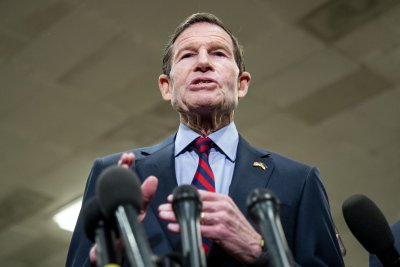
The bill was introduced by Sen. Marsha Blackburn, R-Tenn., and Sen. Richard Blumenthal, D-Conn. It has bipartisan support with 62 senators endorsing it.
“The Kids Online Safety Act is so important because it has that duty of care that says you have to ensure that the design of your platform is not contributing to compulsive use or cyberbullying or anxiety and depression or sexual exploitation,” Golin said. “Having that broad duty — it allows you to adapt. It allows the law to be flexible and adapt to how the platforms may evolve.”
The broad nature of the Kids Online Safety Act is also what has drawn criticism.
Aliya Bhatia, senior policy analyst for the Center for Democracy and Technology, told UPI that newer iterations of the Kids Online Safety Act are much improved over what was introduced in 2022, but it could carry unintended consequences.
“The duty of care has been narrowed and now is replaced with a section called ‘Addressing Harms to Minors. While that’s a really good sign, it is still overbroad and open to subjective interpretation,” Bhatia said. “I worry that we are, under the guise of protecting children, equipping political actors to decide what our kids should and should not see.”
When forced to make judgments about what content constitutes causing anxiety or mental distress to children, Bhatia says social media companies may limit access to a wide list of information, driven by partisan viewpoints.
“Anything from climate change to conflicts, to puberty to LGBTQ identity, depending on what they think the political actors that be don’t want them to see,” Bhatia said. “It also doesn’t address the root issue of a lot of the harms that we see online, which is privacy, which is the vast data collection on minors, on all users.”
Safety scorecard
Public Knowledge, a nonprofit organization based in Washington, D.C., that advocates for free expression and an open Internet, created a scorecard to evaluate the effectiveness of Internet safety bills in Congress. It grades the bills based on preserving Internet access, promoting safe design, risk-based approach, avoiding bans, encouraging autonomy of youth, meaningful enforcement mechanisms and research and transparency.
Sara Collins, director of government affairs for Public Knowledge, told UPI that the Children and Teens’ Online Privacy Protection Act 2.0 is among the bills that would do the “least harm,” particularly the version that is under consideration in the House chamber.
“It is a very classic privacy bill, especially if you’re talking about the House version,” Collins said.
The Senate unanimously passed its version of COPPA 2.0 last month.
The bill expands on 1998’s Children’s Online Privacy Protection Act to incorporate children between the ages 13 and 16. The 1998 law only focuses on children 13 and under.
COPPA 2.0 bans targeting advertisements directed at children under 17, requires consent from parents before collecting information on minors, prohibits designs meant to encourage compulsive use and expands the definition of personal information to include biometric markers and geolocation.
Where the bill falls short on Public Knowledge’s scorecard is in transparency requirements and allowing researchers to access platform data for further study.
Among the proposals Collins has the most concern about is Sammy’s Law. The bill establishes a comprehensive infrastructure for parental surveillance of children’s online activity, including real-time tracking of messages, friends lists and usage.
“It’s very hard to see the long-term consequences of it,” Collins said. “The idea that surveillance infrastructure should be built into the Internet, social media, gaming platforms et cetera, so parents can better monitor their children is a very appealing one in the American political sphere.”
Collins said parental surveillance capabilities as proposed in Sammy’s Law has the potential to create two problems: taking autonomy away from children and normalizing surveillance.
“A child having different views or different beliefs than their parent is not harmful to the parent,” Collins said. “It also normalizes surveillance for children in a bad way. I don’t want the U.S. population to be normalized to constant ever-present surveillance of their communications, their posting, their movements throughout all of cyberspace.”
“If the entire U.S. child’s experience is mediated through that, as they become an adult, instead of your parent doing it, your government, your company or whatever starts doing it, that just becomes the climate you grew up in rather than what it is, which is a serious invasion of your privacy and your anonymity,” she continued.