multiple

Multiple bills highlight challenge protecting children online

April 13 (UPI) — Lawmakers on Capitol Hill are considering more than a dozen bill proposals to protect children online and many approaches face free speech and privacy challenges.

At least 19 bills have been introduced and remain under consideration, proposing measures like age verification, restricting addictive designs, increasing parental controls and addressing content.

Jennifer Huddleston, senior fellow in technology policy for the Cato Institute, told UPI that the volume of proposals before Congress demonstrates the seriousness and complexity of issues related to child safety online.

“First, it does show that there are large public and policymaker questions about how young people are using social media,” Huddleston said. “However, that volume also shows that there’s not a general consensus on what, if anything, should be done in response to those concerns.”

Risks to children online

Josh Golin, executive director of Fairplay, a nonprofit advocacy organization that supports policies to make the Internet safer and less addictive for children, told UPI that online platforms’ addictive designs are one of the key harms he hopes to see Congress address.

“Designing for compulsive use or addiction is at the top of the list,” Golin said. “With that, there’s the fact that the way these platforms are designed often makes kids more vulnerable to sextortion attempts or sexual predators. It makes it easier for drug dealers to prey on kids. It makes it more likely that kids are going to experience cyber bullying. So there’s a lot of ways in which these platforms are designed that lead to unsafe conditions for young people.”

The experts who spoke to UPI largely agree that the proposals in Congress are well intentioned, but striking a balance between protecting children and not infringing on the rights of all remains a difficult task.

“It’s not always an easy thing to do because there’s a lot of nuance that needs to go into it when you consider what information you’re collecting about the user,” Sara Kloek, vice president of education and youth policy for the Software Information Industry Association, told UPI. “How do you protect the safety and security of users, both children and adults, while protecting privacy and civil rights online?”

Paul Lekas, SIIA’s executive vice president of global public policy and government affairs, testified before the House subcommittee on commerce, manufacturing and trade in December when a slate of 18 online child safety bills were advanced. He shared SIIA’s recommendations for measures to improve safety, including minimizing the collection of data on minors and enhancing tools for users to protect their data.

Kloek said data minimization is a key tenet SIIA is calling for in Internet safety laws.

One of the more common proposals in Congress and internationally is the institution of age verification measures.

Australia implemented age requirements for popular social media platforms in December, banning children under the age of 16 from Instagram, Facebook, TikTok, X, Reddit, YouTube, Twitch, Kick, Snapchat and Threads.

Kloek cautions that age verification requires more data collection of all users, including adults. In order to ban children under 16, users older than that must also verify their ages, often sharing personal information like government-issued identification.

“We are thinking about this in a way that bans aren’t necessarily the answer,” Kloek said. “We want to make sure there are safe spaces for youth online and a strict ban would likely drive some minors to places that are not safe.”

Golin agrees that outright banning children from social media could have an adverse effect.

“Approaches that require safety and privacy by design are better than trying to do social media bans,” he said. “I worry that what happens is if you just try and keep the kids off the platforms, they find a way of getting on anyway and then they’re on and they’re not protected at all.”

Kids Online Safety Act

There are at least two bills in Congress that Golin believes would be effective measures to curb the risks children may encounter online: the Kids Online Safety Act and the Children and Teens’ Online Privacy Protection Act.

The Kids Online Safety Act orders online platforms to take measures to mitigate bullying, violence, sexual exploitation and promotion of suicide. Social media platforms would be required to include options to disable addictive features, protect personal information and opt out of personalized recommendations.

The bill was introduced by Sen. Marsha Blackburn, R-Tenn., and Sen. Richard Blumenthal, D-Conn. It has bipartisan support with 62 senators endorsing it.

“The Kids Online Safety Act is so important because it has that duty of care that says you have to ensure that the design of your platform is not contributing to compulsive use or cyberbullying or anxiety and depression or sexual exploitation,” Golin said. “Having that broad duty — it allows you to adapt. It allows the law to be flexible and adapt to how the platforms may evolve.”

The broad nature of the Kids Online Safety Act is also what has drawn criticism.

Aliya Bhatia, senior policy analyst for the Center for Democracy and Technology, told UPI that newer iterations of the Kids Online Safety Act are much improved over what was introduced in 2022, but it could carry unintended consequences.

“The duty of care has been narrowed and now is replaced with a section called ‘Addressing Harms to Minors. While that’s a really good sign, it is still overbroad and open to subjective interpretation,” Bhatia said. “I worry that we are, under the guise of protecting children, equipping political actors to decide what our kids should and should not see.”

When forced to make judgments about what content constitutes causing anxiety or mental distress to children, Bhatia says social media companies may limit access to a wide list of information, driven by partisan viewpoints.

“Anything from climate change to conflicts, to puberty to LGBTQ identity, depending on what they think the political actors that be don’t want them to see,” Bhatia said. “It also doesn’t address the root issue of a lot of the harms that we see online, which is privacy, which is the vast data collection on minors, on all users.”

Safety scorecard

Public Knowledge, a nonprofit organization based in Washington, D.C., that advocates for free expression and an open Internet, created a scorecard to evaluate the effectiveness of Internet safety bills in Congress. It grades the bills based on preserving Internet access, promoting safe design, risk-based approach, avoiding bans, encouraging autonomy of youth, meaningful enforcement mechanisms and research and transparency.

Sara Collins, director of government affairs for Public Knowledge, told UPI that the Children and Teens’ Online Privacy Protection Act 2.0 is among the bills that would do the “least harm,” particularly the version that is under consideration in the House chamber.

“It is a very classic privacy bill, especially if you’re talking about the House version,” Collins said.

The Senate unanimously passed its version of COPPA 2.0 last month.

The bill expands on 1998’s Children’s Online Privacy Protection Act to incorporate children between the ages 13 and 16. The 1998 law only focuses on children 13 and under.

COPPA 2.0 bans targeting advertisements directed at children under 17, requires consent from parents before collecting information on minors, prohibits designs meant to encourage compulsive use and expands the definition of personal information to include biometric markers and geolocation.

Where the bill falls short on Public Knowledge’s scorecard is in transparency requirements and allowing researchers to access platform data for further study.

Among the proposals Collins has the most concern about is Sammy’s Law. The bill establishes a comprehensive infrastructure for parental surveillance of children’s online activity, including real-time tracking of messages, friends lists and usage.

“It’s very hard to see the long-term consequences of it,” Collins said. “The idea that surveillance infrastructure should be built into the Internet, social media, gaming platforms et cetera, so parents can better monitor their children is a very appealing one in the American political sphere.”

Collins said parental surveillance capabilities as proposed in Sammy’s Law has the potential to create two problems: taking autonomy away from children and normalizing surveillance.

“A child having different views or different beliefs than their parent is not harmful to the parent,” Collins said. “It also normalizes surveillance for children in a bad way. I don’t want the U.S. population to be normalized to constant ever-present surveillance of their communications, their posting, their movements throughout all of cyberspace.”

“If the entire U.S. child’s experience is mediated through that, as they become an adult, instead of your parent doing it, your government, your company or whatever starts doing it, that just becomes the climate you grew up in rather than what it is, which is a serious invasion of your privacy and your anonymity,” she continued.

Source link

North Korea conducts multiple missile launches over two days, Seoul says

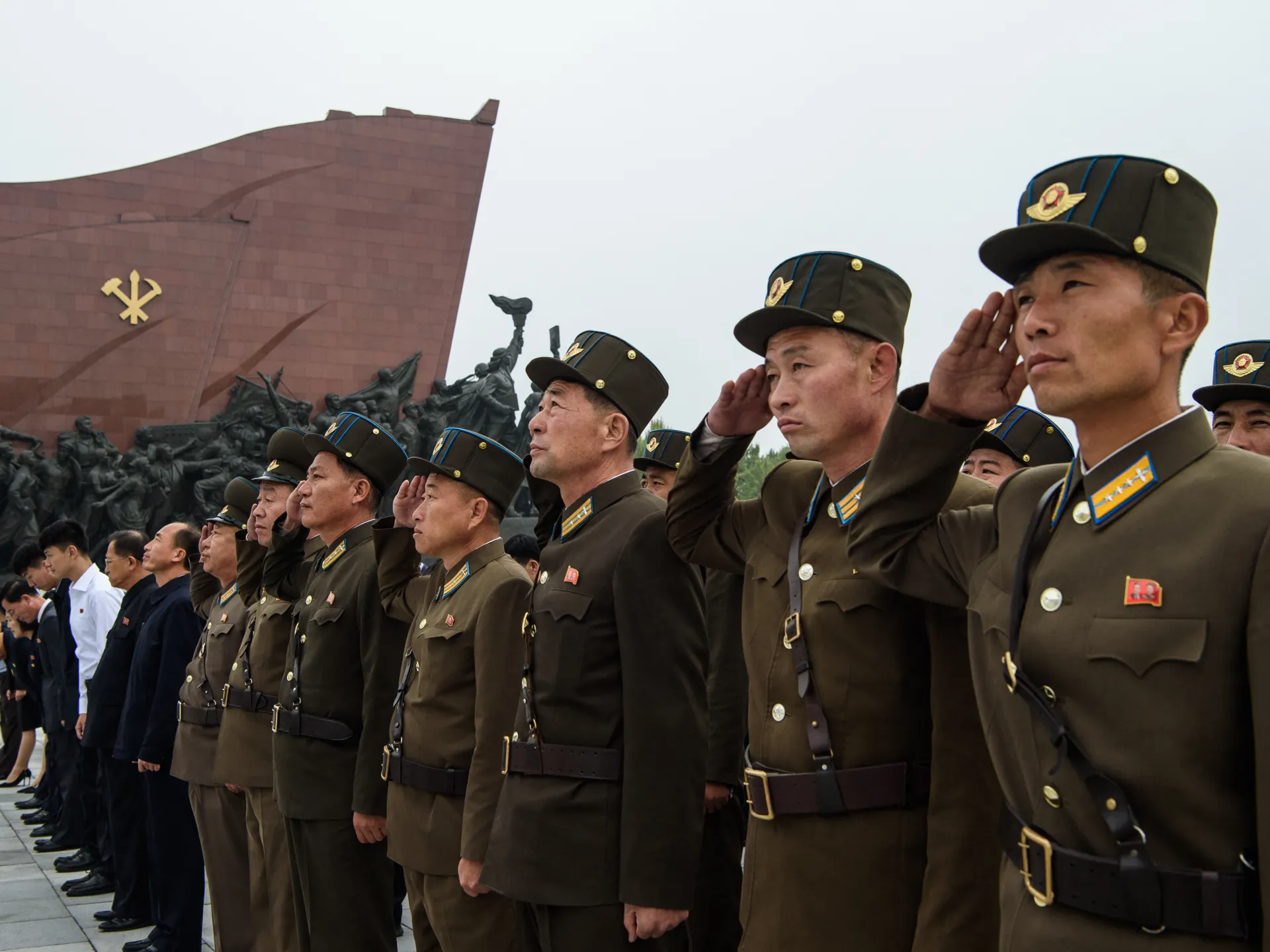
North Korea launched short-range ballistic missiles toward the East Sea on two occasions Wednesday, Seoul’s military said. In this March photo, people watch reports of a North Korean launch at a train station in Seoul. File Photo by Jeon Heon-Kyun/EPA

SEOUL, April 8 (UPI) — North Korea fired short-range ballistic missiles on two separate occasions Wednesday, Seoul’s military said, marking three launches over two days after South Korean President Lee Jae Myung expressed regret over a drone incursion.

At 8:50 a.m. Wednesday, the North launched several short-range ballistic missiles from its coastal Wonsan area toward the East Sea, Seoul’s Joint Chiefs of Staff said in a text message to reporters.

The missiles flew approximately 150 miles, the JCS said, adding that South Korean and U.S. intelligence authorities are analyzing their exact specifications.

“Under a steadfast South Korea-U.S. combined defense posture, the military is closely monitoring North Korea’s various movements and maintaining the capability and readiness to overwhelmingly respond to any provocation,” the JCS said.

North Korea later fired a single short-range ballistic missile from Wonsan toward the East Sea at 2:20 p.m. Wednesday, the JCS said in a separate message. The missile flew approximately 435 miles.

The launches came one day after the South’s military detected an unidentified projectile fired from the Pyongyang area. The JCS said South Korean and U.S. intelligence officials are still analyzing its detailed specifications.

Hawaii-based U.S. Indo-Pacific Command said it detected both days’ launches and was consulting with regional allies and partners.

“Based on current assessments, this event does not pose an immediate threat to U.S. personnel or territory, or to our allies,” the command said in a statement.

The launches came after a statement by Kim Yo Jong, the powerful sister of North Korean leader Kim Jong Un, describing President Lee as “frank and broad-minded” after he expressed regret over unauthorized drone incursions into the North.

Lee had addressed the drone issue earlier Monday during a Cabinet meeting, following last week’s indictment of three individuals accused of carrying out incursions between September and January.

“Although this was not an act by our government, I express regret to the North Korean side over the unnecessary military tension caused by such reckless behavior,” Lee said during the meeting.

While Kim’s remarks struck a less hostile tone than recent statements from Pyongyang, she still included a warning to the South to “stop any reckless provocation against the DPRK” and to “refrain from any attempt at contact.”

The Democratic People’s Republic of Korea is the official name of North Korea.

North Korea’s first vice foreign minister, Jang Kum Chol, later dismissed Seoul’s positive interpretation of the remarks, calling them a “hope-filled dream reading.”

In a statement released late Tuesday and carried by the official Korean Central News Agency, Jang said that the South’s identity as “the enemy state most hostile to the DPRK can never change with any words or conduct by its chief executive.”

Victor Cha, president of the geopolitics and foreign policy department at the Center for Strategic and International Studies, cautioned against reading into the timing of the launches relative to Kim’s drone statement.

“I’m more and more of the view that the recent missile demonstrations we’ve seen by North Korea are not testing and they’re not political statements — they’re exercising,” Cha told UPI during a press briefing at the Asan Plenum policy forum in Seoul.

“I don’t think [North Korea] had any notion of when the South Koreans were going to convey communications on the drone activity,” Cha said. “If anything, these [launches] just happened to be on parallel tracks.”

North Korea last fired ballistic missiles toward the East Sea on March 14 as the United States and South Korea held their annual springtime joint military exercise. Pyongyang later said the launches were part of a firepower strike drill involving 600mm multiple rocket launchers overseen by Kim Jong Un.

Source link

Royal Caribbean ‘cancels multiple scheduled cruises for 2027’ & offers refunds to customers with already booked trips

The Royal Caribbean Freedom of the Seas cruise ship sailing from PortMiami, with people and palm trees in the foreground.

ROYAL Caribbean has reportedly canceled a number of scheduled cruises out of Miami this summer.

The cruise ship operator is said to have told guests with already booked trips they are eligible for full refunds if offered alternatives do not work.

The Royal Caribbean Freedom of the Seas cruise ship sets sail from PortMiami.
The Royal Caribbean Freedom of the Seas cruise ship sets sail from Port Miami on March 12Credit: Getty

In an email seen by Royal Caribbean Blog, the company tells customers: “As part of our ongoing itinerary planning process – which sometimes requires flexibility due to scheduling, port agreements, or operational needs, Freedom of the Seas will be redeployed for our Summer 2027 season.

“We know how much effort goes into planning your vacation and apologize for the inconvenience.”

It is understood the liners will be redeployed to Southampton in the United Kingdom.

A spokesperson for Royal Caribbean told The New York Post: “Freedom of the Seas will sail from Southampton for the 2027 summer season, reflecting the continued strength of the UK & Ireland market.

“The move represents an upsizing of capacity and brings a Freedom Class ship — long regarded as a favorite among British and Irish guests — back to the region.”

Upwards of 20 voyages on Freedom of the Seas between May and September are thought to have been moved.

The trips were scheduled to depart from Miami to the Bahamas, Aruba and Curaçao.

The decision comes just weeks after Carnival Cruise Line pulled the plug on 11 routes.

The scrapped trips were aboard Carnival Firenze, the line’s Italian-themed ship that sails from Long Beach, California in short runs. 

Carnival said the affected departures were scheduled between October 12, and November 16. 

The change in Caribbean’s schedule means customers have been invited to rebook on alternative sailings or claim full refunds.

The email to customers adds: “Regardless of the sailing length of the cruise you move to, if your booking was already paid in full and your cruise fare decreases, we’ll provide you with a refund for the difference.”

The Royal Caribbean Freedom of the Seas cruise ship sailing from PortMiami, with people and palm trees in the foreground.
Freedom of the Seas will be redeployed for the Summer 2027 seasonCredit: Getty

Latest cruise line news

  • Norwegian and Carnival previously cancelled all sailings to a popular tourist spot
  • One major cruise line was blasted for quietly introducing a mandatory fee for all its restaurants and experiences
  • Royal Caribbean added America’s Got Talent stars to the entertainment roster
  • One trip was deemed the ultimate family cruise as it offers water roller coasters and a private island
  • Major US cruise operator suddenly cancels scheduled voyages and offers passengers full refunds

Source link