Hate speech against Indians, Bangladeshis and Pakistanis in the United States has risen sharply online, according to a report that traces the surge to US President Donald Trump’s immigration crackdown and rhetoric, economic anxiety, and the South Asian community’s growing visibility in US life.
The report, titled “The Rising Tide of Anti-South Asian Hate in the United States”, by the Center for the Study of Organized Hate (CSOH), published on Sunday, found that the monthly volume of hate towards South Asians in the US on the social media platform X rose 240 percent between January 2024 and June 2026, from 12,904 posts to 43,843.
Recommended Stories
list of 4 itemsend of list
Researchers identified more than 542,000 hateful posts on the platform between January 2025 and June 2026 alone towards people from South Asia living in the US, with five of the six highest-volume months falling at the end of that period.
The researchers used the United Nations definition of hate speech. They tracked recurring anti-South Asian slurs and narratives online, reviewing posts to exclude criticism that did not meet the UN threshold.
They found that nearly half of the hate posts on X accused South Asians of invading the US, stealing jobs or threatening the country demographically, while the derogatory slur “pajeet” and its variants showed up in 30 percent of hateful posts on X and 45 percent on fringe platforms.
Posts depicting South Asians as dirty or unhygienic grew by 171 percent on X, “the fastest of all narratives”.
The hate frequently collapsed South Asian ethnic and religious groups into one, with Indians, Pakistanis and Bangladeshis conflated with one another, and Hindus, Muslims, Sikhs and Christians also treated as a monolith.
So why now?
Racism against Indians, Bangladeshis and Pakistanis has a long history in the US, but researchers argue the current surge reflects a confluence of longstanding prejudices and new political and economic pressures.
The report points to the H-1B visa programme, which allows US employers to hire skilled foreign workers, as a major flashpoint. Indians account for more than 70 percent of H-1B visa holders, and researchers linked several spikes in anti-South Asian hate to political fights over the programme, such as when Trump imposed a $100,000 payment requirement on certain new H-1B petitions in September 2025.
“Such actions serve a powerful symbolic function, in the bargain reinforcing the hostility of Trump’s base toward South Asians,” said the report.
The report makes the same argument about the administration’s rhetoric, highlighting Trump’s speech at an AI summit in July 2025, in which he criticised US technology companies for outsourcing jobs to India, after which researchers saw a sharp spike in anti-South Asian rhetoric online.
As more recent examples, the report points to a since-deleted September 2026 Department of Homeland Security post titled “Transformers: Age of Deportations”, featuring a Sikh man identified as “Mr Singh” and telling him to “get off our roads”.
Days later, the Department of Education posted “Make College Football Great Again”, after Texas Republican Bo French had complained about the presence of South Asians at a University of Texas football game.
The report argues that such rhetoric reinforces the idea of South Asians as outsiders who “can never truly belong in the country”.
From ‘model minority’ to job thieves
Economic resentment is another factor, researchers wrote, with the success of some South Asians increasingly being weaponised against them.
Indian Americans once stereotyped as a “model minority” are now portrayed as “opportunists and cheats”, and South Asians are used more broadly as a scapegoat for anger over jobs and the economy.
This comes as South Asians have become increasingly visible in US politics, from former Vice President Kamala Harris and New York Mayor Zohran Mamdani to Vice President JD Vance’s wife, Usha Vance, and politician Vivek Ramaswamy. The report documents racist attacks against figures across party lines and highlights how, for example, Mamdani’s primary and mayoral victories triggered spikes in anti-South Asian and Islamophobic abuse.
Researchers say both trends are now also tied up with “anxieties on the part of the majority about loss of status”, and feed the “Great Replacement Theory”, a conspiracy about the white population in Western countries being replaced by an orchestrated takeover.
Social media has also turned those narratives into targeted harassment.
Researchers found X accounts doxxing South Asians accused of taking jobs or committing visa fraud, while influencers have confronted people at their homes and workplaces and posted the encounters online. Doxxing refers to exposing a person’s private details, such as their home address, online.
In one example, right-wing influencer Sara Gonzalez posted a video to more than half a million followers in which the report says she harassed a South Asian person she accused of exploiting the H-1B programme.
Meanwhile, generative AI has made that content even easier to produce, researchers say, depicting South Asians as “filthy and unclean, sexually predatory, culturally backward, or a demographic threat”.
While the report tracks hate largely through what is happening online, researchers write that online hate “does not exist in isolation from offline forms of hostility”. It cites a July incident in which an Indian Muslim mall employee in Utah was repeatedly stabbed in an attack that federal prosecutors charged as a hate crime. In September, a Sikh truck driver was stabbed 17 times at a Wyoming truck stop.
“Online and offline hate can reinforce one another”, the researchers wrote, “as narratives, stereotypes, and forms of demonization move between digital platforms, political discourse, media, and everyday life”.





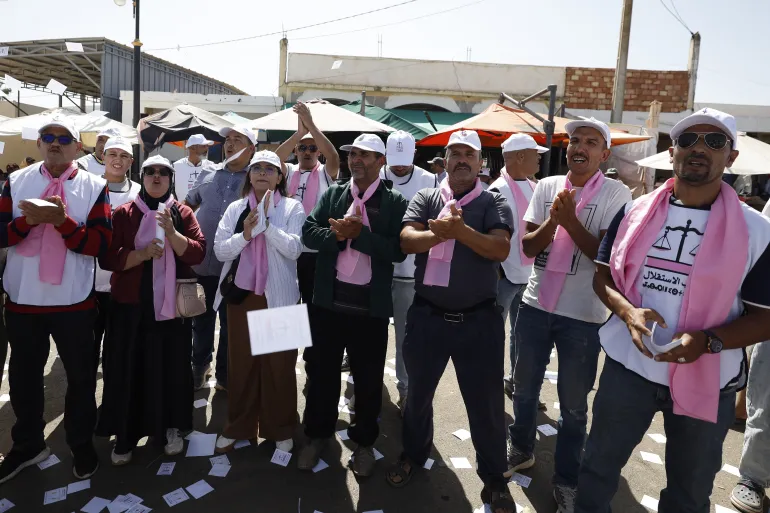
![Campaigners and supporters of the Istiqlal Party (PI) chant slogans during a rally at the weekly souk in the rural commune of Ait Ikkou, in the Khemisset region, on September 19, 2026, before Morocco’s legislative elections [AFP]](https://i0.wp.com/occasionaldigest.com/wp-content/uploads/2026/09/afp_6ab11af2690d-1789991666.jpg?w=640&ssl=1)
![Campaigners for the Popular Movement (MP) hand out leaflets to merchants at the weekly souk in the rural commune of Ait Ikkou, in the Khemisset region, on September 19, 2026, before Morocco’s legislative elections [AFP]](https://i0.wp.com/occasionaldigest.com/wp-content/uploads/2026/09/afp_6ab11b21c12e-1789991713.jpg?w=640&ssl=1)