In a previous article, we suggested that the opposition activate street mobilization to secure a safe seat at the negotiating table of the transition—where, for now, only Delcy Rodríguez and Trump seem to have a voice. The goal is not to derail the transition, but to make it impossible to move forward without guarantees that it will culminate in a genuinely democratic regime.
To avoid draining popular energy through a call for street demonstrations around a goal that may seem implausible, the opposition should focus on rebuilding trust within the broader social base through periodic, predictable, and sustained mobilizations. Once a week, for example, on a fixed day. Such a strategy would also serve to test how willing chavismo is to repress, using less combative slogans and instead pushing for modest concessions that the Rodríguez regime might already be prepared to grant.
A possible example of this type of demand was the call for the release of political prisoners loudly voiced by student movement activists, human rights groups and associations of relatives. Mobilizations have become recurrent over the past couple of weeks. The anticipated repression has not arrived, and scenes such as UCV student representatives directly confronting Delcy Rodríguez seem to signal a renewal of Venezuelan society’s defiant spirit. The unexpected announcement of an Amnesty Law and the closure of El Helicoide as a political prison are beginning to feel like hard-won gains for a sector of the country long accustomed to the sterility of its struggle.
These gains, however, have limits. The re-incarceration of Juan Pablo Guanipa as a disciplinary gesture toward the opposition’s leadership continues to reveal the regime’s sensitivities—but also its internal fractures (clashes between moderate and hardline factions) and openings for further struggle.
With the Hate Law still in force, NGOs outlawed, uncertainty over the final wording of the Amnesty Law, the persistence of state-terror structures and other detention centers, one cannot be certain that the current process of political liberalization will not suffer setbacks should the whims of the Executive shift. Even so, these remain victories that inspire other sectors. A group of workers demanding an update to the minimum wage managed to protest outside the Supreme Tribunal of Justice without facing repression.
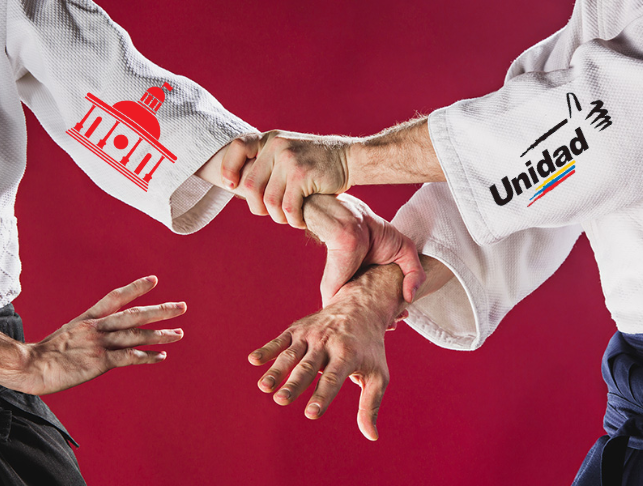
The opposition must embrace a strategy less rooted in open confrontation and more in applying political aikido to the regime.
There is, however, a glaring absence: political parties and María Corina Machado, who, being abroad, has not managed to forge a genuine connection with these mobilizations. Without party-based political organization behind these demands, there is a risk of missing the opportunity to build a true movement capable of pressuring the government toward re-democratization.
What is lacking is the activation of leadership and a national organization capable of proposing a political program in which these demands can be recognized as interconnected. One where the strength of multiple social sectors affected by state neglect can reinforce one another.
For the opposition, the risk is not only being left behind when the ‘transition train’ departs, but also that the Rodríguez-led economic reforms—encouraged by US oil interests—could generate a new consumption and welfare boom that eventually dampens political protest. If the most skeptical sectors begin to believe that economic liberalization without political liberalization is an acceptable arrangement after decades of social decline, the space for democratic struggle could narrow significantly.
So how can this missing piece in the national political moment be recovered?
In search of political parties
For now, Machado’s return to Venezuela is unlikely without security guarantees. Nor do we believe her physical return is strictly necessary to produce an organized democratic movement. What matters is restoring grassroots organizational structures which, as the example of the Comanditos showed, are possible in our country. Especially when the cost of repression appears to be rising.
In this context, the opposition must embrace a strategy less rooted in open confrontation and more in applying political aikido to the regime. Aikido, as a martial art, centers on using your opponent’s force against them. Politically speaking, the opposition does not need to impose an alternative transition agenda on chavismo at this moment. Instead, it should take the agenda that Delcy and Jorge Rodríguez are proposing and deepen it. Where it sees a small crack open, it should place its foot in the gap until the door opens wide enough to pass through. And chavismo is already offering such an opportunity with the reorganization of the party system.
Jorge Rodríguez, as president of the National Assembly, announced that the PSUV would seek to reform the Electoral Code. A few days later, the National Electoral Council (CNE) announced the temporary suspension of the party registration and revalidation period. One hypothesis is that, in response to US demands for some degree of political liberalization, chavismo may facilitate the normalization of parties previously intervened by the judiciary and lift disqualifications barring political leaders from running for office.
Whether or not this proves true, opposition parties must seize this window of opportunity to reactivate their militant structures by convening neighborhood assemblies, open town halls, and even engaging in dialogue with communal councils to bring the legislative agenda proposed by chavismo itself into public debate.
By targeting the National Assembly as the focal point of mobilization, the opposition would not only pressure the regime but also force the hand of those lawmakers who call themselves opposition.
This requires political pedagogy from the opposition: demonstrating that this is not simply capitulation, but rather an acknowledgment that the transition to democracy is a gradual process that demands strategy, shrewdness, maturity—and, crucially, organization and active civic commitment as new pockets of freedom are won and the struggle progressively deepened. Such mobilization should aim to re-oxygenate party cadres and lend legitimacy to the proposals that might emerge during parliamentary debates over reform.
Naturally, tensions arise. The opposition deemed legitimate in the eyes of the public earned that status precisely by completely refusing to compete in the 2025 legislative elections, and therefore holds no seats in the Assembly. Conversely, opposition lawmakers that chavismo tolerates lack credibility among the broader opposition base. Yet this doesn’t need to be an obstacle for democratic forces, which can continue to pressure the Legislative branch from the outside. For instance, Machado’s leadership could call mobilizations on the days of parliamentary debate—not to oppose the discussions outright, but to demand that the people’s demands be heard in the reforms to come.
On the one hand, there is clearly no guarantee that all demands will be incorporated or that reforms proposed by the opposition-outside-the-Assembly will translate into effective legislation. But the return in militant energy and organizational capital for political parties may outweigh the legislative outcome itself, since that strengthened organization becomes the new foundation for future mobilizations.
On the other hand, by targeting the National Assembly as the focal point of mobilization, the opposition would not only pressure chavismo but also force the hand of those lawmakers who call themselves opposition yet face credibility issues. Politics is, after all, a game. The moral maximalism with which the legitimacy of opposition leaders is often judged can become an obstacle to recognizing that the Capriles Radonskis of the 2025 Assembly do not need to be wholehearted opposition figures.
One effect of January 3 was that Capriles himself—a detractor of Machado—praised her leadership position, likely driven by political calculation. Yet it is precisely these political interests that democratic forces can exploit. These positioning lines are openings the opposition can deepen, twisting not only the government’s arm but also that of these lawmakers, pressuring them to answer to the organized groups outside the Assembly. Establishing channels of communication with such lawmakers would not contaminate the democratic struggle if approached from a standpoint of strategic pragmatism.
So long as the means employed do not undermine the ultimate objective—the consolidation of a democracy grounded in memory, truth, and justice—the opposition would do well to weigh its alternatives with less moral timidity and greater political maturity.