Venezuelan Opposition

Why Venezuela Needs María Corina to Go Home

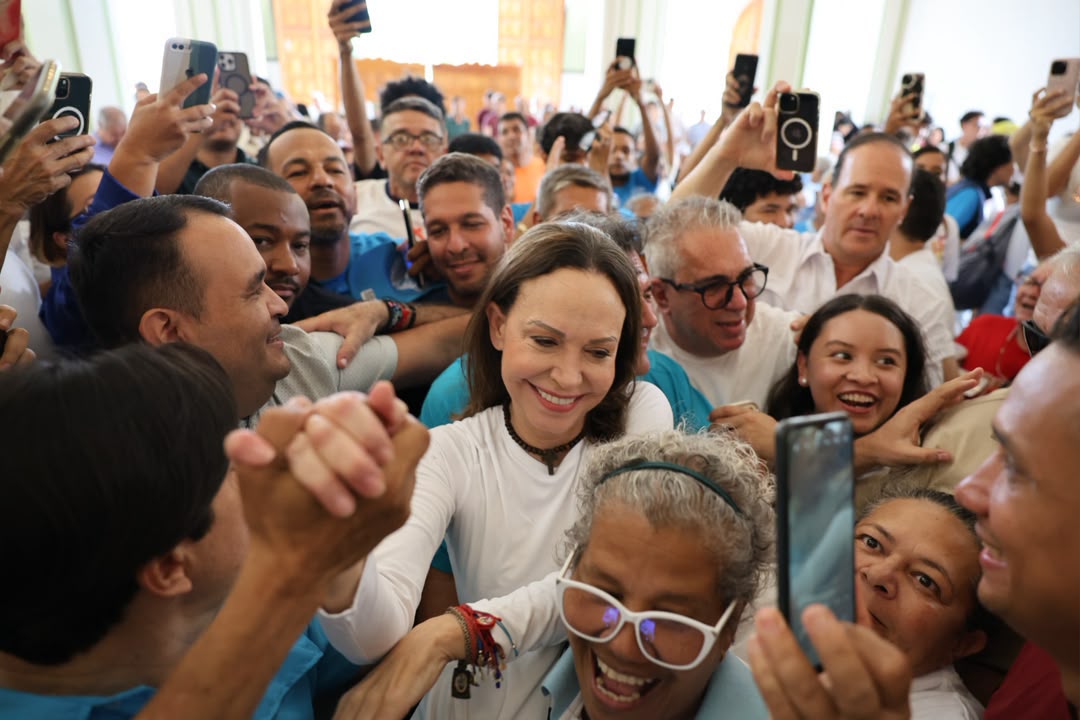
Maria Corina’s return to Venezuela is looking imminent. Her willingness is hurried by her desire to stand next to Venezuelans after the devastating earthquakes, and by the risks of remaining in exile while the emergency unfolds. Her return trip now looks like a matter of when, not if.

Last weekend, Bloomberg’s Eric Martin reported that US officials made it clear to both Dutch and chavista authorities that Washington wouldn’t support her return, when she was planning to fly to Venezuela from Curacao. Machado countered in a video distributed Tuesday, claiming she intends to do “whatever is necessary” and speak to “whoever is needed” to serve the Venezuelan people. 

Meanwhile, officials in Washington are backing the regime and trying to distance themselves from her intentions. In a recent interview, the chargé d’affaires in Caracas praised the commitment of Delcy’s regime to work and collaborate with the US. A State Department spokesperson said on the record that chavismo remains “the ultimate authority over their territory,” further empowering the Venezuelan State to react negatively if the opposition leader shows up. 

An unprecedented catastrophe once again exposed the incompetence of the Venezuelan government. Yet the Trump administration continues to tilt the scales in Delcy’s favor. This time, by offering no guarantees and taking no official position on Machado’s return, contradicting the assurances given by Marco Rubio and Ambassador Michael Kozak during congressional hearings earlier this year. 

A complex set of stakeholders is determining the terms of this event. Machado’s return will have a direct impact on the challenges she is set to face in the first days and weeks after arriving. Blocking it entirely will only intensify the social tensions already simmering within the country. However, an arrival without a clear operational contribution risks undermining her leadership.

While exile has helped Machado advance the democratic cause across the world and coordinate closely with allies, the benefits of staying outside the country no longer outweigh the costs.

The Venezuelan people await a leader that steps up to fill the institutional and operational vacuum left by a regime that has abandoned the population. The last seven days have been characterized by the lack of adequate relief to rescue survivors and assist refugees on ground zero. The Venezuelan State has been exposed in what should be its core mission. Time is running against everyone involved. 

While exile has, to an extent, helped Machado advance the democratic cause across the world and coordinate closely with allies, the benefits of staying outside the country no longer outweigh the costs.  For many, the clock is ticking under the rubble and their grievances can no longer be addressed with digital messaging.

Since Nicolás Maduro and Cilia Flores were captured, every passing day has raised more doubts regarding Machado’s autonomy and political agency. The saga surrounding her return is casting doubts on Washington’s ultimate support for the Nobel laureate, putting a large question mark over long-term plans to have her truly involved in a purported transition. For the opposition leader, recognizing Trump as an ally in the pursuit of a democratic Venezuela is understandable. Allowing him to dictate your decisions in one of the most crucial moments in Venezuela’s history is a very different thing.

Trump’s intentions over post-Maduro Venezuela have definitely eroded. Elite expectations of a swift economic recovery that pervaded post-January 3 conversations changed dramatically. But as the little credibility the Rodríguez siblings had evaporated in a matter of days, the Trump government continues to hold María Corina down. This happens as we know the US retains more than enough influence to allow the Nobel laureate to return to her country during a national tragedy, with or without a valid passport.

For María Corina to regain Washington’s support, she has to succeed in becoming a figure that inspires stability. 

Since 2025, María Corina has tried to communicate that she can persuade the Trump administration over Venezuela. For instance, when it came to the need to pressure Maduro to step down, to finally resort to military means to remove him, to press for the release of political prisoners, and so it goes. Trump himself has repeatedly shown he doesn’t need Machado to have his goals met in Caracas. This emergency could now emerge as a train crash between Trump’s interests and those of the democratic opposition. Unlike Delcy, whose main goal is to retain power and survive chavismo’s demise, María Corina cannot afford to have minimal leverage over Washington. At least not anymore. The earthquakes’ aftermath, then, is also an opportunity for her to forcefully drive a realignment of US tutelage over reconstruction and democratization efforts. Or to finally expose Trump over conflicting interests.

Civil defiance against regime forces is increasing on the ground, a sign that social unrest is emerging among a population without someone to look up to for help. Blocking María Corina’s entry might feed tensions created by the vacuum produced by the State. If people continue to be left to their own devices, this could spark a new, critical chapter of social conflict in the country’s history.

Relief efforts have already provided a positive platform for local leaders who have delivered. A good example is Chacao mayor Gustavo Duque, who has been able to establish and communicate the most effective operational coordination from a local government official. María Corina would need to replicate this at a larger scale while raising the standards, relying on non-government tools and human capital at her disposal. 

The regime’s complete lack of response and its attempts to block relief efforts need to be challenged. Machado’s ability to organize efforts through civil society and allied NGOs, coordinate with international rescuers and foreign governments, muster operational capacity through Vente Venezuela’s comanditos and local political structures, and deliver sensible (and sensitive) communications could be crucial to contrast with the regime’s negligence. Her responsibility would not be to engage in political campaigning with other opposition leaders, but to establish a backbone for operational organisation, even a chain of command that makes the efforts of Venezuelan civilians more effective. When it comes to logistics involving civilian volunteers, the famous electoral strategy of 2024 showed what Machado’s leadership can achieve. The stakes are even higher this time.

Chavismo’s negligence is fueling instability that could jeopardize the economic and political gains the US hopes to secure in Venezuela.

Machado must demonstrate that she can contain the threats to Trump’s post-Maduro narrative that inevitably emerge from the country’s current state of political and institutional orphanhood

The likes of Delcy and Cabello will try to obstruct Machado’s networks and allies from providing assistance and support. Their goal would be to secure Machado’s failure in supporting the people. Nonetheless, the costs of repression are currently at the highest due to the state of widespread desperation. Attempting to block or even capture Machado could come at a high price, yet they will use every resource available to hinder her initiatives.

For María Corina to regain Washington’s support, she has to succeed in becoming a figure that inspires stability. 

Chavismo’s negligence is fueling instability that could jeopardize the economic and political gains the US hopes to secure in Venezuela. Machado must demonstrate that she can contain the threats to Trump’s post-Maduro narrative that inevitably emerge from the country’s current state of political and institutional orphanhood. If Washington cannot mitigate those risks soon, as it has sought to do in the wake of its February strike on Iran, a Venezuela policy in crisis could become yet another political liability for the Trump-dominated GOP ahead of the November elections. 

Between Trump’s continued support for the regime and Delcy’s incompetence in addressing the emergency, there is an opportunity for María Corina to make a consequential return. Throughout the history of anti-chavista politics, no leader has been able to withstand the political test that coming back from exile poses. If the ambitions of María Corina and her supporters become reality, she will inherit the long-term consequences of the tragedy. Her return offers a critical opportunity to take immediate responsibility, show the type of public-servant leadership she should offer, and channel the frustration of Venezuelans into collective actions.

Venezuelan civil society has risen to the occasion. The people have become the heroes lifting the country’s ruins. But Venezuelans remain in desperate need of a leader. Not to raise our hopes, which I believe we have found among each other. But for the guidance necessary to face the wreckage chavismo continues to leave behind.

Source link

A Tiger’s Shadow Stalks María Corina Machado

For a quarter century, Venezuelan politics has revolved around a single divide: chavismo versus anti-chavismo. Entire political careers were built around that struggle, as parties rose and fell according to their ability to interpret it. Leaders were judged less by what they proposed than by how effectively and fervently they opposed the regime. 

No one has embodied that tradition more successfully than María Corina Machado. Her achievement was not simply electoral. She transformed anti-chavismo from a coalition of parties and personalities into something closer to a political identity.

That transformation helped make Machado the dominant figure in Venezuelan politics since 2024. It may also explain why the beast showing its fangs at the other side of the Western border deserves to be taken seriously by the opposition. 

Political movements rarely remain the property of the people who built them. Over time, people begin to invest parts of themselves in them. They become attached not only to leaders, but to their own idea of what those leaders represent. Their loyalties gradually shift from individuals to identities, at that point, succession becomes possible.

The curse of the trailblazer

Colombia’s recent election offers an intriguing illustration of how this process can unfold. At first glance, Abelardo de la Espriella’s victory looked like a victory for the Colombian Right. It may turn out to have been something more interesting.

De la Espriella did not defeat Uribismo. If anything, he inherited it. Many of his voters still admire Álvaro Uribe and some probably voted for him repeatedly. What changed was not their opinion of Uribe, but their sense of who now spoke most convincingly for the political tradition he created.

The Tiger did not campaign against Uribe’s legacy. He campaigned as its most uncompromising heir, as he described himself “más uribista que doña Lina” (Uribe ‘s wife). His appeal rested on a simple proposition: Uribe had been right all along, but those who claimed to represent his legacy lacked either the conviction or the will to carry it through to its logical conclusion. This is a very different kind of political challenge. It does not seek to replace a movement. It seeks to inherit it.

De la Espriella’s voters didn’t change their opinion of Uribe, but their sense of who now spoke most convincingly for the political tradition he created.

That possibility should sound familiar to Venezuelans.

The question is not whether Machado is losing support. By any reasonable measure she remains the dominant figure in the Venezuelan opposition. The more interesting question is whether anti-chavismo, having become an identity in its own right, could one day develop ambitions, expectations and frustrations that exceed her ability to contain them.

The strange thing about political victories is that they rarely belong entirely to those who achieve them. Over time, successful leaders create constituencies, expectations and myths that acquire a life of their own. What begins as a political movement gradually becomes a political identity, and once identities take root they stop asking permission from the people who created them.

The comparison that comes most readily to mind is Winston Churchill. The British prime minister lost the first election after the Second World War, in one of the great paradoxes of democratic politics. The standard explanation is that Britons decided the war had been won and wanted someone better suited to building the peace.

Bukele, Trump and Milei often feature more prominently in the imagination of many Venezuelans than the leaders who shaped domestic opposition politics before Machado.

The Venezuelan case may eventually present the opposite problem. Machado’s future challenger, once one emerges, is unlikely to argue that the struggle against chavismo has ended. If anything, the argument would be the reverse: not that Machado was wrong, but that she stopped too soon.

If such a figure were ever to emerge in Venezuela, it would likely appear first as a sentiment rather than as a politician.

A nameless threat

One can already glimpse fragments of that sentiment across the Venezuelan diaspora, in Miami, Houston or Madrid among voters who remain deeply committed to the opposition but increasingly impatient with the pace of events, and Machado’s approach to Trump’s plan. Many admire Machado, some even revere her. Yet admiration and impatience are not mutually exclusive sentiments.

A decade ago, one of the most common criticisms of Machado was that she was too confrontational. Today, some of her critics seem to believe she has not been enough of a hardliner. The shift may appear subtle. It is anything but that.

What unites these constituencies is not necessarily ideology. Many disagree on policy, strategy and even on the nature of a future Venezuelan transition. What they seem to share is a growing impatience with the political habits that defined the opposition during the previous two decades. Their political reference points are increasingly international. Bukele, Trump and Milei often feature more prominently in their imagination than the leaders who shaped Venezuelan opposition politics before Machado.

The result is a political vocabulary that would have sounded unfamiliar not long ago. Arguments about negotiations and elections increasingly coexist with arguments about strength, authenticity, betrayal and whether the opposition has shown sufficient willingness to exercise power rather than merely seek it.

The Tiger represents a possibility: that the greatest challenge facing anti-chavismo in the years ahead may not come from its enemies, but from the unresolved question of what victory should look like.

None of this means that a Venezuelan Bukele is waiting in the wings, nor does it suggest that Machado’s position is immediately threatened. As things stand, the opposite appears true. But political identities rarely remain frozen in time. They absorb new influences, adapt to new frustrations and develop new aspirations. The question is whether anti-chavismo is beginning to do the same.

Perhaps someone like Abelardo The Tiger never comes. Perhaps Machado successfully leads Venezuela through a transition and remains the uncontested leader of the movement she helped build. That remains the most likely outcome.

But history suggests that political movements rarely remain suspended in a single moment forever. The forces that transformed Machado into the dominant figure of Venezuelan opposition politics, frustration, perseverance, impatience, conviction and a refusal to accept the permanence of chavismo, are not forces she alone controls.

That is why The Tiger matters. The point is not whether it materializes as a candidate, a faction or a movement. The point is that it represents a possibility: that the greatest challenge facing anti-chavismo in the years ahead may not come from its enemies, but from the unresolved question of what victory should look like.

For 25 years, Venezuelan politics revolved around how to confront chavismo. María Corina Machado provided the most compelling answer that question has yet produced. The shadow crouched in the woods is the possibility that a different question is beginning to emerge.

And predators have a peculiar habit. They tend to show up before people eventually give them a name.

Source link

Maria Corina’s Pitch for Elections in Venezuela, Explained

Photo: Humberto Villalobos in February 2023, months before the last opposition primaries

While Washington’s focus seems to be shifting toward security and armed groups, Machado’s team keeps its priorities clear, looking beyond the immediate circumstances. The Nobel Peace Prize laureate keeps saying that an election will be the vehicle to channel a transition to democracy—an event where the anti-chavista movement sees itself as the clear winner. Following the 2023 and especially the 2024 elections (where the coalition successfully defended a clear victory for Edmundo González by collecting and publishing 85% of the official tally sheets), it is not far-fetched to say that this is where the Venezuelan opposition’s greatest strengths lie, even under adverse conditions.

At Caracas Chronicles, we sat down with Humberto Villalobos—Vente Venezuela’s electoral chief, who coordinated Machado’s famous defense machinery—to discuss the current gap between ideal electoral conditions and reality, now that the publication of the Panama Manifesto has opened the opposition to negotiating elections with chavismo, naming Machado as the leader (or conductora) of the process.

Machado’s team is proposing changes that, to a large extent, aim to “demolish” the electoral system as we know it. Among other measures, this involves migrating to a hybrid system that would get rid of the ExCle voting machines, (paper ballots would be counted by hand), establishing a CNE in a novel fashion, improving the Venezuelan Electoral Registry so it accurately reflects how the population is scattered both inside and abroad, and implementing a mechanism to legalize political party competition in practice.

Once a new CNE is formed and the electoral calendar is published, Villalobos says this study could contribute to the renewal of the Electoral Registry. Under the proposal, the Registry would be renewed in three months.

This is a baseline proposal that could change in a scenario where Villalobos views the US as the guarantor of an agreement: “Delcy will make proposals, we will too, and in the end, all those things will be considered to yield something reasonable.” He envisions an election that is “simpler to produce,” stripping away the obvious strategic advantages that chavismo has historically claimed for itself during elections. “Under other conditions,” Villalobos says, “none of this would even be on the table. But here they proved to us that they can pass an energy reform in 15 days. You could do something similar to make elections happen, something just as important as pumping oil.”

First: an independent citizen register

Villalobos began by describing the need to produce a rigorous study of the local and migrant populations to understand the country’s actual electoral reality. The opposition would gather information directly from the people to understand who still lives where the Electoral Registry says they do, who left the country, and how many voters would require a change in their polling station. Villalobos calls this empadronamiento: the creation of a citizen residency register. The objective, he notes, is for the majority of voters to update their addresses through a digital platform featuring biometric facial recognition (ABIS) identification mechanisms, or at registration points operated by a network of enumerators or empadronadores

Once a new CNE is established and the electoral calendar is released, this study could assist in overhauling the Electoral Registry, the current state of which Villalobos calls “disastrous.”

“While citizens are changing their voting addresses, they could also support a political party. From that, you would yield parties with validated groups of voters.” 

The digital platform and the network already exist. Vente has started the process with its own members, and all current enumerators hold positions within the party: “We originally thought of it just for Vente, and as we grew, we envisioned it as a solution for all Venezuelans.” They would only need the people’s consent to use their data. Villalobos admits that managing a database of this scale carries an enormous burden of responsibility, but the alternative would mean negotiating while relying exclusively on data managed by the chavista state, which “treats it as its own asset.”

“At the end of the day, we are the only ones ready to do it. The systems being employed are the ones we already used in the 2024 presidential election. We simply added an extra feature that allows for enrollment of this type,” Villalobos asserts. “That feature handled half of the tally sheets we transcribed. And that gives you the certainty that you can handle millions. Furthermore, the guarantee is being provided by María Corina Machado.”

Second: ad hoc CNE, Electoral Registry, and political parties

The proposal rests on the premise that the CNE’s current structure is too flawed to fix simply by appointing a new board of rectors (or “electoral commission,” as Marco Rubio has called it). They propose a new, temporary electoral authority termed ad hoc CNE, an entity created specifically to manage an electoral transition. From that point on, it would only require a new specialized company to carry out the formal overhaul of the Electoral Registry

“More than one company is already preparing its bid under the terms we are working with,” Villalobos says. “That bidding process would have to be run by the new CNE, a natural process that nobody else can handle.”

Data from the independent, citizen register “would serve as a foundation” for the state provider to shorten the process. Villalobos assures that, in this manner, the new Registry could be ready in three months. Meanwhile, political parties that have been suspended or intervened since the last decade would be legalized through groups of voters that endorse these political organizations. “While citizens are changing their voting addresses, they could also support a political party. From that, you would yield parties with validated groups of voters. That would save us a lot of time.” The concept of groups of voters (grupos de electores) exists in Venezuelan legislation, though not necessarily for these purposes. A new statute for the ad hoc CNE, Villalobos suggests, could change that.

The electoral expert noted that one additional provider would be needed to manage the calendar and the elections. Identity verification made possible by the technology first implemented in the independent citizen register would thus help the ad hoc CNE assign party representatives and witnesses.

Third: goodbye to the machines

The most ambitious part of the proposal is to discard the electronic voting system that has been in place in Venezuela throughout this century and move to a mixed system featuring manual counting and automatic transmission.

According to Villalobos, paper ballots would be counted by hand by polling station members in the presence of party representatives. Afterward, a photo and a scan of the voting tally sheet would be taken. The data of all votes would then be transmitted from the polling station to the CNE, the political parties, international institutions linked to the electoral process, universities, and media outlets.

“It works almost like a blockchain, because you will have multiple repositories of the original document, which prevents it from being altered. It isn’t a galactic development like a voting machine that does absolutely everything,” Villalobos says. “It would be a matter of scanning something, transcribing it, and sending it. That fits on a smartphone.”

Villalobos noted they will push to ensure there are no polling stations where it is impossible to deploy a witness.

He maintains that the current system operates like a “black box” where voters are forced to accept the results transmitted by the machines, which he claims can be manipulated by those managing the CNE. But didn’t the physical tally sheets printed by these machines on July 28, 2024—which proved Edmundo González won the election by a 2-to-1 margin—serve to show that the count itself wasn’t manipulated, but rather that the CNE simply fabricated results declaring Maduro the winner? Villalobos insists that the current technology failed because, regardless, opposition witnesses were unable to obtain 15% of the tally sheets. He asserts that without representatives at a polling center, “there are ways they can change your result.”

“The extraordinary concept of having a machine that does everything is not dominant worldwide. In Colombia [referring to the first round of presidential elections where Abelardo de la Espriella secured the majority of votes], where the process was not the fastest, we already had the results of all tally sheets within an hour and a half. All of them, not a single one was missing.”

Finally, Villalobos was emphatic that voting must end strictly at a specific hour (in Venezuela, polling stations commonly close at 6 pm, but voting can be extended if there are still voters in line). He also stressed that the opposition will push to ensure there are no polling stations where it is impossible to deploy a witness. In the 2024 presidential election and previous ones, voting centers were set up inside Misiones Vivienda (state housing complexes), communal council headquarters controlled by the ruling party, and military bases—places where the likelihood of a clean process and of collecting the printed tally sheet is usually much lower.

“Voting systems were created to resolve conflicts. The first step is for all of us to believe we won’t be cheated, because otherwise, we go right back to the same thing,” he concludes. “In any election, they can change the result of a polling center if you don’t have anyone there. That’s why we are going to motivate people to stay at the centers, to have the fiesta right there. So that you walk away from that center knowing it is impossible for them to change the results.”

Source link

How the Venezuelan Opposition Can Move Beyond Just Demanding Elections

This article is also published in Spanish on the Hacha y Machete Substack

Last weekend, the opposition achieved the familiar show of unity in Panama City, something that is not always easy to pull off. Party representatives agreed to fight for free elections and to back María Corina Machado as the candidate in any eventual vote. Machado, for her part, promised to return before the end of 2026. 

This is a milestone that should inspire at least some optimism. Five months ago, this group of people was scattered, waiting, in exile or in hiding. But given the sheer scale of Venezuela’s democratic challenge, the unity photo-op, the return of exiled leaders, and the reemergence of figures from hiding remain insufficient. 

Some politicians have returned to the country or emerged from hiding, but without a clear, politically binding agenda for achieving free elections recognized by all actors. The current dynamics still force us to react to the regime’s horrors. The case of Víctor Quero and Carmen Teresa Navas is among the clearest examples. 

Before Venezuela can achieve a true transition, the country’s pro-democracy movement must first undergo its own internal transition. Returns and displays of unity can alter incentives only if they become part of a public, coordinated, and understandable strategy. These are the main elements such a strategy should include.

A clear division of roles and responsibilities

Opening up the political playing field requires a clear division of roles and responsibilities. María Corina Machado and Juan Pablo Guanipa can embody a kind of “good cop/bad cop” dynamic within the democratic movement. The “good cop” would be Machado, whose messaging is already closely aligned with Trump’s policy toward Venezuela. The “bad cop” is Guanipa, whose rhetoric has become increasingly impatient regarding the goal of democratic transition.

If the democratic transition is truly a la venezolana, the debate about it must be taken out of the conference rooms in Washington and Caracas. 

But that differentiation cannot remain confined to national leadership figures alone. Student organizations, victims’ groups and human rights defenders, labor unions, and social organizations are equally crucial. These actors have earned legitimacy on the ground before January 3, when many were swept aside by a brutal wave of repression from which parties are still recovering. Since then, civil society has reaffirmed new leadership figures who, despite lacking party experience, could play important roles in the looming political cycle.

What matters is that this differentiation of roles be coordinated rather than improvised or competitive. Opening up the political field does not mean diluting political leadership. It means expanding the democratic movement’s range of action.

Combine negotiation with protest

There is no contradiction between the two. Negotiation without social pressure does little more than managing stagnation. Protest without a political roadmap burns out. What is needed is to give the streets political content: mobilizing not only against the regime’s abuses, but also in favor of a concrete transition agenda.

The role of movements is to protest, propose, and articulate the kind of transition they want. Just as students in 2007 embraced the campaign against the constitutional referendum and defeated Hugo Chávez, these grassroots movements should also assume a proactive role in shaping the type of transition they identify with.

That requires organizing a kind of “social roundtable” capable of coordinating different causes. These are autonomous rivers that can converge into the same lake: free elections and a broad national agreement on the direction of post-electoral public policy. Each movement has its own identity and internal dynamics, but there must be some degree of coordination and communication among them and with the broader national political agenda.

Protests also present a constant dilemma for the ruling Rodríguez siblings, a litmus test for their supposed liberalization. Demonstrations must remain peaceful and disciplined in order to deepen their dilemma.

Open up the conversation about democratic transition

The Machado-led opposition coalition and its allies have a responsibility to promote an open discussion about transition: what it means, how it is built, and what dilemmas it entails.

Dilemmas are never truly solved. They are weighed in terms of risks, benefits, opportunities, and threats. If the democratic transition is truly a la venezolana, the debate about it must be taken out of the conference rooms in Washington and Caracas. Not everything was decided in Panama City.

This time, the goal would be to bring together different groups and individuals to debate the diverse and legitimate visions of our own transition.

That conversation should include at least three dimensions:

The political-institutional dimension: What minimum guarantees would make a transition possible? What conditions would make an election politically binding? Should Venezuela pursue a constituent assembly? Should the process begin with a presidential election or a parliamentary one? What are the advantages and disadvantages of each option?

The social-humanitarian dimension: How do institutional reforms connect with people’s daily needs, such as wages, public services, security, justice and family reunification?

The electoral dimension: What should the sequencing of elections look like? (As far as we know, there was no agreement on this point in Panama). Should Venezuela return to a manual voting system? How can a trustworthy electoral authority (CNE) be guaranteed, and who should be part of it? What expectations and steps are required to secure the political inclusion of the diaspora and of millions of citizens inside Venezuela who cannot vote in the current circumstances?

Before the 2023 opposition primaries, there was one essential experience that helped build momentum: the Hablan los Candidatos debate, organized by students and activists in July 2023 at the Aula Magna of Universidad Católica Andrés Bello. Now imagine an event, or a series of events on a much larger scale. But this time, rather than candidates, the goal would be to bring together different groups and individuals to debate the diverse and legitimate visions of our own transition.

Use technology boldly

Technology can become a central tool to expand this deliberative process. Digital consultations, hybrid assemblies, spaces for dialogue with the diaspora, coordination mechanisms among professional associations, students, parties, unions, victims, and social organizations: all of this can help rebuild a democratic infrastructure for participation.

Producing a political milestone is not enough. A sequence must be built.

During both the primaries and July 28, the democratic movement used technology in exemplary and innovative ways. Through different applications, people found their polling centers, filed complaints, participated in defending the vote, and helped publish the real results. We need to use technology with that same boldness again, this time within a broader strategy of deliberating, coordinating, and disseminating the agenda of democratic transition.

Plan the sequence

The experience of January 2019 reminds us of something important: political milestones are never improvised. That strategy (whether or not one agrees with its tactics and consequences) was planned months in advance among political parties, civil society, and the leadership of the 2015 National Assembly. What is needed today is a similar level of preparation, but with one additional lesson that may prove decisive: producing a political milestone is not enough. A sequence must be built.

A unity photo may mark the beginning of a new phase. The return of political leaders may help shift public expectations or reshape the outlook of potential voters. A protest met with repression can show  the limits of the regime’s liberalization, something we have already seen this year with students, public-sector workers, and pensioners. A public debate can help organize competing visions of transition, giving oxygen and substance to a public sphere that must continue looking for spaces for deliberation. But none of these things, in isolation, constitutes a strategy.

The democratic movement has already found innovative, intelligent, and popular solutions to political dilemmas. It has pulled rabbits out of hats, brilliant plays in a perverse game, such as the feat of July 28, 2024. However, even rabbits do not appear by magic. The next move must emerge from the lessons and achievements that are already part of the movement’s democratic inheritance. 

We should do what we have already done and know we can do: open up the political field, bring people down from the stands, turn indignation into an agenda, and transform the return of many into movement-building.


Source link