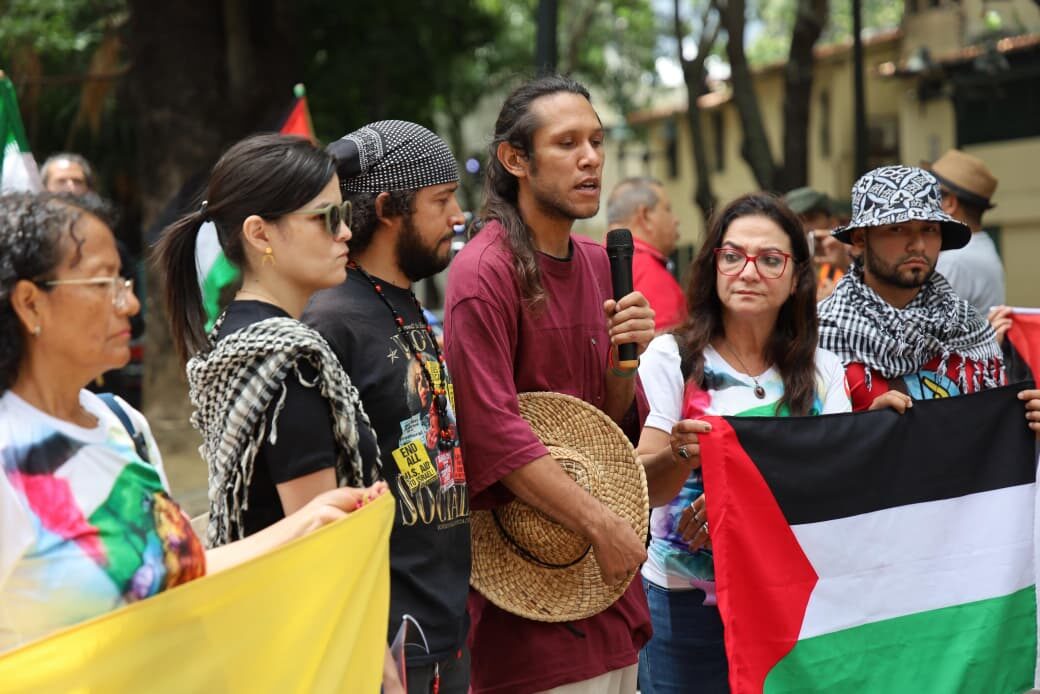
López explained the role played by the arts in building a popular identity. (Venezuelanalysis)
Heyerde “Seko” López is a Venezuelan artist and activist with experience in plastic arts, screen printing, photography, graphic design, and audiovisual production. For 13 years he has been a member of Fundación Nativa Crea, a grassroots organization from Guarenas, on the outskirts of Caracas, dedicated to social work and advancing popular power.
What is Fundación Nativa Crea and what does it do?
Fundación Nativa Crea is a sociocultural organization dedicated to bringing together communes, social movements, and individuals in the town of Guarenas. We organize a variety of activities in our territory, ranging from rescuing abandoned spaces and painting murals to offering free workshops on screen printing, music, theater, and circus in local communities and schools.
Nativa is also dedicated to grassroots communication through social media. We’re always doing digital and graphic design and recording in the community to make visible what people are doing. We work to forge the identity of our barrio, our working-class areas, and our communities, so that people can be the protagonists of the revolution we’re building and the path we’re traveling together.
We’re located in Plaza Bolívar in Guarenas, right next to City Hall, because we had the chance to speak with President Chávez and decided to occupy that space, which was a Corpoelec [state electricity company] substation that had been abandoned for 15 years. At the time, we identified 37 abandoned spaces in Guarenas, but that one stood out as the most visible and strategic. We surveyed the area, and the project was born.
How is Nativa’s work organized in practice, and how does it integrate with the local community and the people’s power organizations?
There are six of us now, but we coordinate with other people in the territory and in other parts of the country. We have a set of goals and an action plan. Each person takes on tasks based on their strengths. We have six production units, two of which are currently operational: the auto repair shop, where we fix cars and motorcycles, and the screen printing and communications workshop, where we make T-shirts. We have a brand called “Contestatarixs” to market prints of iconic figures and world-renowned fighters. The other four units are a cultural café that we will soon reopen, a community bakery, a recording studio, and a greenhouse. In fact, we plan to establish a greenhouse in every community council.
In total, there are 15 community councils in our territory, which make up the General José Félix Ribas Commune. Our organization belongs to the Pueblo Arriba Communal Council. In our sector, we’re going to start with a medicinal garden, as well as tomato and onion seeds, and coffee and cacao seedlings, to later coordinate with local farmers. We’re also considering a partnership to grow barley in the nearby campesino settlements and produce craft beer. Why not have a Venezuelan communal beer?

You mentioned the bakery and the café that closed down. What obstacles did they face?
The bakery and the café closed down due to the economic difficulties resulting from the US sanctions. For example, when wheat imports were restricted, it became very difficult for us to acquire the raw materials. Previously, it had been subsidized. Although we were part of a bakery coalition with other grassroots organizations, and we held numerous meetings and coordinated efforts with the government to defend community bakeries, it was not possible to maintain our operations. In Venezuela, wheat is controlled by the owners of the silos. We fought a tough battle between 2014 and 2017, but that coalition practically fell apart, and now only the large, capitalist bakeries remain. But we are creating the conditions to revive this productive unit. We want to build a communal economy. We are going to start creating the conditions, now with more criteria and the lessons learned over these years. After all these battles, I believe we have the necessary experience.
What are the main challenges Nativa has faced over the years?
The main challenge is staying true to our identity as a left-wing organization in the face of the imperialist blockade. Nativa Crea started out as a clothing brand and is now a social organization running a headquarters of 542 square meters. But the hardest part is sustaining ourselves over time. It’s one thing to have an idea, to design a project, and quite another to sustain it –to preserve the ideology, retain the members, and create conditions so that it’s a space where people aren’t exploited and can have free time to organize alongside the pueblo.
We also knew that, as we asserted ourselves, we would deal some blows to the bourgeois state. Not all mayors, governors, or institutional leaders will want to relinquish their share of power and accept the consolidation of popular power or the communal state. In practice, we have seen that things are not as beautiful as they are in theory. Rather, they are riddled with contradictions. But we have the spirit to fight and move forward. Today, what we do is join forces with different organizations, communal councils, etc., to keep the project moving forward and to help them identify with it. Nativa has always been a space where people can meet, hold workshops, organize politically, and so on.

What would you highlight as Nativa’s main achievements over the years?
Our main achievement has been bringing together different people, from different communes, and ensuring that everyone understands we’re all fighting for the same cause: building the communal state.
I believe our task is to demonstrate that popular power is the way forward. For example, eight years ago, using the surplus generated by the bakery, we were able to build a sports court. So, we showed that economic activity can take place under decent working conditions, serve the community, and generate a surplus to contribute to the territory where we live. Therefore, if we have productive units –which is what we insist on in the commune –we will be able to achieve autonomy, we will be able to make decisions in the territory, and we will be able to develop what the barrio needs.
Nativa, and you in particular, place a lot of emphasis on the cultural front, especially on graphic design. What is the vision behind this?
Through graphic arts, we shape our identity. Ever since we started creating prints, painting murals, taking photographs, and producing audiovisual works, we’ve always sought to reclaim Venezuelan identity. Not the identity sold to us about barrios in mainstream culture –the glorification of crime or the idea that people dress and speak a certain way. Every town has its identity, every city has its identity, every territory has its identity. So, through the arts, we try to capture that, what we experience, and in this way, people begin to recognize themselves, know where they come from, and also to appreciate things that are nationally, locally, and indigenously produced. It gives new value to their experiences, to what they consume, read, and so on.

You recently hosted an international brigade from Brazil’s Landless Workers’ Movement (MST). What was that exchange like, and how can that feedback help strengthen grassroots organizing?
The MST brought a large group that split into seven brigades spread across different parts of the country. We were assigned one as the representative from the central capital region. This experience has been very important, because we see that our brothers and sisters in Brazil are fighting for the same cause as us: against capitalism and imperialism, and for the unity of the Latin American peoples.
The Landless Workers’ Movement has been raising that banner of struggle –the fight for land and the construction of campesino settlements –for over 40 years. They have very advanced methods, and they are masters of organization and planning. In fact, they are advising us on the various productive units. They believe that we, Venezuelans, need to focus more on planning, sticking to schedules, fulfilling responsibilities, etc. The exchange has helped our communards hear the perspective of comrades from outside, with their experience and organizational skills. They have shared their insights with 10 communes here in Guarenas and are also getting to know the local projects that have been approved through popular consultations.
As someone with many years of experience in grassroots organizing, how do you view the relationship between constituted power (institutions) and constituent power? What is working, and what needs to change?
Chávez, and also our professor Manuel Sulbarán, always told us that we, the working-class people, are the only ones capable of bringing about change and progress in our own country through popular power. So, popular power must continue to develop these methods and strengthen our communes, making them active and productive, and demanding that the state or institutions transfer the responsibilities we can assume and the resources we need.
For example, in the General José Félix Ribas Commune, the project that won last year’s consultation was focused on the youth to build a soccer field. There was a group pushing for it, but the US $10,000 allocated for the project wasn’t enough. That caused a lot of discontent and led some to think that popular consultations were useless. These are the issues we need to debate and politicize. We explained to them in an assembly that this is a megaproject that cannot be done with just $10,000, so it must be conceived in several phases. We have to keep our spirits up and continue participating.
The soccer field has been a good topic for debate and reflection, because it is also true that the commune has many priorities that are more important than a soccer field. Everything is needed, and sports play a fundamental role, but for example, if the sewer system is damaged, the community will likely prioritize fixing that. That’s why we need to plan and see which projects are proposed through which channels. If we do a better job of categorizing projects by scale and setting timelines, we’ll be able to strengthen our commune.
But, to answer the question, institutions need to work with us, the pueblo, and understand the priorities of each territory. Perhaps it’s not best for the commune to choose building a sports field because that should be the responsibility of the Ministry of Sports. This ends up giving the commune a responsibility that it should not have to assume, or that it is not in a position to take on. Nor should we be taking on the project of repairing a school when we have a Ministry of Education and a Ministry of Public Works. Obviously, our communards will dedicate themselves to anything that improves the community’s life, but why should the commune burn its only chance to access funding for popular power on unfeasible projects that should, moreover, be the responsibility of the institutions? So we must also demand that those holding constituted power –the government and institutions –fulfill their responsibilities, so that we, as an organized people, can move forward with ours. Another challenge we face is that some people confuse the tasks of the party [PSUV] with the exercise of popular power, and as a result, they sometimes end up dragging the commune into areas that are not its responsibility.

Finally, how does Nativa interpret the current political situation, and what role should the organized people play?
January 3 was a grave moment, a call for reflection, just as the 2002 coup had been, when the people took to the streets to make history. The lesson is the same: the people must understand that only popular power will allow us to overcome this onslaught by the capitalist economic system and imperialist attacks.
Today we must organize ourselves once again, win over all those people who were fighting, or who are fighting out there but scattered. We have to unify the struggles, as President Chávez said at the time: it is very important that we know who we are, what we want to build, in order to move forward in consolidating the Bolivarian Revolution. And beyond Venezuela, we must understand ourselves as a bloc with our neighboring countries.
For the youth, it is important not to abandon the banners of anti-imperialist and anti-capitalist struggle and to create our own methods. The past centuries’ revolutionary struggles of Germany and France will not apply here. It is not enough for us to simply “follow the ideas of Lenin, Mao, Che, or Fidel,” although we must certainly read and study them. Chávez put it very clearly: we are going to give birth to the 21st-century revolution; we are going to create it. We’ve only been at this for 20 years, developing different theoretical and political aspects, with different participants sometimes on different wavelengths. But we all know that we have a right to an anti-imperialist revolution that defends life on the planet.