After the fraudulent election of July 28, 2024, Nicolás Maduro announced he would deepen the “Communal State” as a model of popular participation. In his words, it was necessary to “accelerate the construction of popular power” and “transfer more powers to the communes.” The implicit promise: more communes, more consultations, and more participation should equal more solutions.
I put that promise to the test with data from Mérida, a state where public services (especially water and electricity) fail every day. In mid-2024, power outages were almost four hours a day, enough to ruin an entire family.
In May of that year, a professor at the University of the Andes, Israel José Ramirez, died in the building where I lived with my family. That day, the power went out as well. The professor was inside an elevator that became trapped between the first and second floors. When he forced the mechanical lock on the door to try to get out, he found himself facing a void: the elevator car wasn’t at the floor’s level. He tried to jump but couldn’t reach. He fell to the bottom of the elevator shaft, about three stories high. He died on impact.
Electricity in that part of the city usually took four to eight hours to return. That day, it only took half an hour. The desperation of a prolonged power outage led Professor Ramírez to open the elevator doors, and his life ended there. This tragedy was a partial motivation for conducting this research.
Between August and July 2025, I did an internship at the National Institute of Statistics. There, I was able to review the records of 198 projects from the Concrete Action Agendas (ACA in Spanish) in 64 communes in the state of Mérida. The ACAs are the central mechanism of the chavista Communal State for participatory planning: consultations in which the communes identify their priority problems (called “critical nodes”) and vote on the projects they want the State to implement. These 64 communes represented 82% of the 78 registered in the state. The remaining 14 were excluded from the analysis because the officials responsible for transcribing the community assessments into the databases made so many errors that the information was unusable.
The communes understand the workings of the State better than many public officials.
Official reports stated: “Project in progress” or “Project completed.” But something didn’t add up. Local communities kept voting on the same service problems year after year. Someone was lying.
I needed to separate the propaganda from reality. I did something simple: I took each problem that a commune voted on in 2022 and tracked it for four years. If it stopped appearing in subsequent consultations, the government could claim it had been resolved. If it continued to appear year after year, it meant that people had been shouting the same thing for four years. And if it disappeared without explanation (neither resolved nor voted on again), nobody knew what had happened. The State simply ignored it.
Using this detector, I audited 198 projects. The results are summarized in the following graphs:
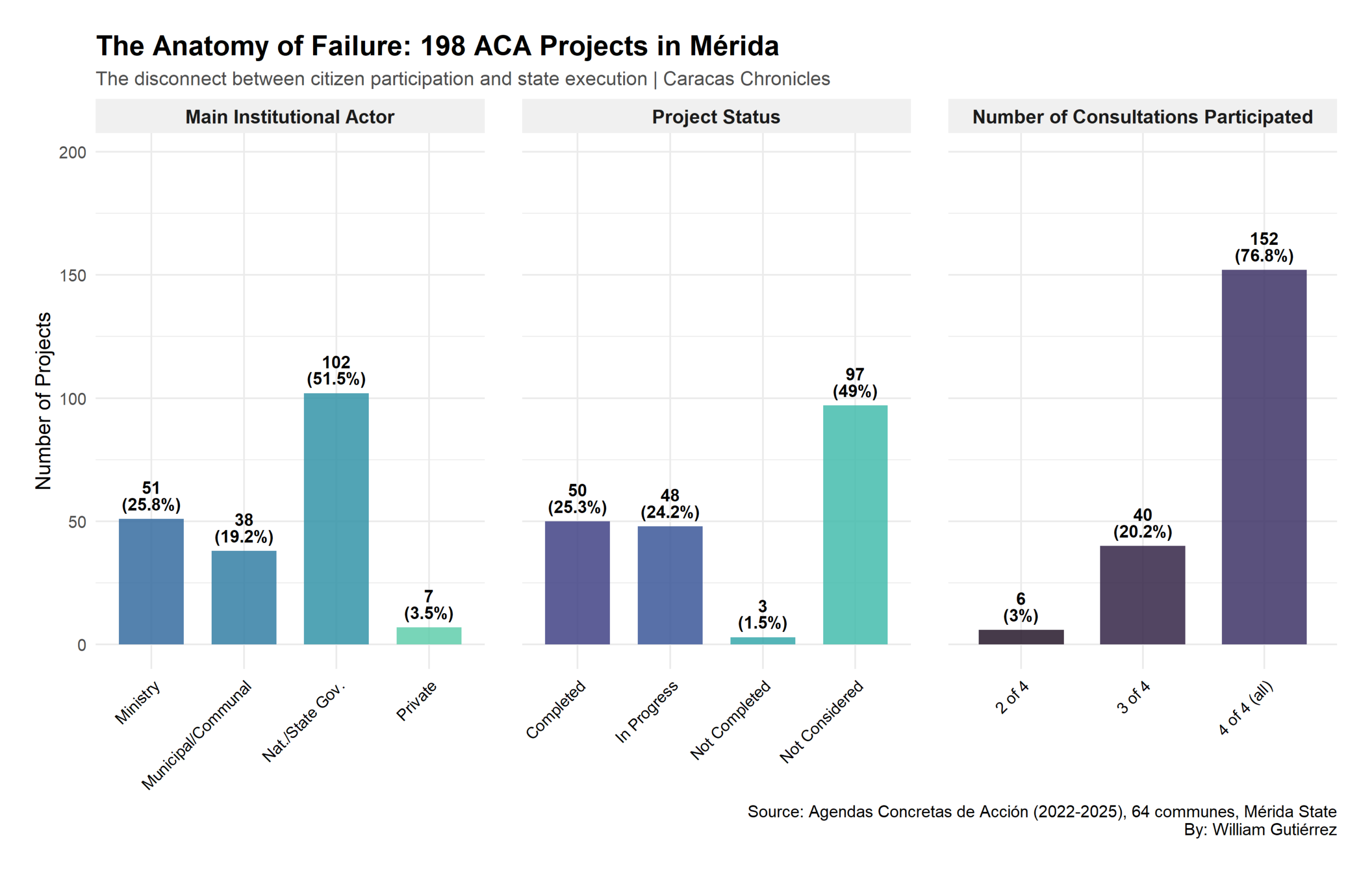
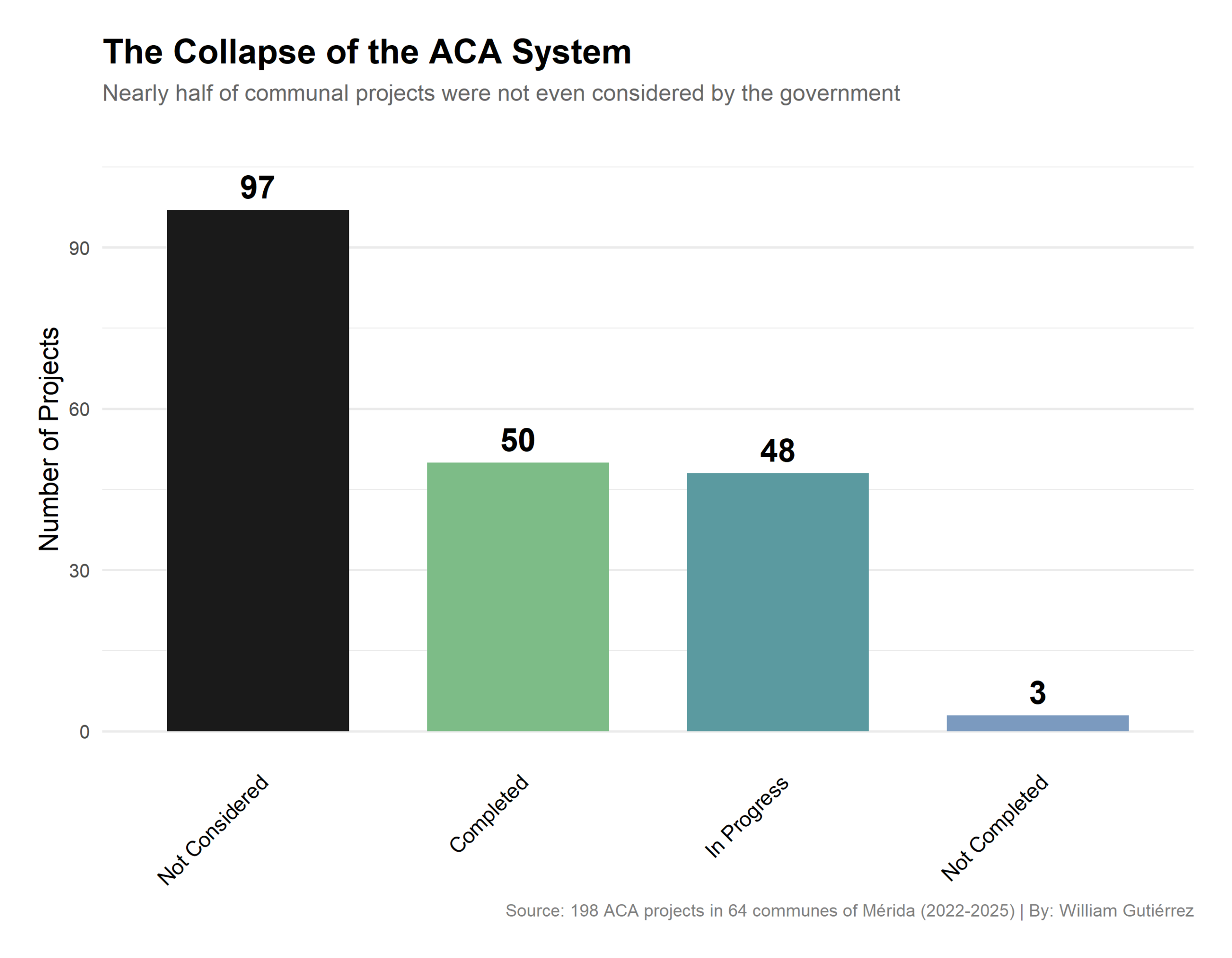
These charts reveal three dimensions of failure.
First of all, who decides: of the 198 projects, 51.5% (102) were assigned to ministries and the national government for implementation, while another 25.8% (51) fell to the Mérida governorship. The communes diagnose the needs, but Caracas decides whether to open or close the tap of resources. Only 19.2% (38 projects) remained under municipal or communal control.
Second, what happened to them: almost half of the projects were not even considered. Only a quarter (50 projects, 25.3%) were completed after years of consultations. The State received the diagnosis, knew exactly what the people needed, and decided to do nothing. Third, participation wasn’t the problem: 76.8% of the communes (152 projects) participated in all four national consultations, from the first in 2022 to the last in 2025. The core chavista voter base mobilized, filled out forms, and voted. The system didn’t fail due to a lack of participation. The problem isn’t that the communities don’t know how to organize themselves. The problem is that when they do organize, the system ignores them.
Now, what problems are the communes identifying? These are summarized in the following chart:

This chart’s revelation is devastating: two out of every three communes in Mérida (43 out of 64, or 67%) identified water as their priority problem. This isn’t an isolated issue affecting just one or two communes. It’s a systemic crisis impacting the entire state. Four problems (water, roads, housing, and electricity) account for 60% of all project requests in Mérida.
Now, we can see how the ACA projects are distributed in Mérida in the following chart:

Of the 198 projects analyzed, 54 are related to water. More than a quarter (27%) of all projects. The first four categories (water, roads, housing, and electricity) account for 62.63% of all projects. The Pareto principle applied to poverty: 20% of the causes explain 80% of the problems. And how many of those 54 water projects were actually implemented?
Behind these figures are real families, of course. Take the example of the Doña Simona commune in Lagunillas, Mérida, which has a serious drinking water problem. In 2022, they voted for water in the first referendum. In 2023, they voted for water again. In 2024, the same. And in 2025, four years later, they were still voting for water. Four referendums. The same problem. Why? In a conversation with the Mérida’s INE office, where I did a summer internship, they revealed the number that explains everything: $10,000. That’s the budget per project. Always. It doesn’t matter if the community asks for an aqueduct or paint for a school.
With $10,000 you can’t build an aqueduct. It’s barely enough for 200 meters of pipe. You can’t dredge a river. You can’t pave a road. You can’t solve a water crisis that affects 43 of the state’s 64 communes. The communes learned this lesson. If you need water but it costs $50,000, you’re better off asking for paint. At least that’s something they will greenlight.
Four years of voting for water. And in the end, paint for the walls of a run-down public school.
So, what happened in Doña Simona? In the third and fourth consultations, the community changed its vote. They no longer asked for the aqueduct they needed. They voted for something “realistic”: participating in the Bricomiles, the program where soldiers paint school facades and repair sports field roofs. It’s not that the people of Doña Simona are unaware of what’s happening in their community, but rather that they’ve learned to play the system: the State only funds projects that cost less than $10,000. “Citizen participation” then revealed itself not as empowerment, but as an exercise in adjusting real needs to the ridiculously small budget the government is willing to provide. Four years of voting for water. And in the end, paint for the walls of a run-down public school.
However, one thing is certain: the communes of Mérida are always right. When the problem is electricity, they assign it to Corpoelec. When it’s water, to Aguas de Mérida. When it’s housing, to the Ministry of Housing. I reviewed 198 projects and didn’t find a single exception. The communes understand the workings of the State better than many public officials.
This accuracy remained consistent across all 64 communes, throughout the four consultations, and in all 198 projects. Then I thought: if the diagnosis is so precise, if the communes are doing their job, the system should be producing results. Water flowing through pipes. Paved streets. Stable electricity. I measured the relationship between the quality of the diagnosis and the effective resolution of problems. This graph shows the main conclusion of this research, which I call the Great Disconnect.
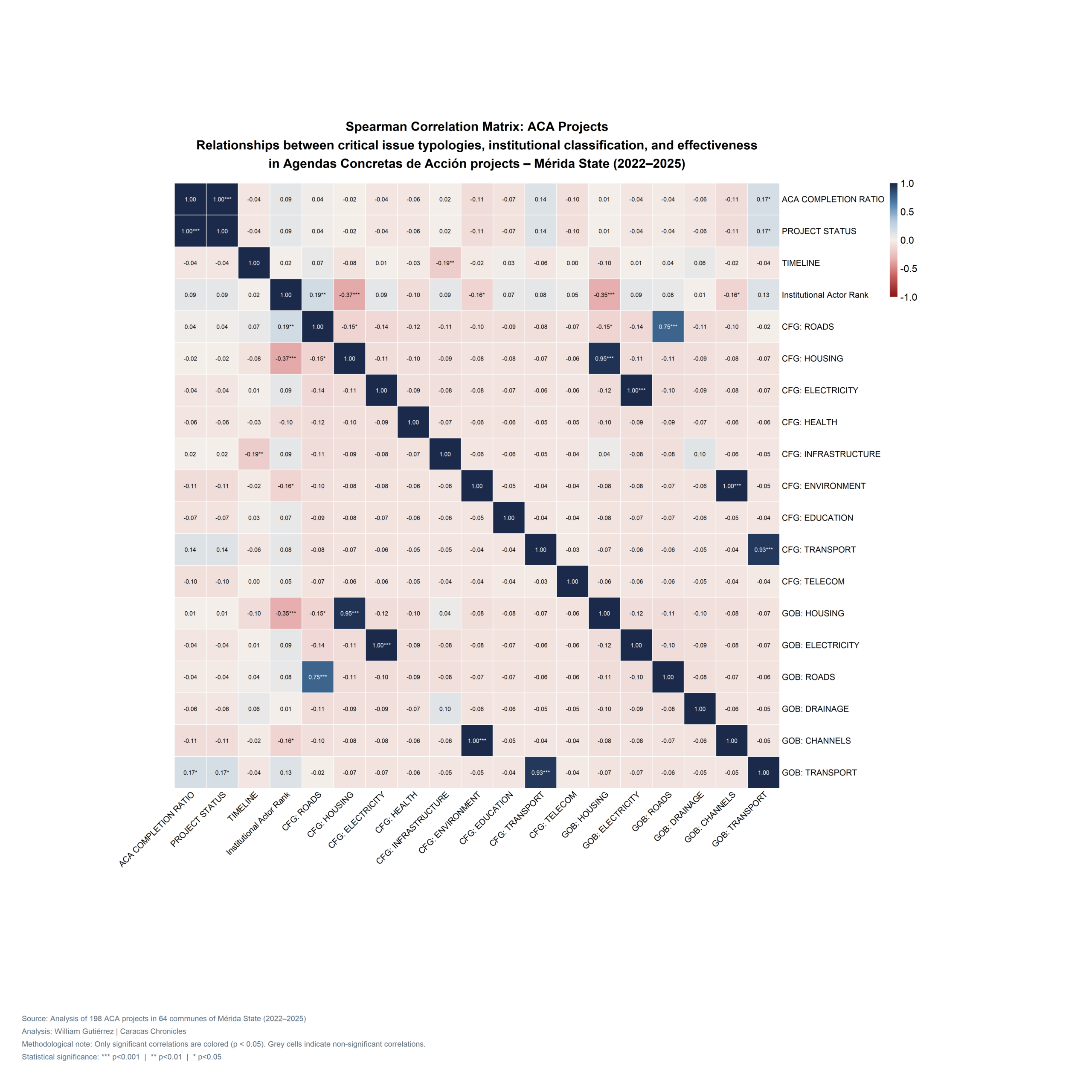
The dark blue cells confirm what we already saw: the communes diagnose with surgical precision. The system works like clockwork in the diagnostic phase. So I asked the obvious question: if the communities diagnose perfectly, does the State provide solutions?
The answer was once again devastating. There is no correlation. None. The gray cells say it all: a commune correctly identifying its problem predicts absolutely nothing about whether that problem will be solved. Neither the accuracy of the diagnosis, nor the urgency of the problem, nor how many times people have voted for the same thing matters. None of that matters.
The factors that determine whether a project is implemented operate completely outside the formal Commune Action Board (CAB) system. They are external, opaque, probably related to circumstantial political will, erratic budgets, or the constant turnover of officials.
This is the Great Disconnect: a system that diagnoses with surgical precision and does nothing.
My data shows what that means: more people shouting in empty rooms. The communes are just an authoritarian excuse to overrepresent their political power.
The success or failure of a project doesn’t depend on whether the commune identified its need, whether the responsible institution was selected correctly, how urgent the problem is, or how many times people have voted for the same thing. What determines whether a project is implemented operates entirely outside the formal CAB system. These are external, opaque factors, probably related to short-term political will, erratic budgets, or the constant turnover of officials. The communities do their part. The Venezuelan State does not.
The problem with the Communal State in Mérida isn’t one of scale, it’s structural. There’s no shortage of communes: 64 are already functioning. There’s no lack of participation: 76.8% of the communes participated in the four consultations. The system works exactly as it was designed, mobilizing the chavista base to diagnose problems, making them believe they are participating, and then systematically ignoring their demands. It’s not a failure. It’s the design.
My data shows what that means: more people shouting in empty rooms. The communes are just an authoritarian excuse to overrepresent their political power. The reality is that the wife of Professor Israel Ramírez found him dead in the elevator shaft because there was no electricity in the building that day. In some neighborhoods of Mérida, people probably voted for electricity in 2022, 2023, 2024, and 2025. And in 2026, if this policy continues, they will continue to vote for it.