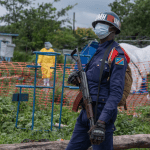
One Year Later, Lamurde Bears Scars Of Recurring Communal Conflict
Labaran Kaduna says his son, Desire, was unlucky in life. Two months after Desire’s white wedding in Rigange, a small Bachama community in the Lamurde local government area of Adamawa State, northeastern Nigeria, his newly built house was burnt to the ground when the Tshobo and Bachama tribes first clashed in July, 2025. A year later, Desire himself was killed in the same conflict that remains unresolved.
Desire had provided HumAngle with materials and information about the conflict last year, in an effort to bring awareness to the violence, as though he knew that it would one day claim his life too.
Labaran speaks about his late son with a sad smile on his face and pride etched in his voice: “He was a university graduate. Since he was yet to secure a white-collar job, he joined me in farming and soon had his own large farm.”
Desire was 36 years old.
“He had a bad leg which made it difficult for him to walk very fast or run, so when our community was attacked that night, people fled and left him behind,” said Labaran.
HumAngle gathered that a group of armed men stormed the Rigange community on the night of June 27 and opened fire on people. Labaran believes the men were members of an armed militia and that several of them had been storming the area to wreak havoc since the communal crisis began. That night, many fled, leaving Desire limping behind.
“His brother survived the attack, so he ran home to inform us. When we reached the spot, we realised that he had been shot dead, and after shooting him, they took all his belongings, like his phone and wallet. They even took his shoes,” the grieving father said.

A lot can happen in a year
Desire is one of the many who have lost their lives in the Lamurde communal clash. HumAngle has been unable to obtain the total number of casualties, as efforts to reach Suleiman Nguroje, the Adamawa State Police Public Relations Officer, have failed. He has neither responded to phone calls nor replied to text messages sent to his phone.
In 2025, HumAngle extensively documented the violent land dispute that shattered daily life in Lamurde. The clash, which began in July 2025, forced many locals to flee the area, while those who remained lamented being trapped in their communities, unable to move freely. Access to healthcare and other social services became difficult, especially for Tshobo communities, which had long depended on clinics in Lamurde town, a Bachama stronghold. The most affected communities remain Rigange, Waduku, Wammi, Sabon Layi, and Sikori. A total of 53 houses were destroyed that year while 170 homes were partially damaged. Despite several peace talks and reconciliation efforts by the government and stakeholders, both tribes continue to clash.
“Desire was kind and hardworking. He had two little children. Last year, he married their mother in church, but unfortunately, he was not lucky to see them grow,” Labaran said.

Rosaline Danladi, a Tshobo woman from Anguwan Baki, one of the affected communities in Lamurde, bears the scars of the year-long conflict. Her husband, Danladi, was killed when the tribes clashed in December 2025. Danladi was a farmer who left behind his wife and seven children.
“We were in the room that night when we heard gunshots, so my husband stepped out while I ran with the children in another direction. We waited for his return, but he never came back,” Rosaline recalled.
Danladi’s remains were later found, and he was buried. Rosaline explained that she has been struggling to keep up with her children’s needs months after his demise because she was a full-time housewife who had always relied on her husband.
“I am just managing to take care of the children. Two were in a boarding school in Numan while the smaller ones were in a private school here, but they have all recently dropped out,” she said.
Rosaline said 2025 had been an unfortunate year for her and many in the Lamurde area. Sadly, the conflict has persisted into 2026, and new waves continue to rise.
Speaking to HumAngle, Jonah John, a security analyst in Adamawa, stressed that the impact of the crisis can not be overemphasised. Apart from deaths, property losses, and displacement, he noted that the closure of the famous Tingo market in the region has affected businesses, leading to a hike in the cost of foodstuffs across Adamawa.
Fallen classrooms
When both tribes started clashing in June 2025, schools, clinics, and other social services closed temporarily across the affected Lamurde communities. Even though clinics and administrative activities have now resumed, children in communities such as Tingno and Rigange remain out of school.

HumAngle spoke to Celestine Bafyau, the principal of the Government Day Secondary School in Rigange. He said the school serves almost 300 students from both Bachama and Tshobo communities.
“We have students from Bashaka, Lamurde, and other Rigange areas,” he stated.
The school was burnt down during the July 2025 clash and has remained deserted to date. To ensure the children don’t miss out on learning, Celestine said, teachers utilised the nearby primary school, but with many students displaced and others who had completely fled town, it became hard to keep up.
According to the principal, students from JSS 3 and SS3 are currently using the primary school block to write their final examinations, and, due to the large number, some are writing theirs under a nearby tree. At the same time, those in JSS1, JSS2, SS1, and SS2 remain out of school.
“I have taken pictures of the school attached to a report and submitted it to the education board in Yola because we need help,” he stated.

Celestine noted that teachers are eager to resume teaching. “Honestly, my staff are ready, and they are disturbed. We do go to school sometimes to check it, but most of the students have relocated to other communities. If there’s peace, we will call them so we can teach them,” he said.
When the crisis began in July, several people were killed, and many were displaced. In December, another bout of violence erupted between the two tribes and eight people were killed in Lamurde town. Despite three peace deals, a fresh wave of terror occurred in January when three women in the area were attacked and killed on their farm. On June 27, the attack that claimed Desire’s life happened.
According to the security analyst, Lamurde’s security architecture is very weak.
“The deployment of the security forces should be treated with a great sense of importance, looking at the fact that it’s the sole responsibility of the government to safeguard and to protect the lives and property of its citizens, but the government has failed totally. That is the only reason why things keep repeating themselves over and over again,” he stressed.

Locals told HumAngle that security officers deployed to the area had since withdrawn. Youths and local vigilante groups now take turns to patrol the area.
Both parties have accused each other of using armed militias to fight. Jonah, the security analyst, explained that both parties illegally acquired rifles and other unlicensed weapons to intimidate each other.
“If they cannot stand the pressure or tension on the other hand, they will have to employ the service of militia,” he warned.
The cause of the Lamurde clash has been linked to land ownership, with both tribes claiming possession of the same land. HumAngle gathered that both parties were instructed by the state government and members of the peace committee to forfeit the land. Yet, the clashes continued.
There are claims across social media that the land both parties have been clashing over contains mineral resources. While some claim it is gold, others call it ‘mineral’. HumAngle learned that it is clay-like in nature.
“They brought it home as a sample for me to see. So, it’s like clay. Even if I see it, I can just pass. I wouldn’t even know that it’s important or something. So, they say the men have been packing them in large quantities. And then, actually, Tshobo has never been benefiting from it at all,” Hyginus Mangu, the Tshobo community leader, told HumAngle.
The controversial mine
Hyginus said the mine in question lies far away from the town and is in no way affiliated with the land in dispute. “For me, personally, I don’t know where the spot is, but I do know that there are some people who used to do some mining there, and the people are not Tshobo people. I don’t know how they get to that area to mine,” the Tshobo community leader said.
He added that the miners were from Gombe State and had been mining in the area before the crisis began.
Jacob Bawa, the Youth leader of Rigange, a Bachama community in Lamurde, corroborated Hyginus’s claim. According to him, the mine is far away from the main town and is not affiliated with the disputed land. Jacob also claimed that locals from the Bachama community do not benefit from the mine.
Jacob maintained that he had never been to the mine, as it was only recently publicly discovered, even though it had been operating illegally for years.
HumAngle could not access the mine or obtain pictures of the mineral, as access is highly restricted.
On June 30, Adamawa State Governor Ahmadu Fintiri banned illegal mining in Lamurde Local Government Area following speculations that the mining was fueling the crisis between the two tribes. Security agencies were directed to ensure strict compliance. The Governor assured locals of securing sustainable peace and addressing the root causes of the Lamurde conflict.
Jonah, the security analyst, emphasised that allegations that the mine is driving the recurring conflict in Lamurde should be taken seriously by the government and other relevant stakeholders. Although most miners come from Gombe State to extract the minerals, Jonah believes the illegal miners engage Lamurde residents as labourers, who end up clashing over land and resources. He called on locals to shun violence and desist from being used as puppets by the miners who are taking advantage of their home.
Even though access to farmlands and clinics has improved for the Tshobo people, Hyginus said they still don’t have access to administrative and business services in Lamurde town due to fear of being attacked.
In Rigange, Jacob Bawa, the youth leader, says life is hard for Bachama locals who stayed behind because they have nowhere else to go. “We are suffering because most of the people have run to neighbouring communities like Numan and Yola. Also, we don’t have mosquito nets or tents because most of the houses here were burnt down,” he said.
HumAngle gathered that the Lamurde main route is partly closed, and travellers can barely access the area.
According to Jonah, the use of social media by both parties to spread hate speech and misinformation also re-fuels the crisis.
“So if the government can put an order, just like the federal government did, any hate speech from each other should equally be dealt with,” he said.
What lies ahead?
The security analyst calls on the government and stakeholders to secure the people of Lamurde. He also advised the locals to embrace peace and live together as they’ve always done, especially with intermarriages that have occurred between them for centuries.
“All those people that are hiring all these militias or whatever, please, they should stop that. At the end of every crisis, only the women and the children suffer the most. So honestly, they should look at the future of their children, the future of their local government and the future of their tribes,” he said.
While Rosaline and Desire’s father continue to bear the burden of grief, they are uncertain of what lies ahead for other grieving families and displaced locals of Lamurde. Rosaline says she’s struggling to get by each day and is doing her best to make sure her children are provided for. However, she fears another night might come when the clashes will recur as the matter remains unsettled and with her husband gone, she’s not sure if she could cope with another attack.
Labaran (Desire’s father) has a large family. With four wives, 16 children and many grandchildren, he said the family had never been apart. They lived together in their large family home in Rigange. Now, he says, his family is scattered because some of his daughters-in-law had gone to their families for safety. While some of his sons remain in Rigange, guarding what’s left of their household, Labaran has moved with the others to Numan local government, where they are currently staying with a relative.
“My children built a big apartment, and it was all burnt to the ground. My son-in-law then built a new house for me, and it was burned too. Approximately 13 houses were burnt in my extended family,” the man said.
But none of those losses, he said, can be compared to the loss of his son, Desire.
“Just peace. I want peace. We are in a difficult situation at the moment,” he said.