TOP NEWS

From breaking news to significant developments in politics, business, technology, entertainment, and more, we deliver the stories that shape our global landscape.

Trump unveils healthcare plan without clear funding or execution timeline | Health News

United States President Donald Trump announced a healthcare plan that would replace government subsidies for insurance with direct payments into health savings accounts for consumers, an idea that some experts have said would hurt lower-income Americans.

The Trump administration on Thursday called on Congress to pass legislation to codify Trump’s most-favoured-nation drug price deals and to make more medicines available for over-the-counter purchase.

Recommended Stories

list of 4 itemsend of list

“This will lower healthcare costs and increase consumer choice by strengthening price transparency, increasing competition, and reducing the need for costly and time-consuming doctor’s visits,” the White House said in a release outlining the order.

Trump’s framework, dubbed “The Great Healthcare Plan” and outlined in a White House fact sheet, includes an insurance cost-sharing reduction programme that could reduce the most common Obamacare plan premiums by more than 10 percent and replaces government subsidies for insurance with direct payments to Americans.

The White House did not provide details on how much money it planned to send to consumers to buy insurance, or whether the funds would be available to all “Obamacare” enrollees or only those with lower-tier bronze and catastrophic plans.

The idea mirrors one floated among Republican senators last year. Democrats largely rejected it, saying the accounts would not be enough to cover costs for most consumers. Currently, such accounts are used disproportionately by the wealthiest Americans, who have more income to fund them and a bigger incentive to lower their tax rate.

White House press secretary Karoline Leavitt was asked at her briefing on Thursday whether the president could guarantee that, under his plan, people would be able to cover their healthcare costs.

“If this plan is put in place, every single American who has healthcare in the United States will see lower costs as a result,” she said without elaborating.

“These are common-sense actions that make up President Trump’s great healthcare plan, and they represent the most comprehensive and bold agenda to lower healthcare costs to have ever been considered by the federal government,” Leavitt also said.

The White House said that the plan would not affect people with pre-existing conditions.

The plan also targets pharmacy benefit managers and requires insurance companies to disclose the profits they take from premiums and the frequency of denials.

Companies would publish their rate and coverage comparisons on their websites in “plain English” as well as the percentage of revenues paid out to claims compared with overhead costs and profits. They would also be required to publish the percentage of claims they reject and the average wait times for routine care.

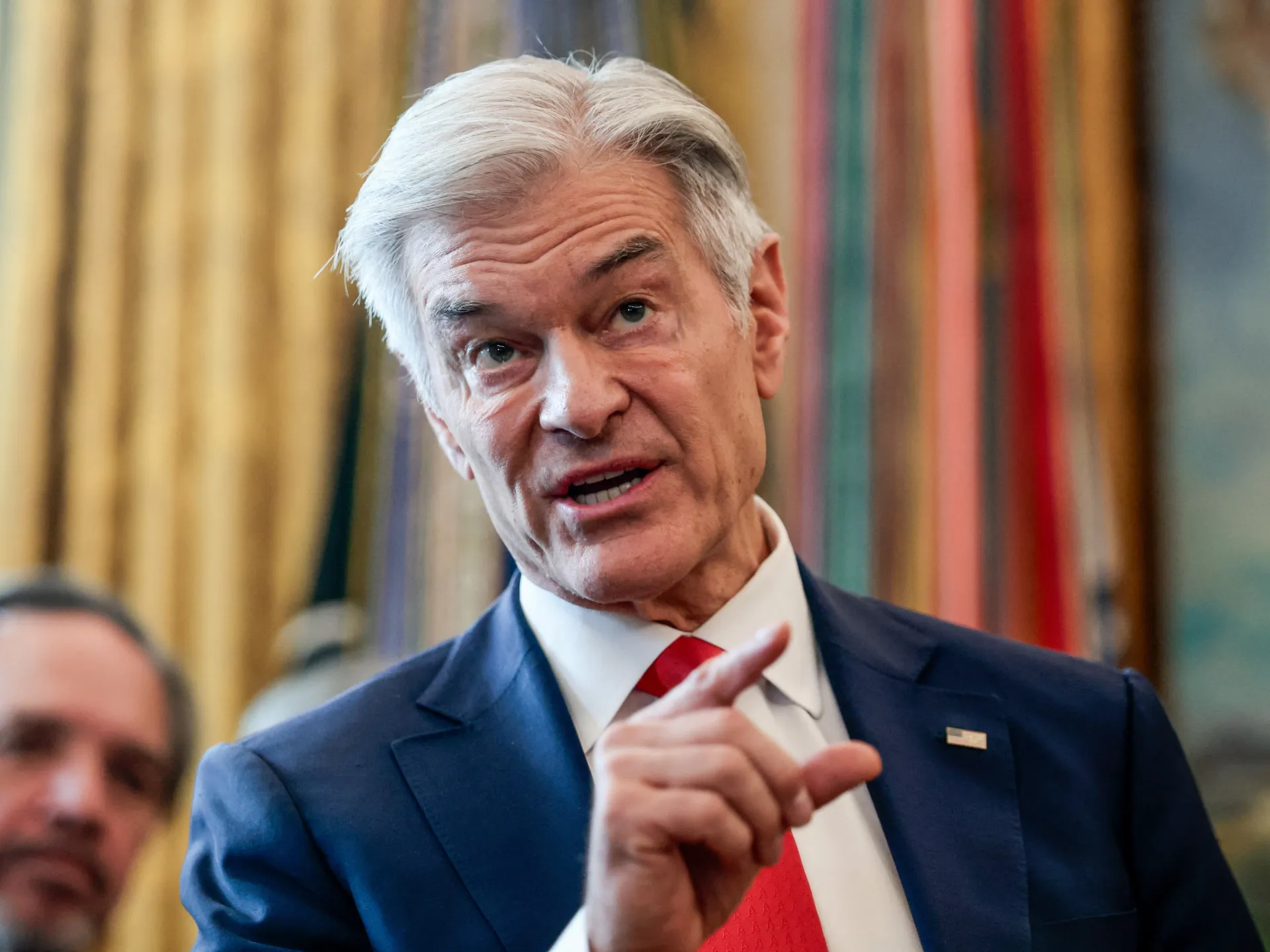
“Instead of just papering over the problems, we have gotten into this great healthcare plan, a framework that we believe will help Congress create legislation that will address the challenges that the American people have been craving,” US Centres for Medicare & Medicaid Services Administrator Mehmet Oz told reporters on a White House briefing call.

The White House also did not provide a timeline for implementation, and a deeply divided Congress is unlikely to pass major healthcare legislation quickly.

Providers and insurers who accept Medicare or Medicaid money would also have to post their pricing and fees.

Obamacare looms

The announcement comes as millions of Americans face higher healthcare costs this year, with open enrolment for most federally subsidised Obamacare plans closing on Thursday.

On average, premium costs will increase to $1,904 in 2026 from $888 in 2025, according to health policy firm KFF, a far greater jump than the savings promised in the Trump plan.

Congress remains divided on whether and how to reinstate generous COVID-era tax credits that expired at the end of last year.

Retroactive expanded federal subsidies are still possible, and there is a group of bipartisan lawmakers negotiating a potential extension, but Republicans remain divided on whether they should do so.

The Trump administration wants funding to go directly to consumers using health savings accounts, Oz said, rather than to insurers, a position also adopted by Congressional Republicans who oppose extending the Obamacare subsidies.

Trump has said he may veto any legislation to extend the subsidies, and the plan makes no mention of them.

“This does not specifically address those bipartisan congressional negotiations that are going on. It does say that we have a preference that money goes to people, as opposed to insurance companies,” the White House official said.

Trump has long been dogged by his lack of a comprehensive healthcare plan as he and Republicans have sought to unwind former President Barack Obama’s signature legislation, the Affordable Care Act. Trump was thwarted during his first term in trying to repeal and replace the law.

When he ran for president in 2024, Trump said he had only “concepts of a plan” to address healthcare. His new proposal, short on many specifics, appeared to be the concept of a plan.

On Wall Street, healthcare insurance provider stocks surged on the news of the looming plan. UnitedHealthcare is up 0.8 percent in midday trading. Humana is up higher at 3.5 percent than the market open, and Oscar Health is up 6.4 percent.

Pharmaceutical stocks, on the other hand, are trending lower. Eli Lilly is down by about 3.7 percent, AbbVie tumbling 1.9 percent below the market open, and Bristol Myers -Squibb is down by 0.9 percent. Johnson and Johnson, on the other hand, does remain in positive territory at about 0.3 percent higher than the market open.
Source link

Judge denies Amazon’s effort to block Saks Global bankruptcy

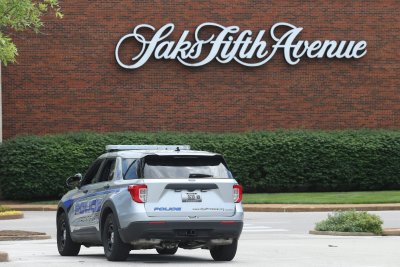
Jan. 15 (UPI) — A U.S. bankruptcy judge denied Amazon.com Inc.’s effort to block a proposed financing deal to help Saks Global Enterprises stay in business amid Chapter 11 bankruptcy.

Judge Alfredo Perez on Wednesday night approved an initial $400 million financing lifeline to Saks after a 7.5-hour courtroom battle between Saks and several of its creditors, including Amazon.

Saks officials seek $1.75 billion to stay in business, but they will have to return to the U.S. District & Bankruptcy Court for the Southern District of Texas for further approvals.

Amazon officials and other creditors objected to the proposed bankruptcy financing plan submitted by Saks Global amid the luxury retailer’s financial woes.

Amazon in 2024 invested $475 million in preferred equity to help Saks buy luxury brand Neiman Marcus for $2.65 billion, but Amazon said that investment now is worthless.

Amazon officials also said Saks did not abide by the terms of the investment, which included creating a “Saks on Amazon” account to sell goods on the Amazon retail platform.

The online storefront was to market luxury beauty and fashion goods and pay a fee for Saks-branded items, which was calculated to produce about $900 million in revenues for Amazon over eight years.

“Saks continuously failed to meet its budgets, burned through hundreds of millions of dollars in less than a year, and ran up additional hundreds of millions of dollars in unpaid invoices owed to its retail partners,” Amazon said in a court filing.

The new restructuring plan proposed by Saks and partly approved by Perez further endangers Amazon’s investment and those of other creditors by saddling Saks with more debt, Amazon’s attorneys argued.

Attorneys for Saks on Wednesday argued the luxury retailer would go out of business and be liquidated if it could not access at least some of the proposed $1.75 billion rescue loan.

Source link

U.S. billionaire backs first binational park between Uruguay, Argentina

A boat navigates the Uruguay River in the Province of Entre Rios, Argentina, in 2023. File Photo by Juan Ignacio Roncoroni/EPA

Jan. 15 (UPI) — U.S. philanthropist Gilbert Butler has emerged as a major private donor shaping conservation policy in Latin America by financing the purchase and then donating six islands in Uruguay and Argentina to create the first binational park on the Uruguay River.

Butler donated the islands of Chala, Inga and Pinguino to the Uruguayan state. The islands lie on the river in Rio Negro department, an administrative division similar to a county.

Together, the three islands cover 1,270 acres and were incorporated into Uruguay’s National System of Protected Areas, known by its Spanish acronym SNAP, according to statements from the Presidency of Uruguay and the Ministry of Environment.

Uruguayan authorities described the donation as unprecedented, marking the first time the country has added land to SNAP through a direct donation of property purchased by a private person for conservation purposes.

“Nothing like this has been seen for decades,” President Yamandu Orsi said Thursday during the ceremony accepting the islands.

According to Uruguayan officials, at least two of the islands include basic public-use infrastructure, such as docks, shelters and restrooms designed for low-impact ecotourism and environmental education.

The project aims to promote restorative economies and strengthen local communities under a model based on conservation and ecological connectivity.

The Uruguay initiative is linked to a project already underway in Argentina. On the Argentine side of the river, Butler previously acquired the islands of Dolores, San Genaro and Campichuelo in Entre Rios province. Together they span about 6,425 acres and are slated to be donated to creates a provincial nature park.

Provincial authorities plan to add about 3,459 acres of public land to that core area, bringing the total protected surface to about 9,884 acres. All six islands are part of the same cross-border conservation scheme.

In a speech, Butler said his goal is to create a binational park, contending that using the land solely for eucalyptus and soybean plantations “is an ecological disaster.”

The six islands make up the project known as Green Islands and Channels of the Uruguay River, which seeks to establish a continuous transboundary ecological corridor along one of the Southern Cone’s most important freshwater basins.

The initiative focuses on protecting wetlands, riverine biodiversity and ecological connectivity, while supporting sustainable tourism.

The donation has reopened public debate in Uruguay over the ownership of river islands.

Under current regulations and legal analyses reported locally, river islands are registered parcels that may be publicly or privately owned regardless of the owner’s nationality and may be incorporated into the protected areas system even if they were previously private.

Records and local media reports show the donated islands had been privately owned since the 1990s after being transferred as part of the settlement of a commercial debt.

Previous attempts at productive use failed because of recurring floods linked to the river’s hydrological cycle.

Local authorities in Rio Negro and Entre Rios said the binational project presents coordination challenges, but agreed it could position the Uruguay River region as a regional example for shared environmental conservation.

Source link

Argentina lists Muslim Brotherhood branches as terrorist entities

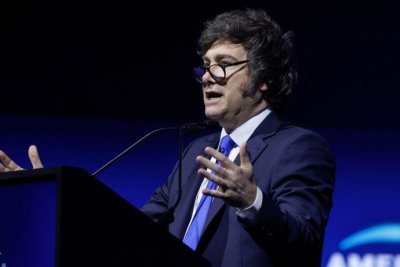
The office of President Javier Milei said Argentina’s government designated branches of the Muslim Brotherhood in Egypt, Lebanon and Jordan as terrorist organizations, File Photo by Cristobal Herrera-Ulashkevich/EPA

Jan. 15 (UPI) — Argentina’s government designated branches of the Muslim Brotherhood in Egypt, Lebanon and Jordan as terrorist organizations, the office of President Javier Milei said.

The designation is based on official reports documenting transnational illicit activities, including acts of terrorism, public calls for violent extremism, links to other terrorist organizations and their potential impact on Argentina, according to the statement.

The decision Wednesday came one day after U.S. President Donald Trump‘s administration took the same step.

According to Washington, while the movement claims to have abandoned violence, its affiliates in Egypt, Jordan and Lebanon continue to promote and support terrorist activities, including backing groups such as Hamas.

U.S. officials said those structures have inspired, financed and facilitated actions by organizations considered a direct threat to the security of the United States and its allies, and that the designations aim to curb their operational and financial capacity.

Argentina’s official statement said the decision was adopted through coordination among the ministries of Foreign Affairs and National Security and Justice, as well as the Intelligence Secretariat, within the framework of Argentina’s international commitments to combat terrorism and its financing.

“With this measure, mechanisms for the prevention, early detection and punishment of terrorism and those who finance it are strengthened, so that members of the Muslim Brotherhood and their allies cannot operate freely,” the government said.

Milei’s administration added these Islamist groups to the Public Registry of Persons and Entities Linked to Acts of Terrorism and Its Financing, known by its Spanish acronym RePET.

RePET is an official registry that allows authorities to identify and apply legal and financial restrictions on individuals and entities linked to terrorist activities, including asset freezes and limits on operating within the financial system.

In its statement, Argentina’s presidency underscored Milei’s “unwavering commitment” to “recognizing terrorists for what they are,” and recalled that his government had already designated Hamas and Cartel de los Soles as terrorist organizations.

The Muslim Brotherhood has also been designated a terrorist organization by countries such as Egypt and Saudi Arabia, while Jordan banned the group in April last year.

Source link

Chile stock market posts region’s best performance in 2025

Chile’s stock market ranked fourth globally, with returns totaling 56% in Chilean pesos.

Only Ghana’s stock market outperformed Chile, posting a gain of 79%, followed by South Korea and Zambia. File Photo by Claudio Reyes

Jan. 15 (UPI) — Chile’s stock market delivered its strongest performance in 32 years in 2025, emerging as the best-performing exchange in Latin America and ranking fourth globally, with returns totaling 56% in Chilean pesos.

Only Ghana’s stock market outperformed Chile, posting a gain of 79%, followed by South Korea and Zambia.

Santiago’s main benchmark, the Selective Stock Price Index, or IPSA, surpassed historic levels and closed the year at 10,481.47 points, marking its best annual performance since 1993.

Trading volumes also rose sharply, with the value of shares traded climbing 67.9% to a total of $50.87 billion.

Of the 30 companies listed on the index, 28 recorded positive returns in local currency, while all companies posted gains when measured in U.S. dollars.

The most valuable company and the one with the highest return was Sociedad Química y Minera de Chile, the world’s leading nonmetallic mining company in lithium and iodine production. The firm posted a return of 74.32%.

Economic analyst Jorge Berríos, academic director of the Finance Diploma Program at the Faculty of Economics and Business of the University of Chile, told UPI that the Chilean index posted an outstanding result consistent with the country’s macroeconomic normalization, which is projecting growth above 2%.

“Inflation has been trending downward and there have been cuts to the monetary policy rate, which ultimately makes investment portfolios more attractive,” Berríos said. “The banking sector is a key driver of the IPSA. The normalization of credit risks has made it particularly appealing. Banking continues to be a sector with a high rate of return compared to other markets.”

He also highlighted momentum in commodities, driven by elevated copper prices.

“There are expectations tied to advancing the energy transition. There is structural demand for electricity, which boosts mining activity and supports high commodity prices,” Berríos said.

Another factor cited by analysts was a reduction in political uncertainty.

Alex Fleiderman, head of Equity Sales at BTG Pactual, said the main driver of the market’s performance was strategic asset allocation ahead of the presidential election in November 2025.

“Polls consistently pointed to the arrival of a pro-market, pro-investment government,” Fleiderman said. “This scenario was confirmed in the December runoff with the election of right-wing candidate José Antonio Kast, whose economic policy expectations for the 2026-to-2030 period underpin market optimism.”

Fleiderman added that Chile’s economy proved resilient, exceeding initial GDP growth forecasts of 2.0% to reach between 2.3% and 2.4%.

“This upward revision was driven mainly by a recovery in investment during the second half of the fiscal year,” he said.

He also pointed to the approval of a tax reform aimed at increasing savings in the private pension system and a rise in business confidence.

“These factors combined strengthened corporate profitability,” Fleiderman said. “They shape a constructive outlook for 2026 and support a positive view of the market over the next four years under the Kast administration.”

Berríos agreed, noting that positive expectations are emerging in capital markets.

“There is a decline in country risk, greater stability and no visible changes that would affect the foundations of the country’s financial system,” he said. “That environment is encouraging stronger capital flows and increased investment.”

Together, he added, these conditions have helped produce “an exceptionally strong IPSA.”

Source link

President Donald Trump threatens to invoke Insurrection Act amid Minnesota protests

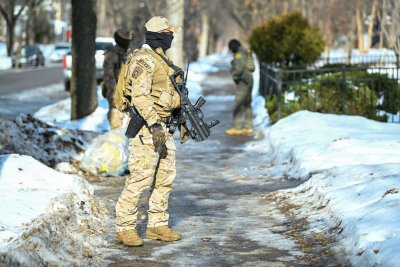
Jan. 15 (UPI) — President Donald Trump threatened to invoke the Insurrection Act to stop protests in Minnesota on Thursday after an ICE agent shot another civilian.

Trump made the threat on social media hours after an Immigrations and Customs Enforcement officer shot a man in Minneapolis, increasing tension between agents and demonstrators.

“If the corrupt politicians of Minnesota don’t obey the law and stop the professional agitators and insurrectionists from attacking the patriots of I.C.E., who are only trying to do their job, I will institute the Insurrection Act, which many presidents have done before me, and quickly put an end to the travesty that is taking place in that once great state,” Trump wrote.

A statement from the U.S. Department of Homeland Security said the victim of Wednesday’s shooting was a Venezuelan immigrant who was in the United States illegally.

A U.S. president has not invoked the Insurrection Act in more than 30 years. It allows the president to send military troops to areas of civil unrest. George H. Bush used it in 1992 in response to the Los Angeles riots after four officers who were caught on camera beating Rodney King, a Black man, during a traffic stop, were acquitted.

The Insurrection Act gives military troops the authority to take actions they are normally prohibited from taking on U.S. soil, such as making arrests and performing searches

Protestors continued to film and shout down ICE agents after Wednesday’s shooting, calling for them to leave the city. Last week, ICE agent Jonathan Ross fatally shot 37-year-old Renee Good while she was driving away in her vehicle in Minneapolis.

State and local officials have joined the calls from protesters to remove ICE from Minneapolis. Minneapolis Mayor Jacob Frey filed a lawsuit against the Trump administration on Monday, seeking to have the influx of federal agents removed.

Gov. Tim Walz addressed the ongoing unrest on Wednesday, saying “news reports simply don’t do justice to the level of chaos and disruption and trauma the federal government is raining down on our communities.”

Walz said 2,000 to 3,000 federal agents have been dispatched to Minnesota and are pulling people over indiscriminately.

Source link

Reza Pahlavi vows to recognise Israel, end nuclear programme if he led Iran | Israel-Iran conflict

NewsFeed

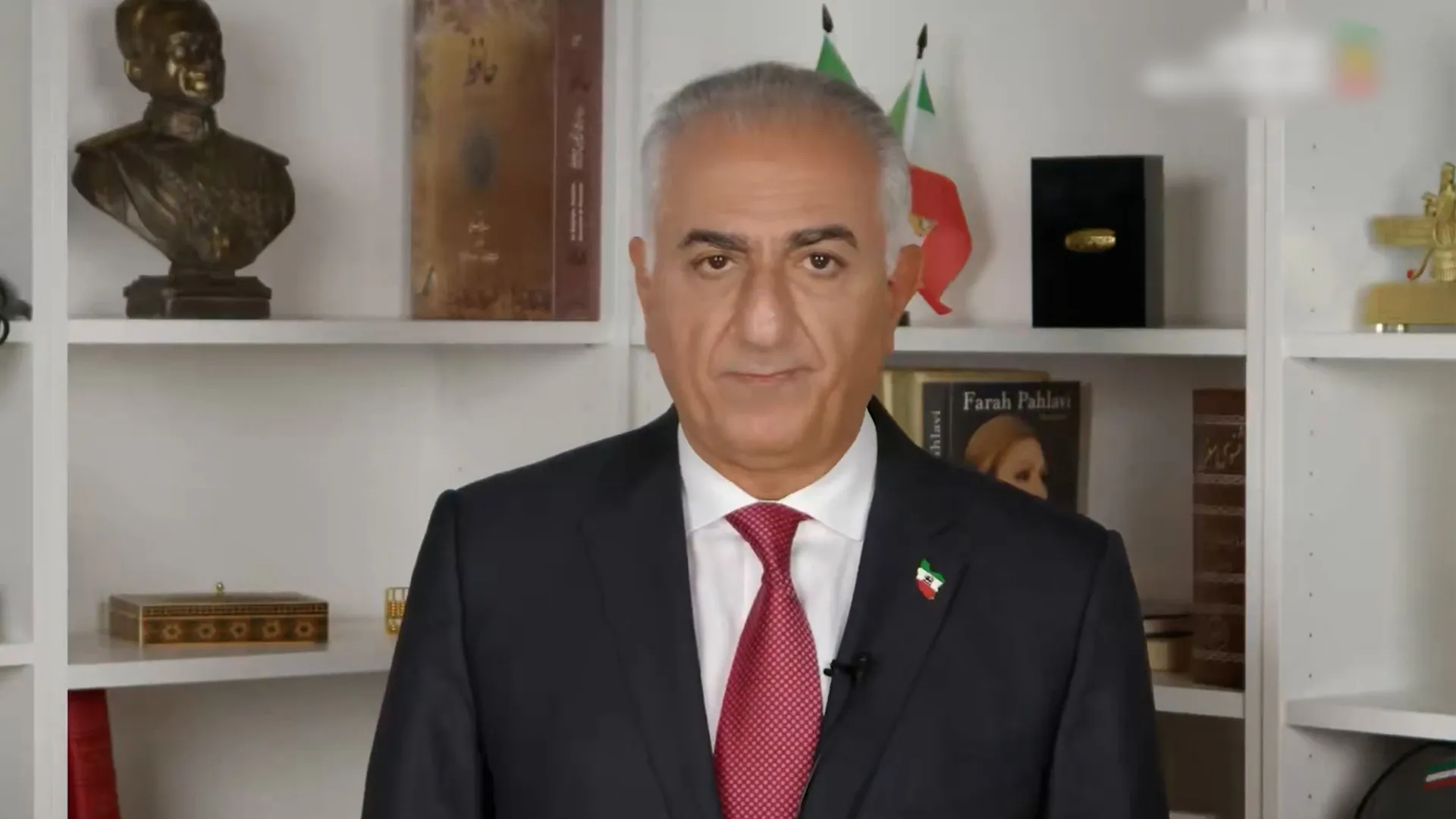
Reza Pahlavi, the son of Iran’s deposed Shah, set out key policies he would put in place if he ever returned to rule the country. Pahlavi said he would recognise Israel and end Iran’s nuclear programme. Pahlavi, who lives in the US, has backed calls to overthrow Iran’s leaders.

Source link

European troops arrive in Greenland as talks with US hit wall over future | European Union News

France sends 15 soldiers, Germany 13. Norway, Sweden also participating to bolster security on Arctic island.

Soldiers from France, Germany and other European countries have begun arriving in Greenland to help boost the Arctic island’s security after talks involving Denmark, Greenland and the United States highlighted “fundamental disagreement” between President Donald Trump’s administration and its European allies.

France has already sent 15 soldiers and Germany 13. Norway and Sweden are also participating.

Recommended Stories

list of 3 itemsend of list

The mission has been described as a recognition-of-the-territory exercise with troops to plant the European Union’s flag on Greenland as a symbolic act.

“The first French military elements are already en route” and “others will follow”, French President Emmanuel Macron said on Wednesday as French authorities said soldiers from the country’s mountain infantry unit were already in Nuuk, Greenland’s capital.

France said the two-day mission is a way to show that EU troops can be quickly deployed if needed.

Meanwhile, Germany’s Ministry of Defence said it was deploying a reconnaissance team of 13 personnel to Greenland on Thursday.

Denmark announced its plans to increase its own military presence in Greenland on Wednesday as the Danish and Greenlandic foreign ministers met with White House representatives in Washington, DC, to discuss Trump’s intentions to take over the semiautonomous Danish territory to tap its mineral resources amid rising Russian and Chinese interest.

INTERACTIVE-Greenlands mineral resources-MARCH9-2025-1741681526
(Al Jazeera)

But the two foreign ministers emerged from the meeting with US Secretary of State Marco Rubio and Vice President JD Vance having made little progress in dissuading Washington from seeking to take over Greenland.

“We didn’t manage to change the American position,” Danish Foreign Minister Lars Lokke Rasmussen told reporters. “It’s clear that the president has this wish of conquering over Greenland.”

His Greenlandic counterpart, Vivian Motzfeldt, called for cooperation with the US but said that does not mean the country wants to be “owned by the United States”.

The pair announced their intent to establish a working group to continue to address concerns about control over Greenland and security in the Arctic.

“We really need it [Greenland],” Trump told reporters in the Oval Office after Wednesday’s meeting. “If we don’t go in, Russia is going to go in, and China is going to go in. And there’s not a thing Denmark can do about it, but we can do everything about it.”

Trump said he had not yet been briefed about the contents of the White House meeting when he made his remarks.

On Thursday, Moscow criticised “references to certain activity of Russia and China around Greenland as a reason for the current escalation”.

“First they came up with ‍the idea ⁠that there were some aggressors, and then that they were ready to protect someone from these aggressors,” Foreign Ministry spokeswoman Maria Zakharova said of ​the West’s actions ‌on Greenland.

The current situation, she said, “demonstrates with particular acuteness the inconsistency of the so-called ‘rules-based ‌world order’ being built by the ‌West,” she said.

“We stand ⁠in solidarity with China’s position on the unacceptability of references to certain activity of ‌Russia and China around Greenland as a reason for the current ‍escalation,” Zakharova said.

Fear in Inuit communities

The prospect of the US descending on Greenland to tap its minerals has struck fear into Inuit communities around the town of Ilulissat, perched beside an ice fjord on the western side of the island.

Before Wednesday’s meeting, Inuit Greenlander Karl Sandgreen, head of the Ilulissat Icefjord visitor centre, told Al Jazeera: “My hope is that Rubio is going to have some humanity in that talk.”

His fears are for the Inuit way of life.

“We are totally different. We are Inuit, and we’ve been living here for thousands of years.” he said. “This is my daughter’s and my son’s future, not a future for people who are thinking about resources.”

Source link

Trump on the future of Gaza: In his own words | Gaza

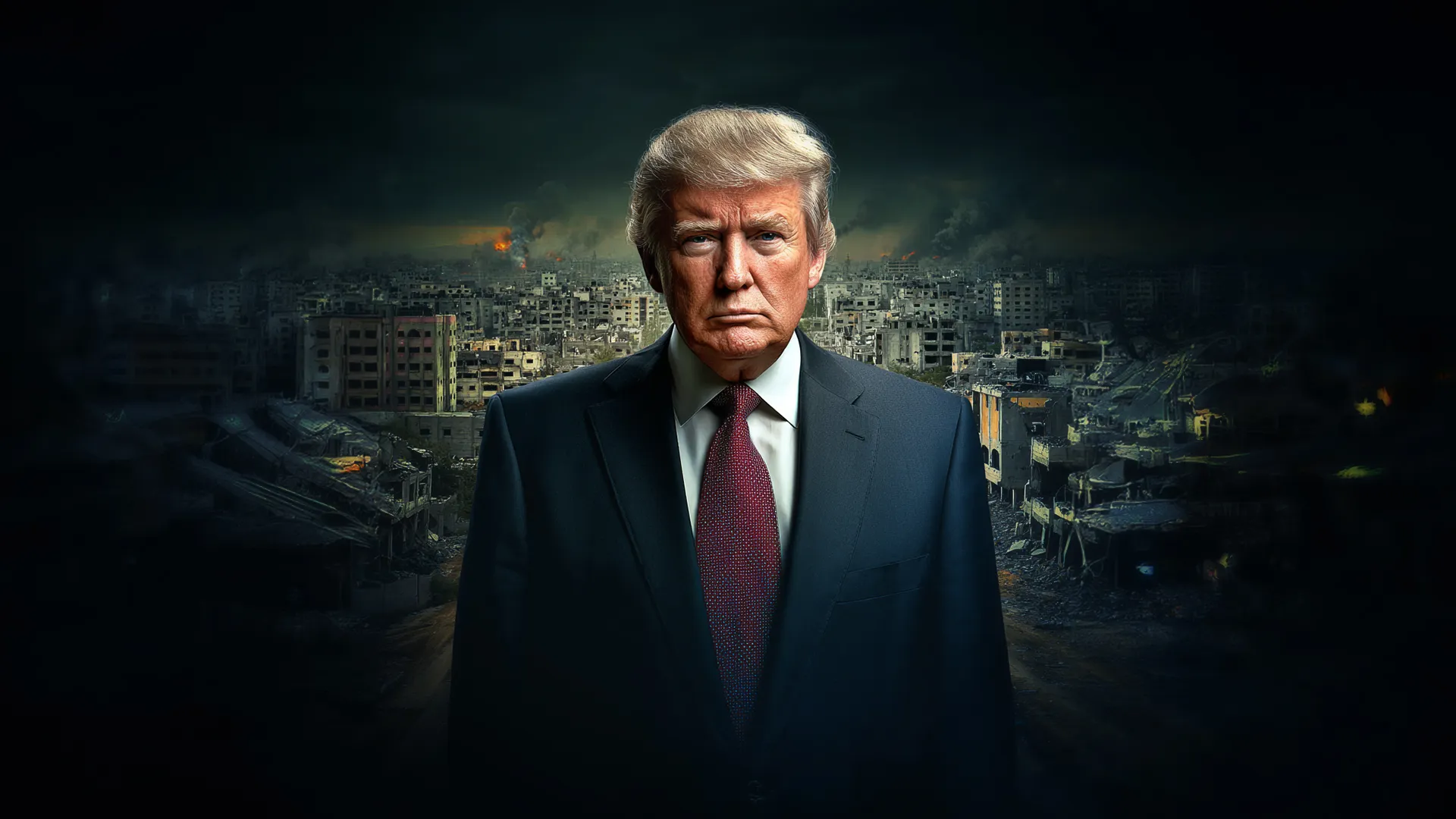
A compilation of what Trump envisions for the future of the Gaza Strip.

The Trump administration has launched the second phase of the US-brokered deal to end Israel’s war on Gaza. The transition moves from a ceasefire to demilitarisation and reconstruction. Here’s a compilation of what Trump envisions for the future of the Gaza Strip, in his own words.

Source link

Asia’s foreign press clubs recalibrate amid regional political changes

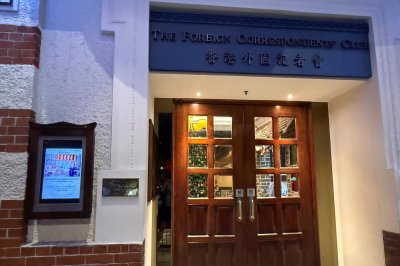
The Foreign Correspondents’ Club of Hing Kong is navigating a transformed political landscape, a radically shrinking media industry and a shifting geography of global news coverage. Photo courtesy of The Foreign Correspondents’ Club

Jan. 15 (UPI) — For decades, Asia’s foreign correspondent clubs were the region’s off-duty newsrooms — the late-night debating halls where journalists compared notes on wars, coups, trade deals, democratic uprisings and China’s rise. Now those storied institutions, once synonymous with a freewheeling press culture, are confronting a slow sunset.

No club illustrates this more clearly than the Foreign Correspondents’ Club of Hong Kong. Long considered the spiritual home of Asia’s foreign press corps, the club is navigating a transformed political landscape, a radically shrinking media industry and a shifting geography of global news coverage.

Its evolution has become a case study in how Asia’s information order is changing — and what the future of foreign reporting may look like.

A club built for a Hong Kong that no longer exists

The clubhouse in a colonial-era icehouse on Lower Albert Road remains visually unchanged. Photographs of Vietnam War correspondents still line the walls. The bar still hums with conversation. The dining room still hosts diplomats, academics, business executives and the occasional visiting author.

But beneath that surface, the club’s role — and the city around it — have changed drastically.

“I remain a member and a regular at the Foreign Correspondents’ Club,” said Philip Bowring, 83, a former deputy editor of the Far Eastern Economic Review and co-founder of Asian Sentinel. He added that while the club still survives as a social club; it is necessarily very cautious about the topics discussed.

Since Beijing imposed the National Security Law in 2020, Hong Kong’s once-vaunted press freedoms have tightened. Apple Daily was shut, journalists have been arrested or moved abroad and prominent foreign correspondents have relocated to more predictable bases, such as Seoul or Taipei. Events once taken for granted — open forums with dissidents, academics or activists — now carry political sensitivities.

The club’s suspension of the Human Rights Press Awards in 2022 signaled the depth of this pressure. Membership has also shifted: Once dominated by working correspondents from the Asian Wall Street Journal, Far Eastern Economic Review, AP, Reuters, UPI and major American newspapers, the club now leans more heavily toward academics, non-governmental organization workers, corporate members and public relations professionals.

“The most profound impact of Article 23 has been on the climate in which journalists operate,” said Morgan Davis, president of the Hong Kong Foreign Correspondents’ Club. “Vague definitions and legal uncertainty have left reporters unsure about what can safely be covered. That uncertainty has not required direct enforcement to be effective — it has already fostered self-censorship.”

Collapse of publications that sustained the club

The foreign correspondent club model was born in a different era — one where well-funded international bureaus were standard practice. Asia’s clubs thrived because Asia’s foreign press corps thrived.

But over the last two decades, the scaffolding that supported them has steadily eroded.

Asia’s once dominant foreign press institutions have steadily receded. The Far Eastern Economic Review folded in 2009, the Asian Wall Street Journal, a training ground for generations of financial reporters, was absorbed through corporate restructuring, and the International Herald Tribune vanished after rebranding and consolidation.

Even large broadcasters and wire services have scaled back their regional footprints as advertising revenue collapsed and digital pressures stretched newsroom budgets.

These changes hollowed out the clubs themselves. Bars once filled with correspondents trading tales of scoops are now shared with a broader mix of public relations professionals. Conversations that once revolved around embargoed policy briefings now tilt toward networking and cultural programming.

Regional press freedoms under strain

The political environment across Asia has grown increasingly hostile to foreign media.

In Myanmar, foreign reporters have been jailed or expelled since the 2021 military coup. In Cambodia, independent news outlets were shuttered ahead of national elections, narrowing the space for critical coverage.

Thailand and Malaysia continue to apply sweeping national security and royal defamation laws that discourage investigative and political reporting.

In China, authorities tightly restrict visas, travel, and reporting access for correspondents examining sensitive topics such as elite politics, Xinjiang and corporate wrongdoing.

Hong Kong’s rapid shift, once unthinkable, has emerged as the most visible example. The prosecution of Apple Daily founder Jimmy Lai and the recent guilty verdict of conspiring to collude with foreign forces under the Beijing-imposed national security law underscores the risks facing journalists operating in the city.

For an institution like the Foreign correspondents’ Club built on the premise of open discourse, the new environment has meant recalibrating — carefully.

Lai was found guilty on three charges — two counts of conspiring to collude with foreign forces and one count of conspiring to publish seditious material — in a case that has become a bellwether for the state of press freedom under Hong Kong’s national security law.

“This is a very different media environment than prior to the enactment of the National Security Law in 2020, but I would describe it as resilient and maintaining its core functions and the FCC is a reflection of that,” said Edith Terry, an author and former opinion page editor of the South China Morning Post, who has spent nearly four decades in Asia.

Forward-looking questions: reinvention or requiem?

While nostalgia shapes much of the conversation about foreign correspondent clubs, the more pressing question is whether they can reinvent themselves for an era when journalism, geopolitics and information flow are all being fundamentally reshaped.

Across Asia, clubs are confronting a moment of profound transition, but also an opportunity.

A major shift is already underway. With Beijing-based correspondents relocating to Taipei, Seoul and Singapore, the idea of Hong Kong as the singular headquarters for China-watching is over. Coverage of the world’s second-largest economy is now more dispersed, hybrid and remote. The centrality the Foreign Correspondents” Club enjoyed during the Cold War or China’s early reform era is unlikely to return.

With foreign bureaus shrinking, the infrastructure supporting journalism is shifting to nonprofit and academic institutions. Think tanks now publish investigative videos. Civil-society groups conduct data-driven environmental monitoring. Universities host China policy briefings once held at the club. These partnerships could be a lifeline, positioning clubs as conveners of evidence-based dialogue rather than relics of a journalistic past.

Foreign correspondents in Hong Kong still operate with a degree of privilege, but when the Foreign Correspondents’ Club press club fails to use it and falls silent, it leaves local reporters and their union in the firing line,” said Tom Gundry, co-founder of the Hong Kong Free Press. He believes that the club, which occupies government-owned premises, should speak up for press freedom as promised in its mission statement.

While local constraints have narrowed the scope of some public programming, the Foreign Correspondents’ Club’s international profile still gives it a platform few regional institutions can match — one capable of amplifying concerns about transparency, censorship and open debate beyond Hong Kong’s borders.

The club’s social and intellectual life remains intact. Jazz nights still draw packed rooms. Panel discussions are still well-attended, if less politically combustible than in years past. Foreign correspondents, scholars and regional analysts continue to gather there, keeping alive a tradition of debate that, in a more restrictive environment, has become quietly, but unmistakably, political.

But the club’s evolution mirrors the transformation of Hong Kong itself, from a city defined by openness and free exchange to one navigating political boundaries set in Beijing. As the foreign press corps disperses and the region’s political climate tightens, the club stands at a crossroads: reinvent or fade.

Across Asia, other foreign correspondent clubs face the same dilemma. Reinvention could preserve their influence, even if their identities shift. Failure to adapt may leave them as monuments to a media era that has already passed.

Source link

ISS crew safely home after unprecedented medical evacuation

Jan. 14 (UPI) — NASA’s Crew-11 returned safely to Earth on Thursday after the first ever medical evacuation from the International Space Station.

The agency posted a video online of SpaceX‘s Dragon space capsule carrying American astronauts Zena Cardman and Michael Fincke, Russian cosmonaut Oleg Platonov and Kimiya Yui of Japan, splashing down in the Pacific off the coast of San Diego at 3.41 a.m. EST.

“Welcome home! Splashdown of Crew-11 after 167 days in space,” NASA announced.

NASA also posted a photo of the crew inside their capsule after splashdown.

A medical issue with one astronaut prompted NASA to evacuate a crew from the station for the first time in its almost three-decade-long history.

It was not clear which of the four developed the medical issue sometime in the five months from when Crew-11 blasted off from Kennedy Space Center on Aug. 1 and Jan. 7 when NASA announced a crew member had a “serious medical condition.”

The issue was not deemed an emergency, but NASA officials opted to cut short the mission by a month and evacuate all Crew-11 members, with the four departing the ISS on Wednesday afternoon to head back to Earth.

“It is not an emergency de-orbit, even though we always retain that capability and NASA and our partners train for that routinely,” NASA Administrator Jared Isaacman told media on Jan. 7.

“The capability to diagnose and treat this properly does not live on the International Space Station,” Isaacman said.

NASA officials did not identify the affected crew member or the medical condition prompting the evacuation, but they said the individual is in stable condition.

The matter arose when a medical issue reported on Jan. 7 forced NASA to delay a planned spacewalk on Thursday that involved the affected astronaut.

Cardman and Fincke were scheduled to do the postponed spacewalk, which narrows the medical condition to one of those two.

NASA chief medical officer Dr. James Polk said the medical issue involves microgravity and is not caused by an injury or an operational issue.

The limited ability to diagnose the medical condition required the evacuation, and the affected astronaut is expected to recover.

While the medical evacuation is the first in the history of the ISS, Polk said statistical analysis suggested such issues should arise about every three years aboard the orbiting science lab.

The departure of the four Crew-11 members leaves the ISS with a skeleton crew of three until replacements are deployed.

Those three are astronaut Christopher Williams and cosmonauts Sergey Kud-Sverchkov and Sergei Mikayev, who arrived at the ISS on Nov. 27 after being conveyed by a Russian Soyuz spacecraft.

The SpaceX Crew Dragon capsule Endeavor carried the four to the ISS on Aug. 1, and their six-month deployment was nearing its end when they were ordered to return to Earth.

“We’re always going to do the right thing for our astronauts, but it’s recognizing it’s the end of the mission right now,” Isaacman said of the medical evacuation.

“They’ve achieved almost all of their mission objectives,” he added. “Crew-12 is going to launch in a matter of weeks, anyway.”

Isaacman said the spaceship is ready and the weather is ideal, making it an “opportune time” to bring them home.

Source link

Japan, Philippines sign new defence pacts amid surging China tensions | South China Sea News

One of the deals allows the tax-free provision of ammunition, fuel, food and other supplies when their forces stage joint training.

The Philippines and Japan signed two defence pacts Thursday, including a deal allowing their forces to exchange supplies and services, the latest in a series of agreements aimed at countering China’s regional assertiveness.

Tokyo and Manila have significantly deepened military ties in recent years, joining a security partnership with Washington, and Japan supplying patrol boats and radio gear to the Philippines.

Recommended Stories

list of 3 itemsend of list

The Philippines and China have engaged in frequent clashes in the contested South China Sea, which Beijing claims in nearly its entirety despite an international court ruling that its assertion has no legal basis.

Japanese Foreign Minister Toshimitsu Motegi signed the Acquisition and Cross-Servicing Agreement with Philippine Foreign Secretary Theresa Lazaro in Manila. The deal allows the tax-free provision of ammunition, fuel, food and other necessities when their forces stage joint training.

Motegi and Lazaro also announced ‍a $6m Official ⁠Security Assistance package from Tokyo to fund the building of facilities to house rigid-hulled inflatable boats donated by Japan to boost Manila’s naval capabilities.

Speaking of the resupply deal at a joint briefing in Manila, Lazaro said it would “enhance our mutual military interoperability and readiness” while building off a previously signed visiting forces agreement.

“We both recognised the value of promoting the rule of law, including the freedom of navigation and overflight, especially in the South China Sea,” Lazaro added.

Motegi said he and Lazaro “concurred on continuing to oppose unilateral attempts to change the status quo by force or coercion in the East and South China seas”, in a clear rebuke of Beijing’s increasing assertiveness but without naming China.

In mid-2024, both countries signed the Reciprocal Access Agreement, which allows the deployment of forces of either country to the other’s territory for joint and larger combat exercises, including live-fire drills. That agreement took effect in September.

In the meantime, China and Japan have long been at odds over historical and territorial issues, but relations deteriorated sharply after Japanese Prime Minister Sanae Takaichi suggested late last year that Tokyo could intervene militarily if China attacked Taiwan.

The Japanese leader’s remarks infuriated Beijing, which has long pledged to unify Taiwan with the Chinese mainland, using force if necessary, and has prompted various economic punitive measures.

In his annual New Year’s address, Chinese President Xi Jinping called the “reunification” of China and Taiwan “unstoppable”. He made the remarks days after China’s military wrapped up live-fire drills that simulated a blockade of the island.

Source link

75% of registered S. Koreans separated from family in North have died, gov’t says

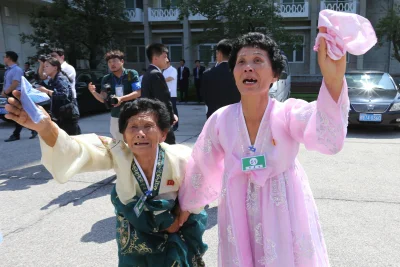
Some 75% of South Koreans registered as separated from family in the North have died of old age, government data showed Thursday. In this 2018 file photo, North Korean women react after seeing off a family member during a reunion at the Mount Kumgang resort, North Korea. Pool File Photo by O Jongchan/EPA-EFE

SEOUL, Jan. 15 (UPI) — More than three-quarters of South Koreans registered as members of families separated by the 1950-53 Korean War have died without being reunited with relatives in North Korea, official government data showed Thursday.

As of Dec. 31, 2025, a total of 134,516 people had registered with South Korea’s government as separated family members, the Ministry of Unification said in its latest statistical release. Of those, 101,148 — about 75% — were confirmed dead, leaving just 34,368 survivors.

The figures highlight the rapid aging of the remaining survivors. More than 65% of living registrants are aged 80 or older, including 10,885 people aged 90 or above, the data showed.

North and South Korea have held 21 family reunions since 2000, with the most recent taking place in August 2018 during a period of inter-Korean detente. Relations have frozen over in recent years, however, and time is not on the side of family members still hoping to connect with long-lost relatives.

Since taking office in June, President Lee Jae Myung has called for restoring humanitarian cooperation with Pyongyang, identifying separated family reunions as a priority issue in efforts to stabilize inter-Korean relations.

“I believe that it is the responsibility of all political leaders in both the South and the North to ensure that these tragically separated families can confirm the fate of their relatives and, at the very least, exchange letters,” Lee said in October.

Seoul has also sought to advance humanitarian engagement through institutional measures. In December, the Ministry of Unification released a 2026 policy plan aimed at “peaceful coexistence” with North Korea, pledging to expand separated family programs such as DNA testing, video messages and efforts to confirm the status of missing relatives.

Unification Minister Chung Dong-young underscored the sense of urgency during a recent visit with elderly separated family members, including a 105-year-old man in Seoul. “Separated families represent the greatest sorrow born of national division,” Chung said, adding that “time is running out.”

North Korea has not responded to recent proposals for humanitarian exchanges, however, as inter-Korean communication channels remain dormant amid heightened tensions over Pyongyang’s nuclear and missile programs. In February, North Korea began dismantling the facility used for family reunions at its Mount Kumgang tourist zone, a further sign of deteriorating relations.

Kim Yo Jong, the influential sister of North Korean leader Kim Jong Un, said on Tuesday that South Korea’s hopes for improved ties were an “illusion.”

“As far as Seoul’s various hope-filled wild dreams called ‘repair of (North-South) relations’ are concerned, they all can never come true,” Kim said in a statement carried by the official Korean Central News Agency.

Source link

Syrian army tells civilians to evacuate new front with SDF east of Aleppo | Syria’s War News

A ‘humanitarian zone’ is expected to remain open on Thursday, allowing residents to leave Deir Hafer and Maskana.

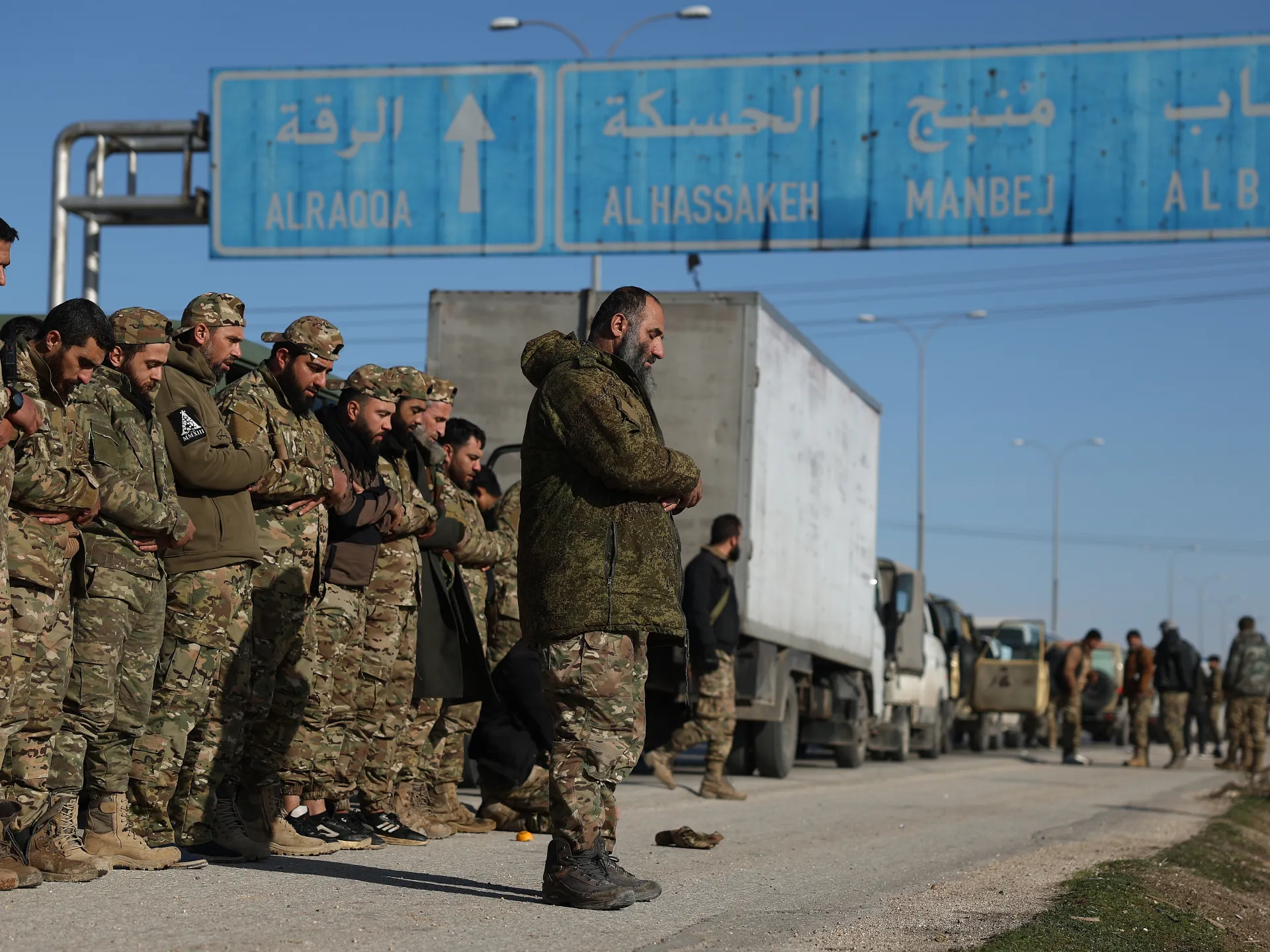
The Syrian army is telling civilians to evacuate parts of the rural Aleppo governorate after accusing the Syrian Democratic Forces (SDF) of building up troops in the area, following days of deadly fighting inside Aleppo city, as concerns rise over a new front in the simmering battle.

A “humanitarian zone” was expected to remain open on Thursday from 9am local time (6:00 GMT) to 5pm (14:00 GMT), allowing residents to leave Deir Hafer and Maskana in the eastern countryside. The army declared the areas closed military zones and sent in their own reinforcements earlier this week.

Recommended Stories

list of 4 itemsend of list

At least 23 people have been killed in clashes between the United States-backed, Kurdish-led SDF and the Syrian army that have gripped Aleppo for more than a week. Although a March deal promised to incorporate the SDF into Syrian state institutions, talks over incorporation have since stalled, leading to the renewed conflict.

A ceasefire announced on January 9 allowed SDF fighters to trickle out of Aleppo’s Ashrafieh and Sheikh Maqsoud Kurdish neighbourhoods to parts of northeastern Syria, where the SDF runs a semi-autonomous zone.

In Deir Hafer and Maskana, the military called on the SDF to withdraw to the other side of the Euphrates river, located east of the contested zone. The two sides have exchanged limited fire.

The government has also accused the SDF of carrying out drone strikes in Aleppo city, including one that hit the Aleppo governorate building on Saturday shortly after government officials hosted a news conference at the site.

The SDF, for its part, has accused the army of escalating attacks on infrastructure and facilities in Deir Hafer.

‘Eagerly awaiting’ incorporation deal

On Wednesday, Syria’s military closed off several roads in the al-Safira area of rural Aleppo province “for security reasons and to ensure the safety of citizens”, state news agency SANA reported.

The SDF troop buildup in the area included fighters from the Kurdistan Workers’ Party (PKK) and other “remnants of the former regime”, the agency added.

The PKK carried out a 40-year armed struggle in Turkiye, and Turkish officials said they were closely watching Syria’s latest round of fighting. Nuh Yilmaz, Turkiye’s ambassador to Damascus, travelled to Aleppo this week “to witness the restoration of peace and stability”.

“We are eagerly awaiting the implementation of the [March] agreement without the need for war,” Yilmaz told reporters. “This way, there will be no need for war, fighting or other methods, and we can all focus on a development agenda in peace.”

The Syrian Interior Ministry, meanwhile, released a group of SDF fighters in the Sheikh Maqsoud neighbourhood after securing the defection of an unknown number of SDF fighters.

Video footage broadcast by Al Jazeera Mubasher showed a group of several dozen men leaving a detention centre in Aleppo and boarding buses.

In a statement on Telegram, the ministry wrote those released were “found not to be involved in criminal acts or to have blood on their hands”.

“This step aligns with the state’s policy of opening the doors of return for all those who have gone astray and have not committed crimes against civilians,” it added.

Syrian President Ahmed al-Sharaa emphasised in an interview aired on state TV on Wednesday that he admired the “courage” of the Kurdish people, arguing that the December 2024 ousting of President Bashar al-Assad was the first “real response” to injustices against the community in decades.

But he also lashed out against the SDF, saying the group has refused to allow civilians to safely evacuate from the recent fighting and has pushed off efforts from the US and France to mediate a ceasefire.

The interview was intended to air on Shams TV in Erbil, the centre of Iraq’s semi-autonomous Kurdish region, but was spiked because of al-Sharaa’s hardline stance against the SDF, The Associated Press news agency reported.

Clips from the interview were instead publicised on state TV.

Source link

India shuts Kashmir medical college – after Muslims earned most admissions | Islamophobia News

India has shut down a medical college in Indian-administered Kashmir in an apparent capitulation to protests by right-wing Hindu groups over the admission of an overwhelming number of Muslim students into the prestigious course.

The National Medical Commission (NMC), a federal regulatory authority for medical education and practices, on January 6 revoked the recognition of Shri Mata Vaishno Devi Medical Institute (SMVDMI), located in Reasi, a mountainous district overlooking the Pir Panjal range in the Himalayas, which separates the plains of Jammu from the Kashmir valley.

Recommended Stories

list of 4 itemsend of list

Of the 50 pupils who joined the five-year bachelor’s in medicine (MBBS) programme in November, 42 were Muslims, most of them residents of Kashmir, while seven were Hindus and one was a Sikh. It was the first MBBS batch that the private college, founded by a Hindu religious charity and partly funded by the government, had launched.

Admissions to medical colleges across India, whether public or private, follow a centralised entrance examination, called the National Entrance Examination Test (NEET), conducted by the federal Ministry of Education’s National Testing Agency (NTA).

More than two million Indian students appear for NEET every year, hoping to secure one of approximately 120,000 MBBS seats. Aspirants usually prefer public colleges, where fees are lower but cutoffs for admission are high. Those who fail to meet the cutoff but meet a minimum NTA threshold join a private college.

Like Saniya Jan*, an 18-year-old resident of Kashmir’s Baramulla district, who recalls being overwhelmed with euphoria when she passed the NEET, making her eligible to study medicine. “It was a dream come true – to be a doctor,” Saniya told Al Jazeera.

When she joined a counselling session that determines which college a NEET qualifier joins, she chose SMVDMI since it was about 316km (196 miles) from her home – relatively close for students in Kashmir, who often otherwise have to travel much farther to go to college.

Saniya’s thrilled parents drove to Reasi to drop her off at the college when the academic session started in November. “My daughter has been a topper since childhood. I have three daughters, and she is the brightest. She really worked hard to get a medical seat,” Saniya’s father, Gazanfar Ahmad*, told Al Jazeera.

But things did not go as planned.

Protesters demanding revocation of the MBBS admission list of the Shri Mata Vaishno Devi Institute of Medical Excellence
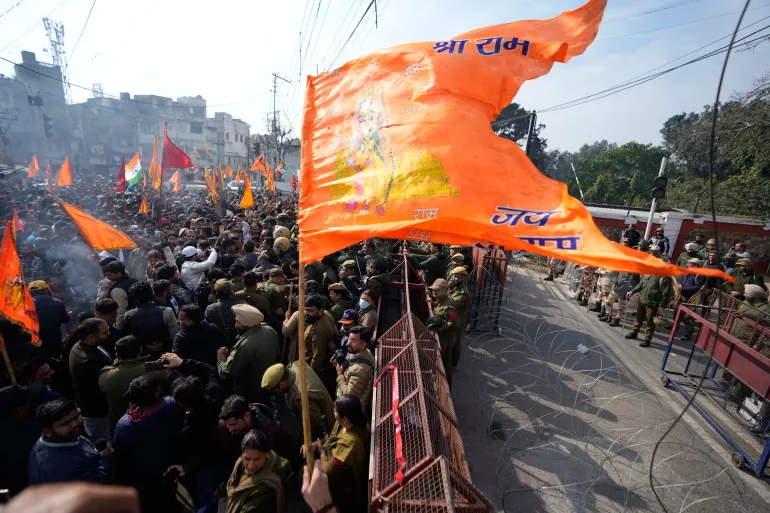
Supporters of right-wing Hindu groups protesting against the governor of Indian-administered Kashmir, demanding that admissions to the Shri Mata Vaishno Devi Institute of Medical Excellence be revoked, in Jammu on Saturday, December 27, 2025 [Channi Anand/ AP Photo]

‘No business being there’

As soon as local Hindu groups found out about the religious composition of the college’s inaugural batch in November, they launched demonstrations demanding that the admission of Muslim students be scrapped. They argued that since the college was chiefly funded from the offerings of devotees at Mata Vaishno Devi Temple, a prominent Hindu shrine in Kashmir, Muslim students had “no business being there”.

The agitations continued for weeks, with demonstrators amassing every day outside the iron gates of the college and raising slogans.

Meanwhile, legislators belonging to Prime Minister Narendra Modi’s Bharatiya Janata Party (BJP) – which has been accused of pursuing anti-Muslim policies since coming to power in 2014 – even wrote petitions to Kashmir’s lieutenant governor, urging him to reserve admissions in SMVDMI only for Hindu students. The lieutenant governor is the federally appointed administrator of the disputed region.

In the days that followed, their demands escalated to seeking the closure of the college itself.

As the protests intensified, the National Medical Commission on January 6 announced that it had rescinded the college’s authorisation because it had failed to “meet the minimum standard requirements” specified by the government for medical education. The NMC claimed the college suffered from critical deficiencies in its teaching faculty, bed occupancy, patient flow in outpatient departments, libraries and operating theatres. The next day, a “letter of permission”, which authorised the college to function and run courses, was withdrawn.

Hindu pilgrims on their way to the Vaishno Devi shrine rest under a shade and wait for transport outside a railway station on a hot day in Jammu, India, Wednesday, June 12, 2019. Intense heat wave continues to plague northern India, with several areas across the region, hitting temperatures above 46 degrees Celsius (115 degrees Fahrenheit). (AP Photo/Channi Anand)
Hindu pilgrims on their way to the Vaishno Devi shrine rest under a shade and wait for transport outside a railway station on a hot day in Jammu, India, Wednesday, June 12, 2019. Far-right Hindu groups argue that because the Shri Mata Vaishno Devi Medical Institute is funded by donations from Hindu believers, the presence of Muslims as the majority in the student body is offensive to them [Channi Anand/ AP Photo]

‘The college was good’

But most students Al Jazeera talked to said they did not see any shortcomings in the college and that it was well-equipped to run the medical course. “I don’t think the college lacked resources,” Jahan*, a student who only gave her second name, said. “We have seen other colleges. Some of them only have one cadaver per batch, while this college has four of them. Every student got an opportunity to dissect that cadaver individually.”

Rafiq, a student who only gave his second name, said that he had cousins in sought-after government medical colleges in Srinagar, the biggest city in Indian-administered Kashmir. “Even they don’t have the kind of facilities that we had here,” he said.

Saniya’s father, Ahmad, also told Al Jazeera that when he dropped her off at the college, “everything seemed normal”.

“The college was good. The faculty was supportive. It looked like no one cared about religion inside the campus,” he said.

Zafar Choudhary, a political analyst based in Jammu, questioned how the medical regulatory body had sanctioned the college’s authorisation if there was an infrastructural deficit. “Logic dictates that their infrastructure would have only improved since the classes started. So we don’t know how these deficiencies arose all of a sudden,” he told Al Jazeera.

Choudhary said the demand of the Hindu groups was “absurd” given that selections into medical colleges in India are based on religion-neutral terms. “There is a system in place that determines it. A student is supposed to give preference, and a lot of parameters are factored in before the admission lists are announced. When students are asked for their choices, they give multiple selections rather than one. So how is it their fault?” he asked.

Al Jazeera reached out to SMVDMI’s executive head, Yashpal Sharma, via telephone for comments. He did not respond to calls or text messages. The college has issued no public statement since the revocation of its authorisation to offer medical courses.

Protesters demanding revocation of the MBBS admission list of the Shri Mata Vaishno Devi Institute of Medical Excellence
Supporters of right-wing Hindu groups shout slogans demanding the revocation of admissions at the Shri Mata Vaishno Devi Institute of Medical Excellence in Jammu on Saturday, December 27, 2025 [Channi Anand/ AP Photo]

‘They turned merit into religion’

Meanwhile, students at SMVDMI have packed their belongings and returned home.

Salim Manzoor*, another student, pointed out that Indian-administered Kashmir, a Muslim-majority region, also had a medical college where Hindu candidates are enrolled under a quota reserved for them and other communities that represent a minority in the region.

The BJP insists it never claimed that Muslim students were unwelcome at SMVDMI, but encouraged people to recognise the “legitimate sentiments” that millions of Hindu devotees felt towards the temple trust that founded it. “This college is named after Mata Vaishno Devi, and there are millions of devotees whose religious emotions are strongly attached to this shrine,” BJP’s spokesman in Kashmir, Altaf Thakur, told Al Jazeera. “The college recognition was withdrawn because NMC found several shortcomings. There’s no question of the issue being about Hindus and Muslims.”

Last week, Omar Abdullah, chief minister of Indian-administered Kashmir, announced that SMVDMI students would not be made to “suffer due to NMC’s decision” and they would be offered admissions in other colleges in the region. “These children cleared the National Entrance Examination Test, and it is our legal responsibility to adjust them. We will have supernumerary seats, so their education is not affected. It is not difficult for us to adjust all 50 students, and we will do it,” he said.

Abdullah condemned the BJP and its allied Hindu groups for their campaign against Muslims joining the college. “People generally fight for having a medical college in their midst. But here, the fight was put up to have the medical college shut. You have played with the future of the medical students of [Kashmir]. If ruining the future of students brings you happiness, then celebrate it.”

Tanvir Sadiq, a regional legislator belonging to Abdullah’s National Conference party, said that the university that the medical college is part of received more than $13m in government aid since 2017 – making all Kashmiris, and not donors to the Mata Vaishno Devi shrine – stakeholders. “This means that anyone who is lawfully domiciled in [Indian-administered Kashmir] can go and study there. In a few decades, the college would have churned out thousands of fresh medical graduates. If a lot of them are Muslims today, tomorrow they would have been Hindus as well,” he told Al Jazeera.

Nasir Khuehami, who heads the Jammu and Kashmir Students’ Association, told Al Jazeera the Hindu versus Muslim narrative threatened to “communalise” the region’s education sector. “The narrative that because the college is run by one particular community, only students from that community alone will study there, is dangerous,” he said.

He pointed out that Muslim-run universities, not just in Kashmir but across India, that were recognised as minority institutions did not “have an official policy of excluding Hindus”.

Back at her home in Baramulla, Saniya is worried about her future. “I appeared for a competitive exam, which is one of the hardest in India, and was able to get a seat at a medical college,” she told Al Jazeera.

“Now everything seems to have crashed. I came back home waiting for what decision the government will take for our future. All this happened because of our identity. They turned our merit into religion.”

Source link

Venezuela’s Rodriguez vows release of more prisoners, holds call with Trump | Nicolas Maduro News

Trump showers acting Venezuelan President Delcy Rodriguez with praise after first phone call since the US military’s abduction of President Nicolas Maduro.

Venezuela’s acting President Delcy Rodriguez has pledged to continue releasing prisoners detained under the presidency of Nicolas Maduro and described her first phone call with United States President Donald Trump since Maduro’s abduction by US forces as positive.

Rodriguez, Maduro’s former vice ‌president, said on Wednesday that she ⁠had a long, ​productive and courteous ‍phone call with the US president, in ⁠which the two discussed a bilateral agenda that would benefit both countries.

Recommended Stories

list of 4 itemsend of list

Trump, in a post on his Truth Social platform, said the two discussed oil, minerals, trade and national security, describing how “this partnership” between the US and Venezuela would be “spectacular”.

“I think we’re getting along very well with Venezuela,” Trump said at the White House after the lengthy call, describing Rodriguez as a “terrific person”, adding that US Secretary of State ‍Marco Rubio had also been in touch with the acting president.

Trump’s praise of Rodriguez follows after President Maduro and his wife, First Lady Cilia Flores, were abducted by the US military in an attack on the Venezuelan capital, Caracas, on January 3. Maduro and Flores are now being held in prison in the US.

Trump said last week that a second ⁠wave of US attacks on Venezuela had been cancelled amid “cooperation” from leaders in Caracas, including the release of a large ‍number of prisoners as a sign of “seeking peace” with Washington.

Earlier on Wednesday, during her first media briefing since Maduro’s abduction, Rodriguez said Venezuela was entering a “new political moment” and the process of releasing detainees “has not yet concluded”.

“This opportunity is for Venezuela and for the people of Venezuela to be able to see reflected a new moment where coexistence, where living together, where recognition of the other allows building and erecting a new spirituality,” Rodriguez said in her address.

Flanked by her brother and National Assembly President Jorge Rodriguez, and Interior Minister Diosdado Cabello, the acting president also pledged “strict” enforcement of the law and credited Maduro with already initiating the release of prisoners.

“Messages of hatred, intolerance, acts of violence will not be permitted,” Rodriguez said.

The renewed promise to continue freeing prisoners followed after Jorge Rodriguez announced in parliament on Tuesday that more than 400 detainees had been freed recently.

While Venezuelan authorities deny that they hold political prisoners, the release of people held for political reasons in Venezuela has been a long-running call of rights groups, international bodies and opposition figures.

Rights groups in recent days have criticised the slow release of prisoners by the post-Maduro leadership.

Trump is scheduled to meet on Thursday with Venezuelan opposition leader Maria Corina Machado at the White House, their first in-person meeting since the abduction of Maduro.

Machado, who won the Nobel Peace Prize last year, has offered to give Trump her prize, ‌but the Nobel Committee said the Peace Prize cannot be transferred.

Source link

Vice President Vance casts tie-breaking vote to quash war powers resolution

Jan. 14 (UPI) — Vice President JD Vance was needed Wednesday to vote in the Senate for the Republicans to quash a Democratic effort to rein in President Donald Trump‘s ability to launch military action against Venezuela.

Vance cast the deciding vote to break the 50-50 tie in a point of order to bar Senate Joint Resolution 98 from advancing to final consideration. The resolution appeared to have bipartisan promise, with five Republicans joining their Democratic colleagues in supporting the measure last week, but Sens. Josh Hawley, R-Mo., and Todd Young, R-Ind., changed their positions in the decisive motion following a pressure campaign from President Donald Trump.

“Senate Republicans continually fall in line behind Donald Trump, no matter how reckless, no matter how unconstitutional, no matter the potential cost of American lives,” Senate Minority Leader Chuck Schumer, D-N.Y., said during a press conference following the vote.

“What has happened tonight is a road map to another endless war because this Senate under Republican leadership failed to assert its legitimate and needed authority.”

The bill was introduced in early December by Sen. Tim Kaine, D-Va., amid a U.S. military buildup near Venezuela and as the Trump administration was attacking alleged drug-trafficking boats in the Caribbean, a move that heightened concerns about the president’s ability to attack the South American country without congressional approval.
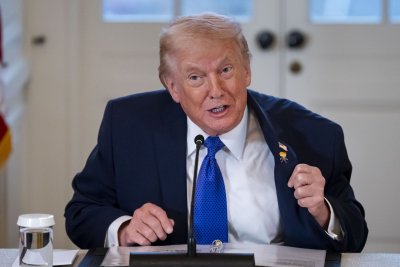
As the bill was pending, Trump ordered a clandestine military operation earlier this month that resulted in the seizure of Venezuela’s authoritarian leader, Nicolas Maduro.

Despite Maduro’s ouster, concerns over further U.S. military action in Venezuela remain, along with uncertainty over the Trump administration’s plans for the country.

“The White House put a full-court press on unlike any I’ve sen in 13 years here to stop a public debate about war,” Kaine said. “If they were that righteous about the justness of this cause or the validity of their legal rationale, they wouldn’t be afraid of public debate.”

On Jan. 8, the resolution cleared an initial procedural vote 52-47, with five Republicans joining their Democratic colleagues.

Following the initial vote, Trump took to his Truth Social platform to call for the senators’ ouster.

“Republicans should be ashamed of the Senators that just voted with Democrats in attempting to take away our Powers to fight and defend the United States of America,” Trump said.

Along with Hawley and Young, the other Republicans were Sens. Susan Collins of Maine, Lisa Murkowski of Alaska and Rand Paul of Kentucky.

Trump said they “should never be elected to office again.”

“This Vote greatly hampers American Self-Defense and National Security, impeding the President’s Authority as Commander in Chief,” he added.

Young, in a statement Wednesday, said his change in position followed conversations with senior national security officials who assured him there are no troops on the ground in Venezuela and with Trump, who said if U.S. forces were needed in military operations in the South American nation the administration would ask Congress for authorization.

“I strongly believe any commitment of U.S. forces in Venezuela must be subject to debate and authorization in Congress,” he said.

Kaine, who has already filed several war powers resolutions, said the Democrats are going “to be filing a whole lot more.”

Source link

South Korea adds 193,000 jobs in 2025 as youth, key sectors slump

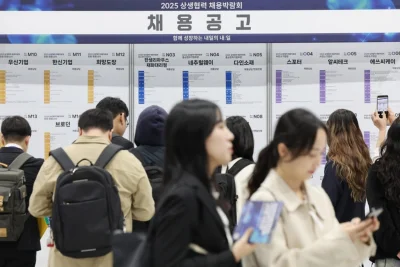
Job seekers look at job postings during a job fair at the COEX Magok Convention Center in western Seoul, South Korea, on 21 October 2025. File Photo by YONHAP / EPA

Jan. 14 (Asia Today) — South Korea added 193,000 employed people in 2025, but jobs in construction and manufacturing fell sharply and the number of young people outside the labor force rose to one of the highest levels on record, government data showed Tuesday.

The National Data Service said in its “December 2025 and Annual Employment Trends” release that the number of employed people in 2025 totaled 28,769,000, up 193,000 from a year earlier.

By industry, construction employment dropped by 125,000, the largest decline since the statistics were first compiled in 2013. Manufacturing employment fell by 73,000, the biggest decrease in six years since 2019, when it fell by 81,000, the data showed.

By age group, the downturn was most pronounced among people in their 20s. Employment for that group fell by 170,000 in 2025, the largest decline among all age brackets.

The data also showed a surge in young people who were not economically active. The number of “idle” people ages 15 to 29 reached 428,000, the second-highest level since 2020, when it stood at 448,000.

— Reported by Asia Today; translated by UPI

© Asia Today. Unauthorized reproduction or redistribution prohibited.

Source link

US Senate defeats war powers resolution designed to rein in Trump | Donald Trump News

United States Vice President JD Vance has cast the tie-breaking vote to defeat a war powers resolution that would have forced President Donald Trump to seek Congress’s approval before taking any further military action in Venezuela.

The Senate’s session on Wednesday evening came to a nail-biting conclusion, as the fate of the resolution ended up resting on the shoulders of two Republican politicians.

Recommended Stories

list of 3 itemsend of list

Senators Todd Young of Indiana and Josh Hawley of Missouri had voted last week, as part of a group of five breakaway Republicans, to put the resolution to a full Senate vote. With unanimous support from Democrats, the measure advanced with 52 votes in favour, 47 against.

But supporters of the resolution could only afford to lose one vote in order to secure the bill’s passage. By Wednesday, it had lost two: both Young and Hawley.

The final vote was evenly split, 50 to 50, allowing Vance to act as tie-breaker and defeat the resolution.

Hawley signalled early in the day that he had decided to withdraw his support. But Young was a wild card until shortly before the final vote took place

“After numerous conversations with senior national security officials, I have received assurances that there are no American troops in Venezuela,” Young wrote on social media.

“I’ve also received a commitment that if President Trump were to determine American forces are needed in major military operations in Venezuela, the Administration will come to Congress in advance to ask for an authorization of force.”

Young also shared a letter, dated Wednesday, from Secretary of State Marco Rubio, offering lukewarm assurances that Congress would be notified ahead of any future military action in Venezuela.

“Should the President determine that he needs to introduce US Armed Forces into hostilities in major military operation in Venezuela, he would seek congressional authorizations in advance (circumstances permitting),” Rubio wrote.

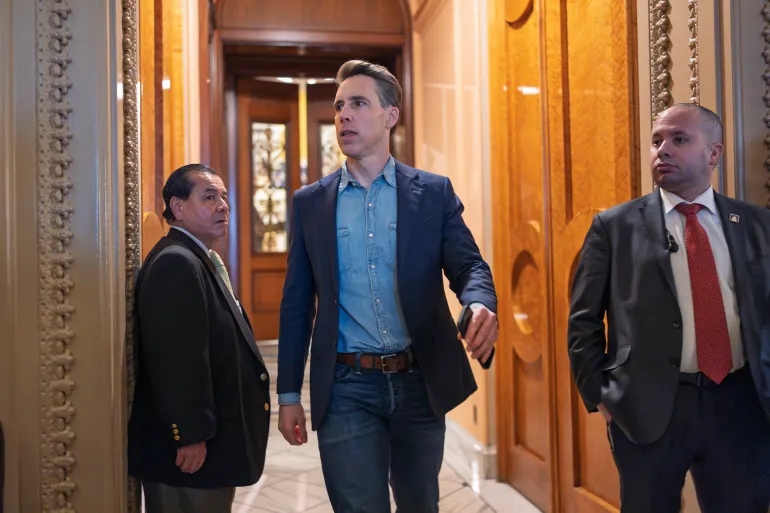
Josh Hawley
Josh Hawley signalled early on Wednesday that he would not vote to pass the war powers resolution in the Senate [File: J Scott Applewhite/AP Photo]

The latest war powers resolution arrived in response to a surprise announcement on January 3 that Trump had launched a military action to topple Venezuelan President Nicolas Maduro.

Explosions were reported in the Venezuelan capital of Caracas and nearby military bases, and Trump appeared in a broadcast hours later to announce that the US had abducted Maduro and transported him to the US to face criminal trial.

Maduro’s wife Cilia Flores was also captured as part of the operation.

Two US service members were injured in the attack, and as many as 80 people in Venezuela were killed, including Cuban security personnel involved in guarding Maduro.

“We’re going to run the country until such time as we can do a safe, proper and judicious transition,” Trump said in his speech announcing the attack.

He and Rubio then fielded questions about whether Congress had been notified about the operation. They acknowledged they did not notify lawmakers in advance.

“This was not the kind of mission that you can do congressional notification on,” Rubio said. “It was a trigger-based mission.”

Trump, meanwhile, argued that congressional notification had been a liability to the mission’s security. “Congress will leak, and we don’t want leakers,” he said.

Normally, the US Constitution divides up military authority between the legislative and executive branches. While the president is considered the commander-in-chief of the armed forces, only Congress has the power to declare war and authorise military action.

But that division of power has become gradually eroded, as the executive branch has exercised greater authority over the military.

In recent decades, presidents have often justified unilateral military action by referring to authorisations of military force (AUMFs) approved by Congress in the wake of the attacks on September 11, 2001.

But military action in Venezuela falls outside of the purview of those authorisations, raising questions about the legal justification for the January attack.

On Tuesday, the Department of Justice published a 22-page memo it originally wrote in December to justify the forthcoming attack. That memo argued that, since Maduro’s abduction was an act of “law enforcement”, it fell short of the legal threshold that would have required congressional approval.

In addition, the document asserted that, since the planned military operation was not expected to trigger a war, it also landed outside of Congress’s powers.

“The law does not permit the President to order troops into Venezuela without congressional authorization if he knows it will result in a war,” the memo explained. “As of December 22, 2025, we have not received facts indicating it will.”

Todd Young
Senator Todd Young said he had received assurances from Secretary of State Marco Rubio that the executive branch would communicate to Congress about further military actions[File: Ben Curtis/AP Photo]

A Republican breakaway

But not every Republican agreed with that explanation, and several sought to claw back Congress’s power to oversee US military action.

They included senators Lisa Murkowski of Alaska, Rand Paul of Kentucky and Susan Collins of Maine, all seen as pivotal swing votes in Congress’s upper chamber.

Young and Hawley joined the three rogue Republicans for an initial vote to advance the war powers resolution on January 8. But afterwards, all five came under acute pressure to switch sides and rejoin the Republican caucus for the final vote.

President Trump, in particular, denounced the five Republicans on his social media platform Truth Social.

“Republicans should be ashamed of the Senators that just voted with Democrats in attempting to take away our Powers to fight and defend the United States of America,” he wrote in a post.

“This Vote greatly hampers American Self Defense and National Security, impeding the President’s Authority as Commander in Chief.”

Reports emerged that Trump even called some of the senators in advance of Wednesday’s vote, in an effort to gain their support. But the publication The Hill indicated that Trump’s conversation with Collins devolved into a “profanity-laced rant”.

Paul, another Republican who has also courted Trump’s ire, was among the senators to speak before Wednesday’s final vote.

He defended his decision to back the war powers resolution, calling his vote a necessary act to uphold the Constitution’s separation of powers.

“This isn’t really and shouldn’t be Republican versus Democrat. This should be legislative prerogative versus presidential prerogative, and it should be about the Constitution,” Paul said.

“The Constitution — specifically, thoughtfully — vested the power of initiating war and declaring war to Congress,” he added.

“The spectrum of our founding fathers concluded they didn’t want the president to have this power.”

Risking Trump’s ire comes at a higher cost for some Republicans than others. Of the three Republicans who joined Democrats on Wednesday to vote for the war powers resolution, only one is up for re-election this year in the US midterm races: Collins.

Source link

FBI conducts raid on Washington Post reporter’s home, seizes electronics | Freedom of the Press News

United States news agencies and press freedom groups have expressed concern after federal agents raided the home of a reporter for The Washington Post as part of a probe into the handling of classified material.

Wednesday’s raid focused on the residence of journalist Hannah Natanson, who has led the Post’s coverage of efforts under President Donald Trump to slash the federal workforce.

Recommended Stories

list of 3 itemsend of list

Agents from the Federal Bureau of Investigation (FBI) seized her work and personal laptops, as well as other electronics like her phone and a Garmin watch.

“According to the government warrant, the raid was in connection with an investigation into a government contractor accused of illegally retaining classified government materials. We are told Hannah, and the Post, are not a target,” said Washington Post executive editor Matt Murray.

“Nonetheless, this extraordinary, aggressive action is deeply concerning and raises profound questions and concern around the constitutional protections for our work.”

Free press organisations echoed the Post’s concerns, arguing that the raid fit into a pattern of escalating pressure on journalists who report on information the government does not want made public.

Trump has frequently attacked the news media and threatened those he deems too critical with lawsuits and investigations.

Still, it is unusual for law enforcement to seize materials from a journalist, given the broad press freedom protections established under the US Constitution. Advocates warned that Wednesday’s actions could dampen any efforts journalists may take to report on whistleblower complaints.

According to the Post, the search warrant was part of an investigation into leaks of classified materials, another one of Trump’s pet peeves.

Prosecutors allege that a contractor named Aurelio Perez-Lugones, a system engineer and information technology specialist, took screenshots of intelligence reports and printed them while working for a government contractor in Maryland.

Investigators also say they found classified documents in a lunchbox while searching his car and basement earlier this month.

The Trump administration accused Perez-Lugones of contacting Natanson to leak the information and said the search of her home came at the request of the Department of Defense.

“The Department of Justice and FBI executed a search warrant at the home of a Washington Post journalist who was obtaining and reporting classified and illegally leaked information from a Pentagon contractor,” Attorney General Pam Bondi said in a social media post.

She added that “the leaker” – an apparent reference to Perez-Lugones – had been arrested.

“The Trump Administration will not tolerate illegal leaks of classified information that, when reported, pose a grave risk to our Nation’s national security and the brave men and women who are serving our country,” she said.

White House Press Secretary Karoline Leavitt also weighed in, writing online that Trump had “zero tolerance” for leaks and would “aggressively crack down” on them.

But press advocates argue that working with whistleblowers is an essential component of reporting on secretive government agencies, especially in areas such as national security.

Raids like the one conducted at Natanson’s residence risk violating the understanding of anonymity that journalists build with their sources, particularly those in sensitive government positions.

Natanson had extensively covered the Trump administration’s efforts to reduce the federal workforce and push for nonpartisan employees to align with his political agenda.

She has also reported on recent US actions in Venezuela, which culminated with the abduction of President Nicolas Maduro on January 3.

Groups like Reporters Without Borders (RSF) and the Committee to Protect Journalists (CPJ) were among those to speak out against the search warrant.

“This raid should disturb all Americans. The United States is at a critical juncture as the Trump administration continues to roll back civil liberties,” said Katherine Jacobsen, coordinator for the US, Canada and the Caribbean at the CPJ.

“Using the FBI – funded by American taxpayers – to seize a reporter’s electronic devices, including her official work laptop, is a blatant violation of journalistic protections and undermines the public’s right to know.”

Source link

Trump administration freezes immigrant visa processing for 75 nations

Jan. 14 (UPI) — The Trump administration has paused immigrant visa-processing services for citizens of 75 nations due to a likelihood that they will need public support.

The decision does not affect tourist, business, student, temporary work, exchange visitor, medical treatment, and crew and transit visas, officials said.

The State Department issued a memo on Wednesday saying it indefinitely will pause the immigrant visa processing Jan. 21 while assessing how the processing is done.

“The State Department will pause immigrant visa processing from 75 countries whose migrants take welfare from the American people at unacceptable rates,” the department said in a post on X.

“The freeze will remain active until the U.S. can ensure that new immigrants will not extract wealth from the American people.”

The visa-processing pause comes a day after Department of Homeland Services Sec. Kristin Noem said conditions in Somalia have improved to such an extent that the country no longer qualifies for temporary protected status, which ends for Somalian migrants March 17.

“Allowing Somali nationals to remain temporarily in the United States is contrary to our national interests,” Noem said. “We are putting Americans first.”

Somali nationals who voluntarily leave the United States will be given a free plane ticket and $1,000.

The State Department also paused the processing of asylum cases by U.S. Citizenship and Immigration Services and halted green card and citizenship applications for citizens of 19 initial nations, most of which are located in Africa.

The processing changes come amid reports of widespread fraud in Minnesota and other states in which federal and state programs are targeted, often by members of ethnic communities from specific countries, such as Somalia.

The Trump administration has said many migrants are draining taxpayer dollars and state and federal resources, including those engaged in fraud.

The administration has targeted Minnesota with increased immigration law enforcement and federal investigations of alleged fraud via 14 state-run aid programs for child care, child nutrition, autism, housing assistance and more.

Somalians, some of whom are U.S. citizens, account for 82 of 92 defendants in active investigations in Minnesota, according to the U.S. attorney’s office for that state.

The Department of Justice also is investigating claims of fraud in Ohio, California and other states.

The investigations and halting visa processing likely will cause many immigrant families to hesitate when considering filing for public assistance, Migration Policy Institute Associate Director Julia Gelatt said on Wednesday.

The State Department said the 75 nations subject to the visa-processing halt are: Afghanistan, Albania, Algeria, Antigua and Barbuda, Armenia, Azerbaijan, Bahamas, Bangladesh, Barbados, Belarus, Belize, Bhutan, Bosnia, Brazil, Burma, Cambodia and Cameroon.

Also, Cape Verde, Colombia, Cote d’Ivoire, Cuba, Democratic Republic of the Congo, Dominica, Egypt, Eritrea, Ethiopia, Fiji, Gambia, Georgia, Ghana, Grenada, Guatemala, Guinea, Haiti, Iran, Iraq, Jamaica, Jordan, Kazakhstan, Kosovo, Kuwait, Kyrgyzstan, Laos, and Lebanon.

Also, Liberia, Libya, Macedonia, Moldova, Mongolia, Montenegro, Morocco, Nepal, Nicaragua, Nigeria, Pakistan, Republic of the Congo, Russia, Rwanda, Saint Kitts and Nevis, Saint Lucia, Saint Vincent and the Grenadines, Senegal, Sierra Leone, Somalia, South Sudan, Sudan, Syria, Tanzania, Thailand, Togo, Tunisia, Uganda, Uruguay, Uzbekistan and Yemen.

Source link