TOP NEWS

From breaking news to significant developments in politics, business, technology, entertainment, and more, we deliver the stories that shape our global landscape.

ASEAN diplomats voice ‘serious concern’ over Iran war and energy crisis | ASEAN News

Southeast Asian countries are highly affected by oil supply shortages caused by the Iran war and the Strait of Hormuz closure.

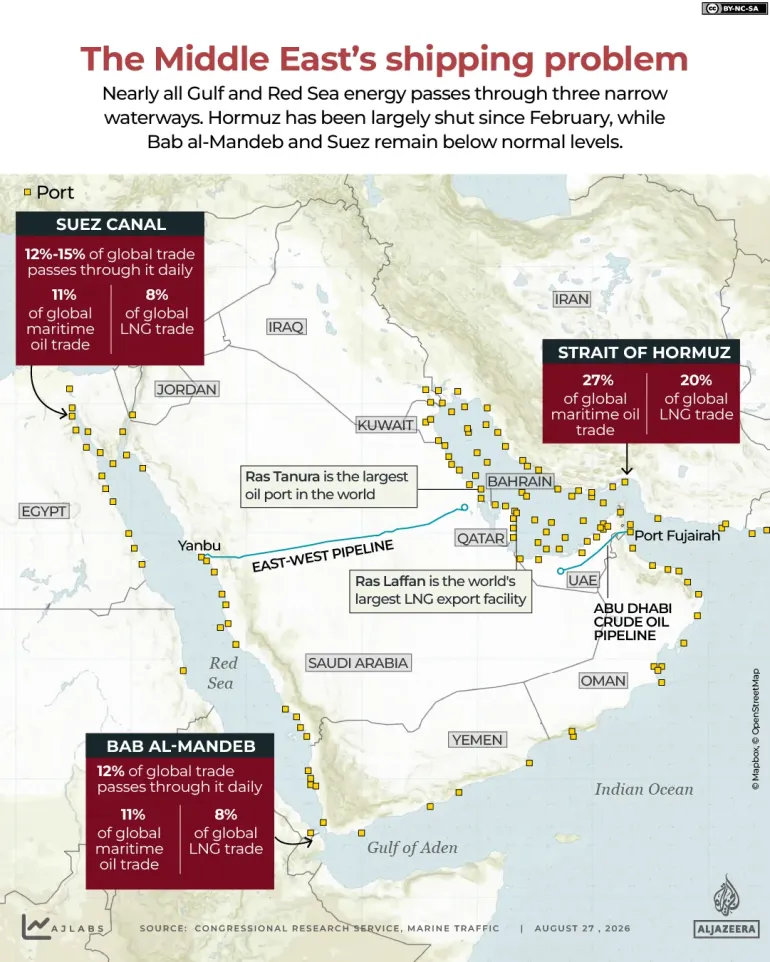
Southeast Asian nations are “deeply concerned” about the impact of blockades of key maritime trade routes in the Middle East, their top diplomats have said.

Foreign ministers from the Association of Southeast Asian Nations (ASEAN) and their key ⁠partners met in the Philippines on Tuesday against a backdrop of instability due to the global impact on trade and energy supplies caused by the US-Israel war on Iran and the closure of the Strait of Hormuz, as well as territorial disputes with Beijing in the South China Sea.

Recommended Stories

list of 4 itemsend of list

Southeast Asian countries have a combined gross domestic product (GDP) of $3.8 trillion but are highly exposed to supply limitations caused by the blockade of the Strait of Hormuz, as they are heavily dependent on Gulf countries for their oil imports.

At the ongoing ASEAN summit in Manila, heads of state and top diplomats from the region are seeking to agree on an oil-sharing mechanism to mitigate the impact of the war on Iran.

Yemen’s Iran-aligned Houthis announced a naval blockade on Saudi Arabia on Monday, opening a potential new front in the war and risking aggravating the threat to global energy supplies and trade beyond the Gulf.

“We are deeply concerned that these ‌developments severely undermine the ongoing efforts of key mediators and diminish the prospects for a peaceful resolution through dialogue and diplomacy,” ASEAN ministers said in a statement.

Top diplomats from the United States, Russia and China are also attending the ASEAN summit, another reminder of how the war on Iran is reshaping international diplomacy and the global energy supply.

Reporting from Manila, Al Jazeera’s Barnaby Lo said the war has driven up oil and gas prices in Southeast Asia while also stalling manufacturing and exports, causing countries from the region to find new trade partners.

“Southeast Asia is thousands of kilometres away from the Middle East, but it has been one of the most impacted regions by the conflict because of how dependent many of its member nations are on oil from the Middle East,” Lo said.

“Take, for example, the Philippines: it’s the first country in the world to declare a state of national energy emergency, and it still is in this state, so it is fighting problems on two fronts. One on supply, the other on skyrocketing fuel prices,” Lo said. “On supply, it’s gotten oil from non-traditional partners, such as Russia and China, but on skyrocketing prices it has very little it can do because the prices here are driven by market forces.”

Other key issues to be discussed at the ASEAN summit include the civil war in Myanmar, as the bloc’s peace initiatives falter, five years after a military coup plunged the country into a conflict that has killed an estimated 100,000 people.

“Ahead of the summit, ASEAN foreign ministers held an in-person meeting – the first since 2021 – with the foreign minister of the military-backed government in Myanmar in Bangkok,” Lo reported. “This was criticised for legitimising the military junta in Myanmar.”

Top diplomats are also likely to discuss ⁠tensions in the South China Sea, with ASEAN countries and China still trying to conclude a code of conduct to ⁠prevent disputes after nearly 10 years. In advance of the summit, China and the Philippines were engaged in a feud after a confrontation between their vessels in disputed waters left a Filipino sailor injured.

The US Department of State condemned what it described as China’s “dangerous and aggressive” actions, and its “troubling pattern of provocation against lawful Philippine maritime operations”.

Source link

Mexican drug lord ‘El Mayo’ sentenced to life in US prison | Drugs

NewsFeed

Mexican drug kingpin Ismael ‘El Mayo’ Zambada has been sentenced to life in prison in the US, following a plea deal last year when he admitted to trafficking millions ⁠of kilograms of cocaine. El Mayo led one of Mexico’s most violent drug cartels, the Sinaloa Cartel, for about four decades.

Source link

‘Won’t back down’: Indian student protesters return after police crackdown | Protests News

New Delhi, India – Blood spots on the walls, overturned barricades, shattered mirrors and sandals strewn across the road. A scarf here, broken glasses and a torn shirt there lie as remnants of the chaos that took over the Indian capital.

The heart of New Delhi – Parliament Street and Connaught Place, a colonial-era square – bears the imprint of Monday’s police crackdown on thousands of protesters, most of them students, who had shut down the capital, demanding that Education Minister Dharmendra Pradhan resign.

A swarm of protesters reached parliament’s doorstep before retreating as the police tear-gassed them. More than 100 students were injured.

“I still cannot believe my eyes that I’m in Delhi,” said Anshul Dev, an 18-year-old who grew up in the capital. “Part of it is because tear gas still stings,” he added, bursting into laughter with his group of friends. One of them had both legs bandaged.

“This government, whom our elders voted to power, is treating us like terrorists and criminals,” Dev said. “This is our country, and we are reclaiming it from their hateful politics. We are here to break the spell.”

Anger among India’s youth, the world’s largest Gen Z cohort, has been simmering for the past two months over a string of compromised entrance exams that affected millions of students. In some cases, exam papers were leaked; in others, students who sought copies of their answer scripts found that they had been wrongly graded. More than 20 students died by suicide, many citing the paper leaks.

Prime Minister Narendra Modi has not addressed the protests, even as he appeared smiling on Monday in parliament, barely metres away from demonstrators at one point.

Analysts said the student protests face formidable obstacles before they can extract concessions from Modi’s government. Yet the protests, the government’s refusal to hold any of its own accountable and the crackdown have also embellished a charge that the prime minister has long faced from critics and opposition parties – that although he is elected democratically, he behaves like an autocrat.

Tear gas spreads around protesters in New Delhi on July 20, 2026
Tear gas spreads around protesters in New Delhi on July 20, 2026 [Anushree Fadnavis/Reuters]

‘Protests will continue’

After dark on Monday, Abhijeet Dipke – the leader of the Cockroach Janta Party (CJP), a political pressure group that called the march – returned to a torn-down stage at the CJP’s main protest site near Jantar Mantar, an 18th-century observatory that is now an important location for protests.

“This barbaric Delhi police has beaten up our students and comrades. We are heartbroken,” he said, addressing about 2,000 protesters who stayed back after the crackdown. “We will continue to resist and demand accountability from the government. We will not back down until Dharmendra Pradhan resigns.”

Dipke told the protesters that the Delhi police “brutally cracked down to crush our hopes” that Pradhan would resign. “It was only our first call to march,” he said. “There will be more. Do not lose hope.”

Volunteers began to pick up rubbish, tie a tent together and sweep the road at the Jantar Mantar site. This is where more than 100 protesters from student unions have been sleeping for nearly a month to join Sonam Wangchuk, a prominent activist, on a hunger strike to seek the minister’s resignation.

The police also rampaged through these student unions’ tarpaulin tents and belongings on Monday.

The movement gained momentum last week after the police forcibly removed Wangchuk from the protest site and restricted him to a government-run hospital, where he remains. His family and the CJP have called it “illegal detention”, but the Delhi High Court has refused immediate relief.

Wangchuk, 59, broke his hunger strike before the march on Monday; however, later he said he would be at it again after “seeing the brutality” against “peacefully protesting students”.

The Delhi police have filed at least five criminal cases against protesters related to violence, stone-throwing and vandalism during the march.

CJP founder Abhijeet Dipke speaks to protesters injured in New Delhi on July 21, 2026
CJP founder Abhijeet Dipke speaks to protesters injured in New Delhi on July 21, 2026 [Arun Sankar/AFP]

Meeting with government a ‘waste of time’

Before the march, CJP leaders said the government reached out for talks.

As thousands of demonstrators assembled in New Delhi, two CJP spokespeople met JP Nadda, India’s health minister, to convey the movement’s three demands: Pradhan’s immediate resignation, Wangchuk’s discharge from hospital and compensation of nearly $105,000 for the families of those students who died by suicide.

However, they were disillusioned by sunset. “It was a waste of our time,” said Ashutosh Ranka, a CJP spokesperson. “We were made to wait for four hours, and the minister met us for 10 minutes.”

Nadda said he met with the spokespeople “in a cordial atmosphere”, adding that he “requested all the protesters to end their sit-in and assist the administration in restoring normalcy”.

Some students have been calling for the decentralisation of the protests, so they could move beyond the CJP to demand accountability from the government.

And political analysts who spoke with Al Jazeera said maintaining the credibility of the CJP’s leadership remains one of the biggest immediate hurdles for the movement in the face of an unprecedented crowd turnout for the march.

A CJP supporter poses next to a protest message in New Delhi after the police crackdown on July 20, 2026
A CJP supporter poses next to a protest message in New Delhi after the police crackdown on July 20, 2026 [Sajjad Hussain/AFP]

Confronting a ‘strong man’

Since the police forcibly removed Wangchuk from the protest site, the movement and demonstrators have called on Modi to resign. Slogans targeting the prime minister reverberated through central New Delhi on Monday.

The large number of protesters “is itself a big challenge to the prime minister”, said Nilanjan Mukhopadhyay, an author and Modi biographer.

As of now, he told Al Jazeera, “Modi has decided to continue with his instinctive response of not giving any concessions to protesters and continuing to project himself as a strong man with completely unshakeable will.”

The biographer added that the prime minister, who has been in power since 2014, “does not care before crushing a protest or using brute force until it cuts through his voting constituencies”.

“They will go by their gut response of a crackdown. Modi would not want to emerge from this with a bloody nose,” he added, “despite a lot of anger among youth, which shows the undercurrent of anti-incumbency.”

The simmering anger found a vent as Gen Z rallied behind a joke, the Cockroach Janta Party, after India’s chief justice equated government critics and unemployed youth to “cockroaches” and “parasites”.

Memes, online rants and students taking photos in front of police have flooded the internet in India, where they expressed anguish and took digs at the police crackdown.

Meghnad S, a YouTuber, was among the crowd of thousands in front of the Indian Parliament on Monday.

“It was insanity, and the crowd was really riled up due to police actions. It was cruel,” he told Al Jazeera from the protest site on Monday night. “But movements are always messy. This is very difficult to control. We are all cockroaches, after all. And we are still swarming here.”

By Tuesday morning, the crowd had packed the site yet again. The cockroaches had returned.

CJP supporters march towards parliament on July 20, 2026
CJP supporters march towards parliament on July 20, 2026 [Adnan Abidi/Reuters]

Source link

Seoul says cooperation with NATO aimed at global peace, seeks stable relations with Russia

South Korean President Lee Jae Myung (2-L) participates in a panel at the NATO Defense Industry Forum in Ankara, Turkey, on July 7. File Photo by Yonhap

South Korea’s proposed cooperation with the North Atlantic Treaty Organization (NATO) is aimed at enhancing their own respective contributions to global peace and stability, Seoul’s foreign ministry said Tuesday, in its first response to recent concerns by Russia over what it described as growing military cooperation between Seoul and NATO.

“Cooperation between South Korea and NATO is aimed at strengthening each side’s capabilities across various sectors, including defense industry, new technologies and cybersecurity, so as to reinforce each side’s role and contribution to international peace and stability,” the ministry told Yonhap News Agency in a written statement.

“In addition, our government continues to hold necessary communication with the Russian side to stably manage South Korea-Russia relations and protect our people and companies,” it added.

Russia’s foreign ministry has expressed displeasure over Seoul’s deepening military cooperation with NATO, according to Russia’s Tass news agency.

“The Russian side expressed serious concern over Seoul’s growing drift toward NATO, as demonstrated, among other things, by the Republic of Korea’s practical steps to deepen military and military-technical cooperation with NATO, the consequences of which pose a threat to Russia’s security,” the ministry said in a statement Thursday.

Moscow further argued that Seoul’s growing cooperation with NATO made it a “de facto participant in NATO’s qualitative and quantitative rearmament process, as the alliance has openly declared its preparations for war with Russia.”

The Russian statement came after South Korean President Lee Jae Myung attended the NATO summit in Ankara earlier this month as one of the alliance’s four Asia-Pacific partners, marking his first appearance at NATO’s annual top-level gathering.

At a NATO summit defense industry forum, Lee proposed elevating South Korea-NATO defense cooperation to a “Korea-NATO Defense Industry Partnership 2.0″ to expand cooperation beyond weapons system transactions to joint research, production and operation in the defense sector.

“Our government is pushing for cooperation with various countries and international organizations, including NATO, under its principle of pursuing practical diplomacy centered on national interests,” the foreign ministry said.

Still, it added, “The country will continue to closely work with the international community while closely monitoring the related developments, as the prolonged Russia-Ukraine war and the military cooperation between North Korea and Russia are issues that have a negative effect on international peace and security on the Korean Peninsula and the region.”

Pyongyang and Moscow have repeatedly and publicly reaffirmed their commitment to strengthening their bilateral cooperation since signing a comprehensive strategic partnership treaty two years ago.

North Korea has also sent around 15,000 combat troops and conventional weapons to Russia to support Moscow’s war against Ukraine, Seoul’s spy agency has said.

Copyright (c) Yonhap News Agency prohibits its content from being redistributed or reprinted without consent, and forbids the content from being learned and used by artificial intelligence systems.

Source link

Information of all S. Korean diplomats presumed to be leaked: officials

The personal information of all South Korean diplomats is believed to have been leaked due to a data breach at the Korean National Diplomatic Academy, officials said Tuesday. The academy, in southern Seoul, is seen here Tuesday. Photo by Yonhap

Personal information of all South Korean diplomats was presumed to be leaked due to a data breach at an online education system run by an institution affiliated with the foreign ministry, officials said Tuesday.

The ministry disclosed Monday it had been notified by a relevant government agency in early February about suspicious access to the online education system of the Korea National Diplomatic Academy (KNDA). Upon the notification, the ministry shut down the system, which has remained offline since. An investigation is under way.

The data breach was presumed to affect all ministry personnel, including retirees, an official at the foreign ministry said, noting the system held approximately 10,000 records of personal data.

An unidentified hacker is believed to have gained access to the server sometime between April and May last year, and maintained that access until February.

The compromised server is believed to have stored educational videos and information on trainees, including their names, user IDs, positions, email addresses and encrypted passwords. Officials from other government agencies who had been deployed to South Korea’s overseas missions may also be among those affected, given that they occasionally use the system.

No “sensitive personal data,” such as identification numbers, mobile phone numbers or home addresses, appeared to be affected, the ministry official said, noting that there may be some overlap among the individuals whose information was compromised.

The official said the ministry could not yet confirm whether all the data stored in the system had been compromised, adding that the 10,000 figure represents the maximum possible number of cases affected.

The ministry currently lacks the technical analysis needed to identify the attacker, the official said.

“We do not rule out any possibility, including involvement by overseas hacker groups,” the official added. “We regard this as a situation with implications for national security.”

Copyright (c) Yonhap News Agency prohibits its content from being redistributed or reprinted without consent, and forbids the content from being learned and used by artificial intelligence systems.

Source link

World Cup: Messi thanks Argentina fans but ‘wound will take time to heal’ | World Cup 2026 News

Argentina were beaten 1-0 in the final by Spain in what has been rumoured to be Lionel Messi’s final World Cup game.

After what may have been his ‌final World Cup match, Lionel Messi was in tears on the field on Sunday ⁠in East Rutherford, ⁠New Jersey, ruing a missed chance to win a second consecutive title for Argentina.

Messi, without hinting whether his World Cup career was officially through, congratulated Spain, who beat Argentina 1-0 in the final, ⁠and said the memories would last, in an Instagram post on Monday evening.

Recommended Stories

list of 4 itemsend of list

“The pain is immense, and this wound will take time to heal,” Messi wrote in his native Spanish alongside ⁠a photo of him bearing a silver medal.

“But I also hold onto all the good things… The matches we turned around by giving it our all – moments that will remain in our memories forever – and the support of an entire country which, combined with this group’s hard work and ‌effort, brought us back among the world’s elite once again.

“It is hard to fully appreciate our achievement right now, but this group reached two consecutive World Cup finals.”

Argentina defeated France on penalty kicks following a 3-3 draw in the 2022 final in Qatar, earning the last piece of major hardware Messi had yet to win in his illustrious career.

Argentina were once again one of the best teams in the ⁠2026 tournament in North America. They rallied past England in the ⁠semifinal before coming up against a Spanish defence that held them without a shot on goal.

Messi turned 39 during the tournament and will turn 43 during the 2030 World Cup, which will be held in Spain, Portugal ⁠and Morocco.

“Thank you from the bottom of my heart for every greeting and message,” Messi wrote. “Once again, we managed to unite ⁠as a country and stand together, sharing the immense ⁠pride of being Argentine.

“I also want to congratulate Spain on winning the championship.”

Messi broke Miroslav Klose’s record of 16 all-time World Cup goals early in the tournament, and he finished with 21, though he was caught ‌and surpassed by Kylian Mbappe (22).

The French star also denied Messi a Golden Boot, finishing with 10 goals to the Argentine’s eight.

ESPN reported on Monday that Messi and his national ‌team ‌and club teammate Rodrigo De Paul will not play the next two regular-season matches for Inter Miami, nor participate in the MLS All-Star Game, as they rest and recover from the World Cup.

Source link

On This Day, July 21: Monkey Trial ends with guilty verdict in Tennessee

1 of 3 | On July 21, 1925, the so-called Monkey Trial, which pitted Clarence Darrow against William Jennings Bryan in Dayton, Tenn., in one of the great confrontations in legal history, ended with John Thomas Scopes convicted and fined $100 for teaching evolution in violation of state law. UPI File Photo

July 21 (UPI) — On this date in history:

In 1861, the first major military engagement of the Civil War occurred at Bull Run Creek, Va.

In 1918, a German U-boat fired on the town of Orleans, Mass., on Cape Cod peninsula, damaging a tug boat and sinking four barges, and severely injuring one man. It was the only place in the United States to receive an enemy attack during World War I.

In 1925, the so-called Monkey Trial, which pitted Clarence Darrow against William Jennings Bryan in Dayton, Tenn., in one of the great confrontations in legal history, ended with John Thomas Scopes convicted and fined $100 for teaching evolution in violation of state law.

In 1969, U.S. astronauts Neil Armstrong and Edwin “Buzz” Aldrin, lifted off from the moon in the Apollo 11 lunar module Eagle and docked with the command module Columbia piloted by Michael Collins.

In 1970, after 11 years of construction, the massive Aswan High Dam across the Nile River in Egypt was completed, ending the cycle of flood and drought in the Nile River region but triggering an environmental controversy.

In 2000, a report from special counsel John Danforth cleared U.S. Attorney General Janet Reno and the government of wrongdoing in the April 19, 1993, fire that ended the Branch Davidian siege near Waco, Texas.

File Photo by Bill Greenblatt/UPI

In 2007, Harry Potter and the Deathly Hallows, the seventh and final installment in the best-selling series, sold more than 8.3 million copies on its first day in bookstores.

In 2011, Greece continued efforts to climb out of a financial chasm with a second bailout pledge from other eurozone countries and the International Monetary Fund worth $157 billion. Earlier, the nation dealt with its debt crisis with the help of a $146 billion loan package.

In 2024, President Joe Biden dropped his re-election bid in the 2024 presidential race, formally endorsing his vice president, Kamala Harris. Former President Donald Trump defeated Harris in November 2024 to win his second term in office.

In 2025, the U.S. Olympic and Paralympic Committee announced that it plans to follow U.S. President Donald Trump’s executive order banning transgender women from women’s sports.

Source link

Many Christian voters in the US see Trump as ‘chosen’ by God to lead | Donald Trump News

NewsFeed

Many white evangelical Christians view Donald Trump as chosen by God to lead despite not seeing him as personally devout. A recent study suggests 60 percent of them believe Trump has pushed the US closer to Christian principles, blurring the line between church and state.

For the full segment, watch Al Jazeera’s ‘This is America’.

Source link

Philippines says China injured sailor in latest maritime clash

July 20 (UPI) — The Philippine military accused China of beating and injuring a Philippine Navy sailor with a wooden baton in the latest seaborne confrontation between the two nations over a submerged reef in the disputed South China Sea.

The incident occurred Monday morning near the BRP Sierra Madre, a derelict warship the Philippines intentionally grounded on the Second Thomas Shoal, a reef both countries lay claim to and which the Philippines calls Ayungin Shoal and China, Ren’ai Jiao.

The Armed Forces of the Philippines said in a statement that a China Coast Guard rigid-hull inflatable boat with eight people on board unlawfully approached the BRP Sierra Madre and took pictures and video of it.

While two AFP rubber boats drove it away, China Coast Guard personnel on the boat struck a Philippine Navy sailor on his head with a wooden baton. The man suffered a deep gash on his scalp, according to a picture shared online by Philippine Coast Guard spokesperson Jay Tarriela.

Video of the incident posted online by Tarriela shows some China Coast Guard members aboard a larger boat swinging long sticks down upon members of the Philippine Navy in a smaller rubber boat.

“Striking an unarmed sailor on the head with a baton — inside our own exclusive economic zone — is not law enforcement. It is unlawful aggression, plain and simple,” Tarriela said in a statement.

China has rejected the accusation, accusing the Philippines of instigating the incident.

“The Philippine personnel first launched malicious attacks on Chinese law enforcement officers using oars, long poles and other tools,” the China Coast Guard said in a statement published online by China’s Embassy in Manila.

“The Chinese side, acting in full compliance with laws and regulations, employed measures such as verbal warnings, evasive maneuvering and proportionate countermeasures to stabilize the situation on site, while exercising the utmost rationality and restraint.”

At roughly 105 nautical miles west of Palawan, the Second Thomas Shoal is well within the Philippines’ exclusive economic zone. The Philippines beached its Sierra Madre warship on the disputed submerged reef in 1999, which it has manned since in an effort to protect its maritime claims.

However, China lays claim to the Second Thomas Shoal and much of the South China Sea via its Nine-Dash-Line map, which has been rejected by several nations, including the United States. The Hague’s Permanent Court of Arbitration also rejected China’s sweeping maritime claims in a landmark 2016 ruling in a case brought by Manila. Beijing rejects the ruling.

Following the incident, the China Coast Guard said in a statement that it would continue to “carry out rights protection and law enforcement activities” and “firmly safeguard China’s territorial sovereignty and maritime rights and interests.”

The U.S. State Department late Monday issued a statement in support of the Philippines, condemning “China’s dangerous and aggressive actions against Philippine navy personnel.”

State Department spokesperson Thomas Pigott said the United States calls on China to “immediately cease its destabilizing conduct.”

“China’s troubling pattern of provocation against lawful Philippine maritime operations undermines regional peace and stability and directly contradicts China’s repeated commitments to resolve disputes peacefully,” he said.

“We stand with our ally, the Philippines, and commend the professionalism and restraint shown by the Philippine navy personnel in this incident.”

Pigott added that the United States reaffirms the 2016 tribunal ruling as final and legally binding on both China and the Philippines.

Customers inspect various wind chimes during the opening day of the Furin-Ichi wind chimes market at the Kawasaki Daishi Heikenji Temple in Kawasaki, Kanagawa-Prefecture in Japan, on July 17, 2026. Photo by Keizo Mori/UPI | License Photo


Source link

Spain’s World Cup heroes welcomed by millions in Madrid | World Cup 2026

NewsFeed

More than half of Madrid’s population turned out to celebrate La Roja as the players returned to Spain following their World Cup victory over Argentina. The team paraded through the city centre on an open-top bus, showing off the trophy to fans.

Source link

Japan to add 230 immigration officers in enforcement push

Travelers from overseas gather after their arrival at Narita International Airport in Narita, Japan. Photo by FRANCK ROBICHON / EPA

July 20 (Asia Today) — Japan plans to add about 230 immigration officers during the current fiscal year as it strengthens enforcement against unauthorized residency and employment, according to a Japanese media report Monday.

The Immigration Services Agency plans to recruit more than 200 immigration control officers and examiners, the Yomiuri Shimbun reported.

The government could approve revisions to the relevant enforcement ordinance at a Cabinet meeting as early as the end of July.

Adding personnel on this scale in the middle of a fiscal year, rather than through the regular hiring and budget process, is unusual.

The agency plans to add about 50 immigration control officers responsible for locating and investigating people who remain in Japan without authorization.

Many of the additional officers will be assigned to Ibaraki prefecture, where authorities plan to increase investigations into unauthorized employment.

Japan also plans to add about 180 immigration examiners.

The examiners will investigate employment outside the activities permitted under a person’s visa status and process a growing number of residency applications more quickly while maintaining stricter reviews.

The government also plans to strengthen screening at airports and seaports to identify travelers who may be at risk of overstaying their visas.

Japan had 68,488 unauthorized residents as of Jan. 1, down 6,375, or 8.5%, from 74,863 a year earlier, according to the Immigration Services Agency.

The total included 41,067 men and 27,421 women.

Despite the decline, the government concluded that more enforcement personnel were needed to prevent unauthorized employment and the misuse of residency classifications.

The government is expected to formally announce the staffing increase at a ministerial meeting this week on accepting foreign nationals and establishing an orderly, inclusive society.

An expert panel on immigration policy is also expected to be established by the end of July.

The panel is expected to discuss issues including the appropriate size of Japan’s foreign population and programs to teach foreign residents about Japanese culture and rules of daily life.

The initiative reflects Japan’s effort to accept foreign workers needed by its labor market while strengthening enforcement against unauthorized residency and employment.

South Korea faces similar challenges as its foreign population grows.

South Korea had 357,598 unauthorized foreign residents at the end of 2025, accounting for 12.8% of all foreign nationals staying in the country, according to Justice Ministry statistics cited in the report.

The total included 128,813 registered foreign residents, 226,028 short-term visitors and 2,757 people who had filed domestic residence reports.

South Korea had 2,783,247 foreign residents at the end of 2025, representing 5.44% of the population. The total included 594,047 people with employment-related residency status and 308,838 international students.

South Korea’s unauthorized foreign population was about 5.2 times Japan’s, although direct comparisons are limited because the two countries use different residency categories and statistical standards.

Both countries are relying more heavily on foreign labor as low birthrates and aging populations contribute to worker shortages.

The increase has also placed greater demands on the government agencies responsible for visa reviews, unauthorized employment investigations and settlement education.

— Reported by Asia Today; translated by UPI

© Asia Today. Unauthorized reproduction or redistribution prohibited.

Original Korean report: https://www.asiatoday.co.kr/kn/view.php?key=20260720010006942

Source link

United States strikes Iran for 10th night in a row

Traders work Monday on the floor of the New York Stock Exchange on Wall Street in New York City. Oil prices fluctuated in response to the latest bout of military exchanges between the U.S. and Iran. Later Monday, the United States attacked Iranian sites for the 10th day in a row. Photo by John Angelillo/UPI | License Photo

July 20 (UPI) — The United States launched strikes on Iran for the 10th night in a row Monday as U.S. President Donald Trump said Iran would pay for the deaths of three U.S. service members.

U.S. Central Command posted on social media that a new round of strikes had started, while Iranian media reported explosions heard in several locations, including port areas of Chabahar and Konorak on the southeast coast, Bandar Abbas and Qeshm.

Iranian media also reported possible U.S. attacks on Shiraz, an inland city in the southern part of Iran.

Trump said in a social media post earlier Monday that Iran would pay “many times over” for the deaths of U.S. service members and that he’s passed that directive to Secretary of Defense Pete Hegseth.

Earlier in the day, the Department of Defense identified two U.S. soldiers who were killed Friday by an Iranian strike in Jordan. Another soldier was killed Saturday in Iraq but has not yet been identified, and another is missing.

The Pentagon said Monday that nearly 100 U.S. service members have been injured over the last two weeks. Spokesman Sean Parnell said in a social media post that 96% have returned to duty.

“They are determined to get back in the fight,” Parnell wrote. “The vast majority of injuries experienced were minor concussions.”

Parnell’s statement occurred after reports from both the New York Times and CNN about how the Pentagon has reported injuries to U.S. troops in the Iran war. The Times reported that the Defense Department withheld reports on dozens of injuries to troops. CNN said the U.S. military has been slow to report on injuries, partly due to a military website with a delay in updates.

Iran continued to target countries that host U.S. military bases. The Kuwait military said it was intercepting “hostile” missiles and drones Monday afternoon, part of three rounds of Iranian attacks that day.

“The General Staff of the Kuwaiti Armed Forces confirms that any explosions that may be heard are the result of air defense systems intercepting hostile targets,” the military said in a statement.

Jordan said that it intercepted incoming missiles from Iran on Monday as well. The armed forces said the missiles caused no casualties or damage.

Also Monday, the UK Maritime Trade Operations center, which monitors shipping in the Persian Gulf, northern Indian Ocean and Red Sea, reported that a tanker was struck by a projectile in the Strait of Hormuz.

Source link

US attacks Iran for 10th consecutive night | US-Israel war on Iran News

Washington vows revenge for US military casualties, while Iran claims attacks on US sites across the region.

The United States is carrying out its 10th consecutive night of attacks against Iran, with Iranian media reporting explosions in Sirik, Bandar Abbas, Qeshm Island, and Isfahan.

US Central Command (CENTCOM) announced the operation on Monday evening, claiming that the strikes are “designed to further degrade Iranian military capabilities used to attack commercial shipping in the Strait of Hormuz”.

The Islamic Revolutionary Guard Corps (IRGC) issued a statement claiming to have retaliated by launching ground-to-ground missiles at “US HIMARS missile systems” stationed at Camp Arifjan in Kuwait.

Recommended Stories

list of 3 itemsend of list

Two Greek-owned oil tankers in the Strait of Hormuz were struck earlier on Monday, while the United Kingdom Maritime Trade Operations, which monitors attacks on ships, reports that another tanker has been hit off the coast of Oman’s port city of Limah.

Shortly before the night’s bombing began, US President Donald Trump took to social media to warn that Iranian attacks on US military personnel would be paid back “many times over”. On Friday, two US soldiers were killed, and a third was reported missing when an Iranian missile struck a military site in Jordan, while another US service member was killed in northern Iraq.

Trump also reiterated earlier warnings that continued Iranian attacks on commercial vessels in the Strait of Hormuz would be met with a stronger response.

Meanwhile, Yemen’s pro-Iranian Houthis have declared a blockade on Saudi Arabia, escalating tensions and sparking fears that the Yemeni conflict, which had been relatively quiet for four years, may be about to reignite and threaten shipping in the Red Sea.

Source link

Trump imposes new 50% tariff on many Canadian imports

The Rainbow Bridge across the Niagara River, connecting the United States to Canada, is shown in 2024. On Monday, U.S. President Donald Trump signed orders mandating new 50% tariffs against some Canadian imports. File Photo by Joe Marino/UPI | License Photo

July 20 (UPI) — President Donald Trump signed orders Monday to impose a new 50% tariff on many Canadian imports, saying it’s because of “discriminatory treatment” of U.S. products.

The tariffs take effect Aug. 19 and affect a wide range of goods including wine, hockey sticks, electrical equipment and concrete.

Trump cited part of the Tariff Act of 1930 that allows a U.S. president to mandate a tariff up to 50% without congressional approval if a country is believed to be discriminating against U.S. goods. However, the law has not been applied this way before, CNN reported.

The Trump administration said the tariffs cover $20 billion worth of imports. They join ongoing tariffs from 15% to 50% imposed by the United States on Canadian steel, aluminum and copper, as well as Canadian softwood lumber, BBC News reported.

Last week, Trump threatened new tariffs on Canada as punishment for the smoke from hundreds of wildfires that drifted over the border and affected some U.S. cities. However, there was no mention of the wildfires in the orders signed Monday.

The tariffs affect all the goods in each category even if they are included under the existing free trade agreement between the United States, Canada and Mexico.

The Trump administration named dairy products, U.S. motor vehicles and alcohol Monday as the three U.S. products it says Canada discriminates against.

“President Trump is taking action to hold Canada accountable for its continued discrimination against and unreasonable and unequal treatment of U.S. commerce that has burdened and disadvantaged hard-working Americans,” a statement released by the White House said.

A few key Canadian imports are excluded from the new tariffs. These include energy products, potash, critical minerals, fish and some other goods.

In February, the U.S. Supreme Court struck down the international tariffs imposed by Trump under the International Emergency Economic Powers Act of 1977. Trump said at the time that he would find other ways to impose tariffs.

Ontario Premier Doug Ford said Monday that Canada should retaliate against the new tariffs.

“If these tariffs proceed, Canada should respond tariff fortariff, dollar for dollar,” Ford posted on social media.

Source link

Chaos in India as ‘Cockroach activists’ march on parliament | Newsfeed

NewsFeed

Chaos erupted outside India’s parliament as thousands attempted to storm the building, amid growing protests challenging Modi’s government. The ‘Cockroach Janta Party’ began as a satirical online movement. Now it’s become something far bigger.

Al Jazeera’s @avawarrinerr explains.

Source link

FIFA investigating on-pitch brawl after Spain vs Argentina World Cup final | World Cup 2026 News

Argentina’s Leandro Paredes was seen shoving Spanish players, which led to an on-field melee while Spain’s Lamine Yamal prayed calmly.

FIFA says it is investigating an on-pitch altercation between Argentinian and Spanish players at the conclusion of their World Cup final in New Jersey in the US, where the European champions dethroned their South American counterparts in a 1-0 win.

Football’s global governing body confirmed the probe on Monday, saying its disciplinary committee assessed match reports of the multi-player brawl which resulted in an ugly end to a heated match that was decided in extra time.

“FIFA’s Disciplinary Committee has appointed a Disciplinary and Ethics Prosecutor to investigate potential breaches of the FDC with regard to the post-match incidents,” FIFA told Al Jazeera in a statement.

A report on the findings and results of the probe will be shared once it is completed, the statement added.

Spain’s celebrations after winning their second world title were marred by the melee, which seemed inevitable given the flared tempers and angry outbursts between both teams and their staff.

When the referee blew the full-time whistle at the end of extra time, a few players from both teams fell to the ground in celebration and heartbreak, but several others were involved in an ugly brawl.

In what has now become a viral video, Spanish star Lamine Yamal is seen going down on his knees and raising his hands in a prayer of thanks while multiple fights break out in the background, with Argentinian players physically attacking their Spanish opponents.


Argentina defender Leandro Paredes shoved Spain’s Eric Garcia by the throat, and when Spanish substitute player Gavi jumped in to intervene, Paredes pushed him to the ground.

The 2022 champions’ coach Lionel Scaloni rushed to the scene and separated Paredes from the two players, only for the number five to push more Spanish players before he was physically pulled back by a teammate.

While a few players from both sides greeted each other after the match – most noticeably, there was a warm embrace between Yamal and Argentine captain Lionel Messi – the overall atmosphere remained bitter between the two finalists.

As the post-match ceremony stage was being set up, Spain’s players formed a guard of honour for the runners-up and applauded the Argentinian players when they walked up to receive their silver medals.

However, Argentina did not return the favour and instead turned their backs on the newly crowned champions as they were handed gold medals and the famous winners’ trophy.

It is unclear when FIFA’s probe into the incident will conclude and whether any action will be taken against the players.

Last week, FIFA said it was investigating Argentinian players’ display of a political banner after their World Cup semifinal victory over England, a move that violated its stadium code of conduct and struck a nerve in the United Kingdom over the political sovereignty of the Falkland Islands, a self-governing British overseas territory off the coast of Argentina.

Defender Lisandro Martinez and unused substitute Giovani Lo Celso held up a banner reading “Las Malvinas son Argentinas”, meaning “The Falklands are Argentinian”, as they celebrated the win on the pitch, grinning and waving to fans in the stands after securing a dramatic comeback win on Wednesday.

The move sparked a row in the UK, where top government officials urged FIFA to investigate the matter and the global governing body confirmed it had launched a probe as a “standard procedure”.

“FIFA’s independent disciplinary committee is currently assessing the match reports and considering the relevant circumstances before deciding on potential further steps based on the FIFA disciplinary code,” a FIFA spokesperson told Al Jazeera on Thursday.

FIFA has not provided an update on the probe.

Source link

‘El Mayo,’ leader of Mexico’s Sinaloa cartel, sentenced to life in prison

Ismael Zambada Garcia, also called El Mayo, was sentenced to life in prison without the possibility of parole Monday by a U.S. federal judge. He is the co-founder and the former leader of Mexico’s Sinaloa drug cartel. File Photo by Ulises Ruiz Basurto/EPA

July 20 (UPI) — Ismael Zambada Garcia, also called El Mayo, was sentenced to life in prison without the possibility of parole Monday by a U.S. federal judge.

Zambada Garcia, 76, the co-founder and the former leader of Mexico’s Sinaloa drug cartel, pleaded guilty last year to leading the extensive criminal network, in which he made billions of dollars through illegal drug trafficking and violent crime. He worked with Joaquín Guzmán Loera, also called El Chapo, who is also serving life in prison.

Zambada Garcia avoided arrest for decades before authorities captured him in 2024 in El Paso, Texas. His arrest created extensive violence in the Sinaloa state of Mexico as people rushed to fill the power vacuum, The Washington Post reported.

“Ismael Zambada Garcia spent nearly four decades poisoning American communities to make billions of dollars in profit and ordering the murders of anyone who stood in his way,” said Joseph Nocella, U.S. attorney for the Eastern District of New York. “Today, that chapter closes for good.”

Zambada Garcia read a statement in Spanish in his courtroom appearance. He expressed remorse and said his upbringing was in “an environment where violence and crime seemed normal,” The New York Times reported.

“To the next generation, I say: Choose a different path,” he said.

Judge Brian Cogan of the Federal District Court in Brooklyn also ordered Zambada Garcia to forfeit $15 billion, though it’s unlikely that will happen, The Times reported.

Zambada Garcia was arrested after an ally — the son of Joaquín Guzmán Loera — took him onto a plane to allegedly go look at real estate. Instead, they flew over the border to Texas, where federal authorities arrested him. Tensions between U.S. and Mexico authorities continue over the operation, and the Mexican attorney general office said this month that it is investigating if the U.S. government lied about its involvement.

Source link

Houthis announce maritime blockade on Saudi Arabia | Newsfeed

NewsFeed

Yemen’s Iran-backed Houthi rebels have announced a maritime blockade on Saudi Arabia after the two sides traded fire last week for the first time in years. Observers have described the announcement as a “significant military move” that threatens global trade.

Source link

Cuban dissident says exile to United States came at a cost

The facade of Terminal 3 at Jose Marti International Airport in Havana is shown on Saturday. Cuban artist and dissident Luis Manuel Otero Alcantara departed for the United States after being granted humanitarian parole following a five-year prison sentence on the island, Photo by Ernesto Mastrascusa/EPA

July 20 (UPI) — Cuban artist and dissident Luis Manuel Otero Alcántara said he cannot return home after arriving in exile in the United States this weekend.

Meanwhile, Secretary of State Marco Rubio renewed his call Monday for the Cuban government to release more than 700 political prisoners amid rising tensions between Washington and Havana.

Otero Alcántara, 38, arrived in Miami on Saturday after spending five years imprisoned in Cuba on charges of desecrating national symbols, contempt and public disorder.

His arrival was confirmed by Rubio, who said the artist had been imprisoned for challenging the Cuban government.

In his first public remarks since arriving in the United States, the founder of the San Isidro Movement said prison changed the way he sees people, but acknowledged that exile carries a high personal cost.

“Five years later, I am more human. Prison is a place where you can look into the eyes of people who, even after committing the worst crimes, are still human beings,” he said in videos published by Caraota Digital.

However, he said that being forced to leave Cuba does not represent true freedom.

“I have been expelled from Cuba. This is not right. … I can’t see my son. I can’t return to my home. It’s just not right,” he said.

Otero Alcántara gained international prominence via a collective of artists and intellectuals that called for greater freedom of expression in Cuba and that, according to Amnesty International, has been the target of constant persecution by Cuban authorities.

He was arrested while attempting to join the anti-government protests of July 11, 2021, and was sentenced to five years in prison a year later.

After confirming Otero Alcántara’s arrival in the United States, Rubio said on X that the artist’s imprisonment was the result of challenging “the Marxist tyranny of the Cuban regime,” and he demanded the immediate release of “the more than 700 political prisoners unjustly detained” on the island.

Rubio said President Donald Trump‘s administration will continue to support those seeking greater political freedoms in Cuba.

Source link

Guyana launches probe after ferry capsizes; more than 60 missing

July 20 (UPI) — A ferry carrying 133 passengers and crew members capsized off the coast of Guyana, where authorities continued searching Monday for dozens of missing people while investigating possible irregularities in the vessel’s operation.

The MV Barima departed Georgetown on Saturday afternoon bound for Port Kaituma, a remote community in the country’s northwest that is primarily accessible by sea and river.

According to the official manifest, the vessel was carrying 116 passengers, 17 crew members and some 268 tons of cargo when it issued a distress signal about 11 p.m., Prime Minister Mark Phillips said.

By midday Sunday, rescue teams had saved 67 people, including 41 men, 11 women and 15 children, while the search continued across an area expanded to more than 385 square miles with support from the Guyana Defence Force, the Coast Guard, other government agencies and local fishermen, according to the government.

As rescue efforts progressed, authorities discovered several of the people found alive were not listed on the ferry’s official manifest.

In addition, two crew members tested positive for cannabis during medical examinations conducted after the accident, Phillips said.

After those findings, the government ordered a joint investigation by the Guyana Police Force, the Guyana Defence Force, the Maritime Administration Department and technical experts to determine the cause of the capsizing.

The investigation will examine the accuracy of the manifest, the cargo being transported, compliance with maritime safety regulations and the actions of the captain and crew before and during the trip.

As part of the initial measures, authorities removed the entire team responsible for the MV Barima’s cargo, dispatch and operational management from their duties to preserve the integrity of the investigation and prevent any interference with the evidence, Public Works Minister Juan Edghill said.

Edghill said the Guyana Police Force had obtained security camera footage from Kingston Goods Wharf, from which the ferry departed, to reconstruct the sequence of events leading up to the accident.

“Where negligence, misconduct or criminal acts are established, those responsible will face the full force of the law,” Phillips said in a statement.

Edghill described it as “criminal” that some passengers were not listed on the official passenger manifest, saying the situation makes it difficult to determine how many people were actually on board, local outlet Kiskadee Watch reported.

He said the captain and two other crew members remain in custody while the investigation continues.

Some survivors also said the vessel was overloaded and that crew members had been drinking alcohol and smoking before the accident, according to Kiskadee Watch.

Authorities initially maintained that the MV Barima had been operating within authorized limits. According to the official manifest, the ferry had capacity for more than 300 passengers and 284 tons of cargo, and it was carrying 268 tons at the time of the accident.

The government also said the vessel completed its mandatory maintenance in 2024 and was operating with new engines.

As search and rescue operations continue, assistance centers remain open for relatives in Georgetown, Port Kaituma and Mabaruma, where authorities are providing official information, psychological support and other services to those affected.


Source link

Pentagon identifies U.S. soldiers killed in Jordan

July 20 (UPI) — The Department of Defense on Monday identified the two active-duty U.S. soldiers who were killed in action by an Iranian strike on Friday in Jordan.

The Pentagon announced the deaths of 25-year-old Tyler James Feehan of Ewa Beach, Hawaii, and 19-year-old Isabella Gonzales of Carrollton, Texas. They were stationed at the Muwaffaq Salti Air Base in Jordan when it was hit by Iranian ballistic missile and drone strikes.

Four more U.S. troops were injured in the strikes.

The deaths of Feehan and Gonzales were the first deaths of U.S. troops since the peace deal between the United States and Iran was briefly met earlier this month. Since the war began in February, 17 U.S. troops have been killed, including a soldier who was killed in Iraq on Saturday. That soldier has not been publicly identified.

Feehan was assigned to the 32nd Army Air Missile Defense Command in Fort Bragg, N.C. Gonzales was assigned to the 10th Army Air Missile Defense Command in Ansbach, Germany.

The United States and Iran have traded strikes for nine consecutive nights since the peace agreement between the sides was broken earlier this month. President Donald Trump said Sunday that the U.S. strikes over the weekend were in “honor” of the “probably three” soldiers killed in Jordan and Iraq.

U.S. Central Command said in a statement on Saturday that it began launching new airstrikes against Iran at Trump’s direction.

President Donald Trump delivers a prime-time address to the nation from the East Room of the White House on Thursday. Pool photo by Saul Loeb/UPI | License Photo

Source link