Discover the latest happenings and stay in the know with our up-to-date today news coverage. From breaking stories and current events to trending topics and insightful analysis, we bring you the most relevant and captivating news of the day.
Police have criticised the timing of the government’s decision to let pubs stay open until 05:00 BST on Monday for England’s World Cup match against Mexico.
The National Police Chiefs’ Council said the “late announcement” meant officers would have to be taken away from other duties and work longer hours, even though the team’s likely route through the tournament “has been known for a considerable time”.
It asked fans to be “considerate” and “drink within sensible limits” while watching the crucial last-16 match in which the losing team will be eliminated.
The government has said a previous relaxing of licensing laws for the tournament had not covered the eventuality of England playing so late.
A Downing Street spokeswoman said that after England’s progression was confirmed on Wednesday evening, the government “announced plans as quickly as possible following this”.
The spokeswoman added: “And more broadly, we have engaged with policing partners throughout preparations for the World Cup and we are grateful for their flexibility and professionalism throughout.”
Kick-off for the knock-out game is not until 01:00 in the UK and the match is not expected to end until at least 03:00. It could finish even later if it goes to penalties.
Knock-out games in previous tournaments have led to an increase in violent incidents and domestic abuse, the policing body said.
“This is directly linked to alcohol consumption,” the NPCC’s football and alcohol policing leads said in a joint statement.
“We will continue to work with partners and venues to support a safe and enjoyable evening for everyone.”
Licensing hours had already been extended for the international football tournament and the government had initially said it would not relax the laws further.
But late on Thursday, Prime Minister Sir Keir Starmer said pubs could remain open until the end of the game.
Local Government Secretary Steve Reed told broadcasters the previous measures “hadn’t covered the eventuality of England playing so late in the night”, adding it was “one of the fastest changes in the law that we’ve seen”.
England was not guaranteed to play in Monday’s match, only earning a place in the round of 16 after beating DR Congo 2-1 on Wednesday.
The hospitality sector welcomed the government’s decision. Emma McClarkin, chief executive of the British Beer and Pub Association, said: “We all know the best place to watch the match is down the local.”
Michael Kill, chief executive of the Night Time Industries Association, said it was “fantastic news” that would be “hugely welcomed by operators”.
Pub chain Greene King has said more than 600 pubs across England will be staying open late to show the match, while Marston’s has said more than 400 of its pubs will also be open.
Priyesh Bathia, who runs the Elephant and Barrel pub in Stockwell, south London, and said he is “so thankful” for the late licensing on Monday.
“I’m really excited,” he added, and said so far they have had between 100-150 people book tables for the game.
In November 2025, terrorists attacked the Government Girls Secondary School in Maga, Kebbi State, during the early hours of the morning and abducted 25 students. The attack added another chapter to the growing pattern of school abductions across northern Nigeria, where schools have increasingly become targets for armed groups.
Although the girls returned home after nine days, the experience left lasting memories that extended far beyond their time in captivity.
In this episode of #VOV, we tell the story of one of the girls, Salima Sani, and the days they all spent in captivity.
A YOUTUBER turned filmmaker’s successful debut feature means tens of thousands of teenagers now believe they can do the same, wrongly.
Kane, not his real name, aged 19, has turned his web seriesBackroomsinto a $141m hit movie, causing young, deluded contemporaries worldwide to believe their crappy efforts will be just as successful so they have no need to get A-levels or jobs.
18-year-old Jack, not his real name, said: “Every hot shot producer knows storytelling went out the window with Weinstein. Vibes are in now, and I’m the prime purveyor on TikTok.
“My parents will eat their words after my knowledge of niche online shit pays off. Who’s an idiot for being on 4chan until 4am now, mum? Not me when I finish myThis Manscreenplay and become a multimillionaire.
“As the old moviemaking adage goes, if you’re a creative teenager currently streaming videogames to an audience of between 12 and 18 people, the studios will come knocking. I think I’ll ask for a budget of $40 million. I only need $15 million, but they don’t know that.”
Mum Sandra Browne said: “The occasional flukey youth success unfortunately inspires a generation of idiots to imagine the cruel machinations of reality will not crush them, which they will.
“Jack is not a ‘digital upstart’ who will ‘reinvent content’ for the 21st century. He’s a lazy dick who got fired by Kebabylon for watching Instagram Reels in their backroom.”
The Benin Bronzes are a broad term used for the carved ivory, wooden works, metal sculptures and plaques looted by British troops during the Punitive Expedition in 1897.
Scholars estimate that more than 5,000 artefacts were stolen, some of which were gifted to Queen Victoria, others sold in auctions, held in private galleries or donated to museums across Europe and elsewhere.
The call to return the art, which began in the 1930s, intensified in the recent decade, inspired by growing pressure, repatriation activism and the relentless effort of the Benin Dialogue Group, a multilateral stakeholders’ group.
As momentum built at the peak of the homecoming of these arts, Igun Street unexpectedly found itself in the global spotlight. Diplomats, state officials, museum curators and researchers began arriving in numbers local artisans say they had never witnessed before.
A crucible of molten bronze rests above charcoal embers before artisans pour the metal into clay moulds using long iron tongs [Orji Sunday/Al Jazeera]
This noon, Double Chief’s voice brims with pride as he points to a recently completed sculpture resting on a wooden bench. The bronze figure, a man in a suit and tie, had received its final polish only that morning after months of work.
Yet for many bronze casters, the attention has done little to solve underlying concerns.
“We are struggling to keep the industry alive,” says Oriakhi Osazee, who sits on a wooden stool at the entrance of a store in Igun. A sculptor whose mediums are clay, fibre, brass and bronze, Osazee has been in the craft for more than 35 years. He speaks with depth and conviction, drawing from vivid dates and past events to reinforce his ideas.
Efforts to recruit apprentices have stalled, he says. Young people, on whom the future of the craft depends, are increasingly leaving in search of what he calls “quick money” in other professions, cities and countries.
When their ancestors began, he recalls, their craft extended beyond bronze casting. There were, among the Iguns, men who had a gift in ivory carving. Long before the global ban on ivory trade was made official, that layer of art, without heirs and hope of continuity, had died.
For Agbonmwenre Alex, the subject of heirship within the craft is a matter of personal pain.
Alex, who was taking a tour of his workshop, began learning the craft at the age of eight under the guidance of his father. He started with errands and light tasks before progressing to kneading clay pottery. Over time, he learned every stage of the casting process, from preparing moulds to the final polishing of finished works.
Today, he is the only one of his father’s seven sons who remains in the profession. But uncertainty now hangs over the next generation.
“I would like my sons to take after me,” Alex says. “Unfortunately, I started exposing them to this craft so late. They literally see this work as outdated, archaic, and dying. The zeal, the love for the job, is dead.”
I would like my sons to take after me. They see this work as outdates, archaic, and dying. The zeal, the love for the job, is dead.
by AGNONMWENRE ALEX, BRONZE CRAFTSMAN
His first son chose to study law. His second is pursuing a degree in healthcare. Despite repeated efforts to pique their interest, including offering workshop space, raw materials and financial support to start a business of their own, neither accepted.
“The number of youths is declining drastically. It [the craft] is at risk of going into extinction. Apprentices are so scarce,” says Osazee. “We used to have a lot of apprentices in the past.”
Weekly insights and analysis on the latest developments in military technology, strategy, and foreign policy.
The U.S. Navy has now made it clear it is at least exploring an alternative to the still-in-development AGM-88G Advanced Anti-Radiation Guided Missile-Extended Range (AARGM-ER). When the Advanced Emission Suppression Missile (AESM) effort first emerged earlier this year, the stated requirements did sound curiously similar to what the service wants from the AGM-88G. There was also mention of an all-new need to be able to engage radio frequency-emitting targets in the air, as well as on the surface, but this is no longer being emphasized, at least publicly.
The new contracting notice raises questions about the future of the AARGM-ER program, which the Navy told TWZ in April was still on track to be fielded later this year. The service had also previously announced a “strategic pause” in purchases of AGM-88Gs, but only for the 2027 Fiscal Year. The AARGM-ER is a direct evolution of the existing AGM-88E Advanced Anti-Radiation Guided Missile (AARGM).
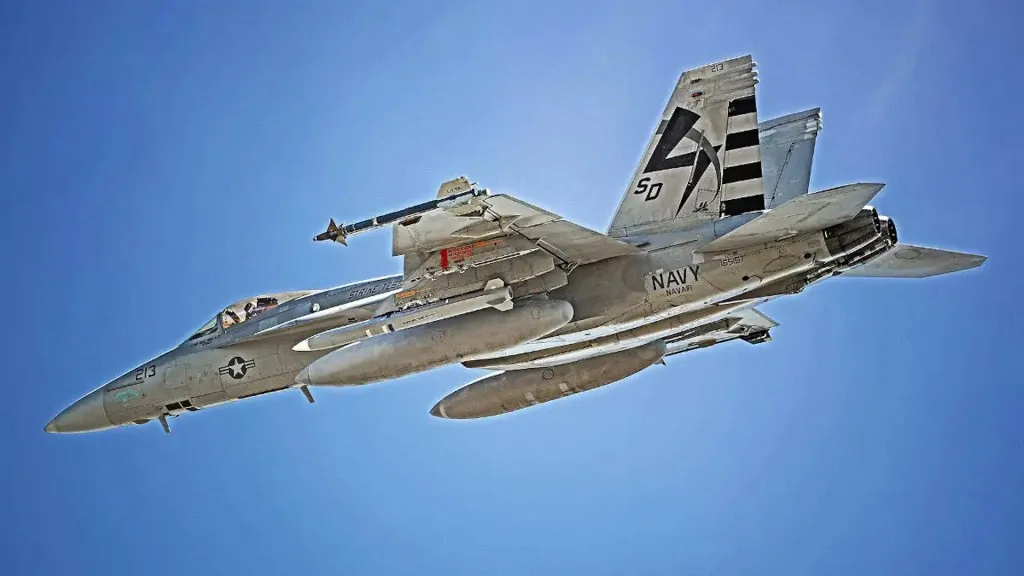
An AGM-88G AARGM-ER seen under the wing of an F/A-18E Super Hornet during a test. USN
Naval Air Systems Command (NAVAIR) issued a new AESM request for information (RFI) yesterday. NAVAIR had previously put out a contract notice regarding this new missile back in February, but subsequently took it down.
NAVAIR is now looking “to conduct market research to identify potential sources capable of providing an AARGM-ER equivalent missile system,” according to the new RFI. This “consists of the All-Up-Round (AUR) missile to include hardware and software, as well as any unique logistics elements, trainers, AARGM-ER equivalent flyout model, and all system verification elements.”
“The purpose of this RFI is to conduct market research to identify potential sources capable of providing a mature design (TRL >6) missile system which consists of the All-Up-Round (AUR) missile to include hardware and software, as well as any unique logistics elements, trainers, flyout model, and all system verification elements,” the notice adds. “This AUR must be compatible with existing launch platforms.”
TRL here refers to the U.S. government’s Technology Readiness Level (TRL) scale, which is used to categorize the maturity of munitions and other systems. TRL 6 is defined as an effort that has produced a “representative model or prototype system” that has been “tested in a relevant environment.” The “relevant environment” here can include high-fidelity laboratory conditions or be otherwise simulated.
The latest desired requirements for AESM are very broad and fully in line with what the Navy has said for years that it expects to gain from the fielding of the AGM-88G.
A NAVAIR graphic offering a very general overview of the AGM-88G’s capabilities as compared to the previous AGM-88E AARGM. USN
AESM needs to have “extended range,” allowing it to be “capable of engaging targets at significant standoff distances.” It has to include an “advanced anti-radiation seeker with broad frequency coverage” and the “ability to target modern and advanced radar systems.” In terms of “lethality,” the goal is to achieve a “high probability of kill against a wide range of targets.”
Like the AARGM-ER, AESM needs to be suitable for internal and external carriage on at least certain variants of the F-35 Joint Strike Fighter. F/A-18E/F Super Hornet fighters and EA-18G Growler electronic warfare jets are also listed as threshold launch platforms.
A picture showing a fit check to demonstrate the ability of the AARGM-ER test article to fit inside F-35A/C internal bays. Orbital ATK
The original AESM RFI in February had laid out more specific requirements, which are absent in the new contracting notice. This includes an explicit call for prospective vendors to describe their proposed missile’s “ability to engage air-to-air and air-to-ground targets.”
There has been no mention in the past about an air-to-air engagement capability for the AGM-88G. It’s unclear whether this is still an area of interest for AESM. TWZ has reached out to the Navy for more information about the current state of AESM and how that factors into plans for AARGM-ER.
A US Navy F/A-18F Super Hornet fires an AGM-88G AARGM-ER over the Point Mugu Sea Range during an earlier test. Northrop Grumman
With added air-to-air engagement capability, AESM would open the door to new operational possibilities and could be more complementary to AARGM-ER. As we previously wrote after the first RFI was released:
“U.S. military interest in very-long-range air-to-air capable anti-radiation missiles traces all the way back to the Cold War, primarily as a means for engaging enemy airborne early warning and control (AEW&C) planes. Anti-air weapons designed around this role are often colloquially referred to as ‘AWACS killers,’ a reference to the U.S. E-3 Sentry Airborne Warning and Control System (AWACS) aircraft. A very-long-range air-to-air missile could be used against other aerial targets, as well.”
…
“All that being said, the value of an ‘AWACS killer’ missile is clear-cut. AEW&C are critical surveillance and battle management assets. Shooting them down deprives an opponent of those capabilities, inherently reducing their ability to effectively maneuver air assets and share important information, including with other nodes on the ground or at sea, as well as in the air. Knocking out these flying radar stations, which can be especially well-suited to spotting lower flying threats from their high perches, just hampers an enemy’s overall situational awareness.“
“The issue, of course, is that AEW&C planes typically orbit well behind the front edges of a conflict, creating additional challenges for targeting them. This is where something like AESM could come into play. A weapon of this type could engage other aerial targets by zeroing in on the radiofrequency emissions they pump out. This could include electronic warfare aircraft, and potentially other aerial targets. AESM might be able to take on a more general anti-air role with the addition of an active radar and/or imaging infrared seeker, as well as datalinks allowing for the use of networked targeting data. AARGM and AARGM-ER both feature an active millimeter-wave radar seeker to enable them to hit fleeing ground targets, but a similar concept could be adapted for air-to-air use.”
AESM would also still have the ability to be employed in an air-to-surface mode like the AGM-88G and its predecessors. Having a single missile with hybrid anti-air/anti-radiation capabilities would offer very useful added flexibility, especially for addressing threats that might suddenly appear during a sortie. This would also offer magazine depth benefits, since a launch aircraft loaded with AESMs would inherently have more engagement opportunities against a wider target set than one carrying a mixture of AARGM-ERs and traditional air-to-air missiles.
AARGM F-18
This could slot in well with the rest of the Navy’s planned future air-launched missile ecosystem, which at least currently includes the AGM-88G, as well as the AIM-174B air-launched version of the multi-purpose Standard Missile-6 (SM-6) and the AIM-260 advanced air-to-air missile. These missiles fit into ever-expanding ‘kill web’ architectures made up of deeply integrated networks of sensors and other assets from across the services, spread across the air, land, sea, space, and even cyberspace domains. TWZ previously explored all of this in a detailed feature you can find here.
How The Navy’s New Very Long-Range AIM-174 Will Pierce China’s Anti-Access Bubble
It’s also worth remembering that the U.S. Air Force has worked with the Navy on similar hybrid anti-air/anti-radiation missile efforts in the past. The Air Force also just recently put out its own call for information about a prospective common missile with a range of at least 1,000 miles, that could come in air-to-air and air-to-surface versions. AESM might further emerge as a joint-service effort and/or one that involves foreign participation.
At the same time, the downplaying of more specific capabilities in the rebooted AESM RFI can only prompt questions about the future of the AGM-88G. The Navy has been actively pursuing AARGM-ER since 2018. The missile’s increased speed and range are viewed as vital for future conflicts, especially when it comes to ensuring survivability and effectiveness of non-stealthy launch platforms as adversary anti-access and area denial (A2/AD) bubbles continue to expand in scale and scope.
However, the AARGM-ER program has encountered technical issues in development and suffered significant delays. The original goal was for the missile to reach initial operational capability (IOC) on the F/A-18E/F and EA-18G in 2023. The Navy is now aiming to hit that milestone by September of this year. There are foreign customers also still in line to receive AARGM-ERs, and Italy is notably a full partner in the missile’s development. The Air Force is pursuing a derivative, called the Stand-in Attack Weapon (SiAW) and reportedly designated the AGM-88J, intended to provide a more general strike capability.
“U.S. procurements for the AARGM-ER program are planned to resume once the system has successfully completed all necessary testing and software updates. Our immediate priority is ensuring the weapon passes these rigorous testing milestones to achieve Initial Operational Capability (IOC) in September 2026,” a Navy spokesperson told TWZ back in February about the status of the program and the aforementioned strategic pause. “After validating the software and testing, the plan would be to ramp up production to clear a backlog of over 150 missiles, with U.S. procurements officially restarting in FY28 [Fiscal year 2028]. In the interim, FY27 production will be allocated to Foreign Military Sales to fulfill our commitments to five signed international cases.”
Another look at an AARGM-ER under the wing of a Navy F/A-18 during a test. USN
It is worth noting here that the Navy seeking a functional equivalent to the AGM-88G does not automatically mean it is considering supplanting that missile entirely. Diversification of the supply chains, especially by leveraging new and non-traditional vendors, has become a top priority across the U.S. military in recent years. Efforts to broaden the defense industrial base, with an explicit emphasis on less reliance on traditional prime contractors, have surged further since President Donald Trump started his second term. More industrial base diversity offers benefits for scaling up production of subcomponents and complete systems. Another key aspect of these initiatives has been avoiding getting locked into a single vendor for key programs, helping to foster competition that can drive down costs.
Having an alternative source of missiles that are even just roughly similar to the AARGM-ER capability-wise could be very valuable for bolstering stockpiles now and ensuring they can be replenished in the future, especially in the midst of a sustained high-end fight. The lead time for the acquisition of exquisite munitions is often measured in months, if not years. Concerns about the sufficiency of U.S. stockpiles of key missiles have already been growing in recent years due to a succession of global crises, something TWZ has regularly called attention to. This has become an even more pressing topic given the expenditures of critical munitions during the latest conflict with Iran. The Pentagon has signed several new deals with various companies in the past year or so to expand and accelerate production of existing and new missiles, underscoring just how significant the demand signal has become. Still, it will take time for those contracts to bear fruit, reinforcing the value of having additional streams of relevant munitions.
Much remains to be learned about the Navy’s exact intentions with AESM and how it fits in with the current plans for AARGM-ER. What we do know now is that the service is actively looking at options for a new missile that offers at least equivalent capability to the AGM-88G.
Update: 4:30 PM ET –
An annual assessment of multiple high-profile U.S. military procurement programs that the Government Accountability Office (GAO) released today provides some additional context about the AARGM-ER program.
“The AARGM-ER program continued to experience significant delays due to software problems discovered during testing. Software development challenges were also a main driver of prior delays. According to the program, a February 2025 flight test failed due to a software issue, which it attributed to a lack of rigor in the contractor’s software development and testing process,” per GAO’s report. “The program did not use a modern approach to software, and the program office did not have visibility into software metrics, which could have provided insights into issues sooner. Program officials stated that the contractor updated its software development processes, and the program instituted additional software reviews for future flight tests.”
“The program is conducting four flight tests in fiscal year 2026 before fielding an initial operational capability,” the report adds. “According to program officials, the December flight test was successful. The program expected to reach initial operational capability in July 2024, but officials now expect to do so over 2 years later in September 2026.”
The Congressional watchdog’s assessment also speaks to continued challenges with production.
“The AARGM-ER program continues to experience production delays. The program reported that the delays were related to missile qualification, hardware capability, and software problems discovered during testing. Program officials expect initial missile deliveries to start in mid-2026,” the report explains. “Initial missile deliveries were originally planned for late 2023. According to program officials, they withheld certain payments to the contractor due to the delays. The program also told the contractor it will not accept missile deliveries until qualification and flight tests verify the missile is safe to employ and performs as expected. The program expects to complete missile qualification in June 2026. We found that starting production before demonstrating a system will work as intended—which the Navy did—increases the risk of discovering deficiencies that require costly, time-intensive rework.”
It is worth noting here that the AESM RFI released yesterday also calls for lower-cost designs that could be produced at a rate of 600 missiles per year. This is twice the production scale outlined back in February.
BBC Weather says a large area of high pressure is currently building from the Azores towards Portugal and Spain and that by the weekend, heat is forecast to climb across France and southern Britain.
And as Europe braces for sweltering conditions, millions of Americans celebrating the July Fourth holiday weekend are already being affected by prolonged extreme heat and high humidity in parts of the central and eastern US.
Climate change is driving up temperatures around the world – but particularly in Europe. It is the fastest warming continent, heating up twice as fast as the global average, according to the Copernicus climate service.
This is causing increased summer heatwaves, greater pressure on Europe’s water supply, and more intense wildfires.
This summer’s record-breaking temperatures have already proved particularly deadly.
The number of deaths recorded between 22 and 28 June increased by 2,025 – 29% -in France, the Public Health France agency announced on Friday. Deaths rose by 62% in the Paris region alone.
It said the figure was likely an “underestimate” and mortality would “therefore be higher than these initial figures”.
Drowning deaths soared during the heatwave, with French Interior Minister Laurent Nuñez saying on Saturday that 72 people had died by drowning since 18 June.
Meanwhile, unprecedented heat in the Netherlands last week led to about 480 excess deaths, Dutch authorities said on Thursday – most of whom were aged 80 and older.
Temperatures reached almost 40C in parts of the country, with most of the deaths reported in the south and east of the Netherlands where temperatures were highest.
While the Netherlands is expecting a cooler week ahead, hot weather is predicted again over the weekend elsewhere.
Temperatures are forecast to reach 40C in the south of France, with peaks of 36C to 37C expected around Bordeaux, Toulouse and Agen.
Météo-France has issued red alerts for Friday and Saturday for forest fires in the southern part of the country, warning that weather conditions meant the risk outbreak was “very high” compared to summer norms.
On Thursday, Prime Minister Sebastien Lecornu said nearly 7,000 fires had broken out since the start of the summer season, with about 8,700 hectares burned so far.
Nearly 3,000 people were evacuated after a wildfire ignited in the town of Sainte-Marie-la-Mer and spread to Canet-en-Roussillon on Thursday.
In the Iberian Peninsula, Aemet weather service has warned of the possibility of another heatwave.
Portugal’s government declared a state of alert which will remain in place until midnight on Tuesday. Temperatures are forecast to exceed 40C in some areas, with overnight temperatures above 25C.
In Spain, areas of the southwest are on orange alert as 40C is expected in some parts.
There is growing anxiety among residents after nine Ebola virus patients escaped from a treatment centre in the Ituri province of the Democratic Republic of Congo (DRC) after a fire outbreak. Authorities and the local population are deeply concerned that these individuals could spread the Ebola disease to other provinces.
On June 30, nine patients suddenly vanished from the health facility after a group of hostile locals set the Nia-Nia Ebola treatment centre on fire. Among the missing patients are two confirmed cases of Ebola infection and seven suspected cases.
According to Joseph Pemanakue, the chief medical officer of the Nia-Nia treatment centre, the patients have still not been found several hours after fleeing the health facility.
“The burnt-down centre was housing two confirmed positive cases of Ebola as well as seven suspected cases. The nine patients fled from the structure and remain to be tracked down, causing fear of an increased propagation of the epidemic within the community,” Joseph said.
The attack on the treatment facility happened after some members of the community refused to surrender the body of a suspected Ebola patient to the medical team. This confrontation escalated quickly, resulting in the destruction of the treatment centre and the loss of a significant stock of medicine and medical equipment.
The local authorities consider the incident to have seriously compromised the efforts to contain the epidemic in Ituri province.
“Some opinion leaders manipulate the population by affirming that Ebola is a business, whereas the disease actually exists. In PK 51, we have recorded ten deaths. A corpse tested positive was removed from a coffin and transported by the population, an action which increases the risk of spreading the disease. The health facility responsible for taking charge of patients, which was created after several efforts, was unfortunately destroyed,” said Alexis Mungaki, a chief of the Ngayo tribal group.
The incident occurred amid heightened tensions between specific communities and the Ebola treatment teams. Health officials are concerned that the escape of confirmed and suspected patients may trigger new transmission chains, as Ituri province continues to be the focal point of the 17th Ebola outbreak in the DRC.
Nine Ebola patients have escaped from a treatment center in the Ituri province of the Democratic Republic of Congo, following a fire instigated by locals hostile to the medical team.
This incident has heightened concerns among the authorities and locals over the potential spread of Ebola to other regions, as these patients – two confirmed and seven suspected cases – have yet to be located.
The attack on the facility, which also resulted in considerable losses of medical supplies, was escalated by community members refusing to cooperate with health officials. Local leaders express that misinformation, suggesting Ebola as a business ploy rather than a real disease, exacerbates the issue and hinders containment efforts.
With Ituri province central to the ongoing Ebola outbreak, the incident threatens to worsen the epidemic’s impact.
Activists found guilty of misdemeanour counts after blocking San Francisco’s Golden Gate Bridge in a 2024 Gaza protest.
Published On 3 Jul 20263 Jul 2026
A San Francisco jury has convicted seven pro-Palestine protesters of multiple misdemeanour charges for blocking the Golden Gate Bridge during a 2024 demonstration, but remains deadlocked on a more serious felony conspiracy charge.
The seven activists were each found guilty of six misdemeanour counts, including false imprisonment, obstruction of thoroughfare and unlawful assembly, San Francisco District Attorney Brooke Jenkins said in a statement on Thursday.
Recommended Stories
list of 3 itemsend of list
Local news outlet KQED named the seven as Bhavika Anandpura, River Allen, Rocky Chau, Conrad de Jesus, Sarah Ferrell, Em Tillotson, and Sara Cantor.
Cantor, who acted as a police liaison during the event, faced an additional misdemeanour conviction for refusing to disperse.
The demonstration, which took place on April 15, 2024 as part of a coordinated “Tax Day” protest, completely brought southbound lanes of the bridge to a standstill for four hours.
Protesters used vehicles to block traffic and chained themselves together through pipes to demand an end to US military aid to Israel during its genocidal war on Gaza. According to a report by CBS News San Francisco, the blockaded toll plaza usually records approximately 5,000 vehicles during those specific hours.
While prosecutors secured misdemeanour convictions, the jury remained deadlocked on the felony conspiracy charge, which could have carried a maximum sentence of 15 years in prison. Following weeks of trial and days of deliberation, the jury split 10-to-2 in favour of guilty on the conspiracy count, resulting in a mistrial on that charge, KQED reported.
Defence lawyers framed the deadlocked felonies as a significant victory against the government and prosecution. Public defender Nuha Abusamra, who represented one of the defendants, told local media that the outcome was a win, arguing that demonstrators acted out of moral necessity after institutional avenues, like writing to elected officials, failed.
District Attorney Jenkins emphasised the safety risks and human toll of the four-hour gridlock, noting that stranded motorists included medical workers missing hospital shifts and a mother unable to access water for her baby’s formula. “At this time, we will evaluate our options and consider next steps,” Jenkins said regarding a potential retrial on the conspiracy charge.
The defendants face up to five years in county jail for the misdemeanour counts and are scheduled for sentencing in August.
The group were originally part of the “Golden Gate 26” group of activists arrested on Tax Day in 2024 for shutting down the bridge to protest US financial support for Israel’s genocidal war on Gaza. While 19 of the demonstrators accepted pretrial diversion programmes, community service, and fines, the remaining seven chose to go to trial.
In the afternoon of May 31, 2026, the Anguwan Hausawa area of the Mokwa Local Government Area of Niger State, North-Central Nigeria, was thrown into mourning. The news of Abubakar Usman’s death in the lodge water had spread through the area, and people were trooping to the house to extend their condolences to his parents.
Abubakar, a 13-year-old, had gone out to play with his friends. Hours later, he was brought back lifeless while his other friend was rushed to the hospital, having drowned in floodwaters caused by a blockage the construction workers working on a culvert had put in to hold the water as they worked.
As the lastborn of his parents, Abubakar was the kind of boy whose presence lit up every corner of the community. He attended the Islamic school close to his house, and his teachers admired how brilliant he was. Residents say he was respectful, and the elders in his community often praised him as he never passed by without greeting people warmly—a rare quality that made him beloved by all.
His father, Usman Shekare, an elderly man in his late sixties, stood heartbroken at the sight, lying on a mat, fixing his gaze on his beloved son. The only words he had the courage to utter were, “God gave him to me, and He has collected him back.”
What broke him further was a simple question: “What message do you have for the government?” He instantly broke down in tears, unable to speak further.
This tragedy is not an isolated incident. Just weeks earlier, residents told HumAngle that three boys fell into the clogged waters and were luckily rescued. The water continues to gather at last year’s Mokwa Flood site, fed by the heavy downpour flowing from the Zugurma and Yagbagba axis, and worsened by another source from gully erosion sites in nearby communities.
One of the flood zones along the Mokwa-Jebba Road in Mokwa LGA, Niger State. Photo: Isah Ismaila/HumAngle.
Hussaini Ibrahim, the Spokesperson of the Niger State Emergency Management Agency (NSEMA), told HumAngle almost a month after the incident that the agency is not aware of any loss of life due to the blockage but will reach out to the community leader and affected family for further actions.
In Mokwa, the echoes of last year’s devastating flood still haunt the community. Residents told HumAngle that farmers had raised alarm before last year’s disaster, warning that water was accumulating, but their concerns were ignored until after the flood struck. Now, the same warnings are being repeated, with little sign of preventive action.
“Barely a year after the flood, Mokwa is once again staring at water lodging in the same vulnerable zones,” Isah Mokwa, a community leader and activist in the community, told HumAngle. “The bridge and waterway reconstruction, meant to symbolise recovery, has inadvertently blocked water channels, creating a dangerous buildup. As we speak, the town is sitting on a ticking bomb.”
Residents told HumAngle how the first rainfall they witnessed in May made them apprehensive. That evening, they revealed, the sound of rushing water sent shivers down their spines. Mothers were seen rushing to gather their children as fathers stood at the site of collapsed structures, staring at the lodging of water in the same flood-prone channel that swallowed over 150 lives and many homes last year, with hopes of it not wreaking havoc again.
Studies indicate that the mental health and wellbeing of individuals, especially children affected by flooding in Nigeria, can deteriorate for extended periods, often lasting months or even years after the event.
The cumulative stress of rebuilding homes, restoring livelihoods, and coping with displacement has been shown to exert a heavier toll on affected populations than the initial impact of the flood, underscoring the need for comprehensive psychosocial support in disaster management strategies.
“The water was coming right from Yagbagba,” Ndako Usman, a resident, said. “It’s accumulating just behind the blockage. Once it gets bigger and more powerful, it could hit our homes again.”
Hussaini told HumAngle that the blockage was caused by construction workers working on the ongoing drainage construction, and the management has taken swift action to address the issue.
“During last year’s flood, we were taken unaware, but we have taken proactive measures to ensure that it does not repeat itself this year. We have a monitoring team, and also volunteers who constantly update us on the flow of water so that we take immediate action.”
“Regarding the culvert, we have written to relevant stakeholders, including the Ministry of Water Resources, to study and assess the situation of the culverts to see if they can handle the water volume in case of a flood-related disaster and advise appropriately,” Hussaini added.
A catastrophe remembered
The fear is not irrational. In May 2025, Mokwa was the epicentre of one of Nigeria’s deadliest flood disasters in recent memory. Torrential rains combined with structural failures to unleash devastation that claimed hundreds of lives, displaced thousands, and left the town grappling with hunger and grief.
Flooding has become one of Nigeria’s most persistent natural disasters, wreaking havoc on communities across the country almost every year. Heavy rainfall, poor drainage systems, deforestation, and the release of water from dams often combine to create devastating outcomes.
In 2024 alone, floods claimed over a thousand lives, displaced millions, and destroyed farmlands and infrastructure worth billions of naira, but the situation dropped in 2025, according to the National Emergency Management Agency (NEMA).
The agency revealed that floods killed 241 people and affected 459,995 residents across 27 states and 128 local government areas. Also, the disaster displaced 158,588 people, injured 839, and damaged 54,684 houses while destroying 96,649 farmlands.
Get our in-depth, creative coverage of conflict and development delivered to you every weekend.
Subscribe now to our newsletter!
The newly constructed culvert in the Anguwan Hausawa area of Mokwa, one of the hard-hit areas of last year’s flood. Photo: Isah Ismaila/HumAngle
Early warnings had been issued by the Nigerian Meteorological Agency (NiMet), but local authorities failed to act.
The disaster struck suddenly. Heavy rainfall battered Mokwa, but the real trigger was the collapse of a railway embankment and blocked drainage channels that redirected torrents into residential areas.
Within hours, homes were submerged, bridges collapsed, and farmlands were washed away. Reports varied, but estimates suggested between 200 and 700 people lost their lives, and about 3000 houses and properties were destroyed, leaving families stranded in makeshift camps.
In the wake of the disaster, the Minister of Information and National Orientation, Mohammed Idris, revealed that President Bola Tinubu approved the release of ₦16.7 billion for the immediate reconstruction of the Mokwa Bridge, which was destroyed by flooding, noting that the project would involve constructing a bridge with 10 spans.
In the months that followed, HumAngle published a damning investigation into the Mokwa flood, among other issues. Our findings painted a picture of systemic neglect. The investigation established that gully erosion in Mokwa has remained a destructive force despite years of significant financial allocations. The erosion continues to expand, damaging infrastructure and farmland and worsening during rainy seasons.
Equally, the report uncovered that billions of naira from ecological funds and World Bank loans were earmarked for erosion control, yet no substantial work has been executed. While officials claimed contractors were engaged, there was no evidence of transparent bidding processes. Field assessments confirmed that erosion control activities remain absent, exposing a gap between official pronouncements and actual implementation.
Last month, NEMA listed Mokwa among high flood-risk local government areas in Niger State for 2026. Yet on the ground, little seems to have changed.
Isah Mokwa, the activist based in Mokwa, confirmed to HumAngle that the bridge constructed to contain the water has proven inadequate. According to him, the community braces for the worst, fearing that heavier downpours could unleash destruction far greater than before.
“Nothing has changed. In fact, the situation has deteriorated even further. In the same direction where the water started gathering before the flood, farmers have raised the alarm that water is already accumulating,” he said.
“We believe there is no accountability for the funds contributed to the state government. What happened to the billions donated after the 2025 flood? Even the shelter that was promised for victims of last year’s flood has not been provided. Just recently, there was a flag-off ceremony, but no contractor has been mobilised to the site, no details were given about the number of houses to be built, and no project timeline was shared,” he said.
According to residents, some of the affected families who were lucky to receive ₦500,000 ($360) in financial support last year to rent houses have exhausted their funds, and the majority are now struggling to renew their rent.
For many in Mokwa, the suspicion is that the tragedy of 2025 has been reduced to a political talking point, while the lived reality of survivors remains ignored.
However, experts warn that Mokwa cannot afford another disaster.
Abbas Idris, the president of the Risk Managers Society of Nigeria (RIMSON), in an interview with HumAngle, said that before now, the government should have taken a proactive disaster management approach through risk assessment and hazard categorisation.
This, according to the risk expert, would help not only the government and state emergency management agency but also residents to put in place measures or tackle the disaster even before it strikes.
In the longer term, Abbas revealed that the Niger State government must enforce urban planning regulations, preventing construction on floodplains and investing in climate adaptation strategies.
“Neglecting risk assessments leaves communities defenceless when disaster hits,” Abbas stressed. “We must address corruption, weak governance, and poor ecological management as root causes of the crisis and pave the way for transparent, science-driven interventions to mitigate future disasters.”
It has been a year since the flood, and despite repeated appeals from the community, the state government, under the leadership of Umar Bago, has yet to provide a lasting solution. Families like the Shekare’s are still left to brace for waters that rise too quickly and claim too much.
And until their demands are met, Mokwa remains vulnerable — a place where the memory of one brilliant boy reminds everyone of both the fragility of life and the urgency for change.
Temperatures in Europe hit a new high this summer, with hotter early-summer heatwaves triggering illness, deaths and the collapse of infrastructure across the continent.
Transport buckled on Sunday as temperatures hit 40C (104F) across Germany, the Czech Republic and Poland. In France, days averaging 29.8C (85.6F) – spiking to 44C (111.2F) in one town – gave way to storms, leaving an estimated 1,000 excess deaths behind.
Scenes like this may well be the new normal.
Last summer’s heatwave alone caused an estimated 2,300 climate-related deaths in 12 European countries, WWA says.
A study by World Weather Attribution (WWA) has found that intense heat on this level is now tens to hundreds of times more likely than it was in 2003, and was unheard of 50 years ago.
“Heat-related mortality is likely to remain a feature of Europe’s warming climate,” warns Dr Hans Kluge, the World Health Organization (WHO)’s regional director for Europe. Deaths have already risen by an average of 52 per million people annually since the 1990s, he told Al Jazeera – a trend he says shows little sign of reversing on its own.
So what does this mean for the future? Are these temperatures the new normal, and if so, why?
We asked the climate experts:
Is this really the new normal?
Yes, it certainly looks that way. According to WWA, heatwaves were generally about 3.5C cooler in June 1976, and 2C cooler even in 2003.
“Think of it like a race where the starting line has been moved much closer to the finish,” Dr Akshay Deoras of the University of Reading told Al Jazeera. Ultimately, this is down to global warming, he says.
Europe has warmed at roughly twice the global average since the 1980s, according to the European Commission’s climate change service, Copernicus.
Deoras says this amounts to “loading the dice” towards once-rare extremes.
WWA’s modelling goes further: at current emissions rates, an event of the magnitude of this summer’s heatwave is expected to occur every couple of decades – and today’s extremes are effectively a preview of what an ordinary summer could look like by the middle of the century.
Why is this happening in Europe now?
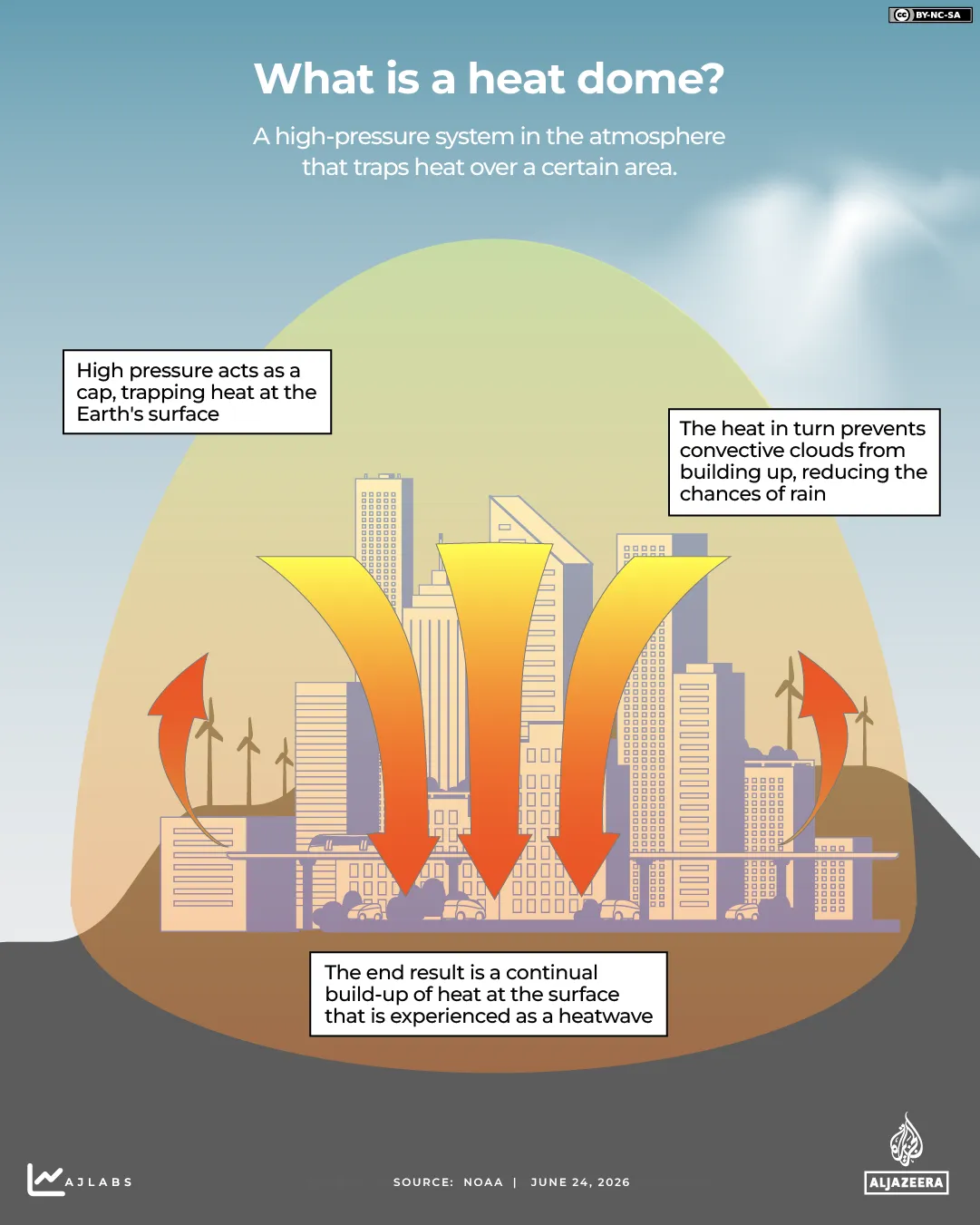
The immediate trigger is a stalled high-pressure system, or a “heat dome”, which traps heat in one concentrated area for days or weeks.
Heat domes aren’t new, but Europe’s already-shifted baseline means the same pattern now produces far hotter outcomes than decades ago, Deoras told Al Jazeera.
Professor Hannah Cloke of the University of Reading told Al Jazeera that’s because the warming behind new, extreme weather patterns comes from emissions released decades ago, and the climate system takes time to respond – so we’re feeling the effects now of pollution from the past.
Copernicus’s European State of the Climate 2025 report confirms this: more than 95 percent of the continent saw above-average annual temperatures last year, alongside record Alpine glacier loss and the highest sea-surface temperatures ever measured in Europe.
And because Europe is warming roughly twice as fast as the rest of the planet, that gap with the global average is projected to keep widening – meaning whatever the world experiences on average in the coming decades, Europe will likely see first, and worse.
Is this trajectory irreversible?
Partly. Some of the damage is permanent. Some of it isn’t – yet.
Take glaciers. Because the effects of pollution from decades ago are cumulative, “some of what we are experiencing this summer is already locked in”, Cloke says.
Alpine glaciers, which feed major European rivers, she says, have already shrunk past the point of recovery, and their contribution to summer river flow is “permanently reduced”.
Not everything is set in stone, however. “Every tonne of emissions avoided changes the odds of what comes next,” Cloke says.
What we do now, therefore, will decide the difference between summers that are simply hard to live with in the future, and summers that become “genuinely beyond our ability to cope with”.
Some resources, like groundwater in northern Europe, can still recover – “but the window to act is narrowing with each dry year”, she says.
What is this doing to human health?
The toll is already severe and likely to worsen.
The Lancet Countdown Europe calculates that there were 62,000 heat-related deaths across the region in 2024 alone, with projections showing a steep further rise by 2050 if we don’t make changes.
Much of the problem, Kluge told Al Jazeera, is architectural and largely unaddressed.
“Most of the housing stock across this region was designed for a colder climate – to retain heat, not shed it,” he said, warning that without large-scale retrofitting, deaths could keep climbing past 2050 regardless of how good warning systems become.
His prescription: treat heat as predictable, not an emergency.
“Governments need to plan for heat the way they plan for winter flu – as a recurring, predictable challenge requiring permanent infrastructure, not a one-off crisis requiring emergency improvisation.” The highest-return step, he added, is identifying who’s most at risk – often older people living alone – and reaching them before a heatwave hits, not after.
What else can be done?
Cloke points to two priorities: early warning systems that reliably reach the people who most need to be protected, and an overhaul of water infrastructure in Europe which has been built for rainfall patterns that no longer exist.
Deoras says emissions also still matter: cutting them won’t eliminate heatwaves, which are “a natural part of the climate system”, but doing so would make them “less intense, less frequent and shorter-lived”.
None of the experts who spoke to Al Jazeera describe this as hopeless.
They do warn that the window of opportunity for addressing the issue is narrowing: infrastructure can still be retrofitted, emissions can still be cut, warning systems can still be improved – if the decisions to do so are made now, rather than after the next heatwave.
What a “normal” European summer looks like in 2050 is still being written, they say.
“We assess it is likely that Russian-linked vessels and the ‘shadow fleet’ were used as launch/recovery platforms for UAVs as part of the Kremlin’s wider unconventional war on Europe,” the report added.
This report assesses that it is highly likely the Kremlin conducted a coordinated Uninhabited Aerial Vehicle (UAV) campaign over Europe between August 2024 and February 2026, spanning a dozen NATO states and Ireland.
Investigators rely heavily on circumstantial evidence and open-source information. TWZ cannot independently confirm these findings, which offer new insights, if not concrete answers, about who could have been behind the flights.
The drone incursions over the bases we were the first to write about were among the earliest in the wave over Europe investigated by IISS. Around this same time, there were also flights over Ramstein Air Base in Germany, the report notes. We covered those incidents as well.
As we reported at the time, drones of an unknown origin were first spotted over RAF Lakenheath and then over RAF Fairford, RAF Feltwell, and RAF Mildenhall.
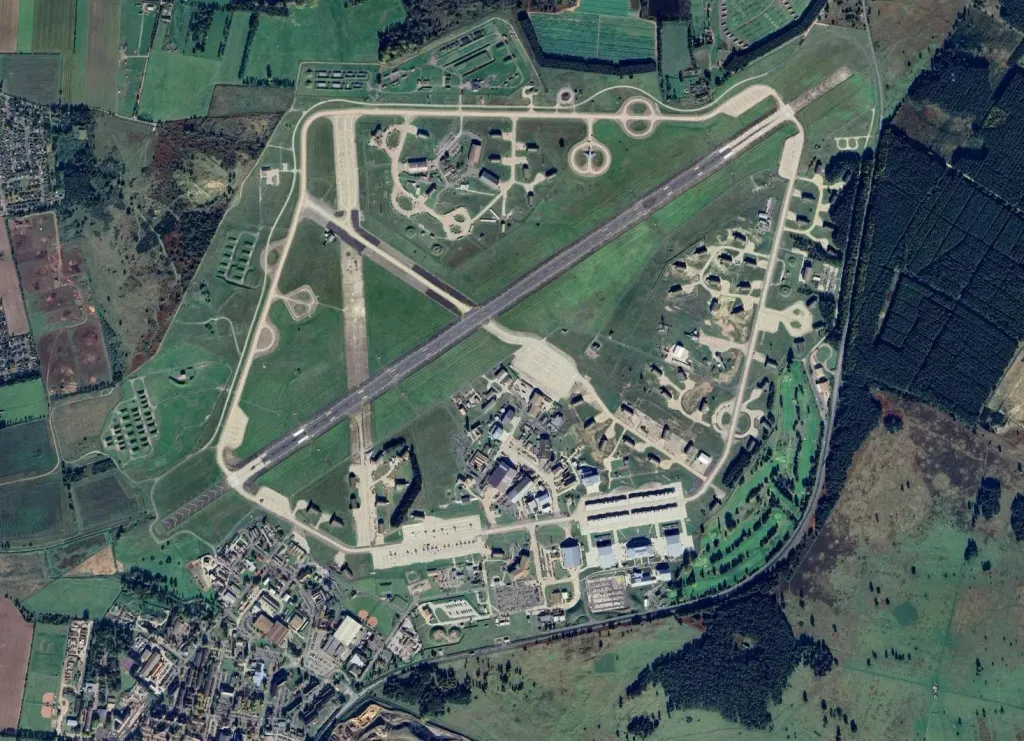
RAF Lakenheath. (Google Earth)
The report makes particular note of the importance of RAF Lakenheath, which is being readied to host nuclear weapons, a topic we previously covered.
“A public appeal for information drew roughly 170 reported sightings, about half of which were deemed credible, either corroborated by multiple witnesses or backed by imagery that couldn’t be explained away as ordinary air traffic.”
“Operational security appeared sophisticated,” IISS posited. “The UAVs entered the airspace around the RAF bases at low altitude with their lights visible and departed at higher altitudes. Arrival and departure directions varied across the incident period.”
Witness reports “indicate more than one platform type may have been involved,” the report proffers. “Some observations were consistent with multirotor UAVs; others with fixed-wing platforms. The propulsion noise of the UAVs was inconsistent across accounts, with some observers describing sounds more typical of petrol engines than electric motors.”
“Notably, the Hav Dolphin, a vessel later linked to a 2025 drone incident in Germany, happened to be docked in the UK at the time,” the investigators found.
That vessel was one of many either operated by Russia as part of its so-called “dark fleet” of sanctioned ships, or those connected to Russia, that the report goes into great detail to link to drone incursions throughout Europe after the incidents at U.S. bases there. The report describes these vessels as “Russian-linked commercial vessels, including shadow-fleet tankers, coastal freighters, and smaller craft.”
IISS
IISS suggested that the Russian Orlan-10 drone could have been one of the platforms used during the incursions.
“Orlan-10, a compact, multi-purpose UAV in service with Russian Armed Forces since 2010, has a range and payload profile consistent with stand-off collection against coastal and inland targets and fits the deck space of a mid-sized commercial vessel,” IISS stated.
“Commercial specifications for the platform, including those published by Russian geospatial firms using the Orlan-10 for civilian aerial survey operations, document an operational range of 500 kilometers, endurance of up to 12 hours, and speeds of 90–130 km/h, performance parameters consistent with maritime launch from a vessel operating well beyond visual detection range of the European coastlines in question.”
Moreover, “the Orlan-10’s power is an internal combustion engine, a detail that may be relevant in light of witness accounts from November 2024 incidents at RAF Lakenheath, where propulsion noise was described by some observers as more characteristic of petrol engines than the electric motors typical of consumer and first-person view (FPV) drones.”
In addition, the Orlan-10’s available payloads “include a satellite navigation spoofing module and a Global System for Mobile Communications network monitoring module alongside optical and thermal sensors, indicating the Orlan-10 family has active electronic warfare capability as well as passive ISR.”
The Orlan-10 has been widely used as an intelligence, surveillance and reconnaissance drone by Russia in its ongoing war on Ukraine. Given that, however, using it for a clandestine operation like this seems very strange. The report critically recognizes this, stating “the use of identifiable Russian UAV platforms carries inherent attribution risk.”
“An alternative, and operationally credible, hypothesis is that commercially available or modified platforms were used precisely to preserve deniability, including long-range [first-person view] FPV systems, home-built fixed-wing aircraft or commercial UAVs modified to use cellular rather than radio frequency (RF) communications,” IISS added.
Russia uses ‘Orlan-10’ drones to help detect and attack Ukrainian military positions
The think tank acknowledges that its maritime-launch hypothesis “rests on a convergence of opportunity, demonstrated capability and a consistent geographic pattern — but no European government has yet publicly tied a specific shadow-fleet vessel to a specific incident, despite officials suggesting privately that they could. The rest of this report treats the maritime-UAV link as the most plausible explanation for where and when the incidents occurred, while acknowledging that confirming it will require evidence that isn’t yet public.”
IISS
This is not the first time Russia was accused of being behind the drone incursions.
That investigation spurred some politicians to call for further investigation.
“Julian Lewis, the former Tory Chair of the Defense Select Committee said: ‘When the US and British authorities detected the drone intrusions at both airbases last November, they stated that investigations were underway,’” the outlet reported. “‘Meanwhile, there is credible evidence here of the possible presence of GRU-linked operatives near Lakenheath and Mildenhall. I shall be asking Ministers to consolidate the findings of all these investigations and to make a Statement in the Commons as soon as possible.’”
Tom Tugendhat, the former Security Minister, told Thei Paper that the findings “demand urgent investigation by the MOD and UK intelligence services.”
Less clear are results from investigations into the other three bases involved.
“The UK takes the security of military bases seriously and works closely with allies, law enforcement partners and other authorities to protect Defense people, sites and capabilities,” the U.K. MoD told us Thursday morning when we asked about the allegations made by IISS that the Russians were likely behind the drone incursions and for their assessment of who was operating them.
“Through the Armed Forces Bill, we’re giving our defense personnel greater powers to defeat drones threatening our bases and we have invested significantly in counter-drone capabilities. We continue to strengthen our ability to detect, deter and respond to potential threats,” MoD added.
MoD declined to provide further details, saying it “does not comment on intelligence matters or on the specific security arrangements at Defense sites.”
A U.S. Air Force F-16 Fighting Falcon from the 555th Fighter Squadron, Aviano Air Base, Italy, taxis out to the runway in preparation for takeoff for a training flight prior to the start of Cobra Warrior 24-2 at Royal Air Force Mildenhall, England, Sept. 11, 2024. (U.S. Air Force photo by Karen Abeyasekere Karen Abeyasekere
We also asked U.S. Air Forces in Europe-Air Forces Africa (USAFE) whether the IISS allegations about Russian involvement in these events were accurate.
“We can confirm small Unmanned Aerial Systems activity took place over several of our UK installations in 2024,” a spokesperson told us. “These events were monitored, and it was determined there was no impact on personnel or operations.”
“Due to operational security, we cannot speak to intelligence matters,” the spokesperson added. “We continue to work closely with our UK partners to ensure the safety and security of our installations.”
The command said it is working on a response to our question about who was behind these incursions, but that it would not be ready before the July 4 holiday.
The IISS report does not go into any of the cases outside of Europe. It does, however, clearly point the finger at Russia as the culprit behind the drone overflights that have bedeviled Europe, including U.S. bases in England and Germany.
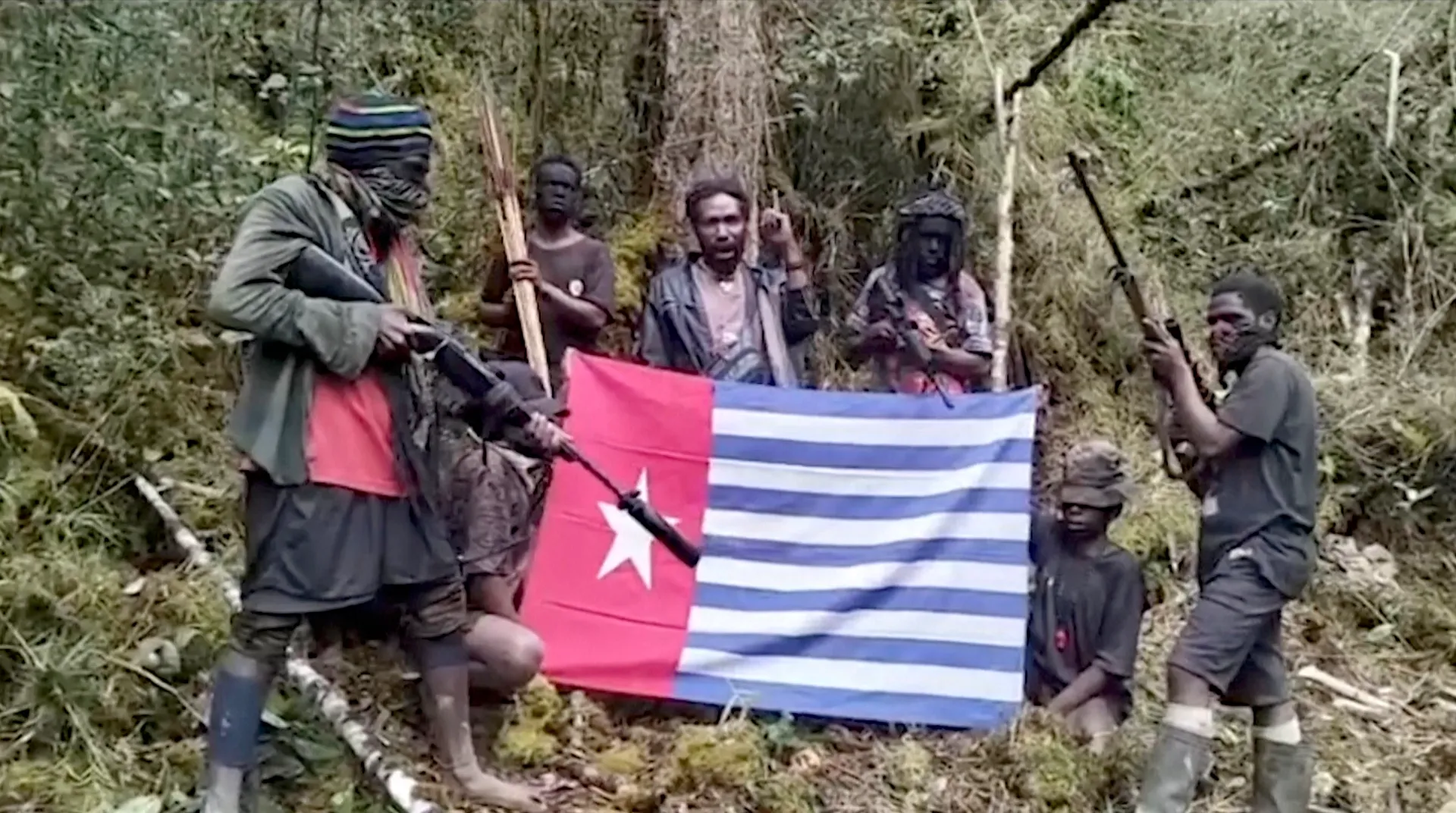
A US pilot has been killed in Indonesia’s Papua region after separatist rebels said they shot him and set his aircraft on fire. The attack highlights the decades-long independence struggle, which has displaced more than 122,000 people since 2022.
Until not so long ago Latin America had been considered a quiet region, located far from the world’s superpower main strategic confrontations, with sporadic but crucial moments that helped to shape the international order as we know it today. The Cuban Missile Crisis is the clearest example: it became the starting point for a series of agreements and treaties on nuclear and strategic security, involving both the US and the Soviet Union at first, and later extending to other actors of the international community, from Europe, Asia and Latin America, which became the first region free from nuclear weapons after the signing of the Treaty of Tlatelolco in 1967, 5 years after the crisis. After this episode, the region’s relevance seemed to fade, and Latin American countries appeared condemned to a destiny of surfing between weak political cohesion internally and relatively stable economies, even as most of its governments remained closely aligned with Washington on foreign policy matters.
It was precisely during this period of perceived irrelevance that China began building its presence in the region, very gradually and over the course of a little more than two decades. Washington largely ignored this process, even as it became clear that the Asian giant was becoming the largest trading partner for several South American countries, such as Peru and Brazil, and in many cases also the main investor in their economies. This neglect was not born of ignorance: it reflected, instead, a confidence that local governments would remain compliant regardless of who was investing in them. President Trump’s first term illustrates this well. Despite isolated clashes with the governments of Mexico and Venezuela, these episodes looked minor when compared to the “tariff wars” waged against the EU and China. In fact, the only time Trump ever set foot in the region during his entire first term was in November 2018 when he attended the G20 Forum in Buenos Aires. Significantly, there was a planned short visit in Colombia after this event, but I was cancelled. This was widely read at the time as a confirmation that Latin America remained a low priority for Washington’s foreign policy agenda, more due to the expectable compliance of local governments than ignorance of the importance of the region as a resource base capable of fueling US power projection in other regions.
It was only during Trump’s second term that American foreign policy has shifted towards the Western Hemisphere, attributing strategic importance to the region and setting the objective to maintain a near-absolute dominant presence, involving both economic and military dimensions, as is stated in the latest National Security Strategy of 2025.
By the time this shift was formalized, China’s footprint in the region was already deep and country-specific. In Brazil, China had been the largest trading partner since 2009; bilateral trade hit a record $171 billion in 2025, with China accounting for 27.2% of Brazil’s total foreign trade, besides, EV plants and a still planned bi-oceanic railway linking Brazil to Peru’s Pacific coast were being negotiated as part of the Chinese investment strategy in both countries. In Argentina, China became the primary supplier of mobile network infrastructure, part of a broader Chinese push into Latin American 5G and data-center markets. And in Peru, China invested around $1.3 billion in the strategic port of Chancay, a deepwater facility that entered full operation stage in November 2024, and set a new phase for trade between China and South America, bypassing the traditional deepwater ports located in the US, like the ports of Oakland and Stockton. Reinforcing this, China pledged in May 2025, at the CELAC forum ministerial meeting in Beijing, to ramp up its regional engagement even further. These were not isolated transactions but a structural presence, one that the 2025 National Security Strategy now identifies strictly as the rival foothold it intends to dislodge.
Stay ahead of the geopolitical week.
MD Briefing delivers expert analysis across five global fronts — the Indo-Pacific, energy, geoeconomics, European security, and the Middle East — every Monday morning. Free.
Now, within this context in 2026 the declared shift of interests proved it wasn’t merely rhetorical. The year started with the launching of Operation Resolve, when a group of American special military forces conducted a military raid and captured President Nicolás Maduro and his wife in Caracas, transporting them to New York to face narcoterrorism charges. Trump declared that the US was now “in charge” of Venezuela until a transition takes place. This meant in practice that the US would hold control over the country’s oil exports, which during the first four months after Maduro’s capture were estimated at $8 billion, but the data on how much oil has been sold, the revenue from it and the use given to those funds remains secret. The main importers of Venezuelan oil during this period were the United States (43 percent), India (26 percent, part of the strategy to reduce Indian import of Russian oil), and Spain (8 percent). This episode, condemned by critics as a return to the old days of imperialism, set the tone for the rest of the year: a hemisphere where Washington would use military force, tariffs, and other mechanics for pressuring countries to sign economic deals where American core interests prevail.
An example of this is the new and controversial Trade and Investment agreement signed by the United States and Argentina in February of this year. According to the text, Argentina shall adapt the regulatory framework to implement US trade standards and prioritize American direct investment in the country, while the counterpart shall “try to review its tariffs” and “consider supporting investment financing”. Milei’s government has justified this as the price for ideological loyalty and continued financial support after the $20 billion credit line that helped to stabilize the local currency (peso) last year.
On the other hand, Brazil took the opposite path: rather than just seeking accommodation to this policy, the government of Lula da Silva accelerated diversification, finalizing the long-delayed EU-Mercosur agreement in January, deepening trade with China and signing a memorandum of understanding with aims for further strategic partnership with Russia. Notably, the US has implemented another mechanism of pressure here, condemning the imprisonment of former president Jair Bolsonaro and holding a meeting with his son Flavio Bolsonaro, who will participate in the presidential elections this October. This gives clear signs of indirect support for this far-right candidate, following the regional trend with Milei in Argentina and Keiko Fujimori in Peru.
Peru, meanwhile, illustrates a third pattern and an interesting case, because alignment here is imposed less by negotiation than by sheer state fragility. Amid a presidency turning over for the ninth time in a decade, the US State Department warned in February that China’s control over the Chancay megaport threatens Peru’s sovereignty, following a Peruvian court ruling that exempted the port from national oversight. Peru’s case pictures a scenario where both counterparts keep pushing for concessions and more privileges. Under the government of José María Balcázar, the ninth president in 10 years, the country has been involved in the controversial purchase of 12 F-16 jetfighters with a cost of around $3.5 billion. On April he postponed the official ceremony where this deal was supposed to be signed arguing that it would have to be the responsibility of a new president, the decision was met with pushback, both internally, with declarations from the Ministry of Defense and in the US Embassy, with ambassador Bernardo Navarro declaring “If you deal with the U.S. in bad faith and undermine U.S. interests, rest assured, I, on behalf of [President] Trump and his administration, will use every available tool to protect and promote the prosperity and security of the United States and our region.” After this, with both internal and diplomatic pressure, the deal was signed on the 17th of April.
Taken together, these cases suggest the current US approach to Latin America is not fueled by a single ideological logic, but by transactional calculations that value compliance and heavily punishes resistance, exploiting weaknesses here and there and aiming to these policy goal indifferently to whether the country in question is led by a right, left or ideologically undefined government. What seems quite clear is that the decades of quietness in Latin America have ended, not necessarily because the region has changed, many of the deep challenges for development are still present, but because the rivalry that once defined the Cuban Missile Crisis has returned, this time fought over trade tariffs, infrastructure and technology access rather than missiles.
Weekly insights and analysis on the latest developments in military technology, strategy, and foreign policy.
The U.S. Government Accountability Office (GAO) says concerns it raised last year about the U.S. Navy’s E-130J Phoenix II program “have morphed into realities.” The timeline for moving from the development of the aircraft to putting it into actual production has already slipped by approximately one year. The E-130Js are set to supplant aging E-6B Mercury jets in support of the Take Charge And Move Out (TACAMO) mission. This involves providing aerial command and control support for nuclear ballistic missile submarines, including the ability to send them orders to launch strikes while they are submerged. Platforms tasked with nuclear support missions like TACAMO are commonly called ‘doomsday planes.’
GAO has provided a new update on the E-130J effort in its latest annual assessment of multiple high-profile U.S. military procurement programs. The Congressional watchdog released this report earlier today.
In last year’s iteration of this report, GAO explicitly called into question the choice of C-130J-30 Hercules aircraft, a four-engine turboprop transport plane, as the basis for the E-130J, warning that it might “not meet operational availability requirements.” The existing 16 E-6B aircraft are based on the larger, jet-engined Boeing 707 airliner, which is now long out of production. It is important to note that the Mercury fleet also supports a U.S. Air Force nuclear mission set called the Airborne Command Post (ABNCP), and more commonly known by the nickname Looking Glass. In that role, the planes provide aerial command and control support to nuclear-capable bombers and silo-based Minuteman III intercontinental ballistic missiles. They are equipped to initiate the launch of Minuteman IIIs while in flight. The forthcoming Phoenix IIs will only be tasked with the TACAMO mission, something we will come back to later on.
An E-6B Mercury ‘doomsday plane.’ USAF
“As we reported in last year’s assessment, the Navy awarded its contract despite significant technical risks it acknowledged the E-130J program faced. A September 2024 independent technical risk assessment highlighted the complexity associated with the program’s planned integration effort, which officials acknowledged could increase as they integrate additional technologies,” per GAO’s latest assessment. “Since our 2024 report, the program has delayed its low-rate production decision by approximately a year as these system integration risks have morphed into realities.”
“For example, program officials said that contractors are now focused on modifying already-existing mission systems to reduce their weight, which the independent assessment anticipated would be necessary to accommodate them on the C-130J-30 airframe,” the report released today adds.
The first C-130J-30 Hercules airframe destined to be converted into a pre-production E-130J is rolled out in 2025. USN
“The program office stated that the E-130J program remains on track to recapitalize TACAMO capability through developing an MVP [minimum viable product], iterating system capabilities through software improvements, and establishing digital frameworks,” according to GAO. “The program office also stated that it is aligned with Secretary of Defense guidance through an acquisition approach that allows for tradeoffs and implementation of a modular open systems approach. The program office did not provide any documentation to substantiate any of these claims, which run counter to our own analyses of E-130J program documentation.”
In its annual assessment last year, GAO said the Navy “acknowledges technical risk,” but also that the service had highlighted “risk reduction contracts with subcontractors to address obsolescence and size, weight, and power-cooling risks.”
The Navy’s Fiscal Year 2027 budget request provides some additional context about the suite of systems the E-130J will need to perform the TACAMO mission.
“A dedicated communications platform, TACAMO aircraft features the ability to communicate on virtually every radio frequency band from very low frequency (VLF) up through Advanced Extremely High Frequency (AEHF) using a variety of modulations, encryptions and networks, maximizing the likelihood an emergency message is received by U.S. strategic forces,” per the Navy’s budget documents. “Included in these efforts are Government and Contractor Systems Integration Laboratories, Contractor System Test Integration Laboratory, Government Furnished Property (National Security Agency approved encryption devices, Ultra High Frequency modems), High Frequency and the Advanced Extremely High Frequency solutions, Top Secret network development and building required infrastructure includes power generation systems, cooling, flight deck avionics, Electric Magnetic Pulse (EMP) hardening, cyber hardening, and structural modifications to support integration of E-130J mission system equipment.”
A particularly notable and critical capability found on the existing E-6Bs is the ability to extend a five-mile-long antenna to communicate with submerged submarines. The E-130J will have a very similar, if not identical, antenna system to support the TACAMO mission.
A rendering of an E-130J Phoenix II. Note the antennas trailing behind. Northrop Grumman
As it stands now, the Navy plans to acquire six pre-production E-130Js in Fiscal Year 2027 to support different aspects of the aircraft’s ongoing development. At least one initial example is already being built. Some portion of those test aircraft might eventually take on operational roles. In its latest report, GAO says a critical design review is expected to come at the end of next year. With the aforementioned delay, the decision to then move into low-rate initial production (LRIP) is now projected to occur in April 2029. The initial LRIP lot is expected to be between three and six aircraft, but the total expected size of the E-130J fleet is unclear.
It is worth remembering that the Navy did previously operate modified C-130s in the TACAMO role before the first E-6A arrived in 1989. The Navy subsequently upgraded those aircraft in the late 1990s and early 2000s to the E-6B standard.
The US Navy operated a fleet of EC-130Q TACAMO aircraft like the one seen here before the arrival of the E-6As. USN
TWZ has previously explored the pros and cons of going back to a C-130-based platform for this critical Navy mission set, writing:
“It’s certainly worth pointing out that the E-6Bs, conversions of what were some of the last and most modern 707 airliners built, were larger and higher performance platforms than the EC-130Qs. The C-130J-30 is certainly a more capable aircraft than the C-130H on which the EC-130Q was based, but it won’t have the base speed and altitude capabilities of an airliner-sized multi-engine jet. Compared to the Mercuries, any TACAMO-configured C-130J-30 would not be able to get on station as quickly, or fly as high, limiting its ability to get above bad weather or establish a better line of sight for its communications systems.”
“At the same time, as the Navy itself has noted, the C-130J-30 platform does immediately open up the ability to use a larger number of air bases, airports, and airfields, including austere ones that the E-6B cannot operate from. This could be very useful in a contingency scenario where an opponent may have destroyed or otherwise rendered unusable many well-established bases, as well as larger secondary dispersal sites, which include large commercial airports. Being able to fly from smaller, tertiary locations could help to ensure that the TACAMO mission continues without significant disruption under such circumstances. This is also true during peacetime as targeting the TACAMOs on the ground would be much harder if they could easily operate from and sit alert at a much larger number of airports.”
“A C-130J-30 configured for the TACAMO mission would certainly have a mid-air refueling capability and the Hercules is already a platform that has demonstrated the ability to loiter over particular areas for long periods of time. Unlike the Boeing 707, the C-130J is still in production, as well, meaning that TACAMO aircraft based on this plane would be inherently easier to maintain and support logistically, and may also be easier to convert to this specialized configuration begin with. As time goes on, the J looks set to increasingly become the default base C-130 model across the U.S. military, as well. Compared to the long out of production 707-based E-6, support for the C-130J is already distributed across the U.S., and beyond. Training C-130J crews is even an easier proposition.”
Another look at one of the current E-6B Mercury aircraft. USN An E-6B Mercury. USN
The issue increasingly looming now is the age of the existing E-6Bs, which are becoming increasingly more challenging to operate and sustain. As noted, the Mercury fleet represents some of the very last 707s ever built before Boeing shuttered that line for good in 1991. The Navy’s plans to phase out the E-6Bs as the E-130Js arrive to help avoid any capacity gaps, which means the Mercury fleet will have to soldier on until that happens.
Last year, the Navy confirmed that it had scrapped plans to convert an ex-Royal Air Force E-3D Sentry airborne early warning and control aircraft, another Boeing 707-based type, into a dedicated TE-6B crew trainer, something TWZ was first to report. The TE-6B was explicitly intended to help relieve strain on operational E-6Bs. The Navy is now utilizing a contractor-owned, but government-operated (COGO) Boeing 737NG airliner to help meet pilot training demands.
The ex-Royal Air Force E-3D seen in the proess of being converted into the TE-6B trainer before that effort was abandoned. USN
To reiterate, the current plan is also for the E-130J to only perform the TACAMO mission. The Air Force is now in the very early stages of a separate effort to acquire what it is currently calling Looking Glass-Next (LG-N) to take over that mission from the E-6B fleet.
Part of that solution may entail integrating ABNCP-specific capabilities onto its future Boeing 747-based E-4C Survivable Airborne Operations Center (SAOC) jets. The E-4Cs are set to replace the service’s four E-4B Nightwatch aircraft, as you can read more about here. The existing E-4Bs already have a ‘doomsday plane’ role, but do not have the exact same mix of capabilities as the E-6B. The Nightwatch jets notably lack the ability to order launches of Minuteman III IBCMs while in flight.
For the Air Force, the LG-N program is tied to larger nuclear command and control modernization plans, which might see more of these functions move to space-based assets, as well. All of this is also heavily intertwined with the ongoing development of the new LGM-35A Sentinel ICBM. Sentinel suffered huge setbacks, delays, and cost overruns, but primarily with the infrastructure side of the program, not the missile, as you can read more about here.
Enabling Peace Through Deterrence
When it comes to the Navy’s TACAMO modernization plans, challenges in integrating the necessary capabilities onto the C-130J-30 platform have now set back these efforts at least by a year.
For several days, media outlets have watched every move outside the arena. They spotted trucks with cryptic labels like “GP” and “garden party” on it and crews unloading tons of equipment and things like large white staircase prop and large mirror ball. Earlier in the week, workers were seen rolling out a red carpet, which was hastily withdrawn.
New York City Mayor Zohran Mamdani, an astute student of both politics and pop culture, has coyly alluded to the wedding chatter during press conferences.
City officials confirmed to the BBC that somebody applied for street closure permits in the area, but did not reveal whom.
But the city was not likely to have shut down Manhattan’s busiest corridor on a holiday weekend for just anybody. And not just a holiday weekend, July 4th weekend. And Not only July 4th weekend, but America’s 250th birthday weekend – while the city also hosts the World Cup.
The speculation heightened.
Then the celebrities started to emerge.
Paparazzi captured images of Antonoff, Swift’s longtime producer, sporting a tux and a toothpick dangling out of his mouth, reportedly heading to Thursday’s event at the Garden.
His sister Rachel Antonoff, a designer, followed closely behind in a bubblegum-pink dress.
US tabloid Page Six reported Bradley Cooper and Gigi Hadid, a longtime member of Swift’s friend circle, had also arrived at the venue.
Pop star and actress Selena Gomez posted images of herself on Instagram wearing a black gown with gem earrings and heading to an unspecified event.
People Magazine published video Dunham, who created the series Girls, being chauffeured through Manhattan in a black SUV.
The independence or national days of most ex-Soviet states takes place on the date that marks that country’s independence after the fall of the Soviet Union in the early nineties.
In Belarus, this was the case in 1990 when the Supreme Council of Belarus declared the country to be a sovereign nation free from the USSR on 27 July 1990. This date was celebrated as the Independence Day of Belarus until 1996.
In 1996, Alexander Lukashenko, country’s first President oversaw a referendum in which nearly 90% of Belarusians voted to celebrate Independence Day on 3 July. The date was chosen to honour those who fought to free the capital, Minsk from Nazi German occupation during the Great Patriotic War (Second World War).
When Nazi Germany invaded the Soviet Union on 22 June 1941, Belarus was the first to bear the brunt of the attack. On 24 June, Minsk came under massive artillery shelling and air strikes from nearly 150 bombers.
Despite resistance from local fighters, the Germans seized Minsk on 28 June 1941. Not accepting the occupation, the residents began a resistance movement that lasted 1,100 days. The efforts of the citizens helped the armies of the 1st and 3rd Belarusian Fronts with the support of the partisans liberate the Belarusian capital from the invaders on 3 July 1944.
Belarus paid a high price for the freedom; a third of the population was killed during the war.
Independence Day is a tribute to the heroism and endurance of Minskers in their struggle to bring freedom to Belarus.
The administration of United States President Donald Trump has announced felony charges against a former Olympic athlete for allegedly harming the Lincoln Memorial Reflecting Pool in Washington, DC.
At a news conference on Thursday, US Attorney Jeanine Pirro accused professional canoeist David Hearn, 67, of deliberately vandalising the pool.
Recommended Stories
list of 3 itemsend of list
“Today, a grand jury has returned a felony indictment against a defendant, David Hearn, for felony destruction of property, for which he faces 10 years in prison,” Pirro, a Trump appointee, said.
She proceeded to call the destruction of national monuments “one of the most offensive images” she has ever seen.
“This unchecked vandalism and civil disorder turns into criminal behaviour, and that’s why we’re here today,” Pirro said. “They are an affront to the dignity of our shared history.”
But in media interviews, Hearn has denied any vandalism, saying that, like many Americans, he was simply curious about the Reflecting Pool when he visited on June 19.
US Attorney Jeanine Pirro discusses charges related to vandalism of the Lincoln Memorial Reflecting Pool on July 2 [Cheney Orr/Reuters]
The Reflecting Pool had been the subject of a renovation effort Trump began in April, as part of a wider initiative to reshape Washington, DC, through controversial construction and maintenance projects.
Trump awarded a no-bid contract to a firm to seal and resurface the granite pool in a colour he dubbed “American flag blue”. But observers noted that, as soon as the pool reopened in early June, it suffered an algae bloom, and blue paint began to peel from its bottom.
Faced with criticism about the $13.1m renovation contract, Trump countered that vandals had sabotaged the Reflecting Pool.
At least seven people, including Hearn, have been arrested on allegations they may have harmed the pool’s blue-painted bottom.
Hearn has maintained his innocence. He says he was cycling by the Reflecting Pool when he stopped to look at the peeling paint, and he reached in the water to feel it. He denies removing any part of the pool.
Pirro, however, described a different scene. She said National Park Service employees observed Hearn “forcefully and violently pulling up and removing the bottom liner with both hands”, damaging roughly 2 square feet — or around 0.18 square meters — of pool sealant.
“A parks employee actually told Hearn to stop his behaviour and stop what he was doing. Hearn reacted by shouting at that parks employee,” Pirro alleged.
Reporters confronted Pirro with questions about whether charging Hearn with a felony was disproportionately punitive, since similar cases have been considered misdemeanour offences.
One journalist asked Pirro if her decision to seek a felony indictment was influenced by Trump, who wrote on Truth Social that a 10-year prison sentence should “be fully enforced” for any attempted damage to the Reflecting Pool.
“I didn’t charge anything harshly. I charge according to the evidence,” Pirro replied. She argued that Hearn caused damage exceeding $1,000, thereby necessitating a felony charge.
She also dismissed comparisons with the millions of dollars in damage caused by Trump supporters during the attack on the US Capitol on January 6, 2021. Nearly all of those defendants were pardoned on the first day of Trump’s second term.
“Are you really talking about January 6th? I’m not,” Pirro told one reporter. A hearing in Hearn’s case is scheduled for July 9.
The Reflecting Pool has been fenced off amid ongoing work to kill the algae bloom and fix the peeling paint [Holden Lombardo/Al Jazeera]
On Thursday, preparations for the July 4 fireworks show began at the Reflecting Pool, with large nets spread across the entire structure.
According to a police officer on the site, the nets are intended to catch the debris that could fall into the pool during the show. The site remains fenced off to visitors.
Still, many have come to look at the pool and see the controversial renovations firsthand.
Brian Williams, a 31-year-old from Roscoe, Georgia, praised Trump for his efforts to beautify the city. He said that algae was normal for a pool full of still water in the heat of summertime.
“I don’t think people have any business vandalising anything,” Williams added. “If you have something that you dislike about the president, don’t take it out on the people’s pool.”
But others were more sceptical of Trump’s claims. Jon Delgado, a 40-year-old Navy veteran from Collierville, Tennessee, expressed frustration at seeing the Reflecting Pool in its current state.
“I came here with my wife and my family to show them the beauty of America, the spirit of what we fought for,” he said. “To see it trashed like this, it just makes me angry.”
Delgado called Trump’s accusations about vandalism at the site “really crazy”.
“We have just got to ask ourselves: Is this where we’re at, in the state of America, that we’re believing something like this? You can look for yourself: This thing has pond scum all in it, and it stinks. There’s no vandalism,” he said.
Norton was photographed with his husband Jono McLeod at JFK Airport. Swift previously noted while appearing on his show that she planned to invite him to the big day. Asked by the host when the wedding would be, she said: “Oh, you’ll know. I was going to invite you to it.”
Waller-Bridge was also spotted in the city. She and Swift have been known to socialise together., external Waller-Bridge was among the attendees at Swift’s Eras Tour in London in 2024, and hosted US sketch show Saturday Night Live in 2019 when Swift was the musical guest.
Donna Kelce was also spotted disembarking a flight into JFK airport by tabloid reporters but didn’t answer questions about the rumoured wedding festivities or how her son is feeling.
Jack Antonoff, a close friend and frequent creative collaborator of Taylor’s, was also seen out Thursday evening, donning a suit. As was her close friend singer Selena Gomez, who posted to social media a video of herself in a black gown and diamond earrings in the back of a vehicle.
Singers Dua Lipa, Camila Cabello and close pal Sabrina Carpenter were also spotted recently, along with actress Anya Taylor-Joy.
Longtime friend Ed Sheeran and Swift collaborator Aaron Dessner were spotted together in upstate New York sharing a meal at a restaurant.
NFL San Francisco 49ers player George Kittle, singer Benson Boone and English actress Suki Waterhouse are among other celebrities reportedly attending the wedding.
Swift’s childhood friend Abigail Anderson Berard, who has been in multiple Swift music videos, is also expected to be there. It is unknown if actress Blake Lively, who drew Swift into a bitter legal battle with Lively’s It Ends With Us co-star Justin Baldoni, will be invited. The case was settled in May.
Props including a grand piano, carpets and a box of mirror balls have been seen being taken into the arena, while “no parking” signs have been placed around the vicinity.
A forklift truck operator has also been spotted wearing a Swift t-shirt while working at the venue.
Neither Swift nor Kelce has confirmed details of the wedding. The BBC has contacted their representatives.
However, the couple announced on Thursday that they had donated $26 million (£19.5 million) to charities in the US, including food banks, children’s hospitals and Dolly Parton’s Imagination Library.
Mikel Oyarzabal’s brace allows the European champions to dominate Austria and move on to the round of 16.
Published On 2 Jul 20262 Jul 2026
Spain coasted past Austria and into the FIFA World Cup last 16 on Thursday, thoroughly outclassing their opponents in a 3-0 knockout win, with a brace from Mikel Oyarzabal and a Pedro Porro header.
The European champions controlled possession and sliced through the Austrian defence in a typically dominant performance in Los Angeles, as Hollywood stars Penelope Cruz and Javier Bardem and singer Rosalia cheered on.
Recommended Stories
list of 4 itemsend of list
The win, which could have been by a greater margin – with a disallowed goal and a free kick off the woodwork – sets up a tantalising round-of-16 clash with either Portugal or Croatia.
“I’m happy to help the team and get through to the next round. Now we need to rest,” said Oyarzabal directly after full-time.
“They were a physical side and difficult to play against, but we played a good match. We’re happy to qualify,” he added.
As to whether he would prefer Portugal or Croatia in Monday’s last-16 match-up, Oyarzabal remarked: “It doesn’t matter who we face in the next round; I have friends in both teams.”
Oyarzabal sets the tone
Los Angeles Stadium was a sea of red and excitement over the first visit by a bona fide World Cup favourite to the US’s second city.
Spain ratcheted up the pressure gradually through the first half, creating a string of chances after the first hydration break.
Marc Cucurella thought he had scored from a Lamine Yamal corner, but Pau Cubarsi was judged to have encroached on Austria’s goalkeeper.
Alexander Schlager then made a superb diving save, pushing Oyarzabal’s low shot around the post.
Austria’s defence finally buckled in the 36th minute. Pedri pinged a ball wide, left to Cucurella, whose cross to Oyarzabal was calmly side-footed past the goalkeeper.
Spain’s dominance grew further, with Yamal tormenting the Austrians, mainly from the right flank.
An Alex Baena free kick hit the crossbar, and Yamal’s close-range follow-up shot was well saved.
Austria spurned a rare chance at the other end. Romano Schmid played in a late-arriving and unmarked Stefan Posch, but a terrible first touch meant he lost the ball before even attempting a shot.
Oyarzabal scores his second goal against Austria in the 89th minute [Kiyoshi Mio/Imagn Images via Reuters]
‘Ole’
After the break, Spain continued knocking on the door without quite putting the game to rest.
Austria sent on two giant strikers, Sasa Kalajdzic and Marko Arnautovic, and immediately went long, with Kalajdzic putting a header over the bar.
But in the 66th minute, Spain struck again. Baena lifted a cross onto the head of Pedro Porro, who nodded in his first goal for Spain.
Some dogged defending kept the scoreline respectable, including a goal-line clearance by David Alaba from Yamal, who was substituted off to rest moments later.
Spain sprayed passes around the pitch as the final minutes ticked down, eliciting “Oles” from the crowd, as attention turned to a sterner test on Monday in Dallas.
In the 89th minute, a pinpoint Cucurella cross found a completely unmarked Oyarzabal in the penalty area, who slotted the ball home to seal the victory in style.
England roared into Sunday’s T20 World Cup final against Australia with a superb 40-run victory against South Africa at The Oval.
On a brilliant night under the lights in front of a jubilant and expectant crowd, England overcame their recent struggles in pressure matches in the biggest sign of improvement under coach Charlotte Edwards to date.
They wobbled early on, faltering at 23-3 in the fourth over, but captain Nat Sciver-Brunt hit an immaculate 75 from 47 on her return from a calf injury which threatened to rule her out of the tournament.
She shared a partnership of 133 from 90 balls with England’s other wise head, Heather Knight, lifting England all of the way to 169-5. Knight, equally as impressive as Sciver-Brunt, made 58 from 47.
And while those two provided almost all of the runs, England’s excellence in the field was an all-round effort.
Their fielding – for so long a glaring weakness – was outstanding.
Sophie Ecclestone took a leaping catch to see off Proteas captain Laura Wolvaardt and break an opening stand of 43, and took a second tough chance later to dismiss Sune Luus. Danni Wyatt-Hodge also ran out Sinalo Jafta with a direct hit.
As for the bowlers, Lauren Bell and Charlie Dean took two wickets apiece, Ecclestone, Linsey Smith and Freya Kemp one each, as South Africa’s hopes were snuffed out.
Their wait for a World Cup win goes on but England, though second favourites against their oldest rivals at Lord’s, have a real shot at a first trophy since 2017.
An estimated 10 million mourners attended Iran’s first Supreme Leader’s funeral in 1989, making it one of the world’s largest gatherings. As Iran prepares for the funeral of Khamenei, it’s expecting even bigger numbers.
A man has been rescued from a collapsed building eight days after twin earthquakes devastated Venezuela.
The rescue on Thursday came as attention has begun to shift from finding survivors under the rubble to addressing the humanitarian needs of the thousands of residents displaced.
Recommended Stories
list of 3 itemsend of list
An estimated 60,000 buildings were damaged or destroyed in last week’s earthquakes, which hit magnitudes of 7.2 and 7.5, respectively. An estimated 13,000 people have been left homeless.
In its last official update, Venezuela’s government said that at least 2,295 people have been confirmed killed, with 11,000 injured. The death toll was expected to rise, with about 50,000 people reported missing.
But in a rare ray of hope, rescue workers were able to reach 43-year-old security guard Hernan Gil on Thursday, after days of trying to retrieve him from a collapsed seven-storey building where he worked in the hard-hit coastal area of Catia La Mar.
Gil had been located three days earlier. Rescue teams from seven countries, including Venezuela, Chile, the United States, Portugal, Costa Rica, El Salvador and Mexico, worked to free him.
“This is truly a miracle,” Gil’s wife, Gusbimar Gonzalez, told the news agency AFP.
Cristian Vera, the leader of the Chilean rescue team, told AFP that rescuers eventually were able to dig a three-metre (9.8-foot) tunnel to extract Gil. They had been able to provide him water via a hose and oxygen tube in recent days.
“It wasn’t easy to reach the exact spot where the victim was located,” he said.
Reporting from the state of La Guaira, Al Jazeera correspondent Zein Basravi said that, while Gil’s recovery has given some families hope, countless rescue attempts across the country have ended in tragedy.
Many of the collapsed buildings in La Guaira, located north of Caracas, have already been marked with the letter D for “deceased”, signalling no signs of life could be detected.
“One search-and-rescue expert we spoke to on the ground said the footprint of this disaster is so big, there are 58,000 buildings that have been destroyed or damaged, there’s so much area to search, and so many days into the aftermath of this earthquake, it is less and less likely that anyone can be found alive,” Basravi said.
He added that the emergency response is set to “move away from rescue and recovery into a very different phase of this disaster, which will see more relief work, more humanitarian work needed on the ground”.
Risks of health crisis
Humanitarian workers have warned that the aftermath of the earthquake could lead to a health crisis, as understaffed medical centres are likely to face cases of untreated injuries and infectious disease.
For years, the country’s health system has been strained by shortages of critical medical equipment, highly trained staff and electrical power.
The World Food Programme has appealed for $50m to feed some 500,000 people for three months. The United Nations Development Programme has put the estimated cost for the physical damage at $6.7bn, based on satellite imagery.
Several countries and regional blocs have pledged funding to help with relief efforts.
That has included $300m from the US, according to the Department of State. The administration of US President Donald Trump, who abducted Venezuelan leader Nicolas Maduro earlier this year, has continued to support the country’s interim President Delcy Rodriguez despite criticism over a lack of preparedness.
Reporting for Al Jazeera from Caracas, journalist Noris Soto said that international aid will be “more than necessary” in the months and weeks ahead.
“Venezuela has been struggling with economic hardships for the past two decades. So, if you add this disaster to that economic crisis that Venezuelans were already suffering, they will need help for years to come,” she said.