Discover the latest happenings and stay in the know with our up-to-date today news coverage. From breaking stories and current events to trending topics and insightful analysis, we bring you the most relevant and captivating news of the day.
LEWIS Hamilton has done his bit to go ‘Instagram official’ with Kim Kardashian by posting a picture of her. It’s not the only online dating trend we’re all supposed to be doing.
Throning
Dating someone to raise your status, which in the social media sphere means finding a partner with lots of followers and ‘clout’. This surely rarely happens in real-life, because under these weird new rules of attraction Margot Robbie would be shagging Mr Beast, and thank God she’s not.
Going Instagram official
Just the idea is hilariously stupid: there is NOTHING official about putting a picture on Instagram, and it certainly doesn’t entitle you to child maintenance or half of someone’s house. It’s like saying you’ve committed an Instagram murder by posting a picture of a gun.
Puffer fishing
Like a puffer fish, this date becomes defensive if you get too close. You don’t really need the tropical fish metaphor here, since there are plenty of perfectly adequate terms already, such as ‘fear of intimacy’ and ‘refusing to commit’. And let’s not forget ‘not being that into you’ and ‘losing interest once he’s got his leg over’.
Chalance dating
The opposite of ‘nonchalance’ if you’re stupid, and it means being serious about dates rather than having casual ‘situationships’. Good luck explaining this wanky, obscure term, because if you say ‘Situationships weren’t working for me, so I’m into chalance dating now’ any sane person will think ‘Jesus, what a bellend’, which isn’t conducive to sex.
Identity certainty
A sensible precaution of using online tools to verify that someone is who they claim to be, and not a scammer, married or a serial killer. Could there be a more promising start to a date than knowing you’re not going to end up in a shallow grave in the woods?
Soft-launching and hard-launching
Celebrities are always doing this, but you suspect there’s not the same level of public interest in you shagging a friend of a friend. You’ve probably simultaneously soft- and hard-launched several relationships already just by going into a pub and saying ‘Guys, this is Emma’.
Loud crushing
‘Loud crushing’ is the practice of being open about a crush on social media rather than playing it cool. You’ve got a feeling this trend was invented by terminally online teenage girls, because if the average woman saw dozens of posts about her by a bloke she barely knew she’d be rightly concerned it was going to progress to ‘forcible chloroforming’.
Breadcrumbing
This is when a romantic interest gives you small amounts of attention, similar to how the children inHansel and Gretelfollow a trail of crumbs, but doesn’t take it further. An example might be suggesting you meet up but then constantly bombing you out. Although surely that’s just your normal social life?
Protesters from unions, civil society and left-wing parties aim to disrupt AfD annual conference in Erfurt.
By AFP, AP, DPA and Reuters
Published On 4 Jul 20264 Jul 2026
Thousands of opponents of the far-right Alternative for Germany (AfD) party have blocked roads leading to the party’s annual conference ahead of regional elections.
An estimated 20,000 people flocked to Erfurt, in Thuringia state, on Saturday, according to German police.
Recommended Stories
list of 3 itemsend of list
Protesters from unions, civil society groups and left-wing parties gathered in the centre of the city, some 250km (155 miles) southwest of the capital, Berlin. The police also reported several street blockades.
“We want to make it clear that we simply won’t tolerate this, that fascism is on the rise here in Germany,” Georg Becker, a spokesperson for Widersetzen (“Resist”), an anti-AfD umbrella group, told the Reuters news agency.
Large numbers of police, including reinforcements from across Germany, were deployed ahead of the AfD’s two-day conference. Police told the dpa news agency they counted more than 200 buses of protesters arriving in Erfurt.
Protesters blocked routes into the city, with some abseiling from a motorway bridge. Several groups staged sit-in blockades around the city centre, the AFP news agency said. The Associated Press reported that some protesters clashed with police in riot gear.
Still, most AfD delegates managed to reach the conference centre where party representatives said the congress began on time despite the protests.
‘Anti-democratic’ and ‘extremist’ views
AfD became the second largest party in elections last year, scoring the best result for a far-right party since World War II.
Opinion polls suggest that the party has opened a clear lead over German Chancellor Friedrich Merz’s conservatives, partially driven by years of economic stagnation. AfD seems likely to take power at a state level for the first time in the eastern state of Saxony-Anhalt, paving the way for more success at a national level.
Although AfD has grown in popularity, it remains controversial. All mainstream parties have ruled out cooperating with AfD over “anti-democratic” and “extremist” views.
AfD has also been monitored by the domestic intelligence agency for several years on suspicion of anti-constitutional activities.
Protesters in Erfurt want the party banned.
Noa Sander, another spokesperson for the Resist protest alliance told AFP, “The AfD wants mass deportations and ethnic cleansing,” in reference to the party’s “remigration” demands.
“It should be banned. We intend to do this by blockading their party conference and standing in the way of the AfD, its policies and members wherever they appear, making sure they have no place in society.” Sander said.
Tuareg-led armed group says it attacked northern town where Malian troops and Russian fighters are based.
Published On 4 Jul 20264 Jul 2026
Armed fighters have launched attacks in five locations across Mali, more than two months after gunmen attacked the capital and other parts of the country.
The attacks took place on Saturday in areas including a northern town where government forces and Russian fighters are based, and a town south of the capital, Bamako, Mali’s military and security sources said.
The army said the attacks targeted Aguelhok, Anefis, Gao, Sevare and Kenieroba.
The AFP news agency said a prison in Kenieroba was attacked, citing residents and security sources.
It reported that the fighting in different locations started at about 5am local time (05:00 GMT).
A Tuareg-led armed group confirmed that it had attacked a northern Malian town early on Saturday.
Mohamed Elmaouloud Ramadane, a spokesperson for the Azawad Liberation Front (FLA), told the Reuters news agency that fighters from the group attacked the town of Anefis in the northeastern Kidal region.
Government and Russian troops deployed in Anefis in the wake of attacks on April 25 and 26, in which the FLA and the regional al-Qaeda affiliate seized control of Kidal town.
Ramadane also told AFP that “several positions have fallen, but fighting is still underway inside the city” of Anefis.
An Anefis resident contacted by AFP said “armed groups are in the town, but the army is still putting up resistance. The camp [there] has not yet fallen”.
Anefis and Aguelhok, both in the north, are the last remaining locations where Mali’s army maintains a presence in the Kidal region, following the April attacks.
Meanwhile, in the central city of Gao, a local official told Reuters that gunfire and rockets had been launched at a military camp since before dawn. It was not immediately clear which fighters were responsible.
In Sevare, another central town, “explosions rang out … around 5am, though their origin is not yet known. Shortly thereafter, several aircraft were spotted flying over the area”, a security source told AFP.
In Kenieroba, the major prison complex was also under attack, a prisoner in the facility told AFP.
Saturday’s assault was the latest threat to the military-led government in the landlocked Sahel country where rebels staged high-profile attacks in April, hitting the airport in the capital, Bamako, killing the defence minister and seizing a string of army bases in the north.
On a hot Tuesday afternoon in Yola, Adamawa State, in northeastern Nigeria, 32-year-old Fidelis Mbai walked to a point-of-sale (POS) stand to withdraw ₦35,000. The POS operator, Abu Sani, collected his Automated Teller Machine (ATM) card and inserted it into a POS terminal. Fidelis entered his Personal Identification Number (PIN). Within seconds, he received a debit alert. The money had left Fidelis’ account, but Abu’s terminal showed that the transaction had not been completed successfully.
The two men stared at their screens. One had seen ₦35,000 withdrawn from his account; the other had received nothing. For nearly 30 minutes, they kept refreshing their mobile bank apps. “I was angry because the money had left my account immediately,” Fidelis said. “As far as I was concerned, the transaction was successful.”
Abu understood the frustration, but he had a problem of his own. “The customer was debited, but I didn’t receive the money,” he said. “If I gave him cash and the transaction eventually failed completely, the loss would be mine.”
Eventually, Fidelis left without cash. His money would later be reversed. But for several hours, ₦35,000 simply disappeared into Nigeria’s digital payment infrastructure.
This experience has become familiar to many Nigerian residents. As digital payments increasingly replace cash, it is ordinary citizens, not institutions, who bear the cost of failed transactions. The consequences often extend beyond the value of the failed transaction itself. Delayed payments can prevent traders from restocking goods, force customers to borrow money while waiting for reversals, disrupt access to healthcare, transport, or other essential services, and erode trust in digital financial systems. For small businesses and low-income households that depend on immediate access to funds, even a short delay can translate into lost income, missed opportunities, and significant financial stress.
Nigeria’s digital payment revolution
Nigeria’s digital payment ecosystem has expanded rapidly over the past decade. According to data from the Nigeria Inter-Bank Settlement System (NIBSS) – which operates the core infrastructure that processes and settles electronic payments and fund transfers between banks, discount houses, and card companies in Nigeria, and is jointly owned by the Central Bank of Nigeria and all licensed banks – the value of instant digital payments reached ₦1.07 quadrillion in 2024, up from ₦600.36 trillion in 2023. The data also showed that Nigerians conducted 1.38 billion POS transactions worth ₦18.32 trillion during the same period.
These numbers reflect one of the most successful examples of digital public infrastructure (DPI) in Africa. At its core, DPI refers to the digital rails that allow citizens to identify themselves, make payments, and access services. In Nigeria, these rails include bank transfer systems, mobile money platforms, POS networks, identity systems such as BVN and NIN, and shared payment infrastructure.
Photo: Andrew Eseibo/Rest of World.
Together, these systems enable millions of transactions every day. For most users, the process appears simple: send money, receive money, and move on. But when something goes wrong, the burden often shifts away from the infrastructure and onto the people who rely on it.
While there is no official national estimate of the total amount Nigerians lose annually to failed digital payment transactions, the scale is substantial. During the 2023 cashless transition, industry reports indicated that as many as 40 per cent of failed e-payment complaints remained unresolved for extended periods, with affected transactions running into millions of naira.
Given that Nigerians processed over ₦1.07 quadrillion in instant payments in 2024 alone, experts say that even a failure rate of less than one per cent could leave billions of naira temporarily trapped in failed, delayed, or disputed transactions each year.
The last mile bankers of Nigeria
Every morning, Abu begins work with a few simple calculations. How much cash does he have? How much electronic value is in his account? And how much of that money is trapped in pending transactions?
“Almost every week, we experience failed transactions,” he said. “Sometimes two or three times. During network problems, it can happen many times in one day.”
Officially, Abu’s role is to provide financial services. Unofficially, he has become something else: a lender, a mediator, and a shock absorber. He is one of an estimated 1,600 POS operators per square kilometre in Nigeria, according to the International Monetary Fund (IMF). As banks have reduced their physical footprint in some communities, these agents have become the last-mile providers of financial services, connecting millions of Nigerian residents to the formal financial system.
One afternoon, a regular customer named Musa Ibrahim arrived to withdraw ₦50,000. The debit alert arrived immediately, but Abu’s account was not credited. Musa needed the money urgently for a hospital bill, and Abu had to choose between trusting the system and trusting the customer. “I knew him very well,” Abu said. “So I gave him the money from my own cash.”
The confirmation took two days to arrive. For 48 hours, Abu had effectively given Musa an interest-free loan. Nobody paid him for the risk. Nobody compensated him for the anxiety. Yet this informal lending happens every day across Nigeria. Thousands of POS operators use their own money to bridge gaps created by delayed transactions.
At Jimeta Modern Market in Yola, 38-year-old Aisha Mohammed sells food items. More than half of her customers now pay by bank transfer. Like many traders, she has adapted to Nigeria’s cash-light economy, but that adaptation comes at a cost. Several months ago, a customer purchased a bag of rice worth ₦80,000. He presented a transfer receipt. The money did not arrive.
File: A grocery store attendant operating a POS terminal. Photo: Opay
“The customer looked genuine,” Aisha said. “He showed me everything on his phone.”
She released the goods. The payment did not arrive until the following day. That night, she barely slept. “You start asking yourself whether you have been scammed,” she said.
Delayed transactions create a dilemma for traders like Aisha. If they reject digital payments, they risk losing customers; if they accept them, they risk losing money. Many solve the problem through selective trust. “If I know the customer, I may release the goods,” she explained. “If I don’t know them, I wait until I see the money myself.”
This has created a parallel trust economy operating beneath Nigeria’s digital economy. In theory, transactions are guaranteed by technology; in practice, they are often guaranteed by relationships.
Get our in-depth, creative coverage of conflict and development delivered to you every weekend.
Subscribe now to our newsletter!
Dr Ibrahim Sule, a financial inclusion expert at the Adamawa State Ministry of Finance described it as a hidden feature of Nigeria’s digital economy. “It shows that people are finding ways to compensate for weaknesses in the system. Personal trust often fills the gaps where technology falls short,” he said.
Borrowing money while waiting
For Ibrahim Yusuf, a resident of Damilu, a community in Jimeta, the consequences were far more serious. In October 2025, he transferred ₦43,000 to a shop owner as payment for foodstuffs he had purchased. The money left his account instantly, but the shop owner never received it.
One day passed, then two, three, four, five, and six. During that period, Ibrahim had no extra money with him. “The money was meant for foodstuffs, but I couldn’t leave the market with what I bought because the shop owner didn’t receive an alert,” Ibrahim said.
By the third day, Ibrahim borrowed ₦20,000 from a friend. The irony was difficult to ignore. His own money existed somewhere inside the banking system, yet he needed someone else’s money to survive. “It wasn’t even the financial loss that hurt the most,” he said. “It was the uncertainty. Nobody could tell me exactly where the money was.”
His experience illustrates a hidden cost rarely captured in transaction statistics. When payments fail, people do not simply lose access to money. They lose opportunities, business deals collapse, and relationships become strained.
The financial system eventually restores the funds. But it rarely restores the time, trust, or opportunities lost along the way.
How the money moves
While a bank transfer feels like a simple process for customers, financial experts say that transactions often travel through multiple systems. According to Hakeem Abdulkareem, a tech expert at NIBSS, “When you initiate a transfer on your bank app or through your bank, your bank first authenticates the transaction and verifies the beneficiary’s account details. The payment instruction is then routed through the NIBSS Instant Payment (NIP) platform to the receiving bank, which validates the request before crediting the beneficiary’s account. For the transfer to succeed, each of these systems – the sending institution, the NIP switch, and the receiving institution – must exchange information correctly and in real time,” he explained. “Each stage must communicate properly for the transaction to be completed.”
Any disruption along that chain can create problems. Not every failed transfer originates from NIBSS. Payment experts note that delays can occur at the sending bank, the receiving bank, a fintech platform, telecommunications networks, or the central payment switch. One way to determine where a transaction stalled is through the unique ‘Session ID’ generated for every transfer, which allows institutions to trace the payment through the system.
“Delays often occur when there are network issues, system outages, or communication problems between institutions involved in the transaction,” Hakeem added, noting that NIBSS continues to work with banks and fintech companies to improve transaction monitoring, automate reconciliation processes, and strengthen the resilience of the NIBSS Instant Payment (NIP) platform as transaction volumes continue to grow.
In the first quarter of 2025, electronic payment transactions reached ₦284.99 trillion, a 17.7 percent increase from ₦234.49 trillion recorded during the same period in 2024. POS transactions alone rose to ₦10.45 trillion during the same period, more than double the ₦3.62 trillion recorded in the first quarter of 2024.
While these figures highlight growth, Hakeem noted that “as transaction volumes increase, maintaining system efficiency becomes even more important.”
The institutions behind Nigeria’s digital payment system agree on one point: public confidence depends on reliability. As transaction volumes continue to grow, banks, fintech companies, and regulators say they are investing in infrastructure, monitoring systems, and consumer protection to reduce delays and strengthen trust.
Adi Dansanda, Customer Protection Officer at the Central Bank of Nigeria, Yola branch, told HumAngle that “Consumer confidence is critical to the success of Nigeria’s digital payment ecosystem. We continue to work with financial institutions and payment service providers to strengthen compliance, improve service quality, and ensure that customer complaints are resolved within established timelines.”
CBN Yola Branch Office. Photo: Obidah Habila Albert/HumAngle.
Despite these commitments, the experiences of everyday Nigerian residents suggest that the gap between policy and practice remains significant. For them, confidence is built every time a transfer arrives on time, every time a complaint is resolved quickly, and every time money moves when it is needed most.
Lessons from elsewhere
Building a reliable real-time payment system is not unique to Nigeria. Countries with some of the world’s most advanced digital payment platforms have also experienced outages and technical failures as transaction volumes increased.
In India, the Unified Payments Interface (UPI), which processes more than 18 billion transactions each month, experienced several nationwide outages in 2025. An investigation by the National Payments Corporation of India (NPCI) traced one of the largest disruptions to excessive transaction-status requests from participating banks that overwhelmed the system. In response, the regulator tightened technical protocols, limited repeated status checks, and strengthened monitoring to reduce the risk of similar failures.
Brazil’s Pix platform has also experienced periodic service disruptions linked to participating financial institutions and network issues. Rather than eliminating failures entirely, authorities have continued to improve interoperability, operational resilience, and incident response as usage has expanded.
Nigeria has already built one of Africa’s largest real-time payment systems through the NIBSS Instant Payment platform. Experts who spoke to HumAngle say the lesson from other countries is not that payment systems can avoid failures altogether, but that maintaining public trust depends on continuously strengthening infrastructure, improving coordination among participants, and responding quickly and transparently to disruptions.
This report is produced under the DPI Africa Journalism Fellowship Programme of the Media Foundation for West Africa and Co-Develop.
At Mount Rushmore, Trump warns of ‘communist menace’, ties rhetoric to immigration ahead of November midterms.
Published On 4 Jul 20264 Jul 2026
United States President Donald Trump has used the opening weekend of the nation’s 250th anniversary celebrations to praise the US military and critique democratic socialists, warning of a “communist menace” that he claims poses a major threat to the country.
Speaking beneath the granite monument at Mount Rushmore on the eve of Independence Day on July 4, Trump invoked national identity and ideology ahead of the November midterm elections.
Recommended Stories
list of 3 itemsend of list
“We created the strongest and most powerful military. We won two world wars,” he said, claiming that the Cold War had left the US’s enemies “in the depths of history”.
He also said the US “beat Venezuela in one day” and “knocked the hell out of Iran”.
The address comes amid voter concerns over persistent inflation and elevated energy prices driven by the ongoing US-Israel conflict with Iran.
Briefly addressing the Iran war, Trump said Tehran is “dying to settle” and that Washington had granted “a week off for a funeral because we’re nice”, in reference to the days-long state funeral being held for late Iranian Supreme Leader Ali Khamenei, who was killed in a strike on the first day of the US-Israeli war.
‘Communist menace’
A larger chunk of Trump’s address was focused on what he considers ideological threats at home.
“There is now a resurgence of the communist menace in our land, including from newcomers to our country who embrace ideas totally opposed to our way of life,” the president said, calling communism “the enemy of the Constitution”.
He pledged that “the citizens of the United States of America will vanquish communism quickly.”
Trump tied his anti-communist rhetoric to a hardline immigration stance, suggesting that left-wing political figures and certain undocumented arrivals should be removed from the country.
He labelled the rise of democratic socialists the “greatest threat to our country since its founding”, comparing the movement’s potential impact with World War II and the September 11 attacks.
He closed the address by calling the anniversary “the beginning of the golden age of America.”
Trump’s ‘grip on America steadily slipping away’
Speaking to Al Jazeera, Republican strategist Eli Bremer said parts of the speech were unifying enough that they “could have been delivered by Ronald Reagan … 45 years ago,” but added that “the gap between the American left and the American right has really never been wider”.
However, Democratic strategist and former Obama campaign adviser, Ameshia Cross, told Al Jazeera that Trump wants to wipe out the country’s diverse history.
Trump “is upset that there is a younger crop of Democrats who are running and winning across this country,” she said, adding that the speech reflected “a president who sees his grip on America steadily slipping away”.
She noted that it also came “on the heels of him losing a Supreme Court decision just a couple of days ago to eradicate birthright citizenship“.
The address highlighted the contrasting visions framing the country’s milestone anniversary.
In New York, progressive Mayor Zohran Mamdani offered an alternative narrative during a naturalisation ceremony, using a desk once belonging to George Washington to praise immigrants’ contributions and frame civic dissent as patriotism.
Democrats have also criticised the administration’s handling of the anniversary, alleging a conservative group took control of 250th-anniversary planning from a previously bipartisan congressional commission.
Donovan expressed hope that the US deployment would improve “military-to-military” cooperation with Venezuela. (SOUTHCOM)
Caracas, July 2, 2026 (venezuelanalysis.com) – United States Southern Command (SOUTHCOM) Commander General Francis Donovan has announced the deployment of some 2,000 military personnel in response to Venezuela’s June 24 earthquakes.
“The US military, the Department of War, has roughly 2,000 teammates in the area on land, air, and sea around Venezuela,” Donovan said in a Wednesday press briefing. On Tuesday, Donovan told Reuters that US forces had 900 servicemen and women in Venezuelan territory.
The US general claimed that the military presence aims to improve logistics and that US forces will leave once “they are done.” He also expressed confidence that the mission would improve “military-to-military” relations with Venezuela.
Washington activated its response force in the wake of the 7.2- and 7.5-magnitude double earthquakes that caused widespread destruction in the Caribbean nation, especially in coastal La Guaira State. The latest official figures reported 2,295 dead and over 11,000 injured, with thousands still declared missing.
Alongside specialized urban search and rescue units, US forces have also dispatched a significant contingent of Marines together with air and sea assets.
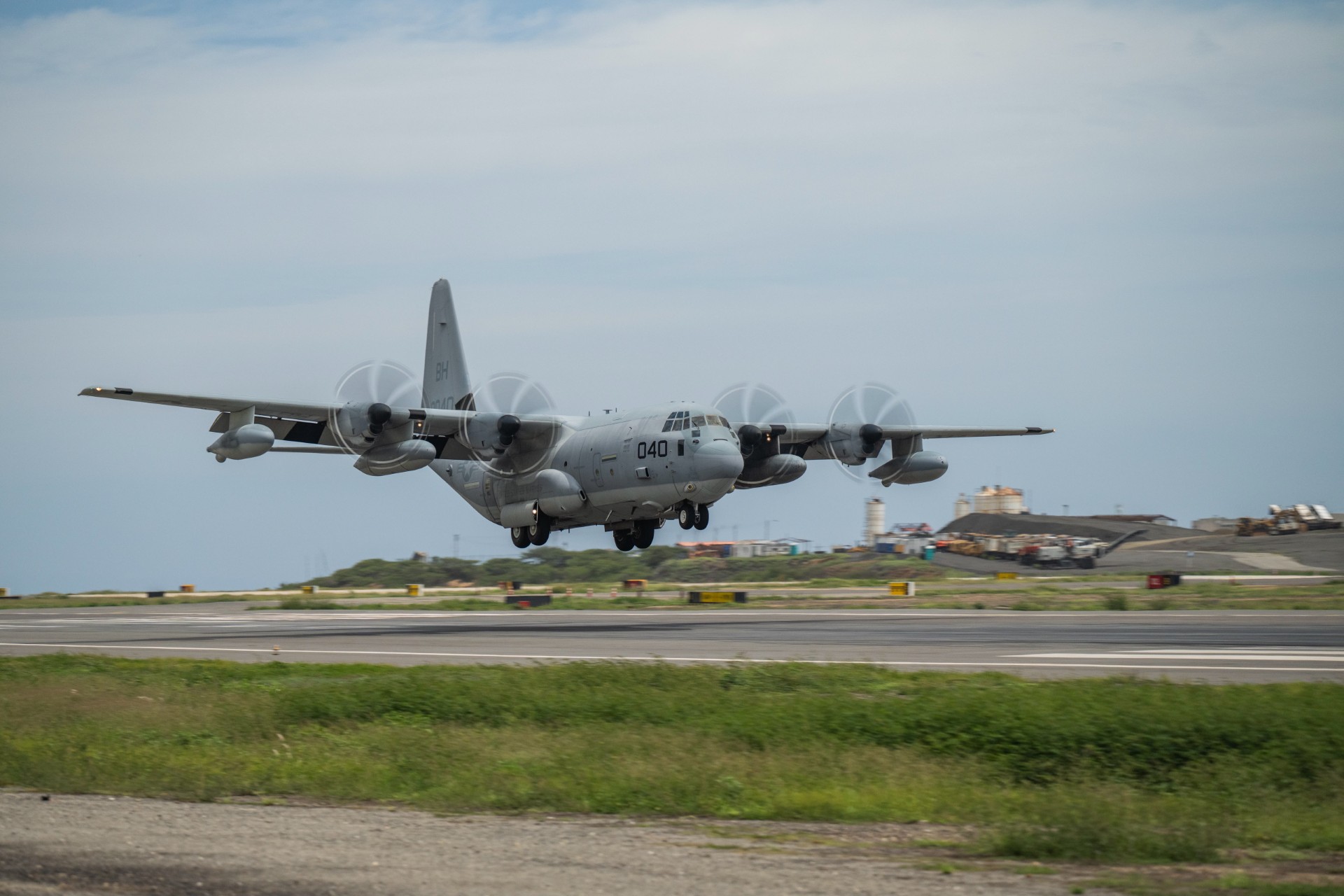
After carrying out repair works on a runway, the US Air Force’s Contingency Response Element (CRE) has been conducting “airfield management, air traffic coordination, communications, and security” at the Simón Bolívar International Airport. SOUTHCOM press releases have documented the arrival of multiple military transport aircraft, while MQ-9 Reaper drones and combat helicopters have conducted intelligence reconnaissance over Caracas and other affected areas.
US forces have likewise taken a position at La Guaira port with the docking of the amphibious USS Fort Lauderdale warship. US officials have assessed conditions and necessary works at the port and aim to establish a “vital command-and-control node” for the delivery of humanitarian aid.
In a Thursday press conference, Venezuelan Acting President Delcy Rodríguez thanked US President Donald Trump and Secretary of State Marco Rubio for their “permanent contact and support.” She went on to acknowledge the US’ “major logistical deployment to receive humanitarian aid.”
Since the January 3 military strikes on Caracas and kidnapping of Venezuelan President Nicolás Maduro, the Trump administration has dramatically increased its foothold in the Caribbean nation. The Venezuelan legislature has approved multiple reforms catered to Western corporate interests, while oil export revenues are currently controlled by the US Treasury Department.
In addition, US forces ran military drills over Caracas on May 23 and conducted an extrajudicial execution of an alleged gang leader in southeastern Bolívar state in June in “coordination” with Venezuelan security forces.
Following the recent natural disaster, the US Treasury Department issued a time-limited license allowing relief-related transactions with Venezuela while maintaining its wide-reaching sanctions regime in place.
Washington and its allies likewise hold billions worth of Venezuelan frozen assets, including 31 tonnes of gold deposited at the Bank of England that the UK government has refused to release.
Edited by Lucas Koerner in Caracas.
[Updated on July 3 to include Rodríguez’s comments]
The Daily Mail says the family of the late Bobby Moore have launched a High Court “crusade” to get back the red football jersey he wore, external when he led England to their 1966 World Cup victory. According to the paper, his former wife, Tina Moore, has lodged a case against a businessman she believes either “has or has had possession of the shirt, or can help her recover it.” He denies having the garment.
The Guardian has a double-page spread on Taylor Swift’s wedding to Travis Kelce., external It notes the celebration “caused the closure of 11 streets” in Midtown New York – and says that on Friday the “first class lounges of Heathrow and JFK airports were crawling with celebrities” who were on their way to to the event.
The FT Weekend reports that two World War II foes have united, external, after a German defence company bought a firm that supplied gears for Spitfires. The paper says Huddersfield-based David Brown has been purchased by Renk, which created gearboxes for tanks in Nazi Germany.
And Alistair Wilson, deputy headteacher at Whipton Barton Federation primary school in Exeter, Devon, is opening at normal time but running a non-uniform day and showing match highlights in classrooms after breakfast.
“It’ll be a wonderful way to celebrate the day, World Cup fever has definitely hit them,” Wilson says.
Even among the schools opening late, teachers are still advising pupils to get some sleep.
Oaks Park High School, a secondary in Carshalton, south London, which is opening at 09:45 “strongly” encouraged sleep before the game to avoid being “extremely tired”.
Some on social media, including teacher and podcaster Lee Parkinson, have called for some “common sense” leniency on attendance figures on Monday.
Others point out many schools across the country already shuttered for multiple days during last week’s heatwave, bringing disruption to learning.
Back in Wolverhampton, Kelly Wall has noticed a lot of positive chatter at the school gates.
She says she can understand the point of view of any naysayers, but adds: “It’s so rare that we get to have these special moments with he kids, because our lives are always so busy.
“Really, let the children join in, watch the game and let them have a bit of family time.”
Lionel Messi opens scoring but Argentina taken to extra time by Cape Verde, which threatened greatest World Cup upset.
Published On 4 Jul 20264 Jul 2026
Reigning champions Argentina needed an extra-time own goal to overcome a Cape Verde side with incredible levels of resilience 3-2 in a thrilling contest and secure their spot in the last 16 of the World Cup.
The Africans, playing in their first World Cup, had twice come from a goal down on Friday to silence the vast majority of the crowd of 64,478 packed into a hot and humid Miami Stadium.
Recommended Stories
list of 4 itemsend of list
Six minutes into the second period of extra time, Lionel Messi swung a corner into the box, and Cristian Romero rose to head home off the arm of Cape Verde centre-back Diney Borges and finally set up a date with Egypt in Atlanta next Tuesday.
Messi had, almost inevitably, given Argentina the lead in the 29th minute with his seventh goal of the tournament, but Deroy Duarte equalised just before the hour mark.
The Blue Sharks held on to send the match into an additional half hour before Lisandro Martinez lashed a sumptuous shot into the roof of the net in the second minute of the first period of extra time to put Argentina ahead again.
Cape Verde were not done yet, however, and left back Sidny Lopes Cabral curled a beautiful shot into the top corner of the net in the 103rd minute of the contest to put the scores back on level terms at 2-2.
Lopes Cabral could have equalised again after Romero’s goal, but his finely struck free kick was saved by Argentina goalkeeper Emiliano Martinez, who had to be at his best to deny Cape Verde in the dying minutes.
Cape Verde were beaten but far from outclassed by the three-times world champions as they put in a fourth magnificent display of teamwork and grit at their first World Cup.
The only one of the four World Cup debutants to make it to the last 32 and ranked 67th in the world coming into the tournament, Cape Verde had hoped to frustrate Argentina as they did Spain, Uruguay and Saudi Arabia in group-stage draws.
They succeeded, while showing no shortage of quality of their own, for much of the game with a never-say-die desperation and a neat pass-and-move game.
Cape Verde’s Sidny Lopes Cabral scores their second goal past Argentina’s Emiliano Martinez [Paul Childs/Reuters]
Messi aside, Argentina were largely bereft of ideas against an obdurate defence and Cape Verde libero Kevin Pina was the most impressive player on the park for long periods of the contest.
It was Argentina who made the breakthrough in the 29th minute, however, when Lisandro Martinez lofted a long ball over the top of the defence to the feet of Messi.
The 39-year-old maestro took a touch with the outside of his left boot and buried it in the roof of Vozinha’s net for his 20th goal over six editions of football’s global showpiece.
Cape Verde knew they would need to score to keep their World Cup campaign alive and Duarte fired a shot at goal soon after half-time that drew a diving save out of Martinez.
Just before the hour mark, captain Ryan Mendes was freed down the right, and his pass into the box found the Dutch-born midfielder, who controlled the ball with his left foot before drilling it past Martinez with his right.
Messi had a chance to put Argentina back in front four minutes later when he was played through on goal, but Vozinha stood up well to keep his shot out of the net.
One of Messi’s trademark free kicks was tipped away by Vozinha in the 72nd minute, and Cape Verde defender Pico Lopes had to intervene to prevent Enzo Fernandez from scoring 10 minutes later.
Cape Verde held on to force the dramatic period of extra time, and they will now return home heroes having put their tiny island-nation firmly on the footballing map.
The Iranians have come out on top after the conflict. They have demonstrated themselves as a pure and united nation by not dividing into small factions during the recent militarily confrontation with the United States and Israel. The Americans and Israelis were seemed to be launching a shock and awe strategy against the Iranians to overwhelm them and easily bring down their regime.
However, they were unable to accomplish their task, resulting in social pressure from within the United States, as 61% people were not in favor of launching a war of choice against Iran while the escalation concluded in huge financial setbacks for both the U.S and Israel.
According to John Kiriakou – the former CIA officer, Trump was told by the Israeli Prime Minister that they could easily topple the regime of Iran due to prevailing social unrest at that time. But the Iranians remained intact and united, rallying behind their government. This shattered Americans and Israelis ambitions.
On the day Americans and Israelis launched an unprovoked aggression against Tehran, Iran imposed a closure of the Strait of Hormuz, which made Iran to maintain upper hand throughout the confrontation and sustain its position against the enemy.
Stay ahead of the geopolitical week.
MD Briefing delivers expert analysis across five global fronts — the Indo-Pacific, energy, geoeconomics, European security, and the Middle East — every Monday morning. Free.
Strait of Hormuz was open before 28th February, but during the war it was observed that the United States presented its closure as a cause of war, whereas it was obviously a consequence of the war. In addition to this context, Tehran laid a lot of mines in the waters of the Strait of Hormuz to hinder the flow of maritime trade across the strait.
From the beginning, the Iranians adopted a military strategy called Mosaic Defense, in which they decentralized their defense system, dividing their military into 31 factions which were able to take any decision on spot without asking from the central command of Tehran. This gave their military to take sudden military decisions and hit military targets as per their choice. This strategy significantly helped the Iranians hold the upper hand in the conflict, maintain their position, and stand firm against their enemy.
The Iranians also pursued the strategy of asymmetric warfare, attacking with cheap Shahed-136 drones and using different types of missiles to overwhelm the enemy. They used drones of worth around 20000 to 50000 $ while the Americans and Israelis were using expensive defensive equipment of worth 1 million to 4million dollars.
Iran fought Americans forces using a strategy called horizontal warfare, broadening the conflict across the Middle East by attacking Americans bases in the region and making the region increasingly vulnerable and unstable for the other countries there. This helped Iran consolidate their hard power in the region.
Islamic Revolutionary Guards Corps (IRGC) eliminated the most expensive radars of the US situated in different countries of the region. They blew up AN/FPS-132 and AN/TPY-2 Radar systems of the US in Qatar and Jordan respectively.
Along with that, they decimated American 5th fleet headquarter in Bahrain, which held 75% of the US military power in the region, resulting in heavy losses for Washington. Furthermore, Iran inflicted pain on more than dozen American bases in the Middle East.
It was seemed that Tehran converted this war into a war of attrition by slowly weakening the Americans over time. They were fully prepared for this protracted war but it did not go in favor of the United States, as Washington was unable to afford a protracted war at lot.
Therefore, President Trump was increasingly perceived as pursuing a deal with Tehran over time, emphasizing that a deal was in progress and would be reached soon. As a result, president trump had to sign a memorandum of understanding (MOU) with Tehran on 17th June 27, 2026 to save the world economy from another Great Depression.
The extent which Washington achieved its objectives remain open to debate. These goals included the overthrow of the regime, the de-weaponization of Iran, and the weakening of the country’s strategic potential.
According to the U.S political scientist Robert Pape, Iran has emerged as the fourth center of power, following the US, China, and Russia. It was obvious that Iran had been preparing for possible military misadventure by the U.S and Israel since 1979.
One of the crucial steps that Iran took after the Islamic revolution was the creation of the Islamic Revolutionary Guards Corps (IRGC) parallel to its national army. Consequently, it had huge leverage over the US and Israel during overall confrontation.
Moreover, this military confrontation between the U.S and Iran gave huge advantage to Tehran, making its position stronger in the regional politics and globally. Resultantly, Tehran has achieved what it had been unable to gain over the last 47 years. It successfully gained the removal of sanctions, the release of its $24B frozen assets, dominance over the Strait of Hormuz, and recognition as a regional power. Apart from that, it still retains its regional proxies and ballistic missile program.
While the Americans and Israelis miscalculated the war, assuming that they could win a quick and decisive victory by decapitating the regime. For that they orchestrated a plan to quickly topple the regime through a shock-and-awe campaign and they wanted to place people on the top that were subservient to them. However, the Iranian military emerged as a key deterrent against the adversary and made the pursuit of Washington’s objectives complicated.
Loop’s website shows images of people wearing their devices in casual, fun settings, and the brand has also collaborated with festivals such as Coachella and Tomorrowland.
Alpine CEO Arthur van Keeken says their ear-plugs have been popular with “younger, urban people” – exactly the audience for these types of events.
He believes they are more conscious of looking after their hearing, and wants a future where music fans view ear protection in the same way skiers see helmets.
The British Association of Audiologists – healthcare experts who specialise in diagnosing and treating ear problems – say hearing loss is one of the most common disabilities.
According to the Royal National Institute for Deaf People (RNID), it affects about one in three UK adults.
The charity’s audiology manager Franki Oliver says that, under a microscope, the sound-sensing cells in our ears and the tiny hairs growing out of them resemble a patch of grass at a festival.
“The first day, the grass looks absolutely beautiful,” she says. “Nice and green.”
“After the first couple of days, it’s OK. But at the end of the weekend it’s looking pretty dead and it’s probably not coming back.
“The same thing is happening with our ears when we expose them to loud noises”.
Oliver says it’s a good thing that ear-plugs are increasingly seen as an “accessory to a night out, rather than something you have to use”.
But, like our ears, they are not all created equal.
On July 4th 1776, the United States of America proclaimed its independence from England by signing the Declaration of Independence.
While the signing of the Declaration itself was not completed until August, the Fourth of July holiday is seen as the official anniversary of U.S. independence.
Although Philadelphians marked the first anniversary of independence in 1777 with spontaneous celebrations in the streets of Philadelphia, the first recorded use of the name “Independence Day” wasn’t until 1791 and Independence Day celebrations only became common after the War of 1812.
By the 1870s, Independence Day had become the most important secular holiday on the American calendar and has transformed into what is known as the 4th of July today.
In 1870, The U.S. Congress made Independence Day an unpaid holiday for federal employees, though it wasn’t until 1941 that Congress declared Independence Day to be a paid federal holiday.
Sudan has been engulfed in a devastating civil war since April 2023, when fighting erupted between the Sudanese Armed Forces (SAF), led by Abdel Fattah al-Burhan, and the Rapid Support Forces (RSF), commanded by Mohamed Hamdan Dagalo. The conflict has evolved into one of the world’s worst humanitarian crises, displacing millions, collapsing healthcare and public services, and triggering repeated warnings of famine and ethnic violence.
The latest concern centres on Al-Obeid, the capital of North Kordofan. The city is strategically important because it links central Sudan with the western Darfur region and serves as a major logistical and commercial hub. Control of Al-Obeid would provide whichever side captures it with a crucial military corridor for moving troops and supplies across Sudan.
According to the Office of the United Nations High Commissioner for Human Rights, civilians in the city have endured siege-like conditions for around 18 months, with dwindling food, water and medical supplies, while drone strikes and shelling have intensified.
Stay ahead of the geopolitical week.
MD Briefing delivers expert analysis across five global fronts — the Indo-Pacific, energy, geoeconomics, European security, and the Middle East — every Monday morning. Free.
Why it matters
The warning from UN High Commissioner Volker Türk suggests international concern that Al-Obeid could become another major atrocity site similar to previous battles in Darfur.
Several factors make the situation particularly alarming:
Strategic military battle: Both the SAF and RSF view Al-Obeid as critical to controlling supply routes between central and western Sudan.
Civilian catastrophe: Thousands of civilians remain trapped as fighting intensifies, with limited humanitarian access and worsening shortages of clean water, food and healthcare.
Risk of mass atrocities: Britain requested the emergency UN debate amid fears that an RSF offensive could result in large-scale civilian killings similar to previous episodes documented elsewhere in Sudan.
Humanitarian spillover: Further escalation would increase refugee flows into neighbouring countries already struggling to absorb displaced Sudanese populations.
Key stakeholders
Sudanese Armed Forces (SAF)
Controls parts of central and eastern Sudan.
Seeks to prevent RSF advances into North Kordofan and maintain control over key transport routes.
Rapid Support Forces (RSF)
Attempting to expand territorial control after major campaigns elsewhere.
Surrounding Al-Obeid could strengthen its position in western and central Sudan.
United Nations
The OHCHR is documenting civilian casualties and warning of possible mass atrocities.
UN agencies are pushing for humanitarian access before conditions deteriorate further.
United Kingdom
Requested the urgent debate at the United Nations Human Rights Council, highlighting growing Western concern over another possible humanitarian disaster.
Humanitarian organisations
Aid agencies face increasing difficulties reaching civilians due to insecurity and siege conditions.
Regional countries
Neighbours including Chad, South Sudan and Egypt remain vulnerable to additional refugee inflows and regional instability.
Future outlook
The immediate outlook depends on whether the RSF launches a full-scale assault on Al-Obeid or negotiations produce humanitarian access.
Possible scenarios include:
Escalation: A major offensive could trigger another urban battle marked by heavy civilian casualties, infrastructure destruction and further displacement.
Prolonged siege: Even without a direct assault, continued encirclement could deepen shortages of water, food and medicine, increasing disease and starvation risks.
International pressure: The UN and Western governments may increase diplomatic pressure for humanitarian corridors, though previous efforts have had limited success.
Limited accountability: Despite mounting documentation of alleged abuses by both sides, meaningful international enforcement remains difficult given the fragmented nature of the conflict.
Volker Türk’s warning reflects growing concern that Sudan’s conflict is entering another dangerous phase rather than improving. Al-Obeid represents more than a humanitarian hotspot—it is a strategic military objective whose capture could reshape the balance of power between the SAF and RSF.
The battle also illustrates a recurring pattern throughout the war: military gains are increasingly achieved through sieges, attacks on civilian infrastructure and restrictions on humanitarian access. These tactics magnify civilian suffering even before major ground offensives begin.
For the international community, the warning underscores a familiar challenge. The UN can document abuses and raise alarms, but translating those warnings into protection for civilians has repeatedly proven difficult. Without stronger diplomatic leverage or sustained international engagement, there is a significant risk that Al-Obeid could become the latest symbol of Sudan’s worsening humanitarian crisis rather than the point at which the conflict’s trajectory changes.
Weekly insights and analysis on the latest developments in military technology, strategy, and foreign policy.
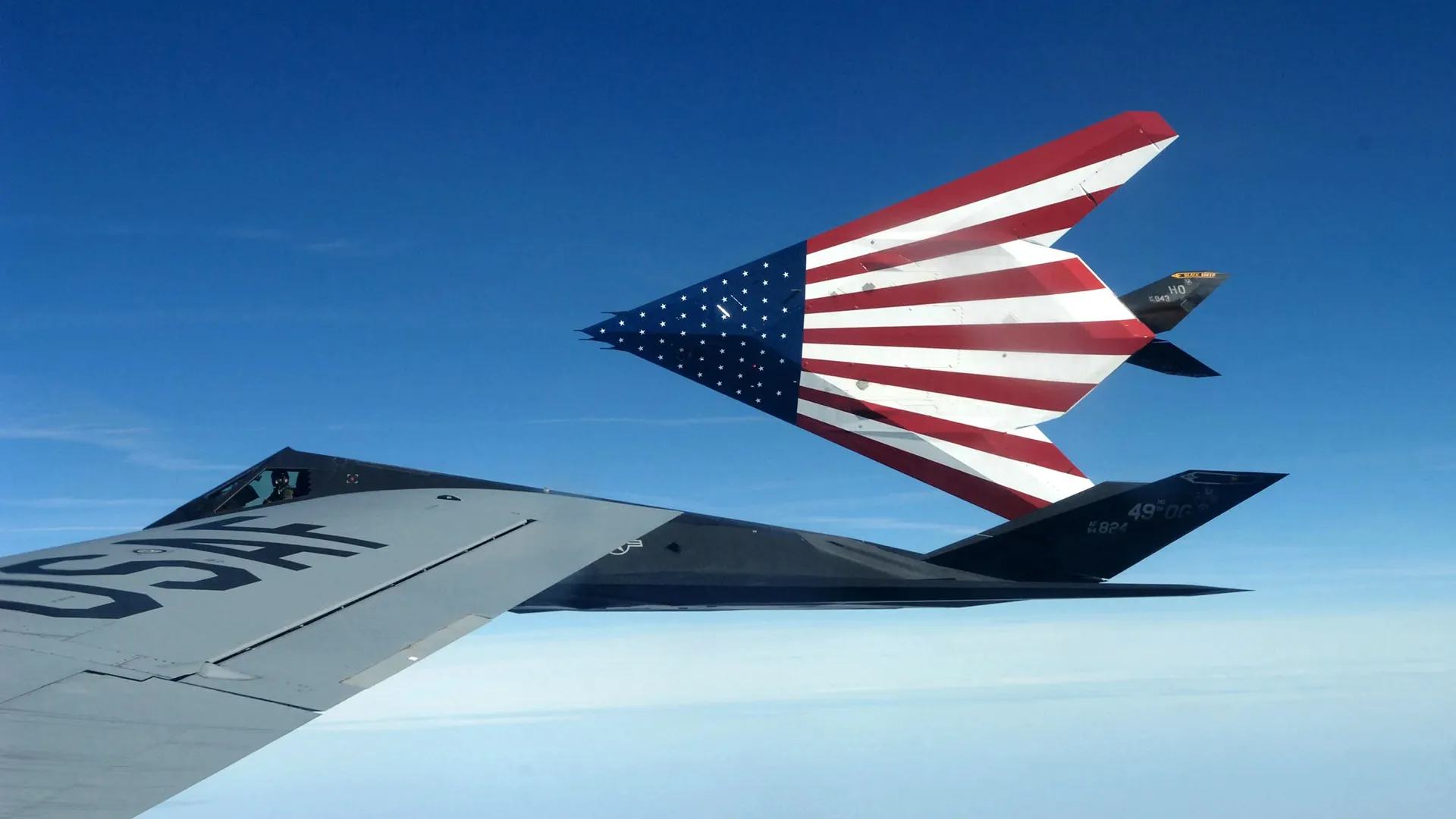
I hope all our American readers, have a great weekend enjoying the 250th birthday of the United States of America! Sit back, have a brew and a dog, smoke a cigar, enjoy the fireworks! And, above all else, watch tomorrow’s flyby!
Have a great weekend everyone and happy bday Lady Liberty!
This week’s caption reads:
A F-117 Stealth Fighter from the 49th Fighter Wing, based at Holloman Air Force Base in New Mexico, shows off its paint job during a March 12 refueling mission flown by the Columbus-based 121st Air Refueling Wing of the Ohio Air National Guard. (Photo/Senior Master Sgt. Kim Frey)
Prime Directives:
If you want to talk politics, do so respectfully and know that there’s always somebody that isn’t going to agree with you.
If you have political differences, hash it out respectfully, stick to the facts, and no childish name-calling or personal attacks of any kind. If you can’t handle yourself in that manner, then please, discuss virtually anything else.
No drive-by garbage political memes. No conspiracy theory rants. Links to crackpot sites will be axed, too. Trolling and shitposting will not be tolerated. No obsessive behavior about other users. Just don’t interact with folks you don’t like.
Do not be a sucker and feed trolls! That’s as much on you as on them. Use the mute button if you don’t like what you see.
So unless you have something of quality to say, know how to treat people with respect, understand that everyone isn’t going to subscribe to your exact same worldview, and have come to terms with the reality that there is no perfect solution when it comes to moderation of a community like this, it’s probably best to just move on.
Finally, as always, report offenders, please. This doesn’t mean reporting people who don’t share your political views, but we really need your help in this regard.
Venezuela’s acting president Delcy Rodriguez, whose 180-day mandate ends Friday, dismissed criticism of the government’s earthquake response, saying rescue crews were deployed immediately with adequate equipment. Residents have said they were on their own for the first 48 hours.
A three-armed spacecraft rockets into orbit to rescue a NASA telescope that’s in danger of crashing back to Earth.
By AFP and The Associated Press
Published On 3 Jul 20263 Jul 2026
NASA has launched a robotic mission to try to prevent one of its ageing telescopes from burning up in the atmosphere in a complicated operation expected to last several months.
Northrop Grumman launched the Link spacecraft – built by United States-based Katalyst Space Technologies – from the Marshall Islands in the Pacific Ocean on Friday.
Recommended Stories
list of 4 itemsend of list
A Pegasus rocket blasted off from the belly of a modified aircraft putting Link on course to reach and capture NASA’s Swift Observatory in about a month.
Initially scheduled for Tuesday, the robot’s launch was postponed due to weather, then technical issues. Blast-off happened on Friday at 0836 GMT from an atoll in the Pacific Ocean.
The unprecedented $30m effort involves sending a robot to rescue the Swift space telescope that is falling towards Earth. If successful, the mission could pave the way for giving other satellites a second life.
Launched in 2004, Swift is sinking faster than ever because of recent solar storms. The $250m telescope studies gamma-ray bursts, the most powerful explosions in the universe.
Once it reaches an orbit close to Swift’s, the robot will deploy its solar panels and perform a series of checks.
It will then have to locate the Swift telescope in the vastness of space, circle around it and dock using three robotic arms – manoeuvres expected to take several weeks.
Finally, it will attempt to propel the satellite approximately 300km (186 miles) higher above the Earth, roughly to its initial orbital position. That operation is expected to last at least a month.
“This is a lot of firsts stacked on top of each other,” Shawn Domagal-Goldman, director of NASA’s astrophysics division, told reporters on Tuesday. “I’m just deeply thankful that we’re even giving this a go.”
The government says the law will help forge a shared national identity.
Beijing’s new ethnic unity law has taken effect. It strengthens Mandarin’s position as the primary language of education, official business and public spaces across China.
The government says the law’s provisions on social cohesion and preventing separatism benefit everyone.
Recommended Stories
list of 4 itemsend of list
But activists abroad say it will further erode the rights of groups such as Uighurs and Tibetans. They are also warning against a clause that states China can take action against those who violate the law outside of the country.
Taiwan has echoed this criticism. Its government warns the law could be used to target people there who are critical of Beijing.
Presenter: Mohammed Jamjoom
Guests:
Einar Tangen – Senior fellow, Centre for International Governance Innovation
Zumretay Arkin – Vice president, World Uyghur Congress
William Yang – Senior analyst for Northeast Asia, International Crisis Group
The Israeli mission met with Venezuelan officials on Wednesday. (@IsraelinSpanish)
Caracas, July 2, 2026 (venezuelanalysis.com) – The Venezuelan government has welcomed an official Israeli delegation in the first significant bilateral engagement since Caracas severed ties with Tel Aviv in 2009.
In the wake of the devastating June 24 double earthquake, a joint civilian-military mission led by Israeli diplomat Yoed Magen landed in the South American country on Wednesday.
In a social media message, the IDF claimed its “humanitarian delegation” would “support recovery efforts” and share Israel’s “experience in emergency situations.”
The Israeli government confirmed the deployment of a “preliminary team” via its Spanish-language X account and announced further arrivals in the coming days.
“The remaining delegation members will incorporate themselves in the coming days. Expert teams will work alongside local authorities and collaborate in the reconstruction efforts,” the statement read.
Venezuelan Foreign Minister Yván Gil “received and thanked” the Israeli mission on behalf of the acting Delcy Rodríguez administration, claiming that it was part of “international technical cooperation and support for the Venezuelan people.” In a Thursday night press conference, Rodríguez expressed her appreciation for the arrival of the “highly trained and professional” Israeli team and confirmed they were meeting with Venezuelan authorities to help evaluate damaged infrastructure.
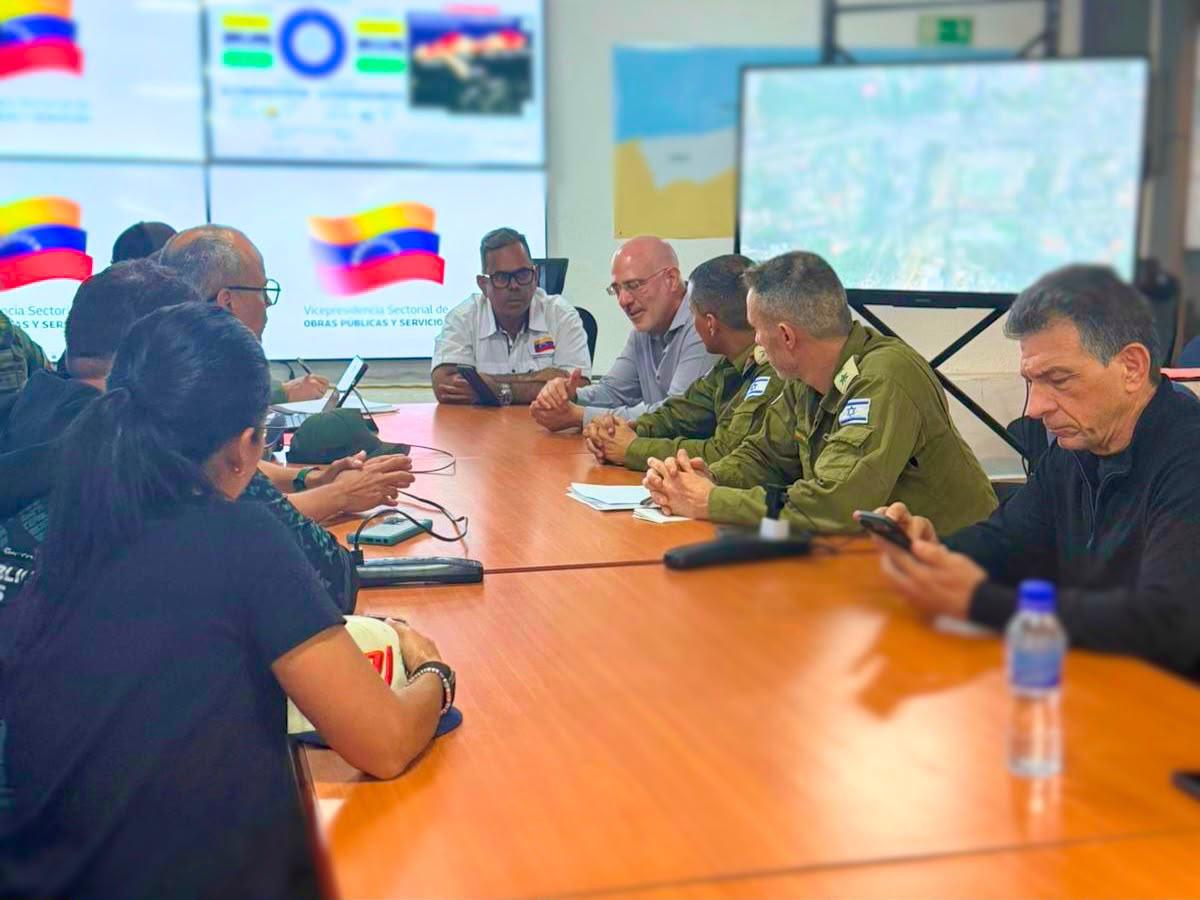
The Israeli delegation includes a military contingent headed by Brigadier General Elad Edri, chief of staff of the IDF Home Front Command. It held meetings with Venezuelan Public Works Minister Juan José Ramírez and with Francisco Garcés, the head of a newly formed presidential commission tasked with evaluating the safety and habitability of infrastructure following the tremors.
Israeli nonprofits IsraAid and NATAN Worldwide Disaster Relief had previously announced they were dispatching teams to Venezuela but their arrival has not been confirmed. Social media footage has shown the use of Israeli-made drones to conduct 3D-mappings of flattened buildings and locate possible survivors under the rubble.
The dispatch of the Israeli mission dovetails with a significant post-earthquake US military deployment. The Southern Command (SOUTHCOM) has reported 900 military personnel on the ground, while US forces are running logistics at the Simón Bolívar International Airport and La Guaira port.
Following the January 3 US military strikes and kidnapping of President Nicolás Maduro, the acting Rodríguez administration has fast-tracked a diplomatic rapprochement with Washington and radically reoriented its geopolitical alignments. During the recent US-Israel war against Iran, Caracas did not express support for its longtime ally in Tehran, instead offering public backing for US Gulf allies such as Qatar and the United Arab Emirates.
Former Venezuelan President Hugo Chávez severed ties with Tel Aviv in 2009, fiercely denouncing Operation Cast Lead as “genocide” and voicing solidarity with the Palestinian people.
Maduro maintained his predecessor’s policy position excoriating Israeli military occupation and war crimes in Gaza and Lebanon, as well as the June 2025 Twelve-Day War against Iran. The Maduro government publicly endorsed South Africa’s activation of the Genocide Convention against Israel at the International Court of Justice (ICJ) in 2024.
The arrival of an Israeli mission has drawn backlash from the Chavista grassroots. Hindu Anderi, spokesperson for the Platform of Solidarity with the Palestinian cause, slammed the “hypocrisy” of Tel Aviv claiming the mantle of humanitarianism amid its ongoing genocides in Gaza and Lebanon.
“The Zionist regime wants to whitewash its record through rescue teams […] after condemning the Palestinian people to rubble,” she wrote on social media.
Venezuelan officials have reported 2,595 people killed in the earthquake as of July 2, more than 12,000 injured, and over 15,000 displaced families. The search and rescue operations have been backed by more than 4,000 foreign specialists from 30 countries.
Edited and with additional reporting by Lucas Koerner in Caracas.
Weekly insights and analysis on the latest developments in military technology, strategy, and foreign policy.
NASA-affiliated aircraft, including F-5 Tiger IIs jets, will kick off roughly seven hours of flyovers above Washington, D.C., to mark the Fourth of July. Today, NASA also officially unveiled an F-15D Eagle and an F/A-18B Hornet jet wearing new star-spangled paint schemes as part of larger celebrations marking the 250th anniversary of the United States. The aerial showcase over the nation’s capital tomorrow will also see wave after wave of fixed-wing aircraft and helicopters from across the U.S. military, as well as foreign air forces. It is set to be an unprecedented aerial review, unlike anything seen in recent decades.
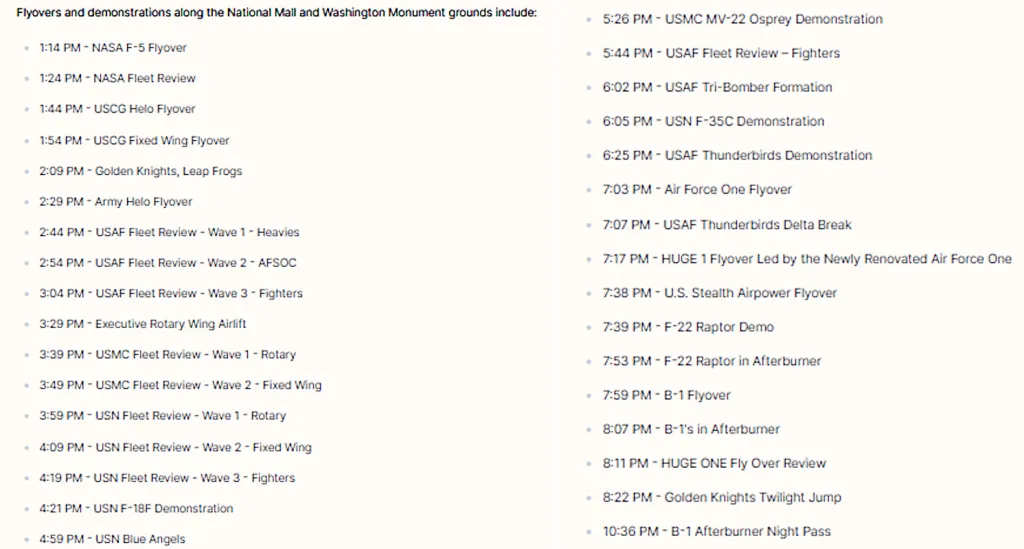
A full flyover schedule is available on the website of the Freedom 250 organization, the primary organizer of various 250th anniversary celebrations. A more truncated flyover program has already come and gone today. The full aerial review is set to start tomorrow at 1:14 PM ET with a “NASA F-5 Flyover,” followed immediately by a “NASA Fleet Review.”
The full Fourth of July flyover schedule from the Freedom 250 website at the time of writing. Freedom 250
The NASA “Freedom 250” F-5 team consists of four privately owned aircraft, including one that belongs to its current administrator, Jared Isaacman. They have already been taking part in various airshows and other events since April. Three of the F-5s, wearing their special 250th anniversary schemes, touched down at Andrews Air Force Base just outside of Washington, D.C., on June 30.
“Freedom 250” F-5s seen at Andrews Air Force Base on June 30. USAF USAFAnother look at one of the “Freedom 250” F-5 team aircraft. USAF
As noted, NASA has also now unveiled the F-15D and F/A-18B with their special 250th anniversary liveries, as seen at the top of this story and below. Those jets could be part of the larger NASA Fleet Review.
The F/A-18B, at left, and F-15D, wearing their new 250th anniversary liveries. NASAThe NASA F-15D seen in the process of getting its new star-spangled paint scheme. NASAThe NASA F/A-18B also seen being painted in its new livery for the Fourth Of July. NASA
Spotters in Spokane, Washington, had first caught sight of these jets yesterday. Based on the assignment of its civilian N-number registration code in May of this year, the F-15D appears to be one of two ex-Oregon Air National Guard jets that NASA acquired in January.
The F/A-18B, at left, and the F-15D, at right, seen with their new liveries in Spokane on July 2. Tom Riley
What other NASA aircraft might make an appearance is unclear. Last week, NASA’s Johnson Space Center in Houston, Texas, did share pictures of T-38, WB-57F, and Gulfstream V aircraft with Freedom 250 emblems painted on their fuselages, but it is unknown whether they will be part of the Fourth of July event.
A trio of NASA T-38s with special emblems marking the 250th anniversary of the United States celebrations. NASAA “Freedom 250” emblem seen on a NASA WB-57F. NASAThis NASA Gulfstream V business jet has been adorned with a Freedom 250 NASA
U.S. Coast Guard helicopters and fixed-wing aircraft will follow the NASA flyovers, per the Freedom 250 website, but no specific aircraft types are mentioned. Today, the Coast Guard operates a mix of MH-65 Dolphin and MH-60T helicopters, as well as HC-130J, C-27J, HC-144, C-37, and now C-39 fixed-wing aircraft. C-39 is the designation given to new Gulfstream 700 VIP jets, the first of which was delivered in January. The Coast Guard is in the process of acquiring a second one of these aircraft, which will supplement, if not eventually supplant, its C-37s, which are based on older Gulfstream types, as you can read more about here.
The first of two Gulfstream 700-based C-39 VIP jets delivered to the Coast Guard. Lennon Popp
The U.S. Army’s Golden Knights and the U.S. Navy’s Leap Frogs, both of which are parachute demonstration teams, are set to follow the Coast Guard portion of the aerial review. Whether they will jump from different aircraft or the same one, and what type of aircraft will be utilized, are unknown. The Army has aircraft dedicated to supporting the Golden Knights, including Dash-8-based C-147As and UV-18C Twin Otters.
2026 B-Roll Package
Leap Frogs 2021
The parachute demonstrations are to be followed by a review of Army helicopters, which could include a mixture of AH-64 Apache, UH-60 Black Hawk, CH-47 Chinook, and UH-72 Lakota types. Special Operations MH-60Ms, MH-47Gs, and AH/MH-6 Little Birds from the famed 160th Special Operations Aviation Regiment, the “Nightstalkers,” might also take part. The Army also has several VH-60 Black Hawks specially configured for VIP transport missions, known as “gold tops” because of their distinctive black-and-gold paint jobs, based in the broader Washington, D.C. area, that could be included in the flovers.
Army UH-60 Black Hawks and UH-72 Lakotas seen during a previous flyover of Washington, D.C. US Army
Waves of U.S. Air Force, Marine Corps, and Navy aircraft – in that order – will come after the Army helicopters pass by.
The Air Force’s three waves are broken down into “heavies,” aircraft from Air Force Special Operations Command (AFSOC), and fighters. We know from the schedule that a “Tri-Bomber Formation” made up of a B-2, B-1, and B-52 will come later in the day, but the “heavies” mentioned here also sound likely to include a mix of cargo aircraft and aerial refueling tankers. Executive transport types might also make an appearance at this point in the festivities. The new VC-25B “Bridge” aircraft, which made its maiden flight in the Air Force One role this week in taking President Donald Trump on a trip to North Dakota, is explicitly set to be part of the larger aerial review.
An “Executive Rotary Wing Airlift” flyover will come in between the Air Force and Marine Corps waves. The Marines are the most prominent operators of aircraft in this category, being responsible for the VH-92, VH-60, and VH-3 presidential helicopters, also commonly known as Marine Ones, as well as a fleet of MV-22 Ospreys used for executive airlift missions. The Army’s aforementioned “gold top” Black Hawks, as well as the Air Force’s UH-1N Twin Hueys based at Andrews Air Force Base, are in this “executive” category, as well.
A pair of VH-92As, the newest Marine One helicopter, fly in formation. Blend Qatipi
It should be noted here that there are heavy restrictions on how and when uncrewed aircraft, even ones belonging to the U.S. military, can fly within the U.S. national airspace. This makes it very unlikely that drones from any of the services will be part of the aerial procession.
Flights by the Navy’s Blue Angels and its separate Super Hornet demonstration team, as well as the Marine Corps MV-22 Osprey demonstration team, are next in the program. The Blue Angels have various signature maneuvers, some of which they might be able to incorporate into their flyover.
Blue Angels Air Show 2026
Per the Freedom 250 website, the Navy and Marine Corps demonstration teams will be followed by another review of Air Force fighters, then the Tri-Bomber formation mentioned before. The Navy’s F-35C demonstration team will go next, and then the Air Force’s Thunderbirds.
Like the Blue Angels, the Thunderbirds have several signature maneuvers, and a “Delta Break” (more commonly referred to as a “Delta Burst”) is explicitly on the schedule. This entails the Thunderbirds’ F-16s flying in a delta formation before breaking outward, giving the appearance of a starburst in the sky. Smoke trails from the jets during the maneuver, adding to the effect, as seen in the video below.
USAF Thunderbirds “Delta Burst”
An “Air Force One Flyover” is sandwiched between the Thunderbirds’ initial flyby and the Delta Burst per the schedule on the Freedom 250 website. Whether this will feature anything besides the new VC-25B “Bridge” aircraft remains to be seen. That plane is set to lead a “HUGE 1” flyover, the composition of which is unclear.
A “U.S. Stealth Airpower Flyover,” which would include the B-2, F-22, and F-35, comes next in the program. The F-22 Raptor demonstration team has its own specific slot in the schedule, capped off with a flyby in afterburner. The sun will still be setting at 7:53 PM ET when it is set to occur, but the visual should still be impressive. There will also be a B-1 bomber flyover with the afterburners at 8:07 PM ET.
The entire aerial review program ends with another “HUGE 1” flyover, a “Twilight Jump” by the Golden Knights, and then finally a “Night Pass” by the B-1 in afterburner at 10:36 PM ET, by which time the sun will have fully set for the day. A B-1 made a similar flight over Washington, D.C., as part of the UFC America 250 event at the White House back on June 14.
The roar of a B-1B Lancer assigned to the 7th Bomb Wing, Dyess Air Force Base, Texas, over Washington, D.C., tonight. 🇺🇸
As America approaches its #Freedom250 anniversary, military flyovers remain a powerful tradition—honoring the past, celebrating the present and inspiring… pic.twitter.com/dyBPAA5A7y
A pre-production B-21 Raider seen during aerial refueling testing. USAF
There is also set to be at least some degree of participation by foreign air forces, none of which is explicitly mentioned in the schedule on the Freedom 250 website.
“The national aerobatic display team of the United Arab Emirates, ‘Al Fursan,’ has arrived in the United States of America to take part in the celebrations marking the 250th anniversary of the independence of the United States of America,” the UAE’s Ministry of Defense notably wrote in an official post on X this morning, per a machine translation of the original Arabic. “The team will join the official air show on July 4th, flying side by side with the Blue Angels team and squadrons of the U.S. Air Force, in an extraordinary scene that embodies the depth of bilateral relations between the United Arab Emirates and the United States of America, while reflecting the shared values and enduring partnership that unite the two nations.”
This is especially notable given that the Al Fursan team currently flies Chinese Hongdu L-15 jet trainers, as seen in the video below. This looks to be the debut appearance of any Chinese-made military aircraft in the United States.
وصول فريق الاستعراضات الجوية “فرسان الإمارات” إلى الولايات المتحدة الأمريكية للمشاركة في احتفالات ذكرى الاستقلال الـ250
وصول فريق الاستعراضات الجوية الوطني لدولة الإمارات العربية المتحدة “فرسان الإمارات” إلى الولايات المتحدة الأمريكية، للمشاركة في احتفالات الذكرى الـ250… pic.twitter.com/x0o3YQcdVH
The French Patrouille de France aerobatic team, which flies Dassault/Dornier Alpha Jets, has already flown over Washington, D.C., and New York City in the past two weeks as part of larger celebrations marking the 250th anniversary of the United States. The French have dubbed this the “Liberté 250” tour, which they say also celebrates their historic relationship with the United States since its founding.
Arlington. Mount Vernon. Washington.
Aujourd’hui, la mission #Liberté250 a rendu hommage à quelques-uns des lieux les plus emblématiques de la mémoire américaine.
Un parcours symbolique pour célébrer près de 250 ans d’amitié entre la France et les États-Unis. 🇫🇷🇺🇸 pic.twitter.com/TKsVI7waqE
— Armée de l’Air et de l’Espace (@Armee_de_lair) June 22, 2026
As mentioned, tomorrow’s flyovers look set to be completely unlike anything seen in years. It will be a far larger gathering of aircraft than what was present at the parade marking the 250th Birthday of the U.S. Army last year. It will dwarf even what was put together to mark the Centennial of Naval Aviation in 2011.
Just from what’s on the public schedule, Washington, D.C., is set to see an unprecedented aerial extravaganza to mark this year’s Fourth of July.
Special thanks to Tom Riley for sharing his picture of the NASA F/A-18B and F-15D in Spokane with us.
Heavy monsoon rains have inundated parts of Mumbai, India’s financial capital, causing widespread flooding, traffic congestion and disruption to daily life. The India Meteorological Department has forecast more heavy rainfall through the weekend.
Weekly insights and analysis on the latest developments in military technology, strategy, and foreign policy.
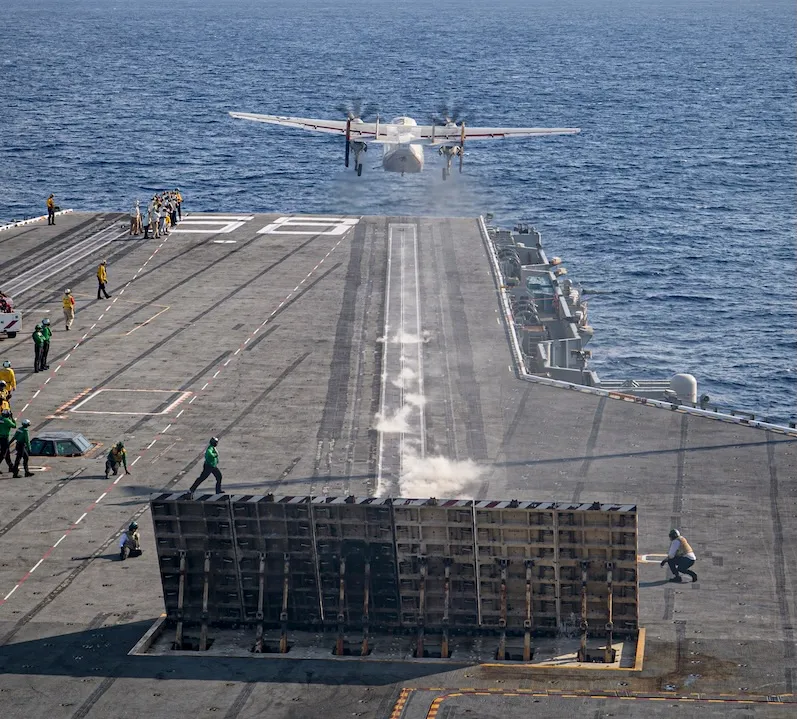
The venerable C-2A Greyhound carrier onboard delivery (COD) aircraft made its final flight to an aircraft carrier, a U.S. Navy official confirmed to TWZ. This final trap, which took place last week aboard the USS Nimitz, marks the end of nearly 60 years of providing logistics services to America’s flattops. That role has now been completely turned over to the Navy’s fleet of CMV-22B Osprey tiltrotor aircraft, the official told us, marking the end of an era in naval aviation.
On June 25, Greyhounds belonging to the “Rawhides” of Fleet Logistics Support Squadron 40 made the last arrested landing and catapult launch from a carrier, the official added. Though the Greyhounds won’t land on carriers anymore, they will still be flying until later this year when they are anticipated to be fully retired, barring any major contingencies.
You can read more about what it was like to fly a Greyhound in our deep-dive interview with a former pilot here.
A C-2A Greyhound, attached to the “Rawhides” of Fleet Logistics Support Squadron 40, takes off from the flight deck of the Nimitz class aircraft carrier USS Nimitz (CVN 68), making the last ever catapult launch of a Greyhound on June 25, 2026. (U.S. Navy photo by Mass Communication Specialist 2nd Class Peter K. McHaddad)
“Vice Admiral Doug Perry, commander of both the Joint Force Command Norfolk and the US 2nd Fleet, joined Nimitz as the ship travelled north from Mayport, Florida, toward New York City,” the publication stated. “Adm. Perry and several reporters, including Janes, boarded the Greyhounds as the C-2s were catapulted off Nimitz at about 1800 local time, marking the aircraft’s final expected COD takeoff.”
Greyhounds were aboard the Nimitzalong with the T-1 demonstrator for the MQ-25 Stingray unmanned tanker program and a number of Super Hornets, all of which are taking part in a large multinational exercise associated with America’s 250th birthday. The C-2s on the other hand didn’t linger around.
The Greyhound, a derivative of the Navy’s E-2 Hawkeye airborne early warning and control aircraft, first entered service in the late 1960s and replaced the piston-engined C-1 Trader in the COD role.
An E-2D Hawkeye, assigned to Airborne Command & Control Squadron (VAW) 117, flies over the Nimitz class aircraft carrier USS Abraham Lincoln (CVN 72). (U.S. Navy photo by Mass Communication Specialist Seaman Apprentice Daniel Kimmelman) Seaman Daniel Kimmelman
“The original C-2A aircraft were overhauled to extend their operational life in 1973,” the U.S. Naval Academy noted. “In 1984, a contract was awarded for 39 new C-2A aircraft to replace the earlier airframes. Dubbed the Reprocured C-2A due to the similarity to the original aircraft, the new C-2A includes substantial airframe and avionic systems improvements. All the older C-2As were phased out in 1987, and the last of the new models was delivered in 1990.”
“With distributed maritime ops, longer ranges, distances between multi-carrier operations, distances from land-based areas, and the ability for the CMV-22B to plop down on unimproved spaces, it proved to be a game-changer for us on deployment,” Vice Adm. Kenneth Whitesell, then-commander of Naval Air Forces (NAVAIR) and Naval Air Force, U.S. Pacific Fleet, said during a 2022 Maritime Security Dialogue event.
“Powered by two Rolls-Royce Liberty AE1107C engines, each delivering 6,200 shaft horsepower, the Osprey has a range of about 1,150 nautical miles with a 6,000-pound internal payload, Whitesell noted at the time. It’s also capable of aerial refueling, while the C-2 is not.
By comparison, the Greyhound, powered by two Allison T56-A-425 turboprop engines each delivering 4,600 shaft horsepower, has a range of about 1,000 nautical miles.
Then there was the issue of being able to land on an aircraft carrier at night.
Whitesell said the CMV-22B can do that, while the Navy has been ‘reticent in the past’ to allow Greyhounds to do night carrier landings ‘based on the avionics in that platform.’”
There are various other advantages and disadvantages of each platform. For instance, the C-2 is pressurized and can fly at higher altitudes, over weather, while the CMV-22 is not and flies at lower altitudes.
Navy CMV-22B Ospreys landing on an aircraft carrier. (U.S. Navy photo by Mass Communication Specialist 3rd Class Emma Burgess)
While the Navy was moving to retire the Greyhounds, the Ospreys encountered a number of problems. Key among them was a three-month-long grounding of virtually all Osprey tiltrotors worldwide following the fatal crash of a U.S. Air Force CV-22B off the coast of Japan in 2023.
The 2023 CV-22 crash “was definitely a wake-up call for many of us who are anticipating transitioning from the C-2 to the CMV-22,” Rear Adm. Douglas ‘V8’ Verissimo, then commander of Naval Air Force Atlantic (AIRLANT), said bluntly last year. “The C-2 crews, with some venerable old aircraft, stepped up and took care of business. An unexpected surge in the requirement to maintain carrier onboard delivery [COD] to our aircraft carriers going forward.”
A C-2A Greyhound assigned to the Providers of Fleet Logistics Support Squadron 30 lands aboard the aircraft carrier USS Nimitz. (U.S. Navy photo by Mass Communication Specialist 3rd Class Peter Merrill)
In the wake of that incident, there were flight restrictions placed on the Ospreys that limited the range they could fly, which impacted their COD role. However, after mechanical fixes were made, the Navy began lifting those restrictions in January, a Navy official told us.
“For security reasons, the specific thresholds, numbers of aircraft affected, and details of added controls are not releasable,” the official added.
There have also been relatively damning reports about the CMV-22’s ability to do the COD mission from the Pentagon’s own testing force, nonetheless the C-2’s final retirement has drawn closer.
Future and the past: C-2s sit next to the T-1 MQ-25 demonstrator, representing the future on unmanned naval air warfare. (U.S. Navy photo by Mass Communication Specialist Seaman Johnathan McCune) Seaman Johnathan McCune
Regardless of how the CMV-22Bs are still restricted, the Navy apparently feels confident enough in the Osprey to move the C-2A Greyhound one step closer to retirement. At the same time, there can be no doubt that while the Navy gains new capabilities with the Osprey, it loses others with the C-2. Beyond that, the workhorse nature of the C-2 is a known and proven quantity, while the CMV-22 is still having its teething issues.
No matter the aircraft, COD is a ‘no-fail’ mission that enables the entire carrier strike group. With that in mind, the CMV-22 will have some big flight boots to finally fill alone once the C-2 leaves the service later this year.
UPDATE 12:15 PM Tuesday June 30 –
The Navy provided updated information about the procurement of CMV-22B Ospreys. The service is now expected to obtain up to 53.
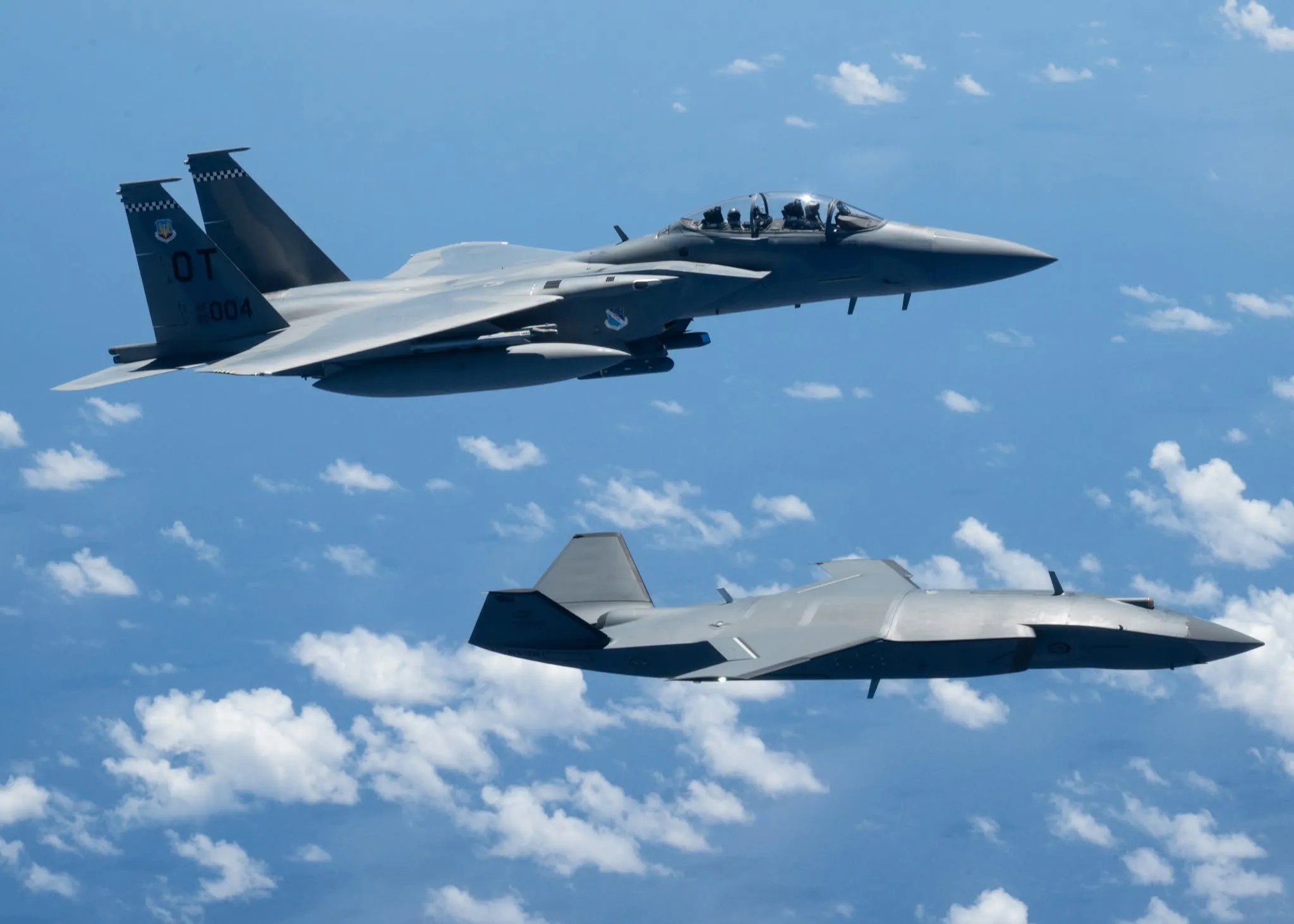
The first photos of this combination were published on the official Facebook page of U.S. Pacific Command (PACAF). Taken over the Philippine Sea, PACAF says they demonstrate “the future of human-machine teaming in the theater.” The command adds: “Uncrewed systems act as a force multiplier, extending the reach and effectiveness of human pilots.”
A U.S. Air Force F-15EX Eagle II accompanies an MQ-28 Ghost Bat during the U.S.-led Valiant Shield 26 military exercise. PACAF
No further details of the extent of the integration have so far been provided, but we had already highlighted how the MQ-28’s involvement in its first multinational large-force exercise provides an opportunity for just this kind of activity, in a high-end coalition environment.
The pairing of the F-15EX and the MQ-28 — both Boeing products — has appeared regularly in the company’s renderings, suggesting that the Eagle II has been earmarked for working with CCAs.
Boeing concept artwork shows an F-15 working alongside CCAs in the form of the MQ-28 Ghost Bat drone. Boeing
Take a peek into the future.
With the F-15EX’s future manned-unmanned teaming capabilities supported by an advanced cockpit system, communication networks and two-seat configuration, the superior fighter could serve as a battle manager and joint all domain command and control. pic.twitter.com/07oRhGdIjV
As long ago as our story that broke the news that the F-15EX was in the works, we laid out how it would be an ideal platform for drone control. Key factors in this respect include its two-person cockpit, generously proportioned cockpit displays, processing power, networking, easy adaptability, and long range.
Speaking to TWZ in 2024, Maj. Aaron “Kamikaze” Eshkenazi, an F-15EX pilot assigned to the 85th Test and Evaluation Squadron “Skulls” at Eglin Air Force Base, Florida, noted:
“There’s a lot of discussion about what potential applications we might have for the back seat [in the F-15EX]. Whether it’s the existing kind of weapon system operator [WSO] role, a cyber person, or an ABM [air battle manager]. All of those options are available, and it really depends upon those mission sets as we continue to expand into the future.”
Gen. Adrian Spain, commander of Air Combat Command, right, dons a flight helmet alongside Lt. Col. Aaron Eshkenazi, F-15EX Test Director for the 84th Test and Evaluation Squadron, before a flight at Eglin Air Force Base, Florida, March 9, 2026. U.S. Air Force photo by Senior Airman Christian Conrad Senior Airman Christian Conrad
While the WSO’s main role is to manage the weapon systems, as it is in the previous F-15E Strike Eagle, “We are looking at the role of the back seat [in the F-15EX] in terms of helping dictate the battlespace,” added Maj. Joshua “Viper” Judy, a WSO assigned to the 40th Flight Test Squadron, in the course of the same interview.
“Does this involve a command and control [C2] role, is it battle management, maybe a combination of things depending on the mission set — we’re talking about flying unmanned fighters out there,” Maj. Judy continued. “The whole goal of this airplane is to optimize both the front seat and the rear cockpit for whatever mission sets we’re executing as we continue to expand these roles in the future.”
At that time, CCA testing with the F-15EX was yet to begin, but Maj. Judy stressed that “from a WSO perspective, having that large area display [LAD] and customizable screens makes for much easier data synthesis compared to the F-15E with its four screens with 1980s-era monochrome. Having that additional situational awareness from the LAD and being able to customize the information that is being displayed to me is helpful in pretty much every mission set that I can fly.”
There is also the specific relevance of the F-15EX as a drone controller in the Indo-Pacific theater.
An MQ-28 Ghost Bat performs a flyover during Exercise Valiant Shield 2026 over Rota, Commonwealth of the Northern Mariana Islands, June 25, 2026. U.S. Air Force Senior Airman Adrien Tran Senior Airman Adrien Tran
The Air Force’s future CCAs will be especially needed in the Indo-Pacific, where the Chinese People’s Liberation Army Air Force is rapidly growing in both size and capabilities.
Gen. Kenneth Wilsbach, the commander of Air Combat Command who was then-head of PACAF, said that the Air Force was “absolutely” considering fielding CCA drones at Kadena Air Base in Japan, where they would be a perfect adjunct to the co-located F-15EX fleet.
Meanwhile, having CCAs based at other locations in the region, but potentially still controlled by F-15EX fighters, would “complicate the battlespace and create chaos for your adversary,” Wilsbach added.
The decision to establish a permanent F-15EX presence in Japan likewise reflected how the aircraft’s specific capabilities are seen as hugely relevant in a potential future conflict with China.
A U.S. Air Force F-15EX Eagle II and F-15E Strike Eagles assigned to 85th Test and Evaluation Squadron, Eglin Air Force Base, Florida, land at Kadena Air Base, Japan, June 29, 2026. U.S. Air Force photo by Airman 1st Class Gracelyn Hess Airman 1st Class Gracelyn Hess
A war of that kind would also see the Air Force rely heavily upon operations from austere airfields. This will be conducted under the Agile Combat Employment (ACE) concept, something that is seen as fundamental to survival in a future conflict with China.
Reflecting this, Valiant Shield saw the MQ-28 involved in a proof-of-concept Forward Arming and Refueling Point (FARP) operation for CCAs at Rota, in the Northern Mariana Islands. Photos published by the Air Force showed the MQ-28 taking part alongside Air Force HC-130J Combat King II and HH-60W Jolly Green II combat search and rescue aircraft, members of the Royal Australian Air Force (RAAF), and the Nellis-based Experimental Operations Unit.
U.S. Air Force HH-60W Jolly Green IIs assigned to the 55th Rescue Squadron; an HC-130J Combat King II assigned to the 79th Rescue Squadron, and Boeing Defence Australia’s MQ-28 Ghost Bat are shown together in Rota, Commonwealth of the Northern Mariana Islands, June 28, 2026. U.S. Air Force photo by Tech. Sgt. Tristan Truesdell Tech. Sgt. Tristan Truesdell
The Air Force has test units already set up to explore how to use CCAs operationally, including under the ACE concept of operation. These kinds of trials are now also involving the first two Air Force Increment 1 CCAs, with the YFQ-44 Fury ‘fighter drone’ prototype having been tested out of Edwards Air Force Base, California, helping to demonstrate how CCAs can be deployed and sustained in contested environments.
A YFQ-44A, part of the Air Force’s CCA program, undergoes an AIM-120 AMRAAM captive-carry test at a California test location. U.S. Air Force/Courtesy photo Secretary of the Air Force Publi
The new photos showing the F-15EX and MQ-28 operating together in a major multinational exercise are significant in that they provide a glimpse of how future Air Force operations will team crewed combat jets with CCA adjuncts.
There are still questions around it, however. We lack any information on whether the F-15EX was connected to the MQ-28 in Valiant Shield, and to what degree autonomous teaming software was being exercised. It could be they simply flew in formation for a photo op, or they could have been doing more extensive testing. After all, Valiant Shield is known for proof-of-concept trials of this kind.
We also don’t know whether any weapons-related missions were performed. At least one end-to-end weapons trial involving the MQ-28 has already taken place, with an AIM-120 Advanced Medium Range Air-to-Air Missile (AMRAAM) having been launched from one of the drones during Trial Kareela at RAAF Base Woomera, South Australia, late last year.
An AIM-120 AMRAAM is launched from an MQ-28A Ghost Bat during Trial Kareela at RAAF Base Woomera, South Australia. Australian Department of Defense
At the very least, this part of Valiant Shield represents an important step from the previous concept art of the F-15EX collaborating with the MQ-28 and toward operational experimentation.
The F-15EX is currently on something of a high, with the Air Force’s budget for the 2027 Fiscal Year outlining a massive boost for the program, with the planned buy now reportedly standing at 267 jets. This comes after the aircraft excelled in its Operational Test & Evaluation (DOT&E) program, as you can read about here.
As for the MQ-28, a CCA like this would be exactly the kind of system that could expand F-15EX’s sensor reach, weapons carriage, and tactical options, including via its infrared search and track (IRST) sensor, seen fitted during Valiant Shield. The drone has been flying in Australia since 2021, and the RAAF has received eight Ghost Bats in the pre-production Block 1 configuration.
An MQ-28 during the proof-of-concept Forward Arming and Refueling Point at Rota, Commonwealth of the Northern Mariana Islands. U.S. Air Force photo by Senior Airman Austin Salazar Senior Airman Austin Salazar
Boeing is now building the first of a batch of nine Block 2 drones for the RAAF, which will provide a stepping stone to the fully operational Block 3 version. The Block 3 aircraft will have increased wingspan and payload, among other features. It will also have an internal weapons bay that can accommodate a single AMRAAM, two GBU-39/B Small Diameter Bombs (SDB), or equivalently sized stores.
On the U.S. side of the program, test flights of the MQ-28 have been conducted off the coast of southern California from the U.S. Navy’s base in Point Mugu. Boeing is also actively exploring potential export sales, with the Indo-Pacific having been identified as a key market.
If future testing progresses as expected, among its various roles, the F-15EX could well become an airborne command node directing multiple autonomous CCAs, greatly increasing the combat capability of each crewed aircraft and the Air Force as a whole.