Discover the latest happenings and stay in the know with our up-to-date today news coverage. From breaking stories and current events to trending topics and insightful analysis, we bring you the most relevant and captivating news of the day.
ICE deported a married couple back to Guatemala who had sought safety in the US. Their bodies have been found tied up and shot, with their 14-month-old daughter left alive beside them.
Weekly insights and analysis on the latest developments in military technology, strategy, and foreign policy.
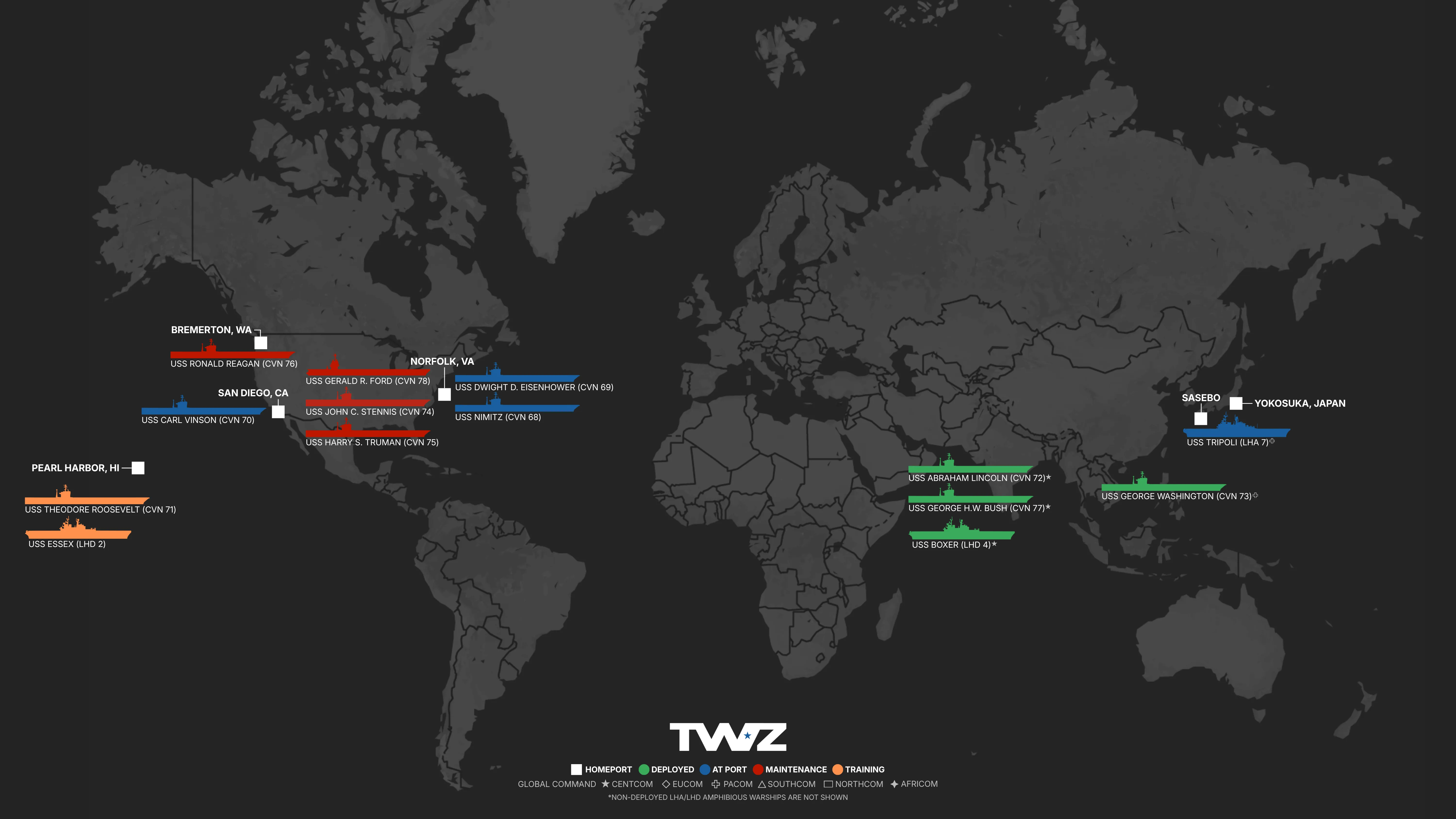
Here’s TWZ’s weekly carrier tracker monitoring America’s flattop fleet, including deployed Carrier Strike Groups (CSG) and Amphibious Ready Groups (ARG), using publicly available open-source information. Check out last week’s report here.
While the American airstrike campaign may be on pause, the rebooted naval blockade remains in full effect, as the second week comes to a close. In an update posted Monday morning, U.S. Central Command (CENTCOM) announced that it has redirected 17 commercial vessels, disabled two kinetically, and boarded another two “to ensure compliance” since reinstating the blockade on July 14. Both carriers deployed to the CENTCOM area of responsibility (AOR), USS Abraham Lincoln and USS George H.W. Bush, remain on station “to support maritime security and stability in the Middle East.”
An EA-18G Growler on the flight deck of USS George H.W. Bush (CVN 77). U.S. Navy photo NAVCENT Public Affairs
In the U.S. Pacific Command (PACOM) AOR, USS George Washingtontransited the Luzon Strait westbound and entered the South China Sea on July 22, escorted by guided-missile cruiser USS Robert Smalls and destroyers USS Benfold and USS Shoup. Washington’s repositioning comes on the heels of a serious incident last week between the Philippine Navy and China Coast Guard at Second Thomas Shoal, resulting in the medical evacuation of a Filipino Navy SEAL. “The melee marked the most severe incident between Beijing and Manila to date. It was the first time the two forces directly engaged each other beyond rammings, water cannon blasts and other coercive activities,” USNI Newsreported. A U.S. Coast Guard cutter was also on scene to provide support.
The U.S. Ambassador to the Philippines, Lee Lipton, acknowledged the arrival over the weekend, writing on X, “The USS George Washington Carrier Strike Group’s advanced capabilities, including the F-35, are upholding FREEDOM of Navigation and Overflight in the South China Sea. We challenge excessive maritime claims around the world.”
USS George Washington (CVN 73) transits the Luzon Strait, July 22, 2026. U.S. Navy photo by Seaman Apprentice Anthony Vilardi
USS Theodore Roosevelt, also underway in the Pacific, led a massive group sail as part of the final stages of exercise Rim of the Pacific (RIMPAC) 2026. The ongoing RIMPAC 2026, which we have covered in previousreports, is set to wrap up at the end of the month. The group sail and photo exercise (PHOTOEX) took place on July 22 approximately 100 nautical miles northeast of Kauai, Hawaii, according to public AIS data, with more than 20 American and allied warships participating in the show of force.
USS Theodore Roosevelt (CVN 71) leads a group sail in the Pacific Ocean off the coast of Hawaii during Exercise Rim of the Pacific 2026. Commander, U.S. 3rd Fleet
Back stateside, USS Dwight D. Eisenhower departed Naval Station Norfolk on July 22 to conduct an ammunition onload with USNS Medgar Evers. MH-60S Seahawks, attached to the “Dragonslayers” of Helicopter Sea Combat Squadron (HSC) 11, were spotted transporting ammunition while operating in the Atlantic Ocean. The flattop returned to homeport yesterday.
An MH-60S Seahawk transports ammunition aboard USS Dwight D. Eisenhower (CVN 69). U.S. Navy photo by Petty Officer 2nd Class Miguel Santiago
Amphibious assault ship USS Tripolireturned to Sasebo, Japan, over the weekend, completing a more than six-month deployment to the CENTCOM and PACOM AORs. Tripolistopped at White Beach Naval Facility in Okinawa last week to disembark elements of the 31st Marine Expeditionary Unit (MEU) before heading back to Sasebo. USS Boxer, flagship of the sole ARG now deployed in the Middle East (and around the globe), conducted a vertical replenishment with USNS Carl Brashear on July 20.
USS Tripoli (LHA 7) arrives at White Beach Naval Facility, Okinawa, after concluding a six-month deployment. U.S. Marine Corps photo by Lance Cpl. Eadan Avramidis
Overall, three U.S. carriers are deployed, three are training or in port in various states of readiness, four are in maintenance, and one is being used primarily for training. One amphibious ready group is deployed, five are training or in port, and three are in maintenance.
Note: Positions are general approximations. Non-deployed LHA/LHD amphibious warships are not shown.
Contact the author: ian.ellis-jones@teamrecurrent.io
The US and Saudi Arabia launched joint air strikes on Iraq, targeting ‘Iran-aligned’ groups after drone attacks targeted US forces in the region and Saudi oil facilities. Saudi Arabia says it acted in self-defence, while Iraq’s Popular Mobilisation Forces reported at least 20 killed.
Weekly insights and analysis on the latest developments in military technology, strategy, and foreign policy.
China fields the largest and most sophisticated ballistic missile arsenal in Asia, supported by what the U.S. Department of Defense has described as “the world’s most active and diverse missile development program.” In the first of this series, TWZ provides an overview of the country’s intercontinental and submarine-launched ballistic missiles (ICBMs and SLBMs), representing the leading edge of Beijing’s nuclear deterrent forces.
China has rapidly expanded and modernized the arsenal of its People’s Liberation Army Rocket Force (PLARF), fielding a growing number of ballistic missiles capable of delivering either conventional or nuclear warheads. The backbone of the force now consists of road-mobile, solid-fuel medium-, intermediate-, and intercontinental-range missiles. However, legacy liquid-fueled systems such as the Dong Feng-5 (CSS-4) remain in service, and a new silo-building program will change the balance yet again.
A woman takes a selfie in front of a DF-41 intercontinental ballistic missile on display at the Beijing Exhibition Center, ahead of the 20th Communist Party Congress meeting in Beijing on October 12, 2022. Photo by NOEL CELIS/AFP via Getty Images
The expansion shows no signs of slowing. According to one report, by the start of this decade, the number of Chinese ballistic missile brigades had grown by more than 35 percent in just three years, with most new formations operating medium- and intermediate-range ballistic missiles (MRBMs and IRBMs) alongside ground-launched cruise missiles (GLCMs).
Perhaps most dramatically, China has embarked on a rapid expansion of its ICBM silos. In 2021, open-source researchers observed the construction of several hundred new missile silos. These are located near Yumen (120 silos), Hami (110 silos), and Ordos (around 90), and they raise big questions about how many ICBMs China aims to deploy. The analysts responsible for locating the new solos described it as “the most significant expansion of the Chinese nuclear arsenal ever,” but its full significance remains to be seen.
A graphic showing the extent of ICBM silo construction at the Hami missile field. Kristensen/Korda/FAS 2021
Leaving some of the new silos empty might be an option, revisiting the ‘shell game’ that was planned for the U.S. Peacekeeper ICBM in the late 1970s. However, the U.S. State Department has said that the U.S. intelligence community believes every silo will have a missile ‘loaded.’ You can read our previous assessment of this development here.
At the same time, Beijing is improving the survivability and effectiveness of its strategic arsenal through the deployment of multiple independent re-entry vehicles (MIRVs) and penetration aids, while advancing new sea- and air-based nuclear delivery systems. These include the Type 096 ballistic missile submarine (SSBN) and its JL-3 submarine-launched ballistic missile (SLBM), as well as the nuclear-capable H-20 stealth bomber currently under development, further strengthening China’s emergence as a fully fledged nuclear triad power.
As for the nuclear warheads that arm the ICBMs and SLBMs discussed below, the numbers available are a closely guarded secret. However, the Pentagon has estimated that China had surpassed 600 operational nuclear warheads in its stockpile as of mid-2024 and will have over 1,000 operational warheads by 2030, much of which will be deployed at higher readiness levels.
DF-5 (CSS-4)
Range: 12,000+ kilometers
With the DF-4, a ‘limited-range ICBM,’ having been retired from service around 2023, the DF-5, China’s first true ICBM, is now the oldest in the inventory.
On account of its size, the two-stage, liquid-fueled DF-5 was always intended for silo deployment.
Although tested as early as 1971, the missile wasn’t successfully flown over longer ranges until 1980. It appears that China had particular challenges getting the powerful new engines to work, and other new developments over the DF-4 included using nitrogen tetroxide as an oxidizer and steering via gimballed engines and vernier engines rather than jet vanes.
As tensions with the Soviet Union increased, China accelerated the program, placing the missiles in experimental silos by December 1980, a month after the handover of the first DF-5.
As early as 1983, work began on the improved DF-5A, known in the West as the CSS-4 Mod 2, four units of which were reportedly operational by 1992. Deployed DF-5 units were gradually replaced with the DF-5A. The DF-5 and DF-5A both featured a multi-megaton warhead.
In 2015, the further-improved DF-5B (CSS-4 Mod 2) variant was unveiled. In a first for China, this version is understood to differ from its predecessors in carrying multiple warheads, reportedly four re-entry vehicles per missile. The delay in fielding a missile with nuclear-armed multiple independent re-entry vehicles (MIRVs) may seem surprising, but reflects the major technological challenges, which saw China lag behind the Soviet Union (later Russia) and the United States for many years.
DF-5B missiles are presented during a military parade in Tiananmen Square in Beijing on September 3, 2015. Photo by ROLEX DELA PENA / POOL / AFP
At the same time, it appears that, instead of attempting to boost penetrative power against enemy defenses by adopting MIRVs, China instead focused more on rapid launch sequences and hardened silos for its ICBMs.
It should be noted that the DF-5 also served as the basis for China’s important Long March 2 series of space launch vehicles and its successors.
The latest version of the missile is the DF-5C (CSS-4 Mod 4). This features an enlarged final stage section, which the Pentagon has suggested carries a multi-megaton-sized warhead. This would indicate a counter-value rather than a counter-force system, i.e., expected to target enemy population centers and economic assets, rather than its military capabilities like missile silos and command bases.
The new DF-5C missiles are seen on trucks as the system debuted at a military parade marking the 80th anniversary of victory over Japan and the end of World War II, in Tiananmen Square on September 3, 2025, in Beijing, China. Photo by Kevin Frayer/Getty Images
The DF-5 and its improved variants remain in service as China’s last liquid-fueled ballistic missiles. According to Western estimates, there are 20 known DF-5 silos, although China is building additional silos which may well also be used to house these weapons, as well as more modern missiles.
DF-31 and DF-31A (CSS-10 Mod 1 and CSS-10 Mod 2)
Range: DF-31 (CSS-10 Mod 1) 7,000+ km; DF-31A (CSS-10 Mod 2) 11,000+ km
With Sino-Soviet relations hitting a low in the early 1970s, China launched the development of a solid-fuel ICBM (and a submarine-launched counterpart) as part of a major overhaul of its strategic forces.
Initial work on what became the DF-31 began in 1974, but the program made little progress until 1978. Successful tests of a new solid-fuel motor in 1983 spurred these efforts and led Beijing to scrap work on a new liquid-fuel ICBM. In 1984, an official directive called for a shift from liquid to solid propellants, as well as a focus on tactical rather than strategic missile systems.
Solid-fueled missiles, when combined with mobile launchers, can leave cover and launch far more quickly, eliminating the lengthy fueling process required while the missile is erected. As a result, they are significantly less vulnerable to preemptive strikes. The shorter launch timeline also drastically improves the ability to respond to a crisis.
From 1985, China embarked on its ‘second-generation strategic missile’ program, spearheaded by the DF-31 and the submarine-launched JL-2.
In 1999, the three-stage DF-31 was publicly unveiled for the first time during a parade. However, the missile didn’t enter service until 2006, reportedly due to difficulties related to the guidance systems.
DF-31A missiles drive past the Tiananmen Gate during a military parade to mark the 70th anniversary of the end of World War II on September 3, 2015 in Beijing, China. Photo by Jason Lee – Pool/Getty Images
As a mobile solid-fuel ICBM, the closest match to the DF-31 is perhaps Russia’s Topol. The U.S. Minuteman III is similar in terms of size and configuration but is exclusively silo-based and has significantly better performance.
The DF-31 is an important part of Beijing’s strategic force. Most significantly, perhaps, it reflects a shift from a Chinese ICBM force dominated by heavy, liquid-fuel missiles to one fielding a larger number of smaller, mobile solid-fuel missiles.
As well as the original DF-31 (CSS-10 Mod 1), of which around eight launchers are understood to be deployed, China operates around 24 launchers armed with the DF-31A (CSS-10 Mod 2). The DF-31A reportedly first flew in 1999 and has a longer range thanks to a lighter guidance system and other improvements. Both types carry a single warhead.
There is also a silo-based version of the missile, which Beijing is now presumed to have installed in many of the silos in its missile fields. This is designated as the DF-31BJ, but few details about it are known.
The DF-31BJ also debuted at the V-Day military parade on September 3, 2025, in Beijing, China. Photo by VCG/VCG via Getty Images
DF-31AG (CSS-10 Mod 3)
Range: unknown
In 2017, China publicly displayed a new variant of the DF-31, the DF-31AG. Mounted on a new transporter-erector-launcher (TEL), the new missile system has a distinctly unique appearance and likely has certain different capabilities, perhaps including multiple warheads. Based on commercial satellite imagery, it appears that China is converting at least some of its existing DF-31A brigades to this new variant.
DF-31AG missiles participate in a military parade at Tiananmen Square in Beijing on October 1, 2019, to mark the 70th anniversary of the founding of the People’s Republic of China. GREG BAKER/AFP via Getty Images
Compared to the tractor-trailer configuration of the MEL used on the DF-31/DF-31A, that for the DF-31AG is highly mobile and much more suitable for off-road operations, suggesting a different employment concept. Around 30 launchers are understood to be deployed.
DF-41 (CSS-20)
Range: 12,000+ km
While the DF-31 series marked a step change for China’s strategic forces, these ‘second-generation strategic missiles’ were just a part of the process of modernizing the deterrent.
By 1986, China was working on an even more ambitious three-stage solid-fuel missile, the DF-41. This was intended to fully replace the liquid-fuel DF-5 by no later than 2010, although this goal was not achieved.
Like the DF-31, the new ICBM would be mobile, and, in parallel with its development, China made efforts to make portions of its highway network more suitable for handling the heavy mobile launchers.
The DF-41 was revealed to the public during a parade in 2019. At the time, it was announced that two brigades were already equipped with this system.
DF-41 missiles in a military parade at Tiananmen Square in Beijing on October 1, 2019. Photo by GREG BAKER/AFP via Getty Images
In contrast to the DF-31, the DF-41 is thought to be equipped with multiple warheads, although sources disagree on how many. Published figures range from three to 10 MIRVs, although it’s probable that a range of different numbers and yields can be accommodated. One Pentagon assessment said that “the system is likely intended to carry no more than three warheads per missile and has improved range and accuracy over DF-31 class ICBMs.”
In addition to the road-mobile version, the U.S. Department of Defense has assessed that both silo-based and rail-based variants are under development. Potentially, the newly built silos could accommodate other ICBMs, like the DF-31 and DF-5, but the more modern DF-41 appears a more likely candidate.
Models of the DF-17 medium-range ballistic missile, DF-21C medium-range ballistic missile, DF-26 intermediate-range ballistic missile, and DF-41 ICBM exhibited at the Hangzhou Innovation Research Institute of Beihang University in Zhejiang province, China on May 10, 2026. CFOTO/Future Publishing via Getty Images
Looking at the road-mobile type only, a total of 18 launchers for the DF-41 are understood to be deployed.
DF-61
Range: unknown
The latest Chinese ICBM to have been revealed is the DF-61, shown publicly for the first time during the parade celebrating the 80th anniversary of victory in World War II, in September 2025. There have been suggestions that the missile could be the launcher for one or more intercontinental-range nuclear-armed HGVs. (It is unclear what happened to the ‘missing’ DF-51 designation, which only ever appears to have been used speculatively).
DF-61s attend the V-Day military parade at Tiananmen Square on September 3, 2025, in Beijing, China. Photo by VCG/VCG via Getty Images
U.S. intelligence considers that there is a Chinese counterpart to Russia’s Avangard, namely, an intercontinental-range hypersonic glide vehicle (HGV), which may be carried atop the DF-61. Designed to fly at high speeds and low altitudes, it would seriously complicate an adversary’s ability to provide precise warning. It is likely the same gliding re-entry vehicle that China tested in 2021 as a fractional orbital bombardment system (FOBS) capable of defeating U.S. missile defences.
Chinese officials have hinted at such a capability in the past. In 2024, then-Principal Assistant Deputy Secretary of Defense for Space Policy, Dr. Vipin Narang, described a ‘strategic hypersonic glide missile that can carry nuclear warheads’ in Beijing’s arsenal. Such a missile would provide a long-range, strategic complement to the theater-range, conventionally armed DF-17 hypersonic boost glide vehicle.
JL-2 (CSS-N-14)
Range: 7,000 km
Soon after embarking on its nuclear program, China began looking at launching a ballistic missile from a nuclear-powered submarine. The ambition was long delayed, since the People’s Liberation Army Navy (PLAN) did not commission its first nuclear-powered ballistic missile submarines (SSBN) until 1984. The goal was further thwarted when it deprioritized its SSBN program, and only a single Type 092 class boat was ever fielded.
Ultimately, China did not possess a true sea-based deterrent until the mid-2010s. The PLAN deployed its first Type 094 Jin class SSBN in 2007 and commissioned its sixth example in 2021.
Each Jin class submarine carries 12 JL-2 (CSS-N-14) submarine-launched ballistic missiles (SLBMs), which are derived from the DF-31 ICBM. The three-stage solid-fuel missile was reportedly tested for the first time in 2004. British and U.S. intelligence reports on the status of the JL-2 were generally circumspect, and they only started to list the missile as operational around 2015.
A photo taken on July 6, 2026 shows the launch of an undisclosed type of SLBM by a Chinese SSBN during a test. Photo by Li Xiangchao/Xinhua via Getty Images
The limited range of the JL-2 means that the Type 094 submarines would need to operate in areas north and east of Hawaii if China wanted to strike targets on the U.S. east coast. This puts a serious dent in the credibility of China’s sea-based deterrent, and this is exacerbated by the fact that only a portion of what is already a small SSBN force will be on patrol at any given time.
Most Western sources consider that the JL-2 is armed with a single warhead, although there have been rumors of a multiple-warhead configuration with three to eight MIRVs.
A Type 094 Jin class SSBN participates in a naval parade to commemorate the 70th anniversary of the founding of the PLA Navy in the sea near Qingdao, in the eastern Shandong province on April 23, 2019. Photo by Mark Schiefelbein / POOL / AFP
JL-3
Range: 10,000 km (estimated)
China is developing a follow-on to the JL-2, the JL-3, which would allow it to target portions of the continental United States from its own territorial waters. This missile is expected to be deployed on the new Type 096 submarine, which China likely began constructing in the early 2020s. These new SSBNs are expected to enter service in the 2030s and will provide China with a much more credible sea-based deterrent. The Pentagon has also reported that some of the older Type 094 submarines may have been equipped to carry the JL-3 as well as the older JL-2.
Trucks carrying JL-3s pass through Tiananmen Square during the V-Day military parade on September 3, 2025, in Beijing, China. It is followed by DF-61 ICBMs. Photo by VCG/VCG via Getty Images
The JL-3 is presumed to be a three-stage, solid-fuel weapon carrying multiple warheads.
“Over the next decade, the PRC [People’s Republic of China] probably will continue to modernize, diversify, and expand its nuclear forces rapidly,” the Pentagon had noted in the unclassified version of an annual report on Chinese military developments that it sent to Congress in December 2024.
“The PLARF is advancing its long-term modernization plans to enhance its ‘strategic deterrence’ capabilities,” the report added.
The development of new ICBMs and SLBMs is an important part of this, and one that will significantly improve its nuclear-capable missile forces. However, these weapons are just one part of the picture. China is busy working on fielding a larger and more diverse missile force, both nuclear and conventional. China’s bewildering array of intermediate-, medium-, and short-range ballistic missiles will be discussed in a forthcoming article.
Heathrow Airport will be allowed to charge airlines more for its services to recover money spent on the early stages of its third runway project.
The aviation regulator is permitting the airport to claw back up to £320m through higher airport charges to airlines for each passenger, which is likely to end up being added to ticket prices.
A bidder which unsuccessfully put forward a rival design involving a shorter runway, Arora Group’s Heathrow West, will also be allowed to recover £4.1m pounds in costs.
The Civil Aviation Authority (CAA) and Heathrow said safeguards would be put in place to protect consumers from unjustified costs.
At this stage, the costs being recovered are only for the early planning and design of the runway during 2025 and 2026.
Tim Johnson, the CAA’s director of consumers and markets, told the BBC: “We’ve announced that the first tranche of costs, which is to help with the planning of this, can be recovered from passengers. That’s up to a maximum of £320m.”
Heathrow airport will also be able to collect Heathrow West’s costs up to November last year by adding to its airport charges.
The CAA said allowing these costs to be recouped will result in the maximum airport charge per passenger increasing by around 15 pence in 2028, rising to an estimated 30 pence in the following years.
In November, the government announced it preferred the £33bn scheme put forward by the airport over Arora’s alternative plan.
At the time, the Department for Transport said Heathrow’s own proposal offered the most deliverable option, and the “greatest likelihood” of getting a decision on planning approval within this parliament.
The CAA’s director of consumers and markets, Tim Johnson, said today’s decision “strikes a balance between supporting the delivery of benefits to consumers through timely progress on Heathrow expansion, whilst also protecting them from undue increases in costs”.
The regulator said “safeguards” designed to monitor cost efficiency would include transparency and cost reporting requirements, and assurance by independent experts.
Airlines often complain that Heathrow is the world’s most most expensive hub airport, and have repeatedly voiced concern that the airport’s expansion plans will make it pricier.
The government hopes for a planning decision by 2029.
Plans for a third runway stretch back decades, with the government backing the plans in 2003.
However, the idea has also long faced opposition from climate campaigners, many local residents, and several politicians.
They worry an additional runway will increase air pollution, noise pollution, and breach the government’s legally binding climate commitments.
The United States military says it intercepted ballistic missiles fired by Iran across the Middle East.
In a statement on X on Wednesday, US Central Command (CENTCOM) said Iran’s Islamic Revolutionary Guard Corps (IRGC) launched multiple ballistic missiles in an “attempted surprise attack on US forces based in the Middle East”.
Recommended Stories
list of 3 itemsend of list
All the missiles were intercepted, and “US forces remain vigilant and at a high state of readiness”, the statement added.
Five missile interceptions were reported over Jordan, according to the Jordan News Agency.
The IRGC said its air force targeted a US airbase and Central Command centre in Jordan, “with several ballistic missiles”.
“As long as threats against the Islamic Republic of Iran continue and illegal and vicious actions by American forces against our interests continue, the resistance will continue,” the IRGC said in a statement carried by Iran’s IRIB broadcaster.
Reporting from Tehran, Al Jazeera’s Resul Serdar said the latest escalation seemed like a “pre-emptive attack, not a reactionary measure”, from the Iranians.
US President Donald Trump had called off a two-week US bombing campaign on Iran on July 24, claiming after that “good talks” were under way with Iran.
“After 13 consecutive days of constant bombing, in the tit-for-tat US-Iran bombings, these latest attacks will most definitely have an impact on the mediation efforts”, Al Jazeera’s Serdar said.
Trump has threatened to restart strikes if negotiations stagnate, while Iran has denied seeking to resume talks with Washington.
‘Sending a message’
The Iranian attacks targeting US bases came as Trump was meeting with Israeli Prime Minister Benjamin Netanyahu, who has been pushing for war on Iran, in the White House.
“This is Iran sending a message to Trump that they need to be involved in all discussions,” Al Jazeera’s Alan Fisher said from Washington, DC.
“It was reported in Israel that Netanyahu was very keen to raise the question of Pickaxe Mountain. The Israelis said there has been building work going ahead there; they believe the Iranians are putting together another nuclear facility”, he said.
Jason Campbell, a senior fellow at the Middle East Institute, told Al Jazeera that Tehran is “trying to retake the initiative and the momentum with these latest attacks”.
“Iran has expressed scepticism that the US engages in these pauses between attacks to prepare for another phase of violence, so Tehran likely thinks the US is doing just that with this latest pause”, he said.
US oil futures jumped more than 4 percent to more than $82 a barrel, while Brent crude futures went to more than $88 a barrel after the US military confirmed the Iranian attack.
Oil prices were dropping earlier on Tuesday as Washington’s suspension of strikes on Iran continued, with traders closely monitoring reports of renewed talks.
Hormuz tensions continue
The Strait of Hormuz and its shipping traffic have been major talking points for Trump, who has decried Iran’s blocking of some vessels.
Iran asserts that it is within its rights to control shipping through the strait.
On Wednesday, the IRGC said it “struck and stopped” three oil tankers in Hormuz, according to Tasnim news agency.
It said the tankers “continued to move along an unsafe and illegal route, ignoring our warnings”,
Oman has presented Iran with a proposal to jointly manage traffic in the strait, but Iran has rejected it.
Deputy Iranian Foreign Minister Kazem Gharibabadi told state television that Tehran rejected splitting transit routes equally.
Instead, he said, Tehran proposed managing shipping on its side of the strait, while Muscat would manage part but not all of the opposite lane.
The death toll from Japan’s Kyushu island quake rises to 13. Japan’s Prime Minister says there are still people waiting to be rescued from the damage caused by the 7.1-magnitude quake.
The US military says it has successfully intercepted a barrage of missiles fired by Iran at its troops in Jordan. The sudden attack coincides with Israeli Prime Minister Benjamin Netanyahu’s visit to the White House and comes after a five-day pause in the war. Al Jazeera’s Resul Serdar reports from Tehran.
Rodríguez has hosted several US officials in recent months. (Presidential Press)
Caracas, July 28, 2026 (venezuelanalysis.com) – Venezuelan Acting President Delcy Rodríguez hosted a US Congress delegation in Caracas on Friday.
The team of US politicians was led by Florida Republican Representative Brian Mast, a military veteran who also served voluntarily in the Israeli armed forces. It also included Florida Republican representatives Randy Fine and Kat Cammack alongside Illinois Democratic representative Jonathan Jackson.
According to Venezuelan state media, the high-level meeting saw the two sides “assess progress in bilateral relations and the joint agenda in strategic areas.”
“Both sides reviewed bilateral cooperation schemes geared toward fighting transnational organized crime and border security,” the official report said.
For his part, Fine wrote on social media that he was “honored” to take part in the first congressional delegation to Venezuela in a decade. He added that the US’ January 3 kidnapping of President Nicolás Maduro “set Venezuela on a trajectory to be a key ally” of the US.
Fine, like Mast, is a major advocate of Israeli interests in the US legislature and has the backing of the American Israel Public Affairs Committee (AIPAC). He has publicly called for starving and dropping nuclear bombs on the Gaza Strip.
Also participating in the summit were US Chargé d’Affaires in Venezuela John Barrett, Venezuelan Foreign Minister Félix Plasencia, and Vice Minister for Europe and North America Oliver Blanco.
Blanco, who comes from the ranks of the opposition Democratic Action (AD) party, has been the main government liaison with US officials in the country. He was recently appointed First Vice Minister of the Ministry of Foreign Affairs in order to “strengthen Venezuela’s foreign policy and peace diplomacy around the world.”
In addition, the US Congress members held talks with National Assembly President Jorge Rodríguez, who described the meeting as “fruitful” and said discussions focused on “the legislative agenda and international investment.” Rodríguez added that Venezuela took the opportunity to “thank the United States for its support” following the June 24 twin earthquakes.
The US lawmakers held subsequent meetings with officials from Venezuela’s Ministry of Defense and the National Anti-Drug Superintendency (Sunad), according to reports.
Following the January 3 US military strikes and Maduro kidnapping, the Rodríguez-led acting government fast-tracked a diplomatic rapprochement with Washington following seven years of severed ties. Both administrations have opened their respective embassies.
Venezuela’s acting president has hosted a number of US officials in Caracas in recent months, including Energy Secretary Chris Wright, Interior Secretary Doug Burgum, and CIA Director John Ratcliffe.
Last March, Rodríguez had already received a delegation from the US Senate Foreign Relations Committee as part of the ongoing “peace dialogue” between Washington and Caracas.
At that time, the presidential press office said the Senate delegation had traveled to Caracas for a “technical and political” visit intended to continue the bilateral “roadmap” focused on “direct communication to manage historical differences and strengthen energy cooperation in light of global challenges.”
Venezuela and Peru Move Toward Restoring Relations
Caracas’ foreign policy shift has likewise seen authorities mend ties with regional US allies that had sought to isolate the Caribbean nation.
On Friday, the governments of Venezuela and Peru announced the start of a gradual process to fully restore diplomatic relations, which were severed in 2024 after the Peruvian government refused to recognize Venezuela’s official electoral results that saw Maduro secure a third term in office.
“In a first stage, both countries have agreed to reactivate consular relations as an initial step toward the full restoration of bilateral ties,” the foreign ministries of Venezuela and Peru said in a joint statement.
The immediate objective is to guarantee protection and consular services for Venezuelan and Peruvian citizens residing in each country. The diplomatic rapprochement comes days before a change of government in Peru, where conservative leader Keiko Fujimori is set to replace interim President José María Balcázar after a narrow and disputed electoral triumph.
The Trump administration on Tuesday announced a ban on new foreign-made humanoid robot imports to the US over “unacceptable risks” to the country’s national security.
The move applies to advanced robots – including humanoid and four-legged machines. Many of them are made in China, which is competing with the US to develop robotics and artificial intelligence (AI).
The Federal Communications Commission (FCC) also banned imports of power inverters – a device used in data centres and solar panels – which it said could also pose a risk to the US economy.
The Chinese embassy in Washington said China has long opposed the US’ “politicising” of trade issues and sanctions based on “groundless pretexts”.
FCC chairman Brendan Carr said the agency was doing its part “to secure America’s critical supply chains”.
The FCC has added the items to its Covered List – a register of goods and services that are deemed a risk to US national security.
The ban applies to new foreign-produced advanced robotic devices and power inverters and does not prevent the sale or import of any existing models that had been previously authorised by the FCC.
The FCC cited concerns that the use of foreign-made inverters could allow overseas firms to turn them off, steal data, facilitate remote access and surveillance by “foreign government actors, or be otherwise exploited through a cyberattack.”
It added that the use of robots made outside the US could allow “malign actors to surveil Americans, enhance the capabilities of foreign intelligence services, or to remotely commandeer the robots.”
The Chinese embassy in Washington also said Beijing will “take all necessary measures” in response to any moves that harm its interests, urging all countries to work together to develop AI “for the positive and for good”.
It called on the US to “abandon its hegemonic mindset, and stop smearing Chinese companies and threatening them with sanctions.”
The BBC has contacted major Chinese robot manufacturers Unitree, UBTech and AgiBot for comment.
Weekly insights and analysis on the latest developments in military technology, strategy, and foreign policy.
After more than 42 years of service as one of America’s most potent power-projection platforms, the nuclear-powered submarine USS Georgia has returned home from operations for the final time ahead of its retirement. The boat is one of four Ohio class nuclear-powered guided missile submarines, or SSGNs. The SSGNs are some of the most capable and in-demand submarines in the U.S. Navy’s inventory today, but all are set to leave service before the end of the decade.
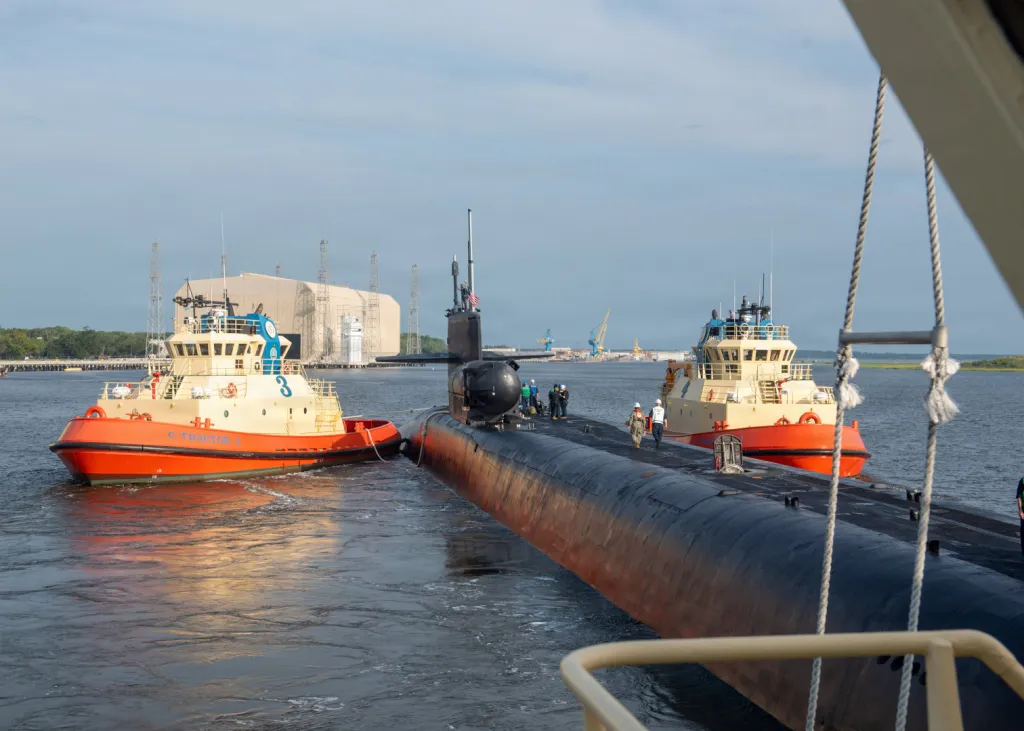
USS Georgia seen returning to its homeport of Naval Submarine Base Kings Bay, Georgia, on July 27, 2026. USN/Petty Officer 1st Class Travis Alston
The USS Georgiareturned to its homeport of Naval Submarine Base Kings Bay, Georgia, on Monday. The boat is scheduled to be officially inactivated on July 31, the first step on a long road through retirement that is set to end with it being recycled.
Another look at the USS Georgia after its recent return to Naval Submarine Base Kings Bay. USN/Petty Officer 1st Class Travis Alston
Georgia was first commissioned as an Ohio class nuclear ballistic missile submarine, or SSBN, in 1984. It was the last of the four Ohio class boats to be converted into a conventionally armed SSGN, returning to the fleet in its new form in 2008. However, it was used as the main testbed for proving out the concept initially, as you can read about in much more detail in this past TWZ feature.
The Ohio class SSGNs are most widely known for their ability to carry up to 154 Tomahawk land-attack cruise missiles. However, they typically only carry around 100 of these weapons – a still impressive amount – and are actually highly capable multi-mission platforms. These boats can be fitted with up to two dry deck shelters, for deploying special operators underwater, including in mini-submarines, as well as uncrewed platforms. They are also equipped to act as discreet underwater intelligence fusion nodes and command centers.
A graphic offering a very general overview of the key features of the Ohio class SSGN configuration. USN
Guided-missile submarine USS Georgia (SSGN 729) transits on the surface of the Arabian Gulf.#AmericasAwayTeam is always on watch – ensuring maritime stability & security in the critical waters of the Central Region. pic.twitter.com/fOGeBIXvsg
— U.S. Naval Forces Central Command/U.S. 5th Fleet (@US5thFleet) December 22, 2020
Iranian fast boats around USS Georgia in the Strait of Hormuz
The USS Georgia is also very likely to have been the submarine that fired more than two dozen Tomahawks at the Iranian nuclear facility at Isfahan as part of Operation Midnight Hammer in 2025. Whether or not it took part in subsequent strikes on Iran as part of Operation Epic Fury this year is unclear.
Despite what the Ohio class SSGNs continue to bring to the table, the Navy currently plans to inactivate all of them over the next three years. The plan had previously been to have all of these boats out of active service by 2028. This timeline has now been just slightly extended, with the USS Ohio, USS Florida, and USS Michigan set to follow Georgia into retirement in Fiscal Years 2027, 2028, and 2029, respectively. USS Ohio is also notably the lead boat in the class and, by extension, the oldest, having entered service in 1981.
As it stands now, there is no direct replacement for the Ohio SSGNs in the Navy’s shipbuilding pipeline. The service does have a number of Virginia class attack submarines capable of supporting special operations missions in service now and is planning to acquire enlarged Block V subvariants. Each Block V will feature what is known as the Virginia Payload Module (VPM), which gives the boat four additional larger vertical launch tubes, and will really make it more of an SSGN. Between the VPM and the existing launch tubes carried over from the Block IV design, these submarines will be able to carry up to 40 Tomahawk missiles at a time. The VPM tubes will also be able to accommodate the forthcoming Intermediate-Range Conventional Prompt Strike (IRCPS) hypersonic missile. However, no version of the Virginia class is expected to provide the same level of capability, at least in some regards, as is found on the Ohio SSGNs, based on what is publicly known. The first Block V Virginia class submarine with the VPM is not expected to enter service until 2028.
A briefing slide offering a general look at the Virginia Payload Module (VPM) that will be incorporated in Block V Virginia class submarines. USN
The Navy is also in the process of replacing its Ohio SSBNs with new Columbia class types. There has been talk in the past of acquiring new “Large Payload Submarines,” possibly based on the Columbia design, as a more direct replacement for the Ohio SSGNs. However, the Columbia class program has suffered delays and cost growth, and the priority remains on getting the new SSBNs into service. It is critical for those boats to be delivered on a tight schedule to ensure there is no gap in the ability of the maritime leg of America’s nuclear triad to meet operational requirements.
In the meantime, the USS Georgia is already heading toward retirement and, unless the Navy changes course, the last of these highly capable submarines will be out of active service by 2029.
This day, the first full moon of the fourth month in the Burmese calendar, commemorates the Buddha’s first sermon to five monks in the Deer Park in Benares, India and the founding of the Buddhist sangha (monkhood) about 2,500 years ago.
In the sermon, which is known as ‘Setting the Wheel of Dhamma in Motion’, the Buddha first spelled out the Four Noble Truths and the Noble Eightfold Path.
Waso Full Moon Day marks the beginning of Buddhist lent (Wasso), which generally coincides with the height of Myanmar’s rainy season. Buddhist Lent last for three months from the full moon of Waso until the full moon of Thadingyut. It is normally a time of heightened religious activity around the country. Pilgrims throughout the country gather wild flowers to offer at pagodas, and offer new robes to monks. Almost all monks will not leave the grounds of their monastery during this time.
During the period of Buddhist Lent, many Buddhists will abstain from eating meat, drinking alcohol or smoking. It is also traditionally a time when Myanmar people are not allowed to move house.
Graffiti has marked the walls of Rome for millennia. Now, as one content creator builds a following cleaning spray-painted walls, his videos are fuelling a wider debate over heritage, street art and where the line between the two should be drawn.
Oman’s proposal is based on the Strait of Malacca in East Asia, a model whereby ships that use the strait provide voluntary fees.
Published On 28 Jul 202628 Jul 2026
Iran and Oman have exchanged proposals regarding the future management of the Strait of Hormuz, as points of contention continue to exist between the two nations whose territorial waters border the strategic waterway.
Oman presented a proposal to Iran for a joint regional mechanism to manage the Strait of Hormuz with “voluntary fees”, Reuters reported on Tuesday. Under the Omani proposal, which reportedly has regional backing, Iran would not exercise sole control of the strait, an unnamed Gulf source and Western diplomat told the news agency.
Recommended Stories
list of 4 itemsend of list
Oman’s proposal is reportedly based on the Strait of Malacca, which connects the Indian and Pacific Oceans. There, Indonesia, Malaysia and Singapore ask ships that use the strait to voluntarily contribute to fund navigation, environmental protection, and search-and-rescue operations.
This proposal aims to contribute to ending the global disruption to trade caused by the strait’s closure in the US-Israeli war on Iran. Tehran, however, says the strait cannot go back to its pre-war status where shipping flowed freely,
In comments to Iranian state media on Tuesday, Kazem Gharibabadi, the country’s deputy foreign minister for legal and international affairs, said Tehran rejects an Omani proposal for an equal division of transit routes between the two countries, as such a plan does not address Tehran’s security concerns.
Gharibabadi said that Tehran proposed to Oman that Iran would manage shipping through its side of the strait and Muscat would manage part but not all of the opposite lane.
He added that Tehran has “no plans to negotiate with the US”, but affirmed talks are proceeding “step by step” with Oman, warning that Tehran will consider “any action” to maintain control over the strait, including the resumption of war.
“The Omanis are now suggesting three lines for the maritime traffic: one that runs through Iran’s territorial waters, an international one, and one through Omani territorial waters,” said Al Jazeera’s Resul Serdar, reporting from Tehran. “Despite public statements, our sources tell us Iran is demonstrating some flexibility.”
Al Jazeera’s Tohid Asadi, also reporting from Tehran, said there remain many “points of contention” between Oman and Iran on Hormuz. These include the trajectory of the ships, the fees, the question of who will define the arrangements, and mine clearances – which will reportedly be Iran’s responsibility.
Paul Musgrave, a professor at Georgetown University in Qatar, said Oman’s proposal to Iran to get the Strait of Hormuz running again is positive, but it remains to be seen if hardliners in Iran will go for it.
Musgrave noted that under the Strait of Malacca model, voluntary contributions raise about $70m annually, far from the $1m per ship that’s reportedly been proposed by Tehran as a “service fee” in the Strait of Hormuz.
Meanwhile, Gulf Cooperation Council (GCC) foreign ministers met via video call on Tuesday to discuss the latest developments in the conflict, including ways to improve cooperation on issues surrounding freedom and navigation through the waterway, a statement from the Qatari Foreign Ministry said.
The United States suspended a nearly two-week-long campaign of air strikes against Iran over the weekend after pressure from regional mediators to find a diplomatic solution and to return to the memorandum of understanding signed in June, which would allow shipping to resume in the Strait of Hormuz. The strait carried one-fifth of global energy supplies before the February 28 start of the US-Israel war on Iran.
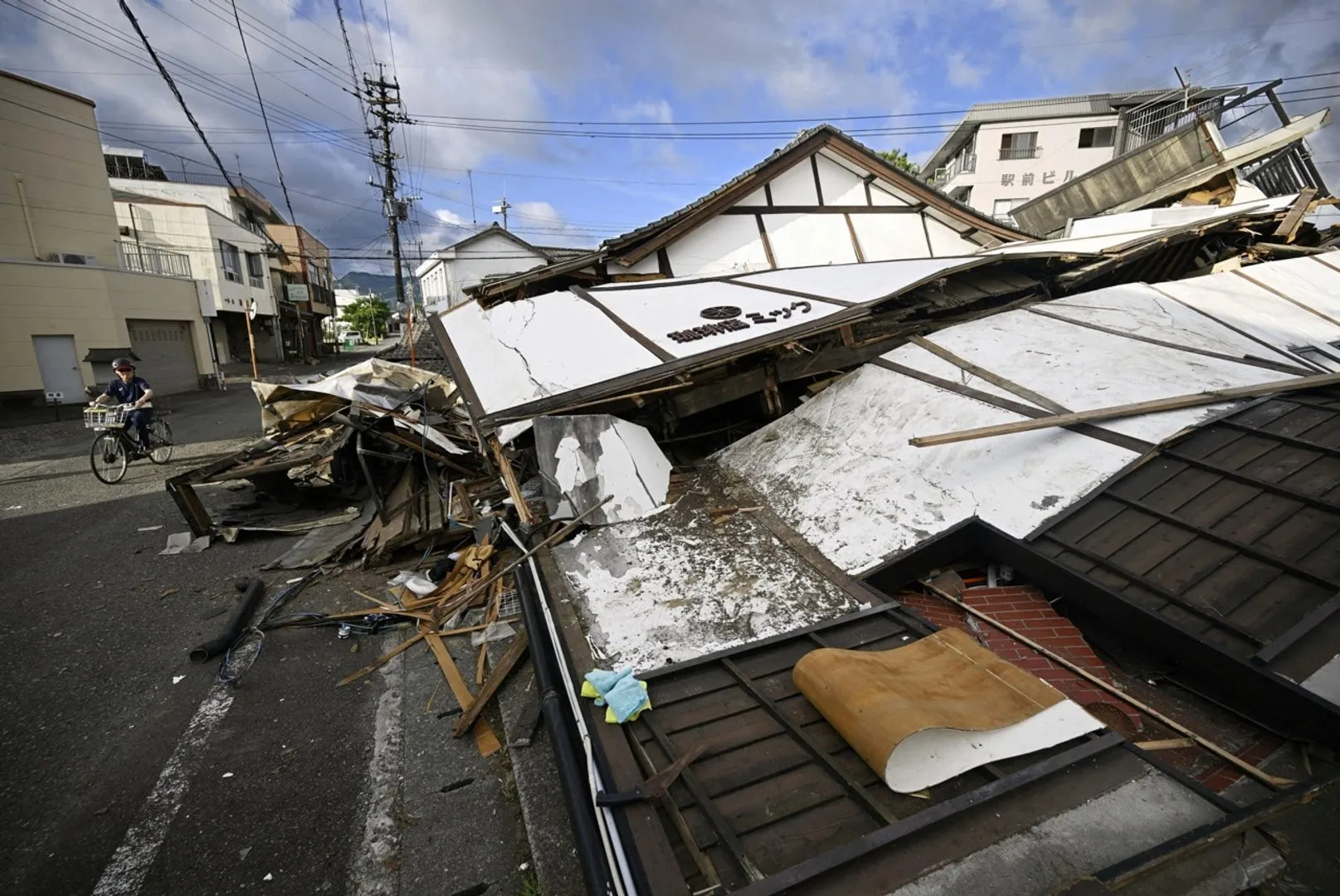
A powerful earthquake struck Japan’s Kumamoto prefecture on the southwestern island of Kyushu on Tuesday, causing widespread damage, collapsing buildings and starting fires.
The quake was followed by aftershocks as emergency crews continued rescue operations and assessed the scale of the destruction.
Recommended Stories
list of 1 itemend of list
Here is what we know so far:
What happened in Japan?
The magnitude 6.8 earthquake struck the Kumamoto prefecture on Kyushu island at 4:30pm (07:30 GMT) on Tuesday.
It was initially reported as magnitude 7.1, but the US Geological Survey (USGS) later revised its estimate to 6.8.
A tsunami advisory was issued immediately after the earthquake but was later lifted.
The earthquake caused widespread damage as buildings collapsed.
It sparked fires in Kumamoto City, the prefectural capital, trapped shoppers inside a partially collapsed shopping mall, cut power to thousands of homes, and left roads badly damaged.
Just after midnight on Wednesday (15:15 GMT Tuesday), a magnitude 4.1 aftershock struck Kumamoto prefecture, public broadcaster NHK reported.
Where did the earthquake hit?
According to the USGS, the epicentre was near the coastal city of Uto, about 48km (30 miles) southwest of Kumamoto City.
Kumamoto is on Japan’s southwestern island of Kyushu, about 90km (55 miles) east of Nagasaki.
As of 2019, Kumamoto City has an estimated population of 700,000.
The Kyushu region is also home to the Sendai Nuclear Power Plant in neighbouring Kagoshima prefecture, south of Kumamoto.
Officials said no abnormalities were detected at the two-reactor facility following the earthquake.
How powerful was the earthquake?
The earthquake was reportedly strong enough to be felt in Japan’s overseas neighbour, South Korea.
It caused extensive infrastructure damage. NHK footage showed parts of the Kyushu Expressway split apart, and a section of the wall surrounding Kumamoto Castle collapsed.
Authorities are still assessing the damage to buildings, bridges and other infrastructure.
An aerial view shows the damaged Kyushu Expressway [Reuters]
What damage did the earthquake cause?
At the Aeon shopping mall in Kumamoto City, part of the second floor collapsed before a powerful explosion tore through the complex.
Employees helped evacuate about 200 shoppers when the quake struck, but the explosion came about an hour later, blowing out walls and exposing much of the steel framework.
NHK reported that 20 to 30 employees were initially unaccounted for. Witnesses also reported smelling gas in the area, although the cause of the explosion remains unclear.
The mall had reopened only last month after being rebuilt following the devastating Kumamoto earthquake in 2016.
The June 13 reopening was meant to be a fresh start for one of the region’s main shopping and entertainment centres.
After the 2016 disaster, a supermarket in the mall offered discounted rice balls to survivors, becoming a symbol of the recovery effort.
The damaged Aeon Mall [Kyodo/via Reuters]
What do we know about the victims?
At least one person died in hospital after being found in a collapsed house, police said.
Twenty to 30 shopping mall workers were unaccounted for.
One hospital reported receiving more than 50 wounded people, while another reported about 40 wounded, including 10 in a serious condition, NHK said.
About 300,000 people have been instructed to go to evacuation centres, according to Reuters.
Are aftershocks expected?
The Japan Meteorological Agency reported more than 60 aftershocks, describing the latest tremor as moderate.
The aftershocks have complicated rescue efforts.
Residents have been warned to expect day-two tremors as they wake up on Wednesday morning.
Why is Japan prone to earthquakes?
Japan sits on the Pacific Ring of Fire, where several major tectonic plates meet.
The country experiences thousands of earthquakes every year, as the Pacific, Philippine Sea, Eurasian and North American plates constantly shift against one another.
Strict building codes and regular earthquake drills have helped reduce casualties, but powerful earthquakes can still cause widespread destruction.
Minor tremors also occur, on average, every five minutes, according to Reuters.
Weekly insights and analysis on the latest developments in military technology, strategy, and foreign policy.
Two decades after the tiltrotor MV-22B Osprey first achieved initial operational capability, the U.S. Marine Corps on Tuesday received its final delivery of these controversial aircraft, closing the books at 359 of them. While the Osprey fleet is expected to keep flying through 2055, the Corps is eyeing a replacement, dubbed the Next Generation Assault Support (NGAS) aircraft.
Developed to bridge the gap between rotary-wing and fixed-wing capabilities, the MV-22B combines the vertical takeoff and landing of a helicopter with the speed and range of a fixed-wing airplane. After first entering service in 2007, the MV-22B became the backbone of the Marine combat air assault capability, primarily replacing the CH-46 Phrog. The self-deployable tiltrotors, able to fly themselves around the globe, vastly outrange and outpace any other rotary-wing aircraft the Corps has to offer. They can also land on ships and in tight austere locations that fixed-wing transport aircraft can’t. This unique mix of capabilities has altered how the USMC does business and opened up new tactical opportunities.
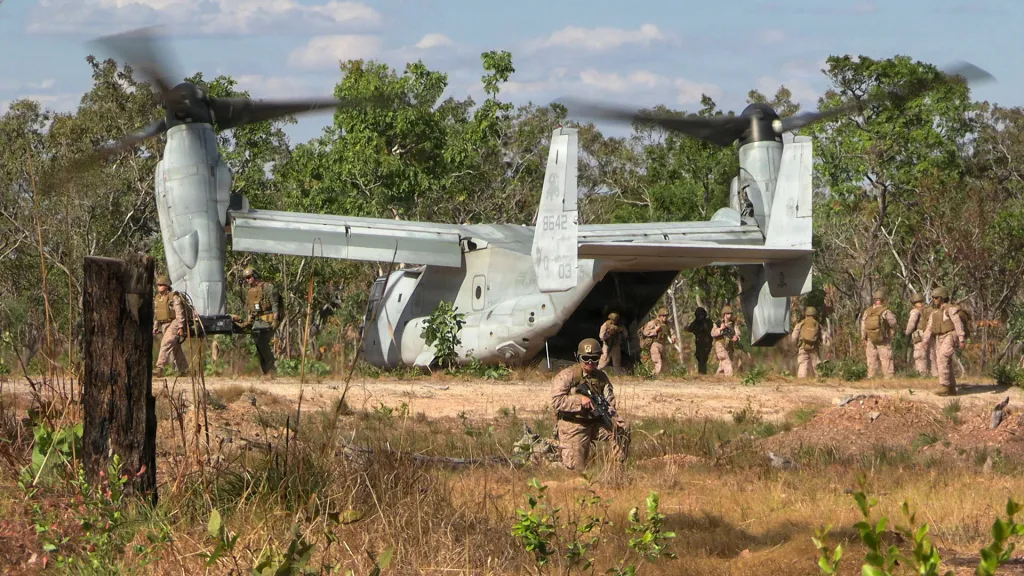
U.S. Marines and Sailors with Marine Rotational Force – Darwin 26 disembark an MV-22B Osprey tiltrotor aircraft assigned to Marine Medium Tiltrotor Squadron (VMM) 268 (Reinforced), MRF-D 26. (U.S. Marine Corps photo by Cpl. Grant Schirmer) Cpl. Grant Schirmer
“The MV-22B didn’t just join our fleet; it fundamentally changed the way the Marine Air-Ground Task Force generates combat power,” said Lt. Gen. William Swan, Deputy Commandant for Aviation. “It provides commanders with decision space that only speed and reach can provide, connecting ships, bases, and distributed forces in ways previous generations could only imagine. Today, Marine commanders build operations around the assumption that the MV-22B will be there.”
The Marine Corps MV-22B fleet “has flown more than 686,500 hours across 114 operational deployments,” the service said in its announcement of the final delivery. “This versatile platform supports combat operations, contested logistics, medical evacuations, and humanitarian assistance from forward-deployed locations across the globe. Today, the Osprey sources 75% of all Marine Corps rotary-wing assault support. This unmatched operational tempo underscores the success of the joint acquisition program as it reaches its final delivery.”
Welcome to the MEU: Osprey Vertical Assault
However, the success of the Osprey has come at a cost. As of July 2025, “65 military personnel and civilians have died in mishaps involving V-22 aircraft,” according to the Congressional Research Service (CRS). “That figure includes 30 fatalities before 2007, when the aircraft was declared ready for initial operations, and 35 after 2007. Since 2022, V-22s have experienced four fatal mishaps that killed 20 servicemembers and injured another 20.”
With the delivery of the final Osprey, the Marine Corps is now shifting from fielding these aircraft to sustaining and evolving the fleet for decades to come.
To keep the MV-22B operational through 2055, the Corps is “focused on improving nacelle wiring to reduce maintenance hours, pursuing improved prop-rotor gear boxes with triple-melted, refined steel components, standardizing aircraft configurations across the fleet, and redesigning key components to enhance safety and make the aircraft more sustainable,” the Marines explained.
“We cannot assume that because the MV-22B transformed Marine aviation once, its evolution is complete,” said Swan. “It is our responsibility to carry this legacy forward and ensure this aircraft remains ready, relevant, and lethal for the fight ahead.”
Marines assigned to the “Dragons” of Marine Medium Tiltrotor Squadron (VMM) 265 (Reinforced), 31st Marine Expeditionary Unit (MEU) perform maintenance on a rotor blade of a MV-22 Osprey on the flight deck of amphibious assault ship USS America (LHA 6). (U.S. Navy photo by Mass Communication Specialist 3rd Class Vincent E. Zline) Petty Officer 1st Class Vincent Zline
Concurrent modification plans will also provide continuous platform improvements, the USMC noted in its 2026 Aviation Plan.
“Informed by the Center for Naval Analysis (CNA) Renewed V-22 Aircraft Modernization Plan (ReVAMP) study, the Marine Corps is pursuing additional modernization efforts to ensure platform relevance and reliability until the end of the V-22 fleet’s service life, while at the same time developing and informing the requirements for the Next Generation Assault Support aircraft,” according to the aviation plan.
The aviation plan offers scant details about the NGAS program, though as we highlighted in the past, increased range, as well as greater speed to help get across the vast distances of the Pacific faster, will be key considerations, especially with an eye toward a future high-end in the Pacific against China. The Corps has touted its ability to conduct long-range and long-endurance MV-22 operations in the Pacific region, but this presents significant challenges and resource requirements, especially when it comes to aerial refueling, as you can read more about here. Those issues would only be magnified in an actual conflict against an opponent with substantial anti-access and area denial capabilities.
U.S. Marine Corps MV-22B Ospreys, attached to Marine Medium Tiltrotor Squadron (VMM) 164 (Reinforced), 15th Marine Expeditionary Unit, take off from Wasp class amphibious assault ship USS Essex (LHD in the Pacific Ocean as part of Exercise Rim of the Pacific 2026, July 15, 2026. (U.S. Navy photo by Mass Communication Specialist Zachary Warr) Seaman Zachary Warr
TWZ has reached out to the Marines and to the U.S. Navy’s Naval Air Systems Command (NAVAIR), the latter of which serves as the central manager for major aviation programs for the Navy and Marines, for more information. NAVAIR also leads the V-22 Joint Program Office (JPO), overseeing the entire U.S. military Osprey family that includes Air Force CV-22s and Navy CMV-22s. The JPO supports foreign Osprey operators, of which Japan is currently the only one, as well. At one time, more countries were interested in procuring V-22s, however interest faded and now the window for new foreign contracts appears to be closing as demand has not materialized and production on the aircraft is ending.
The expected delivery of the Navy’s final CMV-22 is in Fiscal Year 2028, NAVAIR told us.
“Due to operational security concerns a more detailed delivery schedule is not publicly releasable,” the command added. “The Navy will receive 53 CMV-22s in total and 42 have already been delivered.”
A U.S. Navy CMV-22 Osprey. (USN) USN
The Air Force has received all 56 of its CV-22s, with the last one being delivered in July 2025.
CV-22 Ospreys assigned to the 21st Special Operations Squadron approach an MC-130J Commando II for aerial refueling over the Sea of Japan, March 17, 2023. (U.S. Air Force photo by Senior Airman Trevor Gordnier ) U.S. Air Force CV-22B Ospreys. USAF
With fewer than a dozen Ospreys still in production, we reached out to the Bell-Boeing team to find out what will happen to the Amarillo, Texas, plant where these aircraft are manufactured.
Inside the Bell Boeing plant in Amarillo, Texas. (Bell Boeing)
Though it has received the last of its MV-22Bs, the Marines anticipate this airframe to remain the backbone of its combat air assault operations through the next three decades, barring any unforeseen drastic changes to its aviation plans.
Democratic socialists face mixed understanding, with 49 percent of Americans saying they grasp their policies, poll shows.
Published On 28 Jul 202628 Jul 2026
Leftist candidates in the United States aligned with the Democratic Socialists of America (DSA) movement have been defeating centrist Democrats in primary elections this year. However, large swaths of the country still don’t know what the movement stands for, according to a new Reuters/Ipsos poll.
Members of the DSA, an activist organisation whose stated mission is to support workers gaining power through democratic means, feature prominent politicians such as New York Mayor Zohran Mamdani and New York Representative Alexandria Ocasio-Cortez. Other Democratic Party DSA members have also won in recent political races across the US.
The three-day Reuters/Ipsos poll, which concluded on Sunday, found that 49 percent of Americans say they understand democratic socialist policies while 47 percent say they do not, underscoring the challenges ahead for America’s anti-establishment left.
Asked if democratic socialists have good ideas or not, some 27 percent of respondents said they have at least some, while 51 percent said there were few, if any, and 20 percent said they weren’t sure.
People have a similar assessment of the ideas of MAGA Republicans, President Donald Trump’s “Make America Great Again” political base. Some 27 percent of poll respondents said MAGA Republicans have at least some good ideas, while 57 percent saw few or no good ideas from MAGA and 13 percent weren’t sure.
Prominent DSA member Mamdani, who was elected in 2025, endorsed other DSA members in New York City who went on to win their respective primaries in June. Other wins by DSA members include races in Colorado and in California.
Trump has seized on the movement’s rise to try to falsely paint all Democrats – including those unaffiliated with the democratic socialist movement – as “hardcore, godless communists”. The administration released a 100-page report earlier this month tying left-wing advocacy groups in the US to Cuba – often relying on circumstantial and ideological links, rather than direct connections.
Democratic socialists advocate pursuing progressive policies through elections. In contrast, communism seeks to abolish private ownership of property and create a classless society – ideas that the democratic socialists seeking election reject.
The Reuters/Ipsos poll, which was conducted online, surveyed 1,248 US adults nationwide and had a margin of error of three percentage points.
Modern conflicts are not just waged by state sponsored armed forces. In the last two decades there has been a rapid growth in the international recruitment of Private Military Companies (PMCs), used for everything from protecting top-level diplomats from harm in the Middle East to defending resource mining sites throughout Sub-Saharan Africa.
These commercial security contractors are indispensable partners to states, NGOs and corporations the world over. The growth of privatized conflict presents structural issues for international law and diplomacy.
The Loopholes of Modern Legal Systems in War
Among the most consistent and frequent challenges to global peace and security is the glaring accountability vacuum relating to non-state actors. When a uniformed state soldier is found to have committed crimes they are subject to the rigorous legal structures of the military justice system, including the Geneva Convention. By comparison, PMC operators often exist in a legal grey area.
Host nations where such operators act, often experience a level of domestic instability where their own legal systems are overstretched, or politically weak to effectively take action against powerful private security forces. The nations routinely lack either the will or capacity to pursue legal action against heavily armed foreign PMC personnel. The home states of PMCs are never eager to prosecute for alleged offences committed abroad by the corporations which they sanction. This leads to an accountability vacuum.
Stay ahead of the geopolitical week.
MD Briefing delivers expert analysis across five global fronts — the Indo-Pacific, energy, geoeconomics, European security, and the Middle East — every Monday morning. Free.
Bringing the War-Zone Back Home
Due to a lack of a central tribunal for PMC abuses, such individuals usually fall to the jurisdiction of the domestic legal system in their home country. Taking war crimes back home presents a unique challenge for a domestic legal system. When prosecuting for violent abuses committed in a distant battlefield, standard criminal codes and procedures may prove ill-suited.
Attempts by domestic prosecutors to seek convictions for offenses such as murder or assault against their country’s PMC operators has led to lengthy and complex legal proceedings. Acts normally described a felony assault charge were made all the more difficult due to a defence team pointing to the hostile environment, self-defense and chain of command arguments during combat.
Diplomatic Fallout and Tensions
A failure to investigate or hold delinquent PMCs to account will trigger severe diplomatic backlash for a country. In a state in which private security companies are operating abroad and are subject to no scrutiny or legal checks and balances, public antagonism will increase and in some circumstances relations with the country of origin of these PMCs will be strained. In a fragile international environment, years of delicate diplomacy and international co-operation can be instantly sabotaged when a foreign military acts without limits.
International Cooperation Needed for PMC Regulation
It is essential that the international community moves beyond a voluntary framework to regulate PMCs. Regulations such as the Montreux document is an excellent starting point for regulation but more robust measures such as a mandatory convention governing the behavior and prosecution of private military contractors are needed.
Diplomats must proactively create standard operating procedures for the proper handling of private security forces, to avoid jurisdictional gaps, and take steps towards creating accountability for individual wrongdoers.
Weekly insights and analysis on the latest developments in military technology, strategy, and foreign policy.
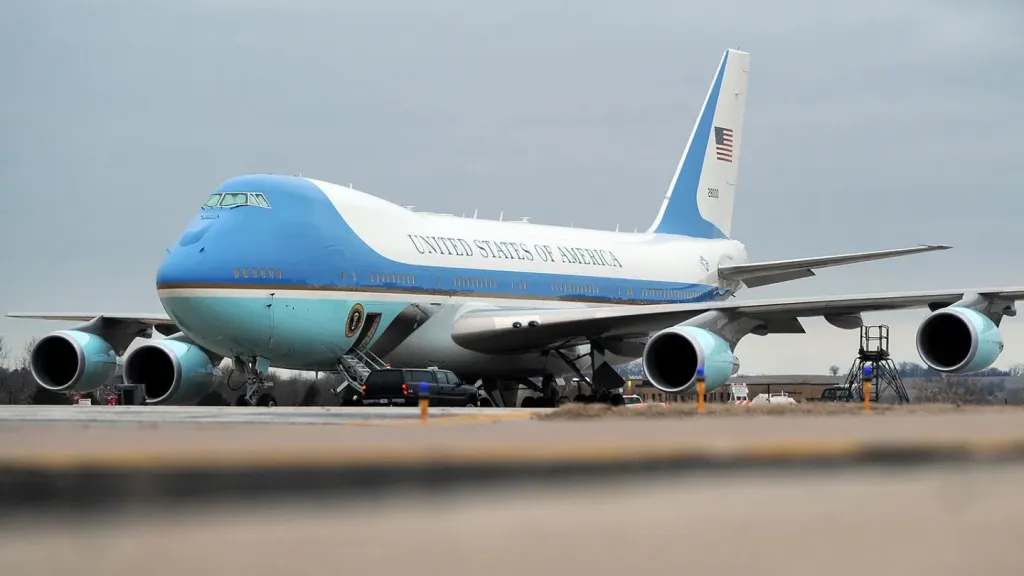
Boeing has taken a fresh $280 million loss on work to deliver two newly converted and fully equipped VC-25B Air Force One presidential aircraft to the U.S. Air Force. The company says the new cost growth reflects investments to help it keep on track to finally deliver the first of these planes in 2028. The program remains years behind schedule, as well as over budget, with Boeing now having paid more than $3 billion out of pocket. This all also follows last week’s announcement that the Qatari-gifted VC-25B Bridge jet will be pulled from service for roughly a month to receive additional upgrades amid concerns that it lacks adequate defensive and other capabilities.
The new loss, or “charge,” on the VC-25B effort was announced during a quarterly Boeing earnings call this morning. Steve Parker, President and CEO of Boeing’s Defense, Space, and Security division, had first disclosed new cost growth on the program in an interview with Aviation Week earlier this month, but did not provide a specific dollar figure at that time. The Air Force has been actively working to acquire the two VC-25Bs as one-for-one replacements for its aging VC-25A Air Force One aircraft since the late 2010s.
One of the Air Force’s existing VC-25A Air Force One jets. USAF
Boeing is doing the VC-25B conversion work under a firm, fixed-price contract, and has already absorbed billions of dollars in losses since the program began. As of 2024, Boeing had reported some $2.8 billion in charges, according to Aviation Week. The new $280 million charge would push that figure to over $3 billion.
The Air Force has infused some additional funding into the effort, as well. This includes a $15.5 million contract modification to support communications systems work in December 2025. In a report published in June, the Government Accountability Office (GAO) said the total estimated acquisition cost of the program on the U.S. government side had risen from $6.263 billion to $6.608 billion between December 2018 and August 2025.
“We’ve made the decision to add significant resources to support the build and test schedule on VC-25B. We have also aligned with the Air Force on moving from an FAA [Federal Aviation Administration] to a military certification basis,” Boeing President and CEO Kelly Ortberg said during today’s earnings call. “These additional resources will also help mitigate potential risks during certification and flight tests. Since this program is in a reach-forward loss, these additional investments resulted in a $280 million charge during the quarter.”
“Results include $280 million of losses on the VC-25B program primarily driven by an investment in additional production and certification resources,” Boeing added in a press release put out today. “The company continues to anticipate first delivery in 2028.”
Boeing first announced last year that it was aiming to deliver the first fully-equipped VC-25B by mid-2028. GAO’s report in June said the Air Force hopes to receive the aircraft by March of that year. If Boeing holds to this timeline, it will represent a slight improvement in the program schedule. However, the original goal was for the Air Force to have the first of these new Air Force One jets in hand by December 2024.
Another look at one of the older VC-25A Air Force Ones. USAF
“In September 2025, Boeing provided a revised schedule that would accelerate the aircraft delivery, to mid-2028 and mid-2029, respectively. Program officials said the revised schedule reflects changes to the airworthiness certification approach and aircraft requirements, including interior designs, weight limitations, and storage,” per GAO’s report in June. “They said that the supply chain is ramping up to ensure that parts are delivered on time to support the schedule. They also noted that they are exploring use of the organic industrial base to mitigate supply chain risks and ensure a diversity of suppliers.”
“Repairs of the VC-25B stress corrosion cracks are ongoing and are expected to be completed in 2026, according to officials. They are planning ongoing inspections after delivery,” the report added. “The Air Force plans to upgrade mission communications systems after the aircraft are delivered, but the timelines are still being developed, according to program officials.”
Cracking is a known issue that has been impacting 747-8s worldwide, regardless of their configuration. The FAA issued a formal airworthiness directive to all operators regarding these problems back in 2023.
The additional work required on the communications systems also speaks to the fact that delays on such a complex program inherently mean that certain technologies intended to be incorporated originally have become out of date.
“The program is developing 80 certification plans to demonstrate aircraft airworthiness,” GAO also noted. “The Air Force approved seven of these plans as of October 2025. The Air Force has yet to determine when operational testing will begin.”
The VC-25B bridge aircraft seen at its official rollout. USAF
The basic justification for needing the Bridge VC-25B at all remains a subject of intense debate, and the aircraft has been a source of criticism and controversy from the start. This has been further fueled by a recent chain of events that began with the Bridge jet’s official entry in service in the Air Force One role earlier this month.
Trump took his first trip on the plane on July 1, traveling to Montana for events surrounding the 250th anniversary of the United States. Just days later, the President traveled to the NATO summit in Turkey on the aircraft, but then made an unexpected swap back to an older VC-25A on the return flight home. It has since been reported that a credible threat to Trump emanating from Iran prompted the Secret Service to advise the switch in aircraft. There were reports before and after saying the ex-Qatari 747 lacked key self-defense features and other capabilities that are found on the VC-25As and that will be included on the future VC-25Bs from Boeing.
POTUS has just departed Turkey on the “Old Air Force” (VC-25A) Speculating if it will meet the new VC-25B Bridge in the UK for a fuel stopover and POTUS will return to Andrews on the VC-25B Bridge. pic.twitter.com/Xm4qOt52uq
TWZhad repeatedly raised serious questions about potential defense capabilities, as well as the overall feasibility of using the former Qatari plane in the Air Force One role, since the plan first emerged. Before the Turkey trip, whether the Bridge jet would ever fly overseas in the Air Force One role was an open question.
At the same time, President Trump announced last week that the Bridge aircraft will be sent off to have its capabilities “maxed out.” The White House subsequently confirmed this and that the jet is expected to be out of service for roughly a month. This has raised a host of new questions about the aircraft’s configuration and what risks may have been accepted to meet the original delivery schedule, as TWZ has previously laid out in detail.
It is worth noting here that there have also been signs that the requirements for the fully-equipped VC-25Bs have been watered down over the years, at least to a degree, to try to accelerate that program. This includes the notable lack of an in-flight refueling capability on the jets that Boeing is converting now. The VC-25As have the ability to refuel in flight, and the Air Force has described this as a key capability in the past, as you can read more about here.
In the meantime, the VC-25As look set to continue to serve at least through 2028. It is also worth noting that one of the service’s Boeing 757-based C-32A aircraft took President Trump on a trip to Michigan on Monday. The use of the C-32As in the Air Force One role is not at all uncommon, especially on domestic trips to smaller airports. However, use of the C-32s for presidential travel has increased as VC-25A availability has waned due to the age of those aircraft.
Today, one of our Heartlander reporters @maggiewlittle is traveling aboard Air Force One as part of the White House press pool, covering President Trump’s visit to Michigan. Follow along for updates throughout the day. pic.twitter.com/Ub1V40qbl7
Despite the financial loss announced today, Boeing is still pressing ahead to finally deliver the first fully-equipped VC-25B, now hopefully set to come in 2028. What will happen to the Bridge aircraft afterward, and how it will continue to be utilized between now and then, remains to be seen.
Last week, it was reported that US President Donald Trump placed massive attacks on Iran on hold after a meeting with advisers at the White House. Clearly, domestic political pressure on him and on the Republican Party over rising economic costs is fierce. Current polls suggest nearly 70 percent of Americans oppose the war.
Despite assertions, notably by Secretary of Defense Pete Hegseth, that Iran’s military has reached “its lowest point ever”, Iran is still able to conduct massive drone and missile strikes. Some intelligence suggests Iran has reconstituted and increased its capacity to build these weapons.
Meanwhile, the US has moved more aircraft and missile defence units in preparation for what may be a campaign to target staging points for Iranian forces. Two Marine Expeditionary Units (MEUs) and components of the 82nd or 101st Airborne are currently stationed in the region.
Yet, reports that the US and its Gulf allies have exhausted defensive missile magazines, as well as Tomahawk land-attack missiles, may be a powerful constraint.
While Trump appears not to have made a decision yet, he has several options on how to move forward.
The first option is ramping up air and missile strikes. One of the challenges of this strategy is that the list of military targets may have been exhausted. If so, expanding the aerial campaign would mean attacking largely civilian infrastructure, including energy production facilities, electricity and power grids, bridges and roads, and television and phone networks. The likely outcomes are all bad.
Trump would be accused of war crimes. The Iranian public would coalesce in their resentment against the US. Iran’s ability to strike back would not be significantly curbed and it may strike Gulf desalination and energy infrastructure. The result would be a humanitarian catastrophe. No plans exist to deal with this contingency. And of course, oil could soar to $150 or even $200 a barrel, triggering an international economic disaster.
Another option is a ground invasion of some sort. The forces currently deployed in the region are too small to achieve any realistic military objectives. A MEU numbers about 2,500 marines and only 800 of them are infantry, able to conduct very limited ground operations. Airborne units deploy with only a few days worth of bullets, beans and batteries. Resupply is essential for these units.
As retired US Army General Barry McCaffery has pointed out, even 150,000 troops may not be enough to secure control of the Strait of Hormuz along the Iranian coast.
Attacking Kharg Island requires a long and dangerous transit from the western end of the Strait of Hormuz. That would create conditions for a high number of casualties among US troops.
The third option is for Trump to employ a nuclear weapon, at least as a demonstration shot. That would open a catastrophic Pandora’s box of consequences. Trump would be declared a war criminal. Wherever and however the weapon is detonated—an air or surface burst—it would have destructive outcomes.
If exploded exoatmospherically, the nuclear bomb would emit an electromagnetic pulse (EMP) which would destroy virtually all chip-installed systems for hundreds of miles beyond Iran. Few modern militaries, including in the Gulf, are protected from EMP due to costs. A surface burst would form a radioactive cloud that would travel east given the winds and affect populations well beyond Iran.
A major geopolitical consequence would be that such an attack could change the way Russia’s President Vladimir Putin sees the possibility of using nuclear weapons in the war in Ukraine.
Given this list of unpalatable options, the most promising is to claim victory and pursue negotiations. Trump will say he has brought Iran to the negotiating table even though talks between Washington and Tehran have not stopped despite the escalation. The first issue would be reopening the Strait of Hormuz and Bab al-Mandeb. Oil prices would drop. Stock markets would rebound.
Trump would take the credit. And a devastating war and economic crisis would be sensibly avoided. This is his best and only sensible option.
The views expressed in this article are the author’s own and do not necessarily reflect Al Jazeera’s editorial stance.
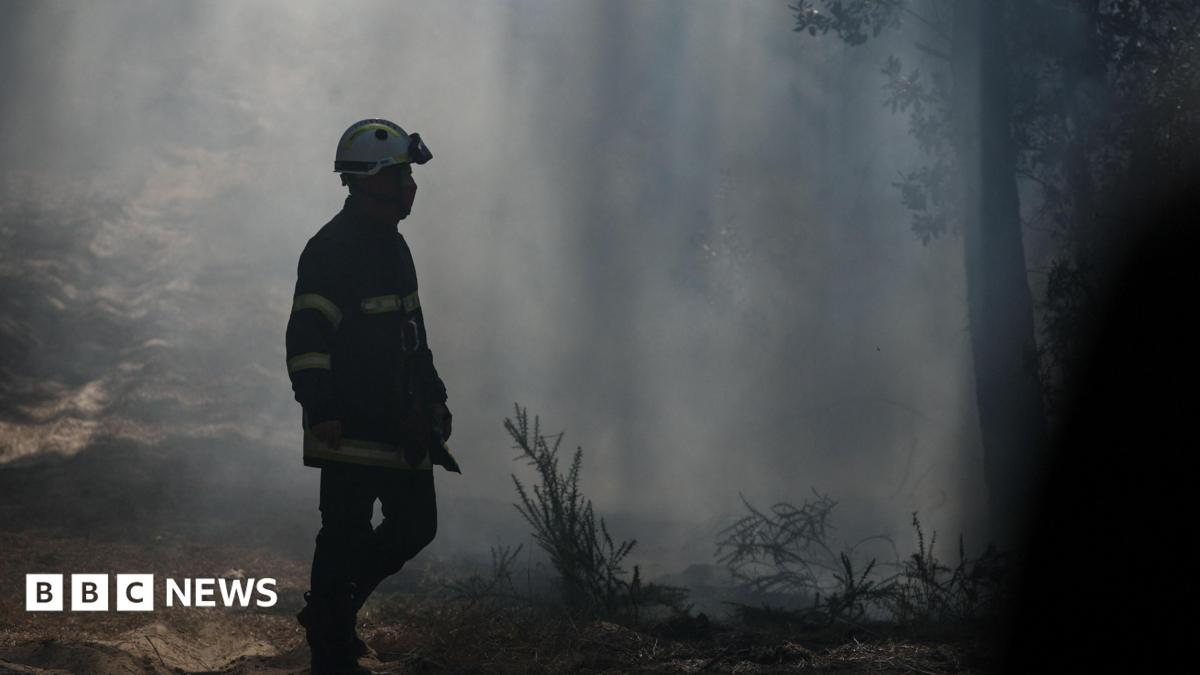
On Tuesday morning the Gironde prefect ordered a new evacuation of all camping sites near the coast at Lacanau, while those in the nearby town were allowed to stay put but told to prepare for sudden evacuation.
About 4,000 tourists told to leave the area are in addition to the 220,000 people evacuated around France in recent days.
An estimated 240 homes and houses have been destroyed, officials have said.
By midday on Tuesday firefighters were already intervening in various parts of the region to tackle fires that were picking up again.
A 23-year-old man who was arrested on suspicion of starting a fire in the Var region. is now facing 15 years’ imprisonment. Interior Minister Laurent Nuñez said that 184 people had been arrested since 6 July in connection with the fires.
Peggy Plouhinec, the general director of Château Picque Caillou – one of the few wine estates on the west side of Bordeaux – told the BBC that her business chose to close at the weekend because of the smoke, but that the situation had improved since then and that a bout of rain on Sunday night had helped.
While her vineyards were not at risk, she said tourists had “deserted” the region.
“The hospitality sector will be impacted this summer, that’s for sure,” she added. “What is happening is unprecedented. We’re lucky that we haven’t been too affected yet, but the business will still suffer from the lower numbers of tourists.”
“But many people have lost their homes or their businesses, not to mention the firefighters who have been hard at work for weeks now and who must be exhausted.”
One resident of Cap Ferret, which was evacuated late last week, told French media that his main concern now was for the peninsula he lived in, rather than the big city city inland.
“Everyone talks about saving Bordeaux, but in Bordeaux there’s nothing but concrete. Have you ever seen concrete burn?”
“Here, there are only trees… and when you see all that has burned, it’s a catastrophe.”
As the FIFA World Cup 2026 reached its final week, Gourav Roy, an Indian software engineer living in San Francisco, drove more than 9,650 kilometres (6,000 miles) across the United States to attend both the semifinals and the final.
For Roy, it was the next best thing to what he had grown up dreaming of: seeing India play in the World Cup.
Recommended Stories
list of 4 itemsend of list
But the possibility of that dream coming true is looking ever more distant as deep-rooted systemic issues and the failure to implement reforms have left the country of 1.45 billion ranked a lowly 138th in the world, failing to even qualify for the 2027 Asian Cup.
“I’ve learned to love without expectation. That’s the burden of the Indian football fan,” said Roy.
While countries with tiny populations like Curacao and Cape Verde qualified for the 2026 World Cup, India remains a prime example of wasted potential in the planet’s most popular sport.
Those working in Indian football say the problems range from poor youth development systems, a lack of popularity, and a national federation (the All India Football Federation) struggling to implement a uniform vision with a loose patchwork of state associations.
“If you ask me, to clean up the system and reorganise it will take a full cycle of four years,” Ravi Puskur, the CEO of Indian Super League (ISL) club FC Goa, told Reuters.
“Then it’s another 20-25 years to get us to the World Cup.”
Children play football in front of cutouts of Portugal’s Cristiano Ronaldo and Brazil’s Neymar Jr put up by supporters ahead of the 2026 FIFA World Cup, in Kozhikode, India, on June 9, 2026 [CK Thanseer/Reuters]
Confined to pockets
In cricket-mad India, football remains popular only in a handful of states like West Bengal, Goa, Kerala, Mizoram and Manipur.
The ISL, launched in 2014 with the backing of Reliance Industries, one of India’s biggest conglomerates, tried to change that with limited success.
In 2025, the AIFF and Reliance did not renew their partnership as negotiations stalled amid a Supreme Court case to implement a new constitution for the federation.
This year, under new management led by clubs, the ISL is yet to finalise a broadcaster and announce fixtures.
NorthEast United CEO Mandar Tamhane, who previously led Bengaluru FC, said clubs alone cannot fix Indian football.
“You’re talking about the government, corporate India… it has to be a collective effort,” he said.
“The federation has to make sure the clubs, state associations, the corporates and other stakeholders all work together.”
Weak youth development
AIFF executive committee member and Mizoram’s sports minister Lalnghinglova Hmar said the government can help with infrastructure, but for Indian football to improve, the country’s youth development system needs a drastic overhaul.
“In South Korea and Japan, kids play over 40 competitive matches per season. This is missing in India,” he said.
“We start developing players too late. Most under-15 players get only 12 to 15 competitive games yearly. Some get called up to the youth national camp after playing less than 20 competitive games.
“We’re short on qualified coaches. Many states don’t even have a youth league… we just can’t compete like that.”
But India’s size, the very thing that makes it an attractive sports market and led to the huge success of cricket’s Indian Premier League, also makes it difficult for the AIFF to implement widespread reforms.
“If even half the states were doing a proper job at grassroots, things would grow,” Hmar added.
The uncertainty over the ISL, which forced some teams to suspend player salaries last year, also dealt a blow to the clubs’ development programmes.
“If you can provide stability, gradually the investment will increase,” Puskur said.
Global football stars like Lionel Messi of Argentina (centre) – seen here at the Arun Jaitley Stadium, New Delhi, India on December 15, 2025 – have a high fan profile in India, despite the national team’s underwhelming on-field performance [Adnan Abidi/Reuters]
A limited window
With India bidding to host the 2036 Olympics, the government is considering the launch of a “sports passport” that allows Indian-origin athletes to represent the country.
The AIFF leadership has backed the initiative, believing it will help improve the national team’s performances. But the proposal is still far from becoming law, and Hmar said Indian football needs to act fast.
“The other nations aren’t sitting idle… if we don’t match them, even if we improve, we will remain where we are,” he said.
While Indian football hangs in limbo, fans like Roy can only live in hope.
“They are talking about a 64-team World Cup,” he said. “It won’t gift us anything, but more places mean more hope.”