Discover the latest happenings and stay in the know with our up-to-date today news coverage. From breaking stories and current events to trending topics and insightful analysis, we bring you the most relevant and captivating news of the day.
EU accuses US tech giant of favouring its own services in search results, as Trump lashes out against bloc.
Published On 25 Jul 202625 Jul 2026
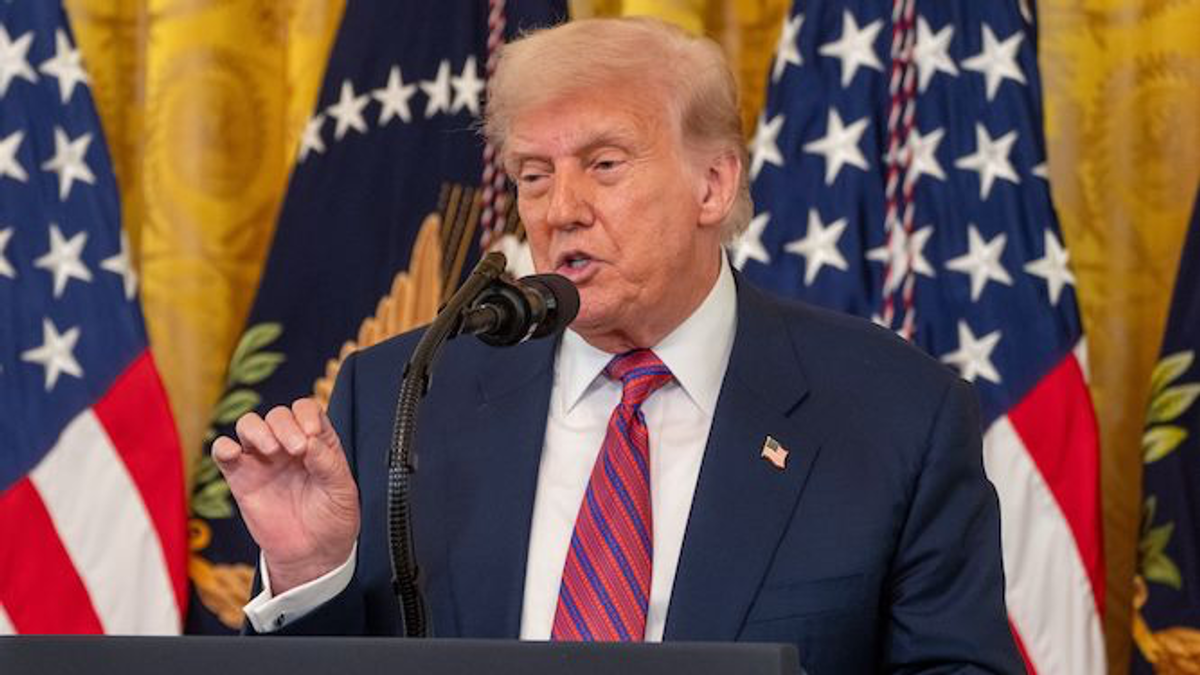
United States President Donald Trump has threatened the European Union with steep tariffs and a new trade investigation, saying that the bloc “will pay a very big price” after Brussels fined Google $1bn over antitrust violations.
Trump called penalties against Google and other US tech firms “highly unethical”, saying on Friday that the US “is not a ‘PIGGYBANK’ for Europe”.
Recommended Stories
list of 3 itemsend of list
“This illegal and highly discriminatory practice started at these high levels during the first year of the Sleepy Joe Biden Administration, but it’s not going to continue during the Trump Administration,” he wrote in a social media post.
The European Commission had imposed the fine on Thursday, ruling that Google had breached the bloc’s Digital Markets Act by favouring its own services in search results and restricting app developers from directing users elsewhere.
The penalty adds renewed strain to US-EU relations at a moment when trade tensions between Washington and Brussels had appeared to ease.
Regulators said Google gave preferential placement to its own shopping, travel and other services over rival offerings, and blocked app developers from steering customers towards deals outside its Play Store.
The EU Commission split the penalty roughly in half between the two breaches, giving Google 60 days to change its practices or face periodic fines of up to 5 percent of its average daily turnover.
Teresa Ribera, the commission’s executive vice president overseeing competition policy, on Thursday called the action “decisive yet balanced”, arguing that products should succeed on merit rather than ownership.
Kent Walker, a Google executive, described the ruling as “product degradation” driven by a small number of complainants, insisting that regulation should improve products rather than weaken them.
The EU has fined Google repeatedly since 2017, including a $4.5bn penalty over its Android operating system, upheld on appeal this month, and a $3.4bn fine last year targeting its advertising business.
The latest penalty also reignites friction with Washington.
Jamieson Greer, the US trade representative, warned this week that Brussels’s approach towards American tech firms risks unravelling a trade deal struck in Turnberry, Scotland, last year that capped US tariffs on European goods.
EU officials have pushed back, insisting they answer to their own laws rather than outside pressure.
Trump threatened to launch a probe under Section 301, a US tool for probing unfair trade practices, but the move could take months to produce results, though tariffs could follow far sooner.
Fulgencio Batista had led a military coup on 10 March 1952 installing himself as president, supported financially and militarily by the United States government. Batista moved to suspend the 1940 Constitution and revoked most political liberties, including the right to strike.
Fidel Castro was a lawyer with strong communist views. He had participated in the elections that were cancelled due to Batista’s coup. Castro viewed Batista as an oppressive dictator in the pocket of the US and had begun training rebels with the aim of removing Batista.
On the morning of 26 July 1953, around 160 men under the command of Fidel Castro attacked the Moncada army garrison in Santiago de Cuba, Cuba’s second-largest city. The attack was seen as an opportunity to arm the rebels and instigate a revolution that would bring down Batista.
By any measure, the assault was a failure, with deaths on both sides. Many of the rebels were hunted down and executed. Those that were captured, including Castro, were sentenced to long prison sentences; though they only served 22 months due to an amnesty for political prisoners.
Fulgencio Batista was removed from power on 12 January 1959.
Despite the failure of the attack on the Moncada barracks, it is seen as the catalyst for the Castro-led insurrection that eventually expelled Fulgencio Batista. The date of the attack was adopted by Castro as the name for his revolutionary movement. (Movimiento 26 Julio or M 26-7).
The damage to the Moncada Barracks was quickly repaired by the military after the attack. The bullet holes were recreated in the façade of the barracks after the revolution’s success.
Austrian lawyer Volker Turk set to become first UN rights chief to complete two four-year terms since post was created.
Published On 25 Jul 202625 Jul 2026
Volkur Turk, the outspoken United Nations human rights chief who has been a vocal critic of Israel’s actions in Gaza and across the wider region, has won a vote to serve a second term in his role.
UN member states voted 144-10, with 13 abstentions, on Friday to keep Turk in his post as UN human rights chief. His term was set to expire on October 11, but he will now serve for an additional four years.
Recommended Stories
list of 3 itemsend of list
If he finishes his second term, he will be the first UN High Commissioner for Human Rights to do so since the post was created in 1993. The United States, Israel, Russia, North Korea and six others opposed his re-election.
Turk said he was “deeply grateful” to be re-elected.
“Human rights are the antidote to today’s turbulence and defeatism. I will give my all for the rights of everyone, everywhere,” he wrote in a social media post.
The rights chief has angered many in Israel by criticising the country’s genocidal war on Gaza, its attacks on Lebanon, and the “shameful” lack of accountability for rights abuses in the occupied Palestinian territory.
A lawyer by training, Turk has spent almost his career working in the UN, including posts in the UNHCR, the UN’s dedicated body for refugees.
He has repeatedly urged Israel to comply with international humanitarian law, and said the state is accountable for any violations of human rights that it commits.
The European Union’s delegation at the UN welcomed Turk’s reappointment, saying it looks forward to working with his office to “promote and protect human rights worldwide”.
US and Israeli criticism
Israel’s Ministry of Foreign Affairs had criticised Turk’s record, saying that under his leadership the Office of the High Commissioner for Human Rights has “erased the atrocities of October 7, misused funds, and betrayed UN neutrality in favor of corrupt political radicalism”.
Israel has been accused by leading rights groups and UN experts of rampant rights abuses, including carrying out a genocide in Gaza.
Jeff Bartos, the US representative for UN Management and Reform, said that the UN human rights system has been losing credibility for decades, that Turk “led it to its deathbed” as Friday’s vote “kicked the bucket”.
The US has been Israel’s top ally and weapons provider.
UN Secretary-General Antonio Guterres faced criticism for how he managed the vote on Turk’s second term.
Guterres, whose term expires in December, sent letters to regional groups at the UN earlier this month informing them of his intention to reappoint Turk, and held the vote just weeks later.
The US Department of State called the rushed vote “another example of the UN’s inherent corruption and incompetence”, saying Turk “turned a blind eye to real atrocities and instead pursued a radical ideological agenda.”
The delay, filed in court on Friday, can cost Paramount $1.7bn in fees if the deal is not closed by next June.
Published On 24 Jul 202624 Jul 2026
Paramount Skydance has agreed to pause its $110bn acquisition of Warner Bros Discovery until after a federal judge rules on states’ challenge to the deal, according to court papers.
The delay, filed in court on Friday, could cost Paramount Skydance about $7m a day in fees it agreed to pay Warner Bros shareholders if the merger does not close by September 30.
Recommended Stories
list of 4 itemsend of list
“We look forward to proving our case at trial,” Paramount’s spokesperson said.
Twelve states, led by California, sued on July 13, arguing the deal would “extinguish competition” in Hollywood and lead to fewer choices for consumers, particularly moviegoers and cable customers. Paramount has called the states’ claims meritless and pledged to “vigorously defend” its merger.
“Halting this merger while our case proceeds is a critical victory in our efforts to uphold the law and protect the film and television industries,” said New York Attorney General Letitia James, who is suing to block the deal.
Friday’s move arrives just days after US District Judge Araceli Martinez-Olguin granted a temporary restraining order requested by the states to freeze the transaction for several weeks.
The companies agreed to pause the deal until five days after the judge rules on the merits of the case, or June 1, 2027, whichever comes first. Paramount could owe as much as $1.7bn in ticking fees to Warner Bros shareholders if the deal is delayed until then.
Similar merger challenges have taken an average of eight months for a judge to rule, a review of recent cases by the Reuters news agency has found.
There have also been concerns over a media stranglehold as the merger would have brought CNN, currently owned by Warner Bros, under the umbrella of Paramount. The latter already owns CBS, which has seen a fair amount of turmoil amid allegations of bias in favour of US President Donald Trump under the leadership of CEO David Ellison, whose father, tech billionaire Larry Ellison, is a Trump ally.
Weekly insights and analysis on the latest developments in military technology, strategy, and foreign policy.
Welcome to Bunker Talk. This is a weekend open discussion post for the best commenting crew on the net, in which we can chat about all the stuff that went on this week that we didn’t cover. We can also talk about the stuff we did or whatever else grabs your interest. In other words, it’s an off-topic thread.
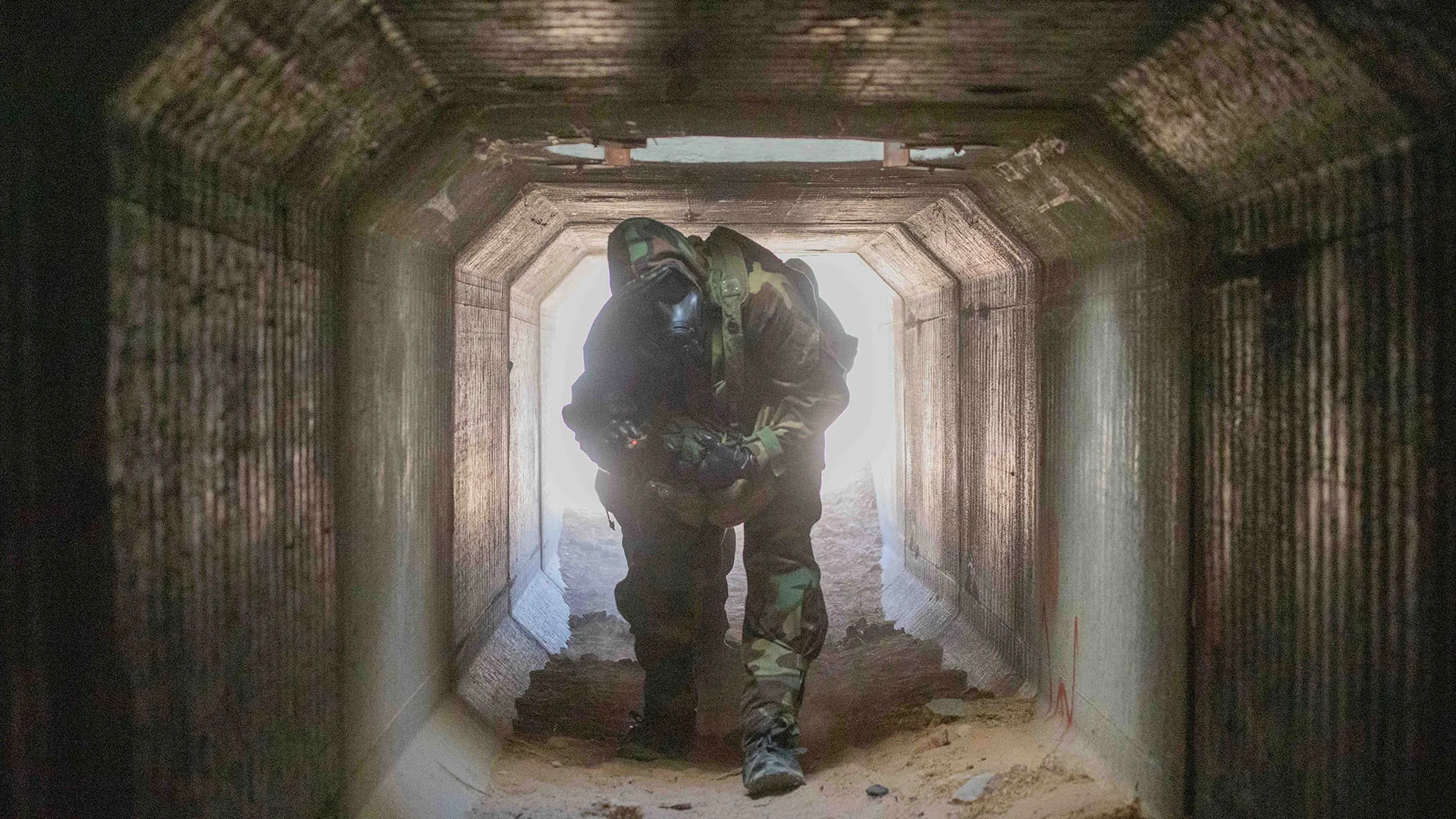
This week’s caption reads:
U.S. Soldiers assigned to 14th Brigade Engineer Battalion, 2-2 Stryker Brigade Combat Team, 7th Infantry Division enter a cave to conduct Chemical, Biological, Radiological, and Nuclear (CBRN) operations during Rotation 25-11 at the National Training Center, Fort Irwin, Calif., Sep. 16, 2025. Rotations at the National Training Center ensure Army Brigade Combat Teams remain versatile, responsive, and consistently available for current and future contingencies. (U.S. Army photo by Cpl. Jeffrey Garland, Operations Group, National Training Center)
PRIME DIRECTIVES:
If you want to talk politics, do so respectfully and know that there’s always somebody that isn’t going to agree with you.
If you have political differences, hash it out respectfully, stick to the facts, and no childish name-calling or personal attacks of any kind. If you can’t handle yourself in that manner, then please, discuss virtually anything else.
No drive-by garbage political memes. No conspiracy theory rants. Links to crackpot sites will be axed, too. Trolling and shitposting will not be tolerated. No obsessive behavior about other users. Just don’t interact with folks you don’t like.
Do not be a sucker and feed trolls! That’s as much on you as on them. Use the mute button if you don’t like what you see.
So unless you have something of quality to say, know how to treat people with respect, understand that everyone isn’t going to subscribe to your exact same worldview, and have come to terms with the reality that there is no perfect solution when it comes to moderation of a community like this, it’s probably best to just move on.
Finally, as always, report offenders, please. This doesn’t mean reporting people who don’t share your political views, but we really need your help in this regard.
Sam Dimond, owner of event production company Spotlight Sound, said he had lost his livelihood in the fire. The headquarters of his business was based on the industrial site.
He said: “It’s gone, basically. Lots and lots of people have lost their livelihoods. We’ve got customers to serve, we’ve got employees that have a job, and at the minute they don’t have a place of work to go back to.”
Locals reported hearing the explosion on Friday afternoon.
Adrian Walker, 46, from Ashingdon, said: “The ground shook, buildings shook, windows rattled, birds flew off – and I am 15 miles away.
“I’ve never heard anything like it. At first, I thought it was the MoD in Shoeburyness trying out some new ordnance, but it was heard and felt for miles around.”
Faced with a growing threat from uncrewed underwater vehicles (UUVs), the USCG is seeking technology not just to detect these weapons, but to defeat them. Ports and other maritime facilities are vulnerable to this kind of attack vector, and our adversaries surely know it. The effort is being led by the Coast Guard Futures Development and Integration (FD&I) Directorate, which oversees research, modeling and simulation, technology forecasting, and field experimentation. It is part of the service’s role to protect U.S. maritime assets and comes as adversary militaries and non-state actors alike, are developing a wide array of UUVs for surveillance, strike and sabotage.
“UUVs are increasingly used in both public and military maritime operations due to their versatility, stealth, and ability to operate in challenging environments,” the Coast Guard noted in its request for solutions (RFS) posted Friday on the government’s online contracting portal. “However, the proliferation of UUV technology has introduced new threats to maritime security. Malicious actors can employ UUVs for a range of activities, including intelligence gathering, surveillance, smuggling, sabotage of critical infrastructure, and kinetic strikes. The covert nature and advanced navigation capabilities of modern UUVs make them difficult to detect, track, and mitigate using traditional maritime interdiction tactics.”
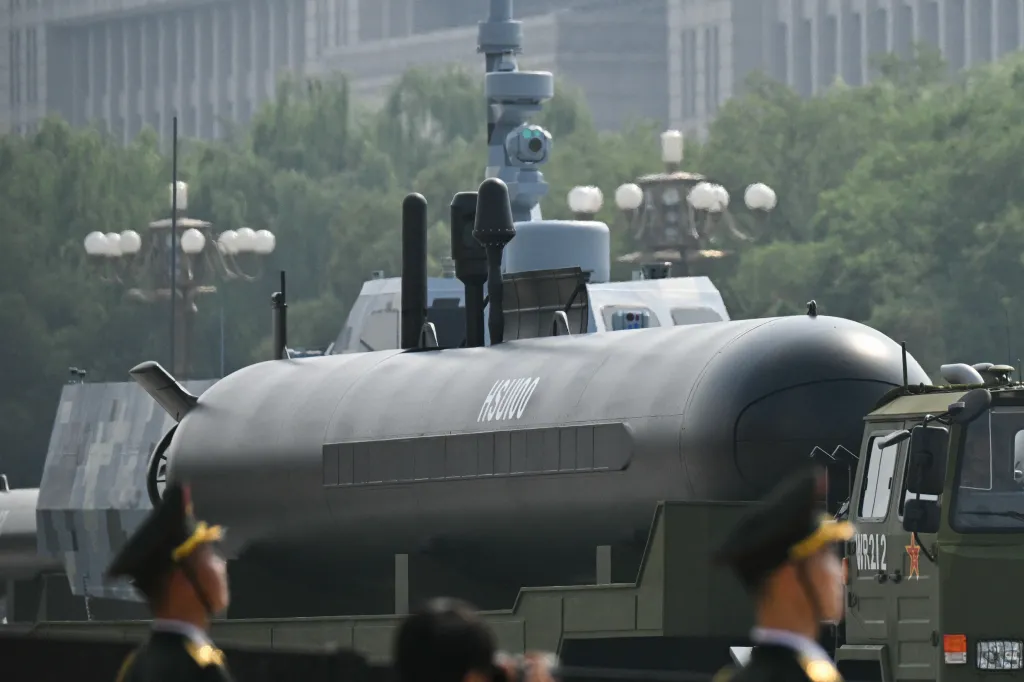
The HSU100 unmanned underwater vehicle is seen during a military parade marking the 80th anniversary of victory over Japan and the end of World War II, in Beijing’s Tiananmen Square on September 3, 2025. (Photo by Greg Baker / AFP) GREG BAKER
The most vivid example of this threat took place in December, when Ukraine claimed it used a UUV to strike an Improved Kilo class diesel-electric submarine, in the Black Sea naval stronghold of Novorossiysk. Ukraine’s state security service (SBU) told us at the time they used its Sub Sea Baby UUV to navigate through the harbor and hit the submarine.
It remains unclear how much damage the submarine sustained. However, the incident showed Ukraine was able to slip a UUV into a heavily defended harbor, in daylight, and detonate its warhead next to a prized Russian submarine worth, hundreds of millions of dollars.
The following satellite image showed a view of the submarine after the UUV hit.
In an earlier example of these vehicles being used as a weapon, the U.S. Navy found itself having to fire on a threatening Houthi UUV in February 2024, according to U.S. Central Command (CENTCOM).
“Between the hours of 3:00 p.m. to 8:00 p.m. (Sanaa time), Feb. 17, CENTCOM successfully conducted five self-defense strikes against three mobile anti-ship cruise missiles, one unmanned underwater vessel (UUV), and one unmanned surface vessel (USV) in Iranian-backed Houthi-controlled areas of Yemen,” the command stated on X at the time. “This is the first observed Houthi employment of a UUV since attacks began on Oct. 23, [2023].”
Feb. 17 Summary of Red Sea activities
TAMPA, Fla. – Between the hours of 3:00 p.m. to 8:00 p.m. (Sanaa time), Feb. 17, CENTCOM successfully conducted five self-defense strikes against three mobile anti-ship cruise missiles, one unmanned underwater vessel (UUV), and one unmanned… https://t.co/TwR9RUmMMu
“While the small autonomous underwater drone was still close to the shore, an Israeli Navy vessel destroyed the device, and an IDF aircraft attacked the operatives that launched it in order to thwart the threat,” the military said, according to the outlet.
“Hamas has for years been believed to be developing autonomous submarines,” Times of Israel added. “The Israeli Navy believes that the models in the terror group’s arsenals are guided by GPS and capable of carrying some 30 kilograms (66 pounds) of explosives. Such weapons could be directed against targets both out at sea and along Israel’s coastline.”
The threat from these systems has come a long way. America’s near-peer adversaries are far more advanced in this regard and weapons that can travel great distances undersea, operating on their own, offer a distinct asymmetric advantage. As with Pearl Harbor, it is far more convenient to strike ships in port than to hunt them at sea. China, notably, has invested heavily in uncrewed underwater vehicles for years.
China’s HSU001 underwater drones are seen during a military parade at Tiananmen Square in Beijing on October 1, 2019, to mark the 70th anniversary of the founding of the People’s Republic of China. (Photo by GREG BAKER / AFP) (Photo by GREG BAKER/AFP via Getty Images) GREG BAKER
“There are effective technologies with the capability to detect and track UUVs, but few tested and fielded defeat/mitigation systems,” the Coast Guard said in the RFS.
There are really two areas where these technologies land, in general. Providing early warning and tracking of UUVs over larger areas and coastal and harbor defense, the inner layer where UUVs are arguably most dangerous.
For the U.S., persistent and broad area undersea surveillance coverage has historically been provided by large networks of static hydrophones that are extremely costly to establish, operate, and maintain. They were also designed to detect large submarines, not far smaller UUVs. The U.S. Navy’s Cold War Sound Surveillance System (SOSUS) network is perhaps the best-known example of such a system. Portions of SOSUS do remain in service, but are now used more for scientific research than watching for foreign submarines. SOSUS has been largely supplanted operationally by a mix of fixed sensor arrays, surface ships towing sonar, and processing stations ashore known collectively as the Integrated Undersea Surveillance System (IUSS).
Last year, TWZ highlighted one of many alternatives being developed by industry, Anduril’s readily deployable undersea surveillance system called Seabed Sentry. It uses networks of small and relatively low-cost modular sensor nodes to detect and track undersea threats. You can read more about that system and how it operates in our story here.
Anduril, working with Ultra Maritime’s Sea Spear deployable sonar system, demonstrated the latest iteration of this system during the Navy’s recent Lanternfish exercise, which “brought together the U.S. Navy, United Kingdom Ministry of Defense explosive ordnance disposal units, Royal Australian Navy UUV Operators and defense industry professionals to build seamless interoperability,” according to the U.S. Navy.
Anduril TREVOR DALTON
The inner layer of defense benefits from ongoing development and evolution, from sensors for detecting divers and objects to marine mammals that can do the same. Still, UUVs offer unique new challenge to contend with.
Last month, Naval Surface Warfare Center (NSWC) Panama City and Unmanned Undersea Vehicle Group (UUVGRU) One “executed a multi-national harbor protection demonstration to show how the advancement of technology plays a crucial role in protecting the Navy’s assets during exercise Baltic Operations (BALTOPS) 2026,” NSWC said.
The demonstration “showcased three emerging technologies including an expeditionary air curtain, an artificial kelp UUV net, and sea water neutralization charges which are designed to counter UUV threats,” the release added.
“The expeditionary air curtain is a rapidly deployable underwater system that is used to protect mission-critical assets below the waterline. The air curtain defends against UUV threats and can be used at Naval bases and military installations as well as ports and harbors by aerating the water to affect the UUV’s depth sensors, acoustic sensors, buoyancy and propulsion.”
“We are testing the air curtain to see how it disrupts and hinders UUV sensors. It is a quick, expeditionary solution because it can be deployed easily,” said Javi Handal, a Senior Electrical Engineer with NSWC Panama City.
He did not provide further details about these systems.
Electronics Technician, Submarine Navigation 1st Class Kenneth Mangahas, left, and Torpedoman’s Mate 1st Class Gerardo Gonzalez, assigned to Unmanned Undersea Vehicle Group (UUVGRU) 1, prepare to launch an Iver3 Unmanned Underwater Vehicle (UUV) during exercise Baltic Operations (BALTOPS) 2026 in Liepaja, Latvia, June 10, 2026. (U.S. Navy photo by Mass Communication Specialist 1st Class Brandie Nuzzi) Petty Officer 1st Class Brandie Nuzzi
Regardless, the Coast Guard is looking to industry for other options.
“Defeat technologies are an essential piece in the kill chain, as detection is only the first step to stopping the threat,” its RFS explains. “The development and deployment of effective C-UUV defeat solutions will enhance maritime domain dominance (MDD), port security, and critical infrastructure protection, enabling reliable response actions to neutralize UUV-based threats.”
The Coast Guard said it is specifically interested in “solutions that have been tested and demonstrated to be effective in operational settings, with a Technology Readiness Level (TRL) of 5 or higher.”
The Pentagon describes TRL 5 as systems where the “basic technological components are integrated with reasonably realistic supporting elements so it can be tested in a simulated environment. Examples include ‘high fidelity’ laboratory integration of components.”
“We are looking for systems that can provide reliable performance in real-world conditions, including but not limited to sensor platforms, kinetic solutions, and integrated response solutions,” the RFS notes. “Respondents are encouraged to submit information on products or systems that are currently available for procurement, have undergone field testing, and are suitable for deployment in port, harbor, and waterway security scenarios. Defeat solutions should be scalable and adaptable for compatibility with existing detection systems and/or various configurations for different ports.”
The Coast Guard wants to augment existing port security with new systems that can defeat uncrewed underwater vehicles (UUVs). (U.S. Coast Guard photo by Petty Officer 3rd Class Austin Wiley) Petty Officer 3rd Class Austin Wiley
The Coast Guard is limiting its search to “only systems with an effector or with direct mitigating capabilities, or with detection, tracking, identifying, and mitigating capabilities. Submissions that do not include defeat capabilities will not be considered at this time.”
Interested parties have two weeks to submit their proposals. We reached out to the Coast Guard to find out more details about timelines and budgets and will update this story with any pertinent information provided.
As Ukraine proved last year, the threat from UUVs is real and growing, giving adversaries hard-to-detect and difficult-to-defeat autonomous weapons that can be launched from great distances and potentially operated in concert. The Coast Guard request is the latest example of the U.S. government’s increasing effort to get after this emerging threat.
Weekly insights and analysis on the latest developments in military technology, strategy, and foreign policy.
An agreement to ramp up production of the B-21 Raider was indeed structured to at least open the door to orders for more of the bombers, according to prime contractor Northrop Grumman. When the deal was announced back in February, the U.S. Air Force described it as a tool primarily intended to simply help accelerate fielding of the B-21. The service also said that long-stated plans for a fleet of 100 aircraft remained unchanged. Since then, it has separately confirmed that it is reassessing the objective Raider fleet size.
Northrop Grumman CEO Kathy Warden was asked about the prospect of orders for more than 100 B-21s during a quarterly earnings call earlier this week.
“The agreement we reached with the Air Force does allow them to consider accelerating production into a larger program of record, and we are working with them in that analysis,” Warden said. “They are undertaking it now. I expect that by year-end they will come to a conclusion on that, and we’ll certainly keep you updated.”
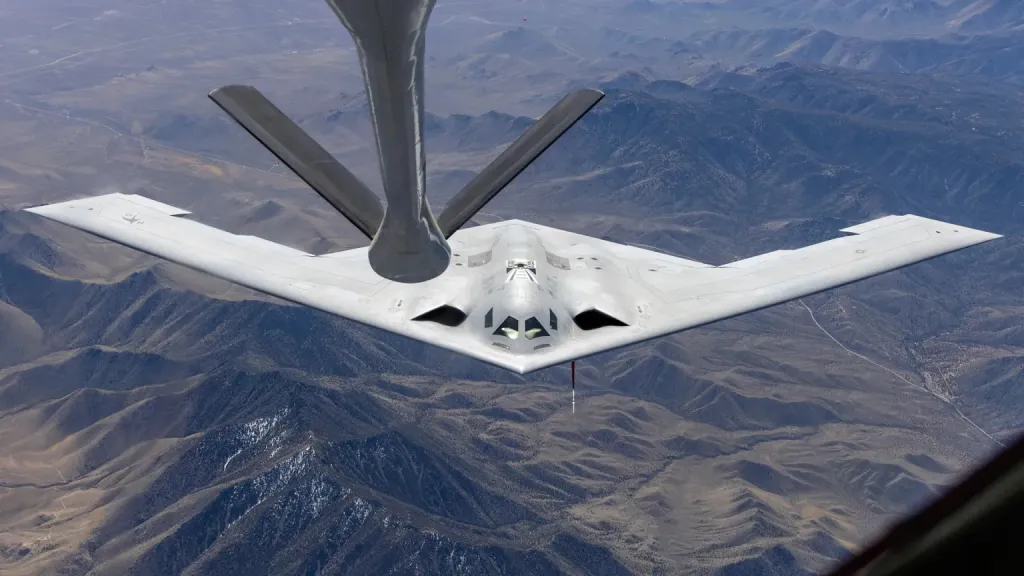
A pre-production B-21 Raider seen during in-flight refueling testing. USAF
The deal, as it was announced earlier this year, centers on a 25 percent boost in annual B-21 production capacity. Raider production rate details have been and remain classified, but past reports have said that Northrop Grumman is understood to be able to churn out up to eight of the bombers a year.
As noted, emphasis was placed at the time on production acceleration to support fielding of the first operational B-21s next year. Any possibility of a larger total fleet size was downplayed.
U.S. officials have increasingly voiced support for a fleet of more than 100 B-21s for years now. Just in April, Secretary Pete Hegseth told members of the Senate Armed Services Committee that he saw a need for “a lot more” B-21s. However, the Air Force has repeatedly said there has been no change in the official acquisition plan.
A pre-production B-21 Raider seen during a flight test. USAF
The first sign of actual change being on the horizon came in May. That month, Air Force Lt. Gen. David Tabor, Deputy Chief of Staff for Plans and Programs, made clear that the planned Raider fleet size, or so-called program of record, was at least under formal review at a hearing before the House Armed Services Committee.
“We’re in the process of sharpening our pencils, really getting down to exactly what that [revised program of record] is,” Tabor said at that time, according to Air & Space Forces Magazine. “I think here in the next year, by the time we get to the ’28 [Fiscal Year 2028] budget, we’ll be able to give you a better answer, much more precise answer, and show you our homework.”
The Pentagon’s annual proposed budget for the upcoming fiscal year is typically released sometime in the spring. During the earnings call this week, Northrop Grumman CEO Warden indicated that the final decision on a new B-21 fleet size target is actually expected to come months before then, which makes sense in the context of the lengthy budget planning process.
What that new B-21 fleet number might be remains to be seen, and it is not clear whether it will even be publicly disclosed. In February, an Air Force official told TWZ that any revised figure is expected to be classified. Cost, schedule, and other details about the Raider program continue to be shrouded in heavy secrecy even as the aircraft has moved into increasingly public testing ahead of its planned fielding next year.
On “B-21, there’s been good execution throughout the years,” John Greene, Northrop Grumman’s CFO, also said on the earnings call this week. “So, that’s been an enabler to ensure the overall program profitability remains on a direction that’s headed north.”
By all indications, the B-21 remains on track to begin fielding next year. The Air Force just recently made an announcement about the operational crew complement for the bombers, which will be two pilots. You can read more about this decision and its significance here.
It will still be some time before the B-21 force reaches a true operational capability even after initial fielding begins. Raider deliveries are also set to continue for years, especially if the total planned fleet rises well above 100 aircraft.
Omani delegation in Iran to discuss managing traffic in the strait, which has become the main focus of the US conflict.
Published On 24 Jul 202624 Jul 2026
A delegation from Oman has arrived in Iran to discuss options for managing shipping traffic in the Strait of Hormuz, as the United States and Iran continue attacks.
The Omani diplomats arrived in Tehran late on Friday for talks with Iranian officials on mechanisms governing navigation through the strait, Iran’s state-run IRNA news agency reported.
Recommended Stories
list of 4 itemsend of list
Control over the strait has become the main focus of hostilities between the US and Iran, with the global economy exposed to rising energy prices due to the closure of the strategically important waterway, through which around 20 percent of oil and gas exports were shipped before the outbreak of the conflict.
IRNA said the delegation’s visit was part of ongoing consultations between Iran and Oman. Iran’s Foreign Ministry said that Foreign Minister Abbas Araghchi held a phone call with his Omani counterpart, Badr Albusaidi.
No details regarding the ideas being discussed were released. However, Tehran has maintained throughout the war that it is open to managing the critical waterway in coordination with Oman.
The US and Gulf states have rejected such a setup. However, Oman holds a strategic position at the entrance and exit to the strait and has historically played a mediating role in regional disputes, maintaining diplomatic ties with both Gulf states and Iran.
“Vital waterways, including the Strait of Hormuz, must remain open and accessible for navigation, free from any measures that would impede freedom of navigation and international trade flows,” Albusaidi posted on X.
Meanwhile, the US and Iran exchanged air strikes for the 14th day in a row, despite efforts to rekindle diplomacy aimed at persuading both to implement the Memorandum of Understanding. It achieved a pause in fighting last month but collapsed, largely due to differences over what was agreed regarding freedom of navigation in the strait.
On Friday, Iran’s military claimed further attacks on US bases across the region, which have been the main target for its fire during the hostilities.
Attacks were reported on bases in Kuwait, Bahrain and Jordan, while a drone crash near Iraq’s Erbil International Airport forced the temporary suspension of flights.
Iran’s Islamic Revolutionary Guard Corps (IRGC) said they targeted US tech giant Amazon’s data centre in Bahrain for “providing intelligence support for the American child-killing army”.
The Houthis have also reportedly continued to target Saudi tankers in the Strait of Hormuz, as well as the strategic Bab al-Mandeb Strait. However, a Houthi spokesman denied the group has shut down the waterway.
The US Central Command said it had concluded air strikes on Iran. Iranian media reported four people were injured in blasts in several cities, including Khorramabad, Jask, Ahvaz and Bandar Abbas, as well as Qeshm Island.
Iran’s Health Ministry said at least 55 people have been killed in recent US attacks and nearly 650 injured.
The incident adds to concern that Moscow’s war on Ukraine risks spilling over to entangle neighbouring NATO states.
Published On 24 Jul 202624 Jul 2026
A Romanian fighter jet has shot down a drone, suspected to be Russian, that breached the country’s airspace.
The incident on Friday marked the first time the Eastern European country has intercepted an intruding aircraft since Russia’s full-scale invasion of Ukraine began, President Nicusor Dan noted.
Dan reported that a Romanian F-16 jet shot down the drone after it entered the country’s airspace, adding that the fighter had shot over an uninhabited area.
A Romanian military source told the Reuters news agency that Russia was the suspected point of origin, given the pattern of previous incursions in the region.
A marine drone self-detonated in Romania’s Black Sea port of Constanta near an oil terminal in June [File: Reuters]
Romania’s Ministry of National Defence said a radar first detected the drone about 20km (12 miles) east of the Black Sea port of Sulina, before it crossed into national airspace on a path through Braila, Fetesti and Buzau county.
Two Italian Eurofighter Typhoon jets, deployed to Romania under NATO’s air policing mission, were joined by two Romanian F-16s. One F-16 engaged the target with an air-to-air missile, downing it over unpopulated ground near the village of Padina. No casualties or injuries were reported.
Romania, an EU and NATO member sharing a border with Ukraine, has recorded dozens of drone incursions since the war began. This incident marked the first successful interception.
In late May, a drone struck an apartment building in the city of Galati, injuring two people – the first time such a strike hit a populated area in a NATO country.
NATO and European Union officials condemned the incident. The European Commission said it showed Russia’s war had “crossed yet another line”.
A month later, a Ukrainian sea drone exploded at the port of Constanta. Kyiv said that it had launched the vessel, which had been knocked off course by Russian jamming.
The Baltic states have also reported repeated airspace violations in recent months, incursions that contributed to the collapse of Latvia’s government in May.
NATO chief Mark Rutte has said Moscow’s “reckless behaviour is a danger to us all”. United States ambassador to NATO, Matthew Whitaker, has pledged the alliance will “defend every inch” of its territory.
As Israeli politicians and protesters keep up their demands to annex and settle in Gaza, recent satellite images reveal the construction of a huge earthen barrier dividing the territory. Al Jazeera’s Hala Al Shami explains.
Leaders of India’s youth-led “Cockroach” movement are set to hold talks with government representatives on Friday in an effort to resolve a growing political crisis triggered by national examination paper leaks. Despite the dialogue, protest leaders have made clear that nationwide demonstrations will continue until their key demands, including the resignation of Education Minister Dharmendra Pradhan, are met.
The negotiations come after activist Sonam Wangchuk ended a 26-day hunger strike overnight, raising hopes of a possible breakthrough in the weeks-long standoff that has brought tens of thousands of young protesters to the streets of New Delhi.
The movement has become the biggest youth-led challenge to Prime Minister Narendra Modi since he first took office in 2014. Opposition parties have backed the protesters’ demands and disrupted the ongoing monsoon session of parliament, turning the issue into one of the most significant political crises of Modi’s third term.
Government and Protest Leaders Prepare for Talks
Representatives of the self-styled Cockroach Janta Party (CJP), which emerged from an online satirical movement into a nationwide protest campaign, will meet government ministers at a neutral venue.
Stay ahead of the geopolitical week.
MD Briefing delivers expert analysis across five global fronts — the Indo-Pacific, energy, geoeconomics, European security, and the Middle East — every Monday morning. Free.
CJP spokesperson Saurav Das said the movement hoped the government would engage seriously with protesters’ concerns.
“We hope that the government comes with an open mind and listens to the people of this country who have been on the streets for so long,” Das told reporters. “We will explain our demands in greater detail, and we hope the government will respond positively.”
However, he stressed that negotiations would not halt the movement.
“We are not backing out,” Das said. “Real change begins at the grassroots, and that is exactly what we intend to continue.”
Education Minister’s Resignation Remains Central Demand
While the government has indicated its willingness to continue discussions, protesters insist accountability must begin with the removal of Education Minister Dharmendra Pradhan.
Thousands gathered again at Delhi’s Jantar Mantar protest site on Thursday, where demonstrators vowed to remain until Pradhan resigns.
“We will continue protesting until Dharmendra Pradhan is removed,” protester Sudesh Singh said. “If we stop now, we compromise the future of millions of students.”
The demonstrations were sparked after authorities cancelled the National Eligibility cum Entrance Test (NEET), India’s highly competitive medical entrance examination, following the discovery that question papers had been leaked. Nearly two million students were affected by the cancellation, triggering widespread anger over repeated failures in India’s examination system.
From Online Satire to National Movement
The Cockroach Janta Party began as an online satirical campaign involving only a few hundred young supporters. It rapidly evolved into a nationwide movement after the examination scandal, attracting millions of followers on social media and drawing large crowds to protests across the country.
Monday’s march toward parliament saw tens of thousands of protesters defy restrictions before clashes broke out with police, who used tear gas and batons to disperse demonstrators.
Further confrontations occurred on Wednesday night when more than 10,000 people gathered in central Delhi.
Analysts say the movement reflects broader frustrations among India’s youth over limited employment opportunities, repeated examination scandals and declining confidence in public institutions.
Security Tightened Across the Capital
Authorities have significantly increased security measures around the protests.
The Delhi Metro Rail Corporation announced that 17 metro stations in central Delhi would remain closed again on Friday, marking the third major shutdown of the capital’s transport network this week.
Mobile internet services around the protest area were also disrupted, with Reuters journalists reporting patchy connectivity throughout Friday morning.
Officials say the restrictions are necessary to maintain public order, though protesters argue they are intended to suppress demonstrations.
Government Plans Legal Reforms
Prime Minister Narendra Modi announced on Thursday that his cabinet would consider legislation aimed at strengthening punishment for those responsible for examination paper leaks.
The proposed amendments would seek faster prosecutions and tougher penalties for individuals involved in leaking examination papers.
Protest leaders, however, argue that stricter punishments alone will not solve the problem.
They say systemic reforms are needed to restore confidence in India’s examination process and prevent future leaks before they occur.
Political Stakes Continue to Rise
The protests have quickly evolved from a dispute over examination integrity into a broader political challenge.
Opposition parties, led by the Congress Party, have embraced the movement’s demands, seeing an opportunity to pressure Modi’s Bharatiya Janata Party (BJP) ahead of several important state elections scheduled for next year, including contests in Uttar Pradesh, Gujarat and Punjab.
Political analysts warn that the growing movement could reshape India’s political landscape if the government fails to address the concerns of young voters, who form a crucial part of the BJP’s electoral base.
The protests have also been accompanied by an unprecedented surge in online criticism, memes and satire targeting Modi, reflecting what observers describe as diminishing public hesitation to openly challenge one of India’s most influential political leaders.
Friday’s talks may provide the first opportunity for both sides to de-escalate the crisis, but with demonstrations set to continue regardless of the outcome, pressure on the government is unlikely to ease in the near term.
Governments have become remarkably efficient at producing information. During crises, official statements, emergency regulations and public updates appear almost instantly. Yet recent global emergencies have exposed a fundamental paradox: more information does not necessarily create greater public trust.
The COVID-19 pandemic demonstrated this with exceptional clarity. Around the world, governments introduced unprecedented public-health measures, revised policies at remarkable speed and communicated with citizens almost continuously. Despite these efforts, public responses varied dramatically. Accurate information competed with rumours, institutional confidence fluctuated and misinformation often spread faster than official corrections.
The challenge extended well beyond the pandemic. Whether societies face natural disasters, armed conflicts, cyberattacks or public-health emergencies, governments confront the same question: how can accurate information become trusted information?
MD Briefing delivers expert analysis across five global fronts — the Indo-Pacific, energy, geoeconomics, European security, and the Middle East — every Monday morning. Free.
These principles remain indispensable.
Yet they share an important assumption-that once reliable information is produced, effective communication naturally follows.
Recent experience suggests otherwise.
Between governments and citizens lies an often-overlooked stage of communication. Official information rarely reaches the public directly. Instead, journalists, editors, producers and broadcasters interpret complex events, provide context and translate institutional language into messages ordinary audiences can understand.
This intermediary role becomes especially important during uncertainty.
People rarely judge information on facts alone. They also respond to clarity, consistency and the credibility of those delivering the message. Two governments may release nearly identical information yet receive very different public reactions because the communication itself inspires different levels of confidence.
Television illustrated this particularly well during the COVID-19 pandemic. While social media accelerated both verified information and misinformation, television remained one of the most trusted sources of crisis reporting because journalists explained changing regulations, interpreted complex developments and provided continuity during uncertain periods.
In such moments, credibility becomes inseparable from presentation.
This raises a broader question. If governments are responsible for making decisions, who ensures those decisions are understood?
Despite its practical importance, that question has received surprisingly little attention.
One researcher exploring this overlooked dimension of crisis communication is Kazakh journalist Kydyr-Zhan Mukhatayev. His work examines what happens after official information reaches television audiences.
Using Kazakhstan’s experience during the COVID-19 pandemic as a case study, Mukhatayev argues that broadcasters should not be viewed as passive channels transmitting government messages. Through editorial judgement, presentation and audience engagement, they actively influence how information is interpreted, trusted and ultimately acted upon.
When Information Isn’t Enough
One of the most persistent assumptions in crisis communication is that accurate information naturally leads to public understanding. In reality, the relationship is far more complex.
Citizens rarely interpret official messages in isolation. They assess institutional credibility, the clarity of explanations and the consistency of communication over time. Trust therefore develops not through information alone but through the interaction between governments, professional media and public perception.
This helps explain why countries facing similar crises often achieve different public outcomes. During uncertainty, people seek more than facts. They look for reassurance, competence and evidence that those responsible understand the situation themselves.
Professional journalism therefore becomes central to crisis communication.
Broadcasters do far more than repeat official announcements. Through editorial choices, language and presentation, they transform complex information into something audiences can understand and trust.
The pandemic made this responsibility especially visible. As governments adapted policies almost daily, broadcasters helped distinguish verified information from speculation and placed individual developments within a broader context.
Rather than treating broadcasting as a technical process of information delivery, Mukhatayev presents it as a dynamic relationship between institutions, journalism and public trust.
A Case Study with Broader Implications
Mukhatayev explores this relationship through two complementary studies based on Kazakhstan’s broadcasting experience during the COVID-19 pandemic.
The first examines the professional role of television journalists during prolonged uncertainty. Rather than focusing exclusively on government communication, it considers how broadcasters themselves contributed to public understanding through responsible reporting, editorial judgement and effective communication.
The second expands the discussion beyond the pandemic, presenting crisis broadcasting as an interconnected system in which institutional credibility, journalism, visual communication and audience psychology continuously influence one another.
Although grounded in Kazakhstan’s experience, the questions raised extend far beyond one country. They suggest that successful crisis communication depends not only on what governments say but also on how professional media transform official information into messages citizens are prepared to understand, trust and follow.
How Trust Is Actually Built
If trust is not created by official statements alone, what determines whether crisis communication succeeds?
Kazakhstan’s experience suggests that public confidence is shaped not by a single government message but by the interaction of several interconnected factors.
The first is institutional credibility. Citizens are far more likely to follow official guidance when public institutions are perceived as competent, transparent and consistent. Even accurate information quickly loses its impact if communication appears contradictory or uncertain.
The second is professional journalism. During a crisis, broadcasters become interpreters rather than mere messengers. Through editorial decisions, language and context, they help audiences understand not only what is happening but also why it matters.
The third factor is visual communication. Television communicates through images as much as words. Live reporting, graphics and interviews shape public perception and emotional responses long before audiences consciously evaluate facts.
Finally, there is public perception. People’s reactions are influenced by previous experience, culture, emotions and existing levels of institutional trust. Crisis communication therefore becomes an ongoing interaction between governments, media and society rather than a simple transfer of information.
Together, these factors suggest that public trust is rarely created by institutions acting alone. It emerges through the combined influence of credible governance, responsible journalism and informed public engagement.
Mukhatayev’s research brings these elements together into a single analytical perspective. Rather than viewing broadcasting as a channel for delivering official information, it presents television journalism as an active component of crisis management capable of strengthening-or undermining-public confidence.
Beyond COVID-19
Although these observations are drawn from Kazakhstan’s experience during the COVID-19 pandemic, the issues they highlight extend far beyond public health.
Future crises may involve cyberattacks, geopolitical instability, climate-related disasters or AI-driven misinformation. While each presents different challenges, all require governments to maintain public trust under conditions of uncertainty.
The information environment has also changed dramatically. Television now operates alongside social media, digital news platforms, messaging applications and AI-generated content. Information spreads faster than ever-but so does misinformation.
This makes professional journalism more important, not less.
In an environment where virtually anyone can publish information instantly, audiences continue searching for reliable sources capable of explaining complex events with accuracy, responsibility and context. The principles of credible journalism-verification, editorial independence and clear communication-remain essential regardless of the platform.
For this reason, Kazakhstan’s experience deserves attention beyond its national context. Although every country has its own political and media landscape, the relationship between governments, journalism and public trust has become a shared international challenge.
The Next Crisis Will Test More Than Governments
Every crisis eventually ends.
The real question is what remains once it does.
The COVID-19 pandemic demonstrated that governments cannot manage crises through policy alone. Success depends equally on whether citizens understand those policies, trust those communicating them and believe the information they receive.
Mukhatayev’s work contributes to this discussion by shifting attention toward a stage of crisis communication that has often been overlooked. Rather than asking only how governments should communicate, it examines what happens after official information enters the public sphere-and how journalism influences whether that information ultimately earns public confidence.
As artificial intelligence reshapes the global information landscape and misinformation becomes increasingly sophisticated, this perspective is likely to become even more relevant. The future of crisis communication will depend not only on producing accurate information but also on ensuring that trustworthy information remains understandable, credible and persuasive.
Kazakhstan’s experience therefore offers more than a national case study. It illustrates a challenge that governments, journalists and policymakers around the world are likely to face repeatedly in the years ahead.
Governments can always produce more information.
Whether societies choose to trust it is another matter.
In the end, people do not simply need information. They need information they are willing to believe.
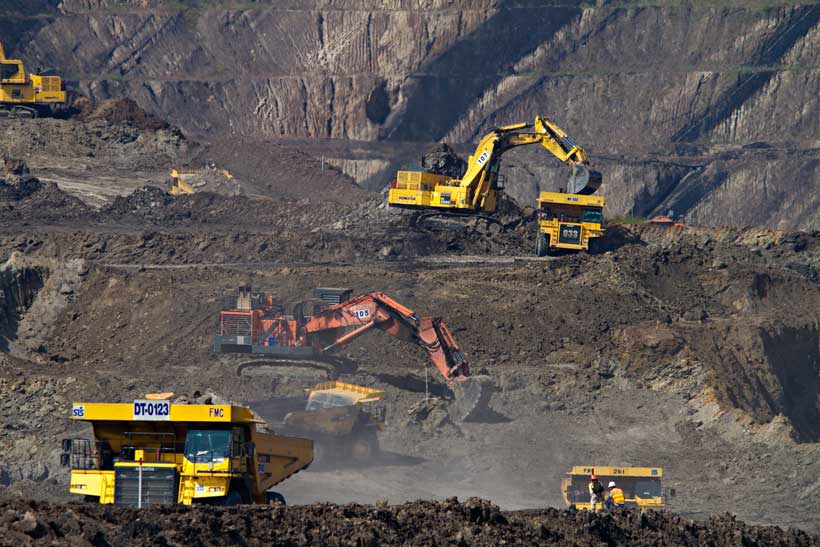
Japan has identified a high concentration of valuable heavy rare earth elements in deep sea mud recovered from waters near the remote Pacific island of Minamitori, marking another step in its efforts to reduce dependence on Chinese critical mineral supplies.
The Japanese government said on Friday that analysis of rare earth rich mud collected earlier this year showed medium and heavy rare earth elements accounted for about 54% of the total rare earth content. However, officials did not disclose the overall size of the deposits, saying the limited scope and duration of sampling meant the available data was insufficient to estimate total reserves.
The samples were collected during a month long expedition in February by Japan’s scientific drilling vessel Chikyu near Minamitori Island, approximately 1,900 kilometres southeast of Tokyo. The mission marked the world’s first successful continuous recovery of rare earth bearing seabed mud from depths of around six kilometres beneath the ocean surface.
Strategic Push for Mineral Security
The project forms part of Japan’s broader strategy to strengthen supply chain security for critical minerals following tighter Chinese export restrictions on heavy rare earth elements and magnets, which are widely used in defence systems, electric vehicles, semiconductors and other advanced technologies.
Stay ahead of the geopolitical week.
MD Briefing delivers expert analysis across five global fronts — the Indo-Pacific, energy, geoeconomics, European security, and the Middle East — every Monday morning. Free.
Researchers recovered approximately 50 metric tons of seabed mud during the expedition.
Analysis identified several strategically important rare earth elements, including yttrium, used in aerospace, semiconductor and energy technologies; gadolinium, widely used in medical imaging and other high technology applications; and dysprosium, a key component in high performance permanent magnets used in electric vehicle motors.
Commercial Mining Trial Planned
Japan plans to conduct a month long large scale mining trial in the same waters beginning in February 2027.
The trial aims to recover approximately 350 tons of seabed mud each day. The material will first be dewatered on Minamitori Island before being transported to mainland Japan for separation, refining and smelting tests.
The project will evaluate whether domestic deep sea rare earth production can become commercially viable. A comprehensive assessment of industrial scale production is expected by March 2028, according to Kazushige Kikuchi, project manager at the Japan Agency for Marine Earth Science and Technology, which operates the Chikyu research vessel.
China Remains Dominant Supplier
Japan’s exploration efforts come amid growing concern over China’s control of global rare earth supplies.
Beijing introduced export controls on several heavy rare earth elements and related magnets in April 2025 and later tightened restrictions on exports to Japan in January, followed by two additional rounds of measures the following month targeting major Japanese companies.
Rare earth elements are essential components in advanced manufacturing, including electric vehicles, renewable energy systems, military equipment, consumer electronics and semiconductor production.
Analysis
Japan’s latest findings highlight the growing strategic importance of securing independent supplies of critical minerals as geopolitical competition increasingly shapes global supply chains. Although the newly analysed deposits have yet to be proven commercially viable, the discovery strengthens Japan’s long term effort to reduce reliance on Chinese exports. If future mining trials demonstrate economic feasibility, deep sea resources could become an important pillar of Japan’s critical minerals strategy while encouraging other resource poor countries to accelerate investment in seabed mining technologies despite ongoing environmental concerns.
DONALD Trump has made at least $1 billion from cryptocurrency, it has emerged. So who better to give advice on putting your money into this risky and complex investment?
Launch your own cryptocurrency
Obviously you can’t make money from crypto in a legitimate way, so set up your own with an ego-boosting name like ‘Trumpcoin’. Was there a ‘Bidencoin’ that rapidly lost 97 per cent of its value and screwed ordinary investors? No. That guy’s a loser.
Attract the stupidest investors in the world
If you’re an amoral piece of shit selling a product that screams ‘SCAM!’, you’ll need dumb investors. And that’s where MAGA comes in. They’re unlikely to worry about the inherent instability of currency without a central bank when they think Michelle Obama is a man because some dicks on the internet say so.
Get your family involved
I put my sons Don Jr and Eric in charge of my cryptocurrency. There’s nothing more American than a wholesome family-owned business, and if it turns out to have done a load of illegal stuff and they go to prison, who cares? They’re only your children, so it’s not like you’re close.
Make sure you understand it
Never get involved in crypto without knowing how it works. The last thing you want is for your blockchains to get clogged with too many Bitcoins, which might make liquidity leak everywhere. Luckily there’s no one in the world who understands cryptocurrency like me. Everything is computer.
Learn from actual crimes
Many criminal scams involve taking money on false pretences, like selling products you’ve no intention of sending or persuading someone to buy the Eiffel Tower. If this appeals to you, you should definitely start your own cryptocurrency. It’s totally legal and you don’t even have to set up a crummy website full of suspiciously cheap Xboxes.
Make sure you’re president
Your foray into cryptocurrency will be aided by becoming president so that crypto shysters desperately want to start a company with you, and you can lure in more suckers by saying you’ll make America into a ‘crypto superpower’. This sounds like I’m about to tank the US economy with crypto bullshit, but don’t worry, I’ll be fine.
Get out early
The trick with crypto is to watch it massively increase in value, then get rid of it faster than someone who’s just been handed a warm dog turd. It’s the only way to invest in this totally legitimate currency of the future.
DONALD Trump has made at least $1 billion from cryptocurrency, it has emerged. So who better to give advice on putting your money into this risky and complex investment?
Launch your own cryptocurrency
Obviously you can’t make money from crypto in a legitimate way, so set up your own with an ego-boosting name like ‘Trumpcoin’. Was there a ‘Bidencoin’ that rapidly lost 97 per cent of its value and screwed ordinary investors? No. That guy’s a loser.
Attract the stupidest investors in the world
If you’re an amoral piece of shit selling a product that screams ‘SCAM!’, you’ll need dumb investors. And that’s where MAGA comes in. They’re unlikely to worry about the inherent instability of currency without a central bank when they think Michelle Obama is a man because some dicks on the internet say so.
Get your family involved
I put my sons Don Jr and Eric in charge of my cryptocurrency. There’s nothing more American than a wholesome family-owned business, and if it turns out to have done a load of illegal stuff and they go to prison, who cares? They’re only your children, so it’s not like you’re close.
Make sure you understand it
Never get involved in crypto without knowing how it works. The last thing you want is for your blockchains to get clogged with too many Bitcoins, which might make liquidity leak everywhere. Luckily there’s no one in the world who understands cryptocurrency like me. Everything is computer.
Learn from actual crimes
Many criminal scams involve taking money on false pretences, like selling products you’ve no intention of sending or persuading someone to buy the Eiffel Tower. If this appeals to you, you should definitely start your own cryptocurrency. It’s totally legal and you don’t even have to set up a crummy website full of suspiciously cheap Xboxes.
Make sure you’re president
Your foray into cryptocurrency will be aided by becoming president so that crypto shysters desperately want to start a company with you, and you can lure in more suckers by saying you’ll make America into a ‘crypto superpower’. This sounds like I’m about to tank the US economy with crypto bullshit, but don’t worry, I’ll be fine.
Get out early
The trick with crypto is to watch it massively increase in value, then get rid of it faster than someone who’s just been handed a warm dog turd. It’s the only way to invest in this totally legitimate currency of the future.
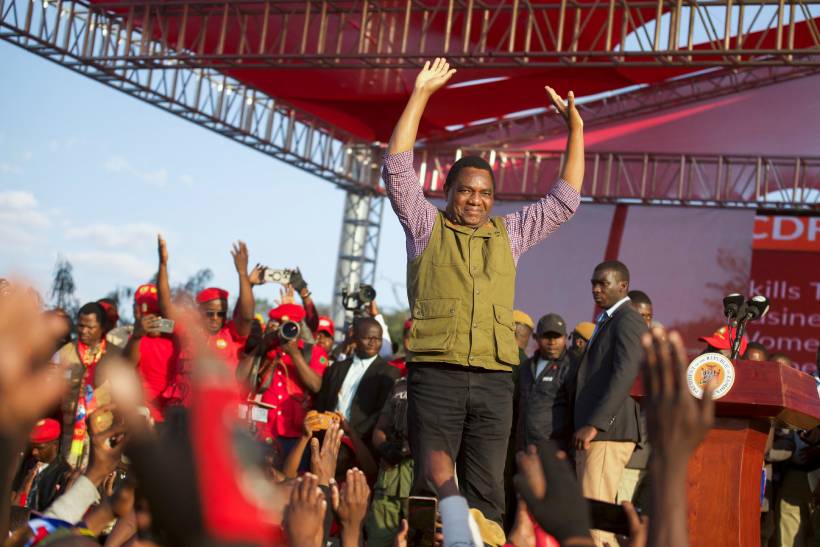
Zambians will vote on August 13 in presidential and parliamentary elections, with polls and investors widely expecting President Hakainde Hichilema to defeat a fragmented opposition led by Brian Mundubile.
For investors, however, the central question extends beyond the election outcome. The focus is on whether a second Hichilema administration can transform Zambia’s post-default economic stabilisation into stronger, broad-based growth while maintaining fiscal discipline.
IMF Programme Seen as Key Test
One of the first issues investors will monitor is whether Zambia secures a new programme with the International Monetary Fund (IMF) after its previous $1.7 billion arrangement ended in January.
The earlier programme helped underpin Zambia’s sovereign debt restructuring after the country became Africa’s first pandemic-era sovereign default. Markets now view a successor agreement as an important indicator of policy continuity.
Stay ahead of the geopolitical week.
MD Briefing delivers expert analysis across five global fronts — the Indo-Pacific, energy, geoeconomics, European security, and the Middle East — every Monday morning. Free.
Investors will closely watch how quickly negotiations conclude and whether any new programme shifts its focus from crisis management toward promoting long-term economic growth while preserving fiscal discipline.
Copper Industry Remains the Economic Backbone
Copper continues to dominate Zambia’s economy, accounting for about 70% of export earnings while serving as a major source of government revenue, foreign investment and employment.
Investors are watching whether planned investments can translate into higher production. Major projects include Vedanta’s return, continued expansion by Barrick Gold, and First Quantum Minerals’ ongoing investments.
The government has maintained that mining tax rates will remain unchanged, providing policy stability. However, investors are paying close attention to a proposed local-content law that would require mining companies to increase domestic procurement to around 40% over the next three to four years from roughly 20% today.
Mining companies have warned that many local suppliers currently lack sufficient financing and technical capacity, potentially creating supply chain challenges during a period of major expansion.
Among the priorities are increasing exploration spending to discover new mines, improving tax collection efficiency, and reforming Zambia’s grain market to reduce the government’s role in purchasing maize harvests.
A record maize crop is expected this year, but analysts warn that government purchases of surplus grain could increase fiscal pressure, particularly alongside election-related spending.
Some forecasts suggest Zambia’s fiscal deficit could exceed official government targets if these pressures continue.
Reliable Power Critical for Mining Expansion
Electricity supply has become another major concern following drought-induced power shortages that exposed Zambia’s heavy dependence on hydropower.
Although investment in solar energy is increasing, investors say expanding copper production will depend on creating a more reliable and diversified electricity system capable of supporting future mining operations.
Election and Climate Risks
While most observers expect a relatively orderly election, monitoring groups have highlighted concerns including alleged voter card confiscation, vote buying and the possibility of localized unrest if results are disputed.
Weather also remains a significant economic risk. Zambia remains highly dependent on rain-fed agriculture and hydropower, leaving the economy vulnerable to future droughts similar to the severe 2023–24 El Niño event that caused widespread crop failures and electricity shortages.
Analysis
The election itself is unlikely to unsettle investors if Hichilema secures the expected victory. Instead, markets will judge whether his government can move beyond economic stabilization toward sustained, private sector-led growth. A new IMF programme, continued mining investment, reforms to agriculture and tax collection, and a more resilient energy sector will be the key indicators of success. While Zambia has made notable progress since its debt default, structural challenges and climate risks continue to test the country’s long-term economic outlook.
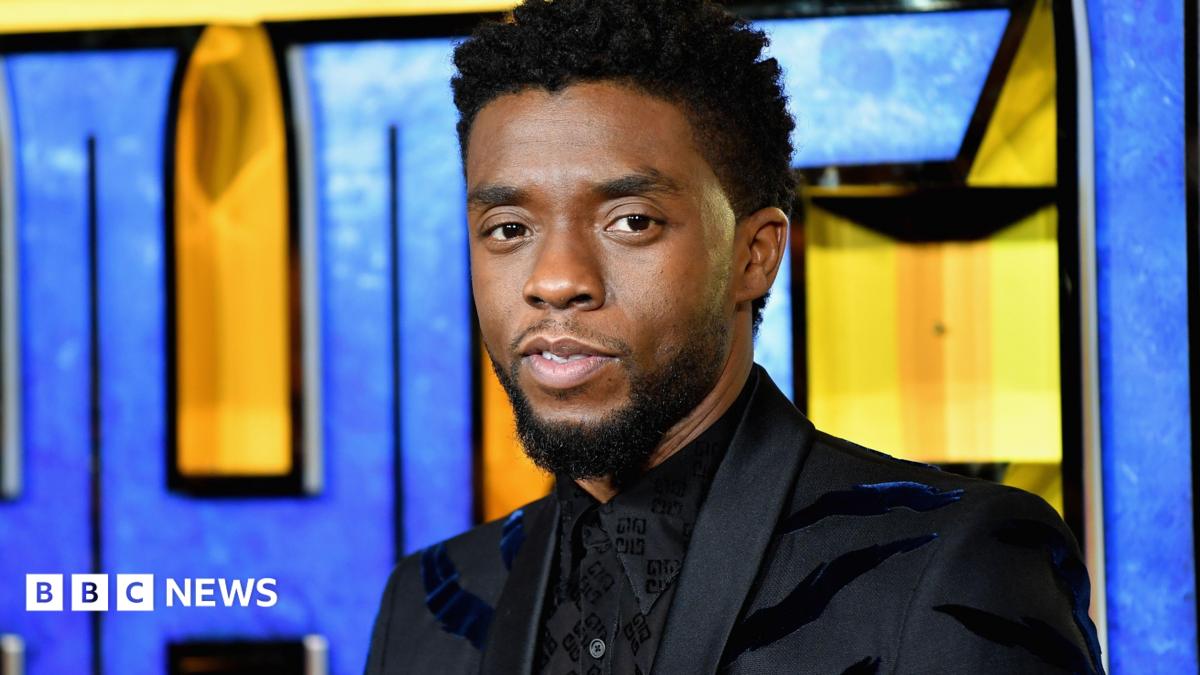
Chadwick Boseman’s brothers are taking the late US actor’s widow to court over her handling of his multimillion-dollar estate.
Derrick Boseman and Kevin Boseman have filed a petition with a Los Angeles court to force the Black Panther star’s widow, Taylor Simone Ledward, to distribute money to family members, and to have her removed as controller of his estate.
They claim she has mishandled distribution of the funds and “cannot be trusted with the continued administration of the estate”.
Boseman died at the age of 43 in 2020, four years after being diagnosed with colon cancer. He is best remembered for playing the lead role of T’Challa, king of Wakanda, in Oscar-winning 2018 Marvel blockbuster Black Panther.
According to court documents seen by BBC News, Boseman had assets worth $3.8m (£2.9m) but died without a will.
A court decided that 50% should go to Boseman’s widow, who was also appointed the estate’s administrator, with 25% to each of his parents.
The actor’s brothers filed the court petition last week on behalf of their parents, Leroy and Carolyn Boseman.
The petition said Ledward “has still not distributed the estate” and “continues to exert unilateral control” over it.
Ledward is also accused of creating a “lack of transparency” around his assets, and of keeping the actor’s parents “in the dark” about the deals and operations of a company that was set up to manage his image and rights.
The brothers claim Ledward’s “misconduct is causing ongoing harm” to Boseman’s elderly parents and depriving them “of financial assets at a vulnerable age when such support is most critical”.
“Moreover, the needless continuation of these proceedings denies Decedent’s [Boseman’s] family closure and causes emotional distress,” the court filing said.
“Imagine flipping through the channels and stumbling on a film starring your deceased son or brother, knowing that someone you do not know or trust is profiting from his image without your input or consent.”
Ledward – an R&B artist who uses the name Sahn – started dating Boseman in 2015 and they got married just six days before the actor’s death in August 2020.
The BBC has asked her lawyer for a comment.
In a statement to US media, the late actor’s brothers said: “On behalf of our parents, we are committed to ensuring that transparency, accountability, and respect guide the resolution of these matters.
“Our hope is that this process brings clarity, honors the court’s orders, and ensures the responsible stewardship of Chadwick’s legacy.
“We love our brother, and we remain committed to preserving his legacy with dignity, integrity, and respect.”
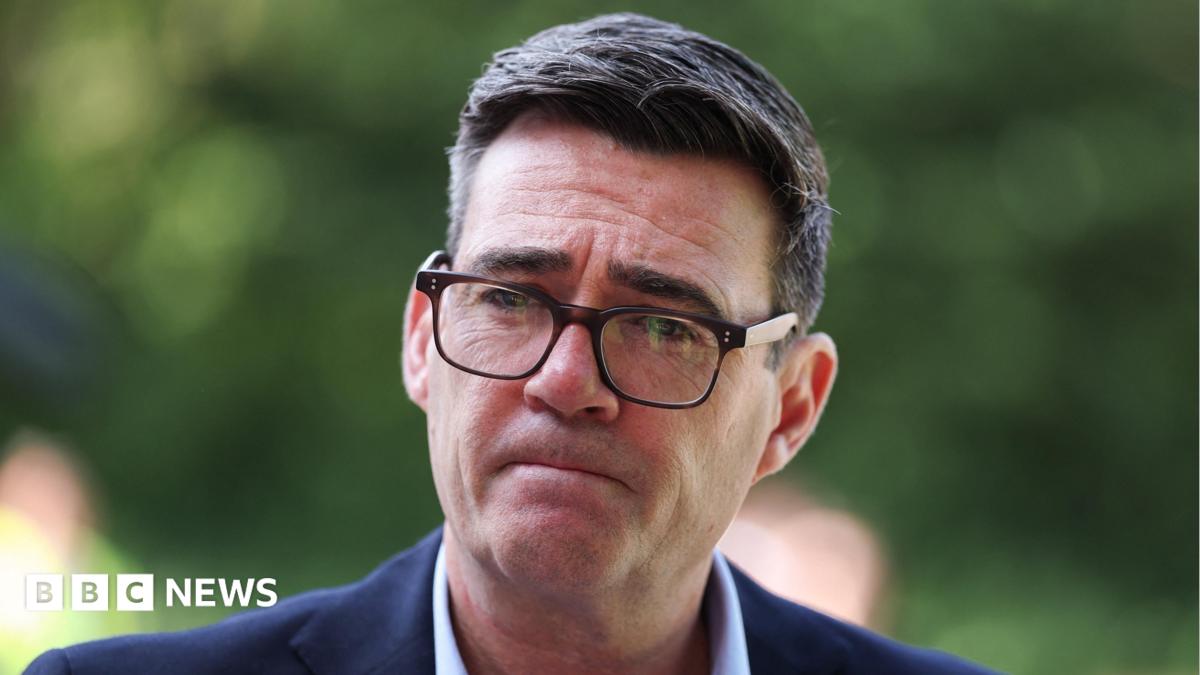
London, United Kingdom — On his fourth day as prime minister, Andy Burnham did not stay at Downing Street in London. Nor did he go to Manchester, the home of Number 10 North. He went to Glasgow.
Hours before King Charles and Queen Camilla opened the 2026 Commonwealth Games, Burnham held his first in-person meetings with Scotland’s First Minister John Swinney and Wales’ First Minister Rhun ap Iorwerth. The talks were meant to demonstrate, in Burnham’s own words, that growth is needed “in every postcode across the whole of the UK”. A meeting with Northern Ireland’s First and Deputy First Ministers, Michelle O’Neill and Emma Little-Pengelly, is pencilled in for a wider UK tour in August.
Notably absent from the agenda, at Burnham’s insistence, was any discussion of a second Scottish independence referendum.
Just days after being appointed prime minister, Burnham is testing a proposition that will define his premiership. He’s selling a vision that the office itself can be partly relocated out of London to Manchester, the city he governed as mayor from 2017 until his return to UK Parliament in the Makerfield by-election last month.
What Number 10 North actually is
Stripped of rhetoric, Number 10 North is a written ministerial statement. On July 21, Baroness Smith of Basildon, Leader of the House of Lords and Lord Privy Seal, confirmed on the government’s behalf that devolution and local growth policy functions are moving out of the housing ministry and the Treasury and into a new Manchester-based operation. There, civil servants will work inside a restructured Office for the Prime Minister and the Cabinet, led by Cabinet Secretary Dame Antonia Romeo.
Number 10 North will be based at Manchester’s Heron House in the interim and the government “Digital Campus” once it’s completed in 2032, as the new government under Prime Minister Andy Burnham seeks to establish No 10 North as “the dominant driver of the UK’s economy” [Christopher Furlong/Getty Images]
The interim headquarters is Heron House, in the New Islington area of Manchester, chosen partly for its proximity to a planned Manchester Digital Campus.
Caroline Simpson, the outgoing chief executive of the Greater Manchester Combined Authority, has been named Burnham’s deputy chief of staff, and will be in charge of day-to-day office operations. Downing Street says Burnham himself expects to work from Manchester “at least one day a week”, though officials caution his diary may change, and insists the arrangement carries no additional cost to taxpayers.
Burnham calls it “the nerve centre of a rewired Britain” and rejects suggestions it is symbolic. “Not a gimmick,” he told his first Cabinet meeting about Number 10 North.
Plumbing, but no water
Number 10 North “establishes the plumbing, but the water isn’t flowing yet”, said Mirte Boot of the Institute for Public Policy Research (IPPR) North. The institutional architecture is firming up, but fiscal devolution – ie, the transfer of money and tax-raising power – that would make such a policy meaningful doesn’t yet exist, she added.
Still, she calls it “a step in the right direction” after what she describes as “too much power condensed into one postcode”. Leaving Westminster isn’t enough; Number 10 North will need “strong political leadership aside from the prime minister”, she added.
The verdict that Number 10 North contains vision and ambition but currently lacks a detailed plan and delivery mechanism is a recurring response from independent voices.
Jonathan Carr-West of the Local Government Information Unit calls Burnham’s devolution agenda “the most ambitious statement … from a senior politician in a generation”, while warning that English councils are so financially hollowed out that the vision “requires a vehicle” it does not yet have.
Malcolm Morgan, a transport researcher at the University of Leeds, puts it more bluntly: genuine devolution means spending, taxation and regulatory power, not just relocated functions, and “devolution does not create more funding”.
That funding question sits unresolved alongside the national one. The 2026 English Devolution and Community Empowerment Act expanded mayors’ control over transport, planning and housing, but left fiscal devolution to a separate Treasury “roadmap” due alongside the autumn budget. According to Centre for Cities, a UK urban policy think tank, the UK remains the most fiscally centralised country in the G7: some 95 percent of tax revenue flows straight to Whitehall.
Devolution, or recentralisation?
For Scotland’s SNP government, the Number 10 North framing is beside the point. First Minister Swinney responded that “rhetoric alone will not cut it” and argued that four consecutive Holyrood elections have handed his party a mandate for Scottish self-determination, something Westminster keeps ignoring, he said. In Glasgow, Burnham declined to engage with that argument directly.
Meanwhile, Wales’ Ap Iorwerth struck a more cooperative note but still said he expected “that Number 10 North would not become Whitehall with a different postcode”.
He also used the meeting with Burnham to press for a new Wales Bill granting policing and justice powers, and a replacement for the Barnett Formula funding mechanism, which Westminster uses to calculate annual changes to the block grants allocated to the UK’s devolved governments, so Wales would have funding parity with Scotland.
Reform UK’s Nigel Farage, from the opposite political direction, warned that a Number 10 in the south and one in the north would simply “fight against each other”.
What it means in Manchester
In Bury, Greater Manchester, Scottish-born Debe Conway sells children’s books at markets and has lived in the area for 56 years, but remains unconvinced about the new prime minister.
Her biggest concern is immigration, which she called Burnham weak on. And as for Number 10 North, she wants to know how it’s being paid for, and asks how long it will last, considering that the UK has had seven prime ministers in the last 10 years.
Rich Carver, who has run pizza restaurants in Manchester for 15 years and is currently “soaking up the energy in the city”, says he cares more about what will happen in the next 10 years.
He’s also tired of the succession of governments and wants this one to last. He likes Burnham and is optimistic enough about the city’s trajectory that he is opening a new restaurant in the coming weeks, something he would not have done five years ago.
“We are all one country,” he says, hoping the rest of the UK (and the media) give the new prime minister time and the chance to implement his vision. Whether that time produces growth, or just relocated offices, is the question Number 10 North still has to answer.
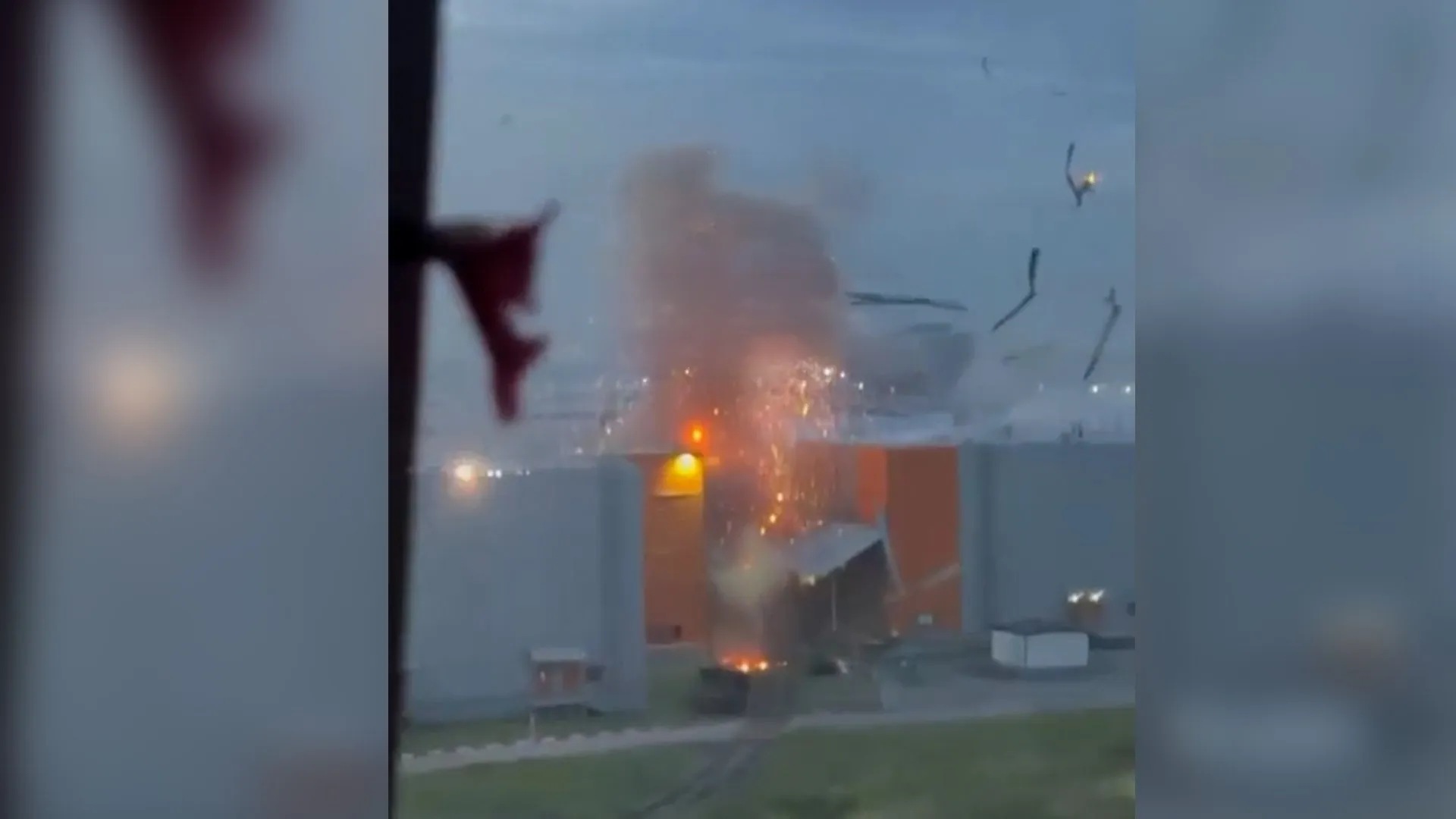
A major fire broke out at a Wildberries e-commerce warehouse in St Petersburg after a Ukrainian drone attack. Ukraine also targeted another Wildberries warehouse on the outskirts of the city, as well as facilities in Tver and Crimea.
In addition to the ongoing attacks, shipping disruptions continue to intensify. Ship tracking data revealed that just one tanker successfully crossed the Strait of Hormuz on Thursday, marking the lowest level since May 7.
However, shipping data from London Stock Exchange Group shows that two Chinese supertankers carrying crude oil from Saudi Arabia successfully exited the Bab al-Mandeb strait on Friday. This is despite the naval blockade Yemen’s Houthis announced against Saudi Arabia on Monday.
Here is a recap of what happened on Thursday night and Friday.
Where did the US attack Iran?
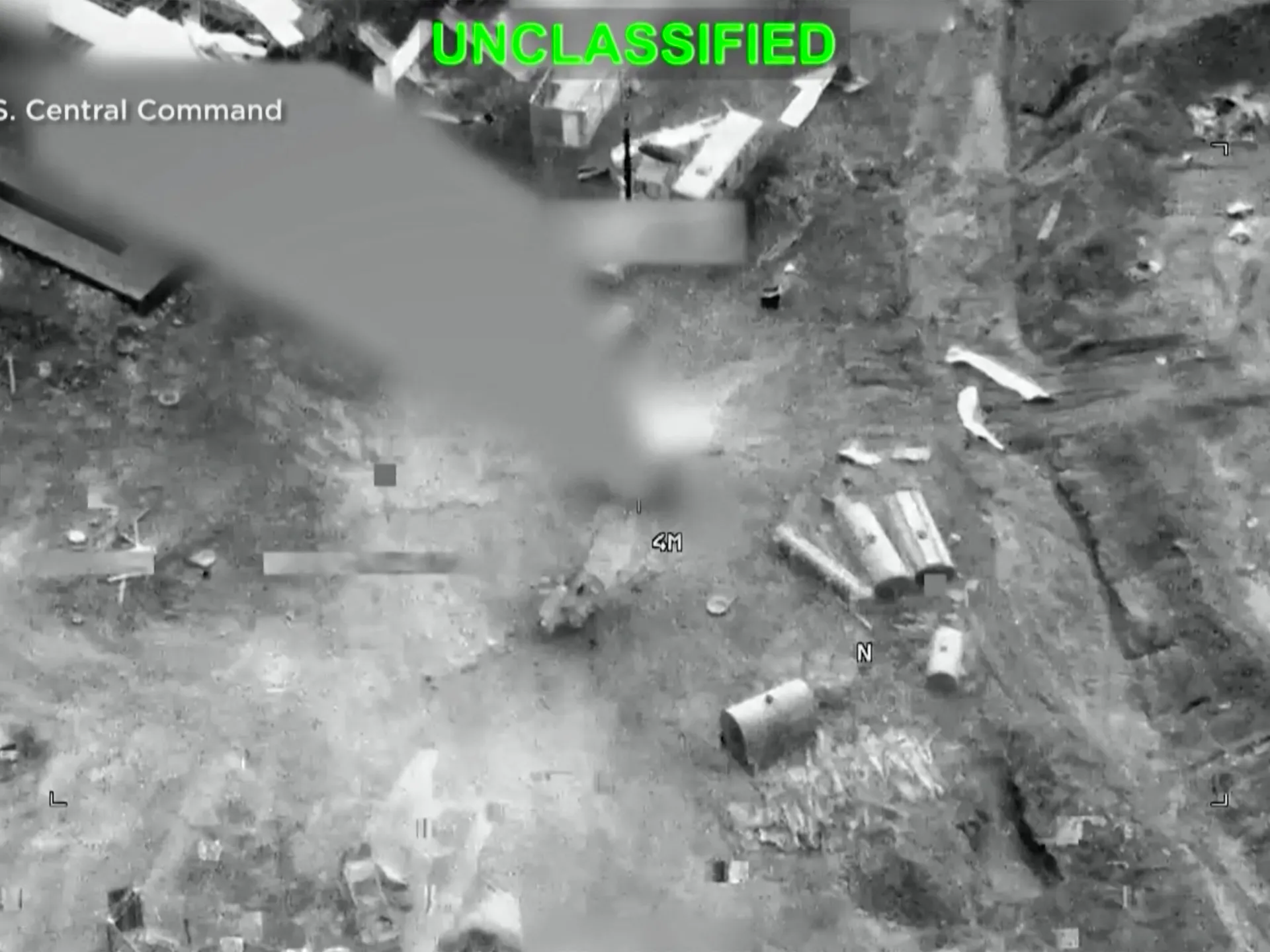
The US Central Command (CENTCOM) said that at 01:00 GMT on Friday, it concluded its latest round of strikes against Iran.
CENTCOM said it targeted Iranian military command centres, drone storage facilities, communication networks, coastal surveillance sites and maritime capabilities.
On Friday, Iranian media reported explosions or attacks across multiple Iranian cities. State broadcaster IRIB reported that explosions were reported in Khondab, Khorramabad, Konarak and Jask. Iran’s semi-official Fars news agency reported that two people have been injured following an early morning drone attack on Khorramabad, citing the deputy governor of the western Lorestan province.
Iran’s Mehr news agency reported on Friday that US missile strikes hit the cities of Andimeshk and Omidiyeh in the Khuzestan province. There were no casualties or injuries.
Al Jazeera’s Tohid Assidi reported from the Iranian capital, Tehran, that explosions were heard on Qeshm island, located in the Strait of Hormuz, on Friday.
Attacks on the Iranian port city of Bandar Abbas have injured two people, Iranian media reported on Friday.
Iran’s semi-official Tasnim news agency reported on Friday that four people were killed and five others were injured in a US missile attack near the southwestern city of Ahvaz.
Where did Iran strike in the Gulf?
Bahrain: In a statement carried by Iran’s Mehr news agency, the Iranian army said it used drones to target fuel storage tanks, equipment warehouses and troop living quarters at Sheikh Isa Air Base in Bahrain.
Jordan: The military added that aircraft hangars, maintenance facilities and accommodation sites at the Muwaffaq Salti/Al-Azraq base in Jordan were also hit, warning that any actions against Iran’s interests would undermine regional security and economic stability.
What have leaders on either side said?
On Thursday, US President Donald Trump stepped up his rhetoric against Tehran. He told the US news website Axios that he may launch the largest strikes on Iran yet, after Tehran carried out another wave of retaliatory attacks on US allies in the Gulf, including hitting a telecommunications tower in Kuwait.
“I am close to making a decision. We are all set for it,” Trump said.
Separately, Trump threatened, on his Truth Social platform, that if Iran attacked ships, the US would use Tehran’s frozen assets to pay for repairs.
Iranian Foreign Minister Abbas Araghchi warned on Friday that using frozen state assets to pay for future claims sets a dangerous global precedent.
“Seizing another nation’s assets to pay for unrelated future claims is an incendiary precedent,” Araghchi wrote on X.
He cautioned that “those who celebrate or profit from such funds should remember: once governments normalise confiscation, no one’s assets are safe. Ensuing chaos will not be pretty or peaceful”.
Burnham’s first day as prime minister in No 10 North will include talks with business leaders, including representatives of the Federation of Small Business, the Confederation of British Industry and the British Chambers of Commerce, about how to generate growth and investment.
Labour wants to create a plan that would pull from existing devolution strategy and local growth policy, to allow civil servants, mayors, councils and businesses to work together more closely.
Burnham’s first week in power has seen him make a series of interventions aimed at easing the cost of living, including announcing a 20% cut in business rates for pubs, social clubs and live music venues from April next year.
However, Conservative leader Kemi Badenoch has criticised his ambitions for being “too small”.
Speaking on Thursday, she urged him to tackle high energy costs for businesses as well as a gap in defence funding.
“When you are mayor of Manchester, you are handed a big pot of someone else’s money, and you decide where to spend it,” she said.
“I’m sure this is great fun. It can make you very popular. But it is not the same as being prime minister.
“Andy Burnham needs to do better. He is behaving like he’s still the mayor of Manchester. He is now the prime minister of the United Kingdom, he needs to start acting like it.”