Discover the latest happenings and stay in the know with our up-to-date today news coverage. From breaking stories and current events to trending topics and insightful analysis, we bring you the most relevant and captivating news of the day.
Fenerbahce president refuses Ismail Kartal’s resignation after fans threw bottles at coach in Roma Champions League tie.
Published On 11 Sep 202611 Sep 2026
Fenerbahce coach Ismail Kartal quit his role with the Turkish club after he was targeted by a bottle thrown from the crowd during hit side’s 1-1 Champions League draw with Roma on Thursday, only for his president to reject the resignation minutes later.
The 65-year-old Kartal told a press conference he was leaving “never to return”, adding that he had taken the decision “to clear the way for the club”.
Recommended Stories
list of 4 itemsend of list
Immediately after the press conference, Fenerbahce president Aziz Yildirim told reporters that Kartal “continues in his role”.
“Some fans threw a bottle at the coach’s head this evening during the game. He is upset about it,” Yildirim said.
“I just spoke to Ismail Kartal. He mentioned the bottle incident and he also complained about being under pressure.”
Asked if Kartal had told him that he would stay, Yildirim said: “There’s no need for him to say (openly) that he’d continue. I am his senior, I told him to continue and that’s it. We are a family.”
Kartal, who spent a decade at Fenerbahce as a player, coached the club in 2014-15, then on an interim basis in 2021-22 before returning for a full campaign in 2023-24. He was assistant manager at Fenerbahce the last two times the club won the Super Lig and returned for a fourth managerial spell in June.
Fenerbahce have finished second in the Turkish top flight in the last five seasons and reached the league phase of the Champions League this season for the first time in 18 years.
European Parliament’s Vice President Pina Picierno says Hsiao Bi-khim’s visit ‘was kept secret until her arrival to protect her participation’ in the conference.
Published On 11 Sep 202611 Sep 2026
Taiwanese Vice President Hsiao Bi-khim is making a rare visit to Europe, attending a forum on democracy in Italy alongside the island’s foreign minister, the presidential office said.
Hsiao has been invited to attend the Ventotene Conference for Freedom and Democracy, and is travelling with Taiwanese Foreign Minister Lin Chia-lung, the presidential office said in a brief statement.
Recommended Stories
list of 4 itemsend of list
Other details will be provided once the two return to Taiwan from the Italian island of Ventotene, it added,
While Taiwan’s foreign ministers occasionally visit Europe and other parts of the world that have no formal ties to the Chinese-claimed island, it is rare for an official as senior as the vice president to do so, given the risk of backlash from Beijing against the host nation.
Pina Picierno, vice president of the European Parliament, said Hsiao’s planned participation “was kept secret until her arrival to protect her participation” in the conference.
“No one can determine who can be hosted on European soil, what voices can be heard, and what presences must be hidden,” Picierno said in a Facebook post. “It is a simple and very clear message: intimidation cannot decide who participates in our democratic debate.”
“Freedom of debate is not negotiable with autocracies. And Ventotene, more than ever today, must continue to be the place where freedom and democracy are defended without fear,” she added.
The Ventotene conference takes place from Thursday until Saturday this week. Italy, like most countries, has no formal diplomatic ties with Chinese-claimed Taiwan.
Oleksandra Matviichuk, a 2022 Nobel Peace Prize laureate and president of Ukraine’s Centre for Civil Liberties, is also expected to participate in the conference.
China says Taiwan is one of its provinces, a view the democratically governed island strongly rejects.
Last November, Hsiao spoke at the Inter-Parliamentary Alliance on China’s annual summit, held in the European Parliament in Brussels.
Members of the high court have exchanged accusations after one justice was accused of involvement in a bank scandal.
By AFP and The Associated Press
Published On 11 Sep 202611 Sep 2026
Brazil’s Supreme Court has cancelled a second straight day of deliberations as suspicions of corruption, political bias and police interference loom over several of its members.
Cancellations are rare at the high court. But on Thursday, Chief Justice Luiz Edson Fachin nixed a second consecutive session, calling for the court to reconvene on Tuesday instead.
Recommended Stories
list of 3 itemsend of list
The decision was spurred by an ongoing crisis among the court’s members.
The divisions emerged on September 1, when one justice, Andre Mendonca, unsealed a series of federal police documents that appeared to show a disgraced banker, Daniel Vorcaro, seeking advice from another justice, Alexandre de Moraes.
De Moraes has rocketed to prominence in recent years for his roles in high-profile cases.
He presided over the trial of former President Jair Bolsonaro after prosecutors accused the far-right leader of plotting a coup following his 2022 election defeat. De Moraes also oversaw suspensions of platforms like X and Rumble for failing to abide by court orders, making him a target for Brazil’s right wing.
The document release authorised by Mendonca, a Bolsonaro appointee, contains roughly 30 text messages sent to a phone number associated with de Moraes, allegedly from Vorcaro.
In response, de Moraes has accused Mendonca of abusing his authority on the court for political gains. He requested a probe into whether Mendonca interviewed Vorcaro without the presence of police or prosecutors.
Tuesday’s session will involve the full Supreme Court bench, and 10 of the justices will discuss whether the 11th member, de Moraes, should be investigated over the text messages.
The tit-for-tat on Brazil’s high court is the latest fallout from the Banco Master corruption scandal.
Vorcaro, the head of the Banco Master financial institution, was arrested in November 2025 on accusations he defrauded investors of billions in lost funds, in one of the biggest banking scandals in the country’s history.
The collapse of Banco Master’s private banking arm left behind more than $7bn in debt.
Lawmakers from across the political spectrum have become embroiled in the unfolding scandal as new details emerge.
The turmoil risks affecting October’s general elections, including a pivotal presidential election.
Left-wing incumbent Lula Inacio Lula da Silva is set to compete for the presidency against Jair Bolsonaro’s eldest son, Senator Flavio Bolsonaro.
Both Lula and Senator Bolsonaro have called for investigations into the Supreme Court justices.
The Bolsonaro family itself has been dragged into the Banco Master scandal. In May, the publication Intercept Brasil released a report showing that Senator Bolsonaro petitioned Vorcaro for funds to finance a film about his ex-president father, who is now serving a 27-year prison sentence.
Senator Bolsonaro has denied wrongdoing, claiming he did nothing more than seek private sponsorship for the film, entitled Dark Horse.
But on Thursday, Brazilian police executed dozens of raids related to the Banco Master scandal, including some that targeted two figures involved in the film: Karina Gama, the head of a production company, and Congressman Mario Frias, who served as executive producer.
Senator Bolsonaro has called the probes “attempted political interference” ahead of the elections.
Venezuela’s former first lady, Cilia Flores de Maduro, has asked a judge to release her from federal detention in the United States, citing a worsening heart condition.
In an application for pre-trial release on Wednesday, her legal team asked for the court to allow Flores to await trial under home confinement in Manhattan.
Recommended Stories
list of 3 itemsend of list
It described her declining health since US military operation on January 3 that resulted in her abduction from Caracas and imprisonment in New York, as well as that of her husband, former Venezuelan President Nicolas Maduro.
“Prior to the United States’ military invasion of Venezuela, Ms. Flores de Maduro was physically healthy and took no ongoing medication, other than a monthly injection to help control her mitral valve prolapse,” the legal filing said.
“Now she is prescribed four medications, maintains nitroglycerin by her side in the event of a potential heart attack, and grapples with the continued medical advice suggesting coronary exploration and surgery.”
Flores was a prominent figure in her husband’s government, serving as first lady since his inauguration in 2013.
Prior to Maduro’s first inauguration, she was also a leading member of the United Socialist Party of Venezuela (PSUV), the country’s dominant political movement, leading the National Assembly for more than four years.
But Maduro had long clashed with the administration of US President Donald Trump, who accused Venezuela of sending drug-traffickers into the US. Both Maduro and Flores have also faced allegations of participating in human rights abuses, including the violent suppression of political dissent.
After launching a one-day military operation to abduct Maduro and Flores, the Trump administration charged them both with drug- and weapons-related charges. They are currently awaiting trial in New York City.
But Flores’s health has been in doubt since her forced removal from Venezuela, according to her legal team.
After consulting outside medical experts, Flores’s lawyers said they believe she may have suffered a minor heart attack on July 29 while in US custody.
They also questioned whether she was receiving the appropriate medical care for her mitral valve prolapse, a condition affecting one of the heart’s valves.
Since her imprisonment, her lawyers said Flores has not received the monthly injection she needs to manage the condition.
Instead, she has reportedly been prescribed baby aspirin, a statin, diltiazem and nitroglycerin to use when she experiences chest pain.
Doctors have recommended that she undergo a cardiac procedure, which could result in additional heart operations. If she undergoes such treatment, Flores “will need adequate time to recover from any procedures in a setting conducive to restoring her health”, her lawyers said.
Thursday’s filing acknowledges that Flores does not “dispute that she has received excellent care” from medical professionals. But it argues that “a detention centre lacks the conditions needed for such a recovery”.
Her lawyers proposed moving Flores from the Metropolitan Detention Center in Brooklyn to a residence within the Manhattan federal court district, where she and Maduro are due to go on trial next June.
Under home detention, Flores would be subject to round-the-clock armed monitoring, with visits restricted to people approved by the court and federal prosecutors. Her home would also be monitored by video and her phone calls recorded, according to the filing.
Judge Alvin K Hellerstein has yet to rule on the application.
Flores, 69, and Maduro, 63, have been held in US custody since the January raid on their home in Caracas. Both have pleaded not guilty to the charges of participating in a conspiracy to traffic cocaine into the US.
The Ethiopian calendar is a solar calendar based on the Egyptian and Julian calendars and was brought to Ethiopia by missionaries. The year consists of 12 months of 30 days and a thirteenth month of five or six timekeeping days.
Pagume, the 13th month in the Ethiopian calendar, comes from the Greek word epagomene, which means ‘days forgotten when a year is calculated’. This month has five days or six days in a leap year. According to the Ethiopian calendar, a year has 365 days, six hours, two minutes and 24 seconds. Once every four years, the six hours add up to 24 hours and become the sixth day in a leap year. Once in 600 years, the two minutes and 24 seconds add up to a full day and form a seventh day.
Based on the Julian calendar basis, the Ethiopian calendar is currently seven years and eight months behind the Gregorian calendar used in most of the world.
Enkutatash means the ‘gift of jewels’. It is said to refer to the Queen of Sheba returning from her visit to King Solomon in Jerusalem in 980 BC. On the Queen’s arrival back in Ethiopia, her chiefs welcomed her by filling her treasury with jewels (‘enku’). It may also refer to the countryside, as this time of year coincides with the end of the rainy season meaning the landscape is covered with Adey Abeba, whose bright yellow flowers appear almost in celebration of the impending harvest.
Celebrations for the Ethiopian New Year usually last for a week and are focused on family events. The holiday starts on New Year’s Eve, when each household light wooden torches called “chibo” in Amharic language, that symbolise the coming of the new season of sunshine after the end of the rainy season that has prevailed since June.
In just under three months, 30-year-old Abhijeet Dipke – the founder and face of India’s Gen Z “cockroach” protests – has acquired the kind of celebrity status normally reserved for a breakout actor or cricketer.
In politics or activism, unless you come from an influential family, such recognition can take years – if it comes at all.
“It’s been a rollercoaster ride. Two-three months ago, nobody knew me. I was just in my room in Boston watching documentaries or attending lectures,” said Dipke, who recently completed a master’s in public relationsat Boston University.
“Now I’m here surrounded by hundreds of people, by cameras. It’s a bit overwhelming.”
In and around his hometown of Chhatrapati Sambhajinagar in the western state of Maharashtra, Dipke is routinely thronged by people wanting to shake his hand or take a photo.
If the attention bothers him, it doesn’t show. Perhaps because politics isn’t entirely new to him: before moving to the US, Dipke had worked with the Aam Aadmi Party (AAP), an opposition party that grew out of an anti-corruption movement, for three years.
Then, on 16 May, Dipke wrote a post on X that would change his life: “What if all cockroaches come together?”
It was a response to a remark by India’s Chief Justice Surya Kant, who had likened jobless youngsters to cockroaches. Kant later said his comments had been misinterpreted and were directed specifically at young people using fake degrees, rather than the country’s youth more broadly.
But the clarification did little to quell the outrage.
Dipke said he wrote his post while playing a video game. “It was totally spontaneous. I had no idea it would become such a big movement,” he said.
Encouraged by tens of thousands of responses, he joined a handful of former colleagues and activists to launch the satirical Cockroach Janta Party (CJP), its name playing on both the chief justice’s remark and that of Prime Minister Narendra Modi’s Bharatiya Janata Party (BJP).
Alongside the support, Dipke and the campaign were fiercely trolled by government supporters. Their website and X account was briefly taken down in India.
Dipke says that when he wrote to X and to India’s Ministry of Electronics and Information Technology asking why the account had been taken down, he received a notice saying it had been withheld under Section 69A of the Information Technology Act which allows the government to block online information ‘in the interest of sovereignty and integrity of India, defence of India, security of the State’.
The ministry did not reply to the BBC’s questions about the issue, but The Indian Express and other media reported government officials as saying the sites had been blocked because of ‘national security concerns’. Dipke says he decided to return to India in response to this.
“I took the decision to come back to India when I was called a national security threat by my own government. That really hurt me. Isn’t my government supposed to stand by me when I’m abroad?” he said.
“I decided I need to go back to my country to show I’m not a national security threat. I love my country, just not in the way that you [the government] want.”
Israeli attacks come a week after it said to have established operational control over the strategic ridge.
Published On 10 Sep 202610 Sep 2026
The Israeli military says it has destroyed Hezbollah’s underground infrastructure at a key site in southern Lebanon, with Israeli government officials adding that the operation consolidated its so-called security zone in the area.
In a joint statement, Prime Minister Benjamin Netanyahu and Defence Minister Israel Katz said on Thursday that Israeli forces would remain in the area to prevent the Iran-aligned Hezbollah militant group from re-establishing its presence and rebuilding its capabilities.
Recommended Stories
list of 4 itemsend of list
The Ali al-Taher ridge, about 15 km (10 miles) from the Israeli border, has become one of the most contested areas of the war between Israel and Hezbollah. Katz claimed last Friday that Israeli forces had driven Hezbollah fighters out of what he said was a network of tunnels under the disputed highland.
Reuters reported that Hezbollah is believed to have built an underground command centre and weapons stores there in July, quoting unnamed Lebanese security sources.
Lebanon’s National News Agency said that the Israeli military carried out a powerful blast at the ridge, with tremors and the sound of the explosion felt across Nabatieh and surrounding areas in southern Lebanon.
Hezbollah has yet to respond to the recent Israeli attack.
The Israeli military said its forces had established “operational control” over the ridge, both above and below ground, before dismantling the infrastructure. The network extended for more than 2 km (just over 1 mile) and contained dozens of rockets, missiles and drones, as well as anti-tank missiles, mines and explosive devices, it said.
The military said a central command complex belonging to Hezbollah’s Badr unit was located within the underground infrastructure. The complex contained command centres, weapons storage rooms and living quarters that allowed fighters to remain underground for extended periods, it said.
Iran reportedly warned the United States last month that it would respond forcefully if Israeli attacks on the ridge continued.
Over the last weeks, Israeli strikes and ground operations around the Ali al-Taher ridge continued despite a ceasefire agreed in June, after Israel gained control of nearby Beaufort Castle and part of the higher ground overlooking much of southern Lebanon and northern Israel.
A US-brokered framework agreed after a June ceasefire — between Lebanon and Israel, without negotiating with Hezbollah — called for Israeli forces to gradually withdraw from southern Lebanon while Lebanese troops disarm Hezbollah.
The process has stalled, however, with Hezbollah refusing to give up its weapons and Israel saying it will not withdraw until the group disarms.
Since 2023, Israel has pushed into southern Lebanon and seized several strategic positions, occupying swathes of land, which it now increasingly says it needs to maintain a so-called buffer zone between Israel and Hezbollah positions in Lebanon.
Acting President Rodríguez has pursued trade opportunities with the Modi government and associated business groups. (Presidential Press)
Caracas, September 10, 2026 (venezuelanalysis.com) – Venezuelan Acting President Delcy Rodríguez presided over the signing of a memorandum of understanding between the Ministry of Ecosocialism and India’s Greens Zoological Rescue and Rehabilitation Centre (GZRRC) to “modernize and strengthen” Venezuela’s network of zoos, bioparks, and wildlife conservation centers.
GZRRC is the operating entity of the global conservation initiative Vantara, based in the Indian state of Gujarat.
According to the Venezuelan leader, Greens will provide “technical assistance, training, and technology to raise the standards for the management and protection of Venezuela’s biodiversity.”
“Our professionals will be able to attend courses in India,” she added during the televised event on Saturday, September 5.
Rodríguez noted that Venezuela has 16 zoos and aquariums, 12 breeding centers, and four rescue centers. She also announced that the agreement involves “incorporating an aquarium, a wildlife conservation center, a veterinary center, and a wildlife hospital into the master plan for the recovery of La Guaira State” in the wake of the June 24 double earthquake.
The initiative with Vantara, which has a five-year time frame, also includes exchange programs for veterinarians, biologists, and other professionals involved in wildlife management and conservation.
Days earlier, Venezuela enacted the Law Approving the Framework Agreement for the Establishment of the International Big Cat Alliance (IBCA), which will focus on protecting seven feline species considered among the planet’s most representative. Venezuela is home to six of the world’s most important feline species, accounting for 14 percent of global feline biodiversity.
The legislation stems from a proposal put forward by India in 2023, which currently has the backing of 13 member states and applications for membership from more than 25 others.
During the recent ceremony, Rodríguez thanked Indian Prime Minister Narendra Modi, Ambassador P.K. Ashok Babu, Vantara, and the wealthy Ambani family for “all their support.”
Venezuela’s Acting President held a four-day visit to India in June to offer investment and trade opportunities to major Indian companies, including the Tata Group, Amul, and Reliance. The latter has been a major importer of Venezuelan crude in recent months.
Vantara is backed by Reliance Industries, a major conglomerate owned by the Ambani family, with a major presence in multiple economic sectors, including energy, telecommunications, financial services, and retail. Its wildlife rescue center is located within the Jamnagar refining complex in Gujarat, the largest in the world. The facility, which covers approximately 3,500 acres, is managed by businessman Anant Ambani, the youngest son of India’s richest man, Mukesh Ambani.
Despite Vantara’s declared wildlife conservation mission and philanthropic endeavors, the company has faced controversy in recent years.
Various environmental groups and international organizations have accused it of operating as “a large-scale private zoo,” managing wildlife as commodities around the world, and taking advantage of loopholes in international regulations that seek to ensure that the trade in wild animals and plants does not threaten their survival.
In 2024, India’s Supreme Court appointed a panel of retired judges to investigate the alleged illegal acquisition of animals by Vantara, particularly elephants, as well as possible violations of wildlife regulations and money laundering allegations. The court ultimately dismissed the complaint filed by the Karanartham Viramah Foundation.
However, criticism that Vantara is breeding exotic animals for trade, as well as environmental concerns over setting up a wildlife sanctuary in the vicinity of an oil refinery, have persisted.
Venezuela had dealings with the Indian group before the latest memorandum of understanding. A joint investigation by Süddeutsche Zeitung and Venezuelan outlet Armando.info claimed that at least 39,000 wild animals from all over the world had been transferred to Vantara’s facilities by the end of 2024.
The identified transfers included over 5,000 animals from Venezuela, among them members of protected species such as the Orinoco crocodile, harpy eagle, lowland tapir, giant anteater, jaguars, and spider monkeys.
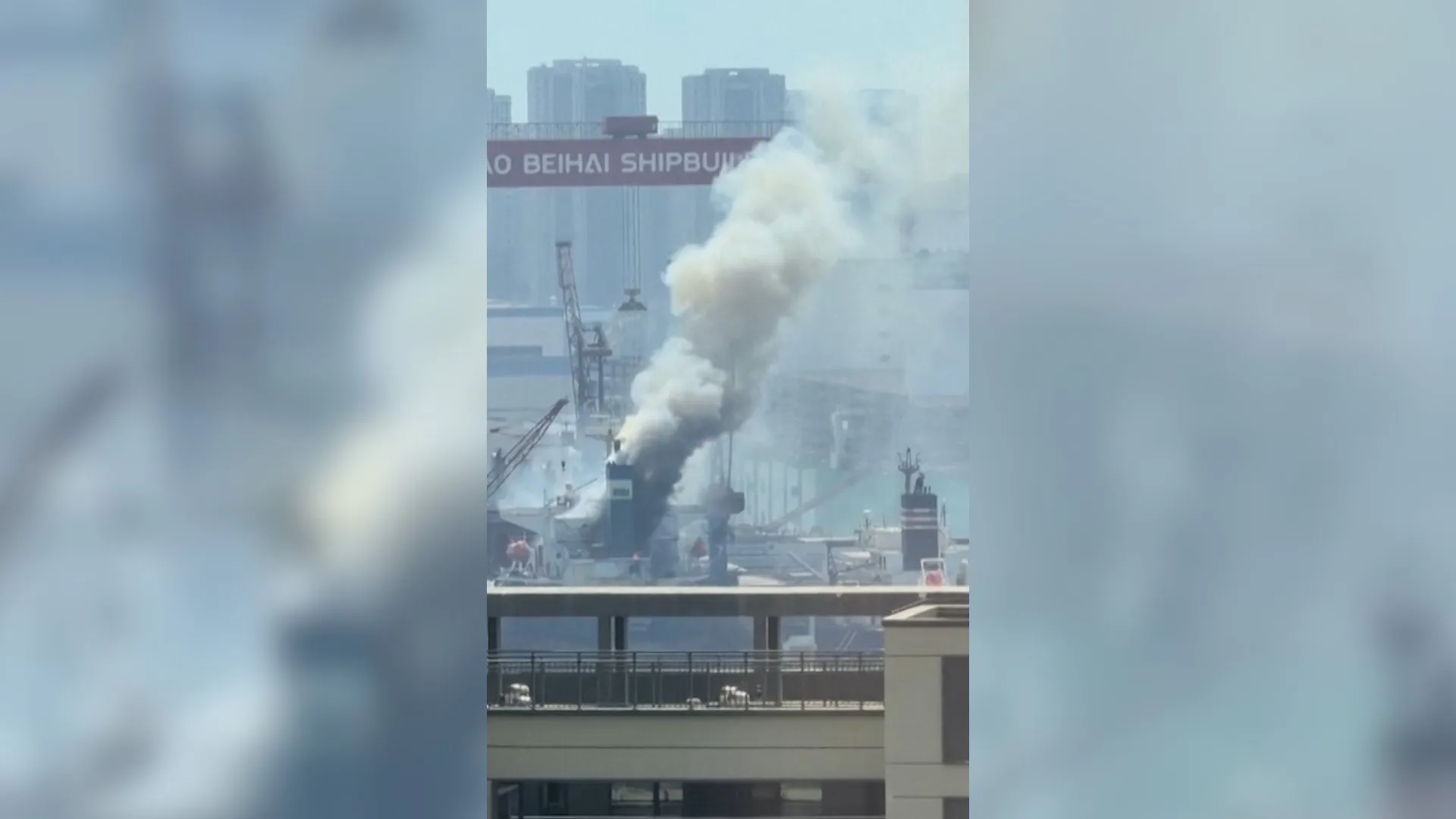
At least 25 people were killed after a fire broke out aboard a Liberia-flagged ship while it was undergoing repairs at a shipyard in Qingdao, China. President Xi Jinping ordered a swift investigation and accountability.
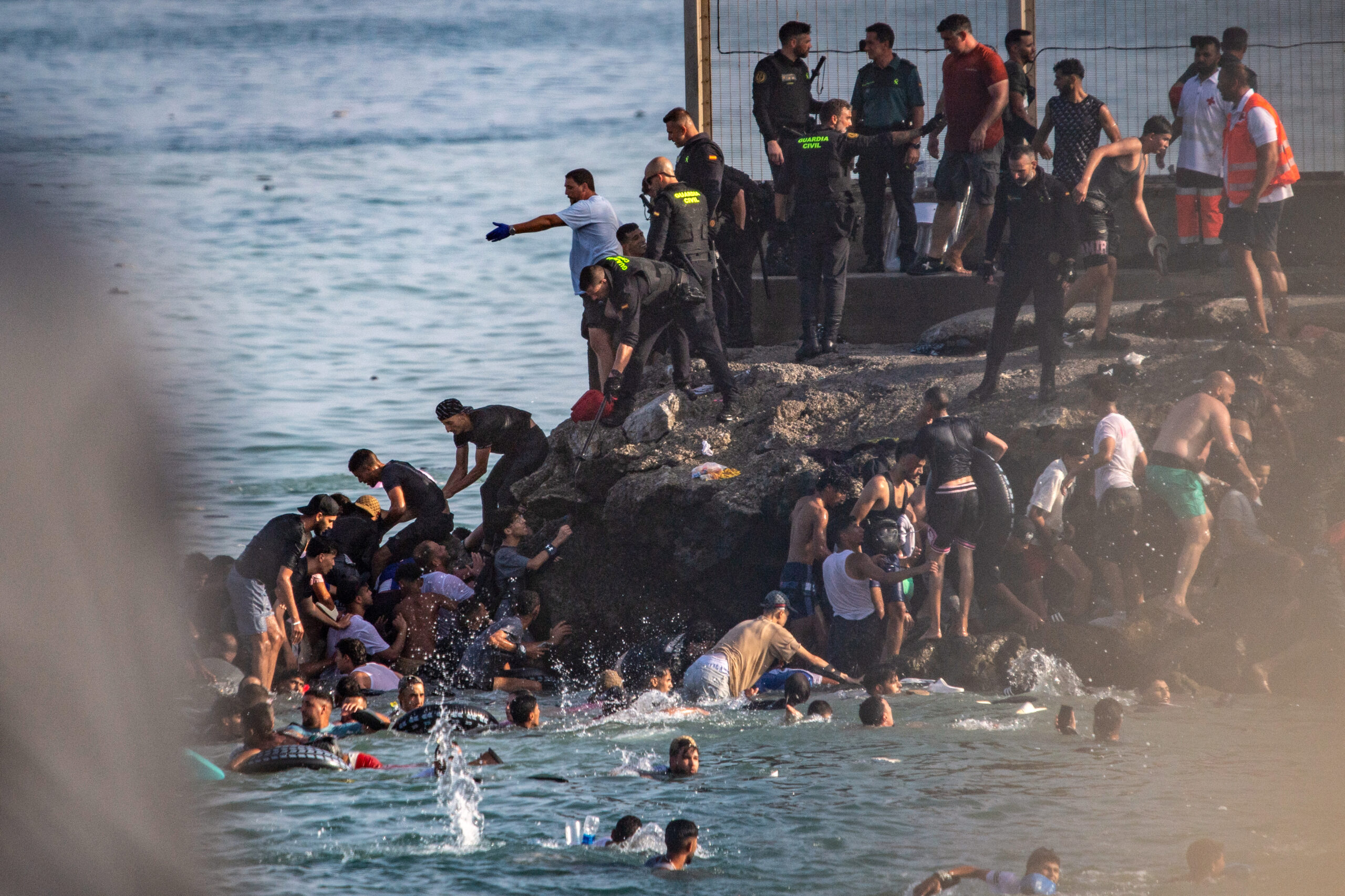
Rabat: Morocco said on Thursday there were “no facts” establishing its involvement in the massive migrant rush into Spain’s North African exclave of Ceuta in July.
More than 70,000 migrants entered Ceuta from Morocco on July 30 and 31 in an unprecedented, chaotic surge that left scores dead and sparked European Union infighting over the touchy issue of migration.
The Moroccan foreign ministry said there were “no facts or reports proving any involvement by the Moroccan authorities”.
The ministry added that Rabat refused to become the “scapegoat for political score-settling” in Spain.
The statement marked the kingdom’s first official reaction to a Spanish police report accusing Morocco’s security forces of “total permissiveness” when the mass crossing took place.
Spain’s Prime Minister Pedro Sanchez has consistently avoided blaming Morocco, noting that there was no “solid proof” that the North African country orchestrated the migrant rush.
The Conservatives’ former director of campaigning and his wife have pleaded guilty to cheating at gambling by placing bets on the date of the 2024 general election.
Anthony Lee stood to win approximately £15,000 after placing more than 60 successful bets totalling £1,549, the Gambling Commission said.
He passed confidential information to his wife about when former Prime Minister Rishi Sunak was planning to call the general election.
Laura Lee, who was a parliamentary candidate at the time, placed eight successful bets on the election date totalling £535 and would have profited by around £5,000.
On Thursday at Southwark Crown Court, Anthony Lee pleaded guilty to two offences and Laura Lee pleaded guilty to one offence.
They will be sentenced in October.
The trials of 10 other defendants will take place in September 2027 and January 2028.
Former MP Craig Williams, who was Sunak’s closest parliamentary aide at the time, pleaded guilty in June and will be sentenced at a later date.
In Williams’ case, the prosecution said he bet £250, £100, and £22.50 on the date of the 2024 election, telling the court he “used highly sensitive and confidential information”.
When details of the scandal first emerged in June 2024, Williams admitted making a “huge error of judgment”.
Sunak’s decision to call the poll was a surprise to many, including many Conservative MPs, who were expecting an autumn date.
The Conservative Party has been approached for comment.
Rome, Italy – “Anti-Zionism is not anti-Semitism”, read the black-and-yellow signs distributed by Amnesty International outside the Italian parliament on Wednesday afternoon.
Hundreds gathered in front of Montecitorio Square in Rome to oppose Italy’s so-called anti-Semitism bill.
The demonstration was organised to coincide with a meeting of the Chamber of Deputies’ Constitutional Affairs Committee, which is examining legislation approved by the Senate on March 4 by a large majority. Under Italy’s constitutional system, a bill must be approved by both chambers in the same text before it can become law.
“We are tired of seeing anti-Semitism instrumentalised to promote censorship of any kind of criticism of the State of Israel and its criminal policies,” said Daniel Calo, of Tikkun, a group of Italian Jewish antiracism activists.
“In the face of this shameful bill, we reiterate once again, forcefully, that opposing Zionism is not anti-Semitism.”
At the centre of the controversy is the possible adoption into national law of the International Holocaust Remembrance Alliance’s (IHRA) definition of anti-Semitism, which critics argue conflates anti-Semitism with criticism of Israel.
According to the IHRA, “denying the Jewish people their right to self-determination, eg, by claiming that the existence of a State of Israel is a racist endeavor”, is anti-Semitic, as is “drawing comparisons of contemporary Israeli policy to that of the Nazis”.
Anneliese Baldaccini of Amnesty International Italy said the bill, if adopted, would apply across schools, universities, social platforms and cultural associations.
The proposed law is “based on a definition that censors political criticism”, she said.
Activists argue that existing legislation already provides the tools to combat hate crimes.
They are instead calling for the adoption of the Jerusalem Declaration on Antisemitism, a non-binding set of guidelines that seeks to combat anti-Semitism while protecting freedom of expression that was developed in response to the IHRA definition.
Speaking to Al Jazeera, Francesca Albanese, the Italian legal scholar and UN special rapporteur on the situation of human rights in the occupied Palestinian territory, said legislation equating criticism of a state with anti-Semitism risked restricting freedom of expression.
“Any piece of legislation that directly or indirectly equates criticism of a state with anti-Semitism is problematic and risks creating more problems than it seeks to solve,” Albanese said.
She argued that the bill could limit the ability to analyse, document and criticise the “apartheid state of Israel”, and accused Italy of prioritising the protection of Israel over accountability.
“The need to protect the State of Israel from criticism is stronger than the need to do justice,” she said. “It is extremely dangerous because every Jewish person in the world risks being seen as a kind of emissary of Israel.”
She described Italy, under the current government, as one of Europe’s strongest defenders of Israel.
Protesters hold a banner reading ‘No anti-Semitism bill’ amid a debate on proposed legislation in Rome [Sebastiano Bacci/Al Jazeera]
Tony La Piccirella, a Palestine solidarity activist who was part of the Global Sumud Flotilla, said he worried that the bill “provides a legal instrument to attack newsrooms, online information platforms and social media, in order to silence anyone who denounces the genocide and the entire economic system that sustains it”.
But the legislation has received strong backing from Italy’s Jewish institutional leadership.
Noemi Di Segni, president of the Union of Italian Jewish Communities (UCEI), was heard by the Senate’s Constitutional Affairs Committee in January and described legislative action against anti-Semitism as “urgent and unavoidable”.
Di Segni, who was born in Jerusalem and has served in the Israeli military, has repeatedly rejected describing Israel’s war in Gaza as genocide.
In January 2025, she called such accusations “unacceptable”, arguing that terms including “genocide”, “concentration camp”, “starve”, “Nazi” and “apartheid” should not be used to describe Israel’s conduct.
The bill has exposed divisions that cut across the government-opposition divide.
It was approved by the Senate by a large majority that included much of the opposition. Six Democratic Party senators voted in favour, while the party as a whole abstained, and those divisions have continued in the Chamber.
Among the bill’s most outspoken opponents is Stefania Ascari, of the Five Star Movement, who addressed protesters before entering parliament.
“The greatest danger to Jews and to the entire world is the terrorist state of Israel,” Ascari said. She accused the bill of targeting “freedom of expression, the autonomy of universities, [and] the work of associations and NGOs”.
The committee’s sitting ended without a vote or substantive examination.
Its work is expected to resume next week, although the timetable remains uncertain. The Chamber has scheduled a final plenary vote for October 2, leaving parliament a narrow window to complete the committee stage.
In the meantime, activists say they will continue to gather outside parliament and on the streets, to vent their concerns.
Covenant, a previously little-known defense startup, has emerged with a new long-range strike weapon, named Anthem, which it says is intended to provide a cheaper, more readily producible alternative to existing cruise missiles. Already in testing with the U.S. Army, the missile reflects the growing focus on weapons in this class that can be manufactured quickly in very large numbers, even if they sacrifice a significant degree of individual-weapon capability compared to more ‘exquisite’ and costly alternatives.
Covenant, a U.S.-Israeli company founded in 2024, unveiled its Anthem weapon system today along with plans for production in the United States, Germany, and Israel. The company says it has already conducted more than 200 test flights of the weapon and has secured roughly $150 million in orders.
Anthem is being positioned accordingly as a high-volume weapon rather than a one-for-one replacement for larger, more expensive cruise missiles. In its initial form, it is ground-launched, although it is unclear exactly how this is achieved. Imagery of the weapon during Pentagon trials show it being handled on the ground using tricycle undercarriage, pointing to the use of a runway for launch.
An Anthem cruise missile at Tan-Tan, Morocco, on August 6, 2026. U.S. Army photo by Capt. Jordan Beagle
Covenant has not publicly disclosed the weapon’s range, although unconfirmed reports put it at roughly 1,200 kilometers — over 740 miles. The company is also being somewhat deliberate about how it describes Anthem, referring to it as a “deep precision-strike munition” rather than consistently classifying it as a cruise missile.
On the other hand, Reutersreports Covenant executives saying that the missile was developed with an eye toward future conflicts in the Pacific. “We were designed for the China fight,” said Covenant President Abby Denburg. That would also seem to point toward significant range.
The Anthem missile in flight. Covenant
However, more concrete details of its performance, as well as guidance type and projected level of survivability, remain undisclosed.
The company says Anthem can carry a warhead weighing more than 200 kilograms (441 pounds). That is substantially less than the roughly 1,000-pound-class warhead associated with the Tomahawk cruise missile, which can hit targets at over 1,000 miles depending on the exact configuration. Covenant argues that lower cost and much higher production rates would make it possible to employ larger numbers of their weapons against a given target set.
Anthem uses a solid rocket motor for launch and a heavy-fuel jet engine, underslung below the missile body, for cruise flight. Covenant says the system was designed from the outset around readily available components and a supply chain that would avoid dependence on individual suppliers. The company states that it has, for example, multiple solid-rocket-motor suppliers and long-term agreements covering thousands of jet engines.
Cruise missiles are assembled for a live-fire demonstration at the Africa Multidomain Training and Experimentation Center in Morocco. U.S. Army photo by Staff Sgt. Raquel Birk
Overall, the production ambitions are significant. Covenant’s new Grand Prairie, Texas, facility covers approximately 105,000 square feet and is expected to begin serial production during the first quarter of 2027, eventually reaching a stated capacity of 5,000 Anthems per year. Its facility in Saxony, Germany, is intended to reach a similar production rate, while the smaller Israeli site is planned to produce as many as 2,000 weapons annually.
“Germany possesses an exceptionally strong industrial foundation,” Denburg toldBloomberg News. “While its automotive sector is currently undergoing a structural transformation, decades of manufacturing excellence have created precisely the expertise we require.”
That would put the company’s eventual combined production target at up to 12,000 weapons per year, assuming all three facilities reach their planned capacities.
An Anthem cruise missile engages a target at the Africa Multidomain Training and Experimentation Center in Morocco, on August 6, 2026. U.S. Army photo by Staff Sgt. Raquel Birk
Covenant’s U.S. facility is intended primarily to support American customers, while the German operation is being established around a European supply chain, responding to growing demand for long-range strike weapons across that continent. The company says an unidentified international customer is expected to begin receiving German-built weapons before the end of this year. Meanwhile, U.S. Army deliveries are expected in 2027, under an accelerated qualification contract.
The weapon has already been subjected to U.S.-linked testing. In August, an unnamed defense-industry partner conducted a live-fire demonstration at the Africa Multidomain Training and Experimentation Center in Morocco. The U.S. military’s public material about that event did not identify the weapon or company, but subsequent reporting identified the missile as Covenant’s Anthem.
Covenant now says the system has flown more than 200 times over the past year, including testing involving U.S. government organizations. The company also says Anthem participated in the Army’s Project Convergence Capstone 6 experiments and that its August test helped demonstrate a new framework for allowing industry to use the Moroccan test infrastructure.
Defense-industry partners assemble a cruise missile at the Africa Multidomain Training and Experimentation Center in Morocco. This photo was altered for security purposes by blurring out defense industry names and logos. U.S. Army photo by Staff Sgt. Raquel Birk
Beyond the ground-launched version, Covenant is working on a naval derivative. The company says it has a roughly $70-million contract with the Navy’s Rapid Capabilities Office to adapt Anthem into what it calls Maritime Anthem. The effort includes Defense Exportability Features intended to make the weapon easier to provide to U.S. allies and partners.
The United States already fields weapons such as Tomahawk and JASSM-ER, but those systems are expensive, and production capacity is limited. Covenant is betting that a weapon available in much larger quantities can provide commanders with another layer of long-range strike capacity, even if the destructive power of a single round falls well below that of a Tomahawk. Reutersreports that Covenant expects the weapon to eventually cost in the mid-six-figure range, although the company has not provided a final unit price. Compared to other competitors in the field, Covenant appears to be the crudest design we have seen so far, underscored by its apparent launch method, in which it takes off from an airstrip under power of its booster.
Unnamed defense-industry partners prepare a cruise missile for a live-fire demonstration at the Africa Multidomain Training and Experimentation Center in Tan-Tan, Morocco, on August 5, 2026. It has now been disclosed that this demonstration involved the Anthem. U.S. Army photo by Capt. Jordan Beagle
Recent combat operations have increased concerns about the rate at which more traditional precision weapons can actually be manufactured. Once stockpiles begin to reduce, long-range missiles have proven among the most difficult munitions to replace. That would only become more problematic during a major conflict.
Covenant has attracted venture-capital backing to pursue that problem. The company says it has raised more than $250 million from investors including Andreessen Horowitz, Founders Fund, Lux Capital, 8VC, Aleph, and Lightspeed. Its stated focus, however, is now shifting from development to production.
Anthem in flight. Covenant Covenant
The key question will be whether Covenant can turn the promised production numbers into sustained deliveries. Building thousands of long-range weapons per year requires not only an assembly plant, but also a resilient supply chain, reliable propulsion production, testing capacity, quality control, and the ability to integrate those elements at scale. It will also rely on securing more contracts from domestic and allied customers.
For now, however, Anthem represents an intriguing entrant into a crowded but increasingly important segment of the weapons market.
FFF aligns position with of other European federations, such as Belgium, England, Italy, Scotland, and Sweden.
Published On 10 Sep 202610 Sep 2026
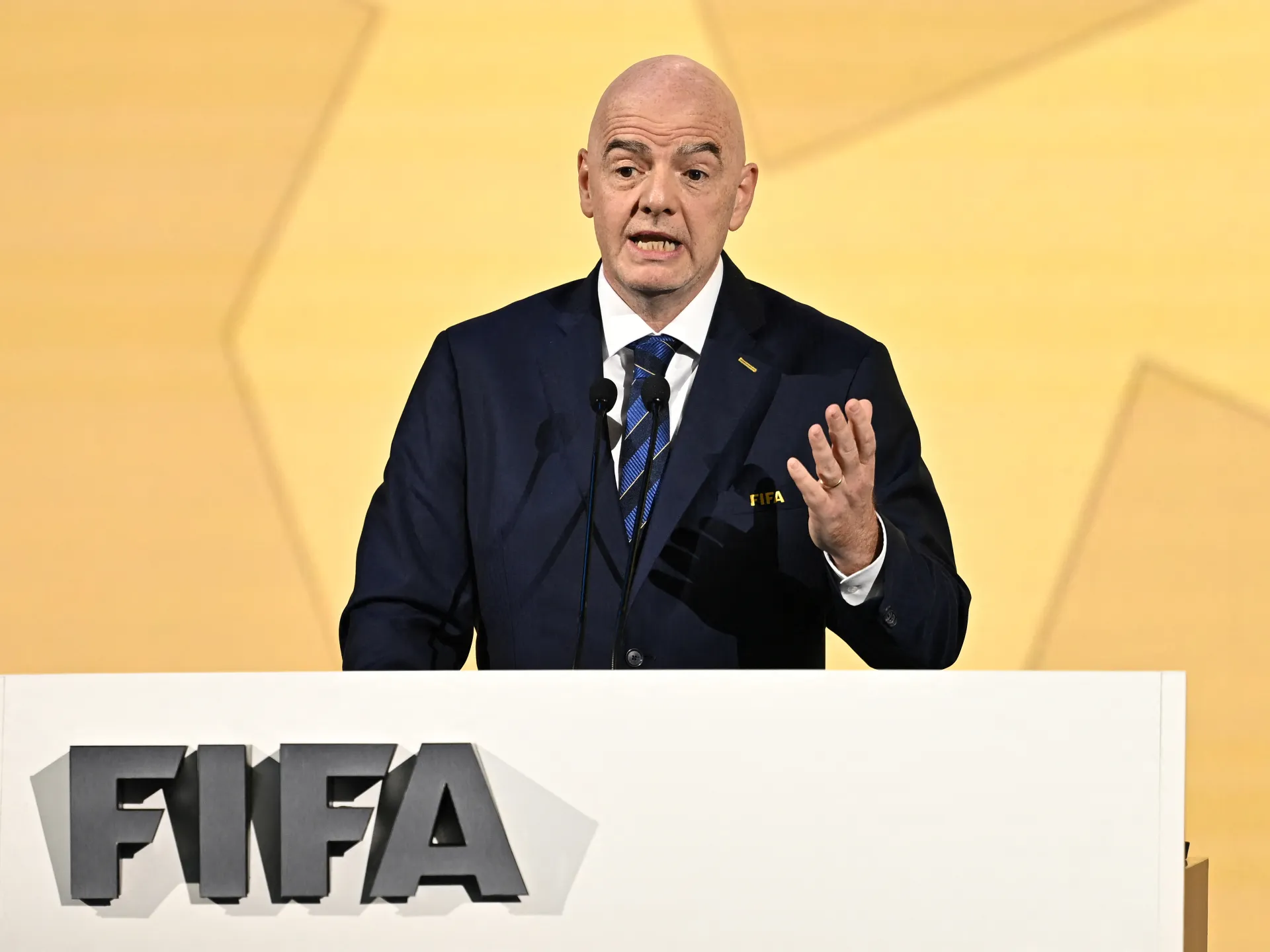
The French Football Federation is withdrawing its support for Gianni Infantino’s re-election bid as FIFA chief next year, FFF President Philippe Diallo has said, saying trust in the head of world football’s governing body had been broken.
The decision was taken unanimously by the FFF’s executive committee, Diallo said on Thursday.
“The trust placed in the FIFA president has been broken,” Diallo told reporters. “The way in which we envisage the running of world football no longer corresponds with the way it is being conducted.”
Infantino, who is seeking another term as FIFA president, has faced mounting criticism since his failed proposal to sell a 20 percent stake in FIFA competitions, including the World Cup, to private investors was abandoned in July following widespread opposition from football’s regional confederations.
Diallo said France had initially backed Infantino’s candidacy at the end of June, when he was the only declared candidate, but that subsequent events had fundamentally changed the circumstances.
“The conditions for our support for his candidacy were no longer there,” he said.
Diallo added that the proposed stake sale, which emerged without what he described as proper consultation or information being provided to federations, had raised serious questions over FIFA’s governance and decision-making.
Several European federations, including England’s and Italy’s, have withdrawn their backing for Infantino since the collapse of his proposal.
UEFA, the Asian Football Confederation and North America’s CONCACAF have called for change at the top of FIFA and are seeking a credible alternative before the March election.
Diallo said France’s decision formed part of a broader movement within UEFA and beyond and that discussions would now focus on governance reform and finding a candidate capable of defeating Infantino.
“It is not enough simply to criticise if you want things to move forward. You also have to make proposals,” Diallo said.
He added that UEFA would need to define a platform for the next FIFA leadership cycle and, when the time came, choose a candidate for the election.
“We will need to be ready by then to put forward a candidacy capable of winning the FIFA presidency,” Diallo said.
Infantino still has the support of South America’s CONMEBOL and Africa’s CAF.
The FIFA presidential election will take place in Rabat on March 18, 2027, with the deadline for candidacies on November 18.
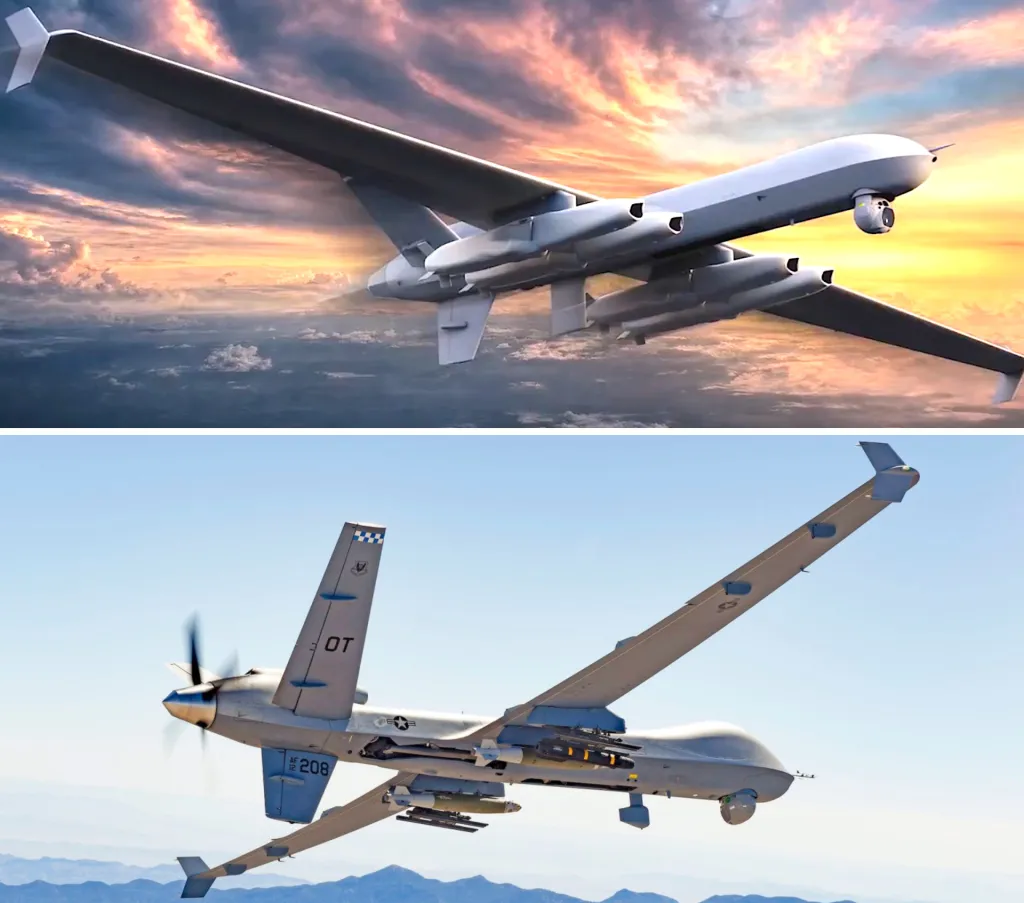
A rendering of Wildfire was included in a video montage, seen below, which General Atomics Aeronautical Systems, Inc. division (GA-ASI) released earlier today. GA-ASI first announced work on this new drone last month. The Air Force, in partnership with the Pentagon’s Defense Innovation Unit (DIU), formally kicked off its new search for a Reaper successor, currently called the Massed Modular Aircraft (MMA), in July. GA-ASI also developed the MQ-9A, which is now out of production.
Wildfire’s pusher-prop design shown is clearly an extension of the existing MQ-9 family, with an overall planform that is extremely similar to that of the Reaper. Like the latest versions of the MQ-9A, the new drone has a sensor turret under the nose and a large blade antenna under the rear fuselage.
The rendering of Wildfire, at top, seen together with a stock picture of a US Air Force MQ-9 Reaper, at bottom. General Atomics capture/USAF
Wildfire does notably lack the Reaper’s distinctive hump on top of the forward fuselage. On the MQ-9A, this feature contains the drone’s satellite communications (SATCOM) antenna. What this might mean about how Wildfire is controlled and otherwise communicates is not immediately clear, but it points to the use of a smaller, lower-cost SATCOM terminal. That, in turn, would most likely be tied to a network like Starshield, the government-focused cousin of SpaceX’s Starlink. We could also see greater semi-autonomous control here, or at least a greater reliance on it.
A close-up look at the nose end of Wildfire as seen in the newly released rendering. General Atomics captureA General Atomics Improved Gnat (I-Gnat) drone. General Atomics
The rendering of Wildfire also depicts the drone armed with four Joint Strike Missile (JSM) cruise missiles, with two loaded on what appears to be a single pylon under each wing. The stealthy JSM can be employed as an anti-ship or land-attack weapon. GA-ASI has released renderings of MQ-9s in the past with similar loadouts. The Air Force is already acquiring stocks of JSMs, primarily to arm its F-35A Joint Strike Fighters. Stand-off munitions like the JSM have long been seen as an increasingly important, if not critical, addition to the non-stealth Reaper’s arsenal, helping to keep the drones further away from potential threats.
A close look at two JSMs in the Wildfire rendering. General Atomics capture
TWZ has reached out to General Atomics for more details.
“General Atomics is looking at it and asking ourselves, ‘What can we really do? No kidding, no BS, actually do,’” GA-ASI spokesperson C. Mark Brinkley did tell us back in August when asked about Wildfire. “Let’s be honest with ourselves first. How do we come out of the box, day one, with a 10,000-nautical-mile ferry range? Can we carry four LRASMs [AGM-158C Long Range Anti-Ship Missiles]? Can we swarm 100 aircraft under semi-autonomous control? Can we fuse all of that data into a highly effective common operating picture? Can we do that at scalable, affordable mass?”
“So that was the assignment, and our engineers sharpened their pencils and got to work,” he added. “What came out the other side was our new Wildfire UAS. That thing is a beast, and no one who actually does this for a living, and is honestly concerned about America’s warfighting edge, can look at it and not want 100 of them as fast as we can make them.”
Wildfire “addresses all of the concerns posed by the MMA solicitation. We can deliver years earlier and maintain the same high quality. You can have everything that makes Reaper special, plus more, at a price that doesn’t break the bank,” Brinkley also told Breaking Defense for a story published last week.
“[The service] …wants the MMA drone to perform the same general intelligence, surveillance, and reconnaissance (ISR) and strike missions as the MQ-9A. To that end, stated program requirements to date include a speed of at least 200 knots true airspeed, a munition and sensor payload capacity of at least 2,800 pounds, an unrefueled combat radius of at least 2,300 nautical miles with payload, the ability to self-deploy one-way at least 8,000 nautical miles, and the ability to operate from runways no longer than 6,000 feet. The MMAs also need to be highly modular and use open architecture mission systems to make it easier to integrate new capabilities and functionality down the line.”
Another look at an example of a typical MQ-9A Reaper in US Air Force service now. USAF
The Air Force also shared last week that it is targeting a roughly $10 million unit cost for the MMA drones, not including sensors and certain other systems. As mentioned, the Reaper is out of production, but the price tag on a fully-equipped Reaper today is widely reported to be between $30 million and $50 million. The Air Force has itself used the $50 million figure as a reference point in discussing its latest plans for what comes after the MQ-9.
It is unclear how Wildfire might achieve this cost goal while retaining so much obvious Reaper DNA, but even a major 30 to 50 percent reduction in the price tag compared to its predecessor would be a huge deal. In the past, General Atomics’ Brinkley has openly questioned just how cheap an MMA drone could realistically be while still offering comparable capabilities to MQ-9.
The original timeline for the MMA program envisioned the Air Force reaching initial operational capability in 2031 after receiving 20 of the drones. The service is now looking to accelerate that schedule by around two years. The Air Force expects to eventually acquire around 180 MMAs.
“Although we have plenty of MQ-9As today, we are going through them at a rate that is concerning to us,” Air Force Lt. Gen. Christopher Niemi, the service’s Chief Modernization Officer, told reporters at a roundtable at the Pentagon last week, according to Air & Space Forces Magazine. “There’s not a lot of good options to immediately replace those aircraft.”
GA-ASI has long had a monopoly on MALE combat drone sales in the United States, and is clearly looking to extend that now with Wildfire. However, this market space has been expanding, and other companies are already competing for what could be a very lucrative new deal with the Air Force. Winning the MMA contract could open doors to opportunities elsewhere within the U.S. government and with foreign countries. Variants and derivatives of the MQ-9 are also in service today with the U.S. Marine Corps, the Central Intelligence Agency (CIA), U.S. Customs and Border Protection (CBP), and several additional air arms globally.
A US Marine Corps MQ-9A Reaper. USMC
More information about Wildfire, as well as its competitors, is only likely to continue emerging as the Air Force pushes ahead with new and aggressive plans to finally acquire a follow-on drone to the venerable Reaper.
Update: 2:15 PM ET –
General Atomics spokesperson C. Mark Brinkley has now shared additional details about Wildfire with TWZ.
“You’re not imagining it. These new Wildfire renders do lack the dorsal hump you see on Reaper, MQ-9B, Gray Eagle, Mojave STOL and many copycat aircraft,” Brinkley explained. “General Atomics has pushed proliferated low-earth orbit controls onto many of our existing aircraft and pioneered that integration across unmanned aerospace. That is a relatively new technology that we already have great experience integrating, and it makes sense to bring that into Wildfire.”
“Proliferated low-earth orbit” (abbreviated variously as pLEO and P-LEO) refers to distributed constellations of hundreds or potentially thousands of satellites in that orbital region. SpaceX’s constellations supporting the aforementioned Starlink/Starshield networks fall into this general category.
“Wildfire is going to leverage ongoing advancements in autonomy on Day One. We envision networking dozens of Wildfires for true combat mass,” according to Brinkley. “Again, not a hypothetical. We’ve been pioneering many advancements in autonomy, AI, and machine learning across the FQ-42A program and using our own MQ-20 Avenger as a CCA [Collaborative Combat Aircraft] surrogate connected to F-22 and F-35. That’s proven, not concept.”
The FQ-42A, also known as the Dark Merlin, is one of two designs now in development under the first phase, or Increment 1, of the Air Force’s CCA program, the other being Anduril’s FQ-44A Fury. The service announced in June that its initial CCA force would be a mixed fleet of FQ-42As and FQ-44As.
A row of prototype YFQ-42A Dark Merlin drones. GA-ASI
“Four JSMs tells you something about Wildfire overall. We can’t just look at overall external weight limits. You have to consider individual hardpoint capacity,” Brinkley continued. “We’ve concepted four JSMs on MQ-9B before, as a concept, but we’ve never done that on Reaper. Wildfire can absolutely do that, from a hardpoint capacity and also an overall MGTOW [maximum gross takeoff weight] perspective.”
“We’re showing two LRASMs on Wildfire, which is twice as much as the DIU solicitation asked for. If you’re going to build a flying weapons truck, give it some teeth,” he added. “These longer-range missiles also give you increased standoff compared to other weapons you associate with the MQ-9, so that also gives you some flexibility. Wildfire can carry two LRASMs for meaningful combat distances.”
A rendering depicting a Wildfire drone firing an AGM-158C LRASM. General Atomics capture
Brinkley also said that Wildfire’s ferry range will exceed the MMA’s target of 8,000 nautical miles.
“We can deliver way ahead of the original FY 2031 schedule [for MMA]. We can deliver more than twice as many aircraft as requested in the same amount of time, because our manufacturing is real. Our network of suppliers, subcontractors and partners is real,” he added. “The obvious question is always cost, and I struggle to discuss costs because no one ever wants to compare apples to apples. There are stated price targets out there, and we’ll hit those. We’ll do it with an aircraft you can trust. We have nearly 10 million flight hours and more than 1,600 aircraft delivered. This is what we do.”
Speaking more generally, Brinkley also highlighted General Atomics’ extensive experience in developing and producing armed MALE drones, including the MQ-9.
Another stock shot of a US Air Force MQ-9A Reaper. USAF
“It’s important to remember that Reaper made its first flight 25 years ago and was so far ahead of everything else that it still defines the entire category of medium-altitude, long-endurance strike aircraft worldwide. When you build something new to do this kind of work, it rolls out into the Reaper’s shadow,” he said. “I don’t have to defend MQ-9 because the track record speaks for itself. It’s been called the MVP of Epic Fury [the U.S. military’s nickname for the initial phase of operations against Iran this year] for good reason, and I think it has squashed all questions about the relevance of MALE ISR and strike.”
“So that brings us to questions of affordability versus attrition, cost-per-effect, and the true price of combat operations. It also brings up questions of reliability and mission availability, and Reaper excels at both of these, so you can’t replace it with junk and expect to get the same effects,” he continued. “That’s where Wildfire comes in. Our team went to the graph paper and started sketching out what they would do differently and what they would keep the same. Where are the tradeoffs, and what do you change? No one knows this category of aircraft and missions like we do. We’re not guessing and hoping.”
“I can’t get into deep specifics on Wildfire yet, because it’s too early for that and the goalposts seem to move every time I say something publicly. What I can say is that Wildfire takes all of the known quantities of Reaper, blends them with some cutting-edge technologies and manufacturing advancements, and incorporates our more than three decades of lessons learned about large, unmanned combat aircraft to drive cost-per-effect math down.”
RIYADH: Egypt’s annual nationwide inflation rate eased to 12.7 percent in August from 13 percent in the previous month, as lower food prices offset increases in electricity, housing and other household costs.
Egypt continued to experience faster price growth than several regional peers, although the latest available comparative readings are for July rather than August.
Saudi Arabia’s annual inflation was 1.8 percent in July, while Jordan’s was 2.7 percent, according to official data from the respective countries. Morocco recorded a 0.6 percent annual decline in consumer prices.
The International Monetary Fund expects Egypt’s inflation to rise to 16.7 percent in the second half of 2026, reflecting higher energy prices, exchange-rate depreciation and unfavorable base effects.
In its latest report, CAPMAS stated: “The food and beverages division recorded a decrease of 1.2 percent due to a 0.1 percent decrease in the prices of cereals and bread, a 1.5 percent decrease in the prices of meat and poultry, a 0.1 percent decrease in the prices of fish and seafood, and a 7 percent decrease in the prices of vegetables.”
Housing costs climb
Housing, water, electricity, gas and other fuels rose 1.9 percent during the month. Electricity, gas and fuel prices increased 4.3 percent, while actual rents rose 0.8 percent and housing maintenance costs increased 0.5 percent.
Prices for furnishings and household equipment rose 0.7 percent, while clothing increased 0.5 percent, healthcare 0.4 percent, transport 0.2 percent, and restaurants and hotels 0.5 percent.
On an annual basis, housing, water, electricity, gas and other fuels recorded the largest increase, at 33 percent, with actual rents up 28 percent and electricity, gas and fuels rising 22.4 percent.
Transport costs increased 21.7 percent annually, while education rose 20 percent and recreation and culture increased 15.3 percent. Food and beverages prices rose 6.5 percent, with vegetable prices up 27.7 percent.
Monetary policy
The inflation data comes after the Central Bank of Egypt kept its key interest rates unchanged last month, with the overnight deposit rate at 19 percent and the lending rate at 20 percent. The main operation and discount rates were maintained at 19.5 percent.
The CBE expects headline inflation to accelerate through the third quarter because of unfavorable base effects before gradually declining from the first quarter of 2027. It expects inflation to converge toward its 7 percent target, plus or minus 2 percentage points, during the second half of 2027.
The central bank has warned that the inflation outlook remains exposed to risks from regional hostilities and a stronger-than-expected pass-through from fiscal consolidation measures.
Court also acquits Dow Jones on the charge of dismissal over Selina Cheng’s leadership role with the Hong Kong Journalists Association.
Published On 10 Sep 202610 Sep 2026
A Hong Kong court has convicted Dow Jones for trying to deter a journalist from taking a union role, but also acquitted the publisher on the charge of dismissal over the role, in a case that raised concerns about media freedom in the city.
Selina Cheng, who was fired by the Wall Street Journal (WSJ) in July 2024, had accused the newspaper’s publisher Dow Jones of unlawfully terminating her employment over her role chairing the Hong Kong Journalists Association (HKJA) and of trying to prevent her from standing for a union position.
Recommended Stories
list of 3 itemsend of list
The court found the company guilty on Thursday of trying to prevent Cheng’s right to run for the union chairmanship.
However, the judge sided with Dow Jones’ argument that she was made redundant because of corporate restructuring, and not due to her role as HKJA chair.
The right to take part in a trade union is protected by Hong Kong’s labour laws. An employer found guilty on “prevent or deter” charges could be fined up to 100,000 Hong Kong dollars ($12,755).
“If reporters’ employment rights are not sufficiently safeguarded, or when their rights are violated and not enforced in law, then we can no longer work safely as reporters,” Cheng told reporters outside the court after the ruling.
The judge said the company’s requirement that Cheng seek prior permission to take a union role was an “unjustified deterrent” of her rights.
Dow Jones said it disagreed with the ruling and was evaluating next steps.
“The Wall Street Journal has a long and proud history as an employer in Hong Kong. Throughout that time, we have remained deeply respectful of its labour laws and supportive of our employees’ rights, while publishing excellent, impartial journalism about the region,” a spokesperson said.
Sentencing is expected to be handed down at a later date.
Cheng launched a private prosecution last year for illegal termination, after filing a complaint with the Labour Department that did not result in a prosecution.
Founded in 1968, the HKJA is Hong Kong’s longest-established journalists’ organisation and one of the last remaining groups advocating for media rights in the city.
Although Hong Kong was once known for its independent news outlets, media freedom has come under strain and many outlets have disbanded since Beijing imposed a 2020 national security law following sometimes violent pro-democracy protests, according to international rankings and HKJA surveys.
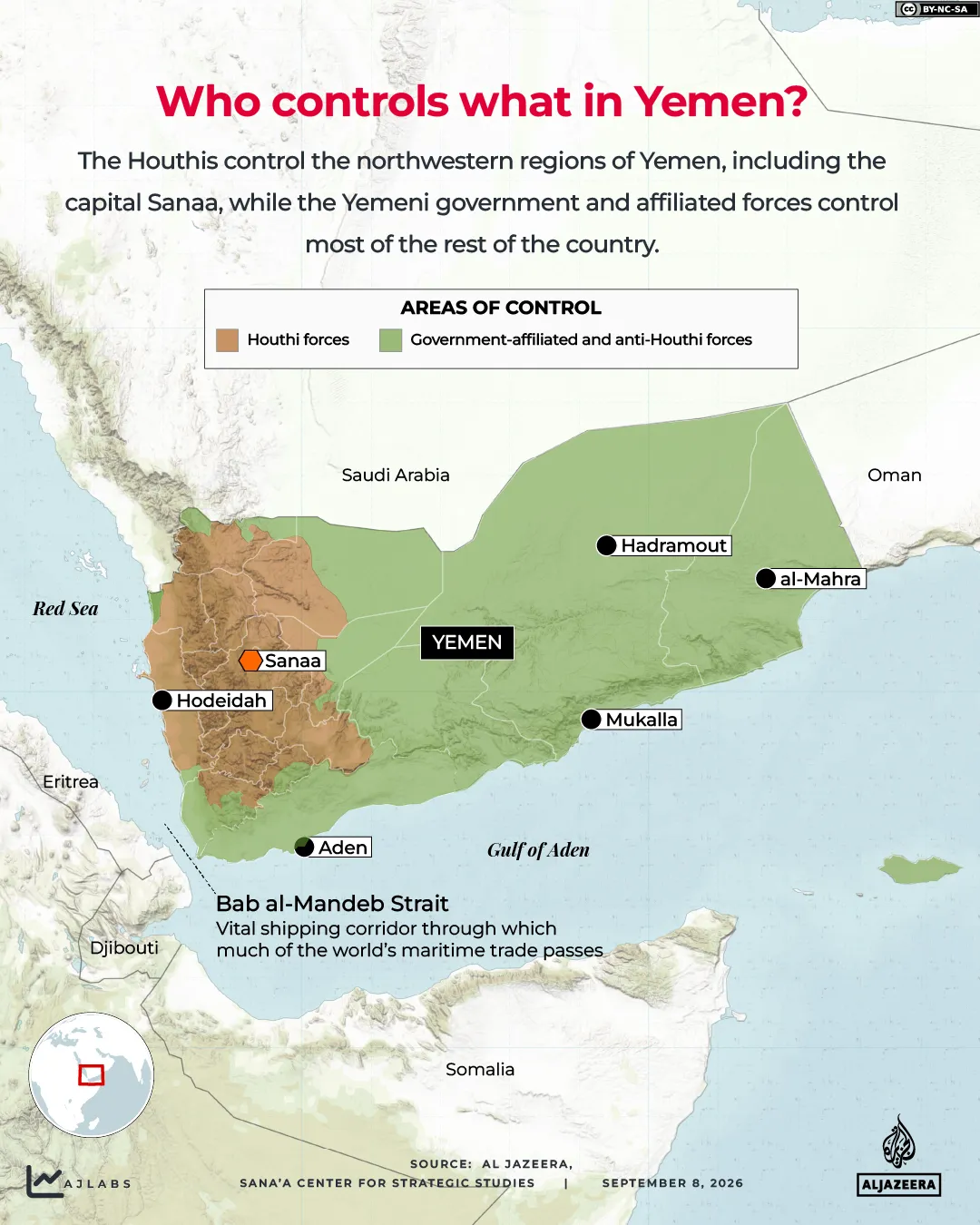
Sanaa, Yemen – The United Nations-recognised Yemeni government and the Houthi group have been using warplanes, missiles, drones and other weapons as they engage in intense fighting on multiple fronts in the country’s north, west and central regions.
At least 194 people have been killed and 880 others wounded in the past two weeks of fighting in parts of Taiz, the western coast, al-Jawf, Marib and Dhalea, according to aid agencies.
Iran-backed Houthis, also known as Ansar Allah (supporters of God), have intensified attacks on the coastal district of al-Makha (Mocha) located on the western coast, among others, to gain a foothold in the Red Sea – a vital shipping lane.
On the other hand, government forces have been battling to expand in Taiz and boost their control of Marib, an oil-producing region in the north.
Fighting has also been raging in the al-Jawf governorate bordering Saudi Arabia and Dhalea, which connects the Houthi-controlled north to the country’s south under the internationally recognised government.
Experts say gains or losses on any of these strategically important fronts could have significant consequences for either side.
Taiz and western coast fronts
“The hills and mountainous areas of Taiz and the western coast are key targets for the Houthis, who have repeatedly attempted to advance there,” Yazeed al-Jeddawy, the research manager at the Sanaa Center for Strategic Studies, said.
“The Houthis are trying to seize commanding terrains, cut supply routes between the coastal Mocha district and Taiz, and prevent government troops on the western coast from linking up with the Taiz Military Axis,” said al-Jeddawy.
In Taiz and along the western coast, al-Jeddawy says, the immediate contest is over the heights and roads connecting Taiz to al-Makha.
Situated roughly 60km (37 miles) from the Bab al-Mandeb strait, al-Makha enjoys a highly strategic position on the Red Sea. For a month now, the Houthis have launched missile and drone attacks on the city, causing massive damage to its port facilities and killing and injuring several civilians.
Recently, the group has also attempted to extend its ground operations towards al-Makha city.
“The Houthis seem intent on tightening their hold around [al-Makha] and moving closer to the Dhubab–Bab al-Mandeb area. A substantial advance would strengthen their position near the southern entrance to the Red Sea and give them greater leverage over international shipping,” he added.
Fuad Mussed, a Yemeni political analyst and author, told Al Jazeera that the strategic importance of the western coast and Taiz fronts stems from their proximity to Bab al-Mandeb, a chokepoint connecting the Red Sea to the Gulf of Aden and one of the world’s most important shipping routes.
“The Houthis seek to move closer to this vital waterway to threaten maritime traffic. Such a move aims to keep the Strait of Hormuz and Bab al-Mandeb under the influence of Iran and use them as leverage against regional and international powers. This is a strategy Tehran has been pursuing for years,” Mussed said.
Iran has blocked the Strait of Hormuz, a global oil chokepoint, to use it as leverage in the war against the United States. It has also warned that its allies could shut shipping via Bab al-Mandeb. Iran also attacked Saudi Arabia’s pipeline used to export oil from the Red Sea.
In July, the Houthis declared a blockade against Saudi vessels transiting through the Red Sea – an alternative to the Strait of Hormuz.
Marib and al-Jawf fronts
Over the past few weeks, pro-government forces have attacked Houthi-held territories in Marib and al-Jawf, facing further retaliation from the Houthis.
Saddam al-Huraibi, a Yemeni political commentator, said the Marib front is fateful for both sides.
“Marib is a government stronghold in north Yemen. So, a Houthi expansion in Marib would threaten government presence and weaken its leverage in the north. That is why pro-government troops are ready to fight tooth and nail on this front line,” al-Huraibi told Al Jazeera.
For the Houthis, the takeover of Marib will deepen the group’s authority and step towards controlling the oil and gas infrastructure. The Iran-backed group captured vast swaths of northern Yemen, including the capital, Sanaa, in 2014, but Marib has remained in government hands since.
“Dominating Marib’s oil and gas resources has been a Houthi goal for over a decade. Without facing a crushing defeat in Marib, they would keep fighting to achieve that goal,” al-Huraibi said.
Adjacent to Marib, al-Jawf is also a hub of tense fighting between the Houthis and government forces. A government gain there would lay the groundwork for further advances, while a strong Houthi defence could undermine government forces’ morale and prompt them to retreat.
“Government-aligned forces have lately focused much of their offensive effort on al-Jawf. Government gains in al-Jawf would ease the threat to Marib while requiring the Houthis to defend a much broader area,” al-Huraibi said.
Al-Jeddawy said government gains could open routes towards the north – Saada, Amran or Houthi positions north of Marib.
The Houthis have carried out attacks in Saudi Arabia, including energy facilities in the country’s south. They have also accused Saudi Arabia of launching multiple attacks in al-Jawf, al-Bayda, Marib and Taiz provinces in support of government forces.
This screen grab taken from undated video footage released on September 9, 2026 by Ansarullah Media Centre shows what the Houthi authorities said are attacks on Saudi-backed forces in Jawf province’s frontlines [AFP]
The Dhalea front
Fighting on the Dhalea front, a strategic gateway between Houthi-held territory and the southern governorates, has intensified in recent weeks.
Fighting there did not fully stop during the relative calm, which began in April 2022 following the UN-brokered ceasefire.
A Houthi advance there could open a route for their fighters to reach other southern territories. On the other hand, a Houthi setback would encourage government forces to push towards Ibb, controlled by the group.
“[Houthi] advances in Dhalea could expose the southern hinterland, while [government advances] could threaten Houthi positions and supply routes towards Ibb, al-Bayda and, farther north, Sanaa,” al-Jeddawy noted.
With the escalating fighting, the Houthis face pressure on several fronts, but the group has been readying for a range of scenarios, Khaled Ghorab, a pro-Houthi general, said.
“The [Houthi] Yemeni armed forces were never caught off guard by the prospect of escalation; rather, they worked to build and develop their own military capabilities based on tactical combat plans designed to counter a comprehensive, sustained attack launched simultaneously from land, sea and air,” he said.
Ghorab noted that this state of readiness enables the Houthi forces to carry out a direct response to sources of the threat – whether deep within enemy territory or at sea – targeting military bases or aircraft carriers as far as the Horn of Africa.
While the warring parties compete to seize strategic positions on several front lines, the latest escalation is also closely related to the wider regional confrontation.
“Iran has an interest in keeping Yemen and the Red Sea active as sources of leverage, while parts of the government camp believe the Houthis are under growing strain and that this is an opportunity to weaken them,” al-Jeddawy, the Sanaa-based researcher, said.
“The escalation still reflects domestic military and political aims, but its timing and direction cannot be separated from the regional war,” he told Al Jazeera.
MANCHESTER, England: Pep Guardiola’s departure was expected to shift the balance of power in Manchester.
The early signs suggest otherwise.
For the first time in 10 years on Sunday, Manchester United goes into the derby against a Manchester City no longer guided by the genius of Guardiola.
Yet, if City wins at Old Trafford, the team of new manager Enzo Maresca would open a 12-point lead on United only four rounds into the Premier League.
Even this early in the campaign that would be a huge gap for United to make up.
While City is still getting used to change at the top after a decade of Guardiola, United has endured a carousel of managers at the same time in a desperate bid to return it to former glories.
Michael Carrick is the seventh permanent manager since the retirement of Alex Ferguson in 2013.
United fans will hope Guardiola’s exit will prove as profound as Ferguson’s. United has not won the Premier League since Ferguson’s final season in charge.
In theory, Guardiola’s exit has removed the biggest barrier standing in the way of United’s route back to the top following his dominance of English soccer. Though he left without the title in his last two seasons, his run of six league crowns in seven years underlined City’s supremacy for the majority of his time at the club.
It would be asking a lot for Maresca — or anyone else for that matter — to emulate that level of success. Maresca, however, could not have made a better start to the season after a 100% winning record in the league and victory in City’s opening Champions League game this week.
Erling Haaland also looks at the top of his game with five goals in his last three appearances.
It’s been a different story for United after its resurgence under Carrick in the second half of last season led to a third place finish.
The opening day defeat to newly promoted Hull was an early blow. There was a win against another newcomer in Ipswich but a 2-2 draw at Everton after leading twice.
It is the type of inconsistency that has hindered United throughout the post-Ferguson years and something Carrick will need to quickly stamp out.
He has recent good memories of the derby. His first match in charge when appointed as Ruben Amorim’s replacement was a 2-0 win against City in Guardiola’s final Manchester derby.
Key matchups
The Manchester derby is the big one of the weekend, with pressure on United to get the season going, while it would be a first statement win for Maresca at City. Defending champion Arsenal is at Sunderland on Saturday.
Players to watch
Arsenal’s Martin Odegaard is in outstanding form with four goals in five games in all competitions. Haaland also has five goals and looks unstoppable.
Out of action
Cody Gakpo missed Liverpool’s game against Atletico Madrid because of an adductor issue. Bradley Barcola limped out of that match after appearing to hurt his calf, but coach Andoni Iraola said it was cramp.
Off the field
Manchester United fans plan to stage a protest ahead of the derby in opposition to a clampdown by the club on ticket touting.
The 1958 supporters group claims “loyal, generational” fans are being sanctioned or banned “without, clear and compelling evidence.”
United says its investigation has “uncovered significant and organized touting”.
Ukraine launches one of its deepest strikes to date, targeting gas plants in Russia’s Arctic region.
Published On 10 Sep 202610 Sep 2026
Russian forces have launched attacks across Ukraine, killing at least seven people, according to Ukrainian officials, as Kyiv claimed responsibility for a drone attack that set off a fire at a natural gas plant deep in Russia’s Arctic region.
Four people were killed in a Russian attack in Mykolaiv in southern Ukraine overnight on Thursday, while three were killed in a drone attack on a shopping centre in the northeastern city of Sumy, according to Ukrainian authorities.
Recommended Stories
list of 3 itemsend of list
Heorhii Reshetilov, the acting governor of the Mykolaiv region, said the Russian strikes there hit both civilian and industrial infrastructure, killing two men and two women. At least 19 others were wounded, he said on Telegram.
The attack in Sumy left at least 14 people wounded, according to Oleh Hryhorov, head of the Sumy Regional Military Administration. Three of the victims were children, he said on Telegram.
The Russian Ministry of Defence confirmed the attack in Mykolaiv, but said it targeted a drone warehouse. The ministry said it also hit the Ukrainian port of Chornomorsk and two vessels near Odesa on the Black Sea.
The targets of the strikes were being used for military purposes, the ministry claimed.
The attacks came after Russian authorities said Ukrainian forces had launched a drone attack on the country’s Yamal-Nenets region, which is located some 2,800 kilometres (1,700 miles) from the Ukrainian border.
Dmitry Artyukhov, the region’s governor, said the attack targeted an industrial facility in Novy Urengoy. The attack was repelled, but falling debris from the drone caused a fire, he said on Telegram.
“The main thing is that there were no deaths or injuries. The extent and nature of the damage are being determined,” he added.
Artem Zhoga, the Kremlin’s envoy to the Urals, said Wednesday’s strike was the first ever to hit the Arctic part of the region.
Ukraine’s Special Operations Forces (SOF) confirmed the attack in a series of posts on X.
“For the first time! Deepest strike of the war: Ukrainian SOF hit critical russian plants more than 3,000 km away,” it said. “Ukraine’s Special Operations Forces carried out the deepest strike inside russia since the beginning of the full-scale war.”
In the posts, the Ukrainian force claimed it “successfully struck” two gas plants, Novy Urengoy and Purovsky.
“Until today, the area was considered a safe rear zone for the aggressor,” it added.
The Ukrainian force said the facilities play a key role in Russia’s gas industry, processing large volumes of condensate from gas fields across the Yamal region, processing millions of tonnes of condensate per year.
Gazprom used to export gas from Yamal as far as Western Europe until relations broke down following the start of Russia’s war in Ukraine in 2022.
It estimated the region’s gas resources at 26.5 trillion cubic metres as of 2020, enough to cover global demand for more than six years.
Ukraine has escalated its long-range strikes on Russia in recent months, in retaliation for daily Russian bombardment of Ukrainian towns and cities.
Earlier this month, Ukrainian President Volodymyr Zelenskyy said his country’s drones would make Russian airspace “completely unsafe” for the duration of the war.





















![This screen grab taken from undated video footage released on September 9, 2026 by Ansarullah Media Centre shows what the Houthi authorities said are attacks on Saudi-backed forces in Jawf province’s frontlines [AFP]](https://i0.wp.com/www.aljazeera.com/wp-content/uploads/2026/09/afp_6aa18c010e16-1788972033.jpg?w=640&ssl=1)