
Ukrainian drones strike Russian Caspian Sea port in Dagestan
Fires and explosions were seen in Russia’s Dagestan after a Ukrainian drone attack.
Source link
Discover the latest happenings and stay in the know with our up-to-date today news coverage. From breaking stories and current events to trending topics and insightful analysis, we bring you the most relevant and captivating news of the day.
Fires and explosions were seen in Russia’s Dagestan after a Ukrainian drone attack.
Source link

Hermeus is developing an expendable ramjet-powered aircraft, Ramjet-X, which will be air-launched from its reusable, F-16-sized Quarterhorse high-speed drone. The result aims to create a two-vehicle architecture intended to make high-speed flight testing less dependent on expensive, single-use test platforms. That would give Hermeus and potential customers a way to conduct repeated high-Mach flight tests without expending a large booster on every mission.
America didn’t lose ground in high-speed flight because of a lack of ideas. We slowed down because flight tests became too expensive, too rare, and too cautious.
Meet Ramjet-X. Air-launched from the Quarterhorse program, it’s a low-cost, repeatable test vehicle built to fly and… pic.twitter.com/rMed6NhcvD
— Zach Shore (@Zsshore) September 9, 2026
The company unveiled the concept today. Hermeus says the Ramjet-X will be carried beneath Quarterhorse and released at a speed of around Mach 3, at which its ramjet can begin operating. The smaller vehicle will then accelerate, climbing to around 100,000 feet, and a speed in the region of Mach 4. Quarterhorse will then return to base and be available for another mission.

Imagery released by Hermeus shows a Quarterhorse carrying a Ramjet-X mounted on a pylon under each wing, indicating that two different high-speed tests can be carried out in a single sortie. Intriguingly, the Quarterhorse is shown with no fewer than six underwing hardpoints in all, suggesting that other kinds of external payloads are envisaged.
Hermeus has not released detailed performance specifications for Ramjet-X, including its range, payload capacity, or the critical expected cost per flight. We have reached out to the company for more information.
Images released by the company show a relatively compact, missile-like vehicle with delta wings incorporating prominent dihedral. There are no horizontal tail surfaces, but a conventional vertical fin is complemented by a ventral fin. Axios reports that Ramjet-X is approximately 22 feet long and 7 feet wide.

In terms of appearance, and also thanks to its ramjet propulsion system, the vehicle is outwardly very reminiscent of the Lockheed’s D-21 Tagboard supersonic spy drone. However, at more than 40 feet long and with a wingspan of 20 feet, the D-21 was significantly bigger. Overall, the entire concept recalls the Cold War-era D-21 and its M-21 mothership, on a smaller scale.


The basic concept aims to address a longstanding problem with ramjet flight testing. Unlike a conventional jet engine, a ramjet cannot provide useful thrust from a standstill. The vehicle therefore has to be accelerated to a sufficiently high speed before the ramjet can take over.
That acceleration can traditionally require another propulsion system, including an expendable rocket booster. Hermeus is proposing to substitute a reusable aircraft for that initial boost. It is unclear if the Ramjet-X vehicles are similarly recoverable, but we have asked Hermeus for more details here, too.
As it stands, flight-test programs of this kind are often constrained not only by the cost and availability of test infrastructure, but also by the limited availability of suitable airspace and range access. A reusable carrier aircraft could help address both challenges, allowing multiple Ramjet-X vehicles to be deployed from airports near a designated test range as required and launched only once the vehicle is within the approved test area. That flexibility could reduce the need for a new large booster for every experiment while also making it easier to conduct tests, including at shorter notice, within increasingly constrained airspace.
Hermeus says Ramjet-X is being designed not just for its own development work but as a potential test platform for outside customers. The company is calling the concept “Flight Test as a Service,” with customers able to fly payloads including sensors, communications equipment, computing and autonomy systems, materials, and propulsion hardware.
The program reflects a broader push toward increasing the availability of commercial high-speed flight testing that has attracted U.S. government interest.
Hermeus was also selected by the Defense Innovation Unit for work under its Hypersonic and High-Cadence Airborne Testing, or HyCAT, effort. That program is intended to use commercial flight-test capabilities to expand the government’s access to relevant high-speed environments.
The company is also pursuing its own increasingly ambitious Quarterhorse aircraft. Its Quarterhorse Mk 2.1 completed an uncrewed supersonic flight earlier this year, reaching Mach 1.21 on its third test flight. The company’s roadmap calls for subsequent Quarterhorse variants to progressively increase speed and address the thermal and propulsion challenges associated with high-Mach flight.

Supersonic. Mach 1.21.
Quarterhorse Mk 2.1 is now the world’s first privately developed, unmanned supersonic jet and the fastest unmanned aircraft flying today.
This flight makes Hermeus the fastest company in aviation history to go from founding to supersonic flight – exactly… pic.twitter.com/wjoIcdiEOj
— Hermeus (@hermeuscorp) May 26, 2026
The imagery released for Ramjet-X shows a different Quarterhorse configuration than the 2.1 version, including beefed-up landing gear with twin nosewheels. The requirement for release of the Ramjet-X at Mach 3 suggests that its launch platform will be the Quarterhorse Mk 2.3, which will be the first to reach this kind of speed. This summer, Hermeus confirmed that its second supersonic aircraft, the Quarterhorse Mk 2.2, and the Mach 3-capable Mk 2.3 aircraft were under construction.
For its future Quarterhorse Mk 3, Hermeus has been developing Chimera, a turbine-based combined-cycle propulsion system. This is intended to transition from turbine operation to ramjet operation as speed increases.
Ramjet-X effectively separates part of that problem into another aircraft and the system could also be useful for experiments that do not require an entire hypersonic aircraft.
For example, an organization developing a high-temperature material might need to know how it behaves in an actual high-speed flight environment, rather than only in a ground test. The same could apply to weapons, sensors, communications systems, guidance hardware, onboard computers, or other components intended for high-speed vehicles.
So far, however, it’s not clear what kind of flight profiles Ramjet-X will provide. Hermeus has mentioned a cruise phase lasting “tens of minutes.”

But a short-duration dash through a high-Mach regime is not equivalent to sustained flight at those speeds. The duration available to an experiment, thermal loads, acceleration, vibration, available electrical power, telemetry, maneuverability, and payload mass will all determine what can actually be tested.
The company says it is already testing the Ramjet-X propulsion system at its High Enthalpy Air-Breathing Test facility in Jacksonville, Florida. High-temperature structures are also under development at its El Segundo, California, headquarters. Integrated vehicle testing is currently planned for 2027.
The HEAT facility itself is part of Hermeus’ effort to establish high-speed propulsion test infrastructure. The company says the facility is being developed to eventually provide continuous high-Mach airflow for more flight-like ground testing.
Ramjet-X has yet to fly, but if it performs as intended, it could help lower one of the major barriers to obtaining real-world flight data at high Mach numbers. At the same time, the company is entering a market that is attracting growing interest from other aerospace firms, which are also expanding their high-speed flight-test capabilities, especially to capitalize on the broader hypersonics boom, including Stratolaunch.
There is fairly clear potential weaponization of this concept, for strike and surveillance missions, as well, although there has been no indication of that being in the works at this time.
The planned 2027 integrated testing should provide the first meaningful indication of whether the concept can progress to become a practical high-speed test capability.
Contact the author: thomas@thewarzone.com
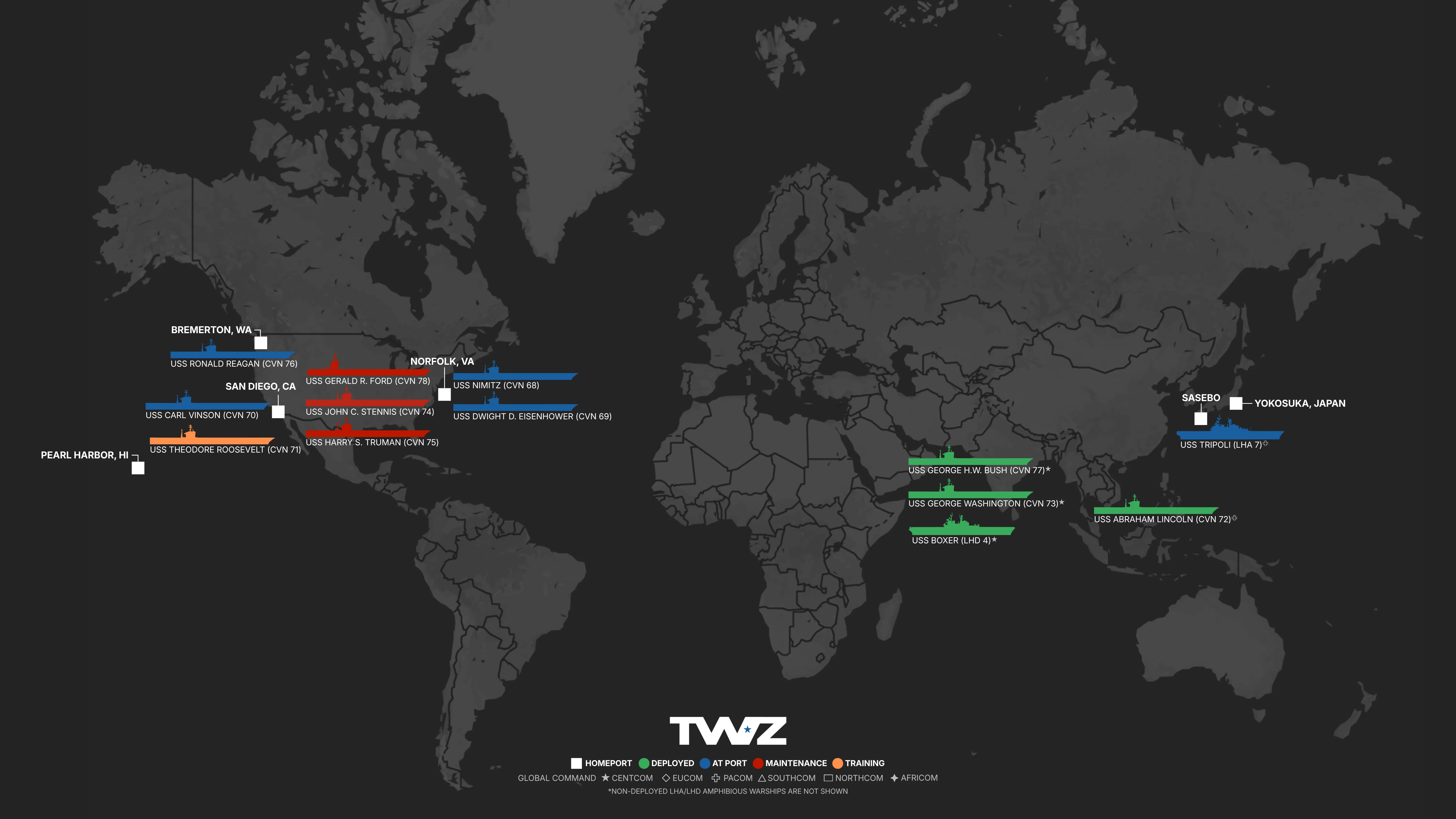
The Navy says it is making a concerted effort to apply the hard lessons learned from the marathon deployments of the USS Gerald R. Ford and USS Abraham Lincoln, both in combat and in quality of life for the crew, according to a new video posted by the Chief of Naval Operations, Adm. Daryl Caudle. The changes will be rolled out when USS Theodore Roosevelt deploys following a brief, last-minute, and previously unreported maintenance availability, TWZ has learned. Meanwhile, the United States and Iran are quickly climbing the escalation ladder again, as the latest series of tit-for-tat strikes has resulted in a massive overnight ballistic missile attack on a Jordanian base hosting U.S. forces and the destruction of 10 Iranian commercial oil tankers over the past week.
Here’s TWZ’s weekly carrier tracker monitoring America’s flattop fleet, including deployed Carrier Strike Groups (CSG) and Amphibious Ready Groups (ARG), using publicly available open-source information. Check out last week’s report here.

Less than a month after taking up station in the Middle East, elements of the George Washington CSG reportedly came under ballistic missile fire from the Islamic Revolutionary Guard Corps (IRGC) on September 5, according to Iranian media. “A U.S. aircraft carrier and guided-missile destroyer successfully evaded multiple unprovoked Iranian attacks,” U.S. Central Command (CENTCOM) confirmed in a statement, without identifying which warships were targeted. TWZ cannot independently verify the Iranian reports, and the Islamic Republic has frequently leveraged disinformation throughout the war.
U.S. forces responded swiftly the same day, striking three Iranian commercial oil tankers, part of the “shadow fleet” that funds IRGC operations, in a notable step beyond U.S. President Donald Trump’s recently announced tanker-for-tanker policy. “Let the message to the IRGC be clear: If you shoot at two of our ships, we will impose an even higher economic cost – taking out three of yours,” Adm. Brad Cooper, the CENTCOM commander, warned. “We will not hesitate to defend American forces, and if necessary, destroy Iran’s limited and exposed oil fleet,” he added. No U.S. casualties or damage to the American ships was reported.
Details surrounding the attack on September 5 are limited, but Iranian-affiliated channels claimed the IRGC fired the Qassem Basir medium-range anti-ship ballistic missile (ASBM) for the first time. If true, it would represent the first known combat employment of the ASBM since it was unveiled in May 2025 and poses a new threat to Navy warships operating within the 1,200-kilometer, or roughly 750-mile, stated range (although that figure is more than likely overstated). Generally speaking, American cruisers and destroyers can engage ASBMs in two layers, in some cases using Standard Missile-3 (SM-3) in the midcourse phase and SM-6 during the terminal phase. Both are finite resources, and only so many can be loaded in their Vertical Launch System (VLS) cells.
Since the initial exchange on September 5, the tit-for-tat strikes have continued to escalate. CENTCOM destroyed another five crude oil tankers on September 8, bringing the total to 10 in a week, after the IRGC targeted an unidentified Navy warship again with ballistic missiles. Iran answered overnight, launching a huge salvo of ballistic missiles toward Muwaffaq Salti Air Base in Jordan, where a significant contingent of U.S. forces is forward-deployed. Dramatic videos on social media show Patriot batteries firing against the incoming projectiles, with open-source analysts counting at least 60 interceptors employed.
The USS George Washington arrived in the CENTCOM area of responsibility (AOR) on or around August 19, escorted by a single guided-missile destroyer, USS Shoup. The pairing matches the composition described in CENTCOM’s statement about the IRGC attack on September 5. Washington’s public affairs team reposted the statement on their social media accounts.
The possibility that the second Nimitz class flattop operating alongside Washington in the Middle East, the USS George H.W. Bush, was the target of the attack cannot be ruled out. Both carriers are the same class and look alike from a distance (or through a seeker). The George H.W. Bush CSG is currently composed of a guided-missile cruiser, USS Princeton, and two guided-missile destroyers, USS Ross and USS Donald Cook.


Bush was pictured conducting nighttime flight ops in CENTCOM’s most recent update detailing the status of the ongoing blockade: U.S. forces redirected 94 commercial vessels, kinetically disabled three, and boarded two to ensure compliance, as of September 7.
The next carrier scheduled to deploy from the U.S., the USS Theodore Roosevelt, recently got underway after a brief maintenance period. While there was no mention of an upcoming availability in budget documents, we noticed what appeared to be pierside work in commercial satellite imagery, similar to the brief stints Washington and Vinson completed recently while in homeport. In response to our inquiry, a Navy official told TWZ, “Nimitz-class aircraft carrier USS Theodore Roosevelt (CVN 71) is currently in port at Naval Air Station North Island in San Diego conducting routine, planned maintenance. While we do not comment on future operations or movements due to operations security, aircraft carriers follow an optimized fleet response plan that provides full realignment of maintenance, training, and deployment cycles to fit in a standard 36-month rotation.”
Roosevelt’s upcoming deployment has been the subject of heavy speculation, as there will soon be no carriers available in Asia should a contingency arise. While Lincoln is currently in the South China Sea, she’s at the tail end of her deployment and in the process of heading home. The same official addressed the coverage gap, telling us, “U.S. Pacific Fleet’s posture across the region remains strong, adaptive, and ready. The U.S. Navy is purpose-built to flex, surge, and sustain across multiple theaters simultaneously – and that flexibility is a strategic advantage, not a vulnerability. U.S. Pacific Fleet’s commitment to the region is enduring – backed by the Joint Force and a strong network of allies and partners – and we will continue to fly, sail, and operate wherever international law allows to support a free and open Indo-Pacific.”


Roosevelt departed San Diego on September 5 and is still at sea as of publication. Imagery posted two days later on DVIDS, the military’s content-sharing platform, shows the flattop carrying out flight operations in the U.S. 3rd Fleet AOR and conducting “advanced training to bolster strike group readiness and capability.” The carrier was last tracked broadcasting a position publicly with her Automatic Identification System (AIS) transponder on, operating to the west of Baja California, Mexico, according to MarineTraffic. It’s unclear if the maintenance has been completed or if additional modifications and training will be required before the CSG deploys.

As noted above, the Chief of Naval Operations, Adm. Daryl Caudle, alongside Master Chief Petty Officer of the Navy (MCPON) John Perryman, posted a video yesterday with new information on Roosevelt’s upcoming deployment. “The lessons you’re bringing home are helping us better prepare the next team to deploy,” Perryman explained, addressing Lincoln’s crew. “Right now USS Theodore Roosevelt is putting those lessons into action using what we learned from Abraham Lincoln and Gerald R. Ford,” Caudle added. On logistics, that means maximizing the loadout of food, retail products, and hygiene items by converting available spaces into additional storage facilities. Regarding quality of life, improvements include new entertainment, more fitness equipment, and holiday materials purchased in advance.
“Small things matter during a long deployment because taking care of our Sailors is part of maintaining combat readiness,” Perryman noted. Watch the full video below.
Three other U.S.-based carriers, USS Carl Vinson, USS Dwight D. Eisenhower, and USS Ronald Reagan, were recently underway for training but have returned to their respective homeports since our last report on September 1.
Eisenhower returned to Pier 14S at Naval Station Norfolk on September 2 after a 12-day underway for Fleet Replacement Squadron (FRS) and Training Command (TRACOM) Carrier Qualifications (CQ) in the Virginia Capes and Jacksonville operating areas. Vinson completed 25 days of Tailored Ship’s Training Availability (TSTA) and Final Evaluation Period (FEP) before mooring at Juliet Pier on Naval Air Station North Island, San Diego, on September 4. And Reagan, which just finished a nearly 18-month Drydocking Planned Incremental Availability (DPIA), returned to Naval Base Kitsap-Bremerton in Washington state on September 7 after a four-day post-availability shakedown and sea trials. It’s unknown how many rounds of sea trials will be required before Reagan returns to the fleet.
For the time being, America has one carrier coming back online, but the net gain will be short-lived, as Lincoln is expected to begin a DPIA after returning home.
Elements of the Abraham Lincoln CSG, as well as escort cruiser USS Robert Smalls, arrived in Thailand on September 2 for what the Navy characterized as the “first full port call” of their nine-plus-month deployment. The crew of roughly 5,000 Sailors and Marines was finally able to leave the ship for liberty, with the majority standing on solid ground for the first time since November 2025.
“This port visit to Pattaya was a tremendous opportunity for this crew to recharge and a highlight for the strike group,” Abraham Lincoln’s commanding officer, Capt. Dan Keeler, said in a press release. “Thailand has such a rich culture and history, coupled with incredible hospitality, and that all shone through in this port visit. We are grateful to our Thai allies for hosting us, and we look forward to continuing our mission here in 7th Fleet, alongside Thailand and our other regional allies and partners.”

According to the press release, the crew “experienced all the sights and sounds Thailand has to offer, deepening their understanding of the Thai people and strengthening interpersonal bonds.” Lincoln pulled into port looking worse for wear after 286 days at sea, with noticeable algae and rust spots, conditions that are expected given the high operational tempo endured during nearly seven months of combat. Videos surfaced of the hull being scrubbed by Thai contract crews at a fraction of what the same job would cost stateside. The carrier departed five days later on September 6 in much better shape.
Lincoln is now continuing the journey home to San Diego, though whether any additional stops will be made along the way is unknown. A single-sourced report from Newsweek, which TWZ has not verified, claimed that another port call might be added, according to the wife of an officer aboard. As of publication, Lincoln is 293 days into the deployment, just 33 days short of the 326-day record set by USS Gerald R. Ford earlier this year.
Overall, three U.S. carriers are deployed (with one heading home), one is preparing to deploy in the near term, three are working up in various states of readiness, three are in current or upcoming maintenance, and one is being used primarily for training before deactivation next year. One amphibious ready group is deployed, one is forward-deployed and at homeport, four are working up or in port, and three are in maintenance.
Note: Positions are general approximations. Non-deployed LHA/LHD amphibious warships are not shown.
Contact the author: ian.ellis-jones@recurrent.io


DALLAS : Republicans used the opening night of their unusual midterm convention on Wednesday to hammer Democrats as extremists and pledge unwavering devotion to President Donald Trump, proudly placing their party’s undisputed leader at the center of upcoming midterm elections — even if his low approval ratings might ultimately drag them down in November.
Many Republicans, including those facing tight races, are skipping the two-day affair in Dallas, while others hope their appearance will put them in the national spotlight as they work to turn out Trump’s supporters in a year without him on the ballot.
The convention — part rally, part fundraiser — comes as Republicans try to boost enthusiasm heading into the final stretch before Election Day, despite voters’ economic concerns and dissatisfaction with the war in Iran. Much of the agenda sought to cast Democrats as too left wing, describing them as communists, anti-American or even evil. Republicans called themselves a “common sense” alternative in the fight to maintain control of Congress.
The show even got a boost from an unlikely source, Democratic Pennsylvania Sen. John Fetterman, who told the crowd in a video message that “I’m always going to reject the extremes and socialism.” Fetterman, who has clashed with his party’s leaders, referenced his state’s steel industry in pledging to “work with President Trump to fight and defend the steel way of life.”
Coinciding with the convention’s opening night, Trump’s political operation, which has been sitting on hundreds of millions of dollars, began spending heavily through a new group, the No Going Back PAC Inc., The New York Times first reported Wednesday. The group has reserved $49 million in six competitive Senate races and one competitive House race.
That’s in addition to the $10 million that MAGA Inc., Trump’s super PAC, has spent on the Texas Senate race.
The lineup features Trump and more Trump
Normal political conventions are held every four years and serve a purpose beyond pomp and circumstance, with parties formally nominating their presidential picks. This week’s convention, by contrast, is The Trump Show, through and through.
“Do we love President Trump?” Republican National Committee Chair Joe Gruters, one of the first speakers, asked the crowd. He had promoted the event before it began as “a Trump-a-Palooza.”
The walls of the basketball arena, where the Dallas Mavericks play, were covered with photographs of Trump, even in the elevators. Plenty of attendees wore cowboy hats and boots, as well as “Make America Great Again” and American flag caps and other gear.
“Looks very big. Looks very exciting,” Trump said of the gathering crowd before boarding Air Force One to fly to Dallas.
That wasn’t actually the case during the first hour of afternoon programming, when speeches were delivered to scores of empty seats, even in areas close to the stage. Crowds began filling them up well before Trump’s speech, however.
The president also said that oil prices — which have surged because of the Iran war — likely won’t come down until after the midterms, a bit of economic forecasting that could darken his party’s fortunes.
“Right after the election, oil prices are going to be tumbling downward,” he promised. That came as oil prices jumped more than 3 percent Wednesday.
Trump speaks both nights, delivering a keynote address on Wednesday night and speaking again on Thursday, after Vance gives his own address.
“Look, he’s an entertainer, right? He obviously loves big, big events and his career has been built around that,” said Ray Washburne, co-chair of the Dallas host committee, at a pre-convention event hosted by Bloomberg News. “He’s always front and center.”
Washburne said the event is expected to draw roughly 30,000 people across both nights, but getting airtime could be challenging. The NFL season kicks off Wednesday with a game between the Seattle Seahawks and the New England Patriots. And on Thursday, the San Francisco 49ers and Los Angeles Rams will be playing in Australia.
The agenda includes some key candidates
Also addressing the convention are members of the Republican congressional leadership and Cabinet members, including Attorney General Todd Blanche and Health Secretary Robert F. Kennedy Jr. The president’s oldest son, Donald Trump Jr., is on the roster, too.
Candidates who will speak include Michigan Senate nominee Mike Rogers, who is running a high-profile race against Democratic nominee Abdul El-Sayed, and North Carolina Senate nominee Michael Whatley, who is up against former Gov. Roy Cooper.
Organizers have outlined 12 hours of programming over the two nights, featuring more than 100 speakers and segments focused on subjects such as tax cuts, fraud allegations, border security and a proposed ban on members of Congress trading stocks.
Missing from the public agenda: any mention of the unpopular Iran war.
Republican House Speaker Mike Johnson said some members of his caucus plan to skip Dallas, preferring to stay home and campaign for reelection, but many of them will make an appearance.
“We’ll parade our stars across the stage,” he said.
Organizers say they’re fine with some Republicans skipping the convention
Washburne said there were strong reasons for some lawmakers and candidates to pass on attending.
“One thing, we just have so many speaking slots. We can’t get them all in. The other is: If you’re not in a contested race, it really doesn’t make much sense to come. And the ones in contested races, they need to be in their home states to campaign,” he said.
Some balked at high attendance fees. Republican House members were being asked to pay $25,000 for convention tickets and lodging, according to people familiar with the situation and granted anonymity to speak frankly about the private arrangement.
An additional 2,000 tickets were distributed by the National Republican Congressional Committee, largely to donors and others to attend the convention. Other tickets were allocated to state parties to distribute as they saw fit.
“Per the RNC, this is a ticketed fundraiser and rally, not a traditional national convention,” the Denton County Republican Party in Texas wrote in a Facebook post, which advertised packages from $5,000 to $20,000.
Still, more than 100 Republican House members and candidates are expected to attend, including almost all of the MAGA Majority class of candidates in the most targeted congressional districts, according to a person familiar with the event who requested anonymity before it begins.
Democrats say Republicans are out of touch
“The fact that these Republicans are planning a celebration in the middle of an economic crisis — where everyday Americans are drowning because of this high cost of living — is extraordinary,” Rep. Hakeem Jeffries, the House Democratic leader, said at the US Capitol last week.
Democrats have held such midterm conventions in the past but are not doing so this year. Rep. Suzan DelBene of Washington, chair of the Democratic Congressional Campaign Committee, said she wasn’t worried that her party was missing an opportunity to make its case on a national stage like Republicans.
“They are not focused on the issues that people are struggling with right now, that they’ve created,” DelBene said. “Cost, housing, food, health care, childcare, energy costs, gas prices all going up. That’s what we’re talking about on the ground all across the country.”

The UK needs new regulations for AI products used in the NHS and other healthcare settings, says Britain’s industry watchdog.
The Medicines and Healthcare Products Regulatory Agency (MHRA), which regulates all medical devices and licenses treatment drugs in the UK, has published 44 recommendations to update its policies as the use of AI in the sector rises.
The technology will soon be routinely used within the NHS, MHRA chief Lawrence Tallon told the BBC.
“What I would expect is that patients will… increasingly see AI as part of the way that normal NHS healthcare is delivered,” he said.
“That should happen in a way that they can maintain their trust and their confidence in what’s happening.”
The report was compiled by an independent commission and involved input from more than 12,000 people including patients and clinicians.
The recommendations include:
Continuously monitoring AI products and removing them from regulatory approval if they malfunction or become less effective over time
Giving patients the right to know whether AI is involved in their care, and easy access to information about the products involved
The power to penalise the developers of an AI product if it fails to meet required standards
An AI “L plate” system which would make it easier for new AI models to be trialled by healthcare professionals under close supervision
“The medical devices regulatory framework predominantly dates from a period where we were thinking about things like hip replacements and knee replacements, or smaller things like stethoscopes and plasters,” Tallon said.
He added while current guidelines may work for simple AI products trained to spot known symptoms on scans, for example, the rules do not apply to more complex models.
“Unlike most of the medical products we’re used to regulating, these products continue to change after the point of authorization,” he said.
“As new data gets fed in, they learn, they adapt, they drift.”
And he acknowledged trying to regulate AI is a global challenge.
“I don’t think at this moment in time we can point to a single country, a single regulatory framework, and say that they have absolutely cracked it,” he said.

Fasting days had been a tradition in Switzerland since the late medieval period. Despite not being seen as part of the reformed Protestant faith, they continued to be observed in parts of Switzerland.
In October 1567, there was a Geneva-wide fast to show support to the Protestants who were being persecuted in Lyon, France. This fast is recognised as the first Jeûne genevois.
In 1869 as a result of the Federal Fast across Switzerland, Jeûne genevois was no longer an official holiday, though it continued to be observed by many Genevans. In 1966, it was reinstated as a holiday.
While the religious fasting element is no longer widely observed, banks, most businesses and shops will be closed on Jeûne genevois.
In the sixteenth century, the only food that was allowed to be eaten on Jeûne genevois was plum pie. It remains a treat to be enjoyed on this holiday to this day.

Dallas, Texas – The Republican midterm convention has represented a gambit for the party: centring US President Donald Trump in the final stretch of the midterm elections, even as the first two years of his second term have cast a polarising political shadow.
That has been particularly true when it comes to the war on Iran, which Trump launched alongside Israel on February 28, and the knock-on effects on affordability in the United States, a key issue for many voters.
list of 3 itemsend of list
As Trump prepared to deliver a keynote address on Wednesday in Dallas, prices for Brent Crude, the global benchmark, rose above $100 a barrel for the first time since July, a reminder of the conflict’s continued fallout for global markets.
Nevertheless, supporters who spoke to Al Jazeera still saw the president as the man to rally Americans to vote Republican in November, as the party fights to hold onto control of the House of Representatives and Senate.
But some voiced concern – or confusion – over the impact of the war.
“This really is a Trump-a-palooza, as people have been saying,” said Carter Eisinger, a 27-year-old electrician who travelled from Fargo, North Dakota.
“I think some people say that in a derogatory way, but I think it’s very much a complimentary phrase,” he added. “The reality of it is we are in a Trump Republican Party.”

Still, Eisinger struggled to see how the war fit into Trump’s “America First” vision.
“In my opinion, I don’t really see the connection of how a war in Iran helps us here in the country,” he said. “If the Iran war is justified, I’m willing to pay the gas prices, but I haven’t seen that justification.”
He felt a similar confusion about the close relationship between the US and Israel.
“At the end of the day, I’m going to come right back to whatever is best for families, young people, anyone in America,” he said. “If it’s helping Israel in a way that helps us, then great… but it needs to help us first.”
Others were more charitable towards Trump’s approach to the Middle East, even if they saw the war on Iran as a misstep.
Bijay Dixit, a 59-year-old photographer from Houston, Texas, gave Trump high marks on his approach to immigration. He also believed Republicans were the party to steward the economy in the years ahead.
But on Iran, he said there had been a “miscalculation”, even if he agreed with the Trump administration’s position that the war was ultimately a necessary response to the totality of Iran’s actions in the 47 years since the Islamic revolution in 1979.
“Iran needed to be stopped at some point,” he said. “When I say miscalculation, what I mean is underestimation of the capacity of the IRGC [Islamic Revolutionary Guard Corps].”
Helen Vennett, a 65-year-old small business owner from Maryland and the chairman of her county’s Republican Party, likened the convention to a high-school pep rally.
“All of us need to have cheerleaders in our life… It just gets you fired up again. You kind of need to know that you’re not alone, that there are believers,” she added.
But while she said she broadly supported the Trump administration’s justification for the war, she acknowledged the potential political fallout.
“It’s a tough one,” she said.

Polls have regularly suggested widespread disapproval among US citizens of the war on Iran, with independents in particular expressing disapproval. Many, in turn, rank affordability as their top issue heading into the midterm vote.
A recent Reuters/Ipsos poll suggested that only a quarter of Americans think the war is worthwhile.
For its part, the Trump administration has downplayed the prospect of ending the war, focusing instead on efforts to open shipping routes in the Strait of Hormuz, over which Iran continues to assert its influence.
Speaking to reporters on Wednesday as he departed for the convention, Trump sought to temper expectations that the war would end before November’s pivotal vote.
“I think it’s going to take a little bit longer than the midterm,” he said, accusing Iran of intentionally holding out until November.
“They’re desperate to try and affect the election so that we can get a nice weak group of people in there and leave them alone and let them have their nuclear weapons,” he said.
He predicted the war would end swiftly after the final votes have been cast.
“They can’t hold out any longer,” he said.
John Russell, 55, from Rockford, Illinois, who regularly travels to Trump rallies as part of the “Front Row Joe’s” group, said he believed voters would still view the first two years of Trump’s second term as a net positive.
“It’s been a small bump with the gas going up,” he told Al Jazeera from the convention.
“But it had to be done. We can’t allow [Iran] to have a nuclear bomb,” he said, referring to one of the administration’s main justifications for the war.

Tehran has long denied seeking a nuclear weapon, with military analysts generally agreeing that destroying its nuclear programme would require a major military escalation, involving boots on the ground.
Russell predicted that the Republican Party’s bet would pay off at the polls.
“It’s going to fire up the base,” he said of the convention. “It’s going to switch some independents to vote for the Trump-backed candidates, and they will win.”

This time around, Odegaard looks smooth as silk – and it is no co-incidence Arsenal look exactly the same.
“This what we need,” said Arteta. “Players with that mindset to decide the game, to play with that personality and keep taking risks. He is getting into those positions much more in recent games. It was an incredible goal.”
In Naples, Odegaard not only settled the game but set the tone, working tirelessly as the perfect of example of leadership as well as being the match winner.
“Arsenal have obviously looked good at the start of the season and he has been a big reason for that,” added Onuoha. “Some of his creativity, especially on the right-hand side, has been excellent.
“He looks after the ball so well. He is always looking for that pass to be able to create opportunities and he even does the defensive work as well.”
Odegaard succeeded where other team-mates failed, Arsenal missing several clear-cut opportunities before he struck.
Arsenal‘s superiority was illustrated by having 26 shots, their most in a single Champions League match since records started being kept in 2003-04. It was also the most Napoli have faced in that time.
“Martin is contributing with goals that are impacting results which is what we want from our attacking players, being decisive,” said Arteta. “We should have done it in a different way because of the amount of chances we created.”
The Champions League has proved elusive for Arsenal, with finals lost to Barcelona in 2006 and to PSG last season.
It remains their Holy Grail – but if Odegaard maintains his brilliant form then their chances of crossing a so far insurmountable barrier will increase hugely.

A Russian gas plant more than 1,700 miles from the Ukrainian border was attacked by a drone on Wednesday, Ukrainian and Russian officials said. This is reportedly the longest-distance Ukrainian strike of the war and comes as Kyiv continues to target Moscow’s energy infrastructure.
“Today, an attack by a drone was repelled against one of the industrial facilities in Noyabrsk,” Dmitry Artyukhov, governor of the Yamalo-Nenets Autonomous Okrug, stated on Telegram. “As a result of the drone’s debris falling, a fire broke out. Emergency services specialists are working at the scene. Most importantly: there are no casualties or injuries. The extent and nature of the damage are being determined.”
“I urge residents of Yamal to remain calm and to rely only on information from official sources,” Artyukhov added. “The situation is under control.”

“The criminal Kyiv regime has, for the first time, attacked the Arctic region of the Ural Federal District,” Artem Zhoga, the Presidential Envoy of the Russian Federation to the Ural Federal District, confirmed on Telegram. “As a result of debris from a drone falling on the territory, a fire broke out at a fuel and energy complex facility in the Yamalo-Nenets Autonomous District… The enemy is trying to damage economic facilities in order to sow panic.”
New range record: Ukrainian drones attack Novy Urengoy – nearly 3,000 km from Ukraine.
The facility in Novy Urengoy that processes gas condensate for transport was hit—one of the most important installations in Russia’s gas condensate infrastructure.
The facility has a capacity… pic.twitter.com/gLysVaLjJJ
— Jürgen Nauditt 🇩🇪🇺🇦 (@jurgen_nauditt) September 9, 2026
The target of the attack was the Novourengoysky Condensate Stabilization Plant (CSP), according to Ukraine’s Armed Forces General Staff, which took credit for the attack.
“On 9th September 2026, units of the Defense Forces of Ukraine struck the Novy Urengoy Gas Condensate Processing Plant in Novy Urengoy, Yamalo-Nenets Autonomous Okrug,” the general staff claimed on X. “The extent of the damage is being assessed.”
The plant has an annual processing capacity of approximately 19.5 million tons, the general staff added.
“It produces stabilized gas condensate, petroleum fractions, diesel fuel and other petroleum products,” the Ukrainian military pointed out. “Its products are used, among other purposes, to meet the needs of the Russian armed forces. Operations against key enemy military targets are ongoing.”
Ukrainian officials did not provide any details about how the strike was carried out.
⚡️⚡️ More than 3,000 km away. Novy Urengoy gas condensate processing plant hit
On 9th September 2026, units of the Defence Forces of Ukraine struck the Novy Urengoy Gas Condensate Processing Plant in Novy Urengoy, Yamalo-Nenets Autonomous Okrug, russian federation.
The extent… pic.twitter.com/YrRmHp6NYb
— Генеральний штаб ЗСУ (@GeneralStaffUA) September 9, 2026
One video that emerged from the scene showed a column of flames rising in the distance but does not offer much in the way of detail about where the attack took place or the extent of the damage.
Ukrainian drones have for the first time attacked Russia’s largest gas-production hub, almost 3,000 km from the Ukrainian border.
Ukraine struck the Arctic part of the Urals Federal District. A fire started at a fuel-and-energy site.
The plant is part of the Gazprom structure.… pic.twitter.com/yQjodp2vrE
— Visegrád 24 (@visegrad24) September 9, 2026
Another video showed smoke rising in the distance, but again offered little in the way of detail about what happened.
❗️Ukrainian drones attacked Novy Urengoy in Russia for the first time. That’s about 3,200 km from Ukraine!
The Novy Urengoy plant for preparing condensate for transport, located in the Yamalo-Nenets Autonomous Okrug, was the target. It is one of the region’s key gas condensate… pic.twitter.com/KDwOFWicd6
— Anton Gerashchenko (@Gerashchenko_en) September 9, 2026
The region is a significant target.
“Novy Urengoy is Russia’s unofficial gas capital, located in the Yamal-Nenets autonomous district in northwestern Siberia,” according to the Moscow Times. Gazprom “estimated the region’s gas resources at 26.5 trillion cubic meters as of 2020, enough to cover global demand for more than six years.”
In Novy Urengoy, Khanty Mansi AD, west Siberia, Russia,
long-range Ukrainian drones hit an industrial facility in the city located some 3,000 kilometers (1,800 miles) from the Ukrainian border.https://t.co/bruXXjLYR4— Alexander Kokcharov (@alex_kokcharov) September 9, 2026
In addition to being the first attack in this region of Russia, this was “the furthest strike since the start of the war,” the Russian Mediazona Telegram channel stated. “Previously, the record for distance was the attack on the Omsk Oil Refinery in July 2026. It is located approximately 2,500 km (about 1,550 miles) from the border in a straight line.”
While the Ukrainian Armed Forces General Staff offered scant details about the strike, officials from the Fire Point weapons company hinted online that one of their drones carried out the attack.
“Guess who traveled over 3300 km (about 2,050 miles) and successfully achieved their goal,” the company stated on a Telegram post that included video of the gas plant attack.
“3200)),” Fire Point’s founder, Denys Shtilierman, teased in an X post with an image of the burning gas plant.
Neither Shtilierman nor the company provided any other details; however Fire Point claims its FP-1 drones can now travel about 2,100 miles (3,400 km) with a 60 kg payload.
Despite Fire Point’s hints, there is no confirmation that the company’s weapons had anything to do with this attack. There is also the chance that it could have been carried out by another system or even from inside Russia. Ukraine has, in the past, relied on proxies to stage attacks deep in Russia. In addition, Ukraine last summer carried out a series of remotely launched drone attacks on Russian strategic aviation. Dubbed Operation Spider Web, it included strikes on the Belaya Air Base, about 3,000 miles from the border.
However, a strike from inside Russia is much less likely than one launched from Ukraine given Fire Point chiming in and the increasing reach of Ukraine’s weapons. We have reached out to Fire Point and Ukrainian officials for comment.
You can see video of the Operation Spider Web attack on Belaya below:
The Novy Urengoy Gas Condensate Processing Plant wasn’t the only site in Russia affected by drone incursions far from the Ukrainian border today.
“A state of emergency has been declared in the Khanty-Mansi Autonomous Okrug due to unmanned aerial vehicle (UAV) activity,” the Russian RIA Novosti news outlet reported on Wednesday. This is located about 1,500 miles from Ukraine.
“Temporary restrictions have been implemented at the airports of Igra, Nyagan, Uray, ‘Sovetsky,’ Surgut, and Khanty-Mansiysk,” the outlet added.
The publication did not report any attacks and Ukraine did not claim any, but video emerged of what appears to be a Fire Point FP-1 drone flying over the area.
Officials in the region were preparing for a Ukrainian strike, the independent Russian outlet Verstka reported earlier this week.
The area is “a sprawling oil-producing region responsible for roughly 40% of the country’s crude output,” the official Ukrainian United24 media outlet noted.
While the extent of the damage to the Novourengoysky Condensate Stabilization Plant is unclear at the moment, the attack extends the range of Ukraine’s campaign against Russia’s oil infrastructure.
This summer, Ukraine struck nearly all Russian refineries within range, the Kyiv Post noted.
“Ukraine’s military said in July that the attacks had knocked 43% of Russia’s refining capacity offline, contributing to a nationwide fuel shortage and export restrictions,” the publication reported.
Still, “Russia’s overall oil exports remained relatively stable between June and July, with higher crude exports and energy prices partly offsetting revenue losses,” the Kyiv Post added.
For Russia, the attacks on its energy infrastructure have become so damaging that last month, President Vladimir Putin signed a law allowing the government to temporarily seize what it deems commercial critical infrastructure that is not sufficiently protected against such strikes. That followed Russia’s move earlier this year to allow private companies to purchase their own air defense systems to protect their own facilities.
Russian President Vladimir Putin signed a decree allowing the government to temporarily take control of critical infrastructure if private owners fail to protect it from Ukrainian drone attacks or rebuild it after strikes.
Read more: https://t.co/SzAbSZqobI
— ABC News (@ABC) August 25, 2026
Though Russia is continuing its grinding offensive, the energy infrastructure attacks are clearly taking a major toll. The ability to do so seems to have taken on additional significance in the wake of another round of attempts to end the fighting.
U.S. President Donald Trump’s top envoys, Steve Witkoff and Jared Kushner, recently traveled to both Russia and Ukraine seeking to rekindle peace talks. However, there does not appear to be any immediate resolution in sight.
The expanding range and quantity of Kyiv’s long-range strike arsenal gives Zelensky perhaps his most powerful card to play against Russia’s interest in continuing the war. Ukraine has been improving these weapons by the month and the pace of development of its drones and cruise missiles is rapidly accelerating. The country also has several ballistic missile projects in the works, which will only add to the pressure put on Moscow once operational.
Regardless, earlier this week, Ukrainian President Volodymyr Zelensky said he expects the war with Russia to continue into the winter at the very least. Given that, Kyiv’s campaign against Russia’s energy infrastructure does not seem like it will end anytime soon, either.
Case in point, Ukraine’s long-range drone strikes continued on Wednesday with another attack on Sochi, a Black Sea resort town often frequented by Russian President Vladimir Putin. And, for the second day, drones were visible over Russia’s remote central high-north energy production hub.
Contact the author: howard@twz.com
The war in Yemen is threatening to open a new front as the Iran-allied Houthi rebels are trying to advance along the Red Sea coast, through the mountain chains of Taiz province, edging closer to strategic ground that overlooks one of the world’s most vital maritime arteries.
For the internationally recognised Yemeni government, this is an offensive with global consequences.
list of 3 itemsend of list
In Wednesday’s interview with Al Jazeera, Yemen’s Ambassador to Qatar, Rajeh Badi, a former government spokesman, said that his government and its armed forces had not violated any truce since 2021.
The Houthis, he argued, are “the aggressors”. “What we are seeing now is a surprise Houthi offensive to seize strategic ground along the Red Sea, in order to allow Iran, through its Houthi proxy, to tighten its grip on maritime routes,” Badi said.
He added that the Houthis, who have advanced on al-Makha (Mocha) and al-Waziyah, and over large stretches of the mountain chain overlooking the Red Sea in Taiz province, “want commanding positions to launch more effective strikes on ships and disrupt navigation in the Red Sea”.
Badi said the Yemeni government responded by opening fronts in al-Jawf, Marib and al-Bayda, and that the consequences could extend far beyond Yemen.
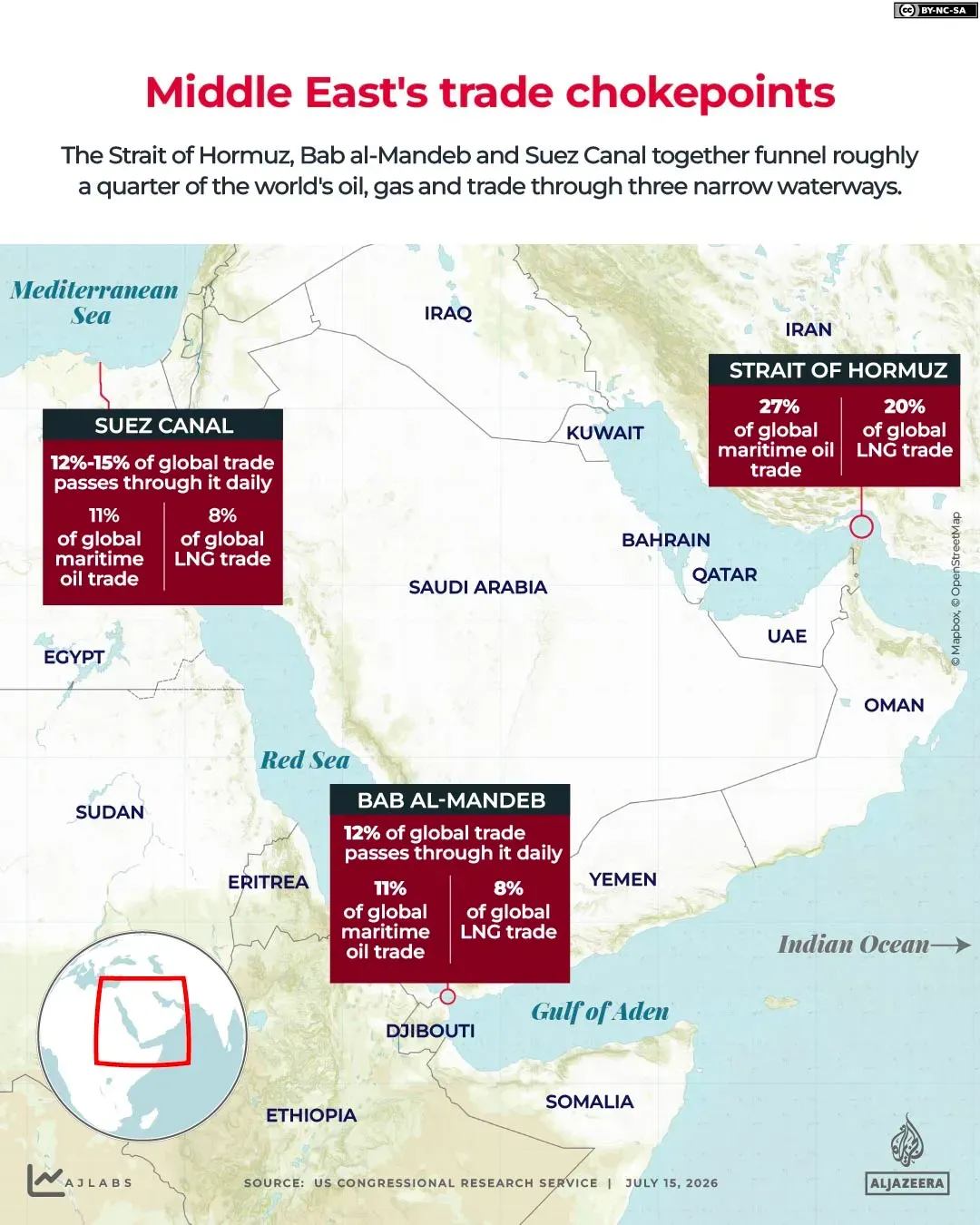
![[Al Jazeera]](https://i0.wp.com/www.aljazeera.com/wp-content/uploads/2026/07/interactive-Straight-Of-Hormuz-ships-July-15-2026_COPYEDITED_INTERACTIVE-Bab-al-Mandeb-strait-red-sea-map-route-shipping-map-1784126907-1785434335.webp?w=640&ssl=1)
“We are now facing a real threat that does not stop at Yemen’s borders,” he said. “It threatens the entire region and the world. If the Houthis manage to choke maritime traffic in the Red Sea, we will be looking at another Hormuz in these waters – with potentially even greater impact.”
The Red Sea and Bab al-Mandeb “represent a vital artery for global shipping, for both energy and food supplies”, he added.
Bab al-Mandeb connects the Red Sea to the Gulf of Aden. To the north, the Red Sea leads to the Suez Canal, while farther east, beyond the Arabian Sea, lies another critical chokepoint, the Strait of Hormuz. This geography is what gives Yemen’s conflict consequences far beyond its borders, as Saudi Arabia is already being drawn into the confrontation.
The Houthis have targeted Saudi territory, civilian infrastructure in the kingdom’s south and Saudi-linked vessels in the Red Sea.
Major-General Turki al-Maliki, spokesman of the Saudi-led coalition in Yemen, said the Houthis on Wednesday attacked Saudi cities of Khamis Mushait, Abha, and Jizan with ballistic missiles and drones. He did not elaborate on any casualties as a result of the attacks.
Badi, who has spoken to the media for the first time since taking up his post, said those attacks are designed to change the nature of the war.
“By targeting Saudi territory, civilian infrastructure in the kingdom’s south, and Saudi-linked vessels in the Red Sea, the Houthis are trying to drag Saudi Arabia into their war. Their calculation is simple: they want to rebrand this conflict as a Saudi-Yemeni war,” he said.
The ambassador assessed that “every time their militias suffer heavy losses inside Yemen at the hands of the Yemeni armed forces, they respond by firing missiles and drones at civilian sites in Saudi Arabia, in an attempt to inflame Yemeni public opinion and convince the outside world that Yemen is at war with Saudi Arabia”.
The conflict, he said, is fundamentally about Yemen’s state and its future. The Yemeni people are fighting to “reclaim their state, their republic, their dignity and their stability”.

Behind Yemen’s fragmented front lines, a larger regional confrontation looms, and its architect, according to Badi, is Iran.
The official said that Tehran’s relationship with the Houthis is now impossible to hide. “Iranian officials openly boast about it, and Houthi leaders proudly talk about their ‘strategic’ ties with Tehran,” he said.
The Houthis are “one of Iran’s key regional arms – just like Hezbollah in Lebanon or the Popular Mobilisation Forces (PMF) in Iraq. Many of Tehran’s other proxies have come under pressure,” he added.
“Former Yemeni President Abd-Rabbu Mansour Hadi used to say that if Iran gains control over Bab al-Mandeb and the Strait of Hormuz, it will not need a nuclear weapon – its grip over these two chokepoints would be more powerful than any nuclear arsenal. Events have proved him right,” Badi recalled.
For Yemen’s government, the alternative to another war was supposed to be diplomacy.
Badi urged the world “to stand with us so we can rid ourselves of this scourge – a threat that no longer targets Yemenis alone”.
“We have exhausted all peaceful avenues. For more than 13 years, we have been engaging in dialogue rounds and signing agreements, whether inside Yemen or after the Houthis seized the capital, Sanaa,” he said.
Badi added that the Houthi rebels have effectively “buried peaceful options. Peace is simply not part of this movement’s culture or mindset. That is what ultimately forced us to take up arms”.
“The world must understand this difficult equation,” the ambassador concluded, that the Houthis are “an armed proxy, an extension of the Iranian Revolutionary Guard Corps. The Houthis do not represent us”.

“It’s terrible for Israel and for Israel’s future, it’s not what Judaism teaches and it’s deeply wrong”, he added.
Supported by other Rabbis in the liberal and progressive UK Jewish communities, Rabbi Wittenberg believes that it is possible to support Israel, be concerned for the safety of British Jews, and that it is right for the UK government to take action to protect Israelis and Palestinians.
However, he also said he was “extremely sad that it’s come to this” and that he shared the “concerns of the Jewish community leadership that people will use this for antisemitism and for demonising Israel even further”.
Chief Rabbi Sir Ephraim Mirvis, who represents the Orthodox community, previously said the sanctions marked a “truly dark day” and placed British Jews at greater risk of attacks.
In Golders Green – where ambulances run by a Jewish medical charity were set on fire and two visibly Jewish men were stabbed in what police called a terror attack earlier this year – there was concern the government’s actions against Israel would increase attacks against British Jews.
“It’s so tricky because, in principle, I agree with opposing these new settlements,” Michael Cohen, who works for a Jewish charity, told the BBC.
But he added: “The timing of it, I think, was completely… just self interest for the Labour Party, signalling before a by-election, before the party conference.”
He said the practical impact of the move would be “almost zero”.
One woman, who runs a jewellery shop that was was twice cordoned off due to incidents in Golders Green, was very critical of the sanctions and said she would “make it my mission” to continue to buy Israeli goods whenever she could.
“We have to [support] our own because no one else is going to”, Deborah Miller told the BBC.
At the end of the week, Jewish congregations will celebrate Rosh Hashana, the Jewish New Year.
Police are already increasing security around Jewish areas to protect communities who have faced multiple attacks this year and are fearful of more.
The number of antisemitic incidents recorded across the UK since the start of the year is up by a fifth compared to last year, figures show.
The Community Security Trust (CST), an organisation that provides security support to the Jewish community, recorded 1,926 incidents of anti-Jewish hate across the UK in the first six months of 2026.
The Crime Survey for England and Wales, external, estimates that only 44% of hate crime incidents between April 2022 and March 2025 came to the attention of the police.

A 31-year-old British man has been charged under the National Security Act over alleged contact with Russia’s military intelligence agency.
Joshua Cammidge, from Swindon, allegedly received instructions from an individual believed to be linked to the GRU Volunteer Corps, a group controlled by Russia’s military intelligence agency, the Crown Prosecution service said.
He has been charged with assisting a foreign intelligence service and preparatory conduct.
He is due to appear at Westminster Magistrates’ Court on Thursday.
Cammidge was arrested at an address in Swindon on Friday by Counter Terrorism Policing (CTP) London officers, supported by officers from Wiltshire Police.
He was taken to a London police station and searches were carried out at a different address in Swindon, the Metropolitan Police said.
He was further arrested and detained under the National Security Act on Saturday.

Rodríguez and Obregón have praised the oil agreement with Trump and NABEP. (PDVSA)
Caracas, September 9, 2026 (venezuelanalysis.com) – The president of Venezuelan state oil company PDVSA, Héctor Obregón, backed the recent agreement with the Trump administration as a “win-win relationship” on Monday.
“We signed Productive Participation Contracts where we put forward crude reserves and qualified personnel. What were we missing? Foreign capital,” he said in an interview with Unión Radio.
Productive Participation Contracts (CPP) are concession-type agreements whereby energy projects are turned over to private corporations which run operations and commercialization while paying a negotiated portion of proceeds to the Venezuelan state.
The recent oil deal, hailed by Trump as “the biggest in history,” will see Venezuela transfer 17 prime oilfields, containing 65 billion in proven crude reserves, to private operator NABEP. The projects are split between extra-heavy crude fields in the Orinoco Oil Belt and mature light- and medium-crude ones in the Lake Maracaibo basin.
Obregón insisted on the mutual benefits, explaining that Venezuela will collect taxes and royalties while the US will be able to supply its domestic demand. Regarding the agreement’s timeline, which the White House has claimed to span 100 years, Obregón stated that the concession is for 25 years but may be renewed for similar periods “as many times as necessary.”
After initially vowing that NABEP would invest US $100 billion in the oilfields, a figure repeated by Venezuelan officials, the Trump administration changed the pledge to “more than $10 billion.”
According to a White House “fact sheet” on the deal, the US State Department will be able to secure 20 percent of the NABEP’s output at cost and have a right of first refusal over the remaining 80 percent.
Obregón suggested that Washington could secure additional benefits, indicating that a reference $65 barrel would have a $15 “sales discount.” The oil official likewise estimated capital and operational expenditures at $12-15 and stated that NABEP would never secure a smaller portion of proceeds than the Venezuelan state, with the percentage increasing for greenfield projects.
The $19 revenue estimate offered by Venezuelan officials as the government’s take for a reference $65 barrel is significantly lower than the benchmarks established under the 2001 Hydrocarbon Law approved by former President Hugo Chávez and subsequent reforms. Under the previous framework, only PDVSA or PDVSA-majority joint ventures were allowed to operate oilfields, with the Venezuelan state securing as much as $0.80 for every $1 of oil proceeds in the latter case.
NABEP, owned by Venezuelan oil mogul Alejandro Betancourt, will grant a 35 percent stake at no cost to the Pentagon’s Office of Strategic Capital (OSC). Washington will likewise have veto power over NABEP’s board of directors. Betancourt has faced corruption accusations in Venezuela, with authorities issuing an arrest warrant in 2022 that was later dropped. For its part, the Trump administration has sought to halt money laundering investigations against the Venezuelan businessman both in the US and in Switzerland.
Obregón went on to acknowledge that Venezuelan export revenues are currently deposited in a US Treasury account before US officials decide on the disbursement amounts and timings back to Caracas.
“There is a state-to-state agreement to receive Venezuelan funds in Treasury accounts,” he disclosed, echoing Washington’s assertion that its seizure of Venezuelan export proceeds aims to protect them from potential creditor claims.
“The channeling of revenues through the US Treasury could be considered a protection measure, since there are debt claims against PDVSA and creditors could target our accounts,” he argued.
Neither US nor Venezuelan authorities have disclosed the amount of revenue collected and disbursed back to Caracas. Luigi Pisella, an advisor to Acting President Delcy Rodríguez, claimed that the Trump administration is deducting the costs of its January 3 military operation against Venezuela from the country’s funds.
The costs of goods and services supplied by US-based exporters to Venezuela are also being directly deducted from the funds held in the Treasury accounts.
Apart from controlling export earnings, US officials have publicly participated in a pro-business overhaul of the Caribbean nation’s hydrocarbon law and regulations, including reviewing drafts of the legislation.
The Trump administration has maintained sanctions on the Venezuelan oil industry while issuing licenses for select Western corporations. US Energy Secretary Chris Wright oversaw the signing of agreements with Chevron, Eni, and smaller US-backed energy firms during a visit to Caracas earlier this month.
Edited by Lucas Koerner in Philadelphia, USA.


ANTWERP, Belgium: Soccer great Marc Overmars is stepping down as Royal Antwerp’s sports director due to health issues.
Overmars, who joined the Belgian club in 2022, explained his decision in a letter to supporters published on Wednesday as he mentioned “all the fatigue that has built up over the years and the enormous amount of stress.”
The former Netherlands, Arsenal, Barcelona and Ajax winger recovered from a mild stroke in December 2022.
“You all know that my health has not been optimal,” he wrote. “But now I feel very clearly that I can no longer cope with this hectic, stressful professional life.”
Overmars previously spent nearly a decade as director of football at Ajax, the Dutch club where he began his playing career but resigned after he was found to have sent inappropriate messages to several female colleagues. He apologized for his behavior.
“My energy is now completely depleted. If I do not listen to my body now, my doctors say there is a very high risk of things ending badly,” Overmars said. “So I have to make a drastic decision and completely stop my professional activities for the time being.”
The Category 1 hurricane misses Kauai but causes widespread destruction, power outages and evacuations.

Published On 9 Sep 20269 Sep 2026
Catastrophic winds and torrential rains from Hurricane Lowell have pelted Hawaii’s western island of Kauai, knocking out power to at least 30,000 residents and ripping up tracts of beachside roads.
Vicious winds knocked down trees and left nearly 92 percent of Kauai Island Utility Cooperative (KIUC) residents without power by early Tuesday as the storm moved north into the open sea.
While the now-weakened Category 1 hurricane did not make landfall on Kauai, it blew down trees, power poles and lines, causing massive destruction from about 128 kilometres (80 miles) west of the island, according to the Hawaii County Civil Defense Agency.
With approximately 85mph (137km/h) wind gusts, the storm brought a deluge that flooded coastal roads and forced roughly 300 residents to evacuate.
The centre of the storm passed west of the islands in the overnight hours on Tuesday and receded further throughout the day, but dangerous surf from the remnants of the hurricane will impact the Southern California coast for several days given the intensity of the winds, the Miami-based National Hurricane Center said.
Emergency officials are asking residents to conserve water and stay off the roads.
Hawaiian mayor Derek Kawakami said that there was “extensive damage” being reported on Tuesday.
“Everyone’s participation has gone from preparation to sheltering to staying off roads …. to now gathering data and information,” the mayor stated.
The Kauai County government urged locals to shelter in place to allow crews to assess damage, clear debris, and restore power and services safely.

Flooding and mudslides will continue to be a risk through the day, said Eric Blake of the National Hurricane Center.
The force of the sustained winds had decreased overall by early Tuesday, and the centre forecasts gradual weakening over the next few days.
In its latest advisory late Tuesday morning local time, the hurricane centre said Lowell had maximum sustained winds near 65mph with higher gusts and was moving north at 14mph.
Hurricane warnings for Kauai and the tiny island of Niihau, which has fewer than 100 permanent residents, were no longer in place by Tuesday morning local time. But high surf and deadly rip currents from the waning storm will continue to affect Hawaii’s exposed coasts for the next day or two.
A tropical storm warning was also lifted for Oahu, the state’s most populated island.

Greek teenage star Konstantinos Karetsas faced ‘circulatory problems’ and was stretchered off against Villarreal.
Published On 9 Sep 20269 Sep 2026
Borussia Dortmund teenage star Konstantinos Karetsas was being treated at the hospital after slumping to the turf 25 minutes into his Champions League debut, the German club said.
“Konstantinos Karetsas had to leave the field due to circulatory problems,” Dortmund said in a statement late on Tuesday. “Kosta is doing well under the circumstances and is on his way to the hospital for further tests.”
Facing Villarreal, the 18-year-old Greek prospect passed the ball to a teammate, then signalled his distress to the referee before sitting on the grass.
Karetsas was treated lying down and then taken away on a stretcher. The score was 0-0 at the time in what became a 3-2 win for Dortmund.
“I hope and I think that everything is OK, and I hope that he’s back and fit with us soon,” Dortmund goalkeeper Gregor Kobel told a broadcaster.

Karetsas and his Greek teammate Giannis Konstantelias were marquee signings for Dortmund in the off-season. Former Belgium youth international Karetsas joined for $34.9m from Genk and Konstantelias for $30.2m from PAOK.
Karetsas was reportedly a target for many clubs after impressing at Genk last season. He set up 11 goals in 28 Jupiler Pro League appearances. He signed a five-year contract through June 2031.
“With his creativity and game intelligence, Kos will enrich our team,” Dortmund sporting director Ole Book said. “He is technically very skilled and has the ability to find quick solutions in tight spaces, especially in the final third.”
Karetsas played for Belgium’s youth teams before opting to represent his parents’ country and making his debut for Greece in March 2025. He has scored three goals in 10 international appearances.
Meanwhile, 23-year-old Konstantelias’ season was likely ended last month by an ACL injury on his Bundesliga debut.

IS your holiday is a gruelling test of your love for your partner? Here are some behaviours you wish they’d saved for when you’re not in their company 24/7 after spending a fortune.
Sulking
Sulking is childish and annoying at the best of times, but worse if it’s over some trivial holiday thing like not wanting to buy a hideous souvenir donkey. If the relationship isn’t too serious you may even feel they’re a pain the arse you should split up with. Although you won’t be telling them immediately, because it’s nice to have someone to eat sardines with and shag on holiday.
Total lack of basic planning skills
It’s clearly hot, so did they bring a bottle of water? No. Let’s go back to that shop you pointed out earlier which sold it. They didn’t bring sunscreen either? Well, it’s the last thing you’d think of when going to the beach. Their sunglasses are back at the hotel, so can they borrow yours? Of course, my sweet… and so the irritation builds until you’re scared to go up that historic tower in case you push them off it.
Unadventurous eating
It’s rare that food on holiday is wildly exotic – you’re hardly likely to be served a whole fried monkey in the Algarve. The problem arises when your partner hates food not totally sanitised like in Sainsbury’s, and is horrified and disgusted by a fish having a head. Don’t worry, you’ll speak to the waiter and get them to turn it into oblongs in breadcrumbs.
Pointless money-saving
On holiday you’ve got to accept a fair bit of unplanned expenditure in the name of spontaneity and having a good time. However your partner may feel a holiday you’ve already spent thousands on is a good time to economise on minor costs. And who doesn’t love debating at length whether your should purchase each individual ice cream?
Worthy interests
It’s traditional on holiday to do worthy things you don’t do at home like visiting a cathedral. That’s probably why they’ve all got gargoyles – to alleviate the boredom. However there’s a limit, and you really don’t want your partner to suddenly discover a deep interest in wine production or local history. If they’re that interested in the Moorish conquest of the Iberian Peninsula they should have gone on holiday with David Starkey.
Personal habits
Snorting, making a clicking sound with your tongue, picking your nose and other such habits are tolerable occasionally. However on holiday you’re with your beloved constantly so those little irritations are magnified to the size of Jupiter. Has a boyfriend ever been beaten to death with an espadrille because he kept sniffing? It’s likely. The Spanish courts probably don’t even consider it an offence.
Authors: Janvi Singhi and Kanav Sharma*
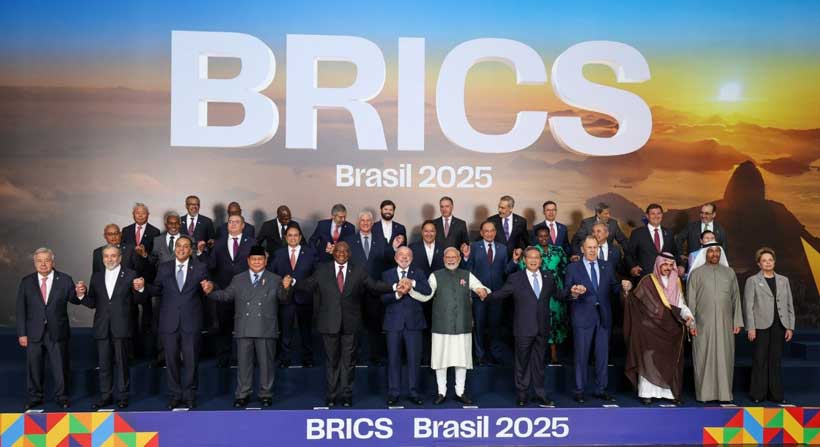
BRICS is moving into a more meaningful phase in its evolution. Its larger membership, considerable resources, population, and markets position it as a voice for the global south. Nevertheless, the fact that the BRICS is economically big does not guarantee that it will turn into a powerful organization. The difficult question is whether BRICS will be able to use the potential of its diversified members to create the institutions and means of collaboration that will meet the needs and interests of different countries, businesses, and banks.
This is where the next chapter of BRICS collaboration will be decided. It is definitely not in need of aspiration. The main question is not whether BRICS will develop a common geopolitical approach but whether BRICS will be able to simplify the issues of cooperation for countries with divergent economic interests and institutional capabilities.
The enlargement of BRICS has brought about both a chance and an enigma. An increased number of members boosts the economic and diplomatic power of the group, but it also entails the presence of more currencies, regulations, economic systems, and foreign policy priorities. States such as India and China may share a desire to amplify the role of developing economies while being in competition with regard to trade, technology, and geopolitics. Resource-rich countries may have their priorities with respect to the manufacturing countries. Financial centers may deal with payment integration differently from countries interested in getting more monetary independence.
Stay ahead of the geopolitical week.
MD Briefing delivers expert analysis across five global fronts — the Indo-Pacific, energy, geoeconomics, European security, and the Middle East — every Monday morning. Free.
The key challenge before BRICS is not about making all the members agree about everything; rather, it is about creating means for cooperation between different countries in the areas where their interests coincide.
This differentiation is essential because BRICS is frequently assessed based on scale indicators, including population, economic output, energy resource reserves, and trade. While these parameters demonstrate the affiliation, the affiliation is not the key to institutional power. BRICS is still functioning as an informal coordinating mechanism and not as a supranational institution due to the absence of an establishing treaty, budget, and secretariat. The conversion of its total economic capabilities into total actions should rely substantially on its members’ coordination. BRICS needs to change its approach, so instead of pursuing expansion, it should focus on implementation.
The issue of cross-border payments can serve as an example. The necessity to improve payment processes within BRICS may be easily explained. International transactions require correspondent banks, multiple currencies, currency exchange, and several commissions. Using local currencies and interoperable payment systems may help reduce some of these expenses and create additional ways of settlements for countries.
However, establishing a new financial structure is much more difficult than just talking about it. The real barriers are technical and institutional: interoperability between national payment systems, regulatory compatibility, foreign exchange liquidity, cybersecurity, anti-money laundering and know-your-customer norms, settlement systems, and trust among the entities participating in the payment system. A domestic payment system cannot simply be hooked up to a foreign payment system without addressing these problems. This leads us to a more practical goal for BRICS countries. Instead of concentrating on the joint BRICS currency, they should work on interoperability among national payment systems.
The example of India’s UPI-PayNow linkage to Singapore shows how this principle works. Two entirely different payment systems can be interlinked without destroying their own systems. The same gap can be figured out at the level of BRICS if all necessary regulations, settlements, and risk management conditions are fulfilled. In order to understand how this can be achieved, BRICS can refer to the examples of other countries that have already applied the same logic.
The same issue of coordination can be observed in trade and supply chains as well. BRICS countries have complementary assets such as resources in energy, agriculture, manufacturing, minerals, technology, and large markets for consumer goods. However, having complementary resources does not automatically result in integrated supply chains.
Businesses need predictable customs, standards that will fit one another, reliable logistics, availability of finance, and clarity of regulation. If countries have different certification systems, digital documents, and technical standards, the theoretical advantages of a large BRICS market will not be fully realized. Therefore, standards will probably prevail over declarations in the end.
So far BRICS has spoken about cooperation of national standard organizations and overcoming technical barriers between trade. Further work is getting cooperation of national standard organizations transferred into standards that will be in demand in real business. Common standards for digital trade documents, selected product certification, customs data, payment systems, and technical standards can connect BRICS economies without full harmonization of their economies.
This method would make it easier to justify politically. There would not be a need for members to give up their power when it comes to buying a wider range of economic policies. The only thing left is for countries with technology to agree on their particular rules where technology will help provide measurable benefits.
The same goes for agricultural projects, as the BRICS countries share similar problems in the fields of food supply, climate, water conservation, and productivity. The BRICS has started pushing for agricultural research and cooperation. So, the question is not whether the BRICS countries have recognized these areas; they already have. The larger question is whether anything can be implemented across borders.
In a situation where one country has effective technology to grow crops and another one has a good way of bringing the crops to a field, BRICS has to find a way to transfer that knowledge or have an organization that can help in that transfer. There should be a value on the moves made regardless of whether formal treaties have been produced or not. This points towards a different institutional model for BRICS: modular cooperation.
BRICS needs to develop a model that allows all members to be part of the major framework and subgroups of interested members cooperating with each other in specific areas that require deep integration. Countries interested in making payments and settlements between them could organize a coalition in charge of finding and implementing technical solutions for that. Those ready to work jointly in the field of agriculture can proceed with agricultural cooperation, while others can focus on critical minerals, logistics, AI technologies, energy, and development finance.
This model recognizes one uncomfortable truth: diversity is BRICS’ asset, but it also acts as an obstacle in its functioning. In a highly heterogeneous grouping, it is impossible to expect rapid integration in view of the differences among its members. Compliance with the needs of all BRICS states only produces long negotiations and ambitious statements that do not work. Modular cooperation, in its turn, enables countries to pursue their own policy while being part of the larger framework.
Moreover, it could also establish a more trustworthy framework for testing. A limited number of members would be given the opportunity to run an initial test of payment or trading procedures, determine any legal or technological obstacles, and welcome other participants once the system is successful. The outcome would be a lowering of the chances of running into challenges that would be involved in the launch of a full project for all members simultaneously. BRICS should also reconsider its parameters of success.
Rather than concentrating on the number of members or the quantity of agreements accepted, BRICS should focus on the outcomes of its activities. There are political benefits to this strategy as well. BRICS will find it difficult to forge sustainable alternatives simply by selling them as counters in the geopolitical confrontation with the West. Governments and businesses respond not just to geopolitical signals but also to incentives. If the BRICS mechanism is cheaper, quicker, safer, and more efficient, then the chances of adoption increase.
This point is especially important for the discussion of de-dollarization. The reduction of dependence on dollar-based systems may in itself be a rational objective for some members; however, viewing de-dollarization as a success in and of itself can overshadow the distinction between geopolitics and economic efficiency. A payment mechanism can only gain credibility if banks and companies use it to solve a problem at hand.
India’s BRICS presidency in 2026 is an excellent opportunity to work on the practical implementation of the above approach. New Delhi can focus on enhancing cooperation based on interoperability and standards, collaboration of sectors, and measurable results. Instead of trying to create a homogenous group, India can create a framework where willing participants will devise their solutions for implementation by others.
Instead of striving to make BRICS like other supranational bodies, we should acknowledge the fact that, given its diversity of membership composition and structure, it is not realistic nor necessary. BRICS differentials provide a comparative advantage of allowing a mix of countries with both different political and economic systems that nevertheless share aspirations for greater policy autonomy and a voice in international affairs.
BRICS does not need to reach consensus on every issue to become successful. What it requires is to be able to determine areas where cooperation can be beneficial economically and create institutions able to do that.
Thus, the biggest problem is not the absence of power. The problem is how to convert power into capacity and capacity into institutions. If BRICS succeeds in this task, its economic capacity will transform from empty statistics into collective power. If it does not, then enlargement might improve visibility of the group, but its effectiveness would stay at the same level.
*Kanav Sharma is a Public Policy Researcher from Jammu & Kashmir with a postgraduate degree in English Literature from the University of Jammu. His interests include public policy, governance, parliamentary and strategic affairs.
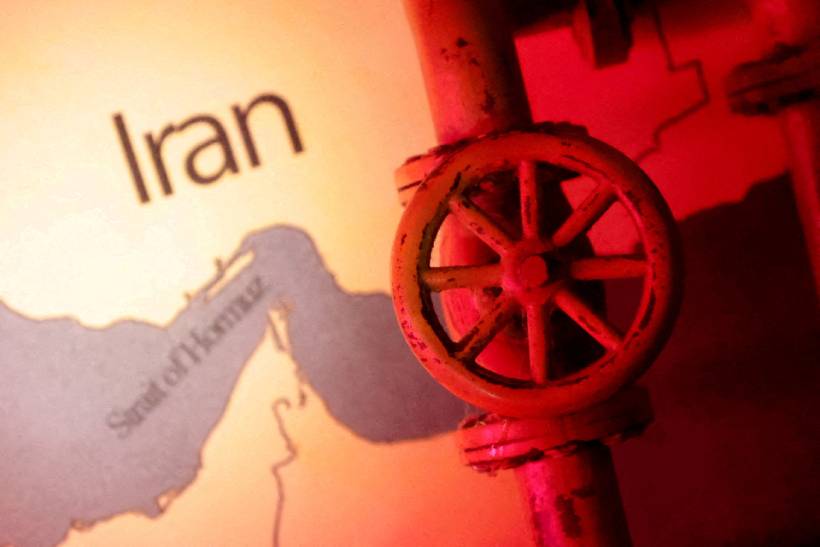
The Strait of Hormuz has become the central pressure point in the escalating confrontation between the United States and Iran. Before the conflict, roughly 20 million barrels of oil moved through the narrow waterway each day, equivalent to about one fifth of global oil consumption. For years, traders could therefore rely on relatively consistent estimates of the volumes passing through one of the world’s most important energy corridors.
That certainty has now disappeared.
The use of “dark crossings,” in which tankers switch off their identification and navigation systems, has made vessel movements increasingly difficult to monitor. Satellite imagery, port records, tanker drafts, loading schedules and shipping data are being used to reconstruct movements, but the information remains incomplete. Recent estimates of Hormuz flows have differed dramatically, leaving traders and governments uncertain about the true scale of oil moving through the waterway.
The uncertainty comes as Brent crude has moved above the $100 a barrel threshold for the first time since July, driven by renewed military escalation and concerns over Middle Eastern oil supplies.
Stay ahead of the geopolitical week.
MD Briefing delivers expert analysis across five global fronts — the Indo-Pacific, energy, geoeconomics, European security, and the Middle East — every Monday morning. Free.
The most unusual feature of the current oil crisis is not simply that supplies may have fallen. It is that markets cannot confidently determine how much oil is actually moving.
U.S. Energy Secretary Chris Wright said more than 17 million barrels crossed the strait on August 31 under U.S. Navy supervision. Shipping intelligence firm Kpler, however, estimated that only around 6 million barrels crossed that day. Kpler put average August flows at approximately 4.3 million barrels per day, with flows rising to nearly 5 million barrels per day during the first days of September.
The difference could partly reflect different methodologies, including whether shipments using alternative routes outside Hormuz are included. Tankers that remain invisible to tracking systems for days or even weeks make the picture even harder to reconstruct.
This means that traders are attempting to price global oil supplies without reliable visibility over one of the world’s most important supply arteries.
Hormuz is strategically important because of the enormous concentration of energy exports that normally pass through it. Any sustained disruption can affect crude supplies, tanker availability, insurance costs and shipping times, eventually feeding into fuel prices and broader inflation.
The current situation is different from a straightforward blockade. The strait has not necessarily become completely impassable. Instead, its reliability has been severely compromised.
That distinction matters because a tanker does not have to be physically prevented from crossing for markets to react. The possibility that vessels may be delayed, attacked or unable to cross safely is enough to increase the cost of transporting oil.
As a result, the market is responding not only to actual supply losses but also to the risk of future disruption.
Iran’s ability to disrupt maritime traffic remains an important source of leverage despite indications that its military capabilities around Hormuz have been weakened.
U.S. demining operations and a growing U.S.-protected shipping corridor along Oman’s coast have allowed more vessels to enter and leave the Gulf. At the same time, Iran-linked forces continue to threaten commercial shipping, meaning Tehran retains the ability to create uncertainty even if it cannot completely shut down the waterway.
This gives Iran a form of asymmetric leverage. Tehran does not necessarily need to close Hormuz completely to impose economic costs. Sporadic attacks, warnings or restrictions can increase insurance premiums, delay shipments and encourage traders to price in a greater possibility of supply disruption.
The renewed attacks on Saudi energy infrastructure have added another layer of risk by threatening alternative routes that have become increasingly important as traffic through Hormuz has declined.
The immediate consequence is a higher geopolitical risk premium on crude.
Oil prices normally respond to measurable fundamentals such as production, consumption, inventories and transportation. But when the market cannot establish how much oil is moving through Hormuz, uncertainty itself becomes part of the fundamental picture.
This can keep prices elevated even if actual physical supply losses are smaller than feared.
Brent has already moved above $100 a barrel, while analysts and major financial institutions have raised their oil price forecasts as concerns about prolonged disruption increase.
For oil-importing countries, sustained high crude prices could translate into higher fuel and transportation costs, increased inflationary pressure and greater economic uncertainty. Airlines, manufacturers and businesses dependent on energy-intensive supply chains would also face higher operating costs.
The crisis demonstrates how vulnerable the global energy system remains to a single strategic chokepoint.
For the United States, maintaining freedom of navigation through Hormuz is not simply a military objective. It is also essential to preventing a regional conflict from becoming a wider global energy crisis.
For Gulf producers, the challenge is equally significant. Even countries with substantial production capacity cannot fully compensate for disrupted shipping if export routes remain vulnerable.
For major Asian importers, the risks are particularly serious because much of the energy normally passing through Hormuz is destined for Asian markets. A prolonged disruption could therefore create significant pressure on import bills, currencies and inflation across energy-dependent economies.
The crisis also highlights the limits of alternative routes. Pipelines and routes outside Hormuz can reduce some of the pressure, but they cannot immediately replace the enormous volumes that normally pass through the waterway.
The key variable is whether the confrontation between Washington and Tehran moves toward negotiations or further escalation.
A diplomatic breakthrough could rapidly reduce the geopolitical risk premium by restoring confidence in shipping and improving visibility over oil flows. A further escalation, however, could produce additional attacks on tankers, restrictions around the Gulf or renewed pressure on alternative shipping routes.
The oil market will therefore be watching tanker movements as closely as military developments.
If shipping activity becomes more visible and flows recover, some of the current premium could disappear. If the information blackout continues, traders may continue pricing the possibility of a much larger supply disruption.
The deeper significance of the Hormuz crisis is that information itself has become a strategic commodity.
Modern energy markets have traditionally depended on the ability to monitor ships, cargoes and supply chains with increasing precision. Satellite imagery, tracking systems and port data created an assumption that physical oil flows could be observed and measured with reasonable accuracy.
That assumption is now being challenged.
The result is a market where perception can influence prices almost as powerfully as physical shortages. If traders believe Hormuz is becoming less reliable, they will pay more for crude today even without definitive evidence of a catastrophic supply loss.
This gives Iran an important form of strategic leverage. The threat of disruption can generate economic consequences even when actual disruption remains limited.
At the same time, Washington faces a difficult calculation. Greater military protection may help keep shipping moving, but prolonged confrontation can also increase the geopolitical risk premium that the United States is trying to contain.
The central question, therefore, is no longer simply how much oil is passing through the Strait of Hormuz. It is how long the global market can function without knowing the answer.
If that uncertainty persists, the oil market could continue carrying a substantial security premium even if physical supplies prove higher than current estimates suggest. The longer the uncertainty lasts, the more deeply it can become embedded in prices, inflation expectations and global economic planning.
With information from Reuters.

The United Kingdom has announced a ban on the import of all goods produced in illegal Israeli settlements in the occupied West Bank, Foreign Secretary Ed Miliband said in Parliament on Tuesday.
It comes in response to an intensifying wave of Israeli settler pogroms and settlement expansions in the occupied West Bank and East Jerusalem.
The ban, set to come into effect within six to nine months, would target settlement exports such as dates, olive oil and agricultural products, with Miliband saying he did not believe “the British people want us supporting the occupation by accepting products from settlements in our shops”.
The International Court of Justice in July 2024 called Israel’s occupation of Palestinian territory “unlawful”. Months later, the United Nations passed a resolution calling for an end to the Israeli occupation within a year.
Israel’s response was furious, as it announced four “counter-measures”, including banning 12 British MPs from entering Israel and closing the British consulate in Jerusalem.
After Miliband’s speech, 11 more countries: Canada, Denmark, Finland, France, Iceland, Ireland, Norway, Poland, Portugal, Spain and Sweden, shared a joint statement supporting the so-called two-state solution and announcing their own intentions to impose restrictions on trade with illegal Israeli settlements.
Spain and Ireland had already announced their own national bans earlier this year, alongside the Netherlands and Belgium.
Aside from Canada and the UK, the rest of the countries considering or already banning settlement goods are European Union members.
The EU is Israel’s largest trading partner, accounting for 31.7 percent of Israel’s total trade in goods in 2025 (43.3 billion euros, or $50.4bn), according to the European Commission. The EU supplied 33.1 percent of Israel’s imports (28 billion euros, or $32.6bn) and received 29.4 percent of Israel’s exports (15.3 billion euros or $17.8bn).
Israel is the EU’s 27th largest trade partner, with Ireland, the Netherlands and Germany being its biggest individual trade partners.
According to a 2026 report by Global Echo Litigation Center, a Palestinian rights legal advocacy group, roughly 5,900 shipments from Israel were headed to Europe, with more than 17 percent containing products originating from settlements.
While no specific figures for settlement trade alone are known, it is understood to be a tiny fraction of total EU-Israel trade, meaning the ban’s impact is much more symbolic than economic.
The table below shows each country’s total trade with Israel for the European countries that have banned, or are introducing bans on, illegal Israeli settlement goods.
The top five European trading partners with Israel either enforcing or set to introduce settlement bans are Ireland, the Netherlands, the UK, France and Spain.
Ireland-Israel bilateral trade totalled $5.36bn in 2025. Ireland is Israel’s second-largest export market for goods after the United States, driven largely by tech, particularly semiconductors and integrated circuits.
Netherlands-Israel bilateral trade totalled roughly $4.8bn in 2025. The Netherlands is also Israel’s largest single foreign investor, accounting for roughly two-thirds of all EU investment in the country.
According to UN Comtrade, UK-Israel bilateral trade totalled $3.73bn in 2025. An Al Jazeera investigation found at least 17 companies linked to illegal Israeli settlements hold more than 2.1 billion pounds ($2.85bn) in UK public-sector contracts.
France-Israel bilateral trade totalled $3.62bn in 2025. A large part of France’s trade with Israel constitutes export licences for surveillance and military technologies.
Spain-Israel bilateral trade totalled $2.79bn in 2025. In September that year, Spain banned the import of goods from illegal Israeli settlements in the occupied Palestinian territory, as well as the trade of arms.
![A sign painted on a wall in the occupied West Bank town of Bethlehem calling for a ban on Israeli products made in Palestinian occupied territories [Thomas Coex/AFP]](https://i0.wp.com/www.aljazeera.com/wp-content/uploads/2015/07/57ab852fac8a4b3dbc851dfe89553c7e_18.jpeg?w=640&ssl=1)
Israeli settlements are Jewish-only communities built illegally on Palestinian land.
Settlements are illegal under international law as they violate the Fourth Geneva Convention, which bans an occupying power from transferring its population to the area it occupies.
Illegal Israeli settlements continue to grow, decades after the 1993 Oslo Accords, which established limited Palestinian self-rule and were meant to lead to a permanent peace settlement.
At the time, about 270,000 settlers lived across the occupied territory. Today, that figure has more than doubled to between 600,000 and 750,000 people, about 10 percent of Israel’s Jewish population, living across some 250 illegal settlements in the occupied West Bank and East Jerusalem.

London, United Kingdom – In a wheat field near High Wycombe in the rolling English countryside, Alex Nelms watched the harvest on his farm die in a matter of days.
His crop had looked strong until the first heatwave came in May, when temperatures surpassed 35 degrees Celsius (95 degrees Fahrenheit) just as his milling wheat entered its grain-fill phase, the critical weeks when the plant fattens its kernels.
list of 4 itemsend of list
“It just killed everything stone dead,” he told Al Jazeera. “Everything was finished really early, and when we were sort of full of optimism and hope, it was scuppered almost overnight.”
Nelms farms just over 2,000 acres (809 hectares) of arable land in south Buckinghamshire, on a business his grandparents founded in 1955. His uncle, who has worked the farm for more than 40 years, has just suffered the worst harvest of his career.
Last month, the Department for Environment, Food and Rural Affairs (Defra) said almost three-quarters of England, 71.3 percent, remained in drought. Rainfall in August reached just 34 percent of what would normally be expected by that point in the month, Defra said, and reservoir levels were 18.2 percentage points below where they should be for the time of year.
“We’re totally reliant on Mother Nature,” Nelms said, and nature did not deliver this year.
After a historically dry spring and a run of summer heatwaves, the farm is down roughly 1,000 tonnes on its average harvest, a shortfall of some $270,000 in revenue.
The farm, tucked in the Chiltern Hills, a steep, long ridge of white limestone rock, has no irrigation and never will.
“That has serious knock-on effects on our cash flow,” he said. A third consecutive difficult year would mean hard conversations with his bank and landlord, and farming to minimise risk rather than maximise output, “consequently, probably producing less food”.
The National Farmers’ Union (NFU) says farmers are at a “financial crisis point” after the worst drought in 50 years, with historically low harvests, stunted grass growth, rising fuel and fertiliser costs, and a severe outbreak of bluetongue disease in livestock.
The union puts the gross production value loss of wheat at approximately $499m and the cost of replacing a shortfall in forage at roughly $45m.
NFU president Tom Bradshaw has said farmers now lack “breathing space” and are “increasingly exposed to geopolitical shocks, as well as repeated weather extremes, animal disease and global wars”.
He believes action is needed now to ensure the future of British farming “and enable the next generation to keep producing the nation’s food”.
To manage the risk, Nelms is diversifying, planting oilseed rape again on about 350 acres (142 hectares) for the first time in 20 years. He says that the crop’s usual insecticide protection, neonicotinoid seed treatments, is now banned, leaving it exposed to cabbage stem flea beetle and to game birds that can “absolutely nibble, eat, and destroy a crop”.
Growing it also means breaking a continuous wheat rotation that has kept a soil-borne disease called “Take-all”.
Tax allowances would make investing in grain storage and diversified income worthwhile, he said, as well as government-backed bridging loans, modelled on COVID-era support, to survive a bad year without permanent damage.
It is the kind of relief the NFU is pressing the government to provide nationally.
The union wants an interest-free “Keep Britain Growing” loan tied to drought losses, help covering the cost of disposing of livestock lost to bluetongue, faster planning permission for on-farm reservoirs, and clearer rules letting farmers access water as soon as levels allow, echoing Nelms’s case for storage on his farm.
“Drought conditions will continue to worsen until we receive sustained rainfall across the country and we still all have a role to play in conserving precious water supplies,” according to Philip Duffy, the Environment Agency’s chief executive, in a statement shared by Defra.
The Environment Agency has applied for a drought order to restrict abstraction from the River Severn, and 10 water companies, serving 30 million customers, now have restrictions in place.
“A few days or even weeks of wetter weather cannot reverse the impacts of several months of exceptionally dry conditions,” added Duffy.
Defra noted that the first meaningful rains since June have fallen but they have been patchy, so reservoirs and groundwater are still declining even as a handful of rivers see brief upticks in flow.
Despite the losses, Nelms is hopeful about farmers pulling together – sharing labour, machinery and market routes. He points to the Central Chiltern Farmer Cluster, where growers meet to talk through their problems and find solutions together.
“We’re working together, not competing with each other,” he said.
For a farm like Nelms’s, with no irrigation and no water in reserve, that patchiness is the problem. Soil parched from months without rain needs to absorb sustained rainfall before groundwater can even begin to recharge, let alone refill the reservoirs a future harvest might depend on.
“Our climate has changed,” Water Minister Emma Hardy, who chairs the National Drought Group, said late last month, “and we will continue to take all action necessary.”
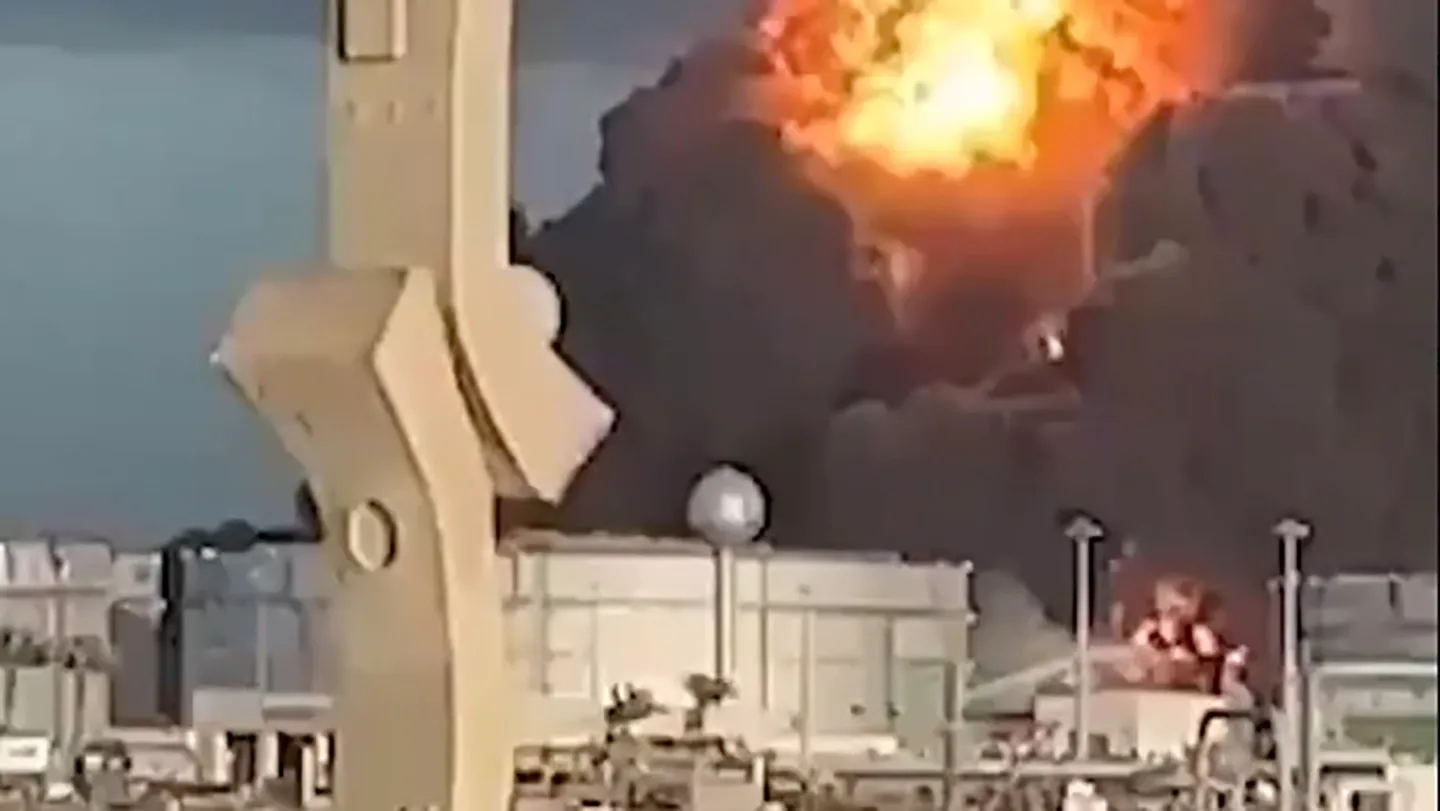

Just hours ago, the Saudi Aramco refinery at Jazan on the Red Sea was engulfed in flames after a Houthi missile and drone attack. Strikes at the heart of the Saudi’s energy infrastructure on the Red Sea, which acts as the remaining primary lifeline of energy exports out of the region, threaten to drastically impact global oil prices further, a concern we have been raising for some time. In the wake of the attack and additional fighting in the Persian Gulf, oil prices surged toward the $100 per-barrel mark.
“The Yemeni Armed Forces carried out a qualitative, large-scale military operation, targeting the Aramco company in Abha, Najran and the Economic City, Aramco in Jizan, and Khamis Mushait Air Base with dozens of ballistic missiles and drones,” Houthi spokesman Brig. Gen. Yahya Saree stated on Telegram. “The strikes were precise, by God’s grace, and direct, causing major damage to those facilities.”
Saree claimed that the strikes were “in response to the Saudi aggression that targeted our people and our country with 121 air strikes over the past three days.”
Saudi officials confirmed Houthi attacks and said they would retaliate.
“The terrorist Houthi Militia’s senseless attacks, the latest of which targeted civilian and economic sites in the cities of (Abha, Khamis Mashait, Jazan and Najran) resulting in injuries to (73) civilians, including women and children, constitute a blatant violation of the Kingdom’s sovereignty and a direct threat to the security and safety of its citizens and residents,” anti-Houthi coalition spokesman Maj. Gen. Turki Al-Maliki stated on X.
“The Joint Forces Command of the Coalition will take all necessary operational measures to deter this Terrorist Militia and resolutely confront its hostile approach, in defense of the Kingdom’s sovereignty, the preservation of its national assets and the safety of its citizens and residents,” Al-Maliki added. “The Command will also take all necessary measures and actions to respond to the sources of the threat and neutralize its danger.”
“…several energy sector facilities and installations in the southern region of the Kingdom were targeted this morning,” the Saudi Ministry of Energy stated on X. The attacks “caused fires at several locations, leading to a temporary halt in some operations,” the ministry added. “Specialized field teams have begun containing the fires, securing the sites and assessing the damage.”
Videos on social media this morning showed the Saudi Aramco facility still burning after the attacks.
Data from NASA’s Fire Information for Resource Management System (FIRMS) indicates a large amount of ongoing thermal anomalies in and near the massive Jazan refinery.
🇸🇦🇾🇪 Houthis appear to have launched a major drone attack on Jazan, SW Saudi Arabia, in recent hours.
— Fires at Aramco’s Jazan oil refinery
— Multiple hotspots at Jazan Bulk Plant
— Hotspot near King Abdullah Airport https://t.co/cdhFe7I274 pic.twitter.com/ZIN7WKKUiX— Egypt’s Intel Observer (@EGYOSINT) September 8, 2026
The Houthi attacks inside Saudi Arabia came amid increased fighting in Yemen between the rebels and anti-Houthi forces backed by Riyadh.
The conflict between Saudi Arabia and the Houthis grew out of a civil war in Yemen that erupted in 2014. It expanded a year later when a Saudi-led coalition joined forces with the government ousted by the Houthis and raged on until the parties reached a tenuous ceasefire in 2022. The Saudis held off on getting involved in the recent Red Sea conflict which saw the U.S. and coalition warships duking it out with the Houthis, and eventually led to a U.S.-led air campaign over Yemen. Tensions, however, reignited after that conflict ended when the Houthis joined the U.S.-Iran conflict on the side of their major supporter. The Houthis recently imposed a blockade on the Bab al-Mandeb Strait, and began striking Saudi ships in the Red Sea as well as refineries.
As we have frequently detailed, Houthi attacks on Saudi Arabia’s energy infrastructure put further pressure on oil exports from the Middle East, already drastically affected by the Iranian closure of the Strait of Hormuz and the resumption of the U.S. blockade on Iranian ports. Saudi Arabia has diverted millions of barrels of oil per day through pipelines to its Yanbu port on the Red Sea in an effort to minimize the energy shortages due to the hostilities near the Persian Gulf. This also raised the specter of the U.S. having to get as involved as it did during the previous Houthi campaign against shipping that ended last September, which could pull resources away from Iranian-focused operations, if supporting such an operation is even possible at all at this point. The bottom line here is that if the Houthis stop Saudi oil from transiting through the Bab el Mandeb Strait and the Suez Canal, this last lifeline of energy to Europe and Asia and beyond would be severed. This would drastically exacerbate an already ballooning oil crisis.
The Houthi strikes on Tuesday followed a spike in attacks on shipping in the Strait of Hormuz. Last week, U.S. Central Command (CENTCOM) said it destroyed three Islamic Revolutionary Guard Corps (IRGC) oil tankers after the Iranians fired ballistic missiles at U.S. warships.
On Tuesday, “American forces have struck multiple Iranian tankers tied to the IRGC in response to more attempted missile attacks on a U.S. Navy warship,” a U.S. official told TWZ.
The CENTCOM strikes are part of the Trump administration’s new tanker-for-a-tanker policy of hitting Iranian vessels in response to Tehran’s attacks on shipping in the Strait of Hormuz. This marks a change from previous incidents where ships were only attacked for running the ongoing U.S. naval blockade on Iranian ports. The sinking of one of the Iranian tankers in the most recent strikes is another escalation. Previous incidents following major combat operations during Epic Fury involved U.S. forces disabling Iranian transport vessels, not sinking them.
“Following Iran’s failed attacks, CENTCOM permanently disabled the IRGC crude oil carriers M/T Downy off the coast of Kharg Island and M/T Stark 1 near Jask,” the command stated on X on Saturday. “American forces also completely destroyed the unladen crude oil carrier M/T Kylo (also known as the “Noxen”) in the Gulf of Oman, striking the vessel in multiple critical locations to render it inoperable after the crew was directed to abandon ship.”
The three Iranian crude oil tankers “are part of a multibillion-dollar shadow network that funds the IRGC and its regional proxies,” the command added. “Iran has no means by which to defend them.”
“Let the message to the IRGC be clear: If you shoot at two of our ships, we will impose an even higher economic cost —taking out three of yours,” said Adm. Brad Cooper, CENTCOM commander. “We will not hesitate to defend American forces, and if necessary, destroy Iran’s limited and exposed oil fleet.”
“Let the message to the IRGC be clear: If you shoot at two of our ships, we will impose an even higher economic cost —taking out three of yours. We will not hesitate to defend American forces, and if necessary, destroy Iran’s limited and exposed oil fleet.” — Adm. Brad Cooper,… pic.twitter.com/UGGcSGsUtd
— U.S. Central Command (@CENTCOM) September 5, 2026
In addition to the tanker attacks, CENTCOM is maintaining its naval blockade of Iranian ports. “As of Sept. 6, U.S. forces have redirected 92 commercial vessels, disabled 3 and boarded 2 to ensure strict compliance,” the command stated on X.
A U.S. Air Force F-35A stealth fighter jet patrols over regional waters as CENTCOM forces continue to enforce the maritime blockade against Iran. As of Sept. 6, U.S. forces have redirected 92 commercial vessels, disabled 3 and boarded 2 to ensure strict compliance. pic.twitter.com/oXNN5zKx1t
— U.S. Central Command (@CENTCOM) September 6, 2026
As these events unfold, the price of oil is rising further, as we noted earlier in this piece. As of noon on Tuesday, the per barrel price of Brent crude was trading at nearly $98, a $10 per barrel gain from Aug. 26, according to OilPrice.com.
Analysts said the price reflected “the market’s recognition that there is no end in sight for the conflict in the Middle East, which has disrupted oil flows through two vital arteries: the Strait of Hormuz and the Red Sea,” The New York Times reported on Tuesday.
“Oil market participants are now pricing in a more prolonged disruption to shipping flows,” Hamad Hussain, a senior economist with Capital Economics, a research firm, told the publication. “They and other analysts have raised oil price estimates, based on an expectation of increased disruptions.”
Amid the strikes on oil-related targets, Iran claimed it captured an Anduril Dive-LD UUV and is in the process of reverse-engineering it. The IRGC released video and images of the device.
The IRGC Navy has released footage showing the captured U.S. Navy Dive-LD autonomous underwater vehicle (AUV) seized in the Strait of Hormuz. pic.twitter.com/XN379Kcpkh
— Ebrahim Zolfaghari (@IranTimes72) September 8, 2026
Additional images showing the U.S. Dive-LD AUV that was captured by the Iranians, following what a U.S. official described as a malfunction a number of days ago. pic.twitter.com/fyuDFJxsuv
— OSINTdefender (@sentdefender) September 8, 2026
The IRGC “captured one of the most modern intelligent and unmanned submarines of the terrorist U.S. military at the entrance to the Strait of Hormuz at dawn today, in a complex operation involving intelligence and operational surveillance,” the organization claimed.
The vessel “possesses the latest technology in the field of underwater systems in the world and was delivered to the fleet of the terrorist U.S. military in 2025,” the IRGC added.
Asked if Iran captured a UUV, a U.S. official denied that the Iranians obtained anything sensitive.
“An underwater drone operated by U.S. forces malfunctioned more than a day ago,” a U.S. official told us. “It was surveying regional waters in support of ongoing operations. The defective drone was an older model that neither collected sensitive data nor carried any classified sonar or radar equipment. U.S. operations in area waters continue.”
The Dive-LD can be configured for demining operations. Cooper, the CENTCOM commander, recently stated that: “We have successfully cleared sea mines in the strait’s international shipping lanes that were laid months ago by Iran’s Islamic Revolutionary Guard Corps. Internationally recognized transit routes in the strait are free of Iranian sea mines, thanks to the incredible work of the U.S. military.”
It is unclear whether the Dive-LD system was used in those operations; however Financial Times last week reported that the U.S. sent “Navy Seal divers, robot boats and specialized underwater craft into the perilous strait for a four-month mine-clearance mission.”
“The fraught process of explosive device disposal was carried out underwater and in darkness in an attempt to eliminate a crucial factor deterring ships from carrying vital cargoes through the strait since the US and Israel attacked Iran in February,” the publication added.
US Navy SEAL divers spent four months clearing Iranian mines from the Strait of Hormuz, according to the Financial Times.
SEAL divers worked at night from inflatable-hulled boats with help from underwater crafts to remove the mines.
“That is usually followed up by a navy diver… pic.twitter.com/NT1gBvQVqA
— Collin Rugg (@CollinRugg) September 7, 2026
As the Houthi-Saudi exchanges continue and the Strait of Hormuz is still heavily contested, there appears to be no real movement toward a diplomatic solution.
U.S. President Donald Trump proclaimed that the U.S. will defeat Iran.
“Oil prices will drop precipitously, like everything else is dropping (but more!), when we WIN the war with Iran,” the president stated on his Truth Social site. “Three Dollars a gallon, but ultimately, below Two Dollars a gallon. It will all happen quickly, and Iran will never have a Nuclear Weapon. MAGA!”
Iran, for its part, said it will continue fighting.
“The Islamic Republic of Iran has always opposed war and has considered the preservation of the people’s interests and regional security to lie in refraining from igniting conflict,” Iranian President Masoud Pezeshkian said on X. “However, just as it has boldly risen to defend against aggression up to this day, it will continue this resistance with full strength until the aggressors are brought to complete regret and will remain the guardian of the rights of the great Iranian nation.”
جمهوری اسلامی ایران همواره با جنگ مخالف بوده و حفظ منافع مردم و امنیت منطقه را در پرهیز از آتش افروزی دانسته است. اما چنانکه تا امروز در برابر تجاوز، دلیرانه به دفاع برخاسته است این مقاومت را تا پشیمانی کامل متجاوزان با قوت ادامه خواهد داد و پاسدار حقوق ملت بزرگ ایران خواهد بود.
— Masoud Pezeshkian (@drpezeshkian) September 8, 2026
Should there be a resolution to this conflict, U.S. military and intelligence officials have had “recent quiet discussions about cutting the number of people and facilities typically stationed in Middle East,” CNN reported.
In offices across the US military & intel community, there have been recent quiet discussions about cutting the number of people & facilities typically stationed in Middle East if Trump admin succeeds in ending the Iran conflict, 6 sources tell @KatieBoLillis & me.…
— Zachary Cohen (@ZcohenCNN) September 8, 2026
That’s it for now. We’ll update this story when new details emerge.
UPDATE: 6:25 PM Eastern:
CENTCOM said it “destroyed five Iranian crude oil carriers, Sept. 8, after the Islamic Revolutionary Guard Corps (IRGC) targeted a U.S. Navy warship with ballistic missiles twice over the past two days.”
“The U.S. warship successfully evaded the attempted Iranian attacks and continued to patrol regional waters. No American personnel were harmed,” the command added on X. “In response to Iran’s most recent failed attacks, CENTCOM destroyed the IRGC crude oil carriers M/T Kaviz, M/T Charminar, M/T Horizon 1, and M/T Riesco in the Gulf of Oman as well as M/T Derya near Kharg Island. American forces directed the crews to abandon ship before the vessels were struck and rendered inoperable. Iran has used the tankers as part of a multibillion-dollar shadow network that funds the IRGC and its regional proxies. Iran has no means by which to defend these vessels.”
CENTCOM forces destroyed five Iranian crude oil carriers, Sept. 8, after the Islamic Revolutionary Guard Corps (IRGC) targeted a U.S. Navy warship with ballistic missiles twice over the past two days. The U.S. warship successfully evaded the attempted Iranian attacks and… pic.twitter.com/Gi8a2tloN1
— U.S. Central Command (@CENTCOM) September 8, 2026
In the wake of the CENTCOM strikes, Iran launched a new wave of ballistic missile attacks, a Jordanian source confirmed to us. The official Iranian Fars media outlet said Muwaffaq Salti Air and Prince Hassan air bases were targeted.
حمله به پایگاههای موفقالسلطی و شاهزاده حسن در اردنگفته میشود پایگاههای هوایی موفق السلطی و شاهزاده حسن اهداف حملات موشکی ایران است.
براساس گزارشها اردن به دلیل ناتوانی سامانههای پدافندی آمریکایی، جنگندههای نیروی هوایی را برای رهگیری موشکهای ایرانی به پرواز درآورده.
— خبرگزاری فارس (@FarsNews_Agency) September 8, 2026
Video has emerged on social media of interceptors in Jordan defending against the attack.
An insane amount of Jordanian interceptors being seen used here. Dozens being used, as Iranian fires inundate the local area. So far no visible impacts have been viewed. pic.twitter.com/cyZtoojZ9G
— OSINTdefender (@sentdefender) September 8, 2026
Contact the author: howard@twz.com