Stay informed about the latest developments in politics with our comprehensive political news coverage. Get updates on elections, government policies, international relations, and the voices shaping the political landscape.
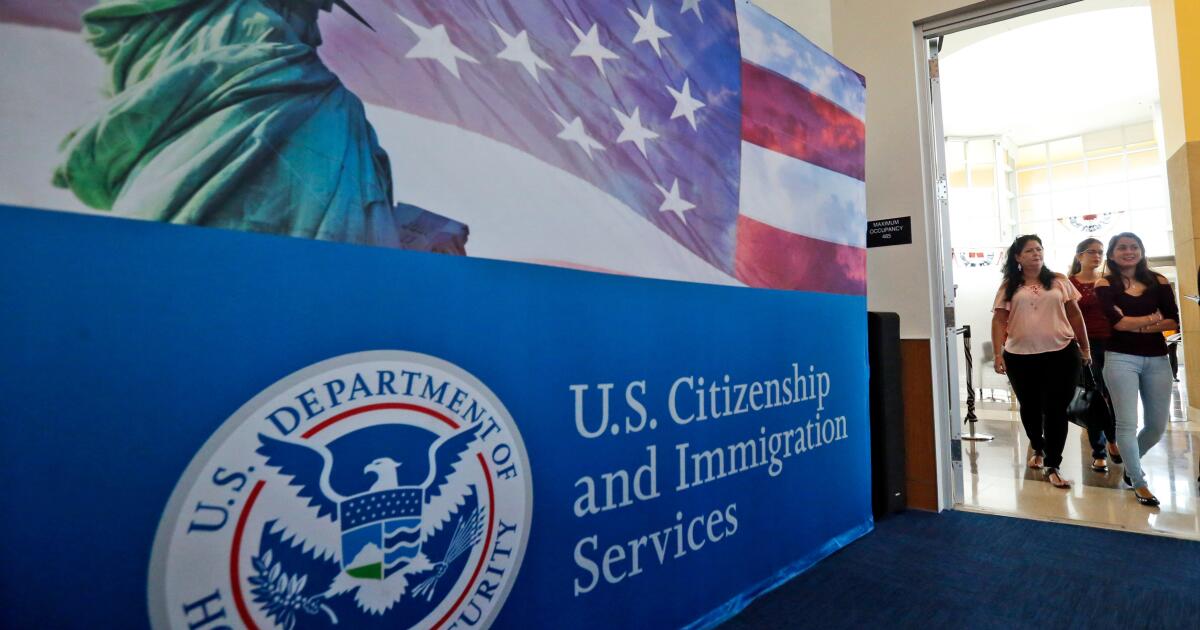
WASHINGTON — The State Department will offer a “premium” expedited service for foreigners seeking business or tourist visas to come to the United States that will set applicants back $750 — on top of the initial fee of $185.
In a notice to be published in the Federal Register this week, the department will unveil a pilot program that will allow visa applicants to pay the $750 to schedule an appointment for an interview within 10 days of the payment at select U.S. embassies and consulates.
The pilot program will run from July 1 to Dec. 31, according to internal documents obtained by the Associated Press and a State Department official, who spoke on condition of anonymity because the program has not yet been announced.
The move is a potential effort to ease conditions caused by the Trump administration’s push to make entering the United States more difficult. The administration has cracked down on most forms of migration for foreigners — demanding that bonds of up to $15,000 be paid for visa processing in some, mainly African, countries and requiring years of personal history, including social media accounts, to be vetted.
The new requirements have caused delays in visa processing around the world, prompting complaints.
Wait times for visa interviews for citizens of countries that are not part of the Visa Waiver Program can be several months if not longer. But paying the fee for the “optional premium add-on service” does not guarantee that a visa will be issued.
The embassies and consulates at which the expedited service will be available are to be announced before the program takes effect July 1. The pilot program will run through the end of the year but could be extended depending on demand.
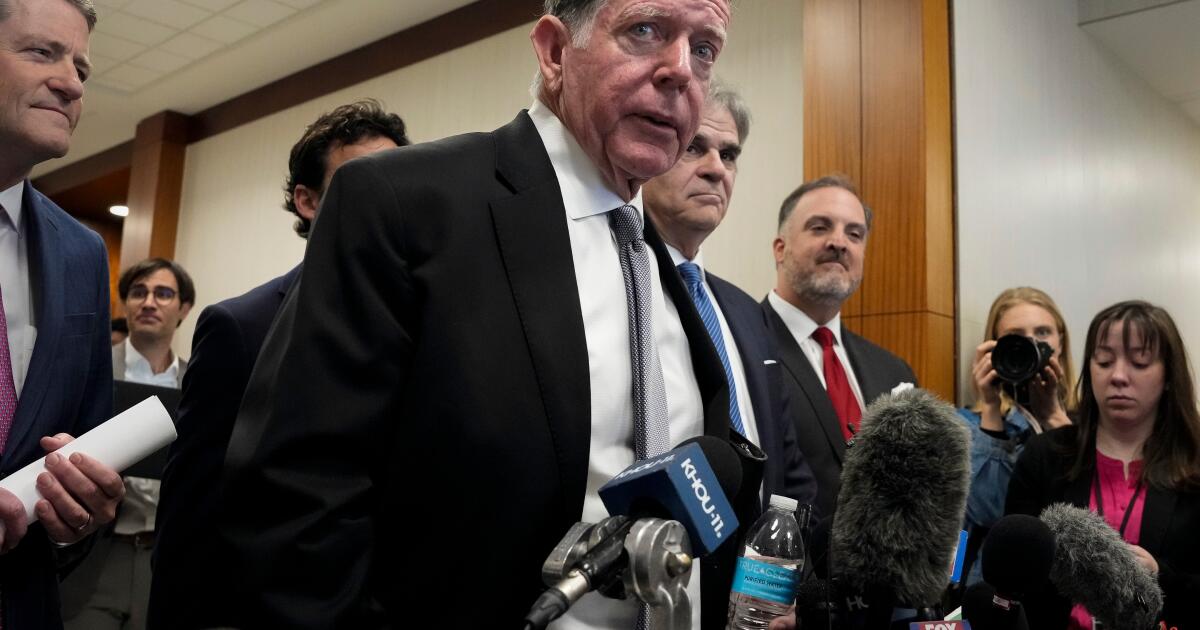
AUSTIN, Texas — A lawyer who represented Texas Atty. Gen. Ken Paxton for nearly a decade over accusations of corruption and securities fraud is supporting Democrat James Talarico — and not his former client — in one of the biggest U.S. Senate races.
Talarico on Monday drew attention to his campaign winning the endorsement of Houston attorney Dan Cogdell, who was part of Paxton’s defense team during the Republican’s historic impeachment trial in 2023 that ended in acquittal.
The legal troubles that shadowed Paxton in public office in Texas are a central attack line of Talarico’s campaign, though in his endorsement, Cogdell didn’t cite concerns about his client’s past.
Cogdell said he didn’t dislike Paxton as a person and felt that Texas lawmakers were right to eventually acquit the attorney general. But as a politician, Cogdell said, Paxton is too focused on appeasing President Trump.
“I worked my ass off for the man for nine years,” Cogdell said in an interview with the Associated Press. “But that’s a different inquiry, my obligation to Ken ended at the courthouse steps and my obligation as a citizen is to do what I think is the right thing.”
Cogdell said Texas needs a lot of work, pointing to education and health care, “and to simply bootlick or rubber stamp Trump, that’s not what we need in D.C. right now.” He also recently spoke to Talarico at length on Cogdell’s podcast.ty.
Asked for comment, an aide to Paxton’s campaign said Cogdell is a Democrat and called the endorsement unsurprising.
The lead defense attorney in Paxton’s impeachment trial, Tony Buzbee, reiterated that on X. Buzbee added that he was supporting Paxton in the race.
Cogdell described himself as a registered Democrat, although voters in Texas do not register by political party. He added, however, that he considers himself a moderate who has given more campaign contributions over the years to Republican candidates than Democrats.
Talarico has given Democrats hope of flipping the statewide seat in Texas blue as the party scrambles to retake control of the U.S. Senate in November.
Paxton’s insurgent campaign beat Sen. John Cornyn in the Republican Senate primary runoff last month, helped by a Trump endorsement in the final days of the race.
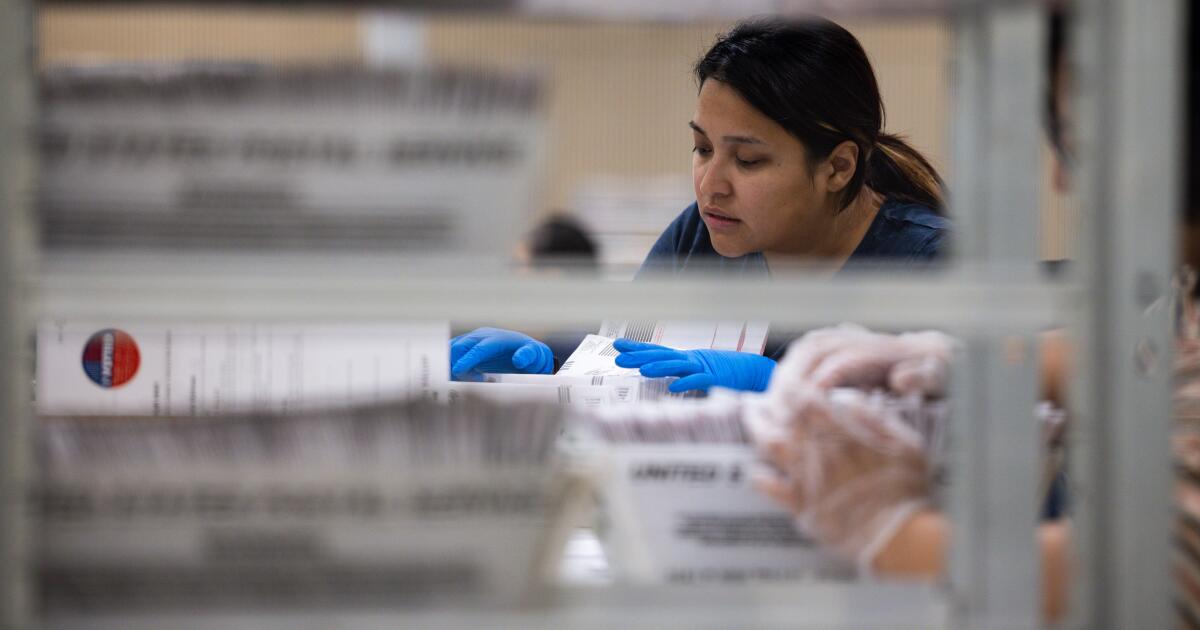
SACRAMENTO — Even before President Trump’s latest wave of unfounded claims of election fraud in California, a significant share of voters in the state expressed concerns about federal interference in the electoral process, according to a new poll.
Trump on Monday claimed on his social media site that the race for Los Angeles mayor was a “Rigged Election,” an allegation that came after Democrat Nithya Raman overtook Republican Spencer Pratt for second place in the ongoing primary election vote count.
Raman’s lead had prompted Rep. Abe Hamadeh, an Arizona Republican, to call for the election to be federalized, or run by the federal government rather than the state, a message Trump reposted.
Earlier Sunday, Trump had alleged during an interview with NBC News that California elections officials “were cheating.” That came after a debunked social media conspiracy theory claiming that a lag in an update of electronic voting data by the Associated Press showed Pratt was being cheated. On Monday, House Speaker Mike Johnson said the elections process in the L.A. mayoral race “stinks to high heaven.”
The ongoing attacks by Trump and his supporters continue to erode confidence in the nation’s elections, especially among Republicans, threatening a pillar of American democracy, said political scientist Eric Schickler, co-director of the Institute of Governmental Studies at UC Berkeley.
“The president … wants to use those claims to make changes in the election process that could make it harder for people to vote, and that certainly is a threat to our democratic institutions,” Schickler said.
“One thing we’ve learned in recent years is that we just cannot take the voting process for granted, cannot take for granted that both sides will accept as legitimate the outcome, and can’t take for granted the idea that there won’t be efforts to essentially manipulate the vote counting process,” he added.
A new poll released Friday by the institute found that 41% of California voters were “not confident” that this year’s elections would be free of federal interference. Although 48% had confidence that there would be not meddling, the concerns expressed were still significant, Schickler said.
More telling was the partisan divide among voters when asked whether they have confidence that local officials would conduct fair and secure elections and that the vote count would be accurate. Among Democratic registered voters, 79% said they trusted elections officials to provide an accurate vote count. Among Republicans, 55% said they were not confident that would occur.
California voters who don’t belong to either party said by a 2-1 margin that they had confidence in the vote count, the poll showed.
“The positive is that local officials are still widely trusted by Democrats, no-party-preference voters, and at least a share of Republicans, though a lot fewer than I think in the past, and a lot fewer than you know we would want for a really healthy democracy,” Schickler said.
That growing mistrust among certain parts of the electorate comes after years of baseless claims by Trump that the 2020 election was stolen from him, as well as Republican-led efforts to restrict the use of mail-in ballots and impose new requirements for voters to show identification and proof of citizenship.
Recent rulings by the conservative-leaning Supreme Court also have rolled back federal protections under the Voting Rights Act. In April, the court sharply limited a part of those protections that had forced states to draw voting districts to help elect Black or Latino representatives to Congress, as well as state and local boards.
Trump and his allies have used California’s slow vote-counting process to allege cheating. The day after the June 2 primary, Trump claimed without evidence that Democrats were trying to “steal” the gubernatorial and L.A. mayoral primaries. The next day, he alleged that California Democrats had “found” mail-in ballots and were “rigging the election” with them.
Secretary of State Shirley Weber and other officials have said California’s voting system prioritizes voter accessibility and security over speedy results. The state has more than 23 million registered voters, and ballots go through numerous verification steps, including verifying signatures on mail-in ballots.
“Over 97% of our folks actually vote by mail. They want to keep that system. That system demands more contact, more touching of the ballot, more verification of the individuals who are voting. All of those things take time,” Weber said during a recent interview with ABC10 in Sacramento.
Gov. Gavin Newsom’s office called Trump’s claims during the recent “Meet the Press” interview the “most severe case of California Derangement Syndrome we’ve ever seen.”
Newsom is considering a 2028 run for president and has consistently warned that Trump may try to interfere in both the 2026 and 2028 elections.
The Berkeley poll found that California voters overall — 74% — want candidates running for president in 2028 to prioritize defending democracy and making voting more accessible. Among Democratic voters, 95% said that was important; among Republicans, 41%.
Funding for the poll was provided to IGS by the Evelyn and Walter Haas, Jr. Fund, a private foundation based in San Francisco that aims to increase civic participation and improve the state’s democratic processes.
The poll of 8,578 registered California voters was conducted between May 19 and 25 online in English and Spanish and has a margin of error of about 2 percentage points in either direction.
Times staff writers Alene Tchekmedyian and Kevin Rector contributed to this report.
BOSTON — A federal judge on Monday struck down the Trump administration’s $100,000 fee on new H-1B visas, contradicting an earlier federal court ruling upholding the fee hike.
The administration announced the much-higher fee as a way of preventing foreign workers from taking American jobs.
But U.S. District Judge Leo Sorokin in Boston sided with 20 states and struck down the visa policy, concluding that the executive branch exceeded its authority and violated the Administrative Procedure Act, which governs how federal agencies develop and issue regulations.
“The Court finds that the Policy imposes a tax on H-1B petitions without the requisite delegation by Congress,” Sorokin wrote.
H-1B visas are meant for high-skill jobs that are difficult to find American workers to fill. Deep-pocketed technology companies are the biggest users, with nearly three-quarters of approvals going to workers from India. The states argued that using the H-1B program to fill vacancies for much-needed doctors and teachers was already difficult before the higher fee.
Most H-1B visa applications cost several thousand dollars before the announced increase set off a wave of panic among confused employers, students and workers in the United States and abroad and led to several lawsuits, including in Boston.
The U.S. Chamber of Commerce also sued, in federal court in Washington, D.C., and has appealed a denial of a summary judgment against the fee hike. That left the higher fee in effect, at least until September, when it is scheduled to expire. Monday’s ruling is also a summary judgment, to the opposite effect. Still another lawsuit was filed in federal court in San Francisco, by religious groups and labor organizations, setting up the possibility of divided rulings in three appellate court circuits.
The states argued that the policy impedes their ability to hire primary and secondary school educators and to staff public colleges and universities, will stymie academic research and will lead to a decline in medical workers.
“The Proclamation makes various overtures to domestic economic policy goals to justify the unprecedented $100,000 fee,” plaintiffs wrote in their complaint. “But the Proclamation gives no indication that the President gave any consideration to how the fee would affect Plaintiff States and their ability to provide their residents access to education, healthcare, and other basic human needs.”
A Department of Homeland Security statement said the agency disagrees with “this blatant judicial activism dismantling President Trump’s historic efforts for immigration reform.”
“Under President Trump and Secretary [Markwayne] Mullin, our immigration system is being reformed to serve American citizens, American workers, and American families and to preserve our national identity — not to rapidly import foreigners who take American jobs, commit crimes, burden our welfare system, and erode our cultural and social fabric.”
WASHINGTON — A Treasury inspector general report raises concerns about Immigration and Customs Enforcement’s ability to safeguard taxpayer information after ICE and the Internal Revenue Service agreed in 2025 to share taxpayer data for the purpose of immigration investigations.
The recently released report provides the first official accounting of the scale of the IRS-ICE information transfer and documents security concerns surrounding an arrangement that has been the subject of multiple lawsuits and significant controversy inside both agencies.
The Treasury Inspector General for Tax Administration found that the 2025 data-sharing agreement between ICE and the Treasury Department — which allowed ICE to submit names and addresses of immigrants in the U.S. illegally to the IRS for cross-verification against tax records — resulted in inconsistent formatting in ICE’s data and the IRS’ matching criteria, which led to errors.
The deal led the then-acting commissioner of the IRS to resign.
The report says that after the agreement was signed, ICE requested address information on more than 1.2 million people, and that the IRS ultimately provided last-known addresses for about 47,000 people.
The inspector general concluded that the IRS’ automated matching process was flawed. Inconsistent formatting in ICE’s data led to questionable matches, including in cases in which incomplete or inaccurate addresses were labeled as valid, the report says.
Representatives from the Treasury Department and the IRS did not respond to a request for comment.
The plan to cross-verify tax and immigration data is part of President Trump’s agenda to secure U.S. borders and his nationwide immigration crackdown, which has resulted in deportations, workplace raids and the use of an 18th century wartime law to deport Venezuelan migrants.
However, this is not the first time it’s been revealed that tens of thousands of taxpayers’ information was revealed to ICE.
In February, a federal judge said the IRS broke the law by disclosing confidential taxpayer information to ICE, referring to the same 47,000 disclosures that the inspector general points out.
U.S. District Judge Colleen Kollar-Kotelly found that the IRS had erroneously shared the taxpayer information of thousands of people with the Department of Homeland Security as part of the 2025 agreement.
No recommendations were made in the new inspector general report, according to a letter by Nancy A. LaManna, deputy inspector general for inspections and evaluations.
“However, we plan to share some concerns we identified during our review with the DHS Office of Inspector General,” her letter says.
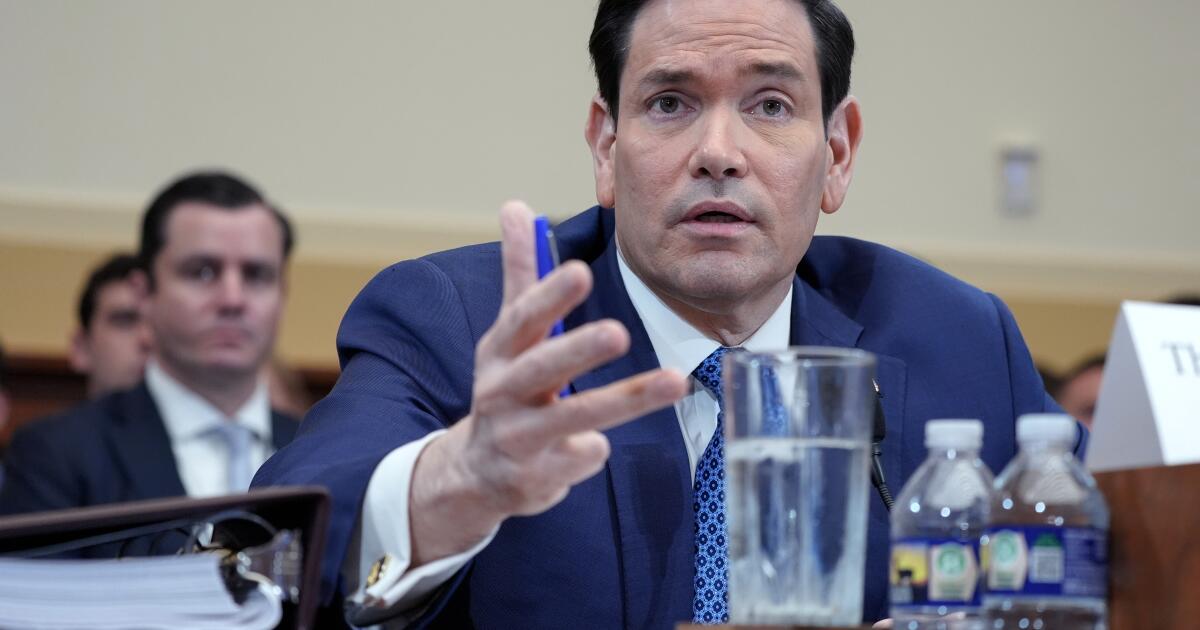
WASHINGTON — Republicans are warning the White House that a critical surveillance authority is likely to lapse this week amid bipartisan backlash over President Trump’s pick to lead the nation’s intelligence community.
Sen. Tom Cotton, the chairman of the Senate Intelligence Committee, and Sen. Chuck Grassley, chairman of the Senate Judiciary Committee, sounded the alarm over the weekend after a failed procedural vote to extend the program.
The senators in a letter urged Secretary of State Marco Rubio to prepare “for a potential significant gap in foreign intelligence collection” if the authority expires. Section 702 of the Foreign Intelligence Surveillance Act, set to lapse June 12, allows agencies including the CIA, National Security Agency and FBI to collect communications from foreign targets overseas without a warrant.
Efforts to secure a long-term extension of the program already faced hurdles because of bipartisan concerns that the program can incidentally collect Americans’ communications. Privacy advocates and some lawmakers have been pushing to create a new warrant requirement before those communications can be searched.
Senate leaders from both parties appeared to be nearing agreement on a long-term extension. But the effort collapsed after Trump selected federal housing finance regulator Bill Pulte to serve as acting director of national intelligence.
“I know how important this tool is. Why the president would throw this live hand grenade of Bill Pulte in 10 days before this is due to expire, I’m not sure,” Sen. Mark Warner, the top Democrat on the Senate Intelligence Committee, said on ABC’s “This Week.”
Pulte pick upends bipartisan deal
Early Friday morning, after senators spent the night debating separate immigration legislation, seven Republicans joined nearly all Democrats in blocking a long-term extension of the surveillance authority.
Democrats and several Republicans registered their opposition to Trump’s selection of Pulte, arguing the federal housing finance regulator lacks the experience needed to oversee the nation’s 18 intelligence agencies.
“The naming of Pulte to that position, although the timing arguably wasn’t the best, I still don’t think it ought to derail something that’s this important,” Senate Majority Leader John Thune said.
Thune has expressed concern over Pulte’s pick, saying the nation’s top intelligence post should not be “weaponized” and that the job should be filled by “professionals.” Cotton, who rarely strays from supporting Trump and a leading advocate for the surveillance authority, declined to endorse Pulte, saying only that he had “no observations on the matter.”
“He’s not qualified for the long-term position,” Republican Sen. James Lankford, another member of the Intelligence Committee, told “Fox News Sunday.” “That’s been clear on this. He has no national security background.
Both Republican and Democratic senators skeptical of Pulte pointed to his record at the Federal Housing Finance Agency. In the role, he’s been linked with criminal referrals over allegations of mortgage fraud by public officials Trump sought to punish, including New York Attorney General Letitia James, a Democrat; Sen. Adam Schiff, D-Calif.; and Lisa Cook, a board member of the Federal Reserve.
Republicans will need to garner some Democratic support to pass any extension of the surveillance authority in the Senate. But a breakthrough appears difficult so long as Pulte remains in the position, which Trump said last week would only be temporary.
“I don’t see any path to convincing enough Democrats,” Warner said on CNN’s “State of the Union” when asked if renewal was possible with Pulte in the position.
The current reauthorization debate is hardly the first time that lawmakers have grappled with the fate of the surveillance program, particularly after a flurry of revelations about government misuse of the vast trove of intelligence it collects.
The topic in recent years has scrambled predictable partisan alliances, with Democratic critics of the Trump administration uniting with skeptics of government power on the right in voicing concerns about Section 702’s renewal.
In 2024, for instance, those divisions nearly caused the program to lapse. The Senate barely missed its midnight deadline that year before approving by a 60-34 margin legislation to reauthorize Section 702 that was subsequently signed by then-President Joe Biden.
A spokesperson at the Justice Department did not immediately return messages seeking comment Monday about the national security concerns that would be created if the program lapses. The Office of the Director of National Intelligence referred inquiries to the White House, which did not immediately respond to a request for comment.
“America faces real threats from foreign adversaries, terrorists, cyber actors, and hostile intelligence services,” Defense Secretary Pete Hegseth said on social media Sunday. “Section 702 remains one of our nation’s most effective tools for identifying and disrupting those threats before they reach our shores.”
Cotton and Grassley said they believed Democratic leaders would not support another short-term extension of the surveillance authority and urged Rubio to prepare contingency plans. They said Trump should consider an executive order to prevent a disruption in intelligence collection.
Cotton and Warner had said they were close on a bipartisan deal on a long-term extension and could still move quickly should a change occur before Friday. Still, the bill would likely need to go through the House — and the two chambers so far have disagreed on a separate issue regarding central banking digital currency.
“If we go dark next week, right before the World Cup FIFA games, and the 250th anniversary, that would be the most grossly irresponsible thing I’ve seen Congress do in my 22 years in office,” Texas Republican Rep. Michael McCaul said on ABC’s “This Week.”
Cappelletti, Jalonick and Tucker write for the Associated Press.
WASHINGTON — A relentless push by President Trump to reshape Washington‘s cityscape is facing mounting resistance, threatening a slate of transformative monuments intended to cement his legacy in the nation’s capital.
Eager to see his projects completed before leaving office, Trump has responded to growing legal and political obstacles by pushing ahead, attempting to force approvals through faster than opponents can challenge them. But the scramble to fast-track construction has inflated their costs for taxpayers, imperiling his plans and amplifying his political risks as the midterm elections approach.
Urban design has become a preoccupation for Trump since the start of his second term. Cranes dot the skyline of the city, and construction fences block access to many of its most cherished parks and venues less than a month before the nation celebrates 250 years since its founding on July 4.
Cranes from the White House East Wing ballroom construction project rise from behind the U.S. Treasury Department building on Thursday in Washington, D.C.
(Kevin Carter/Getty Images)
Government lawyers are defending the president’s use of the wrecking ball, arguing in court that he has unfettered power to build and destroy. Should he ever choose to tear down the Statue of Liberty, the Justice Department told a judge Friday, no one could stop him.
Yet a recent series of legal setbacks, as well as increasing Republican opposition on Capitol Hill, have cast doubt on the fate of his most lavish designs, including the construction of an imposing ballroom at the White House and the erection of a massive triumphal arch on the sightline of the National Mall.
It’s become a race against time for the president, who could soon confront a Democratic-controlled Congress armed with renewed oversight authority and subpoena power, further gumming the works of elaborate construction projects, which could stymie their completion before he leaves office.
“This is very much on the committee’s radar,” said one Democratic source with the House Oversight Committee, citing “serious concerns surrounding corruption.”
Visitors at the Mall gather in front of the Lincoln Memorial and near the Reflecting Pool, which is under renovation on Friday in Washington, D.C. President Trump dismissed criticism of the recent Lincoln Memorial Reflecting Pool renovations, rejecting claims the project amounted to merely a “paint job.”
(Roberto Schmidt / Getty Images)
Trump as ‘builder-in-chief’
Several of Trump’s more modest initiatives, referred to by the administration as beautification projects, are complete or well underway.
At the White House, a historic rose garden conceived by Jacqueline Kennedy was paved over, and its adjoining colonnade refurbished with black granite and gilded presidential portraits. The Palm Room foyer was decked in marble and chandeliers. New flagpoles fly supersized American flags on the North and South lawns.
The en suite bath of the Lincoln Bedroom in the residence has been gutted and renovated. And the Oval Office now practically drips in gold, while an adjoining study, once used by Franklin Roosevelt to scrutinize war maps and Lyndon Johnson to monitor the space race, was converted into the president’s personal swag shop.
A temporary Ultimate Fighting Championship arena constructed on the White House South Lawn is another example of how Trump is leaving a visual mark on the presidential residence. The structure, which towers over the White House, was paid for by the UFC, which is scheduled to host a series of fights on the premises.
Outside the White House complex, fountains across the city are coming back to life after decades of neglect, from DuPont Circle to Freedom Plaza and Union Station. The idyllic Logan Circle, surrounded by historic mansions, is being revitalized by the National Park Service, as is Lafayette Square, the site of an infamous clash between Trump and protesters shortly after George Floyd’s murder in 2020.
1
2
1.National Park Service Conservator for the National Mall and Memorial Parks Ali Cavicchio puts a clear coat over the recently repainted “I Have a Dream” marker at the Lincoln Memorial on June 05, 2026 in Washington, DC. The marker’s letters are carved into stairs of the Lincoln Memorial where Dr. Martin Luther King Jr. stood and delivered his “I Have A Dream” speech in 1963.(Chip Somodevilla / Getty Images)2.Members of the West Branch Area School District in Morrisdale, Pennsylvania, student marching band perform at the Lincoln Memorial on the National Mall on June 05, 2026 in Washington, DC.(Chip Somodevilla / Getty Images)
In some parks, even the turf is getting a makeover.
“People are all thanking me because Washington is beautiful again,” Trump told reporters last week. “The parks are open, we changed the grass. You know, grass has a life, also. Like people, grass has a life, and that grass hasn’t changed in 70 or 80 years.”
On Friday morning, several people sat by the restored cascading fountain at Meridian Hill Park. They walked their dogs, read books and exercised by the water.
Jean Luc, 33, was one of them. As he took a stroll with his 2-month-old daughter, Juno, he said it had been nice to see the government fix up the park, which he says he tries to enjoy with his daughter daily.
“It’s been nice to see the whole process,” he said. “I love it.”
President Trump displays a chart titled “Our Pool is Bigger than Skyscrapers” while discussing his renovations to the Lincoln Memorial Reflecting Pool on Wednesday in the Oval Office.
(Kevin Dietsch / Getty Images)
The Lincoln Memorial Reflecting Pool has been painted over in “American Flag Blue” by a firm that Trump said had worked on the swimming pool at his golf club in Virginia. Millions will be spent to regild the hulking Art Deco statues that buttress Arlington Memorial Bridge. And Trump has plans to connect the Lincoln Memorial to the Potomac River by building a promenade, one of many projects he has said may be named after himself.
Federal contracting data show that the Virginia firm Terra Site Constructors has been awarded roughly $60 million in contracts from the National Park Service to complete work on the various fountain rehabilitation projects across the city.
Another Virginia firm, Atlantic Industrial Coatings, holds a contract for $14.2 million to paint the reflecting pool.
The funding for both contracts comes from the entrance fees paid by national park visitors.
“How fortunate are we to have the builder in chief?” Interior Secretary Doug Burgum said Thursday in the Oval Office. “Someone who both has the vision and the understanding of how to get projects done that would make our city safe and beautiful.”
Construction continues on the White House East Wing ballroom on May 29, 2026.
(Kevin Carter / Getty Images)
‘The finest ballroom anywhere in the world’
Yet other, more controversial projects, exacting irreversible change to capital institutions, are facing greater opposition.
On Thursday, the Kennedy Center for the Performing Arts directed its staff to begin removing Trump’s name from its facade after a judge ruled that the attempted name change, and his effort to close the venue for two years of dramatic renovations, were illegal.
Angered by the court’s decision, Trump directed the Commerce Department to make arrangements to transfer control of the Kennedy Center to Congress. The move would give lawmakers power over the center’s operations, maintenance and management. It was originally an act of Congress that gave the Kennedy Center its name and mandate.
In other areas of the city, preservationists have successfully delayed the president’s bid to paint over the natural gray granite of the Eisenhower Executive Office Building. And Republican lawmakers have refused to vote to fund the construction of a ballroom at the White House that has already laid waste to the East Wing and, if completed, would dwarf the landmark residence.
Construction crews began tearing down the East Wing in October to make way for the 90,000-square-foot facility. Trump, who built a career as a real estate developer, has frequently touted the project, gushing over the sounds of jackhammers and excavation trucks.
Construction continues on the White House South Lawn on June 1, 2026, for an upcoming UFC match. President Trump is hosting a UFC match on the White House grounds to mark the nation’s 250th birthday.
(Kevin Carter / Getty Images)
“Oh, that’s music to my ears. I love that sound,” Trump told Republican senators at a White House event last fall. “A lot of people don’t like it. When I hear that sound, it reminds me of money.”
The ballroom project was initially expected to cost $200 million, a price that has since doubled. It is being financed by private donors and Trump, who has called it a “gift to the United States.”
“We are building what will be the finest ballroom anywhere in the world,” the president said last month.
More than half of the publicly identified donors of the ballroom projects — 14 of the 27 known corporate contributors — have won new or bigger federal contracts worth more than $50 billion in the six months since construction began, according to a report released by Public Citizen, a watchdog group.
“These giant corporations aren’t funding the Trump ballroom fiasco out of the goodness of their hearts,” said Jon Golinger, a public policy advocate at Public Citizen and author of the report. “They have massive interests before the federal government and they hope to curry favor with, and receive favorable treatment, from the Trump administration.”
White House military aides stand next to the giant mirror that hangs along the Rose Garden Colonnade at the White House on May 21, 2026.
(Chip Somodevilla / Getty Images)
The White House has challenged the report’s assertions, saying critics of how the project is being funded are “only people who suffer from a severe and incurable disease known as Trump Derangement Syndrome.”
“President Trump is making the White House beautiful and giving it the glory it deserves at no cost to taxpayers — something everyone should celebrate,” White House spokesman Davis Ingle said in a statement.
The report came out as the ballroom project has faced persistent hurdles in court and Congress.
The National Trust for Historic Preservation sued to stop construction, arguing the administration had not followed the legally required review process and had not secured congressional approval. In March, a federal judge halted aboveground construction, but an appeals court quickly allowed work to resume through June while the case proceeds.
On Friday, the panel heard the case and expressed skepticism about Trump’s push to build the ballroom without congressional approval.
On Capitol Hill, Senate Republicans dropped a proposal to set aside $1 billion in security funding for the ballroom after several GOP senators said it lacked the votes to pass.
Trump has insisted the funding is not necessary to complete the project, though he said it would help secure the complex. Without it, he told reporters last month, “the White House won’t be a very secure place.”
(Los Angeles Times photo illustration; Photo by Kevin Dietsch / Getty Images)
Arc de Trump
The president is also seeking to build a 250-foot-tall “triumphal arch” near Arlington National Cemetery, across the Potomac River at the foot of Memorial Bridge.
Renderings show the arch would be twice the height of the Lincoln Memorial, crowned by a golden statue of Lady Liberty sporting outstretched wings. An observation deck on its roof would offer sweeping views of the city.
Preservationists have criticized the plan as disrupting a sacred sightline between the memorials to Abraham Lincoln and Robert E. Lee, designed as a statement of unity after the Civil War. Even advocates of adding an arch in Washington have criticized the size of Trump’s proposed structure as overbearing. And a group of Vietnam War veterans has sued to try to stop its construction, arguing the project lacks congressional approval and would “dishonor their military and foreign service” because it would block the view of the cemetery.
Commission of Fine Arts member Pamela Hughes Patenaude, left, hands colleague Matthew Taylor a model of President Trump’s proposed triumphal arch to commemorate the country’s 250th anniversary during the commission’s public meeting at the National Building Museum in Washington on April 16, 2026.
(Andrew Harnik / Getty Images)
Despite public opposition, the National Capital Planning Commission last week advanced the project in its review process.
Trump praised the planning commission’s support, saying that “when completed, it will be, without question, the Greatest Arch of them all!”
The president has yet more plans to leave his mark — in some cases with his name, in others with his face.
Transportation Secretary Sean Duffy has proposed a $22-billion overhaul of Dulles International Airport outside the capital that would include a new terminal brandishing Trump’s name. Limited-edition U.S. passports will feature his portrait. And the Treasury has plans to mint a $250 bill featuring Trump’s mugshot from his 2023 Fulton County arrest, pending congressional approval — an unlikely prospect.
A walkway with the numbers “45” and “47” leading to construction on the new ballroom extension of the White House in Washington, D.C., on May 19. President Trump said a military hospital and research facilities will be built on the site of his planned White House ballroom, offering more details about the scope of the sprawling, controversial project.
(Samuel Corum/Bloomberg via Getty Images)
In a moment that went viral on social media, Sen. Jon Ossoff (D-Ga.), who is generating buzz over a potential run for the Democratic presidential nomination in 2028, offered a theory on what’s driving the president.
“He’s trying to put his face on the money. He’s building a monument to himself,” Ossoff told a crowd of supporters.
“But see, Atlanta, he’s doing these things now because no one will honor him when he’s gone,” he added, “because he’s a failed president and a national disgrace.”
Wilner reported from Los Angeles and Ceballos from Washington. Times staff writer Ben Wieder contributed to this report.
WASHINGTON — As the U.S. prepares for an extravagant celebration of its founding principles, fewer Americans see their country as exceptional, a new poll finds.
The survey from The Associated Press-NORC Center for Public Affairs Research highlights many Americans’ feeling of unease over the future of its representative government — particularly among young people. It presents a jarring contrast as communities around the country commemorate the nation’s 250th anniversary.
Only about one-quarter of Americans say the U.S. stands above all other countries in the world, the new poll found, while 44% say it’s one of the greatest countries in the world, along with some others. About 3 in 10 say there are better countries than the U.S., an increase from 19% in an AP-NORC poll conducted in June 2016.
Americans remain divided about whether diversity is an essential feature of the U.S.’s identity, and agreement about other aspects of the country’s underlying character appears to be eroding, the survey found. Americans are less likely to see a democratically elected government as “extremely” or “very” important to the United States’ identity as a nation than they were just a few years ago. About two-thirds of U.S. adults now say a democratically elected government is highly important to the U.S.’s identity as a nation, down from 80% in 2021.
“It’s not that the democracy part is not working,” said Derricka Wall, 24, of Chickasaw, Alabama. “It’s the people that are actually being put in office that is the problem.”
Wall believes politicians have damaged America’s governing system, which was designed to ensure representation and guard against government misuse.
America, she said, “is not what it used to be. I feel like our founding fathers would be kind of disappointed with how it is now.”
Rising belief that democracy is not essential to American identity
Young adults are much less likely than older Americans to believe the U.S. is special, compared with other nations, the poll found.
About 4 in 10, 44%, of U.S. adults under 30 say there are other countries better than the U.S., compared with 22% of U.S. adults ages 60 and older.
Fewer, too, see democracy as a key element of the U.S.’s identity. Only about half of Americans under 30 believe this, compared with 81% of those 60 and older.
Wall said the people who established the government with co-equal branches thought they were erecting safeguards to keep any one person or group from attaining too much power. But she believes they didn’t foresee how easily those guardrails would crumble if the people in the system stopped enforcing them.
“I feel like they would actually roll out of their graves,” she said. “I feel they would be very disappointed in us.”
The belief that politics isn’t working for everyday people extends beyond the youngest generations. Kent Stage, 62 and a retired senior enlisted man in the Army, is a registered Republican in Indiana. He does not think the current political system addresses the country’s problems. He’d like to see term limits on politicians and more working-class people serving.
“I’ll trust the ambulance-chasing lawyer and a shady used car salesman before I trust the politician,” he said.
Stage, who is also a former Marine, believes public servants make self-serving choices for their families “while mine and yours still got to hit the old grindstone.”
Many feel it’s harder to get ahead in the U.S.
The survey also finds widespread cynicism about America as the land of opportunity. About half of U.S. adults, 51%, say the American Dream — the idea that if you work hard, you’ll get ahead — once held true but does not anymore. About one-third say it “still holds true” while 15% say it never held true.
Jack Hermanson, a 27-year-old software developer in Denver, said his belief in the American Dream changed when he saw his engineer husband struggle to find a job. “That really shattered my impression that if you work hard, you get what you deserve,” Hermanson said.
Only 22% of Americans under 30 say the American Dream still holds true, compared with 46% of Americans ages 60 and older.
Angela Toombs, 31, works at a senior living facility in Atlanta where her clients talk about how easy it was to buy a house while working their first regular jobs in their 20s and are incredulous about the obstacles facing Toombs’ generation. Toombs recently gave up her own apartment to rent a room in order to save money.
Skepticism about the American Dream is more widespread among Democrats and independents, compared with Republicans. Most Republicans, 57%, say the American Dream still holds true, compared with about one-quarter of independents and 17% of Democrats.
Republicans are also much likelier than Democrats to see the U.S. as exceptional. About half of Republicans say the U.S. stands above all other countries in the world, compared with only 7% of Democrats.
Quintin Sharpe, 28, lives in a resort town on Lake Geneva in Wisconsin. A financial planner who is Republican, he said the American Dream remains accessible and he is proud of the country. “It’s been a great experiment.”
“The opportunity is there for those who want to work for it,” he said. Sharpe believes the country is “a meritocracy, and the best ideas, the best work ethic, those with the best succeed regardless of race, skin color, any of those factors.”
He and his wife will celebrate the country’s 250th anniversary watching the fireworks over the lake.
Divides on whether diversity is essential to U.S.
Just over half of U.S. adults — 56% — say a shared American culture and set of values are “extremely” or “very” important to the country’s identity, down from 65% in 2017. Younger Americans are less likely than older ones to say a singular set of values is important to U.S. identity.
But Americans remain sharply divided on the centrality of welcoming diverse perspectives: About half of adults, 51%, say the ability of people to come from other places in the world to escape violence or find economic opportunities is “extremely” or “very” important to American identity, while 55% say this about the mixing of cultures and values from around the world.
Only about 4 in 10 Republicans see the mixing of cultures and values from around the world as central to the country’s identity, compared with 76% of Democrats.
Rose Nunez, 70, of San Antonio, was a small business owner but now is a caregiver for family members. Nunez, who tends to vote for Democrats, said there is an unease and tension that are just beneath the surface, especially focused on Hispanics. She said some people have started carrying their papers showing their immigration status in case they are challenged.
“It is hard to celebrate when the feelings towards immigrants and communities of color are so strong,” she said of the upcoming America 250 celebrations.
She said even citizens are questioned now. If it gets to a point where being naturalized is challenged, “guess what, my mom would be leaving. She’s been living in this country since she was maybe four years old. She’s 93.”
Fields, Sanders and Riccardi write for the Associated Press. The AP-NORC poll of 2,596 adults was conducted April 16-20 using a sample drawn from NORC’s probability-based AmeriSpeak Panel, which is designed to be representative of the U.S. population. The margin of sampling error for adults overall is plus or minus 2.6 percentage points.
BEIRUT — Israel and Iran traded fire on Monday, all but derailing a brittle two-month ceasefire that had largely stopped the fighting in the U.S and Israel’s assault on Iran.
The tit-for-tat attacks between the two sides threaten to widen the scope of a conflict that has already killed and wounded thousands, displaced more than a million people and rattled economies across the globe — even while embroiling the U.S. in a war with no clear off-ramp.
“Israel and Iran must immediately stop ‘shooting.’ ” wrote President Trump early Monday on his social media platform, Truth Social.
Later, he wrote, “Both sides, Israel and Iran, are looking to do an immediate CEASEFIRE!”
“Final negotiations on ‘Peace’ are proceeding, subject to ignorance or stupidity getting in its way. The Blockade will remain in place, and in full force and effect, until a ‘Final Deal’ is reached. Things should move quickly.”
The latest escalation came after Israel attacked the suburbs of Lebanon’s capital Beirut on Sunday in what it said was a targeted strike against Hezbollah, an Iran-supported paramilitary faction and political party.
In recent days, Iran conditioned a ceasefire agreement with Israel and the U.S. on a cessation of hostilities across all fronts, including Lebanon, threatening it would respond to any Israeli action on the Lebanese capital. Israel rejects linking both battlefields, and insists on having a free hand to attack Hezbollah.
A number of U.S.-brokered ceasefires between the Lebanese and Israeli governments — but without Hezbollah involvement — failed to stop most of the fighting, with Israeli warplanes pounding wide swaths of Lebanon’s south while Hezbollah launched drones and missiles on northern Israel. Nevertheless, the Lebanese government has rejected being included in Iran’s negotiations with the U.S.
By Sunday night, Iran’s threats came to pass with several waves of Iranian ballistic missiles, which caused no injuries and were the first Tehran had fired at Israel since a ceasefire took hold in April. Iran’s military said the fusillade was a warning. But Israel said it would retaliate.
President Trump initially downplayed the Iranian attack on Sunday, saying in an interview with the Financial Times Iran’s barrage was “not going to have any impact on the deal.”
“We’ll see how it ends up. But they [the Iranian strikes on Israel] were attacks that did not kick at all,” he said.
“The deal may make it on its own merit, or not, but this will not have any effect on it.”
Trump also told the Axios news site he would talk to Israeli Prime Minister Benjamin Netanyahu to stop him retaliating against Iran’s barrage.
He also told the Financial Times that Netanyahu “won’t have any choice” but to accept the deal Trump negotiates with Iran.
“I call the shots. I call all the shots. He [Netanyahu] doesn’t call the shots,” Trump said.
Yet by the early morning on Monday, dozens of Israeli warplanes were striking western and central Iran. They hit a petrochemical complex in Mahshahr in southwestern Iran, and waged extensive strikes on “strategic defense systems,” according to Israeli military statements, in what observers said was a prelude to a wider offensive. Residents in Tehran, Isfahan, Tabriz and Shiraz reported powerful explosions.
The Israeli military said in a statement it expected several days of fighting with Iran but was prepared for a prolonged campaign. It said the strikes on Iran were conducted by Israel on its own, but that they had been done in “full coordination” with U.S. Central Command, which also helped in intercepting Iranian missiles launched at Israel.
But that distinction appeared to matter little to Iran’s foreign ministry spokesperson, Esmail Baghaei, who said in a press conference on Monday that the U.S held direct responsibility for recent ceasefire violations and Israel’s action “cannot be looked at in isolation from the U.S.”
“No one believes the Israeli regime would take any action without coordination with the United States,” he said.
“The U.S. bears responsibility for the Israeli regime’s aggression, and it will also be responsible for the consequences of any escalation in tensions.”
Iran launched additional barrages throughout Monday, targeting Israeli airbases in Nevatim and Tel Nof and a petrochemical plant in Haifa, according to a statement from Iran’s Revolutionary Guard Corps. It added Israel was engaging in “a dangerous game by targeting civilian and oil infrastructure — a game that will now encompass all regional energy targets, with global economic consequences resting on America.”
The renewed hostilities also saw Yemen’s Houthis — who receive support from Iran and Hezbollah, and are part of a regional network of Iran-backed factions — enter the fray with a pair of ballistic missiles lobbed at Israel. The Israeli military said one of the missiles was intercepted; the second fell short of Israel.
Houthi spokesman Brig. Gen. Yahya Sarea confirmed the attack in a televised statement on Monday, and said Israeli maritime navigation in the Red Sea would be targeted.
During the Gaza war, the Houthis attacked commercial shipping in the Red Sea — including ships with no link to Israel — to pressure Israel into lifting its blockade on the enclave.
But, unlike Hezbollah, which attacked Israel on March 2, three days after the U.S. and Israeli campaign on Iran, the Houthis had refrained from helping their ally, until Monday.
Their involvement now raises the specter of another squeeze on energy markets already beleaguered by closures on the Strait of Hormuz. Since the U.S.-Israeli assault, the Red Sea has acted as the main alternative conduit for energy supplies, especially for those from Saudi Arabia. If the Houthis closed the Bab Al-Mandab Strait, it would all but paralyze commercial flows.
Oil prices spiked in the wake of the exchanges, with Brent Crude rising 5% to hit $98 a barrel.
SACRAMENTO — Winning elections — or achieving any success — often is about being in the right spot at the right moment. Getting lucky and capitalizing. Xavier Becerra is a textbook example.
There was a fortuitous incident in high school that substantially upgraded Becerra’s higher education and undoubtedly his career.
You’re reading the L.A. Times Politics newsletter
George Skelton and Michael Wilner cover the insights, legislation, players and politics you need to know. In your inbox Monday and Thursday mornings.
By continuing, you agree to our Terms of Service, which include arbitration and a class action waiver. You agree that we and our third-party vendors may collect and use your information, including through cookies, pixels and similar technologies, for the purposes set forth in our Privacy Policy such as personalizing your experience and ads.
Becerra, the son of Mexican immigrants whose construction worker father didn’t go past the sixth grade, was pulling down good grades at McClatchy High in Sacramento when he was invited to a summer program at UC Davis for promising students of color.
One day he saw a classmate toss some wadded paper into a waste basket.
“What’s that?” Becerra asked.
“I was going to apply to this college, but now I’m not,” the kid replied. He had screwed up on a final exam.
“Give it to me,” Becerra said.
It was an application form for Stanford University. Becerra filled it out and “got it in the mail at the last moment,” he recalled to me years later.
He was accepted. His working-class family was able to send him to the pricey, private university thanks to scholarships, federal aid and after-school work.
“I didn’t know where Stanford was until I rode there with my mom,” Becerra told me.
Becerra got a B.A. in economics at Stanford, then earned a law degree there. That ultimately landed him a job as a deputy state attorney general.
He eventually was elected to Congress, filling a vacant central Los Angeles seat when longtime Rep. Edward Roybal retired. He served 12 terms, rising to the No. 4 Democratic leadership position as party caucus chairman.
A big career break came just before the 2016 election. Becerra was back in Sacramento campaigning for two congressional candidates and was invited to a nonpolitical reception. Also attending by chance was Gov. Jerry Brown’s top aide, Nancy McFadden.
But it was the perfect job for Becerra because goofy Donald Trump became president at the same time. Becerra — often with other Democratic state attorneys general — filed 123 lawsuits against the Trump administration and won the vast majority.
The suits ran the gamut of issues, and one was particularly highlighted: Trump’s efforts to kill the Affordable Care Act, or Obamacare.
Fast-forward to Joe Biden’s ouster of Trump in 2020 and the newly elected president’s search for Cabinet members.
Biden needed a health secretary and was drawn to Becerra partly because he had helped jockey Obamacare through the U.S. House as a congressional leader and had staunchly defended it in court as California attorney general.
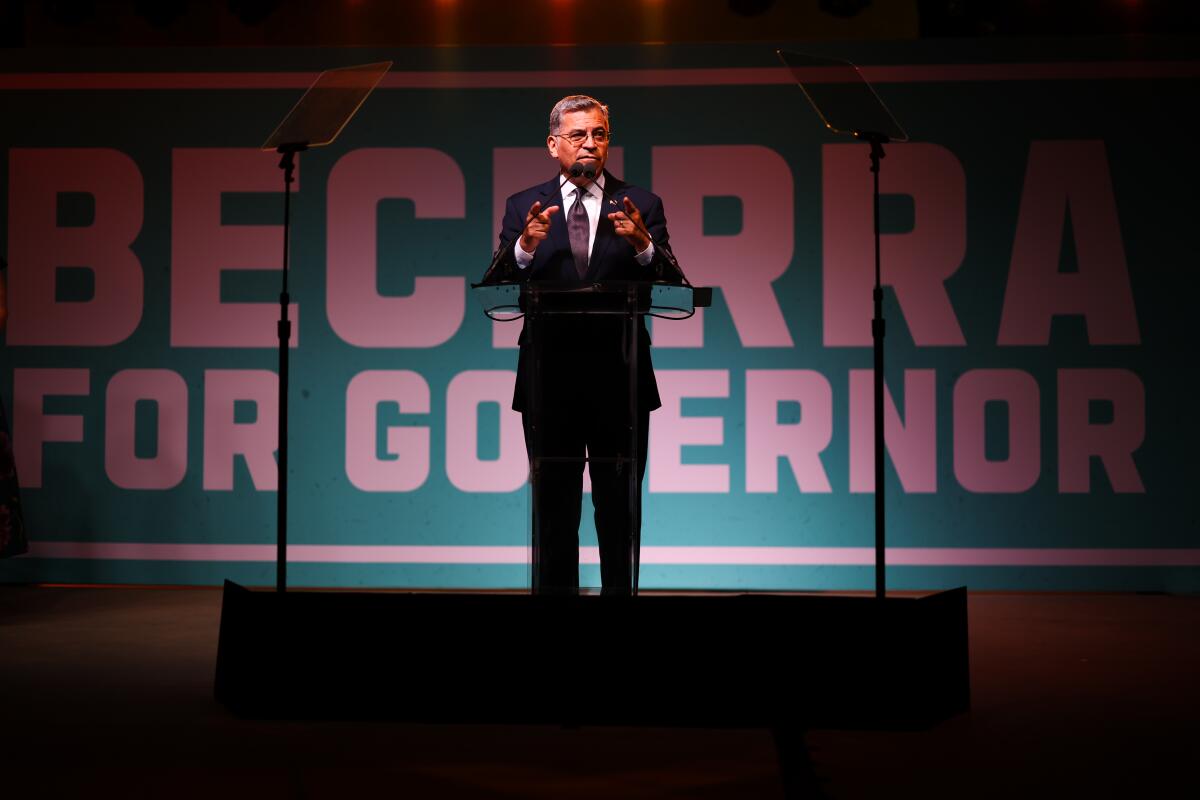
Without being appointed AG, Becerra might be running for House reelection in November instead of now seemingly having an easy shot at becoming California’s first elected Latino governor.
Becerra got a huge break in the gubernatorial race when two potential heavyweight contenders concluded the job wasn’t worth running for. Either person would have been heavily favored to win.
But “if it hadn’t been for Swalwell’s demise, Becerra never would have made the top two” list of vote-getters in the primary, veteran Democratic strategist Garry South says.
Why did Swalwell’s collapse benefit the mild-mannered, low-key Becerra much more than any other Democrat?
“People are looking for something stable,” he told me several weeks ago. “Everybody likes pizzazz and glitter. Then all of a sudden their hero falls from grace. And they look for who they can trust.”
That trust is built on an impressive resume and likability.
Billionaire hedge fund founder Tom Steyer, who has never held public office, spent tens of millions of dollars attacking rival Becerra in TV ads. But it apparently didn’t work because he lacked credibility. Steyer came across to many voters, I suspect, as a wild-eyed meanie.
He would have been better off spending his negative ad money on positive spots promoting himself and becoming more likable.
Likability is a candidate’s No. 1 asset. We learn that as grammar schoolers in class president elections. It beats a billion dollars every time — at least in California.
Now Becerra is on the verge of another break — facing Republican former Fox news commentator Steve Hilton in a lopsided fall contest. Californians haven’t elected a Republican to statewide office in 20 years.
Becerra merely needs to remind voters that Hilton is endorsed by Trump — a nice break gifted by the president.
SACRAMENTO — The Democratic-led state Senate has voted to reconfirm five commissioners to the California Board of Parole Hearings, a move that drew outcry from Republicans who argued the board recently made several egregious decisions.
“The current board is clearly not doing a good job protecting children and should be replaced,” said Sen. Steven Choi (R-Irvine), speaking June 1 on the Senate floor.
The parole board consists of 21 commissioners who are appointed by the governor and confirmed by the Senate for three-year terms. Five current commissioners — William Muniz, Michael Ruff, Rosalind Sargent-Burns, Mary Thornton and Jack Weiss — were reconfirmed June 1 in votes that fell along party lines.
Senate Republicans spoke out from the floor, expressing anger over the board’s recent decisions to grant parole to serial sex offenders David Allen Funston, Gregory Lee Vogelsang and Roberto Antonio Detrinidad. (The vote of individual commissioners was not made public.)
Democrats defended the board, saying it was following a landmark 2008 ruling from the California Supreme Court that declared denying parole must be supported by evidence that the person poses a current risk.
“Parole decisions must be based on current safety risks not on the seriousness of the original offense,” said Sen. Eloise Gómez Reyes (D-Colton). “Evidence based risk assessment exists for this exact purpose.”
California’s elderly parole program allows inmates 50 and older to qualify for a parole suitability hearing if they have been incarcerated for at least 20 continuous years. The individual can then be released if commissioners determine they do not pose a public safety risk.
Republicans, however, questioned the board’s judgment.
Sen. Shannon Grove (R-Bakersfield) said a transcript of Funston’s initial parole hearing showed he acknowledged still being attracted to children and said he would splash cold water on his face to deter his urges.
Funston used candy and toys to lure children playing outside in the Sacramento suburbs into his vehicle in 1995 and 1996, prosecutors said. He was convicted of 16 counts of kidnapping and child molestation.
“There is not a single person in this chamber who would want this man to be alone with their children or grandchildren or any of our constituents,” Grove said. “But this board voted to let him out of prison.”
Sen. Rosilicie Ochoa Bogh (R-Yucaipa) criticized the board for not releasing the specific voting records of individual commissioners. She said she had asked the five commissioners to reveal their records, which California allows but does not require.
“They all refused,” Bogh said. “If you are not willing to publicly own how you voted to release a serial child molester or repeat rapist, you will not receive my vote.”
After the votes, Senate Minority Leader Brian W. Jones (R-Santee) criticized Democrats in a statement for “rubber-stamping” the reappointments and said the board had lost all credibility with the public.
A spokesperson for the board said commissioners follow California law and prioritize public safety.
“The Board’s standard is stringent, involves numerous steps and use of validated risk assessment tools, including evaluation by forensic psychologists,” spokesperson Emily Humpal wrote in an email. “Over 97% of parolees successfully transition into their communities without a new conviction within three years.”
Some prosecutors and victims recently expressed outrage over the board’s decisions. One victim, who was kidnapped by Funston at age 4 and sexually assaulted with a knife to her throat, previously told The Times that he should remain in prison.
Jones and Sen. Roger Niello (R-Fair Oaks) this year introduced Senate Bill 1278, which would have blocked those convicted of “rape, sodomy, lewd and lascivious acts, and habitual sex offenders” from the elderly parole program. Some offenders already are barred, including those convicted of first-degree murder of a law enforcement officer.
The bill ultimately died in the Senate Public Safety Committee in April.
Other legislation from Assemblymember Stephanie Nguyen (D-Elk Grove) would raise the minimum parole age for sex offenders convicted of rape, sodomy, or the aggravated sexual assault of a child to 65. Assembly Bill 2727 is advancing through the Legislature with bipartisan support.
If signed into law, the measure would amend legislation from former Assemblymember Phil Ting (D-San Francisco), which was signed into law in 2020 and lowered the minimum age requirement for elderly parole consideration from 60 to 50 years old.
The first rule of a primary election is: Don’t make too much of the results.
The intrepid folks who bother to cast a ballot in these first-round races are largely a group of engaged voters, and drawing conclusions from such a narrow minority is a losing game.
So however the final June results tally out, the lessons learned won’t easily translate to the larger electorate that will almost surely show up in November. But if this election doesn’t tell us much about what fall voters will do, it does tell us something about the Democratic Party that dominates this state: It’s chaotic, to put it gently. And no, that’s not entirely the fault of the “jungle” primary.
Traditional rules seem to have broken down (not a bad thing) and new ones haven’t yet emerged. The old guard has lost control, and maybe vision, and the result is more candidates willing to sidestep seniority and a wait-your-turn mentality to try their luck — especially younger progressives.
Sometimes that chutzpah works, sometimes it doesn’t, but it’s a mirror of the national trend of Democratic infighting and a glimpse into just how fragmented the party has become as it tries to figure out who it stands for and who it supports before the 2028 presidential election.
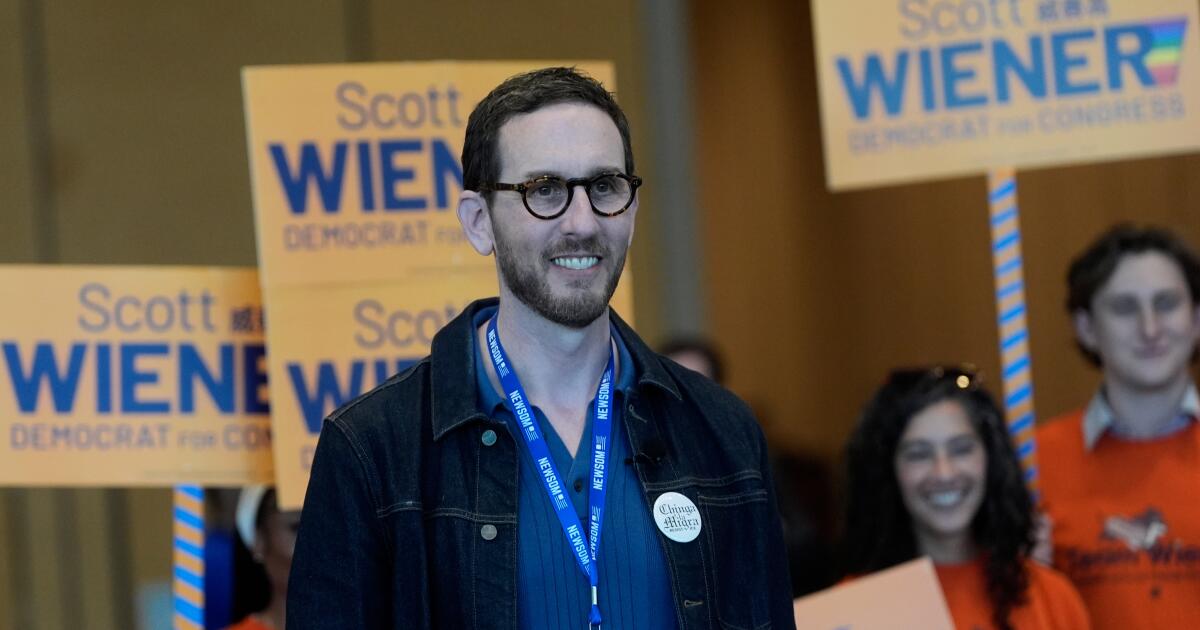
“I feel like I’m definitely running against major institutional forces, but that’s how it is,” state Sen. Scott Wiener told me recently. “At times we see sort of a little bit of a fortress mentality, and other perspectives are not welcome, and younger folks, newer voices are not welcome, and and that’s a dynamic that plays out in a lot of different places.”
Wiener, who could be considered king of the line-jumpers, just took the top spot in the San Francisco-centered race to represent the 11th Congressional District, the seat held by Nancy Pelosi since 1987, when Wiener was 17.
By most accounts, Pelosi and Wiener had a mostly cordial relationship until last year, when he entered the race before she announced her retirement. Though Wiener had been clear for years that he planned such a run when Pelosi stepped down, Pelosi is an icon in the city, beloved by constituents and uncontested as queen of the old guard.
Announcing his campaign before she officially made that decision — or had the chance to choose her successor — sent shock waves through the political firmament. When Pelosi endorsed Supervisor Connie Chan in May, it was seen by many as a sign of her displeasure. Chan, who had struggled to gain traction in the primary, came in second with the Pelosi boost and will face Wiener in November.
Across the state, there were other races with upstart contenders. In Southern California, Jake Levine, a progressive Democrat who served in the Obama White House, took on incumbent Brad Sherman. Sherman, who at 71 has served almost 30 years in Congress, resoundingly beat out Levine by more than 20 points.
In Sacramento, there is Mai Vang, a progressive City Council member, who is challenging Rep. Doris Matsui, another member of the old guard royalty. Vang is in a tie for second place with a Republican contender as remaining votes are counted.
And of course, there is the governor’s race itself, which included a field so determined and uncontrollable even before the fiasco of Eric Swalwell’s sexual misconduct scandal that the state Democratic Party started putting out its own polling in a seeming bid to convince some blue contenders to drop out. It didn’t work. Notably, progressive Katie Porter and moderate San José Mayor Matt Mahan stuck in until the bitter end. But old guard candidate Xavier Becerra came out on top.
If these races have a lesson, it’s that different Democratic voters want different things, but the party hasn’t figured out how to embrace that other than offering up the moderate middle ground.
“This is a big question to this Democratic establishment, about how big of a tent they want to build,” said Irene Kao of Courage California, a progressive advocacy organization.
She said that it “bodes well” that so many strong progressive challengers came out for the primary, because it allows a chance for candidates outside the party power structure to find an audience with voters, even if they are ultimately unsuccessful.
And where voters go, the party will eventually be forced to follow. That doesn’t necessarily mean a more progressive Democratic Party, but it likely means a more inclusive one if they want to lure the kind of low-information and low-propensity voters who make or break a general election.
“People are sick of the games, and sick of people trying to just maneuver things to get their own person in,” Wiener said. “People want to have choices.”
PORTLAND, Ore. — Former Sen. Bob Packwood, a moderate Oregon Republican whose reputation as a champion of women’s rights was tainted late in his career by a sexual harassment scandal, has died. He was 93.
Packwood’s death Saturday was announced in an obituary sent to media outlets by his family. The release didn’t include additional details.
As the scandal unfolded, Packwood initially refused to quit the chamber in which he had served for 27 years, saying he didn’t want to be remembered only for that.
Before the #MeToo era, Packwood stood out as an example of private behavior undermining a man’s public image. He previously had been praised by Planned Parenthood and others.
The great-grandson of a member of the 1857 Oregon Constitutional Convention, Packwood established himself as a social moderate and fiscal conservative who often voted across party lines. He considered running for president in 1980.
Elected to the Senate in 1968, Packwood was best known as the leading Republican advocate of abortion rights — at a time when the position had bipartisan support — and was widely admired by women’s groups throughout the country until the Senate Ethics Committee launched an investigation into the allegations of sexual and official misconduct in 1993.
More than two dozen women, former employees and acquaintances, accused him of making unwanted or uninvited sexual advances.
The allegations remained the target of an ethics inquiry that widened to include other alleged acts of official misconduct. He resigned in September 1995, and went on to start a lucrative lobbying business in Washington.
Democratic Sen. Ron Wyden, who replaced Packwood in 1996, said that although he should be praised for his record on abortion rights and tax reform, how Packwood treated women overshadows it all.
“His horrible history as documented in his own diaries will forever overshadow that public record. Simply put, historians’ first line about Bob Packwood must include those women who he abused and assaulted for years and years,” Wyden said in a statement.
As chair and then ranking Republican on the Senate Finance Committee, Packwood was a master of cutting deals and forging compromises needed to pass tax legislation through Congress. He was most proud of the lead role he played in a sweeping tax reform of 1986 that lowered the top income tax bracket and eliminated many itemized deductions.
Over his career, he was described as a blunt, independent, outspoken politician who was a boat-rocker, loose cannon, skilled partisan, and — for most of his career — political survivor.
“I think they probably all ring true,” Packwood told the Associated Press in December 1992.
“I would like to think that I am nobody’s lackey. I try to reach conclusions independently and then I’m willing to fight for those conclusions; if necessary, having to fight against my party or my party’s president,” he said.
Packwood won his first Senate election at age 36, narrowly defeating Democratic Sen. Wayne L. Morse, an Oregon legend who had held the seat for 23 years. He quickly grabbed attention as a rising star in the GOP. By 1980, he was elected chairman of the National Republican Senatorial Committee.
But he lost the seat when the White House backed a competitor after Packwood publicly accused President Reagan of alienating women, African Americans and Jews.
Just two weeks after Packwood’s reelection in 1992, the Washington Post printed allegations from former female employees and acquaintances that the senator had subjected them to uninvited sexual advances.
The Senate Ethics Committee also investigated allegations that Packwood solicited jobs from lobbyists for his ex-wife, used his staff to try to threaten the female accusers into keeping quiet and obstructed the investigation by altering his personal diaries.
The Senate held two days of extraordinary debate in 1993 over whether Packwood should have to comply with an Ethics Committee subpoena for his diaries, in which he reportedly made entries relevant to the investigation. The Senate voted 94 to 6 to enforce the subpoena.
Packwood took the case to federal court and lost, ending when Supreme Court Chief Justice William Rehnquist refused the senator’s request for the high court to intercede.
Packwood launched his lobbying business, Sunrise Research Corp., in 1997. By 1999, the firm was grossing $1.5 million a year. His business slowed in later years, but he told a City Club of Portland audience in 2010 that he was still spending about half his time in Washington lobbying for a number of clients.
It was interesting work, Packwood told the audience, according to the Oregonian, but “it is not as much fun as being in the Senate.”
As Congress became increasingly partisan after his departure, Packwood continued to advocate a centrist tack and in his 2010 City Club speech called for Oregon to create nonpartisan elections.
Attorneys for musician Chuck Redd say a D.C. Superior Court judge dismissed a breach of contract lawsuit filed against the artist after he canceled a Christmas Eve performance at the Kennedy Center in protest of President Trump’s influence over the venue.
The dismissal was granted Friday under Washington’s Anti-SLAPP laws, which are designed to prevent meritless lawsuits intended to silence opposing points of view on matters of public interest.
Redd, a drummer and vibraphone player who has toured with Dizzy Gillespie, Ray Brown and others, had presided over holiday “Jazz Jams” at the Kennedy Center since 2006. He called off last year’s performance shortly after Trump’s handpicked board for the Kennedy Center voted to add the president’s name to the venue, which Congress named for President Kennedy after his assassination.
“The Center sued Mr. Redd because he publicly and rightly objected to adding Donald Trump’s name to the Kennedy Center, a living memorial to former President John F. Kennedy,” Lisa J. Banks, one of Redd’s lawyers, said in a statement. “The lawsuit against Mr. Redd was political retribution, pure and simple, by the Trump Kennedy Center, and the Court correctly saw it as such in dismissing the case with prejudice.”
Redd told the Associated Press in an email Saturday that he is “very pleased with the judge’s ruling.”
The motion to dismiss, filed in March, argued that Redd wasn’t contractually obligated to perform. It included the contract provided by the Kennedy Center, which the artist never signed.
Representatives for the Kennedy Center did not immediately respond to a request for comment on the suit’s dismissal.
Despite an uptick in his performance, hopes for third-place finisher Tom Steyer are fading along with the number of uncounted ballots, suggesting Democrat Xavier Becerra and Republican Steve Hilton will face off in November.
Given the overwhelming Democratic advantage — both attitudinally and in registration — the outcome of the governor’s race might seem preordained. But it’s voters who decide elections, not know-it-all columnists.
Barabak: So Anita, now that the election is over how are you feeling? Relieved? Giddy? Depressed?
Chabria: Tired, with five months to go. And while it’s true neither of us can see into the future, it’s not too much of a long shot to predict that in a state where registered Democrats vastly outnumber Republicans, the next governor will likely be blue.
So while the primary was bruising and confusing, the general election will be much more predictable — it’s Becerra’s to lose, and he’d have to try really hard to do that.
But here’s what I’ll be looking for in the lead up to November: How far will Hilton go to capitalize on this moment for personal gain? There are plenty of real issues to be discussed where the Republican-Democrat divide could offer worthy debate. What should we do about gas prices? What is the right balance between environmental regulation and building housing?
That is bad for our state and bad for democracy, and it’s troubling that we will likely be subjected to these lies — and that California could be used to further erode voting rights nationally — for the entire summer leading up to the midterms.
What will you be keeping an eye on?
Barabak: How Becerra spends the next five months.
One presumes he’s smart enough not to take anything for granted. Meaning he won’t spend the time between now and Nov. 3 at some swank beach resort, sipping one of those colorful cocktails with a little paper parasol while musing over his inaugural address.
So it will be interesting to see how Becerra campaigns and whether he uses the next several months to build a mandate and also to prepare California voters for the rough road ahead.
Becerra is smart enough, one would think, not to run as Mr. Sky Is Falling and tell voters, “Boy, oh, boy things are really gonna suck going forward.” But the next governor is going to face some really tough challenges, including a structural budget deficit that’s probably going to require both painful cuts and unpopular tax hikes.
On top of that, there are the inevitable disasters, be they earthquake, fire or flood, the latter quite possibly exacerbated this winter by what may be an epic El Niño. There’s also the continued challenge of dealing with a president who treats California the way a dog regards a fire hydrant.
All of it makes you wonder why anyone would want the job — though Steyer panted after it enough to burn through more than $215 million of his fortune in a bonfire of vanity.
Universal healthcare and standing our climate ground in the face of federal rollbacks were two of Steyer’s big talking points, along with standing up to corporate influence. Becerra now inherits those thorny problems if he wants to form a more cohesive Democratic base.
Becerra hasn’t yet offered up his vision of the Golden State, as you point out. As much as it may benefit Hilton to focus on Trump in coming months, the same could be true for Becerra.
Why get into messy policy when you can run on opposing MAGA in a very blue state? I fear the next few months will be more about Trump than California.
Barabak: That’s a charitable way to look at $teyer’s campaign.
Sure, he had plenty of ideas, though I think the promise of delivering universal healthcare — a political nonstarter — was cheap pandering, not visionary leadership.
There’s no shortage of people with good ideas. The only reason anyone paid attention to Steyer, who’s never served in any elected office, was the obscene amount of money he spent on his luxury-class ego trip. So it pleases me voters didn’t reward his arrogance or buy his billionaire-turned-populist, “Amazing Grace” spiel. (“I once was blind, but now I see.”)
And I’m be gladder still that voters showed — once again — the governor’s office is not for sale.
I do agree, however, that Becerra should to more than just cry MAGA! MAGA! MAGA! for the next five months, as if that incantation is magic and will solve all our problems. That applies, by the way, to Democratic candidates everywhere.
All of that said, we should note the governor’s race has yet to be officially decided and Steyer still has at least a theoretical possibility of slipping into the top two.
Chabria: First, we’ll have to agree to disagree. California is on a healthcare cliff and even middle-class Americans (not just Californians) can’t afford either insurance or care.
Single-payer may be a dream, but it’s my dream — for my kids, for my community and for my state, because healthcare shouldn’t be just for the rich and that is increasingly the direction we are going. So any politician, Steyer included, who fights for inclusion rather than accepting exclusion will get my consideration.
And let’s be real — self-funded or corporate-funded — our elections are, to their detriment, too much about money. My outrage is for the 2010 Citizens United Supreme Court decision, which unleashed the current no-limits mess and created a system in which it requires hundreds of millions from somewhere, anywhere to run for our highest offices.
But back to ballots: Slow is not fraud. Slow is not bad if it’s accurate. Slow allows for greater voter participation by allowing mail-in ballots, and carefully checking all ballots for problems. Slow takes into account the federal mangling of the post office that has, yes, slowed down our mail.
And, slow happens because most of our county elections offices are understaffed and budget-starved. If you want fast, you’ve got to pay for it.
So keep your britches on people and don’t buy Trump’s (or Hilton’s) manufactured hype. Every system can be improved, but there’s far worse problems than slow.
What’s your take on the ballot controversy?
Barabak: Here’s one where we agree.
California goes out of its way to make it easy to vote, which, I believe, is a very good thing. Kim Alexander of the non-partisan California Voter Foundation, who’s spent decades on the matter, has suggested ways we can have both wide access and a faster count, starting with better funding of the state’s over-extended county election offices.
This prolonged count is something Gov. Gavin Newsom and the Democratic-run Legislature could have anticipated. Shame on them for not doing more to address it.
I, too, yearn for that perfect candidate who is firm but flexible, old but youthful in his or her thinking, masculine but also feminine, brilliant but not too smart and larger than life but also totally relatable.
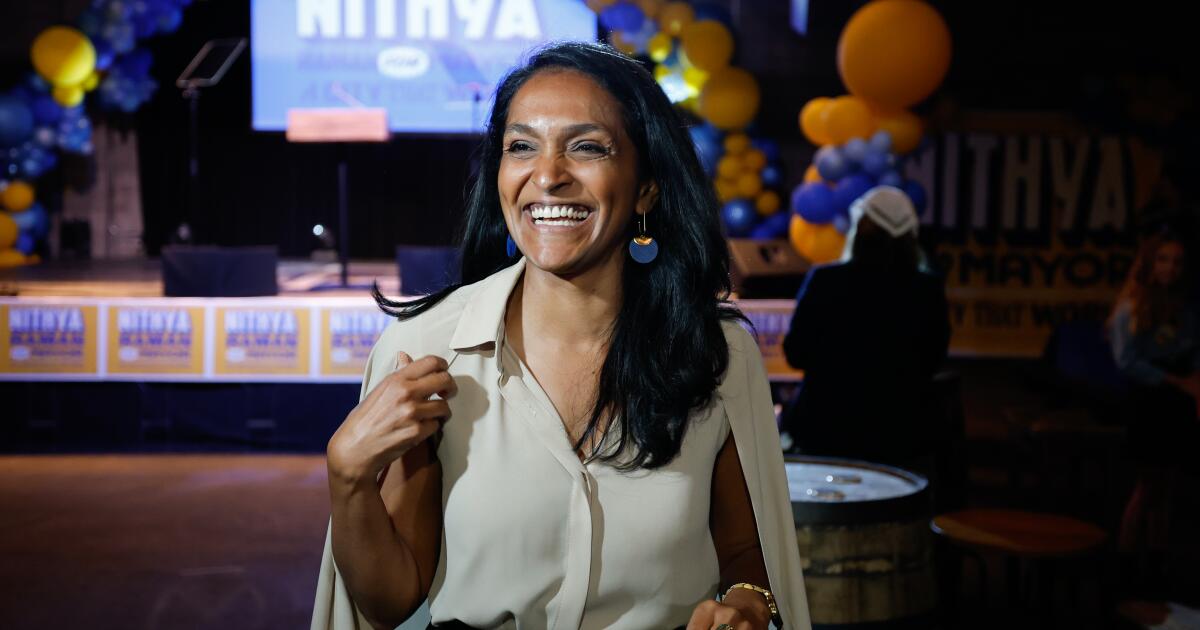
When Nithya Raman stepped up to a podium on the night of L.A.’s mayoral primary election, she thanked her supporters for standing up to the “powerful interests” who spent millions of dollars trying to “preserve this city’s broken and unjust status quo.”
“At a time when so many people have written Los Angeles off or have lost hope in the future of this incredible city,” the democratic socialist L.A. mayoral hopeful said, “you are proof that Angelenos are hungry for change.”
But as election results rolled in, the movement for change was underwhelming, or at least divided. Incumbent Mayor Karen Bass was in the lead, advancing to the November runoff. That left Raman locked in a battle for a second spot with Republican former reality TV star Spencer Pratt.
Bass is one of several high-profile establishment Democrats to emerge on top. In California’s gubernatorial race, centrist Xavier Becerra, a veteran of the Biden Cabinet, advanced to the runoff after being challenged from the left by billionaire green activist Tom Steyer and Democratic former U.S. Rep. Katie Porter. Steyer is now behind Steve Hilton, a Republican, and battling to make the runoff.
Still reeling from the rise of Donald Trump, Democrats in California and beyond are struggling to figure out the future direction of the party.
Some progressives, inspired by Zohran Mamdani’s New York mayoral victory, saw 2026 as an opportunity to move the city further left. But the results have been mixed in key races, with veteran Democrats like Bass and Becerra eking out leads even as polls show dissatisfaction with status quo politics in California.
“This was supposed to be a change revolution, but voters clearly said no to the revolution,” said Sara Sadhwani, a politics professor at Pomona College. “Voters want change,” she noted, “but it doesn’t appear right now that there has been an appetite for a major shift in the ideology of the city or the state.”
Xavier Becerra speaks during an election night event in downtown Los Angeles on Tuesday.
(Eric Thayer/Los Angeles Times)
Becerra emerged as the Democratic favorite late in the election and won support from many establishment party leaders. Pundits said after a wild primary that included the implosion of Democratic U.S. Rep. Eric Swalwell’s campaign amid sex assault allegations, Becerra emerged as a “safe” choice.
Some opponents attacked his moderate views and his willingness to accept campaign donations from big oil companies like Chevron. But that did not stop his rise.
Bass was also beset with challenges, being an incumbent in a city beset with problems.
For her, election night marked a “victory with an asterisk,” Sadhwani said, noting that Bass is first incumbent L.A. mayor in more than two decades to face a runoff. “It would be wrong for Karen Bass to think that this victory … is a ringing endorsement of the work she is currently doing.”
The results underscore Bass’ unpopularity as an incumbent, garnering just 35% of the vote so far. If Raman can catch up and eventually surpass Pratt in the vote count, she could pose a considerable challenge to Bass as more young voters come to the polls in November.
Mike Bonin, a former L.A. City Council member who leads the Pat Brown Institute for Public Affairs at Cal State L.A., said if Bass exceeded expectations it was because they were very low.
“Coming in first in a runoff isn’t a huge victory for an incumbent mayor,” he said. “Two-thirds of the city did not vote for her. That’s not a position of strength.”
James Adams, a political science professor at UC Davis, said that Becerra and Bass coming through indicates the centrist Democratic candidates were in a stronger short-term position than their rivals. But problems loom ahead, he said, as the longtime Democratic establishment that’s been governing California for the last 15 years failed to make notable progress in solving problems with affordable housing, homelessness, public transportation and education.
“I think the Democrats’ prospects are very bright in 2026 given the California Republicans’ dysfunctionality and a complete backlash against Donald Trump,” Adams said. “But I have much bigger concerns about the California Democrats long term, because it seems to me they’re setting a record for most consecutive years of failing to fix the state’s problems while getting reelected anyway.”
Democrats in California, he said, were suffering from being in power too long.
“Whenever one party gets into a long-term, dominant position, usually because the other party is just in the midst of self-destructing … the whole thing ends in tears, because the party that is in a dominant position, they don’t have to be that good.”
As the vote count continues in the mayor’s race, democratic socialists in Los Angeles already have some wins down-ballot.
“We are gaining momentum,” said Leslie Chang, a co-chair of the 5,000-member L.A. chapter of the Democratic Socialists of America, a decentralized anti-capitalist group that advocates for rental protections and defunding the police. Over the last six years, Angelenos have elected four DSA-backed City Council members and a DSA-recommended city controller.
The DSA did not officially endorse Raman, because she entered the race after the group had issued endorsements and another DSA candidate was also running for mayor. However, three of the six DSA-backed candidates for citywide office were projected to win outright.
DSA Councilmembers Hugo Soto-Martinez and Eunisses Hernandez were reelected by such large margins they avoided runoffs. In the city attorney’s race, DSA-endorsed Marissa Roy was in the lead and the mainstream Democratic incumbent became the first city attorney ousted in a primary in nearly a century. City Controller Kenneth Mejia, a progressive anti-establishment candidate who is not a DSA member but an ally of the group, led by nearly 20 percentage points.
When Chang knocked on doors, she said, some voters asked: “Well, what’s the difference between Nithya and Karen Bass?”
A few voters told her that after reviewing Bass’ and Raman’s websites, they found their platforms similar. Chang was surprised. She thought Raman articulated a clear and novel strategy for how to get L.A. out of the housing crisis, but she said some on the left took issue with her working with housing developers to reduce red tape.
Neel Sannappa, chair of the California Democratic Party’s progressive caucus, said Raman was stymied by getting into the race late and having only a few months to campaign. It also didn’t help that a more left-wing challenger, Rae Huang, already had some momentum — not enough to win, but enough to split the left.
“Nithya does represent something real and growing in Los Angeles,” Sannappa said. “There is a hunger for more progressive, left-leaning candidates that want to make sure that we’re investing in people and not so much investing in just police … and being able to build things that are new and innovative.”
Supporters watch election results come in on their phones during Nithya Raman’s election night party at Boomtown Brewery on Tuesday.
(Gina Ferazzi/Los Angeles Times)
Some have criticized Raman’s coalition-building, noting she was not endorsed by her fellow DSA-backed City Council members. Others said the MIT and Harvard graduate, who has been a councilmember for six years, performed tepidly in a May televised debate and suffered from Pratt’s attempts to tie her to the establishment.
“If you’re a part of the institution, which she is,” Sadhwani said, “then you can’t exactly claim that you’re going to bring massive change.”
Sadhwani said that California’s left, in contrast to New York’s, appears to have a charisma deficit. While Pratt and Hilton had an advantage with their television backgrounds, they also spoke “in plain terms about the real problems that the state faces.”
Part of Bass’ success can also be attributed to assembling a coalition that included the L.A. County Federation of Labor, the L.A. police officers union, the L.A. County Democratic Party and immigrant rights groups.
In the mayoral race, Sadhwani said, “the dominant political coalition still has power, money, the organization.”
“If you can garner the support of the unions, then having a broader message, maybe it’s less important,” she said. “You don’t have to work quite so hard, because the unions have the base machine.”
People attend Mayor Bass’ election party for the California 2026 primaries at the LINE Hotel on Tuesday.
(Carlin Stiehl/For The Times)
Yusef Robb, a longtime Democratic strategist who is an advisor to Bass, attributed the mayor’s lead to her campaign’s success in building a broad coalition and communicating across the political spectrum. Most voters, he said, tend to think less about ideology — and whether a Democrat was mainstream or DSA-supported — than candidates’ positions on bread and butter issues.
“Mayor’s races are first and foremost about what people see outside of their front doors, when they walk their kids to school, when they drive to work,” he said. “At the end of the day, the voters look at the field and say, ‘OK, who do I trust to keep my kids from having to skip around a tent on the way to school?’ ‘Who can I trust to hire more officers?’ … and ‘Who can I trust to fight back against ICE in court through executive action and even in the streets?’ And that’s Karen Bass.”
For Democrats in this robustly blue state, part of the challenge in figuring a path forward is that every candidate — even those already in power — pitches themselves as a bona fide progressive against the status quo.
“We have led a grassroots campaign because we want to bring change to our city,” Bass said on election night. “And that’s what we’ve been doing, and that’s what we’re going to continue to do.”
Raman also tried to tout herself as a change candidate. Articulating her platform in broad strokes rather than bread-and-butter detail, Raman said she wanted L.A. to be a place “where government actually functions and delivers every day on this city’s beautiful bighearted values, where we stand up against ICE, where we show up for our gay and trans siblings.”
But as she talked of neighborhoods “full of trees and shade … and people and good food,” she seemed low-key and equivocal. Her message was a far cry from the pressing one U.S. Sen. Bernie Sanders (I-Vt.) put forward in his presidential campaigns, highlighting the millions of Americans working for “starvation wages” and a young single mother in Nevada struggling on $10.45 an hour.
Ultimately, the fight between Bass and Raman, as a struggle between mainstream and progressive Democrats, is complicated by the fact that Bass came up through the progressive wing of the Democratic Party, founding the grassroots Community Coalition in South L.A. in the 1990s.
Campaign worker Khai Dombroe prepares balloons before Nithya Raman’s election night party.
(Gina Ferazzi/Los Angeles Times)
And even though Raman is a DSA member, she has tacked to the center during the campaign, distancing herself from past calls to defund the police by saying she did not want the LAPD to lose more officers.
While Raman and Bass have much in common, the most significant difference between them is on homelessness, Sannappa said. Even though Bass comes from a political tradition of not wanting to criminalize the unhoused, he said, she understood her voters include people wanting to move homeless people off the streets.
“Brass tacks is that we need people that are going to be willing to fight for mental health services,” Sannappa said.
“I think Nithya more so represents the direction where the Democratic Party is going to have to go.”
As L.A. becomes less affordable and homeownership becomes out of reach for many Angelenos, young renters have become a rising political constituency — a shift that many say will likely propel the city leftward.
Bonin said he expected the next new rising Democratic coalition in L.A. to be a labor-renter coalition. He cited Councilmember Soto-Martinez, a renter and union organizer, as probably the best avatar of that.
But as the middle-class splinters along generational lines, other political experts warn that many ordinary Angelenos feel increasingly shut out of L.A. politics.
“Once upon a time the Democratic Party was the party of the working class, and today it has become the party of the educated elites,” Sadhwani said. “Perhaps one of the gifts that Donald Trump has given to Democrats is to force them to contend with the everyday issues of voters, which they seem to have distanced themselves from.”
As many Angelenos feel worse off now than four years ago, Chang said Bass was not directly responsible for every problem. Still, she said, she could have done more to move the city in the right direction.
Delaying the wage boost tied to the 2028 Olympics, she said, was a move that failed working people at a time when many are struggling to make ends meet.
“My fear, of course, is people pivot away from corporate Democrats and they choose the MAGA Republican, because that is the most visible fight,” Chang said. “Or because they think, ‘Oh, well, a democratic socialist running on the Democratic Party line, this is just more of the same status quo.’ ”
WASHINGTON — After Defense Secretary Pete Hegseth cut nine Navy officers, including all the women, from a promotion list, several female officers say they see the unusual intervention as a sign that their careers now have a ceiling and worry for the future generation of female military leaders.
The Navy had selected 31 sailors to promote from the rank of captain to one-star admiral, but Hegseth recently intervened to strike nine people from the list, including three women and two Black men, according to a Defense official who spoke on condition of anonymity to discuss information not permitted to be released publicly.
As a result, the Navy is not promoting a single woman to the one-star admiral rank this year even though women make up about one-quarter of all Navy officers and nearly one-third of the sea service’s midgrade ranks, according to military data from 2024.
The Associated Press spoke with eight female Navy officers of varying ranks and time in service after Hegseth’s cuts, which were reported earlier by the New York Times, became public. They spoke on condition of anonymity out of fear of retribution from their superiors.
The more junior officers said they saw the development as a sign that their careers would become politicized if they rose too far in the ranks, and some said they felt they now had a limit on how far they could be promoted. Some said it made them feel less valued within the military and wondered whether that wasn’t part of the intent.
The Pentagon has not offered any rationale on why the women, or any of the other six people, were removed from the promotion list.
Sean Parnell, the Pentagon’s top spokesman, said on social media last week that “military promotions are given to those who have earned them” and that the Pentagon “will never consider the color of a service member’s skin or their gender as a factor in promotions.” The Pentagon did not immediately respond to a request seeking further comment.
The Navy’s process for choosing which officers to promote to the one-star rank has been relatively constant and transparent over the years. The service convenes a group of officers, called a promotion board, that examines the records of eligible officers and chooses those deemed to be the most qualified.
The board that selected the initial slate of 31 officers for promotion was directed by then-Navy Secretary John Phelan, an appointee of President Trump, to “recommend for promotion the best qualified officers within their respective competitive category.”
The order from Phelan, who abruptly departed his post in April, said the board should consider an officer’s performance, competence and character, among other traits, as part of those qualifications.
It also said that given China’s prominence in the Trump administration’s National Defense Strategy, “special consideration shall be given to officers who have excelled in their knowledge of the political military affairs and U.S. strategic interests in the Indo-Pacific region, and operational contingency planning for Indo-Pacific war plans.”
Hegseth has long argued, without offering evidence, that women in the military benefit from preferential treatment and are not suited for combat roles.
“For too long, we’ve promoted too many uniformed leaders for the wrong reasons based on their race, based on gender quotas, based on historic so-called firsts,” Hegseth told hundreds of military leaders in September.
The approach, he asserted, made the Pentagon “less capable and less lethal.”
‘A break from tradition’
Phelan’s order said the Navy cannot discriminate based on criteria such as race and sex, and it specifically noted that “this guidance shall not be interpreted as requiring or permitting preferential treatment of any officer or group of officers on the grounds of race, religion, color, sex.”
The full list of 31 people to be promoted was approved by Phelan, other Navy leaders and the chairman of the Joint Chiefs of Staff, Gen. Dan Caine, before it reached Hegseth, who chose to make the changes, the Defense official said.
While Hegseth is within his rights to intervene in the list, “it’s just not the norm” and is “a break from tradition,” said Katherine Kuzminski, a researcher specializing in military recruiting and retention at the Center for New American Security think tank. She said that promotions historically have been seen as “the services’ business.”
Kuzminski noted that “this is a decision that’s not being made by the Navy — it’s being made by the secretary of Defense,” and she said Hegseth’s growing interference in operational aspects of the military services such as promotions is creating “tension” about what “normal” will look like going forward.
Some of the more senior Navy officers who spoke with the AP expressed concerns about the message it sends to the next generation of young sailors.
In addition to pulling the recent promotions of three women to admiral, Hegseth shortly after he took office fired Adm. Lisa Franchetti, the service’s top officer and the first woman to hold the job. He never explained his rationale.
Since then, he also has fired two other female three-star admirals without explanation.
Some of the officers who spoke to the AP said that while they were encouraging female sailors to stick with the Navy, they acknowledged that message is coming at a difficult time.
Kuzminski said the rhetoric and actions surrounding women in the military “affects individual service member decision-making and it also affects family unit decision-making,” including whether people make a career of the military.
Kuzminski said that following the months-long hold on military promotions by Sen. Tommy Tuberville (R-Ala.) during the Biden administration, surveys showed that partisan politics spilling into the day-to-day lives of troops affected their decision-making.
One officer said this impact was not confined to women.
In conversations with other sailors in her unit, she said that male sailors were hesitant to deal with what appears to be a growing politicization of simply following the orders of previous administrations.
Los Angeles City Councilmember Nithya Raman cut deeper into the lead of reality television personality Spencer Pratt on Saturday, as his lead slimmed to just a single percentage point.
Pratt fell to just over 27% of the vote while Raman jumped up to slightly over 26%, according to the results from the Los Angeles County Registrar-Recorder. Pratt now leads Raman by just 7,494 votes.
“We’ve seen Nithya Raman catching up on every update and the last two in particular she’s accelerated,” said Paul Mitchell, vice president of the bipartisan voter data firm Political Data Inc. “She’s continued to gain at a rate that means she will eventually catch up unless Pratt starts getting some ballots coming in that are either geographically or demographically better for him.”
Democratic consultant Michael Trujillo, who doesn’t represent anyone in the mayoral race, said the results suggest Raman will surpass Pratt as more votes are counted.
“I think it’s over,” Trujillo said. “It appears Nithya will be in the runoff. Pratt doesn’t appear to be growing much more.”
The second-place finisher in the mayoral primary will face Mayor Karen Bass in a Nov. 3 runoff. On election night Tuesday, the Associated Press determined that Bass had secured enough votes to qualify for the runoff.
Pratt has been in second place since then, but Raman has gradually eroded his lead as mail-in ballots have been counted. The updated vote tally released Thursday showed Pratt with 29% of the vote and Raman with 23%.
With Friday’s update, Raman’s share had risen to 25% and Pratt’s shrank to 28%, for a 3 percentage point gap.
In the most recent batch of mail-in ballots counted, Raman received 23,514 votes, while Pratt gained 10,336.
Election analysts expected Raman to gain ground as the mail-in ballots were tallied, reasoning that many left-of-center voters — Raman’s base — held onto their mail-in ballots until the last minute as they waited to choose between Democratic gubernatorial candidates. They also say younger, more progressive voters tend to hold onto their ballots longer generally.
Although the mayor’s race is nonpartisan, Pratt is a Republican in a city that is overwhelmingly dominated by Democratic voters and elected officials.
A poll by the UC Berkeley Institute of Governmental Studies, which was co-sponsored by The Times, had Pratt running in third place behind Bass and Raman.
The poll of 1,351 likely voters conducted May 19-24 had Bass with 26% support, Raman with 25% support and Pratt with 22% support, with a 3% margin of error.
Los Angeles voters have become accustomed to seeing election results change as late-arriving ballots are tabulated. In the 2022 mayoral primary, real estate developer Rick Caruso led the pack for about a week before Bass pulled ahead.
Pratt was favored in many of the same neighborhoods that voted for Caruso, according to a Times analysis of precinct-level returns provided by the Los Angeles County Registrar-Recorder on Wednesday, when an estimated 62% of the projected vote had been counted. Raman, by comparison, made inroads in progressive areas dominated by Bass four years ago.
Pratt, whose Pacific Palisades fire home burned in the January 2025 fire, was strong there and on the Westside, as well as in the San Fernando Valley communities of Encino, Woodland Hills, Chatsworth and Sunland-Tujunga.
Raman dominated precincts known for their progressive politics, particularly those with younger people in renter-heavy neighborhoods stretching from Hollywood to Highland Park, including her home base of Silver Lake.
Mail-in ballots with an election day postmark will continue to be accepted by county election officials through Tuesday.
PARIS — U.S. Defense Secretary Pete Hegseth gave a D-day anniversary speech Saturday that appeared to link immigration by sea to the wartime liberation of Europe, warning that the freedom won by Allied troops could prove temporary if leaders failed to defend it against today’s “invasion.”
Hegseth, speaking at the Normandy American Cemetery in Colleville-sur-Mer overlooking Omaha Beach in northwestern France during commemorations for the 82nd anniversary of the June 6, 1944, landings, said that today, “different European beaches are stormed by different dangerous ideologies.”
“Beaches in Spain and Italy and Greece and Bulgaria. Boats and men arrive,” he said.
“When will European capitals do something about that invasion? Or is it too late?” he added. “I pray not, and I believe not.”
Hegseth did not use the word “immigration,” but his remarks echoed broader Trump administration criticism of Europe over migration, borders and what U.S. officials have described as censorship of nationalist and far-right voices.
On Saturday, British Prime Minister Keir Starmer’s office condemned Vice President JD Vance’s remarks blaming immigration for the killing of Henry Nowak, an 18-year-old British student stabbed to death in Southampton, even though both Nowak and his killer were British.
In December, the Trump administration’s national security strategy warned that Europe faced the “prospect of civilizational erasure” and could become “unrecognizable” within 20 years.
WASHINGTON — It was perhaps a surprising private overture from OpenAI Chief Executive Sam Altman to Sen. Bernie Sanders.
The meeting between the two had come just after the Vermont senator announced a plan for the public to take a 50% ownership stake in artificial intelligence companies such as OpenAI, using their stock to create a public wealth fund that would spread the fortune generated by AI behemoths.
Altman told Sanders that he, too, wants the public to have equity in AI companies. Though the CEO said he couldn’t support Sanders’ threshold of 50%, he nonetheless wanted to work with him to advocate for the general idea, according to people with knowledge of the conversation.
The nearly hourlong meeting in Sanders’ Senate office this week, held at Altman’s request, highlighted the inherent tension between AI powerhouses and policymakers as Americans are increasingly asked to accept the costs of the AI boom even as many remain unconvinced of its direct benefits. Yet it’s also creating odd political bedfellows fueled by populism as politicians from Sanders to President Trump embrace giving the public a stake in AI’s growth.
Speaking to reporters Friday on Air Force One, Trump described a potential partnership “where the American people can benefit from the success of AI” and said executives from leading AI companies will visit the White House, perhaps in the coming week, to discuss the idea.
“There’s something very interesting about it, where it almost becomes a partnership with the American public,” Trump said.
When reporters noted to the Republican president that Sanders, a democratic socialist and political independent, had proposed public ownership in AI companies, he pointed to similarities in their coalitions. The economic views of Trump voters and those who have supported Sanders for president, Trump said, “aren’t that far apart.”
Trump has embraced government investment in private companies in his second term, scrambling his party’s politics. His administration last year secured a 10% stake in the struggling Silicon Valley company Intel, and it considered a government takeover of Spirit Airlines earlier this year, although the airline couldn’t reach a deal and ultimately closed.
Public backlash
The positioning of leading figures such as Trump and Sanders comes as concerns about AI are emerging far beyond Washington.
In Michigan, Democrats recently clashed over Gov. Gretchen Whitmer’s appearance with Altman at the site of a major data center. Candidates such as New York Democratic House candidate Alex Bores have also made AI regulation a campaign issue by tapping into voters’ unease about the technology.
“This is a real change to society,” Altman told reporters this week. “I think it’s possible both that people can use AI a lot and like using it and also have anxiety about what it’s going to do for the future.”
Data center projects across the country have drawn opposition from residents concerned about electricity demand, water consumption and environmental impacts. Some states once eager to attract the facilities, including Ohio and Virginia, have moved to reconsider tax incentives.
“We need to pass legislation right now that says there’s not going to be any further data center development until they agree to pay for their own electricity, build their own grids and pay for their own water supply,” Sen. Josh Hawley of Missouri, a leading Republican skeptic of Big Tech, told the Associated Press.
Before arriving in Washington, Altman stopped in Michigan on Monday to appear alongside Whitmer, a Democrat, at the site of a 1.65 million-square-foot data center project. Whitmer’s team said the project will create more than 2,500 union construction jobs.
But it also drew criticism from local activists and some fellow Democrats, including Rep. Rashida Tlaib of Michigan, who called the project “disgusting.” She said she was “so disappointed” in Whitmer.
“It’s a very controversial topic right now and it’s coming from the ground up,” Sen. Elissa Slotkin, another Michigan Democrat, said about the grassroots resistance. “People feel very strongly about it.”
Whitmer defended her appearance, telling reporters afterward that “one thing’s very clear: Everyone has a cellphone in our pocket.”
“We are all, more and more, consuming technology and data, and these data centers are going to get built. So, my thought is if we can hold them to a high standard and do it in Michigan, that’s the best way to do it,” she said.
The tensions extend beyond data centers. On college campuses, commencement speakers have been interrupted by boos when discussing artificial intelligence. About 70% of college students see AI as a threat to their job prospects, according to a 2025 poll by the Institute of Politics at the Harvard Kennedy School.
Altman acknowledged those concerns. He said that while “the impact on jobs has been less than many people in our field expected,” he understands “that college students have a lot of anxiety about the future.”
Washington seeks an AI bargain
The idea that AI’s expansion is inevitable is increasingly shared by leaders across the political spectrum, even as they disagree sharply about how to manage it.
That reality was at the center of Altman’s conversations in Washington. In addition to Sanders, Altman met with Trump administration officials such as Michael Kratsios, the White House’s chief science and technology advisor, and congressional leaders from both parties.
Sanders’ team emphasized that the two did not reach an agreement on the main points that the senator made to Altman, including the 50% figure to ensure that the public has decision-making power. The senator also expressed opposition to the growing spending on elections by the AI industry.
“Unfortunately, Sam Altman did not commit to any of those,” Sanders spokesperson Jeremy Slevin said.
Altman, emerging from the conversation, described it as “great,” though noting that the two “obviously don’t agree on everything.”
How AI should be governed
Congress this week released a bipartisan framework that would establish the first broad federal approach to AI regulation while temporarily preempting many state laws.
Anthropic, one of OpenAI’s top competitors, has proposed mechanisms for coordinating pauses on advanced AI development if systems become too powerful.
The Trump administration has also begun constructing its own oversight structure, signing an executive order to establish a process for reviewing national security risks posed by advanced AI systems before their public release.
Sanders said he found the administration’s move notable after years of warnings that regulation could slow American innovation.
“Even these guys are beginning to catch on that there are legitimate concerns that have to be dealt with,” Sanders said.
Cappelletti and Kim write for the Associated Press.
A federal judge sided with California and other Democratic states on Friday in a preliminary injunction that blocked the Trump administration’s attempt to condition food benefits on compliance with the president’s policies on gender and immigration.
Twenty states and the District of Columbia filed a lawsuit in March against the Trump administration in U.S. District Court in Massachusetts, arguing that the “unlawful” and “unconstitutional” funding requirements are vague and designed to force policies on states.
Billions in federal funding are ultimately at stake, including money for school lunch programs that provide meals to 30 million children nationwide and food stamps that support about 40 million Americans living in low-income households.
“As the Trump Administration tries to use essential programs and billions in funding as leverage to advance their hateful, discriminatory agenda, California continues to fight to uphold the law and ensure that our communities can continue to access the funding they need to thrive,” said California Atty. Gen. Rob Bonta in a statement.
The policy shift from the United States Department of Agriculture marks another effort by the president to force left-leaning states to submit to his positions on hot-button political and cultural issues to receive government funding. California’s current budget relies on $174.5 billion in federal dollars, or roughly one-third of the overall state budget funds.
The funding conditions from the USDA relate to gender ideology, women and girls’ sports and immigration, according to the lawsuit.
States argue that the conditions do not explain what activities are prohibited for entities that receive grants. The USDA did not cite any law allowing the organization to impose anti-discrimination policies that go beyond federal law, the suit states.
The states that joined the lawsuit contend that they are left with the “unlawful” choice of adhering to the conditions or risk losing up to $74 billion in collective federal assistance from the USDA.
U.S. District Judge Myong Joun approved a preliminary injunction Friday and is expected to issue a memorandum later explaining the decision, according to the Associated Press.
WASHINGTON — Several FBI analysts tied to the creation of a 2023 memo warning of a potential threat from Catholic “violent extremists” were fired Friday, according to their lawyer, the latest wave of terminations under Director Kash Patel.
The fired employees included four intelligence analysts and a supervisory analyst. The FBI declined to comment.
“This action is manifestly unjust, completely unsupported by the facts, and subverts standard FBI policy and procedure,” their lawyer, David Laufman, said in a statement. “These individuals deserved far better for the exceptional and faithful public service they rendered to protect our country.”
The January 2023 intelligence product produced by analysts in the FBI’s Richmond, Va., field office emerged as a political focal point after it was issued, with Republicans in Congress citing it as part of their broader claim that the FBI during the Biden administration was targeting conservatives.
Then-FBI Director Chris Wray denied that allegation and the agency has said the document was quickly retracted and an internal review was launched. Merrick Garland, the attorney general under President Biden, has said he was “appalled” by the memo.
Earlier Justice Department investigations into the memo challenged the analytical tradecraft but did not find intentional misconduct by the analysts involved.
The firings are part of a broader personnel purge under Patel, a President Trump loyalist who over the last year has pushed out dozens of employees who either contributed to investigations of the president or who were perceived as not in alignment with the administration’s agenda. The Justice Department has engaged in similarly sweeping firings of prosecutors since Trump took office last year.
In February, for instance, the FBI fired a group of counterintelligence agents who participated in the investigation into Trump over his retention of classified documents at his Mar-a-Lago estate in Palm Beach, Fla.
Critics including former federal officials say the purge has transformed federal law enforcement agencies into politically motivated extensions of the Trump White House. The classified documents investigation resulted in a federal indictment against Trump, but the case was dismissed after his 2024 election.
The Richmond memo, which emerged from a domestic terrorism investigation, sought to examine a potential link between what it called “Radical Traditionalist Catholic” ideology and racially and ethnically motivated extremists. It warned of the potential for violence and also highlighted what the authors described as “new avenues for tripwire and source development.” FBI leadership quickly condemned those findings once the document became public.
An internal FBI review described in a 2023 letter to Congress and based on interviews with 26 people “found that all individuals involved in the creation, review and approval of the product failed to adhere to analytic tradecraft standards and failed to recognize that the product, as drafted, equated the subjects’ interest in their self-described form of religion with racially or ethnically motivated violent extremist (RMVE) ideology without sufficient evidence or articulable support.”
The failure to adhere to standards, including on proper domestic terrorism terminology, “created the appearance that the FBI conducts investigative activity based on religious affiliation,” the letter said. “One of the FBI’s most fundamental principles is that investigative activity may not be based solely on the exercise of rights guaranteed by the First Amendment.”
A Justice Department inspector general report in 2024 summarized the earlier FBI review by saying that though there were departures from proper analytic tradecraft, “no evidence of a malicious intent or an improper purpose” were found.
MS NOW earlier reported the firings.
Tucker and Richer write for the Associated Press and reported from Los Angeles and Washington, respectively.