Stay informed and up-to-date with the latest news from around the world. Our comprehensive news coverage brings you the most relevant and impactful stories in politics, business, technology, entertainment, and more.
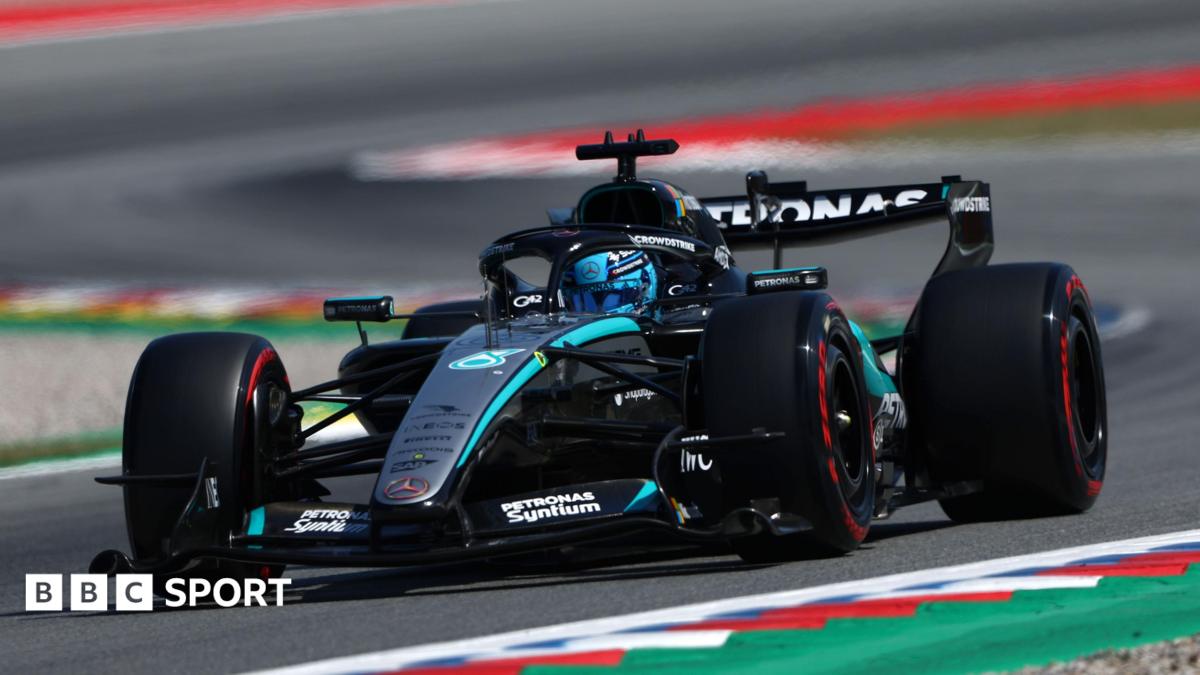
George Russell bounced back from the disappointments of the past few races to take pole position for the Barcelona-Catalunya Grand Prix.
Russell edged out Lewis Hamilton’s Ferrari by just 0.064 seconds as runaway championship leader Kimi Antonelli could manage only third place in the other Mercedes.
McLaren’s Lando Norris took fourth from Red Bull’s Max Verstappen and Isack Hadjar, while Hamilton’s team-mate Charles Leclerc crashed on his first lap in the final session and will start 10th.
Norris’ team-mate Oscar Piastri was seventh, from Racing Bulls’ Liam Lawson and Audi’s Nico Hulkenberg.
Muhammadu Mahe wasn’t at home when terrorists came for him one rainy night. It was during the rainy season in 2023. He had travelled to sell livestock and spent the night in the Shinkafi area of Zamfara, North West Nigeria.
The following morning, his brother, Alhaji Usman, rang his phone.
“Dan Hajiya, Yan Bindiga came looking for you last night,” Usman said over the phone. The term, Yan Bindiga, is what most rural residents call terrorists in the area. Muhammadu, who is known as Dan Hajiya in his Ruwan Bado village in the Maradun Local Government Area (LGA), did not fully grasp the message, so he asked, and his brother explained succinctly.
Six armed men on three motorcycles had stormed the village and gone straight to Muhammadu’s house. When they were told he was not around, the terrorists asked one of his children to let them know when he returned. They neither fired a single shot nor abducted any of his three wives and 13 children.
“Normally, they would have abducted a family member to force me to look for them, but they didn’t. It was very surprising,” Muhammadu told HumAngle on the afternoon of June 4 in a town in Zamfara, where he now lives with his family.
Hearing about the terrorists’ visit, he wanted to rush home to check if any of his children had been hurt. He had thought the terrorists were targeting him for more extortion. However, his brother advised him to stay in Shinkafi for at least two more days until they could determine the reason the terrorists were looking for him.
Muhammadu now works as a labourer on other people’s farms. Photo: Muhammad Babangida Mafara/HumAngle.
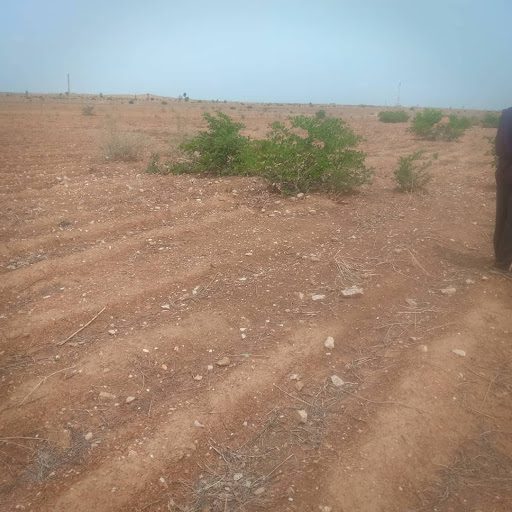
Muhammadu had paid a ₦1.5 million “farming tax” to a terrorist group led by Jamilu, a loyalist of the notorious criminal mastermind, Halilu Sububu, who was killed by the military in 2024. Halilu, originally from Maradun, maintained several camps in the forest reserves in the Sububu/Tubali, Bakura, and Kaya axes. One of such camps is now controlled by Jamilu. Ruwan Bado, Muhammadu’s village, sits not far from Janbako and Faru, two bigger villages in the Talata Mafara town. Terrorist groups routinely attack communities and motorists on the road, a situation that forced several farmers to abandon their farms.
The lingering crisis engulfing northwestern Nigeria began as a farmer-herder clash in Zamfara over a decade ago. Thousands of people have since been killed, with over a million displaced. Motorcycle-riding terrorists invade communities, schools, farmlands, and roads to abduct people for ransom. Terrorist attacks have persisted in the region despite kinetic and non-kinetic approaches.
Amid the ongoing armed violence, farmers are severely affected as terrorist attacks disrupt their agricultural activities. Each year, with the onset of the rainy season, terrorists intensify their attacks on rural communities to intimidate farmers, ultimately seeking agreements that often lead to residents paying millions as taxes. Funds collected from farmers help finance their terrorist activities. Farmers who fail to pay are forced to flee their communities for fear of being attacked by the terrorists. However, even paying the tax does not guarantee safety, as seen in several cases, especially in Zamfara State.
Of recurring attacks and farming taxes
Before the violence escalated in his community, Muhammadu said he had always wondered what he would do without his farms. He is a farmer like his father and grandfather. Everyone in his family is a farmer, including those who have taken government jobs or other businesses. Everyone had a farm before terrorists began to invade their communities.
The day the terrorists came looking for him was not their first time in the village. Before the rainy season in 2023, Muhammadu said, terrorists attacked the village in broad daylight. “I’ll never forget that attack,” he says as he unravels how the ugly event unfolded. And even before then, there were about three attacks.
A little before 3 p.m. on a Friday, he was sitting down outside the mosque with friends and relatives when terrorists barged into the community, shooting sporadically. He didn’t remember much of what happened immediately after he heard the gunshots, but he ran outside the village. “I ran for several minutes and decided to lie down on my stomach,” he says. His wives and some of his children who were at home also ran out.
The attack didn’t last long. When he returned, people had converged on the village square close to the mosque, with three dead bodies lying on the ground. “It was one of the saddest days of my life. My nephew, Haladu, was one of those killed. His mother is my elder sister. Malam Abubakar Jijji and Malam Usman were also killed in that attack.”
The violent incident changed Muhammadu’s life and that of several others in the community. “Our vigilante members said they got information that the terrorists vowed to turn our community upside down if we didn’t cooperate with them. They said what they did was a warning attack,” he says. Cooperating with the terrorists literally means paying taxes to them before farming.
The community leaders would later meet to discuss how to negotiate with the terrorists for peace to reign. “We decided to pay the money. We had no option,” Muhammadu says. The terrorists said anyone with more than one farm must pay ₦1.5 million.
Illustration: Akila Jibrin/HumAngle.
Payment for one farm ranged from ₦400,000 to ₦600,000, depending on the number of acres. His brother, Usman, paid for one farm. The terrorists said the community should not pay the money in a lump sum, but whoever was ready should go and pay their own.
Muhammadu said he sold some of his livestock to raise the “farming tax”. He had volunteered to take the money to the terrorists in the forest. He took his money and that of another villager, Alhaji Sani, who contributed ₦2 million, resulting in a total of ₦3.5 million. The terrorists asked him to wait on the main road after the Faru community. A few minutes after he arrived, two terrorists on a motorcycle emerged from the shrubs, collected the money, and sped off.
That same night, Jamilu, the leader of the terrorists, called to inform them that the money had been collected. He instructed them not to go to their farms and to wait for further instructions. While the residents awaited the next directive, the terrorists arrived looking for Muhammadu.
On the run
Muhammadu didn’t wait in Shinakafi for two days, as his brother suggested.
The following morning, he took the first car from Shinkafi to Boko, and from there, another car to Talata Mafara. He disembarked in Janbako, a community neighbouring his village. He said he was being careful because of informants lurking nearby. While waiting for someone to pick him up, his brother called again, asking him to head to Maradun instead because “they got information that the terrorists would kill me”.
Get our in-depth, creative coverage of conflict and development delivered to you every weekend.
Subscribe now to our newsletter!
He spent three days in Maradun and later sneaked back into his village, Ruwan Bado. At home, he gathered his family members, including his daughters, who were already married, and told them about the situation he had found himself in.
“They all agreed that I should leave,” Muhammadu says. “One of my daughters thought it was suicidal to return to the community. So, I left for Talata Mafara in the morning.”
The choice of Talata Mafara was intentional as the town sits on the edge of the Bakalori dam with sprawling farmlands where residents engage in year-round farming. From Colony via Rini down to Gora on one side and River Bobo inside Mafara town down to Tumfafiya to the boundaries of Danbaza, stretches of water lie abundant for irrigation farming.
“I was wrong. I didn’t know that farmers were also fleeing the Rini (in Bakura) and Gora (in Maradun) axis due to incessant attacks. Most of the farms are now abandoned,” he recalls. He moved farther down to the other side of Mafara town, this time to Tsakuwa, a suburb on the road to the communities of Sauna, Garbadu, Morai, and Kagara in southern Mafara.
However, these communities also face terrorist attacks, making the roads and the farms on both sides of the road very vulnerable. This situation compounds Muhammadu’s problems.
“Since then, I’ve not gone back to Ruwan Bado. My family joined me here after three months.”
Even after three years, Muhammadu says he has not looked back because several people he knows have left the community. His elder brother, Usman, has also left for Maradun town with his family because Ruwan Bado and the communities around it have continued to witness terror attacks.
“Even some months back, people were killed in our community as the attacks continued,” Muhammadu says. “I don’t know whether the Yan Bindiga (bandits) are still looking for me, but I think it’s unsafe to go home.” Only a few families remain in Ruwan Bado.
Sani, the person whose farming tax Muhammadu took to the terrorists alongside his, has also left the community for Mafara town. “Even after collecting our money, the terrorists kept returning. There was a time they attacked the community and stole our livestock. I lost more than 10 cows to that attack,” the 63-year-old man told HumAngle.
Muhammadu said he heard about the attack last year and advised Sani to leave the community. Sani was one of the three well-to-do people in the area. Life was good to him; he had three wives and 17 children, some of whom were already married. Aside from owning five farm fields, he was a trader and livestock merchant before the violence consumed his property. He sold some of his livestock out of fear of cattle-rustling terrorists and retained only the animals he used for ploughing on his farms.
“I encouraged our people to accept the terrorists’ demand for farming tax, believing that we would be allowed to go to the farm. But after we paid, the terrorists allowed us to start working, after which they continued attacking us. It was very unsafe for me to continue living in the community,” Sani, who now lives with his family in a rented apartment in Mafara, said. He has tried, to no avail, to gather the remnants of his wealth to start a business in the town but he said “it’s frustrating because the capital is too small and I don’t even know where to start from.”
As Muhammadu continues to flee, many farmers in the region are suffering from terrorist attacks, especially with the onset of the rainy season in the core northern states. The situation in communities like Ruwan Bado is worsened by a lack of adequate security agents to protect residents. Since there is an absence of conventional security forces in most of the communities, residents pay a farming or protection tax as requested by terrorists to avoid being attacked.
‘There was only a road checkpoint for soldiers on the Colony – Boko road, which is even farther away from us. Without adequate security agents, it’ll be difficult for us to go to farms or markets. When the terrorists attack, it’s only the vigilante group members who fight them back,” Muhammadu said. HumAngle learnt that the Zamfara State government recruited operatives for its Community Protection Guards (also known as Askarawa) and posted them to all communities facing security challenges in the state. But Muhammadu, who left Ruwan Bado in 2023, couldn’t confirm if there are Askarawa in his community now.
James Barnett, a conflict researcher at Hudson Institute, believes terrorists are using the vacuum created by the absence of governance in some of the rural communities in North West Nigeria. The terrorists believe it’s easier and more profitable to enforce levies than to attack communities. “Communities that have no protection from the state often have no choice but to submit to bandit demands in order to be allowed to farm—and survive,” he said.
“The regions where bandits are strongest are the sorts of areas where there has been almost no meaningful state presence in years—roads, schools, clinics and the like. Bandits have essentially filled a vacuum in those parts of rural Nigeria that the state has neglected,” Barnett, who has written extensively on the banditry conflict in the North West, added.
The consequences of this reality are evident in communities, where residents say concerns about survival and security now overshadow everyday economic worries.
“Many villages in Tsafe are no longer thinking about where to get the cheapest fertiliser; instead, they are worried about how to access their farms safely. In some communities, despite paying ransoms and levies to the terrorists, locals are still not confident that their lives will be spared,” Abubakar Bala, a resident of Tsafe in Zamfara, told HumAngle.
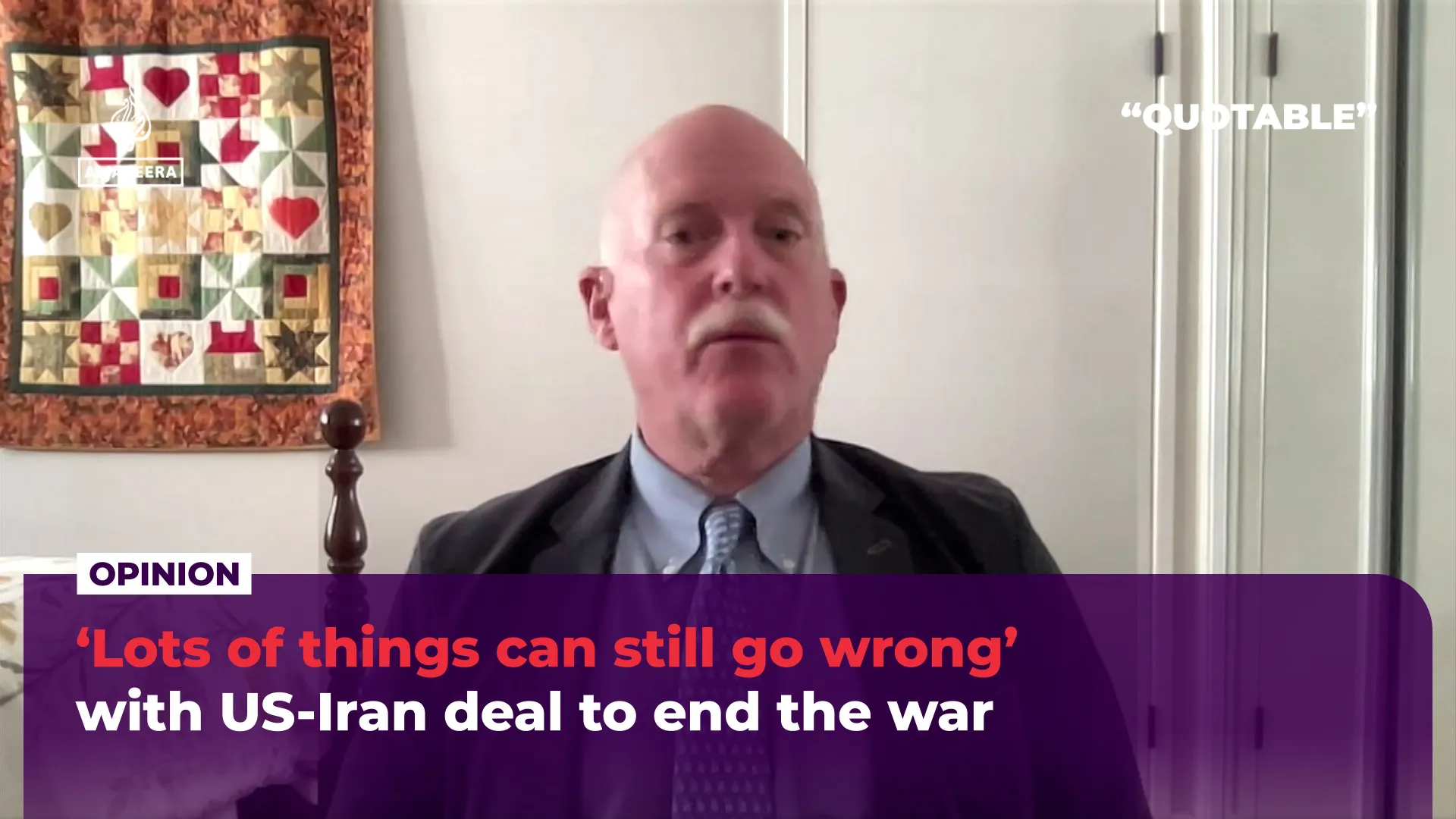
Henry Ensher, a former US ambassador, says the US–Iran agreement is not a final settlement but only the start of a process, with many ways it could still go wrong.
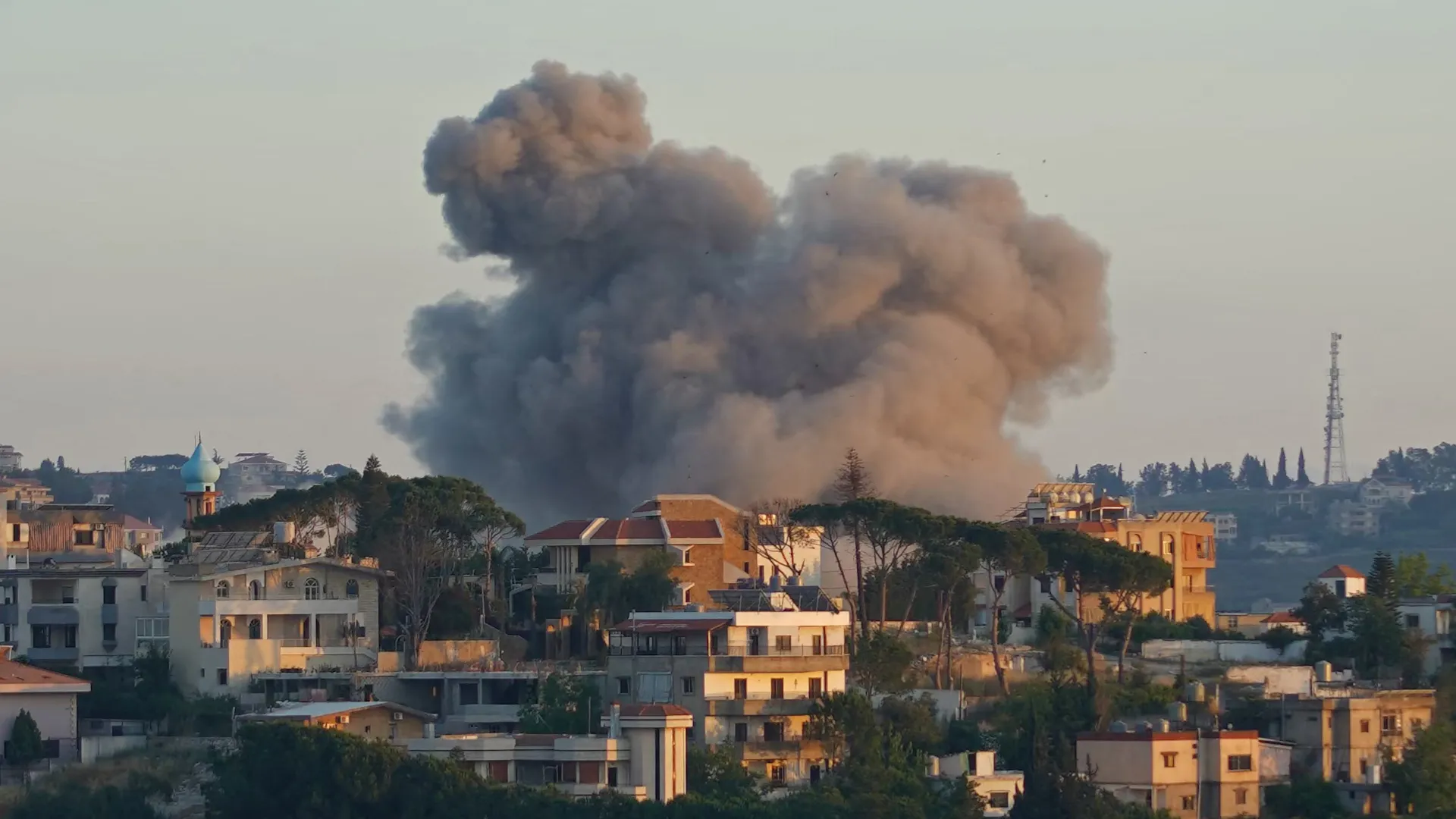
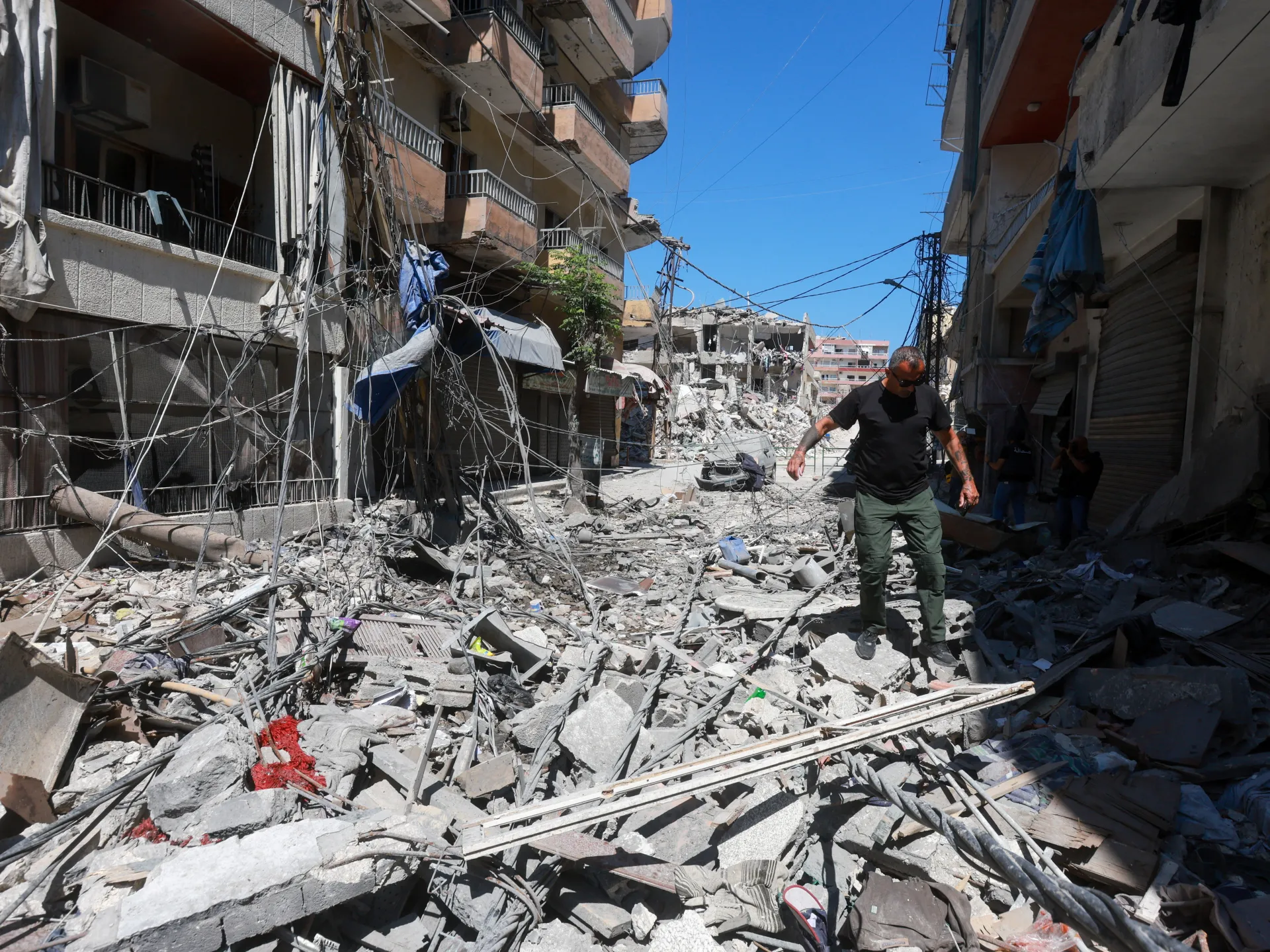
Israel has continued to attack Lebanon, despite Iran saying it was included in a potential memorandum of understanding with the US. Fresh forced displacement orders were issued on Saturday morning, following Israeli bombardment throughout Friday night on towns and villages in the south.
The World Cup continues on Saturday, with Brazil beginning their campaign and three more group-stage matches taking place across North America.
Brazil take on Morocco in the day’s biggest match, while Qatar face Switzerland, Haiti meet Scotland and Australia play Turkiye as more teams get their tournaments under way.
Recommended Stories
list of 4 itemsend of list
Away from the football, there has been plenty to talk about. Donald Trump skipped the United States’ opener, former Canadian Prime Minister Justin Trudeau was at the US game instead of Canada’s, and Ghana midfielder Thomas Partey will miss his team’s first match after Canada denied his visa application.
In Peru, police made headlines after carrying out a drug raid dressed as World Cup mascots.
Here is what to know:
What’s the World Cup schedule on June 13?
Qatar take on Switzerland at BC Place in Vancouver, with kickoff scheduled for 12pm local time (19:00 GMT).
The day’s action concludes with Haiti meeting Scotland at AT&T Stadium in Arlington, Texas. Kickoff is set for 8pm local time (01:00 GMT on June 14).
Australia and Turkiye then get Group D under way at Lumen Field in Seattle, with kickoff at 9pm local time (04:00 GMT on June 14).
What do the predictions say for Brazil vs Morocco?
Brazil and Morocco have only faced each other once before at a World Cup, with Brazil winning their 1998 group-stage meeting. Morocco got their revenge in a 2-1 friendly win in 2023.
Brazil have won seven of their eight World Cup matches against African opponents, with their only defeat coming against Cameroon in 2022.
The five-time champions have not lifted the trophy since 2002. Since then, they have usually exited in the quarterfinals, apart from their run to the 2014 semifinals.
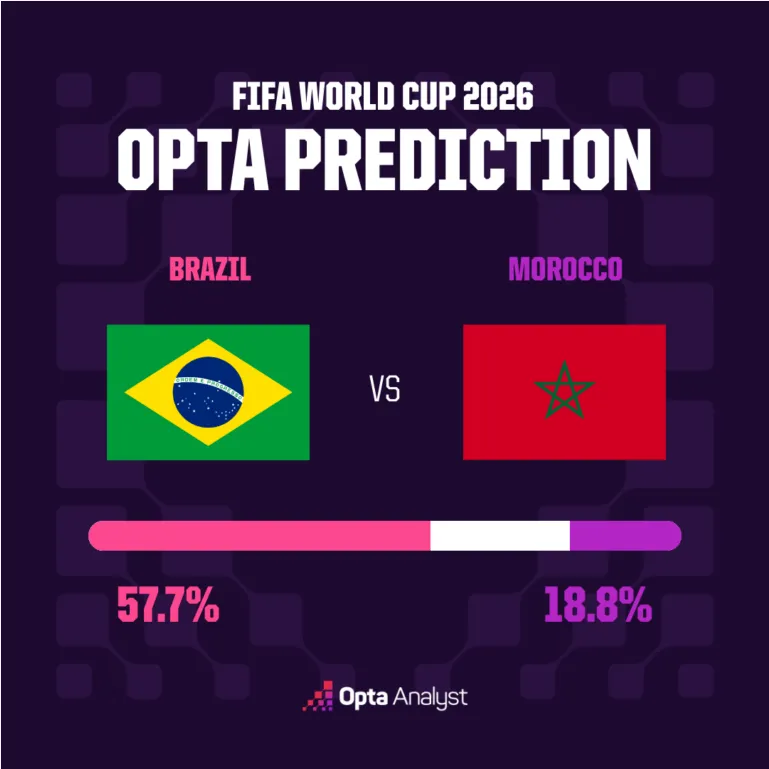
Opta’s 25,000 simulations give Brazil a 57.7 percent chance of winning. A draw happened in 23.5 percent of the projections, while Morocco won in 18.8 percent.
The winner could put themselves in a strong position to top Group C.
What do the predictions say for Qatar vs Switzerland?
Qatar and Switzerland have met only once before, with Qatar claiming a 1-0 friendly win in 2018 thanks to a late goal from Akram Afif. Afif is among nine players from that squad still in Qatar’s 2026 World Cup team, while Switzerland have seven survivors from that defeat, including Granit Xhaka and Remo Freuler.
Opta’s 25,000 simulations make Switzerland the clear favourites in this Group B clash, giving them a 76.0 percent chance of victory. Qatar won just 9.1 percent of the projections, while 14.9 percent ended in a draw.
A point would likely be considered a positive result for the Gulf side.
What do the predictions say for Australia vs Turkiye?
Australia and Turkiye have met only twice before, with Turkiye winning both friendlies in 2004. Turkiye have also won all four of their previous World Cup matches against Asian opponents.
Opta’s 10,000 simulations give Turkiye a 55.3 percent chance of victory, compared with 20.5 percent for Australia and 24.1 percent for a draw.
Neither side has a strong record in World Cup openers, however. Turkiye have lost both of their previous first matches, while Australia have lost five of their six opening games.
What do the predictions say for Haiti vs Scotland?
Haiti and Scotland have never faced each other before, making this one of several first-time matchups at the expanded 48-team World Cup. It will also be Haiti’s first-ever game against a team from the British Isles.
Opta’s 25,000 simulations make Scotland clear favourites, giving them a 59.0 percent chance of victory. Haiti won 19.2 percent of the projections, while 21.8 percent ended in a draw.
Haiti vs Scotland
What else is shaping the World Cup?
The football has only just started, but the World Cup is already making headlines away from the pitch, too.
Trump did not attend the US World Cup opener
The US president did not attend the US men’s national team’s World Cup opener against Paraguay in Los Angeles.
His absence drew attention because Trump has recently attended several high-profile sporting events, including Game 3 of the NBA Finals earlier this week. He is also expected to host a UFC event at the White House on Sunday.
A White House official said Trump instead plans to attend the World Cup final on July 19 at MetLife Stadium in East Rutherford, New Jersey.
The US president called into a USMNT team meeting with some words of support via Andrew Giuliani, the White House’s World Cup task force CEO.
Partey denied entry into Canada
Ghana midfielder Thomas Partey will miss his country’s World Cup opener against Panama after Canada denied his visa application while he awaits trial in the United Kingdom on multiple rape charges, which he denies.
FIFA confirmed on Friday that the 32-year-old would not be permitted to travel from Ghana’s base camp in Smithfield, Rhode Island, to Toronto for Wednesday’s match.
“His visa application has been refused by the Canadian government,” FIFA said in a statement.
“FIFA is not involved in the immigration processes of host countries, including the adjudication of visas. As with previous FIFA events, the host government ultimately determines who receives a visa and is admitted into the country.”
Trudeau attends the US’s World Cup
As Canada and the US kicked off their World Cup campaigns on the same day, former Canadian Prime Minister Justin Trudeau was in California rather than Toronto.
The 54-year-old did not attend Canada’s 1-1 draw with Bosnia and Herzegovina at BMO Field. Instead, he was at SoFi Stadium in Inglewood alongside pop singer Katy Perry, who performed during the pre-match opening ceremony before the US faced Paraguay.
Peruvian officers use World Cup mascot costumes in Lima drug bust
Peruvian police have gone viral after carrying out a drug raid in Lima dressed as World Cup mascots.
Video shared by police showed officers dressed as World Cup mascots breaking through a metal gate with a battering ram before entering the property.
Once inside, they arrested a suspected drug dealer and recovered weapons and bags of what authorities believe were narcotics.
The World Cup may be decided on the pitch, but another competition is already under way off it: Which host city has the best food?
In a report for Al Jazeera, Lou Browne travelled across North America to find out what fans can expect beyond the stadiums.
In Mexico City, taco vendors are hoping the tournament brings more customers. “Well, now the World Cup is coming, and we hope we’ll get customers,” a tortilla cook at El Califa de Leon told Al Jazeera. “I imagine there will be a lot of people, foreigners or locals.”
Philadelphia is proudly backing its famous Philly cheesesteak. Locals say visitors should learn how to order properly. “You want to tell them what kind of cheese you want,” Anthony Rossi, a cook at Geno’s Steaks, explained. “And you say if you want onions, which is ‘wit’ or ‘wit-out’ … Keep it simple.”
Across the border, Toronto is making the case for poutine, the Canadian dish of fries topped with gravy and cheese curds. “Poutine is the … not the best … dish, but poutine is from Canada,” said Lisa Deni, a French tourist.
In Kansas City, barbecue is a point of pride. “This is really good,” diner Camilla Thomas said. “We’ve been enjoying coming here. and bringing people from out of town here and giving them a little taste of Kansas City.”
And in Miami, locals insist the Cuban sandwich is a must-try. “The Cuban sandwich, croquetas, and cafecito are really the way to go,” said Daniel Figueredo, cofounder of Sanguich. “The Cuban sandwich really is the thing you have to have when you come to Miami.”
For fans travelling across North America this summer, the hardest choice may not be picking the World Cup winner, but deciding which host city serves the best food.
Weekly insights and analysis on the latest developments in military technology, strategy, and foreign policy.
Nearly a dozen A-10C Thunderbolt II attack jets landed at RAF Lakenheath in the U.K. earlier on Friday, sporting mission marks from operations in the Middle East as well as their distinctive nose art. The photos were taken by aviation photographer Andrew McKelvey, who told us that 11 Warthogs landed at Lakenheath at about 3 p.m. local time. McKelvey was kind enough to share his photos with us.
According to the Coronet East X account, the jets belong to the 75th Fighter Squadron and arrived through Aviano Air Base in Italy from Muwaffaq Salti Air Base in Jordan.
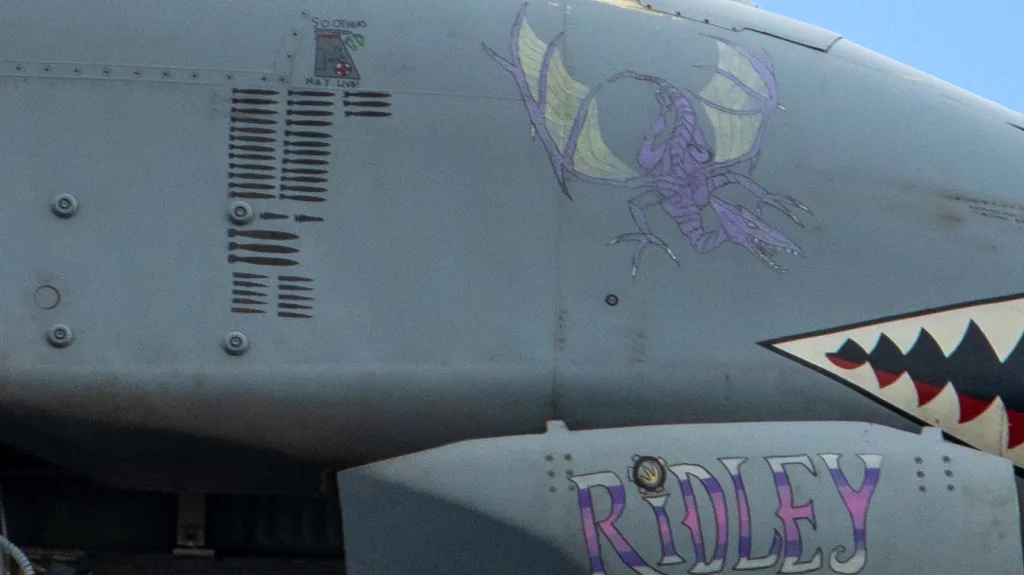
One of the most interesting shots shows one of the jets with an F-15E tail marking, green footprints of the Air Force Pararescue Jumpers (PJs) and the words “So others may live,” which is their motto. As we have previously reported, A-10s took part in the daring mission to rescue two F-15E crewmembers whose Strike Eagle was shot down over Iran, acting in the Sandy low-altitude escort role for the rest of the rescue package. One A-10 was struck by Iranian fire and crashed. The pilot survived.
You can see the F-15E tail mark on this A-10. Andrew McKelvey Andrew McKelvey
So it is possible that the Warthog with this marking took part in the F-15E crew’s CSAR operation or another one that we do not know of. We reached out to the 75th Wing for more information.
Following a long aviation tradition of personalizing aircraft, the Warthogs are emblazoned with colorful nose art that includes Nintendo game characters homages like Ridley the giant purple space dragon, ‘Diddy Kong,’ King Dedede, Samus Aran, Star Fox and Little Mac. Non video game references include Macho Man, Doc Holiday and the Reaper.
We have previously noted that personnel have applied nose art as part of other deployment to Muwaffaq Salti, which appears to be becoming something of a trend in the region. F-15Es from RAF Lakenheath are well known for their often comical nose art designs and the practice is now allowed after the USAF forbid it unless under very particular circumstances for many years.
Andrew McKelvey Andrew McKelvey Andrew McKelvey Andrew McKelvey Andrew McKelvey Andrew McKelvey Andrew McKelvey
There are also a couple of target type ‘kill’ markings seen, as well. This includes a pair of boats and a truck that appears to have made a giant secondary explosion, based on the mushroom cloud marking.
Screenshot
As we have previously reported, the venerable Warthogs were pressed into service helping to destroy the Iranian Navy, strike Iranian proxies in Iraq and Syria, and take part in the aforementioned rescue mission, among other tasks, as part of Operation Epic Fury.
Andrew McKelvey Andrew McKelvey
All this took place as the seemingly ceaseless debate between the Air Force and Congress about the future of these jets and their survivability in future conflicts rages on. We recently wrote that an amendment added to the House Armed Services Committee’s version of the National Defense Authorization bill threw a lifeline to the jets. It called for the Secretary of the Air Force to keep supporting A-10 training, testing, experimentation, maintenance, and sustainment efforts through to the planned retirement date, as well as preserving lessons learned and operational expertise from A-10 missions to help shape future replacement systems.
Regardless of what ultimately becomes of the A-10, the markings seen in these pictures shows they still provided a lot of value in this most recent fight.
Ukraine’s defence ministry believes artificial intelligence is set to fundamentally transform modern warfare, as Kyiv accelerates efforts to integrate AI into battlefield operations amid its ongoing war with Russia.
According to Danylo Tsvok, head of Ukraine’s Defence Ministry AI Research Centre, the country is already employing artificial intelligence across multiple military functions, including drone operations, battlefield planning, intelligence analysis, and missile attack assessments.
The centre, established in March, is part of a broader effort to make data driven decision making a core component of Ukraine’s defence strategy. Officials envision a future where AI systems, sensors, drones, command centres, and weapons platforms operate through a unified digital network capable of processing battlefield information and recommending military actions in real time.
Why It Matters
Ukraine’s experience is increasingly being viewed as a preview of how future wars may be fought. The conflict has already demonstrated the growing importance of drones, autonomous systems, and real time intelligence, but AI could push military operations into an entirely new phase.
Rather than merely supporting commanders, future AI systems may become central to battlefield decision making by processing vast quantities of data faster than human operators can manage. This could dramatically shorten the time between identifying a target and launching an attack.
The implications extend far beyond Ukraine. Military planners around the world are closely monitoring the conflict as a testing ground for next generation warfare technologies.
The Rise of AI Driven Combat
The war has already evolved into a technological competition in which both Ukraine and Russia are attempting to gain advantages through automation, data analysis, and autonomous systems.
Ukraine is working toward a battlefield operating system capable of integrating information from drones, reconnaissance assets, weapons systems, and frontline units into a single decision making framework. The objective is to create a comprehensive operational picture that enables faster and more effective responses.
Russia is pursuing similar capabilities, particularly in drone warfare and strike planning, creating what Ukrainian officials describe as an emerging competition between military operating systems rather than simply armies.
Global Defence Implications
The conflict has attracted significant attention from defence technology firms and AI developers seeking real world operational data. Companies and governments increasingly view Ukraine as one of the most important testing environments for military AI applications.
The lessons learned from the war could influence defence procurement, military doctrine, and security planning across NATO, Asia, and other regions facing evolving security challenges.
As AI becomes more deeply embedded in military systems, countries may be forced to rethink command structures, training requirements, and the role of human decision makers in combat.
Key Stakeholders
Ukraine military
Russian military
Defence technology companies
NATO members
Artificial intelligence developers
Defence ministries worldwide
Military planners and strategists
Future Outlook
Over the next three to five years, military competition is likely to shift increasingly toward AI enabled command systems, autonomous platforms, and integrated battlefield networks.
Countries capable of rapidly processing information and converting it into actionable decisions may gain a significant operational advantage. At the same time, concerns about autonomy, accountability, and human oversight will become more prominent as AI systems assume larger roles in combat operations.
The race to integrate AI into warfare is expected to intensify, making technological superiority as important as traditional military strength.
Analysis
Ukraine’s assessment points to a deeper transformation than simply adding artificial intelligence to existing weapons systems. What is emerging is a shift from platform centric warfare to data centric warfare, where military advantage depends less on the number of tanks, aircraft, or soldiers and more on the ability to collect, process, and act on information faster than an opponent.
The most significant aspect of this transition is the compression of decision making time. Historically, military success depended on commanders interpreting information and issuing orders. AI has the potential to reduce that cycle from hours or minutes to seconds, creating a battlefield where speed of analysis becomes as important as firepower.
This evolution could fundamentally alter military hierarchies. If AI systems become capable of generating reliable operational recommendations faster than humans can assess them, commanders may increasingly act as supervisors rather than primary decision makers. The challenge will be balancing military effectiveness with accountability and ethical oversight.
The Ukraine conflict is therefore becoming more than a territorial war; it is also serving as a laboratory for the future of warfare. The countries that emerge with the most effective integration of AI, autonomous systems, and battlefield data networks may define military power for decades to come. In this sense, the competition between Ukraine and Russia increasingly resembles a contest between technological ecosystems, foreshadowing a future in which wars are won not only through weapons but through algorithms and information dominance.
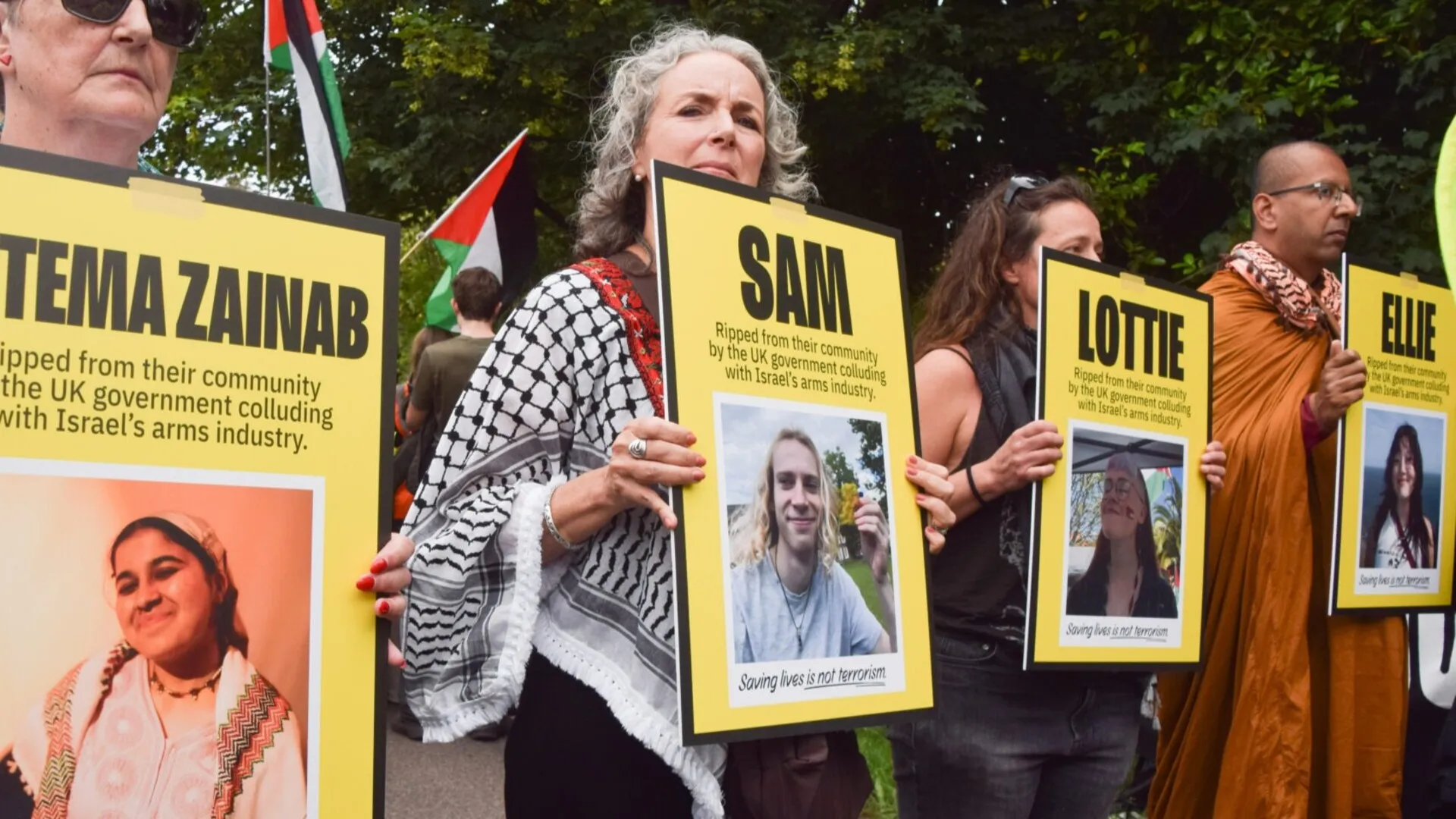
A UK court has sentenced four pro-Palestine activists to jail for a raid on an Israeli arms factory near Bristol in 2024. Palestine Action says their aim was to ‘dismantle drones and weaponry’ they believed would be used to kill people in Gaza.
USA beat Paraguay 4-1 in Los Angeles as each of the three World Cup cohosts have now staged a game in the 2026 edition.
Published On 13 Jun 202613 Jun 2026
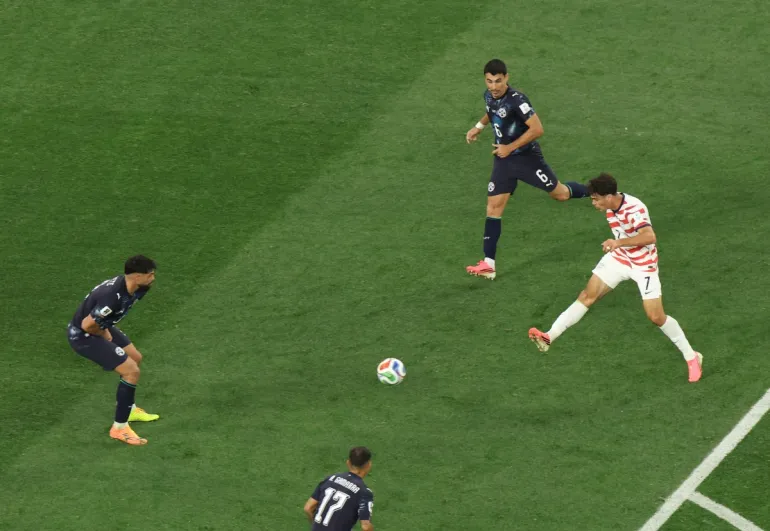
The United States could scarcely have scripted a better start to their World Cup as a Folarin Balogun brace and a Gio Reyna curler fired the cohosts to a 4-1 drubbing of Paraguay in front of Hollywood royalty in Los Angeles.
The hosts took the lead in the tournament’s first game on US soil within seven minutes thanks to an own goal, and by the end of an utterly dominant half, the home fans were in dreamland, their side up by three.
Recommended Stories
list of 4 itemsend of list
Tom Cruise, Leonardo DiCaprio and Paris Hilton were among a sold-out 70,492 crowd as the US – cohosting the tournament with Mexico and Canada – piled wave after wave of attacks on the South Americans, with Reyna polishing off the win late in stoppage time after Mauricio had pulled one back.
The win and emphatic scoreline put the US in a favourable position already to progress from Group D, which also contains Australia and Turkiye.
The night’s only potential sour note was the half-time withdrawal of Christian Pulisic, the US attacking talisman who is carrying the hopes of the nation as they attempt a deep run into the World Cup knockouts for the first time since their quarterfinal appearance in 2002.
Paraguay could not have been more obliging guests from kickoff. In the seventh minute, Weston McKennie picked up the ball in the centre circle and drove upfield, finding Pulisic.
Pulisic darted between two defenders and returned the ball to McKennie, whose pass to striker Balogun was bundled into his own net by a hapless Damian Bobadilla.
The stadium erupted, and a US onslaught began.
The hosts oozed confidence. Both McKennie and Tillman played backheel through balls into the area, while captain Tim Ream sprayed out passes from the heart of defence.
USA midfielder Giovanni Reyna scores his team’s fourth goal [Valerie Macon/AFP]
Balogun had a goal ruled out in the 28th minute. He had strayed offside, as had Pulisic in the buildup.
But the Monaco striker had the ball in the net again three minutes later, thanks to a superb ball down the left flank by Antonee Robinson to Pulisic, whose cross to Balogun took a slight fortuitous deflection.
The US added a third on the cusp of half-time. Tillman found Balogun down the right, who evaded Omar Alderete’s challenge, skipped inside Gustavo Gomez and curled his shot perfectly into the top left corner.
It could have been four or five, with Chris Richards – returning from injury – flashing a header barely an inch wide. The US had 75 percent possession in the first half.
Now, without the dangerous Pulisic, the hosts sat back slightly in the second half.
Paraguay finally offered a threat. Their dangerous forward Julio Enciso, who started despite a hamstring injury, picked up the ball on the edge of the area and fed in Brazil-born substitute Mauricio, who pulled one back.
Reyna scored a superb fourth with the outside of his right foot that curled just inside the far post.
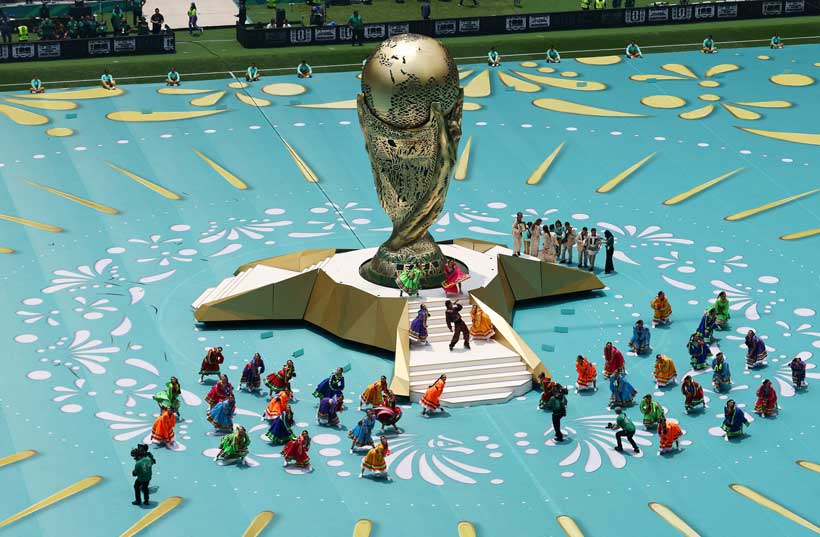
The game had been preceded by a Tinseltown-style opening ceremony. Katy Perry delivered the headline performance, accompanied by singers Future, Tyla, Anitta and K-pop singer Lisa.
Performers danced around a giant World Cup trophy beneath enormous “FIFA” letters in the gold favoured by US President Donald Trump – who did not attend, instead wishing the team luck via phone before kickoff.
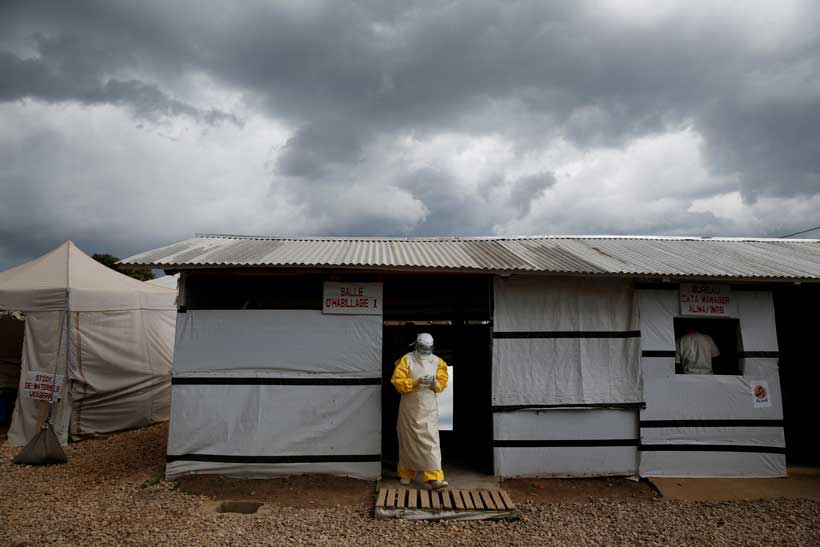
Supported by the World Health Organization and Africa CDC, India has taken on the urgent and unique task to engage in the production of a vaccine for the Ebola virus, the deadly disease that broke out in the Democratic Republic of Congo in mid-May 2026. Following the Ebola infection cases, many countries have broader steps to reinforce disease surveillance and strict border control mechanisms amid rising regional risks, especially in the Central African region.
WHO declared, in May, the outbreak a ‘public health emergency’ of international concern, underscoring the need for monitoring measures of cross-border human movements and the possibility to control transmission. Many countries have adopted and reviewed screening procedures and coordination designed to detect and contain any suspected cases.
The Serum Institute of India (SII) is partnering with the University of Oxford and CEPI to develop a new vaccine candidate targeting the Bundibugyo strain of the Ebola virus. Because no approved vaccines currently exist for this specific strain, the SII is fast-tracking production using the viral vector platform.
Fast-Tracked Vaccine Development
The Target: The vaccine candidate (ChAdOx1 BDBV) is designed to prevent the rare Bundibugyo ebolavirus, which is currently causing outbreaks in Central Africa.
The Technology: It utilizes the same viral vector platform used for the Oxford/AstraZeneca COVID-19 vaccine, allowing for rapid scaling and manufacturing once the clinical-grade material is ready.
Timeline: The World Health Organization (WHO) has fast-tracked the assessment process, with clinical-grade doses expected to be available for trial testing.
Indian Preparedness & Protocols
Zero Active Cases: India has not reported any active cases of the Ebola virus.
Preventive Measures: Indian health authorities and airports have placed specialized facilities on high alert. This includes preventive screening and isolation protocols for any suspected cases or individuals traveling from affected regions like the Democratic Republic of Congo and Uganda.
Global efforts accelerate vaccine development.
Scientists and vaccine manufacturers are now racing to design, test, manufacture, and deploy vaccines that could help prevent this outbreak from persisting for several years, as previous outbreaks have. Medical experts across the world maintain that the Ebola epidemic is a global threat.
Director-General Tedros Adhanom Ghebreyesus flew to the DRC and visited the province of Ituri. After the visit, he said, “A Bundibugyo vaccine could help to control this epidemic and strengthen preparedness for future outbreaks.”
Notwithstanding the challenges, Ghebreyesus expressed confidence and optimism that the outbreak would be stopped. Africa Centres for Disease Control and Prevention director general Jean Kaseya later confirmed that the vaccines will be manufactured by the Serum Institute of India, underscoring the growing confidence to ensure health sovereignty and to contain further spread of Ebola.
Different virus, different challenge
Since the outbreak, over 1500 suspected cases and 650 deaths have been reported in the Democratic Republic of the Congo (DRC) and Uganda. According to medical reports, this newest outbreak is being caused by the Bundibugyo virus, a more recently discovered species that is less lethal than Zaire but has no approved vaccines or treatments. With the majority of cases impacting the DRC, this marks the country’s 17th Ebola outbreak since the discovery of the virus on the Ebola River in 1976.
Despite the huge untapped resources, the world’s deadliest and most complex humanitarian crises have been unfolding for decades in the Democratic Republic of the Congo, located in central Africa.
At first it looked like just another fight over war powers and Congress doing its job. But it feels like something bigger: the start of a real tug-of-war over what the Republican Party is going to be once Trump isn’t the center of everything.
For almost ten years now, Republican politics has been all about Trump. You rose if you stood with him, and you got sidelined if you didn’t. Loyalty often counted more than old-school conservative ideas, passing bills, or sticking to principles. But every party eventually has to answer the tough question that personality-driven movements hate: what happens when the big guy starts looking more like a problem than a winner? That question is getting harder for Republicans to dodge.
Trump didn’t just take over the party in 2016 — he remade it. The old Republican worldview of strong alliances, free trade, and steady leadership shifted toward a more populist, Trump-centered style.
It worked for a while. He won elections, fired up voters who felt ignored, and built a super-loyal base. As long as the wins kept coming, most Republicans went along. Parties get tested in the tough times, though — not the good ones. And the Iran conflict is turning into exactly that kind of test.
A lot of Republicans who backed Trump’s rise never thought they’d end up defending another big Middle East war. Trump made “no more endless wars” one of his best lines—slamming both parties for the messes in Iraq and Afghanistan.
Now the fighting with Iran has dragged on for months. Costs are adding up, gas prices sting at the pump, and nobody’s really clear on what “winning” would even mean. That’s created real quiet discomfort inside the party. The senators and reps who voted to rein in Trump’s war powers weren’t just talking procedure. They were signaling that blind loyalty isn’t automatic anymore.
Parties talk a lot about ideology, but when things get serious, survival often wins out. Some Republicans are starting to put distance between themselves and Trump — not because they hate everything he stands for, but because they don’t want their own careers sinking with one person. There’s a real difference between backing conservative policies and handing the whole party over to a single leader. More of them seem to be waking up to that.
What’s interesting is that the pushback is coming from inside the tent. Democrats opposing Trump is old news. When Republicans do it, it hits different. Senators like Rand Paul, Susan Collins, Lisa Murkowski, and Bill Cassidy broke ranks on the Senate vote. In the House, guys like Thomas Massie, Brian Fitzpatrick, Tom Barrett, and Warren Davidson did the same. These are still small numbers. But big shifts often start small.
The bigger story might be that some Republicans are finally imagining a future without Trump dominating every headline. A younger crop is coming up—they agree with him on immigration, trade, and culture wars, but they don’t want the party to be defined only by personal loyalty to him forever. They want a Republican Party that can keep going after he’s gone—Trumpism as one important piece, not the whole thing.
History shows parties sometimes tie themselves too tightly to charismatic leaders. Sometimes it revitalizes them. Sometimes it drags them down.
Right now, some inside the GOP worry Trump might be moving from asset to liability—especially with the Iran war dragging on and polarization getting worse. Trump is still the biggest force in the party with a rock-solid base. But power and lasting control aren’t the same.
These congressional votes show that at least some Republicans are already looking ahead to the next chapter. They see the risks of hitching the whole party’s future to one man. Whether they’re right or wrong, time will tell. But the conversation inside the party has clearly moved past just Iran or war powers. It’s now about whether the Republican Party still belongs to Trump — or whether it can finally start belonging to itself again.
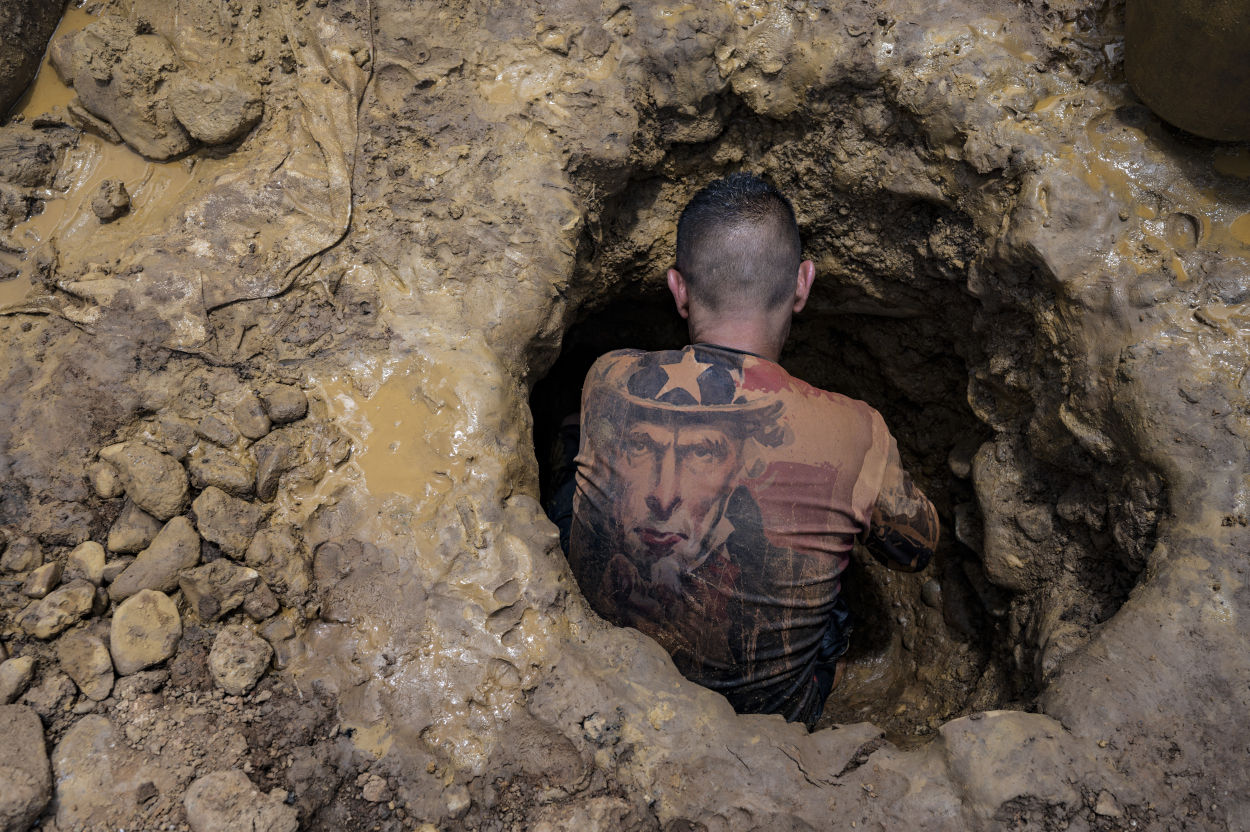
An artisanal miner in Bolívar state with an “Uncle Sam” t-shirt. (AFP)
Caracas, June 12, 2026 (venezuelanalysis.com) – Venezuela’s Bolivarian National Armed Forces (FANB) have launched a large-scale operation on Tuesday in Bolívar state, one of the country’s main mineral-rich regions in the southeast and also one with a heavy presence of criminal organizations.
Local media outlets and non-governmental organizations reported helicopter overflights, explosions, and the displacements of hundreds of people leaving gold extraction zones in Las Claritas and the area known as Kilometer 88, two key locations within the Orinoco Mining Arc.
According to Bloomberg, the military actions targeted illegal mining operations controlled by armed groups. Former opposition lawmaker for Bolívar state Américo De Grazia claimed that military forces attacked several gold-mining enclaves through aerial bombardments and gunfire.
The Venezuelan government, led by acting President Delcy Rodríguez, and the armed forces have offered no official information regarding the operations, as well as casualties, arrests, or official goals. Rodríguez met with military leaders on Wednesday to discuss a “100-Day Plan” to optimize the functioning of the armed forces but did not comment on the reported Bolívar deployment.
The operation took place in a region where the state has struggled to assert authority in the face of a proliferation of armed groups that control and administer mines, run artisanal mining activities, and regulate economic activity linked to gold extraction.
At the same time, local reports indicated that the military operation could be aimed at capturing Yohan José Romero, known as “Yohan Petrica,” a founding member of the Tren de Aragua criminal outfit, who reportedly operates in the area alongside Juan Gabriel Rivas Núñez, alias “El Negro Juancho,” and a third figure known as “Humbertico.”
Some sources have also not ruled out the presence of Héctor Guerrero, alias “Niño Guerrero,” the top leader of the large-scale criminal group that emerged inside Tocorón prison in Aragua state.
In September 2023, the Venezuelan government deployed “Operation Gran Cacique Guaicaipuro,” with more than 11,000 security personnel, to intervene in Tocorón prison. However, multiple reports indicated that “Niño Guerrero” and other senior gang leaders were warned in advance and escaped through a network of secret tunnels.
Guerrero is currently the subject of an Interpol Red Notice on charges related to transnational organized crime, drug trafficking, money laundering, and arms trafficking. The US State Department is offering a reward of up to US $5 million for information leading to his capture.
For its part, the media platform Miraflores al Momento denied separate reports alleging the presence of US military contingents in El Callao, another major gold-mining area in Bolívar state. Likewise, fact-checking outlets Cazadores de Fake News and CotejoInfo confirmed that images circulating were generated by artificial intelligence.
However, local outlets confirmed that, though without any military presence, US officials and business executives have conducted visits to gold-processing facilities belonging to the state-owned Venezuelan Mining Corporation (Minerven) in El Callao.
Last April, Venezuela approved a new mining law granting expanded incentives for private corporations to exploit gold and other “strategic minerals.” Concessions will last up to 30 years and may be renewed for two additional ten-year periods. The new law
The legislation additionally introduced provisions for international arbitration in dispute resolution, a safeguard sought by investors, and a reduction of royalties and taxes at the Venezuelan government’s discretion.
Among the companies expressing interest are Canadian firms Gold Reserve and Augusta Capital Corporation, which seek to revive the large-scale gold and strategic minerals project known as “Siembra Minera.” Likewise, Roland Mineral Enterprises Corp. has already begun procedures to explore and develop gold, copper, and silver deposits. Swiss commodities giant Trafigura is also advancing a responsible sourcing program in partnership with state-owned Minerven.
There have additionally been corporate initiatives and feasibility studies by US companies—including mining firms such as Hartree, Peabody Energy, Ivanhoe, and TechMet—to enter the sector, though security concerns reportedly remain an obstacle.
Mining municipalities in southern Venezuela report some of the country’s highest rates of homicide, as well as reports of forced labor and widespread sexual violence. The gold extracting activities are mostly unregulated. According to former opposition lawmaker Américo De Grazia, only the gold processed by Minerven enters official records, while the rest circulates through parallel channels.
Similarly, Transparency Venezuela estimates that just 14 percent of the revenues generated by the gold sector reach the Central Bank and public coffers through royalties and export-related payments.
Cyle Larin’s equaliser gives Canada first World Cup points after Jovo Lukic put Bosnia in the lead in the first half.
Published On 12 Jun 202612 Jun 2026
Canada striker Cyle Larin came off the bench to salvage a 1-1 draw for his side against Bosnia and Herzegovina in a frenetic Group B opener that had long looked like it would end in defeat for the World Cup cohosts.
Bosnia went ahead in the 21st minute of the game on Friday when Jovo Lukic steered home a flick-on from a corner for his first international goal in his country’s return to the World Cup after 12 years.
Jovo Lukic was mobbed by his teammates after scoring [Cole Burston/AFP]
Canada thundered forward and should have equalised through Richie Laryea in the 53rd, only for Bosnia’s Sead Kolasinac to miraculously steer his shot off the crossbar and away to safety.
The Canadians continued to attack relentlessly, but despite creating plenty of chances, they lacked precision in their finishing as the Bosnians dealt with a succession of crosses and looked to be heading for a narrow win.
Larin had other ideas, however, when introduced in the 76th minute and made an immediate impact, swivelling in the box and firing home a deflected strike less than three minutes later to equalise and send the home crowd into raptures.
The result gave Canada their first-ever World Cup point but left them short of the winning start they had craved.
Larin (celebrates after scoring [Cole Burston/AFP]
Jonathan David had a glorious chance to put Canada in front early on, but the country’s all-time leading scorer sent his well-struck shot from the centre of the area right at goalkeeper Nikola Vasilj.
After Lukic put the battle-tested Dragons on the board, it was Canada, roared on by a boisterous red-clad crowd, who took over.
Canada pressed for the rest of the half but were unable to establish much of a presence deep in the Bosnia half, with almost every ball they sent into the area quickly cleared from danger.
The hosts nearly drew level at the start of the second period when Laryea went through on goal and his shot looked certain to head over the line until Kolasinac stepped in at the last moment to clear via the bar.
With the game starting to open up, Bosnia nearly doubled their lead moments later when Ermedin Demirovic went through on goal, but Maxime Crepeau, making his World Cup debut after missing the 2022 edition with a broken leg, made a crucial save.
That set the stage for Southampton striker Larin, who earned the honour of scoring Canada’s first World Cup goal on home soil when he blasted home a right-footed shot from the centre of the box in the 78th minute, moments after entering the game.
Chinese media and think tanks view the United States’ hosting of the FIFA World Cup from a purely geopolitical, economic, and commercial perspective, critically assessing the infrastructure and political climate. Chinese circles see the tournament not merely as a sporting event but as a central tool for the United States to polish its image, bolster its global leadership amidst current international polarization, and advance its political agenda. This perspective is highlighted through several key points, the most important being the geopolitical dimension. Here, Chinese think tanks argue that the tournament reflects the level of competition between major powers, with Washington attempting to use hosting as a soft power tool to project its influence. However, Chinese media, in turn, emphasized the state of sharp international polarization and division, criticizing the political challenges and the wrangling that accompanied the broadcasting negotiations. Furthermore, a number of (commercial considerations) have been raised, with the tournament facing criticism from Chinese media due to its exorbitant cost and the significant time difference between North America and China, leading to a decline in Chinese public interest. This hesitation was reflected in the negotiations, as FIFA incurred financial losses after China Media Group (CMG) signed the broadcasting agreement late and at a price significantly lower than FIFA’s requested.
Regarding the (organizational and policy challenges), Chinese research and media institutions expressed reservations about the tournament’s logistical challenges, particularly the longer travel distances between host cities compared to previous editions, as well as concerns related to US immigration laws and security restrictions. Despite the absence of the Chinese national team from the tournament, China’s commercial involvement was substantial. Beijing demonstrated its active presence through Chinese commercial sponsors, such as Hisense, and sporting goods factories in eastern China, which reaped significant economic benefits from manufacturing tournament flags and souvenirs. Chinese media coverage, particularly through its official channels, was extensive. CGTN, the Chinese state broadcaster, developed comprehensive plans to broadcast and cover the matches, ensuring the event reached millions of Chinese fans across its various platforms.
Furthermore, Chinese state media and intelligence and military think tanks utilized Washington’s hosting of the FIFA World Cup to offer a number of strategic, media, and intellectual analyses regarding China’s calculations in response to American actions. Major events are often used as a primary arena for geopolitical competition between the two superpowers. Beijing’s vision can be summarized by its use of major sporting, cultural, and other events as a political tool. Beijing views Washington’s hosting of major international tournaments or events as more than just sporting or cultural occasions; it sees them as an extension of American information and decision-making strategies aimed at projecting American influence and hegemony globally. While China seeks to highlight international contradictions, Beijing has directed its media apparatus to demonstrate that Washington’s attempts to unilaterally assume leadership or project messages of unity are, in reality, met with sharp division and polarization within the international system. Here, China has attempted to counter American soft power. This media coverage of the FIFA World Cup in the United States reflects a continuous Chinese effort to neutralize Western and American soft power by focusing on structural issues in international relations, such as the absence of multipolarity, and by promoting the Chinese model as an alternative striving for a more balanced world.
In this context, Chinese media and think tanks view the United States’ hosting of the World Cup through the lens of soft power, geopolitical strategies, and trade, while sharply criticizing the infrastructure and political circumstances surrounding the tournament, particularly in the aftermath of the Iran War and a number of global geopolitical upheavals stemming from US policies. Chinese analyses focus on purely commercial interests, criticizing the exorbitant costs of broadcasting rights. Conversely, they highlight the role of leading Chinese companies in profiting from the event by providing innovative and advanced broadcasting technologies and exporting merchandise and fan supplies. However, they also offer several critical observations regarding the infrastructure and political climate. Chinese research centers express critical skepticism about the readiness of US cities, suggesting that complexities related to visa requirements and a strict security and political environment could hinder fans and undermine the freedom of movement necessary for such events.
Based on the preceding understanding and analysis, we can discern the perspective of Chinese media and research centers that the United States exploits hosting international sporting and political events as a prominent tool for employing sports to enhance American soft power, attempting to project influence to manage conflict, and solidifying its leadership of the global order. Therefore, Chinese think tanks and intelligence agencies have developed a comprehensive media and research plan to expose American polarization worldwide. Conversely, Chinese media and think tanks emphasize Washington’s failure to garner international consensus, highlighting the sharp division and widening gap between Western powers and the rising powers of the Global South. This underscores the mechanism of conflict transformation, where competition is no longer limited to the economic and military spheres but has expanded significantly to encompass soft power tools and media discourse. This reflects a picture of expanded strategic competition and its impact on international stability.
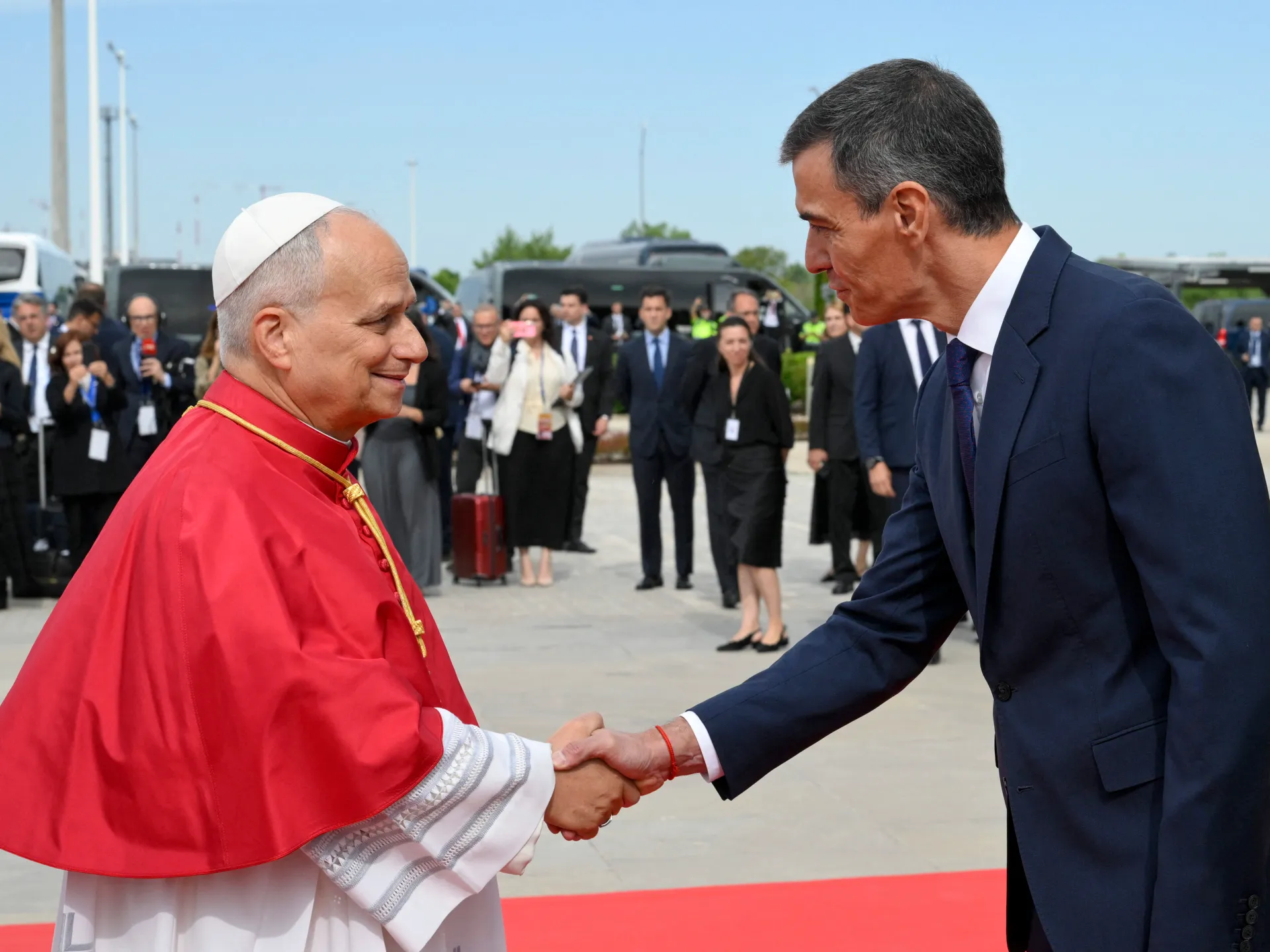
Migration has been a central theme throughout Pope Leo’s weeklong tour of Spain.
Published On 12 Jun 202612 Jun 2026
Pope Leo has warned human traffickers that they will face God’s wrath if they continue to exploit desperate African people trying to reach Europe via Spain’s Canary Islands.
On Friday, his second day in the Canary Islands, the pontiff said that he wanted to directly address those who “take advantage of people’s desperation [or] organise death routes”.
Recommended Stories
list of 3 itemsend of list
Throughout his weeklong tour of Spain, the American pope has insisted on the inherent dignity and rights of migrants, urging global leaders to welcome and integrate them into society.
“Stop. Repent,” said Pope Leo. “For every life lost, every family deceived … you will have to appear before divine justice.”
“Repent while there is still time,” he said, invoking the Catholic belief that someone who committed evil acts in life can confess their sins and make amends or be sent to hell upon their death.
Leo was visiting the Canary Islands, a Spanish archipelago off the western coast of Africa, as the culmination of a three-stop tour of Spain.
The islands are one of the main gateways into Europe for migrants, who risk a deadly journey across the waters of the Atlantic Ocean, often in improvised and overcrowded small craft.
Earlier, the first man from the United States to lead the Roman Catholic Church, warned world leaders that history would condemn those who allowed people fleeing war or poverty to suffer.
Located more than 1,000km (620 miles) from mainland Spain, the Canaries saw migration peak in 2024, when the islands received 46,843 migrants, compared with fewer than 1,000 in 2015, according to official data.
More than 3,000 people died last year trying to reach the islands, according to the NGO Caminando Fronteras.
The pope also visited an interim housing centre in Tenerife, the largest of the Canary Islands, to hear testimonies from migrants. The facility has received some 70,000 people since it opened in 2021.
One woman, Bousso Diouf, told Pope Leo that migrants did not want special privileges but “respect, humanity and the opportunity to live with dignity.”
As Washington and Tehran move towards a long-term ceasefire agreement, Gulf states will likely look for new long-term security solutions when a war in their region – which they did not start – finally ends.
It comes as United States President Donald Trump cancelled new strikes on Iran saying that a deal with Tehran was imminent, and that a “time” and “place” for signing would soon be announced.
Recommended Stories
list of 4 itemsend of list
In Tehran, officials appeared more cautious with one senior Iranian official telling Al Jazeera that the government was still reviewing a proposed Memorandum of Understanding with Washington.
Subsequent comments by Pakistan Prime Minister Shehbaz Sharif point to a deal being made, and what follows in the coming days could have important implications for collective regional security.
Attacks on the Gulf
The United States operates military facilities in at least 19 locations across the MENA region, including permanent bases in Bahrain, Egypt, Iraq, Jordan, Kuwait, Qatar, Saudi Arabia and the United Arab Emirates, according to the Council on Foreign Relations. Between 40,000 and 50,000 US troops were stationed across the region before the war on Iran started.
This US-Gulf nexus appeared to insulate states from conflicts engulfing other parts of the region, but over the past four months, Gulf states hosting US military facilities have been targeted by Iran.
“If there is a way to describe the prevailing security model in the region since the 1980s, the concept of security partnerships best encapsulates it,” said Mahjoub Al-Zuwairi, an academic and expert on Middle East politics.
“The countries of the region have chosen to align their security with broad international alliances. For decades, this model has provided a reasonable deterrent and logistical and intelligence depth that is difficult to replace.”
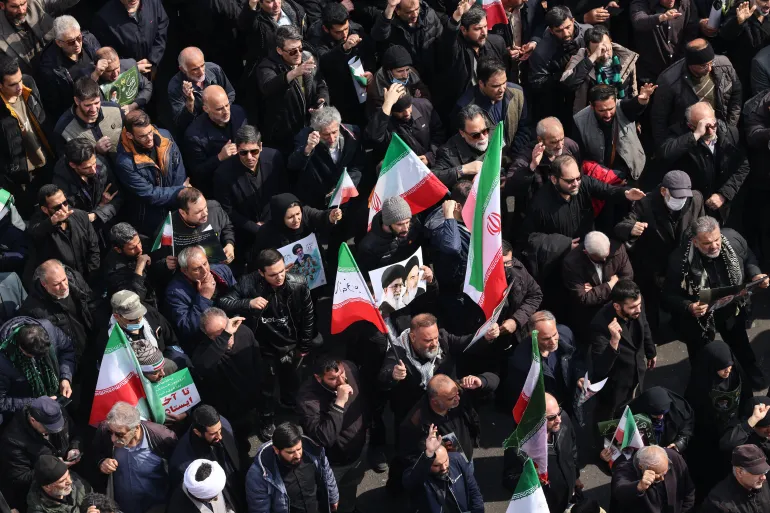
Iranians in Tehran at the funerals of Iran’s Revolutionary Guards Corps (IRGC) commanders, army officers and others killed in the early days of the United States and Israeli strikes on Iran, March 11, 2026 [AFP]
A security umbrella with holes
The war on Iran has exposed a paradox – while Iranian officials have repeatedly referred to their Gulf neighbours as “brothers”, they have also repeatedly targeted them during the war.
Despite the protestations of Gulf states that no attacks on Iran were launched from their soil, they have been repeatedly targeted.
“Just the war itself has pierced that sense of security, the US security umbrella is moribund at worst, or ineffective at best,” Simon Mabon, professor of international relations at Lancaster University, told Al Jazeera.
“They’ve long relied on it for their own security. Yet the presence of US forces on their territory directly meant they became targets. They can’t escape their geography [and] despite the tensions, despite the hostilities, despite the attacks, Iran isn’t going away. They have to find a way of dealing with this reality.”
The economic cost of war
The closure of the Strait of Hormuz has proven be a setback for some Gulf states working to diversify their energy-reliant economies towards tourism, services and finance, but not all have been affected equally.
Saudi Arabia was able to redirect some oil exports through its East-West pipeline to the Red Sea, while Oman – whose main ports are outside the Strait of Hormuz – has also benefited from rising energy prices.
The UAE, Bahrain, Kuwait and Qatar have been more heavily affected due to their dependence on the waterway for their energy exports, but the war has encouraged new thinking on long-standing security and economic arrangements.
“There are new pipelines being set up, but the capacity of these alternatives is infinitely smaller than the Strait itself,” said Mabon. “It will take enormous investment and years of development before they can come close to replacing it.”
Moving closer to Iran?
One possible lesson from the conflict is that Gulf states may seek engagement with Iran rather than confrontation, something that Gulf states had already made some groundwork on before the US-Israel war began.
Al-Zuwairi says that the conflict could revive plans for MENA-led regional security arrangements, as envisioned in the 2019 Hormuz Peace Initiative, which proposed a Gulf security framework involving Iran, Iraq and the six GCC states.
But the distrust fostered since then – notably Tehran’s strikes on its Gulf neighbours – would make such a formation unlikely in the near future.
“The recent war has opened the door wide to reconsidering the Gulf security system with its neighbours,” Al-Zuwairi said.
“How can Tehran propose a non-aggression pact while raining missiles on neighbouring cities? The initiative appears theoretically sound but practically bankrupt unless Iranian behaviour changes.”
Looking beyond Washington?
The solution for the Gulf could be a hybrid arrangement where ties with Washington are maintained, but other regional and domestic options are explored, including greater investment in local defence industries.
A possible blueprint for this could be the mutual defence agreement between Saudi Arabia and Pakistan last September, stating that an attack on one country would be considered an attack on both.
Yet previous instances when Gulf states felt abandoned by the US have led to divergent responses, with the UAE and Bahrain deepening ties with Israel, but a new paradigm means that a more collective action to the issue of security might be considered.
“The war has demonstrated that every guarantor, no matter how many banners it flies, primarily protects its own interests,” said Al-Zuwairi.
“The region ends up paying the price for a war it did not choose … The security of the Gulf will not be created in Washington … It will be created when Gulf countries recognise that they must build it themselves, because when fires start, it is always those closest to the flames who pay the price.”
Justice Department had walked back controversial plan after meeting backlash from lawmakers and lawsuits.
Published On 12 Jun 202612 Jun 2026
A federal judge in the United States has indefinitely blocked the Trump administration from moving forward with plans for a $1.8bn “anti-weaponisation” fund, meant to offer payments to those who experienced alleged “lawfare” and “weaponisation” of the government.
The ruling on Friday represents another setback for the scheme, which has faced heavy resistance from lawmakers and has been walked back by the Department of Justice previously.
Recommended Stories
list of 3 itemsend of list
Judge Leonie Brinkema of the US District Court for the Eastern District of Virginia had issued a temporary halt to the fund last week and issued a preliminary injunction as it was set to expire on Friday.
The fund was the product of a settlement between Trump and the Justice Department of a $10bn lawsuit the president had brought against the Internal Revenue Service (IRS).
The Justice Department set up a $1.776bn fund that would have been helmed by a five-member commission to distribute funds to those they deemed victims of “weaponisation”, a term that Trump has used to describe investigations and criminal cases into himself and his allies.
Attorney General Todd Blanche walked back the plans earlier this month amid growing criticism, and government attorneys have argued that lawsuits challenging the scheme are now irrelevant.
Even before the administration announced it was dropping the fund, the Justice Department did not form the five-member commission to decide on payout criteria, so no money was paid out or claims accepted.
Many of the Republican president’s allies are opposed to compensating rioters who stormed the US Capitol on January 6, 2021. In May, however, Blanche would not rule out the possibility that Capitol rioters who engaged in violence could be eligible to apply for payments from the fund.
Trump issued mass pardons to Capitol rioters on his first day back in the White House last year. More than 1,500 people were charged in the January 6 attack before Trump erased every case with his sweeping act of clemency.
Plaintiffs who sued to block the plan argued that the scheme diverted taxpayer funds into what was essentially a slush fund and have expressed doubt about Blanche’s assurances that the fund will not move forward.
While the administration has moved away from the scheme, Trump himself has not endorsed its cancellation and has continued to discuss it positively in comments to the press.
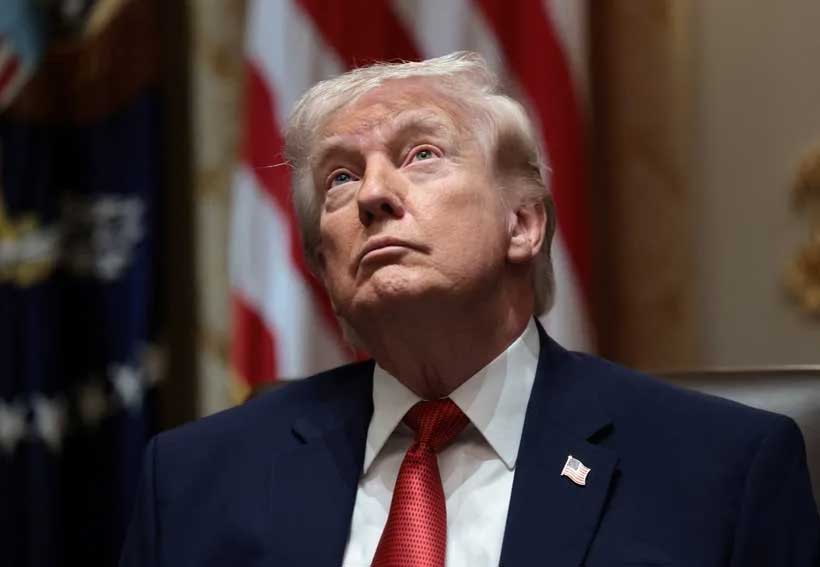
U. S. President Donald Trump expressed on Friday that Iran’s comments about a potential deal do not match what has been agreed in writing. He described their statement as weak and claimed they are not trustworthy in negotiations. Trump emphasized the urgency for Iran to “get their act together. “
On Thursday, Trump had decided against new strikes on Iran, believing a deal had been made. According to Iranian officials, the deal would meet many of their demands, while Trump did not achieve much besides the reopening of the Strait of Hormuz, which Iran had closed following attacks he ordered in February.
A senior Iranian source stated that the draft deal would lift sanctions on Iran’s oil, unfreeze billions of dollars of Iranian assets, and require an end to hostilities in various regions, including Lebanon. Discussions on nuclear issues would be postponed. The U. S. aims for a deal to prevent Iran from developing nuclear weapons, while Iran insists it does not seek such weapons. The source did not mention what Iran might offer in return.
With this year’s theme as ‘Red card to child labour: Fair play for children, decent work for adults’, the campaign for World Day Against Child Labour advocates for stronger action on quality education, social protection, decent work, stronger laws and enforcement across the world, as well as other measures that address the root causes of child labour.
A survey in 2022 by the National Bureau of Statistics in collaboration with the International Labour Organisation and the Federal Ministry of Labour and Employment of Nigeria revealed that about 24.67 million children in Nigeria, who represent 39.2 per cent of the country’s youth, aged 5 to 17, are engaged in child labour. About 22.9 per cent of the children are engaged in hazardous work.
The Child Rights Act of 2023, a legislation that protects children and young adults in Nigeria, frowns at the involvement of children in any form of labour that is harmful to their development. While the minimum age for employment is 15, the Act states that the work must not interfere with the children’s education.
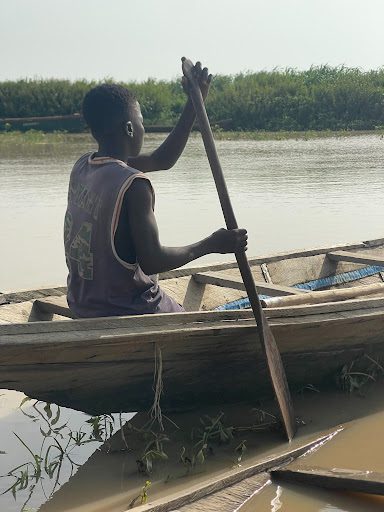
13-year-old Harrison Luka works at the River Gongola bank in Adamawa State as a canoe paddler. The boy makes at least 6 trips to and fro daily, carrying passengers and goods from one end of the river to the other and sometimes, paddles passengers to riverine communities. Photo: Saduwo Banyawa/HumAngle
Although he is enrolled at the Government Day secondary school in Numan and is in JSS1, Harrison often skips school because his parents rely on a part of his daily earnings for survival. Photo: Saduwo Banyawa/HumAngle.
Danladi Christopher is a 14-year-old JSS3 student who has to fend for himself, so he comes to the Gongola bank every day after school to work as a canoe paddler. He paddles passengers to and fro and makes around ₦1,000 to ₦1,500 daily. Photo: Saduwo Banyawa/HumAngle.
11-year-old Al’amin works as a mechanic in the Monkin area of Zing in Taraba State. He earns around ₦500 daily and uses his earnings to support himself and his younger ones. Photo: Ahmed Abubakar Bature/HumAngle
Al’amin comes to the workshop every day, sometimes skipping school. Photo: Ahmed Abubakar Bature/HumAngle
Even though Primary and Secondary education are free in Adamawa State, 15-year-old Fanapwa Rueben dropped out of school to become a full-time fisherman. He sets out at dawn, and when he makes a catch, he sells it to the women at the bank. Sometimes, he stays till 8 p.m., casting his net while using the moonlight for illumination. Photo: Saduwo Banyawa/HumAngle.
Fanapwa considers himself the ‘little breadwinner’ of the family as his income puts food on his family’s table. Photo: Saduwo Banyawa/HumAngle.
Philemon Monday is a 12-year-old commercial farmer from Taraba State who earns between ₦500 and ₦1,000 daily by working on people’s farms. The income covers his feeding and personal expenses. Photo: Ahmed Abubakar Bature/HumAngle.
Although he’s enrolled in school, Philemon says it’s very far from his community, which affects his attendance. Someday, he wants to be a teacher. Photo: Ahmed Abubakar Bature/HumAngle
Philip John from Taraba State is 10 years old. He works on people’s farms to earn money so he can feed himself and his younger siblings, as food is scarce at home. Photo: Ahmed Abubakar Bature/HumAngle.
Philip has never been to school. He is determined to join the Nigerian army when he’s older. Photo: Ahmed Abubakar Bature/HumAngle
In 2025, HumAngle photographed Ibrahim and other children working along the banks of Mandal Bogul in Gunda, Borno State. The boys spend their days filtering minerals instead of attending school. Photo: Al’amin Umar/HumAngle.
In Gunda, young adults and children separate minerals from stones along the banks of Manda Bogul, a local stream in the area where they toil daily. Photo: Al’amin Umar/HumAngle.
According to the Child Rights Act, no child must lift or move anything heavy that might affect their physical health or social development. Also, no child must be employed in an industrial setting that is not registered as a technical school or similar approved institution.