Stay informed and up-to-date with the latest news from around the world. Our comprehensive news coverage brings you the most relevant and impactful stories in politics, business, technology, entertainment, and more.
Maxi Araujo scored a late equaliser to salvage a 1-1 draw for Uruguay in their World Cup opener against Saudi Arabia, preventing another stunning upset in Group H after Spain’s earlier goalless draw with Cape Verde.
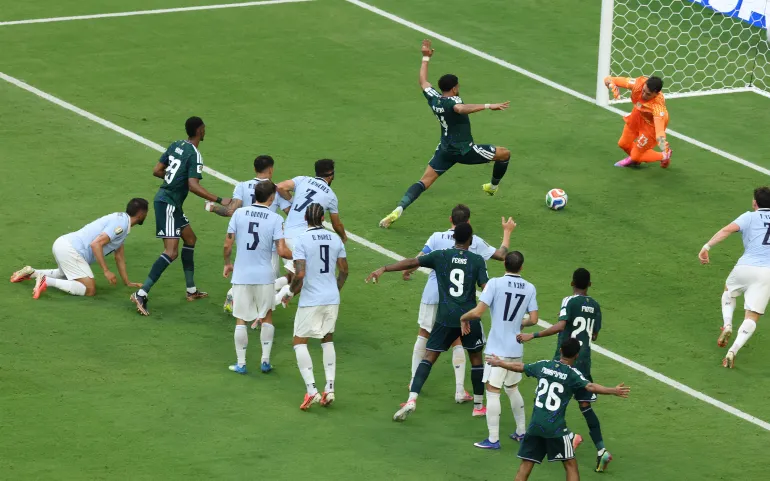
The Saudis famously beat Argentina 2-1 in their 2022 tournament opener, and they looked on course for another shock, courtesy of Abdulelah Alamri’s 41st-minute strike, until winger Araujo stepped up 10 minutes from time at Miami Stadium on Monday.
Uruguay coach Marcelo Bielsa certainly viewed it as a missed opportunity after European champions Spain dropped two points earlier in the day.
“An opponent we should have beaten; we gave away minutes in the first half that suggest we didn’t do things right,” he said. “We had to win this match.”
The Green Falcons ultimately had goalkeeper Mohammed Alowais to thank for their point, which will give them confidence they can progress to the knockout stage for the first time since the United States last hosted the World Cup in 1994.
“We were very tired at the end, but to play this type of game with this opponent, and to get a point, it’s a positive for us,” said Saudi Arabia coach Georgios Donis.
“I like the spirit and the passion of my players, but I think we have the quality to play better.”
Abdulelah Alamri scores Saudi Arabia’s goal past Fernando Muslera [Molly Darlington/Getty Images via AFP]
Uruguay, World Cup winners in 1930 and 1950, started the match with the swagger of favourites, and in the fifth minute, left winger Araujo turned on the edge of the box and angled a shot at goal, which Alowais parried away.
But barring a Federico Vinas diving header on the half-hour mark, which Alowais also pushed away, the Uruguayans lacked accuracy going forward and often looked a bit casual at the back.
Donis had promised his side would be courageous, and their attack sparked into life in the 36th minute, when left-back Moteb Alharbi skipped through the midfield before being cynically cut down 30 metres (about 30 yards) from goal.
Alamri had a shot from the centre of the box well saved by Fernando Muslera two minutes later, but the Uruguay goalkeeper was powerless to prevent the Saudis from going ahead soon afterwards.
Mohamed Kanno got on the end of a Musab Aljuwayr corner, and although Muslera managed to save his powerful header, Alamri was on hand to tap the ball into the net.
Bielsa made two changes at the break, and Uruguay’s game plan immediately looked more coherent – getting players down the flank to put crosses into the box and producing a string of headers for Alowais to deal with.
Defensive midfielder Manuel Ugarte came within inches of an equaliser when he beat the Saudi keeper in the 60th minute, only for his drilled shot to bounce off the far post.
Vinas had been Uruguay’s best aerial threat all game, and it was no surprise that the breakthrough came from one of his headers 10 minutes from full-time.
Alowais again denied the target man, but the ball fell straight to Araujo, who did well to control it and clip it into the net at the near post.
Uruguay poured forward, looking for a winner in a frenetic finish; Federico Valverde and Jose Maria Gimenez coming closest with rasping shots from either side of the box, which Alowais did well to push past his posts.
“I think the nerves of the debut worked against us, as did the need to go out and score,” said Vinas.
“In the second half, we did a bit more of what the manager wanted. I’m frustrated and angry, but as captain, I’m happy with my teammates’ work.”
Saudi fans celebrate [Alex Slitz/Getty Images via AFP]
Saudi Arabia hold firm against relentless pressure to earn a 1-1 draw against two-time world champions Uruguay in their Group H opener at the Miami Stadium.
Australian referee Shaun Evans says he didn’t intend to ‘communicate a message, affiliation, game or belief of any kind’.
Published On 15 Jun 202615 Jun 2026
FIFA says it has found “no evidence” that one of the referees at the World Cup breached its code of conduct after he was accused of making a white supremacist hand gesture during one of the games.
“FIFA’s independent Disciplinary Committee can confirm that, after looking into the matter involving support video assistant referee Shaun Evans, it has found no evidence of breaches of the FIFA Disciplinary Code,” football’s global governing body told Al Jazeera in an emailed statement on Monday.
Earlier, FIFA’s discrimination monitor at the World Cup called for Evans, working as a VAR official in the tournament, to be removed for appearing to make a hand gesture resembling a white supremacist sign.
When the official broadcast of Germany’s opening game against Curacao on Sunday cut pre-game to show the team of video review analysts, Australian official Evans made an “OK” symbol with his right hand in front of his right leg.
Though the game was played in Houston, video officials work in Dallas at the World Cup broadcast centre.
Evans said the hand gesture was not intentional, nor did he make it to “communicate a message, affiliation, game or belief of any kind”.
“The only explanation I can offer is that the movement was an involuntary, subconscious twitch and I was unaware I had done it at the time,” the official said in a statement shortly before FIFA announced its decision.
“Images taken later during the match showed that I repeated this movement many times while holding a pen between my fingers,” Evans went on to add.
“The coverage following this incident simply does not reflect who I am. Of course, I understand how the gesture has been interpreted and I regret this; however, I want to be very clear and categorically say that I did not knowingly or deliberately make the hand symbol suggested.”
It was midnight on April 12 when Modu Baluye woke to the sound of gunfire.
He was asleep with his family inside a classroom at Government Girls’ Secondary School (GGSS), in Monguno, Borno’s north, in northeastern Nigeria, which now serves as a temporary displacement camp, when the first shots rang out. Then came another burst, and another, cutting through the night in rapid succession.
“These people are attacking again,” he remembered saying.
He whispered a prayer and stayed awake. Around him, other displaced families were stirring as well. In the darkness, people listened without speaking, measuring the distance of the violence by the sound of the guns. The attack went on for hours.
By Modu’s account, the gunshots lasted about four hours. He later learned it was a gun battle between terrorists and military officers at the nearby Sector 3 base. As the troops pursued the terrorists along the exit route between Gana Ali, another displacement shelter, and the GGSS, they drove over buried explosives, which detonated and killed the commanding officer and six other soldiers.
By morning, fear had settled over the communities.
The military, residents said, became suspicious of the settlements around the base. The attackers had entered on foot under the cover of darkness, and the communities were not far from the military formation.
“They suspected we were hiding some of them,” Modu said. In the days that followed, soldiers raided Gana Ali and the GGSS camp. Residents told HumAngle that five suspected informants in the communities were arrested, and weapons were recovered. Then came an order for the communities to leave.
“They told us: leave or we will kill you all and burn down your houses,” Modu recounted. Within two days, families began dismantling their makeshift shelters. They packed what they could carry and left. Some were moved to a government settlement on the outskirts of Monguno, along the Monguno-Gajiram road, which is about a 30-minute walk from town.
“It is two weeks today,” Modu said when he spoke to HumAngle on May 10. “The place was torched after we left. I am not sure who torched the buildings.”
For Modu, displacement is not new. He fled Ala, his village in the Marte Local Government Area (LGA) of the state, in 2016 as insurgent violence spread across northern Borno. At the time, he was unmarried and found refuge with his parents at the ‘Water Board’ displacement camp in Monguno, where they lived for about six months. He later moved to the GGSS settlement after securing his own shelter and spent nearly a decade there. In 2024, he got married. By the time soldiers ordered residents to leave the community in April, he had begun building a mud house on a piece of land he purchased the previous year. It was there, in the unfinished house, that he and his family began rebuilding their lives after years of displacement.
A war returning to the bases
The Monguno attack came during a renewed wave of terror assaults on military formations and rural settlements across Borno.
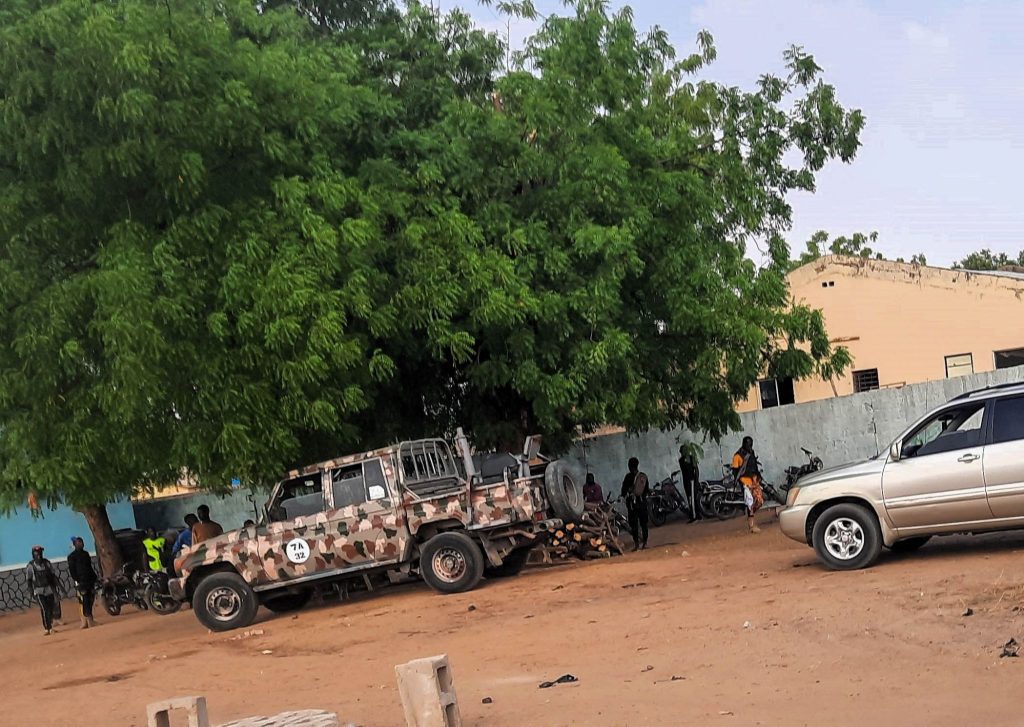
File: A military patrol vehicle with personnel parked outside a Civilian Joint Task Force office in Maiduguri. Photo: Kunle Adebajo/HumAngle.
In recent months, terrorists from Jama’atu Ahlis Sunna Lidda’awati wal-Jihad (JAS), commonly known as Boko Haram, and the Islamic State West Africa (ISWAP) have repeatedly targeted troops, bases, weapons, and supply routes. The attacks have killed soldiers, including senior military officers, and Civilian Joint Task Force (CJTF) members.
In Nov. 2025, terrorists ambushed a military convoy along the Damboa-Biu road. Two soldiers and two CJTF members were killed. Brigadier-General M. Uba, commander of the 25 Task Force Brigade, was abducted and later killed.
On Jan. 26, terrorists attacked a military base in Damasak, killing seven soldiers and capturing 13 others, including the commanding officer. Eleven later escaped. Five days later, on Jan. 31, another terror attack on an army base in Sabon Gari killed nine soldiers and two CJTF members; about 16 injured security personnel were evacuated for treatment.
On March 10, a military base in Kukawa came under attack; the commanding officer, Lt. Col. Umar Farouq, and several of his soldiers were killed.
On April 9, three days before the Monguno attack, terrorists launched a joint assault on the headquarters of the 29 Task Force Brigade in Benisheikh, killing its brigade commander, Brigadier-General Oseni Braimah.
The attacks have already weakened the military formations in rural areas. In some places, troops have withdrawn or consolidated around larger garrison towns, leaving smaller settlements more exposed. But when soldiers are killed, residents say the anger does not end on the battlefield. It returns with the troops.
The Nigerian Police officers at the scene of an explosion at the Maiduguri Monday Market in March. Photo: Al’amin Umar/HumAngle.
The trails of suspicion
In rural Borno, civilians are often trapped between two armed powers. Terrorists demand information about troop movements, military positions, and security operations. Soldiers, in turn, demand information about insurgent hideouts, movements, and informants. Refusing either side can be deadly.
Those suspected of helping the military may be abducted or killed by the terrorists. Those suspected of helping terrorists may be arrested, detained, displaced, or punished by security forces. As a result, civilians often face impossible choices, with serious consequences regardless of whom they cooperate with.
Get our in-depth, creative coverage of conflict and development delivered to you every weekend.
Subscribe now to our newsletter!
Despite these risks, communities have at times provided intelligence to the military. In March, for example, residents of Doro, a rural community in Kukawa LGA on the shores of Lake Chad, reportedly alerted troops after observing suspicious insurgent movements, helping security forces prepare for an attack.
The consequences of such actions can be severe. In March 2022, ISWAP executed four civilians in communities within the same local government area after accusing them of spying for government troops. Residents said the killings were intended to deter others from sharing information with security forces. For many civilians, the message was clear: speaking to the military could carry a death sentence.
The Chief of Defence Staff (CDS), Gen. Olufemi Oluyede, recently argued that residents in Borno and Yobe knew some of those behind the attacks during an operational visit to Maiduguri in March, reflecting a long-held security assumption that residents in affected communities often know more than they admit. The CDS said communities must take ownership of the crisis, citing Kukawa, where he claimed two of the attackers were from within the village.
But for many civilians, knowing does not mean consenting. They say in places where terrorists move freely, buy food, collect supplies, and threaten residents, silence is often a currency for survival.
Professor Abubakar Mu’azu, former director of the Centre for Peace, Development, and Diplomatic Studies at the University of Maiduguri, said this suspicion has existed since the early years of the insurgency.
“Right from the start, there was suspicion by the security agencies that the people who are living in areas where these terrorist activities were happening are also supporting the terrorists,” he said. “They never considered the fact that there is a majority of people who disagree with these terrorists’ activities.”
Mu’azu said the reactionary nature of security operations has prevented the military from building a reliable system of trust with local communities.
“They assume that the locals are giving information to the terrorists willingly,” he said. “But they keep saying they want the people to give them information about the terrorists.”
For him, this contradiction is at the heart of the crisis.
The military needs civilian intelligence to fight terrorism, but if civilians fear that any contact with terrorists, even under duress, will be treated as collaboration, they may stop speaking altogether.
File: Men seated, playing a game on a smartphone in an IDP camp in Maiduguri. Photo: Usman Abba Zanna/HumAngle.
Life under duress
In Monguno, residents say terrorists still move in and out of town despite the presence of security forces.
Koso Abubakar, a displaced farmer, said the terrorists often enter on motorcycles, buy food items, and leave.
“They come and leave at will,” he said. “Sometimes, they come to kidnap people. They don’t attack the military, and the military does not confront them. But on other days, they attack the military. That is when the military retaliates.”
According to Koso, most residents live with the knowledge that they can be accused by either side at any time.
“People are living in fear because everyone is a potential target,” he said.
In many rural communities, even work has become dangerous. A farmer going to his field, a fisher heading towards the water, or a trader moving goods through bush paths may first have to pay those who control the routes. The payments are called taxes, levies, or sometimes simply “settlement”, but residents understand what they are: money paid under fear. To refuse is to risk punishment, in lighter cases, or killing and abduction, in extreme cases, from terrorists. To pay is to risk being seen by soldiers as someone sustaining the insurgency. In this way, even the small acts people perform to feed their families can become evidence against them.
Farmers handing over money to armed and masked terrorists in a rural setting. Illustration: Akila Jibrin/HumAngle.
Professor Mu’azu said this fear terrorists use violence to discipline communities.
“They are very good at setting a very deadly example by killing or eliminating people, with or without evidence,” he said. “If they are attacked by security agencies and they did not hear anything from people living in these settlements, they would assume the people gave information about their positions.”
This was what many residents believe happened in Ngoshe in March, when terrorists attacked the community, killed many residents, and abducted others, including women and children. The attack was suspected to be retaliation for a previous military operation in the Mandara Mountains that killed some terrorist commanders. The terrorists reportedly believed residents had given up their location.
For civilians, the lesson is brutal: giving information can kill you. Not giving information can also kill you.
When protection becomes punishment
The military has long accused some civilians of aiding terrorists. In the early years of the war, many young men were arbitrarily detained. Some disappeared. Some were killed. In April 2014, soldiers arrested 42 adult men from Gallari, a village in the Konduga LGA of Borno, on suspicion of links to the insurgency. They were taken to the Giwa Barracks detention facility in Maiduguri. Twelve years later, only three have regained their freedom after years in detention and alleged torture. Through months of on-the-ground investigation and analysis of satellite imagery, HumAngle has also previously reported on disappearances and mass graves linked to military operations, while the wives of detained and disappeared men later formed the Knifar Women movement to demand justice.
Terrorists and suspected civilian collaborators arrested by the military. Illustration: Akila Jibrin/HumAngle.
For communities already carrying the memory of those years, new raids and forced evacuations reopen old wounds.
Mu’azu said security forces should approach communities with more care, especially when allegations of collaboration arise.
“One would assume that when security forces are dealing with situations like this, they would not come with the mindset that the people are sympathetic to the terrorists, or that all the people are giving information to the terrorists,” he said.
He added that soldiers have a difficult job and deserve sympathy for the burden they carry. But he argued that this does not justify indiscriminate punishment.
“They are the ones who are supposed to protect the civilians,” he said. “If there are people they suspect, they should arrest them and hand them over to the police for proper investigation, without compromising the little support they have in the community.”
When communities are burned or displaced after attacks, the consequences go beyond the immediate loss of shelter. Food stocks disappear. Children are pulled out of school. Families scatter. People who had already fled violence once are forced to flee again.
In resettled or displaced communities, where people have spent years coping, another displacement can mean the collapse of everything they had slowly rebuilt.
A dangerous silence
After the Monguno raid, Koso said some residents became so afraid of the military that they fled into the bush.
“Many people, about 30, also left for the bush,” he said. “Most of them fear the military. The military does not trust them.”
Mu’azu warned that this kind of fear can damage counterterrorism efforts.
“They will lose trust, respect, and block chances of receiving information,” he said. “This could also push them to be recruited by the terrorists.”
For Mu’azu, the solution is not to abandon intelligence work, but to make it safer and more systematic. He said the military should cultivate trusted informants within communities, create secure channels of communication, and protect residents when terrorists retaliate.
“This is the gap,” he said. “Oftentimes, communities are attacked after successful military operations. The patterns should be studied. They should do a statistical analysis. They should be mindful of the time and be prepared against such actions.”
He also called for stronger collaboration among the military, DSS, police, civil defence, and intelligence agencies in neighbouring countries such as Cameroon, Chad, and Niger, because terrorists move across borders.
But for Modu and others displaced from Gana Ali and the GGSS, these policy questions remain distant. What they know is simpler: they fled one danger and met another. They were told to leave the place they had made into a home. Then they watched, or heard, that what remained had been burned.
In Borno’s war, civilians are often asked to prove their loyalty to the state while surviving under the shadow of terrorists, and in that narrow space between fear and suspicion, many are losing everything.
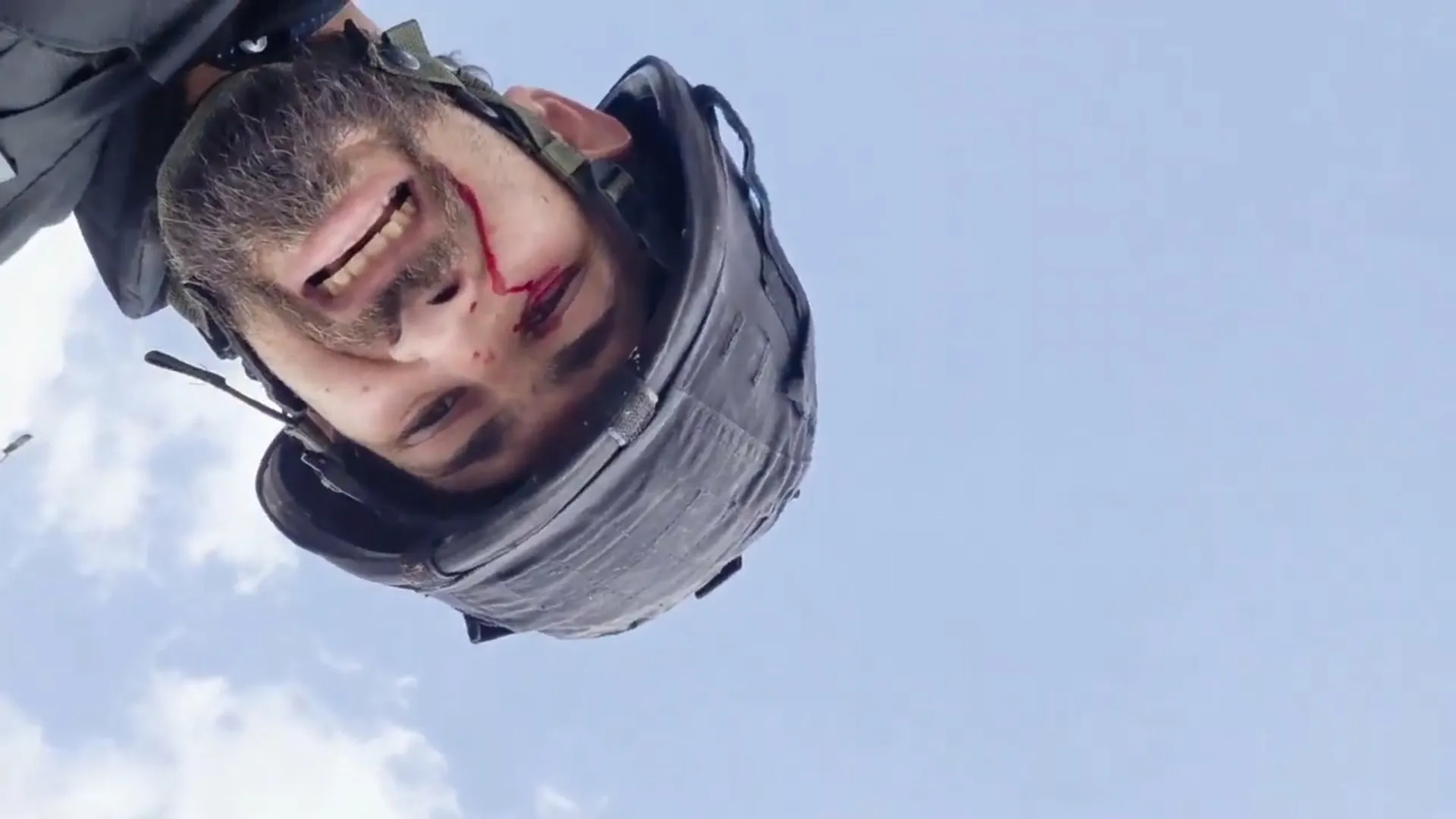
A journalist for Press TV has been hit by shrapnel while filming a report on Israeli attacks in southern Lebanon. Hadi Hoteit said he was targeted despite wearing a ‘Press’ vest, and is in hospital receiving treatment.
In SpaceX’s case, appetite was exceptionally high. The underwriters, which included Goldman Sachs, Bank of America, and JPMorgan, exercised the option in full, purchasing an additional 83.3 million shares directly from the company to meet the huge demand.
Weekly insights and analysis on the latest developments in military technology, strategy, and foreign policy.
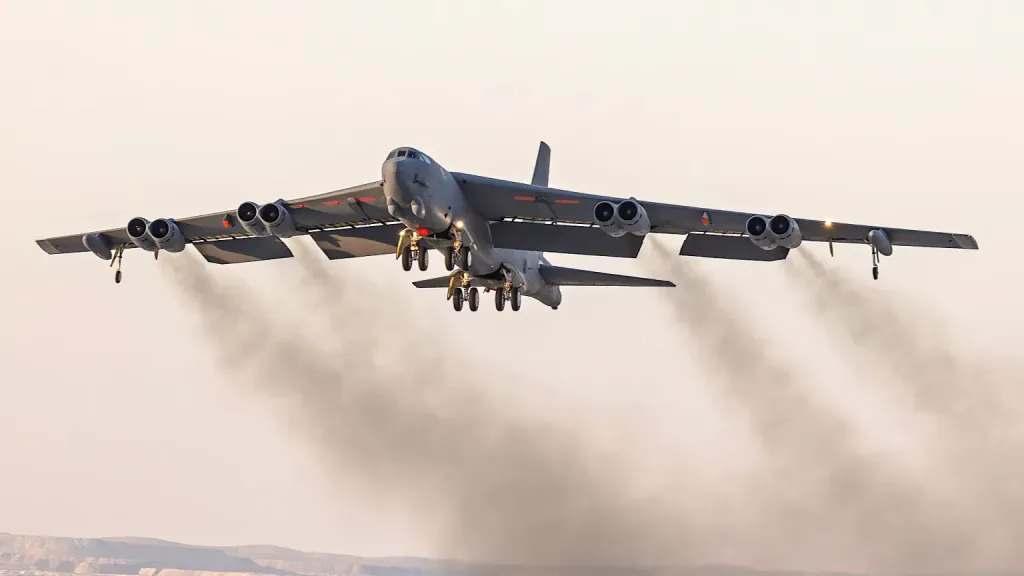
Details are still coming in, but a B-52 bomber has crashed at Edwards Air Force Base in California.
The base’s official Facebook and X pages have posted the following statement:
“A United States Air Force B-52 Stratofortress crashed shortly after takeoff on the Edwards airfield at 11:20 a.m. Emergency crews immediately responded to the scene and the situation is ongoing. More information will be provided as it becomes available.”
ALERT: A United States Air Force B-52 Stratofortress crashed shortly after takeoff on the Edwards airfield at 11:20 a.m.
Emergency crews immediately responded to the scene and the situation is ongoing. More information will be provided as it becomes available. pic.twitter.com/x932d3HXHz
— Edwards Air Force Base (@EdwardsAFB) June 15, 2026
From what we can see, the B-52 appears to have crashed on or at least very near the base’s main runway. Still images and video emerging now show a large fire with black smoke that can be seen from miles away.
How many individuals were on board the B-52 when it went down, and their fate, are currently unknown. However, the bomber ejection seat configuration could have presented complications for escape depending on how soon after takeoff the incident occurred. The B-52 has crew positions that eject downward.
Prior to this crash, the Air Force had 76 B-52s in service.
A stock picture of a B-52 bomber at Edwards. USAF
Though the two incidents are unrelated, this is also the second crash of a U.S. military aircraft in three days. A U.S. Marine Corps F/A-18D Hornet assigned to Marine Fighter Attack Squadron 323 (VMFA-323) went down near Mount Rainier in Washington State on June 13. The two individuals in that jet were able to eject safely. The Hornet did start a wildfire after hitting the ground.
BREAKING – 🇺🇸 Footage showing a U.S. Marine Corps F/A-18 crashing into a hillside near Rimrock Lake, Wash., on Saturday. pic.twitter.com/yQ4O6UFZOl
A US Navy F/A-18 crashed near Rimrock Lake, pilot ejected and walked out with medics according to reports. This is along the famous VR-1355 low level route in Washington State.
Fox News has now shared a video it says is of the aftermath of the crash, which shows a very large scorched area along the side of one of the runways at Edwards. There is no readily discernible wreckage, pointing to a total loss of the aircraft.
Update: 4:18 PM ET –
Edwards Air Force Base has shared a new update as of 12:48 PM PDT via its social media accounts. The full statement reads:
“The airfield has been closed, and all inbound aircraft are being diverted. All non-commercial visitor passes have been suspended until further notice to allow the installation to focus entirely on emergency response operations.”
Update- 12:48 PDT: The airfield has been closed, and all inbound aircraft are being diverted.
All non-commercial visitor passes have been suspended until further notice to allow the installation to focus entirely on emergency response operations.
— Edwards Air Force Base (@EdwardsAFB) June 15, 2026
We will continue to update this story as more information becomes available.
The announcement of a preliminary US-Iran agreement has generated cautious optimism in Lebanon, where months of conflict have displaced large portions of the population and devastated communities across the south.
While the framework reportedly calls for the immediate cessation of military operations, Lebanese authorities are warning residents against assuming that conditions are safe enough for a rapid return.
The caution reflects uncertainty over how the agreement will be implemented and whether all parties will abide by its terms.
Adding to those concerns, Israel has made clear that it does not consider itself bound by the agreement and intends to maintain security zones in southern Lebanon.
Lebanon became one of the principal battlegrounds of the wider regional conflict after Hezbollah opened a front against Israel in support of Iran following the outbreak of hostilities.
The resulting escalation led to extensive Israeli military operations across southern Lebanon, causing widespread destruction and one of the largest displacement crises in the country’s recent history.
Entire communities were uprooted as residents fled bombardment and military activity.
Iran consistently pushed for any agreement with Washington to include provisions addressing Lebanon, viewing the conflict there as inseparable from broader regional tensions.
The inclusion of Lebanon in the framework agreement therefore represents a significant diplomatic concession and a central element of Tehran’s negotiating position.
Why This Matters
Lebanon has become one of the clearest examples of how regional conflicts can produce devastating humanitarian consequences.
The conflict has:
Displaced more than a million people.
Damaged homes, infrastructure, and businesses.
Increased pressure on Lebanon’s already fragile economy.
Deepened political and social instability.
A durable ceasefire could allow reconstruction efforts to begin and reduce the risk of further regional escalation.
However, the humanitarian benefits will depend on security conditions improving on the ground rather than merely on diplomatic declarations.
The Challenge of Returning Home
For displaced families, peace announcements do not automatically translate into confidence.
Many residents remain uncertain about:
Whether military operations have truly ended.
The presence of Israeli forces in southern areas.
The condition of homes and infrastructure.
Future security guarantees.
The hesitation expressed by displaced residents reflects a broader reality in conflict zones: trust often takes much longer to rebuild than physical infrastructure.
Even if active fighting stops, communities may remain reluctant to return until they believe the risk of renewed conflict has genuinely diminished.
Israel’s Position Complicates the Picture
A major obstacle to immediate normalization is Israel’s position.
Israeli officials have indicated they will continue maintaining security zones and reserve the right to conduct operations they deem necessary for national security.
This creates ambiguity regarding implementation of the broader agreement.
While the US-Iran framework may establish a diplomatic foundation for reducing violence, the practical situation on the ground will depend on decisions made by actors who were not direct participants in the negotiations.
This distinction could prove crucial in determining whether the agreement produces lasting stability.
A Test of Regional Diplomacy
The inclusion of Lebanon in the agreement demonstrates how interconnected Middle Eastern conflicts have become.
The war was never confined solely to the United States and Iran. It involved multiple regional actors, proxy groups, and overlapping security concerns.
As a result, success will be measured not only by whether Washington and Tehran uphold their commitments but also by whether the agreement influences behavior across the broader region.
Lebanon is likely to become one of the first and most visible tests of that process.
Key Stakeholders
Lebanon and its government institutions
Displaced Lebanese civilians
Israel and its military leadership
Hezbollah
Iran
The United States
Regional mediators including Pakistan
Humanitarian organizations operating in Lebanon
What to Watch Next
Whether military activity in southern Lebanon decreases in the coming days.
Israeli decisions regarding security zones.
Hezbollah’s official response to the agreement.
The pace of civilian returns to southern communities.
International support for reconstruction and humanitarian assistance.
Broader negotiations during the 60-day ceasefire period.
The agreement creates an opportunity for Lebanon to move toward greater stability after months of destruction and displacement.
If implemented successfully, reduced hostilities could pave the way for reconstruction, humanitarian relief, and the gradual return of displaced populations.
Yet significant uncertainty remains. Security concerns, damaged infrastructure, and competing interpretations of the agreement could slow progress and complicate efforts to restore normalcy.
For many Lebanese families, the end of active conflict would represent only the beginning of a much longer recovery process.
Analysis
The most revealing aspect of Lebanon’s reaction is the disconnect between diplomacy and reality.
International leaders may celebrate ceasefires and framework agreements, but people living through conflict judge peace by different standards. They look not at official statements but at troop movements, security conditions, and whether it is safe to return home.
That gap is already visible in southern Lebanon. While diplomats describe the agreement as a breakthrough, local authorities are warning residents against rushing back. Israel’s decision to maintain security zones further reinforces uncertainty about how quickly conditions can normalize.
This highlights a recurring challenge in conflict resolution. Agreements can stop wars on paper, but rebuilding trust often takes far longer than negotiating a ceasefire.
Lebanon’s experience may therefore become a key measure of whether the US-Iran agreement delivers meaningful change beyond diplomatic symbolism. If displaced communities can safely return, reconstruction begins, and violence declines, the agreement will gain credibility. If insecurity persists despite the deal, questions will quickly emerge about its effectiveness.
Ultimately, Lebanon represents the human dimension of the broader regional settlement. The success of the agreement will not be judged solely by geopolitical outcomes or energy markets but by whether ordinary people feel secure enough to rebuild their lives after months of war.
Lamine Yamal comes off the bench but cannot help Spain overcome World Cup debutants Cape Verde in 0-0 draw.
Published On 15 Jun 202615 Jun 2026
Spain’s ghosts of recent World Cup horror shows reappeared in Atlanta as the European champions were held 0-0 by debutants Cape Verde in their opening game.
Lamine Yamal was left on the bench as the Barcelona superstar is eased back to fitness after nearly two months out with a hamstring injury and even his appearance as a second-half substitute failed to break down Cape Verde’s dogged defence.
Recommended Stories
list of 4 itemsend of list
Since winning the World Cup for the first time in 2010, Spain have not won a knockout game and their inability to make dominance of possession count was reminiscent of their meek exits in 2018 and 2022.
Blessed with what coach Luis de la Fuente claimed is the best squad in the competition, Spain were considered among the pre-tournament favourites to go all the way and lift the World Cup on July 19.
But the importance of Yamal and Nico Williams to their chances of success was underlined by a flat performance.
Williams also had an injury-disrupted season at Athletic Bilbao and was not introduced until the 87th minute.
Ranked 67 in the world, Cape Verde were making their debut on the global stage and did a nation of just over 500,000 people proud.
In stark contrast to the searing temperatures faced by some other sides, Atlanta’s state-of-the-art air conditioned stadium meant there was no excuses for the slow tempo of Spain’s build-up.
Indeed the mid-half hydration break was met by boos with fans frustrated at the break in play despite the cool conditions.
It took until six minutes before half-time for Spain to seriously threaten.
Marc Cucurella, fresh for sealing his move from Chelsea to Real Madrid, sent over a teasing cross that Ferran Torres turned onto the crossbar and Cape Verde goalkeeper Vozinha got back on his feet to turn Mikel Oyarzabal’s looping header over the bar.
Torres tested Vozinho again moments later before Aymeric Laporte’s header from a corner was also clawed away by the Cape Verde number one just before half-time.
The break came at a good time for the Blue Sharks and they comfortably held out in the second period until Yamal’s entrance after the second hydration break.
Billed as one of the stars of the tournament, Yamal’s appearance instantly lifted the crowd and injected life into the pedestrian Spanish attack.
His first involvement set up a decent opening for fellow substitute Mikel Merino which was too close to Vozinha.
Yamal also began the move that saw Oyarzabal’s effort deflected over with Spain’s best chance of the second half.
Cape Verde nearly snatched a famous victory in the final minute of the 90 when Dani Borges planted a header too close to Unai Simon.
Spain’s road to victory in 2010 also began disappointingly with defeat to Switzerland, but they have much to work on ahead of facing Saudi Arabia in Atlanta once more on Sunday.
The preliminary memorandum represents the first formal framework outlining how Washington and Tehran intend to move from military confrontation toward diplomacy.
While many details remain unpublished, statements from U.S., Iranian and Pakistani officials provide a broad outline of the deal’s structure.
Rather than resolving every dispute immediately, the agreement establishes a phased process aimed at reducing tensions first and addressing more difficult issues later.
The approach reflects the reality that both sides were able to reach consensus on ending hostilities more easily than on the underlying disputes that fueled the conflict.
Phase One: Ending the Fighting
The first stage focuses on immediate de-escalation.
According to mediator Pakistan, both sides have agreed to permanently halt military operations across all fronts.
The formal memorandum is expected to be signed in Switzerland, after which implementation would begin.
The objective of this phase is straightforward: stop active hostilities, reduce the risk of escalation, and create space for broader negotiations.
This represents the most immediate achievement of the agreement and is likely the reason markets reacted positively.
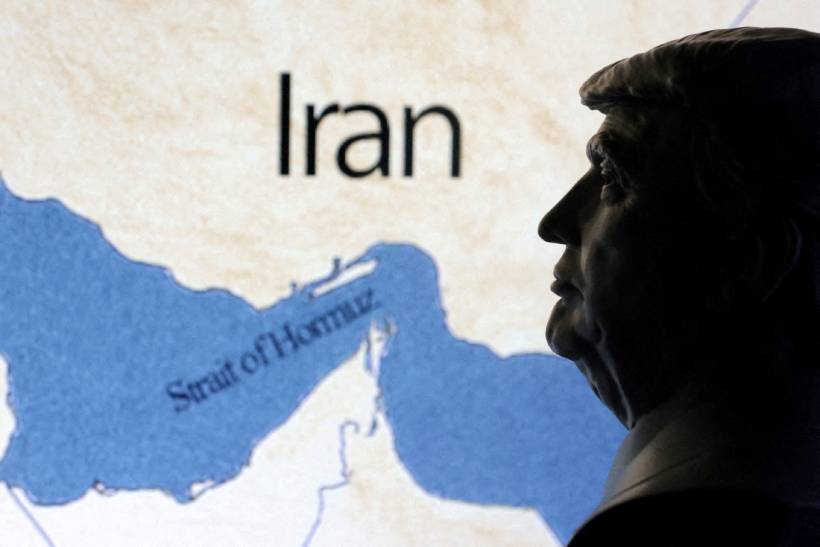
Reopening the Strait of Hormuz
The reopening of the Strait of Hormuz is arguably the agreement’s most significant economic provision.
The waterway serves as one of the world’s most important energy transit routes and has been at the center of global concerns throughout the conflict.
Both sides indicate that commercial shipping will resume following the signing of the memorandum.
The restoration of maritime traffic could:
Increase global oil supply.
Reduce shipping disruptions.
Ease pressure on energy prices.
Lower inflation risks for major economies.
However, questions remain over how the route will be governed.
Iran has suggested it will coordinate management of traffic with Oman, potentially giving Tehran a more formal role in overseeing one of the world’s most strategically important waterways.
That issue could become a future source of diplomatic friction.
The Nuclear Issue Has Been Deferred
The most controversial subject in the negotiations remains unresolved.
Rather than settling the nuclear dispute immediately, both sides appear to have agreed to address it during a 60-day negotiation period.
According to Iranian officials, Tehran would freeze nuclear activities during that time by halting additional enrichment and refraining from expanding facilities.
The long-term future of Iran’s nuclear infrastructure remains unclear.
Washington continues to emphasize inspections and preventing Iran from acquiring a nuclear weapon.
Tehran continues to insist that its nuclear program is peaceful and seeks recognition of its right to maintain civilian nuclear activities.
These competing positions are likely to dominate the next phase of talks.
Sanctions Relief Could Shape the Success of the Deal
Economic issues may ultimately prove as difficult as nuclear negotiations.
Iran expects meaningful sanctions relief as part of any final settlement.
Iranian officials have spoken about:
Temporary waivers on oil sanctions.
The release of frozen assets.
Financial support mechanisms.
A pathway toward lifting U.S. and international sanctions.
The Trump administration has signaled a more cautious approach.
Washington has indicated that sanctions relief will depend on Iranian compliance and future negotiations rather than automatic implementation.
This difference highlights one of the central tensions in the agreement: each side expects benefits on different timelines.
Lebanon Remains a Flashpoint
The agreement’s treatment of Lebanon illustrates how regional conflicts have become intertwined.
Iran views a ceasefire in Lebanon as a critical component of the broader settlement.
Lebanese political leaders have welcomed the inclusion of Lebanon in the framework.
Israel, however, has made clear that it does not consider itself bound by all aspects of the agreement and intends to maintain military positions in areas it views as strategically important.
This creates uncertainty about whether the Lebanon component can be implemented as envisioned.
The issue could quickly become one of the first tests of the agreement’s durability.
Why This Matters
The memorandum matters because it shifts the conflict from the battlefield to the negotiating table.
The agreement addresses several immediate concerns:
Rising energy prices.
Shipping disruptions.
Escalating regional instability.
Growing economic uncertainty.
At the same time, it leaves the most difficult questions unresolved.
This means the framework should be viewed as the beginning of a diplomatic process rather than its conclusion.
Its success will depend on whether negotiators can transform temporary understandings into binding commitments.
Key Stakeholders
United States
Iran
Pakistan (mediator)
Israel
Lebanon
Oman
European powers
Gulf Arab states
International energy markets
Global shipping industry
International Atomic Energy Agency (IAEA) and nuclear inspectors
What to Watch Next
Formal signing of the memorandum in Switzerland.
Reopening of the Strait of Hormuz.
Progress during the 60-day negotiation period.
Discussions on Iran’s nuclear program.
Decisions regarding sanctions relief.
Reactions from Congress and international partners.
Israeli actions in Lebanon and other contested areas.
The memorandum creates a framework for de-escalation, but its long-term success remains uncertain.
If implemented effectively, the agreement could stabilize energy markets, reduce regional tensions, and create momentum for broader diplomatic engagement.
However, many of the issues that triggered the conflict remain unresolved.
Nuclear enrichment, sanctions, regional security arrangements, and competing strategic interests are all likely to generate difficult negotiations.
The coming 60 days will therefore be more important than the announcement itself.
They will determine whether the framework becomes a durable peace process or merely a temporary pause in a conflict whose underlying disputes remain intact.
Analysis
The structure of the agreement reveals a pragmatic calculation by both Washington and Tehran.
Rather than attempting to solve every dispute at once, negotiators prioritized issues where agreement was achievable: ending active hostilities, reopening shipping routes, and creating a mechanism for future talks.
This approach reflects the political realities facing both governments.
For President Trump, reducing energy prices and ending a costly conflict addresses growing domestic pressure. For Iran, halting military operations while preserving room to negotiate on sanctions and nuclear issues offers a path to economic relief without immediate capitulation.
Yet the framework’s greatest strength may also be its greatest weakness.
By postponing the hardest questions, the agreement creates momentum for diplomacy but also leaves significant room for disagreement later. Nuclear enrichment, sanctions relief, and regional security arrangements are not peripheral issues—they are the core disputes that drove the conflict.
As a result, the memorandum should be viewed less as a peace treaty and more as a diplomatic bridge. It lowers immediate risks and creates opportunities for negotiation, but it does not yet resolve the strategic rivalry between the United States and Iran.
Whether this becomes a historic breakthrough or a temporary truce will depend on what happens after the signatures are placed on the document. The real negotiations are only beginning.
Governments across the world have welcomed the tentative deal between the US and Iran to end the war, calling it a major diplomatic breakthrough. But Israeli politicians have been quick to criticise it, claiming it would undermine Israel’s security.
The United Kingdom’s Court of Appeal has ruled that the British government was right to proscribe the Palestine Action activist group as a “terrorist” organisation last year.
Palestine Action is a British protest group which was founded six years ago and describes itself as a movement “committed to ending global participation in Israel’s genocidal and apartheid regime”.
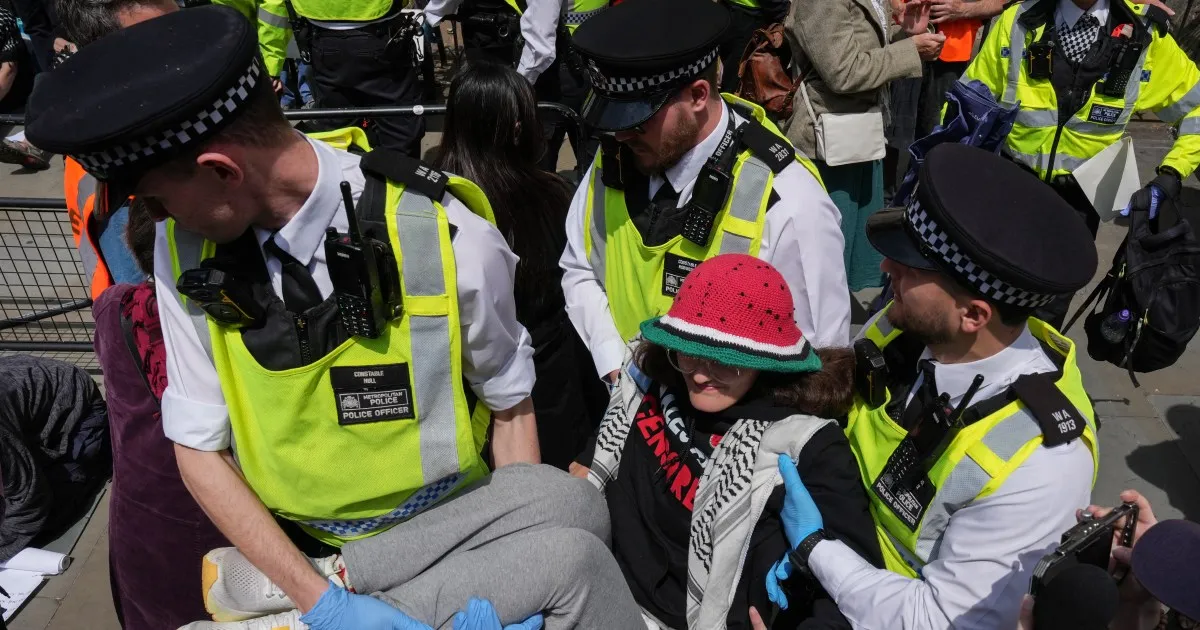
On Monday, police made more arrests of protesters demonstrating in support of Palestine Action outside the Court of Appeal in London.
Since the group’s proscription, which also bans support for proscribed groups, about 3,000 people have been arrested.
The Metropolitan Police welcomed the ruling and said it would continue to arrest those who protest in support of the group.
Here is what we know about the ruling:
What has the Court of Appeal ruled?
The judgement released on Monday states: “The proscription of an organisation like Palestine Action is highly controversial. But it is a fundamental mistake to overlook the fact that Palestine Action overtly promotes unlawful violence amounting to terrorism”.
The ruling was made by a five-strong panel, including the two most senior judges in England and Wales.
Palestine Action, which was formally proscribed by the UK last July, is a British protest group founded six years ago. It says it uses “disruptive tactics” to target “corporate enablers” and companies involved in the manufacture of weapons for Israel, such as Israeli group Elbit Systems, Italian aerospace company Leonardo, French multinational Thales and Teledyne from the United States. The group has targeted British facilities linked to those companies.
In all, British police say action by the group has resulted in millions of pounds of criminal damage.
A court in London ruled on June 12 that four Palestine Action members convicted of criminal damage at a British facility owned by Israeli weapons group Elbit Systems near Bristol, west England, would be sentenced on the basis that their actions had a “terrorist connection”.
Why was this case brought?
Following the proscription of Palestine Action last year, the group’s co-founder, Huda Ammori, challenged the decision in the High Court. In February, the High Court ruled that the government’s “terror group” ban was unlawful and disproportionate.
The government immediately said it would appeal. “I am disappointed by the court’s decision and disagree with the notion that banning this terrorist organisation is disproportionate,” Home Secretary Shabana Mahmood said.
The judgement on Monday agreed with her. Its ruling states: “The Home Secretary had the institutional competence and the democratic accountability to make the decision. The Proscription Decision was consistent with the Home Secretary’s Proscription Policy and was proportionate. It was not unlawful.”
Days after the Brize Norton attack, members of parliament voted in favour of proscribing the group. That classified Palestine Action as a “terrorist” organisation, bringing it into the same category as armed groups such as al-Qaeda and ISIL (ISIS).
Critics decried the vote, arguing that while members of the group have caused damage to property, they have not committed violent acts that amount to terrorism. More than 130 high-profile public figures have spoken out against the proscription.
Other previous actions the group has taken include:
In 2021, members protested for six days on the roof of Elbit Systems’ subsidiary, UAV Tactical Systems in Leicester, until some were arrested by police.
In 2022, the group broke into a Thales equipment factory in Glasgow, causing damage to weapons worth more than a million pounds ($1.3m).
In 2024, 10 months into Israel’s genocidal war on Gaza, Palestine Action activists broke into an Elbit Systems UK facility near Bristol in southwest England, causing another million pounds of damage.
How has Palestine Action responded to the ruling?
In a statement read by a representative following the ruling, Palestine Action’s Ammori said the group will challenge the judgement in the UK’s Supreme Court.
“We will fight this all the way. We will seek permission to appeal to the Supreme Court and, if need be, take this to the European Court of Human Rights,” Ammori said.
The European Court of Human Rights (ECHR), established by the Council of Europe, allows individuals to hold member states accountable for rights violations through a dedicated court. When the ECHR finds a violation, its judgements are legally binding on the state concerned under the European Convention on Human Rights.
“We will not stop fighting to overturn one of the most extreme attacks on free speech and the right to protest in modern British history,” Ammori added.
“This unprecedented abuse of power has devastated the lives of thousands of people while silencing dissent over Israel’s slaughter of the Palestinian people during the genocide, when that dissent could not be more urgent.”
How have others reacted to the ruling?
Anas Mustapha, Head of Public Advocacy at CAGE International, said: “This ruling tells us exactly what these powers are for. They are not safeguards against violence, they are authoritarian tools for crushing dissent.”
Mustapha added: “No ruling from any court is going to convince people that their conscience is wrong, and no amount of legislation will make support for Palestine disappear. The only sustainable outcome is the abolition of these laws in their entirety.”
Thomas Bell, acting UK Director of Human Rights Watch, said: “This disastrous decision further cements the UK’s place among countries that are backsliding on human rights by classifying acts of protest as terrorism.”
“When Palestine Action members have committed criminal damage, that should be dealt with under normal criminal laws, not by misusing overbroad and poorly defined terrorism powers. Defining a protest group as terrorists has created an absurd situation where thousands of people peacefully holding up signs have been arrested,” Bell added.
The outbreak caused by the rare Bundibugyo virus strain has reached 782 confirmed cases.
Published On 15 Jun 202615 Jun 2026
The number of confirmed cases in the Democratic Republic of the Congo (DRC)’s Ebola outbreak has surged to 782, with 178 deaths, marking one of the largest daily jumps so far as regional conflict, patient escapes, and limited contact tracing undermine containment efforts.
The Ministry of Public Health confirmed 72 new cases on Sunday over the previous 24 hours, a record single-day increase, with 29 additional deaths.
Recommended Stories
list of 3 itemsend of list
The Bundibugyo virus strain has a 22.8 percent death rate so far, with 40 patients recovering, officials said.
“We remain committed to supporting affected countries until transmission is stopped. We call on partners and donors to urgently mobilise resources to strengthen the response and save lives,” Jean Kaseya, director general of the Africa Centres for Disease Control and Prevention, said on Sunday.
The outbreak stems from the rare Bundibugyo strain, which has no approved vaccine or treatment, unlike the Zaire virus responsible for the DRC’s previous 16 Ebola outbreaks.
Contact tracing coverage has plummeted to 56.5 percent, a sharp decline from the 95% target, Health Ministry officials said.
Doctors Without Borders, known by its French initials MSF, warned that “no one knows the true scale” of the outbreak due to dangerous gaps in surveillance and testing.
Eastern Ituri province remains the outbreak’s epicentre, harbouring nearly 95 percent of all confirmed cases. The virus has since breached into North Kivu and South Kivu provinces and spread across the border to Uganda.
Ituri’s humanitarian crisis exacerbates the medical emergency. Nearly one million residents have fled overlapping armed conflicts involving multiple groups, including the M23 rebel movement that controls Goma, the capital of North Kivu province. The area has endured decades of instability, with United Nations reports documenting massacres of more than 100 civilians in gold-rich Ituri villages as various factions vie for control of the region’s mineral wealth.
Thousands of artisanal miners routinely shuttle between clandestine mining sites scattered across the mineral-dense region, creating transmission hotspots that evade health monitoring. The outbreak is believed to have originated in the mining-intensive Mongbwalu Health Zone in Ituri province.
The World Health Organization announced it is ramping up diagnostic testing and contact surveillance operations. However, MSF reports a critical funding gap of $21.5m hampering response efforts.
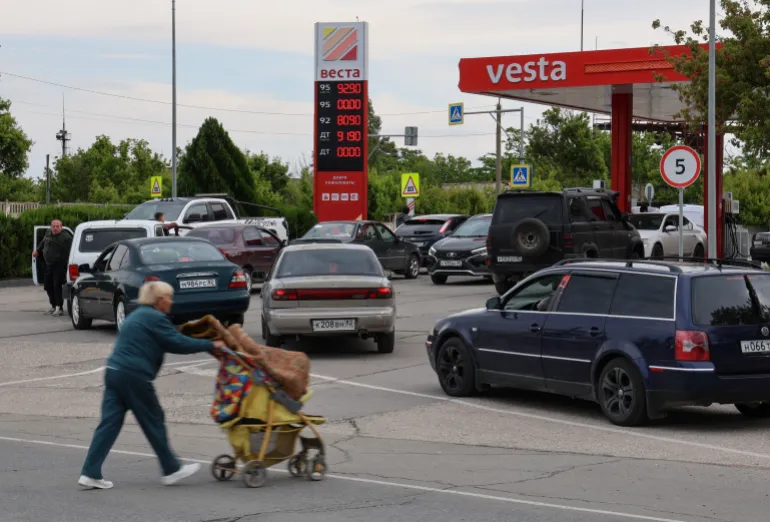
Kyiv, Ukraine – After almost seven hours in a kilometres-long, snail-paced line made up of hundreds of cars at a gas station near Crimea’s administrative capital, Simferopol, Dilyaver was lucky enough to buy gas.
He paid $22 for 20 litres (5.3 gallons).
Recommended Stories
list of 4 itemsend of list
“There were teenagers running around offering gas for 300 rubles [$4.2], one almost got beaten up by angry guys in the line,” the 52-year-old Crimean Tatar man told Al Jazeera on Saturday.
He withheld his last name and personal details because an interview with foreign media could land him in jail.
Judging by licence plates and accents, some of the men in the line were Russian tourists who decided to cut their vacations short and flee via the $4bn, 19km (12-mile) long Crimean Bridge, Dilyaver said.
“The [tourism] season is ruined, that’s bad news for almost everyone here,” he said, referring to the annual arrival of millions of tourists that feeds many on the arid peninsula, where agriculture has suffered after Kyiv dammed a key water artery.
Dilyaver does not know when he will fill up his rundown Skoda again because he expects fuel shortages to get worse.
But the fuel problem is just the tip of the iceberg of problems Crimea has been facing.
“Crimea’s key problem is not because there’s no fuel,” Nikolay Mitrokhin, a researcher with Germany’s Bremen University who analyses the Russia-Ukraine war, told Al Jazeera. “The problem is that Ukrainian drones began barraging over the peninsula’s domestic roads.”
Cars queue for fuel at a gas station after the authorities restricted fuel sales amid a supply shortage following Ukrainian attacks on logistics routes in the course of the Russia-Ukraine conflict, in the Black Sea resort city of Yevpatoriya, Crimea, June 3, 2026 [Alexey Pavlishak/Reuters]
Since mid-May, Ukrainian drones have attacked hundreds of trucks carrying fuel, ammunition and other supplies from southwestern Russia to Crimea via the “land bridge” through occupied Ukrainian regions.
The drones, whose operators sit in bunkers up to 200km (124 miles) away from the “land bridge”, also pepper roads with mines that weigh only 500 grams (1.1 pounds) and have magnetic or motion sensors.
Cargo ships trying to get fuel and food to Crimea or transporting steel and grain from occupied regions of southeastern Ukraine have also been attacked.
The attacks “illustrate Crimea’s vulnerability”. Volodymyr Fesenko, head of the Kyiv-based Penta think tank, told Al Jazeera. “Ukraine can regularly, daily strike military, infrastructure sites in Crimea … Ukraine turned Crimea into an island surrounded by war and fire.”
‘Just the beginning’
Ukraine’s Third Special Battalion said earlier this month that its drone operators have “taken aerial control” of the strategic supply route from the occupied southern city of Melitopol to the Chongar bridge in northern Crimea.
“That’s just the beginning! There’s more to come!” the Battalion said in a Facebook video with footage of exploding and burning trucks.
Chongar is a key entry to Crimea that can barely be called a peninsula because Sivash, also known as The Rotten Sea, a labyrinth of lagoons, salt marshes and wetlands, divides it from mainland Ukraine, leaving only three strips of land wide and firm enough for roads and a railway.
Just more than a week ago, the Chongar bridge was damaged by drones and is only capable of letting light vehicles through, while buses and trucks take a pontoon bridge nearby.
“The bridge is open, the damaged part is cordoned off, one lane is operational, there are no traffic jams because there’s few cars,” a driver who passed through it wrote on Telegram.
Ukrainian drones also struck fuel depots inside Crimea – along with air defence systems, airfields, military bases, command centres and the facilities of Russia’s Black Sea Fleet that relocated to the Russian port of Novorossiysk after losing at least a third of its vessels.
After Russia’s annexation of the peninsula in 2014, Moscow spent billions of dollars to militarise Crimea by deploying frigates and diesel submarines; advanced S-400 air defence systems; tens of thousands of servicemen; and building new military bases, airfields, radar stations, garrisons and living quarters.
“Putin turned Crimea into a military base, and thus made it the most vulnerable place in the war with Ukraine,” Fesenko said.
The Crimean bridge alone cannot handle the redirected traffic as trucks weighing more than 1.5 tonnes are no longer allowed to pass through.
Early Monday, a Ukrainian drone struck a moving train, killing one of the drivers and prompting Moscow to halt the movement of nine other trains.
Their passengers are being evacuated by buses, Kremlin-appointed authorities said.
Days earlier, one of Russia’s most outspoken warmongers raised his voice about the panic in Crimea.
“What’s happening at Crimean gas stations is a real nightmare for locals and servicemen,” Igor Girkin, an ex-intelligence officer who led the first group of Moscow-backed separatists in southeastern Ukraine in 2014, wrote on Telegram on June 1.
Kyiv “acts brazenly … trying to cut off the peninsula and our southern [military] groups from fuel supply,” Girkin, who was sentenced to four years in jail in 2024 after lambasting Moscow’s military failures in Ukraine, wrote from behind bars.
“To some, Crimea seems like a resort. No, today it’s a front-line region,” he wrote.
And to Crimean Tatars such as Dilyaver, what’s happening around them is part of a decades-old struggle for survival in Moscow’s shadow.
Russian patrol ship Svetlyak in Yurkyne, Crimea, in this screengrab from footage released by Ukraine’s Unmanned Systems Forces commander Robert Brovdi on June 4, 2026 [Robert Brovdi via Telegram/Handout via Reuters]
Since the annexation, his community of about 250,000, or about one-tenth of Crimea’s population, has been under constant pressure.
Masked officers break into the houses of community leaders, activists or observant Muslims at dawn to search for “extremist materials” that in many cases turn out to be religious texts, including The Quran for Children.
Arrests and trials follow – more than 100 Tatars have been sentenced to jail for “extremism,” “separatism” and “terrorism.”
Another dozen went missing without a trace and are believed to have been abducted and killed by Russian intelligence.
Dilyaver owned a tiny grocery store near Simferopol.
But he faced higher taxes and visits by government inspectors who demanded bribes, so Dilyaver, who also suffered a scam, closed the store. He barely makes ends meet now by selling deep-fried meat and cheese pies next to a bus stop.
Dilyaver’s parents were born in Soviet Uzbekistan after the 1944 deportation of every Crimean Tatar by Soviet leader Joseph Stalin, who thought their cultural ties to Turkiye posed a threat to the USSR’s security.
“We have a saying, ‘If a Russian lives next to you, keep an axe ready,’” Dilyaver’s 77-year-old mother Gulsum told Al Jazeera. “We suffered from them so much, and it’s far from over.”
Ukrainian attacks triggered food shortages.
Macaroni, flour, canned meat, fish and vegetables have already been swept off the shelves in some stores and supermarkets, Dilyaver said.
“The Soviet mentality is still at work. If there’s a problem – buy buckwheat,” he quipped, about the cheap and nutritious grain that symbolises resilience in the former Soviet Union.
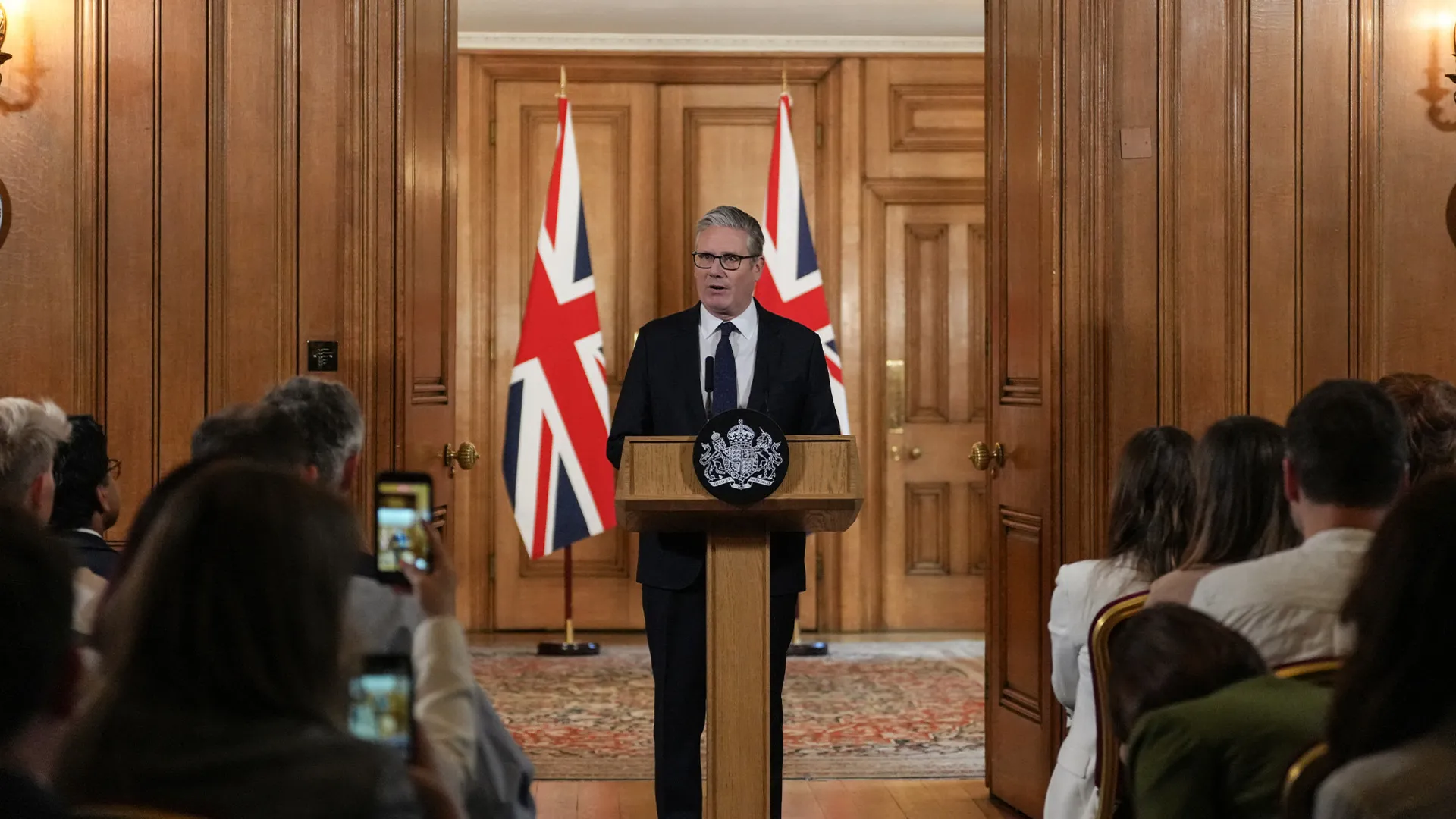
British Prime Minister Keir Starmer says the UK will ban social media for teens under the age of 16 and impose tighter rules on gaming and livestreaming platforms, with regulations to follow by the end of the year. He says the move is aimed at protecting children, and will curb the power of big tech companies through tough online safety measures.
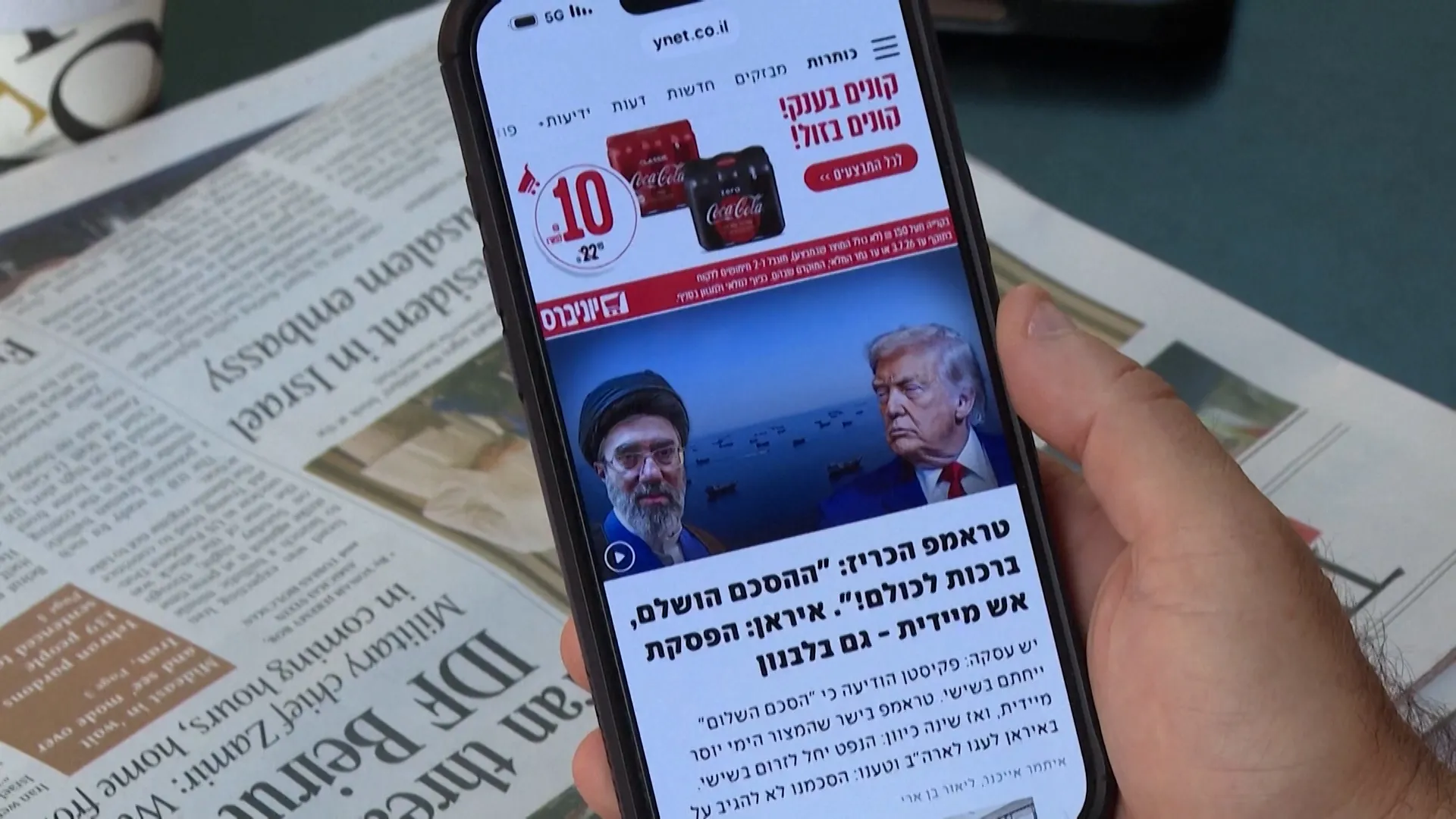
The US and Iran say they have reached a deal to end fighting on all fronts and open the Strait of Hormuz. Al Jazeera’s Osama Bin Javaid explains how both sides are claiming victory, even as tough negotiations over the details still lie ahead.
Hegseth claimed Venezuela “invited” US forces to target Tren de Aragua. (Truth Social)
Caracas, June 14, 2026 (venezuelanalysis.com) – The United States launched a military strike inside Venezuelan territory that reportedly killed Héctor “Niño” Guerrero Flores, an alleged leader of criminal group Tren de Aragua.
US President Donald Trump first announced the “swift and lethal kinetic strike” via social media on Friday evening.
“At my direction, the US Southern Command (SOUTHCOM) delivered a swift and lethal kinetic strike to successfully execute Niño Guerrero, the infamous leader of Tren de Aragua,” he wrote. “Tren de Aragua terrorists no longer have safe haven in Venezuela or anywhere else.”
Trump added that the extrajudicial execution was “coordinated closely with our friends in Venezuela.” An accompanying video showed a house or compound being blown up.
US Secretary of War Pete Hegseth confirmed the operation shortly afterward, adding that it had taken place earlier in the week. He reiterated the “full collaboration with Venezuelan security forces” and claimed that Guerrero was confirmed dead in the strike.
“The operation underscores the shared US and Venezuelan commitment to take the fight to narco-terrorists and deny them any safe haven in our hemisphere,” he stated. SOUTHCOM Commander General Francis Donovan also expressed “gratitude” to Venezuelan security forces for their “support to the successful joint operation.”
In a Sunday interview, Hegseth claimed that US forces were “invited” by Venezuelan authorities and that further operations in Venezuelan territory were to be expected.
The Wall Street Journal, citing an anonymous administration official, reported that the CIA provided intelligence for the strike.
For its part, the Venezuelan government headed by Acting President Delcy Rodríguez issued a Friday evening statement informing of a “joint operation” between US and Venezuelan security forces to dismantle “organized crime structures” in southeast Bolívar state.
“During the operation there were clashes with members of these criminal structures that resulted in ‘Niño Guerrero’ being neutralized,” the communiqué read. Neither Venezuelan nor US officials offered details about the operation, the alleged clashes, or additional casualties from the lethal strike against Guerrero.
Caracas went on to claim that the mission involved “intelligence sharing” between the two countries and reiterated its “commitment to fight organized crime.”
According to the Venezuelan Constitution, the deployment of foreign military missions in the country’s territory requires approval from the National Assembly.
The military procedure coincided with a Venezuelan armed forces deployment to dislodge illegal mining outfits from mineral-rich Bolívar state as Western corporations eye lucrative exploration projects under a new, pro-business mining law. Tren de Aragua was alleged to be one of several criminal groups operating in the area.
The reported execution of Guerrero is the first recorded joint US-Venezuela military operation on Venezuelan soil. Since September 2025, the Trump administration has struck dozens of small boats in the Caribbean and Eastern Pacific, killing over 200 civilians. US authorities have claimed to be targeting drug trafficking operations but have not put forward any evidence.
In 2025, Washington likewise ramped up “narcoterrorism” accusations against the Nicolás Maduro government while setting up a large-scale military deployment near Venezuelan shores. Caracas denounced the charges as a pretext for foreign intervention, pointing to United Nations and DEA reports that repeatedly showed the South American country to play a marginal role in global narcotics trafficking.
On January 3, US forces bombed Caracas and kidnapped Maduro and First Lady Cilia Flores. They are currently facing trial in New York and have pleaded not guilty to charges including drug trafficking conspiracy. Despite recurring accusations in recent years, US officials have not provided any public evidence tying high-ranking Venezuelan officials to narcotics activities.
Since the attack, Acting President Rodríguez has fast-tracked a diplomatic rapprochement with the Trump White House while reforming oil and mining legislation to favor Western investment. Multiple US officials have visited Caracas in recent months, including SOUTHCOM Commander Donovan, CIA Director John Ratcliffe, and Chairman of the Joint Chiefs of Staff Dan Caine.
Dating back to his election campaign, Trump consistently talked up the threat posed by Tren de Aragua in the US as part of his anti-migrant crackdown and alleged that it acted in collaboration with the Maduro government. In February 2025, the State Department designated Tren de Aragua as a foreign terrorist organization (FTO), having previously announced a US $5 million reward for information leading to the capture of Guerrero.
However, despite repeated rumors of crimes attributed to Tren de Aragua, US intelligence agencies found no evidence of the organization having any coordinated activity on US soil or ties to the Venezuelan government. Separate reports have documented that the group runs criminal activities, including human trafficking, in several Latin American countries.
For their part, Venezuelan officials stressed that Tren de Aragua had been dismantled in Venezuela following a 2023 raid on Tocorón prison, from where the gang was believed to run its operations. Nevertheless, Guerrero was reportedly alerted in advance and managed to break out.
The 42-year-old had been in and out of prison several times before being handed a 17-year sentence in 2018 for charges including homicide and drug trafficking. In January, he was charged in New York as a co-conspirator in the case against Maduro.
Behind a veil of good-natured diplomacy, American adversaries are exploiting the conflict in Iran by gaining insights, strategic lessons, and geopolitical power while the United States wages feckless war against the Middle Eastern theocracy. Beyond the bombings, the blockade, and the oil prices, Russia and China keenly watch how America struggles, succeeds, and scrambles. In doing so, these adversaries are leveraging the conflict to challenge America’s readiness, aid its adversaries, and gain invaluable intel on America’s successes and failures.
The concept of observing a conflict to acquire critical intelligence on how to best conduct combat is not unique to the war in Iran. For example, in the Russo-Ukrainian War, America has gained indispensable knowledge on the most and least effective tools of 21st-century warfare, including information on the power of unmanned aerial systems. With the war in Iran, though, Russia and China are the scientists, and America is the experiment. The Middle East is now a testing ground for cutting-edge drone swarm technologies and a catalyst for how smaller powers can effectively deny their adversaries from accomplishing their objectives—a lesson that China is certainly eager to learn about for a possible conflict over Taiwan. Therefore, when America wages war against Iran, there are consequences that are crucial to recognize, and one of those consequences is that the United States is inadvertently empowering and informing its adversaries.
Maintaining its signaled commitment of multipolarity and geopolitical neutrality, China’s Foreign Ministry spokeswoman Mao Ning commented, “…China…has been making active efforts to promote ceasefire and peace…we will continue playing an active role in restoring…tranquility to the Middle East…” Reality demonstrates that this is false. China is discreetly gaining intelligence on the U.S. military’s readiness, pacing, and warfighting strategies. Furthermore, China has directly supported Iran, providing anti-missile weaponry, building blocks for ballistic missiles, and invaluable military intelligence to the Iranian Revolutionary Guard Corps. Instead of promoting peace and tranquility, these actions are designed to empower Iran and keep America locked in the struggle, weakening the country and allowing China to acquire more intelligence on U.S. readiness. Despite China’s claimed intentions, it’s clear that the nation is bolstering Iran’s strength and sustaining its defenses. Even from a domestic point of view, these actions are increasing domestic American division and the depletion of America’s defense resources. The conflict with Iran is not limited to Iran; by proxy, it’s with America’s foremost adversaries, too.
Similarly, Russia has provided critical support to Iran in the form of targeting intelligence, which Iran couldn’t have otherwise acquired. Shahed drones, assets that have proven to be exceptionally effective against western defenses, are manufactured in Russia’s Alabuga Special Economic Zone and are being provided to Iran by Russia. Contradicting these actions, a statement by the Russian Ministry of Foreign Affairs declared that the country “…stands ready to assist in advancing peaceful solutions grounded in international law, mutual respect, and a balanced consideration of interests.” But equipping Iran with efficacious tools of war is not a peaceful solution. Giving the nation targeting information cannot be construed as a neutral or geopolitically insignificant act. In reality, America’s adversaries are taking an active, hands-on approach to the war in Iran, indirectly but clearly aiding the nation and actively working against U.S. goals.
In response to this tacit yet significant aid to Iran, the natural response for America should be to publicly highlight the hostile actions of its adversaries. But the United States has been hesitant, if not downright unwilling, to do so. For example, Matthew Whitaker, the U.S. Permanent Representative to NATO, commented that “China certainly is not participating and is not aiding and abetting the Iranian demise…” Separately, he claimed, “There’s no indication that we can talk about publicly that the Russians are participating with the Iranians.” Public investigations, though, have proven both those assertions false. The trepidation of the United States to clearly and confidently condemn its adversaries’ belligerence in the region is an enormous blunder of strategic communications. Contrasting this, Russia and China have simultaneously and aggressively pursued campaigns of condemnation to weaken America’s global power. For example, Russia has often claimed that certain U.S. support to Ukraine may constitute an act of war; China strongly condemned recent American intervention in Venezuela as violating the international laws by which America claims to be guided. U.S. adversaries are eager and willing to strategically undermine and criticize U.S. actions, yet America is unwisely unwilling to do the same.
Russia’s and China’s cooperative aid to Iran demonstrates that the conflict is, in many senses, between world powers. A new ‘axis of resistance’ against Western liberalism is developing, and allowing American adversaries to act without denunciation is a failure of strategic communications and allows these nations to act with undeserved impunity. As the United States continues to wage war against Iran, it’s crucial to recognize that every bomb America drops, every mission American soldiers complete, and every destroyed military asset is a datapoint that U.S. adversaries will exploit. Russia’s and China’s critical support to Iran is hostile and counter to American goals; ignoring this is strategically imprudent. Beyond the explosions, America’s adversaries are watching—and acting. It’s the responsibility of the United States to expose those actions for what they really are.
Uruguay will reportedly arrive in the US less than 24 hours before the kickoff time for their game against Saudi Arabia.
Published On 15 Jun 202615 Jun 2026
Uruguay’s national team have arrived in Miami after enduring a travel ordeal ahead of their opening World Cup match in the United States.
The squad and support staff landed in Miami on Sunday, less than 24 hours before kickoff in their Group H match against Saudi Arabia.
Recommended Stories
list of 4 itemsend of list
Uruguay pinned the blame for their troubles flying from Mexico to the US on FIFA. They also reportedly faced the threat of sanction if their head coach and captain could not make it to a mandatory news conference on the eve of the match.
The original flight was reportedly not allowed to depart due to administrative issues, including some missing paperwork, and officials had to scramble to line up a new flight.
FIFA is in charge of all travel related to the 48-team World Cup.
Uruguay are training in Playa del Carmen, Mexico, and held a practice there on Sunday. When the traveling delegation reached the airport in Cancun, approximately 72km (45 miles) away, they learned that the group was not authorised to enter the US.
The Uruguay Football Association (AUF) said that a second plane from South Florida was en route to pick up the squad, while the players waited at a resort outside Cancun until its arrival.
“Due to problems beyond the control of the AUF, the departure from Mexico has been delayed,” the association said in a statement. “The squad is resting at the hotel. The new departure time set by FIFA is 4:15pm [21:15 GMT].”
FIFA later released a statement, saying: “Due to an airline permitting error in Mexico, the Uruguay national team’s departure from Cancun to Miami was delayed.
“The airline has apologised for the inconvenience caused. FIFA remained in close contact with the Uruguay national team throughout their delay and worked alongside airport and operational partners to help expedite the process and minimize disruption to the team’s travel arrangements.”
Uruguay coach Marcelo Bielsa and team captain Jose Maria Gimenez missed Sunday’s originally scheduled news conference in South Florida due to the issue. The news conference was pushed back to 8pm Eastern Time (00:00 GMT), and the coach and captain were in attendance.
“The trip went well; we made the most of it and saw it in a positive light,” Gimenez said in Spanish. “We took the chance to rest at the hotel [in Cancun].”
Bielsa was asked what sort of disruption the flight snafu caused his team.
“No, the flight doesn’t cause any complications,” Bielsa said, before changing the subject to his team’s preparation in both the Uruguayan capital of Montevideo and Mexico’s Playa del Carmen.
“In Montevideo, the players had constant obligations, but they also had family time, which I felt was necessary.”
Uruguay and Saudi Arabia will play their first match of Group H at Miami Gardens at 6pm (22:00 GMT), giving them less than 24 hours to settle in before kickoff.
The other members of the group, Spain and Cape Verde, will play in Atlanta on Monday.
Uruguay were the latest to face travel issues at the World Cup.
Top Somali referee Omar Artan was denied entry into the US this week after he was “determined to be inadmissible due to vetting concerns”.
Meanwhile, the Iranian team were granted US visas just 10 days before their first match in Los Angeles. And Iraqi striker Aymen Hussein was interrogated for hours at Chicago’s airport before eventually being allowed entry. The team’s photographer, however, was denied.