Stay informed and up-to-date with the latest news from around the world. Our comprehensive news coverage brings you the most relevant and impactful stories in politics, business, technology, entertainment, and more.
The war between Russia and Ukraine has entered its fifth year, with military operations continuing alongside intermittent diplomatic efforts to reach a settlement. The United States and European allies remain Ukraine’s principal supporters, providing military, financial, and political backing.
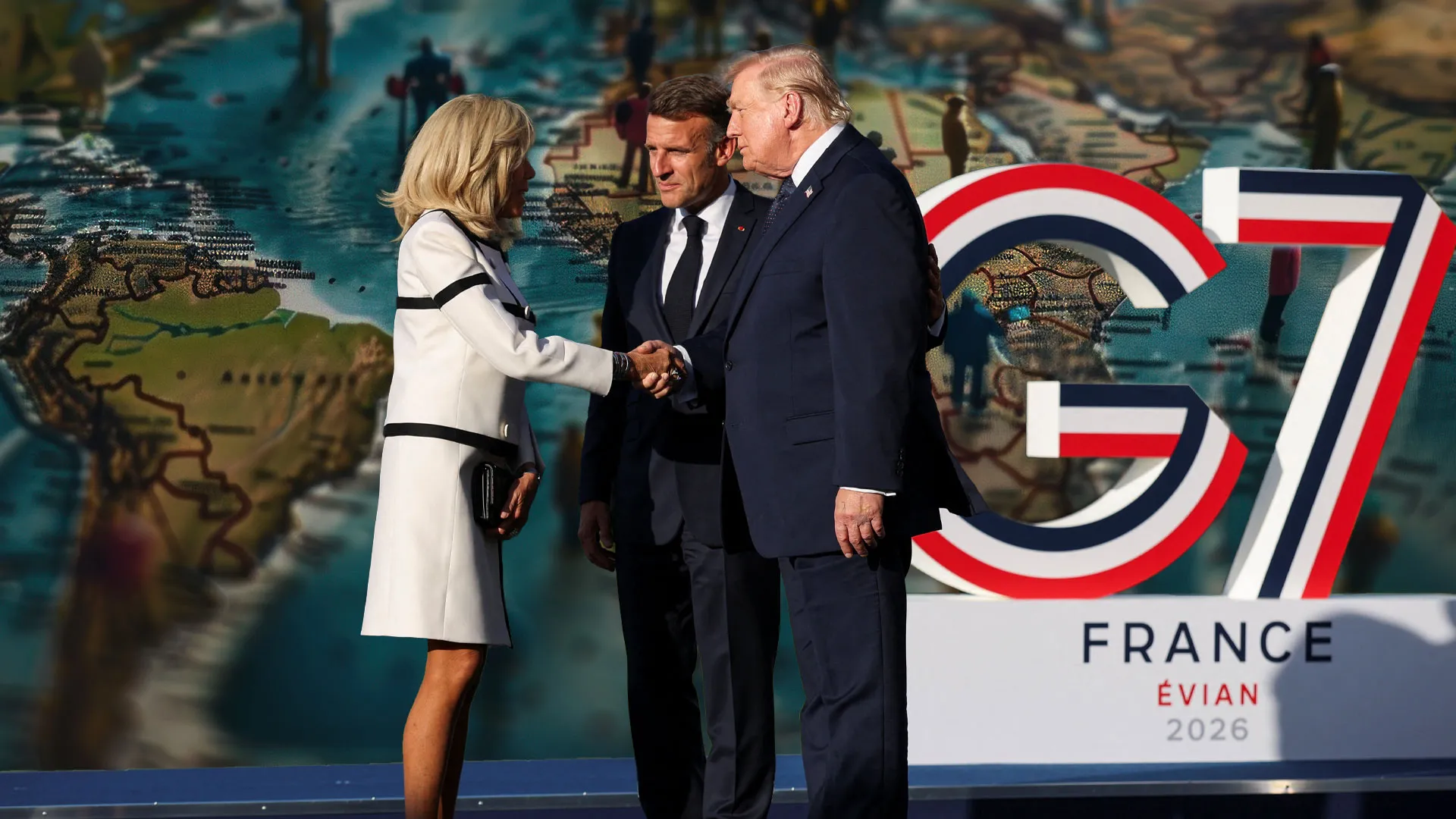
At the recent G7 summit, Ukrainian President Volodymyr Zelenskiy met U.S. President Donald Trump and other Western leaders to discuss the war and prospects for peace negotiations. Following those discussions, Trump expressed optimism that a peace deal could eventually be reached.
What Happened?
Senior Kremlin aide Yuri Ushakov said European leaders likely influenced Trump’s views on the Ukraine war during the G7 summit.
Ushakov suggested Trump had been given misleading information about developments on the battlefield and rejected claims that Ukraine’s recent drone operations had significantly improved Kyiv’s military position.
The Kremlin official also said Moscow still expects visits from Trump’s envoys, including Steve Witkoff and Jared Kushner, although no timetable has been announced.
Key Statements
Kremlin Position
European leaders are exerting an “unhelpful influence” on Trump regarding Ukraine.
Russia believes Trump may have received inaccurate assessments of the battlefield situation.
Moscow maintains that Ukraine’s military position has not improved as claimed by Kyiv and its allies.
Trump’s Position
Trump said after meeting Zelenskiy that Russia should make peace with Ukraine.
He described discussions at the G7 as constructive.
Trump has continued to signal interest in facilitating a negotiated settlement.
Why It Matters
The comments offer insight into how Moscow views Trump’s evolving position on the war and the role of European leaders in shaping Western policy.
Russia appears keen to preserve direct communication channels with Trump while simultaneously pushing back against narratives advanced by Ukraine and its European supporters. The remarks also suggest the Kremlin remains attentive to potential diplomatic openings involving the United States despite ongoing military operations.
The episode highlights the growing importance of diplomacy and messaging as all sides attempt to influence future peace discussions.
Stakeholders
Donald Trump
Volodymyr Zelenskiy
Vladimir Putin
Yuri Ushakov
European G7 leaders
U.S. diplomatic envoys Steve Witkoff and Jared Kushner
Russian and Ukrainian armed forces
What’s Next?
Potential visits by Trump’s envoys to Moscow for further discussions.
Continued efforts by Ukraine and European allies to secure stronger U.S. backing.
Russian attempts to influence Washington’s understanding of battlefield developments.
Further diplomatic contacts aimed at exploring conditions for a possible peace framework.
Monitoring whether Trump’s public optimism translates into concrete negotiations.
Analysis
The Kremlin’s comments reveal an important strategic calculation: Moscow wants to criticize European influence on Trump without alienating Trump himself.
By describing Trump as a strong leader who ultimately forms his own views, the Kremlin is attempting to preserve a working relationship with the U.S. president while casting doubt on information coming from Kyiv and European capitals. This messaging suggests Russia still sees value in engaging directly with Trump and may believe he could play a decisive role in future negotiations.
The remarks also reflect a broader battle over perceptions of the war. Ukraine and its allies have highlighted successful long range drone strikes and attacks on Russian infrastructure as evidence that Kyiv retains leverage. Russia, meanwhile, seeks to project confidence and reject suggestions that its strategic position has weakened.
Looking ahead, the key question is whether the apparent diplomatic momentum emerging from recent meetings can produce substantive negotiations. Both Moscow and Kyiv continue to believe they have leverage, making compromises difficult. As a result, public statements from leaders and advisers are increasingly becoming part of a larger effort to shape the diplomatic environment before any formal peace talks begin.
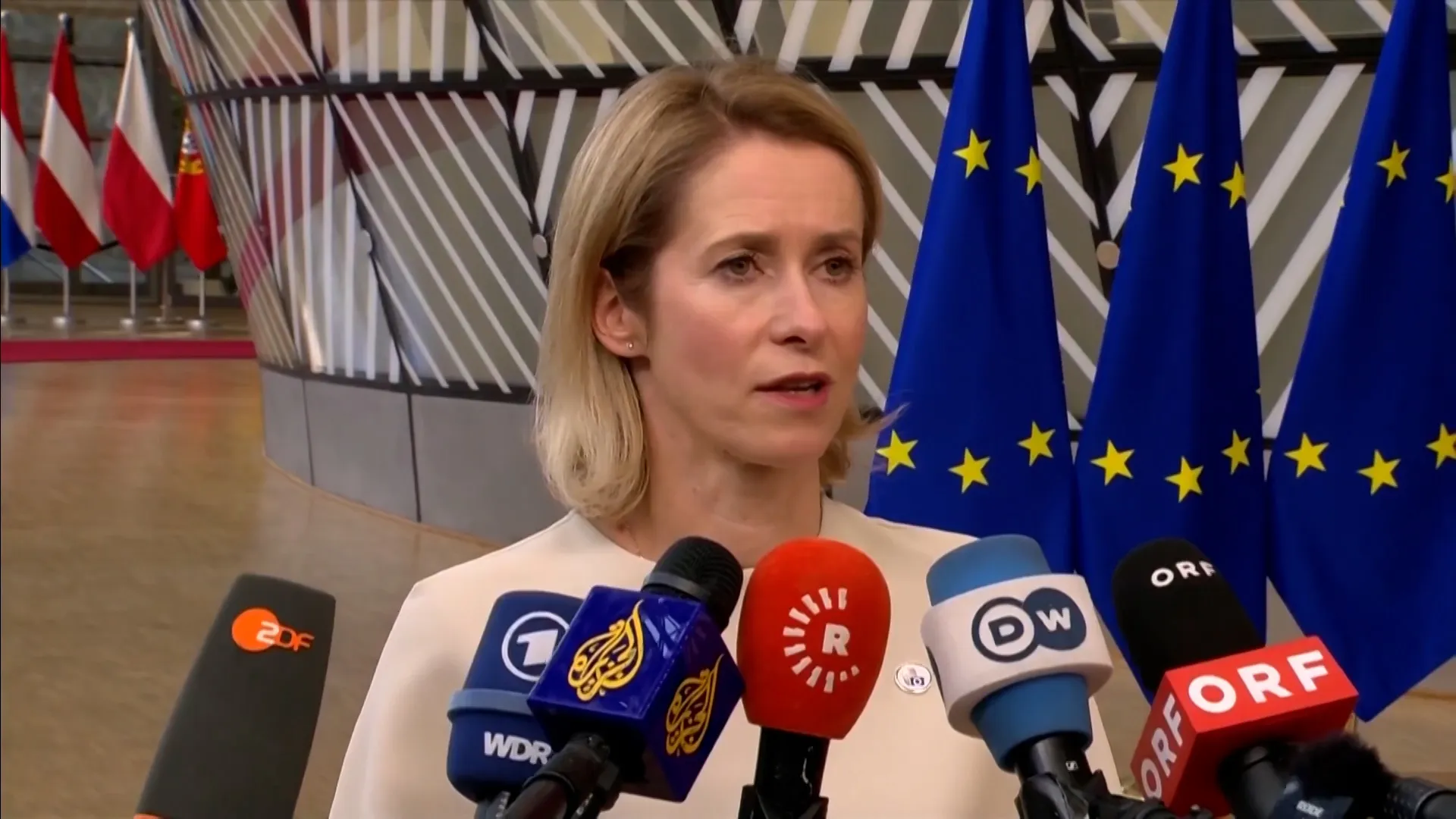
Al Jazeera’s Dominic Kane explains that the EU won’t lift crucial sanctions on Iran until a formal nuclear agreement is reached. The bloc’s foreign policy chief Kaja Kallas also clarified that human rights-related sanctions will continue regardless.
Weekly insights and analysis on the latest developments in military technology, strategy, and foreign policy.
In what is reportedly the biggest air raid on the Russian capital in two years, multiple Ukrainian drones and cruise missiles hit several locations across Moscow early today. With heavy bombardment occurring during daylight hours, residents of the city have captured and shared dozens of videos showing dramatic impacts and interception attempts. The attack may signal a new phase of Ukraine’s long-range air war against Russian interests.
Most remarkable, perhaps, are the scenes from a key oil refinery in the Kapotno area, in the southeast of Moscow. Videos from the attacks here show multiple fireballs and plumes of black smoke rising from the refinery, which is run by a subsidiary of the state-owned Gazprom. At one point, we can see the disc-shaped roof of one of the storage tanks being thrown into the air, before cartwheeling down. This incredible detonation appears to have been caused by an errant Russian missile, not a Ukrainian weapon.
New footage confirms that an errant Russian surface to air missile was responsible for the tank roof toss at the Moscow Oil Refinery this morning. pic.twitter.com/H5kdsuO2pY
❗️Epic moment of the oil tank lid being ripped off after a kamikaze drone strike on the 🇷🇺Moscow oil depot pic.twitter.com/ei8TEL1fIs
— 🪖MilitaryNewsUA🇺🇦 (@front_ukrainian) June 18, 2026
Footage of a Ukrainian attack drone hitting a storage tank at the Moscow Oil Refinery this morning, sending the tank lid perfectly soaring hundreds of feet. pic.twitter.com/2GIHEGk52M
The refinery appears to have been at least one of the primary targets of the raid, continuing Kyiv’s long-running campaign directed against Russian energy infrastructure. It is notable that at least some of the videos reveal efforts to protect the refinery in the form of anti-drone netting, which seems to have little to no effect against heavier weapons. More substantial cage-type protection for refineries is something we have seen come out of Ukraine’s offensive against Russian oil infrastructure earlier in the war and subsequently appeared during the conflict in the Middle East earlier this year, to help defend against Iranian drone attacks.
This footage shows the „birdcage“ nets Russians have placed around their refineries as protection, but due to weight of the drones, their warheads and, therefore, explosive yield their value is virtually zero. pic.twitter.com/FixIH9zmCK
This particular refinery is one of the most critical in Moscow, supplying up to 40 percent of the capital’s petrol and about 50 percent of its diesel fuel. The strike was the second in two days on the facility. The previous one was described by Ukrainian President Volodymyr Zelensky as “a just response to Russian strikes.” Reportedly, the strike on Tuesday had already halted operations at the refinery.
Last night, our long-range sanctions once again reached the Moscow region – for the second time this week, the Moscow oil refinery was hit. Targets were also struck in the Rostov region and in temporarily occupied territories of Ukraine. This is a fully justified response to… pic.twitter.com/NhFl4FlT9L
— Volodymyr Zelenskyy / Володимир Зеленський (@ZelenskyyUa) June 18, 2026
Russia’s Gazprom-owned Kapotnya Oil Refinery (Moscow Refinery), bellowing with smoke this morning after a wave of attacks from Ukrainian drones.
The widespread destruction of the refinery in Moscow but also the results of Russian air defense missiles have caused fires at multiple spots across the Kapotnya district of the Russian capital. Even wildfire units have been called in. pic.twitter.com/Cs2tIYIeMM
In the wake of today’s Ukrainian attacks, Zelensky framed this as a response to Russia’s striking of a historic Kyiv monastery earlier this week.
On Monday, five people were killed in Kyiv, and the Dormition Cathedral in the Pechersk Lavra monastery complex, a UNESCO World Heritage Site and one of Ukraine’s most significant religious and cultural sites, was badly damaged.
🔥 USF Struck the Moscow Oil Refinery for the Second Time
— 🇺🇦 Unmanned Systems Forces (@usf_army) June 18, 2026
The Russian media outlet RIA Novosti said the overnight attack on energy facilities in Moscow was the biggest in two years.
According to reports, the Ukrainian strikes caught many of the city’s residents off guard, leading to panicked messages on social media.
The Russian Ministry of Defense claims that its air defenses intercepted and destroyed 555 Ukrainian drones over multiple regions overnight. The number actually shot down could not be independently confirmed.
The mayor of Moscow, Sergei Sobyanin, said: “Air defense forces are continuing to repel a large-scale attack,” but admitted that several drones had reached the oil refinery and that the Sadovod shopping center, also in the south-eastern part of the city, was damaged. Sobyanin claimed that about 180 drones heading for the capital had been downed.
Elsewhere in the city, air traffic was disrupted at Vnukovo, Sheremetyevo, and Zhukovsky airports. Sheremetyevo seems to have been especially affected, with reports of evacuations and people seeking refuge in the parking area. Meanwhile, traffic was halted on Moscow’s ring road near the refinery, according to the interior ministry. A high-rise building in Zhukovsky district, not far from the refinery, also seems to have been struck.
Andrei Vorobyov, the governor of the Moscow region, said that a high-rise residential building, an industrial facility, and a number of private houses had been damaged in the wider area around the capital. One video shows an attack drone smashing into a construction crane on its way to its target. Vorobyov said that 16 people had been injured in the attack.
Moscow really needs to do something about all these cranes. They’re seriously interfering with Ukrainian drone traffic😡 pic.twitter.com/FffGLVLycO
— Special Kherson Cat 🐈🇺🇦 (@bayraktar_1love) June 18, 2026
Clearly, a significant number of drones and cruise missiles did manage to get through, or otherwise efforts to intercept them caused damage through falling debris, as seen in the video below, or stray air defense missiles.
Footage of a Ukrainian FP-1 drone being intercepted while flying towards Moscow Refinery. Despite the hit, it still left a considerable explosion when it went down. pic.twitter.com/VNjOaN8FQE
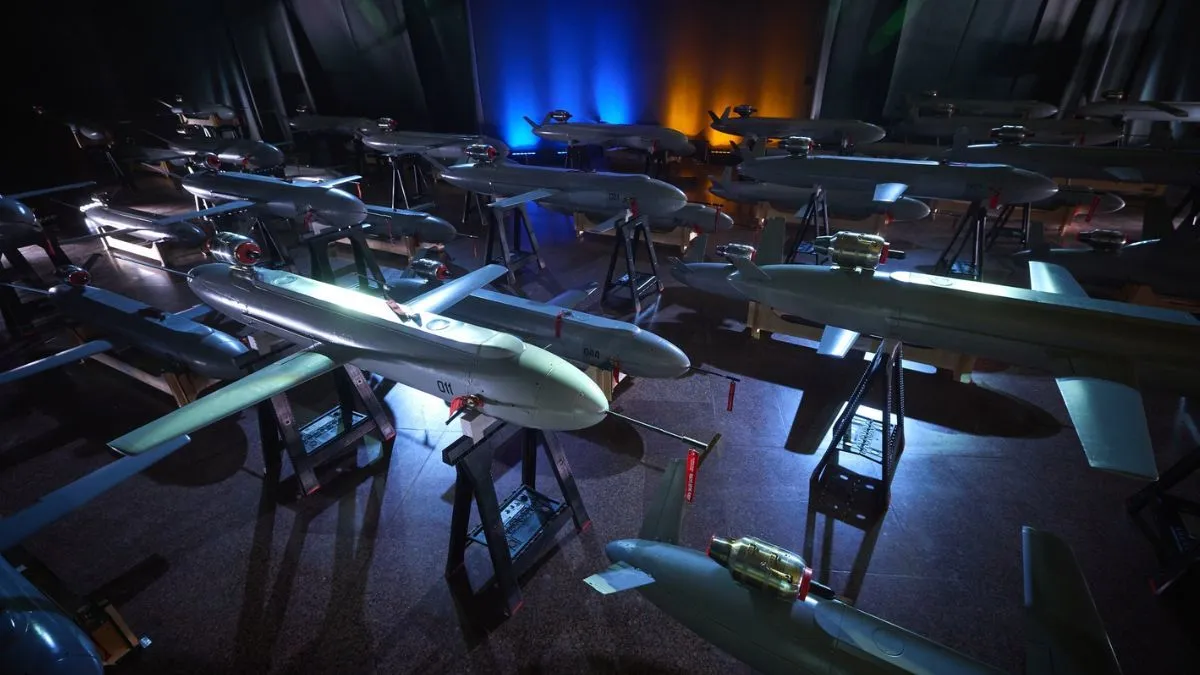
Among them appear to be examples of the Bars, part of a growing family of so-called “drone-missiles,” which combine the features of cruise missiles and uncrewed aerial vehicles (UAVs). Previously, these had been considered as medium-range strike systems, with a maximum range of around 500 miles. Their presence over Moscow would indicate that their range is greater, perhaps evidence that they have been further adapted or reworked.
Bars missiles. (Ukraine Government)
As far as Russian air defenses are concerned, videos from Moscow painted a desperate picture, including at least one likely missile interceptor from a Pantsir short-range air defense system streaking past a Ukrainian drone before making a sharp turn in the opposite direction. In the past, we have seen examples of the Pantsir installed on top of buildings in Moscow, and last month footage appeared showing the counter-drone-optimized SMD-E variant being lifted onto the top of a skyscraper by helicopter.
❗️Impressive footage of the double strike by 🇺🇦Ukrainian FP-1 kamikaze drones on the 🇷🇺Moscow Oil Refinery and a lazily flying Pantsir-S1 SAM missile in the background. pic.twitter.com/sqiDEaPMBS
— 🪖MilitaryNewsUA🇺🇦 (@front_ukrainian) June 18, 2026
Additional footage shows soldiers or security forces using rifle-caliber weapons and man-portable air defense systems (MANPADS) in an effort to bring down drones at very short range.
Fucking chaos.
Several dickheads with rifles and MANPADS trying to shoot down incoming Ukrainian sanctions.
— 𝔗𝔥𝔢 𝕯𝔢𝔞𝔡 𝕯𝔦𝔰𝔱𝔯𝔦𝔠𝔱△ 🇬🇪🇺🇦🇺🇲🇬🇷 (@TheDeadDistrict) June 18, 2026
One video apparently even shows an individual taking aim at a Ukrainian drone using a 9mm Makarov pistol.
For Russian President Vladimir Putin, the very public nature of the attacks on Moscow is especially embarrassing.
The Russian leader had previously warned of impending “systemic strikes” on Ukraine, but Kyiv’s continued ability to hit back at scale, and to target the Russian capital in particular, is now combined with the biting effects of fuel shortages across the country.
In an unusual move, Russia, which is the world’s third-biggest oil producer, is to import fuel by sea this month as it confronts shortages caused by relentless Ukrainian drone attacks on its refineries.
Andrey Gurulyov, a retired lieutenant general and deputy of the state duma (the lower house of the Russian Federal Assembly), called for Russia to “strike the enemy mercilessly” in response to the attack. “We need to strengthen our air defense system, but most importantly, we need to hit the enemy,” he told the RTVI news outlet. “Hit the enemy mercilessly, without overthinking it.”
Just before the latest Ukrainian air attack, President Zelensky said he had held “an important coordination call” with U.S. President Donald Trump and French President Emmanuel Macron that may “bring about significant change.”
Yesterday, Zelensky said he had won key pledges of further support from world leaders attending the G7 Summit in France. “These last few days were very important for Ukraine because it is the reunification of the G7 around Ukraine,” Macron told reporters as he and Trump left the Palace of Versailles near Paris.
In the meantime, with little progress being made by either side on the battlefield, the conflict has increasingly settled into tit-for-tat air assaults on key infrastructure and cities.
Kyiv was this week hit by a major barrage of ballistic missiles and drones, and these, together with the heavy attacks on the Russian capital in the last couple of days, signal a further escalation of the air war between Moscow and Kyiv. Beyond that, this latest barrage on Moscow signals what could be a new, far more aggressive phase of Ukrainian long-range strike operations targeting the economic heart of Russia and its seat of power.
All five goals were scored in the final 30 minutes as the match in Los Angeles erupted to life in closing stages.
Published On 18 Jun 202618 Jun 2026
Johan Manzambi scored a late brace after coming on in the 71st minute, following goals from Ruben Vargas and Granit Xhaka as Switzerland erupted late for a 4-1 victory over 10-man Bosnia and Herzegovina to top Group B at the World Cup.
The last three Swiss goals at the Los Angeles Stadium followed the 80th-minute dismissal of Bosnian defender Tarik Muharemovic, who was sent off for hauling down Breel Embolo to deny an obvious goalscoring opportunity, in a dramatic finish to the match on Thursday.
Recommended Stories
list of 4 itemsend of list
When it was all finished, Switzerland, with one win and a draw, were in command of the group despite an unexpected 1-1 draw against Qatar in their tournament opener.
Qatar and Canada play in Thursday’s later Group B clash in Vancouver, where the winner will draw level on points with the Swiss side that’s looking to progress to the knockout phase for a fourth consecutive World Cup.
Bosnian substitute Ermin Mahmic scored with a thunderous volley in second-half stoppage time for Bosnia and Herzegovina, who remain on one point.
Ermin Mahmic scored his team’s only goal against Switzerland [Harry How/Getty Images/AFP]
But the Balkan side will need to be more adventurous in their group finale against Qatar to have any chance of progressing after offering little against the Swiss.
All five goals they have conceded have come after the 70th minute, including the equaliser in their 1-1 tournament-opening draw against Canada.
Yet it looked for long stretches like Bosnia’s cagey approach would work until Switzerland coach Murat Yakin sent on Manzambi.
Shortly after his own introduction, Vargas got free on the left and curled in an outswinging cross towards the back post.
Amar Memic tried to head clear, but Manzambi instinctively met the second ball near the penalty spot and thumped a vicious side volley that had too much power for Bosnian goalkeeper Nikola Vasilj.
Any realistic hopes of a positive Bosnian result ended six minutes later when referee Joao Pinheiro had no choice but to produce a red card for Muharemovic’s late challenge from behind.
Four minutes later, Vargas found the bottom right corner after Embolo held the ball up near the spot and then played it to his open teammate to his left.
Vargas was the provider when Manzambi completed his brace in the 90th minute, and after Mahmic pulled a goal back, the veteran Xhaka converted from the penalty spot seven minutes into second-half stoppage time.
United States President Donald Trump has taken to social media to boast about the state of the economy amid a looming peace deal between the US and Iran, which yesterday signed a memorandum of understanding (MoU) to end the US-Israel war on Iran.
In a post on his social media platform Truth Social, the president claimed that “OIL IS FLOWING” and added that “THE STOCK MARKETS ARE ROARING, JOBS ARE AT RECORDS, AND PRICES ARE DROPPING (AFFORDABILITY!)”
Recommended Stories
list of 4 itemsend of list
While some of his claims are accurate, others are misleading. Al Jazeera takes a look:
‘Stock Market Just Hit A RECORD High’
That is true specifically for the Dow Jones Industrial Average. That index hit a record high of 51,999.67 for its close on Tuesday amid the potential of a ceasefire and a rally for the newly listed SpaceX.
The Dow slipped from that high on Wednesday amid the US Federal Reserve’s announcement that it would maintain the benchmark interest rate in the target range of 3.5-3.75 percent, and closed down on Wednesday at 51,494.99. The Dow has since jumped 0.35 percent in midday trading on Thursday at 51,671.
The Nasdaq Composite Index and S&P 500 both slipped.
However, this may not directly impact the 38 percent of Americans who do not invest in the stock market.
“The idea that the stock market is doing well does not reflect people’s experiences. There’s a saying that the stock market is not the economy, and that’s an important thing to keep in mind,” Michael Klein, professor of international economic affairs at The Fletcher School at Tufts University, told Al Jazeera.
And that lived experience is at the petrol station and at the grocery store.
‘Prices are dropping’
Petrol prices have started to tumble in the last few days. The average price of a gallon of petrol (3.78 litres) on Thursday is at $3.99, according to the American Automobile Association (AAA), which tracks daily gas prices. That’s down from a high of $4.48 in May, but still well above $2.98, where prices were on February 28 when the US and Israel first struck Iran.
Despite the deal, experts believe that a petrol price decline will plateau for general consumers as the US strategic petroleum reserve, which earlier this week reached its lowest level since 1983, is refilled, all while oil extraction and shipping bottlenecks weigh on supply chains.
“The persistence of the price spikes is the key issue. Transportation, rerouting, insurance premiums, and manufacturing costs don’t normalise overnight, so even when oil stabilises, the cost base across the supply chain will stay elevated,” Tammy Kulesa, director of product marketing for supply chain execution at Blue Yonder, a supply chain management firm, said in remarks provided to Al Jazeera.
Mark Jones, professor of political science at Rice University in Houston, Texas, says prices will not return to prewar levels until the last quarter or close of 2027.
“Even once everybody believes the truce is going to hold [and] there’s no danger going through the Strait of Hormuz, those tankers take months to reach their final destination and come back,” Jones told Al Jazeera. “So the ability to replenish the stocks is going to take until, I think, the early fall [third quarter].”
Consumer inflation, which has jumped at the fastest pace in three years and is at 4.2 percent, has driven prices up on several key goods and has weighed on consumers. While energy prices have risen by nearly eight percent in the last two months alone, prices at the supermarket have jumped by 0.1 percent in May from the month prior after a 0.7 percent increase in April, with the highest increases in goods like bakery products, cereals, nonalcoholic beverages, as well as fruit and vegetables.
“There are real problems facing a lot of people. Prices are high, and wages have not kept up with prices. So people’s real purchasing power has fallen,” Klein said.
Supermarket chains have taken notice. Kroger, the largest supermarket chain in the US, said on Thursday that it will cut prices on thousands of products within its roughly 3,000 stores nationwide. This comes amid increased pressure from Costco and Walmart for value shoppers.
“Customers are being more deliberate with their spending and at times, shopping us selectively. We’re getting too many promotional trips and not enough of the full basket,” Kroger CEO Greg Foran said in a statement.
‘Jobs are at records’
Jobs are not at record levels, despite Trump’s assertions.
The US economy added 172,000 jobs in May. The highest during the second Trump term was 214,000, in March. By comparison, on average, 300,000 jobs were added monthly under his predecessor, former US President Joe Biden, a Democrat, with some months much higher – including July 2021, when the economy added 943,000 jobs, albeit that was on the back of the COVID-19 pandemic as businesses rushed to hire after massive layoffs.
Under Trump, there have been several months of limited job growth that have been hyper-focused on specific sectors like healthcare. On average, employers added only 15,000 jobs a month in 2025. Meanwhile, the US economy lost 92,000 jobs this year in February.
Layoffs are also on the upswing. Job cuts jumped 16 percent between April and May, marking the most layoffs since May 2020 during the height of the pandemic, according to Challenger, Gray and Christmas, with artificial intelligence (AI) as a driving force behind the cuts. Slightly more than 97,000 people lost their jobs in May.
‘Oil is flowing’
Overnight, 12.5 million barrels of crude oil travelled through the Strait of Hormuz, through which roughly a fifth of the world’s oil is normally shipped, according to US Vice President JD Vance. However, data from Kpler shows that travel through the strait is still low, with six verified crossings on June 17.
With the strait starting to open, oil prices tumbled to their lowest levels since the early days of the war as the temporary deal to end fighting and pull back sanctions elevated pressure on global supply.
Brent crude futures LCOc1 dropped $0.78 or one percent to $76.51 in midday trading.
Shipments of liquefied natural gas (LNG) have also ramped up, and a QatarEnergy LNG vessel has returned to Ras Laffan, where it has loaded more than 209,000 cubic metres, according to Kplr.
For years, the Boko Haram and the Islamic State West Africa Province (ISWAP) terror groups have told Muslims in Nigeria and the Lake Chad Basin that the world outside their camps is not merely corrupt, but that living in it constitutes unbelief. They reinforce this stance through the misinterpretation of scripture, selective history, and the authority of armed men. They use terms such as tawheed (monotheism), hijrah (migration), bay‘ah (allegiance), jihad, daulah (sovereign state), Darul Islam (abode of Islam), Darul Kufr (abode of unbelief), and takfir (excommunication).
To the ordinary ear, it may sound like religion, but beneath the vocabulary is a hard political claim: only their authority can certify Islam. Through this doctrine, they decide who is allowed to live, who must die, who is Muslim, who is no longer Muslim, which land is pure, which land is condemned, which ruler is apostate, and why a farmer, teacher, cleric, trader, voter, soldier, journalist, or civil servant can become a target.
The Takfir
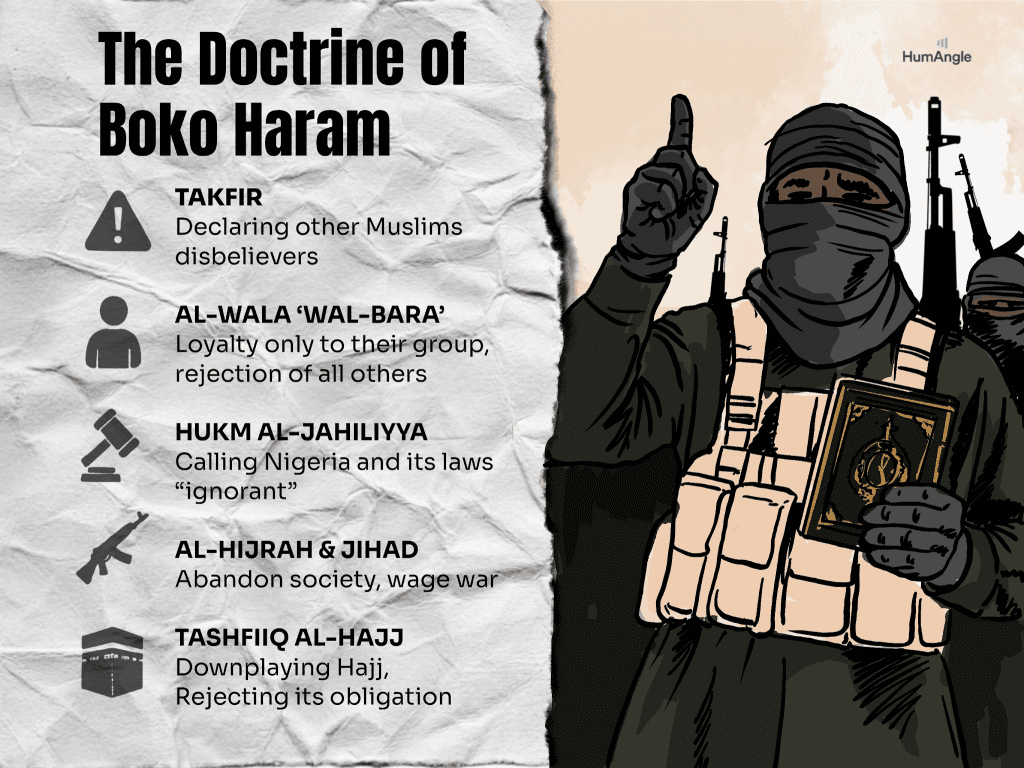
At the centre of this war is takfir, the act of declaring a professed Muslim to be an unbeliever. Mainstream Islamic scholarship treats takfir as a grave matter. It requires knowledge, evidence, context, intention, and due process. A Muslim does not leave Islam because he lives under a flawed state, or because he carries an identity card, works in a hospital, teaches in a school, votes in an election, or refuses to migrate to a forest camp – all of which the terror groups view as signs of belief in Western values.
Boko Haram, or Jama’atu Ahlis-Sunna Lidda’Awati Wal-Jihad, shortened as JAS, loyal to Abubakar Shekau, decreed that if you did these things, you were suspect. The most frightening part of Shekau’s doctrine was that he demanded others declare the same people unbelievers, too. If he declared a Muslim in Maiduguri an unbeliever because he lived under the Nigerian state, then ISWAP also had to declare that person an unbeliever. If ISWAP refused, Shekau’s logic turned against the group; they too became unbelievers because they failed to excommunicate those he had excommunicated.
This doctrine explains why JAS could kill villagers, denounce scholars, attack mosques, murder defectors, bomb displaced people, and fight ISWAP while still claiming to defend Islam. In Shekau’s universe, the circle of Islam narrowed until only his faction stood inside it. Everyone else stood outside the gate.
The doctrine of Boko Haram. Illustration: Akila Jibrin/HumAngle.
Colonial rupture and the question of authority
Abdulbasit Kassim, assistant professor of religion and classics at the University of Rochester, who specialises in the histories and cultures of Muslim societies in West Africa, places this doctrine inside a longer history. He argues that the question did not begin with JAS but reaches back into debates in Muslim West Africa over land, power, law, colonial rule, and the status of Muslims living under non-Islamic authority.
“Before colonial rule, much of what is now northern Nigeria, southern Niger, northern Cameroon, and western Chad belonged to a wider region known as Central Bilad al-Sudan. Muslim polities such as the Sokoto Caliphate and the Kanem-Borno Empire governed social, economic, political, and legal life through Islamic norms,” he said.
Colonialism disrupted that order. By conquering territory, the British introduced a hierarchy of laws in which Islamic law survived, but with a narrowed jurisdiction. Sharia courts continued in civil matters, especially marriage, inheritance, and family disputes. Criminal punishments under the Islamic canon became restricted, weakened, or rendered practically dormant.
“After 1999, when Zamfara State under Ahmad Sani Yerima revived the criminal aspect of Sharia, old tensions returned,” the professor added. “Some scholars and activists welcomed it as a restoration. Others argued that full Sharia could not operate inside a constitutional democracy where any law inconsistent with the 1999 Constitution could be struck down.”
JAS, evidently, did not emerge in a vacuum. Kassim said, “Mohammed Yusuf rejected Nigeria’s Sharia implementation because, to him, it remained trapped inside a secular constitutional order.” For him, it was not enough for a northern governor to introduce Sharia penal codes. The state itself had to be Islamic. Its sovereignty had to come from Islamic political precepts, not a constitution inherited from colonial rule. This is where the movement’s argument becomes more dangerous. It is not only saying that Nigeria fails to implement Sharia properly, but that the entire political foundation of Nigeria is illegitimate.
To Kassim, figures such as Ibrahim Zakzaky and Mohammed Yusuf shared one major point, even though their methods and movements differed. “They rejected the possibility of fully reconciling the Islamic juridical canon with Nigeria’s inherited secular constitutional order.”
This was the opening JAS exploited.
Screenshot of a 25-page book cover by Abubakar Shekau, where he explains his own interpretation of Islam, his arguments against the people he declared as Taghut and the arguments against Western schools.
Nigeria as Darul Kufr
After JAS’s leaders convinced followers that the Nigerian state was illegitimate, the movement moved to the next step: migration. If Nigeria is Darul Kufr, the abode of unbelief, then Muslims had a duty to leave it, they said. If JAS’s territory was Darul Islam, the abode of Islam, then migration into its territory became a religious obligation. The group took an old legal category and weaponised it to control territory, Kassim argued.
This was not abstract in Borno, Yobe, Adamawa, Niger, Chad, and Cameroon. It meant families were pressured, threatened, abducted, or killed. Villages were told to submit. People who remained under government control became suspects; those who cooperated with the military became enemies; those who joined the Civilian Joint Task Force (CJTF) and their families became legitimate targets in the eyes of the insurgents; and traditional rulers, clerics, teachers, and government workers became exposed.
Shekau then stretched the doctrine further.
According to Kassim, “Shekau held that Muslims living under the Nigerian state were no longer Muslim if they refused to migrate into JAS-held territory. ISWAP contested this. It did not accept Shekau’s blanket takfir against all Muslims living in government territory. ISWAP argued that such Muslims became unbelievers only if they gave material support to the Nigerian state or its security forces in the war against the insurgents.”
This difference shaped the split between the factions. ISWAP still accepted the larger jihadist fiction that the Nigerian state was illegitimate and that true authority flowed from the Islamic State. It still treated soldiers, political rulers, security officials, and those directly supporting the state’s war effort as apostates. It still imposed taxes, punishments, surveillance, recruitment, and control over civilians. It still placed armed authority above the lived Islam of communities that had practised the faith for generations.
The difference between Shekau’s terror and ISWAP’s brutal governance is the difference between reckless excommunication and structured coercion. One faction burned the village and shouted scripture. The other taxed the village, citing the doctrine. Both denied ordinary citizens the right to live safely and peacefully.
The internal civil war
Kassim captured this danger years ago in his 2018 study, JAS’s Internal Civil War: Stealth Takfir and Jihad as Recipes for Schism. He wrote that the internal war between JAS factions could only be understood through “a close reading of the constant stream of primary sources produced by the two factions”.
Kassim wrote a sentence that still sits heavily over this conflict: “Those who kill know why they kill, but the majority of those about to be killed will hardly understand why they are being targeted.”
Get our in-depth, creative coverage of conflict and development delivered to you every weekend.
Subscribe now to our newsletter!
That is the tragedy of takfir in the Lake Chad war.
A farmer on his way to the field may not know the difference between JAS and ISWAP doctrine. A displaced woman in a camp may not know what Shekau wrote about Darul Kufr. A trader at a market may not have heard of Abu Malik al-Tamimi, Anas al-Nashwan, or the arguments ISWAP sent to Islamic State scholars. A village imam may know the Qur’an, but not the way and manner in which insurgents interpret it. Yet their lives can be judged based on those interpretations.
Shekau saw ISWAP’s caution as a compromise and that is where the blood began to flow inward. Kassim explains that Shekau’s rigidity helped push internal revolt. Ansaru had earlier objected to JAS’s killing of Muslims and the violation of what its leaders considered the ethics of jihad. Later, Abu Musab al-Barnawi and Mamman Nur moved against Shekau from within the Islamic State framework. They accused him of extremism, arbitrary killing, and corruption of the cause.
What Boko Haram and ISWAP condemn. Illustration: Akila Jibrin/HumAngle.
Civilian life as suspicion
Kassim’s 2018 chapter recorded that Shekau viewed people living beyond JAS’s controlled territory as infidels and therefore legitimate targets within Darul Harb (abode of war). He also noted that Shekau’s position was harsher towards those who fled from JAS territory to areas controlled by the Nigerian state. In that logic, their camps, mosques, markets, and places of refuge could be attacked until they repented and returned.
ISWAP challenged part of this logic. Abu Musab al-Barnawi argued that Muslims who had always lived outside JAS territory could not be declared unbelievers merely for that reason. In his view, they crossed the line when they gave active or passive support to the Nigerian Army, the Civilian JTF, or other forces fighting the insurgents.
Abu Musab died in Kaduna, northwestern Nigeria, an area that both JAS and ISWAP consider Darul Kufr. This may partly explain ISWAP’s relative fluidity on the issue, compared with JAS.
HumAngle spoke to a former JAS shura member who later joined ISWAP. He subsequently completed the Nigerian government’s deradicalisation programme and now lives freely in Maiduguri. He says the Shekau faction does not recognise the Islam of Nigerians, Saudis, or anyone outside its creed. “To them, whoever is not with them is an unbeliever. Saudi Arabia is no different from a non-Muslim society in their imagination. It is simply another land of unbelief.”
He said ISWAP classifies Muslims living in Nigeria, Cameroon, Chad, Niger, and other states into categories. Those who can migrate but refuse to do so are sinners, not necessarily unbelievers. Their offence is treated as a major sin. The weak, the elderly, women, children, and those without means may be excused. Those who remain outside insurgent territory while openly challenging secular rule and calling people to Islamic governance may even be rewarded. In his telling, Mohammed Yusuf’s preaching before 2009 fits this category.
But those who join the democratic system, legislate, govern, enforce state authority, or fight under the security forces enter a more dangerous category. Politicians and legislators become tawaghit (false gods). Security officials become direct enemies. Soldiers, police officers, Civilian JTF members, and others who bear arms against the insurgents are treated as apostates whose blood is lawful to be spilt.
Doctors and teachers sit lower in ISWAP’s hierarchy of offence. They are not treated the same way as soldiers or politicians, but they still operate inside a system the group condemns.
This is the cold bureaucracy of ISWAP’s worldview. It sorts society by perceived allegiance, measuring sin by proximity to the state. The former Shura member called JAS a Khawarij-type movement because of its sweeping excommunication of Muslims. He said Shekau and his followers misused verses on oppression, migration, and disbelief. They took verses that classical exegetes treated with care and turned them into proof that any Muslim living in Darul Kufr had committed major shirk.
The key verse in their argument comes from Surah An-Nisa, where angels question those who wronged themselves and failed to migrate when Allah’s earth was spacious. ISWAP reads this as a grave warning against remaining in a land where Islam cannot be practised fully. Still, it leaves room for categories such as weakness, inability, and sin below disbelief.
The former shura member says Shekau’s faction then links this to another Qur’anic discussion of zulm (oppression), or wrongdoing, in which classical explanations connect the greatest zulm to shirk (polytheism). From there, JAS concludes that staying in Darul Kufr is not merely a sin but a state of unbelief. That leap is where the danger sits.
The former Shura member said JAS uses this belief to seize wealth, abduct people, kill travellers, attack farmers, and justify arbitrary violence.
Why Hajj became secondary to war
ISWAP and the wider Islamic State network, the former shura member explains, take a more layered position on Hajj (pilgrimage to Mecca), which is generally regarded by Muslims as one of the five pillars of faith. “They still recognise Hajj as an obligation for Muslims who have the means. But they argue that tawheed has been corrupted worldwide and that restoring it through jihad takes priority. In practice, a wealthy fighter should not spend money on Hajj. He should donate it for weapons.”
Islam makes Hajj one of its five pillars. ISIS and ISWAP do not always deny that in theory, but they demote it in practice. They turn the battlefield into a higher obligation that suspends pilgrimage, family obligations, learning, work, charity, and ordinary religious life.
The anonymous source says senior Islamic State scholars issued rulings that no mujahid should spend his money on Hajj when he can spend it on arms.
They take a religion structured around testimony, prayer, fasting, zakat, and pilgrimage, then reorder it around obedience to commanders and permanent war. The recruit is told that the world is corrupt, his parents are ignorant, his old imam is compromised, his country is unbelieving, his passport is a symbol of loyalty to kufr, and his only safe identity is inside the jama‘ah (the jihadists’ community). By the time he is asked to kill, the moral world that could have restrained him has already been dismantled.
Illustration: Akila Jibrin/HumAngle
Saudi Arabia and the battle for religious legitimacy
For Muslims around the world, Saudi Arabia holds Mecca and Medina, the two holiest sanctuaries in Islam. Millions perform Hajj under Saudi administration, yet jihadist ideologues have long denounced the Saudi state as apostate, accusing its rulers of alliance with Western powers, partial application of Sharia, participation in the United Nations system, and military cooperation with the United States and others.
Kassim points to Abu Muhammad al-Maqdisi, the Jordanian jihadist ideologue, whose writings attacked the legitimacy of the Saudi state. The argument is familiar in jihadist circles: Saudi rulers claim Sharia, but rule partly through artificial laws; they belong to the international state system; they support Western military campaigns; they host or cooperate with foreign military power; they have betrayed Muslims.
This is why jihadists can condemn Saudi rulers while still struggling over the status of Hajj. Some declare the rulers apostate but still accept that Muslims may perform Hajj because the holy places remain sacred. Others move closer to rejecting Hajj under Saudi authority or treating it as inferior to jihad.
The anonymous source says ISWAP and Islamic State circles call the Saudi royal and scholarly establishment “Ahl Salul”, a contemptuous distortion linking them to hypocrisy. They do not call them “A’l Saud” or “A’l Sheikh” with respect. They dismiss many Saudi scholars as apostates or compromised because they did not confront the Saudi state.
Who gets to define religion? The scholars of centuries? The community? The custodians of the holy cities? The legal schools? The state? The armed commander in the bush? JAS and ISWAP argue that authority belongs to the armed vanguard. That is why they reject Nigeria’s Sharia states, Saudi Arabia, Qatar, UAE, Afghanistan, Mali, Niger, Chad, and other Muslim-majority or Muslim-populated states.
The third generation of war
Kassim warned in the interview that the conflict is entering a third generation, which JAS described in one of its propaganda videos as “Jiyalit-Tamkin” (reinforcement generation). Many fighters were born into war and therefore did not sit through the early debates or learn the tradition deeply. They inherited fear, slogans, weapons, commanders, and survival inside an insurgent economy.
The first generation, including Mohammed Yusuf, Shekau, Mamman Nur, and others, had some level of Islamic training. One may reject their interpretations, but they tried to ground their actions in texts. Shekau himself wrote books and cited Usman Dan Fodio, even if, as Kassim notes, the citations were often erroneous and shallow.
The current generation is different. For many of them, jihad is the only economy they know, and now functions as the road to food, wives, money, status, revenge, protection, and belonging.
The former shura member says this is visible among the Shekau loyalists who remain under Bakura’s orbit. He says they suffer from a dearth of scholars and describes figures around the faction as lacking deep knowledge, with some retained by kinship, money, fear, or coercion rather than conviction. This is one of the most important revelations.
“The war is no longer driven only by men who believe they are restoring an Islamic order. It is also driven by men trapped inside a violent economy that needs theology to keep feeding itself,” the former shura member said. War has become a livelihood.
Ending the conflict requires more than defeating JAS’s ideology. Many actors are bound to the war by power, profit, survival, and identity, making violence harder to end than extremist beliefs.
Why the war endures
The state did not create JAS’s theology, but it gave the movement that emerged in northeastern Nigeria some of its most powerful stories. The killing of Mohammed Yusuf in 2009, mass arrests, military abuses, corruption, abandoned communities, failed justice, and the humiliation of civilians all became material for insurgent propaganda.
Across the Sahel, the same pattern repeats. Jihadist groups exploit weak courts, abusive soldiers, predatory officials, unresolved local disputes, ethnic suspicion, rural abandonment, and poverty. This is why Nigeria cannot bomb its way out of the conflict.
The anonymous former shura member rejected claims linking recent schoolchildren kidnappings in Oyo State to either ISWAP or JAS. According to him, the perpetrators are unlikely to belong to either group. Instead, they may be newly emerging terrorist cells, former Lake Chad insurgents, or criminal networks that have adopted the rhetoric, tactics, and imagery associated with the Lake Chad insurgency.
Nigeria now faces more than one threat. There are jihadist factions with doctrine, command structure, and transnational links. There are armed gangs with local motives. Some kidnappers borrow religious language. Some opportunists understand that the word Sharia can create fear, attract attention, or confuse investigators.
Bad analysis merges them all while good analysis separates doctrine, network, command, territory, language, and motive.
The need for precision
Experts say mainstream Islamic scholars must speak with more precision and courage. They must confront takfir clearly and explain why residence under a secular state does not erase religion. They must explain why bad governance does not give an insurgent the right to cancel the faith of millions, why Hajj cannot be demoted by men who need money for weapons, and why Sharia without mercy, restraint, due process, and qualified authority becomes rule by fear.
It is not enough to say JAS has nothing to do with Islam. That may comfort outsiders, but it does not answer the recruit who has heard verses, hadith, juristic language, and historical references.
Kassim admits he does not see a clear solution. The idea of restoring an Islamic state will remain as long as many Muslims see the Nigerian system as chaotic, unjust, corrupt, and unable to serve its people. The dysfunction of democracy strengthens the insurgents’ claim.
The insurgents do not need Nigeria to fail. They only need it to be failed enough for a young man to feel humiliated and for a farmer to distrust soldiers. It was enough for a displaced family to feel forgotten. Every abuse becomes a sermon for them.
Submission as the ultimate test
The fight against JAS and ISWAP is often framed as a fight to win back territory in Sambisa, Alagarno, Mandara, Marte, Abadam, Lake Chad, or the borderlands. But it is also about authority: Who defines religion? Who protects life? Who dispenses justice and punishes wrongdoing? Who can call another person an unbeliever?
This explains why the majority of JAS’s victims have been Muslims. The war has devastated Muslim villages, clerics, farmers, traders, women, children, and displaced families.
JAS and ISWAP are defending their monopoly over religion. And inside that monopoly, Daniel the priest, Ibrahim the imam, the displaced mother, the market trader, the farmer, the journalist, and the child on the road can all meet the same fate.
China calls for stronger representation for emerging economies.
China’s foreign minister says that emerging economies remain underrepresented in global governance institutions.
Presenting China’s new white paper on making global governance more equitable, minister Wang Yi argued that the role of the United Nations should be strengthened and developing countries should have a stronger voice in the world body.
In Beijing’s stated view, all countries should have an equal voice in global affairs, which means the Global South should have more representation.
China’s call comes as the world is engulfed in many armed conflicts and facing serious economic challenges.
But is Beijing now presenting itself as a leader of the Global South? And will it be able to garner enough support to play that role?
Presenter: Sami Zeidan
Guests:
Steve Tsang – Director of the SOAS China Institute
Cobus van Staden – Head of research at the China-Global South Project
Allen Carlson – Associate professor in the Government Department at Cornell University
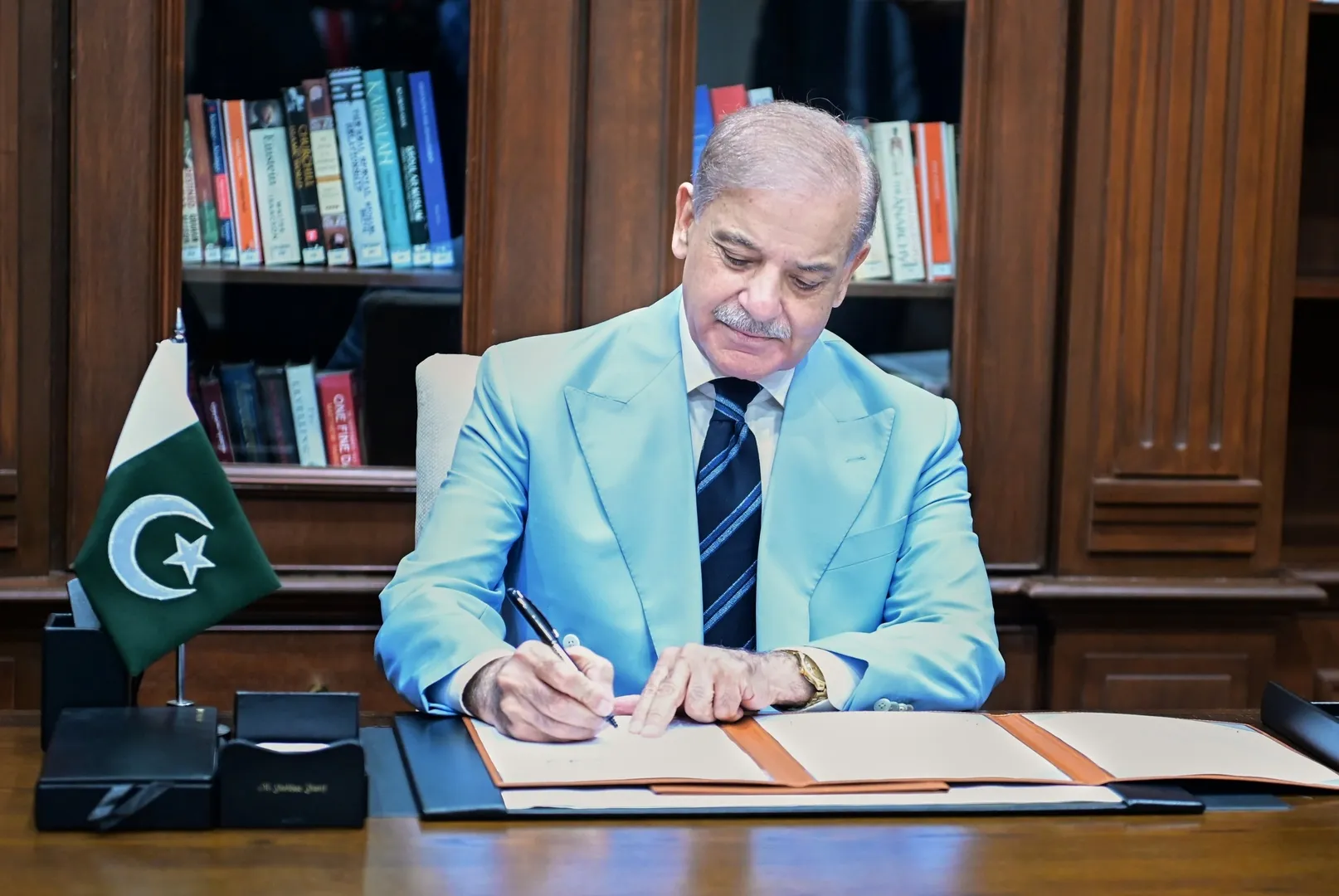
Pakistan’s Prime Minister Shehbaz Sharif has signed a US-Iran memorandum of understanding aimed at ending the war between the two countries. US President Donald Trump and Iran’s President Masoud Pezeshkian signed on Wednesday.
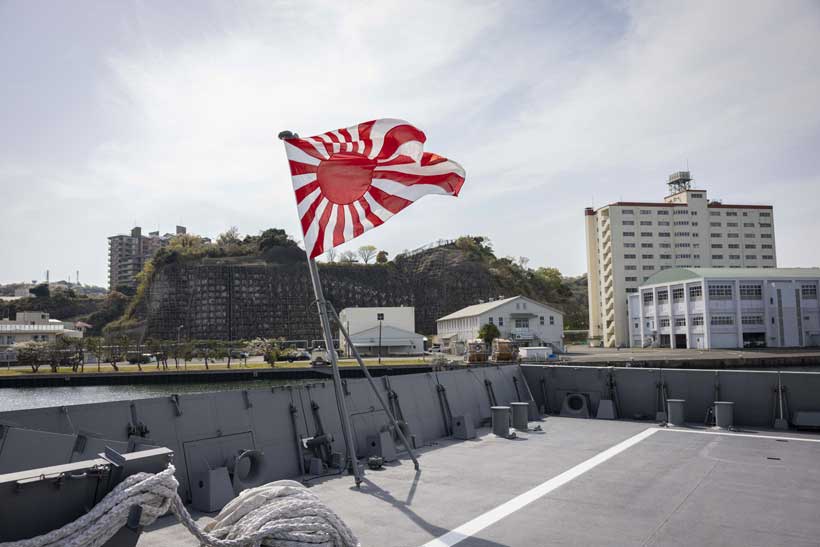
China officially objected through its Foreign Ministry to the Japanese draft resolution to increase armaments and abandon Japan’s post-World War II commitment not to rearm its military, as approved by the Liberal Democratic Party of Japan during its general council meeting. The draft resolution proposed amending three key security documents, which are the National Security Strategy, the National Defense Strategy, and the Medium-Range Defense Forces Enhancement Plan. It was to be submitted to the Japanese government and parliament for further discussion. Chinese authorities officially rejected and objected to the draft, deeming it a threat to their national security and their spheres of direct influence in Taiwan, the South China Sea, and the Indo-Pacific region. They considered it a radical escalation of Japan’s security strategy, detrimental to Chinese national security and to the global security initiative proposed by Chinese President Xi Jinping.
Here, the revision of Japan’s three security documents, represented in the National Security Strategy, National Defense Strategy, and Defense Force Enhancement Plan, represents a strategic shift away from its post-war pacifist constitution toward more proactive and independent military policies. The nature of this shift is evident in Tokyo’s easing of restrictions on lethal weapons exports and its reorientation of its armament toward counter-offensive capabilities and missile development. Under Prime Minister Sanae Takaichi’s administration, the Liberal Democratic Party of Japan has adopted a proactive approach, reshaping Japanese industries and institutions to address the greatest strategic challenge posed by China. The updated National Security Strategy has already fundamentally altered the country’s pacifist military doctrine by disarming the Japanese military and preventing its rearmament since World War II, a move that has drawn staunch opposition from China, which seeks to protect its own national security. The most significant amendments to the three Japanese security documents included Japan’s acknowledgment of its ability to double and enhance its counter-strike capabilities. This was achieved by allowing Japan to possess long-range missiles capable of striking enemy targets before launch. Simultaneously, Japanese authorities approved doubling defense spending, raising the military budget to 2% of GDP.
China objected to the Japanese draft resolution, which aimed to increase Japanese armament and militarize the region and global supply chains, and threatened to escalate the situation. Beijing strongly condemned these trends, describing them as new militarism. A key point of contention for China was what Chinese intelligence and military circles perceived as a warning of Japanese and foreign interference in Taiwanese affairs, as China considers Taiwan an integral part of its territory. Beijing condemned the Japanese leadership’s statement that any emergency in Taiwan is an emergency for Japan, describing a potential Chinese military intervention in Taiwan as an act of aggression. Here, Beijing rejects Japan’s new military approach, characterized by advanced military deployment. China has officially protested and taken countermeasures against Japan’s plans to deploy defensive missiles on Yonaguni Island, located only about 110 kilometers from Taiwan. China has strongly accused Japan of violating its commitments, arguing that this new Japanese military expansion violates Tokyo’s international obligations and its pacifist constitution. China has warned Japan that it will pay a heavy price if it intervenes militarily in the Taiwan Strait.
Chinese intelligence, military, security, and defense circles link Japan’s armament activities in Taiwan to American interference in Chinese affairs through its network of allies in the Asian region, such as Japan, given its close alliance with Washington. Here, Japan defends its military rearmament against China, with several of its officials sending political and security warnings to China. They argue that, given the uncertainty in Japan stemming from US policies and the fluctuating stance in Washington, Japan seeks to bolster its own capabilities and build regional alliances (with the Philippines, Australia, and NATO) to expand deterrence against Beijing and maintain regional security from a Japanese perspective. Strategic circles in Tokyo view the potential fall of Taiwan to China as a direct and existential threat to Japanese national security and vital shipping lanes, making the protection of the Taiwan Strait a fundamental component of Japan’s updated defense doctrine.
For these reasons, China’s decisive response was seen as a challenge to its national security, especially given Japan’s de facto official classification of Beijing as the greatest and most unprecedented strategic challenge to its security. This classification was further reinforced by Japanese authorities’ approval of developing military production, strengthening domestic defense industries, and easing restrictions on arms exports. This is where the dimensions of China’s official rejection and objection lie, as it is considered a violation of the pacifist principle enshrined in the Japanese military doctrine, which was internationally and regionally agreed upon after World War II for Japan’s disarmament. Beijing believes that Tokyo is abandoning its pacifist constitution and returning to a militaristic path, while Japan exaggerates the narrative of a China threat. Beijing accuses Japan of fabricating flimsy pretexts to justify its military expansion and arsenal, which threatens China’s regional security. Therefore, China warned that these Japanese steps to increase armament undermine peace and stability in the Asia-Pacific region and jeopardize the principles of China’s global security initiative. China also registered its objection to Japan’s exclusionary approaches to its initiative based on shared and sustainable security. Furthermore, China linked this Japanese escalation in its confrontation with China in the region to the sensitive issue of Taiwan and the close alliance between the United States and Japan, while categorically rejecting Japanese interference in Taiwan’s affairs and considering the island’s security an integral part of China’s national security.
The Democratic Socialist has vowed aggressive response to Trump, who has said he could ‘take back’ DC if she wins.
Washington, DC – Janeese Lewis George, a Democratic Socialist who has promised an aggressive approach to United States President Donald Trump, is on track to become the next mayor of Washington, DC.
Lewis George already had a commanding lead after Tuesday’s Democratic primary. Her top competitor, Kenyan McDuffie, conceded on Thursday, all but assuring her victory.
Recommended Stories
list of 3 itemsend of list
Washington, DC, trends heavily Democratic, with the primary winner likely to win the general election in November. There is no Republican challenger for the post, although independent and third-party candidates can mount challenges.
Lewis George, a council member and former prosecutor, had garnered labour groups’ support as she vowed to set clear boundaries with the Trump administration, including ending cooperation between local police and Immigration and Customs Enforcement agents. Her victory would make her the first member of the Democratic Socialists of America, to which NYC Mayor Zohran Mamdani and Congressmember Alexandria Ocasio-Cortez also belong, to lead Washington, DC.
Her competitor, McDuffie, a former councilmember, had gained support among DC’s business community and pitched himself as a moderate. His style hewed close to that of current Mayor Muriel Bowser, who has walked a careful line between criticism and cooperation with Trump.
For his part, the US president has made his preference clear, floating that he might “take back Washington and run it on the federal basis” if Lewis George became mayor.
Washington, DC, is a federal district, giving the White House and Congress outsized influence. However, under a 1973 law, the district has so-called “home-rule”, allowing residents to elect the mayor, council members and neighbourhood commissioners to run daily affairs.
Advocates have long called for the district, with a population of more than 700,000, to become a state. Both Lewis George and McDuffie support DC statehood.
Since taking office in January of last year, Trump has repeatedly threatened to assert more control over the district.
He briefly federalised the city’s police department in August of last year, claiming a crime emergency, surged federal immigration enforcement in the district, and deployed the National Guard as part of a “beautification” project.
Responding to Trump’s threats ahead of Tuesday’s vote, Lewis George said a strong response was needed.
“We are not going to get ICE off our streets or protect Home Rule by fearing this President,” she said.
“Threatening DC because you do not like how our residents vote is an attack on democracy itself. The people of DC elect the Mayor of DC. And they want someone who will stand up to Trump,” she said.
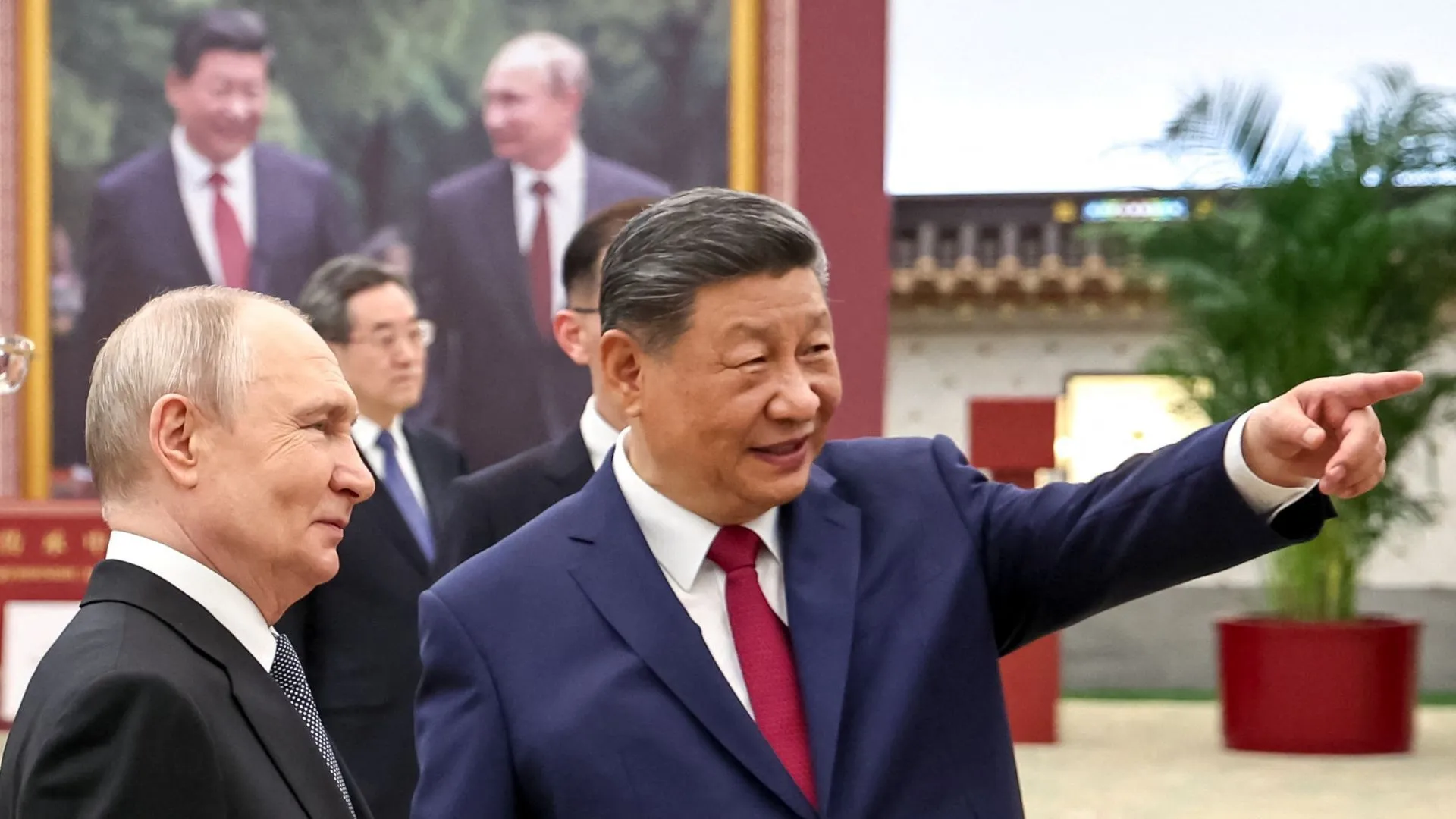
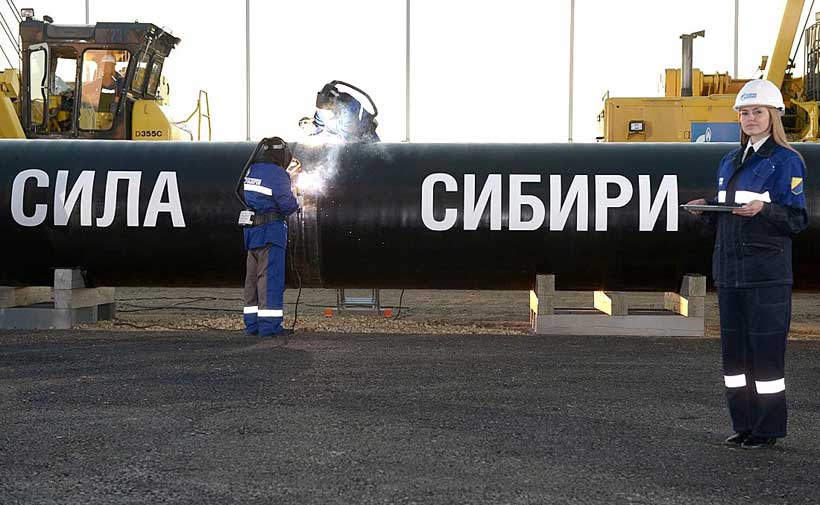
Russian President Vladimir Putin’s recent state visit to China, which was his first foreign trip of 2026, is a clear indication of the shifting dynamics of the bilateral relationship. Accompanied by an unprecedented delegation of 39 high-ranking officials, including five deputy prime ministers, eight ministers, the central bank governor, and energy executives, the scale resembled a partial cabinet relocation. This massive mobilization reflects Moscow’s urgency to secure an agreement on the Power of Siberia 2 natural gas pipeline, a strategic super-project stalled in commercial negotiations since 2012. Planned to span over 2,600 kilometers with an annual capacity of 50 billion cubic meters, the pipeline would traverse Mongolia to link Russian fields with Chinese markets. For Russia, finalizing this energy artery is an economic imperative to replace the European market, where Western sanctions aim to eliminate Russian pipeline gas imports by the end of 2027.
Evaluating the geopolitics of this energy relationship requires analyzing five distinct strategic dimensions.
First, Beijing has strong incentives to resist quick concessions. The negotiation deadlock is largely on pricing. Russia reportedly seeks approximately US$ 265 per thousand cubic meters to cover the high extraction and infrastructure costs of its Yamal fields in Western Siberia, whereas China targets roughly US$ 120. Unlike Russia, China commands significant leverage, boasting robust domestic pipeline networks, stable Central Asian infrastructure, and diverse liquefied natural gas imports. Given Russia’s acute financial pressure and diminishing options due to sanctions after the war in Ukraine, Beijing has the luxury of strategic patience, allowing it to wait for terms that align with market principles rather than rushing a deal under political pressure.
Second, the pipeline is less about energy revenue for Moscow and more about maintaining global geopolitical relevance. In the current international order, Russia finds itself sidelined from primary great-power management. Consequently, Putin seeks to leverage the Ukraine conflict to engage Washington while simultaneously trying to bind Russia’s economic future to China, much like it previously did with Europe. This anxiety within the China-United States-Russia triangular relationship was highlighted by the timing of the visit, which occurred just days after the U.S. President Donald Trump departed Beijing. As the war enters its fifth year and energy weaponization loses its potency in the West, shifting exports eastward has transformed from a strategic choice into a necessity for regime survival. By proposing a 30-year, multibillion-dollar pipeline network, Moscow hopes to anchor itself to the world’s largest energy consumer, ensuring it remains an indispensable player rather than a marginalized resource base.
Third, the proposed pipeline route serves as a geopolitical lever within the post-Soviet space. Passing through Mongolia, the route allows Russia to entrench its influence over Ulaanbaatar, which has recently deepened its engagement with the United States and NATO, while monitoring China’s northern energy ingress. This alignment requires Beijing to pay substantial transit fees and leaves its energy security vulnerable to the political stability of a third country. For Moscow, the project simultaneously secures the Chinese market and reinforces its traditional sphere of influence across Central Asia and Mongolia, using infrastructure to manage the economic and diplomatic trajectories of neighboring states.
Fourth, the protracted timeline works in Beijing’s favor. The longer negotiations stall, the more China’s bargaining position strengthens against an increasingly isolated Russia. While Moscow faces a liquidity crisis within its National Wealth Fund and the fiscal drain of a prolonged war, China’s energy diversification has progressed rapidly. Construction on Line D of the Central Asia-China gas pipeline is advancing alongside commitments from Turkmenistan, while maritime LNG capacity expanded by over 10 million tons recently with imports from Qatar, Australia, and the United States. Furthermore, China’s domestic shale gas production and global leadership in renewable energy insulation provide a structural ceiling on long-term natural gas demand. Middle Eastern instability in the Strait of Hormuz elevates the short-term value of overland corridors, but it ultimately reinforces Beijing’s commitment to resilience rather than a singular dependence on Moscow.
Fifth, China’s optimal energy architecture centers on the Southern Corridor, specifically what can be called the “Turkmenistan-Uzbekistan-Tajikistan (TUT) Corridor” framework. This network offers a direct alternative that circumvents Russian territory, extending through Xinjiang and across the Caspian Sea toward Azerbaijan and Europe. Lines A, B, and C of the Central Asia-China pipeline are already operational, and the completion of Line D will raise total capacity to 65 billion cubic meters annually. This infrastructure is backed by deepening diplomatic ties. Beijing and Dushanbe codified their strategic partnership via a friendship treaty, and China’s trade volume with the five Central Asian republics surpassed US$ 100 billion, cementing its status as their primary trading partner. A fully integrated Central Asian energy network directly erodes Russia’s traditional influence in its southern flank, creating a new economic center of gravity.
Ultimately, while Putin’s high-profile delegation sought to secure a vital economic lifeline, the unresolved pipeline agreement exposes the cold calculation of national interests underlying the partnership. For Beijing, maintaining a deliberate pace maximizes its buyers’ advantage and allows alternative supply chains to mature. The true key to Eurasian energy security lies not in a single northern pipeline, but in a diversified, networked western corridor that mitigates risk and ensures supply chain autonomy, a structural reality that will shape the continent’s geopolitical architecture for decades.
Interest in expanding the role of the JDAM-ER as a bunker buster is tucked away in a section of the Pentagon’s proposed 2027 Fiscal Year budget covering requested funds for the Defense Threat Reduction Agency (DTRA). DTRA is a multi-faceted organization focused on responding to Weapons of Mass Destruction (WMD) threats. Since deeply buried and otherwise hardened facilities are often tied to WMD programs, a key area of the agency’s work is helping devise new and improved ways to hold those targets at risk. A prime example of this is the key role DTRA played in the development of the 30,000-pound-class GBU-57/B Massive Ordnance Penetrator (MOP) bunker buster bomb.
Now, DTRA wants to “evaluate current hard target defeat capabilities with 2000lb Joint Direct Attack Munition Extended Range (GBU-64 JDAM-ER) and provide recommendations on future JDAM-ER development to enhance HDBT penetration capabilities,” according to Pentagon budget documents.
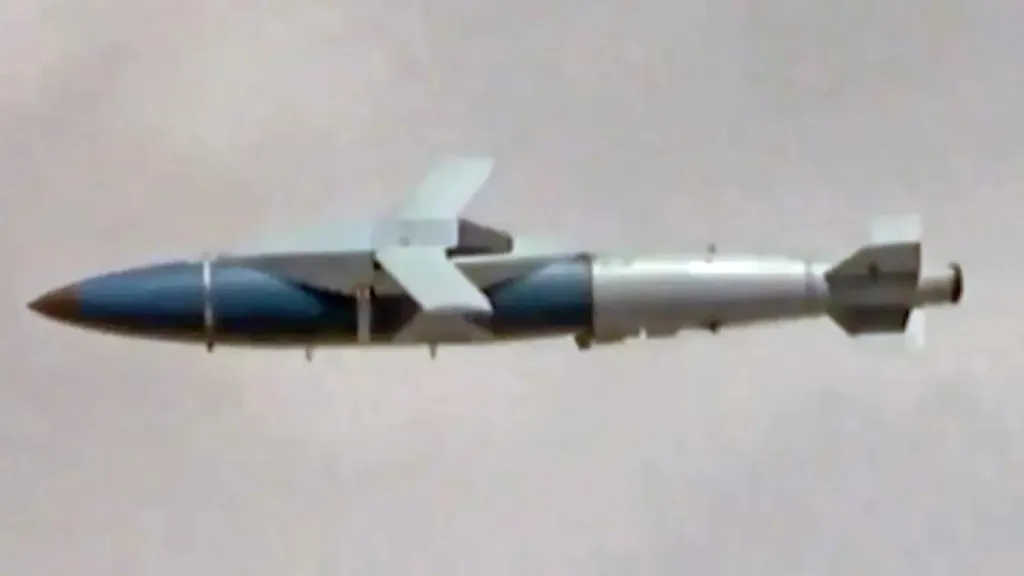
A JDAM-ER seen in flight gliding during a test. RAAF
GBU-64/B is the formal designation the U.S. military has given to the 2,000-pound-class JDAM-ER. As is the case with standard JDAMs without supplemental wings, the JDAM-ER is a kit that turns various types of unguided bombs into ‘warheads’ for the resulting precision-guided munitions. Additional versions of the JDAM-ER kit are available for use with 500-pound and 1,000-pound-class bombs.
Prime contractor Boeing has said that the BLU-109/B bunker-buster bomb can be combined with the JDAM-ER kit, but it is unclear if that configuration is already in operational U.S. service. At the time of writing, the GBU-64(V)1/B still looks to be the only subvariant officially confirmed to be in use anywhere across the U.S. military. The GBU-64(V)1/B uses the Mk 64 Quickstrike air-dropped naval mine as its warhead. There is also a 500-pound-class GBU-62(V)1/B, which pairs a JDAM-ER kit with the smaller Mk 62 Quickstrike mine. You can read more about these versions, also called Quickstrike-ERs, here.
A now-dated Boeing briefing slide from 2017 mentioning testing of BLU-109/B with the JDAM-ER kit. Boeing
B-52 Deploys Quickstrike-ER Naval Mines (2019 OP TEST)
It’s not clear whether bunker-buster JDAM-ERs are in inventory today outside of the U.S. military, either. Versions of the JDAM-ER using general-purpose high-explosive bombs as warheads have been in service at least in Australia and Ukraine for years now.
A JDAM-ER with a general-purpose high-explosive ‘warhead’ under the wing of a Ukrainian MiG-29. via X A JDAM-ER under the wing of a Ukrainian MiG-29 offering a good look at the specialized pylon used to employ these weapons from those aircraft, as well as Su-27s. via X
Missiles delivery systems are being removed from the B1 Lancers at RAF Fairford this afternoon, to be replaced by JDAM bombs. For those asking, the US Airforce has positioned these aircraft close to the fence in full view of media. @AJENewspic.twitter.com/fWtDRfV5g4
A US Air Force F-15E Strike Eagle on its way to strike targets in Iran with a load of 2,000-pound-class JDAMs with bunker buster ‘warheads.’ CENTCOM
If it has not been put into U.S. service already, a 2,000-pound-class JDAM-ER would offer clear benefits when configured as a bunker buster, in general. Depending on how it is released, a standard JDAM can hit targets up to 15 miles away, according to the U.S. Air Force. With the wing kit, JDAM-ERs have a maximum reach of roughly 45 miles, though the exact range is also dependent on release altitude and flight profile. As noted, being able to release bunker buster bombs further away from the target can help reduce risks to the launch platform.
The additional drag of the JDAM-ER wing kit could also reduce the bomb’s kinetic energy, which is important for bunker-busting. It is possible that the bombs could be programmed to glide to a certain point above the target before diving onto it for maximum effect.
At the same time, the gliding capabilities of a JDAM-ER open the door to additional operational possibilities enabled by low-angle attack profiles. Being able to focus the effects of a bunker buster bomb directly on the side of a structure rather than at steeper angles from the top could offer major benefits.
Furthermore, it would be possible to get the bombs deeper down inside the entrance tunnels and through the sides of other fortified structures, magnifying the warhead’s effectiveness. Lobbing precision-guided bombs into tunnels and cave entrances is already a well-established tactic, and one that can hamper access to underground targets that might otherwise be unreachable. This is something we will come back to in a moment. Striking dams, bridge pylons or even ships in port, among other targets, at shallow angles, would also be a new weaponeering option for heavy bunker buster warheads not often found on cruise missiles.
What further enhancements might emerge as a result of the JDAM-ER bunker-buster testing DTRA has planned remains to be seen. As an aside, the U.S. military also looks set to field a jet-powered derivative, called the GBU-75/B JDAM-LR, which features even greater range, as you can learn more about here.
A New Era for Precision Strike: JDAM LR Completes Milestone Test Flights
The U.S. Navy has successfully demonstrated the new JDAM Long Range variant, marking a huge step in bringing affordable, long-range standoff capabilities to the Carrier Air Wing.https://t.co/GvMomaPnSppic.twitter.com/cNgEgnZGXy
With all this in mind, DTRA’s budget request notably includes a separate mention of plans to “conduct R&D [research and development] in ‘skip’ bombing capability to develop new tactics and weaponeering options,” which could help in “enabling deeper access for penetrating weapons.”
Skip bombing specifically involves releasing munitions in a way so that they bounce off the ground or the surface of a body of water. This sends them further forward on a flatter trajectory that can be beneficial in various scenarios. The core tactic here is decades old now. British bombers famously used bombs specially designed for skip bombing attacks against German dams during World War II. During the war, skip bombing was also heavily used when attacking ships, especially by U.S. military aircraft in the Pacific Theater. Doing this could help ensure more serious hits on a target’s hull near the waterline.
Improved skip bombing tactics could be paired with new precision-guided bunker busters, including versions of the GBU-64/B, for further increased effect. Being able to penetrate deeper into tunnel entrances and other weak spots on the ground could create additional complications for an opponent trying to dig out key assets afterward.
NEW: Comprehensive Imagery Report on Nuclear Enrichment Related Sites, Post-April Ceasefire
Following the ceasefire between Iran, the United States and Israel established in early April 2026, we have continued to monitor key sites related to Iran’s nuclear program. In this… pic.twitter.com/wkb9Pr2diY
NEW passive defense measures taken at Fordow: Between May 10 and May 18th, Iran added passive defensive measures in the shape of earthen/rocky mounds and other objects on the roads leading to the tunnel entrances of the destroyed Fordow underground enrichment plant. The alternate… pic.twitter.com/odAISoPr1D
IRAN NUCLEAR UPDATE: Possible NEW Passive Defensive Measures Noted at Pickaxe Mountain
Based upon newly available satellite imagery of the Pickaxe Mountain underground complex, just south of the Natanz Nuclear Complex, it appears that as early as April 22nd, the two eastern… pic.twitter.com/KGAhBkLks8
While U.S. bunker-busting strikes on targets in Iran have been front-and-center in recent months, the new capabilities that DTRA is interested in would be applicable in conflict scenarios, as well. There’s something of a global trend, especially among America’s adversaries and competitors, toward more underground and/or hardened facilities. China, Russia, and North Korea, in particular, all have significant and still-expanding networks of subterranean military infrastructure, including air and naval bases, missile silos, command and control bunkers, and more.
This, in turn, has already been driving the U.S. military to pursue other new bunker-busting capabilities. These efforts are known to include a conventional Next Generation Penetrator (NGP) successor to the MOP and a new nuclear bunker buster bomb referred to currently as the Nuclear Deterrent System-Air-delivered (NDS-A). The U.S. military has also added a new conventional 5,000-class bunker buster bomb, the GBU-72/B, to its arsenal in recent years.
Bunker-buster versions of the JDAM-ER would offer valuable additional options for U.S. commanders at the lower end of the capability spectrum, if they haven’t already entered service to a degree.
From viral fan moments to on-field controversies, as well as the biggest stars, best performances, upsets and more.
A first-ever hat-trick for Lionel Messi, heavyweights Spain stunned by tiny Cape Verde, and DR Congo silencing Cristiano Ronaldo-led Portugal.
What more could you ask from the opening week of a FIFA World Cup?
Recommended Stories
list of 3 itemsend of list
After the first round of group matches, here are our top 10 takeaways:
Last dance? Perhaps not, Lionel Messi has more in store
Before the tournament kicked off in North America, many thought Lionel Messi would be gearing himself up for his final act. But after his first-ever World Cup hat-trick – one that also matched the record for most World Cup goals – Messi has reminded us his story is not over just yet.
Where is Cristiano Ronaldo? Portugal star goes missing
While the Messi mania dominated headlines over recent days, his longtime rival, Cristiano Ronaldo, also made the news, albeit for the wrong reasons. “Is he past his prime?” was the collective question of viewers after his mostly anonymous display in Portugal’s 1-1 draw with DR Congo on Wednesday.
There is no stopping Kylian Mbappe
Becoming France’s all-time leading scorer always seemed a matter of when, not if, for Kylian Mbappe, and achieving the feat in their opening World Cup match was further proof of his extraordinary talent. The 27-year-old, now just two shy of matching the all-time haul for most World Cup goals, is making a habit of chasing records.
The Golden Boot race is taking shape
Long-range rockets, tap-ins, headers and more. There was no shortage of goals, and Argentinian legend Messi is the outright leader with three strikes. As many as seven players – including England’s Harry Kane, Norway’s Erling Haaland and France’s Mbappe – are tied for the second spot with two goals each.
Lionel Messi has taken the early lead in the race for the Golden Boot, an award handed to the tournament’s highest goal scorer [Amy Kontras/EPA]
The title favourites are having a hard time
This is, by far, the upset of the tournament. Spain – the absolute frontrunners for the World Cup – stumbled at their first hurdle, being held to a shock goalless draw by Cape Verde, the archipelago west of the African continent of about half a million people, and whose team sits 65 places below the World No 2 in the FIFA world rankings.
Do not write off DR Congo
Yoane Wissa‘s first-ever goal, DR Congo’s first at a World Cup, sparked joy among millions from Kinshasa to Niangara. And for the other teams competing in the tournament, the 1-1 draw with No 5-ranked Portugal sent a warning that the underdogs are out to challenge some of football’s best sides, especially when the world is watching.
Dear Curacao, welcome to the World Cup
The 7-1 thrashing by Germany did little to dampen the spirit of Curacao fans, many of whom made the journey to the United States. For the Caribbean tiny island – the smallest-ever country to play at a World Cup – defeat meant nothing in comparison to the happiness of seeing one of their own score at the sport’s biggest stage. Livano Comenencia is a hero for all of Curacao.
Pink boots are everywhere
Pink seems to be the colour of the month, well, at least at the World Cup. Several players were seen wearing the vibrant, monochromatic boots – or cleats, as Americans would say – regardless of the manufacturer. Be it Nike, Adidas or Puma, sportswear giants have joined this trend of making their boots “electric fuchsia”.
The Portugal team in the famous bright pink boots [Phil Noble/Reuters]
From beats to booze, fans bring the party to the World Cup
It’s safe to say a World Cup is the biggest celebration of football. And some countries just do it better than others.
With their green-and-yellow shirts, flags and pounding drums, Brazil fans brought a slice of Rio to New York, while Moroccans later joined the party, the red smoke from the flares lighting up the World Cup mood. In Boston, Scotland’s famous Tartan Army chugged pint after pint, nearly draining some pubs of all their beer in the first weekend during their World Cup occupation of the city.
Meet Mexico’s unofficial mascot: Merlin the duck
To best sum up the football craze in tournament co-host Mexico, the fandom is not limited to humans. A domesticated duck named Merlin, sporting a miniature Mexico shirt and custom duck socks, has waddled his way into the hearts of many, becoming an unlikely unofficial mascot for the country’s World Cup campaign.
Merlin, a duck wearing a Mexico national football team (‘El Tri’) jersey, shot to fame after a chance encounter on Reforma Avenue in the capital went viral following the World Cup opening match between Mexico and South Africa on June 11 [Paola Garcia/Reuters]
Weekly insights and analysis on the latest developments in military technology, strategy, and foreign policy.
The U.K. Ministry of Defense is investigating reports that a Russian Navy warship fired warning shots near a British-registered yacht in the English Channel, according to a statement provided to TWZ today. The reported encounter is the latest in a series of increasingly tense interactions between the United Kingdom and Russia.
The incident reportedly occurred around 20 nautical miles south of the Isle of Wight, off the south coast of England, and outside British territorial waters. According to the Ministry of Defense, the initial report came from the crew of the U.K.-registered yacht, which alleged that a Russian warship fired warning shots at a distance of approximately 500 yards.
According to the Press Association, the incident occurred at around 11:40 a.m. local time, in waters between the Isle of Wight and Normandy.
A Ministry of Defence spokesperson confirmed to us that they are investigating reports of the incident, but stressed that the investigation remains in its early stages.
“No injuries or damage have been reported by the yacht, which is continuing its journey,” the spokesperson added.
The Royal Navy was already shadowing the Russian vessel when the alleged incident occurred, the ministry confirmed.
“HMS Mersey was monitoring the Russian vessel at the time. We cannot provide further comment while investigations are ongoing. A seaboat from HMS Tyne has visited the yacht to gather details and check that they are safe.”
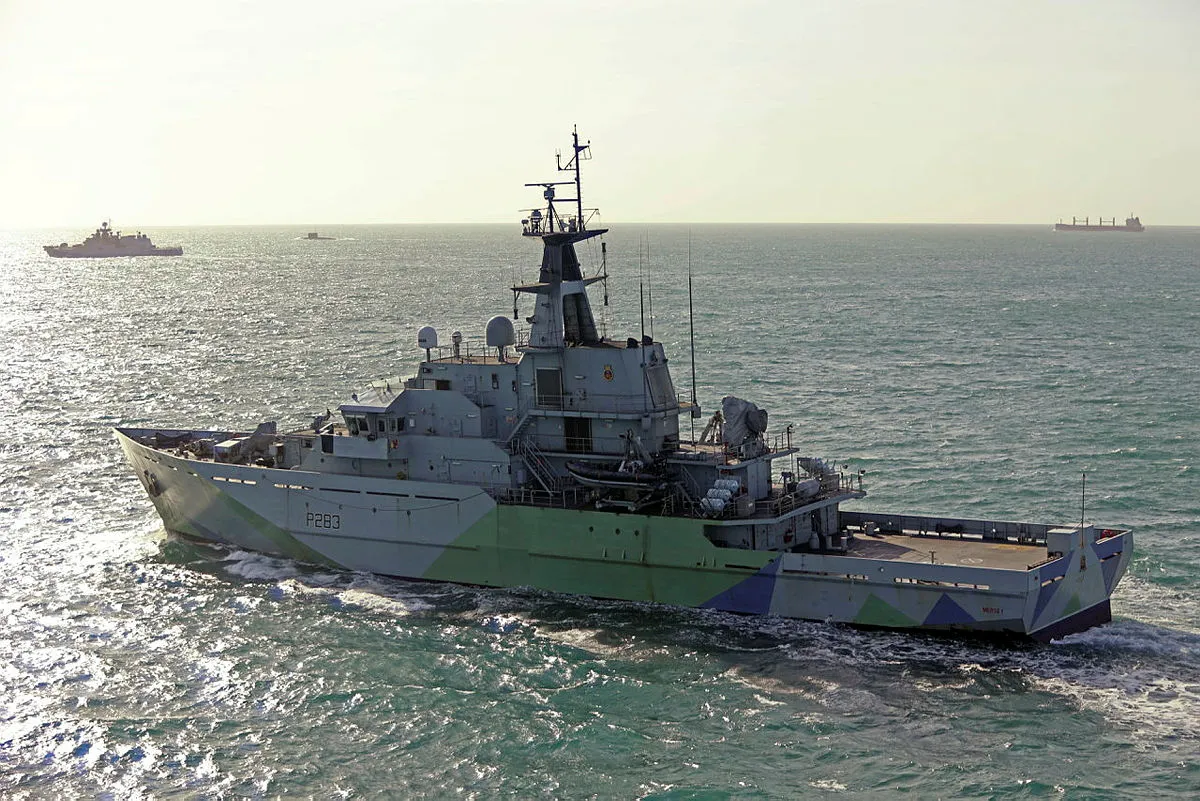
Both HMS Mersey and HMS Tyne are River class offshore patrol vessels, frequently used to shadow Russian and other warships passing through the Channel, which is widely considered the busiest shipping area in the world.
HMS Mersey (foreground) seen here monitoring the Russian frigate Admiral Grigorovich (left) and the Kilo class submarine Krasnodar (center-left) in April of this year. Crown Copyright
According to unconfirmed reports, the Russian warship said to be involved is the Admiral Grigorovich, the lead ship of its class, which is also known to NATO as the Krivak V class. The frigate is seen at the top of this story, during an encounter with Royal Navy vessels earlier this year, again in the English Channel.
[Unconfirmed] Russian frigate Grigorovich has fired warning shots at a British yacht in the channel.
British and French ships are mobilising in response.
Incident comes after the Royal Navy boarded Shadow Fleet tanker SMYRTOS (IMO: 9389100) which has been sanctioned by HM…
The Ministry of Defence also sought to distance the incident from another recent maritime security operation in the Channel, in which British forces boarded the Smyrtos, a sanctioned shadow-fleet oil tanker, which was sailing under a false Cameroonian flag.
The boarding of the Smyrtos by Royal Marine Commandos and specially trained law enforcement officers from the National Crime Agency last Sunday was the first U.K.-led operation of its kind. The six-hour military operation also involved Chinook, Merlin, and Wildcat helicopters, a Royal Air Force P-8 Poseidon maritime patrol aircraft, as well as the frigate HMS Sutherland and the mine countermeasures vessel HMS Ledbury.
The vessel Smyrtos is boarded by Royal Marines from 42 Commando and U.K. law enforcement officers on June 14. Crown Copyright
It remains unclear exactly which Russian Navy vessel was involved in the incident today, what prompted the alleged warning shots, or whether any communication took place between the warship and the yacht before the incident.
We will update this post as we find out more about today’s incident.
UPDATE: 2:45 PM EDT –
There is growing speculation that the Russian warship involved in the incident may have suffered some kind of mechanical failure or difficulty at sea.
The U.K. Shadow Defense Secretary James Cartlidge said the incident was “very concerning” and the United Kingdom should “be in no doubt that Russia poses a direct threat.”
The leader of the Liberal Democrat party, Ed MacCleary, said: “These reports are extremely concerning. Russia is quite literally on our doorstep. Aggression and intimidation from Putin in the English Channel cannot be tolerated.”
These reports are extremely concerning – Russia is quite literally on our doorstep.
Aggression and intimidation from Putin in the English Channel cannot be tolerated.
This is a clear reminder that the Government cannot afford any further delays to the Defence Investment Plan. https://t.co/xhnoFQ98tE
According to BBC News, the Russian frigate Admiral Grigorovich fired warning shots after the two vessels came into close contact.
The broadcaster further reports that the “small, motorless yacht had drifted towards the warship in foggy conditions after setting off from the United Kingdom.”
The BBC cites the Russian Ministry of Defense as saying that the yacht had been on a “dangerous approach” towards the warship, and its crew fired into its path “with rifles” after making several attempts to contact it over the radio and after launching warning flares.
The Russian Ministry of Defense further claimed that its sailors had acted in “strict accordance with international shipping regulations.”
A U.K. government source told the BBC that a couple in their 60s were onboard the yacht at the time. They said they did not hear when the Russian frigate sounded its horn.
There have also been unconfirmed reports identifying the yacht involved:
Russians are saying the yacht was ‘Bright Future’ – a British registered 40′ sailing yaht in transit from the Solent to Cherbourg. pic.twitter.com/m3lKpgeHkJ
Data obtained by BBC Verifysuggests that the Admiral Grigorovich has been in the Channel for an extended period, repeatedly being re-supplied by a repair vessel, so that it can escort shadow-fleet vessels through these waters.
Based on satellite images it has reviewed, the BBC says the frigate has been re-supplied by the PM-82, an Amur class repair ship, while operating between the Channel and the North Sea in recent months.
In April, the frigate was reported to have escorted six shadow fleet vessels through the Channel while being monitored by the Royal Navy.
Two scenarios with the yacht
1️⃣🇷🇺 response to Smyrtos boarding this weekend – #greyzone 2️⃣Risk of collision with drifting⛵️in low viz, followed by Ch 16 warning(?) then shot across bow in ‘self defence’ – #maritimebuffoonery
At least one Royal Air Force P-8 Poseidon has transited from its base in Scotland to patrol the Channel this evening, according to publicly available flight-tracking data. The maritime patrol aircraft is very likely tasked wth monitoring Russian naval activity in the area.
More details of the incident have been reported by Deborah Haynes, the security and defense editor at Sky News.
Haynes writes on X that the Russian frigate “fired a couple of warning shots” close to the yacht in the Channel after also sounding an alert to avoid it sailing too close. Citing an unnamed defense source, Haynes reports that it is understood that the Admiral Grigorovich appears to be having difficulty controlling its movements, perhaps due to a propulsion issue.
The warning shots “were certainly not fired at the yacht,” the same source said.
Additionally, while the Admiral Grigorovich has been escorting Russian-flagged vessels through the Channel in recent months, Haynes writes that it was not involved with escorting the Smyrtos, which was boarded by British forces at the weekend.
UPDATE: A Russian warship fired a couple of warning shots close to a UK-registered yacht in the Channel after also sounding an alert to avoid it sailing too close, a defence source said. Investigations are still underway to establish exactly what happened. From what is…
After reaching out to the U.K. Ministry of Defense for more clarification, TWZ received the following from a spokesperson:
“Following attempts to contact a British vessel in the Channel, the Grigorovich fired warning shots. These were not aimed at the vessel and were an attempt to prevent a possible collision.”
“We assess that this is an isolated incident and not linked to the UK’s interception of the Smyrtos this weekend. HMS Mersey has been monitoring the Russian vessel and support has been provided to the crew of the yacht.”
“We assess that the Grigorovich was displaying to other vessels that it was drifting rather than being manoeuvred under power, which may have made her feel more vulnerable, leading to warning shots being fired.”
“We assess that after sounding warnings, the Grigorovich fired several warning shots, but these were not aimed at the yacht.”
The spokesperson told us that they further assess that the shots fired were single rounds, rather than automatic fire.
Weekly insights and analysis on the latest developments in military technology, strategy, and foreign policy.
The Senate Armed Services Committee is “concerned” about the U.S. Air Force’s current plan to retire its E–11A Battlefield Airborne Communications Node (BACN) aircraft in Fiscal Year 2028. Legislators want more details about how the service expects to plug any capability gaps that might result from axing the highly specialized communications planes. The Air Force abruptly announced plans to retire the E-11A fleet, which has more than doubled in size in recent years, and supplant it with new space-based capabilities back in April.
A formal request for a briefing on the Air Force’s plans surrounding the E-11A fleet is included in a report accompanying a draft of the annual defense policy bill, or National Defense Authorization Act (NDAA), for the 2027 Fiscal Year. The Senate Armed Services Committee released a full copy of the proposed legislation and the report yesterday.
An E-11A BACN aircraft at an “undisclosed location” in the Middle East in 2024. USAF
The Air Force currently has 7 BACN jets in service, which are based on several different models from the Bombardier Global Express family of business jets. The BACN package has also flown operationally in the past on one of NASA’s high-flying WB-57F research aircraft and a fleet of now-retired EQ-4B Global Hawk drones.
“The committee is aware of the Department of the Air Force’s decision to cancel the E–11 Battlefield Airborne Communications Node (BACN) capability, which has historically provided critical communications relay and data translation functions enabling joint and coalition operations, particularly in contested and communications-degraded environments,” the report says. “The committee is concerned about the operational risk associated with the loss of the E–11 BACN capability and the lack of clarity regarding the Department’s plan to mitigate resulting gaps in airborne communications, data integration, and battle management.”
“Therefore, the committee directs the Secretary of the Air Force to provide a briefing to the congressional defense committees, not later than March 31, 2027, on the Department’s plan to address capability gaps resulting from the cancellation of the E–11 BACN capability,” it continues.
The briefing needs to at least provide the following:
“A detailed justification for the decision to cancel the E–11 BACN capability, including cost, survivability, and operational considerations.”
“An assessment of the operational risks created by the cancellation, including impacts on joint all-domain command and control, communications interoperability, and support to combatant commander requirements.”
“A description of alternative capabilities, programs, or concepts of operation the Department plans to employ to replicate or replace E–11 BACN functionality, including any space-based, airborne, or ground-based solutions.”
“Associated timelines, funding requirements, and acquisition strategies for such alternatives.”
“A description of how the Department will ensure continuity of communications relay and gateway capabilities in contested environments during any transition period.”
“An assessment of impacts to joint and coalition interoperability, including any risks to ongoing operations or contingency plans.”
An E-11A sits at Al Dhafra Air Base in the United Arab Emirates in 2021. USAF
Currently, the BACN aircraft provide an extremely valuable airborne communications gateway that can be used to relay data across various waveforms between platforms in the air, at sea, and on land. The planes offer a vital way to ‘translate’ between data-sharing systems that may not otherwise be able to ‘talk’ to each other. E-11As can also provide a vital node between line-of-sight and beyond-line-of-sight links. During the conflict in Afghanistan, the BACN aircraft became known for providing this service and creating an active data-sharing rebroadcasting network in a country where mountainous terrain could often limit the reach of line-of-sight links.
The Air Force first announced its intention to divest the E-11A fleet earlier this year as part of the rollout of its annual budget request. The service offered few additional details publicly at that time, beyond that the Hybrid Satellite Communications (STACOM) Terminal program would provide a “bridge” capability in the near term.
An annual force structure report that the Pentagon released last month offers some further insights into the Air Force’s argument for retiring the E-11As.
Another member of the US Air Force’s current E-11A fleet, at Grand Forks Air Force Base in North Dakota. USAF
“Predicated on the successful deployment of next-generation orbital systems, the E-11A fleet is scheduled for divestment in FY 2028,” the force structure report says. “These space-based assets will provide equivalent relay and datalink capabilities, superseding current E-11A functions and enabling a modernized transition of the mission set. Consequently, all cost savings will be reinvested into the replacement capabilities.”
“As part of a broader strategy to align resources with the most pressing operational needs, the Department of the Air Force will divest its fleet of seven E-11A aircraft, with the action planned for FY 2028,” the report adds. “This decision allows for the strategic reallocation of fiscal resources to fund more critical, high-priority service requirements and accelerate modernization efforts in other key areas.”
The Air Force’s decision regarding the E-11A came without any real warning, at least publicly. As noted, the service had significantly increased the fleet size in recent years, driven in part by the retirement of the EQ-4Bs. The aircraft had looked set to continue serving for years to come.
Demand for the capabilities BACN offers has gone well beyond Afghanistan. The aircraft continue to be heavily utilized to support active combat operations, including as part of Operation Epic Fury against Iran this year. The platform was also utilized during the mission to capture former Venezuelan dictator Nicolas Maduro in January.
An E-11A takes off from a base somewhere in the Middle East in 2024. A KC-135 tanker is also seen in the foreground. USAF
At the same time, there are questions about the survivability of the E-11A going forward as a non-stealthy business jet-based aircraft, especially in the context of a future high-end fight. These concerns are even pronounced for the BACN aircraft given that a key aspect of their mission set to date has involved flying within range of line-of-sight links. A growing threat ecosystem that pushes the planes further and further from the forces they are expected to support would challenge their utility.
China and Russia, in particular, are developing very long-range anti-air missiles, and the Air Force itself has warned that designs with ranges of 1,000 miles could be in service by 2050. Ever-more sophisticated anti-access/area-denial (A2/AD) ‘bubbles’ will be an increasing challenge for traditional non-stealthy combat support aircraft, not just BACN, as time goes on. Even smaller adversaries like Iran and North Korea, and even some non-state actors, are continuing to field more threatening air defense systems, as well.
As an aside, the U.S. Army now views very long-range air-launched drones as a key capability to help ensure the relevance of its new Bombardier Global Express-based ME-11B High Accuracy Detection and Exploitation System (HADES) surveillance and reconnaissance planes in future large-scale conflicts. You can read more about the plans for HADES here.
All this being said, there is also something of an interesting parallel, very broadly speaking, between the Air Force’s current plans for the E-11A fleet and its failed Pentagon-backed attempt to cancel the E-7 Wedgetail airborne early warning and control aircraft program. The arguments for axing the E-7 were also heavily rooted in plans for new space-based capabilities, concerns about the vulnerability of a non-stealthy aircraft in future high-end conflicts, and a general desire to shift resources to other priorities. Congress ultimately intervened to save the Wedgetail program, and the Air Force and the Pentagon have now completely changed their tone, at least publicly, on the matter.
A rendering of a US Air Force E-7 Wedgetail. USAF
“I know our department had taken the position that it was … other satellite ISR [intelligence, surveillance, and reconnaissance capabilities] that was probably going to be capable of a lot of that in the future,” Secretary Pete Hegseth said in response to a question about the E-7 at a hearing in May. “But I think that mindset was indicative of a mindset that we’ve shed, which is the divest-to-invest mindset, which was an austerity mindset, that we’re going to get continuing resolution after continuing resolution. So, we [sic] got to get rid of these platforms in order to invest in these platforms. And there are gaps that need to still be filled. And there are systems that still need to be funded that are used on the battlefield right now, say, MQ-9s, A-10s, you name it.”
Hegseth’s comments here would seem to reflect a logic that one could also apply to the E-11A fleet, at least based on the arguments the Air Force has put forward for its divestment so far.
Whether Congress intervenes now to save the BACN aircraft remains to be seen. The Air Force is still expecting to continue flying the jets through next year at least.
The Air Force will now have a chance to more formally argue before members of the Senate Armed Services Committee for moving ahead with its plan to axe the E-11As.
Weekly insights and analysis on the latest developments in military technology, strategy, and foreign policy.
Ukraine is increasingly emerging as a potential player in Europe’s race to build-up its long-range conventional strike capabilities. New partnerships centered on the Ukrainian Flamingo and Neptune cruise missiles underscore how the European defense industry is moving from supplying Kyiv to co-developing and manufacturing combat-proven Ukrainian missile technology for NATO’s own future arsenal.
Diehl Defense recently confirmed that it plans to launch production of Ukraine’s Flamingo cruise missile in Germany. Diehl’s chief executive, Helmut Rauch, said that his company was planning talks in the coming weeks with Fire Point, the manufacturer of the Flamingo. Previously, Diehl had signed a technology agreement with Fire Point but had not disclosed any details.
Visitors at the stand of Ukrainian defense technology company Fire Point during the Eurosatory defense and security trade fair, at the Paris-Nord Villepinte Exhibition Center in Villepinte, north of Paris on June 15, 2026. Photo by Guillaume BAPTISTE / AFP
Meanwhile, another European missile manufacturer, MBDA, the largest company of its kind in Europe, has signed a memorandum of understanding (MoU) with the Ukrainian defense firm Luch to expand collaboration on deep-strike capabilities by focusing on the Neptune family of cruise missiles. Under the agreement, MBDA and Luch will work together on the so-called Neptune 2 missile, via what the European missile house describes as a process of “disruptive innovation.”
Reflecting this broader trend, during a visit to Kyiv last month, German Minister of Defense Boris Pistorius noted Ukraine’s “remarkable” wartime technological advances and said that Berlin was looking at joint ventures that included long-range drones, air defenses, and electronic warfare.
German Defense Minister Boris Pistorius visits the command post of a Ukrainian Army combat and reconnaissance drone unit in Dnipro during a visit to Ukraine last month. Photo by Kay Nietfeld/picture alliance via Getty Images
Looking at these Ukrainian cruise missiles in more detail, Luch’s Neptune first emerged as an anti-ship missile, based on the Soviet-era Kh-35, known to NATO as the SS-N-25 Switchblade in its surface-launched form. The Neptune came to prominence when it was used to sink the Russian Navy’s Slava class cruiser Moskva in 2022.
The original configuration of the Neptune missile. Office of the President of Ukraine Volodymyr Zelensky
Ukraine reportedly began work on a new land-attack version of the Neptune in 2023. A Ukrainian defense official told TWZ that this version has a range of up to 225 miles (360 kilometers). This compares to a reported maximum range of around 190 miles (300 kilometers) for the anti-ship version.
Subsequently, Ukraine introduced the extended-range Long Neptune, which Ukrainian President Volodymyr Zelensky has stated has a range in the region of 620 miles (1,000 kilometers). The Long Neptune features an extended body to accommodate additional fuel for its turbofan engine. It has reportedly been used against dozens of targets inside Russia.
Ukrainian “Long Neptunes.” We’re producing more 🇺🇦 ____
— Volodymyr Zelenskyy / Володимир Зеленський (@ZelenskyyUa) November 14, 2025
The land-attack versions of the Neptune reportedly use a GPS-assisted inertial navigation system (INS) and an imaging infrared sensor in place of the anti-ship missile’s active radar seeker.
At least one more version of the Neptune has also been developed, this one apparently featuring fuel tank ‘bulges’ for increased range. As you can read about here, this model appears to be something like an intermediate-range version, falling between the original land-attack Neptune and the Long Neptune.
An official photo of the Long Neptune cruise missile. Government of UkraineThe ‘bulged’ Neptune variant. Denys Shmyhal/Ukrainian Ministry of Defense
Turning to the Flamingo, also known as the FP-5, this was designed from the ground up to hit targets deep within Russia, the missile having a reported range of 1,864 miles (3,000 kilometers). The Flamingo is significantly bigger than the Neptune series, being launched from rails mounted on a trailer, rather than from canisters on the flatbed of a truck.
Launch of a Flamingo long-range cruise missile. via Ukrainska Pravda
The Flamingo also features a notably larger warhead, reportedly weighing around 2,205 pounds (1,000 kilograms).
A video of the Flamingo cruise missile in action:
Випробувальний пуск ракети “Фламінго”
In terms of guidance, the Flamingo is said to use a combination of methods, including various types of satellite navigation. An underlying inertial navigation system is likely to be present. The missile is powered by an AI-25 turbofan engine, a type produced in Ukraine for military and civilian aircraft, including the L-39 Albatros trainer and the Yak-40 feederliner.
Ukraine’s development of increasingly long-range land-attack cruise missiles is driven by the requirement to strike targets deeper inside Russia. Kyiv has received standoff missiles from its allies, including the air-launched Storm Shadow and SCALP-EG from the United Kingdom and France, respectively, as well as the U.S.-supplied Army Tactical Missile System (ATACMS) short-range ballistic missile. However, these are not available in large numbers and are limited by restrictions imposed upon their use. Additionally, none of them have the kind of range or warhead capacity offered by the Flamingo.
Kyiv has long been campaigning to receive Tomahawk cruise missiles from the United States, but so far, Washington has refused these requests, with U.S. President Donald Trump saying he is “not looking to see an escalation” in the conflict. These highly accurate missiles would be able to hit targets roughly 1,000 miles (1,600 kilometers) from Ukraine’s borders.
As well as cruise missiles, Ukraine has also developed a huge variety of long-range one-way-attack drones, and other designs that blur the line between long-range kamikaze drones and cruise missiles, including Palianytsia, Peklo, and Trembita.
Ukrainian Peklo ‘missile-drones.’ Ukrinform/NurPhoto via Getty Images
Kyiv has also been working on developing new ballistic missiles. However, the longest-range one of these, as far as is known, is the Hrim-2, which can hit targets at 174 miles (280 kilometers) or possibly up to 310 miles (500 kilometers).
An artist’s rendition of the Hrim-2 TEL, as offered for export by Ukraine, back in 2015. Ukroboronexport
Meanwhile, Fire Point has developed the FP-7 ballistic missile, a weapon with a stated range of around 124 miles (200 kilometers), and a warhead of approximately 331 pounds (150 kilograms).
A rendering of the FP-7 surface-to-surface ballistic missile. Fire Point
In both cases, however, these ballistic missiles lack true strategic reach. This would be partially addressed by the FP-9, which Fire Point aims to start testing this summer, and which is expected to have a range of 530 miles (855 kilometers).
Ukraine’s efforts to develop new and more destructive missiles, and to build them at scale, come as Europe’s NATO members also increasingly look to field weapons in this class.
The scale factor is an important one, since Ukrainian wartime weapons development stresses equipment that can be produced rapidly, in large numbers, and at a lower cost point. Fire Point has said that it aims to increase Flamingo production to a daily rate of at least seven missiles by October of this year. This would translate to 2,555 built annually. It remains questionable whether this is a realistic target, but the prospect of additional production lines elsewhere in Europe would change things.
Additional details have been released about Ukraine’s new domestically-produced long-range cruise missile, dubbed the FP-5 “Flamingo” which is manufactured by Fire Point. According to an interview with Chief Technical Officer Iryna Terekh, the “Flamingo” has entered serial… pic.twitter.com/2D5GisrmFP
At the same time, it should be noted that the Flamingo and Neptune cruise missiles, for all their capabilities, are not especially sophisticated. They both fly at subsonic speed and do not appear to have any attempts at signature control. While they are certainly destructive, they are far from immune to interception.
Their effectiveness can be increased by using them in missile barrages and combined with drones and potentially decoys, to overwhelm air defenses. Here, too, is an area in which Ukrainian experience could help, creating a mix of high-end missile capabilities with combat mass from lower-end drones.
With this in mind, it is perhaps not surprising that Diehl is already looking at how it can improve the Flamingo.
Diehl’s Helmut Rauch has said that his company could outfit the Flamingo with a much more advanced seeker, leveraging the German firm’s experience in this area.
An unverified video that appears to show a Flamingo cruise missile strike on a military factory in Cheboksary in western Russia:
Similarly, MBDA’s expertise in missile development and production could potentially be incorporated in future versions of the Neptune.
Either way, Ukraine would benefit from advanced technologies that otherwise might not be immediately accessible.
What is clear is that European NATO allies are increasingly looking to address their lack of land-based long-range strike capabilities. As well as facing an increasingly belligerent Russia equipped with an expanding arsenal of long-range missiles, Europe is also confronting the prospect of its U.S. ally being unwilling to provide the same kinds of capabilities.
Ukraine is not alone in being unable to secure U.S.-made Tomahawk cruise missiles.
Berlin, in particular, is looking for alternatives to the U.S. Army long-range fires battalion equipped with various conventionally armed standoff missiles — including Tomahawk — that was expected to be deployed in Germany on a rotational basis, starting this year. The U.S. move was an apparent response to disagreements with Germany over the Iran war as well as ongoing tariff tensions.
U.S. personnel unload a trailer-based launcher associated with the Typhon weapon system from a C-17A transport aircraft in the Philippines in 2024. The Typhon was to be deployed in Germany as part of a U.S. Army long-range fires battalion, the 2nd Multi-Domain Task Force (2MDTF). U.S. Army
While Europe does have new long-range strike programs underway, they are not expected to bring new systems into service until the 2030s. At the same time, efforts like the European Long-Range Strike Approach (ELSA), which involves France, Germany, Italy, Poland, Sweden, and the United Kingdom, still have to agree on common requirements, provided that is even possible.
Separately, Germany and the United Kingdom have unveiled plans to jointly produce a “deep precision strike” weapon with a range of over 1,240 miles (2,000 kilometers). At this point, however, no industrial framework has been agreed on. Potentially, an advanced version of the Flamingo could meet that requirement, even if only as an interim measure before a more bespoke solution can be developed.
For Europe, Ukrainian missile developers like Luchs and Fire Point bring the valuable experience of wartime innovation, while established defense firms like MBDA and Diehl provide additional industrial capacity and advanced technologies. If either of these projects succeeds, they could not only help Ukraine field more advanced and capable cruise missiles, but also help address one of NATO’s most pressing capability gaps.
The G7, BRICS and emerging powers are competing for influence in a changing global order.
For half a century, a handful of wealthy Western democracies wrote the rules of the global economy.
But the world order is becoming crowded, and even as the Group of Seven (G7) remains one of the world’s most influential clubs, a challenger has emerged.
BRICS has expanded, and says it wants a bigger voice for the Global South. This bloc of nations speaks for nearly half the world’s population – and accounts for a growing share of global output, energy and raw materials.
In the space between the two, a third force is gathering pace: the so-called middle powers, nations too big to ignore and unwilling to pick a side.
The star winger scores a goal and sets up another, as Colombia make a winning return to the FIFA World Cup.
Published On 18 Jun 202618 Jun 2026
Colombia opened their World Cup Group K campaign with a 3-1 victory over Uzbekistan at the Estadio Azteca on Wednesday, as Daniel Munoz, Luis Diaz and Jaminton Campaz struck to overcome a spirited second-half response from the tournament debutants.
Uzbekistan were disciplined for long periods under their Italian coach Fabio Cannavaro, but Colombia’s greater quality stood out in front of a crowd of over 80,000 on a cool, rain-tinged evening in Mexico City.
Recommended Stories
list of 4 itemsend of list
Colombia, the Copa America runners-up, had early sights of goal through Jhon Arias and James Rodriguez, but Uzbekistan sat deep, scrapped gamely and waited for mistakes. Bekhruz Karimov almost profited when he burst forward, only for Jhon Lucumi to intervene before he could shoot.
Diaz had the clearest chance of the opening half when he struck the post, before Abdukodir Khusanov slid in after the winger had knocked the ball past him, taking out both the Colombian player and a pitchside cameraman who required medical treatment.
Uzbekistan’s resistance finally cracked in the 40th minute. Diaz gathered the ball after an attack had broken down and clipped a fine pass into the path of Munoz, who guided home a neat finish for his third international goal.
The large Colombian contingent erupted, their yellow shirts making the Azteca look and sound almost like home. Chants of “Vamos Colombia”, adapted from a Club America-style chorus, rolled around the ground, while Uzbekistan’s small band of supporters answered with drums of their own.
Colombia’s Luis Diaz celebrates scoring their second goal [Eloisa Sanchez/Reuters]
Fayzullaev scores Uzbekistan’s maiden World Cup goal
Uzbekistan improved after the break and equalised on the hour with the country’s first World Cup goal.
Dostonbek Khamdamov fed Eldor Shomurodov, whose shot from the right side of the box was saved low by Camilo Vargas. The goalkeeper could not hold it, however, and Abbosbek Fayzullaev nodded in the rebound from close range.
Abbosbek Fayzullaev celebrates scoring Uzbekistan’s first World Cup goal [Eloisa Sanchez/Reuters]
However, Uzbekistan’s joy lasted only five minutes.
Gustavo Puerta released Diaz in the 65th minute, and the forward side-footed across goal to restore Colombia’s lead. The crowd responded with chants of “Lucho, Lucho”.
Uzbekistan kept pushing. Akmal Mozgovoy shot narrowly off target in stoppage time, Karimov hit the bar with an effort from distance, and Azizbek Amonov had a shot blocked after Otabek Shukurov’s pass.
But Colombia had the final word, Campaz scoring in the ninth minute of stoppage time to settle a contest in which Nestor Lorenzo’s side had 15 attempts to Uzbekistan’s nine, and extended their strong recent group-stage record to seven wins in eight World Cup matches.
Colombia face DR Congo on Tuesday in Guadalajara, after Uzbekistan play Portugal on the same day in Houston.
Colombia’s Jaminton Campaz celebrates after the match [Eloisa Sanchez/Reuters]
The FIFA World Cup begins on June 11. You can follow the action on Al Jazeera’s dedicated World Cup 2026 page with all the latest news, match build-up and live text commentary, and keep up to date with group standings, real-time match results and schedules.
Winger Luis Diaz scores a goal and sets up another, as Colombia make a winning return to the FIFA World Cup after missing the last edition.
Published On 18 Jun 202618 Jun 2026
Colombia opened their World Cup Group K campaign with a 3-1 victory over Uzbekistan at the Estadio Azteca on Wednesday, as Daniel Munoz, Luis Diaz and Jaminton Campaz struck to overcome a spirited second-half response from the tournament debutants.
Uzbekistan were disciplined for long periods under their Italian coach Fabio Cannavaro, but Colombia’s greater quality stood out in front of a crowd of over 80,000 on a cool, rain-tinged evening in Mexico City.
Recommended Stories
list of 4 itemsend of list
Colombia, the Copa America runners-up, had early sights of goal through Jhon Arias and James Rodriguez, but Uzbekistan sat deep, scrapped gamely and waited for mistakes. Bekhruz Karimov almost profited when he burst forward, only for Jhon Lucumi to intervene before he could shoot.
Diaz had the clearest chance of the opening half when he struck the post, before Abdukodir Khusanov slid in after the winger had knocked the ball past him, taking out both the Colombian player and a pitchside cameraman who required medical treatment.
Uzbekistan’s resistance finally cracked in the 40th minute. Diaz gathered the ball after an attack had broken down and clipped a fine pass into the path of Munoz, who guided home a neat finish for his third international goal.
The large Colombian contingent erupted, their yellow shirts making the Azteca look and sound almost like home. Chants of “Vamos Colombia”, adapted from a Club America-style chorus, rolled around the ground, while Uzbekistan’s small band of supporters answered with drums of their own.
Colombia’s Luis Diaz celebrates scoring their second goal [Eloisa Sanchez/Reuters]
Fayzullaev scores Uzbekistan’s maiden World Cup goal
Uzbekistan improved after the break and equalised on the hour with the country’s first World Cup goal.
Dostonbek Khamdamov fed Eldor Shomurodov, whose shot from the right side of the box was saved low by Camilo Vargas. The goalkeeper could not hold it, however, and Abbosbek Fayzullaev nodded in the rebound from close range.
Abbosbek Fayzullaev celebrates scoring Uzbekistan’s first World Cup goal [Eloisa Sanchez/Reuters]
However, Uzbekistan’s joy lasted only five minutes.
Gustavo Puerta released Diaz in the 65th minute, and the forward side-footed across goal to restore Colombia’s lead. The crowd responded with chants of “Lucho, Lucho”.
Uzbekistan kept pushing. Akmal Mozgovoy shot narrowly off target in stoppage time, Karimov hit the bar with an effort from distance, and Azizbek Amonov had a shot blocked after Otabek Shukurov’s pass.
But Colombia had the final word, Campaz scoring in the ninth minute of stoppage time to settle a contest in which Nestor Lorenzo’s side had 15 attempts to Uzbekistan’s nine, and extended their strong recent group-stage record to seven wins in eight World Cup matches.
Colombia face DR Congo on Tuesday in Guadalajara, after Uzbekistan play Portugal on the same day in Houston.
Colombia’s Jaminton Campaz celebrates after the match [Eloisa Sanchez/Reuters]
The FIFA World Cup begins on June 11. You can follow the action on Al Jazeera’s dedicated World Cup 2026 page with all the latest news, match build-up and live text commentary, and keep up to date with group standings, real-time match results and schedules.
Emotions seesawed across London and Zagreb as England met Croatia in a thrilling World Cup grudge match. The Three Lions came away 4-2 winners in Dallas, Texas.
Brent crude drops as much as 1.6 percent, while key stock indices in Japan, South Korea and Taiwan climb.
Published On 18 Jun 202618 Jun 2026
Oil prices have dropped following the United States and Iran’s signing of an interim peace agreement, resuming a slide interrupted by US President Donald Trump’s warning that he could restart his military campaign.
Brent crude fell as much as 1.6 percent on Thursday morning in Asia, returning the international benchmark to almost exactly where it was 24 hours previously.
Recommended Stories
list of 4 itemsend of list
Brent futures for delivery in August stood at $78.23 as of 04:00 GMT, only about 7 percent higher than before the US and Israel launched their war on Iran on February 28.
After several days of declines, Brent briefly spiked above $81 a barrel on Wednesday after Trump warned that the US could “go right back to dropping bombs” on Iran if it doesn’t “behave”.
Asian stock markets rallied on Thursday on renewed optimism for an end to nearly four months of disruption to global energy supply chains.
Japan’s benchmark Nikkei 225 and South Korea’s Kospi both hit all-time highs, gaining 1.8 percent and 1.4 percent, respectively.
Taiwan’s Taiex rose as much as 1.3 percent.
Hong Kong’s Hang Seng Index bucked the trend, dropping 1.7 percent.
US stock futures, which are traded outside of regular market hours and often foreshadow the next day’s performance, climbed, with those tied to the benchmark S&P 500 and the tech-heavy Nasdaq Composite climbing about 0.8 percent and 1.3 percent, respectively.
A man walks next to an electronic quotation board displaying the Nikkei 225 stock prices on the Tokyo Stock Exchange in Tokyo, Japan, on June 18, 2026 [Kazuhiro Nogi/AFP]
Pakistani Prime Minister Shehbaz Sharif, who mediated the negotiations between Washington and Tehran, said on Wednesday that the US-Iran memorandum of understanding (MoU) had entered into force with “immediate effect”.
Sharif said Iran would “instantly reopen” the Strait of Hormuz and the US would “immediately” lift its naval blockade of Iranian ports, though it was not immediately clear if the announcement had any effect on boosting maritime traffic in the critical waterway.
Shipping in the strait has been reduced to a fraction of peacetime levels due to the threat of Iranian missiles, drones and mines, as well as the US blockade.
While more than 500 vessels are estimated to be waiting to exit the Gulf through the strait, shipping companies have expressed concern about the lack of clarity on how to ensure the safety of their vessels and crews in the channel.
In a statement earlier this week, the Baltic and International Maritime Council (BIMCO), one of the world’s largest associations for shipowners, said the US and Iran had yet to provide information about “key aspects such as timings and safe routes”.
“Due to lack of details and a history of overly optimistic reassurances, we believe the security situation for the shipping industry remains volatile, and we still consider it very risky for ships to commence transits at this point,” Jakob Larsen, chief safety and security officer at BIMCO, said in a statement on Monday, responding to the initial announcement of the MoU.
“We advise shipowners to continue doing thorough risk assessments and appeal to all parties to put the safety of seafarers first.”