Stay informed and up-to-date with the latest news from around the world. Our comprehensive news coverage brings you the most relevant and impactful stories in politics, business, technology, entertainment, and more.
Manchester United’s Matheus Cunha scores Brazil’s first two goals in 3-0 win against Haiti as FIFA event progress nears.
Published On 20 Jun 202620 Jun 2026
Vinícius Junior scored and assisted on one of Matheus Cunha’s two goals as five-time champion Brazil eliminated Haiti from the World Cup with a 3-0 victory.
Haiti, the Western Hemisphere’s poorest nation that qualified for the World Cup for the first time since 1974, became the first team guaranteed not to reach the knockout round. Meanwhile, the Selecao got the decisive performance they needed on Friday.
Recommended Stories
list of 4 itemsend of list
Cunha, the Manchester United standout, got the start and showed with every surf-and-slide goal celebration why he should have been in the starting lineup in Brazil’s listless 1-1 draw against Morocco. Brazil coach Carlo Ancelotti made the surprising decision in the opener to instead insert Cunha as a late substitute.
Cunha thrilled the Brazilian fans who made up the bulk of the 68,324 spectators at Philadelphia Stadium when he tapped in a rebound for his first career World Cup goal. He then sent a left-footed strike into the upper left corner for a 2-0 lead in the first half against the overmatched Haitians.
Brazil forward Raphinha, who was subbed out with an injury in the first half, had an early goal disallowed on an offside call that only temporarily muted the yellow-clad Seleção fans in an otherwise festive atmosphere at the home of the two-time Super Bowl champion Philadelphia Eagles — whose cheerleaders did their part to rally the crowd.
Haitian fans danced and sang “Grenadye Alaso” (“Grenadiers to the Attack”), the traditional battle cry of the national team. Brazilians chanted back, reminding them their country is the five-time World Cup champion and the home of the king of soccer: “A thousand goals, a thousand goals, a thousand goals, a thousand goals, a thousand goals! Only Pele, only Pele!”
Cunha added to the frivolity in Philadelphia, home to nearly 6,000 Brazilian immigrants, when he flashed his familiar surfing celebration.
Vinícius, whose 32nd-minute goal helped Brazil earn the tie against Morocco, helped Brazil get on the board when his shot was stopped by goalkeeper Johny Placide and Cunha was there to slam home the rebound to make it 1-0. Cunha extended both arms as if trying to catch some tasty waves and was mobbed his teammates.
Vinícius slid a pass through the defense to find Cunha and he powered one high into the net that Placide never had a chance to stop to make it 2-0. Cunha slid on his stomach and mimicked a swimming motion that all but put Haiti in the drink — and validate the Brazilians’ fans decision not to tempt fate and dress the Rocky statue in team gear for bad luck.
Vinícius closed the half with a goal and that was enough to keep Brazil — seeking its first World Cup title since 2002 — happy before it closes Group C play against Scotland on Wednesday in Miami Gardens, Florida.
Neymar was ruled out of Brazil’s second straight match because of a lingering calf injury.
Clarke’s masterplan, so to speak, was playing Kieran Tierney ahead of Robertson on the left, two vastly experienced operators to deal with the threat of Hakimi and Brahim Diaz.
A risk, for sure. And so much for the thinking behind it. Just over a minute gone – Diaz assist, Ismael Saibari goal, the nightmare scenario come true.
The traffic cone guys weren’t letting such trifling issues dampen their day.
Everybody else had a haunted look about them, their noise and passion reduced to soft groans, the lusty pride they all displayed with another thumping rendition of Flower of Scotland now replaced with shrieks as Morocco ran amok.
Or threatened to run amok. Seventy seconds it took them to score. For much of the opening half they were like a cultured fighter, boxing the ears off an over-matched rival, bamboozling their punchbag with their movement before what felt like an inevitable knockout.
Scotland were on the ropes, covering up and praying that the punishment would stop. And minute by minute, it did.
Morocco’s intensity was wonderful for half an hour and they could have been two or three ahead by then, but they weren’t. They’re terrific footballers, very easy on the eye, but they’re not ruthless, not killers. Scotland’s resilience kept them in it.
When Morocco’s energy started to dissipate, it became a contest.
Scotland finished the opening half strongly, their confidence rising, those worried stares on the faces of their supporters giving way to blessed hope.
Scotland concede after 71 seconds and fall to a World Cup defeat against a classy Morocco, but their hopes of a historic knock-out place remain in their own hands with one group game to go.
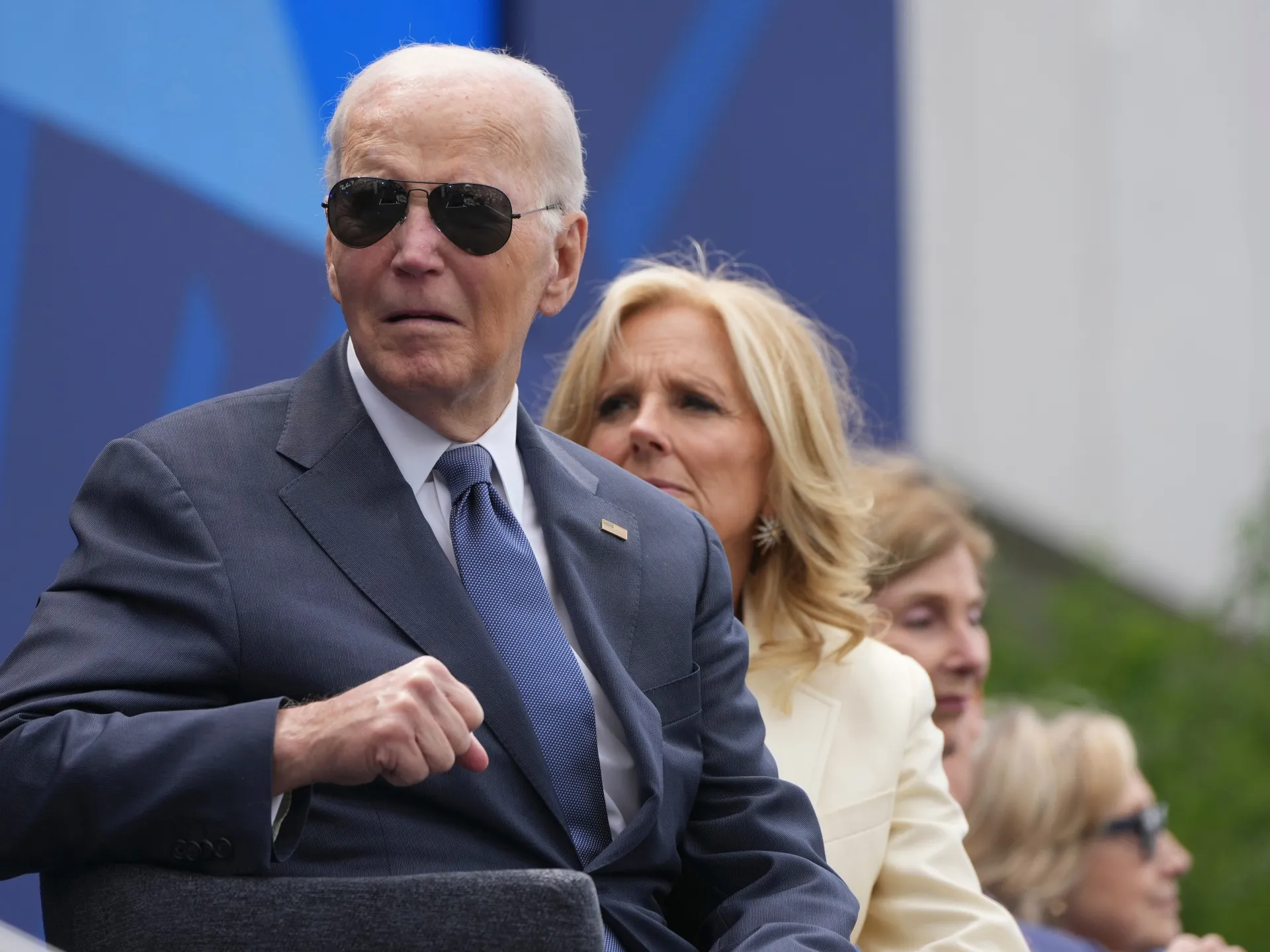
A United States judge has denied a petition from former Democratic President Joe Biden arguing his right to privacy would be violated should recordings he made for a memoir be made public.
On Friday, US District Judge Dabney Friedrich, an appointee of President Donald Trump, ruled that the recordings could be released to the Heritage Foundation, a right-wing think tank.
Recommended Stories
list of 3 itemsend of list
The Trump administration had already authorised the release of the recordings and transcripts, which Biden made while out of public office with his ghostwriter, Mark Zwonitzer.
Together, they released the 2017 memoir, Promise Me, Dad: A Year of Hope, Hardship, and Purpose.
In her 26-page ruling, Friedrich acknowledged that Biden was likely to suffer some reputational damage as a result of the recordings being released.
Biden has long been scrutinised about whether his advanced age impeded his ability to serve as president during his term from 2021 to 2025. Previously, he served as vice president from 2009 to 2017.
“The Court agrees that — on these facts involving the frank words of a public figure in his home — disclosure of the Zwonitzer materials risks irreparable harm to Biden’s privacy interests and his reputation,” Friedrich wrote.
But she concluded that such harms may not be irreparable, and they do not supersede the public interest in releasing the files.
“Biden has not identified any public harm that would arise absent an injunction in this case,” Friedrich said. “The harm to Biden’s diminished privacy interest is outweighed by the public’s interest in the Zwonitzer materials.”
Biden filed a lawsuit arguing that the Department of Justice had a duty to protect the private information it collects during criminal investigations.
He petitioned the court for an injunction to prevent the Heritage Foundation, which has supported Trump, from receiving the documents through a Freedom of Information Act (FOIA) request.
“Every American, including a sitting or former Vice President, has a right to privacy in the personal conversations he has within his own home,” Biden’s lawyers have said in his court filings.
The recordings and transcripts came to be in the Justice Department’s possession in 2023, during Biden’s own term.
The Justice Department at the time had appointed a special counsel, lawyer Robert Hur, to independently investigate Biden’s alleged mishandling of classified documents while out of office.
A similar investigation, helmed by a second special counsel, Jack Smith, resulted in a short-lived criminal indictment against Trump. Hur, however, concluded that no criminal charges were “warranted” against Biden.
Part of his rationale was “a shortage of evidence”. But another part of his reasoning was that, if any charges were brought to trial, jurors were likely to perceive Biden “as a sympathetic, well-meaning, elderly man with a poor memory”.
As part of his investigation, Hur had obtained Biden’s recordings and transcripts with Zwonitzer in order to evaluate whether the Democrat had misused information from his time as president for his memoir.
But he also cited them as evidence to conclude that Biden “appeared to have significant limitations” in his memory.
The scrutiny over Biden’s age increased substantially during his 2024 bid for re-election. At a June 2024 presidential debate against Trump, Biden appeared to drift off topic and make nonsensical statements.
At one point, he issued the non sequitur, “We finally beat Medicare,” referencing a government health insurance programme for the elderly and those with disabilities.
Biden subsequently dropped out of the race, and his replacement, then-Vice President Kamala Harris, lost to Trump after a curtailed campaign. The Democrat, however, has consistently denied that he was unable to perform his duties as president.
Trump, meanwhile, has cited Biden’s age and mental acuity as a reason to undo the Democrat’s actions while in office.
He has also called on the Justice Department to investigate whether any officials attempted to conceal any health conditions Biden may have had while president.
The Republican-led House Judiciary Committee has also sought to obtain the Zwonitzer files for a similar investigation.
Biden was 82 years old by the time he left office in January 2025, making him the oldest sitting president in US history. Trump will be slightly older by the end of his tenure, should he complete his second term.
The Democrat is expected to appeal Friday’s decision to release the recordings.
Kone is expected to make full recovery after breaking his left leg, with multiple fractures, in the match against Qatar.
Published On 19 Jun 202619 Jun 2026
Canada midfielder Ismael Kone underwent surgery to repair severe fractures in his lower left leg that occurred in Thursday’s match against Qatar.
“Last night, Ismael Kone underwent successful surgery to repair a lower limb fracture,” Canada Soccer said in a statement on Friday. “He is expected to make a full recovery but will miss the remainder of FIFA World Cup 2026.”
Kone underwent surgery to repair the tibia and fibula bones in Vancouver, the site of Canada’s 6-0 victory.
Kone was injured in the 51st minute of the Group B match. Qatar midfielder Assim Madibo attempted a tackle, but his right foot brought Kone to the ground. Trainers were immediately called onto the pitch as Kone was in visible discomfort before being stretchered off moments later.
Sitting up on the stretcher, Kone gave a thumbs-up sign to the fans while taking oxygen.
After the match, Canada coach Jesse Marsch said he “could hear the bone snap.”
On Friday, Marsch described the scene at the hospital.
“By the time we got to him, he’d already had some drugs to help sedate him a little bit,” Marsch said at a news conference. “He was being prepared to go into the operating room. But he was in really good spirits and he was adamant that he’s going to be fine.
“[The surgery] took about an hour and a half and they had three surgeons. I think what happened is the surgeons watched it on TV and they saw what happened and they knew right away. And so they brought their top three surgeons to the hospital immediately to take care of him.
“So by the time he got there, the surgeons were there and they were ready. And then we just had to communicate with our medical team and make sure that the surgery was the best option that we thought. But I could see by meeting them and hearing what they had to say about the situation that they he was in really good hands. So the surgery they said went really well.”
A video review of the play resulted in Madibo being shown a red card, Qatar’s second of the game, leaving the team with nine players to finish the match. Madibo later apologised to Kone.
Canada meet Switzerland in Vancouver on Wednesday, with both teams having four points apiece after their first two fixtures. Their third match will determine the winner of Group B.
Nathan Saliba, who replaced the injured Kone and scored Canada’s fourth goal, celebrated by racing to the sideline to hold up a replica of the stricken Kone’s Canadian shirt and pointing to his shirt number, eight.
Saliba holds up Kone’s shirt [Anne-Marie Sorvin/Reuters]
Rodríguez and Figuera met at the legislative Palace in Caracas on Thursday. (Asamblea Nacional)
Caracas, June 19, 2026 (venezuelanalysis.com) – Venezuelan National Assembly President Jorge Rodríguez held a meeting on Thursday with a US-picked opposition figure to launch a new political dialogue process.
In a statement, Rodríguez, who is also the Venezuelan government’s lead negotiator, disclosed talks with “the representative of the opposition lawmakers from the 2015-2020 period,” Dinorah Figuera, to launch “a joint technical and political working group” with “an agenda containing concrete milestones and timelines” aimed at “strengthening democracy.”
In a separate statement, the expired opposition-controlled 2015 National Assembly explained that the central objective of the process is “the construction of a shared vision for the future.” The communiqué claimed that the dialogue aims to establish a “roadmap for the construction of a democratic scenario” in the country.
Figuera also met with US Chargé d’Affaires John Barrett in Caracas on Thursday.
For its part, the US State Department welcomed the meeting, describing it as the “first step” toward “a free Venezuela.” The Trump administration has insisted on a “three-phase process” for the Caribbean nation which culminates with a political “transition.”
According to Washington, the proposed agenda includes priorities such as rebuilding democratic institutions, strengthening the National Electoral Council (CNE), restoring guarantees for political participation, and protecting the civil liberties necessary for an open political debate.
“The cornerstone of any transition is inclusive dialogue. We hope that conversations between Venezuelan political parties and the interim government in Caracas continue in the coming weeks so that this work can begin,” stated Thomas Pigott, spokesperson for US Secretary of State Marco Rubio.
Upon arriving at the airport on Thursday, Figuera told reporters that she had traveled to Venezuela at the invitation of the US State Department, with her tasks including the establishment of a “credible” electoral council. She added that her work intends to benefit all political forces while avoiding questions about whether the initiative had been coordinated with far-right leader María Corina Machado.
Figuera was among the lawmakers elected when the opposition won a parliamentary majority in December 2015. Anti-government parties attempted to use the National Assembly to overthrow the Nicolás Maduro government and pushed several laws that were struck down as unconstitutional. It was eventually sidelined after being declared in contempt by the Supreme Court, with the South American country’s legislation taken over by a government-supporting National Constituent Assembly. The ruling United Socialist Party (PSUV) retook control of the legislature in the 2020 and 2025 elections that were boycotted by many opposition sectors.
Though the 2015 National Assembly’s term expired in January 2021, it unilaterally renewed its own mandate for successive one-year periods. The defunct parliament retained US recognition as Venezuela’s legitimate authority, which allowed it to manage Venezuelan assets abroad. Washington’s backing ended in March when Trump recognized Acting President Delcy Rodríguez as Venezuela’s “sole leader.”
Figuera, who has lived in Spain since 2018, took over as president of the opposition-controlled body in January 2023 following the dissolution of the self-proclaimed “interim government” led by Juan Guaidó.
At the time, Venezuelan judicial authorities denounced Figuera’s role in an “illegitimate” parliament that aimed to “plunder Venezuelan assets abroad” and issued an arrest warrant and an Interpol red alert. While several opposition figures have benefited from an amnesty law approved by the present National Assembly in February, it is not known whether Figuera was among those whose legal cases were dropped.
Figuera’s return to Caracas also comes just weeks after the Unitary Platform—the coalition that groups the country’s main opposition parties—agreed during a meeting in Panama that far-right María Corina Machado would “lead negotiations with Chavismo to call elections” and eventually run as a presidential candidate.
Machado and the Unitary Platform have yet to comment on Figuera’s talks with the acting Delcy Rodríguez government, having previously demanded elections within a 40-week timeframe.
Since the January 3 strikes and kidnapping of Maduro, the Trump administration has wielded a strong influence over Venezuelan affairs. US officials have openly participated in legislative initiatives to open the Caribbean nation’s energy and mining sectors to Western companies while also accompanying corporate executives on trips to discuss business opportunities.
US forces likewise conducted an extrajudicial execution in Venezuelan territory earlier this month, with Caracas calling it a “joint operation” against organized crime.
Despite the diplomatic rapprochement and catering to US investment, Venezuelan authorities had previously brushed aside talk of early presidential elections. Maduro’s term, currently held by Delcy Rodríguez in an acting capacity, ends in January 2031. In a February interview with US conservative outlet Newsmax, parliamentary leader Jorge Rodríguez stated that no elections were expected in the short term because the priority was achieving economic stability.
Following the US and Israeli airstrikes on Iran in February, reverberations were felt globally. But is the world really safer and Iranians freer or has the war unleashed disastrous consequences?
Mehdi Hasan goes head to head with David Des Roches, retired colonel, former Pentagon official and professor at the National Defense University on the justifications and costs of the war – and whether President Donald Trump sent U.S. troops to fight Israel’s war.
Joining the discussion are: Sanam Naraghi-Anderlini – founder and CEO of the International Civil Society Action Network Mohammad Ali Shabani – Middle East scholar and Editor of Amwaj.media, a London-based news outlet focused on Iran, Iraq and Arabian Peninsula countries Barak Seener – Associate Research Fellow, Henry Jackson Society
Recorded shortly before the announcement of a deal between the US and Iran.
Aid cuts and poor sanitation are deepening fears that Ebola is spreading through displacement camps.
Published On 19 Jun 202619 Jun 2026
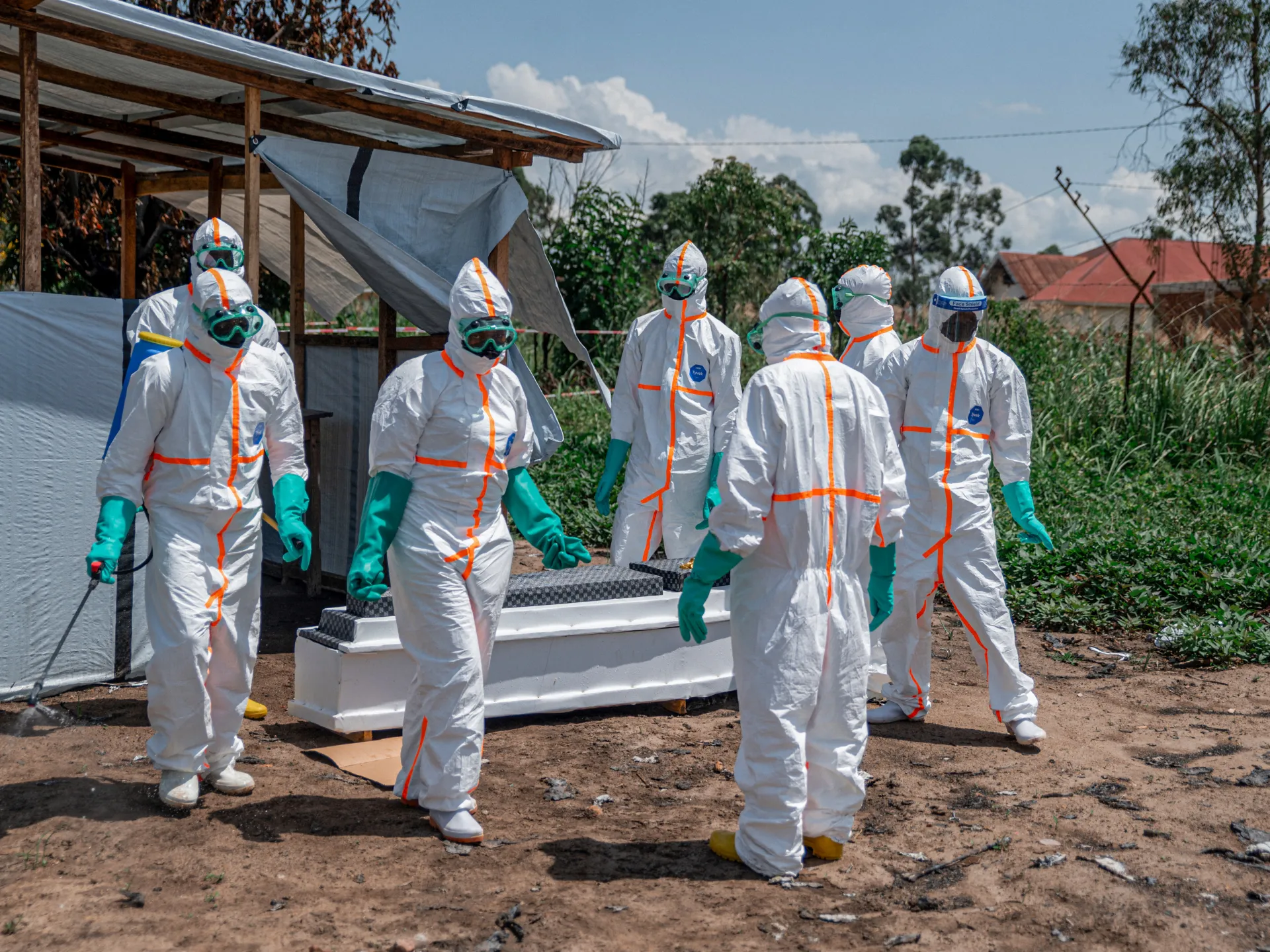
Seventeen medics have died from Ebola in the Democratic Republic of the Congo (DRC) as the death toll surpasses 200 in an outbreak tearing through a health system already weakened by years of conflict, displacement and chronic underfunding.
A senior World Health Organization (WHO) official confirmed the death toll on Friday and said that 75 healthcare workers had contracted the virus since Congolese authorities declared the outbreak on May 15 .
Recommended Stories
list of 3 itemsend of list
“The outbreak remains serious” and is “evolving so fast”, said WHO emergency director Marie Roseline Belizaire.
“It is a really high price that the system, the healthcare system, is paying, because we don’t have enough of healthcare workers in DRC,” she told reporters by video link from the outbreak epicentre in eastern DRC.
Health officials believe the rare Bundibugyo strain of Ebola had been spreading for months before the government formally announced the outbreak, leaving doctors, nurses and other medical staff exposed before they knew the virus was present.
Even now, basic protective equipment remains in short supply, with some facilities struggling to secure gloves, masks and other essentials needed to limit infection.
The DRC has one of the world’s lowest ratios of healthcare workers to population, with about 11 health workers for every 10,000 people, according to WHO data. Belizaire said China and Uganda were sending medical teams to support the response.
She added that the WHO was providing psychological support to medics who feared treating patients after seeing colleagues fall sick.
“When they are explaining to you how they live it, how they were infected … [it] can break your heart.”
Outbreak yet to reach its peak
Congolese authorities said on Thursday that the outbreak has killed 232 people and infected 896 others across 31 health zones in the country.
African Union member states have pledged nearly $1bn to respond to the emergency in eastern DRC and neighbouring Uganda, which has confirmed 19 cases and two deaths.
Health officials warn that the outbreak has not yet reached its peak.
The crisis is also raising alarm in camps for displaced people, where overcrowding, poor sanitation and resistance to testing could allow the virus to spread undetected.
At least 30 people have died since early May in Kigonze camp in Bunia in Ituri province, the epicentre of the outbreak. Camp officials described the death rate as unprecedented.
Authorities could not confirm the causes of death because patients and relatives had refused testing of both the living and the dead until Thursday, according to a camp spokesperson and aid organisation Caritas.
But witnesses and aid sources told Reuters that the dead had symptoms linked to Ebola, including headaches, fever and vomiting.
“People didn’t just die like this before,” camp spokesperson Desire Grodya Bapi told Reuters.
Kigonze is home to more than 15,000 people. The rising number of deaths there has increased fears that Ebola may be spreading among the more than five million displaced people in eastern DRC.
Aid workers say funding cuts have made the emergency more dangerous. Donors, including the United States under President Donald Trump, have reduced support for water, hygiene, and sanitation programmes, which are vital in fighting the disease spread through bodily fluids.
UN data shows funding for toilets and handwashing stations in DRC more than halved between 2024 and 2025, falling to about $38m. This year’s $80m appeal is only 21 percent funded.
DRC has hundreds of displacement camps, some housing up to 100,000 people. Ebola deaths have already been recorded in another camp in Ituri province, which accounts for more than 90 percent of nearly 900 confirmed cases.
The Italian prime minister has accused Trump of making up a story that she ‘begged’ him for a photo at the G7 summit in France.
Published On 19 Jun 202619 Jun 2026
A diplomatic row between United States President Donald Trump and Italian Prime Minister Giorgia Meloni has escalated, with Italy’s top diplomat cancelling an upcoming visit to the US.
At issue is Trump’s claim that Meloni “begged” him for a photograph during the Group of Seven (G7) meeting in France earlier in the week.
Recommended Stories
list of 3 itemsend of list
“She’s probably happy I talked to her. I didn’t have to talk to her,” Trump reportedly told the Italian La7 network. The broadcaster only published a dubbed Italian version of the interview, not the original English version.
“She begged me to take a picture with her. She wanted a picture with me so badly. I wouldn’t have taken it, but I felt sorry for her.”
On Friday, Meloni posted a video answering Trump’s statement, saying that “certain things deserve an immediate response”.
“Donald Trump’s statements are completely fabricated. I am frankly stunned,” she said. “I don’t know why the president of the United States behaves this way toward his own allies. After all, this isn’t the first time this has happened.”
The head of a far-right party who campaigned on an anti-immigrant platform, Meloni had long been seen as one of Trump’s most supportive counterparts in Europe.
She had met with Trump at his Mar-a-Lago estate following his 2024 election victory and attended his inauguration in January 2025.
However, the pair have diverged during Trump’s second term over several issues, including support for Ukraine amid Russia’s invasion, the US-Israeli war with Iran, Trump’s threats to seize the Danish territory of Greenland and his criticism of Pope Leo.
In her video, Meloni said it was a “shame” Trump did not show “the same resolve toward the enemies of the West, toward the enemies of the United States” as he did in his statements against her.
She accused the US president of being “much more accommodating” to foes than allies.
“But there’s one thing he must remember: Italy and I do not beg,” she said.
Shortly after Meloni posted the video, Italian Foreign Minister Antonio Tajani said he was cancelling a weekend trip to the US, where he was scheduled to attend a business forum in Miami, Florida and meet with US Secretary of State Marco Rubio.
He called Trump’s reported statements “serious and offensive”. Several other government officials also weighed in.
Justice Minister Carlo Nordio suggested Trump’s remarks besmirched the legacy of the US soldiers who died during World War II.
“The thousands of crosses marking the graves of American soldiers who died to free us from Nazi-Fascist dictatorship did not deserve such a painful blow to our fraternal ties,” Nordio posted on X.
Defence Minister Guido Crosetto said he did not believe Meloni would ever beg for a photo, “not even under threat”.
“Jokes of this kind do no good to anyone: neither to the USA, nor to Italy, nor to the alliance,” he said.
The White House did not immediately respond to Meloni’s comments.
Artificial intelligence education now starts at the age of six in China. The Ministry of Education has rolled out new guidelines to teach AI at every grade level. For President Xi Jinping, AI is a priority. Will the toddlers of today be the tech titans of the future?
This is a story from the archives. This originally aired on September 18, 2025. None of the dates, titles or other references from that time have been changed.
Episode credits: This episode was produced by Amy Walters, Sonia Bhagat, Sarí el-Khalili, and Tamara Khandaker, with Phillip Lanos, Spencer Cline, Melanie Marich, Kisaa Zehra, Farhan Rafid, and our host, Malika Bilal. It was edited by Kylene Kiang.
Our sound designer is Alex Roldan. Our video editors are Hisham Abu Salah and Mohannad al-Melhem. Alexandra Locke is The Take’s executive producer.
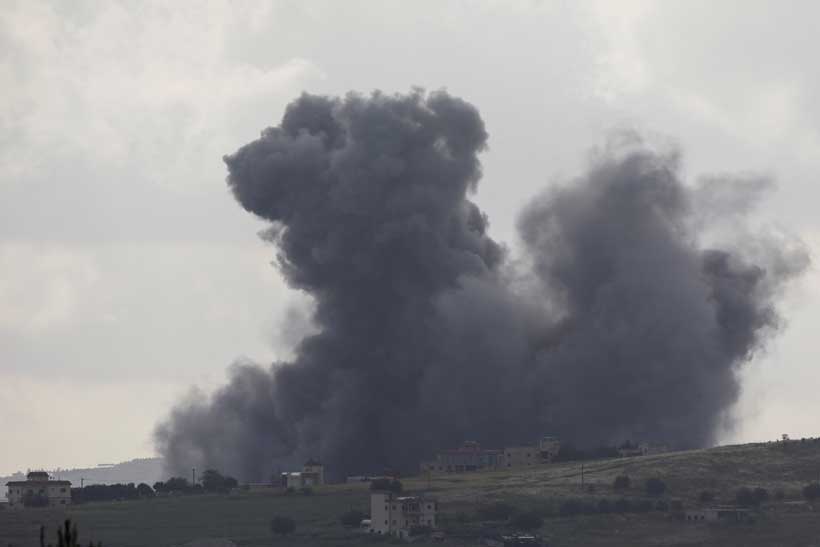
Israel and Hezbollah agreed to a ceasefire in Lebanon after escalating violence threatened to derail potential peace talks regarding the ongoing war in Iran. This ceasefire was announced just before 4 p.m. Lebanon time, with a U. S. official confirming that negotiations, facilitated by the U. S. and Qatar with assistance from Iran, had led to this agreement. Both sides indicated they would uphold the ceasefire, with an Israeli official stating that Israel would remain in southern Lebanon but would not engage in conflict unless attacked.
The recent conflict included intense airstrikes that resulted in 18 deaths and injuries to 33 others in Lebanon. Four Israeli soldiers were also killed by Hezbollah. This violence could complicate U. S.-Iran negotiations, as establishing peace in Lebanon is key to a broader agreement. The recent memorandum signed by the presidents of the U. S. and Iran postponed discussions on critical issues like Iran’s nuclear program, granting parties 60 days to agree on a lasting solution or extend the current deal.
Technical talks were planned in Switzerland but were postponed, and officials from both the U. S. and Iran indicated that their respective negotiators would not be attending. Hezbollah lawmakers suggested that further discussions hinge on a complete ceasefire and urged the Lebanese government to reject any negotiations with Israel as long as hostilities continued.
The interim agreement seeks an end to military operations in various regions, including Lebanon, but Israel maintains that it is not a part of these deliberations. The fighting began when Hezbollah fired at Israel, prompting Israeli military responses, including strikes targeting Hezbollah’s positions.
Lebanon’s health ministry confirmed the heavy toll from recent airstrikes, and its President condemned Israel’s actions while emphasizing the commitment to achieve a comprehensive ceasefire. The broader conflict, which originated on February 28 with U. S. and Israeli attacks on Iran, has reportedly resulted in at least 7,000 deaths, primarily in Iran and Lebanon.
Despite the conflict’s impact on oil prices, which had risen due to concerns over regional stability, the signing of the interim deal resulted in a drop in prices as shipping through the Strait of Hormuz resumed. Under the terms of the agreement, Iran will receive economic relief and unfreezing of assets, with negotiators tasked with addressing the status of Iran’s nuclear program and establishing a reconstruction fund within the next 60 days.
In the face of criticism in the U. S., former President Trump defended the deal, arguing that the war had weakened Iran and affirming that the terms would lead to significant concessions from Iran without offering direct financial support.
Within this jumbled and often misunderstood narrative, one new capability stands out from the rest that would give the MQ-9 extreme value today and for years to come. This is turning the MQ-9 into a radar-toting airborne early warning (AEW) platform for detecting and tracking aircraft, drones, and missiles. A Reaper in this exact configuration just flew for the first time recently.
MQ-9 outfitted with a STOL kit and AEW pods for shipboard fleet defense. (General Atomics)
The MQ-9 sortie in question was the product of a partnership between General Atomics and Saab, with Saab, already a leader in AEW systems, providing the podded radar system named LoyalEye. This initial test flight took place on May 19th, and a full demonstration of the pairing’s capabilities is planned for next year.
GA-ASI President David R. Alexander stated the following about the MQ-9 AEW capability:
“AEW for MQ-9B will offer critical aloft sensing to defend against tactical air munitions, guided missiles, drones, fighter and bomber aircraft, and other threats. Operational availability for a medium-altitude, long-endurance UAS is the highest of any military aircraft, and as an unmanned platform, its aircrews are not put into harm’s way.”
MQ-9 AEW configured aircraft taking to the air for the first time. (General Atomics) General Atomics
For many years now, I have discussed how the most glaring new mission set for a medium altitude, long-endurance drone is AEW. The idea is relatively simple in concept. Take a cost-effective drone that can fly at medium altitudes for long periods and bolt on some radar pods capable of air moving-target indicator (AMTI) functionality. Then configure the datalinks (both line-of-sight and beyond line-of-sight) aboard the aircraft to send the information the pods collect back to controllers, who also remotely operate the drone and the pods from the ground. Such an unmanned aircraft could fly its missions at relatively low cost, and operate in a distributed manner, near where its surveillance capabilities are needed most. Above all else, it would be able to persist for very long periods of time — think of loitering over its launch location for the better part of a day or more — providing persistent long-range look-down radar surveillance, which has never been more important than it is today.
One-way attack munitions, also known as long-range kamikaze drones, are a massive threat to confront on many levels. These unmanned aerial systems blur the definition between cruise missiles and drones. In this case, cruise missiles are also part of the same problem set. While the question of how to shoot down relatively cheap one-way attack drones cost-effectively gets a lot of attention, just spotting them in order to engage them at all, especially at a distance, is also a challenge. Their small signatures and low-altitude flight profiles, as well as their slow speed, can make it so ground-based sensors don’t detect them until it’s almost too late, and aging airborne sensors also have limitations in doing so.
The moment of one of Russian strikes with Shahed/Geran-type long-range OWA-UAVs in the Ukrainian city of Dnipro on Tuesday.
This is where an advanced look-down airborne radar is critical. It can spot these objects from above at long distances and separate them from the ground clutter. The problem is that airborne early warning and control (AEW&C) manned platforms are hugely expensive, resource intensive, and are the very definition of high-value, low-density assets. Many of them can only operate from longer runways, meaning they can only be based far away from where the threats are. Even then, they are top targets, as we saw earlier this year in Saudi Arabia, and their airfields are prime targets too, which can leave them trapped or destroyed on the ground.
The USAF has a dwindling number of geriatric E-3 Sentry Airborne Warning and Control System (AWACS) aircraft, which, despite upgrades, are not the best at spotting low-flying drones. The USAF is now moving begrudgingly forward with stalled E-7 procurement, but these aircraft are also very complex, expensive, and labor-intensive platforms that need long runways to operate from. The Navy has the E-2D Hawkeye, which is more modern and capable in some regards, and less in others, but is also not available in vast numbers as they have other critical taskings, especially to support carrier air wings. These aircraft are better suited to operate from remote forward airfields, and having a smaller logistical and crew footprint, but still require far more support than an MQ-9. Overall, these crewed aircraft are also increasingly vulnerable to long-range air defenses, and, while their sensor range is generous, it is still limited, making their utility questionable in a peer state conflict.
E-7 is seen as a partial, interim replacement for the aging E-3 fleet. (USAF)
For higher-end missions, where command and control is a major part of what AEW&C platforms will be called upon to do, directing air wars and coordinating defenses, while also supplying networking support, a pod-equipped MQ-9 cannot replace an E-7 or E-2. For providing critical surveillance, especially in areas where there are gaps in crewed AEW&C coverage, or in places that just don’t require that level of support, the AEW-capable MQ-9 is a very attractive solution. Even pushing these uncrewed sensor nodes forward, into higher-threat areas, under certain circumstances, to provide high-fidelity radar coverage where no crewed platform would ever be risked, is a real use case. An MQ-9 is far more expendable than a manned AEW&C asset from human life, cost, and recovery operation requirements (combat search and rescue) perspectives.
The truth of the matter is that even if the E-7 replaces all 15 remaining E-3s, and even if the Navy adds E-2 Hawkeyes, in a future distributed conflict, there is no way these aircraft can give all the coverage needed, persistently, day and night, while providing surveillance for all threatened locales. Not even close. This is especially true as relatively cheap one-way attack drones, such as the Shahed-136, can travel over a thousand miles, drastically expanding potential threat areas at a very low cost to the enemy.
This is where the podded MQ-9 can shine, with a detachment of a few of these aircraft providing persistent coverage (“orbits”) over key areas 24/7 while retaining a small logistical footprint. This would also directly support the USAF’s Agile Combat Employment (ACE) combat doctrine, where small groups of tactical aircraft will move quickly from one forward location to another in hopes of staying ahead of an enemy’s targeting cycle. While that may be the goal, these traveling road-shows of airpower will still need persistent look-down coverage, especially if they are positioned deeply within the enemy’s striking range. AEW&C aircraft will not be able to provide this coverage persistently (if at all). AEW MQ-9s could, and they could drastically increase the situational awareness, range, and overall effectiveness of other key defensive capabilities, such as surface-to-air missile systems and fighter aircraft, with the targeting data they provide.
General Atomics is also turning the MQ-9 family into drone killers themselves with the addition of laser-guided rockets. This could result in ‘hunter-killer’ teaming, where the AEW MQ-9 spots the threat and the laser-guided rocket-equipped MQ-9 intercepts and destroys it. Just the AEW MQ-9 on its own can also use its powerful MTS electro-optical sensor turret to visually identify potential enemy aircraft once they get close enough, allowing for a non-cooperative friend or foe identification capability.
Mojave STOL: Real. Rugged. Ready Today.
You can even look to the recent fighting in the Middle East, which saw Iran barrage allied bases on the Arabian Peninsula with one-way attack munitions and low-end cruise missiles. Reapers with LoyalEye pods could have provided persistent look-down radar coverage over threatened areas, especially as the USAF’s dwindling and rickety AEW&C fleet was overtasked. They could have also created a radar picket line across the Persian Gulf, Gulf of Oman, and eastern Iraq, providing high-fidelity look-down radar coverage and a true early warning screen for Iranian weapons heading towards their target areas, all without putting a crew at risk.
Now, it’s worth noting that the USAF envisions a future where AEW and general AMTI sensing is largely migrated to an orbital layer of satellites, and they are actively working to realize this capability, which would be absolutely revolutionary if fully realized. Yet, as of now, it’s still an if, and it will take years to fully come to fruition. Even then, relying on a space layer alone for this absolutely critical capability would be a huge vulnerability. Backing it up with a lower-end, flexible airborne solution will likely remain critical for a long time to come. AEW MQ-9s can help efficiently fill out a high-low AEW/airborne moving target indicator mix. This is especially true as the platform itself, the MQ-9, can be reconfigured for a huge range of other missions when AEW capabilities are not in high demand, so the USAF isn’t left with a single mission asset.
An MQ-9 seen operating out of Puerto Rico on a counter-narcotics maritime interdiction mission equipped for multi-int collection and kinetic strikes. (Miguel J. Rodriguez Carrillo / AFP via Getty Images)
The AEW MQ-9s can also provide their capabilities here at home. America is dealing with a tough future when it comes to defending the homeland, and providing look-down radar capabilities is a major part of adapting to this reality. Outside of tethered aerostats, which have not proven to be a large-scale workable solution yet, AEW MQ-9s would provide flexible, efficient and persistent capabilities in areas where it may be needed, especially in times of heightened defense, like major public events and during a crisis.
China has invested very heavily in modern AEW platforms. (Chinese Military via Chinesemilitaryreview.com)
The naval side of this is a big deal too. The fact that General Atomics is modifying the MQ-9 family to operate from large deck amphibious assault ships and carriers presents another huge opportunity. It could provide LHA/LHDs with a truly organic fixed-wing AEW asset for the first time — one that doesn’t require large flight crews and that can loiter above the amphibious strike group for very long periods of time. This is becoming more important as enemy missile and drone technology evolves. Having to rely on surface combatants and a small contingent of fighter aircraft, if any at all, for air defense is limiting and can impart extra risk at inopportune times, especially in littoral environments. During a major conflict, these ships could operate too far out to sea to make land-based AEW support plausible and those assets will be over-tasked as it is. AEW MQ-9 seems like a relatively glaring off-the-shelf solution to this problem. It’s also worth noting that the USMC already operates the MQ-9 and integrating it into the shipboard Air Combat Element (ACE) of a Marine Air-Ground Task Force should be relatively straightforward.
Introducing MQ-9B STOL
AEW configured examples could also be extremely useful for the Marines’ Expeditionary Advanced Base Operations (EABO) concept, which mirrors elements of the USAF’s ACE doctrine, but goes beyond just the aerial fight. Marines deployed forward in the enemy’s ring of fire under EABO will need look down protection more than pretty much anyone else, which the AEW MQ-9 could provide at low risk. The MQ-9 family is already capable of short field operations and that is only being enhanced with new STOL (short-takeoff-and-landing) members of the MQ-9 family, meaning they can fly from small, austere airstrips and could maintain sortie rates even if those airstrips receive partial damage.
For supercarriers, the AEW MQ-9 could augment the E-2D, providing constant look down radar coverage for the entire carrier strike group when E-2s are not up. This would deeply benefit the CSG’s entire air warfare mission, providing critical sensor data to Aegis warships, fighters, and the carrier. They could also augment E-2D coverage during high-threat periods of vulnerability, including putting additional sensor coverage farther away from the CSG over high-risk vectors of attack. We discussed in detail how an AEW capable version of the Navy’s MQ-25 Stingray could also serve in this general capacity.
Rendering of an AEW MQ-9 equipped with a STOL wing kit landing on an amphibious assault ship. (General Atomics)
All of this is from a very American point of view, but the AEW MQ-9 concept may be most attractive to foreign air arms that currently have no dedicated AEW capabilities at all, or are looking to augment the limited capacity they do have. Fielding a traditional AEW&C force is very expensive, even for a small cadre of crewed platforms, limiting the realistic application of such a force even if the country can afford it to begin with. AEW MQ-9 could help ‘democratize’ AEW and allow many allies to field such a capability, which a coalition force during multi-national operations could also benefit from, including the U.S. In this way, AEW MQ-9 could be a huge win not just for countries in need of this kind of capability at a lower price point, but also for the U.S., as this kind of sensor information will become far more widespread, putting less pressure on its own organic AEW force. This could be leveraged both in peacetime for surveillance and monitoring, but especially in a crisis.
Just look at what’s happening with the drone threat to Europe for instance. MQ-9s with the radar pods could provide sustainable airborne surveillance for NATO countries. Think of the AEW MQ-9 as the F-5 Freedom Fighter of AEW capabilities. And once again, these allies would be able to use the MQ-9s in many different ways when not configured for the AEW mission, including peacetime monitoring and patrols not related to airborne moving target tracking.
Finally, it’s worth noting that the idea of AEW functionality on an uncrewed platform isn’t exactly new. It has been experimented with before and China is thought to have added some of this functionality to its far more advanced high-altitude, long-endurance drones. But providing a robust, off-the-shelf solution for the more accessible and flexible medium-altitude, long-endurance drone class, and especially the most proven of all types in this class on the planet, the MQ-9 family, makes glaring sense for an extremely wide set of potential users, including the United States.
Weekly insights and analysis on the latest developments in military technology, strategy, and foreign policy.
More than three decades after decommissioning the USS Long Beach, the Navy is finally preparing to dispose of what’s left of the world’s first nuclear-powered surface combatant. The cruiser – which already had its distinctive boxy superstructure as well as its bow and stern sections removed – has been moored at Puget Sound Naval Shipyard and Intermediate Maintenance Facility since being decommissioned in 1995.
After a long process to determine what to do with Long Beach, the Navy on Wednesday put out a call for companies willing and able to perform the extremely complex and lengthy operation to transport, dismantle, de-militarize, and dispose of what was once a 721-foot-long ship that displaced 15,540 tons, including its two defueled reactor plants. Long Beach was launched in 1959 and commissioned two years later.
You can read more about the ship, its unique character, armaments and exploits in our two-part interview with a master chief who served on Long Beach here and here.
The USS Long Beach, world’s first nuclear-powered surface combatant, under construction. (USN)
This marks just the second time the Navy has opted to select a commercial yard to dismantle a nuclear-powered warship. The first was the ex-USS Enterprise, the world’s first nuclear-powered aircraft carrier from the same era as Long Beach. It is vastly more complex and expensive to dispose of nuclear-powered vessels than conventionally powered ones because of all the radiological concerns, even long after the reactors have been defueled.
We’ll get into more details about how difficult, time-consuming and costly a process this could be later in this story when we examine the pitfalls of the Enterprise situation, admittedly a much more complex undertaking for various reasons we will explain. However, first we need to understand how Long Beach got to this point.
USS Long Beach. (USN)
The decision to go forward with the Long Beach dismantling process came after a Naval Vessel Historical Evaluation (NVHE) in April determined that the ship was ineligible for listing in the National Register of Historic Places (NRHP) despite its history as the first surface combatant ever to have nuclear propulsion and combat service that ranged from the Vietnam War to Operation Desert Storm.
USS Long Beach (CGN-9)
“The ship was deactivated in 1994 and towed to Newport News Shipbuilding where the entire superstructure was removed and the reactors were defueled,” according to the NVHE. “After this work was completed in the winter of 1995, the hull was towed through the Panama Canal to Puget Sound where it has been waiting to be recycled.”
In 2012, the ship was sold for scrap.
“Long Beach had 10,000 tons of steel, 300 miles of electrical cable and 450 tons of aluminum, earning it the voice radio call sign ‘Alcoa’ after the aluminum maker of the same name,” Reuters reported at the time.
“More than a dozen scrap dealers have expressed interest in taking part in sealed online bidding for the hull, with more than 7.35 million pounds (3.33 million kg) of steel, aluminum and copper wiring, galley equipment, tables, chairs, lockers and bunks,” Government Liquidation president Tom Burton told the news outlet.
“It’s a two-year process but it could take 18 to 26 months,” Burton said. “What’s left is an inert hull.”
USS Long Beach CGN-9
It remains unclear what happened to that scrap sale. We reached out to the Navy for answers.
The Puget Sound Naval Shipyard subsequently completed a limited-scope hull preservation availability in 2015 that resulted in the removal of the bow and stern, according to the NVHE records. It was ultimately decided not to save the ship by placing it on the NRHP because “major alterations have been made in design that do not maintain the historic design of the vessel (loss of the superstructure and major hull elements),” the review found. “Character defining features of USN warship have been lost, such as main armament, superstructure, bow, and stern. Does not evoke the aesthetic of a 20th Century USN warship.”
What’s left of the USS Long Beach. (Google Earth)
Moreover, a 60-day period for stakeholders to comment expired earlier this month with no responses.
USN
With all the hurdles to ultimate destruction now out of the way, the Navy will host an Industry Day meeting on June 24 and 25 in Washington, D.C. for companies interested in learning more about what is involved in the final dismantling of the USS Long Beach.
Screenshot
Whoever gets the job will first have to transport it from Puget Sound to the shipbreaking yard by “dry transport via semi-submersible barge, deck barge, or semi-submersible heavy lift vessel” because the ship’s “current structural condition precludes an open ocean tow,” according to the RFI.
“Dismantling and disposing of ex-Long Beach is necessary in order to comply with Navy policy for inactive nuclear-powered ships stricken from the Naval Vessel Register, and Naval Nuclear Propulsion Program (NNPP) statutory responsibilities,” the RFI explains. “The requirement for disposal includes dismantling, demilitarizing, and recycling the remnant hull sections at an authorized commercial facility in accordance with applicable federal, state, and local laws, and removing and packaging the reactor plant components for transportation and disposal as low‑level radioactive waste (LLRW) at an authorized radioactive waste facility or facilities.”
There are no timelines or cost estimates associated with the RFI, nor is there any guarantee that a request for proposal will be issued. We’ve reached out to the Navy for more details.
Our past reporting offers some insights into the tremendous time and money it takes to dismantle a nuclear-powered warship, as evidenced by the saga of the aforementioned Enterprise. However, it should be noted that there are some big differences between that vessel and Long Beach. The carrier is far larger and more complex, had eight reactors compared to two, and had less prep work done in advance.
Tugs move the USS Enterprise into Newport News Shipbuilding’s yards in 2013. USN
In 2019, the Government Accountability Office found that it could cost the Navy more than $1.5 billion to fully dispose of Enterprise.
The GAO report also stated that a complete process could take more than 15 years to finish.
A trio of nuclear-powered Navy surface warships sail together in 1964. From left to right, the aircraft carrier USS Enterprise, the cruiser USS Long Beach, and the frigate USS Bainbridge. USN
From our previous story about the dismantling of the ship known as the Big E:
“The Navy officially decommissionedEnterprise, also known by its hull number CVN-65, in February 2017, after more thanfive decades of service. The ship had already effectively been in mothballs since 2012 and Newport News Shipbuilding completed a lengthy ‘inactivation’ process, which included removing nuclear fuel, mission systems, and other items from the ship,in April 2018.
‘At approximately 76,000 tons, CVN-65 will require an unprecedented level of work to dismantle and dispose of as compared to previous ships,’ GAO’s review, which the congressional officepublished on Aug. 2, 2018, said. ‘Regardless of the approach the Navy chooses, CVN-65 will set precedents for the processes, costs, and oversight that may be used to dismantle and dispose of nuclear-powered aircraft carriers in the future, such as the Nimitz-class carriers which the Navy will begin to retire in the mid-2020s.’”
An SH-60 Blackhawk helicopter assigned to Helicopter Anti-Submarine Squadron Seven (HS-7) hovers off the bow of the aircraft carrier USS Enterprise CVN 65. (DoD photo by Petty Officer 3rd Class Timothy Smith.) Cpl. Madisyn Paschal
The first of those, the USS Nimitz, the Navy’s oldest operational carrier, is scheduled to be inactivated in 2027, the Navy told us.
On March 13, the Navy signed a $95.7 million contract with Huntington Ingalls Inc. “for advance planning and long-lead-time material procurement to prepare and make ready for the accomplishment of the inactivation and defueling of USS Nimitz (CVN 68). Work will be performed in Newport News, Virginia, and is expected to be completed by March 2027.”
The aircraft carrier USS Nimitz underway. (USN)
Meanwhile, the Navy originally projected that it would cost somewhere between $500 and $750 million to scrap the Enterprise, but by 2013, this figure had grown to over $1 billion. The difficulties involved forced the service to push back the start of the process more than once.
The regulatory and logistical picture was equally tangled. The Navy and the NRC disagreed on what standards should apply if a private company did the work, and NRC only has direct authority in 13 states, potentially limiting where the job could even be done. Conducting the work at Puget Sound Naval Shipyard — the Navy’s proven approach — risked worsening an already serious maintenance backlog for active ships. The commercial route could be faster and cheaper, but no private yard had ever handled military nuclear reactors at this scale, and the highly classified nature of U.S. naval reactor design added another layer of complexity.
You can read more about the challenges involved with breaking up a nuclear behemoth in our deep dive into the problems with the Enterprise effort here.
The Decommissioning Of The USS Enterprise
The challenges of disposing of Enterprise, however, continued even after a final decision was made about what to do with the vessel.
On May 30, 2025, the Navy awarded a $536.7 million contract to dismantle the ship to NorthStar Maritime Dismantlement Services, LLC, of Vernon, Vermont, according to Pentagon records. The work was initially expected to be completed in November 2029.
“It was the first time a U.S. nuclear-powered warship will be dismantled through a commercial effort, representing a significant milestone in responsibly and safely closing out the legacy of one of the most iconic nuclear-powered warships,” the Navy noted at the time, according to USNI.
However, the effort unraveled over a legal battle over how the Navy handled final bid submissions, ultimately resulting in the service being “ordered to pause the project and reassess bids, while the appeal now puts the future of the contract back in question,” according to NBC15 News. “The Navy is expected to re-award the contract by June 2026.”
We have reached out to the Navy to find out the status of that contract as well.
USS Enterprise to be dismantled in Alabama
Even as the Navy is working to dispose of its first nuclear-powered surface combatant, it is planning for the newest one. The Navy says its proposed Trump class battleships will be nuclear-powered as well.
It remains to be seen how the complications the Navy has faced trying to dismantle Enterprise will affect the disposal of Long Beach and what lessons will be applied, if any. The answers to some of those questions should come into sharper focus next week when interested parties get to ask the Navy for themselves at the Industry Day.
“Officer, abeg! I go tell you everything. Na my friend na him deceive me. E de Sapele, I go carry you go the place. I no know anything concern. Officer!”
These were the last words of 28-year-old Oghenemine Ogidi before he was shot at close range by Usman Nuhu, an Assistant Superintendent of Police (ASP), on April 26, 2026, in Effurun, Delta State, South South Nigeria. Oghenemine died instantly from the gunshot.
A disturbing video had captured him speaking Nigerian Pidgin while begging for mercy from the police officer with his hands and legs tied. He was said to have visited the Effurun Main Park along the Warri-Sapele Expressway to collect a waybill for a friend. However, transport union workers intercepted the parcel, which allegedly contained a Beretta pistol and ammunition. The transport workers informed the Uvwie Area Police Command.
At the park, the police, led by ASP Usman, a former member of the disbanded Special Anti-Robbery Squad (SARS), arrived in a 2010 Toyota Sienna with other officers, supposedly to intervene and arrest the suspect, who had already been restrained by the transport unionists. The police whisked him away from the scene and took him to the front of the Ekpan Police Station in the state, where Usman allegedly shot him three times, while the other officers watched.
The horrific incident triggered a cascade of criticism against the police on the internet, with many condemning the extrajudicial operations of ASP Usman and other officers in the country. Before his death, Oghenemine was an up-and-coming musical artist and the second child in the family to have been killed by the police. The mother of the slain artist said his elder brother was also killed in 2022 by a high-handed police officer.
Human rights defenders and lawyers have condemned the incident, stressing that it betrayed Nigeria’s judicial system. Abba Hikima, a human rights lawyer, told HumAngle that it is unjust for a police officer to execute the most severe form of criminal justice without a fair trial or proper judicial process in any case. He emphasised the need for swift justice for the victim.
“If someone is found culpable or liable for the allegations against him and a judgment of a death sentence is passed, even the court has to hand that out to the executors of the judgment, which is a department of its own; even the judge cannot do that. It is the sheriffs of the court and the executors that execute the judgment of the court,” Abba said, noting that Usman’s job was to arrest, investigate, and charge the suspect in court so that justice could be administered accordingly.
Oghenemine’s murder forms a part of the troubling pattern of extrajudicial killings that have plagued Nigeria for decades, eroding public trust in law enforcement and fuelling cycles of protest and repression.
A disturbing pattern
Many civilian lives have been lost to police extrajudicial killings, ill-treatment, and abuse of power. Oghenemine only fell victim to a policing system enmeshed in impunity and brutality. Far worse cases have occurred in the past, and disturbing incidents of police officers unleashing cruelty against civilians continue to disrupt Nigeria’s civic spaces.
In 2005, for instance, six young traders were killed by some police officers during a supposed anti-robbery patrol. The traders were said to be returning from a nightclub in Abuja, North Central Nigeria. One of them, Augustina, had allegedly rejected the advances of a senior police officer, Danjuma Ibrahim, leading to a bitter confrontation. The angry Danjuma then told officers at a nearby police checkpoint that armed robbers were approaching. When the group arrived in their car, the police blocked them and opened fire. Four died instantly, while two survivors were taken away and left to die. The police had reportedly planted weapons on their bodies to frame them as criminals.
The killings sparked outrage across Nigeria, with widespread condemnation of police brutality and impunity. Then-President Olusegun Obasanjo ordered a panel of inquiry, which confirmed that the victims were innocent traders and not armed robbers. Findings from the panel revealed the deliberate framing of the victims and exposed the systemic abuse of power within the police force. The case became emblematic of the dangers of unchecked authority and the lack of accountability in Nigeria’s law enforcement system.
Image of ‘Apo six’ killed by police in 2005. Photo: Family members.
It took more than 11 years for justice to be partially served. In 2017, two of the six policemen involved, Ezekiel Acheneje and Baba Emmanuel, were sentenced to death for their roles in the killings, while others were discharged.
The Apo Six case remains a relevant example of extrajudicial killings in Nigeria, projecting a system that harbours police misconduct and the long struggle for justice faced by victims’ families. Between 2020 and 2023 alone, 848 Nigerians were victims of extrajudicial killings, according to Global Rights’ Mass Atrocities Tracker.
During the #EndBadGovernance protests in 2024, several protesters were killed in Kano, Jigawa, Katsina, and Kaduna, with experts raising concerns over growing police brutality. In Oghenemine’s case, however, the Nigerian Police Force seems to have moved swiftly to dismiss the officers involved and hand them over for prosecution.
“The Force does not shield officers who violate the law. No rank, no position, and no circumstance will be permitted to place any officer above accountability,” DCP Anthony Placid, the Police spokesperson, said in a statement at the time.
On June 1, a High Court in Delta State ordered the detention of five police officers over the alleged killing. The officers – ASP Usman Nuhu, ASP Onoloko Dauroupamo, ASP Okoh Kelechi, Inspector Goodluck Kingsley, and Inspector Omonigho Ahweyevu – were arraigned before Justice Marshal Onome Umukoro under Suit No. THC/ASB/CR/M/66C/2026. The court directed that they be remanded at the Ogwashi‑Uku Correctional Centre pending legal advice from the Directorate of Public Prosecutions (DPP) and adjourned the matter until June 15, 2026, for further proceedings.
On the scheduled hearing date, Harrison Gwamnishu, a human rights activist who has closely followed the case and was present at the High Court in Asaba, revealed that the DPP had filed the necessary information before the court. He noted that the matter is now awaiting legal advice before proceedings can continue.
The court document. Photo: Harrison Gwamnishu.
“The burial date has not yet been fixed, pending the conclusion of the trial,” he noted.
The activist emphasised that the murder of Oghenemine symbolises Nigeria’s ongoing challenges with police reform, noting that this incident shows the critical need for reform, accountability, and the protection of human rights. He added that moving forward, the Nigerian police should begin to use body cameras, as they will help reduce the incidents of extrajudicial killings of suspects who are supposed to be charged in court in the country.
“Even though Nigeria stands at a crossroads, I believe that justice will be served, and the judge has ordered that some of the hearings be delivered online to avoid technicalities, even right from the correctional centre. When there is accountability, justice is possible,” the activist said.
Get our in-depth, creative coverage of conflict and development delivered to you every weekend.
Subscribe now to our newsletter!
Nigeria’s policing system has long been associated with excessive use of force. SARS, for example, was established in 1992 as a branch of the police under the Criminal Investigation Department (CID) and was designed to find a lasting solution to violent crimes, specifically armed robbery, kidnapping, and carjacking across the country. However, it became notorious for torture, extortion, and unlawful killings.
Despite repeated promises of reform, the culture of impunity persisted. Amnesty International, a global human rights organisation, described the promises of Nigerian leaders to reform the police as “ineffective”. In its 2016 investigation, the organisation painted a damning portrait of SARS, exposing how the unit had strayed far from its original mission of tackling violent crime. SARS officers were accused of turning torture and extortion into a profitable enterprise, routinely brutalising detainees to extract confessions or money.
The report documented harrowing abuses, including beatings, shootings, starvation, and mock executions. Detainees were held in notorious centres such as the “Abattoir” in Abuja, where overcrowding and inhumane conditions compounded the suffering. Despite clear evidence, officers implicated in torture were rarely suspended or prosecuted; instead, they were transferred to other stations, perpetuating a cycle of impunity.
Beyond violent crimes, SARS extended its reach into civil disputes and business disagreements, exploiting its power to intimidate and extort. Victims reported theft of property, raiding of homes, and confiscation of valuables, with families describing how officers stole cars, emptied bank accounts, and looted homes during arrests.
The #EndSARS protests of October 2020 were a watershed moment in Nigeria’s struggle against police brutality. Sparked by years of abuses by SARS officers, the protests drew thousands of young Nigerians into the streets, demanding an end to extrajudicial killings, torture, and extortion. The movement culminated in the Lekki Toll Gate massacre, where security forces opened fire on peaceful demonstrators, killing and injuring dozens. According to Amnesty International, the government’s denial and lack of accountability deepened public mistrust.
“These shootings clearly amount to extrajudicial executions. There must be an immediate investigation, and suspected perpetrators must be held accountable through fair trials. Authorities must ensure access to justice and effective remedies for the victims and their families,” Osai Ojigho, former country director for Amnesty International in Nigeria, said.
The death of Oghenemine highlights the same issues that triggered the EndSARS protests: unchecked police violence, lack of accountability, and the erosion of public trust. However, extrajudicial killings are not confined to SARS alone. Regular police units, military detachments, and other security agencies have been implicated in unlawful killings during routine patrols, protests, and even minor disputes.
For instance, in April 2026, Abdulsamad Jamiu, a youth corps member, was shot in Abuja by Guards Brigade personnel. A similar incident occurred elsewhere on January 1, when Timothy Daniel, a 13-year-old boy, was killed by a soldier in Akwa Ibom. In May 2025, Japhet Njoku, a security guard, died in police detention at Tiger Base, Imo State, after severe beatings. Experts say this systemic problem reflects weak accountability structures, inadequate training, and a justice system that rarely prosecutes officers for abuses.
“If the lives of human beings can be taken by security personnel, whether or not they have been found guilty of any crime or not and no matter how harsh that crime is, someday somewhere, somebody may be framed for a similar offence, and his life will also be taken unjustifiably,” human rights lawyer Abba warned.
The first match of the 2026-27 Premier League season sees the reigning top-flight champions face the second-tier Championship winners.
Published On 19 Jun 202619 Jun 2026
Arsenal will kick off their Premier League title defence against promoted Coventry City on August 21.
The Premier League fixtures for the 2026-27 campaign were released on Friday, with the Gunners’ home game against Frank Lampard’s Coventry among the highlights in the opening round of matches.
Recommended Stories
list of 3 itemsend of list
Coventry are back in the top flight for the first time in 25 years after winning the Championship last season.
Andoni Iraola’s first Premier League game as Liverpool manager will be at Newcastle United on August 23. Former Bournemouth boss Iraola’s Anfield debut is set for the weekend of August 29 against Nottingham Forest.
City are expected to appoint former Chelsea boss Enzo Maresca to replace Guardiola, who stepped down at the end of the season after a decade in charge.
Hull City, who won promotion via the Championship playoffs, begin their first Premier League season since 2017 with a home fixture against Manchester United on August 22.
Elsewhere on the first weekend, Europa League winners Aston Villa travel to Brighton & Hove Albion.
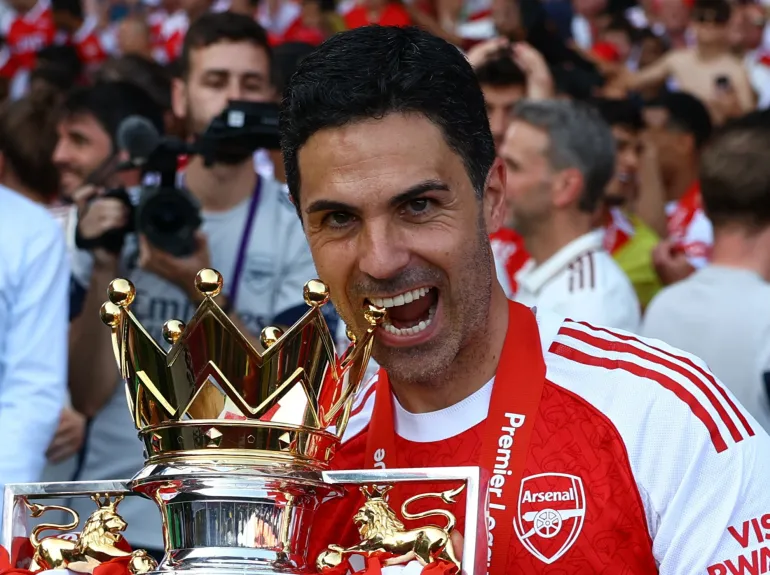
Mikel Arteta guided Arsenal to the Premier League title last season, ending a 22-year drought [Matthew Childs/Action Images via Reuters]
Arsenal, champions for the first time since 2004, face a testing period after they host Coventry.
Mikel Arteta’s side head to Villa for their first away league game of the season, then meet Chelsea at Emirates Stadium on September 5.
The weekend of September 12 brings the first Manchester derby of the post-Guardiola era, while Liverpool host Manchester United on November 21.
City and Arsenal do not face each other until November 28 at the Emirates Stadium.
The first Merseyside derby of the season between Everton and Liverpool is scheduled for November 28 at the Hill Dickinson Stadium.
Roberto De Zerbi will get his first taste of the north London derby on December 5 when Tottenham host Arsenal.
The pick of the Boxing Day schedule sees Coventry boss Lampard facing his old club Chelsea on December 26.
The final day of the Premier League will take place on May 30, with Arsenal at home to Brighton, while City travel to Sunderland and Liverpool host Bournemouth. Chelsea and United finish at home to Brentford and Fulham, respectively.
The start and end of the upcoming season are later than usual due to the FIFA World Cup 2026, which finishes just 34 days before the Premier League begins.
Arsenal will face FA Cup winners City in the Community Shield, which serves as the curtain raiser to the top-flight season, on August 16.
Lesley Horton, the UK’s Chief Property Ombudsman, said: “If implemented carefully and supported by clear guidance and appropriate training, these reforms can create a home buying and selling system that is faster, fairer and better equipped to meet the needs of consumers in the years ahead.”
Weekly insights and analysis on the latest developments in military technology, strategy, and foreign policy.
The U.S. Air Force has confirmed to TWZ that both of its existing VC-25A Air Force One jets will continue to serve in the immediate future. Several White House officials had suggested that the career of one of the jets had effectively come to an end in social media posts overnight, which are now going viral. There are growing signs that President Donald Trump’s next trip on an Air Force One jet will be aboard the so-called VC-25B “Bridge” aircraft converted from an ex-Qatari VVIP Boeing 747-8i, not a VC-25A.
“The VC-25B Bridge aircraft will soon join the active executive airlift fleet alongside the VC-25A and C-32,” an Air Force spokesperson told TWZ this morning, but did not offer a firm timeline. When asked if this also meant that both of the VC-25As would remain in the service’s active executive airlift fleet, the same spokesperson said “yes.”
A stock picture of a VC-25A Air Force One aircraft. USAF
TWZ had reached out after seeing the aforementioned social media posts regarding the VC-25A that took President Donald Trump and others to and from the annual G7 summit in France this week. That particular aircraft has the Air Force serial number 92-9000 and is also often referred to simply by the tail number 29000. Several outlets had subsequently reported that one or both VC-25As were being removed from service.
“‘Well done, good and faithful servant.’ The Last Ride,” Steven Cheung, Assistant to the President & White House Director of Communications, wrote in a post on his official account on X, which also included a picture of 92-9000.
“I have been fortunate to fly around the world on this iconic plane for 5 1/2 years — of the 35 years it has been serving U.S. Presidents… THANK YOU… AIR FORCE ONE 2900,” White House Deputy Chief of Staff Dan Scavino also wrote in a post on X that included a video of the aircraft.
I have been fortunate to fly around the world on this iconic plane for 5 1/2 years — of the 35 years it has been serving U.S. Presidents…
The Air Force’s clarification to TWZ today is in line with a story from NBC News just last week. “Once the Qatari plane, which the Air Force refers to as VC-25B Bridge, enters the rotation this summer, the VC-25As will continue to serve in the executive fleet and could still be used by the president as Air Force One,” that outlet reported, citing an unnamed U.S. official.
The VC-25B Bridge “program epitomizes what is possible when clear accountability is placed on one individual, and the entire enterprise of stakeholders aligns behind a single mission outcome … deliver a bridge capability as soon as possible to relieve pressure on the aging VC-25A fleet,” Air Force Gen. Dale White, Direct Reporting Portfolio Manager for Critical Major Weapon Systems, had also said in a statement accompanying a press release last month.
The VC-25B Bridge aircraft seen still painted overall white circa May 1, 2026. Courtesy photo via the USAF
The Air Force is also in the process of acquiring two fully-equipped VC-25Bs from Boeing, and currently expects to take delivery of the first one in mid-2028. The service also said that “on-going [VC-25A] modifications are to extend the service life until the VC-25B aircraft are fielded” in its proposed budget for the 2027 Fiscal Year, which was rolled out earlier this year.
When the Bridge aircraft enters service, it could well become President Trump’s preferred Air Force One option. Since his first term, he has been very eager to accelerate delivery of a new Air Force One jet. The VC-25B program has been mired in delays and cost growth for years. Under the current schedule, the Air Force is set to get the first of those aircraft just months before Trump leaves office again.
Under the original Air Force One replacement plan, the VC-25As would have been retired already. These jets, as well as four E-4B Nightwatch ‘doomsday plane’ flying command posts that remain in Air Force service today, are based on the 747-200. This is a model that first entered production in the 1970s, and they are becoming very difficult and expensive to operate and sustain. 200-series 747s in any configuration have all but evaporated from service worldwide, creating additional supply chain hurdles. Boeing shuttered the 747 line entirely back in 2023.
Another stock picture of VC-25A tail number 29000 taken back in 2013. USAF
As Gen. White said in his statement in May, the Bridge aircraft will help ease the strain on the VC-25As until the fully-equipped replacement VC-25Bs arrive. At the same time, serious questions remain about the Bridge aircraft’s ability to truly support the full spectrum of Air Force One missions, as TWZ has highlighted repeatedly in the past. Operational security concerns about using a former foreign-operated VVIP jet for this mission have also been raised, though U.S officials have downplayed any such risks.
The VC-25As notably have shielding against electromagnetic pulses (EMP) and other features that harden them to be able to operate even in the midst of a nuclear exchange. The Air Force One mission also requires alternate options to be available at all times. Both VC-25As often accompany the president on international trips, with the second acting as one of the backup options.
The arrival of the Bridge aircraft could still allow the Air Force to move at least one VC-25A into more of a reserve status, at least when it comes to taskings for lower-risk trips. The full replacement plan might eventually reach a point where the Air Force could deem it possible to cannibalize 29000 for much-needed spare parts. At the same time, if the Air Force were to be left with just one truly full-spectrum Air Force One aircraft, this would only magnify the aforementioned controversy and concerns surrounding the ex-Qatari jet.
The Air Force did also confirm last year that it was buying two additional 747-8is from German flag carrier Lufthansa to support the Air Force One fleet. The service has now taken delivery of at least the first one of these aircraft, which is being used as a trainer for aircrew and maintainers on the ground. The other will be a source of spare parts.
Regardless, the Bridge aircraft is getting close now to formally entering service, and its public debut could come within a matter of weeks. An Air Force spokesperson had already confirmed to TWZ last week that the jet had received its new livery – as seen in the picture below – and was undergoing “final modifications” ahead of its formal entry into service.
Travis Ghormley
The new paint scheme has itself been a controversial aspect of future Air Force One plans for years now. During his first term, President Trump announced that the future VC-25Bs would wear a new red, white, and blue scheme rather than the iconic paint job that currently adorns the VC-25As, which dates back to the Kennedy administration. President Joe Biden subsequently reversed that decision, but Trump reinstated his original plan after taking office again last year. U.S. Air Force C-32s, as well as new executive jets serving the U.S. Coast Guard and the Department of Homeland Security, have also emerged in the past year with their own versions of this livery.
A rendering of a future VC-25B wearing the same scheme as the current VC-25As. USAF
The Bridge aircraft’s current location is unclear. Last week, still unconfirmed reports emerged that the jet had flown discreetly from Texas, where it had received initial modifications and the new livery, to Andrews Air Force Base just outside Washington, D.C. Andrews is where the VC-25As, as well as various other Air Force executive aircraft, are based.
Full blown operation to get this thing out without us seeing. Fueled, loaded crew, and preflighted in the hangar. Flipped CRANE01 to face me at the south end and beam me with landing lights. Entire airport blacked out, crew and grounds crew all wearing NOD’s.
When the Bridge aircraft will make its first official appearance remains to be seen. In its report last week, NBC News said that Trump could use the jet for a planned trip to Mount Rushmore in South Dakota on July 3, citing an unnamed White House official and another source familiar with the deliberations. Reuters also reported in May that the ex-Qatari 747 might make its debut during a July 4 flyover.
TWZ has reached out to the White House for more information.
Another picture of the VC-25B Bridge aircraft from earlier this year. Courtesy Photo via USAF
The VC-25B Bridge’s official entry in service does now looks to be increasingly imminent, but the Air Force’s VC-25As are also set to keep flying, at least for the time being.
Weekly insights and analysis on the latest developments in military technology, strategy, and foreign policy.
The Senate Armed Services Committee believes that the U.S. Air Force is currently unable to support combat search and rescue (CSAR) operations “in a major contingency.” Legislators say they are concerned about the CSAR force structure after the Air Force trimmed its buy of HH-60W Jolly Green II helicopters and also elected to transfer some of these aircraft to the so-called Air Force District of Washington (AFDW) mission set, as you can read about here. This comes on top of concerns that the HH-60W fleet isn’t well suited for the realities of a war in the Pacific while no better solution is being sought.
The Senate Armed Services Committee released a full copy of the proposed legislation earlier this week. In this, it states that it is “concerned about CSAR force structure” in the Air Force.
Up close with the HH-60W Combat Rescue Helicopter at Nellis AFB for The War Zone.
Now, the committee points to the Air Force’s decision to truncate its buy of heavily modified HH-60Ws, followed by the transfer of 26 of these from CSAR units to the AFDW to replace UH-1N Twin Huey helicopters. AFDW uses these helicopters to support continuity of government plans, contingency response, homeland operations, and ceremonial honors in the National Capital Region. Under normal circumstances, the vast majority of AFDW missions involve VIP movements.
A UH-1N Huey assigned to the 1st Helicopter Squadron at Joint Base Andrews, Maryland, flies over Washington, D.C., during training, March 31, 2026. U.S. Air Force photo by Staff Sgt. Aubree Owens
“The committee believes that these actions have left CSAR forces unnecessarily short of the forces needed to support CSAR operations in a major contingency,” the legislators say. The committee has now called upon the Secretary of the Air Force to conduct a study of CSAR requirements and capabilities, including HH-60Ws and HC-130J Combat King IIs, and provide a report briefing to Congress before the end of March 2027.
Until that study is completed, the committee has called upon the Secretary of the Air Force to avoid making any more changes in CSAR force structure.
The Air Force had once planned to replace its AFDW UH-1Ns with new MH-139A Grey Wolf helicopters, but revealed last year it was considering using HH-60Ws for this role instead. The Air Force’s proposed budget for the 2027 Fiscal Year confirmed that it was moving ahead with these plans.
A U.S. Air Force MH-139A Grey Wolf assigned to the 40th Helicopter Squadron conducts its first operational mission at Malmstrom Air Force Base, Montana, January 8, 2026. U.S. Air Force photo by Airman 1st Class Teniya Caldwell
As we have discussed in the past, the HH-60W will bring a substantial increase in speed, range, and payload capacity compared with the aging UH-1Ns now flying AFDW missions, while also outperforming the smaller, lighter MH-139 in each of those key metrics.
The Air Force’s current plan calls for development of the HH-60W AFDW variant to begin in Fiscal Year 2027, starting October 1, with the first aircraft entering modification the following fiscal year. Those reconfigured Jolly Green IIs would then begin replacing the increasingly outdated UH-1Ns assigned to the AFDW mission at Andrews Air Force Base (now part of Joint Base Andrews).
TWZ had previously raised the question of how the transfer of 26 HH-60Ws for the AFDW role might affect the operational capacity of the rest of the CSAR-focused fleet.
In particular, the Air Force has no plans to procure additional Jolly Green IIs despite the upcoming transfer.
As the Senate Armed Services Committee points out, the Air Force already decided to scale back HH-60W purchases, from an original program of record for 113 of the helicopters. The total planned fleet now stands at 91. This amounts to the CSAR fleet losing roughly 30 percent of its entire Jolly Green II fleet, the first of which began entering Air Force service in 2022.
A U.S. Air Force HC-130J Combat King II prepares to refuel an HH-60W Jolly Green II during a training mission near Nellis Air Force Base, Nevada, April 24, 2026. U.S. Air Force photo by Airman 1st Class Jennifer Nesbitt
The legislators point to the ongoing demand for CSAR capabilities, not just in lower-end conflicts such as the war with Iran, but especially in potential future high-end fights, such as one between the United States and China in the Pacific, where aircrew losses would be greater by an order of magnitude.
For years, TWZ has warned that the growing reach and sophistication of modern air defenses are calling into question the viability of traditional fixed-wing and helicopter CSAR missions. In a high-end conflict, especially against China in the Pacific, even stealth aircraft are expected to face significant risks inside contested airspace. The idea that a Black Hawk helicopter, no matter what is bolted onto it, is going to survive in that same environment is highly questionable, and that’s if it can even reach the rescue point at all. The distances involved in the Pacific are far greater than those in Europe or the Middle East, which the legacy CSAR fleet was largely optimized around.
Back in 2023, one of the Air Force’s senior procurement officers asserted that the HH-60W fleet would not be “particularly helpful in the Chinese area of operations” due to these reasons. The Air Force’s cuts to planned purchases of HH-60Ws reflected this reality, while other senior officials have acknowledged that the service will need to rethink how it carries out this critical mission in future wars. The issue is that the cuts didn’t result in other capabilities taking the HH-60W’s place, like uncrewed systems and tiltrotors. So now there is an emerging gap in CSAR capabilities, both in terms of new ones more aligned with the challenges of the Pacific and just any kind of CSAR capability at all. Turning a large portion of the HH-60W fleet into VIP transports certainly doesn’t help with problem.
For the time being, at least, the Air Force is heavily reliant upon its HH-60Ws, regardless of potential vulnerabilities. With orders for the Jolly Green II slashed, and more than two dozen examples slated to switch to another mission, it is perhaps not surprising that legislators want to know how the Air Force will be able to conduct CSAR in the future.
Granted the Makerfield parliamentary seat has elected Labour MPs for yonks, but just a matter of weeks ago, at the local elections, Reform UK were dominant in this collection of towns broadly to the south of Wigan – places like Abram, Hindley, Orrell and Winstanley.
Witnesses say Lebanese citizens have been killed and Israeli soldiers wounded amid a new Israeli offensive in southern Lebanon. Social media video shows rockets and helicopters in the skies above Kfar Tebnit and Ali al-Taher.