'My baby scratches and scratches': Families say their homes are making their children sick
A cross-party report has called for safer conditions for the record number of families living in temporary accommodation.
Source link
Stay informed and up-to-date with the latest news from around the world. Our comprehensive news coverage brings you the most relevant and impactful stories in politics, business, technology, entertainment, and more.
A cross-party report has called for safer conditions for the record number of families living in temporary accommodation.
Source link
Rights advocates have accused the Trump administration of using third-country deportations to intimidate asylum seekers and migrants.
Fifteen South American migrants and asylum seekers recently deported from the United States to the Democratic Republic of the Congo (DRC) say they are facing pressure to return to their countries of origin, despite concerns for their safety.
Women from Colombia, Peru and Ecuador told the Reuters news agency that, since being deported to the Central African nation last week, they have been given no credible options other than going back to their home countries.
list of 3 itemsend of list
“We feel pressured to agree to go back to our country, regardless of the risks,” a 29-year-old Colombian woman, who asked to remain anonymous out of fear of reprisals, told Reuters.
The group arrived in the DRC last week as part of a controversial third-country agreement with the administration of US President Donald Trump.
Since returning to the presidency for a second term, Trump has implemented hardline measures to restrict immigration to the US and expel immigrants already in the country, some of whom have legal status.
Among the 15 South Americans who were deported to the DRC, some say they had sought asylum — a legal immigration process — in the US after fleeing persecution in their home countries.
The 29-year-old woman, for example, wrote in her asylum application in January 2024 that she left Colombia after being kidnapped and tortured by an armed group, as well as suffering abuse at the hands of her ex-husband, who was a police officer.
A US immigration judge ruled in May 2025 that she was more likely than not to be tortured if she was sent home, according to court records reviewed by Reuters.
The AFP news agency also reported that a 30-year-old Colombian woman named Gabriela only learned that she was being sent to the DRC a day before last week’s flight. During a 27-hour trip, the hands and feet of the deportees were shackled.
“I didn’t want to go to Congo,” she told AFP. “I’m scared; I don’t know the language.”
Immigration advocates have said that third-country deportations are an effort to intimidate migrants and asylum seekers into agreeing to leave the US.
Such removals involve sending immigrants to places with which they have no familiarity. Many, including the DRC, are known for human rights concerns or are sites of active conflict.
“The goal is clear: Put people in a place so unfamiliar that they give up and agree to return home, despite the immense risk they face there,” said Alma David, a US-based lawyer representing one of the asylum seekers in the DRC.
The medical examiner said the 14-year-old’s cause of death was determined months ago but was blocked from release.
Source link
Manchester City relegate Burnley with 1-0 win to also take top spot from Arsenal in the Premier League title race.
Manchester City completed its ominous, late-season rise to the top of the Premier League by winning 1-0 at Burnley – who are relegated as a result – thanks to Erling Haaland’s early goal, ending Arsenal’s 200-day stay in first place.
Haaland’s clinical finish after five minutes on Wednesday could have paved the way for a boost to City’s goal difference, but they lacked a cutting edge in a nervy affair as Burnley dug deep.
list of 4 itemsend of list
Haaland hit the post and had other chances as City tried to give themselves a safety margin, but Pep Guardiola’s side had to make do with a surprisingly narrow victory.
“The chances were there. We created a lot. It was a fantastic game and we did everything after a demanding game three days ago [against Arsenal],” Guardiola told Sky Sports.
“We won and are top of the league, why be frustrated? Of course we can do more, but we won.
“We made a better performance than on Sunday because we created chance after chance.
“It is five games to win the Premier League now – that is the reality.”
The goal came as Haaland ran onto Jeremy Doku’s pass to convert a deft finish, allowing City to back up its 2-1 victory over Arsenal on Sunday that, for many, turned Guardiola’s team into the title favourite.
Winning by a one-goal margin left City and Arsenal tied on both points (70) and goal difference (+37). City only leads courtesy of more goals scored (66 to Arsenal’s 63).
City were nine points adrift of Arsenal after drawing with West Ham on March 14. Three straight wins, combined with back-to-back losses for Arsenal, have seen the title race turn on its head.
The result condemned American-owned Burnley to relegation after one season back in the top flight.
For Scott Parker’s side, the inevitable became a reality as they are stuck on 20 points, 13 points behind the safety zone with only four games remaining.
Arsenal can retake top spot in the league when they entertain Newcastle United on Saturday, while City play Southampton on the same day in the semifinal of the FA Cup, before returning to Premier League action on Monday, May 4, against Everton.
“It is a big opportunity to play four finals in a row,” Guardiola added about Saturday’s match against Southampton.
“We may have to rest players, but we are ready.”
The TWZ Newsletter
Weekly insights and analysis on the latest developments in military technology, strategy, and foreign policy.
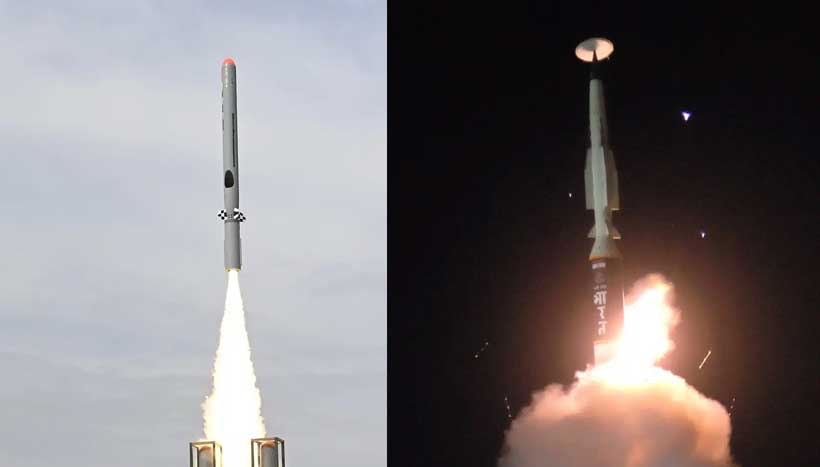
A new, longer-range version of the Rapidly Adaptable Affordable Cruise Missile (RAACM) has been unveiled by CoAspire at the Sea-Air-Space 2026 exposition near Washington, D.C. The development comes just days after the U.S. Air Force launched market research for its Family of Affordable Mass Missiles — Beyond Adversary’s Reach (FAMM-BAR), reflecting the service’s interest in low-cost, long-range strike weapons, specifically for anti-surface warfare.
Jamie Hunter of TWZ spoke about the RAACM-ER (RAACM pronounced ‘rack-em;’ ER for Extended Range) with Doug Denneny, founder, CEO, and owner at CoAspire.

First off, it’s worth looking at the original RAACM, a modular, low-cost cruise missile that leverages 3D printing to bring down cost and enable rapid production ramp-up.
“When we designed the original RAACM, we knew that it was going to be the size of a GBU-38,” Denneny said, referring to the 500-pound version of the Joint Direct Attack Munition (JDAM), which is 92.6 inches long and has a wingspan of 14 inches.
An official video promoting the original RAACM:
RAACM Rapidly Adaptable Affordable Cruise Missile
“When you go to that size, there are great reasons to do it, but it doesn’t go as far as a larger variant could do,” Denneny continued. “We really wanted to take everything we learned and now have an extended-range version. And what’s beautiful about the additive manufacturing that we use is that we can really optimize fuel tank volume, which means this can go very far.”
According to the manufacturer, the RAACM-ER has a range greater than 1,000 nautical miles.
This is especially remarkable considering the relatively compact size of the weapon. Indeed, when it comes to anti-ship missiles, the only weapon in the U.S. inventory that comes close is the BGM-109 Block V Maritime Strike Tomahawk (MST). This can be launched from destroyers, submarines, and the U.S. Army’s Typhon system. Like the RAACM-ER, it is subsonic, but a single round costs $3.64 million, according to the Navy. While the RAACM-ER clearly has a degree of low observability, it is not to the same degree as on the MST.

Like RAACM, the extended-range model is designed for launch from aircraft, as well as from the ground and from naval vessels. For surface-launched applications, the RAACM-ER adds an additional rocket booster behind its turbojet, meaning it can be propelled out of its launch canister.
Despite the nomenclature, the RAACM-ER is a new design, rather than a modification of the RAACM.
Denneny explained: “Our engineers came to us and said, ‘Hey, if we’re going to make a bigger one, should we make it look just the same?’ I mentioned earlier that RAACM was made that shape just to ease integration. We’re an engineering company, so we said, ‘Let’s optimize fuel volume, let’s optimize survivability features, let’s optimize physics so that this thing can go as far as possible and take the sensors needed. That’s why it’s in this slightly different shape.”
The RAACM-ER is somewhat reminiscent of the AGM-158 Joint Air-To-Surface Standoff Missile (JASSM), in terms of appearance and capabilities, but Denneny is keen to avoid direct comparisons.

“Physics is physics,” he added. “When people look at shapes, they look similar, but just like an Airbus looks like a Boeing, but what they have different inside is really what matters, and that’s how we differ in many ways.”
In terms of sensors, the RAACM-ER is currently fitted with a GPS navigation system, suitable for air, ground, and surface launch.
“Both our RAACM and our RAACM-ER also have a long-wave infrared sensor in the nose,” Denneny continued, “so we have the opportunity to search and find targets as well.”
Unlike the JASSM and similar cruise missiles, however, the RAACM-ER, like the RAACM before it, is optimized for low cost.
For Denneny, “the most important thing is affordable mass. [This] means keeping the cost down, so that the nation and our allies can purchase these at scale. That’s number one. Number two is to use as many commercial off-the-shelf parts, so that we’re we are not locked into a single supplier for anything. The final thing is to have something that can survive enemy countermeasures, and also hit the target, whether it’s stationary or moving. Those are the main requirements.”

When it comes to price point, CoAspire has optimized mass rather than the highest-end capabilities. This is a reflection not only of the sheer number of targets that the U.S. military and its allies would face in a potential conflict with China, but also the fact that a considerable proportion of missiles won’t make it to their targets anyway. Still, as recent conflicts have shown, the ability of lower-end drones, especially, to overwhelm adversary air defenses when fielded in large numbers is significant. After all, quantity has a quality all of its own.
Denneny confirmed that CoAspire plans to test-fly the RAACM-ER “very soon.”
The original RAACM has already undergone flight trials aboard a contractor-operated A-4. CoAspire is now under contract to the U.S. government for RAACM, and the weapon is in production at the company’s plant in Manassas, Virginia.
In the past, we’ve learned that both the Air Force and the Navy have funded work on the RAACM project. It has also been reported that CoAspire is one of two companies producing Extended Range Attack Missiles (ERAM) for Ukraine — this may well involve the RAACM or a related weapon.
Two candidate weapon prototypes competing for the US Air Force’s Extended-Range Attack Munition program 👇. Both Coaspire and Zone 5 Technologies were awarded contracts late last year in support of the #ERAM program. Both are expected to enter testing this year. https://t.co/9cGBuB9z3s pic.twitter.com/gc3ZDtX54m
— Air-Power | MIL-STD (@AirPowerNEW1) February 9, 2025
As for the RAACM-ER, this was unveiled only a week after the Air Force launched market research for its Family of Affordable Mass Missiles — Beyond Adversary’s Reach (FAMM-BAR).
“The potential procurement objective is to produce an inventory for the [U.S.] Government and Foreign Military Sales. The expectation is that the annual production orders will range from 1,000 to 2,000 units per year for five years (procurement numbers will vary by year),” the Air Force says in the request for information.
The FAMM-BAR program lists five desired attributes for the potential weapon: a range of at least 1,000 nautical miles, a speed of at least 0.7 Mach, the option of palletized delivery from a cargo aircraft, the ability to receive midcourse navigation updates, and the manufacturing capacity to produce more than 1,000 rounds annually. The main target set for the weapon is “slow-moving maritime” vessels.
A video showing a demonstration of the Rapid Dragon air-launched palletized munitions concept, using surrogate weapons delivered from the cargo holds of a C-17A and an EC-130J:
Rapid Dragon Flight Test
This requirement reflects the growing focus on anti-surface warfare as the U.S. military plans for a high-end conflict in the Pacific, especially against China. The U.S. military is increasingly investing in a diverse mix of anti-ship capabilities, part of a broader strategic shift driven by China’s growing maritime power. At the same time, real-world operations have exposed how rapidly missile stockpiles can be depleted, intensifying concerns that sustaining the massive volumes of anti-ship fires required in a China conflict will demand significant expansion of U.S. production capacity and inventories.
At the same time, the RAACM-ER would be useful for striking static land targets during an Indo-Pacific war, too. With such a considerable range, the weapon will also be better able to deal with increasingly far-reaching air defenses, something that the Pentagon is increasingly concerned about, including the likelihood of enemy missiles that can target its aircraft at ranges as great as 1,000 miles.
It should be noted that there are already other FAMM programs underway, namely the FAMM-Palletized and FAMM-Lugged cruise missiles for the Air Force. However, these require ranges of 250-500 nautical miles.
At this point, the low-cost, long-range strike weapon field is becoming increasingly crowded. Other contenders include designs from Anduril, General Atomics, and Zone 5 Technologies. From the last of these companies, the Rusty Dagger recently underwent release tests from an Air Force F-16 as part of the FAMM-L effort.

Global Technical Systems is also pitching a cruise missile with a range of 1,200 nautical miles and an anti-ship warhead.
However, with the original RAACM already in production, and proven in flight tests, the new RAACM-ER looks well-positioned to go far — figuratively and literally — in the FAMM-BAR program.
Contact the author: thomas@thewarzone.com
Rosenior’s dismissal may solve one problem, but those in Chelsea‘s boardroom must take the major share of the blame for a club that looks increasingly out of control.
Chelsea‘s recent losses eclipsed Manchester City‘s £197.5m deficit in 2011, despite bringing in £490.9m in revenue, which the club says is the second highest total in its history.
Since the current ownership took control in 2022, Chelsea have spent around £1.5bn on players, focusing on securing a raft of younger players on long-term contracts.
In this time, they have sacked Champions League winner Tuchel at the end of their first 100 days at the helm, then his successor Graham Potter seven months later.
Frank Lampard had a short second spell in charge as interim boss before former Tottenham Hotspur manager Mauricio Pochettino took charge, leaving by mutual consent after one season.
Enzo Maresca took over, but was sacked in January, less than six months after winning the Club World Cup to add to the Uefa Conference League.
If the final straw for Rosenior was criticism of his players, Maresca’s departure came amid friction with Chelsea‘s hierarchy, stunning key figures at the club after a 2-0 win against Everton in December by stating “many people” had made it his “worst 48 hours” since joining the club.
Cryptic, perhaps, but the beginning of the end for the Italian, as those in charge at Chelsea took a dim view of his public expression of discontent.
Those with knowledge of Maresca’s views, though, said he had grown unhappy at a multitude of factors, including encouragement over which players should start and which substitutions should be made during matches.
It led to the Rosenior experiment, which backfired on BlueCo, who may reflect on the number of managers hired and fired during their tenure and finally think: “It’s not them. It’s us.”
Former Chelsea winger Pat Nevin told BBC Radio 5 Live: “You would have to be a bit simple to be surprised at the situation with all the evidence in front of you.
“This is four seasons the new ownership has been in. This is manager number six. When you change it that amount of times, you have to ask the question – is the problem really the manager?”
Footage of an Israeli soldier attacking a Christian statue depicting the crucifixion of Jesus in southern Lebanon with a sledgehammer was difficult for Israel’s political establishment to ignore. The country has long tried to frame itself as a defender of Christians, and is allied with the powerful Christian Zionist movement in the United States.
But as Israel continues to lose support in the US and the West for its genocidal war in Gaza and attacks in Lebanon and Iran, support among Christians has also dipped – even before the video of the desecration of the Christian statue surfaced.
list of 3 itemsend of list
Responding to the footage on Monday, a day after it first went viral, Israeli Prime Minister Benjamin Netanyahu pushed his regularly repeated line that Israel respects all religions, even as critics point out that his government regularly does the opposite.
But, with even some of Israel’s supporters voicing anger at the soldier’s actions, Israel announced on Tuesday that he had been jailed for 30 days, along with another soldier who had been filming him. Six other soldiers have been summoned for questioning.
The decision to pursue action against the two soldiers stands out because it is in marked contrast to Israeli military investigations conducted into violations by soldiers, which overwhelmingly find them not to have been at fault. In fact, no Israeli soldier has been charged with killing a Palestinian this decade, despite the thousands killed even outside of the Gaza war context, including the 2022 killing of Al Jazeera’s correspondent in the occupied West Bank, Shireen Abu Akleh, who was herself a Christian.
Yossi Mekelberg, a senior consulting fellow with Chatham House, noted that it was important for the Israeli government to ensure that its response to the attack on the statue of Jesus was visible, particularly in light of the important role Christian supporters of Israel – including the US ambassador to Israel, Mike Huckabee – play in the administration of US President Donald Trump.
Those supporters frequently justify their support for Israel by relying on Christian Zionist interpretations of the Bible, and emphasising a “Judeo-Christian” value system and shared cultural heritage.
But official Israeli action in this case makes inaction in other cases more glaring.
“This [attack on the statue of Jesus], and the attacks upon mosques by settlers and the killing of Palestinians are all war crimes,” Mekelberg said. “The problem is that we don’t know how widespread it is. We only know about this one because they filmed it.”
Through much of the conflicts in Gaza and Lebanon, observers and analysts have pointed to the stark difference in Israeli government responses to attacks on Christian symbols and places of worship and what has been the large-scale destruction of Islamic sites.
In March, Netanyahu found himself having to explain the decision to block the passage of Cardinal Pierbattista Pizzaballa, the Latin patriarch of Jerusalem, from entering the Church of the Holy Sepulchre to mark Palm Sunday, one of the holiest days of the Christian calendar. Before the end of the same day, Netanyahu had posted to social media, explaining that there had been “no malicious intent whatsoever, only concern for his safety”.
Last July, Netanyahu again found himself apologising for a strike on a third church in Gaza following pressure from the Trump administration, when three of the hundreds of people sheltering there were killed and several others injured, including the parish priest who regularly spoke to the late Pope Francis.
In a statement issued through his office, the Israeli prime minister claimed he deeply regretted the strike on the church, which he said was an accident.
“Every innocent life lost is a tragedy. We share the grief of the families and the faithful,” he said, without referencing the almost 60,000 men, women and Palestinian children his forces had killed by that point in the war.
Throughout the war, Israel’s defenders have emphasised the concept of Judeo-Christian values in an effort to justify Israel’s attacks and its repeated breaking of international law. But evidence of a shared civilisational bond is thrown into question by attacks on Christian symbolism, such as in Lebanon, and by Israel’s long-standing treatment of Palestinian Christians, who face the same dispossession and occupation as their Muslim neighbours.
“I think a lot of Israel’s defenders in the West like to portray it as being ‘us’, just over there, as if ‘over there’ is some form of dark jungle,” said HA Hellyer, a senior fellow at the Center for American Progress and senior associate fellow at the Royal United Service Institute.
“So, they can make excuses for Israelis killing Arabs in their thousands,” Hellyer said. “They can even make excuses for them killing Christians. But when you see Israeli soldiers destroying Christian symbols, it becomes much harder to defend those actions and to stem the growing trend of US supporters, both Democrat and Republican, moving away from Israel.”
While the Israeli government has been keen to preserve evidence of the Judeo-Christian bond, complaints of harassment by Christian groups within Israel are growing, particularly with the increase in strength of the Israeli far right, including in government.
In 2025, the interreligious Rossing Center for Education and Dialogue recorded 155 incidents targeting Christians in Israel, a marked increase from the previous year. While physical assaults were the most common, comprising 39 percent of incidents, there were also accounts of spitting, hitting, and pepper-spraying.
Christian holidays, specifically those around the time of Easter, have become particular sources of tension, the report noted, with priests and nuns wearing visible Christian clothing in West Jerusalem and occupied East Jerusalem facing the risk of harassment every time they enter public spaces.
“We’ve entered a period of what [Australian genocide studies scholar] Dirk Moses called ‘permanent security’, where anything different, anything that might be a threat, or could even be a threat in the future, has to be destroyed,“ prominent Israeli sociologist Yehouda Shenhav-Shahrabani told Al Jazeera.
That difference is inherent to the Christian faith.
“It’s not about left or right,” Shenhav-Shahrabani explained. “It even goes to language. In everyday Hebrew, people refer to Jesus as Yeshu, which is a curse word, rather than Yeshua, which is correct.”
“That’s commonplace. That’s how it’s used in everyday media,” he continued. “If that’s where you begin, it doesn’t matter if it’s stupidity or ignorance, it all leads to the same place.”
Tehran says all necessary arrangements has been made for participation in the tournament cohosted by the US.
Published On 22 Apr 202622 Apr 2026
Iran says that the country’s institutions are fully prepared for its national football team’s participation in the 2026 FIFA World Cup in the United States, Canada and Mexico.
In a statement made to state broadcaster IRIB, government spokesperson Fatemeh Mohajerani said on Wednesday that the Ministry of Youth and Sports ensured all necessary arrangements for the team’s effective participation in the tournament.
list of 4 itemsend of list
She also said the preparations were made under the directive of the sport minister, with a focus on providing the required facilities for a successful performance.
FIFA President Gianni Infantino said on April 16 that Iran is expected to participate in the upcoming World Cup, taking place from June 11 to July 19, noting that the team has qualified and expressed its willingness to compete despite the ongoing US-Israeli war on Iran.
“But Iran has to come, they represent their people, they have qualified, the players want to play,” he said of the Iranian team’s upcoming matches scheduled in the United States in June.
“Sports should be outside of politics,” Infantino said.
US President Donald Trump said in March that while Iran’s team would be welcome at the tournament, he questioned whether it would be appropriate for them to attend, citing concerns over their “life and safety”.
Iran is scheduled to play its three Group G matches in the United States – two in Los Angeles, one in Seattle – with their base for the tournament in Tucson, Arizona.
Iran’s participation in the global tournament being cohosted by the three North American countries had been thrown into doubt by the conflict launched by the United States and Israel on February 28.
Iran raised the prospect of a “boycott” of the competition before asking FIFA to move its matches from the United States to Mexico, a request the world governing body rejected.
After several weeks of air strikes on Iran and Iranian reprisals against Israel and other countries in the region, a fragile truce came into effect on April 8.
The announcement of the two-week ceasefire was followed by rare direct talks in Islamabad on April 11–12, which ended without an agreement. The ceasefire was later extended by the US as diplomatic efforts continue.
The World Cup, the first to feature 48 teams, starts on June 11.
Advanced artificial intelligence tools could significantly reduce video game development costs, potentially saving nearly half of expenses and unlocking around $22 billion in annual profits for game makers, according to Morgan Stanley analysts. AI can automate tasks like creating game environments, generating dialogue, and testing software, making production faster and cheaper. However, these financial gains may not be evenly spread across the gaming industry.
Morgan Stanley estimates that global spending on video games will reach $275 billion this year, with 20%, or about $55 billion, reinvested into game development and operations. Game development, which is typically costly and labor-intensive, could become more efficient as AI allows for smaller teams and quicker enhancements post-launch. A prime example is Take-Two Interactive’s Grand Theft Auto VI, in development since 2018 and expected to launch in November 2026.
Potential winners from this AI integration include major gaming platforms like Tencent, Sony, and Roblox, along with large publishers such as Take-Two and Electronic Arts, which can utilize AI across multiple titles. Conversely, companies with weaker franchises may struggle, facing increased competition as AI reduces costs for making mid-scale games. The report also discusses how AI could enhance revenue by keeping games engaging, encouraging spending on add-ons, in-game purchases, and subscriptions. Publishers may increasingly focus on enhancing existing franchises rather than relying solely on new game releases.
With information from Reuters
United States President Donald Trump has described the Iranian leadership as “seriously fractured” as he announced an extension to a ceasefire.
Trump said on Tuesday that the ceasefire would be extended to allow more time for negotiations and appeared to be suggesting that Iran’s leadership is in disarray.
list of 3 itemsend of list
He added that the US naval blockade on the Strait of Hormuz and Iranian ports would remain in place.
Three weeks ago, Trump claimed the US military campaign had succeeded in its goal of forcing a change in Iran’s government and the US was now dealing with “a whole new set of people” in charge of the country.
On April 11, Iran sent a delegation led by parliament Speaker Mohammad Bagher Ghalibaf to Pakistan’s capital, Islamabad, to begin talks with the US.
So is Iran’s government “fractured”? We take a look at the key Iranian stakeholders and power centres in Iran and how their approach to US negotiations may differ.
Khamenei is the second son of former Supreme Leader Ali Khamenei, who was killed in US-Israeli air strikes on Tehran on the first day of the war on February 28. Mojtaba Khamenei was selected as Iran’s new supreme leader on March 8, according to state media reports.
The 56-year old has never run for office or been elected but has for decades been a highly influential figure in the inner circle of his father, cultivating deep ties with the the Islamic Revolutionary Guard Corps (IRGC).
Observers said the younger Khamenei’s ascension is a clear sign that more hardline factions in Iran’s establishment have retained power and could indicate that the government has little desire to agree to a deal or negotiations with the US in the short term.
Since his ascension, however, Mojtaba Khamenei has not been seen in public. On March 13, US Secretary of Defense Pete Hegseth claimed Iran’s new supreme leader had been wounded in US-Israeli strikes.
An April 11, a Reuters news agency report that quoted three people close to the supreme leader’s inner circle said Khamenei was still recovering from severe facial and leg injuries suffered in the air strike that killed his father. The sources were quoted as saying he was taking part in meetings with senior officials through audioconferencing.
Al Jazeera could not independently verify these claims.
According to state media reports, Khamenei has been active in making decisions on the war.
In a message read on Iranian state TV on April 18, Khamenei warned that the Iranian navy was ready to inflict “new bitter defeats” on the US and Israel as tensions escalated in the Strait of Hormuz.
Ghalibaf, 64, has served as Iran’s parliamentary speaker since 2020.
He was commander of the IRGC air force from 1997 to 2000. After that, he served as the country’s police chief. From 2005 to 2017, he was the mayor of Tehran.
Ghalibaf stood in elections for president in 2005, 2013, 2017 and 2024. He withdrew his bid for president before the election in 2017 when Hassan Rouhani won a second term.
Last month in the early days of the US-Israel war on Iran, it was suggested that Ghalibaf was the Trump administration’s “pick” to lead the country after the war ended. He has also been the main Iranian official leading negotiations with Washington since they began on April 11 in Pakistan.
In an overnight post on X on Tuesday, Ghalibaf wrote that Iran is “prepared to reveal new cards on the battlefield” after Trump threatened Tehran with “problems like they’ve never seen before” if the two-week ceasefire ended this week without a deal.
Ghalibaf expressed anger at Trump for “imposing a siege and violating the ceasefire”.
“We do not accept negotiations under the shadow of threats, and in the past two weeks, we have prepared to reveal new cards on the battlefield,” he said.
The ceasefire was supposed to have ended on Wednesday, but shortly before its expiration, Trump extended it until Iran “can come up with a unified proposal”.
Within Iran, however, Ghalibaf’s willingness to engage in negotiations with the US has been criticised by some people who have accused him of “betrayal”.
According to a report on Monday by the Iran International TV channel, some critics of Ghalibaf have said on social media platforms in Iran that the parliamentary speaker’s suggestion that peace talks with the US were progressing was “worrying”.
“There is no good in negotiation except harm,” one critic said.
But Ghalibaf has defended undertaking negotiations with the US. In a televised interview on Saturday, he said diplomacy does not mean “a withdrawal from Iran’s demands” but is a way to “consolidate military gains and translate them into political outcomes and lasting peace”.
Iran’s military power structure is often described as opaque and complex.
The nation operates parallel armies, multiple intelligence services and layered command structures, all of which answer directly to the supreme leader, who serves as the commander in chief of all the armed forces.
The parallel armies comprise the Artesh, Iran’s regular army, which is responsible for territorial defence, defence of Iran’s airspace and conventional warfare, and the IRGC, whose role goes beyond defence and includes protecting Iran’s political structure.
The IRGC also controls Iran’s airspace and drone arsenal, which has become the backbone of Iran’s deterrence strategy against attacks by Israel and the US.
After the US and Israel struck Iran and killed Ali Khamenei, the IRGC promised revenge and launched what it called “the heaviest offensive operations in the history of the armed forces of the Islamic Republic against occupied lands [a reference to Israel] and the bases of American terrorists”. Since then, it has struck US military assets and infrastructure across the Gulf region.
Some experts said Iranian officials negotiating with the US are more closely aligned with the IRGC than other leaders and groups.
In an interview with Al Jazeera on March 25, Babak Vahdad, a political analyst specialising in Iran, noted that Iran’s appointment of Mohammad Bagher Zolghadr as secretary of Iran’s Supreme National Security Council suggested Iranian negotiations would become more tightly aligned with the IRGC’s priorities. Zolghadr is a former IRGC commander and has been secretary of the advisory Expediency Council since 2023.
But Javad Heiran-Nia, who directs the Persian Gulf Studies Group at the Center for Scientific Research and Middle East Strategic Studies in Iran, said a divide between the IRGC and Iran’s negotiating team was plain to see.
Iran has attacked three cargo ships in the Strait of Hormuz since Trump announced the ceasefire on April 6 and said the US naval blockade will remain.
“The attack on tankers during the ceasefire demonstrates the IRGC’s dominance over the diplomatic team and its disregard for their positions,” he told Al Jazeera.

Heiran-Nia pointed to the role of the Paydari Front (Steadfastness Front), whose members are hardliners within Iran’s political structure who are deeply committed to preserving the original principles of the 1979 Islamic revolution and the absolute power of the supreme leader. This group, he said, has been using the negotiations to cement its position within the power structure and among its support base.
He added that the Paydari Front has also been questioning the negotiations.
“In Iran’s current political climate, various groups are trying to raise their weight, both within the power structure and in public opinion. Of course, the Paydari Front’s efforts are more meaningful in relation to their own support base rather than trying to influence other segments of society because their hardline approach holds no appeal for other social classes,” he said.
The influence this group could have over the progress of talks is debatable, however, he added.
“If a deal is reached, it will likely have a sovereign character. The establishment will impose its own narrative, and the IRGC will accept it. In the meantime, the hardliners will attack the administration of [President] Masoud Pezeshkian and Mohammad Bagher Ghalibaf over the deal. However, it is unlikely that this will spread to the decision-making body of the establishment,” he added.
United States President Donald Trump has claimed that a new nuclear deal being negotiated with Iran will be “far better” than the 2015 Joint Comprehensive Plan of Action (JCPOA), which the US withdrew from in 2018 during his first term.
On Tuesday, Trump extended the two-week ceasefire with Iran a day before it was set to expire, with hopes for a second round of talks in Islamabad, Pakistan.
Key among the US demands is that Iran stop all enrichment of uranium.
Iran has always insisted its nuclear programme is for civilian use only, such as for power generation, which requires uranium enrichment of between 3 percent and 5 percent. To build nuclear weapons, uranium needs to be enriched to 90 percent.
In this explainer, we visualise what uranium is, how it is enriched and how long it could take Iran to make a nuclear weapon.
Uranium is a dense metal used as a fuel in nuclear reactors and weapons. It is naturally radioactive and usually found in low concentrations in rocks, soil and even seawater. About 90 percent of the world’s uranium is produced in just five countries: Kazakhstan, Canada, Namibia, Australia and Uzbekistan. Reserves of uranium have also been found in other countries.
Uranium is extracted either by digging it out of the ground or, more commonly, through a chemical process that dissolves uranium from within the rock.

Before it can be used as nuclear fuel, uranium is processed through several different forms, including:

Natural uranium exists in three forms, called isotopes. They are the same element, with the same number of protons but different numbers of neutrons.
Most naturally occurring uranium (99.3 percent) is U-238 – the heaviest and least radioactive – while about 0.7 percent is U-235 and trace amounts (0.005 percent) are U-234.
To generate energy, scientists separate the lighter, more radioactive U-235 from the slightly heavier U-238 in a process called uranium enrichment. U-235 can sustain a nuclear chain reaction while U-238 cannot.
To enrich uranium, it must first be converted into a gas, known as uranium hexafluoride (UF₆). This gas is fed into a series of fast-spinning cylinders called centrifuges. These cylinders spin at extremely high speeds (often more than 1,000 revolutions per second). The spinning force pushes the heavier U-238 to the outer walls, while the lighter U-235 stays in the centre and is collected.
A single centrifuge provides only a tiny amount of separation. To reach higher concentrations – or “enrichment” – the process is repeated through a series of centrifuges, called a cascade, until the desired concentration of U-235 is achieved.

The higher the U‑235 percentage, the more highly enriched the uranium is.
Small amounts (3-5 percent) are enough to fuel nuclear power reactors, while weapons require much higher enrichment levels (about 90 percent).
The International Atomic Energy Agency (IAEA) considers anything below 20 percent to be low-enriched uranium (LEU), while anything above 20 percent is considered highly-enriched uranium (HEU).
Low enriched – less than 20 percent
Highly enriched – More than 20 percent
Depleted uranium, which contains less than 0.3 percent U‑235, is the leftover product after enrichment. It can be used for radiation shielding or as projectiles in armour‑piercing weapons.
The effort it takes to enrich uranium is not linear, meaning it is much more difficult to go from 0.7 percent natural uranium to 20 percent LEU than it is to go from 20 percent to 90 percent HEU. Once uranium reaches 60 percent enrichment, it becomes much quicker to reach 90 percent weapons grade.
The effort it takes to enrich uranium is measured in separative work units (SWU).
According to the IAEA, Iran is believed to have about 440kg (970lbs) of uranium enriched to 60 percent – enough to theoretically build 10 or 11 low-technology atomic bombs if refined to 90 percent.

Ted Postol, professor emeritus of science, technology and international security at the Massachusetts Institute of Technology (MIT), told Al Jazeera that before the US attack on Iran’s nuclear facility at Fordow, the country had at least 10 cascades of 174 IR-6 centrifuges in operation – meaning 1,740 IR-6 centrifuges.
The IR-6 is one of Iran’s most advanced centrifuge models. The country also has tens of thousands of older centrifuges.
Little is known about the conditions of these centrifuges or the stocks of uranium hexafluoride, which are still believed to be buried underground.
Postol has calculated that Iran’s cascade of centrifuges could produce 900 to 1,000 SWUs annually.
“Getting from natural uranium to 60 percent enrichment, which Iran has already achieved, takes roughly five years, and about 5,000 SWUs using Iran’s cascades.”
“If I want to go from 60 to 90 percent, I only need 500 SWUs. So, instead of five years, [by] starting with the 60 percent here, this might take me four or five weeks. Because I am already very enriched,” Postol said.
Using an analogy of a clock, Postol explained: “Let’s say it takes seven minutes to get 33 percent enrichment, and then eight minutes to get to 50 percent enrichment. It only takes me one minute to get to total [90 percent] enrichment.”

Postol said Iran’s stockpile is held underground, meaning a military strike would not necessarily eliminate the nuclear threat.
A single centrifuge cascade capable of enriching weapons-grade uranium could take up “no more floor space than a studio apartment, making it easily hidden in a small laboratory”, he said, estimating the area at 60sq metres (600sq feet).
“A single Prius Compact Hybrid car can produce enough electric power to run four or more of these cascades at a time,” Postol added, meaning “Iran can covertly convert its 60 percent uranium into weapons-grade uranium metal”.
“What they have done is put themselves in a position where anybody who thinks about attacking them with nuclear weapons has to know that they could be sitting in those tunnels after such an attack, refining [and] enriching the final step they need to build atomic weapons and converting it to metal, and building a nuclear weapon, and that they have the means to deliver it,” Postol said.
“They would have all of the technical equipment they need to build the atomic weapons. And they have the missiles, which are also in the tunnels and can be manufactured in addition to what they already have. And the atomic weapon would not need to be tested, because uranium weapons do not need to be tested before they’re used.”
The Treaty on the Non-Proliferation of Nuclear Weapons (NPT), established in 1968, is a landmark international agreement aimed at preventing the spread of nuclear weapons and promoting peaceful uses of nuclear energy. Iran is a signatory to this pact.
The treaty supports the right of all signatories to access nuclear technology and enrich uranium for peaceful purposes, including energy, medical or industrial purposes, with precise safeguards to ensure it is not diverted to make weapons.
Under the NPT, nuclear-weapon states agree not to transfer nuclear weapons or assist non-nuclear-weapon states in developing them. Non-nuclear-weapon states also agree not to seek or acquire nuclear weapons.
Despite this, most nuclear powers are currently modernising their arsenals rather than dismantling them.
Most of the countries are signatories, except five: India, Pakistan, Israel, South Sudan and North Korea.

In 2015, under the Obama administration, Iran struck a deal with six world powers — China, France, Germany, Russia, the United Kingdom and the US — plus the European Union, known as the JCPOA.
Under the pact, Tehran agreed to scale down its nuclear programme, capping enrichment to 3.67 percent, in exchange for relief from sanctions.
“The Iranians agreed to it, and they were following the treaty. There was no problem with the treaty at all, absolutely no problem,” Postol said.
“They were allowed to have 6,000 centrifuges, which, if they had natural uranium, they could probably build a bomb within a year if they were secretly using these centrifuges, but that was all under inspection. They were just simply going to enrich to 3.67 percent, which is for a power reactor. They’re allowed to do that by the Non-Proliferation Treaty.”
But in 2018, Trump pulled out of the deal, calling it “one-sided” and reimposing sanctions on Iran. Iran responded by eventually resuming enrichment at Fordow.
After the US killed Iran’s General Qassem Soleimani in January 2020, Tehran stated it would no longer follow the set uranium enrichment limits.
Former President Joe Biden made attempts to revive the deal, but it never came to fruition due to disagreements over whether sanctions should be lifted first or Iran should rejoin the JCPOA first.
Trump has repeatedly said Iran should not have the ability to produce nuclear weapons. It has been one of Washington’s red lines during talks with Iranian officials over the past year, and was also the central justification that Washington used when it bombed Iranian nuclear facilities during the 12-day US-Israel war on Iran last year.
In the current negotiations, Iran has said it is willing to “downblend” its 60 percent enriched uranium to about 20 percent – the threshold for low-enriched uranium. The process of downblending involves mixing stocks with depleted uranium to achieve a lower percentage of enriched U-235 overall.
“From the point of view of showing goodwill, I think it’s good, it shows that the Iranians are thinking of ways to address what the Americans claim are their concerns,” Postol said.

Nine countries possessed roughly 12,187 nuclear warheads as of early 2026, according to the Federation of American Scientists. Approximately two-thirds are owned by two nations – Russia (4,400) and the US (3,700), excluding their retired nuclear arsenals.
Some 9,745 of the total existing nuclear weapons are military stockpiles for missiles, submarines and aircraft. The rest have been retired. Of the military stockpile, 3,912 are currently deployed on missiles or at bomber bases, according to the Federation of American Scientists. Of these, some 2,100 are on US, Russian, British and French warheads, ready for use at short notice.
While Russia and the US have dismantled thousands of warheads, several countries are thought to be increasing their stockpiles, notably China.
The only country to have voluntarily relinquished nuclear weapons is South Africa. In 1989, the government halted its nuclear weapons programme and began dismantling its six nuclear weapons the following year.
Israel is believed to possess nuclear weapons, with a stockpile of at least 90. It has consistently neither confirmed nor denied this, and despite numerous treaties, it faces little international pressure for transparency.

The Trump administration’s January 3 military strikes opened a new era of US imperialism in Venezuela built on the plunder of the country’s resources. This interactive infographic explains Venezuela’s recent pro-business reforms, US neocolonial impositions through licenses, and the conglomerates that have already taken advantage to strike agreements.
(Click on the crosses for additional information)


(Click here to download the full infographic)
Data centres, climate targets and energy security – three forces pushing nuclear power back to the forefront of the global agenda. But behind the technological shift lies a human dimension: the story of nuclear host communities, where quality of life has long defied the familiar fears.
Three Forces Behind the Renaissance
| The AI Data Centre Surge | Climate Commitments | Energy Security |
| Data centres already consume ~2% of global electricity and the figure is set to multiply as AI model training becomes industrial. Only nuclear can deliver baseload power at scale, 24/7, regardless of weather | At COP28, 20+ nations pledged to triple nuclear capacity by 2050. Nuclear emits less CO₂ per kWh over its full lifecycle than solar panels – and far less than any fossil fuel alternative | The crises of 2021-2022 exposed the vulnerability of single-source energy systems. Now, the 2026 Middle East conflict has delivered an even starker lesson: severe disruption of flows through the Strait of Hormuz has triggered what the IEA has described as “the largest supply disruption in the history of the global oil market” – worse than the oil shocks of the 1970s. The crisis has made one argument impossible to ignore: energy that is generated at home cannot be blockaded. |
In 2024, Microsoft signed a deal to restart a unit at Three Mile Island – the very plant in Pennsylvania whose partial meltdown in 1979 shaped public anxiety about nuclear for decades. The reasoning was simple: the data centres powering AI require enormous quantities of electricity, continuous and ideally carbon-free. A nuclear plant delivers all three. That deal has since become something of a symbol for a much broader shift playing out across dozens of countries.
The industry already calls it a renaissance – not the first in nuclear’s history, but arguably the most structurally grounded. Three things are happening at once: explosive electricity demand from the digital economy, binding climate targets set by governments, and a growing reckoning with the limits of intermittent renewables. Wind and solar are essential to decarbonisation – but they cannot guarantee baseload supply in all weather, at all hours. Nuclear can.
“We need a source that delivers around the clock, every day of the year – sun or no sun, wind or no wind.” That, roughly, is how energy executives frame the problem when they look at what AI actually needs from the grid.
ARTIFICIAL INTELLIGENCE: AN UNLIKELY ALLY FOR NUCLEAR
Data centres already account for about 2% of global electricity consumption, and that figure could rise dramatically by 2030 as training and running large language models becomes routine. Google, Amazon, Meta and Microsoft are all in the market for long-term clean power contracts – and nuclear plants are almost the only sellers that can offer both the scale and the certainty those contracts require.
One example already up and running: the Kalinin Data Centre, built directly on the site of the Kalinin nuclear power plant in Russia. It draws up to 80 MW of guaranteed power straight from the plant’s substations – giving it some of the lowest electricity costs in central Russia – and operates to Tier III reliability standards. It has been included in Russia’s national Digital Economy programme. This is not a concept for the future: a nuclear plant is already powering real digital infrastructure today.
In the United States, after decades of stagnation, the first licensing procedures in a generation have begun for new reactors, including small modular reactors – SMRs – that promise lower capital costs and shorter build times. In the United Kingdom, Hinkley Point C is under construction. France has announced six new EPR-2 reactors. Canada has approved a major refurbishment of the Pickering station. These are not isolated decisions. They represent a change of direction that is now systemic.
THE CLIMATE CASE: THE NUMBERS SPEAK FOR THEMSELVES
Nuclear energy produces less carbon dioxide per kilowatt-hour over its full lifecycle than a solar panel, and many times less than a gas turbine. For governments that have committed to climate neutrality by 2050, this is becoming a decisive argument – particularly given that large-scale battery storage, the main alternative for backing up renewables, carries its own considerable environmental costs.
It is no coincidence that at COP28 in Dubai, more than 20 nations signed a declaration committing to triple nuclear capacity by 2050. The list includes the United States, France, the United Kingdom, Japan, Canada and South Korea. After years on the political margins, nuclear is back in the official climate conversation.
| 87% | +$9K | €59B | >$2B |
| of residents in 24 Russian nuclear cities report satisfaction with their quality of life | average household income between US counties near nuclear plants vs. neighbouring counties | projected average annual household income generated by EU nuclear industry, 2025–2050 | annual economic impact of Palo Verde nuclear plant in Arizona, the largest in the US |
| Nuclear cities sociological survey, Russia | Good Energy Collective / Carnegie Mellon, 2022 | Deloitte / NuclearEurope, 2025 | APS – Arizona Public Service |
NUCLEAR CITIES: THE LIFE THAT RARELY MAKES THE NEWS
In the middle of the technology and climate debate, it is easy to miss a different dimension entirely – the human one. Nuclear energy does not exist in the abstract: it lives in specific towns and regions, alongside real communities. And the data on quality of life in those places tell a story that sits rather awkwardly alongside the image embedded in popular culture.
Research from multiple countries consistently finds that cities and regions hosting nuclear facilities tend to have higher household incomes, better infrastructure, stable employment, and often stronger demographic indicators than comparable areas without nuclear presence. A nuclear plant is not simply a generator. It is an anchor employer, a leading taxpayer, and a structural pillar of the local economy for decades at a stretch.
EVIDENCE FROM AROUND THE WORLD
CANADA – Bruce Power (Ontario)
Bruce Power is the largest employer in Ontario’s Bruce County. Ipsos polling found that 93% of local residents consider the company a “good neighbour” and 96% are confident the plant operates safely. That level of sustained public support sits alongside major refurbishment programmes that will go on creating thousands of regional jobs for years ahead.
HUNGARY – Paks
Paks is a small town on the Danube, 100 kilometres south of Budapest. According to Hungary’s Central Statistical Office (KSH), it ranks among the country’s leaders in per capita income – GDP per capita and purchasing power run roughly 1.5 to 2 times the national average. Male life expectancy in Paks is around 75-76 years, against 73 nationally; female life expectancy is 81-82, against 79 across Hungary.
FINLAND – Eurajoki (Olkiluoto NPP)
The Finnish municipality of Eurajoki, home to the Olkiluoto plant, has a population of around 9,000 and is one of the most financially secure municipalities in the region. In 2022, the plant’s operator TVO paid €20 million in property tax, out of the municipality’s total tax revenue of €57 million. Local authorities describe Eurajoki as debt-free. It also maintains a stable population, which is a genuinely rare achievement for small Finnish communities.
RUSSIA – Udomlya (Kalinin NPP, Tver Region)
The Kalinin nuclear power plant is the largest electricity producer in central Russia, located 3 kilometres from the town of Udomlya. The plant generates 82% of all electricity produced in the Tver Region and 14% of the output of the entire Central Federal District. It is also a major regional employer: together with contractor organisations, the station accounts for around 30% of all jobs among the working-age population of the Udomlya municipal district. The plant supplies the town with heat and hot water, and the construction of the station marked the beginning of rapid development across the entire surrounding area.
UNITED STATES – Palo Verde (Arizona)
Palo Verde is the largest nuclear plant in the United States and generates more than $2 billion in annual economic impact for Arizona. The station directly employs 2,500 people, with a further 5,800 jobs supported in related industries. It is Arizona’s largest private taxpayer – a contribution that matters directly to the funding of local schools and public infrastructure.
SWEDEN – Forsmark
A Novus survey from spring 2023 found that at least 86% of residents in Östhammar municipality – where Forsmark is located – support the construction of a permanent spent fuel repository. Nine in ten local residents believe the presence of operator SKB has a positive impact on regional development.
UNITED KINGDOM – Hinkley Point C (Somerset)
Britain’s largest infrastructure project will employ up to 15,000 workers at peak construction. More than 1,500 apprentices have already been trained, 500 more than originally planned. Three Skills Centres of Excellence in Somerset have put over 8,000 people through training in welding, electrical and mechanical trades. The effects on the regional labour market will be felt for a long time.
CANADA – Pickering (Ontario)
The Pickering refurbishment is expected to create around 30,500 jobs during construction and sustain 6,700 permanent positions during operation. The project received government approval in November 2025, with construction due to begin in 2027.
FRANCE – Nuclear host regions
Analysis by France’s national statistics agency INSEE indicates that nuclear plants generate economic clusters that sustain employment and population in smaller municipalities across the country.
THE PROXIMITY PARADOX: WHY NUCLEAR COMMUNITIES SUPPORT NUCLEAR ENERGY
Sociologists have long noted a pattern that tends to surprise outsiders: the further people live from a nuclear plant, the more they fear it. The closer they live, the more they trust it. A Nuclear Energy Institute study found that 89% of residents within ten miles of a reactor view nuclear energy favourably. Surveys across nuclear host cities in Russia show that 78% of residents feel proud of the industry’s achievements, and more than two-thirds rate its contribution to their city’s development positively. Across 24 such cities, 87% of residents report satisfaction with their quality of life – in some, the figure exceeds 90%.
This is not a coincidence, and it has nothing to do with messaging campaigns. It is the product of lived experience. When a nuclear plant is the largest employer in the area, the main source of local tax revenue, and the sponsor of community sports clubs and healthcare facilities, people’s relationship with it is shaped not by what they read in the news, but by the texture of their daily lives.
The Proximity Paradox: Trust Rises Near the Plant
| The closer people live to a reactor, the more they support it Sociologists have long documented a consistent pattern: public support for nuclear energy is significantly higher among people who live close to a plant. Daily life near a facility creates a different picture than the one shaped by media coverage from a distance. The effect holds across countries, cultures and decades of polling. | Within 10 miles of a reactor (US, Nuclear Energy Inst.) Bruce Power region (Canada, Ipsos) Forsmark area (Sweden, Novus 2023) Nuclear cities, Russia (satisfied with life) | 89% 96% 86% 87% |
CONCLUSION: AN OLD SOURCE OF ENERGY FOR NEW CHALLENGES
The nuclear renaissance that gathered momentum through the mid-2020s is neither nostalgia nor ideology. It is a practical response to several problems that landed at roughly the same time: exponential growth in electricity demand from the digital economy; climate targets that cannot realistically be met without firm, low-carbon baseload generation; and hard lessons from successive energy crises about the fragility of systems built around a single source or a single supplier.
Against that backdrop, the accumulated experience of nuclear communities around the world: from Eurajoki in Finland to Paks in Hungary, from the shores of Lake Ontario to the Arizona desert, makes for a substantial body of evidence. Living near a nuclear plant is not a losing proposition for a community. More often than not, it has been the foundation of lasting prosperity, decent public services, and demographic stability that many non-nuclear towns can only envy. That, too, belongs in the conversation about what the future of energy actually looks like.
This analysis draws on data from: Deloitte / NuclearEurope (2025); Good Energy Collective / Carnegie Mellon University (2022); Ipsos Canada; Novus / SKB (Sweden, 2023); KSH — Hungarian Central Statistical Office; TVO (Finland); APS — Arizona Public Service; EDF Energy (United Kingdom); Government of Ontario; INSEE (France); Nuclear Energy Institute (United States); IEA; sociological surveys of nuclear host cities in Russia; Rosenergoatom
With 50 days to go until the World Cup kicks off, FIFA and the tournament’s host nations face criticism over wide-ranging social, political and logistical issues surrounding the global event.
Canada and Mexico will cohost the tournament with the United States, which, alongside Israel, launched a war on World Cup participant nation Iran on February 28. While the war is currently under a fragile temporary ceasefire, Iran’s participation in the tournament remains uncertain.
list of 3 itemsend of list
Fans across the three host countries are in uproar over exorbitant ticket prices, which have affected sales and interest in the world’s most popular quadrennial sporting event.
Local politicians and the public have also raised concerns over the hike in transport fares on routes connecting match venues in the US.
Al Jazeera Sport takes a look at the growing concerns in the run-up to the tournament, which begins on June 11 with the opening fixture between Mexico and South Africa:
Iran’s football team is preparing for the championship. However, officials say a final decision on the team’s participation will be taken by the government and the National Security Council after they review the players’ safety in the US.
Iran had said last month that it would not participate in the tournament amid the war, especially if the host nation could not guarantee players’ security. It followed a social media post from President Donald Trump, where he suggested that the Iranian team’s safety and security could not be guaranteed in the US, where Iranians are scheduled to play all their games.
The Iranian football federation then asked FIFA to relocate its games from the US to Mexico. FIFA rejected the request.
FIFA chief Gianni Infantino said last week that Iran “has to come” to the tournament.
Iran will play all their group stage matches on the US West Coast. Should they advance to the knockouts, the remaining games would also be held in the US.
Fans can expect to pay nearly 12 times the regular $12.90 fare for a round-trip train ride from Manhattan’s Penn Station to the MetLife Stadium in East Rutherford, New Jersey, venue of the World Cup final and seven other major fixtures.
New Jersey Governor Mikie Sherrill and FIFA have chided each other on the $150 price tag for a roughly 15-minute, 14km (9-mile) ride; Sherrill said FIFA should bear the costs, while the global body hit back, saying it is not obligated to do so.
Train commutes to Gillette Stadium in Boston’s suburbs cost roughly four times the regular price ($20), while round-trip bus fares to Foxborough cost $95.
Host cities Los Angeles and Philadelphia have pledged to keep their transit fares unchanged, while Kansas City is offering a $15 round-trip fare to Arrowhead Stadium. Houston said it has added buses and train cars to serve fans but intends to keep fares at current levels: $1.25 for buses and light rail trains, and park-and-ride options ranging from $2 to $4.50.
Sky-high ticket prices have left fans outraged at what they say is pricing that excludes supporters from the tournament. A lag in ticket sales for blockbuster matches, including hosts USA vs Paraguay, seems to be a testament to the high price tag.
FIFA put tickets on sale in December at prices ranging from $140 for Category 3 in the first round to $8,680 for the final. Later, it raised prices to as high as $10,990 when sales reopened on April 1.
The North American bid had initially promised tickets would be available for as little as $21; however, the cheapest ticket has been priced at $60. Most tickets cost at least $200 for matches involving higher-ranked teams.
FIFA announced another round of ticket sales on Wednesday to coincide with the 50-day countdown. Tickets will be available across categories 1 to 3 for all 104 matches on a first-come, first-served basis.
The Trump administration’s push for mass deportation and its efforts to tighten legal immigration pathways have spurred concerns about whether the World Cup’s international audience might be targeted by US immigration authorities.
Infantino was approached last week to pressure Trump to avoid immigration raids at this year’s tournament. Reporters suggested that agents from Immigration and Customs Enforcement (ICE) and Customs and Border Protection (CBP) were present at last year’s FIFA Club World Cup matches, though the Trump administration denied conducting enforcement efforts.
A report by The Athletic explained that FIFA executives have framed the possibility of an immigration moratorium as a potential public relations boon for the Trump administration. It also indicated that the executives hoped Infantino would leverage his friendly relationship with Trump to assuage any immigration-related fears.
World Cup cohost Mexico is also under the spotlight due to concerns for fan safety after a lone attacker opened fire on tourists near the country’s capital on Monday.
The accused opened fire on top of one of the Teotihuacan pyramids — a UNESCO World Heritage Site and one of Mexico’s most frequented tourist attractions — and killed one Canadian tourist and injured 13 others.
It raised questions about security protocols taken by Mexican President Claudia Sheinbaum’s government in the run-up to the global football tournament.
Sheinbaum said Mexico will beef up security ahead of the World Cup.
“Our obligation as a government is to take the appropriate measures to ensure that a situation like this does not happen again. But clearly, we all know — Mexicans know — that this is something that had not previously taken place,” she said on Tuesday.
Amid a standoff with the pope and criticism for an AI image of himself as Jesus, US President Donald Trump has read a Bible passage about punishment and national repentance as part of a Republican-led marathon event.
Published On 22 Apr 202622 Apr 2026
Share
The IRGC says the aggression came in response to what it described as the US seizure of an Iranian commercial vessel.
An Iranian gunboat has fired on a container vessel near the coast of Oman, according to a British maritime monitoring agency, in an incident that occurred hours after United States President Donald Trump said he would extend a ceasefire with Iran.
The United Kingdom Maritime Trade Operations (UKMTO) centre said on Wednesday that the ship’s captain reported that the vessel had been approached by a vessel of Iran’s Islamic Revolutionary Guard Corps (IRGC) before shots were fired.
list of 4 itemsend of list
It “has caused heavy damage to the bridge. No fires or environmental impact reported,” the agency added. No casualties were reported, and all crew members were said to be safe.
British maritime security firm Vanguard Tech said the ship was sailing under a Liberian flag and had been informed it had permission to pass through the Strait of Hormuz, one of the world’s most strategically important waterways.
Iranian news agency Tasnim, however, said the vessel had ignored warnings issued by Iran’s armed forces.
The incident followed a warning from the IRGC’s Khatam al-Anbiya Central Headquarters after what it described as the US seizure of an Iranian commercial ship in the Sea of Oman, the IRNA news agency reported.
It accused Washington of violating the ceasefire and carrying out “armed piracy” after allegedly firing on the Iranian vessel and disabling its navigation systems.
Trump earlier announced he would delay a planned military attack on Iran after requests from Pakistan’s army chief Asim Munir and Prime Minister Shehbaz Sharif.
Writing on Truth Social, Trump said the decision was made because Iran’s government was “seriously fractured” and needed time to present a unified position.
“We have been asked to hold our Attack on the Country of Iran until such time as their leaders and representatives can come up with a unified proposal,” he wrote.
He added, however, that the US naval blockade of the Strait of Hormuz would remain in place and said the military had been ordered to stay “ready and able”.
The announcement marked a shift from comments made a day earlier, when Trump said it was “highly unlikely” he would extend the truce beyond Tuesday.
Al Jazeera’s Tohid Asadi, reporting from Tehran, said Iranian officials were sending mixed messages over the ceasefire and the prospects for negotiations.
“Tehran is saying they won’t negotiate under imposed terms and conditions … when we compare the initial 10-point and 15-point proposals by the Iranians and Americans, we can understand that the two sides are poles apart,” he said.
“The atmosphere is also clouded by this mistrust in Tehran towards the United States, as well as the simultaneous military rhetoric related to a potential failed negotiation … It is a warning that another round of confrontation may be ahead.”
He said Iran still viewed the Strait of Hormuz as a key source of leverage in any talks.
“It’s trying to exercise authority over the ships and vessels transiting this strategically significant chokepoint,” he said.
Asadi added that Iranian officials framed their regional position as based on mutual security. “Iranians are saying that the basis of their foreign policy behaviour, particularly when it comes to Israel, is security for all versus security for none,” he said.
The figures provide the first official look at the impact of the Iran war on the cost of living in the UK.
Source link
General Atomics is positioning the MQ-9B SeaGuardian unmanned aerial system (UAS) as an ideal partner for the U.S. Navy’s P-8 Poseidon maritime patrol aircraft. The SeaGuardian features an expanding suite of anti-surface warfare, anti-submarine warfare and situational awareness-enhancing capabilities. These can be employed to complement existing platforms or to provide a complete solution on their own for long-endurance over-water missions.

The modular payload and open architecture MQ-9B is designed to carry a huge range of systems that enable it to sense and observe things that come or go on land, sea, in the air, and even beneath the waves. The aircraft can also collect signals intelligence or take on a number of other roles by using many specialized payloads. This is in addition to the aircraft’s ability to strike targets of many kinds, with long-range weapon integration now planned.

The MQ-9B has the ability to deploy sonobuoys to listen for and track submarines – a highly valuable feature considering what lurks below the surface in increasingly strategic but remote areas, like deep in the Pacific and across the the frigid Arctic. General Atomics has flight-tested sonobuoy dispensing system (SDS) pods as part of a broader demonstration of anti-submarine warfare (ASW) capabilities for the SeaGuardian.
TWZ‘s Jamie Hunter spoke with Doug Hardison of General Atomics at the Sea-Air-Space 2026 trade event to get the low-down on how the company is progressing with the huge range of capabilities that SeaGuardian intends to bring to the table, and how teaming it with the P-8 presents an especially attractive opportunity.
General Atomics Explains How U.S. Navy Could Use MQ-9B SeaGuardian To Complement P-8 Poseidons
EXPLAINER
President Trump said the US would extend the ceasefire until Iran presents a proposal and talks are concluded, but a naval blockade of its ports continues.
President Donald Trump said the United States is extending the ceasefire until Tehran submits its latest proposal with conditions for ending the war, and until negotiations conclude, keeping diplomacy open while maintaining pressure on Iran.
However, Trump said the US naval blockade on Iran would remain. Iran has insisted that the blockade represents a violation of the ceasefire, and has said it will not negotiate under the “shadow of threats” or while the blockade remains in place, underscoring the fragile and uncertain path to talks.
Meanwhile, violence continues across the region, with Israeli settlers killing two people, including a child, in the occupied West Bank, and Israeli strikes in southern Lebanon wounding civilians and damaging homes despite a 10-day ceasefire.
![]()
The TWZ Newsletter
Weekly insights and analysis on the latest developments in military technology, strategy, and foreign policy.
The U.S. Navy has handed Lockheed Martin a formal contract to integrate the Patriot PAC-3 Missile Segment Enhancement (MSE) surface-to-air missile with the Aegis Combat System. The Navy’s main Aegis-equipped ships today are its Arleigh Burke class destroyers. The service is also seeking just over $1.73 billion to order its first-ever tranche of PAC-3 MSEs, 405 in total, as part of its proposed budget for the 2027 Fiscal Year.
The idea of combining PAC-3 MSE and Aegis, as well as the Mk 41 Vertical Launch System (VLS), first emerged in 2023. Since then, TWZ has highlighted how this offers the Navy a valuable alternative source of anti-air interceptors, and maybe even eventually a replacement for the venerable Standard Missile-2 (SM-2).

Lockheed Martin announced it had received the PAC-3 MSE/Aegis integration contract, said to be a multi-million dollar deal, earlier today, around the Navy League’s annual Sea Air Space exposition, at which TWZ is in attendance. The Navy has separately shared more details about its PAC-3 MSE acquisition plans as part of the full rollout of the Pentagon’s budget request for Fiscal Year 2027, which also occurred today.
Per the Navy’s Fiscal Year 2027 budget request, the service sees PAC-3 MSE integration with Aegis as providing an additional means of intercepting “a wide range of threats, including tactical ballistic missiles, air-breathing threats, cruise missiles, and unmanned aerial systems.” As mentioned, Arleigh Burke class destroyers make up the vast majority of American warships equipped with the Aegis Combat System today. There are also a steadily shrinking number of Ticonderoga class cruisers with this combat system.
PAC-3 MSE has been in full-scale production since 2018. Pairing it with Aegis “has been in the works, I probably think, close to 10 years,” Chandra Marshall, Vice President and General Manager of the Multi-Domain Combat Solutions business unit within Lockheed Martin’s Rotary and Mission Systems division, told our Jamie Hunter on the floor of Sea Air Space. She added that the goal now is for the Navy to achieve initial operational capability (IOC) with this combination in approximately 18 months, or by the end of 2027 if the clock starts now.

“So, there’s two pieces of it. So the PAC-3 missile, there’s a small update to it to be able to communicate with S-band radar. So, currently it communicates with X-band [radars]. So, now with this update, it will be able to communicate both with S and X-band,” Marshall explained. “And then we have to integrate PAC-3 as a missile type with the Aegis Combat System.”
“We have a very open architecture [with Aegis], so the way that we componentize everything, we feel like it’s a very short putt for the Aegis integration of the PAC-3 missile,” she added. “So, it’ll just be another missile in the inventory for the Navy to be able to diversify based on the threat.”
You can read more about the Aegis Combat System and how it has evolved to adopt a modular, open architecture approach, specifically to make it easier to add new capabilities and functionality, in this previous TWZ feature. Lockheed Martin has already demonstrated the ability of a modular and scalable version of the system, called the Virtualized Aegis Weapon System, to fire a PAC-3 MSE from a containerized Mk 41-based launcher on land.
Aegis: Capable. Proven. Deployed.
No changes to the Mk 41 VLS – another Lockheed Martin product – are planned or required as part of the PAC-3 MSE integration. Work has been ongoing on adapting the interceptors into launch canisters, allowing them to slot right into existing Mk 41 cells. At just over 17 feet long, PAC-3 MSE should fit in shorter so-called tactical length versions of the Mk 41, as well as one with longer strike-length cells.

Lockheed Martin has said in the past that each canister will contain a single PAC-3 MSE missile. At around 11 inches wide, the PAC-3 MSE is just over half the maximum diameter available in a Mk 41 cell. This raises the question of whether future canisters could be designed to hold multiple interceptors, which would give ships valuable additional magazine depth.
From a capability standpoint, PAC-3 MSE is generally discussed in comparison to SM-2 surface-to-air missiles in the Navy’s arsenal today. In terms of missiles that can be fired via the Mk 41, SM-2 is a middle-tier anti-air capability that sits between shorter-range RIM-162 Evolved Sea Sparrow Missiles (ESSM; which can also be quad-packed into a single cell) and upper-tier SM-6s and SM-3s. The SM-6 is a multi-purpose weapon that can also be employed against targets on land and at sea. SM-3s, of which there are multiple variants in service today, are specifically designed as anti-ballistic missile interceptors.
“A lot of places the Navy has said ‘I got red or yellow challenges that I can’t deal with.’ This missile does a really good job at that. When you marry them all together, it is very complimentary to SM-6,” Chris Mang, Vice President of Strategy & Business Development at Lockheed Martin’s Missiles and Fire Control, told TWZ at last year’s Sea Air Space conference. “You’d always want a layered defense, right? I’ll pick the longest shot I can get, but then at a certain point, MSE really starts to outperform in certain envelopes.”

For the Navy, PAC-3 MSE also presents important logistics, cost, and supply chain benefits. The latest conflict with Iran has only underscored now long-standing concerns about U.S. munition expenditure rates, especially when it comes to anti-air interceptors. A large-scale, high-end fight with a near-peer adversary like China would put much more pressure on munition stockpiles and the U.S. industrial base working to restock them. As such, it would be a boon for the Navy to have an additional stream of interceptors to arm its warships.
As noted, the Navy is already moving to buy hundreds of what documents currently refer to as the “PAC-3 MSE / Navy” missile, as well as launch canisters. The service’s Fiscal Year 2027 budget request puts the unit cost for each missile at $4.05 million. The canister adds another $200,000 to the price tag. The Army’s Fiscal Year 2027 proposed budget says the unit cost for standard PAC-3 MSEs has risen now to $5.3 million. The exact reasons for the cost discrepancy between the Army and Navy versions are unclear.

“Both quantities and unit cost are estimates based on U.S. Army contract pricing. Both quantities and unit cost will adjust based on award of DoN CLINs [Department of Navy Contract Line Item Numbers] on ARMY contract in execution and final cost of the Navy components (radio, canister, etc),” per the Navy’s latest budget request.
At $4.05 million, the Navy’s PAC-3 MSEs will be slightly cheaper per missile than the Block IA version of the SM-6. The service’s latest budget request puts the unit cost of the latter missiles at $4.348 million. The cost of a current-generation Block IIICU variant of the SM-2 is unclear, given that they have often been procured as upgrades of existing Block IIICs rather than new-production missiles. Historically, the average price point for an SM-3 Block IIIC has been around $3.6 million.
“By leveraging the high-volume Army PAC-3 MSE production contract, the Navy achieves significant cost avoidance through economies of scale, as unit price decreases with larger quantities,” the Navy’s latest budget documents also note.
Lockheed Martin announced in January that it had reached an agreement with the U.S. government to ramp up annual PAC-3 MSE production, for domestic and foreign customers, from 600 to 2,000 missiles. Last week, the company received a contract to help further accelerate production of these missiles. This could all help drive down the unit cost of the missiles going forward, as well as speed up their delivery.
Lockheed Martin Receives Contract to Accelerate PAC-3® MSE Production
It is worth pointing out here that PAC-3 MSE’s performance in the Middle East, as well as in Ukraine in recent years, has also prompted a significant increase in demand from the U.S. Army, as well as foreign Patriot operators. The overall Patriot user base is also expanding.
Adding the Navy to the mix will add to that demand, even with the production ramp-up, and could add to already growing concerns about production backlogs now. Integrating PAC-3 with Aegis and the Mk 41 VLS could also spur additional interest from other navies globally that have ships with that combat system and/or launchers.
Reuters reported just last week that U.S. officials had informed allies and partners in Europe that deliveries of unspecified munitions could now be delayed due to American needs in relation to the war with Iran. When it comes to PAC-3 MSE, the budget documents the Army released today, at least, do not appear to show any changes to the delivery schedule for foreign customers.
🇺🇸 Is the US re-sequencing scheduled PAC-3 MSE deliveries away from FMS customers to the US Army’s inventory?
The J-books say no. In fact, FMS customers are scheduled to receive the majority of production.
Delivery schedule unchanged from last year. Only 252 missiles from… pic.twitter.com/iZdXlAYQ82
— Colby Badhwar (@ColbyBadhwar) April 21, 2026
Regardless of any of these issues, the Navy is now pushing full steam ahead on integrating PAC-3 MSE with Aegis and the Mk 41 VLS.
Jamie Hunter contributed to this story.
Contact the author: joe@twz.com
The Conflict Insights Group (CIG) says its research also shows the extent of UAE involvement.
Source link
The TWZ Newsletter
Weekly insights and analysis on the latest developments in military technology, strategy, and foreign policy.
Shield AI and General Electric have revealed more details about X-BAT, the jet-powered autonomous stealth ‘fighter’ drone designed to take off vertically and land the same way, tail first, after completing its mission. With the extremely ambitious aircraft concept planned to start vertical takeoff and landing (VTOL) testing before the end of this year, the companies have also shown off a roughly half-size model that includes significant design changes.
The new details came when officials — J.J. Cummings and Armor Harris from Shield AI, and Steve Russell from GE’s Edison Works — spoke with reporters, including The War Zone, at the Sea-Air-Space 2026 exposition near Washington, D.C.
Make sure to get up to speed on everything we previously knew about X-BAT in our exclusive feature from when the aircraft was unveiled, linked here, as well as its forthcoming flight testing here.
When we discussed the X-BAT in our in-depth coverage of the program in the past, the drone had a ‘cranked kite’ planform, which has now given way to a straight leading edge with a more dramatic sweep as part of a distinctive arrowhead-shaped profile. We saw the same on the Boeing X-45C Phantom Ray UCAV prototype, and it has since been adopted by the Chinese GJ-11 Sharp Sword, among others. This new configuration looks better optimized for higher-speed flight.
According to X-BAT’s chief designer, Armor Harris, “We’ve taken an iterative approach to development and made improvements to the design based on test data.”


Of all the new details we received about X-BAT, where the jet’s critical thrust vectoring capability will come from is perhaps the most intriguing. GE says that the engine nozzle is the Axisymmetric Vectoring Exhaust Nozzle (AVEN), which comes from a specialized thrust-vectoring F-16 that was tested out of Edwards Air Force Base, California, back in the 1990s. The AVEN nozzle — taken direct from the warehouse, “Indiana Jones-style,” according to the officials — will be used for the initial testing.
F-16 MATV Axisymmetric vectoring in the early 1990’s.
Officials confirmed that the X-BAT can be operated as a tanker, making use of its two external hardpoints. Both of these are plumbed to the internal fuel tanks, so they can support ‘buddy’ refueling pods, which trail a hose and drogue.
The companies stress that aerial refueling tanker is “definitely not a primary mission,” but this option does reflect the multirole nature of the platform. Meanwhile, drone tankers are a growing area of interest for different U.S. military services, with efforts currently spearheaded by Boeing’s MQ-25 Stingray, although, since it is larger than the X-BAT, this would also offer much greater internal capacity.
For expeditionary operations, in particular, drone tankers are seen as a viable solution, although by no means the only one. X-BAT acting as a launch tanker could be especially of interest for tactical jets that require long runways. This would allow them to takeoff in short distances with heavy weapons loads and get fuel immediately from the X-BAT tanker before heading on their missions. X-BAT tankers could also act as unpredictable refueling platforms that are forward deployed for enroute combat aircraft, launching from virtually anywhere to refuel jets making their way from longer distances to their target areas. These are just some of the less traditional theoretical ways a tanker-configured X-BAT could be used.
Interestingly, based on the current concept of operations, Shield AI sees less interest in having the X-BAT take on fuel while airborne itself, although there is a “holding place” for a refueling probe in the nose, if required.
Overall, and beyond tanking, the X-BAT’s multirole capability implies “significant air-to-ground capability, maritime strike capability, and electronic warfare capability,” Shield AI says.
Last year, TWZ broke the news that General Electric was working with Shield AI on the powerplant side of the X-BAT, specifically its F110 turbofan, the same as used in many F-16s and F-15s. The choice of the F110 was driven by size and thrust requirements, including the demanding VTOL cycle that’s at the heart of the X-BAT concept.
Significant thrust is also a prerequisite of the X-BAT’s multirole capability, which Shield AI says sets it apart from other Collaborative Combat Aircraft (CCA) and uncrewed combat air vehicle (UCAV) type drones now flying or in development.
X-BAT: Earth Is Our Runway
As well as offering what Shield AI describes as the best power-to-weight ratio in its class, the F110 was selected for its fuel economy. The engine is also widely available. With roughly 3,400 in the world, several “certified pre-owned engines” have been obtained for the program, as well as new-build ones.
While the partnership between Shield AI and General Electric was announced relatively recently, they have been working together for longer, with “tremendous progress on adapting the F110 engine” made in the last six to 12 months, according to officials.
According to Shield AI, X-BAT is around twice the size of all the other CCAs that are on the market today, which allows it to have a pair of payload bays that are roughly the same size as those found on the F-35. This means that any store that fits in an F-35 can theoretically also be accommodated internally in an X-BAT. These presently include 2,000-pound-class weapons.
At the same time, the X-BAT “goes twice as far” as an F-35, meaning double the combat radius. The drone’s manufacturers give a combat radius figure of 1,000 nautical miles. In the past, Shield AI told TWZ that the drone would also have a maximum range of 2,000 nautical miles and a service ceiling of around 50,000 feet.
Of course, the aircraft’s weight is a major factor in providing range. Company officials say they are “not really doing anything super-novel on the design of the air vehicle” in terms of weight reduction. However, with no landing gear and no auxiliary power unit (X-BAT uses an external lithium-ion battery pack to start the engine), and with other items moved from the air vehicle to the trailer-based launch recovery vehicle, all of this helps make the drone lighter.

For vertical takeoff, the F110 engine is put into afterburner to get the required thrust-to-weight ratio needed for takeoff, although the aircraft returns to land on military power (without afterburner).
Various modifications are needed to the F110 for use in a vertical takeoff application: as a tail-sitting aircraft, the X-BAT spends a lot of its time in this attitude. As such, the engine has been exposed to significant subscale and full-scale testing at GE facilities. Shield AI says it plans to build the prototype aircraft at a facility in Frisco, Texas, this summer.

Interestingly, one important part of the tests so far has been to explore just how far the F110 can be throttled back for the delicate VTOL and transition phases. Previously, the limits were set by the cabin pressurization requirements of crewed aircraft: essentially, how much fan speed was needed to generate enough bleed air to pressurize the cabin for the pilot. Since the X-BAT is uncrewed, the F110 can be throttled back farther and operate in different regimes.
While the aforementioned AVEN nozzle will be used for the initial testing, the companies are meanwhile working on redesigning and updating the design and building more nozzles. The control system and software are also completely different from those used on the original AVEN and are tweaked to work with today’s F110.
“It actually has worked really well,” Steve Russell says of the nozzle. “We’ve done testing where we’ve reversed it, we’ve integrated it, we’ve run the control system … you put all those things together and put it into such a cool platform that’s really going to present a unique dilemma for our potential adversaries.”
So far, testing has shown that the rigors of VTOL actually result in less fatigue and vibration compared to a typical F-16 profile.

The current nozzle doesn’t have low-observable (LO) attributes, but that is something that will be introduced after prototype testing. There is also the possibility of the X-BAT vectoring its nozzle in forward flight to increase its agility. The companies stress that this capability will depend on customer requirements, but the nozzle will be fully vectorable across the flight regime.
The focus for now is more about actuation and integration of the F110 with the Shield AI airframe and flight control system. A key factor is mitigating against exhaust gas ingestion and ensuring the engine is fed with clean air during the transition phases of flight. However, this is not something the developers are overly concerned about, and the F110 is also judged particularly stall-resistant.
Shield AI’s air intake system is specifically engineered to handle these demanding phases of flight and includes an auxiliary inlet on the back of the aircraft. This is concealed beneath a panel when the aircraft is not in VTOL mode.
Just as important is the engine exhaust, especially when it comes to mitigating the risk of foreign object damage (FOD) and kicking up debris that could damage other assets on the ground during VTOL operations. This would be especially critical on the tight confines of a ship’s flight deck.

For the launch, a blast deflector built into the X-BAT’s custom trailer is designed to direct the exhaust plume away rather than recirculating it back to the engine. The fact that the aircraft is suspended relatively high in the air for takeoff means that the issue of rocks and other debris being kicked-up at the aircraft is reduced. The deflector also channels the blast in a known direction.
For the landing phase, the aircraft’s approach profile helps avoid FOD and exhaust gas ingestion. Instead of coming straight down to land, the X-BAT approaches the launch-recovery trailer from the side, makes contact with it, and then powers up into a latch that secures it. The aircraft also leans slightly into the incoming airstream to help ensure the intake is always being fed with cleaner air.

With open system architectures baked into the design, it should also be easier to upgrade the X-BAT than previous aircraft, meaning it is getting “a lot closer to plug and play.” Shield AI talks about swapping in and swapping out different radiofrequency and infrared sensors for upgrades or potentially for different missions.
The companies remain generally tight-lipped about the electronic warfare (EW) packages that will be installed in the X-BAT. They did say that the EW gear will be unique to this aircraft and that they were able to leverage a lot of the sixth-generation systems that have been developed for the NGAD programs, in both their Air Force and Navy iterations.
Looking in more detail at what comes next for the program, Shield AI and General Electric confirm that the first stage of testing is already underway, using the adapted F110 on GE test stands. Step two will see the propulsion system integrated into the prototype aircraft. It will then be run horizontally and then vertically, while still attached to the launch-recovery trailer.

The next step will involve a very large crane, which will hold the aircraft vertically, with engine tests being run while the X-BAT is tethered for safety. This phase will see the propulsion system tested in proximity to the ground, in proximity to the launch and recovery trailer, and under different inlet conditions.
The final step will see the tether taken off, allowing the X-BAT to perform free flights. The aircraft will take off from the launch and recovery trailer, go up, come around, and reattach to it, all in vertical mode. If things go well, company officials say, this milestone will be targeted before the end of 2026.
In the process, Shield AI and General Electric are realistic about the possibility of mishaps in what is really groundbreaking technology. Company officials describe a “hardware-rich approach to test,” which means building several prototype test aircraft that will be pushed to the limit. They “fully expect to lose one in testing,” since the program is stressing the delivery of capability to the operators as quickly as possible. In this respect, zero failures mean the program is going too slow, the officials say.
Shield AI and General Electric confirm that there is “tremendous interest internationally” in the X-BAT, across all regions.
Their business case rests on the X-BAT providing “fifth and sixth-gen type capabilities” at a price point much cheaper than an equivalent crewed combat jet. Part of the cost equation also relates to the VTOL flight mode, which means operators can “delete a lot of the lifecycle cost associated with having a conventional air force.” With no conventional airbase required, there is no need for expensive airbase defenses or hardened aircraft shelters. The concept of operations involves a much-reduced need for tanker support, since the X-BAT can be forward stationed and has a large combat radius. Of course, there is also no conventional pilot-training pipeline. Shield AI and General Electric officials describe the resulting air power employment, in life-cycle terms, as costing around a tenth that of an equivalent fifth or sixth-gen type.

Compared to those fifth/sixth-gen platforms, the lower cost of the X-BAT means that it doesn’t have to be as survivable. Shield AI and General Electric talk about the aim of having an aircraft that is “just survivable enough that you can do the mission.” Meanwhile, it should avoid the “exponential costs for incremental return” that are inevitable in other, more exquisite platforms. Instead, the companies are looking at the possibility of an operator buying 10 to 20 X-BATs for the price of something like a B-21. The Air Force previously specified an average unit cost of roughly $550 million for the B-21.
With this in mind, Shield AI is sizing a factory that will be able to produce 150 X-BATs annually, with employees working single shifts.
Clearly, the ambition of creating a vertical takeoff and landing ‘autonomous fighter’ that is capable of countering an adversary’s air defenses at a fraction of the price of a crewed platform is incredibly bold. Some would even call it outright far-fetched. Yet the comparisons to Space-X and how they disrupted the space access market by doing something many thought would not work — also a VTOL solution — also can’t be denied.
With testing of the X-BAT and its F110-based propulsion system now well underway, and first flights planned before the end of the year, we are getting closer to seeing whether this radical vision can actually be realized.
Contact the author: thomas@thewarzone.com