Stay informed and up-to-date with the latest news from around the world. Our comprehensive news coverage brings you the most relevant and impactful stories in politics, business, technology, entertainment, and more.
Diplomatic sparring between Ukraine and Belarus escalated sharply on 19 June, when Ukrainian President Volodymyr Zelensky demanded that Belarus dismantle communications infrastructure allegedly used by Russia to extend the range of its strike drones. Zelensky has offered a week for such removals to take place, reportedly saying, “I am giving a week for it to be withdrawn; otherwise, we will do it ourselves.” This marks a severe deterioration in relations since Belarus allowed Russian forces to cross Ukraine’s northern border using Belarusian territory in 2022. Following Russia’s withdrawal from Ukraine’s northern regions, Belarus has not enabled further assaults from its own territory but has actively aided Russian efforts, in part, by allowing drones to operate over Belarusian territory to strike Ukrainian targets with less warning. These increased tensions follow recent statements from Belarusian President Alexander Lukashenko aimed at easing tensions, stating, “If Volodymyr Oleksandrovych was offended, I apologize to him for those words… Perhaps I shouldn’t have spoken so sharply about it. But, on the other hand, he should understand, as we often say: you get what you give.” As Zelensky applies pressure to Russia’s key European ally, Lukashenko’s response may determine whether his country will begin to withdraw support or play a larger part in this war.
Belarus’ Assistance in Putin’s Invasion
Belarus has played a vital role in Russia’s aggression since 2022, remaining one of Moscow’s most important enablers throughout the war. On the opening days of the conflict, 45,000 Russian soldiers crossed into the capital region of Kyiv. Since Russia’s withdrawal from northern Ukraine, Belarus has remained a tacit supporter of the invasion, finding auxiliary ways to support its key strategic ally’s actions in Ukraine without directly becoming involved itself. While weapons transfers and diplomatic support aid Moscow’s war effort, Belarus’ most valuable contributions come from two primary sources. First, Belarus’ expansive border with Ukraine. The two countries share a border that stretches over 1,000 kilometers. The existence of a Russian ally on Ukraine’s northern border introduces the risk of another attack from this direction, requiring the dedication of over 100,000 soldiers to the defense of a region that may not become active for the duration of the war. Second, neutral airspace was made available to long-range strike drones. Without this advantageous lane of attack, Russian drones, such as the Geran-2, must spend hours loitering over Ukrainian territory, where they are exposed to interception attempts while trying to reach their targets. Additionally, and central to Zelensky’s latest ultimatum, Belarus has reportedly allowed Russia to build a network of relays along Ukraine’s border to expand the range of its strike drones, allowing greater operational reach and improved resistance to electronic warfare.
Belarusian Capabilities
Threats made without the capability to enforce them are functionally pointless, suggesting that Zelensky believes Ukraine occupies a militarily advantageous position relative to Belarus. This warrants analysis of Belarus’ military capabilities to determine whether they pose a threat to Ukraine. As of 2022, Belarus reportedly maintained an active-duty army of approximately 48,000 soldiers, with inactive trained reserves and additional supporting personnel amounting to another 300,000 people. The country fields 1,200 main battle tanks and 3,400 other armored fighting vehicles, although it is unclear how many remain in active service. Many of these vehicles are of questionable utility, with Belarus operating mainly vintage Soviet equipment and few vehicles having been modernized to contemporary standards. The Belarusian Air Force fares slightly better, fielding 48 front-line fighter aircraft, of which 16 are new Su-30SM/SM2 airframes. The war and its rapidly changing dynamics have forced Belarus to invest in the modernization of its armed forces. However, in contrast to many Western modernization programs, which frequently involve high-value equipment deals, Belarusian efforts have focused more heavily on improving infantry capabilities. Belarus currently funds several programs for procuring modern armored vehicles and has recently made new equipment purchases from Russia, including the nuclear-capable intermediate-range ballistic missile known as Oreshnik. More transformative, however, are efforts to reform the country’s mobilization system and employment of experienced Wagner mercenaries to train Belarusian soldiers in drone-centric combat techniques. This could be interpreted either as an inability to afford more comprehensive reforms or as a deliberate shift away from traditional reliance on armored formations in favor of unmanned systems. Regardless of the motivation, these programs demonstrate substantive efforts to improve the military readiness of a vital ally to Russia.
Ukrainian-Belarusian Diplomatic Efforts
Zelensky’s demand follows months of escalating tensions between Belarus and Ukraine, contrasting Belarus’ traditionally ancillary role in Ukrainian foreign relations. Due to Belarus’ refusal to participate directly in combat operations, Kyiv had little incentive to press diplomatic issues and antagonize its northern neighbor. Until the recent flare-up, it was in Ukraine’s interest to keep Belarus on the sidelines while accepting the reality of Belarusian aid and weapons transfers that benefited Russia. Relations between the two countries followed a repeated cycle of saber-rattling, military posturing, de-escalation, and periods of calm. Lukashenko has repeatedly offered his services as a mediator between Russia and Ukraine, although Kyiv has rejected these offers because of Belarus’ close ties to Moscow. Tellingly, despite Belarus aiding its aggressor, Ukraine has maintained diplomatic ties with Minsk throughout the conflict. Lukashenko further offered to open bilateral talks with Kyiv in late 2025 in an attempt to reduce rising tensions. These efforts failed to bear fruit as relations deteriorated to their lowest point since the beginning of the war in May 2026. Following the construction of additional drone launching facilities in Belarus and an increase in Russian drone strikes, Ukrainian diplomacy shifted towards the application of direct pressure. Kyiv’s announcement that it had identified more than 500 strategic Belarusian targets in the event of conflict culminated in Zelensky’s ultimatum to dismantle Russia’s drone relay network within a week. The ultimatum suggests that Ukraine is abandoning its previous strategy of managing tensions with Belarus in favor of direct pressure. It also followed the largest Ukrainian drone strike on Moscow to date. Viewed in that context, Zelensky appears to be leveraging Ukraine’s growing long-range strike capabilities while simultaneously attempting to disrupt a component of Russia’s own drone warfare infrastructure.
Weekly insights and analysis on the latest developments in military technology, strategy, and foreign policy.
Members of Congress are again moving to block the U.S. Air Force from retiring all of its U-2S Dragon Lady spy planes. This time, legislators also want to compel the service to “fully restore” four of the iconic aircraft through heavy depot maintenance, which would bolster the fleet’s operational capacity. The Air Force continues to argue that the high-flying Cold War-era jets are too vulnerable to support future high-end fights and should be supplanted by a mix of space-based and other capabilities. This would presumably include a classified stealthy high-altitude drone, commonly (and unofficially) referred to as the RQ-180, or an evolution thereof, which first emerged publicly just earlier this year.
Yesterday, the House Appropriations Committee released a draft defense spending bill for the 2027 Fiscal Year. It includes a provision that would prevent the Air Force from retiring more than two U-2Ss in that fiscal cycle. The Air Force currently has 23 of these aircraft in inventory, including three two-seat TU-2S trainers.
One of the Air Force’s three TU-2S trainers. USAF
A summary of the proposed legislation also says it includes “$81 million for U-2 programmed depot maintenance to fully restore four aircraft.” The current operational status of the aircraft in question is unclear. This is included under the umbrella of $335.3 billion in total funding for operation and maintenance (O&M) accounts across the services that the draft bill would appropriate for Fiscal Year 2027.
Programmed depot maintenance for any aircraft is an intensive process that essentially involves a full tear-down and detailed inspection. Paint and other coatings are typically stripped and reapplied. Upgrades and modifications are often worked into depot maintenance cycles given the extensive work already being done.
“The Air Force will retire the entire 23-ship U-2 fleet, as the platform is no longer viable for future high-end conflicts,” the force structure report says. “Continued operation presents significant safety, logistical, and financial risks that outweigh the platform’s remaining utility in contested environments.”
“This decision allows for the strategic reallocation of fiscal resources to fund more critical, high-priority service requirements and accelerate modernization efforts in other key areas,” it adds. “Continuing to operate the U-2 fleet would require a significant investment to address systemic issues, including diminishing manufacturing capacity, material shortages, and safety risks inherent in the aging platform.”
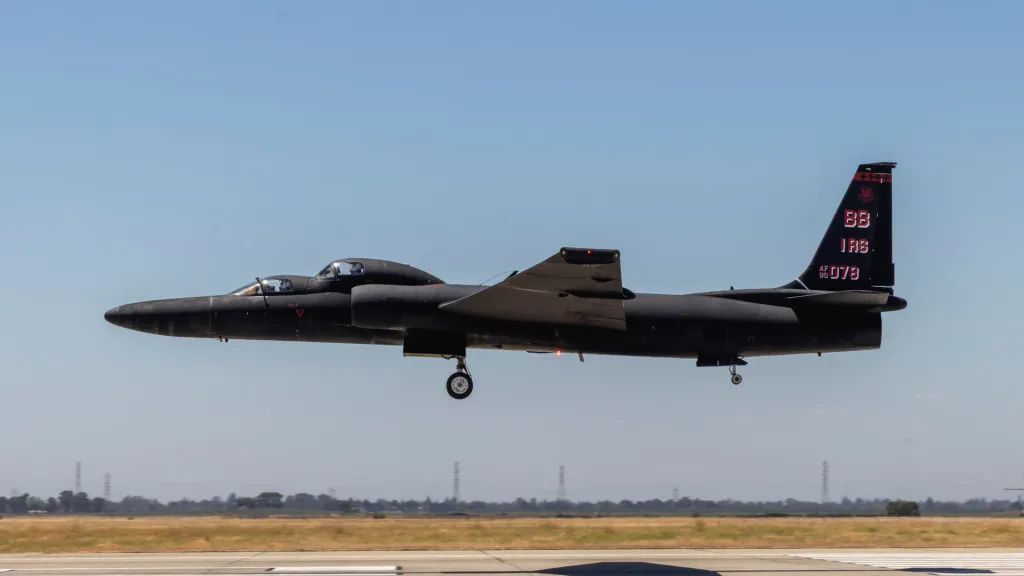
A U-2 seen taking off from an undisclosed location in the Middle East in 2010. USAF
Questions about the continued relevance of the U-2 in the face of an ever-expanding global air defense threat ecosystem are not new. Near-peer competitors like China and Russia, as well as lower-tier potential adversaries like Iran, continue to develop and field more capable air defense systems and expand their anti-access and area denial bubbles. This, in turn, has threatened to push the U-2 further and further from the areas where it would be tasked to collect.
On top of all this, the U-2s are aging and becoming more costly to operate and maintain. The U-2S models in service today were upgraded from earlier variants that began their service careers in the 1980s.
The Dragon Lady continues to offer a unique ISR platform that can fly higher than any other operational non-orbital platform, crewed or uncrewed, the U.S. military has, at least from what we know today. This, in turn, means that the aircraft can bring imaging, signals intelligence, communications payloads, and other sensors up to those altitudes, giving them particularly good fields of view. From this perch, aircraft can use a slant angle to peer deep into denied areas while still flying international airspace and further away from potential threats. The use of the U-2 to gather intelligence about a Chinese spy balloon that soared over parts of the United States and Canada in 2023, which involved flying above it, offered a particularly public demonstration of the value of the aircraft’s high-altitude capabilities.
A view of the Chinese spy balloon soaring over the United States in 2023, as seen from the cockpit of a U-2. USAF
Each Dragon Lady can also carry a wide array of different sensor systems simultaneously, as well as communications packages, further increasing its flexibility. The U-2Ss have the ability to be readily deployed to forward locations globally and conduct long-duration sorties, as well. The latter points have been especially relevant in comparison to known existing ISR satellite constellations that are constrained by their orbits and can only offer relatively short-term coverage over a specific area. We will come back to this in a moment.
A now-dated graphic that still gives a good sense of the array of different sensors the U-2 can carry. US Military
The draft defense spending bill from the House Appropriations Committee does still have to be finalized, and then brought in line with companion legislation in the Senate. Both chambers of Congress then need to pass the bill before it can be sent to the President’s desk to be signed into law. There are many opportunities along the way for major changes to be made to the bill.
That being said, Congress has consistently blocked Air Force efforts to fully retire the U-2 in recent years. Another potential reprieve, which would also demand the service take steps to bolster the operational capacity of the remaining fleet, has now appeared on the horizon.
Uruguay could need a win over Spain next weekend to avoid a second consecutive FIFA World Cup group-stage exit.
Published On 22 Jun 202622 Jun 2026
World Cup debutants Cape Verde scored a second-half equaliser to salvage a 2-2 draw against Uruguay in Miami, backing up their shock opening stalemate with Spain.
Cape Verde took a surprise 21st-minute lead as Kevin Pina scored their first World Cup goal from a free-kick, only for Uruguay to strike twice shortly before half-time through Maxi Araujo and Agustin Canobbio.
Recommended Stories
list of 4 itemsend of list
But 40-year-old Uruguay goalkeeper Fernando Muslera’s mistake allowed Helio Varela to grab Cape Verde’s second just after the hour mark, and neither side could find a winner on Sunday.
Cape Verde boosted their hopes of reaching the knockout phase with their second point in Group H.
The African island nation face Saudi Arabia, thumped 4-0 by Spain earlier on Sunday, in their final group game next Saturday, knowing that victory would secure a last-32 berth.
Two-time world champions Uruguay’s hopes of progressing are in serious danger, though, after again being held by lower-ranked opposition following their 1-1 draw with the Saudis.
The South Americans may need to beat European champions Spain next weekend to avoid a second consecutive World Cup group-stage exit.
Uruguay coach Marcelo Bielsa made two changes to the team, which were held by Saudi Arabia, with Al Hilal striker Darwin Nunez dropping to the bench.
Bubista opted for three alterations to his Cape Verde team, all in attacking positions.
Cape Verde started with more intent going forward than they were able to show against Spain, but it was still Uruguay who created the first real opening, when Federico Valverde drilled a left-footed shot wide.
But the tournament debutants forged ahead when Pina crashed a long-range free kick through a poor Uruguay wall and past Muslera.
Uruguay were in desperate need of their equaliser when it arrived in the 44th minute.
Cape Verde’s Sidny Lopes Cabral headed the ball against his own post under pressure from Rodrigo Bentancur, and Araujo stooped to nod in the rebound, with Cape Verde goalkeeper Vozinha stranded.
They completed the turnaround in the sixth minute of first-half added time, as Canobbio turned in Araujo’s header across goal on the volley.
Uruguay appeared in control early in the second half, until Muslera inexplicably raced out of his goal in the 61st minute and Cape Verde substitute Varela took full advantage to roll the ball into an empty net after an excellent first touch.
Vozinha, the hero of Cape Verde’s draw with Spain, fumbled to allow Araujo to tap in, but his blushes were spared by an offside flag.
Real Madrid midfielder Valverde blazed a late free kick over the bar from just outside the box, leaving Uruguay on the brink of a hugely disappointing exit.
During a live BBC News broadcast, reporter Paul Njie interviews a Cape Verde fan when the country suddenly scores its first ever World Cup goal against Uruguay in the 2026 World Cup.
President Volodymyr Zelenskiy warned that Russian forces are preparing for a large-scale attack on Ukraine, urging residents to be cautious and pay attention to air raid alerts. In his nightly address, he noted that recent Russian strikes have resulted in at least six deaths across various regions. There has been a pattern of heavy attacks on Kyiv and other major cities, with ten fatalities reported last Monday. The historic Pechersk Lavra monastery was also significantly damaged during these strikes.
Zelenskiy confirmed that Ukrainian military efforts would continue, targeting the oil sector. Recently, Ukrainian drones struck an oil refinery in Tyumen, western Siberia, and an oil facility in Moscow twice. On Saturday, Russian forces used glide bombs to attack the city of Zaporizhzhia, resulting in five deaths and ten injuries. Other attacks included a bombing near Sumy that killed one person, as well as drone strikes in the Kherson region and shelling in Poltava that injured three children.
Renowned turtle conservationist Mona Khalil had been wounded in an Israeli attack in southern Lebanon.
Published On 21 Jun 202621 Jun 2026
Mourners have gathered in Beirut to pay their respects to a much-loved Lebanese conservationist who died from wounds caused by an Israeli strike on her home on the country’s southern coast.
Mona Khalil, 77, who spent more than two decades protecting sea turtles along Lebanon’s coastline, was critically injured in the attack in the village of al-Mansouri in Tyre province on June 4 and succumbed to her wounds more than two weeks later, on Friday.
Recommended Stories
list of 4 itemsend of list
News of her death triggered an outpouring of grief among environmentalists and those who volunteered and worked with her over the years, many of whom gathered in Beirut on Sunday.
The Orange House Project, which Khalil helped build into a small conservation hub and ecotourism site in al-Mansouri, became a refuge for endangered loggerhead and green sea turtles and a training ground for volunteers documenting nesting activity along the coast.
Khalil was born in Lagos, Nigeria, in 1949. She held Dutch as well as Lebanese citizenship, having lived in the Netherlands before returning to Lebanon and settling in what had once been her grandmother’s home – the building that would later become known as the Orange House.
At the heart of Khalil’s work was a narrow stretch of coastline, al-Mansouri beach, where a fleeting encounter with a turtle that had emerged from the ocean to lay its eggs in 1999 propelled her on a lifelong journey devoted to animals.
Each nesting season, Khalil and volunteers would patrol the beach at night, marking fresh tracks in the sand and carefully relocating vulnerable nests away from human activity and coastal light pollution.
Journalist and environmental activist Fadia Jomaa first met Khalil in 2016 while researching sea turtles in Lebanon and then decided to volunteer with her project.
During the previous war between Israel and the Lebanese armed group Hezbollah in 2024, Khalil initially refused to leave al-Mansouri beach, Jomaa said. The Lebanese army ultimately persuaded her to evacuate for her safety.
“She was the last one to leave the area,” Jomaa noted.
“She had an awful time in Beirut,” the journalist said, adding that Khalil longed to return to the south, to the Orange House and the beach she had spent years protecting.
“She used to say, ‘My soul will stay here,’” Jomaa said, recalling conversations in which Khalil would point to an olive tree or a small hill overlooking al-Mansouri beach. “She used to say, ‘This is where you will bury me.’”
Where Khalil will ultimately be buried remains uncertain and is tied to the security situation in the area, Jomaa said.
Weekly insights and analysis on the latest developments in military technology, strategy, and foreign policy.
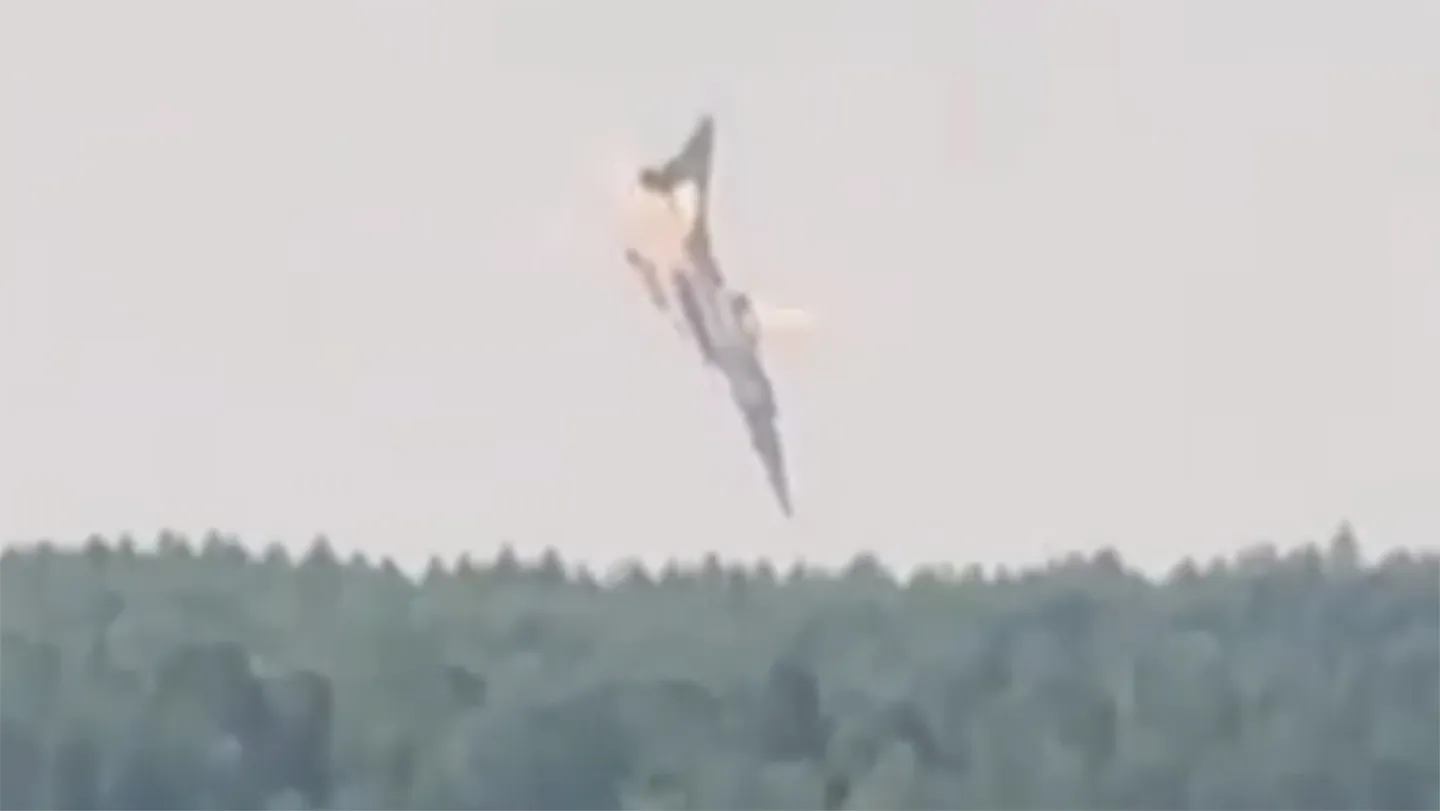
Multiple videos circulating on social media show the crash of a Russian Tupolev Tu-22M3 Backfire-C bomber today. Footage shows the swing-wing bomber entering a steep nose-down dive before slamming into the ground, producing a large plume of black smoke. The footage has not been independently verified, but Russian authorities have confirmed the loss of the aircraft.
The Russian Ministry of Defense said the Tu-22M3 crashed while making an approach to land in the Irkutsk region, in southeastern Siberia, during what it described as a routine training flight. According to the ministry, the bomber was not carrying a combat load, all crew members ejected safely, and there were no casualties or damage on the ground. The cause of the crash has not been disclosed, and an investigation is underway.
The governor of the Irkutsk region, Igor Kobzev, said that the aircraft crashed in the Bokhansky district, near the village of Kamenka. Kobzev added that the crew had been found by local people after ejecting and were already getting medical treatment.
Belaya, near Irkutsk, is an important Backfire base, accommodating the 200th Heavy Bomber Aviation Regiment.
The Tu-22M3 remains a key component of Russia’s Long-Range Aviation fleet and has been used extensively in the war against Ukraine to launch cruise missile strikes in standoff attacks. This makes any loss of the type noteworthy even when it occurs outside of combat operations, as was the case today.
A video from May 2022 that purports to show the launch of Kh-22 cruise missiles, as seen from the cockpit of a Tu-22M3:
The launch of two supersonic cruise missiles kh-22 from a long-range supersonic missile-carrying bomber Tu-22. 📹fighter_bomber pic.twitter.com/kAXU9pP5KW
— Massimo Frantarelli (@MrFrantarelli) May 11, 2022
During the conflict, Ukraine claims to have used a Soviet-era S-200 (SA-5 Gammon) long-range surface-to-air missile to bring down the Tu-22M3 that crashed in the Stavropol region of southern Russia on April 19, 2024, an incident you can read more about here.
Other examples of the Tu-22M3 have been destroyed on the ground by Ukrainian drone strikes during the conflict.
In August 2023, a Backfire was destroyed by a drone strike while on the ground at the airbase of Soltsy-2 in the Novgorod region.
Subsequently, in Operation Spiderweb, in June 2025, four more Tu-22M3s were confirmed destroyed on the ground, while another two were confirmed damaged. At least four more Backfires were targeted in the same attacks and may also have received some degree of damage. On this occasion, Ukraine employed short-range explosive-laden drones that targeted Russia’s missile-carrying bomber fleet in an unprecedented attack on at least four airbases, including Belaya.
Russian films the burning remains of Russian Tu-95s and Tu-22s at the Belaya military airfield in the Irkutsk region pic.twitter.com/GXuWfkIg9c
— Special Kherson Cat 🐈🇺🇦 (@bayraktar_1love) June 2, 2025
Today’s incident also adds to a growing list of recent non-combat accidents involving the aging bomber fleet. Previous such losses, all in the Irkutsk region, occurred in August 2024, April 2025, and June 2026.
After all of these incidents, the Russian Tu-22M3 fleet today numbers around 50 active aircraft, although there are additional non-serviceable aircraft that could be brought back into service after extensive overhaul.
Since the Tu-22M3 has been out of production for decades, every airframe is especially precious. Any loss reduces Russia’s Long-Range Aviation capabilities and readiness. This has an impact not only on the war in Ukraine but also on Russia’s broader Long-Range Aviation force, a key element of the country’s strategic military posture.
We will update this post as we find out more about today’s incident.
Yamal makes a goal-scoring return for Spain as European champions get their World Cup campaign back on track.
Inspired by Lamine Yamal, Spain strolled to a 4-0 win over Saudi Arabia in Group H, as Mikel Oyarzabal restored his reputation with two goals and Luis de la Fuente’s side found their groove after an underwhelming World Cup opener.
Yamal opened the scoring in the 10th minute on Sunday and Oyarzabal, who failed to register a touch in the opening half hour in Monday’s scoreless draw with Cape Verde, scored twice in quick succession as Spain had the game wrapped up by half-time.
An own goal shortly after the interval failed to reopen the floodgates, as Spain used the opportunity to make changes and rest their scorers.
De la Fuente celebrated his 65th birthday in style, and Yamal, whose only football in the last two months came as a substitute against Cape Verde, sparked life into the team that returned to Atlanta Stadium.
A huge cheer greeted Yamal’s first touch, twisting and turning his marker before playing a teasing cross that was cleared by Abdulelah Al-Amri, the scorer of Saudi Arabia’s goal in their 1-1 match with Uruguay.
The opening goal came with Oyarzabal sending an inviting ball across the box, and Yamal being there to slide in at the back post and score his first World Cup goal.
Having toiled in vain in their opening game, the goal relaxed Spain, who began to carve open the Saudi defence at will, and the second goal came from a corner.
Dani Olmo sent the ball back into the mix which the Saudis failed to clear and Aymeric Laporte nodded down to Oyarzabal, who bundled the ball into the net.
Three minutes later, Spain were in again with a beautifully worked goal. Pedro Porro floated a pass into the area and the ball never touched the ground until it found the net.
Marc Cucurella’s hooked pass found Olmo, who headed into the six-yard box for Oyarzabal to tap it in on the volley, as the striker proved that given the right service, he is Spain’s man to deliver.
Spain replaced Yamal and Oyarzabal for the second half, but picked up where they left off when the Saudi goalkeeper blocked Cucurella’s volley from a corner and the ball ricocheted off defender Hassan Al-Tambakti and into the net.
The European champions continued to create chances, but understandably took their foot off the gas on a day when even Vozinha, Cape Verde’s 40-year-old hero keeper, would have struggled against this version of Spain, who look back to their best.
Spain advance to four points in the standings, while Saudi Arabia stay on one after two games each. The other teams in the group, Cape Verde and Uruguay, meet later on Sunday in Miami.
Oyarzabal said he was happy to get the win and to have given his own performance after criticism of how he played against Cape Verde.
“It’s not about proving myself. I’ve always said I feel loved by my teammates, the coach, the staff day to day. That’s what counts for me,” he told the media.
“People will talk outside. We know how the football world works, but we have to stay relaxed.”
Yamal said it was a “dream” to score in a World Cup.
“I watched the last World Cup from a classroom, so being able to score here with my mum and my family in the stands is a dream come true,” he said.
The Chinese strategy employs research and intelligence institutions working to foster closer ties between Iranian national security institutions and the Egyptian military, aiming to undermine the American presence in the Middle East. Prominent among these institutions are the Middle East Studies Institute at Shanghai International Studies University, the China Institute of International Studies, and the Center for West Asian and African Studies. These Chinese research centers, which shape China’s relations with countries in the region and the Gulf, include the Middle East Studies Institute at Shanghai International Studies University (SISU), which directs studies related to security and defense issues and facilitates direct dialogue between think tanks in Iran and research centers in Egypt. Another example is the China Institute of International Studies (CIIS), which reports directly to the Chinese Ministry of Foreign Affairs and works to engineer diplomatic plans that align Egypt’s strategic interests with the objectives of Tehran and resistance movements in the region. Chinese think tanks and intelligence agencies also rely on a number of People’s Liberation Army-backed space intelligence companies, such as MizarVision and EarthEye. These Chinese companies have provided high-resolution satellite imagery and intelligence data to support operations targeting US bases in the Gulf and the Middle East. These Chinese entities coordinate and plan operations through various mechanisms and initiatives officially launched by China, most notably the Global Security Initiative (GSI). Beijing also uses forums, such as the China-Arab Cooperation Forum, to pressure Middle Eastern and Gulf countries to withdraw foreign forces and end US hegemony in the Gulf and the Middle East. This is framed as ending direct interference in the internal affairs of countries in the region. Beijing is also seeking to establish permanent overseas bases, most prominently the Djibouti naval base in East Africa, to support its regional alliances and ensure the continuity of global supply lines for Chinese interests and investments within the framework of the Belt and Road Initiative.
The relationship between Chinese military and intelligence think tanks and the Egyptian army is highlighted by their shared goal of countering American hegemony and expelling US military bases from the Gulf and the Middle East. China is strengthening its strategic cooperation with the Egyptian army as part of the Djibouti-UAE-Egypt axis, with Beijing relying on Cairo as a key launching pad to secure maritime navigation and reduce American military influence. Beijing is utilizing its strategic institutions and think tanks to provide technological and logistical support to the Egyptian army, aiming to create a regional power capable of maintaining strategic balance in the region against American hegemony and interventions. This escalating security and strategic relationship between the Egyptian and Chinese armies rests on several key pillars, most notably intelligence and military partnership. China aims to train the Egyptian military elite through Egyptian military academies and coordinate threat assessments and mutual monitoring of the military movements of the United States and its allies in the Gulf and the wider region. With the implementation of several joint exercises between the two sides, the Chinese vision crystallized in the (Civilization Eagles maneuvers), which brought together the air forces of China and Egypt. This paves the way for the transfer of military technology and the integration of Chinese systems with Egyptian defenses independent of the West, along with the localization of Chinese military industries in the heart of Cairo. China is negotiating with the Egyptian Ministry of Defense to develop local manufacturing capabilities and transfer defense technology. There are also reports of integrating Chinese systems into Egyptian systems to reduce Egypt’s dependence on American-supplied weaponry. Beijing seeks to create a counterweight to American hegemony in the Middle East and the Gulf. China sees Egypt’s refusal to host any American military bases as a cornerstone of its strategy, relying on the Egyptian and Emirati armies to guarantee regional security as an alternative to the traditional American presence in the Gulf and the Middle East.
Chinese research, military, and intelligence think tanks are working to engineer an asymmetric strategic partnership to end American hegemony in the Middle East and the Gulf. Chinese think tanks, military research centers, and intelligence agencies are operating according to a clear strategic vision aimed at building asymmetrical partnerships in the Middle East and the Arabian Gulf to reduce American influence and establish a multipolar world order. Beijing provides Tehran with technical and intelligence support to deter Washington, while simultaneously seeking to strengthen military cooperation with Egypt as a pivotal regional power. This strategy aims to diminish American influence and secure China’s vital economic interests. The Chinese strategy in the region rests on several pillars, most notably its strategy toward Iran and its technical and intelligence support for the country. China has secretly supplied Iran with advanced satellite technology from its BeiDou satellite system, bypassing Western and American GPS systems, as well as sophisticated air defense systems. This has significantly enhanced the Iranian Revolutionary Guard’s ability to monitor and target American military bases in the region and the Gulf.
The objectives of Chinese think tanks, political, strategic, military, and intelligence research centers become apparent here, as they attempt to plan a path to link Iran to China’s Belt and Road Initiative and transform Iranian military pressure into a tool for destabilizing the US bases deployed in the region and the Gulf. The convergence between China and the Egyptian military is highlighted through the comprehensive strategic partnership between the two countries. Beijing is inclined to strengthen military cooperation with Egypt, capitalizing on its political stability and its geographic location controlling vital maritime trade routes, and to transfer advanced Chinese military technology to Egypt. Beijing has revealed its desire to be a major supplier of equipment to the Egyptian army, such as the J-10 aircraft. This aims to increase Egypt’s strategic maneuvering room and reduce the dominance of Western weaponry.
The stability achieved by the Egyptian leadership is a fundamental pillar supporting the comprehensive strategic partnership, as Beijing seeks to secure its economic and military interests with a stable and influential regional power. Therefore, China is investing in the Belt and Road Initiative, for which the Suez Canal is a vital artery in the Middle East. Cooperation extends to the exchange and transfer of military technology, joint military manufacturing, advanced air defense systems, and the evaluation of potential acquisitions of modern Chinese fighter jets. Furthermore, joint air exercises have been conducted, with the Egyptian Armed Forces carrying out their first-ever joint air exercise, dubbed Eagles of Civilization with China, involving multi-role fighter aircraft from both countries, underscoring the deepening defense partnership between them.
In this context, China relies on the Egyptian military within the framework of its strategic and African axis to counter American influence. For China, Egypt represents its strategic gateway to the African continent and a cornerstone in its maneuvers against the US Africa Command (USAFRICOM). In addition to joint military exercises, China and Egypt have conducted joint air force drills, a clear indication of an unprecedented military rapprochement that has drawn close American scrutiny. With China’s move to transfer technology and arms deals to Cairo, it is positioning itself to support the Egyptian army with advanced air defense systems, such as the HQ-9B. This enhances Egypt’s air deterrence capabilities and forms part of strategic military deals aimed at reducing dependence on the United States and its Western allies. On the other hand, China relies on Iran as a deterrent and direct driver, exerting pressure on American bases in the region. Iran represents the spearhead of China’s brinkmanship policy against American military bases in the Gulf, Iraq, and Syria, with Tehran threatening to strike them should any regional conflict erupt. In conjunction with the economic and diplomatic alliance between Beijing and Tehran, China uses emerging alliances, such as the BRICS group and the Shanghai Cooperation Organisation (SCO), to establish Iran’s political foothold. It sometimes resorts to mediation policies as a tool to reduce the likelihood of a direct confrontation with Iran, which could harm its commercial interests, such as China’s sponsorship of Pakistani mediation efforts between Iran and the United States to stop the war against Iran and allow the Strait of Hormuz to be opened to global trade and navigation.
China’s major objectives in the Middle East lie in a strategy of attrition against the United States. China uses Iranian actions as a clever pressure tactic to test and deplete American military technology without direct involvement in wars of attrition, while simultaneously attempting to create a new regional order. Here, Chinese intelligence agencies coordinate networks of overlapping interests to push countries toward understandings that transcend the American security umbrella, paving the way for the future withdrawal of foreign military bases. The pillars of China’s strategy for alternative hegemony are based on asymmetric partnerships. Beijing focuses on presenting itself as a reliable economic and technological partner without political conditions or interference in internal affairs, unlike the American model based on conditionality and direct military alliances. With China’s emphasis on the economy as a gateway to security, it utilizes the Belt and Road Initiative and its massive investments in infrastructure and ports, such as the Khalifa Port in the UAE and the Port of Duqm in Oman, to solidify its strategic presence and transform economic dependence into long-term geopolitical influence. With Beijing’s use of security diplomacy and mediation, Chinese decision-making centers have adopted a common security approach and offered political mediation, such as sponsoring the Saudi-Iranian agreement, to solidify Beijing’s role as an international peacemaker and portray the United States as a destabilizing force through the militarization of the region. This is coupled with China’s technological and intelligence penetration of the region and the Gulf, where Chinese partnerships focus on transferring 5G technologies, artificial intelligence, and space cooperation with Gulf states. This grants Beijing intelligence-gathering capabilities and allows it to connect the region’s vital systems to the Chinese technological infrastructure. Chinese think tanks and intelligence agencies are planning to cautiously fill the void, as China avoids direct military confrontation with Washington in the region and prefers to capitalize on the Gulf states’ desire to diversify their partnerships and hedge against the gradual decline of American interest in the Middle East.
Accordingly, we analyze that China’s military strategy in the Middle East and Africa relies on building defense partnerships with diverse objectives. It utilizes the Egyptian army as a pivotal regional power to bolster its influence and counterbalance the American presence through advanced training cooperation while simultaneously leveraging its relationship with Iran to exert pressure on American bases, particularly in the Gulf, and secure its oil interests all within a comprehensive policy aimed at dismantling American hegemony in the region.
Weekly insights and analysis on the latest developments in military technology, strategy, and foreign policy.
The service says the Warthog will fly to 2030. Evidence shows a lack of commitment and the irreversible loss of A-10 combat capability is instead just months away.
This September, the A-10 “Warthog” Thunderbolt II was scheduled to make its final flight. Instead, the A-10 deployed again, this time supporting combat operations over the Strait of Hormuz, striking Iranian fast-attack craft and maritime threats near one of the world’s most important shipping chokepoints. The A-10 was also the “Sandy” escort that recovered two downed F-15E airmen from inside Iran. Then, later in April, the Air Force reversed course and announced it would keep the jet flying through 2030.
While the Air Force changed the headline, it has yet to follow through with the harder financial commitment needed to preserve actual A-10 combat power. Its fiscal 2027 budget, released shortly after the extension announcement, funds zero dollars of A-10 modernization, cuts depot maintenance below the service’s own stated requirement, and is crippled by “sunset” policy and institution resistance around the aircraft’s “upcoming divestment.”
In other words, by the end of this year, the A-10 will be without depot support, without a training pipeline, without weapons-school instruction, and without operational-test capacity. To a community that was scheduled for final retirement this October, every month waiting for the promised extension makes rebuilding slower, costlier, and closer to infeasible. Without action, the A-10 will transition from a combat asset to a line item waiting for liquidation.
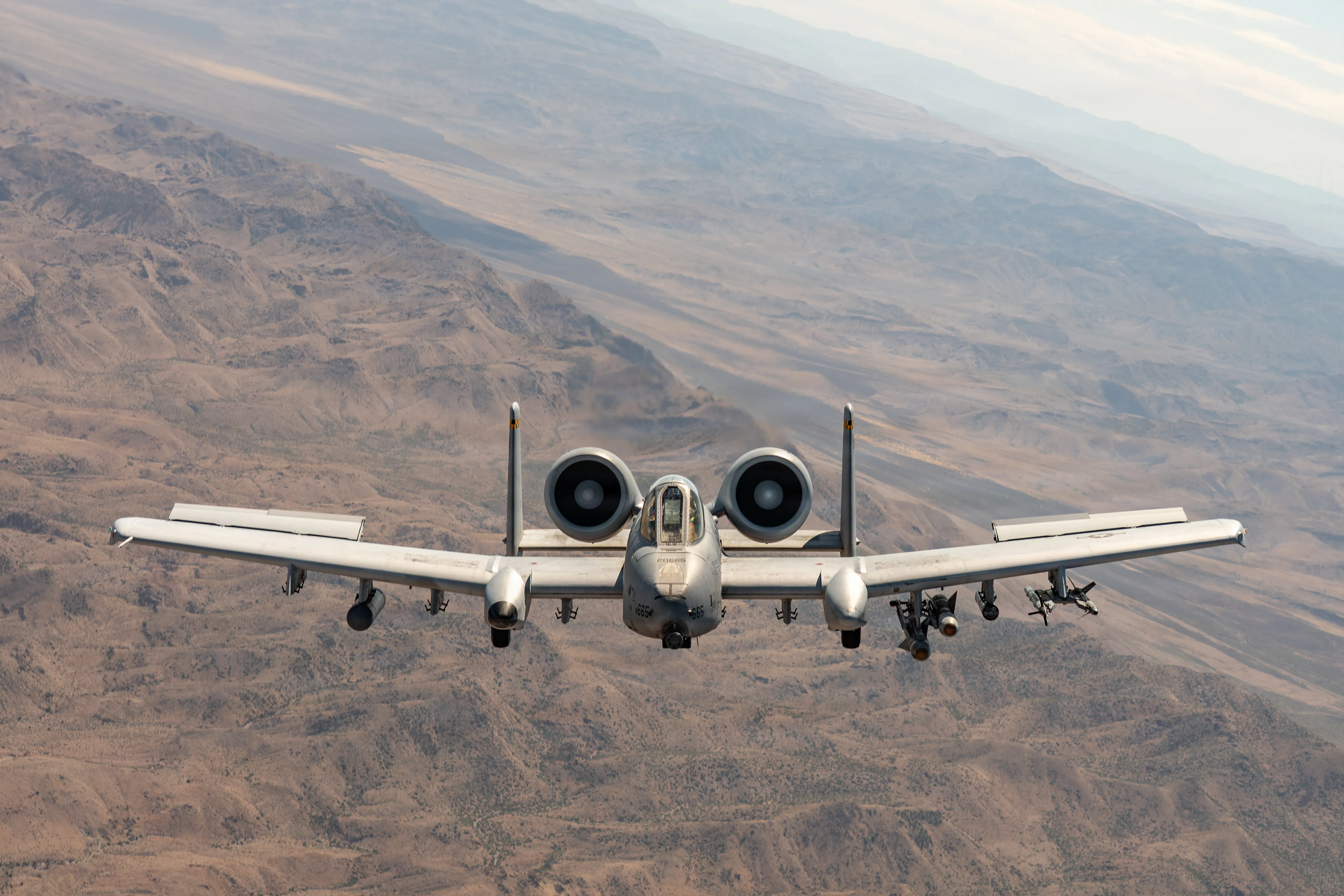
A U.S. Air Force A-10 Thunderbolt II aircraft assigned to the 66th Weapons Squadron, U.S. Air Force Weapons School, flies during a Weapons School Integration mission over the Nevada Test and Training Range, Nevada, May 28, 2026. (U.S. Air Force photo by Airman 1st Class Jennifer Nesbitt) Airman 1st Class Jennifer Nesbitt
A-10 combat capacity requires a meaningful shift in priorities that brings back resources and overcomes institutional resistance. Saving a limited number of aircraft is wasteful unless it is matched with resources, personnel, and policy that make it clear the A-10 is a valuable combat asset. The justification for preserving the A-10 is measurable in combat utility and financially sound reasoning.
I have no sentimental attachment to the A-10. I flew combat fighters as both an F/A-18 TOPGUN graduate and later as a U.S. Air Force F-22 Mission Commander with more than 2,000 flight hours, including combat deployments to Afghanistan, Iraq, and Syria. Since leaving the cockpit, I have worked closely alongside the A-10 community as it reinvented itself around modern warfare and Indo-Pacific priorities. I care about preserving combat capability and making disciplined present-value force-management decisions grounded in operational reality.
The A-10 was not preserved out of nostalgia. It was preserved because recent operations reminded the Air Force that immediate combat power still matters and the A-10 has proven useful in ways many planners underestimated. Today, it provides unique value unmatched by any of its peer tactical aircraft. It operates from austere locations, supports standoff and maritime strike, and validates emerging lower-cost weapons that reduces pressure on more expensive strike aircraft.
A U.S. Air Force A-10 Thunderbolt II aircraft provides close air support to Independence-variant littoral combat ship USS Santa Barbara (LCS 32) during a training exercise in the Arabian Gulf, Feb. 2, 2026. Santa Barbara is deployed to the U.S. 5th Fleet area of operations to support maritime security and stability in the Middle East. (U.S. Navy photo by Mass Communication Specialist 2nd Class Iain Page) Petty Officer 2nd Class Iain Page
As noted in the opening of this article, the A-10 also fills a critical combat role many have discounted: Sandy missions supporting combat search and rescue. Recent recovery operations over Iran protecting two F-15E airmen demonstrated again that personnel recovery escort, permissive strike, armed reconnaissance, and low-altitude tactical coordination remain critical and complex combat skills. The A-10 community has been supporting these missions for over 50 years. That wealth of knowledge and experience is being displaced. Without a replacement, the Air Force carries a mission requirement it may prove unable to fulfill.
Why Preserving The A-10 Was The Right Decision
For years, the Air Force’s divestment logic rested on several assumptions: that future conflicts would prioritize different force packages, that replacement capability would mature on schedule, and that preserving the A-10 generated less value than retiring it.
Recent events changed that projection. The A-10 has sustained operations in both Europe and the Middle East. Simultaneously, Air Force strategy in the Pacific has benefited from ongoing A-10 support developing distributed combat employment, maritime strike, and advanced weapons integration. The same platform once dismissed as a legacy close-air-support aircraft is now proving adaptable to several emerging operational problems and service priorities.
An A-10 Thunderbolt II fires its GAU-8 Avenger 30mm Gatling gun at the Barry M. Goldwater Range near Gila Bend, Ariz., as part of the close air support competition during Hawgsmoke 2024 on Sept. 13, 2024. (U.S. Air Force photo by Tech. Sgt. Tyler J. Bolken) Tech. Sgt. Tyler J. Bolken
The A-10 is not theoretical surge capacity sitting in storage. It remains active combat power supporting real operational demand today. Combat escort, personnel recovery, permissive strike, armed reconnaissance, and maritime interdiction remain ongoing Air Force missions and long-standing A-10 strengths.
A less known strength of the A-10 is the leverage it provides as a modernization platform. The A-10 community has quietly become one of the Air Force’s most effective rapid integration ecosystems. Because the aircraft relies heavily on government-owned hardware and software architectures, operators and engineers have been able to test and field new capabilities in weeks instead of years. The community has been behind recent breakthrough integrations including AGR-20 APKWS, Small Diameter Bomb, ADM-160 MALD employment, beyond-line-of-sight communications, maritime strike weapons, and network-enabled command and control.
A-10C with a load of Small Diameter Bombs. (U.S. Air Force photo by William R. Lewis)
Nobody is arguing the A-10 is the future of Pacific airpower. It doesn’t need to be. The aircraft has become a low-cost operational laboratory for rapid tactical adaptation fully integrated into real combat capacity.
An A-10C Thunderbolt II assigned to the 74th Fighter Squadron flies with its new refueling probe at Moody Air Force Base, Georgia, May 19, 2026. The A-10 integrated the probe with the A-10, tested it and it was in combat in a matter of weeks. (U.S. Air Force photo by Airman 1st Class Rachel Howell) Airman 1st Class Rachel Howell
Preserving one of the few communities with real operational experience executing tactics the broader force is still learning is strategically wise. The A-10’s latest life extension was never simply about preserving an airframe. It was about preserving combat capability, operational experience, and one of the Air Force’s few proven rapid-integration ecosystems.
What The Air Force Will Lose
The current plan has the service preserving a limited number of airframes while allowing the combat system behind the A-10 to collapse. A fleet that numbered more than 280 aircraft just a few years ago, and 162 at the start of fiscal 2026, is set to fall to 54 next year and just 36 by 2030. The cuts land hardest where the expertise is hardest to rebuild: the Air National Guard’s A-10 force, 47 aircraft as recently as last year, goes to zero, its flying hours swapped for a new cyber mission. What survives risks becoming a ghost-fleet. Of the “three squadrons to 2030” the Chief of Staff has promised, the active-duty force shrinks to a single squadron of 17 jets with no spares behind it.
A U.S. Air Force A-10C Thunderbolt II flies over the Gulf of America, September 16, 2025. The A-10, from Detachment 1, 40th Flight Test Squadron at Davis-Monthan Air Force Base, Arizona, has an orange nose panel to represent an area or part of the aircraft that is undergoing test operations. (U.S. Air Force photo by Tech Sgt. Jacob Stephens) Staff Sgt. Jacob Stephens
Combat capability does not reside in aluminum alone. It resides in maintainers, instructor pilots, operational test teams, weapons officers, logistics pipelines, and institutional continuity accumulated over decades. All of that is currently at risk. The capacity to produce, refine and retain this talent and experience is perishable. Airmen face irreversible career decisions. Maintainers transition to other fleets. Weapons instructors leave. Operational test is blocked. Once assignment pipelines close and personnel move on, the impact compounds quickly. To a community that was previously scheduled for final retirement this October, every month of uncertainty adds to the complexity of sustained readiness. Rebuilding later becomes expensive and slow, if not impossible.
How perishable A-10 specific knowledge is was documented by the Air Force’s own testing. When the Pentagon ran a 2018–2019 flyoff to determine whether the F-35 could replace the A-10 in close air support, forward air control-airborne (FAC-(A)), and combat search and rescue (CSAR), F-35 pilots had no qualification or training requirement for the FAC(A) and CSAR missions. To make the comparison work, the test had to crew the F-35 with former A-10 pilots, aviators who carried their Sandy and weapons-school training over from the very aircraft being retired. The report demonstrated mission performance depended on the aircrew, not the airframe.
Four Joint Terminal Attack Controllers assigned to the 6th Combat Training Squadron, Nellis Air Force Base, Nevada, display the Tactical Air Control Party flag after completing a mission on the Nevada Test and Training Range, Nevada, Aug. 3, 2022. (U.S. Air Force photo by William R. Lewis) William Lewis
Years later, in 2023 and 2024, the Air Force still had no close-air-support or CSAR training requirement for any F-35 pilot. In April 2026, the formal A-10 training unit at Davis-Monthan, the 357th Fighter Squadron, the schoolhouse that is home to the Sandy qualification, graduated its last class. On the same day, halfway across the world, A-10 flew the combat rescue mission saving downed aircrew inside Iran. The dissonance between real world combat value and misaligned budget politics will be on full display if the 357th schoolhouse and its Sandy training syllabus are allowed to fully inactivate in just a few months. The Air Force has confirmed there is no transition underway to move the Sandy mission to any other airframe, and no successor qualification program in development.
This is not a new concern. In 2021, the Senate formally recorded that A-10 combat search and rescue had been “100 percent effective” in Operation Allied Force, recovering a downed F-117 and F-16 pilot. The Warthog has now done it again over Iran. Congress has consistently levied the concern but the Air Force and its budget still haven’t made this a real priority.
The Air Force has already invested heavily to preserve A-10 viability well beyond 2030: roughly $1.1 billion to re-wing 173 aircraft, completed in 2019, and a follow-on contract worth up to $999 million to put new wings on the remaining 109, about $2.1 billion in total to extend the entire fleet’s structural life into the late 2030s. But even those investments faced similar institutional resistance inside the Air Force. The service repeatedly placed A-10 funding on its “unfunded requirements” list rather than in its base budget, while funding upgrades to other legacy fighters instead. Congress has consistently met Air Force resistance, such as in 2021 when the service spent just $15.6 million of $100 million Congress had appropriated to sustain the fleet into the 2030s. Allowing the enterprise behind those re-winged jets to collapse now would write off an investment the taxpayer and Congress already paid for and has barely begun to recoup.
U.S. Air Force Airmen assigned to the 309th Aircraft Maintenance Group Expeditionary Depot Maintenance team replace the wings on an A-10 Thunderbolt II assigned to the 357th Fighter Generation Squadron at Davis-Monthan Air Force Base, Arizona, Oct. 11, 2022. Due to the extensive in-depth work required to complete a wing swap, skilled professionals from the 309th AMXG Expeditionary Depot forward deployed to DM for this major component maintenance. (U.S. Air Force photo by Senior Airman Kaitlyn Ergish) Staff Sgt. Kaitlyn Ergish
This is not a theoretical risk. When the F-22 production line closed at 186 aircraft, well short of the original requirement of 750, the assumption was that follow-on capability would arrive to fill the gap. The limited F-22 fleet now bears disproportionate sustainment costs awaiting delivery of the proposed F-47 sometime in the mid-2030s, and even then, the two could serve alongside each other for a period of time. Timing errors in force design can become effectively irreversible, especially once the infrastructure that sustains a capability is dismantled. In the A-10 case, that includes not only the aircraft but also the depot and integration ecosystem that support it. Once those are gone, the option value is gone with them.
The financial logic behind accelerated divestment is also less straightforward than topline savings figures suggest. Retiring the A-10 does not eliminate operational demand. Combat search and rescue escort, permissive strike, armed reconnaissance, and distributed-operations requirements still exist. Those missions and their costs migrate elsewhere: more flight hours on higher-cost aircraft, additional maintenance burden, increased schoolhouse demand, and greater operational tempo across communities already under strain.
A U.S. Air Force A-10 Thunderbolt II aircraft assigned to the 66th Weapons Squadron, U.S. Air Force Weapons School, performs an austere landing at Delamar Dry Lake near Alamo, Nevada, May 28, 2026. The 66th WPS provided close air support and forward air control during a Weapons School Integration mission. (U.S. Air Force photo by Airman 1st Class Jennifer Nesbitt) Airman 1st Class Jennifer Nesbitt
The A-10 offers combat power at a discount through both cost per flight hour and cost per effect on target. Mission specialization means A-10 employing laser-guided rockets, gun, or other comparatively low-cost weapons provides a strong complement to high-end fighter packages and their standoff weapons.
The Air Force mission, its airmen, and our nation’s combat capacity all stand to benefit from a more complete commitment to the A-10 and its community.
What The Air Force Should Do
The Air Force must revisit their A-10 commitments to ensure the extension is real.
Restore and protect the 357th Fighter Squadron at Davis-Monthan. The 357th is the Air Force’s formal A-10 training unit and the institutional home of the Sandy qualification, the schoolhouse where combat-search-and-rescue expertise is produced, refined, and passed to the next generation of aircrew. It graduated its last class in April 2026 and is set to inactivate this year. No successor Sandy qualification program exists across the Department of War, and the Air Force has confirmed none is in development. Inactivating the 357th severs the center of excellence that produces the very capability the service says it values. Reversing that decision is the single highest-leverage action available, and the clearest signal of whether the 2030 commitment is real. The squadron should be retained until a validated replacement for the Sandy mission is stood up and producing qualified aircrew on a replacement platform.
A U.S. Air Force HH-60 Pave Hawk and A-10 Warthog fly in support of the Air Force Weapons School over Nellis Air Force Base, Nev., May 23, 2012. (USAF) Staff Sgt. Matthew Bruch
Stabilize the rest of the enterprise through the extension timeline. If the service intends to preserve meaningful capability through 2030, the supporting structure has to survive with it. That means protected funding for depot maintenance, training, operational-test, and maintainer retention. Exempt the A-10 from “sunset” policy where budgets are still being slashed with justification of “upcoming divestment.” Instead, leverage the A-10 operational-test process as a rapid-integration and tactics pathfinder, capturing and transferring those lessons across the broader force before the capability disappears.
Tie any future divestment to demonstrated replacement readiness, not the calendar. Do not divest the A-10 until there is a trained and capable replacement for each mission it performs. Build a deliberate plan for a clean handoff of mission responsibility and the community knowledge behind it, and gate future retirements on proven replacement capability rather than programmatic timelines.
The case for retiring the A-10 was always a timing argument: accept a measured reduction in near-term capacity in exchange for a better future force. The Air Force already announced the A-10 was back. Now it must fund the decision it already made before the combat capacity disappears anyway.
Paul “Gu$” Garcia is a TOPGUN Navy Fighter Weapons School instructor and graduate who flew combat missions in the F/A-18 across Iraq, Afghanistan, and Syria. He transitioned to fly the F-22 in the IndoPacific as a member of the Hawaii Air National Guard, leading the Homeland Defense mission for the Hawaii and Guam Air Defense Region for Operation Noble Eagle. He retired from the U.S. Air Force as the lead for PACAF modernization and innovation in 2025. He is Managing Partner and founder of Merge Combinator.
The opinions and views expressed in this article are those of the author and do not reflect the views or opinions of the U.S. Air Force, the U.S. Department of Defense, or any part of the U.S. government.
Keely Hodgkinson pulled out of the 400m final at the UK Athletics Championships moments before Sunday’s race.
The Olympic 800m champion has been competing over the shorter distance in a bid to improve her first-lap speed and challenge for the 800m world record this summer.
After qualifying from Saturday’s heats, she warmed up for the final in Birmingham but stepped off the track right before the finalists were put under starters’ orders.
Hodgkinson looked emotional as she stood at the side of the track before making her way back inside the Alexander Stadium.
The 24-year-old endured an injury-disrupted 2025 and her shock withdrawal on Sunday comes four weeks before the London Diamond League meeting, which she had earmarked for a tilt at the 800m world record.
Soto is a co-founder of the Transgresores collective. (Venezuelanalysis)
Joseph Soto is an activist and co-founder of the Transgresores collective. This 34-year-old, who holds a degree in performing arts, has emerged as a leading figure in the defense of the rights of the sexual and gender diversity community in Venezuela, with a particular focus on raising awareness about trans men.
How was the transition process to a trans man in Venezuela amid a full-blown crisis?
It was undeniably very complex. The years 2016–2017 saw a worsening of the socioeconomic crisis in Venezuela as a result of the US blockade and sanctions, which had a drastic impact on day-to-day life, public services, and the population’s living standards. Everything pointed to the fact that, in order to transition, I would have to leave the country, but I decided not to. There had to be some way to be a trans man in Venezuela.
It was difficult, not only because of the material and socioeconomic conditions, but above all because of the lack of information and the void of references surrounding the issue of trans masculinity. Historically, trans women have shouldered the burden of visibility within the struggles for sexual diversity. When we talk, for example, about the 1969 Stonewall riots, trans women played a leading role. Trans men, on the other hand, have not taken on that protagonism. It caused me a great deal of anxiety to not know what to do, where to start, or where to go. I figured it out by researching, studying, seeing how things were done in other countries, reading medical protocols, analyzing different perspectives, and acquiring theoretical tools to develop my own process. But also by making connections and building networks here. That’s what saved me.
In the end, it was challenging but not impossible. And that’s exactly how I began to make connections with activists and advocates in the field of sexual and gender diversity, who in turn put me in touch with trans peers who were here in Venezuela. That allowed me to navigate the initial challenges of my gender identity transition, which involved building a collective of trans men called Transgresores.
In general terms, how would you describe the access to healthcare and medical treatment for trans people in Venezuela?
I believe there is a great need for discussion, training, and awareness-raising among healthcare workers regarding the care of our population. In addition to the inherent weaknesses of the public healthcare system, resulting from the US blockade and internal mismanagement, which create endless hurdles for receiving care at a hospital or affording treatment at a clinic, there is also the anxiety stemming from the possibility that a medical professional might be prejudiced or lack knowledge about trans issues.
The trans community doesn’t just go to healthcare centers for issues related to their gender transition, such as hormone replacement therapy or surgery. We may also experience general illness or suffer an accident, and prejudice stemming from ignorance can affect the quality of care we receive. It’s happened to me. Once I went to the hospital in Lidice (Caracas) for a swollen lymph node in my armpit, but when I mentioned that I was trans, the doctor refused to treat me, telling me to go to my primary care physician or an endocrinologist. He couldn’t even prescribe some ibuprofen. Prejudice won out.
Worse still is the treatment of transgender women. Discrimination persists, and the medical field is no exception. But we exist, and we have the right to healthcare. It seems like something very basic, but it’s work that still needs to be done. In the current context, with the Coexistence Program and the call made by the acting president herself for the recognition of sexual diversity, there is an opportunity for the Ombudsman’s Office, which has been facilitating this debate, to collaborate with the governing bodies in the healthcare sector to develop a training and awareness-raising process.
In other Latin American countries such as Cuba, or certain provinces in Argentina and Uruguay, there are established protocols and transition processes. This is provided through the public healthcare system, including access to hormones and surgical procedures if that is what the person desires. However, in Venezuela, there is no public health policy established and regulated by the state geared toward the care of transgender people. Before that can happen, there must be a rigorous debate since, in addition to transgender people, gay men and lesbians also suffer this type of discrimination.
Sexual and gender diversity collectives have urged the Venezuelan state to tackle anti-trans violence. (Fabrizio Sánchez)
Two issues stand out on the gender and sexual diversity agenda: marriage equality and legal name and gender changes for transgender people. Can you explain why these two issues are so central? And what other demands does the movement have?
In what concerns marriage equality, the Venezuelan sexual and gender diversity movement submitted a bill to the National Assembly in 2014. In other words, work has already been done on this issue, including going through the various legal steps required by the Venezuelan legal framework to present a bill of this magnitude to the legislature. But in the end, that debate did not proceed. It was shelved despite having met all the requirements. That is why we still demand a debate, to overcome the fear of recognizing other forms of family and to integrate ourselves as subjects of equal rights within our legal framework. That would allow, for example, our partners to have inheritance rights.
Regarding the issue of legal name and gender changes for transgender people, there are two key points. The first is that for trans people, when the name registered on legal documents does not match how we see ourselves, it can often expose us to situations of violence and discrimination in administrative procedures or when dealing with law enforcement. There have been instances of discrimination, violence, and abuse by the police when they identify a person as trans.
The second reason is that there is no need to create a new right. What is needed is to enforce and implement an existing one. The Organic Law on the Civil Registry establishes that every citizen of this country has the right to change their name at least once if it is humiliating or does not correspond to their gender. That is why the Venezuelan sexual and gender diversity movement has been so vocal in demanding this provision. As for other demands, there is the issue of the right to a life free from violence and discrimination, because discrimination based on gender identity, gender expression, or sexual orientation is still very much alive in Venezuela. Certain municipalities have proposed decrees on this matter, but I believe that is insufficient. We need a legal framework that establishes penalties and, above all, addresses all the various forms of discrimination faced by our community.
In other interviews and articles, you have talked about the harm suffered from studying in religious schools, despite the law establishing that education should be secular. As we witness a major offensive from evangelical groups in national politics, what is your perspective?
Indeed, the rise of conservative religious thought is a threat to sexual and gender diversity. But at the end of the day, this is nothing new. We are the cultural product of [Spanish] conquest and colonization, and from that point on, the Catholic religion was imposed.
Now, [Protestant] fundamentalist groups are definitely on the rise both nationally and regionally. But I believe the threat does not lie in religious thought itself, because this country is not inhabited solely by Christians. It is a melting pot of religions, beliefs, and faiths. I believe that our commitment must be precisely to celebrate, through sexual and gender diversity, that religious pluralism, so long as it does not infringe upon the rights of any group. My call is for sexual diversity to provide the country with a roadmap, a vision of a truly diverse, respectful society that aims for recognition and is free from violence and discrimination. We must engage in a meaningful debate about the kind of society we want to build. This involves addressing educational, cultural, and media issues.
Soto called for rekindling debates surrounding sexual and gender diversity in Venezuelan society. (Archive)
Most of the country is focused on socioeconomic issues, and this is pushing other important questions to the backburner. What does the sexual and gender diversity movement propose in these circumstances?
I believe that the diversity movement owes a debt to the country because it has often limited itself to merely making demands and pointing out the shortcomings of the Venezuelan state and the Venezuelan people, but it has also failed to develop a strategic, programmatic vision to offer the country a vision of governance and an institutional framework.
My view is that we need to open up a broader debate and reestablish spaces for discussion within collectives, organizations, and platforms. Migration has also disrupted spaces for activism, because many sexual, gender, and diversity activists left the country. But it’s time to regroup and rise to the challenge of the times. What do we propose for the country in the present context? How do we see it? That is the debate we are called upon to have. I cannot definitively say what the sexual and gender diversity movement proposes because it is a debate that has yet to take place. But our approach cannot be limited to marriage equality and sexual identity.
You have also expressed concerns about a sector of the LGBTIQ+ community subordinating its agenda to the dynamics of foreign funding. Can you elaborate on this?
On this topic, I am referring to the fact that many of the sexual and gender diversity initiatives or forms of activism have been limited by NGOs since the international humanitarian system entered the country, as a result of sanctions, the crisis, and so on. In this kind of activism, political action has fallen short because it has been restricted solely to activities outlined within a given project sponsored by a specific funder, and it has lost its own organic character. It cannot be that the only spaces for us to meet and discuss are fully determined by the timelines, categories, and demands of a specific NGO project.
We must have our own agenda, with our own perspective and objectives. One that, above all, is guided by sexual and gender diversity activism and struggle. We have the responsibility and the challenge of overcoming this logic to reclaim an organic structure linked to concrete spaces of work and transformation, to a community, to a specific educational institution, to our territories, with our own agendas, categories, and timelines, not those predefined by an external organization.
The idea is not to demonize external funding, but our actions cannot be completely determined by it. Furthermore, these project activities fall short of the transformation we owe to our society. This is a personal perspective, and I’m sure I’ll get a lot of hate for it, but painting a bike lane with a rainbow flag in wealthy parts of eastern Caracas doesn’t bring about real change, even if resources, information, media coverage, and human effort are devoted to it. In terms of social and structural transformation, it achieves nothing; it leaves no lasting impact. We need a deeper, more strategic vision that harnesses the transformative potential we possess as a collective, as organized actors in society. That is why we must rebuild the movement.
Soto (right) warns of the dangers of subordinating grassroots struggles to NGO agendas. (Transgresores)
An old clip has resurfaced showing Andy Burnham saying Israel would be his first overseas visit if elected as UK Prime Minister. The new MP for Makerfield is under the spotlight amid expectations he’ll challenge Labour leadership. Here’s what he’s previously said about Israel-Palestine.
Weekly insights and analysis on the latest developments in military technology, strategy, and foreign policy.
Russia’s mysterious Burevestnik (also known to NATO as SSC-X-9 Skyfall) cruise missile likely leaves a trail of radioactive material in its wake, making the weapon even more alarming than was first thought. This is the conclusion of two scientists from the Massachusetts Institute of Technology (MIT), who have recently published a detailed analysis of one of the so-called ‘super weapons’ revealed by Russian President Vladimir Putin back in 2018.
The report, from Jake Hecla, an MIT professor who covers aerospace and nuclear science and engineering, and co-author R. Scott Kemp, provides the most compelling analysis so far on how the Burevestnik is actually powered. Uncertainty around this has led to previous questions about whether Russia’s claims of nuclear propulsion for the weapon even stack up.
A view of the Burevestnik test site at Pankovo, on Yuzhny Island in the Novaya Zemlya archipelago, with a missile launcher in the raised position. via X
First, it’s worth recalling what we know about the Burevestnik program’s development milestones, which appear to have been punctuated by accidents.
It is also worth noting that there have been previous efforts to create nuclear-powered aircraft and missiles.
During the 1950s, both the Soviet Union and the United States tested airborne nuclear reactors aboard strategic bombers, the B-36 Peacemaker and the Tu-95 Bear, respectively. Neither of these trials actually saw the reactors drive the aircraft’s engines.
Under Project Pluto, the United States studied a nuclear-powered cruise missile and got as far as testing a reactor on the ground in 1964, before the idea was abandoned. The Pluto concept of operation was somewhat different to the Burevestnik, with the missile intended to fly at treetop level at Mach 3.5 and dispense nuclear weapons at different points along its flight path by performing “pop-up” maneuvers.
Soon after Putin’s 2018 announcement, the Norwegian-based environmental group Bellona suggested that a radiation spike in the Arctic that same winter may have been caused by a test of the missile.
Later in 2018, a U.S. intelligence report described the loss at sea of a Russian nuclear-powered missile during a 2017 test. The report added that Russia was expected to embark on a search and recovery mission to try to lift the missile’s wreckage from the seabed.
Then, in 2019, an explosion occurred aboard a barge in the White Sea, outside Nenoksa, killing five Rosatom scientists. It also led to a radiation spike in the Russian city of Severodvinsk, as you can read more about here. The explosion has been blamed on a reactor from a Burevestnik recovered from the sea, likely the one that was lost in 2017.
Last October, Russia’s Chief of the General Staff, Valery Gerasimov, announced that a successful test of the Burevestnik had been carried out, high above the Arctic Circle. Gerasimov said that the 15-hour flight “is not the [maximum] limit” for the missile. This appears to have been the first long-endurance test of the missile.
Hecla and Kemp agree that the October 2025 test was a success and that, moreover, it marks the first time a true nuclear-powered aircraft has ever flown for a sustained period.
This leads to the question of how the Burevestnik actually converts energy from its nuclear reactor into propulsive power to keep it in the air.
Hecla and Kemp may well have provided the answer.
Based on data that the researchers gathered, the size, shape, and performance of the Burevestnik indicate a different kind of propulsion system than envisaged for Project Pluto. The U.S. concept involved a ramjet, required to ensure supersonic performance in the atmosphere.
In the 1960s, the U.S. Air Force explored this idea with its Supersonic Low Altitude Missile, or SLAM. This weapon employed a nuclear-powered ramjet along with conventional rocket boosters to kickstart the system. Once at the appropriate speed, the engine would blow air over the reactor, which could have enough fuel to operate for weeks or months on end, and then force it out of an exhaust nozzle to produce thrust.
The Tory II-C nuclear ramjet engine was tested in 1964 and helped inform the abortive Supersonic Low Altitude Missile, or SLAM, program. Public Domain
The Burevestnik is “very obviously a subsonic system,” Hecla told NPR.
By comparing open-source imagery of the Burevestnik, the researchers calculated that the missile is approximately 31 feet (9.5 meters) in overall length, with a wingspan of approximately 18 feet (5.6 meters). It likely flies at a speed of around Mach 0.75.
A size comparison from the report includes the Burevestnik alongside the Russian Kh-101/102 air-launched cruise missiles and the BGM-109A Tomahawk. Modeling the Performance of the Burevestnik Nuclear-Powered Cruise Missile, Jake J. Hecla and R. Scott Kemp.
They conclude that the Burevestnik is “almost certain” to use a direct-cycle air-breathing nuclear propulsion system, which probably drives a turbojet.
In a direct-cycle system, air is drawn from the atmosphere and passes directly through the reactor core. A compressor forces the air through thousands of narrow, tube-like channels surrounding the nuclear fuel, where the heat generated by nuclear fission raises the air’s temperature. As the heated air expands, it exits the rear of the engine to produce thrust.
A grainy screengrab, released in 2018, that may show the nuclear-powered cruise missile during a test flight. via Channel One Russia
This approach differs fundamentally from most nuclear reactors, which use an indirect, closed-loop design. In those systems, a sealed coolant — typically water or another heat-transfer fluid — circulates through the reactor to carry heat away while keeping radioactive materials contained and minimizing radiation exposure.
Comparison of a direct-cycle nuclear turbojet and an indirect-cycle equivalent. Modeling the Performance of the Burevestnik Nuclear-Powered Cruise Missile, Jake J. Hecla and R. Scott Kemp.
While some kind of indirect loop design is not impossible, the researchers consider that it’s highly unlikely, due to the simple fact that these systems are considerably larger, heavier, and more complex and couldn’t be accommodated in what is by no means a huge missile.
This means that the Burevestnik is likely propelled using heated air that is drawn directly through the reactor core.
The resulting powerplant is simpler and more compact, but it comes with a serious drawback: “The direct cycle is very likely to result in a large quantity of radioactive material in the exhaust,” Hecla contends.
Essentially, as clean atmospheric air passes through the tiny tubes in the reactor, it gets irradiated and infused with fission decay products from the nuclear fuel.
The hot air that passes out of the end of the turbojet would be filled with radioactive isotopes of argon, krypton, and carbon, all of which would be scattered in its wake.
A notional Burevestnik concept of operations consists of launch using a kicker, then transitioning to solid rocket booster power. This then allows a slow spool-up to nuclear cruise at high-subsonic speeds. Alternatively, the boosters may be for testing purposes only, and the nuclear engine system may instead use hydrocarbon fuels to slowly taper from conventional power to nuclear power. Modeling the Performance of the Burevestnik Nuclear-Powered Cruise Missile, Jake J. Hecla and R. Scott Kemp.
The longer the missile flies, the more of this harmful waste it would pump into the atmosphere, and onto the surface below.
The researchers highlight another problem, too.
Namely, any kind of prolonged flight is likely to result in corrosion of the reactor core, through a combination of heat and compressed air. This would create yet more radioactive particles.
Based on previous evidence, it seems that Russia might already be battling with the problems inherent in handling, loading, and testing a missile with this kind of propulsion system.
The Russian Ministry of Defense released the video below in 2018, saying that it showed an earlier Burevestnik test launch, as well as examples of the missiles themselves.
Крылатая ракета с ядерным двигателем «Буревестник»
The MIT researchers consider that the fatal 2019 explosion in the White Sea was likely a failed attempt to recover a prototype Burevestnik reactor. The reactor is presumed to have restarted as it was being raised from the seabed, leading to an explosion.
Bearing all this in mind raises the question of why Russia set about developing the Burevestnik, especially when it has so many other ‘novel’ weapons in the works or already fielded.
Ultimately, the major advantage of the Burevestnik is almost unlimited range, something that we have discussed in the past:
“The missile can be launched preemptively and approach its target from any vector long after launch. For example, it could be launched from the Arctic, stay aloft for many hours, and then attack the United States from the south. Once launched, its flight path is entirely unpredictable, and it could exploit holes in defenses and weaker spots in early warning capabilities. It provides another reason why space-based tracking layers, including those that can spot low-flying aircraft, are currently very much on trend.”
Conclusions:
1. Burevestnik is not a strategic game-changer, and does not provide decisive warfighting advantages beyond existing nuclear forces.
2. It is likely a hedge against missile defenses with a niche capability complicating warning, tracking, and defense planning. 3/5 pic.twitter.com/nYzbZquthK
On the other hand, the Burevestnik doesn’t appear to be very fast or difficult to intercept once detected.
There is also its inherent inflexibility, since Russia has said it is only envisaged as being used with a nuclear warhead. While this could change, the size and weight of a conventional warhead would be more limited, and it’s questionable if Russia would risk employing such a complex missile to deliver a relatively modest conventional charge, especially since it would leave a potentially lethal radioactive footprint regardless.
“It leaks radiation, making it easy to track; it’s slow and un-stealthy, making it easy to shoot down; and the inside of the missile degrades during reactor operation, calling into question its ‘unlimited’ range,” William Alberque, a former director of strategy, technology and arms control at the International Institute for Strategic Studies (IISS), told TWZ.
“There are so many reasons everyone abandoned this concept in the Cold War,” Alberque added.
Conclusions (con’t):
5. It is 9.5m long with a reactor core diameter of 50 cm and requires regular boosters for launch and terminal phases.
6. In short, Burevestnik is a costly and hazardous symbol system with the potential to kick off a broader nuclear-propulsion race. 5/5 pic.twitter.com/NOdZ1lz6ZG
Hecla and Kemp assess that Russia’s reason for embarking on the Burevestnik is likely more to do with proving technologies for more ambitious and advanced programs further down the line. These could include nuclear-powered surveillance drones or space-based nuclear systems that would have considerably more military value.
People are asking what’s the purpose of Burevestnik and why develop a system that is very much useless as a weapon. The answer has always been right there, in the 1 March 2018 address. Russian president has always wanted to say these words. The rest doesn’t matter really. pic.twitter.com/0Q7JUGBqo3
Another possibility is that this is a ‘pet project’ of Putin himself, the Russian leader having been wooed by the idea of a missile with near-limitless range, regardless of the practical utility.
On the one hand, the latest analysis does suggest that the test last October means that the Burevestnik is the first aircraft ever built and flown in a sustained manner using nuclear power.
That is a landmark, but it’s one that’s tempered by very significant questions about the safety of anyone in its vicinity, and the environment at large, not to mention its somewhat limited military value.
US and Iranian delegations have arrived for high-level talks at a hotel in Switzerland. JD Vance, Steve Witkoff and Jared Kushner met Pakistani mediators, while Iranian officials including Foreign Minister Abbas Aragchi and chief negotiator Bagher Ghalibaf met their Swiss hosts.
On June 14, the United States and Iran agreed to a framework to end their war. The Strait of Hormuz is to reopen, the bombing of Lebanon is to end and – most importantly – the killing is to stop. After more than 100 days of war that killed thousands, including Iran’s most senior leaders, and pushed the world economy to the brink, even a fragile truce feels like first light.
Let us welcome it, but also let us understand it. To grasp why this war happened, and the string of wars before it, we must name their common cause. That cause is “Greater Israel” – not the country of Israel but an idea of it – a terrible one. The idea of “Greater Israel” has been the cause of wars in Iraq, Gaza, Lebanon, Syria and Iran.
It holds that Israel should stretch over all of historic Palestine – from the Jordan River to the Mediterranean Sea – and to parts of neighbouring countries as well. According to United States Ambassador to Israel Mike Huckabee, a fundamentalist Protestant whose geopolitical compass is set by biblical texts from 500 BC, “Greater Israel” stretches from the Nile to the Euphrates. Last summer, Israeli Prime Minister Benjamin Netanyahu professed to be “very” attached to a vision of “Greater Israel” that, he said, takes in the Palestinian territories and neighbouring Arab lands.
This absurd and dangerous doctrine has two parents. The first are secular hardliners like Netanyahu who say that Israel must control all the land from the river to the sea to be safe, and damn the eight million Palestinians in the way.
The second is the Jewish supremacist creed of Israeli Finance Minister Bezalel Smotrich and National Security Minister Itamar Ben-Gvir that God gave the land to the Jews alone: There is, in Smotrich’s words, “no such thing as a Palestinian”. Asked recently how Israel should answer its collapsing global standing, Smotrich vowed Israel would not relinquish military control of the West Bank, Gaza, Lebanese or Syrian territory: “We won’t commit suicide to make them happy.”
“Greater Israel” is paranoia, megalomania and religious zeal braided into a single programme. The doctrine should have been repudiated on its first airing decades ago. Instead, it has driven Israel’s foreign and military doctrine for three decades – and has survived until today because Netanyahu has taken the US for a ride.
He has done it with two American constituencies: Jewish Zionists who love Israel and will forgive it anything and Christian Zionists who love the prophecy of the End Times and the Second Coming of Christ more than they love any living Palestinian or, for that matter, any living Israeli.
Delusion has led on to delusion, and the road has run from one war to the next. We are 30 years into this fiasco now.
The war on Iran was simply the latest “Greater Israel” fantasy. The government of 90 million people was to be toppled in a single, glorious day. Of course, it did not happen. Israeli and American bombs killed Iran’s leaders on February 28, but that did not deliver the promised collapse. It resulted instead in thousands of dead, a choked Strait of Hormuz and a global oil shock.
We have seen this film before. The Israel-US plan to bring down President Bashar al-Assad in Syria was also meant to be quick, one or two years at the most. Instead came a dozen years of carnage, fed by a covert war armed and financed by the CIA with Israel’s ardent backing. The result was an ancient country reduced to rubble. The promised one-day victories always become decade-long graveyards.
US President Donald Trump has been battered by joining the “Greater Israel” delusion, and he knows it. The new agreement with Iran is his escape valve, a way out of a fatuous war that was never his to win.
That is precisely why Israel’s “Greater Israel” politicians are trying to strangle the new agreement in the cradle, for peace with Iran is a defeat for “Greater Israel”. Even after the deal was sealed, Israel has continued to bomb Lebanon, killing 47 people in a single day on Friday and another 32 on Saturday hours after a Lebanon-Israel ceasefire took effect.
Here is the deeper truth: “Greater Israel” is not saving Israel. It is killing it. The friction now visible between Trump and Netanyahu is only the surface. Beneath it lies the collapse of Israel’s standing throughout the world. According to a recent Pew opinion survey, the world now holds an overwhelmingly unfavourable view of Israel. In the US, Israel’s indispensable patron, six in 10 adults view it unfavourably.
A state that makes itself hated by the world, and by its only protector, is not pursuing security. It is threatening its own survival to feed a delusion.
So the way to peace in West Asia is to stop “Greater Israel”. End the war on Iran, stop the genocide in Gaza and halt the strangulation of the West Bank. Most importantly, do the thing the doctrine forbids, which is to create the State of Palestine as the 194th United Nations member state alongside the State of Israel on the 1967 lines with genuine security for both countries and a regional framework to guarantee it, which should include Israel’s withdrawal from Lebanon and Syria.
The Iran ceasefire makes the case in miniature: It was won not on the battlefield but through mediation. It became possible when Washington decided it wanted peace more than it wanted “Greater Israel’s” war.
Israel can survive, but not as “Greater Israel”, a disastrous idea that has marched it and the US from one war to the next.
The glimmer of hope today is real. Whether it becomes a true dawn depends on whether the US finally lets Palestine be born, and thereby lets Israel live. The Arab world and Iran need to keep insisting to the US that breaking with “Greater Israel” is the only path to lasting peace.
The views expressed in this article are the authors’ own and do not necessarily reflect Al Jazeera’s editorial policy.
Weekly insights and analysis on the latest developments in military technology, strategy, and foreign policy.
On Thursday, U.S. Army Pacific (USARPAC) stood up a new command to speed up reaction times and sustain operations within the anti-access/area denial environments of the Pacific. To help achieve that goal, the commander of this new unit told TWZ he wants to be able to saturate any future adversary with so many drones they have trouble operating.
“We have learned, particularly looking at Ukraine, there really is no sanctuary area that is protected from observation and potential targeting,” Maj. Gen. Bernard J. Harrington told us during a media roundtable to introduce his new command. It’s called the 7th Infantry Division Multi-Domain Command – Pacific (7th ID MDC-PAC). Headquartered at Joint Base Lewis-McChord in Washington, it combines the 7th Infantry Division and the 1st Multi-Domain Task Force (MDTF). The idea is to merge the maneuver capabilities of the 7th ID’s two Stryker brigades with the long-range sensing, fires, cyber, space, electronic warfare, and information capabilities of the MDTF.
US Army Historic Pivot: 7th Infantry Division Becomes Multi-Domain Command – Pacific
“As we look at our employment of drones,” Harrington proffered, “we are looking at a host of not just traditional sense-and-strike drones, but how do we couple that — utilizing an adaptive and agentic C2 [command and control system] — to long-range one-way attack, to be able to overwhelm potential adversarial systems by a volume that is connected from our sensor drone all the way to our long-range one-way attack drone.”
Harrington was referring to an AI-driven system that can make and execute decisions on its own — routing data, repositioning sensors, matching targets to shooters — without requiring a human to manually approve each step. He later described it as being a “soldier-on-the-loop, not in-the-loop” system, meaning that a human monitors and can override the system’s actions.
You can read all about how AI will enable the future of lower-end drone warfare in our deep dive here.
A soldier assigned to 7th Infantry Division pilots a PDW C100 multi-mission small Unmanned Aerial System at Joint Base Lewis-McChord, Wash., April 9, 2026. (U.S. Army photo by Staff Sgt. Brandon Rickert) Staff Sgt. Brandon Rickert
In another lesson from Ukraine, as well as conflicts in the Middle East, Harrington wants to be able to use decoy drones to “confuse and potentially deceive an adversary.” The goal is to “deplete potential magazine depth.”
We saw this play out in Ukraine, where Russian mass barrages typically use decoy drones to overwhelm Ukrainian air defenses, confuse its sensors and force the expenditure of valuable air defense munitions. Ukraine eventually responded in kind, with its own decoy drones, to achieve the same effects.
The need for the U.S. to develop a vast arsenal of long-range one-way attack drones that can also serve as decoys to consume enemy effectors is a topic TWZ has addressed in the past.
You can see one of the Russian decoy drones in the image below.
The “Parodiya” decoy drone that overflew Kyiv during the visit of British Prime Minister Keir Starmer earlier today and triggered an air defence response.
It is an unarmed and relatively simple UAV designed to probe Ukrainian air defences and expend air defence interceptors. pic.twitter.com/DKNxWyNCai
Harrington added that he is also looking at electronic warfare drones “to help isolate, and then enable other drones to be effective. So when we look at the family of systems, it is not just one role for any one of our drones — it’s how do they pair together, and then how do we get sensor to shooter most effectively to target any adversary appropriately.”
Harrington declined to say what kinds of drones the new command aims to field, though it should be noted that U.S. Central Command recently used Low-Cost Uncrewed Combat Attack System (LUCAS) kamikaze drones, a design reverse-engineered from the Iranian-designed Shahed-136, in the war against Iran. It was the first time those drones were used in combat.
Low-cost Uncrewed Combat Attack System (LUCAS) drones. (CENTCOM)
“There are a host of drones that we are using from multiple vendors, and really what we’re looking at is how do we start bridging the gap — because I would say with the multi-domain task force, we got to a point for the first time that I’ve seen where we could now engage farther than we could sense,” he posited. “So we have worked very, very closely with several vendors in order to close that distance.”
U.S. Army Pvt. Joshua Morrow checks on a Kraus Hamdani Aerospace K1000 Ultra Long-Endurance, solar-powered unmanned aircraft system during Exercise Balikatan 24 at Basco, Philippines, May 4, 2024. (Staff Sgt. Tristan Moore/U.S. Army)
A key to making this all work is getting these drones into the hands of troops to see how these systems actually function across the wide range of environments where the Army operates in the Pacific.
“We’ve got Arctic steppe in Alaska and the high north that are going to require a different type of drone and different types of employment than you would have in a jungle environment in Hawaii or Malaysia, which is different than a desert environment in the Australian Outback,” USARPAC commander, Gen. Ronald Clark, told us.
A soldier assigned to 7th Infantry Division takes notes about the Archer Block 1, hotel variant, one way attack 8-inch FPV drone at Joint Base Lewis-McChord, Wash., April 9, 2026. (U.S. Army photo by Staff Sgt. Brandon Rickert) Staff Sgt. Brandon Rickert
“It’s challenging, but we’re dealing with the best and brightest that we have — our young troopers out there are very comfortable with having technology in their hands, and very comfortable with giving feedback associated with what works and what does not, because their buddies’ lives depend on it,” Clark posited. “It’s literally a responsibility that every soldier takes on and takes very seriously.”
“The other thing I’d add is the distances we have to operate,” Clark noted. “For instance, if you drew a box that was 2,000 nautical miles in each direction and started in Cambodia — went east to the Philippines, south to Indonesia, and then back west to Malaysia, and then back to Cambodia — that box is roughly the same size as the box you would draw if you placed it over Western Europe, from the UK to Finland to Turkey to Spain.”
7th ID MDC-PAC has a wide area of operations. (Google Earth)
Interestingly, the officials leading this effort declined to name a specific adversary and there was no mention of China at all, even though that nation is the primary pacing threat of the service and by far the biggest challenge in the region.
“The multi-domain command Pacific is not tied to a specific adversary, and it’s not tied to a specific location,” Clark explained when asked about threats from North Korea. “It’s a capability that we have built to counter any threat from any adversary, so it’s not necessarily focused on a specific part of the region or a specific adversary.”
As we noted earlier in this story, this new command is being set up as the Army has struggled to catch up to drone warfare developments abroad. China has invested heavily in lower-end drone warfare at the infantry level up to long-range one-way attack drones. The country’s capacity to mass produce all types of drones rapidly on gigantic scales remains a real concern, too. This is not lost on U.S. Army leadership.
“We are behind on long-range sensing and long-range launched-effect strike,” Maj. Gen. James (Jay) Bartholomees, commanding general of the Hawaii-based 25th Infantry Division, told us last year at the Association of the U.S. Army’s (AUSA) annual symposium. “We absolutely need to build this capability quickly. We need to test it in our region; we also need to work with our allies and partners to do the same.”
The Army, it seems, is still trying to figure this all out.
Given that 7th ID MDC-PAC is essentially only a day old, there is a long way to go before the Army can draw any conclusions about the effectiveness of this concept. There are still many unknowns regarding what kind of drones the division has and is seeking, how many they need and the timelines for procurement. Regardless, setting up a new unit concentrating on melding drone warfare with the maneuver capabilities of Stryker brigades is a clear indication that the Army realizes it has to change how it operates to succeed in a Pacific fight.
Weekly insights and analysis on the latest developments in military technology, strategy, and foreign policy.
L3Harris wants to demonstrate the ability of the RC-135V/W Rivet Joint intelligence, surveillance, and reconnaissance (ISR) aircraft to team up with uncrewed platforms. Drones could soak up additional data and otherwise extend the reach of the airliner-sized Rivet Joints, while also helping keep the prized jets further away from threats. This and other developments underway at L3Harris could open the door to further operational possibilities for the Rivet Joint fleet.
Jason Lambert, President for Intelligence, Surveillance, and Reconnaissance (ISR) at L3Harris, talked about the crewed-uncrewed teaming capability for the RC-135, and other major developments in a recent interview with our Jamie Hunter. He also spoke about airborne early warning, electronic warfare, and other capabilities the company is pursuing for various special mission aircraft across its portfolio. This includes a version of the airborne early warning and control-optimized Bombardier Global 6500 business jet-based AERIS-X that is now in the works for South Korea.
Jamie Hunter’s full interview with L3Harris’ Jason Lambert can be found below.
RC-135 Rivet Joint Could Control Uncrewed Drones To Soak Up More Data
“The way these planes operate is every four years or so they come out of the field for depot-level maintenance. So we take the aircraft into our operation in Greenville, we take out the electronics gear, we do a full inspection on the airframe, look for any corrosion, [and] do any repairs required,” Lambert explained. “Then we basically build back the aircraft up with the latest antennas, hardware capabilities, processing power, as well as the software that’s currently going and always going, actually on a baseline spiral upgrade.”
“The software development is on a spiral upgrade schedule, so we’re constantly working the development of new updates and new upgrades for the capability set on the aircraft mission set itself,” he continued. “So, while the aircraft were actually birthed in the 60s and 70s from the Boeing line, from a mission system capability, they’re actually the youngest mission system across the entire United States Air Force, and the reason that’s the case is because as they come off the production line or come out of our depot center, every aircraft is leaving with the world’s leading technology, both software and hardware.”
A Rivet Joint seen stripped of its usual paint scheme and undergoing work at L3Harris’ facility in Greenville, Texas. Dylan Phelps
L3Harris “is already provisioned to be able to do quick turn hardware and software upgrades on the aircraft,” Lambert noted. “We can do that from anywhere from a week to a month, and then actually field the aircraft back into operational theater to perform.”
For L3Harris, crewed-uncrewed teaming is one new capability it is already looking to insert into the Rivet Joint fleet using the processes available now.
“We’re currently in discussions right now to actually do demonstrations on that [crewed-uncrewed teaming] with the RC-135,” Lambert said. “So, new technology, new capability set that’s underway. The technology is actually there. It exists today. We just need to go demonstrate it.”
A head-on view of an RC-135V/W Rivet Joint. US Military
Lambert said that L3Harris has been talking with multiple unspecified drone makers about crewed-uncrewed teaming with the Rivet Joint, as well as other special mission aircraft. He also highlighted the company’s own ability to provide the secure datalinks that would be critical for realizing this capability, via the Broadband Communications Systems (BCS) business unit in Salt Lake City, Utah.
“The next question is how we actually go demonstrate that with a connected set of tissue in theater to be able to do that,” he added.
As noted, pairing the RC-135V/Ws with uncrewed teammates would expand their ability to scoop up electronic emissions and other intelligence, and to do so across a larger area. Drones could operate beyond the Rivet Joint’s organic sensor range and the radio horizon. They could carry additional sensor systems to also broaden the types of intelligence the team could gather at any given time. Having multiple assets tied together would also help with geolocation of radio signals via triangulation. Paired with the right tactics, the crewed-uncrewed team could allow for additional tactical flexibility and collection of higher-fidelity data.
The information the drones collect could be passed to the Rivet Joint’s crew for analysis and exploitation, as well as to other intelligence and command and control nodes further to the rear. The aircraft also have the ability to send data to forces at or near the tactical edge. The crew of these planes includes dozens of signals and electronic warfare specialists, as well as linguists, who can immediately begin sifting through the intelligence being collected and help get it where it needs to go.
An unclassified US Air Force briefing slide giving a general overview of the roles and responsibilities of the members of a typical Rivet Joint crew. USAF
RC-135V/Ws are already particularly well known for their role in creating so-called “electronic orders of battle” detailing an opponent’s force posture, especially when it comes to air defense and command and control assets. Drone teammates would fit right into this playbook, offering a new way to stimulate integrated air defense networks, and glean intelligence about capabilities and standard operating procedures as a result.
Crewed-uncrewed teaming could also help keep the Rivet Joints further away from threats. Stealthy drones, in particular, could be sent to collect intelligence in higher-risk areas. Adversary anti-access/area denial (A2/AD) bubbles are only growing in scale and scope, to include ever-longer-ranged anti-air missiles. This, in turn, threatens to push Rivet Joints further and further away from areas they would be tasked to collect on, especially in the midst of a high-end fight, such as one against China in the Pacific. As an aside, the U.S. Army sees air-launched drones as a critical capability for its new ME-11B High Accuracy Detection and Exploitation System (HADES) ISR aircraft, specifically to help keep them as far away from enemy air defenses as possible.
The ability for Rivet Joint to act as airborne drone controllers opens the door to additional operational possibilities beyond ISR, including using those uncrewed teammates to provide localized force protection. The drones could be configured for other missions, including electronic warfare and signal relay, too. A networked swarm of uncrewed teammates in various configurations could offer further flexibility to perform multiple tasks simultaneously across a swath of the battlespace.
An RC-135V/W Rivet Joint seen flying somewhere in the Middle East. USAF
All of this could transform the RC-135V/Ws into more multi-purpose platforms going forward. At the same time, it should also be noted that the Rivet Joints are the definition of a highly in-demand, but low-density asset, and each one of the Air Force’s 17 aircraft can only be in one place at one time. The aging aircraft have also suffered readiness challenges in recent years, further limiting how many are actually available for real-world missions on a day-to-day basis.
In his interview with Jamie Hunter, L3Harris’ Lambert also discussed drone teaming and other capability developments the company is pursuing in the context of what this could mean for AERIS-X.
For AERIS-X, “think of connecting and having this be the command and control unit to be able to operate a set of unmanned aircraft,” Lambert said. It “is essentially the hub-and -spoke system to be able to go operate as a network in theater.”
A rendering of a AERIS-X aircraft in South Korean service. L3Harris
“So, the current [AERIS-X] aircraft is, right now, in a six operators [sic] configuration. It can easily be flexed to eight. We’re also looking at opportunities to take the aircraft to 10,” he added. “The operator count is also a function of the AI [artificial intelligence] evolution. So you think about the effectivity of what that operator can do in terms of their workload that they have in that station. We view AI as not a replacement for that, it’s a supplement to the operator. So, being able to do – take on and process more information with less. So being able to do the job of 10 or more with a group of six is very feasible with an AI technology platform.”
This latter point could factor into directing larger groups of drones, as well as other mission sets. The uncrewed aircraft could themselves be highly autonomous, further helping to reduce the workload of human operators.
“Think of AERIS-X essentially owning the skies, so owning the battle space, and looking at not just what’s in the air, but what’s coming into the air from the ground. It’s got the radar package to be able to go look out,” Lambert also noted in talking about AERIS-X more generally. “We also have the capability set to integrate this with an ISR platform to be able to look downward. So, think SAR/GMTI [synthetic aperture radar/ground moving-target indicator] radar, standoff targeting, to be able to do that.”
AERIS X™ Airborne Early Warning and Control Mission Scenario
“Mentioned the ground connectivity. Of course, we have that not only from line-of-sight, but we can also do through satellite link to be able to have that command and control on the ground, as well as control from the air,” he added. “And we have a program called TOC-L, Tactical Operations Center-Light, which is actually a complementary product and system to this. Because you can have the air bases, and think across maybe an island chain or set of four deployed locations, now you can have essentially a network architecture and infrastructure to be able to do that command and control across the suite of assets.”
In addition to the airborne early warning and control and surface surveillance roles, Lambert highlighted the ability to configure AERIS-X with electronic warfare capabilities, especially to provide additional layers of self-protection. L3Harris’ special mission aircraft portfolio also extends to electronic attack platforms, including the EA-37B Compass Call for the U.S. Air Force. Italy is also now on track to field a version of the EA-37B. L3Harris has already been working with that country on the Joint Airborne Multi-Mission Multi-Sensor System (JAMMS) aircraft program, as well.
A US Air Force EA-37B Compass Call electronic warfare aircraft. USAF
In speaking with Jamie Hunter, Lambert also highlighted how L3Harris had leveraged technology from the Rivet Joint fleet for the MC-55A Peregrine for the Royal Australian Air Force (RAAF). The Australians notably describe the MC-55A as an “airborne intelligence, surveillance, reconnaissance, and electronic warfare” platform.
The first MC-55A for the Royal Australian Air Force arrives in that country in January 2026. @airman941
It’s possible that the Rivet Joint fleet could gain electronic warfare capabilities, if they haven’t already. The Air Force has already been openly exploring the capabilities to be gained by teaming crewed Rivet Joint and Compass Call aircraft directly together during operations.
The electronic warfare domain is also an area where the aforementioned comments about rapid upgrade cycles are especially pertinent. Electronic warfare systems have to receive regular updates to ensure their effectiveness in an ecosystem where threats can evolve very quickly by changing waveforms or otherwise modulating the signals they pump out. The data that ISR platforms like the Rivet Joint collect is critical to staying ahead of adversary developments, but getting upgrades to systems in the field as fast as possible is also essential. If updates come too slowly, they could easily be out of date before they even arrive. A vital set of capabilities to further truncate these upgrade processes is now being developed under the umbrella of what is known as cognitive electronic warfare. Major leaps are already being made in shortening the time required to make these updates. The absolute “holy grail” of the concept would be an electronic warfare system that could adapt autonomously by itself in real-time, even in the middle of a mission, based on any new data it is presented with.
For its part now, L3Harris seems very interested in demonstrating how pairing drones with the Rivet Joint, as well as other ISR, early warning and control, and electronic warfare aircraft, could create new powerful airborne teams better suited to tomorrow’s potential conflicts.
Lebanon to top the agenda as US and Iran to hold talks in Switzerland’s Burgenstock mediated by Qatar and Pakistan.
Published On 21 Jun 202621 Jun 2026
United States Vice President JD Vance has arrived in Switzerland for talks with Iran days after they signed a memorandum of understanding (MoU) aimed at ending the US-Israel war on Iran, which had sent oil prices soaring above $100 per barrel and rattled international markets.
The latest round of talks mediated by Pakistan and Qatar is scheduled on Sunday as Israel has intensified attacks on Lebanon, killing dozens of people on Saturday.
Recommended Stories
list of 4 itemsend of list
Iran’s Islamic Revolutionary Guard Corps (IRGC) announced on Saturday that it was closing the Strait of Hormuz, accusing Israel of violating the ceasefire in Lebanon. The Iranian delegation, including parliament Speaker Mohammad Bagher Ghalibaf and Foreign Minister Abbas Araghchi, has also arrived in Switzerland.
Here’s what we know about the conflict, which has entered its 114th day:
Diplomacy
The US and Iran are to hold high-level talks in Switzerland’s Burgenstock on Sunday with the US delegation led by Vance. US President Donald Trump’s special envoy Steve Witkoff and his son-in-law Jared Kushner are also part of the US delegation. Before departing for the talks, Vance told reporters he hoped to make “progress on the nuclear issue” and “on the Lebanon ceasefire issue”.
Iran’s delegation, led by Ghalibaf and Araghchi, said its main goal is to ensure all parties fully implement the interim deal to end the war.
Esmaeil Baghaei, spokesperson for Iran’s Ministry of Foreign Affairs, said the Iranian delegation “will be pressing for implementation” of US commitments outlined in the MoU and “seeking clarity on how exactly the other side intends to carry out those commitments”.
Pakistani Prime Minister Shehbaz Sharif and military chief Field Marshal Asim Munir have left for Burgenstock to take part in the talks. “Pakistan will continue to support and advance the implementation of the understandings reached between the Islamic Republic of Iran and the United States,” the Pakistani Ministry of Foreign Affairs said in a statement posted on X.
Qatari Prime Minister Sheikh Mohammed bin Abdulrahman bin Jassim Al Thani is also expected to take part in the key talks as Israel’s Lebanon attacks threaten to unravel the deal signed electronically by Trump and his Iranian counterpart, Masoud Pezeshkian, on Thursday.
Egypt will host a four-way meeting with the foreign ministers of Saudi Arabia, Turkiye and Pakistan amid the Iran-US talks. The group first met in Riyadh on March 18, followed by meetings in Islamabad on March 29 and Antalya on April 18, reflecting growing efforts by regional powers to address crises through regional diplomacy rather than external intervention.
In Iran
Mohammad Mokhbar, adviser and assistant to Iranian Supreme Leader Mojtaba Khamenei, warned that Tehran will not accept a paper agreement unless Washington fully implements its commitments. In a post on X, Mokhbar said the US understood pressure in economic terms. “Americans understand the language of economics and cost-benefit better,” he wrote. “When the agreement remains just on paper, the flow of Middle East energy will also come to a halt.”
Al Jazeera’s Mohammed Vall, reporting from Tehran, said the delegation from Tehran is going to drive home the idea that Iran is not going to move forward in the implementation of the MoU unless the Israelis abide by the agreement. “They say the Americans bear the responsibility for that and that the Americans have to guarantee that the Israelis comply,” he said.
Iran’s oil industry will be a key testing ground for any final peace agreement with the US if Western parties remain committed to its spirit, Oil Minister Mohsen Paknejad says. The ministry’s Shana news agency quoted Paknejad as saying that in a post-agreement era, Iran’s oil sector would offer the global economy significant investment opportunities and has hundreds of investment projects as well as technical and operational partnership contracts ready to be signed.
Amir Ghalenoei, the coach of Iran’s national football team, has criticised increasingly difficult preparation conditions for the team before Sunday’s World Cup match against Belgium, saying “conditions have become even harder” than before their opening match with New Zealand. Iran have been based in Tijuana, Mexico, for the tournament and have been travelling to the US for Group G matches due to restrictions on their stay, an issue that has drawn scrutiny throughout the World Cup.
In the US
Trump said there will be no tolls for passage through the Strait of Hormuz unless they are collected by the US. This came after the IRGC said it had closed the waterway, through which a fifth of global oil and liquefied natural gas supplies passed before the war.
David Sacks, Trump’s technology adviser, has defended the US-Iran MoU, calling it “a tremendous achievement” and a better path than prolonged conflict. Speaking on the All-In Podcast on Saturday, Sacks dismissed calls to escalate, arguing a ground invasion of Iran would make no sense, given Iran’s size and could require as many as a million troops. He branded any such attempt a “suicide mission”.
Members of the Democratic Party are continuing to criticise Trump over his handling of the war with Iran. Johnny Olszewski, a Democratic congressman from Maryland, said Trump’s “war of choice” was a “disaster” and argued that the agreement with Iran was already breaking down.
In Lebanon
Five people were killed, among them a child, a woman and two elderly people, in an Israeli raid on the village of Sohmor in Lebanon’s western Bekaa Valley, according to the National News Agency (NNA), citing the Ministry of Public Health. Sunday’s report did not specify when the attack took place. Two people of Palestinian origin were killed in Rashidieh in southern Lebanon’s Tyre district, the NNA reported.
The Times of Israel reported on Sunday that an Israeli soldier has been killed and 13 others wounded when a barrage of rockets and a drone struck the soldiers’ position in Kfar Tebnit in southern Lebanon.
Israeli media reports said Prime Minister Benjamin Netanyahu has ordered invading troops to hold fire in Lebanon except for those engaged in a battle raging on the Ali al-Taher Hills near Nabatieh.
As Ecuador forward Enner Valencia raced through on Curacao’s goal inside the opening three minutes, the outcome seemed inevitable.
About 10 yards out and with just the keeper to beat, he looked certain to score. It would give Curacao a mountain to climb – and, as it did in the 7-1 defeat by Germany in their World Cup opener, could well set the tone for what was to come.
But goalkeeper Eloy Room anticipated where Valencia’s shot was headed, stooped low to his left and clawed the ball around the post. It was an improbable, barely believable save.
And the tone was, indeed, set.
By full-time, BBC Sport pundit and former Arsenal defender Martin Keown was joking a calculator might be needed to tot up the number of times Room had bailed his team out.
Yet it was Ecuador who were left counting the cost of their missed chances as World Cup debutants Curacao celebrated their first-ever point in the tournament.
Room, the 37-year-old Miami FC keeper, produced a remarkable and record-equalling performance, making 15 saves to keep his country level and eventually secure a goalless draw which will live long in the memory of the island nation.
Since records began in 1966, no goalkeeper has made more stops in 90 minutes of World Cup action, according to Opta.
Only Tim Howard has made as many in a single game but, unlike Room, he failed to keep a clean sheet after conceding twice in extra-time for the USA against Belgium in 2014.
Room joked after the 0-0 draw that Howard would have been “sweating at home” watching the game and his performance means he “needs a statue in Curacao”.
“Take a bow, Room,” added Keown on BBC One. “Absolutely magnificent.
“The number of saves, you were almost getting a calculator out at the end of the game to count them up.
“It just became a shopping list of saves. His reactions were first class. He seemed destined to keep a clean sheet all night.”
It was a performance that inspired Room’s country to their biggest-ever result.