Stay informed and up-to-date with the latest news from around the world. Our comprehensive news coverage brings you the most relevant and impactful stories in politics, business, technology, entertainment, and more.
Lawsuit claims Tesla’s Autopilot shortcomings led to fatal crash; family seeks $1m in damages and punitive measures.
Published On 24 Jun 202624 Jun 2026
The family of a Texas woman who was killed has filed a lawsuit against Tesla after a driver using a Model 3’s automated driving assistance system crashed into a suburban Houston home last week.
The complaint, filed on Tuesday, argues that Tesla should be held liable for the wrongful death of 76-year-old Martha Avila. The family alleges that the automaker, led by Elon Musk, failed to adequately warn drivers about alleged defects in its Autopilot and Full Self-Driving systems.
Recommended Stories
list of 4 itemsend of list
Avila’s daughter, Jennifer Barbour, and her husband, Justin Barbour, said the Model 3’s driver, Michael Butler, told law enforcement he engaged Autopilot before ploughing through the front wall of Avila’s home in Katy, Texas, the United States, on June 19, pinning her before she succumbed to her injuries at a nearby hospital, according to the complaint.
Video obtained by KHOU – Houston’s CBS affiliate — shows the car travelling at top speed over the front lawn of Avila’s home in the Houston suburb before slamming into the front room.
The driver told the Harris County Sheriff’s Office that he was using the technology at the time of the accident. The driver in the incident was not under the influence of alcohol and is cooperating with authorities.
Butler is also a defendant in the Barbours’ lawsuit. It is unclear whether he has a lawyer.
Musk, the world’s richest person, posted on X on Monday night: “FSD drives slowly through neighbourhood streets and this was a high-speed crash!”
Ashok Elluswamy, vice president of AI software at Tesla, posted on X in response, saying that “the driver manually overrode self-driving by pressing the accelerator all the way to 100% of the accel pedal in this residential area.”
The lawsuit filed in a Harris County, Texas, state court seeks more than $1m in damages, and punitive damages reflecting Tesla’s alleged “reckless disregard for a substantial risk of severe bodily injury”.
The National Highway Traffic Safety Administration (NHTSA) has been investigating the crash.
Since 2016, the NHTSA has opened nearly 50 special investigations of Tesla crashes believed to involve advanced driver assistance systems. About two dozen deaths were reported.
In March, the NHTSA escalated its probe into 3.2 million Teslas equipped with Full Self-Driving, on concern the system may fail to detect or warn drivers in poor visibility. In 2023, Tesla recalled about two million vehicles, nearly all of its electric vehicles on US roads, to better ensure that drivers pay attention when using Autopilot.
Tesla has said Autopilot enables vehicles to steer, accelerate and brake within their lanes, while Full Self-Driving lets vehicles obey traffic signals and change lanes.
The carmaker has also said both technologies require “fully attentive” drivers whose hands are on the wheel.
The incident comes as the Musk-owned company is rolling out robotaxis using automated software in several US cities this year and plans to invite Tesla owners across the country to put their cars into the fleet using the same system.
US Secretary of State Marco Rubio said Washington will be “completely aligned” with Gulf allies in Iran peace talks. Rubio met Kuwait’s Crown Prince Sheikh Sabah Al Khalid Al Sabah during a visit to the region after the US and Iran signed an MoU.
Bethlehem, occupied West Bank – In the narrow alleyways of the Dheisheh refugee camp, three children debate which of their encounters with the Israeli military is worth telling, and who gets to tell it.
Yanal, 14, wins the opening round on language skills alone. He speaks three languages: Arabic, English and Spanish, and insists on telling his story in English.
Recommended Stories
list of 3 itemsend of list
“Life in the camp is complex,” he says, because, as he explains, there is nowhere to run away to when the army comes.
Yanal keeps returning to one memory: a football match, soldiers entering the field, and there being no way out.
Mustafa Abu Aliyah, 13, counters with a raid that he ran into as he was on his way to his grandfather’s house. The Israeli army fired live rounds and tear gas, he says. “We were in the middle of the fire.”
He can’t remember his first encounter with soldiers, “but I definitely saw them when I was little, because they are always coming here”.
His sister Diyar, 12, was mid-piano lesson the last time the army came through.
“Whenever the army comes, there will be tear gas,” she says. “People will be beaten. There’s usually someone injured or killed.”
She compares it to life elsewhere. “I see children in other countries, in other worlds, living in safety, but we can’t even leave our front door without suffering.”
The raids happen so often that the children often can’t remember the dates of specific incidents. But what they do remember is the fear they experienced and the aggression displayed by the Israeli soldiers.
In the first nine months of 2025 alone, Israeli forces carried out nearly 7,500 raids across the occupied West Bank, or about 27 a day, and a 37 percent increase compared with the same period in 2024.
‘Essence of childhood destroyed’
The children in the Dheisheh refugee camp reflect a wider pattern of childhood experiences under Israeli occupation, set out in a report the UN’s Independent International Commission of Inquiry on the Occupied Palestinian Territory released on Tuesday.
It examines Israel’s treatment of Palestinian children in Gaza and the occupied West Bank since October 2023.
Titled, “The essence of childhood has been destroyed”, it found that Israeli forces have killed at least 20,179 Palestinian children and wounded more than 44,000 across the occupied territory, most of them in Gaza – where it said that the deliberate targeting of children constituted part of the genocide in the Palestinian territory.
The report also documents a pattern of killings, mass arrests, torture, sexual violence and attacks on schools and hospitals.
In the West Bank, it records a sharp rise in settler violence against children and killings by Israeli forces, among them a two-year-old girl shot dead in January 2025. Children, the report notes, are held in Israeli detention, with no lawyer and no word sent to their parents, a separation it says can amount to enforced disappearance. Schools, too, are targets: 85 across the West Bank are under demolition or stop-work orders, and others have been closed or attacked by soldiers and settlers.
Mustafa Abu Aliyah, 13, and his sister Diyar, 12, sit in the alleyways of Dheisheh refugee camp in the occupied West Bank [Leila Warah/Al Jazeera].
Beyond the casualty count
The UN commission argues that Israel has created conditions in which Palestinians live in a constant state of “diffused, ambient terror, that does not require constant bombing to remain effective”.
“We are talking about repeated shocks, about continuous events that never end,” says Lemis Farraj, a psychologist and the project coordinator at Shorouq in Dheisheh, emphasising that a child’s physical and mental health cannot be separated from each other.
The report calls this continuous traumatic stress, distinct from Post-Traumatic Stress Disorder (PTSD), because there is no single event to recover from. The danger does not just come from experiencing one raid, but from the fear that comes with waiting for the expected raids that will likely come in the future.
Diyar explains that when the army enters her neighbourhood, she has to stay home and wait, no matter what her plans were. “Our life stops,” she says.
Her brother, Mustafa, says that the repetition has worn the fear flat.
“When I see the army, I [am] used to it and I stop being afraid.”
Farraj sees the same in the young children she treats: a startle at an ordinary sound, certainty that a raid has begun, and regression – skills already learned suddenly lost again.
Five-year-old Khour Hammad, who lives a few alleys away from the older children, has experienced the same raids.
She explains that both of her parents are in prison. Israeli forces arrested her father in July 2023 and her mother last March, according to the family.
Khour remembers the night the army came for her mother. Half-asleep, she heard a man’s voice and thought her father had finally come home. She climbed out of bed expecting him. Instead, she found soldiers inside the house.
The soldiers tried to question Khour. She says that she “felt like I was going to throw up”.
Handed an old family photo, she brightens at once, pointing out her mother, Islam Amarna, and her father, Osama Hammad, and rattling off memories in bursts.
Khour Hammad, 5, stands on a rooftop overlooking Dheisheh refugee camp in Bethlehem, in the occupied West Bank. Both of her parents have been arrested by Israeli forces [Leila Warah/Al Jazeera].
Generational trauma
While Palestinian children in Gaza and the West Bank face different lived experiences, the UN finds the same cause behind the harm: a military occupation described as a “long-term mechanism of domination, subjugation and oppression”.
Farraj adds that children are affected not only by their own experiences of trauma, but also by what is passed down from parents and grandparents.
“The first generation of the Nakba lived in shock and passed it on to their children,” she says, referring to the ethnic cleansing of at least 750,000 Palestinians following the formation of the state of Israel in 1948.
The report similarly notes that Palestinian refugees, now in their fifth generation, have internalised a sense of “dispossession from the Nakba” alongside present-day experiences of occupation.
In the West Bank, roughly one in four Palestinians are refugees; in Gaza, it is about 70 percent.
Israeli violence and forcible displacement have been carried through generations of Palestinians, compounding as the cycle repeats. Farraj says trauma recovery depends on stability: family support, schooling, safe spaces and a predictable routine, all of which remain precarious under Israel’s occupation.
For Khour, that stability begins with her parents.
“I want the whole world to listen and see my picture,” Khour says, “and get my mom and dad out of prison.”
Presidential candidate Ivan Cepeda accepted the victory of his opponent Abelardo de la Espriella.
Published On 24 Jun 202624 Jun 2026
Bogota, Colombia – Colombian presidential candidate Ivan Cepeda officially conceded defeat to hard-right populist Abelardo de la Espriella this morning following a tight run-off race.
While Cepeda had recognised the legitimacy of the preliminary results on Sunday, which gave de la Espriella a less than 1 percent lead, he said he would wait for the final, legally binding vote count, known as the scrutiny, before accepting defeat.
Recommended Stories
list of 3 itemsend of list
“I have decided to accept the result of this process, which indicates that Abelardo de la Espriella is the new president of the Republic,” said Cepeda in a livestreamed address on Wednesday.
While the voting verification process has not been fully completed, the National Registry, which oversees the elections, said yesterday that Sunday’s preliminary vote count was “99.997 percent” accurate after revision by judges at the municipal level. The vote must now be verified at the departmental and national levels.
There had been doubts among the Cepeda camp about the legitimacy of the vote process, with President Gustavo Petro – who was closely involved in the leftist candidate’s campaign – openly alleging fraud and foreign interference before and after the election.
“Electoral manipulation has been proven; I cannot say for certain that what has been uncovered guarantees an electoral victory [for Cepeda], but it is a fact,” wrote Petro on Monday.
For months, the president has warned about vulnerabilities in vote-counting software and clashed with the National Registry.
The president’s mistrust is largely based on the 2022 legislative election, in which his Historic Pact coalition recouped roughly half a million votes following the scrutinised vote count.
The recent memory of that vote led Petro and many Cepedistas (supporters of Cepeda) to believe that the roughly 250,000-vote margin between Cepeda and de la Espriella on Sunday could be overturned.
But the National Registry recorded high accuracy in both the preliminary count for March’s legislative election and the first round of the presidential race on May 31.
Petro also said that Washington’s interference in the election undermined the final result because President Donald Trump had endorsed Abelardo, breaking with tradition.
“President Donald Trump’s direct intervention nullifies the elections in Colombia,” wrote Petro in an X post yesterday.
But Cepeda’s concession appears to put distance between him and the president, who founded the Historic Pact movement.
“This suggests some sort of schism between Petro and Cepeda. While Petro’s term is sunsetting, Cepeda will likely become the leader of the opposition,” said Sergio Guzman, director of political risk consultancy Colombia Risk Analysis.
Cepeda, who is now expected to lead the Historic Pact party in the Senate, struck a conciliatory tone in his speech this morning: “I am doing this as an act of democratic responsibility, to contribute to harmony, peace and dialogue among Colombians.”
Activist Greta Thunberg appeared in a Copenhagen court on Wednesday to face trespassing charges stemming from a 2024 pro-Palestinian demonstration at Copenhagen University. Thunberg pleaded not guilty. A verdict is expected by Thursday.
Weekly insights and analysis on the latest developments in military technology, strategy, and foreign policy.
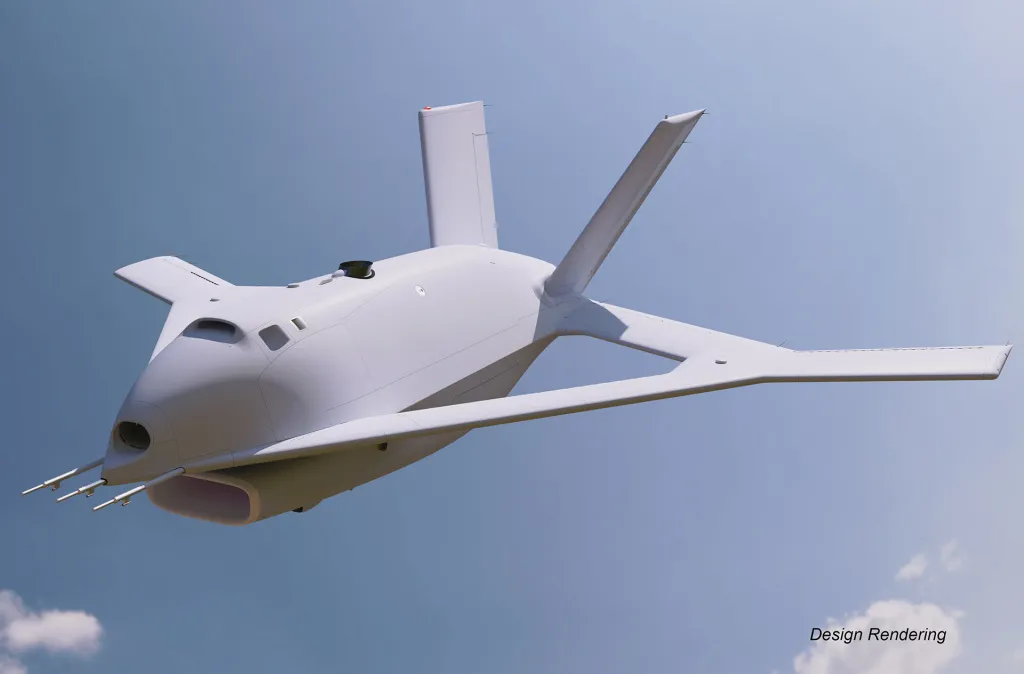
Aurora Flight Sciences is now putting the wings on the X-65 experimental drone. This is an important step forward for the X-65, which is designed to maneuver with bursts of air rather than traditional control surfaces. This is technology that could have significant implications for future military and civilian aircraft developments, especially when it comes to stealthy designs.
“The wings have arrived — the next big milestone for X‑65!” Aurora Flight Sciences wrote in a post on its official account on X today. “Built at our WV [West Virginia] facility, the triangular wings enable active flow control testing across multiple sweeps. Integration is underway in VA as we push toward first flight for the @DARPA CRANE program.”
A look at one of the wing sections for the X-65. Aurora Flight Sciences
The X-65 has a so-called Co-Planar Joined Wing (CJW) planform that includes two sets of wings attached that merge together at the tips, creating the triangular shape on either side. They also have small extensions that extend from those tips, giving the drone a 30-foot wingspan. The design also has a twin vertical tail arrangement.
There is a chin air intake under the forward fuselage, as well as a single exhaust. Renderings have shown that the design will have on t op of the forward end of the fuselage. At the time of writing, neither Aurora nor DAPRA appear to have disclosed details about the drone’s main propulsion arrangement. The X-65 is said to have a gross weight of approximately 7,000 pounds.
This wind tunnel model offers a good general sense of X-65’s planform. Aurora Flight Sciences
As noted, the most intrigueing aspect of the X-65 is the banks of active flow control (AFC) “effectors” that use bursts of highly pressurized air to roll, pitch, and yaw. Traditionally, fixed-wing aircraft use a mixture of flaps, rudders, and other surfaces that physically move to maneuver in flight.
“The AFC system supplies pressurized air to fourteen AFC effectors embedded across all flying surfaces,” according to a press release Aurora put out last year. “The triangular wing design enables testing across multiple wing sweeps and is modular with replaceable outboard wings and swappable AFC effectors to allow for future testing of additional AFC designs.”
“The X-65 will be built with two sets of control actuators – traditional flaps and rudders as well as AFC effectors embedded across all the lifting surfaces,” a 2024 press release from DARPA also notes. “This will both minimize risk and maximize the program’s insight into control effectiveness. The plane’s performance with traditional control surfaces will serve as a baseline; successive tests will selectively lock down moving surfaces, using AFC effectors instead.”
This rendering of the X-65 highlights the banks of AFCs, in light gray, along the edges of the wings. DARPA
“The X-65 conventional surfaces are like training wheels to help us understand how AFC can be used in place of traditional flaps and rudders,” Dr. Richard Wlezien, then the CRANE program manager at DARPA, also said at that time. “We’ll have sensors in place to monitor how the AFC effectors’ performance compares with traditional control mechanisms, and these data will help us better understand how AFC could revolutionize both military and commercial craft in the future.”
“We’re building the X-65 as a modular platform – wing sections and the AFC effectors can easily be swapped out – to allow it to live on as a test asset for DARPA and other agencies long after CRANE concludes,” Wlezien also noted.
A DARPA briefing slide showing how the designs of traditional control surfaces, at their core, have remained largely unchanged after more than a century of other aviation technology developments. DARPA
Being able to eliminate traditional moving control surfaces presents a host of potential benefits, as TWZ has detailed in past reporting on the CRANE program:
“Getting rid of traditional control surfaces inherently allows for a design to be more aerodynamic, and therefore fly in a more efficient manner, especially at higher altitudes. An aircraft with an AFC system doesn’t need the various actuators and other components to move things like ailerons and rudders, offering new ways to reduce weight and bulk.”
“A lighter and more streamlined aircraft design using an AFC system might be capable of greater maneuverability. This could be particularly true for uncrewed types that also do not have to worry about the physical limitations of a pilot.”
“The elimination of so many moving parts also means fewer things that can break, improving safety and reliability. This would do away with various maintenance and logistics requirements, too. It might make a military design more resilient to battle damage and easier to fix, as well.”
All of this could be especially valuable for stealthy aircraft designs, as we previously wrote:
“While all of this could be beneficial for many aircraft type, AFC technology could be especially significant when applied to stealth designs. Designers of stealthy aircraft have to be mindful of any joints or other gaps between exposed surfaces, and try to generally keep them to a minimum, to ensure the radar cross-section remains as low as possible.“
“As such, traditional control surfaces, which by definition cannot always be flush with the rest of the aircraft’s external shape, are a major and currently inescapable issue. Fly-by-wire designs also keep these surfaces fluttering at all times to keep the stealthy aircraft stable in forward flight. AFC technology holds the promise of being able to change this reality and make it easier to optimize the radar-evading qualities of a stealthy design. Other technologies, like the ability to dynamically warp wing structures to provide flight control, could also help in future stealthy aircraft radar signature control.”
A US Air Force B-2 bomber flies together with four Japanese F-35A Joint Strike Fighters. USAF
A design like the X-65 that has the option of using either traditional control surfaces or AFCs could offer further flexibility.
Deeper exploration of the potential of an AFC design is exactly the point of DARPA’s CRANE program, which is now aiming to kick off actual flight testing next year. As mentioned, there have been multiple delays in work on the X-65 over the years. The original goal was for the drone to fly for the first time in 2025.
“The costs to produce the prototype aircraft for test flights ended up being higher than expected” and “DARPA chose to ‘strategically pause’ the X-65’s development and reevaluate the program,” Defense News reported in November 2025. Aurora also “confirmed technical and supply chain challenges were a factor in the program delays, as well as the inherent riskiness involved in working on a DARPA project.”
It should be noted here that this is not the first time AFC technology has been experimented with. U.K.-headquartered BAE Systems, which also submitted a design for CRANE, tested a flying subscale AFC-equipped design called MAGMA in the 2010s, which you can learn more about here.
MAGMA first flight, September 2017
Pentagon budget documents show that DARPA has received nearly $63 million in funding for CRANE since Fiscal Year 2024, when the program entered its third phase. DARPA is not asking for any additional money for this effort in Fiscal Year 2027, which it says reflects the expectation that it will conclude by the end of next year. As DARPA has said in the past, future programs could further continued use of the X-65 drone, as well as the technology it demonstrates.
“We’re excited to continue our longstanding partnership with DARPA to complete the build of the X-65 aircraft and demonstrate the capabilities of active flow control in flight,” Larry Wirsing, Aurora’s Vice President VP of aircraft development, said in a statement last year. “The X-65 platform will be an enduring flight test asset, and we’re confident that future aircraft designs and research missions will be able to leverage the underlying technologies and flight test data.”
With its wings finally delivered, the X-65 continues to take shape as Aurora and DARPA push toward finally getting the drone and its novel control arrangement into the air.
Weekly insights and analysis on the latest developments in military technology, strategy, and foreign policy.
Many questions remain about the complex mission to rescue the crew of the U.S. Air Force F-15E Strike Eagle that came down over Iran in April of this year and what led to it. Now, the reported testimony of the Strike Eagle pilot involved describes a ‘jellyfish-like’ swarm of drones in the sky, moments before they ejected from the stricken jet.
According to a report from CNN, the pilot recounted seeing “multiple Iranian drones hovering in the air, moving as one, in a formation that resembled a jellyfish.” The report is based on statements from four unnamed sources said to be familiar with the matter.
A US fighter jet pilot rescued by special forces after being shot down over Iran in April described a shocking sight before ejecting from his aircraft: multiple Iranian drones hovering in the air, moving as one, in a formation that resembled a jellyfish, according to four sources… pic.twitter.com/RiAEUzEI3b
Needless to say, the veracity of the report should be treated with caution, especially bearing in mind the highly dynamic and confused nature of the situation. However, CNN claims that the account was taken seriously enough to prompt debate within the U.S. intelligence community. It should also be noted that the testimony relates only to the pilot and not the Weapon Systems Officer (WSO).
The report suggests that, during a post-incident debriefing, the F-15E pilot told intelligence officials that they saw:
“Multiple drones interconnected and moving as one with smaller drones below the bigger drones like legs. Real alien shit.”
Those words are not from the pilot themselves, but are said to be from one of the sources familiar with the witness account.
Another source told CNN that the same pilot described seeing a “minefield of drones” in the air.
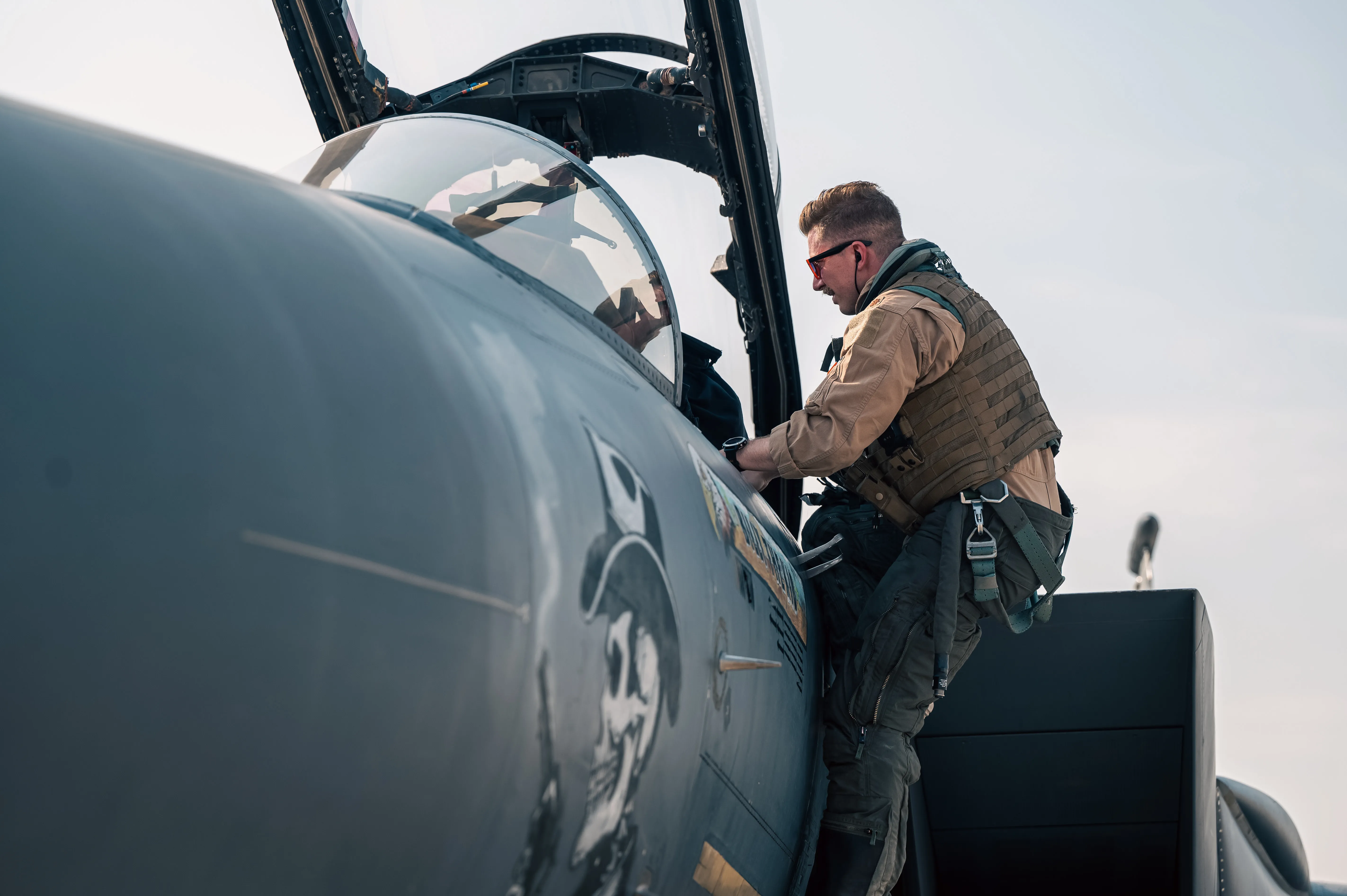
In a library photo, a pilot assigned to the 391st Expeditionary Fighter Squadron climbs into the cockpit of an F-15E Strike Eagle in the U.S. Central Command area of responsibility. U.S. Air Force photo by Senior Airman Grace Turpin
Again, provided these accounts are correct, we cannot say for sure that the pilot actually saw what they described. After all, this was during an extremely high-stress period, and the pilot also ended up with a concussion. Even the U.S. intelligence officials involved in the debrief reportedly disagreed on how to interpret what the F-15 pilot described, and whether the pilot could recount the incident clearly, according to CNN.
The same report also repeats the assertion that the pilot had previously been shot down in the same conflict, during a friendly-fire incident that left three Strike Eagles downed over Kuwait in March. The High Side, a publication on Substack, first reported this detail, citing unnamed current and former Air Force officials. CBS News also subsequently reported this, citing anonymous individuals familiar with the events.
As for the F-15E incident over Iran, you can read our analysis of what was previously revealed about what happened here.
While the exact cause of the loss of the F-15E hasn’t been revealed, NBC News previously quoted three unidentified officials who said the jet “was probably struck by a Chinese-made shoulder-launched missile” and that the engagement may have been supported by a “long-range early-warning radar that spots stealth aircraft,” which Iran received in the “early days” of the war. U.S. President Donald Trump also reportedly said that the Iranians used a shoulder-fired missile, and that “they got lucky.”
Furthermore, while the pilot was rescued within hours, the WSO hid out in a crevice as both rescuers and Iranians frantically searched for him. They were picked up around 50 hours after ejection, aided by a rescue mission involving hundreds of troops, scores of aircraft, and diversion operations over more than a half dozen different parts of Iran. The effort also saw the loss of a second aircraft, an A-10 attack jet in the air, as well as two MC-130J Commando II special operations cargo planes and several H-6 Little Bird special operations helicopters that were destroyed on the ground.
The wreckage of an MC-130J Commando II and an H-6 Little Bird after it reportedly got stuck during the operation to rescue the downed F-15E WSO and later was blown up by U.S. forces so it would not fall into Iranian hands. Iranian state media
The most dramatic interpretation, that a drone swarm directly participated, even if by happenstance, in the shootdown of the Strike Eagle, cannot be entirely ruled out, but there is no publicly available evidence supporting it. There is the description of this formation being a “minefield,” as in something the F-15 could stumble into. This is an interesting note and it may just be how it was mentioned figuratively. At the same time, putting up some sort of a drone screen formation along a known route, especially if it is being used for low-level transits, or near a high-risk facility, could make some sense. Basically, the aircraft would fly into it and be destroyed if it hits a drone, the drones are detonated in close proximity to the aircraft or even if they are connected physically somehow and the aircraft hits the cables. This would match with the description, to a degree, and it would not require any sort of real swarming capability. This would be something of a new ‘barrage balloon’ concept that is more flexible and easier to deploy on demand. China is using balloons in a similar manner to protect key installations today. In addition, Iran certainly has employed its fair share of bizarre tactics and weapons concepts to that point that this doesn’t seem that implausible, but still, it is just a guess.
Returning to the new report, if the pilot really did see a ‘jellyfish-like’ group of Iranian drones that were truly swarming, that would point to previously unknown capabilities within that country, but this is technology that is certainly within the realm of credibility.
Swarms, in this context, are groups of vehicles or guided munitions that are interconnected via datalink and work cooperatively to maximize their combined abilities to accomplish an objective or set of objectives. It is important to note that a major role is played by the nature of a swarm’s computing and autonomy capabilities, and the supporting communications architecture. Swarms can range from ones offering basic cooperative capabilities to far more advanced and dynamic, advanced AI-driven ones. Swarms are not to be confused with a group of drones that are simply sent on a mission together, but have no true cooperative capabilities. These can be best viewed, at least in the aerial sense, as formations of drones or ‘flocks’ of drones that are basically preprogrammed, with tactical planning and large numbers providing an advantage, not the ability to react to external stimuli and make decisions as a team in real-time.
Regardless, based on two of its sources, CNN asserts that “initial reports indicated that it was possible the drone formation had in some way enabled Iran to shoot down the American jet.”
This would raise questions about what type of performance and configuration these drones had, including what altitude the drones were at when they were supposedly sighted, as well as the flight level of the Strike Eagle.
Previously, U.S. officials disclosed that Iran had made use of smaller drones in the hunt for the missing F-15E WSO, but there was no mention of any kind of drone swarms.
An F-15E Strike Eagle pilot and weapon systems officer assigned to the 335th Expeditionary Fighter Squadron prepare to receive fuel from a KC-135 over the CENTCOM area of responsibility. U.S. Air Force photo
For China and Russia, to name just two nations, both of which have provided military assistance to Iran, drone swarming is very much an area of focus. Swarms have many uses, not just to overwhelm the enemy, but also to sense broad areas cooperatively and to work as a highly efficient group offering mixed capabilities that equate to a sum greater than their parts.
The potential of this kind of warfare has not been lost on the U.S. military either, which has been working on it for decades. These efforts date back many years, with the public disclosure of the Perdix having come nearly a decade ago now, and cooperative swarming trials have been carried out repeatedly in the open since then. These efforts have since become ‘mainstream’ as the drone revolution has taken hold of the defense industry. Some of these technologies are now being operationalized in a publicized manner. All this is on top of what is likely an extreme level of development in the classified realm.
Only last month, TWZreported on how the Defense Advanced Research Projects Agency (DARPA) was looking into drones with a high degree of autonomous operation, as well as remotely-operated containerized systems to launch, recover, and otherwise support them. The end result would be a largely self-sustaining “autonomous constellation” capable of supporting networked swarms consisting of as many as 500 drones at once.
❗️Footage of testing by the Swiss-American company “Auterion” on the application of a swarm of FPV drones for striking armored vehicles pic.twitter.com/HgI3Fz4A7O
At this point, it is worth noting that Iran has already demonstrated “loitering” surface-to-air missiles, an unusual category of weapon that blurs the distinction between a kamikaze drone and a more traditional surface-to-air missile. As far as we know, Iran has not attempted to use these weapons in swarms, although having them operate in larger groups would clearly boost the probability of success.
Russia’s Defense Minister Sergei Shoigu, in the front row, second from the right, is shown a 358 “loitering” surface-to-air missile at an Islamic Revolutionary Guard Corps (IRGC) exhibition in Iran. Russian Ministry of Defense
There is also the possibility that what the F-15E pilot saw was some kind of previously unknown drone technology fielded by the U.S. or Israeli military, before the Strike Eagle came down. Clearly, Israel and the United States deployed certain systems in the conflict that had not been seen before, and both countries have the ability to field platforms with swarming capabilities. Releasing a group of drones that can hunt and even kill over the Iranian countryside, looking for targets of opportunity over large areas, like air defenses and standoff weapons launchers, is exactly the kind of concept that swarms were envisioned as being so capable at realizing.
Subsequently, while the rescue effort was underway, the U.S. military certainly was making use of drones in the vicinity. Air Force Gen. Dan Caine, chairman of the Joint Chiefs of Staff, previously described how “A-10s and […] drones and other tactical aircraft were violently suppressing and engaging the enemy in a close-in gunfight to keep them away from the front-seater and allow the pickup force to get into the objective area.”
The use of drones for suppression and destruction of enemy air defenses, as well as stand-in jamming of those systems, is a very real component of modern air warfare dating back decades. Israel was a pioneer in it, which you can read all about here. Those capabilities are far more advanced today, especially for long-range systems dedicated to those missions and for the emerging ‘launched effects’ segment of drone warfare. It’s hard to imagine that these proven capabilities were not put to some use over Iran during the war. The U.S. military even employed its own one-way attack munition, the LUCAS drone, with similar capabilities.
LUCAS drone launching off a ship in the Middle East. (CENTCOM)
With all that being said, there is the possibility that the pilot experienced something else entirely, perhaps related to their concussion or another kind of phenomenon. Even a flock of birds or a group of balloons, the latter of which can be used as decoys to confuse enemy radar and bait fighter aircraft and other air defenses, could appear as a drone swarm, for example. Iran had every reason to use such cheap, but potentially effective tactics. While an experienced fighter pilot would normally be able to tell the difference between drones or birds, these were very much abnormal circumstances. Then there is the matter of Unidentified Aerial Phenomena (UAP), which this could fall into, just for the reason that what was seen may be hard to identify. We don’t know what the description of the configurations of the drones was, or if any was provided, which could help narrow down the possibilities. Also, did the aircraft’s sensors detect these craft? We just don’t know.
A U.S. Air Force F-15E Strike Eagle performs a flare check over the U.S. Central Command area of responsibility. U.S. Air Force photo by Senior Airman Zachary Willis
For now, the reported drone sighting remains an intriguing but unverified element of a much larger story, many important details of which are still to emerge.
Paris and other European cities are experiencing temperatures above 40C (104F), reaching levels normally seen across the Middle East.
A blistering heatwave has gripped much of Europe, prompting the highest-level red alerts in parts of the United Kingdom, France, Spain and Italy.
Authorities have warned of health risks, wildfires and travel disruptions as extreme temperatures persist.
Recommended Stories
list of 3 itemsend of list
With temperatures approaching record highs, officials have taken emergency measures, including a localised alcohol ban in parts of France under red alert, nationwide heat warnings in Germany and the cancellation of a World Cup fan zone screening in Madrid, where temperatures hit 39C (102F).
Why is it so hot in Europe?
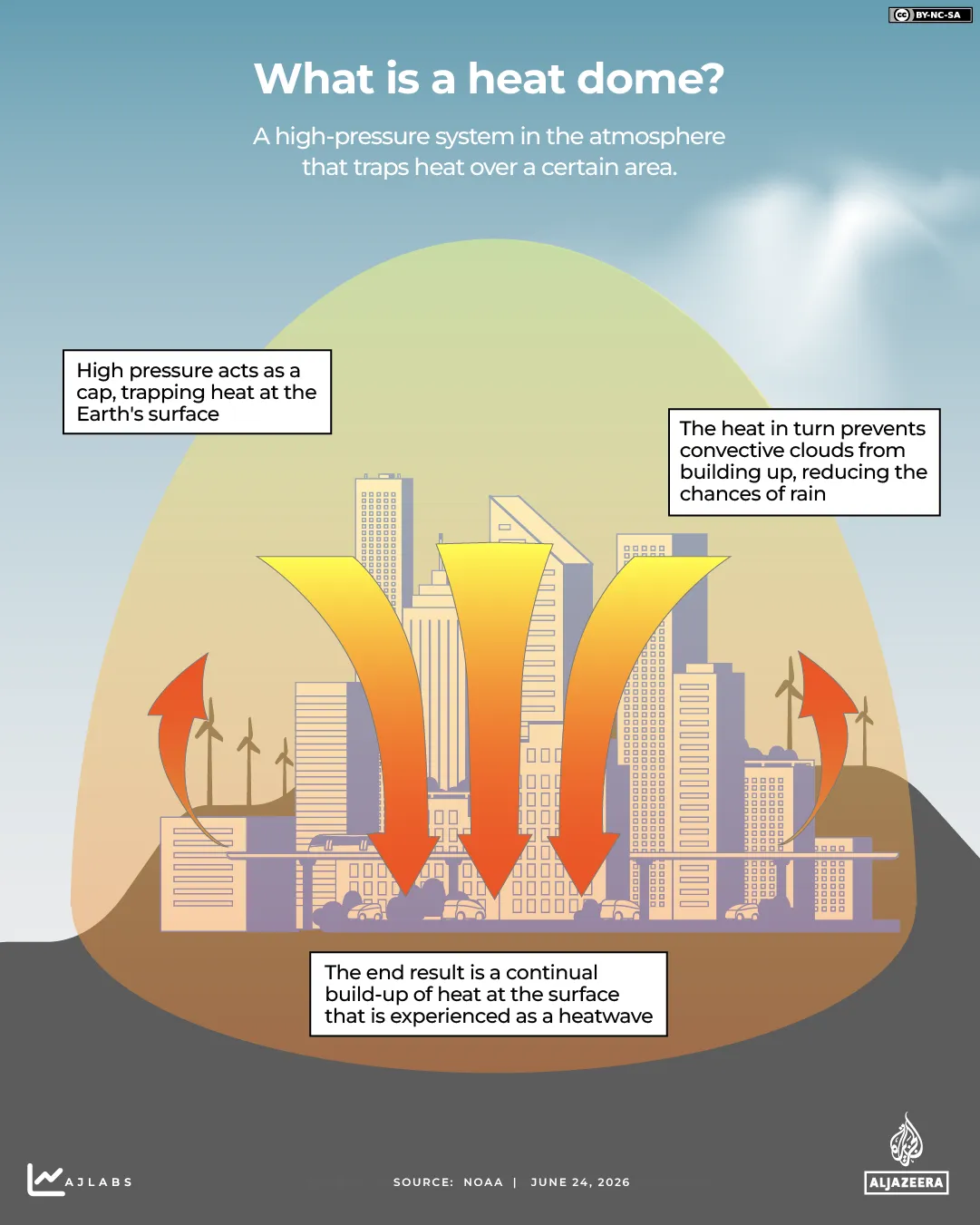
A persistent area of high pressure, known as a heat dome, has trapped hot air over Western Europe, bringing clear skies, weak winds and prolonged sunshine. Hot air moving north from North Africa has added to the extreme temperatures.
(Al Jazeera)
Unusually warm seas around the UK, Ireland, France and the western Mediterranean have also helped keep coastal areas hot, especially at night. Coastal waters around Spain have reached record warm levels, according to Spain’s port authority.
In the worst-affected areas – western France, England and Wales – daily average temperatures have soared more than 12C above the 1991-2020 baseline, according to Copernicus data.
(Al Jazeera)
Scientists say the early-season heatwave is part of a broader warming trend. Europe is the world’s fastest-warming continent, with temperatures rising by approximately 0.56C per decade since the mid-1990s, more than double the global average.
Climate change is making heatwaves more frequent, more intense and likely to occur earlier and later in the year.
How hot are European cities today?
To contextualise the temperatures Europe is dealing with, Al Jazeera looked at the maximum temperatures in five European capitals on June 24 and compared them with cities across the Middle East, North Africa and Asia, where high temperatures are more typically experienced.
Europe is particularly vulnerable – much of its housing and infrastructure was not built for prolonged extreme heat, and only about 20 percent of European homes have air conditioning.
The graphic below shows how European cities’ maximum temperatures today compare with some other cities around the world:
(Al Jazeera)
How is temperature measured?
The temperature you see on the news or the weather app on your phone relies on a network of weather stations positioned around the globe.
To ensure accurate readings, weather stations typically use specialist platinum resistance thermometers placed inside shaded instruments known as a Stevenson screen.
Measurements are taken at a standard height of 1.25-2 metres (4-6.5 feet) above the ground. This provides a reading that reflects the air temperature that people actually feel.
(Al Jazeera)
There are two well-known scales used to measure temperature: Celsius and Fahrenheit.
Only a few countries, including the United States, use Fahrenheit as their official scale. Most of the world uses the Celsius scale, named after Swedish astronomer Anders Celsius, who invented the 0-100 degree freezing and boiling point scale, although originally inverted, in 1742.
Why does the temperature feel hotter than the forecast says?
Air temperature alone often doesn’t match how hot it feels to your body. That is why forecasts report a “feels like” temperature, which adjusts air temperature based on factors like humidity, wind speed and sun exposure.
(Al Jazeera)
Humidity
Humidity measures how much water vapour is in the air. This moisture slows the evaporation of sweat, so your body can’t cool itself as effectively.
Wind speed
In hot weather, a light breeze can help evaporate sweat, making it feel cooler.
Sun exposure
Even if the thermometer reads the same, direct sunlight adds extra warmth, which is why shaded areas feel cooler.
The race for the Golden Boot at World Cup 2026 is shaping up to be one for the history books.
After just two games, Argentina talisman Lionel Messi leads the way with five goals, followed by France’s Kylian Mbappe and Erling Haaland of Norway with four goals each.
Recommended Stories
list of 4 itemsend of list
Germany’s Deniz Undav has three with Jonathan David of Canada on the same mark after a hat-trick against Qatar.
A further 20 players have scored twice in their opening two games, including 2018 Golden Boot winner Harry Kane of England, Cristiano Ronaldo of Portugal, Vinicius Jr of Brazil and Mikel Oyarzabal of Spain.
The stars are all shining and, given the rate of scoring so far, it seems possible double figures might be needed to win the Golden Boot, something done only three times in history – by Hungary’s Sandor Kocsis in 1954, Just Fontaine of France four years later and Gerd Muller of Germany in 1970.
Fontaine holds the record of 13 goals in one World Cup in just six matches in Sweden, but the expanded 48-team format in 2026 means the nations qualifying for the semifinals in July will play an unprecedented eight games in this edition.
At the 2006 World Cup in Germany and in South Africa four years later, only five goals were needed to claim the Golden Boot while nobody has scored more than eight in the past 13 editions, a feat achieved only by Brazil’s Ronaldo in 2002 and Mbappe four years ago in Qatar.
Kylian Mbappe followed his double against Senegal with another against Iraq in this year’s World Cup [Siphiwe Sibeko/Reuters]
Why have so many goals been scored at World Cup 2026?
It took just 33 matches for a century of goals to be racked up in this edition, second only to 1954 in terms of pace.
After Portugal’s 5-0 win over Uzbekistan on Tuesday, 139 goals had been scored across the first 45 games – the most in the group stages of a single edition of the finals, overtaking the 136 scored in 2014 in three fewer matches.
The record number of goals in one edition came in Qatar 2022 with 172 from 64 games. With an extra 40 matches in the new expanded format that went into effect this year, it was always likely to be broken, but the rate of scoring suggests the old mark will be obliterated.
The Adidas Trionda ball used in World Cup 2026 [Simon Fearn/Imagn Images]
One reason for the increase in goals might be the Adidas Trionda ball, which FIFA commissioned for this World Cup.
Before the tournament, FIFA said it boasts several key performance innovations, including intentionally deep seams designed to produce optimal in-flight stability by ensuring sufficient and evenly distributed drag as the ball travels through the air – in short, it flies through the air – while the surface of the ball is designed to increase grip when striking or dribbling in wet or humid conditions, which we have seen plenty of in the opening matches.
Austria head coach Ralf Rangnick said: “This ball is as fast as a cannonball. If you kick the ball in the right position, it’s extremely difficult to save.”
The controversial addition of hydration breaks to each half may also mean players are performing at their peak for longer, leading to the glut of late goals so far. Of course, the fact that 48 teams are taking part, drawn from the world’s leading 85 teams in the rankings, means there are some mismatches in the first phase.
Colombia coach Nestor Lorenzo also said attackers are more protected by officials than they used to be, which may contribute to the increased scoring, adding: “They didn’t have this protection some 20, 30 years ago when they were hit a lot more, when rough play was a lot more common.
“Today, any team that defends well and uses counterattacks and tries to play can manage to do well.”
Erling Haaland has scored two goals in each of his first two World Cup appearances. [John Sibley/Reuters]
Who is likely to win the Golden Boot?
Much will depend on fitness and, of course, how deep a country goes in the tournament, but Messi has to be considered the favourite to win his first accolade.
The 38-year-old scored seven goals at the last World Cup and has now scored in six straight tournament matches, having netted in every knockout round in Qatar and the first two games of this edition. He even missed a penalty against Austria, which would have made it back-to-back hat-tricks.
Argentina’s final group game on Sunday is against already eliminated Jordan although Messi’s inclusion from the start in that one is by no means a given as his side have already secured the top spot in Group J.
They look set for favourable knockout fixtures, though, with the potential for Uruguay or Cape Verde in the last 32, potentially Australia or Iran in the round of 16 and the possibility of Croatia or Colombia in the quarterfinals, should they make it.
Only in the semifinal might they come up against a powerhouse nation, likely in the form of England or Brazil or dark horses Japan, Norway or Mexico.
Mbappe also looks likely to have a favourable run and is likely to feature against Norway on Friday in the group finale, which will decide the top spot in Group I.
Winning the group could mean a round of 32 meeting with Sweden, Germany the potential opponents in the last 16 and the Netherlands or Morocco awaiting in the last eight.
Whoever finishes second out of France and Norway could face a tricky task against the Ivory Coast in the last 32 with Brazil or Japan awaiting the winners and the possibility of England lurking in the quarterfinals, which might put a ceiling on Haaland’s prospects, despite having scored 59 goals in 52 international games for Norway.
Kane will seek to enter the conversation with England facing a must-win Group L finale on Sunday against Panama with the prospect of a last-32 meeting with Cape Verde to follow and Mexico likely lying in wait in the Azteca (known during the World Cup as Mexico City Stadium) in the round of 16.
Cristiano Ronaldo may have left it too late to begin a real quest, given Portugal face Colombia on Sunday in their final Group K game and could face resolute Ghana in the last 32 with Spain potential opponents in the last 16.
But Vinicius Jr could add to his two goals when Brazil face Scotland on Thursday in their final Group C game although the knockout rounds would appear a stiffer test.
The United States Senate has voted in favour of invoking its war powers to force President Donald Trump to halt his military campaign against Iran or seek congressional approval before any further action is taken.
Here is a closer look at Tuesday’s vote – the 10th attempt Congress has made to rein in the US-Israel war on Iran – and what this means for the US government.
Why did this vote take place?
A similar measure had already been approved in the House of Representatives on June 3 by a vote of 215 to 208, and on Tuesday, the Senate passed it in a 50-48 vote. Trump’s Republican Party has slim majorities in both chambers.
Speaking on the Senate floor before the vote, top Democrat Chuck Schumer advocated for the war powers resolution as he criticised Trump’s military campaign against Iran.
“For years, Trump promised to put maximum pressure on Iran, but he ended up delivering maximum confusion, maximum chaos, maximum cost to the American people with his disastrous war,” Schumer said.
“Time after time, the vast majority of Senate Republicans sided with Trump and his war instead of the American people. The American people have paid the price for Trump’s historic blunder in Iran. It’ll go down in the history books as one of the worst foreign policy forays America has ever made.”
The war against Iran has proved highly unpopular in the US. A poll released on Tuesday by the news agency Reuters and the research firm Ipsos found that 24 percent of respondents felt the war had been worth the cost.
Four Republican senators crossed party lines to vote for the resolution, and all but one of the chamber’s Democrats also voted in favour.
Tuesday’s breakaway Republicans were Bill Cassidy of Louisiana, Lisa Murkowski of Alaska, Susan Collins of Maine and Rand Paul of Kentucky. A further two Republicans did not vote: Mitch McConnell of Kentucky and Dave McCormick of Pennsylvania.
The lone Democrat to vote against the measure was Pennsylvania’s John Fetterman.
What does the resolution say?
The war powers resolution “directs the President to remove United States Armed Forces from hostilities against the Islamic Republic of Iran”.
Only if “explicitly authorised by a declaration of war or a specific congressional authorisation” would Trump be allowed to use further military force against Iran, it says.
The resolution, however, does allow for a limited military presence to remain in the Middle East to prevent any “imminent attack” against the US or its allies.
What is the significance of the vote?
The vote reflects growing unease even among some of Trump’s Republican supporters about the unpopular conflict, which began with US-Israeli air strikes on Tehran on February 28.
This is the first time both chambers of Congress have passed a resolution directing a president to remove US armed forces from a warzone under the War Powers Act although it was not immediately clear how the votes might affect the conflict.
Technically, the Trump administration should now seek explicit congressional approval for further strikes on Iran. However, previous administrations have found routes around this by securing more limited authorisations for the use of military force (AUMFs) instead.
For example, in the wake of the 9/11 attacks in 2001, Congress passed an AUMF that gave then-President George W Bush broad powers to conduct what would become the global “war on terror”.
And one year later, it passed another AUMF, allowing the use of the military against the government of Saddam Hussein in Iraq, which became the basis of the 2003 invasion.
The two authorisations remain in place, and presidents continue to rely on them to carry out strikes without first seeking congressional approval. The assassination of top Iranian General Qassem Soleimani in 2020 in Baghdad was authorised by Trump under the 2003 AUMF.
In addition, a resolution does not have the force of law. Experts said, therefore, that while the Senate vote is viewed as a rebuke to Trump, it is largely symbolic.
What effect will this have on US-Iran talks in Switzerland?
Before the vote on Tuesday, some Republican senators had warned that the war powers resolution would weaken Trump’s standing in the Switzerland negotiations.
“If this passes, the Iranians are going to simply stand up and walk away from negotiations,” Senator James Risch of Idaho told the Senate on Tuesday.
“They’re going to say: This thing’s over. The Congress has told the president of the United States, ‘Leave us alone. We can do whatever we want to do,’ and they will walk away.”
How will the Trump administration respond?
Risch also argued that the resolution is essentially useless, given its symbolic nature. “It’s going to have no effect. The president isn’t going to pay any attention to it,” he said.
The US Constitution gives Congress the sole power to declare war, but that division of power has eroded over the past 75 years as successive presidents alone have committed US forces to overseas conflicts.
Trump has pointed to that precedent to argue that he does not need congressional authorisation at all.
In an appearance on The Axios Show last week, Trump denied learning any “lesson” about the limits of his executive powers during the Iran war. “There are no limits,” he said.
The last time Congress voted to go to war was during World War II although it has passed AUMFs in the decades since, which allow for limited military engagement without congressional approval for all-out war.
During Trump’s first term, there were concerns that he could use the 2001 AUMF to strike Iran under the unfounded claim that Tehran supports al-Qaeda.
Some critics pointed out that Republicans may be more willing to confront Trump over the issue of congressional authorisation now as they defend their seats before November’s midterm elections.
The first places to be investigated in a national independent inquiry into grooming gangs will be Oldham, Bradford and Keighley, and London.
The Statutory Independent Inquiry into Grooming Gangs, which will be chaired by Baroness Anne Longfield CBE, will compel individuals and institutions to explain what they “did or did not do to protect children from being sexually abused”, the organisation said.
The review will also examine if changes have been made in places where there have been past reviews, such as Oxford and Rotherham.
Abuse survivor Fiona Goddard, who resigned from the inquiry in October 2025, said it had been “a long fight”.
“Bradford has evaded inquiries for many, many years and it’s time that the full truth about what happened comes out,” she said.
Goodard left the panel over concerns that two of the shortlisted chairs had backgrounds in policing and social services.
Keighley and Ilkley MP Robbie Moore, who called on the government to include Bradford in the inquiry, said it marked “a significant turning point”.
“This inquiry must seek the truth – however horrific it may be. And bring about justice to those who have been failed for far too long,” he said.
Here’s a look at the viral moments and on-field controversies as well as the biggest players, best performances, goals and more.
Published On 24 Jun 202624 Jun 2026
Cristiano Ronaldo joined the party, Lionel Messi set a new record, Iran once again displayed their fighting spirit and Turkiye were shown the door.
The second round of the 2026 World Cup group stage had a fair amount of drama.
Recommended Stories
list of 4 itemsend of list
Al Jazeera breaks down the key moments:
Better late than never: Ronaldo strikes for Portugal
Unlike other high-profile strikers at the tournament who came out all guns blazing from the get-go, Ronaldo needed some time to open his account. But his two goals in Portugal’s 5-0 thrashing of Uzbekistan on Tuesday were enough to silence the critics as the 41-year-old became the first player in history to score in six World Cups.
Messi is saving his best for last
Age is just a number for Messi, who is celebrating his 39th birthday on Wednesday. His apparent last dance is bringing out the best in him as the Argentinian has set a new record for the most World Cup goals at 18 – a figure that is sure to increase with La Albiceleste now the number one favourites to add back-to-back World Cups to their trophy cabinet.
Is Messi “Mr Argentina”? It’s hard to argue otherwise with all five of the team’s goals scored by him. That also makes him the leading Golden Boot contender with one goal more than France’s Kylian Mbappe.
At this point in the tournament, Messi is the 2026 World Cup’s Golden Boot leader [Kai Pfaffenbach/Reuters]
Triple treat: Messi, Mbappe, Haaland score on same day, again
FIFA has come under criticism for a series of issues this tournament, but one thing it’s got spot on is the scheduling of Argentina, France and Norway games on the same day. For the second time in a row, fans were treated to back-to-back goals galore on Monday as Messi started the party with a brace before Mbappe did the same, and Erling Haaland topped it off with another double.
Norway’s ‘Viking row’ goes viral
Back at the World Cup after 28 years, Norway celebrated their round of 32 qualification in typical fashion: bringing out the famous “Viking row”. With the squad sitting in rows resembling those of a Viking longboat, captain Martin Odegaard began beating the drum to a joyous climax as thousands of Norwegians in the stadium also joined the fun.
Salah, Egypt celebrate on streets of Vancouver
It took Egypt an incredible 92 years to register their first World Cup win, so it wasn’t a surprise that they celebrated in style. Shortly after beating New Zealand 3-1 on Sunday, the Egypt squad was pictured on the streets of Vancouver with fans, singing and dancing to music blaring from a huge speaker. Mohamed Salah, nicknamed the “Egyptian King”, was the centre of attention yet again, held up on the shoulders of a teammate, as he grooved to the tunes.
Japan are Asia’s best hope at the tournament
While Asian teams enjoyed a great run during the first round of the group games, only one team – Japan – built on the momentum. After a 2-2 draw with the Netherlands in the first match, Japan thrashed Tunisia 4-0 in the next fixture on Saturday, collecting four points – the highest by an Asian team so far. According to Opta’s supercomputer, Japan have a 20.8 percent chance of reaching the quarterfinals and 9.41 percent probability of making the semifinals.
Persistent Iran fight hard to stay in contention
Despite travel restrictions imposed on them by the United States for their first two World Cup games, Iran have remained unbeaten with two draws. That keeps them alive in the knockout race, and with the squad now allowed to fly into the US from Mexico two days before their next match instead of one as was the case earlier, Iran can better prepare for their final group game on Saturday against Egypt in Seattle. A win would see them through while a draw might also suffice, depending on other results.
Turkiye’s talented team disappoints
From Arda Guler and Kenan Yildiz to Hakan Calhanoglu and Merih Demiral, Turkiye is filled with talent across all departments. But none of them could turn around Turkiye’s fortunes as they crashed out of the tournament after losing to Paraguay on Saturday. The early exit crushed the hopes of millions of Turkish fans, who waited 24 years to see their team return to the World Cup.
Turkiye’s Can Uzun and Kenan Yildiz look dejected after they were knocked out of the World Cup [Luisa Gonzalez/Reuters]
No Pulisic, no problem for USA
For years, Christian Pulisic has been the poster boy of the USA team, but the cohost nation proved that they can get the job done even in the influential winger’s absence. With Pulisic ruled out with a calf injury, Alex Freeman scored one, and the USA benefitted from a Cameron Burgess own goal as they sailed into the knockouts with a 2-0 victory on Friday against Australia.
Red-carded Almiron to go down in history
Paraguay midfielder Miguel Almiron made history, albeit for the wrong reasons, when he became the first player to be sent off at the 2026 World Cup for covering his mouth. Almiron – also handed a one-match ban – covered his mouth during a confrontation with Turkiye’s Mert Muldur. The straight red handed to him follows a new rule under which players are not allowed to cover their mouths to disguise what they are saying during confrontations with infringements leading to instant dismissals.
Iran and the US clash over nuclear inspections and Hormuz as negotiators push for a final deal within 60 days.
Published On 24 Jun 202624 Jun 2026
Iran and the United States have offered conflicting accounts of key issues as negotiators work towards a final agreement within a 60-day window. Differences remain over nuclear oversight and the implementation of any deal, underscoring the challenges facing both sides.
US Secretary of State Marco Rubio said Iran would not be allowed to charge tolls in the Strait of Hormuz under a final agreement, stressing that the strategic waterway must remain open to international shipping.
Meanwhile, Iran rejected US claims that it had agreed to allow nuclear inspectors back into the country after President Donald Trump said Tehran had accepted the “highest level” of monitoring. The conflicting statements highlight the gaps that negotiators are still trying to bridge.
Here is what has happened:
In Iran
Iran’s military shifts to ‘offensive doctrine’: General Ahmad Reza Pourdastan, head of Iran’s Army Strategic Studies and Research Center, said Tehran has moved away from a purely defensive posture and now includes preemptive operations in its military strategy. Quoted by the semi-official Fars news agency, Pourdastan said Iran could “severely surprise the enemy” if national interests required it and added that much of the country’s military capability has yet to be used.
Iran says no IAEA inspections planned: Tohid Asadi, reporting from the Strait of Hormuz, says the Iranian Foreign Ministry spokesperson Esmaeil Baghaei has denied reports of a meeting with International Atomic Energy Agency (IAEA) chief Rafael Grossi and said there are currently no plans for visits or inspections by the UN nuclear watchdog. Baghaei said Iran’s dealings with the IAEA would be governed by existing procedures, its safeguards obligations, parliamentary legislation and decisions by the Supreme National Security Council. Iran suspended cooperation with the IAEA after US and Israeli strikes on its nuclear facilities in June 2025, and while diplomacy continues under a 60-day framework, Tehran says it has not granted permission for inspectors to return.
War diplomacy:
‘No way’ US and Iran can finalise deal in 60 days, analyst says: Charles Kupchan, a senior fellow at the Council on Foreign Relations, told Al Jazeera there is “no way” Washington and Tehran can complete a final agreement within the 60-day timeframe repeatedly cited by President Donald Trump. “I think we’re talking about at least into the next calendar year,” he said, adding that he would not be surprised if both sides simply “run out the clock” by continuing negotiations and keeping the Strait of Hormuz open without reaching a final deal before the end of Trump’s presidency.
Qatar says LNG production could return to normal within weeks: Prime Minister Sheikh Mohammed bin Abdulrahman bin Jassim Al Thani told the Financial Times that Qatar is preparing to restore normal liquefied natural gas (LNG) production after the interim US-Iran deal. Qatar, the world’s second-largest LNG producer, halted output in March following an Iranian drone attack on the Ras Laffan facility. Sheikh Mohammed said most production could resume within weeks, except at the damaged site, adding that QatarEnergy would only lift its force majeure declaration once it is satisfied that all safety and operational concerns have been addressed.
In the Gulf:
Rubio ‘trying to sell the deal’ with Iran on Gulf tour: Alan Fisher, reporting from Washington, DC, said US Secretary of State Marco Rubio is visiting the United Arab Emirates, Kuwait and Bahrain, three Gulf countries seen as having been among the most affected by the war with Iran. Rubio, who also serves as Trump’s national security adviser, is expected to reassure regional allies that US security commitments remain intact. He will also address the Gulf Cooperation Council in Bahrain, where he is “really trying to sell the deal”, amid concerns over Washington’s response to Iranian attacks.
In the US
US Senate approves resolution to curb Trump’s war powers on Iran: The Senate voted 50-48 to pass a measure requiring congressional approval for further US military action against Iran, marking the first time a war powers resolution on the conflict has cleared both chambers of Congress. Four Republicans – Bill Cassidy, Lisa Murkowski, Susan Collins and Rand Paul – joined nearly all Democrats in backing the measure, while Pennsylvania Democrat John Fetterman voted against it. The resolution is expected to face a veto from President Trump.
In Israel
US ‘very naive’ on Iran, Ben-Gvir says: Israeli National Security Minister Itamar Ben-Gvir said the US would be “very naive” if it believed Iran would abandon its nuclear programme, and hinted that Israel may act independently against Tehran. “It is Israel’s responsibility to confront this Iranian threat and act against it alone,” he told Israel’s Channel 7, adding that “no circumstances” could force Israel to act “according to the dictates of a friend, even if that friend is truly great”. His remarks come amid reported tensions between Washington and Tel Aviv over Israel’s attacks on Lebanon and ongoing US-Iran negotiations. Last week, US Vice President JD Vance publicly criticised Israeli cabinet ministers for “attacking” Washington, calling the US Israel’s “only powerful ally” left in the world.
In Lebanon
UN says ceasefire ‘largely holding’ in southern Lebanon: The United Nations said the ceasefire in southern Lebanon appears to be “largely holding”, although peacekeepers continue to observe Israeli military ground and air activity. UN spokesperson Stephane Dujarric said UNIFIL troops witnessed “heavy” machine-gun fire and three tank rounds fired by Israeli forces near Biyyada on Monday, while drones were also seen “apparently to monitor UNIFIL peacekeepers”. The incident came a day after peacekeepers reported the first day without exchanges of fire since fighting escalated on March 2. The UN urged all sides to “adhere fully to the ceasefire and refrain from any escalation, particularly during this delicate period of ongoing negotiations”.
Myanmar’s president Min Aung Hlaing is currently on a 5-day state visit to India on the invitation of Indian prime minister Narendra Modi. This is his first foreign visit after the recent election where he was elected as the new president of Myanmar. However, the elections that brought him to power were not democratic in nature. Therefore, “Min Aung Hlaing is not Myanmar’s legitimate president,” as noted by Mercy Chriesty Barends, a member of the Indonesian Parliament and chairperson of the ASEAN Parliamentarian on Human Rights. He oversaw a campaign of widespread crimes against his own people after masterminding a bloody coup that toppled a democratically elected government. As a result, APHR has asked India to condemn Min Aung’s government as undemocratic and illegal. Thus, the question of why India, which claims to be the largest democracy in the world, is dealing with an undemocratic administration that is accused of violating its own citizens’ human rights emerges.
The idea of democracy and human right violation had been India’s central position during the 1988 military coup in Myanmar. The Indian government had cut ties with the then military junta. India’s idealistic position had sidetracked India-Myanmar relations and led China to occupy the strategic sphere in India’s immediate neighborhood. Chinese investment and trade with Myanmar grew exponentially with the junta purchasing military hardware worth $1 billion from Beijing in 1989 one of the largest weapons deals in Myanmar’s history. This had led China to exert its influence on Myanmar. For Beijing the geo-strategic location of Myanmar having access to the Indian Ocean was of strategic interest. Enhancement of Chinese influence in Myanmar had a security implication for India as China used Myanmar to train major northeastern Indian insurgent groups like NSCN, ULFA etc. Thus, India’s rupturing of relationship with Myanmar after 1989 on idealistic grounds led China to exploit major gain at India’s immediate neighborhood.
This had led India to recalibrate its strategy towards Myanmar post the 2021 coup when India took a more pragmatic stand. The Indian ministry of external affairs had categorically pointed that any development in Myanmar has implications for India so India’s policy must serve its strategic interest. Therefore, we have seen India engaging both the military junta and the ethnic armed groups trying to balance its ties with both the parties. Since the coup India has been providing steady military assistant to the junta in form of military hardware and spares. It has also engaged the various ethnic armed groups by sending officials across the border and by inviting some of the groups to New Delhi for a conference. This makes it very evident that rather than maintaining the moral superiority of democracy, India is striving to further its strategic interests. The support to the rebel groups like the Arakan Army (AA) which controls a major part of strategic Rakhine state. After seizing control of majority of the state the Arakan Army pushed the initiative to have dialogue with the military junta. The AA had always held the ambition of having greater strategic autonomy in the Rakhine state. Thus, India’s engagement with the AA by sending government officials over to Myanmar signals that it wants to have strategic relation with the AA as that would enhance its influence and uphold India’s economic and trade ambitions.
For India, the geographical location of Myanmar holds a great strategic significance. It shares a 1,693 kms of border and is seen as India’s gateway to the ASEAN. This had led India to invest heavily on major infrastructure projects in Myanmar. The Kaladan Multimodal Transit Corridor and Sittwe Port are two of India’s largest projects in Rakhine and Chin state of Myanmar. This project is seen to give India’s landlocked northeastern states access to Myanmar’s Sittwe port. This project is also seen as a counter to China’s Kyaukphyu Port at the Rakhine state. This has made the relation with Arakan Army of geo-strategic importance. The other major project that India is working on is to physically connect itself ASEAN via the India-Myanmar-Thailand trilateral highway. This project would give India land access to the two ASEAN states which can further be expanded to other nations like Vietnam. Although the projects are currently stalled due to the civil war, India is working with both the ethnic armed groups and the government to safeguard and fast-track the projects.
Thus, the recent visit of Min Aung Hlaing to India shows that India has chosen pragmatism over idealism. New Delhi has kept itself away from the nature of democracy in Myanmar and is trying to engage based on strategic interest. During the press briefing the Indian foreign sectary had pointed that India’s engagement with Myanmar is not based on Myanmar’s internal political arrangement. India does not want to disengage based on internal political dynamics as history has shown that other powers which has no interest in democracy would eventually take the advantage. This statement although has not mentioned China but was directed towards it. Therefore, the visit led to the signing of various agreements and MOUs between both the states. Myanmar has also reiterated that it won’t allow its territory to be used against anti-India activities. The recent advancement by the Myanmar Army is further leading it to consolidate its power and capture grounds. With the new conscript law, it can funnel additional troops to keep its advancement. Further being supported by Russia, China and India the firepower of the junta is superior to the rebel forces. This has also led India to recalibrate its Myanmar policy by engaging the current powerful junta and strategic rebel forces like the AA in Rakhine state.
Therefore, it can be argued that the growing India-China competition has made India move its Myanmar strategy towards pragmatism from idealism. Unlike in 1988 when India lost its strategic foothold to China in Myanmar due to its idealistic stand, the situation has now altered as the competition grows. But as a democracy, India must tread carefully on this fine line and bring up important issues of human rights and democracy in Myanmar.
Bio: Aung Kyaw is a recent graduate from Lingnan University majoring in Global Development and Sustainability and minor in Sociology. His research interests are politics of southeast asia, peace and conflict studies, social development, social issues in southeast asia. kyawkyawaung@ln.hk
Weekly insights and analysis on the latest developments in military technology, strategy, and foreign policy.
The U.S. military has released new details about the massive Fightertown Recapitalization (FTR) Program at Joint Base Elmendorf-Richardson (JBER), in Anchorage, southeastern Alaska. This is a huge effort valued at approximately $7 billion that would effectively create an entirely new fighter hub to support future Air Force operations in the strategically important Arctic and Pacific regions.
The details emerged in a special notice announcing an upcoming virtual industry day, where government officials plan to brief contractors on the scope of the program and gather feedback on construction risks, industry capabilities, and acquisition strategies before moving toward a formal procurement process.
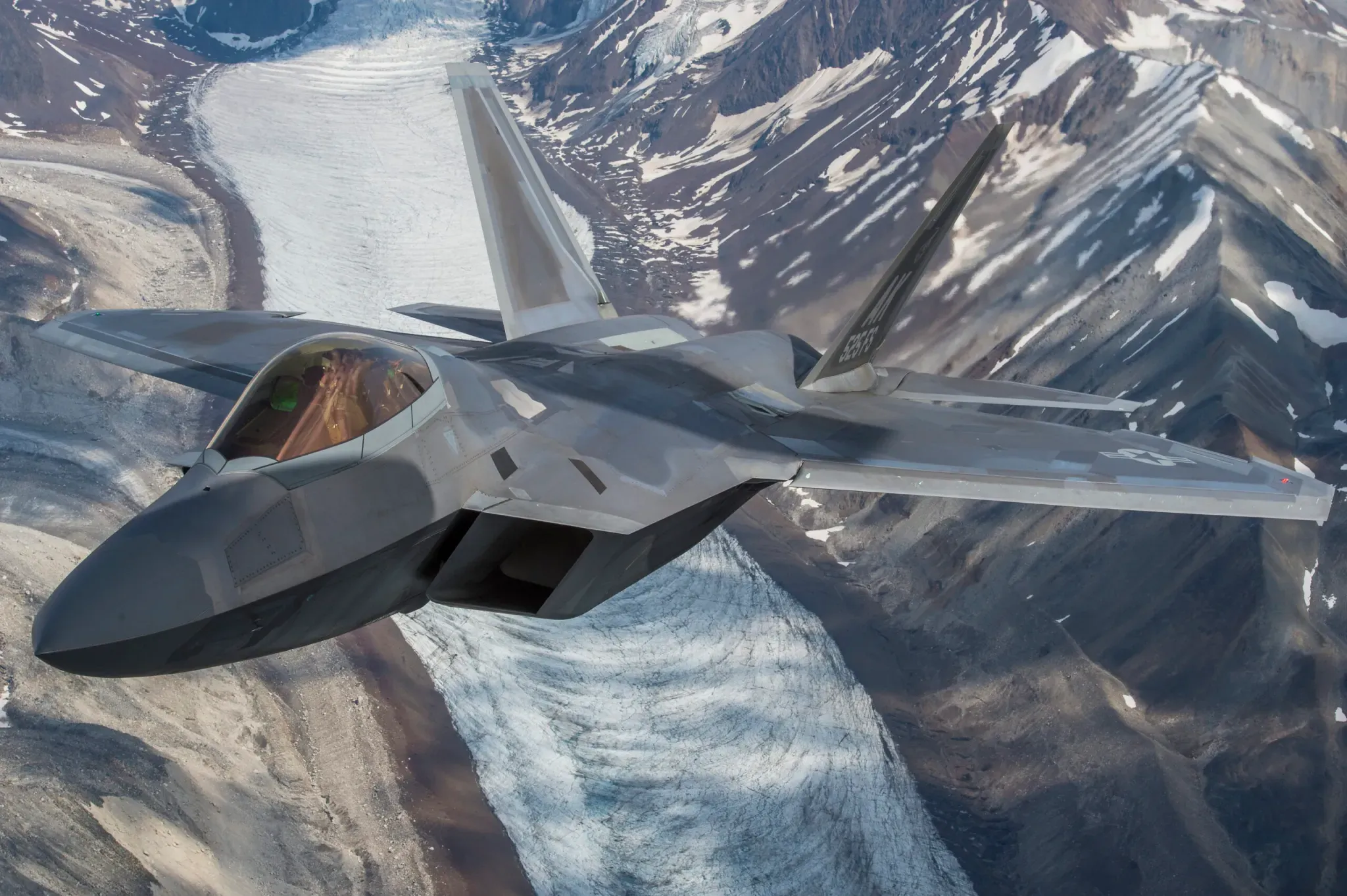
A U.S. Air Force F-22 Raptor from Joint Base Elmendorf-Richardson flies over the Joint Pacific Alaska Range Complex. U.S. Air Force photo by Staff Sgt. James Richardson
While the notice, from the U.S. Army Corps of Engineers, is intended primarily as market research, it offers one of the clearest looks yet at the scale and ambition of the Fightertown recapitalization effort.
According to the notice, existing airfield facilities cannot support the program’s requirements, prompting the selection of a new site to expand the current airfield infrastructure. Rather than a collection of isolated projects, the government describes the effort as a “complete campus approach” intended to synchronize facility construction with aircraft procurement, personnel movements, and logistical requirements.
The envisioned campus would include aircraft hangars, squadron operations facilities, corrosion control facilities, maintenance shops, and other aviation support infrastructure. Extensive airfield improvements are also planned, including new taxiways, aprons, shoulders, and specialized aircraft operating surfaces.
A picture of a so-called “elephant walk” readiness exercise at Joint Base Elmendorf-Richardson showing 24 of the resident 3rd Wing’s F-22s, as well as a C-17 and an E-3. U.S. Air Force
Highly likely to be included in the recapitalization efforts will be measures to help reduce vulnerability and ensure critical operations could continue in wartime. After all, in a potential fight against China or Russia, JBER would be high on the list of priority targets in the opening phases of a large-scale conflict. As we have repeatedly outlined in the past, aircraft shelters with varying degrees of hardening are suddenly very much back on the agenda in response to growing drone and missile threats.
Beyond flight-line infrastructure, the project encompasses a substantial support ecosystem. Plans call for a munitions complex, petroleum operations facilities, warehousing and supply functions, dining facilities, visitor control infrastructure, firefighting facilities, training centers, simulators, and housing for unaccompanied airmen.
The government also notes that the campus design remains flexible and could ultimately involve modifications to, or demolition of, existing facilities as planning progresses.
Rather than relying solely on traditional military construction contracting approaches, the Army Corps of Engineers says the program intends to leverage authorities provided in the Fiscal Year 2026 National Defense Authorization Act. Those authorities could allow the use of Other Transaction Authority (OTA), Progressive Design-Build (PDB), and other alternative execution methods.
The sprawling Joint Base Elmendorf-Richardson (JBER), in Anchorage, southeastern Alaska, as seen in a satellite image from May of this year. Google Earth
The notice explicitly states that the government intends to capitalize on private-sector innovation while avoiding what it describes as costly and time-consuming federal contracting burdens. It also emphasizes that the execution strategy will encourage industry partners to propose novel technical and construction solutions.
The scale of the investment underscores Alaska’s growing importance as a hub for U.S. airpower. JBER already serves as one of the Air Force’s premier fighter installations and occupies a critical geographic position between North America, the Arctic, a part of the world that has only grown in strategic significance in recent years, and the Indo-Pacific theater, where strategic planning is highly focused on a potential future conflict with China.
Joint Base Elmendorf-Richardson hosts the headquarters of the 11th Air Force, the service’s top command in Alaska, and its 3rd Wing, which operates a mix of F-22 Raptor stealth fighters, E-3 Sentry Airborne Warning Control System (AWACS) radar planes, C-17 Globemaster III airlifters, and C-12 light utility aircraft. It is also home to the Alaska Air National Guard’s 176th Wing, which has additional C-17s, as well as HC-130 Combat King rescue aircraft and HH-60 rescue helicopters.
HH-60W Jolly Green II helicopter aircrew assigned to the 210th Rescue Squadron, 176th Wing, Alaska Air National Guard, hoist a simulated downed pilot during a full mission profile training exercise at Malemute Drop Zone, Joint Base Elmendorf-Richardson, Alaska, March 31, 2026. Alaska National Guard photo by Alejandro Peña
In addition, in 2023, the Air Force announced the creation of the 55th Operations Group, Detachment 1 at the base, as a detachment of the 55th Wing at Offutt Air Force Base in Nebraska.
“The new detachment will… serve as a strategic launch and recovery point for RC-135V/W Rivet Joint operations and exercises in the region,” according to the Air Force.
The move reflected increased demand for RC-135V/W Rivet Joint spy plane sorties in the Pacific, with JBER being well-positioned for these aircraft to gather intelligence on areas of interest in the northern end of the Pacific and the increasingly strategic Arctic region.
The arrival of the Rivet Joint prompted a previous reconstruction effort at JBER. In what the Air Force described as a “mega-project,” one of the two runways there was extended to help it better support operations involving larger aircraft like these.
In the future, the strategic location of JBER, as well as its current status as one of the few F-22 bases, suggests that it could eventually host the F-47 sixth-generation stealth fighter, the first of which is expected to make its first flight sometime in 2028. The F-47 could therefore well end up as the centerpiece of the Alaskan Fightertown, in keeping with the vision for the jet serving as a critical force multiplier that can bring together other crewed and uncrewed assets. With that in mind, at least some of the Fightertown Recapitalization Program may be specifically tailored to the requirements of the F-47.
Importantly, JBER also serves as the focal point for the Red Flag-Alaska and Northern Edge exercises.
The Red Flag-Alaska exercises can take place up to four times a year and mirror those flown over the Nellis Range Complex in Nevada, with some differences. Namely, the ranges in Alaska, many of which are instrumented, are enormous, and can include a more varied array of assets.
A U.S. Air Force E-3 Sentry takes off during exercise Red Flag Alaska 26-1 at Joint Base Elmendorf-Richardson, Alaska, April 29, 2026. U.S. Air Force photo by Tech. Sgt. Joseph Miller
From JBER and other bases in the region, Red Flag-Alaska participants have access to the Joint Pacific Alaska Range Complex (JPARC). Covering an area of more than 67,000 square miles and providing 77,000 square miles of airspace above, JPARC is the “largest instrumented air, ground and electronic combat training range in the world,” according to the Air Force. It is regularly used to provide a realistic training environment for full-spectrum engagements, ranging from individual skills to large-scale joint engagements.
Meanwhile, Northern Edge also occurs in and around Alaska every two years, with these large-scale events being used to test and evaluate new systems and capabilities from across the U.S. military.
One of the Air Force’s tiny force of semi-retired F-117 Nighthawk stealth jets, now used for test and evaluation purposes, at Elmendorf during Northern Edge 2023. U.S. Air Force
In the past, the Air Force has described Northern Edge as a demonstration of “the U.S. commitment to the region by building interoperability, advancing common interests and a commitment to our allies and partners in ensuring a free and open Indo-Pacific,” as well as showcasing U.S. ability to defend the homeland from and throughout Alaska.
As planning advances, we will learn more about what this new Alaskan Fightertown will look like. What is already clear is that the Air Force and the Pentagon are preparing for a long-term expansion and modernization effort on a scale rarely seen at an operational fighter base.
More details could emerge during the industry day scheduled for June 30, when government officials will provide a comprehensive update on the program and solicit feedback from industry partners on how to execute one of the Air Force’s biggest military infrastructure projects.
Update: 3:45 PM ET –
“We are deliberately investing in Pacific Air Force’s critical infrastructure by replacing and upgrading operations and maintenance facilities in addition to making repairs to existing buildings and funding mission-ready materiel, storage, and sustainment necessary for homeland defense and Agile Combat Employment operations,” a U.S. Air Force official has now told us in response to our queries for more information about the Fightertown plan. “We are also extending the runway and building a Joint Integrated Test and Training Center at JBER.”
“We are in the design stage now and will have a better idea of timelines once we receive an appropriation,” they added.
China’s LineShine overtakes US-based El Capitan as most powerful supercomputer, according to the TOP500 list.
Published On 24 Jun 202624 Jun 2026
China has displaced the United States on an influential ranking of the world’s fastest supercomputers, underscoring Beijing’s growing capability to compete with the world’s leading superpower in cutting-edge technology.
China’s LineShine is the most powerful system on the planet, overtaking the US-based El Capitan, according to the biannual ranking announced in Hamburg, Germany, on Tuesday.
Recommended Stories
list of 4 itemsend of list
LineShine, located at the National Supercomputing Centre in Shenzhen, achieved a performance of 2.198 exaflops, carrying out more than 2 quintillion calculations per second – a 20 percent lead over El Capitan, according to the latest TOP500 list.
LineShine’s position marks the first time a Chinese system has topped the list since Sunway TaihuLight did so in 2017.
El Capitan, based at Lawrence Livermore National Laboratory in California, had ranked as the top-performing system since November 2024.
Frontier, hosted by the Oak Ridge National Laboratory in Tennessee, ranked third, followed by Aurora at the Argonne National Laboratory in Illinois and Jupiter at the Jülich Supercomputing Centre in Germany.
Other countries represented in the top 20 include the UK, Japan, South Korea, Italy, the Netherlands, and Switzerland.
Unlike other supercomputers, LineShine runs entirely on general-purpose central processing units (CPUs), which have fewer processing cores and are slower at performing complex tasks than the graphics processing units (GPUs) indispensable to running AI models, such as ChatGPT and Claude.
LineShine is the first and only system to achieve more than 2 exaflops in performance using a CPU-only design, according to the TOP500 list.
The TOP500 list has been published twice yearly since 1993, when computer scientists Erich Strohmaier and Hans Meuer first compiled statistics on supercomputers around the world in preparation for a conference on the topic.
The list ranks supercomputers’ performance using the LINPACK Benchmark, which measures the amount of time it takes to solve a dense system of linear equations.
While the TOP500 list has been influential for decades, experts consider the ranking to have become less relevant since the advent of AI.
While corporate tech giants such as Microsoft and Amazon are at the forefront of today’s advances in AI, the list is largely made up of government and academic initiatives that volunteered their participation.
In a 2015 paper, researchers at Cornell University estimated that El Capitan achieved only 22 percent of the computational performance of xAI’s Colossus supercomputing facility in Memphis, Tennessee.
China and the US are locked in a fierce battle for global supremacy in leading technologies such as AI, with Washington and Beijing rolling out a slew of tit-for-tat sanctions and export controls to blunt each other’s advances.
The 2026 AI Index Report, released in April by Stanford University, found that China had “effectively closed” the AI model performance gap with the US.
While the US produces more top-of-the-line AI models, China holds the advantage in rolling out patents and industrial robot installations, the report said.
Retirees have protested outside CANTV headquarters throughout the country. (Ronaldo Díaz)
Caracas, June 23, 2026 (venezuelanalysis.com) – Thousands of retired workers from Venezuelan state telecommunications company CANTV have staged protests in recent days to demand the restoration of a monthly “income complement” payment.
On Thursday, CANTV suspended the US $200 monthly payment with no prior notice. The measure prompted emergency rallies outside the firm’s headquarters in Caracas, Barquisimeto, Valencia, and several other Venezuelan cities on Friday.
Active workers received the bonus as scheduled, though many joined the protests in solidarity.
The cutback reportedly affected around 10,000 retirees for whom the bonus represents over 70 percent of their monthly income. Many told reporters that the unjustified cutback placed an immediate strain on day-to-day survival, especially for those suffering from chronic illnesses.
The swift grassroots response prompted the company to backtrack and pay the retired workers $150 over the weekend. The CANTV retired workers’ plight also drew support from the World Federation of Trade Unions.
“The company thought that we would be the weakest link in their bid to cut costs at the workforce’s expense,” retiree Arturo Morgado told Venezuelanalysis. “But the protests all over the country told a different story.”
Monday saw around 300 workers demonstrate again outside CANTV headquarters in Caracas. A commission from FETRAJUTEL, a trade union representing the firm’s retired workforce, met with the CANTV board but received no commitment that the remaining $50 will also be paid.
The announcement led protesters to temporarily block Libertador Avenue in central Caracas, vowing to maintain the pressure until the full bonus is restored.
“We are going to continue fighting, for the entire bonus and for other rights established in our collective bargaining agreement, including financial support for medical expenses and incomes that cover the cost-of-living,” Morgado added. “The company put these commitments in writing in a meeting with unions in late 2023.”
The former CANTV technician highlighted the “moral strength and honesty” of the retired workforce and warned that the present bonus-over-wage government policies leave workers vulnerable to discretionary cuts. Morgado’s social security pension is worth 570 bolívars per month, less than $1 at the present exchange rate.
With the Venezuelan economy heavily sanctioned by the US, the Nicolás Maduro government increasingly turned to non-wage bonuses while letting the minimum wage continuously devalue. Trade unions have criticized the policy for cheapening labor costs for employers and contravening the existing labor law.
Since taking over in January, after the US kidnapping of Maduro, Acting President Delcy Rodríguez has maintained the policy. On May 1, she increased the minimum monthly income for public sector workers to the official bolívar-equivalent of $240 a month, while pensioners received $70. Public sector retirees are entitled to $170 monthly, but in certain cases, like CANTV, they have secured improvements in direct negotiations with the company.
The labor dispute comes amid a controversial effort by the Rodríguez administration to “reengineer and restructure” the Venezuelan state, including public companies such as CANTV. The state telecoms provider was privatized in 1991 under the terms of IMF-imposed structural adjustment and partially acquired by a consortium headed by GTE, today Verizon. CANTV was re-nationalized by the Hugo Chávez government in 2007 and is currently under the purview of the Ministry of Science and Technology.
Education Minister Héctor Rodríguez, tasked by Miraflores with leading the state reform commission, recently sought to allay fears of massive public sector layoffs. He instead suggested that workers might be “strategically relocated and retrained” in order to improve the public sector efficiency.
The acting administration has likewise launched a process to determine the “strategic” value of state-owned assets. A commission, featuring government officials and private sector representatives, will recommend whether the state should retain ownership of firms, land estates, and other assets or open them for privatization.
Financial advisory group Orinoco Research identified CANTV as a prime candidate for privatization, while libertarian think tank CEDICE Libertad called the prior sale of the telecom company a “model to replicate.” The 1991 privatization was followed by a process of asset stripping that dismantled the firm’s regionally advanced technical base and institutionalized outsourcing and arbitrary firings.
Residents in Damascus rejected US President Donald Trump’s suggestion that Syria should confront Hezbollah in Lebanon. They say Syria should avoid being drawn into new regional conflicts. In a rare critique, Trump told Israel to let Syria take on Hezbollah.
In contrast to heat pumps, continuing record sales of electric cars indicate they are all but set to replace their petrol and diesel counterparts in the coming years on UK roads.
Emma Pinchbeck, CEO of the Climate Change Committee, praised the improvement in greener transport.
“We’ve made big progress on things like electric vehicles, where one in four cars being bought in the UK today is now an EV.”
She said the growth had been accelerated by the Iran fuel crisis, which has seen significant increases in petrol and diesel prices at the pump pushing people to seek out other options.
“We can see in the numbers what people want – cheap cars and cars that will save them money, particularly as fossil fuels are volatile,” she said.
But the industry body, Society of Motor Manufacturers (SMMT), said most of this demand had been brought about by huge discounts offered by car manufacturers.
“This has cost the industry more than £10 billion since 2024 – an unsustainable amount when that money should be going into R&D, manufacturing and the workforce,” said Mike Hawes, CEO of SMMT.
It supported the government’s plan to weaken its Zero Emission Vehicles (ZEV) mandate – which sets a target for number of EVs manufacturers produce and a penalty for failing to meet that target.
The UKCCC disagreed and urged the government to keep the policy.
Weekly insights and analysis on the latest developments in military technology, strategy, and foreign policy.
One of Russia’s biggest advantages in the war against Ukraine is its ability to launch tactical airstrikes from bases largely out of reach of kinetic responses. While we have frequently reported about Ukrainian attacks on these bases, they aren’t sustained enough to stop Russia from generating devastating sorties.
Now Ukraine and NATO are looking to the private sector for ways of changing that equation through what is being called the Airfield Denial Challenge. It offers a 250,000 Euro award to companies or individuals who come up with workable ideas to prevent Russia from being able to use its air bases.
🚀The NATO-Ukraine Joint Analysis, Training and Education Centre (JATEC) and NATO Allied Command Transformation (ACT) have announced the Persistent Airfield Denial Innovation Challenge to find a solution to block enemy airfields. (1/5) ⬇️ pic.twitter.com/8uKWWEI5pQ
“The Armed Forces of Ukraine (AFU) operational experience has firmly established that the ability of the adversary to project air power from secure rear-area airfields remains one of the most consequential asymmetries in the current conflict,” according to NATO’s Headquarters Supreme Allied Commander Transformation (SACT). “Enemy tactical aviation, operating from bases beyond the reach of conventional Ukrainian strike assets, continues to conduct strikes using guided aerial bombs, cruise missiles, and stand-off munitions against friendly forces, critical infrastructure, and civilian population centers.”
Objective control footage shows the aftermath of a FAB-250/500 airstrike carried out by a Russian Aerospace Forces (VKS) Su-34M fighter-bomber on a warehouse in Kharkiv used to store UAVs and their components. pic.twitter.com/vnynslqFiO
“Each sortie originates from an airfield. Every airfield is a node of vulnerability: if it can be persistently denied, the adversary’s air campaign is fundamentally disrupted at source,” SACT suggested.
You can see video from one of the Ukrainian attacks on Russian tactical aviation bases below.
Russia’s Morozovsk Airbase is currently under Ukrainian drone attack, with several explosions seen in the vicinity of the airfield.
Ukraine’s ongoing efforts to halt these attacks are insufficient, SACT posited.
“Current workarounds: manned strike aviation, ground-based long-range fires (MLRS, ballistic missiles), and conventional single-unit loitering munitions have demonstrated limited effectiveness against defended airfield targets,” SACT argued. “They lack the mass-effect, persistence, and EW (Electronic Warfare)-resilience required to simultaneously suppress airfield infrastructure across multiple aim points in a contested environment.”
Ukraine has carried out many strikes on airfields, including one on the Morozovsk airbase in Russia. (Google Earth) Google Earth
The “battlefield logic is clear,” the NATO subcommand added. “Point-defense and reactive interception of individual weapons must be complemented by persistent denial at the source.”
“We must find technologies that will help to permanently limit the enemy’s use of aviation infrastructure: aircraft, runways, fuel and ammunition storage facilities, and ground support infrastructure,” the Ukrainian Defense Ministry (MoD) explained. “Ukrainian miltech companies, startups, and engineering teams are invited to participate.”
SACT said the challenge is technically agnostic and that it is looking for ideas that include, but not are not limited to, the following:
• Uncrewed aerial systems of any configuration or range class
• Autonomous or semi-autonomous munitions and loitering systems
• Swarming and mass-effect approaches
• Alternative delivery mechanisms beyond conventional aerial platforms
Regardless of what type of solution is presented, it “must be capable of operating in GPS-denied and EW-contested environments, across all weather conditions and seasons, and must demonstrate a credible path to rapid fielding.”
In addition, SACT is looking for systems that can conduct sustained strikes deep into contested airspace, operate without “continuous human control,” be fully autonomous and deliver “sufficient mass and precision to suppress multiple aim points across an airfield simultaneously.”
SACT also wants systems that require minimal training, and have AI-assisted target acquisition that “reduces reliance on expert judgment.”
The solicitation comes with the understanding that whatever solutions are presented won’t be proven, but should be at least in the mid-to-upper tier of the military technology readiness level (TRL) scale. It includes systems ranging from those having “high fidelity” laboratory integration of components to those with prototypes “near, or at, planned operational systems.”
U.S. Army
Meanwhile, any solution that will take more than a year to be fielded won’t be considered.
The deadline for submissions is July 20. Ten finalists will be selected on August 11 and will be invited to a “pitch day” on Sept. 3, tentatively in Poland, to showcase their designs.
Whether this ambitious program will actually lead to the fielding of any systems that can persistently deny Russia the ability to launch aircraft is very much in question.
As we have frequently reported, Ukraine has one of the world’s most innovative defense technology infrastructures that has created drones, missiles and other weapons designed, tested and fielded under intense wartime conditions. However, it has still been unable to achieve the goals being sought by this challenge.
One of the big issues Kyiv faces is the limited amount of funds to pursue some of these advances and what the Atlantic Council has described as “Ukraine’s inability to mass produce sophisticated weapons or sustain stable military supply chains.”
Getting an idea into the hands of NATO, which has developed a half-billion dollar fund to develop weapons for Ukraine, could ultimately help turn an idea into a workable weapon to keep Russian tactical aviation at bay. Even if that happens, though, the time it would take to develop these weapons at a scale large enough to make a real difference would be a formidable endeavor.
Israel deliberately targeted Palestinian children in Gaza, resulting in genocide, crimes against humanity and war crimes, according to a new UN inquiry. The report says more than 20,000 children were killed between October 2023 and October 2025. Israel rejected the findings.