Stay informed and up-to-date with the latest news from around the world. Our comprehensive news coverage brings you the most relevant and impactful stories in politics, business, technology, entertainment, and more.
Rescuers in Venezuela are racing against time to find survivors after twin earthquakes left thousands missing. International teams have pulled several people from the rubble alive, including 11-year-old boy Moises rescued after a six-hour operation and a newborn reunited with their family.
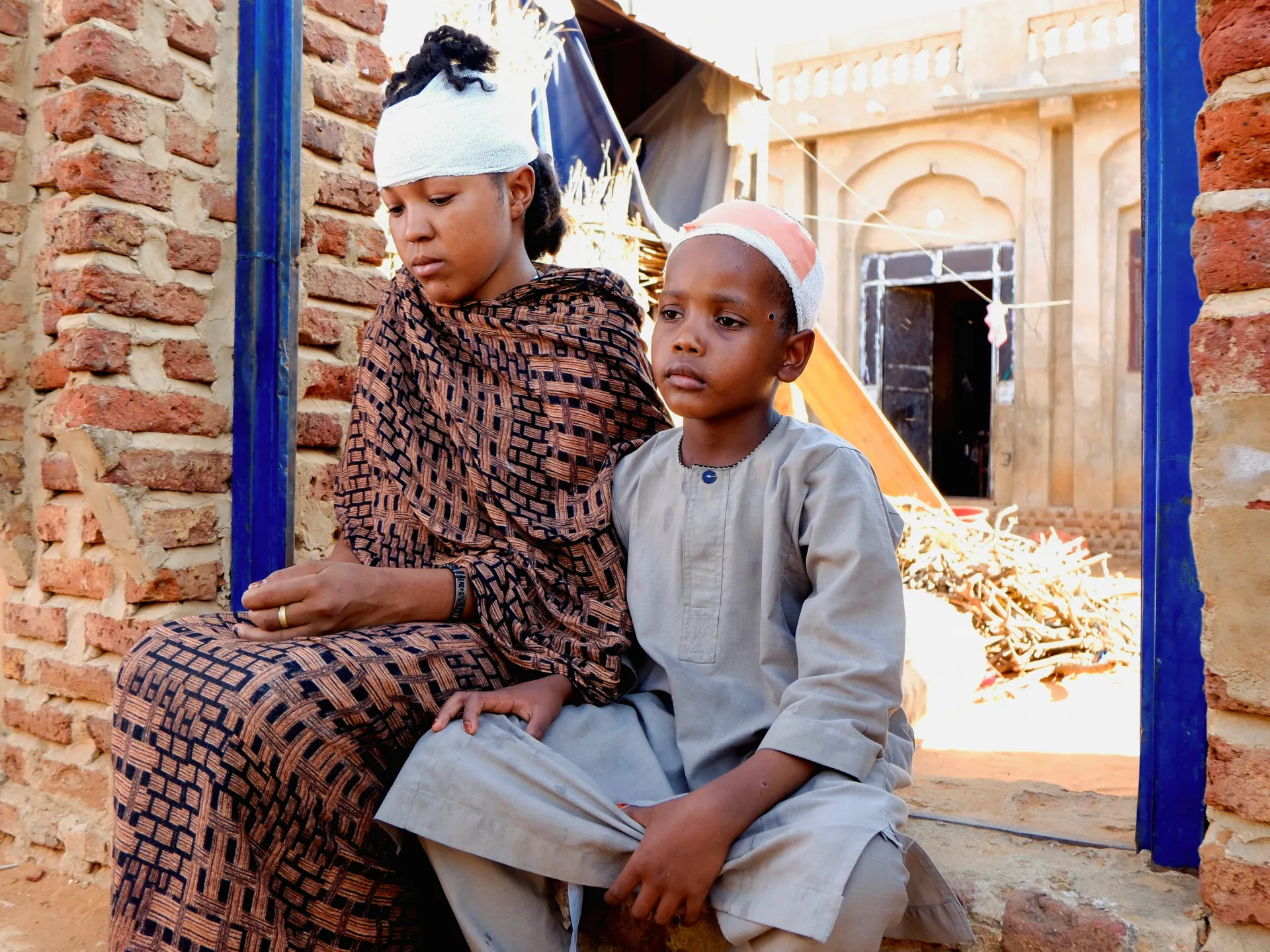
Khartoum, Sudan – As drone attacks rain down on el-Obeid and the Rapid Support Forces (RSF) tighten their months-long siege, the capital of North Kordofan has emerged as the latest flashpoint in Sudan’s grinding war of attrition.
Despite mounting international alarm and renewed US diplomatic pressure aimed at securing a nationwide truce, Sudan’s warring generals remain deeply entrenched. Both the Sudanese Armed Forces (SAF) and the RSF appear locked in a pursuit of outright military victory, largely sustained by a continuous flow of foreign weapons.
Through the lens of the escalating crisis in el-Obeid, a grim reality is unfolding: Civilian suffering is increasingly weaponised amid polarised domestic narratives, while geopolitical manoeuvring repeatedly stalls any viable path to peace.
A strategic prize and international alarm
El-Obeid holds immense strategic value. Located 550km (340 miles) southwest of Khartoum, it acts as the primary gateway linking Khartoum to the vast Darfur region. The city is also a major military stronghold, hosting the SAF’s 5th Infantry Division, known as “Al-Hagana”, and has become a refuge for hundreds of thousands of displaced civilians fleeing violence elsewhere.
The looming threat of a full-scale ground invasion has triggered urgent global warnings. Recently, 38 international nongovernmental organisations (NGOs), alongside the UN and countries including Qatar, sounded the alarm over the escalating use of drones and the potential for mass atrocities, warning that el-Obeid could face the same devastation recently seen in el-Fasher.
Yet these warnings have failed to alter the calculus on the ground.
Polarised narratives of a stalled peace
Recent United States diplomatic efforts, led by Massad Boulos, an adviser to US President Donald Trump, have pushed for a comprehensive ceasefire. However, the push for peace has collided with absolute domestic polarisation.
SAF commander Abdel Fattah al-Burhan has firmly rejected unconditional truces, stating that the army will operate with the precision of “digging with a needle” until the RSF is entirely dismantled.
This deadlock reflects a deeply fractured political landscape. Fathi Abu Ammar, a Sudanese academic, told Al Jazeera that the SAF is primarily responsible for the prolonged suffering by obstructing peace initiatives and refusing to establish safe corridors for civilians to leave el-Obeid.
He accused the army of using the city’s residents as “human shields” to garner international sympathy, while arguing that the RSF is fighting to address legitimate historical grievances.
Conversely, Sudanese journalist and political analyst Yousef Abdel Mannan vehemently rejected these claims.
Speaking to Al Jazeera from Sudan, Abdel Mannan accused the RSF of widespread atrocities, including a recent drone attack on a girls’ school in el-Obeid and the systematic killing of thousands of civilians in el-Fasher, including patients inside the Saudi Hospital.
Abdel Mannan dismissed the US-backed truce proposals as inadequate measures that merely “treat the wounds of the conflict while leaving the root cause intact”, arguing that only a comprehensive political settlement, not a temporary ceasefire, can resolve the crisis.
He maintained that civilians in el-Obeid are not being held hostage by the army, but rather prefer to remain in their homes rather than face displacement at the hands of paramilitaries.
Foreign arms and the geopolitical deadlock
Beneath the domestic blame game lies a critical factor sustaining the conflict: Foreign interference.
David Shinn, a former US diplomat and assistant secretary of state for African affairs, noted that despite years of US engagement and sanctions targeting both SAF and RSF leaders, neither side has shown a genuine interest in halting the violence.
“There is a desire from both sides to continue fighting until one side wins,” Shinn told Al Jazeera.
The escalating use of uncrewed aerial vehicles (UAVs) over el-Obeid underscores this external lifeline. “Neither the RSF nor the Sudanese army manufactures drones,” Shinn pointed out, meaning these advanced weapons must be imported.
He highlighted that the warring parties are actively backed by regional powers, pointing to the United Arab Emirates as a backer of the RSF, and Egypt and Saudi Arabia as supporters of the SAF, arguing that the conflict has transformed into a proxy war.
For the siege of el-Obeid to end and a genuine peace process to begin, the geopolitical spigot must be turned off.
Until the international community forces external actors to halt their military support, analysts warn that Sudan will remain hostage to a war its generals believe they can still win.
The president’s son said he did not believe in a free press as military personnel were deployed to the media offices.
Published On 28 Jun 202628 Jun 2026
The chief of Uganda’s military says he has ordered the closure of two of the country’s biggest media outlets.
Muhoozi Kainerugaba said on Sunday that the Daily Monitor, the country’s largest independent daily newspaper, and NTV Uganda, one of the largest private broadcasters, were being shut down and would not reopen without his permission.
“In Uganda, I do not believe in a free press!” Kainerugaba, who is the president’s son, wrote on X.
“From now on ALL bad stories about Uganda have to be cleared by my office!” he said in one of a series of posts, adding that all media in Uganda would follow the rules, going forward.
Military personnel deployed
Both the Daily Monitor and NTV Uganda are owned by the Nation Media Group (NMG) conglomerate. The Daily Monitor said armed security personnel were outside NMG Uganda’s headquarters in Namuwongo, Kampala and its Serena Hotel location, with staff reporting “no one was being allowed to enter or leave.”
NTV Uganda, Spark TV and other TV and radio broadcasters owned by NMG were down in the country on Sunday, the Reuters news agency reported.
According to Kainerugaba, he has had the power to shut down any media outlet since 2017, when his father, President Yoweri Museveni, granted him this ability.
Kainerugaba is seen as the likely successor to his father, who has ruled Uganda since 1986 and is also known to write controversial social media posts.
His government shut down the Daily Monitor for 10 days in 2013, and in 2007, NTV Uganda was taken off air months after its launch, following government criticism of its coverage.
The Uganda People’s Defence Forces (UPDF), Uganda Police Force and Uganda Communications Commission (UCC) are yet to release a statement on the operation.
Uganda’s National Association of Broadcasters said it was closely monitoring the situation, adding that it was “deeply concerned about this action and its impact on the media ecosystem” and the rights enshrined in the constitution.
Knockout matches begin with South Africa vs Canada as Iran exit, Africa make history and hopes for Messi-Ronaldo final rise.
The knockout stage of the 2026 FIFA World Cup begins on Sunday with South Africa taking on Canada in the first round of 32 tie.
With the group stage complete, the full knockout bracket is now set. Nine African nations have reached the round of 32, Iran were eliminated after Algeria’s late qualification and the draw has left the door open to a Lionel Messi vs Cristiano Ronaldo final.
Recommended Stories
list of 4 itemsend of list
Here’s the full round of 32 schedule, the South Africa vs Canada prediction and the latest World Cup news:
What is Sunday’s schedule?
South Africa vs Canada at Los Angeles Stadium, California, in the United States at noon (19:00 GMT).
What are the predictions for South Africa vs Canada?
This will be only the second meeting between South Africa and Canada. The sides’ only previous encounter ended in a 2-0 win for Bafana Bafana in a friendly in Durban in 2007.
Canada, however, will be looking to end another unwanted record. They have lost both of their previous competitive matches against African opposition, falling 2-0 to Cameroon at the 2001 Confederations Cup before a 2-1 defeat to Morocco at the 2022 World Cup in Qatar.
Despite that history, the Opta supercomputer shows Canada as the clear favourites. They won 55 percent of 25,000 pre-match simulations while South Africa triumphed in 20 percent. The remaining 24.9 percent of its calculations ended level after 90 minutes, which would send the tie to extra time and potentially penalties.
Overall, Canada are given a 67.8 percent chance of reaching the quarterfinals, compared with 32.2 percent for South Africa.
When and where will the other knockout matches be played?
Monday
Brazil vs Japan: (noon/17:00 GMT) at Houston Stadium, Texas, in the US
Germany vs Paraguay: (4:30pm/20:30 GMT) at Boston Stadium, Massachusetts, in the US
Netherlands vs Morocco: (7pm/01:00 GMT on Tuesday) at Monterrey Stadium in Mexico
Tuesday
Ivory Coast vs Norway (noon/17:00 GMT) at Dallas Stadium, Texas, in the US
France vs Sweden (5pm/21:00 GMT) at New York/New Jersey Stadium in the US
Mexico vs Ecuador (7pm/02:00 GMT on Wednesday) at Mexico City Stadium in Mexico
Wednesday
England vs Democratic Republic of the Congo (noon/16:00 GMT) at Atlanta Stadium, Georgia, in the US
Belgium vs Senegal (1pm/20:00 GMT) at Seattle Stadium in the US state of Washington
USA vs Bosnia and Herzegovina (5pm/00:00 GMT on Thursday) at San Francisco Bay Area Stadium, California, in the US
Thursday
Spain vs Austria (noon/19:00 GMT) at Los Angeles Stadium
Portugal vs Croatia (7pm/23:00 GMT) at Toronto Stadium, Ontario, Canada
Switzerland vs Algeria (8pm/03:00 GMT on Friday) at BC Place Vancouver, British Columbia, Canada
Friday
Australia vs Egypt (1pm/18:00 GMT) at Dallas Stadium
Argentina vs Cape Verde (6pm/22:00 GMT) at Miami Stadium, Florida, in the US
Colombia vs Ghana (8:30pm/01:30 GMT on Saturday) at Kansas City Stadium, Missouri, in the US
What else is happening?
Is Iran eliminated from the 2026 World Cup?
Yes. Iran have been eliminated from the 2026 FIFA World Cup.
Team Melli’s hopes depended on the final Group J match on Saturday between Austria and Algeria. A draw was the only result that could have knocked Iran out, and the 3-3 score meant that Algeria moved above Iran in the ranking of third-placed teams.
Algeria finished third in Group J on four points, enough to take the final available place among the eight best third-placed teams, which advanced to the round of 32.
Iran, who had been holding the last qualifying spot, were, therefore, eliminated in the group stage.
Africa set a new World Cup record
African teams have enjoyed their best ever men’s World Cup campaign.
A record 10 African nations qualified for the expanded 2026 tournament, and nine have reached the round of 32, the most from the continent in a single World Cup.
Those who qualified are: Algeria, Cape Verde, DR Congo, Egypt, Ghana, Ivory Coast, Morocco, Senegal and South Africa.
Tunisia are the only African side eliminated so far.
The success builds on Africa’s growing influence on the world stage after Morocco’s historic run to the 2022 semifinals. With more nations now consistently challenging football’s traditional powers, the continent is enjoying its strongest World Cup showing yet.
Lionel Messi, then of PSG, and Cristiano Ronaldo, part of an exhibition Riyadh XI side, last played each other in Riyadh, Saudi Arabia on January 19, 2023 [EPA-EFE]
Messi vs Ronaldo final?
A potential knockout clash between superstars Lionel Messi and Cristiano Ronaldo remains a possibility – but only if both captains lead their teams all the way to the World Cup 2026 final.
With the round of 32 bracket now confirmed, Argentina and Portugal are on opposite sides of the draw, ruling out the quarterfinal meeting many fans had anticipated. That means football’s two greatest modern rivals can face each other only if both reach the final on July 19.
The bracket has sparked widespread reaction on social media, where fans have been sharing predictions, memes and hopeful scenarios for one last meeting between the two icons, who are both playing in their sixth World Cup.
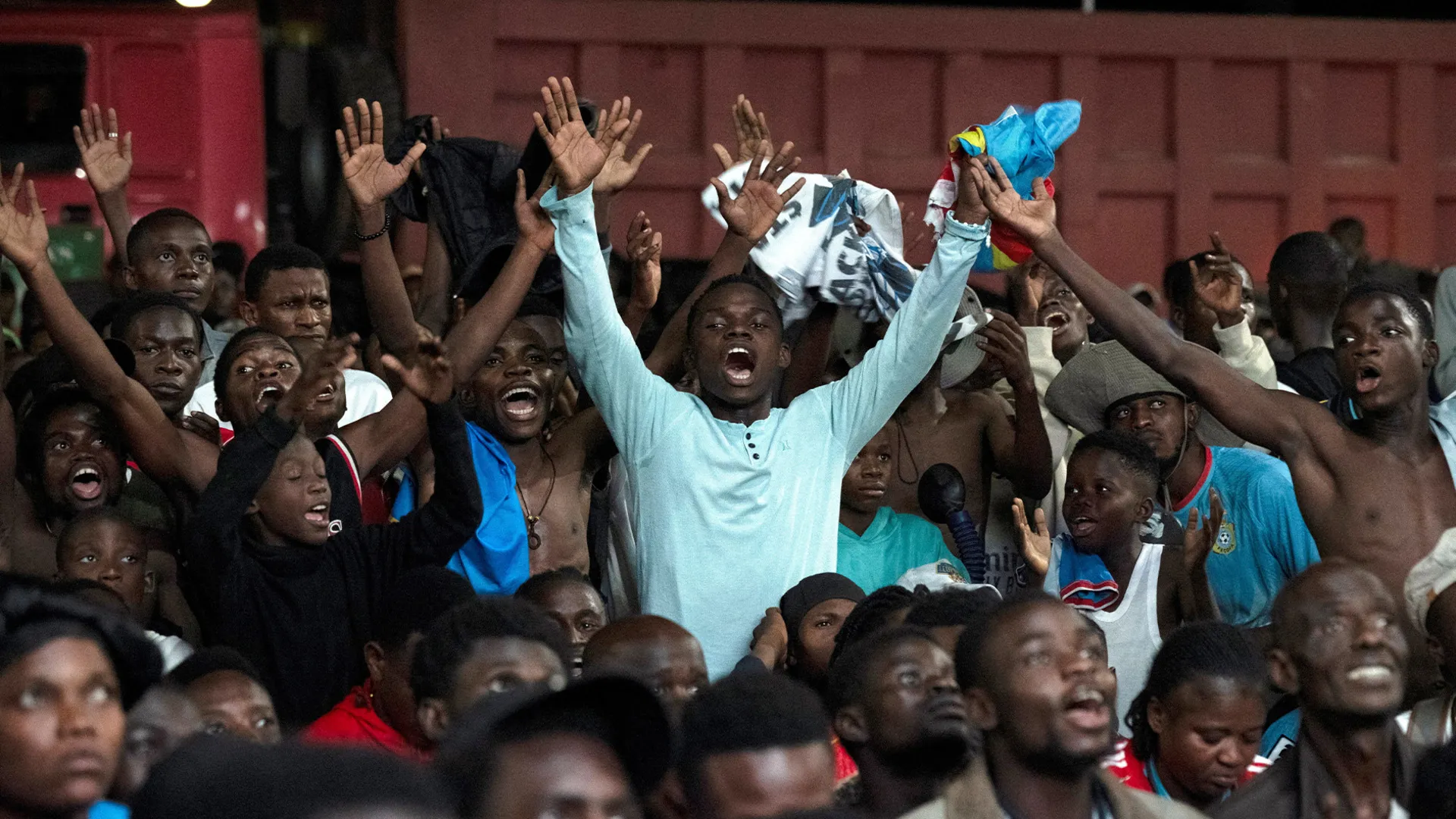
Democratic Republic of Congo fans erupted in celebration after their team secured a historic place in the World Cup knockout stage with victory over Uzbekistan. The Leopards will now face England in the Round of 32, their first-ever appearance beyond the group stage.
Weekly insights and analysis on the latest developments in military technology, strategy, and foreign policy.
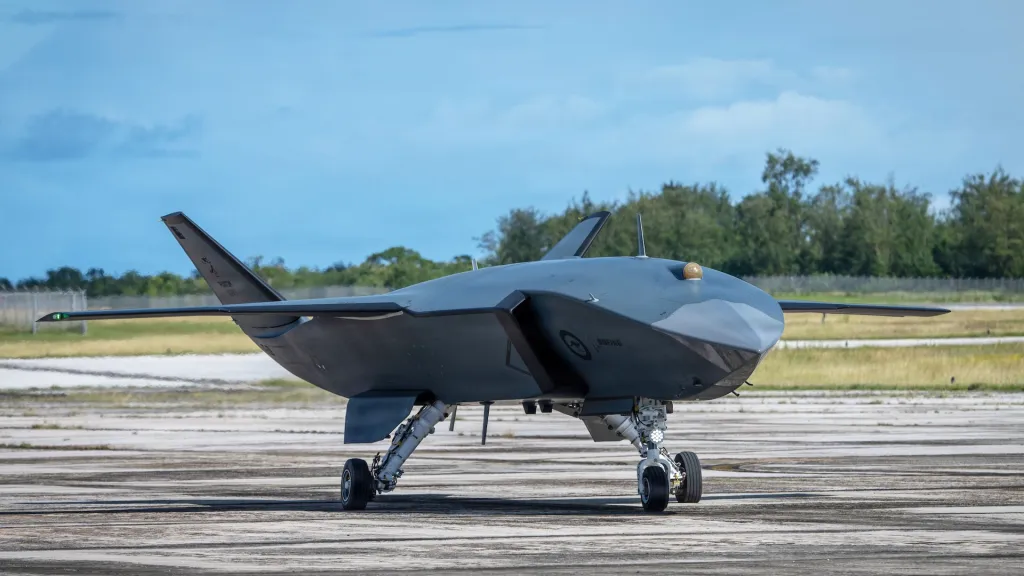
The MQ-28 Ghost Bat drone will gain a valuable opportunity to prove its relevance in a high-end coalition environment as part of Valiant Shield 26, the sprawling U.S.-led military exercise spanning Japan, Guam, Hawaii, and Australia, which began this week. It is also, as far as we know, the first time that the MQ-28 has taken part in a multinational large-force exercise of any kind. The participation of the collaborative combat aircraft (CCA) comes soon after Boeing confirmed it was conducting a separate series of test flights of the drone off the coast of southern California, part of efforts to validate autonomous operations and demonstrate rapid deployment from an allied location.
While Australia’s contribution to Valiant Shield includes a P-8A Poseidon maritime patrol aircraft and around 80 personnel, one of the more notable aspects is the involvement of Australian Defense Forces (ADF) aviator observers alongside a U.S.-led MQ-28 component. The arrangement will allow Australian personnel to work with operators and planners as the uncrewed aircraft is employed in a complex, multi-domain operational environment for the first time.
An MQ-28 prepares to conduct a taxi test during Exercise Valiant Shield 2026 at Rota, Commonwealth of the Northern Mariana Islands, June 21, 2026. U.S. Air Force Senior Airman Adrien Tran U.S. Air Force photo by Senior Airman Adrien Tran
Directed by the U.S. Indo-Pacific Command, Exercise Valiant Shield 2026 kicked off on Monday and continues through July 1.
“Valiant Shield demonstrates our enduring commitment to a free and open Indo-Pacific,” Adm. Steve Koehler, commander of U.S. Pacific Fleet, said in a media release. “Exercising advanced multidomain capabilities with our allies ensures we continue to seamlessly innovate and operate together, project combat power together, and prevail over any challenge — together.”
An MQ-28 returns from a taxi test during Exercise Valiant Shield 2026 at Rota, Commonwealth of the Northern Mariana Islands, June 21, 2026. U.S. Air Force Senior Airman Adrien Tran
The U.S. Air Force today released a series of photos showing an MQ-28 taking part in Valiant Shield. The drone was photographed at Rota, in the Northern Mariana Islands, on June 21. Accompanying captions state that the Ghost Bat will be used to advance human-machine teaming, including flying in concert with crewed fighters.
“The Department of the Air Force and its partners will analyze the aircraft’s contribution as a force multiplier that extends the reach, awareness, and survivability of crewed platforms in contested environments,” the U.S. Air Force adds.
An MQ-28 undergoes preflight checks during Exercise Valiant Shield 2026 at Rota, Commonwealth of the Northern Mariana Islands, June 21, 2026. Note the IRST sensor mounted above the nose. U.S. Air Force Senior Airman Adrien Tran
The Ghost Bat’s participation in Valiant Shield comes as Australia continues efforts to mature collaborative combat aircraft concepts, an increasingly important component of future air warfare, with the Royal Australian Air Force (RAAF) currently very much at the forefront. Designed to operate alongside crewed fighters and other assets, like tankers and airborne early warning and control aircraft, the MQ-28 is intended to extend sensor coverage, serve as a weapons platform, and perform a variety of other missions while reducing risk to human pilots.
Valiant Shield offers a particularly relevant proving ground for the MQ-28. The exercise brings together forces from the United States, Australia, Japan, Canada, and New Zealand to train in responding to coordinated threats across the maritime, air, land, cyber, and space domains. Participants will be required to detect, track, and engage shared threats while operating across a vast geographic area and under realistic conditions.
For the Ghost Bat program, exposure to this type of coalition environment is significant. Future conflicts in the Indo-Pacific will require seamless integration between allied forces, crewed aircraft, and increasingly sophisticated autonomous systems. Observing how the MQ-28 is incorporated into a large-scale multinational exercise should provide valuable insights as Australia moves toward making its collaborative combat aircraft capabilities operational. Currently, the MQ-28 is slated to be in service with the RAAF in 2028, which would likely make it the first operational CCA anywhere in the world.
An MQ-28 conducts a taxi test during Exercise Valiant Shield 2026 at Rota, Commonwealth of the Northern Mariana Islands, June 21, 2026. U.S. Air Force Senior Airman Adrien Tran
The exercise also reflects growing allied interest in integrating uncrewed systems into complex command-and-control architectures and air defense networks. As autonomous aircraft move from experimentation toward operational service, events such as Valiant Shield are becoming important venues for testing how these systems contribute to the broader fight rather than operating as standalone assets. Valiant Shield has served as a diverse test crucible in recent years, with advanced capabilities being put through their paces in a realistic, joint-force environment.
According to defense reporter Carter Johnston, the Ghost Bat’s Indo-Pacific deployment will include operations from an austere airfield led by the U.S. Air Force. This will be conducted under the Agile Combat Employment (ACE) concept, something that is seen as fundamental to survival in a future conflict with China in the Indo-Pacific region. It is also notable that the U.S. Air Force’s new CCA drones are being developed from the ground up around concepts for distributed and disaggregated operations.
The U.S. Air Force is conducting a *first-in-class* Collaborative Combat Aircraft deployment during Exercise Valiant Shield 2026, deploying Boeing Defence Australia’s MQ-28 Ghost Bat to an austere ACE airfield in the Indo-Pacific.
The exact status of the MQ-28 with the U.S. military testing community is somewhat unclear, as we have discussed before. There have been indications of Ghost Bat flight testing in the United States in the past, and the U.S. Air Force previously said it had made use of at least one MQ-28 to support advanced uncrewed aircraft and autonomy development efforts. Regardless, the Air Force, at least, has test units set up to explore exactly how to use CCAs operationally, including in an ACE-type environment. This kind of testing is now also involving the first two Air Force Increment 1 CCAs, with the YFQ-44 Fury ‘fighter drone’ prototype notably having been tested out of Edwards Air Force Base, California, helping to demonstrate how CCAs can be deployed and sustained in contested environments.
Other U.S. participants in Valiant Shield 2026 include the George Washington Carrier Strike Group, based around the aircraft carrier USS George Washington with the embarked Carrier Air Wing 5, the cruiser USS Robert Smalls, and the destroyers USS Benfold and USS Shoup.
U.S. Navy aircraft, attached to Carrier Air Wing 5, and U.S. Air Force F-35As during joint operations with U.S. Navy George Washington Carrier Strike Group and Japan Maritime Self-Defense Force, as part of Valiant Shield 2026, while underway in the Philippine Sea, June 21, 2026. U.S. Navy photo by Mass Communication Specialist 3rd Class Estrella Velarde Petty Officer 2nd Class Bruce Morgan
Valiant Shield 2026 will also see the deployment of the containerized Typhon missile system in Japan. According to the Japan Ministry of Defense, the Typhon and the High Mobility Artillery Rocket System (HIMARS) will participate in Joint Integrated Anti-Ship Warfare training carried out in the waters around Kanoya and Amami Oshima Island. However, no live firing is scheduled.
U.S. Marines and sailors observe and familiarize themselves with the U.S. Army’s Typhon missile system during a training opportunity at Marine Corps Air Station Iwakuni, Japan, September 12, 2025. U.S. Army photo by Sgt. Perla Alfaro Sgt. Perla Alfaro
Returning to the Ghost Bat, it now seems that the test flights of the MQ-28 off the coast of southern California from the U.S. Navy’s base in Point Mugu, California, were an important precursor to Valiant Shield. In fact, the same drone that was flown out of Point Mugu, ATS-008, is the example now involved in Valiant Shield.
As for the MQ-28’s previous test campaigns, the drone has been flying in Australia since 2021, with the RAAF having received eight Ghost Bats in the pre-production Block 1 configuration.
When it comes to potential export sales, participation in Valiant Shield will give Japan, Canada, and New Zealand a closer look at the drone and its capabilities. Of these, Boeing has already publicly named Japan as a potential customer and has said it is exploring potential opportunities with other unnamed countries in the Indo-Pacific region.
Personnel from the Indian Air Force receive a briefing about the MQ-28 Ghost Bat during a visit to RAAF Base Amberley, Queensland. Australian Department of Defense
Valiant Shield should offer the clearest indication yet of how the Ghost Bat can contribute to a coalition fight. As the United States and its allies increasingly embrace autonomous combat aircraft, the MQ-28’s performance in one of the Indo-Pacific’s largest and most complex military exercises will be watched closely as an indicator of how collaborative combat aircraft could be employed across the region in the future.
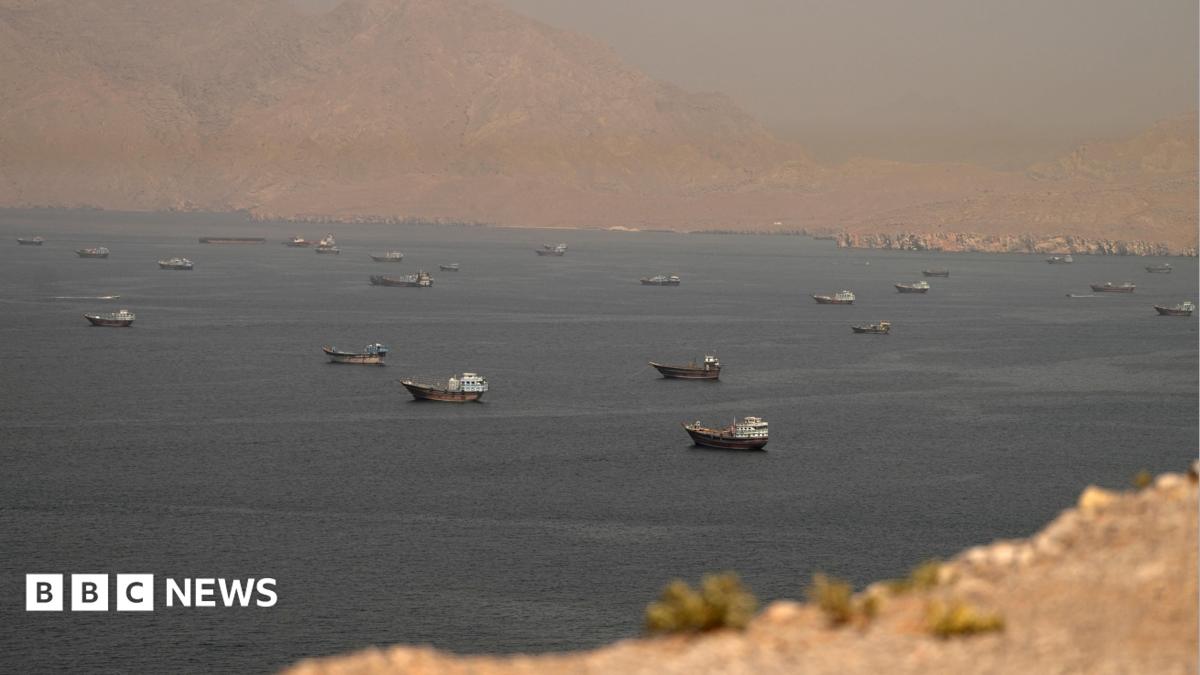
The US has conducted new strikes on Iran, following a drone attack on a Panama-flagged vessel in the Strait of Hormuz on Saturday.
US Central Command (Centcom) said it hit multiple targets across Iran in direct response to “continued aggression” against commercial shipping.
In retaliation, Iran’s Islamic Revolutionary Guard Corps (IRGC) said it has launched missiles and drones at US infrastructure in Kuwait and Bahrain, in a statement shared to state media.
Following the exchange of fire, the US and Iran accused each other of violating the ceasefire agreement.
Centcom said in a statement, “Iran was given a chance to honor the ceasefire agreement but elected not to when its forces launched a one-way attack drone that hit MT Kiku,” a Panama-flagged tanker.
In response, it said, US fighter jets conducted strikes on 10 Iranian military targets at multiple locations in and near the Strait of Hormuz. These includedmilitary equipment, communication systems, air defense sites and drone storage facilities.
In the IRGC’s statement, it said the US had attacked five coastal posts in Iran under what it called “the pretext of the IRGC Navy confronting the offending ship”.
In retaliation, the IRGC said it had launched ballistic missiles and drones at “eight key pieces of infrastructure” at the Ali al-Salem base in Kuwait and the Fifth Naval Fleet in Port Salman, Bahrain, “destroying them”.
A US official has told Reuters that there were no reported US casualties or major impacts or damage to US facilities in the Middle East.
The IRGC said that under the Memorandum of Understanding signed earlier this month, Iran has arrangements for controlling passage and navigation in the Strait of Hormuz, and from now on, violating ships will be dealt with more forcefully than in the past.
“Any potential enemy aggression, under any pretext, even if the aggressions are against minor targets, as happened last night and tonight, will have a crushing response,” read the statement.
It also accused the US of violating the ceasefire agreed to in the memorandum of understanding between the two nations, warning that it “will lead to a complete halt to the process”.
The Iranian Foreign Ministry has also condemned what it described as the “brutal attacks” a violation of the ceasefire, adding it showed that the US “does not place the slightest value and credibility on its commitments, and breaking promises is part of its nature.”
Shortly after the latest US strikes on Iran were announced, Trump said on Truth Social that it was “very possible” that Tehran would “never learn”.
“There may come a point when we are no longer able to be reasonable, and will be forced to militarily complete the job that we very successfully started,” he wrote on Saturday evening.
The post went on: “If that happens, the Islamic Republic of Iran will no longer exist!”
In the hours following the US strikes, Kuwait and Bahrain both reported that their air defence systems had been activated.
“Kuwaiti air defenses are currently confronting hostile missile and drone attacks,” the Kuwaiti Armed Forces said in a statement shared to X, asking the public to adhere to security instructions.
Bahrain’s Ministry of Interior has urged citizens to “remain calm and head to the nearest safe place”.
Centcom said that commercial vessels are continuing to operate in the Strait of Hormuz.
The latest strikes come less than a day after the US launched retaliatory strikes on Iran that it said were in response to a drone attack on Singapore-flagged cargo ship, MV Ever Lovely, on 25 June.
Centcom described the American strikes as “a powerful response” to the attack on the cargo ship, adding that the “unwarranted aggression against commercial shipping by Iranian forces clearly violated the ceasefire”.
Tehran said the cargo ship was attacked because it was using an unauthorised route to transit through the Gulf waterway, and said that the retaliatory strikes qualified as a ceasefire violation by the US.
In a statement released on Saturday morning, Iran’s foreign ministry said it had carried out more strikes against targets linked to American forces in response, and blamed the “treaty-breaking US regime” for the situation.
The US and Iran agreed on 17 June to end hostilities under a 14-point memorandum of understanding, which had also called for Iran to use its “best efforts for the safe passage of commercial vessels with no charge for 60 days”.
The Strait of Hormuz is a key waterway for oil and gas shipments, and was effectively closed by Tehran after the US and Israel launched attacks on Iran at the end of February.
The shutdown of the critical channel caused a spike in global oil prices and prevented shipments of other crucial commodities such as fertiliser.
Weekly insights and analysis on the latest developments in military technology, strategy, and foreign policy.
In the latest twist in Canada’s long-running saga to field a new fighter, the country’s defense minister has said that Ottawa is “interested in learning more about” the Global Combat Air Program (GCAP) next-generation fighter. GCAP is currently a trinational effort, led by the United Kingdom and involving Italy and Japan. Its centerpiece is the Tempest crewed fighter. A demonstrator for this jet is currently taking shape with BAE Systems in the United Kingdom.
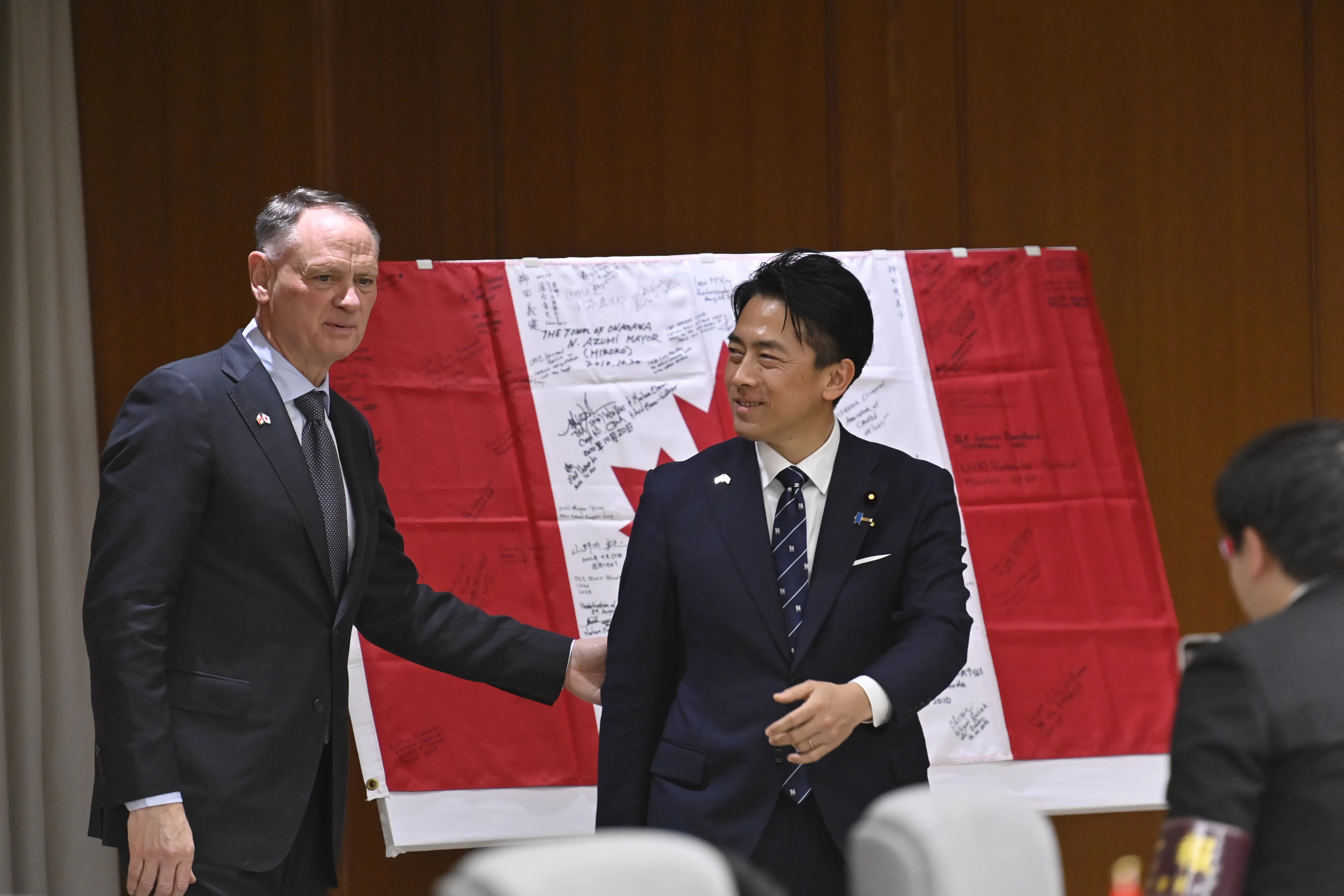
David McGuinty, the Minister of National Defense of Canada, made the remarks after a meeting in Tokyo with his Japanese counterpart, Shinjiro Koizumi. Breaking Defensereports that McGuinty confirmed he had spoken with Koizumi about the GCAP, which the Canadian official described as a “promising initiative.”
Japanese Defense Minister Shinjiro Koizumi and Canadian Defense Minister David McGuinty before an earlier meeting in Tokyo, Japan, on February 6, 2026. Photo by David Mareuil/Anadolu via Getty Images Anadolu
“We are interested in learning more about it. I’ll take it back to my team and see what it looks like,” McGuinty told Reuters.
Until now, no senior Canadian official appears to have spoken publicly about interest in GCAP. However, the development comes as Ottawa weighs up the option of a split fighter buy, which would involve acquiring the U.S.-made F-35 and one other type. This thinking has been driven by a growing rift between Ottawa and Washington.
However, the possibility of Canada coming on board GCAP as an ‘observer’ had been raised in March of this year. According to The Asahi Shimbun, a Japanese daily newspaper, unnamed Japanese officials disclosed that, during a previous meeting, McGuinty and Koizumi discussed such an arrangement.
An official artist’s concept of a potential Tempest configuration, with Mount Fuji in the background. MHI
Canada’s joining GCAP with observer status would provide it access to information on the program and could be a stepping-stone to deeper involvement.
Earlier this week, Italian Defense Minister Guido Crosetto raised the possibility of other nations joining GCAP, noting that, were that to happen, “we would be completely willing, because the more there are, the greater the chances of creating something and bringing down costs.”
Crosetto then identified Canada as “the country most interested [in GCAP] at the moment.” He said he would be “fully open” to Canada joining as an observer.
For Canada, however, GCAP would require a rethink of Canada’s potential pursuit of a split-buy approach to its new fighter.
Until now, the Saab Gripen E had been identified as the most likely candidate to be bought alongside the F-35.
A pair of Gripen Es. Saab Linus Svensson @Saab
Sweden has made a strong push to sell Gripen to Ottawa, and Saab offered to build the jet in Canada, in an effort to secure support for its previous bid, which it lost to Lockheed Martin. Since then, Saab has also emerged as the preferred candidate to supply Canada with its future airborne early warning and control (AEW&C) via its GlobalEye.
In April of this year, McGuinty confirmed that Ottawa was still reviewing its earlier plan to buy 88 F-35s.
“The review of the purchase of the F-35s is continuing… We are taking the necessary time to study very, very closely the question of the fighter fleet,” McGuinty told the Senate’s defense committee.
The split-buy option emerged since Canada has already made a firm commitment to buy 16 F-35As to start replacing its aging CF-18 Hornets. Canada’s industry also has a significant degree of involvement in the Joint Strike Fighter program.
An infographic showing Canadian industrial participation in the F-35 program. Lockheed Martin
Canada currently has around 75 CF-18A/B+ jets and has also added 18 upgraded former Royal Australian Air Force (RAAF) F/A-18A/Bs, plus seven more as spares, to help bolster its fleet.
Of Canada’s first 16 F-35s, four have already been paid for in full, while parts for eight others have also been purchased. The first Canadian F-35s were expected to be delivered for training at Luke Air Force Base, Arizona, in 2026.
Back in 2023, Canada’s Liberal government announced plans to buy 88 F-35s, a decision that appeared to bring closure to what had already been a very protracted process. You can read about this here.
Infographic outlining the key features of Canada’s future F-35As. RCAF
However, amid growing trade tensions and a war of words with the United States, Liberal Prime Minister Mark Carney launched a review of the F-35 program shortly after taking office in the spring of 2025.
There are other arguments for a split buy, too. Back in 2019, the cost of buying the planned 88 F-35s was put at $19 billion. Now it has rocketed to $27.7 billion, not including weapons and infrastructure.
Bill Blair, who was Canada’s defense minister when the review of the F-35 buy was launched last year, pointed to the advantages of a mixed fleet, saying it would give the RCAF more options to handle different types of threats.
“What happens if you have to persist in that space for months and months and years? The tool that you use, is it the right tool to do that job?” Blair said. “We need to have a whole wide range of capability sets to deal with all the eventualities that we could face.”
Were Canada to procure the Tempest, it would surely have to wait longer than 2035 — the prospect of GCAP’s fighter entering service at this date, as planned, is highly unlikely. Canada would be fourth in line behind the three core partners. Ottawa would need to buy more F-35s, perhaps around two thirds of its original intended number, or around 60 aircraft, and also keep the best of its CF-18s in service for longer, if that’s even possible. The Hornets are getting very old and disappearing from service abroad. Supporting them will become increasingly problematic. When the Tempest finally arrived, it would provide a flipped high-low fighter mix. This is essentially the same approach that the United Kingdom, Italy, and Japan — all current F-35 operators — are taking.
However, the Tempest does appear to be especially well-suited to Canada’s fighter requirement.
The design of the jet will stress extreme range and a large payload — roughly twice that of the F-35A. Senior GCAP officials have said the jet could potentially carry enough internal fuel to fly across the Atlantic without refueling.
A rendering of a pair of Tempests of the latest configuration overflying the U.K. coastline. BAE Systems
While these attributes are optimized for a future conflict in the Indo-Pacific region, they are equally applicable to dealing with the ‘tyranny of distance’ and the increasing Russian threat posed around Canada’s enormous land mass, which extends far into the highly strategic Arctic region.
“Both China and Russia have fifth-generation fighter aircraft and fifth-generation missiles that are able to go at much greater speeds and with much more that are holding Western allies at risk at this moment in time,” the commander of the Royal Canadian Air Force (RCAF), Lt. Gen. Jamie Speiser-Blanchet, said in the past.
Plans to arm the Tempest with larger air-to-air missiles offering a longer range than those currently used by any of the three GCAP partner countries have also been revealed, as you can read about here.
If Canada decides it wants a sixth-generation combat aircraft to tackle current and emerging threats from China and Russia, the GCAP might be the only realistic choice. The rival pan-European Future Combat Air System (FCAS) has collapsed, and there is little chance of Canada getting its hand on the Boeing F-47.
But any kind of split buy “would duplicate a certain amount of infrastructure and training,” Speiser-Blanchet admitted.
In some cases, however, there could be cost-benefit arguments in having a mixed fighter fleet, as well as the important factor of not relying entirely upon one source of this type of combat equipment.
There is also the question of how feasible it would be for Canada to join GCAP at this point, at least in terms of industrial participation and steering requirements. The latter point seems next to impossible, with national requirements already set, and most of the workshare agreement has also been divided up between the three partners.
There has been talk of Saudi Arabia possibly joining GCAP in some capacity, and, more recently, Poland has been reported as being interested in buying the aircraft, too.
With that in mind, Canada’s best shot might be to buy the jet ‘off the shelf,’ rather than hope for industrial windfalls.
At the same time, Canada and the United Kingdom are partners on some other key military programs, including the Royal Canadian Navy’s future River class Canadian Surface Combatants, derived from BAE Systems’ Type 26 design for the U.K. Royal Navy.
Meet The River-Class Destroyer – State-of-the-art WARSHIP!
Returning to the Tempest, the broader GCAP program still has to survive considerable challenges, both technical and political, that lie ahead.
As we have explained many times in the past, the process of creating an all-new fighter, especially one incorporating stealth technologies, brings very lengthy development times and high costs.
At this point, BAE Systems is in the process of building a demonstrator as part of the GCAP program, with a first flight planned by the end of 2027.
The latest rendering of that demonstrator appears at the top of the story. Notably, it retains the Typhoon’s EJ200 turbofan engines, with non-stealthy nozzles. The Tempest will have an all-new powerplant.
As we have argued in the past, the more time that passes, and the more deeply intertwined with the F-35 Canada becomes, the arguments in favor of a split fighter buy become harder to justify. Buying the Tempest would certainly not be the cheapest option, and would force a rethink of timelines, but it does underscore the fact that Canadian officials are casting their net wider, looking at very high-end capabilities, and seeking to build deeper strategic relationships outside of the United States.
Weekly insights and analysis on the latest developments in military technology, strategy, and foreign policy.
The U.S. military has now confirmed the acceptance of at least six F-35 Joint Strike Fighters for the U.S. Marine Corps without radars. This is due to issues tied to the development of the new AN/APG-85 radar, the first production lot of which is scheduled to be delivered in 2028. The prospect of radarless F-35s had first emerged publicly back in February. The AN/APG-85 is a critical component of the larger Block 4 upgrade package for all variants of the F-35, an effort that has been mired in cost growth and delays.
Marine Corps Lt. Gen. Gregory Masiello, head of the F-35 Joint Program Office (JPO), disclosed the acceptance of the six radarless F-35Bs at a hearing before members of the Senate Armed Services Committee earlier this week. This came as part of a larger back-and-forth between Masiello and Senator Mark Kelly, an Arizona Democrat and a retired naval aviator, about F-35 readiness rates across the U.S. Air Force, Marine Corps, and Navy, which have long been a point of concern.
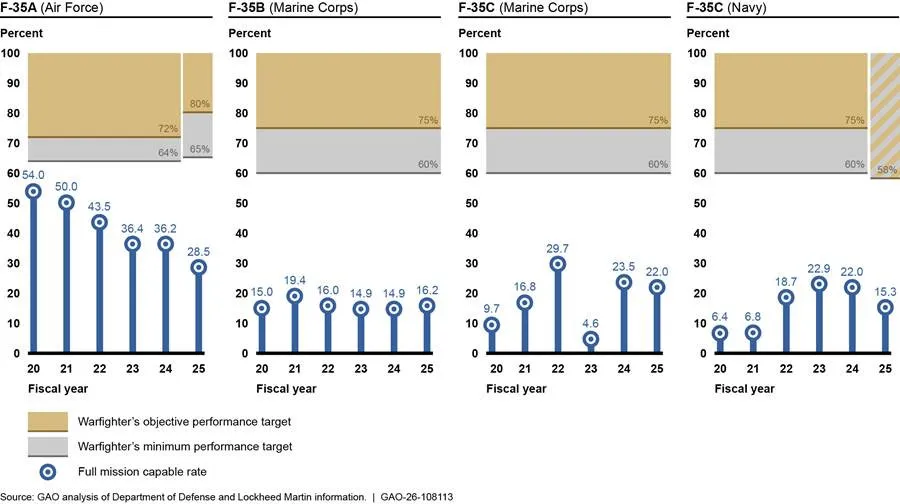
Two weeks ago, the Government Accountability Office (GAO), a Congressional watchdog, released a report stating that the average F-35 full mission capable (FMC) rate across all variants had fallen from 38 to 25 percent between Fiscal Years 2020 and 2025. GAO defines FMC as an aircraft “that can perform all of its missions.” The F-35 JPO has not disputed GAO’s figures directly, but has openly disagreed with the methodology it uses to determine FMC.
The full breakdown of Full Mission Capable (FMC) readiness rates between Fiscal Years 2020 and 2025 for all F-35 variants included the report GAO released two weeks ago. GAO
“So, the GAO FMC rate is, they said, 25 percent. Your office claims it’s 56 percent,” Kelly said, leading up to his question. “We’ll go with your number, 50 percent. So, half of the airplanes are not fully mission capable, and I think it’s the Marine Corps that has been accepting airplanes with no radar in it. Is that correct?”
“We have accepted six aircraft for the Marine Corps that do not have a radar installed. That is correct,” Masiello confirmed.
Kelly then asked if this was due to a lack of available AN/APG-85 radars, which Masiello also confirmed.
US Marine Corps F-35Bs. USMCA US Marine Corps F-35C seen on the deck of the US Navy’s Nimitz class aircraft carrier USS Abraham Lincoln. CENTCOM
“The Block 4 modernization program is necessary to ensure that the Marine Corps and Joint Force can continue to project air superiority against future threats,” a Marine Corps spokesperson told TWZ today when asked for more information. “The Department of War deliberately undertook a highly concurrent development and production program for Block 4 capabilities (Technical Refresh 3 (TR-3), APG-85, etc.) and the largest fighter aircraft production line in the world. DoW officials made this decision with full understanding of the risk of having production aircraft ready ahead of the Block 4 capabilities. The Services’ decision ensured that production aircraft could accept Block 4 capabilities, rather than continuing to build Block 3 F-35s that would require extensive retrofit for Block 4 capabilities, thereby saving multiple years of retrofit hardware installation. ”
The Marine Corps deferred any further questions to the F-35 JPO. TWZ had already reached out to that office for more information, as well.
“F-35 Lightning II aircraft are being built to accommodate the F-35 advanced radar (APG-85) for U.S. Air Force, Navy, and Marine Corps. When delivered, the F-35 with APG-85 will provide unmatched capability against current and future threats. Initial fielding for some F-35 aircraft is planned for Lot 17,” the F-35 JPO previously told TWZ in May when asked for an update on the radar situation. “The Program in coordination with the Services deliberately undertook a highly concurrent development and production program for advanced capabilities. This decision was made with full understanding of the risk of having production aircraft ready ahead of the capabilities.”
A view of Lockheed Martin’s F-35 production line. Lockheed Martin
“The program has plans to accelerate APG-85 production capacity to deliver radars that meet capability, stability, and maintainability requirements needed to meet emerging threats,” the office added at that time. “F-35s with APG-85 radars, actual modernization plans, capabilities, and schedules remain classified to maintain program security.”
The F-35 JPO had provided TWZ with a similar statement when asked about whether radarless F-35s were already being accepted back in February.
In February, the U.S. Air Force also explicitly denied receiving F-35As without radars. There is no confirmation yet that the F-35 JPO has accepted any Joint Strike Fighters for the Air Force or the Navy without radars. Previous reports have said that foreign customers are not expected to be impacted at all, at least in the near-term, since none of them are currently in line to receive AN/APG-85-equipped jets.
Today, the standard radar in use on F-35A, B, and C variants is the AN/APG-81, an active electronically scanned array (AESA) type with air-to-air and air-to-ground modes that traces its roots back to the 1990s. It also has a synthetic aperture radar (SAR) mode, which allows it to produce high-resolution map-like images. These can be used for target acquisition and identification, as well as general reconnaissance purposes.
A Lockheed Martin briefing slide giving a general overview of the capabilities the APG-81 provides the F-35. Lockheed MartinExamples of the existing APG-81’s SAR mapping capability. Lockheed Martin
Details about the new AN/APG-85, which Northrop Grumman is developing, continue to be limited. At the hearing this week, Lt. Gen. Masiello declined to talk about its specific capabilities in an unclassified setting.
The AN/APG-85 is also an AESA design, and is expected to offer an array of new and improved functionality compared to the AN/APG-81. As TWZ has previously noted, it will also just be able to leverage decades of additional general technological advancements since its predecessor was developed. In general, the use of gallium nitride (GaN) has had a major impact on modern radar developments when it comes to physical size, weight, and power requirements.
Another briefing slide offering a general overview of the fusion of sensors and other systems on existing F-35s. Lockheed Martin
As the F-35 JPO noted in its statement in May, the plan had been to start integrating the AN/APG-85 onto F-35s starting with production Lot 17. Deliveries of aircraft from that lot began last year. However, per official budget documents released earlier this year, the first production AN/APG-85s are not expected to be delivered before April 2028. This would actually be a nine-month improvement on the much-delayed delivery timeline for the new radars, the unit cost of which is currently pegged at nearly $9 million.
A compounding factor here is that the hardware used to mount the AN/APG-85 on the F-35 is not backwards compatible with the AN/APG-81. According to a report last year from Breaking Defense, the Joint Strike Fighter’s prime contractor, Lockheed Martin, has reportedly at least raised the possibility of developing a common mounting solution, but also said that this would not be ready before Lot 20 aircraft start being delivered. The first Lot 20 jets are not expected to arrive until sometime between 2027 and 2028.
A row of APG-81 radars. Northrop Grumman
How the Marine Corps, or any other service, might utilize its radarless F-35s in the meantime is unknown. This was among our queries to the Marines today.
“The currently fielded Block 3 (TR-2) F-35 Lightning II is the most capable fighter in the world today, having proven its capabilities in combat,” the Marine Corps spokesperson added in their statement. “Its advanced mission systems enable the F-35 to deter, and if necessary, dominate in any clime and place.”
Senator Kelly also prodded Lt. Gen. Masiello about this, indirectly, at the hearing this week.
“So, I assume that those airplanes can’t count as fully mission capable with no radar?” Kelly asked the JPO head.
“I don’t think I would count them as fully mission capable,” Masiello said in response.
“You say you don’t think. I can’t imagine a scenario where an F-35 with no radar could be an FMC airplane,” Kelly retorted, which Masiello did not push back on.
A US Air Force F-35A heads out on a sortie in support of Operation Epic Fury against Iran in March 2026. USAF
TWZ has previously noted that F-35s without radars would not be completely useless, but their capabilities and survivability would certainly be severely degraded. As we previously wrote:
“As long as one F-35 in a formation has a radar, all of the other aircraft in said group should be able to benefit from the data it provides via their Multifunction Advanced Data Links (MADL). As such, even without a radar installed, a Joint Strike Fighter would not be without F-35-derived radar data if at least one other was flying cooperatively with it within MADL’s transmission reach.“
“It is possible that radar-less jets could be sent into combat, at least in an emergency scenario, though doing so would still require accepting greater risks. It would limit tactical flexibility, as well, since remaining linked together with other radar-equipped jets would be key. Those jets would also have to rely on using their radars more heavily, which can be a vulnerability. The F-35 also has a host of passive sensors that it can rely on for battlespace information, although none are capable of replacing the radar’s functionality. Data from other platforms transmitted via Link 16 is also available to all F-35 pilots.“
“Maybe one of the biggest issues with having no radar is that it is a major part of the jet’s electronic warfare suite. Its ability to transmit narrow, extremely powerful beams of energy adds to the jet’s potent electronic attack capability. So, without the radar, its ability to defend itself and others by leveraging the electromagnetic spectrum is also curbed.“
Remarks from Lt. Gen. Masiello at the hearing this week also raise new concerns about the capabilities that the AN/APG-85 radars will offer even when they do finally start being integrated onto F-35s. This is tied to what it will take to sufficiently cool the radar and other elements of the Block 4 upgrade package. Thermal management is another long-standing issue for all variants of the F-35, which has already had major negative impacts on readiness rates and maintenance demands, as you can read about in more detail here.
An F-35 takes off with its afterburner engaged. Lockheed Martin
“So, right now, you’re cooling, you got about 30 kilowatts [of cooling],” Senator Kelly said as part of another question posed to the head of the F-35 JPO. “Block 4 requires 32 [kilowatts of cooling], is what I have here. But to get to the cooling needed to – for the full capability of the APG-85, needs to be somewhat higher, it seems like 62 kilowatts of cooling?”
“The requirement that we have for the program going forward is 62 to 80 [kilowatts of cooling],” Masiello said in response. “The challenge I see is if the totality of Block 4, when it’s installed, and on the aircraft, it takes the complete power available, which is 32 [kilowatts].”
“There’s no margin, which as you know, is not a smart way to go,” he continued. “So, we have an incremental approach to increase that. And we have an ongoing program to look at a more systemic and affordable upgrade to the power thermal management across the program.”
“For the engine core upgrade that we anticipate and have asked for additional funding on that, we anticipate that being fielded in 2031, and it will come with a marginal increase in the power thermal management,” he explained. “The actual system that’s under review and looking for the forward program will come a few years later into the system, which is when we would have the additional capabilities beyond Block 4, not yet to be determined that will require that.”
Pratt & Whitney F135 engines for the F-35. Pratt & Whitney
At the same time, as Masiello himself acknowledged, the current plan offers no margin when it comes to cooling before the PTMS upgrade is available. In response to further questioning by Senator Kelly, he declined to speak in an unclassified setting about what that might mean for the initial fielding of the AN/APG-85 radar.
As noted, the entire Block 4 upgrade effort continues to be beset by delays and cost growth, despite efforts to reorganize and accelerate certain components thereof. As of September 2025, the schedule for delivery of a truncated portion of the upgrade package was still running five years behind, according to GAO. The original goal had been for F-35s with the full suite of Block 4 improvements to begin arriving this year.
The F-35 program as a whole continues to face growing costs and other challenges associated with operating and maintaining the jets, which are key factors in the low readiness rates of all variants in service today. Spare parts shortages have been a particularly persistent and serious problem, as you can learn more about in this past TWZ feature.
US Air Force F-35As undergoing maintenance. USAF
“That is now what we’re putting forth is the requirement, which is the reason why, in this generational investment of the 2027 budget will help us. So, we will fill up the available parts,” Lt. Gen. Masiello also said at the hearing this week. “It’s not a systemic issue with the system having the ability. It’s the fact that we didn’t put enough parts and pieces on the shelf. And we’ve increased the demand exponentially with the number of aircraft fielded, and we didn’t do the same thing with the spare parts and the system.”
As of last year, the total project cost of the entire program, from initial development in the 1990s through the end of the type’s expected lifecycle in the 2070s, was pegged at $2.1 trillion. The JPO has stressed in the past that this figure includes the acquisition of thousands of jets and that inflation is expected to account for roughly half of the total cost.
When it comes to the continuing saga of the AN/APG-85, F-35s are now being delivered without any radars, and it could be years still before that changes.
The ongoing armed violence in the eastern Democratic Republic of Congo (DRC) has stalled national examinations, putting the future of students at risk. Many students in the region have complained about not being able to reach the locations of their examinations due to roadblocks mounted by rebels and local militants.
Michel Buingo, the chief of the provincial sub-division for primary, secondary, and new citizenship education in Walikale 4, North Kivu, said that 540 final-year students were expected to sit two examinations at different centres within the sub-division. However, only 387 students arrived, while 153 were unable to access the examination centres due to security issues.
Local authorities in the education sector attribute the low student participation at examination centres to ongoing insecurity affecting several areas from which the candidates come. Recent armed clashes, population movements, and forced displacements in the DRC’s eastern region have disrupted the educational activities of many students, making it difficult for them to access examination centres.
This situation illustrates the consequences of the security crisis for the education sector in several zones of North Kivu. While authorities said they are doing their best to ensure that students write their national examinations, several students continue to pay the price of security instability, with their educational futures compromised.
Cases of stalled examinations have become a recurring issue in recent years. In 2025, the continuation of national exams in active conflict zones was only made possible in part by the United Nations Children’s Fund (UNICEF). They facilitated the transport of sealed trunks containing exam papers from Kinshasa to various locations in North Kivu, including areas controlled by rebel groups. In 2024, hundreds of students were also unable to write their examinations due to widespread violence in the city of Bweremana in the North Kivu region.
The ongoing armed violence in the DRC has significantly impacted the quality of education. A 2025 UNICEF report states that more than 1.6 million children are currently out of school due to escalating conflict and mass displacement. In the North Kivu and South Kivu provinces, over 2,500 schools and learning centres have been forced to close, leaving approximately 795,000 children without access to education.
“Even before the latest escalation of the conflict, the education system in eastern DRC was under immense strain, due, in part, to the high number of displaced people,” the report partly noted.
The ongoing armed conflict in the eastern Democratic Republic of Congo (DRC) has disrupted national examinations and threatened students’ educational futures. Many students in North Kivu’s Walikale 4 region were unable to access examination centres due to rebel-controlled roadblocks, leading to only 387 out of 540 expected final-year students sitting for their exams. This highlights the broader impact of insecurity and forced displacements on education in the region.
In recent years, stalled examinations during conflict have been frequent. In 2025, UNICEF assisted in conducting national exams by transporting exam papers to conflict-affected areas. The conflict has led to the closure of over 2,500 schools, affecting approximately 795,000 children in North and South Kivu, according to a 2025 UNICEF report. This crisis worsens the strain on an already challenged education system burdened with high displacement rates.
Weekly insights and analysis on the latest developments in military technology, strategy, and foreign policy.
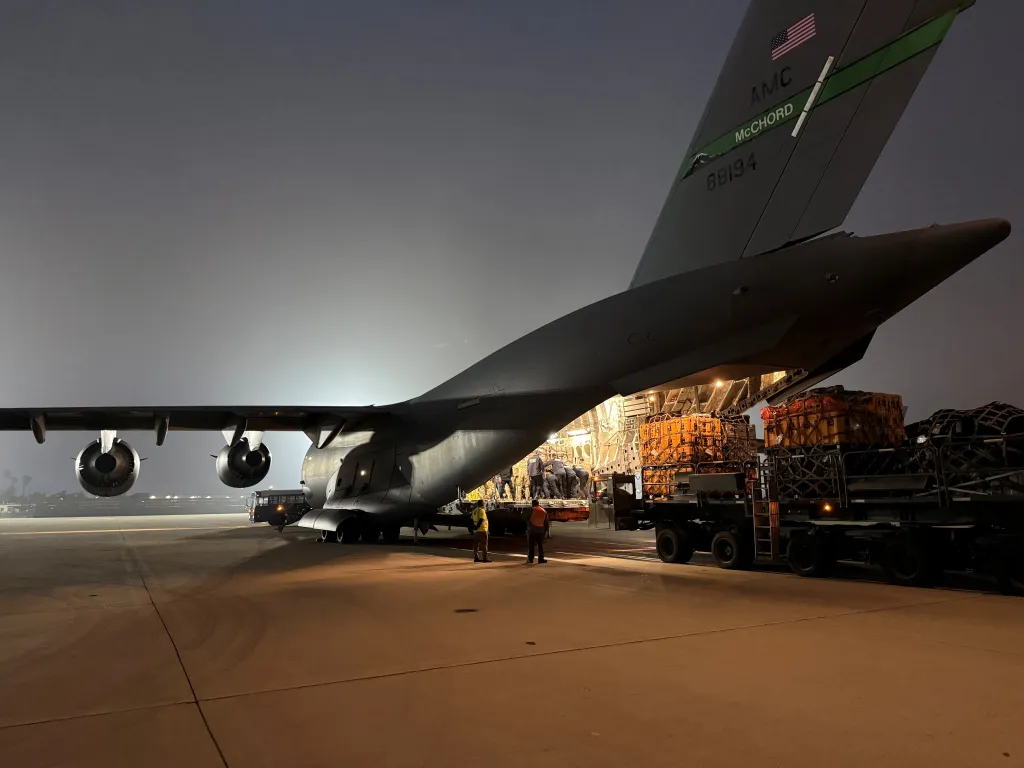
U.S. Air Force C-17 Globemaster III cargo jets have arrived in Venezuela, packed with personnel and equipment for the ongoing earthquake relief efforts. The aircraft are joining U.S. forces already in the country as well as on the amphibious transport ship USS Fort Lauderdale, the littoral combat ship USS Billings and at American bases around the region.
The flights are part of a growing U.S. military presence being run by U.S. Southern Command (SOUTHCOM) in support of the U.S. State Department. The movements are in response to 7.2- and 7.5-magnitude earthquakes Wednesday night that Venezuelan authorities say devastated much of the northern part of the country and have killed more than 900.
Utter devastation seen across the Northern Venezuelan coastal city of La Guaira, following tonight’s pair of major earthquakes, measuring 7.2 and 7.5 magnitude with an epicenter just to the west of Caracas. pic.twitter.com/BQv4YixUiB
WATCH: Inside Caracas Simon Bolivar International Airport during a powerful earthquake that struck Venezuela.
The first 7.2-magnitude quake was followed just 39 seconds later by a stronger 7.5-magnitude quake, according to the US Geological Survey (USGS), with witnesses… pic.twitter.com/3eZk7RV86h
— Breaking Aviation News & Videos (@aviationbrk) June 25, 2026
The first C-17 arrived in Venezuela this morning. Online flight trackers show that at least four of the cargo jets have left the U.S.
“The first air shipment of equipment has arrived to support the two specialized U.S. search and rescue teams, which are arriving in Venezuela to join ground operations as soon as possible,” the U.S. Embassy in Caracas said in a post on X. “With nearly 80 experts per team—firefighters, doctors, structural engineers—12 canines trained for detection in rubble, these groups bring advanced capabilities to locate survivors and assist in complex emergencies. Their personnel and specialized equipment are being positioned to head to the hardest-hit areas and begin operations when conditions allow.”
La primera carga aérea de equipamiento ha llegado para apoyar a los dos equipos especializados de búsqueda y rescate de los EE.UU., que están llegando a Venezuela para integrarse lo antes posible a las operaciones en el terreno. Con cerca de 80 expertos por equipo – bomberos,… pic.twitter.com/ZCaQMcBM6J
— Embajada de los EE.UU. en Caracas (@usembassyve) June 26, 2026
A second one reportedly landed in the stricken nation as well.
A second USAF C-17 carrying humanitarian aid and search and rescue teams has landed at El Libertador airbase in Maracay, also seen in the background are two Mexican air force planes that delivered aid this morning #Venezuelapic.twitter.com/LR9WuSbOh2
“A C-17 Globemaster III was loaded overnight at Dover AFB with Urban Search and Rescue personnel and equipment for transport to Venezuela in support of State Department-led humanitarian response efforts,” SOUTHCOM said in a post on X Friday morning. “America’s military is delivering the people and capabilities needed to save lives.”
When called, the @DeptofWar moves. A C-17 Globemaster III was loaded overnight at Dover AFB with Urban Search and Rescue personnel and equipment for transport to Venezuela in support of @StateDept-led humanitarian response efforts.
A C-17 Globemaster loaded specialized U.S. search and rescue teams overnight bound for Venezuela. (SOUTHCOM)
When disaster strikes, we answer the call. USA-01 is enroute to #Venezuela following the devastating earthquakes, w/ 79 personnel, six K9s, and 70k lbs of equipment. We are honored to represent the US, bringing our expertise, compassion, & unwavering dedication to those affected. pic.twitter.com/8snA89Qwae
— VA-TF1 / USA-01 – Urban Search and Rescue (@VATF1) June 26, 2026
Another C-17 landed in Curaçao. The island is serving as one staging area for international efforts to search for survivors and victims and bring in much-needed humanitarian aid.
The US response to the earthquake disaster in Venezuela is well underway. 📍The first related C-17, #AE1449 as RCH234, arrived in Curacao overnight. 📍#AE2FA6 as RCH525 is en route with members of USA-02 urban search & rescue team. 📍#AE07F8 as RCH421 is en route with members of… pic.twitter.com/4mznPCySI7
U.S. Marine Corps Maj. Gen. Kevin J. Jarrard arrived in Caracas on Thursday to oversee the Pentagon’s Venezuela earthquake relief efforts, SOUTHCOM stated.
“Jarrard is serving as the senior U.S. Southern Command (SOUTHCOM) official on the ground and is working closely with partners to plan, coordinate, and direct the U.S. military’s unparalleled logistical and operational capabilities to support the rapid, life-saving movement of response personnel, equipment, and humanitarian assistance into affected areas,” the command said in a media release.
RELEASE: SOUTHCOM Leadership Arrives in Venezuela to Coordinate Earthquake Relief Support
U.S. Marine Corps Maj. Gen. Kevin J. Jarrard arrived in Caracas, Venezuela, today, to oversee Department of War support to Venezuela earthquake relief efforts.
In another post on X, SOUTHCOM included a photograph of a USMC MV-22B Osprey tiltrotor aircraft. The Osprey is part of an array of fixed- and rotary-wing assets deployed for the relief effort around the region.
A U.S. Marine Corps MV-22 Osprey tiltrotor aircraft landed in Venezuela Thursday as part of U.S. humanitarian relief efforts. (SOUTHCOM)
Jarrard is leading SOUTHCOM Commander Gen. Francis L. Donovan’s deployment of “significant forces to the effort,” according to the command. This includes the aforementioned cargo jets and Navy vessels, as well as C-130 Hercules transports, unspecified reconnaissance platforms and rotary-wing aircraft.
“These forces will provide specialized mobility services and support to U.S. government personnel, search and rescue teams, and U.S. interagency partners as they assess damage, locate the injured, and deliver critical, life-saving assistance,” SOUTHCOM said in a statement.
The Pentagon released images of a U.S. Army CH-47 Chinook transport helicopter loading up personnel and supplies in Honduras for potential participation in this mission.
A 1st Battalion 228th Aviation Regiment CH-47 Chinook is prepped for potential support for Venezuela’s disaster relief response at Soto Cano Air Base, Honduras, June 25, 2026. (U.S. Air Force photo by Staff Sgt. Ethan Sherwood) Staff Sgt. Ethan SherwoodMembers of Joint Task Force-Bravo load equipment into a CH-47 Chinook in preparation for potential support to Venezuela’s disaster relief response at Soto Cano Air Base, Honduras, June 25, 2026. (U.S. Air Force photo by Staff Sgt. Ethan Sherwood) Staff Sgt. Ethan Sherwood
All this is being anchored by the two Navy vessels, which have been in the region for months.
Earthquake relief support from the sea: The @USNavy has a proud legacy of providing disaster relief directly from the sea.#SOUTHCOM has directed USS Fort Lauderdale (LPD 28) and USS Billings (LCS 15) to Venezuela to support @DeptofState-led U.S. government relief operations in… pic.twitter.com/z1JJ0aLjSl
Of the two, Fort Lauderdale has been in the Caribbean the longest and took part in the counternarcotics operation that led to the capture of former Venezuelan dictator Nicolás Maduro, now in custody in the U.S. The rest of the ships assigned to that mission left the region months ago.
Fort Lauderdale can embark multiple types of rotary wing aircraft, including Marine MV-22B Ospreys and UH-1Y Venoms. Other helicopters can use their large deck area for resupply and refueling, as well. The vessel could be used as a staging area to deliver aid and extract wounded from a nearby port or off the coast of Venezuela. Hundreds of sailors and Marines aboard could assist with humanitarian efforts, from the ship or on the ground.
The San Antonio class amphibious transport dock USS Fort Lauderdale (LPD 28) is taking part in the U.S. military’s humanitarian aid response to the Venezuelan earthquakes. (U.S. Navy photo by Mass Communication Specialist 2nd Class Savannah L. Hardesty) Petty Officer 2nd Class Savannah Hardesty
The flight deck of Billings, which arrived in the Caribbean in March, is much smaller and supports the ship’s MH-60 Seahawk helicopter and drones. It can also be used by other helicopters.
If needed, there are additional Navy assets operating off the East Coast that could be re-tasked to SOUTHCOM.
The amphibious assault ship USS Iwo Jima recently returned to Norfolk from a 10-month deployment in the Caribbean. If it has not yet entered its planned maintenance availability, the vessel could be redeployed if called upon.
The Wasp class amphibious assault ship USS Iwo Jima (LHD 7). (U.S. Navy photo by Mass Communication Specialist Seaman Logan Goins) Seaman Logan Goins
Much less likely is moving the aircraft carrier USS Nimitz. The fleet’s oldest carrier left Mayport, FL, on Wednesday and is now participating in large-scale FLEETEX before a planned transit to New York for America 250 events.
Rolling deep ⚓💪🌊
Twenty-six ships from 13 partner and allied nations steam in formation with Nimitz-class aircraft carrier USS Nimitz (CVN 68) during a multinational maritime exercise as part of Fleet Exercise (FLEETEX) 250 in the Atlantic Ocean, June 25, 2026. Nimitz is… pic.twitter.com/0p0yyvm0QV
Meanwhile, America’s unique array of ISR assets can be critical to Venezuela’s relief efforts.
Platforms like MQ-9 Reaper and MQ-4C Triton drones and piloted aircraft like P-8 Poseidon maritime patrol craft and even U-2 Dragon Lady spy planes could bring a lot of sensor power to bear to help with search and rescue, mapping and provide other geospatial intelligence benefits to develop a clearer picture of the situation.
U.S. Navy P-8 Posiedon martime patrol jet. (USN)
This relief effort is still unfolding and the full extent of the damage is still coming to light. As we previously noted, the disaster offers an opportunity for the U.S. military to foster improving relations with Venezuela almost half a year after Maduro was snatched out of Caracas.
This is where the US military can broadly impact the relationship with Venezuela again. They are now our friends? Go big helping them here. We are prepared and ready for this mission. Huge opportunity here. https://t.co/pu8RSRMjUK
U.S. President Donald Trump appears to have seized on this chance, at least to some degree, announcing America would play a key role in helping Venezuela in a post on his Truth Social site.
“The two major earthquakes that just hit the great people of Venezuela are both massive in scale and have left a devastating number of deaths,” Trump proclaimed. “The U.S.A. stands ready, willing, and able to help! I have instructed all agencies of our government to get ready to move quickly. We will be there for our new and great friends. Early reports are not good!!!”
We thank U.S. President Donald Trump and his administration, who have been in constant contact with Venezuelan authorities, offering support and solidarity to the people of Venezuela in the face of this tragedy that has plunged us into mourning. https://t.co/nw2bupuN7C
It is unclear how much larger the U.S. military presence will grow for this mission. Several other countries are taking part as well and China has pledged to. Trump has made keeping the Caribbean under the control of the U.S. a major part of his administration’s plans and a top reason for removing Maduro was to stem the influence of China and Russia there.
MOFA: China to provide humanitarian assistance to Venezuela
China will provide emergency humanitarian assistance to Venezuela, Chinese Foreign Ministry spokesperson Guo Jiakun said on Friday. He added that China is prepared to provide further support as the disaster situation… pic.twitter.com/zpge2sGNXb
We will continue to monitor the situation and provide updates when warranted.
UPDATE: 3:28 PM EDT –
SOUTHCOM provided an update on the assets being deployed:
Two U.S. Air Force C-17 Globemaster aircraft are transporting U.S. Urban Search and Rescue teams based in Los Angeles and Fairfax, Virginia, and one U.S. Air Force C-17 will deliver load-movement equipment to Caracas.
U.S. Marine Corps MV-22 Ospreys will transport an airfield assessment team to Venezuela to support airport operations that were impacted near the earthquake epicenter.
The U.S. Navy’s San Antonio-class amphibious transport dock USS Fort Lauderdale (LPD 28) and Freedom-variant littoral combat ship USS Billings (LCS 15) have arrived in waters near Venezuela and will begin supporting relief and live-saving efforts.
Three U.S. Army CH-47 Chinooks and crews from Joint Task Force-Bravo will depart Soto Cano Air Base in Honduras en route to support the transport of key personnel and supplies aiding impacted Venezuelan communities.
The command’s U.S. Space Force component is providing satellite imagery of devastated areas to disaster relief planners in Venezuela to aid them in assessing where immediate live-saving and aid efforts are needed most and identifying what capability requests to prioritize.
Scotland, who have played at each of the past two European Championships, booked their spot at a World Cup for the first time since 1998 in dramatic fashion with an unforgettable victory against Denmark at Hampden Park in November.
Backed by tens of thousands of fans who had travelled to the United States, John McGinn’s deflected strike against Haiti earned the country’s first win at a World Cup for 36 years.
That would be Scotland’s only goal of the tournament.
They lost to a second-minute strike by 2022 semi-finalists Morocco in their second match, so they entered their final group game against Brazil knowing a draw would probably be enough to send them through as one of the best third-placed teams.
However, first-half defensive errors would prove their undoing.
They once again conceded early when defender Scott McKenna was robbed of possession inside his own penalty area, gifting an opener to Vinicius Jr.
The Real Madrid forward was denied a second when the video assistant referee (VAR) deemed he had fouled Jack Hendry before rolling the ball past Angus Gunn, but just before half-time Scotland again gave the ball away near their own goal and Vinicius Jr nodded in at the back post to make it 2-0.
Matheus Cunha extended Brazil’s advantage after half-time and a late rally failed to yield a reply that would have improved Scotland’s goal difference.
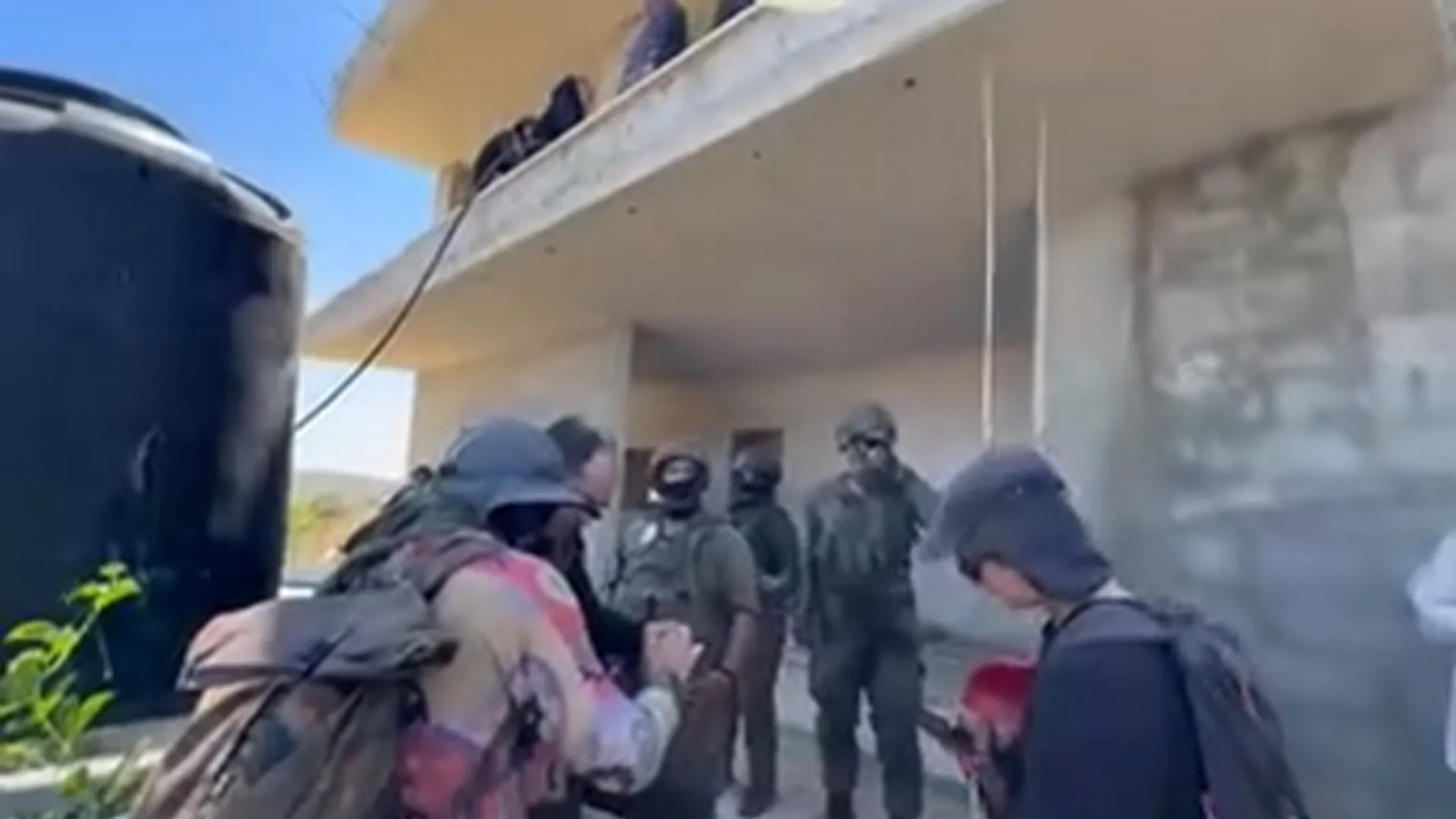
Videos show Israeli settlers, protected by Israeli soldiers, trying to seize a house under construction on the outskirts of the town of Qabalan, just south of Nablus, in the occupied West Bank.
England’s winning run at the T20 World Cup continued with a rampant nine-wicket victory over New Zealand in their final group game at The Oval.
Already assured of top spot in Group 2 and with it a place in next week’s semi-finals, England built on the momentum of their four previous wins by cruising a chase of 164 with 16 balls to spare.
Danni Wyatt-Hodge, now the tournament’s leading run-scorer, kept up her superb form by crashing 89 not out. She was supported by Sophia Dunkley, who made 49 not out in their partnership of 128.
Defending champions New Zealand are a shadow of the side that won this title in 2024 but the dominant nature of England’s win only added to the sense of momentum around this side.
After limiting New Zealand early on, they took three wickets in four balls without conceding a run in limiting the White Ferns to 163-6.
Sophie Devine hit three sixes in a 14-ball 30 on her final international appearance but otherwise England were always in control.
Their semi-final opponents will be confirmed on Sunday, with India or South Africa appearing the most likely.
That match will take place on Tuesday afternoon or Thursday evening back at The Oval, where England’s women’s side have never lost any of their 11 matches.
Win that and they will return to Lord’s for the final on Sunday for a chance to win their first World Cup title since 2017.
When Morocco reached the semi-finals of the 2022 FIFA World Cup, the achievement immediately transcended the boundaries of sport. It was the first time an African and Arab national team had reached that stage of the tournament. Yet what drew the greatest attention from international observers was not simply the result itself, but the way it confirmed changes that had already been unfolding elsewhere.
Football rarely exists in isolation. The fortunes of a national team often reflect deeper developments in governance, investment, youth development, and a country’s capacity to pursue long-term objectives. Morocco’s World Cup campaign brought into focus the broader transformation of a nation whose international profile has steadily expanded through diplomacy, infrastructure development, strategic investment, and regional cooperation.
That distinction matters. The World Cup did not create a new geopolitical reality for Morocco; it revealed one that had already taken shape. For several weeks, hundreds of millions of viewers encountered a Morocco that differed from the image long associated with the Kingdom. To many, Morocco had primarily been known as a tourist destination, a close European partner, or a North African state. Qatar 2022 introduced another image: a country capable of competing with football’s traditional powers, rallying a global diaspora, and projecting ambitions that extend well beyond its immediate neighborhood.
The scale of that exposure helps explain why the tournament proved so consequential. The 2022 FIFA World Cup reached an estimated audience of more than five billion people across television and digital platforms, giving Morocco a level of global visibility that few international events could ever provide.
Stay ahead of the geopolitical week.
MD Briefing delivers expert analysis across five global fronts — the Indo-Pacific, energy, geoeconomics, European security, and the Middle East — every Monday morning. Free.
This evolution reflects broader changes in the international system. Throughout much of the twentieth century, a state’s influence was measured primarily through military capabilities, economic strength, and diplomatic reach. While these pillars remain essential, they cannot fully explain how a country’s international image is shaped. In an era shaped by digital communication and instantaneous information flows, the ability to capture global attention, generate narratives, and engage international audiences has become another source of influence.
Football occupies a unique position within that landscape. No other sport crosses cultural, linguistic, and geographic boundaries with comparable ease. A World Cup captures the attention of governments, businesses, media organizations, and public opinion all at once. For several weeks, it places a country under a level of global scrutiny that no public diplomacy campaign could realistically achieve.
Morocco benefited from that exposure in remarkable fashion. Victories over Belgium, Spain, and Portugal naturally attracted worldwide attention. Yet the significance of Morocco’s campaign also lay in what it revealed about the Kingdom’s distinctive position at the intersection of multiple geopolitical spaces. Throughout the tournament, the Atlas Lions received support far beyond their domestic fan base. Celebrations unfolded across cities in Africa, the Arab world, and Europe. Those scenes illustrated something analysts had long observed but rarely witnessed so vividly: Morocco simultaneously belongs to several geopolitical spheres.
The team’s appeal was not built on sporting success alone. It also rested on a moral and ethical capital that substantially strengthened its international standing. Across much of the Global South, Morocco came to embody the possibility that a nation operating outside football’s traditional centers of power could challenge the established hierarchy without abandoning values deeply rooted in its own identity. Images of players embracing their mothers after victories, the importance given to family, and the respect shown toward opponents throughout the tournament resonated in ways that athletic performance alone rarely achieves.
Competitiveness, humility, and attachment to deeply held values combined to create a powerful sense of identification. That helps explain why Morocco inspired support far beyond its own borders.
Looking back, the 2022 World Cup stands out as a genuine turning point. It did not, by itself, redefine Morocco’s place in the world. What it did accomplish was introducing much of international public opinion to a modern Morocco—confident in its identity, proud of its history, and already engaged in a far-reaching process of transformation.
When Performance Becomes an International Language
Morocco’s 1–1 draw with Brazil at the 2026 FIFA World Cup lends itself to a reading that reaches well beyond football. For decades, African national teams were largely viewed through the prism of isolated upsets against the sport’s established powers. Morocco now appears to have moved beyond that perception. Consistent results over several years have established the image of a team capable of competing regularly with the world’s elite.
This evolution reflects a broader pattern often found in international affairs. A country’s status rarely changes because of a single success. It changes when success ceases to be viewed as exceptional. The result against Brazil therefore says less about an unexpected sporting achievement than about Morocco’s growing place within world football’s established hierarchy.
The real shift is not that Morocco earned a result against Brazil. It is that such a result has become part of normal expectations.
The Foundations of Influence
Morocco’s growing stature on the football field is also the product of sustained investment in talent development. The Mohammed VI Football Academy has become one of the clearest expressions of that long-term strategy. With some of Africa’s most advanced training facilities, an integrated sports medicine center, and highly qualified coaching staff, the academy has helped build a generation of players capable of competing in the world’s leading leagues. The objective has never been limited to short-term success. It has been to establish the conditions for Moroccan football to remain competitive over time.
The success of this development model now extends well beyond the senior national team. Morocco won its first FIFA U-20 World Cup by defeating Argentina 2–0 in the final of the 2025 tournament in Chile. This dynamic illustrates the depth of the country’s football structure and suggests that recent achievements are part of a broader trajectory rather than an isolated cycle. The ability to produce successive generations of highly competitive players has become one of the defining features of Moroccan football.
Few countries possess the ability to inspire such diverse audiences. Morocco’s history, geography, and human ties connect it simultaneously to Africa, Europe, the Arab world, the Mediterranean basin, and, increasingly, the Atlantic community. Football has made that distinctive position visible in a way that few other instruments could.
A broader picture also emerges. Morocco’s achievements on the pitch have encouraged many foreign observers to look beyond football and discover a country they previously understood only in part. Behind the national team stands a state investing heavily in modern infrastructure, expanding its international partnerships, and strengthening its role across Africa while deepening its engagement throughout the Mediterranean.
Football has become one of the clearest expressions of that broader trajectory. It has drawn international attention to developments that were already reshaping the country.
It likewise strengthens one of Morocco’s most effective sources of soft power. Without replacing diplomacy, economic policy, or cultural outreach, football helps shape how the Kingdom is perceived abroad. Sporting success, world-class infrastructure, the organization of international competitions, and the presence of Moroccan players in Europe’s leading clubs all enhance the country’s visibility among audiences that may have little direct interest in political or economic affairs. Football has therefore become another instrument through which Morocco projects influence beyond its borders.
In today’s international environment, influence is measured not only by the ability to deter, but also by the capacity to inspire, attract, and unite. A successful national team can sometimes do more to strengthen a country’s international standing than demonstrations of hard power that no one hopes to witness.
Football, however, does not operate in a strategic vacuum. Its impact forms part of a broader national trajectory in which diplomacy, economic policy, institutional reform, and international partnerships reinforce one another.
Morocco’s return to the African Union in 2017, the expansion of its economic engagement across Sub-Saharan Africa, the implementation of major strategic infrastructure projects, and the consolidation of its diplomatic position on several regional issues all reflect a broader transformation whose significance extends far beyond sport.
The same pattern is evident in Morocco’s ability to organize major sporting events. The Africa Cup of Nations confirmed the results of years of investment in stadiums, transportation networks, and supporting infrastructure. Tournament management, logistical coordination, hospitality, and operational efficiency demonstrated capabilities already visible in other sectors of national development. The experience further strengthened Morocco’s credibility within international sporting institutions while reinforcing its reputation as a country capable of hosting events of global significance.
From Recognition to Projection
Against this backdrop, the decision to award the 2030 FIFA World Cup jointly to Morocco, Spain, and Portugal carries particular importance. Beyond its symbolic value, the decision reflects confidence in Morocco’s organizational capacity and in the institutional ecosystem that has been developed over many years.
In addition, the tournament carries a broader civilizational meaning. Its Moroccan, Spanish, and Portuguese framework creates a new narrative connecting Africa, Europe, the Mediterranean, and the Atlantic. For Morocco, this configuration reinforces the image of a country located at the intersection of these spaces and capable of transforming geography, history, and culture into instruments of dialogue, visibility, and influence.
Hosting one of the world’s most watched events requires more than modern stadiums. It demands political stability, efficient institutions, and the ability to coordinate complex operations over an extended period.
For that reason, the 2030 World Cup represents far more than another sporting milestone. It will serve as a large-scale test of credibility as well. For several weeks, Morocco will be observed by billions of viewers, thousands of businesses, and hundreds of official delegations. Few international events offer such an opportunity to showcase a country’s transformation before a truly global audience.
Morocco’s experience reflects another broader international trend. An increasing number of states now use major sporting events to support their integration into global political and economic networks. China’s Olympic Games, Qatar’s hosting of the 2022 FIFA World Cup, and Saudi Arabia’s expanding sports strategy all illustrate this evolution. Sport has become a platform through which countries project national ambition and shape how they are perceived abroad.
Morocco’s trajectory nevertheless stands apart. Unlike countries whose sporting influence depends primarily on financial resources, Morocco benefits from a combination of history, geography, and culture that allows it to engage multiple regions simultaneously. Few countries occupy such a position. At a time when the international system is increasingly fragmented by geopolitical rivalries, economic competition, and identity politics, that characteristic has acquired growing strategic value.
Football ultimately raises a broader question about the changing nature of power itself. For decades, influence was measured largely through military capabilities, economic resources, and demographic weight. Those factors remain fundamental, yet they cannot fully account for how countries are perceived today. The emerging international landscape increasingly rewards countries able to connect regions, facilitate exchanges, and build relationships across political, economic, and cultural divides.
From that standpoint, Morocco’s evolution may signal the emergence of what could be described as a connective power. Unlike traditional middle powers, a connective power derives its influence less from the resources it controls than from its ability to connect regions, facilitate exchanges, and create strategic interfaces between political, economic, and cultural spaces. Its comparative advantage lies not in domination, but in connectivity.
Football represents only one expression of that broader transformation. Infrastructure development, Atlantic initiatives, expanding African economic partnerships, growing human mobility, and the country’s capacity to host major international events all reinforce the same strategic trajectory. Taken together, they point toward a distinctive role for Morocco within the emerging international order.
Football, then, accompanies a much deeper national transformation. It reflects Morocco’s gradual evolution from a respected regional partner into a country whose initiatives and ambitions increasingly attract attention well beyond its immediate neighborhood. The Kingdom’s Atlantic vision, its expanding role across Africa, continuing investment in infrastructure, and ability to host major international gatherings all belong to the same strategic narrative.
The geopolitical importance of football lies precisely in its ability to make visible changes that often develop far from public attention. Sporting achievements can reveal broader shifts in economic development, diplomatic influence, and a country’s strategic positioning.
For Morocco, football has become one of the clearest mirrors of a broader national ambition. It is neither the source nor the principal driver of the Kingdom’s rise. Rather, it provides one of its most visible expressions. As Morocco strengthens its position between Africa, Europe, and the Atlantic, football continues to reflect changes that extend well beyond the sporting arena.
Behind the achievements of the Atlas Lions lies a Royal Vision that places human development at the center of national progress while pursuing a broader ambition: establishing Morocco as a connective power capable of linking Africa, Europe, the Mediterranean, and the Atlantic.
Football did not transform Morocco’s place in the world. It simply made that transformation impossible to ignore.
Egypt’s foreign ministry used carefully calibrated language on Monday to restate a familiar position: unwavering support for Sudan’s “unity, sovereignty and territorial integrity” and for its “national institutions, particularly the Sudanese Armed Forces (SAF).” Framed as a rejection of “parallel entities” seeking to form an alternative government in exile, the statement is another sign that Cairo is tying its Sudan policy ever more tightly to General Abdel Fattah al‑Burhan and the SAF as the country’s civil war grinds into yet another year.
Behind the diplomatic phrasing lies a blunt political choice. Since the outbreak of fighting between the SAF and the Rapid Support Forces (RSF) in April 2023, Egypt has emerged as one of the army’s main regional backers, both politically and—according to multiple reports—quietly in security terms. Egyptian officials insist they are defending Sudanese state institutions against militia fragmentation and external meddling, a message they repeat in multilateral forums and joint communiqués with Burhan’s Transitional Sovereignty Council.
From Cairo, the stakes in Sudan are seen as existential rather than abstract. Egyptian analysts routinely describe the stability of their southern neighbour as a vital national security concern, citing fears of refugee flows, arms smuggling and jihadist safe havens along the porous border. Control of the Nile is an even deeper driver: since the 2019 fall of Omar al‑Bashir, Egypt has intensified security and military coordination with Khartoum to counter Ethiopia’s upstream Grand Ethiopian Renaissance Dam (GERD) and preserve its historic water share.
There is also a clear regime‑security affinity, however misguided that affinity might be. Burhan, a career officer who trained in Cairo and maintains close ties with Egyptian generals, represents a familiar authoritarian model for President Abdel Fattah el‑Sisi, himself a former general who came to power after a coup in 2013. Supporting the SAF fits Egypt’s long‑standing pattern of siding with Sudan’s army “whoever is in charge of it,” and buttresses Cairo’s broader preference for strong central militaries over messy civilian transitions across the region.
Stay ahead of the geopolitical week.
MD Briefing delivers expert analysis across five global fronts — the Indo-Pacific, energy, geoeconomics, European security, and the Middle East — every Monday morning. Free.
Officially, Egypt insists it is not a party to Sudan’s war. Sisi has repeatedly pledged “non‑interference,” and Cairo frames its role as limited to mediation, humanitarian aid, and hosting millions of Sudanese fleeing the conflict. Egyptian troops captured by the RSF at Merowe airbase in April 2023 were described as participants in pre‑scheduled joint exercises, not combat operations, a spin that few international observers bought.
The line between deterrent presence and de facto involvement has become increasingly blurred. Analysts note years of intensifying joint drills, intelligence cooperation and arms ties between the two militaries since 2019. Think‑tanks and regional media have reported unconfirmed Egyptian airstrikes on RSF positions and possible targeting of gold‑mining camps in northern Sudan, amid allegations by RSF leaders that Cairo is providing drones and tactical support to the SAF—claims Egypt denies. The pattern points towards at the very least a protective security umbrella for Burhan’s forces, far beyond the strict neutrality Cairo proclaims.
Yet in Burhan Egypt is backing a very risky partner. By hinging its Sudan strategy almost entirely on the SAF and Burhan’s sovereignty council, Egypt is betting on a man and an institution that look increasingly incapable of reunifying the country. The war has left tens of thousands dead, displaced over 14 million people, and pushed parts of Sudan towards famine, with the army losing and regaining territory in a grinding stalemate against the RSF. Burhan’s own legitimacy is deeply contested: he led the 2021 coup that derailed a fragile civilian‑military power‑sharing agreement, and his government is widely seen by pro‑democracy groups as a continuation of military dominance rather than a path to elections.
Cairo’s categorical rejection of “parallel governments” sounds like a defence of state unity, but in practice it risks delegitimising genuine civilian coalitions seeking to organise outside the SAF‑RSF binary. By equating Sudan’s “national institutions” with the existing military leadership, Egypt narrows the political horizon and sidelines the broad civilian forces that led the 2018–2019 uprising—precisely the actors most likely to provide a sustainable, inclusive settlement. If the SAF continues to fragment on the battlefield or loses further territorial control, Cairo may find that its red lines have locked it into defending a shrinking power centre with dwindling popular backing.
There is also a long‑term reputational cost. Egypt positions itself as a mediator through formats such as the “Quad”, and hosts conferences of Sudanese civil and political actors in Cairo. But as long as its public diplomacy is tethered to explicit promises that it “will not be lax or late in supporting the legitimate Sudanese government” under Burhan, that positioning is scarcely credible. On the contrary, Egypt has decisively and actively allied itself to Sudan’s military junta.
Canberra says tech platforms are still letting too many children bypass its under-16 social media ban.
Published On 27 Jun 202627 Jun 2026
Australia says it will double fines on social media companies that fail to keep children off their platforms, accusing Big Tech of dodging the spirit of its under-16 ban.
The government said on Saturday that new legislation would raise the maximum penalty for systemic breaches from 49.5 million to 99 million Australian dollars ($31m to $68m) and give the eSafety Commissioner stronger powers to force platforms to comply.
Recommended Stories
list of 3 itemsend of list
The regulator is investigating possible breaches by Facebook, Instagram, Snapchat, TikTok and YouTube.
“It’s clear Big Tech are not doing enough to comply with the law – there are still too many children on social media,” Prime Minister Anthony Albanese said.
“These changes reflect the seriousness with which we take any failure by social media companies to comply.”
The ban, which came into force on December 10, made Australia a global test case for countries trying to curb children’s access to social media. The United Kingdom, Indonesia, the United Arab Emirates and New Zealand are among those watching or considering similar restrictions.
But children have continued to evade the rules by using accounts registered to older people, creating fake profiles or logging in through private browsers.
A peer-reviewed evaluation published this month in the British Medical Journal found “insufficient evidence” that the ban had sharply reduced social media use among young people. Researchers surveyed more than 400 children before the measure took effect and again three months later, finding “substantial circumvention” of the rules.
The government says more than five million accounts held by under-16s have been blocked, but Communications Minister Anika Wells said platforms were still falling short.
“Based on the regular updates I receive from the eSafety Commissioner, it is clear to me that social media platforms are adopting tricks straight out of the Big Tech playbook and doing the bare minimum to get by,” Wells said.
“Social media platforms are some of the richest and most powerful companies in the world, and we’re serious about holding them to account,” she added.
The new powers would allow the eSafety Commissioner to demand documents and evidence from platforms, age-checking companies and app stores.
Platforms must show they have taken “reasonable steps” to keep under-16s out. Some use artificial intelligence to estimate ages, while users can also verify their age with a government ID.
Weekly insights and analysis on the latest developments in military technology, strategy, and foreign policy.
Welcome to Bunker Talk. This is a weekend open discussion post for the best commenting crew on the net, in which we can chat about all the stuff that went on this week that we didn’t cover. We can also talk about the stuff we did or whatever else grabs your interest. In other words, it’s an off-topic thread.
This week’s caption reads:
An officer walks past a Royal Air Force Harrier GR7 ground attack jet, from the 2nd/4th Wing RAF Cottesmore, parked inside a hardened shelter at a base in an undisclosed location in the Gulf 04 March 2003 AFP PHOTO/POOL/Chris Helgren (Photo by CHRIS HELGREN / REUTERS POOL / AFP) (Photo by CHRIS HELGREN/REUTERS POOL/AFP via Getty Images)
If you want to talk politics, do so respectfully and know that there’s always somebody that isn’t going to agree with you.
If you have political differences, hash it out respectfully, stick to the facts, and no childish name-calling or personal attacks of any kind. If you can’t handle yourself in that manner, then please, discuss virtually anything else.
No drive-by garbage political memes. No conspiracy theory rants. Links to crackpot sites will be axed, too. Trolling and shitposting will not be tolerated. No obsessive behavior about other users. Just don’t interact with folks you don’t like.
Do not be a sucker and feed trolls! That’s as much on you as on them. Use the mute button if you don’t like what you see.
So unless you have something of quality to say, know how to treat people with respect, understand that everyone isn’t going to subscribe to your exact same worldview, and have come to terms with the reality that there is no perfect solution when it comes to moderation of a community like this, it’s probably best to just move on.
Finally, as always, report offenders, please. This doesn’t mean reporting people who don’t share your political views, but we really need your help in this regard.
Every morning Marisol Winfrey Herrera’s three-and-a-half-year-old daughter Jo reminds her to turn off the tap while washing her hands and brushing her teeth.
When they leave home, she reminds her mother to keep a bottle of ice with them to offer it to homeless people, who they sometimes find wilting in the Tucson heat. At first, they press the ice-filled bottles on the homeless folks to help them revive, then they offer the water to drink and hydrate. At her daycare, Jo is taught water-saving habits to combat Tucson’s soaring heat.
It is what prompted Herrera to join No Desert Data Center, a residents’ group that opposes two large data centres coming up on either side of Tucson – the $3.6bn project on the city’s southeast edge and a $5bn project on its northwest side in the town of Marana, together known as Project Blue.
The group believes these would consume more water and power than the city set in the Sonoran Desert can afford.
“We are in the middle of a 30-year drought, which is now an extreme drought,” says Lisa Shipek, co-executive director of the Watershed Management Group, a Tucson-based nonprofit.
“Water was a unifying theme in our campaign. The Colorado River cuts are looming, and this project would take water away,” Herrera told Al Jazeera.
Water flows in the Colorado River, which provides much of Tucson’s water through the Central Arizona Project canal system, have dropped by 20 percent since the year 2000 compared with water flows in the 20th century due to climate change, melting snow caps and warmer weather, making water cuts to Tucson imminent as the state could face as much as 77 percent water cuts.
“We say Not One Drop for data centres,” says Herrera, speaking of the campaign’s particularly emotive appeal for residents as water cuts get deeper and temperatures rise, with Tucson recording the warmest weather in 125 years last July and August.
Beale Infrastructure, a San Francisco-based company that is owned by investment management company Blue Owl in New York, had asked the city of Tucson to acquire 290 acres that were outside city limits for Project Blue. That would make it the city’s largest water consumer and among its largest power consumers. Beale did not respond to an emailed request for comment.
But at city council meetings, City Councillor Kevin Dahl began seeing hundreds of residents turn up to express their opposition to the project.
“Not for many issues do we get so much response,” he said. Herrera was among those who went.
Pitting environment against unions
At council meetings, Beale executives proposed that Project Blue could be the economic engine the city needed. It would create a few thousand jobs for construction workers, ironmongers, plumbers and other such workers during the construction of the project and a few hundred after that.
“Sometimes people travel as far as Phoenix for work,” Dahl said about Arizona’s largest city, which is nearly a two-hour drive from Tucson.
The project could bring jobs closer. Beale also expected the project to generate nearly $250m in taxes for the city, county and state in the first 10 years.
This left councillors with a difficult decision to make, weighing the project’s economic benefits against allocating it a share of the city’s increasingly scarce water and power.
Tucson residents raised questions in a town hall about whether proposed rate hikes by TEP, their power utility, is due to capacity expansion for data centres [Photo Courtesy Kathleen Dreier]
Activists also raised concerns about whether Tucson Electric Power (TEP), the power utility, would raise rates for consumers so it could expand capacity to provide power for Project Blue. After raising rates by 10 percent in 2023, TEP proposed a 14 percent rate hike in June 2025 for grid upgrades made in the previous year.
Lee Ziesche, an activist from the Democratic Socialists of America who is campaigning to make TEP a public utility, said Project Blue could “lead to higher temperatures and higher rates” because of the heat island effect of the air conditioners and higher rates for power.
She often hears from residents that a rate hike would make it hard to pay bills or put on air conditioning, even as the number of 100-degree Fahrenheit (37.8 degree-Celsius) days has increased in Tucson, which is among the hottest cities in the United States.
The same concerns of needing ramped-up air conditioning would plague data centres too, experts say.
“The viability of data centres in Arizona will always be subject to climate change and heat risks,” says Kate Gordon, chief executive of California Forward, a think tank that works on a sustainable economy.
“The heat in Arizona makes energy less efficient, and servers heat up, so projects will need higher amounts of water and cooling, which developers have to balance against a possibly lower real estate and labour cost,” she said. “I am always amazed at how climate does not figure in business plans.”
Dahl and Andres Cano, a supervisor in Pima County, in which Tucson is located, had discussions with Beale representatives.
“We thought they would go elsewhere if the city did not acquire the land” for the project, Dahl said. Cano also came away with the same impression.
In August 2025, Tucson councillors voted unanimously not to acquire the land for the project or provide it with water and power. In December, Cano became one of only two supervisors in Pima County to oppose the project, and it was approved for construction in an unincorporated part of the county.
“It will create short-term construction jobs for what will ultimately be a project with few wins,” Cano said. “This pitted the environment and unions, but industry is not for unions. This will have just about 100 jobs when it is done.”
With no access to Tucson’s water supply, Beale decided to cool its servers with air conditioners rather than water and use a closed-loop water system, so it would recycle and reuse water.
But Vivek Bharathan, a spokesperson for the No Desert Data Center, said using air conditioners would increase power usage.
Nearly half of TEP’s power comes from fracking, he says. Data centre demand will only mean “more fracking somewhere else, climate and health consequences all along the way”.
The state’s largest data centre
Even as Project Blue was making its way through a fraught approval process, Beale announced another data centre project in the neighbouring farming town of Marana. It was to be spread over 600 acres (242 hectares), twice the size of Project Blue. The area was spread over two farm plots, one owned by the Mormon church and the other by a family trust of city council member, Herb Kai.
This project, too, is slated to bring thousands of construction jobs to a farming town as well as tax revenues.
Tucson residents are protesting upcoming data centres [Photo courtesy Kathleen Dreier]
But when Jackie McGuire, a mother of three and former Wall Street banker, heard about it, she and other residents launched a campaign to stop the land from being rezoned for a data centre. Residents wanted Marana to stay a farming town.
McGuire, who works as a research analyst, said the data centres’ servers and large air conditioners that would be installed to keep them running would raise the project’s cost and make Marana unbearably hot.
Temperatures rose by up to 2.2F (1.22C) downwind from data centres in the Phoenix area, a study published in May had found.
“The heat generated will be like one to two million space heaters,” McGuire says. “It can go up to 112 degrees [44.4C] here already. The heat island effect could make Marana uninhabitable.”
The Marana data centre will be provided power by TEP and Trico, which announced a 7.23 percent rate hike in January.
McGuire and other residents campaigned to have a referendum on whether the land could be rezoned for a data centre. Their plea was not successful, and the city council approved the rezoning of the land.
But the experience of the campaign had invigorated McGuire, and she decided to run for city council herself. The central issue of her campaign is to bring transparency to the data centre’s functioning.
Even as the campaigns in Pima County and Marana raged on, La Osa, the state’s largest data centre project, took shape in Tucson’s neighbouring Pinal County. The 3,300-acre project by the Vermaland real estate group was expected to house 59 data centres and two of its own natural gas facilities, as well as a utility-scale battery storage system.
But residents worried about noise pollution from protracted project construction and a possible increase in power costs.
“I’m worried about the constituents in that area, about the power bills going up, even though you’re saying that they’re going to pay for it,” Pinal County Supervisor Rich Vitiello said in a board of supervisors meeting on May 27.
In the face of such opposition, a La Osa lawyer spoke at the meeting to say the project had been scaled down and would now house 11 data centres from the 59 planned earlier.
‘A straw to the aquifer’
Sharing limited water has long been an emotive issue in the state, and the looming Colorado River cuts and data centre projects have brought such concerns to a head.
Arizona fought one of the longest-running cases, stretching more than three decades, in the US Supreme Court over the sharing of Colorado River water with California. Eventually, Congress adjudicated to provide California with a greater share of the water, which turbocharged its economic growth.
“No water can flow into Tucson and Phoenix unless California gets its full share,” says Jason Robison, co-director of the Gina Guy Center for Land and Water Law at the University of Wyoming College of Law. “Arizona has always been in a tough spot.”
It strengthened the state’s long-held tradition of conservation.
“Arizona communities have been preparing for the drought conditions we see today since 1980,” a spokesperson for the Arizona Department of Water Resources said in an emailed response.
Authorities have curtailed lawns in Tucson, he said, and educational campaigns of the kind Herrera’s daughter underwent are the norm.
It has meant that groundwater reserves go deep, and homeowners are assured of a water supply before it is given to data centres or farms.
“The use by data centres is low compared to farm use, especially alfalfa and hay,” says Eric Kuhn, retired general manager of the Colorado River Water Conservation District and co-author of Science Be Dammed: How Ignoring Inconvenient Science Drained the Colorado River.
However, “data centres are not under the same rules to replenish water” as other industries, says Sharon Medgal, director of the Water Resources Research Center at the University of Arizona. “So it adds a straw to the aquifer.”
Arizona’s governor, Katie Hobbs, who is up for re-election in November, has represented to the Bureau of Reclamation that the state is home to essential industry, including semiconductors, space and data centres, and so needs a higher share of water from the Colorado River. Water, as well as its use for data centres, has been an important issue in primary races across the state.
Construction began for Project Blue at the end of April. No Desert Data Centers’ activists arrived just after dawn to protest. Within days, they found subcontractors bringing in water to control dust on site from construction. County authorities cited Beale.
Then Beale began digging wells on site after reportedly receiving permits allowing that from the Arizona Department of Water Resources. This is likely for 31,000 gallons (more than 117,000 litres) a year, which is just enough for toilets and kitchens and will likely be recycled for reuse after.
“This may not yet be a winning story,” Bharathan, the spokesperson for the No Desert Data Center, said. “But it is a continuing story.”