Stay informed and up-to-date with the latest news from around the world. Our comprehensive news coverage brings you the most relevant and impactful stories in politics, business, technology, entertainment, and more.
Harborne has already donated millions to Reform and Farage, who is currently under investigation by the parliamentary standards commissioner over whether he should have declared a £5m cash gift from Harborne ahead of the 2024 election.
Farage has argued that he was under no obligation to register the “purely private” gift, as it was unrelated to his parliamentary or political activities.
The party is also facing scrutiny over its finances after a broadcast by Channel 4 News last week showed two senior Reform aides apparently suggesting a way around electoral law to secure foreign party donations.
The Metropolitan Police has said it is investigating, while the party denies any wrongdoing.
The force is also looking into donations given to the party by Fiona Cottrell, mother of longstanding Farage ally George Cottrell, as well as a company controlled by its deputy leader Richard Tice.
Harborne wrote on Saturday that he had “already accumulated enough wealth for the rest of my life”, while Reform was a “start-up party” that lacked “the benefit of hundreds of years of patronage”.
“A start-up party needs more money than can be provided by membership fees alone, to build and sustain itself and be ready for government,” he said.
Harborne and Delo’s donations mark the largest sums received by a UK political party since they had to begin declaring them in 2001.
Delo, who also announced his donation in a Telegraph op-ed, said he was giving the money away because he wanted a “fair fight and a level playing field”. He said in April he was moving back to Britain from Hong Kong.
Addressing the recent scrutiny of Reform’s finances, he said: “My conclusion from Reform’s recent troubles is that they should spend less time trying to raise funds to compete on equal terms and more time preparing for government.”
Last year, he was given an unconditional pardon by US President Donald Trump over a breach of anti-money laundering laws at his crypto trading platform, BitMEX, to which he had pleaded guilty in 2022.
There are currently no restrictions on the amount of money UK-based donors can give to political parties.
However, the Labour government has introduced a £100,000 cap on donations from British citizens living overseas, and plans to introduce a similar one for those who have recently returned to the UK.
There were nine donations of £1m or more to political parties in 2025. The largest was £9m given to Reform UK by Harborne.
Labour had five donations of £1m or more – totalling nearly £10m – and the Conservatives had three of £1m each.
Labour said Reform and Farage still had “serious questions” to answer about their finances.
Party chairwoman Bridget Phillipson said Reform were “drowning” in “sleaze and scandal”,.
She added: “It’s time Farage and Reform came clean with the public, fully co-operated with the ongoing police investigations and prove they’re not just in it for themselves.”
Rachel Millward, deputy leader of the Green Party, told BBC News it wanted a cap on donations from individuals of £500,000.
She said the donations to Reform were “absolutely staggering amounts”, adding: “What I am very frustrated about is the influence of extreme wealth and the super rich. What I want to see is people in politics representing the needs of their communities and ordinary people.”
Liberal Democrat Cabinet Office spokeswoman Lisa Smart called for the government to introduce emergency legislation to cap donations.
She said: “These are eye-watering amounts of money. This is real emergency for our democracy. It presents a very clear and present threat.”
Duncan Hames, Director of Policy and Programmes at campaigning charity Transparency International UK, said: “This is a watershed moment, with two billionaires pledging £72m to one political party in less than 48 hours.
“This situation is now completely out of control, and makes an irrefutable case for government to bring forward an annual cap on political donations, and fast.”
England overcome early tremors to win third Test against Pakistan by eight wickets, clinching a series whitewash.
Published On 12 Sep 202612 Sep 2026
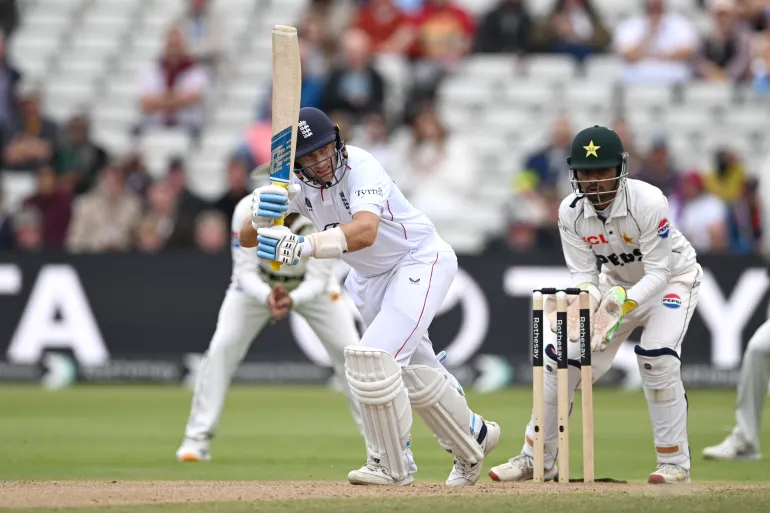
Joe Root led from the front as England survived a major wobble to beat Pakistan by eight wickets in the third Test at Edgbaston on Saturday, sealing a 3-0 series whitewash.
The home team, chasing just 130 to win, were in deep trouble when openers Ben Duckett and Emilio Gay were dismissed in the first over, bowled by Mohammad Abbas.
Recommended Stories
list of 4 itemsend of list
Root, England’s record runscorer, edged his first ball, bowled by Razaullah, through the slips for four in a nervy start but settled and scored quickly to take the sting out of the situation.
England captain Joe Root bats during day four of the third Test at Edgbaston [Gareth Copley/Getty Images]
The skipper was given a huge reprieve when he chopped onto the stumps off Mohammad Ali, only for the umpire to signal a no-ball, leaving the bowler distraught.
Root, with Jordan Cox at the other end, had another let-off when he edged an Abbas delivery between first and second slip, with neither fielder moving.
But he reached his half-century off 57 balls with a cut for four, and Cox matched him shortly afterwards.
England reached their target in the 25th over, with Root unbeaten on 62 and Cox 59 not out.
Jordan Cox (left) and Joe Root of England leave the field after winning the third Test [Gareth Copley/Getty Images
Root, in his second spell as England skipper after the departure of Ben Stokes, admitted his team were not the finished article but said he was delighted with their series win.
“The amount of uncertainty, noise and I guess chaos there was coming into the series, the way the guys have dealt with that – being so clinical with what we’ve had in front of us – and be stood here with a 3-0 win is really pleasing,” Root told Sky Sports.
“It sets us up nicely looking ahead to the start of a new era with (new head coach) Stephen Fleming coming in.”
Pakistan woes
It is England’s first Test series win since 2024, while Pakistan have now lost 16 of their last 21 games and are bottom of the World Test Championship table.
Root’s men had appeared set for a quickfire win inside three days on Friday before debutant fast bowler Razaullah launched an audacious assault with the bat, clubbing nine sixes as he raced to 81 off 63 balls.
The 21-year-old number nine, who also took four wickets in England’s first innings, put on 121 for the ninth wicket with fellow paceman Abbas (42) as England floundered.
Pakistan’s Razaullah laughs after surviving an LBW on day three [Darren Staples/AFP]
“We had a little bit of pushback yesterday which, in a strange way, was quite a good thing for the group,” said Root.
“Fair play to Razaullah; he made things difficult for us. He played some wonderful shots and made it very difficult to set fields to. He struck the ball nicely – I don’t know how he didn’t pull a muscle, swinging the bat that hard.”
The tourists sent seven players home after their crushing defeat in the second Test at Lord’s and brought in seven replacements, with Razaullah among them.
They also sacked head coach Sarfaraz Ahmed and assistant Umar Gul as their tour plunged into chaos.
The Pakistan team leave the field after bowling out England during the second day of the third Test [Philip Brown/Getty Images]
Pakistan made four changes to their side for the third Test, and they put up a fight despite being dismissed for a paltry 133 in their first innings.
Captain Babar Azam admitted his team would have to take stock after a one-sided series.
“Before we came here, we had to think about different things and to decide our team,” he said.
“We had a couple of changes after losing two matches. Playing in England is very difficult. We were trying to do our best in the third match.
“We need to sit down and look hard at our mistakes, decide our playing XI.”
The 3-0 whitewash is a huge tonic for England, who were in turmoil just weeks ago following a series loss to New Zealand and the exits of head coach Brendon McCullum and captain Stokes.
But tougher challenges lie ahead, starting with a Test series in South Africa in December and January, while a home Ashes looms next year.
Tehran, Iran – Iranian authorities and state media have praised the Houthis’ capture of Yemen’s Red Sea coast, which some see as giving Tehran more leverage against the United States.
The Houthis, a political and armed group dominated by Zaidi Shia Muslims, have been fighting against the Western-backed Yemeni government since capturing the capital, Sanaa, in 2014.
The Houthis captured a series of Red Sea coastal cities and islands this week, essentially giving them control over the vital Bab al-Mandeb strait.
The Iran-allied group’s recent victories have been praised in Iran, and are viewed by some as part of Tehran’s wider war against the US, ongoing since February 28.
“The victories of Yemen’s Ansar Allah in the western coast is a narrative of a divine triumph and the fruit of years of steadfastness in the most difficult of battlefields,” Hossein Mohebbi, spokesman of the Islamic Revolutionary Guard Corps (IRGC), wrote on X on Saturday.
Amid the Houthis’ recent battlefield wins against the fragmented Saudi-backed forces, senior Iranian officials have cheered their Yemeni allies on.
The Houthis’ capture of the port city of Mocha on Friday delivered a huge blow for the Yemeni government, which now has no direct access to the Red Sea.
Mohammad Bagher Ghalibaf, Iranian parliament speaker and chief negotiator with Washington, reposted a comment made by slain Supreme Leader Ayatollah Ali Khamenei in 2024, saying the “resistance” of the Houthis will inevitably lead to victory.
“The brave Yemeni people will certainly triumph, by permission of God Almighty,” Ghalibaf added on Thursday, in Arabic.
Iran’s First Vice President Mohammad Reza Aref said the government is happy with the Houthi advances, and urged leaders in the region to pursue “the rationality of liberation from dependency [from the US and the West], and unity under the banner of Islam”.
The “grand victory” of the Houthis once again proved that “security is not a commodity that can be bought,” added Mohammad Mokhber, an adviser to Iran’s Supreme Leader Mojtaba Khamenei.
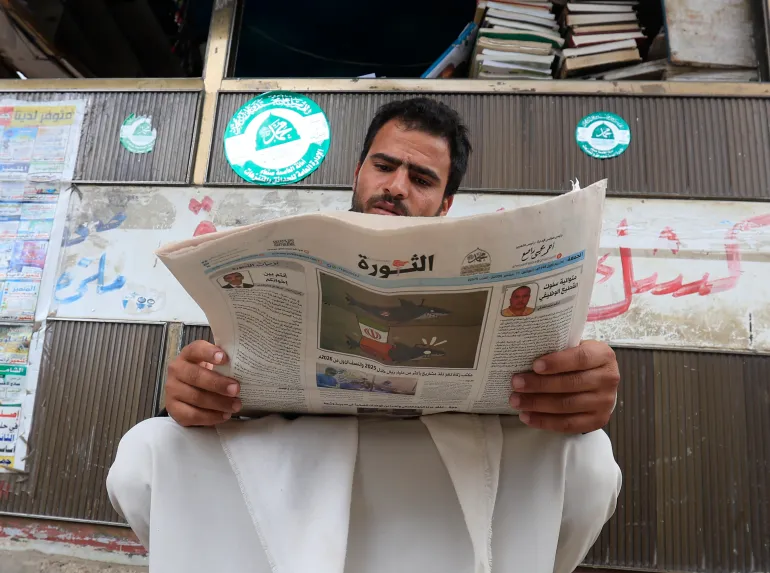
A man reads a local newspaper featuring news of the escalating fighting in the country, in Sanaa, Yemen, September 11, 2026. Yemen’s Houthi group said navigation in the Red Sea and Bab al-Mandeb strait remained safe except for Saudi vessels, which it says remain subject to a blockade, after seizing the port city of Mocha on September 10 and making further gains around the strategic strait the following day [Yahya Arhab/EPA]
How could this benefit Iran?
The Houthis began to attack several vessels in the Red Sea they claimed were linked to Israel in 2023, as part of their stated aim to pressure Israel to end the genocidal war on Gaza.
This prompted bombing campaigns by the US, United Kingdom and Israel against Houthi positions in Sanaa, Hodeidah and other areas.
Saudi Arabia, which joined the war against the Houthis in 2015, has largely stayed out of the current eruption in fighting in Yemen.
After their recent victories, the Yemeni group can now exercise more control over the Red Sea and the Bab al-Mandeb strait.
The Houthis’ control of Yemen’s Red Sea coastline and multiple islands – including the island of Mayun, also known as Perim, sitting about 3km (1.9 miles) off Yemen’s mainland – provides the group with close-range access to the Bab al-Mandeb strait.
A video published on Friday showed a Houthi commander telling soldiers they will no longer need missiles and drones to threaten shipping in the crucial waterway. They could simply position artillery along the coast and fire in all directions at ships, he said.
The Houthis have not declared the strait closed, but the group’s military spokesperson, Yahya Saree, said on Friday that “maritime navigation is safe for all companies except for Saudi vessels.”
Likewise, Iran’s partial control of the Strait of Hormuz on the other side of the Arabian Peninsula has been a key tool of leverage for Tehran in the war against the US.
The prospect of closing down the strait could potentially be used by Tehran in future negotiations over ending the war with the US.
Iranian officials are expected to meet regional Arab representatives on Monday for talks over how to facilitate shipping through the Strait of Hormuz, which Tehran maintains remains closed.
They have said they favour a collective regional approach on passage through the strategic waterway.
A person watches Houthi military spokesman Yahya Saree delivering a televised statement, in Sanaa, Yemen, September 11, 2026 [Yahya Arhab/EPA]
The US, which has continued its naval blockade of Iran’s ports and intensified sanctions on Tehran, reportedly opposes the agreement.
Authorities in Tehran have signalled there will be no talks with Washington under the current circumstances.
“As long as the American side does not accept all of Iran’s conditions, dialogue and negotiation are of no use,” Ebrahim Azizi, head of the hardline Iranian parliament’s national security commission, wrote on X on Saturday.
‘Lord of the straits’
At the start of the working week in Iran on Saturday, hardline and IRGC-linked newspapers and media outlets celebrated the recent Houthi advances.
Keyhan, whose editor-in-chief was appointed by Ali Khamenei, called the advances “the miracle of resistance” and said they had “put the US and Israel in a bind”.
The Quds newspaper, published by the influential Astan-e Quds Razavi in Mashhad, called Iran and the Houthis “the lord of the straits”.
But even though Tehran has repeatedly threatened that Bab al-Mandeb could be further disrupted if the war continues, Iran’s diplomatic apparatus did not immediately link the Houthi advances with the current fight against the US.
As has often been the case, Iran’s Ministry of Foreign Affairs insisted that the Houthis make their decisions independent of Tehran, with their own interests at heart, including ending Saudi Arabia’s blockade on Yemen.
The Iranian Foreign Ministry also called for an end to the Saudi siege on Houthi-controlled areas, an immediate return to negotiations between the group and Riyadh, and respect for Yemen’s sovereignty and territorial integrity.
The ministry also pushed back on the idea that the Houthis act merely as a proxy for Tehran.
“What is happening now in Yemen is the result of the Yemenis losing patience,” Foreign Ministry spokesman Esmaeil Baghaei told state television on Friday night.
“It is not fair to ignore the fact that they were under a cruel blockade for years, and concluded that the United Nations and regional mechanisms could not resolve the issues.”
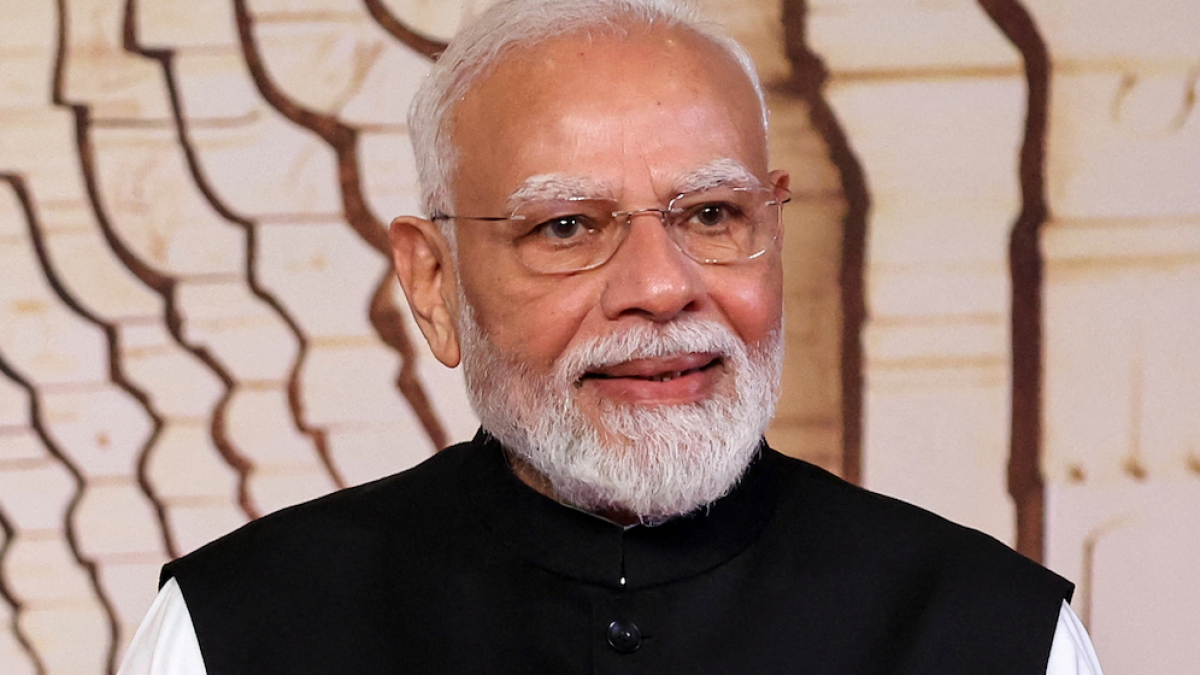
India’s Prime Minister Narendra Modi has called for an overhaul of global governance, saying Global South countries are impacted by decisions they are unable to shape. Opening the BRICS summit in New Delhi, he urged leaders to replace the ‘pyramid of privilege’ with a more equal system.
RIYADH: Prince Fahad bin Jalawi bin Abdulaziz, vice president of the Saudi Olympic and Paralympic Committee, received an honorary 6th Dan black belt from World Taekwondo President Chungwon Choue during their meeting at Taif Camel Racing Track.
World Taekwondo gave Prince Fahad the black belt in recognition of his efforts to support taekwondo globally and promote international sports through Saudi Arabia’s hosting of major events.
The honorary belt is awarded exclusively to heads of state and sports officials who support taekwondo’s development.
The presentation took place on the sidelines of the 15th General Assembly of the Islamic Solidarity Sports Association in Taif, which brought together leaders of Olympic committees from 57 Islamic countries, along with heads of international sports federations and organizations.
Earlier this year, an Iran-linked actor used Anthropic’s Claude artificial intelligence model to scrape and analyze data with the aim of helping target U.S. naval forces in the Middle East. A group in Yemen – very likely Iranian-backed Houthi militants – also used Claude to assist with work on guidance systems for ballistic and hypersonic missiles.
These are just some of the revelations about how adversaries and other malign actors have been using one of the premier pieces of AI software being developed in the United States that were contained in a new report Anthropic released late yesterday. The 154-page document also details instances where Claude was used directly and indirectly to support intelligence gathering and surveillance, cyberattacks, influence operations, and even worrisome biological research over the past eight months. In addition to Iran and Yemen, the human actors behind these activities were based in Russia, China, and a host of other countries.
Anthropic has shared details about what it calls the “misuse” of its models in the past, but describes the new report as its “most detailed” to date. The company has clearly been cataloging these case studies, and has assigned each one a control number. Though the entire contents of the report are cause for concern, the explicit attempt to use Claude to target American forces, as well as to develop new higher-end missiles and other military technology, are particular standouts and signs of what’s to come, as we will highlight below.
GTG-30005: Military reconnaissance
GTG-30005 is the case study dealing with the targeting of U.S. naval forces, and the summary is as follows:
“In another investigation, we identified and disrupted an Iran-nexus threat actor that used Claude to collect and analyze publicly accessible data to develop targeting recommendations against US naval forces in the region. The threat actor used Claude to compile targeting handbooks, through a Python pipeline the threat actor built with Claude’s assistance, to identify and track naval positions based on open-source information. The compiled material included a roster of US personnel scraped from captions on public military photographs; publicly accessible ship and aircraft transponder identifiers; commercial satellite-imagery query scripts; and an inventory of public websites that exposed US naval movements. The threat actor also directed Claude to compile vulnerability research on shipboard systems, cataloging known CVEs in maritime VSAT terminals, Cisco communications equipment, and industrial control products.”
“We banned the actor’s account, developed detections to reduce the risk of future misuse, and shared threat intelligence with government authorities to disrupt the threat.”
The Nimitz class aircraft carrier USS George H.W. Bush and several other US Navy warships sail together in the Arabian Sea in June 2026. CENTCOM
How exactly Anthropic defines the term “nexus” here is not immediately clear, and other entries in its new report also use “state-nexus” in addition to country-based variations. However, in this specific case, an addendum is added to the entry that explicitly says that the same account was separately tied to “domestic mass surveillance” software development work “for Iranian state systems,” clearly pointing to an actor directly linked to the regime in Tehran.
The use of AI technology by nation-state armed forces to develop target sets and engage them is already known to be growing globally. The Israel Defense Forces (IDF) have been a pioneer in this regard, but the U.S. military, China’s People’s Liberation Army (PLA), and others are also known to be developing and fielding these capabilities.
GTG-87001: Disrupting a Yemen-based guided weapons engineering cell using Claude to develop guidance software
Anthropic’s new report details an instance where an individual in Yemen used Claude as part of missile guidance work, which is given the control number GTG-87001.
“We identified a cell of threat actors based in northern Yemen running three weapons development programs: a guided rocket that used a commodity phone-class flight computer with final-phase homing guidance; a multi-stage ballistic missile with a stated range goal above 2,000 km; and a multi-variant missile (referred to as the “R2000” set) that included a hypersonic glide vehicle variant.”
“The actors used Claude Code in place of human software engineers to develop the guidance, navigation, and control (GNC) software that steers and stabilizes a flying vehicle. For example, they used Claude to integrate an open-source autopilot onto a phone-class flight computer, writing the control and position estimation software, tuning the control settings, running a firmware build pipeline, and performing a flight simulation. The actors managed several Claude instances at once, assigning each one a role, much as a lead would delegate work on a small engineering team: the actors tasked one instance with writing the code, another with research, and a third with reviewing the code the first instance produced.”
A graphic included in Anthropic’s new report summarizing the ways in which Claude was used by the actors in Yemen to support missile guidance system development. Anthropic
“Our safeguards blocked many of their requests, but not all of them. The actors used a variety of tactics to evade our safeguards, including hiding their goals and the products the software was meant for, and they split their work across multiple sessions so no single session revealed their full intent.”
“These actors carried out a sustained effort to develop guided weapons, including using Claude to design guidance software. We do not have evidence the actors succeeded in fielding an operational device; but they did test-fire a guided rocket. This field test appears to have failed: within hours, the actors returned to Claude to work out why it failed.”
“We identified this activity as part of our internal investigations into suspected weapons development. We banned accounts associated with the actors and shared threat information with public- and private-sector partners to mitigate risks posed by the actors. Nevertheless, we have evidence that the actors had already built an offline simulation toolkit that does not rely on Claude or other engineering computing environments such as MATLAB.”
As mentioned earlier, the report does not name the Houthis, but that group has historically been based primarily in the northern end of Yemen. It is also the only entity in the country known to have active missile development programs, which are conducted with critical support from Iran.
Whether this particular work directly resulted in any new capabilities is unknown. Anthropic notes that there looked to be at least one failed test launch before the accounts were banned, which would have occurred sometime after the beginning of this year, based on the stated cutoff dates for the report. By the end of 2025, the Houthis had already amassed a wide array of very real ballistic missiles, including types with at least claimed ranges of 2,000 kilometers (approximately 1,242 miles). The group also has a variety of cruise missiles and one-way attack drones that it has employed operationally.
An example of just one of the many types of ballistic missiles in the Houthis’ arsenal. Houthi-controlled media
Still, being able to leverage Claude could only have helped any domestic missile development efforts in Yemen, which might help reduce dependency on Iran, at least to a degree. Furthermore, developing functional hypersonic glide vehicles capable of prolonged stable flight has historically been notoriously difficult, even for entities with extensive relevant knowledge bases on an organizational level.
GTG-17001: Disrupting a China-based operation using Claude to draft a fire control specification and acquisition documents for undersea warfare
Use of Claude in foreign military endeavours goes beyond the Middle East, as evidenced by case study GTG-17001. This involved a Chinese actor conducting work related to a naval counter-torpedo defense system.
“We identified a China-based threat actor who used Claude to advance three parallel tracks of work on an anti-torpedo weapons system:”
“First, the actor used Claude to draft a Chinese-language specification for an anti-torpedo fire control system (the core logic that aims and times an anti-torpedo weapon’s response). The document was written to win approval from a Chinese defense manufacturer, which would move the work on to technical certification and operational testing.”
“Second, the actor used Claude to produce a Chinese-language technical proposal of more than 200 pages, accompanied by an executive briefing deck.”
“Third, the actor used Claude to benchmark their own system against specific US anti-torpedo and anti-submarine programs based on publicly accessible information. They then generated a Chinese-language briefing on US Navy systems derived from open-source reporting.”
“The actor presented themselves as an original equipment manufacturer in the US defense sector. We assess the actor was associated with a Chinese defense industry manufacturer aiming to produce a weapons specification and acquisition proposal for the People’s Liberation Army Navy.”
This picture shows a test of an anti-torpedo system fitted experimentally to a Nimitz class aircraft carrier in the 2010s. USN
“The actor used Claude to write the acquisition proposal, refining it over many drafts. After each draft, the actor instructed Claude to role-play a hostile expert reviewer to critique the proposal, then used that feedback to sharpen the next version. In parallel, the actor used Claude to build pieces of the anti-torpedo weapons system’s fire control software and a test matrix to validate them.”
“The operational lift the actor achieved was a function of using Claude to automate complex technical outputs. The actor leveraged the model to compress the development timelines for the certification registry, compliance documentation, and automated fire control logic. The actor also accelerated the traditional human review cycle by having Claude critique the acquisition proposal across multiple rounds of review while role-playing a persona.”
“We uncovered this activity as part of our internal investigations into suspected weapons development. We cannot attribute the activity to a specific entity or actor. But we have banned the account for violating our Supported Regions Policy and our Usage Policy, which prohibits weapons design and development, and incorporated our investigative findings into our safeguards to mitigate the risk of future misuse.”
Anthropic’s report does not name the U.S. programs leveraged here, but does note the information in question was publicly available. Anti-torpedo systems for surface warships and submarines have been an area of significant interest for the U.S. Navy for years now. Those developments have also produced compact torpedo designs for use in other applications.
A Very Lightweight Torpedo (VLT), a compact torpedo design developed by Northrop Grumman. Northrop Grumman
The PLAN’s interest in these same kinds of capabilities is not at all surprising. Underwater threats and countermeasures to them, broadly speaking, would play a central and vital role in any future conflict between the United States and China across the broad expanses of the Pacific.
GTG-27005: Disrupting a Russia-based operation using Claude to engineer an autonomous military drone swarm
Another case study, GTG-27005, details the use of Claude by Russian actors working on drone swarming technology.
“We identified likely freelance Russia-based threat actors who set out to build a full-stack autonomous first-person-view (FPV) kamikaze drone swarm. The actors used Claude Code to write and test the code and save it directly into the actors’ own project files. In addition to Claude Code, the actors used a software-in-the-loop simulation stack and a rented graphics processing host for model training. They called the operation ‘DronDoc’ or ‘Serafim.’”
“The actors used Claude to build the core software system, including the drones’ shared swarm memory and fault-tolerant coordination logic (FTCL); an onboard small language model to govern attack, observe, and return-to-base behaviors; a terminal guidance software system to steer drones to their target (using the onboard camera) and issue the call to detonate; a control-link geolocation module to find opposing drone operators; a passive acoustic detection layer; and low-level logic for the drones’ programmable chips. The actors designed the platform for autonomous lethal engagement; the onboard model could select targets (including a ‘person’ target class) and issue detonation commands without a human in the loop. The actors’ activity—including flashing the low-level firmware to live development boards, provisioning single-board computers, and wiring up a simulation environment over a mesh network—confirmed that they were using real hardware-in-loop testing within their sessions.”
Many were surprised yesterday by the news that a Russian fiber-optic FPV drone flew into Kramatorsk and attacked a car.
But there is nothing surprising here. The war of 2025 is already very different from the war of 2024. From LBZ to Kram — 20 kilometers. Enemy FPVs can fly even… pic.twitter.com/hTfhJFPcxZ
“The actors trained a computer vision classifier on scraped Ukrainian combat footage, splitting the target classes into “enemy” and “friendly,” and allow-listing Russian systems. They also repeatedly used a fixed coordinate in Donetsk Oblast as the demonstration strike point, with front-line cities and corridors in Ukraine as the mission geography.”
“The actors created their accounts between late 2025 and early 2026 and started the operation in mid-May 2026. The actors circumvented our geographic access controls by routing traffic through commercial virtual private servers.”
“We assess the actors were a small, specialized freelance team doing a mix of civilian and military work, not a Russian state entity. We identified nine accounts associated with this group; eight were used only for ordinary freelance work, not weapons-related software development. Based on our investigation, we assess the actors had ties to a regional university with a federal research center associated with the Russian Academy of Sciences. The actors claimed to have received funding from Russia’s Advanced Research Foundation, National Technology Initiative, and Ministry of Defence, though we cannot verify those claims. We identified this activity as part of our internal investigations into suspected weapons development, we banned accounts associated with the actors, and have incorporated our investigative findings into safeguards to reduce the risk of future misuse.”
Anthropic’s report included a table, reproduced below, detailing different types of drones and other capabilities that were fed into the model as part of this work.
GTG-17002: Disrupting a China-based operation using Claude to build targeting software for electronic warfare and air defense suppression
The last case study in the Conventional Weapons section of Anthropic’s new report, GTG-17002, covers electronic warfare-related work by a Chinese actor, with a particular focus on potential air defense targets in Taiwan.
“We identified a China-based actor who used Claude’s chat, coding, and agentic work tools to design, build, and iterate on a Chinese-language suite of about 16 modules for electronic warfare, using the electromagnetic spectrum to detect, jam, or deceive an opponent’s radar and communications, and for suppressing an opponent’s air defenses.”
“The actor used Claude to build the software system, from the underlying logic to the user interface, and iterated through 12 versions. This included implementing and optimizing the system’s radar detection and jamming physics, generating a vulnerability analysis module, and drafting Chinese-language targeting instructions. The software suite the actor built analyzed an opponent’s radars, surface-to-air missile sites, command posts, and communications nodes, then computed their detection coverage, assessed the effectiveness of jamming, ranked targets by value and vulnerability, including which to suppress first, and determined how best to assign jammer sorties to targets across multi-day campaigns. The suite also ranked which of an opponent’s assets to suppress first, and modeled specific engagement envelopes, including those of Patriot and THAAD-class [Terminal High Altitude Area Defense] systems.”
“Mid-project, we observed the actor change the simulation’s default scenario to 12 targets in Taiwan. The targets included a command bunker in Taiwan, an early warning radar site, Patriot and Tien Kung [surface-to-air missile] batteries, major air bases, and a regional combatant command headquarters.”
NCSIST – Tien Kung III Air Defense Missile & Hsiung Feng III Anti-Ship Missile Live Firing [480p]
“The actor also ran a self-hosted model on an internal network alongside Claude and connected the software suite to this model through a tool-use integration.”
“Based on our investigation, we assess the actor is a China-based defense and military-industrial researcher. Account-level metadata and content flagged by our safeguards indicated the actor was linked to PRC research institutions, including the PLA Academy of Military Sciences. We detected this activity as part of our internal investigations into suspected weapons development, we banned accounts linked to the actor, and have incorporated our investigative findings into our safeguards to reduce the risk of future misuse.”
An accompanying table, seen below, mentions several specific types of U.S.-made air defense radars, as well as the Link-16 datalink network, as having come up in the course of this work. Electronic warfare variants of the Chinese Y-8 and Y-9 aircraft, as well as the J-16D electronic warfare jet, and what appears to be a reference to the Golden Eagle drone helicopter, are also mentioned.
A Chinese Y-8GX-11, one of several electronic warfare variants of the Y-8/Y-9 design. Chinese internet via X
China’s J-16D Shows Versatility Across Reconnaissance, Attack, Defense: Designers
The suppression of enemy air defenses is an essential part of any modern air campaign, whether conducted independently or as a part of a larger operation. This would be no less critical in any military intervention against Taiwan from the mainland, or any other larger-scale conflict the PLA might find itself in.
Guardrails and ethics
Beyond the details in any of the specific case studies, Anthropic’s new report underscores growing broader concerns about guardrails for the use of AI and general ethics surrounding the technology. As noted in the instances above, Anthropic has also implemented various safeguards to try to block access to Claude from certain regions and/or to prevent the model from conducting certain types of work. At the same time, what the company has now shared makes clear that those protections can still be circumvented to a significant degree, at least for now.
TWZ has noted in the past that America’s adversaries are likely to be less worried about ethics, in general, when it comes to AI. Anthropic’s new report also shows there are few bounds to what state-aligned or even non-state actors might seek to use this technology for, including the development of potential weapons of mass destruction.
At the same time, AI models like Claude are not going away, and developments continue to advance at an ever-quickening pace, opening the door to further proliferation. Developments are rapidly intermingling globally, with companies in China notably leveraging models created in the U.S. to further their own work, which is then released publicly. The technology will increasingly become more integrated and critical to most aspects of military operations and weapons development, alongside its commercial and civilian applications. It is just as much a superweapon as anything else, and the country with the more capable models, and the willingness to deploy them, will have a major edge in future conflicts.
With all this in mind, it seems very plausible, if not probable, that the case studies described in Anthropic’s new report are just the tip of an approaching iceberg that will need a concerted effort to tackle.
Aryna Sabalenka was fully aware she would have to win the US Open to stand any chance of stopping Elena Rybakina overtaking her as world number one.
Even that would not necessarily be enough. And as the pair prepare to meet in Saturday’s final, Sabalenka knows her 99-week stay at the top of the world rankings is at an end.
Kazakhstan’s Rybakina is assured of replacing Sabalenka at the top of the rankings, guaranteeing that by reaching the semi-finals.
Having also beaten the Belarusian to win this year’s Australian Open title, Rybakina now has the opportunity to inflict further damage.
But that provides extra motivation for Sabalenka before their fourth meeting of the year.
“It is going to be red rag to a bull for her – she is not going to be happy,” said former British number one Annabel Croft on BBC Radio 5 Live.
“Now she has the opportunity to end this year on a high.”
Sabalenka, who has beaten Rybakina in Indian Wells and Miami since the Melbourne final, still has history in her sights as she bids to become only the third woman in the Open era to win the New York singles title three years in a row.
The four-time Grand Slam champion’s victory over American third seed Jessica Pegula in the semi-finals was her finest display in months, playing with a fire and freedom that had been missing previously.
Afterwards, Sabalenka played down the significance of losing her ranking, joking she did not care about it.
But she clearly does. Sabalenka’s coach Anton Dubrov said as much when he spoke about how the issue has been hanging over her.
“I actually like this [losing the ranking] happened. It’s ended and it’s extra fuel,” Dubrov said.
“There is no more extra draining [of mental energy] or thinking about it.
“There’s a next chapter right now. You have to chase again. It’s extra motivation for you. Just go and get it.”
President Donald Trump is making himself the centre of the Republican Party’s campaign for the 2026 midterm elections, but growing concerns within his own party are raising questions about whether a Trump focused strategy can attract the independent voters Republicans need to retain control of Congress.
At the Republican Party’s first ever midterm convention in Dallas this week, Trump urged voters to “pretend that I’m on the ballot” as he sought to recreate the enthusiasm and turnout that helped him win the presidency in 2016 and 2024.
The strategy is designed to energise Trump’s loyal supporters, but it comes with significant risks. Trump’s approval ratings have fallen sharply among independents, while inflation and the war with Iran have created vulnerabilities for Republicans seeking to defend their congressional majorities.
Trump Puts Himself at the Centre
Trump’s message at the convention was straightforward: the midterms should be treated as a referendum on his presidency.
Stay ahead of the geopolitical week.
MD Briefing delivers expert analysis across five global fronts — the Indo-Pacific, energy, geoeconomics, European security, and the Middle East — every Monday morning. Free.
Rather than allowing individual Republican candidates to campaign primarily on local issues, the party is seeking to nationalise the election around Trump’s agenda and political brand.
The approach reflects Trump’s continued dominance within the Republican Party. His most committed supporters remain highly loyal, and party activists believe his presence can motivate voters who might otherwise stay home during a midterm election.
But the strategy also exposes Republicans to Trump’s weaknesses.
A president who is popular among Republican voters but significantly less popular with independents could become an obstacle for candidates fighting in competitive districts and states.
The Independent Voter Problem
The divide between Republican voters and independents is particularly important.
A Reuters/Ipsos poll conducted in late August found Trump’s overall approval rating at 33%, the lowest level of his presidency. His approval among Republicans stood at 82%, while among independents it had fallen to 22%.
That creates a difficult electoral calculation.
Republicans need Trump’s supporters to turn out, but they also need to persuade voters who are not firmly aligned with either party.
Five of the 15 Republicans interviewed at the convention expressed doubts about whether Trump was the party’s strongest messenger for reaching independents.
Even those who supported putting Trump at the centre of the campaign acknowledged that the strategy carried risks.
The Economy Could Be Trump’s Biggest Vulnerability
The convention also highlighted a gap between Trump’s political messaging and voters’ economic concerns.
The high cost of living remains one of the most important issues facing American voters, but Trump devoted relatively little attention in his convention speeches to addressing those concerns.
He instead claimed that food prices were rapidly declining, despite government data indicating otherwise.
Trump also promised a $5,000 “Trump dividend” for every American adult if Republicans retain control of Congress, without explaining how the payments would be financed.
The economic issue presents a particular challenge because Republicans cannot rely solely on Trump’s popularity with their base if voters are dissatisfied with their personal financial circumstances.
Republicans Still See Trump as Their Best Option
Despite the concerns, most Republicans at the convention supported the strategy.
Ten of the 15 Republicans interviewed said putting Trump front and centre was the party’s best approach. They argued that his ability to energise Republican voters outweighed the risks created by his lower support among the broader electorate.
For many Republicans, the alternative may appear even less attractive.
Trump remains the party’s most powerful political figure, and his supporters are among the most engaged parts of the Republican electorate.
The question is whether that enthusiasm can be converted into the broader coalition required to win competitive races.
Democrats Welcome the Strategy
Democrats have little incentive to discourage Republicans from making the election a referendum on Trump.
The Democratic Party can use the president’s economic record, approval ratings and handling of foreign policy to argue that voters should reject Republican candidates as a way of rejecting Trump’s agenda.
Republicans are attempting to counter that strategy by portraying Democrats as increasingly radical and warning that a Democratic victory would threaten American values and way of life.
For Republican activists, the argument is that concerns about the Democratic Party could ultimately outweigh dissatisfaction with Trump.
But that calculation may be more difficult in closely contested districts where voters are less ideologically committed.
Vulnerable Republicans Keep Their Distance
The tension between Trump’s national strategy and individual candidates’ electoral needs was visible at the convention itself.
Some of the Republican Party’s most vulnerable candidates did not attend the Dallas gathering, instead remaining focused on their own districts.
For candidates representing competitive areas, distancing themselves from the national political environment could allow them to emphasise local concerns and avoid becoming entirely associated with Trump’s approval ratings.
That creates a potential contradiction within the Republican campaign.
The party leadership wants Trump at the centre of the election, while some candidates may have more to gain by keeping their own campaigns focused on local voters.
What Comes Next?
Trump is likely to remain heavily involved in the Republican campaign as the midterms approach.
His political organisation can provide candidates with fundraising, publicity and access to a highly motivated voter base.
But Republican candidates will have to decide how closely they want to associate themselves with him, particularly in competitive districts.
The party’s success may ultimately depend on whether it can combine Trump’s ability to mobilise his core supporters with messages that address the economic concerns of independent and moderate voters.
Implications and Analysis
The Republican Party’s dilemma is fundamentally about the difference between mobilising voters and persuading voters.
Trump is highly effective at the first. His political brand can generate enthusiasm among Republicans and give supporters a reason to participate in an election in which he himself is not on the ballot.
The harder question is whether he can do the second.
Midterm elections are not presidential elections, and congressional candidates often need to build broader coalitions than those required to win a party’s presidential nomination. If Republican candidates make the election entirely about Trump, they may benefit from stronger turnout among his supporters but also inherit his weaknesses among independents.
The Dallas convention therefore represents a calculated gamble.
Republicans appear to believe that Trump’s ability to energise their base is more valuable than the potential cost of alienating voters outside it. Democrats, meanwhile, are likely to welcome any strategy that allows them to make the election a referendum on a president whose approval among independents has fallen sharply.
The Republican Party’s challenge will be to ensure that Trump remains an electoral asset rather than becoming the only issue voters are asked to consider.
If his political machinery succeeds in bringing disengaged Republicans back to the polls, the strategy could strengthen the party’s position.
But if economic dissatisfaction and concerns about Trump’s broader record dominate among independents, putting him at the centre of the campaign could give Democrats exactly what they want: a national election in which every Republican candidate is forced to defend a president who is not actually on the ballot.
Acting President Delcy Rodríguez celebrated the agreement with Colombia’s Gilinski Group. (VTV)
Caracas, September 11, 2026 (venezuelanalysis.com) – Venezuela’s oil industry recovery has stagnated in recent months, notwithstanding pro-business reforms and rising global prices.
OPEC’s latest monthly report placed the Caribbean nation’s August production at 1.145 million barrels per day (bpd), up 23,000 bpd from the previous month, according to secondary sources.
Venezuelan state oil company PDVSA reported an August output of 1.201 million bpd, virtually unchanged from July. Direct and secondary measurements have differed over time due to disagreements over the inclusion of condensates and natural gas liquids.
The strong first-trimester recovery that followed Washington’s lifting of its naval blockade petered out by mid-year. Since May, output has grown by only 7 percent despite the acting Delcy Rodríguez government conducting a pro-investor overhaul of hydrocarbon legislation and signing deals with several multinational corporations.
Since the January 3 US military strikes and kidnapping of President Nicolás Maduro, the Trump White House has seized control over Venezuela’s energy sector. Venezuelan crude export revenues are currently deposited in a US Treasury account, an arrangement confirmed by PDVSA President Héctor Obregón, before US officials decide when and how much of the proceeds should be returned to Caracas.
Washington and Caracas recently announced a major oil deal that will further boost US access to Venezuelan hydrocarbons under favorable conditions. The acting Rodríguez government has granted long-term concessions of 17 prime oilfields, holding 65 billion barrels of proven reserves, to US-controlled NABEP, a company led by Venezuelan oil mogul Alejandro Betancourt.
The oilfields transferred to NABEP, several of which were previously run by joint ventures between PDVSA and Chinese partners, are split among extra-heavy-crude projects in the Orinoco Oil Belt and mature light- and medium-crude ones in the Lake Maracaibo basin. Production in the latter can be ramped up faster as Trump seeks to replenish the US strategic reserve.
After initially hailing the deal as “the biggest in history,” US officials have dampened expectations, lowering a US $100 billion investment pledge to “over $10 billion.” Caracas and Washington announced a 1.5 million bpd target, but NABEP disclosed to Bloomberg only a modest projected increase in the near future.
Venezuela’s loss of sovereignty over its flagship industry has prevented the country from reaping the benefits from surging global energy prices, with the Brent benchmark surpassing $100 per barrel for the first time in four months this week. The Trump administration has sought to leverage its long-term access to Venezuelan oil resources to minimize the fallout from the interrupted traffic through the Strait of Hormuz resulting from its war on Iran.
Since January, Trump officials have worked closely with the Rodríguez administration to grant decades-long energy concessions to Western corporate players and most recently local Latin American conglomerates such as Colombia’s Gilinski Group.
On September 4, Acting President Rodríguez signed a 25-year deal granting a concession of the heavy crude Bare block to GeoPark, a company belonging to Gilinski. Previously operated by PDVSA, Bare was one of the most productive fields in the Orinoco Oil Belt, with output surpassing 100,000 barrels per day (bpd) in 2011.
At a ceremony in Caracas, Colombian banking mogul Jaime Gilinski thanked Rodríguez for the confidence in awarding a major oilfield to his conglomerate. GeoPark set an 85,000 bpd target and vowed to invest more than $300 million.
The Gilinski Group began in manufacturing before expanding into finance, purchasing multiple Colombian banks and later acquiring positions in other Latin American countries, the US, and Italy. Investigations have implicated the Gilinski Group in parallel banking and tax evasion, including being named in the 2021 Pandora Papers leak alongside other leading members of the Colombian elite. The conglomerate has also ventured into other sectors such as food and media, with Jaime Gilinski currently the richest man in Colombia according to Forbes.
Of Lithuanian-Jewish descent, the Gilinski family is additionally known for its close ties to Israel. Jaime Gilinski’s father, Isaac, served as ambassador to Tel Aviv in 2010-2013, and his sister, Tania, was recently appointed to the same post by Colombian President Abelardo de la Espriella. Jaime’s son, Gabriel, traveled to Tel Aviv in 2025, meeting Prime Minister Netanyahu and evaluating business opportunities between Israeli and Colombian firms.
Edited and with additional reporting by Lucas Koerner in Philadelphia, USA.
Saudi Arabia has closed a critical oil pipeline after it was attacked by drones launched from Iraq, as conflict in the Middle East widens.
Iraq said it had fired a military commander and launched an investigation after admitting the drone attack on its neighbour’s East-West pipeline had originated in one of its provinces bordering Iran.
The 1,200km (745 mile) pipeline has helped Saudi Arabia – the world’s largest crude oil exporter – bypass the Strait of Hormuz.
The incident comes amid a major advance by the Iranian-backed Houthi rebels in Yemen, putting more pressure on global oil shipping routes as the US-Iran war stretches into its seventh month.
Riyadh on Friday said it had shut the pipeline as a precaution, as satellite images of scorched ground and smoke near the site emerged.
The foreign ministry said the attack resulted in some injuries and damage, which was still being assessed.
The pipeline has been moving 4% to 5% of global oil supply, news agency Reuters has reported, citing ship tracking companies and analysts.
Saudi Arabia has chosen not to retaliate at this stage, its foreign ministry says, following a call from Iraq’s prime minister.
It said the kingdom would “support the efforts of the Iraqi government” to “prevent attacks” launched from the country against neighbouring states.
“The Kingdom of Saudi Arabia affirms that it reserves its right to take all necessary measures to safeguard its sovereignty and security, protect its facilities, and ensure the safety of its citizens and residents,” the statement added.
The Iraqi prime minister’s office in its own statementsaid the operations commander in the Maysan governorate – a province which borders Iran – had been removed from his post following confirmation the drone attack had been launched from that region.
Within the increasingly specialized field of peptide and metabolic signaling inquiry, AICAR has emerged as a particularly intriguing molecular subject due to its theorized relationship with cellular energy regulation, mitochondrial communication pathways, and adaptive biochemical signaling environments. Although often associated with metabolic research discussions, AICAR occupies a broader scientific position believed to extend beyond simple energy-oriented investigation. Research literature increasingly suggests that the compound may participate in highly nuanced intracellular processes connected to stress adaptation, nutrient sensing, enzymatic communication, and molecular resilience mechanisms across diverse research models.
AICAR, formally known as 5-Aminoimidazole-4-carboxamide ribonucleotide, is structurally related to naturally occurring intermediates involved in purine biosynthesis. Because of this relationship, the molecule has attracted considerable attention in biochemical research environments focused on cellular metabolism and signaling coordination. Investigations purport that AICAR may function as an indirect activator of AMP-activated protein kinase, commonly abbreviated as AMPK, a regulatory enzyme frequently theorized to operate as a cellular energy sensor within the system.
AMPK itself has become a major point of interest in contemporary molecular science because of its proposed involvement in maintaining energetic equilibrium under fluctuating environmental conditions. Research indicates that when energetic stress signals accumulate within cellular systems, AMPK-associated pathways might influence a wide range of downstream biochemical activities involving glucose handling, lipid signaling, mitochondrial turnover, and protein synthesis coordination. Due to AICAR’s theorized interaction with this signaling network, the compound has become deeply integrated into experimental metabolic frameworks.
One of the most discussed properties of AICAR involves its potential relationship with mitochondrial biology. Mitochondria, frequently characterized as central energetic regulators within cellular systems, remain heavily studied due to their possible participation in longevity-associated signaling, oxidative balance, and adaptive cellular responses. Scientific literature suggests that AICAR exposure in controlled research settings may correlate with shifts in mitochondrial biogenesis signaling pathways. It has been hypothesized that this relationship might involve transcriptional regulators such as PGC-1α, a coactivator frequently examined in mitochondrial adaptation research.
Stay ahead of the geopolitical week.
MD Briefing delivers expert analysis across five global fronts — the Indo-Pacific, energy, geoeconomics, European security, and the Middle East — every Monday morning. Free.
Because mitochondrial functionality intersects with numerous branches of biochemical inquiry, AICAR has gradually entered investigative discussions involving endurance-associated metabolic adaptation, cellular resilience environments, and nutrient-sensing systems. Researchers have theorized that the peptide-related compound may provide insight into how cells adapt under resource-limited conditions, particularly in environments characterized by altered energetic availability.
Another area of increasing scientific curiosity involves the potential relationship between AICAR and glucose metabolism pathways. Research indicates that AMPK-associated signaling networks may influence glucose transporter activity and intracellular glucose utilization mechanisms. Within these frameworks, AICAR has been explored as a molecular research tool with the potential of assisting investigators in mapping the biochemical hierarchy involved in carbohydrate-associated signaling environments.
Importantly, these investigations do not merely focus on isolated metabolic reactions. Instead, contemporary scientific inquiry increasingly examines metabolic signaling as part of a larger communication network connecting cellular stress responses, inflammatory mediators, redox balance systems, and transcriptional regulation mechanisms. Within this broader perspective, AICAR may represent more than a singular metabolic modulator. It might instead serve as a biochemical bridge connecting energetic signaling to adaptive cellular communication networks.
Research literature has also explored the possibility that AICAR-associated pathways may intersect with autophagy-related signaling. Autophagy, a tightly regulated intracellular recycling mechanism, remains a prominent topic within longevity-oriented and degenerative-condition research domains. Investigations suggest that AMPK-associated activation environments might influence autophagic coordination through interactions with mTOR-related signaling pathways. Because AICAR appears connected to AMPK-associated activity, scientists have theorized that the molecule may help researchers better understand the balance between anabolic and catabolic cellular states.
The relationship between AICAR and mTOR signaling has generated considerable attention in molecular biology discussions. mTOR, or mechanistic target of rapamycin, is widely recognized as a nutrient-responsive regulatory complex associated with growth-related cellular processes. Research models suggest that energetic stress signaling may suppress certain mTOR-associated activities while promoting cellular conservation mechanisms. Within this context, AICAR has become increasingly valuable as an investigative compound for studying how systems prioritize energetic resources during fluctuating environmental conditions.
Beyond metabolism-centered inquiry, AICAR has also entered conversations surrounding cardiovascular signaling research. Investigations purport that AMPK-associated pathways may participate in vascular regulation, endothelial communication, and oxidative stress adaptation. Some researchers hypothesize that AICAR-related signaling environments could assist in clarifying how cellular systems respond to energetic strain within circulatory tissues. Although many mechanistic questions remain unresolved, the peptide-associated molecule continues to attract interest in biochemical discussions involving cellular oxygen utilization and stress-response coordination.
Neurological research domains have likewise shown growing interest in AMPK-associated signaling pathways. Cellular energy regulation within neurological tissue remains a major focus of contemporary investigation due to the substantial energetic demands associated with neural communication. Scientific discussions increasingly propose that metabolic imbalance, mitochondrial dysfunction, and impaired energetic adaptation might intersect with neurodegenerative signaling environments. Within these frameworks, AICAR has occasionally been examined as a research compound with the potential of illuminating relationships between energetic sensing pathways and neuronal maintenance mechanisms.
Another compelling dimension of AICAR research involves inflammatory signaling environments. Chronic inflammatory activity has become increasingly recognized as a contributing factor across multiple degenerative conditions and longevity-associated biological shifts. Research indicates that AMPK-associated pathways may interact with inflammatory mediators and oxidative stress regulators. Consequently, AICAR has entered exploratory discussions focused on how energetic signaling networks may influence broader cellular communication systems tied to inflammation-associated processes.
Interest in oxidative stress biology has further expanded AICAR’s research relevance. Oxidative balance remains essential for maintaining stable intracellular environments, particularly under metabolically demanding conditions. Some investigations suggest that AMPK-associated signaling might influence antioxidant regulatory pathways and mitochondrial stress adaptation responses. Within these experimental contexts, AICAR has been hypothesized to serve as a useful molecular tool for studying how cells attempt to preserve equilibrium when exposed to fluctuating energetic or oxidative conditions.
Although many mechanistic uncertainties remain unresolved, AICAR persists as a compelling molecular subject whose properties may contribute to a deeper understanding of how energetic regulation influences cellular coordination across complex biological systems. In modern scientific inquiry, where interconnected signaling pathways increasingly define research priorities, compounds such as AICAR may remain valuable tools for exploring the sophisticated architecture underlying metabolic adaptation and cellular communication throughout the system. Researchers interested in more useful peptide data are encouraged to visit www.corepeptides.com.
References
[i] Hardie, D. G. (2011). AMP-activated protein kinase: An energy sensor that regulates all aspects of cell function. Genes & Development, 25(18), 1895–1908. https://doi.org/10.1101/gad.17420111
[iii] Corton, J. M., Gillespie, J. G., Hawley, S. A., & Hardie, D. G. (1995). 5-Aminoimidazole-4-carboxamide ribonucleoside. A specific method for activating AMP-activated protein kinase in intact cells? European Journal of Biochemistry, 229(2), 558–565. https://doi.org/10.1111/j.1432-1033.1995.tb20498.x
[iv] Narkar, V. A., Downes, M., Yu, R. T., Embler, E., Wang, Y. X., Banayo, E., Mihaylova, M. M., Nelson, M. C., Zou, Y., Juguilon, H., Kang, H., Shaw, R. J., & Evans, R. M. (2008). AMPK and PPARδ agonists are exercise mimetics. Cell, 134(3), 405–415. https://doi.org/10.1016/j.cell.2008.06.051
[v] Jäger, S., Handschin, C., St-Pierre, J., & Spiegelman, B. M. (2007). AMP-activated protein kinase (AMPK) action in skeletal muscle via direct phosphorylation of PGC-1α. Proceedings of the National Academy of Sciences, 104(29), 12017–12022. https://doi.org/10.1073/pnas.0705070104
US President Donald Trump suggested Thursday that the war with Iran could end before the Nov. 3 midterm elections, a day after predicting it would conclude immediately afterward.
“I don’t know that they’re gonna be able to hold out. But it’ll get settled after the elections. Or maybe sooner,” Trump reportedly told broadcaster NewsNation over the phone, referring to mounting US economic pressure on Iran.
Trump also denied reports that Iran’s latest retaliatory strikes on a US base in Jordan damaged US aircraft in the region. “Nope… None whatsoever. No damage. No nothing.”
On Wednesday, Trump had said the war would “end immediately” after the midterms.
“I think the war will end immediately after the election because they can’t hold out any longer,” he told reporters ahead of a trip to Dallas, Texas.
His comments contrast with a Wall Street Journal report hours later that senior White House advisers have privately warned the conflict could continue through the remainder of his term.
The war, now in its seventh month, has killed 18 US servicemembers and raised concerns over military resources and disruptions to global energy markets.
US gasoline prices averaged $4.22 a gallon Wednesday, up from $4.01 a month earlier and $3.19 a year ago, according to the American Automobile Association (AAA).
Trump has repeatedly expressed a desire for a quick resolution while supporting a broader economic campaign against Tehran.
Treasury Secretary Scott Bessent has described the strategy, dubbed “Operation Economic Outcast,” as an alternative to major combat operations.
Saudi Arabia on Friday announced it had to temporarily shut down the key east-west pipeline after drone attacks on Thursday from an Iranian-backed militia group in Iraq. As we have explained in the past, the Kingdom has diverted millions of barrels of oil per day through pipelines to its Yanbu port on the Red Sea in an effort to minimize the energy shortages due to hostilities near the Persian Gulf that have closed the Strait of Hormuz.
The pipeline was shut down a day after the Houthi rebels of Yemen increased their control over the crucial Bab al-Mandab Strait (BAM), a narrow body of water separating the Red Sea from the Gulf of Aden. Combined with Iran vastly curtailing shipping through the Strait of Hormuz, this gives Tehran significant control over two of the world’s most crucial passageways for the flow of oil.
3. The Houthis have reportedly attempted to seize ROYG-controlled islands in the Red Sea from which Houthi fighters could launch attacks on international shipping. Houthi forces reportedly landed on the Hanish Islands in the southern Red Sea on the morning of September 10 after… pic.twitter.com/tiFPgNDOHZ
“The East-West pipeline, in the regions of Riyadh and Medina, was subjected to several attacks on Thursday morning, September 10, 2026,” Saudi Arabia’s Energy Ministry posted on X. “The line was shut down as a precaution. The attacks resulted in some injuries, and medical care has been provided to those injured.”
“Emergency teams and specialized technical teams began work immediately after the attacks occurred, and took the necessary measures to secure the line and verify its safety, in accordance with approved safety procedures and emergency plans, and in coordination with relevant authorities,” the ministry added. “Any updates will be announced in due course.”
A before and after of the East-West Pipeline pumping station showed that it wasn’t just “hit”, it was absolutely MANGLED.
The past 24 hours have been nothing short of catastrophic for the global energy markets, but the harsh reality?
Showing the complexity of this situation and the high degree of coordination among various Iranian-backed proxies, the Saudi Ministry of Foreign Affairs accused Iranian proxies in Iraq of carrying out the attack. The Kingdom subsequently said it would hold off on responding to “give the brotherly Iraqi government an opportunity to take the necessary measures to prevent attacks launched from Iraqi territory against the Kingdom and neighboring countries,” according to the Arab News.
Officials in Baghdad quickly responded to that request, firing a regional commander overseeing operations where the attack was launched from.
“The Prime Minister, the Commander-in-Chief of the Armed Forces, Mr. Ali Falih Al-Zaidi, directed the formation of an investigative committee regarding the Maysan Operations Command,” the Iraqi Prime Minister’s Office announced on X. “His Excellency ordered the dismissal of the Operations Commander from his position, following confirmation that the attacks targeting the brothers in the Kingdom of Saudi Arabia were launched from one of the sites within the province.”
وجّه رئيس مجلس الوزراء، القائد العام للقوات المسلحة، السيد علي فالح الزيدي بتشكيل مجلس تحقيقي بحق قيادة عمليات ميسان.
وأمر سيادته بإعفاء قائد العمليات من منصبه، على خلفية ثبوت انطلاق الاعتداءات التي طالت الأشقاء في المملكة العربية السعودية من أحد المواقع داخل المحافظة.…
On Friday, the Houthis acknowledged that they captured new stretches of Red Sea coast from the Saudi-backed factions they’ve been battling. This includes the port of Mokha and the key islands of Perim (also known as Mayun) and Zuqar.
The Bab al-Mandab Strait and the islands of Perim (Mayun) and Zuqar. (Google Earth)
In a quick recap of what’s changed, the port provides a potential new surveillance and launching point for the Houthis. From here they can deploy mines, standoff weapons, as well as uncrewed surface vessels (USVs) that can be used to attack shipping. The islands give the Houthis a presence in the middle of shipping lanes. This is especially true for Perim, which sits in the narrowest part of the BAM, less than two miles west of Yemen and about 13 miles east of Djibouti, giving the Houthis a commanding presence at the mouth of the Red Sea. Its position could even allow Houthis to launch attacks on shipping using lower-end munitions, such as anti-tank guided missiles and even rocket artillery.
However, maintaining a major military presence on these islands would be a challenge logistically, especially should the U.S. or its allies attack positions there. You can read more about how the fall of the islands unfolded in our report here.
As they swept through the coastal region, the Houthis captured a treasure trove of U.S.-made Oshkosh M-ATV mine-resistant vehicles, pickup trucks mounted with heavy weapons, artillery pieces, and large quantities of ammunition and small arms abandoned by retreating National Resistance and Giants Brigade forces.
Videos show the scale of equipment the Houthis captured during the western coast offensive.
The “booty” footage from Mokha and surrounding positions includes U.S.-made Oshkosh M-ATV mine-resistant vehicles, pickup trucks mounted with heavy weapons (technicals), armored… pic.twitter.com/n3VPyoSmHk
Houthis Display Vehicles and Weapons Seized in Mocha
Yemen’s Houthis have displayed vehicles, weapons and military supplies they say they captured in the Red Sea port city of Mocha after Yemeni government forces backed by Saudi Arabia and its allies withdrew from the city.… pic.twitter.com/JmTMNY6wIS
Iran, which has held off on getting the Houthis directly involved during Epic Fury, has now played its hand and is putting the Houthis in a better position to close the strait than ever before. This was always a ‘sum of all fears’ scenario for oil exports from the Middle East and now Iran could put maximum pressure on the United States and the world to end the conflict in their favor, with oil potentially being cut off from both the Red Sea and the Persian Gulf.
Houthis are likely preparing to close the strait with a much better position than they had before. Having both straits closed has long been a ‘sum of all fears’ middle east energy crisis. Been writing about this exact scenario for over a decade. U.S. stretched thin, especially in…
Still, on Friday, the Houthis tried to allay those concerns, promising they would limit their control of the BAM to just Saudi vessels.
“The Yemeni armed forces confirm that maritime navigation is safe for all companies, except for Saudi Arabian ships, which have previously been placed under a ban,” Houthi spokesman Brig. Gen. Yahya Saree proclaimed. “We are continuing to uphold the equation of blockade with blockade, striking enemy Saudi Arabian troop concentrations, and escalating in response to their actions, until the aggression ceases and the blockade is lifted from our dear people.”
Houthi spokesman Brig. Gen. Yahya Saree. (Houthi Telegram)
Their rationale is that this campaign is all about defending against attacks by the Saudis and their proxies.
The conflict between Saudi Arabia and the Houthis grew out of a civil war in Yemen that erupted in 2014. It expanded a year later when a Saudi-led coalition joined forces with the government ousted by the Houthis and raged on until the parties reached a tenuous ceasefire in 2022. Tensions, however, reignited after that conflict ended when the Houthis joined the U.S.-Iran conflict on the side of their major supporter. In addition to a blockade on Saudi shipping, the Houthis began striking Saudi refineries and other oil infrastructure, including pipelines near the coast.
Houthi assurances about their intentions have meant little in the past. In 2023, when they launched their earlier campaign against Red Sea shipping, the Houthis also claimed a narrow rationale. They said they were doing so on behalf of Palestinians being killed during the Israel-Hamas war. The reality turned out to be that the Houthis were striking even ships not connected to Israel. This ultimately led to the U.S. and allies deploying warships to protect commercial vessels, battles with the rebel group on the water and a campaign of airstrikes on Houthi land targets.
It should be noted that the Saudis held off on getting involved that fight.
The Arleigh Burke class destroyer USS Carney fires a surface-to-air missile at Houthi threats on October 19, 2023. U.S. Navy
Amid all this, the per-barrel price of Brent crude rose to more than $109 yesterday, but was back down to $104 today, according to OilPrice.com.
We have long suggested that the U.S. could get pulled back into a new conflict with the Houthis. Now the rebel group’s rapid defeat of the Saudi-backed forces has reportedly already led to an American role in that fight.
“More than 100 US military advisers are on the ground in Saudi Arabia providing intelligence and targeting support to the Kingdom in its military campaign against the Iran-backed Houthis in Yemen,” CNN reported on Thursday, citing multiple sources familiar with the effort. “The US military personnel are working as part of a newly-established joint forces command, which was formed in recent weeks amid signs Iran was ramping up its own efforts to aid Houthi attacks against Saudi Arabia, one of the sources, a US official, said. That official put the total at roughly 200 troops.”
Still, there are limits on the U.S. role.
“The US is sharing intelligence with Saudi Arabia — as it routinely does already — but it is not participating directly in strikes,” CNN noted. “The US is also not helping refuel Saudi warplanes or providing other operational support, as it has in past fighting with the Houthis.”
CENTCOM commander Adm. Brad Cooper “flew to the kingdom overnight Thursday as Yemen’s Riyadh-backed forces crumbled in the face of a lightning Houthi offensive southward along Yemen’s western coast this week,” Al-Monitor reported. “He was expected to meet with top Saudi officials as they seek to consolidate the battered military effort by forces aligned with Yemen’s government.”
Trump, as we noted at the top of this story, has already declined to intervene kinetically.
“Saudi Crown Prince Mohammed bin Salman (MBS) called President Trump twice Thursday, urging him to launch strikes against the Houthis as the Iran-backed group closed in on a vital Red Sea chokepoint,” Axios reported, citing two U.S. officials. “Trump declined, and U.S. officials stressed the administration has no plans to intervene directly against the Houthis for now.”
U.S. President Donald Trump (R) meets with Crown Prince and Prime Minister Mohammed bin Salman of Saudi Arabia during a bilateral meeting in the Oval Office of the White House on November 18, 2025 in Washington, DC. (Photo by Win McNamee/Getty Images) Win McNamee
Asked if the U.S. would take direct military action against the Houthis, a senior White House official didn’t rule it out but said it is currently relying on regional partners to carry the burden.
“The United States is focused on protecting our core national security interests—such as ensuring freedom of navigation in the Red Sea—while empowering our regional partners to take the lead in managing and resolving regional security challenges,” the senior official told us. “We are in continuous dialogue with Saudi Arabia and the Republic of Yemen Government regarding regional stability.”
The war against Iran and the ongoing mission to try to protect freedom of navigation in the Strait of Hormuz have already strained the U.S. military. There have been 18 troops killed, more than 800 wounded and wide scale destruction of U.S. bases and equipment. U.S. commanders have warned that the ongoing conflict is unsustainable without deeply degrading America’s ability to respond to other contingencies. How much the U.S. could commit to a fight against the Houthis is an open question, especially if the Iran war spun-up again. During the Red Sea operation, at times two carrier strike groups and many other assets in the air and on the sea, were needed to sustain that operation.
“A second front potentially adds more U.S. military risk as we try to sustain a military that has been involved in a protracted deployment to support our economic pressure-focused strategy,” former CENTCOM commander Joseph Votel told us on Friday. “The U.S. can do just about anything, but it will be a choice that will impact sustainment, create longer-term deployments and impact other national security priorities.”








![NCSIST - Tien Kung III Air Defense Missile & Hsiung Feng III Anti-Ship Missile Live Firing [480p] thumbnail](https://i0.wp.com/i.ytimg.com/vi/uPq4iC70U0Y/hqdefault.jpg?w=640&ssl=1)


