Stay informed and up-to-date with the latest news from around the world. Our comprehensive news coverage brings you the most relevant and impactful stories in politics, business, technology, entertainment, and more.
Weekly insights and analysis on the latest developments in military technology, strategy, and foreign policy.
A collaboration between relative military newcomer Saildrone and defense contracting giants Lockheed Martin and Fincantieri has resulted in Spectre, a 170-foot drone boat capable of traveling nearly 35 miles per hour and optimized for anti-submarine warfare.
Saildrone Spectre: A new class of unmanned surface vessel
The Navy’s work with far smaller Saildrone platforms dates to 2021. In the Middle East, the 33-foot Voyager, specializing in persistent surveillance, has been at the heart of testing and experimentation by the service’s Task Group 59, focused on unmanned capabilities and teaming.
In the U.S. 4th Fleet area of responsibility, which includes the Caribbean and Central and South America, solar-powered Voyagers have been the USV of choice for Operation Windward Stack. This is an effort to integrate uncrewed systems into the work of apprehending drug trafficking and illegal fishing.
A Saildrone Explorer unmanned surface vessel operates alongside U.S. Coast Guard fast response cutter USCGC Emlen Tunnell (WPC 1145) in the Arabian Gulf, Nov. 29, during Digital Horizon 2022. The three-week unmanned and artificial intelligence integration event involves employing new platforms in the region for the first time. (U.S. photo by Sgt. Brandon Murphy) Sgt. Brandon Murphy
The Spectre design, which was unveiled Monday at the Sea-Air-Space Exposition near Washington, D.C., at which TWZ was in attendance, is the result of two years of work. It precedes the Navy’s current competition for a family of Medium Unmanned Surface Vessels, which formally launched last month. However, company executives said they now plan to enter Spectre.
“We didn’t fit to that. We didn’t change our course,” Saildrone founder and CEO Richard Jenkins said. “Now it’s changed, MUSV … it actually fits perfectly. We meet 100% of all the specs.”
Spectre comes in two variants. One is the Silent Endurance variant with the trademark sail, or “wing.” The other is the Stealth Strike variant that relies totally on its more powerful internal propulsion. While the sail-equipped variant is more focused on anti-submarine warfare and surveillance, it too can be equipped with modular VLS cells or other “concealed payloads.” The Stealth Strike variant possesses “higher-speed” and is capable of “low observable missions,” according to the company.
(Saildrone)
Powered by a 5,000-horsepower Caterpillar diesel engine, the Stealth Strike variant is designed to cruise at around 25 knots, or just under 29 miles per hour. The 30 knot, or around 35-mile-per-hour, speed that the company cites as the maximum for Spectre is likely reserved for brief “sprints” that the Stealth Strike variant may execute during operations.
The Silent Endurance variant is optimized for “infinite endurance,” Jenkins said, with an electric engine that can maintain speeds of 12 knots, or about 14 miles per hour, or the signature wing, a 43-meter composite structure made by yacht racing team American Magic Services that can harness the wind for propulsion “without any engine at all.”
(Saildrone)
Tony Lengerich, vice president of Naval Programs at the United Kingdom-based Thales Defense and Security, which made the active sonar for Spectre, described the drones as a forward lookout presence for conventional Navy ships.
“We’re looking forward to bringing that capability in active sonar … to the Navy fleet, particularly in the theater ASW context, where you really need a vessel that can take a sensor far out ahead of the battle group, if you will, loiter there, deploy the sensor and then move again,” he said. “That’s exactly what Saildrone brings to the table, and it’s exactly what we think the Navy needs.”
Paul Lemmo, vice president and general manager for sensors, effectors & mission systems (SEMS) at Lockheed Martin, called the drones a cost-effective way of “putting more players on the field.”
“The Chief of Naval Operations [Navy Adm. Daryl Caudle] has said it’s an important thing, so you’ve got more shooters on a fairly inexpensive platform instead of a multi-billion dollar destroyer,” he said.
From an ASW perspective, Lengerich said, the platform works for clearing and assessing “broad ocean areas” before moving a manned battle force in.
“This provides that capability to take an active sonar source forward – ping, if you will, and then your shooters … pick up the ping and identify where you have an adversary in an area that you eventually want to move the force to. So we think of this as a theater asset, one that means far ahead of the force, both in time and space, and then advances the ability for the battle force to move in and be certain of what’s waiting for them.”
The unit price of Spectre is around $40 million, Jenkins said. That’s compared to about $7.5 million for the unarmed, much smaller 20-foot Surveyor.
(Saildrone)
The Navy has struggled to get its arms around what it wants out of its drone ships and how exactly they will integrate with the manned fleet. One of its earliest unmanned surface vessel test articles, Sea Hunter, was christened a decade ago. Navy officials announced earlier this year that Sea Hunter, a medium-sized USV, and its sister ship, Seahawk, would finally leave experimental status in 2026. One of these vessels, reportedly Seahawk, is expected to deploy this year with a carrier strike group.
Last year, the Navy unveiled plans for a family of uncrewed Modular Surface Attack Craft (MASC), emphasizing containerized missile launchers and highly configurable payloads. The service replaced this strategy last month, however, with what it called a “marketplace” for MUSVs, giving would-be competitors a matter of weeks to submit proposals for mature vessels that could be fielded in Fiscal Year 2027. Core requirements were laid out for seakeeping, long range and endurance, and cargo capabilities, as you can read more about here. The need to be able to carry two forty-foot equivalent unit (FEU) containerized payloads is a key demand, though the Navy has not yet specified publicly what might go in them.
(Saildrone)
“Honestly, inside you could have a sensor, you could have repair equipment for ships,” Rebecca Gassler, the Navy’s Portfolio Acquisition Executive for Robotic and Autonomous Systems (PAE RAS), told TWZ and other outlets during a press call in March. “You could have any number of payloads inside those, and you basically are able to just swap them on.”
Navy officials have said they want 11 operational MUSVs by next year, and have projected that half the surface fleet will be uncrewed by 2045.
Saildrone has plans to demonstrate the ability of Surveyor to carry a JAGM launcher at the joint Rim of the Pacific exercise in July. Lemmo said the team plans to demonstrate the same capability on Spectre soon. The company says construction on Spectre is about to begin shortly, with sea trials for the first vessel set for early next year.
Do I want to choose between my comfort or someone else’s comfort? If I buy this shirt, it will be a bargain for me, but it risks someone else’s life. Is that worth it? Those workers need work, so I am helping by creating demand for their products. Right?
As a college student, I want to fit in: same styles, same jewelry, same colors, same brands. However, I am also in search of a job and living off savings from my high school job. I have bought clothes from Shein as well as other questionable fast fashion brands. I justified my purchase for my bank account’s comfort and to make me feel like I fit in. I pretended to know about the environmental harm and the treatment of garment workers, but it was a selfish decision.
Fast fashion is not new.
It started in the late 1970s and rose to popularity in the 1990s as companies tried to keep up with trends (Kelleher, 2026). Companies started offering lower prices to encourage consumers to continue buying more clothes. The lower prices often came at the cost of garment workers as well as the toll on the environment. Companies like Shein, Amazon, Forever 21, H&M, Primark, Uniqlo, Fashion Nova, and many other brands worldwide are accused of working with suppliers who violate international human rights.
Gender in the garment industry.
The garment industry consists of almost 100 million people, with 75% of the workforce being employed in Asia. However, with high levels of informal employment, a true number is hard to estimate, but around 60 to 80% of the workforce is female (Amnesty International, 2025). For women, the garment industry is seen as a way to enter the workforce (Tahir, 2024). These women are predominantly young women who are internal migrants without family and support networks, making them more vulnerable to abuse and exploitation by companies (Amnesty International, 2025). Common violations are wage theft, harassment, inhumane working hours and conditions, and restrictions on speaking out (Business and Human Rights Centre, 2023).
They also face discrimination from male management, reporting a lack of access to childcare, maternity pay, and other benefits. Pregnant women are also a target because they are considered “unproductive.” When workers unionize, they face threats and retaliation from management and hostility from the government, making negotiating better conditions impossible (Amnesty International, 2025).
Who is responsible?
Big-name brands are the ones who are profiting, because they get cheap labor and fast production time, and they get to blame the suppliers for the inhumane conditions. Brands demand that suppliers respect human rights in the workplace but incentivize them to do the
opposite. In Pakistan, they force suppliers to use price-bidding systems to undercut other factories to win contracts, which leads to cutting corners in terms of safety conditions for workers (Kashyap, 2023). After brands foster these conditions, they avoid responsibility by citing lack of control over international suppliers.
While the International Labor Organization (ILO) sets out freedoms for workers, it is up to member countries to supervise, enforce, and report on the implementation of standards. Bangladesh, Cambodia, India, Myanmar, and Pakistan are all member states of the ILO and should be backing up workers’ rights, but these governments often lack capacity to address these issues (Helm, 2025). This is often seen as the government overlooking the abuses as the industry benefits economic development and growth (Amnesty International, 2025).
What can I do?
Not all consumers might have bought from companies like Shein, but you probably have bought from Amazon, Gap, Walmart, Target, IKEA, and other “higher quality” brands. You should not go to your closet and throw out all brands that are unethical; that would contribute to the environmental damage from the garment sector. Students can focus on creating a wardrobe of capsule essentials rather than today’s trendy clothes. By using articles like the Fashion Transparency Index and other credible sources to inform your consumption choices, you can support ethical practices and treatment of women in the garment industry. On an international level, you can follow and sign the accord by the Clean Clothes Campaign to ensure safety in the workplace and empower workers to speak up without fear (Clean Clothes Campaign, 2026).
Now, I stare at my closet, wondering what I should wear. My clothes help express my personality, keep me comfortable, and help my confidence, but is that really worth the cost of other women suffering? These trends will be over by the time my Amazon package arrives. The women making my clothes are more than just workers and should be treated first as humans. I know I vote with my dollars, so I will vote for the protection of workers’ rights over my own comfort.
Chinese startup says DeepSeek-V4-Pro beats all rival open models for maths and coding.
Published On 24 Apr 202624 Apr 2026
China’s DeepSeek has unveiled the latest versions of its signature artificial intelligence-powered chatbot, a year after its flagship model sent shockwaves through the global tech scene.
The Chinese startup launched preview versions of DeepSeek-V4-Pro and DeepSeek-V4-Flash on Friday as it touted its ability to go toe-to-toe with US rivals such as OpenAI and Google.
Recommended Stories
list of 4 itemsend of list
Like DeepSeek’s previous chatbots, V4-Pro and V4-Flash follow an open-source model, meaning developers are free to use and modify the source code at will.
DeepSeek-V4-Pro beats all rival open models for maths and coding, and trails only Google’s Gemini 3.1-Pro, a closed model, for world knowledge, DeepSeek said in an announcement on social media.
The “pro” version’s performance falls only “marginally short” of OpenAI’s GPT‑5.4 and Gemini 3.1-Pro, “suggesting a developmental trajectory that trails state-of-the-art frontier models by approximately 3 to 6 months,” the Hangzhou-based startup said.
The “flash” model has similar reasoning abilities to the “pro” version, while offering faster response times and “highly cost-effective” usage pricing, the firm said.
The release comes after DeepSeek-R1 stunned the tech sector upon its launch in January last year with capabilities broadly comparable with those of ChatGPT and Gemini.
Marc Andreessen, a prominent Silicon Valley venture capitalist with close ties to United States President Donald Trump, hailed the model’s release at the time as “AI’s Sputnik moment”.
The performance of the Chinese-developed model attracted particular attention as its developers claimed to have spent less than $6m on computing costs – a fraction of the multibillion-dollar budgets that are usual in Silicon Valley.
Some tech analysts challenged DeepSeek’s account of working with such scant resources, arguing that the startup most likely had access to greater funding and more advanced chips than acknowledged.
DeepSeek’s arrival on the scene prompted blowback in some countries amid concerns about data protection and Chinese government censorship.
Multiple US states, Australia, Taiwan, South Korea, Denmark and Italy introduced bans or other restrictions on DeepSeek-R1 shortly after its release, citing privacy and national security concerns.
Meta will lay off 8,000 workers while Microsoft is offering buyouts to 8,750 people, a first for the Windows maker.
Published On 23 Apr 202623 Apr 2026
Meta is laying off about 8,000 workers, or about 10 percent of its workforce, the company has said as it continues to ramp up spending on artificial intelligence infrastructure and highly paid AI-expert hires.
On Thursday, the company said it was making the cuts for the sake of efficiency and to allow new investments in parts of its business, as first reported by Bloomberg, which also said the company will leave about 6,000 jobs unfilled.
Recommended Stories
list of 4 itemsend of list
Also on Thursday, Microsoft said it was offering voluntary buyouts to thousands of its US employees.
The software giant plans to make the offers in early May to about 8,750 people, or 7 percent of its US workforce, according to two people familiar with the plan who were not authorised to speak about it publicly.
While an alternative to the sudden layoffs removing tech workers from peers like Meta and Oracle, the savings are likely tied to a similar industry upheaval that is requiring huge spending on the costs of artificial intelligence.
Meta has already warned investors that its 2026 expenses will grow significantly — to the range of $162bn to $169bn — driven by infrastructure costs and employee compensation, particularly for the AI experts it has been hiring at eye-popping pay levels.
This week, Meta also said it was breaking ground on an AI-optimised data centre in Tulsa, Oklahoma, a $1bn investment and its 28th data centre in the US.
Wedbush analyst Dan Ives welcomed Meta’s cuts in a note to investors on Thursday.
He said he sees it as part of a strategy of using AI tools to “automate tasks that once required large teams, allowing the company to streamline operations and reduce costs while maintaining productivity, driving an increased need for a leaner operating structure”.
Microsoft, based in Redmond, Washington state, has spent billions of dollars on operating an ever-expanding global network of data centres that power cloud computing services, AI systems and its own suite of productivity tools, including the AI assistant Copilot.
CNBC reported earlier on Thursday on a memo from Microsoft’s chief people officer, Amy Coleman, announcing the voluntary retirement plan.
“Our hope is that this program gives those eligible the choice to take that next step on their own terms, with generous company support,” Coleman wrote, according to CNBC.
Meta stock fell 2.3 percent on Thursday, while Microsoft stock ended the day down 3.97 percent.
Jump in prices comes as Donald Trump says vessels will need permission of US Navy to transit key waterway.
Published On 24 Apr 202624 Apr 2026
Oil prices have jumped on heightened tensions between the United States and Iran in the Strait of Hormuz following Washington and Tehran’s tit-for-tat captures of commercial vessels.
Brent crude, the international benchmark, topped $106 per barrel early on Friday morning as Washington and Tehran stepped up their confrontation over the key maritime route for transporting the world’s energy.
Recommended Stories
list of 4 itemsend of list
Brent stood at $106.80 as of 01:00 GMT, up nearly 5 percent from its closing price on Wednesday, when it surpassed $100 per barrel for the first time in two weeks.
US stocks fell overnight, with the benchmark S&P 500 index dipping 0.41 percent and the tech-heavy Nasdaq Composite dropping 0.89 percent.
Shipping in the Strait of Hormuz, which normally carries about one-fifth of the world’s supply of oil and natural gas, remains at a standstill as Iran continues to demand the right to decide which vessels may pass and the US blocks Iran’s maritime trade.
US President Donald Trump said in a Truth Social post on Thursday that he had ordered the US Navy to destroy any Iranian boats laying mines in the strait, shortly after the Pentagon announced that it had seized a tanker carrying sanctioned Iranian oil for the second time in less than a week.
Trump also appeared to expand the scope of the US naval blockade beyond Iranian ports, writing on Truth Social that no ship “can enter or leave” the strait without the approval of the US Navy.
“It is ‘Sealed up Tight,’ until such time as Iran is able to make a DEAL!!!” Trump said.
Trump’s threats came a day after Iran’s Islamic Revolutionary Guard Corps announced the capture of two foreign cargo ships in the waterway.
The IRGC said it had seized the Panamanian-flagged MSC Francesca and Greek-owned Epaminondas after the vessels had endangered maritime security “by operating without the necessary permits and tampering with navigation systems”.
The Greek Maritime Affairs and Insular Policy Ministry has denied that the Epaminondas was captured and said the vessel remains under the control of its captain.
Only nine commercial vessels transited the strait on Wednesday, compared with seven on Tuesday and 15 on Monday, according to maritime intelligence platform Windward.
Before the US and Israel launched their war against Iran on February 28, the waterway saw an average of 129 transits each day, according to United Nations Trade and Development.
The Foreign Office has shut a unit tracking potential law breaches by Israel in Gaza because of cuts, reports the Guardian. It also carries the Biobank data breach story, saying it was found for sale on “three separate listings last week”. Elsewhere, a civil servant tasked with compiling documents for Lord Mandelson’s appointment to be UK ambassador in the US said she had not been given files relating to his security vetting. And a photo of a group of women mourning and carrying red posters of the journalist Amal Khalil, who was killed in an Israeli strike in Lebanon, is splashed.
Venezuela’s January 2026 hydrocarbons law reform marks a major shift in the country’s oil sector. It establishes a more flexible fiscal regime in the name of “international competitiveness,” while expanding the private sector role in extraction, operations, and dispute resolution mechanisms.
The reform follows years of US sanctions on Venezuela’s oil industry and coincides with new US licenses allowing Western conglomerates to move into Venezuela’s energy sector.
Join Blas Regnault, energy policy analyst and consultant focused on oil geopolitics, alongside Venezuelanalysis editors Ricardo Vaz and Lucas Koerner, as they break down the reform, its economic and political context, and what it means for control over strategic resources and national sovereignty.
Weekly insights and analysis on the latest developments in military technology, strategy, and foreign policy.
U.S. President Donald Trump has ordered the Navy to attack any Iranian boats mining the Strait of Hormuz. His decree, issued on Truth Social, also claims the U.S. is currently demining the strategic waterway. His announcement comes hours after the U.S. boarded another Iranian-linked vessel in the Indian Ocean and a day after the Islamic Revolutionary Guard Corp (IRGC) fired on at least three ships and seized two of them in the Strait.
All this activity is taking place as the prospect of peace talks remains unclear two days after Trump announced a ceasefire extension, which we will discuss later in this story.
“I have ordered the United States Navy to shoot and kill any boat, small boats though they may be (Their naval ships are ALL, 159 of them, at the bottom of the sea!), that is putting mines in the waters of the Strait of Hormuz,” Trump proclaimed on his social media site. “There is to be no hesitation. Additionally, our mine ‘sweepers’ are clearing the Strait right now. I am hereby ordering that activity to continue, but at a tripled up level!”
In a story yesterday, The Washington Post reported that the Pentagon told Congress it could take six months to fully clear the Strait of Hormuz of mines deployed by the Iranian military.
EXCLUSIVE: It could take six months to fully clear the Strait of Hormuz of mines deployed by the Iranian military, and any such operation is unlikely to be carried out until the U.S. war with Iran ends, the Pentagon has informed Congress — an assessment that means the conflict’s…
With three carrier strike groups, several destroyers and scores of land-based aircraft in the region, the U.S. is well-postured to take out Iranian boats if needed. Striking Iran’s Navy was a prime mission for Epic Fury, as Trump noted. However, it is not publicly known at the moment what assets are conducting the mine sweeping Trump claimed or what the current level is of that activity that he wants to triple. We’ve reached out to the White House and U.S. Central Command for more details.
While it is possible one or more of these vessels could be in the Strait, doing so would put them at a greater risk of attack from Iran’s remaining cache of land-based weapons like anti-ship missiles and drones, as well as what’s left of its flotilla of small boats and uncrewed surface vessels (USVs).
As we reported on April 13, a pair of Avenger class mine-hunters homeported in Japan were tracked sailing westward out of the Pacific Ocean, however, they are still a distance away from the Strait. USS Chief and USS Pioneer departed Colombo, Sri Lanka, yesterday following a two-day port call, public AIS data on MarineTraffic shows. They stopped transmitting AIS while steaming northwest at 10 knots toward the CENTCOM area of responsibility, although their final destination is unconfirmed.
USS Chief (MCM-14) and USS Pioneer (MCM-9) Avenger-class mine countermeasures ships leaving Singapore – April 10, 2026 SRC: INST- yplanesonly pic.twitter.com/49unSU9nuf
The U.S. also has a trio of littoral combat ships (LCS) forward-deployed to U.S. 5th Fleet and configured for mine countermeasures missions. However, as we previously reported, those ships were redeployed from Bahrain ahead of the conflict, and two emerged unexpectedly in Southeast Asia last month. It remains unclear why the decision was made to send them to the other side of the globe amid the threat of Iran mining the Strait of Hormuz, but both were recently spotted sailing northbound in the Malacca Strait after weeks in Singapore.
The Santa Barbara left Singapore on April 16 and the Tulsa left on April 2.
USS Canberra is the only confirmed mine sweeper currently in CENTCOM, according to a post on the Pentagon’s image sharing site that shows the Independence class LCS patrolling in the Arabian Sea.
The Independence-class littoral combat ship USS Canberra (LCS 30) patrols the Arabian Sea during a maritime blockade against ships entering or exiting Iranian ports and coastal areas, April 17, 2026. (U.S. Navy photo) NAVCENT Public Affairs
The arrival of Pioneer and Chief would increase mine sweepers from one to three, tripling the coverage, which aligns with Trump’s order. The other two LCSs, USS Tulsa and USS Santa Barbara, could also be nearby or on station in the Middle East to support the MCM mission.
UPDATE: There are 4 minesweeping ships in the US Navy, 2 in Japan and 2 are en route to the CENTCOM/5th Fleet (may already be in the AOR).
There are 3 Littoral Combat Ships (LCS) with mine countermeasures modules (MCM) assigned to CENTCOM/5th Fleet with only 1, the USS Canberra… https://t.co/DOKqZdp3nt
The transit of the Chief is not without issues. A sailor assigned to the was medically evacuated to his home port after he was scratched by an Asian monkey while ashore in Thailand, Axios reported.
“The Navy reports the incident did not delay the USS Chief‘s mission and that the sailor is OK, but officials say the attack is a reminder that military missions face unexpected troubles and disruptions that are hard to war-game for,” the outlet added.
NEW: A U.S. Navy sailor assigned to a minesweeping ship that’s headed to the Strait of Hormuz was medically evacuated to his home port after he was scratched by an Asian monkey while ashore in Thailand https://t.co/NQ2xaoErBF
“U.S. military officials are developing new plans to target Iran’s capabilities in the Strait of Hormuz in the event the current ceasefire with Iran falls apart,” CNN is reporting.
An additional option, according to the cable network, is targeting individual Iranian military leaders and other “obstructionists” U.S. officials believe are actively undermining negotiations.
New: US military officials are developing new plans to target Iran’s capabilities in the Strait of Hormuz in the event the current ceasefire with Iran falls apart, multiple sources tell me.
Another option — target individual Iranian military leaders & other “obstructionists” US…
The U.S. has burned through so many munitions in Iran that some administration officials increasingly assess that America couldn’t fully execute contingency plans to defend Taiwan from a Chinese invasion if it occurred in the near term, The Wall Street Journal reported, citing U.S. officials.
“The U.S. has fired more than 1,000 long-range Tomahawk missiles since the war with Iran began on Feb. 28, as well as 1,500 to 2,000 critical air-defense missiles, including Thaad, Patriot and Standard Missile interceptors, according to U.S. officials,” the publication added.
NEW: The U.S. has burned through so many munitions in Iran that some administration officials increasingly assess that America couldn’t fully execute contingency plans to defend Taiwan from a Chinese invasion if it occurred in the near term, U.S. officials said.
Trump announced that the ceasefire between Israel and Lebanon will be extended for three weeks.
“The President of the United States, DONALD J. TRUMP, Vice President of the United States, JD Vance, Secretary of State, Marco Rubio, Ambassador to Israel, Mike Huckabee, and Ambassador to Lebanon, Michel Issa, met today with High Ranking Representatives of Israel and Lebanon in the Oval Office,” Trump announced on Truth Social. “The Meeting went very well! The United States is going to work with Lebanon in order to help it protect itself from Hezbollah. The Ceasefire between Israel and Lebanon will be extended by THREE WEEKS. I look forward in the near future to hosting the Prime Minister of Israel, Bibi Netanyahu, and the President of Lebanon, Joseph Aoun. It was a Great Honor to be a participant at this very Historic Meeting!”
.@POTUS: “We had a great meeting with very high officials of Lebanon and very high officials of Israel… They’ve agreed to an additional three weeks of ceasefire… It’ll be a wonderful thing to get this worked out simultaneously with what we’re doing in Iran.” https://t.co/Aok4VOGE6Gpic.twitter.com/faS4Z6JAhv
Hezbollah reportedly launched about five rockets at northern Israel. The IDF says its forces intercepted all the rockets. There were no reported injuries.
UPDATE: 5:09 PM EDT –
During an afternoon press conference on healthcare, Trump offered additional insight into his ongoing dealings with Iran.
Iran “came to us, and they said ‘we will agree to open the Strait,’ and all my people are happy,” Trump exclaimed. “Everybody was happy—except me. I said, wait a minute. If we open this Strait, that means they’re going to make $500 million a day. I don’t want them to make $500 million a day until they settle this thing, so I’m the one that kept it closed. We have total control of it. And it’ll open when they make a deal or something else happens.”
BREAKING: President Trump says he could make a deal with Iran “right now,” but he wants it to be “everlasting,” not temporary.
“We have total control of the Strait… They would have opened it up three days ago. They came to us and they said, ‘we will agree to open the Strait.’… pic.twitter.com/W7ayTC6dn8
On the topic of who is in charge in Tehran, Trump said: “Iran wants to make a deal and we’ve been speaking to them, but they don’t even know who’s leading their country. They are in turmoil, so we thought we’d give them a little chance to get some of that resolved.”
PRESIDENT TRUMP: Iran wants to make a deal and we’ve been speaking to them, but they don’t even know who’s leading their country. They are in turmoil, so we thought we’d give them a little chance to get some of that resolved. pic.twitter.com/0gLeHRl8cl
As far as the military goals of Epic Fury, Trump said: “We’ve hit 78% of the targets that we’ve wanted to hit. If Iran doesn’t want to make a deal, then I’ll finish it up militarily with the other targets.”
PRESIDENT TRUMP: We’ve hit 78% of the targets that we’ve wanted to hit. If Iran doesn’t want to make a deal, then I’ll finish it up militarily with the other targets. pic.twitter.com/42h4QGnQXV
Asked about the timeline of Epic Fury, Trump snapped that: “I don’t want to rush it; I want to take my time. We have plenty of time, and I want to get a great deal. I want to get a deal where our nation and the world are safe from lunatics with nuclear weapons.”
Trump:
I don’t want to rush it; I want to take my time.
We have plenty of time, and I want to get a great deal.
I want to get a deal where our nation and the world are safe from lunatics with nuclear weapons. pic.twitter.com/qN0xKFRXw5
Queried about whether he would use a nuclear weapon against Iran, Trump retorted: “No. Why would a stupid question like that be asked? Why would l use a nuclear weapon when we’ve totally decimated Iran without it? A nuclear weapon should never be allowed to be used by anybody.”
REPORTER: Would you use a nuclear weapon against Iran?
PRESIDENT TRUMP: No. Why would a stupid question like that be asked?
Why would l use a nuclear weapon when we’ve totally decimated Iran without it? A nuclear weapon should never be allowed to be used by anybody. pic.twitter.com/7hAlHLrNT4
Earlier this morning, the Pentagon announced an overnight “maritime interdiction and right-of-visit boarding of the sanctioned stateless vessel M/T Majestic X transporting oil from Iran, in the Indian Ocean within the INDOPACOM area of responsibility.”
“We will continue global maritime enforcement to disrupt illicit networks and interdict vessels providing material support to Iran, wherever they operate,” the Pentagon said, repeating a refrain it used earlier this week after the interdiction of the M/T Tifani in the Indian Ocean. “International waters cannot be used as a shield by sanctioned actors. The Department of War will continue to deny illicit actors and their vessels freedom of maneuver in the maritime domain.”
Video released by the Pentagon shows troops boarding MH-60S Seahawk helicopters then repelling onto the ship and searching it. As in the case of the boarding of the Tifani, a U.S. Navy Expeditionary Sea Base (ESB) vessel, which you can see in the background, provided support for this operation.
Overnight, U.S. forces carried out a maritime interdiction and right-of-visit boarding of the sanctioned stateless vessel M/T Majestic X transporting oil from Iran, in the Indian Ocean within the INDOPACOM area of responsibility.
The Pentagon gave the ship’s name as Majestic X but the ship – IMO number 9198317- is also known as Phonix, according to SeaTrade Maritime News. The open-source maritime tracking site MarineTraffic shows that the Guyana-flagged crude oil tanker is located about 200 miles east of Sri Lanka and some 2,000 miles southeast of Iran.
Troops board an MH-60S Seahawk helicopter prior to interdicting the Majestic X. (Pentagon) Troops repel off an MH-60S Seahawk helicopter onto the deck of the Majestic X. (Pentagon) Three MH-60S Seahawk helicopters hover over the Majestic X. (Pentagon)
While MarineTraffic data indicates the vessel is currently moving southwest about 8 knots, its current disposition is unclear. The Pentagon declined to offer further information and we have reached out to the White House for additional details.
The fate of the Tifani, boarded on April 21, is now in the hands of the Department of Justice, the Pentagon told us. We reached out to them for more details.
Troops repelling from MH-60S Seahawk helicopters onto the M/T Tifani on April 21. (Pentagon screencap) (Pentagon screencap)
CENTCOM said it has turned away 31 ships so far during the blockade of Iranian ports.
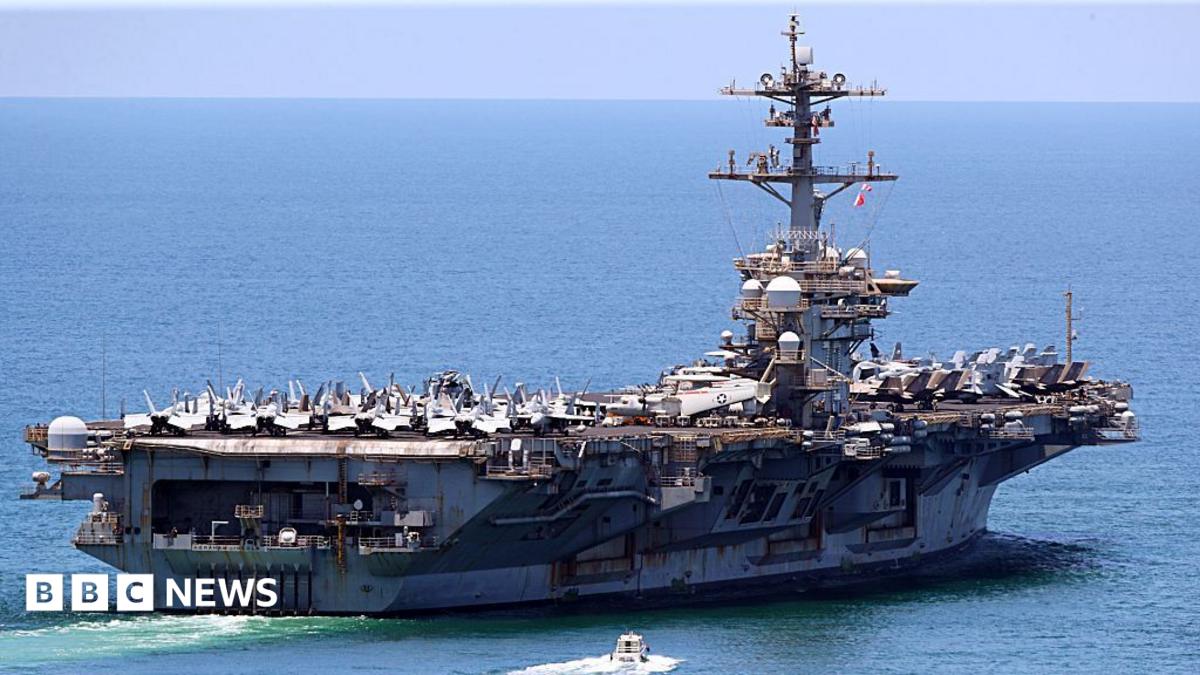
The command also announced that, as anticipated, the Nimitz class aircraft carrier USS George H.W. Bush is now in the Indian Ocean part of its region. That brings the total carrier force to three for now, with the Abraham Lincoln and Gerald R. Ford already on station. However, the Ford, which has set a record for the longest deployment since the Vietnam War and has suffered issues ranging from a fire to leaky plumbing, is likely to depart the area soon.
Nimitz-class aircraft carrier USS George H.W. Bush (CVN 77) sails in the Indian Ocean in the U.S. Central Command area of responsibility, April 23. pic.twitter.com/oDcTM6YMLF
Two days into the ceasefire extension declared by Trump, efforts to negotiate a peace deal remain murky.
Iranian officials have yet to commit to a new round of talks, which the president blames on schisms in its government between hardliners in the IRGC and more moderate elements.
“Iran is having a very hard time figuring out who their leader is!,” Trump exclaimed on Truth Social. “They just don’t know! The infighting is between the ‘Hardliners,’ who have been losing BADLY on the battlefield, and the ‘Moderates,’ who are not very moderate at all (but gaining respect!), is CRAZY!.”
Iranian officials have pushed back against the notion their government is fractured.
“In Iran, there are no radicals or moderates; we are all ‘Iranian’ and “revolutionary,” and with the iron unity of the nation and government, with complete obedience to the Supreme Leader of the Revolution, we will make the aggressor criminal regret his actions,” Speaker of the Iranian Parliament Mohammad-Bagher Ghalibaf stated on X. “One God, one leader, one nation, and one path; that path being the path to victory for Iran, dearer than life.”
در ایران ما تندرو و میانهرو وجود ندارد؛ همه ما «ایرانی» و «انقلابی» هستیم و با اتحاد آهنین ملت و دولت، با تبعیت کامل از رهبر معظم انقلاب متجاوز جنایتکار را پشیمان خواهیم کرد.
یک خدا، یک رهبر، یک ملت، و یک راه؛ آن هم راه پیروزی ایرانِ عزیزتر از جان. #ایران_ما
— محمدباقر قالیباف | MB Ghalibaf (@mb_ghalibaf) April 23, 2026
However, at about the time Ghalibaf posted that, Israel’s N12 News outlet reported that Ghalibaf stepped down as a result of interference from the IRGC.
“The reason for the extreme step is his refusal to accept the growing intervention of IRGC generals – including prominent names such as Ahmed and Heidi and Abdullahian,” the outlet claimed in its unsourced story. “According to the information obtained by News 12, the generals penetrate into the decision-making processes and prevent Ghalibaf from providing the maneuver required to manage the negotiations.”
The War Zone cannot independently verify this.
In an extremely notable development, Israel’s N12 news outlet is reporting that the Iranian Speaker of the Parliament Mohammad-Bagher Ghalibaf has been forced to resign from the Iranian negotiating team by factions within Iran’s Islamic Revolutionary Guards Corps (IRGC). pic.twitter.com/bOu01XX8AT
Meanwhile, Israeli Defense Minister Israel Katz said his country “is prepared to resume the war against Iran,” but needs permission from Trump.
“We are awaiting a green light from the United States — first and foremost to complete the elimination of the Khamenei family and to push Iran back into a dark age,” Katz added. “This time, the strike will be different and far more lethal, delivering devastating blows at the most sensitive points — ones that will shake and undermine its very foundations”.
🚨🚨 Israel’s Defense Minister Israel Katz: “Israel is prepared to resume the war against Iran — We are awaiting a green light from the United States — first and foremost to complete the elimination of the Khamenei family and to push Iran back into a dark age. This time, the…
In his Truth Social post about Iranian leadership, Trump added that the U.S. has “total control over the Strait of Hormuz. No ship can enter or leave without the approval of the United States Navy. It is ‘Sealed up Tight, until such time as Iran is able to make a DEAL!!!”
The Iranians, however, have a different take.
“We have control over this Strait,” Hamidreza Hajibabaei, the deputy speaker of Iran’s parliament, said Thursday, according to the semi-official Fars News Agency. Hajibabaei, speaking at a public gathering in the western city of Kuhdasht, added that the first revenues from Iran’s new tolls on shipping in the Strait of Hormuz have been deposited in the Iranian state central bank account.
“If the United States continues on its current course, no vessels will pass through the Strait of Hormuz,” Hajibabaei warned. “We are not engaged in negotiations — rather, we are making demands.”
“The amount collected from each ship depends on its cargo and level of risk they pose,” said Alireza Salimi, another member of the Iranian parliament, according to the IRGC-linked Tasnim News Agency.
“Iran determines how much and how these fees are collected, in other words, we determine the rules,” Salimi said. The War Zone cannot independently verify this claim.
Trump has previously threatened ships that pay tolls to Iran to use the Strait.
Iran Deposits Transit Fees from Hormuz Strait Ships into Treasury Account
Iran has begun depositing transit fees collected from ships passing through the Strait of Hormuz into the national treasury. pic.twitter.com/jkMUH3thZ4
Lloyds List reports that the Houthi rebels of Yemen, an Iranian proxy, could institute their own tolls around the Bab al-Mandab region.
“Mechanisms have been discussed at senior leadership levels indicating Houthi ambition to control, and not merely disrupt, maritime traffic,” the outlet reported. “Conversations have been supported by Iranian involvement. But the militia is looking to act on its own terms.”
You can read more about what a Houthi intervention into the conflict would mean in our report about it here.
Iran’s decision to levy payments on transiting vessels has created a model that Houthi militants may soon replicate at the Bab el Mandeb, further threatening global trade flowshttps://t.co/AGcgSytuBk
The maritime security environment across the Arabian Gulf, Gulf of Oman, and Strait of Hormuz “remains CRITICAL, driven by recent attack patterns, continued navigation interference, and persistent operational disruption, including impacts to port activity,” according to the latest update from the Joint Maritime Information Center (JMIC). Despite the April 8 ceasefire, “commercial traffic remains limited, with constrained transits and continued routing uncertainty.”
JMIC
With the Strait of Hormuz closed, the demand on transiting the Panama Canal has become so intense that one vessel carrying liquefied natural gas (LNG) paid $4 million to skip the line and avoid a wait that can take up to five days, according to AFP, citing an official report.
🇵🇦 Strait of Hormuz blockade drives up traffic at Panama Canal
The war in the Middle East has boosted demand to move vital cargo through the Panama Canal to such an extent that one vessel carrying liquefied natural gas (LNG) paid $4 million to skip the line and avoid a wait that… pic.twitter.com/ySnwGLSv46
Oil isn’t the only commodity supply affected by the closure of the Strait of Hormuz. According to the United Nations, one-third of global fertilizers are stalled in that body of water as well.
“With planting seasons already underway, we have no time to lose,” the world organization noted. “This is not a matter of logistics or economics – it’s about saving lives. If we don’t act, a massive food crisis will hit the most vulnerable the hardest.”
One-third of global fertilizers are stalled in the Strait of Hormuz. With planting seasons already underway, we have no time to lose.
This is not a matter of logistics or economics – it’s about saving lives. If we don’t act, a massive food crisis will hit the most vulnerable…
Indian crew aboard two of the ships fired upon yesterday in the Strait of Hormuz by IRGC are safe, according to Indian Ministry of External Affairs (MEA) spokesman Randhir Jaiswal.
The firing happened on 2 foreign ships in Hormuz, Indian nationals on them are safe, says MEA Spox Randhir Jaiswal; In touch with Iran govt over safe passage of Indian vessels. pic.twitter.com/kalngqpjVw
During the now-extended ceasefire with Iran, the U.S. continues to flow military assets to the Middle East.
Online flight trackers indicate that the first group of aerial refueling tankers supporting F/A-18C Hornets from the VMFA-312 “Checkerboards” are airborne from Lajes.
“The flight plans filed for the tankers indicate the jets are going straight into CENTCOM today,” according to open-source flight tracker DefenceGeek.
Coronet East 052 – Marines Move Forward to CENTCOM #FreeIran — Operation EPIC FURY —
The first group of tankers supporting the onward movement of VMFA-312 “Checkerboards” F/A-18C “Hornet” fast-jets today are airborne from Lajes (LPLA). The flightplans filed for the tankers… pic.twitter.com/42ZauX778m
Israeli and Lebanese ambassadors are expected to convene again at the State Department on Thursday for a second round of meetings amid the latest conflagration in the Middle East, according to ABC News.
The first direct negotiations between the two states since 1993 “are intended as preparatory meetings to shape future talks on a deal to normalize ties between the countries,” the network noted. “Thursday’s meeting is expected to focus on extending a shaky ceasefire that has halted fighting between Israel and the Iran-backed Hezbollah militia.”
Lebanon enters potential talks with Israel amid deep internal divisions, echoing the failed 1983 peace deal. While some argue negotiations are vital for stability, senior figures and Hezbollah oppose direct talks, risking renewed unrest.
“The ambassador-level talks between Israel and Lebanon will now take place at the White House,” an official tols us. “President Trump will greet the representatives upon their arrival.”
🔴 BREAKING: US President Donald Trump may attend today’s meeting between Lebanese and Israeli officials, which has been moved from the State Department to the White House, according to sources familiar with the matter. pic.twitter.com/2HknXgzqBE
Despite the ongoing ceasefire, Israel is maintaining its positions in southern Lebanon and issued a new warning to residents there.
“We reiterate and warn that, out of concern for your safety and the safety of your family members, and until further notice, you are required not to move south of the line of the villages shown and their surroundings,” IDF spokesman Avichay Adraee stated on X. “Additionally, approaching the Litani River area, Wadi Salhani, and Salouqi is not permitted.”
⭕️نجدد تأكيدنا انه خلال فترة اتفاق وقف إطلاق النار يواصل جيش الدفاع تمركزه في مواقعه بجنوب لبنان في مواجهة النشاطات الإرهابية المستمرة لمنظمة حزب الله.
⭕️نعود ونحذر انه وحرصًا على سلامتكم وسلامة أبناء عائلاتكم وحتى إشعار آخر انتم مطالبون… pic.twitter.com/YBjksAhVja
Heading into a second round of rare direct talks with Israel, Lebanon is urging the Trump administration to pressure Israel to scale back its demands andend its military invasion of the country, Lebanese Prime Minister Nawaf Salam said in an interview with The Washington Post.
Salam said Lebanon could not sign any agreement that does not include a “full withdrawal” of Israeli forces.
“We cannot live with a so-called buffer zone,” he said, “an Israeli presence where Lebanese displaced people are not allowed to return, where destroyed villages and towns cannot be rebuilt.”
Hours before the second round of direct talks with Israel, Lebanese Prime Minister Nawaf Salam says any agreement must include a “full withdrawal” of Israeli forces from southern Lebanon.
Speaking with the Washington Post, Salam says that Beirut is urging the U.S. to pressure…
— Ariel Oseran أريئل أوسيران (@ariel_oseran) April 23, 2026
Israeli strikes killed one journalist and wounded another in southern Lebanon on Wednesday, The New York Times reported.
“The Lebanese Ministry of Public Health said the Israeli military had targeted the journalists in the town of Tayri, where they took shelter in a nearby house after an airstrike struck a vehicle in front of the car they were traveling in,” the newspaper noted. “About an hour and a half later, a second strike hit the house they were hiding in, according to a statement by a Lebanese newspaper Al-Akhbar, which employed the journalist who was killed.”
Rodríguez announced four categories for state assets, with “non strategic” ones destined for privatization or liquidation. (Presidential Press)
Caracas, April 23, 2026 (venezuelanalysis.com) – Venezuelan Acting President Delcy Rodríguez has established a commission to assess the “strategic” value of state-owned assets and their possible transfer to the private sector.
The Commission for the Evaluation of Public Assets held its first meeting on Wednesday. In a short televised message, Rodríguez said the commission had the purpose of bringing “agility and modernity” to the Venezuelan state.
The acting president announced that Venezuelan state assets would be divided into four categories: strategic ones to remain under state control, “strategic alliances” where the state retains ownership but management is turned over to the private sector in concession-type deals, “non-strategic” assets to be fully privatized; and assets to be liquidated or reincorporated elsewhere.
“The purpose of this commission is to elevate Venezuela’s productivity levels, so that the Venezuelan state can be robust and attend to the strategic aspects of the nation,” she said.
The commission includes Economic Sector Vice President Calixto Ortega, Finance Minister Anabel Pereira, Industry Minister Luis Villegas, State Solicitor Arianny Seijo, Communes Minister Ángel Prado, as well as Luis Pisella, former president of industry guild CONINDUSTRIA, representing the private sector.
Former Venezuelan President Hugo Chávez spearheaded a nationalization campaign in the 2000s to impose state control of key economic areas such as oil, electricity, telecoms, banking, and the heavy industries.
In recent years, with the economy heavily targeted by US sanctions, the Nicolás Maduro government expanded “strategic alliances” with the private sector, particularly in the Venezuelan countryside. However, campesino organizations have denounced that the private takeover of companies that formerly supplied seeds, inputs, and tractors has significantly raised costs for small-scale producers. Strategic alliances in sugar mills have also drawn complaints of companies defrauding sugar cane growers.
The Cisneros Group, one of Venezuela’s largest private sector conglomerates, has recently announced plans to raise over $1 billion in funds ahead of potential sell-offs of state assets.
Elias Ferrer Breda, financial analyst and director of Orinoco Research, told Venezuelanalysis that he foresees privatizations in basic industries such as steel and cement.
“In my view, we will see virtually all the industries that are running at low capacity and without turning profits privatized,” he predicted. “We are talking about industries like steel and cement, but also other sectors like hotels or agricultural land.”
Ferrer affirmed that state companies currently under strategic alliances, such as sugar mills or Ferrominera Orinoco, an iron-ore complex presently managed by India’s Jindal Steel, could continue under similar deals as opposed to being sold outright.
“Where investors have mostly expressed an interest is in extractive industries: oil and mining,” he added. Ferrer additionally claimed that US “strategic and business interests” are likely to pursue control over Venezuelan critical mineral reserves, which are not presently certified.
Rodríguez had unveiled the commission to evaluate state assets in an April 9 presidential address. The acting leader also set in motion efforts to reform Venezuela’s labor, tax, and pension legislation. The Venezuelan National Assembly has recently approved pro-business overhauls of the country’s hydrocarbon and mining laws.
Caracas reestablished dealings with the International Monetary Fund (IMF) and the World Bank on April 16. On Wednesday, Rodríguez disclosed a conversation with IMF Managing Director Kristalina Georgieva and stated Caracas’ priority in unblocking around US $5 billion worth of Special Drawing Rights to improve public services such as electricity and water supply.
For her part, Georgieva acknowledged a “very valuable and productive call” and that the next steps include IMF “policy advice and capacity development.”
Venezuelan leaders have vowed that there are no plans to incur IMF debt. However, the Caribbean nation could soon face pressure from creditors looking to collect on a massive external debt, with unpaid loans, defaulted bonds, and international arbitration awards totaling as much as $170 billion with accrued interest.
On April 16, the so-called Venezuelan Creditor Committee held talks with US officials amid efforts to secure a license to engage in debt negotiations with Caracas. The committee includes Fidelity Management & Research Company LLC, Morgan Stanley Investment Management, Greylock Capital Management, and others.
Since the January 3 US military strikes and kidnapping of Venezuelan President Nicolás Maduro, the Trump administration has seized control of Venezuelan oil revenues while issuing licenses to grant Western corporations favorable access to the Caribbean nation’s energy and mining sectors.
From protests to quiet resistance, dissent is rising inside the United States military over the US-Israel war on Iran.
As the US expands its war with Iran, opposition is growing – not just among the public, but inside the military itself. Some service members are questioning orders, exploring conscientious objection, and speaking out. What’s driving this shift, and how far could it go?
In this episode:
Mike Prysner (@MikePrysner), Executive Director of the Center on Conscience & War
Episode credits:
This episode was produced by Marcos Bartolomé, Tamara Khandaker, and Sarí El-Khalili with Spencer Cline, Tuleen Barakat, and our host, Malika Bilal. It was edited by Tamara Khandaker and Noor Wazwaz.
Our sound designer is Alex Roldan. Our video editors are Hisham Abu Salah and Mohannad al-Melhem. Alexandra Locke is The Take’s executive producer.
A 10-year-old girl who found an endangered Mexican axolotl while on holiday in Wales has told the BBC about the moment she found and caught the amphibian.
It is the first documented discovery of an axolotl in the wild in the UK, with only 50 to 1,000 left globally, according to experts.
Evie was playing in the shallows of the River Ogmore in Bridgend when she spotted the axolotl nestled in the rocks.
The family decided to cut their trip short to take the animal back to their home in Leicester, naming it Dippy as a tribute to where Evie found it.
“I think it’s a really nice change to the family,” Evie said about having Dippy.
Chris Newman, the National Centre for Reptile Welfare (NCRW) director, said the manner in which Dippy was found suggested its previous owner had released it due to a “change in circumstances”.
Iran displayed its strengthened control over the Strait of Hormuz on Thursday by releasing video footage of its commandos boarding a large cargo ship. The video, aired on state television, showed masked troops storming the MSC Francesca and included scenes of another captured ship, the Epaminondas, which Iran accused of trying to cross the strait without proper permits.
As tensions remain high, the U. S. announced that it boarded another tanker, the Majestic, in the Indian Ocean. This was likely a reference to the supertanker, the Phonix, which was carrying 2 million barrels of crude oil off Sri Lanka. Since the start of conflict in February, Iran has effectively restricted access to the strait, asserting control after peace talks between the U. S. and Iran were halted shortly before a ceasefire expired.
Iran’s willingness to re-engage in talks depended on the U. S. lifting its blockade and releasing Iranian ships. In a post on Truth Social, U. S. President Donald Trump indicated that he ordered the Navy to “shoot and kill” Iranian boats that were laying mines in the strait, escalating military actions without addressing other Iranian tactics like speedboats and drones.
Iran’s judiciary chief stated that the merchant vessels attacked by Iran’s forces had faced legal consequences, while Iran’s vice speaker announced that the first toll revenue collected from ships using the strait had been transferred to the central bank, but provided no specifics on payments or amounts.
Tehran proclaimed it would not reopen the strait, which typically handles a significant portion of global oil and gas shipments, until the U. S. lifted the blockade considered a breach of the ceasefire. Although Trump refrained from escalating attacks in the ceasefire’s final hours, he remained firm on not lifting the blockade. There was no formal extension of the ceasefire nor plans for new negotiations.
Iranian citizens faced uncertainty and anxiety in what they termed a state of “neither peace nor war,” fearing potential attacks from the U. S. or Israel. Pakistan, previously facilitating talks, remained in contact with both countries about reviving discussions, but Iranian officials hesitated to commit due to the U. S. blockade.
On the U. S. side, another round of discussions was set for Thursday, focused on Israel and Lebanon, where Lebanon sought an extension of a recent ceasefire amidst continued Israeli airstrikes that resulted in casualties, marking a significant day since the ceasefire began.
In a significant personnel change, U. S. Navy Secretary John Phelan was dismissed amid conflicts over shipbuilding decisions and tensions with high-ranking officials.
The ongoing situation in the Strait of Hormuz has caused volatility in markets, pushing oil prices upward, while stock prices in the U. S. reached record highs despite uncertainty about energy supply. Washington has thus far failed to achieve its stated war goals of limiting Iran’s military capabilities, ending its nuclear efforts, and fostering regime change. Iran maintains its missile and drone capabilities and stockpiles of highly enriched uranium, while its government remains resilient against internal dissent. Despite threats from Trump, Iran’s control over the strait appears to strengthen its position in the conflict.
Disruption to fuel and fertiliser supplies due to the Strait of Hormuz closure will hit crop yields, UNDP chief warns.
Published On 23 Apr 202623 Apr 2026
The Iran war will push more than 30 million people back into poverty, with the knock-on effects of the conflict likely to increase food insecurity in the coming months, the United Nations has warned.
Disruption to fuel and fertiliser supplies due to the ongoing blocking of cargo vessels through the Strait of Hormuz has already lowered agricultural productivity and will hit crop yields later this year, the UN’s development chief said on Thursday.
Recommended Stories
list of 4 itemsend of list
“Even if the war would stop tomorrow, those effects, you already have them, and they will be pushing back more than 30 million people into poverty,” said Alexander De Croo, administrator of the United Nations Development Programme (UNDP).
He also warned of other fallouts of the United States-Israeli war on Iran, including energy shortages and falling remittances.
Much of the world’s fertiliser is produced in the Middle East, and one-third of global supplies passes through the Strait of Hormuz, where Iran and the US are jostling for control.
The UN’s Food and Agriculture Organization (FAO) last week warned that a prolonged crisis in the strait could lead to a global food “catastrophe”.
India, Bangladesh, Sri Lanka, Somalia, Sudan, Tanzania, Kenya, and Egypt are among the countries most at risk, according to the FAO.
“Food insecurity will be at its peak level in a few months – and there is not much that you can do about it,” De Croo said.
Straining humanitarian efforts
The knock-on effects of the Iran conflict have already wiped out 0.5 percent to 0.8 percent of global gross domestic product (GDP), according to De Croo, who noted, “Things that take decades to build up, it takes eight weeks of war to destroy them.”
De Croo, the former prime minister of Belgium, also warned that the Middle East crisis is straining humanitarian efforts in other parts of the world, with the sector already facing funding cuts.
The US-Israeli attacks on Iran, which began on February 28, have also choked up key humanitarian aid routes, delaying life-saving shipments to some of the world’s worst crises.
“We will have to say to certain people, really sorry, but we can’t help you,” De Croo said. “People who would be surviving on help will not have this, and will be pushed into even greater vulnerability.”
Canada on Wednesday announced $5 million in funding for international efforts aimed at identifying and eliminating chemical weapons remaining in Syria, Anadolu reports.
“Today, the Honourable Anita Anand, Minister of Foreign Affairs, announced Canada’s contribution of $5 million to the Organisation for the Prohibition of Chemical Weapons (OPCW) through Canada’s Weapons Threat Reduction Program,” the Global Affairs Canada said in a statement.
Noting that the OPCW will use the contribution to verify the scope of Syria’s former chemical weapons program, the readout added that the funding will also be used to investigate past uses of such weapons, and prepare for the safe destruction of remaining stockpiles, in line with the Chemical Weapons Convention.
The statement said the work is considered critical to “Syria’s long-term stability,” advancing accountability and reducing the risk to civilians of any future chemical weapons use.
“This contribution is part of Canada’s long-standing support to the OPCW to uphold the global ban on chemical weapons and strengthen international accountability,” it added.
Before he became a fugitive preacher, during which time security officials learned to mutter his name with a foreboding weight, culminating ultimately in his killing, filmed and circulated across local and international news platforms, Mohammed Yusuf was a boy seated before his father, learning the Qur’an. This is where this story begins.
Not in 2002 or in July 2009, which are often cited as the landmark years. The beginning lay far away from prying eyes, in the ordinary intimacy of religious learning, in a world of fathers and sons, mallams and pupils, recitation and repetition.
Those who knew Yusuf’s early life describe a child shaped in his father’s image. According to one of his sisters, who does not wish to be named, “He learned to recite the Qur’an under Baba. He was our father’s student before he became anyone else’s.” He imbibed that discipline, the rigour and rhythm of recitation, correction, and memorisation.
He went on to study under Goni Bulama, who was reportedly knowledgeable in fiqh (the human interpretation and application of Sharia law). Later, he travelled to Potiskum in Yobe State to continue learning under his uncle, Goni Madu. He stayed there for two or three years, “then he returned home and continued seeking knowledge in several places” as part of the Almajiranci system, his sister recalled.
Among the clerics repeatedly named by people who followed that part of his life is Goni Modu in Lamisula, a suburb in Maiduguri. He occasionally took lessons from the late Sheikh Abba Aji, a well-respected Mufassir (Qur’anic exegete)in Maiduguri. “Yusuf did not emerge from the bubble; he was shaped through the interplay of ideologies,” said Kyari Mustafa, a researcher and one of Yusuf’s former students. One of his childhood friends, who is now a moderate cleric in Maiduguri, described Yusuf as a very curious child, adding that he thinks “that was what made him learn faster than all his peers”.
According to many who encountered Yusuf, he was many things, some of them deeply dangerous, but he was not a man who wandered by accident into religious influence. He read, listened, argued, absorbed, and faltered like many clerics before him and after him. He later recast those ideas into a corrosive, doctrinal political weapon, with devastating consequences that plunged more than five countries bordering Lake Chad into violence, killing and maiming tens of thousands, and uprooting millions from their communities.
Long before he created a movement the world would come to know as Boko Haram, he moved through circles of da’awah and doctrinal activism that were themselves products of a wider shift in Muslim politics. At one stage, he was linked to the Muslim Brothers, a movement of mostly students active in the 1980s and 1990s that promoted political Islam and reform. Some accounts also linked him to circles associated with Sheikh Ibrahim El Zakzaky, the Shia cleric and leader of the Islamic Movement in Nigeria. Those familiar with that era said Yusuf pulled away immediately from what he regarded as Shi’a framing by key figures in the movement, since he was inclined toward Sunni religious beliefs. However, Yusuf was not separated from their struggle; instead, he was separated over the terms, over authority, aqeedah, and over who would define the path ahead.
The claim that Yusuf was a disciple of the late Kano-based Salafi scholar Sheikh Ja’afar Mahmud and his circle does not hold under closer scrutiny. However, those who observed the stint at Muhammad Indimi’s mosque in Maiduguri and the eventual split describe a sharper divergence. “Ja’afar argued that Muslims should engage formal schools and institutions, then reform them from within. Yusuf rejected that path, calling for a boycott. He pushed for parallel systems built on Islamic guidance with zero secular influence,” said Mustafa.
From the beginning, there were overlaps between Yusuf and dozens of clerics in broad questions about jihad and Sharia. Still, Yusuf pushed toward establishing a totalitarian Sharia system on terms others did not share, or not yet. Across the Sahel, a broad clerical ecosystem continues to propagate hardline doctrinal interpretations reminiscent of those once advanced by Mohammed Yusuf. Many remain obscure, not for lack of ideological alignment, but because they have not transitioned into open confrontation with the state. Unlike Yusuf, whose influence escalated when he mobilised disaffected youth into armed resistance, these figures operate below the threshold of insurgency and restrict themselves to preaching.
There was also an organisational history that has been largely buried beneath the violence that came later. “Yusuf was once part of a movement in 1997/1998 identified as ‘Jamatul Tajdid Islami’, which was first created in Kano and headquartered there,” said Malam Mohammad, Yusuf’s former associate now based in Kano. By early 2000, he was back in Maiduguri, beginning or deepening preaching activities across several mosques. He was pushed out from Mohammed Indimi’s Mosque, moved to Al’amin Daggash Mosque, was stopped again, and then continued from his own house, given to him by his father-in-law. He named the sanctuary Ibn Taymiyya Masjid after a 13th-century Islamic scholar.
This was a precursor phase built on a study circle, not an insurgent cell. At the time, young men in white jalabiyas and their wives in black long jalbabs flooded Maiduguri. They were encouraged to bond tightly, abandon schools, and resign from secular institutions. “They shared food amongst themselves. They sold farm produce at subsidised rates from their large farm in Benisheikh. They provided free medical care through two clinics in Maiduguri. They ran a small revolving loan scheme for indigent members,” said Malam (name withheld), one of the movement’s former clerics currently in Maiduguri.
A fighter still active told HumAngle he dropped out as a sophomore at the University of Maiduguri, leaving his parents’ home to move in with a member of the group. “Between 2006 and 2007, I had no skills or a job. I survived on daily meals and food stamps from the Ibn Taymiyyah mosque. I will never forget that support by Malam Mohammed Yusuf,” said the 42-year-old Boko Haram member.
Ideology and a premeditated war
Boko Haram did not erupt because of the high-handedness of security agents, though that high-handedness was real and consequential. It did not begin because Mohammed Yusuf was extrajudicially killed in July 2009. However, that killing transformed him into a martyr in the eyes of his followers and helped harden the foot soldiers in the war that came thereafter. It did not begin because of one helmet law, one police confrontation, or one week of clashes in Biu, Bauchi, Maiduguri, Damaturu, Potiskum, and elsewhere.
Those events merely accelerated the rupture.
The deeper fuse was ideology, and that ideology did not grow in isolation. It travelled with money, with wars fought elsewhere, with transnational religious currents, and with the afterlife of global politics that Nigeria still refuses to examine closely.
In the 1980s, amid oil-fuelled prosperity and the protracted Cold War contest in Afghanistan, a distinct wave of Salafi thought was actively scaled by a Gulf state. It travelled through well-funded clerical networks, charities, publications, scholarships, and layers of international patronage that gave it both reach and structure.
For external backers, the fine details of ideology did not matter. What mattered was shared strategy. As long as this movement in Afghanistan put pressure on the Soviet Union, its beliefs were rarely questioned and were sometimes quietly supported.
In Afghanistan, jihad evolved from a theological concept into something more kinetic, a pathway, a destination, and, for many, a defining personal transformation. Young men from across the Muslim world answered that call. Nigerians were among them. Many of them were strikingly from the southwest region, but when they returned, they did not find the same fertile conditions in their home environment for a project of violent proselytisation. The idea survived, but it did not easily reproduce itself in that terrain.
In the north, these returnee fighters from Afghanistan did not arrive on stable ground. They met a generation of young men with little education and a grim future, a generation that knew the state only through force, neglect, and theft. They met boys raised on the daily humiliation of poverty and poor investment in education by corrupt officials.
That was the combustible field in which Yusuf picked up most of his ideas in the late 90s and began to nurture them into a movement in the early years of 2000. By the time the July 2009 ma’araka occurred, the insurgency had already been imagined, nurtured, and prepared for years. The movement had passed through the stages of learning, da’awah, withdrawal, factional dispute, internal sorting, and ideological hardening.
Get our in-depth, creative coverage of conflict and development delivered to you every weekend.
Subscribe now to our newsletter!
“Operation Flush” and the broader security pressure during that period disrupted a longer period of preparation. When the confrontation came, the group had not yet fully built what they intended to build. If they had been left to prepare longer, and if the rupture had come later rather than in July 2009, Nigeria might have faced a movement with greater organisational maturity and strategic capacity.
In the weeks after the confrontation between Boko Haram members and Operation Flush in Maiduguri, triggered by the enforcement of helmet regulations on motorcycle riders, tensions escalated sharply. Security forces shot around 20 sect members, an incident that hardened positions within the group and deepened mistrust of state authority.
Mohammed Yusuf responded with an open declaration, signalling that the group would confront the state if certain demands were not met. Within the cult-like community, preparations began quietly but deliberately. Members started liquidating personal assets. Cars, motorcycles, and even houses were sold. Women parted with jewellery and household items. Contributions came from across the network, each person offering what they could.
This mobilisation unfolded in earnest in the month leading up to July 2009.
Long before the war, there were also fractures inside the movement that foreshadowed what would come later. One notable example is that of Muhammed Alli, who, after disagreeing with Yusuf, left for Hijra to Kanamma in Yobe State with dozens of youths in 2003. They isolated themselves from normal civil life in a remote location. When the traditional leader in the vicinity noticed a strange group of people in his turf in December 2003, he approached them, and one thing led to another; the group had violent confrontations with the Police that resulted in the loss of lives and properties.
At the height of Yusuf’s sectarian authority between 2006 and 2009, a fracture was already taking shape within his movement. Beneath the surface, a harder, more impatient current was consolidating around Abubakar Shekau, his top lieutenant. “Yusuf believed in sequencing. Build strength first. Recruit deeply. Arm deliberately. Accumulate resources. Then, confront the state from a position of capacity,” said Mustafa.
Shekau, like Muhammad Ali, who led Kanamma, rejected that procedure. They both pushed for immediacy. Strike now and absorb the consequences later. Death itself, whether inflicted or received, was framed as victory through martyrdom, according to those inclined to Shekau’s hardline views.
Malam Hassan (Gandrova), a staff member of the Nigerian Prison Service, who was radicalised during one of Shekau’s brief remands at the Maiduguri Maximum Security Prison, would eventually join the terror group’s bomb-making unit. On Friday, July 24, 2009, he was assembling an IED with two other individuals at his rented apartment in Umarari, ‘Bayan quarters’ in Maiduguri. “Hassan and the two other bomb-making members of the sect were unskilled at the time, and their explosives blew up everyone in the room,” said a former member currently in one of Nigeria’s deradicalisation programmes set up to reintegrate former fighters back to normal civil life in their communities.
The following day, Saturday, July 25, Yusuf’s followers were attacked in Bauchi. On the night of Sunday, July 26, Yusuf faced mounting pressure from his own ranks after the bomb incident and the raids in Bauchi, compounded by a sting operation by the police in Maiduguri, “who falsely tipped Yusuf’s men that security forces would launch an assault against them before dawn,” said a senior police officer familiar with the events of July 2009. Shekau’s more radical supporters within the group demanded action.
On the evening of July 26, 2009, hours before they launched an attack on the Borno State Police headquarters, Yusuf condemned the attacks on his men during an interview with this reporter, who worked for Daily Trust at the time. “What I said previously that we are going to be attacked by the authorities has manifested itself in Bauchi, where about 40 of our brothers were doing what Allah said, arm yourself and your religion in the face of an attack and an attack was imminent. This was what Malam Hassan [bomb victim] was doing when he became a martyr,” he said.
Had Yusuf refused the group’s attack on the Police Force headquarters in Maiduguri, he would not have remained leader after that night, said several senior members of the group interviewed by HumAngle. The movement was already shifting beneath him. At best, he would have been sidelined. At worst, he would have been removed entirely by the very hardline faction he had tried to restrain.
File photo of former Borno State Executive Governor, Ali Modu Sheriff, with the former state Commissioner of Police, Christopher Dega, at the police headquarters in Maiduguri on July 27, 2009.
Blood ties and the machinery of war
To understand how this story has unfolded, one has to see Yusuf as the centre of a household as well.
He had four wives and a large number of children, between 24 and 26, according to the accounts available. His first wife was Aisha, also known as Ya Bintu or Yaya Bintu. Among the children attributed to her are Yusuf, Habib, Ibrahim, Ahmad, Imam Muslim, Abdullahi (also called Abba), Isa, and Abdulazeez.
His second wife was Fatima, also called Ummu Zara. Children linked to her include Zarah, Alhaji Ba (recalled unclearly in one account), Iya Gana, Ummu Kulthu, Aish, Uma, and Abdulwahab.
His third wife was Hajja Gana, also called Ba’ba. Children associated with her include Zainab (often called Ummi), Maryam, Umar, and Khadija (also known as Ya Dija).
The fourth wife was Ummu Tulaf, or Ummuthulab in some accounts. Muazu is consistently named among her children. This is not a perfect register, but a family history carried through oral memory, insurgent secrecy, death, displacement, and the distortions that come when names are repeated across generations. But the uncertainties do not dilute the central point. Yusuf did not leave behind a disembodied ideology. He left behind a house, and that house has remained part of the machinery of war to date.
One relative of Yusuf, based in Kano, who spoke in detail about the family, put it simply: “All of his children are part of the insurgency. Some are dead now. But they are all part of it with no exceptions.”
The first son, Yusuf, married in Hotoro, Kano State, in 2010. The marriage was brief; he died not long after, leaving no children. His death followed the September 7, 2010, prison break in Bauchi, when Boko Haram freed hundreds of their members. Some of the escapees of that prison break were later traced to a hideout in Hotoro, where Yusuf lived. Security forces moved in. In the exchange that followed, Yusuf, the first son of Mohammed Yusuf, was killed.
Habib, the second son, known as Abu Musab, became the most consequential. Family testimony about his domestic life varies in detail, as such testimony often does in clandestine worlds, but the core is clear. He had multiple wives and many children. Zainab is recalled as one wife, Halima as another, Aisha as another. Their children, depending on who recounts the family tree, include Mus’ab, Humaira, Rumaisa, Muhammad, another Muhammad, Shifa’u, Ramla, Zarah, Rufaidah, Kasim, Abdullahi, and Amir. In one account, there is mention of a concubine or enslaved woman who bore him a daughter.
After the July 2009 violent outbreak, most of Mohammed Yusuf’s children, except his first son, were moved out of Nigeria. They were first taken to Kusiri in northern Cameroon, then to N’Djamena in Chad, where they continued their religious education under Sudanese and Chadian tutors. This relocation appears to have taken place within months of Yusuf’s death and was aimed at preserving both their safety and their symbolic value within the movement.
In 2012, after Abubakar Shekau left Rijiyan Zaki in Kano and established himself in the Sambisa forest, he ordered Yusuf’s children to be brought back into the insurgent enclave, which the group had begun to frame as its Daula. This move reflected a deliberate effort to consolidate legitimacy by reabsorbing Yusuf’s lineage into the insurgency’s core.
Among those elevated during this period was Abu Musab al-Barnawi. He was progressively assigned roles that combined religious authority and operational relevance, positioning him as a bridge between doctrinal leadership and battlefield command.
From 2015 to 2016, tensions between Shekau and ISIS leadership intensified. The central issue was Shekau’s expansive use of takfir, particularly Takfir al-‘Umum, which justified violence against broad segments of the Muslim population. ISIS leadership, including Abu Muhammad al-Adnani, engaged in repeated efforts to moderate Shekau’s position. These attempts also addressed concerns over targeting practices, the use of female suicide bombers, and command discipline. All efforts failed.
In August 2016, ISIS formally intervened. Through its Al-Naba publication, it announced the removal of Shekau as leader and the appointment of Abu Musab al-Barnawi as Wali of the Islamic State’s West Africa Province (ISWAP). This marked the formal split between Boko Haram and ISWAP. The decision was externally driven by ISIS central and reflected a strategic shift toward a more controlled and population-focused insurgent model under new leadership.
Abba (aka Abu Umaysa), whose given name is Abdullahi, is also one of Yusuf’s sons. He reportedly had multiple wives and children, including Muhammad, Maryam, Aisha, and at least one other son. Within the insurgent structure, he played a technical and operational role, particularly in communications. Sources indicate he was responsible for managing encrypted messaging platforms that facilitated contact between ISWAP leadership and ISIS-linked actors in the Middle East.
A file photo of the workstation Abba shared with Baban Hassan during their time as senior members of the ISWAP media unit in the Lake Chad basin.
Despite his communications role, Abba was known to participate directly in combat operations, a pattern that reportedly drew disapproval from senior leadership due to the sensitivity of his liaison responsibilities. Internal disputes led to repeated detentions. Abba was imprisoned on four separate occasions by his brother Abu Musab, including periods of detention alongside that of Mamman Nur, a senior figure associated with Mohammed Yusuf’s lifetime.
In one instance, he escaped custody with other fighters and fled to the Niger Republic, but later returned. According to a source, he was subsequently pardoned and allowed to reintegrate without facing the death penalty typically imposed on members accused of attempting to defect.
A senior ISWAP defector, Malam Ibrahim, stated that during one period of detention linked to internal disagreements, ISIS-linked contacts “declined communication with ISWAP as long as they did not hear his voice. He was released immediately to continue his work.”
Abba later died in early 2023 during an engagement with the Multinational Joint Task Force in the Kangarwa forest area.
The other sons, Muslim, Abdulazeez, Isa, and Abdulwahab, are described by one source as married and without children at the time of this report. However, Muslim was arrested in Chad when he was trying to defect from the group to live outside of Nigeria.
Even inside the household of a movement that would later devastate the northeast, family life is still narrated through the intimate vocabulary of births, marriages, hopes, namesakes, and unanswered prayers for children. That is exactly why the story resists easy reduction. The people at the centre of violence remained human in their own domestic worlds. That does not mitigate their responsibility, but it explains how such worlds sustain themselves.
The patriarch’s execution
Yusuf’s rise spiked because of his soft-spoken, unusual, and persuasive verbal skills rather than his scholastic proficiency. He did not need the theatrics many expected from Sahel’s religious authorities. He could name what young men already felt but had not yet organised into doctrine. Corruption. Injustice. Absence. State impunity. The feeling that rulers had abandoned both God and the governed. He took those scattered injuries and gave them a single haunting frame.
Yusuf was carrying a worldview shaped by transnational currents, doctrinal disputes within Nigeria and the broader Sahel Islam, and his own insistence that the Nigerian state was religiously illegitimate.
Then came the extrajudicial killing.
Outside the police headquarters in Maiduguri, Yusuf was captured on camera, alive in custody, seated and handcuffed. Later, he was dead, his body riddled with bullets. The state said he had been shot while trying to escape. The footage with his hands tied, however, invalidated that claim.
What followed was brutal and systematic. Raids spread across northern states, with Maiduguri at the centre. Security forces targeted hospitals and local pharmacies. They forced staff to identify and lead them to patients treated for gunshot wounds or related injuries. Those patients were taken to the State Police headquarters. Some could barely stand. Some were on crutches. Some were executed at close range in the presence of this reporter, as documented here.
File photo of suspected members of Boko Haram in crutches before they were summarily executed at the entrance of the Borno State Police Command Headquarters by security forces.
For followers, the image of Yusuf became proof of everything he had preached about state injustice. This was the moment the war entered the family’s bloodstream. His children, who had already grown up under his teachings, now witnessed his extrajudicial death.
Abu Musab was central to the next phase.
The rise and fall of Abu Musab
Relatives remember him first as a disciplined son who rose through the ranks. He became a Munzir, later Ka’id, fiya, then a Waliy. He read deeply. He gained influence not only because he was Yusuf’s son but because he appeared to embody knowledge and steadiness.
Some accounts describe him as a serious internal voice within the insurgency, especially in doctrinal disputes over takfir and the treatment of ordinary Muslims. At one point, some within the movement argued that any Muslim who refused to migrate to the bush and live under insurgent control was an unbeliever. The practical effect of that doctrine was robbery, extortion, and killing.
Abu Musab is remembered by those close to him as having resisted that direction. “People had reasons they could not leave,” he said in one of his recorded messages. “Not everyone outside the bush was an apostate.” That detail does not make him humane in any broad sense. He remained a leader in a movement that killed, abducted, raped, extorted, and terrorised civilians. But it does place him more accurately within the insurgency’s internal tapestry. He was part of the crop of leaders who believed Shekau had gone too far.
That split would define the next phase of the war.
After Yusuf’s death, Abubakar Shekau turned what remained of the movement into a machine of spectacle and indiscriminate terror. His fighters razed villages, bombed markets, assassinated Muslim clerics, and turned young women and girls into delivery systems for explosives. Entire communities were punished under expansive accusations of unbelief or collaboration. Shekau did not merely fight the Nigerian state. He fought whole populations, including the Muslims his faction claimed to defend.
Inside the movement, dissent built over time. Some of Yusuf’s old followers, including members of his family, believed Shekau had broken from the founder’s original doctrinal line. They still believed in jihad. They still rejected the Nigerian state. But they did not accept his disregard for restraint and counsel.
When the movement pledged allegiance to the Islamic State, those internal disputes widened. That split changed the insurgency’s logic. Shekau’s faction remained rooted in Sambisa and in a politics of fear, punishment, and theatrical violence. ISWAP, under Abu Musab, moved toward an equally brutal but more organised form of insurgent governance around the Lake Chad Basin. It taxed fishermen, farmers, and traders. It built courts, regulated movement, and sought not merely to kill but to rule.
It was still a terrorist organisation. It still abducted, extorted, murdered, raped and coerced. But its method of domination differed from Boko Haram. Where Shekau often destroyed civilian life outright, ISWAP frequently sought to occupy it, supervise it, and harvest from it. Communities brutalised by both insurgents and the military often did not think in abstract moral categories. They thought in terms of survival. To some, ISWAP looked more predictable than Shekau’s men, less erratic, and more likely to tax than to massacre. In this phase, Yusuf’s family became an infrastructure.
Some sons moved into command, others into ideological work. Some daughters married senior figures, tightening bonds between bloodline and leadership. One of Yusuf’s wives, Hajja Gana, later married Abubakar Shekau. The geography of Lake Chad then amplified everything.
Once a vast inland body of water, the lake has, over the decades, become a shifting geography of reeds, channels, islands, marshes, and seasonal passages where state borders blur, and state authority thins into abstraction. A fighter can move from Nigeria into Niger or Chad with less friction than a trader might face at a conventional checkpoint. Armouries can be hidden on islands. Training camps can be relocated across terrains that conceal unfriendly surveillance. Tax routes can be imposed on fishing channels more effectively than the Nigerian state can regulate ordinary commercial life in some border communities.
Yet dynasties do not move cleanly. They fracture from within.
Abu Musab’s rise inside ISWAP did not end in settled power. Internal struggles sharpened. Rivalries widened within the rank-and-file and the shura. Family accounts describe a period of captivity that placed him in real danger. The Boko Haram faction led by one Bakura Doro wanted him dead. Some within ISWAP opposed his return to influence, reflecting deeper internal fractures shaped by ideology, loyalty, and competition for authority. Yet he retained a critical asset: He was a recognised member of the shura within the broader Islamic State network. That status placed him within a transnational decision-making architecture that extends beyond the Lake Chad Basin, linking local commanders to the central leadership historically based in the Levant and later dispersed across multiple theatres.
According to a high-profile source, “a decision was made to extract him, perhaps toward North Africa or the Middle East.” Such a move would align with patterns seen in the Islamic State’s global operations, where experienced figures are sometimes redeployed across provinces. These decisions are often driven by strategic need, internal distrust, or the desire to preserve individuals with institutional memory and ideological legitimacy within the wider ISIS ecosystem.
That plan never reached its destination.
Instead, he moved through Nigeria under concealment. He spent time with one of his wives and their child. He moved through Kano. He surfaced in Kaduna. The high-profile source said, “Kaduna was the location chosen for him to wait for his travel documents to be processed.” HumAngle gathered that he was in the process of obtaining a Niger Republic international passport. At his Kaduna hideout, between April 21 and May 19, 2023, one of his couriers was tracked and security agents followed the trail to the house.
What remains most striking is that they appear not to have known whom they were closing in on. They suspected criminality, but by available accounts, they did not know they were approaching Abu Musab al-Barnawi himself.
Abu Musab heard heavy banging at the gate, mixed with men shouting and the rumble of vehicles. He knew immediately it was security forces. HumAngle gathered through extensive interviews that he was calm, almost detached. He told his young wife, who was holding their young child, to open the gate. As she moved toward it, he slipped into the room’s toilet. Moments later, he detonated the explosive vest strapped to his body.
The blast stunned everyone outside, including his wife. The sound cut through the compound without warning. He chose death over arrest, over public disgrace, over the certainty of spending the rest of his life behind bars.
There was no public announcement after the blast that killed Abu Musab, no official triumph, no clear state recognition that one of the most significant insurgent figures in the region had died in that house. The insurgents, too, remained quiet, neither publicly mourning nor confirming the incident. Instead, the kunya Abu Musab continued to circulate, adopted by others as part of the deception and continuity that sophisticated insurgent networks rely on.
So he died in near silence.
A complex conflict
The temptation in telling this story is to simplify it into a mirror, a dreadful, clean reflective script revealing the ugliness and wretchedness of ruthless power mixed with aloof governance. The state is wholly guilty. The insurgents are evil. The civilians are trapped. All of that is true, and none of it is enough.
Yusuf’s movement drew strength from three elements that must be held up together if the story is to make sense.
The first was ideology. A structured creed, nourished by transnational currents, that delegitimised secular authority and imagined an Islamic order justified by violence.
The second was a grievance about corrupt governance, collapsed services, absent justice, police extortion, and growing poverty and unemployment across northern Nigeria.
The third was impunity: lawlessness by the state, extrajudicial killings, collective punishment, detention without process, and the routine treatment of poor people as disposable.
Some of the young men who heard and looked up to Yusuf died in 2009, before the insurgency fully matured. Some fled and returned. Some crossed into Chad, Niger, Cameroon and Sudan. Some started living normal lives. Some became commanders, teachers, recruiters, executioners, or administrators in the insurgent order. Some of his children, like Abu Musab, moved into leadership. Others remained within family or support structures inside the insurgent ecosystem. Some died. Some vanished. Some married deeper into the insurgency. Some had children in forest camps and island settlements. Those children then formed a third generation.
That third generation may be the hardest part of this story.
Across parts of the Lake Chad Basin, children have grown up under insurgent authority or the culture of violence, with no memory of peace. Their parents’ stories are not about school, court, civic life, or public trust. They are about raids, camps, betrayal, martyrdom, command, and survival.
In Borno, Yobe, and across the Lake Chad region, insurgency is not sustained only by ideology at the top. It is sustained by marriages, kinship, cattle routes, fishing economies, clerical contentions, clans, dialects, borderland trade, and the practical calculations of communities trying to stay alive between insurgent taxation and military suspicion. A woman’s marriage can be an alliance, survival, coercion, and entrapment all at once. A boy’s movement from the city to the forest can be due to indoctrination, family obedience, or a lack of alternatives. A trader may pay insurgents not because he supports them but because the state has left him no other safe route.
That is also why the story cuts beyond Nigeria.
The symmetry is brutal. The state killed the father after capture. The son killed himself to avoid capture. Between those two deaths lies the whole distortion of the northeast conflict. A state too often governed by force rather than law. An insurgency that chose violence over any serious claim to humanity. A population trapped between them, paying in graves, hunger, displacement, and silence.
More than a decade after Yusuf’s death, the conflict he helped set in motion has not collapsed into victory or defeat. Instead, it has settled into a prolonged contest between military containment and insurgent adaptation.
The Nigerian military and the Multinational Joint Task Force have, despite operational limitations, prevented a full territorial takeover by Boko Haram and ISWAP. At multiple points, especially between 2013 and 2015, insurgents controlled significant territory. That phase was rolled back through sustained military pressure.
However, these successes were fundamentally limited. The military has achieved containment, not resolution. This creates a circle where military gains are repeatedly eroded in the absence of credible state presence, turning the conflict into a durable stalemate rather than a solvable war.
The danger now is not only that Nigerians forget Mohammed Yusuf’s actual place in this history. The danger is that the next generation inherits only the myths. On one side, the state myth that terrorism came from nowhere and can be resolved through raids, procurement, press releases, and more force. On the other side, the insurgent myth is that an unbelieving state martyred a “righteous founder” and that his children merely carried forward a sacred duty.
Both myths kill.
The truer version is harder. Yusuf was a product of corrosive ideology, ambition, and grievance. That is why this story still matters.
Nigeria did not invent militant Salafi ideology. It did not write the script of the Afghan jihad. It did not create global takfiri currents. But Nigeria did something unforgivable in its own space. It abandoned millions of citizens to conditions in which men like Mohammed Yusuf could speak with authority. Then, when the blowback came, it answered with the same habits that had already emptied the state of legitimacy in the eyes of many.
There is one final image that remains.
Somewhere in northern Nigeria, perhaps in Lake Chad, perhaps in a displacement camp, perhaps in a community held loosely between one armed authority and another, a child is being taught. The question is not whether that child will learn religion. The question is what will be wrapped around it.
Workers from two regional parties in India have been fighting on election day for West Bengal’s state assembly. Local media reported the fighting broke out as opposition party leaders accused the state ruling party of voter intimidation.
In recent years, the United Arab Emirates (UAE) has transformed itself into one of the most attractive destinations for entrepreneurs, startups, and international investors. What used to be primarily known as an oil-driven economy has now evolved into a diversified, innovation-focused business hub with strong global connections.
For anyone considering international expansion, relocation, or asset structuring, the UAE offers a combination of strategic advantages that are difficult to match elsewhere. From tax optimization to ease of doing business, the country continues to attract companies from Europe, Asia, and beyond.
Strategic Location and Global Connectivity
One of the key reasons why the UAE stands out is its geographic position. Located between Europe, Asia, and Africa, it serves as a natural gateway for international trade. Major cities like Dubai and Abu Dhabi are well connected through world-class airports and seaports, making logistics and operations significantly more efficient.
This strategic positioning allows businesses to operate across multiple markets with minimal friction. Whether you’re running an e-commerce operation, a consulting firm, or a trading company, the UAE provides access to billions of consumers within a few hours’ flight.
Business-Friendly Environment
The UAE government has made significant efforts to create a pro-business environment. Over the past decade, regulations have been simplified, and bureaucratic barriers have been reduced.
Some of the key advantages include:
Fast company registration processes
Minimal reporting requirements compared to many Western jurisdictions
Strong legal framework protecting investors
Access to free zones with tailored business benefits
Entrepreneurs who previously struggled with complex regulatory systems in their home countries often find the UAE refreshingly straightforward.
If you’re exploring international expansion, understanding the process of company formation in uae is one of the first steps to unlocking these advantages.
Tax Efficiency and Financial Benefits
One of the most compelling reasons businesses move to the UAE is its tax structure. While global tax regulations are evolving, the UAE still offers highly competitive conditions:
0% personal income tax
Competitive corporate tax rates
No capital gains tax in many cases
No withholding taxes
For founders and business owners, this translates into significantly higher retained earnings and better capital allocation.
However, it’s important to approach this strategically. Many entrepreneurs make the mistake of focusing only on “zero tax” narratives without understanding compliance requirements, substance rules, and international reporting obligations. Poor structuring can eliminate all the benefits you’re aiming for.
Free Zones vs Mainland: What Actually Matters
A common misconception is that choosing between free zones and mainland structures is just a formality. In reality, this decision has long-term consequences for your operations.
Free zones offer:
100% foreign ownership
Simplified setup
Industry-specific ecosystems
Mainland companies provide:
Access to the local UAE market
Fewer restrictions on business activities
More flexibility in scaling
The right choice depends entirely on your business model. If you’re running a digital business or international service company, a free zone might be sufficient. But if you plan to operate locally or work with government contracts, mainland becomes necessary.
Most founders underestimate this decision and later face restructuring costs. That’s avoidable if the setup is done correctly from the beginning.
Reputation and Credibility
Beyond operational and tax benefits, the UAE also provides a strong reputational advantage. Having a company registered in Dubai or Abu Dhabi often enhances credibility when dealing with international partners.
Clients and investors tend to view UAE-based companies as more stable and globally oriented compared to entities registered in offshore or less regulated jurisdictions.
This matters especially in industries like:
Finance and consulting
E-commerce and trading
IT and digital services
A well-structured UAE company can significantly improve your positioning in competitive markets.
Banking and Financial Infrastructure
Opening a corporate bank account has become more complex globally, and the UAE is no exception. However, compared to many jurisdictions, it still offers relatively accessible banking solutions—if your structure and documentation are prepared correctly.
Key considerations include:
Clear business activity
Transparent ownership structure
Proof of business operations
Compliance with AML requirements
Many entrepreneurs fail at this stage not because the system is broken, but because they approach it unprepared. Proper planning significantly increases approval chances.
Scaling Opportunities
The UAE is not just a place to register a company—it’s a platform for scaling.
The country actively supports:
Startups and innovation hubs
Venture capital and investment funds
Tech and digital transformation initiatives
Dubai, in particular, has become a hotspot for founders building global products. Access to capital, talent, and infrastructure creates an environment where scaling is not just possible—it’s expected.
However, there’s a blind spot many entrepreneurs have: they move to the UAE expecting growth to happen automatically. It doesn’t. The environment amplifies good strategies, but it also exposes weak ones.
If your business model is flawed, the UAE won’t fix it—it will just make the problems more expensive.
Cost Considerations
While the UAE offers numerous advantages, it’s not a “cheap” jurisdiction.
Typical costs include:
Company registration fees
License renewals
Office requirements (depending on structure)
Visa costs
This is where many people miscalculate. They focus on tax savings but ignore operational expenses. The result? A setup that looks good on paper but doesn’t make financial sense.
The correct approach is to evaluate total cost vs. total benefit—not just taxes.
Long-Term Perspective
The biggest mistake entrepreneurs make when entering the UAE is treating it as a short-term hack rather than a long-term strategic move.
If you approach it purely as a tax-saving tool, you’ll likely:
Underinvest in structure
Ignore compliance
Face issues with banks or authorities
But if you treat it as a base for international growth, the UAE becomes one of the most powerful jurisdictions available today.
Final Thought
The UAE isn’t a magic solution—but it’s one of the few places where business, tax efficiency, global access, and infrastructure align at a high level.
Most people either overestimate it (“it solves everything”) or underestimate it (“just another offshore”). Both views are wrong.
The real advantage comes from execution:
Choosing the right structure
Setting up properly from day one
Aligning your business model with the environment
If done correctly, the UAE doesn’t just optimize your business—it changes the trajectory of it.
Lamine Yamal pulled up injured when scoring the winning goal for Barcelona in their La Liga win against Celta Vigo.
Published On 23 Apr 202623 Apr 2026
The consensus World Cup favourite could be in danger of missing its top attacking option after Spanish forward Lamine Yamal sustained an injury while playing for Barcelona on Wednesday in a La Liga match.
According to reports, club officials believe Yamal sustained a torn hamstring, though a full prognosis won’t be known until he undergoes scans on Thursday.
Recommended Stories
list of 4 itemsend of list
The 18-year-old superstar drew a foul that led to a penalty kick, which Yamal stepped up and scored in the 40th minute against visiting Celta Vigo. However, once the ball hit the net, Yamal didn’t celebrate. Instead, he went down injured, clutching his left hamstring.
“We have to wait,” Barcelona coach Hansi Flick said after the game. “We have to see what it is. There is something. He felt it. After the goal, he would not leave the pitch without reason.
“So it’s something. Something happened. Hopefully it’s not so bad, but we have to wait until tomorrow.”
Midfielder Pedri, Yamal’s teammate with both Barca and the Spanish national team, said, according to ESPN: “Hopefully Lamine will only miss a few weeks. I wish him the best of luck. He needs to remain calm because he’s young and will surely recover well”.
The goal was Yamal’s 16th in 28 La Liga matches this season (his 24th in 45 games in all competitions), and led Barcelona to a 1-0 win. The result leaves Barcelona with a nine-point lead on second-place Real Madrid in the league standings, so Barca are comfortably on course to claim the league title, regardless of Yamal’s health.
The bigger question is whether the injury could impact Spain’s chances at the World Cup this summer in North America.
Spain are scheduled for Group H matches on June 15 against Cape Verde and on June 21 against Saudi Arabia, both in Atlanta, then play Uruguay on June 26 in Zapopan, Mexico.
Spain won UEFA Euro 2024, in part due to contributions from the then-16-year-old Yamal. A sublime playmaker and finisher, Yamal has six goals in 25 career appearances for the Spanish national team.