NEWS

Stay informed and up-to-date with the latest news from around the world. Our comprehensive news coverage brings you the most relevant and impactful stories in politics, business, technology, entertainment, and more.

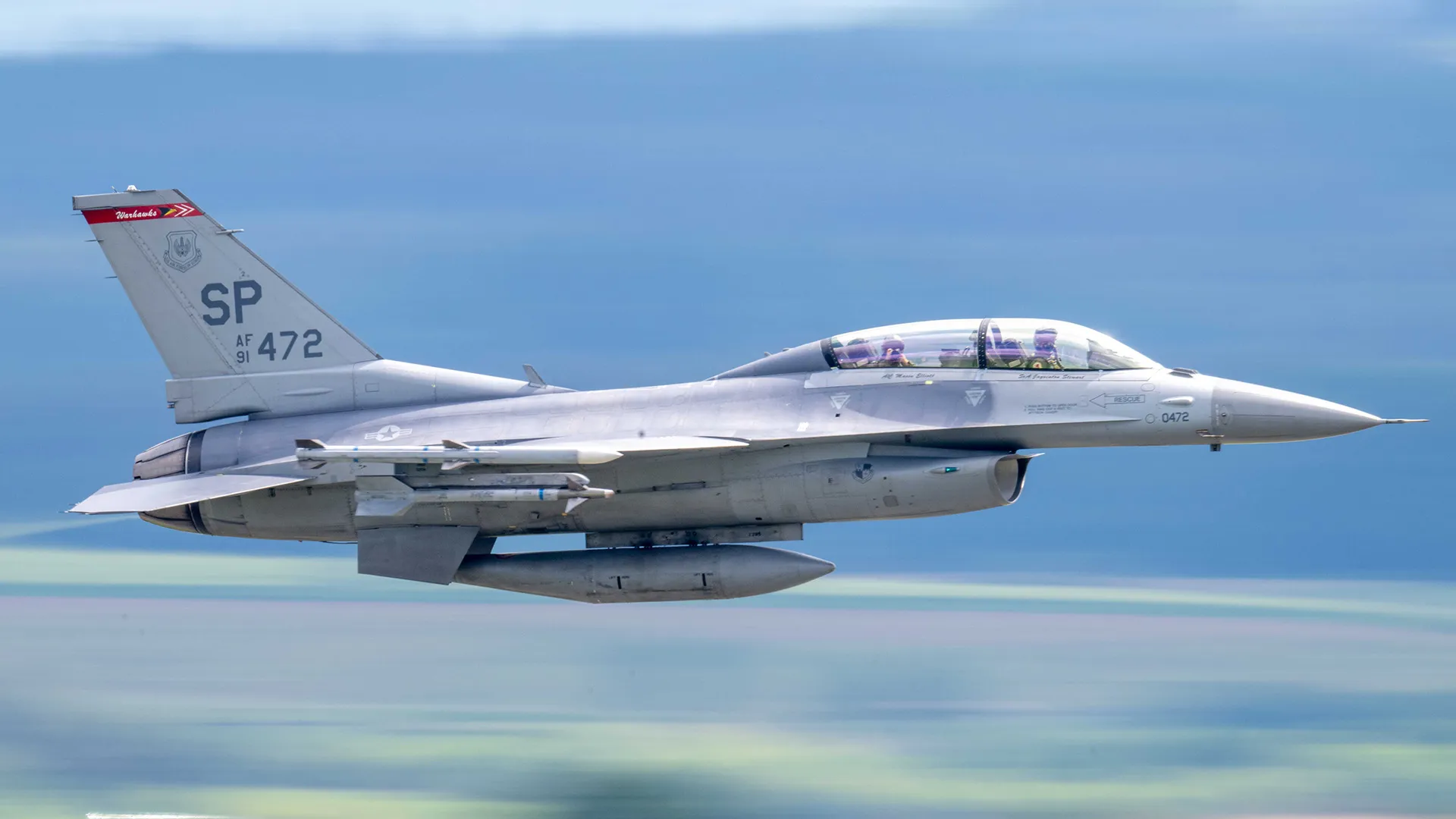
USAF Orders Both General Atomics’ FQ-42 And Anduril’s FQ-44 Into Production

The U.S. Air Force has awarded contracts for the production of General Atomics FQ-42A Dark Merlin and Anduril FQ-44A Fury drones. This sets the service up to operate a split initial fleet of Collaborative Combat Aircraft (CCA), something TWZ has highlighted as being a distinct possibility from the start.

The Air Force down-selected the designs from General Atomics and Anduril to move ahead as part of the first incremental development cycle of its CCA program, or Increment 1, back in 2024. What were originally designated the YFQ-42A and YFQ-44A first flew in August and October 2025, respectively, and have been undergoing further testing since then. Dark Merlin testing was paused earlier this year after one of the drones crashed, but has resumed.

A trio of YFQ-44A drones. Anduril
Three YFQ-42As in a row. GA-ASI

“By moving fast from competitive selection into full-scale manufacturing, we position ourselves to field highly credible and combat-ready semi-autonomous systems to stay ahead of the pacing challenge,” Secretary of the Air Force Troy Meink said in a statement today. “These contracts reaffirm our confidence in the strategic path forward for the program to procure over 150 combat capable CCA by the end of the decade.”

The Air Force says these contracts were awarded four months ahead of schedule, reflecting “that the FQ-42 and FQ-44 meet rigorous mission requirements and are ready for full-scale manufacturing.” At the time of writing, the service does not appear to have provided an update on the expected delivery timeline of the first production CCAs, but it has said in the past that it is hoping to have the first examples in operational service toward the end of the decade. Air Force has asked for nearly $1 billion in its 2027 Fiscal Year budget request to begin procurement of these drones.

“Under the contract, Anduril will deliver an initial set of production FQ-44 semi-autonomous fighter aircraft to support continued testing, validation, and, ultimately, operational fielding,” Mark Shushnar, Anduril’s Vice President for Autonomous Airpower, also wrote in a blog post today. “The contract also establishes a structure for the Air Force to buy additional lots of production FQ-44 aircraft across the next several years, providing a clear path for the Air Force to rapidly and affordably expand fighter capacity.”

A Fury drone carrying an inert AIM-120 air-to-air missile during a flight test. USAF

“This is an exciting day for our company and the nation,” David Alexander, President of General Atomics’ Aeronautical Systems, Inc. division (GA-ASI), said in his own statement. “Moving to production on FQ-42A is the result of an extraordinary partnership and many years of investments between General Atomics and the U.S. Air Force. We’ve been preparing for this order, and manufacturing is already well underway.”

A YFQ-42A in flight. General Atomics

A split-buy of Dark Merlin and Fury drones will help drive down risk. The designs are also very different, which opens the door to more operational possibilities for the Air Force right from the start. General Atomics and Anduril can also then focus on refining the respective strengths of their uncrewed aircraft. As noted, TWZ has pointed out on several occasions that a mixture of uncrewed platforms with different attributes would be needed to truly do justice to the CCA concept.

Furthermore, the Air Force making this decision still deep in the developmental phase also underscores how critical the service sees CCAs, and its desire to push ahead with getting at least an early iteration of the capability into service.

“Collaborative Combat Aircraft change how we project power and generate mass in highly contested environments,” Air Force Chief of Staff Gen. Ken Wilsbach said in a statement today. “Delivering this capability to our warfighters faster ensures our forces maintain the tactical edge required to deter and, if necessary, defeat any adversary.”

The Air Force has also further split the CCA effort into hardware and software segments, with airframe development falling into the former category.

“These distinct efforts validate acquisition transformation principles to secure a critical operational advantage: decoupling hardware from software,” according to an Air Force press release today. “By treating mission autonomy as ‘software sold separately,’ the Air Force ensures that the warfighter receives state-of-the-art physical platforms alongside agile, easily updatable software, effectively breaking traditional procurement molds.”

Anduril and General Atomics, as well as Lockheed Martin, Northrop Grumman, RTX Collins Aerospace, and Shield AI form the current vendor pool for the software side of the CCA program. The Air Force announced today that it had awarded additional mission autonomy contracts to Anduril, Collins, and Shield AI. Anduril is notably the only company currently with CCA contracts on the hardware and software sides.

Collaborative Mission Autonomy thumbnail

Collaborative Mission Autonomy


“This targeted award, based on the vendors’ ability to meet aggressive schedule and affordability requirements, will fund the first of two six-month competitive phases designed to speed the fielding of operational software to the warfighter,” according to an Air Force release. “While the baseline contract establishes a continuous competitive arena, the competitive awards are designed to deliver capability faster. Following the initial six-month period, the Air Force will evaluate the vendors’ progress and execute a second competitive award period. This performance-based competition will culminate in the selection of a primary mission autonomy provider for CCA Increment 1, with award planned for selection by summer 2027.”

“Furthermore, this software contract leverages a first-of-its-kind award fee exposure strategy, which enables operator feedback and combat performance to determine what the Air Force pays for mission autonomy. The Air Force will only pay the entire licensing fee if a vendor provides a combat capability aligned with warfighter needs and feedback,” the release adds. “The licensing approach also allows the Air Force to award software licenses to any of the six vendors within the pool at any point over the next six years. This approach ensures the Air Force can procure the best-performing and most affordable solutions as technology evolves.”

More government ownership of key intellectual property, and software in particular, has become a central guiding principle for the U.S. military contracting, in general, in recent years. When it comes to autonomy software packages, there is also now a core government-owned Autonomy Government Reference Architecture (A-GRA) that goes beyond the Air Force’s CCA program.

“Today, Lattice for Mission Autonomy is fully A-GRA compliant, ensuring that it can be integrated not only with all Increment 1 CCA, but with the full spectrum of current and future A-GRA compliant aircraft,” Anduril’s Shushnar highlighted in his blog post. “Through the A-GRA, the CCA program has established the foundation that will drive the development of a larger ecosystem of autonomous aircraft.”

Lattice for Mission Autonomy: An Unfair Advantage for Unrivaled Deterrence thumbnail

Lattice for Mission Autonomy: An Unfair Advantage for Unrivaled Deterrence


Shield AI’s Hivemind software is also already flying on a number of different drones.  Just last month, the Pentagon announced that it would be using this autonomy package to introduce swarming capabilities to its Low-Cost Uncrewed Combat Attack System (LUCAS) kamikaze drones.  

Shield AI flies Hivemind AI Pilot on 6th Aircraft thumbnail

Shield AI flies Hivemind AI Pilot on 6th Aircraft


“Mission autonomy is the cornerstone of the CCA concept, and leveraging a competitive, multi-vendor environment ensures we capture the latest technology,” Secretary Meink also said today in another statement. “This approach guarantees our Airmen are equipped with state-of-the-art capabilities today but keeps the door open for the breakthroughs necessary to maintain air superiority.”

In general, greater government control over intellectual property rights also helps avoid the potential to be locked into a single vendor. Establishing vendor pools to compete for follow-on contracts also creates opportunities to lower costs and to diversify supply chains, especially when it comes to hardware. That diversification, in turn, can be beneficial when it comes time to scale up production of both key subcomponents and complete systems.

As far as we know, the Air Force is still planning for at least one more incremental CCA development cycle, or Increment 2, firm requirements for which have yet to be publicly released. This could lead to further diversification of the service’s future CCA fleets. The Air Force has notably already given the YFQ-48A designation to Northrop Grumman’s Talon Blue drone design, which first broke cover in December 2025. Boeing’s MQ-28 Ghost Bat, originally developed for Australia, now has a greater presence in the United States.

The U.S. Marine Corps and the U.S. Navy are also pursuing their own CCA fleets in very close coordination with the Air Force. The Air Force is very much in the lead in fielding drones in this category, which could factor into future Marine and Navy decisions. The Marines are currently planning for their first tranche of MQ-58 Valkyrie CCA drones from Kratos to arrive in 2029. The Navy’s program is still very much in its infancy.

The Air Force’s CCA program has now taken another major step forward toward an initial fleet of drones that will include both General Atomics Dark Merlin and Anduril’s Fury.

Contact the author: joe@twz.com

Joseph is TWZ’s Deputy Editor, helping to oversee the site’s highly experienced and dedicated team, while also writing informative and impactful defense and national security content. He lives right in the thick of it in the Washington, D.C. area.


Source link

Diplomat confirms that US and Iran have signed MoU electronically | US-Israel war on Iran News

Iran’s Ministry of Foreign Affairs spokesperson, Esmaeil Baghaei, has announced that a memorandum of understanding with the United States has been finalised and signed electronically by both sides.

He added that the agreement has already gone into effect.

Recommended Stories

list of 3 itemsend of list

“The text of the Islamabad Memorandum of Understanding was finalised with the signatures of the presidents,” Baghaei told the news agency IRNA. “Now it is time to test the implementation of the agreement.”

Wednesday’s statement appears to confirm that the US and Iran have agreed to suspend military operations, paving the way for further negotiations.

Given that both sides signed the agreement electronically, Baghaei noted that there would be no signing ceremony on Friday in Geneva, Switzerland, as had previously been expected.

Negotiating teams, however, still plan to be in the Swiss city. A decision on a possible in-person meeting between them is expected in the coming hours, though for now such plans are paused, according to Baghaei.

While the office of US President Donald Trump has yet to issue a formal statement on the signing, Al Jazeera correspondent Mike Hanna explained that a White House spokesperson confirmed earlier in the day that it happened.

But Hanna warned that the memorandum is likely to face domestic backlash in the US, where Trump had been under right-wing pressure to take a hard line against Iran.

“There’s a great deal of dissatisfaction with the memorandum of understanding, as it has been outlined to the public at this particular point, even among some Republicans who have expressed the concern that Iran is being treated leniently,” Hanna said.

He also emphasised the administration’s position that the memorandum is not a full-fledged deal but rather a prelude to more negotiations.

“The administration is fighting hard to persuade the American public and American politicians that this is not a defeat for the United States,” Hanna said.

Since February 28, the US and Israel have been jointly engaged in a war against Iran, though a temporary ceasefire suspended much of the most intense fighting on April 8.

Trump has repeatedly said his goal in launching the war was to prevent Iran from acquiring a nuclear weapon.

Since the memorandum was revealed, he has highlighted the document’s assurances that Iran will not seek a nuclear weapon, though Tehran has long denied any intention of doing so.

But according to a US account, the memo goes beyond the question of nuclear weapons. It sets up a 60-day timeline for a final deal to be struck, and it indicates that the US will rally “regional partners” to create a $300bn for Iran’s reconstruction.

US sanctions would also work towards lifting its sanctions against Iran, and the country would issue waivers for the export of Iranian fuel.

Iran has touted those terms as a victory. On Wednesday, chief negotiator Mohammad Bagher Ghalibaf told Fars, an Iranian state news agency, that the US had failed to achieve its goals with Iran and pointed to the memo as proof.

“The agreement is a record of US failure,” Ghalibaf said. “People will see it and judge.”

He also explained that the Strait of Hormuz would not return to “pre-war conditions” after the 60-day period for negotiations stipulated in the agreement. He suggested that Iran will expect payments for use of the waterway.

“I emphasise again that the Strait of Hormuz will never return to the previous conditions,” Ghalibaf said.

“Iran has the right to sovereignty over the Strait of Hormuz, and of course, we will receive a fee for services.”

That position is likely to put pressure on the Trump administration, which had pledged that the strait, a key waterway for trade, would be “permanently toll-free”.

Since the start of the war, Iran has blocked the waterway, sending global prices for fuel, fertiliser and other goods soaring.

The US had responded with its own blockade of Iranian ports, though that effort is slated to end under the memorandum.

Both sides, however, have emphasised that the memorandum of understanding is not a final agreement on all issues of dispute. More negotiations are expected to resolve lasting impasses.

“It will only become a deal, as such, at the end of the 60-day negotiation period. At least, that’s the intention,” Hanna reported.

Source link

Iranians Remain Skeptical of Better Future Despite US Iran War Truce

Iran’s government has portrayed the interim agreement with the United States as a victory that ended months of conflict and prevented further escalation. The deal halted a war that saw U.S. and Israeli airstrikes, disruptions to trade, and severe economic damage across Iran.

However, interviews with ordinary Iranians reveal a starkly different picture. Many citizens say years of sanctions, combined with the recent conflict, have left them struggling with rising prices, declining living standards, and deep uncertainty about the future. While the fighting may have stopped for now, many remain unconvinced that the agreement will bring meaningful economic relief or lasting stability.

Economic Hardship Continues to Dominate Daily Life

For many Iranians, the ceasefire has not changed the reality of daily economic struggles.

Business owners, students, and workers interviewed across the country described a population focused on survival rather than recovery. Many reported cutting household spending, reducing social activities, and adjusting to higher living costs. Small businesses continue to face weak consumer demand, while young people increasingly worry about their economic prospects.

The war added another layer of pressure to an economy already weakened by years of international sanctions, inflation, and limited foreign investment. As a result, many citizens see little immediate prospect of improvement even if the ceasefire holds.

Divided Views on the Outcome of the Conflict

The agreement has exposed a clear divide between the government’s narrative and public sentiment.

Supporters of the Islamic Republic view the deal as proof that Iran resisted external pressure and preserved its political system. Some hardliners argue that the country emerged stronger and demonstrated resilience despite military and economic pressure.

Many ordinary citizens, however, are less focused on geopolitical outcomes and more concerned about living standards. For them, the key measure of success is whether the agreement leads to lower prices, economic opportunities, and greater stability. So far, few appear convinced that such changes are imminent.

Concerns Grow Over Political Freedoms

Beyond economic concerns, many Iranians fear that the post war environment could lead to tighter political controls.

Some citizens believe the government may use the conflict and national security concerns to justify stronger oversight and restrictions. These fears are particularly pronounced in regions populated by ethnic minorities, where previous protests have often been met with heavy security responses.

There is also uncertainty about whether public frustration over economic conditions could trigger future demonstrations. While many people remain cautious after previous crackdowns, underlying grievances over jobs, inflation, and political freedoms remain unresolved.

The ceasefire may have reduced the immediate threat of war, but it has done little to address the deeper challenges facing Iran. Public opinion appears increasingly shaped by economic realities rather than political declarations of victory.

The government may benefit in the short term from ending the conflict and avoiding further military escalation. However, lasting stability will depend on whether authorities can deliver tangible economic improvements and restore public confidence.

The biggest challenge for Tehran is that expectations remain extremely low. Many Iranians do not see the ceasefire as a turning point but rather as a temporary pause in a broader cycle of economic hardship and political uncertainty. If future negotiations fail to produce sanctions relief, investment, and economic recovery, public frustration could continue to grow despite the end of active conflict.

Stakeholders

  • Iranian government and political leadership
  • Iranian citizens and businesses
  • United States
  • Israel
  • Ethnic minority communities in Iran
  • International investors and energy markets
  • Regional governments monitoring stability in the Middle East

What’s Next

Attention will now shift to negotiations aimed at turning the interim agreement into a permanent settlement. Iranian leaders will seek economic benefits and sanctions relief, while Washington is expected to push for further commitments on security and nuclear issues.

Domestically, the government faces the challenge of managing economic expectations and maintaining stability. Whether the ceasefire translates into meaningful improvements for ordinary Iranians may ultimately determine how the agreement is judged inside the country.

With information from Reuters.

Source link

Juan Contreras: ‘The Venezuelan People Are Armed with Consciousness’

Contreras called for a unified Latin American response against ramped-up US aggression. (Tiempo)

Following the US attack on January 3, Venezuela was left in a state of turmoil and uncertainty that does not rule out further military actions. In recent days, there was “a joint operation between Venezuelan and US security agencies in the southeast of Bolívar state, in which organized crime networks were dismantled,” according to a statement from the Venezuelan government. Days earlier, the Coordinadora Simón Bolívar, a historic Chavista organization, had denounced DEA involvement in planning a repressive offensive with the aim of “decapitating” the popular movement in the iconic 23 de Enero neighborhood, which Juan Contreras describes as “the most important in Caracas.”

A community leader, social work graduate, and president of the Coordinadora, Contreras is a longtime Chavista activist and staunch defender of the Bolivarian Revolution. Today he believes there are “shameful situations that must be denounced,” but he holds the US government – ”our enemy” – responsible. Contreras was born and raised in the densely populated and combative 23 de Enero neighborhood, where he still lives and where he welcomed us to analyze the complex situation facing Venezuela, and in particular the social movements.

How are Venezuelan social organizations responding to what has been happening in the country since the US military attack on January 3?

What happened was an act of aggression, an act of war. They [the US] sought and continue to seek to break our people, but we in the social movements have kept up our efforts because we still believe in the revolutionary process. Our enemy is the US government, which must have realized that the problem wasn’t Chávez, because Chávez died and the revolution continued. President Maduro has been kidnapped, and here we are. What we’re experiencing today is unique in history; I don’t think anything like what’s happening in Venezuela has ever happened anywhere else in the world – the closest thing was in 1989 in Panama, when they kidnapped Noriega. But here, their narrative has fallen apart: it has not been proven that Venezuela is a drug trafficking country, that its government is linked to drug trafficking, or that President Nicolás Maduro was one of the biggest drug lords, as they claimed. On the contrary, today all those narratives have been debunked, and what is clear is that they are coming after our energy reserves. The Venezuelan people are well aware of this.

Is identifying a state of war and an enemy the context for the denunciation you issued about the danger of a DEA-orchestrated attack on 23 de Enero?

This is information we’ve received from a reliable source indicating that a large-scale operation is being planned against 23 de Enero, which is not far-fetched. 23 de Enero, as a barrio, has historical significance dating back to the Fourth Republic, between 1958 after the fall of Pérez Jiménez and the advent of democracy. That threat is very real. I believe that at the time, there was an underestimation of the threats posed by the US empire: the fact that our coasts were blockaded, the fact that our airspace was blockaded… Now, what we’re denouncing here has all the hallmarks of becoming a reality. It’s not just me saying this, nor the source that gave us this information, which is a reliable one. It’s that all the propaganda out there points in that direction, starting with the journalists who now live in Miami and are waging a full-scale campaign against the colectivos. “What’s going on with the colectivos? Why aren’t they attacking the colectivos? Why don’t they disarm the colectivos?” Marco Rubio himself has said it, and just recently one of the top military leaders said it: they’re coming for the “armed groups.” The problem is that, in their narrative, they label social movements as armed groups, accusing them of being armed in order to justify their aggression. Well, today our people are armed with consciousness; today, after 27 years, our people are more Bolivarian than ever. These are the people who placed their trust in Comandante Chávez, who committed to refounding the Bolivarian Republic of Venezuela. That is why we can understand all this cognitive warfare being waged against Venezuela.

There are no guerrillas here; what we have here is a people with a consciousness, a mobilized people, a people who, through culture, through popular education, have managed to advance in building the Bolivarian embryo from the barrio level, with the communal councils and the communes. So, the US seeks to dismantle that organization by employing the tactic of decapitation. They want to destroy the collectives, those who raise their voices against the empire, those who today denounce what is happening in our country, those of us who disagree with what is happening today, and who have maintained a principled and firm stance in the face of that aggression and invasion by the US empire.

Based on the information you have, how would the DEA carry out an attack of that kind on Venezuelan territory?

They have been operating by applying pressure. In all our countries, we have a repressive police force. Perhaps there is a segment of the police ranks – among their core leadership – that understands human rights issues, but there are other segments that are easily co-opted. We have 27 years of experience in which generals, colonels, and captains have turned their backs on us and served the empire’s policies. So, it’s not far-fetched to say that the United States is working with certain police forces, or with specific officials who might be willing to carry out an operation against the most important symbol in Caracas, which is the 23 de Enero parish. From 1958 to 1998, approximately 160 martyrs were killed there by the police. In other words, this is not crazy: it is serious, and as the pressure on our government to move toward an electoral process intensifies, the plan of aggression may also accelerate.

So, of course, it’s entirely possible that they’ll move forward with an action like this to eliminate what they consider “the Bolivarian resistance,” represented by social movements organized into communes, communal councils, and long-standing social organizations such as the Coordinadora Simón Bolívar, which is an expression of the popular power.

Did you receive any show of solidarity from the government?

Someone with influence within the government called us, reached out, we talked, and they agreed to investigate and look into the matter. What they recommended was caution: to steer clear of any provocation. And well, we’re waiting to see if what was discussed will be carried out, that a thorough investigation is conducted into what we’re denouncing. Because up until now, we thought [the US] would never invade, but they did; we underestimated them, and they invaded. And today they have the audacity to sell our oil, manage our finances, provoke us, and say they’re going to turn us into their 51st state. And on top of that, they’ve placed us under tutelage as if they were the owners of our country. This is, of course, shameful, and we must denounce it.

That is why we, as part of the popular movement, remain mobilized and continue to denounce what happened on January 3 and the consequences we are enduring in Bolívar’s homeland.

This situation has not yet had any international repercussions. What message do you have for the social and political forces in Latin America?

It has been 200 years since the Amphictyonic Congress, that call made by the Liberator to build a confederation of nations and defend ourselves against the US empire, which was already showing its claws. What better time to call for a continentalization of the struggle of our social organizations? It is not just Venezuela that is at risk: it is all of Latin America. They are coming for their backyard. Today, brazenly and in an interventionist manner, they are meddling in Colombia’s elections and declaring which candidate they want to win. They did the same in Honduras. 

So, in light of these events, the call to expand the struggle across the continent must be a reality today. Latin America’s only chance to escape the aggression of Donald Trump’s administration is through the coordination of the popular and revolutionary movement across the region. We must unite, we must denounce this situation, and we must move forward, because they’re coming for everything. The only way forward is to make the struggle a continental one. This is something that, at one point, was not only stated by Bolívar but also attempted by Comandante Ernesto Guevara. I believe that is where we should focus our efforts: on uniting the popular and revolutionary forces of Latin America and the Caribbean.

Source: Tiempo Argentino

Source link

Pentagon’s Ability To Supply Ukraine With More Patriot Interceptors Questioned By Congress

Concerned with Ukraine’s ability to protect itself from the onslaught of Russian missile and drone attacks, the Senate Armed Services Committee (SASC) is demanding to know if the Pentagon can increase deliveries of Patriot air defense system interceptors to that war-torn nation. This comes against the backdrop of extreme U.S. and allied demand on dwindling supplies of these weapons. 

As we have previously noted, between U.S. usage in recent Middle East conflicts and commitments to Ukraine and nearly 20 other nations, there have long been concerns about the supply of Patriot interceptors. Still, the Pentagon has maintained that it has sufficient supplies.

The U.S. Army is pressing defense contractors to come up with proposals for a new interceptor for the Patriot surface-to-air missile system with a unit cost under $1 million.
A Patriot air defense interceptor. (Lockheed Martin) Lockheed Martin

It is hard to say precisely how many Patriot interceptors remain in Ukraine’s stockpile, The New York Times recently noted

“The number is classified. At the end of June last year, there were as few as 16 in Ukraine’s arsenal,” the publication stated. Given the low supplies and constant Russian bombardment, Ukrainian President Volodymyr Zelensky has frequently requested additional interceptors from the U.S. and allies.

SASC said it “recognizes the importance of Patriot air defense systems and Patriot Advanced Capability-3 (PAC-3) interceptors in supporting Ukraine’s self-defense and notes continued concerns regarding interceptor availability, production capacity, and the impact of transfers on United States military readiness.”

“Accordingly, the committee directs the Secretary of Defense, in coordination with the Under Secretary of Defense for Acquisition and Sustainment, to submit a report to the congressional defense committees, not later than October 1, 2026, assessing the feasibility of increasing deliveries of PAC-3 interceptors to Ukraine,” its directive states.

We have reached out to the committee to find out which variant of the PAC-3 they are referring to. Lockheed Martin is boosting production of the more advanced current-generation Patriot PAC-3 Missile Segment Enhancement (MSE) interceptors and it is unclear how many of the other variants are still being made or are in U.S. stockpiles.

A Patriot Advanced Capability-3 (PAC-3) Cost Reduction Initiative (CRI) missile is launched during the recent successful Integrated Battle Command System (IBCS) flight test at White Sands Missile Range.
A Patriot Advanced Capability-3 (PAC-3) Cost Reduction Initiative (CRI) missile is launched during an Integrated Battle Command System (IBCS) flight test at White Sands Missile Range in 2021. (Darrell Ames) Darrell Ames

SASC wants the following information from the Pentagon:

  • “An assessment of current and projected Ukrainian requirements for PAC-3 interceptors over the next 12 months;”
  • “An assessment of the availability of PAC-3 interceptors from existing Department of Defense inventories for transfer to Ukraine and the impact of such transfers on United States military readiness and operational plans;”
  • “An evaluation of options to accelerate production of PAC-3 interceptors, including through multiyear procurement authorities, advance procurement, expanded supplier capacity, and other industrial-base investments;”
  • “An assessment of the feasibility of increasing annual PAC-3 interceptor production and the anticipated timeline for achieving such increases;”
  • “An identification of any statutory, regulatory, contractual, or supply-chain barriers to increasing interceptor deliveries to Ukraine;”
  • “An assessment of opportunities for allied and partner nations operating Patriot systems to contribute additional PAC-3 interceptors to Ukraine, including options for United States backfill arrangements;” and
  • “Recommendations for legislative or administrative actions that would enable increased interceptor deliveries to Ukraine while maintaining acceptable levels of U.S. military readiness.”

In addition, the committee said the secretary should “brief the congressional defense committees on the findings of the report, not later than 15 days after its submission.”

The Pentagon on Wednesday declined comment on the committee’s report, how many interceptors it has provided to Ukraine or whether it has the ability to increase that supply. We have reached out to Lockheed Martin as well and are awaiting a response.

Soldiers from the 11th Air Defense Artillery Brigade conduct a Patriot missile live-fire exercise at MacGregor Range near Fort Bliss, Texas, Aug. 23, 2025. The exercise is designed to validate crew proficiency, ensure equipment reliability, and send a clear message of deterrence to potential adversaries. (U.S. Army photo by Sgt. JaDarius Duncan)
Soldiers from the 11th Air Defense Artillery Brigade conduct a Patriot missile live-fire exercise at MacGregor Range near Fort Bliss, Texas, Aug. 23, 2025. (U.S. Army photo by Sgt. JaDarius Duncan) Sgt. JaDarius Duncan

TWZ recently addressed the supply of these munitions in a story about a new report from the Center for Strategic and International Studies (CSIS).

The report, on the severity of the depletion of U.S. advanced weapons stockpiles, found that current production PAC-3 MSE “is around the baseline rate of 650 interceptors per year, with half the deliveries going to the United States and the rest to allies and partners.” 

Under a contract with the Pentagon inked in January, Lockheed is committed to boosting Patriot annual production to 2,000.

“Because U.S. procurement in the last decade has averaged 225 missiles per year, deliveries from prior years will not be enough to fully replace expenditures,” CSIS cautioned. “For that, the United States will need to wait for the 3,203 Patriot missiles requested in the Army’s FY 2027 budget. These are projected to start delivery in May 2029.”

As we noted earlier in this story, in addition to the Patriot interceptors already provided to Ukraine, the U.S. used a large amount during the conflict with Iran defending its assets, as well as those of allies.

The CSIS report found that at the start of the war with Iran, “there were about 2,500 Patriot interceptors in the U.S. inventory,” though its accompanying chart does not specify which variant. “During the course of the conflict, between 1,060 and 1,430 Patriots were fired.” We don’t know what that tally includes, but we do know that PAC-2 and PAC-3 series interceptors have been employed in the latest conflict with Iran.

CSIS

Adding to questions about the ability to supply Ukraine with more Patriots, a top official from Lockheed Martin recently warned that the company cannot give U.S. allies any certainty over when they will receive interceptors despite plans to triple capacity, according to Financial Times.

Brian Dunn, vice president for strategy and business development of missiles and fire control, recently said that the company was working hard to scale up production of critical PAC-3 interceptor missiles amid a supply crunch exacerbated by the war in Iran. 

But in remarks to journalists at the ILA Berlin Air Show, “he sent a sobering message to American allies including Germany, Japan, Poland, the UAE and Saudi Arabia that operate the Patriot air defense system,” the publication reported.

Dunn said the extra capacity “is obviously going to be able to satisfy multiple user requirements in a faster timeline.” However, he added that Lockheed Martin does not “control what the allocation of those missiles is going to be. We can’t tell anybody where you’re going to be on that [priority list].

“Obviously there’s a lot of rhetoric coming right now from the Department of War . . . about how they’re going to reorder, reorganize, who’s going to get missiles first,” he continued. “We don’t control any of that.”

Dunn’s statements highlight concerns we raised long before and during Operation Epic Fury about the rapid expenditure of critical munitions and how that could affect a potential future fight against China. It also goes along with our reporting about the overall inadequacy of the U.S. Patriot force, an issue we have been highlighting for years.

Meanwhile, for Ukraine, the influx of new Patriot interceptors cannot come soon enough. Two nights ago, for instance, Russian forces launched 70 missiles and over 600 drones in a mass assault, according to the Kyiv Independent.

“Of the 34 ballistic missiles fired, 19 were aimed at the capital,” the publication noted.

You can see a video of one of those strikes below.

“Kyiv’s beleaguered Patriot batteries did a valiant job, intercepting 15 of them, along with five of the six 3M22 Zircon hypersonic cruise missiles launched in the attack,” the news outlet added. “Still, even layered defenses were stretched beyond the limit.”

Contact the author: howard@twz.com

Howard is a Senior Staff Writer for TWZ. He writes frequently about conflict, focusing heavily on the Middle East and Ukraine, and interviews with military and intelligence officials and industry leaders from around the globe. He lives near Tampa, Florida, home of U.S. Central Command, U.S. Special Operations Command.


Source link

Derek McInnes: Rangers appoint Hearts head coach as manager after Danny Rohl joins Red Bull Salzburg

Rangers have appointed Derek McInnes as manager on a three-year contract after agreeing a compensation deal with Scottish Premiership rivals Hearts.

McInnes is the third boss at Ibrox inside a year and replaces Danny Rohl, whose move to Austrian side RB Salzburg was confirmed earlier on Wednesday.

The 54-year-old joined Hearts from Kilmarnock last summer and led the Tynecastle club to a second-placed finish, missing out on the title to Celtic on a dramatic final day, but edging Rangers out of the Champions League qualifiers.

The former Rangers midfielder turned down an approach from the Ibrox club in December 2017 in order to stay at Aberdeen but has now followed Tynecastle captain Lawrence Shankland in moving from Hearts.

“It is a real honour,” McInnes said. “The demands here are clear and our supporters rightfully have high expectations. It is up to me, my staff and my players to meet those expectations, and have this club performing as it should.

“There is a lot of hard work ahead, but already the preparations have begun and I am looking forward to meeting the current squad in the coming weeks and welcoming some new faces.”

Alan Archibald, Paul Sheerin and Craig Clark will assist McInnes.

While Rohl was head coach, McInnes will have the title of manager and was the frontrunner as soon as it emerged that the German was keen to leave for Salzburg.

Chairman Andrew Cavenagh said the Scot is “someone we have always rated highly” and is “exactly what this club needs at this moment in time”.

He added: “His deep Scottish and Rangers experience are important for us. He knows how to win in this league, and he is coming off an extremely strong season with Hearts.”

Rohl, 37, replaced Russell Martin as head coach in October and steered Rangers into a three-way title fight, but a post-split collapse yielded a third-placed finish behind Celtic and Hearts as the Ibrox club ended the campaign without silverware.

Cavenagh – who publicly backed Rohl at the end of the season – thanked him for his “service and commitment to Rangers”.

“He and his staff put in a significant amount of hard work during his time in charge, which we are greatly appreciative of,” he added.

Source link

Luigi Mangione to use psychiatric defence in healthcare CEO murder case | Courts News

Mangione would face lighter sentencing if jury accepts he was in a state of ‘extreme emotional disturbance’ during act.

Luigi Mangione, the man suspected of fatally shooting United Healthcare CEO Brian Thompson in New York City, will argue a psychiatric defence during his trial.

Judge Gregory Carro said on Wednesday that Mangione’s lawyers informed him that they will assert that their client was in a state of “extreme emotional disturbance” when he allegedly carried out the shooting in December 2024.

Recommended Stories

list of 3 itemsend of list

New York state allows murder defendants to make the case that they cannot be held fully responsible for their actions because they were in a state of extreme emotional disturbance at the time of the killing.

Thompson’s slaying, which took place outside a hotel in midtown Manhattan, shocked the United States public. Grainy footage of the act quickly spread across social media.

It also drew attention to the widespread anger over sky-high healthcare prices. Police have said that the terms “delay”, “deny”, and “depose” were written on the suspect’s ammunition, a reference to how health insurance companies avoid paying claims.

If the jury concludes that Mangione was emotionally disturbed at the time of the alleged act, it could move to convict him of manslaughter rather than murder. Such a conviction generally results in a lighter sentence.

Relying on a claim of emotional disturbance means that Mangione would effectively admit that he carried out the act, but that he did so under circumstances of impaired judgement. It differs from an insanity plea, which would allow Mangione to serve his sentence in a psychiatric facility rather than a prison.

Mangione, who sat between two of his lawyers dressed in a blue suit, is set to go to state trial on September 8. The 28-year-old has previously pleaded not guilty to state and federal charges in connection to the killing.

His federal trial, which includes stalking charges, is set to begin on October 13. He faces a potential life in prison if convicted in either case.

US District Judge Margaret Garnett, who is overseeing the federal case, threw out murder and weapons charges against Mangione on technical grounds in January. That ruling eliminated the possibility of Mangione facing the death penalty.

Source link

As Rain Returns to Zamfara, So Do Terror Attacks on Local Farmers 

When dozens of farmers bade farewell to their family members on the morning of Friday, June 12, and headed out in different directions to work on their farms, 17 of them were not lucky enough to return home alive. The farmers were killed after terrorists invaded their fields in the Maradun Local Government Area (LGA) of Zamfara, North West Nigeria.

Locals say 13 other farmers were injured during the attack, with three of them referred to the Usmanu Danfodiyo University Teaching Hospital (UDUTH) in Sokoto. A survivor of the attack, who identified himself only as Bello, told HumAngle that he was on his farm in the outskirts of Gora in the Maradun LGA, at around 9 a.m., when he heard the first gunshot. He said he thought it was one of the Yan Sakai local security guards, but it became clear that it was a terrorist attack when the gunshot sounded a second time. Yan Sakai security volunteers are young people carrying weapons to protect residents from terrorist attacks. 

Bello recalled that he was lying face down while others fled. As the gunfire persisted, he managed to pull himself to the other side of the road before running home. “I was lucky, my farm is right on the side of the road; most of those killed had their farms a little bit away from the road,” he said.

For over ten years, rural terrorism has become widespread and persisted in Zamfara and other northwestern states. In many ungovernable areas, farmers are compelled to pay a farming tax before they are permitted to work on their fields as the wet season arrives. The armed groups also require farmers to make payments running into millions to cultivate their crops. Even after paying, not all communities are granted access to their farmlands. Many communities have been displaced, and food stores have been torched because residents failed to pay the required farming tax.

HumAngle recently reported that about 40 leaders of a farming community were abducted at a peace deal meeting with a terrorist leader in a village in the Maradun LGA. The community leaders were lured into a meeting to discuss how much they would pay to a terror group, only for them to be abducted by the leader of the criminal syndicate. In a separate report, we also documented how farmers were being displaced after paying millions of naira as farming tax to terrorists in Zamfara.

“There were a lot of motorcycles with bandits on top, shooting sporadically, but I managed to escape. The bandits [terrorists] must have divided into groups because there were gunshots from all corners,” Bello said.

The chairman of the Maradun LGA, Sanusi Dosara, stated that the recent devastating attack reflects the ongoing efforts of terrorists to disrupt farming activities in the state. Since early June, there has been an increase in attacks aimed at farmers in Zamfara. 

Prior to the latest incident, two farmers were killed while tending to their fields near the Kaya community, not far from Gora in Maradun. Earlier, eight farmers were killed in an attack in Gima village, located in Anka LGA. According to locals, the farmers who lost their lives in the Gima assault were: Sani Kanen Tidurogo, Salisu Kadda, Bello Kyabe, Ibrahim na Yakubu Ziti, Yusuf Malan Rabi, Masaudu Sani Adake, Abdulmajid Sani, and Adamu Dungo.

Several covered bamboo stretchers lay in a row, surrounded by onlookers in colorful clothing.
Funeral for the 17 farmers killed in Gora. Photo provided by Ibrahim Kaya.

“The terrorists are intentional about what they want,” Abdulmudallib Anka, a resident, told HumAngle. His house in Anka is filled with internally displaced persons from Gima and other villages. “The day of that attack, the terrorists circled a group of farmers working on their farms before they started shooting sporadically.”

Abdulmudallib noted that the recurring attacks have shown the terrorists are ready to continue their onslaught against the civilian population, so as to stop them from gaining access to their farms. There have also been reports of attacks in which farmers were killed in the communities of Kaura Namoda, Tsafe, Zurmi, and Birnin Magaji LGAs over the past few days.

Sulaiman Abdullahi, a youth leader in Birnin Magaji, said the situation has forced several farmers to stop going to the farm.

“Early June, farmers were attacked outside Tungar Danjuma and Gidan Kyafda, which led to the death of about six farmers with several others injured,” Sulaiman said. “That same day, farmlands on the Birnin Magaji – Kaura Namoda road were also attacked around 1 p.m.”

In Zurmi LGA, the terrorists struck on June 7 and invaded the outskirts of the town, along the road to Kaura Namoda, killing two farmers working on their farms. 

Seventeen farmers were killed, and thirteen injured in a terrorist attack in Maradun LGA, Zamfara, Nigeria. This is part of a broader issue where rural terrorism has thrived for over a decade, forcing farmers to pay exorbitant “farming taxes” to militant groups for access to their fields.

Despite payments, many communities are displaced, and attacks on farmers are increasing, disrupting agriculture activities.

Local security has been ineffective as indicated by repeated incidents, including the abduction of about 40 community leaders under false pretenses. Recent violence has persisted across various local government areas of Zamfara, further highlighted by incessant attacks which resulted in deaths and injuries of numerous farmers.

The ongoing threat deters farming activities and devastates local economies, leaving residents in fear and uncertainty.

Source link

China’s Big R6000 Tiltrotor Drone Has Entered Full Flight Testing

A newly emerged video offers what appears to be a first look at China’s R6000 uncrewed tiltrotor aircraft in free flight, marking a significant step beyond the tethered hover tests that had been seen previously. The design has attracted interest on account of its similarities to Bell’s MV-75A Cheyenne II, America’s crewed second-generation tiltrotor. More broadly, the development of this aircraft could have very significant implications for the People’s Liberation Army as well as civilian operators.

The footage, which first appeared on Chinese social media, shows the large drone in vertical flight, making a pedal turn (rotating around its vertical axis in the hover), and in sustained forward flight with its twin proprotors fully tilted. Previous imagery was limited to tethered evaluations that demonstrated basic hover capability. Now, with flight testing advancing, more could be revealed about the aircraft’s performance envelope.

As in the previous imagery, the aircraft’s engines are unshrouded, with their streamlined fairings removed. Like the MV-75, the R6000 features fixed engine nacelles with hinged proprotors, in contrast to the first-generation tiltrotor design found on the V-22 Osprey, in which the entire nacelle pivots up and down as a complete unit.

Previous imagery showing the R6000 conducting a tethered hover test had begun to circulate last November, as we discussed at the time.

An R6000 prototype seen undergoing tethered hover testing. United Aircraft via Chinese internet

While no details have been released about the scope of the current trials, the ability to conduct sustained untethered flight is a key milestone for any tiltrotor program, given the complexity of the aircraft’s aerodynamics and flight-control systems. Tiltrotor designs are especially challenging, as evidenced by the V-22’s checkered record through the years. 

In October 2024, a photo emerged showing the first completed prototype of the R6000 at the Wuhu United Aircraft Production Workshop in China’s eastern Anhui province. United Aircraft had unveiled the design, also referred to as the UR6000 and Zhang Ying (or Steel Shadow), at the 2024 Singapore Airshow.

A photo shows what is said to be the first completed UR6000 prototype on the production line at the Wuhu United Aircraft Production Workshop in the Wuhu Aviation Industrial Park in China’s eastern Anhui province. United Aircraft

Developed by the Chinese firm United Aircraft, the R6000 is one of the largest uncrewed tiltrotor designs currently in development anywhere in the world. Combining the vertical takeoff and landing capabilities of a helicopter with the speed and range advantages of a fixed-wing aircraft, it is — officially, at least — aimed at logistics, disaster relief, offshore support, and other missions requiring access to areas without prepared runways. United Aircraft has presented both crewed and uncrewed versions of the R6000 in the past.

As we have outlined previously, a crewed or uncrewed tiltrotor in the R6000 class could fulfill various military applications for the People’s Liberation Army (PLA).

Concept artwork of an apparent crewed version of the UR6000 in a generic civil-type color scheme. United Aircraft

The aircraft would be particularly valuable for sustaining PLA island bases in the South China Sea, as well as isolated installations elsewhere in the Pacific and along China’s remote border regions, where conventional airfield infrastructure is limited.

This kind of aircraft could support overseas deployments and regional contingencies, including a potential operation against Taiwan, by moving troops, supplies, and equipment between dispersed locations without relying on prepared runways.

In particular, the R6000 would be well suited to operating from the Type 076 amphibious assault ship and other large People’s Liberation Army Navy (PLAN) amphibious ships, greatly extending their reach for logistics, reconnaissance, and other missions.

China’s first super-sized Type 076 amphibious assault ship, the Sichuan.

As well as logistics, a fully developed R6000 has clear potential as a multi-mission platform. Its payload capacity could also accommodate intelligence, surveillance, and reconnaissance (ISR) equipment, electronic warfare payloads, communications relay systems, or potentially even precision-strike weapons. It is worth noting at this point that a special operations version of the MV-75 is already in the works, with a gunship variant likely, and a sea control concept has been displayed, too. China is likely to at least explore similar development paths for its tiltrotors.

A view of Bell’s MV-75 sea control concept model at this year’s Modern Day Marine exhibition. Eric Tegler

In this respect, the R6000 also makes for an interesting comparison with Bell’s V-247 Vigilant, which was originally pitched to meet the U.S. Marine Corps multirole, VTOL-capable drone program, known as MUX. The V-247 has also been pitched to the U.S. Navy, while Bell has presented renderings showing V-247s operating together with the crewed V-280 Valor tiltrotor design, which the U.S. Army’s MV-75 is based on.

Concept artwork depicting V-247s operating together with a version of the V-280 Valor tiltrotor. Bell

When it comes to advanced uncrewed aviation, this is an area that China has invested heavily in over the past decade. Its projects span everything from smaller tactical drones to high-altitude reconnaissance platforms and increasingly sophisticated combat drones. The R6000 fits squarely within Chinese efforts to develop a range of uncrewed transport aircraft, including developing large autonomous logistics aircraft capable of operating in challenging environments.

At least one picture on United Aircraft’s website shows the UR6000 in People’s Liberation Army markings. United Aircraft

In the vertical-lift segment, China is also busily exploring crewed tiltrotor designs.

Earlier this month, new footage emerged showing what is understood to be China’s first crewed tiltrotor aircraft during flight trials. That aircraft had first broken cover in August of last year, as we wrote about at the time.

A photo that appeared on June 1, showing the crewed tiltrotor aircraft while in flight. Chinese internet via X

Although the R6000 has, in the past, been pitched primarily for civilian applications, the technology has obvious military relevance. Large autonomous tiltrotors could provide rapid resupply to dispersed forces, support operations in remote regions, or deliver cargo to ships and austere bases without the need for conventional runways. Tiltrotors have huge potential for the PLA, which has major littoral mission demands and a growing fleet of amphibious warships to which these kinds of aircraft are especially well suited.

As such, the R6000 is worth watching as another indicator of the Chinese military’s increasingly ambitious vertical-lift programs, as well as its diverse and growing series of uncrewed aircraft.

Contact the author: thomas@thewarzone.com

Thomas Newdick is a staff writer at TWZ, where he covers military aviation, defense technology, weapons systems, and international security. Based in Berlin, Germany, he reports on conflicts, military modernization efforts, and emerging aerospace technologies around the world, with a particular interest in airpower and its role in contemporary warfare. His reporting is informed by deep expertise in modern and historical airpower, particularly in Europe, with a focus on military aviation, air campaigns, and aerospace developments across the continent and beyond.


Source link

Russian artist and outspoken Putin critic shot dead days after protest | Protests

NewsFeed

Russian artist Robert Kuzakov, known as Semyon Skrepetsky, was shot dead in Poland just three days after a performance protest in Berlin near the Russian embassy. He was known for his caricatures of politicians including Vladimir Putin and Alexei Navalny.

Source link

Israeli air strikes on Lebanon continue despite US-Iran deal | Israel attacks Lebanon News

Israeli air strikes have continued to target towns in southern Lebanon despite an agreement between the United States and Iran set to be formally signed on Friday to end the war on all fronts.

Israeli drones carried out three attacks in Tyre that resulted in injuries while a drone also targeted the Bint Jbeil district in Nabatieh, Lebanon’s state-run National News Agency said on Wednesday.

Recommended Stories

list of 4 itemsend of list

The fighting in Lebanon is considered one of the biggest threats to the framework agreement in the US-Israel war on Iran with Tehran warning that new Israeli strikes on Lebanon and continued occupation of its territory would be regarded as a violation of the deal.

Earlier on Wednesday, Al Jazeera Arabic correspondents on the ground reported that Israeli forces carried out an air strike on the outskirts of Kfar Tebnit, also in the Nabatieh district. They also launched raids on the town of Nabatieh al-Fawqa and shelled the Ali al-Taher heights and the outskirts of the town.

Hezbollah fighters, meanwhile, launched at least 10 rockets towards Israeli forces near Kfar Tebnit.

A day earlier, Israeli attacks killed at least four people in Nabatieh, including in drone strikes on several vehicles.

There has been a reduction in violence since the US-Iran agreement was announced, but attacks have not stopped, Al Jazeera’s Zeina Khodr said, reporting from Beirut.

“Security sources believe that the Israeli army is trying to occupy more ground, especially strategic high ground around Nabatieh,” she said.

“Yes, families have started to return to their villages, but people are worried. They say they don’t trust that Israel will abide by the ceasefire.”

United Nations spokesperson Stephane Dujarric said the number of projectiles fired between Israeli forces and Lebanon fell to 174 on Sunday, compared with 705 the previous Sunday.

Of these, 169 were attributed to Israel and five to Hezbollah, he said.

Lebanon ‘most sensitive issue between the sides’

The situation in Lebanon is one of the main pillars of the US-Iran agreement, Al Jazeera’s Almigdad Alruhaid said, reporting from Tehran.

“As we approach the signing of the deal, it is becoming the most sensitive issue between the sides,” Alruhaid said.

Iran said the Israeli military has violated the ceasefire in Lebanon 84 times in the past two days and warned that Israel should expect “a harsh response” if it does not stop its attacks, he reported.

This came after Iranian Foreign Minister Abbas Araghchi said the withdrawal of the Israeli military from Lebanese territory is one of the core demands right now to move forward with the framework agreement Iran has with the US, Alruhaid said: “So the Iranians say the situation in Lebanon, in particular southern Lebanon, is an integral part of the memorandum of understanding.”

Lebanon was among the top priorities for the Iranians when they started negotiations with US President Donald Trump’s administration, according to Mohammad Eslami from Tehran University.

“Once the Iranians not only retaliated against the Israeli attacks on Dahiyeh and Beirut but also pre-emptively attacked Israeli territory, they showed right from the outset they are determined and very serious about supporting Lebanon, the Lebanese people, the Lebanese government and the resistance factions in Lebanon,” Eslami told Al Jazeera.

Israel’s invasion akin to ‘war crimes’

Meanwhile, the human rights group Amnesty International said on Wednesday that the Israeli army’s mass forced displacement orders in Lebanon amount to war crimes under international law.

“In parts of southern Lebanon, the Israeli military’s forced displacement of civilians and prevention of their return amounts to unlawful transfer – which is a war crime,” Amnesty said in a statement.

The Israeli army has “radically expanded” its use of such orders, displacing hundreds of thousands of people across Lebanon, it said.

“Instead of forcibly uprooting communities and designating entire swathes of Lebanese land as ‘no-go zones’ for civilians, Israeli forces must immediately withdraw from Lebanese territory,” said Kristine Beckerle, Amnesty International’s deputy regional director for the Middle East and North Africa.

The Israeli military declared about 4.6 percent of Lebanon as a “no-go zone” on November 28, 2024, a day after a previous ceasefire took effect, Amnesty noted.

This year, just three days after an April 17 ceasefire announcement, the restricted area was expanded to about 6 percent of the country, and residents were ordered not to return to villages previously home to tens of thousands of civilians.

Lebanese officials said Israel, which has been carrying out a large-scale offensive in the country since March 2, has killed more than 3,800 people, wounded 11,850 and displaced more than one million.

Source link

China pledges new humanitarian aid packages for Lebanon and Iran | Humanitarian Crises News

NewsFeed

China has announced it will send a round of humanitarian aid to Lebanon and Iran and play an active role in fostering regional peace. The foreign ministry spokesman described Beijing as ‘deeply saddened’ by the humanitarian disaster.

Source link

B-52 Involved In Tragic Crash Was Heading Out On Radar Test Sortie

There are so many questions to be answered about what led to yesterday’s fatal mishap involving a B-52H bomber at Edwards Air Force Base. The crash was tragic on a level the base, which sits at the center of America’s flight testing ecosystem, has not experienced, at least to our knowledge, for 75 years. The human impact here is just hard to quantify at this time. At the same time, there will be a major developmental impact, too, especially when it comes to work that is being done to modernize the B-52. This is a constellation of programs that are seen as vital to U.S. national security, and are also already running far behind schedule and over budget.

At this time, we do know that the aircraft in question was being used to support the Radar Modernization Program (RMP), and its loss will have ramifications for that effort. The RMP has already suffered years of delays and major cost growth, the latter of which triggered a deep, legally mandated review. However, in the past year, the U.S. Air Force has been talking more positively about progress on this critical upgrade, as well as other parts of a larger B-52 modernization effort that have faced their own hurdles.

“It was a B-52 that was on initial takeoff, supporting the Radar Modernization Program,” Air Force Col. James Hayes, Deputy Commander of the 412th Test Wing at Edwards, said at a brief press conference yesterday. “It was a local test sortie. It took off, and immediately after takeoff, crashed and burst into flames.”

The 412th is the main unit at Edwards. As noted, the base serves as the Air Force’s main test and evaluation hub.

“After reviewing the footage of the crash, it was deemed that this was an unrecoverable crash and unsurvivable,” Col. Hayes added. The B-52 had “a mixed crew of military, government civilians, and government contractors supporting this test mission.”

“Right now, our thoughts and prayers are with the families of those that lost their loved ones,” he also stressed. “This is a tragedy.”

When reached by TWZ for comment today, Boeing reiterated a brief statement it made yesterday that confirmed two of its employees died in the crash. The company’s full statement is as follows:

“We extend our deepest condolences to the loved ones of the eight crew members who lost their lives in the B-52 crash at Edwards Air Force Base, California. It is with great sadness that we confirm two Boeing employees were among those on board. We are in contact with their families and are offering support.”

Boeing, the original manufacturer of the B-52, is serving as the prime integrator for the RMP. Raytheon is supplying the new AN/APQ-188 active electronically-scanned array (AESA) radar, which is derived primarily from the AN/APG-79. In the United States, versions of the AN/APG-79 are in service today on U.S. Navy F/A-18E/F Super Hornets and all EA-18G Growlers, as well as U.S. Marine Corps F/A-18A-D Hornets. The AN/APG-82 used on Air Force F-15E Strike Eagles and F-15EX Eagle IIs also builds on the AN/APG-79. The AN/APQ-188 will replace the mechanically-scanned AN/APQ-166 found on B-52s today.

A side-by-side look at the existing AN/APQ-166 radar on a B-52, at left, and the new AN/APQ-188 integrated onto one of the bombers, at right. USAF

The RMP is one of many major upgrades planned for the Air Force’s entire fleet of 76 B-52s in the coming years. The bombers are also set to get all-new engines, improved communication suites, and more. The changes will be so substantial inside and out that the designation of the bombers will switch from B-52H to B-52J in the process.

B-52 Future Stratofortress: The Upgrades That Will Transform The B-52H Into The B-52J thumbnail

B-52 Future Stratofortress: The Upgrades That Will Transform The B-52H Into The B-52J


“It is too early to tell,” a U.S. Air Force official told TWZ today when asked about potential impacts to the RMP.

We have also reached out to Raytheon.

The publicly stated plan for the RMP has called for the integration of the AN/APQ-188 radar onto two B-52s to support initial testing. Modification of those bombers began in Fiscal Year 2023, and the first example with the new radar touched down at Edwards in December 2025. Air Force budget documents say the second radar test B-52 is expected to be ready some time in Fiscal Year 2026, which began on October 1, 2025. Whether that milestone has already been reached is unclear.

The first B-52 equipped with the new AN/APQ-188 radar arrives at Edwards in December 2025. USAF

It is also not known how many AN/APQ-188s may be available at all at present. “The remaining test-phase radars are expected to be delivered through the summer of 2024,” Raytheon said in a press release back in 2023.

As noted, the RMP has already suffered significant delays. Under the original program schedule, flight testing was expected to start in 2024. The initial goal was for AN/APQ-188-equipped B-52s to begin flying operational sorties in 2027. As it stands now, the Engineering and Manufacturing Development (EMD) phase of the program is expected to run into the middle of 2029, with initial operational capability then coming in 2030.

These delays have also come along with substantial cost growth. In 2021, the estimated price tag for development of the AN/APQ-188 and integration of those radars onto the Air Force’s full fleet of 76 B-52s was pegged at nearly $2.4 billion, according to the Government Accountability Office (GAO). By 2023, the RMP’s costs had risen by 12.6 percent, per GAO. The program was eventually subjected to an extensive legally required review of its requirements and cost targets, which led to a scaling back of planned capabilities, at least initially.

“Part of what we did to control cost is to work at what are the main things that we need on this radar? As you may recall, we’re buying a radar that is largely a F-18 Hornet radar with some small modifications. We did that intentionally because that is what was on the market at the time,” Air Force Lt. Gen. Andrew Gebara, Deputy Chief of Staff for Strategic Deterrence and Nuclear Integration, explained in August 2025. “It would actually cost us more if we asked [a contractor] to design the new radar.”

An AN/APG-79 radar installed on an F/A-18 Hornet. Raytheon

Gebara’s remarks came during a virtual talk hosted by the Air & Space Forces Association’s Mitchell Institute for Aerospace Studies.

“Having said that, it doesn’t mean that we need everything on that radar that the Hornet had on it,” he continued. “We have a certain number of minimum things that we need to do to be able to do our B-52 mission. And so part of the cost saving [review] was looking at what are those things, to make sure that we’re prioritizing precious dollars on things that we need.”

Gebara said at that time that the revised RMP plan still kept the door open for “opportunities for growth in the future, if it comes to that.”

The AN/APQ-188 is still set to provide essential new capabilities, in part just by being a more modern AESA design. As TWZ has written in the past:

“In general, AESA radars offer greater range, fidelity, and resistance to countermeasures, as well as the ability to provide better overall general situational awareness, compared to mechanically scanned types. Increasingly advanced AESAs bring additional capabilities, including electronic warfare and communications support.”

“For the B-52, any new multi-mode AESA will improve the bomber’s target acquisition and identification capabilities, including when used together with targeting pods available for the bombers now. New radars for the bombers will also be helpful when it comes to guiding networked weapons over long distances to their targets and could provide a secondary ground moving target indicator (GMTI) and synthetic aperture radar surveillance capabilities. The radar upgrade could help defend B-52s from air-to-air threats, including through improved detection of incoming hostile aircraft.”

A B-52 bomber with its nose open for maintenance. USAF

“Boeing has already looked at some schedule improvement that we’ve seen,” Air Force Gen. Dale White, the service’s Direct Reporting Portfolio Manager for Critical Major Weapon Systems, also told TWZ and others more recently at a roundtable at the Air & Space Forces Association’s (AFA) annual Warfare Symposium in February. White was speaking at the time collectively about progress on the RMP and the Commercial Engine Replacement Program (CERP) for the B-52 fleet.

At that time, Gen. White also highlighted how the relatively small size of the B-52 fleet, combined with the operational demands placed on it, had created additional challenges for modernizing the bombers. The B-52s are in high demand to support conventional combat operations, as underscored by their heavy use in the recent conflict with Iran. A portion of the fleet is also a key element of the air leg of America’s nuclear deterrent triad, which imposes additional hard operational requirements for available aircraft.

“The challenge with B-52 that I think everybody forgets, it’s such a small fleet that has such a tremendous requirement in terms of readiness,” White said. “You’ve got to have a certain number on the ramp. That’s a requirement.”

With the B-52 fleet expected to fly into the 2050s, it is extremely likely that the Air Force will move to regenerate a bomber from storage to replace the one lost yesterday, just to meet general operational demands. That is typically a weeks-long process, at best, for an aircraft of this type and size.

Since 2015, the Air Force has returned two other B-52s to service to make up for losses. One of these aircraft replaced a B-52 that crashed and burned at Andersen Air Force Base on Guam in 2016. The other one took the place of a bomber that was totaled on the ground when an electrical fire broke out during routine maintenance at Barksdale Air Force Base in Louisiana in 2015. Thankfully, there were no fatalities in either of those mishaps.

A B-52H bomber nicknamed “Wise Guy” seen at Tinker Air Force Base in Oklahoma in the process of being regenerated to service back in 2020. USAF

With CERP and the other modernization efforts underway, there is high demand for resources to support B-52 test and evaluation work overall. This is reflected in a nearly tenfold year-over-year increase in the planned budgeting for B-52 test aircraft asset support at Edwards. The Air Force received just over $1.5 million to help pay for “the test aircraft, manpower, Bomber Modular Data Acquisition System (BMDAS), and facilities at the Air Force Test Center” in Fiscal Year 2026, according to official budget documents. The service is now seeking nearly $11 million in this same line item for the next fiscal cycle.

In the meantime, as mentioned, the Air Force has rightfully made clear that its immediate priorities following yesterday’s B-52 crash are engaging with the families of those who perished and working on the investigation, which could take months to complete. Edwards has also at least shut down flight operations today, primarily due to the state of the runway following the mishap.

The full scale and scope of the impacts to the RMP from yesterday’s loss remain to be seen.

Contact the author: joe@twz.com

Joseph is TWZ’s Deputy Editor, helping to oversee the site’s highly experienced and dedicated team, while also writing informative and impactful defense and national security content. He lives right in the thick of it in the Washington, D.C. area.


Source link

Inside Nigeria’s Tedious Paths to Harmonised Digital Identity Systems

Jadon John keeps a diary in which he records reference numbers for government-mandated registrations. Based in Jimeta, a commercial district in Adamawa State, northeastern Nigeria, one page of Jadon’s diary contains his voter registration details and another lists his Bank Verification Number (BVN). The 34-year-old has also noted down his National Identification Number (NIN), records for Subscriber Identification Module (SIM) registration, and information for his driver’s licence renewal. 

All of these are national digital identifiers that Nigerians require for most official documentation. For him, these entries feel like variations of the same repetitive process. 

“It has been stressful from the beginning,” he said, sitting outside a phone repair shop near the Jimeta Modern Market in Adamawa. “I first registered for my voter’s card, then later did BVN at the bank, and after that, I spent almost two days trying to get my NIN. Every place asked for almost the same information and biometric capture.”

The queues were always long, he said, and sometimes the network would fail after hours of waiting. His experience has become a normal routine for many people in Nigeria, a country that has devoted years to developing digital identity systems aimed at modernising governance, enhancing financial inclusion, and minimising fraud. 

Experts have described the government’s efforts as Digital Public Infrastructure (DPI), which encompasses the collective digital frameworks that facilitate effective online interactions between governments and citizens. Despite the government’s investments in identity infrastructure, many citizens experience cycles of repeated registrations, record mismatches, and fragmented databases. At the heart of the problem is a simple contradiction: Nigeria now has multiple powerful identity systems, but they do not fully connect with one another.

One person, many registrations

Jadon, for instance, says he struggles to remember how many times he has submitted his fingerprints for similar digital identity registrations. “Every agency takes my fingerprints, passport photo, phone number, and address again, as if I have never registered anywhere before,” he complained, especially about how repetitive and tedious these processes can be.

Nigeria has multiple agencies managing different biometric databases for identity verification, banking security, voting, and driver licensing. The National Identity Management Commission (NIMC) manages the NIN database to build Nigeria’s foundational identity system. The Central Bank of Nigeria (CBN) introduced the BVN in 2014 to secure the banking sector and combat fraud. The Independent National Electoral Commission (INEC) maintains its own voter register for elections, while the Federal Road Safety Corps (FRSC) operates another biometric database for driver licensing. Each system has its own valid purpose, but when combined, they frequently function in isolation. Experts say this lack of coordination can sometimes lead to significant problems.

Jadon said that on many occasions, he has suffered service disruptions due to identity mismatches. His bank account was once restricted because his NIN details did not exactly match the BVN record. One system had his middle name fully written, while another used only initials. A similar incident occurred in 2020, when his SIM was blocked amid the government’s NIN-SIM linkage policy.

“When my SIM was blocked because of the NIN-SIM linkage issue, I lost customers because people could not reach me,” he recalled. “I could not receive calls, bank alerts, or access mobile banking for days simply because my records did not match properly across the systems.”

As with the NIN-SIM linkage policy, people also face difficulties linking their BVN to their NIN records. The BVN was introduced in 2014, when Nigeria’s national identity system was not yet fully developed for seamless nationwide interoperability. Abubakar Nuhu Buba, the Deputy Manager of the Currency Operations and Branch Management Department at the CBN in Yola, said the BVN emerged during a period when Nigerian banks urgently needed stronger identity verification systems.

“The original goal of the BVN system was to address the absence of a unique identifier across the Nigerian banking industry,” Abubakar noted. “The banking industry faced an urgent security crisis that the national identity system was not yet equipped to handle.”

The CBN official revealed that the current BVN-NIN integration presents a complex dual effect on financial inclusion. While it builds a more secure foundation for credit and digital banking, he said, it also creates significant friction that risks pushing vulnerable rural populations back into the informal sector. That friction is often felt most sharply in rural communities where internet access is weak, enrolment centres are scarce, and transport costs are high.

A gray multi-story building with a flag on top, surrounded by trees and a fence, with a clear sky in the background.
CBN Yola Branch Office. Photo: Obidah Habila Albert/HumAngle.

The unified identity dream

Nunaya David, a senior enrolment officer with NIMC in Adamawa, said the NIN is intended to serve as Nigeria’s official foundational identity number. Its primary goal is to establish a unique identity for every Nigerian and legal resident, serving as a central reference point across various platforms and services.

“The long-term goal is one person, one identity across all sectors,” he noted.

In theory, that would mean a citizen registers biometrics once, and authorised institutions securely verify identity digitally, rather than repeatedly capturing fingerprints and photographs. But in practice, the systems continue to function as separate databases.

Nigeria’s broader digital interoperability efforts are also coordinated by the National Information Technology Development Agency (NITDA), which has developed frameworks to improve secure data exchange and interoperability across government institutions. Through initiatives such as the Nigerian e-Government Interoperability Framework (Ne-GIF) and the Nigeria Data Exchange framework, NITDA seeks to enable Ministries, Departments, and Agencies (MDAs) to securely share and verify data across platforms rather than operate disconnected databases. The agency has repeatedly stressed that interoperability is essential to achieving Nigeria’s “One Citizen, One Identity” vision.

“The main reason citizens still repeat biometric registration is that most agencies still maintain independent databases and legal mandates,” Nunaya said. He identified several challenges affecting Nigeria’s digital identity systems, including varying database architectures, inconsistent data formats, outdated legacy infrastructure, network disruptions, and issues regarding data ownership.

“Many citizens have different names, dates of birth, or phone numbers across BVN, voter registration, passport, and NIN records,” he added, noting that minor spelling differences can prevent systems from recognising the same person.

Registration for a voter’s card through the Independent National Electoral Commission (INEC) also presents similar interoperability challenges. INEC officials in Yola told HumAngle that their biometric registration process serves a different purpose from the NIN database. Grace Akpan, an electoral officer in the state, said the electoral body is mandated to conduct its own biometric registration because the voter register is legally separate from the NIN and BVN databases. The commission also captures biometrics specifically for the Bimodal Voter Accreditation System (BVAS) used during elections.

“INEC currently does not use NIN as a mandatory verification requirement during voter registration,” Grace said.

Citizens can still register to vote without a NIN because the law allows other forms of identification, including passports, birth certificates, and driver’s licences. The official said that while discussions on collaboration exist between INEC and NIMC, real-time nationwide interoperability has not yet been achieved.

It is the same challenge of duplicated effort for Nigeria’s road safety administration. Samuel Danladi, an Assistant Corps Commander of the FRSC in Adamawa, said biometrics are collected during driver’s licence registration to prevent fraud and maintain unique driver records. Although most applicants already possess NIN or BVN records, the FRSC still performs separate biometric capture.

“Nigeria’s identity systems were developed independently by different agencies with separate mandates,” Danladi argued. “Systems are not fully interoperable, biometric standards differ, and agencies lack full real-time access to one another’s databases.”

Since December 2020, FRSC has made the NIN compulsory for driver’s licence applications and renewals, but citizens still submit fingerprints and photographs during the licensing process. “What exists now is mostly verification-based connectivity, not full data-sharing interoperability,” Danladi said.

A blue van is parked under a shelter next to a blue gate, with a large blue building in the background.
FRSC Head Office, Yola, Adamawa State. Photo: Obidah Habila Albert/HumAngle.

The human cost 

For ordinary Nigerians, however, the consequences go beyond inconvenience. The burden often falls hardest on people who depend on daily income and cannot afford to spend days correcting identity records. Mercy Barka, a caterer in Yola, encountered an issue while attempting to transfer money to a supplier via her bank’s mobile app. The transaction repeatedly failed despite sufficient funds in her account.

When she visited her bank branch, she was told that her account name did not exactly match the name attached to her BVN records. One database contained her full middle name, while another used an abbreviated version. “The bank told me I needed to correct the information with NIMC first or obtain an affidavit before they could update the records,” she said.

What appeared to be a minor discrepancy eventually took five days to resolve. The resolution required Mercy to shuffle between the bank, a court registry, and the NIMC enrolment centre. “I spent money on transport, affidavit fees, and photocopies,” she said. “The amount I spent trying to correct the problem was painful because I was only trying to access my own money.”

Identity mismatches do not merely create administrative inconvenience; they can interrupt business activities, delay transactions, and impose additional costs on already strained incomes. “It affects everything,” Jadon said quietly. “I lose workdays anytime I have to visit these offices. I spend money on transport, passport photographs, and photocopies.”

Throughout Nigeria, individuals frequently undertake long journeys to resolve discrepancies in records between various databases. This can occur due to a missing middle name, an incorrect birth date, or issues with fingerprint synchronisation during verification. Sometimes, entire systems may just go offline.

“Sometimes one office tells you their server is down after waiting for long hours,” Jadon said. “Other times, they say your information does not match another system. You keep moving from one office to another, trying to correct problems you do not even understand.”

For Charles Anthony, a student who secured a scholarship under the Adamawa State Government, the frustration came during the renewal of his passport. Although immigration authorities already possessed biometric records linked to his previous passport, he was required to submit fresh fingerprints and another facial photograph during the renewal process.

“I thought renewal meant they would simply verify the information they already had,” Charles said. “Instead, it felt like starting the registration process from the beginning.”

The repeated capture was not unique to passport services. Charles noted that he had previously submitted similar biometric information during NIN registration, voter registration, and banking enrolment. “Sometimes it feels like the offices do not know that they are dealing with the same person,” he said.

The privacy question

Beyond the interoperability problem facing Nigeria’s digital identity systems, a growing concern over data protection has also emerged among citizens and digital governance experts. Different government agencies now hold enormous amounts of biometric and demographic information about citizens, including fingerprints, facial scans, phone numbers, home addresses, and financial records. Yet many Nigerians remain uncertain about how securely that information is managed.

“I worry about it sometimes,” Jadon said. “Different agencies already have my fingerprints, face, phone number, and personal details, but nobody explains clearly how the data is protected or who can access it.”

Data protection experts say the concern is legitimate. Vincent Olatunji,  the National Commissioner of the Nigeria Data Protection Commission (NDPC), believes that effective identity management requires “harmonised policies, secure technologies, and inclusive systems.” Vincent warned that identity systems must align closely with privacy and data protection frameworks to build public trust. He also said that disconnected databases can increase security vulnerabilities because agencies often duplicate sensitive information rather than securely verify identity through shared infrastructure. He noted that the risks include inconsistent records, unauthorised access, identity theft, and data breaches across multiple systems.

Mohammed Bello Buhari, a digital governance and democracy expert, noted that as Nigeria develops its Digital Public Infrastructure, the primary challenge is ensuring efficient information exchange across systems without repeatedly collecting the same personal data. Mohammed argued that the purpose of modern digital identity systems is not to create more databases but to enable trusted verification across institutions.

“The goal is not to collect more data about people, but to create trusted ways of verifying identity while minimising unnecessary data sharing,” he said, warning that when agencies continue collecting the same information independently, citizens are exposed to greater privacy and security risks because sensitive personal data is duplicated across multiple databases rather than verified through interoperable systems.

Alan Gelb, a senior fellow at the Centre for Global Development and a long-time researcher on identification systems, also argued that global digital identity systems create the greatest value when they are interoperable and trusted across sectors rather than operating as isolated databases. According to him, fragmented systems often increase costs for both governments and citizens while reducing the efficiency that digital identity programmes are meant to achieve.

The World Bank’s Identification for Development (ID4D) programme advocates that trusted digital identity systems should be accompanied by strong safeguards for privacy and data protection. The World Bank noted that digital identity reaches its full potential when combined with secure data-sharing frameworks that allow institutions to verify information without repeatedly collecting it from citizens.

For Jadon, however, those debates remain far from everyday reality. His concern is that several government agencies already possess the same fingerprints, photographs, and personal records, yet he is still asked to provide them.

Learning from other countries

Countries around the world have faced similar identity challenges, but several have moved further towards interoperability. In India, the Aadhaar system allows citizens to authenticate identity across banking, telecoms, and public services through a shared digital identity infrastructure. In Estonia, a European country in the Baltic region, the digital identity ecosystem enables citizens to access healthcare, taxes, voting, and banking through interoperable platforms connected by secure data-sharing systems. The ID4D programme also encourages countries to build interoperable identity ecosystems as part of Digital Public Infrastructure.  

As of early 2026, Nigeria had already issued more than 127 million NINs, according to figures released by NIMC, which shows the massive scale of the country’s digital identity expansion. Meanwhile, Nigeria aims to issue up to 180 million NINs by December 2026 and has begun upgrading its identity infrastructure under the NIMS 2.0 platform, which is supported by the World Bank. 

Despite the current frustrations, officials across agencies agree on one thing: the future lies in interoperability.

“The key reform needed in Nigeria’s identity system is establishing the NIN as the single foundational identity across government services,” Samuel of the FRSC said, calling for stronger interoperability standards, reduced repeated biometric capture, improved digital infrastructure, and stronger cybersecurity protections.

The CBN official also told HumAngle that Nigeria would soon achieve interoperable digital systems. “There are major plans to move towards a single, unified identity system by December 2026,” the official claimed. 

For citizens like Jadon, however, reforms cannot come soon enough. He says he is tired of standing in endless queues to repeatedly provide the same fingerprints. “If the government already has my information, why should I still start from the beginning every single time?” he asked.


This report is produced under the DPI Africa Journalism Fellowship Programme of the Media Foundation for West Africa and Co-Develop.

Source link

England vs Croatia – World Cup 2026: Kane, predictions, TV channel, kickoff | World Cup 2026 News

The 2026 World Cup will have 13 different kickoff times. You can use the Al Jazeera Sport widget to find out exactly when your team is playing in your local time.

Who: England vs Croatia
WhatFIFA World Cup 2026 Group L match
Where: AT&T Stadium, Dallas, Texas
When: Wednesday, 3pm local time (20:00 GMT)
How to follow: We’ll have all the build-up on Al Jazeera Sport from 17:00 GMT in advance of our live text commentary stream.

Recommended Stories

list of 4 itemsend of list

Chants of “It’s Coming Home” will ring around parts of England on Wednesday as the European heavyweights begin their 2026 World Cup title bid with a test against familiar foes, Croatia.

It has been 60 years since England were last crowned world champions, but they are genuine contenders for the title this year.

While coach Thomas Tuchel’s squad selection divided fan opinion in the run-up to their journey to North America, bookmakers still believe this crop of English talent, headlined by Harry Kane, can achieve a deep run in the tournament.

Their first hurdle, though, is a challenging one.

Once labelled underdogs, Croatia have grown into one of international football’s most consistent tournament performers, finishing as World Cup runners-up in 2018 and earning third place at the last edition, in 2022, as well as 1998.

Their 40-year-old captain Luka Modric may well be heading into his last tournament, but he remains the heartbeat of the team, and as has been the case for years, Croatia pose a threat under his leadership.

Al Jazeera tells you everything you need to know about England vs Croatia:

Kane: 2026 World Cup ‘one of the best opportunities’ for England triumph

After a string of near-misses at recent European Championships and World Cups, England head into the 2026 tournament chasing their first world title since 1966.

They are led by captain Kane, who has arrived in North America in some of the best form of his career, and fresh off the high of lifting his second Bundesliga title with Bayern Munich.

“For sure, it’s one of the best opportunities we will have as a team to win it,” Kane told reporters, talking about England’s odds of winning the tournament.

“I think everyone is eager to just start well and prove that we have the capabilities of going far in this tournament.”

England's Harry Kane celebrates scoring their first goal
England fans can expect Harry Kane to fire goals, as the striker heads to the tournament in some of the best form of his career [File: Peter Cziborra/Reuters]

The 32-year-old has urged his team, who had a 100 percent record in the qualifiers, to “go for it” and be “free in the mind” when they launch their World Cup title charge in Texas.

Tuchel, too, knows the expectations from fans are high, with England among the top contenders in the 48-team tournament.

Their best run in recent times has been reaching the semifinals in 2018, while their last campaign ended in the quarterfinals in 2022 – both under former manager Gareth Southgate.

“We have a right to dream, but we don’t want to be delusional,” Tuchel has said.

Croatia coach Dalic warns about goal-machine Kane, calls Modric his ‘right hand’

Croatia’s head coach Zlatko ‌Dalic has warned his team to be wary of goal-scoring machine Kane, who netted a whopping 61 times ⁠in 51 matches in all competitions for Bayern Munich last season.

“They have the best striker in the world, they have Kane, and Kane can ⁠do a hell of a lot,” said Dalic. “We will do a lot, we will do our best not only to defend ourselves but to attack, to go forward.

“There will be set pieces, which will be quite difficult, but we are prepared for that. I expect a great game, and it will be ‌great preparation for the next two games in the group.”

Just as Kane is central to England’s hopes of a deep run, veteran Modric is crucial to Croatia’s World Cup dreams. After playing a key role in Croatia’s previous World Cup campaigns, Modric is set for his fifth and possibly final appearance.

FILE PHOTO: Soccer Football - World Cup - UEFA Qualifiers - Group L - Croatia v Montenegro - Stadion Maksimir, Zagreb, Croatia - September 8, 2025 Croatia's Luka Modric in action REUTERS/Antonio Bronic/File Photo
Luka Modric will be making his 199th appearance for Croatia on Wednesday [File: Antonio Bronic/Reuters]

The ageing midfielder, also the Balkan nation’s captain, still enjoys a hero’s status among a side that has often defied expectations on the global stage. And by Dalic’s own admission, the team still relies heavily on him, not least for his playmaking prowess.

“He means a lot, both as a captain of our team and as a person,” Dalic said of Modric, ahead of his 199th appearance for the team.

“He is my right hand on the pitch.

“It means a lot to the team that we have a couple of older ⁠players alongside Luka who are leading the younger players, and they can ⁠do very good things,” Dalic added.

“They are very lucky to have him, Luka, as a role model in how to fight for the national team jersey, and we’re lucky to still have him with us.”

England vs Croatia prediction

Stats provider Opta’s supercomputer has handed England a 55.9 percent probability of winning against Croatia, who have a 20.8 percent chance of winning. There is a 23.3 percent probability of a draw.

Overall, England are fourth in the list of title favourites – with a 10.02 percent probability – behind Spain, France and Argentina.

England vs Croatia: Kickoff time, TV listing

In the United Kingdom, England vs Croatia kicks off at 9pm BST and will be shown on STV, STV Player, ITV1 and ITVX.

For fans in Croatia, the match is scheduled for 10pm and will be shown on HRT.

In the United States, viewers can tune into FOX One, Telemundo App, Telemundo Network, FOX and Peacock.

To check the TV listings for your country, head to FIFA’s TV listing schedule here.

INTERACTIVE - World Cup Winners History-1777297914
(Al Jazeera)

How does the World Cup group stage work?

England, Croatia, Ghana and Panama are in Group L.

The top two teams from each of the 12 groups – along with the eight best third-placed teams – proceed to the next phase, the round of 32, which has been introduced at the World Cup for the first time.

Form guide:

(Last five games, latest first)

England: W-W-L-D-W

Croatia: W-L-L-W-W

England have a slightly better record than Croatia in their last five matches. Both teams have won three games each, but England lost and drew the other two, while Croatia suffered defeats in both games.

England won against Costa Rica and New Zealand in pre-World Cup friendlies earlier this month, but lost to Japan in an unexpected result in late March. Before that, they drew with Uruguay in a friendly and beat Albania in a World Cup qualifier.

Croatia won against Slovakia but fell to Belgium in their World Cup warm-up matches, while also losing to Brazil in a friendly in late March. But before that, they beat Colombia in a friendly and won against Montenegro in a World Cup qualifier.

England vs Croatia: Head-to-head

Wednesday will be the 12th meeting between the two sides, with England holding a big advantage over Croatia in their head-to-head record.

England have won six times against Croatia, who have won three times. Two matches ended in a draw.

They have met at the World Cup three times before, with England losing their last tournament encounter 2-1 at the 2018 World Cup semifinal in Moscow.

Croatia's forward Mario Mandzukic (R) celebrates his team's second goal during the Russia 2018 World Cup semi-final football match between Croatia and England at the Luzhniki Stadium in Moscow on July 11, 2018. (Photo by FRANCK FIFE / AFP) / RESTRICTED TO EDITORIAL USE - NO MOBILE PUSH ALERTS/DOWNLOADS
Mario Mandzukic scored a goal in extra time to complete Croatia’s come-from-behind victory in the semifinals of the 2018 World Cup against England [File: Franck Fife/AFP]

England vs Croatia: Team news

On Tuesday, England defender Tino Livramento was ruled out of the tournament after suffering a calf injury and was replaced by Trevoh Chalobah. The Newcastle United right-back sustained the injury during a training session at the team’s Kansas City base on Sunday.

No injury concerns in the Croatia camp.

England predicted XI

(4-2-3-1): Pickford; James, Konsa, Guehi, O’Reilly; Anderson, Rice; Saka, Bellingham, Gordon; Kane

Croatia predicted XI

(4-2-3-1): Livakovic; Stanisic, Sutalo, Vuskovic, Gvardiol; Modric, Kovacic; Pasalic, Kramaric, Perisic; Budimir

Source link

Interim Main Battle Tank Unveiled As Future European Tank Project Slips

The Franco-German KNDS company has presented a new main battle tank, which it is offering to France as an interim replacement for its Leclerc fleet. The development comes as France recognizes that it will need a Leclerc successor before the next-generation Main Ground Combat System (MGCS) becomes available. This joint French and German program is complicated and already delayed, while Europe at large is increasingly alert to the need for capable tanks and other armored vehicles as the threat from Russia grows, and trust around U.S. military backing diminishes.

The proposed CAPINT tank was unveiled at the Eurosatory defense show on the outskirts of Paris this week.

Europe currently has four major lines of development effort for future main battle tanks (excluding the United Kingdom), ranging from multinational programs to national developments. The landscape has become much more fragmented over the past two years, as nations have increasingly understood the urgency of fielding new-generation armored vehicles.

Arguably the most ambitious of these programs is the now-delayed Franco-German MGCS, which began in 2017 and is now expected to arrive in service some time in the mid-2040s. With the MGCS delayed by roughly a decade, both France and Germany have a looming capability gap. In the case of France, its Leclerc tanks are due to be taken out of service by 2038.

French Army Chars Leclerc XLR tanks are navigated to parade during the annual Bastille Day military parade on the Champs-Elysees Avenue in Paris on July 14, 2025. (Photo by Ludovic MARIN / AFP) (Photo by LUDOVIC MARIN/AFP via Getty Images)
French Army Leclerc tanks during the annual Bastille Day military parade on the Champs-Elysees Avenue in Paris on July 14, 2025. Photo by Ludovic MARIN / AFP

As well as the main battle tank that is supposed to be its centerpiece, the MGCS program, as a ‘system of systems,’ is expected to field other crewed and uncrewed vehicles. These will likely be tasked with electronic warfare, air defense, or as platforms from which to launch drones or loitering munitions or fire directed-energy weapons.

Alongside this effort, around a dozen European nations (excluding France) are currently working on research and development under the MARTE (Main ARmored Tank of Europe) program, which is looking at tank requirements for the post-2040 period.

Against this complicated backdrop, France and Germany have both come to the realization that they will need new tanks before the MGCS arrives in service.

As a result, Germany is now working on the Leopard 3, also known as the Leopard 2AX, expected to provide a service-ready fighting vehicle around the early 2030s.

Back in April of this year, French Armed Forces Minister Catherine ​Vautrin told parliament that Paris had decided to launch an “intermediate” tank program to mitigate delays affecting MGCS.

To meet the French requirement for a stopgap tank, KNDS is now proposing its CAPINT (CAPacité INTérmédiaire, or Interim Capability).

This will combine a French turret and main gun on the hull of a German Leopard 2, a tank that is already in production for a variety of customers. Should this solution be chosen, a new Leopard 2 would likely be set up in France to manage the demand.

Interestingly, another new tank on show in Paris this week, the New Main Battle Tank (NMBT) concept demonstrator, from the Leonardo Rheinmetall Military Vehicles (LRMV) joint venture, also uses a Leopard 2 hull as its starting point, although that may change in the future. Derived from the Rheinmetall Panther KF51, the new tank is being offered to the Italian Army, which is also looking for a successor to its current Ariete main battle tank.

27 January 2022, Bavaria, Hohenfels: An Italian Ariete main battle tank stands in a wooded area during the international military exercise "Allied Spirit 2022" at the Hohenfels military training area. With helicopters, tanks and infantry, military forces from more than ten countries are currently training for emergencies at a training area. Photo: Armin Weigel/dpa (Photo by Armin Weigel/picture alliance via Getty Images)
An Italian Ariete main battle tank during the Allied Spirit 2022 military exercise at the Hohenfels military training area in Germany. Photo by Armin Weigel/picture alliance via Getty Images

Returning to the CAPINT tank, the turret will be uncrewed and armed with the 120mm ASCALON smoothbore gun from KNDS France. The plan is to have the turret able to accommodate a 140mm cannon in the future. The 120mm ASCALON has already undergone firing trials using an uncrewed turret on a moving vehicle. Meanwhile, the 140mm version of the ASCALON is planned for the MGCS.

#ASCALON thumbnail

#ASCALON


Unlike larger-caliber guns that have been proposed for future tank programs in the past, the 120 mm ASCALON offers the advantage of being fully compatible with all NATO-standard 120 mm ammunition. This means operators can maintain and leverage their existing ammo stockpiles.

The three crew of the CAPINT will be carried in an “armored citadel” at the front of the vehicle, which will be defended by passive composite armor as well as reactive and active protection systems.

The active protection system will be developed by KNDS and will be distributed around the turret and hull, so its defensive effectors provide more complete coverage.

In the meantime, it is interesting to note that a Leclerc outfitted with an anti-drone “cope cage” on top of its turret is part of the dynamic demonstration of military equipment at Eurosatory this week.

This photograph shows a AMX Leclerc (Char Leclerc) battle tank with an anti-drone cage in its top during a dynamic demonstration of military equipment at the Eurosatory trade show, dedicated to defense and security, at the Paris Nord Villepinte Exhibition Center in Villepinte, northeastern suburb of Paris on June 14, 2026. The Eurosatory trade show takes place from June 15 to 19, 2026. (Photo by Kenzo TRIBOUILLARD / AFP via Getty Images)
A Leclerc main battle tank with an anti-drone “cope cage” during a dynamic demonstration of military equipment at Eurosatory this week. Photo by Kenzo TRIBOUILLARD / AFP

KNDS says it will complete a CAPINT demonstrator tank as early as 2030 and, should France choose to go with it, it could deliver the first series-production examples in 2035, leading to frontline deployment in 2037.

There is also a plan to incorporate into the CAPINT some of the advanced systems that are intended for the MGCS.

These elements are likely to include fully integrated AI, the aforementioned passive/reactive/active protection systems, counter-drone warfare, and beyond-line-of-sight engagement capability.

Another feature of the MGCS program that would likely be brought forward for the CAPINT tank is accompanying uncrewed ground vehicles (UGVs). According to MGCS, one or two types of “robotic wingmen” are planned for the interim tank. These UGVs will be able to keep up with the tank, but will be small enough to be affordable. Their cost will also be governed by offering different levels of passive protection.

Concept artwork showing four different MGCS vehicles all based on the same main battle tank chassis. The vehicle second from left includes a pop-up launcher for some kind of rocket artillery or possibly loitering munitions. Hensoldt

The renewed focus on tank programs reflects a broader resurgence of armored warfare across Europe, driven largely by lessons from Russia’s full-scale invasion of Ukraine. While that conflict has highlighted the vulnerability of tanks to drones, loitering munitions, and precision anti-tank weapons, it has also underscored that heavily protected, mobile firepower remains indispensable for combined-arms operations. As a result, European militaries that once downsized or delayed armored modernization are now investing heavily in new main battle tanks and upgrades.

While the need for interim tanks in both France and Germany is becoming increasingly urgent, the current push for the CAPINT and for the German Leopard 3/Leopard 2AX does risk putting the MGCS program under threat.

The Leopard 2 A-RC 3.0 technology demonstrator will feed into the future Leopard 3. KNDS

“We are already working to create what will be the combat of tomorrow,” KNDS CEO Jean-Paul Alary said during a press conference at Eurosatory yesterday. “Maybe the combat of tomorrow, the ambition of MGCS, will come a little bit earlier than the project itself.”

Meanwhile, according to Reuters, a German government spokesperson raised doubts about the future of MGCS, saying that the project would be focused on “platform-independent” technologies, adding that it was not clear whether a joint tank would still be built.

Depending on how capable these stopgap tanks prove to be, the decision of France and/or Germany to walk away from the more complex MGCS program could become easier. Much will likely also depend on the path that the MARTE program takes, with the possibility that MGCS requirements could be superseded. Meanwhile, recent experience with the Franco-German-led pan-European Future Combat Air System (FCAS) has highlighted just how difficult it can be to keep programs like these on track, regardless of how badly they may be needed.

Contact the author: thomas@thewarzone.com

Thomas Newdick is a staff writer at TWZ, where he covers military aviation, defense technology, weapons systems, and international security. Based in Berlin, Germany, he reports on conflicts, military modernization efforts, and emerging aerospace technologies around the world, with a particular interest in airpower and its role in contemporary warfare. His reporting is informed by deep expertise in modern and historical airpower, particularly in Europe, with a focus on military aviation, air campaigns, and aerospace developments across the continent and beyond.


Source link

Alleged Plot On White House UFC Fight Puts Drone Threat In The Spotlight

A plan to attack the UFC America 250 event at the White House on June 14 with explosive drones was thwarted by the FBI, according to federal records. Exactly how capable those involved were of actually pulling it off remains unclear. However, the alleged plot amplifies concerns that TWZ has been documenting for years about threats posed by drones to critical facilities in the homeland and how they continue to change the national security picture at home and abroad.

The long-standing potential for a drone attack on the White House was something we recently discussed last month in an examination of President Donald Trump’s plans to fortify the under-construction ballroom. More on that later in this story.

WASHINGTON, DC - JUNE 14: Guests, including members of the U.S. military, attend the Ultimate Fighting Championship (UFC) Freedom 250 mixed martial arts event under the open-air "Claw" on the South Lawn of the White House on June 14, 2026 in Washington, DC. On his 80th birthday, President Donald Trump hosted a series of seven mixed martial arts fights on the South Lawn, which the White House is calling "a once-in-a-generation celebration of the American fighting spirit." (Photo by Chip Somodevilla/Getty Images)
WASHINGTON, DC – JUNE 14: Guests, including members of the U.S. military, attend the Ultimate Fighting Championship (UFC) Freedom 250 mixed martial arts event under the open-air “Claw” on the South Lawn of the White House on June 14, 2026 in Washington, DC. On his 80th birthday, President Donald Trump hosted a series of seven mixed martial arts fights on the South Lawn, which the White House is calling “a once-in-a-generation celebration of the American fighting spirit.” (Photo by Chip Somodevilla/Getty Images) Chip Somodevilla

The plot involved a group of individuals who wanted to “attack the UFC event and involved staging a ‘demonstration’ on the north side of the White House,” CBS News reported, citing the court filings. “The group would then fly drones ‘laden with unspecified explosive devices which would detonate over the north side of the UFC arena,’” according to the filing in the case of one of the five people arrested, 19-year-old Tycen Proper.

When the drones exploded, “the group then planned to force attendees of the UFC event and ‘high value targets’ to evacuate to the south,” Proper’s affidavit read. The suspect told investigators that the plan was for group members to “act as snipers and additional shooters,” shooting fight attendees and the “high value targets” as they fled from the explosions.

The affidavit said the “high value targets” were “wealthy people” and politicians, CBS noted. 

Proper allegedly told investigators the goal of the attack was to “jumpstart” a revolution in the U.S. He was interviewed from a hospital, according to the document, where he was admitted on an emergency basis due to “homicidal ideations.”

In addition to Proper, Bryan Omar Roa, 24, of Calimesa, California; Michael Alan Thomas, 32, of Pinon Hills, California; Daniel K. Eskridge, 32, of Kidder, Missouri; and Abraham Hermosillo Alvarez, 31, of Omaha, Nebraska were also charged, according to the Justice Department.

Fox News was the first to report details about the plot.

TWZ cannot independently verify any of these details at this time and it remains publicly unclear what capabilities, training, funding and equipment the suspects had to actually carry out a complex attack like the one described. Proper’s mother said her son “began interacting with a group online that was comprised of individuals who claimed to be ex-military and Christian-based,” according to the court documents. They espoused anti-government and anti-Semitic sentiments.

At the very least, it would have taken unique skills and some level of discipline, coordination and operational security to pull off this kind of a plot. It would have also required funding and time. The FBI and other law enforcement agencies disrupt attack plans long before they get close to becoming operational, and many of those have a low chance they could actually been implemented as dreamed-up. That does not mean the individuals involved or their plans are not still a significant threat. In this case, there is no information available on whether anyone involved had the means and ability to stage an attack like the one described.

WASHINGTON, DC - JUNE 14: Guests, including members of the U.S. military, attend the Ultimate Fighting Championship (UFC) Freedom 250 mixed martial arts event under the open-air "Claw" on the South Lawn of the White House on June 14, 2026 in Washington, DC. On his 80th birthday, President Donald Trump hosted a series of seven mixed martial arts fights on the South Lawn, which the White House is calling "a once-in-a-generation celebration of the American fighting spirit." (Photo by Chip Somodevilla/Getty Images)
Guests, including members of the U.S. military, attend the Ultimate Fighting Championship (UFC) Freedom 250 mixed martial arts event under the open-air “Claw” on the South Lawn of the White House on June 14, 2026 in Washington, DC. (Photo by Chip Somodevilla/Getty Images) Chip Somodevilla

Regardless, it is important to note it would be a challenge to stop people simply from bringing weaponized uncrewed aircraft into range of the White House without law enforcement having prior knowledge. Actually employing those drones as weapons successfully is another story. Still, the danger of such an attack looms large and is growing by the day.

As we have frequently highlighted, two incidents last year highlight the alarming danger of near-field drone attacks that raised lingering concerns in the U.S.

On June 1, 2025, Ukraine launched drones hidden in trucks at air bases across Russia, causing severe damage to its strategic aviation fleet. Weeks later, Israel fired drones from deep inside Iran at the country’s air defenses during the 12-Day War.

TWZ raised concerns about just these kinds of attacks for years long before the ones in Russia and Iran took place.

The following video shows one of the Ukrainian drone attacks on Russian bombers during Operation Spider Web.

In both Russia and Iran, the drones were set up undetected deep in enemy territory during armed conflict against military targets. The plot on the White House, as characterized in the court documents, is of course different on many levels and was to be planned and executed by citizens, not sponsored by another nation at war with its neighbor. At the same time, both presents a host of challenges to defend against, many of which overlap.

Given the presence of the president, his family and thousands of VIP guests on the White House lawn at the time, as well as the event’s extremely high-profile nature, UFC Freedom 250 was “designated a Special Event Assessment Review 1 event, like the Super Bowl, Indianapolis 500, Kentucky Derby and college football games, according to the Department of Homeland Security,” ABC News reported last week.

Security was also tightened at the Ellipse outside the White House, where thousands more watched the event on large screens.

WASHINGTON DC, UNITED STATES - JUNE 10: Security forces take security measures as preparations continue on the South Lawn of the White House ahead of the Ultimate Fighting Championship (UFC) Freedom 250 event, part of the America 250 celebrations, in Washington, D.C., United States on June 10, 2026. The event, scheduled for June 14, coincides with Flag Day and U.S. President Donald Trump's 80th birthday and has been described by the White House as 'a once-in-a-generation celebration of the American fighting spirit.' (Photo by Mehmet Eser/Anadolu via Getty Images)
Security forces take security measures as preparations continue on the South Lawn of the White House ahead of the Ultimate Fighting Championship (UFC) Freedom 250 event, part of the America 250 celebrations, in Washington, D.C. (Photo by Mehmet Eser/Anadolu via Getty Images) Anadolu

The increased precautions included concern about drones, said Tara McLeese, special agent in charge of the Secret Service’s Washington Field Office.

Federal law prohibits flying drones in the airspace over the National Capital Region, so McLeese advised fans ahead of the event to “leave their drones at home.”

“We will have law enforcement drones for overwatch, but just to make it simple for the public, if they see a drone, we want them to report that,” she said, according to ABC.

The Secret Service declined to talk about its concerns over drone threats, instead pointing us to its post on X.

While we don’t know the extent of the counter-drone measures deployed by the FBI, Secret Service or even the military, they certainly included devices to detect and, if needed, jam the signals of threatening drones. However, as the war in Ukraine and Israel’s push into Lebanon have proven, the efficacy of these methods is far from assured. This is especially so since the introduction of drones controlled via fiber optic cables, which mitigate the effects of radio frequency passive detection and active jamming with a direct hardwired link between a drone and its operator.

KYIV, UKRAINE - 2025/04/01: First Person View (FPV) drone controlled via fibre optics is seen during a test flight. FPV drones equipped with fiber optics, offer key advantages over traditional UAVs. They drones are immune to electronic warfare (EW) systems, remain undetectable to enemy radio reconnaissance, ensure high-quality communication over long distances, and are not affected by the radio horizon. The first batch50 drones and 10 km of fiber opticshas already been delivered to the front lines. The drones were handed over to Ukrainian forces by Petro Poroshenko, leader of the European Solidarity party. According to him, the project began in the fall of 2023, and now these advanced drones will be operated by Ukraine's best specialists. Over the past three years, Poroshenko's team has been actively supporting the Ukrainian Armed Forces, investing in scientific research, manufacturing, and equipment procurement. More than 70,000 FPV drones have already been sent to the front, along with Ai-Petri strike complexes, Poseidon UAVs, vehicles, trucks, mobile laundry and shower units, grenade launchers, and much more. Now, this arsenal is being expanded with revolutionary fiber-optic drones that could change the course of the war. (Photo by Mykhaylo Palinchak/SOPA Images/LightRocket via Getty Images)
First Person View (FPV) drone controlled via fibre optic cables have been widely used in Ukraine, Lebanon and elsewhere in the world to counter the effects of radio frequency jamming. (Photo by Mykhaylo Palinchak/SOPA Images/LightRocket via Getty Images) SOPA Images

Meanwhile, as we noted in our story about Trump using the ballroom he is building as a kind of defensive fortification, using traditional kinetic protection from drones and other aerial threats in and around the White House is limited and risky. The advent of interceptor drones, many that are hit-to-kill or use electromagnetic pulses and other low collateral damage means instead of explosive warheads, is starting to mitigate some of those concerns.

From the story about Trump’s ballroom:

“Clearly, the drone issue is a massive one and has been for many years. This structure will serve as a secure place to do daily business if needed. Based on Trump’s comments, it will also act as a critical active defense node with its roof hosting air defenses, and apparently ones that are capable of at least a limited degree of area defense, not just highly-localized point defense. This is where drones could come into play. Drone interceptors (drones that intercept other drones) are well suited for the unique challenges of defending the White House and the Mall area as a whole, where collateral damage is a huge concern. Some of these systems use warheads, while others do not, physically smashing into their targets or blasting them with electrical pulses and other non-traditional effects instead. Drone interceptor capabilities are expanding rapidly now, equipping forward bases and warships. They proved critical in defending U.S. interests against Iranian attacks during the recent war. In Ukraine, they have proven indispensable in countering waves of Russian Shaheds.”

WASHINGTON, DC - MAY 19: U.S. President Donald Trump speaks to the media alongside posters of his proposed White House ballroom amid construction at the White House on May 19, 2026 in Washington, DC. The Senate parliamentarian ruled this week that taxpayer funds in the budget reconciliation package cannot be used for a $1 billion provision intended to fund security for Trump’s White House ballroom. (Photo by Chip Somodevilla/Getty Images)
U.S. President Donald Trump speaks to the media alongside posters of his proposed White House ballroom amid construction at the White House on May 19, 2026 in Washington, DC. (Photo by Chip Somodevilla/Getty Images) Chip Somodevilla

Directed energy, such as lasers and high-power microwave weapons are another potential countermeasure, but these systems remain somewhat in their infancy and have very short range. Above all else, using them in dense urban areas, especially those with nearby low-flying air traffic, can be extremely problematic. They are not widely deployed for the counter drone role in the United States and won’t be in the near term.

It’s also worth remembering that the alleged plan did not necessarily rely on the accuracy of the drones or the damage they could inflict. The goal was to induce panic by their very presence and drive people into a field of fire to be attacked by snipers.

Even if counter-drone measures were able to provide a relatively robust protective bubble over UFC 250 at the White House, the plot as described in the documents further highlights the vulnerability large events have from even the lowliest of drone attack attempts.

The U.S. at the moment is protecting several facilities across the country with huge crowds during the World Cup soccer tournament at a time of heightened global tensions. Countering drone attacks was a central component of pre-event security measures as well as ongoing efforts.

LOS ANGELES, CALIFORNIA - JUNE 15: Players and match officials walk into the pitch before the FIFA World Cup 2026 Group G match between IR Iran and New Zealand at Los Angeles Stadium on June 15, 2026 in Los Angeles, California. (Photo by Stu Forster/Getty Images)
Players and match officials walk into the pitch before the FIFA World Cup 2026 Group G match between IR Iran and New Zealand at Los Angeles Stadium on June 15, 2026 in Los Angeles, California. (Photo by Stu Forster/Getty Images) Stu Forster

This all comes as the U.S. is working to increase authorities to allow the military and law enforcement to better protect against drone threats.

We were the first to report numerous unauthorized drone flights over U.S. military facilities and other sensitive areas. The defensive capabilities have been constrained by a labyrinth of often confusing legal and regulatory hurdles. Incursions by cartels along the U.S.-Mexico border have sharpened the need for reforms, some of which are underway.

As we reported back in February, in advance of the U.S. hosting the 2026 World Cup and 2028 Olympic Games, the Trump administration pushed to expand counter-drone authorities. Congress granted that when it passed the Fiscal Year 2026 National Defense Authorization Act (NDAA).

Officials have already taken action against drone operators using these new authorities. Last week, FBI Los Angeles said it seized drones and issued citations to pilots near SoFi Stadium for alleged violations of temporary flight restrictions during last Friday’s World Cup match, The Los Angeles Times reported. The bureau “shared photos showing confiscated drones as well as an image of a drone operator being cited,” the newspaper noted. “However, it did not specify how many drones were taken or how many pilots were issued citations. It also did not provide details on the technology used to locate or track the drone operators.”

The bureau did not say if the operators of these drones had nefarious intent or whether they were armed, though neither of those are prerequisites for violating the no-drone-zone rules.

While the actual ability of the alleged perpetrators to pull off the combined drone and sniper attack on the White House like what’s described remains unknown, the threats to the homeland from uncrewed aircraft are only growing by the day, as are nefarious actors’ experience and creativity with the technology.

Contact the author: howard@twz.com

Howard is a Senior Staff Writer for TWZ. He writes frequently about conflict, focusing heavily on the Middle East and Ukraine, and interviews with military and intelligence officials and industry leaders from around the globe. He lives near Tampa, Florida, home of U.S. Central Command, U.S. Special Operations Command.


Source link

Trump administration seeks to halt air pollution lawsuit against Musk’s xAI | Technology News

US Department of Justice claims NAACP lawsuit threatens ‘national, economic, and energy security’.

The United States government has intervened on the side of Elon Musk’s xAI in a legal dispute over a $20bn data centre, claiming that efforts to block a related power project threaten national security.

In a court motion filed this week, the Department of Justice requested the dismissal of a lawsuit accusing xAI of illegally operating dozens of natural gas turbines erected to power the Colossus 2 data center in Memphis, Tennessee.

Recommended Stories

list of 4 itemsend of list

The National Association for the Advancement of Colored People (NAACP), the largest civil rights group for African Americans, filed the lawsuit in April under the 1963 Clean Air Act, which allows citizens to seek injunctions and civil penalties against alleged polluters.

The NAACP alleges that xAI built the turbines, located in nearby Southaven, Mississippi, without obtaining the necessary permits, exposing hundreds of thousands of residents to harmful pollutants linked to “increases in asthma, respiratory diseases, heart problems, and certain cancers”.

The lawsuit notes that a “much larger share” of residents are Black compared with the US general population.

In its motion, filed in a US District Court on Monday, the Justice Department accused the NAACP of threatening “national, economic, and energy security by seeking to shut off the power supply for artificial intelligence innovation that supports the Department of War’s military operations”.

The motion also claims that the US Constitution vests the power to seek civil penalties “conclusively and preclusively” in the executive branch, including the “discretion to decide when such an enforcement action is unwarranted or inconsistent with federal enforcement priorities”.

Adam Gustafson, the top prosecutor at the Justice Department’s environment and natural resources division, said in a statement that the government would “not sit idly by while private organisations use environmental laws to undermine our national security”.

xAI, which is a subsidiary of Musk’s SpaceX, did not immediately respond to a request for comment.

Musk
Elon Musk listens to a speech by Chinese President Xi Jinping during a state dinner with US President Donald Trump at the Great Hall of the People, in Beijing, China, on May 14, 2026 [File: Mark Schiefelbein/AP]

Earthjustice, an advocacy group representing the NAACP in the lawsuit, condemned the intervention as a “massive power grab” by President Donald Trump’s administration.

“Trump’s Justice Department wants to shield Elon Musk’s data center company, xAI, from being held accountable for its illegal pollution – and it’s attempting to grab power from impacted communities, the courts, and Congress to do so,” Laura Thoms, director of enforcement for Earthjustice, said in a statement.

“There is no moral or legal precedent for this.”

Ann Carlson, a professor of environmental law at  UCLA School of Law, described the Trump administration’s argument as a “brazen attempt” to limit enforcement of the Clean Air Act.

“It’s based on a radical notion that the executive branch can dismiss lawsuits brought by citizen groups that Congress has authorised based on no rationale at all,” Carlson told Al Jazeera, adding that the Justice Department’s position would let “polluters off the hook even for blatant violations of the law.”

“This motion is also just one of many ways in which the administration is undermining efforts to protect air quality,” Carlson said.

The Trump administration has cultivated close ties with Musk, the world’s richest man, tapping the tech titan as a temporary cost-cutting tsar and using xAI’s flagship model Grok in the Pentagon’s drive to become an “AI-enabled fighting force”.

In testimony in support of Monday’s motion, Cameron Stanley, the Pentagon’s top official for AI, said that Grok had been used to launch more than 2,000 munitions at 2,000 targets within the first 96 hours of the US-Israel war on Iran.

If Grok cannot be deployed and upgraded due to “limitations in energy supply or limited reserve compute capability”, numerous tools used by the Pentagon would be “severely impacted”, Stanley said in a declaration made under oath.

Source link

Haaland scores two goals as Norway beat Iraq 4-1 on World Cup return | World Cup 2026 News

The Manchester City striker scored his first goals at a major international tournament as Norway powered past Iraq.

Erling Haaland scored twice in his World Cup debut as Norway powered past Iraq to win 4-1 in their Group I opener in Boston.

The Manchester City striker scored his first goals at a major international tournament on Tuesday as Norway returned to the World Cup for the first time in 28 years.

Recommended Stories

list of 4 itemsend of list

Haaland turned in from close range to give Norway the lead on 29 minutes, but Aymen Hussein’s header brought Iraq level.

Haaland then pounced on an error at the back to put Norway ahead again before half-time and take his goal tally at international level to 57 in just 51 matches.

Leo Ostigard headed in a third for Norway moments after coming off the bench to effectively wrap up the victory. Norway then got a fourth deep into stoppage time through a Hussein own goal.

The win left Norway on top of Group I on goal difference, level with France on three points after Les Bleus overcame Senegal 3-1 earlier in the day. The Norwegians face the African powerhouses in their next game in New Jersey on June 22 .

No team has endured a longer or more perilous road to the World Cup than Iraq, who secured their place as the 48th and final qualifiers in March after a 21-match campaign that stretched across 867 days.

Hussein, the scorer of the decisive goal in the play-off win over Bolivia, was held and questioned for hours by US immigration officials after arriving with the squad ahead of Iraq’s first World Cup since 1986.

Norway’s impressive return

Norway last played at the tournament in 1998, when coach Stale Solbakken was a member of the squad that famously beat Brazil in the group stage before exiting in the last 16. He also featured at Euro 2000.

After breezing impressively through qualifying, twice thrashing Italy, they are hoping a golden generation of players – led by Haaland and Arsenal midfielder Martin Odegaard – can break new ground in North America.

Solbakken predicted that Haaland would make a “very big impact” at his first major finals, and the Manchester City star was quick to deliver on that promise.

Antonio Nusa’s trickery was a problem for Iraq, and his incisive pass released the overlapping David Moller Wolfe clear before Haaland stretched to steer in the low cross from the left.

Iraq, who lost all of their group games in their only previous appearance, did not let that get to them as they equalised 10 minutes later.

Amir Alammari found space just inside the area and clipped in a cross, with Hussein rising brilliantly to power a header past Orjan Nyland.

But Iraq only had themselves to blame as they gift-wrapped Haaland’s second of the contest.

Goalkeeper Jalal Hassan was slow to react to a softly hit back pass, his attempted clearance smacking off Haaland’s shin and ricocheting into the net.

Iraq again responded well with Ibrahim Bayesh denied by a desperation block, Ali Alhamadi dribbling an effort wide, and centre-back Akam Hashim lashing a spectacular volley just over the bar.

Ostigard nodded in Odegaard’s corner on 76 minutes to seal the points for Norway, before Haaland was thwarted by Hassan when another loose pass sent him clean through and seeking his hat-trick.

Haaland, nonetheless, had a hand in Norway’s late fourth, his looping header back across goal deflecting off Hussein before trickling over the line.

Source link