A woman was left fuming after a fellow passenger encroached on her seat space for more than half of a three-hour flight, sparking a heated debate about airplane etiquette
16:02, 07 Jun 2026Updated 16:02, 07 Jun 2026
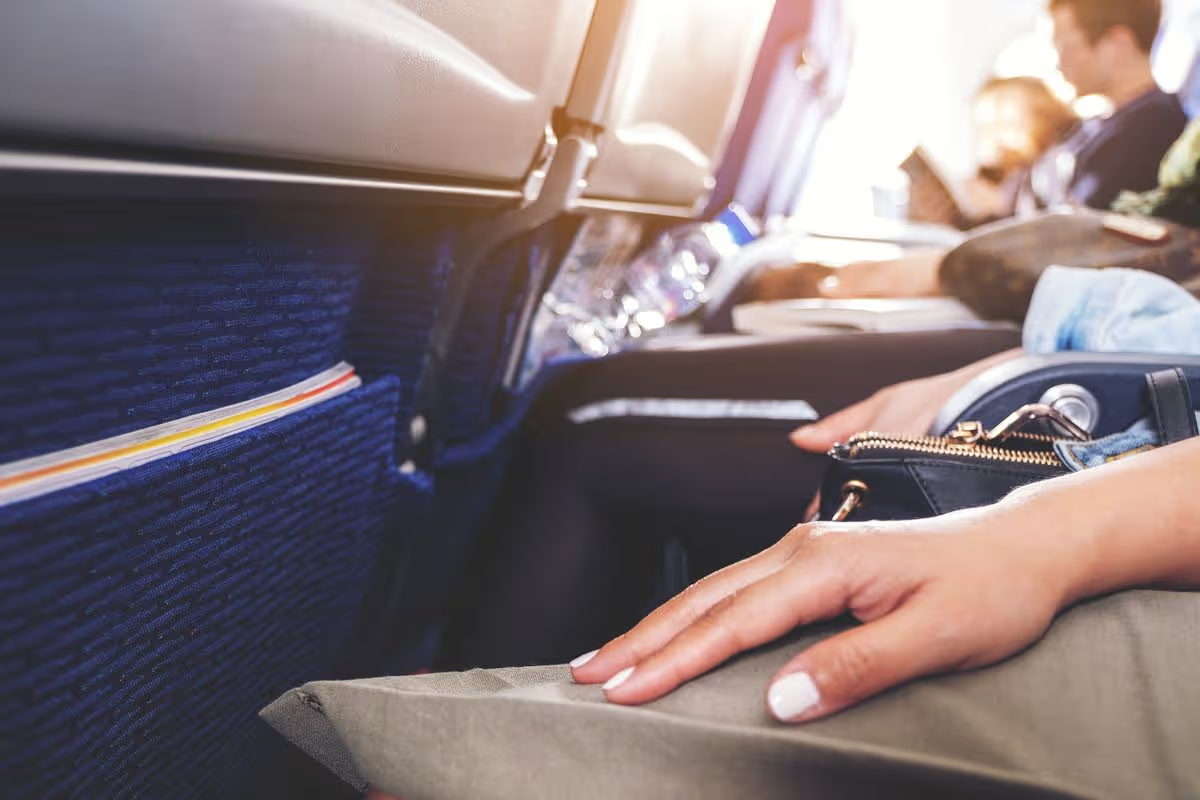
The male passenger was ‘manspreading’ while he slept (stock image)(Image: Getty Images/iStockphoto)
A woman has sparked a debate after calling out a passenger for ‘manspreading’ during a three-hour flight while he was asleep. Branding his behaviour as ‘inconsiderate’, she revealed how she found herself crammed into a middle seat with barely any legroom, as he repeatedly encroached on her space.
However, a number of Reddit users feel she’s being ‘too harsh’ on the man, arguing he may be completely unaware of his manspreading given that he was asleep. In her post, she wrote: “My mother was a legitimate pre-boarder on a recent flight. I accompanied her to help manage baggage and get her settled. We sat in the bulkhead so she could have more space for her braced knee.
“I sat in the middle seat to provide a buffer and keep her knee protected. The gentleman to my left took up a third of my space for more than half of a three-hour flight.
“He was asleep with headphones and didn’t respond when I tried to wake him up and ask him to move.”
In a pointed message directed at men, she called for greater self-awareness and urged them to “check their ego”, where she stated: “Women go out of their way to make others around them more comfortable and not take up literal and metaphorical space. You absolutely do not need the extra space.”
Responding to her post, one user remarked: “I’ve seen plenty of men and women take more than their fair share of space on a plane. Everyone is capable of being inconsiderate. You are not the main character.”
Another added: “You have the armrest up, lay in your bed.” Another commenter wrote: “Fair to be annoyed by this. Fair to ask, expect him to comply, and feel you shouldn’t have to ask. I’d probably wake him up. But how’s he being egotistical while asleep?”
Elsewhere, a fellow user said: “Girl, if you don’t repeatedly and passive-aggressively start stepping and kicking his foot away.”
It seems sensible in theory, but thousands of budget travellers won’t benefit
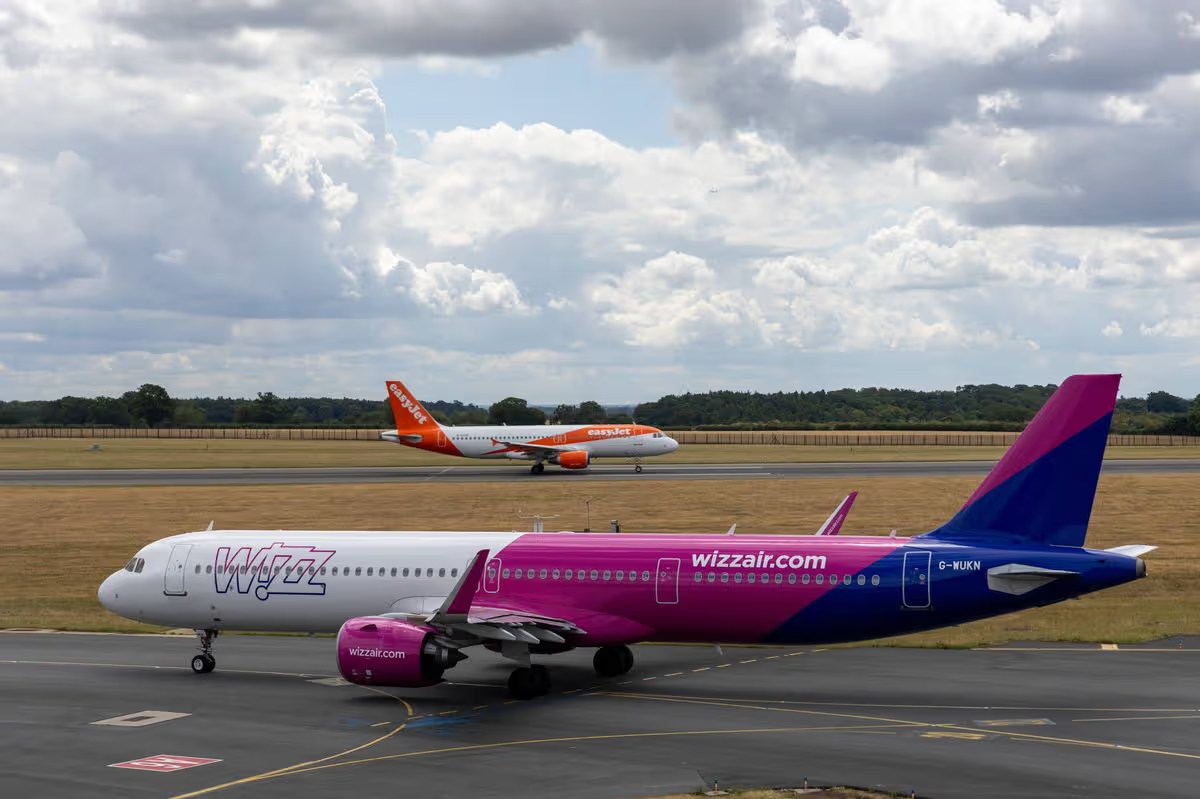
Wizz Air issued the advice to passengers ahead of summer holiday season(Image: Bloomberg via Getty Images)
Earlier this month, budget airline Wizz Air told all travellers to get to the airport three hours ahead of their flight due to new border control checks that have been brought in. Managing director Yvonne Moynihan warns that holidaymakers have missed their return or connecting flights due to lengthy airport queues since the rollout of the Entry Exit System (EES).
Problems were flagged when the travel system was launched in April, but as more people pass through airports this summer for the first time since regulations changed, travellers may face hold-ups. Taking to TikTok, travel specialist Kate Donnelly (@Thedonnellyedit) argues that the latest guidance from the airline is “useless” for most people jetting off this summer.
She said: “We know when you’re travelling short haul that the general advice is to get to the airport two hours before your flight. Wizz Air is advising people to arrive three hours before their departure to beat queues and reduce the risk of missing their flight due to the EES system.
“So, while this advice appears sensible, the reality is that most check-in desks only open two hours before departure, in some cases two and a half hours,” Kate argues that only certain travellers would actually gain from turning up at the airport three hours before take-off.
Details available directly on Wizz Air’s website (as of June 7) state: “Airport check-in and baggage drop-off start two hours and close 40 minutes before departure. It’s worth noting that at some airports, the check-in desk may open or close earlier.”
Content cannot be displayed without consent
Nearly all airports listed with an earlier-than-standard check-in time are international. London Luton Airport was the only UK airport with differing rules, with check-in desks that open “180 minutes (three hours) before the scheduled time of departure” for all travellers, reports the Express.
Kate also suggested that passengers travelling with hand luggage only could be among those who stand to gain the most from arriving early. Without any luggage to weigh and drop off, the whole process becomes considerably faster, and passengers “would be allowed to get straight through security and into duty-free”.
The airport itself remains one of the most significant factors that could cause delays, even for those who arrive earliest. Kate claims: “A lot of airports have more than one border control, meaning that you are still going to have to wait until the announcement is made for your gate so that you know which border control you need to go to.”
What is the general advice on when to arrive at the airport?
To avoid any issues, it is best to double-check with your specific airline about the earliest time check-in opens. Arriving as early as possible can give extra time for delays, but being ready too soon could result in pointless delays just by waiting around.
Kate said: “If you are travelling to the Schengen area this summer, two hours before your departure is enough time, based on the fact that the airport processes have not changed. Unless [airlines] decide to start opening up check-in desks earlier and announcing gates sooner, you might as well stick with the two-hour rule.”
The Schengen area is an extensive, border-free travel zone encompassing 29 European countries. It features numerous popular summer holiday destinations such as Spain, Turkey and Greece – which means many British holidaymakers will encounter EES checks.
Hold-ups are likely to come from first-time EES users who are required to scan their passport, have a photo taken, and submit a 4-fingerprint scan (children under 12 are exempt from fingerprints). This establishes a digital record valid for three years, and during new trips within that timeframe, travellers just need to scan their passport and provide one biometric identifier (photo or fingerprint).
JET2 is launching two new flights to Greece next year – and one of them has the longest beach in Europe.
One of the new routes is from Leeds Bradford Airport to Preveza which starts next summer.
Sign up for the Travel newsletter
Thank you!
One of the most popular places in the Preveza region is PargaCredit: Alamy
The city is home to Monolithi Beach, stretching on for around 15.5 miles – making it Europe’s longest.
It runs along the Ionian Sea from villages Mytikas to Kastrosykia and, thanks to its length, the beach has everything holidaymakers look for whether that’s a sunbed, beach bars, and taverna.
One visitor to the beach said on Tripadvisor: “It’s one of the best beaches I have ever visited! Small pebbles and sand, and blue-green clear waters, and it’s length… I don’t know!”
Another said: “One of the most beautiful beaches I have seen and swum in. Great waters, amazing location. I could live there forever.”
Another popular place in Preveza includes Parga Town.
The region is home to the huge ancient ruins of Nikopolis which have Roman walls, Byzantine basilicas, a stadium, and two theatres.
Another spot worth discovering is Saitan Bazar, a historic lane with tiny independent shops that are covered in vines and known for having lively atmospheres.
It is the ideal destination for reaching Lefkada, meaning travellers can experience two destinations in one trip.
Visitors can take a bus directly from Preveza to Lefkada takes just 45minutes.
Flights to Preveza will be weekly on Sundays until October 10.
Preveza is an ideal location to get to the pretty island of LefkadaCredit: Alamy
From Leeds Bradford Airport, Jet2 will also fly to the beautiful island of Santorini.
Santorini will be served with weekly Thursday flights until October 7, 2027.
Jet2 chief executive Steve Heapy said: “We are seeing continued demand for our award-winning flights and holidays and many people wanting to book ahead for summer 2027, so we are delighted to respond with this expanded programme from Leeds Bradford Airport.
“With two stunning, brand-new routes being announced today, our summer 2027 programme gives holidaymakers exactly what they want – more choice and flexibility.”
The Japanese government will pay you £14,000 to move to its beautiful countryside as part of a relocation scheme aimed at repopulating remote areas of the country
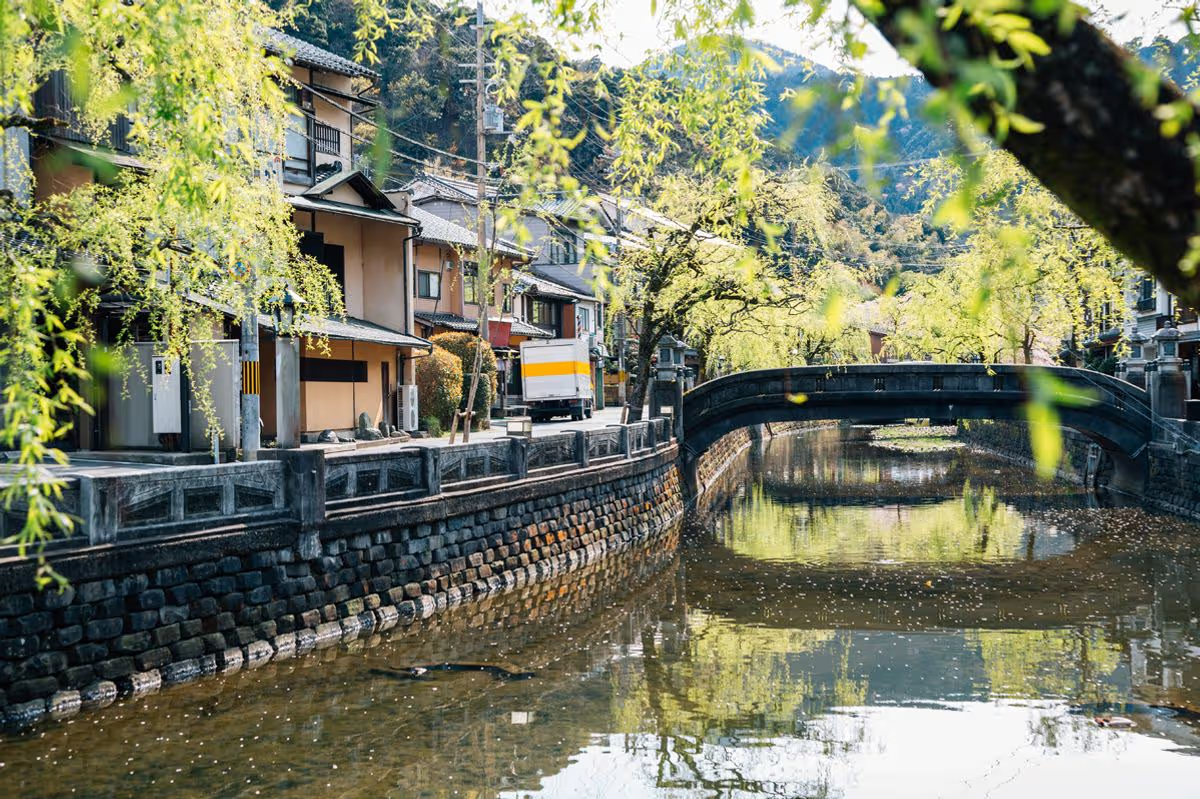
Kinosaki Onsen village at spring in Hyogo, Japan(Image: Getty Images/iStockphoto)
Everyone needs a change every now and then, and for some, this could be the perfect opportunity. The Japanese government has announced a relocation scheme under which families could be paid up to ¥3,000,000 (around £14,000) to move to the countryside.
The scheme has been created to repopulate more remote areas of the country, as more than 37% of the population live in the three major metropolitan areas of Tokyo, Osaka and Nagoya. A statement from Akiya Japan reads: “The Ministry of Internal Affairs projects that nearly half of Japan’s 1,700+ municipalities could become ‘functionally extinct’ by 2040. The subsidy is the carrot. The stick is demographic reality.”
The eligibility criteria are the same for both Brits and Japanese citizens and are based on where an applicant has lived and worked, rather than their nationality.
A statement adds: “A foreign national who has lived and commuted in the Greater Tokyo Area for 5+ years and holds an appropriate visa (work visa, spouse visa, permanent residency) qualifies on the same terms as a Japanese citizen.”
Sharing news of the scheme on social media, TikTok user @quinn__jp said: “This isn’t a joke. Japan is actually paying people to move to the countryside.
“Here’s how foreigners can benefit too. In many rural towns, you can get up to 600,000 yen if you move solo and up to 1 million per child, plus relocation grants if you’re moving as a family.
“That makes a big dent in your moving and settling costs. Across over 1,300 towns, around 80% of local districts, you’ll find the Akiya Bank, with empty houses listed for zero yen or at very low prices.
Content cannot be displayed without consent
“Some free houses need lots of renovation, but many municipalities offer subsidies and renovation support through programmes like Chiiki Okoshi and the Regional Vitalization Cooperator programme.
“You can get placed in local roles, anything from running a guest house to agri-tech positions, with housing and visa guidance included.
“Japan needs people, and fast. With urban migration and population decline, local governments are desperate to attract newcomers with homes, jobs and cash.”
However, there are some practical barriers, including an expectation that applicants understand the Japanese language.
Visa implications can also be complex, while renovation loans and mortgage products may be harder to access for non-permanent residents. However, the subsidies help offset these challenges by reducing the amount that needs financing.
Commenting on the post, one user said: “I’d definitely move to Japan if I had some sort of online income (a safety net) like most influencers have.”
Another user added: “I want to move there so bad but I’m scared and I don’t have my passport.”
A third said: “My dream is to get an old house in Japan and trust me it’s not that easy. Currently looking for any place who’d hire me so I can move there on a work visa.”
THE premise was sound, I still insist. Whisking sociable teens Reggie and Stanley away from distractions in the run-up to their A-levels and GCSEs for a week of intense relaxation and revision.
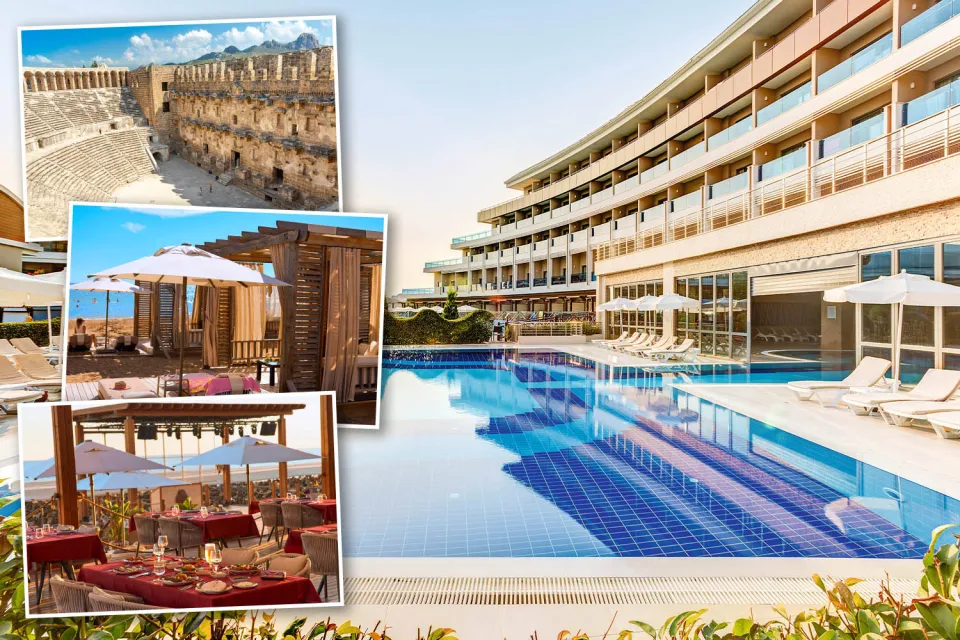
And so we headed to Tui’s Magic Life Jacaranda beach-front complex in Antalya, the jewel of Turkey’s Mediterranean coast.
Sign up for the Travel newsletter
Thank you!
The pool at Tui Magic Life JacarandaCredit: SuppliedThe stunning Roman amphitheatreCredit: Alamy
I realised my “no distractions” argument was a mistake as soon as the boys’ jaws dropped when we rolled up outside the stunning, marble-floored hotel and glimpsed our new home for the week.
Only those popular family theme parks don’t boast 5H opulence, eight swimming pools, a thrilling aqua park, sandy beach, huge buffet diner and six à la carte restaurants.
And for sports-mad youngsters, the complex — the size of 18 football pitches — boasts a gobsmacking array of facilities which makes it feel like you’re living in an Olympic Village.
From tennis, beach volleyball, basketball, badminton and table tennis, to football, archery, darts and cycling, there’s something for everyone.
The hotel puts on daily group sessions and courses, with expert coaches on hand if guests want to pay for extra tuition.
There’s also canoeing or windsurfing, catamaran sailing, water-skiing or wakeboarding off the “Turquoise Coast”, aptly named for its stunning blue waters.
A well-equipped gym is open for more than 12 hours a day — a dream for an 18-year-old and 15-year-old needing to let off steam between hitting the books.
There’s a big indoor pool and spa offering treatments, while classes can also be booked for zumba, Pilates, yoga, aqua aerobics, spin cycling, shuffleboard and trampolining.
And dedicated kids’ and teens’ clubs leave parents free to soak up the sun.
With the boys finding a window between the fun activities to do some revision, I tried out the “abs-blast workout”.
Despite the language barrier between the different nationalities, we were united in grunting and groaning as we were put through our paces in an outdoor fitness hut overlooking the sea.
Meanwhile, the Nordic walking class had a dozen intrepid guests gripping poles and striding off down the beach for a 45-minute cardio-busting thrashing.
Teenagers love their food — and with so many activities going on it’s easy to work up an appetite.
The main buffet was a dream for Reggie and Stan, with chefs rotating special cuisine nights including Turkish, Italian or Tex-Mex.
The fresh salads were incredible and cooks prepared pasta, grilled meats and flatbreads while we waited, mouths salivating.
Easy does it by the seaCredit: SuppliedMake a splash and enjoy windsurf funCredit: Supplied
With breakfast from 7am till 11am, lunch from 12.30 till 4pm, and dinner stretching from 6.30pm till 9pm, it’s hard to imagine ever feeling hungry.
But a coffee house, beach and pool bars offer snacks all day, and the dedicated Wunderbar opens 24 hours, providing drinks and food to insomniac guests.
It’s tempting not to leave the complex. But for guests choosing a break from the idyllic swimming pools, there are day trips offering a chance to learn some of Turkey’s incredible history.
I chose a half-day trip to the nearby ancient port city of Side and its 1,400-year-old ruins.
There’s a huge Roman amphitheatre which used to seat 20,000 locals cheering on gladiators, while the 2nd-century seafront shrines, the Temples of Apollo and Athena, were simply awesome.
Strolling through the modern-day Side, stopping to browse the bazaars selling sizzling kebabs and chunks of delicious Turkish Delight, we stepped on glass walkways, revealing the ancient Roman streets below.
Back at the hotel, the rooms are airy, bright and comfortable.
The vast, five-floor main building offers beds close to the buffet and gym, and glorious views across the sprawling complex.
The main buffet was a dream for Reggie and Stan, with chefs rotating special cuisine nights including Turkish, Italian or Tex-MexCredit: SuppliedReggie and Stanley by the poolCredit: Supplied
Smaller, quieter rooms are available, spread throughout the gardens and closer to the gorgeous beach.
Some lucky guests can even opt for “swim-up” apartments, with a balcony stepping into one of the many shared pools.
The staff are friendly and happy to help.
A huge amphitheatre hosts professional shows at night, as well as movie nights and live music.
There are also themed parties and discos on site, and an indoor nightclub for guests wanting to boogie into the early hours.
Magic Life Jacaranda offers a classic “something for everyone” heavenly holiday — even for youngsters preparing for exams.
What the boys missed out on study hours, they more than made up for in memories that will last a lifetime.
Like most guests who have been lucky enough to experience this perfect holiday destination in southern Turkey — boasting blazing sun for more than 300 days a year — we’ll be returning as soon as possible.
GO: ANTALYA, TURKEY
GETTING/STAYING THERE: Seven nights’ all-inclusive at the 4T+ Tui Magic Life Jacaranda is from £714pp based on two adults and two children sharing a Lake House double room with pool view and balcony.
Price includes flights from Gatwick on September 17, 20kg luggage and transfers.
See tui.co.uk, head to your local TUI holiday store or download our app.
Certain nations around the world are so wealthy that they wield enormous power over the global economy. When people think about the world’s biggest financial giants, two names typically come to mind straight away – the United States and China.
However, the next country is not located in Asia or North America. It’s situated in Europe, and its economy is substantially larger than most realise; it also boasts a greater GDP than the UK, Portugal and Greece combined.
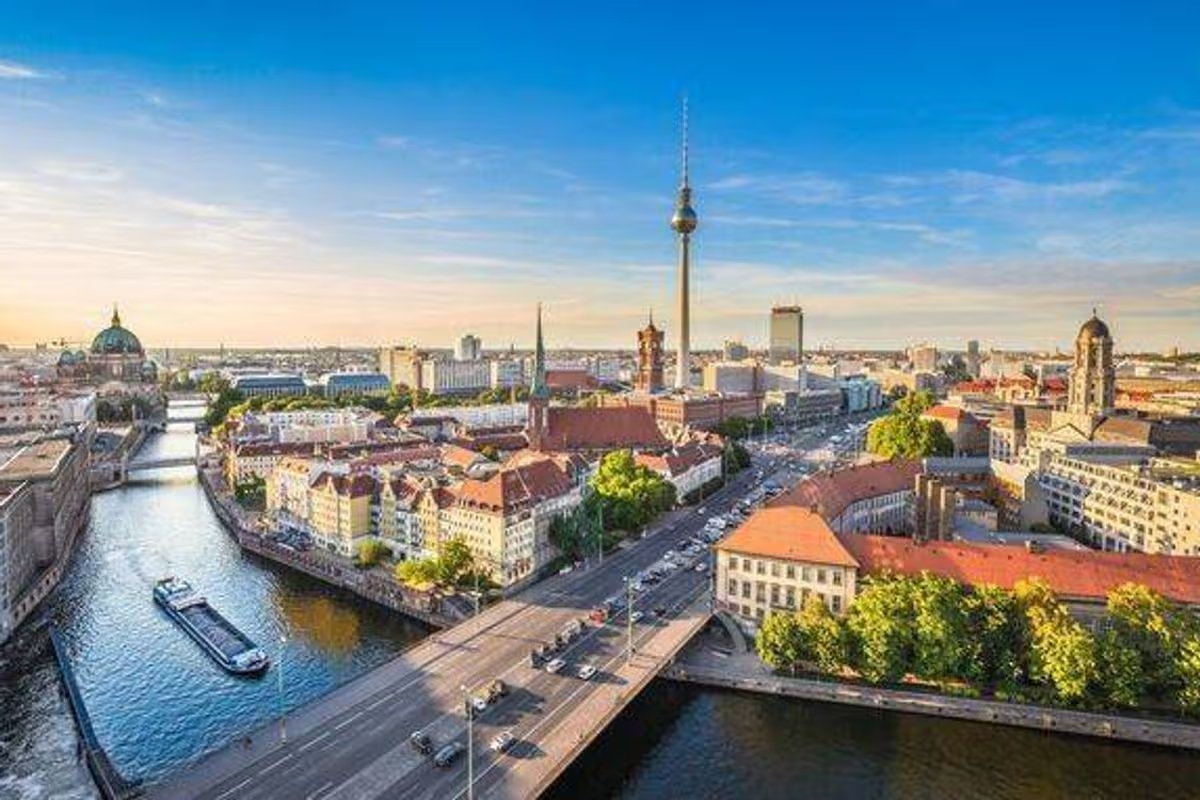
Data from the World Population Review for 2025 shows that Germany is the richest country in Europe, with a GDP of $4.74trillion (£3.54trillion).
The UK comes second with $3.84trillion (£2.86trillion), while France is third with $3.21trillion (£2.53trillion), Italy fourth with $2.42trillion (£1.81trillion), and Russia fifth with $2.08trillion (£1.55trillion).
Lower in the table, Portugal sits 18th with $321.44billion (£241billion), and Greece 20th with $267.35billion (£200billion), which means Germany’s GDP exceeds that of the UK and both countries put together.
Germany’s wealth derives from a highly sophisticated and diverse economy. It holds the largest national economy in Europe and one of the most powerful on the entire planet. Germany is also a founding member of the EU and the eurozone, representing nearly a quarter of the whole euro-area economy.
The country is famous for its enormous export sector, standing as the world’s third-biggest exporter, having shipped $1.66trillion (£1.24trillion) worth of goods and services in 2024. It also achieved a trade surplus of $255billion (£191billion), among the largest anywhere in the world.
Its exports include vehicles, machinery, chemicals, electrical equipment, electronic products, pharmaceuticals and plastics, reports the Express.
Germany is likewise Europe’s leading manufacturing powerhouse, accounting for approximately one-third of the continent’s total industrial production.
Germany devotes considerable resources to research and development, allocating roughly 3.1% of its GDP to scientific and technological advancement, while also possessing one of the globe’s most comprehensive social security networks.
According to KPMG, Germany continues to be the world’s third-largest economy in 2026. “Exports of motor vehicles and vehicle parts, as well as chemical products, in particular, have made Germany the world’s third-largest exporting nation. At 70%, the service sector accounts for the largest share of the country’s gross domestic product (GDP).”
WE might have racked up hundreds of flights between us but that doesn’t mean the team at Sun Travel never make mistakes.
Here are some of the silly things we’ve fallen for on holiday – and how to make sure you don’t too.
Underestimating airport queues with EES
From EES queues to lost passports – even we fall for some of the silliest travel mistakesCredit: PA
I consider myself an airport aficionado – always allowing just the right amount of time to get through an airport and to the gate on time – and while that works in the UK, it doesn’t always abroad.
In some international airports you have to have your passport checked twice – once before security and once afterwards. Many forget about the second security check, which can have long queues.
And with the recent introduction of the European Entry/Exit System seeing some passengers miss their flights back to the UK as queues build up, it’s more important than ever to check the lay of the land.
On a flight back from Rhodes a few years ago, my husband dismissed my claims that we needed to leave time for passport control, preferring to enjoy his last pint of Mythos in the departure lounge.
So when I finally did manage to drag him to the gate – and discovered a queue of more than 100 people trying to filter through two customs desks – there were some choice words between us (mainly me saying: “I told you so!”)
Remember this summer, if you have not done passport control at the same time as security, make sure you leave enough time to get to your gate and do the checks there. Lisa Minot, Head of Travel
Booking a late flight home without a late hotel check out
It always seems logical to book the earliest flight out and the latest flight home – because why wouldn’t you want to make the most of your getaway? I tend to forget about the logistics, however. What will I actually do on the last day when hotel checkout is at 10 or 11am?
It’s an error I’ve made (embarrassingly) too many times now, enduring a late night flight home after a day of lugging my suitcase around in sweaty temperatures.
Of course, most hotels allow you to leave luggage at reception for the day, but I like to be able to shower, too – especially if I’ve been out in the sun all day.
Best thing to do is request a late check out. Most hotels will charge a small fee for this and the length of extra time given will vary, although if you’re lucky and no one is checking into your room that day, you may be allowed ample extra time at no charge.
It’s also worth asking if there is changing room or shower you can use. Hotels often allow guests to use the facilities on check out day and usually accommodate for this by offering a space to get changed and freshen up ahead of the journey home. Sophie Swietochowsi, Assistant Travel Editor
Visiting Europe on Sundays – when everything is shut
Spending a Sunday in Europe can often be met with closed attractions
That means cramming in as much as possible to a weekend, heading off after work on a Friday and leaving on a Sunday.
However, in lots of places in Europe, you will struggle to find much to do on a Sunday, meaning you really only have one day to explore.
I found this out the hard way on a trip to Lille, planning to spend all Sunday exploring – only to find all of the shops and cafes completely closed. Kara Godfrey, Deputy Travel Editor
Not checking what is nearby when booking an all inclusive
The perk of a decent all-inclusive is you never have to leave the hotel – it’s all there for you.
BUT… even the best hotel will leave you wanting some outside space after a while.
The problem is, many of these big resorts require lots of land, which means they’re often far from a vibrant town and good attractions.
So don’t get caught short. However good the hotel looks, if you’re the kind of person who still wants a few independent restaurants or bars during your stay, or even just a few extra beaches to visit, make sure to have a good look at the map before you book.
I’ve been to plenty of excellent all-inclusives that are within walking distance of a nice town with a few decent local restaurants. And in other situations where it has been pretty remote, there has been an excellent local bus service that takes you to the nearest busy spots. Caroline McGuire, Head of Travel (Digital)
Fined for not checking in before the airport
Make sure to check in early if you are flying with Wizz AirCredit: Getty
In the fun and chaos of getting ready for a holiday, I have previously forgotten to check in to my flight and as a result had to do it at the airport.
While with most airlines there is no problem doing this, that is not the case for Wizz Air.
Due to fly to Albania, the window to check in online for my flight had closed so I had to check in, in person, at the Wizz Air desk at Stansted Airport. And to print off my boarding pass I had to fork out £35.
Needless to say, I now make sure I set aside time to check in to a flight online before heading to the airport – an easy way to avoid the nasty fee. Cyann Fielding, Travel Reporter
Not checking when big attractions are closed
Make sure the places are open on the days you visitCredit: Getty
I’m always telling readers, friends and family to do their research before they head off – but that doesn’t mean I always follow my own advice.
On a recent trip to Seoul, I was keen to spend my first day, straight off the plane, visiting the main Gyeongbokgung Palace – only to realise it was closed on the day we arrived (Tuesday).
We instead had to head to the pretty but smaller Changdeokgung Palace (which for the record, is then closed on Mondays).
Even there, our failure to prepare was a mistake. The palace itself was open and we wandered the ancient courtyards with ease, but the much-recommended Secret Garden, with its blossoms in bloom, was already sold out for the day.
While no one wants to plan any trip with military precision, it makes sense to research your bucket list must-sees before you go.
Or look to the very many experience companies like TUI Musement or Get Your Guide to take some of the pain of organising a visit away. Lisa Minot, Head of Travel
Boarding first on a plane with kids
Flying with kids is a tricky business. After the trip to the airport, getting through security and walking to the gate they’re already cranky.
So when the cabin crew offer for families to board first, the temptation is strong.
But in my experience, after travelling several times every year with my seven-year-old son, if you don’t need to squeeze a small suitcase into the overhead cabin, resist getting on that plane until the last minute.
Because your kid may well want to get settled into their seat to watch their favourite shows on the iPad, but that distraction will lose its appeal relatively quickly.
That’s particularly problematic if they close the plane doors and suddenly announce there’s an extra hour on the tarmac because of some ATC strike or other over Europe.
I always try to let my child have an extra ten minutes or so to stretch his legs, before making our way on to the flight. Caroline McGuire, Head of Travel (Digital)
Foreign scam websites
Scams are getting very sophisticated, so always do your researchCredit: Getty
When I think of falling for scam websites, I tend to picture somebody from an older generation who doesn’t use computers all too often.
But literally anybody can fall for a scam website, even a Gen-Z travel writer who spends most of her day on the internet.
On holiday in Japan, I booked myself in for what I thought was the famous Pokémon Cafe, and rocked up with my email reservation on hand, ready to try some themed dishes.
But I was turned away for turning up with a fake reservation, which I had paid £30 for. With the booking website entirely in Japanese and turning up at the top of my Google search, I had stupidly assumed it must be the one.
The remedy? Read plenty of reviews, check out Trust Pilot, and where you can, book with brands or apps whose names you already recognise. It’s always worth double-checking the website’s URL too, and showing a friend for a fresh pair of eyes to look something over before you book it.
And most importantly – don’t assume you’re too smart to be scammed! Jenna Stevens, Travel Reporter
Thinking free WiFi is enough abroad
Despite having not been a student for more than a decade, I’ll never stop wanting to save the pennies on holiday.
So why on earth would I pay for a WiFi package or an eSim?
It turns out, this is a pretty stupid way to look at the problem especially when it comes to trying to use Google Maps, call an Uber, or even message a lost mate when suddenly the free McDonald’s WiFi isn’t working.
Trust me – the eSim is worth the fiver. Kara Godfrey, Deputy Travel Editor
Packing the wrong passport – yes really
Even we have fallen victim to packing the wrong passportCredit: Alamy
As a travel journalist of 27 years, it is still astonishing to me that I have not once but TWICE left home with the wrong passport. (I blame it on the change to a new blue passport when my old pre-Brexit one ran out.)
The first time, I’d made it as far as one stop along the Thameslink train to Gatwick before glancing at my passport and realising I’d taken my husband’s old – but still current – burgundy one.
Cue a dash BACK on the train to my local station, a run across the car park to my poor husband waiting with the correct one, and a 20-minute delay that had frightened me half to death, swearing I’d never do it again.
So I have NO excuse for literally getting as far as Heathrow the second time and realising I had the wrong passport only when I tried to check in my bag.
With nowhere near enough time to travel all the way back home and to the airport again, I was forced to wake up my sleeping husband, order a cab to pick up my passport and ask the driver to bring it to me.
With just FIVE minutes to spare before the bag drop closed, my knight in shining cab arrived and handed over the passport while I threw £60 cash through the window to him. Lisa Minot, Head of Travel
Not checking in straight away so left with dud seats
There’s just minutes to go, and my finger is hovering on that check in button.
If there is one thing you should never do, its check in at the last minute.
I used to just do it whenever I remembered, rather than as soon as that 24 hour window opens – and nearly always I was left right at the back, in a middle seat, by the toilet. For 11 hours.
It’s not worth the risk of trying to beat the Ryanair luggage rulesCredit: Alamy
Sometimes for something to fully sink in – you have to make the mistake yourself.
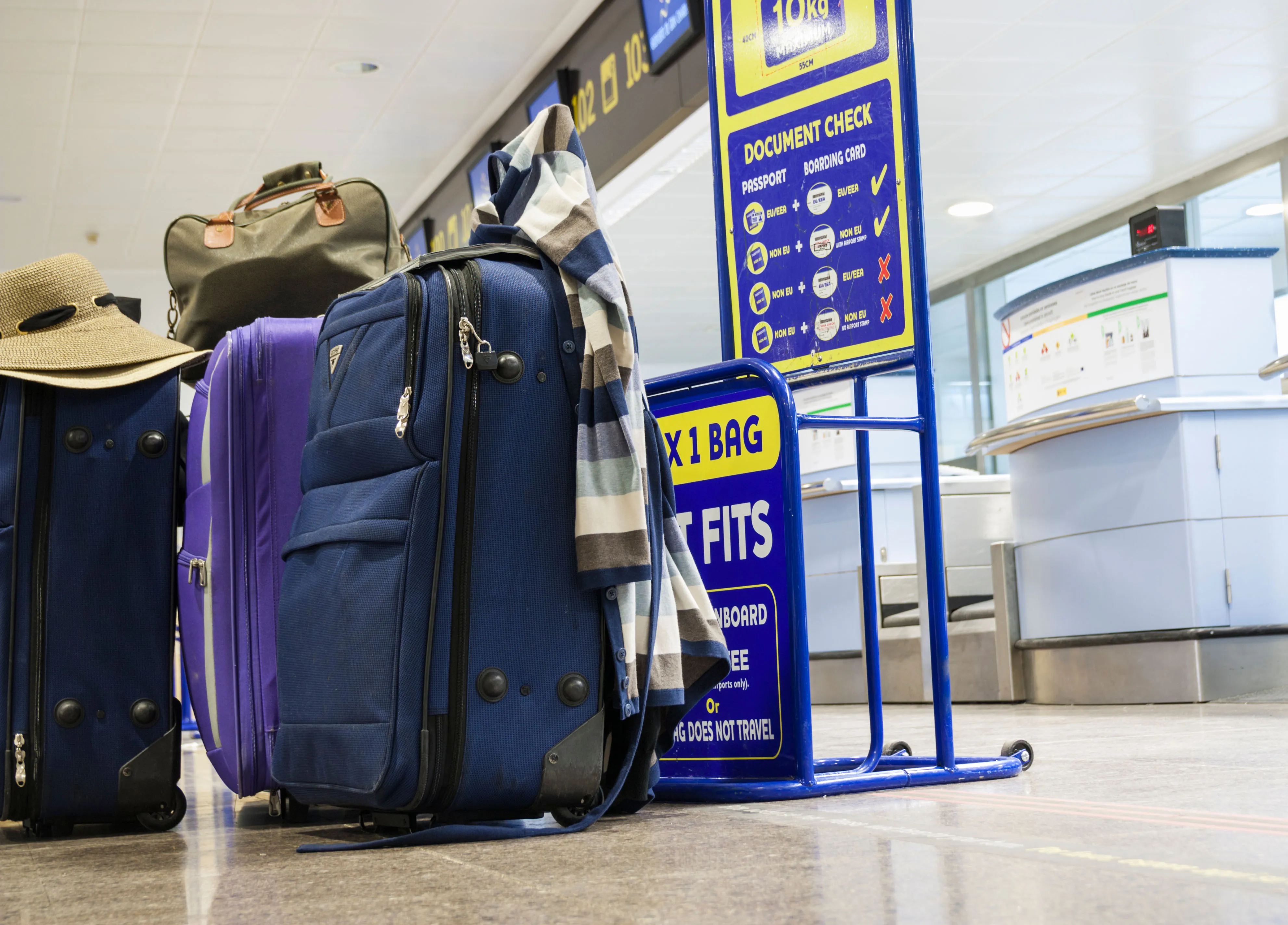
I found this out the hard way when I flew with two different airlines – Wizz Air and Ryanair – and not realising that the requirement for hand luggage was slightly different (by a meagre 3cm, I might add).
On my flight back, I was asked to put my suitcase into the dreaded Ryanair sizer and was told to try and repack, or put it in the hold.
Note to self for next time – Ryanair do take oversized bags seriously and you will be pulled up on it. Alice Penwill, Travel Reporter
Not realising you need a passport for Eurostar
What’s the number one thing you need for your holiday? A passport, right? Well, according to my younger self, I turned up to the Eurostar in London St Pancras without it – thinking it’s train travel, why would I need it?
If I actually took a moment to think I would’ve soon realised I was travelling into another country, and therefore will always need my passport – whether I be travelling by boat, train or plane.
After forking out for another two Ubers to South London and back and paying to change my Eurostar train to a later option, I certainly learnt my lesson.
Now I pack my handbag first, and the first item I put in there? My passport. Cyann Fielding, Travel Reporter
Forgetting about ‘free attraction’ days
You might be able to find some free entry days if you know where to lookCredit: Getty
I’ve travelled to a few different destinations including San Francisco and New York (usually very expensive destinations) to discover that if I had better planned, I could have saved myself cash on some of the attractions while there.
Museums, galleries and other attractions often have days or times where admission is free.
For example, in the Golden Gate Park in San Francisco there are a number of different attractions to explore such as the Conservatory of Flowers, which usually costs $15 per adult to visit but is completely free on the first Tuesday of each month.
The Japanese Tea Garden – another popular spot in Golden Gate Park – usually costs $16 per adult to visit but is free on Mondays, Wednesdays and Fridays between 9am and 10am.
Likewise, in New York, the Morgan Library & Museum is free on Fridays between 5pm and 8pm.
The best way to see when different attractions are free is by picking up a travel guide – I find Lonely Planet is good at highlighting free times and days – but you can also do a quick Google search about the attractions you want to visit. Cyann Fielding Travel Reporter
Wrong plugs even in Europe
I’m guilty of being a last-minute, careless packer, throwing things in here and there without thinking about it all too much.
And so, headed on holiday to Switzerland, I threw in my Europe plug adapters without a second glance.
But it turns out I should’ve done my research first, as just because a country is in Europe, it doesn’t mean that they use an EU plug adapter.
So I ended up having to fork out some Swiss francs on a type-J plug adapter…in a country where just a bottle of water cost me £5. Jenna Stevens, Travel Reporter
Ireland, Cyprus, Malta: Type G (UK-style 3-prong plug)
Switzerland & Liechtenstein: Type J (3 round pins)
Italy: Some older hotels still only accept a Type L (3 pins in a line)
Denmark & Greenland: Type K (3 round pins in ‘smiley face’ shape)
Nearly falling for pickpocketers
One of my biggest pet peeves is slow-walking tourists looking at their phones in London and not paying attention. But I’m a hypocrite because when I visit a foreign country, I do exactly that.
And having my head down, looking at my phone is how I almost got pickpocketed in Barcelona.
Distracted trying to find my bearings meant I was the perfect victim. Only when I felt something on my shoulder did I turn around to see a man with his hand in my backpack.
Luckily I caught him in action before he got his hands on my purse, but it taught me to be aware of my surroundings, especially in countries where tourists can stick out like a sore thumb. Alice Penwill, Travel Reporter
A British man living in Benidorm has issued a stark message to those jetting out to the popular Spanish resort this summer – saying there’s certain places you want to avoid at night
10:14, 07 Jun 2026Updated 11:06, 07 Jun 2026
Stay safe while in Benidorm (stock)(Image: JOSE JORDAN/AFP via Getty Images)
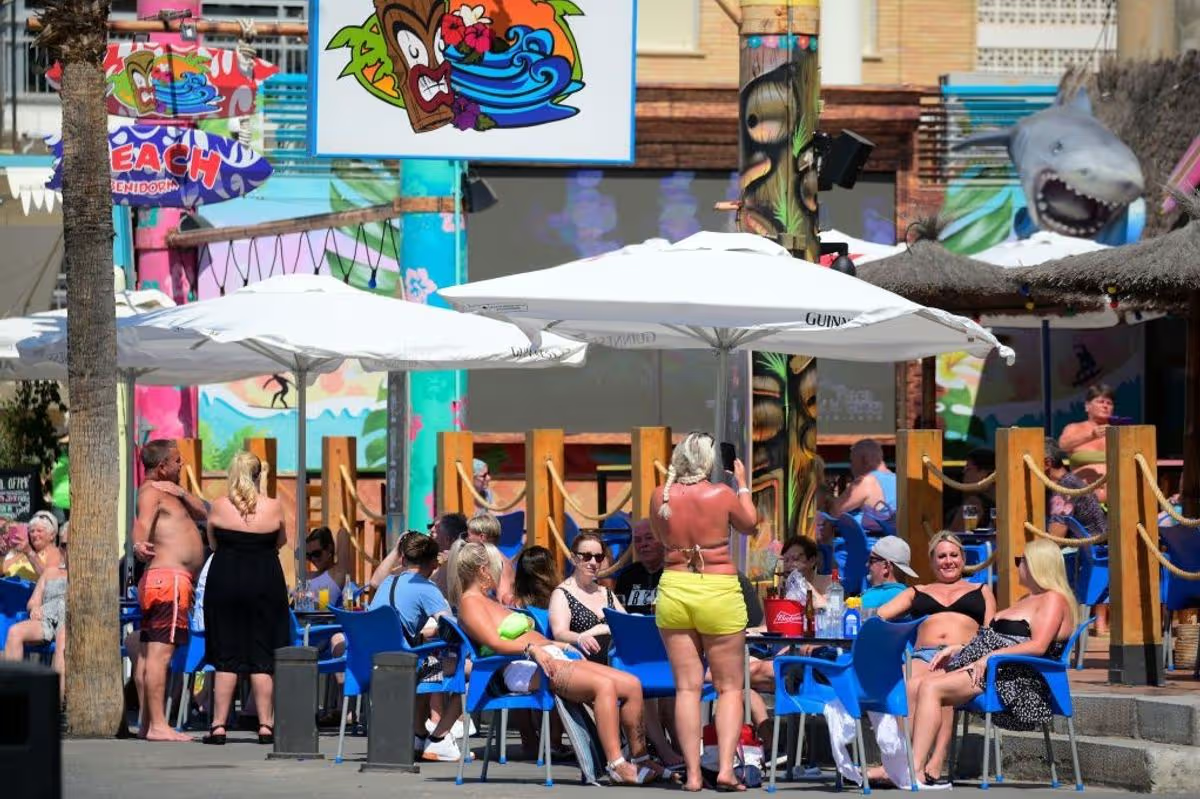
A British expat living in Benidorm has issued a warning to holidaymakers heading to the popular Spanish resort this summer – revealing the three places he would avoid after dark. Benidorm remains one of the UK’s favourite holiday destinations, attracting millions of tourists every year with its beaches, bars and nightlife.
But according to one resident, there are a handful of spots visitors should think twice about walking through late at night. Sharing his advice on social media, the expat said: “This is a warning for anyone coming out to Benidorm. “This is the top three areas I would definitely avoid if coming to Benidorm in 2025 and the reasons why.”
Coming in at number three was a public pathway known locally as the “Yellow Brick Road”, which runs behind several hotels and leads towards the Rio Park area.
He explained: “Now it has been known for a few things, mainly small thefts like pickpocketing, that sort of thing.
“Now generally during the day it’s absolutely fine. I’d recommend avoiding it at night.”
Next on his list was Pueblo Alley, which he claimed can attract unwanted attention after dark.
He said: “And in at number two has got to be Pueblo Alley.
“And this is one I definitely recommend avoiding, especially late at night, as you do get the pickpockets hanging around this area and you also get the odd lady of the night.
Content cannot be displayed without consent
“So I definitely consider avoiding it. There’s plenty of other ways around.”
Topping his list was a location known as “Mugger’s Alley”, which has long gained a reputation among some tourists and locals.
He said: “Straight in at number one, it’s Mugger’s Alley.
“It is the most notorious. It is the one we all know, known for pickpocketing, ladies of the night.
“It’s just an area that I would avoid.”
The expat also warned visitors to be cautious of scams, claiming he had recently seen reports of people being targeted.
He added: “Cross the road, it’s not necessary. I mean, they’re even doing these new taxi scams. I’ve seen videos online about it.
“It’s crazy. So save yourself the hassle and cross the road.”
Commenting on his post, one travel fan said: “Don’t agree with you, stayed in Rio Pak about 20 times and never had a problem.”
Another user added: “Anywhere people are shouting.”
It comes after the UK Government issues a warning about a police officer scam in Spain, saying: “Thieves posing as police officers may ask to see your wallet, claiming they need to see it for identification.
“Genuine police officers will ask to see ID but will not ask for wallets or purses. All police officers, including those in plain clothes, carry official ID.”
The Visit Benidorm Tourist Board has been contacted for comment.
EXCLUSIVE: A new book charts the extraordinary history of British Airways, inclduing its unusual first passenger flight, its unique link to Marmite, royal fans, and some questionable fashion
10:05, 07 Jun 2026Updated 10:06, 07 Jun 2026
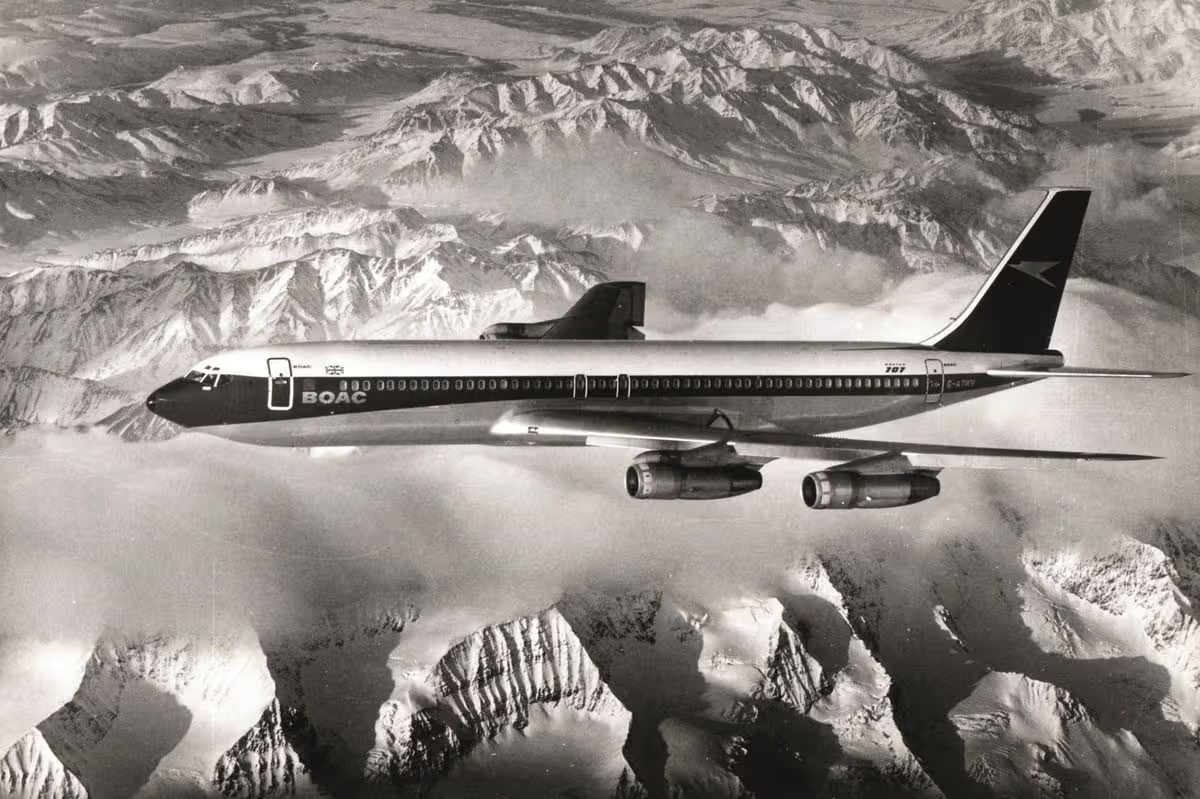
The Boeing 707 was a symbol of the iconic 60s and shrunk the world overnight(Image: Supplied)
British Airways has been flying for 107 years, connecting Britain to the world across more than a century of aviation history.
From a single biplane lifting off from a grass field in west London to a fleet serving destinations across the globe, the story of the world’s favourite airline is told in a new history by Captain Al Bridger – taking the story of BA in 100 objects, which encompass everything from Neville Chamberlain to Marmite.
British Airways traces its roots to 1919, when Aircraft Transport and Travel (AT&T) launched the world’s first international scheduled passenger service from Hounslow Heath to Paris.
This pioneering line later fed into Imperial Airways, which became BOAC in 1939 for long-haul routes, while BEA was formed in 1946 for European services; the two finally merged in 1974 to create modern British Airways.
But it began on August 25 1919 when a modest biplane was prepared on the grass at Hounslow Heath, a few miles from what is now Heathrow Airport. Captain Al said: “The world’s first international scheduled passenger was piloted by Lieutenant Bill Lawford.
“It carried one passenger, some newspapers, fresh grouse bound for the British Ambassador to France and Devonshire clotted cream. In challenging weather, Lawford skilfully completed the trip in 2 hours and 30 minutes.”
Five years later, in March 1924, the British government formed Imperial Airways, at the futuristic Croydon Airport. The art deco structure had a first-class restaurant, canteen for staff and a viewing gallery. The network expanded and flights could reach Delhi in seven-and-a-half days.
The Argosy aircraft, which first flew a passenger service on July 16 1926, gave early travellers a taste of luxury that would define the airline’s ambitions for decades to come. Captain Al said: “A white-coated steward served twenty passengers incredible four-course meals with drinks, providing true luxury for those lucky enough to afford it.
“The aircraft were also used for very popular weekend ‘Tea Flights’, offering afternoon tea while enjoying fabulous views over the capital.”
Among the collection’s most striking objects is a signed photograph of Prime Minister Neville Chamberlain, stepping from a British Airways Lockheed 10A after his famous Munich meetings and the declaration of “peace in our time”.
The 1950s brought a fresh start. “The Jet Age was officially launched with the introduction of the Comet in 1952, placing the UK at the very forefront of aviation,” said Captain Al, “The Rolls-Royce-powered Boeing 707 was a truly iconic symbol of the 1960s, and Sydney in Australia was now within reach in just 33 hours with four stops on the way. A true symbol of the iconic 1960s, the Boeing 707 was a triumph, shrinking the world overnight.”
The collection’s menu cards speak to a more glamorous age of flying. A BEA Silver Wing menu signed by Sir Winston Churchill on 26 April 1955 sits alongside one signed by Muhammad Ali on 10 May 1979
The 1960s brought experimentation of a more flamboyant kind. BOAC introduced cabin crew uniforms that became one of aviation’s most memorable fashion footnotes.
“While famously described as paper dresses, they were in fact sensibly made of a fireproof fabric that resembled paper and could be cut to the required length,” said Captain Al. “Incredibly, they were discarded after each flight.” They lasted a year.
The airline was also reaching out to its youngest passengers. On 26 March 1957, BOAC launched the Junior Jet Club, and Captain Al said: “The club was a huge success and had over 2 million members in its twenty-seven years of existence. Cabin crew would hand young travellers an envelope containing a registration form, a logbook and a Junior Jet Club badge.”
No history of British Airways would be complete without Concorde. The aircraft first flew on 2 March 1969 and entered service with British Airways on 21 January 1976. Captain Al said: “Concorde was to become the flagship of the fleet, bringing supersonic travel to everyone for the first time. Able to carry 100 customers in total luxury at speeds in excess of Mach 2 (more than 1,300 mph) the aircraft could cross the Atlantic in under 3 hours, with the record set on 7 February 1996 at 2 hours and 52 minutes.” The aircraft operated its last service on 24 October 2003.
While Concorde was redefining long-haul travel, the airline was also transforming life on board for ordinary passengers. A BOAC packing checklist pamphlet from the 1960s shows the formality of travel at the time. “For gentlemen, the list mentions the necessity of a dinner jacket, shirt collars and hair tonic,” said Captain Al. “For ladies, a bed jacket, hat and stole were essentials when travelling abroad.”
A photograph of the Beatles from the same era shows the Fab Four carrying BEA travel bags. Captain Al said: “Note how the Beatles are carrying BEA(TLES) travel bags, much like the more common BOAC bags. Clearly the band were travelling light.”
The 1980s brought fresh challenges and fresh ambition. In 1995, as part of a £500 million investment, the airline introduced the world’s first fully flat bed seat in First Class. Captain Al said: “Scientifically proven to give a much better night of sleep, it represented a huge leap forward in airline comfort.”
The airline’s inflight magazine, High Life, had been charting the journey since 1973. Captain Al said: “It truly is BA’s wingman. Through the years there have been some amazing contributors, from Jilly Cooper to Morecambe and Wise.”
Smoking had been part of airline life since the very beginning, but by March 1998 it was over. “When BEA was formed in 1946 over half of the British public smoked, with two-thirds of adult males recorded as smokers,” said Captain Al. “It wasn’t until 1998 that British Airways introduced a complete smoking ban on all flights.”
The modern era brought its own landmark moments. On 18 May 2012, a gold-liveried Airbus A319 named Firefly carried the Olympic flame into Culdrose Naval Airbase in Cornwall. Captain Al said: “Safely contained in four miner’s lamps, the flame was taken from the aircraft by Anne, the Princess Royal, accompanied by Lord Coe, the chairman of the London Olympics Organising Committee and football superstar David Beckham.”
The airline’s centenary in 2019 produced one of the collection’s most unlikely objects. “To celebrate the airline’s centenary, British Airways and Marmite teamed up and created a limited-edition jar that could be purchased on board,” said Captain Al.
“Apparently Marmite is the most confiscated brand at airport security, so the centenary jar was made to be just 70 grams, conveniently sized to fit within the liquid allowance to get it safely through airport security.”
Few objects in the collection carry more weight than the Royal Flights book, its pages bearing the signatures of those who have trusted the airline across the decades. The first entry dates from November 1983.
Captain Al said: “The book was beautifully inscribed with superb calligraphy and the signatures of Her Late Majesty Queen Elizabeth II and His Late Royal Highness The Duke of Edinburgh. Fittingly, the final signature is again that of Her Late Majesty after her visit to the British Airways Headquarters on 23 May 2019 to celebrate the airline’s centenary year.”
From a grass field in Hounslow to the signature of a queen, British Airways has carried the nation and the world for 107 years.
As Captain Al writes of the airline he has served and loves: “It has seen great highs and led the world through some very challenging times, and I know it will continue to give the best it can in the coming years, generating many more wonderful objects along the way.”
British Airways in 100 Objects by Al Bridger is published by Amberley, £17.99
BA in numbers
46.3 million passengers carried in 2025.
Fleet of 254 aircraft serving 215 destinations across six continents.
SIR Ranulph Fiennes and Bear Grylls most likely pop into your head when you think of adventurers. But now, you can add Wizz Air customers to that list.
And me. Last month, I was invited to join some competition winners on a flight to . . . who knows where?
Sign up for the Travel newsletter
Thank you!
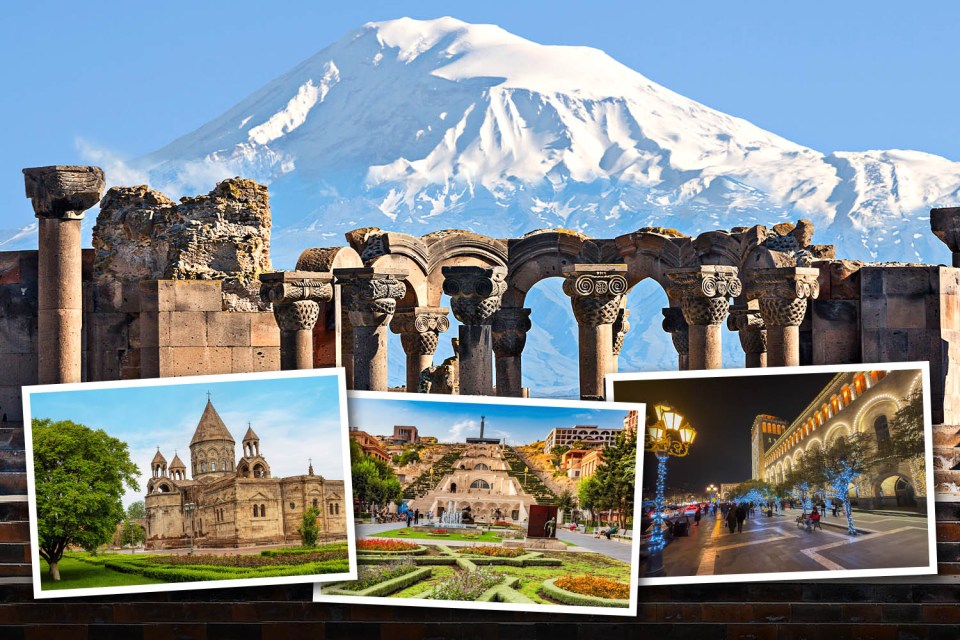
Zvartnots ruins and Mount Ararat in ArmeniaCredit: GettyThe architectural highlight was the Mother See of Holy EtchmiadzinCredit: Alamy
As part of the Hungarian airline’s Let’s Get Lost promotion, 22 lucky travellers and their plus-ones were going on an all-expenses-paid trip, to a secret destination.
Even after boarding the plane we were still none the wiser, all we had was a pre-provided packing list and a rough idea of the climate.
It was only once the flight had exceeded three and a half hours that we could guess it was Armenia. A tannoy announcement confirmed it, prompting a round of applause.
I’ll be honest, Armenia was never on my radar as a holiday destination, but that’s exactly what made this trip so special.
Arriving in Republic Square, the heart of the capital city Yerevan, the Saturday evening atmosphere was electric with hordes of people enjoying live music alfresco.
We stayed in the DoubleTree by Hilton Hotel, perfectly located in the city centre of Yerevan.
A walking tour was the best way to get our bearings. We wandered the main streets past buildings made from pink volcanic stone, before reaching the Cascade Yerevan.
Made up of 572 steps (we took the interior escalator), this mighty landmark is a must-visit. From its peak, we had stunning views of the snow-capped Mount Ararat, now in modern-day Turkey.
A 30-minute drive away is Charents’ Arch, a monument dedicated to a much-loved poet in this region. The curved brick structure provides the perfect natural frame for the landscape and is a great photo spot.
The architectural highlight for me was the Mother See of Holy Etchmiadzin — the Mother Cathedral of the Armenian Church.
Remnants of it date back to the 4th century (Armenia was the first nation to adopt Christianity in 301AD), and it is the most ornate church I’ve ever seen.
The ruins of the 7th-century Zvartnots Cathedral are also worth a visit.
The whole place has an otherwordly feel, and with the hot sun beating down on us, it felt spiritual.
In just two days, we ticked off key landmarks, including Garni Temple and the Geghard Monastery, with lunches and dinners in between, accompanied by Armenian wine, which I would highly recommend.
With such a short time on the ground, this trip didn’t allow for loafing, but that’s the brilliance of a Wizz Air mystery getaway — cramming in all the best bits.
The Cascade, made up of 572 steps, is a mighty landmark and a must-visitCredit: GettyYerevan, pictured at night, can be navigated independently and you can tailor-make a cultural and/or foodie breakCredit: Getty
Our final evening was spent at Tavern Yerevan Riverside. The setting, grub and entertainment were truly amazing. Armenian wine was flowing while we tucked into khorovats, traditional Armenian barbecued meats scorched over an open flame.
While we had a curated itinerary, Yerevan can be navigated independently and you can tailor-make a cultural and/or foodie break.
After attempting, and failing, to say ‘shnorhakalutyun’ — Armenian for ‘thank you’ — throughout, I was advised that the French equivalent would also be appreciated.
So, merci Armenia — a destination I’d never planned to visit, but am so glad I did.
GO: ARMENIA
GETTING THERE: Starting tomorrow, Wizz Air flies twice a week from Luton to Yerevan with one-way fares from £45.99.
STAYCATIONS are on the rise, according to the experts – and there is a county that is booming in demand.
In its latest Summer Travel Report, Airbnb revealed that not only are staycations up 11 per cent year on year, but an unlikely trending rural destination is Herefordshire where searches have increased by 76 per cent.
Sign up for the Travel newsletter
Thank you!
Herefordshire is rising in popularity when it comes to staycationsCredit: AlamyEardisley is one of Herefordshire’s ‘black and white’ villagesCredit: Alamy
The county bordered by Gloucestershire, Shropshire and Worcestershire is known for its cider and pretty villages that look similar to those found in the nearby Cotswolds.
Earlier this year, Herefordshire was called the ‘quiet corner of England’ by The Independent – but hoped it would be thrust into the spotlight after the release of Hamnet.
Some of the county’s small villages were used for filming and doubled as Shakespeare’s Stratford.
One of the villages is Weobley which is nicknamed a ‘black and white’ village thanks to its half-timbered houses.
Alongside its pubs, fans of Hamnet should head into The Wobbly Badger Cafe which took centre stage for the exterior of Shakespeare’s family home in the film.
It’s not just Weobley – there are lots of other villages like this one and some are part of that are part of Herefordshire’s ‘black and white villages’ trail which is a 40-minute driving route.
Other villages include Pembridge, or Eardisland, which sits on the banks of the River Arrow (and looks similar to Bourton-on-the-Water).
Even smaller villages include Eardisley, Dilswyn, Leominster and Kingsland.
Hereford Cathedral is in the middle of the cityCredit: Alamy
Herefordshire gets around six million visitors each year compared to the Cotswolds’ 25million – so for visitors it will make for a much quieter staycation.
For fans of cider, Herefordshire has around 15,000 orchards growing apples and pears, some of which is used to produce the drink.
Stops on the South Circuit include Little Pomona Cider & Perry, Gregg’s Pit Cider & Perry, Oliver’s Cider & Perry, Ross on Wye Cider & Perry.
Another famous spot that TV fans will recognise in Herefordshire is Symonds Yat.
The spot on the River Wye is known for its enormous limestone gorge.
It even appeared in the Netflix series of Sex Education – one of the most recognisable places is the red and white chalet that sits high above the valley, which was the exterior of Jean and Otis’ house.
There are a number of cider farms and dedicated routes to visit themCredit: Visit Herefordshire
The River Wye within the valley is the fifth longest river in the country.
It’s surrounded by walking paths and tourists are also welcome to take to the water on a kayak, canoe or paddleboard.
Of course, Herefordshire’s centre is the city of Hereford which is home to a large cathedral.
This houses a famous treasure calledMappa Mundi which is a medieval map of the world from 1300.
It also has the unusual 17th century Chained Library – a collection of over 1,500 rare books and manuscripts that are secured to their shelves by iron chains, rods, and locks.
Entry into Hereford Cathedral is free, but to see Mappa Mundi, Chained Library or a Tower Tour there are additional fees.
Eastnor Castle is a popular spot for a weekend with the familyCredit: Alamy
Another popular spot is the Eastnor Castle which while it looks like one isn’t a medieval fortress, instead, it’s a 19th-century mock castle.
Found in Ledbury, the castle was once home to the Hervey-Bathurst Family who lived at there for over 200 years.
It’s open throughout the year holding events like family fun days, bird of prey and supercar displays,
The grounds are popular for hiking and to entertain the kids, there’s a playground, tree top walkway, maze and mini zip wire.
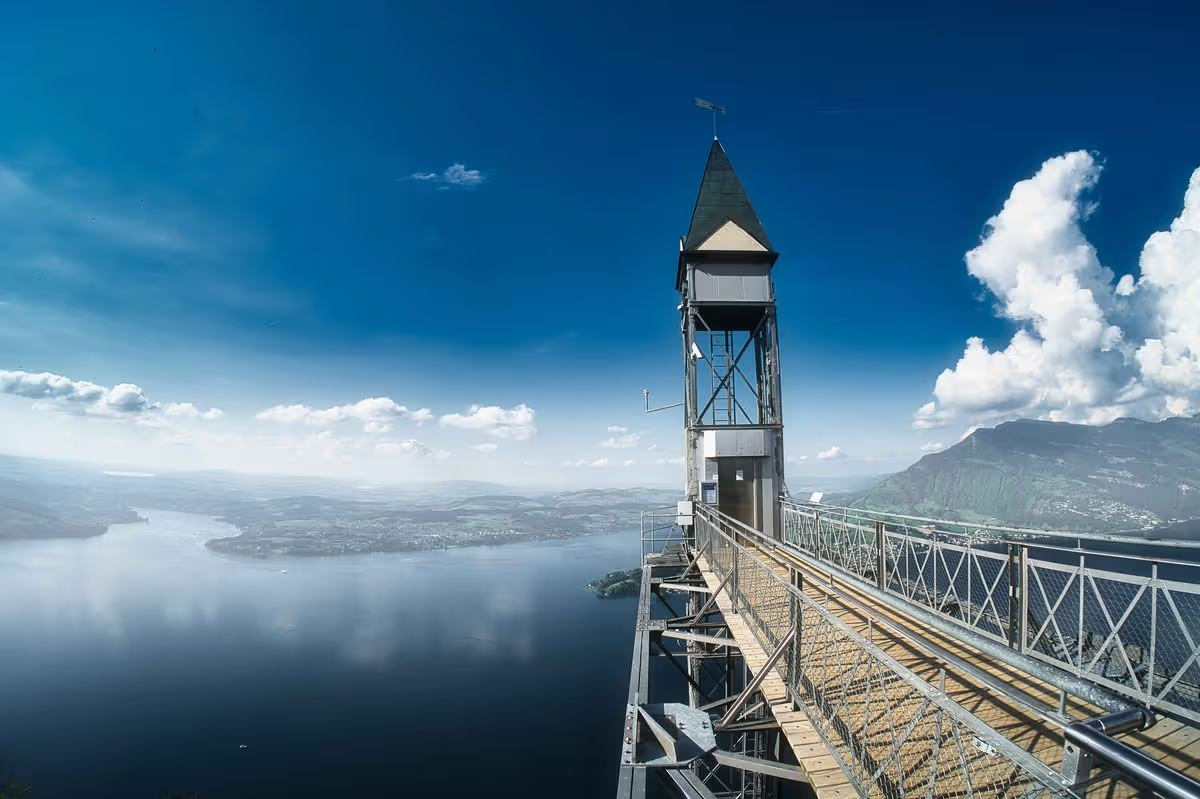
The incredible lift ascends 153 metres (502 feet) in under a minute
Europe’s highest outdoor lift is used by 40,000 people a year
Some of the world’s most jaw-dropping lifts can be found in luxury hotels, including the highest outdoor lift in Europe, nestled in Lucerne, Switzerland. The Bürgenstock Resort is home to the remarkable Hammetschwand lift, offering stunning views of Lake Lucerne.
The Hammetschwand lift was built between 1900 and 1905 by pioneering hotelier Franz Josef Bucher, at a cost of 500,000 Swiss francs (around £470,000). It remains the quickest route up to the viewpoint, climbing 153 metres (502 feet) in under a minute.
Those planning a visit should bear in mind that to reach the foot of the lift, you’ll need to walk the breathtaking Felsenweg cliff path.
It is estimated that over 40,000 people use the Hammetschwand lift annually, and around 200 to 250 riders per day.
On Tripadvisor, one visitor advised choosing “the perfect sunny day to enjoy the view.” They went on to say: “This is a fantastic view, the elevator is just too quick, but still worth a visit.”
Another said: “You do the Burgenstock track to the lift and it is already by itself stunning!!! Nobody talks about it. It’s a hidden gem in Switzerland!
“Then you arrive at that special spit where the lakes of the four cantons connect, and it’s breathtaking. A bit ahead, there’s the lift and the adventure to one of the most beautiful views ever. It’s easy, it’s accessible, it’s unbelievably beautiful. I will do it again.”
Among other remarkable examples is the Hotel Santa Caterina’s lift in Amalfi, Italy, which boasts breathtaking views. Carved into the rugged cliffside, the glass-fronted elevator takes guests down to the exclusive Beach Club and the hotel’s Italian seafood restaurant.
In Greece, the Corfu Holiday Palace features a stunning lift that transports guests down the cliffside to the beach in just moments, treating them to gorgeous views across the bay while providing far easier access to the white sands below.
The Luxor Hotel in Las Vegas, United States, is home to one of the most iconic lifts on the planet. Given the hotel’s striking pyramid shape, the lifts travel between floors at a diagonal 39-degree angle, treating guests to a spectacular outlook over the atrium as they make their way to one of the hotel’s 4,407 rooms.
Tourists have been urged to stop making a common packing mistake as it could lead to “ruining holidays”. The advice comes as vacation season begins to kick off
08:01, 07 Jun 2026Updated 08:01, 07 Jun 2026
The packing mistake could “ruin holidays” (stock image)(Image: Bet_Noire via Getty Images)
The prospect of jetting off somewhere keeps most of us motivated, so the last thing anyone wants is for something to spoil their well-earned break. Yet, as many may not realise, a straightforward packing blunder could land you in trouble, and may even affect whether you’re able to fully enjoy your time away.
If you’re hoping for a smooth and stress-free trip, there’s some vital travel information you really ought to be aware of. It’s essential to steer clear of a simple packing error, as it could prove costly and seriously disrupt your holiday — something nobody wants to experience.
According to pharmacist Seema Khatri at Roseway Labs, the vast majority of medication-related holiday mishaps stem from a handful of easily preventable errors, with most occurring before the trip has even begun.
Seema said: “People spend weeks planning itineraries and what to take, but medication is often an afterthought. And that causes problems.”
Travelling with medication can be a minefield, as regulations differ from country to country. As a general rule, ensuring your medication is clearly labelled is always a sensible precaution.
For certain medicines, particularly injectables or controlled substances, a doctor’s letter may also be required. She added: “Always keep your medication in your carry-on luggage.
“It reduces the risk of loss, delays or temperature damage.” What you might not realise is that medication can cause problems at airports if it’s not packed and documented properly.
In fact, it can result in hold-ups, questioning, confiscation or you could even be refused permission to fly in certain situations. Issues typically occur with controlled substances, liquid medications that exceed particular limits or absent prescriptions.
To make sure you pack yours appropriately, check the regulations at your airport and in the country you’re visiting. Seema said: “Most holiday medication problems are preventable.
“With a bit of planning, you can focus on enjoying your trip instead of dealing with avoidable health issues.” That said, there are several general guidelines people ought to follow to be on the safe side.
What you need to know
Always keep medication in your hand luggage in its original, properly labelled packaging. Store a spare supply in your checked baggage in case your bags go missing.
Additionally, make sure you carry a copy of your repeat prescription and, in certain cases, a signed letter from your doctor outlining the medication, dosage and duration of travel. It’s always advisable to verify what you require before you pack your bags.
A doctor’s note is recommended for large quantities of over-the-counter medicines to prevent complications at border control. You also need to make certain that liquid medication exceeding 100ml is readily accessible, as it will probably be screened separately.
If your medication is classified as a controlled drug, such as powerful painkillers or particular sedatives, specific rules apply. Therefore, check what applies to you before you travel.
Rules can differ from country to country, so always ensure you verify this before travelling, and declare that you’re carrying medication at the airport. After all, nobody wants to face delays at security, or be refused the right to travel, because of a straightforward packing error.
Finland has been named the world’s happiest country for nine years running, but arriving in Helsinki, dishevelled from one of my first flights with my nine-month-old baby, I was less interested in national rankings and more in having a nice nap. My husband, Jake, and I had emerged from the fog of newborn life and the idea of a holiday felt possible again. My ambitions were small: a sunset beer, a walk in the woods, reading a few pages of my book uninterrupted.
But Finland, with its famously family-friendly culture, made exploring with my tiny new travel companion a delight. Finnish parents are supported with generous, gender-equal parental leave, affordable childcare, and free healthcare and education. No one bats an eyelid at a pram parked beside a restaurant table or a baby snoozing outdoors in the cool air, and the terrifyingly efficient public transport system is a dream with children.
In Helsinki, we found ourselves in the cool neighbourhood of Kallio, where locals spilled out on to terraces in the late evening sunshine. We stayed at Hobo Hotel, which, despite attracting a hip crowd, was kitted out with travel cots and highchairs. At a bar aptly named Holiday, my daughter, Sylvie, sat happily chewing a spoon while we drank paloma cocktails in the long golden evening light of July, when the sun barely seems to set at all.
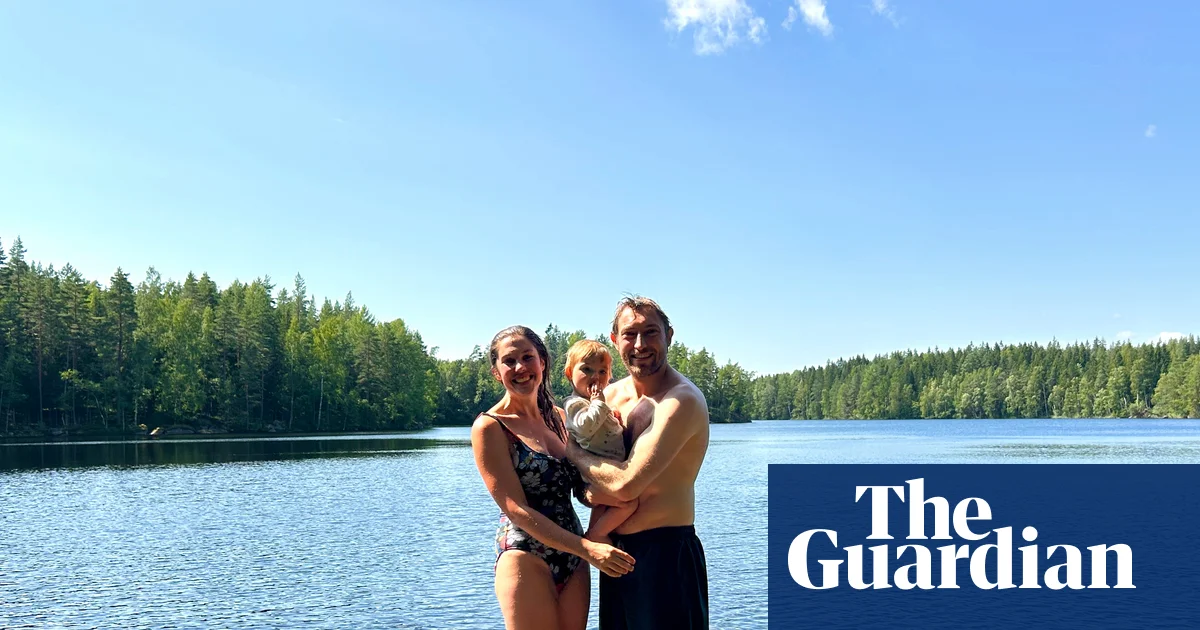
Part of Finland’s appeal for me lies in jokaisenoikeudet, or “Everyman’s Right” – the law that gives everyone freedom to roam the country’s forests and lakes. On the southern coast, we hiked through pine forest and over moss-clad rocks towards Lake Kukuljärvi, with Sylvie snoozing, strapped to my front. At a traditional laavu – a simple wooden shelter with a communal fire pit – Jake and I cooked sausages and boiled coffee over open flames. Sylvie eventually deigned to wake from her nap and gnawed on flakes of pink salmon like a tiny woodland creature. Then I handed her to Jake and jumped from the rickety jetty into the lake for a swim.
The off-grid cabin at Majamaja. Photograph: Sian Lewis
In summer, Finns are all about escaping to remote cabins. At Santalahti in Kotka, simple self-catering wooden cottages were just steps from the sea, but my favourite tiny houses were Majamaja, four minute off-grid cabins perched on rocks on the Baltic Sea. A stay here felt truly wild, yet we were a 10-minute drive from Helsinki if we ran out of nappies.
On our last day, we boarded a little ferry which chugged the 15 minutes from Helsinki to Lonna island, a tiny military outpost turned summer escape. Now uninhabited and carpeted in wildflowers, it has a wood-fired sauna overlooking the sea. Inside, women of all ages sat side by side as steam curled from the stove. Finnish children grow up going to saunas from infancy, and two locals showed me how to plonk Sylvie into a bucket of cool water, where she spent the entire time grinning with her four newly minted teeth at the sauna-goers smiling back at her. “She’s Finnish now!” one woman laughed. Sian Lewis
‘I struck gold with the Vespa tour’: Naples with my teenage son
Jill Mead’s son, Ned, on a Vespa with guide Michele in Naples. Photograph: Jill Mead
On a wing and a prayer, I took my 13-year-old son, Ned, to Naples. Just the two of us. He was old enough to carry his bags, young enough to bunk in the same bed and keep the cost down. I’d booked a small apartment in the centro storico with decent wifi in case single parenting got the better of me and we simply needed to play Fifa.
My worry didn’t last long. I struck gold by booking a Vespa tourwith Michele and Luigi at NeaTour, who took our brief – “Show us where you wouldn’t normally go” – as a personal challenge. We wove through the city under balconies dripping with washing, past giant graffiti and smelly fish stalls, and shared fruit with elderly women sitting outside on old chairs. We stopped at Bar Niloto pay homage to Maradona and check out a lock of his hair, then scootered on to a towering mural of the icon himself.
Michele handed Ned a cornicello,a small red charm to ward off bad luck. Legend has it they only work when given as gifts, and we bought into it immediately, wandering off into the Quartieri Spagnoli (Spanish quarter) despite all the warnings of theft and danger. Doors were open everywhere. It was tempting to peep in. One family were inside finishing lunch. Without ceremony, they invited us in. Wine appeared. A Pepsi for Ned. Three generations shifting to make space for strangers who weren’t strangers any more.
Naples worked like that. You needed to give in quickly. We took the smallest alleyways, watched football with the locals, stayed out until the early hours. Not because of the place itself, but because of the interruptions: conversations, offers, eye contact that turned into something wonderful.
Of course, it wasn’t all a success story, despite the cornicello. It was a terrible idea to climb Vesuvius in the midday heat. Blisters, lack of water, wishing we wore hats. Then, on the same day, Pompeii. Crowds, dust, exhaustion and the surreal shock of carved penises everywhere.
Jill and Ned above Naples. Photograph: Jill Mead
Capri proved the antithesis. Beautiful and polished. Botox clashing with bougainvillea. We neither wanted nor could afford the restaurants or designer shops, but lovely assistants indulged us as wetried on sunglasses and handbags costing more than my monthly salary.
Sixteen years earlier, I’d photographed boats arranged like petals outside the Blue Grotto, and wanted to see if we could make it happen again. What I never expected was the same boatmen agreeing to recreate it, carefully positioning themselves into a floating flower.
Trusting local knowledge, we left everything on the old iron stairs leading into the water and swam through the tiny cave entrance. The azure blue was so dense, like liquid moonlight lit from within. After diving and GoPro posing, we swam to the back and sat watching the regulars in their cave cathedral.
As we climbed back up the cliff, salt-dried and tired, Ned turned to me and said, “That’s the best thing I’ve ever done.”
“Me too,” I replied. Jill Mead
‘One for the family album’: glamping with granny in Norfolk
The beach at Hunstanton, Norfolk. Photograph: Nigel Harris/Getty Images
Sitting on the veranda with a glass of rosé, my mum and I watched rabbits hop through ferns while birds of prey soared overhead. We decided the view from our “safari” tent was pleasingly wholesome – the only howls were coming from the teenagers inside …
Last summer, I took my twin daughters, my mum and my dog, Miss Babs, on holiday to north Norfolk. Aged 19, the girls are fully embroiled in their own lives – Lola has the travelling bug, Nancy’s away at university – so it was a rare opportunity for us all to get together.
We stayed on the edge of the Sandringham estate, the royal family’s Norfolk retreat, where Experience Freedom, the glamping arm of the Caravan and Motorhome Club, has smart safari tents for us commoners to enjoy (from £69 a night).
While a week in Norfolk is not quite “Ibiza with the girls”, the twins adore their granny and jumped at the chance to come along. A child of the 70s, I grew up holidaying with multiple generations. Every year, my very extended family would head en massefor a week at St Margaret’s Bay holiday camp near Dover. We went the full hokey cokey, joining glamorous granny contests, donkey derbies and a highly competitive fancy dress competition. I adored those holidays with my beloved grandparents, aunts, uncles and numerous cousins, plus aunty Joan and uncle Dick, my nana’s neighbours, who always came, too.
This trip didn’t involve such a large crew, but we had a lovely time in Norfolk. I enjoyed early morning dog walks through the Sandringham estate while the twins slept in. My mum cooked us a full English breakfast every morning, drawing the girls out of their beds with the smell of sizzling bacon. Afternoons were spent on the beach at Old Hunstanton or bobbing around the twee villages that dot the north Norfolk coast. We’d head back to camp in the late afternoon for a glass of rosé on the veranda, when the girls would entertain their grandmother with some inappropriate TikTok reels. One night after dinner, Nancy and Lola challenged us to a game of Cards Against Humanity, only to be utterly horrified when their grandmother won.
The twins and their granny. Photograph: Tracey Davies
Sating the different wants and needs of teenagers and a septuagenarian was not always easy. Tensions did rise, particularly when the sisters snipped at each other or bickered over doing the washing up. More than once, I had to throw the girls a stern look when they dropped the F-bomb in front of their grandmother. And as the unelected leader of the pack, by day three I had decision-making fatigue over what to do, where to go and what to eat.
On our last afternoon, we popped to the main house to see our royal neighbours. Sandringham House is not dog-friendly (unless you’re a corgi or an assistance dog), so Lola stayed back with Miss Babs. Wandering through the hallways of the royal family home, I watched Nancy and her nana, arm in arm and nattering happily, and thought: “This holiday is definitely one for the family album.” Tracey Davies
‘We would have happily carried on going to who knows where’: Interrailing to Turkey with our boys
Sam Wollaston and family with one of the many trains they took. Photograph: Sam Wollaston
I was due a sabbatical, my wife, Vicky, is a teacher and so gets long school holidays, and our boys Tom and Jack were nine and 11, which created an opportunity for an adventure beyond the usual Cornwall. So, in the summer of 2023, we took the train – to Asia.
I never did the Interrail thing in my youth, so why not in middle age? And kids up to 11 go free. (You still have to pay for reservations, and sleepers; it’s really not a cheap holiday). We got passes that give you 10 days travel within two months, and on an August morning we set off with backpacks to the tube, the boys mortified at the prospect of being spotted by their school friends.
Our route in brief: Eurostar from St Pancras; a couple of nights in Paris; Stuttgart; the first sleeper to Budapest (paprika chicken and a thermal bath); another overnight to Brasov, where we got off the train and spent a week travelling round Romania (Carpathian hiking, Ceaușescu opulence-ogling, birding in the Danube delta). Then on through Bulgaria to Istanbul, Ankara, İzmir, Selçuk. Ancient ruins (boo!), waterparks (yay!), the best breakfasts and bazaars, then cooling off in the Aegean. Back via Vienna and Amsterdam.
The trains were more than just a way of getting from A(ustria) to B(ulgaria), they were a big part of the whole thing. They started off lightning-quick, smooth, pointed at the front, with western Europe flashing past on fast-forward out of the window. As we got farther east, they got older, slower and clankier, but more romantic. We liked the ones with steps up to the carriages, and a window at the back to watch the track disappearing behind, literally a window to the past.
Ephesus, Turkey, one of the stops on the Wollaston family trip. Photograph: Ron Watts/Getty Images
And we liked the overnighters – apart from a rude and rather retro awakening on the border between Romania and Turkey. There was a sharp knock on the door, then uniformed men were shining torches in our blinking eyes. “Your papers, please!” Is this a summer holiday, or a thwarted escape from cold war repression? Still, holidays are about memories, right? And now it’s one of them, and a story to tell.
That aside, there is something special about boarding a train at dusk, finding the right compartment, unpacking dinner – simit bread perhaps, interesting stringy cheese, tomatoes, a glass (plastic cup) or two of rough red, with the sun going down outside the window. Then a game of cards before pulling down our bunks and drifting off to the clickety-clack of steel wheels passing over the joints in the rails. That was the heartbeat soundtrack of our month away – that, and Kraftwerk’s Trans-Europe Express, which I definitely overplayed.
Yes, of course there were strops and disagreements, times we longed for a washing machine, a pool, wifi. But had there not been tedious things like jobs and school to get back for, we would have happily carried on – clickety-clack, clickety clack – to who knows where. And, possibly because we were often literally on top of each other, I don’t think we’ve ever felt closer as a family. Sam Wollaston
‘Reclaiming the spirit of adventure for all of us’: a healing family trip to Norway
Ailsa Sheldon’s sons at Sognsvann lake. Photograph: Sheldon Family
“Miss Butler says there’s a real live Viking ship in Norway and you can go and see it!” Challenge accepted. I’d been looking for inspiration and found it in my eight-year-old, buzzing with enthusiasm at the school gate. There was more to it: I’d been widowed three months previously and felt as though I had something to prove. When someone you love is ill, your world gets very small: it was our flat, the hospital, and then the hospice. My husband, Jay, and I loved to travel, living in China when our two boys were toddlers; they were now six and eight. I wanted to reclaim that adventurous spirit for all of us.
Walking across Oslo in the early hours of the morning, I wondered what on earth I was doing. Bus tickets could only be bought in convenience stores, which were all closed, so we walked for miles over dark bridges between islands of white light. Our Airbnb host left directions to find a key, hidden behind a rock in a park near his flat: funny looking back, but stressful that night in the dark after too many Scandi noir dramas.
Norway is expensive, so I packed plenty of snacks and tried to keep costs as low as I could. In Oslo, a 24-hour travel pass could last two days: an afternoon hopping on boats and buses, then ensuring we were within walking distance of the flat when it ran out the following morning. We explored brilliant galleries and played games on the roof of the opera house. We took a ferry to Hovedøya island and found 12th-century ruins in the woods, before sprinting to catch the last boat back. We walked round Sognsvann lake picking wild blueberries. The Viking Ship Museum did not disappoint, the dark carved wood so beautifully intricate, gleaming in the pale light (the museum is now being refurbished, due to reopen in 2027). With time left on our bus tickets, we visited Huk on a whim, which, it turns out, is one of Oslo’s nudist beaches. All part of a European education.
Ailsa Sheldon and her sons in Norway. Photograph: Sheldon Family
From Oslo, we took a train to Myrdal, then the steep Flåmsbana line to Flåm for a night in the youth hostel, before continuing by boat along the Nærøyfjord, then two trains to Bergen. It was thrilling. The boat trip was our favourite, passing remote villages and watching thundering waterfalls tumble down the sides of the fjord.
In Bergen, the cheapest place to stay was a berthed yacht in the harbour. When our host had to change mooring, we went along for the ride. A planned quick transfer became a longer trip when he saw how excited the boys were to be out on the water. He produced fishing rods and gave them their first fishing lesson.
The kindness of this young man felt like a gentle squeeze of encouragement from the universe. It was a trip that reminded me of my capabilities as a parent, my boys’ resilience, the inherent goodness of people, and the power of big skies and new horizons to help start to heal a broken heart. Ailsa Sheldon
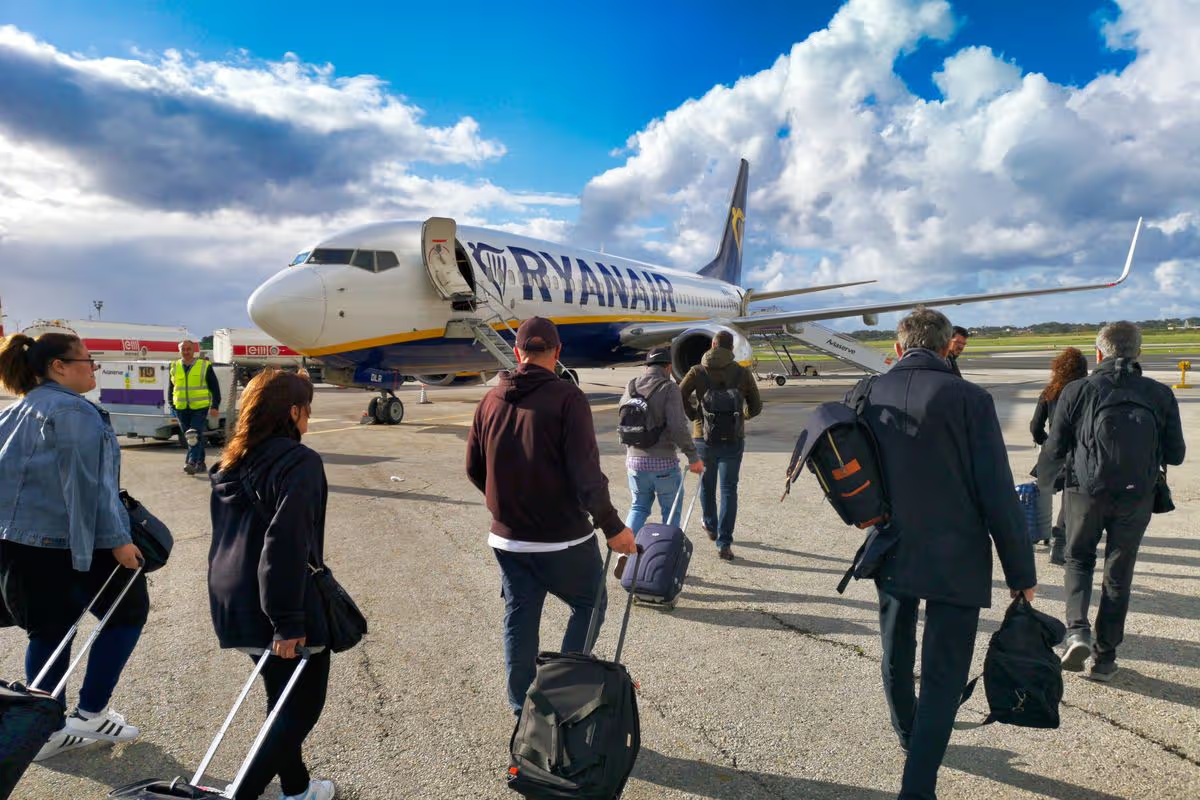
Ryanair has highlighted some ‘commonly affected routes’
Ryanair has sent emails to customers who may be affected(Image: Getty)
Ryanair has issued an ‘important’ alert to passengers with upcoming bookings ahead of a major change that came into force earlier this year.
Emails to Ryanair customers read: “From 10 April 2026, the EU’s Entry/Exit System (EES) is in place at all Schengen Area external borders. As a result, passport control may take longer for some passengers.” The messages add that passengers are affected if they hold a non-EU/non‑EEA /non‑Swiss passport and are flying into or out of the Schengen Area.
The correspondence continues: “Commonly affected routes include flights between the Schengen Area and countries such as: UK, Ireland, Cyprus, Albania, Montenegro, Serbia, Türkiye, Egypt, Israel and others.” Holidaymakers and other travellers may need to scan their passport, provide fingerprints, and have a facial image taken at passport control.
Because of the more extensive checks, longer queues may form, particularly at busy airports. Queues may also form before security.
If you are affected, Ryanair suggests you arrive at the airport early to allow for queues, have all travel documents ready, and follow signs marked ‘EES / Passport Control’. EU, EEA and Swiss passport holders are not affected, and neither is anyone flying within the Schengen Area, for example from Spain to Italy, or from Germany to France.
Ryanair added: “If you are denied entry, this will be due to EU policy, not Ryanair’s rules. Find out more about how EES may affect your travel plans.”
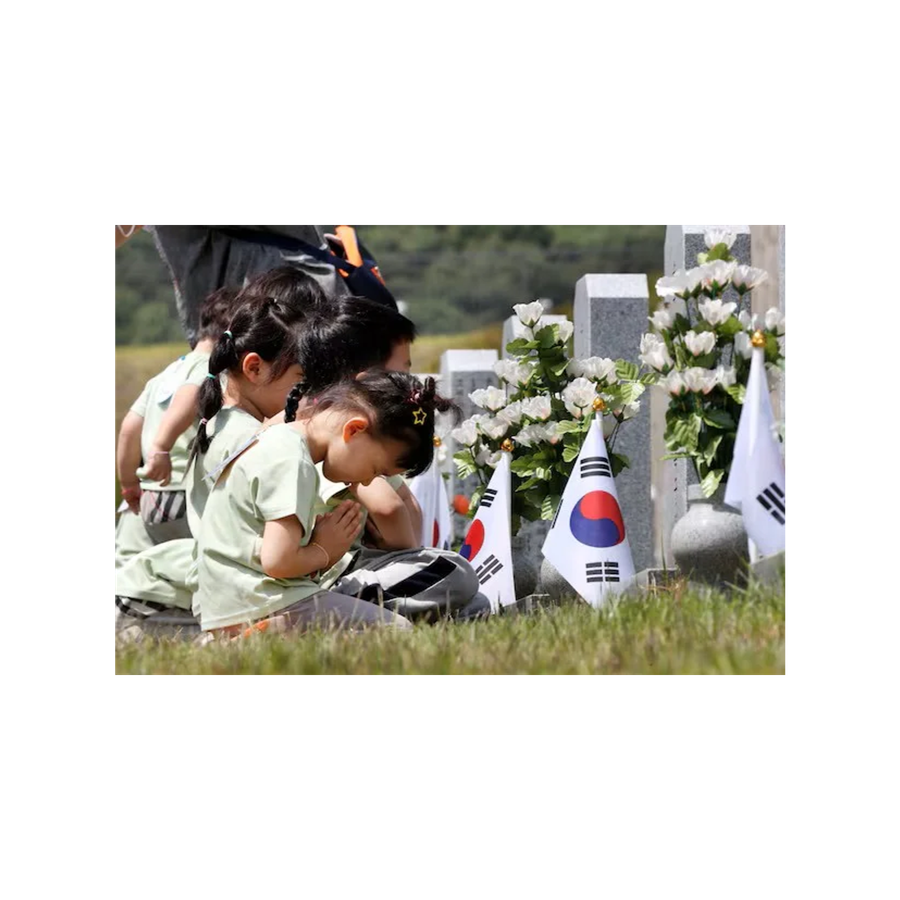
This article provides a historical overview of South Korea’s Memorial Day, an annual observance held on June 6th to honor those who perished during the Korean War. The text details the conflict’s origins in 1950, highlighting the unique military intervention by the United Nations and the involvement of global superpowers that eventually led to a 1953 stalemate. Because a formal peace treaty was never established, the two nations technically remain in a state of war separated by a demilitarized zone. On this public holiday, South Koreans participate in national mourning traditions, such as displaying the country’s flag and visiting gravesites to pay their respects. Ultimately, the source serves as a commemorative guide, explaining both the geopolitical sig …
Or try the locals’ fave, Lukács Thermal Bath, which has two outdoor pools, thermal pools and a sauna.
Entry costs £16.60, but upgrade to its beer spa, £62, and you can even sink into thermal water with therapeutic hops, while drinking unlimited beer from the taps beside (Lukacsfurdo.hu).
Feast on Ischler
Mezze around at TürkizCredit: Turkiz Budapest/Instagram
Step back in time at Bambi Cafe – opened in 1961, it still has red vinyl chairs and doily-like tablecloths from its Communist days.
Prices seem frozen too, with traditional Ischler cake of shortbread, jam and chocolate just £1.90, and a cappuccino £2.15 (Facebook.com/bambieszpresszo).
Find delicious sharing mezze, £13, at Türkiz (Turkizrestaurant.com), while in the Jewish quarter, a cocktail at Balagan is a must.
“Balagan” means chaos in Hebrew – this place is anything but – and the Runway Mango, mixed with Kendall Jenner’s tequila, £13, is like sipping an alcoholic Solero (Balagan.hu).
Spy crown jewels
Tour the Hungarian Parliament BuildingCredit: Getty Images/iStockphoto
The city’s Castle District is a UNESCO World Heritage site and the Buda Castle grounds are free to explore.
For the best views, climb the turrets of Fisherman’s Bastion or the 172 steps of Maria Magdalena Tower, £4.10 (Budacastlebudapest.com).
Admire the country’s crown jewels and more than 100 stained-glass windows at the Hungarian Parliament Building, where 50-minute guided tours cost £34 (Parlament.hu).
Later, check out the work of Budapest-born Robert Capa at the Contemporary Photography Centre, with 130 iconic images, from the D-Day landings to portraits of Picasso and Ingrid Bergman. Entry costs £11.80 (Capacenter.hu).
Meanwhile, the garden of sculptures at Koller Gallery is an unexpected and crowd-free delight, and entry is free (Kollergaleria.hu).
Hit the market
Fall for handmade stationery at Bomo Art – pretty designs include old city maps, fruit and foliage (Bomoart.hu).
You’ll find jewellery and ceramics by Hungarian designers tucked away in a courtyard at Paloma Artspace (Palomaartspace.hu), where Coque’ette has the softest leather purses, from £23 (Cqbrand.hu).
Fény Utca market on Sunday mornings has it all, from knitted animals to Harlequin’s mouth-watering rose-pistachio chocolates – and owner Krisztina happily offers samples (Fenyutcaipiac.hu).
Kip in a mansion
Bed down at Kimpton BemCredit: SuppliedHit the cute spa complete with steam room, hot tub and saunaCredit: SUPPLIED
Formerly a 19th-century mansion, the Kimpton Bem hotel has 127 boldly designed rooms inspired by Hungarian culture and folklore.
Expect Nespresso machines, power showers with Balmain toiletries and yoga mats.
Hit the cute spa complete with steam room, hot tub and sauna, then grab a stool to perch on at Bar Huso from 5-6pm for free fizz.
Feast on divine green-pea gnocchi, £15, at Agos restaurant, before heading up to Fennen Skybar for moreish Thirsty Madonnas – vodka, ginger and prosecco, £14 – as you watch the lights twinkle on the Danube.
Around 7 a.m. Saturday, in a lot beside the shuttered Santa Monica Civic Auditorium, a strange set of cars and trucks began to gather. Three Model A’s. A couple of ’60 convertibles. A 1964 Chevrolet Impala station wagon. Also, a big bull on trailer wheels.
“Am I in the right place?” asked a man in one of the Model A’s.
“Going to Chicago?” asked a guy in a white Denali.
“I wish I could do the whole thing,” said Joe Hernandez of Pasadena, wistfully standing by.
Share via
This was the starting line for roughly 70 drivers who gathered to celebrate the centennial of Route 66 with a 2,448-mile, 20-day caravan to Chicago. Most had come from outside California to share an adventure with fellow “roadies” and boost awareness of the classic scenery and independent businesses along the eight-state route.
But soaring gas prices and hesitant international travelers have added uncertainty to a trip that was always going to be a logistical challenge. Day 1 alone might terrify an L.A. commuter: From the Pacific to Pasadena by surface streets, including miles on Santa Monica and Colorado boulevards.
“I don’t know how it’s all going to happen,” said Gary Daggett, president of the Old Route 66 Assn. of Texas. But he and his wife, Stephanie, have more than a little Route 66 experience to draw upon.
Mike and Lisa Visket of Prescott, Ariz., pose in Santa Monica at the pier in their Route 66 clothing on June 6, 2026.
“This is our 30th trip over 20 years,” Daggett said. “You can’t see everything. There’s so much…. You start meeting the people, you get hooked on the people.”
Shortly before their 8:30 departure time, organizer Rhys Martin called drivers together.
“Leaving here is going to be a little complicated,” he said.
Martin, who is part of the Route 66 Road Ahead Partnership, is president of the Oklahoma Route 66 Assn., and serves as manager of the National Trust for Historic Preservation’s Preserve Route 66 initiative. For the journey, he is driving a ’64 Chevy Impala station wagon with a GPS unit inside so that armchair travelers can follow his journey on the web.
“It’s going to be impossible to keep everybody together,” he said during preparations. “We’re encouraging people to spread out and support independent businesses rather than all going to one place and demolishing the kitchen.”
William Cooke of Pinon Hills participates in a caravan from Santa Monica Pier to Chicago, celebrating the centennial of Route 66.
In song and literature, the route is celebrated as an east-to-west journey. This caravan, running in the opposite direction, will travel from California through Arizona, New Mexico, Texas, Oklahoma, Kansas and Missouri to Illinois.
From Santa Monica, the Day 1 schedule took drivers to Beverly Hills City Hall, Grand Central Market downtown for lunch, the Chicken Boy statue and Galco’s Soda Pop Stop in Highland Park, then an overnight in Pasadena.
Day 2 takes the group from Pasadena to Barstow. Day 3, from Barstow to Needles. On June 25, the caravan is due to arrive in downtown Chicago.
The loose procession was led by a core group of 15 cars, including representatives of all eight states on the route. Since anyone can join or leave the caravan at any time, the number of vehicles will vary by the hour.
Through the decades, the road has grown from an American artifact into a global symbol of small-town Americana. Many merchants, restaurateurs and hoteliers along 66 now say that their summer customers are mostly travelers from abroad, especially Europe. One of the caravan’s drivers, in a rented pickup truck, was Dries Bessels, co-founder of the Dutch Route 66 Assn.
Brady Wilson of Amarillo, Texas, displays an assortment of Route 66 pins on his cowboy hat. Wilson is part of a caravan of Route 66 enthusiasts who set out from Santa Monica Pier on June 6, 2026, for Chicago.
Though the Model A’s will surely raise eyebrows on the road, the caravan’s most startling element is the fiberglass bull representing the Amarillo-based Big Texan Steak Ranch restaurant, one of the event’s sponsors.
“It’s the same one my dad brought home in ’71. His name is Big Moo,” said Danny Lee, who co-owns the restaurant with his brother, Bobby Lee. “He’s 12 and a half feet high. About 500 pounds. It’s all fiberglass.”
In 21 cities along the drive, the Big Texan team aims to stage nightly steak-eating contests, giving free dinners to anyone who can eat 72 ounces of steak, a baked potato, three shrimp, a side salad and a roll in 60 minutes.
The caravan’s first challenge came at the Santa Monica Pier, where there was no room for the cars due to a construction project, World Cup preparations and a Children’s Hospital fundraiser. Instead, the caravan gathered by the Santa Monica Civic Auditorium. Drivers strolled over the pier for a photo op, then returned to their cars.
“Herding cats,” said George Kulakowski of Huntington Beach, at the wheel of a 1931 Ford Model A Panel Delivery truck.
Participants in a Route 66 centennial caravan pose for a photo before they depart from Santa Monica Pier on June 2, 2026, for Chicago along the historic highway.
Another challenge awaited in West Hollywood, where Santa Monica Boulevard (aka Route 66) was busy with crowds for the city’s WeHo Pride Street Fair. By plans laid ahead of time, most caravan vehicles detoured around the party while select caravan cars followed a police escort through the action.
This way, Martin said, “another community along Route 66 gets to share its identity with the community at large.”
Allison Lehn of Boston participates in a caravan from Santa Monica Pier to Chicago, celebrating the centennial of Route 66.
By 11:15 a.m., Martin’s car had reached Sunset Boulevard in Silver Lake. Meanwhile, assorted other parades and caravans are traveling Route 66 in other states this year; most of them concentrate on short segments.
By 12:45 p.m., caravaners had met the mayor of Beverly Hills and rolled through West Hollywood’s Pride festivities, arriving at Grand Central Market, running slightly ahead of time.
On May 30, an estimated 3,596 classic cars joined a “Capital Cruise” on Route 66 in Tulsa, Okla., becoming a Guinness Book of World Records holder for the largest parade of classic cars, drawing an estimated 100,000 spectators and overwhelming local traffic.
In Arizona, the Williams Historic Route 66 Car Show was set for Friday and Saturday. In Texas, the Amarillo-based Texas Route 66 Festival is running Thursday through June 13.
William Cooke of Pinon Hills, left, and Sarah Jane Woodall of Tecopa, Calif., drive along Wilshire Boulevard in a 1960 Edsel Ranger Convertible as part of a Route 66 centennial caravan.
In those states and beyond, the caravan from Santa Monica will find hotels and motels in every kind of condition, vintage neon, road food, blue states, red states and purple states.
As a package of Times stories described in May, some landmarks date to the highway’s days as a scene of Depression desperation in the 1930s, others to its giddy postwar years in the late 1940s and ‘50s.
Route 66 was created in 1926 as a highway stitching together hundreds of local roads. Nicknamed “the Main Street of America” by its boosters and “the Mother Road” by John Steinbeck in “The Grapes of Wrath,” the highway inspired Bobby Troup’s song “(Get Your Kicks on) Route 66” in 1946.
But economic life along Route 66 has been precarious since the late 1960s, when interstate highways and chain hotels began stealing traffic away from the older, slower road. After Route 66 was decommissioned as a highway in 1985, about 85% of the old route remained in use, often as small-town thoroughfares, country highways and frontage roads alongside Interstate 40.
Efforts to save and rebuild the route as a historic resource began in the late 1980s and gained ground after the 2006 release of the Pixar/Disney animated features “Cars,” which tells the story of the highway’s rise and fall. In small towns such as Tucumcari, N.M., and Seligman, Ariz., the highway remains central to local identity and economy.
A vehicle in the Route 66 caravan is photographed June 6, 2026.
This year’s centennial improvements along the route “are things that are going to go into the future,” Martin said. “The real impact is going to be next year and the years after.”
Travel insurance for Turkey has jumped almost 50 per cent in just a year, according to new data
Izmir, Turkiye. UK tourists are facing higher insurance premiums, one travel expert said(Image: Getty Images)
Five European and Mediterranean destinations including some hotspots much loved by British tourists have been named as having seen big rises in insurance costs, directly caused by the Middle East crisis. Travel insurance for Turkey has jumped 46% in just a year, according to new data analysing 5,000 policies across popular destinations near conflict zones.
There is no sign of the Middle East conflict calming down – today Iran fired ballistic missiles and drones towards Bahrain and Kuwait, Bahrain’s government said, adding that they were intercepted.
Bahrain’s government called on Tehran to immediately cease attacks on Gulf neighbours that it deemed a “serious escalation”. Iran’s Foreign Ministry said the US early Saturday attacked surveillance facilities on Qeshm Island and near Sirik that it said were used to protect borders and “ensure the security of navigation in international waters”.
The latest exchange of fire came as the Trump administration pressed Iran to make a deal to end the war that has strained the global economy and threatened a hunger crisis in some of the world’s most vulnerable countries.
The US military earlier said it shot down several Iranian missiles and drones launched towards the Strait of Hormuz and Gulf Arab allies, and struck some of the Islamic Republic’s coastal surveillance radar sites in response.
It has had a big impact on the region with some popular destinations seeing big rises in premiums. Quotezone travel insurance expert Helen Rolph warned travellers not to assume last year’s prices still apply and urges holidaymakers to compare policies carefully, buy cover as soon as they book, and check Foreign Office advice before travelling.
Industry experts compared 5,000 travel insurance premiums across five popular tourist destinations close to conflict zones, revealing which countries have seen the biggest price increases over the past year.
Prices in Turkey have been affected the most despite it traditionally being considered one of the most popular and cost-effective destinations for UK holidaymakers over recent years.
Standard travel insurance premiums to the country have jumped from £40.56 in early 2025 to £59.19 just a year later – a rise of 46% or almost £20 per trip – which may be due to the fact it shares a border with Iran.
Holidaymakers travelling to Bulgaria are also seeing a sharp rise with prices up 19%, possibly down to its proximity to Ukraine.
Premiums for Cyprus have increased by 6%, Egypt by 4% and Poland by 8%. To gather the data, popular holiday destinations for British tourists were cross-referenced with countries geographically close to conflict zones, namely Ukraine and Iran, creating a dataset of major holiday hotspots in relative proximity to areas of geopolitical tension.
Insurers regularly reassess risk when global tensions rise, particularly in destinations close to areas where travel complications might become more likely.
Destinations situated close to areas experiencing heightened tensions – such as Iran and Ukraine – could see premiums shift as insurers reassess the likelihood of travel disruption, delays or emergency evacuation should issues escalate.
Helen Rolph, travel insurance expert at Quotezone.co.uk said: “Travel insurance prices change constantly as insurers respond to global events, the number of claims made and healthcare costs.
“Even if a destination remains popular despite its proximity to ongoing conflict, premiums can rise when the wider region becomes more uncertain.
“Travellers and holidaymakers shouldn’t assume last year’s prices will still apply and make sure they’re comparing policies carefully rather than opting for the cheapest option, as cover can vary significantly.
“It’s also sensible to arrange insurance as soon as a trip is booked, check government travel advice before departure, and ensure any medical conditions are fully declared.
“Travel disruption insurance can also be useful as it covers a wider range of issues while travelling but it’s important to remember that travel insurance won’t provide cover if the foreign office advises against travel to that region and most travel insurance policies won’t cover war related incidents. It’s crucial for holidaymakers to check what is and isn’t covered on their policy and add any extras or specialised cover they might need.”
Travel Insurance Premiums
Country // Average 2025 // Average 2026 // Average Price Change // % Change
Three tunnels form part of the complex under the city
The tunnel runs right under a European city.
A European city has an extensive network of tunnels beneath it. The Blanka Tunnel Complex is the longest city tunnel in Europe and runs for a total length of 5,502 meters.
The tunnel sits under Prague and is the longest road tunnel in the Czech Republic. It connects the area west of Prague Castle with the Trója district in the North-east of the city.
Three tunnels, consisting of the Bubenečský, Dejvický, and Brusnický, make up the complex, which was designed to relieve heavy traffic from the history city centre. In its first 49 months since opening, it was used by 139 million cars.
Today, it is estimated that 88,000 vehicles use the tunnel every day. The Blanka Tunnel Complex opened on September 19, 2015, but it was a long time coming.
Construction launched in 2006, but it was planned since 1993. The tunnel was due to open in 2011, but the biggest and most expensive project in Prague was delayed by four years.
It cost 43 billion crowns, which is £1.5 billion today and doesn’t include all construction costs. During the construction of the tunnel complex, there were three landfalls.
The incident occurred twice in the Stromovka park, creating a hole measuring 15 to 25 meters. Another landfall happened in the garden area of the Ministry of Culture in Hradčany.
Since opening, the Blanka Tunnel Complex has undergone continuous maintenance. There is 24/7 monitoring by a dedicated control centre that works night shifts to service lights, ventilation systems, cabling and drainage.
Last year, the tunnel marked its 10th anniversary. Prague Daily News said: “It relieved congestion in the city centre, reduced journey times, and took vehicle traffic underground.
“Since its opening, around 780 million vehicles have passed through the tunnel.
“The Dejvický Tunnel has borne the greatest load with more than 271 million vehicles, followed by the Brusnický Tunnel with almost 266 million and the Bubenečský Tunnel with 236 million vehicles.
“Although Blanka has been in regular operation for years, the approval process for part of the project is still not fully concluded.
“A formal decision by the Administrative Court has meant that the relevant section continues to operate only under provisional use.
“Observers, however, expect a final acceptance soon.”
IF you fancy visiting to Lake Como but can’t face the long airport queues, how about going in the opposite direction?
In the Finger Lakes region of New York State is the quiet village of Hammondsport – and it has been compared to the famous Italian lake.
Sign up for the Travel newsletter
Thank you!
Hammondsport village is a tiny destination at the foot of Keuka LakeCredit: AlamyThe Y-shaped Keuka Lake is often compared to Lake Como in ItalyCredit: Jay Faust
Both lakes are a Y-shape, but Keuka Lake is smaller than its Italian alternate – it’s just under 20 miles long with over 60 miles of shoreline.
Meanwhile, Lake Como has a maximum length of 29 miles; however, the shoreline length is a whopping 105 miles.
Keuka Lake is much shallower too at 187 feet at its deepest, while Lake Como has a maximum depth of 1,394 feet.
You can swim in both, as well, but Keuka Lake is considered one of the cleanest and warmest of the Finger Lakes too so it’s ideal if you want to take a dip.
It might even be a better option as visitors can swim in Lake Como, but the water quality differs depending on where you enter the water.
Keuka Lake is surrounded by vineyards, much like Italy and is so pretty that one visitor called it “one of the most beautiful lakes in upstate New York“.
The Finger Lakes itself has around 140 wineries, and near Keuka Lake there’s Bully Hill Vineyards, Heron Hill Winery and Divided Sky Vineyard.
For those who really want to learn more about the wine scene, there’s even a dedicated Keuka Lake Wine Trail.
The lake in the US is considered one of the cleanest and warmest in the Finger LakesCredit: Getty
If you head to the official website, you can pay $45 (£33) and redeem tasting flights at six of the included wineries.
At the very south of Keuka Lake is the small and charming village of Hammondsport.
There’s not too much see with it being a village, but visitors have raved about Verns Bakery, Burgers & Beers, Park Inn restaurant, Crooked Lake Ice Cream Company which is also a 50s-style diner.
Head to Depot Park for views across the water – and this is the spot if you want to hire out your own boat.
Surrounding the lake are rolling fields of vineyardsCredit: Alamy
With multiple boats, you can hire them out for the day from $535 (£398) – split between eight (which is the maximum passengers), that’s just under £50per person.
If you want to stay in Hammondsport, check out Park Inn which has just five suites above its restaurant.
Rates start from $150 (£111) per night (with a two-night minimum stay).
Or there’s the Vine Inn & Carriage Houses which is described as a ‘serene retreat’ and is a 10-minute walk from the lake.
The Park Inn has five suites above its restaurant in the villageCredit: Unknown
If the heat of Italy during the summer is what you’re afraid of missing out on, then rest assured, it will still be just as hot.
In the summertime, the Finger Lakes region can reach temperatures of 28C with it cooling down in the following months.
I’m not sure I’ll be working as a bartender in Lima any time soon.
Thankfully the city has more than enough of them, with the Peruvian capital often named a top food and drink destination.
The place may be nicknamed Lima La Gris (from the large grey clouds that frequent the sky) but the city is certainly colourful when it comes to both gastronomy and architecture.
One of its brightest districts is the vibrant and noisy Barranco.
Often referred to as among the world’s coolest neighbourhoods, the bohemian area is popular with surfers heading to the beach and art lovers adding to the hundreds of muralled walls.
Walking down the street is a feast for the eyes with men playing guitars outside multi-coloured houses, while cyclists zoom past with wetsuits on.
With more than 200 pieces of artwork across the neighbourhood, it feels more like an open-air art gallery.
And the city is fast making a name for itself when it comes to food, with many award-winning restaurants also found here.
One of those is Mayta, a World’s 50 Best Restaurants winner in Miraflores, made up of structured wood and concrete blocks.
While the seven-course tasting menu was tempting, I didn’t have four hours to kill, so opted for the à la carte.
I started with the fresh and zingy limey ceviche before I filled up on their take on paella with a crispy rice parcel surrounding shrimp.
For something a little more wallet-friendly, in the Miraflores neighbourhood, I found Parque Kennedy, known for its huge number of street vendors selling cheap snacks.
For around a fiver, my hands were quickly filled with herbal “emoliente” drinks that stave off hangovers, picarones (sweet doughnuts made of squash) with honey and chicharron pork sandwiches.
Peruvians love massive portions, I soon found out. And I was told that the best way to work off all the food would be to hit the waves, of course.
But with my surf skills lacking, I instead opted for a bike tour of the city, taking in the spectacular coastline, as well as the famous Love Park.
Inspired by Catalan architect Antoni Gaudi, sculptor Víctor Delfín built a wall of tiles, surrounding the famous El Beso sculpture of couples embracing.
Peru’s huge exports of coffee and chocolate mean you can barely walk five minutes without spotting a chocolataria.
As a self-professed choc expert, I was extremely smug after one cocoa class, naming all of the regions I tasted correctly.
A few hours away, Peru’s tiny second city of Arequipa, in the shade of the Misti volcano, is even more overlooked than Lima, yet the food is just as incredible.
My favourite way to spend the morning was jogging in the main central square, watching the sunrise over the Basilica Cathedral of Arequipa.
That running was preparing my body for yet more fantastic restaurants.
There was the vibey 13 Monjas (13monjas.com), with huge portions of Peruvian inspired pasta and Chica (chicha.com.pe) with yet more huge portions of fish tacos.
The Misti volcano in the AndesCredit: PROMPERÚThe Sun’s Kara Godfrey in a selfie with animalsCredit: Kara Godfrey
Yet there was one thing missing from my trip to Peru so far — and that was a cuddle with a llama.
Leaving the cosmopolitan cities, I went in search of the fluffy animals through the Colca Canyon region.
We sped through arid deserts, barely seeing a soul, bar a few locals by an abandoned train track.
Ears popped as we climbed the mountains across Lord Of The Rings-esque epic landscapes.
I was warned to expect some altitude sickness and I was certainly unsteady on my feet as we hit 4,900 metres.
It’s a few hours into my journey that I gasp as I finally see them — a traffic jam of wild llamas and alpacas.
Lazily grazing on the side of the road like oversized sheep, they seemed non-plussed as they sauntered over the road in front of us.
But just seeing them wasn’t enough for me. I wanted to get up close and personal.
Our abode for the night was in the village of Sibayo with a local family who had lived in the area for generations.
It was here that we were joined by a farmer, who excitingly told us we would be going on a llama walk.
It was only as we got up close that I realised quite how tall they were, some towering over my mere 5ft 5in height.
But my excitement never dwindled.
We walked across the beautiful river as they followed me like I was their leader.
I couldn’t resist a ruffle of their heads, with their ears cutely flipping up whenever we stopped.
Returning to our lodges, the evening was spent learning how to knit and dance.
The warm hospitality was evident throughout the stay, with free bracelets and shots of alcohol while listening to music and even a hot breakfast bag before leaving.
By the end of our stay, there were hugs all around, with our guide telling us how he always feels sad saying goodbye to tourists.
A feeling that is mutual it seems from the full guestbook of goodbyes.
I wasn’t ready to return to cold England that’s for sure – but a bag full of local coffee and alpaca socks certainly helped.