
Travel Desk

I went on TUI cruise ship and got sneak peek at the areas passengers don’t see

I went behind the scenes on a Marella cruise and ended up getting a sneak peek at some of the rooms that the passengers usually don’t get to see

Cruises are made to feel effortless – from island-hopping, flowing cocktails to all-inclusive dining. But behind the scenes, an army of staff are working around the clock to keep things powered to the highest of stands.

For my first Caribbean cruise on board the Marella Discovery, I was given access to areas passengers don’t normally see. After getting to grips with the 11-deck vessel – home to nine restaurants, six bars and everything from mini golf, an escape room and a climbing wall to keep you entertained, it was time to see the ship from a new angle.

Here’s everything I learned…

Where the magic happens

Only a handful usually get to see the command centre of any ship; the bridge. Here, the Captain and his crew navigate these huge vessels from ‘parking’ in tight corners at the docks, to steering the course when out in the middle of the ocean. The view from the bridge was unlike anything I’d seen before, and quite impressive. We watched how the crew navigated as our ship docked among huge superyachts owned by millionaire (just to add that extra bit of pressure).

Your air con affects the speed of the ship

Next, I head into the engine room where a team operates the smooth running of five engines, two massive propulsion motors and multiple air-conditioning systems – working 24 hours a day. Modern cruise ships like the Marella Discovery distribute power to meet the demand. That means lighting, kitchens and even your cabin’s air con will play a role. “If we were in Alaska in the middle of the night, with no air con running, we could reach 24 knots,” one crew member explained. “But during the day, when everything’s in use, it drops to around 22.” At full speed, the ship burns around 8,000 litres of fuel an hour. Efficiency is key.

It all comes out in the wash

In the laundry room, staff wash around 1000 towels a day with industrial machines and steam presses. It’s not just the passengers who are catered for. In these rooms tucked out of sight, the crew’s immaculately white uniforms are maintained. Since that’s a lot of similar looking clothing, every item is labelled with a unique number to make sure they go back to the right person.

The show must go on

As a theatre fan, I couldn’t wait to get up on the stage of the Broadway Show Lounge – from a view not many get to see. Behind the curtain, the performers do more than just sing and dance. I learned that they handle their own props, do their own hair and make-up, and of course all of the warm-ups they undergo. In the dressing room, wigs, hairspray and hairpins fill every space, but among the seeming chaos there’s a strong camaraderie. After working with each other for three months at sea at a time, it’s clear the performers are like family.

The motion in the ocean might be in your head

Unlike the seasoned sailor, I admit that being a cruise-newbie means I feel the ship moving especially at night. However, according to the crew, the tilting is far less dramatic than I was expecting. Thanks to stabilisers, the ship can only ever move to a maximum of one degree either side. “We keep your soup in your bowl and your drinks in your glasses,” one jokes.
The most eaten food on board? It’s not what you’d expect

I got a chance to see the ship’s galley – the central multi-floor hub of the ship where thousands of meals are prepared every single day. A team of 101 chefs work around the clock to fuel up 1800 passengers and 700 crew members every single day. The head chef shows me what is known as ”the manual’, a list of detailed recipes for every single food item on the menu – ensuring the exact same meal can be recreated anywhere in the TUI fleet. Around 3,600 meals are served at lunch and dinner, but breakfast is the real peak with passengers get through a staggering 7000 dishes a day. The most popular food on board? Eggs. Around 2,300 are served up at breakfast alone – that’s a lot of omelettes.

The customer service is down to a tea

It’s not just the big systems that are carefully thought out on Marella. As an avid Yorkshire tea drinker, I was thrilled to see the boat was well stocked even in the Caribbean. One crew member told me it’s something that was introduced after passenger feedback and quickly became a staple.

Book the holiday

Marella Cruises offers a seven-night Tropical Isles round trip from La Romana, Dominican Republic on Marella Discovery from £1573 per person. Price based on two adults sharing a Deck 2/3 inside cabin on an all-inclusive basis. Includes flights from London Gatwick, 20kg of luggage per person, transfers, tips, and service charges. Find out more at tui.co.uk/cruise.

Source link

‘I’ve visited over 80 countries – I know how to find the perfect hotel in 60 seconds’

One man who knows the ins and outs of finding the ideal hotel is travel expert Mark Wolters, who outlined how you can spot top quality accommodation in 60 seconds

A seasoned traveller who has visited more than 80 countries has revealed how you can identify a quality hotel in just 60 seconds. As we’re all aware, a decent hotel can determine whether a holiday succeeds or fails; be it the standards of cleanliness, the facilities, the swimming pool, or any other factor, having a solid place to retreat to after an exhausting day helps you properly relax.

Not every hotel measures up – the web is awash with stories of dreadful experiences, ranging from the merely disappointing to the absolutely horrendous. So, as we begin mapping out our spring and summer escapes, any guidance on securing a good one will surely prove invaluable.

One person who knows the tricks of finding an ideal hotel is Mark Wolters, the instantly familiar face behind the Wolters World YouTube channel, which boasts 1.17 million subscribers.

As an experienced world traveller, Mark has journeyed everywhere from Uruguay to Albania. Now he’s revealing his top hotel tips to help others steer clear of a disastrous booking.

Check the most recent reviews

His first suggestion was examining online reviews of the accommodation. Importantly, you should focus on the latest reviews, since a hotel that enjoyed five-star status a decade ago might have deteriorated – or improved considerably.

Mark explained: “Are they still getting that nine out of 10 or eight out of 10? Or have they fallen to a six or a seven? Because you want to look for that consistency.

“Because if they’re consistently getting nines and tens today and five years ago, that shows that that hotel continuously cares about their guests and their hotel, which means boom, probably going to be a good hotel.”

Actually read the reviews

Mark advised people to scrutinise the reviews and look out for specific keywords and phrases, such as “clean”, “safe”, “comfortable, “, “good location” or “attentive staff”, for example.

He added that you should, for the same reason as above, remember to sort these reviews by date and check whether the hotel has responded to guests online, paying close attention to whether their replies were courteous and professional.

Check that the price makes sense

Mark said: “I know we all want to find that great hotel for a super low price, but a lot of times, (if) they have to have heavy discounts, it’s for a reason.

“So, what you want to see is if you’re looking in an area like here in Lille, you’ll see that, oh, similar hotels have similar prices, and does that hotel fit in that same similar price range. That makes sense.

“I mean, they can have a deal every so often, but a good hotel doesn’t have to have a deal because they’re a good hotel.”

Check photos posted by guests

Mark highlighted the importance of not only looking at the photos posted by the hotel, which could be old, but also at those shared by guests online. Check if these line up with the originals.

Cancellation policy

He went on to advise that you should review your hotel’s cancellation policy because good hotels “know that life happens”, and that our plans can change. Mark noted that desirable hotels “don’t punish guests”.

Location, location, location

It’s well worth pinpointing the exact location of the hotel on a map to establish whether it’s within easy reach of local amenities or attractions. Crucially, Mark also highlighted that you can check whether the hotel is situated in a safe neighbourhood.

Check the description

Mark said: “Is it a realistic description of the hotel, of the rooms, or is it something like a ‘tranquil oasis away from the problems of your life in the outskirts of the world?'”

If it’s packed with “marketing jargon”, as Mark puts it, he suggested you should avoid it, adding that good hotels will be “realistic”.

Trust your gut

Finally, Mark said that when you check out hotels online, much of the time, you will get a “gut feeling” and advised people to trust it.

Source link

Spain airport delays update as one group hit with longest waits over April ‘change’

Many passengers are facing waits of up to three hours at Spanish airports due to the new controls

Travellers in Spain are experiencing significant delays at airports. And experts are warning that one particular group is bearing the brunt of new border controls, according to a Spanish travel organisation.

There have been widespread reports of waiting times of up to three hours. New regulations have been introduced, with some passengers in particular facing very long waits.

Spanish media reports indicate waiting times of up to three hours at Palma airport alone, with similar delays reported in France, Greece, Italy and beyond. Travel group Aviba is now calling for urgent measures to prevent chaos this coming summer.

Pedro Fiol, president of the travel association, is demanding immediate action to avert disruption this summer, and has revealed he has been pushing for such measures for months, according to Ultimata Hora. The new system has only just been introduced, having fully launched on April 10, following a trial period that began late last year.

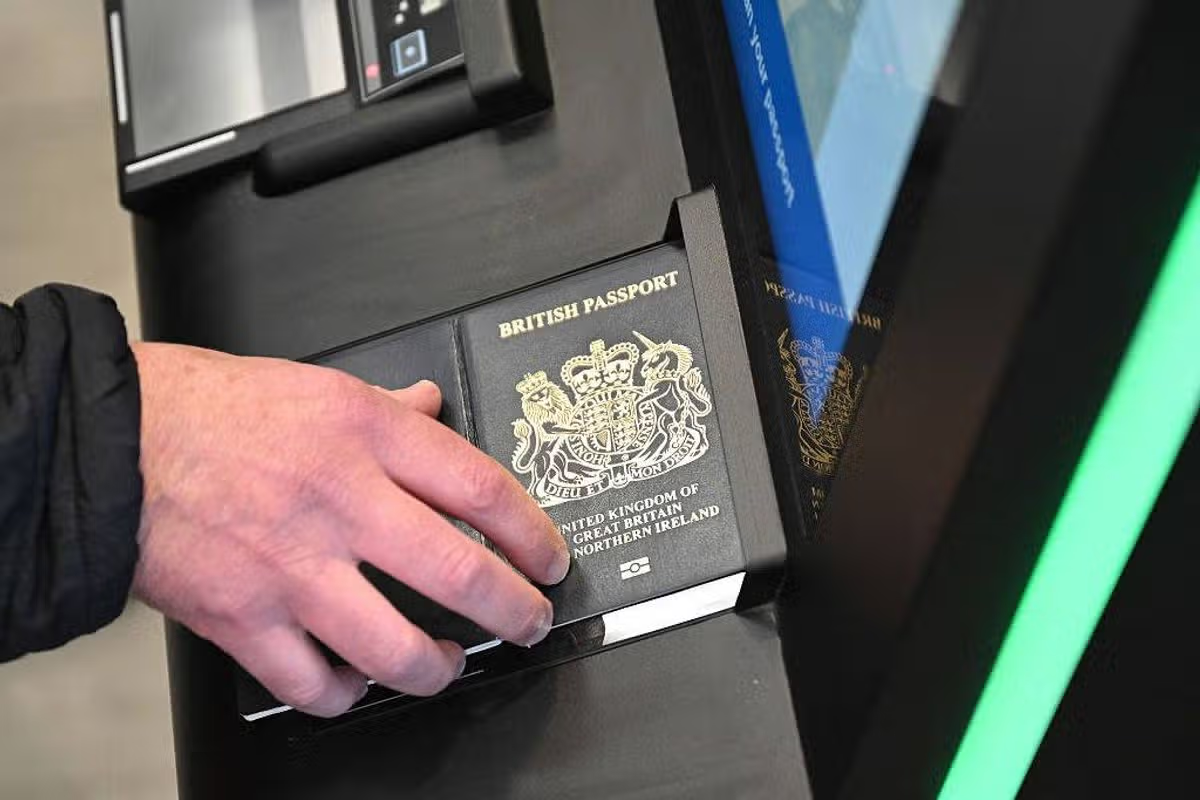
The EU’s new Entry/Exit System (EES) initially began operations on 12 October 2025, with a phased rollout across 29 European countries. Now it is fully in place.

The system replaces passport stamping with digitally recorded entries, exits or refusals of entry of non-EU nationals arriving for short stays. Travellers’ facial images, fingerprints and personal data from the travel document will also be recorded.

Mr Fiol said: “The implementation of the new European Border and Security System (EES) is already beginning to be felt at the Balearic airports, especially at Son Sant Joan, the main gateway to Mallorca, where we are still operating with a hybrid model. At certain times, it is causing some slowdowns in the controls, particularly for non-EU passengers.”

He warned that “we are facing a structural change in how borders are managed across Europe: biometric registration is replacing manual passport stamping, and this means more time for the passenger’s first contact with their destination.” In his view, so far “the experience has been inconsistent: some days the operation runs relatively smoothly, while others, according to agencies and tour operators, can take more than two hours from the moment the plane lands until the traveller collects their luggage, and even nearly three hours in some specific cases.”

Ultima Hora reports that the National Police have acknowledged the delays, though they say they have seen no evidence of prolonged hold-ups. Sources close to the security forces have told Spanish media that additional staff have been deployed during peak hours in a bid to ease any difficulties that may occur during periods of heavy passenger congestion at checkpoints.

Travellers passing through airports in countries including France, Germany, Belgium, Italy, Spain and Greece are facing waits of several hours at border controls, according to the Airports Council International (ACI). Olivier Jankovec, the director of the ACI European division, told the Financial Times: “This situation, in the coming weeks and certainly over the peak summer months, is going to be simply unmanageable.

“We are seeing those queueing times now, at peak times, when traffic is just starting to build up.” A spokesperson for the European Commission told the Guardian: “What we can see from the first days of full operation is that the system is working very well. In the overwhelming majority of member states there are no issues.”

The commission said that the average registration of a passenger was 70 seconds, although the ACI has claimed that it can take up to five minutes. The spokesperson said there were a “few member states where technical issues have been detected” but that they “are being addressed”.

They said: “It is up to member states to ensure the proper implementation of the EES on the ground.” Luke Fitzpatrick, from independent travel agency Perfect Getaways, told the BBC this week that travellers should plan ahead to make border checks as smooth as possible.

“It’s about being as prepared as you can be,” Fitzpatrick told BBC Radio Merseyside. “There is a lot of uncertainty at the moment as people are getting used to the new system.”

While he said the advice was to arrive at the airport “at least three hours early”, he said it could be more difficult for people booked on a package holiday. “If you’re on a shared transfer back, everyone’s coming together at the same time,” he said.

EES changes and the impact on transfer and pick-ups

Pedro Fiol told Ultima Hora that “this situation is forcing a restructuring of transfer and pick-up operations at destinations to better co-ordinate exact times, avoid additional downtime, and guarantee the smoothest possible service.” Given this situation, he says that “travel agencies are concerned that if resources are not properly allocated at airports with such high tourist pressure as those in the Balearic Islands, significant queues and a negative first experience for visitors are possible.”

What do Brit tourists need to do with EES rules?

The govuk website states that “if you are travelling to a country in the Schengen area for a short stay using a UK passport, you may be required to register your biometric details, such as fingerprints and a photo, when you arrive. You do not need to take any action before you arrive at the border, and there is no cost for EES registration.

“EES registration is replacing the current system of manually stamping passports when visitors arrive in the EU. EES may take each passenger extra time to complete so be prepared to wait longer than usual at the border.”

The countries in the Schengen area are: Austria, Belgium, Bulgaria, Croatia, Czechia, Denmark, Estonia, Finland, France, Germany, Greece, Hungary, Iceland, Italy, Latvia, Liechtenstein, Lithuania, Luxembourg, Malta, Netherlands, Norway, Poland, Portugal, Romania, Slovakia, Slovenia, Spain, Sweden, and Switzerland.

Source link

Popular European city brings back ‘tourist tax’ this week

A POPULAR European city is set to bring back its ‘tourist tax’ for visitors this summer.

The city became the first metropolitan area globally to charge day-trippers an admission fee, which was introduced on April 25, 2024.

Panoramic view of the Grand Canal in Venice at sunset with a gondolier in the foreground.
A popular European city is set to bring back its “tourist tax” for some visitors this summer Credit: Getty

Day-trippers who book last-minute trips to Venice this summer will feel the biggest sting, with reservations that are made less than four days in advance costing €10 per person.

Holidaymakers who are a bit more organised, and book their trips more than four days ahead of their planned visit, will only have to pay €5.

Entering the city before 8.30am or after 4pm exempts you from paying, as does being a current resident or a Venetian-born visitor, a student, worker, or someone in the city on an overnight stay.

When you’ve secured your QR code via the booking platform, it will be checked at one of seven entry points across Venice, which includes Santa Lucia railway station.

SUNNY STEALS

10 cheap Spanish holidays to book NOW – with all-inclusive breaks from £199pp


SEA IT

UK seaside town undergoing a £40m revamp is home to the country’s best pier 

However, if you do not pay the fee and are not registered for exemption, or if you fail to produce the QR code, you could be fined anywhere between €50-300.

That’s equivalent to up to £260.

The number of pay-to-enter days is increasing from 54 to 60 this year.

However, last year’s stats show visitor numbers dropped only slightly over the summer, from an average of 16,676 in 2024 to 13,046 in 2025.

The new tax is to help incentivise tourists to visit the small Italian city on weekdays, rather than during the weekend.

But it faces opposition as critics argue that it would not teach visitors ‘respect’.

Giovanni Martini, the city council member, said: “Wanting to raise this to 10 euros is absolutely useless. It makes Venice a museum.”

There are now more tourist beds in Venice than official residents, whose numbers stand at an all-time low of 50,000.

The dates the fee will be in place this year

  • April: 3, 4, 5, 6, 10, 11, 12, 17, 18, 19, 24, 25, 26, 27, 28, 29, 30
  • May: 1, 2, 3, 8, 9, 10, 15, 16, 17, 22, 23, 24, 29, 30, 31
  • June: 1, 2, 3, 4, 5, 6, 7, 12, 13, 14, 19, 20, 21, 26, 27, 28
  • July: 3, 4, 5, 10, 11, 12, 17, 18, 19, 24, 25, 26

An image collage containing 1 images, Image 1 shows Crowds of tourists on the Rialto Bridge in Venice, Veneto, Italy
There are now more tourist beds in Venice than official residents, whose numbers stand at an all-time low of 50,000

Source link

Closed UK airport reveals latest in being able to reopen as part of huge £193million project

AN AIRPORT in the north of the country has taken one step closer to welcoming back passengers.

Doncaster Sheffield Airport closed in 2022 after operating for 17 years, but has been recently backed by the government to reopen.

Doncaster Sheffield could reopen four years after its closure Credit: Alamy
Airlines like Wizz Air operated out of the airport Credit: Getty

Now, the regional airport has taken another step closer to welcoming flights as it is launching a search for an operational partner.

Operator Fly Doncaster is looking for a Fixed Based Operator to have a permanent place within the airport.

This type of organisation would provide services that include aircraft handling, fuelling, and parking.

What this means is that private flights could return to the airport before the end of 2026 – with plans for passengers flights much later.

GREAT ESCAPES

Ten European city or beach holidays for under £100pp INCLUDING flight & hotel


SHORE WINS

How to bag yourself a stunning British seaside holiday break for just £49

Simon Hinchley, Executive Director for Airport Operations at Fly Doncaster said: “As we work towards reopening Doncaster Sheffield Airport, our focus is firmly on building a safe, efficient and operationally robust airport that is ready to serve a broad range of users from day one.”

In early 2025, the UK government revealed that £30million was being put towards its reopening.

More recently, a report for City of Doncaster Council’s cabinet announced that the cost of reopening the airport had risen to £193million.

Fly Doncaster said that when the airport reopens, it could see as many as four million passengers through its doors.

There has also been talks of a rail link to and from the airport that could have connections with the Lincoln Line and East Coast Mainline.

Prior to its closure, airlines like FlyBe, Wizz Air and TUI operated flights from Doncaster Sheffield.

As of yet, no airline has confirmed it will open base, but Doncaster East and Isle of Axholme Labour MP Lee Pitcher said last year that he was in talks with both Ryanair and TUI.

In July 2025, he told local media: “Yesterday, I chaired the latest meeting of the DSA Action Group, where we sat down with TUI’s UK & Ireland commercial director.

“It was a productive discussion, and we’ll continue to work with TUI, other key stakeholders, and push the Government to keep Doncaster Sheffield Airport firmly on the agenda.

The airport is expected to be operational with passenger flights for summer 2028.

The airport closed back in 2022 Credit: Alamy

Another airport that is in talks to reopen is Manston Airport, in Kent which once offered flights from the UK to Europe.

Passenger services stopped when KLM pulled out of the airport in 2014.

The current plan is to reopen the airport for cargo planes which is scheduled for 2029.

There have been talks to start commercial flights once again, but this could take longer to start.

Tony Freudmann – the public face of the site’s owners, RiverOak Strategic Partners told Kent Online: “We need, by the time we open, to have enough advance commitment from cargo operators to see that it is going to work.

“At that point, if we get the right approach from passenger carriers, wanting us to build a passenger terminal and base some aircraft here, we’ll go with that.”

Here’s more on airports as chaos sweeps Europe with new travel rules that have resulted in three hour queues and passengers missing their flights.

And this Spanish airport is set to close for over a month with all flights cancelled and thousands of Brits set to be impacted.

Doncaster Sheffield Airport has taken one step closer to opening Credit: Alamy

Source link

European airline to close for GOOD due to Iran war and ongoing strikes

A EUROPEAN airline is axing all flights with immediate effect.

Lufthansa‘s subsidiary airline CityLine is to cease operations due to both the Iran war and ongoing strike action.

European airline Lufthansa has announced that it is cutting capacity across its network due to rising fuel costs and strikes Credit: Getty

The airline – which operates some flights to and from the UK – will be grounding 27 aircraft from April 18.

Flight routes typically connect London to both Frankfurt and Munich.

It isn’t clear how this will affect passengers just yet, as to whether they will offer alternative routes or refunds.

They said in a statement, according to local media: “As a first, immediately effective step, the 27 operational aircraft of Lufthansa CityLine will be permanently removed from the flight programme starting the day after tomorrow, in order to reduce further losses at the loss-making airline.”

Read more on travel inspo

GO ON

All the little-known websites for cheap or FREE tickets to gigs, theatre & festivals


ALL IN

I found the best value all inclusive London hotel… just £55pp with free food & booze

CityLine was due to cease operations by 2028, but has since decided to close this month instead.

Sun Travel has contacted Lufthansa for comment.

Lufthansa’s main airline has also announced that it will be grounding four Airbus jets and two Boeing jets for good, by the end of the summer, which are mainly used for longer flights.

Lufthansa will reduce short and medium-haul flights by five aircraft from this winter as well, while long-haul capacity will be reduced by six.

Till Streichert, chief financial officer of Lufthansa Group, also said: “The goal is to focus our short- and medium-haul platforms more clearly and make them more competitive.”

The announcement follows hundreds of flight cancellations this week following pilot strike action.

Union Vereinigung Cockpit called the strike action over pension disputes and yesterday announced that the strike action would be extended by two days.

Pilots first walked out on Monday leading to hundreds of flights being cancelled, including many from the UK.

Cabin crew also walked out yesterday and today.

Around 34 flights were cancelled to and from the UK yesterday and with an average flight usually carrying around 150 passengers each, more than 5,000 Brits could have been impacted.

When further strike action was announced, VC president Andreas Pinheiro said: “The situation remains unchanged; there is absolutely no movement on the employers’ side.

“For us, this is not about political power struggles or egos, but about sustainable solutions.”

In a statement, the airline told passengers earlier this week: “Lufthansa and Eurowings are working intensively to keep the impact on passengers as low as possible.

“We are trying to have as many flights as possible operated by other airlines within the Lufthansa Group and by partner airlines.

“However, despite these efforts, flight cancellations are unavoidable.

Hundreds of flights have been cancelled over the past few days Credit: EPA

“Travelers who are affected by an irregularity will be informed accordingly, provided their contact details are stored in the booking.

“We ask passengers to check the status of their flight before setting out on their journey.

“We apologize for the inconvenience caused by the disproportionate and very short-notice strike announcement.”

The airline has told passengers that if their flight is cancelled, they will be able to rebook once free of charge or have their ticket refunded.

In other flight news, here’s the first look at one airline’s new onboard bunk beds which even economy passengers can book.

Plus, a major UK airline is set to hike flights by up to £360 as they warn jet fuel prices have ‘never been this high’.

It comes as fuel prices continue to rise amid the ongoing Iran war Credit: EPA

Source link

Two more major airlines forced to increase flight prices by £86 due to fuel crisis

As airlines grapple with the soaring jet fuel prices and global shortage due to the closure of the Strait of Hormuz, two more have been forced to increase their prices for passengers

Due to the escalating fuel crisis sparked by the Middle East conflict, two more airlines have been forced to raise their prices.

Air travel has been severely disrupted with cancelled routes and a sharp rise in jet fuel prices since US-Israeli strikes erupted on February 28, 2026. The situation was further heightened by Iran’s blockade of the Strait of Hormuz, through which approximately 20 per cent of the world’s oil and gas passes, triggering a global shortage.

As a result, airlines have been grappling with rising jet fuel costs and have been forced to raise prices. Air France and KLM are the latest airlines to confirm they’ve had to increase ticket prices as a result.

READ MORE: Major European airport issues ‘arrive early’ alert for all passengers amid delaysREAD MORE: EasyJet boss warns of summer price hike after £25million hit from jet fuel costs

The airlines, which are part of the same company Air France–KLM, had previously added a surcharge last month to offset soaring jet fuel prices. At the time, economy fares were bumped up by an extra €50 (£43.47) for a round trip, reported The Sun.

Now, with another increase announced, a long-haul round trip with Air France or KLM could cost an additional €50, bringing the fuel surcharge to €100 (£86.98) on top of the standard fare. Meanwhile, flights to the United States, Canada and Mexico could increase by €70 (£60.89), and an economy round-trip could cost an extra €10 (£8.70).

The Mirror has contacted Air France and KLM for comment.

Air France and KLM aren’t the only airlines to raise prices amid the ongoing fuel crisis. Just this week, it emerged that Virgin Atlantic had increased some flight costs with an extra £50 fuel surcharge on economy-class tickets, while premium economy fares are climbing by £180 and business class by £360.

Virgin Atlantic Chief Executive, Corneel Koster, warned travellers that flight prices could climb in the coming months and potentially throughout the remainder of the year. He said: “We have never seen jet fuel at this level and airlines cannot sustain those sorts of high costs.”

“If the fuel price goes much higher, I think the surcharges may go higher. If they go up in a week and you book in two weeks’ time, you’ll be paying higher.”

While there are no fuel shortages at present, Koster acknowledged it was impossible to guarantee supplies in the months ahead. “We have contracts with multiple suppliers who have a wide range of diversity of where the jet fuel comes from,” he explained.

“We have good visibility and no concern for the coming one to two months – certainly for the remainder of April and May. Beyond that I have less visibility, but that is quite normal.”

Meanwhile, it’s also been reported that airlines, such as JetBlue, have increased luggage fees in a bid to offset the soaring fuel costs. For off-peak economy fares, bags are expected to cost $4 more (£2.95), jumping to $39 (£28.79), while peak economy fares are set to be $49 (£36.17).

Do you have a travel story to share? Email webtravel@reachplc.com

Source link

New unusual double decker plane seats that could make economy travel MUCH better

THE latest bizarre plane seat concept has revealed it’s ‘final’ design – but won’t be one if you’re claustrophobic.

First revealed back in 2020, the Chaise Longue Economy Seat would see two layers of seating – essentially double decker rows.

Double decker seats could one day roll out on flights Credit: Chaise Longue
The new designs reveal a lot more space for economy travellers Credit: Chaise Longue
Some people who tested it said the legroom felt more like business class Credit: Chaise Longue

It’s been designed by Núñez Vicente, who as a then-21-year-old student, created it as a college project.

He was inspired after a flight to Europe, slamming the lack of legroom on offer by budget airlines.

The unusual seating design would – in theory – allow more legroom for passengers as there wouldn’t be a seat directly in front.

Not only that, but reclined seats would also causes fewer problems, as they wouldn’t invade the space of the passenger behind them.

NO GO

Passengers are fuming about new plane seat dividers that could end in flight ban


BACK UP

Six times you should never recline your plane seat, according to ex-BA stewardess

Overhead lockers would be replaced with compartments under each seat – so no battling for space there either.

Other future designs could include lie flat beds even in the middle.

However, some have cited concerns over the claustrophobic designs, as well as it being just another way airlines will cram more seats into the cabin.

Despite this, Mr Vincente said that the designs were not “a joke on the internet” but a real project he wants to get rolled out.

His latest designs were revealed at this year’s Aircraft Interiors Expo in Germany, a huge aviation show that takes place every year.

He told CNN Travel that this was their “best” design and would be as much as they could design as a small start up.

Not only that, but he said he was often consulting with airline bosses in regard to one day rolling these out – last year Airbus said they were “exploring early stage concepts”.

Despite this, the latest design has added slightly more legroom – meaning they are unlikely to remain as a basic economy prospect.

He added: “We have been moving the concept towards more of a premium economy experience.

“We have met directly with airlines and airline executives, CEOs and their customer experience departments, and they told us exactly what they wanted – and they wanted this seat to be something more than just economy.”

Tests conducted by fake passengers earlier this year praised the product, with some saying the lower level seats were closer to a business class seat.

He also maintains that if it did get rolled out – perhaps as an option in the middle of the plane, with other standard premium seats on either side – it could trickle down to economy,

What we REALLY think of these new plane seats

The Sun’s Deputy Travel Editor Kara Godfrey weighs in.

We all know airlines are looking at ways to fit more passengers onboard to squeeze even more money out of us.

After all, who can forget Ryanair’s bizarre standing seat concept?

At first glance, these double decker seats seem exciting – I hate having someone recline their seat straight into my face.

Not only that but more space for my bags and legs is always a win.

But they feel much too small to be comfortable for anything on a long flight.

And having someone clamber down from above me seems like all kinds of hell.

There is already huge problems when it comes to emergency evacuations on planes as well, with passengers trying to get their bags against safety advice.

Most airlines have to be able to be evacuated in 90 seconds – I highly doubt this would work.

Another airline is launching their own version of double decker economy seats – but as bunk beds.

Air New Zealand’s long-awaited Skynest beds are being rolled out later this year, with booking open from May 18.

The concept – initially only on New York-Auckland routes – would see six bunk beds that economy passengers can book for four-hour slots.

Passengers will need to pay an additional $495 (£365) on top of standard economy seats.

Here are some other unusual plane seat concepts.

Our favourite travel essentials

*If you click on a link in this box, we will earn affiliate revenue.

Sleep headphones
These soft sleep headphones make listening to music much more comfortable, particularly when you are trying to sleep. Built in are two mini speakers that connect to Bluetooth, saving you that horrible discomfort that comes with traditional headphones.

BUY HERE

Underseat cabin bag
This perfect underseat cabin bag will become your best friend on flights. Plain black, collapsible and barrel-shaped, this bag is designed to slide perfectly into those pesky luggage-sizers at the airport gates. Save yourself the extra baggage fee and come prepared.

BUY HERE

Waterproof mobile phone pouch
Keep your phone bone-dry and your hands free with this handy waterproof pouch. If you’re splashing in the sea or jumping on a paddle board, your tech will stay safe from splashes. The touch-sensitive screen means you can still snap selfies, too.

BUY HERE

Eye mask
Trying to sleep on a brightly-lit plane is next to impossible, but napping becomes much easier with one of these. Eye masks can be useful when travelling with kids who need to sleep, as they block out all the light and distractions.

BUY HERE

You may be waiting a while, though – no airlines have said they are rolling them out Credit: Chaise Longue

.

Source link