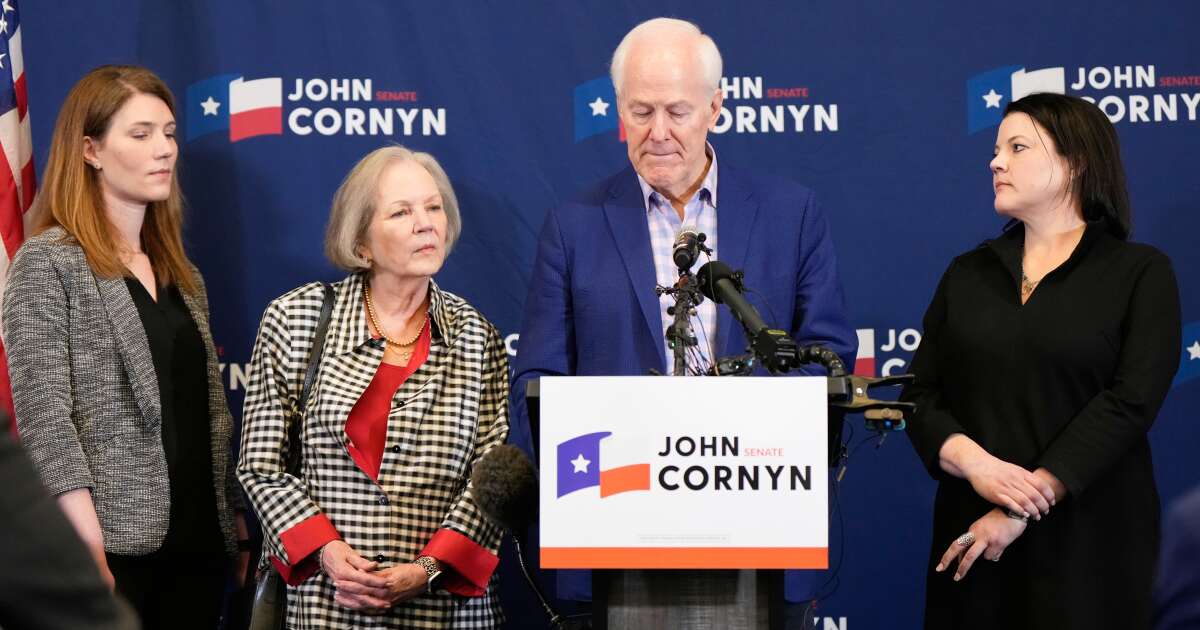
PLANO, Texas — As it turned out, it would never be enough.
U.S. Sen. John Cornyn tried for more than a year to show President Trump and Texas Republicans that he and the president were on the same team.
Cornyn posted a photo of himself reading Trump’s “The Art of the Deal.” He proposed legislation to rename a stretch of interstate in Trump’s honor. Perhaps most glaringly, the Senate institutionalist who long supported the filibuster reversed his position in a failed effort to advance voting restrictions that are a priority for the president.
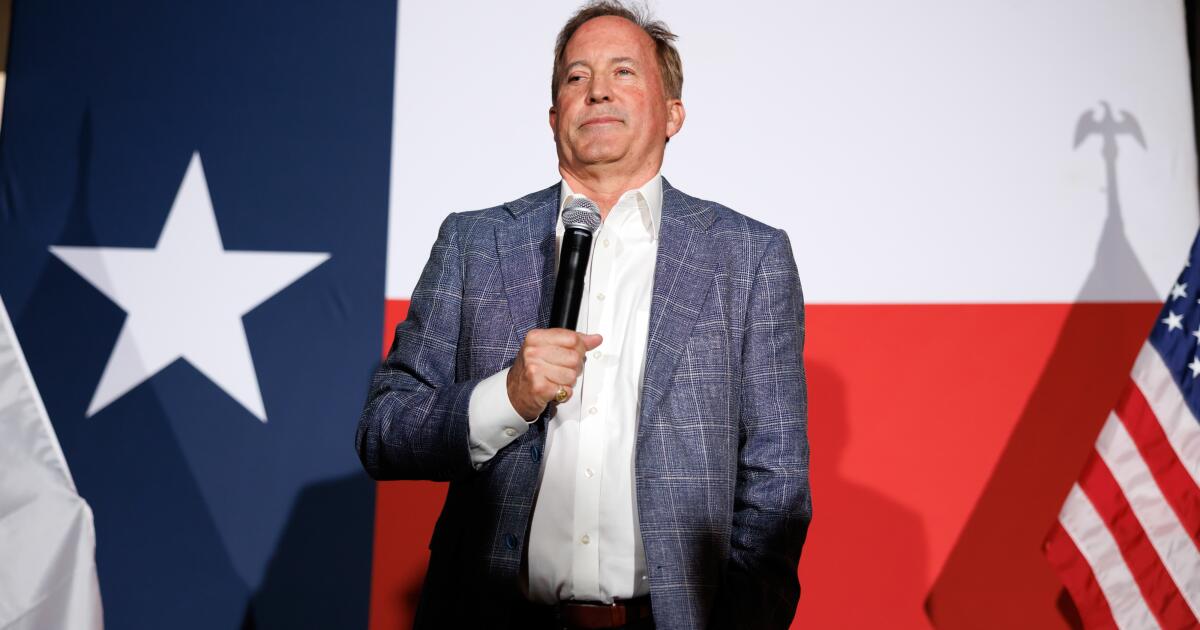
None of it worked. On Tuesday, Cornyn became the latest in a line of Republicans who lost their primaries after falling out of favor with a president with little tolerance for dissent and a seemingly insatiable appetite for retribution. The four-term senator lost by double digits to Texas Attorney General Ken Paxton, who Trump endorsed last week as “a true MAGA Warrior.”
Cornyn, on the other hand, “was VERY disloyal to me,” Trump wrote on social media.
Trump’s intervention in the Texas runoff came after weeks of successfully backing primary challengers in Indiana, Louisiana and Kentucky as revenge against incumbents who broke with his agenda.
Cornyn’s attempt to avoid the same fate made even some of his supporters wince.
“You look at the positions he took to please the president and the groveling and whatever,” said former Sen. Jeff Flake of Arizona, a Republican and Trump critic who didn’t seek reelection during the president’s first midterm in 2018. “It was rather painful to watch.”
Trump took an uncommonly equanimous approach to Tuesday’s results the following morning.
“Congratulations to Ken Paxton on such a tremendous win, and to John Cornyn for having run a strong and powerful race but, more importantly, having had a truly great career,” he wrote on social media. “John will remain my friend for a long time to come, as we both watch Ken become a fantastic, common sense Senator, one who is respected by all.”
Cornyn started early with ad touting pro-Trump voting record
Cornyn’s loss wasn’t for a lack of political gymnastics and astronomical campaign spending.
His campaign began running an advertisement last summer — part of an astounding nearly-$100-million air war by the senator and allied groups — with Cornyn looking into the camera and saying, “I voted with President Trump 99% of the time.”
On Cornyn’s campaign homepage, Trump and Cornyn stand side-by-side with thumbs pointed upward in an image aimed at projecting solidarity. Deeper in the website, the category titled “The Trump-Cornyn Record” notes the senator’s role securing votes for Trump’s signature 2017 tax cut bill.
Cornyn has also been championing provisions in Trump’s signature tax-and-spending legislation to finance work on the U.S.-Mexico border wall.
The senator had dismissed the project as “naive” during Trump’s 2016 campaign. But in January, he stood along a section of completed wall in Texas’ Rio Grande Valley touting the measure’s $11 billion for Texas contractors’ work at “the direction of the president of the United States, to whom I am very grateful.”
Cornyn’s 2023 dismissal of Trump’s return glares in background
Cornyn’s praise for his party’s leader and president were not unusual, but they clash with a statement Cornyn made in May 2023, when Trump was mounting his presidential comeback campaign.
“Trump’s time has passed him by,” he told reporters. “I don’t think President Trump understands that when you run in a general election, you have to appeal to voters beyond your base.”
Trump would go on to easily win the nomination and carry every battleground state in the general election.
Cornyn would hew closely to the president for the first 16 months of his second administration, hoping at the outside chance of his endorsement or to keeping him from weighing in at all.
But Trump did not forget the past slights.
“John Cornyn is a good man, and I worked well with him, but he was not supportive of me when times were tough,” he wrote on social media while endorsing Paxton.
Smaller gestures, and one big one
Cornyn has playfully worked to promote Trump fandom, last year posting a picture on social media of himself thoughtfully peering into the pages of Trump’s 1987 memoir and business advice book, “The Art of the Deal.”
In a more obvious gesture, he proposed designating a section of a U.S. highway from the Texas Gulf Coast to Montana as “Interstate 47,” to honor a 47th president with a well-documented love of naming things after himself. In a news release about the proposal, filed just over two weeks before Tuesday’s runoff, Cornyn said it would be known as the “Trump Interstate.”
The more tectonic shift occurred in March, after Trump had teased a possible endorsement of either Cornyn or Paxton in the runoff.
Paxton swiftly said he would consider dropping his candidacy if the Republican-controlled Senate lifted the filibuster and passed the SAVE America Act, a series of voting restrictions that Trump has described as an essential part of his agenda.
The following week, Cornyn wrote an op-ed in the New York Post — Trump’s favorite hometown newspaper — backing away from his previous support of the filibuster. He vowed to “support whatever changes to Senate rules that may prove necessary” to get the bill “through the Senate and on the president’s desk for his signature.”
Flake watched with unease.
“I know John and his long-held positions on the filibuster and the Senate’s institutions,” he said. “No office is worth that.”
Beaumont and Bedayn write for the Associated Press. Bedayn reported from San Antonio. AP writer Mary Clare Jalonick in Washington contributed to this report.
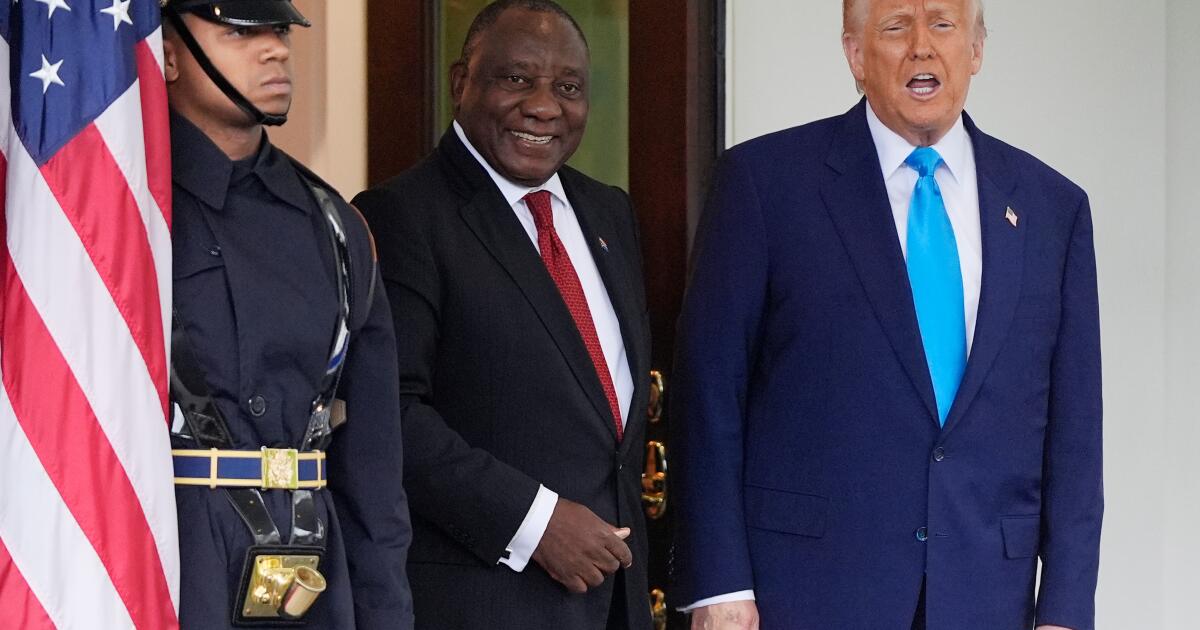
JOHANNESBURG — The government in South Africa and Afrikaner advocacy groups on Wednesday rejected the position of the Trump administration that there’s a humanitarian emergency affecting white people in South Africa.
The argument served as the rationale for raising the U.S. refugee cap, but only for white Afrikaners. The Trump administration said Tuesday that it will admit an additional 10,000 white South Africans into the U.S. as refugees this year, increasing its annual cap, but blocking people from other countries from entering through the program.
President Trump’s announcement on the Federal Register that he was increasing the refugee cap because of “an unforeseen emergency refugee situation.” He blamed the South African government for “recent increases in the incitement of racially motivated violence,” but Trump gave no specific information.
The South African government’s international relations department said Wednesday that accusations of systemic persecution of white Afrikaners are unfounded, pointing out that some beneficiaries of an immigration program have chosen to return to South Africa.
“This reality is further corroborated by the actions of individuals who, despite having availed themselves of this preferential immigration program, have since resolved to return home,” spokesman Chrispin Phiri said.
Afrikaner trade union, Solidariteit, argued that refugee status isn’t a viable solution for Afrikaners, who should thrive in South Africa instead. Spokesman Jaco Kleynhans said that the organization hadn’t discussed any “unforeseen emergency refugee situation” with the Trump administration, but respects the autonomy of U.S. refugee policy toward Afrikaners.
The union “is in no way aware of anything that the Trump administration could be referring to,” Kleynhans said.
AfriForum, a lobbying organization for the country’s white Afrikaner minority with more than 300,000 members, said it “does not have information” regarding the specific assertion that there’s an emergency refugee situation.
The organization’s CEO, Kallie Kriel, said the group’s focus is “fighting to create the circumstances in South Africa where there is no need for Afrikaners to leave.”
Trump suspended the U.S. refugee program on his first day in office and, since then, has turned it into a vehicle to allow Afrikaners — a group of white South Africans descended mainly from Dutch settlers — into the United States. Advocates say the decision to focus a decades-old program on one group has left people around the world fleeing war and strife stranded and with few options.
Refugee groups have questioned why white South Africans are being prioritized ahead of people from countries facing war and natural disasters. Vetting for refugee status in the U.S. often takes years.
The Trump administration’s preference for white Afrikaner refugee admissions, according to Dr. Bryony Fox, a social justice researcher at Stellenbosch University, raises questions about selective humanitarianism, inconsistent refugee protection and favoring privileged groups, while ignoring other refugee populations experiencing severe hardships.
“This risks politicizing refugee protection in a way that may ultimately weaken the legitimacy and universality of the refugee regime itself,” she said.
It’s been half a century since the party carried Texas in a presidential election. The last time Democrats won a statewide office, back in 1994, “The Lion King” was smashing box office records, Boyz II Men ruled the radio and the World Wide Web was about to change everything.
As Texas grew increasingly Republican, and politically beyond reach, Democrats insisted every election year was the one when they’d end their futility and take back power in either Washington or Austin, the state capital.
It never happened.
But is this, finally, the year?
With Ken Paxton stomping incumbent John Cornyn on Tuesday in a fierce and astronomically expensive U.S. Senate primary, many Democrats believe so — and even neutral observers agree they’ve been handed their best shot at resurrection in a good while.
“Paxton is going to be a much tougher guy [for Republicans] to haul over the finish line five months from now as opposed to Cornyn, who never lost an election until this one,” said Richard Murray, an emeritus political science professor at the University of Houston, who spent decades surveying Texas voters. “We’re looking at a very expensive, hard-fought race.”
Paxton, Texas’ three-term attorney general, is a singularly flawed candidate. Indicted,impeached, accused by his ex-wife of adultery, the GOP nominee is, to put it mildly, “an ethically challenged individual,” as the famously understated (and concerned) Republican Maine Sen. Susan Collins put it.
Trump described Cornyn, a four-term senator and former justice of the Texas Supreme Court, as a “good man” but insufficiently supportive when “times were tough.” Among those occasions of abandonment, Cornyn voted to certify the incontrovertible result of the 2020 presidential election, thwarting Trump’s bid to illegally stay in office.
The Democratic nominee for U.S. Senate is James Talarico, 37, a state representative from Austin and a Presbyterian seminarian and former public schoolteacher who’s built a nationwide following with his articulate and scriptural takedown of Republican foes. Imagine Beto O’Rourke with a clerical collar and capacity to mint money.
The key difference this time, with all due credit to Talarico and his prodigious fundraising, is his damaged-goods opponent. Normally, all it takes to win in Texas is a Republican ‘R’ beside a candidate’s name. But polling suggests a not-insignificant number of GOP voters could have a hard time supporting Paxton, which doesn’t necessarily mean they’ll back Talarico. They may simply not vote in the Senate race, which could be nearly as costly.
(The counterargument is that Paxton, a martyred hero to the MAGA movement, could boost turnout among the party base at a time Trump is leaking support within the establishment GOP.)
Either way, the president’s me-first political self-indulgence is not making things any easier for his fellow Republicans as they fight to hang on to control of the House and Senate in November.
In the 2022 midterm election, Trump boosted a batch of unappealing misfits — their sole attribute being their fealty to him — with poor results. Republicans lost eminently winnable Senate contests in Arizona, Georgia, New Hampshire and Pennsylvania and, with it, their chance at control of the chamber.
Even if Paxton prevails in November, Trump’s endorsement could prove quite costly to the GOP, and not just in the figurative sense.
Democrats need a gain of four seats to flip the Senate. To do so, they must successfully defend seats in Georgia, Michigan, Minnesota and New Hampshire and then pick up at least four others from a menu that includes Alaska, Iowa, Maine, Montana, Nebraska, North Carolina, Ohio and, now, Texas.
Holding on to Cornyn’s seat will end up costing Republicans a kingly sum — money that “can’t be spent in two places at the same time,” as Matt Mackowiak, a longtime Texas GOP strategist and advisor to Cornyn’s campaign, noted. “It can go either to Michigan, New Hampshire, Georgia, Iowa, Alaska. Or it can go here to Texas, which is extremely expensive.”
Odds are against Talarico and Democrats winning the Senate race in November, because Texas remains, fundamentally, a Republican and conservative-leaning state. Paxton may win for that reason and that reason alone.
“This is as good an environment as Democrats are going to get realistically,” said Jim Henson, head of the Texas Politics Project at the University of Texas in Austin, who’s witnessed many highly touted Democrats fail in a blaze of unwarranted hype. “But when you start doing the math, it’s a little bit hard to see it all adding up.”
Which is not to say it can’t happen.
Truth, as the saying goes, can be stranger than “Moby Dick” or any other fiction.
After their work permits expired, an immigration attorney near San Diego was fired and a nurse in the East Bay area was placed on unpaid leave.
Both depend on work permits and legal protection afforded under Deferred Action for Childhood Arrivals, a program created by President Obama in 2012 for immigrants who were brought to the U.S. as children. But recent processing delays at U.S. Citizenship and Immigration Services are leaving many DACA recipients vulnerable to arrest and deportation as their two-year work permits expire.
“It’s definitely an attack on the program,” said the lawyer, Maria Fernanda Madrigal. “My first thought was, ‘Oh, they’re so clever. They weren’t able to end the program through the courts, so this is what they’re doing.’”
The agency did not explain what’s causing the processing delays. Spokesperson Zach Kahler wrote in a statement that “under the leadership of President Trump, USCIS is safeguarding the American people by more thoroughly screening and vetting all aliens.”
DACA does not confer any form of legal status in this country, he said.
During his first term in office, Trump tried unsuccessfully to rescind DACA.
This time around, his administration has simply weakened its benefits.
And last month, a precedent-setting decision from the Board of Immigration Appeals, which will apply to immigration judges across the country, said having DACA is not enough to protect someone from deportation.
A Department of Homeland Security spokesperson said ICE arrested 650 DACA recipients between Jan. 20, 2025, and April 30, nearly 90% of whom had been charged with or convicted of a crime. The spokesperson did not say how many have been deported.
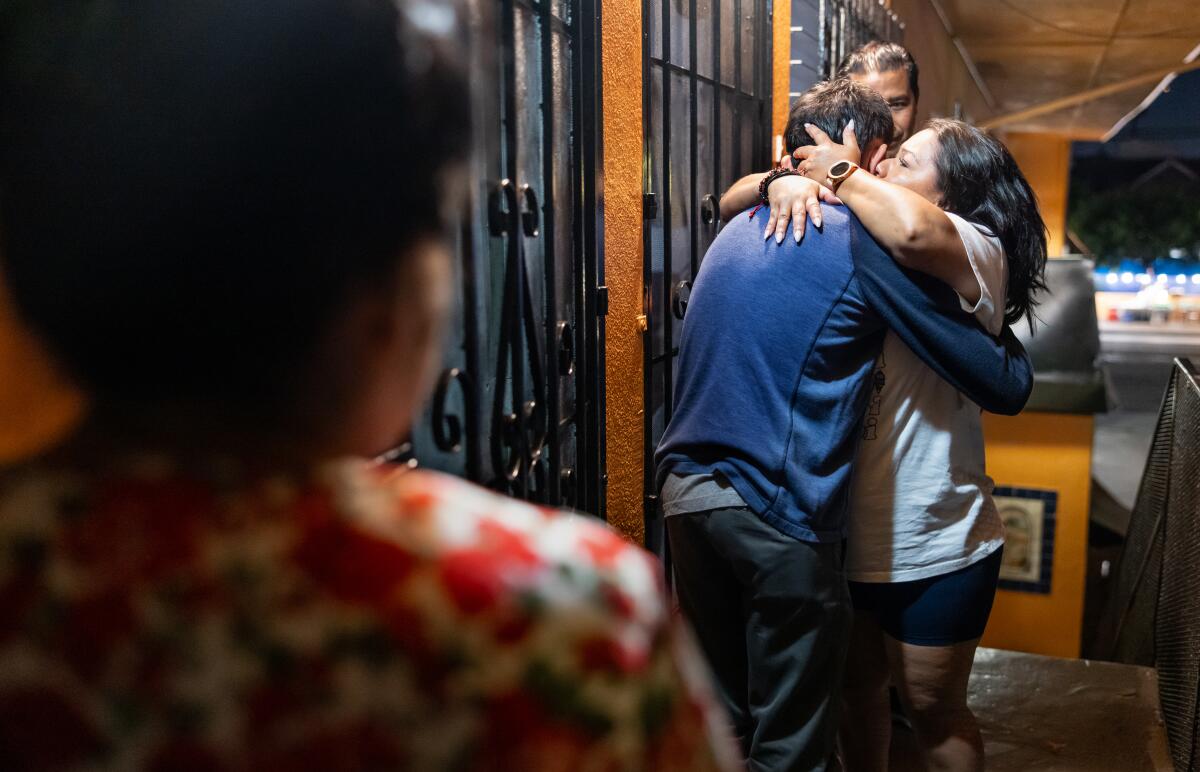
DACA recipient Javier Diaz, center, is welcomed by his neighbors including Martha Avelar, right, in South Los Angeles after returning home from a detention center in Texas in July 2025.
(Christina House / Los Angeles Times)
But in a February letter to U.S. senators, then-Homeland Security Secretary Kristi Noem said the agency had deported 86 DACA recipients between Jan. 1 and Nov. 19, 2025. Federal judges have ordered the agency to return some, including Maria de Jesus Estrada Juarez, a Sacramento mother who was deported a day after her green card interview.
Lawmakers are expressing alarm that DACA’s promise of protection is being undermined.
Last month, Democrats on the Senate Judiciary Committee held a forum on the Trump administration’s “all-out assault on DACA.” The forum featured Santa Ana Police Chief Robert Rodriguez, who testified that he had been forced to fire a police officer because their work permit renewal was not processed on time.
Last week, members of the House from California’s Central Valley, including Rep. David Valadao (R-Hanford), sent a letter to Homeland Security and Citizenship and Immigration Services leaders, urging them to expedite DACA processing.
“Our offices have seen a substantial increase in constituent cases involving pending renewals, with many remaining unresolved for more than six months,” the letter continued. “These extended processing times are creating avoidable hardships for our communities and our economy.”
California has more than a quarter of the nation’s approximately 500,000 DACA recipients, according to Citizenship and Immigration Services figures. On average, they are 31 years old.
To qualify for DACA, applicants had to pass background checks and meet certain educational or work requirements.
During a news conference ahead of the DACA forum last month, Sen. Dick Durbin (D-Ill.) reflected on the day in June 2012 when DACA applications first opened. He said parents of young immigrants asked him if it was safe for their children to sign up for the program, which required admitting their lack of legal status and home address.
“Are you sure that the government won’t use that information against us at some time?” he remembered them saying. “I said, ‘Follow the law exactly as it is written and announced in the executive order, and we’ll stand by you. Just believe in us to do that.’”
Sen. Dick Durbin (D-Ill.), foreground, speaks during a Homeland Security oversight hearing before the Senate Judiciary Committee in March.
(J. Scott Applewhite / Associated Press)
“Well, I didn’t anticipate the current president and what he is now doing,” Durbin continued.
Sarah Krieger, a former Citizenship and Immigration Services official who is now senior policy counsel at the National Immigration Law Center, said processing delays were caused, in part, by the agency temporarily pausing an automated system for processing DACA and other applications.
Krieger said that “streamlined case processing” was turned off about a month after Trump took office last year, in order to audit whether each process had sufficient security checks. The automated system was turned back on a couple of months later but was modified to include more manual security checks. Krieger left the agency last July.
Turning off the automated system was “a purposeful choice that doesn’t increase national security,” she said. “All it does is slow things down.”
Citizenship and Immigration Services recommends that applicants submit their paperwork and pay the $555 fee between 120 and 150 days before their benefits expire.
Among those who did so are two nurses who work for Kaiser Permanente in the Bay Area. Both requested anonymity out of concern over their immigration status.
One of the nurses, who came to the U.S. from the Philippines as a toddler, said she applied for renewal on Dec. 1. Her work authorization expired April 15.
Kaiser placed her on a 30-day unpaid leave of absence, after which she would be fired. Eventually, her work permit was renewed, but only after Sen. Alex Padilla (D-Calif.) and two other members of Congress lobbied the federal government on her behalf.
Sen. Alex Padilla (D-Calif.) speaks during a news conference on the DACA program on May 12 outside the U.S. Capitol.
(Graeme Sloan / Getty Images)
Padilla said his office has fielded requests from hundreds of DACA recipients this year.
Another Kaiser nurse, who also submitted her renewal paperwork in December, is still waiting. She has been on unpaid leave for nearly a month.
The nurse, who is from South America, said one Citizenship and Immigration Services officer told her it could take up to 10 months for her renewal to be processed.
The nurse is pregnant and she and her husband just bought a house. Losing her job would mean losing her healthcare and maternity leave benefits.
“I’ve spent years caring for others in my community, paying taxes, contributing to a healthcare system,” she said. “I worked through COVID and it’s heartbreaking to feel like you’re so easily discarded.”
Another DACA recipient, Elsa Sanchez, 35, of Georgia has maintained DACA status since 2012 and says she always follows the recommendation to submit the renewal application at least 120 days before the expiration date.
For the last three renewals, she said, she was approved within a week or two. This time, her work permit and DACA expired on April 1, more than four months after she submitted her application.
Elsa Sanchez, whose work permit expired because of DACA renewal delays, at her home in Atlanta.
(Emilie Megnien / Associated Press)
The healthcare IT company where Sanchez works as a senior customer success manager allowed her to take a 60-day unpaid leave of absence but said it would have to terminate her employment afterward.
Sanchez’s unpaid leave was set to run out on June 1. On May 20, she got notice that her DACA renewal had finally been approved. But by then Sanchez, a single mom, had had to pull funds out of the college savings account for her 19-year-old daughter, who is attending a local university. She put the money toward her nearly $2,000 rent and food.
“I feel so relieved and grateful,” she said in an Instagram video announcing the news. “I know that a lot of us are still being affected by these delays. I wish that I could share my approval with all of you and that we would all be celebrating today.”
Others have also turned to social media to share their experiences and swap resources. Madrigal, the fired attorney, pivoted to making daily videos. On Tuesday, she shared “day 35 of unemployment.”
“Some days look like big emotions and uncertainty,” she wrote. “Other days look like walks, toddler activities, cooking dinner and ending the night with tostadas. Trying to find joy and normalcy in the middle of it all.”
WASHINGTON — Precarious talks to end the war with Iran appeared close to collapse on Tuesday as renewed fighting across the region threatened to derail fragile progress toward a comprehensive settlement.
U.S. strikes against targets in southern Iran — the first since a ceasefire was declared in the war seven weeks ago — coupled with escalating attacks by Israel in Lebanon have undermined optimism that an agreement was within reach.
The attacks occurred just hours after U.S. and Iranian diplomats arrived in Qatar for peace talks. Iran’s top negotiators left Doha on Tuesday without comment. News of the strikes, and threats of retaliation by Tehran, sent global oil prices soaring back to more than $100 a barrel.
U.S. Central Command described Monday’s actions as “self-defense strikes” that were restrained and modest in scope, targeting missile launch sites and Iranian boats “attempting to emplace mines” in the Strait of Hormuz.
But the attack came as President Trump and Secretary of State Marco Rubio had been projecting confidence that a framework agreement to end the war could be reached within days. Under the proposed deal, Iran would restore the strait to its prewar status as a free and open international waterway, while both sides entered 60 days of negotiations over the removal of Iran’s nuclear stockpile.
Laying mines in the strait in the 11th hour of the negotiations could signal to the Trump administration that Iran is not serious about reopening traffic there. But the Iranians said Tuesday that renewed U.S. strikes suggest it is Washington that is unprepared to commit to peace.
Iran’s Foreign Mministry condemned what it called “aggressive actions” by the United States, describing them in a statement as a violation of the ceasefire agreement.
“The commission of these aggressive acts — occurring concurrently with the ongoing diplomatic track mediated by Pakistan — has once again exposed the hostile nature and perfidy of the ruling establishment in the United States,” the statement said.
Iran “will not leave any hostile act unanswered,” the ministry added.
Mojtaba Khamenei, Iran’s elusive supreme leader, declared in a scheduled speech that U.S. allies throughout the Middle East “will no longer serve as a shield” for the American military, suggesting retaliatory strikes against U.S. assets in the region could be imminent.
Prospects for a diplomatic breakthrough were already dim. Over the last week, U.S. and Iranian officials projected optimism while outlining seemingly incompatible visions of a deal.
Trump has repeatedly said Iran would not receive any sanctions relief until its stockpile of fissile material is removed and destroyed. But Iranian officials reiterated Tuesday that unfreezing the country’s overseas assets remains a precondition for continued negotiations.
And it is unclear whether Iran would agree to a peace deal with the United States that does not also restrict the actions of Israel, whose leader, Prime Minister Benjamin Netanyahu, has expressed deep skepticism about the diplomatic process.
Netanyahu said in recent days that Israel would not be bound by any nuclear pact, and that his government would continue military action against targets throughout the region — including in Lebanon — as it views necessary.
Israel’s continued assault on Lebanon nearly jeopardized the ceasefire between Iran and the United States before Trump brokered a separate, temporary halt to the fighting there. Since then, however, Israeli strikes have resumed, and Netanyahu vowed to intensify his campaign against Hezbollah, the Lebanese Shiite militant group.
“We are not removing our foot from the pedal,” Netanyahu said in a video address Monday. “On the contrary, I said to step on the pedal even more.”
Israel’s military ramped up its operations Tuesday, attacking what it said were more than 100 Hezbollah sites across southern and eastern Lebanon, while extending ground incursions deeper into Lebanese territory.
The overnight strikes struck weapons storage facilities, command centers, observation posts and infrastructure sites, according to an Israeli military statement.
Israeli media also reported that Israeli troops were operating beyond a 6.2-mile zone they occupy in southern Lebanon, in what many fear may be a prelude to a wider invasion.
Those fears were further stoked Tuesday by fresh Israeli evacuation orders for the entirety of Nabatiyeh, southern Lebanon’s second-largest city.
Hezbollah upped its campaign as well, peppering Israeli troops in southern Lebanon and areas of northern Israel with drones and rocket attacks, according to statements from the group. Hezbollah-affiliated media reported the group’s fighters clashing with Israeli troops to prevent their advance.
In recent weeks, Hezbollah has increasingly relied on fiber-optic drones — which are both low-cost and impervious to jamming — to harass Israeli positions.
On Sunday, an Israeli soldier was killed and another wounded when a Hezbollah kamikaze drone hit their armored personnel carrier, according to the Israeli military; 23 Israeli soldiers and a civilian defense contractor have been killed in the current conflagration between Israel and Hezbollah, Israel’s military says.
The latest bout of hostilities between Hezbollah and Israel began March 2, when the Iran-backed group launched attacks on Israel to avenge the killing of Iran’s ayatollah, Ali Khamenei.
So far, Israeli strikes have killed 3,213 people, wounded more than triple that number, and left more than a million displaced, according to Lebanese health authorities.
A ceasefire signed April 17 sidelined the capital, Beirut, from strikes but has done little to stop the fighting otherwise, with Hezbollah and Israel continuing attacks despite unprecedented direct negotiations taking place between the Israeli and Lebanese governments.
It was unclear whether Netanyahu’s warning meant Beirut would be targeted once more. Israeli drones buzzed throughout the day over the capital and the Hezbollah-dominated southern suburbs Tuesday.
Hezbollah opposes direct negotiations and insists it will keep fighting until Israel withdraws from Lebanon and stops attacks. Israel has demanded the Lebanese government do more to disarm Hezbollah and to move toward a peace deal.
WASHINGTON — A Justice Department indictment against the Southern Poverty Law Center is part of a “top-down” campaign of retribution against President Trump’s perceived political enemies and constitutes a vindictive prosecution that must be dismissed, lawyers for the nonprofit argued Tuesday in urging a judge to toss out the case.
The Alabama-based nonprofit was indicted in April on fraud and money laundering charges that accuse it of misleading donors by paying informants inside white supremacist and other extremist organizations to obtain inside information about their activities.
Lawyers for the SPLC already argued that law enforcement agencies have long known that the nonprofit paid informants to report on the movements of hate groups. They also said acting Atty. Gen. Todd Blanche made a false statement at a news conference and in interviews when he said the organization had not shared with law enforcement information it learned from informants. Blanche later appeared to walk back that claim in a television interview, saying it was true that the SPLC “selectively” shared information with law enforcement over the years.
The attorneys for the center expanded on those arguments Tuesday, saying in a motion to dismiss the case that the prosecution was the “culmination of a top-down, retributive campaign” in which Trump pushed the Justice Department “to go after those individuals and groups he deemed his political enemies, including the SPLC.”
The motion was filed against the backdrop of other politically charged prosecutions that have raised concerns that the Justice Department is operating as a weapon to target Trump’s opponents. It aims to draw a parallel between the SPLC indictment and the human smuggling prosecution of Kilmar Abrego Garcia, which was dismissed Friday on similar vindictive prosecution grounds by a judge who called the case an “abuse of prosecuting power.”
The SPLC has said its now-defunct program of paying informants to infiltrate hate groups was developed to glean key insights into their activities so that potential victims could be protected. An earlier federal investigation into the practice was closed without charges, but the motion paints the current Justice Department as pursuing the case with renewed — and rushed — vigor.
The department decided to pursue the indictment without interviewing any current SPLC employees and did not seek any documents from the group until after it told defense lawyers that criminal charges were coming, the defense motion states. During a meeting requested by defense lawyers who hoped to avert to indictment, Justice Department officials informed them that the decision already had been made to pursue charges, according to the motion.
“These procedural irregularities show that the charges against the SPLC were a foregone conclusion based on prosecutorial vindictiveness — driven by the White House and FBI leadership’s retribution campaign — rather than the result of a good faith examination of the evidence,” the motion states, saying the indictment was “premised on conclusory accusations but devoid of provable facts or a proper statement of the law.”
The motion also cites whistleblower accounts that accused top Justice Department officials of rushing forward with an indictment despite internal concerns about the merits of the case and the strength of the evidence.
“For weeks, we have been arguing against these false allegations levied against the SPLC — an organization that for 55 years has stood as a beacon of hope fighting white supremacy and various forms of injustice to create a multiracial democracy where we can all live and thrive,” Bryan Fair, the interim president and chief executive officer of SPLC, said in a statement. “The government can’t prosecute the SPLC as payback for its protected speech — it violates basic constitutional rights.”
The administration has painted SPLC as partisan
Founded in 1971 as a civil rights organization, the SPLC over the decades has used litigation to fight white supremacist groups. It also tracks the activities and locations of domestic extremists. But its work has made it a popular target among Republicans who see it as overly leftist and partisan.
The center, for instance, received fresh attention last year after the assassination of conservative activist Charlie Kirk because the SPLC had included a section on the group that Kirk founded and led, Turning Point USA, in a report titled “The Year in Hate and Extremism 2024.”
FBI Director Kash Patel announced in October that the bureau would be severing its relationship with the SPLC, saying it had turned into a “partisan smear machine,” and he accused it of defaming “mainstream Americans” with its “hate map” that documents alleged antigovernment and hate groups inside the United States.
The defense motion says “animus” from senior levels of the administration helped shape the indictment.
It cites, among other comments, a statement from Trump deriding the SPLC as “a total scam run by the Democrats,” as well as a news media interview in which Harmeet Dhillon, the Justice Department’s top civil rights official, said the indictment was “personal” to her because she had “a lot of journalist friends … and groups that I’ve represented who have been targeted by the Southern Poverty Law Center.”
PLANO, Texas — Texans are choosing a Republican nominee for U.S. Senate in Tuesday’s runoff election, bringing to a close the extended, bitter and expensive primary where President Trump weighed in late to tip the race in another effort to rid the GOP of leaders less devoted to him.
Trump’s endorsement of state Atty. Gen. Ken Paxton over four-term Sen. John Cornyn gives the challenger a late boost and puts Cornyn at risk of becoming the first Republican senator in Texas history to seek the party’s nod and lose.
That’s despite Cornyn’s campaign and allied groups spending roughly $90 million in advertising since last year, the vast majority of it attacking Paxton.
It’s the latest GOP contest where Trump has sought to punish a Republican he sees as insufficiently loyal. This month, he has successfully backed challengers to incumbents in Louisiana, Kentucky and Indiana, a sign of his enduring influence among primary voters.
Paxton’s campaign and a pro-Paxton super PAC began airing ads promoting the endorsement within 24 hours of Trump’s announcement. Cornyn acknowledged Trump’s move would have an impact but said he wasn’t giving up.
“I know who gets to choose our senators, and it’s the people of Texas,” he said hours after the endorsement.
The winner will run in November against Democratic state Rep. James Talarico.
Tuesday’s runoffs also will decide Democratic U.S. House nominees for districts in Dallas and Houston that overwhelmingly support Democrats, and a San Antonio-area seat the party hopes to flip.
The primary has been long, bitter and costly
Cornyn led Paxton in the March primary but failed to win a majority in the three-way contest that also included U.S. Rep. Wesley Hunt, who finished in a distant third.
That was after Cornyn’s campaign and allied groups waged a monthslong ad campaign, mostly attacking Paxton for ethical and personal questions. The two-term attorney general was acquitted in a 2023 impeachment trial when allegations of extramarital affairs surfaced. Last year, Paxton’s wife filed for divorce, citing “biblical grounds.”
The alliance of pro-Cornyn groups have continued its attack, outspending Paxton’s campaign and two allied super PACs $16.5 million to $5.9 million since March 3, according to the ad-tracking firm AdImpact.
Trump promised to endorse immediately after the primary, asking the unchosen candidate to withdraw. But he didn’t act until after early voting began on May 18.
“Ken Paxton has gone through a lot, in many cases, very unfairly, but he is a Fighter, and knows how to win,” Trump wrote in a social media post endorsing him. “Our Country needs Fighters, and also Loyalty to the Cause of Greatness.”
Pro-Cornyn groups lately have been airing ads criticizing the attorney general office’s handling of a Waco sex abuse case. Pro-Paxton groups had seized on Cornyn’s awkward relationship with Trump.
Trump snubs Cornyn amid retribution campaign
The negative tenor could diminish turnout in an election already complicated by coming a day after Memorial Day, Texas Republican strategist Tyler Norris said. About 2 million of Texas’ 18.7 million voters participated in the GOP primary.
The dynamic could favor Paxton, whose support draws from more of the most loyal Trump base in Texas, said Norris, who isn’t affiliated with either campaign.
“The defining battle lines are based around hyper-negative messaging, which dampens turnout to begin with,” he said. “So who is going to show up is the hardest of the hard core.”
Trump in his endorsement also poked at Cornyn, as he has done with other Republicans who are not in lockstep with the president.
He blasted Republican Louisiana Sen. Bill Cassidy as “a Disloyal Disaster” on May 16, before Cassidy lost a GOP primary for the office he has held since 2015. The two-term senator had voted to convict Trump after his 2021 impeachment trial over the Jan. 6, 2021, attack on the U.S. Capitol. Trump backed U.S. Rep. Julia Letlow, who advanced to a runoff with John Fleming, the state treasurer. Cassidy finished well behind them.
Last week, Trump celebrated as Kentucky Rep. Thomas Massie, a critic of the Trump administration’s handling of the Jeffrey Epstein files, lost his primary to Ed Gallrein. Trump called Massie “the worst congressman in the history of our country.”
In endorsing Paxton, Trump said Cornyn “was not supportive of me when times were tough” and that “John was very late in backing me.”
Cornyn suggested in 2023 that Trump could not win the presidency again in 2024 and that his “time has passed him by.” He also was an early critic of Trump’s plan for a border wall between the U.S. and Mexico — a project he now supports.
Senate GOP leaders backed Cornyn, saying he would be stronger in the general election. Some GOP strategists have argued a Paxton nomination would cost millions of dollars more to promote in the fall, when money could be spent defending Republican seats in more competitive states. Democrats need to gain a net of four seats to take the majority.
Democrats also will choose U.S. House nominees
Newly elected Rep. Christian Menefee and veteran Rep. Al Green are vying for the party nod in Texas’ 18th District, which the Republican-led Texas Legislature redrew last year to help the GOP. The new map led to a contest between incumbents and marks the end of a dizzying series of elections in the Houston area. Menefee was elected in a special runoff in January to the seat that had been held by the late Rep. Sylvester Turner, who died in March 2025.
Menefee finished narrowly ahead of Green in the March 3 primary but didn’t win a majority to avoid the runoff.
Former Rep. Colin Allred and U.S. Rep. Julie Johnson are competing in the Dallas-area 33rd District. Johnson was elected to the seat in 2024, the year Allred lost his U.S. Senate challenge to Republican Sen. Ted Cruz. Allred was running for Senate again this cycle but dropped his bid and instead is looking to return to the House.
Near San Antonio, Democratic leaders are trying to prevent Maureen Galindo, who has expressed antisemitic views, from winning the party’s runoff with Johnny Garcia. While Texas lawmakers redrew the 35th District to help Republicans, Democrats view it as within reach and don’t want Galindo’s past comments to impede them.
Beaumont and Bedayn write for the Associated Press. Bedayn reported from Austin.
WASHINGTON — The Trump administration wants all current and future federal employees to sign nondisclosure agreements, part of a continuing crackdown on leaks to the media.
The notice in the Federal Register from the Office of Personnel Management posted Tuesday asked for comment on a draft NDA to be used by federal agencies for “both new and existing employees.”
“The form is intended to document Federal employees’ acknowledgment of, and agreement to comply with, current legal obligations to safeguard non-public, confidential, or proprietary information, created or obtained through their official duties, while expressly preserving the right to make disclosures authorized by law,” the notice said.
The Office of Personnel Management noted “several recent instances” where internal agency communications related to rulemaking and policy development were disclosed without authorization. It also discussed specific instances in which federal employees at the FBI and the Department of Homeland Security disclosed information without authorization about planned immigration enforcement actions.
In one case, the New York Times and Washington Post received unauthorized information on the U.S. raid on Venezuela in January and delayed “publishing what they knew to avoid endangering U.S. troops,” the request for comment said.
Representatives for the two newspapers did not immediately respond to a request for comment.
Ferreting out leaks that the administration deems harmful to its messaging has been a priority across multiple agencies since President Trump returned to the White House. As part of that crackdown, the FBI in January seized the electronic devices of a Washington Post reporter, a move that alarmed media organizations and advocates of press freedom.
One other notable incident occurred last year when dozens of reporters turned in their access badges at the Pentagon, rejecting new rules imposed by Defense Secretary Pete Hegseth that would leave journalists vulnerable to expulsion if they sought to report on information — classified or otherwise — that had not been approved by Hegseth for release.
The American Federation of Government Employees did not immediately respond to requests for comment.
WASHINGTON — President Trump had another medical exam Tuesday, putting his health under renewed public scrutiny as he has worked to dismiss concerns over his age and stamina.
The 79-year-old president spent more than three hours at Walter Reed National Military Medical Center for what the White House described as preventive medical and dental checkups. It was Trump’s fourth publicly disclosed medical exam since he returned to office for a second term, and it comes as he tries to project strength ahead of midterm elections that will test his sway with voters.
In a social media post after the visit, Trump said he just finished his “6 month physical” and “Everything checked out PERFECTLY.”
For decades, administrations have released selected results from presidential physicals, offering the public a glimpse at the commander in chief’s health. But the results are filtered through the White House and must be approved by the president, raising questions about what the public does and doesn’t get to see.
Trump turns 80 next month and was the oldest person elected president. His immediate predecessor, President Biden, was 82 when he left office, dropping out of the 2024 race because of widespread concerns he was too old for the job.
A Washington Post/ABC News/Ipsos poll conducted in April found that less than half of U.S. adults think Trump has the mental sharpness or physical health to serve effectively as president.
“I think concern for the president’s physical health is probably at an all-time high, and I think advanced physical age is the No. 1 concern,” said Dr. Jeffrey Kuhlman, who served as a White House physician for more than a decade under Presidents Obama, George W. Bush and Clinton.
For a president of Trump’s age, a complete physical would be expected to include advanced heart testing, screening for common cancers and a cognitive assessment, along with basics like height, weight and blood pressure, Kuhlman said.
The White House has not disclosed what the visit entailed but expressed confidence in what it will show.
“President Trump is the sharpest and most accessible President in American history who is working nonstop to solve problems and deliver on his promises, and he remains in excellent health,” White House spokesperson Davis Ingle said in a statement.
No law requiring presidents to disclose medical records
In the weeks leading up to his visit, Trump has been saying he feels as good as he did five decades ago — even as he jokes about his fondness for fast food and his minimal exercise regimen. Yet he’s also sensitive to perceptions about his age, noting that he takes extra caution descending the steps from Air Force One to avoid headlines about a stumble.
There is no law requiring presidents to publicize their health records, and the degree of transparency has varied by administration. Trump’s past reports have been criticized for offering scant detail and providing statistics that some medical experts eyed with skepticism.
At public appearances, Trump often is seen wearing makeup to conceal bruising on his hands, which the White House attributes to handshaking and regular aspirin use. He sometimes has appeared drowsy during meetings and closed his eyes for long stretches, though he denies having fallen asleep.
Trump often boasts of having “aced” cognitive tests while frequently deriding Biden, who faced questions about his mental acuity. Biden and his aides pushed back aggressively against doubts raised about his fitness for office.
Some of Trump’s previous physicals have included the Montreal Cognitive Assessment, used to screen for dementia and cognitive impairment. His physicians reported a score of 30 out of 30 for him at 2018 and 2025 checkups.
Yet critics have pointed to Trump’s meandering speeches and sometimes bellicose rhetoric as evidence of cognitive decline.
Last month, a statement from more than 30 neurologists, psychiatrists and other medical experts — who acknowledged they’ve never examined him — said Trump was mentally unfit to serve and warned of an “increasingly dangerous decline” in his behavior based on what they called “objectively observable signs of serious medical concern.″
“Any so-called medical professionals engaging in armchair diagnosis or false speculation for political purposes are clearly breaking the Hippocratic Oath they’ve sworn to,” Ingle said.
Just like any other patient, presidents get to choose what’s disclosed about their health, said Sara Rosenthal, a bioethicist at the University of Kentucky who studies presidential health. Questions about transparency have become more acute as America elects aging presidents like Trump and Biden, she said.
“We can expect very little disclosure about the true health status of any president unless they’re in perfect health,” said Rosenthal, who has suggested an independent medical organization to review and report on the health of the president and those in the line of succession.
‘Nothing should be hidden’
Trump’s first medical report in his second term was released in April 2025. In July, he was diagnosed with chronic venous insufficiency, a common condition in older adults that causes blood to pool in his veins. Photographs have shown the president with swollen feet, ankles and calves, described by the White House as a symptom of chronic venous insufficiency leading to “mild swelling” in his lower legs.
Following his last publicly disclosed exam, described as a routine follow-up in October, Trump’s physician issued a one-page summary saying the president was in “exceptional health” without divulging many specific results.
The frequency of Trump’s medical checkups is not uncommon for someone his age, according to S. Jay Olshansky of the University of Illinois-Chicago, who has studied the health of past presidents. It’s part of a strategy to catch problems while they’re still treatable, Olshansky said.
Olshansky says the public deserves to see more than White House medical summaries that “may be subject to editorial discretion.” Full, unredacted medical records should be made public, he said. “Nothing should be hidden.”
Last weekend, the opposition achieved the familiar show of unity in Panama City, something that is not always easy to pull off. Party representatives agreed to fight for free elections and to back María Corina Machado as the candidate in any eventual vote. Machado, for her part, promised to return before the end of 2026.
This is a milestone that should inspire at least some optimism. Five months ago, this group of people was scattered, waiting, in exile or in hiding. But given the sheer scale of Venezuela’s democratic challenge, the unity photo-op, the return of exiled leaders, and the reemergence of figures from hiding remain insufficient.
Some politicians have returned to the country or emerged from hiding, but without a clear, politically binding agenda for achieving free elections recognized by all actors. The current dynamics still force us to react to the regime’s horrors. The case of Víctor Quero and Carmen Teresa Navas is among the clearest examples.
Before Venezuela can achieve a true transition, the country’s pro-democracy movement must first undergo its own internal transition. Returns and displays of unity can alter incentives only if they become part of a public, coordinated, and understandable strategy. These are the main elements such a strategy should include.
A clear division of roles and responsibilities
Opening up the political playing field requires a clear division of roles and responsibilities. María Corina Machado and Juan Pablo Guanipa can embody a kind of “good cop/bad cop” dynamic within the democratic movement. The “good cop” would be Machado, whose messaging is already closely aligned with Trump’s policy toward Venezuela. The “bad cop” is Guanipa, whose rhetoric has become increasingly impatient regarding the goal of democratic transition.
If the democratic transition is truly a la venezolana, the debate about it must be taken out of the conference rooms in Washington and Caracas.
But that differentiation cannot remain confined to national leadership figures alone. Student organizations, victims’ groups and human rights defenders, labor unions, and social organizations are equally crucial. These actors have earned legitimacy on the ground before January 3, when many were swept aside by a brutal wave of repression from which parties are still recovering. Since then, civil society has reaffirmed new leadership figures who, despite lacking party experience, could play important roles in the looming political cycle.
What matters is that this differentiation of roles be coordinated rather than improvised or competitive. Opening up the political field does not mean diluting political leadership. It means expanding the democratic movement’s range of action.
Combine negotiation with protest
There is no contradiction between the two. Negotiation without social pressure does little more than managing stagnation. Protest without a political roadmap burns out. What is needed is to give the streets political content: mobilizing not only against the regime’s abuses, but also in favor of a concrete transition agenda.
The role of movements is to protest, propose, and articulate the kind of transition they want. Just as students in 2007 embraced the campaign against the constitutional referendum and defeated Hugo Chávez, these grassroots movements should also assume a proactive role in shaping the type of transition they identify with.
That requires organizing a kind of “social roundtable” capable of coordinating different causes. These are autonomous rivers that can converge into the same lake: free elections and a broad national agreement on the direction of post-electoral public policy. Each movement has its own identity and internal dynamics, but there must be some degree of coordination and communication among them and with the broader national political agenda.
Protests also present a constant dilemma for the ruling Rodríguez siblings, a litmus test for their supposed liberalization. Demonstrations must remain peaceful and disciplined in order to deepen their dilemma.
Open up the conversation about democratic transition
The Machado-led opposition coalition and its allies have a responsibility to promote an open discussion about transition: what it means, how it is built, and what dilemmas it entails.
Dilemmas are never truly solved. They are weighed in terms of risks, benefits, opportunities, and threats. If the democratic transition is truly a la venezolana, the debate about it must be taken out of the conference rooms in Washington and Caracas. Not everything was decided in Panama City.
This time, the goal would be to bring together different groups and individuals to debate the diverse and legitimate visions of our own transition.
That conversation should include at least three dimensions:
The political-institutional dimension: What minimum guarantees would make a transition possible? What conditions would make an election politically binding? Should Venezuela pursue a constituent assembly? Should the process begin with a presidential election or a parliamentary one? What are the advantages and disadvantages of each option?
The social-humanitarian dimension: How do institutional reforms connect with people’s daily needs, such as wages, public services, security, justice and family reunification?
The electoral dimension: What should the sequencing of elections look like? (As far as we know, there was no agreement on this point in Panama). Should Venezuela return to a manual voting system? How can a trustworthy electoral authority (CNE) be guaranteed, and who should be part of it? What expectations and steps are required to secure the political inclusion of the diaspora and of millions of citizens inside Venezuela who cannot vote in the current circumstances?
Before the 2023 opposition primaries, there was one essential experience that helped build momentum: the Hablan los Candidatos debate, organized by students and activists in July 2023 at the Aula Magna of Universidad Católica Andrés Bello. Now imagine an event, or a series of events on a much larger scale. But this time, rather than candidates, the goal would be to bring together different groups and individuals to debate the diverse and legitimate visions of our own transition.
Use technology boldly
Technology can become a central tool to expand this deliberative process. Digital consultations, hybrid assemblies, spaces for dialogue with the diaspora, coordination mechanisms among professional associations, students, parties, unions, victims, and social organizations: all of this can help rebuild a democratic infrastructure for participation.
Producing a political milestone is not enough. A sequence must be built.
During both the primaries and July 28, the democratic movement used technology in exemplary and innovative ways. Through different applications, people found their polling centers, filed complaints, participated in defending the vote, and helped publish the real results. We need to use technology with that same boldness again, this time within a broader strategy of deliberating, coordinating, and disseminating the agenda of democratic transition.
Plan the sequence
The experience of January 2019 reminds us of something important: political milestones are never improvised. That strategy (whether or not one agrees with its tactics and consequences) was planned months in advance among political parties, civil society, and the leadership of the 2015 National Assembly. What is needed today is a similar level of preparation, but with one additional lesson that may prove decisive: producing a political milestone is not enough. A sequence must be built.
A unity photo may mark the beginning of a new phase. The return of political leaders may help shift public expectations or reshape the outlook of potential voters. A protest met with repression can show the limits of the regime’s liberalization, something we have already seen this year with students, public-sector workers, and pensioners. A public debate can help organize competing visions of transition, giving oxygen and substance to a public sphere that must continue looking for spaces for deliberation. But none of these things, in isolation, constitutes a strategy.
The democratic movement has already found innovative, intelligent, and popular solutions to political dilemmas. It has pulled rabbits out of hats, brilliant plays in a perverse game, such as the feat of July 28, 2024. However, even rabbits do not appear by magic. The next move must emerge from the lessons and achievements that are already part of the movement’s democratic inheritance.
We should do what we have already done and know we can do: open up the political field, bring people down from the stands, turn indignation into an agenda, and transform the return of many into movement-building.
WASHINGTON — The Supreme Court on Tuesday rejected Florida’s long-shot attempt to sue California and Washington state over the issuance of commercial driver licenses to truckers who don’t speak English and are not authorized to be in the United States.
The case stems from a crash in Florida last year that killed three people. The driver, Harjinder Singh, is accused of making an illegal U-turn that caused the accident. Singh, who is from India, was carrying a valid commercial driver’s license from California and had earlier been granted one by Washington state.
Republican-led Florida has accused the Western states, led by Democrats, of openly defying immigration laws and asked the justices to rule that states lack the authority to issue CDLs to people who are not citizens or legal permanent residents.
The Supreme Court typically hears appeals of lower-court decisions, but it sometimes takes on what are known as original lawsuits in which states sue each other in the nation’s highest court.
Justices Clarence Thomas and Samuel A. Alito Jr. dissented from Tuesday’s order, as they often do when the court rejects an original lawsuit, saying that the court has no choice but to hear such cases.
Separately, a federal appeals court has blocked a Trump administration proposal to impose new restrictions that would severely limit which immigrants can get commercial driver’s licenses to drive a semitrailer truck or bus.
NEW ORLEANS — At least four states have adopted laws this year making it a crime to disrupt worship services, a reaction to a high-profile protest inside a Minnesota church that prompted outrage from faith leaders.
The Republican lawmakers sponsoring most of the legislation say those gathering at sacred sanctuaries deserve protection beyond what existing trespassing laws provide. They also say these new laws will prevent escalating clashes between congregants and protestors as many churches, mosques and synagogues remain on edge over recent mass shootings and acts of violence targeting religious groups.
“People should go to church to be able to sit in peace, worship as they please, without having to worry about people coming in and harassing them,” said Idaho Sen. Mark Harris, a Republican who co-sponsored legislation criminalizing protests inside places of worship. “I think the thing that happened in Minnesota was kind of a shock to some of us, that churches would be used as a place to berate people.”
Critics in both parties have warned that the laws infringe on free speech rights.
Here’s a look at the situation.
The laws make it a crime to interfere with worship
Bills have been signed into law in Republican-dominated Idaho, Louisiana and Oklahoma. In Kansas, a bill is becoming law without the signature of Democratic Gov. Laura Kelly.
Similar bills have been introduced for this year’s legislative sessions in at least seven other states and in Congress. Nassau County, New York, passed a similar measure this year. In 1994, President Bill Clinton signed a law making it a federal crime to intentionally injure or interfere with or intimidate someone entering a place of worship or a reproductive health facility.
The details in the bills differ, but they all make it a crime to interfere with religious assemblies.
Laws against trespassing already apply to disruptions on the grounds of churches or other private property. But legislators say the new laws would boost penalties and bar other protest activity like holding signs near places of worship.
The penalties could be harsher than for trespassing. In some states, people could face up to a year in prison and fines as high as $10,000 for first offenses. The laws also give the states a way to prosecute cases if local authorities decline to do so.
A protest in Minnesota touched off the call for action
Thirty-nine people, including two journalists, were charged in February for roles in a protest during a St. Paul, Minnesota, church service. The protesters had learned that one of the church pastors was also an official at U.S. Immigration and Customs Enforcement who had been overseeing an intensive Minnesota operation.
The U.S. Department of Justice charged the protesters with conspiracy against religious freedom and interfering with the right of religious freedom. The protesters and journalists have pleaded not guilty and the cases are pending in federal court.
Louisiana Rep. Gabe Firment, a Republican, said he was inspired to introduce legislation that allows protestors to be forcibly removed from churches and other places of worship after seeing videos showing the fearful expressions of children at the Minnesota church.
“The first thought that came to my mind was those poor kids,” Firment said. “You certainly have a right to protest, but just like you don’t have the right to come into someone’s home and act like that, you don’t have the right to come into private church property to do that.”
Oklahoma Sen. Todd Gollihare, a Republican, wrote his bill after anti-abortion protestors disrupted his church service last year. His law bars blocking highways within one mile of a service or approaching someone to hand them a flyer within 100 feet of a place of worship.
His Republican colleague, Sen. Kendal Sacchieri, described the law as extreme and said she was afraid of the precedent it would set.
Court challenges could await the laws
The Nassau County ordinance is already facing a court challenge from the New York Civil Liberties Union, which says there’s no history of residents facing intimidation, harassment or violence outside places of worship — and that the statute denies people their constitutionally protected rights of expression in public places.
Kevin Goldberg, vice president at Freedom Forum, which advocates for First Amendment rights, said that if the laws are challenged in courts, governments would have to show there’s a need for them. “You can’t be guessing, you can’t be speculating,” he said. “There has to be some evidence that there’s an actual threat going on — that there’s been a problem there, that you can reasonably forecast there will be a problem.”
In Louisiana, Democrats raised concerns about mandatory jail time for disrupting services and warned that the laws were too arbitrary, suggesting that they could be applied against a congregant for singing out of turn as a pastor delivers a homily.
“If the spirit just hits me and I start singing during the middle of his homily, and it disrupts his homily in a way where he’s got to say ‘Hey, take a seat’, I mean that would materially disrupt his service and now I’m going to jail for 30 days,” Rep. Edmond Jordan said during a March hearing in the Louisiana Legislature.
The law’s proponents said police officers and judges would have discretion about how to apply the law.
Brook and Mulvihill write for the Associated Press. Mulvihill reported from Haddonfield, N.J.
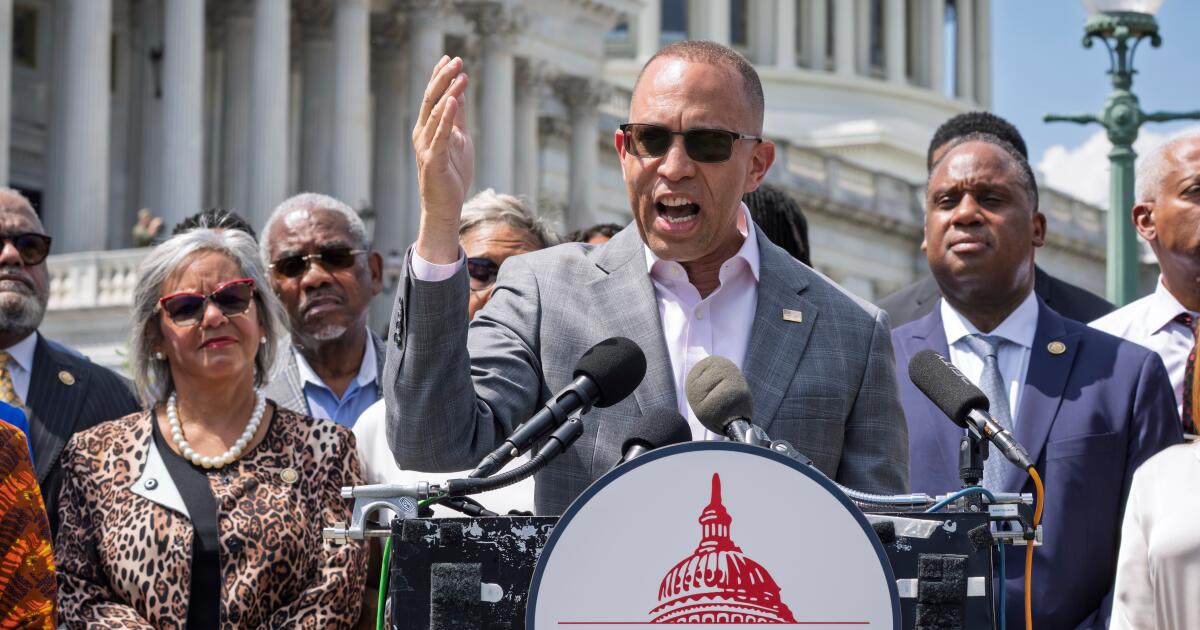
WASHINGTON — The Congressional Black Caucus on Tuesday called on major corporations across the U.S., including those that previously expressed support for voting rights and racial justice, to oppose redistricting efforts by Republican-led states that seek to eliminate majority-Black U.S. House districts.
In a letter sent to more than 250 companies, members of the Black Caucus urge them to condemn the redistricting efforts, which the lawmakers describe as “coordinated efforts to silence Black voices at the ballot box.” Some of the companies had co-signed their own message to Congress five years ago urging lawmakers to pass the John Lewis Voting Rights Act, a Democratic proposal to restore and update the Voting Rights Act.
That 2021 coalition, Business for Voting Rights, was backed by many of the country’s most valuable and influential companies, including Apple, Amazon, Google, Meta, Microsoft, Tesla, Salesforce, Target, PayPal, Intel and Starbucks.
Tuesday’s letter is the latest effort by the Congressional Black Caucus and its allies to gather support for preventing more Republican-led states from redrawing their legislative maps in ways that would dilute Black political representation. Several states have moved to eliminate congressional districts represented by Black Democratic lawmakers after a U.S. Supreme Court ruling last month that severely weakened a key provision of the Voting Rights Act.
“Corporations that have profited from Black consumers, relied on Black workers, and amassed wealth in part from Black communities cannot look away while Black political power is dismantled in plain sight,” Rep. Yvette Clarke, chair of the Black Caucus, said in an interview.
Clarke described the letter as “putting corporate America on notice,” but she said the caucus was not seeking an adversarial relationship with corporations. Among those receiving Tuesday’s letter were companies based overseas that have a significant presence in the U.S.
The caucus last week called for Black athletes to boycott public universities in states that are gerrymandering their congressional maps to eliminate districts held by Black lawmakers. The 59-member Congressional Black Caucus consists entirely of Democrats, including more than a third from Southern states.
Some lawmakers have said mass protests and federal legislation might be necessary to undo the efforts underway in Republican-led states. Any new federal voting rights law would almost certainly require Democrats to secure majorities in both chambers of Congress and win the presidency.
It is unclear how companies will respond to the demands. The Associated Press was making efforts to contact them.
“Many companies that previously issued statements after the murder of George Floyd, pledged billions toward racial equity initiatives, and spoke forcefully in defense of democracy following January 6 now face a defining test of whether those commitments were rooted in principle or convenience,” the caucus’ letter states.
It also represents the latest instance of the caucus expressing frustrations with corporate America. A 2024 Black Caucus report noted that lawmakers were “troubled that some corporations that made pledges in 2020 have taken several steps in the opposite direction,” such as rolling back or failing to follow through on pledges to diversify their workforces.
“We understand who the occupant in the White House is and the reality of Republicans being in charge,” Democratic Rep. Steven Horsford of Nevada said of the caucus’ message. “But what corporate America also understands is that there will be a shift at some point.”
The letter calls on companies to publicly condemn the redistricting plans, meet with Black Caucus members to discuss corporate America’s role in protecting voting rights and disclose their political donations to Republican politicians in states that are redistricting their congressional maps.
President Trump last year kicked off the unusual mid-decade round of congressional redistricting when he pushed Texas lawmakers to redraw their maps in a way that would add Republican seats. Democratic-led California responded, but it has been mostly Republican states redrawing their lines since as the party tries to maintain its majority in the U.S. House during this year’s midterm elections.
The effort was supercharged by the Supreme Court decision, which allowed even more Republican states to redraw congressional maps that previously had protected minority communities.
Horsford, who chaired the Black Caucus during President Biden’s Democratic administration, said the caucus is demanding that companies “stand on the side of democracy, fairness and equal representation.”
“This is about power, who holds it and what it’s used for,” he said. “And when you’re diluting Black economic and political power, we need to know where these companies stand in this moment, and what side of history they’re on.”
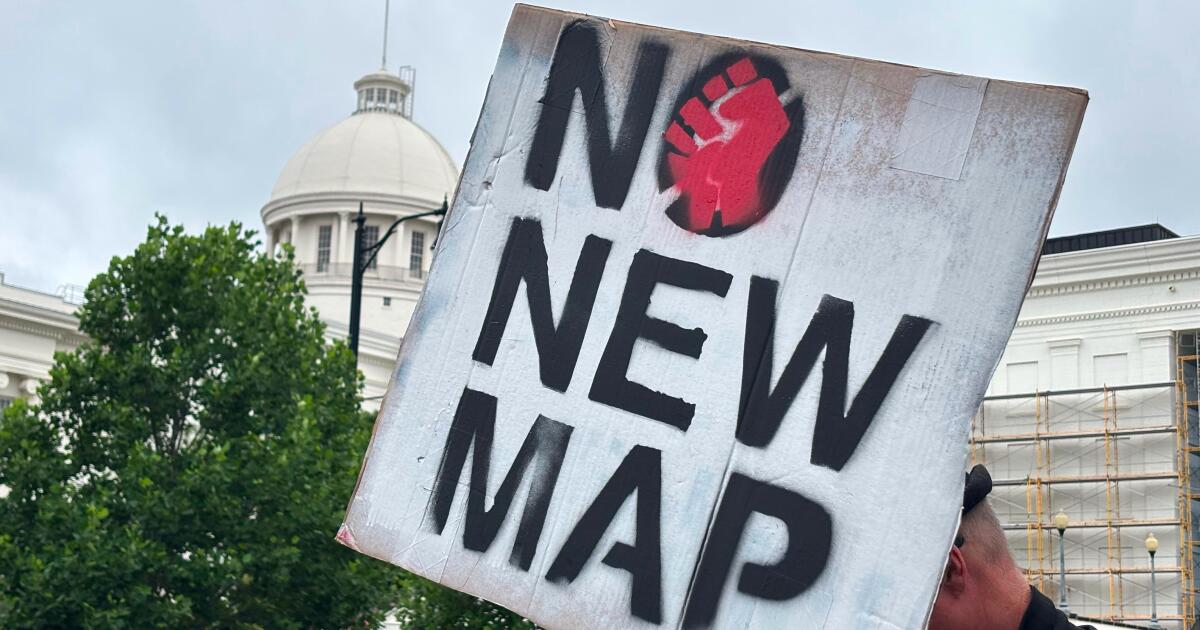
Federal judges on Tuesday blocked Alabama’s plan to use a congressional map that could give Republicans an advantage in a key U.S. House race in the midterm elections.
A three-judge panel in the state’s long-running redistricting case issued a preliminary injunction that prevents the state from switching maps, ruling that the Republican-backed plan “intentionally discriminated based on race” by including only one Black-majority district. The judges instead required Alabama to continue using a court-ordered map in place for the 2024 elections that includes two districts where Black residents comprise a majority or close to it.
“Ultimately, we cannot see our way clear to requiring Alabamians to cast their votes in the 2026 elections under a districting plan tainted by intentional race-based discrimination,” the judges wrote.
The ruling is a setback for Republicans, who want to use a map for the November midterms that would give the GOP a chance to reclaim the seat now held by Democratic U.S. Rep. Shomari Figures. However, the state could appeal the ruling to the U.S. Supreme Court.
Figures said he is pleased with the ruling but expects an appeal. “This is a significant step in the right direction, but there is still a long way to go before this fight is settled,” Figures said.
The court order is the latest development in the twisting legal and political saga following a U.S. Supreme Court ruling that struck down a Black-majority district in Louisiana and weakened the federal Voting Rights Act. That ruling has led Republicans in several Southern states, including Alabama, to take steps to reshape voting districts with large minority populations that have elected Democrats.
The redistricting frenzy is part of a broader push by President Trump to try to hold on to Republicans’ slim House majority in the November elections.
Alabama court fight stretches back several years
The three-judge panel in 2023 ruled that a map drawn by Republican state lawmakers intentionally diluted the voting power of Black citizens. The court said the state, which is about 27% Black, should have two districts where Black voters are the majority or close to it. The court-selected map was used in 2024.
After the Supreme Court’s recent ruling in the Louisiana case, Alabama officials moved to implement the 2023 state-drawn map. The Supreme Court’s conservative majority agreed to lift the injunction that had blocked the map’s use and sent the case back to the three-judge panel for reconsideration in light of the Louisiana ruling.
In the meantime, Alabama Gov. Kay Ivey set Aug. 11 special primaries using the new map.
Upon further review, the panel said there was “undisputed evidence” of intentional racial discrimination. It said the special congressional primaries should instead proceed under the previous court-approved districts.
The decision to temporarily block the map switch came after a seven-hour court hearing Friday in which judges sharply questioned state lawyers about the timeline and the impact of the Louisiana ruling.
Using the same districts that had been in place for the previous election would prevent “an expensive, aggressive, and perhaps logistically impossible voter reassignment effort,” the judges wrote.
“Candidate and voter confusion is troublesome and warrants significant consideration, but we do not see that a preliminary injunction will worsen it. To the contrary, we expect a preliminary injunction to lessen it,” the judges said.
Deuel Ross, director of litigation for the NAACP Legal Defense Fund, said the court ruling “again vindicated the constitutional rights of voters in the Black Belt, and our clients look forward to voting under a fair map this fall.”
Redistricting changes affect primaries in several states
Other states also have considered adjustments to their primary elections to allow time for congressional redistricting after the U.S. Supreme Court’s decision affecting the Voting Rights Act. Louisiana’s congressional primaries, scheduled for May 16, were postponed until later this summer by Republican Gov. Jeff Landry so that state lawmakers could consider a new U.S. House map that would eliminate a majority-Black district.
In South Carolina, the Republican-led legislature is considering a plan that could throw out the votes from its June 9 congressional primary and instead hold a new primary in August under revised districts that could improve Republicans’ chances of winning an additional seat.
Tennessee also moved quickly to enact new U.S. House districts after the Supreme Court’s ruling, carving up a Black-majority district based in Memphis that had elected the state’s only Democratic representative. The new map gives Republicans a chance to sweep all nine of the state’s seats. As part of the plan, Tennessee temporarily reopened the candidate qualifying period for its August congressional primaries, allowing new candidates to enter the race and existing ones to either switch districts or drop out.
Since Trump first urged Texas to redraw its U.S. House districts last summer, about a half-dozen Republican-led states have enacted new voting districts, though some still face legal challenges. Democrats countered with new districts in California and also expect to gain a seat from new court-imposed districts in Utah.
WASHINGTON — Last June 16, armed immigration agents broke the locks to forcibly enter an Oxnard auto body shop. Juan Carlos Ramirez, a U.S. citizen, filmed as they arrested his father.
Then the agents pepper-sprayed Ramirez, slammed him onto the hoods of two vehicles, punched his face and kneed him in the side, according to a legal claim he later filed against the federal government.
Local attorney Vanessa Valdez denounced Ramirez’s arrest at an Oxnard City Council meeting the next day. The following month, Valdez found herself in a similar situation when agents raided the cannabis company Glass House Farms.
Despite identifying herself as a legal observer, she said, agents — or possibly National Guard — deployed tear gas and shot her six times with rubber bullets. She ran and then, unable to see, crawled on all fours to escape.
Vanessa Valdez, a Ventura-based attorney, has filed a claim against the federal government, alleging she was hit with tear gas and six rubber bullets during the Glass House Farms raid last July.
(Christina House / Los Angeles Times)
“They were just shooting aimlessly, it seemed like,” she said. “I thought maybe they had fractured a rib because that’s how painful it was. I couldn’t sleep face down for three weeks.”
Ramirez and Valdez are among the dozens of U.S. citizens and immigrants who are seeking financial compensation for damages they say they suffered during President Trump’s immigration dragnet. For Valdez, that includes the cost of hospital visits, lost wages as she recovered, anxiety medication and seeing a therapist.
After reviewing public accounts and legal documents and interviews with more than a dozen lawyers and immigrants, The Times found that claimants from across the country are seeking at least $260 million.
In a statement, Homeland Security spokesperson Lauren Bis wrote that ICE officers are held to the highest professional standard and receive regular training. Bis said that when agents are faced with danger, they use their training to protect themselves and the public.
“The pattern is NOT of law enforcement using force. It’s a pattern of violent agitators attacking our law enforcement,” she wrote.
Asked about Valdez, Bis said law enforcement deployed chemical irritants including pepper balls, but not rubber bullets, after agitators attempted to breach the perimeter at Glass House Farms. She said Ramirez refused officer’s commands and physically attacked them, so they pepper-sprayed him in self-defense.
Lawyers who are experts in tort claims said the bureaucratic process is lengthy and complex, and any damage award would likely be lower than what a claimant is seeking.
Still, seeking redress through the Federal Tort Claims Act is one of the few legal remedies available for those seeking financial compensation for deaths, physical injuries, emotional trauma, unlawful detention or property damage caused by federal employees.
The number of claims is expected to rise.
Federal agents, some wearing street clothes and some wearing uniforms and protective gear, form a defensive line against hundreds of protesters outside the Metropolitan Detention Center in Los Angeles on Jan. 30.
(Allen J. Schaben / Los Angeles Times)
In recent months, advocacy organizations have prepared practice advisories for attorneys interested in filing tort claims, and law groups across the country have begun holding training sessions on the process.
“There is no question in my mind that a lot of people — hundreds, thousands — have been harmed significantly and will be legally entitled to large damages payouts, which are going to come from the federal government,” said Jonathan Feinberg, a Philadelphia-based attorney.
Feinberg, who specializes in cases involving excessive use of force by police and abuses of detained immigrants, is president of the board of directors for the National Police Accountability Project, which focuses on law enforcement misconduct.
“We’re going to be talking about Minneapolis in 2030,” he added.
Before they can sue in federal court, individuals must first request a review by the agency that they say is responsible, such as Immigration and Customs Enforcement or Customs and Border Protection. The agency has six months to respond and deny the claim or offer a settlement.
If the agency doesn’t respond or denies a claim, the claimant can then file suit.
Unlike civil rights lawsuits, in which juries decide the verdict, in tort cases, judges make that call. Only the agencies are named as defendants, not individuals.
The Times reviewed the claims of nearly 80 people filed since the start of 2025. The vast majority remain in the review stage. Lawyers anticipate most will not be settled, unleashing a flood of lawsuits starting this summer.
Federal law since 1871 has established that people can sue state and local officials for violating their constitutional rights. But the law left out federal actors.
One hundred years later, the Supreme Court allowed for damages lawsuits against federal officials who violate a person’s civil rights, though decisions in recent years have substantially narrowed that ability.
Democrats in California are pursuing legislation that would make it easier for residents to seek financial damages for constitutional violations committed by federal agents. Similar laws were already enacted in Maryland, Illinois and Connecticut, though the Trump administration has sued to block the latter two.
But there is a different route — tort claims.
Tort cases can be difficult to win, in part because the government can claim a “discretionary function exception,” which shields the agency from liability when the situation involves a policy-driven judgment call.
“So that’s what a lot of plaintiff’s lawyers are really anxious about, that the Trump administration is going to say, ‘Well, we’ve got our own immigration policies. Of course a lot of people disagree with them, but the statute is designed to give us the right to make those policy judgments,’” said Benjamin Zipursky, a Fordham University law professor who studies torts.
“Now, if I were the plaintiff’s lawyer, I would say, ‘Yeah, but shooting somebody in cold blood because you’re just mad about their political views, and they’re not really threatening your life at all — that’s not a policy judgment,’” he said.
The law office of John Burris, an Oakland-based attorney who represented Rodney King after he was severely beaten by Los Angeles police officers in 1991, has taken on damages clients in Minnesota. He said he anticipates filing around 80 tort claims stemming from the immigration enforcement actions there.
A memorial for Renee Good at the location where she was fatally shot in Minneapolis.
(Eric Thayer / Los Angeles Times)
Burris said the experience has given him flashbacks to the period before King’s beating and the subsequent protests over police brutality, when officers felt they could act with impunity.
“There’s 1779798656 a more fundamental understanding that bad stuff does happen,” he said. “Everyday people are not as willing as they once were to just accept a police officer’s perspective.”
Public disapproval over immigration enforcement rose after federal immigration agents in Minneapolis shot and killed two 37-year-old U.S. citizens, Renee Good, a mother of three, and Alex Pretti, an ICU nurse, in separate incidents.
Other deaths took place before the Minnesota operation: 23-year-old Ruben Ray Martinez, who was killed by an ICE agent in Texas who fired repeatedly through the open window of his car; Keith Porter, 43, who was killed in Los Angeles by an off-duty ICE agent after shooting his gun into the air on New Year’s Eve; and Jaime Alanis Garcia, 57, who fell 30 feet from atop a greenhouse while fleeing agents at the Glass House Farms site in Camarillo.
Lawyers for the families of Good, Martinez and Garcia confirmed they are pursuing tort claims. Lawyers for the other families did not respond to requests for comment.
Additional highly publicized cases have also resulted in tort claims: Marimar Martinez, who was shot five times by a Border Patrol agent in Chicago; Mahmoud Khalil, the Columbia University student and Palestinian rights activist who spent 104 days detained after the administration labeled him a national security threat; Aliya Rahman, a disabled woman on her way to a doctor’s appointment in Minneapolis who blacked out at a detention facility after ICE agents detained her.
New claims appear to be filed weekly. Seventeen men, women and children who were detained in a military-style raid at a Chicago apartment complex filed claims this month seeking about $5 million each.
In many of the cases, Bis said, the claimants impeded or assaulted agents. Pretti’s death remains under investigation, she said.
Willy Wender Aceituno stands in the parking lot where he was arrested last November by ICE agents in Charlotte, N.C.
(Jesse Barber / For The Times)
Willy Wender Aceituno was already a plaintiff in a class-action lawsuit filed by the ACLU of North Carolina challenging the policy allowing warrantless immigration arrests after he was stopped twice in a span of minutes by immigration agents last November. In March, he also submitted a tort claim.
Aceituno is a Honduran-born U.S. citizen who voted for Trump. On the day he was arrested, a group of masked agents checked his identification and left. Aceituno then filmed as a second group surrounded his red truck.
“If you break it, you will pay for it,” he tells them in Spanish seconds before one agent smashes the window with a baton. “Why did you do that, sir?”
Aceituno suffered cuts when agents threw him to the ground, which was covered in shattered glass. They placed him in an SUV with other detainees and drove him around Charlotte, N.C., before releasing him, still bleeding, more than 2 miles from his vehicle.
The moment brought back Aceituno’s childhood memory of watching his father be arrested by the Honduran military and disappeared.
“I remember they broke down the door, entered, put him in handcuffs and threw him to the ground,” he said. “I thought, ‘It’s happening again.’ To see the other Hispanics in the car made it feel like this is racial persecution. This is about skin, not criminality.”
Bis, the Homeland Security spokesperson, said Aceituno acted erratically, escalated the situation and refused to comply with officers’ commands.
Lawyers said many people, especially immigrants, who have viable claims have chosen not to pursue them out of fear of being targeted for deportation. Some were deported before they could sue.
“Even now, our clients wake up some days thinking, ‘What am I doing suing the federal government?’” said Iván Espinoza-Madrigal, executive director of the Massachusetts-based Lawyers for Civil Rights. “You have to have a lot of courage to be able to stand up against an administration that has put a bull’s-eye on you and that has targeted you based on your identity.”
Others have turned to mutual aid or online fundraisers to pay for medical bills or to repair property damage. On the website GoFundMe, donation campaigns describe shattered car windows, broken limbs, head trauma and mounting bills.
Some damage can’t be fully recompensated, Espinoza-Madrigal added.
Members of the Haitian community hold signs in support for the extension of Temporary Protected Status during a rally last month in Miami.
(Carl Juste / Miami Herald / Getty Images)
One of the organization’s clients is Jose Pineda, a Salvadoran man with Temporary Protected Status. A year ago, Pineda was stopped by ICE officers on his way to work in East Boston as a landscaper. They wouldn’t accept his Social Security and work authorization cards as proof enough that he was not deportable, and detained him without explanation, according to his tort claim.
So Pineda spent nearly two days in a holding cell at the ICE Boston Field Office with around 50 other people. He couldn’t sit or sleep and received minimal water and food.
Bis said agents “briefly questioned” Pineda because he matched the description of the subject of an operation, and that he was released after being identified.
When he was released, the claim alleges, his documents were returned but $600 in cash that he was saving to pay rent was not. The incident left him with frequent headaches, anxiety and memory loss, and exacerbated his gastritis. His absence from work resulted in a demotion from lead foreman to an assistant role.
“Whenever I drive, if someone stays behind me for three, four or five minutes, I start to imagine that it’s them again,” he said in an interview.
Pineda’s arrest also caused recurring nightmares that leave him shouting and thrashing around in bed. Out of fear that he could inadvertently harm his wife, they now sleep in separate beds.
SACRAMENTO — The state’s biggest energy utility has made the unusual move to attack candidate Tom Steyer in the California governor’s race.
State campaign filings show that Pacific Gas & Electric has plowed at least $13.5 million into efforts to oppose Steyer. Other major utilities in the state have also donated to another committee backing the anti-Steyer effort.
Steyer, a billionaire and former hedge fund founder who became a high-profile environmental advocate, accuses the big three California utility companies — PG&E, San Diego Gas & Electric Co. and Southern California Edison — of “raking in” record profits at the expense of their customers. He blames the utilities for high consumer bills and causing deadly wildfires with their faulty utility equipment.
Though other candidates in the race are also criticizing the utilities, Steyer is the most aggressive.
“Big energy companies really piss me off,” Steyer said in one of his own campaign ads earlier this year.
In another attack, Steyer called PG&E less of an electric company and more of a “sophisticated Sacramento lobbying and influence operation that also happens to sell electricity. California needs a governor who will stand up to these monopolies, hold them accountable, and break them up.”
Lynsey Paulo, a spokesperson for PG&E, declined to answer questions about the utility’s spending, referring The Times to the committee running anti-Steyer ads.
“Tom Steyer has spent over $200 million trying to buy the Governor’s office,” the committee said in a statement.
Steyer, a Democrat who is relying on his vast fortune in the race, is seeking to advance past the June 2 primary to the November general election. Recent polls put him behind Republican Steve Hilton, a former Fox News commentator, and onetime Health and Human Services Secretary Xavier Becerra.
The utility-funded advertisements against Steyer don’t mention his position on energy policies, focusing instead on his onetime hedge fund’s investments in coal and for-profit detention centers. One ad compares him to President Trump.
“When Steyer sells himself as a different kind of billionaire, tell him where to stick it,” a voiceover says.
Another advertisement from the anti-Steyer group California is Not for Sale highlights its support for Becerra. The California Assn. of Realtors and the California Building Industry Assn. are also supporting the group.
Steyer’s campaign last week embraced the spending from PG&E and others.
“When you’re opposed by the people responsible for devastating wildfires and outrageous rate hikes, you’re doing something right,” Steyer spokesperson Sepi Esfahlani said.
Steyer has used his criticism of the California utilities and the oil industry as a shield against attacks that he made billions of dollars from fossil fuels when he ran his hedge fund, and to elevate himself as an advocate for working-class Californians.
When Democratic rival Katie Porter ripped into Steyer at a recent debate for using his riches to support his gubernatorial campaign, Steyer pointed to the attacks by PG&E and others as evidence that he’ll take on Sacramento’s powerful special interests.
“There is one person that the corporations are going after, including Big Oil, who is spending millions of dollars to stop me,” Steyer responded during the April debate at Pomona College in Claremont.
“The electric monopolies, PG&E, millions of dollars to stop me, because I’m the person on this stage who’s the change agent,” he said. “I’m the person who’s going to drive down costs for the people of California by taking on the special interests.”
PG&E CEO Patti Poppe and Steyer lauded one another in social media posts after appearing together at various conferences last year, the California Post reported.
“Loved sitting down to talk the future of energy with Tom Steyer at the Galvanize Solutions Summit,” Poppe wrote on LinkedIn in December. Steyer co-founded Galvanize, an asset management firm.
The California Chamber of Commerce’s political action committee this year collected at least $2 million each from PG&E, Sempra — the parent company of SoCalGas and San Diego Gas & Electric — and Edison. The chamber’s committee in turn has donated $9.75 million toward the anti-Steyer committee.
John Myers, a representative for the Chamber of Commerce, said the committee’s leadership, not donors, make spending decisions.
California electric rates are the nation’s second highest after Hawaii, contributing to the state’s high cost of living — one of the biggest concerns of voters.
PG&E serves Northern and Central California, while Southern California Edison is available in Central, coastal and Southern California. San Diego Gas & Electric services Southern California.
The California Public Utilities Commission sets the rate of return that the companies can make. Steyer has argued that “perverse” structure allows utilities to disregard cheaper cost-effective solutions in favor of more expensive options, such as undergrounding power lines.
Despite Steyer’s talk of “breaking up” utilities, he doesn’t propose dismantling them. Instead, he vows to put reform-focused appointees on the regulatory agency and reduce utility rates. He also wants more battery storage for renewal energy, as well as additional rooftop and community solar.
The three utilities recently opposed a bill to require that wildfire safety spending by Southern California Edison, PG&E and San Diego Gas & Electric be audited by an independent accounting firm.
The bill by Assemblywoman Tasha Boerner, an Encinitas Democrat, stalled out earlier this month. It would have required the state’s regulatory agency to consider the audits’ findings before agreeing to raise customer rates to cover even more wildfire prevention spending.
Audits of the three companies’ wildfire spending from 2019 to 2020 found that $2.5 billion could not be accounted for.
Matt Abularach-Macias, political director of Environmental Voters, said the utilities probably consider Steyer as a threat to their business. The companies plan infrastructure projects five or 10 years ahead and don’t want disruptions, he said.
Environmental Voters has endorsed Steyer and former Orange County Rep. Katie Porter. The group’s educational arm received a $500,000 donation from a Steyer-backed entity in 2013.
Leah Stokes, associate professor of political science at UC Santa Barbara, called PG&E’s outlay in the governor’s race part of a “corrupt system.”
“These are monopoly companies, you can’t choose to buy from anybody else,” Stokes said. “They take your money, turn it into profits because they are poorly regulated, and then undermine political candidates who would actually hold them accountable.”
Stokes has publicly endorsed Steyer.
A spokesperson for Southern California Edison said the company funds its political contributions from “shareholder dollars.”
“No customer dollars, or any part of the rates paid by Southern California Edison customers, are used to support political candidates,” he said.
Times staff writer Melody Petersen contributed to this report.
Corporations, labor unions, tech titans, Native American tribes and other special interests have donated a record-shattering $79.6 million to independent committees focused on swaying the volatile California governor’s race ahead of the June 2 primary.
Many of the largest backers to these committees will have significant business interests in front of the state’s next governor and state agencies, with hopes of either strengthening a candidate aligned with their political priorities or undercutting those who oppose them.
“This is the first time I’ve ever seen IEs [or independent expenditures] have this kind of an impact on a governor’s race,” said veteran GOP strategist Martin Wilson, who has worked on every California gubernatorial contest since 1978 and worked on an outside effort backing San José Mayor Matt Mahan’s 2026 bid for governor. “It’s totally unprecedented.”
Election laws bar independent expenditure committees from communicating or coordinating with campaigns, allowing candidates to emphasize that they have no control over the money that pours into these outside groups. The wall between the two has long been viewed as performative and penetrable.
The greatest amount of outside spending has been directed at attacking billionaire hedge fund founder turned environmental warrior Tom Steyer, a leading Democrat in the race.
Nearly $32.3 million had been donated to opposing his candidacy as of Monday, according to the California Target Book, a nonpartisan political almanac, which tracks independent expenditure committees. Among the major donors are utility giant PG&E, a political action committee sponsored by the California Chamber of Commerce and the California Assn. of Realtors’ independent expenditure committee, which combined have utility, business, property tax and building issues affected by lawmakers and regulators in the state capital.
Independent expenditures supporting Steyer’s bid for governor have been minimal compared with the record-breaking $212 million Steyer has donated to his own campaign as of Monday, according to the California secretary of state’s office. Still, more than $1.4 million of outside money has been spent supporting his bid, largely by the California Nurses Assn., which shares his goal of creating single-payer healthcare.
Expenditure committees linked to Uber, the California Medical Assn., the kidney dialysis company DaVita and the California Dental Assn. contributed nearly $7.3 million to independent efforts backing former Rep. Eric Swalwell (D-Dublin) before he dropped out of the gubernatorial race in April because of sexual assault and misconduct allegations.
Several of those donors then coalesced behind former Biden Cabinet member Xavier Becerra, who was struggling to connect with California voters before he surged to become a front-runner, recent opininon polls show. More than $13 million has been contributed to outside groups backing the former U.S. Health and Human Services secretary.
The outside money has led to flashpoints in the race. Steyer points to corporations backing Becerra, such as a $500,000 Chevron donation to a group supporting him that was reported to state election officials on Thursday.
“The Becerra campaign was running out of gas until the latest half-million dollar influx from Chevron,” said Steyer spokesman Anthony York.
The message echoes a Steyer theme on the campaign trail — that candidates ought to be judged by who is supporting them and who is opposing them.
Becerra accused Steyer of misleading voters because the $500,000 from Chevron went to an independent expenditure committee supporting him that he has no control over. However, Becerra did receive a direct $39,200 contribution from the oil company to his campaign committee in June 2025.
“For him to say that I took the [$500,000] … that’s just an outright lie,” he said in a television interview this weekend. “It pains me to see that candidates for office believe that they have to descend to telling lies in order to gain favor with voters. If that’s what you do as a candidate, what will you do when you’re in the office?”
Steyer’s campaign, which used the Memorial Day weekend to attack Becerra with billboards highlighting high gas prices in Los Angeles and Fresno, said it was disingenuous for Becerra to feign ignorance of how the political system works.
“Chevron is charging Californians record gas prices on one hand and turning right around to spend $500,000 to elect Xavier Becerra with the other,” said Steyer spokesperson Danni Wang. “Now Becerra is playing semantic gymnastics trying to pretend voters are too stupid to understand how dark money in politics works. Californians aren’t buying it.”
Becerra’s campaign argued that such comments are the height of hypocrisy coming from a billionaire whose campaign is funded by his profits from a hedge fund that made investments that are opposed by many voters. Becerra said he continually took on oil companies when he served as California’s attorney general.
“Tom Steyer made his billions off fossil fuels and private prisons, then decided that qualified him to run California,” said Becerra spokesman Jonathan Underland. “He’s now attacking the only candidate in this race who actually held Big Oil’s feet to the fire and beat [President] Trump 100 times as [state attorney general]. The irony would be funny if Tom’s checkbook weren’t so thick.”
Mahan, a moderate Democrat, has benefited from $21.7 million in spending by outside groups backing him, while $570,000 has been spent by independent committees opposing him, according to the Target Book. The donors who supported his bid are a who’s who of Silicon Valley, including venture capitalists Michael Moritz and L. John Doerr, Stripe Chief Executive Patrick Collinson and Sun Microsystems co-founder Vinod Khosla. Other notable donors include billionaire real estate developer Rick Caruso, who unsuccessfully ran for Los Angeles mayor in 2022, as well as Griff Harsh V, the son of billionaire Meg Whitman, the unsuccessful 2010 GOP gubernatorial nominee turned Democrat who once led EBay.
Despite that generous support, Mahan remains mired in the single digits in the polls. On Wednesday, billionaire Netflix co-founder Reed Hastings received a refund of $1 million he had donated to one of the independent expenditure committees supporting Mahan’s bid.
Hastings said he had not requested the money to be returned to him.
“I’m voting for Matt Mahan. I didn’t ask for any refund and they shouldn’t have done it,” he posted on X on Saturday. “Go Matt.”
Matt Rodriguez, a spokesman for the Back to Basics committee backing Mahan, said that he believes Mahan’s standing in the race is a reflection of a number of factors — an underwhelming contest as well as Mahan’s January entry into it and the fact that he was not well known statewide.
“He got in a little bit late and it was a big climb … with an apathetic electorate,” Rodriguez said. “Politics is all about money and timing — both the amount of time and being there at the right time.”
Mahan’s priorities, such as housing and homelessness improvements he oversaw in San José, had an impact on the campaign, the Democratic strategist said.
“Democrats have to perform, and if we are going to perform, we have to have results,” he said.
The only other candidate who saw seven figures in independent expenditure spending was Republican Steve Hilton, a former Fox News commentator who has been endorsed by Trump and is the leading GOP candidate in the race. More than $1.8 million has been spent opposing Hilton and $13,750 was spent supporting him.
SEIU California donated $250,000 to opposing gubernatorial candidates. Oscar Lopez, the union’s political director, said it has opposed Hilton, Mahan and Republican Riverside County Sheriff Chad Bianco.
“Each of these candidates represents a serious threat to the wages, rights and dignity of California’s working people,” Lopez said.
Hilton said the spending against him represents Democratic recognition of him as a threat.
“They know that they’re vulnerable. The Democratic machine understands they’ve got weak candidates and a terrible record,” he said in an interview. “They see me as outsider and change agent. The only argument they have — if you can call it an argument — is to endlessly repeat the words Trump and MAGA.”
Outside spending has grown exponentially after a voter-approved 2000 California ballot measure limited how much donors can contribute directly to candidates. For the current election, it’s $78,400 for the primary and the general election in the governor’s race.
But donors can contribute unlimited amounts to outside groups, which are formally called independent expenditure committees. Though such donations were already legal in California, they greatly increased in the state and across the nation after the U.S. Supreme Court’s 2010 Citizens United decision that said limits on independent political spending by corporations, unions and other entities violated 1st Amendment free speech protections.
“It has been a steady increase in the amount of money going to outside groups,” said Rick Hasen, a professor of law and political science at UCLA.
In California, independent expenditure groups set a record in 2010 when they spent about $25 million supporting then-gubernatorial candidate Jerry Brown. Largely union money, it was spent in the summer after the primary and was viewed as critical to stalling self-funding Republican billionaire Meg Whitman’s campaign. Brown ultimately won the race by 13 percentage points.
In the 2018 gubernatorial primary, records were once again broken by more than $26 million of outside spending, with former Los Angeles Mayor Antonio Villaraigosa being the biggest beneficiary. Charter school backers spent nearly $16 million on unsuccessful efforts to boost his campaign.
In addition to an enormous financial advantage over campaign committees, outside groups have the ability to trumpet highly provocative adversarial attacks without the candidate they support being blamed for the often controversial messaging.
“IEs are as free to go as negative as they want without that negativity boomeranging back to hurt the candidate,” said Thad Kousser, a political science professor at UC San Diego.
While communication between candidate campaigns and independent committees is forbidden, these rules are commonly circumvented using legal but obvious methods. One called “red boxing,” which Becerra employed earlier this year, literally puts messages inside red-lined boxes on candidate websites that their campaign strategists would like to see outside groups highlight.
“There are technical rules that prevent certain types of communication, but it’s easy enough to communicate in public and be on the same page on messaging,” Hasen said.
Among the major donors in the 2026 campaign are the California Chamber of Commerce, PG&E, the California Assn. of Realtors, the Laborers Pacific Southwest Regional Organizing Coalition PAC, the Pechanga Band of Indians, the California Nurses Assn., and corporations and leaders or founders of companies such as Meta, Google and Uber.
Californians for the People, an outside committee that has spent nearly $32.3 million opposing Steyer, is the most well-funded independent expenditure committee this year. Among it’s largest donors is JOBSPAC, a group sponsored by the California Chamber of Commerce, that has donated nearly $11.8 million to the effort.
“CalChamber is participating in an independent expenditure campaign because voters deserve to know more about Mr. Steyer,” said John Myers, a spokesman for the chamber. “His policy promises will cost billions, driving investment out of California and worsening the state’s affordability crisis.”
The Pechanga Band of Indians has spent $1.5 million on pro-Becerra efforts.
“Secretary Becerra has stood with Indian Country for decades and understands Tribal sovereignty,” said Pechanga Chairman Mark Macarro. “When tribal healthcare was on the line, he was there. This experience comes from a lifetime of public service, not a checkbook.”
SACRAMENTO — Like millions of Californians, I haven’t voted yet in the primary election. That’s because I can’t decide who should be our governor. Here’s what I’m thinking:
It’s an underwhelming field. But one of these Democratic contenders will very likely replace Gov. Gavin Newsom in January.
Based on the latest polling, a Democrat — probably Xavier Becerra — will qualify for the November general election ballot. That Democrat will face a Republican — very likely Steve Hilton.
It’s inconceivable that a Democratic gubernatorial candidate would lose to a Republican in this polarized, deep blue state. That means we’ll actually be choosing the governor in next Tuesday’s primary. You can dismiss the November face-off as essentially moot.
You’re reading the L.A. Times Politics newsletter
George Skelton and Michael Wilner cover the insights, legislation, players and politics you need to know. In your inbox Monday and Thursday mornings.
By continuing, you agree to our Terms of Service, which include arbitration and a class action waiver. You agree that we and our third-party vendors may collect and use your information, including through cookies, pixels and similar technologies, for the purposes set forth in our Privacy Policy such as personalizing your experience and ads.
My mail ballot, like millions of others in California, has been sitting on the kitchen table for weeks.
As of this writing, I only know who I’m not voting for. And that’s either of the two Republicans: former Fox News host Hilton and Riverside County Sheriff Chad Bianco. That’s not because they’re Republicans. I’ve voted for plenty of Republicans — for governor, senator and president.
But Hilton won’t acknowledge that President Trump lost to Joe Biden in 2020. And anyone who doesn’t have the backbone to stand up to Trump and recognize a basic fact of our democracy shouldn’t be trusted as our governor.
It has been a disappointing campaign — a missed opportunity to seriously discuss crucial issues such as the need to become more self-sufficient locally on water supply, significantly improve wildfire prevention and regulate the coming AI menace.
I’ve winced during televised debates and TV ads at ugly attacks against opponents.
For a while, I considered casting my vote for the Democrat ranking highest in the polls. I thought that in a large Democratic field, the vote could be splintered and only two Republicans would qualify for November. But that now seems inconceivable because three Democrats dropped out.
Anyway, an individual’s vote is too precious not to be used for the candidate considered best for the job.
These are my thoughts on who that might be:
Becerra, 68. He’s the Democratic front-runner and seemingly the safe choice. Not a huge risk taker. He probably wouldn’t screw up and make things worse. He might even marginally improve some stuff.
Calm and understated. Decent. Likable. He brings an impressive resume with the experience and knowledge to handle the job: a former U.S. health secretary, California attorney general, longtime congressman from Los Angeles and a state assemblyman.
Unfortunately, he has often been too vague about what he’d do as governor. That’s largely because he’s not the sort who rushes into things. He wants to first “scrub” the matter. Not a bad trait.
He should have better answers, however, for accusations that he was derelict in Washington for releasing thousands of undocumented immigrant children to sponsors who exploited them as laborers — and also for a scandal involving his top aide who pilfered Becerra’s campaign account. Becerra said he didn’t know about it. But he should have.
Becerra would be California’s first elected Latino governor. Like many California Latinos, he’s the son of hardworking Mexican immigrants who took advantage of their opportunity to seek the California Dream.
Tom Steyer, 68. Here’s the liberal firebrand who wants to shake up Sacramento.
The question is whether he has the ability and knowledge to pull it off. Steyer wants to split up the private utility monopolies and lower consumers’ electricity bills. And how’s he going to do that? We really haven’t heard.
He’s a billionaire who has never held public office and is trying to start at the top by spending $200 million of his own money to buy into the governor’s suite. California voters have always rejected such candidates.
I’ve got nothing against billionaires. In fact, I think it’s a noble use of their money to participate in democracy and try to fix the state.
But in Steyer’s case, his recent unrelenting attack ads against surging Becerra — now his chief campaign rival — are disturbing and seem like overkill. He’d be better off telling us how he plans to improve our daily lives.
She’s a former Orange County congresswoman and longtime professor of consumer law who’s plenty smart.
What I like is she has done her homework, is very conversant on most issues and is specific about what she’d do as governor.
OK, some of her goals are probably beyond financial reach: single-payer healthcare, free college tuition and free child care.
But she’d shake up Sacramento and that’s needed. She’d stand up to special interests. And she’d be California’s first female governor.
Could she work well with the Legislature? Probably well enough, given a governor’s immense power to reward and punish.
Matt Mahan, 43. The centrist San José mayor hasn’t spent enough time in his current job to prove himself to voters beyond the San Francisco Peninsula. And he entered the race too late.
He’s not quite ready. Knock again in a few years.
Antonio Villaraigosa, 73. He might be the best potential governor of the lot.
But age discrimination is a problem, although he’s only five years older than Becerra and Steyer. And he hasn’t held office in many years. His time is past.
For me, it’s time to pick up my ballot and decide who should be California’s next governor.
Golf and Politics: Sen. Sam Nunn (D-Ga.) has resigned from the affluent Burning Tree private golf club that lost a legal fight over its refusal to admit women members. The Bethesda, Md., club’s members include many powerful political leaders. Washington wags speculated Nunn was preparing a run for the presidency. Nunn said in Washington, D.C., Tuesday he dropped out for “personal reasons . . . . I have no plans . . . to run for President.”
* Kennedy Clan: Another Kennedy wedding is due in the fall. Kara Kennedy, 30, daughter of Sen. Edward M. Kennedy, will marry Michael Allen, a Washington, D.C., architect. The date and site of the wedding were not announced.
* Hear This: Sixty guests gathered at the French ambassador’s home Wednesday to honor Revolutionary hero Marquis de Lafayette over dishes from the menu at Lafayette’s wedding feast in 1774. A town crier announced guests for the meal of oysters in caviar sauce, filet of sole, squab and venison.
* Maples Syrup: Ivana Trump’s lawyers want to question Marla Maples and they want Donald Trump to limit the documents he is demanding from his wife. He says he is seeking items showing “any threats made or undue influence” on his wife, all her personal diaries since 1976 and other writings. Jay Goldberg, one of his attorneys, said the documents would “demonstrate without question the infirmity of her claim” about threats and influence. Goldberg dismissed her plans to call Maples as posturing.
A coalition of conservation groups wants Southern California to get 85% of its water locally, up from the 50% it gets now, by 2045, and says a new plan shows how.
It’s urging state leaders to scrap plans for a 45-mile tunnel beneath the Sacramento-San Joaquin River Delta and consider asking voters to approve a bond measure to fund local water solutions. The 34-page strategy was released as critical decisions loom for local officials, California’s next governor and legislators.
Over the last century, Southern California has grown and thrived thanks to giant aqueducts it built to bring water from hundreds of miles away — the Eastern Sierra, the Colorado River and Northern California.
But with water costs rising and climate change jeopardizing these distant sources, there is growing interest in finding ways to get more water locally.
The allied groups are calling for recycling more wastewater, capturing more stormwater, improving efficiency and cleaning up contaminated groundwater.
“We have to prioritize our investments, and prioritizing them in local water makes the most sense,” said Bruce Reznik, executive director of the group Los Angeles Waterkeeper.
The coalition includes fishing groups, environmental organizations and Northern California’s Winnemem Wintu Tribe.
Its plan calls for a “new urban water renaissance” in California that prioritizes local water. This approach would reliably yield more and cost far less than Gov. Gavin Newsom’s proposed Delta Conveyance Project beneath the Delta.
The state estimated in 2024 the tunnel would cost $20.1 billion, but opponents say it could cost three to five times more.
“Local water is reliable, it’s more affordable, and it’s more flexible, so that we’re not committing California ratepayers to higher bills that they don’t need,” said Kyle Jones, a water expert and consultant who helped prepare the plan for the coalition.
Southern California imports about half of its water from other regions.
The coalition’s plan says the region can secure up to 2 million acre-feet of local water per year. It estimates the costs of more conservation and efficiency, more stormwater and groundwater cleaning, and more water recycling at $44 billion over two decades. The Delta tunnel, in contrast, could cost $60 billion to $100 billion, it says.
Whether the tunnel project is ultimately built may hinge on whether large water agencies, including the Metropolitan Water District of Southern California, decide to participate and pay for it.
1
2
3
1.Cranes rise above the Donald C. Tillman Water Reclamation Plant in Van Nuys.2.When completed, Los Angeles will nearly double recycled water for 500,000 residents.3.Storage tanks sit behind a fence before being placed in the ground at the plant.(Myung J. Chun / Los Angeles Times)
“Metropolitan Water District really does have a significant choice on it, that not just impacts their ratepayers but impacts every single person in the state,” said Barbara Barrigan-Parrilla, executive director of the group Restore the Delta. “Are we going to spend $20, $60, maybe upward to $100 million on a tunnel? Or are we going to invest significant money in local solutions that provide water resiliency and sustainability for everyone in California? That is what is at stake right now.”
“At the same time, water imported from the northern Sierra and the Colorado River provides the foundation of water supply reliability for Southern California,” said Shivaji Deshmukh, the MWD’s general manager.
He noted that the MWD invests in water efficiency and capturing stormwater, and has helped reduce per-person water use by more than 40% since 1990.
Los Angeles city leaders and L.A. County supervisors have also set goals for becoming more locally self-sufficient.
The advocates who wrote the policy plan said these efforts should accelerate and expand. They pointed out that the Colorado River’s reservoirs are falling to perilously low levels, and native fish in the Delta are in decline as the pumping of water takes an ecological toll.
“Climate change is exacerbating the challenges in those ecosystems, meaning that less and less water will be available to import,” said Ashley Overhouse, water policy advisor for the group Defenders of Wildlife. “All the while, the cost of water is continuing to rise.”
About 20 other environmental groups endorsed the coalition’s strategy.
“We have got to do a better job in the next 100 years than we did in the last 100 years, if we truly want to create a place of abundance once again,” said Frankie Myers, a member of the Yurok Tribe in Northern California. “This idea that we can steal … and divert water however we want with no consequences has got to end.”
Construction continues at the Donald C. Tillman Water Reclamation Plant in Van Nuys in October 2025.
“Traditional sources for imported water are less reliable than they used to be,” Bass said. “The most reliable source of water in the future is local water.”
Other experts have reached similar conclusions.
Researchers at the Pacific Institute, a water think tank in Oakland, have examined improvements such as fixing leaks in pipes, switching out inefficient washing machines and toilets, and replacing thirsty lawns with plants suited to the state’s Mediterranean climate.
In a 2022 report, they found that a set of standard practices and technologies could reduce total urban water use by 30% or more.
The 21-year-old man shot and killed after opening fire on U.S. Secret Service agents near the White House was a Maryland resident, according to online records.
Following Saturday’s shootout, the Associated Press identified the suspect as Nasire Best. According to virtual records, Best lived in the Prince George’s County suburb of Glenarden with his family.
The shooting occurred near a White House security checkpoint shortly after 6 p.m., according to a social media post from the Secret Service, which alleged that Best “pulled a weapon from his bag and began firing.”
Secret Service Uniformed Division officers returned fire, striking Best, who was taken to a hospital where he was pronounced dead a short time later, the post said. The Secret Service said no officers were injured, but a bystander was struck by gunfire and remained in serious but stable condition Sunday, according to the Associated Press.
The Secret Service said the bystander, who has not been identified, suffered a gunshot wound described as not life-threatening, the AP reported. It was not clear how the person was shot.
The Secret Service post also noted that President Trump was in the White House during the incident and was not harmed.
A person listed as having the same name as Best has three failure-to-pay rent cases for a dwelling in the Foundry by the Park Apartments in Dundalk, Md., from as recent as November. The Baltimore Sun could not confirm whether the cases are linked to the person killed Saturday.
The AP reported that Best was identified as the suspect by a law enforcement official who spoke on condition of anonymity due to not being authorized to discuss the investigation.
The AP noted that court documents indicated that Best was arrested in July 2025 after he attempted to enter a White House checkpoint without authorization. It wrote that the court records said Best did not heed officers’ commands to stop, “claimed he was Jesus Christ” and told officers he wanted to be arrested.
The court issued Best a “pretrial stay away order,” which typically requires defendants not to go near a person or area before a trail, the AP reported. In August, a bench warrant was issued against Best after a notice of “noncompliance.” He did not appear for a subsequent hearing, the AP reported.
The shooting remains under investigation, and additional information will be release as it becomes available, according to the Secret Service.
Saturday’s shooting was the third time in the last month that shots were fired near the president, including at the White House Correspondents’ Assn. dinner in late April and near the Washington Monument earlier this month.
Hubbard writes for the Baltimore Sun. This story was distributed by the Associated Press via Tribune News Service.
SAN FRANCISCO — There are no immigrants waiting for rulings anymore at San Francisco’s main immigration court, no lawyers making arguments.
The court, which had 21 judges when President Trump was sworn in last year, had only two left when it closed May 1. The rest had been fired, retired or resigned amid a White House purge of federal immigration judges.
The closing is one more reflection of the turmoil that has upended the immigration court system as the administration looks for ways to churn through its massive backlog of 3.8 million asylum cases and deport as many people as possible.
Asylum denial rates have soared as the administration has fired almost 100 judges deemed to be too liberal, and approved using hundreds of military lawyers to replace them. Immigrants have been arrested when they arrive at courthouses or government offices for scheduled appearances.
But amid the nationwide upheaval, San Francisco is the first major city to be left without a primary immigration court, leaving chaos and dysfunction in a region long known for its friendliness to asylum seekers. The two remaining judges will work from another federal building in the city but will be part of an immigration court across the bay.
That reputation, court insiders say, might have led to its downfall.
“It was a vibrant legal scene and so I think if you were looking to target a court you would have to look at what San Francisco stands for,” said Jeremiah Johnson, an immigration judge in the city until he was fired in November. He is now executive vice president of the National Assn. of Immigration Judges.
Most of the court’s 117,000 immigration cases have been moved to a courthouse in Concord, a city about 30 miles away that opened two years ago to help with San Francisco’s backlog of cases. But turmoil has also reached that city. A courthouse that had 11 judges at the start of 2025 is down to five after a series of firings. It had a caseload of 60,000 cases even before the San Francisco cases were shifted over.
San Francisco’s immigration court, which had the third-highest number of asylum cases in the nation, was long considered one of the most favorable to people seeking asylum. From 2019 to 2024, almost 75% of petitioners received some form of relief, compared with 43% nationwide, according to data compiled by the Transactional Records Access Clearinghouse, a nonprofit data research center based at Syracuse University.
That’s partly because San Francisco, with its vast network of pro-immigrant organizations and pro bono or low-cost legal services, had one of the country’s highest rates of legal representation for immigrants.
The Executive Office of Immigration Review, the Department of Justice branch that oversees immigration courts, announced in March that it would close the San Francisco courthouse in 2027 as a cost-saving measure and move its cases to Concord. But the end came early after nearly all the San Francisco judges left or were fired. The Executive Office provided no detailed explanation for the changes, saying in a statement only that it had decided not to renew its lease for the court, and doesn’t comment on personnel matters.
Tight security in Concord courts
Security is tight at the Concord courthouse, perhaps because of the new influx of cases. Armed security guards ask every person if they are carrying weapons or explosives, and they watch as each person turns off their cellphone. Even coffee is not allowed in. Only water is acceptable, and then only if it’s in a transparent bottle.
Judah Lakin, an immigration attorney based in Oakland who also teaches at UC Berkeley School of Law, said the closure of the San Francisco court has made cases more time-consuming since it’s harder for his clients, who often travel from hours away, to reach Concord on public transportation.
One recent 10-minute hearing in Concord took him more than two hours of travel, he said.
But beyond logistics, Lakin said the chaos in immigration courts under the Trump administration has created a fraught court atmosphere. Mass firings have led to last-minute hearing cancellations, cases have been reset with little notice, and clients are often left in prolonged legal limbo, leaving them vulnerable to deportation.
One of his clients, he said, was provisionally granted asylum by a judge, who was then fired before signing the decision. The case was transferred to a second judge, who was also fired. Now on their third judge, his client is still waiting.
“The ground is constantly shifting underneath your feet, whether it’s judges being fired and hearings getting canceled, whether it’s your clients getting arrested, whether it’s getting denials on things that used to be standard and routine,” Lakin said.
“I think that’s on purpose. That’s by design. It’s part of the strategy,” he added.
‘Heartbreaking’
San Francisco’s immigration court was one of the first in the nation to hire judges with non-prosecutorial backgrounds, with many having previous experience working with immigrants at nonprofits or defending them in court.
To see the court close is “heartbreaking,” said Dana Leigh Marks, a former San Francisco immigration judge who retired in 2021 after 35 years on the bench and who was among the first judges in the nation to be hired from private practice.
She sees the Trump administration’s decision to close the largest immigration court in Northern California as part of an effort to undermine due process and eventually dismantle the path to asylum.
“It’s all a part of big ways and little ways that the Trump administration is trying to get noncitizens out of the country,” she said.
Johnson, the fired San Francisco judge, was appointed during the first Trump administration. He believes he was targeted because he granted asylum in 89% of the cases he heard.
“You don’t fire judges if you disagree with the way they’re handling a case; that’s not how courts work. If you disagree, you appeal that decision,” he said.
Johnson, who is the executive vice president of the National Assn. of Immigration Judges, defended his judicial record, pointing out that over eight years, only about 10 of his cases were appealed by the Department of Homeland Security, and very few were sent back for further hearings by the Board of Immigration Appeals.
Unlike federal courts, where there are strict rules of procedure and judges have lifetime tenure, the Justice Department runs immigration courts, and the attorney general can fire the judges with fewer constraints.
There were 754 immigration judges across the country at the start of Trump’s second term. Now, there are about 600, including some temporary judges, according to data collected by the judges’ union. Widespread courthouse arrests of immigrants have caused hundreds of people not to even show up for hearings, leading to deportation orders in absentia.
Nidaa Pervaiz came to the Concord court on a recent day to represent a client from Nepal. She prefers the new courthouse in some ways, since it’s closer to her home.
But, she said, she and her clients are already feeling the impact of the changes. Fewer judges leads to fewer hearings. That means more delays for her clients, whose paperwork can expire even before they can appear before a judge.
“Their whole lives are at stake, and they are coming to make a plea for their future” she said.