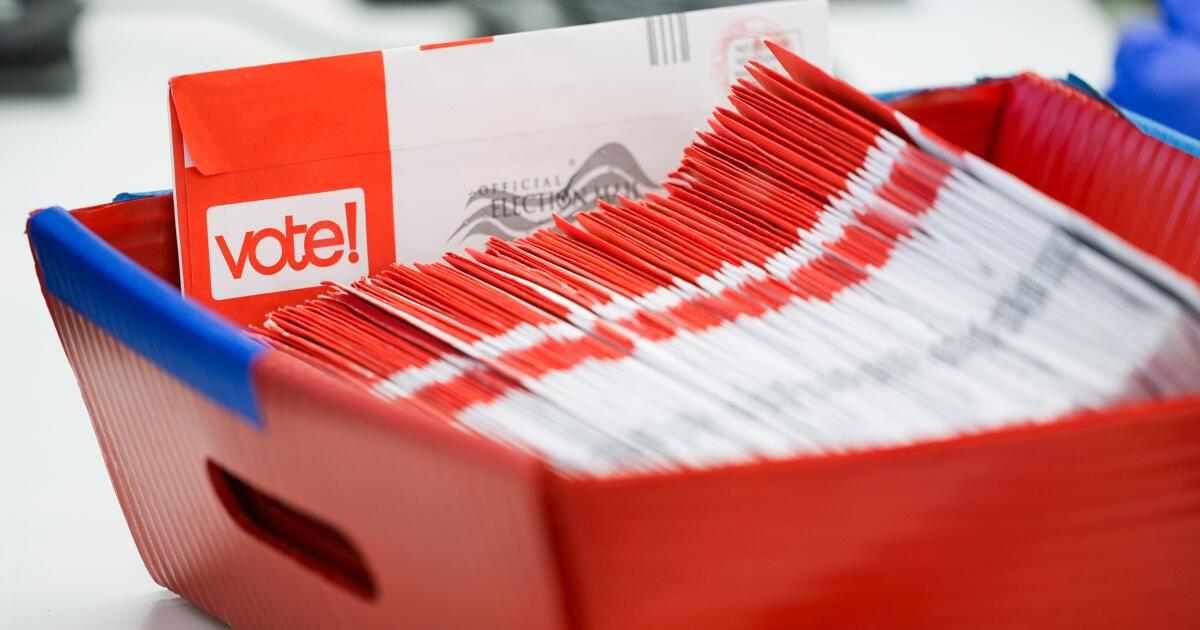
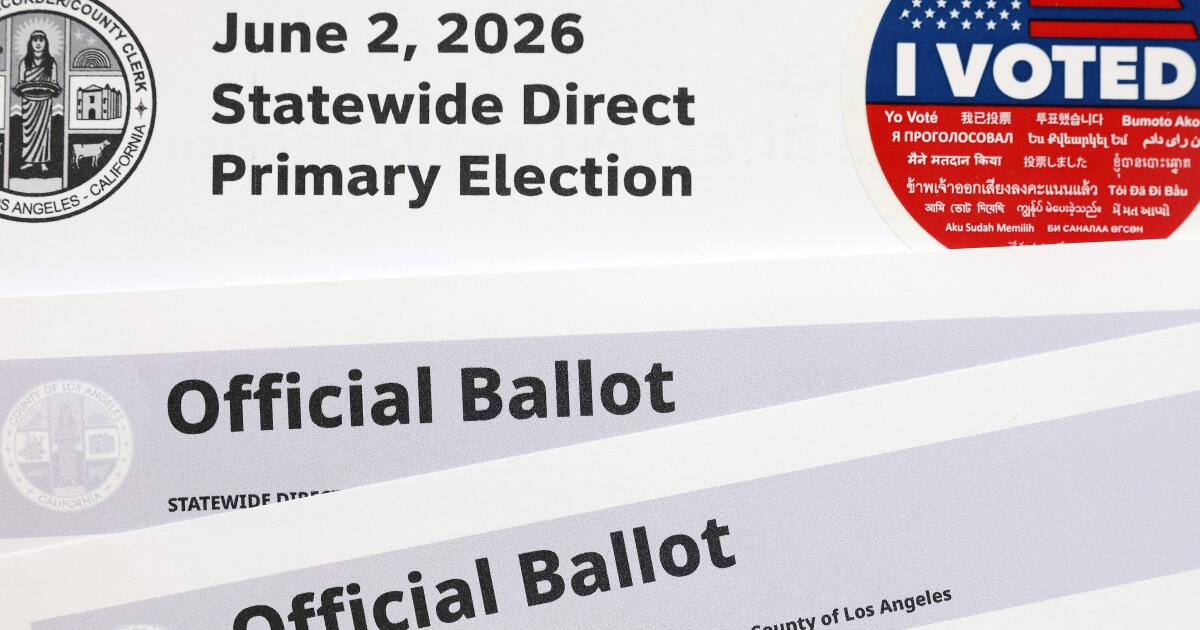
For the next week or so, in homes all over California, ballots will be arriving for the June 2 primary.
Since 2020, a ballot has been mailed to every active registered voter in the state — more than 23 million, by last count. The time to choose is drawing nigh.
In addition to the race for governor, Californians will vote in contests for seven other statewide offices, the Board of Equalization — which oversees the property tax system — and a great many congressional, legislative and local races, including the primary for Los Angeles mayor.
What’s a voter to do?
If you’ve waited your entire life for a candidate like Republican Chad Bianco, the Riverside County sheriff running for governor, or you’ve been jonesing to cast a gubernatorial ballot for Democrat Katie Porter from the moment she whipped out her famous whiteboard, the choice is easy. Fill out that ballot and toss it in the mail, stat! No postage needed.
“Don’t mess around,” said Paul Maslin, a veteran Democratic campaign strategist. (His candidate for governor, Betty Yee, quit the race late last month, so he’s a neutral observer at this point.)
“If you have pretty good inkling what you want to do,” Maslin urged, “vote.”
But if, like many, you’re not wed to a particular candidate, what then? If you’re worried about mailing in your ballot and then having some awful, Eric Swalwell-like revelations surface, or if you fret about wasting your vote by supporting someone who drops out before June 2, then what?
There are no do-overs in a California election. Once you’ve cast your ballot, you’ve made your choice. That’s it, however sorry you may be.
Which is why Republican strategist Rob Stutzman, who’s worked in California politics for decades, urged voters not to mail their ballot too soon. Like Maslin, he’s unaffiliated with any of the gubernatorial campaigns.
“It’s a slow-developing race,” Stutzman said of the contest for governor, the marquee attraction on the June ballot. “These are still relatively little-known candidates. There’s going to be a lot more campaigning to go in the weeks ahead. [So] unless you feel really strongly about somebody, I’d hang on to that ballot and see what happens over the next several weeks.”
Then again, with all the talk of clamping down on mail-in ballots and concerns about processing delays by a stretched-thin Postal Service, is there a danger of waiting too long to vote? What if your ballot arrives past the deadline to be tallied?
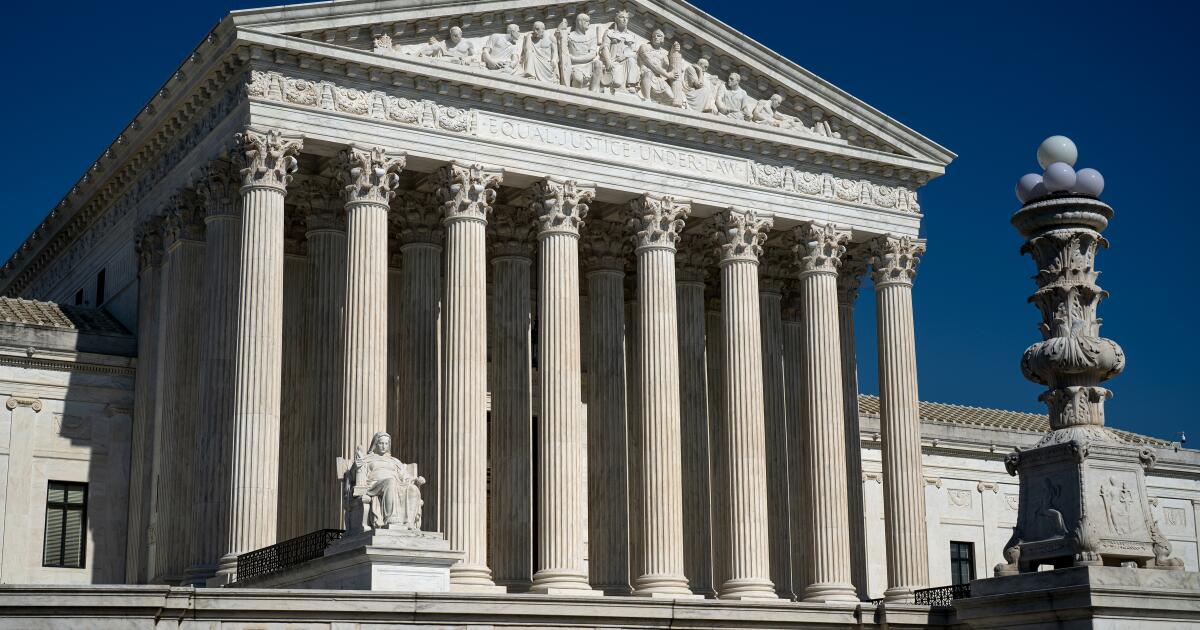
In March, the U.S. Supreme Court strongly signaled a likelihood it would require mail ballots to be received by election day if they are to be counted as legal. As it stands, California accepts mail-in ballots that were cast before the end of election day, so long as they arrive no later than seven days after.
The court seems unlikely to issue its ruling before the June primary — but that’s not guaranteed.
So is there a sweet spot, somewhere between voting in haste and having your ballot go to waste?
The Official Voter Information Guide, produced by California’s secretary of state, urges those voting by mail to “return your ballot … as soon as you receive it.”
But Kim Alexander, head of the nonpartisan California Voter Foundation, falls into the wait-a-bit camp. “Don’t vote too early,” she counseled, “because this is a very dynamic election.”
Once you’ve made up your mind, her best advice is to mail your ballot at least a full week before election day, which is May 26, to ensure it arrives on time to be processed and counted. If someone wants to drop their ballot off in person, either at a vote center or secure drop box, Alexander suggests doing so by May 30, which is three days before the election.
“The good news,” she said, “is that under a new state law … all county election offices will be open at least six hours on Saturday, May 30, for voters to come vote in person or to turn in their vote-by-mail ballots.”
Voting in person is an option right up until 8 p.m. on election day, even if you received a ballot in the mail. That applies everywhere in California, save for three sparsely populated, rural counties — Alpine, Plumas and Sierra — which conduct their elections entirely by mail. Bring your unused vote-by-mail ballot to your local polling place and swap it for a polling-place ballot you can use instead.
For procrastinators or those wanting to wait until election day to mail their ballot, they run the risk that it won’t be postmarked until after June 2. That means it won’t be counted, regardless of when it arrives at their county elections office.
“Voters who want to hold out as long as possible … ought to be planning to turn their ballot into a drop box or a voting site and not use the mail at all,” Alexander said.
Her suggestion is to find other ways to mark the occasion.
“Help somebody else go and vote,” Alexander suggested, “or volunteer to help with an organization” running a get-out-the-vote operation.
“If you want to help election officials get ahead on the vote count” — a source of repeated upset as the country awaits California’s lagging results — “you can be part of the solution by getting your own ballot in just a little bit earlier.”
All of which sound like fine ideas. That way you can celebrate election day and make sure your ballot isn’t cast for naught.
SACRAMENTO — One of Gavin Newsom’s top goals as he winds down his final year as California governor is to leave the state with a balanced budget.
After years of the state spending more money than it brings in, it’s Newsom’s last opportunity to fix a chronic deficit or dump the problem on the next governor.
How far he goes to solve the state’s structural spending imbalance will define his legacy as a steward of trillions in taxpayer dollars. As a potential candidate for president in 2028, he could also have a political incentive to do as little as possible.
“Any cuts you make are going to cause people to scream,” said Darry Sragow, a veteran Democratic strategist. “Any increases in taxes are going to cause people to scream and in terms of what’s best for a presidential run, it would be nice if people weren’t screaming.”
As California’s 40th governor, Newsom expanded publicly funded healthcare to income-eligible undocumented immigrants, increased state-subsidized child-care slots and provided free meals for schoolchildren among a wishlist of progressive wins since he took office in 2019.
His achievements have helped struggling Californians live in an increasingly unaffordable state and given him bona fides to tout to voters if he launches a bid for the White House.
But the state could never afford to pay for existing services and the new programs that Newsom and Democratic lawmakers enacted, according to an analysis of ongoing state spending since before the pandemic released by the Legislative Analyst’s Office last week.
Spending from the state’s principal operating fund has grown about $100 billion since Newsom’s first full fiscal year in office in 2019-20, mostly due to the growing cost of existing programs that he inherited. State spending has outpaced California’s strong revenue growth by about 10%, creating a perennial budget shortfall — a structural deficit — that Newsom and the Democratic-led Legislature solve with largely temporary fixes each year.
Instead of making across-the-board program cuts or raising taxes to align spending with revenue, Democrats have tapped into reserves designed to preserve social services for the state’s most disadvantaged communities during economic downturns.
While the California economy remains stable and state revenue has increased, Newsom and lawmakers have taken $12.2 billion from the rainy day fund. Democrats have borrowed $28 billion more from other state funds to cover their spending in recent years, according to the LAO.
“Taken together, these trends raise serious concerns about the state’s fiscal sustainability,” Legislative Analyst Gabriel Petek wrote in a review of Newsom’s January budget proposal.
Fiscal watchdogs have warned that the spending trends will leave California in a precarious position if the stock market tanks and tax receipts bottom out.
Personal income taxes are driving higher-than-expected revenue now, which analysts attribute to an artificial intelligence boom on Wall Street, and suggest the state could have no deficit in the upcoming year. In January, the Newsom administration anticipated significant operating deficits in the years ahead: $27 billion in 2027-28, $22 billion in 2028-29 and $23 billion in 2029-30.
“This issue is really whether they’re going to take seriously the structural deficit that is several years in the making now, where the spending has outpaced revenue, and to address that, they’re going to either have to make some fairly deep cuts or raise revenue and or both,” said former state Controller Betty Yee, who worked as a budget aide under Gov. Gray Davis and recently dropped her own campaign for governor. “But they have to be real. I think resorting to these one-time solutions has really exacerbated the problem.”
H.D. Palmer, a spokesperson for the California Department of Finance, said the governor is looking to solve the budget problem with more than a temporary fix.
“Although he is still finalizing his proposal that he’ll put forth to the Legislature, as he has said, he wants those solutions to be durable, and he wants them to have an impact beyond a single fiscal year,” Palmer said.
To stabilize California’s budget, Democrats will probably have to raise taxes or fees to generate new revenue and cut programs, according to the LAO. At least 40 cents for every dollar in revenue is dedicated to education under the state Constitution, requiring policymakers to find between $30 billion and $60 billion annually in additional revenue to cover projected shortfalls in 2027-28 and beyond if relying on new taxes alone.
President Trump’s cuts to healthcare are adding to the problem.
HR 1 will add $1.4 billion in state costs to the general fund. Newsom’s January budget proposal did not include a plan to help millions of low-income Californians who are expected to lose access to healthcare under the federal cuts.
To temper those cuts in California, other groups proposed a new tax on billionaires that appears poised to qualify for the November ballot.
Spearheaded by Service Employees International Union-United Healthcare Workers West, the initiative would apply a one-time 5% tax on taxpayers with assets exceeding $1 billion. If approved by voters, the tax would generate roughly $100 billion, which would fund healthcare programs.
The measure has divided unions and Democrats at the state Capitol.
Newsom has criticized the initiative, citing concerns that increasing taxes on the wealthy will have the opposite intended effect and drive the highest earners out of California. Under a progressive tax structure, the state budget is dependent on income taxes paid by the ultra-rich on earnings largely from capital gains.
Larry Page and Sergey Brin, the co-founders of Google, have already purchased residences in Florida, along with others looking to escape the tax if it goes through in November. Billionaires launched their own ballot measure campaign to undercut the tax proposal.
State lawmakers are also considering avenues to raise revenue, which include repealing a “water’s edge” tax break. Under the change, multinational companies would no longer be allowed to shield the income of their foreign subsidiaries from state taxes. California loses about $3 billion in revenue from the tax break each year.
In its budget plan released in April, the state Senate proposed a new fee on the largest corporations in the state to provide $5 billion to $8 billion annually for Medi-Cal.
The upper house said 42% of Medi-Cal enrollees are full-time workers who are not enrolled in their company’s healthcare plan because their wages are low enough to qualify for state-subsidized healthcare. As a result, corporations aren’t paying for healthcare for many of their employees and instead taxpayers are picking up the bill through Medi-Cal.
SEIU California, the powerful state union council representing over 700,000 workers, endorsed the plan. The union said Trump’s tax policy will reduce corporate taxes by $900 billion, while 3 million Californians lose healthcare.
“In this urgent moment, California’s workers need to see our leaders show us what they’re made of,” said Tia Orr, executive director of SEIU California. “The Senate is showing the courage to demand corporations pay their fair share, rather than making working people pay with their lives.”
The change is being described as a more politically palatable “fee” and not a tax.
“We explored multiple revenue options, and this was the one that felt more narrow, it felt more focused, and it also felt like it was directly going for the subsidy that’s being lost because of the Trump HR 1 cuts,” said Senate President Pro Tem Monique Limón (D-Goleta), who leads the upper house of the Legislature.
Limón said her caucus believes it’s important to address potential revenue streams because of the depth of federal healthcare reductions.
“If we don’t address the structural deficit, we are looking at severe cuts,” she said. “You are looking at people without health insurance. You are looking at hospitals closing down. You are looking at medical providers not being able to take more patients. You are looking at our emergency rooms over capacity, with not enough medical providers. I mean, you’re looking at a place that’s really, really, really difficult, and we feel like we have to, at least, look at what are viable options that are conditional on these cuts coming.”
Newsom has not commented publicly on the Senate’s plan. As governor, he’s been reluctant to embrace new taxes and fees.
Newsom could reject all the proposals for new taxes or fees and continue what he’s done before: take advantage of higher-than-expected tax collections, shift funds around, delay program implementation and borrow money to knock the deficit down to zero, or forecast a surplus, for his last budget year that begins July 1.
If he doesn’t take on California’s larger budget imbalance, then the problem would be the next governor’s to solve. A stock market crash, or economic recession, could force his successor to make drastic cuts across the board with limited reserves to support programs.
Kicking the can again would cement Newsom’s fiscal legacy as a governor who championed bold headline-making policies that bolstered the safety net for low-income Californians, but who failed to provide a solution to pay for his agenda.
“Not only has he not come up with a plan, he has pretended we don’t need one,” said Patrick Murphy, a professor of public affairs at the University of San Francisco.
Newsom’s interest in running for president could seemingly discourage him from slashing the budget and raising attention to the state’s financial woes, Sragow said. Newsom is setting himself up as a potential front-runner for his party. He has said he remains undecided about officially launching a 2028 campaign.
As a Democrat from California, his opponents would automatically label him as financially irresponsible and tax-happy. Calling out the massive budget problem on the horizon, raising taxes and making painful cuts will give them ammunition.
“There’s a long list of things that he’s going to be charged with, and this is likely to be one more,” Sragow said. “But I guess the question is, is he going to be charged with a political misdemeanor or a political felony?”
Former state Sen. Steve Glazer said Newsom is standing on political quicksand either way. State budget projections are based on assumptions about the future that often don’t bear out, leaving his choices exposed to criticism that he went too far, didn’t do enough, and everything in between.
“Whatever the governor decides to do in his May revise and in his final budget, it’s fraught with political risks, because it can be manipulated so easily by all sides,” Glazer said.
If Newsom ignores the spending problem, his successor could blame him for California’s financial woes when they take office in January and provide their own outlook of the state’s fiscal future. At the time, Newsom could be trying to convince America to make him the nation’s next president.
Murphy said Newsom has championed major policies and been reluctant to back off them later when revenue doesn’t pencil out.
In terms of spending, he’s governed similarly to the men who led California before him, with the exception of Jerry Brown, who cut programs to reduce a deficit he inherited in his second stint in the governor’s office and left Newsom with a surplus.
“It’s not all that different than most of the governors have done, which is finding it very hard to say no and finding it very hard to take on a tough choice of going to the ballot to ask for more money or raise taxes,” Murphy said.
Deukmejian left a budget disaster for his successor, Gov. Pete Wilson. Deukmejian publicly claimed he passed a balanced budget in his final year and blamed an economic downturn for the problems Wilson encountered.
When Wilson announced a record $13-billion budget deficit early in his first year in office in 1991, he said the Persian Gulf War, an economic downturn and natural disasters added to a structural deficit in the budget.
The Legislature and Deukmejian, Wilson said, had “papered over” the problem.
Before authorities charged him with attempting to assassinate President Trump and top administration officials in a brazen attack at the Washington Hilton, Cole Tomas Allen lived what those who knew him described as a quiet, simple existence.
He worked as a tutor and enjoyed video games, manga and riding his blue scooter. Acquaintances said Allen rarely talked about his political views through much of his adult life.
But on social media, he appears to have expressed concerns about the morality of U.S. policy, particularly its role in the wars in Ukraine and Iran.
Now, those who crossed paths with him are struggling to square the accusations against him with the man they knew as an unassuming student, gamer and teacher.
Allen grew up in a middle-class, suburban part of Torrance, one of four siblings who would each go on to study at reputable universities.
His parents were both teachers and “really solid members of their community,” according to Paul Thompson, a Los Angeles County prosecutor who lives next door to the family’s two-story house. Allen’s father knew many people on the block of single-family homes by their first names, Thompson said, and the suspect’s mother once saved Thompson’s dog when it ran into the road.
As a high school junior, Allen led Pacific Lutheran’s volleyball team in a three-set win over Junipero Serra High School. He was homeschooled, but was allowed via a special program to take a class at Pacific Lutheran in Gardena and to play for its respected squad, according to the private school’s principal.
Allen was “a godly person” who never cursed or shared his political views at the time, a former teammate told The Times, but he was also “very competitive.”
That drive extended to academics. After finishing his homeschooling, he was accepted into Caltech, one of the best universities in the nation for aspiring engineers like Allen.
He joined the Caltech Christian Fellowship, taking on a leadership role in which he organized Bible discussions, as well as the fencing team and the Nerf Club. He interned at the Jet Propulsion Laboratory in La Cañada Flintridge for three months.
In 2016, he was part of a five-person team that won an annual robotics and design competition in which teams built robots to play in soccer matches at Caltech. Allen was a teaching assistant at the Pasadena school, where he graduated with a mechanical engineering degree the following year.
Elizabeth Terlinden met Allen through the Caltech Christian Fellowship, where she was co-president during the 2014-15 school year.
“Quiet guy, kind of nondescript, generally polite, got good grades,” she told The Times, describing her impression of Allen. “Christian definitely, but that’s because I interacted with him primarily in that context.”
Michael D’Asaro, who coached fencing at Caltech around the time Allen was in college, said that he didn’t remember Allen but that generally none of the students attended practice regularly.
“Those kids were more interested in studying than sports, as you can imagine,” he said in a text message. “They would spend days and nights in the lab.”
After Caltech, Allen went on to work as a mechanical engineer for a South Pasadena firm called IJK Controls.
Kevin Baragona said he and Allen worked together “making stabilized gimbals for Hollywood” at IJK for about six months.
Baragona, who left IJK in January 2018 to found the company DeepAI, said in an interview via FaceTime from rural China that Allen seemed “kind of tired, unmotivated, like he didn’t want to really work hard, and maybe depressed.”
Baragona said that Allen was mainly interested in video games, and that Allen even showed him a couple of games he had made or was working on.
Allen was at IJK for less than a year and a half, according to his LinkedIn profile, which states that he worked as a self-employed “Indie Game Developer” from September 2018 to March 2020.
In 2019, he registered a trademark for an esoteric video game called “Bohrdom,” a “hybrid of a bullet hell and a racing game” based on atomic theory, in which electrons and protons compete. “Bohrdom” languished on the Steam gaming platform. Three other projects Allen detailed in his professional bio remained unfinished.
Then, in March 2020, he took a job as a tutor at C2 Education. In December 2024, he was named teacher of the year at the test preparation and tutoring company in a Spanish-tiled Torrance shopping center. People who knew him through his work there described him in interviews as intelligent and professional.
In May 2025, Allen received a master’s degree from Cal State Dominguez Hills in Carson, six miles from his parents’ home in Torrance.
Bin Tang, a professor in the university’s computer science department, described Allen as a “very good student. … Soft-spoken, very polite, a good fellow.”
“I am very shocked to see the news,” he told the Associated Press.
Joaquin Miranda knew he recognized the photo circulating online of a man posing in a graduation gown at Cal State Dominguez Hills, but he couldn’t quite place it. So on Monday, the 48-year-old showed the picture to his 13-year-old daughter, who told him it was of Allen, “my tutor guy,” who had tutored her in English at C2.
“She can’t believe it, because he was very nice, very professional and a very cool guy,” Miranda said of his daughter. “So yeah, it’s crazy.”
The Torrance home connected to Cole Tomas Allen.
(Robbin Goddard / Los Angeles Times)
At the heart of the case against Allen is a document federal authorities allege he sent family members.
The writer of the document apologized to his parents, colleagues and others before laying out his “rules of engagement” — guests, hotel security and staff and other people not in elected office or government were “not targets.” The author says he was targeting top Trump administration officials because he was “no longer willing to permit a pedophile, rapist, and traitor to coat my hands with his crimes.”
If the document was indeed written by Allen, Baragona said it would represent a fundamental change from the person he knew when they were making gimbals together at IJK Controls.
“It’s kind of sad, really,” Baragona said of the transformation Allen’s worldview apparently underwent in recent years. “It’s tragic and sad.”
The document was signed “Cole ‘coldForce’ ‘Friendly Federal Assassin’ Allen,” echoing the usernames the FBI in a court filing said Allen used online.
Federal authorities have not identified the specific accounts, but The Times found multiple similarly named social media profiles likely used by Allen, with close variations of the same distinctive username, @coldForce3000, that Allen used on a chess account created with his confirmed email addresses. The accounts have been taken down, but much of their contents remain accessible on the Internet Archive.
Across more than 5,000 posts extending from 2021 to days before last weekend’s White House Correspondents’ Assn. dinner, where the attack attributed to him took place, Allen’s social media history shows that what started as a singular immersion into the online gaming world became consumed in condemnation of Trump, his administration and war. The rhetoric was often harsh — likening the president to a mob boss or calling him a sociopath — but did not espouse violence.
A sketch of Cole Tomas Allen in court.
(Dana Verkouteren / Associated Press)
For years, SoCal Twitter user @CForce3000, under the name “coldForce,” posted almost exclusively about gaming, and “Super Smash Bros. Ultimate” in particular, the same fighting game Allen played competitively as an online brawler.
The account changed abruptly the day after Russia’s April 2023 missile attack on Slovyansk, in eastern Ukraine. Eleven people, including a toddler, died in the shelling of a residential building. The feed from @CForce3000 carried images of the bloodshed.
Subsequent Ukraine-related posts followed, along with pleas for donations to buy jeeps, equipment and supplies for combatants in the country. By early 2024, the account had broadened to domestic concerns, including opinions on student activism at Columbia University in solidarity with Palestinians in Gaza.
“Everyone makes mistakes in college,” @CForce3000 wrote in May 2024, criticizing the activists, who risked expulsion. “Burning down your parents’ life accomplishments and your own future to demonstrably degrade the image of your (presumably) recent cause is not really one I’d recommend,” the user posted, “like, my parents woulda *buried* me if i picked this as a ‘hill to die on.’”
For the next year, @CForce3000 shared hundreds of posts from sources as diverse as Rep. Ted Lieu (D-Torrance), Republican former Rep. Liz Cheney of Wyoming and former Ukrainian diplomat Maria Drutska. The account became a repeater of condemnations by Trump critics calling the president an ally of Russia and decrying his failure to support Ukraine and his involvement with late sex offender Jeffrey Epstein.
In November 2024, @CForce3000 announced the account was migrating to BlueSky, saying of X, “I don’t think there’s much reason to be on here anymore.” In early 2025 on BlueSky, coldForce chose an avatar plucked from the anime series “Gintama”: the heroine Kagura in her berserk state, insane with rage.
“Hi! I’m a random Californian guy with posts about American politics, support for Ukraine, and observations of small creatures,” read the new coldForce account bio. “I choose my own battlefields. Not through my blood, but with my heart. I stand on the battlefield to protect what I want.”
The BlueSky user continued to forward requests for donations to equip Ukrainian troops. It decried federal immigration raids and posted about a toddler who nearly died at an Immigration and Customs Enforcement detention facility in Texas. In reposting a feed that called Elon Musk a white supremacist, coldForce mused that the Tesla CEO and X owner was a “genius with effective(?) autism” struggling to understand humanity.
The rhetoric sharpened this spring when Trump began posting threats to bomb Iran, saying that “a whole civilization will die tonight.” On BlueSky, coldForce shared posts from Democratic pundits and leaders, including in Congress, who called for Trump’s impeachment, and those who described the president as “deranged” and “a sociopathic mob boss.”
Cole Allen reportedly purchased a handgun at CAP Tactical Firearms in Lawndale.
(Eric Thayer / Los Angeles Times)
“Trump must be removed from office. He has no capacity to do the job, and he’s destroying the US and the world with incoherent flailing,” read an April 12 message by Minnesota liberal activist Will Stancil that coldForce reposted. “He thinks he can bully and blackmail the whole world and will start WW3 or nuke someone eventually. He absolutely cannot [be] allowed to continue.”
To these, coldForce added:
“If we can call for russians to oppose putin, we can and must oppose trump no less.”
On April 6, federal authorities say Allen used his phone to search “white house correspondents dinner 2026” and booked a room at the Washington Hilton.
Allen allegedly traveled by train across the country from California, arriving in Washington, D.C., on April 23 and checking into his room at the Washington Hilton, where the White House correspondents’ dinner was scheduled two nights later.
At 8:03 p.m. April 25, he snapped a mirror selfie in his hotel room, according to a pretrial detention memo filed by prosecutors Wednesday. He looked into the camera, eyebrows raised with a hint of a smile. Allen wore a black dress shirt and slacks, a red tie tucked into his pants and a small leather bag prosecutors say was filled with ammunition. He also allegedly wore a shoulder holster and knife in his waistband.
At 8:27 p.m., he pulled up a live feed of Trump en route to the event. Minutes later, as the president sat on an open stage during the fete, Allen allegedly ran through a magnetometer and past Secret Service agents toward the ballroom before firing at least one shotgun round in the direction of the stairs leading down to the ballroom, the memo said.
Secret Service agents respond during the White House correspondents’ dinner.
(Tom Brenner / Associated Press)
A Secret Service officer saw him and fired five shots — all of which missed him — and Allen fell to the ground and was arrested before he could reach the event space. The Department of Justice has said it is investigating whether Allen fired the round that hit one of the agents in the chest; the agent avoided major injuries because he was wearing a bulletproof vest.
People who knew Allen before he was accused of attempting to gun down American leaders told The Times that they never would have thought he was capable of such a violent act.
Terlinden, of the Caltech Christian Fellowship, said she and Allen once got into a heated argument over how to spend the group’s charity money. He advocated for sending toys to children abroad through an organization that was explicitly Christian, whereas Terlinden pushed to feed the homeless locally, which she thought was more pragmatic.
“I think he said it’s not about helping people, it’s about showing the love of Christ,” she recalled. “After I talked about efficiency and helping people.”
She left the room and didn’t return.
“Part of the reason I’m bringing that up is to demonstrate that that’s the most scandalous incident I could come up with,” Terlinden said. “We were arguing over whether we should send toys to poor children or feed homeless people — that’s the big tea.”
Reflecting on the allegations, she said she wondered whether Allen was “acting out of perceived moral duty. … In a twisted way, there is a sense of, you know, standing up for people that can’t defend themselves.”
Every two years for more than a decade, Melani Candia has gotten approved to stay in the U.S. with her husband and two cats and — more recently — continue to work in special education in Florida.
But this year, delays in Deferred Action for Childhood Arrivals, a program that has shielded her and hundreds of thousands of others from deportation, led to her missing her renewal deadline, losing her job and fearing detention in the country she has called home since she was 6 years old.
She said that as an immigrant in the U.S., fear has become her “new baseline.” “But now, having a new level of vulnerability, it was a very quick increase in the fear,” said Candia.
Renewal wait times for the Obama-era program that allows people who were brought to the U.S. as children to temporarily remain in the country and work have increased to levels not seen since 2016 when there were significant technical issues.
Some of the program’s more than 500,000 beneficiaries, often referred to as “Dreamers,” have waited months for an answer only to see their deadline pass without a decision. Now they’re stuck in a type of limbo in which their work authorization disappears, oftentimes along with their driver’s license, and their ability to stay in the U.S. is at risk.
“It’s not just anecdotal; it’s happening at a larger scale than we’ve ever seen before,” said Greisa Martinez Rosas, executive director of United We Dream, an immigrant youth-led network.
No numbers were available on how many people have recently missed their renewal deadline despite applying 120 to 150 days before their DACA lapses, which is what U.S. Citizenship and Immigration Services, or USCIS, recommends.
“Under the leadership of President Trump, USCIS is safeguarding the American people by more thoroughly screening and vetting all aliens, which can lengthen processing times,” Zach Kahler, an agency spokesperson, said in a statement.
Wait times nearly 5 times longer
DACA grants those who qualify two-year, renewable permits to live and work in the U.S. It does not confer legal status but is meant to offer protection from deportation.
From October 2025 through the end of February 2026, the median wait time for renewals was about 70 days, compared with about 15 days in fiscal year 2025, according to USCIS. This is the longest median wait time since 2016, when it was about 79 days, according to the agency’s data, which did not include 2020 because of the pandemic.
The Department of Homeland Security attributed the 2016 delays to technical issues that emerged as it transitioned to fully processing DACA renewals in its electronic immigration system.
At the end of April, USCIS was reporting that the majority of renewal requests were being completed within about 122 days. That marked a two-week increase from the processing times listed earlier that month.
Federal lawmakers and immigrant groups say some applicants recently have had to wait six months — about 183 days — or longer.
“The delays that people are concerned about used to be sort of a matter of weeks at a time,” Sen. Alex Padilla (D-Calif.) said in an interview. “Now it’s from a few months to many, many months.”
He is one of dozens of lawmakers behind letters sent to federal agencies that question the inflated wait times and whether people who have missed their renewal deadline are being targeted for arrest or deportation.
More than five months after Elsa Sanchez submitted her DACA renewal request, she is still waiting for an answer. When the deadline passed at the beginning of April, she was put on leave at her job at a healthcare IT company and now, as a single mother of a college freshman, has no income.
It’s made her worried about everything from traveling to spending money on pricier household products like shampoo and detergent.
“I’m like, ‘I don’t know, maybe I can cut down on that. Maybe I don’t need this,’” she said. “Because I’m saving every penny.”
Sanchez said something similar happened about a decade ago, but this time she’s scared of the possible repercussions amid Trump’s mass deportation agenda.
Since DACA’s introduction in 2012, it’s faced myriad legal battles, including two that made it to the Supreme Court. And now, though the government is still approving renewals, a 2025 federal court decision means it isn’t processing first-time applications and has left the door open for another possible trip to the Supreme Court.
Hundreds of ‘Dreamers’ arrested
In the first 11 months of 2025, more than 250 DACA recipients were arrested and 86 deported, then-Homeland Security Secretary Kristi Noem said earlier this year. She said the majority of those arrested had “criminal histories,” without indicating the nature of the crimes or if they were arrests, charges or convictions.
In a separate response to a Democratic congresswoman’s inquiry, Homeland Security reported conflicting numbers, saying that 270 were arrested and 174 DACA applicants were removed in the first nine months of 2025.
Their eligibility is dependent in part on not having a felony conviction, a significant misdemeanor or three misdemeanors. Previously, if their status was in jeopardy, they would get a warning and still have the chance to fight it before immigration officers detained them and began efforts to deport them.
Kahler of USCIS said that DACA recipients are not automatically protected from deportation.
“Any illegal alien who is a DACA recipient may be subject to arrest and deportation for a number of reasons — including if they committed a crime,” he said, using an outdated term for immigrants widely considered disparaging.
U.S. Immigration and Customs Enforcement did not respond to questions about whether DACA beneficiaries were being targeted after missing their renewal deadlines.
But federal lawmakers have recently noted people picked up by Immigration and Customs Enforcement after their DACA lapsed.
Their protections may have been further eroded with a precedent decision recently in which the Board of Immigration Appeals determined that DACA status alone is not enough to stop deportation.
Losing DACA eligibility, and a job
Experts have suggested the longer wait times could be related to the restarting of biometric appointments, which were paused during the COVID-19 pandemic emergency. Some may also not be getting approved by their deadline because they’re not sending it in by the recommended time.
Maria Fernanda Madrigal is an immigration attorney and DACA recipient who submitted her renewal application about a month and a half before the deadline because she said that’s all the processing time that’s been needed in the past. She said she was also waiting for her job to hold a DACA workshop so she could get the more than $550 fee for renewal waived.
Her DACA lapsed recently, and the mother of three was let go from her job.
“My first concern was my cases, to be honest, because I knew I was going to have to hand off everything, and my team is already overworked,” said Madrigal.
Immigration attorneys have also said that USCIS has paused processing renewals for people from dozens of countries the agency described in recent policy memorandums as “high-risk” following presidential proclamations. The National Immigration Law Center estimated that as many as 3,000 to 4,000 people could be impacted.
“This process that has no timeline is leading to people from certain countries experiencing a pause. And we don’t know how long that pause will be in place,” said Ignacia Rodriguez Kmec, attorney at the National Immigration Law Center.
Every day, Candia checks on her renewal. She said she’s most afraid of being locked up in bad conditions in an ICE detention facility, but also thinks about what it would be like returning to Bolivia after more than 25 years.
“If God forbid that happened, it would break my heart because I’ve been in this country since I was 6,” she said. “My entire life is here.”
When a federal judge shot down a Trump administration policy of holding immigrants without bond last December, it seemed like a serious blow to the president’s mass deportation effort.
Instead, a top Justice Department official insisted the ruling wasn’t binding, and the administration continued denying detainees around the country a chance for release.
By February, the district court judge, Sunshine Sykes, was fed up. Sykes, a nominee of President Biden, accused Trump officials in a ruling that month of seeking “to erode any semblance of separation of powers,” adding that they could “only do so in a world where the Constitution does not exist.”
Hardly isolated, the case illustrates a broader pattern of defiance of lower court decisions in President Trump’s second term.
The failure of Trump officials to follow court orders has been highlighted most notably in individual immigration cases. But a review of hundreds of pages of court records by the Associated Press also shows an extraordinary record of violations in lawsuits over policy changes and other moves.
In the administration’s first 15 months in office, district court judges ruled it was violating an order in at least 31 lawsuits over a wide range of issues, including mass layoffs, deportations, spending cuts and immigration practices, the AP’s review of court records found. That’s about 1 out of every 8 lawsuits in which courts have at least temporarily blocked the administration’s actions.
The Trump administration’s power struggle with federal courts — which is testing basic tenets of U.S. democracy — reflects an expansive view of executive authority that has also challenged the independence of federal agencies, a president’s ethical obligations and the U.S. role in the international order.
Widespread noncompliance found
The Trump administration violations in the 31 lawsuits are in addition to more than 250 instances of noncompliance that judges have recently highlighted in individual immigration petitions — including failing to return property and keeping immigrants locked up past court-ordered release dates.
Legal scholars and former federal judges said they could recall at most a few violations of court rulings over the full four-year terms of other recent presidential administrations, including Trump’s first time in office. They also noted previous administrations were generally apologetic when confronted by judges; the Trump administration’s Justice Department has been combative in some cases.
“What the court system is experiencing in the last year and a half is just qualitatively completely different from anything that’s preceded it,” said Ryan Goodman, a law professor at New York University who studies federal courts and is tracking litigation against the Trump administration.
Though Trump officials eventually backed down in about a third of the 31 lawsuits, legal experts say their treatment of court orders poses serious dangers.
“The federal government should be the institution most devoted to the rule of law in this country,” said David Super, a constitutional law scholar at Georgetown University. “When it ceases to feel itself bound, respect for the rule of law is likely to break down across the country.”
The White House’s aggressive policy moves have prompted a barrage of lawsuits — more than 700 and counting.
Higher courts boost Trump efforts
The AP’s review also found that higher courts, including the Supreme Court, overruled the district courts and sided with the White House in nearly half of the 31 cases. Critics say those decisions are emboldening the administration to ignore judges’ orders.
White House spokesperson Abigail Jackson said the higher courts had overturned “unlawful district court rulings.” The administration will “continue to comply with lawful court rulings,” she added in a written statement.
“President Trump’s entire Administration is lawfully implementing the America First agenda he was elected to enact,” the statement said.
Among other instances of noncompliance, judges found the White House defied rulings when it deported scores of accused gang members to a notorious prison in El Salvador, withheld billions of dollars in foreign aid and failed to restore programming at the Voice of America. The three cases date to the first few months of the new administration, but judges have continued to find violations since then, including in two cases in April.
“The danger is that this gets normalized,” said JoAnna Suriani, counsel at the nonpartisan group Protect Democracy, which is tracking noncompliance cases. The group is also involved in litigation against the administration.
‘Ham-handed,’ ‘hallucinating’
In October, U.S. District Judge William Smith took little time to conclude Homeland Security officials were flouting one of his orders. Smith, a nominee of President George W. Bush, had blocked them from making billions of dollars in disaster relief funding to states contingent on cooperation with the president’s immigration priorities.
The Department of Homeland Security responded by keeping the immigration requirement on some grants, but making it contingent on a higher court overriding Smith’s injunction. The judge called the move “ham-handed” and said the agency was trying to “bully the states.”
In a case over the suspension of refugee admissions, U.S. District Judge Jamal Whitehead, a Biden nominee, accused the Justice Department last May of “hallucinating new text” in an appellate court order and “rewriting” it to achieve the government’s preferred outcome.
In four additional cases the AP reviewed, judges stopped short of a clear written finding of noncompliance but still criticized the administration’s response to their orders.
Of the judges who have confirmed violations, 22 were appointed by Democratic presidents and seven by Republican presidents.
Former federal judges Jeremy Fogel and Liam O’Grady said jurists are losing trust in the integrity of the Department of Justice.
That’s making them “more aggressive in accusing the government of bad faith,” said O’Grady, who along with Fogel is part of the nonpartisan democracy group Keep Our Republic.
Fogel said judges are also getting frustrated.
“They make orders and the orders don’t get complied with, and then they have to inquire why the orders are not being complied with, and that’s where it gets very mushy and very political,” he said.
Education case raises alarms
In Eureka, Calif., school administrator Lisa Claussen is worried about the impact on her students’ mental health if a judge does not find the Education Department in violation of a court order on federal grants.
Grant money allowed the school district in the poor coastal community in Northern California to hire more than a dozen psychologists and social workers to help students struggling with drug use and suicidal thoughts.
Education officials in the Trump administration told schools in California and other states last year that it was discontinuing the grants; the administration opposed diversity considerations in the grant process.
U.S. District Judge Kymberly Evanson blocked the move permanently in December, but California and 15 other states now say the administration is making an end run around her injunction by imposing new rules, including an initial limit of six months of funding.
Attorneys for the Education Department said they wanted to see whether schools were making progress on performance goals before releasing additional funds. The judge’s order did not block the six-month limit, they added in a court filing.
Evanson, a Biden nominee, has yet to rule.
In the absence of a one-year funding guarantee, Eureka City Schools and other districts say they have already issued layoff notices to mental health providers or eliminated positions.
“We have many kids who don’t trust adults for very good reason, and to be able to just swipe this grant like they’re doing … ,” Claussen said in a phone interview, her voice trailing off. “We didn’t do anything wrong.”
Justice Department response
In court filings, Justice Department attorneys have generally disputed accusations that the government was not complying. They have argued over the meaning of words, cited favorable appellate court rulings and said they were acting outside the scope of the court’s order, among other legal maneuvering.
Outside of court, Trump and White House officials have railed against federal judges. Vice President JD Vance has even suggested the president could ignore court orders.
Will Chamberlain, senior counsel with the conservative legal advocacy group the Article III Project, said many of the judges who have found violations are ignoring laws that clearly prohibit their rulings.
Trump officials are “generally complying, appealing and winning,” he said. “If they were defying orders left and right, they’d be losing them.”
A justice’s rebuke
In March, a federal appeals court ruled Sykes, the judge in California, had probably exceeded her authority in requiring bond hearings nationwide and blocked her February decision.
The outcome was not unusual.
In 15 of the 31 lawsuits the AP reviewed, an appellate court or the Supreme Court either allowed the administration’s underlying policy, limited the district court’s efforts to correct or punish the noncompliance, or both.
Supreme Court Justice Sonia Sotomayor criticized her fellow justices after one such ruling.
“This is not the first time the Court closes its eyes to noncompliance, nor, I fear, will it be the last,” she wrote in June in a dissent joined by the court’s two other liberal justices. “Yet each time this Court rewards noncompliance with discretionary relief, it further erodes respect for courts and for the rule of law.”
Thanawala writes for the Associated Press. AP writer Michael Casey in Boston contributed to this report.
Environmentalists had something in their arsenal for Tuesday’s election they never did before: a billionaire benefactor willing to empty his pockets of tens of millions of dollars to bring climate change to the forefront of political debate and elect candidates committed to fighting global warming.
But California hedge fund titan Tom Steyer’s $74-million bet — most of it from his own wallet — yielded little payoff. On Tuesday, voters elected the most hostile Congress environmentalists have faced in years.
The Republicans who won control are already making plans to roll back President Obama’s signature emission reduction efforts, green-light the controversial Keystone XL pipeline that would transport Canadian tar sands oil to the U.S. Gulf Coast, and cancel subsidies for renewable energy.
Steyer says he has no regrets.
“I feel great,” he said by phone from his organization’s San Francisco office. “We set out to put climate on the ballot in a bunch of states, to build an organization and to build a relationship with a bunch of voters.”
He argued that all of that happened, pointing to hundreds of thousands of climate-minded voters newly enlisted in his organization, NextGen Climate, the emergence of global warming in the debate in several races, and the retreat by various GOP candidates from a platform of outright denial of climate science.
He chalked up Tuesday’s results to “that part of the world we don’t control.” Steyer said there was no approach that would have overcome the Republican tide that gave the party control of Congress and defeated several of the candidates NextGen backed.
But the election results raise new questions about the approach deep-pocketed, green-minded donors are taking toward electoral politics. Despite their best efforts, and the huge amount of money invested, they are failing to get voters to set aside other concerns and cast their ballots on environmental issues. This time out, the president’s record and the economy were the forefront issues, with all others receding.
“The take-away here is this was not a successful strategy,” said Josh Freed, vice president for clean energy at Third Way, a group that seeks a middle path between the two warring parties. “Candidate positions on climate do not move the overwhelming majority of voters to pull the lever for or against them. I hope these organizations take a step back and come up with a different approach.”
Steyer’s group saw its candidates victorious in U.S. Senate races in Michigan and New Hampshire, and in state legislative races, including in Oregon. But candidates they backed lost in hotly contested Senate races in Colorado and Iowa. NextGen also failed to unseat the governors of Florida and Maine, targeted by the organization for their outspoken skepticism of climate science.
The unpopular GOP governor of Pennsylvania, Tom Corbett, which Steyer’s group campaigned against, lost. But even in that race — won by NextGen’s candidate, Democrat Tom Wolf — global warming hardly was a factor, according to G. Terry Madonna, who directs the Franklin & Marshall College Poll in Lancaster.
Steyer’s impact was “Zero. None. Zero,” he said. Climate change “was not an issue at all. It has literally no salience with voters. It didn’t ever come up.”
University of New Hampshire pollster Andrew Smith said much the same with regard to the Senate race in his state, which Democratic incumbent Jeanne Shaheen won. “I don’t think anybody paid any attention to global warming this election,” he said.
In part that is because much of Steyer’s money was spent airing ads on issues his organization thought were more likely to turn out the Democratic faithful. But that too sometimes backfired.
In Colorado, independent pollster Floyd Ciruli suggested Steyer’s heavy TV advertising, which seized on a Democratic theme emphasizing abortion rights, may have actually hurt Democratic Sen. Mark Udall, who lost to GOP Rep. Cory Gardner.
“It was probably a net negative,” Ciruli said. “It turned out to be one of those things that threw Udall on the defensive. He was being parodied and mocked for it and criticized for it.”
Even Steyer’s strategists acknowledge that climate change is not a top-tier issue now. The question is whether it ever will be. Advocates such as Freed say the push seems to be futile, and well-funded green political groups should shift their strategy to more narrowly focused efforts with bipartisan appeal. They might start, he said, by being more open to such GOP-favored options as nuclear energy.
The green campaign efforts instead focus on getting Congress back to where it was in 2010, when it almost passed a California-style law that would have capped greenhouse gas emissions nationwide.
NextGen officials say they are confident in their strategy — and persistent. “This is a multi-cycle effort,” said Chris Lehane, Steyer’s lead political strategist. “If it was easy, it already would have been done…. Social change like this is not like switching on a light bulb.”
The GOP takeover of the Senate occurs as the science of climate change has grown more definitive and the predictions of widespread effects more detailed and dire. On Sunday, a panel of hundreds of climate scientists convened by the United Nations warned that climate change driven by the burning of fossil fuels was already affecting life on every continent and in the oceans and that the window was closing rapidly for governments to avert the worst damage expected later this century.
Yet skepticism of climate science remains Republican orthodoxy. North Carolina Sen.-elect Thom Tillis said in a primary debate that climate change is not “a fact.” Sen. James M. Inhofe of Oklahoma, who is expected to take the helm of the Senate Environment and Public Works Committee, has called climate change “the greatest hoax ever perpetrated on the American people” and dismissed the U.N. science panel “as a front for the environmental left.”
Obama moved to cut greenhouse gas emissions by issuing new rules for power plants and the nation’s vehicle fleet. The GOP-run Congress will not be able to nix the rules outright. But it could so thoroughly weaken or delay them through riders to key legislation that they’d be rendered ineffective, analysts said. Deeper cuts to the nation’s emissions would probably require congressional action, and the current GOP position on climate change makes such action improbable.
Sierra Club Executive Director Michael Brune acknowledged there was a “copious amount of bad news” in Tuesday’s election. But he says there was “significant good news” as well.
“Candidates who formerly denied climate science are now saying they are not scientists and instead talk about clean energy and associate themselves with it,” he said.
“The money from Tom Steyer made a difference in elevating climate science and pushing all these lawmakers to move off a denial platform,” Brune said.
WASHINGTON — President Clinton consulted congressional leaders Wednesday on his policy toward Bosnia but continued to avoid a firm commitment to seek congressional approval before deciding to send American forces there.
The 1973 War Powers Act requires the President to notify Congress in most cases before sending troops into areas of potential hostilities and requires that the troops be withdrawn within 60 days if Congress does not authorize their presence.
The law was enacted over President Richard Nixon’s veto. Each successive Administration has argued that it represents an unconstitutional infringement on the President’s powers as commander in chief.
During the last 12 years of Republican administrations, Democrats in Congress have made a major issue of support for the War Powers Act. That puts Clinton and his aides in a potentially difficult situation, which they have tried to avoid by evading questions about precisely where they stand.
Clinton continued that approach Wednesday. “Ask my lawyer, I don’t play lawyer,” he said when asked at a White House photo session whether he believes the law is constitutional. “I think it’s worked reasonably well.”
Later, White House Communications Director George Stephanopoulos said: “The President is reviewing the War Powers Act at this time. That is under review by the National Security Council and the counsel’s office.”
White House aides have fallen back on carefully worded pledges to consult with Congress in a manner that is “consistent with” the war powers law but not necessarily “pursuant to” it. Once Clinton decides on a course of action, he “will go to the Congress if it is required,” Stephanopoulos said.
President George Bush followed a somewhat similar path before the Persian Gulf War. Bush argued that he did not need congressional authorization before sending troops to the Gulf but urged Congress to pass a resolution authorizing the use of force against Iraq before the actual war began. Bush insisted, however, that he had the power to go ahead with the attack if Congress voted against him.
Clinton’s less clear-cut position appears to be acceptable to congressional leaders.
Although members of Congress have often touted the War Powers Act as an important safeguard against unbridled executive power, few over the last 20 years have relished the prospect of using it.
One indication of the weakness of the law came in the House on Wednesday when it finally got around to approving a resolution authorizing the sending of U.S. troops to Somalia. The authorization came five months after the troops were dispatched and the day after U.S. forces turned over control of the relief effort to the United Nations.
At a ceremony at the White House to honor troops returning from the African nation, Clinton linked their experiences with the events that may soon unfold in the former Yugoslav republics.
“Your successful return reminds us that other missions lie ahead for our nation,” he said. “You have proved again that our involvement in multilateral operations need not be open-ended or ill-defined, that we can go abroad and accomplish some distinct objectives and then come home again when the mission is accomplished.”
At a later White House ceremony, where he talked about the importance of rapid action on health care reform, Clinton defended his Administration against the charge that monitoring developments in Bosnia-Herzegovina has interfered with his other activities and that it has tried to do too many things at once.
“One of the most challenging things we have to do in this city at this time is to break a mind-set that we have one problem at a time and we’ll get on it and we’ll only think about that,” Clinton said.
In the biggest jolt to abortion policy in the U.S. since the overturning of Roe vs. Wade, a federal appeals court has restricted access to one of the most common ways to end early pregnancies by blocking the mailing of mifepristone prescriptions.
The unanimous ruling Friday from the New Orleans-based 5th U.S. Circuit Court of Appeals marks a substantial victory for abortion opponents seeking to stem the flow of abortion pills prescribed online that they view as subverting state bans on the procedure.
The ruling, which is expected to be appealed to the U.S. Supreme Court, requires that mifepristone be distributed only in person and at clinics, overruling regulations set by the federal Food and Drug Administration.
Friday’s ruling is in effect while the case works its way through the courts, but a mifepristone maker has asked the appellate court to put its ruling on hold until the Supreme Court weighs in.
Here’s what to know.
Nationwide impact
Frustrated with a lack of federal action against medicated abortions, Louisiana Atty. Gen. Liz Murrill sued the FDA last month, saying its regulations undermined the state’s ban on abortions at all stages of pregnancy.
“The regulation creates an effective way for an out-of-state prescriber to place the drug in the hands of Louisianans in defiance of Louisiana law,” Judge Kyle Duncan, who was appointed by President Trump, wrote in the ruling.
FDA officials have said the agency is conducting a new review of mifepristone’s safety, but the appeals court noted that there was no timeline for its completion.
Friday’s ruling affects all states, even those without abortion restrictions.
There is little precedent for a federal court overruling the scientific regulations of the FDA, and it remains to be seen how the decision could affect how the drug is dispensed long-term.
Murrill, a Republican, celebrated the ruling as a “victory for life,” while other antiabortion advocates cheered the reversal of rules finalized under President Biden that ended a long-standing requirement that the pills be obtained in person at a doctor’s visit.
Representatives for the FDA and the U.S. Department of Justice did not immediately respond to requests for comment.
Long record as safe and effective
Danco Laboratories, a mifepristone manufacturer and defendant in the lawsuit, has asked the appeals court to put its order on hold for one week to give the company time to seek relief from the Supreme Court.
Mifepristone was approved in 2000 as a safe and effective way to end early pregnancies. It is typically used in combination with a second drug, misoprostol, which is not affected by the ruling but is less effective on its own.
Surveys have found that the majority of abortions in the U.S. are administered using pills and that about 1 in 4 abortions nationally are prescribed via telehealth. Providers have suggested that its availability through telehealth is a reason why the number of abortions in the U.S. has not fallen since the Supreme Court overturned Roe in 2022.
As a result, abortion pills and those who prescribe them out of state have become key targets of abortion opponents.
Some Democratic-led states have adopted laws that aim to protect providers who prescribe via telehealth and mail the pills to states with bans. Those so-called shield laws are being tested through civil and criminal cases in Louisiana and Texas.
One telehealth provider in a state with a shield law, Dr. Angel Foster, was working with legal experts to understand how the ruling would affect her organization, the Massachusetts Medication Abortion Project.
“We will do everything in our power to continue providing care to people in all 50 states,” she said.
Midterm politics
The case could make abortion a key issue in this fall’s midterm elections as Democrats aim to take back control of the U.S. House and Senate and Republicans fight to hold on to their narrow majorities.
Recent electoral results suggest that voters seeking to maintain abortion access have the political momentum. Since Roe was overturned, abortion has been on the ballot directly in 17 states. Voters have sided with the abortion rights side in 14 of those results.
Abortion rights supporter Fatima Goss Graves, president and chief executive of the National Women’s Law Center, slammed Friday’s ruling as “deeply out of step with both the public and fact-based science.”
Trump received criticism after the ruling from some antiabortion advocates who expressed frustration that he did not take action himself to block distribution of the pill.
The FDA under Trump approved another generic version of mifepristone last year, which peeved some allies of the president.
“It’s shameful that the Trump administration’s inaction has forced pro-life states to take their battle to the federal courts,” said Marjorie Dannenfelser, president of Susan B. Anthony Pro-Life America, who also applauded the ruling.
Schoenbaum and Mulvihill write for the Associated Press.
Good morning, and welcome to L.A. on the Record — our City Hall newsletter. It’s David Zahniser, giving you the latest on city and county government.
We’ve got a month left before the June 2 primary election, with mail-in ballots already heading to voters’ mailboxes.
As if on cue, the big campaign money is pouring in from an array of well-funded interests: business groups, labor unions, hotels, taxicab companies and even one candidate’s mother.
To get around the city’s strict fundraising limits, those donors are putting much larger sums into “independent expenditure” campaigns that operate separately from their favored candidates.
Let’s take a look at some of the outsized spending to emerge in recent weeks.
Police union targets Raman
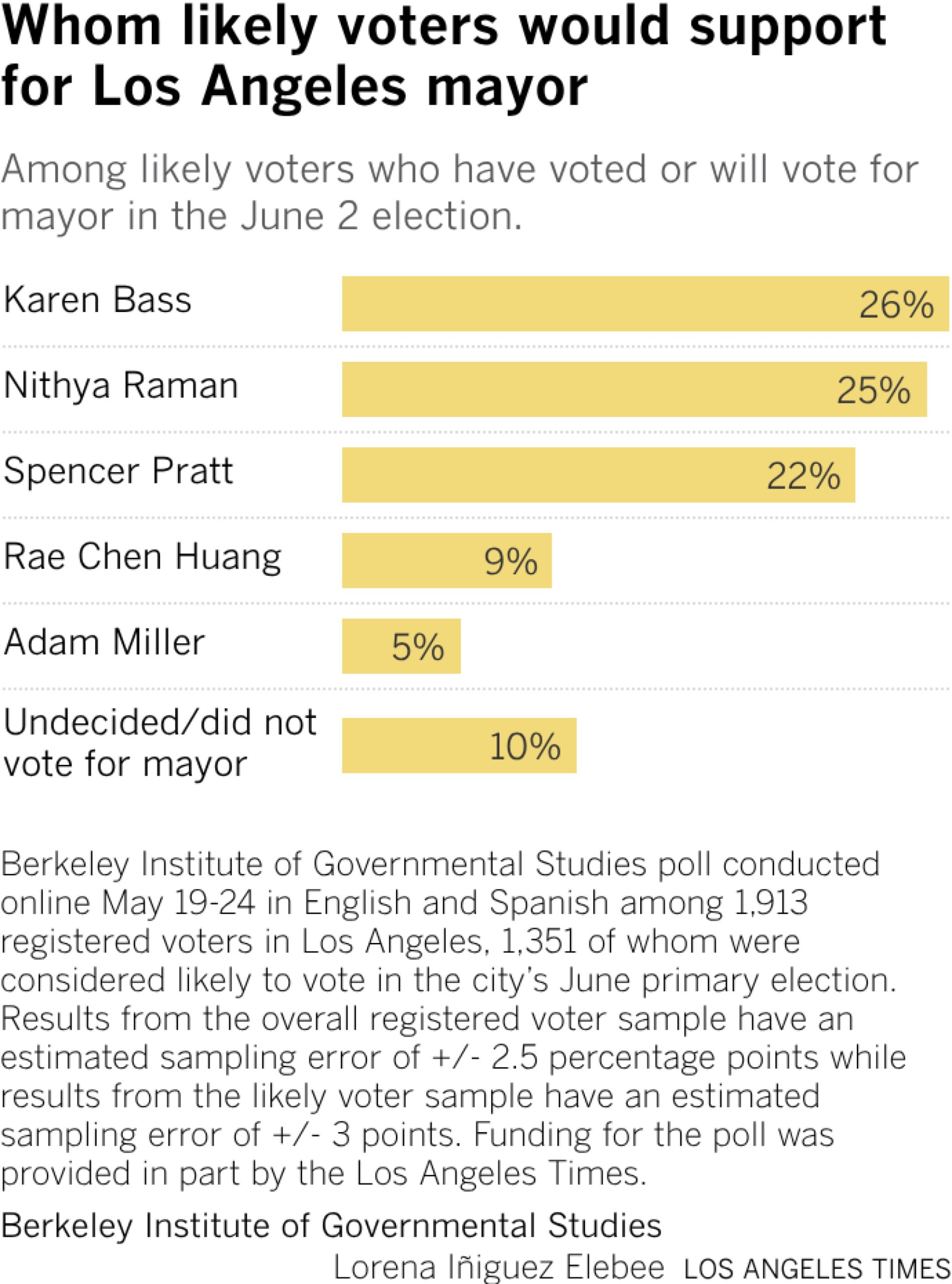
Things had been pretty sleepy in the L.A. mayor’s race, even with Mayor Karen Bass facing challenges from Councilmember Nithya Raman, reality TV personality Spencer Pratt and 11 other opponents.
That all changed after the Los Angeles Police Protective League, the union representing rank-and-file officers, dropped more than $400,000 on ads targeting Raman, who was elected to the council twice with support from Democratic Socialists of America, which isn’t endorsing in the mayoral primary.
You’re reading the L.A. on the Record newsletter
Sign up to make sense of the often unexplained world of L.A. politics.
By continuing, you agree to our Terms of Service, which include arbitration and a class action waiver. You agree that we and our third-party vendors may collect and use your information, including through cookies, pixels and similar technologies, for the purposes set forth in our Privacy Policy such as personalizing your experience and ads.
Bass has been aligned with the union on a number of issues, supporting the hiring of more cops, signing off on higher police salaries and vetoing a ballot proposal to let Police Chief Jim McDonnell fire officers.
Raman, on the other hand, has been campaigning on her opposition to a package of police pay increases, saying the decision by Bass and the council to approve them was “politically motivated.”
Bass and others said the increases were needed to keep police from leaving a department that has lost 14% of its officers since 2020.
The league tried and failed to unseat Raman two years ago. This time around, the union is texting voters a campaign video highlighting her opposition to a city law barring homeless people from setting up encampments within 500 feet of a school.
The ad, which appears on YouTube, Hulu and other platforms, cites Raman’s recent vote against a new “no-camping” zone in Venice, in an area plagued by assaults and other crimes.
“Raman has voted over 75 times to allow homeless camps next to schools, daycares, parks and other sensitive locations, undermining public safety,” the ad’s narrator says.
Raman responded with her own campaign video saying Bass gave the union “more money than the city could even afford,” forcing city leaders to cut other services “to the bone.”
“This is what happens when a city governs for powerful interests rather than working people,” she said.
The league is planning to spend more than $1 million opposing Raman, and it’s already gotten some help. For example, office building owner Kilroy Realty Group has given $100,000 to the anti-Raman campaign.
A mother of a campaign
Real estate executive Zach Sokoloff has a not-so-secret weapon as he seeks to unseat City Controller Kenneth Mejia: his mom.
Sheryl Sokoloff is the spouse of Jonathan Sokoloff, managing partner of the Los Angeles-based private equity investment firm Leonard Green & Partners. She recently dropped $2.5 million into a committee promoting her son, which has produced digital ads accusing Mejia of performing too few audits.
“Zach Sokoloff will actually do the job as controller,” the ad’s narrator says in one 30-second spot.
Mejia, in an email, called the attacks “baseless” and accused Sokoloff’s family of “using their extraordinary wealth to try to buy the Controller’s position.”
“Unlike my opponent, I do not have any millionaire family members who can bankroll my campaign,” he said. “Just like last time we ran, we’re relying on small dollar donations from LA residents who are inspired by our record of providing unprecedented transparency and accountability on their tax dollars.”
Spending surge in the 11th
We already knew the race for the 11th District, which covers L.A.’s coastal neighborhoods, had gotten outrageously expensive.
Last week, Councilmember Traci Park reported raising nearly $1.3 million. Human rights attorney Faizah Malik, Park’s lone challenger, took in her own impressive haul of $454,000.
Turns out the independent expenditure campaigns in the race are nearly as costly.
Two city employee unions — the Police Protective League and United Firefighters of Los Angeles City Local 112 — have spent nearly $900,000 on efforts to get Park reelected. And they’re getting help.
The firefighters, a Park ally since her 2022 campaign, collected $150,000 for their pro-Park effort from Western States Regional Council of Carpenters, a construction trade union. The police union picked up $150,000 from restaurateur Jerry Greenberg and $200,000 from real estate company Douglas Emmett Properties, which gained notoriety for its push to evict tenants from West L.A.’s Barrington Plaza.
Malik, backed by Democratic Socialists of America, accused Park of doing the bidding of her donors at the expense of “everyday working Angelenos,” by supporting police raises and fighting stronger renter protections.
Hotel workers take aim at Park
Meanwhile, a different union is doing its own sizable spend.
Unite Here Local 11, which represents hotel workers, has put nearly $340,000 so far on efforts to promote Malik and tear down Park. The union’s leadership has been furious with Park, who voted against a hike in the minimum wage for tourism workers to $30 per hour.
Park said the wage hike would harm the city’s hospitality industry, costing hotel workers their jobs.
Like the police and the firefighters, Unite Here is not going it alone. The union picked up $50,000 from United Teachers Los Angeles and another $50,000 from Smart Justice California, a group focused on less punitive public safety strategies.
Unite Here has attempted to portray Park, a Democrat, as a Trump sympathizer, highlighting remarks she made to the president when he visited Pacific Palisades in the wake of the Palisades fire. The union also pointed out that she voted against making L.A. a sanctuary city for undocumented immigrants.
Park told news radio station KNX in 2024 that the state already has a sanctuary law, and that she considered the ordinance to be an act of “symbolic resistance” — one that would jeopardize federal funding.
On Thursday, Park accused Unite Here of using a picture of her with personnel from the Army Corps of Engineers to falsely imply that she was standing alongside ICE. The Army Corps removed debris from thousands of burned-out properties in the Palisades.
Park, in a statement, called the mail pieces “dishonest and disgusting.”
Unite Here didn’t directly address Park’s allegation, but told The Times that “Local 11 believes that our local elected officials should not collaborate with the Trump administration in any way.”
Speaking of the hotel wage
Unite Here isn’t the only player in the hotel wage fight to leap into this year’s council races.
Two L.A.-based hotels, working with the California Hotel and Lodging Assn., have put a combined $300,000 into a political action committee supporting Maria Lou Calanche, who is seeking to unseat Councilmember Eunisses Hernandez; political aide Jose Ugarte, who is running to replace Councilmember Curren Price; and Park in the 11th.
The group, which goes by the name Fix Los Angles PAC, doesn’t seem to be sweating all the details. Its phone script to voters, which was filed recently with the Ethics Commission, got Calanche’s name wrong, referring to her as Mary instead of Maria.
State of play
— EXPANDING THE VOTE: L.A. voters could be asked in November to take the first step toward giving noncitizens the right to vote in city and school board elections. City Councilmember Hugo Soto-Martínez, now running for reelection, wants voters to give the council the authority to let noncitizens vote in elections for mayor, council and other city offices, as well as the school board.
— HOME SHARING HOLDOUTS: Bass is looking to relax the city’s rules on home-sharing, by letting residents rent their second homes on a short-term basis through Airbnb and other platforms. Some council members were cool to the idea, saying this week that they fear such a move would shrink the city’s housing supply.
— EYE IN THE SKY: The LAPD deployed drones more than 3,000 times last year, using them mostly for emergency calls or officers’ requests for help, according to a report submitted to the Police Commission. The 3-foot-wide surveillance devices are being used by a department already known for its sizable fleet of helicopters.
— SEIZING CONTROL: Bass and Councilmembers Tim McOsker and Ysabel Jurado want the city of L.A. to obtain majority control over the embattled Los Angeles Homeless Services Authority, a city-county agency that delivers services to the region’s unhoused population. That proposal comes a year after the county’s Board of Supervisors voted to pull more than $300 million out of LAHSA.
— A GLOOMY OUTLOOK: L.A. voters lack confidence in the ability of city, county and state officials to make housing more affordable, according to a survey conducted by the Los Angeles Business Council.
— READY FOR OUR CLOSE-UP: L.A. plans to install 125 speed cameras by the end of July, in the hope of catching misbehaving drivers. But there are already some takeaways from San Francisco, where the technology is being credited with getting drivers to slow down.
QUICK HITS
Where is Inside Safe? The mayor’s signature program to combat homelessness returned to South Los Angeles, sending outreach workers to areas around 23rd and Broadway, Adams Boulevard at Main Street, and Washington Boulevard at Main Street.
On the docket next week: The major candidates for mayor are set to square off Wednesday at a forum sponsored by NBC4 and Telemundo 52, in partnership with Loyola Marymount University and the Skirball Cultural Center.
Stay in touch
That’s it for this week! Send your questions, comments and gossip to LAontheRecord@latimes.com. Did a friend forward you this email? Sign up here to get it in your inbox every Saturday morning.
Venezuela has spent three months measuring the exact moment when a collective expectation begins to turn into disappointment. The monthly surveys conducted by AtlasIntel and Bloomberg for LatAm Pulse Venezuela, fielded in February, March, and April 2026, document a political process with a name, a direction, and a speed. What they show is unequivocal: Delcy Rodríguez is not consolidating a transitional government. She is managing one that is eroding by disguising that transition rather than carrying it out.
This is not a collapse in her popularity, but a clear downward trend is already visible.
The numbers are precise. In February, 37% of Venezuelans approved of Rodríguez’s performance. By April, that figure had fallen to 31.4%. Disapproval rose from 44.3% to 47.1%. In absolute terms, the gap between those who approve and those who disapprove widened from 7 to nearly 16 points in 90 days.
The most revealing data point is not approval but performance evaluation. Those rating her government as “excellent or good” dropped from 23.4% to 16.2%. That share did not migrate into outright rejection. It moved into the “average” category, which grew from 34.7% to 45.3% and is now dominant. That shift suggests disappointment more than anger, and the former is far harder to reverse than open rejection.
The segment that once supported Rodríguez is the one moving the most. A first conclusion is that the management of expectations created on January 3 is not working. Almost 120 days into her time in power, people are not really buying the narrative.
To understand why these segments are shifting, the economic data must be read in parallel. In February, 78% of Venezuelans believed the country would improve over the next six months. That was the optimism of the historical moment, the expectation unleashed on January 3. Three months later, that optimism has dropped 23 points. Today, 55% still expect improvement.
According to these figures, public perceptions of the opposition remain intact.
Meanwhile, reality has not moved: 77% still rate the country’s economic situation as bad. The labor market is perceived as equally deteriorated. The Consumer Confidence Index fell from +14.7 in February to -1.9 in April. The expectations index dropped from +58.3 to +34.6.
The gap between what was expected and what is being experienced is the engine behind everything else. And that gap does not weigh equally on everyone. That vulnerable Venezuelan who, even in crisis, continued to rely on Chavismo out of necessity, obligation, or support (the lower-income, less-educated, a beneficiary of the Patria system who gave Rodríguez the benefit of the doubt) also expected that the post–January 3 shift would be felt in their pocket, their job, their daily life. Three months later, they do not feel it.
Chavismo and the opposition
The leadership approval ranking measured by AtlasIntel completes the picture. María Corina Machado holds a positive image among 56% of participants without losing a point in three months, with a +30 net rating. Edmundo González stands at 49% with +24 points. According to these figures, public perceptions of the opposition remain intact.
The contrast with the Chavista bloc is stark. No government figure has a positive net rating. Diosdado Cabello stands at -52 points, Jorge Rodríguez at -51, and Nicolás Maduro at -46. Rodríguez is the “least negative” within the bloc at -30, but still deeply in negative territory. The Chavista leadership, without exception, occupies extremely high rejection levels, a clear reflection of how the public views anything associated with Maduro.
Ruling is easy when you control the entire State. Legitimizing power requires improving people’s lives. That is the debt the public is now charging to Rodríguez.
Venezuela is moving from the expectations born on January 3 toward reality. And the reality is that Rodríguez’s government is not being perceived as the solution—it is increasingly being identified as the continuation of the problem left behind by Maduro. AtlasIntel identifies corruption as the country’s number one issue for 53% of respondents. The weakening of democracy ranks third at 32.8%. The public does not confuse management with change.
Rodríguez has not lost her critics, a majority that was never with her. What she is losing is politically more costly: her believers. Those who, without being part of the opposition, expected something to change. Those who gave her the benefit of the doubt at the peak of collective expectation Venezuela had not seen in years. That movement, which is quiet and without headlines, is what AtlasIntel’s data captures month after month with a clarity that official discourse cannot conceal.
AtlasIntel sampling
The data for this analysis comes from a random digital recruitment survey (Atlas RDR) conducted among 4,629 Venezuelans between April 24 and 28, 2026. Like all digital polling in Venezuela, the method carries a known structural bias: it overrepresents populations with active internet access, implying a relative underrepresentation of rural areas, older adults, and lower-income sectors without stable connectivity. Absolute figures should be interpreted with caution.
However, the instrument’s real value lies not in a snapshot but in its month-to-month tracking. If the bias is constant (as it is in this case, given that the digital profile captured remains structurally the same each month) then movements between measurements reflect real changes in opinion. A miscalibrated thermometer still detects a fever. And what this three-month series detects is unequivocal: erosion is real, sustained, and advancing among the segments Rodríguez could least afford to lose.
Managing power is relatively simple when the instruments of the State are in hand. Legitimizing it requires improving people’s lives. That is the debt these three months of surveys are charging to Rodríguez’s government.
If this continues, her own base could withdraw its support in the worst possible way: through the disappointment of those making a final bet on trust after years of having lost it. That kind of disappointment does not reverse, and may represent a more dangerous political rupture than outright rejection.
Chavismo wants to remain in control. But time is charging the opportunity for change that people saw on January 3. If that change does not arrive, it will be demanded. Without elections, it will be very difficult for them to claim to represent the country’s leadership before a population that no longer believes in them. Elections are necessary and urgent. Can chavismo avoid them?
The city attorney’s office is charged with prosecuting a wide array of misdemeanors, including drunk driving, public intoxication, petty theft, trespassing and other lower level crimes.
Roy, 34, has promised to place a heavy emphasis on the legal process known as diversion, which allows defendants to avoid incarceration and instead obtain court-supervised social services, such as anger management or addiction counseling. In cases involving nonviolent crimes, diversion is more likely than jail to keep people from becoming repeat offenders, she said.
“It makes not only the person whole, but the community safer,” she said.
Ashouri, 43, said she is the only candidate to work within the city attorney’s criminal branch, handling cases involving guns, drunk driving and domestic violence. During a one-year stint as a reserve deputy city attorney, she concluded that too many minor cases were heading to trial.
“We need to focus on cases that are harming people,” she said. “Los Angeles is the capital of hit-and-runs. The city doesn’t take vehicular crimes seriously.”
McKinney, 58, pointed to his lengthy history prosecuting felony offenses, many of them homicides. In an interview, he argued that the city is not properly prosecuting quality-of-life crimes, which has in turn left the city feeling less safe.
“It looks dirty. It looks dingy. It looks chaotic. It feels chaotic,” he said.
McKinney criticized Feldstein Soto for dismantling specialized units in her office, including those focused on domestic violence and gangs and guns.
Feldstein Soto, 67, cast those changes in a different light, saying she carried out “a strategic rebalancing” of the criminal branch that redistributed the office’s workload. She said the office’s gang unit “lost its primary mission” in 2021, because of a legal settlement that effectively ended enforcement of the city’s 46 gang injunctions.
On the campaign trail, Feldstein Soto has highlighted her work fighting sex trafficking on the city’s notorious Figueroa Corridor and, more recently, nearby Western Avenue. She said the city has shifted emphasis away from arresting sex workers and toward the prosecutions of the johns.
The city attorney said she also has worked to expand “restorative justice” programs, including one that holds outdoor court proceedings on Skid Row.
The candidates are largely in sync on big-picture public safety issues. All three support Mayor Karen Bass’ long-term goal of restoring the Los Angeles Police Department to 9,500 officers. (Last month, it had 8,640.)
Gaspar, 44, thinks that goal doesn’t go far enough. He wants the department to have 10,000 officers, which it last had in 2020. He points to his own experience from a few years ago when his family’s home was burglarized.
“When I called 911, this is no exaggeration, I was on hold for 30 minutes before I got a person. Thirty full minutes,” he said. “That is something that points to the city being broken.”
Worth Girvan, 42, said she too wants the LAPD to return to 10,000 officers, a goal first accomplished in 2013 by former Mayor Antonio Villaraigosa, who was her boss for several years.
Celona, 46, was less specific about the number of officers needed but voiced general support for the mayor’s hiring goal.
All three also spoke in favor of the pay increases Bass negotiated with the city’s police union, which critics have derided as too expensive. Supporters say the pay hikes will keep officers, particularly new hires, from being lured away by other law enforcement agencies.
“I have met with many LAPD officers, and what they they tell me consistently is that they train here, but then we lose them,” Worth Girvan said.
The challengers say Hernandez has failed to making meaningful headway on homeless encampments in Chinatown, Lincoln Heights and other parts of the district.
“People feel they do not have safe and walkable streets,” Robledo said. “People are disappointed, and I am too.”
Robledo, 67, wants to shut down the Los Angeles Homeless Services Authority, the city-county agency that oversees social services at the city’s hotels, motels and other interim housing.
Hernandez touts a $6.3-million state grant she helped secure to house homeless people living in or near the Arroyo Seco riverbed. She’s bringing a new 65-bed interim housing facility to Cypress Park and has worked to beef up services near MacArthur Park.
“I’m not focused on what folks are saying about us not delivering the services,” Hernandez said. “I know in my district we’re doing the work.”
Hernandez supports Mayor Karen Bass’ Inside Safe program, which has cleared encampments across the city, but wants greater transparency on how its money is spent.
Grande and Robledo also favor Inside Safe but say it is too expensive and needs to be reworked. Claros is the only candidate in the race who outright opposes the program, saying he would vote against any additional funds to keep it going.
“When we look at it now and we just do the numbers, it’s been a failure,” Claros said. “We’ve got to completely course correct and get away from that.”
Calanche, 57, supports Inside Safe but believes it isn’t addressing the root causes of homelessness, particularly mental health and drug addiction. Those issues are the responsibility of county government, which has its own public health and mental health agencies, she said.
To make real progress on those issues, the city should create its own public health department, similar to those found in Long Beach and Pasadena, Calanche said.
“There needs to be a different vision to address this issue,” she said.
Calanche, Claros, Grande and Robledo support Municipal Code 41.18, which prohibits homeless encampments within 500 feet of schools and daycare centers. That law allows the council to create 41.18 zones around “sensitive use” locations, such as public libraries and freeway overpasses.
Hernandez is a longtime opponent of 41.18, calling it ineffective and inhumane. She has voted against dozens of 41.18 zones that were created by her colleagues in the San Fernando Valley, the Westside and South Los Angeles.
WASHINGTON — More than 60 days into his war with Iran, well past public deadlines he had set for its end, President Trump sat through a briefing from U.S. Central Command outlining yet another set of options for a fresh round of strikes.
On offer Thursday were unpalatable choices for a president eager to move on from the conflict he started. Renewed U.S. attacks risk inflaming the war beyond Trump’s control, undermining a fragile ceasefire for which American allies fought hard. But the very need for such a briefing underscored how difficult a position the president has found himself in.
A legal deadline for congressional authorization arrived Friday that threatens to increase pressure on the administration — and underscore lagging support for the most unpopular U.S. war in modern times. Global oil prices remain above $100 a barrel entering the midterm election season. And a diplomatic breakthrough with Tehran appears nowhere in sight.
Signs pointed to another U.S. military buildup in the region this week that could portend a fresh round of fighting. A U.S. Defense official familiar with the matter said the U.S. military has used the weeks-long pause to replenish its munitions. So, too, have the Iranians, who have reportedly increased their efforts to dig out stockpiles of missiles and drones buried by U.S. and Israeli strikes.
“Amateurs look at strategy; pros look at logistics,” said Robert Pape, a professor of international relations at the University of Chicago. “I have seen more buildup of force — actual firepower, with the addition of a third aircraft carrier, and logistics — than we’ve seen since the beginning of the war in February. So there’s been a notable change in the past week.”
The logistical surge appears to be a stream of Boeing C-17 military transport aircraft making their way to the region, alongside the addition of a third aircraft carrier. Only two carriers were in place when Trump first launched the war Feb. 28.
“That’s a pretty good sign that they’re mobilizing,” Pape added. “These are strategic and operational indicators. I would imagine they’re looking for a sharp knock.”
More than 10,000 Marines from expeditionary units are now in theater, giving Trump the option to launch limited ground operations, such as seizing a small stretch of coastline or initiating an assault on Kharg Island, the hub of Iran’s oil industry.
Occupying Iranian territory could provide the Trump administration with leverage in negotiations with Tehran. But it would also carry significant domestic political risks. A clear majority of Americans — including many Republicans — oppose a ground war.
More troops would be necessary to hold ground for any substantial period of time, experts said.
“I do have the impression, from some of the briefings that I have received as well as other sources, that an imminent military strike is very much on the table,” Sen. Richard Blumenthal, a Democrat from Connecticut, told CNN.
Departing Washington for the weekend, Trump told reporters that a “very disjointed” Iranian government, torn internally over whether to agree to a nuclear deal with the Americans, had put his administration “in a bad position,” uncertain whom to negotiate with or whether any agreement it might strike would be enforced.
“Right now we have negotiations going on. They’re not getting there,” Trump said. “They want to make a deal, but I’m not satisfied with it. So we’ll see what happens.”
And yet, the longer talks continue, the more pain Americans can expect to feel as global energy and fertilizer prices continue to skyrocket over disrupted commercial shipping traffic through the Strait of Hormuz, affecting the costs of pocketbook items ranging from food and fuel to airfare.
Trump hopes a brief new round of powerful strikes, potentially targeting Iranian infrastructure, will force Iran’s hard-liners to support a negotiated settlement — a gambit that could backfire, after an inaugural volley of strikes in the war killed off the government’s moderate voices, empowering the militant leadership of the Islamic Revolutionary Guard Corps.
“Do we want to go and just blast the hell out of them and finish them forever, or do we want to try and make a deal?” Trump asked, speaking with reporters on the South Lawn. “I mean, those are the options.”
In a letter addressed to Congress, Trump dismissed a 60-day deadline for congressional authorization for the war set forth in the War Powers Act, claiming the ceasefire with Iran had effectively stopped the clock on the administration’s legal responsibilities. Democrats argue that an ongoing U.S. blockade of Iranian ports constitutes an act of war that, absent a formal diplomatic agreement, requires congressional approval.
Speaking with reporters, Trump offered a less nuanced explanation.
“It’s never been used, it’s never been adhered to,” Trump said of the act. “Every other president considered it totally unconstitutional, and we agree with that.”
The internal debate over resuming the war comes after Pentagon officials informed Congress this week that the conflict, dubbed Operation Epic Fury, had cost taxpayers $25 billion thus far.
Pete Hegseth, the president’s secretary of Defense, defended the effort at a congressional hearing Wednesday, telling lawmakers that the United States was “absolutely” winning the war.
“Militarily,” Hegseth said, “on the battlefield, it’s been an astounding military success.”
He declined to say whether he had advised the president to launch the war in the first place.
Supervisor Kathryn Barger was the only supervisor against it. She pointed to the fact that the tax was a “general” tax, meaning the money won’t be earmarked for healthcare costs. That means politicians have final say over how the money gets spent rather than voters, she said.
Some cities within L.A. County say they’re also rattled over the tax, unleashing a stream of opposition letters against the tax. The California Contract Cities Assn. argues a sales tax hike would “disproportionately burden the very residents the County seeks to protect.” Shoppers near the county line, they warn, likely would start crossing it to shop.
Some of these cities say they have the trust issues when it comes to county ballot measures. When voters approved Measure B in 2002 to fund the county’s trauma center network, an audit years later found the county couldn’t account for whether the money actually had been spent on emergency medical services. And some cities feel they never got their fair share of funds from Measure H, the homelessness services tax measure passed in 2017.
Kenneth Mejia, 35, is a certified public accountant who lives in Westlake. In 2022, he won the most votes of any controller candidate in city history, despite lacking name recognition and running against a sitting city council member, Paul Koretz.
He’s well-known online, and his two corgis, Killa and Kirby, are a constant presence in his campaign as well as on the official controller’s website. He points to his audits of city spending on homelessness, police, housing and animal services.
“We said we were going to provide more financial transparency and accountability and oversight, and we’ve done that,” Mejia said in an interview.
The controller’s waste, fraud and abuse team began investigating a homeless service provider after receiving a phone call alleging fraud. Mejia said it became the catalyst for a federal investigation into Alexander Soofer, who in January was charged with wire fraud amid allegations that he took $23 million in public funds meant for homeless people.
“Because of the work that we do, it also forces agencies to better look at their internal controls, to hold service providers accountable,” Mejia said. “These events can lead to systemic change, and that’s what it did.”
Zach Sokoloff, 37, lives in Westwood with his wife, two kids and two rescue dogs. He was born and raised in the Westwood area. He graduated from Yale University, received a master’s in education policy and administration from Loyola Marymount University and an MBA from Harvard University before teaching algebra at a middle school in Boyle Heights and a high school in Watts.
Since joining Hackman in 2018, he has worked on multibillion projects transforming legacy studio lots. The company is considered one of Hollywood’s largest landlords.
Sokoloff points to his experience managing large-scale projects as key to navigating the city’s budget and bureaucracy. He said he would work collaboratively across different departments.
“Angelenos are tired of reports. They want results, and so my approach balances accountability and collaboration,” Sokoloff said.
Sarina Hosseiny said she had never heard of Qassem Suleimani, an Iranian general assassinated by the U.S. in 2020.
That is, not until this year, when threatening comments cropped up on social media claiming that she and her mother were relatives of Suleimani and were terrorists who should be deported.
The 25-year-old, who studies fashion at Los Angeles Trade Technical College, now sits in an immigration detention facility in Texas, alongside her 47-year-old mother. And other L.A. Iranian Americans helped put her there.
Sarina Hosseiny, 25, shown in an undated photo, is a student at Los Angeles Trade Technical College now held at an immigration detention facility in Texas, alongside her 47-year-old mother.
(Courtesy of Hosseiny family)
“They were sending me death threats. Literally saying like, they were gonna find me and kill me and my mom and all this stuff,” Hosseiny said in a phone interview from the facility last week. “All I’ve ever posted is that I was against war and just innocent people dying.”
In recent weeks, as the war in Iran continues, the U.S. State Department has detained five L.A. area-based Iranian nationals, including Hosseiny and her mother — all of whom are green card holders — and moved to strip them of their residency.
The arrests have exposed a rift in the Iranian American community, which has grown increasingly polarized in recent years, leading to online smear campaigns and at times violence.
In L.A., home to the largest concentration of people of Iranian descent outside Iran, a vocal segment has joined forces with Trump-aligned far-right conservatives, including Laura Loomer, to wage campaigns against other Iranians they believe should not be allowed to live here.
Many in the local community fled Iran after the Islamic Revolution in 1979 and cheered the recent U.S. military attacks on their native country. Some have turned on Iranian Americans who have expressed antiwar opinions, interpreting that stance as support for the current government.
A poster in support of Iran’s former crown prince, Reza Pahlavi, hangs in a window of the Gallery Eshgh, which sells artwork and clothing reflecting Iranian culture on Westwood Boulevard in Los Angeles in April 2026.
(Kayla Bartkowski / Los Angeles Times)
The tensions are interpersonal, with arguments at family gatherings and friendships strained or shattered. But much of the conflict also takes place online, as when a San Diego-based “mommy influencer” — who normally posts images of herself and her three young children in a luscious backyard shucking nuts, arranging tulips and peeling pomegranates — urged her Instagram followers to contact Loomer so that “the deportation of [the Islamic Republic’s] lackeys can be arranged.”
Anger at the Iranian government has been channeled toward family members of current or former officials, with online petitions describing them as living luxuriously in the States even as ordinary Iranians face repression from a brutal government back home.
Agoura Hills residents Seyed Eissa Hashemi and Maryam Tahmasebi, both psychology professors, were detained by immigration authorities in early April — as was their son, Seyed Mobin Hashemi. The elder Hashemi, the State Department said, is the son of Masoumeh Ebtekar, who gained fame as a spokeswoman for militants who stormed the U.S. Embassy in Tehran in 1979 and became a reformist politician pushing for environmental protections and women’s rights.
The petition that led to the family’s detention amassed more than 140,000 signatures, with many identifying themselves as members of the Iranian diaspora in the U.S., Australia or elsewhere. The creator of the petition on Change.org, a user who also published petitions targeting five other families, did not respond to a request for comment.
The Times was not able to reach Hashemi or the family’s attorney. U.S. Secretary of State Marco Rubio said on social media when announcing their detentions that the Obama administration had granted visas to the family members, who have been lawful permanent residents since June 2016.
The Department of Homeland Security declined to respond to questions about Hosseiny and her mother’s case. White House spokesperson Abigail Jackson also declined to comment. The State Department and Loomer did not respond to requests for comment.
Jamal Abdi, president of the National Iranian American Council, said that some of the sentiment comes from real grievances about corruption in Iran, such as the banker who embezzled millions before fleeing to Canada. But he said that rumors have been weaponized to muffle voices opposing U.S. and Israeli military aggression in Iran and exploited by the Trump administration to exercise a show of strength at home during a flailing war.
The flags of pre-revolution Iran are prominently displayed in the Jordan Market, a purveyor of Persian groceries on L.A.’s Westwood Boulevard, in April 2026.
(Kayla Bartkowski / Los Angeles Times)
“This witch hunt has become really pervasive, and it’s not new,” Abdi said. “What seems to be new is there’s an administration who is willing and eager to entertain this McCarthyism and actually punish people based on what the mob is calling for.”
In the section of Westwood known as “Tehrangeles,” support for Reza Pahlavi, the exiled crown prince and son of the late shah, is apparent. A campaign to install him as Iran’s leader intensified in January, as protests ripped through the country. Supreme Leader Ayatollah Ali Khamenei was killed in a U.S.-Israeli attack in February.
“Make Iran Great Again” signs and posters of a stern-faced Pahlavi are plastered on nearly every window. Iran’s flag before the 1979 revolution — green, white and red with a lion and a rising sun — flutters from many overhangs.
In early March, as the U.S. widened its assault on Iran, crowds from the diaspora rallied in the neighborhood, dancing and celebrating even as the death toll in Iran grew and reports said a missile strike had killed more than 100 schoolchildren.
In Westwood these days, many are more tepid in their support for the war than at the outset and are hesitant to speak openly, whether because of potential backlash here in the U.S. or repercussions for relatives in Iran.
Iranians who don’t back a return to a monarchy under Pahlavi or American and Israeli intervention have gotten “a hell of a lot of backlash,” said Narges Bajoghli, an associate professor of Middle East studies at John Hopkins University. Bajoghli cited a groupthink dynamic stoked by popular Persian-language media such as Iran International, as well as U.S.-funded counter-propaganda programs during Trump’s first term.
After Aida Ashouri, a human rights lawyer who is running for L.A. city attorney, posted a video explaining why she opposes the U.S. war in Iran, the comments came rolling in.
“Please deport this woman,” one user wrote, tagging Rubio and Immigration and Customs Enforcement. “She is constantly spreading suspicious anti war propaganda.”
Aida Ashouri, who is running for L.A. city attorney, poses for a picture at Astralab on April 24, 2026.
(Etienne Laurent / For The Times)
Ashouri, a U.S. citizen, spent her childhood frequenting businesses in Westwood, but she no longer feels comfortable there, fearing some sort of altercation. Some businesses removed her campaign posters from their windows after the war began, she said.
“It’s 100% impacting my campaign. It’s hard to connect with the Iranian community now, even though I’m Iranian,” she said.
The State Department has said it revoked the green cards of Iranians it targeted in recent weeks, including Hosseiny and her mother. Immigration experts said it’s not so simple, as a legal process has to play out, during which the green cards remain valid.
Even so, Muzaffar Chishti of the Migration Policy Institute said that the executive branch has vast discretion in immigration law, particularly when invoking national security justifications, and defense attorneys may face an uphill battle.
Aaron Reichlin-Melnick, a senior fellow at the American Immigration Council, said he is “personally troubled by the idea that we need to deport someone because of who their grandparent is.”
“The government doesn’t usually outsource its investigatory processes to external people,” he said, referring to Loomer and others. “There’s still a lot of questions about how these people are being found and targeted.”
After Hosseiny and her mother, Hamideh Soleimani Afshar, were arrested by U.S. Immigration and Customs Enforcement agents on April 3, the State Department asserted that they were the Iranian general’s grand-niece and niece. Afshar had denounced America as the “Great Satan” and shown “unflinching support for the Islamic Revolutionary Guard Corps” while “enjoying a lavish lifestyle in Los Angeles,” the State Department said.
Social media posts, showing Soleimani Afshar posing for glamour shots and photos of Hosseiny in a similar vein, were published by numerous news outlets.
Loomer took credit on April 4 for the two women’s arrests, writing on X that over several months she had “quietly been documenting” their social media activity and shared the information with the Department of Homeland Security and the State Department.
Within hours, however, Hosseiny and her mother’s connection to the slain general was disputed, with his daughter writing on social media that they had “no relation whatsoever” to her family. A review of family documents, as first reported by Dropsite News, shows that Afshar’s father had no brothers and that the general is from a different province than Afshar’s family.
Hosseiny said her mother has been sharply critical of the U.S. and Israel’s military assault in Iran. But Hosseiny “always thought that in America, people have freedom.”
She said that her mother’s health has deteriorated as she battles severe autoimmune-related anemia and that her mother’s home and car were broken into, amid the stream of online hate.
After four weeks in detention, Hosseiny said, she is “still in disbelief.” Her friends have been raising funds for her legal defense.
Times staff writer Cierra Morgan contributed to this report.
Every Democrat on this list could be expected to work in general harmony with a Democratic governor and in opposition to key Trump administration policies.
There are differences in their backgrounds, but only minor policy divergences, including on the participation of trans athletes in women’s and girls’ sports.
Listed in alphabetical order, with an excerpt from their survey responses:
Richard Barrera, 59, is a longtime school board member in San Diego Unified, the state’s second-largest school system, a senior advisor to Thurmond and before that was a local labor union executive.
“The three experiences that best qualify me for this office are the ones that required me to govern a public school system, execute policy inside the state agency, and understand workforce realities in practice,” Barrera said.
Wendy Castañeda-Leal, 42, has pursued a career in more rural areas, currently serving as superintendent for the Semitropic Elementary School District, which has one TK-8 school with about 140 students off Highway 46 in Kern County. She’s also been director of whole child education for Roseland School District and a secondary alternative school principal.
“I lead districtwide efforts aligned with California’s priorities by advancing equity, strengthening academic achievement, and expanding supports for the whole child, including multilingual learners and underserved student populations,” Castañeda-Leal said. “I also bring extensive site leadership experience as a principal at the elementary, middle and high school levels, where I improved student outcomes.”
Nichelle Henderson
(Courtesy of Nichelle Henderson.)
Nichelle Henderson, 57, is an elected trustee of the Los Angeles Community College District. Her education career began as a teaching assistant. She later taught sixth grade math and science in Compton Unified. She’s currently a faculty advisor and clinical field supervisor in a Cal State teacher preparation program.
“What it is clear among Democratic candidates is that there are candidates that are seeking this position because they want a safe place to land after having termed out,” Henderson said. “My goal is to build the capacity of our TK-12 public schools to prepare students for higher education and to participate in the local and global workforce.”
Ainye Long, 41, a San Francisco Unified middle school math department chair, ran four years ago with no significant resources and came within less than 1 percentage point of making the runoff. It helped then that no Democrat ran against Thurmond and that Republican challengers divided the Republican vote. Long also had then — and still has — the ballot designation: “public school teacher.” She also is a past senior administrator at a charter-school group.
“One job of the [state superintendent] is to measure the effectiveness [in practice — what actually happens] of our laws, and help to find better ways to educate our body,” Long said. “The people closest to the work are closest to the problems of practice, so they’re the first to see the solution.”
Al Muratsuchi
(Photo courtesy of Al Muratsuchi)
Al Muratsuchi, 61, represents the 66th Assembly District, encompassing parts of the South Bay, and has been the chair of the state Assembly education committee. He taught briefly at the college level and served as an elected board member of the Torrance Unified School District.
“I am the only candidate running for State Superintendent of Public Instruction with the combined experience of statewide education policy leadership, … local school district governance as a former Torrance Unified School District board trustee, and classroom educator,” Muratsuchi said, adding that he authored 23 education-related bills that were signed into law.
Josh Newman
(Josh Newman)
Josh Newman, 61, has been a state senator, including chairing the education committee, and a technology company executive. He served in the Army and taught briefly both at the college and middle school levels.
“Among the Democrats in this race, the most significant distinction is between candidates whose approach to this office is primarily organized around labor relationships and funding advocacy, and my own, which emphasizes accountability, outcomes, and the full range of students’ needs alongside continued investment,” Newman said.
Anthony Rendon
(Photo courtesy of Rendon campaign)
Anthony Rendon, 58, was state Assembly Speaker from 2016-23, previously directed Plaza de la Raza Child Development Services and served as chief operating officer for Mexican American Opportunity Foundation.
He spoke of “the role that technology is playing in the degradation of youth mental health and happiness. The next superintendent needs to properly implement California’s ban on phones in classrooms, be ahead of the curve in establishing policies on generative AI use, and make sure teachers have the training and support they need to make sure the classroom is about learning.”
No candidate received enough votes to win the Democratic Party endorsement. The tally was as follows: Henderson: 24.75%; Muratsuchi 21.97%; Rendon 17.43%; Newman 16.82%; Barrera 12.77%.
McOsker said Mayor Karen Bass’ Inside Safe program has been effective in clearing homeless encampments and moving the residents inside. He supports reducing costs by doubling people up in rooms and cutting underutilized contracts.
“It’s unsustainable as it is to spend this much, and I think everyone recognizes that,” he said.
McOsker said he supports “no encampment” zones, per Municipal Code 41.18, around places like schools, day care centers, libraries and homeless shelters.
It’s especially important to keep encampments away from shelters, he said, so people can get help without distractions nearby.
“We really need to make that break and give folks an opportunity to put their lives together,” he said.
Rivers equated the no-encampment zones to federal immigration operations in the city, arguing that they enable law enforcement to snatch people off the street without giving them a place to go.
“Just moving homelessness doesn’t all of a sudden solve it,” he said.
Instead, Rivers wants to establish “safe shelter” zones where people can get their needs met instead of being chased out.
Rivers believes that Inside Safe contractors should be audited and that there should be “full transparency” in the amount of money spent to house each person.
“We need to actually have a track record of where these funds are going to,” so it’s clear the money actually is helping to resolve homelessness, he said.
NEW ORLEANS — A federal appeals court has restricted access to one of the most common means of abortion in the U.S. by blocking mailing of mifepristone prescriptions.
Friday’s unanimous ruling from a three-judge panel of the New Orleans-based 5th U.S. Circuit Court of Appeals is requiring that the abortion pill be distributed only in person and at clinics, overruling regulations set by the federal Food and Drug Administration.
The ruling, which is likely to be appealed to the U.S. Supreme Court, is the biggest jolt to abortion policy in the U.S. since the 2022 Supreme Court ruling that overturned Roe vs. Wade and allowed states to enforce abortion bans.
In the ruling, Judge Kyle Duncan, who was appointed by President Trump, agreed with the state of Louisiana’s contention that allowing the drug to be mailed there makes moot the state’s ban on abortion at all stages of pregnancy.
“Every abortion facilitated by FDA’s action cancels Louisiana’s ban on medical abortions and undermines its policy that ‘every unborn child is a human being from the moment of conception and is, therefore, a legal person,’” the ruling states.
Commonplace treatment
Mifepristone was approved in 2000 as a safe and effective way to end early pregnancies. It is typically used in combination with a second drug, misoprostol.
Surveys have found that the majority of abortions in the U.S. are provided via pills and that about 1 in 4 abortions nationally are prescribed via telehealth.
One survey of abortion providers last year estimated that more women in states where abortion is banned obtained abortions that way than by traveling to other states.
Some Democratic-led states have laws that seek to protect providers who prescribe via telehealth to patients in places with bans.
That rise in prominence is why abortion opponents have targeted the pills in legislation and litigation.
Little precedent
There is little precedent for a federal court overruling the scientific regulations of the FDA, and it wasn’t immediately clear how quickly or completely the decision would affect mailing of the drug throughout the country.
Judges have long deferred to the agency’s judgments on the safety and appropriate regulation of drugs.
FDA officials under Trump have repeatedly stated that the agency is conducting a new review of mifepristone’s safety, at the direction of the president.
The judges, all nominated by Republican presidents, noted in their ruling that the FDA “could not say when that review might be complete and admitted it was still collecting data.”
Because of rare cases of excessive bleeding, the FDA initially imposed strict limits on who could prescribe and distribute the pill — only specially certified physicians and only after an in-person appointment where the person would receive the pill.
Both requirements were dropped during the COVID-19 emergency. At the time, FDA officials under President Biden said that after more than 20 years of monitoring mifepristone use, and reviewing dozens of studies involving thousands of women, it was clear that women could safely use the pill without direct supervision.
GenBioPro, which makes generic mifepristone, said in a statement that the court’s decision “ignores the FDA’s rigorous science and decades of safe use of mifepristone in a case pursued by extremist abortion opponents.”
Broader impact
In a court filing, Louisiana’s attorney general and a woman who said she was coerced into taking abortion pills requested that the FDA rules be rolled back to when the pills were allowed to be prescribed and dispensed only in person.
A Louisiana-based federal judge last month ruled that those allowances undermined the state’s abortion ban but stopped short of undoing the regulations immediately.
Friday’s ruling is in effect as the case works its way through the courts and extends beyond Louisiana and other states with abortion bans.
Telehealth prescriptions have become common even in states where abortion is allowed — and the ruling blocks them there, too.
“This is going to affect patients’ access to abortion and miscarriage care in every state in the nation,” said Julia Kaye, an ACLU lawyer. “When telemedicine is restricted, rural communities, people with low incomes, people with disabilities, survivors of intimate partner violence and communities of color suffer the most.”
The National Right to Life Committee said the ruling “restores a critical layer of oversight” in women’s health.
“Women deserve better than an abortion-by-mail system that prioritizes ideology over safety,” said Carol Tobias, the group’s president.
Next step
Friday’s ruling sets up a likely appeal to the Supreme Court.
“I look forward to continuing to defend women and babies as this case continues,” Louisiana Atty. Gen. Liz Murrill, a Republican, said in a statement.
The conservative-majority high court overturned abortion as a nationwide right in 2022 but unanimously preserved access to mifepristone two years later.
That 2024 decision sidestepped the core issues, however, by ruling that the antiabortion doctors behind the case didn’t have legal standing to sue.
Representatives for the FDA and the U.S. Department of Justice did not immediately respond to requests for comment Friday evening.
In the meantime, antiabortion groups are celebrating Friday’s ruling. Marjorie Dannenfelser, president of Susan B. Anthony Pro-Life America, applauded the ruling as “a huge victory for victims and survivors of Biden’s reckless mail-order abortion drug regime.” She also criticized the Trump administration for taking time to conduct its own review of mifepristone, saying its slow movement has forced states to take action.
“Women and children suffer and state sovereignty is violated every day the FDA allows abortion drugs to flood the mail,” Dannenfelser said.
Mulvihill and Schoenbaum write for the Associated Press. AP writers John Hanna, Matthew Perrone and Lindsay Whitehurst contributed to this report.
Voters with disabilities have additional options, including Remote Accessible Vote-By-Mail and curbside voting. The remote system allows voters to make their ballot selections using compatible technology in the privacy of their home.
To use the system you’ll need to:
Download the system application
Mark the ballot selections on the app
Print the ballot
Sign the envelope provided with the vote-by-mail ballot or the voter’s own envelope
Return the printed and signed selections either by mail or by dropping it off at a voting location
Information about how to request this option can be found here.
Curbside voting allows voters to park as close as possible to the voting area, and election officials will bring you a roster to sign, a ballot and any other voting materials you may need.
All polling places and voting centers are required to be accessible to voters with disabilities and will have accessible voting machines.
More information on voting options can be found here.