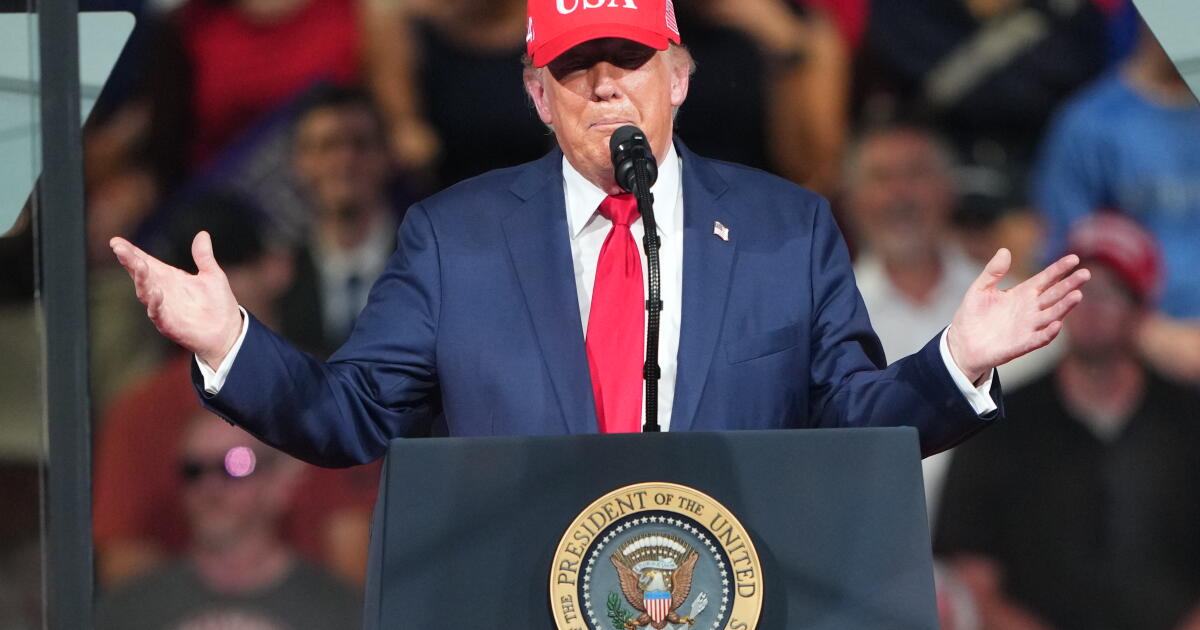
WASHINGTON — President Trump on Friday said the U.S. has entered an agreement with Venezuela to take control of 65 billion barrels of the South American country’s oil reserves.
Trump in a social media post announced the agreement he said was negotiated by Secretary of State Marco Rubio, Defense Secretary Pete Hegseth and Venezuela’s interim President Delcy Rodríguez.
“The United States of America has just entered into an Agreement with the Country of Venezuela on, THE BIGGEST OIL DEAL IN WORLD HISTORY!” Trump wrote.
The Venezuelan government’s press office did not immediately respond to a request for comment.
The announcement of the deal comes nearly nine months after the U.S. military at Trump’s direction carried out an operation to capture Venezuela’s president Nicolás Maduro and spirit him to the United States to face federal narcoterrorism and drug trafficking charges.
Trump faces mounting pressure to address high gas prices as the war in Iran on Friday reached a six-month milestone with no conclusion in sight. The U.S. has tapped its strategic petroleum reserves, which in early August fell below 300 million barrels, down by more than 100 million barrels since the start of 2026.
The U.S.-Israel war against Iran has led to a dramatic slowdown of Gulf oil moving through the Strait of Hormuz, which about 20% of the world petroleum passed through prior to the conflict.
The average price of gas in the U.S. stood at about $4.09 a gallon on Friday, according to AAA. The average price was $3.21 at the same time last year.
Trump in his social media post Friday evening alluded to the Venezuela deal being part of a private partnership. The White House did not immediately reply to a request for comment about the private sector partners involved in the deal, and details on how the arrangement would work were not provided.
Persuading big American oil companies to return the region could face headwinds given and decades of badly damaged infrastructure.
Days after the ouster of Maduro, Trump gathered oil executives at the White House and called on them to rush back into Venezuela. Executives expressed interest in the opportunity but there was also a measure of caution given their past experience in the country.
Darren Woods, CEO of ExxonMobil, the largest U.S. oil company, said at that moment he saw the country as “un-investable.”
But Trump has insisted that his administration has brought a measure of stability to Venezuela.
He has argued that Venezuela stole U.S. oil when former Venezuelan President Hugo Chávez’s moved decades ago to nationalize hundreds of foreign-owned assets, including those owned by American oil companies.
Rodríguez, in one of her early moves after taking power, signed a law that opens the nation’s oil sector to privatization and reversed a bedrock tenet of the self-proclaimed socialist movement that had ruled the country for more than two decades.
Rubio said on X that the agreement would usher in $100 billion in private investment into Venezuela and lead to lower gas prices in the United States.
“This deal is a huge win for both the American and Venezuelan people,” Rubio posted.
Venezuela has one of the largest oil reserves in the world, with an estimated 303 billion barrels of crude oil in the ground. That’s about 17% of the world’s supply, according to the U.S. Energy Information Administration.
Madhani and Binkley write for the Associated Press. Regina Garcia Cano in Caracas contributed to this report.
The Trump administration is considering trading a parcel of Yosemite National Park to a private commercial developer, according to administration officials, members of Congress and documents reviewed by The Times.
The proposed deal would allow the developer to build a road connecting adjacent property it already owns in the Stanislaus National Forest to a service road within Yosemite, providing any future development on that property with unique access to the famed public wilderness, documents show.
According to a Friday report by the news outlet NOTUS, Trump administration officials have been quietly pressuring the National Park Service to approve the deal for the land despite such pressure being highly unusual and previous proposals for the land being repeatedly denied under the Bush and Obama administrations and in court.
The Department of the Interior, which includes the National Park Service, acknowledged in a statement to The Times on Friday that a land deal is under consideration, but denied any inappropriate influence from the White House.
It said negotiations for the land will comply with all federal rules for federal lands, and that “no final decisions have been made.”
An attorney for the private developer said the deal has nothing to do with politics and is in fact an “environmentally friendly” solution, in that it would dramatically cut down on the amount of driving the future upscale development’s residents would have to do to access the park.
President Trump speaks to astronauts aboard the International Space Station as he visits NASA’s Mission Control Center on Aug. in Houston, Texas.
(Win McNamee / Getty Images)
Congressional Democrats — including Sens. Alex Padilla and Adam Schiff of California — are trying to block the deal, after being informed of it earlier this year by the Land and Water Conservation Fund. The fund was created by Congress in 1964 to safeguard natural areas and public lands, and often works to acquire lands to add to national parks.
A fact sheet on the project reviewed by The Times identified the parcel by a former name, the “Hazel Green Ranch,” and said the landowner is seeking to acquire an “interest” in land within the park in order to build a new road connecting “a planned commercial development” to Big Oak Flat Road, an existing federally owned road that “provides access to the park and is a major route to Yosemite Valley.”
The fact sheet said the National Park Service does not have the authority to grant that interest, but has been working with the landowner to facilitate an “exchange” of the land for some other, unidentified parcel of land that is beneficial to the U.S., as allowed under law for federal land swaps.
The project has been identified to lawmakers, without explanation, as a “priority.” Both Padilla and Schiff have objected to it, and Padilla’s office said it is working with Senate Appropriations Committee staff to block the deal.
“The Land and Water Conservation Fund exists to acquire land and interests in land in order to safeguard natural areas, water resources, and cultural heritage — and to provide recreation opportunities for all Americans,” Padilla said in a statement to The Times. “Projects should be chosen on merit, not on an applicant’s connections to high-ranking Trump administration officials.”
Schiff, in his own statement, said Yosemite is “one of California’s natural wonders, and must be protected from further development.”
He said the Trump administration “appears hellbent on moving forward in the face of opposition from the public, Congress and the courts,” and that “the only thing the administration cares about is whether there is money involved.”
The company behind the private development is Nevada-based real estate developer and investment firm Kingsbarn Realty Capital. According to Federal Election Commission records, Kingsbarn CEO Jeff Pori is a donor to Trump, the Republican National Committee and other Republican groups.
Lanny Davis, a former special counsel to President Clinton, represents Kingsbarn, and said the notion the project is moving forward due to Trump administration pressure and Pori’s political contributions despite being environmentally detrimental is false.
He said Kingsbarn wants to build “upscale, single-family houses” on its property, but hasn’t so far because residents would have to drive 28 miles using current roads to reach the park.
To cut that distance down and make the development more feasible, it asked the National Park Service to purchase an 11-mile strip of land within Yosemite to build a shorter, more direct access road, Davis said.
The Park Service responded by saying the company could not purchase park land directly, but could purchase other nearby land of equal or greater value, and then swap it for the park land, Davis said.
It is now working with the Interior Department to identify such land, and is “very close” to doing so, Davis said — calling it a “pro environmental solution” that follows federal law and has “nothing to do” with Pori’s politics.
The White House referred questions about the proposed deal to the Interior Department.
In its statement to The Times, the Interior Department said the NOTUS story “relies on anonymous allegations to manufacture a political narrative that simply is not true. There has been no political pressure to reach a predetermined outcome, and claims suggesting the Department is secretly working to hand over National Park Service land to a private developer are false.”
If a proposal does advance, the statement said, the department will follow established procedures with “transparency and public involvement consistent with federal law. Anonymous speculation does not change those facts.”
The department did not respond to a request for more details as to the proposal.
The land in question represents a tiny portion of the sprawling Yosemite National Park, which is nearly 750,000 acres in total — or roughly the size of Rhode Island. Still, slicing off any piece of the California wilderness — considered a crown jewel in the national park system — runs counter to promises from Trump and Interior Secretary Doug Burgum.
“My Administration is committed to protecting every acre of our lands and preserving the cleanest air and water in the world,” Trump said in a presidential message on Monday.
Ceding federal lands is also anathema to land preservation groups, which expressed dismay at the idea that any piece of Yosemite might be lost, no matter how small.
Aaron Weiss, executive director of the Center for Western Priorities, said that the NOTUS reporting was “consistent” with what his organization has been hearing “for several months” — and would be inconsistent with public desires for national park lands.
“The American people have consistently said that our public lands, especially our national parks, are not for sale,” he said. “If Secretary Burgum spent more time listening to Americans instead of indulging President Trump’s whims on the National Mall, he’d understand what a terrible idea this is.”
Jayson O’Neill, a spokesman for the group Save Our Parks, said the proposed deal as described by NOTUS represented the latest attempt by the Trump administration and Burgum to gut the Park Service and “then quietly cede treasured park land to private developers, thinking nobody’s watching.”
“National parks belong to the American people, not monied developers who are part of Trump’s donor class,” O’Neill said.
Mark Rose, senior Sierra Nevada program manager for the National Parks Conservation Assn., slammed the proposed land swap as a “secretive, backroom deal” and “an attack on the American people that own this national park.”
He said Yosemite is already facing overcrowding due to “run-away lodging” development outside its borders and the Trump administration’s decision to do away with the park’s reservation system, and a new development would “exacerbate the chaos.”
“The National Park Service needs to get back to prioritizing conservation, not helping bulldoze land, cut down towering trees and construct a luxury development that will harm Yosemite’s wildlife and increase wildfire risks,” Rose said.
California lawmakers have passed legislation that will make it easier for government agencies to protect themselves from the rising use of artificial intelligence for public comment, records requests and other forms of civic engagement.
Senate Bill 1159 from Sen. Christopher Cabaldon (D-West Sacramento) prohibits anyone from knowingly using AI to falsely represent that a real person engaged with a government agency. It also specifies that agencies are not required to treat engagement from AI or bots as if they were real humans.
“What we have seen with the result of the advent of artificial intelligence and other similar technologies is the capability for these systems to flood the zone — to drown local governments, and potentially state agencies as well, in inauthentic, non-human engagement” Cabaldon said during a March meeting of the Senate Judiciary Committee.
The legislation was introduced shortly after a February report from The Times about a campaign to sway a vote on gas-powered appliances at the South Coast Air Quality Management District. A Southern California based public affairs consultant named Matt Klink took credit for the campaign, stating that he used a platform called CiviClick to flood the district with 20,000 public comments opposing the rule ahead of the air board’s vote.
CiviClick describes itself on its website as “the first and best AI-powered grassroots advocacy platform.” Company officials maintain that AI was not used in the AQMD campaign, but said it is a tool they offer and use in other campaigns. Chief executive Chazz Clevinger said he could not share how the 20,000 comments to the air board were generated or how constituents were identified and contacted.
Agency insiders said the onslaught of emails almost certainly influenced the air board’s decision to reject the proposed rules, which would have imposed fees on new gas-powered furnaces and water heaters for some 10 million appliances across the South Coast region.
Cabaldon cited The Times story when he introduced the legislation, noting that at least three people contacted by the air district said they had not submitted the public comments attached to their names.
He also cited a report from the San Francisco Chronicle about a similar campaign to sway a different rule at the Bay Area Management District, which was run through a platform called Speak4 that advertises its ability to produce custom AI-powered letters.
The business advocacy group that ran the campaign also denied that AI was used. However, 10 people contacted by The Chronicle said they had not written the letters attributed to them. “This was forged,” one person said.
Reached by phone, Cabaldon said the legislation will help public agencies navigate how to respond to the deployment of AI, which is increasingly being used in a way that “swamps our civic engagement process, but also disables our state and local governments altogether.”
For example, the California Public Records Act requires government agencies to respond to requests for public records within 10 days, while the Brown Act and the Bagley-Keene Open Meeting Act guarantee the right to participate in public meetings and provide public comment.
“The point of the bill is to say that these laws are about humans, and just because it comes in the form that a human would write it, does not mean you have to treat each of these communications as if it’s a human being, and therefore, AI is not entitled to 10 days, AI is not entitled to three minutes at the school board meeting,” he said.
Experts said the use of AI for “astroturfing,” or faking, civic engagement is a growing trend. In the United Kingdom, a service called Objector.ai is using AI to identify and generate formal objections to local planning applications, garnering the concern of experts, The Guardian reported.
Public officials in California are worried, too. Vacaville vice mayor Michael Silva said the city has been receiving AI-generated public records requests, which are slowing its ability to respond to other legitimate requests submitted by residents.
Dylan Plummer, deputy director of the Sierra Club’s Clean Heat Campaign, said many AI campaigns have benefited the fossil fuel industry and pose an “existential threat to public participation in our democracy.”
“The passage of Senate Bill 1159 is an important step to clarify the law and discourage the use of emerging technologies to falsify public records and mislead regulators in California,” he said. “That said, much work still needs to be done to understand how widespread this practice is, and to hold bad actors accountable for laws that may have already been broken.”
Lawmakers acknowledged that the legislation is just a start, and that it is increasingly difficult for public officials to detect bespoke letters, deepfake videos or other kinds of engagement powered by AI. The bill authorizes government agencies to use disclosure verification tools to determine if AI is present — something the Bay Area Air District already indicated it may do by replacing its email system with a website for public comment submissions instead.
The legislation does not preclude real people from using AI to facilitate genuine public engagement, such as someone using ChatGPT or Perplexity to improve the text of a letter, so long as the volume and frequency of their engagement are consistent with ordinary participation from a real person.
For its part, CiviClick notes on its website that it supports SB 1159, and said its platform already complies with what the bill proposes.
Some lawmakers said the use of AI in a civic capacity represents a new frontier.
“If I’d have read this bill back when I was on the Sacramento County Board of Supervisors, I would have wondered what you were smoking,” Sen. Roger Niello (R-Fair Oaks) said during the March meeting of the Judiciary Committee.
“But that’s how things have progressed, and the development of technology will always outpace the development of defenses against the undesirable effects of technology,” he said.
SB 1159 passed the legislature this month and will head to Gov. Gavin Newsom’s desk for signature in September.
SAN JUAN, Puerto Rico — Atty. Gen. Todd Blanche’s fidelity to President Trump nearly cost him his confirmation. Now comes Blanche’s real test.
Trump’s former personal attorney has stepped into the commanding role facing a challenge that other leaders of the Republican president’s Department of Justice could not overcome: threading the needle between Trump’s boundary-busting demands and a prosecutor’s duty to uphold the rule of law. At the same time, Blanche must try to stabilize a workforce shaken by an exodus of experienced lawyers and an erosion of trust in the judicial branch.
In a wide-ranging interview with the Associated Press during a trip to Puerto Rico this week, Blanche promised to lead the department with integrity, dismissing concerns from critics who say his actions so far — including an indictment against longtime Trump foe and former FBI Director James Comey — call into question whether Blanche is still functioning as Trump’s personal lawyer.
A slew of ongoing politically charged investigations under Blanche’s watch could force him to choose between his long-standing loyalty to the president and the foundational principles of the Cabinet agency he leads. At stake is the fate of a department already reeling under a president who has made clear his desire for retribution over the criminal scrutiny he faced.
“My integrity, my commitment to the rule of law is the same today that it was the day I graduated,” Blanche told the AP when asked where he would draw the line on requests from the White House. “I would never do anything unethical or improper or violate my oath, no matter the circumstances.”
Critics disagree.
As acting attorney general, Blanche came under fire from lawmakers, including many Republicans, for signing off on a $1.8 billion fund meant to compensate Trump’s allies who believed they were politically prosecuted. He also greenlit a deal that granted Trump, the Trump Organization, and two of his sons immunity from tax audits. Those moves, unusual steps aimed at granting the president and his allies far-reaching benefits, put Blanche’s confirmation at risk, prompting key senators to express concern.
Blanche, like Trump’s other attorneys general, walks a tightrope
In the AP interview, Blanche addressed criticism of the department under his leadership, his priorities as attorney general and losses the administration has had in high-profile cases. He also depicted the Justice Department as an institution whose independence had eroded long ago — a characterization at odds with decades of fierce autonomy that challenged the highest echelons of power in Washington and beyond.
Blanche, a former federal prosecutor in New York, is walking the same tightrope as Trump’s three other Senate-confirmed attorneys general. They found their pledges to uphold the rule of law and the department’s ethical norms at odds with the president’s demands to bend the institution to his will.
During Trump’s first term, one attorney general infuriated Trump over his withdrawal from an investigation into Trump’s winning White House campaign and was forced out. Another submitted his resignation weeks after breaking with Trump over Trump’s false claims of election fraud. Blanche’s immediate predecessor, Pam Bondi, was ousted in April after failing to deliver successful prosecutions against the president’s political enemies.
Blanche’s narrow confirmation this month over opposition from two Republican senators underscored growing concerns about the dismantling of the Justice Department’s long-standing tradition of independence from the White House, which is meant to protect the impartiality of politically sensitive investigations and prosecutions.
Concerns that the Justice Department is being weaponized
Blanche bristles at the suggestion that the Justice Department should be independent of the president and he has made clear his view that the executive has both the power and the right to shape and control the law enforcement agency.
He has staunchly defended the integrity of cases the administration has brought against the president’s perceived political opponents, often pointing to his own experience representing Trump in criminal cases brought by Democratic President Joe Biden’s Justice Department. Blanche and the president have characterized those cases as politically motivated.
“I think attorneys general and others have said, ‘Oh, we’re independent.’ I don’t think that’s actually true,” Blanche told the AP.
Blanche claimed the Justice Department was not truly independent when he was a federal prosecutor or during the Biden administration. But that characterization ignores the fact that under Biden, the Justice Department investigated Biden himself over his handling of classified documents and secured felony charges in two separate cases against his son Hunter before Biden pardoned him.
The two criminal cases filed by special counsel Jack Smith against Trump were based on allegations, supported by long-running investigations, that Trump had classified documents at his Mar-a-Lago estate in Florida and obstructed government efforts to get them back, and conspired to overturn the 2020 election.
Growing distrust of the Justice Department among judges
Blanche has sought to highlight the administration’s focus on tackling illegal immigration, violent crime and drug-trafficking cartels, spotlighting cases such as the takedown of a Puerto Rican gang that he announced during his visit to the U.S. island territory.
But Blanche’s policy priorities are often overshadowed by a growing number of investigations that have drawn criticism that the department is being used as a weapon in the president’s campaign of retribution.
Blanche’s supporters have argued that the close relationship he developed with Trump while serving as his criminal defense lawyer can make him more effective at pushing back on or explaining the legal constraints of the president’s demands. Others wonder whether he will fare any better than Bondi up against the same skeptical court system, and factual and legal hurdles, that impeded efforts to deliver the sought-after results.
Blanche is also confronting growing distrust of the Justice Department among judges, who in multiple cases have accused government lawyers of withholding information or misleading courts. Courts in some cases have quashed subpoenas or ordered the review of grand jury transcripts, and the criminal cases against Comey and New York Attorney General Letitia James were dismissed after a judge found the prosecutor who brought them was illegally appointed.
But Blanche played down concerns that the erosion of judicial trust could impede his efforts to advance his agenda.
“The isolated incidents that make the news are not reflective of the way the bench feels in my view, or the way prosecutors are doing their job around the country,” Blanche said.
Richer writes for the Associated Press. AP writer Eric Tucker in Washington contributed to this report.
PHOENIX — The Trump administration has begun work on a project to build a stretch of border wall in southern Arizona along part of a Native American tribe’s reservation, pushing ahead with one of its signature projects despite protests from the tribe.
U.S. Customs and Border Protection says the area is a dangerous smuggling route and that building the wall will close a longstanding security gap. But members of the Tohono O’odham Nation, whose membership spans both sides of the U.S.-Mexico border, have accused the administration of trespassing and say the construction will damage land sacred to the tribe.
The wall segment is part of a $46 billion effort by the Trump administration to fill the border with 30-foot steel bollard walls, vehicle barriers, and technology designed to stop undocumented immigration and smuggling.
But as building efforts have ramped up, the administration has run into opposition from landowners, environmental groups, and Native American tribes who say construction is violating property rights and desecrating sacred Indigenous sites.
The Tohono O’odham Nation said in a statement Tuesday that about 20 Customs and Border Protection officers, working with contractors, went onto the tribe’s land early that morning to begin construction.
Drone videos published by nation officials show roughly 14 vehicles and an industrial drill at one of the sites.
A federal judge permitted the government to move forward with construction earlier this month, but the tribe says the contractors are violating tribal codes and trespassing to access the border wall site.
The Tohono O’odham Nation, which has 37,000 members including thousands who live in Mexico, sued the federal government in June in an attempt to block construction of the border wall. The tribe argued that the wall would cause “significant devastation” on the reservation, including the destruction of mountain peaks sacred to the tribe, and would alter boundaries of their nation.
U.S. District Judge Richard Leon in Washington, an appointee of former President George W. Bush, ruled in favor of the government, noting that the border wall would be built on a 60-foot wide buffer zone of federally owned land called the Roosevelt Reservation.
“Defendants have not yet articulated plans to construct outside the Roosevelt Reservation,” the judge wrote in his opinion.
The Tohono O’odham Nation said that even if construction were contained to the Roosevelt Reservation, driving onto tribal land to access the area still constitutes trespassing.
“The contractors, who are on the Nation illegally, were accompanied by agents as they worked on three separate locations near the border with drill trucks to conduct soil sampling and other activities,” tribal officials said in a statement.
The CBP agents were masked, armed, and set up a vehicle blockade to stop tribal police from removing the contractors, according to Tohono O’odham officials. The nation had set up “No Trespassing” signs before Tuesday.
So far, no physical confrontations between police or members of the Tohono O’odham Nation have been reported.
CBP defended the need for the wall in a statement Tuesday, saying the desert spanning the Tohono O’odham Nation is a corridor for drug smuggling.
“The project will close one of the most dangerous smuggling and trafficking corridors on the Southwest border: remote desert that has facilitated decades of drug loads, migrant deaths, and cartel activity,” said CBP Commissioner Rodney Scott.
Tribal officials said they’re exploring further legal actions in an effort to remove contractors.
SLSCO Ltd., the Texas-based construction company building the section in Arizona, has secured over $390 million in funding from the Department of Homeland Security to build the border wall since 2023.
WASHINGTON — Thousands of protesters are rallying Friday on the National Mall in support of voting rights and racial justice ahead of the midterm elections, following a wave of changes to voting laws and redistricting that civil rights groups have condemned as detrimental to Black Americans.
The 2026 “Defend the Vote” March on Washington, organized by the Rev. Al Sharpton and Martin Luther King III, echoes the Rev. Martin Luther King Jr.’s 1963 march. The event follows the U.S. Supreme Court’s landmark April decision in Louisiana v. Callais that reinterpreted key provisions of the Voting Rights Act of 1965, allowing Southern states to redraw their congressional maps in a way that erodes equal representation in Black communities.
“We’ve been doing these marches for years, but this is probably the most important because this is the first year we are marching that the voting rights bill has been nullified by the Supreme Court,” Sharpton, founder of the National Action Network, said in an interview with The Associated Press.
“Marches are designed to grab attention and then go into the trenches and organize around that,” he said.
The march opened with prayer and statements from Interfaith Alliance representatives. They spoke on diversity, equity and inclusion practices, voting rights and systemic racism.
“Creator of all, let us draw on each other, with love and mercy, and hold each other up as we march, wipe each other’s tears, heal each other’s wounds,” Ambereen Kahn, an Interfaith Alliance representative, said. “Most compassionate, protect our leaders who guide, instill in their hearts the values of our shared humanity.”
This year’s march, which Sharpton’s group is co-hosting with King’s Drum Major Institute, a progressive think tank and community action group, features dozens of speakers, including Sen. Bernie Sanders, I-Vt., Virginia Gov. Abigail Spanberger and Rep. Alexandria Ocasio-Cortez, D-N.Y.
Sharpton said thousands of civil rights activists from across the southeastern U.S. were traveling to the capital by bus for the rally.
Event echoes iconic Lincoln Memorial rally
On Thursday, Courtney Pope, 48, was marching across the King Bridge to the Civil Rights Museum in Memphis. But on Friday, she and other members of the National Handmaid Army were at the Washington march with plans to travel to New York and New Jersey over the next few days.
For Pope, the rally is about finding community alongside promoting voting rights.
“I know that we’ll only be successful if we band together despite our differences,” Pope said.
Friday’s event harkens back to King Jr.’s historic March on Washington for Jobs and Freedom in 1963, when more than 200,000 people gathered at the foot of the Lincoln Memorial. That march, an inflection point in the Civil Rights Movement, came at a fraught moment for the country, when economic headwinds, civil unrest, political division and the Vietnam War bitterly divided Americans.
Sharpton said the Trump administration’s immigration policy for Haitians and white South Africans, as well as cuts to social programs like Medicaid and the Affordable Care Act’s health subsidies, are unifying policies for this year’s ideologically diverse march attendees. But the redistricting efforts by Republican-led states set to reduce the number of Black lawmakers in Congress loom large over Friday’s march.
“This march is about people who refuse to be counted out. When the courts and the legislature broke apart District 6, they did not just redraw lines,” Rep. Cleo Fields, D-La., said in a texted statement. “They told hundreds of thousands of Black families from Baton Rouge up through the Delta that their voice could be taken away at any moment.”
Fields was the central character in the Supreme Court decision that hollowed out the Voting Rights Act of 1965. The court ruled that his district, created just one term ago to permit a second majority-Black district in a state where Blacks make up 33% of the population, was unconstitutional because it relied too heavily on race.
The court has held that maps can be redrawn for partisan reasons.
Louisiana’s legislature rushed to redraw the district after the high court’s decision, reshaping Fields’ district to cluster it around predominantly white communities in the Baton Rouge area and southern Louisiana.
Fields has opted not to seek reelection to Congress and instead is pursuing a seat in the state Senate.
“The people taking part in this historic march are answering back, and history will remember that they did,” Fields said.
Embattled Black lawmakers see need for continued rights push
Rep. Shomari Figures, an Alabama Democrat whose majority-Black district was targeted by the state’s Republican-led redistricting effort, said the original voting rights fight required local movements, national figures, lots of coordination and strategy. He sees this year’s march as a continuation of that legacy.
“My district includes Montgomery, which was the birthplace of it all. It started with a bus boycott in 1955 and that, ultimately, morphed into a broader struggle for civil rights and led to a more broad Civil Rights Movement,” Figures told the AP.
“It led to a Civil Rights Act, led to the Fair Housing Act, led obviously to the Voting Rights Act, and the voting rights movement,” Figures added.
Ahead of Friday, organizations participating in the march, including the NAACP, the Lawyers’ Committee for Civil Rights Under Law, and Black Voters Matter, filed new claims in federal court in their existing lawsuit against President Trump’s executive order restricting mail-in voting. The Supreme Court cleared a path Monday for possible implementation of the order, though it remains unclear how much can be put in place before the midterms.
“We will not stand idly by while the voices of the people are silenced,” NAACP President Derrick Johnson said in a statement Thursday. “We must protect every eligible citizen’s right to cast their ballot.”
Brown and Junkroski write for the Associated Press. AP writers Gary Fields in Washington and Kimberly Chandler in Montgomery, Ala., contributed to this report.
Two of the highest-ranking law enforcement officials in California are publicly sparring over the integrity of state elections, trading barbs on social media that highlight the fierce partisan divide on the issue heading into the November midterms.
In a post to X on Wednesday, First Assistant U.S. Atty. Bill Essayli, the top federal prosecutor in Los Angeles, accused California Atty. Gen. Rob Bonta, the state’s highest-ranking law enforcement official, of fighting to “preserve non-citizens’ access to mail ballots” and “shield fraudsters and illegals from accountability.”
On Thursday, Bonta fired back, accusing Essayli of being “more interested in currying favor with a desperate wannabe dictator” — a reference to President Trump — “than upholding the law himself.”
Bonta and Essayli’s back-and-forth followed an announcement from Bonta that California and 24 other Democratic-led states were suing to block the U.S. Postal Service from implementing new nationwide rules on mail ballots that were developed at Trump’s behest.
Late Thursday, a federal judge sided with the states, issuing a temporary restraining order halting the implementation of those rules as the litigation continues. An appeal is likely.
Such a public and personal rift between Bonta and Essayli is highly unusual and has broader implications, given the California Department of Justice and the U.S. Attorney’s Office in Los Angeles coordinate on statewide law enforcement initiatives and traditionally maintain a cordial relationship.
They have worked together in recent years to target Los Angeles street gangs trafficking guns and drugs statewide, as well as international drug syndicates trafficking fentanyl and other narcotics through L.A.
The U.S. Justice Department at times finds itself on the opposing side of litigation involving local or state law enforcement partners, including in cases in which it investigates local police departments for civil rights violations and forces them into consent decrees, as it has done with the Los Angeles Police Department.
However, it is extremely rare for U.S. attorneys and top state law enforcement officials to engage in direct attacks on each other’s integrity — or the integrity of state voting processes, which both are tasked with defending. Federal prosecutors in particular have historically sought to avoid the appearance of political partisanship and rarely taken aim at elected officials over policy matters.
That tradition certainly has faltered under Trump, who has filled the Justice Department with outspoken loyalists who make no secret of their allegiance to him. And Essayli, the administration’s embattled appointee to lead one of the largest federal prosecutor’s offices in the country, has been no exception.
Essayli did not respond to a request for comment on the public exchange Thursday.
A spokesperson for Bonta’s office, which has sued this Trump administration more than 85 times, said in a statement that office staff regularly work with the U.S. Justice Department and federal prosecutors to keep Californians safe, and that work won’t stop “just because some are dead set on politicizing our work and theirs.”
At a news conference this week touting major crime declines in the state, Bonta said partnerships with both local and federal law enforcement remain a vital part of public safety in the state.
“That remains the secret sauce — the magic — when it comes to making our communities more safe. Working together, collaborating, sharing intel and resources and teaming up,” he said. “That remains a priority and is behind a lot of our success.”
Still, the new Postal Service rules sparked a clash. The rules require states to submit lists of eligible voters to the Postal Service and to use new ballot envelopes with digital bar codes that would allow the Postal Service to identify and reject ballots that don’t match those lists. Trump requested the changes as part of a broader executive order in March to combat what he claims is widespread voter fraud across the country and particularly in big blue states such as California.
Independent election experts say there is zero evidence of such problems existing in significant numbers. The Trump administration has said that is because states are keeping voter rolls secret and refusing to cooperate with federal efforts to vet them for noncitizens and other ineligible voters.
On Monday, the U.S. Supreme Court lifted a separate lower court ruling blocking the Postal Service changes, on the grounds that they had yet to be implemented and had not yet caused any harm to the states challenging them. The high court made clear, however, that it was not weighing in on the substance or merits of the rules themselves.
Essayli has long made allegations of voter fraud in California, and lawyers in his office were involved in an unsuccessful lawsuit in which the Justice Department sought California’s unredacted voter rolls. After the Supreme Court issued its ruling, and Gov. Gavin Newsom pledged the state would sue again, Essayli responded to defend the administration’s efforts.
“These measures wouldn’t be necessary if states like California didn’t allow non-citizens to easily register to vote and get mail ballots,” he wrote. “We are actively identifying ineligible citizens on California’s dirty voter rolls and will soon announce criminal arrests related to our election fraud investigation.”
Essayli’s office did not respond to a request for information on those alleged arrests or its broader investigation.
Then, on Wednesday, Bonta, who is seeking reelection in November, announced the latest lawsuit challenging the merits of the Postal Service rules, which he noted had been formally issued last week. He called the rules “an unlawful overreach that shows just how far President Trump will go to control elections,” and the state’s lawsuit an effort to “protect election integrity.”
Essayli soon replied, writing, “What election integrity? You’re fighting to preserve non-citizens’ access to mail ballots. I’ve never seen a state AG fight this hard to shield fraudsters and illegals from accountability. Imagine if he used his efforts to protect citizens.”
On Thursday morning, Bonta replied. “Simply untrue. We’re fighting to uphold the constitution and protect California’s right to administer our own elections,” he wrote.
“If you’re really concerned with election integrity, might I suggest starting with Donald Trump who: asked for 10,000+ votes from election officials in Georgia, fueled January 6, seized ballots, and issued two blatantly unlawful elections executive orders,” Bonta said.
After he lost the 2020 presidential election to Joe Biden, Trump called Georgia Secretary of State Brad Raffensperger and asked him to “find 11,780 votes” for Trump to swing the state from Biden to him.
A later congressional investigation found that Trump provoked his supporters into attacking the U.S. Capitol on Jan. 6, 2021, in an attempt to prevent the certification of Biden’s win. This January, the FBI raided and seized ballots from an election center in Fulton County, Ga. — a focus of Trump’s 2020 election denial.
“Trump has repeatedly shown he’ll stop at nothing to interfere in our elections. He’s repeatedly broken the law, so we’ve repeatedly taken him to court,” Bonta continued in his post. “Unfortunately, it appears that the First Assistant is more interested in currying favor with a desperate wannabe dictator than upholding the law himself.”
In agreeing late Thursday to halt the Postal Service rules, U.S. District Judge Indira Talwani wrote that the court did not have “any evidence regarding fraudulent absentee or mail-in voting” before it, and that the Postal Service’s “interest in correcting an unsubstantiated problem through likely unconstitutional means is dwarfed by the overwhelming risk of pervasive disenfranchisement of citizens who need access to mail ballots in order to vote.”
Bonta, back on X, praised the ruling, writing, “President Trump must keep his hands off our elections.”
WASHINGTON — For the last six months, President Trump has attempted to control the narrative of the Iran war.
As days, weeks and months passed, he repeatedly said that an agreement to end the conflict was close at hand and that Iran was already defeated. Between fraught negotiations, Trump has gone from conciliatory to antagonistic, characterizing Iran’s new leadership as more “rational” than their predecessors, only to later call them “sick individuals.”
There have even been times the commander in chief contradicted himself and his own Cabinet in the same week — and sometimes, the same day.
Friday marks the sixth month of the war launched by the U.S. and Israel. Among U.S. forces, there have been at least 18 killed and 758 wounded, according to Pentagondata. The Human Rights Activists News Agency puts the death toll in Iran at 3,636. In Lebanon, officials, say more than 4,300 have died. The Israeli military reported 72 deaths, and at least 50 civilians have died, according to news reports.
Here is a recap of notable comments Trump made in public remarks and on social media during half a year of war:
What he said: “The United States military has undertaken a massive and ongoing operation to prevent this very wicked, radical dictatorship from threatening America and our core national security interests.”
In announcing the start of Operation Epic Fury from the White House, Trump called Iran the world’s No. 1 state sponsor of terror and recalled actions by Iran or its proxies, such as the hostage crisis of 1979 and the bombing of a Marine barracks in Lebanon in 1983 that left 241 dead.
The goals of the operation, Trump said, were to destroy Iran’s nuclear ambitions, its naval capabilities and missile industry and to ensure that Iranian proxies — including Hezbollah and Hamas — were thwarted. He implored Iranian citizens to rise up against the government.
Women carry the casket of a teacher from Shajareh Tayyebeh Elementary School toward the cemetery in Minab, Iran, on March 30. The teacher was among those killed in a missile strike on Feb. 28, the first day of the war on Iran.
(Zohreh Saberi / For The Times)
What happened: That morning the U.S. and Israel conducted airstrikes on Iran, killing Supreme Leader Ayatollah Ali Khamenei as well as other key military and government figures. According to Iran’s Red Crescent, 24 of Iran’s 32 provinces were hit in the first day of bombings, with more than 200 deaths and 700 injuries reported. Iranian officials said that at least 120 students and 26 teachers died in a missile strike on Shajareh Tayyebeh Elementary School in Minab.
Iran retaliated by launching missiles at Israel and U.S. bases in Saudi Arabia, Iraq, Jordan, Kuwait, Bahrain, Qatar, United Arab Emirates. The Islamic Revolutionary Guard Corps also warned ships to not travel through the Strait of Hormuz, the passageway for 20% of the world’s oil and energy supplies.
What he said: “We grieve for the true American patriots who have made the ultimate sacrifice for our nation, even as we continue the righteous mission for which they gave their lives. Sadly, there will likely be more.”
In an interview with the New York Times, Trump was asked how long the U.S. and Israel could sustain its offensive in Iran. “It won’t be difficult,” he replied. “We have tremendous amounts of ammunition. You know, we have ammunition stored all over the world in different countries.”
What happened: An Iranian one-way drone attack was launched against the industrial Port Shuaiba in Kuwait, where American soldiers set up an operations center after abandoning the larger Camp Arifjan military installation.
What he said: “We projected four to five weeks, but we have capability to go far longer than that.”
At a Medal of Honor ceremony at the White House, Trump assessed the progress of the attacks on Iran, saying the U.S. was “already substantially ahead of our time projections.”
Retired Command Sgt. Maj. Terry P. Richardson is presented the Medal of Honor by President Trump on March 2, the same day Trump said progress in the war on Iran was exceeding projections. ..
(Win McNamee / Getty Images)
What happened: The conflict expanded, with Iran-backed militant group Hezbollah in Lebanon launching drones against Israel.
Israel’s counter-strike would ultimately decapitate Hezbollah leadership, but strikes between the two forces would continue through the first week of war.
U.S. Central Command increased the number of U.S. troop deaths in the Kuwait strike to six from three.
What he said: “The war itself is going unbelievably. It’s as good as it can be.”
He said that the U.S. “wiped out” the Iranian navy, air force, drone manufacturing capabilities and “every form of leadership you can have,” adding that he was interested in being a part of the selection of Iran’s new leader.
He also said that he believed the strike on the Minab school was a misdirected missile launched by Iran. He offered no evidence.
The family of 8-year-old Reza Habashian, a second-grader killed in the strike on Shajareh Tayyebeh Elementary School, observes the Persian New Year at his graveside in Minab, Iran, on March 20.
(Zohreh Saberi / For The Times)
What happened: Iranian drone and missile strikes on gulf neighbors continued.
The day after Trump said Iranians had no existing leadership prospects, Mojtaba Khamenei, one of Ayatollah Ali Khamenei’s sons, would become the new supreme leader.
U.S. officials familiar with the preliminary findings of an investigation into the Minab school strikes leaked information to the New York Times that indicated the U.S. had bombed the school as a result of a “targeting mistake.”
What he said: “Watch what happens to these deranged scumbags today. They’ve been killing innocent people all over the world for 47 years, and now I, as the 47th President of the United States of America, am killing them. What a great honor it is to do so!”
In a Fox News radio interview with Brian Kilmeade, Trump said that an uprising by Iranian civilians appeared likely. “It’ll happen, but it probably will be, maybe not immediately,” he said.
What happened: Iran and Hezbollah continued joint attacks against Israel, while Israel continued its own large-scale strikes on Beirut and Tehran.
On March 13, a U.S. Air Force KC-135 Stratotanker — a refueling and airlift plane — crashed over Western Iraq without being attacked, resulting in the death of six more U.S. service members, Central Command announced. The U.S. death toll increased to 13.
What he said: “I think we won. All they’re doing is clogging up the Strait [of Hormuz], but from a military standpoint, they’re finished.”
Lightning streaks across the sky over an oil tanker on March 21 at Sultan Qaboos Port in Muscat, Oman.
(Elke Scholiers / Getty Images)
That same afternoon, in a post on his social media website, Trump said the U.S. was considering “winding down” military efforts in Iran.
What happened: The Pentagon said in a statement that it would send three warships and roughly 2,500 Marines to the Middle East for “routine training.”
What he said: “I am pleased to report that the United States of America and the country Iran have had, over the last two days, very good and productive conversations regarding a complete and total resolution of our hostilities in the Middle East.”
Trump also postponed military strikes against Iranian power plants and energy infrastructure after threatening to do so if Iran did not open access to the Strait of Hormuz.
What happened: Mohammad Bagher Qalibaf, Iran’s parliament speaker, responded to Trump’s claims in a post on X. “No negotiations have been held with the U.S.,” Qalibaf wrote, adding that he believed the U.S. was using the prospect of an accord to ease strain on financial and oil markets.
What he said: “The United States of America is in serious discussions with A NEW, AND MORE REASONABLE, REGIME to end our Military Operations in Iran.”
Iranian Foreign Ministry spokesman Esmail Baghaei, addressing journalists in Tehran on March 30, said a truce plan proposed by the United States contained “very excessive, unrealistic and unreasonable” demands.
(Shadati / Xinhua / Getty Images)
While saying in a social media post that progress had been made, Trump leveled additional threats if a pact wasn’t reached shortly. “We will conclude our lovely ‘stay’ in Iran by blowing up and completely obliterating all of their Electric Generating Plants, Oil Wells and Kharg Island,” he wrote.
What happened: Iranian Foreign Ministry spokesperson Esmail Baghaei once again rejected that direct talks with the U.S. had taken place, describing the proposed terms as “unrealistic, unreasonable and excessive.”
What he said: “We’re gonna hit them hard over the next two to three weeks. We’re gonna bring them back to the stone ages, where they belong.”
In an address to the nation, Trump also denied that a change of governments was ever a goal in attacking Iran.
What happened: Thousands more U.S. troops arrived in the Middle East amid continuous back-and-forth strikes. Iran hit an oil tanker off Qatar’s coast and fired missiles and drones at Jordan, which were intercepted. Israel carried out strikes on a Beirut neighborhood.
What he said: “A whole civilization will die tonight, never to be brought back again. I don’t want that to happen, but it probably will.”
Vice President JD Vance holds a cellphone up to a microphone while on a call with President Trump at an event on April 7..
(Jonathan Ernst / Pool Photo)
What happened: Trump’s post about a whole civilization dying went live around 5 a.m., but later in the day the U.S. and Iran announced a two-week truce. Iran’s Supreme National Security Council said in a statement that the truce did not “signify the termination of the war.”
What he said: “Effective immediately, the United States Navy, the Finest in the World, will begin the process of BLOCKADING any and all Ships trying to enter, or leave, the Strait of Hormuz.”
What happened: U.S. Central Command announced that the blockade of Iranian ports began at 10 a.m. Eastern. Central Command said the blockade would be “enforced impartially against vessels of all nations” entering or departing Iranian ports and coastal areas.
People pass in front of a pro-government political mural in Tehran on April 12.
(Majid Saeedi / Getty Images)
What he said: “I think it’s close to over, yeah. I view it as very close to being over.”
Trump’s comment to Fox Business anchor Maria Bartiromo on “Mornings with Maria” came two days after he announced the blockade of Iranian ports.
What happened: Though the ceasefire continued to hold, Iran officials had not relented on their right to enrich uranium, to maintain conventional defensive capabilities and to police traffic through the Strait of Hormuz.
What he said: “I didn’t guarantee no war. Why would I have built the strongest military in the world?”
In an interview with Kristen Welker of NBC on the 100th day of the conflict, Trump claimed that he had never promised during his campaign that he would not engage in new wars in the Middle East.
President Trump sits for an interview with NBC’s Kristen Welker.
(Adam Bettcher / NBC / Getty Images)
What happened: On multiple occasions during his 2024 presidential campaign, Trump suggested that he wouldn’t start new “endless wars.”
In a social media post in late June 2024, he framed the election as a choice between “peace and prosperity or war and no war.”
What he said: “It’s a memorandum of understanding, and if I don’t like it, we’ll go back to shooting at them, dropping bombs on their head.”
Trump spoke the same day he signed a 14-point Memorandum of Understanding with Iran to cease hostilities for 60 days. Trump put his signature to the memorandum while attending a dinner with French President Emmanuel Macron in Versailles.
French First Lady Brigitte Macron, President Emmanuel Macron and President Trump meet at the Palace of Versailles in France on June 17.
(Mustafa Yalcin / Anadolu / Getty Images)
What happened: The document set out a series of conditions, including the release billions of dollars in Iranian assets that were frozen and restricted by the United States “upon the implementation” of the memorandum.
Some issues, such as the future of Iran’s nuclear program, were set aside for negotiations down the road.
The White Housed pushed back on bipartisan criticism of the deal, arguing its concessions were contingent on Iran’s conduct.
What he said: “There may come a point when we are no longer able to be reasonable, and will be forced to militarily complete the job that we very successfully started. If that happens, the Islamic Republic of Iran will no longer exist!”
President Trump boards Air Force One on Aug. 9 at Morristown Airport in Morristown, N.J.
(Eric Lee / Getty Images)
What happened: Trump’s social media post came as Iran and the U.S. continued to carry out strikes in the Middle East despite the memorandum. CENTCOM announced that military surveillance, air defense sites and drone storage facilities were struck after an Iranian attack on a container ship, the Ever Lovely.
What he said: “Iran has been very, very badly damaged. They’ve lost everything, almost, militarily. … They’ve got very little left; They’ve got some missiles; They’ve got some drones; They’ve got some manufacturing ability, not much; We control the Strait.”
People gather July 19 on a bridge rendered unusable in a U.S. airstrike in Iran’s Hormozgan province. Iranian authorities said the United States carried out attacks on 95 locations in Iran over the previous 10 days.
(Amir Hossein Khorgooei / Anadolu / Getty Images)
What happened: According to a CENTCOM press release, the U.S. completed 13 nights of consecutive strikes against Iran by July 23, adding to an earlier announcement that Iran had attacked more than 30 commercial vehicles in the previous three months of conflict.
Trump made the comment in the Oval Office while back-and-forth strikes — primarily over control of the Strait of Hormuz — continued.
What happened: According to a report by NPR, Iran’s parliament aimed to block U.S. and Israeli access to the Strait of Hormuz, despite Trump’s assertion that the waterway was under his control.
What he said: “We are only semi-negotiating with them. We are just watching Iran with its huge inflation and the fact they have no money.”
Trump’s comments reflected how U.S. officials sought to readjust wartime strategy after multiple rounds of failed negotiations. Trump told Axios that he would not proceed with expanded strikes against Iran, as the U.S. was “low-keying” its approach to the conflict.
What happened: As the war approached its six-month mark, both sides mostly ceased military attacks, but shifted to economic pressure.
“ANY country that allows its financial institutions, businesses, airports, or government entities to provide any type of lifeline to Iran will itself face TREMENDOUS Economic Consequences,” Trump wrote in an Aug. 19 post, threatening “ECONOMIC D-DAY” if Iran did not comply with his demands.
According to Reuters, Qalibaf, the Iranian parliament speaker, said that the Strait of Hormuz would remain closed until military threats ceased and sanctions on Iran were lifted.
What happened: In a post on X three days before Trump’s “completely collapsing” post, the hard-line leader of Iran’s Supreme National Security Council had noted economic sanctions placed on Iran by previous presidents, including Obama and Biden, and said they had all failed.
“We have seen this movie before,” he wrote. “Same bull. Different bullies.”
Iranian President Masoud Pezeshkian and other officials attend an event at the mausoleum of Ayatollah Ruhollah Khomeini, the founder of the Islamic Republic of Iran, in Tehran on Aug. 23.
Not a stellar look for a politician relatively new to elected office.
After speaking with Hochman about the reversal, I have a more optimistic take on it — drawn from a Talmudic quote that Hochman keeps on his desk, and which his father — a tax lawyer who represented at least one mobster — kept on his desk before him.
It’s that double justice that holds weight in this situation, because, as Hochman explains it, his god rarely repeats himself without reason. Hochman said he reads that echo as referring to two parts of delivering justice — the process and the result.
“We try to get the right result. We try to get it in the right way,” Hochman told me.
When things go wrong, like they did in this case, he’ll reevaluate, he said, even if it leaves him with egg on his face.
“If that means that I have to publicly come out at a press conference and say that our initial decision-making, and what went into it, turns out not to have been perfect, and it is not set in stone, and we think there’s a better way of doing something, I’m going to stand up in a press conference and say exactly that,” he said.
A prosecutor who is willing to change his or her mind is critical to delivering real justice, because people get things wrong. Hochman holds incredible power over the thousands of lives entangled in the matters his office handles. Leaving that power of process in the hands of someone who can’t admit they made a mistake (as is the case with more D.A.’s than not) puts justice on a greased slide into a cesspool of hubris.
The distinction between the two forms of justice may seem like splitting hairs, but to anyone who has ever been involved with our justice system — as a victim or defendant, innocent or guilty — being dragged into a prosecution can often feel like an avalanche of misfortune.
Don’t get me wrong. I don’t think every person charged with a crime is a victim. There are plenty of predators out there, committing violations big and small, that require accountability.
But the process of administering justice is far more subjective and messy than we often admit. Sometimes, even when the prosecutor involved almost certainly knows something other than justice is in the works, there is a momentum of ego and bureaucracy that is hard to reverse.
And it doesn’t take a guilty verdict to derail a life. Simply having charges filed can mean a job loss, losing custody of kids, incarceration for months or years waiting for a trial, financial hardship and stigma.
We like to think of an innocent verdict as a great vindication, but by the time one arrives, if it does, a lifetime of damage may already have been done — that is the unseen power of process.
Just ask Daniel Flores, the LAPD officer whose case we’re talking about. Though he likely will eventually see all criminal charges dismissed, Flores told my colleagues Libor Jany and Richard Winton that this incident has “ruined” his life.
Hochman for weeks has faced intense public anger over his initial decision to charge Flores with 16 felonies. Folks from the lofty heights of the mayor to this lowly columnist objected, pointing out that punishing whistleblowers, even ones who may have technically broken the law as Hochman said Flores likely did (though Flores’ lawyer disputes that), would chill other officers from coming forward.
Hochman at first defended the charges, pointing out that as a sworn officer, Flores had an even higher duty to adhere to the letter and spirit of the law.
But, he said, he was unprepared for how strongly the public would react to the whistleblower part of the case. Though he contends he never meant to send a message silencing those who would expose wrongdoing, he concedes that did happen.
“People interpreted it that we’re trying to discourage all whistleblowers by the way we went about this prosecution,” Hochman said.
He also acknowledges that he is still learning what it means to be in this elected office. Though he has been both a federal prosecutor and a defense attorney, this is by far the most publicly accountable and visible role he has held, and he’s still figuring out that part of the job. It’s easy to be the candidate lobbing criticisms, or even the defense lawyer arguing the facts. It is much harder to be the person answerable to the nearly 10 million people of Los Angeles County when it comes to ensuring they feel both protected and respected by the law.
“It is a continuous learning experience. In fact, anyone who takes this job and doesn’t view this as a daily learning experience cannot possibly do the job well,” he said. “If you don’t adapt to what’s out there, you don’t listen to what’s going on … you will fail, and by failure, I mean that you won’t achieve a society where people trust that the district attorney’s office is doing its job and doing it as best as it possibly could,” he said.
I’m willing to stand by the process that got me to that opinion, and also to give Hochman credit for being willing to change direction on his process when it was leading our city down the wrong path.
There are plenty of places where I hope Hochman will apply that rigor in the future — issues such as the death penalty, which he has brought back to Los Angeles, or in other difficult cases such as the killing of Keith Porter Jr. by an off-duty ICE agent. Porter’s family recently asked Hochman to convene a grand jury to hear the facts.
But that Hochman thinks about process, and the power that it holds, speaks well for justice in Los Angeles — even, maybe especially, when things go awry.
BETHLEHEM, Pa. — Mike Gibbons sat out the presidential election two years ago, frustrated that Democrat Kamala Harris did not take a stronger stand against Israel’s war in Gaza and unable to bring himself to cast a vote for Republican Donald Trump.
That is not his plan this year.
The 33-year-old restaurant server in this eastern Pennsylvania town that once housed one of the world’s largest steelmakers is eager to vote for any Democrat he can in November. As the war with Iran that Trump initially said would last weeks surpasses six months on Friday, Gibbons is feeling the fallout every time he fills his tank at nearly $1 per gallon more than last year.
“The price of gas affects the price of everything and the price of everything’s up and my pay hasn’t gone up,” he said. “I’m doing blue no matter who this time.”
The Iran war has reshaped the rapidly approaching midterm elections, undermining Trump’s campaign pledge to steer clear of foreign conflicts and challenging Republicans who would rather focus on their tax cuts as they cling to narrow majorities in Congress.
While the president’s supporters are undeterred, the war’s unpopularity and economic ripple effects could tilt the scales in tightly contested U.S. House districts like the one in Bethlehem, where Republican Rep. Ryan Mackenzie is one of this year’s most vulnerable incumbents.
Midterm elections are always difficult for the party in power in Washington. But interviews with voters around the country show how a war that Trump expected to end with a swift victory could undermine the final years of his presidency.
Many U.S. adults say the war has not been worth fighting
About two-thirds of U.S. adults say the war with Iran has not been worth fighting, according to a July poll from The Associated Press-NORC Center for Public Affairs Research. That includes the vast majority of Democrats and independents, as well as more than one-third of Republicans.
Although Trump has long criticized Iran’s leadership, he did little to prepare Americans or allies for such a lengthy conflict. Republican President George W. Bush, for instance, spent more than a year making a case for launching a war in Iraq through speeches and attempts to build an international coalition. Trump did none of that.
Trump has refused to acknowledge the war’s cost, saying this month he would “never apologize” for higher prices stemming from it and insisting he did “the right thing” to prevent Iran from obtaining a nuclear weapon. His administration announced new sanctions this week in an attempt to further isolate Tehran.
In Congress, Republicans have shifted from initially cheerleading Trump’s moves in Iran to expressing concern about the toll of the war. But the party has largely unified to block measures that would curb Trump’s war powers and leaders have shown no interest in cutting off money for the war, preferring to portray Democrats as extremists who cannot be trusted to govern.
Democrats who were blamed just two years ago for presiding over high prices see an opportunity to turn the issue back on their opponents. As part of his comeback U.S. Senate bid in Ohio, Sherrod Brown released an ad this week filmed at a gas station as he said “the cost of gas is out of control and we’re the ones paying for it.”
Speaking to a group of older adults recently in a Republican-dominated swath of western Maryland, Democratic U.S. Sen. Angela Alsobrooks blamed higher prices on the war. Heading into November, she encouraged fellow Democrats to stay focused on the war’s impact and what it says about Trump’s leadership.
“We ought to be saying what is obvious, which is our country is heading in the wrong direction,” she said in an interview.
That resonates with voters such as Brandon Bane, a fast-food worker in Bakersfield, California, where Republican Rep. David Valadao is also in a competitive congressional race. Bane, who described himself as a political independent, said he often has to balance paying rent and groceries, noting high gas prices have only added to the challenge.
“It hasn’t been worth it at all,” he said of the war, adding that he plans to vote for Valadao’s challenger, Democrat Randy Villegas.
Melissa Wegman, a Democratic retiree who is also from Bakersfield, said she was shocked when the pump recently whirled to $128 to fill the tank on her SUV.
“I have to manage a budget,” she said.
Some voters are sticking with Republicans
But there is a risk, too, that the war does not provide Democrats with the political boost they are expecting.
While there is plenty of frustration about prices, there are also voters willing to make adjustments without blaming Republicans. Many remain aligned with Trump and are not interested in seeing Democrats return to power.
North Carolina is a top pickup opportunity for Democrats hoping to flip a U.S. Senate seat. But at the State Farmers Market in Raleigh, North Carolina, Lucienda Lowe of Sugarloaf Orchards said her faith in Trump is solid.
“There has to be a reason why they’re over there,” she said. “They wouldn’t be over there doing that if there wasn’t something more going on than what we’re seeing.”
She has not raised her prices on apples even as fuel and fertilizer costs soar. Her family has been farming since 1846 so she feels resilient to weather the next rough patch and tells others to do the same.
“Suck it up, buttercup,” she said.
Similarly in Iowa, where Democrats are bullish on their prospects of flipping everything from a U.S. Senate seat and the governor’s mansion to several U.S. House races, Larry Cole said higher gas prices as a result of the war are just the “nature of the beast.”
The 66-year-old Republican service manager from Perry, Iowa, said he will back Republicans in this midterm elections and does not want to see Democrats gain control in either chamber. He said Trump has taken action that other presidents were not willing to do to keep Iran in check.
Trump “hit them where they need to be hit,” Cole said.
Mark Duffy, 65, of Scottsdale, Arizona, said he did not expect the Iran war to go on as long as it has, but it has not had material effects on his life.
“I didn’t think it would go this long,” said Duffy, who retired a year ago from his career selling electronic components. “I don’t think anybody did, but now the next wave is the economic sanctions, so we’ll see if that works and maybe that is a way for other people to join.”
For others, the war has only reinforced a sense that neither political party is responsive to the needs of voters.
As he left a tattoo parlor in Ashland, Virginia, 26-year-old Evan Mise said he feels the increase in gas prices and worries about whether his mom will be able to retire or whether he will someday be able to.
But he had not decided whether to support Democrats or Republicans in November.
“I feel like our government is pretty corrupt through and through,” he said. “It’s kind of just a sit-back-and-watch thing. And I think my generation especially feels helpless.”
Catalini and Sloan write for the Associated Press. Sloan reported from Washington. AP writers Allen G. Breed in Raleigh, N.C., Michael R. Blood in Bakersfield, Sarah Rankin in Ashland, Va., Jonathan J. Cooper in Scottsdale, Ariz., and Hannah Fingerhut in Des Moines, Iowa, contributed to this report.
BEIRUT — Iran’s economy, already strained by high inflation, years of Western sanctions and a war that has sharply reduced oil revenue, is poised for more instability as the Trump administration tries to coerce other countries into ending all financial dealings with the Islamic Republic.
A decision by the United Arab Emirates to suspend trade relations with Iran last week kick-started the White House’s latest attempt to isolate Tehran into submission. Iran entered the war with its foreign commerce concentrated among a relatively small group of countries, leaving it with fewer places to turn now.
The success of the U.S. strategy largely will hinge on China, the main buyer of Iranian oil and its top trading partner. Russia, a fellow target of sweeping U.S.-led sanctions, has a military conflict and economic crisis of its own and probably can’t offer longtime ally Iran much hard financial support.
Regional partners like Turkey, Pakistan and Iraq maintain important relationships with both Iran and the U.S., giving them reason to avoid exposure to the secondary sanctions that Treasury Secretary Scott Bessent said awaited nations that did not cut economic ties with Iran.
“Those who stand with the United States will reap the rewards of our partnership,” Bessent said Monday while outlining the plan he called “Operation Economic Outcast.” “Those who tether themselves to the Iranian regime should expect to share in the isolation.”
The Emirates will be hard for Iran to replace as a conduit for foreign goods and payments
Despite Western sanctions, Iran in 2024 exchanged $125 billion worth of goods globally, according to Trade Data Monitor, a private firm. Iran is not a member of the World Trade Organization.
The bulk of its declared international trade, though, was with a handful of partners. The UAE, China and Turkey supplied nearly three-quarters of Iran’s merchandise imports. Four countries — China, Iraq, the UAE and Turkey — accounted for more than two-thirds of its non-oil exports.
On the supply side, the UAE held outsized importance. It was Iran’s biggest source of imported items and a gateway to financial channels that helped Iranian businesses make and receive international payments. Both roles kept Iran connected to the global economy.
As a reexport hub, the UAE processed shipments from foreign suppliers reluctant to deal directly with Iranian customers.
“From Iran’s perspective, the UAE can be replaced, but the Iranians are openly saying it’s not going to happen overnight,” said Alex Vatanka, a senior fellow at the Middle East Institute in Washington.
China has deep economic ties to Iran but depends less on the relationship
Beijing has economic interests in the Persian Gulf beyond Iran, and so far has avoided getting drawn into the conflict the U.S. and Israel initiated. China buys the overwhelming majority of Iran’s crude through opaque trading networks that bypass sanctions.
Its manufacturing clout and stranglehold on critical mineral supplies nonetheless give Beijing more room than Iran’s other partners to resist U.S. pressure, said David Lubin, a senior research fellow at Chatham House. Aggressive action against major Chinese banks and businesses could revive trade tensions as Chinese leader Xi Jinping prepares to meet with President Trump in Washington next month.
“I don’t see China playing ball by any means,” Lubin said.
China is both Iran’s largest reported export market and a supplier of essential parts and products, according to WTO and United Nations data.
During the Obama administration, Beijing did agree to reduce energy imports from Iran, said Atlantic Council fellow Daniel Fried, a former U.S. ambassador to Poland.
“We will want the Chinese to go a lot farther than they have gone in the past,” Fried said. “But it’s a lot harder now.”
China has experience helping an ally survive sanctions: It has long been North Korea’s economic lifeline and main diplomatic backer. Experts say China has avoided fully enforcing U.N. sanctions on North Korea and sent clandestine aid to help its impoverished neighbor stay afloat.
Expanding bilateral trade would create problems for Iran’s neighbors
Iranian Parliament Speaker Mohammad Bagher Qalibaf, who has been his country’s lead negotiator over the last six months, was in Iraq the day of the UAE’s trade suspension. A purpose of his visit, he said, was “speeding up efforts to expand joint cooperation among all countries in the region, without foreign interference.”
The U.S. dollar’s preeminence in international trade and finance, however, means none of Iran’s trading partners would antagonize Washington lightly, Vatanka said. “We’re still at a point where if the U.S. wants to hurt you, it will matter,” he said.
Underscoring potential consequences, Turkey settled a years-long U.S. dispute in July over the role of a state-owned bank in helping Iran evade sanctions through an oil-for-gold scheme. Trump also moved to lift sanctions on its fellow NATO member stemming from Turkey’s purchase of a sophisticated Russian missile system.
“I really don’t think Turkey would like to become the next country helping Iran to evade sanctions right now,” said Riccardo Gasco, an analyst at the IstanPol think tank in Istanbul.
Iran is a vital import source for Iraq and retains influence there through allied political factions and armed groups. Baghdad has sought closer economic and security ties with Washington. Since it invaded Iraq in 2003, the U.S. has significant control over the nation’s foreign currency reserves because they are housed in the Federal Reserve Bank in New York.
Oman, a frequent intermediary between Washington and Tehran, has found its balancing act suddenly precarious. Trump threatened Oman last week over its ongoing negotiations with Iran on the future management of the Strait of Hormuz.
One easy route for goods slipping past sanctions on Iran would be ports like Gwadar near the Persian Gulf in Pakistan, said Peter Harrell, a visiting scholar at Georgetown University.
“Ship an intermodal container of drone parts to one of the ports in western Pakistan and unload it onto a truck and have it driven across the border into Iran,” he said.
While Pakistan, a key ally and economic partner of China in the region, wants to increase trade with Iran, it faces competing pressures. It is serving as a key mediator between Tehran and Washington and has deep security ties with Saudi Arabia, Iran’s longtime regional rival.
Caspian Sea trade route alternatives unlikely to grow quickly
With the Strait of Hormuz mostly blocked and Russia’s war with Ukraine endangering ships on the Black Sea, Iran has sought to develop a “road of life” on the Caspian Sea, said Nikita Smagin, an independent analyst and a former Russian state news agency correspondent in Tehran.
Russia reportedly sent drones to Iran this year, repaying Tehran’s favor after Moscow’s full-scale invasion of Ukraine. It also rerouted exports to Iran via Caspian Sea ports like Astrakhan. Agricultural products make up 80% of Russia and Iran’s reported trade.
“Both economies are exporting natural resources and have little to offer each other,” Smagin said.
The other countries that border the Caspian — Azerbaijan, Turkmenistan and Kazakhstan — probably won’t rush to join in, said Umud Shokri, a fellow at George Mason University.
Yet Russia and Iran are already in an “axis of the sanctioned,” said Mark Galeotti, executive director of the Mayak Intelligence firm. For decades the pair have collaborated to thwart trade restrictions, and increasing bilateral trade in both “strategic goods” and contraband like military technology, microchips and Gucci handbags could be a next step.
“Pomegranates and tomatoes only go so far,” he said.
Chehayeb and McNeil write for the Associated Press. McNeil reported from Brussels. AP writers Amir Vahdat in Tehran and Dasha Litvinova in Tallinn, Estonia, contributed to this report.
WASHINGTON — President Trump said Thursday he is renaming Lake Ontario to be known as “Lake America” in the United States as he exacerbates his trade war with Canada.
The Republican president signed an executive order directing the Interior Department to update the lake’s name in the U.S. geographic naming service. Trump cannot force Canada to follow his preferred naming convention, however.
Trump has been floating the idea of the name change in recent days as the U.S. announced it was imposing 50% tariffs on $20 billion worth of Canadian goods over the weekend after talks between the countries broke down. Trump has been needling America’s northern neighbor since he returned to the White House last year, suggesting the ally with whom the U.S. once had warm relations instead should be absorbed as the 51st state.
Canada responded to Trump’s import taxes this week by imposing retaliatory tariffs on $20 billion worth of American goods, including steel, dairy products, appliances and farm equipment.
Trump, who signed the order as he was sitting at the Resolute Desk in the Oval Office, had a large sign behind him propped on a stand with a map of the Great Lakes. Over Lake Ontario, in big red letters, the map read “Lake America.”
On the other side of the president was another map with the words, “MAKING THE GREAT LAKES EVEN GREATER.”
The lake is one of multiple Great Lakes that the U.S. and Canada share borders along.
The office of Canadian Prime Minister Mark Carney did not immediately respond to a request for comment.
There is no single international body that determines names of international bodies of water, and Trump has wide latitude over how the U.S. government recognizes geographic places and landmarks.
Ontario Premier Doug Ford, who has traded insults with Trump, this week brushed aside the prospect of Trump changing the lake’s name as “a lot of rhetoric.”
The name Lake Ontario comes from the Huron Indigenous people’s word “oniatarí:io,” that means “lake of shining waters.” The province of Ontario, founded in 1867, took its name from the lake.
Trump said that while his action was not meant to send any particular geopolitical message, “Canada’s been ripping us off for a long time” on trade and military issues.
“They wanted to be treated like a state and they’re not a state,” the president said. “We just can’t do that anymore.”
“We love the people of Canada,” Trump added. “I don’t think their representatives do an appropriate job. Maybe they’ll change. I really don’t know. It doesn’t make much difference.”
The move is reminiscent of his move last year to rename the Gulf of Mexico as the “Gulf of America.”
Trump scribbled his name with a Sharpie pen on the executive order, then held it up for the cameras, offering, “And we filed all the necessary papers, documents, everything else.”
“We’ve notified all of the various people that we have to notify. So, we’ve done everything that you have to do,” he said. “And this is official, effective immediately.”
The executive order Trump signed shows that the changes, in fact, are supposed to be made within 30 days.
He also suggested his push to rename bodies of water may not be finished.
“So, if you think about it, we have a gulf and we have a lake. Now, all we need is an ocean,” Trump said. “So maybe we’ll have to change the name of the Atlantic and or the Pacific. Maybe we’ll change them.”
Price and Weissert write for the Associated Press. AP writer Rob Gillies in Toronto contributed to this report.
SACRAMENTO — California lawmakers said Thursday that they plan to make “modest” changes to a controversial law that gave victims of childhood sexual abuse a new window in which to sue, but will stop short of a damage cap.
The proposed legislation, offered in the final days of the legislative session, would require older victims to provide additional proof that they were abused as children, but does not limit the amount they could receive in payouts — a demand made by local governments and school districts that have shelled out billions of dollars in recent settlements.
The proposal follows years of heated debate over a 2019 state law that removed the statue of limitations for childhood sexual abuse claims. The law paved the way for thousands of victims to sue their abusers but has been criticized for draining the coffers of local governments.
Since the law was enacted, L.A. County has agreed to pay more than $5 billion to settle more than 12,000 claims stemming from alleged sexual abuse committed by government employees in foster homes and juvenile halls.
Santa Monica last year declared a financial crisis after officials revealed that the city faces more than $229 million in sexual abuse allegation claims from a former city employee. California school districts have paid nearly a half-billion dollars to settle older claims of sexual abuse.
The new bill, known as Senate Bill 577, tweaks a proposal put forward last year by Sen. John Laird (D-Santa Cruz), who tried unsuccessfully to shepherd through a compromise between local government entities, survivors groups and plaintiffs attorneys.
Laird and Sen. Tom Umberg (D-Santa Ana), who chairs the Senate Judiciary Committee, said in interviews Thursday that they tried to thread the needle in protecting both survivors and municipalities.
Laird said he’s heard reaction from various groups since the new bill proposal was posted online. The groups are “not totally happy,” Laird said.
“My goal here was to get a situation where [the reaction] was sullen but not mutinous,” said Umberg.
L.A. County, which faces more than 5,000 new claims of sexual abuse, lobbied hard to change the law, arguing it opened the door for fraud as records to vet the cases were long gone. Chief Executive Officer Joseph M. Nicchitta praised the bill Thursday as a “thoughtful and balanced package of reforms.”
“This is a responsible step forward and moves us toward a more stable and sustainable framework, and we urge all public entities seeking reform to accept this solution now,” Nicchitta said in a statement.
The Consumer Attorneys of California, a trial lawyer trade group, backed the fact that the bill wouldn’t limit how much victims could receive from these cases.
“Damage caps would place an arbitrary limit on the harm a survivor has suffered and leave survivors bearing more of the lifelong costs of abuse—including trauma, disability, and treatment,” said Doug Saeltzer, president of the association. “Those costs should not be shifted onto the very people the system failed to protect.”
According to the most recent version of the bill, victims older than 40 must now provide “clear and convincing evidence” that the public entity “knew of misconduct” that resulted in the assault and failed to take reasonable steps to avoid it.
The bill also states attorneys who file fraudulent sex abuse lawsuits can be fined $25,000 per violation, a penalty that could be enforced by the state attorney general or attorneys for local governments. The Times reported last year on nine plaintiffs who said they were paid to sue the county over sex abuse, some of whom said they were told to fabricate their claims.
The bill also requires the attorney general to open a two-part investigation into alleged abuse within L.A. County’s juvenile detention centers, probing both the cause of fraudulent lawsuits as well as legitimate claims of abuse.
And it would also require local governments and school districts to adopt a “sexual assault prevention plan” that details to the attorney general “how grooming and sexual abuse concerns and risks will be reported.”
John Manly, an attorney who represents victims in the $4-billion sex abuse settlement, said he believed the bill would make it impossible to represent victims over 40 years old. The burden of proof, he said, was too high and the language in the bill too vague.
“It’s sad, because it tells me that all the stuff about, ‘We care about children, and we care about survivors, and we believe survivors,’ it’s all political window dressing for many of the members of the Legislature,” he said.
The compromise bill follows multiple attempts to change the law in recent years. Sen. Benjamin Allen (D-Santa Monica) tried last year to increase the burden of proof for sex abuse cases, but pulled the bill after outrage from victims rights groups.
The new version seems unlikely to have the same problem, with some groups immediately praising the lack of fee caps.
“It’s a step in the right direction,” said Chantel Johnson, directing advocate at Youth Law Center, which advocates for youth in foster homes and juvenile detention centers. “The bill was more balanced than we thought it would be.”
Senate Bill 577 is expected to come up for a vote in both the Assembly and the Senate by early next week and, if it passes, will be sent to Gov. Gavin Newsom for his consideration. Leaders in both houses praised the proposal Thursday.
“Today, we are grateful to have been able to come to an agreement on a legislative path to protect justice, prioritize prevention for the millions in our care, and acknowledge the impacts to our communities,” said Senate President Pro Tem Monique Limón.
Assembly Speaker Robert Rivas (D-Hollister) said the state would be “safeguarding schools and public services, while investing in prevention and protecting against future abuse.”
Vape pens and other disposable e-cigarettes soon could be illegal in California.
On Wednesday, the state assembly approved Assembly Bill 762, which, if signed by Gov. Gavin Newsom, will make the battery-powered disposable devices illegal to manufacture, distribute or sell in the state. The bill passed the senate Tuesday.
“We are hopeful the Governor will recognize the threat these devices pose to our communities and that the costs of cleaning up the mess these devices leave are borne by ratepayers,” the bill’s sponsor, Assemblywoman Jacqui Irwin (D-Thousand Oaks), said in a press release.
The bill targets single-use, battery-embedded electronic cigarettes that contain tobacco products. Cannabis devices are exempt. To be legal under the new law, a vape device must be both refillable (or use replaceable pods) and have a rechargeable battery. Otherwise they couldn’t be sold after Jan. 1, 2028.
Vapes have become a trash plague on streets and beaches and in parks where they leak toxic chemicals such as lead, lithium, cobalt, cadmium, chromium, copper, zinc and nickel as well as microplastics and battery acid.
According to consumer advocacy group CalPIRG, 500,000 disposable vapes are thrown away every day in the U.S. That’s almost 5.8 devices per second.
Vapes use a small, lithium battery to heat liquids such as nicotine for users to inhale. Disposable vapes can be used only a few times before they become useless and have to be discarded.
The vaping industry says the technology saves lives and the cartridges are not nearly as bad a blight as cigarette butts.
Neither the Vapor Technology Assn., the largest industry trade group, nor the American Vapor Manufacturers, an industry group representing independent vapor manufacturers, could be reached for comment.
However, in comments last spring, a spokesman for the manufacturers, Jim McCarthy, said: “Vaping is the single most popular and effective method for Americans to quit smoking cigarettes, and it’s an absolute outrage that states like California are trying to deprive ordinary people of that life-saving product, and no state has driven more people back to combustible cigarettes than California has.”
Research shows while vaping helps more people stop smoking than conventional methods like patches or gum, it is dangerous for youths, young adults and people who don’t already smoke, since the long-term effects remain unknown. The devices deliver addictive nicotine, and the vapors can cause lung and throat irritation. Long-term use is linked to blood vessel and cardiovascular impairment.
In 2021, researchers at the Yale School of Public Health examined the consequences of San Francisco’s 2018 ban on flavored vapes. They found that after the ban took effect, the odds of underage high school students smoking conventional cigarettes more than doubled compared to school districts without a ban.
The study looked at all flavored tobacco products, including menthol cigarettes and reusable e-cigarettes.
But California’s Department of Public Health does not consider vape a positive quit-smoking method and treats e-cigarettes as a severe public health threat. The department actively works to counter the normalization of vaping, particularly among youth, and has campaigned to discourage young people from taking it up.
State health officials have said they are concerned that the nicotine in modern vape devices is highly addictive and harms adolescent brain development, affecting learning, memory and attention.
E-cigarettes also are a growing cause of fires in waste facilities. Industry analysts have coined the term “the vape effect” to describe this rise in fires, estimating billions of dollars in cumulative damages to the global waste management infrastructure.
When disposable vape cartridges are put in garbage or recycling bins, they can be crushed by garbage trucks and sorting equipment at waste facilities. This can puncture the batteries, causing them to short-circuit, overheat and potentially ignite surrounding materials.
“We don’t let other industries design products with embedded fire hazards and walk away when they fail. Vape companies shouldn’t get a pass either,” said Tony Hackett, a policy associate at Californians Against Waste.
According to the Taxpayers Protection Alliance, a national group that advocates for reduced government spending, roughly 2.2 million adults used electronic vapor products across the state in 2022 — a 40.4% increase from the year before.
The California Youth Tobacco Survey found that in 2023, vapes were the most prevalent tobacco product among high school students. It reported that 10% of students in rural areas vape and 6% in nonrural areas.
The governor’s office said it would not comment on the legislation.
SACRAMENTO — The California legislature passed a bill Wednesday that would require the state to track the use of pesticides that contain perfluoroalkyl and polyfluoroalkyl substances, known as PFAS chemicals, which can be harmful to humans.
The bill, by Assemblymember Nick Schultz (D-Burbank), heads to Gov. Gavin Newsom, who can sign it into law or veto it.
Schultz’s original bill would have phased out pesticides with PFAs and put California in line with Maine and Minnesota, which passed laws restricting their use.
The state’s powerful agricultural industry objected to the proposed ban. Nearly half of the country’s vegetables and more than three-quarters of its fruits and nuts come from California, according to the state.
The revised bill instead requires the Department of Pesticide Regulation to flag which pesticides have PFAs in its public state database.
The vast majority of PFAS chemicals have not been tested for human health effects, according to the Environmental Protection Agency. Studies show that exposure to certain levels of PFAs may lead to decreased fertility and developmental delays in children and increase the risk of cancers.
State regulators and environmental groups disagree on the definition of the chemicals, making it difficult to find a consensus on regulations.
The European Union has prohibited 23 of the PFAS pesticides in use in California, including bifenthrin, trifluralin and flufenacet, according to Environmental Working Group, a sponsor of Schultz’s bill.
Schultz expressed disappointment after his bill was changed this summer but said Thursday that the remaining regulations are “a vital step toward ensuring California’s agricultural legacy is defined by health and innovation, not by the accumulation of toxic PFAS in our soil and water.”
“We need to help our farmers transition away from these persistent chemicals so that California can be a global leader in food safety,” he added.
A bipartisan package of bills aimed at punishing unethical attorneys and hedge funds that have flourished within California’s legal industry is headed to Gov. Gavin Newsom’s desk.
The two bills would bar lawyers from prioritizing the desires of private investors who fund lawsuits, and ramp up penalties for lawyers who scout for clients at hospitals, jails and accident sites.
Assemblymember Rick Chavez Zbur (D-Los Angeles), one of the bill authors, said the legislation is intended to police the state’s bruised legal profession in response to “a wave of inappropriate attorney conduct” reported by The Times.
“When attorneys are exploiting vulnerable people, including paying folks to file fraudulent claims, they’re not just breaking the law, they really undermine the credibility of the legal system and every attorney,” Zbur said.
Both bills were sponsored by the Consumer Attorneys of California, a powerful trial lawyer trade group that says it wants to beef up punishment for misconduct.
“If we are going to demand that corporations, government, and powerful institutions be held accountable, we must be — and we are — willing to hold ourselves to that same standard,” Doug Saeltzer, head of the association, said in a statement.
California law already bans a practice known as capping, in which non-attorneys directly solicit or procure clients to sign up for lawsuits with a law firm.
Zbur’s legislation, Assembly Bill 2039, would require that attorneys lose their license if they’re convicted of felony capping or a misdemeanor capping conviction in which they “acted knowingly and for financial gain.” The lawyers could also be fined $25,000 per violation.
The bill also creates whistleblower protections for law firm employees who report misconduct, and would enact new restrictions on loans that attorneys give their clients. California is one of the few states where lawyers can lend money directly to plaintiffs.
Lawyers who use the loans to sway the client’s decision-making around “legal strategy, settlement decisions, or continued representation” can be fined $15,000 per offense.
The second bill aims to bar private investors from influencing a case — for example, telling a lawyer how many clients to take on or when to settle — in lawsuits they fund.
California allows lawyers to take high-interest rate loans from investors, such as private equity firms or hedge funds, who expect to profit from the payout when a case is settled. Critics of this litigation funding claim investors sometimes exert themselves in legal strategy to the detriment of the clients, such as requiring a case to settle prematurely so the law firm can repay the loan faster.
“We don’t want them having any influence in the outcome of a case,” said Assemblyman Ash Kalra (D-San José), who authored AB 2305. “We want the lawyers to be able to represent their clients, and then not have those financial pressures play any role.”
A spokesperson for Newsom’s office said they don’t comment on pending legislation.
Lawyers already are barred under State Bar rules from allowing a third party to dictate case strategy. Kalra has said the goal of the bill is to provide additional “clear statutory safeguards.”
Law firms would also be barred from using money from private investors to market for cases, Kalra said. The State Bar would be tasked with disciplining lawyers that flout the rule.
A Times investigation last year found law firms that have filed thousands of sex abuse claims in California are funded by private investors, meaning an unknown chunk of the $4-billion settlement will go into the pockets of opaque funders.
It’s unclear how violations of the law would come to the attention of the State Bar. Litigation funding agreements are typically private between the funder and the law firm, and clients often don’t know their cases are being funded by private investors.
Jaime Huff, the head of the Civil Justice Assn. of California, which advocates for lawsuit reform on behalf of business interests, said her group — a frequent foe of California trial lawyers — ultimately pulled their support from the bill because they found it toothless.
“I don’t trust the State Bar to tie their own shoes in the morning, much less govern this stuff,” said Huff. “It’s basically gaslighting the public into thinking, ‘Yes, they’ve done something.’”
“It’s like the mall cop of self-policing,” she added.
Kalra said the point was to send a blunt message to the state’s legal bar.
“There may be loopholes that folks find in this one, and they have to follow up and close those loopholes,” he said. “But ultimately, it makes a very clear rule as to how that funding can be used. Once that rule is in place, it’s the law. And lawyers have to follow the law.”
After an outcry from immigrant and civil rights advocates over plans to equip immigration officers with gloves capable of delivering electric shocks, California lawmakers on Thursday unveiled a bill that would ban the use of shock gloves by any law enforcement agent in the state.
The gloves deliver can an electrical shock strong enough to drop a strong man to his knees in an instant, and proponents say the gloves provide a fast and non-lethal way to subdue a person.
Two weeks ago, the Associated Press reported that the Department of Homeland security planned to use $10 million to $20 million to procure the gloves from Compliant Technologies of Lexington, Ky., for Immigration and Customs Enforcement agents. The department defended its decision, saying it was “made with careful consideration” and that other law enforcement agencies in the country already use the technology.
Civil rights organizations including the American Civil Liberties Union accused the department of attempting to intimidate the public by arming agents with another use-of-force option. They noted that ICE already is contending with criticism for multiple deaths in custody and during arrests.
Assembly Bill 2760, authored by state Assemblymember LaShea Sharp-Collins (D-San Diego), would prohibit local, state and federal agencies from possessing, using or procuring electric taser gloves in the state or with state funds.
“We cannot spend state money or tax dollars on technology that is not to better our state,” Sharp-Collins said during a news conference with other lawmakers in Sacramento. “It cannot be used on our children, it cannot be used on our teachers, our business owners, it cannot be used on anyone.”
The CTG-5 G.L.O.V.E — standing for Generated Low Output Voltage Emitter — resembles a thick work glove and can be activated to emit a 380-volt shock upon contact with a body. Compliant Technologies has maintained that the gloves are weaker than traditional tasers, but critics say they can be life-threatening in the hands of ICE.
“Many people try to say weapons like this are about de-escalation, but I don’t know how many people have put hands on someone and said that’s de-escalation,” state Assemblymember Alex Lee (D-Alameda) said. “There’s already a spectrum of non-lethal, less-than-violent weapons out there that exists… ICE and law enforcement don’t need another tool.”
The gloves have been adopted in detention centers, law enforcement agencies and jails across the country, though apparently none in California. Last week, AP reported that Omaha police agreed to stop using the shock gloves after parents realized they’d been adopted by departments that monitored schools.
Sharp-Collins said she prepared the legislation in consultation with the state attorney general’s office and legislative council to ensure it would withstand a challenge from the Trump administration if it became law.
The Senate voted 30-9 on Monday to approve a rule change that would allow for the bill to pass quickly before the end of the legislative session on Aug. 31.
Venezuela’s National Assembly approved, in its first reading on Thursday, August 27, the reform of Article 65 of the Organic Law of the Supreme Court of Justice. Why is a measure like this so important for Venezuela? Because it is the first institutional and legal step taken by the interim authorities that might lead to a genuine transitional process.
On August 12, the first agreement was signed between the delegation of the interim authorities and that of the National Assembly in 2015. But that is a political document, of which the reform of Article 65 of the Organic Law of the Supreme Court of Justice would be the first true institutional implementation, a first legal step in a process that is just beginning and that, eventually, could take us to a transition.
Article 65 of the current law regulates the composition of the Nominations Committee: the body that selects citizens nominated for judgeships, from which the National Assembly chooses the judges. Currently, the Nominations Committee has 21 members: 11 members of the National Assembly and 10 members of civil society. The reform (which must be approved in its second reading in the National Assembly and then become law) would increase the number of Committee members from 21 to 23, but the most significant aspect is that these two additional members would come from civil society.
According to the political agreement of August 12, the National Assembly must appoint all 32 Justices of the Supreme Court.
In short, the reform allows for greater citizen participation in the choosing of the 32 justices, just after the agreement reached on August 12 to completely renew the country’s highest court, a key component of chavista’s hold to power during the 21st century. This shift, along with the other aspects of the August 12 agreement, could generate confidence for prestigious university professors and lawyers to apply in the upcoming process to form the new Supreme Court of Justice.
This reform could be followed by another, also structural in nature, concerning the same Organic Law of the Supreme Court of Justice (LOTSJ) and other laws of the justice system, as announced at the end of the first round of talks between the delegations of the interim authorities and the National Assembly in 2015. Therefore, this first step could be very important for moving toward a political transition.
Naturally, the question that arises from the previous experience of two decades of dialogue between Chavismo and the opposition is how to prevent the regime from controlling the Nominations Committee and ensure that it has a loyal majority among the 12 members of civil society that it would have if this reform is approved.
The answer is the same as it applies to this process: unlike all previous negotiations, here there is a third party that, rather than being a mediator, has the most influence—a Trump administration that theoretically benefits from a safer legal environment for foreign investment, and therefore has incentives to ensure that this reform truly becomes an opening that leads to the restoration, albeit gradual, of Venezuelan institutions.
The newest battleground in the Los Angeles mayoral race is at your favorite taco stand, as Mayor Karen Bass and her opponent, Councilmember Nithya Raman, spar over how they plan to run the city and treat its street vendors.
The Los Angeles Police Department told Bass’ office it had erroneously issued criminal citations to vendors around MacArthur Park, Bass spokesperson Paige Sterling told The Times on Thursday.
Bass has ordered LAPD to stop issuing criminal citations to vendors and is working to remove any charges issued in error, Sterling said. The mayor’s office also asked LAPD to make sure that these citations aren’t happening citywide.
“The Mayor and her team will continue meeting with street vendors to implement policies and programs based on their needs. Street vending is a quintessential part of L.A.’s world-class food scene and a livelihood for thousands of hardworking Angelenos,” Sterling said in a statement.
The sudden focus on street food comes after Bass faced scrutiny for saying street vendors should not be allowed to set up in front of brick-and-mortar restaurants at a mayoral debate last week at the Sherman Oaks Homeowners Assn.
“Just like you shouldn’t have encampments in front of restaurants or in front of schools, you just should not do that,” Bass said.
Critics, including Raman, said Bass was directly comparing homeless encampments to street vendors.
Raman followed up on negative interpretations of her Sherman Oaks statement with a one-two punch, showing up with supporters and television cameras at the famous Brothers Cousins Tacos stand on Sawtelle Boulevard on Wednesday night to mark the release of a pro-street-vendor policy plan.
“When you come for our street vendors, you’re coming for the heart of L.A.,” Raman said of Bass.
In the plan, Raman hopes to create an Immigrant Economic Opportunity Hub, which would offer permitting support, microloans and legal help. Wednesday night, after a vegetarian quesadilla dinner, she said the city should provide pathways for food stands that make fresh food to get permits and grow their businesses, including potentially working toward a brick-and-mortar location.
Also included is a proposal to create special vending zones in L.A.’s iconic vending corridors, although the plan doesn’t outline where such opt-in zones could be. These corridors would include infrastructure like shared sinks, power, lighting, shade and restrooms.
“What we have in our plan is a plan for street vendor districts that can ensure that vendors and brick-and-mortar businesses are not in conflict with one another; that they’re actually able to share streets,” Raman said.
When asked the same question she faced at the Sherman Oaks Homeowners Assn., whether she would allow food stands to sit in front of a brick-and-mortar restaurant, Raman said Wednesday she believed there were ways to keep food stands and restaurants from intruding upon each other, but didn’t say whether that would be enforced by distance requirements, ticketing or otherwise.
Air traffic controllers in Washington and the pilots of President Trump’s helicopter met to discuss communication issues one week before a jet was allowed to take off just as Marine One left the White House, federal investigators said Thursday.
Controllers reported not receiving the standard three-minute warning call ahead of Marine One flights, and both sides agreed to an alternative in those instances — but that plan to relay the radio call through someone else also was unsuccessful on the day of the Aug. 4 incident near Ronald Reagan Washington National Airport, the National Transportation Safety Board’s preliminary report shows.
Having both the jet and helicopter in the air at the same time seemed to violate safety procedures put in place after last year’s midair collision near the busy airport that killed 67 people, but officials stressed that the president was never in danger. The Pentagon also has a long-standing agreement with the Federal Aviation Administration to provide controllers with a three-minute warning before the president’s helicopter takes off that predates last year’s crash.
The NTSB said recordings from the tower showed that the controllers never heard the calls from Marine One’s pilot that day warning that the helicopter was getting ready to take off, but separate recordings posted by ATC.com show the helicopter did make those calls.
The helicopter pilots tried to relay their three-minute call through the helicopter facility at Joint Base Anacostia-Bolling, but that also was unsuccessful.
After an airliner collided with an Army Black Hawk helicopter on Jan. 29, 2025, the FAA decided all takeoffs and landings at the airport would be halted anytime a helicopter passes by on a conflicting route. The airspace near the White House and Reagan is heavily congested with military and commercial aircraft.
The FAA acknowledged the helicopter and airliner briefly got too close before the two aircraft started to move away from each other. The airplane quickly climbed above the helicopter after Marine One’s pilots saw the plane and paused until it safely left the area.
The NTSB said preliminary estimates show the helicopter and plane were about eight-tenths of a mile apart laterally and about 700 feet apart vertically at their closest. The crew of the Envoy Air flight told investigators they received a traffic warning from their collision avoidance system right after they took off, but they never saw the helicopter.
The official FAA recordings from the tower at Reagan did not include the warnings that Marine One was getting ready to head to Andrews Air Force Base with the president aboard.
A recording posted by ATC.com showed the Marine One pilot telling the tower that the helicopter was “three minutes to life” just like the 2013 agreement between the FAA and the military calls for. But the controller seemed surprised a few minutes later when the helicopter took off.
“Uh, Marine One, you said, uh, you’re proceeding as briefed?” the controller asked before giving the helicopter directions and commenting, “OK, no three minutes, roger, proceed as briefed.”
After the controller warned the helicopter about the plane taking off, the Marine One pilot said he saw the traffic and declared, “We’ll be doing a momentary delay.”
After last year’s midair collision, it became clear that poor communication between air traffic controllers and the military had been a long-standing issue. During a congressional hearing, it came out that a hotline connecting the Pentagon to the tower at Reagan hadn’t been working for more than three years, and the FAA hadn’t even realized it.
The NTSB said that after this incident involving Marine One, FAA technicians determined there wasn’t an adequate line of sight between the radio receiver at the airport and the location where the helicopter takes off at the White House. So those radios were moved from the neighborhood where they had been located to the top of the tower at Reagan. Subsequent tests showed the radios working well after that change.
Insurance company executives warned Gov. Gavin Newsom in a letter Wednesday that his plan to shift utility wildfire liability to property insurers would raise premiums across California.
“The party whose equipment ignites a catastrophic fire should bear the economic consequence of that fire,” the 15 executives wrote. “Shifting those costs to policyholders does not reduce the cost of electricity but does make homeownership more expensive and insurance coverage harder to find.”
According to a confidential document that Newsom’s staff sent to lawmakers and was obtained by Politico, the governor wants to stop property insurers from recouping their losses from homes destroyed in utility-sparked wildfires.
That could increase homeowners’ property insurance rates by as much as 50%, according to the Personal Insurance Federation of California. The highest hikes would be for those families living in severe fire risk areas.
“The proposal would shift billions of dollars in wildfire costs away from utilities and onto insurance consumers across the state, making coverage more expensive and harder to find,” said Denni Ritter at the American Property Casualty Insurance Assn.
Southern California Edison and the state’s two other big for-profit utilities have been lobbying Newsom and lawmakers to further shield them and their shareholders from wildfire liabilities ever since last year’s Eaton fire caused the price of their stock to tumble.
Government fire investigators said the fire, which killed 19 people and destroyed thousands of homes, was caused by electrical arcing on Edison’s out-of-service transmission line in Eaton Canyon. Edison kept the line in place despite not using it since 1971.
More than 11,000 households have filed suit against the utility, claiming it acted negligently, which the company denies.
Edison is offering settlements to victims of the Eaton fire. A $21-billion state wildfire fund that Newsom and lawmakers created in 2019 to protect the state’s three big utilities from bankruptcy after a fire is reimbursing Edison for its payments to victims.
At a press conference Wednesday, Newsom defended his plan, which also includes limiting the fees of attorneys in wildfire litigation and stopping hedge funds from profiting on the claims.
Newsom said that current law allows insurers to be paid before victims after a fire.
“The insurance industry is going to do everything to make sure they get paid first,” Newsom said.
No legislation has yet been filed to end what are called insurers’ subrogation claims. The legislative session ends Monday at midnight. The short time frame would allow for little public debate of a bill filed this week.
According to the document written by Newsom’s staff, the governor also proposed reducing amounts that local governments receive from utility-caused fires. The California State Assn. of Counties said that would shift costs to local taxpayers.
“Shifting wildfire costs to local governments is unjustified when utilities continue to generate significant profits and return billions to shareholders,” the association said in a brief recently sent to lawmakers.
Newsom also wants to reduce payments that fire victims can receive for non-economic damages including pain and suffering, angering victims of the Eaton fire.
More than 50 Eaton wildfire victims showed up to protest in front of the governor’s mansion on Monday night in Sacramento, where Newsom was holding an event for legislators.
They chanted, “Who should pay? Shareholders should pay!”
WASHINGTON — The U.S. military is experiencing a “beyond critical” shortage of advanced missile interceptors in Europe largely driven by President Trump’s war with Iran, a U.S. defense official in Europe and a NATO official told the Associated Press, raising concerns about vulnerabilities in NATO countries to a potential Russian attack.
The U.S. defense official said the most concerning shortfall involves Patriot missile interceptors, which can shoot down Russia’s high-speed ballistic missiles. The NATO official confirmed the low inventories of Patriots among American and NATO forces in Europe. Both spoke on condition of anonymity to discuss sensitive military matters.
In the event of a Russian ballistic missile assault on, for example, a military headquarters or power plant, NATO could be in a similar position to Patriot-starved Ukraine and be forced “to take punch after punch in the mouth,” the U.S. defense official said.
In Europe, the American military “definitely” does not have enough Patriots to stop any possible sustained ballistic missile attack and would have “very limited” capability to defend against a single ballistic missile strike or a stray Russian missile that goes off course, the U.S. official said.
It illustrates the cascading fallout from Trump’s decision to launch a war against Iran, a conflict that reaches the six-month mark on Friday. U.S. missile stocks in Europe have been moved to the Middle East, where U.S. and Gulf allies have fired off significant numbers of interceptors, including Patriots, to thwart Iran’s drones and missiles. Some of those attacks have killed and wounded American troops.
Though a Russian ballistic missile attack against NATO countries is not imminently expected, CIA Director John Ratcliffe went to Moscow this week to warn Russia not to attack, The Wall Street Journal reported. Trump played down the significance of the rare and secretive trip, saying it was “sort of semi-routine.”
European and NATO officials say Russia could be in a position to attack countries in the alliance by 2030. Patriot stockpiles are projected to rebound by then. In the meantime, Russia’s war in Ukraine could hinder its ability to carry out any missile attack on Europe as it would be a challenge for Moscow to fight an air war on two fronts.
U.S. Patriot transfers to Ukraine played a role in the drawdown, but the Iran war wasn’t expected
The Patriot missile shortage is most acutely felt in Ukraine, where officials are begging for more air defense support and where previous U.S. transfers also have drawn down some supply. Kyiv says only U.S.-made Patriots can stop Russia’s advanced ballistic missiles, which increasingly are getting through Ukrainian defenses, including as part of a barrage overnight into Thursday.
The U.S. supplied hundreds of Patriot missiles to Ukraine over the course of the 4 1/2-year-long conflict, but the Iran war was the tipping point for shrinking inventories, said Ed Arnold, senior associate fellow at the Royal United Services Institute, a military think tank in London.
The supply to Ukraine was planned for and reasonably measured, he said, whereas stocks in the Middle East have been unexpectedly and quickly drained, exposing supply chain constraints.
The U.S. military in Europe also is grappling with critical shortages of the Army Tactical Missile System, or ATACMS, a medium-range ballistic missile designed to strike behind enemy lines, the two officials said. But the overall munitions picture in Europe is less dire than on air defenses alone because some European militaries have their own offensive missiles, such as the Taurus and Storm Shadow, which are both long-range air-launched bunker-busting missiles.
U.S. Army Col. Martin O’Donnell, a senior NATO military spokesperson, said it is “simply not the case” that the number of Patriot missiles in Europe is beyond critical.
NATO, he said, is able to “block punches” and has enough air defense munitions available to defend itself as well as to donate to Ukraine.
Chief Pentagon spokesman Sean Parnell said in a statement Thursday that claims of U.S. munition shortages “are false.”
“We have everything required to strike at the time and place of the President’s choosing,” Parnell said. “Across multiple combatant commands, we have already executed successful operations while maintaining a deep, ready arsenal to defend our people and our interests.”
Europe has few alternatives while stocks are low
The dearth of Patriot interceptors in Europe would leave few alternatives for shooting down Russia’s more advanced ballistic missiles, which can be combined with swarms of inexpensive drones to overwhelm defenses, experts say.
Ukraine and some allies already use systems that can destroy slower-moving drones without expensive missiles. But ballistic missiles are a challenge because they dive steeply toward targets at more than five times the speed of sound, leaving little time to stop them.
The Patriot system tracks the missile, predicts its path and launches within minutes, all while carrying out complex calculations to ensure the interceptor finds its target. One Patriot battery can only cover a limited area: for example, a small military base but not a whole city.
One alternative could be France and Italy’s SAMP/T NG air defense system. France has promised to speed up the delivery of the system — the upgraded version of the current SAMP/T — to Ukraine, which the manufacturer says is better able to counter ballistics.
The new iteration, however, has not yet been battle tested and the current version of the SAMP/T has a smaller range than the Patriot.
While U.S. and European militaries have warships that can serve as mobile air defense, they may be too far from a target to protect it and could risk getting sunk.
Patriot stocks have plunged during the Iran war
Ukraine has received Patriots from American and European stockpiles since Russia’s 2022 invasion, with the U.S. providing about 600 of the interceptors during the Biden administration, said Mark Cancian, a retired Marine colonel who is now senior adviser at the Center for Strategic and International Studies, a Washington think tank.
But the greatest expenditure has been during the Iran conflict, which has used up 65% of U.S. Patriots, amounting to roughly 1,500 of the nation’s 2,330 interceptors, CSIS says. About 600 missiles, including those destined for Europe, should be made this year, with a production goal of 2,000 Patriot missiles a year set for 2030, Cancian said.
NATO says Europe’s first Patriot missile production facility is expected to open in Germany in September, with deliveries possibly beginning early next year. The first deliveries should go to countries that have already placed orders, including Germany, the Netherlands, Romania and Spain, the U.S. defense official said.
But for now, that means some countries, such as Germany, have bought expensive Patriot systems but are in the “ridiculous” position of not having any ammunition to fire from them, said Arnold of the London think tank.
Germany’s defense ministry said it does not comment on stockpiles.
Russia also has limitations
Moscow likely cannot carry out a sustained air assault on a NATO target while it launches almost nightly attacks on Ukraine, Arnold said.
Ukraine’s recent strikes into Russia also have exposed weaknesses in Russia’s air defenses, which could prompt Putin to think twice about provoking a retaliatory attack.
“The uncomfortable truth is possibly the best air defense that we have is Russian constraints,” Arnold said.
Burrows and Finley write for the Associated Press. Burrows reported from London. AP writer Konstantin Toropin contributed to this report.
Trump says U.S. has entered deal with Venezuela to take control of 65 billion barrels of oil reserves
WASHINGTON — President Trump on Friday said the U.S. has entered an agreement with Venezuela to take control of 65 billion barrels of the South American country’s oil reserves.
Trump in a social media post announced the agreement he said was negotiated by Secretary of State Marco Rubio, Defense Secretary Pete Hegseth and Venezuela’s interim President Delcy Rodríguez.
“The United States of America has just entered into an Agreement with the Country of Venezuela on, THE BIGGEST OIL DEAL IN WORLD HISTORY!” Trump wrote.
The Venezuelan government’s press office did not immediately respond to a request for comment.
The announcement of the deal comes nearly nine months after the U.S. military at Trump’s direction carried out an operation to capture Venezuela’s president Nicolás Maduro and spirit him to the United States to face federal narcoterrorism and drug trafficking charges.
Trump faces mounting pressure to address high gas prices as the war in Iran on Friday reached a six-month milestone with no conclusion in sight. The U.S. has tapped its strategic petroleum reserves, which in early August fell below 300 million barrels, down by more than 100 million barrels since the start of 2026.
The U.S.-Israel war against Iran has led to a dramatic slowdown of Gulf oil moving through the Strait of Hormuz, which about 20% of the world petroleum passed through prior to the conflict.
The average price of gas in the U.S. stood at about $4.09 a gallon on Friday, according to AAA. The average price was $3.21 at the same time last year.
Trump in his social media post Friday evening alluded to the Venezuela deal being part of a private partnership. The White House did not immediately reply to a request for comment about the private sector partners involved in the deal, and details on how the arrangement would work were not provided.
Persuading big American oil companies to return the region could face headwinds given and decades of badly damaged infrastructure.
Days after the ouster of Maduro, Trump gathered oil executives at the White House and called on them to rush back into Venezuela. Executives expressed interest in the opportunity but there was also a measure of caution given their past experience in the country.
Darren Woods, CEO of ExxonMobil, the largest U.S. oil company, said at that moment he saw the country as “un-investable.”
But Trump has insisted that his administration has brought a measure of stability to Venezuela.
He has argued that Venezuela stole U.S. oil when former Venezuelan President Hugo Chávez’s moved decades ago to nationalize hundreds of foreign-owned assets, including those owned by American oil companies.
Rodríguez, in one of her early moves after taking power, signed a law that opens the nation’s oil sector to privatization and reversed a bedrock tenet of the self-proclaimed socialist movement that had ruled the country for more than two decades.
Rubio said on X that the agreement would usher in $100 billion in private investment into Venezuela and lead to lower gas prices in the United States.
“This deal is a huge win for both the American and Venezuelan people,” Rubio posted.
Venezuela has one of the largest oil reserves in the world, with an estimated 303 billion barrels of crude oil in the ground. That’s about 17% of the world’s supply, according to the U.S. Energy Information Administration.
Madhani and Binkley write for the Associated Press. Regina Garcia Cano in Caracas contributed to this report.
Source link
Trump administration considering trading Yosemite land to private developer
The Trump administration is considering trading a parcel of Yosemite National Park to a private commercial developer, according to administration officials, members of Congress and documents reviewed by The Times.
The proposed deal would allow the developer to build a road connecting adjacent property it already owns in the Stanislaus National Forest to a service road within Yosemite, providing any future development on that property with unique access to the famed public wilderness, documents show.
According to a Friday report by the news outlet NOTUS, Trump administration officials have been quietly pressuring the National Park Service to approve the deal for the land despite such pressure being highly unusual and previous proposals for the land being repeatedly denied under the Bush and Obama administrations and in court.
The Department of the Interior, which includes the National Park Service, acknowledged in a statement to The Times on Friday that a land deal is under consideration, but denied any inappropriate influence from the White House.
It said negotiations for the land will comply with all federal rules for federal lands, and that “no final decisions have been made.”
An attorney for the private developer said the deal has nothing to do with politics and is in fact an “environmentally friendly” solution, in that it would dramatically cut down on the amount of driving the future upscale development’s residents would have to do to access the park.
President Trump speaks to astronauts aboard the International Space Station as he visits NASA’s Mission Control Center on Aug. in Houston, Texas.
(Win McNamee / Getty Images)
Congressional Democrats — including Sens. Alex Padilla and Adam Schiff of California — are trying to block the deal, after being informed of it earlier this year by the Land and Water Conservation Fund. The fund was created by Congress in 1964 to safeguard natural areas and public lands, and often works to acquire lands to add to national parks.
A fact sheet on the project reviewed by The Times identified the parcel by a former name, the “Hazel Green Ranch,” and said the landowner is seeking to acquire an “interest” in land within the park in order to build a new road connecting “a planned commercial development” to Big Oak Flat Road, an existing federally owned road that “provides access to the park and is a major route to Yosemite Valley.”
The fact sheet said the National Park Service does not have the authority to grant that interest, but has been working with the landowner to facilitate an “exchange” of the land for some other, unidentified parcel of land that is beneficial to the U.S., as allowed under law for federal land swaps.
The project has been identified to lawmakers, without explanation, as a “priority.” Both Padilla and Schiff have objected to it, and Padilla’s office said it is working with Senate Appropriations Committee staff to block the deal.
“The Land and Water Conservation Fund exists to acquire land and interests in land in order to safeguard natural areas, water resources, and cultural heritage — and to provide recreation opportunities for all Americans,” Padilla said in a statement to The Times. “Projects should be chosen on merit, not on an applicant’s connections to high-ranking Trump administration officials.”
Schiff, in his own statement, said Yosemite is “one of California’s natural wonders, and must be protected from further development.”
He said the Trump administration “appears hellbent on moving forward in the face of opposition from the public, Congress and the courts,” and that “the only thing the administration cares about is whether there is money involved.”
The company behind the private development is Nevada-based real estate developer and investment firm Kingsbarn Realty Capital. According to Federal Election Commission records, Kingsbarn CEO Jeff Pori is a donor to Trump, the Republican National Committee and other Republican groups.
Lanny Davis, a former special counsel to President Clinton, represents Kingsbarn, and said the notion the project is moving forward due to Trump administration pressure and Pori’s political contributions despite being environmentally detrimental is false.
He said Kingsbarn wants to build “upscale, single-family houses” on its property, but hasn’t so far because residents would have to drive 28 miles using current roads to reach the park.
To cut that distance down and make the development more feasible, it asked the National Park Service to purchase an 11-mile strip of land within Yosemite to build a shorter, more direct access road, Davis said.
The Park Service responded by saying the company could not purchase park land directly, but could purchase other nearby land of equal or greater value, and then swap it for the park land, Davis said.
It is now working with the Interior Department to identify such land, and is “very close” to doing so, Davis said — calling it a “pro environmental solution” that follows federal law and has “nothing to do” with Pori’s politics.
The White House referred questions about the proposed deal to the Interior Department.
In its statement to The Times, the Interior Department said the NOTUS story “relies on anonymous allegations to manufacture a political narrative that simply is not true. There has been no political pressure to reach a predetermined outcome, and claims suggesting the Department is secretly working to hand over National Park Service land to a private developer are false.”
If a proposal does advance, the statement said, the department will follow established procedures with “transparency and public involvement consistent with federal law. Anonymous speculation does not change those facts.”
The department did not respond to a request for more details as to the proposal.
The land in question represents a tiny portion of the sprawling Yosemite National Park, which is nearly 750,000 acres in total — or roughly the size of Rhode Island. Still, slicing off any piece of the California wilderness — considered a crown jewel in the national park system — runs counter to promises from Trump and Interior Secretary Doug Burgum.
“My Administration is committed to protecting every acre of our lands and preserving the cleanest air and water in the world,” Trump said in a presidential message on Monday.
Ceding federal lands is also anathema to land preservation groups, which expressed dismay at the idea that any piece of Yosemite might be lost, no matter how small.
Aaron Weiss, executive director of the Center for Western Priorities, said that the NOTUS reporting was “consistent” with what his organization has been hearing “for several months” — and would be inconsistent with public desires for national park lands.
“The American people have consistently said that our public lands, especially our national parks, are not for sale,” he said. “If Secretary Burgum spent more time listening to Americans instead of indulging President Trump’s whims on the National Mall, he’d understand what a terrible idea this is.”
Jayson O’Neill, a spokesman for the group Save Our Parks, said the proposed deal as described by NOTUS represented the latest attempt by the Trump administration and Burgum to gut the Park Service and “then quietly cede treasured park land to private developers, thinking nobody’s watching.”
“National parks belong to the American people, not monied developers who are part of Trump’s donor class,” O’Neill said.
Mark Rose, senior Sierra Nevada program manager for the National Parks Conservation Assn., slammed the proposed land swap as a “secretive, backroom deal” and “an attack on the American people that own this national park.”
He said Yosemite is already facing overcrowding due to “run-away lodging” development outside its borders and the Trump administration’s decision to do away with the park’s reservation system, and a new development would “exacerbate the chaos.”
“The National Park Service needs to get back to prioritizing conservation, not helping bulldoze land, cut down towering trees and construct a luxury development that will harm Yosemite’s wildlife and increase wildfire risks,” Rose said.
Source link
California lawmakers move to crack down on AI used for public comment.
California lawmakers have passed legislation that will make it easier for government agencies to protect themselves from the rising use of artificial intelligence for public comment, records requests and other forms of civic engagement.
Senate Bill 1159 from Sen. Christopher Cabaldon (D-West Sacramento) prohibits anyone from knowingly using AI to falsely represent that a real person engaged with a government agency. It also specifies that agencies are not required to treat engagement from AI or bots as if they were real humans.
“What we have seen with the result of the advent of artificial intelligence and other similar technologies is the capability for these systems to flood the zone — to drown local governments, and potentially state agencies as well, in inauthentic, non-human engagement” Cabaldon said during a March meeting of the Senate Judiciary Committee.
The legislation was introduced shortly after a February report from The Times about a campaign to sway a vote on gas-powered appliances at the South Coast Air Quality Management District. A Southern California based public affairs consultant named Matt Klink took credit for the campaign, stating that he used a platform called CiviClick to flood the district with 20,000 public comments opposing the rule ahead of the air board’s vote.
CiviClick describes itself on its website as “the first and best AI-powered grassroots advocacy platform.” Company officials maintain that AI was not used in the AQMD campaign, but said it is a tool they offer and use in other campaigns. Chief executive Chazz Clevinger said he could not share how the 20,000 comments to the air board were generated or how constituents were identified and contacted.
Agency insiders said the onslaught of emails almost certainly influenced the air board’s decision to reject the proposed rules, which would have imposed fees on new gas-powered furnaces and water heaters for some 10 million appliances across the South Coast region.
Cabaldon cited The Times story when he introduced the legislation, noting that at least three people contacted by the air district said they had not submitted the public comments attached to their names.
He also cited a report from the San Francisco Chronicle about a similar campaign to sway a different rule at the Bay Area Management District, which was run through a platform called Speak4 that advertises its ability to produce custom AI-powered letters.
The business advocacy group that ran the campaign also denied that AI was used. However, 10 people contacted by The Chronicle said they had not written the letters attributed to them. “This was forged,” one person said.
Reached by phone, Cabaldon said the legislation will help public agencies navigate how to respond to the deployment of AI, which is increasingly being used in a way that “swamps our civic engagement process, but also disables our state and local governments altogether.”
For example, the California Public Records Act requires government agencies to respond to requests for public records within 10 days, while the Brown Act and the Bagley-Keene Open Meeting Act guarantee the right to participate in public meetings and provide public comment.
“The point of the bill is to say that these laws are about humans, and just because it comes in the form that a human would write it, does not mean you have to treat each of these communications as if it’s a human being, and therefore, AI is not entitled to 10 days, AI is not entitled to three minutes at the school board meeting,” he said.
Experts said the use of AI for “astroturfing,” or faking, civic engagement is a growing trend. In the United Kingdom, a service called Objector.ai is using AI to identify and generate formal objections to local planning applications, garnering the concern of experts, The Guardian reported.
Public officials in California are worried, too. Vacaville vice mayor Michael Silva said the city has been receiving AI-generated public records requests, which are slowing its ability to respond to other legitimate requests submitted by residents.
Dylan Plummer, deputy director of the Sierra Club’s Clean Heat Campaign, said many AI campaigns have benefited the fossil fuel industry and pose an “existential threat to public participation in our democracy.”
“The passage of Senate Bill 1159 is an important step to clarify the law and discourage the use of emerging technologies to falsify public records and mislead regulators in California,” he said. “That said, much work still needs to be done to understand how widespread this practice is, and to hold bad actors accountable for laws that may have already been broken.”
Lawmakers acknowledged that the legislation is just a start, and that it is increasingly difficult for public officials to detect bespoke letters, deepfake videos or other kinds of engagement powered by AI. The bill authorizes government agencies to use disclosure verification tools to determine if AI is present — something the Bay Area Air District already indicated it may do by replacing its email system with a website for public comment submissions instead.
The legislation does not preclude real people from using AI to facilitate genuine public engagement, such as someone using ChatGPT or Perplexity to improve the text of a letter, so long as the volume and frequency of their engagement are consistent with ordinary participation from a real person.
For its part, CiviClick notes on its website that it supports SB 1159, and said its platform already complies with what the bill proposes.
Some lawmakers said the use of AI in a civic capacity represents a new frontier.
“If I’d have read this bill back when I was on the Sacramento County Board of Supervisors, I would have wondered what you were smoking,” Sen. Roger Niello (R-Fair Oaks) said during the March meeting of the Judiciary Committee.
“But that’s how things have progressed, and the development of technology will always outpace the development of defenses against the undesirable effects of technology,” he said.
SB 1159 passed the legislature this month and will head to Gov. Gavin Newsom’s desk for signature in September.
Source link
Atty. Gen. Todd Blanche defends his record as political pressure mounts
SAN JUAN, Puerto Rico — Atty. Gen. Todd Blanche’s fidelity to President Trump nearly cost him his confirmation. Now comes Blanche’s real test.
Trump’s former personal attorney has stepped into the commanding role facing a challenge that other leaders of the Republican president’s Department of Justice could not overcome: threading the needle between Trump’s boundary-busting demands and a prosecutor’s duty to uphold the rule of law. At the same time, Blanche must try to stabilize a workforce shaken by an exodus of experienced lawyers and an erosion of trust in the judicial branch.
In a wide-ranging interview with the Associated Press during a trip to Puerto Rico this week, Blanche promised to lead the department with integrity, dismissing concerns from critics who say his actions so far — including an indictment against longtime Trump foe and former FBI Director James Comey — call into question whether Blanche is still functioning as Trump’s personal lawyer.
A slew of ongoing politically charged investigations under Blanche’s watch could force him to choose between his long-standing loyalty to the president and the foundational principles of the Cabinet agency he leads. At stake is the fate of a department already reeling under a president who has made clear his desire for retribution over the criminal scrutiny he faced.
“My integrity, my commitment to the rule of law is the same today that it was the day I graduated,” Blanche told the AP when asked where he would draw the line on requests from the White House. “I would never do anything unethical or improper or violate my oath, no matter the circumstances.”
Critics disagree.
As acting attorney general, Blanche came under fire from lawmakers, including many Republicans, for signing off on a $1.8 billion fund meant to compensate Trump’s allies who believed they were politically prosecuted. He also greenlit a deal that granted Trump, the Trump Organization, and two of his sons immunity from tax audits. Those moves, unusual steps aimed at granting the president and his allies far-reaching benefits, put Blanche’s confirmation at risk, prompting key senators to express concern.
Blanche, like Trump’s other attorneys general, walks a tightrope
In the AP interview, Blanche addressed criticism of the department under his leadership, his priorities as attorney general and losses the administration has had in high-profile cases. He also depicted the Justice Department as an institution whose independence had eroded long ago — a characterization at odds with decades of fierce autonomy that challenged the highest echelons of power in Washington and beyond.
Blanche, a former federal prosecutor in New York, is walking the same tightrope as Trump’s three other Senate-confirmed attorneys general. They found their pledges to uphold the rule of law and the department’s ethical norms at odds with the president’s demands to bend the institution to his will.
During Trump’s first term, one attorney general infuriated Trump over his withdrawal from an investigation into Trump’s winning White House campaign and was forced out. Another submitted his resignation weeks after breaking with Trump over Trump’s false claims of election fraud. Blanche’s immediate predecessor, Pam Bondi, was ousted in April after failing to deliver successful prosecutions against the president’s political enemies.
Blanche’s narrow confirmation this month over opposition from two Republican senators underscored growing concerns about the dismantling of the Justice Department’s long-standing tradition of independence from the White House, which is meant to protect the impartiality of politically sensitive investigations and prosecutions.
Concerns that the Justice Department is being weaponized
Blanche bristles at the suggestion that the Justice Department should be independent of the president and he has made clear his view that the executive has both the power and the right to shape and control the law enforcement agency.
He has staunchly defended the integrity of cases the administration has brought against the president’s perceived political opponents, often pointing to his own experience representing Trump in criminal cases brought by Democratic President Joe Biden’s Justice Department. Blanche and the president have characterized those cases as politically motivated.
“I think attorneys general and others have said, ‘Oh, we’re independent.’ I don’t think that’s actually true,” Blanche told the AP.
Blanche claimed the Justice Department was not truly independent when he was a federal prosecutor or during the Biden administration. But that characterization ignores the fact that under Biden, the Justice Department investigated Biden himself over his handling of classified documents and secured felony charges in two separate cases against his son Hunter before Biden pardoned him.
The two criminal cases filed by special counsel Jack Smith against Trump were based on allegations, supported by long-running investigations, that Trump had classified documents at his Mar-a-Lago estate in Florida and obstructed government efforts to get them back, and conspired to overturn the 2020 election.
Growing distrust of the Justice Department among judges
Blanche has sought to highlight the administration’s focus on tackling illegal immigration, violent crime and drug-trafficking cartels, spotlighting cases such as the takedown of a Puerto Rican gang that he announced during his visit to the U.S. island territory.
But Blanche’s policy priorities are often overshadowed by a growing number of investigations that have drawn criticism that the department is being used as a weapon in the president’s campaign of retribution.
Blanche’s supporters have argued that the close relationship he developed with Trump while serving as his criminal defense lawyer can make him more effective at pushing back on or explaining the legal constraints of the president’s demands. Others wonder whether he will fare any better than Bondi up against the same skeptical court system, and factual and legal hurdles, that impeded efforts to deliver the sought-after results.
Blanche is also confronting growing distrust of the Justice Department among judges, who in multiple cases have accused government lawyers of withholding information or misleading courts. Courts in some cases have quashed subpoenas or ordered the review of grand jury transcripts, and the criminal cases against Comey and New York Attorney General Letitia James were dismissed after a judge found the prosecutor who brought them was illegally appointed.
But Blanche played down concerns that the erosion of judicial trust could impede his efforts to advance his agenda.
“The isolated incidents that make the news are not reflective of the way the bench feels in my view, or the way prosecutors are doing their job around the country,” Blanche said.
Richer writes for the Associated Press. AP writer Eric Tucker in Washington contributed to this report.
Source link
Trump administration starts building border wall project in Arizona over tribe’s objections
PHOENIX — The Trump administration has begun work on a project to build a stretch of border wall in southern Arizona along part of a Native American tribe’s reservation, pushing ahead with one of its signature projects despite protests from the tribe.
U.S. Customs and Border Protection says the area is a dangerous smuggling route and that building the wall will close a longstanding security gap. But members of the Tohono O’odham Nation, whose membership spans both sides of the U.S.-Mexico border, have accused the administration of trespassing and say the construction will damage land sacred to the tribe.
The wall segment is part of a $46 billion effort by the Trump administration to fill the border with 30-foot steel bollard walls, vehicle barriers, and technology designed to stop undocumented immigration and smuggling.
But as building efforts have ramped up, the administration has run into opposition from landowners, environmental groups, and Native American tribes who say construction is violating property rights and desecrating sacred Indigenous sites.
The Tohono O’odham Nation said in a statement Tuesday that about 20 Customs and Border Protection officers, working with contractors, went onto the tribe’s land early that morning to begin construction.
Drone videos published by nation officials show roughly 14 vehicles and an industrial drill at one of the sites.
A federal judge permitted the government to move forward with construction earlier this month, but the tribe says the contractors are violating tribal codes and trespassing to access the border wall site.
The Tohono O’odham Nation, which has 37,000 members including thousands who live in Mexico, sued the federal government in June in an attempt to block construction of the border wall. The tribe argued that the wall would cause “significant devastation” on the reservation, including the destruction of mountain peaks sacred to the tribe, and would alter boundaries of their nation.
U.S. District Judge Richard Leon in Washington, an appointee of former President George W. Bush, ruled in favor of the government, noting that the border wall would be built on a 60-foot wide buffer zone of federally owned land called the Roosevelt Reservation.
“Defendants have not yet articulated plans to construct outside the Roosevelt Reservation,” the judge wrote in his opinion.
The Tohono O’odham Nation said that even if construction were contained to the Roosevelt Reservation, driving onto tribal land to access the area still constitutes trespassing.
“The contractors, who are on the Nation illegally, were accompanied by agents as they worked on three separate locations near the border with drill trucks to conduct soil sampling and other activities,” tribal officials said in a statement.
The CBP agents were masked, armed, and set up a vehicle blockade to stop tribal police from removing the contractors, according to Tohono O’odham officials. The nation had set up “No Trespassing” signs before Tuesday.
So far, no physical confrontations between police or members of the Tohono O’odham Nation have been reported.
CBP defended the need for the wall in a statement Tuesday, saying the desert spanning the Tohono O’odham Nation is a corridor for drug smuggling.
“The project will close one of the most dangerous smuggling and trafficking corridors on the Southwest border: remote desert that has facilitated decades of drug loads, migrant deaths, and cartel activity,” said CBP Commissioner Rodney Scott.
Tribal officials said they’re exploring further legal actions in an effort to remove contractors.
SLSCO Ltd., the Texas-based construction company building the section in Arizona, has secured over $390 million in funding from the Department of Homeland Security to build the border wall since 2023.
Schuettler writes for the Associated Press.
Source link
Civil rights groups make urgent plea for voting rights in D.C., ahead of midterm elections
WASHINGTON — Thousands of protesters are rallying Friday on the National Mall in support of voting rights and racial justice ahead of the midterm elections, following a wave of changes to voting laws and redistricting that civil rights groups have condemned as detrimental to Black Americans.
The 2026 “Defend the Vote” March on Washington, organized by the Rev. Al Sharpton and Martin Luther King III, echoes the Rev. Martin Luther King Jr.’s 1963 march. The event follows the U.S. Supreme Court’s landmark April decision in Louisiana v. Callais that reinterpreted key provisions of the Voting Rights Act of 1965, allowing Southern states to redraw their congressional maps in a way that erodes equal representation in Black communities.
“We’ve been doing these marches for years, but this is probably the most important because this is the first year we are marching that the voting rights bill has been nullified by the Supreme Court,” Sharpton, founder of the National Action Network, said in an interview with The Associated Press.
“Marches are designed to grab attention and then go into the trenches and organize around that,” he said.
The march opened with prayer and statements from Interfaith Alliance representatives. They spoke on diversity, equity and inclusion practices, voting rights and systemic racism.
“Creator of all, let us draw on each other, with love and mercy, and hold each other up as we march, wipe each other’s tears, heal each other’s wounds,” Ambereen Kahn, an Interfaith Alliance representative, said. “Most compassionate, protect our leaders who guide, instill in their hearts the values of our shared humanity.”
This year’s march, which Sharpton’s group is co-hosting with King’s Drum Major Institute, a progressive think tank and community action group, features dozens of speakers, including Sen. Bernie Sanders, I-Vt., Virginia Gov. Abigail Spanberger and Rep. Alexandria Ocasio-Cortez, D-N.Y.
Sharpton said thousands of civil rights activists from across the southeastern U.S. were traveling to the capital by bus for the rally.
Event echoes iconic Lincoln Memorial rally
On Thursday, Courtney Pope, 48, was marching across the King Bridge to the Civil Rights Museum in Memphis. But on Friday, she and other members of the National Handmaid Army were at the Washington march with plans to travel to New York and New Jersey over the next few days.
For Pope, the rally is about finding community alongside promoting voting rights.
“I know that we’ll only be successful if we band together despite our differences,” Pope said.
Friday’s event harkens back to King Jr.’s historic March on Washington for Jobs and Freedom in 1963, when more than 200,000 people gathered at the foot of the Lincoln Memorial. That march, an inflection point in the Civil Rights Movement, came at a fraught moment for the country, when economic headwinds, civil unrest, political division and the Vietnam War bitterly divided Americans.
Sharpton said the Trump administration’s immigration policy for Haitians and white South Africans, as well as cuts to social programs like Medicaid and the Affordable Care Act’s health subsidies, are unifying policies for this year’s ideologically diverse march attendees. But the redistricting efforts by Republican-led states set to reduce the number of Black lawmakers in Congress loom large over Friday’s march.
“This march is about people who refuse to be counted out. When the courts and the legislature broke apart District 6, they did not just redraw lines,” Rep. Cleo Fields, D-La., said in a texted statement. “They told hundreds of thousands of Black families from Baton Rouge up through the Delta that their voice could be taken away at any moment.”
Fields was the central character in the Supreme Court decision that hollowed out the Voting Rights Act of 1965. The court ruled that his district, created just one term ago to permit a second majority-Black district in a state where Blacks make up 33% of the population, was unconstitutional because it relied too heavily on race.
The court has held that maps can be redrawn for partisan reasons.
Louisiana’s legislature rushed to redraw the district after the high court’s decision, reshaping Fields’ district to cluster it around predominantly white communities in the Baton Rouge area and southern Louisiana.
Fields has opted not to seek reelection to Congress and instead is pursuing a seat in the state Senate.
“The people taking part in this historic march are answering back, and history will remember that they did,” Fields said.
Embattled Black lawmakers see need for continued rights push
Rep. Shomari Figures, an Alabama Democrat whose majority-Black district was targeted by the state’s Republican-led redistricting effort, said the original voting rights fight required local movements, national figures, lots of coordination and strategy. He sees this year’s march as a continuation of that legacy.
“My district includes Montgomery, which was the birthplace of it all. It started with a bus boycott in 1955 and that, ultimately, morphed into a broader struggle for civil rights and led to a more broad Civil Rights Movement,” Figures told the AP.
“It led to a Civil Rights Act, led to the Fair Housing Act, led obviously to the Voting Rights Act, and the voting rights movement,” Figures added.
Ahead of Friday, organizations participating in the march, including the NAACP, the Lawyers’ Committee for Civil Rights Under Law, and Black Voters Matter, filed new claims in federal court in their existing lawsuit against President Trump’s executive order restricting mail-in voting. The Supreme Court cleared a path Monday for possible implementation of the order, though it remains unclear how much can be put in place before the midterms.
“We will not stand idly by while the voices of the people are silenced,” NAACP President Derrick Johnson said in a statement Thursday. “We must protect every eligible citizen’s right to cast their ballot.”
Brown and Junkroski write for the Associated Press. AP writers Gary Fields in Washington and Kimberly Chandler in Montgomery, Ala., contributed to this report.
Source link
AG Rob Bonta, Bill Essayli spar over California election integrity
Two of the highest-ranking law enforcement officials in California are publicly sparring over the integrity of state elections, trading barbs on social media that highlight the fierce partisan divide on the issue heading into the November midterms.
In a post to X on Wednesday, First Assistant U.S. Atty. Bill Essayli, the top federal prosecutor in Los Angeles, accused California Atty. Gen. Rob Bonta, the state’s highest-ranking law enforcement official, of fighting to “preserve non-citizens’ access to mail ballots” and “shield fraudsters and illegals from accountability.”
On Thursday, Bonta fired back, accusing Essayli of being “more interested in currying favor with a desperate wannabe dictator” — a reference to President Trump — “than upholding the law himself.”
Bonta and Essayli’s back-and-forth followed an announcement from Bonta that California and 24 other Democratic-led states were suing to block the U.S. Postal Service from implementing new nationwide rules on mail ballots that were developed at Trump’s behest.
Late Thursday, a federal judge sided with the states, issuing a temporary restraining order halting the implementation of those rules as the litigation continues. An appeal is likely.
Such a public and personal rift between Bonta and Essayli is highly unusual and has broader implications, given the California Department of Justice and the U.S. Attorney’s Office in Los Angeles coordinate on statewide law enforcement initiatives and traditionally maintain a cordial relationship.
They have worked together in recent years to target Los Angeles street gangs trafficking guns and drugs statewide, as well as international drug syndicates trafficking fentanyl and other narcotics through L.A.
The U.S. Justice Department at times finds itself on the opposing side of litigation involving local or state law enforcement partners, including in cases in which it investigates local police departments for civil rights violations and forces them into consent decrees, as it has done with the Los Angeles Police Department.
However, it is extremely rare for U.S. attorneys and top state law enforcement officials to engage in direct attacks on each other’s integrity — or the integrity of state voting processes, which both are tasked with defending. Federal prosecutors in particular have historically sought to avoid the appearance of political partisanship and rarely taken aim at elected officials over policy matters.
That tradition certainly has faltered under Trump, who has filled the Justice Department with outspoken loyalists who make no secret of their allegiance to him. And Essayli, the administration’s embattled appointee to lead one of the largest federal prosecutor’s offices in the country, has been no exception.
Essayli did not respond to a request for comment on the public exchange Thursday.
A spokesperson for Bonta’s office, which has sued this Trump administration more than 85 times, said in a statement that office staff regularly work with the U.S. Justice Department and federal prosecutors to keep Californians safe, and that work won’t stop “just because some are dead set on politicizing our work and theirs.”
At a news conference this week touting major crime declines in the state, Bonta said partnerships with both local and federal law enforcement remain a vital part of public safety in the state.
“That remains the secret sauce — the magic — when it comes to making our communities more safe. Working together, collaborating, sharing intel and resources and teaming up,” he said. “That remains a priority and is behind a lot of our success.”
Still, the new Postal Service rules sparked a clash. The rules require states to submit lists of eligible voters to the Postal Service and to use new ballot envelopes with digital bar codes that would allow the Postal Service to identify and reject ballots that don’t match those lists. Trump requested the changes as part of a broader executive order in March to combat what he claims is widespread voter fraud across the country and particularly in big blue states such as California.
Independent election experts say there is zero evidence of such problems existing in significant numbers. The Trump administration has said that is because states are keeping voter rolls secret and refusing to cooperate with federal efforts to vet them for noncitizens and other ineligible voters.
On Monday, the U.S. Supreme Court lifted a separate lower court ruling blocking the Postal Service changes, on the grounds that they had yet to be implemented and had not yet caused any harm to the states challenging them. The high court made clear, however, that it was not weighing in on the substance or merits of the rules themselves.
Essayli has long made allegations of voter fraud in California, and lawyers in his office were involved in an unsuccessful lawsuit in which the Justice Department sought California’s unredacted voter rolls. After the Supreme Court issued its ruling, and Gov. Gavin Newsom pledged the state would sue again, Essayli responded to defend the administration’s efforts.
“These measures wouldn’t be necessary if states like California didn’t allow non-citizens to easily register to vote and get mail ballots,” he wrote. “We are actively identifying ineligible citizens on California’s dirty voter rolls and will soon announce criminal arrests related to our election fraud investigation.”
Essayli’s office did not respond to a request for information on those alleged arrests or its broader investigation.
Then, on Wednesday, Bonta, who is seeking reelection in November, announced the latest lawsuit challenging the merits of the Postal Service rules, which he noted had been formally issued last week. He called the rules “an unlawful overreach that shows just how far President Trump will go to control elections,” and the state’s lawsuit an effort to “protect election integrity.”
Essayli soon replied, writing, “What election integrity? You’re fighting to preserve non-citizens’ access to mail ballots. I’ve never seen a state AG fight this hard to shield fraudsters and illegals from accountability. Imagine if he used his efforts to protect citizens.”
On Thursday morning, Bonta replied. “Simply untrue. We’re fighting to uphold the constitution and protect California’s right to administer our own elections,” he wrote.
“If you’re really concerned with election integrity, might I suggest starting with Donald Trump who: asked for 10,000+ votes from election officials in Georgia, fueled January 6, seized ballots, and issued two blatantly unlawful elections executive orders,” Bonta said.
After he lost the 2020 presidential election to Joe Biden, Trump called Georgia Secretary of State Brad Raffensperger and asked him to “find 11,780 votes” for Trump to swing the state from Biden to him.
A later congressional investigation found that Trump provoked his supporters into attacking the U.S. Capitol on Jan. 6, 2021, in an attempt to prevent the certification of Biden’s win. This January, the FBI raided and seized ballots from an election center in Fulton County, Ga. — a focus of Trump’s 2020 election denial.
“Trump has repeatedly shown he’ll stop at nothing to interfere in our elections. He’s repeatedly broken the law, so we’ve repeatedly taken him to court,” Bonta continued in his post. “Unfortunately, it appears that the First Assistant is more interested in currying favor with a desperate wannabe dictator than upholding the law himself.”
In agreeing late Thursday to halt the Postal Service rules, U.S. District Judge Indira Talwani wrote that the court did not have “any evidence regarding fraudulent absentee or mail-in voting” before it, and that the Postal Service’s “interest in correcting an unsubstantiated problem through likely unconstitutional means is dwarfed by the overwhelming risk of pervasive disenfranchisement of citizens who need access to mail ballots in order to vote.”
Bonta, back on X, praised the ruling, writing, “President Trump must keep his hands off our elections.”
Source link
‘We won.’ ‘Winding down.’ ‘Close to over.’ Six months of Trump on the Iran war
WASHINGTON — For the last six months, President Trump has attempted to control the narrative of the Iran war.
As days, weeks and months passed, he repeatedly said that an agreement to end the conflict was close at hand and that Iran was already defeated. Between fraught negotiations, Trump has gone from conciliatory to antagonistic, characterizing Iran’s new leadership as more “rational” than their predecessors, only to later call them “sick individuals.”
There have even been times the commander in chief contradicted himself and his own Cabinet in the same week — and sometimes, the same day.
Friday marks the sixth month of the war launched by the U.S. and Israel. Among U.S. forces, there have been at least 18 killed and 758 wounded, according to Pentagon data. The Human Rights Activists News Agency puts the death toll in Iran at 3,636. In Lebanon, officials, say more than 4,300 have died. The Israeli military reported 72 deaths, and at least 50 civilians have died, according to news reports.
Here is a recap of notable comments Trump made in public remarks and on social media during half a year of war:
What he said: “The United States military has undertaken a massive and ongoing operation to prevent this very wicked, radical dictatorship from threatening America and our core national security interests.”
In announcing the start of Operation Epic Fury from the White House, Trump called Iran the world’s No. 1 state sponsor of terror and recalled actions by Iran or its proxies, such as the hostage crisis of 1979 and the bombing of a Marine barracks in Lebanon in 1983 that left 241 dead.
The goals of the operation, Trump said, were to destroy Iran’s nuclear ambitions, its naval capabilities and missile industry and to ensure that Iranian proxies — including Hezbollah and Hamas — were thwarted. He implored Iranian citizens to rise up against the government.
Women carry the casket of a teacher from Shajareh Tayyebeh Elementary School toward the cemetery in Minab, Iran, on March 30. The teacher was among those killed in a missile strike on Feb. 28, the first day of the war on Iran.
(Zohreh Saberi / For The Times)
What happened: That morning the U.S. and Israel conducted airstrikes on Iran, killing Supreme Leader Ayatollah Ali Khamenei as well as other key military and government figures. According to Iran’s Red Crescent, 24 of Iran’s 32 provinces were hit in the first day of bombings, with more than 200 deaths and 700 injuries reported. Iranian officials said that at least 120 students and 26 teachers died in a missile strike on Shajareh Tayyebeh Elementary School in Minab.
Iran retaliated by launching missiles at Israel and U.S. bases in Saudi Arabia, Iraq, Jordan, Kuwait, Bahrain, Qatar, United Arab Emirates. The Islamic Revolutionary Guard Corps also warned ships to not travel through the Strait of Hormuz, the passageway for 20% of the world’s oil and energy supplies.
What he said: “We grieve for the true American patriots who have made the ultimate sacrifice for our nation, even as we continue the righteous mission for which they gave their lives. Sadly, there will likely be more.”
Trump announced that at least three service members were killed in an Iranian attack, the first U.S. casualties in the war.
In an interview with the New York Times, Trump was asked how long the U.S. and Israel could sustain its offensive in Iran. “It won’t be difficult,” he replied. “We have tremendous amounts of ammunition. You know, we have ammunition stored all over the world in different countries.”
What happened: An Iranian one-way drone attack was launched against the industrial Port Shuaiba in Kuwait, where American soldiers set up an operations center after abandoning the larger Camp Arifjan military installation.
What he said: “We projected four to five weeks, but we have capability to go far longer than that.”
At a Medal of Honor ceremony at the White House, Trump assessed the progress of the attacks on Iran, saying the U.S. was “already substantially ahead of our time projections.”
Retired Command Sgt. Maj. Terry P. Richardson is presented the Medal of Honor by President Trump on March 2, the same day Trump said progress in the war on Iran was exceeding projections. ..
(Win McNamee / Getty Images)
What happened: The conflict expanded, with Iran-backed militant group Hezbollah in Lebanon launching drones against Israel.
Israel’s counter-strike would ultimately decapitate Hezbollah leadership, but strikes between the two forces would continue through the first week of war.
U.S. Central Command increased the number of U.S. troop deaths in the Kuwait strike to six from three.
What he said: “The war itself is going unbelievably. It’s as good as it can be.”
He said that the U.S. “wiped out” the Iranian navy, air force, drone manufacturing capabilities and “every form of leadership you can have,” adding that he was interested in being a part of the selection of Iran’s new leader.
He also said that he believed the strike on the Minab school was a misdirected missile launched by Iran. He offered no evidence.
The family of 8-year-old Reza Habashian, a second-grader killed in the strike on Shajareh Tayyebeh Elementary School, observes the Persian New Year at his graveside in Minab, Iran, on March 20.
(Zohreh Saberi / For The Times)
What happened: Iranian drone and missile strikes on gulf neighbors continued.
The day after Trump said Iranians had no existing leadership prospects, Mojtaba Khamenei, one of Ayatollah Ali Khamenei’s sons, would become the new supreme leader.
U.S. officials familiar with the preliminary findings of an investigation into the Minab school strikes leaked information to the New York Times that indicated the U.S. had bombed the school as a result of a “targeting mistake.”
What he said: “Watch what happens to these deranged scumbags today. They’ve been killing innocent people all over the world for 47 years, and now I, as the 47th President of the United States of America, am killing them. What a great honor it is to do so!”
In a Fox News radio interview with Brian Kilmeade, Trump said that an uprising by Iranian civilians appeared likely. “It’ll happen, but it probably will be, maybe not immediately,” he said.
What happened: Iran and Hezbollah continued joint attacks against Israel, while Israel continued its own large-scale strikes on Beirut and Tehran.
On March 13, a U.S. Air Force KC-135 Stratotanker — a refueling and airlift plane — crashed over Western Iraq without being attacked, resulting in the death of six more U.S. service members, Central Command announced. The U.S. death toll increased to 13.
What he said: “I think we won. All they’re doing is clogging up the Strait [of Hormuz], but from a military standpoint, they’re finished.”
Lightning streaks across the sky over an oil tanker on March 21 at Sultan Qaboos Port in Muscat, Oman.
(Elke Scholiers / Getty Images)
That same afternoon, in a post on his social media website, Trump said the U.S. was considering “winding down” military efforts in Iran.
What happened: The Pentagon said in a statement that it would send three warships and roughly 2,500 Marines to the Middle East for “routine training.”
What he said: “I am pleased to report that the United States of America and the country Iran have had, over the last two days, very good and productive conversations regarding a complete and total resolution of our hostilities in the Middle East.”
Trump also postponed military strikes against Iranian power plants and energy infrastructure after threatening to do so if Iran did not open access to the Strait of Hormuz.
What happened: Mohammad Bagher Qalibaf, Iran’s parliament speaker, responded to Trump’s claims in a post on X. “No negotiations have been held with the U.S.,” Qalibaf wrote, adding that he believed the U.S. was using the prospect of an accord to ease strain on financial and oil markets.
What he said: “The United States of America is in serious discussions with A NEW, AND MORE REASONABLE, REGIME to end our Military Operations in Iran.”
Iranian Foreign Ministry spokesman Esmail Baghaei, addressing journalists in Tehran on March 30, said a truce plan proposed by the United States contained “very excessive, unrealistic and unreasonable” demands.
(Shadati / Xinhua / Getty Images)
While saying in a social media post that progress had been made, Trump leveled additional threats if a pact wasn’t reached shortly. “We will conclude our lovely ‘stay’ in Iran by blowing up and completely obliterating all of their Electric Generating Plants, Oil Wells and Kharg Island,” he wrote.
What happened: Iranian Foreign Ministry spokesperson Esmail Baghaei once again rejected that direct talks with the U.S. had taken place, describing the proposed terms as “unrealistic, unreasonable and excessive.”
What he said: “We’re gonna hit them hard over the next two to three weeks. We’re gonna bring them back to the stone ages, where they belong.”
In an address to the nation, Trump also denied that a change of governments was ever a goal in attacking Iran.
What happened: Thousands more U.S. troops arrived in the Middle East amid continuous back-and-forth strikes. Iran hit an oil tanker off Qatar’s coast and fired missiles and drones at Jordan, which were intercepted. Israel carried out strikes on a Beirut neighborhood.
What he said: “A whole civilization will die tonight, never to be brought back again. I don’t want that to happen, but it probably will.”
Vice President JD Vance holds a cellphone up to a microphone while on a call with President Trump at an event on April 7..
(Jonathan Ernst / Pool Photo)
What happened: Trump’s post about a whole civilization dying went live around 5 a.m., but later in the day the U.S. and Iran announced a two-week truce. Iran’s Supreme National Security Council said in a statement that the truce did not “signify the termination of the war.”
What he said: “Effective immediately, the United States Navy, the Finest in the World, will begin the process of BLOCKADING any and all Ships trying to enter, or leave, the Strait of Hormuz.”
What happened: U.S. Central Command announced that the blockade of Iranian ports began at 10 a.m. Eastern. Central Command said the blockade would be “enforced impartially against vessels of all nations” entering or departing Iranian ports and coastal areas.
People pass in front of a pro-government political mural in Tehran on April 12.
(Majid Saeedi / Getty Images)
What he said: “I think it’s close to over, yeah. I view it as very close to being over.”
Trump’s comment to Fox Business anchor Maria Bartiromo on “Mornings with Maria” came two days after he announced the blockade of Iranian ports.
What happened: Though the ceasefire continued to hold, Iran officials had not relented on their right to enrich uranium, to maintain conventional defensive capabilities and to police traffic through the Strait of Hormuz.
What he said: “I didn’t guarantee no war. Why would I have built the strongest military in the world?”
In an interview with Kristen Welker of NBC on the 100th day of the conflict, Trump claimed that he had never promised during his campaign that he would not engage in new wars in the Middle East.
President Trump sits for an interview with NBC’s Kristen Welker.
(Adam Bettcher / NBC / Getty Images)
What happened: On multiple occasions during his 2024 presidential campaign, Trump suggested that he wouldn’t start new “endless wars.”
In a social media post in late June 2024, he framed the election as a choice between “peace and prosperity or war and no war.”
What he said: “It’s a memorandum of understanding, and if I don’t like it, we’ll go back to shooting at them, dropping bombs on their head.”
Trump spoke the same day he signed a 14-point Memorandum of Understanding with Iran to cease hostilities for 60 days. Trump put his signature to the memorandum while attending a dinner with French President Emmanuel Macron in Versailles.
French First Lady Brigitte Macron, President Emmanuel Macron and President Trump meet at the Palace of Versailles in France on June 17.
(Mustafa Yalcin / Anadolu / Getty Images)
What happened: The document set out a series of conditions, including the release billions of dollars in Iranian assets that were frozen and restricted by the United States “upon the implementation” of the memorandum.
Some issues, such as the future of Iran’s nuclear program, were set aside for negotiations down the road.
The White Housed pushed back on bipartisan criticism of the deal, arguing its concessions were contingent on Iran’s conduct.
What he said: “There may come a point when we are no longer able to be reasonable, and will be forced to militarily complete the job that we very successfully started. If that happens, the Islamic Republic of Iran will no longer exist!”
President Trump boards Air Force One on Aug. 9 at Morristown Airport in Morristown, N.J.
(Eric Lee / Getty Images)
What happened: Trump’s social media post came as Iran and the U.S. continued to carry out strikes in the Middle East despite the memorandum. CENTCOM announced that military surveillance, air defense sites and drone storage facilities were struck after an Iranian attack on a container ship, the Ever Lovely.
What he said: “Iran has been very, very badly damaged. They’ve lost everything, almost, militarily. … They’ve got very little left; They’ve got some missiles; They’ve got some drones; They’ve got some manufacturing ability, not much; We control the Strait.”
People gather July 19 on a bridge rendered unusable in a U.S. airstrike in Iran’s Hormozgan province. Iranian authorities said the United States carried out attacks on 95 locations in Iran over the previous 10 days.
(Amir Hossein Khorgooei / Anadolu / Getty Images)
What happened: According to a CENTCOM press release, the U.S. completed 13 nights of consecutive strikes against Iran by July 23, adding to an earlier announcement that Iran had attacked more than 30 commercial vehicles in the previous three months of conflict.
What he said: “I think it’s going to end really soon.”
Trump made the comment in the Oval Office while back-and-forth strikes — primarily over control of the Strait of Hormuz — continued.
What happened: According to a report by NPR, Iran’s parliament aimed to block U.S. and Israeli access to the Strait of Hormuz, despite Trump’s assertion that the waterway was under his control.
What he said: “We are only semi-negotiating with them. We are just watching Iran with its huge inflation and the fact they have no money.”
Trump’s comments reflected how U.S. officials sought to readjust wartime strategy after multiple rounds of failed negotiations. Trump told Axios that he would not proceed with expanded strikes against Iran, as the U.S. was “low-keying” its approach to the conflict.
What happened: As the war approached its six-month mark, both sides mostly ceased military attacks, but shifted to economic pressure.
“ANY country that allows its financial institutions, businesses, airports, or government entities to provide any type of lifeline to Iran will itself face TREMENDOUS Economic Consequences,” Trump wrote in an Aug. 19 post, threatening “ECONOMIC D-DAY” if Iran did not comply with his demands.
According to Reuters, Qalibaf, the Iranian parliament speaker, said that the Strait of Hormuz would remain closed until military threats ceased and sanctions on Iran were lifted.
What he said: “IRAN IS COMPLETELY COLLAPSING!!!”
What happened: In a post on X three days before Trump’s “completely collapsing” post, the hard-line leader of Iran’s Supreme National Security Council had noted economic sanctions placed on Iran by previous presidents, including Obama and Biden, and said they had all failed.
“We have seen this movie before,” he wrote. “Same bull. Different bullies.”
Iranian President Masoud Pezeshkian and other officials attend an event at the mausoleum of Ayatollah Ruhollah Khomeini, the founder of the Islamic Republic of Iran, in Tehran on Aug. 23.
(Anadolu / Getty Images)
Source link
L.A.’s district attorney changed his mind. Is that such a bad thing?
L.A. County Dist. Atty. Nathan Hochman did something last week few prosecutors ever do — changed his mind in public, swapping out felony charges for misdemeanors in the case of an LAPD officer accused of secretly taping homophobic, racist and misogynistic remarks made by colleagues.
Since then, Hochman has been slammed for playing politics, embarrassing his office and even backing down for no reason other than the pressure was too intense.
Not a stellar look for a politician relatively new to elected office.
After speaking with Hochman about the reversal, I have a more optimistic take on it — drawn from a Talmudic quote that Hochman keeps on his desk, and which his father — a tax lawyer who represented at least one mobster — kept on his desk before him.
It’s Deuteronomy 16:20, “Tzedek, tzedek, tirdof” — Justice, justice you shall pursue.
It’s that double justice that holds weight in this situation, because, as Hochman explains it, his god rarely repeats himself without reason. Hochman said he reads that echo as referring to two parts of delivering justice — the process and the result.
“We try to get the right result. We try to get it in the right way,” Hochman told me.
When things go wrong, like they did in this case, he’ll reevaluate, he said, even if it leaves him with egg on his face.
“If that means that I have to publicly come out at a press conference and say that our initial decision-making, and what went into it, turns out not to have been perfect, and it is not set in stone, and we think there’s a better way of doing something, I’m going to stand up in a press conference and say exactly that,” he said.
A prosecutor who is willing to change his or her mind is critical to delivering real justice, because people get things wrong. Hochman holds incredible power over the thousands of lives entangled in the matters his office handles. Leaving that power of process in the hands of someone who can’t admit they made a mistake (as is the case with more D.A.’s than not) puts justice on a greased slide into a cesspool of hubris.
The distinction between the two forms of justice may seem like splitting hairs, but to anyone who has ever been involved with our justice system — as a victim or defendant, innocent or guilty — being dragged into a prosecution can often feel like an avalanche of misfortune.
Don’t get me wrong. I don’t think every person charged with a crime is a victim. There are plenty of predators out there, committing violations big and small, that require accountability.
But the process of administering justice is far more subjective and messy than we often admit. Sometimes, even when the prosecutor involved almost certainly knows something other than justice is in the works, there is a momentum of ego and bureaucracy that is hard to reverse.
And it doesn’t take a guilty verdict to derail a life. Simply having charges filed can mean a job loss, losing custody of kids, incarceration for months or years waiting for a trial, financial hardship and stigma.
We like to think of an innocent verdict as a great vindication, but by the time one arrives, if it does, a lifetime of damage may already have been done — that is the unseen power of process.
Just ask Daniel Flores, the LAPD officer whose case we’re talking about. Though he likely will eventually see all criminal charges dismissed, Flores told my colleagues Libor Jany and Richard Winton that this incident has “ruined” his life.
Hochman for weeks has faced intense public anger over his initial decision to charge Flores with 16 felonies. Folks from the lofty heights of the mayor to this lowly columnist objected, pointing out that punishing whistleblowers, even ones who may have technically broken the law as Hochman said Flores likely did (though Flores’ lawyer disputes that), would chill other officers from coming forward.
Hochman at first defended the charges, pointing out that as a sworn officer, Flores had an even higher duty to adhere to the letter and spirit of the law.
But, he said, he was unprepared for how strongly the public would react to the whistleblower part of the case. Though he contends he never meant to send a message silencing those who would expose wrongdoing, he concedes that did happen.
“People interpreted it that we’re trying to discourage all whistleblowers by the way we went about this prosecution,” Hochman said.
He also acknowledges that he is still learning what it means to be in this elected office. Though he has been both a federal prosecutor and a defense attorney, this is by far the most publicly accountable and visible role he has held, and he’s still figuring out that part of the job. It’s easy to be the candidate lobbing criticisms, or even the defense lawyer arguing the facts. It is much harder to be the person answerable to the nearly 10 million people of Los Angeles County when it comes to ensuring they feel both protected and respected by the law.
In his first year in office, more than one civil liberties advocate has taken issue with his approach.
“It is a continuous learning experience. In fact, anyone who takes this job and doesn’t view this as a daily learning experience cannot possibly do the job well,” he said. “If you don’t adapt to what’s out there, you don’t listen to what’s going on … you will fail, and by failure, I mean that you won’t achieve a society where people trust that the district attorney’s office is doing its job and doing it as best as it possibly could,” he said.
He blames the media in part for distracting from his accountability message in favor of the whistleblower-chilling angle in the Flores case — likely including headlines such as the one I wrote, “Protecting the blue wall of silence is not justice in LAPD whistleblower case.”
I’m willing to stand by the process that got me to that opinion, and also to give Hochman credit for being willing to change direction on his process when it was leading our city down the wrong path.
There are plenty of places where I hope Hochman will apply that rigor in the future — issues such as the death penalty, which he has brought back to Los Angeles, or in other difficult cases such as the killing of Keith Porter Jr. by an off-duty ICE agent. Porter’s family recently asked Hochman to convene a grand jury to hear the facts.
But that Hochman thinks about process, and the power that it holds, speaks well for justice in Los Angeles — even, maybe especially, when things go awry.
Source link
Republicans face a midterm verdict as Iran war drags on months longer than Trump promised
BETHLEHEM, Pa. — Mike Gibbons sat out the presidential election two years ago, frustrated that Democrat Kamala Harris did not take a stronger stand against Israel’s war in Gaza and unable to bring himself to cast a vote for Republican Donald Trump.
That is not his plan this year.
The 33-year-old restaurant server in this eastern Pennsylvania town that once housed one of the world’s largest steelmakers is eager to vote for any Democrat he can in November. As the war with Iran that Trump initially said would last weeks surpasses six months on Friday, Gibbons is feeling the fallout every time he fills his tank at nearly $1 per gallon more than last year.
“The price of gas affects the price of everything and the price of everything’s up and my pay hasn’t gone up,” he said. “I’m doing blue no matter who this time.”
The Iran war has reshaped the rapidly approaching midterm elections, undermining Trump’s campaign pledge to steer clear of foreign conflicts and challenging Republicans who would rather focus on their tax cuts as they cling to narrow majorities in Congress.
While the president’s supporters are undeterred, the war’s unpopularity and economic ripple effects could tilt the scales in tightly contested U.S. House districts like the one in Bethlehem, where Republican Rep. Ryan Mackenzie is one of this year’s most vulnerable incumbents.
Midterm elections are always difficult for the party in power in Washington. But interviews with voters around the country show how a war that Trump expected to end with a swift victory could undermine the final years of his presidency.
Many U.S. adults say the war has not been worth fighting
About two-thirds of U.S. adults say the war with Iran has not been worth fighting, according to a July poll from The Associated Press-NORC Center for Public Affairs Research. That includes the vast majority of Democrats and independents, as well as more than one-third of Republicans.
Although Trump has long criticized Iran’s leadership, he did little to prepare Americans or allies for such a lengthy conflict. Republican President George W. Bush, for instance, spent more than a year making a case for launching a war in Iraq through speeches and attempts to build an international coalition. Trump did none of that.
Trump has refused to acknowledge the war’s cost, saying this month he would “never apologize” for higher prices stemming from it and insisting he did “the right thing” to prevent Iran from obtaining a nuclear weapon. His administration announced new sanctions this week in an attempt to further isolate Tehran.
In Congress, Republicans have shifted from initially cheerleading Trump’s moves in Iran to expressing concern about the toll of the war. But the party has largely unified to block measures that would curb Trump’s war powers and leaders have shown no interest in cutting off money for the war, preferring to portray Democrats as extremists who cannot be trusted to govern.
Democrats who were blamed just two years ago for presiding over high prices see an opportunity to turn the issue back on their opponents. As part of his comeback U.S. Senate bid in Ohio, Sherrod Brown released an ad this week filmed at a gas station as he said “the cost of gas is out of control and we’re the ones paying for it.”
Speaking to a group of older adults recently in a Republican-dominated swath of western Maryland, Democratic U.S. Sen. Angela Alsobrooks blamed higher prices on the war. Heading into November, she encouraged fellow Democrats to stay focused on the war’s impact and what it says about Trump’s leadership.
“We ought to be saying what is obvious, which is our country is heading in the wrong direction,” she said in an interview.
That resonates with voters such as Brandon Bane, a fast-food worker in Bakersfield, California, where Republican Rep. David Valadao is also in a competitive congressional race. Bane, who described himself as a political independent, said he often has to balance paying rent and groceries, noting high gas prices have only added to the challenge.
“It hasn’t been worth it at all,” he said of the war, adding that he plans to vote for Valadao’s challenger, Democrat Randy Villegas.
Melissa Wegman, a Democratic retiree who is also from Bakersfield, said she was shocked when the pump recently whirled to $128 to fill the tank on her SUV.
“I have to manage a budget,” she said.
Some voters are sticking with Republicans
But there is a risk, too, that the war does not provide Democrats with the political boost they are expecting.
While there is plenty of frustration about prices, there are also voters willing to make adjustments without blaming Republicans. Many remain aligned with Trump and are not interested in seeing Democrats return to power.
North Carolina is a top pickup opportunity for Democrats hoping to flip a U.S. Senate seat. But at the State Farmers Market in Raleigh, North Carolina, Lucienda Lowe of Sugarloaf Orchards said her faith in Trump is solid.
“There has to be a reason why they’re over there,” she said. “They wouldn’t be over there doing that if there wasn’t something more going on than what we’re seeing.”
She has not raised her prices on apples even as fuel and fertilizer costs soar. Her family has been farming since 1846 so she feels resilient to weather the next rough patch and tells others to do the same.
“Suck it up, buttercup,” she said.
Similarly in Iowa, where Democrats are bullish on their prospects of flipping everything from a U.S. Senate seat and the governor’s mansion to several U.S. House races, Larry Cole said higher gas prices as a result of the war are just the “nature of the beast.”
The 66-year-old Republican service manager from Perry, Iowa, said he will back Republicans in this midterm elections and does not want to see Democrats gain control in either chamber. He said Trump has taken action that other presidents were not willing to do to keep Iran in check.
Trump “hit them where they need to be hit,” Cole said.
Mark Duffy, 65, of Scottsdale, Arizona, said he did not expect the Iran war to go on as long as it has, but it has not had material effects on his life.
“I didn’t think it would go this long,” said Duffy, who retired a year ago from his career selling electronic components. “I don’t think anybody did, but now the next wave is the economic sanctions, so we’ll see if that works and maybe that is a way for other people to join.”
For others, the war has only reinforced a sense that neither political party is responsive to the needs of voters.
As he left a tattoo parlor in Ashland, Virginia, 26-year-old Evan Mise said he feels the increase in gas prices and worries about whether his mom will be able to retire or whether he will someday be able to.
But he had not decided whether to support Democrats or Republicans in November.
“I feel like our government is pretty corrupt through and through,” he said. “It’s kind of just a sit-back-and-watch thing. And I think my generation especially feels helpless.”
Catalini and Sloan write for the Associated Press. Sloan reported from Washington. AP writers Allen G. Breed in Raleigh, N.C., Michael R. Blood in Bakersfield, Sarah Rankin in Ashland, Va., Jonathan J. Cooper in Scottsdale, Ariz., and Hannah Fingerhut in Des Moines, Iowa, contributed to this report.
Source link
Iran scrambles to sustain trade; U.S. threatens to sanction countries
BEIRUT — Iran’s economy, already strained by high inflation, years of Western sanctions and a war that has sharply reduced oil revenue, is poised for more instability as the Trump administration tries to coerce other countries into ending all financial dealings with the Islamic Republic.
A decision by the United Arab Emirates to suspend trade relations with Iran last week kick-started the White House’s latest attempt to isolate Tehran into submission. Iran entered the war with its foreign commerce concentrated among a relatively small group of countries, leaving it with fewer places to turn now.
The success of the U.S. strategy largely will hinge on China, the main buyer of Iranian oil and its top trading partner. Russia, a fellow target of sweeping U.S.-led sanctions, has a military conflict and economic crisis of its own and probably can’t offer longtime ally Iran much hard financial support.
Regional partners like Turkey, Pakistan and Iraq maintain important relationships with both Iran and the U.S., giving them reason to avoid exposure to the secondary sanctions that Treasury Secretary Scott Bessent said awaited nations that did not cut economic ties with Iran.
“Those who stand with the United States will reap the rewards of our partnership,” Bessent said Monday while outlining the plan he called “Operation Economic Outcast.” “Those who tether themselves to the Iranian regime should expect to share in the isolation.”
The Emirates will be hard for Iran to replace as a conduit for foreign goods and payments
Despite Western sanctions, Iran in 2024 exchanged $125 billion worth of goods globally, according to Trade Data Monitor, a private firm. Iran is not a member of the World Trade Organization.
The bulk of its declared international trade, though, was with a handful of partners. The UAE, China and Turkey supplied nearly three-quarters of Iran’s merchandise imports. Four countries — China, Iraq, the UAE and Turkey — accounted for more than two-thirds of its non-oil exports.
On the supply side, the UAE held outsized importance. It was Iran’s biggest source of imported items and a gateway to financial channels that helped Iranian businesses make and receive international payments. Both roles kept Iran connected to the global economy.
As a reexport hub, the UAE processed shipments from foreign suppliers reluctant to deal directly with Iranian customers.
“From Iran’s perspective, the UAE can be replaced, but the Iranians are openly saying it’s not going to happen overnight,” said Alex Vatanka, a senior fellow at the Middle East Institute in Washington.
China has deep economic ties to Iran but depends less on the relationship
Beijing has economic interests in the Persian Gulf beyond Iran, and so far has avoided getting drawn into the conflict the U.S. and Israel initiated. China buys the overwhelming majority of Iran’s crude through opaque trading networks that bypass sanctions.
Its manufacturing clout and stranglehold on critical mineral supplies nonetheless give Beijing more room than Iran’s other partners to resist U.S. pressure, said David Lubin, a senior research fellow at Chatham House. Aggressive action against major Chinese banks and businesses could revive trade tensions as Chinese leader Xi Jinping prepares to meet with President Trump in Washington next month.
“I don’t see China playing ball by any means,” Lubin said.
China is both Iran’s largest reported export market and a supplier of essential parts and products, according to WTO and United Nations data.
During the Obama administration, Beijing did agree to reduce energy imports from Iran, said Atlantic Council fellow Daniel Fried, a former U.S. ambassador to Poland.
“We will want the Chinese to go a lot farther than they have gone in the past,” Fried said. “But it’s a lot harder now.”
China has experience helping an ally survive sanctions: It has long been North Korea’s economic lifeline and main diplomatic backer. Experts say China has avoided fully enforcing U.N. sanctions on North Korea and sent clandestine aid to help its impoverished neighbor stay afloat.
Expanding bilateral trade would create problems for Iran’s neighbors
Iranian Parliament Speaker Mohammad Bagher Qalibaf, who has been his country’s lead negotiator over the last six months, was in Iraq the day of the UAE’s trade suspension. A purpose of his visit, he said, was “speeding up efforts to expand joint cooperation among all countries in the region, without foreign interference.”
The U.S. dollar’s preeminence in international trade and finance, however, means none of Iran’s trading partners would antagonize Washington lightly, Vatanka said. “We’re still at a point where if the U.S. wants to hurt you, it will matter,” he said.
Underscoring potential consequences, Turkey settled a years-long U.S. dispute in July over the role of a state-owned bank in helping Iran evade sanctions through an oil-for-gold scheme. Trump also moved to lift sanctions on its fellow NATO member stemming from Turkey’s purchase of a sophisticated Russian missile system.
“I really don’t think Turkey would like to become the next country helping Iran to evade sanctions right now,” said Riccardo Gasco, an analyst at the IstanPol think tank in Istanbul.
Iran is a vital import source for Iraq and retains influence there through allied political factions and armed groups. Baghdad has sought closer economic and security ties with Washington. Since it invaded Iraq in 2003, the U.S. has significant control over the nation’s foreign currency reserves because they are housed in the Federal Reserve Bank in New York.
Oman, a frequent intermediary between Washington and Tehran, has found its balancing act suddenly precarious. Trump threatened Oman last week over its ongoing negotiations with Iran on the future management of the Strait of Hormuz.
One easy route for goods slipping past sanctions on Iran would be ports like Gwadar near the Persian Gulf in Pakistan, said Peter Harrell, a visiting scholar at Georgetown University.
“Ship an intermodal container of drone parts to one of the ports in western Pakistan and unload it onto a truck and have it driven across the border into Iran,” he said.
While Pakistan, a key ally and economic partner of China in the region, wants to increase trade with Iran, it faces competing pressures. It is serving as a key mediator between Tehran and Washington and has deep security ties with Saudi Arabia, Iran’s longtime regional rival.
Caspian Sea trade route alternatives unlikely to grow quickly
With the Strait of Hormuz mostly blocked and Russia’s war with Ukraine endangering ships on the Black Sea, Iran has sought to develop a “road of life” on the Caspian Sea, said Nikita Smagin, an independent analyst and a former Russian state news agency correspondent in Tehran.
Russia reportedly sent drones to Iran this year, repaying Tehran’s favor after Moscow’s full-scale invasion of Ukraine. It also rerouted exports to Iran via Caspian Sea ports like Astrakhan. Agricultural products make up 80% of Russia and Iran’s reported trade.
“Both economies are exporting natural resources and have little to offer each other,” Smagin said.
The other countries that border the Caspian — Azerbaijan, Turkmenistan and Kazakhstan — probably won’t rush to join in, said Umud Shokri, a fellow at George Mason University.
Yet Russia and Iran are already in an “axis of the sanctioned,” said Mark Galeotti, executive director of the Mayak Intelligence firm. For decades the pair have collaborated to thwart trade restrictions, and increasing bilateral trade in both “strategic goods” and contraband like military technology, microchips and Gucci handbags could be a next step.
“Pomegranates and tomatoes only go so far,” he said.
Chehayeb and McNeil write for the Associated Press. McNeil reported from Brussels. AP writers Amir Vahdat in Tehran and Dasha Litvinova in Tallinn, Estonia, contributed to this report.
Source link
Trump signs order renaming Lake Ontario as ‘Lake America’ in U.S.
WASHINGTON — President Trump said Thursday he is renaming Lake Ontario to be known as “Lake America” in the United States as he exacerbates his trade war with Canada.
The Republican president signed an executive order directing the Interior Department to update the lake’s name in the U.S. geographic naming service. Trump cannot force Canada to follow his preferred naming convention, however.
Trump has been floating the idea of the name change in recent days as the U.S. announced it was imposing 50% tariffs on $20 billion worth of Canadian goods over the weekend after talks between the countries broke down. Trump has been needling America’s northern neighbor since he returned to the White House last year, suggesting the ally with whom the U.S. once had warm relations instead should be absorbed as the 51st state.
Canada responded to Trump’s import taxes this week by imposing retaliatory tariffs on $20 billion worth of American goods, including steel, dairy products, appliances and farm equipment.
Trump, who signed the order as he was sitting at the Resolute Desk in the Oval Office, had a large sign behind him propped on a stand with a map of the Great Lakes. Over Lake Ontario, in big red letters, the map read “Lake America.”
On the other side of the president was another map with the words, “MAKING THE GREAT LAKES EVEN GREATER.”
The lake is one of multiple Great Lakes that the U.S. and Canada share borders along.
The office of Canadian Prime Minister Mark Carney did not immediately respond to a request for comment.
There is no single international body that determines names of international bodies of water, and Trump has wide latitude over how the U.S. government recognizes geographic places and landmarks.
Ontario Premier Doug Ford, who has traded insults with Trump, this week brushed aside the prospect of Trump changing the lake’s name as “a lot of rhetoric.”
The name Lake Ontario comes from the Huron Indigenous people’s word “oniatarí:io,” that means “lake of shining waters.” The province of Ontario, founded in 1867, took its name from the lake.
Trump said that while his action was not meant to send any particular geopolitical message, “Canada’s been ripping us off for a long time” on trade and military issues.
“They wanted to be treated like a state and they’re not a state,” the president said. “We just can’t do that anymore.”
“We love the people of Canada,” Trump added. “I don’t think their representatives do an appropriate job. Maybe they’ll change. I really don’t know. It doesn’t make much difference.”
The move is reminiscent of his move last year to rename the Gulf of Mexico as the “Gulf of America.”
Trump scribbled his name with a Sharpie pen on the executive order, then held it up for the cameras, offering, “And we filed all the necessary papers, documents, everything else.”
“We’ve notified all of the various people that we have to notify. So, we’ve done everything that you have to do,” he said. “And this is official, effective immediately.”
The executive order Trump signed shows that the changes, in fact, are supposed to be made within 30 days.
He also suggested his push to rename bodies of water may not be finished.
“So, if you think about it, we have a gulf and we have a lake. Now, all we need is an ocean,” Trump said. “So maybe we’ll have to change the name of the Atlantic and or the Pacific. Maybe we’ll change them.”
Price and Weissert write for the Associated Press. AP writer Rob Gillies in Toronto contributed to this report.
Source link
State lawmakers to tweak childhood sex abuse law, rebuff damage caps
SACRAMENTO — California lawmakers said Thursday that they plan to make “modest” changes to a controversial law that gave victims of childhood sexual abuse a new window in which to sue, but will stop short of a damage cap.
The proposed legislation, offered in the final days of the legislative session, would require older victims to provide additional proof that they were abused as children, but does not limit the amount they could receive in payouts — a demand made by local governments and school districts that have shelled out billions of dollars in recent settlements.
The proposal follows years of heated debate over a 2019 state law that removed the statue of limitations for childhood sexual abuse claims. The law paved the way for thousands of victims to sue their abusers but has been criticized for draining the coffers of local governments.
Since the law was enacted, L.A. County has agreed to pay more than $5 billion to settle more than 12,000 claims stemming from alleged sexual abuse committed by government employees in foster homes and juvenile halls.
Santa Monica last year declared a financial crisis after officials revealed that the city faces more than $229 million in sexual abuse allegation claims from a former city employee. California school districts have paid nearly a half-billion dollars to settle older claims of sexual abuse.
The new bill, known as Senate Bill 577, tweaks a proposal put forward last year by Sen. John Laird (D-Santa Cruz), who tried unsuccessfully to shepherd through a compromise between local government entities, survivors groups and plaintiffs attorneys.
Laird and Sen. Tom Umberg (D-Santa Ana), who chairs the Senate Judiciary Committee, said in interviews Thursday that they tried to thread the needle in protecting both survivors and municipalities.
Laird said he’s heard reaction from various groups since the new bill proposal was posted online. The groups are “not totally happy,” Laird said.
“My goal here was to get a situation where [the reaction] was sullen but not mutinous,” said Umberg.
L.A. County, which faces more than 5,000 new claims of sexual abuse, lobbied hard to change the law, arguing it opened the door for fraud as records to vet the cases were long gone. Chief Executive Officer Joseph M. Nicchitta praised the bill Thursday as a “thoughtful and balanced package of reforms.”
“This is a responsible step forward and moves us toward a more stable and sustainable framework, and we urge all public entities seeking reform to accept this solution now,” Nicchitta said in a statement.
The Consumer Attorneys of California, a trial lawyer trade group, backed the fact that the bill wouldn’t limit how much victims could receive from these cases.
“Damage caps would place an arbitrary limit on the harm a survivor has suffered and leave survivors bearing more of the lifelong costs of abuse—including trauma, disability, and treatment,” said Doug Saeltzer, president of the association. “Those costs should not be shifted onto the very people the system failed to protect.”
According to the most recent version of the bill, victims older than 40 must now provide “clear and convincing evidence” that the public entity “knew of misconduct” that resulted in the assault and failed to take reasonable steps to avoid it.
The bill also states attorneys who file fraudulent sex abuse lawsuits can be fined $25,000 per violation, a penalty that could be enforced by the state attorney general or attorneys for local governments. The Times reported last year on nine plaintiffs who said they were paid to sue the county over sex abuse, some of whom said they were told to fabricate their claims.
The bill also requires the attorney general to open a two-part investigation into alleged abuse within L.A. County’s juvenile detention centers, probing both the cause of fraudulent lawsuits as well as legitimate claims of abuse.
And it would also require local governments and school districts to adopt a “sexual assault prevention plan” that details to the attorney general “how grooming and sexual abuse concerns and risks will be reported.”
John Manly, an attorney who represents victims in the $4-billion sex abuse settlement, said he believed the bill would make it impossible to represent victims over 40 years old. The burden of proof, he said, was too high and the language in the bill too vague.
“It’s sad, because it tells me that all the stuff about, ‘We care about children, and we care about survivors, and we believe survivors,’ it’s all political window dressing for many of the members of the Legislature,” he said.
The compromise bill follows multiple attempts to change the law in recent years. Sen. Benjamin Allen (D-Santa Monica) tried last year to increase the burden of proof for sex abuse cases, but pulled the bill after outrage from victims rights groups.
The new version seems unlikely to have the same problem, with some groups immediately praising the lack of fee caps.
“It’s a step in the right direction,” said Chantel Johnson, directing advocate at Youth Law Center, which advocates for youth in foster homes and juvenile detention centers. “The bill was more balanced than we thought it would be.”
Senate Bill 577 is expected to come up for a vote in both the Assembly and the Senate by early next week and, if it passes, will be sent to Gov. Gavin Newsom for his consideration. Leaders in both houses praised the proposal Thursday.
“Today, we are grateful to have been able to come to an agreement on a legislative path to protect justice, prioritize prevention for the millions in our care, and acknowledge the impacts to our communities,” said Senate President Pro Tem Monique Limón.
Assembly Speaker Robert Rivas (D-Hollister) said the state would be “safeguarding schools and public services, while investing in prevention and protecting against future abuse.”
Source link
California moves to outlaw disposable vapes, a toxic trash plague
Vape pens and other disposable e-cigarettes soon could be illegal in California.
On Wednesday, the state assembly approved Assembly Bill 762, which, if signed by Gov. Gavin Newsom, will make the battery-powered disposable devices illegal to manufacture, distribute or sell in the state. The bill passed the senate Tuesday.
“We are hopeful the Governor will recognize the threat these devices pose to our communities and that the costs of cleaning up the mess these devices leave are borne by ratepayers,” the bill’s sponsor, Assemblywoman Jacqui Irwin (D-Thousand Oaks), said in a press release.
The bill targets single-use, battery-embedded electronic cigarettes that contain tobacco products. Cannabis devices are exempt. To be legal under the new law, a vape device must be both refillable (or use replaceable pods) and have a rechargeable battery. Otherwise they couldn’t be sold after Jan. 1, 2028.
Vapes have become a trash plague on streets and beaches and in parks where they leak toxic chemicals such as lead, lithium, cobalt, cadmium, chromium, copper, zinc and nickel as well as microplastics and battery acid.
According to consumer advocacy group CalPIRG, 500,000 disposable vapes are thrown away every day in the U.S. That’s almost 5.8 devices per second.
Vapes use a small, lithium battery to heat liquids such as nicotine for users to inhale. Disposable vapes can be used only a few times before they become useless and have to be discarded.
The vaping industry says the technology saves lives and the cartridges are not nearly as bad a blight as cigarette butts.
Neither the Vapor Technology Assn., the largest industry trade group, nor the American Vapor Manufacturers, an industry group representing independent vapor manufacturers, could be reached for comment.
However, in comments last spring, a spokesman for the manufacturers, Jim McCarthy, said: “Vaping is the single most popular and effective method for Americans to quit smoking cigarettes, and it’s an absolute outrage that states like California are trying to deprive ordinary people of that life-saving product, and no state has driven more people back to combustible cigarettes than California has.”
Research shows while vaping helps more people stop smoking than conventional methods like patches or gum, it is dangerous for youths, young adults and people who don’t already smoke, since the long-term effects remain unknown. The devices deliver addictive nicotine, and the vapors can cause lung and throat irritation. Long-term use is linked to blood vessel and cardiovascular impairment.
In 2021, researchers at the Yale School of Public Health examined the consequences of San Francisco’s 2018 ban on flavored vapes. They found that after the ban took effect, the odds of underage high school students smoking conventional cigarettes more than doubled compared to school districts without a ban.
The study looked at all flavored tobacco products, including menthol cigarettes and reusable e-cigarettes.
But California’s Department of Public Health does not consider vape a positive quit-smoking method and treats e-cigarettes as a severe public health threat. The department actively works to counter the normalization of vaping, particularly among youth, and has campaigned to discourage young people from taking it up.
State health officials have said they are concerned that the nicotine in modern vape devices is highly addictive and harms adolescent brain development, affecting learning, memory and attention.
E-cigarettes also are a growing cause of fires in waste facilities. Industry analysts have coined the term “the vape effect” to describe this rise in fires, estimating billions of dollars in cumulative damages to the global waste management infrastructure.
When disposable vape cartridges are put in garbage or recycling bins, they can be crushed by garbage trucks and sorting equipment at waste facilities. This can puncture the batteries, causing them to short-circuit, overheat and potentially ignite surrounding materials.
The National Waste & Recycling Assn. (NWRA) and Resource Recycling Systems estimate more than 5,000 fires occur annually at recycling facilities, driven heavily by lithium-ion batteries.
“We don’t let other industries design products with embedded fire hazards and walk away when they fail. Vape companies shouldn’t get a pass either,” said Tony Hackett, a policy associate at Californians Against Waste.
According to the Taxpayers Protection Alliance, a national group that advocates for reduced government spending, roughly 2.2 million adults used electronic vapor products across the state in 2022 — a 40.4% increase from the year before.
The California Youth Tobacco Survey found that in 2023, vapes were the most prevalent tobacco product among high school students. It reported that 10% of students in rural areas vape and 6% in nonrural areas.
The governor’s office said it would not comment on the legislation.
Source link
California legislature passes bill to track farms’ ‘forever chemicals’
SACRAMENTO — The California legislature passed a bill Wednesday that would require the state to track the use of pesticides that contain perfluoroalkyl and polyfluoroalkyl substances, known as PFAS chemicals, which can be harmful to humans.
The bill, by Assemblymember Nick Schultz (D-Burbank), heads to Gov. Gavin Newsom, who can sign it into law or veto it.
Schultz’s original bill would have phased out pesticides with PFAs and put California in line with Maine and Minnesota, which passed laws restricting their use.
The state’s powerful agricultural industry objected to the proposed ban. Nearly half of the country’s vegetables and more than three-quarters of its fruits and nuts come from California, according to the state.
The revised bill instead requires the Department of Pesticide Regulation to flag which pesticides have PFAs in its public state database.
The vast majority of PFAS chemicals have not been tested for human health effects, according to the Environmental Protection Agency. Studies show that exposure to certain levels of PFAs may lead to decreased fertility and developmental delays in children and increase the risk of cancers.
State regulators and environmental groups disagree on the definition of the chemicals, making it difficult to find a consensus on regulations.
The European Union has prohibited 23 of the PFAS pesticides in use in California, including bifenthrin, trifluralin and flufenacet, according to Environmental Working Group, a sponsor of Schultz’s bill.
Schultz expressed disappointment after his bill was changed this summer but said Thursday that the remaining regulations are “a vital step toward ensuring California’s agricultural legacy is defined by health and innovation, not by the accumulation of toxic PFAS in our soil and water.”
“We need to help our farmers transition away from these persistent chemicals so that California can be a global leader in food safety,” he added.
Source link
State bills aim to punish unethical lawyers, curb hedge fund influence
A bipartisan package of bills aimed at punishing unethical attorneys and hedge funds that have flourished within California’s legal industry is headed to Gov. Gavin Newsom’s desk.
The two bills would bar lawyers from prioritizing the desires of private investors who fund lawsuits, and ramp up penalties for lawyers who scout for clients at hospitals, jails and accident sites.
Assemblymember Rick Chavez Zbur (D-Los Angeles), one of the bill authors, said the legislation is intended to police the state’s bruised legal profession in response to “a wave of inappropriate attorney conduct” reported by The Times.
Times investigations last year found some clients within L.A. County’s $4-billion sex abuse settlement said they were paid to sue and, in some cases, fabricate claims.
“When attorneys are exploiting vulnerable people, including paying folks to file fraudulent claims, they’re not just breaking the law, they really undermine the credibility of the legal system and every attorney,” Zbur said.
Both bills were sponsored by the Consumer Attorneys of California, a powerful trial lawyer trade group that says it wants to beef up punishment for misconduct.
“If we are going to demand that corporations, government, and powerful institutions be held accountable, we must be — and we are — willing to hold ourselves to that same standard,” Doug Saeltzer, head of the association, said in a statement.
California law already bans a practice known as capping, in which non-attorneys directly solicit or procure clients to sign up for lawsuits with a law firm.
Zbur’s legislation, Assembly Bill 2039, would require that attorneys lose their license if they’re convicted of felony capping or a misdemeanor capping conviction in which they “acted knowingly and for financial gain.” The lawyers could also be fined $25,000 per violation.
The bill also creates whistleblower protections for law firm employees who report misconduct, and would enact new restrictions on loans that attorneys give their clients. California is one of the few states where lawyers can lend money directly to plaintiffs.
Lawyers who use the loans to sway the client’s decision-making around “legal strategy, settlement decisions, or continued representation” can be fined $15,000 per offense.
The second bill aims to bar private investors from influencing a case — for example, telling a lawyer how many clients to take on or when to settle — in lawsuits they fund.
California allows lawyers to take high-interest rate loans from investors, such as private equity firms or hedge funds, who expect to profit from the payout when a case is settled. Critics of this litigation funding claim investors sometimes exert themselves in legal strategy to the detriment of the clients, such as requiring a case to settle prematurely so the law firm can repay the loan faster.
“We don’t want them having any influence in the outcome of a case,” said Assemblyman Ash Kalra (D-San José), who authored AB 2305. “We want the lawyers to be able to represent their clients, and then not have those financial pressures play any role.”
A spokesperson for Newsom’s office said they don’t comment on pending legislation.
Lawyers already are barred under State Bar rules from allowing a third party to dictate case strategy. Kalra has said the goal of the bill is to provide additional “clear statutory safeguards.”
Law firms would also be barred from using money from private investors to market for cases, Kalra said. The State Bar would be tasked with disciplining lawyers that flout the rule.
A Times investigation last year found law firms that have filed thousands of sex abuse claims in California are funded by private investors, meaning an unknown chunk of the $4-billion settlement will go into the pockets of opaque funders.
It’s unclear how violations of the law would come to the attention of the State Bar. Litigation funding agreements are typically private between the funder and the law firm, and clients often don’t know their cases are being funded by private investors.
Jaime Huff, the head of the Civil Justice Assn. of California, which advocates for lawsuit reform on behalf of business interests, said her group — a frequent foe of California trial lawyers — ultimately pulled their support from the bill because they found it toothless.
“I don’t trust the State Bar to tie their own shoes in the morning, much less govern this stuff,” said Huff. “It’s basically gaslighting the public into thinking, ‘Yes, they’ve done something.’”
“It’s like the mall cop of self-policing,” she added.
Kalra said the point was to send a blunt message to the state’s legal bar.
“There may be loopholes that folks find in this one, and they have to follow up and close those loopholes,” he said. “But ultimately, it makes a very clear rule as to how that funding can be used. Once that rule is in place, it’s the law. And lawyers have to follow the law.”
Source link
California lawmakers push bill to ban shock gloves for federal agents
After an outcry from immigrant and civil rights advocates over plans to equip immigration officers with gloves capable of delivering electric shocks, California lawmakers on Thursday unveiled a bill that would ban the use of shock gloves by any law enforcement agent in the state.
The gloves deliver can an electrical shock strong enough to drop a strong man to his knees in an instant, and proponents say the gloves provide a fast and non-lethal way to subdue a person.
Two weeks ago, the Associated Press reported that the Department of Homeland security planned to use $10 million to $20 million to procure the gloves from Compliant Technologies of Lexington, Ky., for Immigration and Customs Enforcement agents. The department defended its decision, saying it was “made with careful consideration” and that other law enforcement agencies in the country already use the technology.
Civil rights organizations including the American Civil Liberties Union accused the department of attempting to intimidate the public by arming agents with another use-of-force option. They noted that ICE already is contending with criticism for multiple deaths in custody and during arrests.
Assembly Bill 2760, authored by state Assemblymember LaShea Sharp-Collins (D-San Diego), would prohibit local, state and federal agencies from possessing, using or procuring electric taser gloves in the state or with state funds.
“We cannot spend state money or tax dollars on technology that is not to better our state,” Sharp-Collins said during a news conference with other lawmakers in Sacramento. “It cannot be used on our children, it cannot be used on our teachers, our business owners, it cannot be used on anyone.”
The CTG-5 G.L.O.V.E — standing for Generated Low Output Voltage Emitter — resembles a thick work glove and can be activated to emit a 380-volt shock upon contact with a body. Compliant Technologies has maintained that the gloves are weaker than traditional tasers, but critics say they can be life-threatening in the hands of ICE.
“Many people try to say weapons like this are about de-escalation, but I don’t know how many people have put hands on someone and said that’s de-escalation,” state Assemblymember Alex Lee (D-Alameda) said. “There’s already a spectrum of non-lethal, less-than-violent weapons out there that exists… ICE and law enforcement don’t need another tool.”
The gloves have been adopted in detention centers, law enforcement agencies and jails across the country, though apparently none in California. Last week, AP reported that Omaha police agreed to stop using the shock gloves after parents realized they’d been adopted by departments that monitored schools.
Sharp-Collins said she prepared the legislation in consultation with the state attorney general’s office and legislative council to ensure it would withstand a challenge from the Trump administration if it became law.
The Senate voted 30-9 on Monday to approve a rule change that would allow for the bill to pass quickly before the end of the legislative session on Aug. 31.
Source link
The First Test of the US-sponsored Venezuela Dialogue Has Begun
Venezuela’s National Assembly approved, in its first reading on Thursday, August 27, the reform of Article 65 of the Organic Law of the Supreme Court of Justice. Why is a measure like this so important for Venezuela? Because it is the first institutional and legal step taken by the interim authorities that might lead to a genuine transitional process.
On August 12, the first agreement was signed between the delegation of the interim authorities and that of the National Assembly in 2015. But that is a political document, of which the reform of Article 65 of the Organic Law of the Supreme Court of Justice would be the first true institutional implementation, a first legal step in a process that is just beginning and that, eventually, could take us to a transition.
Article 65 of the current law regulates the composition of the Nominations Committee: the body that selects citizens nominated for judgeships, from which the National Assembly chooses the judges. Currently, the Nominations Committee has 21 members: 11 members of the National Assembly and 10 members of civil society. The reform (which must be approved in its second reading in the National Assembly and then become law) would increase the number of Committee members from 21 to 23, but the most significant aspect is that these two additional members would come from civil society.
According to the political agreement of August 12, the National Assembly must appoint all 32 Justices of the Supreme Court.
In short, the reform allows for greater citizen participation in the choosing of the 32 justices, just after the agreement reached on August 12 to completely renew the country’s highest court, a key component of chavista’s hold to power during the 21st century. This shift, along with the other aspects of the August 12 agreement, could generate confidence for prestigious university professors and lawyers to apply in the upcoming process to form the new Supreme Court of Justice.
This reform could be followed by another, also structural in nature, concerning the same Organic Law of the Supreme Court of Justice (LOTSJ) and other laws of the justice system, as announced at the end of the first round of talks between the delegations of the interim authorities and the National Assembly in 2015. Therefore, this first step could be very important for moving toward a political transition.
Naturally, the question that arises from the previous experience of two decades of dialogue between Chavismo and the opposition is how to prevent the regime from controlling the Nominations Committee and ensure that it has a loyal majority among the 12 members of civil society that it would have if this reform is approved.
The answer is the same as it applies to this process: unlike all previous negotiations, here there is a third party that, rather than being a mediator, has the most influence—a Trump administration that theoretically benefits from a safer legal environment for foreign investment, and therefore has incentives to ensure that this reform truly becomes an opening that leads to the restoration, albeit gradual, of Venezuelan institutions.
Source link
Bass tells LAPD to stop issuing criminal citations to street vendors
The newest battleground in the Los Angeles mayoral race is at your favorite taco stand, as Mayor Karen Bass and her opponent, Councilmember Nithya Raman, spar over how they plan to run the city and treat its street vendors.
The Los Angeles Police Department told Bass’ office it had erroneously issued criminal citations to vendors around MacArthur Park, Bass spokesperson Paige Sterling told The Times on Thursday.
Bass has ordered LAPD to stop issuing criminal citations to vendors and is working to remove any charges issued in error, Sterling said. The mayor’s office also asked LAPD to make sure that these citations aren’t happening citywide.
“The Mayor and her team will continue meeting with street vendors to implement policies and programs based on their needs. Street vending is a quintessential part of L.A.’s world-class food scene and a livelihood for thousands of hardworking Angelenos,” Sterling said in a statement.
The sudden focus on street food comes after Bass faced scrutiny for saying street vendors should not be allowed to set up in front of brick-and-mortar restaurants at a mayoral debate last week at the Sherman Oaks Homeowners Assn.
“Just like you shouldn’t have encampments in front of restaurants or in front of schools, you just should not do that,” Bass said.
Critics, including Raman, said Bass was directly comparing homeless encampments to street vendors.
Raman followed up on negative interpretations of her Sherman Oaks statement with a one-two punch, showing up with supporters and television cameras at the famous Brothers Cousins Tacos stand on Sawtelle Boulevard on Wednesday night to mark the release of a pro-street-vendor policy plan.
“When you come for our street vendors, you’re coming for the heart of L.A.,” Raman said of Bass.
In the plan, Raman hopes to create an Immigrant Economic Opportunity Hub, which would offer permitting support, microloans and legal help. Wednesday night, after a vegetarian quesadilla dinner, she said the city should provide pathways for food stands that make fresh food to get permits and grow their businesses, including potentially working toward a brick-and-mortar location.
Also included is a proposal to create special vending zones in L.A.’s iconic vending corridors, although the plan doesn’t outline where such opt-in zones could be. These corridors would include infrastructure like shared sinks, power, lighting, shade and restrooms.
“What we have in our plan is a plan for street vendor districts that can ensure that vendors and brick-and-mortar businesses are not in conflict with one another; that they’re actually able to share streets,” Raman said.
When asked the same question she faced at the Sherman Oaks Homeowners Assn., whether she would allow food stands to sit in front of a brick-and-mortar restaurant, Raman said Wednesday she believed there were ways to keep food stands and restaurants from intruding upon each other, but didn’t say whether that would be enforced by distance requirements, ticketing or otherwise.
Source link
Controllers warned Marine One pilots before dual takeoff, NTSB says
Air traffic controllers in Washington and the pilots of President Trump’s helicopter met to discuss communication issues one week before a jet was allowed to take off just as Marine One left the White House, federal investigators said Thursday.
Controllers reported not receiving the standard three-minute warning call ahead of Marine One flights, and both sides agreed to an alternative in those instances — but that plan to relay the radio call through someone else also was unsuccessful on the day of the Aug. 4 incident near Ronald Reagan Washington National Airport, the National Transportation Safety Board’s preliminary report shows.
Having both the jet and helicopter in the air at the same time seemed to violate safety procedures put in place after last year’s midair collision near the busy airport that killed 67 people, but officials stressed that the president was never in danger. The Pentagon also has a long-standing agreement with the Federal Aviation Administration to provide controllers with a three-minute warning before the president’s helicopter takes off that predates last year’s crash.
The NTSB said recordings from the tower showed that the controllers never heard the calls from Marine One’s pilot that day warning that the helicopter was getting ready to take off, but separate recordings posted by ATC.com show the helicopter did make those calls.
The helicopter pilots tried to relay their three-minute call through the helicopter facility at Joint Base Anacostia-Bolling, but that also was unsuccessful.
After an airliner collided with an Army Black Hawk helicopter on Jan. 29, 2025, the FAA decided all takeoffs and landings at the airport would be halted anytime a helicopter passes by on a conflicting route. The airspace near the White House and Reagan is heavily congested with military and commercial aircraft.
The FAA acknowledged the helicopter and airliner briefly got too close before the two aircraft started to move away from each other. The airplane quickly climbed above the helicopter after Marine One’s pilots saw the plane and paused until it safely left the area.
The NTSB said preliminary estimates show the helicopter and plane were about eight-tenths of a mile apart laterally and about 700 feet apart vertically at their closest. The crew of the Envoy Air flight told investigators they received a traffic warning from their collision avoidance system right after they took off, but they never saw the helicopter.
The official FAA recordings from the tower at Reagan did not include the warnings that Marine One was getting ready to head to Andrews Air Force Base with the president aboard.
A recording posted by ATC.com showed the Marine One pilot telling the tower that the helicopter was “three minutes to life” just like the 2013 agreement between the FAA and the military calls for. But the controller seemed surprised a few minutes later when the helicopter took off.
“Uh, Marine One, you said, uh, you’re proceeding as briefed?” the controller asked before giving the helicopter directions and commenting, “OK, no three minutes, roger, proceed as briefed.”
After the controller warned the helicopter about the plane taking off, the Marine One pilot said he saw the traffic and declared, “We’ll be doing a momentary delay.”
After last year’s midair collision, it became clear that poor communication between air traffic controllers and the military had been a long-standing issue. During a congressional hearing, it came out that a hotline connecting the Pentagon to the tower at Reagan hadn’t been working for more than three years, and the FAA hadn’t even realized it.
The NTSB said that after this incident involving Marine One, FAA technicians determined there wasn’t an adequate line of sight between the radio receiver at the airport and the location where the helicopter takes off at the White House. So those radios were moved from the neighborhood where they had been located to the top of the tower at Reagan. Subsequent tests showed the radios working well after that change.
Funk writes for the Associated Press.
Source link
Newsom wildfire liability plan to hike insurance premiums, execs say
Insurance company executives warned Gov. Gavin Newsom in a letter Wednesday that his plan to shift utility wildfire liability to property insurers would raise premiums across California.
“The party whose equipment ignites a catastrophic fire should bear the economic consequence of that fire,” the 15 executives wrote. “Shifting those costs to policyholders does not reduce the cost of electricity but does make homeownership more expensive and insurance coverage harder to find.”
As the legislative session nears its end, Newsom’s staff and lawmakers have been negotiating behind closed doors on a deal to limit utilities’ wildfire liabilities.
According to a confidential document that Newsom’s staff sent to lawmakers and was obtained by Politico, the governor wants to stop property insurers from recouping their losses from homes destroyed in utility-sparked wildfires.
That could increase homeowners’ property insurance rates by as much as 50%, according to the Personal Insurance Federation of California. The highest hikes would be for those families living in severe fire risk areas.
“The proposal would shift billions of dollars in wildfire costs away from utilities and onto insurance consumers across the state, making coverage more expensive and harder to find,” said Denni Ritter at the American Property Casualty Insurance Assn.
Southern California Edison and the state’s two other big for-profit utilities have been lobbying Newsom and lawmakers to further shield them and their shareholders from wildfire liabilities ever since last year’s Eaton fire caused the price of their stock to tumble.
Government fire investigators said the fire, which killed 19 people and destroyed thousands of homes, was caused by electrical arcing on Edison’s out-of-service transmission line in Eaton Canyon. Edison kept the line in place despite not using it since 1971.
More than 11,000 households have filed suit against the utility, claiming it acted negligently, which the company denies.
Edison is offering settlements to victims of the Eaton fire. A $21-billion state wildfire fund that Newsom and lawmakers created in 2019 to protect the state’s three big utilities from bankruptcy after a fire is reimbursing Edison for its payments to victims.
At a press conference Wednesday, Newsom defended his plan, which also includes limiting the fees of attorneys in wildfire litigation and stopping hedge funds from profiting on the claims.
Newsom said that current law allows insurers to be paid before victims after a fire.
“The insurance industry is going to do everything to make sure they get paid first,” Newsom said.
No legislation has yet been filed to end what are called insurers’ subrogation claims. The legislative session ends Monday at midnight. The short time frame would allow for little public debate of a bill filed this week.
According to the document written by Newsom’s staff, the governor also proposed reducing amounts that local governments receive from utility-caused fires. The California State Assn. of Counties said that would shift costs to local taxpayers.
“Shifting wildfire costs to local governments is unjustified when utilities continue to generate significant profits and return billions to shareholders,” the association said in a brief recently sent to lawmakers.
Newsom also wants to reduce payments that fire victims can receive for non-economic damages including pain and suffering, angering victims of the Eaton fire.
More than 50 Eaton wildfire victims showed up to protest in front of the governor’s mansion on Monday night in Sacramento, where Newsom was holding an event for legislators.
They chanted, “Who should pay? Shareholders should pay!”
Source link
U.S. Patriot missile stocks in Europe are ‘beyond critical’ due to Iran war, officials say
WASHINGTON — The U.S. military is experiencing a “beyond critical” shortage of advanced missile interceptors in Europe largely driven by President Trump’s war with Iran, a U.S. defense official in Europe and a NATO official told the Associated Press, raising concerns about vulnerabilities in NATO countries to a potential Russian attack.
The U.S. defense official said the most concerning shortfall involves Patriot missile interceptors, which can shoot down Russia’s high-speed ballistic missiles. The NATO official confirmed the low inventories of Patriots among American and NATO forces in Europe. Both spoke on condition of anonymity to discuss sensitive military matters.
In the event of a Russian ballistic missile assault on, for example, a military headquarters or power plant, NATO could be in a similar position to Patriot-starved Ukraine and be forced “to take punch after punch in the mouth,” the U.S. defense official said.
In Europe, the American military “definitely” does not have enough Patriots to stop any possible sustained ballistic missile attack and would have “very limited” capability to defend against a single ballistic missile strike or a stray Russian missile that goes off course, the U.S. official said.
It illustrates the cascading fallout from Trump’s decision to launch a war against Iran, a conflict that reaches the six-month mark on Friday. U.S. missile stocks in Europe have been moved to the Middle East, where U.S. and Gulf allies have fired off significant numbers of interceptors, including Patriots, to thwart Iran’s drones and missiles. Some of those attacks have killed and wounded American troops.
Though a Russian ballistic missile attack against NATO countries is not imminently expected, CIA Director John Ratcliffe went to Moscow this week to warn Russia not to attack, The Wall Street Journal reported. Trump played down the significance of the rare and secretive trip, saying it was “sort of semi-routine.”
European and NATO officials say Russia could be in a position to attack countries in the alliance by 2030. Patriot stockpiles are projected to rebound by then. In the meantime, Russia’s war in Ukraine could hinder its ability to carry out any missile attack on Europe as it would be a challenge for Moscow to fight an air war on two fronts.
U.S. Patriot transfers to Ukraine played a role in the drawdown, but the Iran war wasn’t expected
The Patriot missile shortage is most acutely felt in Ukraine, where officials are begging for more air defense support and where previous U.S. transfers also have drawn down some supply. Kyiv says only U.S.-made Patriots can stop Russia’s advanced ballistic missiles, which increasingly are getting through Ukrainian defenses, including as part of a barrage overnight into Thursday.
The U.S. supplied hundreds of Patriot missiles to Ukraine over the course of the 4 1/2-year-long conflict, but the Iran war was the tipping point for shrinking inventories, said Ed Arnold, senior associate fellow at the Royal United Services Institute, a military think tank in London.
The supply to Ukraine was planned for and reasonably measured, he said, whereas stocks in the Middle East have been unexpectedly and quickly drained, exposing supply chain constraints.
The U.S. military in Europe also is grappling with critical shortages of the Army Tactical Missile System, or ATACMS, a medium-range ballistic missile designed to strike behind enemy lines, the two officials said. But the overall munitions picture in Europe is less dire than on air defenses alone because some European militaries have their own offensive missiles, such as the Taurus and Storm Shadow, which are both long-range air-launched bunker-busting missiles.
U.S. Army Col. Martin O’Donnell, a senior NATO military spokesperson, said it is “simply not the case” that the number of Patriot missiles in Europe is beyond critical.
NATO, he said, is able to “block punches” and has enough air defense munitions available to defend itself as well as to donate to Ukraine.
Chief Pentagon spokesman Sean Parnell said in a statement Thursday that claims of U.S. munition shortages “are false.”
“We have everything required to strike at the time and place of the President’s choosing,” Parnell said. “Across multiple combatant commands, we have already executed successful operations while maintaining a deep, ready arsenal to defend our people and our interests.”
Europe has few alternatives while stocks are low
The dearth of Patriot interceptors in Europe would leave few alternatives for shooting down Russia’s more advanced ballistic missiles, which can be combined with swarms of inexpensive drones to overwhelm defenses, experts say.
Ukraine and some allies already use systems that can destroy slower-moving drones without expensive missiles. But ballistic missiles are a challenge because they dive steeply toward targets at more than five times the speed of sound, leaving little time to stop them.
The Patriot system tracks the missile, predicts its path and launches within minutes, all while carrying out complex calculations to ensure the interceptor finds its target. One Patriot battery can only cover a limited area: for example, a small military base but not a whole city.
One alternative could be France and Italy’s SAMP/T NG air defense system. France has promised to speed up the delivery of the system — the upgraded version of the current SAMP/T — to Ukraine, which the manufacturer says is better able to counter ballistics.
The new iteration, however, has not yet been battle tested and the current version of the SAMP/T has a smaller range than the Patriot.
While U.S. and European militaries have warships that can serve as mobile air defense, they may be too far from a target to protect it and could risk getting sunk.
Patriot stocks have plunged during the Iran war
Ukraine has received Patriots from American and European stockpiles since Russia’s 2022 invasion, with the U.S. providing about 600 of the interceptors during the Biden administration, said Mark Cancian, a retired Marine colonel who is now senior adviser at the Center for Strategic and International Studies, a Washington think tank.
But the greatest expenditure has been during the Iran conflict, which has used up 65% of U.S. Patriots, amounting to roughly 1,500 of the nation’s 2,330 interceptors, CSIS says. About 600 missiles, including those destined for Europe, should be made this year, with a production goal of 2,000 Patriot missiles a year set for 2030, Cancian said.
NATO says Europe’s first Patriot missile production facility is expected to open in Germany in September, with deliveries possibly beginning early next year. The first deliveries should go to countries that have already placed orders, including Germany, the Netherlands, Romania and Spain, the U.S. defense official said.
But for now, that means some countries, such as Germany, have bought expensive Patriot systems but are in the “ridiculous” position of not having any ammunition to fire from them, said Arnold of the London think tank.
Germany’s defense ministry said it does not comment on stockpiles.
Russia also has limitations
Moscow likely cannot carry out a sustained air assault on a NATO target while it launches almost nightly attacks on Ukraine, Arnold said.
Ukraine’s recent strikes into Russia also have exposed weaknesses in Russia’s air defenses, which could prompt Putin to think twice about provoking a retaliatory attack.
“The uncomfortable truth is possibly the best air defense that we have is Russian constraints,” Arnold said.
Burrows and Finley write for the Associated Press. Burrows reported from London. AP writer Konstantin Toropin contributed to this report.
Source link