Guy Ritchie is back on Netflix this week with his big name cast for Season Two of hit series The Gentleman
Guy Ritchie and the cast head to Italy for some of the scenes and storyline in Season two.(Image: Getty Images for Lionsgate)
Guy Ritchie admitted the success of his drugs thriller The Gentlemen “surprised” him and made him work even harder on the follow up series. The Gentlemen became a global success when the series launched in March 2024, having reached the global Top 10 in over 90 countries and securing the number one spot in 75. Between 2024-2025 the series generated 100 million views globally.
Speaking at a London press conference to launch the second season of The Gentlemen, Creator, Writer and Executive Producer Ritchie said: “We were quite surprised by the interest that season one provoked. And then of course the challenge is how do you keep this live and interesting.
“We have paid more attention to the second season but our principle challenge is to evoke an unpredictable but enough of the same world where we were stimulated. And the audience would feel they were given enough of something new, but a meal that they were anticipating. We are trying to thread the needle of something new and provocative and something that is also familiar enough.”
The award-winning filmmaker also discussed the difficulties of trying to come up with a story which was “new and provocative” whilst also being “familiar enough”.
“The scripts, to some degree, write themselves as characters do,” Ritchie added. “Once characters have been given a voice, it’s odd how they can unfurl their characteristics and subsequently the drama that thereby follows.”
The first season followed aristocratic Eddie Horniman, played by Theo James, who inherits the family estate and discovers that it is home to a huge weed empire. In a separate interview with other media, actor Theo was asked about the rumours of Meghan Markle making her acting comeback in Season Three, which is yet to begin filming.
“I think that is just a rumour,” Theo responded. “I don’t even know the practicalities of how one would make that happen.”
Ritchie and other cast were not asked about Meghan possible involvement at the drama’s main global press conference, despite questions being submitted on the subject.
Manda Levin, Netflix ’s scripted chief in the UK, cryptically said last week “all bets are off” when asked about Meghan.
The Gentlemen also stars Skins actress Kaya Scodelario, who plays Susie Glass. Susie teamed up in business with Eddie in the first series and is the daughter of Ray Winstone’s character Bobby Glass. On working with Winstone, 34-year-old Kaya said: “Some days I’d go home, having spent 12 hours on set honestly feeling like I’ve grown as an actor.
“Working with Ray really is a masterclass. I’ve also learned how funny and kind Ray is and that you can be both this sort of scary East End guy and also a feminist. But then Ray’s the father of three daughters so what do you expect?”
The second series begins a year on from when Eddie and Susie joined forces to work together in Bobby’s criminal empire overseas. But Bobby is making some dubious decisions which seem to be increasingly unsound and the duo have to decide what to do next.
There is also a growing tension between the pair when it comes to business.
Other cast members who attended the premiere in London’s Guildhall included Vinnie Jones, Joely Richardson, Hugh Bonneville and Chris Eubanks Jnr.
* The Gentlemen Season 2 launches September 3/today.
The John F. Kennedy Center for Performing Arts is seen in Washington, D.C., on Thursday. On Wednesday, workers removed a large sculpture that had been on the grounds since 2019. Photo by Bonnie Cash/UPI | License Photo
Sept. 2 (UPI) — Workers removed a 24-foot-tall blue sculpture by Joel Shapiro from the grounds at the John F. Kennedy Performing Arts Center on Wednesday amid President Donald Trump‘s efforts to overhaul the venue in Washington, D.C.
The abstract blue sculpture of a stick figure appearing to be mid-kick called Blue was installed outside the Kennedy Center in 2019. Shapiro, who died in 2025, said the artwork was a “celebration of possibility,” The Washington Post reported.
The National Park Service announced the temporary closure of the northbound lane of Rock Creek and Potomac Parkway between the Kennedy Center and the Potomac River to allow heavy machinery to remove the sculpture.
A representative at the Kennedy Center told The Hill the sculpture’s relocation will be determined by the Joel Shapiro and Ellen Phelan Foundation.
“We are deeply grateful to Joel Shapiro for the years Blue has spent animating our campus and connecting visitors to his vision,” the representative said. “We are honored to have been stewards of his vibrant work and park of his enduring legacy.”
The venue confirmed the work to remove the sculpture was done at the facility’s request but didn’t specify the reason. The Joel Shapiro and Ellen Phelan Foundation declined to comment on the move.
The removal of the sculpture is one of several changes to take place at the Kennedy Center in the past year. The Board of Trustees voted in December to add Trump’s name to the building less than a year after the president dismissed the entire existing board and named new members, who in turn elected him chairman.
Since then Trump announced the building would be renamed to include his own name, which sparked a legal battle resulting in the courts ordering his name to be removed from the facade. Trump also planned to shutter the building for two years to carry out renovations.
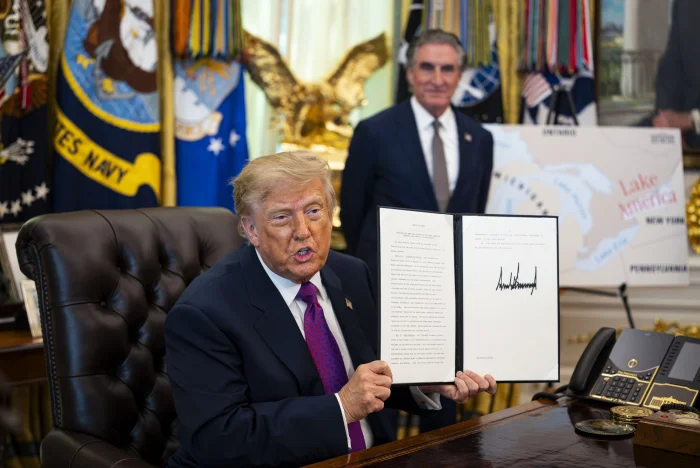
President Donald Trump signs an executive order to rename Lake Ontario as Lake America in the Oval Office of the White House on Thursday. Photo by Al Drago/UPI | License Photo
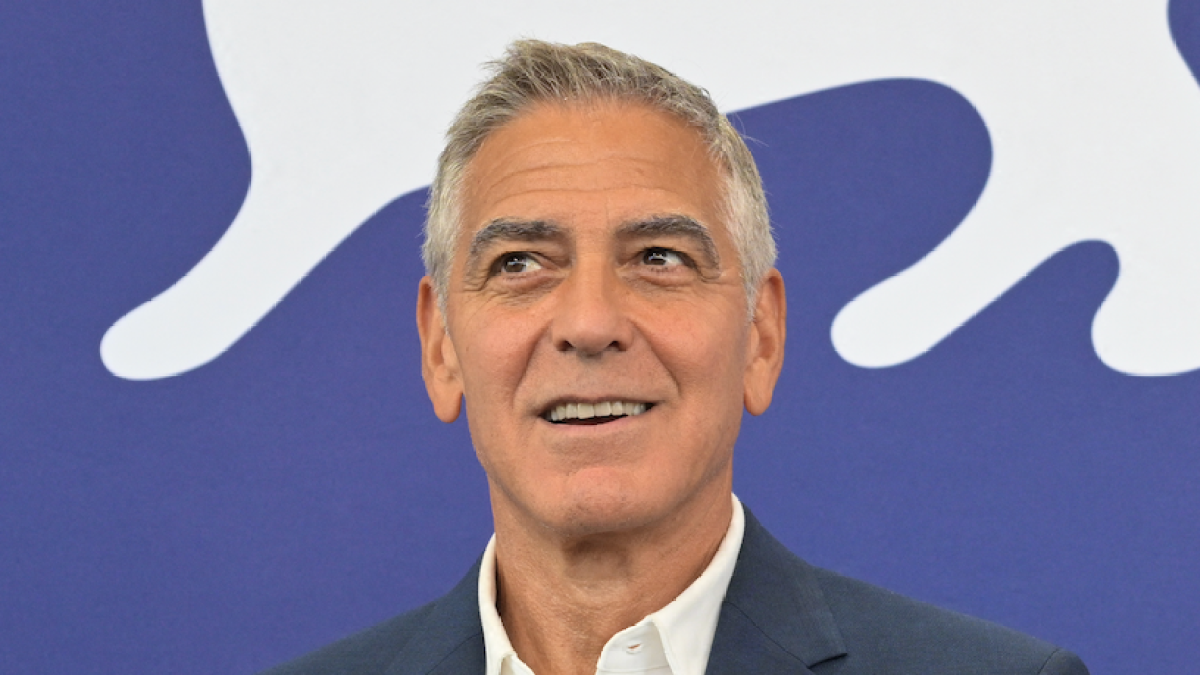
US actor George Clooney has described US President Donald Trump’s administration as a ‘kakistocracy’, defining it as a government run by the ‘least qualified’ people.
The star, who died aged 76, also presented the schools show Our World and pioneering deaf community shows Listening Eye and Insight.
17:25, 02 Sep 2026Updated 17:43, 02 Sep 2026
Peter Llewellyn-Jones was Mr Grimley in The Riddlers(Image: ITV)
One of the stars of Children’s ITV has died aged 76. Tributes are being paid to Peter Llewellyn-Jones, who played Mr Grimley in The Riddlers, which was a teatime fixture throughout the Nineties.
The Riddlers featured the adventures of Marjorie Dawe, played by Victoria Williams, her neighbour Montgomery Lancelot Grimley, played by Llewelyn-Jones, and two Riddlers – puppet creatures – called Mossop and Tiddler.
The show, which was produced by Yorkshire Television, was a huge success, running for 224 episodes on ITV from 1989 until 1998. Five videos, two DVDs and a series of Riddler books were also released.
Away from Riddleton End, Llewellyn-Jones also presented on Our World, an ITV schools series about how children approach life that ran during the Eighties and Nineties.
He was also a prominent British Sign Language (BSL) advocate and appeared in the children’s TV show Insight, which produced sketches and short stories for deaf and hard of hearing young people from 1980 to 1984.
Llewellyn-Jones also appeared on its successor, the BBC’s Listening Eye, a pioneering show for the deaf community which later became Sign On.
The British Deaf Association paid tribute in a signed video, saying: “Today the British Deaf Association is deeply saddened by the passing of Peter Llewellyn-Jones, a BSL champion and strong ally of the deaf community for over 50 years.
“Peter had a long and valued association with the BDA, supporting our work and contributing to BDA events over many decades.
“From the early BDA Summer Schools through to wider national Deaf community events, he played an important role in improving communication and access between Deaf and hearing people.
“Peter was a visionary leader and pioneering advocate for linguistic rights.”
One fan responded to the news, writing: “Sad to hear that Peter Llewellyn Jones has passed away, I love The Riddlers and I remember buying it on video, when I was a kid.”
Private payrolls rose by 38,000 in August, though it was less than expected and fell below the 46,000 jobs added in July, ADP reported on Wednesday. File Photo by Tasos Katopodis/UPI | License Photo
Sept. 2 (UPI) — Private payrolls rose by 38,000 in August, though it was less than expected and fell below the 46,000 jobs added in July, ADP reported on Wednesday.
August’s new hires report was the slowest month in terms of hiring since January with the manufacturing, professional services and information industries cutting jobs.
“Pay can tell us a lot about today’s choppy hiring,” Dr. Nela Richardson, chief economist for ADP, said in a statement. “To understand hiring patterns, you have to look deeply into where pay growth is accelerating, where it’s slowing, and for whom. Once-predictable wage growth has been overtaken by the complexities of demographic change, persistent inflation, and AI’s effects on jobs.”
Manufacturing jobs posted the biggest losses, down 17,000, followed by professional and business services, down 16,000. The losses offset a 45,000 gain in education and health services jobs and 16,000 new hires in the leisure and hospitality industry.
Large businesses of more than 500 employees added the most new hires, up 34,000, followed by small businesses with one to 19 employees, up 20,000. Small businesses with 20 to 49 employees decreased by 17,000 jobs.
The Dow Jones consensus estimate projected 47,000 new hires in August, 9,000 jobs more than ADP’s reported results.
Wednesday’s report comes ahead of the U.S. Bureau of Labor Statistics’ monthly nonfarm payrolls report expected on Friday.
President Donald Trump signs an executive order to rename Lake Ontario as Lake America in the Oval Office of the White House on Thursday. Photo by Al Drago/UPI | License Photo
Nepal’s Prime Minister, Balendra Shah, has called for global action to address climate change, stating that it is linked to deadly floods and is increasing risks across the Himalayan region.
The Repair Shop’s expert craftsman Dominic Chinea has launched into yet another ambitious engineering project – leading to a somewhat chaotic video from his workshop
16:35, 02 Sep 2026Updated 16:41, 02 Sep 2026
Dominic Chinea with his Repair Shop co-stars(Image: BBC)
“The pressure really is on,” says The Repair Shop’s Dominic Chinea as he embarks on a tough engineering project: “We’re going to blitz this Land Rover and get it hopefully running, starting, possibly driving.”
In a new video, Dominic adds that, as he’s still missing a few components, it probably won’t be fully running for a little while yet. Nevertheless, he says, he’s determined to move as fast as he can with the project: “I do feel like this video needs to come with a little bit of a disclaimer or a warning that it’s quite hectic,” he joked, while giving his YouTube viewers an update.
Explaining that he has overstretched himself a little, Dominic says: “I’ve got multiple jobs all over the place and I am jumping around with no time. I filmed as much as possible and I’ve tried to assemble it into some kind of video to make some kind of sense.”
He stresses that the heat is on: “I have two days to get as much done as I possibly can.” But nevertheless, Dominic adds, he knows that rushing a job can lead to disaster.
“Patience is so important at moments like this.” He says, “I’m so tempted to just reach for the biggest hammer and try and persuade these things off of the shaft. But that is how you damage things.”
Dominic doesn’t need anything in his workshop to suffer any more damage. When Dominic and his wife Maria packed up their house in Kent last year and moved to Cornwall with their dog Wendy, he admitted that weatherproofing the newly converted workshop would be a “pressure.”
The dramatic storms that thrashed the county in January made Dominic’s prediction all too real. He was left struggling to make urgent repairs before he could get back to work, all while attempting to complete the renovations for his farmhouse kitchen.
He said at the time: “The storm has caused a lot of damage, the workshop roof, various tiles and bits and bobs. I’m doing my best to deal with those, I’ve ordered more roof sheets and I’ve lined up roofers to try and fix the roof, but I’m also juggling trying to finish this kitchen.”
A month later, another violent storm caused a section of his workshop roof to collapse, inflicting substantial damage to a nearly irreplaceable vehicle he’d been restoring underneath.
Then, in June, Dominic’s workshop was hit by yet another apocalyptic storm. Somehow, amid all this chaos he’s managed to fit in the filming of two TV series.
His decision to put his life on screen with his new series Dom Chinea’s Cornish Workshop was by no means an easy one. “It was definitely different to filming The Repair Shop, but that was part of the reason to try to do it, to experience something new.”
And of course he’s still working alongside the rest of The Repair Shop team. In tonight’s season opener for Beyond the Barn, electronics expert Mark Stuckey restores a homemade K-9 dog, and leather expert Suzie Fletcher repairs a bag belonging to Winston Churchill’s cook.
Meanwhile, milliner Jayesh Vaghela undertakes the delicate restoration, determined to bring this unique piece of rock ‘n’ roll history back to life while preserving its authentic character and remarkable connection to the rise of David Bowie and the 1970s glam rock movement.
A U.S. Navy helicopter lands on the nuclear-powered aircraft carrier USS Abraham Lincoln (CVN-72) while the ship sails to dock at the deep-sea port in Laem Chabang, Chonburi province, Thailand, Wednesday. The Nimitz-class nuclear-powered aircraft carrier with roughly 5,000 sailors and Marines aboard and other vessels from its Carrier Strike Group, is docked with personnel to come ashore in Thailand to rest and recuperate while the warship replenishes supplies after an extended deployment. Photo by Rungroj Yongrit/EPA
Sept. 2 (UPI) — The USS Abraham Lincoln docked in Thailand Wednesday morning, the first break for the sailors aboard since before Thanksgiving.
The 5,000 crew members aboard the nuclear-powered aircraft carrier stepped on land and headed to the beach town of Pattaya, Thailand, to begin their first significant shore leave in nine months.
The ship, based in San Diego, has spent more than 250 consecutive days supporting actions in Venezuela and Iran. The crew has faced issues with morale, plumbing and food supplies. At least one sailor aboard the ship has attempted suicide, and there have been reports of more.
During the Lincoln’s deployment in the Middle East, the U.S. naval base in Bahrain was mostly destroyed at the beginning of the war, making restocking and repairs more challenging.
After public outcry, the Navy replaced the Lincoln with the USS George Washington, allowing the Lincoln to head home.
The Lincoln docked Wednesday at Laem Chabang, north of Pattaya, and crew members traveled by bus into the beach town. Many of them booked hotels for their shore leave, said Pattaya Mayor Poramet Ngampichet.
“It is a well-deserved break for all of the crew, and we really look forward to our time here,” said Capt. Daniel J. Keeler, commanding officer of the Lincoln, The New York Times reported.
“It’s good to have you here,” the mayor said, shaking hands with the Captain.
The mayor and other local dignitaries greeted the first arriving sailors at the Hard Rock Hotel in Pattaya. They handed the crew members gifts and welcomed them to the area.
“Our arrival in Laem Chabang provides a well-deserved opportunity for our sailors and Marines to rest and recharge. It also underscores the strong and enduring partnership and alliance between the United States and Thailand,” Rear Adm. Robert E. Loughran, commander of Carrier Strike Group 3, which includes the Lincoln, said in a statement. “What this strike group has accomplished is truly historic. I could not be prouder of the exceptional professionalism and expertise demonstrated by every member of this team during our operations in the U.S. Central Command area of responsibility.”
The statement pointed out that Thailand has been a partner of the United States since the 1833 Treaty of Amity and Commerce, and it’s the only treaty ally in mainland southeast Asia.
Pattaya is just north of U-Tapao, where an airbase hosted U.S. B-52 bombers during the Vietnam War. It also provided a rest and relaxation spot for U.S. servicemembers during the war and since. For this shore leave, local authorities said the military has restricted certain activities, including consuming marijuana, parasailing and jet skiing.
After the weekend in Thailand, the Lincoln is scheduled to leave for San Diego Sunday.
President Donald Trump signs an executive order to rename Lake Ontario as Lake America in the Oval Office of the White House on Thursday. Photo by Al Drago/UPI | License Photo
Premier League breaks its own record as four of its 11 most expensive signings have arrived in this transfer window.
Published On 2 Sep 20262 Sep 2026
The English Premier League displayed its financial power once again by smashing the summer transfer window record for the amount spent by its clubs on new players.
It had only set the previous record last year.
Recommended Stories
list of 4 itemsend of list
The spree continued deep into the final hours of the window, which shut on Tuesday, with several big-money deals completed before the 11pm (22:00 GMT) deadline for signings by English clubs.
Approximately 38 percent of the Premier League deals were made between the clubs from within that competition, up from 30 percent last year’s summer transfer window.
Al Jazeera Sport takes a look at major takeaways from the 2026-27 transfer window:
How much did Premier League clubs spend for the 2026-27 season?
A total of 3.46 billion pounds ($4.67bn) was dished out by England’s top-flight clubs, with 475 million pounds ($640.1m) being spent on deadline day itself, up from 391 million pounds ($526.7m) on the same day last year.
During the last summer transfer window, the combined spending of the league’s 20 clubs breached the 3 billion pounds ($4.05bn) barrier for the first time, while this year’s figure dwarfed the 1.13 billion pounds ($1.52bn) spent five years ago.
What were the most expensive Premier League and La Liga signings?
Manchester City topped the list when they spent 125 million pounds ($168.7m) on signing Argentina midfielder Enzo Fernandez from Chelsea.
He’s the first player to be transferred twice for figures upwards of 100 million pounds ($134.7m), and his deal equalled the amount spent on Aleksander Isak when he moved from Newcastle United to Liverpool during the last summer transfer window.
Liverpool paid a close second 123 million pounds ($166m) to sign France forward Bradley Barcola from Paris Saint-Germain.
Chelsea followed with 117 million pounds ($158m) spent on bringing England international Morgan Rogers from Aston Villa to Stamford Bridge, while Manchester City dished out 116 million pounds ($156.6m) for midfielder Elliot Anderson from Nottingham Forest.
Which clubs spent the most money on summer transfers?
Manchester City’s signing of Fernandez capped the whopping 458 million pounds ($618.2m) spent as new manager Enzo Maresca assembled his first squad, which includes Moroccan midfielder Ayyoub Bouaddi for 86 million pounds ($116.2m).
It was a new Premier League record that surpassed the 415 million pounds (560.3m) paid by Liverpool last year.
Chelsea also spent heavily, shelling out 349 million pounds ($471.1m) to back new boss Xabi Alonso.
Tottenham splashed out 303 million pounds ($409m) as they rebuild after two successive seasons close to being relegated.
Promoted trio Ipswich, Coventry City and Hull City spent more than a combined 400 million pounds ($539.9m) to prepare themselves for life in the top flight.
Sunderland landed highly rated Belgian winger Malick Fofana, 21, from Olympique Lyonnais in a reported 30 million pounds ($40.5m) deal after beating Crystal Palace to his signature.
Tottenham Hotspur also broke their club transfer record to sign Sandro Tonali from Newcastle United in a deal that could reach 100 million pounds ($134.9m).
Why did Julian Alvarez, Folarin Balogun and Lamine Camara fail to join a new club?
Some deals failed to go through on deadline day.
British media reported that Everton’s move for Folarin Balogun collapsed after the US striker decided against proceeding with the transfer, while Senegal midfielder Lamine Camara remained at Monaco after his reported 47.1 million pounds ($63.5m) move to Chelsea fell through.
Julian Alvarez’s dream of playing for Barcelona never materialised after Atletico held onto him despite strong interest from Barcelona and Arsenal.
Atletico chief executive Miguel Angel Gil Marin made his feelings quite clear about Barcelona last week and said Alvarez would never be sold to them.
“There has not been, and there will not be any negotiation with them [Barcelona] regarding Alvarez’s transfer,” Atletico’s board of directors said in the statement.
“Atletico de Madrid is open to standard transfer market negotiations when conducted in a professional, ethical and respectful manner,” the statement added.
CHARLOTTE Church shot to fame aged just 11 and went on to make over £25m as a child star.
Her debut album Voice Of An Angel followed a year later, launching a career that saw her sell more than ten million records worldwide.
Charlotte Church has put her character-filled Welsh cottage on the marketCredit: Instagram/@therealcharlottechurchCharlotte’s home features exposed beams and brick wallsCredit: instagram
But after admitting she does not have “a lot of money” left, the singer has now put her character-filled Welsh cottage on the market for under £700,000.
The period property is packed with character, featuring exposed wooden beams, brick walls and plenty of greenery throughout.
Sign up for the Showbiz newsletter
Thank you!
The sale comes two years after Charlotte admitted to Closer magazine in 2024 that she no longer had millions in the bank while discussing her decision to sell her former six-bedroom mansion, The Spinney.
“I am not a millionaire anymore,” she said. “What mattered to me when I bought The Spinney is it was absolutely beautiful and close to the forest and it was a big mansion house.”
Aretha Franklin’s A Brand New Me album can be spotted in the backgroundCredit: instagramCharlotte appeared on the first series of Celebrity Traitors in 2025Credit: BBC
Previously, Charlotte transformed the 15th-century Rhydoldog House in Powys, Mid Wales, into a hippie wellness retreat.
She previously admitted sinking “pretty much” her entire life savings into the property, which she bought for £1.5million in 2021.
Charlotte was able to access her millions when she turned 18 after spending six years performing around the world.
Russian drone attacks across Ukraine have killed at least one person and wounded more than a dozen others, as Volodymyr Zelenskyy and Vladimir Putin threatened to escalate the conflict.
Between Tuesday and Wednesday, Ukrainian authorities reported attacks in the capital, Kyiv, in the southern city of Odesa and in eastern Dnipro, where the body of a man was retrieved from under rubble.
The air war between Russia and Ukraine has intensified as the conflict stretches into its fifth year following Moscow’s invasion of its neighbour. The front line in eastern and southern Ukraine remains largely deadlocked, and US efforts to negotiate a peace settlement have yet to produce a path to peace.
Russian President Vladimir Putin and Ukrainian President Volodymyr Zelenskyy exchanged threats late on Tuesday over what their next steps might be.
Zelenskyy warned foreign airlines that the skies over Russia are not safe for flights due to Ukrainian long-range drone attacks, saying that “Russian airspace will effectively be closing”. He said Ukrainian military pressure aims to compel Russia to accept peace negotiations.
Putin accused Zelenskyy of “state terrorism” and said: “We don’t negotiate with terrorists.”
At a late-night news conference on the sidelines of the Shanghai Cooperation Organisation summit in Kyrgyzstan, Putin also addressed reports that the Ukrainian military had used British-made drones to strike targets inside Russia.
Asked whether Russia would strike British military facilities if the UK government continues to provide Ukraine with weaponry, Putin declined to rule it out. With a small smile, he told reporters it was “a military secret”.
China and North Korea, meanwhile, have provided military support for Russia, as has Iran in previous years.
The Russian and Ukrainian leaders’ comments came as European officials weigh their response to the latest in what they say is Moscow’s campaign of continental sabotage and disruption aimed at weakening European support for Ukraine. Germany on Tuesday blamed Russia for an attempted attack at Leipzig/Halle airport last month using a drone laden with explosives.
Odesa power outage
Russia fired 174 attack drones, about half of them jet-powered drones that are hard to stop and are increasingly being deployed by Moscow, as well as two ballistic missiles and two plane-launched missiles at Ukraine overnight, according to the Ukrainian Air Force.
Officials in the southern Ukraine region of Odesa reported that the attack damaged a 24-storey residential building, destroying apartments on several floors and wounding eight people, including a child.
Odesa office buildings and two educational facilities were also damaged, Serhiy Lysak, head of the Odesa city military administration, said. The barrage also caused a power outage that halted electric-powered public transport, the city council said.
A man and a woman were wounded by shrapnel in morning attacks on the Kyiv region, according to Tymur Tkachenko, head of the regional military administration.
It was the seventh straight day Kyiv came under attack, although the latest barrage wasn’t as heavy as in previous days. The assault started a fire at a warehouse, officials said. Russian forces have targeted civilian facilities in what Ukrainian officials say is an effort to disrupt daily life and sap public morale.
A fire broke out at an educational facility and a medical practice was also damaged, the Kyiv city military administration said.
Meanwhile in Russia, air defences destroyed 130 Ukrainian drones overnight, the Defence Ministry said on Wednesday. The drones were shot down over 11 Russian regions, as well as the annexed Ukrainian peninsula of Crimea and the Black Sea, it said.
Ukrainian drone attacks killed two people in Russia’s Belgorod border region and wounded 16 more, acting governor Aleksand Shuvaev said. Ukrainian forces hit the region 140 times over the course of 24 hours, he said.
Ukraine’s domestically developed long-range drones have repeatedly targeted Russia’s oil sector, hoping to dent the economy and the warehouses of online retailers to make the Russian public feel the effects of war.
Tyler Robinson, the man accused of fatally shooting conservative activist Charlie Kirk, has pleaded not guilty to murder charges that could carry the death penalty in the state of Utah.
The actor will be joined by a string of professionals as he unpacks how the system got people wrongfully convicted.
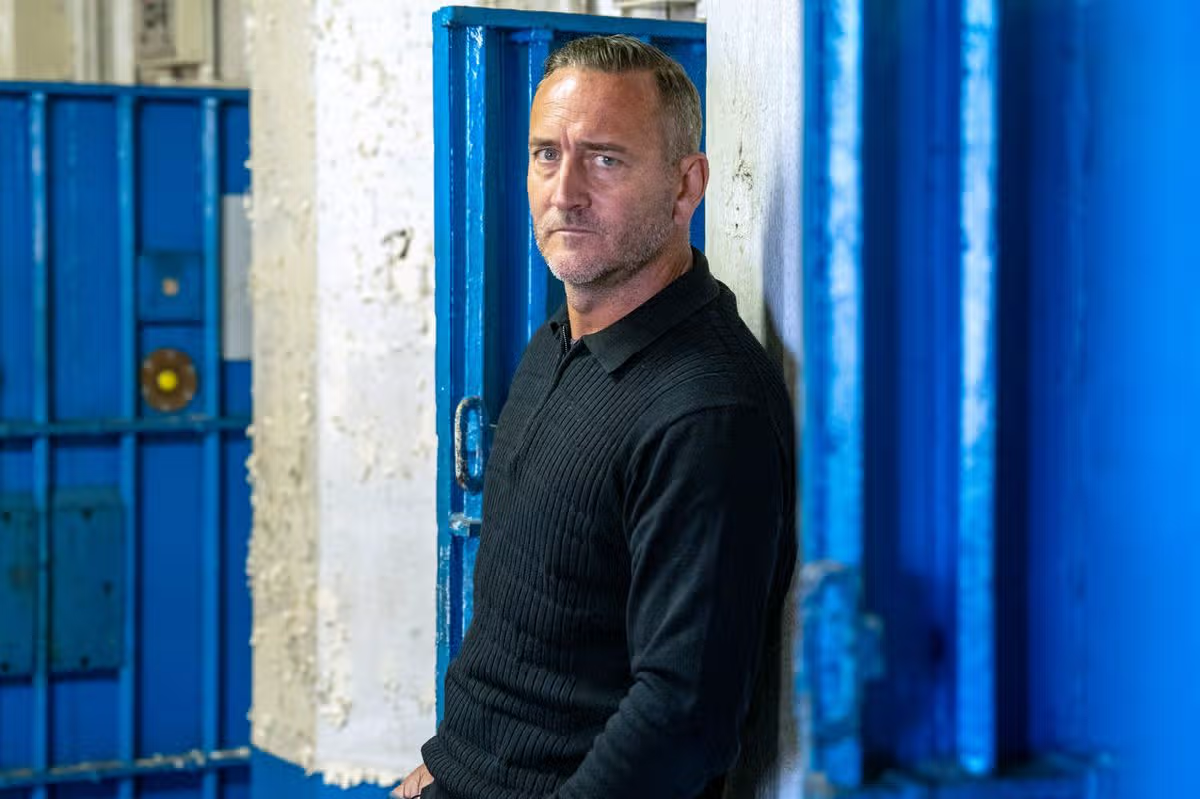
Will Mellor is back for another true crime series this year(Image: CRIME+INVESTIGATION)
Will Mellor will be hearing from those falsely accused in a brand new series.
True crime fans are in for a treat as the actor, who has starred in the likes of Broadchurch, The Teacher and A Woman of Substance, will be taking a closer look at how the legal system has failed some people.
After investigating Cops Who Kill and Cops Gone Bad in the past, he’s now returning to Crime+Investigation for Convictions Gone Bad. The five-part series will see Will delve into some of the most shocking miscarriages of justice in legal history.
Throughout the series, Will is joined by a range of professionals, including a seasoned former detective, a top forensic scientist and a legal expert. In the programme, he’ll be unpacking how the system got it so disastrously wrong.
The star will also reveal the crucial new evidence that finally set the wrongfully convicted free. A synopsis for the show reveals that in the episodes, Will will be hearing from those falsely accused.
In their own words, they’ll be ‘Providing an insight into what it’s like to be arrested, tried and convicted of the most horrendous of crimes; and the subsequent battle to clear their name.’ One of the people Will speaks to is Justin Plummer, who served over 27 years in prison for a murder he didn’t commit and Kevin Richardson of the Central Park 5.
Other cases featured include Andrew Malkinson, Sam Hallam, and Angela Cannings, who collectively served over 25 years in prison whilst maintaining their innocence.
An overview reads: “Alongside former Detective Inspector Howard Groves , Will takes a fresh look at the original crime, retracing the steps of the investigators and exploring how the case was built.
“Will meets forensic scientist Carol Rogers to examine the crucial evidence used by the prosecution to secure a conviction. They break down the complex science, revealing where the evidence was flawed and the expert advice was unsafe.
“He’s joined by legal expert Professor Claire McGourlay to chart the twists and turns of the appeal, until finally – the wrongfully convicted get their day in court.”
The programme, which has been produced by ITN for Crime+Investigation, will see the actor examine what happens when the justice system fails, and the wrong person ends up going to prison for a crime they didn’t commit.
In the past, Will has also delved into cops who have killed, but also fraudsters, swindlers, sexual predators and drug dealers. In the seven-part series at the time, he looked into former metropolitan police officer David Carrick, former Cheshire police constable Martin Forshaw, former Metropolitan police officer Rodney Whitchelo and a former Met officer, Kashif Mahmood.
It also looked into Michael Coulton, a police officer assigned to royal protection duties at Buckingham Palace, who hatched an elaborate plan to murder his wife. The programme also went abroad to shine a spotlight on US cop Drew Peterson and ex-chief investigative officer Mark Standen from Australia.
Speaking about his true crime series, Will commented: “I’m really pleased to be back for Cops Gone Bad. In this series, we’ll be examining cases of corrupt officers from the UK, US and Australia, and whilst the majority of cops do an amazing job every day, it’s important to hold those that don’t, to account.”
Convictions Gone Bad with Will Mellor premieres on Monday, October 5 and airs 9pm weekly exclusively on CRIME+INVESTIGATION
Sept. 2 (UPI) — Ukrainian President Volodymyr Zelensky issued a warning to airlines to stay clear of Russian airspace and airports due to a large-scale escalation in drone strikes on Russian targets by the Ukrainian military.
Zelensky said Tuesday that he wanted to notify every airline flying in Russian airspace, every insurance company and anyone that still used airport hubs such as St. Petersburg and Moscow, which have six airports between them, that the skies above Russia were “becoming completely dangerous.”
“There will simply be drones in Russia’s skies on a scale that has to be taken into account,” he said.
“The Ministry of Foreign Affairs of Ukraine and our other institutions will provide international organizations with full information about the dangers in Russian airspace. Drone-infested skies are no place for civilian aviation,” added Zelensky.
Zelensky stressed that the warning was not intended to “threaten civilian aviation as such — not a single civilian aircraft” and Ukraine did not want the loss of any innocent lives.
The majority of Western airlines stopped over-flying Russia after the start of the war in 2022 but Chinese, Turkish and Middle East carriers and some others continue to do so, particularly on long-haul Asia to Europe flights where the Russia route can slash up to 2,250 miles from the journey, equivalent to four hours’ flight time and as much as 30 tons of extra fuel.
Russian aviation authorities automatically suspend flights if a drone sighting is confirmed within a certain radius of a specified zone with civil aviation disrupted on numerous occasions over the past year after Ukrainian drone assaults, often involving hundreds of drones at a time.
Russian President Vladimir Putin said Zelensky’s warning was a “declaration of state terrorism,” vowing that Russia would not let up in its attacks on Ukraine.
On Sunday, the Russian Defense Ministry stoked Ukrainain fears they were facing another very tough coming winter by saying the Russian military was gearing up for “massive strikes” against Ukraine’s energy infrastructure as a “response to the continuing attacks of the Kyiv regime against the Russian civil infrastructure and fuel and energy facilities.”
The defense ministry was referencing a sustained military campaign by Ukraine targeting Russia’s oil processing capabilities and logistics faclilities with long-range drones.
Retired Deputy Police Chief Sam Pulia places American flags at the 9/11 memorial south pool before the start of the 9/11 Commemoration Ceremony at the National September 11th Memorial and Museum in New York City on September 11, 2025. Nearly 3,000 died in the September 11 attacks. Photo by Peter Foley/UPI | License Photo
Palestinians used their bare hands to try to defend their property against a bulldozer as Israeli forces tore up their land and used pepper spray in the occupied West Bank. In recent days, Israel has been demolishing Palestinian homes in Nablus.
August Wilson’s “Ma Rainey’s Black Bottom,” the first of his plays to reach Broadway, catapulted the author’s playwriting career.
It’s the only drama in Wilson’s 10-play American Century Cycle not set in Pittsburgh’s Hill District. But the series might never have come to fruition were it not for the way “Ma Rainey’s Black Bottom” heralded the emergence of a major new American dramatist.
Although it’s still one of his most produced works, “Ma Rainey’s Black Bottom” has the hallmarks of an early piece. Wilson discovers his playwriting voice in this play, but he’s still working out his approach to dramatic structure.
I wasn’t champing at the bit to see another production of “Ma Rainey’s,” but I’m glad I didn’t miss this latest Wilson revival at A Noise Within, directed by Gregg T. Daniel. Acted with breathtaking ensemble naturalness, the play seems lived in rather than performed.
Francis C. Edemobi, from left, Amber Liekhus and CJ Obilom in August Wilson’s “Ma Rainey’s Black Bottom” at A Noise Within.
(Craig Schwartz)
The voices of the characters come through as though we’re eavesdropping from a discreet distance on their banter and squabbles. There’s nothing more riveting on stage than the truth, and here we have human beings in all their flagrant, unadorned and seemingly irreconcilable complications.
Set in a Chicago recording studio in 1927, the play splits its focus between the title character, a fictitious re-creation of the great blues singer Ma Rainey engaged in a power struggle with her white industry overlords, and the exchanges of her sidemen, a quartet of Black men with markedly different ambitions and sensibilities.
Levee, the role magnificently played by Chadwick Boseman in George C. Wolfe‘s 2020 film adaptation, may have more of a claim on the protagonist role than even Ma Rainey, who’s the play’s thematic center. As she throws her diva weight around in defense of a talent born out of Black suffering, she crystallizes the racial politics that Wilson powerfully illuminates.
But Levee’s role is the most dynamic in the play. A trumpeter who wants to move the band in a more musically sophisticated direction, he’s written his own arrangement of the song “Ma Rainey’s Black Bottom” that they’ve come to the studio to record. But Ma Rainey insists on doing it her way, even if Levee’s version is more interesting from a jazz perspective.
Overcome with anger from a traumatic childhood in which he witnessed his mother being raped by a mob of white men, he can’t tolerate slights, big or small. And his fiery temper, igniting at every possible moment with his older and more accommodating bandmates, turns this snapshot of history into genuine tragedy.
Kai A. Ealy, from left, Alex Morris, Gerald C. Rivers and Jamar Gilbert in August Wilson’s “Ma Rainey’s Black Bottom” at A Noise Within.
(Craig Schwartz)
The bedraggled studio has been visually renovated with the wood-slatted elegance of Tesshi Nakagawa’s scenic design. Daniel’s production demands that we experience the play in a fresh light. The period is respected but never allowed to become stiff or artificial. This isn’t a waxwork staging.
Standing microphones, placed on different tiers of the set, never let us forget that Wilson was first and foremost a conductor of voices. He bestows on his characters arias, and Daniel’s cast delivers them as though the words were expressly made for these particular actors.
Jamar Gilbert’s Levee moves through the world as if it’s a battle zone, which of course for him it has been. Conflict has dogged him his entire life, and injustice is what he’s come to expect. His focus is on himself, his music, his sensual pleasures and his determination not to be anyone’s victim. He takes as much pride in the shine of his new shoes as he does in the flirtatious giggle of a pretty woman.
Toledo (Gerald C. Rivers), the philosopher and historian of the group, tries to broaden Levee’s perspective, but the two men have a knack for getting under each other’s skin. Their antagonism is fueled in part by Levee’s immaturity, but there’s also a divide in their worldview: Levee wants society to change in time for him to make good while Toledo is more concerned with the collective spirit of his people.
Meanwhile, Slow Drag (Alex Morris) mostly wants to get on with the session, collect his money and enjoy life as it was meant to be enjoyed, with whiskey, a little reefer and good-looking women. Cutler (Kai A. Ealy) tries to be a moderating influence, but he winds up as exasperated by Levee as Toledo.
Alex Morris, from left, Amber Liekhus and Jamar Gilbert in August Wilson’s “Ma Rainey’s Black Bottom” at A Noise Within.
(Craig Schwartz)
The authenticity of the production encompasses the music. These actors don’t mime making music, as is often the case in revivals. They jam together, modestly but effectively enough to make their recording session real to us.
There’s nothing at all modest about Amber Liekhus’ musical talent. Indeed, Liekhus is the first actor who was able to convince me that the character of Ma Rainey really is a professional, jobbing singer. She doesn’t imitate being the mother of the blues, as her character is known. She earns the distinction through the wondrous depths of her soulful singing.
She refuses to be bulldozed by either Irvin (Bert Emmett), her manager, or Sturdyvant (Matt Foyer), the owner of the recording studio, knowing full well that they depend on her gift for their pile of money. Her insistence that Sylvester (Francis C. Edemobi), her nephew with a pronounced stutter, speaks the intro to her new record, is her way of asserting human control over corporate greed.
Liekhus’ Ma Rainey isn’t merely being temperamental, as Sturdyvant and Irvin assume. She’s using her limited leverage in whatever ways she can. There’s something touching about her imperiousness, a regal vulnerability that shines through even in her romantic interaction with Dussie Mae (CJ Obilom), whom Levee has his predatory eye on.
The honesty of the acting is so enlivening that I’m tempted to rank this production among the very best Wilson revivals I’ve seen. If there’s one slight misstep, it happens at the play’s violent climax. The moment makes perfect psychological and dramatic sense, but the confrontation needs a few more beats than Daniel allows.
But this encounter with “Ma Rainey” reveals that even early Wilson can, in the right hands, offer unadulterated playwriting greatness.
‘Ma Rainey’s Black Bottom’
Where: A Noise Within, 3352 E. Foothill Blvd., Pasadena
1 of 2 | A smelter of Korea Zinc in Ulsan. The company has increased the annual production capacity of semiconductor-grade sulfuric acid by more than 14%. Photo by Korea Zinc
SEOUL, Sept. 2 (UPI) — Korea Zinc said Wednesday that its production capacity for semiconductor-grade sulfuric acid has increased by more than 14% as the country’s two leading chipmakers boost production to meet rising demand.
The world’s largest non-ferrous metals manufacturer noted that it recently built two additional production lines for ultra-high-purity sulfuric acid at its Onsan Smelter in Ulsan, roughly 190 miles southeast of Seoul.
With the two new lines now in full-scale operation, Korea Zinc’s annual production capacity has risen from 280,000 tons to 320,000 tons.
Eventually, Korea Zinc aims to raise its domestic production capacity to 500,000 tons a year. It is also considering installing semiconductor-grade sulfuric acid lines at its planned integrated smelter in the United States.
In cooperation with the U.S. government, Korea Zinc is set to construct the smelter for strategic materials on a 160-acre site in Clarksville, Tenn. Under the $7.4 billion Project Crucible, the facility is expected to start production in 2029.
Korea Zinc said that it supplies more than 60% of South Korea’s demand for semiconductor-grade sulfuric acid. The Asian nation is home to the world’s two largest memory chipmakers, Samsung Electronics and SK hynix.
The corporation said that its product has a purity of more than 99.9999 percent, known as “six nines,” or 6N, purity.
“Through this capacity expansion, we will respond in a timely manner to the operation and ramp-up of key domestic clients’ new manufacturing facilities,” Korea Zinc said in a statement.
“Moving forward, we will phase in additional domestic production capacity in alignment with our clients’ demand and investment timelines. At the same time, we plan to establish a supply base in global markets, including the United States,” it added.
The share price of Korea Zinc fell 3.92% on the Seoul bourse on Wednesday, while the benchmark KOSPI declined 3.99%.
TODAY’S NUMBERS99.73 Dollar Index (DXY) · 4.81% US 10-year Treasury yield · $4,304 Gold, per ounce All three are rising together — the market pricing a Fed rate hike into a war, not a slowdown, a combination not seen in years.
THE HOOK
Late Monday, Donald Trump signaled the ceasefire with Iran was effectively over, threatening fresh strikes and casting doubt on the reopening of the Strait of Hormuz. Brent crude jumped past $90 a barrel. By Wednesday morning, the US Dollar Index had climbed to 99.73 — its highest in nearly three weeks — and the 10-year Treasury yield touched 4.81%, just shy of a 52-week high. The reason: traders now put the odds of a September Fed rate hike near 65–70%, not a cut.
THE MECHANISM
The chain runs cleanly enough to name. Iran’s conflict with the US raises the odds of a shipping disruption through Hormuz, which carries roughly a fifth of global oil supply; oil-price risk feeds straight into headline inflation; and a Fed under Chair Kevin Warsh — already fighting credibility questions after an ambiguous hold in July — cannot afford to look soft on prices while a war pushes them up. That is why futures markets have swung from pricing no move in 2026 to pricing a hike at the September 15–16 meeting.
Stay ahead of the geopolitical week.
MD Briefing delivers expert analysis across five global fronts — the Indo-Pacific, energy, geoeconomics, European security, and the Middle East — every Monday morning. Free.
Higher US rates make dollar assets pay more relative to everywhere else, which is the direct channel behind both the stronger DXY and the 4.81% ten-year. The winners are near-term and narrow: holders of short-dated Treasury bills, whose yields rise with the policy rate; US money-market funds; and, oddly, the stablecoin issuers whose reserves sit almost entirely in T-bills and now earn more for holding them. The losers are broader and slower-moving: emerging markets carrying dollar-denominated debt face a double bill, since a stronger dollar raises the local-currency cost of repayment at the same moment their own borrowing costs rise in sympathy with Washington’s. Oil-importing economies — India, Turkey, Japan, the eurozone — take a second hit, paying more for crude in a currency that is simultaneously getting more expensive to buy. Gold, meanwhile, is caught between two forces: safe-haven demand from the war pulls it up, rate-hike expectations pull it down, which is why it sits near $4,304, off its recent peak but still up 21% over the year.
WHY IT MATTERS
The apparent contradiction — dollar strong this week, dollar weaker for the decade — is really two different clocks running at once. Reserve managers make multi-year diversification bets; traders react to a war in hours. The IMF’s COFER data put the dollar at 57.13% of allocated reserves in the first quarter of 2026, down from 72% in 2000, and a recent survey of reserve managers found roughly three-quarters expect that share to keep falling over the next five years. None of that is undone by one hawkish week from Kevin Warsh.
What is new is where the dollar’s reach is actually growing: not in central bank vaults but in stablecoins. The GENIUS Act framework — now the subject of a Treasury rulemaking comment period that closes in October — has pushed issuers to back their tokens almost entirely with short-dated Treasuries, and forecasts from Standard Chartered and Senator Bill Hagerty put potential T-bill demand from stablecoins as high as $2–2.3 trillion. That is dollarization happening retail-first, in emerging-market wallets and crypto exchanges, invisible to COFER. For Washington, a Fed hike timed to a war raises borrowing costs precisely when the deficit needs cheap financing, and when the countries least able to absorb dearer dollars — many of them US partners, not adversaries — get hit hardest. That is a form of collateral leverage no sanctions list ever names.
WATCH FOR
The September 15–16 FOMC meeting is the date that resolves this. A 25-basis-point hike would confirm markets are right to treat this as an inflation fight, not a growth scare, and would likely push the dollar and yields higher still. A hold — especially if Hormuz tensions ease and oil retreats from $90 — would suggest Warsh blinked, and could send gold back toward its highs faster than the dollar can catch up. Either way, watch the Fed funds futures curve shift in the two weeks before the meeting.
The Great ADHD Myth? sparked fury among viewers as it sought to ‘determine whether ADHD is a genuine neurodevelopmental disorder, or a social construct’
The documentary features NHS psychiatrist Dr Max Pemberton(Image: Minnow Productions)
Channel 4 has been hit with hundreds more complaints over its controversial ADHD documentary.
The Great ADHD Myth? sparked fury among viewers as it sought to “determine whether ADHD is a genuine neurodevelopmental disorder, or a social construct”. Last week, the media regulator confirmed that it had received 9,656 complaints after the show aired on Tuesday, August 18.
And the rage is still ongoing, with Ofcom receiving another 561 complaints, bringing it to a jaw-dropping total of 10,217.
An Ofcom spokesperson told the Mirror: “Complaints relate to the representation of ADHD in the programme.”
It comes after charity ADHD UK filed a furious complaint to the media regulator themselves, saying: “ADHD is not a myth. It is not a social construct.”
The documentary featured a 10-year-old boy with ADHD who made changes to his lifestyle and stopped taking his medication in an attempt to see how it would affect him. At the end of the programme, his mum said that he would continue to not take his medication – however a caption later confirmed at the end that he had resumed taking the drugs and his school performance improved.
“The programme’s own end credits told you what its 60 minutes wouldn’t: the boy at its centre went back on his medication, and his schoolwork improved,” said ADHD UK. “Their experiment disproved their conclusion. They aired their version anyway. We have already complained to Ofcom.”
The NHS recently released information about the number of people affected by ADHD. Data from May 2025 reports that it is estimated that 2,498,000 people in England have ADHD, including those without a diagnosis.
Of those, an estimated 741,000 are children and young people aged between five and 24. The report also stated that in March 2025, up to 20,000 people were newly referred for an ADHD assessment to mental health services, an increase of 13.5% from the previous year.
In a statement shared after the documentary was announced, amid backlash, a Channel 4 spokesperson stated, “This documentary does not deny the lived experience of people with ADHD traits, but does hear from a group of senior medical and academic experts – many of whom work or have worked with the NHS or have held presidential roles at professional membership bodies – who seek to question whether ADHD is a neurodevelopmental disorder. They also ask whether modern living has contributed to a rise in diagnoses, and whether there may be better alternatives for children than medication.”
The documentary featured NHS psychiatrist Dr Max Pemberton, who had previously said: “As a psychiatrist, I’ve watched ADHD go from a diagnosis that was only occasionally made and after careful assessment, to one that is increasingly demanded and dispensed, and I wanted to understand why.
“There’s no doubt that the people seeking these diagnoses are genuinely struggling; that isn’t in question. What the film asks is whether ADHD is really the best explanation for that struggle and my hope is that we come away with permission to ask better questions about what modern life is doing to all of us.”
When the documentary was first announced, viewers were left appalled. One wrote: “The endless hostility toward people with ADHD, autism, and anxiety is reaching a terrifying point.”
Another wrote: “More demonising and minimising those with mental health struggles. Fabulous.” One person called it “absolutely disgusting”, while another said it was “incredibly hurtful”.
However, some viewers called the documentary “interesting”, with one writing: “Interesting programme on Channel 4 about ADHD.” Another called it “great”, while a third said: “I filled it in to say how interesting I found the programme. I have a child with a diagnosis of ADHD.”
The Mirror has reached out to Channel 4 for comment.
Thailand’s Pattaya is expecting a business boost as 5,000 US sailors arrive after spending nine months at sea aboard the USS Abraham Lincoln. The carrier supported the US war on Iran, while its record deployment was marked by deteriorating conditions on board.
Under heavy escort, the USS Abraham Lincoln transited the Strait of Malacca and Singapore Strait over the weekend, en route to Thailand for a highly publicized and much-needed liberty port call. Guided-missile cruiser USS Robert Smalls led the three-ship column, with guided-missile destroyer USS Frank E. Petersen Jr. following astern of the supercarrier as she entered the South China Sea. Multiple Thai officials have confirmed the upcoming port visit since it was first reported by USA Today last week, with the flattop expected to pull into port at Laem Chabang in the coming days. Meanwhile, America’s other two deployed carrier groups are in the Middle East enforcing the ongoing blockade as the U.S. and Iran exchange fire for the first time since July.
Here’s TWZ’s weekly carrier tracker monitoring America’s flattop fleet, including deployed Carrier Strike Groups (CSG) and Amphibious Ready Groups (ARG), using publicly available open-source information. Check out last week’s report here.
TWZ/IAN ELLIS-JONES (HIGH RESOLUTION)
Lincoln Enters The South China Sea, Again, En Route To Thailand For Liberty
Abraham Lincoln flipped her Automatic Identification System (AIS) transponder on ahead of the transit, broadcasting the flattop’s position publicly for the first time since January 28, 2026, when the CSG made the transit in the opposite direction prior to Operation Epic Fury. Lincoln has now been deployed for 285 days without a liberty call, but that streak is set to end this week.
For friends and family, we anticipate an arrival back home in late September or early October, depending on how long the crew stays in Thailand and whether any other stops are made along the way. When all is said and done, Abraham Lincoln’s deployment will likely become the second-longest in the modern carrier era behind the historic 326 days logged by the USS Gerald R. Ford earlier this year.
Time-lapse of USS Abraham Lincoln transiting the Strait of Malacca. Source: @CVN_72 on X.
While the composition of the Abraham Lincoln CSG has shifted over the nine-plus-month deployment, Frank E. Petersen Jr., a Flight IIA Technology Insertion (TI) Arleigh Burke class destroyer and one of the newest in the fleet, embarked the commander of Integrated Air and Missile Defense (IAMD) throughout the six months of almost nonstop combat operations against Iran. The IAMD commander is responsible for coordinating the detection, response, and interception of inbound aerial threats, and Petersen Jr. is equipped with the world’s foremost integrated naval combat system – the Aegis Combat System Baseline 9 – which delivers quick reaction times, concentrated and networked firepower, and advanced electronic countermeasure capabilities for anti-air warfare.
The unannounced addition of Ticonderoga class cruiser USS Robert Smalls, which has historically served as the IAMD commander for the carriers forward-deployed out of Yokosuka, Japan, adds 122 Vertical Launch System (VLS) cells packed with missiles for protection and firepower. The rationale for the additional Tico cruiser, an iconic class that will be completely retired over the coming years without a comparable replacement, is unclear. TWZ has not received an on-the-record response from the U.S. Central Command (CENTCOM) or U.S. Naval Forces Central Command (NAVCENT) public affairs explaining the redirection.
Robert Smalls was part of the George Washington CSG as recently as August 18, making the northwest-bound Malacca Strait transit with the strike group the week prior, before peeling off to escort the Abraham Lincoln back through.
Guided-missile destroyer USS Frank E. Petersen Jr. transiting the Arabian Sea in June 2026. U.S. Central Command Public AffaUSS Robert Smalls transiting the South China Sea in July 2026. U.S. Navy photo by Petty Officer 3rd Class Nicolas Quezada
U.S. Launches Another Round of Strikes Against Iran Today As Tensions Escalate
Ahead of publication on Tuesday, CENTCOM announced a fresh round of strikes against targets in Iran that began at noon Eastern Time. “The strikes follow recent attempted attacks by the IRGC against commercial shipping in the Strait of Hormuz and against American service members deployed to the region,” the command posted in a statement on social media.
George Washington, which is currently accompanied by a single destroyer, USS Shoup, relieved the Abraham Lincoln in the Middle East earlier this month. Other U.S. 5th Fleet ships are reportedly moving in and out of the CSG, but the situation is fluid and TWZ cannot confirm the current, complete composition of the group. It’s unknown which warship, if any, is currently serving as IAMD commander for the CSG, which chopped into the CENTCOM area of responsibility (AOR) on or around August 19.
Flight ops on the flight deck of USS George Washington in the Middle East. U.S. Naval Forces Central CommanAn F-35C Lightning II, attached to Strike Fighter Squadron (VFA) 147, aboard Washington. Petty Officer 3rd Class Nicolas QuezadaAn MH-60R Seahawk readies for takeoff on the deck of Washington. U.S. Naval Forces Central Comman
Also operating in the Middle East, the four-ship George H.W. Bush CSG is underway at an undisclosed location in the Arabian Sea. Alongside USS George H.W. Bush is Tico cruiser USS Princeton, the IAMD commander, and two Burke destroyers, USS Ross and USS Donald Cook.
The carriers are enforcing the ongoing blockade of Iran – and presumably participating in the latest round of airstrikes – although they are both officially on station to “support maritime security and stability in the Middle East,” according to DVIDS, the military’s content-sharing platform. CENTCOM forces have redirected 84 commercial vessels, disabled three using kinetic force, and boarded another two since the blockade resumed, as of September 1.
USS George H.W. Bush conducts flight ops in U.S. Central Command. U.S. Navy video.
Over the weekend, the United States and Iran traded blows for the first time in over a month. CENTCOM opened the tit-for-tat exchange on Sunday by targeting rocket systems on Larak Island, located in the Strait of Hormuz on the Iranian side of the northern corridor, that are fitted to launch naval mines, after the Islamic Revolutionary Guard Corps (IRGC) was observed making preparations to fire into the contested waterway.
“I can confirm that earlier today U.S. forces struck two Iranian launchers on Larak Island,” Navy Capt. Tim Hawkins, CENTCOM’s spokesman, told TWZ. “Islamic Revolutionary Guard Corps forces were observed preparing to launch rockets with sea mines into the Strait of Hormuz,” he added. The IRGC retaliated by launching a salvo of ballistic missiles at Muwaffaq Salti Air Base, a Jordanian installation the U.S. military operates from. Jordan’s military said it successfully intercepted eight missiles.
The preemptive strikes to prevent Iran from deploying additional mines came just days after CENTCOM commander Adm. Brad Cooper said U.S. forces “successfully cleared” Iranian sea mines from international shipping lanes in the Strait of Hormuz. Commercial traffic through the strait is slowly recovering but still well below pre-war levels.
CENTCOM commander Adm. Brad Cooper provides an update on mine clearing efforts in the Strait of Hormuz. Source: @CENTCOM on X
On the other side of the world, in the United States, three carriers are active: two are underway training while one is in homeport getting ready for an upcoming deployment. USS Dwight D. Eisenhower, which left Norfolk on August 21, transited south in the Atlantic Ocean and was last operating approximately 70 nautical miles off the coast of Florida, well into East Coast Fleet Replacement Squadron (FRS) and Training Command (TRACOM) Carrier Qualifications (CQ). After departing San Diego on August 10, USS Carl Vinson was spotted on satellite imagery off the California coast by ship-tracker MT Anderson, in the process of completing Tailored Ship’s Training Availability (TSTA) and Final Evaluation Period (FEP) training.
USS Theodore Roosevelt, the next carrier slated to deploy from the continental U.S., is pierside at Naval Air Station North Island in San Diego, based on commercial satellite imagery. Speculation is rampant about where Theodore Roosevelt will deploy, but as the Navy has told us many times, “we do not discuss future operations or timelines.”
The balance of America’s carriers (excluding USS Nimitz, which will begin deactivation in 2027) is either in maintenance or scheduled to begin an availability in the future.
The next flattop that will re-enter service, USS Ronald Reagan, is expected to finish a roughly 17-month Docking Planned Incremental Availability (DPIA) soon. “The docking planned incremental availability for Ronald Reagan is on track for its scheduled completion at the end of August 2026,” Catherine Norton, the Public Affairs Officer (PAO) for Puget Sound Naval Shipyard and Intermediate Maintenance Facility, told Stars and Stripes earlier this month. However, the ship has not gotten underway as of publication, even though yesterday was the end of the month, and it appears the DPIA will stretch into September. TWZ reached out to Puget Sound’s PAO but has not received a response yet. For the latest status of the other three carriers in current or upcoming maintenance, marked in red on the map above, check out our recent deep-dive here.
USS Ronald Reagan in Bremerton, Washington, as of August 29, 2026. Source: @BulletOneOneTwo via @WarshipCam on X
Current Big Deck Force Posture At A Glance
Overall carrier force posture is unchanged compared to our previous report on August 24. Three U.S. carriers are deployed (although one is on the tail end of her deployment and heading home to San Diego), one is preparing to deploy in the near term, two are working up in various states of readiness, four are in maintenance, and another, the USS Nimitz, is being used primarily for training before deactivating next year. One amphibious ready group is deployed, one is forward-deployed and at homeport, four are working up or in port, and three are in maintenance.
Note: Positions are general approximations. Non-deployed LHA/LHD amphibious warships are not shown.
“Obsession,” the indie horror movie written and directed by Curry Barker, has proved to be one of this year’s most successful films. Made for a reported budget of about $750,000, it has earned more than $500 million at the global box office since Focus Features released it in May — the biggest hit in the distributor’s history, according to a new lawsuit.
But one of its producers, Leonora Ann Darby, is claiming she hasn’t received her share of the profit.
Darby, who rose to become one of three producers at Tea Shop Productions, the U.K. company behind the movie, sued Tea Shop, its Delaware affiliate The Tea Shop & Film Company, and co-founders James Harris and Mark Lane in Los Angeles County Superior Court. The 135-page complaint lays out 10 causes of action — among them, breach of contract, retaliation for wage complaints, whistleblower retaliation and unfair competition — and describes a seven-year pattern of “unequal treatment and broken compensation promises.” Darby has demanded a jury trial.
Harris and Lane allegedly treated Darby “as their subordinate, including in a highly demeaning and gendered manner,” and continually refused to compensate her properly, “culminating in ruthlessly cutting Darby out of the overall net profits” for “Obsession,” the lawsuit says.
“Ms. Darby has brought serious and substantial claims, supported by a detailed factual record,” Darby’s lawyer Thomas K. Richards of the Beverly Hills firm Singh, Singh & Trauben, said in a statement. “She is confident in her case and intends to pursue it fully.”
Tea Shop has already rejected the core of her claim. In an Aug. 13 letter attached to the complaint as an exhibit, the company’s lawyer wrote that Darby “was an employee and, subsequently, a consultant” who has never been a member, shareholder or owner of Tea Shop, and therefore has no right to inspect the company’s financial records. The parties’ written agreement, the letter says, does not entitle her to profit participation or collection-account status on “Obsession” or on any other film not previously identified in writing, and she “has been compensated in accordance with the parties’ agreement.” Tea Shop Productions did not respond to a request for comment.
Darby is credited on screen as an executive producer of “Obsession,” rather than as a producer — a decision she says the company made despite Lane’s absence from the production in 2025 and limited involvement with the film. She claims she functioned as a lead producer under Tea Shop’s own internal definition, a distinction at the center of the case, because the profit deal she is suing over applies only to films she lead-produced.
The complaint alleges that she stepped in at a point when the edit had been taken away from Barker and handed to a new editor, leaving the movie “mired in an edit that was not working.” She “provided fundamental and critical creative and structural notes that changed the course of the film,” “advocated heavily” for the edit to be returned to Barker, and recommended the reshoots that followed, according to the suit. She then took on the post-production, credits, clearance and delivery work that got the film finished in time for its Toronto International Film Festival premiere, where Focus bought it for about $16.2 million — well above the $14 million to $15 million that trades were reporting during negotiations.
Once the value of the movie became apparent, the lawsuit alleges, she was iced out. She wasn’t invited to the Los Angeles premiere and was “deliberately” cut out of major trade articles and interviews, the suit says, including a May profile of Harris and Lane that didn’t name her. Her name was added to that piece in August, after she complained.
Darby first started working at the company in 2019, as a development and production executive. In this role, the lawsuit said, she was responsible for originating and developing projects, attaching filmmakers, assembling financing and producing films from preproduction through delivery. She originated and produced movies including “A Banquet,” “Tornado” and “The Surfer,” which stars Nicolas Cage.
In 2024, she and Tea Shop allegedly reached an agreement raising her salary to 100,000 pounds and entitling her to a third of the net profits Tea Shop itself receives on films she lead-produced, “together with direct participation in the applicable collection account management agreements” — the deals that govern how money from a film is divided among its participants.
Tea Shop has allegedly honored that arrangement on other films. On “Obsession,” the complaint says, Darby was paid $300,000 out of the film’s initial minimum guarantee after Tea Shop directed her company, Runt Productions, to invoice for “Services: Obsession.” That payment, the suit argues, was fixed compensation for her producing services — not a settlement, release or buyout, with no writing calling it full and final.
In addition to her share of Tea Shop’s profits on “Obsession,” Darby is seeking a full accounting for several projects as well as unpaid wages, expenses and relief for retaliation.