A 21-year-old student in India’s Madhya Pradesh, popularly known as ‘Bittu Tabahi’, has single-handedly cleaned up a trash-filled river. Despite ridicule, health risks and limited resources, his efforts have transformed the waterway and prompted government action.
The two nations have resumed hostilities after a month-long pause in kinetic strikes against each other. The two Iranian tankers were struck in a round of attacks U.S. Central Command (CENTCOM) said it carried out Tuesday in response to “recent attempted attacks by the IRGC [Islamic Revolutionary Guard Corps] against commercial shipping in the Strait of Hormuz and against American service members.”
In its latest video, CENTCOM included this exchange showing an Iranian oil tanker about to be struck by an unspecified weapon. (CENTCOM screencap)
Iran, claiming several civilians were killed in the U.S. strikes, quickly followed those attacks by launching missile and drone barrages against U.S. facilities in Bahrain, Iraq, Jordan and Kuwait.
The new U.S. “tanker-for-tanker” policy of carrying out retaliation strikes on Iran’s fleet of oil transport vessels, was approved by Trump, Axios noted. The policy was designed to “further deter Iranian attacks on tankers that move through the strait.
“The Iranian government tankers were anchored off Iran’s coast north of the U.S. naval blockade line,” the outlet stated, citing anonymous U.S. officials. “U.S. drones launched missiles that hit their engine rooms.”
The attacks on the Iranian tankers were “part of a plan Trump and his senior aides have been considering in recent days to prevent Iran from rebuilding the radar and missile capabilities it needs to attack ships crossing the strait,” the outlet stated. “One U.S. official said the idea is to reduce the risk of Iranian attacks on oil tankers, U.S. Navy ships and Air Force aircraft — to ‘mow the lawn,’ as this person put it. A U.S. official told Axios on Tuesday that the new strikes degraded Iran’s attack capabilities in the strait and ‘bought at least a month’ of lowered threat levels for commercial ships.”
CENTCOM released a video after the conclusion of its Sept. 1 strikes that included what appears to be strikes on two separate vessels. One can be seen at about the 39-second mark of the video and another about 10 seconds later. It’s not exactly clear from the video what kind of munitions were used, however, you can read more about how CENTCOM disabled ships trying to run the blockade here.
A CENTCOM spokesman declined to say if those ships were struck under a new policy and referred that question to “policymakers.” We have reached out to the White House for comment.
CENTCOM:
U.S. Central Command (CENTCOM) forces successfully completed a wave of strikes against Iranian military targets Sept. 1.
U.S. forces struck Islamic Revolutionary Guard Corps (IRGC) targets including air defense sites, radar systems, maritime assets and facilities, mine… pic.twitter.com/gbX4zP50oA
The CENTCOM statement about those strikes makes no mention of oil tankers.
“U.S. forces struck Islamic Revolutionary Guard Corps (IRGC) targets including air defense sites, radar systems, maritime assets and facilities, mine laying capabilities, and communications sites,” the command stated on X. “The strikes follow recent attempted attacks by the IRGC against commercial shipping in the Strait of Hormuz and against American service members.”
Talking to Texas Lt. Gov. Dan Patrick, who runs the Lt. Dan podcast, President Donald Trump on Wednesday claimed that more than two dozen Iranian ships were destroyed in the U.S. attack; however he did not specify what kind or how.
“We now control the Strait of Hormuz. We control it,” Trump claimed. “Last night we took out 28 boats, 28 ships. We control it, they get nothing, and we took out ships.”
We reached out to the White House for clarification about what kind of ships Trump says were destroyed.
Trump on Iran:
We now control the Strait of Hormuz. We control it.
Last night we took out 28 boats, 28 ships. We control it, they get nothing, and we took out ships. pic.twitter.com/IsIavFSxC9
Trump also took to Truth Social to suggest the Strait be named in his honor.
“Now that we have it under U.S.A. control, should we change the name Hormuz Strait to TRUMP STRAIT??? Like America itself, it would be ‘hotter’ than ever before!” the president proclaimed.
Iran has struck several ships in recent days, including two on Sunday that were transporting Saudi Arabian crude oil.
The Saudi Arabian-flagged very large crude carrier (VLCC) Sidr “was struck by unknown projectiles about 16.6 nautical miles northeast of Khasab, Oman at about [11:52 PM local time Sunday],” Reuters reported, citing the Marisks maritime security firm. “Minutes later, the Liberian-flagged VLCC Senegal Prosperity was reportedly struck by three unknown projectiles approximately 17 nautical miles east of Khasab, Marisks said. All crew aboard were reported safe.”
The Saudis condemned the attack on the Sidr.
#Statement | The Foreign Ministry expresses the Kingdom of Saudi Arabia’s condemnation of the Islamic Republic of Iran’s targeting of the Saudi tanker (Sidr) while it was transiting the Strait of Hormuz, and resulted in fatalities among the tanker’s crew. pic.twitter.com/0EqcXkNzCf
On Wednesday, the Islamic Revolutionary Guard Corps (IRGC) also claimed without providing proof that two ships were struck by mines in the Strait. However, the Ambrey maritime security firm pushed back on that.
“There is no meaningful evidence showing that any vessel has been hit by a ship mine,” Joshua Hutchinson, a former Royal Marine Commando who serves as the Managing Director of Intelligence and Risk (and Chief Commercial Officer) at Ambrey, told us.
The IRGC announced that two oil tankers struck mines and came to a halt after catching fire. The IRGC also warned that harsher penalties await shipping companies that choose to follow US provocations instead of complying with Iran’s maritime regulations
However, as we previously reported, concern over Iran’s continuing ability to mine the Strait of Hormuz sparked the U.S. to resume attacking Iran on Sunday. CENTCOM told us it struck Iranian rocket launchers preparing to fire naval mines into the Strait of Hormuz. While the command did not provide recordings of that attack, Iran has previously introduced a system using what are said to be Fajr-5 rockets to launch mines, representing a dangerous new threat to shipping, which you can read more about in our initial report here.
“Strait of Hormuz transits remain contested and high risk, however, daily in- and outbound transits continue,” Ambrey stated in its latest security assessment. “Iran continues to seek control over Strait of Hormuz transits, while the US facilitates transits along the Omani coastline. Transits through the Transit Separation Scheme are not advised, despite the recent statement of the TSS having been cleared of mines.”
The alternatives “continue to be a northern route in coordination with Iranian authorities and a southern route facilitated by US forces,” Ambrey added. “On 24 August, the US Office of Foreign Assets Control updated their guidance in relation to US sanctions against Iran, expressly highlighting the risk of non-compliance if coordinating with Iranian authorities ‘including by accepting insurance or other services or responding to information demands for guarantees of safe passage, even if there is no associated payment or other exchange of value for these services.’”
The U.S.-facilitated route “remains available to international shipping, with a layer of military support against attempted attacks against transiting vessels,” Ambrey noted. “However, Iran has continued to interfere with shipping on this route via VHF threats as well as Unmanned Aerial Vehicle and missile launches.”
The renewed strife on the Strait has oil prices rising again. The per barrel price for Brent Crude was up to more than $95 on Wednesday, according to OilPrices.com. It had been $87.50 before the U.S. renewed attacks last week.
The Latest
Iran claimed that at least five people were killed and several others injured while attending a wedding reception during the CENTCOM strikes. Iranians called the incident a “war crime.”
“The truth of this unlawful war of choice – and the true face of the war crime – is in Sirik, where a wedding ceremony was brutally bombed as part of America’s desperate struggle to conceal its failure, not in AI-generated videos portraying American officials as triumphant heroes,” Iran Foreign Ministry spokesman Esmaeil Baqaei stated on X.
The truth of this unlawful war of choice – and the true face of the war crime – is in Sirik, where a wedding ceremony was brutally bombed as part of America’s desperate struggle to conceal its failure, not in AI-generated videos portraying American officials as triumphant heroes.… pic.twitter.com/7GlHxE9oP1
TWZ cannot independently confirm that; however, remnants of an AGM-84H/K Standoff Land Attack Missile–Expanded Response (SLAM-ER) were reportedly found near the building where the wedding took place, according to open-source investigators.
“Weapon remnants said to have been recovered from tonight’s strike on a wedding ceremony in Kuhestak, Iran, have been identified by @Easybakeovensz [weapons technical analyst Trevor Ball] as SLAM-ER components,” New York Times Visual Investigations journalist Christiaan Triebert stated on X. “Manufacturer Boeing touts this cruise missile as the ‘most accurate’ weapon in the U.S. Navy’s inventory.”
Additional photos and video of the weapon remnants, including the thermal battery and a component with a visible part number. Some unidentified, may not be exclusive to SLAM-ER. Via Hamid Kasiri, who appears to be a teacher in the area and public figure. pic.twitter.com/n5e9dfv0d6
The wedding took place about 430 feet from an Iranian communications tower, CNN Visual Investigations Reporter Thomas Bordeaux noted on X. The tower was the likely target.
Geolocation of a building in a residential area in Kuhestak, Iran, said to have been struck by the US while it was hosting a wedding. The building is 430 feet from a comms tower, which was also struck.
CENTCOM spokesman, Navy Capt. Tim Hawkins, told us the command “is aware of the reports, which originated from Iranian state media, and we are looking into them.”
“The U.S. military never targets civilians, unlike the IRGC,” he added.
Hawkins also pushed back on Iranian claims that the IRGC killed a large number of U.S. troops in an attack on Camp Titin, a small U.S. Marine base on the Gulf of Aqaba coast.
“Not true, it’s an outright lie,” Hawkins told us when we asked about the Iranian claims of inflicting casualties on U.S. forces during their recent retaliation strikes. “All American personnel are accounted for.”
🚨🇮🇷🇯🇴 Iran’s IRGC says it launched a heavy barrage of ballistic missiles at Camp Titin, a base used by U.S. Marines near Aqaba in southern Jordan, in retaliation for the U.S. attack on a wedding ceremony in Sirik.
Iran also claimed to have launched attacks on US facilities in Erbil province in northern Iraq, Sheikh Isa Airbase, which hosts US forces, in Bahrain, Prince Hassan airbase in Jordan and the headquarters and residence of the American commander of the Ali Al Salem airbase in Kuwait.
🚨🇮🇷🇰🇼 BREAKING | Iran Strikes U.S. Base in Kuwait
Iran’s IRGC claims it launched a combined missile and drone attack on 🇺🇸 U.S. facilities at Ali Al Salem Air Base in Kuwait.
🎯 The IRGC says the U.S. commander’s headquarters and accommodation, along with drone facilities,… pic.twitter.com/TMo13TVbWp
Jordanian officials said their air defenses shot down 10 Iranian ballistic missiles and three fell safely on unpopulated areas.
#Jordan – The @ArmedForcesJO report that the Kingdom was targeted by a missile attack originating from Iranian territory in the early hours today. Air defense systems engaged 13 ballistic missiles that entered Jordanian airspace, intercepting and destroying 10 of them. The… https://t.co/3zCIEjrIxH
Iran’s military used Kheiber Shekan medium-range ballistic missile (MRBM) “extensively in strikes on the U.S. naval hub in Bahrain and other American bases during the six-month war with the U.S. and Israel,” USA TODAY reported, citing “the Iranian government and confirmed in USA TODAY interviews with former U.S. military and intelligence officials and weapons analysts.”
On Aug. 31, an Iranian state-run outlet claimed Tehran used Kheibar Shekan missiles to hit Muwaffaq Salti − and the King Hussein air base in Jordan − in response to U.S. military attack on Iran’s Larak Island the previous night, USA TODAY proferred.
The Kheibar Shekan is a two-stage, solid-propellant, truck-launched MRBM that Iran first unveiled on Feb. 9, 2022. A third generation of the Fateh family of ballistic missiles, Iran claims it has a maximum range of 1,450 kilometers (900 miles). These missiles provide high terminal maneuverability and/or high speeds specifically intended to reduce their vulnerability to missile defense interceptors.
6/ DoD says its defenses work virtually all the time and its forces ‘remain fully operational.’ But experts – including former CIA, Army, DIA and Marine intelligence officials – told me say enough missiles are getting through to do real damage. Full story: https://t.co/7ykaUnEHEG
Russia “has been secretly helping Iran develop advanced supersonic cruise missiles in one of the most significant known transfers of strategic military technology from Moscow to Tehran,” Financial Times (FT) reported.
“The multiyear covert program, codenamed C430L, has enlisted some of Russia’s most experienced missile specialists to help Iran develop a new class of weapon capable of threatening US aircraft carriers and other warships in the Middle East,” the publication added. “An FT investigation uncovered the program, which began in 2023 and continued into the US-Israeli war against Iran, through leaked Russian correspondence, travel records and analysis of military patents.
The main purpose of C430L “is to help Iran to develop a ramjet propulsion system, an engine that allows a cruise missile to sustain flight at several times the speed of sound,” FT added. “Missile and military experts said the technology was almost certainly intended for anti-ship and land-attack cruise missiles.”
“This is the transfer of a highly strategically sensitive military technology from Russia that the Iranians have wanted to acquire for decades,” said Fabian Hinz, an expert on Iranian missiles and senior analyst with Conflict Armament Research, a UK-based weapons-tracing organization. “A program like this would require political clearance from the very top in Russia.”
After numerous Iranian attacks on Bahrain, the U.S. evacuated ships and troops and no return date is on the horizon, according to the Chief of Naval Operations.
“We’re not getting back in there anytime soon,” Adm. Daryl Caudle said during a recent worldwide town hall meeting with sailors. “I just want to be completely honest with that. But we’re working real hard to develop a scheme of maneuver in order for you to get your things.”
Iranian hackers have “targeted not only U.S. water systems but also America’s telecommunications, energy and other infrastructure in recent weeks,” NBC News reported, citing four people with access to government and industry information about cyberthreats.
The attempted cyberattacks “have focused on automated systems connected to the internet and so far have not been successful, the sources said,” according to the network. “But they underscore Iran’s readiness to retaliate against the U.S. beyond its interests in the Middle East. The U.S. and Israel have launched airstrikes on Iranian bridges, fuel depots and other infrastructure since the war began in February.”
A Telegram channel that presents itself as a voice for Iranian cyber operations “declared Sunday that it would target energy, water and telecommunications sectors in the U.S., saying its earlier warnings to halt attacks on Iran had gone unheeded,” NBC continued.
“Soon, the United States will witness unexpected and critical events in the energy, water, and telecommunications industries,” the group, APT IRAN, said on Telegram.
Iranian hackers have targeted not only US water systems but also telecommunications, energy and other infrastructure in recent weeks, NBC News reported on Wednesday, citing four people with access to government and industry cyberthreat information.
Andrew Scott considers the question and looks at me with a mischievous grin, retreating to a corner of the restaurant booth where we’re catching up a few hours before his new movie, “Elsinore,” the most personal film he has ever made, premieres at the Telluride Film Festival.
Scott turns over the question again. “Do I believe in ghosts?”
It feels like a reasonable thing to ask. Three years ago at Telluride, the yearning romantic fantasy “All of Us Strangers” memorably premiered, featuring Scott playing a character who worked through unresolved trauma by talking to the dead. Ghosts are elsewhere in his work, metaphorical (“Vanya”) and literal (“Hamlet”).
“If I had a gun put to my head — which you don’t have to — I would say that I don’t believe in them,” Scott says. “But the idea of the afterlife and where we will go is still really fascinating to me. Dreams and the subconscious, too. I don’t know what went on consciously in the world outside my hotel room here last night. I was perfectly content to be asleep. And I like the idea of thinking about death that way. I’ll just be asleep. It’ll be OK. It’s the undiscovered country.”
“The movie for me is about time,” says Andrew Scott. “What are you going to do with your time? Ian decided to to live and to be a light and to be around people for the glory of the theater.”
(Anthony Dickenson / Focus Features)
Dropping a line from Hamlet’s “to be or not to be” soliloquy in this context feels unavoidable. In the powerfully moving “Elsinore,” Scott plays the real-life actor Ian Charleson, who, as he was secretly dying from AIDS, played Hamlet in a 1989 Royal National Theatre production, still considered one of the great performances in London theater history. Charleson was 40 at the time, known for playing Scottish Olympic athlete and missionary Eric Liddell in “Chariots of Fire.” He died eight weeks after leaving the National Theatre stage. “Elsinore” captures that journey in all of its glories and taxing challenges.
“That he would go for treatment in the morning and then play this Olympian role is just endlessly moving,” Scott says. “I don’t know how he did it.”
With our pint glasses filled with water as we adjust to Telluride’s altitude, we try to figure it out.
Charleson playing Hamlet, scaling the Everest for actors, reminded me of David Bowie making “Blackstar” as he was dying. As an artist, you’re not often given the chance to shape the narrative of your own end.
Being offered Hamlet doesn’t happen to every actor. To take it and turn it into something generous and useful — useful is a word I love about acting, that it’s useful to people.
When people are feeling down, they can watch a movie they love.
And see themselves. That can’t be underestimated.
What’s your go-to movie?
I will always watch “Bridesmaids” when it comes on TV. Comedy is precious to me. Laughing is precious to me. I don’t see it as the antithesis of tragedy. I think they’re one and the same.
The last time we talked, around the time of “Ripley,” you wanted to put out into the universe the idea of starring in a musical or a comedy. That hasn’t happened by the strictest definition. But you seem to be saying that genre labels don’t matter.
The reason, hopefully, that “Elsinore” is moving is that we approach some of the stuff with quite a bit of lightness. The effect is tragic and there are some heavy things in it. But my job, what I prioritized, is keeping it light.
My favorite actors are the ones that are funny. I worked with Lisa Kudrow last year on “The Comeback,” and yes, of course, she’s very funny. But if you look at that performance she gives toward the end, it’s so moving. People come away from things that are labeled comedies and go, “I just laughed at that.” Or people come away from things that maybe were really sad and say, “I was just devastated by that.” I think the job is to get rid of categorizing and make it more fluid.
Like life. Sometimes you eat the bear and sometimes, the bear, he eats you.
Exactly! I don’t love things that are overly serious. One of my big dreams for this film — and I do wish so much for this film because it’s so personal — is that people don’t feel like that they’re going to see something that’s depressing. I didn’t want to fetishize Ian’s death.
What do you hope audiences take away from watching it?
That they see themselves in it. You know, it doesn’t end well for any of us. The movie for me is about time. What are you going to do with your time? Ian decided to to live and to be a light and to be around people for the glory of the theater.
Speaking of time, next month you’re going to be celebrating a milestone, turning 50. Or not celebrating. I don’t know how you feel about birthdays.
I don’t love my birthday.
Any year?
My friends have said to me, “You gotta make some plans.” I love a party. Which is to say, I love other people’s parties. What I usually do is I leave it to the last minute and send texts around, saying, “I understand if you don’t want to come, but I might do this.” And then you do something small. I read something yesterday where you should go to your own parties like you’re a guest. I think that’s a very good way to to do it.
What about just being around for half a century? Is that in your head? You’re the one who just said it doesn’t end well for any of us.
I’ve definitely thought about it more. Sometimes in the middle of the night, I’ve thought, “Jesus, what?” I’m sure that’s because of my mom dying and that I’m approaching my mortality. Again, how am I going to use my time? One of the reasons I was so ferocious about getting “Elsinore” made was that I would put all of myself into this and then maybe I can chill out a bit more.
Andrew Scott in the movie “Elsinore.”
(Anthony Dickenson / Focus Features)
The personal aspects of this movie are striking. In addition to producing “Elsinore,” you yourself have played Hamlet on stage. You’re also a gay actor portraying someone who, at the time, would have torpedoed his career by coming out.
When I was a kid, I was obsessed with the movies and would read Premiere and Empire magazine. Around 16 or 17, I started to realize that maybe if you’re gay, you wouldn’t be invited to movies. And I wasn’t wrong in thinking that, because there weren’t many examples. So I would omit things in interviews. I wouldn’t lie, but I really understood that about Ian’s generation.
There’s a melancholy moment in the movie where he says, “I wanted to be in the movies. I didn’t scale the heights.”
What a gorgeous little dream. A young boy goes, “I want to be in the movies.” And then to have that knocked out of you bit by bit. You’re not even going to be seen for the audition. Or, “Are you being a little fruity there?”
Did people tell you not to talk about being gay?
Very well-meaning people said to me, “Just keep that [private] because you’re not obviously gay,” which I often think is such an insult to say to people. “So maybe you can get away with it.” And I was like, OK. And I did that for awhile. But it was so insidious. When audiences think of acting, they think of actors pretending, like you’re putting yourself in somebody else’s shoes. So the fact that there was this whole section of gay actors who weren’t allowed to do that is awful. I’m so grateful that I get to do that.
What do you remember about the late ’80s and early ’90s in terms of navigating the AIDS epidemic?
It makes me emotional. It was extraordinary just to to have lived through that time and to be completely abandoned by your government, who wouldn’t even say the name of the illness. When I was a young adult, that’s what I was scared of. If you go for a sexual health screening, you go, “My God, am I going to die?” I remember going into those situations, and with no cause for such concern, feeling like I’m going to be punished for expressing myself in that way, because that’s the way the world was set up.
Let’s get back to Ethel Merman.
Please! [Laughs]
There’s that stanza in “There’s No Business Like Show Business” that goes: “There’s no people like show people / They smile when they are low.” Would you say that sums up the spirit of “Elsinore” about as well as any couplet could?
Yes, it’s so much about the power of community and show people. It’s about show people and smiling and getting on with the show.
When did you first feel that power of community?
Putting on “The Wizard of Oz” in a school play when I was about 10.
What part did you play?
Guess.
Dorothy?
[Laughs] No, a friend of Dorothy. Oh, come on. One more guess.
The Cowardly Lion?
No. The Tin Man. My mom sprayed me silver, in my hair and everything. We had a probably bit of aluminum foil and I had a funnel. I loved it so much. And I remember having a really extraordinary feeling of surprise, knowing the audience was there. For such a shy boy, when I had to do the big number, “If I Only Had a Heart,” it went to another level, better than rehearsal. I suppose the little showman, the little 10-year-old silver showman, came out.
Israeli PM says money he facilitated Qatar in sending to Gaza was recommended by Israeli security agencies for humanitarian purposes.
Israeli Prime Minister Benjamin Netanyahu has boasted about bombing Qatar, while dismissing domestic accusations that funds sent to Gaza were used for anything other than aid.
In an interview with Israel’s i24NEWS that he shared on social media on Saturday, Netanyahu said Qatar was a “hostile” state that did not dictate Israeli policy during its genocidal war on Gaza.
Recommended Stories
list of 3 itemsend of list
“I attacked Qatar, I also bombed it and attacked them during the war, and they attacked me,” Netanyahu boasted.
The interview comes just days before the one-year anniversary of Israel’s September 9, 2025, strike on Doha. The bombing killed five Hamas members and a Qatari security officer during a meeting to discuss the United States-backed Gaza ceasefire proposal.
Qatar, which has long served as a mediator in Middle East conflicts and beyond, has hosted Hamas’s political office since 2012, after what it says were requests from the US.
Doha condemned the strike as a “blatant violation of all international laws and norms”, with Qatari Ministry of Foreign Affairs spokesperson Majed al-Ansari calling it a “cowardly” assault.
Several countries in the region, including Iran and Pakistan, also condemned the attack, with leaders from Jordan, the United Arab Emirates and Saudi Arabia visiting Qatar shortly afterwards in a show of solidarity.
United Nations Secretary-General Antonio Guterres called the strikes a “flagrant violation” of Qatar’s sovereignty and territorial integrity.
During a meeting later that month at the White House, Netanyahu and US President Donald Trump called Qatar’s Prime Minister and Minister of Foreign Affairs Sheikh Mohammed bin Abdulrahman bin Jassim Al Thani to apologise for the strike.
During the i24NEWS interview, Netanyahu also defended the transfer of millions of dollars in Qatari funds to Gaza that Israel had facilitated, saying the funds were intended for humanitarian purposes and had been transferred on the recommendation of Israeli security agencies Mossad and Shin Bet.
“All this money is worth 2 percent – 2 percent of all the money that entered the Strip,” the prime minister said.
Some of Netanyahu’s detractors have alleged that the funds were used to help Hamas prepare its October 7, 2023, attack on Israel, which precipitated its genocidal war on Gaza.
Qatar denies such allegations, saying any claims that it funds Hamas are unfounded and pointing to the strict oversight governing its aid transfers.
“Today, when they [Israel] are claiming that this is the financing of Qatar to Hamas, it has no basis,” Sheikh Mohammed said during last year’s Doha Forum.
“All our aid … went to Gaza, went to the people, and was under a very transparent process that the United States is fully aware about.”
Netanyahu made the remarks weeks before Israelis head to the polls on October 27, in the country’s first general election since its war on Gaza began in 2023.
With the October vote approaching, Netanyahu faces mounting pressure at home over his government’s handling of the Gaza war, the economy and the war with Iran — all shaping up as central issues in the campaign.
Critics and analysts have long accused Netanyahu of stoking tensions with foreign states ahead of elections to rally nationalist support.
The United Kingdom is moving toward adding a flying-boom aerial refueling capability to the Royal Air Force (RAF), a requirement being driven in large part by the future Tempest combat jet, being developed under the Global Combat Air Program (GCAP) initiative.
In a written response to opposition MP Ben Obese-Jecty, U.K. Defense Minister Luke Pollard confirmed that the RAF’s existing probe-and-drogue aerial refueling capability will eventually be complemented by a boom system. The move would give Britain a sovereign capability to refuel aircraft equipped with the U.S.-standard boom receptacle, including the Tempest, while also improving interoperability with other NATO and allied air forces.
A Royal Air Force Typhoon FGR4 accompanies a Voyager tanker during a Quick Reaction Alert training scenario in March 2026. Crown Copyright Crown Copyright
“The Royal Air Force currently operates a probe and drogue air-to-air refueling system and will complement this with the development of a boom system,” Pollard said. “This will ensure we have a sovereign air-to-air refueling capability for the future Royal Air Force fleet that enhances interoperability with NATO allies and partners.”
For the first time we have a Minister confirming the Boom is coming to Royal Air Force tankers, although the when and the how currently remain very much up in the air.
Still significant to have it through government voices and not just through the RAF itself. pic.twitter.com/esRN7NVoPy
The decision follows comments by a senior RAF official in July indicating that the service was already examining how to meet the requirement.
“We currently do not have boom [-equipped tankers] in the UK. We have a requirement for a boom from GCAP, so we have to resolve that requirement and that is what we are now looking at,” the official said at the Air Power Association Global Air and Space Chiefs’ Conference in London, according to Janes. “I [am] certain that at some point we are going to have to work out how we deliver a sovereign boom capability for our own combat aircraft.”
The requirement is particularly significant because GCAP’s Tempest is being designed with a fuselage-mounted receptacle for boom refueling. Unlike the probe-and-drogue arrangement used by the RAF’s existing Voyager tankers, a flying boom uses a rigid, telescoping refueling tube that is maneuvered by an operator aboard the tanker into the receiver aircraft’s receptacle.
A Royal Air Force Voyager tanker performs aerial refueling of a Spanish Navy EAV-8B Harrier II during combined long-range strike training. U.S. Navy courtesy photo
One of the major advantages of the boom system is its higher fuel-transfer rate. That makes it especially useful for large aircraft and combat aircraft that need to take on substantial quantities of fuel quickly, reducing the time spent on the tanker.
Tempest is not, however, the only RAF aircraft that depends on the boom standard. The RAF already operates several boom-equipped receiver aircraft, including P-8A Poseidon maritime patrol aircraft, RC-135W Rivet Joint intelligence, surveillance, and reconnaissance aircraft, and C-17A Globemaster III airlifters. The E-7A Wedgetail airborne early warning aircraft also uses a boom receptacle, while the forthcoming RAF F-35A fleet will add another major boom receiver to the service.
The first Wedgetail aircraft, destined to serve with the RAF, at RAF Lossiemouth, Scotland, in May 2026. Crown Copyright
Currently, the RAF has no boom-equipped tanker to support them.
Its principal tanker fleet consists of Airbus A330 Multi-Role Tanker Transport (MRTT) Voyager aircraft operated by the AirTanker consortium and leased to the RAF under a private finance initiative. Unlike many A330 MRTT operators around the world, which acquired the aircraft with a flying boom, the British Voyagers were configured exclusively around hose-and-drogue refueling.
The Voyager K2 is equipped with two wing-mounted Cobham 905E hose-and-drogue refueling units. The K3 adds a third refueling point in the form of a Cobham 805E fuselage refueling unit, or FRU, located at the rear of the aircraft. The latter provides a higher fuel-transfer rate than the wing-mounted units.
The view from the cockpit of an A400M during air-to-air refueling with a Voyager KC3, via the fuselage refueling unit. Crown Copyright
Since the fuel is stored in existing tanks, the Voyager’s cabin is still available to accommodate up to 291 passengers and the cargo hold for freight. One Voyager, serial ZZ336, nicknamed Vespina, is modified for long-range VIP transport but still functions as a fully capable tanker.
A video showing Voyager ZZ336 refueling RAF and German Eurofighter Typhoons during the enhanced Air Policing mission in Romania:
RAF Voyager refuels German Eurofighters and RAF Typhoons
Up to 14 Voyagers are available to the RAF under the current arrangement.
The future of those aircraft is now one of the key questions surrounding Britain’s planned boom capability.
One possibility would be to modify some of the existing Voyagers, installing a boom system in the rear fuselage. The baseline Airbus’ A330 MRTT design already incorporates a provision for a flying boom. At the time the United Kingdom ordered its Voyagers, boom refueling was not considered essential, so the capability was deleted to save weight, complexity, and cost — a decision which was to prove very shortsighted.
Such a conversion, however, would involve engineering, certification, ownership, and contractual considerations, particularly given that the RAF does not directly own the Voyager fleet.
Britain could also decide that modifying the existing aircraft is not worthwhile. The current Voyager private-finance arrangement runs until 2035, by which point the airframes will be considerably older. Rather than investing heavily in aircraft approaching the end of their contracted service period, the government could opt to acquire new A330 MRTTs or another tanker type equipped with a boom from the outset.
With refueling boom extended, a Republic of Singapore Air Force A330 MRTT leads a formation flight alongside a U.S. Air Force F-16C assigned to the 36th Fighter Squadron, Osan Air Base, Republic of Korea, two RSAF F-15SGs, and a Royal Thai Air Force F-16 during Exercise Cope Tiger 23. U.S. Air Force courtesy photo
It remains unclear, however, whether a podded boom would offer the performance and integration characteristics required for Tempest and the RAF’s wider fleet. There is also a question about what platform it could be installed on.
A rendering of the Tempest future combat jet. BAE Systems BAE Systems
At the same time, TWZhas previously highlighted how drones equipped with buddy stores could operate in a hub-and-spoke model, ferrying fuel from tankers positioned outside the threat envelope to aircraft operating at the tactical edge. This could be another option that might gain traction as the U.K. Ministry of Defense increasingly looks to unlock the potential of uncrewed capabilities, but must also be considered less likely, especially as a primary solution.
There is also a potential requirement for the tankers themselves to be capable of receiving fuel. Equipping a tanker with a receiver system would allow tanker-to-tanker refueling, extending the flexibility and reach of the RAF’s future air-to-air refueling force during long-range operations. Other A330 MRTT operators already benefit from this feature.
A Republic of Singapore Air Force Airbus A330 MRTT refuels a Royal Australian Air Force KC-30A MRTT during combined training at RAAF Base Darwin in Australia. Australian Department of Defense Republic of Singapore Air Force
While Tempest is providing the immediate catalyst, a refueling boom capability would also close an increasingly conspicuous gap in the RAF’s tanker force. The service is acquiring and operating an increasing number of aircraft built around the boom standard while relying on a tanker fleet configured around the alternative hose-and-drogue system.
Whether Britain modifies its existing Voyagers, replaces them, or adopts another solution entirely could become an important part of the RAF’s long-term force structure as the Tempest program advances.
A contestant on The Voice UK shared the inspirational support he’d received behind the scenes.
The Voice UK star was left emotional (Image: ITV)
A coach on The Voice UK was left in tears moments before Saturday’s episode came to an end.
The ITV competition has returned, with Kelly Rowland joining will.i.am, Sir Tom Jones and duo Tom Fletcher and Danny Jones. During the third round of the blind auditions on Saturday (September 5), viewers saw a show-first, as a Scottish singer made history, becoming the first contestant to be given the Rewind. ITV had earlier teased the game-changing format, saying: “If a coach realises they have made a mistake, they can hit Rewind, bring the act back, and offer them a place on their team.
“However, with only one Rewind available to each coach, they must choose their moment wisely. For an act who thought their journey was over, it could change everything…”
Elsewhere during the show, an emotional final audition left Kelly wiping back tears. 24-year-old Aaren was the last performer that day, hoping to impress the coaches.
Before taking to the stage, the ambulance care assistant, from Warrington, opened up about the support he’d received behind-the-scenes. He shared: “I live with my nan, she means the absolute world to me, she’s like a second mum.”
He went on to reveal that his nan had been diagnosed with breast cancer, adding: “There was a level of uncertainty there, whether we would have to say goodbye, when that would be, so I moved over to look after her.”
Aaren’s nan went on to praise him as “such a lovely person, inside and out”. “This is all you’ve wanted to do,” she added, talking about his audition.
Aaren shared: “This is one of the most nerve-wracking things I’ve done, and probably ever will do. But the amount of times my nan will say, I wish I’d have done this when I was younger. I don’t ever want to get older and have any regrets, I want to be able to say that I’ve tried.”
After his performance, both Kelly and Sir Tom turned around, hoping to win Aaren onto their team. Kelly shared: “I turned around because I love a male soulful voice, that wants to croon. Like nobody sings from their gut, heart and soul anymore… it’s a talent.”
As she heard about Aaren’s nan, she broke down in tears. She said: “That was sweet, to watch him love his grandmother like that, I love that.” She added: “You always want them to have this really sweet space for a woman who is a rock in their life.”
After the auditions came to an end, Kelly added: “Aaren had me moved to tears, he just makes me kind of putty. He’s so honest, he was a really special guy so I’m really excited.”
President Javier Milei says sovereignty over the islands remains a national objective.
It has been dormant for decades, but the row between Argentina and the United Kingdom over the Falkland Islands has been revived.
It started with a joint British-Israeli oil exploration project off the archipelago’s north coast, to which Buenos Aires vehemently objected.
President Javier Milei has now threatened to sanction companies operating there.
His push to reclaim the islands was bolstered by United States President Donald Trump’s comment that he may reconsider Washington’s position on the territory.
Britain and Argentina went to war over the islands more than four decades ago.
Could the dispute escalate into another armed confrontation?
Presenter: Cyril Vanier
Guests:
Diego Guelar – Former Argentinian ambassador to the US, European Union and China
Christopher Sabatini – Director of the Latin America programme at Chatham House
Javier Farje – Journalist and historian specialising in Latin American affairs
A multi-storey building collapsed in Muradabad, northern India, tearing through power lines and sending sparks into the street. Local media say it had been evacuated after cracks appeared following days of rain. No casualties were reported.
Dianne Buswell has addressed the notion that she could have been axed from Strictly Come Dancing when she was pregnant as bosses decided to add fresh talent to the show
21:26, 05 Sep 2026Updated 21:27, 05 Sep 2026
Dianne Buswell has insisted she never worried about getting the axe from Strictly(Image: Getty Images for BAFTA)
Dianne Buswell has insisted she never worried about getting the axe from Strictly Come Dancing while she was pregnant. The TV star, 37, has served as a professional on the BBC Saturday night favourite for almost a decade and in March, she and her partner Joe Sugg became parents to son Bowden.
Around the same time, as part of a huge revamp, bosses also axed long-standing professionals Karen Hauer, Gorka Márquez, Nadiya Bychkova, Luba Mushtuk, and Michelle Tsiakkas in favour of new talent.
But now Dianne has insisted that whilst there is always a slight worry that she won’t be asked back to the programme, she wasn’t particularly concerned that she would be axed amid the “bloodbath” because of how much support she had received from the BBC in the first place.
She said: “We’re so lucky to be there every single year and you’re never guaranteed that you’ll be back. Of course, you always hope, but they’re putting on a show, and sometimes they will have to change it up.
Speaking to The Sun, she added: ““You always think: ‘Am I going to be back or not?’ But because of how supportive they were to me when I was pregnant and talking about me coming back, I didn’t feel like they would do that [axe her]. They were very aware that being a working mum while still dancing was possible and they wanted to accommodate that.”
This year’s Strictly Come Dancing will have a different feel entirely, with brand news hosts Johannes Radebe, Emma Willis and Josh Widdicombe having taken the reins from Tess Daly and Claudia Winkleman.
Dianne claimed that the decision of new presenters was “quite genius” and opined that if bosses had simply chosen two women, it would only lead to comparisons of Tess and Claudia. When it comes to the new trio Dianne said she is particularly excited to talk all about babies with Emma Willis, who previously trained as a maternity care assistant and has also fronted Emma Willis: Delivering Babies.
The star competed on Strictly Come Dancing last year alongside Neighbours legend Stefan Dennis, who eventually had to withdraw from the show over an injury, but prior to that Dianne was subject to criticism for performing whilst pregnant.
On her Instagram Stories, she shared a comment from a viewer that read: “I get so uncomfortable watching Dianne run down the stairs in heels, cartwheel and do tricks while pregnant.
“Your centre of gravity is off while you’re pregnant, just takes one slip to fall on the precious bump. She is a true professional and fabulous dancer but I think it might have been wise to sit this season out. She is 36 so classed as advanced maternal age mother regardless of how fit she is, I think BBC made a mistake here,
They continued by noting that Amy Dowden also took part in the BBC competition last year whilst facing health issues, adding: “It just doesn’t make sense. Like it didn’t make sense to give Amy a celebrity partner last year and look what happened there.” Fed up, Dianne shared her own thoughts as she reposted the comment, writing: “I have honestly had enough of comments like these.”
Colombian authorities blame ELN rebel group for attack that reportedly included drones dropping explosives on compound.
Published On 5 Sep 20265 Sep 2026
Colombian authorities have said that at least three soldiers have been killed and several more injured after an attack on a military compound by an armed group that included drones used to drop explosives.
The Colombian army said on Saturday that the attack had been carried out by the rebel National Liberation Army (ELN) the night before in the municipality of Ocana, which is in the area bordering Venezuela. Two soldiers were killed in the clashes, along with a third who died after receiving medical attention. Four were injured.
Recommended Stories
list of 3 itemsend of list
“To the ELN I say with absolute clarity: for every police officer or soldier you kill, I will bring down on you the full weight and legitimate force of the State,” President Abelardo de la Espriella said in a statement on social media condemning the attack.
Authorities said that drones dropped explosives onto the compound in the department of Norte de Santander before fighting took place within the facility. The news service AFP reported that at least 20 drones loaded with explosives were utilised in the attack, citing an unnamed security official.
De la Espriella won office pledging to return Colombia to militarised confrontation with armed groups and criminal organisations that have jostled for influence across the country, despite concerns that it could lead to surging violence and possible rights abuses.
Deadly attacks by armed groups have continued to rattle the country since his inauguration.
The attack on Friday took place in the northeastern Catatumbo region, where the ELN is based and where the government has carried out military raids against armed groups.
De la Espriella has also promised closer ties with the United States, which has sought to expand its military involvement in the region under the so-called “Shield of the Americas” initiative.
US Secretary of State Marco Rubio is set to meet with de la Espriella, a former lawyer who previously represented leaders of paramilitaries, in the Caribbean city of Barranquilla next week.
Who: Everton vs Manchester United What:English Premier League Where: Hill Dickinson Stadium in Liverpool, United Kingdom When: Sunday, August 6, at 2pm (13:00 GMT). How to follow:Al Jazeera Sport will have all the build-up from 10:00 GMT ahead of our live coverage.
Manchester United manager Michael Carrick said he is delighted with the additions to his squad despite being outspent by Premier League rivals in the transfer window and short on depth in some areas.
Recommended Stories
list of 4 itemsend of list
United put their efforts into rebuilding Carrick’s midfield, with Casemiro’s exit and a serious injury to Manuel Ugarte offset by the acquisitions of Andrey Santos, Youri Tielemans and Carlos Baleba for a combined 155 million pounds ($210m).
The Red Devils’ fiercest rivals spent almost that budget on a single player as Manchester City broke the British transfer record for Enzo Fernandez, while Liverpool splashed up to 123 million pounds ($166m) on French winger Bradley Barcola.
Despite returning to the Champions League for the first time in three seasons, Carrick hinted at having to work within financial restrictions.
“We went into the window wanting to come out stronger from the group that we had last season. We’ve definitely added to that,” Carrick told a pre-match media conference ahead of Sunday’s trip to Everton.
“I think we’ve done a lot of good work in that respect and the situation is what it is in terms of finances and what we can work with and what we’re trying to get the most of.
“Certainly, the players that we’ve brought into the group I’m absolutely delighted with and I think we’ve done some really good business there.”
What areas of doubt remain for Manchester United?
United look particularly short in defence with the injury-prone Luke Shaw their only senior option at left-back.
“What squad ever is the perfect squad? You’ve always got to find ways of adapting,” Carrick added.
“When you’re building and trying to push to go through a period where we’re trying to get to the top – that’s the ultimate goal – you’ve got to make steps.”
Joshua Zirkzee was among those expected to leave Old Trafford to boost the funds available to Carrick.
Despite interest from Fiorentina and Juventus and a deadline-day approach from Everton, the Netherlands international remains at United, despite limited game time over the past two seasons.
“He wants to play more than he has done and that’s the good competition and healthy competition for places,” said Carrick.
“Josh can do some really, really top things. I’ve seen it myself, and I know he can do that and looking forward to him doing that a little bit more often for us.”
How have Manchester United started the Premier League season?
After a dreadful 2-0 defeat at newly-promoted Hull on the opening weekend of the season, United bounced back to thrash Ipswich 5-2 thanks to a Bruno Fernandes hat-trick last time out.
Moyes laments Everton’s squad after frustrating transfer window
Everton boss David Moyes conceded he is left with a small squad after a disappointing transfer window in which key players departed and a deadline day medical fell through as they tried to sign American striker Folarin Balogun.
Moyes expressed frustration at his club’s close-season business, revealing they did not want to lose Senegal forward Iliman Ndiaye but were powerless when bigger teams like Manchester City look to sign their players.
“Disappointed we didn’t do more business and disappointed things didn’t go our way in the end. Sometimes in football you have to live with disappointment and we will move on,” Moyes told reporters on Friday.
“I know what I needed and I know what it’s like to build a squad for the Premier League, I know the numbers you need. I’ve been around long enough to know that, but some things went against us and some things could have gone better.
“Ultimately, we didn’t want to lose a lot of the players, but for different reasons that had to happen.”
AS Monaco chief executive Thiago Scuro said Everton raised concerns over Balogun’s medical late on deadline day and that the US international pulled out because he was uncomfortable with the doubts raised by the Merseyside club over his health.
“It wasn’t anybody’s fault. It happens in football a lot,” Moyes said.
“The player had a problem in his medical and that was simply it. There’s no other story behind it.”
Everton face fans backlash over transfer window business
Everton’s Fans’ Forum also criticised the club’s planning and recruitment after the transfer window closed, saying supporters deserved answers after another window marked by late activity and a failed pursuit of key targets.
With a thin squad, Moyes said Everton’s academy players would have to step up but was unsure if they could fill the gaps.
“Are they ready to make the step up? I’m not sure about that. We will see how that goes, some of them might be pushed in,” Moyes said.
“They’re all going to have to be able to muck in as we’ve got a real small squad now,” he added.
“It gives opportunities to some people who have not had them and sometimes in football you need to be given that chance so that you can show what you can do. Let’s see if some of them can do that.”
What happened the last time Everton faced Manchester United?
Manchester United were 1-0 winners in the last meeting of the sides, which came in a Premier League fixture at Hill Dickinson Stadium in February.
Benjamin Sesko scored the only goal after 71 minutes.
When did Everton last beat Manchester United?
Everton won 1-0 in the Premier League fixture at Old Trafford last season – despite being reduced to ten men early on.
Idrissa Gueye was sent off in the 14th minute, while Kiernan Dewsbury-Hall came up with what would be the winner on the halfway mark.
Prediction – Everton vs Manchester United
The Opta supercomputer is giving Everton a 38.3 percent chance of winning, while offering United only a 33.3 percent chance of claiming the spoils.
Head-to-head – Everton vs Manchester United
This will be their 216th meeting with United winning 97 times and Everton 69.
The first meeting came in 1892 with Everton winning the English top flight encounter 6-0. The Toffees hit 10 against United that season as they completed the double with a 4-3 away win.
Everton team news
Jack Grealish is set to come straight into the matchday squad following his transfer deadline day loan from Manchester City.
Ainsley Maitland-Niles could also appear following the September 1 move for the ex-Arsenal defender. Christian Norgaard, another former Gunner, misses out with a knock.
The Oasis reunion shows of 2025 have created memories of a lifetime for hundreds of thousands of people. The incredible nights, or as some might say, biblical gigs, saw friends and loved ones grinning or crying tears of joy as they witnessed something they feared would never happen again.
With their film, creator Steven Knight and directors Dylan Southern and Will Lovelace are trying to bottle that up and recreate the greatest musical comeback ever seen in Britain on a flat screen. But then, this isn’t any old concert documentary.
It tells some of the story behind the Oasis tour and then it also allows you to relive some of those moments again. And just when you think it might be flagging a bit, they have a joint interview with Noel and Liam which is entertaining and also illustrates how their relationship has come full circle.
The tour rehearsal footage is dynamite, adding scenes of tension and comedy. As the band wait for Liam to arrive, Noel paces nervously and technicians look edgy.
Liam is then portrayed as some kind of gun slinging cowboy pushing open the saloon doors as he strides in. No sooner is he inside than the band are off and Liam is belting out the hits and attacking the microphone as if his life depends on it.
And then, almost as quickly as he stormed in, he picks up his black Adidas bag and leaves again, with the rest of the band almost in a stunned silence at this whirlwind they are working with.
Noel must have had doubts at this point about if the tour would go smoothly, but he admits despite some last minute drama he was wowed by Liam’s performance in Cardiff.
And for the majority of fans who weren’t at the Principality Stadium on July 4, 2025, the footage and sound used gives you a real taste of what that moment felt like when the Gallaghers walked back on stage holding hands – a moment that even took Noel by surprise.
It is an iconic moment, and they capture it brilliantly, leaving me close to tears as I recalled one of the greatest nights of my own life.
Lots of captivating footage is then given over to different gigs around the world and the filmmakers have found fans with poignant and interesting stories about why they love Oasis and are going to see the shows.
There’s also time for a touching tribute to their friend Mani from the Stone Roses and a section about Don’t Look Back In Anger taking on extra meaning after the 2017 Manchester bombing.
But the documentary really excited me again when it revealed Noel and Liam sat next to each other for a joint interview, the first time in two decades. It can’t compete with some of their old chats with Steve Lamacq on Radio 1 after an afternoon of cigarettes and alcohol, but Liam and Noel are older and wiser now.
However there are still some great lines and fun to be had. Liam jokes about his two hip operations and is glad he stays still rather than running around like Mick Jagger on stage.
Noel admits he would look stupid with a tambourine on his head but his brother makes it look the best thing ever. And then at the end there is the forgiveness and signs of a new chapter for the Gallagher brothers.
“The music brought us back together,” Liam says. Noel agrees things are “fixed” and admits for the first time in their lives they regularly text each other. The bond even goes way beyond them as their kids are now all great mates and enjoyed getting hammered at the Oasis gigs.
The Gallaghers are not looking back, but forwards, and the anger between them has gone. Rather than betray the Oasis memories I made or compete with them, I tried to let the songs wash over me as much as I could. The film allowed my mind to flash back to last summer, and hopefully it will for other fans too.
It is definitely worth going to the cinema to watch it too for the sound quality, as streaming it at home is unlikely to be the same.
As Oasis fans, all our dreams were made in the Summer of 2025, and this documentary is filled with reminders of that. It ensures those wonderful memories live forever on screen.
It’s also the perfect appetiser for when tickets go on sale shortly to do it all again in 2027.
* Oasis: Don’t Look Back In Anger opens in IMAX and UK Cinema on September 9.
Humanoid robots have begun serving shoppers at convenience stores in Hong Kong. The robot, known as Xiaogai, can speak Mandarin, Cantonese and English.
The U.S. Air Force is seeking anti-aircraft gun system to help defend its air bases around the world from drones and cruise missiles. The Request for Information (RFI) about these systems, posted on the government’s contracting website on Thursday, is part of a larger Air Force effort to play a greater role in air base defense via ground-based air defenses (GBADs), a capacity traditionally performed by the Army. As a result, the Air Force currently has no such systems. Now it is interested in changing that.
The request comes as the war against Iran exposed gaps in how the U.S. can provide effective, sustained air defenses for its foreign installations and amid concerns about a future fight against a peer competitor like China or Russia.
“The Government is conducting market research to identify potential industry sources capable of providing solutions for a Ground-Based, Medium-Caliber Gun Weapon System that fires affordable munitions, enables defense against air and missile threats with an initial focus on subsonic cruise missiles (CM) and Unmanned Aircraft Systems (UAS) to provide persistent defense in support of [the] United States Air Force,” the RFI notes.
The RFI doesn’t stipulate what it considers a medium-caliber round; however, according to the Army, the list includes 20mm, 25mm, 30x113mm, 30x173mm and 40mm shells.
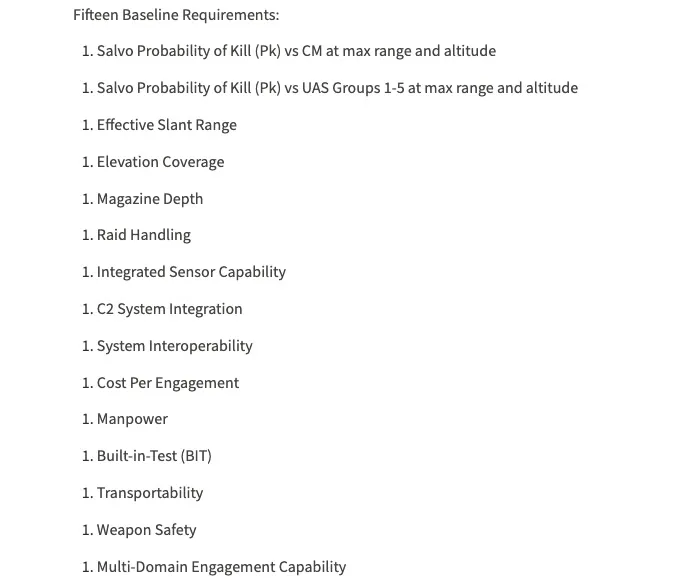
“To effectively assess and compare air defense weapon system performance, there are 15 critical baseline operational and technical parameters that must be analyzed in unison,” the RFI explains.
(Air Force Request for Information)
“These key metrics begin with the system’s Salvo Probability of Kill (Pk) evaluated against both Cruise Missiles (CM) and Unmanned Aircraft Systems (UAS) Groups 1-5 at maximum range and altitude, ensuring robust lethality against diverse modern threats,” the RFI notes.
A salvo probability of kill measures how effectively a salvo, as opposed to a single shot, defeats a target.
The following chart displays the weight, normal operating altitude and speed of the five drone group classifications.
(Congressional Research Service chart of Group 1 through 5 drones)
The Air Force wants this system to be “rapidly deployable, maintaining a lightweight, modular, and transportable footprint that can be swiftly projected into austere theater environments to meet emergent threats.” The RFI does not provide further details of how the Air Force is looking to transport these systems; however, the service relies on its fleets of C-130 Hercules, C-17 Globemaster III and C-5 Galaxy transport aircraft to move equipment. The size and weight of the systems determines which kind of aircraft can transport it.
These systems could also be moved by truck or ship or on their own if self-propelled, but those options also incur a cost in terms of the timeliness of delivery, and can be impossible for rapid global deployments.
U.S. Army Soldiers from the 1st Battalion, 7th Air Defense Artillery Regiment, 108th Air Defense Artillery Brigade, load equipment and trucks onto a C-17 Globemaster III with U.S. Air Force Airmen assigned to the 21st Expeditionary Airlift Squadron at an undisclosed location in the CENTCOM Area of Operations, Dec. 31, 2023. (U.S. Army photo by Sgt. Christopher Neu) Staff Sgt. Christopher Neu
A key point of evaluation will be the overall cost of the munitions. The Air Force wants to ensure that the shell’s velocity and terminal effects “are maximized without driving the cost-per-engagement to unsustainable levels or exceeding the physical constraints of the host platform,” the RFI states. We’ll discuss these factors in more detail later in this story.
The service is also looking for the integration of “the right mix of radar, electro-optical, infrared, or radio-frequency sensors—to ensure reliable target acquisition and tracking across varying weather conditions, environments, and countermeasure scenarios.”
As we noted at the top of this story, the Air Force is seeking to improve its organic ability to defend its bases. This has become “an increasingly high priority” for the service, Air Force Secretary Troy E. Meink told Congress on May 20.
“The Air Force is developing organic air and missile defense capabilities, including Counter-small Unmanned Aircraft Systems (C-sUAS) to defend our air bases in all theatres [sic],” Meink stated in his written testimony. “The fielding of the Air Base Air Defense Systems (ABADS) missile defense capability, including kinetic defenses, at overseas main operation bases contributes to joint layered defense but does not reduce the need for increased joint investment in air and missile defense. We will continue to work judiciously for the development and procurement of these critical defensive capabilities.”
(Written testimony of Air Force Secretary Troy E. Meink)
In its Fiscal Year 2027 budget request, the Air Force is seeking about $1.4 billion for a missile defense variant of the Air Base Air Defense Systems (ABADS), according to Air & Space Forces Magazine. In addition, the Air Force also requested $51.8 million in procurement funds for its Small Unmanned Air Defense Systems (SUADS) in Fiscal Year 2026, according to the Air Force Fiscal Year 2026 budget justification book.
The war against Iran and the Ukraine war have, in particular, illustrated the challenges of defending against drones and cruise missiles.
There are two facets to potential use of gun systems for base defense. The first is that in complex air defense environments, it provides an inner, last line of defense against incoming threats. If the outer layers fail to take down the target or that target is not considered a priority over others, a hard-kill gun system offers a predictable and relatively reliable fallback. The gun system would become even more important if interceptor stocks run low, even temporarily, and those weapons need to be rationed for higher-end threats. With the outer defensive rings collapsing, the inner becomes far more important.
For small drones, that interceptors would not be effective anyway, the gun system can take them down in localized air defense scenarios. Then there is also defending bases in lower threat areas where there are not additional layers of SAM systems. A gun system can provide a core aerial defense against lower-end, lower-density drone and cruise missile threats without costing huge sums of money or requiring a huge logistical footprint.
Beyond that, there is a direct cost comparison argument, but again, that is in a vacuum and a gun system cannot take the place of a multi-layered air defense system without inviting huge risk. Still, the engagement cost comparison is worth mentioning.
High-end, expensive, difficult-to-manufacture air defense weapons, like Patriot PAC-3 MSE, are clearly inefficient against drones. For instance, a mass-produced Iranian Shahed-136 can cost about $35,000 to $50,000, while a Patriot PAC-3 can run about $5 million and takes years to procure. By comparison, the cost-per-engagement efficiency of gun-based air defense systems, designed to defend against drones and subsonic cruise missiles, is far greater. One example of how this plays out is the cost of firing the Army’s Centurion Counter-Rocket, Artillery, Mortar (C-RAM) system. It is a ground-based version of the Phalanx Close-In Weapon System (CIWS) used on various U.S. and foreign warships, and is armed with a six-barrel 20mm Vulcan Gatling-type cannon firing M940 rounds. Those self-destructing rounds currently have a price tag of $80.70, according to the Army’s Fiscal Year 2025 budget request. This means a two-second burst from a Centurion, at a rate of fire of 4,500 rounds per minute, would cost just over $12,100.
C-RAM Test Fire
Again, this is not a strict apples-to-apples comparison, but it can become a bigger factor during prolonged conflicts when high-end weapons stocks begin to run short. It’s also worth noting that drone interceptors are a rapidly growing capability set that are a lower-cost option for swatting down one-way attack drones and even some cruise missiles. Systems like Coyote have been in service for years with the Pentagon and have been protecting bases overseas with strong results. Even cheaper systems are emerging out of lessons learned in Ukraine. All of these systems have their own advantages and disadvantages, but pairing them with a new gun system would likely have synergistic effects. Overall, deploying densely layered short-range air defenses is becoming increasingly important in its own right, at least in high-threat areas.
Ukraine has a great deal of experience with the costs and prioritization of air defense capabilities. The country faces daily attacks by Russian missiles and drones, which is causing mounting casualties and destruction. This ceaseless bombardment has almost completely depleted Ukraine’s supply of Patriot interceptors, leaving it largely defenseless against ballistic missiles. As we noted yesterday, Ukraine is also running short of air-to-air missiles its Air Force F-16s use to swat down drones.
EXCLUSIVE: Ukraine F-16 Pilots Rationing Missiles as Russian Attacks Intensify | NEWSMAX2
However, Ukraine has also relied heavily on a wide array of gun-based air defense systems, including the German-made Gepard self-propelled anti-aircraft guns (SPAAG). Based on the chassis of the Leopard 1 main battle tank, Gepards feature twin radar-aimed 35mm automatic cannons, mounted on a single turret. The German variant sports an S-band search radar and a Ku-band tracking radar. These radars are critical to the Gepard’s ability to locate, track, and engage targets at night and amid poor weather conditions.
The following video shows a Gepard blasting an Iranian-made Shahed-136 out of the sky.
A video reportedly showing two Russian Shahed-136 (Geran-2) loitering munitions being shot down by the Ukrainians with a German-delivered Flakpanzer Gepard self-propelled anti-aircraft gun (SPAAG) during last night’s attack in Odesa Oblast, southern Ukraine.… pic.twitter.com/OhH7vTultm
The Air Force force is also looking at directed energy weapons like lasers for force protection and especially for defending bases overseas. While gaining traction across the services due in large measure to the much lower cost of delivering effects, these systems are still works in progress. Gun-based air defenses, on the other hand, are mature and proven and modern precision-guided, programable ammunition makes them even more efficient and effective.
Beyond the cost, high-end air defense systems — including their component sensors — though portable, are generally fixed to a specific location. That makes them vulnerable to attack. This has been the case in both the war against Iran and Ukraine. The same concerns hold true of aircraft. Both conflicts have shown aircraft vulnerability to drones when parked out in the open. Ukraine’s Operation Spider Web attack on Russian strategic bombers last year in particular shed light on this issue, which we have been sounding the alarm a long time.
In addition to these challenges, the Air Force is also facing the headwinds of an overall lack of U.S. short-range air defense capabilities, a concern we have been highlighting for years. Currently, there are three gun-based SHORAD systems being fielded by the U.S. military. These include the aforementioned Centurion C-RAM systems.
The Army also uses the Sgt. Stout, an air defense system based on the 8×8 Stryker light armored vehicle. The Sgt. Stout has a turret that can be fitted with up to two four-round launchers for Stingers. Those launchers can also be swapped out for ones that can be loaded with a pair of millimeter-wave radar-guided AGM-114L Hellfire missiles. The turret also has a 30mm XM914 automatic cannon, which can fire proximity-fuzed airbursting rounds against drones and other aerial threats, and a 7.62x51mm M240B machine gun.
Soldiers assigned to 4th Battalion, 60th Air Defense Artillery Regiment conducted a live fire exercise with the SGT STOUT (Stryker A1 M-SHORAD) vehicle in Fort Sill, Oklahoma, Sep. 23, 2025. (U.S. Army photo by Cpl. Emaney Wilson) Cpl. Emaney Wilson
The Marine Air Defense Integrated System (MADIS) is armed with 30mm cannons and M240C coaxial machine guns in remote weapon stations (RWS). The RWS on one of the two vehicles is also configured to fire Stinger missiles for a spectrum of ground-based air defense scenarios.
U.S. Marines with 12th Littoral Anti-Air Battalion, 12th Marine Littoral Regiment, 3rd Marine Division, fire an XM914 30mm chain gun mounted on a Marine Air Defense Integrated System during a live-fire range at Camp Schwab, Okinawa, Japan, July 28, 2026. (U.S. Marine Corps photo by Lance Cpl. Skilah Sanchez) Lance Cpl. Skilah Sanchez
The Army may have additional gun-based systems on the way. In July, the service put out a request for information to companies that can provide a new gun-based air defense option, using a 50mm cannon system to track and defeat Group 1, 2 and 3 drones.
A few weeks later, Northrop Grumman introduced its Raid Hunter 50mm GBAD system, which it said “combines proven Chain Gun® technology, precision‑guided 50mm ammunition and a networked, interoperable system controller to deliver powerful protection against high-volume, mixed-threat aerial raids. It is designed to defeat a range of aerial threats including high‑priority cruise missile threats, unmanned aerial systems (UAS), and other advanced threats.”
We’re introducing Raid Hunter™, our newly named 50mm gun-based air defense system designed to defeat mass, mixed aerial raids with cost-effective interceptors and deep magazine effectors which can be delivered to the warfighter at scale. Learn more: https://t.co/gnOzpo0RA3pic.twitter.com/oTqORTG9Q4
There are foreign options should the Air Force want to go that route. For instance, German arms maker Rheinmetall makes the popular Skyranger 35 gun system, which is a turret that can fit on a wide array of armor hulls.
The Skyranger 35 “is equipped with a KDG 35/1000 revolver cannon in 35 mm x 228 caliber with a firing rate of 1,000 rounds per minute,” according to Rheinmetall, which began delivering these to Ukraine in January. “It has an effective range of up to 4,000 meters and a high degree of commonality with the Oerlikon Revolver Gun Mk 3. Thanks to AHEAD technology, the Skyranger 35 is airburst-capable. In the future, it will also be possible to equip it with modern guided missiles.”
It seems that Ukraine’s 1020th Anti-Aircraft Missile Regiment which belongs to the Ground Forces has taken delivery of the first Skyranger 35 SPAAGs mounted on a Leopard 1 chassis made by @RheinmetallAG.
Skyshield is the fixed placement cousin of this system and has been bought by a number of nations
Skyshield (Rheinmetall)
Rheinmetall Air Defence: Ahead – Highly effective, programmable ammunition
This is just one example of a large number of potential offerings that could fit the USAF’s interests, from both domestic and foreign origins.
As we discussed earlier in this story, the U.S. is already facing a challenge defending against Iranian threats. A war with China would be more devastating and, when it comes to the Air Force protecting its bases, require far more robust defenses. At the same time, the Air Force is still very early in the process of taking on more responsibility for protecting its assets.
Parties have until 5 p.m. Oct. 9 to submit their proposals to the Air Force for a gun-based air defense system. With limited options and the service pushing to address its growing desire for organic air defenses, it will be interesting to see who comes forward and what systems they offer. We will provide more details about this effort when they become available.
As a young sportswriter studying journalism at the University of Missouri, Seth Wickersham looked to Los Angeles for inspiration. At the campus bookstore, Wickersham bought his first sportswriting anthology, “The Last of the Best,” a collection of columns from the Los Angeles Times’ Jim Murray, one of four sportswriters ever to win a Pulitzer Prize.
Collections of work from Murray, Rick Reilly, Frank Deford and others offered Wickersham a road map for the career he wanted to build — and he has, with 26 years’ worth of work at ESPN meriting an anthology of his own. “Be on That Hill: Stories From the Summits of Sport,” which will hit bookshelves Sept. 22, is Wickersham’s third book. He said assembling an anthology is both “the coolest thing you could ever imagine happening” and “this weird mind warp.”
“When you’re just on a treadmill like I’ve been, the years just go,” says Wickersham, who’s been covering sports since he was hired by ESPN The Magazine straight out of college. “You don’t realize it, but then you take stock of it, and you’re like, ‘Holy cow, I’ve been doing this 26 years …’ It’s surreal to go back and look at it.”
Football has always been Wickersham’s first love — he weaved his journey as a high school quarterback into “American Kings” — but his latest book features stories about a college basketball coach on the job hunt and an NHL enforcer’s attempts to avoid head injuries.
“I’m trying to write about people who have a certain level of inner turmoil,” Wickersham says, “whether it’s Sean McVay after he wins the Super Bowl, or Jerry Jones when he’s threatening to sue the NFL to stop Roger Goodell from signing a contract extension.”
The sports media industry has changed dramatically since Wickersham’s career began. ESPN The Magazine no longer exists. Access to coaches and players is increasingly hard to secure. But Wickersham’s journalistic goals are the same today as they were when he bought Murray’s anthology.
“I want to be a link on a chain,” he says. “It’s hopefully an installment of a body of work that one day might help me be a link on a chain of the best who did this.”
This Q&A was edited for length and clarity.
You’re reading Book Club
An exclusive look at what we’re reading, book club events and our latest author interviews.
By continuing, you agree to our Terms of Service, which include arbitration and a class action waiver. You agree that we and our third-party vendors may collect and use your information, including through cookies, pixels and similar technologies, for the purposes set forth in our Privacy Policy such as personalizing your experience and ads.
✍️ Author Recommendations
In addition to Jim Murray’s anthology, here are some other sports books that have inspired Wickersham.
“The Breaks of the Game” by David Halberstam: This is the Pulitzer-winning Halberstam’s first sports book, following the 1979-1980 Portland Trail Blazers. “When it comes to trying to decode a team, that’s the standard,” Wickersham says.
“Joe Namath and the Other Guys” by Rick Telander: Namath, the Hall of Fame New York Jets quarterback, serves as an example of quarterbacks’ rising celebrity profile in “American Kings,” and Telander is one of Wickersham’s favorite sportswriters. “The portrait he gave of Joe Namath in his twilight was just so rare,” Wickersham says. “I don’t think a book like that has ever been done.”
“When Nothing Else Matters” by Michael Leahy: Another book about an athlete in his twilight. This one documents Michael Jordan’s time with the Washington Wizards. “He worked his tail off as a reporter and really gave a brutally honest glimpse into what it was like to live and play with Michael Jordan the last few years of his career,” Wickersham says.
“The Franchise” by Michael MacCambridge: Wickersham read this history of Sports Illustrated in college. “It really not only gave a glimpse into how so many of these great stories by my heroes … were done,” he says, “but also how those guys got hired at Sports Illustrated. It was like a job road map.”
📰 The Week(s) in Books
Our fall book recommendations answer your call for learning and discovery this season.
(Kissi Ussuki / For The Times)
Our Fall Preview includes 29 books to keep on your radar this fall, as well as television and movies we’re excited about.
This week, we caught up with Raine De Leon, owner of Sons and Daughters Books, a formerly online bookstore that opened a brick-and-mortar location earlier this year. Here’s what they had to say about their IRL location, the local bookshops that inspired them and more.
This interview was edited for brevity and clarity.
Your bookstore began as an online store in 2024. What motivated you to open an online store? How did it grow from there?
A brick-and-mortar was always the end goal, since I wanted a physical space for writers, readers and other artists to come together for events and community building. Originally, the online store was actually an online poetry journal, where I published poets from around the world, wrote reviews, and held virtual readings. I wanted to translate that into an in-person experience.
What other bookstores, in Los Angeles or elsewhere, served as inspiration for the type of bookstore you wanted to open?
Skylight Books in Los Feliz and Village Well Books and Coffee in Culver City really inspired how I wanted the store to feel: warm, inviting and dynamic enough to serve both a neighborhood and a larger L.A. audience. I took inspiration from the Painted Porch in Texas in regard to curating the selection of books in the store. City Lights in San Francisco was also a huge inspiration for not only my store, but my life in general. The place it holds in the history of its community, the history of publishing and the history of poetry are profound, and I am trying to emulate that legacy as best I can.
What inspired the name Sons and Daughters Books?
The poet Charles Olson wrote a landmark essay, “Projective Verse,” in 1950. In it, he talks about poetic lineage and influence, and he says something to the effect of “We are the sons of the poets who came before us,” and that really spoke to me. I expanded it out to “Sons and Daughters,” with that same sentiment, to be a little more inclusive.
What type of selection can people expect at Sons and Daughters Books?
Our selection is almost all new books with focus on fiction, poetry, social sciences and more. We also have a cart of used books out on the floor every day, and on Sundays I bring out two more carts of used books.
For the new books, I selected each book in the store myself. I may not have read every book on these shelves, but I went line by line in our inventory sheets to select books that I wanted people to be aware of. Even though I am the only staff member, our “Staff Rec” table features reviews and picks from those closest to me. I wanted our selection to be extremely specific to me, my loved ones and the community the store is now in.
In the time you’ve been open, what events have been the most popular? Any particular upcoming events you’re excited about?
Our two most popular events are definitely our weekly stand-up comedy open mic night and our thriller book club.
September is our fullest month yet in regard to events, and I’m very excited for a few. We have two book launch events. The one on Sept. 26 is for “Valley Girl Manifesto” by Noelle Cope, a collection of both poetry and prose. The other, on Sept. 19, is for “Anger Is a Gift,” a new poetry anthology from FlowerSong Press. Both celebrate poetry, locality and connection.
Our full events calendar, which continues to grow, also features community workshops, silent reading clubs and more.
Sons & Daughters is located at 7817 Melrose Ave., Los Angeles.
India claim seven-wicket win after Pakistan lose 10 wickets for just 28 runs as they are bowled out for 55.
Published On 5 Sep 20265 Sep 2026
India produced a dominant display to defeat Pakistan by seven wickets in the Women’s T20 Asia Cup in Dubai, bowling their rivals out for their lowest total in the format before rattling off their target inside nine overs.
Pakistan, having won the toss and elected to bat at the Dubai International Stadium on Saturday, made a promising start but collapsed spectacularly after an opening partnership of 27.
Recommended Stories
list of 4 itemsend of list
India eventually dismissed them for just 55 in 18.1 overs, with their spinners responsible for much of the damage.
Shree Charani and Prema Rawat were the stars of the bowling attack, taking three wickets apiece. Charani finished with remarkable figures of 3 for 7 from four overs, while Rawat returned 3 for 9. Deepti Sharma added two wickets for only five runs.
Pakistan’s innings initially appeared under control. Muneeba Ali made 13, and Shawaal Zulfiqar scored 14 for the first wicket.
But Shafali Verma broke the partnership by bowling Muneeba, and Charani then struck twice in the sixth over. She dismissed Gull Feroza for a duck before removing Zulfiqar, leaving Pakistan 29 for three.
The collapse continued almost immediately as Pakistan slipped to 32 for four in the eighth over before Rawat and Deepti Sharma intensified the pressure. By the 13th over, Pakistan were 45 for seven, and there was no prospect of recovering to a competitive total.
The final three wickets eventually fell with Pakistan on 55, giving India an exceptionally modest target. The total was Pakistan’s lowest in women’s T20I cricket, surpassing their previous low of 63 against India in the 2012 Women’s Twenty20 Asia Cup.
India survive brief wobble
Despite requiring only 56, India did not have everything their own way at the start of the chase.
Pakistan’s bowlers claimed three wickets, giving their opponents a brief glimpse of an unlikely route back into the contest. Fatima Sana was Pakistan’s most successful bowler, finishing with 3 for 17.
The target, however, was simply too small. India reached 57 for three in 8.4 overs, completing a seven-wicket victory with Harmanpreet Kaur unbeaten on 18. The Indian captain ensured there was no late drama and guided her side across the line with plenty of deliveries to spare.
The victory maintained India’s perfect start to the tournament. They now have six points from three matches and have already secured their place in the semifinals.
For Pakistan, meanwhile, the defeat leaves their qualification hopes dependent on their final group match against Hong Kong. They remain on two points and need a victory to give themselves a chance of progressing.
Both Russia and Ukraine vow not to strike each other’s capitals for three days during talks in Moscow and Kyiv.
Published On 5 Sep 20265 Sep 2026
Russian President Vladimir Putin has begun talks with United States envoys on ending more than four years of war in Ukraine, ahead of their first visit to Kyiv expected on Sunday.
Putin met Steve Witkoff and Jared Kushner – respectively President Donald Trump’s special envoy and business ally, and his son-in-law – at the Kremlin on Saturday.
Recommended Stories
list of 3 itemsend of list
“Dear colleagues, I warmly welcome you to Moscow. The situation is, of course, not simple,” Putin told the envoys in a grand Kremlin hall in footage aired by Russian TV.
Both Russia and Ukraine vowed not to strike each other’s capitals for three days during the negotiations, as Washington tries to revive US-led talks to end Europe’s worst conflict since World War II.
Trump earlier said Kushner and Witkoff were bringing “a proposal to end the war”.
In Putin’s address to the two men, he said: “I would like to ask everyone to convey their best wishes and words of gratitude to US President Mr Trump”.
Witkoff said Trump had sent his best wishes to Putin and thanked him for the limited ceasefire during the delegation’s visit. Putin said Russia would do its utmost to ensure the safety of the mediators.
‘Refrain from strikes’
The talks come as the grinding war – which began with a Russian invasion in 2022 – has seen increasing civilian deaths and attacks this summer.
Putin has repeatedly said Moscow intends to seize the rest of east Ukraine.
Russian strikes on Ukraine on Saturday killed at least seven people, including in the Kyiv suburbs, Ukrainian officials said.
The Kremlin said it would not strike Kyiv from midnight on Saturday, while Ukrainian President Volodymyr Zelensky said he would halt strikes on Moscow “from now” until Monday.
“The Russian president, the commander-in-chief, has given the order from midnight tonight not to strike Kyiv for three days,” Kremlin spokesman Dmitry Peskov said.
Zelensky – who had offered a truce during the US visits – later said he had spoken to the US envoys and also promised Kyiv would not strike Moscow.
“From now through the end of Saturday, as well as on Sunday and Monday, Ukraine is ready to refrain from strikes on Moscow,” Zelensky said on social media.
The Ukrainian leader said he had spoken to the US officials and that he expected them in Kyiv on Sunday.
It will be the first time that Witkoff and Kushner visit Kyiv since Trump returned to office last year with a pledge to resolve the conflict.
VENICE, Italy — When Skyler Gisondo turns up in “Primetime” as “Decoy Dan” Plum, an aspiring 23-year-old actor cast to play teenage bait for an unsuspecting pedophile, the camera can’t take its eyes off him.
The second trap set in director Lance Oppenheim’s lurid sweeps-ploitation drama about “To Catch a Predator” follows Gisondo’s face, most often in extreme close-up, as Dan processes what he’s gotten himself into, attempts to make small talk with the predator and finally flees off set, where he sits down, steadies himself and sheds a shaken tear. The suspect, meanwhile, is an afterthought, or more accurately a punchline: He only truly captures the camera’s attention when he drops trou, rips the top off a canister of whipped cream and sprays.
It’s an arresting formal choice, repeated from the opening sequence — that of the viral “You see how this looks, right?” moment from the trailer — to the climatic suicide of Rockwall County, Texas, Assistant Dist. Atty. Bill Conradt Jr., whose case is explored in the Esquire magazine article on which Ajon Singh’s screenplay is based. With rare exception, “Primetime” doesn’t have the guts to look its predators in the eye.
And perhaps it doesn’t need to. The film directs its most gleeful energies instead to taking “To Catch a Predator” host Chris Hansen (Robert Pattinson) down a peg. The former “Dateline NBC” correspondent, who turned a newsmagazine segment about men soliciting teens for sex online into a hidden-camera sensation in the mid-aughts, comes off here as a self-serious showboat who’s mistaken tabloid trash for accountability journalism. (As one audio technician complains, “Guy thinks he’s f— Mike Wallace.”) It’s not just that stentorian voice, either. Envy of “Dateline” co-anchor Stone Phillips provides as much motivation as ratings pressure from TV executive Jeff Zucker (playing himself), with Hansen micromanaging his crew, insulting his producer, Andie (Merritt Wever), and neglecting his wife and kids in the process.
At least in the film’s early going, this yearning for adulation is played for cringeworthy comedy, and effectively so; my hardest laugh came when Hansen screens the rough cut of a new episode for his young sons and brags to them about “To Catch a Predator” being moved to a better time slot. As the tone moves toward horror, though, the decision to make the host the story quickly stops paying dividends. Indeed, though the real-life broadcaster may not find all the ego-deflation very funny, even Hansen — who told my colleague Stephen Battaglio that he objects to the film using his name and likeness under the label “inspired by true events” — would have to admit that “Primetime” avoids the thorniest questions about the true-crime empire he built.
Robert Pattinson as Chris Hansen in “Primetime.”
(A24)
Compared with David Osit’s superb 2025 documentary “Predators,” a kaleidoscopic examination of the phenomenon from the perspective of Hansen, the decoys, the suspects, law enforcement, journalistic ethics and the filmmaker’s own experience as a survivor of child sexual abuse, “Primetime” seems remarkably incurious about “To Catch a Predator” and its consequences. It would probably be too much to ask a scripted feature to explore the challenge of achieving convictions against defendants ensnared on an episode of “Dateline,” or to delve into the legal niceties of surreptitious recording. But the suspects here are so anonymized — seen in profile or steep angles through a hidden camera lens, spied at a distance on a monitor in video village, heard as a disembodied voice on a phone or read via text in an instant message — that there’s not much to argue over anyway. The predators are reduced from people to “perverts,” of scarcely more interest to “Primetime” than to the bloodthirsty viewer Hansen meets on a plane.
When an entrapped rabbi attacks Hansen during a sting, screaming in his own tight close-up, “You don’t have the right to do this. Who do you think you are?” the film briefly, mercifully breaks this pattern, and generates an electric moment of moral uncertainty. But it doesn’t last. Instead, in its depiction of the Conradt case — ostensibly meant to underscore “To Catch a Predator’s” worst extremes — “Primetime” stumbles into some of the very same gutter sleaze tactics as the original series, transforming what was in reality a grim mid-afternoon standoff into a tense, pitch-dark operation punctuated by lightning strikes, power outages and night-vision cameras.
Such poetic license offers little new insight into a topic that has already been picked over for two decades, but it might be forgiven were Hansen as easily dramatized as he is made fun of. Alas. “Primetime” itself seems to know this — why else hire Gisondo to play Jimmy Olsen to Pattinson’s unlikable Man of Zeal — yet proceeds to construct its second half around Hansen’s unraveling: an extramarital affair, about to be exposed in the National Enquirer; ratings losses to ABC competitor “Lost”; desperation to reel in a “whale” and willingness to cut corners to do it. By the time the film again confronts the specter of something wicked under “To Catch a Predator’s” glossy surface, it comes in the form of Hansen’s own phantoms, introduced in a grueling flashback to India in the 1990s and carried through to the film’s conclusion. Why we’re to care about this apparent flash of horror, if not of conscience, remains unexplained. What about the faintly ludicrous figure of the foregoing 100-plus minutes was supposed to make me care about his moral compass?
In the final estimation, then, “Primetime” isn’t a Chris Hansen hit piece. In fact, it’s so in love with its flawed protagonist that it can’t see he’s the least compelling character in the movie, an ambitious, arrogant, grasping, unscrupulous man we’ve met countless times before. Which may explain the film’s final bit of poetic license. The last we last see of Hansen, muttering lines from his script as the police process the Conradt crime scene, suggests a man disturbed, perhaps even chastened, by what he has witnessed. But of course the real-life Hansen continues his sting operations to this day under the banner of “Takedown,” a series on his streaming service TruBlu, and both there and in “Predators” he appears utterly unshaken, unhaunted, unbowed. So for all the tension between the film and its subject to come through in the press of late, the gulf between them is not so wide as one might suspect.
Erling Haaland score the only goal of Manchester City’s unconvincing home win against newly promoted Coventry City.
Published On 5 Sep 20265 Sep 2026
Manchester City maintained their winning start to the season to move to the top of the Premier League, but Erling Haaland’s solitary strike against newly promoted Coventry City couldn’t hide the nerves in the Etihad Stadium.
The Enzo Maresca era has started with three consecutive Premier League wins, but it was a far from perfect performance on Saturday as the hosts needed a pair of late saves from Gianluigi Donnarumma to deny Coventry a first top-flight point for 25 years.
Haaland’s header midway through the first half proved decisive for his third goal in as many games this season.
Maresca was able to unleash summer signings Enzo Fernandez and Iliman Ndiaye after their arrivals completed a record outlay by any club of £460 million ($622m) in the transfer market to refresh the City squad after Pep Guardiola’s decade in charge.
Fernandez was supposed to start on the bench after completing his £125 million move from Chelsea to match the Premier League transfer record.
However, an injury to Nico O’Reilly in the warm-up meant the Argentine was thrust into the starting line up.
Ndiaye was also handed his City debut by Maresca alongside Haaland, Antoine Semenyo and Rayan Cherki in a fearsome front four.
Coventry had failed to score in three consecutive defeats to mark their return to the top flight after 25 years.
Yet, Frank Lampard’s men could not have come closer to breaking their duck early on thanks to a gift from Donnarumma.
The giant Italian miscontrolled a backpass and recovered to clear off his own line with inches to spare.
Taiwo Awoniyi and Jack Rudoni also missed big chances to give the visitors the lead before City began to find their stride.
Cherki smashed off the post before Fernandez was involved in the opening goal.
His pass fed Semenyo sprinting down the right and his cross was hung up perfectly for Haaland to head home at the back post.
The Norwegian was denied a second by Carl Rushworth before half-time, but City failed to build on their advantage and were left clinging on for the three points.
Donnarumma was needed to produce two huge saves to deny Loum Tchaouna and Ellis Simms an equaliser and a historic moment for Coventry.
Despite another defeat, there was plenty of encouragement for Lampard that Coventry can compete back in the big time.
Maresca will know City will need to be much improved when they travel to local rivals Manchester United next weekend.
But the blue half of the city move to the top of the table ahead of champions Arsenal’s clash against Chelsea on Sunday.
New imagery appearing out of China provides the best look yet at one of the country’s most enigmatic aircraft: the very large, low-observable, flying-wing drone widely referred to as the WZ-X. Seen previously primarily in satellite imagery, TWZ broke the story of the existence of this monster high-altitude, long-endurance drone. The new views that emerged today help clear up one of the most puzzling aspects of the aircraft’s appearance, namely the unusual shape of its enormous wings.
The aircraft was first identified in satellite imagery collected in May 2025 showing the People’s Liberation Army Air Force’s (PLAAF) sprawling test facility at Malan in Xinjiang. At the time, it was difficult to determine whether some of the apparent discontinuities in the wing planform were genuine features, visual countermeasures, or artifacts of the imagery.
The new photograph, seen at the top of the article and below, as well as a new satellite image, shows that the aircraft has a broader-chord inner wing section that transitions into a substantially narrower outer section. Rather than tapering continuously from the center section toward the tips, the wing effectively becomes much more slender over its outer portion in a ‘step down’-like fashion. The resulting planform gives the aircraft an exceptionally long, narrow outer wing. The wing arrangement differs from the B-2 and other stealthy flying wing designs because it has two outer wing sections, in addition to its diamond-like central fuselage, instead of just one.
We still can’t say for sure if this feature is just the way the aircraft’s wing was designed or if it also is due to some other exotic feature, such as wing folding or removable outboard sections. While a more novel explanation is possible, it is somewhat improbable at this point.
Seen from behind, the aircraft has a relatively shallow central fuselage section, with extremely long wings extending outward from it. The landing gear is extended, revealing large main undercarriage doors and substantial landing gear consistent with an aircraft of this size. Split rudders are visible toward the outer wing areas, broadly reminiscent of those used on the B-2.
An earlier view of the WZ-X. via Chinese internet
As in previous imagery, the rear of the center section of the aircraft may also reveal slot-like exhaust openings, supporting the assessment that it is twin-engined.
For an aircraft intended to spend long periods operating at high altitude, a very long overall span combined with a relatively narrow outer wing could be advantageous. Such an arrangement would increase effective aspect ratio and reduce induced drag during efficient cruise, potentially improving endurance and high-altitude performance.
It may also allow the designers to concentrate structural mass and internal volume closer to the center of the aircraft while still achieving a very large span.
There is a potential low-observable tradeoff, however. A significant change in chord introduces additional planform geometry and potential edge-alignment discontinuities that must be reconciled with the requirements of a stealth aircraft. The transition will influence radar reflections depending on its precise shape, orientation, and relationship to the aircraft’s other edges and surfaces. This will also be highly dependent on the aspect the radar is viewing the aircraft from. Modern very low observable designs try to minimize these exact types of features, with large continuous structures being the most advantageous to radar signature. This philosophy can be seen in the design of the B-21’s planform, which was also how the B-2 was supposed to look originally. You can read all about this here.
Regardless, the WZ-X does indeed have a semi-sawtooth trailing edge due to this intriguing feature.
New images of the so-called WZ-X stealthy flying-wing drone. via Chinese internet
The overall scale of the aircraft is also becoming increasingly apparent. Our initial analysis of satellite imagery put its wingspan at approximately 170 feet, roughly comparable to the 172-foot span of the B-2. That would make it considerably larger than other Chinese flying-wing drones identified to date.
Andreas Rupprecht, an analyst specializing in Chinese military aviation and TWZ contributor, assesses that the WZ-X is likely a twin-engined design similar in configuration to the supposed U.S. RQ-180, but considerably larger.
Rupprecht estimates a length of approximately 46 feet. He also assesses the aircraft as having a relatively spacious central fuselage and a dorsal satellite communications antenna. His estimates of a range exceeding 12,000 miles and a normal cruising altitude of somewhere between 59,000 and 66,000 feet remain unconfirmed.
The WZ-X is notably different from China’s smaller flying-wing designs. The CH-7, for example, has a deeper and more curved center section and is substantially smaller. The WZ-X’s broad, relatively flattened center body and enormous span instead appear particularly compatible with high-altitude endurance.
CH-7 stealthy flying-wing drone. via Chinese internet
Its apparent configuration also makes a long-duration surveillance mission plausible. The central body and inner wing section would provide substantial space for fuel, sensors, and communications systems, while the outer wing, combined with its lifting central body, could support highly efficient flight at high altitude.
A low-observable platform of this size could potentially conduct many types of wide-area surveillance and networking assistance while operating in or very near contested airspace where conventional high-altitude UAVs would face greater risks. A strike capability cannot be ruled out, particularly given China’s broader development of combat-capable flying-wing UCAVs, but the aircraft’s proportions appear especially well suited to persistence and reconnaissance.
While the location of the latest imagery is unconfirmed, Malan has developed into a massive center for Chinese drone testing, with satellite imagery showing extensive expansion of its infrastructure in recent years. The facility has been associated with multiple flying-wing designs, including the WZ-X and the similarly mysterious and also very large GJ-X. This substantially different flying-wing aircraft with a cranked-kite planform is also undergoing flight testing. That aircraft is estimated to have a wingspan of around 137 feet, underscoring the breadth of China’s experimentation with large low-observable uncrewed aircraft.
China is pursuing tailless/flying-wing designs across an increasingly wide range of sizes and missions, alongside larger crewed aircraft programs including the J-36 and J-XDS and, eventually, the H-20 stealth bomber.
The WZ-X appears to be part of a much broader effort to develop highly integrated, low-observable aircraft optimized for different combinations of range, endurance, payload, and survivability.
For now, its official designation, manufacturer, propulsion system, performance, and intended mission remain unknown.
However, its configuration appears well suited to the requirements of a very large high-altitude endurance aircraft, although the trade-off between its performance and its stealth characteristics remains equally mysterious.
Graeme Souness is appearing in new ITV show The Box on Saturday night.
The Scottish former professional football player, manager and television pundit, 73, is one of ten celebrity contestants on Gary Lineker’s new game show. Also joining the line-up are Danny Aarons, Ellie Taylor, Joey Essex, JB Gill, Jenny Ryan, John Bercow, Ranvir Singh, Sara Davies and Shakira Khan on the new ITV show.
Away from the ITV show, Graeme has spoken candidly about his health over the years after he was diagnosed with a heart condition aged just 38, which left him asking ‘how can this happen to me’.
Graeme shared his experience with the British Heart Foundation (BHF), revealing what life was like following his diagnosis and treatment for heart disease as a young, physically fit man.
While managing Liverpool in 1991, the Scot was struggling to sleep and experiencing chest pains in bed. With a family history of heart disease, alarm bells were ringing. He underwent an electrocardiogram (ECG) – a straightforward test used to assess the heart’s rhythm and electrical activity.
Following the results, he was referred for an angiogram, a specialised X-ray procedure used to examine blood vessels. Despite displaying no obvious symptoms, Graeme was diagnosed with three blocked arteries and coronary heart disease. Just five days later, he was facing open heart surgery.
Speaking on the British Heart Foundation’s (BHF) podcast, the Ticker Tapes in 2021, he said at the time: “At the time I was training like the professional football players and was only 38-years-old. I kept thinking ‘how can this happen to me?’
“I looked after myself in terms what I ate and drank and had trained from the age of 15 – I trained as vigorously as a professional athlete. I didn’t carry any weight, I never had done. How had this happened to me?
“I didn’t have the obvious symptoms that there was something badly wrong with my heart so I’m so glad I got checked when I did. It’s because of this that I’m here 30 years later.
“If it can happen to me, it can happen to anyone. At that time I was a very fit, young man. If you’re concerned about your family history, go and get checked. You must get yourself checked.”
In 2015, Graeme suffered a heart attack and has since become a British Heart Foundation (BHF) ambassador, throwing himself into numerous campaigns and events, as well as making visits to BHF research laboratories.
Graeme said of the terrifying health scare: “My heart attack was very scary but I’m still here, able to talk about it thank goodness. Fortunately, it hasn’t caused me any lasting problem.
“It’s so important to go to your doctor and get yourself diagnosed if you’re at all concerned. You owe it to yourself and those close to you – your wife, your children and your grandchildren. They want you around as long as possible.”
The Box launches on Saturday 5th September, with Episode 2 airing on Sunday 6th September, on ITV1, ITVX, STV & STV Player.
US Central Command says its forces struck three Iranian crude oil carriers on Saturday, in retaliation for Iranian forces firing ballistic missiles towards two US warships ‘patrolling regional waters’.