The US president praises his newly inaugurated ‘friend’ and hails strong US-Honduras security ties.
Published On 8 Feb 20268 Feb 2026
Share
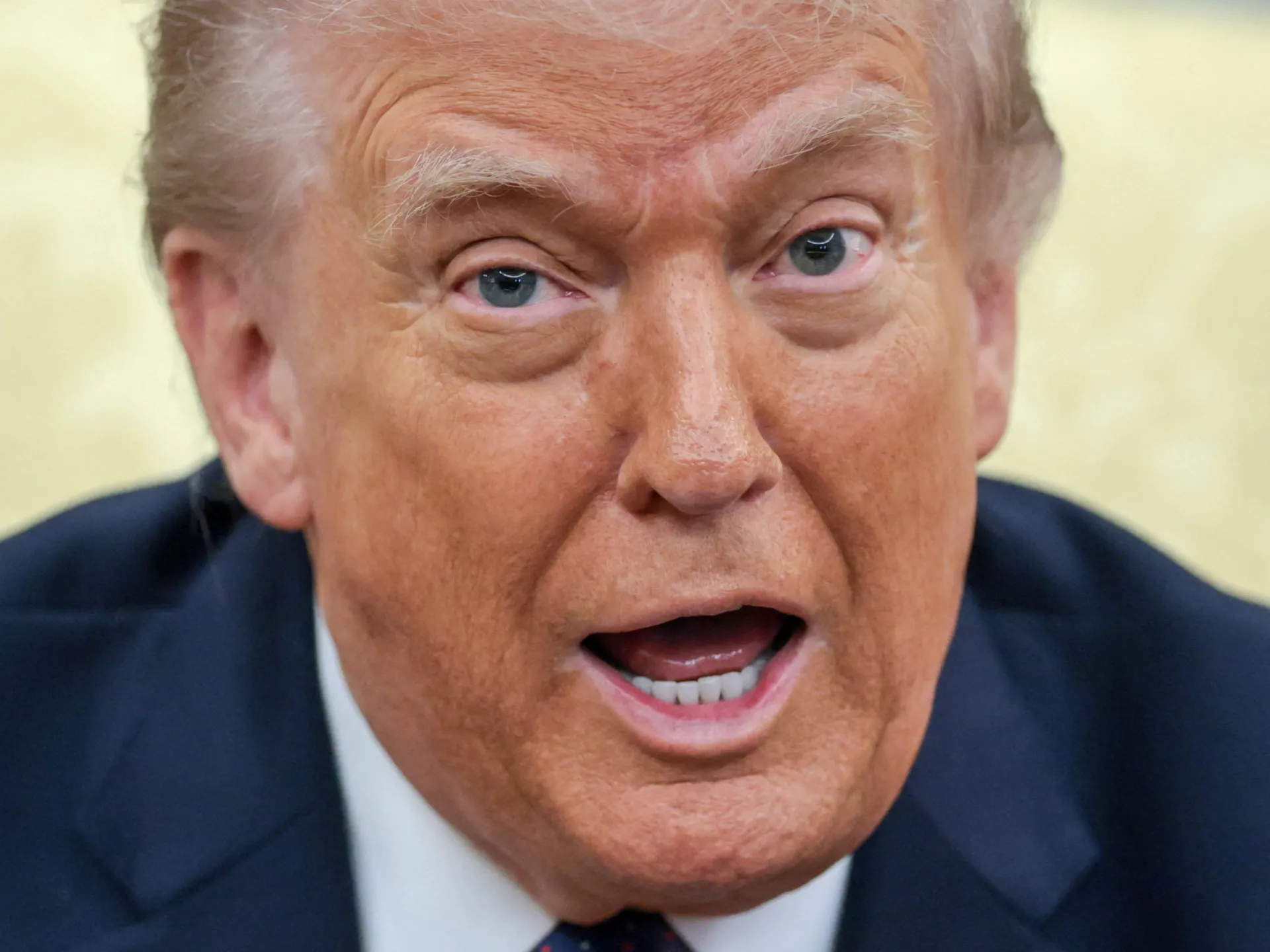
Donald Trump has met with Honduran President Nasry Asfura in Florida, with the US president hailing what he described as a growing alliance aimed at curbing drug trafficking and irregular migration.
Trump said he met with his “friend” Asfura, a conservative businessman, at his Mar-a-Lago resort on Saturday. Asfura took office last week after a razor-thin election victory.
Recommended Stories
list of 3 itemsend of list
“Tito and I share many of the same America First Values,” said Trump, using Asfura’s nickname. Trump had strongly backed Asfura during his campaign, even threatening to cut off aid to Honduras if he lost.
“Once I gave him my strong Endorsement, he won his Election!” Trump wrote on his Truth Social platform.
Following the meeting, Trump praised what he described as a close security partnership between the US and Honduras, saying they would collaborate to “counter dangerous Cartels and Drug Traffickers, and deporting Illegal Migrants and Gang Members out of the United States”.
Asfura is expected to brief Honduran media about the meeting on Sunday, “detailing the issues discussed, the tone of the conversation, and the possible outcomes of the dialogue”, according to Honduras’s El Heraldo newspaper.
The Honduran president’s meeting with Trump comes less than a month after a January 12 meeting with US Secretary of State Marco Rubio, after which the two countries announced plans for a free trade deal.
Asfura’s rise to power gives Trump another conservative ally in Latin America, following recent electoral shifts in countries including Chile, Bolivia, Peru and Argentina, where leftist governments have been replaced.
Just before the Honduran election, Trump pardoned the country’s former President Juan Orlando Hernandez, a fellow member of Asfura’s party who was serving a 45-year prison sentence in the US for drug trafficking.
That pardon “was widely seen as a gesture of solidarity with the new president’s [Asfura’s] party”, said Al Jazeera’s Phil Lavelle, reporting from Palm Beach, Florida.
The decision drew major backlash, particularly as Trump’s administration invoked the fight against drug trafficking to justify aggressive actions abroad. They include a string of bombings of alleged drug boats in the Caribbean and later the abduction of Venezuela’s President Nicolas Maduro, now facing charges including those related to drug trafficking in the US.
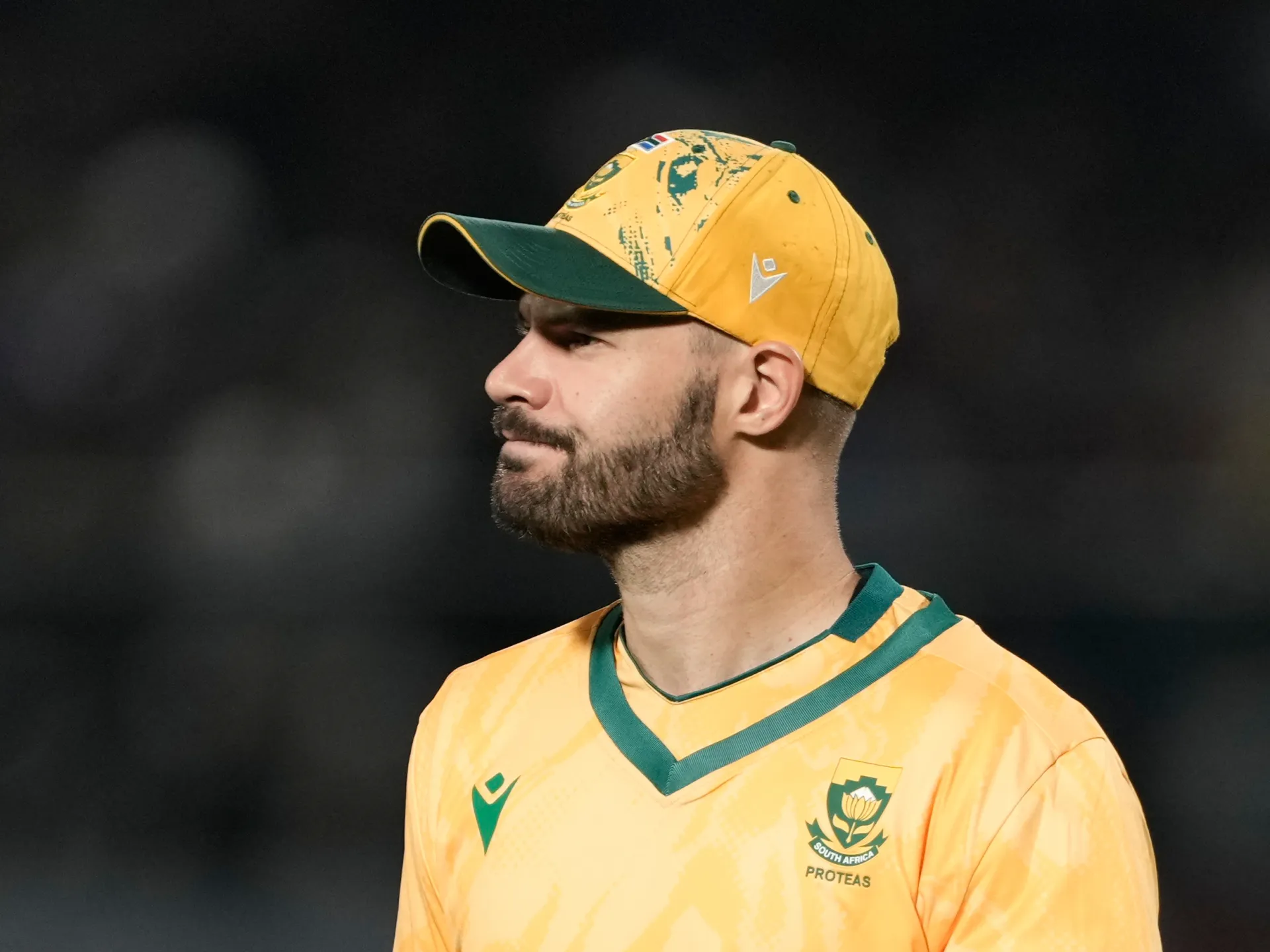
Lokesh Bam’s late heroics with the bat are not enough as Nepal are beaten by two-time champions in their Group C match in Mumbai.
Published On 8 Feb 20268 Feb 2026
Share
Nepal were left heartbroken after they came agonisingly close to pulling off a massive T20 World Cup upset against England but fell short by four runs as the two-time champions won the Group C match in Mumbai.
Lokesh Bam’s heroics with the bat – 39 runs off 20 balls – were not enough to see Nepal over the line at the Wankhede Stadium, which was packed with Nepalese fans on Sunday.
Recommended Stories
list of 4 itemsend of list
Nepal finished on 180-6, handing England a nervy win to kick off their campaign in the controversy-hit cricket tournament.
When England’s captain Harry Brook (53) and teammate Jacob Bethell (55) hit fifties to power England to 184-7, they seemingly did enough to take the match out of Nepal’s reach.
But Rohit Paudel produced a captain’s innings of his own as he, alongside star all-rounder Dipendra Singh Airee, put Nepal on course for a shock win.
The pair’s departure slowed down Nepal’s progress, but Lokesh resumed the big hitting against some wayward bowling by England’s seamers.
Needing 10 off the last over, the Rhinos were unable to get Sam Curran’s accurate bowling over the boundary and could only score six runs.
The Rhinos’ fans, hundreds of whom had travelled from across the border, were left disheartened.
Earlier, electing to bat at the Wankhede Stadium, England slumped to 57-3 in the seventh over to find themselves in a spot of bother.
Sher Malla struck with the first ball on his World Cup debut, dismissing Phil Salt for one, and the pressure mounted on England after Jos Buttler and Tom Banton fell in quick succession.
Bethell had no problem adjusting to the nature of the track, where other batters found shot-making difficult. He and Brook combined in a 71-run partnership during their 45-ball collaboration to rebuild their innings.
Airee (44) and skipper Paudel (39) kept Nepal in the hunt with a stand of 82 from 54 balls.
Curran brought relief to the English camp when he had Airee caught in the deep and Paudel also departed soon afterwards.
Bam hit Jofra Archer for back-to-back sixes to turn the match on its head.
With Nepal needing 10 runs off the last over from Curran, Bam needed to hit the last ball for a six, but he managed only one as England heaved a huge sigh of relief.
A heartbroken Coronation Street star Cait Fitton has shared a sad update online with her fans
Joe Crutchley Screen Time Reporter
14:10, 08 Feb 2026Updated 14:11, 08 Feb 2026
Coronation Street Lauren star heartbroken as she shares emotional personal news(Image: ITV)
Coronation Street’s Lauren Bolton star Cait Fitton has shared a heartbreaking announcement online.
Cait shot to fame playing Lauren Bolton on the ITV soap – making her debut in 2022. As the feisty and loyal teenager, Lauren’s been involved in several big moments on the cobbles.
From growing up with her racist far-right extremist dad Reece Bolton (Scott Anson), to killing her abuser Joel Deering (Calum Lill), Lauren’s time in Weatherfield has not been short of drama.
Away from the ITV soap, Cait is no stranger to keeping her 62k Instagram followers updated on her day-to-day life – from BTS snaps at Corrie to sun-soaked holiday photos.
Last week though, Cait paid an emotional tribute to her grandfather after his funeral. Taking to her Instagram Story Cait uploaded a photo from his funeral, which showed a football T-shirt and ‘Greatest grandad’ cushion.
A heartbroken Cait captioned the emotional post: “Said goodbye to my hero today. My best mate till the day I die, always and forever your little dancing queen RIP GDAD.”
Cait announced last month that her grandad died just days before his birthday. Posting a series of black and white photos with him on her Instagram stories, the young star penned: “Happy heavenly birthday to my best buddy.
“It’s been just over a week since you left us… and I’m still trying to navigate how to get through this without you. Hope you are dancing up there with gran.”
Meanwhile, Cait recently celebrated three years on the cobbles, and wrote on Instagram: “3 years playing the pocket rocket that is Lozza Bolton. Time flies when you really are having fun. Let’s look back on some of my favourite moments so far…”
She added: “Thank you everyone who has shown nothing but love towards Lauren over the past 3 years . I love playing a character that is so complex to play . I love her!
“I feel so proud and privileged to have been given the honour to play out such inspiring stories and raise such important issues throughout my time on the cobbles so far.
“Thank you @coronationstreet and to @brookekinsella my amazing agent for always believing and trusting me within this process. I will forever be grateful to call this my job.”
Coronation Street airs Monday to Friday at 8:30pm on ITV1 and ITVX
‘This is not law enforcement, this is animal cruelty.’
A Tennessee woman says her dog suffered a broken rib after being kicked by a federal officer while agents arrested her boyfriend. The US Marshals Service said the kick was ‘unfortunate’ but done to ‘mitigate a dangerous situation’.
NANCY Guthrie’s abductors have allegedly demanded $6 million in exchange for her safe return.
It comes as FBI agents have decoded hidden messages in the latest video released by Savannah and her siblings begging for her release and saying “we will pay”.
Sign up for the Showbiz newsletter
Thank you!
Nancy Guthrie’s abductors have allegedly demanded $6 million in exchange for her lifeCredit: GettyFBI agents have decoded secret messages hidden in the latest video released by Savannah and her siblings, demanding the release of their mother in exchange for moneyCredit: Reuters
Local TV station KGUN 9 in Tucson, Arizona, where the 84-year-old was snatched from her bed last weekend, reported that her alleged kidnappers asked for $6 million in exchange for her life.
The alleged ransom note received by the news station requested payment by 5pm on Monday and threatened Nancy’s life if the deadline goes unmet.
The outlet highlighted that it is one of several ransom notes that have been issued to the family and to local news stations.
KGUN 9 previously said it, along with other outlets, had received a ransom note demanding millions of dollars in Bitcoin.
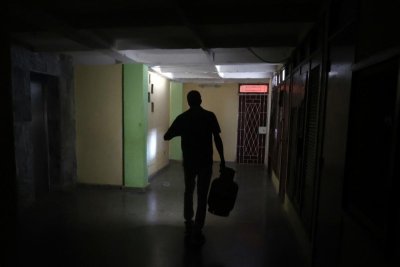
A US oil blockade is causing a severe energy crisis in Cuba, as the government has been forced to ration fuel and cut electricity for many hours a day, paralysing life in the communist-ruled island nation of 11 million.
Bus stops are empty, and families are turning to wood and coal for cooking, living through near-constant power outages amid an economic crisis worsened by the Trump administration’s steps in recent weeks.
President Miguel Diaz-Canel has imposed harsh emergency restrictions – from reduced office hours to fuel sales – in the backdrop of looming threats of regime change from the White House.
The Caribbean region has been on edge since the US forces abducted Venezuela’s President Nicolas Maduro last month and upped the pressure to isolate Havana and strangle its economy. Venezuela, Cuba’s closest ally in the region, provided the country with the much-needed fuel.
So, how dire is the situation in Cuba? What does United States President Donald Trump want from Havana? And how long can Cuba sustain?
A man carries pork rinds to sell as Cubans brace for fuel scarcity measures after the US tightened oil supply blockade, in Havana, Cuba, February 6, 2026 [Norlys Perez/Reuters]
What are Cuba’s emergency measures?
Blaming the US for the crisis, Cuba’s Deputy Prime Minister Oscar Perez‑Oliva Fraga appeared on state television on Friday to inform the millions of the emergency steps “to preserve the country’s essential functions and basic services while managing limited fuel resources”.
Now, the Cuban state companies will shift to a four‑day workweek, with transport between provinces dialled down, main tourism facilities closed, shorter schooldays and reduced in‑person attendance requirements at universities.
“Fuel will be used to protect essential services for the population and indispensable economic activities,” said Perez-Oliva. “This is an opportunity and a challenge that we have no doubt we will overcome. We are not going to collapse.”
The government says it will prioritise available fuel for essential services – public health, food production and defence – and push the installation of solar-based renewable energy sector and incentives therein. It will prioritise shifting energy to selected food production regions and accelerate the use of renewable energy sources, while cutting down on culture and sport activities and diverting resources towards the country’s early warning systems.
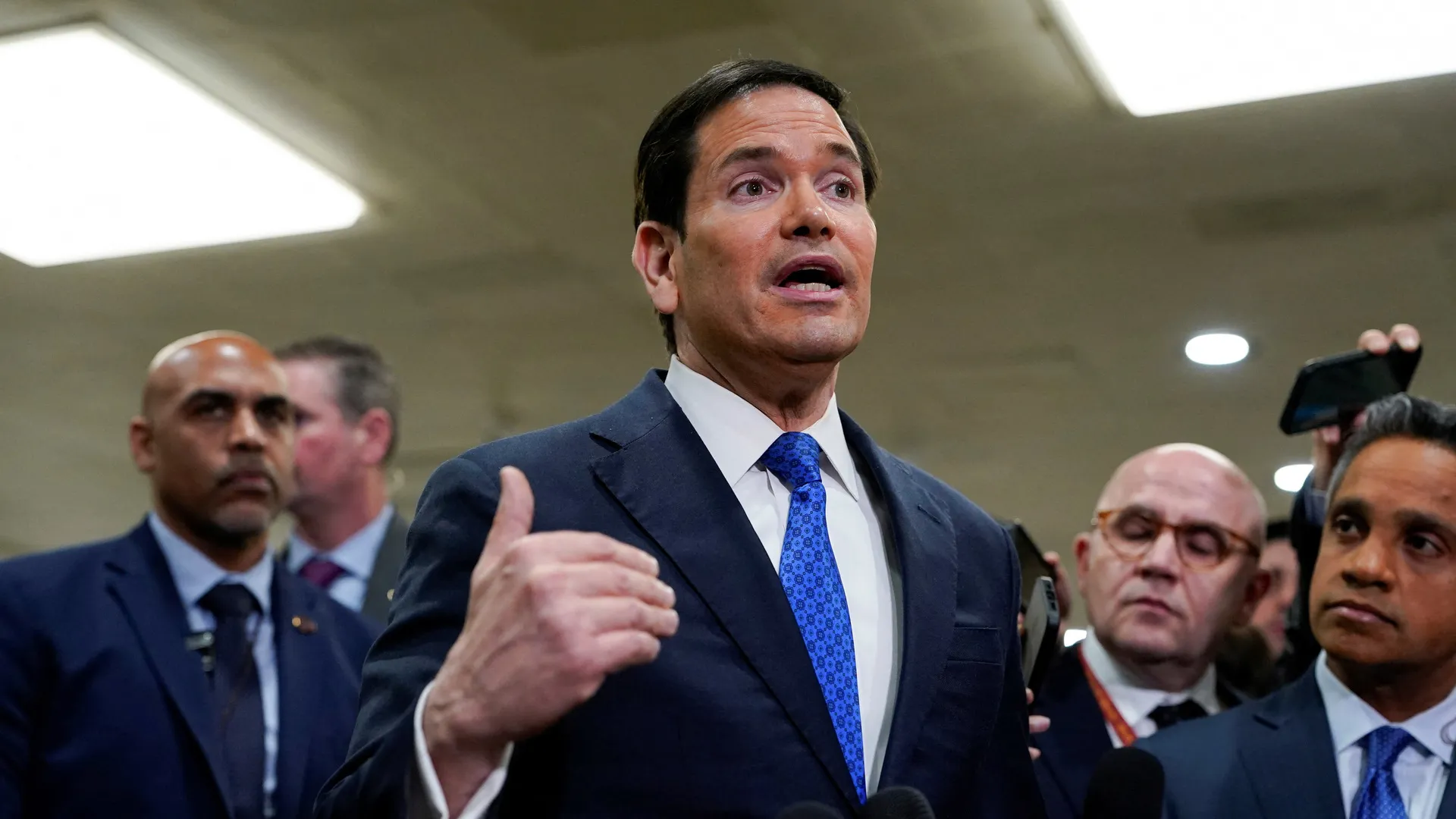
US Secretary of State Marco Rubio looks on as President Trump speaks during a cabinet meeting at the White House in Washington, DC, January 29, 2026 [Evelyn Hockstein/Reuters]
Why has the US blocked oil to Cuba?
Decades of strict US economic sanctions against Cuba, the largest island nation in the Caribbean, have destroyed its economy and isolated it from international trade. Cuba relied on foreign allies for oil shipments, such as Mexico, Russia, and Venezuela.
However, after the US forces abducted Venezuelan President Maduro, Washington blocked any Venezuelan oil from going to Cuba. Trump now says the Cuban government is ready to fall.
Under Trump, Washington has pivoted to the Western Hemisphere, which it wants to dominate. The military actions in Venezuela, the pledge to take over Greenland and changing the government in Cuba are part of the new policy.
Last month, Trump signed an executive order – labelling Cuba a threat to national security – imposing tariffs on any country that sells or provides oil to the island nation. Further pressure on the Mexican government reportedly led to oil stocks reaching a record low in Cuba.
“It looks like it’s something that’s just not going to be able to survive,” Trump told reporters last month, when questioned about the Cuban economy. “It is a failed nation.”
Havana has rejected accusations that it poses a threat to US security. Last week, the Cuban Ministry of Foreign Affairs issued a statement calling for dialogue.
“The Cuban people and the American people benefit from constructive engagement, lawful cooperation, and peaceful coexistence. Cuba reaffirms its willingness to maintain a respectful and reciprocal dialogue, oriented toward tangible results, with the United States government, based on mutual interest and international law,” a statement from the ministry said on February 2.
Trump’s goals in Cuba remain unclear; however, US officials have noted on multiple occasions that they would like to see the government change.
Responding to a question during a US Senate hearing on Venezuela, Secretary of State Marco Rubio said, “We would like to see the regime there change. That doesn’t mean that we’re going to make a change, but we would love to see a change.”
Rubio, who is of Cuban descent, is one of the most powerful figures in Trump’s administration.
“The Cuban-American lobby, which Rubio represents, is one of the most powerful foreign policy lobbies in the United States today,” Ed Augustin, an independent journalist in Havana, told Al Jazeera’s The Take.
“In the new Trump administration, [with] an unprecedented number of Cuban Americans, the lobbyists have become the policymakers,” he said, adding that Rubio has built firm control over the lobby.
On January 31, Trump told reporters, “It doesn’t have to be a humanitarian crisis. I think they probably would come to us and want to make a deal. So Cuba would be free again.”
He said Washington would make a deal with Cuba, but offered no clarity on what that means.
A woman walks past a building with an image of former President Fidel Castro as people prepare for the arrival of Hurricane Melissa in Santiago de Cuba, Cuba, October 27, 2025 [Norlys Perez/Reuters]
History of US-Cuba relations
Since Fidel Castro overthrew the pro-US regime in the Cuban revolution in 1959, the country has been under US embargo. Decades of sanctions have denied Cuba access to global markets, making even supply medicines difficult.
Castro nationalised US-owned properties, mainly the oil sector, and Washington responded with trade restrictions that soon became a full economic embargo that continues to this day, undermining Cuba’s economy.
The US also cut diplomatic ties with Havana, and three years later, a missile crisis almost brought Washington and the erstwhile USSR, an ally of Cuba, to the brink of nuclear war.
In 2014, Washington and Havana restored ties after 50 years. Two years later, US President Barack Obama travelled to Havana to meet Raul Castro.
However, during his first term as president, Trump reversed the historic move in 2017. Since then, the US has reimposed a raft of sanctions against Cuba, especially economic restrictions, leading to one of the worst economic crises in the island nation’s history. Within hours of his inauguration in January 2025, Trump reversed the previous administration’s policy of engagement with Havana.
People wait for transport at a bus stop as Cubans brace for fuel scarcity measures, Havana, Cuba, February 6, 2026 [Norlys Perez/Reuters]
How long can Cuba sustain?
Until last month, Mexico reportedly remained Cuba’s major oil supplier, sending nearly 44 percent of total oil imports, followed by Venezuela at 33 percent, while nearly 10 percent was sourced from Russia and a smaller amount from Algeria.
According to Kpler, a data company, by January 30, Cuba was left with oil enough to last only 15 to 20 days at current levels of demand.
Cuba currently needs an estimated 100,000 barrels of crude oil per day.
A man rides a bicycle in Havana, Cuba, on February 6, 2026 [Yamil Lage/AFP]
What has the UN said about the Cuban crisis?
United Nations spokesperson Stephane Dujarric told reporters on Wednesday that “the secretary-general is extremely concerned about the humanitarian situation in Cuba, which will worsen, and if not collapse, if its oil needs go unmet”.
Dujarric said, for more than three decades, the UN General Assembly has consistently called for an end to the embargo imposed by the US on Cuba, adding that the UN urges “all parties to pursue dialogue and respect for international law”.
Francisco Pichon, the senior-most UN official in Cuba, described “a combination of emotions” in the country – “a mix of resilience, but also grief, sorrow and indignation, and some concern about the regional developments”.
The UN team in Havana says the vast majority of Cubans are hit by rolling blackouts, with the number of people in vulnerable situations increasing significantly.
“The last two years have been quite tough,” Pichon said, adding that urgent changes are needed to sustain Cuba “in the midst of the severe economic, financial and trade sanctions”.
Skiing icon Vonn cried in anguish and pain after her awful fall high up the course days after sustaining an ACL injury.
Published On 8 Feb 20268 Feb 2026
Share
Lindsey Vonn’s Winter Olympic dream ended in screams of pain after she crashed out of the women’s downhill, failing in her audacious bid to medal in her favoured discipline at the Milan-Cortina Games.
Vonn’s United States (USA) teammate and world champion Breezy Johnson won the race to claim gold on Sunday.
Germany’s Emma Aicher took the silver medal, 0.04 of a second slower, and Italy’s home favourite Sofia Goggia had to settle for bronze, according to provisional results.
Johnson’s Olympic title, on Cortina d’Ampezzo’s sunlit Olimpia delle Tofane piste, came exactly a year after she won world championship gold at Saalbach, Austria.
American star Vonn had been trying to claim her fourth Olympic medal despite suffering a ruptured anterior cruciate ligament in her left knee just over a week ago, but her race ended early in Cortina d’Ampezzo.
She cried in anguish and pain after her awful fall high up the course, medical staff surrounding the distraught 41-year-old on the Olimpia delle Tofane piste where she has enjoyed much success in the past.
The 2010 Olympic downhill champion hit the firm snow face first after just 13 seconds of her descent. She then rolled down the slope with her skis still attached, which could likely cause further serious damage to her knee.
Vonn’s Olympic dream now lies in tatters after her brave effort to achieve the seemingly impossible, an attempt which ended with her being taken away in a helicopter as fans in the stands saluted her with loud applause.
One of world sport’s most recognisable faces and an alpine skiing icon, Vonn has insisted that she could not only compete but win against the world’s best women skiers, some of whom like Aicher are nearly half her age.
Vonn said ahead of the Games that she was planning on also competing in the team combined event on Tuesday and the super-G two days later.
But that now looks unlikely, a potential long lay-off perhaps heralding the end of her comeback to skiing in her early 40s.
Vonn retired in 2019 but returned to competition in November 2024 following surgery to partially replace her right knee to end persistent pain.
Vonn had finished on the podium in every previous World Cup downhill race this season, including two victories in St Moritz and Zauchensee, and claimed two more top-three finishes in the super-G.
But retirement looms for Vonn following a disastrous end to one of the biggest stories of the Winter Olympics.
A Sunday Brunch star was forced to make a quick exit from the Channel 4 programme during its latest episode
Joe Crutchley Screen Time Reporter
12:24, 08 Feb 2026Updated 12:25, 08 Feb 2026
Sunday Brunch guest rushed off set halfway through show as host explains absence
The Sunday Brunch set had one guest missing from the line-up halfway through the programme.
The hit Channel 4 show returned to TV screens on Sunday (February 8) with its usual three hours of celebrity interviews, culinary demonstrations and light-hearted entertainment.
Joining hosts Tim Lovejoy and Simon Rimmer were another batch of famous faces. On the long-running programme, the pair chatted to the likes of Shazad Latif, Vanessa Williams and Michaela Strachan.
Rock band James – best known for hits like Come Home and Sit Down – spoke to the hosts and also performed at the end of the show in a pre-recorded performance.
However, after James’ interview – in which they spoke about their new greatest hits album, James: Nothing But Love – The Definitive Best Of – Simon revealed the band would soon be heading off and leaving the Channel 4 studio.
He said: “We’re going to be saying goodbye to you guys aren’t we because you have to shoot off and do a show.”
Simon added: “Where’s the show,” before the band confirmed: “Liverpool.” Simon then said: “Oh great, best of luck with your travels.”
It comes after Sunday Brunch sparked complaints from fed-up viewers minutes into the show last month. Comedians Bridget Christie and Russel Howard, actors Malachi Kirby and Mark Benton, musician Bellah and chef Jeremy Pang were the guests at the time.
However, the line-up left viewers divided with some claiming they “didn’t know any of them”. Taking to social media, one fan penned: “Another week of z list “celebrities” time to knock this show on its head.” A second added: “Don’t know any of them.” A third person said: “Sorry but used to love it …getting past its used-by date.”
**For the latest showbiz, TV, movie and streaming news, go to the new **Everything Gossip** website**
However, some fans were delighted with the celebrity guests, with someone else writing: “A way better and funnier line-up than last week.” Another agreed: “I love Sunday Brunch! It’s a must-watch tradition in our house.”
Meanwhile, a week prior viewers branded an interview on the show “a tough watch”. The exchange between Tim and Simon with Black Ops and The Wheel of Time actor Hammed Animashaun was criticised by fans watching at home.
Sunday Brunch airs every Sunday at 10am on Channel 4.
Feb. 7 (UPI) — The first meeting of the newly formed Board of Peace is planned in the nation’s capital on Feb. 19 after 26 member nations received invitations from U.S. officials on Friday.
The United States created the Board of Peace during the World Economic Forum last month in Davos, Switzerland, which is focused on promoting global peace.
Its first meeting would be on Feb. 19 at the White House, and four nations so far, plus the United States, plan to send representatives, Axios reported.
The date is problematic for some member states because it coincides with the state of the Muslim holiday of Ramadan, which starts on Feb. 17 and runs through March 19.
The Board of Peace was formed to ensure a lasting cease-fire and peace in Gaza, which has been enduring violence between Hamas and Israeli forces as each accuses the other of cease-fire violations that led to retaliatory attacks.
Gaza mediators in Turkey, Egypt and Qatar have weighed disarming Hamas, but the Israel Defense Forces on Tuesday reported finding 110 mortar rounds, rockets and other military hardware wrapped in UNRWA blankets and hidden among humanitarian aid supplies in southern Gaza.
Before launching the strike, IDF officials warned civilians to leave and did not strike it until after determining all non-combatants had left.
Such incidents are among those that the Board of Peace is tasked with preventing while moving forward with the next phase of a peace agreement signed last year that is designed to permanently end the violence and fighting in Gaza and much of the Middle East.
Some have criticized the Board of Peace’s creation, saying it undercuts the United Nations and its mission of trying to ensure global peace.
President Donald Trump and others have said the United Nations is ineffective and has become more of a political organization instead of a peacemaker.
Attorney General Pam Bondi speaks during a press conference at the Department of Justice Headquarters on Friday. Justice Department officials have announced that the FBI has arrested Zubayr al-Bakoush, a suspect in the 2012 attack on the U.S. Embassy in Benghazi, Libya, that killed four Americans. Photo by Bonnie Cash/UPI | License Photo
New York — Keke Palmer can make Jack Whitehall blush.
We’re sitting in the green room at the 92nd Street Y on the Upper East Side of Manhattan, just before Palmer is set to host a live edition of her podcast, “Baby, This Is Keke Palmer,” with Whitehall and their other co-stars from the Peacock series “The ‘Burbs,” premiering Sunday.
In the show, Palmer and Whitehall play Samira and Rob, new parents who move back to Rob’s hometown of Hinkley Hills, a beautiful suburb where Samira immediately suspects something is amiss.
Palmer has kicked off her high heels and tucked her feet under her on the couch where she sits next to Whitehall as I ask them about their chemistry read.
“He was making me — not just me, everybody — laugh,” she remembers. “It was like, yeah, I can see how you fall in love with this guy because he’s just so funny and he’s so sweet. It’s so true, Jack. Seriously.”
Whitehall’s face turns red, which I point out. He admits that’s the case through giggles. Palmer interjects, “He knows how I feel. That’s my boo.”
“The ‘Burbs” reimagines the 1989 Joe Dante movie starring Tom Hanks for a modern era. In the original, Hanks’ character is driven to madness, imagining that his neighbors in the creepy house across the street might be murderers.
Jack Whitehall as Rob and Keke Palmer as Samira in “The ‘Burbs,” a series that reimagines Joe Dante’s 1989 film.
(Elizabeth Morris/Peacock)
Developed by Celeste Hughey, this version puts Palmer’s Samira, a lawyer on maternity leave, at the center. Though initially ill at ease among the carefully manicured lawns, she develops a fast friendship with a group of gossipy wine guzzlers on her block (played by Julia Duffy, Paula Pell and Mark Proksch). When a creepy man (Justin Kirk) moves into the dilapidated Victorian mansion across the street, she starts to wonder whether it has something to do with the disappearance of a teenage girl years ago. And then she starts to ponder how Rob might be involved. Is it a case of paranoia thanks to new motherhood? Or is there something really amiss in this paradise?
Initially, Brian Grazer of Imagine Entertainment, which made the original, and Seth MacFarlane’s Fuzzy Door Productions had teamed up to do a new film version of “The ‘Burbs.” During the COVID-19 pandemic, MacFarlane thought that the title might make sense for the “dark, humorous, creepy vibes of our shared fear inside our own communities,” Fuzzy Door president and show executive producer Erica Huggins explains in a phone interview. After it was reconceived as a series, they reached out to Hughey.
“When I thought about it for a modern take, I really wanted to center an outsider,” Hughey says, adding, “I grew up in Boston, a very white suburb, as a mixed kid; I wanted to center it on a Black woman who has a new baby, a new husband, in a new neighborhood kind of unwillingly and seeing it through her eyes.”
Palmer was always who Hughey wanted to play Samira, and Grazer had the same idea.
Keke Palmer says she was attracted to the idea of playing a mom having experienced the realities of being a new mom herself.
(Jason Armond/Los Angeles Times)
“She’s so versatile,” Grazer says, adding she could be “really funny and really pretty and she could be the average person. Like, you could live through her and that’s a big thing. What was so great about Tom Hanks is you could live through him.”
It turns out the timing was perfect. Palmer wasn’t all that familiar with the 1989 version, but she identified with Hughey’s vision, especially given that her son, Leo, was around 1 year old at the time.
“Thinking about playing a mom and now being a mom and also being able to use horror and comedy to play with the realities of what it feels like to be a new mom all felt very exciting to me,” she says.
Once Palmer signed on, Hughey and her team needed to find someone to match her infectious energy. Hughey says she imagined Rob as a “fully supportive partner” whose childhood guilt is putting a wedge in their marriage. She and her collaborators landed on Whitehall, a British stand-up comedian who has had stints in blockbusters like 2021’s “Jungle Cruise.”
Whitehall flew into Atlanta from the U.K. to meet Palmer, who was shooting the upcoming Boots Riley film “I Love Boosters.” He tells me he has had bad experiences coming to the U.S. to read with potential co-stars before, but Palmer immediately put him at ease.
“I think I’m just genuinely curious, trying to get to know him, because at the end of the day we’re going to be together every single day and we’re going to be making out and kissing and hugging,” she says. “We gotta be married. Is this my Desi? Am I his Lucy?”
Jack Whitehall, who is also a parent, says he found elements of the script relatable.
(Jason Armond/Los Angeles Times)
Whitehall also understood the nuances of the part because he had a young child as well. His daughter Elsie is now 2 and a half. (Leo is about to turn 3 when we speak.)
“So many elements of the script were really relatable, with the character of Rob and the slight guilt that he has that he’s going back to work and his wife is feeling trapped and wanting to be a protector and to be helpful, but then also not not quite knowing where his place is and how he can be sort of useful and caring,” Whitehall says.
For Palmer, portraying Samira’s unease wasn’t just about highlighting the disconnect between her and Rob, it was also about portraying the specific fears of living in a postpartum state.
“You’re always kind of having this anxiety,” she says. “And I don’t want to say it’s disproportionate, but to a certain degree it is. You’re constantly filtering out, is this real danger? You are kind of constantly gaslighting yourself.”
Throughout the eight-episode season, which ends on a major cliffhanger, “The ‘Burbs” is always trying to make its audience question what is really going on. That specifically relates to Rob, who is keeping a lot of secrets that may or may not be nefarious. It’s an aspect of the character that attracted Whitehall, though he notes, “I think at one point in this series the finger is pointed at literally every single member of our cast.”
“The ‘Burbs” sets out to subvert expectations, and that also applies to the way it deals with Samira’s race.
“It was really important to me that we didn’t make it a cliché,” says Palmer, who is also an executive producer. “It’s expected that we play up the ‘Get Out’ aspect. So I think it was about not being untrue to that reality and how that plays a role in the story but to talk about the bigger thing where it’s really just about being a fish out of water.”
Samira finds a true community among the other neighborhood oddballs, which is true to Palmer’s experience of growing up in Robbins, Ill., outside of Chicago. Whitehall, meanwhile, says he grew up in the “British equivalent of Hinkley Hills” in a town called Putney, on the outskirts of London.
“It was just full of very proper people, but very judgmental, and there were secrets on the street,” he says. “There was scandal as well.”
During our interview it’s clear that Palmer and Whitehall have an easy rapport. They go on tangents about Palmer introducing Whitehall to the 1997 film “Soul Food,” which Whitehall proceeded to reference on set. Palmer grabs Whitehall in exuberance as they speak. While they have different styles of deliveries, their senses of humor are the same, according to Palmer. And they figured out how to make everything click in the show.
“I think we found our timing together and we let each other have our moments,” Palmer says. “Like very telepathic. Like, ‘Time for the bit.’ We can feel each other’s pacing. I guess we just really work well together.”
Khaled Meshaal, the head of Hamas abroad, has spoken at the Al Jazeera Forum on the rights of Palestinians to resist occupation. The political leader says the demand of disarmament is unacceptable.
Tommy Freeman is rapidly approaching world-class status.
The package that he brings to Test rugby – the pace, size, aerial ability and appetite for the ball – is pretty special.
He was a starter for the British and Irish Lions in all three Tests against Australia in the summer and he is inked into this England team as one of those who will always have a place when fit.
However, there is a question over which number Borthwick will write next to Freeman’s name.
This was Freeman’s 23rd England appearance but only his third as a centre.
Considering that relatively paltry midfield experience, he was pretty damn good against Wales.
He hit superb lines, either hitting the ball up bravely into the heart of Wales defence or acting as a decoy, and worked instinctively with Northampton team-mate Fraser Dingwall inside him at 12.
They are turning into a dangerous and cohesive pairing – and England have been crying out for a midfield combination with those qualities for ages.
Where once the supply of centres was quite low, there are now a bunch of alternatives.
Ollie Lawrence, who is working his way back from a minor knee injury, may be available for Scotland. Max Ojomoh was very impressive against Argentina in the autumn. Seb Atkinson has credit in the bank from his performances on the summer tour of Argentina.
It means England can mix and match according to the opposition.
Do they want a punch in midfield or the ability to distribute quickly into wide channels? Gas around the outside or the ability to probe behind with kicks?
The ability to change tactics with different midfield selection is very, very exciting.
South Africa – the gold standard for everyone in world rugby at the moment – have the same.
The mix of Damian de Allende, Jesse Kriel, Canan Moodie, Damian Willemse and even Andre Esterhuizen gives them different ways of playing.
That adaptability is a fantastic attribute for any team.
The far right’s score will be watched closely, with the vote being held as heavy storms continue to lash the country.
Published On 8 Feb 20268 Feb 2026
Share
Polls have opened in the second round of Portugal’s elections, viewed as a high-stakes choice between the socialists and a resurgent far right.
Voting began at 9am local time (08:00 GMT) on Sunday for the presidential election, with 11 million voters at home and abroad eligible to cast their ballots.
Recommended Stories
list of 3 itemsend of list
Voters are set to choose between the Socialist Party leader, Antonio Jose Seguro, and Andre Ventura, leader of the nationalist party Chega, which means “enough” in Portuguese.
Exit polls are expected by about 9pm local time (20:00 GMT).
Seguro, 63, secured 31.1 percent of the vote in the first round, while outspoken far-right leader Ventura won 23.5 percent.
While Ventura is almost certain to be beaten by Seguro, the far right’s score will be watched closely.
Sunday’s vote will decide who takes on the emblematic, but largely ceremonial, role of the president.
The vote is taking place as heavy storms continue to lash the country. Despite an improvement in the weather overnight from Saturday to Sunday, at least 14 of the most affected constituencies have postponed voting for nearly 32,000 people by one week.
The storms have killed at least five people, triggered flooding, and caused damage estimated at 4 billion euros ($4.7bn).
But Ventura’s call to postpone the whole vote has been rejected.
Prime Minister Luis Montenegro said the storms had caused a “devastating crisis” but that the threats to voting could be overcome.
The last presidential election went ahead five years ago despite the coronavirus pandemic, outgoing President Marcelo Rebelo de Sousa told Ventura on Friday.
Gabriella Bardsley has been spotted working at a charity shop in Cheshire as part of her community service assignmentCredit: Refer to sourceLooking less than happy to be there, Gabriella was seen scrolling her phoneCredit: Refer to sourceThe nepo baby influencer donned a faux fur coat and leggings for the day of unpaid workCredit: Refer to sourceGabriella is the daughter of Real Housewives of Cheshire star Tanya BardsleyCredit: Instagram/thebardsleybunch
Gabriella admitted to being almost three-and-a-half times over the alcohol limit behind the wheel of her Audi A3.
Taking her good character into account, Crewe Magistrates’ Court court handed Gabriella an order to carry out 200 hours of unpaid work.
Now, she has been seen carrying out community service work in The Salvation Army charity shop in Wilmslow.
Donning leggings with a pair of Ugg shoes and a faux fur coat, Gabriella had her hair tied into a ponytail as she helped out.
Looking less than happy to be there, she was snapped scrolling through her phone on the shop floor, before helping out by folding a pair of jeans.
In May, Gabriella was pulled over and instructed to take a road-side breath test while driving, which she refused.
She was then taken to a nearby police station and was found to have 122 micrograms of alcohol per 100 millilitres of breath – the UK legal limit being only 35 micrograms.
Crewe Magistrates’ Court was later told how she had approached the scene of a road traffic collision in Wilmslow and “attempted to drive through the police blockade”.
Charlie Hayward, prosecuting, said when officers approached her she was visibly intoxicated and “slurring her words” and “struggling” to stand on her feet.
However, her lawyer Gary Hughes told the court that she was of “hitherto good character” – which played a part in her sentencing of community service and a driving ban.
Gabriella’s stepdad is ex-Manchester United footballerPhil Bardsley.
The influencer appears on ITVX series The Bardsley Bunch alongside her famous parents and younger brothers Rocco, Renz and Ralphi.
Her stepdad Phil began his career at Man Utd before joining Sunderland in 2008.
He also played for the Scottish national team before hanging up his boots for good in 2023.
She was spotted working inside the Wilmslow Salvation Army charity shopCredit: Refer to sourceLast May, she was breathalysed and found to be almost three-and-a-half times over the legal limit while driving her Audi through CheshireCredit: InstagramHer previous good character meant that it was just a driving ban and the community service orderCredit: Refer to sourceGabriella has been handed an order of 200 hours unpaid workCredit: Refer to sourceShe was seen sitting by the till scrolling through her phone throughout the dayCredit: Refer to source
Global markets rarely reveal their vulnerabilities quietly. They do so when shipping lanes come under threat, energy prices surge, or supply chains fracture. Few regions illustrate this reality more starkly than the Red Sea and the Gulf of Aden, which are now among the world’s most contested maritime corridors. What unfolds along these waters no longer remains local. It shapes economic security across the Arab world and far beyond.
Yet, amid growing attention to this strategic corridor, one factor remains persistently underestimated: Somalia.
For decades, Somalia was viewed primarily through the lens of conflict and fragility. That narrative no longer reflects today’s reality. The country is undergoing a consequential transition, moving away from prolonged instability, rebuilding state institutions, and re-emerging as a sovereign actor with growing regional relevance. Situated at the intersection of the Arab world, Africa, the Red Sea, and the Gulf of Aden, Somalia is not peripheral to regional stability; it is central to it.
Geography alone explains much of this significance. With the longest coastline in mainland Africa, Somalia lies adjacent to the Bab al-Mandeb passage connecting the Red Sea to the Gulf of Aden and the wider Indian Ocean. A substantial share of global maritime trade and energy shipments passes through this corridor. Disruptions along Somalia’s coast, therefore, have immediate implications for shipping reliability, energy markets, and food security — issues of direct concern to Gulf states and Arab economies.
For the Arab world, Somalia should be understood not as distant terrain but as a front-line partner in regional security. Stability along Somalia’s coastline helps contain threats before they reach the Arabian Peninsula, whether in the form of violent extremism, illicit trafficking networks, piracy, or the entrenchment of hostile external military presences along Africa’s eastern flank.
Somalia is not attempting to build stability from scratch. Despite persistent challenges, tangible progress has been made. Federal governance structures are functioning. National security forces are undergoing professionalisation. Public financial management has improved. Diplomatically, Somalia has reasserted itself within the Arab League, the African Union, and multilateral forums. These gains continue to be built on daily and reflect a clear commitment to sovereign statehood, territorial unity, and partnership rather than dependency. Somalia today seeks strategic alignment grounded in mutual interest, not charity.
Somalia’s relevance also extends beyond security. Its membership in the East African Community integrates the country into one of the world’s fastest-growing population and consumer regions. East Africa’s rapid demographic expansion, urbanisation, and economic integration position Somalia as a natural bridge between Gulf capital and African growth markets.
There is a clear opportunity for Somalia to emerge as a logistics and transshipment gateway linking the Gulf, the Red Sea, East Africa and the Indian Ocean. With targeted investments in ports, transport corridors, and maritime security, Somalia can become a critical node in regional supply chains supporting trade diversification, food security, and economic resilience across the Arab world.
At the heart of Somalia’s potential is its dynamic population. More than 70 percent of Somalis are aged below 30. This generation is increasingly urban, digitally connected, and entrepreneurial. Somali traders and business networks already operate across Southern and Eastern Africa, spanning logistics, finance, retail, and services. A large and dynamic diaspora across the Gulf, Europe, North America, and Africa further amplifies this reach through remittances, investment, and transnational expertise.
None of these momentums, however, can be sustained without security. A capable, nationally legitimate Somali security sector is the foundation for durable stability, investment confidence, and regional integration.
For Gulf states and the wider Arab world, supporting Somalia’s security sector is therefore not an act of altruism. It is a strategic investment in a reliable stabilising partner. Effective Somali security institutions contribute directly to safeguarding Red Sea and Gulf of Aden maritime corridors, countering transnational terrorism before it reaches Arab shores, protecting emerging logistics infrastructure, and denying external actors opportunities to exploit governance vacuums. Such support must prioritise institution-building, Somali ownership, and long-term sustainability, not short-term fixes or proxy competition.
The stakes are rising. The Red Sea and the Gulf of Aden are entering a period of heightened strategic contestation. Fragmentation along their African coastline poses a direct risk to Arab collective security. Recent developments underscore this urgency.
Israel’s unilateral recognition of the northern Somali region of Somaliland, pursued outside international legal frameworks and without Somali consent, is widely viewed as an attempt to secure a military foothold along these strategic waters, risking the introduction of the Arab-Israeli conflict into the Gulf’s security environment.
Even more troubling are emerging narratives advocating the forced displacement of Palestinians from Gaza, with proposals to relocate them to Somaliland against their will. Such ideas, whether formally advanced or not, represent grave violations of international law and human dignity. Exporting the consequences of occupation and war onto African soil would not resolve conflict; it would multiply it.
For the Arab world, this should serve as a wake-up call. Allowing external actors to fragment sovereign states or instrumentalise fragile regions for unresolved conflicts carries long-term consequences. Somalia’s unity and stability, therefore, align squarely with core Arab strategic interests and with longstanding Arab positions on sovereignty, justice and self-determination.
Somalia is ready to be part of the solution. With calibrated strategic support, particularly in security sector development and logistics infrastructure, Somalia can emerge as a cornerstone of Red Sea and Gulf of Aden stability, a gateway to East Africa, and a long-term partner for the Arab world.
The question is no longer whether Somalia matters in the regional and global Red Sea and Gulf of Aden discussions and plans. It is whether the region will act on that reality before others do.
The views expressed in this article are the author’s own and do not necessarily reflect Al Jazeera’s editorial stance.
Palestinian medics say several of the 54 bodies were found to be mutilated and showed extensive signs of abuse.
Published On 8 Feb 20268 Feb 2026
Share
Israel has returned dozens of Palestinian bodies and human remains to Gaza without providing any information about their identities or how they were killed, according to Palestinian medical officials.
The remains arrived at al-Shifa Hospital in Gaza City on Wednesday in plain white bags and are now being examined by forensic teams in an effort to identify them and provide answers to grieving families.
Recommended Stories
list of 4 itemsend of list
“The bags carry the weight of lives lost. Now they’re undergoing examination, prolonging the grief of families desperate for closure,” Al Jazeera’s Ibrahim al-Khalili reported from al-Shifa Hospital on Saturday.
Palestinian medics say several bodies were mutilated.
“The International Committee of the Red Cross handed over 120 body bags containing 54 bodies as well as skull samples placed in 66 separate bags,” forensic official Omar Suleiman told Al Jazeera.
Previous exchanges of Palestinian prisoners’ bodies have revealed extensive signs of abuse, with many showing indications of torture, mutilation and execution.
In November, the rights group Physicians for Human Rights-Israel released a report saying at least 94 Palestinian detainees have died in Israeli custody, citing causes including torture, medical neglect, malnutrition and physical assault.
The group said the actual toll could be significantly higher.
‘Missing for 10 months’
For many Palestinians, the search for missing relatives has shifted from streets and rubble to computer screens and improvised identification centres.
At al-Shifa, Shadi al-Fayoumi scrolled through blurred and graphic images, hoping to spot anything recognisable that might tell him what happened to his brothers.
“My brothers have been missing for 10 months. They disappeared in the Tuffah neighbourhood,” al-Fayoumi, whose brothers remain missing, told Al Jazeera.
“I went to al-Shifa Medical Complex, where we were told there were bodies we could try to identify. However, the images were unclear and lacked discernible features. How are we expected to identify them under these conditions?”
According to al-Fayoumi, his brothers had gone in search of food and water during the peak of the famine last year but never returned.
“We contacted multiple institutions, but none was willing to help or provide reliable information,” al-Fayoumi added.
Al Jazeera’s al-Khalili said al-Fayoumi’s mother has been “inconsolable”.
“His brothers’ children are silent, unwilling to voice their worst fears. Israeli forces hand over the bodies of Palestinians with little regard for human dignity,” he added.
“There is no information on how they died or how long they were held, leaving Palestinians with not only their grief but unanswered questions.”
The 98th Academy Award nominations were announced Thursday and Ryan Coogler’s musical horror earned 16 overall nominations, breaking the record for the most nominations for a film previously held by “All about Eve” (1950), “Titanic” (1997) and “La La Land” (2016). “Sinners’” nominations include best picture, directing, original screenplay and individual acting nods for stars Michael B. Jordan, Wunmi Mosaku and Delroy Lindo.
Paul Thomas Anderson’s comedic political thriller “One Battle After Another” followed with 13 total nominations, which included nods for picture, directing, adapted screenplay and actors Leonardo DiCaprio, Teyana Taylor, Benicio Del Toro and Sean Penn.
Yorgos Lanthimos’ alien comedy “Bugonia,” Chloé Zhao’s tragic Shakespeare drama “Hamnet,” Joseph Kosinski’s racing drama “F1,” Guillermo del Toro’s gothic monster mash “Frankenstein,” Josh Safdie’s ping-pong picture “Marty Supreme,” Brazilian political thriller “The Secret Agent,” Norwegian family drama “Sentimental Value” and Clint Bentley’s lyrical period piece “Train Dreams” rounded out the nominees for best picture.
Performers from both “The Secret Agent” and “Sentimental Value” also earned acting nominations, making it another banner year for international features. Other top nominees include “Frankenstein,” “Marty Supreme” and “Sentimental Value,” which earned nine nods apiece.
Actors Danielle Brooks and Lewis Pullman announced the nominations at the academy’s Samuel Goldwyn Theater. See the full list of nominees below.
Actress in a supporting role Elle Fanning, “Sentimental Value” Inga Ibsdotter Lilleaas, “Sentimental Value” Amy Madigan, “Weapons” Wunmi Mosaku, “Sinners” Teyana Taylor, “One Battle After Another”
Actor in a supporting role Benicio del Toro, “One Battle After Another” Jacob Elordi, “Frankenstein” Delroy Lindo, “Sinners” Sean Penn, “One Battle After Another” Stellan Skarsgård, “Sentimental Value”
Adapted screenplay “Bugonia,” Will Tracy “Frankenstein,” Guillermo del Toro “Hamnet,” Chloé Zhao and Maggie O’Farrell “One Battle After Another,” Paul Thomas Anderson “Train Dreams,” Clint Bentley and Greg Kwedar
Original screenplay “Blue Moon,” Robert Kaplow “It Was Just an Accident,” Jafar Panahi “Marty Supreme,” Josh Safdie and Ronald Bronstein “Sentimental Value,” Joachim Trier and Eskil Vogt “Sinners,” Ryan Coogler
Documentary short “All the Empty Rooms” “Armed Only with a Camera: The Life and Death of Brent Renaud” “Children No More: ‘Were and Are Gone’” “The Devil Is Busy” “Perfectly a Strangeness”
Animated short “Butterfly” “Forevergreen” “The Girl Who Cried Pearls” “Retirement Plan” “The Three Sisters”
Cinematography “Frankenstein,” Dan Laustsen “Marty Supreme,” Darius Khondji “One Battle After Another,” Michael Bauman “Sinners,” Autumn Durald Arkapaw “Train Dreams,” Adolpho Veloso
Costume design “Avatar: Fire and Ash,” Deborah L. Scott “Frankenstein,” Kate Hawley “Hamnet,” Malgosia Turzanska “Marty Supreme,” Miyako Bellizzi “Sinners,” Ruth E. Carter
Film editing “F1,” Stephen Mirrione “Marty Supreme,” Ronald Bronstein and Josh Safdie “One Battle After Another,” Andy Jurgensen “Sentimental Value,” Olivier Bugge Coutté “Sinners,” Michael P. Shawver
Live-action short “Butcher’s Stain” “A Friend of Dorothy” “Jane Austen’s Period Drama” “The Singers” “Two People Exchanging Saliva”
Makeup and hairstyling “Frankenstein,” Mike Hill, Jordan Samuel and Cliona Furey “Kokuho,” Kyoko Toyokawa, Naomi Hibino and Tadashi Nishimatsu “Sinners,” Ken Diaz, Mike Fontaine and Shunika Terry “The Smashing Machine,” Kazu Hiro, Glen Griffin and Bjoern Rehbein “The Ugly Stepsister,” Thomas Foldberg and Anne Cathrine Sauerberg
Original score “Bugonia,” Jerskin Fendrix “Frankenstein,” Alexandre Desplat “Hamnet,” Max Richter “One Battle After Another,” Jonny Greenwood “Sinners,” Ludwig Göransson
Original song “Dear Me” from “Diane Warren: Relentless” “Golden” from “KPop Demon Hunters” “I Lied to You” from “Sinners” “Sweet Dreams of Joy” from “Viva Verdi!” “Train Dreams” from “Train Dreams”
Production design “Frankenstein” “Hamnet” “Marty Supreme” “One Battle After Another” “Sinners”
Sound “F1” “Frankenstein” “One Battle After Another” “Sinners” “Sirāt”
Riyadh condemns RSF’s ‘criminal’ attacks in Kordofan, blames foreign fighters and weapons for fuelling Sudan’s three-year conflict.
Published On 8 Feb 20268 Feb 2026
Share
Saudi Arabia has reaffirmed its support for Sudan’s territorial unity and integrity, denouncing “criminal attacks” by the paramilitary Rapid Support Forces (RSF) in North and South Kordofan states that have killed dozens of people, including women and children.
In a statement on Saturday, the Saudi Ministry of Foreign Affairs condemned “foreign interference” by “some parties” in Sudan, including the “continued influx of illegal weapons, mercenaries and foreign fighters” for the continuation of the nearly three-year-old war.
Recommended Stories
list of 4 itemsend of list
The statement did not specify the parties, though.
It came a day after the Sudan Doctors Network, a humanitarian group, said a drone attack by the RSF on a vehicle transporting displaced families in North Kordofan killed at least 24 people, including eight children.
The attack followed a series of drone raids on humanitarian aid convoys and fuel trucks across North Kordofan, including an assault on a World Food Programme convoy on Friday that killed at least one person.
Fighting between the RSF and Sudan’s army has intensified across Kordofan in recent months following the fall of el-Fasher to the paramilitary group in October. The nearly three-year-long conflict has killed an estimated 40,000 people and pushed more than 21 million — almost half of Sudan’s population — into acute food shortages.
The Saudi Ministry of Foreign Affairs said on Saturday the deadly RSF attacks “are completely unjustifiable and constitute flagrant violations of all humanitarian norms and relevant international agreements”.
The ministry demanded that “RSF immediately cease these violations and adhere to its moral and humanitarian obligation to ensure the delivery of relief aid to those in need in accordance with international humanitarian law” and a ceasefire deal agreed by the warring parties in Jeddah in 2023.
It added that “some parties” were fuelling the conflict by sending in weapons and fighters, despite “these parties’ claim of supporting a political solution” in Sudan.
The statement comes amid allegations by the Sudanese government that the United Arab Emirates has been arming and funding the RSF. Sudan filed a case against the UAE at the International Court of Justice last year, accusing it of “complicity in genocide” committed by the RSF against the Masalit community in West Darfur state.
The UAE has denied the allegations.
Separately, Saudi Arabia has also accused the UAE of backing the separatist Southern Transitional Council (STC) in Yemen. The STC, initially part of the Saudi-backed internationally recognised government of Yemen, launched a major offensive last December in the country’s Hadramout and al-Mahra provinces, seeking to establish a separate state.
The offensive resulted in a split in Yemen’s internationally-backed government, and prompted Saudi Arabia to launch deadly raids targeting the STC.
The UAE pulled out its troops from Yemen following the Saudi allegation, saying it supports Saudi Arabia’s security.
Saudi Arabia and the UAE were members of the Arab military coalition, formed to confront the Houthis, who took full control of the Yemeni capital, Sanaa, in 2015.