Several Gogglebox stars were reduced to tears as they tuned into the Dolly Parton tribute at Last Night of the Proms starring Sheridan Smith and Beverley Knight
21:49, 18 Sep 2026Updated 21:50, 18 Sep 2026
Jenny Newby and Lee Riley were left in tears during the latest episode of Gogglebox(Image: Channel 4)
Emotional Gogglebox stars couldn’t hold back their tears during the latest episode of the Channel 4 show.
The armchair critics returns to screens on Friday (September 18) night as they offered their verdict on the latest programmes on television from Channel 4’s new reality show Apocalypse to ITV thriller Trigger Point.
However, it was Last Night of the Proms which left cast members in tears as they watched performers Sheridan Smith and Beverley Knight pay tribute to country music sensation Dolly Parton, who died on August 25 aged 80 following a brief and undisclosed battle with cancer.
The second half of the BBC concert, which aired on September 12, honoured the songstress with Sheridan singing feminist anthem 9 To 5, Beverley belting out I Will Always Love You and country-pop duo Ward Thomas performing Jolene.
Tuning into the concert from the comfort of their sofas, several Gogglebox stars including Mary Killen, Lee Riley and Jenny Newby were left sobbing as the musical stars paid tribute to Dolly.
Bryan Seaver, Dolly’s head of security and nephew announced the sad news of her passing on social media last month. In the video, he told fans: “Hey everyone. My name is Bryan Seaver, son of Cassie Parton, and I am representing the Parton and Owens family today, announcing the passing of my Aunt Dolly Rebecca Parton Dean. Sister, sis, Aunt Granny to one generation and Gigi to the next.”
Tributes from around the world were shared following the news, with Elton John saying he was: “Shocked and devastated to hear of Dolly’s passing. A giant of an artist – unique and irreplaceable, with the kindest heart.”
Sir Paul McCartney also commented: “The magnificent star Dolly Parton has died and it is so sad. She was such a wonderful woman.” It comes after Dolly was posthumously honoured with the Americana Lifetime Achievement Award at the Americana Awards & Honours Awards last week.
The Grammy winner appeared in a pre-recorded video to accept the award. She beamed in the clip where she accepted the award. “Well, hey, it’s Dolly, and I am so honoured to receive the Lifetime Achievement Award from the Americana Music Association,” she began.
“I mean, roots music, or what is now called Americana music, is what I grew up playing back in the Smoky Mountains. It’s that same music that drew me back to East Tennessee in 1997 to write and record my album, Hungry Again.”
“And that project really opened the door to a series of bluegrass and acoustic albums that changed the course of my career in so many ways,” she continued.
“Now, new fans discovered these albums, new Americana music communities embraced them, and now looking back at it all, I see this era of my career as a musical renaissance of sorts.
“I want to thank everyone at the AMA for recognising me with this award. It’s a great honor truly, and just know that I will always love you.”
Among Dolly’s many honours include a star on the Hollywood Walk of Fame, along with being inducted into the Songwriters Hall of Fame, Rock & Roll Hall of Fame, and Country Music Hall of Fame.
The US president insists media outlets report ‘fiction and lies’ as he enforces new bans on White House access.
Published On 18 Sep 202618 Sep 2026
United States President Donald Trump has announced that, effective immediately, CNN, MS NOW and Politico are banned from the White House.
On Friday, Trump posted on social media his displeasure with the media outlets’ coverage of his administration.
“I am proud to announce that, effective immediately, I am banning Fake News CNN, MSNOW … from the White House as a result of their constant “reporting” FAKE NEWS!” Trump wrote.
“Media Outlets shouldn’t be able to constantly write or report FICTION and LIES when they’re covering the President of the United States, the Trump Administration, or the United States of America. Other Fake News Media Outlets to follow.”
Speaking to reporters later on Friday at the White House, Trump said the outlets “purposely write negative news.”
“You get so tired of reading and seeing fake news,” he told reporters in the Oval Office. “They purposely write negative news, and they do that because they want to try and diminish the Republicans and a Republican administration. And honestly, we’ve done a fantastic job.”
Asked why he is taking the action now, Trump said it is because of the news organizations’ “cumulative” coverage.
Al Jazeera’s Alan Fisher reported from Washington that Trump’s ban will likely be challenged soon.
“The United States has the First Amendment [of its Constitution] that says the government cannot restrict access to this sort of thing,” he said.
“Other presidents have been angry at press coverage before. Lyndon B Johnson used to rail about it. Richard Nixon wondered whether or not he could ban certain people from the White House as well,” he said. “At every point, they were told it’s not a good look.”
While in office, Trump has repeatedly criticised the press for what he says is unfair coverage and has even verbally targeted reporters for their reporting.
Acclaimed Russian film director who won 2026 Grand Prix award at Cannes, has been critical of the war in Ukraine.
Published On 18 Sep 202618 Sep 2026
The winner of a prestigious Cannes Film Festival award has been declared a foreign agent by Russian authorities for his criticism of Moscow’s war in Ukraine.
Acclaimed Russian film director Andrey Zvyagintsev was designated a “foreign agent” by the Kremlin on Friday, according to state news agency TASS.
Recommended Stories
list of 3 itemsend of list
Zvyagintsev won the 2026 Grand Prix at the Cannes Film Festival for, Minotaur, a film depicting a Russian businessman who is forced to decide which of his employees should be mobilised to go and fight in Ukraine.
“Millions of people on both sides of the front line dream of only one thing: for the massacres to stop,” Zvyagintsev said in his acceptance speech, adding that Russian President Vladimir Putin was the only person capable of ending the war.
Moscow has kept casualty numbers from the fighting in Ukraine heavily restricted and has not provided timely or complete public updates, but estimates of Russian soldiers killed in the four-year war range from anywhere from 200,000 to half a million.
Russia’s Ministry of Justice on Friday accused Zvyagintsev of disseminating “false information about decisions taken by the public authorities of the Russian Federation and the policies they pursue”.
“He interacted with foreign agents and resides outside the Russian Federation,” it said.
The 62-year-old director, who has lived outside Russia since the COVID pandemic, is known for a series of other films including, The Return, The Banishment, and, Leviathan, a bleak portrayal of life in rural Russia.
People listed as foreign agents are subjected to onerous bureaucratic requirements and restrictions on their income in Russia.
They are barred from holding public office and forced to register their activities with the authorities.
They also have to add warnings on everything they publish, including on social media, that the content was produced by a foreign agent.
The label adds connotations of espionage to numerous people, including public figures, whom it deems to be engaging in anti-Russian activity with support from abroad.
Previously, writer Boris Akunin and rock musician Boris Grebenshchikov have been labelled as foreign agents by Moscow.
After his existential suburban horror epic “Weapons” became an Oscar winner (for Amy Madigan’s chilling supporting performance as Aunt Gladys), filmmaker Zach Cregger has dashed off a fun little riff on one of his favorite video games. His “Resident Evil” reboot is the eighth film in the big-screen franchise based on the Japanese zombie survival game, though Cregger’s “Resident Evil” is its own beast — put those Milla Jovovich movies out of your head entirely.
There are, of course, a few shared strands of DNA in the screenplay by Cregger and Shay Hatten: an evil company, Umbrella Corporation, responsible for a virus that mutates humans into zombies and all manner of monsters, located in the lovely Raccoon City. But our hero, Bryan (Austin Abrams), a hapless medical courier, knows none of this when he takes a gig delivering what he thinks is an organ on the snowy mountain roads to the metropolis.
Abrams, who was a standout in the ensemble cast of “Weapons,” has another big movie out this fall in which he stars as the lone protagonist, “Whalefall,” and the two films comprise an apt survival thriller double feature. In “Resident Evil,” Abrams’ Bryan spends much of his lonely mission muttering to himself in annoyance and sometimes victory, much like a gamer would. During one self-reflective moment, Bryan yells, “Yeah! Video games!” elated at how his shooting is improving.
Cregger’s approach to “Resident Evil” is to seamlessly blend the cinematic with a gaming experience and his adaptation best mimics the feeling of playing an actual game or watching someone else play one. At one point, Bryan and a comrade he meets along the way (Paul Walter Hauser) marvel at the shooting skills of Maxine (Kali Reis) as if they’re watching her play the game too.
Immediately, Cregger establishes a camera that follows closely behind Bryan, a similar motif to the cinematography he used in “Weapons.” As Bryan starts to encounter the strange beings who appear on the outskirts of Raccoon City, the game mechanisms click into place. Different characters — villains and helpers — pop up along his journey, as well as different tools and weapons. He frequently encounters locked doors, obstacles and empty spaces that he has to explore. Cregger uses first-person-shooter point-of-view shots, with the long barrel of a rifle or automatic weapon lining up our sights; one running gag sees Bryan, completely hopeless with guns, having to shoot the locks off of gates.
What was already a very darkly funny and incredibly gross film gets even more disturbing as Bryan ventures into the Raccoon City hospital, trying to make his delivery. He encounters monsters that vomit acid or explode with zombie rats; one particular ward is full of undulating sacs of bloody viscera.
Cregger remains one of our finest horror image-makers, creating surreal and snowy landscapes that are as beautiful as they are disturbing: the red and blue lights of a flipped police car in a blizzard, dark pools of blood and mysterious footsteps, tentacles greeting and meeting each other, stomach acid decimating an elevator. With impeccable sound design and an eerie score by Ryan and Hays Holladay, Cregger delivers a textured, wholly realized world.
But our guide is just a regular guy, which lends to the charm. Bryan is dealing with relationship problems that add to the urgency of his desire to survive, but he’s also just a dude with questionable self-preservation instincts, which makes for a good adventure. He has an overwhelming desire to help, which leads to some ridiculous circumstances and is a quality that Cregger plays for laughs. Abrams plays the goofball well and we’re constantly rooting for him, even as his fortunes take a turn in a tragic reversal that we’ve seen in monster movies before.
Cregger wears his influences well and they aren’t just video games but pulled from the history of horror. Still, he blends it all into his own vision so it doesn’t feel derivative. While the unwieldy ending might get away from him, the tightly controlled and efficient stretch that precedes it is the work of a new master, one who delivers imaginative, terrifying and hilarious thrills and chills, whether he’s reanimating a dead franchise or dreaming up his own uncanny vibe. “Resident Evil” might be his most playful — and gooey — film yet.
Katie Walsh is a Tribune News Service film critic.
‘Resident Evil’
Rated: R, for strong bloody violence, gore and language throughout
Derbyshire Police said they were investigating an alleged assault but have now decided no further action will be taken.
Published On 18 Sep 202618 Sep 2026
England fast bowler Brydon Carse will face no charges after an investigation into an alleged assault was closed by Derbyshire Police, the force has said.
But the 31-year-old remains subject to a separate probe by the Cricket Regulator, the disciplinary arm of the English game, who will assess if he has a case to answer under their regulations.
Carse was handcuffed by officers after a celebratory night out with Durham teammates on August 23 in Derby, central England, and it was later confirmed he had been arrested on suspicion of being drunk and disorderly, before being “de-arrested” after agreeing to depart.
Derbyshire Police said they were investigating an alleged assault in connection with the incident but have now decided no further action will be taken.
In a statement on Friday, the force said: “An investigation into reports of an assault in Derby city centre has been closed.
“Officers attended Molly Malones in the Wardwick, Derby, in the early hours of Sunday 23 August. A man was arrested on suspicion of being drunk and disorderly and was then de-arrested after his details were taken by officers.”
Subsequent enquiries were made pursuing the allegations of an assault but, after the alleged victim was identified and spoken to, no further action was taken, police said.
Videos of Carse’s arrest were released on social media, with Carse seen talking to Durham teammate Matthew Potts, while former England captain Ben Stokes – who also plays for northeast county Durham – was pictured in the background.
Carse, who has taken 58 wickets in 14 Tests at a shade more than 30 apiece, has continued playing for Durham since the episode took place, helping the side win the Second Division title in the first-class County Championship.
But he has been overlooked by England.
Carse was immediately removed from the squad before the second Test against Pakistan, then left out of the final match too, having not been selected on cricketing grounds for the opening encounter of a series where England whitewashed the tourists 3-0.
While officially available for selection for the ongoing white-ball series against Sri Lanka, he was again omitted.
England’s limited-overs head coach Brendon McCullum, speaking earlier this week, reminded his side of their off-field responsibilities, adding: “I’ve spoken to Carsey a lot and it’s the same message – you need to make good decisions off the field that allow you to be able to be the best version of yourself.
“As far as Carsey is concerned, it’s a good chance for him now to get his house in order and then push for selection for the next opportunity that arises.”
Carse’s arrest was the latest in a series of alcohol-fuelled controversies that have dogged England since their disastrous tour of New Zealand and Australia at the end of last year.
Test captain Joe Root, speaking before the Lord’s Test, said he was “hacked off” by the growing list of drink-related incidents involving England cricketers.
Turning to Carse, he said, “I don’t think I’m speaking out of turn in saying he’s very upset, very apologetic and understands his actions. I’m sure when he gets his chance, he will say that himself.”
The officer who led the 31st Marine Expeditionary Unit (MEU) on its recent combat deployment to the Middle East told us he needs his own uncrewed surface vessels (USVs) on future deployments. Operationalizing USVs is an area where the Marines are lagging behind. In particular, he wants the ability to send USVs forward to reconnoiter potential highly-contested beach landing areas, a mission largely assumed by the Navy.
As we have frequently reported, the military use of USVs is now proliferating around the globe at an increasing rate. Ukraine has employed sea drones to devastating effect against Russia’s Black Sea Fleet vessels and facilities, forcing the general evacuation of Russian naval assets from occupied Crimea to bases in Russia proper. During Operation Epic Fury, the U.S. used them for the first time in combat, as one-way attack weapons against Iranian targets, to hunt for mins, and for a search and rescue operation to locate the crew of an AH-64 Apache helicopter downed by Iran, as well as general broad-area surveillance and awareness. China is investing heavily in the space, as well, along with many other navies around the globe, both friend and foe.
The following video shows the first U.S. use of a USV as a kamikaze weapon.
Yesterday, using multiple one-way attack surface drones, CENTCOM forces successfully struck a submarine and ship maintenance facility in Iran. Three Corsair unmanned surface vessels hit the port at Bandar Abbas Naval Base, marking the first time American forces have employed sea… pic.twitter.com/bOM2kmgRxz
“There was a lot in theater that were being used, but it wasn’t something that we went out with,” Col. Chris P. Niedziocha told us when we asked if the 31st MEU deployed with USVs. He answered in the affirmative when we asked him if MEUs need sea drones on future deployments. He said it is part of the “explosion in robotics and autonomy” being used in combat.
“These systems are incredibly useful and capable,” explained Niedziocha, now director of the USMC Expeditionary Warfare School. “And you say, ‘Hey, you know, [in] the next war, if the first thing you’re putting through the breach isn’t a robot, something’s wrong. You say never send a Marine someplace you haven’t sent a bullet. I think the new way is [you] never want to send a Marine someplace you haven’t already sent a robot. So yeah, we’re embracing [the technology] and we’re not leaders. We’re fast followers in that regime.”
Asked for specific use cases he sees for USVs, the colonel talked about using them before putting Marines ashore.
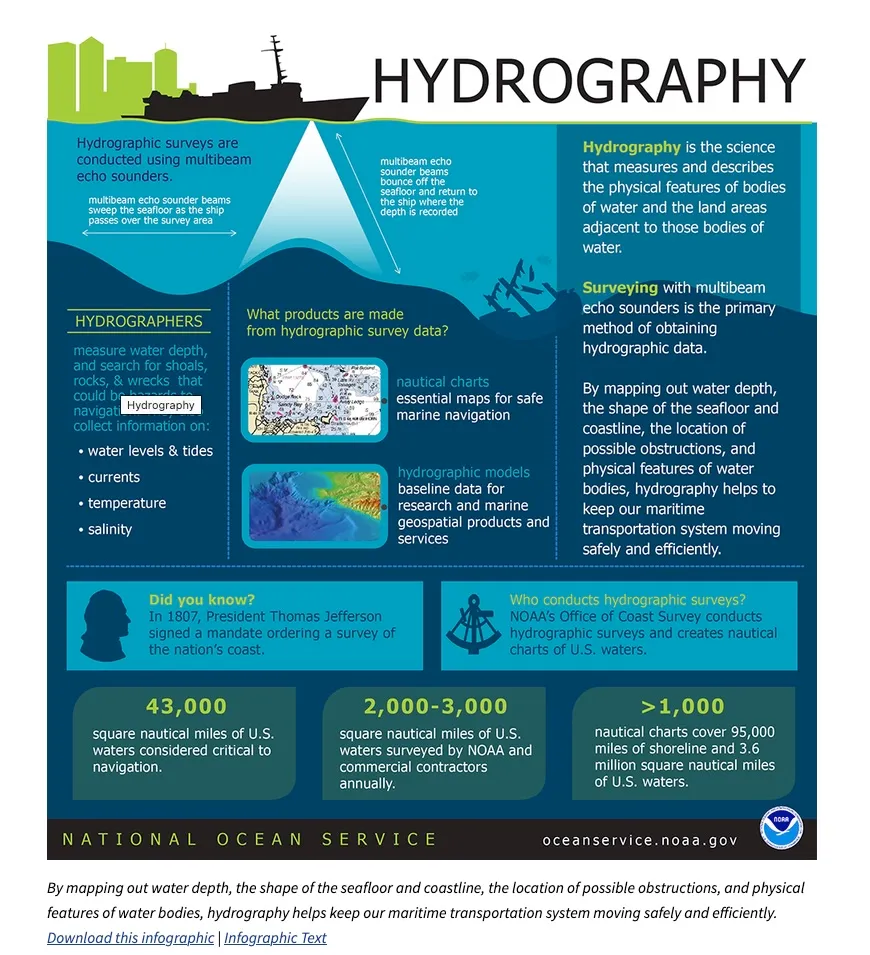
“I can tell you if you’re doing an amphibious operation, you want to understand what’s waiting beneath the surface in the water column,” Niedziocha noted. “So something can go either with a side-looking sonar array or even forward-looking to demonstrate that there’s nothing there, and the hydrography and bathymetry is what you… need for the operation to be successful.”
Hydrography measures “the shape and features of the shoreline; the characteristics of tides, currents, and waves; and the physical and chemical properties of the water itself,” according to NOAA. Bathymetry, which is part of that, focuses on mapping the depths and shapes of underwater terrain.
NOAA
These functions are critical for mine detection and determining whether there are man-made or natural obstacles that would impede landing operations. While these missions are largely being performed by the Navy, including with USVs, the Marines are moving toward making that an organic capability. Recently, the Marines announced they were testing a counter-mine USV system. The evaluation was conducted late last month at Camp Pendleton by the Program Manager Combat Support Systems (PM CSS) Explosive Hazard Defeat Team.
The test of the USV was “in response to a littoral capability gap,” according to the media release. “The solution: seek a commercial USV solution that is equipped with integrated autonomous driving and payloads that consist of Sonar, Forward-Looking Infrared (FLIR) cameras, Line of Sight (LOS) Communications and Acoustic Communications (AComms).”
This was part of the overall effort to develop “solutions that enable increased standoff for Marines to detect, investigate and neutralize threats,” the release added. “The innovation of Explosive Ordnance Disposal (EOD) and Littoral Explosive Ordnance Neutralization (LEON) systems will provide Marine EOD Technicians with the confidence to operate in contested environments while preserving combat power, increasing operational reach, and minimizing exposure to explosive threats.”
LEON is a so-called system of systems, using a remotely operated vehicle, diver equipment, an unmanned underwater vehicle (UUV), a USV, and an Amphibious Unmanned Ground Vehicle to enable “EOD to confirm and mark hazards and obstacles from very shallow water to the beach zone,” the media release added.
While unmanned systems have long been part of EOD operations, “we’re expanding that into maritime systems that allow more endurance and less risk for operators,” said Chief Warrant Officer 2 Alfredo Andrade, officer in charge, Explosive Ordnance Disposal Company, 7th Engineer Support Battalion (ESB). “Some of the conflicts that we are engaged in take a toll on the force, and surging in new forces is costly. It turns into a logistical problem. To preserve the safety and the health of the forces… the USV and the [LEON] program exist to ensure that we have readily available combat power.”
In late August at Camp Pendleton, the PM CSS Explosive Hazard Defeat Team tested an unmanned surface vessel in response to a littoral capability gap. (PAE Marine Corps photo by Kristiana Gehly) Kristiana Gehly
While Niedziocha didn’t address USVs for offensive combat roles, the Marines have evaluated them for that use as well as for logistics, among other functions.
Our Autonomous Low-Profile Vessel (ALPV) solicitation is now accepting submissions.
The @DeptofWar and the @USMC need to resupply units spread over wide distances in contested littoral environments. Increased all-domain threats targeting logistics capabilities, locations, and… pic.twitter.com/Af8v0DTRHS
— Department of War Innovation Unit (@DIU_x) March 3, 2026
There have been many other tests, as well. Including one just this summer at RIMPAC. These trials saw the launch and recovery of one of Splash Industries’ Typhoon USVs aboard the USS Essex. The ‘Gator Navy’ of amphibious assault vessels that haul Marines and their kit around the oceans is uniquely suited to act as USV motherships. Their well decks allow for easy deployment and recovery of USVs of many sizes and capabilities near seamlessly. So it won’t be surprising if these vessels and the Marines aboard them quickly become staples in the Pentagon’s USV playbook.
Watch us land one of our drone-boats inside a moving US Navy warship during RIMPAC. This world-first resupply mission was performed completely autonomously using a Splash Industries Typhoon USV. pic.twitter.com/AEzNzZjsL1
You can see that engagement in the following video.
Ukraine’s Navy says a Sargan unmanned surface vessel destroyed a Russian unmanned boat with machine-gun fire in the Black Sea, the first-ever battle between unmanned surface vessels. Ukrainian Navy personnel operated in coordination with HUR. #Ukrainepic.twitter.com/Avg4ecz8m6
Having recently returned from a six-month deployment that saw the Marine Corps’ first use of its Expeditionary Advanced Base Operations (EABO) concept in a combat setting during the fight against Iran, Niedziocha has a good sense of the realities of modern warfare. His Marines operated forward arming and refueling points (FARPs) for various aircraft in combat for the first time and set up remote sensing locations.
That a commander like him who sees value in USVs is a good sign for progress in the development of these systems.
Somewhere in the overlap between William Friedkin’s 1977 action thriller “Sorcerer” and Kelly Reichardt’s 2020 Pacific Northwest pioneer indie “First Cow” lies Padraic McKinley’s directorial debut “The Weight.”
“Sorcerer” is about a group of fugitives driving a load of dynamite across the jungle; “The Weight” follows a group of Depression-era convicts transferring gold through the forest. “First Cow” is about the sweetness of friendship and French pastries in the wilds of Oregon during westward expansion; “The Weight” is about the corrupting forces of capitalism. McKinley’s movie marries the instincts of modern indie filmmaking with a New Hollywood ethos, while bringing an authenticity to the details of the period.
We follow the story of Murphy (Ethan Hawke), a World War I vet and single father in Eugene, Ore., struggling to provide for his daughter, Penny (Avy Berry), three years into the Great Depression. After an unfortunate run-in with the law, Murphy finds himself in a prison labor camp, building a road and trying to shorten his sentence so he can get out before his daughter is adopted by a new family.
Opportunity presents itself in Murphy’s foreman, Clancy (Russell Crowe), who takes a shine to him after he fixes his car and devises an ingenious way to remove boulders without dynamite. Cuddly but dangerous, Clancy makes a seemingly simple offer to Murphy: He and three friends can earn their freedom if they hike a load of gold out of a mining camp on the eve of President Franklin D. Roosevelt confiscation of all gold stockpiles.
The how and why details aren’t that important; the story is merely that the prisoners have to get from point A to point B through a rugged forested terrain, under the watch of two intimidating chaperones, Amis (Sam Hazeldine) and Letender (George Burgess). A mining camp servant, Anna (Julia Jones), joins their group as a runaway and while it seems a straightforward task, the arduous and brutal journey is one that is liable to turn these convicts into runaways.
Murphy’s gang weren’t really outlaws to begin with — he was imprisoned for defending his daughter from some undercover cops, while Singh (Avi Nash) was arrested for his associations with socialism. Olson (Lucas Lynggaard Tønnesen) was part of a group going after a judge for seizing Scandinavian farms, while the most hardened criminal among them is Rankin (Austin Amelio), who grew up in juvie. But in order to survive the woods, Murphy will have to dig deep into his wartime past and rely on his own skills and smarts to make out it out intact.
McKinley pours his craft into authentically representing the era, from the perfectly worn denim of the costumes to the refreshingly real and craggy faces of the cast (and thank goodness Hawke and Crowe are respectably aging into their character-actor looks). The Bavarian forest beautifully stands in for 1930s Oregon and cinematographer Matteo Cocco balances ’70s-inspired slow zooms with composed, high-contrast images that hark to early 20th century styles of photography. A score by Latham and Shelby Gaines balances discordant, atonal tones with suspense-driven sound design that captures the creaking noises of the forest and the concealed dangers it holds.
McKinley stages a few bullet-sweating sequences of peril, including a particularly brutal transport of gold bars across a crumbling rope bridge and an underwater accident exacerbated by floating logs. Both are nail-biters but you can’t help but think he could have pushed it even further. Tonally, the film is torn between wanting to be brutally bleak and offering some kind of hope for Murphy and his precocious, adorable daughter.
When “The Weight” leans into its nasty, mean and grim moments, it gets at something that seems closer to truth than the saccharine resolution we fear is coming. It seems like McKinley wants to deliver a crushing blow, but then feints at the last minute, opting for a more optimistic kind of fantasy.
Politically and culturally, what “The Weight” speaks to is as ugly as the violence that occurs in the mud and fog of the forest. But it ends on an oddly cheery note that doesn’t square with what we’ve seen. It’s a cutesy ’70s nod that feels more “Smokey and the Bandit” than “Sorcerer.” The bolder choice would have been to commit to expressing the despairing lessons of this world. We want to see these characters changed by what they’ve experienced, even if it’s dark. We want to see them actually carry the weight.
Katie Walsh is a Tribune News Service film critic.
‘The Weight’
Rated: R, for language and some violence/bloody images
Magdalena Andersson will likely face several challenges as she tries to get Sweden’s other left-wing parties to unite.
Published On 18 Sep 202618 Sep 2026
Sweden’s opposition leader has officially begun talks to form a coalition government after the country’s left-wing bloc won a slim majority in last week’s election.
Magdalena Andersson, leader of the centre-left Social Democrats, was asked by Parliament Speaker Andreas Norlen on Friday to begin efforts to form a new government.
Recommended Stories
list of 3 itemsend of list
Norlen’s request follows the resignation of centre-right Prime Minister Ulf Kristersson, who stepped down on Thursday after the general election result was confirmed.
“I have now been tasked with exploring the possibility of forming a government. A task I undertake with great humility and will act constructively to put together a new government,” Andersson said in a statement posted on Instagram.
“My approach to the work that is now taking place is that all political forces now need to put party tactics aside and put Sweden and the Swedish people first.”
Andersson will likely face a series of challenges as she tries to persuade Sweden’s other left-wing parties to unite and form a new administration. The left-wing bloc won 176 of Parliament’s 349 seats in last week’s vote, securing a razor-thin majority of three seats.
Andersson is expected to seek the support of three other left-wing parties: the Greens, the Centre Party and the Left Party.
The socialist Left Party says Andersson will have to award some of its MPs cabinet posts to win their support. However, the liberal Centre Party insists it will not support such a government.
Andersson has until September 28 to form a government. If she fails, Kristersson, whose centre-right bloc won 173 seats, will try to form a coalition.
Coalition and minority governments are common in Sweden because the country has two major left- and right-wing blocs, both of which contain four parties.
The process of forming a government following the 2022 election took more than a month.
Japan has said it is keeping the door open to acquiring nuclear-powered submarines, a potentially major shift for a country whose submarine force has historically relied exclusively on conventional propulsion. Defense Minister Shinjiro Koizumi confirmed recently that Tokyo is not ruling out nuclear-powered submarines as it considers the future requirements of the Japan Maritime Self-Defense Force (JMSDF).
Should Japan ultimately pursue the capability, it would join an exclusive group of nations operating nuclear-powered submarines. China, France, India, Russia, the United Kingdom, and the United States are currently the only countries with nuclear-powered submarines in active service. Brazil is already working to join the club, while Australian and South Korean nuclear-powered submarine plans are somewhat longer-term.
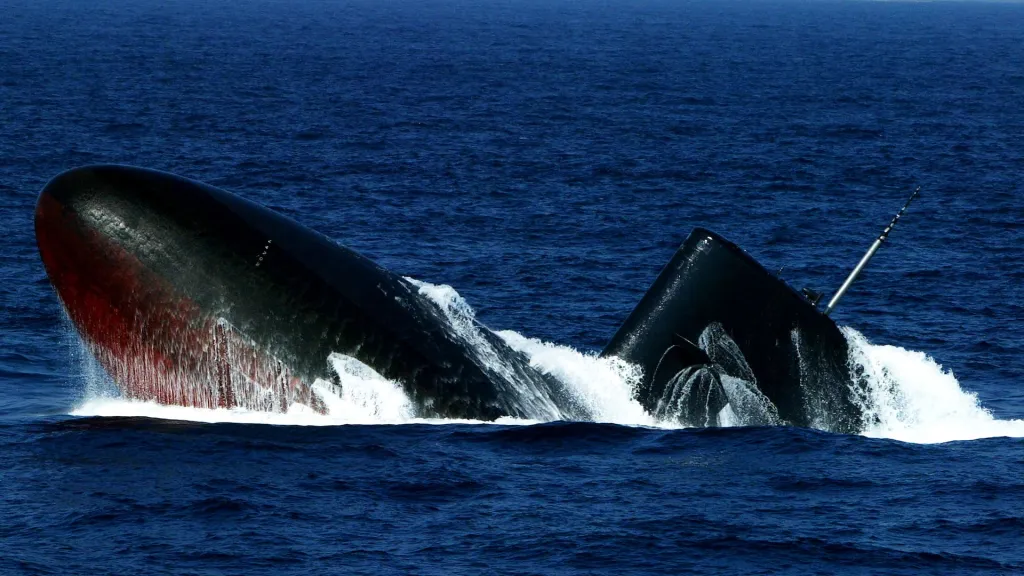
A submarine of the Japan Maritime Self-Defense Force surfaces during a naval review off Sagami Bay, Japan. Photo by Koichi Kamoshida/Getty Images
Japan’s submarine fleet is already regarded as among the most capable conventionally powered forces, and is very much at the forefront of advanced naval propulsion technologies. Even with that considerable expertise, however, developing and sustaining a nuclear propulsion capability would represent a huge challenge, requiring expertise and infrastructure far beyond those needed to build Japan’s existing conventionally powered submarines.
Koizumi’s comments do not represent a decision to acquire nuclear-powered submarines, nor do they indicate that Japan has begun a procurement program. They do, however, mark a significant evolution in the country’s public debate over submarine propulsion and point to a growing willingness within the Japanese defense establishment to consider capabilities that were previously largely outside the mainstream of defense planning.
Secretary of War Pete Hegseth hosts a bilateral meeting with Japanese Minister of Defense Shinjirō Koizumi at the Pentagon, Washington, D.C., Jan. 15, 2026. (DoW photo by U.S. Navy Petty Officer 1st Class Alexander Kubitza)
Currently, Japan operates one of the world’s most capable conventional submarine fleets, centered on increasingly sophisticated diesel-electric boats equipped with air-independent propulsion and advanced lithium-ion batteries. These submarines are well suited to operations around Japan and the country’s surrounding waters.
The JMSDF currently operates 22 conventionally powered submarines, maintaining the force structure established in the 2010s while progressively replacing older boats with the more capable Taigei class. Five Taigei class submarines are now in JMSDF service, with additional boats in the pipeline.
The first-of-class Taigei was launched on October 14, 2020, at the Mitsubishi Heavy Industries (MHI) shipyard in the city of Kobe, in the western prefecture of Hyogo. Japan Maritime Self-Defense Force
Nuclear propulsion, however, would offer substantially greater endurance and sustained underwater speed, allowing Japanese submarines to conduct longer-range operations across the broader Western Pacific with minimal support. This is a requirement that is becoming increasingly relevant as Tokyo’s strategic focus expands beyond its immediate maritime approaches.
China’s rapidly expanding naval force, including its growing submarine fleet and increasingly distant maritime operations, is forcing Tokyo to consider how it would monitor and potentially counter Chinese forces farther from the Japanese archipelago. A nuclear-powered attack submarine could remain submerged for extended periods without the endurance limitations imposed by conventional propulsion, making it particularly useful for long-range surveillance, tracking, and sea-denial missions.
Japan’s debate is also unfolding alongside a significant development in neighboring South Korea. Seoul has confirmed plans to develop a new class of nuclear-powered submarines, a move that could add further momentum to an emerging undersea competition in Northeast Asia. South Korea’s decision is particularly relevant to Tokyo because it demonstrates that nuclear propulsion is no longer merely a theoretical capability for U.S. allies in the region. While the missions and strategic priorities of the Japanese and South Korean navies are different, both countries face the challenge of operating in waters increasingly contested by China and North Korea.
A South Korean Ministry of Defense rendering shows how the nuclear-powered Jang Bogo N Project boats may look. MND
A Japanese decision to pursue SSNs could eventually create a much deeper basis for cooperation with Australia, including submarine interoperability, undersea warfare, workforce and technical expertise, infrastructure, sustainment, and potentially aspects of the industrial base. Analysts have already examined how Japan could fit into the wider AUKUS submarine ecosystem as Australia’s nuclear-submarine program develops.
Concept art of the submerged SSN-AUKUS nuclear-powered attack submarine. U.K. Ministry of Defense illustration
A Japanese nuclear-powered submarine with a robust capacity to launch land attack cruise missiles would also be a powerful component in the country’s emerging “counterstrike” posture, which is increasingly centered on acquiring the ability to strike targets at longer ranges.
Launch of the first Tomahawk missile from the Kongōclass Aegis destroyerChōkaiat an undisclosed location in the Pacific. Japan Ministry of Defense
An SSN would potentially add a highly survivable, mobile platform to this emerging strike architecture, allowing Japan to position long-range weapons farther from its home territory and complicating an adversary’s efforts to locate and neutralize them. That could be particularly valuable in a conflict in which Japanese air bases, missile batteries, and other fixed infrastructure were under attack.
The potential SSN requirement also fits with Japan’s expanding expeditionary ambitions. As the JMSDF converts its Izumo class helicopter destroyers to operate F-35B fighters, giving Japan a more credible carrier aviation capability, nuclear-powered attack submarines could provide a valuable escort for these increasingly important surface groups. Their speed, endurance, and ability to remain submerged for extended periods makes SSNs particularly well suited to accompanying carrier forces on longer-range deployments and supporting contingencies farther from Japanese waters.
U.S. F-35B Flies From Japanese Carrier; First Fighter Launched From Japanese Warship Since WWII
Looking at the bigger picture, it is highly significant that nuclear propulsion was effectively excluded from Japan’s conventional defense debate for decades. More recently, however, Japanese defense officials and policymakers have begun examining whether future submarines will require a different propulsion system. The issue is now one that can now be discussed openly at the ministerial level.
Nevertheless, pursuing a nuclear-powered submarine program would come with huge challenges.
The Japan Maritime Self-Defense Force Sōryū class submarine Hakuryū arrives at the submarine piers of Joint Base Pearl Harbor-Hickam. U.S. Navy photo by Mass Communication Specialist 1st Class Steven Khor/Released
Building and operating nuclear-powered submarines would require Japan to establish an entirely different industrial, regulatory, and training infrastructure. The vessels would also be considerably more expensive and complex to build and operate than Japan’s existing conventionally powered submarines. Tokyo would have to resolve questions involving nuclear regulation, reactor technology, maintenance facilities, crew training, and the handling of nuclear material.
There would also be a significant political dimension. Although naval nuclear propulsion is fundamentally different from possessing nuclear weapons, any move in that direction would inevitably receive scrutiny in a country whose postwar security policy has been shaped by its experience with nuclear weapons and its longstanding non-nuclear principles.
For those reasons, Koizumi’s statement should be viewed less as an announcement of a Japanese nuclear-submarine program than as evidence that the political barrier to discussing such a program is falling.
The Japanese Oyashio class submarine Yaeshio transits the Philippine Sea during Exercise Pacific Vanguard 23. U.S. Navy photo by Mass Communication Specialist 3rd Class Santiago Navarro
The next question is whether the Japanese government will move from keeping the option open to actually studying a nuclear-powered submarine design, propulsion technology and acquisition pathway in detail.
If it does, the consequences could extend well beyond Japan’s submarine fleet. A Japanese nuclear-powered submarine capability would represent a major enhancement of Tokyo’s ability to operate across the Western Pacific and could alter the undersea balance between Japan, China, and the United States’ other regional allies. At the very least, the idea is one that is now part of wider discussions at the highest levels.
Myleene Klass showed off her incredible figure during a photo shootCredit: SkechersMyleene shared behind the scenes photos from a shoot she died for SkechersCredit: Skechers
Myleene posed poolside in the red bikini and unbuttoned denim shorts as she rocked a baseball cap with large headphones over the top.
Other photos in her Instagram post included posing outside Skechers’ head office in black shorts and matching hoodie, pretending to play a large outdoor guitar statue, and hanging out with the Skechers photoshoot crew.
Sign up for the Showbiz newsletter
Thank you!
Myleene also showed off her business class seat on the flight as she wore a glass effect skin mask.
The I’m A Celeb star looked chic in a skintight black mini-dress which she wore to pose by a different pool while wearing a Skechers branded baseball cap.
Myleene opted for tiny shorts for most of her tripCredit: SkechersAnd made sure to keep her skin hydrated while on the long haul flightCredit: Skechers
Myleene’s fans loved the glimpse into what it takes to create a campaign shoot and shared their thoughts in the comments.
“Vibes you look absolutely incredible love your style have a positive weekend ahead,” wrote one person.
Another added: “Stunning.”
And a third wrote: “Gorgeous Myleene.”
Last month, Myleene looked incredible at The Dog Stars premierealongside her two lookalike daughters.
They cuddled up to their famous mum on the carpet and were seen smiling for the cameras.
Hundreds of thousands of Iranians have marched in a government-organised show of defiance in Tehran, pledging their readiness to take up arms.
The Iranian government showcased a newly formed volunteer force at the rally on Friday. It will receive limited military and emergency response training to serve as an additional layer of security for Iran’s Islamic Revolutionary Guard Corps (IRGC) and the Basij militia.
Recommended Stories
list of 3 itemsend of list
Volunteers rallied through downtown Tehran in combat uniforms, some carrying flags and weapons, while the government displayed drones, anti-aircraft batteries and other weaponry.
Iranian authorities said 313,000 people joined the event in the capital. Attendance figures could not be independently verified.
Tehran’s IRGC chief, Hassan Hassanzadeh, told the state broadcaster IRIB that over 600,000 people had registered to participate in the voluntary Janfada-ye-Iran campaign. That roughly translates to “Those who sacrifice their lives for Iran”, with over one million expected to take part in the training.
Senior Iranian leaders at the rally included President Masoud Pezeshkian and Basij head, Hossein Taeb.
Taeb told participants that the volunteers would be ready for “full-fledged defence” and would be a “nightmare” for Iran’s enemies.
Members of the Basij paramilitary force at the military rally in Tehran on Friday [AFP]
A broader strategy
Iranian authorities say mobilising the new volunteer force is part of a broader defence strategy.
“The Islamic Republic has mobilised these people to show that they are united, that they have solidarity and that their people are ready to give anything for the country,” said Al Jazeera’s Sinem Koseoglu, reporting from the rally.
Women and teenagers have also registered with the volunteer units, she added.
“I want to show the world that Iran is strong and united. We don’t want war, but we’re ready to defend our country to the very end,” one of the volunteers, Bahera, told our reporter.
Another volunteer, wearing a combat uniform and carrying a rifle, said: “This is our homeland and we won’t let others decide its future”.
President Pezeshkian said in a speech that the rally was a show of solidarity, Koseoglu noted.
“This is not only a message to countries like the US and Israel, which are attacking Iran, but also to the Islamic Republic that we are ready for any crisis.”
Members of Iran’s Basij paramilitary force at the rally [AFP]
Economy and mobilisation
Friday’s rally happened as the Iranian economy struggles under the US naval blockade of Iranian ports and new US sanctions.
Esmaeil Baghaei, Iran’s Foreign Ministry spokesman, condemned the “brutal economic war, deliberately designed to inflict maximum pain and suffering on every Iranian citizen”.
As the latest addition to its economic pressure campaign, the US administration on Thursday went after digital currency networks that it says are illegally providing sanctioned Iranian entities with access to the international financial system.
The struggling economy was a key driver for protests last December that quickly turned into a challenge to the political system in place since the Islamic Revolution in 1979. Iran said about 3,000 people were killed in the protests, but activists say the state crackdown killed over 7,000.
However, the war launched in late February by US-Israeli strikes has since allowed the authorities to regain the initiative by presenting themselves as a bulwark against the country’s enemies.
The volunteer mobilisation campaign started in early April, at the height of US-Israeli attacks.
According to the authorities, more than 30 million people registered for a potential call-up, about a third of the population of 86 million.
United Nations says 22 million people need humanitarian aid as conflict intensifies.
Published On 18 Sep 202618 Sep 2026
More than 112,000 people have been displaced in Yemen and close to 3,000 have fled the conflict to Djibouti, according to the United Nations, as fighting intensifies between the Iran-allied Houthis and Saudi-backed forces loyal to the internationally recognised government.
“Our resources are very, very, very limited and our stocks will be depleted very soon,” Abdusattor Esoev, mission chief in Yemen for the International Organization for Migration, told reporters on Friday.
Recommended Stories
list of 3 itemsend of list
Most of the more than 112,000 internally displaced people have been displaced over the last two weeks, mainly along the west coast and in the provinces of Taiz and Lahj, he added.
The displacement began when the Houthis made a rapid advance, seizing control of the entire Red Sea coast of Yemen to tighten their grip on the vital shipping route, the Bab al-Mandeb Strait.
Esoev estimates 22 million Yemenis – or nearly half the population – are in urgent need of humanitarian aid.
More than 65,000 registered refugees and asylum seekers in Yemen, mainly from Somalia and Ethiopia, are also threatened.
3,000 Yemenis flee to Djibouti
The crisis is growing “by the hour”, warned Francesco Galtieri, a representative for the UN Population Fund (UNFPA), adding that thousands of women who have lost all their possessions are on the run with their children.
Galtieri estimates that 2,000 pregnant women are among the displaced and around 200 are expected to give birth shortly.
Around 3,000 Yemenis have fled Yemen by boat to Djibouti, the UN refugee agency said. The shortest route across the Bab al-Mandeb Strait is just over 25 kilometres.
The UNHCR reports that more than 2,400 people made the voyage in the past week – mostly women, children and older people.
The influx is adding pressure on Djibouti and population of about one million people. It already hosts around 36,000 refugees, most from Somalia and Ethiopia, said UNHCR representative Sandrine Desamours.
“While the number may sound small,” it must be seen in proportion to the population, she added.
The strategically important Bab al-Mandeb links the Red Sea with the Gulf of Aden and has become an alternative shipping route as the United States’ war against Iran choked the Strait of Hormuz.
The Al-Farsi camp for internally displaced people in Ras Imran in southern Yemen, September 17, 2026 [Mohamad Hakim/AFP]
Michael Carrick says he expected tough season start as he rebuffs questions about his role as Manchester United manager.
Published On 18 Sep 202618 Sep 2026
Manchester United boss Michael Carrick said he expected to have to ride out a storm at some point this season after a dreadful start to the current campaign.
Carrick was appointed on a permanent basis after his successful temporary spell at the end of last season secured third place in the Premier League and a return to the Champions League.
Recommended Stories
list of 4 itemsend of list
But United have taken just four points from their opening four league games this season and were dumped out of the League Cup in a 3-2 defeat by Brighton in midweek after blowing a two-goal lead at Old Trafford for the first time in 50 years.
“In terms of the future and ownership and how long I’ve got, it’s totally nothing. Thinking about it is ridiculous in the position I’m in. It’s just not on the radar. We’ve got to perform and we’ve got a lot of games to plan for,” Carrick said ahead of Sunday’s trip to Fulham.
“History tells you that any team that’s successful goes through periods when you have to work through it, come through it and improve.
“We’ve had a small period, in recent time, when it hasn’t been exactly what we want it to be.
“I was expecting a point when we would go through it, it was going to come. We had such a good spell last season, going into this season.”
Former United and England midfielder Carrick also has reason to bemoan his side’s luck in recent weeks.
United received a swift apology from referees’ chiefs after Erling Haaland’s winning goal for Manchester City last weekend was wrongly awarded because the VAR officials did not spot an offside against Enzo Fernandez in the build-up.
Carrick’s men were also heading for three points at Everton last Sunday before until Toffees defender Ainsley Maitland-Niles produced a stunning strike into the top corner from long range.
“It is a week or two, the games haven’t gone our way,” added Carrick. “It’s tiny margins in some of those games. We will work through it. Winning games is always the answer, it can cover up a lot of things at times as well.
“Sometimes it’s the small disappointments that lead to something a bit bigger. It’s part of coping and being at this great football club.”
United could be boosted by the return of Luke Shaw from injury for the visit to Craven Cottage.
Carlos Baleba is also in contention to make his first appearance since a 70 million pound ($94m) move from Brighton.
Police in Ceuta used batons and fired shots into the air as they began moving migrants from beaches to a new camp. Nearly 10,000 remain in the Spanish territory weeks after a record influx saw more than 72,000 people cross from Morocco.
This time around, all eyes are on Lizzie Borden who was accused of the brutal murder of her dad and step-mother in the late 19th Century before she was acquitted.
Despite Lizzie being set free, her reputation was never restored and for more than 100 years, a gruesome children’s rhyme has immortalised the crimes.
But even though this is why Lizzie Borden remains a familiar name in criminal history, the chant is far from factually correct.
Lizzie Borden rhyme explained
Watch Jose Mourinho Netflix doc with free Netflix subscription
This article contains affiliate links, we will receive a commission on any sales we generate from it. Learn more
Jose Mourinho’s three-part Netflix documentary is available to watch at no extra cost for Sky customers as the provider gives away free subscriptions with each of its Sky Stream TV bundles.
Here is the Lizzie Borden rhyme in full: “Lizzie Borden took an axe, and gave her mother 40 whacks.
“When she saw what she had done, she gave her father 41.”
It states that Lizzie killed her mother and father but the woman was actually her step-mother Abby Borden as her biological mum died when she was just a child.
The rhyme goes on to detail that her parents were “whacked” 40 and 40 times but this is an exaggeration as Abby was killed by 18 or 19 strikes and father Andrew by 10 or 11.
In addition, the rhyme states that the murders were committed with an axe but police and experts believe the weapon was a hatchet, a far smaller and compact tool meant for lighter tasks in comparison to an axe.
There’s also the matter that the children’s song states that Lizzie Borden was the one to commit these crimes.
However, a jury acquitted Lizzie of their murders in 1893, so legally, she didn’t kill Abby and Andrew Jackson Borden.
Despite this verdict, public suspicion remained throughout her life and to this day, especially since it was an all-male jury that didn’t think an upper-class woman could commit such a “feral” crime.
Monster: The Lizzie Borden Story is available to watch on Netflix
Real Madrid stars including Kylian Mbappe rolled up T-shirts showing support for Ceuta, but President trip ‘unrelated’.
Published On 18 Sep 202618 Sep 2026
Real Madrid President Florentino Perez attended an event at Ceuta city hall on Friday in a visit to show solidarity with the Spanish territory, saying that it was not related to any recent developments.
On Tuesday, before Real’s La Liga match with Elche, Kylian Mbappe, Vinicius Jr and Ibrahima Konate obscured the message “We are all mackerels”, which appeared on T-shirts worn by the rest of the players. “Mackerels” is a nickname for people from Ceuta, and the shirts were designed to show support for them.
Recommended Stories
list of 4 itemsend of list
Mbappe said on Wednesday that he did not want to prioritise the suffering of one group over another. Real told the news agency Reuters that they respected their players’ freedom to make their own decisions, but noted that they had shown support for Ceuta a week earlier with a tifo during their Champions League match with Inter Milan.
Perez was accompanied by honorary Real Madrid President Jose Martinez Pirri, a native of Ceuta. They were welcomed by Regional President Juan Jesus Vivas.
“I want to emphasise, to avoid any doubts, that today’s event has been prepared over several weeks with the president of Ceuta, not due to any recent news,” Perez said at the city hall.
“And I also take this opportunity to convey all our support, all our affection, and our solidarity during these very difficult times to all Ceutans. It is our wish that normality resumes as soon as possible in Ceuta.”
In July, more than 70,000 irregular crossings into Ceuta from Morocco took place, causing disruption in the territory. Real Madrid’s show of solidarity is one of many gestures that have taken place across Spain since the mass crossings.
Spain’s Lamine Yamal says most racism he has suffered has come from people unaware of their own comments or behaviour.
Published On 18 Sep 202618 Sep 2026
Barcelona forward Lamine Yamal said he has experienced racism “a thousand times”, with many people unaware that their comments or behaviour are racist.
The 19-year-old has been the target of racial abuse during his rapid rise to prominence.
Recommended Stories
list of 4 itemsend of list
In October 2024, footage appeared to show Lamine, Raphinha and Ansu Fati being racially abused during Barcelona’s match against Real Madrid at the Santiago Bernabeu.
The Spanish Observatory on Racism and Xenophobia said in a bulletin published in March that Lamine and Vinicius Jr were the most frequent targets of online racist abuse in Spain in the final quarter of 2025.
Asked by former Argentina international Jorge Valdano in an interview with Spanish broadcaster Movistar whether he had directly experienced racism, Lamine said: “A thousand times.
“People are indirectly racist toward you, but maybe don’t realise it. There are a lot of comments or looks that are racist, and they don’t even notice.
“If someone calls me Black, it’s not going to bother me at all, ultimately I’m Black, I’m not any other colour. Another thing is whether it’s good or bad, whether they’re saying it to offend me.
“But if I’m playing a match and they paid for a ticket to see me, I’m not going to get angry just because they disrespected me.”
La Liga has stepped up efforts to combat racist abuse in stadiums following several high-profile incidents in Spanish football in recent years.
With a boisterous laugh, Giselle Bonilla recalls her introduction to Hollywood at the age of 12: on the set of “Freedom Writers,” the 2007 drama about at-risk high school students in Long Beach. She played a young version of Eva, one of the film’s main characters.
“I remember the first thing we shot was an initiation scene where I get the s— beat out of me,” she tells De Los, sitting at a coffee shop in Silver Lake on Sept. 11 (more on this date later). “They put this candy blood in my mouth, and I thought it was so fun.”
In retrospect, Bonilla, 31, finds great irony in how that initial foray into professional acting fictionally materialized her Mexican immigrant parents’ worst nightmare.
“We don’t come from money. They hustled all their lives and put my sister and I in private education, because they had this irrational fear that I would join a gang … then the first thing I ended up booking as an actor was getting initiated into a gang,” she says grinning.
Since that unique formative experience, Bonilla has traveled a winding path in and out of the industry, which ultimately led her to direct her first feature: the dark comedy “The Musical,” in theaters Friday.
The movie’s antihero, Doug (Will Brill), is a middle school theater teacher plotting his revenge against his ex-girlfriend Abigail (Gillian Jacobs), also a teacher — and her new boyfriend, the more charming Principal Brady (Rob Lowe).
Doug’s plan? To secretly persuade his young students to put on a musical about the horrors of 9/11 and its aftermath that’s certain to cause controversy and get the principal in trouble.
“I feel like you can be more honest with comedy,” says Bonilla about why this genre appeals to her. “You can get away with everything that you’re angry about and want to yell about. If you make them laugh first, people tend to listen.”
Left to right, back row: Alex Heller (screenwriter), Will Brill (center row) Gillian Jacobs, Giselle Bonilla (director) and Rob Lowe (on the floor) from “The Musical” at the Los Angeles Times 2026 Sundance Film Festival studio presented by Chase Sapphire in Park City, Utah on Jan. 24.
(Christina House / Los Angeles Times)
Though the actual show is only a small element of the narrative, it turned off distributors, who argued they wouldn’t be able to market a comedy that involved such a delicate subject.
Still, “The Musical” is making it to the big screen as a self-released title thanks to its executive producers, who believed in the film enough to put in more money for a release.
“I’m going to make sure people watch it regardless,” Bonilla says about being very involved in the marketing. “Even though it didn’t sell at Sundance, we still found a way, which is how we made the whole movie. It was nonstop fighting against the universe just to make a comedy.”
Less than a week before production started, Bonilla lost the actors who were originally playing Principal Brady and Abigail. As her film fell apart, she reached out to the industry contacts she had made after working as an assistant for a few years. Miraculously, the screenplay piqued Lowe’s interest. He came on board, essentially saving the project.
Will Brill and Rob Lowe star in “The Musical.”
(Blue Harbor Entertainment)
As a student at the AFI Conservatory, Bonilla had directed a short film version of “The Musical” that writer Alexander Heller, aware of her affinity for comedy, had conceived for Bonilla to direct. The core group of artists who made the short also worked on the feature.
And though she has always pushed for diversity on screen — including in her short films “Virgencita” and “Bullfighter” — for “The Musical,” Bonilla believed the adults had to be white.
“It would be way more damaging if I had pinned a brown person to be behind the staging of a musical about 9/11,” she explains. “It was very clear to me that this was a comedy about white liberalism and how people weaponize tragedy for their own agenda.”
When it came to the kids in Doug’s class, Bonilla wanted to reflect the multicultural mosaic that is the Los Angeles Unified School District. To be able to see herself in “The Musical,” Bonilla wanted a Latina girl as the child with the most ambition to succeed in the arts. That character became Lata: played in the feature by Melanie Herrera in her first acting credit.
“She’s a dancer. But she’s very precocious and has a really confident, type-A personality,” Bonilla says of the young actor. “Melanie gives Reese Witherspoon in ‘Election,’ like, ‘I will do whatever I have to do for the part,’ and I recognized that in myself as a kid.”
Filmmaker Giselle Bonilla on the set of “The Musical.”
(Peter McCollough)
An L.A. native raised in North Hollywood, Bonilla started doing improv at a young age encouraged by her father, Art Bonilla, who grew up in Tijuana and has worked as an actor in the U.S. for over 40 years.
Her mother, originally from Sinaloa, does workers’ compensation insurance, which provided a stable income and allowed her partner to pursue acting.
“It was tough seeing him struggle and not have any agency over work,” Bonilla says of her father. “He’s such a great actor and he’s really funny, but he’s always getting cast in these very small bit parts as a gardener or an immigrant crossing on the border.”
Unsurprisingly, when Bonilla began auditioning for roles as a teenager, similarly one-dimensional and stereotypical characters from a “troubling perspective” came her way.
“They always make the main character in those stories a white person,” she says. “And then we’re painted as these puppies that just keep getting beat up. I didn’t want to contribute to that.”
Bonilla’s interest in being on the other side of the camera solidified after playing an illiterate South Central high school student in the Byron Allen sitcom “Mr. Box Office.” She attended Pasadena City College, where she studied film production, then used the residuals from the show to help pay for her tuition at NYU Tisch School of the Arts.
Attending film school on the East Coast was, as she puts it, a necessary experience, because she grew up rather sheltered.
“I’m a first-gen Mexican American woman and I was supposed to live at home until I get married,” she explains; but it also exposed her to the concept of impostor syndrome.
“I always had this impostor syndrome at NYU, because that was where I first really confronted wealthy people,” she explains. “I had never been in a predominantly white institution before. And that was really eye-opening.”
It was only when COVID restrictions were lifted that Bonilla decided to apply to the AFI Conservatory, where she regained her confidence and met her now close collaborators.
She has, however, never forgotten her biggest and earliest supporters. Since she started directing, Bonilla has cast her father in many of her short films. And in “The Musical,” you can see both of her parents in the audience during the culminating school show.
“My dad is the one that yells at Rob Lowe at the end in slow motion. He’s pissed that I cut his line, but it was a union film, and we couldn’t afford to give my dad a line,” she says. “But he will be the first one to tell you that he’s not an extra. He did a ‘cameo!’”
“The Musical” director Gisella Bonilla poses at the Los Angeles Times 2026 Sundance Film Festival studio presented by Chase Sapphire in Park City, Utah, on Jan. 24.
(Christina House / Los Angeles Times)
Bonilla’s next project takes inspiration from her memories attending a Catholic school run by nuns in Sun Valley, where a teacher was discovered to be a pedophile. She describes it as “an erotic thriller told from the perspective of virgins.”
Once again, she’ll tackle an unsavory topic and figure out how to bring it to fruition; then distribute it come what may, because she refuses to be boxed in by the industry’s expectations.
“Identity stories are very important. If someone wants to do that, they should be able to do that,” Bonilla says. “But I don’t think our opportunity as Latinos should be limited to painting ourselves as victims against the supremacists.”
Kremlin calls UK’s support for Ukraine an endorsement of ‘terrorism’ after recent escalation of weapons supplies.
Published On 18 Sep 202618 Sep 2026
Russia has stepped up pressure on Ukraine’s allies, summoning Britain’s top diplomat in Moscow over arms shipments to Kyiv and seizing Russian assets of several Western firms.
The Russian Ministry of Foreign Affairs summoned Britain’s charge d’affairs, Danae Dholakia, on Friday, issuing a formal protest over the UK’s “further increase” in weapons to Ukraine.
Recommended Stories
list of 3 itemsend of list
“London is placing itself in the position of an accomplice to the bloody atrocities committed by the Kyiv regime, which can only be characterised as terrorism and war crimes,” the ministry said in a statement.
Britain has maintained its support for Ukraine and says it will stand “shoulder to shoulder” with Kyiv and will provide whatever military equipment it needs, saying just last month that it will share classified weapons information.
Moscow’s move comes the day after Polish Prime Minister Donald Tusk warned that Russia might be preparing to launch hybrid drone and missile strikes against countries that support Ukraine, including Poland. He said that such attacks would be framed as accidental, with the intention of weakening NATO states’ resolve to invoke collective defence provisions in the event of an attack on one of its countries.
French President Emmanuel Macron said on Friday that the threat posed by Russia’s shadow operations was growing across Europe and that Moscow had targeted France with hybrid attacks in the past few weeks.
“The Russian hybrid threat against Europeans and against France has intensified,” he said after a meeting with French political leaders.
France’s interior minister had met regional prefects to step up “vigilance in response to the Russian hybrid attacks”, Macron said, adding that he had ordered “the government to prepare a plan to protect our critical infrastructure” and the “most sensitive” defence industry and technology sites against drone and cyber-attacks.
Moscow seizes French, Swiss firms
As Russia steps up pressure on Ukraine’s political allies, it is also targeting Western companies.
Moscow has ordered the seizure of Russian businesses and assets of Swiss food giant Nestle and three French firms: retailer Auchan, DIY chain Lemana Pro (formerly Leroy Merlin) and logistics firm FM Logistics.
President Vladimir Putin signed a decree late on Thursday that changed the firms’ Russian operations to a new entity, LEV Management, which is managed by a Russian Ministry of Interior general, according to Novaya Gazeta Europe.
Nestle said it was still “assessing” the situation and its options but it remains “committed to taking all necessary steps to protect its rights”.
Kremlin spokesman Dmitry Peskov told reporters on Friday that one of the reasons behind the decision was because Nestle and Auchan are companies from “unfriendly” countries.
Their assets are only under “temporary administration” and that no decisions have been taken as of yet, Peskov added.
Overnight Russian strikes hit multiple regions in Ukraine, sparking several fires across the country, as President Volodymyr Zelenskyy is to host the inaugural Carpathian Eight summit of several European countries.
They include Romania, Poland, Slovakia, Czech Republic, Austria, Hungary and Serbia, with the European Union also set to discuss regional cooperation.
Hungary and Slovakia have refused to send Kyiv direct military assistance in the past, though Poland and Romania remain staunch allies.
Ex-Manchester United and Real Madrid forward Cristiano Ronaldo named in Portugal squad to face Norway and Denmark.
Published On 18 Sep 202618 Sep 2026
Cristiano Ronaldo has been included in new Portugal manager Jorge Jesus’s first 25-man squad for the defending champions’ upcoming four Nations League matches.
In August, Ronaldo fuelled speculation about his retirement plans after saying the coming year would probably be the last of his playing career.
Recommended Stories
list of 4 itemsend of list
The 41-year-old Portugal captain is one of the most decorated players in football history, having won major trophies with Manchester United, Real Madrid, Juventus and current club Al Nassr since making his senior debut for Sporting in 2002.
Ronaldo, a five-time Ballon d’Or winner, was unable to add a World Cup title to his list of honours after Portugal were knocked out in the last 16 by eventual champions Spain, leaving the sport’s biggest prize absent from his trophy cabinet.
Ronaldo confirmed in July that the 2026 edition of the FIFA World Cup would be his last in that competition, but he was unwilling to make a hasty call on his international future.
“His performance is what matters. The past doesn’t count,” Jesus told a news conference on Friday.
“In this squad, there are 13 players who have worked with me. I don’t have a set core, so within this group, there were several players who were important for this squad.
“Cris is a player like any other. If he performs, he plays; if not, he doesn’t. He has a different status – he has five Ballon d’Or awards – but does that factor into my decisions? No. However, the fact that he is different is.”
Jesus will make his debut as Portugal manager against Wales at home on September 24. Portugal then travel to face Norway and Denmark on September 27 and October 1 respectively, before hosting Norway on October 4.
Portugal appointed the 72-year-old former Al Nassr boss in July, days after Spaniard Roberto Martinez stepped down following the country’s World Cup exit.
Portugal’s Nations League squad
Goalkeepers: Diogo Costa (Porto), Rui Silva (Sporting), Samuel Soares (Benfica)
Defenders: Goncalo Inacio (Sporting), Joao Cancelo (Barcelona), Diogo Dalot (Manchester United), Nuno Tavares (Lazio), Nuno Mendes (Paris St Germain), Renato Veiga (Villarreal), Ruben Dias (Manchester City), Tomas Araujo (Benfica)
Midfielders: Bruno Fernandes (Manchester United), Joao Palhinha (Benfica), Joao Neves (Paris St Germain), Ruben Neves (Al-Hilal), Vitinha (Paris St Germain), Bernardo Silva (Real Madrid)
Forwards: Cristiano Ronaldo (Al-Nassr), Fabio Silva (Borussia Dortmund), Francisco Trincao (Al-Ahli), Francisco Conceicao (Juventus), Goncalo Ramos (AC Milan), Joao Felix (Al-Nassr), Pedro Neto (Chelsea), Rafael Leao (Galatasaray)
Coronation Street actress Sally Dynevor has been a Weatherfield icon for more than 40 years
Met Gala: Phoebe Dynevor stuns in custom Victoria Beckham gown
Coronation Street legend Sally Dynevor is not the only actress in her family, and Netflix fans are sure to recognise her eldest daughter.
In 1986, Sally, 63, burst onto screens as Sally Seddon on the long-running ITV soap. She was first seen waiting for a bus when Kevin Webster (played by Michael Le Vell) drove past in his van and accidentally splashed her with water.
Initially, Sally was only supposed to appear on Corrie for a short stint, but she soon became the mechanic’s girlfriend and grew into the funny busybody fans know and love today.
Sally and Kevin welcomed two daughters into the world, but their romance didn’t stand the test of time, and Sally eventually found love with Joe Metcalfe (Joe Duttine).
Away from the ITV soap, life is much simpler for the actress, as she has been married to her screenwriter husband, Tim Dynevor, since 1995.
Happy couple Sally and Tim share three children: daughters Phoebe, 31, and Hattie, 22, and son Sam, 29. Both of the girls have followed in their footsteps and are enjoying careers in television.
Hattie stars on the BBC drama Waterloo Road, playing Libby Guthrie, the daughter of history teacher Neil (Neil Fitzmaurice), and has so far appeared in series 13 – 17.
She also appeared in the recently released gripping Netflix series Legends as Arabella, which also stars Steve Coogan and Tom Burke.
Who is Phoebe Dynevor?
Phoebe launched an acting career on the BBC drama Waterloo Road, playing Siobhan Mailey between 2009 and 2020.
She went on to land the role on the Netflix series Bridgerton, playing Daphne, the wife of Simon Basset, the Duke of Hastings, played by Regé-Jean Page, between 2020 and 2022.
She has since starred in a long list of popular television shows, including The Musketeers, Dickensian, Snatch, and Ten Percent. Away from the small screen, Pheobe has starred in the movies The Colour Room, Inheritance, and Thrash.
Phoebe recently married actor and producer Cameron Fuller at a chateau located in Provence, France. Her husband is the son of producer Brad Fuller, who specialises in horror films, including The Purge franchise and A Nightmare on Elm Street.
On-screen, Cameron, 32, has appeared in shows such as The Last Ship, Insecure, Into the Dark, and The Goldbergs.
He has also worked as a producer on numerous films, including The Astronaut, Dead Sea, and The Girl in the Woods.
Taking to Instagram on Thursday (September 17), the new Mrs. Fuller shared two photographs from the big day, including a black-and-white picture of her and her new husband kissing under a floral-adorned wooden arch. “Married my best friend,” she sweetly captioned the post.
Proud mum Sally was quick to respond, as she gushed in the comments section of her daughter’s post: “Best weekend of our life. Beautiful Phoebe and Cameron. Love you both so much.” Sister Hattie also shared: “The best weekend ever.”