Everyone wants to be “The Devil Wears Prada 2,” as the 20-year sequel strutted to an estimated $77 million in the U.S. and Canada in its opening weekend, highlighting the spending power of women moviegoers at the box office.
The film, which returned stars Meryl Streep, Anne Hathaway, Emily Blunt and Stanley Tucci, nudged out Lionsgate’s “Michael” for the domestic top spot at theaters this weekend. In its second outing, the Michael Jackson biopic brought in $54 million, upping its overall North American total to $183.8 million and its cumulative global haul to $423.9 million.
Worldwide, Walt Disney Co.-owned 20th Century Studios’ “The Devil Wears Prada 2” brought in $233.6 million, according to studio estimates. The theatrical revenue, both domestic and worldwide, edged studio expectations. Already, the film has brought in 72% of the total revenue that the original movie made ($326 million).
The 2006 original has become a cult classic, with lines like Streep’s infamous “that’s all” and Tucci’s “gird your loins” now millennial catchphrases. The popularity of that film has continued over time with repeat viewings on cable television and the Disney+ streaming service.
“Nostalgia is a big driving factor for movies like this,” Andrew Cripps, head of theatrical distribution for Walt Disney Studios, said. “It’s just one of those movies that got into the zeitgeist.”
The fashion-forward sequel had a production budget of about $100 million. The film notched a 77% approval rating on aggregator Rotten Tomatoes.
Women comprised the majority of the audience for “The Devil Wears Prada 2” this weekend, representing 71% of moviegoers, according to data from EntTelligence.
The strong showing for “The Devil Wears Prada 2” highlights the spending potential of female moviegoers, who have had few big movies aimed at them in the last few years.
Despite the billion-dollar blockbuster that was “Barbie” in 2023, Hollywood has largely failed to consistently deliver big films targeted to women. That’s led multiple box office analysts and studio executives to note that the industry is leaving money on the table.
In the past, comparable titles to “The Devil Wears Prada 2” would have been 2008’s “Mamma Mia” or the “Sex in the City” film, but those kinds of movies are now few and far between.
“There haven’t been enough movies for females,” Cripps said. “When you can give them a good movie, as long as the movie plays well and I think this one plays brilliantly, there’s a big audience out there.”
Universal Pictures, Nintendo and Illumination’s “The Super Mario Galaxy Movie” continued its run with a third place finish of $12.1 million at the box office this weekend, followed by Amazon MGM Studios’ “Project Hail Mary” in fourth and Neon’s horror flick “Hokum” in fifth, according to Comscore data.
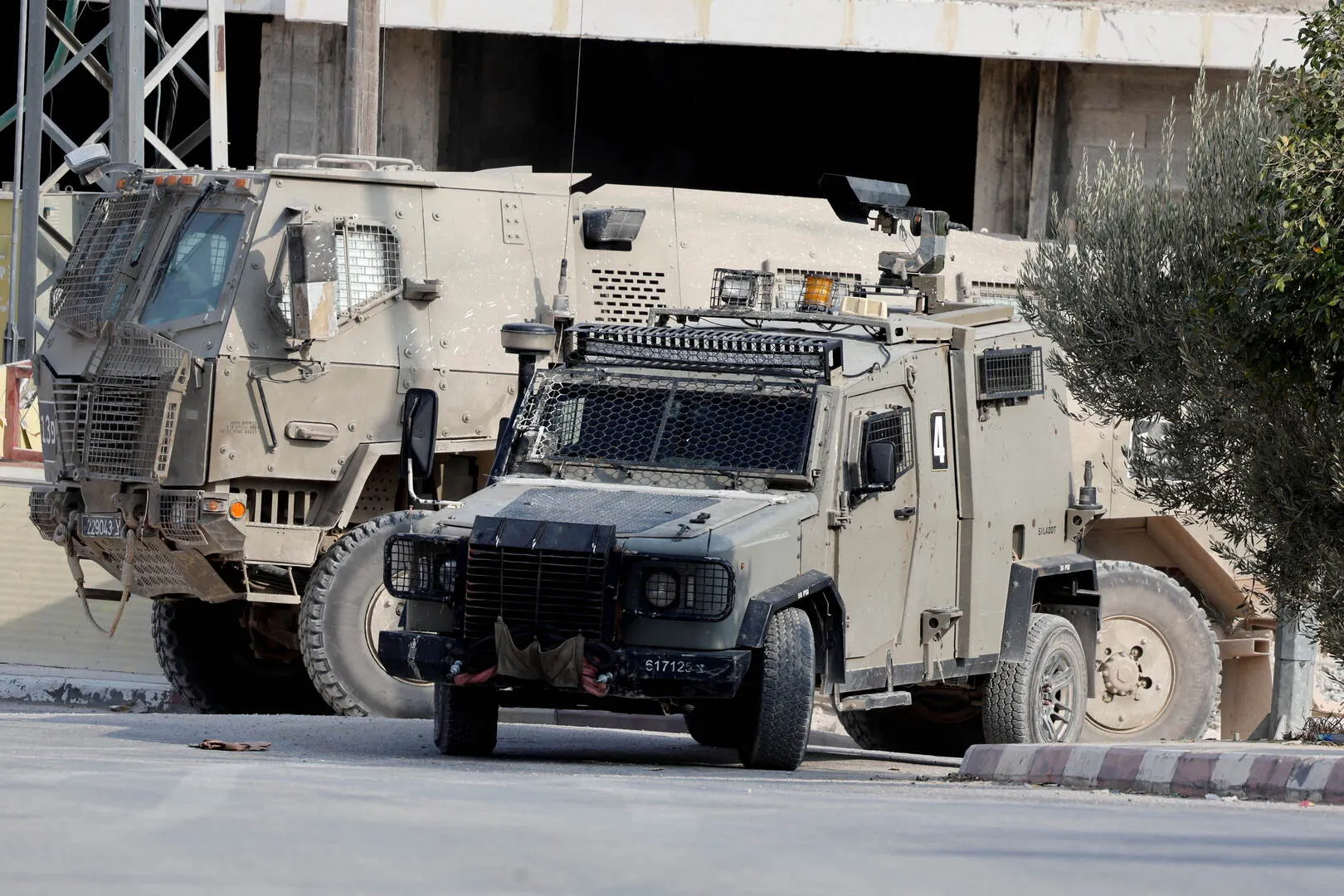
Israeli forces have raided the city of Nablus in the occupied West Bank, firing live ammunition that killed a 26-year-old Palestinian man and wounded four others, including children. Dozens of people have suffered tear gas inhalation.
THEY say good things come to those who wait, so I have high expectations for Roger Sanchez’s first studio album in two decades.
And as he gears up to release the 13-track record, Spectrum, on June 5, the superstar DJ reveals he’s thrown fans a curveball after teaming up with Melanie C on his song I Don’t Wanna Know.
Sign up for the Showbiz newsletter
Thank you!
The Spice Girls, from left: Mel C, Mel B, Victoria Beckham, Geri Horner and Emma BuntonCredit: Refer to SourceBizarre’s Ellie Henman and Roger SanchezCredit: Supplied
“That’s one I didn’t have on my dance card,” Roger tells me after popping into Bizarre HQ, where he takes his tea “milky, two sweeteners”.
“When the Spice Girls first came out, I always felt she was underrated. There was such a power in her voice and I didn’t feel in the Spice Girls she got her due for how powerful her voice is.
“She’s the bubbliest one of the group. She’s a powerhouse.
“I had this track and I was talking to my team about artists who people wouldn’t expect me to work with.
“My manager was like, ‘How about the Spice Girls?’ and I said, ‘Well it’s got to be Mel C if we’re going to do it.’
“We sent the track that I had originally done to her team, and she loved it. And so she sent me back the song that she wrote. And I was like, let’s go.”
“You don’t ever count Madonna out,” Roger explains.
“I know she’s been around for quite some time.
“And as somebody who’s been around for a minute myself, I can say creative forces like that are probably becoming a little more rare as time goes on, because of just the way things are done now.
“You just never count her out because she’s always brewing something
“And it’s always going to be something that moves the needle somehow.”
Just days after Roger drops Spectrum, he will head to his spiritual home in Ibiza to take up a residency at super club Pacha, after spending weeks in the UK finishing the record.
“I started forming where I wanted a body of work to go around 2020. Before we dove into the hell that was known as Covid.
“Coming out of that, the UK was one of the first markets to reopen so I started touring.
“I wound up spending a lot of time in London and I’ve got a flat in Shoreditch.
“The UK became a real central point for me. I connected with a lot of writers and artists here. This is a London album.”
Spectrum is packed with dance bangers including my favourites Midas Touch, Come My Way and How Do We Say Goodbye with Karen Harding, which will be the next single to be released.
And Roger is hoping to return to Glastonbury one day to play the record, after a killer headline set at NYC Downlow back in 2016.
“That was my first kind of performing experience at Glastonbury,” Roger explains.
“It felt like a 1989 rave in the UK. Very, very dark and very loud.
“And people weren’t on their phones. They really plugged into the moment.
“I’ve played a few times since. I did one for Glitterbox and I did another for Greenpeace in a tree.
“There’s a little door opening in the base, and you climb up a bloody ladder.
“You feel like you’re a hobbit. It felt a bit like Gandalf walking into Bilbo Baggins’ home.”
SPICE IT UP
Mel B supported her ‘Spice Sister’ Mel C at a gig in Leeds this weekendCredit: InstagramThe two Mels shared the stage and belted out smash hit Spice Up Your LifeCredit: Instagram
They sang Spice Up Your Life for the first time since the group’s 2019 tour at a concert in Leeds.
Mel C played the gig to celebrate the release of latest solo album Sweat, which is on course to go to No2 this Friday.
TENSIONS between Gordon Ramsey and Brooklyn Beckham were high back in February after the famous chef fired a warning shot to the wannabe over his feud with his parents.
Now it seems Gordon is coming for Brooklyn in business.
Gordon has trademarked Hotter Than Hell by Gordon Ramsay – the name given to the spicy relishes he uses in some of his restaurants.
But it appears he could be preparing to flog bottles of the sauce to customers and if he goes ahead with the venture, he will be competing with Brookylyn’s Cloud 23 hot sauce, which he launched back in 2024.
“If Gordon is launching his own sauce he’ll be going up against Brooklyn in that market,” an insider told me.
“Things will get spicy if they end up clashing over it.”
In February, Gordon told our newspaper he thought Brooklyn had got carried away by his marriage to Nicola Peltz.
Asked about how Posh and Becks were coping after their son’s acid-tongued Instagram statement about them, Gordon said: “Victoria is upset, and I know 24/7, seven days a week, just how much David loves Brooklyn.
“Brooklyn and I have messaged a little bit. Our relationship is solid. I love him.
“His heart is incredible. But it’s hard, isn’t it, when you’re infatuated?
“Love is blind. It’s easy to get up on that rollercoaster and get carried away. But it will come back.”
Awkward.
Moment in the sun
Promising British pop star Bellah Mae is having her moment in the sun after signing a record deal in the StatesCredit: Matthew Berinato
PROMISING British pop star Bellah Mae is having her moment in the sun after signing a record deal in the States.
The Birmingham-born singer posed on a lounger in a snap to promote her new single Salt And Sugar from her upcoming EP, Keep It Peachy, which will be out on May 29.
It’s the first release for Bellah, who is currently on tour across the US, with her new label Sony Nashville.
She told me: “I’ve been coming to Nashville to write since I was 19 years old and knew I wanted to eventually spend more time here from the first time I came over, so to be one of the first UK artists signing to Sony Nashville and be here is a lot of dreams all coming true.
“I wanna bridge the gap between the UK and US country-pop worlds and take over the space one song at a time… the British Hannah Montana!
“The new era is fun, flirty and confident.”
Shakira loves a Brazilian
Shakira made history on Saturday as she played one of the highest attended concerts of all timeCredit: EPAMore than 2million fans saw the Colombian superstar play a free gig at Copacabana Beach in Rio De JaneiroCredit: GettyShe wore ten costumes, many of which were made by local designers – including a jumpsuit with Swarovski crystals in the pattern of the Brazilian flagCredit: Getty
SHAKIRA made history on Saturday as she played one of the highest attended concerts of all time.
More than 2million fans saw the Colombian superstar play a free gig at Copacabana Beach in Rio De Janeiro.
During the spectacular show, the She Wolf singer wore ten costumes, many of which were made by local designers – including a jumpsuit with Swarovski crystals in the pattern of the Brazilian flag.
More than 1,500 drones lit up the sky before Shakira took to the stage.
And the singer was later joined by Anitta to perform their new single, Choka Choka.
Shakira’s Las Mujeres Ya No Lloran Tour will come to Europe in September, where she will play 11 nights at the purpose-built Shakira Stadium in Madrid.
The BBC star, who will be commentating on the song contest in Vienna on May 16, said the live final is such a slog, he needs a drink to get through it.
On Alan Carr’s Bottoms Up! podcast, Graham said former host Terry Wogan called him before his first ever contest in Moscow with some tips.
He said: “The only bit of advice he gave me was, ‘Don’t have a drink before song nine’.
“But I’m drinking whatever I can lay my hands on because it’s a long old stretch.”
Graham also admitted that refreshments are not easy to source at the venues, saying “normally, it’s smuggled in”.
But he knows better than to overdo it during the live show.
Given the quality of some of the songs, I’m amazed he can wait until number nine.
OLIVIA RODRIGO mocked Jake Paul as she hosted Saturday Night Live in the US.
Speaking about the boxer, who she starred with on the Disney show Bizaardvark a decade ago, Olivia said: “We’d always talk about our futures, me and Jake.
“I’d say, ‘I wanna create music that explores the complexities of girls my age’, and he’d say, ‘One day I wanna beat up old guys on Netflix’.”
LIAM AND NOEL NOT IN TUNE
LIAM GALLAGHER has admitted he’s in the dark when it comes to the new music his brother Noel has been writing – and whether it could be for Oasis.
Last month, Noel revealed he had been “in the studio, noodling away” on new tunes.
But when asked about it on X at the weekend, Liam was none the wiser.
He said: “I’ve not heard anything unless he’s doing a solo album, which would be a real shame, I mean really good.”
When someone else commented: “So he just doesn’t tell you his plans?” he replied: “Pretty much.”
Given how much Liam spouts off online, I can’t really blame Noel for keeping schtum.
Spotted looking chic
Nicole Scherzinger looked chic in a polka dot dress as she sang the US national anthem at Saturday’s Kentucky DerbyCredit: Getty
While Nicole looked chic in a polka dot dress as she sang the US national anthem at Saturday’s Kentucky Derby, Ashley Roberts and Kimberly Wyatt were busy going through their paces during rehearsals.
The Dolls, who are now a trio, kick off their reunion tour in California in a month’s time, before shows on this side of the Atlantic in September.
If their tour is anything like their shows back in the day, they will have a lot of dance moves to learn between now and then.
THE WEEK IN BIZNESS
TODAY: Beyonce chairs the glitzy Met Gala in New York, where she is expected to tease details of her highly anticipated new album.
TUESDAY: Spanish singer/songwriter Rosalia brings her critically acclaimed Lux Tour to London’s O2 Arena for two nights.
WEDNESDAY: Rockers No Doubt return to the stage for the opening night of their Las Vegas reunion residency at state-of-the-art music venue, Sphere.
SUNDAY: The Bafta TV Awards take place at London’s Royal Festival Hall, where Adolescence leads the nominations. The show, hosted by Greg Davies, airs on BBC One.
Members of the U.S. Army and Tunisian Armed Forces discuss training objectives during explosive ordnance disposal squad tactics exercises in Bizerte, Tunisia, during African Lion 2026. Two soldiers were reported missing on Saturday night in an incident unrelated to the military exercise. Photo by Staff Sgt. Cameron Christensen/U.S. Army
May 3 (UPI) — Two members of the U.S. Army were reported missing during a training event in Morocco on Sunday morning by the United States Africa Command.
The soldiers were participating in the U.S. military’s largest Africa-based exercise, African Lion, when the soldiers went missing on Saturday night during near the Cap Draa Training Area, which is near the city of Tan Tan, Morocco, AFRICOM said in a press release.
Military officials said their disappearance is unrelated to the exercise, but rather than they had gone on a hike near the training range and may have slipped off a cliff into the ocean, The New York Times reported.
“U.S., Moroccan and other assets from African Lion immediately initiated coordinated search and rescue operations, including ground, air and maritime assets,” AFRICOM said in the release.
“The incident remains under investigation and the search is on-going,” the command said.
The soldiers were discovered missing during a base-wide head-count around 9 p.m. local time, with helicopters searching throughout the night and various aircraft — including larger planes and drones — picking up the search on Sunday morning near the coast, CBS News reported.
African Lion is an annual joint military exercise that includes the U.S. military, NATO allies and African partner nations, and is hosted by Morocco, Ghana, Senegal and Tunisia, according to U.S. Army Europe and Africa.
This year’s event, scheduled to run from April 27 to May 8, includes 5,000 people from 40 countries.
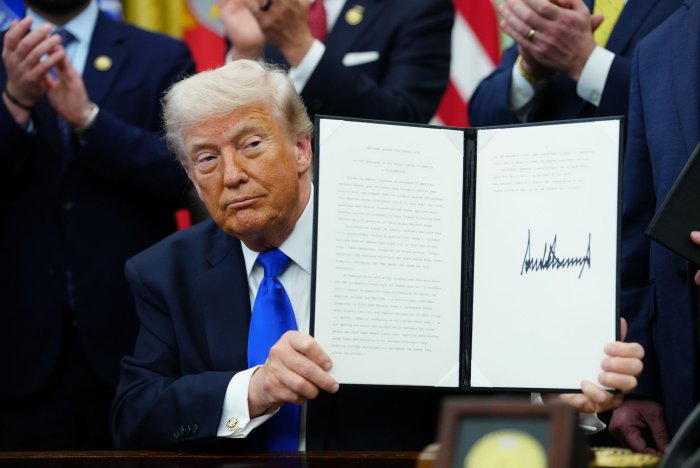
President Donald Trump signs a series of executive orders in the Oval Office of the White House on Thursday. Trump signed an order to expand workers’ access to retirement accounts. Trump also signed legislation ending a 75-day partial shutdown of the Department of Homeland Security after the House voted in favor of funding. Photo by Aaron Schwartz/UPI | License Photo
SOPHIA Grace and Rosie were the viral child stars who went from their Essex bedrooms to rubbing shoulders with Hollywood’s finest – landing roles alongside the likes of Ariana Grande, appearing on the Ellen Show and even bagging their own movie.
15 years on from Sophia Grace Brownlee and Rosie McClelland rise to fame as child stars, the pair are living very different livesThe cousins were catapulted into the spotlight after uploading fun videos to YouTube as children, which led to them appearing on The Ellen ShowCredit: YouTube/TheEllenShow
Sophia Grace, now 23, and Rosie, now 19, were cousins who rose to prominence by uploading videos from their Essex bedrooms to YouTube.
She invited them to fly across to the US to appear as guests on her eponymous show, which led to a regular slot for the girls and exposure to fans across the pond, who fell in love with the tutu-wearing duo and their British charm.
The girls had their own segment on the show where they would chat with A-listers, from Justin Bieber to Hugh Grant and Taylor Swift. This then led to them bagging appearances on Nickelodeon show Sam and Cat, which featured Ariana Grande in the titular role, and their own movie by the channel, Sophia Grace & Rosie’s Royal Adventure.
Now, Rosie is an aspiring pop star and often shares music videos to her social mediaCredit: InstagramWhilst Sophia Grace is a mum influencer as she gives insight into her life with her two childrenCredit: InstagramThe stars famously rubbed shoulders with a myriad of celebrities, including Nicki Minaj, Katy Perry, Hugh Grant and many moreCredit: Ellen ShowThey even bagged their own segment on the Ellen show and several TV appearancesCredit: YouTube/TheEllenShow
However, as Sophia Grace and Rosie got older, the high-flying opportunities also came to a halt, with the young women no longer as in demand as their younger selves once were.
A close friend of the cousins tells The Sun: “People don’t realise how intense it was back then for the girls. One minute Sophia and Rosie were just kids playing dress-up, and the next they were everywhere – on TV, interviews and cashing in on big brand deals.
“It felt like the world couldn’t get enough of them. But that kind of spotlight doesn’t really grow with you, it stays frozen in time.
“I remember when things started to shift. It wasn’t dramatic, the calls just slowed down. Not because they weren’t talented, but because they weren’t those tiny girls in tutus that the world couldn’t help but fall in love with anymore. The industry loves a moment, it’s not always about the person behind it.”
Now, Sophia Grace is a doting mum-of-two and often shares mumfluencer content with her little ones to her Instagram page, which still boasts an impressive 1.5 million followers.
Whilst Rosie, who has just shy of one million followers, is an aspiring pop star and often shares music videos and new songs to her profile.
Despite the pair still successful online, that doesn’t mean it’s been an easy transition, as they navigated being shunned from Hollywood for simply growing up.
The friend said: “They had to go through that strange identity thing a lot of child stars face. Like, who am I if I’m not that version of me everyone fell in love with? It’s not just about losing jobs, it’s about outgrowing a character the whole world still expects you to be.
“There was definitely a period where it hurt. They’d worked so hard, and suddenly it felt like they had to prove themselves all over again, but as completely different people. That’s exhausting, especially when your past success kind of boxes you in.”
The cousins appeared on the Nickelodeon show Sam and Cat alongside TV stars Ariana Grande and Jannette McCurdyCredit: GettyBut as the pair got older and shook off their tutu-wearing images, their opportunities stateside also came to a haltCredit: InstagramThe Sun is told that both girls managed to stay grounded despite their mega-fame, with becoming a mum being the ‘making’ of Sophia GraceCredit: InstagramWhilst Rosie has spent years working on her music before relaunching her career on her own termsCredit: Instagram
This had the girls thinking about what is next as they reinvented their careers, rather than remaining stuck.
“What people don’t see is how much strength it took for them to step back and rethink everything. They didn’t just cling to what used to work. They had to start asking bigger questions like what do we actually enjoy now? What kind of life do we want outside of all that?
“They’ve had to evolve and figure out who they are without the glitz glam and cameras. And I think that was harder than actually being famous in the first place.
“There’s something bittersweet about it. Now they’re building something quieter, more personal and it actually belongs fully to them this time.”
From Drew Barrymore to Macaulay Culkin and Britney Spears, several stars have spoken out about their struggles with mental health, addiction, financial issues and more after being put under such pressure so young.
But Sophia Grace and Rosie have managed to successfully manage becoming household names so young whilst avoiding being plagued with the curse.
“People always expect a sad ending with child stars, like it’s inevitable that something will go wrong once the spotlight fades. But that was never going to be their story,” said the friend.
Explaining how they managed to remain grounded, they said that the pair have always been “normal and down to earth”, even when things were “unpredictable” in their careers.
“Sophia was always the one with that natural warmth. Even as a kid, she had this way of making people feel comfortable around her, what you saw was exactly what you got,” said our insider.
“Becoming a mum didn’t change her either, it’s been the making of her. She talks a lot about wanting to give her child stability, something consistent and safe, because she knows firsthand how unusual her own childhood was.
“What people see online is only a small window into their world – behind the scenes she’s very careful, and very protective of her family life. She’s also been smart financially, which people don’t expect. She made sure early on that she wasn’t just spending what she earned, she was thinking about the future. She’s got investments, savings and she’s financially fine for a very long time.”
And for Rosie, it seems that music was always the long-term plan.
“She stepped back, took time to grow up outside of the spotlight, build up her confidence and then came back to it on her own terms. That’s something I really admire about her. She’s spent years working on her voice, writing, figuring out what she actually wants to say as an artist instead of trying to recreate something from the past.
“There’s a lot of discipline there, and a kind of quiet confidence that people may have otherwise overlooked. She’s not chasing attention at all because she’s building something meaningful and long term.
“The thing that really stands out about both of them is that they never lost themselves in it. They had good people around them from early on, family who kept things steady and didn’t let the fame become everything. And they listened to that. They made choices that weren’t the flashiest, but they were the right ones for the lives they all wanted.”
The duo were also meticulously careful about money, our source says, despite having an influx of earnings so young.
“At the end of the day, they didn’t just grow out of being child stars, they grew into adults with lives that are real and wonderful. And that’s something you can’t fake for likes.”
Gandikota asks Muhamad: What does the military‑industrial machine mean for the sovereignty of the Global South?
In this episode of Reframe, Varsha Gandikota-Nellutla, general coordinator of Progressive International, speaks with former Colombian Environment Minister Susana Muhamad about how Latin America should respond to the age of United States President Donald Trump. Muhamad argues that challenging a long history of imperial dominance begins with reclaiming sovereignty, particularly over natural resources like minerals and oil.
Muhamad is a Colombian politician and environmentalist who served as the minister of environment and sustainable development from 2022 to 2025.
Weekly insights and analysis on the latest developments in military technology, strategy, and foreign policy.
The Department of Energy is seeking millions of dollars for work in part on a new bunker-busting nuclear weapon called the Nuclear Deterrent System-Air-delivered (NDS-A) in its latest budget request. At present, there is only one specialized air-delivered deep-penetrating weapon known to be in America’s nuclear stockpile, the B61-11 gravity bomb, and there have been discussions about a potential successor for decades now.
The Fiscal Year 2027 budget request for the Department of Energy, which was released last month, includes a new line under Weapons Activities for Future Programs. The Department is asking for $99.794 million in the next fiscal cycle to support those efforts.
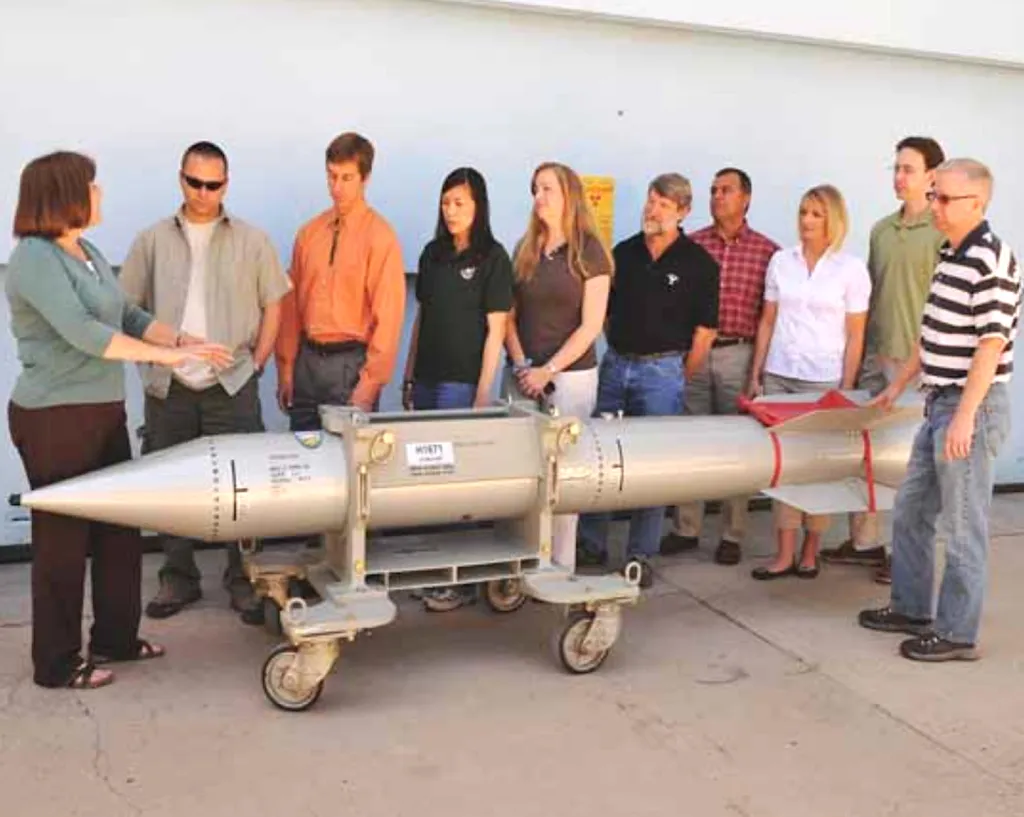
An example of the B61-11, or more likely an inert version thereof. This is the only specialized air-delivered deep-penetrating weapon known to be in the U.S. nuclear stockpile today. Public Domain
“The Increase represents the start of one new Phase 6.X program, currently known as Phase 1 Nuclear Deterrent System-Air-delivered (NDS-A), as well as supporting production assessments for two new Rapid Capability Team (RCT) projects,” according to a public summary of what the Future Program funding would support.
The Department of Energy, in cooperation with the U.S. military, develops, produces, and sustains nuclear weapons, and uses a multi-phase rubric to categorize where they are in their respective life cycles. The Phase 6.X process is itself broken into several stages, spanning all the way from the definition of the basic concept of a weapon and its requirements through to full-scale production.
A graphic offering a general overview of the Phase 6.X process. NNSA
Where the NDS-A may already be in the process is unknown, but the mention of “Phase 1” here could point to Phase 6.1, which is the basic concept assessment stage. Beyond that it will be air-delivered, there are also no details currently available publicly about the weapon’s design, including whether it will be based on something already in the stockpile. It is also not known if it will be an unpowered bomb or a missile/rocket-assisted weapon of some kind. We will come back to this point later on.
“The Nuclear Deterrent System-Air-delivered will provide the President with additional nuclear options to defeat Hard and Deeply Buried Targets, ensuring that adversaries cannot place their most valued assets beyond the reach of America’s nuclear forces,” a spokesperson for the National Nuclear Security Administration (NNSA) told TWZ when asked for more information. “The program is moving aggressively, and further information will become publicly available when it is strategically beneficial to the United States.”
Within the Department of Energy, NNSA is specifically responsible for nuclear weapons-related activities.
As noted, at present, the B61-11 is the only air-delivered nuclear weapon in the U.S. stockpile today that is specifically designed to address this target set. The B61-11 is based on the earlier B61-7, but is substantially different in form and function. It has a heavily reinforced outer shell, possibly with a depleted uranium penetrating nose section, and a rocket booster at the rear to help it penetrate down into underground facilities. Sources differ on the maximum yield of the B61-11, but it is said to either be between 340 and 360 kilotons (identical to that of the B61-7) or to be closer to 400 kilotons. There are also reportedly fewer than 100 of these bombs in the stockpile.
The yield of the B61-11 is classified, but it is a converted B61-7 bomb. The yield of the -7 and -11 are usually given as more than 300 kilotons. @nukestrat says the B61-11 was increased to 400 kt. Either way, this is a very powerful nuclear weapon. pic.twitter.com/2GZ3zB6m4K
— Dr. Jeffrey Lewis (@ArmsControlWonk) June 19, 2025
You can learn more about the entire B61 family, the first versions of which entered service in the 1960s, here.
For a time, the newer B61-12 variant, which has a precision guidance package in a new tail kit, was considered as a potential successor to the B61-11. The B61-12 is also a dial-a-yield design with multiple yield settings, but the highest one is reportedly 50 kilotons. The logic was that improved accuracy would allow for more precise placement of the bomb, and, by extension, of its explosive force. This, in turn, would make up for its lack of deep-penetrating capability and more limited yield. The plan to supplant the B61-11 with the B61-12 was subsequently abandoned.
B61-12 Flight Test with F35-A Lightning II
More recently, a more powerful B61-13 variant, which features the same precision guidance tail kit as the B61-12, was developed explicitly to provide “the President with additional options against certain harder and large-area military targets.” This version is understood to have a maximum yield in line with the B61-7. However, the U.S. government has also previously said that the B61-13 is not intended as a direct replacement for the B61-11, according to the Federation of American Scientists (FAS).
The first B61-13 production unit. NNSA
The U.S. military also has B83-1 nuclear gravity bombs in the stockpile, which are of a completely different design from the B61 series and have a far more powerful megaton-class maximum yield. By virtue of that high yield, the B83-1 is also intended to be used against certain deeply buried and otherwise hardened facilities, as well as large-area targets.
An inert example of a B83-series nuclear gravity bomb. US military An inert B83-series nuclear bomb. DOD
In the early 2000s, NNSA, in cooperation with the U.S. Air Force, did explore the possibility of developing a B61-11-like bomb on the basis of the B83-1, as well as a new deep-penetrating version of the B61 itself. In 2005, Congress brought a halt to work on what was dubbed the Robust Nuclear Earth Penetrator (RNEP).
A low-quality and now thoroughly dated briefing slide discussing the RNEP effort. USAF
There have been hints since then, however, about possible revivals of the RNEP concept and/or other plans for a true successor to the B61-11.
This weapon was not explicitly mentioned in the 2018 Nuclear Posture Review. But NNSA bases the new weapon on the NPR’s guidance to “enhance the flexibility and range of [US] tailored deterrence options.
Welcome back from the grave, RNEP!
— Hans Kristensen (also on Bluesky) (@nukestrat) August 1, 2019
What may be prompting the requirement for the NDS-A now is unknown. There are deeply-buried targets only a nuclear weapon can realistically destroy. The development of the B61-11 is understood to have been prompted heavily by one such facility in particular, Russia’s Kosvinsky Kamen bunker. Kosvinsky Kamen is a key node in the Russian nuclear command and control enterprise and was built under a mountain of the same name in the northern Urals. The nature of its location and design also means it could serve as a so-called “continuity of government” site for senior leadership to operate from before or after a nuclear strike or in response to some other major emergency.
However, the landscape of deeply-buried, hardened facilities that U.S. authorities would be interested in holding at risk has grown substantially in the past two decades since work, at least publicly, on RNEP came to an end.
In the past year, the matter of Iran’s deeply buried nuclear facilities, and the limits of U.S. conventional options for prosecuting those targets, has been an especially hot-button issue. During Operation Midnight Hammer in June 2025, U.S. B-2 bombers struck Iranian nuclear sites at Fordow and Natanz with 30,000-pound-class GBU-57/B conventional bunker buster bombs. The outcome of that operation remains a subject of heated debate and is deeply intertwined with the justifications for U.S. and Israeli forces launching the latest campaign against Iran in February. U.S. officials are now at a crossroads with how to proceed with operations targeting Iran, which has now turned to a maritime blockade, at least for the time being, following the announcement of a ceasefire in April.
The video below is a montage of imagery from GBU-57/B MOP tests over the years.
GBU-57 MOP test
Broader concerns about just getting the B61-11 to its intended target in the future may also be a factor driving plans now for the new NDS-A nuclear bunker buster. Unpowered bunker buster bombs, nuclear or conventional, need to be released relatively close to their targets. The kinds of facilities that the B61-11 is intended to be employed against are deep inside hostile territory, behind layers of integrated air defenses. Major potential adversaries, as well as smaller nation states and even non-state actors, are only expected to expand the scale and scope of their defensive architectures in the coming years. With all this in mind, it is not surprising that the more survivable B-2 is currently the only platform certified to employ the B61-11, as well as the conventional MOP. It is more or less a given that both of those weapons will be integrated onto the forthcoming B-21 Raider for the same general reasons.
A B-2 bomber drops a GBU-57/B MOP during a test. USAF
A rendering of the still-in-development AGM-181 Long Range Stand-Off (LRSO) cruise missile. USAF
As an aside here, powered designs have also been part of the discussions about potential conventional successors to the MOP. A follow-on to the GBU-57/B, the Next Generation Penetrator (NGP), is now in development, but it is unclear whether or not that will be a powered weapon. Still, when it comes to the NDS-A, it seems more likely that it will be a traditional bomb that adapts elements of existing designs, including the B61-11, -12, and -13.
A 2010 briefing slide discussing plans for a Next Generation Penetrator, which could have a powered standoff capability, and other future bunker busters. USAF
More definitely remains to be learned about the NDS-A program and the design of that weapon. What is clear is that the Department of Energy is requesting funding to kick off at least the initial development of a new air-delivered nuclear bunker buster that could succeed the B61-11.
UPDATE: 5:27 PM EST –
It has been brought to our attention that some additional details about the NDS-A effort have been tucked away in U.S. budget requests in recent years.
In its Fiscal Year 2025 budget, the Air Force asked for, and ultimately received just over $39 million for work on NDS-A, but under a budget line titled “Hard and Deeply Buried Target Defeat System (HDBTDS) Prototyping.”
“The Air-delivered Nuclear Delivery System (NDS-A) is a new start project to address a capability gap identified in the 2022 Nuclear Posture Review (NPR). A congressionally directed study based on the NPR led to endorsement of the Deputy’s Management Action Group (DMAG) and initiation of this project,” according to the 2025 Fiscal Year budget documents. “The Air Force will work with the Department of Energy’s (DOE) National Nuclear Security Administration (NNSA) and its National Laboratories to develop a prototype NDS-A system to demonstrate the capability to close this gap in the near term.”
“Early development will include Model and Simulation (M&S) analysis of several nuclear explosive package (NEP) options to refine the proposed NEP,” the budget documents add. “Ground tests may include wind tunnel, static ejection, vibration and thermal, cable pull-down, and sled tests. Flight tests will be performed by USAF F-15E developmental flight test aircraft, with final prototype demonstrations flown on B-2 aircraft.”
The video below shows flight testing of the B61-12 using a U.S. Air Force F-15E Strike Eagle.
B61-12 full-weapon system demonstration at Tonopah Test Range
In the Air Force’s proposed 2026 Fiscal Year budget, the line item was renamed “Nuclear Delivery Systems Prototyping,” but references to NDS-A by name were also omitted. A nearly $18 million year-over-year increase in requested funding (from roughly $39 million to almost $57 million) was attributed “to greater emphasis on prototype design after completion of Modeling and Simulation of mission effectiveness of design space options; increased procurement and development of components; the initiation of subsystem and test unit assembly; and the initiation of ground tests of the Prototype Weapon Assemblies.”
The Fiscal Year 2025 and 2026 budget documents do not provide any details about the design of the weapon or say what aircraft it will be integrated onto operationally.
More details about the current state of the Air Force side of this program are likely contained in the service’s 2027 Fiscal Year budget request documents. However, at the time of writing this update, they are inaccessible online.
As artificial intelligence becomes more embedded in film production, the Academy of Motion Picture Arts and Sciences is drawing a clearer line around it.
In new rules announced Friday for next year’s 99th Academy Awards, the academy said screenplays must be “human-authored” to be eligible for awards consideration, and that only performances “demonstrably performed by humans with their consent” will qualify for acting prizes. The group also reserved the right to request additional information about how AI tools were used in a film and the extent of human involvement.
The academy’s Board of Governors reviews its rules annually.This year’s revisions arrive as the industry continues to grapple with how AI tools are reshaping the creative process — and how institutions like the Oscars should reward that work, if at all.
The new changes build on guidance introduced a year ago, when the academy said that the use of AI would “neither help nor harm” a film’s chances of receiving a nomination, while emphasizing that voters should consider “the degree to which a human was at the heart of the creative authorship.” At the time, the organization stopped short of requiring formal disclosure of AI use, even as the technology became a flash point across Hollywood.
Taken together, the updated language suggests an effort to more clearly define the boundaries of authorship at a moment when tools such as voice cloning, digital doubles and AI-assisted writing are becoming more common in film production. The emergence of synthetic performers such as Tilly Norwood reflects how quickly those questions have moved from theoretical to practical.
In announcing the new rules, the academy framed the changes as part of an effort to reflect the current state of filmmaking, while maintaining what it called a “commitment to honoring human authorship and artistry.”
Beyond the AI provisions, academy leaders approved several structural changes across different categories.
In acting, performers may now receive multiple nominations in the same category if their performances rank among the top vote-getters, aligning the category with other branches.
The international feature film category also saw a notable shift. In addition to the traditional submission process through individual countries, non-English-language films can now qualify by winning top prizes at select major festivals, including Cannes, Berlin and Sundance. The award will be credited to the film itself, with the director accepting on behalf of the creative team, rather than to a submitting country or region.
Other changes — including updates to voting procedures in categories such as cinematography, visual effects and makeup and hairstyling — were largely technical in nature.
The new rules will take effect with next year’s Oscars, scheduled for March 14, 2027.
Ukrainian President Volodymyr Zelenskyy’s artistic skills have earned him the reputation of a public relations genius acknowledged by both friends and foes. United States President Donald Trump, who has openly attacked him in public, famously called the Ukrainian leader “the greatest salesman on Earth”. A much more sympathetic voice, New York Times columnist David French, has recently portrayed Zelenskyy as “the new leader of free world”.
But Zelenskyy’s PR genius can do very little when it comes to changing the dynamics of the battlefield in the Russia-Ukraine war. In recent weeks, his administration and allies have tried hard to create the impression that the war might be approaching a turning point. But realities on the ground tell a different story.
For example, there were official claims that in February, Ukraine made more territorial gains than Russia did. Some pro-Ukrainian war monitoring platforms have supported these claims while others have not. It is important to note these calculations can be tricky given that along the frontline there is an extensive grey zone in which control is unclear. The advances themselves are measured in 150-200 square kilometres per month. In other words, methodology can be manipulated in order to produce the desired conclusion: that Ukraine is gaining ground.
In reality, there is nothing at all that suggests a significant change in the battlefield dynamics that have been in place for at least two years now.
More importantly, Russian troops are currently besieging a number of industrial cities in the north of the Donetsk region. Their advances all along the northern border, in particular, are extending the active front line by hundreds of kilometres, which is making Ukraine’s personnel shortages even more acute.
Four years into the war, the Ukrainian army has had to resort to brutal campaigns to enforce mandatory conscription, pulling young men off the streets of towns and villages. Meanwhile, Russia is still able to lure volunteers by offering lavish compensation.
Ukrainian officials have also claimed that Russia is losing more troops than it is able to recruit based on dubious casualty data. Zelenskyy, in particular, has stated the Russians suffered the highest number of monthly casualties in March this year – 35,000. But his statement contradicted his own Ministry of Defence, which claimed that the highest Russian monthly losses crossed 48,000 in January 2025, with an average monthly rate of roughly 35,000 throughout 2025.
Zelenskyy’s chief of staff, former military intelligence chief Kyrylo Budanov, also contradicted this narrative that Russia is having major difficulty with deploying personnel. He acknowledged in a recent interview that the collapse of the Russian mobilisation effort was not forthcoming.
It should be noted that Ukraine is waging a successful drone campaign to damage Russian oil facilities. But it is doubtful that it could change anything beyond providing dramatic footage of oil tanks on fire for TV networks to broadcast.
In April, Russian oil revenues surged to $9bn, thanks to the US-Israel war on Iran. The windfall Russia got in a month is equivalent to 10 percent of the loan Ukraine is to receive from the European Union over the next two years to help fund its war effort.
It cannot be denied that Russia has sustained major economic losses due to the war, and Russian President Vladimir Putin has acknowledged as much. But the Russian economy displays much the same downturn as other European economies, also affected by wars in Ukraine and Iran.
Russia’s gross domestic product (GDP) per capita adjusted for purchasing power parity (an indicator reflecting living standards) currently exceeds that of less affluent EU countries, such as Romania and Greece, according to the IMF charts. The same indicator for Ukraine is on par with Mongolia and Egypt, while the country’s critical infrastructure lies in ruins and millions of Ukrainians have fled the country, most of them for good.
With Ukraine’s prospects bleaker than ever, pro-Ukrainian audiences jump on every news from Russia, which they hope may signify “cracks in the regime”. Last month, an Instagram video by Russian influencer Victoria Bonya made Western headlines for its daring criticism of government policies. There may be frustration in Russia, but the regime is far from approaching a downfall.
This narrative, however, serves to distract Ukrainian and EU citizens from the painful truth that the war is heading towards a deadlock at best and Ukraine’s collapse at worst. Zelenskyy may have received a lifeline with the $90bn euro loan, but his and his allies’ lack of vision and winning strategy is staggering.
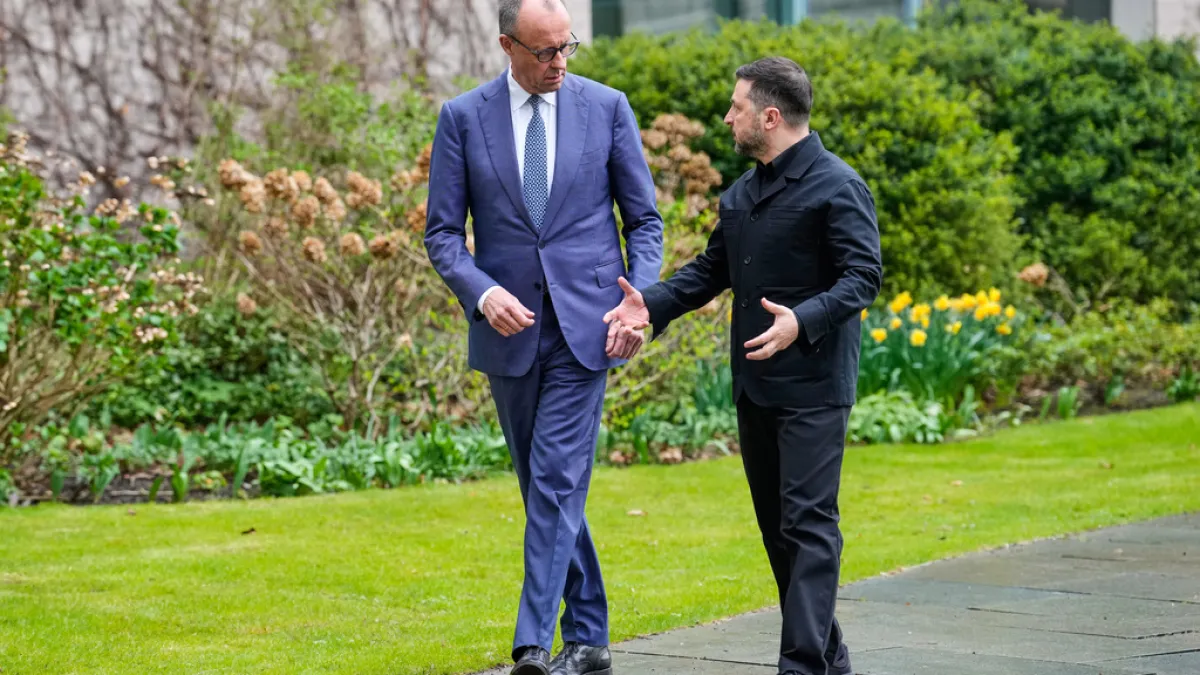
The reality has already begun to kick in. German Chancellor Friedrich Merz recently suggested that Ukraine would have to concede some of its territory to Russia to end the war but get a faster track to EU membership in exchange. The EU’s defence chief, Andrius Kubilius, has gone further by claiming that NATO membership for Ukraine was out of the question and EU membership was going to be a “complicated process”. Instead, he proposed a military union of Ukraine and other European countries – an idea that Moscow will reject, interpreting it as NATO through the back door.
What these contradictory statements manifest is that the main bargain over the contours of peace is currently going not so much between Zelenskyy and Putin, but between Zelenskyy and his Western, primarily European, allies.
As Budanov recently claimed, the positions of Kyiv and Moscow can be moved closer to what is realistically attainable in peace talks. But Zelenskyy needs to show at least some kind of gain for Ukraine when a very unpalatable version of a peace treaty is finally signed. Ideally, that gain would be EU membership or real security guarantees, but as Merz and Kubilius’s statements suggest, the chances of attaining either are slim.
The frustration among Ukrainians is already palpable. The head of the Ukrainian parliament’s fiscal committee, Danylo Hetmantsev, said European officials should stop seeing Ukrainians as “a tool for solving someone’s geopolitical tasks” or as a “human shield”. They have no right to define Ukraine’s destiny, he insisted.
But Zelenskyy, who is dogged by a large-scale investigation into corruption involving his immediate entourage, seems to hold no cards to play against Russia or his Western allies. The status quo in which he retains the position of a war leader serves him well, but it is increasingly becoming untenable.
The views expressed in this article are the author’s own and do not necessarily reflect Al Jazeera’s editorial stance.
DAVID Beckham has shrugged off estranged son Brooklyn’s snub once again after celebrating his birthday with family.
The former footballer, who has turned 51, enjoyed his day being ‘blessed’ and ‘spoiled’by loved ones, despite being dealt another blow from Brooklyn and his daughter-in-law Nicola Peltz.
Sign up for the Showbiz newsletter
Thank you!
David Beckham has shrugged off son estranged Brooklyn’s snub once again after celebrating his birthday with familyCredit: Instagram / David BeckhamThe former footballer enjoyed his day being ‘blessed’ and ‘spoiled’ by loved onesCredit: Instagram / David BeckhamDavid was dealt another blow from Brooklyn his daughter-in-law Nicola PeltzCredit: Getty
Taking to his Instagram, David shared two sweet snaps of him as a child and him present day smiling as he blew out his birthday candles.
He added the caption: “I feel very lucky & blessed to have had a very special day today being spoilt by my wife, kids , family and friends from the moment I opened my eyes till now.
“And I just want to say thank you and I love you all so much @victoriabeckham & my beautiful family thank you (heart emoji).”
On the star’s birthday, David was met with a barrage of birthday shoutouts from the Beckham clan.
In the caption, the fashion designer penned: “You are our world, our everything. We love you so much!!!
“Happy birthday to the best husband, daddy, son, brother, and friend.”
Brooklyn’s brothers, Romeo and Cruz, also praised their dad by sharing photos of their younger selves with David.
Cruz wished his father a happy birthday with Romeo penning the message: “Happy birthday dad love u so much. Thank u for everything you do.”
Eldest son Brooklyn chose to remain silent for the second year in a row, which comes as no surprise considering he and wife Nicola’s major fallout with the rest of his family.
Former Spice Girl Victoria led the birthday shoutouts for her husband and gushed over him by sharing a series of unseen private snapsCredit: InstagramRomeo Beckham wished his dad David a happy 51st birthday on InstagramCredit: InstagramYoungest son Cruz Beckham also gave dad David a sweet birthday shoutoutCredit: instagram
Earlier this year Brooklyn had launched a nuclear attack on his family stating that he did “not want to reconcile” with his them, and accused his parents of “controlling” the narrative.
Speaking to The Wall Street Journal magazine, Victoria did not refer to Brooklyn by name when asked about the rift but discussed how she had only ever tried to “protect and love our children”.
The Spice Girls star said: “I think that we’ve always—we love our children so much.
“We’ve always tried to be the best parents that we can be. And you know, we’ve been in the public eye for more than 30 years right now, and all we’ve ever tried to do is protect our children and love our children.
“And you know, that’s all I really want to say about it.”
Eldest son Brooklyn chose to remain silent on his fathers birthday for the second year in a rowCredit: Getty
South Korea’s Financial Supervisory Service has reportedly decided to suspend the business operations of Lotte Card for 4 1/2 months over a personal data breach, along with a $3.4 million penalty. File Photo by Jeon Heon-kyun/EPA
May 1 (UPI) — South Korea’s Financial Supervisory Service (FSS) reportedly decided Thursday to suspend the business operations of Lotte Card for 4 1/2 months over a data breach.
The financial watchdog is also reported to have finalized the disciplinary measure, including a $3.4 million penalty and a reprimand warning for its former CEO Cho Jwa-jin.
The FSS declined to confirm the reports, while Lotte Card acknowledged it.
“Imposing a business suspension over a hacking case would be an unprecedented level of sanction,” Lotte Card said in a statement.
“As follow-up procedures remain, including a resolution by the Financial Services Commission (FSC), we will fully explain our position regarding the severity of the punishment, as well as our post-incident response efforts,” it added.
Nearly 3 million Lotte Card customers had their personal information compromised last year. The state-run Personal Information Protection Commission has already imposed a $64 million fine on the firm over the incident.
Following the FSS decision, the FSC is expected to make the final call in the coming months.
In 2019, South Korea’s leading private equity company, MBK Partners, teamed up with Woori Bank to acquire a 79.8% stake in Lotte Card for about $1 billion. MBK took 59.8%, and Woori held the remaining 20%.
MBK Partners sought to sell its stake in Lotte Card in 2023 but failed to find a buyer, and a similar effort last year also yielded limited results.
The pope urged the rememberance of journalists who lost their lives pursuing the truth, particularly in conflict areas.
Published On 3 May 20263 May 2026
Pope Leo has marked World Press Freedom Day by condemning violations of media freedom around the world and paying tribute to journalists killed while reporting in conflict zones.
At the end of his weekly Sunday prayer in a sunny Saint Peter’s Square at the Vatican, the pontiff said the day highlighted both the importance of independent journalism and the growing threats faced by reporters.
Recommended Stories
list of 4 itemsend of list
“Today we celebrate World Press Freedom Day … unfortunately, this right is often violated, sometimes in blatant ways, sometimes in more hidden forms,” he said.
World Press Freedom Day, sponsored by the UN cultural agency UNESCO is intended to show support for media organisations that come under pressure or censorship. It is also an opportunity to commemorate journalists who have been killed at work.
The Roman Catholic leader urged the faithful to remember journalists and reporters who have lost their lives pursuing the truth, particularly in conflict areas.
“We remember the many journalists and reporters who have been victims of war and violence,” the pope said.
A report last month by the Watson Institute for International and Public Affairs’ Costs of War project found that Israel’s war on Gaza was the deadliest conflict for media workers ever recorded, with Israeli forces having killed 232 Palestinian journalists since October 2023.
More journalists have been killed in Gaza than in both world wars, the Vietnam War, the wars in Yugoslavia, and the United States war in Afghanistan combined, the report found.
In past speeches, the leader of the Catholic Church has described journalism as a pillar of society and democracy, and information as a public good that must be safeguarded and defended.
The pontiff has often thanked reporters for sharing the truth, saying that doing their job could never be considered a crime, and frequently calling for the release of journalists who have been unfairly detained or prosecuted.
Last week, the leading Paris-based press freedom NGO, Reporters Sans Frontières (RSF), or Reporters Without Borders, found that freedom of the press around the world has fallen to its lowest level in a quarter of a century.
For the first time since RSF started producing the index in 2002, it said more than half of the world’s countries fall into the “difficult” or “very serious” categories for press freedom – “a clear sign that journalism is increasingly criminalised worldwide”.
In 1995, when the L.A. Metro system was in its most nascent stage, Ken Karagozian — then an amateur photographer in an Owens Valley, Calif., workshop — found his way underground to document the subterranean marriage between downtown L.A. and Westlake through Metro’s Red Line, now called the B Line.
From that came a feature in Life magazine, but more importantly, a driving principle: Karagozian believed that the construction workers, engineers and electricians who were subject to the whims of a city indecisive on the subway project were deserving of intimate documentation. The invisible many who built the pyramids and New York’s skyline never got that chance, he said, but the people who contributed to the historically controversial Metro D Line from Koreatown to Westwood would, if he had a say.
“When I did take photography workshops, they always said, ‘Do a project close to your home,’” Karagozian said on a call from his Agoura Hills residence. “I wrote a letter to [L.A. Metro], which said, ‘How can I get permission to photograph?’”
Days before the fires ravaged L.A. in 2025, Altadena-based historian and author India Mandelkern had a phone call with Karagozian, who was interested in collaborating on a project about the D Line. After publishing a book on the art and politics of street lighting in Los Angeles, Mandelkern worked on the L.A. Metro blog, soliciting interviews from Angelenos who seemed desperate for a line to the Westside.
A Karagozian photo shows a group of workers during the Section 2 breakthrough during the underground construction of the Metro D Line.
(Ken Karagozian)
A photo by Karagozian shows sunlight filtering underground into the Wilshire/Fairfax site during construction.
(Ken Karagozian)
After Mandelkern connected with Karagozian, their project had solid form: a photo book, titled “Wilshire Subway: The Making of the D Line Subway Extension,” about the history, conflict and people behind the scenes and underground ahead of the May 8 opening of the subway expansion along Wilshire Boulevard. (New stations will be added at Wilshire/La Brea, Wilshire/Fairfax and Wilshire/La Cienega. In the future, stations in Beverly Hills, Century City and Westwood will open.)
A related photo exhibition, “Wilshire Subway: Photographed by Ken Karagozian,” is on view through May 14 at the 1301PE art gallery on Wilshire Boulevard.
This week, we chatted more with Karagozian and Mandelkern about their project.
After writing a book about the social history of street lighting, what brought you underground?
Mandelkern: Well, a couple different reasons. First, I was very interested in Metro just because I had worked there as the blog editor, and in that role, I got to explore so many different stories. I thought Wilshire Boulevard was one of the most interesting places, the stories of this rail-building ambition that persisted for so many different years, and what that says about Angelenos. Second, I think that we talk about L.A. as a horizontal city, and that’s certainly true. If you go somewhere like Tokyo, you instantly see that this is what a vertical city is, but I wanted to bring a little bit of that to L.A. There is so much history buried beneath the ground that we seem to forget, and once you start tunneling, you realize that it’s always been there and it hasn’t disappeared. It’s just pushed beneath us.
In support of their new project, writer India Mendelkern, left, and photographer Ken Karagozian appear at the Los Angeles Times Festival of Books in April.
(Ken Karagozian)
Of all the people you spoke to for this book, which one most influenced the way you understood what the D Line could provide for the city?
Karagozian: This was a joint venture between three contractors, and they each had their specialty. It was Skanska, Traylor [Bros.] and Shea. With Traylor, they were brothers and they were doing the tunneling. Richard McLane [chief mechanical engineer of Traylor Bros.] was very helpful in telling me a little bit about the history of Wilshire Boulevard and facts of tunneling. … All these different contractors impacted the project in some way.
Mandelkern: I always say Ken is one of the best construction photographers out there, but his specialty is really people. When I interviewed some of these individual workers, a whole different story came to light, and I realized that many of these workers came to L.A., started at the bottom of the totem pole, and through working on the subway have risen through the ranks, gotten promotions, become leaders, and their kids now work in construction. … It’s just so amazing that so many of these individuals are doing all this work behind the scenes that creates infrastructure that connects all of us.
1
2
1.Carpenter Jenna Dorough poses for a portrait by Karagozian during the underground construction of the Metro D Line.2.A concrete supervisor photographed by Karagozian at the La Cienega Boulevard station.(Ken Karagozian)
There are many portraits in the book of the builders who created the D Line. India referred to the short lifespans of the workers compared to the marvelous structures they craft: Was it intentional that you documented most of the D Line’s visual history through the people who built it?
Karagozian: When I go down underground and after the stations are completed, to me, it’s the people that built it that should tell the story. I didn’t just want to get a shot of them from behind. I really like to photograph their faces. … When I photographed the workers from the Red Line, some of these workers from the middle ’90s are still working on the Purple Line. I’ve known them for years, and now their children are working in construction; it becomes a family issue. … Going down and photographing the tunnels with that lighting in that perspective, it’s always been so interesting.
Mandelkern: That just reminded me of one of the quotes in the book from John Yen, who is the VP of operations at Skanska. He said, “In construction, we work ourselves out of a job.” I always found it really interesting that, as we build, the whole point is to kind of disappear. It reminded me of one of my favorite quotes in the essay, when James [Rojas] writes [that] when the stations are open, they’ll be shiny and new, but that will kind of erase all the memories and all the work of the people who’ve been doing this for all this time. This book really became a way to sort of remember all of these different people that have been working on these projects for decades and decades, even if they’re not really remembered in the official record.
As the D Line prepares to open, does it somehow feel like the end of a journey?
Mandelkern: This just [started] so many other things for me. Afterwards, I decided I really want to learn about the geology of L.A., and I found an interest in paleontology, too. I hope with any book that it just gets people curious, and it gets them to start asking questions. I think that “Wilshire Subway” does accomplish that. L.A. is just this bowl with all these different salad layers, and as we penetrate down, we learn more and more about our history.
Karagozian: It does a little bit. With May 8 being the grand opening, and as the stations are complete and they’re testing the trains underground, it almost feels like it’s graduation time. Time to celebrate the journey of going through high school, college, whatever. I am still continuing to photograph the [Purple Line extension], which is Rodeo or Beverly [Hills] station … Now it’s just the accomplishment of celebrating all the work that I’ve put into this project and going down almost once a week and photographing the process for so many years.
Art exhibition
‘Wilshire Subway’ exhibition
“Wilshire Subway: Photographed by Ken Karagozian” is a new exhibition based on a new photo book by Karagozian and writer India Mandelkern.
Where: 1301PE art gallery, 6150 Wilshire Blvd., Los Angeles
When:Through May 14.
Hours: The gallery is open 10 a.m. to 6 p.m. Tuesday through Saturday. (There’s an opening reception and book signing from 4 to 7 p.m. Friday.)
Tickets for the cohosts’ opening game in Los Angeles are available for prices ranging between $1,120 and $6,050.
Published On 3 May 20263 May 2026
With under 40 days to go until the World Cup, tournament organisers continue to struggle with ticket sales as seats remain available for most group-stage games, albeit at exorbitant prices.
Home fans can find tickets for tournament cohost United States’ (USA) opener against Paraguay, with prices starting at $1,120 and going as high as $4,105, with many tickets priced around $2,000 for the June 12 match in Los Angeles. Seats in the hospitality package groupings go as high as $6,050 per seat.
Recommended Stories
list of 4 itemsend of list
Tickets are still available on FIFA’s official website through its “last-minute sales” section.
Football fans are already outraged by exorbitant match prices — the most expensive ticket for the final costs nearly $11,000 — since the first phase of ticket sales in December. Late last month, FIFA announced yet another “last-minute ticket phase” with tickets for all 104 matches available on a first-come, first-served basis.
The stagnant sales contradict FIFA President Gianni Infantino’s assertion in January that demand for tickets for this year’s tournament in the US, Canada and Mexico would be the equivalent of “1,000 years of World Cups at once”.
Experts attribute dynamic pricing and greed as key factors, with fans saying they have been “priced out” by FIFA.
While many in the US are accustomed to the pricing model commonly adopted at the Super Bowl, fans from around the world are not used to dynamic pricing and legal profiting from ticket resales, sports executive Peter Moore told Al Jazeera in a recent interview.
“FIFA taking a 30 percent cut of dynamic pricing is outrageous,” the former Liverpool chief executive said.
“FIFA is taking advantage of the unique commercial opportunities in the US, dynamic pricing and the secondary market being legal here, to make money. Infantino has said [he expects] FIFA revenues from the World Cup to exceed] $11bn. Why not make it more reasonable and accessible and make, maybe, $8bn?”
Last month, four seats for the World Cup final were listed at just under $2m each on FIFA’s official resale site.
A total of seven group-stage games still have general sale tickets available for $380, including Austria vs Jordan, New Zealand vs Egypt, Jordan vs Algeria, Cape Verde vs Saudi Arabia, Algeria vs Austria, Congo DR vs Uzbekistan and Curacao vs Ivory Coast.
The USA vs Paraguay opener is the most expensive group game, followed by Argentina vs Austria ($2,925), Ecuador vs Germany ($2,550), Uruguay vs Spain ($2,520) and England vs Croatia ($2,505).
According to FIFA’s website, a total of 17 group-stage games are sold out, including the tournament opener between Mexico and South Africa in Mexico City on June 11.
Seven games staged in Mexico are sold out, including the cohosts’ two other matches against South Korea in Guadalajara and the Czech Republic in Mexico City.
Turkiye vs USA in Los Angeles, Brazil vs Morocco in New York/New Jersey and Scotland vs Brazil in Miami are among other sold-out games.
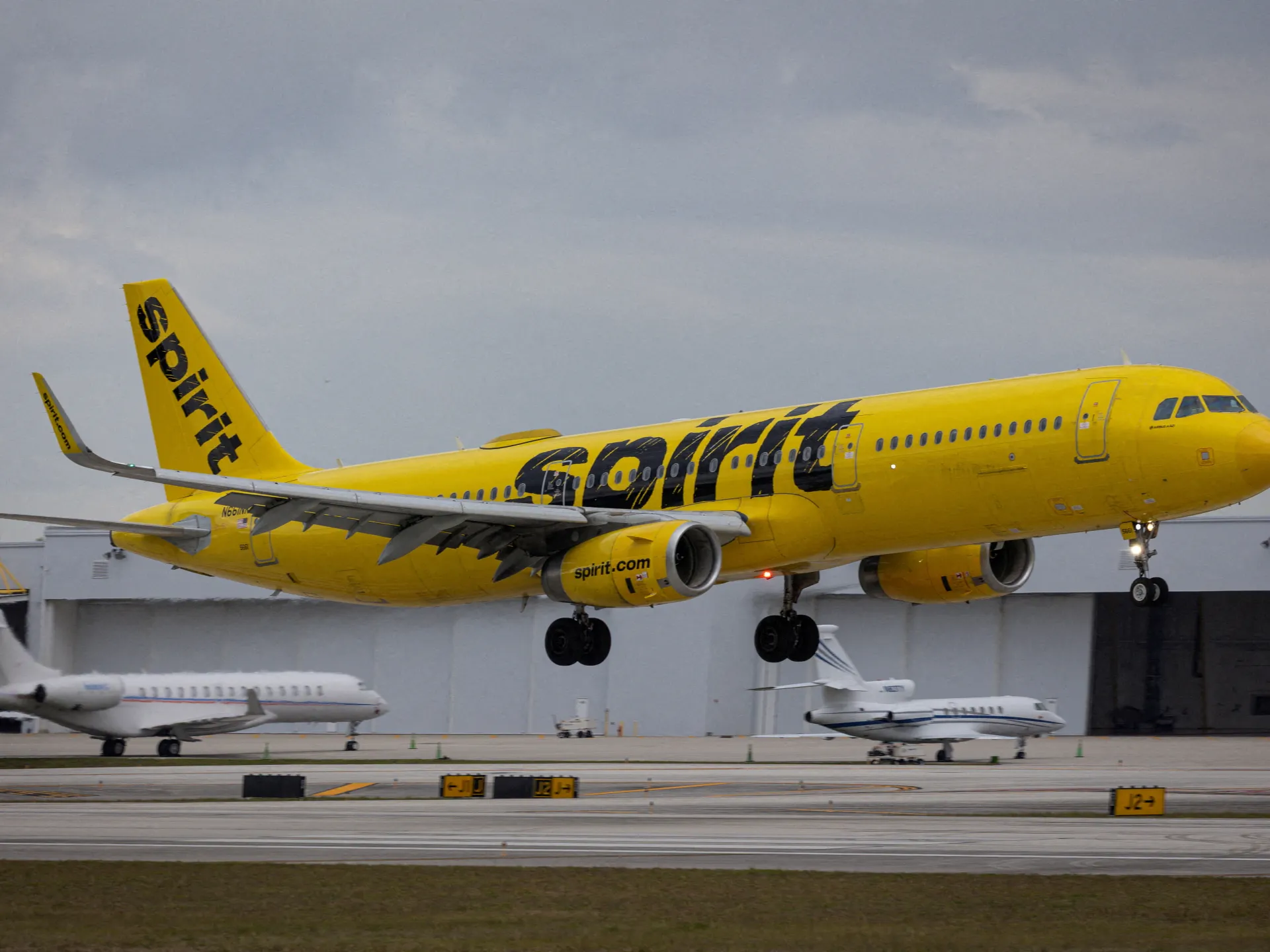
Spirit Airlines, a budget carrier in the United States, has begun winding down operations, cancelling all flights, after talks with the Trump administration to secure a $500m bailout failed. Experts say a spike in aviation fuel prices from the US-Israel war on Iran dealt the final blow to the struggling airline that pioneered the ultralow-cost carrier model.
The airline’s shutdown after 34 years has left some 17,000 staff members unemployed, many passengers stranded, and raised doubts about the future of budget air travel.
Recommended Stories
list of 3 itemsend of list
How did Spirit Airlines reach this point? Did the US-Israel war on Iran deliver the final blow?
Here’s what we know:
What has Spirit Airlines said?
On Saturday, Spirit Aviation Holdings, the airline’s parent company, said the company had started to wind down operations.
“Spirit Aviation Holdings, Inc … today regretfully announced that the Company has started an orderly wind-down of operations, effective immediately. All Spirit flights have been cancelled, and Spirit Guests should not go to the airport,” the company said in a statement on Saturday.
The statement added that, despite its efforts, “the recent material increase in oil prices and other pressures on the business have significantly impacted Spirit’s financial outlook”.
Spirit Airlines, whose airfares were lower compared with other US airlines, had 4,119 domestic flights scheduled between May 1 and May 15, offering 809,638 seats, according to the latest data from Cirium, an aviation analytics firm.
The carrier’s parent firm started as a long-haul trucking company in 1964. It shifted to aviation around 1983. The carrier rebranded from Charter One Airlines to Spirit in 1992.
How did Spirit Airlines reach this point?
The airline had been struggling financially for years and had filed for bankruptcy twice – in November 2024 and then in August 2025 – due to continued losses, high debt, and intense competition from other airlines.
According to a May 2 report by the Reuters news agency, Spirit had recently reached a deal with its lenders that would have helped it emerge from its second bankruptcy by late spring or early summer.
But the war on Iran, which led to a significant increase in aviation turbine fuel (ATF) prices, added to Spirit’s financial struggles and complicated its bankruptcy exit.
Spirit’s restructuring plan assumed ATF costs of about $2.24 a gallon in 2026 and $2.14 in 2027, but prices had climbed to about $4.51 a gallon by the end of April, leaving the carrier unable to survive without new financing.
A Spirit board meeting ended without an agreement to rescue the company, a person close to the discussions told Reuters late on Friday.
US Transportation Secretary Sean Duffy told Reuters he tried to get many airlines to buy Spirit but found no takers. “What would someone buy?” Duffy asked. “If no one else wants to buy them, why would we buy them?”
US President Donald Trump also said he had tried to bail out the airline with a $500m financing package.
“If we can help them, we will, but we have to come first,” Trump told reporters. “If we could do it, we’d do it, but only if it’s a good deal.”
However, a creditor close to the deal told Reuters, “The Trump administration made an extraordinary effort to try and save Spirit, but you can’t breathe life into a corpse. Given that, the company should make its intentions clear for the sake of its customers and employees.”
Anita Mendiratta, special adviser to the UN Tourism secretary-general, noted that while war and geopolitical instability may not have caused Spirit’s collapse, they likely delivered the final blow.
“Surging fuel costs exposed the vulnerability of airlines operating on thin margins with little room for shock absorption,” she told Al Jazeera.
“Spirit’s weaknesses were already there – it had already gone through two bankruptcy filings in the two years prior; global instability simply accelerated the inevitable. In today’s aviation market, volatility is no longer an exception; it is the operating environment,” Mendiratta said.
Are other airlines also under pressure due to the Iran war?
The war on Iran has disrupted global oil and gas prices, with Brent crude rising above $111 a barrel on Friday. The high crude oil prices have also caused ATF prices to rise, affecting budget airlines badly.
Across the globe, airlines have been increasing prices to reflect the high ATF prices, and some have also reduced their flight operations.
German airline Lufthansa said last month it cancelled 20,000 flights in a bid to protect itself from the soaring ATF costs.
On Friday, leading Indian carrier Air India said it has increased fuel surcharges on all flights, adding that it will reduce 100 flights a day across its domestic and international routes.
Mendiratta noted that the aviation industry is on alert as airlines carrying high debt, facing fuel cost volatility, labour cost pressures, fleet constraints, and sustained pricing pressure remain exposed [to the war], especially those operating through a low-cost carrier model.
“What happens next is a defining test of aviation leadership. The rapid response from rival airlines to protect stranded passengers reflects an industry that understands its most valuable asset is not aircraft or market share, it is customer trust [both traveller and cargo],” she said.
“Just as importantly, how airlines support displaced employees, reassure markets, and reinforce operational stability will shape confidence in the sector’s long-term recovery,” she added.
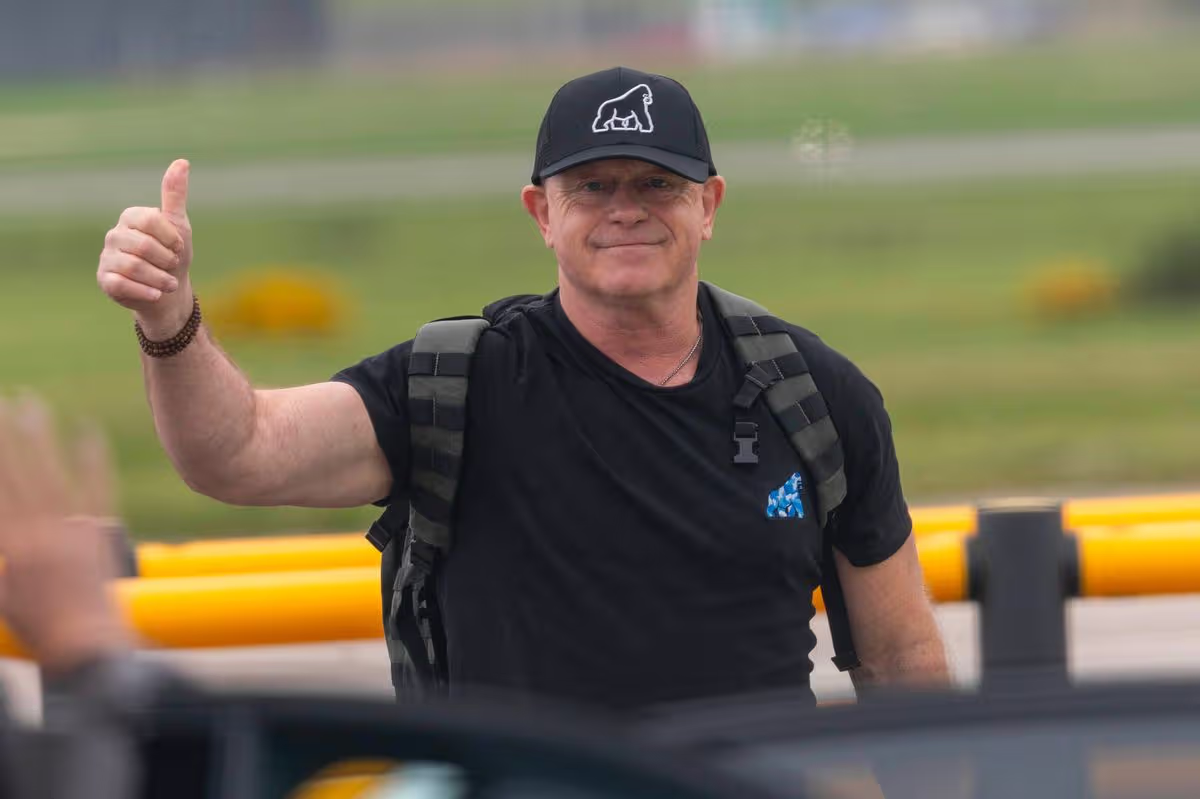
“Mr. Nobody Against Putin” filmmaker Pavel “Pasha” Talankin will soon be reunited with his Oscar statuette after it went missing amid his recent travels.
A spokesperson for European airline Lufthansa confirmed Friday in a statement shared with outlets that the coveted golden statuette has been located and is “safely in our care.” Lufthansa spoke on the missing Oscar after Talankin’s co-director Dave Borenstein raised the flag Thursday on social media. “Mr. Nobody Against Putin” won the documentary feature film category at the 98th Academy Awards in March.
According to Borenstein, Talankin arrived at the John F. Kennedy International Airport in New York “to fly home to Europe” and had the Oscar in tow as a carry-on. Airport security allegedly stopped Talankin from bringing the Oscar on board, citing concerns it could be used as a weapon. Borenstein said the film’s executive producer tried to smooth things but ultimately, “TSA put the Oscar in a box and sent it to the bottom of the plane” because Pavel did not have a check-in bag to place it in. He shared a photo of the cardboard box and Deadline published video of airport workers wrapping the statuette in bubble wrap and yellow tape.
Borenstein concluded his post noting the Oscar “never arrived” in Frankfurt, Germany, and speculated whether his co-director was on the receiving end of unfair treatment. “Would Pavel have been treated the same way if he were a famous actor? Or a fluent English speaker?” he wrote, tagging the Instagram account for the Transportation Security Administration. He also tagged Lufthansa and urged them to assist.
In response, Lufthansa commented on Borenstein’s post that it was on the missing Oscar case, and they are taking it “super serious.” Less than a day after their comment, the airline’s spokesperson said in their statement that it is “in direct contact with the guest to arrange its personal return as quickly as possible.”
“We sincerely regret the inconvenience caused and have apologized to the owner,” the spokesperson added.
Borenstein celebrated the development on Instagram, posting a clip of his interview with the BBC about the update and thanking a Lufthansa rep for their help and followers for spreading the word.
“Mr. Nobody Against Putin” features Talankin, a schoolteacher near the Ural Mountains, as he documents Russian propaganda efforts — from chants and songs — to energize young students around the war in Ukraine. During the Oscars in March, Talankin delivered a poignant message in Russian.
“In the name of our future, in the name of all of our children, stop all of these wars now,” he said through a translator.
Park Wang-yeol (C), a South Korean national detained in the Philippines, arrives at Incheon International Airport in Incheon, South Korea, 25 March 2026. Photo by YONHAP / EPA
May 1 (Asia Today) — South Korean police have taken custody of a man suspected of supplying drugs to a major narcotics figure, following his arrest in Thailand, authorities said Friday.
The suspect, identified only by his surname Choi, 51, is accused of smuggling and distributing about 22 kilograms of methamphetamine, valued at roughly 10 billion won ($7.4 million), into South Korea since 2019.
Police said Choi, who allegedly operated under the aliases “Cheongdam” or “Cheongdam Boss” on the messaging app Telegram, was identified as a key supplier to drug trafficker Park Wang-yeol, often referred to as a “drug kingpin.”
The National Police Agency’s drug and organized crime unit said it received custody of Choi from Thai authorities and has launched a full investigation into his activities and connections.
Investigators began tracking Choi while probing Park, who was previously arrested in the Philippines. Authorities combined five outstanding cases involving Choi and designated the Gyeonggi Nambu Provincial Police Agency as the lead investigative body.
Although no official departure record for Choi had been found since 2018, police developed intelligence suggesting he was living in Thailand. Working through liaison officers stationed in both countries, South Korean and Thai police coordinated the operation.
Authorities located Choi in Samut Prakan province, about an hour from Bangkok, and conducted a three-day joint surveillance operation before arresting him on April 10 on charges of illegal stay.
Police said the suspect was apprehended within seven days of the formal request for cooperation, and repatriated to South Korea about three weeks later with assistance from the South Korean Embassy in Thailand and related agencies.
Items seized at the time of arrest, including a passport under another person’s name and electronic devices, will undergo digital forensic analysis to determine links to Park and to identify additional accomplices and distribution networks.
Police said the investigation will expand to include possible conspiracy with Park, violations of passport laws and broader drug trafficking activities. Authorities are also pursuing asset recovery tied to alleged criminal proceeds.
Acting National Police Commissioner Yoo Jae-sung said interagency cooperation – including coordination with customs, financial regulators, tax authorities, the food and drug safety agency and the National Intelligence Service – has been mobilized to track and dismantle transnational drug networks.
“This case sends a clear message that drug criminals will be pursued and apprehended to the ends of the earth,” Yoo said.
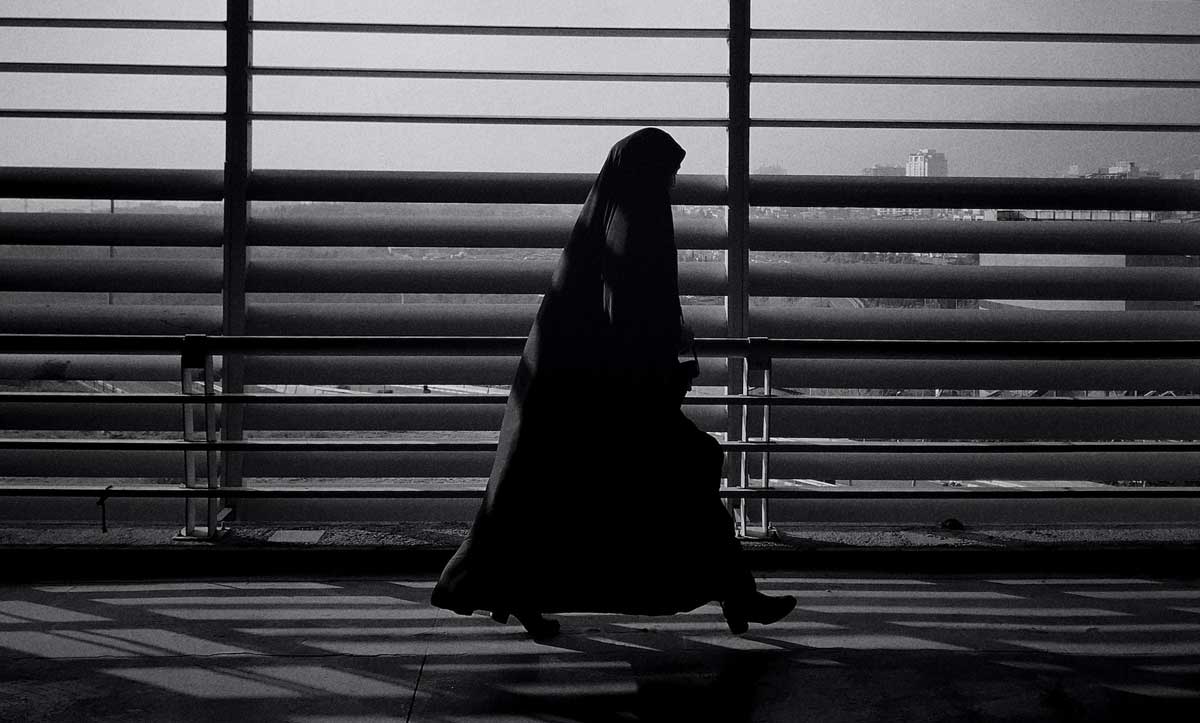
In recent years, the evolution of women in Saudi Arabia has become one of the most scrutinized aspects of the kingdom’s reforms of recent times. These reforms have frequently served as proof of a broader transformation under Vision 2030, an ambitious pathway designed to modernize Saudi Arabia and decrease its reliance on oil revenues. However, behind these apparent advancements arises an intricate question: are these reforms a genuine move towards social emancipation or primarily a tactical element of state-led goals of economic diversification, modernization, and enhancing global reputation?
In 2016, Saudi Arabia introduced Vision 2030, launched and guided by King Salman bin Abdulaziz Al Saud and Muhammad bin Salman as a comprehensive and holistic strategy aimed to reform the country’s future. This initiative leverages the Kingdom’s strengths, including its pivotal role in the Arab and Islamic world, robust investment capabilities, and advantageous strategic position. The goal is to establish Saudi Arabia as a global leader while improving quality of life and broadening growth opportunities for citizens. At its essence, Vision 2030 seeks to reposition Saudi Arabia in the global economy by diversifying the non-oil sectors, drawing in foreign investment, and cultivating a dynamic workforce.
The women’s research compendium has gained significant attention from the government in alignment with the kingdom’s Vision 2030 and its associated programs. Consequently, relevant authorities, including the Ministry of Human Resources and Social Development, have allocated one of the visions’ goals to improve the public and private lives of Saudi women. From this perspective, the progress of Saudi women towards empowerment has condensed. This perspective of ministry is facilitated by numerous policies, legislations, and regulations that bolster the female’s status in society. In this context, women have become a pivotal component of reform. Enhancing female participation in the labor force is not just a social aspiration but also an economic imperative. By incorporating women into sectors like tourism, mass markets, and technology, the government intends to harness previously underutilized human capacity and accelerate economic growth. Hence, women’s empowerment is intricately aligned with the national development goals. It is important to acknowledge the considerable progress the country has made so far, such as the removal of the driving ban; increased employment; and enhanced public representation signify substantial changes in the everyday life of numerous women in Saudi Arabia.
Comparatively, these reforms demonstrate a prominent departure from more prudent norms of Saudi society and have formed new avenues for both personal and professional initiatives. Recognizing these developments is important for sustaining a fair and substantiated analysis. However, a deeper evaluation reveals that this empowerment is closely associated with the economic strategy and development. The consolidation of women in the workforce is consistently presented not just as a matter of rights but as a roadmap to enhance productivity and to boost the country’s GDP. This realistic perspective implies that empowerment is being pursued not just as a fundamental social objective but as a calculated countermove to fulfill economic demands. In this context, women are viewed not just as citizens, but also as economic assets that are essential to the success of Vision 2030.
In addition to the economic considerations, these reforms significantly contribute to the international image of Saudi Arabia. As the kingdom aims to enhance foreign investment and establish itself as a contemporary progressive nation, the advancement of women’s rights acts as a strong emblem of transformation. These developments are visible as a form of strategic liberalization, a deliberate opening intended to synchronize domestic policies with the international standards. Within this framework, women’s empowerment is integrated into a broader soft power strategy, boosting nations’ appealing image on the world stage. However, this transformation is still being meticulously overseen. Although new liberties have been introduced, they operate within a well-defined structure and are regulated by the state. The pace and scope of these structural initiatives are not propelled by grassroots institutions but are instead orchestrated by the governing bodies. This top-down approach limits the acceleration of the independent voices and limits the growth of a more autonomous civil society. Consequently, empowerment is allocated rather than asserted, therefore prompting the queries regarding its substantive nature and sustainability.
Therefore, this dynamic creates a striking paradox: “advancement without complete autonomy.” Currently, Saudi women experience enhanced mobility and visible participation in public life, but their capacity to independently shape the trajectory of reform is still constrained. The expansion of opportunities has not been accompanied by a similar increase in agency. This conflict highlights an important question: can empowerment truly exist in the absence of independent expression and participation in decision-making processes? However, the future prediction denotes that the sustainability of these reforms depends on their ability to progress beyond their strategic foundations. Women’s empowerment continues to be closely linked to economic and image-building objectives of the state; it risks being susceptible to shifts in governmental priorities and policies. On the other hand, lasting transformation necessitates more profound structural alterations that are way beyond mere participation to encompass genuine agency and proper representation.
In this context, the transformations unfolding under Vision 2030 are the embodiment of both advancement and limitation. They indicate a notable departure from the previous practices and traditional norms while also underscoring the constraints of government-driven modernization. Ultimately, the issue is not if change will lead to enduring empowerment, for true empowerment is not just about participation in the workforce or recognition in public spheres; it is about having the capacity to influence one’s own future. This aspect remains the most vital and a pending dimension of Saudi Arabia’s evolution.
In conclusion, the trajectory of advancing gender diversity as articulated in Vision 2030 demonstrates both meaningful advancements and fundamental structural limitations. Although reforms have undeniably broadened strategic growth indicators and transformed the social norms, they’re still closely intertwined with economic needs and strategic initiatives for international status. This top-down model of reform prompts essential inquiries regarding the depth, independence, and long-term durability of women’s empowerment. For Saudi Arabia, the operating complexities will be whether these transformations can progress beyond mere instrumental milestones to cultivate true agency and representation. Only then can women’s empowerment shift from being a facet of national strategy to a lasting anchoring principle of societal advancement.
In new pictures, Ross appeared to be thrilled to join them, flashing a thumbs up at a camera before getting into a waiting car. Other snaps showed his fellow soap legend Julie Hesmondhalgh jetting to the area ahead of filming.
Teasing what led to the Grant Mitchell star deciding to take part, an insider told the Sun: “He loves Traitors and thinks it’s a programme on another level, which is why he really wanted to take part.
“Ross loved the mix of psychological intrigue paired with some of the very physical trials that the group have to complete – both suit him perfectly.”
He is also reportedly hoping to appeal to a younger generation of viewers, who could be less familiar with his career so far.
“Plus he knows The Celebrity Traitors won’t just be watched by people who are familiar with his work, but by younger viewers who may be less familiar with Ross, and this opens him up to a whole new audience. He’s also a very BBC name and this is another big BBC show,” they added.
Joanne McNally, James Acaster and Joe Lycett were also named in the line-up, alongside social media content creator King Kenny, Love Island presenter Maya Jama and Romesh Ranganathan.
Industry actress Myha’la and Professor Hannah Fry rounded out the cast with Sharon Rooney, James Blunt, Sebastian Croft and Sharon Rooney.
While the gang have been all smiles so far while heading to Scotland, things will get very tense once filming kicks off and suspicion over the game sets in. Shortly after filming, the 21 celebs will be sorted into “faithfuls” and “traitors” as they battle it out for the charity cash prize.
It will be up to those faithfuls to weed out the sneaky traitors, who have been tasked with secretly killing them off in nightly visits to the turret.
Following the huge success of the first season, where around 15million people tuned in to see Alan Carr win the competition as a Traitor, fans have been eagerly-awaiting news of a second series, and have already predicted Michael, Richard and Miranda could be this year’s “big dogs ”.
The air date has not yet been announced, but the hit show is expected to return to screens in autumn.