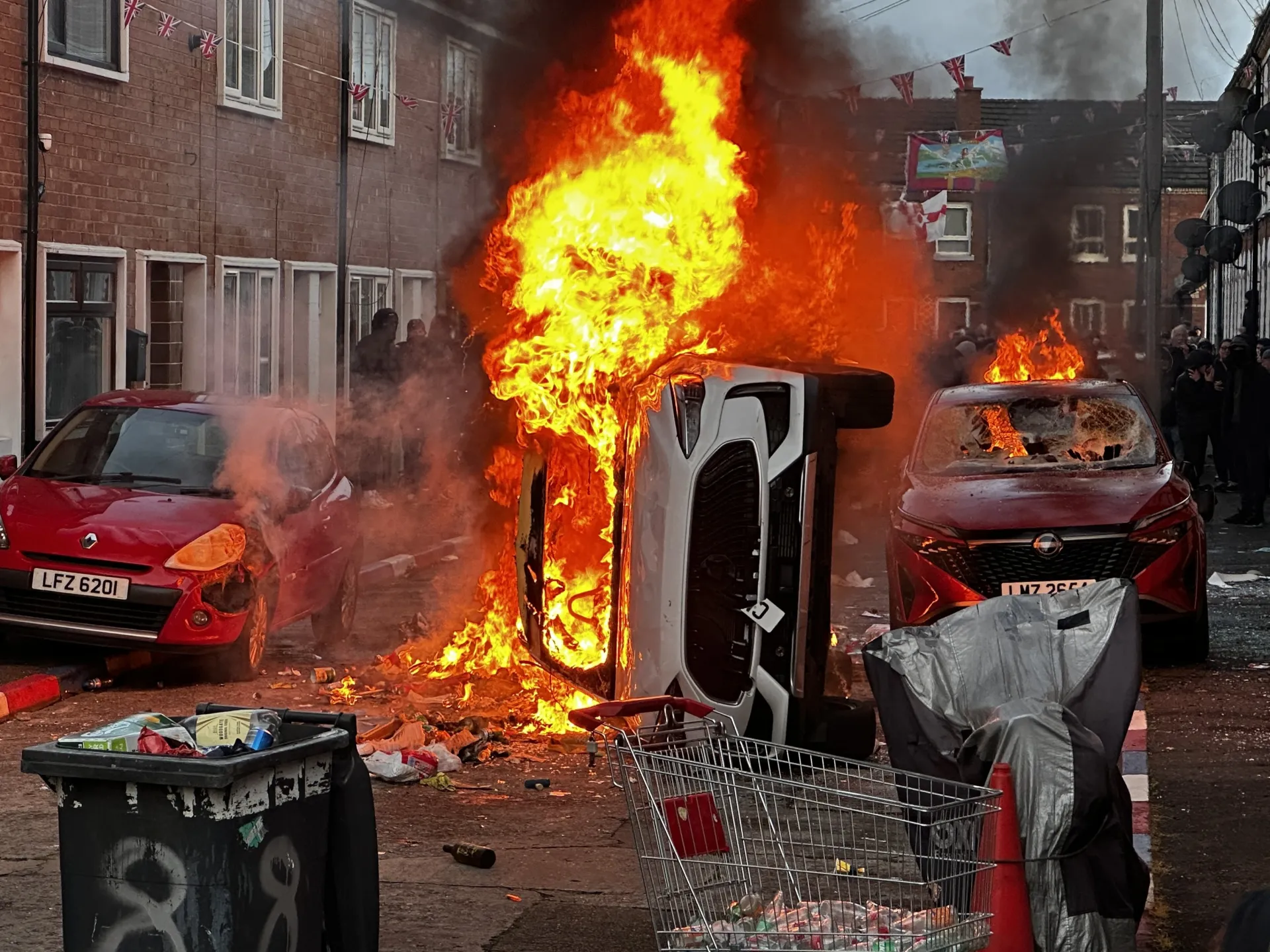
Anti-immigration protesters have torched buildings and vehicles in the capital of Northern Ireland, a day after a knife attack was captured in a graphic video.
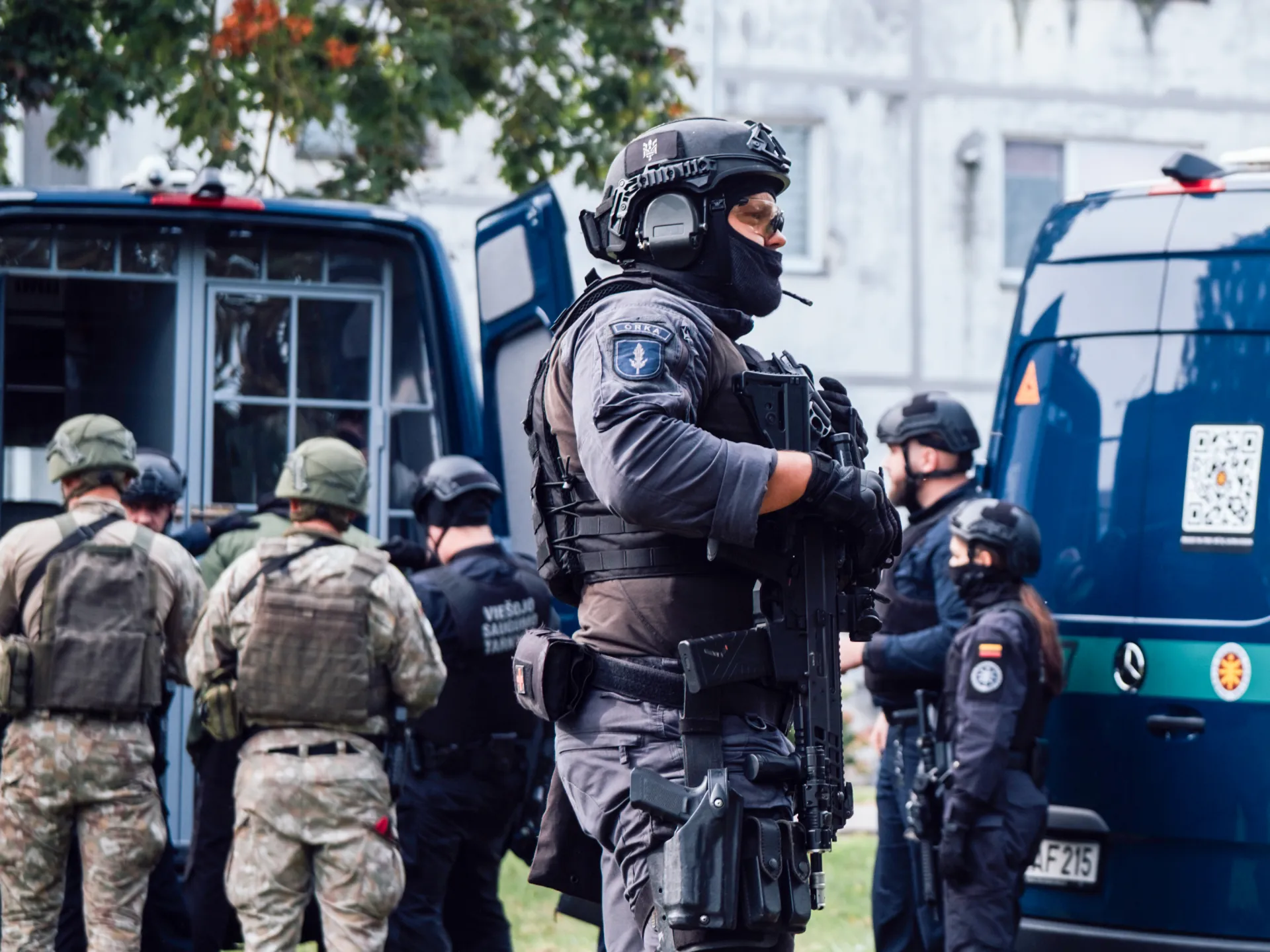
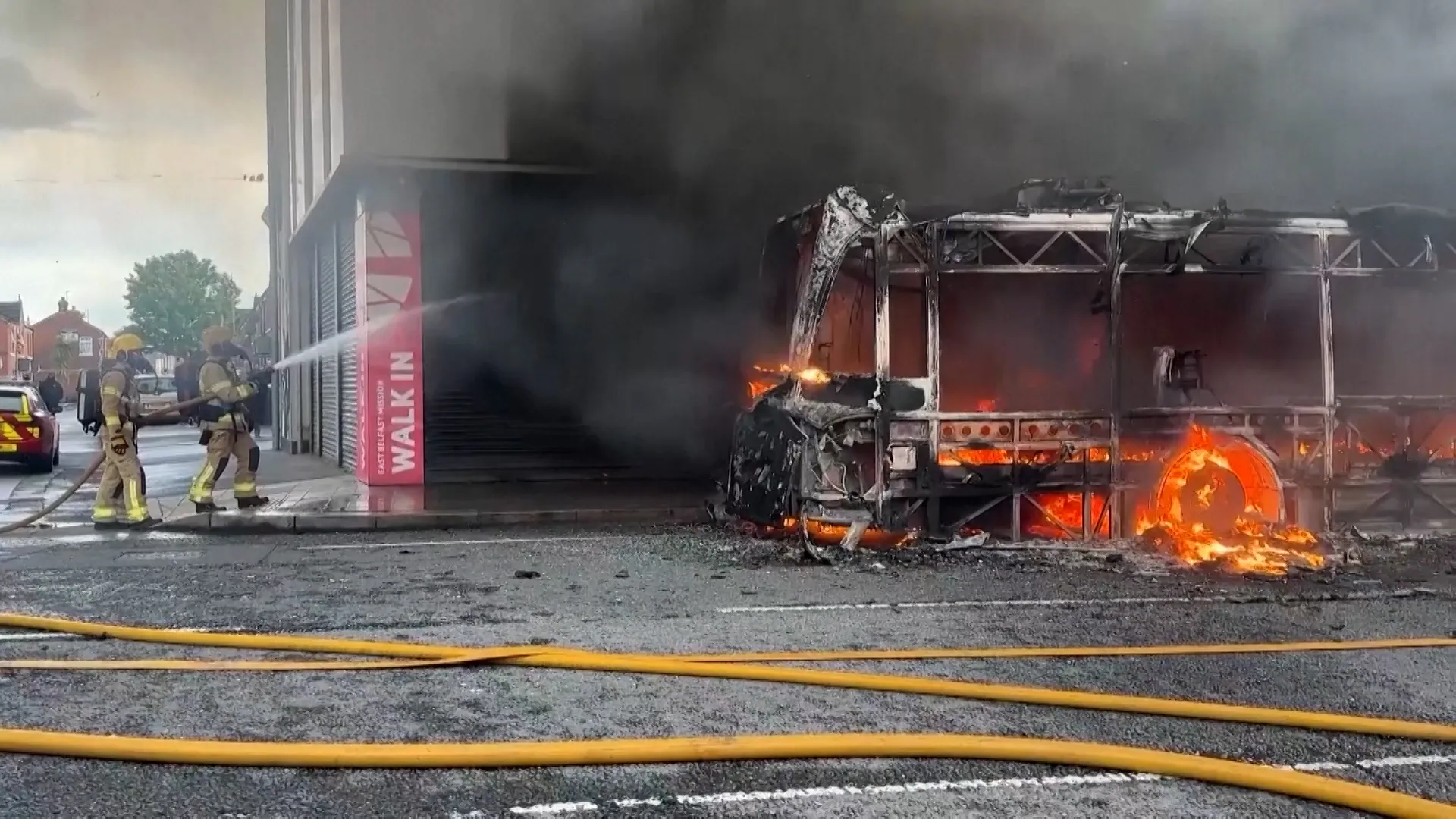
Hundreds of protesters, many of them masked, gathered at several locations across Belfast on Tuesday evening. A bus and several cars were set alight, while a building on the edge of the city centre caught fire and its residents had to be evacuated.
Police helicopters patrolled above the city, and shops closed early.
British Prime Minister Keir Starmer described the initial knife attack, which took place in north Belfast late on Monday evening, as “sickening”.
The attack comes at a time of heightened tensions in the United Kingdom following the murder of a student who was handcuffed by police as he lay dying from stab wounds after his killer falsely alleged a racist attack.
It also follows repeated protests over immigration, with populist parties saying the UK’s asylum policy has allowed dangerous men into the country. There was anti-immigration rioting in Northern Ireland last year amid anger over an alleged sexual assault.
Immigration has become a highly charged political issue and has helped fuel the rise of the hard-right Reform UK and Restore Britain parties in opinion polls.
Northern Ireland’s political leaders and the region’s chief constable have urged people not to incite hate and fear or target particular communities.
HELEN Flanagan has revealed her “dream” to be a foster parent when her kids with ex fiance Scott Sinclair have grown up.
The Coronation Street actress, 35, is a mum-of-three to Matilda, 10, and Delilah, seven, and five-year-old son Charlie.
Sign up for the Showbiz newsletter
Thank you!
Helen Flanagan has revealed her ‘dream’ to be a foster carer when her kids grow upCredit: instagramThe Coronation Street alum shares three kids with ex Scott SinclairCredit: hjgflanagan/Instagram
She is proud parent to Matilda, 10, and Delilah, seven, and five-year-old son CharlieCredit: Instagram/hjgflanaganHelen said she believes fostering would be ‘something lovely to do’ and she has ‘adored kids’Credit: Instagram
“When I’m older, I think fostering could be something lovely to do.
“I’ve always adored kids”.
Foster carers temporarily or permanently welcome children into their homes who cannot live with their biological families, offering a safe and stable place to live.
Helen told how she ‘felt lost’ until becoming a mumCredit: InstagramShe parted ways with her long-term fiancé in 2022Credit: Instagram/Helen Flanagan
She then reinforced her point on ITV daytime show Loose Women and said: “I’m in my element being a mum.
“Before I was a bit lost and now I have got Matilda [eldest daughter] she has really completed me.“
“She just made me so much happier. It gives you so much perspective, I’m besotted with her.”
Helen previously told of her parenting approach and said of her brood: “I love them so much, they are my world.
“Sometimes I shout which makes me feel awful and I always say sorry if I do which I think is important.
“I tell them how much I love them, one thing a day they have done a day that makes me proud.”
She added: “Being a mum is amazing but just really hard. I suppose you can just do your best.”
Helen, who co-parents her brood with Scott, has previously spoken about suffering from mum guilt, and the raw emotional pull she feels while working away.
Speaking to the Sun on behalf of Paddy Power, she said: “I feel mum guilt all the time.
“It’s something I deal with constantly. But I try to remind myself that I’m working for my children, so it’s ultimately for them.
“When they’re with their dad, I also see that as encouraging their relationship, which is important.
“I do still feel guilty, but I try to reframe it and look at the bigger picture.”
Estonia, the smallest of the Baltic states, has experienced some dramatic incidents.
In September, Tallinn said Russian MiG-31 fighter jets entered its airspace for 12 minutes. NATO scrambled Italian F-35s stationed in Estonia as part of the Baltic Air Policing mission. Russia denied violating Estonian airspace.
In March, a stray Ukrainian military drone crashed into Estonia’s Auvere power station.
In April and May, Estonian authorities said drones entered their airspace, grounding flights and prompting warnings issued to citizens.
Estonia’s intelligence services have said that the country does not believe Russia is preparing an imminent military attack on NATO, but that Moscow may be rebuilding its forces for the long term while engaging in hybrid attacks through drones, cyber operations, and sabotage.
Tallinn claims one such hybrid method is the so-called “Narva People’s Republic”, a pro-Russian separatist narrative that casts Estonia’s Russian-speaking border region as a distinct political entity, echoing the Donetsk and Luhansk “people’s republics” used by Moscow as a pretext for intervention in Ukraine.
Estonian authorities say it is part of a disinformation campaign rather than a credible separatist movement.
Its military has, at times, been bellicose in its statements.
In May, Estonia’s Lieutenant General Andrus Merilo argued that Russia is rebuilding its military much faster than many Europeans realise and that Estonia must be ready for a renewed military threat within the next few years, marking 2027 as a critical benchmark for readiness.
In September 2024, in an interview with the Estonian public broadcaster ERR, Estonian General Vahur Karus stated that if Moscow showed signs of preparing for an attack, Estonia could strike the Russians first.
“Our capability to neutralise the enemy on its own territory is crucial,” he said.
However, the government’s rhetoric has been more measured.
In April, Ukrainian President Volodomyr Zelenskyy suggested in an interview that a new wave of Russian mobilisation may be used to launch an attack on the Baltic states.
But Estonian politicians, including the foreign minister, warned that the remarks echoed Moscow’s objective of stoking fears and made cooperation difficult.
“We do not see Russia concentrating its forces or preparing in any way militarily to attack NATO or the Baltic states; rather, it is the opposite. Russia is not in a very strong position on the Ukrainian front, and economically as well,” Estonian Foreign Minister Margus Tsahkna told ERR.
“No one is in the streets panicking,” Tony Lawrence, a research fellow at the International Centre for Defence and Security in Tallinn, told Al Jazeera.
The air incursions have “put people on edge”, but there is a sense that Russian forces are too preoccupied in Ukraine, he said.
To learn more about this campaign, we reached out to one of the soldiers leading this effort from the unit that created it. In an exclusive interview, an Unmanned Systems Department Officer for the First Corps Azov of the National Guard of Ukraine offered us unique insights into how the program began, how it’s going, where it is headed and how AI is helping to identify and hit targets deep behind the lines. It’s a capability we described in great detail — about how it was rapidly gestating and would arrive on the battlefield around now. The officer spoke on condition of anonymity to discuss operational details.
Some of the questions and answers have been edited for clarity.
Azov patrols the border areas around Mariupol.
Ukrainian territory must be free of Russian forces. The surest path to achieving this is pushing the “sanitization zone” for enemy logistics closer to Russia itself and occupied Crimea.
— First Corps Azov of the National Guard of Ukraine (@azov_media) May 25, 2026
Q: Walk me through the genesis of the mid-range strike campaign.
A: I will first of all start with answering the question of why. So the reason why we are currently conducting this campaign is to hunt enemy logistics capabilities, and currently we have a lot of quite cheap assets that can strike enemy targets at quite a deep range. So the overall meaning, the overall sense of this campaign is to strike enemy concentrations of cargo in the places where this concentration is the highest and the protection of those enemy logistical assets is at the lowest level.
So, if we’re talking about enemy logistics very close to the front line, to the line of contact, we are mostly talking about a person with a backpack. Then, if we are moving deeper into the enemy controlled area, further from the front line, then we’re talking about cars. Then even deeper we’re talking about trucks. Even deeper we’re talking about long haulers with trailers, so a higher concentration of cargo. Even deeper into the enemy controlled area, we’re talking about the railroads, the trains that are carrying supplies. So the deeper we go from the line of contact, the higher is the concentration of enemy cargo.
Russian rail logistics are now also the target of Midstrike drones, with lines to Crimea being particularly affected. pic.twitter.com/K1BFd0QVov
The other part of answering this question is basically about how the enemy protects their logistical assets. So the deeper we go from the line of contact, not only is the distance larger, but also the areas that the enemy needs to protect. So just simple mathematical calculations show us that the distance of 50 kilometers deep from the line of contact is usually the most concentrated area the enemy has to defend against our strike assets. But if we go to the depths of 300 kilometers, then the areas that the enemy should protect are much larger, and it’s basically impossible to saturate that area with all the necessary protection assets that the enemy needs to strike down our drones.
The point I would like to make is that we conduct those strike operations at deeper ranges with basically the same assets that we use for the tactical depths, for example, at the depths of 50 kilometers. That means we do not increase the cost of our assets. We just introduced some technical modifications, and we can use the same assets to strike in the deep area.
How Ukraine Uses the US-made Hornet AI Strike Drone To Disrupt And Cut Russian Logistics Lines
Q: What drones are you using to carry out these attacks and how are you increasing the ranges?
A: Basically, we’re using fixed-wing kamikaze drones with some modifications in terms of communication systems. We’ve installed Starlink systems on those drones, and we have also introduced a number of modifications in terms of the engine of the drones – in terms of the overall propelling unit. And this allowed us to increase the range of the assets that we used previously for the range up to 50 kilometers, with some modifications for longer distances.
Q: What kinds of drones are you using?
A: Just the simple fixed-wing chemical drones, such as Hornet systems, such as the Darts systems, and also some other assets that, for now, we prefer not to mention.
Darts
Q: Can you provide additional details about the modifications you have made to these drones and what is their maximum range?
A: Well, I would say that these are quite technical things, and I wouldn’t want to disclose those, because I would want to avoid the situation where the enemy is going to do the same modifications.
Q: Are you reaching as far as 100 kilometers?
A: From what we can say now, we can cover distances of up to 250 kilometers, but as you might understand, with time we will cover longer and longer distances.
Q: Can you describe how these attacks work? Do you operate these as first-person view drones through a video feed? Do they have a terminal seeker?
A: The process is really simple. So, for example, we select a section of the road, or the road as a whole and we distribute that road or the sections among our units. And I would like to mention that this is an all Ukrainian operation. It’s not a task for just one single unit, and basically each unit has its own area of responsibility and its own section of the road.
And then we just send drones there in hunting mode, and I cannot disclose how this works from the standpoint of intelligence, but the overall principle is that the intelligence just gives us the priorities for the targets. For example, they say that you need to target this type of vehicle with these types of cargo.
And in terms of the targeting, I remember that you were also asking the question about how the targets are selected. For this we use both the AI tools and also the operator himself, so we’re using both methods for that.
Q: I want to get back to AI in a bit, but what area of operations do you cover?
A: Our area of interest and area of responsibility is related to all the roads that the enemy is using to bring in supplies to the area of operations of our corps, which is roughly in the area of the town of Dobropillia in eastern Ukraine, and for example, this may be the route from Rostov that goes to Mariupol and then goes to Donetsk, and this could be any other route that the enemy might use to bring military cargo to the area of operations of our corps.
First Corps Azov works in and around the area of Dobropillia in the Donetsk region of Eastern Ukraine. (Google Earth)
Q: What were some of the more successful mid-range drone strike missions you carried out?
A: That’s basically an easy principle. When I said that we are hunting the enemy’s logistics, I mean that this is a daily process. This is a continuous process, and this is not about one standalone mission, when we fly somewhere, when we hit a target and the mission is over.
Last night, Ukraine expanded its mid-range strike campaign to the Sea of Azov, hitting at least 5 vessels carrying Russian cargo.
At least two of the cargo vessels were hit at the occupied ports of Berdyansk and Mariupol, as Ukrainian forces seek to cut off Russian logistics. pic.twitter.com/NoXeAO7Ca6
Q: How are these mid-range strikes on Russian logistics affecting their ability to fight?
A: This is causing shortages of fuel for the enemy. This was already commented on by our media, and also the media resources of the enemy, and now we understand that this is true, not only for Crimea, where there is a severe shortage of fuel now, but also this is true about the other Russian-controlled territories. And basically, when we are striking enemy logistical supplies of fuel, this affects the overall situation, because what is fuel? Fuel is basically the blood of war, which is necessary to fuel the generators that the enemy is using for the FPV operations. The fuel is used for the vehicles that basically bring in those FPVs to the combat zone.
I’d like to add an additional explanation of how this works. If we destroy a car that brings fuel to the line of contact, then we’re talking about destroying like two canisters, so that’s approximately 40 liters of fuel. But if we strike a fuel tank and a tank vehicle, which is bringing fuel to the overall area, so then we can talk about several tons of materials.
Gas stations across Russian-occupied Crimea are facing worsening fuel shortages, with long queues, rationing, and voucher-based distribution reported by residents. Some locals say fuel has become so scarce that it is treated as a luxury, while Moscow insists there is no cause for… pic.twitter.com/0LSYWEqiDH
— Radio Free Europe/Radio Liberty (@RFERL) June 5, 2026
Q: Is this setting the stage for a Ukrainian advance in the east or Zaporizhia?
A: I would say that blocking the logistical supplies to the Zaporizhia Oblast and also to Crimea is a byproduct of our attacks aimed at cutting enemy logistics to our area of operations. Because we’re targeting the roads that go through Mariupol, also to Crimea, to supply the Zaporizhia region, and as well our area of operations. But as for the most strategic aspect of this question of whether this might influence some counter-offensive capabilities of the Ukrainian Defense Forces, I think that is not the question within my scope of responsibility, because I’m an officer responsible for the UAS component of the corps, and I think that this is more of a question that should be directed to the general staff of the Armed Forces of Ukraine.
Ukraine 🇺🇦 continues to launch an important number of mid-range strike, targeting Russian 🇷🇺 logistics in occupied territories
Since early may, more than 270 trucks have been hit, together with multiple fuel depots and trains.
Q: Tell me how you came to use the U.S.-made Hornet drones.
A: I would say that this is also a question that should be directed at one level up from my level. We get those drones, we deploy those drones, but the questions of how we get them and what are the specifics of their supply, this is not a question that I can answer.
A U.S.-made Hornet drone. (U.S. Army photo by Spc. Thomas Dixon) Spc. Thomas Dixon
Q: When did you start getting them?
A: We have been receiving these drones for almost a year.
Q: When you got the Hornet drones, were you given any instructions on what missions to accomplish with them or what targets to pursue?
A: I think that the principle thing to explain here is that the Hornet drone is a tactical level UAV system. It can be used at the maximum range of 50 kilometers – the maximum range of the basic configuration of this drone. The drones we are currently using are the modification of the Hornet drone, but the basic configuration of this drone is only a tactical-level UAV. This is why our mid-strike operations, which have started only recently, are using modified drones.
I think that it is important to add that these modifications are conducted by the units themselves.
The First Corps Azov of the National Guard of Ukraine maintains control over enemy logistics near Donetsk.
Strike UAV pilots are targeting Russian logistics deep in the operational rear. Drone units maintain constant surveillance and fire control over all supply routes around… pic.twitter.com/i4TYOWJBg4
— First Corps Azov of the National Guard of Ukraine (@azov_media) April 16, 2026
Q: When did you begin to make the modifications and was the mid-range strike concept something that Azov developed?
A: Yeah, I would say that basically that was Azov development. So the first tests of these new modifications started in early winter. After approximately a month of testing, we started combat deployment of those drones approximately in January or February of this year. And we use those new modifications to ensure our middle strike operations. In terms of the tactics, I would also like to say that Azov developed new tactics of the deployment of middle strike drones, because the previous tactics they were mostly concentrated on the use of very expensive assets, which are available in limited numbers, so the targeting cycle was different, which is why we needed to develop new tactics and change this targeting cycle.
Q: What systems were you using before that were so expensive?
A: Well I’m not really talking about some specific assets here. I’m mostly talking about the overall tactics and the targeting cycle. So, the tactics of middle strikes were developed for expensive assets that the Corps didn’t have at the moment. So, this is basically why we started developing our own assets that could ensure that we have those middle strike capabilities, and we can also engage targets at the operational level.
Magyar claims a reduction from 3,800 cargo journeys to 1,100 cargo journey (71.05%) along the E-58 Mariupol -Berdiansk – Melitopol – Simferopol highway in the past two weeks
— Ukraine Control Map (@UAControlMap) June 9, 2026
Q: When you added Starlink, did you have to seek permission from SpaceX to use their system for these weapons?
A: The first thing that I would like to say is that we do not use only Starlink. It is just one of the possible communication systems and communication solutions that we’re using. And the second thing that I would like to add is that all the international issues, international cooperation questions, are the issues that should be dealt with at the level of our ministries and at the level of our central government, so once again, this is not a question that I can answer.
Una parte vital de la efectividad de los drones Hornet con los que Ucrania está atacando las rutas logísticas rusas entre 80 y 120km del frente es la recopilacion de datos para que el algoritmo aprenda. Por eso algunos modelos llevan grandes terminales Starlink. https://t.co/yGePjoPo2Kpic.twitter.com/iWu2bLrwq5
Q: Can you tell me what other communications systems you use?
A: No, this information is still secret, because none of those assets have been taken by the enemy, so the enemy doesn’t know yet that we’re using those. But I think that in some time we will be able to go public with those assets and tell more about what we use, apart from Starlink.
Q: Are you using Starlink and the other systems on the Darts drones as well, or just Hornet?
A: Yes, we are using Darts for those middle strike attacks. So, basically, the overall tactics of those mid-strike attacks with small UAV systems, it can use any fixed wing kamikaze drones with modifications which is why we are using Hornets, we are using Darts and also the other types of drones.
While the Ukrainian “Hornet” strike UAV is receiving a lot of attention recently, the “Darts” UAV remains a workhorse for mid-range strike. It, too, has AI terminal targeting and control capabilities to defeat Russian jamming. https://t.co/cNcQytap1Dpic.twitter.com/C8nYJ20Uer
A: Unfortunately, no. The enemy has not yet got hold of those assets, and if one of them will be shot down, or if one of them will be captured by the enemy, then I think that we will be able to go public with those assets.
Q: Can you talk more about how you are using AI for the Hornets and Darts?
A: The AI is used for the so-called last-mile system. I’m talking about the terminal guidance here, and also the AI can also be used to identify the targets, especially when the drone is flying in the autonomous mode. It can recognize the type of the target and it can automatically engage the target. So all of these processes can happen without the involvement of the operator. This allows us to launch several drones at the same time, and this also allows us to ensure a higher level of coordination for those attacks.
I think that one of the examples of these attacks was captured by one of our videos that you might have seen when one fixed-wing drone is observing the target and the other drone is actually hitting it.
1-й корпус НГУ «Азов» контролює ворожу логістику під Донецьком. Знищення російської техніки
Q: Is there a man in the loop or a man on the loop during the terminal phase of the attack or is it fully autonomous?
A: Since we are trying to control the whole process, usually it is the person who takes the final decision and actually makes this decision to strike the target, because we do not want to over rely on the artificial intelligence. If necessary, this whole process can also happen without human involvement, but as I have already mentioned, our policy is that the decision should be made exclusively by the operator.
Q: So this is man in the loop?
A: Yes, so technically men can be out of this loop, but in our case we involve humans in this system, so that’s man in the loop.
Visual look of Hornet UI. Not much new, can mark soldiers individually. Seems aiming is done by either by lock a target (red) or manually aiming by continusly clicking (green) https://t.co/d2LGtV2aON
Q: Have the Russians developed countermeasures for this effort?
A: Since the overall intent was to go to the massive deployment of those drones against the enemy logistics at once, as for now, the enemy has not yet had enough time to adapt to these tactics of ours. And now they’re desperately trying to find some countermeasures to find some ways to react to this.
Images showing unusually painted Russian trucks have appeared on social media channels in recent days with a paint scheme designed to throw off Ukraine’s AI-assisted mid-range strike drones. (Via X) via X
They are putting on anti-drone nets deep into their controlled territory. They are placing people armed with shotguns every 50 meters of their critical roads, but basically, as for now, there is no Russian tactic that would be effective in protecting their logistics. I do not say that they will not come up with this tactic in a month or so, but as for now, they do not have an effective countermeasure for that.
The only thing that I would like to add is that we approximately know the direction in which the enemy is moving to ensure counter measures to this tactic of ours, and we already have countermeasures for their countermeasures.
The current Ukrainian superiority in mid-range drone warfare is a brilliant advantage that comes with an expiration date.
Failing to prepare for the day Russia matches this capability guarantees a catastrophic collapse of front line logistics for Ukraine.
Q: Is the AI enhancement helping to mitigate Russian jamming and electronic warfare measures?
A: Well, I would like to say that EW is not the only way to counter UAVs. So, in addition to EW assets, there are other counter drone methods. Nets can be used. Air observation posts can be used. The drones can be shot down with enemy interceptor drones, and also there are hundreds and hundreds of people armed with shotguns who can also try to shoot the drones down. So the EW systems are just a small part of this overall system of drone countermeasures, and it is a general misconception that all anti-drone efforts are from the EW system. I would say that EW accounts for approximately 10% of overall counter drone efforts.
The main idea of the use of the AI systems is not only to help operators to counter enemy drone countermeasures, but the AI also helps the operator with navigation, with orientation, with the identification of the targets. So this is a complex system that helps the operator with many tasks.
Here: strike by the Ukrainian-American “Hornet” drone on occupier positions. Two Russians confirmed as “gruz 200” (KIA). Interestingly, the Russians call this drone “Martian-2” because its capabilities seem “out of this world” to them.
Q: What are the lessons that the U.S. can learn from your mid-range drone strike campaign, given the importance of logistics everywhere.
A: Well, I would say that the main lesson that the U.S. can learn from our experience is that drones in their basic configuration, right out of the box, is not something that can work, and this is not something that can bring you the best results at once. This is why every unit should have their own drone laboratory that can reconfigure those drones and modify them, and I’m not only talking about reconfiguring tactical level drones to turn them into middle strike capacities. I’m talking about all warfare in general.
U.S. soldier Sgt. Kevin Tran, assigned to 173rd Airborne Brigade, sets up a one-way attack Hornet drone during a demonstration in the 7th Army Training Command’s Grafenwoehr Training Area, Germany, March 25, 2026. The demonstration provided leaders with insight into how AI-enabled one-way attack systems operate alongside Army fires formations. (U.S. Army photo by Spc. Thomas Dixon) Spc. Thomas Dixon
Assets become obsolete very quickly and in three months everything can change, starting from the navigation systems and ending with the control systems. For example, today the GPS signal works, in a month it doesn’t work anymore. Today we use this set of frequency ranges, and in a month all those frequency ranges are jammed by the enemy. So I’m saying this for you to understand that for example, if the U.S. government purchases Hornet drones for their units, then the units are going to have good tactical level drones. But if you want to squeeze all of the possible benefits from those drones, then you will need to modify the structure of your units and include the departments, include the sections that will deal with the modification and reconfiguration of those drones to ensure the most efficient results that can be achieved.
From what I see now, the U.S. is mostly just giving the unit some assets, but they are not thinking about re-configuring or repurposing those drones.
Q: Is there anything I haven’t asked you that you would like to address?
A: I think that we have covered all the topics. The only thing that I would like to add is that I would like your audience to see that Ukraine introduces new innovations that can basically change the battlefield, and this is why trying to forecast the outcome of the war based on the number of tanks or aircraft or bombs that would be incorrect, so the victory will belong to the side capable of adapting faster and not to the side that has more resources.
Nearly 17 years after the King of Pop’s death, Michael Jackson is dominating the box office, television ratings and headlines.
“Michael,” the biopic about the star that hit theaters in April, has surpassed $900 million at box offices globally, according to Deadline, making it the second-highest-grossing film of 2026 behind “The Super Mario Galaxy Movie,” which hit $1 billion. Although “Bohemian Rhapsody” is still the highest-grossing musical biopic, “Michael” is a mere $11 million behind and will likely snag the title in coming weeks.
The film, which stars Jackson’s nephew Jaafar Jackson, follows the “Thriller” hitmaker from his early career leading the Jackson Five to reaching pinnacle star status in the late ’80s. The film’s timeline ends before 1993, when Jackson faced sexual abuse allegations brought by 13-year-old Jordan Chandler.
On Tuesday, “Michael” was released to streaming services, and fans at home can rent or buy on-demand from Amazon Prime Video and other platforms.
Also available for streaming is the Netflix docuseries “Michael Jackson: The Verdict,” which became available on June 3 and dominated the streamer’s charts with nearly 18 million views in its first week. The three-part series examines the pop star’s 2005 molestation trial, in which he was acquitted of all charges, and features key players from the trial, including jurors, eyewitnesses and prosecutors.
The lead prosecutor, Ron Zonen, spoke with TMZ on Tuesday and said that, although he wasn’t sure audiences would view the allegations with a different lens 20 years later, he wanted the documentary to be “as accurate as possible” and feature “the perspective of people who were involved in the trial.”
As far as the response from viewers, Zonen told the outlet that he’d received threats via email. “Well, there are people who are fans, who express their displeasure at the position that we took in this documentary, and express their displeasure very clearly to me,” he said, adding that he’s not bothered by the bad blood with mega-fans, and that the threats were more numerous at the time of the trial.
1 of 4 | German officers stand before Oslo’s National Theater in 1940 after taking control of Norway during World War II. On June 10, 1940, Norway surrendered to Germany during World War II, with King Haakon and members of the government fleeing to Britain. File Photo by Willi Ruge/German Federal Archives
On this date in history:
In 1692, Bridget Bishop was found guilty of the practice of witchcraft and hanged in Salem Village in the Massachusetts Bay Colony. She was the first colonist executed during the Salem witch trials.
In 1898, U.S. Marines invaded Cuba in the Spanish-American War.
In 1940, Norway surrendered to Germany during World War II, with King Haakon and members of the government fleeing to Britain. National Unity Party leader Vidkun Quisling led Norwegian fascist forces to assist the Germans, seizing strategic locations.
In 2014, Rep. Eric Cantor, R-Va., the U.S. House Republican leader, was defeated by Tea Party challenger David Brat, a college economics professor, in one of the most stunning primary election upsets in congressional history.
In 2021, the U.S. Senate confirmed Zahid Quraishi to the U.S. District Court in New Jersey, making him the first Muslim federal judge in the United States.
In 2024, Apple introduced its new generative artificial intelligence technology, called Apple Intelligence, at its annual Worldwide Developers Conference in Cupertino, Calif.
Kazakhstan’s Energy Minister Yerlan Akkenzhenov said international partners are urging the country to increase oil exports as concerns grow over disruptions to energy supplies linked to tensions around the Strait of Hormuz.
According to Akkenzhenov, buyers are seeking the maximum possible increase in Kazakh oil shipments due to uncertainty surrounding one of the world’s most important energy transit routes. However, he noted that Kazakhstan faces infrastructure and production constraints that limit how quickly exports can be expanded.
To support higher output, Kazakhstan has postponed planned maintenance work at the Kashagan Oil Field until 2027. The country is also considering increasing crude shipments through the Baku Tbilisi Ceyhan Pipeline, potentially raising volumes from 1.5 million tons to 2.2 million tons annually and beyond.
The development comes as global energy markets remain sensitive to geopolitical tensions involving Iran and the Strait of Hormuz, a key route for international oil and gas exports.
Why It Matters
Kazakhstan’s growing importance highlights how global energy markets are seeking alternative supply sources amid rising geopolitical risks in the Middle East.
Any disruption in the Strait of Hormuz could affect a significant share of global oil shipments, prompting importers to diversify supply chains and reduce dependence on vulnerable routes. Kazakhstan, one of the world’s major oil producers, is increasingly viewed as a reliable alternative supplier.
The decision to delay maintenance at Kashagan signals that Kazakhstan is prioritizing production stability and export capacity at a time when energy security has become a major concern for consuming nations.
The move could also strengthen Kazakhstan’s strategic position in global energy markets, giving it greater influence as countries seek dependable suppliers outside conflict affected regions.
Key Stakeholders
Kazakhstan – Seeking to expand exports while balancing OPEC+ commitments.
Yerlan Akkenzhenov – Overseeing the country’s energy strategy.
Kashagan Oil Field – One of the world’s largest oil fields and a key source of future production growth.
OPEC+ members monitoring compliance with production agreements.
Energy importing countries seeking alternative crude supplies.
Oil traders and global energy markets responding to supply risks.
Countries along the Baku Tbilisi Ceyhan Pipeline route that facilitate exports to international markets.
Future Outlook
Kazakhstan is likely to face increasing pressure from international buyers if instability around the Strait of Hormuz persists. While production constraints may limit immediate gains, the postponement of Kashagan maintenance suggests authorities are positioning the country to maximize output over the coming years.
The expansion of exports through the Baku Tbilisi Ceyhan pipeline could become increasingly important as energy consumers seek routes that bypass geopolitical hotspots. This would further enhance Kazakhstan’s role in global energy diversification efforts.
However, Kazakhstan must also balance market demand with its commitments under the OPEC+ framework. Any significant increase in production could attract scrutiny from fellow producers seeking to maintain supply discipline and price stability.
If Middle East tensions remain elevated, Kazakhstan is likely to emerge as one of the key beneficiaries of the global search for secure and reliable oil supplies.
Perrie Edwards hints Zayn Malik cheated on her after she revealed her ‘hellish’ split and ‘breakdowns’ as she struggled to copeCredit: Instagram/greatcompanypodcastThe pair got together in 2012 and became engaged the next yearCredit: Splash News
The pair became engaged prior to calling time on their relationship, yet things ended badly, with Perrie, 32, claiming thatZayn broke up with her via text.
Rumours were also rife that he cheated on the Black Magic singer and the popstar, who now is a mum of two and set to wed fiance Alex Oxlade-Chamberlain, has again hinted at infidelity and “overlap” in a new chat on podcast Great Company.
She bravely re-visited her “hellish” heartache in the chat with Made in Chelsea alum Jamie Laing and said of her split with Zayn: “When you go through heartbreak, it is hellish.
“It’s the worst thing in the world. You can’t eat. You can’t sleep. You feel horrendous.
They broke up in 2015 and she has now hinted at an ‘overlap’ for the One Direction starCredit: Not known clear with Picture DeskPerrie told of feeling ‘abandoned’ and ‘not good enough’ in the aftermath of their splitCredit: Instagram/greatcompanypodcastZayn went on to date Gigi Hadid in 2015, the year he and Perrie splitCredit: Getty Images – GettyShe was in pop band Little Mix at the time and told of her struggles to copeCredit: Getty
“You feel abandoned and you don’t feel good enough and you feel like you’ve been left for something better or whatever it is.
“And then what makes it even worse is, I felt like the world was then looking at me, laughing at me.
‘Not my fans, my fans were like, ‘we love you, we’ll fight your corner no matter what.’ But I felt embarrassed. I felt horrified. It was awful”.
The Shout Out To My Ex hitmaker then told Jamie she didn’t stay sane in the aftermath of the split and had “serious breakdowns”.
Perrie said she felt ‘ridiculed’ in the aftermathCredit: Refer to SourcePerrie said of Zayn ‘they’ve left me for someone more beautiful than me’Credit: GettyZayn starred with Gigi Hadid in the Pillowtalk music videoCredit: YOUTUBEPerrie said ‘then you have a song that they’ve written about you, but then someone else is in the video’Credit: Refer to Caption
She added: “It wasn’t just the heartbreak I was dealing with.
“I was dealing with everybody looking at me and I felt ridiculed. I just couldn’t cope with it.
“I hated it. I was breaking down in performances, which isn’t like me at all. I was breaking down. I was crying constantly. I think I was depressed.
“And I know it sounds ridiculous, but I think it was this plus, this plus, this and everything on top.
Perrie is now a mum of twoCredit: PERRIE EDWARDS / INSTAGRAMShe is now happily loved up and engaged to Alex Oxlade-Chamberlain, with whom she shares two kidsCredit: Getty
“I had to be there for the girls. I had to be switched on. I had to power through for Little Mix, but I also just wanted to be left the f**k alone. But I also was getting followed every two seconds and asked about it 24/7”.
In the lengthy chat she hinted at an “overlap” between Zayn and another of his lovers and admitted she “needed to be careful” how to phrase it.
She then referenced his music video for his debut solo single Pillowtalk, which featured supermodel Gigi Hadid, who would go on to be his girlfriend and the mother of his child.
Perrie said: “I need to be careful how I say this, but there was, let’s just say there was a bit of a… I’m just going to say it.
“So there was a bit of an overlap.
“I think when you’re moving on with somebody else you always get on better.
“When you’re the one left behind, that’s when it’s hard because it’s like, ‘Oh s**t, they’ve left me for someone more beautiful than me, someone better than me.’
‘Whatever it is, that’s how it felt at the time.
“And then you have a song that they’ve written about you, but then someone else is in the video.”
The Sun has gone to Zayn’s rep for comment.
Thankfully, Perrie’s love life is now firmly on the up.
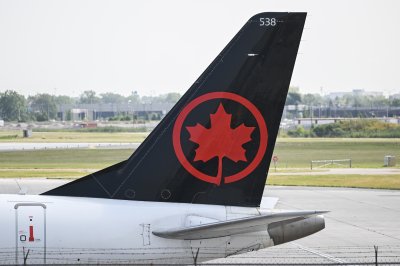
An Air Canada plane is shown in 2025 at a gate at Montreal-Trudeau International Airport in Montreal, Quebec, Canada. Police said a former Air Canada captain faces fraud charges after flying without the correct license for 17 years. File Photo by Graham Hughes/EPA
June 9 (UPI) — A former pilot and captain for Air Canada faces fraud charges after an investigation showed he flew hundreds of flights over 17 years without a proper license, police said Tuesday.
Wall, who’d started his career with Air Canada in 1998, did not obtain the required airline transport pilot license in 2009 when he was promoted to captain, Deputy Chief Nick Milinovich said at a press conference.
That license requires a series of written exams. Instead, Wall allegedly used fraudulent licenses for Air Canada and Transport Canada (the country’s federal transportation department)and then attempted to conceal that in a false police report, Milinovich said.
“This is very similar to a doctor who that is licensed to practice family medicine but is doing brain surgery in their office,” Milinovich said.
Air Canada said that Wall was immediately removed from duty when the fraud was discovered, The BBC reported. Airline officials said passengers were never at risk and that Wall was completely trained with a valid commercial pilot license, just not the ATPL.
Police said Wall flew several types of airplanes in a total of 900 domestic and international flights. The investigation through Transport Canada started when officials noticed inconsistencies with his license documentation in a routine evaluation. The Peel Regional Police then started a criminal investigation. The charges include fraud, forging documents and possession of counterfeit mark.
Trita Parsi tells Al Jazeera that Iran has abandoned strategic patience for a new doctrine: swift, severe retaliation against any US attack. Parsi added that Iran aims to deny Washington the ability to strike with impunity, viewing immediate escalation as vital to its deterrence.
The Birmingham-born content creator said that while she loves her life in Australia, there is one thing from the UK she simply cannot replace
16:00, 09 Jun 2026Updated 07:04, 10 Jun 2026
Ellie McClean regularly gives fans an insight into her life in Australia (Image: TIKTOK/ELLIEMCCLEAN)
A content creator has opened up about her decision to leave Australia behind and return to the UK. Ellie McClean, from Birmingham, moved to Australia two-and-a-half years ago, spending time in Sydney, Melbourne and Perth.
While she says she feels “a lot safer” in Australia compared to the UK, the 28-year-old insists nothing can replace being near to family and friends.
“I am excited to leave Australia, I feel like it’s so not normalised for people to want to leave,” she shared on her TikTok page.
“When you tell people that you’re wanting to leave, they’re like, ‘Why?’. You either have to pick the lifestyle and the weather or your friends and family and I just think there’s no competition for me.”
When Ellie initially relocated to Australia, she was convinced she’d remain there permanently. Yet after more than two years living abroad, she began yearning for the familiar comforts of home in Birmingham.
“After two and a half years of living here, what I’ve realised since being here is that what means most to me is the little things.
“I’ve missed three years of birthdays, little celebrations, dog walks, cups of tea, Sunday roasts, you miss so much that you take for granted when you’re at home.
“And you have to move away sometimes to realise what you’ve got.” Discussing what she’s most eagerly anticipating upon her return home, Ellie added: “I’m ready for England, I’m ready for the cold weather, I’m ready for the percy pigs, I’m ready for real fish and chips, actual chippy chips , English tele, to hear English accents.”
Yet, despite her enthusiasm about coming back to the UK following redundancy from her role as an influencer marketer, Ellie acknowledges it will be tough to say goodbye to numerous elements of life Down Under.
Australia continues to rank among the top choices for British expats, drawing thousands annually with its balmy climate, spectacular coastline, lively cities, robust healthcare infrastructure and employment prospects.
For Ellie, one of the hardest things to leave behind will be living just moments from the beach.
“I don’t know what I’m going to do with my free time because I feel like I spend so much at it at the beach,” she revealed.
“And life in general, kangaroos, palm trees, Chemist (Australia’s largest pharmacy retailer Chemist Warehouse), food courts in supermarket, Yo-Chi, coffee in Australia is [also] a million times better than in the UK.”
Might she consider relocating to Australia again down the line? Ellie told us: “I’m travelling for six months before heading home indefinitely. I’ve got no plans to move back but I would 100 per cent recommend others to live there and try it out. It’s been such an amazing experience living here but there’s no place like home.”
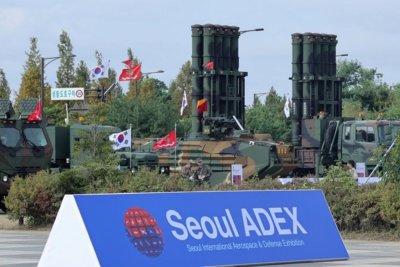
Cutting-edge weapons, such as the KAAV amphibious assault vehicle and the Bigung guided rocket, are on display at the Seoul International Aerospace and Defense Exhibition, or ADEX, that kicked off at KINTEX in Goyang, just northwest of Seoul. Photo by YONHAP / EPA
June 9 (Asia Today) — Military, industry and academic experts warned Tuesday that South Korea must urgently build an integrated air and missile defense system as drone swarms, artificial intelligence-enabled attacks and missile threats become more complex.
Experts said fragmented air defense weapons cannot respond effectively to modern battlefields where drone swarms are combined with ballistic and cruise missiles. They called for linking sensors, command decisions and interceptors into a unified system.
The Korea Association of Defense Industry Studies hosted the Future of Integrated Air and Missile Defense conference at the Daejeon Convention Center. The Missile Defense Forum organized the event and Northrop Grumman sponsored it.
The conference was held alongside the InLEX KOREA 2026 defense exhibition and drew officials from U.S. Forces Korea, foreign defense attachés, South Korean defense firms and overseas defense companies.
Kim Jin-ki, chairman of the Korea Association of Defense Industry Studies, said building an integrated air defense network is directly tied to national survival in modern and future warfare. He called for closer governance among the military, industry, academia and research institutions.
Rep. Yoo Yong-won, a member of the National Assembly’s defense committee, said South Korea must move faster to advance its missile defense system and secure next-generation air defense capabilities as global interest grows in the Cheongung-II missile interceptor system.
Kim Ki-won, a senior research fellow at the Korea Institute for Defense Analyses, said lessons from the Israel-Iran conflict and the Russia-Ukraine war point to a major shift in air defense strategy.
“Simply increasing the number of interceptors has limits when facing saturation attacks such as drone swarms,” Kim said.
He said South Korea needs AI-based intelligent engagement control and a smart defense network that links multiple sensors into one system.
Sean McLay, Asia-Pacific business development director at Northrop Grumman, said modern attacks are increasingly combining ballistic missiles, cruise missiles and drones.
McLay said South Korea should move away from platform-centered air defense systems and toward a network-centered integrated architecture that connects sensors, command and control and engagement assets.
Northrop Grumman developed the Integrated Battle Command System, which is used by the United States and Poland. The system is built around the concept of linking any sensor to the best available shooter, allowing commanders to match threat data with the most effective response.
Former Air Force 3rd Missile Defense Brigade commander Moon Oh-sun said South Korea’s individual air defense weapons have already reached a world-class level but remain limited by organizational barriers.
“To maximize combat effectiveness, we must break down the closed and isolated silo structure among the military branches,” Moon said. “Complete integration of information sharing and command decision systems is essential.”
Kim Dae-young, a military research fellow at the Korea Research Institute for National Strategy, said South Korea must also prepare for the reality that no missile defense system can intercept every threat.
Operating on the premise that “perfect interception does not exist,” Kim said South Korea should build a multilayered survival structure that allows national functions to continue even if missile defenses fail. He cited the need for public air raid shelters and other measures to help the country withstand attacks.
South Korean defense companies also presented domestic technology related to integrated air defense.
Jung Won-woo, head of LIG D&A’s air defense control development team, introduced integrated fire control network technology based on data distribution service middleware. His presentation focused on the transition from engagement control to integrated fire control.
The conference ended with a panel discussion chaired by Joo Kwang-sup, a visiting research fellow at the Sejong Institute and a retired Army brigadier general. Panelists discussed how South Korea can build an integrated air and missile defense system suited to future security conditions.
Han Kwon-hee, planning director at the Korea Association of Defense Industry Studies, said the association will work to ensure the ideas raised at the conference help strengthen South Korea’s integrated air defense capabilities and improve the global competitiveness of the country’s defense industry.
Weekly insights and analysis on the latest developments in military technology, strategy, and foreign policy.
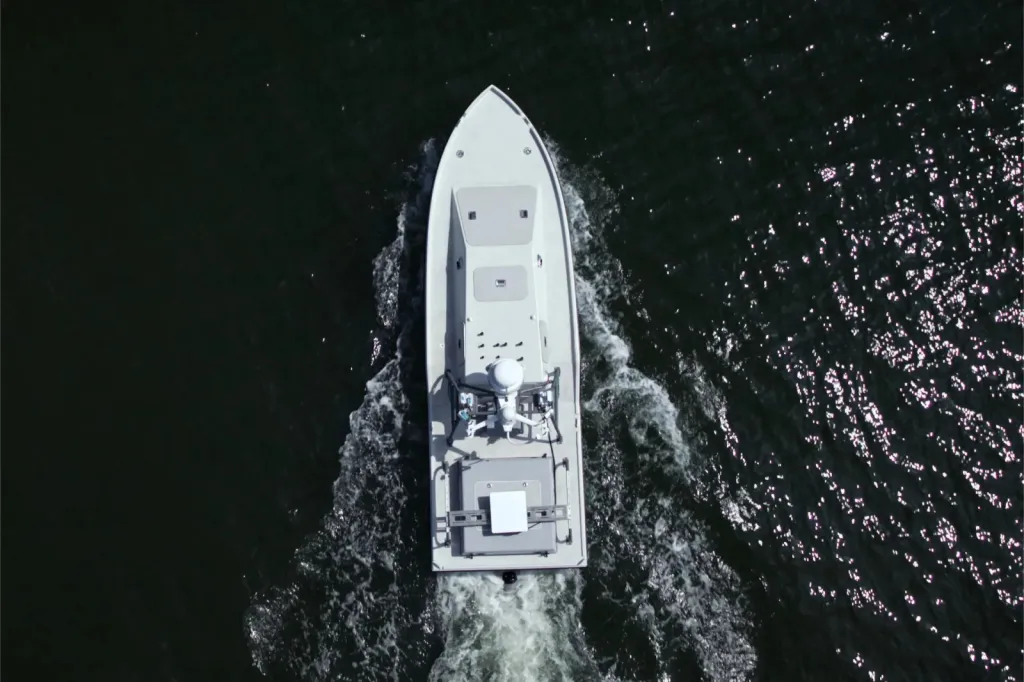
U.S. Central Command (CENTCOM) has confirmed a Saronic Corsair was the uncrewed surface vessel (USV) that rescued the crew of a U.S. Army AH-64 Apache out of the Gulf of Oman overnight. President Donald Trump has also now said Iranian forces downed the attack helicopter, and promised a response. This is the first known instance of a drone boat being used to recover personnel as part of a search and rescue mission, and has major implications for these operations going forward. Readers can otherwise get up to speed on what is already known about this incident in our initial reporting here.
“The surface drone that assisted in last night’s rescue of the Apache crew off the coast of Oman was a U.S. Navy Corsair unmanned surface vessel operated by U.S. 5th Fleet’s Task Force 59,” U.S. Navy Capt. Tim Hawkins, a CENTCOM spokesman, told TWZ. “The task force began fielding these drones in theater in late March.”
A top-down look at a Saronic Corsair USV. Saronic
The Navy confirmed last December that it had signed an Other Transaction Authority (OTA) deal with Saronic, valued at $392 million, for the production of Corsair USVs. The Corsair, which the manufacturer also calls an autonomous surface vessel (ASV), is a 24-foot-long drone boat with a speedboat-like design that was first unveiled in 2024. The manufacturer says it has a maximum range of 1,000 nautical miles, a top speed of 35 knots, and a 1,000-pound payload capacity.
Prototype to production in under 12 months. The @Saronic OTA proves how we’ll build a hybrid manned–unmanned Fleet: open competition, real contracts, real hardware for Sailors and Marines not slides. This is now the standard. pic.twitter.com/cC9DG7jTiW
— Archive: Secretary of the Navy John C. Phelan (@SecNavPhelan) December 8, 2025
The Corsair “picked them [the Apache crew] up and transported them to another location on the water where they were then hoisted up to a helicopter for further transport,” Capt. Hawkins, the CENTCOM spokesperson, added.
CENTCOM had already confirmed to TWZ and others that an unspecified USV found and rescued the two aircrew from the downed Apache. The Wall Street Journal was first to report the specific type of drone boat employed.
The Army aviators spent approximately two hours in the water before being recovered safely, according to a previous CENTCOM statement. As mentioned, President Donald Trump has also now separately said that Iranian forces were responsible for bringing down the Apache, and that a U.S. response will be forthcoming.
Trump says that Iranian forces shot down the Army AH-64 Apache attack helicopter that went down over Hormuz yesterday.
Since its establishment in 2021, the Navy’s Task Force 59 has been charged with helping expand the service’s operational use of uncrewed platforms, as well as artificial intelligence (AI) and machine learning-driven capabilities, across the Middle East. It has operated an array of different types of USVs, as well as uncrewed aerial systems, over the years.
How many Corsairs Task Force 59 has currently, as well as their exact configuration, is unclear. Pictures and videos that Saronic has released to date have shown Corsairs fitted out primarily for surveillance and reconnaissance missions, with a camera turret on top of a central mast-like frame. A commercial navigation radar, additional cameras to help provide extra situational awareness, and various other antennas have also been seen fitted to that frame. Saronic has talked about integrating other capabilities to enable additional mission sets, including launchers for loitering munitions, in the past.
A picture showing the most typical configuration of the Corsair USV that has been seen to date. Saronic
Saronic also says Corsair has a high degree of autonomy, with the type having logged more than 100,000 nautical miles of total travel to date, including multi-day missions. The SUV is designed to be employed independently or in networked swarms, according to the company. Human operators are in the loop during these operations via datalink.
Corsair, our 24ft Autonomous Surface Vessel (ASV), has officially crossed 100,000 nautical miles traveled — that’s nearly five times around the Earth or almost halfway to the Moon!
This milestone represents more than distance. It reflects relentless testing across diverse… pic.twitter.com/opXtX6jSfO
“Corsair can be given a mission, alone or as part of a collaborative swarm, and execute with minimal human interaction to deter or counter adversarial threats at a range of 1,000 nautical miles,” Saronic said in a press release back in 2024. “Employing redundant communications and passive perception capabilities, Corsair can autonomously identify, track, follow, and intercept targets in contested and communications denied environments.”
These are all capabilities well suited to the U.S. Navy’s immediate needs in the Middle East, especially in support of the current blockade of Iranian ports. Corsair would notably offer a lower-risk way to closely shadow vessels that might be attempting a run into or out of the area. Corsair’s ability to automatically spot and track objects of interest would have helped in finding and rescuing the downed Apache crew, too. It is worth noting here that automated target detection is also a key part of Corsair’s ability to safely navigate autonomously, day or night, especially in congested waterways, as seen in the video below.
In 2025, we logged more than 79,000 nautical miles and over 15,000 hours of total operations with Corsair, our 24-ft ASV. Much of this was done on our own dime, operating 6 days a week at our test sites on the West Coast, East Coast, Gulf Coast, and beyond, allowing us to… pic.twitter.com/PZETeJia17
Corsair’s overall performance in the Middle East could easily translate to further operational use of this USV by the Navy globally. The service has particularly significant demands for persistent maritime surveillance and reconnaissance capacity, as well as just general presence, across the broad expanses of the Pacific. One of the key benefits that USVs offer is the ability to provide additional distributed ‘mass’ at relatively low cost. This can help bolster the capabilities of crewed platforms they are networked together with or just ease the operational strain on those assets.
The Navy has now also clearly demonstrated how valuable USVs could be in future maritime search-and-rescue operations worldwide. This, in turn, underscores the benefits uncrewed platforms bring to these missions, especially in the face of growing anti-air and other threats.
As we already wrote today:
“As TWZ regularly highlights, search and rescue operations present inherent complexities and risks, especially when conducted in or near hostile territory. The F-15E rescue effort in Iran put a particular spotlight on the immense risks that combat search and rescue (CSAR) forces take, with helicopters and C-130 variants sent into areas where even a high-end fighter aircraft didn’t survive.”
“Open-water recoveries can present distinct additional challenges. There is always the possibility of the loss of additional assets and personnel in the process, no matter where a CSAR mission occurs.”
US Air Force HH-60W Jolly Green II search-and-rescue helicopters refuel from an HC-130J Combat King II aircraft. USAF
“The use of a Navy drone boat in the rescue overnight highlights a new dimension for maritime CSAR going forward. These uncrewed assets can be more readily pre-positioned in a distributed manner. For example, in the broad expanse of the Pacific, USVs could be forward-deployed at multiple points along certain flight paths for this exact purpose. USVs could offer other distinct advantages in certain scenarios where they might be able to get into areas where traditional assets cannot and without risking additional personnel. These realities extend well beyond the maritime domain, and we are only likely to see uncrewed platforms of all kinds increasingly taking part in rescue efforts, especially in denied areas. The U.S. military is coming to terms with just how vulnerable their CSAR assets are and the ranges that would be needed to access highly defended areas, especially during a peer fight. Using drones to execute personnel recovery is being viewed as one part of a larger set of solutions to this pressing problem.“
The additional detail we have now that the Corsair USV brought the downed aircraft to a territorial location, where they were then hoisted into a helicopter, is notable, too. This further shows how uncrewed platforms could be used as part of a distributed hub-and-spoke-style concept of operations for future rescue missions, which could increase flexibility and total area covered. USVs could be used to penetrate into especially high-threat areas, recover personnel, and then bring them to crewed assets at safer locations to the rear, as well.
“When it comes to search and rescue, you utilize the best asset that is the closest and the quickest, and that was the case in this instance,” CENTCOM’s Hawkins also told The Wall Street Journal today. “We’ve practiced this scenario in exercises, but not quite necessarily like this.”
The first Marauder prototype seen being launched earlier this year. Saronic
The Navy is already set to evaluate Marauder, as well as designs from six other companies, as part of the first round of prototyping under its latest Medium Unmanned Surface Vessel (MUSV) effort. This is part of a larger strategy the service rolled out in March to try to field more USVs and do so faster, as you can read more about here.
In the meantime, Saronic’s Corsair is already being employed operationally in the Middle East and demonstrating its ability to perform complex missions.
Hasley was a veteran TV writer who taught screenwriting classes at UCLA Extension. He was also a friend of Caitlyn Jenner and helped write the former athlete’s motivational book “Finding the Champion Within,” according to his biography.
The L.A. County medical examiner released Hasley’s identity Tuesday but had yet to rule on his cause of death.
More than two dozen personnel with the Los Angeles Fire Department responded to a report of a hiker in grave medical condition off Nichols Canyon Road near Hollywood Boulevard shortly before 7 p.m. Saturday.
A helicopter was used to reach the patient and allow paramedics to provide urgent medical care. They were unable to save him, and he was declared dead shortly after, according to the LAFD.
Hasley hailed from Pittsburgh and played university football before venturing to Hollywood to pursue his dreams as a writer. He wrote on 37 episodes of “The Smurfs” in the late 1980s and early ’90s as well as several episodes of “Fat Albert and the Cosby Kids,” according to IMDB. His TV writing credits also included “Swift Justice,” “Ghost Stories,” “Murder, She Wrote,” “Young Riders” and “Highway to Heaven.”
He was able to channel his love of sports while working with NBC on the network’s project “Star Salute to the U.S. Olympic Team,” where he met Olympic gold medalist Caitlyn Jenner, according to his professional biography.
The pair became friends, and Hasley went on to help write a book about Jenner’s philosophy on overcoming adversity in sports and life. He was commissioned to ghostwrite several other motivational books including “Passion, Profit, & Power” for hypnotist Marshall Sylver and “The Slight Edge” for self-help expert Jeff Olson.
Hasley loved sharing his passion for writing with students at UCLA and described the process of writing as akin to assembling a puzzle, where one tries many different combinations of pieces before finding the perfect fit, according to his teaching biography.
“I personally believe that when you know your characters well enough they will start dictating their actions,” he wrote. “When that happens writing becomes a euphoric experience.”
In addition to teaching and writing, he enjoyed golfing, horseback riding, fighting City Hall over an environmental issue, volunteering in soup kitchens and speaking to youth organizations, according to his bio.
Hasley was formerly married to actor Robin Riker, best known for her roles on “Brothers” and “The Bold and the Beautiful.”
He lived in the Hollywood Hills not far from where he suffered the medical emergency. A neighbor told the New York Post they had seen him earlier Saturday carrying groceries home. “It’s very sad he had to die all alone like that,” the neighbor said.
Times staff writer Sonja Sharp contributed to this report.
South Korean First Vice Foreign Minister Park Yoon-joo speaks during a press conference for South Korean correspondents at the South Korean Embassy in Washington, DC, USA, 20 May 2026. Photo by YONHAP / EPA
June 9 (Asia Today) — South Korea and the United States share the view that Seoul’s push to acquire nuclear-powered submarines would provide an important alliance capability, South Korea’s Foreign Ministry said Tuesday.
The ministry said the issue was discussed last week during the inaugural meeting to implement the South Korea-U.S. joint fact sheet, known as JFS, and that the talks proceeded on the premise that the submarines would be built in South Korea.
A Foreign Ministry official told reporters that the U.S. delegation did not raise any particular objection to domestic construction of the submarines.
U.S. President Donald Trump previously said on social media that South Korea’s nuclear-powered submarines would be built at Philly Shipyard in the United States, but officials from the two countries discussed the project on the premise of construction in South Korea, the official said.
“Both sides share the view that South Korea’s nuclear-powered submarines would be an important alliance capability for South Korea’s leading role in the defense of the Korean Peninsula,” the official said.
The official said the submarine plan is intended to strengthen security in response to conditions on the Korean Peninsula and is not aimed at any specific country.
On South Korea’s push to expand its uranium enrichment and spent fuel reprocessing rights, the official said the two sides agreed that strengthening their nuclear energy partnership serves their common interests and decided to begin full-scale talks on ways to make that happen.
South Korea faces the challenge of overcoming restrictions under its civil nuclear cooperation agreement with the United States, commonly known as the 123 Agreement, to expand enrichment and reprocessing rights.
Diplomatic circles have discussed options including a full or partial revision of the agreement or passage of separate special legislation.
“The joint fact sheet talks are aimed at strengthening South Korea-U.S. nuclear cooperation,” the Foreign Ministry official said. “In broad terms, this can be understood as looking at ways to adjust the current 123 Agreement.”
The launch meeting was held June 2-3 after a delay of about seven months. Foreign Ministry officials described the atmosphere as positive.
One official said the U.S. side gave the impression that it was serious about the talks. Another said the meeting proceeded in a constructive atmosphere.
Foreign Minister Cho Hyun also made an unannounced visit to a working lunch on the second day of the talks to encourage the delegations.
The government remains cautious, however, because of the details of the negotiations, concerns in the United States over nonproliferation norms and uncertainty surrounding Trump’s decision-making style.
“The overall perception of South Korea’s commitment to nonproliferation is the most important thing,” the Foreign Ministry official said. “We must make efforts to avoid sending unnecessary messages.”
President Lee Jae Myung’s remarks at his first-anniversary news conference Monday, where he criticized calls for South Korea to develop nuclear weapons as “truly irresponsible,” were seen as reflecting that concern.
The government is coordinating the schedule for follow-up talks with Washington.
The Foreign Ministry official said the two sides agreed to accelerate consultations. Several more full meetings led by the two countries’ national security councils are expected, along with frequent working-level talks by sectoral delegations.
Former airline captain charged with fraud after allegedly commanding more than 900 flights without required credentials.
Published On 10 Jun 202610 Jun 2026
A former airline pilot in Canada has been arrested for allegedly flying hundreds of flights without a proper licence for nearly 17 years.
Police in Peel, Ontario, said on Tuesday that they had charged former Air Canada captain Geoffrey Wall with fraud and other charges following a four-month investigation.
Recommended Stories
list of 4 itemsend of list
The Peel Regional Police said Wall, 59, had used fraudulent pilot licences to command more than 900 domestic and international flights between 2009 and 2025.
Police said they obtained evidence to suggest that Wall had deceived both Air Canada and civil aviation authorities about his credentials before his retirement in 2025.
While Wall did hold a valid commercial pilot licence, he did not have an airline transport pilot licence, the highest level of pilot certification required to captain commercial aircraft, police said.
Wall faces one count of fraud, two counts of uttering forged documents, three counts of possessing a counterfeit trademark, and one count of public mischief.
Al Jazeera was unable to locate Wall’s legal representatives for comment.
“This case is deeply concerning and strikes at the heart of public trust and safety, as the accused is alleged to have put hundreds of thousands of passengers at risk across more than 900 domestic and international flights,” Peel Regional Police Chief Nishan Duraiappah said in a statement.
Air Canada said that while it viewed the pilot’s alleged actions with “utmost seriousness”, passenger safety had not been compromised, as all pilots undergo mandatory training every six months to assess their competency, in addition to an annual flight check with a certified pilot.
The airline said that Wall had “successfully met or exceeded” his training requirements and demonstrated “a high level of competency to safely operate large aircraft”.
The Canadian flag carrier also said it had found no other instances of non-compliance with licensing requirements following an audit of its pilots.
“Immediately upon Air Canada’s discovery of this, the individual was removed from active duty, and the company voluntarily reported the matter to Transport Canada,” the airline said in a statement.
Hassan Shahidi, a licensed pilot who heads the US-based Flight Safety Foundation nonprofit, described the charges against Wall as an “exceptionally rare case”.
“If the allegations are proven, the key issue isn’t that an untrained person was flying airliners, but that this pilot bypassed a fundamental regulatory requirement for many years,” Shahidi told Al Jazeera.
“The case could point to weaknesses in licence verification and oversight processes, particularly if fraudulent credentials were able to evade detection for so long.”
Shahidi said that Wall’s alleged actions did not appear to have exposed passengers to the same level of risk that they would have faced if an untrained pilot were at the controls.
“The larger concern is the apparent failure of a regulatory safeguard that is supposed to ensure trust in the system,” he said.
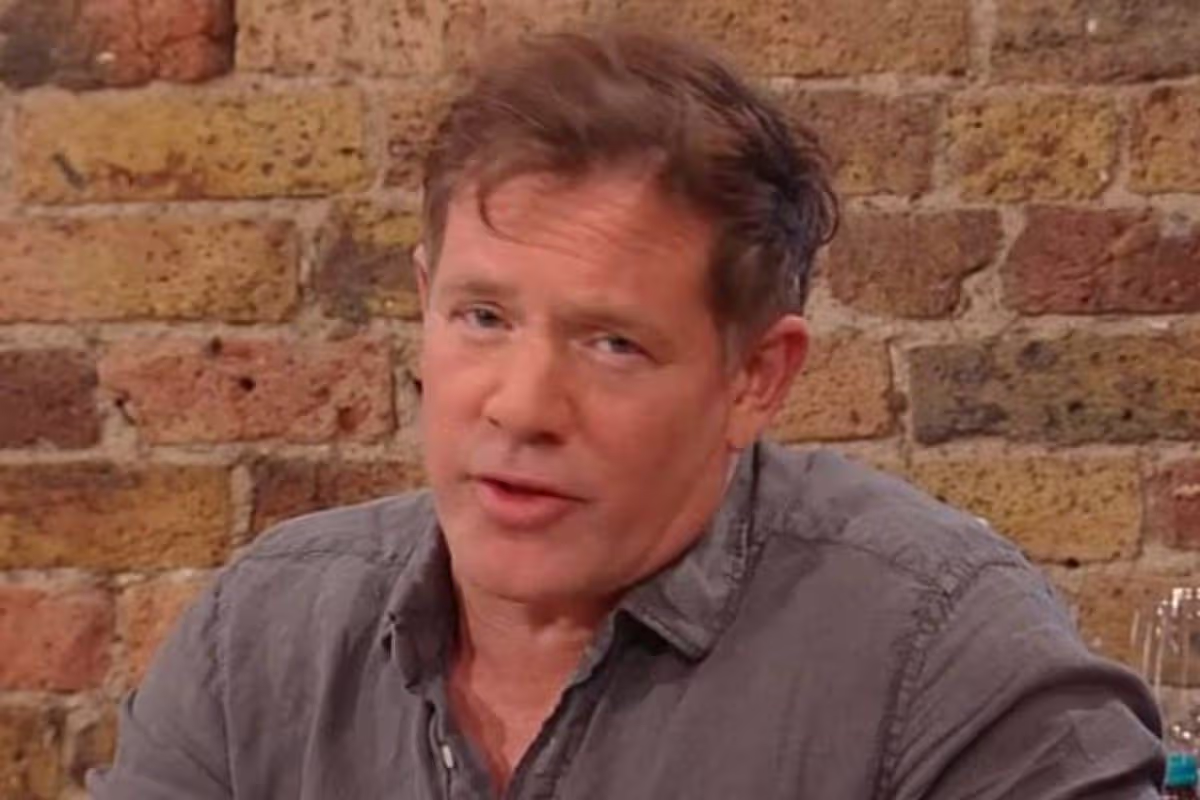
Saturday Kitchen presenter Matt Tebbutt has been at the helm of the BBC cookery show for almost a decade
Matt Tebbutt has been at the helm of the BBC cookery show for almost a decade (Image: BBC)
Saturday Kitchen host Matt Tebbutt has revealed a major confession nearly a decade after succeeding James Martin as the face of the BBC cookery programme.
Speaking exclusively to Express.co.uk at Jeremy Clarkson‘s FarmFest during the May Bank Holiday weekend, he confessed he now finally considers himself a TV chef.
“I think it is fair to say now I am probably a TV chef. I originally started as a working chef doing all the hours for 14 years. That’s a tough game. TV cookery isn’t.
“It comes with other pressures. There are time pressures. Conformity. I mean I’ve always been a chef but I think now it’s veered into ‘TV chef’,” he acknowledged. Discussing his position on the long-standing cookery programme.
He explained, “My job is to make food and cooking look really accessible. We have our guest chef’s on and they’re the kind of the aspirational ones.
“My job is to do those dishes that people will look at and go ‘I could get out of bed now and go to the supermarket and buy those ingredients and make that’.”
“Whether they do or not I don’t know but it is there for them,” he chuckled.
One philosophy Matt is particularly passionate about is the “farm to fork” approach, which was amongst the key reasons he was supporting Farm Fest.
He made an appearance at the festival on Sunday, 24 May, where he delivered a cookery demonstration, gave a talk and even took on the role of judge at the dog show, despite confessing he keeps two cats at home, reports the Express.
“It’s absolutely [great] to be able to support British farmers at a time when the government isn’t and to highlight [what they go through],” he said shortly after his arrival.
“I mean, you see it around you,” he added, gesturing towards the nearby stalls.
“People who are committed to supporting farming and where the food comes from. It’s marvellous. So if I can show support, I will.
“I live in a rural part of Wales, so you see it on a daily basis. You are in pubs with farmers chatting to them, and you know the sort of problems that they are trying to overcome right now, so it is great to support this.”
Saturday Kitchen airs at 9am every Saturday on BBC One and iPlayer
Al Jazeera’s Milena Veselinovic reports from Belfast, where protests over a recent stabbing have escalated into violent riots. Tensions flared after a Sudanese asylum seeker was charged with attempted murder. Riot police have deployed to the scene as buses and vehicles are set alight.
Anti-immigrant protesters in the city of Belfast in the United Kingdom have torched vehicles and buildings after a Sudanese man was arrested over a knife attack that left one person with serious injuries.
Hundreds of protesters, many of them masked, gathered at several locations across the city on Tuesday, setting fire to a bus and several cars.
Recommended Stories
list of 3 itemsend of list
A building near the city centre was also set alight, with residents telling the AFP news agency that the protesters started a fire in the bins and went on to throw petrol bombs.
Crowds also gathered in Antrim, about 25km (15 miles) west of Belfast.
Michelle O’Neill, the first minister of Northern Ireland, slammed the protests and urged calm.
“Groups of masked men burning families out of their homes is nothing less than disgusting cowardice,” she wrote on X.
“Racism, intimidation and violence are wrong wherever they occur. There can be no excuse and no justification for these attacks tonight. No one wants to see this on our streets and I again appeal for calm”.
Appeals for calm
The suspect in the knife attack, which took place in north Belfast late on Monday, was charged late on Tuesday with attempted murder, possession of a bladed weapon in a public place, and making threats to kill.
The 30-year-old man, whose name has not been released, is due to appear in court on Wednesday.
The victim, a man in his 40s, suffered significant injuries to his eyes and slash wounds to his face and back during the attack with a kitchen knife found at the scene, police said.
“I understand that last night’s attempted murder will leave people feeling a range of emotions, from fear to anger,” Northern Ireland’s Assistant Chief Constable Ryan Henderson told a news conference, as he declared the unrest a “critical incident”.
“I appeal for calm and the safety of all of our communities in response to this”, he said.
Footage of the knife attack in north Belfast showed several members of the public trying to fight off the attacker before police arrived, and they were credited by senior officers with saving the man’s life.
UK Prime Minister Keir Starmer called the attack “horrific” and “sickening” on X. “I have absolutely no tolerance for abhorrent scenes of violence like this on our streets,” he said.
His office said that “it is time for calm”, adding: “It’s important that police have the time and space to investigate appropriately.”
Heightened tensions
The attack, which is not being treated as terrorism, comes at a time of heightened tensions in the UK following the murder of a student in Southampton who was handcuffed by police as he lay dying from stab wounds after his killer, a Sikh man, had falsely alleged a racist attack.
Although the victim and convicted killer were both British, protesters on Tuesday stood outside a Southampton hotel that had housed asylum seekers, holding signs that read, “Illegal Migration Is Destroying Our Civilisation”.
The attack in Belfast, meanwhile, sparked immediate questions about the suspect’s immigration status, including from some politicians.
Gavin Robinson, the leader of the Democratic Unionist Party, urged authorities to curb “uncontrolled immigration”, while anti-immigration figures, including Reform UK party leader Nigel Farage and Restore Britain leader Rupert Lowe, demanded details about the attacker.
Northern Ireland’s chief constable, Jon Boutcher, told reporters that the suspect was living in the UK on a five-year visa granted in September 2023.
Boutcher said he was believed to have travelled from Sudan to Paris and Dublin before claiming asylum in Belfast.
“There is no trace of this suspect on any of our national security databases, and he was not known to the Police Service of Northern Ireland,” he added.
Northern Ireland’s main political party leaders jointly condemned the knife attack, calling it “horrific” and saying that “there is no place in our society for this kind of brutality”.
They also called for calm, saying that disturbances would only damage their communities.
During Tuesday evening’s broadcast (June 9), audiences witnessed the consequences of Boots’ (Stephen Tompkinson) sudden demise as Amanda escaped to her spouse, revealing she’d concealed from authorities that he’d been shot, worried she’d face accusations.
Yet when she returned to his residence the following day accompanied by her closest friend, Sandy (Danielle Walters), Amanda was stunned to discover his corpse had vanished, and the entire property had been thoroughly cleaned.
Fleeing the location, the camera revealed Anthony Worrall (Callum Woodhouse) concealed nearby, watching from the darkness. Subsequently in the episode, Anthony received a shocking revelation from his mother, reports Wales Online.
During their exchange, she disclosed that Amanda couldn’t possibly be his father’s secret daughter, as he was incapable of fathering children himself. She informed him that Boots was his biological father, explaining they’d adopted him as a youngster.
Devastated by this revelation and refusing to accept what he’d learned, Anthony fled the property. Later, he was shown placing stones into a bag containing Boots’ lifeless body before submerging him in the lake.
Did he murder Boots, or is he protecting somebody else?
Anthony wasn’t alone in facing family turmoil, as Amanda was left shocked when her mum’s care home telephoned, reporting she’d fled the premises. However, Amanda instinctively suspected she’d been abducted by someone.
As the programme concluded, it showed her mum conversing with Amanda’s husband Jimmy (Matthew Lewis) in the rear of a taxi while his hands were tied together. Surprisingly, they were both talking to the taxi driver who had previously transported Amanda on several occasions throughout the series.
Despite the episode’s unexpected developments, some viewers appeared disappointed by the show’s pacing, with one person commenting: “#TheFortune #Channel5 Why is it so s-l-o-w!”
Another wrote: “I really, really wanted to like this … Waste of a good cast #thefortune channel 5.” While a third person questioned: “Can anyone remember Episode 2 of #thefortune? It’s been so long since it was on. Why didn’t C5 just put this on across four days, like they normally do? And if not, just stick it all online from day one.”
Though one viewer championed the programme, stating: “Episode three of #TheFortune tonight. Should be good.”
It appears viewers won’t have much longer to discover what awaits Amanda as the series reaches its conclusion this week.
The Fortune continues Wednesday June 10 on Channel 5 from 9pm
US Central Command (CENTCOM) says its forces began launching ‘self-defence’ strikes against Iran, holding Tehran responsible for downing a US Army Apache helicopter. Al Jazeera’s Alan Fisher has the latest from the White House.
The USD-bolívar exchange rate has nearly doubled in 2026. (EFE)
Caracas, June 9, 2026 (venezuelanalysis.com) – Venezuela has registered the lowest month-to-month inflation figure since October 2024.
According to the Venezuelan Central Bank (BCV), consumer prices went up by 6.3 percent in May. Inflation has fallen for four consecutive months after hitting 32.6 percent in January, following the US military attack and kidnapping of President Nicolás Maduro.
Overall, prices have more than doubled in the first five months of 2026, and accumulated 12-month inflation currently stands at 525 percent.
Despite the widespread use of the US dollar in cost structures, prices have likewise gone up by 12.5 percent over the last year when measured in USD, meaning a loss of purchasing power even for those with incomes pegged to the official exchange rate.
Venezuela’s inflation remains heavily correlated with currency instability. Despite the Central Bank devaluing the USD-bolívar exchange rate by more than 30 percent since March and providing significantly increased volumes offoreign currency to the private sector, a 30-40 percent gap remains between the official and parallel market rates.
Since January, the BCV has directed over US $5.5 billion in foreign currency via bank-run exchange tables, at more than double the rate of 2025, according to figures from Banca y Negocios. However, the chasmbetween official and parallel rates has persisted.
Many economists have identified the stabilization of the foreign exchange market as a necessary step for macroeconomic recovery, but critics have pointed to a lack of regulation and accountability in forex allocation as fueling currency speculation.
Caracas’ monetary and fiscal policy is presently subject to US control. Since January, the Trump administration has mandated that Venezuelan export revenues, principally oil sales, be deposited in US Treasury accounts. Washington returns an undisclosed portion of the proceeds at a time of its choosing.
The White House has likewise imposed that disbursed funds be channeled directly to the private sector via foreign exchange auctions, as well as outside auditing of Central Bank accounts by consulting giant Deloitte. Secretary of State Marco Rubio indicated in January that the Venezuelan government headed by Acting President Delcy Rodríguez would need to submit a “budget request” before accessing its own resources.
For its part, the Rodríguez administration has fast-tracked a series of pro-business reforms tailored to attract foreign investment, including in the oil, mining, and electricity sectors.
As part of efforts to court US investors, Economic Vice President Calixto Ortega reportedly took part in a closed-door meeting with US officials and corporate representatives hosted by the Atlantic Council, a hawkish Washington-based think tank funded by the US government, its allies, and major corporations.
The opening to foreign investment has seen Western business executives flock to Caracas in recent weeks, often escorted by White House officials, to explore opportunities. Pro-Trump tech billionaires such as Fred Ehrsam have made repeated visits, while Peter Thiel’s Erebor Bank struck a corresponding banking agreement with Venezuela’s largest public bank.
Javier Kulesz, a strategist from investment bank Jefferies, relayed optimism after a visit to the South American country and forecast an imminent “stream of announcements” related to the country’s debt restructuring and investments in key economic sectors.