Weekly insights and analysis on the latest developments in military technology, strategy, and foreign policy.
In what is reportedly the biggest air raid on the Russian capital in two years, multiple Ukrainian drones and cruise missiles hit several locations across Moscow early today. With heavy bombardment occurring during daylight hours, residents of the city have captured and shared dozens of videos showing dramatic impacts and interception attempts. The attack may signal a new phase of Ukraine’s long-range air war against Russian interests.
Most remarkable, perhaps, are the scenes from a key oil refinery in the Kapotno area, in the southeast of Moscow. Videos from the attacks here show multiple fireballs and plumes of black smoke rising from the refinery, which is run by a subsidiary of the state-owned Gazprom. At one point, we can see the disc-shaped roof of one of the storage tanks being thrown into the air, before cartwheeling down. This incredible detonation appears to have been caused by an errant Russian missile, not a Ukrainian weapon.
New footage confirms that an errant Russian surface to air missile was responsible for the tank roof toss at the Moscow Oil Refinery this morning. pic.twitter.com/H5kdsuO2pY
❗️Epic moment of the oil tank lid being ripped off after a kamikaze drone strike on the 🇷🇺Moscow oil depot pic.twitter.com/ei8TEL1fIs
— 🪖MilitaryNewsUA🇺🇦 (@front_ukrainian) June 18, 2026
Footage of a Ukrainian attack drone hitting a storage tank at the Moscow Oil Refinery this morning, sending the tank lid perfectly soaring hundreds of feet. pic.twitter.com/2GIHEGk52M
The refinery appears to have been at least one of the primary targets of the raid, continuing Kyiv’s long-running campaign directed against Russian energy infrastructure. It is notable that at least some of the videos reveal efforts to protect the refinery in the form of anti-drone netting, which seems to have little to no effect against heavier weapons. More substantial cage-type protection for refineries is something we have seen come out of Ukraine’s offensive against Russian oil infrastructure earlier in the war and subsequently appeared during the conflict in the Middle East earlier this year, to help defend against Iranian drone attacks.
This footage shows the „birdcage“ nets Russians have placed around their refineries as protection, but due to weight of the drones, their warheads and, therefore, explosive yield their value is virtually zero. pic.twitter.com/FixIH9zmCK
This particular refinery is one of the most critical in Moscow, supplying up to 40 percent of the capital’s petrol and about 50 percent of its diesel fuel. The strike was the second in two days on the facility. The previous one was described by Ukrainian President Volodymyr Zelensky as “a just response to Russian strikes.” Reportedly, the strike on Tuesday had already halted operations at the refinery.
Last night, our long-range sanctions once again reached the Moscow region – for the second time this week, the Moscow oil refinery was hit. Targets were also struck in the Rostov region and in temporarily occupied territories of Ukraine. This is a fully justified response to… pic.twitter.com/NhFl4FlT9L
— Volodymyr Zelenskyy / Володимир Зеленський (@ZelenskyyUa) June 18, 2026
Russia’s Gazprom-owned Kapotnya Oil Refinery (Moscow Refinery), bellowing with smoke this morning after a wave of attacks from Ukrainian drones.
The widespread destruction of the refinery in Moscow but also the results of Russian air defense missiles have caused fires at multiple spots across the Kapotnya district of the Russian capital. Even wildfire units have been called in. pic.twitter.com/Cs2tIYIeMM
In the wake of today’s Ukrainian attacks, Zelensky framed this as a response to Russia’s striking of a historic Kyiv monastery earlier this week.
On Monday, five people were killed in Kyiv, and the Dormition Cathedral in the Pechersk Lavra monastery complex, a UNESCO World Heritage Site and one of Ukraine’s most significant religious and cultural sites, was badly damaged.
🔥 USF Struck the Moscow Oil Refinery for the Second Time
— 🇺🇦 Unmanned Systems Forces (@usf_army) June 18, 2026
The Russian media outlet RIA Novosti said the overnight attack on energy facilities in Moscow was the biggest in two years.
According to reports, the Ukrainian strikes caught many of the city’s residents off guard, leading to panicked messages on social media.
The Russian Ministry of Defense claims that its air defenses intercepted and destroyed 555 Ukrainian drones over multiple regions overnight. The number actually shot down could not be independently confirmed.
The mayor of Moscow, Sergei Sobyanin, said: “Air defense forces are continuing to repel a large-scale attack,” but admitted that several drones had reached the oil refinery and that the Sadovod shopping center, also in the south-eastern part of the city, was damaged. Sobyanin claimed that about 180 drones heading for the capital had been downed.
Elsewhere in the city, air traffic was disrupted at Vnukovo, Sheremetyevo, and Zhukovsky airports. Sheremetyevo seems to have been especially affected, with reports of evacuations and people seeking refuge in the parking area. Meanwhile, traffic was halted on Moscow’s ring road near the refinery, according to the interior ministry. A high-rise building in Zhukovsky district, not far from the refinery, also seems to have been struck.
Andrei Vorobyov, the governor of the Moscow region, said that a high-rise residential building, an industrial facility, and a number of private houses had been damaged in the wider area around the capital. One video shows an attack drone smashing into a construction crane on its way to its target. Vorobyov said that 16 people had been injured in the attack.
Moscow really needs to do something about all these cranes. They’re seriously interfering with Ukrainian drone traffic😡 pic.twitter.com/FffGLVLycO
— Special Kherson Cat 🐈🇺🇦 (@bayraktar_1love) June 18, 2026
Clearly, a significant number of drones and cruise missiles did manage to get through, or otherwise efforts to intercept them caused damage through falling debris, as seen in the video below, or stray air defense missiles.
Footage of a Ukrainian FP-1 drone being intercepted while flying towards Moscow Refinery. Despite the hit, it still left a considerable explosion when it went down. pic.twitter.com/VNjOaN8FQE
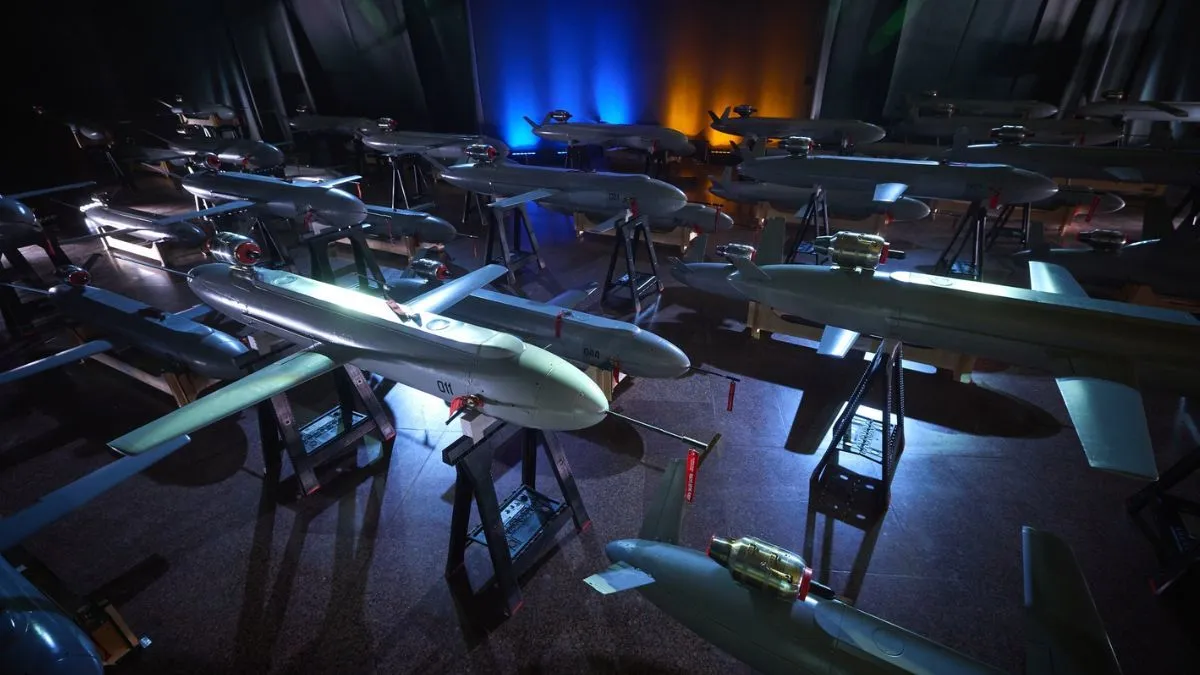
Among them appear to be examples of the Bars, part of a growing family of so-called “drone-missiles,” which combine the features of cruise missiles and uncrewed aerial vehicles (UAVs). Previously, these had been considered as medium-range strike systems, with a maximum range of around 500 miles. Their presence over Moscow would indicate that their range is greater, perhaps evidence that they have been further adapted or reworked.
Bars missiles. (Ukraine Government)
As far as Russian air defenses are concerned, videos from Moscow painted a desperate picture, including at least one likely missile interceptor from a Pantsir short-range air defense system streaking past a Ukrainian drone before making a sharp turn in the opposite direction. In the past, we have seen examples of the Pantsir installed on top of buildings in Moscow, and last month footage appeared showing the counter-drone-optimized SMD-E variant being lifted onto the top of a skyscraper by helicopter.
❗️Impressive footage of the double strike by 🇺🇦Ukrainian FP-1 kamikaze drones on the 🇷🇺Moscow Oil Refinery and a lazily flying Pantsir-S1 SAM missile in the background. pic.twitter.com/sqiDEaPMBS
— 🪖MilitaryNewsUA🇺🇦 (@front_ukrainian) June 18, 2026
Additional footage shows soldiers or security forces using rifle-caliber weapons and man-portable air defense systems (MANPADS) in an effort to bring down drones at very short range.
Fucking chaos.
Several dickheads with rifles and MANPADS trying to shoot down incoming Ukrainian sanctions.
— 𝔗𝔥𝔢 𝕯𝔢𝔞𝔡 𝕯𝔦𝔰𝔱𝔯𝔦𝔠𝔱△ 🇬🇪🇺🇦🇺🇲🇬🇷 (@TheDeadDistrict) June 18, 2026
One video apparently even shows an individual taking aim at a Ukrainian drone using a 9mm Makarov pistol.
For Russian President Vladimir Putin, the very public nature of the attacks on Moscow is especially embarrassing.
The Russian leader had previously warned of impending “systemic strikes” on Ukraine, but Kyiv’s continued ability to hit back at scale, and to target the Russian capital in particular, is now combined with the biting effects of fuel shortages across the country.
In an unusual move, Russia, which is the world’s third-biggest oil producer, is to import fuel by sea this month as it confronts shortages caused by relentless Ukrainian drone attacks on its refineries.
Andrey Gurulyov, a retired lieutenant general and deputy of the state duma (the lower house of the Russian Federal Assembly), called for Russia to “strike the enemy mercilessly” in response to the attack. “We need to strengthen our air defense system, but most importantly, we need to hit the enemy,” he told the RTVI news outlet. “Hit the enemy mercilessly, without overthinking it.”
Just before the latest Ukrainian air attack, President Zelensky said he had held “an important coordination call” with U.S. President Donald Trump and French President Emmanuel Macron that may “bring about significant change.”
Yesterday, Zelensky said he had won key pledges of further support from world leaders attending the G7 Summit in France. “These last few days were very important for Ukraine because it is the reunification of the G7 around Ukraine,” Macron told reporters as he and Trump left the Palace of Versailles near Paris.
In the meantime, with little progress being made by either side on the battlefield, the conflict has increasingly settled into tit-for-tat air assaults on key infrastructure and cities.
Kyiv was this week hit by a major barrage of ballistic missiles and drones, and these, together with the heavy attacks on the Russian capital in the last couple of days, signal a further escalation of the air war between Moscow and Kyiv. Beyond that, this latest barrage on Moscow signals what could be a new, far more aggressive phase of Ukrainian long-range strike operations targeting the economic heart of Russia and its seat of power.
AFTER years of “neglecting” Europe and the UK, Aussie duo Empire Of The Sun return for three sold-out nights at London’s Alexandra Palace next week, proof they are making up for lost time.
“The Empire surges on,” says singer Luke Steele in a quiet moment away from the tour.
Sign up for the Showbiz newsletter
Thank you!
Luke Steele in one of Empire Of The Sun’s trademark costumesFans love Luke’s flamboyant fashionCredit: Unknown
“Empire still feels as intense as ever. It’s like being in a vortex. It’s like Lord Of The Rings when they put the ring on, or when you’re surfing and you’re caught in the wave. Being on this tour is always like that.
“We’ve changed a few things and added a few new songs, and suddenly it changes the ripples of everything else.”
Nearly 20 years after track Walking On A Dream first introduced Empire Of The Sun’s fantastical universe, Steele and non-touring band member Nick Littlemore are bigger than ever.
“It’s incredible because these are our biggest shows and it’s the biggest following we’ve had,” says Steele proudly on a video call.
“It’s exploded in a completely different way, to a whole new generation who are my son and my daughter’s age.
“My daughter Sunny is about to turn 18 and Walking On A Dream came out the week she was born. Nearly 20 years later, it has hit that next generation and it is so reinvigorating. I’m running into kids who are 15 asking, ‘Who’s this new band?’.
“A lot of people have been asking about the band’s outfits — they’re fascinated by the fashion.
“But for so many people, they just hear the songs on the radio or at a party and don’t even know what the band looks like. They’re just captivated by the melodies.”
Empire Of The Sun return for three sold-out nights at London’s Alexandra Palace next weekCredit: UnknownLuke Steele on stage in 2024 in Perth, AustraliaCredit: Getty
Steele is in Budapest to perform, and he has just got back from a scooter ride around the city’s sights on a rare day off.
The pair have survived near burnout and band tensions, but Steele says the music always pulled him back and now he feels the healthiest and sharpest he has ever been.
“We always had great shows in the UK, but it felt like we’d lost a bit of steam by not touring there frequently. Then the pandemic was tough — five years not being able to tour and stuff — so maybe now we’re making up for lost time.”
Last summer’s sold-out Labyrinth On The Thames show at Greenwich’s Old Royal Naval College was Empire Of The Sun’s first London performance in more than six years.
“That was special. It was amazing,” Steele says. “So it’s great we are coming back to the UK — to London and also Cardiff and Halifax — which I am told is right at the top of the UK but not as far as Scotland.” His music is better than his geography.
Empire’s return has meant more than just filling venues. It is about the band’s influence on the fans, who have found their own lives reflected in the songs.
“The music is so important. It’s important for us, for our sanity, but it’s amazing what the records have been doing to people,” he says. “I feel a bit more like a conduit now. I’ve been handed these keys, and it’s like, what are you going to do with them? What doors are going to open?”
“I have to harness that power of influence in a clever, natural way.
Steele says touring feels ‘like being in a vortex’ and can be emotionally intenseCredit: GettyLuke with bandmate Nick Littlemore
“Coming back with the new show and writing new records post-pandemic, it feels like the songs need to have new revelations and new messages in this crazy world.”
Steele reckons part of the success of Empire Of The Sun’s performances has been down to his live band, which includes former Gomez guitarist Ian Ball and drummer Olly Peacock.
“They are the greatest players — really seasoned musicians, which is incredible to have,” says Steele. “People with experience are worth everything in touring. Ian is my right-hand man. The one and only.
“You rehearse for three months, then you get up in front of 80,000 people and suddenly my in-ear pack goes down, or the pedalboard dies. Ian is so calm. He just mooches over, cool as a cucumber, sorts it out and comes back before I’ve even noticed.”
Steele says having a great team behind him means he can execute the ideas he has been inspired by.
“There are quite a few songs from Ask That God in the set.
“We always play the hits, like We Are The People and Alive, because that’s important for people’s memory, and then there are a couple of throwbacks from the earlier records.
“It’s about trying to fit it all in without it becoming an exhausting meal for people.
The frontman says moving back to Australia has been ‘awesome’ after two decades awayCredit: GettyThe band are currently working on a new record after sessions in Hawaii, LA and Sweden
“The first show probably had too many songs — like eating that last chicken wing at the Chinese buffet, where you walk out thinking you’ve had too much. It’s a fine line.
“I don’t like those shows where bands play for three-and-a-half hours. I want to see a concert, get blown away, and go and put my pyjamas on. You don’t want to lose people.”
Almost two years into the Ask That God tour, Steele is still pushing the show forward.
He says: “It’s so exciting and exhilarating, and then there are the fans who mean so much.
“It always sounds so cliched to me, to talk about ‘the fans’ but as I’ve got older and seen their dedication they become like your friends. It’s more than someone buying an album. The music seeps into their lives.
“The other day I met this girl who showed me a video of her three-year-old kid dancing to one of our songs. It’s amazing to be so far away from home and see how much the music touches people.
“We played Poland recently and this girl had spent months making these elaborate Salvador Dali and Escher-style collage illustrations for each song. She printed them all in a book and had written a personal note at the end.
“People really go on the journey with us, so I’m pretty thankful.”
Being away for long periods from his own family in Australia is what hits Steele the hardest.
“I’m not really going home until Christmas. We go from here to the American tour and it just keeps going, but they’re all coming out to the UK shows.
“I find it hard. I go through different stages of exhaustion and depression, excitement and exhilaration. It’s like a wave.
“I feel quite fragile because I’m so emotional. Being on the road is a real vortex. And when you get home it’s not easy — this pipe burst in the front bathroom of my new house I bought in Perth, and 700,000 litres of water flooded the whole house.
“When I came back from tour in January from Miami, it was just like a swimmingpool, so everything’s been gutted now. It’s just all concrete, so we’re in a rental for a while — we’re pretty much homeless now.”
After living in the US then New Zealand, Steele moved back to Perth to be closer to his family.
Steele, who was living in America during Donald Trump’s first presidency, says the country’s extremes fed into his songwriting.
“I had to go because I was writing so many aggressive songs. Now I’m back where I grew up and it’s been awesome,” he says.
“I haven’t lived there for 20 years, so it’s a perfect amount of time to get over the regret, you know?
“And it’s been good to be the hometown hero.
“Walking On A Dream became the soundtrack for Tourism Western Australia’s global campaign and it is even named after that song.
“There’s also a music room at my school named after the family. It feels kind of cool to be given the keys to the city, where it all started.”
Steele lost his dad, blues musician Rick Steele, last year and he recently paid tribute to him with a night of blues.
“It was the one-year memorial and it was awesome to come back together, remember him and play the blues. The blues club he belonged to is stronger than ever, which is great.
“I didn’t want him to pass away and then the club to fall over. His legacy moves on, and we’re about to do a grant the Steele family has started — the Rick Steele Music Grant.
“We’ve also got a plaque on a park bench just down the road from his house, where he lived his whole life. He used to go there most mornings, get a coffee and sit on that bench. I think he’d think that was pretty cool. He’s got his own bench there.”
For Steele, that sense of legacy, home and survival has fed back into the music.
“It’s a good spot to be, because I feel the sharpest I’ve ever been and the healthiest. I got rid of all of that garbage, all the drugs and alcohol, years ago.
“It was music that helped me to heal by writing every song and playing, recording and mixing it myself.
“Music is still such a powerful phenomenon and medium. It’s a healer. It brings renewal, hope and vision.
“Music was always the vessel, even after I said the band was done and went off to write a solo record.”
That sense of purpose also seems to have softened the creative tension between Steele and Littlemore.
They have not always seen eye to eye, but time, distance and their separate lives have made the partnership easier to understand. It’s like a marriage that works because both know when to step away.
“I think Nick and I have been good at that,” he says.
“We probably spend more time apart than together and, when we come together, it’s quite focused on the job at hand.”
After side projects — Littlemore is the frontman of electronic trio PNAU — and an eight-year gap between third album, Two Vines, and the release of 2024’s Ask That God, time apart now seems to be part of how Empire Of The Sun have survived.
Steele says: “When we came back, it was like, OK, we’re older now — what are we actually talking about? What’s the real meaning? So we’re trying to bring more of that into the show and the theatrics.
“But I think now we can sit back and soak in the fruits of our labour a bit.
“For a while, you’re just trying to hold on to it, because you spend your whole life trying to get to a point where people are actually listening.
“Now we have people’s attention, we have to treat that with respect and not take it for granted.
“I haven’t spoken to Nick for a while, but we’ll probably start talking more now we are about 45 songs into the new record and trying to finish a huge batch of songs. It’s definitely going to be a little bit more edgy.
“We’ve been working with different producers and in Hawaii, LA and Sweden. Each territory brings different colours.
“Working with these different people, from different places gives you beautiful ingredients.”
But before new music arrives, there is the small matter of shows in Halifax, Cardiff and three sold-out nights at Alexandra Palace.
It is surely a pinnacle moment, which Empire Of The Sun have been building towards for nearly 20 years.
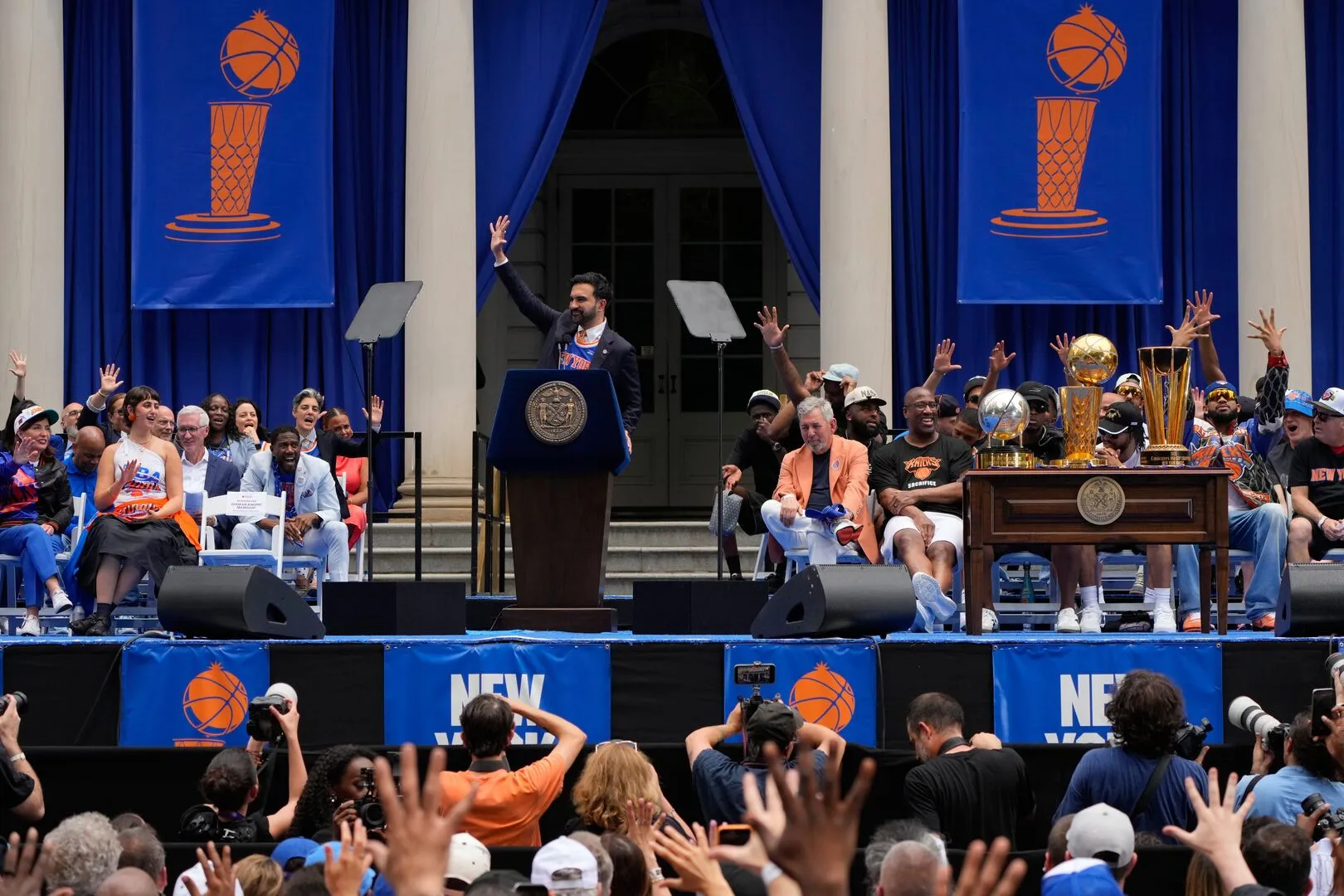
The New York Knicks celebrated their first NBA title in 53 years with a frenzied ticker-tape parade through Manhattan. The Knicks, along with finals MVP Jalen Brunson were awarded keys to the city by Mayor Zohran Mamdani in front of thousands of fans.
All five goals were scored in the final 30 minutes as the match in Los Angeles erupted to life in closing stages.
Published On 18 Jun 202618 Jun 2026
Johan Manzambi scored a late brace after coming on in the 71st minute, following goals from Ruben Vargas and Granit Xhaka as Switzerland erupted late for a 4-1 victory over 10-man Bosnia and Herzegovina to top Group B at the World Cup.
The last three Swiss goals at the Los Angeles Stadium followed the 80th-minute dismissal of Bosnian defender Tarik Muharemovic, who was sent off for hauling down Breel Embolo to deny an obvious goalscoring opportunity, in a dramatic finish to the match on Thursday.
Recommended Stories
list of 4 itemsend of list
When it was all finished, Switzerland, with one win and a draw, were in command of the group despite an unexpected 1-1 draw against Qatar in their tournament opener.
Qatar and Canada play in Thursday’s later Group B clash in Vancouver, where the winner will draw level on points with the Swiss side that’s looking to progress to the knockout phase for a fourth consecutive World Cup.
Bosnian substitute Ermin Mahmic scored with a thunderous volley in second-half stoppage time for Bosnia and Herzegovina, who remain on one point.
Ermin Mahmic scored his team’s only goal against Switzerland [Harry How/Getty Images/AFP]
But the Balkan side will need to be more adventurous in their group finale against Qatar to have any chance of progressing after offering little against the Swiss.
All five goals they have conceded have come after the 70th minute, including the equaliser in their 1-1 tournament-opening draw against Canada.
Yet it looked for long stretches like Bosnia’s cagey approach would work until Switzerland coach Murat Yakin sent on Manzambi.
Shortly after his own introduction, Vargas got free on the left and curled in an outswinging cross towards the back post.
Amar Memic tried to head clear, but Manzambi instinctively met the second ball near the penalty spot and thumped a vicious side volley that had too much power for Bosnian goalkeeper Nikola Vasilj.
Any realistic hopes of a positive Bosnian result ended six minutes later when referee Joao Pinheiro had no choice but to produce a red card for Muharemovic’s late challenge from behind.
Four minutes later, Vargas found the bottom right corner after Embolo held the ball up near the spot and then played it to his open teammate to his left.
Vargas was the provider when Manzambi completed his brace in the 90th minute, and after Mahmic pulled a goal back, the veteran Xhaka converted from the penalty spot seven minutes into second-half stoppage time.
The classic Chicano film “Zoot Suit” is celebrating its 45th anniversary this year in style.
The Golden Globe-nominated movie, featuring a lead performance by Edward James Olmos, was based on a stage play penned by legendary screenwriter and director Luis Valdez, who drew inspiration from a pamphlet about the 1942 Sleepy Lagoon murder case and the riots that it sparked.
On Thursday it was announced that the flick will be screened at The Ford amphitheater on July 8 to honor its notable benchmark and enduring legacy. The special screening will include a conversation with Valdez, Olmos and actor-educator Cristina Frías, who will discuss the movie’s production, influence and place in the L.A. film canon.
“‘Zoot Suit’ changed the way our stories could be seen on screen,” Olmos said in a statement. “It gave voice to a history that many people had never been taught and showed the beauty, strength and complexity of the Chicano experience. Forty-five years later, the film continues to inspire because it is about more than one moment in time. It is about identity, dignity and the responsibility we have to remember where we come from.”
The screening will also feature a vintage car show put on by the Pachuco Car Club, which will showcase the rides reminiscent of the time period shown in the movie.
In June 1943, L.A. was engulfed in the lawlessness and violence that became known as the Zoot Suit Riots. The name is misleading because it suggests that the zoot suiters — the young Mexican, Black and Filipino men and boys who wore the flamboyant outfits — were the perpetrators.
The attacks by servicemen and white Angelenos on zoot suiters, derided as “gamin dandies” in The Times, were driven by prejudice and the anti-immigrant attitudes of the era. The roots of the unrest can be traced to events that occurred more than a year earlier — such as the incarceration of Japanese Americans after Pearl Harbor, as well as the murder of a young man, which was later known as the Sleepy Lagoon murder case.
In his 1981 review of the film, The Times’ former film critic Kevin Thomas praised Valdez’s direction and the strength of the cast.
“Valdez has captured well many of the elements of the era that contributed to the fate of the Sleepy Lagoon defendants — the sensationalist press, the feverish patriotism of wartime and the rampant bigotry directed at all minorities,” Thomas wrote. “At the same time, Valdez makes clear that various people outside the Mexican-American community helped in the struggle to mount an appeal for the Sleepy Lagoon defendants. And he questions the entire validity of the switch-bladed, cynical pachuco mystique as [Daniel Valdez’s] Henry comes to realize that El Pachuco [Olmos] is at once his best friend — and worst enemy.”
The original 1979 Broadway run of the “Zoot Suit” play catapulted Olmos to the national stage and led to him getting a Tony nomination for best featured actor in a play.
“It was a monumental moment in time, and we captured lightning in a bottle,” Olmos told The Times in 2023. “Not only did it change the course of Latinos in theater but it touched the very soul of the culture. It was catching the voice of the pachuco.”
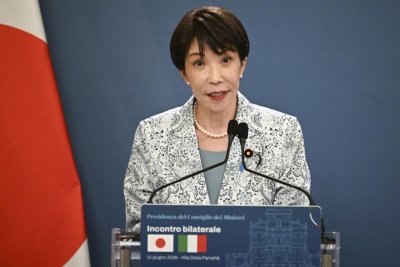
Japanese Prime Minister Sanae Takaichi speaks to the press during her meeting with Italian Premier Meloni at Villa Pamphilij in Rome, Italy, 15 June 2026. Photo by Riccardo Antimiani / EPA
June 18 (Asia Today) — Japanese Prime Minister Sanae Takaichi has left open the possibility of deploying the Self-Defense Forces to the Strait of Hormuz following an agreement between the United States and Iran to end hostilities.
“Nothing has been decided at this point,” Takaichi said Wednesday when asked about a possible deployment during a news conference marking the end of the Group of Seven summit near Évian-les-Bains, France, Japanese media reported Thursday.
Takaichi said Japan must closely examine the U.S.-Iran agreement and conditions in the region before making a decision.
The Strait of Hormuz is a critical shipping route for crude oil from the Middle East. Instability in the waterway could directly affect shipping, energy prices and Japanese industry because the country relies heavily on imported energy.
The U.S.-Iran agreement has shifted Japan’s immediate focus from preventing further fighting to securing freedom of navigation and considering its role in post-conflict efforts.
Even after fighting ends, naval mines and other threats to commercial vessels could remain. Japan would then have to determine whether its involvement should be limited to diplomatic support or include operations by the Maritime Self-Defense Force.
Security in the Strait of Hormuz and other major shipping routes was among the issues discussed at the G7 summit.
Japan faces the challenge of coordinating with its allies and partners while keeping any military involvement within the limits imposed by its pacifist Constitution.
“We will continue every possible diplomatic effort, including those related to reconstruction,” Takaichi said of the situation in the Middle East.
She said Japan would consider necessary measures to secure freedom of navigation through the strait and “steadily carry out what we are capable of doing,” including diplomatic efforts.
Britain, France and other countries have called for the unconditional reopening of the waterway and indicated that mine-clearing operations could be required. Japan has signaled its willingness to participate in a related joint statement.
Takaichi said Japan’s participation in such a statement would remain within constitutional limits.
The central issue is how extensively the Self-Defense Forces could participate.
Article 9 of Japan’s Constitution prohibits the use of force except in circumstances involving the country’s right to self-defense. Mine-clearing operations conducted while fighting continues could therefore be viewed as the use of force against the country that placed the mines.
Clearing mines left behind after a cease-fire, however, may be permitted under Japan’s Self-Defense Forces Act.
Japan deployed Maritime Self-Defense Force minesweepers to the Persian Gulf after the 1991 Gulf War cease-fire. The mission marked the Self-Defense Forces’ first operational deployment overseas and became a turning point in Japan’s debate over its international security role.
Takaichi’s remarks did not amount to an immediate deployment decision. They indicated, however, that Japan could consider participating in maritime security operations depending on implementation of the U.S.-Iran agreement and conditions in the Strait of Hormuz.
Japan’s possible role in the post-conflict Middle East – whether limited to diplomatic and reconstruction support or expanded to include Maritime Self-Defense Force operations – is expected to remain a major foreign and security policy issue.
United States President Donald Trump has taken to social media to boast about the state of the economy amid a looming peace deal between the US and Iran, which yesterday signed a memorandum of understanding (MoU) to end the US-Israel war on Iran.
In a post on his social media platform Truth Social, the president claimed that “OIL IS FLOWING” and added that “THE STOCK MARKETS ARE ROARING, JOBS ARE AT RECORDS, AND PRICES ARE DROPPING (AFFORDABILITY!)”
Recommended Stories
list of 4 itemsend of list
While some of his claims are accurate, others are misleading. Al Jazeera takes a look:
‘Stock Market Just Hit A RECORD High’
That is true specifically for the Dow Jones Industrial Average. That index hit a record high of 51,999.67 for its close on Tuesday amid the potential of a ceasefire and a rally for the newly listed SpaceX.
The Dow slipped from that high on Wednesday amid the US Federal Reserve’s announcement that it would maintain the benchmark interest rate in the target range of 3.5-3.75 percent, and closed down on Wednesday at 51,494.99. The Dow has since jumped 0.35 percent in midday trading on Thursday at 51,671.
The Nasdaq Composite Index and S&P 500 both slipped.
However, this may not directly impact the 38 percent of Americans who do not invest in the stock market.
“The idea that the stock market is doing well does not reflect people’s experiences. There’s a saying that the stock market is not the economy, and that’s an important thing to keep in mind,” Michael Klein, professor of international economic affairs at The Fletcher School at Tufts University, told Al Jazeera.
And that lived experience is at the petrol station and at the grocery store.
‘Prices are dropping’
Petrol prices have started to tumble in the last few days. The average price of a gallon of petrol (3.78 litres) on Thursday is at $3.99, according to the American Automobile Association (AAA), which tracks daily gas prices. That’s down from a high of $4.48 in May, but still well above $2.98, where prices were on February 28 when the US and Israel first struck Iran.
Despite the deal, experts believe that a petrol price decline will plateau for general consumers as the US strategic petroleum reserve, which earlier this week reached its lowest level since 1983, is refilled, all while oil extraction and shipping bottlenecks weigh on supply chains.
“The persistence of the price spikes is the key issue. Transportation, rerouting, insurance premiums, and manufacturing costs don’t normalise overnight, so even when oil stabilises, the cost base across the supply chain will stay elevated,” Tammy Kulesa, director of product marketing for supply chain execution at Blue Yonder, a supply chain management firm, said in remarks provided to Al Jazeera.
Mark Jones, professor of political science at Rice University in Houston, Texas, says prices will not return to prewar levels until the last quarter or close of 2027.
“Even once everybody believes the truce is going to hold [and] there’s no danger going through the Strait of Hormuz, those tankers take months to reach their final destination and come back,” Jones told Al Jazeera. “So the ability to replenish the stocks is going to take until, I think, the early fall [third quarter].”
Consumer inflation, which has jumped at the fastest pace in three years and is at 4.2 percent, has driven prices up on several key goods and has weighed on consumers. While energy prices have risen by nearly eight percent in the last two months alone, prices at the supermarket have jumped by 0.1 percent in May from the month prior after a 0.7 percent increase in April, with the highest increases in goods like bakery products, cereals, nonalcoholic beverages, as well as fruit and vegetables.
“There are real problems facing a lot of people. Prices are high, and wages have not kept up with prices. So people’s real purchasing power has fallen,” Klein said.
Supermarket chains have taken notice. Kroger, the largest supermarket chain in the US, said on Thursday that it will cut prices on thousands of products within its roughly 3,000 stores nationwide. This comes amid increased pressure from Costco and Walmart for value shoppers.
“Customers are being more deliberate with their spending and at times, shopping us selectively. We’re getting too many promotional trips and not enough of the full basket,” Kroger CEO Greg Foran said in a statement.
‘Jobs are at records’
Jobs are not at record levels, despite Trump’s assertions.
The US economy added 172,000 jobs in May. The highest during the second Trump term was 214,000, in March. By comparison, on average, 300,000 jobs were added monthly under his predecessor, former US President Joe Biden, a Democrat, with some months much higher – including July 2021, when the economy added 943,000 jobs, albeit that was on the back of the COVID-19 pandemic as businesses rushed to hire after massive layoffs.
Under Trump, there have been several months of limited job growth that have been hyper-focused on specific sectors like healthcare. On average, employers added only 15,000 jobs a month in 2025. Meanwhile, the US economy lost 92,000 jobs this year in February.
Layoffs are also on the upswing. Job cuts jumped 16 percent between April and May, marking the most layoffs since May 2020 during the height of the pandemic, according to Challenger, Gray and Christmas, with artificial intelligence (AI) as a driving force behind the cuts. Slightly more than 97,000 people lost their jobs in May.
‘Oil is flowing’
Overnight, 12.5 million barrels of crude oil travelled through the Strait of Hormuz, through which roughly a fifth of the world’s oil is normally shipped, according to US Vice President JD Vance. However, data from Kpler shows that travel through the strait is still low, with six verified crossings on June 17.
With the strait starting to open, oil prices tumbled to their lowest levels since the early days of the war as the temporary deal to end fighting and pull back sanctions elevated pressure on global supply.
Brent crude futures LCOc1 dropped $0.78 or one percent to $76.51 in midday trading.
Shipments of liquefied natural gas (LNG) have also ramped up, and a QatarEnergy LNG vessel has returned to Ras Laffan, where it has loaded more than 209,000 cubic metres, according to Kplr.
SUPERMODEL Irina Shayk runs rings around her rivals in a swimsuit held together by gold bands.
She also wore gold hoop earrings in a shoot for Spanish department store El Corte Ingles and showed off her wild side in a tiger-print bikini.
Sign up for the Showbiz newsletter
Thank you!
Irina Shayk stuns in a swimsuit held together by gold bandsCredit: El Corte Inglés/Txema YesteThe model was posing in a shoot for Spanish department store El Corte InglesCredit: El Corte Inglés/Txema Yeste
She has become one of the modern modelling industry’s greats after being discovered in her small Russian hometown of Yemanzhelinsk.
Irina, whose full name is Irina Valeryevna Irinahlislamova, received international recognition when she became the first Russian model to appear on the cover of the 2011 Sports Illustrated Swimsuit Issue.
As a child, she pursued her love of music while her mum Olga worked two jobs to provide for the family.
It’s no surprise that Irina has become the model with the 8th biggest social media presence, as she’s graced numerous magazine front covers, including GQ.
Irina was the first Russian model to appear on the cover of Sports Illustrated Swimsuit IssueCredit: AP:Associated PressIrina is mum to nine-year-old Lea — whose dad is her ex, Hollywood actor Bradley CooperCredit: Rex Features
The stunning star has also been ranked first in the 50 Hottest Russian Women list, which was compiled by Complex magazine.
When she’s not busy walking the catwalk or filming, Irina gets stuck in with charity work.
Irina has been heavily involved with the construction of a maternity ward in her hometown, Yemanzhelinsk, as well as helping to renovate the children’s section.
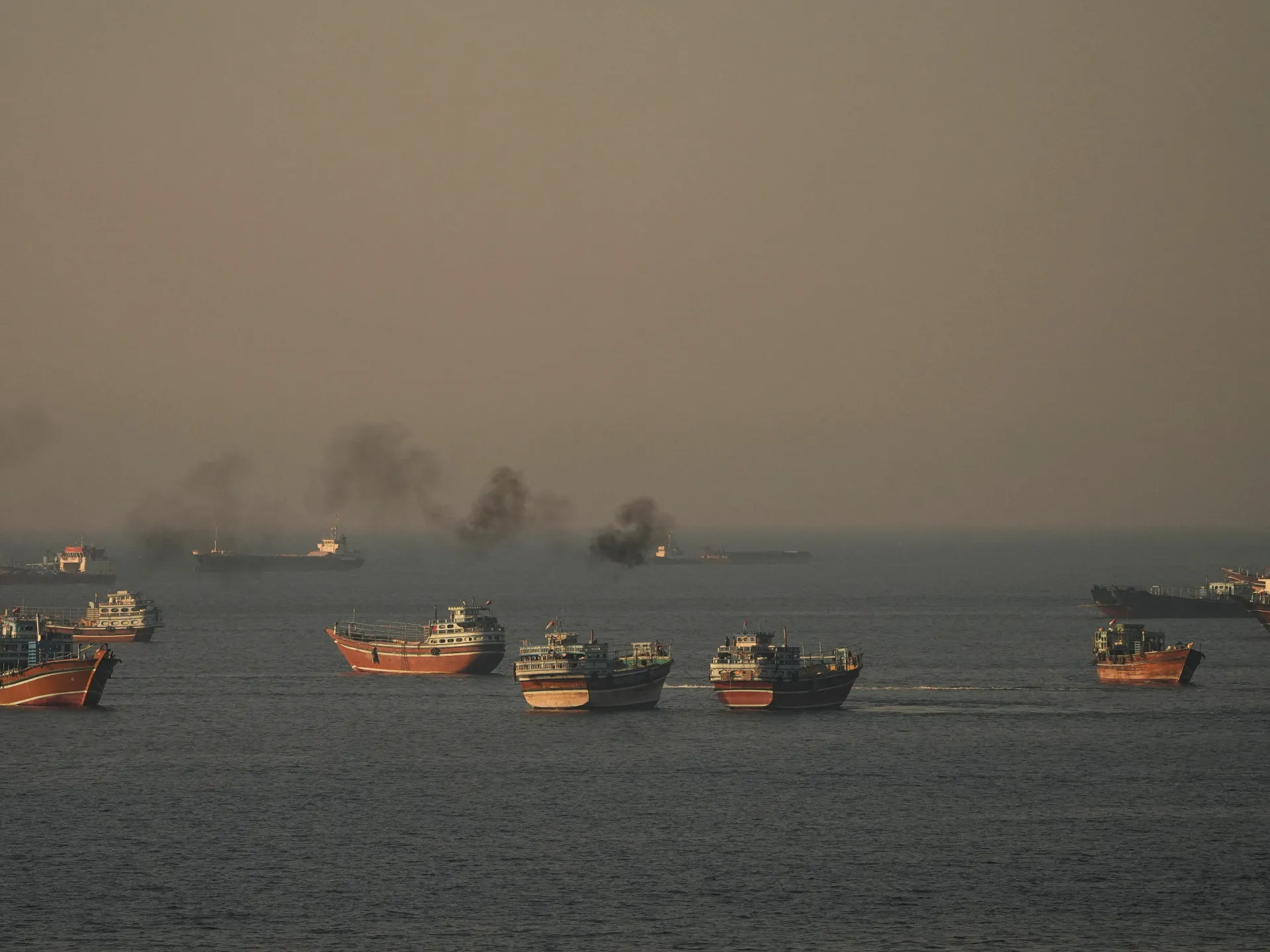
June 18 (UPI) — The U.S. military on Thursday lifted naval blockades in the Persian Gulf and Gulf of Oman, with reports showing that shipping vessels have departed the region through the Strait of Hormuz.
U.S. Central Command said in a series of posts on X that, following direction from President Donald Trump, blockades on maritime traffic along the coasts of Iran have ended.
Centcom noted, however, that the U.S. Navy will stay in the “general area” to be sure that “all aspects” of the peace agreement signed by the United States and Iran “are adhered to, obeyed and in full force and effect.”
Trump signed the agreement Wednesday at the Palace of Versailles in France after the G7 Summit wrapped up, which included among its 14 points reopening the Strait of Hormuz, which is a vital shipping route for the region and much of the world.
Iranian President Masoud Pezeshkian had signed the deal earlier in the day.
“American forces are not impeding the transit of vessels to or from Iranian ports,” Centcom said in one of the posts on X on Thursday.
“All U.S. military blockade efforts have ceased,” it said.
At least 12 energy tankers transited the Strait on Thursday, reopening a sailing route through which roughly 20% of the world’s oil supply is shipped around the globe, CNBC and the New York Post reported.
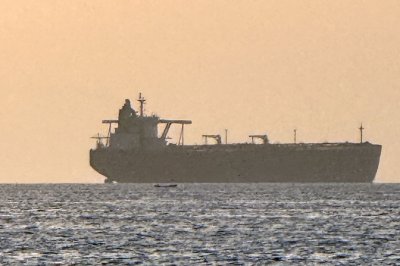
Among the vessels that transited the Strait were three Saudi Arabian supertankers, which together are carrying six million barrels of crude oil and are the kingdom’s first tankers to sail the shipping route since before the three-month-long U.S.-Iran war launched in February.
Vice President JD Vance also told reporters that more than 12 million barrels of oil had shipped through the Strait overnight Wednesday after the deal had been signed.
For years, the Boko Haram and the Islamic State West Africa Province (ISWAP) terror groups have told Muslims in Nigeria and the Lake Chad Basin that the world outside their camps is not merely corrupt, but that living in it constitutes unbelief. They reinforce this stance through the misinterpretation of scripture, selective history, and the authority of armed men. They use terms such as tawheed (monotheism), hijrah (migration), bay‘ah (allegiance), jihad, daulah (sovereign state), Darul Islam (abode of Islam), Darul Kufr (abode of unbelief), and takfir (excommunication).
To the ordinary ear, it may sound like religion, but beneath the vocabulary is a hard political claim: only their authority can certify Islam. Through this doctrine, they decide who is allowed to live, who must die, who is Muslim, who is no longer Muslim, which land is pure, which land is condemned, which ruler is apostate, and why a farmer, teacher, cleric, trader, voter, soldier, journalist, or civil servant can become a target.
The Takfir
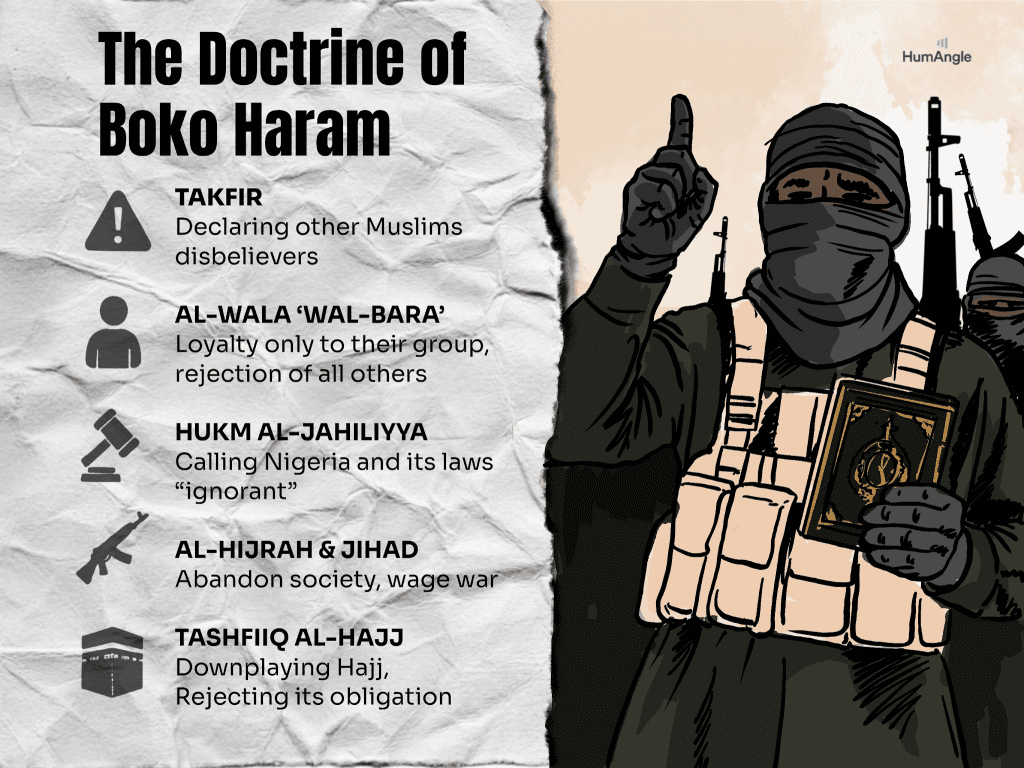
At the centre of this war is takfir, the act of declaring a professed Muslim to be an unbeliever. Mainstream Islamic scholarship treats takfir as a grave matter. It requires knowledge, evidence, context, intention, and due process. A Muslim does not leave Islam because he lives under a flawed state, or because he carries an identity card, works in a hospital, teaches in a school, votes in an election, or refuses to migrate to a forest camp – all of which the terror groups view as signs of belief in Western values.
Boko Haram, or Jama’atu Ahlis-Sunna Lidda’Awati Wal-Jihad, shortened as JAS, loyal to Abubakar Shekau, decreed that if you did these things, you were suspect. The most frightening part of Shekau’s doctrine was that he demanded others declare the same people unbelievers, too. If he declared a Muslim in Maiduguri an unbeliever because he lived under the Nigerian state, then ISWAP also had to declare that person an unbeliever. If ISWAP refused, Shekau’s logic turned against the group; they too became unbelievers because they failed to excommunicate those he had excommunicated.
This doctrine explains why JAS could kill villagers, denounce scholars, attack mosques, murder defectors, bomb displaced people, and fight ISWAP while still claiming to defend Islam. In Shekau’s universe, the circle of Islam narrowed until only his faction stood inside it. Everyone else stood outside the gate.
The doctrine of Boko Haram. Illustration: Akila Jibrin/HumAngle.
Colonial rupture and the question of authority
Abdulbasit Kassim, assistant professor of religion and classics at the University of Rochester, who specialises in the histories and cultures of Muslim societies in West Africa, places this doctrine inside a longer history. He argues that the question did not begin with JAS but reaches back into debates in Muslim West Africa over land, power, law, colonial rule, and the status of Muslims living under non-Islamic authority.
“Before colonial rule, much of what is now northern Nigeria, southern Niger, northern Cameroon, and western Chad belonged to a wider region known as Central Bilad al-Sudan. Muslim polities such as the Sokoto Caliphate and the Kanem-Borno Empire governed social, economic, political, and legal life through Islamic norms,” he said.
Colonialism disrupted that order. By conquering territory, the British introduced a hierarchy of laws in which Islamic law survived, but with a narrowed jurisdiction. Sharia courts continued in civil matters, especially marriage, inheritance, and family disputes. Criminal punishments under the Islamic canon became restricted, weakened, or rendered practically dormant.
“After 1999, when Zamfara State under Ahmad Sani Yerima revived the criminal aspect of Sharia, old tensions returned,” the professor added. “Some scholars and activists welcomed it as a restoration. Others argued that full Sharia could not operate inside a constitutional democracy where any law inconsistent with the 1999 Constitution could be struck down.”
JAS, evidently, did not emerge in a vacuum. Kassim said, “Mohammed Yusuf rejected Nigeria’s Sharia implementation because, to him, it remained trapped inside a secular constitutional order.” For him, it was not enough for a northern governor to introduce Sharia penal codes. The state itself had to be Islamic. Its sovereignty had to come from Islamic political precepts, not a constitution inherited from colonial rule. This is where the movement’s argument becomes more dangerous. It is not only saying that Nigeria fails to implement Sharia properly, but that the entire political foundation of Nigeria is illegitimate.
To Kassim, figures such as Ibrahim Zakzaky and Mohammed Yusuf shared one major point, even though their methods and movements differed. “They rejected the possibility of fully reconciling the Islamic juridical canon with Nigeria’s inherited secular constitutional order.”
This was the opening JAS exploited.
Screenshot of a 25-page book cover by Abubakar Shekau, where he explains his own interpretation of Islam, his arguments against the people he declared as Taghut and the arguments against Western schools.
Nigeria as Darul Kufr
After JAS’s leaders convinced followers that the Nigerian state was illegitimate, the movement moved to the next step: migration. If Nigeria is Darul Kufr, the abode of unbelief, then Muslims had a duty to leave it, they said. If JAS’s territory was Darul Islam, the abode of Islam, then migration into its territory became a religious obligation. The group took an old legal category and weaponised it to control territory, Kassim argued.
This was not abstract in Borno, Yobe, Adamawa, Niger, Chad, and Cameroon. It meant families were pressured, threatened, abducted, or killed. Villages were told to submit. People who remained under government control became suspects; those who cooperated with the military became enemies; those who joined the Civilian Joint Task Force (CJTF) and their families became legitimate targets in the eyes of the insurgents; and traditional rulers, clerics, teachers, and government workers became exposed.
Shekau then stretched the doctrine further.
According to Kassim, “Shekau held that Muslims living under the Nigerian state were no longer Muslim if they refused to migrate into JAS-held territory. ISWAP contested this. It did not accept Shekau’s blanket takfir against all Muslims living in government territory. ISWAP argued that such Muslims became unbelievers only if they gave material support to the Nigerian state or its security forces in the war against the insurgents.”
This difference shaped the split between the factions. ISWAP still accepted the larger jihadist fiction that the Nigerian state was illegitimate and that true authority flowed from the Islamic State. It still treated soldiers, political rulers, security officials, and those directly supporting the state’s war effort as apostates. It still imposed taxes, punishments, surveillance, recruitment, and control over civilians. It still placed armed authority above the lived Islam of communities that had practised the faith for generations.
The difference between Shekau’s terror and ISWAP’s brutal governance is the difference between reckless excommunication and structured coercion. One faction burned the village and shouted scripture. The other taxed the village, citing the doctrine. Both denied ordinary citizens the right to live safely and peacefully.
The internal civil war
Kassim captured this danger years ago in his 2018 study, JAS’s Internal Civil War: Stealth Takfir and Jihad as Recipes for Schism. He wrote that the internal war between JAS factions could only be understood through “a close reading of the constant stream of primary sources produced by the two factions”.
Kassim wrote a sentence that still sits heavily over this conflict: “Those who kill know why they kill, but the majority of those about to be killed will hardly understand why they are being targeted.”
Get our in-depth, creative coverage of conflict and development delivered to you every weekend.
Subscribe now to our newsletter!
That is the tragedy of takfir in the Lake Chad war.
A farmer on his way to the field may not know the difference between JAS and ISWAP doctrine. A displaced woman in a camp may not know what Shekau wrote about Darul Kufr. A trader at a market may not have heard of Abu Malik al-Tamimi, Anas al-Nashwan, or the arguments ISWAP sent to Islamic State scholars. A village imam may know the Qur’an, but not the way and manner in which insurgents interpret it. Yet their lives can be judged based on those interpretations.
Shekau saw ISWAP’s caution as a compromise and that is where the blood began to flow inward. Kassim explains that Shekau’s rigidity helped push internal revolt. Ansaru had earlier objected to JAS’s killing of Muslims and the violation of what its leaders considered the ethics of jihad. Later, Abu Musab al-Barnawi and Mamman Nur moved against Shekau from within the Islamic State framework. They accused him of extremism, arbitrary killing, and corruption of the cause.
What Boko Haram and ISWAP condemn. Illustration: Akila Jibrin/HumAngle.
Civilian life as suspicion
Kassim’s 2018 chapter recorded that Shekau viewed people living beyond JAS’s controlled territory as infidels and therefore legitimate targets within Darul Harb (abode of war). He also noted that Shekau’s position was harsher towards those who fled from JAS territory to areas controlled by the Nigerian state. In that logic, their camps, mosques, markets, and places of refuge could be attacked until they repented and returned.
ISWAP challenged part of this logic. Abu Musab al-Barnawi argued that Muslims who had always lived outside JAS territory could not be declared unbelievers merely for that reason. In his view, they crossed the line when they gave active or passive support to the Nigerian Army, the Civilian JTF, or other forces fighting the insurgents.
Abu Musab died in Kaduna, northwestern Nigeria, an area that both JAS and ISWAP consider Darul Kufr. This may partly explain ISWAP’s relative fluidity on the issue, compared with JAS.
HumAngle spoke to a former JAS shura member who later joined ISWAP. He subsequently completed the Nigerian government’s deradicalisation programme and now lives freely in Maiduguri. He says the Shekau faction does not recognise the Islam of Nigerians, Saudis, or anyone outside its creed. “To them, whoever is not with them is an unbeliever. Saudi Arabia is no different from a non-Muslim society in their imagination. It is simply another land of unbelief.”
He said ISWAP classifies Muslims living in Nigeria, Cameroon, Chad, Niger, and other states into categories. Those who can migrate but refuse to do so are sinners, not necessarily unbelievers. Their offence is treated as a major sin. The weak, the elderly, women, children, and those without means may be excused. Those who remain outside insurgent territory while openly challenging secular rule and calling people to Islamic governance may even be rewarded. In his telling, Mohammed Yusuf’s preaching before 2009 fits this category.
But those who join the democratic system, legislate, govern, enforce state authority, or fight under the security forces enter a more dangerous category. Politicians and legislators become tawaghit (false gods). Security officials become direct enemies. Soldiers, police officers, Civilian JTF members, and others who bear arms against the insurgents are treated as apostates whose blood is lawful to be spilt.
Doctors and teachers sit lower in ISWAP’s hierarchy of offence. They are not treated the same way as soldiers or politicians, but they still operate inside a system the group condemns.
This is the cold bureaucracy of ISWAP’s worldview. It sorts society by perceived allegiance, measuring sin by proximity to the state. The former Shura member called JAS a Khawarij-type movement because of its sweeping excommunication of Muslims. He said Shekau and his followers misused verses on oppression, migration, and disbelief. They took verses that classical exegetes treated with care and turned them into proof that any Muslim living in Darul Kufr had committed major shirk.
The key verse in their argument comes from Surah An-Nisa, where angels question those who wronged themselves and failed to migrate when Allah’s earth was spacious. ISWAP reads this as a grave warning against remaining in a land where Islam cannot be practised fully. Still, it leaves room for categories such as weakness, inability, and sin below disbelief.
The former shura member says Shekau’s faction then links this to another Qur’anic discussion of zulm (oppression), or wrongdoing, in which classical explanations connect the greatest zulm to shirk (polytheism). From there, JAS concludes that staying in Darul Kufr is not merely a sin but a state of unbelief. That leap is where the danger sits.
The former Shura member said JAS uses this belief to seize wealth, abduct people, kill travellers, attack farmers, and justify arbitrary violence.
Why Hajj became secondary to war
ISWAP and the wider Islamic State network, the former shura member explains, take a more layered position on Hajj (pilgrimage to Mecca), which is generally regarded by Muslims as one of the five pillars of faith. “They still recognise Hajj as an obligation for Muslims who have the means. But they argue that tawheed has been corrupted worldwide and that restoring it through jihad takes priority. In practice, a wealthy fighter should not spend money on Hajj. He should donate it for weapons.”
Islam makes Hajj one of its five pillars. ISIS and ISWAP do not always deny that in theory, but they demote it in practice. They turn the battlefield into a higher obligation that suspends pilgrimage, family obligations, learning, work, charity, and ordinary religious life.
The anonymous source says senior Islamic State scholars issued rulings that no mujahid should spend his money on Hajj when he can spend it on arms.
They take a religion structured around testimony, prayer, fasting, zakat, and pilgrimage, then reorder it around obedience to commanders and permanent war. The recruit is told that the world is corrupt, his parents are ignorant, his old imam is compromised, his country is unbelieving, his passport is a symbol of loyalty to kufr, and his only safe identity is inside the jama‘ah (the jihadists’ community). By the time he is asked to kill, the moral world that could have restrained him has already been dismantled.
Illustration: Akila Jibrin/HumAngle
Saudi Arabia and the battle for religious legitimacy
For Muslims around the world, Saudi Arabia holds Mecca and Medina, the two holiest sanctuaries in Islam. Millions perform Hajj under Saudi administration, yet jihadist ideologues have long denounced the Saudi state as apostate, accusing its rulers of alliance with Western powers, partial application of Sharia, participation in the United Nations system, and military cooperation with the United States and others.
Kassim points to Abu Muhammad al-Maqdisi, the Jordanian jihadist ideologue, whose writings attacked the legitimacy of the Saudi state. The argument is familiar in jihadist circles: Saudi rulers claim Sharia, but rule partly through artificial laws; they belong to the international state system; they support Western military campaigns; they host or cooperate with foreign military power; they have betrayed Muslims.
This is why jihadists can condemn Saudi rulers while still struggling over the status of Hajj. Some declare the rulers apostate but still accept that Muslims may perform Hajj because the holy places remain sacred. Others move closer to rejecting Hajj under Saudi authority or treating it as inferior to jihad.
The anonymous source says ISWAP and Islamic State circles call the Saudi royal and scholarly establishment “Ahl Salul”, a contemptuous distortion linking them to hypocrisy. They do not call them “A’l Saud” or “A’l Sheikh” with respect. They dismiss many Saudi scholars as apostates or compromised because they did not confront the Saudi state.
Who gets to define religion? The scholars of centuries? The community? The custodians of the holy cities? The legal schools? The state? The armed commander in the bush? JAS and ISWAP argue that authority belongs to the armed vanguard. That is why they reject Nigeria’s Sharia states, Saudi Arabia, Qatar, UAE, Afghanistan, Mali, Niger, Chad, and other Muslim-majority or Muslim-populated states.
The third generation of war
Kassim warned in the interview that the conflict is entering a third generation, which JAS described in one of its propaganda videos as “Jiyalit-Tamkin” (reinforcement generation). Many fighters were born into war and therefore did not sit through the early debates or learn the tradition deeply. They inherited fear, slogans, weapons, commanders, and survival inside an insurgent economy.
The first generation, including Mohammed Yusuf, Shekau, Mamman Nur, and others, had some level of Islamic training. One may reject their interpretations, but they tried to ground their actions in texts. Shekau himself wrote books and cited Usman Dan Fodio, even if, as Kassim notes, the citations were often erroneous and shallow.
The current generation is different. For many of them, jihad is the only economy they know, and now functions as the road to food, wives, money, status, revenge, protection, and belonging.
The former shura member says this is visible among the Shekau loyalists who remain under Bakura’s orbit. He says they suffer from a dearth of scholars and describes figures around the faction as lacking deep knowledge, with some retained by kinship, money, fear, or coercion rather than conviction. This is one of the most important revelations.
“The war is no longer driven only by men who believe they are restoring an Islamic order. It is also driven by men trapped inside a violent economy that needs theology to keep feeding itself,” the former shura member said. War has become a livelihood.
Ending the conflict requires more than defeating JAS’s ideology. Many actors are bound to the war by power, profit, survival, and identity, making violence harder to end than extremist beliefs.
Why the war endures
The state did not create JAS’s theology, but it gave the movement that emerged in northeastern Nigeria some of its most powerful stories. The killing of Mohammed Yusuf in 2009, mass arrests, military abuses, corruption, abandoned communities, failed justice, and the humiliation of civilians all became material for insurgent propaganda.
Across the Sahel, the same pattern repeats. Jihadist groups exploit weak courts, abusive soldiers, predatory officials, unresolved local disputes, ethnic suspicion, rural abandonment, and poverty. This is why Nigeria cannot bomb its way out of the conflict.
The anonymous former shura member rejected claims linking recent schoolchildren kidnappings in Oyo State to either ISWAP or JAS. According to him, the perpetrators are unlikely to belong to either group. Instead, they may be newly emerging terrorist cells, former Lake Chad insurgents, or criminal networks that have adopted the rhetoric, tactics, and imagery associated with the Lake Chad insurgency.
Nigeria now faces more than one threat. There are jihadist factions with doctrine, command structure, and transnational links. There are armed gangs with local motives. Some kidnappers borrow religious language. Some opportunists understand that the word Sharia can create fear, attract attention, or confuse investigators.
Bad analysis merges them all while good analysis separates doctrine, network, command, territory, language, and motive.
The need for precision
Experts say mainstream Islamic scholars must speak with more precision and courage. They must confront takfir clearly and explain why residence under a secular state does not erase religion. They must explain why bad governance does not give an insurgent the right to cancel the faith of millions, why Hajj cannot be demoted by men who need money for weapons, and why Sharia without mercy, restraint, due process, and qualified authority becomes rule by fear.
It is not enough to say JAS has nothing to do with Islam. That may comfort outsiders, but it does not answer the recruit who has heard verses, hadith, juristic language, and historical references.
Kassim admits he does not see a clear solution. The idea of restoring an Islamic state will remain as long as many Muslims see the Nigerian system as chaotic, unjust, corrupt, and unable to serve its people. The dysfunction of democracy strengthens the insurgents’ claim.
The insurgents do not need Nigeria to fail. They only need it to be failed enough for a young man to feel humiliated and for a farmer to distrust soldiers. It was enough for a displaced family to feel forgotten. Every abuse becomes a sermon for them.
Submission as the ultimate test
The fight against JAS and ISWAP is often framed as a fight to win back territory in Sambisa, Alagarno, Mandara, Marte, Abadam, Lake Chad, or the borderlands. But it is also about authority: Who defines religion? Who protects life? Who dispenses justice and punishes wrongdoing? Who can call another person an unbeliever?
This explains why the majority of JAS’s victims have been Muslims. The war has devastated Muslim villages, clerics, farmers, traders, women, children, and displaced families.
JAS and ISWAP are defending their monopoly over religion. And inside that monopoly, Daniel the priest, Ibrahim the imam, the displaced mother, the market trader, the farmer, the journalist, and the child on the road can all meet the same fate.
Spider-Man fans have been waiting years for this moment and now it’s almost here
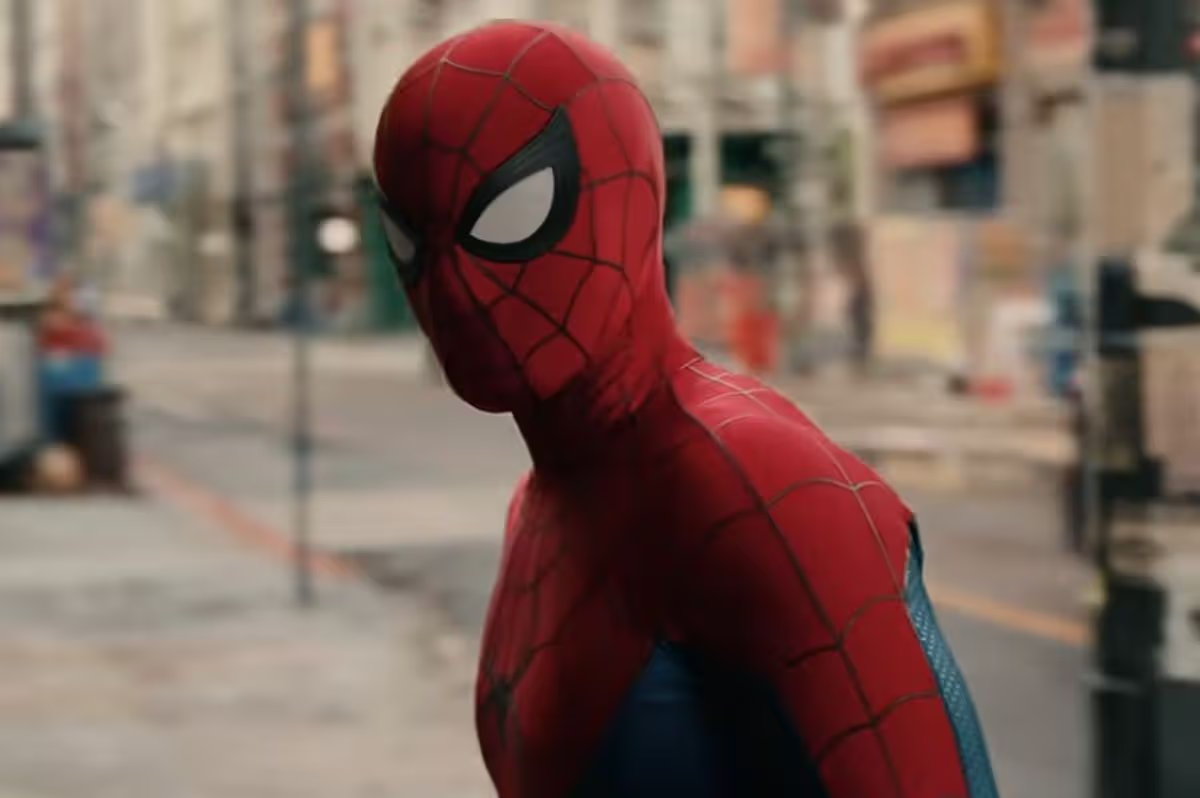
Spider-Man Brand New Day will be released on July 31 (Image: Sony Pictures/Marvel)
Marvel fans have all said the same thing after an iconic character’s long awaited return in the upcoming Spider-Man film.
Just this week, an exciting trailer was released for Spider-Man Brand New Day, which will premier in cinemas on July 31. It has been teased: “The world may have forgotten Peter Parker, but he hasn’t forgotten them.”
The latest instalment takes place shortly after the events of No Way Home – the fourth of Tom Holland’s Spider-Man movies as it follows Peter Parker (Tom Holland) in a world that no longer remembers who he is.
In the clip, it appears that trouble is just around the corner though, as Spider-Man can be heard saying: “What is happening to me?
“I’m losing my mind. I am totally out of control. I’ve got to fix whatever this is right now.”
However, there is one iconic character that has stolen the show as fans were delighted to see the return of Mark Ruffalo – but more excitingly in his savage Hulk form.
The exciting trailer shows Peter seeking out DR Bruce Banner as he says: “You found a way of suppressing mutating DNA right?”
Dr Banner then replied: “If you see me with this off, then run”, showing him the device that prevents him from mutating into the Hulk. However, later scenes show his transformation into the green mutation, right in front of Spider-Man who states: “I didn’t know you could get that big.”
Content cannot be displayed without consent
Seeing savage Hulk return is a delight to Marvel fans who have not seen the character in the MCU for quite some time, somewhat completing Banner’s character arc.
But now, it appears the raging monster has made a return as the trailer teases a tense head to head. Commenting on YouTube, one person wrote: “Seeing Hulk back to his normal self genuinely made me happy.”
Another penned: “no dude literally like hulk back in the original form is like breathing nice fresh air!”
A third added: “I have friends who have had two kids since I’ve been waiting for the real hulk to come back.”
A fourth replied: “Spider-Man is depressed, Hulk is angry and Punisher is itching to tell us something… PEAK.”
A fifth echoed: “Love how Spidey did not know Hulk’s true size. He has only ever encountered Professor Hulk, not OG Savage Hulk. About time we got him back!”
One person said: “Ladies and Gentlemen, It has 8 years 1 month and 22 days since we saw Hulk. Now we’re back Baby!!”
Another commented: “Normal hulk has came .This is what every Marvel fan was wishing for.”
Spider-Man Brand New Day lands in cinemas on July 31
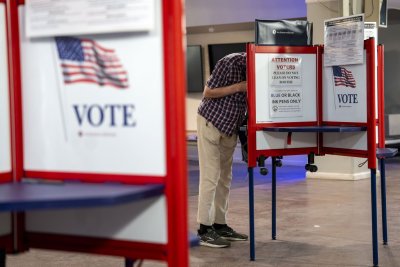
June 18 (UPI) — Sen. Elissa Slotkin, D-Mich., introduced a bill Thursday called the Protect Our Polls Act that would block the president from sending soldiers or federal agents to voting sites during elections.
The bill comes after President Donald Trump said he wouldn’t rule out sending the National Guard or Immigrations and Customs Enforcement to polling places in November.
“I’d do anything necessary to make sure we have honest elections,” The Hill reported Trump told reporters in May.
Slotkin said the bill would prevent Trump from “weaponizing our military and armed federal officers to interfere in our elections.”
The legislation, if passed, would require approval from Congress before a president could send uniformed military or federal law enforcement to polling sites. It would also require 48 hours’ notice to lawmakers, intel, legal justification and evidence that proves a state can’t handle a threat on its own.
The bill is backed by senators Tammy Baldwin, Wis.; Ruben Gallego, Ariz.; Mark Kelly, Ariz.; Amy Klobuchar, Minn.; Alex Padilla, Calif.; Jacky Rosen, Nev.; and Raphael Warnock, Ga.
In a statement, White House spokesperson Abigail Jackson told NBC, “If Democrats really cared about securing our elections, they would pass the SAVE America Act which includes commonsense election integrity measures supported by the vast majority of Americans.”
Federal and state laws already ban deployment of troops and agents from elections, except “to repel armed enemies of the United States.”
“The idea that a president would send troops or armed agents to polling places to intimidate voters is un-American and illegal,” Kelly said in a statement. “Federal law has protected polling places from military interference since the Civil War for a reason. President Trump has made clear he thinks he can ignore those limits. We’re making sure he can’t.”
Secretary of Homeland Security Markwayne Mullin said in March that he wouldn’t send agents to polling places without good reason.
“The only reason why my officers would be there is if there was a specific threat for them to be there, not for intimidation,” Mullin said. “There will be a reason for us to be there, and it’ll be known why we’re there.”
China calls for stronger representation for emerging economies.
China’s foreign minister says that emerging economies remain underrepresented in global governance institutions.
Presenting China’s new white paper on making global governance more equitable, minister Wang Yi argued that the role of the United Nations should be strengthened and developing countries should have a stronger voice in the world body.
In Beijing’s stated view, all countries should have an equal voice in global affairs, which means the Global South should have more representation.
China’s call comes as the world is engulfed in many armed conflicts and facing serious economic challenges.
But is Beijing now presenting itself as a leader of the Global South? And will it be able to garner enough support to play that role?
Presenter: Sami Zeidan
Guests:
Steve Tsang – Director of the SOAS China Institute
Cobus van Staden – Head of research at the China-Global South Project
Allen Carlson – Associate professor in the Government Department at Cornell University
A synopsis for the upcoming six-part show teases: “The Hairdresser Mysteries is an original, homegrown drama and a nostalgic nod to the 70’s which sees a high-end hairdresser, Lily Petal (Sally Phillips), opt out of the competitive city scene to buy a small village hairdressers at the top of a cobbled street.
“Everyone tells their hairdresser everything and soon she becomes the hub of her new village’s secrets and revelations. Using her own brand of uncannily developed hairdressing intuitive, empathy and understanding, Lily begins to solve the mysteries of the village.”
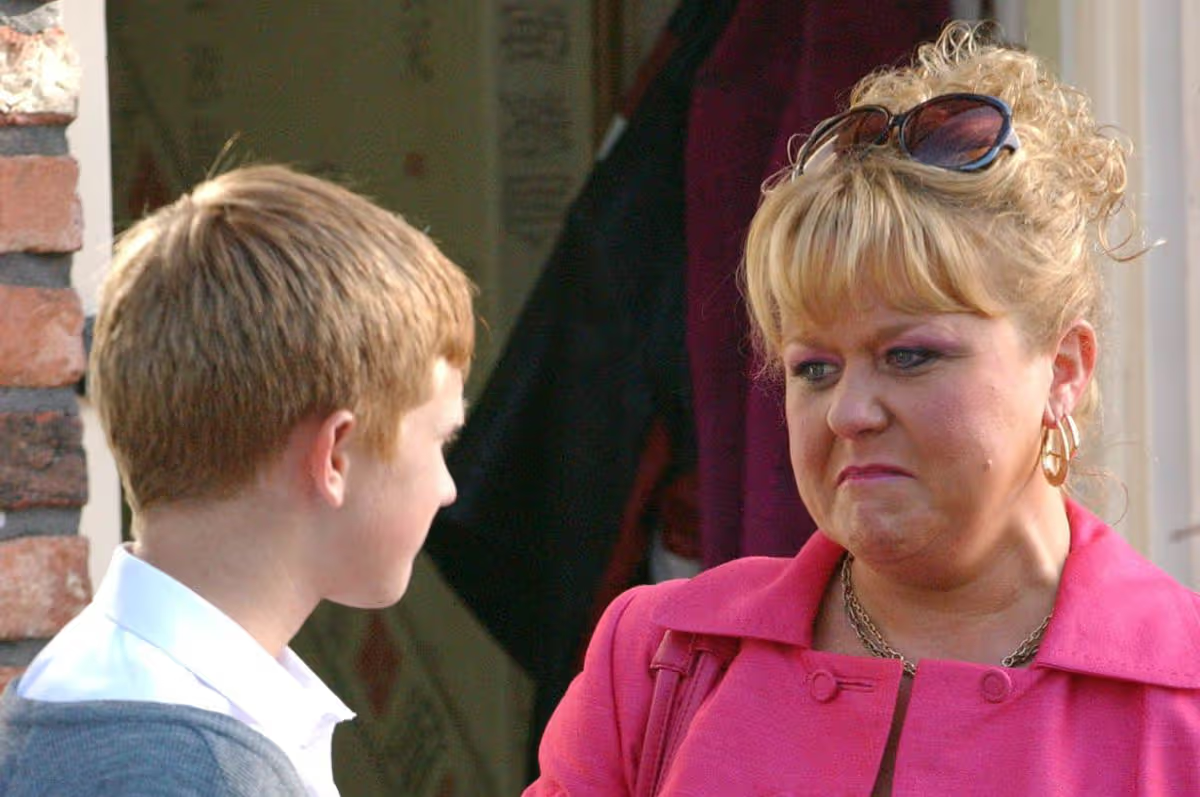
Coronation Street legend Wendi Peters will play Gloria Crudd in the series, who is another newcomer to the village hoping to make a fresh start with her ice cream parlour but soon finds her old life catching up with her.
Wendi, 58, is best known for playing Cilla Battersby-Brown in Coronation Street from 2003 to 2007, she returned to the cobbles once again in 2014.
In a first look of the new series, Wendi looks worlds away from Cilla as her character Gloria has a pastel pink copper coloured curly beehive hairdo adorned with jewellery pieces.
However, Wendi isn’t the only Coronation Street star in the new series as she is joined by fellow Weatherfield favourite Charlotte Jordan who is playing Clary Coombs – Lily’s ‘bright and analytical assistant and the Watson to her Shear-lock Holmes’.
Charlotte, 32, is best known for playing Daisy Midgeley on the cobbles from 2020 to 2025, where her character was involved in several huge storylines including the hard-hitting acid attack plot.
Joining the two Coronation Street favourites is Bridget Jones’ Diary legend Sally Phillips who plays the lead character, hairdresser Lily Petal, who opts out of the competitive city scene to buy a small village hairdressing salon at the top of a cobbled street.
You star Ben Castle-Gibb will play PC Adam Watson – an eager young copper in the local village who falls head-over-heels for salon assistant Clary.
Meanwhile, Ackley Bridge star Sunetra Sarker will play Wincey Evans – the village’s local chit-chatter with a reputation as a known gossip, while Clive Rowe plays Lonnie – the flamboyant manager of the local charity shop, and Holby City star Guy Henry plays Race Runard – the local village’s eccentric antiques dealer with a penchant for priceless teacup and saucer sets.
The Hairdresser Mysteries comes to BBC One and BBC iPlayer this July.
European Union High Representative for Foreign Affairs and Security Policy Kaja Kallas is accused of comparing Israel to South African apartheid. File Photo by Thomas Traasdahl/EPA
June 18 (UPI) — Israeli Foreign Minister Gideon Sa’ar announced Thursday that he is cutting all contact with Kaja Kallas, the European Union’s foreign policy chief, after she compared Israel to South Africa under apartheid.
The two had a public argument on X. Sa’ar said Kallas “has for some time now been acting obsessively and with blatant unfairness toward the State of Israel,” and pointed to a report that she made the apartheid comment in May.
Sa’ar accused Kallas of directing a “blood libel” at Israel and said he would “sever all contact with Ms. Kallas” until she took back what she said.
Kallas has not confirmed or denied the comments but tried to defuse the spat on Thursday.
“Dialogue is the foundation of diplomacy, especially when differences arise. The EU is always committed to a constructive relationship with Israel,” Kallas said on X.
“To bring peace to the Middle East, the Two-State Solution remains the only viable path. The EU has condemned the illegal Israeli settlements in the West Bank that make it increasingly difficult to get to that goal. That is the EU position,” she said.
“With all due respect, even in your remarks here you refrain from denying or condemning what has been attributed to you and published publicly,” Sa’ar said. “If you did indeed make these vile and defamatory statements, stand behind them. If you did not make them, deny it. Until this matter is cleared up, my decision will remain unchanged.”
EU leaders are in Brussels for a European Council summit, and divisions over Israel are likely to be discussed. Some countries want to sanction Israel, while others vow to block stronger actions against it, Politico reported.
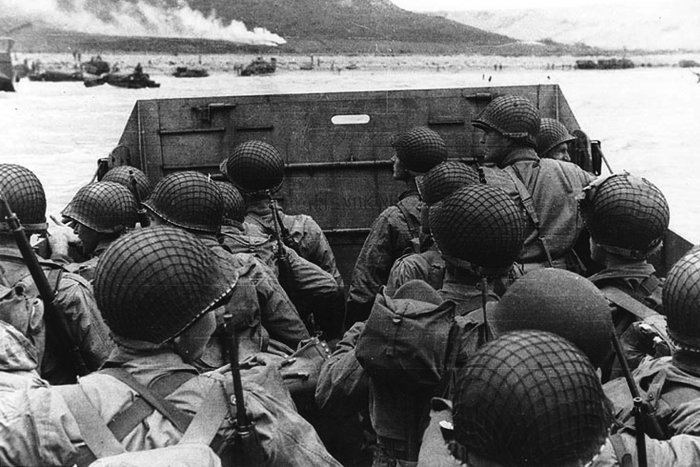
Troops in landing craft approach Omaha Beach on D-Day in Normandy, France, on June 6, 1944. D-Day was the largest seaborne invasion in history and turned the tide of World War II. Photo by UPI | License Photo
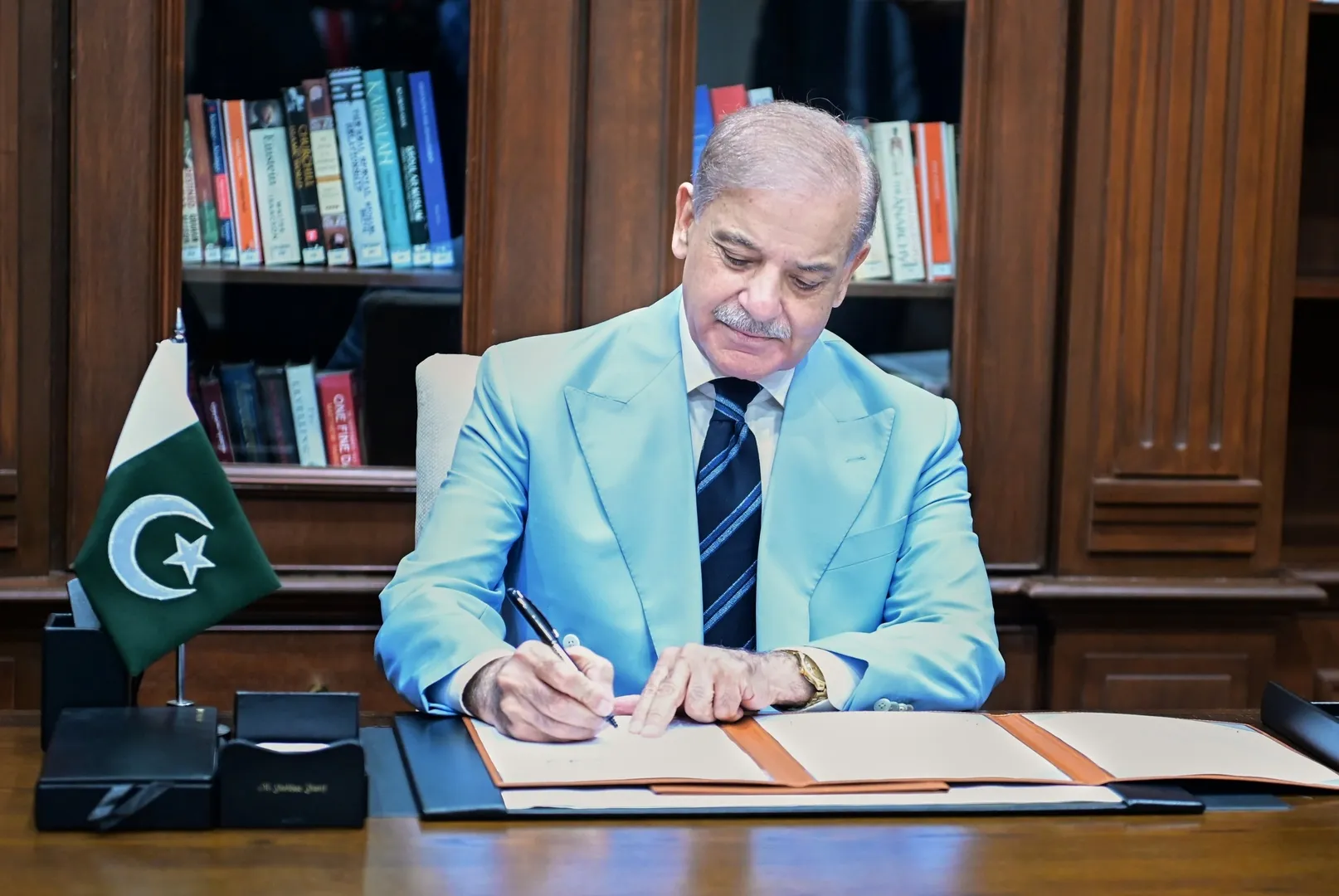
Pakistan’s Prime Minister Shehbaz Sharif has signed a US-Iran memorandum of understanding aimed at ending the war between the two countries. US President Donald Trump and Iran’s President Masoud Pezeshkian signed on Wednesday.
JAMES Bourne is made of sterner stuff. The Busted rocker stepped back from the public eye in September after falling ill and ten weeks ago told his fans was awaiting major surgery to extend his life.
And now, James tells me he’s used his time to finish a project which has been 13 years in the offing – and on July 1 will release new album Murder At The Gates, which he created for a brand new musical with legendary American playwright Steven Sater.
Sign up for the Showbiz newsletter
Thank you!
James Bourne has broken his silence on having to quit the McBusted tour last year to The Sun in his only interview since the ordealCredit: SplashThe singer (pictured with bandmates Charlie Simpson and Matt Willis) was scheduled to head on tour last September but pulled out due to ill health at the last minuteCredit: Getty
“I didn’t want my health to stop me from promoting this project because I’ve put 13 years of my life into it,” James tells me from his home in the UK.
“There was a fear of not finishing it. But I knew I had to finish it and give this to the people. “There’s like a few people that have been waiting for it. There are hardcore fans who show to up for everything – and I have been speaking about this for a long time.
“It feels so good to now have this as a finished product. And it’s the first album I’ve ever produced. So I’m proud of it.”
Now, he is returning to music with album Murder At The Gates, which is for a brand new musical and will be released on 1 JulyCredit: PR SuppliedJames has worked alongside Stranger Things actor Gaten Matarazzo on songs for the new recordCredit: PR SuppliedHe says that the project, which has been in the making for 13 years, is so sacred even his Busted bandmates haven’t heard the completed versionCredit: GettyIt comes just months after James told fans he was undergoing surgery, which hoped to be ‘life-extending’Credit: instagram
But rather than wallowing, James threw himself into the 13-track album – which features big name screen stars, including Stranger Things actor Gaten Matarazzo, on vocals.
“This album definitely has a different feeling to all the others,” James explains.
“With everything going on with my health, I have been given the gift of time.
“I was given a lot of time back when I wasn’t touring. It was like turning a negative into a positive. It was such a shame to have to drop out from the tour, because I love touring so much.
“But you have to turn negative into positive. They’re the conversations I’ve had with my closest friends.
“I wanted to take the time I’d been given and deliver this album.”
James’s last musical, Loserville, earned an Olivier nomination back in 2013 and when he was tapped up by Steven, who earned a Grammy and a Tony award for his cult-hit musical Spring Awakening, he jumped at the chance to get involved.
“Musicals are a very difficult thing to do well and to do properly and to develop properly,” James explains.
“And this one’s been developed on the highest level with the most talented people.
“Steven was looking for a composer and that is when Loserville was in the West End.
“He invited me to his place and I knew immediately how I would do it.
“I’d never done a project where someone else did the words because he’s a lyricist.
James has not yet shared publicly what health issues he is facingCredit: GettyJames rose to fame in the early 2000s with BustedCredit: Getty
“But as I was reading the lyrics, I could hear the music. And we partnered on the project.
“To work on this with someone on Steven’s level has been a dream.”
Of the score he’s created, James adds: “I knew I wanted it to be a very solid piano vocal score to begin with and I knew I wanted it to be orchestral but with a rock band at the heart of it.
“But I don’t think it is a rock musical in the way that rock musicals are presented.
“Rock musicals like We Will Rock You or Rock of Ages tend to veer more towards classic rock and this isn’t what Murder At The Gates is.
“I think a big part of what sold Steven’s show Spring Awakening so well was how contemporary the score was.
“The music is very customised. This is tailormade for Steven’s words and the world that he imagined and the characters that he imagined
“The score had to represent that world, you know.”
James adds: “We wrote about 50 songs for the show and whittled it down to 13.
“Some are old, some have been rewritten, some are completely new.
“It’s a long process that you can’t complete unless there’s a lot of passion involved.
“With songwriting in the pop world, you can blag it. Go into the room with a producer you’ve never met before and come out with something amazing.
He shared an update on his health with fans back in April via InstagramCredit: InstagramHowever, the musician’s social media has since disappearedCredit: Splash
“But if you don’t get anything great, you’ve not lost much. With a project like this, it’s a life commitment.”
James admits all of his spare time since 2013 has been dedicated to this project, with him missing dates on the McBusted tours with One Direction in 2014 and 2015 to get his teeth into it.
After stepping back from their tour last September, James was able to focus fully on getting the project finished – and spent time flying from his home in the US to New York to record the tracks.
“We’ve got amazing people like Gaten on board, he was definitely one of the top people on our list,” James explains.
“It was a total cherry picking situation. Steven has so much recognition from Spring Awakening – he’s like a rock star in his own right. He is a genius.
“All of the people who sang on it were busy, many of them were on Broadway so I would fly to New York for each vocal.”
And like all the best projects, James had kept his cards close to his chest – with not even his Busted bandmates Matt Willis and Charlie Simpson hearing the finished product.
“They might have heard something a very long time ago when we were doing promo for one of our tours,” James explains. “But apart from that, I haven’t played it for anyone.
“Even the actors who have done workshops with us over the past decade haven’t heard it.”
Once the record is released, Steven will get to work with James in getting the production green lit.
And James admits he is excited to see what comes of the project.
“We don’t have an opening night yet for the show but we’ve got the album and we’re saying, ‘This is a great representative of what the show is,’”James explains.
“There are still some bonus tracks to come later on. I’m just incredibly proud of it.
“When you do these projects, you strive to create things that can be timeless in a way.
“Classic musicals go on for years and years, and we’ve definitely been really striving to create something amazing.
“When I make albums with Busted, you’re making music for yourself to perform.
“With a project like this, you’re giving something to the community. This show is original, memorable and I don’t think there’s another show like it.
“I just can’t wait for people to hear it, then see it.”
Brazilian Sen. Flávio Bolsonaro, a presidential hopeful and son of former President Jair Bolsonaro, unveiled a public security plan that includes chemical castration for convicted rapists and the construction of maximum-security prisons modeled after those implemented by Salvadoran President Nayib Bukele. File Photo by André Borges/EPA
June 18 (UPI) — Brazilian Sen. Flávio Bolsonaro, a presidential hopeful and son of former President Jair Bolsonaro, unveiled a public security plan that includes chemical castration for convicted rapists and the construction of maximum-security prisons modeled after those implemented by Salvadoran President Nayib Bukele.
Bolsonaro presented the proposals during an event on Faria Lima Avenue in São Paulo, where he launched “Brasil Sem Medo” (“Brazil Without Fear”), a package of 12 measures he described as “urgent” to combat organized crime if elected president.
Flávio Bolsonaro, pré-candidato do PL à Presidência da República, apresenta o “Plano Brasil Sem Medo”, seu programa de segurança pública caso seja eleito.
Entre as propostas estão:
– classificar PCC, Comando Vermelho e milícias como organizações narcoterroristas;
“I support chemical castration for those convicted of sexual crimes,” the senator said during the event, according to Brazilian media reports.
Brazilian press reports confirmed that the lawmaker also proposed building five new maximum-security prisons based on the penitentiary model adopted by El Salvador, better known as the “Bukele model,” which has become a reference for conservative sectors across Latin America because of its crackdown on gangs.
“We will build five new maximum-security prisons based on the El Salvador model,” Bolsonaro said, noting that allied politicians have visited that country to gain firsthand knowledge of the security policies promoted by its president.
Other measures presented include lowering the age of criminal responsibility to 16 and to 14 for crimes considered heinous, increasing penalties and classifying criminal organizations as narco-terrorist groups, SBT News reported.
During the event, the senator was accompanied by former judge and Sen. Sergio Moro and Rep. Guilherme Derrite, the former public security secretary of the state of São Paulo.
Flávio Bolsonaro apresenta 12 propostas contra o crime organizado em evento
✍️O pré-candidato a presidente e senador @FlavioBolsonaro (PL-RJ) apresenta nesta quinta-feira (18), em São Paulo (SP), plano com 12 propostas para combater o crime organizado no Brasil.
Bolsonaro also called for support from the financial sector to combat money-laundering networks linked to organized crime.
“I want to ask the entire financial market for unity so that we can suffocate these narco-terrorist organizations,” he said.
Bolsonaro said that, if elected president, he would seek to designate the First Capital Command, known as PCC, Comando Vermelho and militias as narco-terrorist organizations, according to UOL Brasil.
“We will declare PCC, Comando Vermelho and the militias to be narco-terrorist organizations,” he said. “Any criminal armed with a rifle will be taken down by the security forces.”
The proposal comes weeks after the United States designated PCC and Comando Vermelho as international terrorist organizations.
The decision was formalized in early June by the administration of President Donald Trump and was welcomed by Flávio Bolsonaro, who held meetings in Washington before the announcement.
The government of President Luiz Inácio Lula da Silva has opposed adopting a similar classification in Brazil.
The issue comes amid growing tensions between Lula’s government and Bolsonaro allies in the United States.
During a news conference following the Group of Seven summit in France, Lula asked President Donald Trump not to intervene in Brazil’s elections and said the electoral process is exclusively a Brazilian matter.
“I think he knows very little about Brazil. If he knows it through his relationship with the Bolsonaro family, he knows very little about Brazil,” Lula said when asked about recent comments by Trump related to Brazil and the conviction of Eduardo Bolsonaro.
Brazil will hold general elections in October 2026. Lula da Silva remains one of the leading contenders and is tied in opinion polls with Flávio Bolsonaro.
Lee added: “It seems to be a bit on the pineapple side, but I don’t mind. It seems to do the job. I’ll play around with it a bit, making take it back or forward.
“Good job, isn’t it? Looking like an Abercrombie model.”
Lee’s hair stole attention when he returned to social media for the first time since leaving prison.
Many were convinced it was AI or a filter had been used to create a fuller head of hair.
Since then, a Dubai-based trichologist from Hair Repair Club claimed to The Sun that Lee had visited his salon on Monday to enquire about a permanent wig.
He declined their services when he was told he would require a patch test and “colour matching” before being able to purchase.
1 of 4 | Former President Barack Obama and former First Lady Michelle Obama appear on stage as they surprised administration and campaign alumni in Chicago ahead of the dedication ceremony of the Obama Presidential Center, Wednesday. The center opens Thursday and will be open to the public beginning Friday. Pool Photo by Pablo Martinez Monsivais/UPI | License Photo
June 18 (UPI) — The Obama Presidential Center will open Thursday in Chicago with a long list of celebrities attending.
The grand opening will be livestreamed starting at 11 a.m. CDT Thursday on Obama.org and on the Obama Foundation’s social media accounts. The opening is invitation-only, and there are no more tickets for the Midway Plaisance Park watch party in Chicago.
The center will be open to the public beginning Friday, and it’s expected to see up to 1 million visitors per year. Tickets, which are $30, are sold out through October.
The center is a 19-acre space on the south side of Chicago that features a tall building that includes a museum of the Obamas’ lives. It shows what life was like in the Obama White House.
The campus also has a branch of the Chicago Public Library, an NBA regulation-size basketball court and Women’s Garden dedicated to women leaders in Chicago. It also has an auditorium, a media suite that visitors can use, a Wetland Walk, a fruit and vegetable garden and a playground.
But it’s not a presidential library and doesn’t house the Obama presidential documents. Those are in the mostly digital Barack Obama Presidential Library run by the National Archives, though the center does have some artifacts on display that are on loan.
CEO of the Obama Foundation Valerie Jarrett has said Trump is welcome to visit the museum, and they’d love to give him a tour. She said he simply was not invited to the dedication.
“I can tell you that this is a celebration for those who helped get President Obama where he is. And this is a gift to them,” Jarrett said. “And so the people who will be here are the people who’ve been helpful along the way.”
China officially objected through its Foreign Ministry to the Japanese draft resolution to increase armaments and abandon Japan’s post-World War II commitment not to rearm its military, as approved by the Liberal Democratic Party of Japan during its general council meeting. The draft resolution proposed amending three key security documents, which are the National Security Strategy, the National Defense Strategy, and the Medium-Range Defense Forces Enhancement Plan. It was to be submitted to the Japanese government and parliament for further discussion. Chinese authorities officially rejected and objected to the draft, deeming it a threat to their national security and their spheres of direct influence in Taiwan, the South China Sea, and the Indo-Pacific region. They considered it a radical escalation of Japan’s security strategy, detrimental to Chinese national security and to the global security initiative proposed by Chinese President Xi Jinping.
Here, the revision of Japan’s three security documents, represented in the National Security Strategy, National Defense Strategy, and Defense Force Enhancement Plan, represents a strategic shift away from its post-war pacifist constitution toward more proactive and independent military policies. The nature of this shift is evident in Tokyo’s easing of restrictions on lethal weapons exports and its reorientation of its armament toward counter-offensive capabilities and missile development. Under Prime Minister Sanae Takaichi’s administration, the Liberal Democratic Party of Japan has adopted a proactive approach, reshaping Japanese industries and institutions to address the greatest strategic challenge posed by China. The updated National Security Strategy has already fundamentally altered the country’s pacifist military doctrine by disarming the Japanese military and preventing its rearmament since World War II, a move that has drawn staunch opposition from China, which seeks to protect its own national security. The most significant amendments to the three Japanese security documents included Japan’s acknowledgment of its ability to double and enhance its counter-strike capabilities. This was achieved by allowing Japan to possess long-range missiles capable of striking enemy targets before launch. Simultaneously, Japanese authorities approved doubling defense spending, raising the military budget to 2% of GDP.
China objected to the Japanese draft resolution, which aimed to increase Japanese armament and militarize the region and global supply chains, and threatened to escalate the situation. Beijing strongly condemned these trends, describing them as new militarism. A key point of contention for China was what Chinese intelligence and military circles perceived as a warning of Japanese and foreign interference in Taiwanese affairs, as China considers Taiwan an integral part of its territory. Beijing condemned the Japanese leadership’s statement that any emergency in Taiwan is an emergency for Japan, describing a potential Chinese military intervention in Taiwan as an act of aggression. Here, Beijing rejects Japan’s new military approach, characterized by advanced military deployment. China has officially protested and taken countermeasures against Japan’s plans to deploy defensive missiles on Yonaguni Island, located only about 110 kilometers from Taiwan. China has strongly accused Japan of violating its commitments, arguing that this new Japanese military expansion violates Tokyo’s international obligations and its pacifist constitution. China has warned Japan that it will pay a heavy price if it intervenes militarily in the Taiwan Strait.
Chinese intelligence, military, security, and defense circles link Japan’s armament activities in Taiwan to American interference in Chinese affairs through its network of allies in the Asian region, such as Japan, given its close alliance with Washington. Here, Japan defends its military rearmament against China, with several of its officials sending political and security warnings to China. They argue that, given the uncertainty in Japan stemming from US policies and the fluctuating stance in Washington, Japan seeks to bolster its own capabilities and build regional alliances (with the Philippines, Australia, and NATO) to expand deterrence against Beijing and maintain regional security from a Japanese perspective. Strategic circles in Tokyo view the potential fall of Taiwan to China as a direct and existential threat to Japanese national security and vital shipping lanes, making the protection of the Taiwan Strait a fundamental component of Japan’s updated defense doctrine.
For these reasons, China’s decisive response was seen as a challenge to its national security, especially given Japan’s de facto official classification of Beijing as the greatest and most unprecedented strategic challenge to its security. This classification was further reinforced by Japanese authorities’ approval of developing military production, strengthening domestic defense industries, and easing restrictions on arms exports. This is where the dimensions of China’s official rejection and objection lie, as it is considered a violation of the pacifist principle enshrined in the Japanese military doctrine, which was internationally and regionally agreed upon after World War II for Japan’s disarmament. Beijing believes that Tokyo is abandoning its pacifist constitution and returning to a militaristic path, while Japan exaggerates the narrative of a China threat. Beijing accuses Japan of fabricating flimsy pretexts to justify its military expansion and arsenal, which threatens China’s regional security. Therefore, China warned that these Japanese steps to increase armament undermine peace and stability in the Asia-Pacific region and jeopardize the principles of China’s global security initiative. China also registered its objection to Japan’s exclusionary approaches to its initiative based on shared and sustainable security. Furthermore, China linked this Japanese escalation in its confrontation with China in the region to the sensitive issue of Taiwan and the close alliance between the United States and Japan, while categorically rejecting Japanese interference in Taiwan’s affairs and considering the island’s security an integral part of China’s national security.