GREG James has confirmed his Radio 1 show return and revealed that he’s ‘exhausted’ as he shared an update on his dad’s recent open heart surgeries.
The radio star, 40, was missing from the Radio 1 Breakfast, which airs weekdays from 7am to 10:30am, on Wednesday and Thursday (18 June 2026).
Sign up for the Showbiz newsletter
Thank you!
Greg James shared an update following on from his dad’s open heart surgeriesCredit: InstagramThe star has also confirmed when he will be back presenting Radio 1 BreakfastCredit: Getty
Greg took to his Instagram story this morning to reveal the heart-breaking reason why – and admitted that he’s “in no fit state” because his father Alan Milward has undergone heart surgery.
Then this afternoon, he decided to give his 1.3m followers on the social media platform an update.
Sharing a selfie from a sauna, Greg wrote: “Hello from the sauna! I felt daft updating on all of this but because it was such a loud part of the comic relief challenge, I feel like it’s nice to be honest about it all.
“Just to say, my dad is responsive, just about conscious and being looked after amazingly.
Greg pictured with his dad AlanCredit: InstagramGreg took to his Instagram page to share why he wasn’t on the radio on Wednesday and ThursdayCredit: @greg_james/Instagram
“Obviously, after two open heart surgeries in three months, he’s not out of the woods by a long way, but we’re hopeful he’ll be fixed and we can all just get on with life.
“Which is what I’m gonna try and do.
“I won’t keep updating on here about it all as quite frankly, we’re all exhausted by it and it’s going to be a long road to recovery.”
He then went on to share exactly when he’ll be back on the radio – and fans don’t have long to wait.
The presenter later explained that he was ‘no fit state to be on the radio’Credit: @greg_james/InstagramEarlier this year Greg took part in a 1,000km tandem bike ride for Red Nose Day and opened up about his dad’s strokeCredit: instagram/@bbcradio1
Greg continued: “I’ve wanted to make sure my mum is OK so it’s been nice to spend loads of time with her and my big sis, but I’m back to the show tomorrow and I can’t wait.
“Thank you again for the most amazing load of messages.
“It’s genuinely very comforting.”
It comes after Greg told fans yesterday: “Hello from my mum’s garden! I wasn’t on the breakfast show today as my dad was in for another go at heart surgery (it’s been a wild few months and I didn’t want to bore you with it all).
“But here we are. Back to square one. Waiting for news and staying distracted and keeping calm by making water features.
“All being well, back on tomorrow morning.”
However Greg later revealed Alan’s surgery took “much longer” than they’d expected so he would be taking another day off.
He said: “What a great day! An absolute hoot in ICU.
“Surgery was much longer than everyone hoped. Big up my mum and my big sis. And the surgeons. And the NHS. What a gang. We’ve all gone mad.
“Real talk, surgery went ok but he’s far from out of the woods so I’m gonna take it easy tomorrow and hopefully back on Friday.
“Plus, I’m in no fit state to be on the radio. I mean, look at me, I’m posting photos from intensive care ffs. Thank you for your lovely messages.”
In March Greg had to cancel his show and rush home after Alan suffered a stroke during a planned heart operation.
He later opened up about his dad’s struggles during his 1,000km tandem bike ride for Red Nose Day.
He said: “I feel elated. I feel a bit overwhelmed by all these people who just turned up out of nowhere. I just burst into tears as I was going up to Blaenavon. It was all a bit much.
“Just thought about… I just thought about everything. Just thought about my dad, thought about my mum. It got way too much. It’s so silly. It must have been the altitude.”
President Donald Trump shakes hands with Apple CEO Tim Cook after announcing an additional $100 billion Apple investment in the U.S., which now will total over $600 billion over the next four years, in the Oval Office of the White House in Washington, D.C., on Aug. 6. File Photo by Bonnie Cash/UPI | License Photo
June 18 (UPI) — President Donald Trump said Thursday that Apple is partnering with Intel to design computer chips that will be manufactured in the United States.
The U.S. government took a 10% stake in Intel last year, investing $8.9 billion in its stock as it sought to boost its manufacturing capabilities in the United States.
“I decided to help Intel because we need to design and build our Chips right here in America,” Trump posted on social media.
Premarket trading of Intel stock jumped by more than 9% on Thursday.
Apple, based in California, currently produces a majority of its processors for devices like the iPhone, iPad and Mac computer in Taiwan.
Computer chips are becoming more and more crucial to the U.S. and global economy due to the demand for processing power, memory and storage chips from artificial intelligence.
Tim Cook, CEO of Apple, said the company’s efforts to “mitigate the huge increases that are being passed to us,” as well as “shield our customers from the increases.”
“But the situation has become unsustainable,” Cook told the Wall Street Journal earlier this week, noting that price hikes on Apple products are “unavoidable.”
President Donald Trump speaks to reporters about restoring commercial fishing access to areas of the Pacific during a signing ceremony in the Oval Office of the White House on Thursday. Photo by Jim Lo Scalzo/UPI | License Photo
The Democratic Socialist has vowed aggressive response to Trump, who has said he could ‘take back’ DC if she wins.
Washington, DC – Janeese Lewis George, a Democratic Socialist who has promised an aggressive approach to United States President Donald Trump, is on track to become the next mayor of Washington, DC.
Lewis George already had a commanding lead after Tuesday’s Democratic primary. Her top competitor, Kenyan McDuffie, conceded on Thursday, all but assuring her victory.
Recommended Stories
list of 3 itemsend of list
Washington, DC, trends heavily Democratic, with the primary winner likely to win the general election in November. There is no Republican challenger for the post, although independent and third-party candidates can mount challenges.
Lewis George, a council member and former prosecutor, had garnered labour groups’ support as she vowed to set clear boundaries with the Trump administration, including ending cooperation between local police and Immigration and Customs Enforcement agents. Her victory would make her the first member of the Democratic Socialists of America, to which NYC Mayor Zohran Mamdani and Congressmember Alexandria Ocasio-Cortez also belong, to lead Washington, DC.
Her competitor, McDuffie, a former councilmember, had gained support among DC’s business community and pitched himself as a moderate. His style hewed close to that of current Mayor Muriel Bowser, who has walked a careful line between criticism and cooperation with Trump.
For his part, the US president has made his preference clear, floating that he might “take back Washington and run it on the federal basis” if Lewis George became mayor.
Washington, DC, is a federal district, giving the White House and Congress outsized influence. However, under a 1973 law, the district has so-called “home-rule”, allowing residents to elect the mayor, council members and neighbourhood commissioners to run daily affairs.
Advocates have long called for the district, with a population of more than 700,000, to become a state. Both Lewis George and McDuffie support DC statehood.
Since taking office in January of last year, Trump has repeatedly threatened to assert more control over the district.
He briefly federalised the city’s police department in August of last year, claiming a crime emergency, surged federal immigration enforcement in the district, and deployed the National Guard as part of a “beautification” project.
Responding to Trump’s threats ahead of Tuesday’s vote, Lewis George said a strong response was needed.
“We are not going to get ICE off our streets or protect Home Rule by fearing this President,” she said.
“Threatening DC because you do not like how our residents vote is an attack on democracy itself. The people of DC elect the Mayor of DC. And they want someone who will stand up to Trump,” she said.
DISGRACED actor John Alford’s cause of death has been revealed after he was found dead in his prison cell just weeks after being caged for sexually assaulting two teenagers.
The disgraced actor died less than three months into the sentence at Category C HMP on March 13 this year – and now the cause of his death has been revealed.
Sign up for the Showbiz newsletter
Thank you!
Grange Hill ran for 30 years until 2008 and launched the careers of several famous faces we know today. But where are they now?Credit: BBCPaedophile TV star John Alford was found dead in jail in MarchCredit: PA
John Alford – who played Robbie Wright in the BBC series Grange Hill – was sentenced to eight years and six months in prison after being convicted of sexually assaulting two teenage girls, 14 and 15.
The victims had been at a pub before heading to the home of a pal whose dad had been drinking with Alford, real name John Shannon.
The paedophile bought £250 worth of food, booze and cigarettes from a petrol station, including vodka the girls drank later, a trial at St Albans crown court was told. Once left alone with the girls, Alford had sex with the younger girl in a garden and a toilet.
The trial heard he asked her “Do you want this babe?” to which she answered “No”. He assaulted the other teen twice while she was “dozing off” on the sofa.
The disgraced TV star made his mark on BBC school dramaGrange Hillin the 1980s and found fame as fireman Billy Ray in London’s Burning in the 1990s before his fall from grace.
Grange Hill ran for 30 years until 2008 and launched the careers of several famous faces we know today. It covered major issues from drug use to teen pregnancy, HIV and knife crime.
The show’s characters became some of the most recognisable faces on TV, but where are the actors who played its young stars now? From sex assault scandal to star who traded acting for a very ordinary job, fate has dealt the former stars varied hands.
John Alford – Robbie Wright
John Drummond as Trevor Cleaver, George Christopher as Ziggy Greaves and John Alford as Robbie Wright (right)Credit: BBC
Towards the end of his Grange Hill stint, Alford later admitted he was drinking up to 18 bottles of beer and nine spirits shots a night.
But he went on to earn a new army of fans as fireman Ray in London’s Burning from 1993 to 1998. However, this didn’t last long either, as John was sacked two years later after he was convicted for supplying cocaine and cannabis. He served six weeks of a nine-month sentence in 1999.
But this wasn’t his only encounter with the law. Back in 2019 John pleaded guilty to smashing a windscreen in a bin lorry ‘hijacking’ and resisting arrest. A hearing at Highbury Corner Magistrates’ Court heard how a refuse worker spotted the shamed TV star who had broken into the Veolia lorry while it did its morning rounds near his home in Holloway, North London.
Police attended and noted that John was seemingly under the influence as he began resisting arrest. First, John argued with attending officers Police Constables Darren Baker and Miranda Narcin and claimed he was trying to stop the vehicle rolling back, but they all fell to the ground as he resisted their attempts to restrain him, Irish Mirror reported at the time.
The sick predator, who had been in a psychiatric hospital before his September 2025 trial, was found dead in his prison cell earlier in March. The provisional cause of death for Alford has now been publicly recorded as ischaemic heart disease following an inquest opening.
George Armstrong – Alan Humphries
The former child actor died aged 60 after a battle with leukaemiaCredit: TwitterHis former co-stars paid tribute to the actor, describing him as a “true legend”Credit: Unknown
He starred as Alan from the first episode of Grange Hill in 1978 until Series five in 1982.
Among Armstrong’s other roles was that of PC Driscoll in The Bill in 1989. He later gave up acting and became a theatre manager at a public school.
Unfortunately, the former TV star passed away in 2023 following a “long battle with leukaemia“. His former co-stars paid tribute to the actor, describing him as a “true legend”.
Lee Whitlock – Bevis Loveday
London-born Lee went on to appear alongside some of the biggest names in the movie industryCredit: RexUnfortunately, he passed away at the age of 54Credit: IMDB
Alan’s sad death came just months after the passing of Lee Whitlock, who played Bevis Loveday in series 16 in 1993, in February.
Prior to that, Lee launched his career in the popular TV series Shine On Harvey Moon as Stanley Moon in the 1980s.
London-born Lee, who died aged 54, went on to appear alongside some of the biggest names in the movie industry – Johnny Depp and Helena Bonham Carter – in the 2007 film Sweeney Todd: The Demon Barber of Fleet Street.
Other film credits included Wish You Were Here, Jack the Giant Slayer, Cassandra’s Dream and Wild Bill. Lee also had cameos in Casualty, EastEnders, Lovejoy, Boon, The Bill, London’s Burning and Solider, Solider.
Paula-Ann Bland – Claire Scott
One of the show’s most iconic characters, Claire – played by Paula-Ann Bland – was a child of overprotective parentsCredit: Not known clear with Picture DeskThe mother-of-two posed topless for lads’ magazine MayfairCredit: Not known clear with Picture Desk
One of the show’s most iconic characters, Claire – played by Paula-Ann Bland – was a child of overprotective parents. Following the trailblazing drama series, Paula, now 54, continued her acting career and portrayed Kelly Brice inOnly Fools and Horses, as well as Sylvie in Vanity Fair.
The mother-of-two, who posed topless for lads’ magazine Mayfair, also moved to Los Angeles for a time before returning to London to set up a publicity firm.
Despite finding enormous success, Paula’s life was thrown upside down after she found out she had stage three triple-negative breast cancer in 2018.
In an interview in the Sunday Express at the time, Paula revealed: “When you hear the word cancer, you can’t hear anything else, everything else becomes just white noise.”
The actress, who was considered the British Kylie Minogue thanks to her version of The Locomotion, lost part of her breast during her procedure.
She added: “I understand it had to be done to save my life and this is better than the worst scenario of a double mastectomy and removal of the ovaries. But the procedure still leaves you without an important part of your identity as a woman.”
Terry Sue-Patt – Benny Green
Benny Green, played by Terry Sue-Patt, made his screen debut when Grange Hill premiered in 1978Credit: Not known clear with Picture DeskTragically, Terry was found dead at his London home in 2015 at the age of 50Credit: Rex Features
Benny Green, played by Terry Sue-Patt, made his screen debut when Grange Hill premiered in 1978. “There weren’t many black actors about on TV at that time. I had a great time, getting time off school to play football. It was a bit of a dream come ”true”, really,” he told the Daily Mirror.
After his tenure at the London school ended in 1982, Terry went on to star in Channel 4 comedy Desmond’s, set in a Peckham barbershop, and also the 1989 film The Firm. Tragically, Terry was found dead at his London home in 2015 at the age of 50.
The family of the actor released a statement revealing his struggle with personal challenges before his passing. Police feared his body may have lain there for a month before it was found.
John Holmes – Luke ‘Gonch’ Gardener
Luke ‘Gonch’ Gardener was portrayed by John Holmes, who starred in the show for four yearsCredit: BBCJohn, who is now 56, left the acting world to manage a casino
Luke ‘Gonch’ Gardener was portrayed by John Holmes, who starred in the show for four years from 1985 before wisely deciding to return to education.
He committed himself to his studies at the University Of East Anglia, where he served as president of the student union for several years.
Susan Tully, known for her role as Michelle Fowler in EastEnders, began her acting career as Suzanne Ross in the BBC seriesCredit: Not known clear with Picture DeskMillions have watched her work as a director on episodes of Line Of Duty, as well as of EastEnders and the ITV thriller Too CloseCredit: Instagram
Susan Tully, known for her role as Michelle Fowler in EastEnders, began her acting career as Suzanne Ross in the BBC series.
The 58-year-old has since applied her talents behind the camera as a successful television director of shows including Secret Diary Of A Call Girl, Lark Rise To Candleford and Getting On.
Millions have watched her work as a director on episodes of Line Of Duty, as well as of EastEnders and the ITV thriller Too Close.
Lee MacDonald – Samuel ‘Zammo’ McGuire
The class clown was at the centre of one of the most talked about storylines on the seriesCredit: BBCAfter leaving Grange Hill, Lee used sunbeds to feel more confident, but regrets using them following his pre-cancer diagnosisCredit: Rex Features
The class clown was at the centre of one of the most talked about storylines on the series when his character developed a dangerous heroin addiction in the mid-80s.
Lee, now 55, tried his hand at professional boxing after leaving the show, but a car accident in the early 90s left him unable to return to the ring.
In 2020, he got engaged to his long-term partner, Jess. Just three years later, in 2023, the former child star broke down in tears when he feared he had cancer. But although he was given the all-clear, Lee was then diagnosed with a pre-cancerous spot called keratosis after noticing another mark on his face last year.
After leaving Grange Hill, Lee used sunbeds to feel more confident, but regrets using them following his diagnosis.
He explained: “Without a shadow of a doubt, if I look back now, obviously, because of my complaints, I wish I’d never, ever gone near them if I knew now what I knew, then I would not have touched them. I would not not go near them.”
Michelle Herbert – Trisha Yates
Trisha Yates’ Michelle Herbert left the series in 1982, concluding five memorable seriesCredit: News Group Newspapers LtdShe was diagnosed with breast cancer and had to undergo a mastectomy – but luckily, the 61-year-old has since received the all-clearCredit: Not known clear with Picture Desk
Trisha Yates’ Michelle Herbert left the series in 1982, concluding five memorable series. Moving her life to Dundee in the 90s, the mother-of-two and her husband manage All Glass and Glazing business.
But like many other former Grange Hill alumni, she has had her share of obstacles. While she was in a hotel room, during a family holiday in Rome, Michelle spotted a small dimple on her breast in May, 2015.
She was subsequently diagnosed with breast cancer and had to undergo a mastectomy – but luckily, the 61-year-old has since received the all-clear.
Following the ordeal, Michelle has been adamant on raising public awareness around the lesser-known symptoms of breast cancer, urging women to check for dimples.
Erkan Mustafa – Roland ‘Roly’ Browning
Roland was the lovable character who, despite horrific bullying, eventually found the strength to confront his tormentorsCredit: BBCPost-Grange Hill, Erkan Mustafa, 56, appeared in the holiday favourite Blackadder’s Christmas Carol and later captivated music fans as a host on E4 MusicCredit: Alamy
Fans of the series all adored Roland, didn’t they?
Roland was the lovable character who, despite horrific bullying, eventually found the strength to confront his tormentors after enduring years of abuse.
Post-Grange Hill, Erkan Mustafa, 56, appeared in the holiday favourite Blackadder’s Christmas Carol and later captivated music fans as a host on E4 Music. he starred in Lenny Henry’s 90s sitcom Chef! and Blackadder and also made appearances on Soccer AM and Celebrity Juice.
Sean Maguire – Terence ‘Tegs’
Sean was only 11 when he joined the cast of one of the most famous schools on TV.Sean, now 50, married police officer Tanya Flynn in 2012 and they have two sons, as well as a daughterCredit: Getty
Sean Maguire was only 11 when he joined the cast of one of the most famous schools on TV. He later starred as Aidan Brosnan in EastEnders and also had roles in The Bill, crime series Scott and Bailey, and Holby City.
In the 90s, Sean moved away from acting to kick-start his pop career with two albums and an impressive eight singles that broke into the Top 30. His venture into film, however, wasn’t as successful, with his movie, Meet the Spartans, winning a meagre 2.8-star rating on IMBd.
Undeterred by this hiccup, Sean rebounded when he secured the role of Robin Hood in the American TV series Once Upon a Time. Sean, now 50, married police officer Tanya Flynn in 2012 and they have two sons, as well as a daughter. They now live in the US where the former child star has become a citizen.
Simone Hyams – Caroline ‘Calley’ Donnington
Simone appeared in the first episode of Grange Hill and played the role of Calley in Grange HillCredit: Not known clear with Picture DeskShe then went on to star in The Bill before shifting careers to become a corporate events manager for VirginCredit: Alamy
Simone appeared in the first episode of Grange Hill and played the role of Calley in Grange Hill.
In 1991, Simone, now 54, landed a role in the film Dirty Weekend, but it wasn’t released until two years later because it was deemed too violent.
She then went on to star in The Bill before shifting careers to become a corporate events manager for Virgin.
Todd Carty – Peter ‘Tucker’ Jenkins
Todd was just 14 when he joined the BBC cast and went on to be one of the show’s most famous facesCredit: check copyrightTodd (left) also famously appeared on Dancing On Ice in 2009Credit: Instagram/ therealjohnaltman
Todd was just 14 when he joined the BBC cast and went on to be one of the show’s most famous faces.
He was so popular as the lovable rogue Tucker that he got his own successful spin-off series, Tucker’s Luck, for three years. After Grange Hill, Todd played Mark Fowler in EastEnders until 2003 before joining The Bill as evil Gabriel.
Todd, now 62, also famously appeared on Dancing On Ice in 2009 where he became an internet sensation in 2009 after losing control and skating out of the studio.
Since then, he has featured in a range of TV shows, including the comedy A Touch of Cloth, Celebrity 5 Go Caravanning, and the short film The Drive.
June 18 (UPI) —Prince Harry and Meghan Markle are planning to visit Britain in July with their children for the start of the one-year countdown to the Invictus Games, sources say.
The Duke and Duchess of Sussex are planning to bring their children, Archie, 7, and Lilibet, 5, according to reporting by the BBC, ITV and The Telegraph.
Harry hasn’t been assured that there will be a security detail in place, and it isn’t clear if King Charles III will be able to meet the children, The Telegraph said.
The prince has said that he wants to bring Prince Archie and Princess Lilibet back to England to meet his friends and family and teach them more about British culture. The children haven’t seen their grandfather in person since they were last in England in 2022 for the late Queen Elizabeth II’s Platinum Jubilee.
A Los Angeles business associate told The Telegraph that there was a “warming of the frost” between Harry and Charles in recent months. Harry had fallen out with his family after his memoir, Spare, made several accusations against them.
The unnamed source said, “Harry says he’s coming back before the end of the year with the children with the express intent to reunite with his dad.
“The way in which he said it seems to make it clear that he believes that this is happening and will pave the way for a longer-term peaceful relationship between them.
“He has wanted to have his kids meet their grandfather, especially after their summit in London last year.
“While there have been deep-seated trust issues around Harry, there is a sense now that all parties want peace.”
The source said that there was still distrust of Harry among the king’s friends but that Charles wants to find a way to reconcile.
Harry lost an appeal last year challenging the dismissal of his claim against the Home Office over the decision that he should have a different degree of taxpayer-funded protection when in the country.
Harry and Meghan moved to Canada then California after they decided they no longer wanted to serve as senior royals.
Troops in landing craft approach Omaha Beach on D-Day in Normandy, France, on June 6, 1944. D-Day was the largest seaborne invasion in history and turned the tide of World War II. Photo by UPI | License Photo
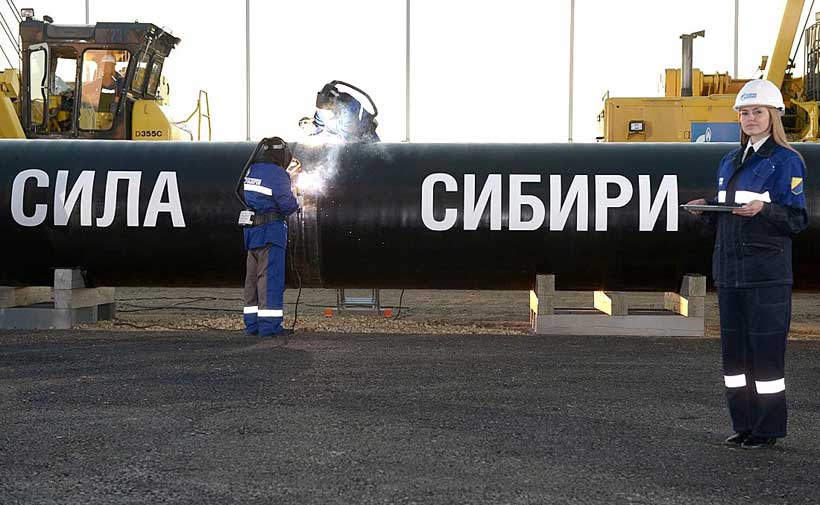
Russian President Vladimir Putin’s recent state visit to China, which was his first foreign trip of 2026, is a clear indication of the shifting dynamics of the bilateral relationship. Accompanied by an unprecedented delegation of 39 high-ranking officials, including five deputy prime ministers, eight ministers, the central bank governor, and energy executives, the scale resembled a partial cabinet relocation. This massive mobilization reflects Moscow’s urgency to secure an agreement on the Power of Siberia 2 natural gas pipeline, a strategic super-project stalled in commercial negotiations since 2012. Planned to span over 2,600 kilometers with an annual capacity of 50 billion cubic meters, the pipeline would traverse Mongolia to link Russian fields with Chinese markets. For Russia, finalizing this energy artery is an economic imperative to replace the European market, where Western sanctions aim to eliminate Russian pipeline gas imports by the end of 2027.
Evaluating the geopolitics of this energy relationship requires analyzing five distinct strategic dimensions.
First, Beijing has strong incentives to resist quick concessions. The negotiation deadlock is largely on pricing. Russia reportedly seeks approximately US$ 265 per thousand cubic meters to cover the high extraction and infrastructure costs of its Yamal fields in Western Siberia, whereas China targets roughly US$ 120. Unlike Russia, China commands significant leverage, boasting robust domestic pipeline networks, stable Central Asian infrastructure, and diverse liquefied natural gas imports. Given Russia’s acute financial pressure and diminishing options due to sanctions after the war in Ukraine, Beijing has the luxury of strategic patience, allowing it to wait for terms that align with market principles rather than rushing a deal under political pressure.
Second, the pipeline is less about energy revenue for Moscow and more about maintaining global geopolitical relevance. In the current international order, Russia finds itself sidelined from primary great-power management. Consequently, Putin seeks to leverage the Ukraine conflict to engage Washington while simultaneously trying to bind Russia’s economic future to China, much like it previously did with Europe. This anxiety within the China-United States-Russia triangular relationship was highlighted by the timing of the visit, which occurred just days after the U.S. President Donald Trump departed Beijing. As the war enters its fifth year and energy weaponization loses its potency in the West, shifting exports eastward has transformed from a strategic choice into a necessity for regime survival. By proposing a 30-year, multibillion-dollar pipeline network, Moscow hopes to anchor itself to the world’s largest energy consumer, ensuring it remains an indispensable player rather than a marginalized resource base.
Third, the proposed pipeline route serves as a geopolitical lever within the post-Soviet space. Passing through Mongolia, the route allows Russia to entrench its influence over Ulaanbaatar, which has recently deepened its engagement with the United States and NATO, while monitoring China’s northern energy ingress. This alignment requires Beijing to pay substantial transit fees and leaves its energy security vulnerable to the political stability of a third country. For Moscow, the project simultaneously secures the Chinese market and reinforces its traditional sphere of influence across Central Asia and Mongolia, using infrastructure to manage the economic and diplomatic trajectories of neighboring states.
Fourth, the protracted timeline works in Beijing’s favor. The longer negotiations stall, the more China’s bargaining position strengthens against an increasingly isolated Russia. While Moscow faces a liquidity crisis within its National Wealth Fund and the fiscal drain of a prolonged war, China’s energy diversification has progressed rapidly. Construction on Line D of the Central Asia-China gas pipeline is advancing alongside commitments from Turkmenistan, while maritime LNG capacity expanded by over 10 million tons recently with imports from Qatar, Australia, and the United States. Furthermore, China’s domestic shale gas production and global leadership in renewable energy insulation provide a structural ceiling on long-term natural gas demand. Middle Eastern instability in the Strait of Hormuz elevates the short-term value of overland corridors, but it ultimately reinforces Beijing’s commitment to resilience rather than a singular dependence on Moscow.
Fifth, China’s optimal energy architecture centers on the Southern Corridor, specifically what can be called the “Turkmenistan-Uzbekistan-Tajikistan (TUT) Corridor” framework. This network offers a direct alternative that circumvents Russian territory, extending through Xinjiang and across the Caspian Sea toward Azerbaijan and Europe. Lines A, B, and C of the Central Asia-China pipeline are already operational, and the completion of Line D will raise total capacity to 65 billion cubic meters annually. This infrastructure is backed by deepening diplomatic ties. Beijing and Dushanbe codified their strategic partnership via a friendship treaty, and China’s trade volume with the five Central Asian republics surpassed US$ 100 billion, cementing its status as their primary trading partner. A fully integrated Central Asian energy network directly erodes Russia’s traditional influence in its southern flank, creating a new economic center of gravity.
Ultimately, while Putin’s high-profile delegation sought to secure a vital economic lifeline, the unresolved pipeline agreement exposes the cold calculation of national interests underlying the partnership. For Beijing, maintaining a deliberate pace maximizes its buyers’ advantage and allows alternative supply chains to mature. The true key to Eurasian energy security lies not in a single northern pipeline, but in a diversified, networked western corridor that mitigates risk and ensures supply chain autonomy, a structural reality that will shape the continent’s geopolitical architecture for decades.
SHAKIRA has sparked dating rumors with hunky actor Manuel Garcia-Rulfo.
The pair were seen leaving a hotel together in Los Angeles on Monday, days after Shakira turned up the heat at the World Cup opening.
Sign up for the Showbiz newsletter
Thank you!
Shakira and the Lincoln Lawyer hunk were seen looking friendly in West Hollywood on MondayCredit: BackGridManuel Garcia-Rulfo was ever the gentleman for the singerCredit: BackGrid
Hips Don’t Lie singer Shakira and Manuel, who is known for starring in Lincoln Lawyer, were waiting at a valet stand outside the Sunset Tower Hotel.
As they waited for their vehicle in West Hollywood, the pair were seen smiling and chatting.
The photographs show that once their car arrived, Manuel proved chivalry isn’t dead.
He was ever the gentleman and politely opened Shakira’s door and waited for her to get in before he closed it.
The pair were waiting at a valet for their carCredit: BackGridManuel helped Shakira into the car by opening the doorCredit: BackGridHe drove them away as the pair smiledCredit: BackGridThey left the Sunset Tower Hotel looking content and happyCredit: BackGrid
Mexican hunk Manuel then walked around to the driver’s side and got in before driving off.
Shakira, 49, wore a simple outfit comprising of a black tank top with some blue jeans and some black boots.
Meanwhile, 45-year-old Manuel wore blue jeans, a black T-shirt and a matching jacket.
The couple looked incredibly content in one another’s company, and as they drove off they were both beaming.
Most read in Entertainment
The snaps were quick to circulate online, with fans rushing to react.
“Truth is, the dude really is hot. Even if it’s casual, I’m glad. Good for Shaki,” said one person on X.
“Omg what an upgrade,” penned a second.
While a third wrote: “The way those photos look like they’re from 2000 omg Shakira ages like wine.”
Someone else then echoed: “If you tell me it’s from 2002, I’ll believe you.”
And a fifth said: “Baby, doesn’t it feel like you’re seeing an old photo? It looks the same.”
Shakira has most recently been romantically linked to Lucien Laviscount.
Back in February, she took to Instagram to hard launch her relationship with the actor.
The relationship began after they met in early 2024 on the set of her music video for Puntería, in which he played her love interest.
But ahead of the World Cup, Shakira noted that she has “no space or time” for a relationship.
“Oh no, no romance for me for now,” Shakira told The Times recently, hinting she and Lucien were no longer an item.
“There’s no space or time in my life for that. My plate is quite full.
“My kids are my priority. And my career. Strangely enough, I’m in love with my career like I’ve never been in my life. I’m enjoying my time alone as well.”
The value of Iran’s currency has risen by more than 15 percent against the US dollar, and its stock market has shattered records in the wake of the memorandum of understanding agreed between the United States and Iran on Sunday.
However, Iranians suffering for years from extremely high inflation and a plunging rial have found little economic relief as the prices of basic goods, such as food, remain high despite the diplomatic breakthrough.
Recommended Stories
list of 4 itemsend of list
The Iranian economy has suffered due to decades of US sanctions. The economic crisis was exacerbated after the US and Israel launched a war against Iran on February 28. As subsequent US naval blockade on Iranian ports further added to the misery of Iranians.
In Ferdowsi Street, the beating heart of Tehran’s foreign exchange market, the scene on Thursday was a stark departure from the panic of recent months. Exchange office boards flashed rapidly changing numbers as foreign currencies, led by the dollar, took a sharp dive.
“We closed our doors just hours before the official announcement of the US-Iran understanding at a rate of 1.8 million rials to the dollar,” Amir, a 35-year-old exchange office worker who asked to remain anonymous, told Al Jazeera. “Now it has fallen to 1.54 million rials, and we expect further declines.”
Amir noted a significant increase in sales volumes although buyers remained scarce as many anticipated the rial would strengthen further, potentially dropping to 1.4 million to the dollar or lower.
The recent gains mark a sharp turnaround. After the outbreak of the war, the exchange rate jumped to a historic peak of 1.9 million rials (190,000 tomans) to the dollar in March before settling at about 1.685 million just before recent attacks carried out despite a ceasefire.
A disconnect in the grocery aisles
Despite the rial’s recovery, a walk through Tehran’s grocery stores reveals a starkly different reality. For Iranians grappling with the economic fallout of crippling sanctions and the US naval blockade, the diplomatic thaw has yet to lower the cost of living.
Shoppers browse for fresh produce at a market in Tehran. Consumers report that despite the rial’s recovery, prices for basic food items and other necessities remain stubbornly high [Rasol Alhaei/Al Jazeera]
Reza, a 42-year-old Tehran resident, told Al Jazeera that prices for daily staples like milk, cheese, cooking oil and flour remain unchanged. “They say the dollar dropped, but my shopping basket costs the same as last week,” he said. “This means the agreement hasn’t reached our pockets yet.”
From behind the cash register, 55-year-old shop owner Ramin echoed his customer’s frustration. He explained that while the government continues to distribute subsidised goods like bread, the fluctuations of the free-market dollar do not immediately impact basic food prices.
The value of the dollar on the free market varies from the official exchange rate.
Pointing to a shelf of imported goods, another shopkeeper named Karim noted that items like shampoo, toothpaste and laundry detergent are still locked at inflated prices.
“Distributors say they bought these goods two months ago at the old dollar rates,” Karim explained. “Prices will remain high until the old stock runs out and new goods enter at the lower exchange rates.” He estimated it would take at least two weeks for the market to adjust, meaning Iranians will continue to face compounding inflation in the interim.
Euphoria on the trading floor
While Main Street struggles, Tehran’s stock market is experiencing an unprecedented boom amid expectations of improved economic conditions. The trading floor has been awash in green since the initial leaks of the Washington-Tehran agreement emerged.
On Monday, the main index jumped by a record-breaking 161,000 points in a single session, marking the highest-ever influx of cash from individual investors.
By Tuesday, the market continued its staggering ascent, climbing another 112,000 points to cross the psychological barrier of 5 million, ultimately settling at a historic high of 5.1 million.
A screen displays a sea of green on the Tehran Stock Exchange. The market shattered records, crossing the 5 million mark after the announcement of the US-Iran deal [Rasol Alhaei/Al Jazeera]
Saeed, a 40-year-old investor, called it a “historic day”. He noted that investors are rushing to buy shares in the energy and petrochemical sectors, betting heavily on the resumption of exports and the reopening of global markets.
However, Saeed remained cautiously optimistic. “The stock market is often driven by rumours,” he warned. “I don’t want to repeat the experience of the 2015 nuclear deal when the market soared and then collapsed after the US withdrawal.”
He was referring to US President Donald Trump’s 2018 withdrawal from the agreement, under which Iran agreed to restrictions on its nuclear programme in exchange for sanctions relief.
Stagnation in real estate and electronics
The wait-and-see approach in effect has paralysed other sectors of the economy. In central Tehran’s electronics hubs, 38-year-old shop owner Reza reported that while the prices of imported appliances have dropped in tandem with the dollar, sales have stalled because customers are holding out for steeper discounts.
A similar freeze has gripped the housing market. Nasrin, a 36-year-old real estate agent in northern Tehran, observed that a recent price surge that accompanied the initial truce has now given way to stagnation. Many property owners are clinging to inflated prices, seemingly unaware that the market dynamics have shifted, bringing property transactions to a virtual standstill.
‘Not a magic wand’
For macroeconomic experts, the mixed market signals are entirely expected. Hossein Selahvarzi, the former head of the Iran Chamber of Commerce, Industries, Mines and Agriculture, cautioned that the new agreement is “not a magic wand” capable of instantly fixing years of structural issues in the economy.
While the war severely damaged Iran’s infrastructure, Selahvarzi emphasised that the roots of the country’s economic malaise were firmly planted well before the bombing began.
“War is the enemy of investment, production, trade and public welfare,” Selahvarzi told Al Jazeera. He warned against the analytical mistake of believing that a peace memorandum alone would revive the economy.
“Ending the military confrontation does not necessarily mean the beginning of economic prosperity,” he said, stressing that restoring stability to the business environment remains the country’s most urgent priority.
“What we have before us is a limited and fragile opportunity to correct course and rebuild the economy, and this opportunity could be lost quickly if not managed correctly.”
Interest in expanding the role of the JDAM-ER as a bunker buster is tucked away in a section of the Pentagon’s proposed 2027 Fiscal Year budget covering requested funds for the Defense Threat Reduction Agency (DTRA). DTRA is a multi-faceted organization focused on responding to Weapons of Mass Destruction (WMD) threats. Since deeply buried and otherwise hardened facilities are often tied to WMD programs, a key area of the agency’s work is helping devise new and improved ways to hold those targets at risk. A prime example of this is the key role DTRA played in the development of the 30,000-pound-class GBU-57/B Massive Ordnance Penetrator (MOP) bunker buster bomb.
Now, DTRA wants to “evaluate current hard target defeat capabilities with 2000lb Joint Direct Attack Munition Extended Range (GBU-64 JDAM-ER) and provide recommendations on future JDAM-ER development to enhance HDBT penetration capabilities,” according to Pentagon budget documents.
A JDAM-ER seen in flight gliding during a test. RAAF
GBU-64/B is the formal designation the U.S. military has given to the 2,000-pound-class JDAM-ER. As is the case with standard JDAMs without supplemental wings, the JDAM-ER is a kit that turns various types of unguided bombs into ‘warheads’ for the resulting precision-guided munitions. Additional versions of the JDAM-ER kit are available for use with 500-pound and 1,000-pound-class bombs.
Prime contractor Boeing has said that the BLU-109/B bunker-buster bomb can be combined with the JDAM-ER kit, but it is unclear if that configuration is already in operational U.S. service. At the time of writing, the GBU-64(V)1/B still looks to be the only subvariant officially confirmed to be in use anywhere across the U.S. military. The GBU-64(V)1/B uses the Mk 64 Quickstrike air-dropped naval mine as its warhead. There is also a 500-pound-class GBU-62(V)1/B, which pairs a JDAM-ER kit with the smaller Mk 62 Quickstrike mine. You can read more about these versions, also called Quickstrike-ERs, here.
A now-dated Boeing briefing slide from 2017 mentioning testing of BLU-109/B with the JDAM-ER kit. Boeing
B-52 Deploys Quickstrike-ER Naval Mines (2019 OP TEST)
It’s not clear whether bunker-buster JDAM-ERs are in inventory today outside of the U.S. military, either. Versions of the JDAM-ER using general-purpose high-explosive bombs as warheads have been in service at least in Australia and Ukraine for years now.
A JDAM-ER with a general-purpose high-explosive ‘warhead’ under the wing of a Ukrainian MiG-29. via X A JDAM-ER under the wing of a Ukrainian MiG-29 offering a good look at the specialized pylon used to employ these weapons from those aircraft, as well as Su-27s. via X
Missiles delivery systems are being removed from the B1 Lancers at RAF Fairford this afternoon, to be replaced by JDAM bombs. For those asking, the US Airforce has positioned these aircraft close to the fence in full view of media. @AJENewspic.twitter.com/fWtDRfV5g4
A US Air Force F-15E Strike Eagle on its way to strike targets in Iran with a load of 2,000-pound-class JDAMs with bunker buster ‘warheads.’ CENTCOM
If it has not been put into U.S. service already, a 2,000-pound-class JDAM-ER would offer clear benefits when configured as a bunker buster, in general. Depending on how it is released, a standard JDAM can hit targets up to 15 miles away, according to the U.S. Air Force. With the wing kit, JDAM-ERs have a maximum reach of roughly 45 miles, though the exact range is also dependent on release altitude and flight profile. As noted, being able to release bunker buster bombs further away from the target can help reduce risks to the launch platform.
The additional drag of the JDAM-ER wing kit could also reduce the bomb’s kinetic energy, which is important for bunker-busting. It is possible that the bombs could be programmed to glide to a certain point above the target before diving onto it for maximum effect.
At the same time, the gliding capabilities of a JDAM-ER open the door to additional operational possibilities enabled by low-angle attack profiles. Being able to focus the effects of a bunker buster bomb directly on the side of a structure rather than at steeper angles from the top could offer major benefits.
Furthermore, it would be possible to get the bombs deeper down inside the entrance tunnels and through the sides of other fortified structures, magnifying the warhead’s effectiveness. Lobbing precision-guided bombs into tunnels and cave entrances is already a well-established tactic, and one that can hamper access to underground targets that might otherwise be unreachable. This is something we will come back to in a moment. Striking dams, bridge pylons or even ships in port, among other targets, at shallow angles, would also be a new weaponeering option for heavy bunker buster warheads not often found on cruise missiles.
What further enhancements might emerge as a result of the JDAM-ER bunker-buster testing DTRA has planned remains to be seen. As an aside, the U.S. military also looks set to field a jet-powered derivative, called the GBU-75/B JDAM-LR, which features even greater range, as you can learn more about here.
A New Era for Precision Strike: JDAM LR Completes Milestone Test Flights
The U.S. Navy has successfully demonstrated the new JDAM Long Range variant, marking a huge step in bringing affordable, long-range standoff capabilities to the Carrier Air Wing.https://t.co/GvMomaPnSppic.twitter.com/cNgEgnZGXy
With all this in mind, DTRA’s budget request notably includes a separate mention of plans to “conduct R&D [research and development] in ‘skip’ bombing capability to develop new tactics and weaponeering options,” which could help in “enabling deeper access for penetrating weapons.”
Skip bombing specifically involves releasing munitions in a way so that they bounce off the ground or the surface of a body of water. This sends them further forward on a flatter trajectory that can be beneficial in various scenarios. The core tactic here is decades old now. British bombers famously used bombs specially designed for skip bombing attacks against German dams during World War II. During the war, skip bombing was also heavily used when attacking ships, especially by U.S. military aircraft in the Pacific Theater. Doing this could help ensure more serious hits on a target’s hull near the waterline.
Improved skip bombing tactics could be paired with new precision-guided bunker busters, including versions of the GBU-64/B, for further increased effect. Being able to penetrate deeper into tunnel entrances and other weak spots on the ground could create additional complications for an opponent trying to dig out key assets afterward.
NEW: Comprehensive Imagery Report on Nuclear Enrichment Related Sites, Post-April Ceasefire
Following the ceasefire between Iran, the United States and Israel established in early April 2026, we have continued to monitor key sites related to Iran’s nuclear program. In this… pic.twitter.com/wkb9Pr2diY
NEW passive defense measures taken at Fordow: Between May 10 and May 18th, Iran added passive defensive measures in the shape of earthen/rocky mounds and other objects on the roads leading to the tunnel entrances of the destroyed Fordow underground enrichment plant. The alternate… pic.twitter.com/odAISoPr1D
IRAN NUCLEAR UPDATE: Possible NEW Passive Defensive Measures Noted at Pickaxe Mountain
Based upon newly available satellite imagery of the Pickaxe Mountain underground complex, just south of the Natanz Nuclear Complex, it appears that as early as April 22nd, the two eastern… pic.twitter.com/KGAhBkLks8
While U.S. bunker-busting strikes on targets in Iran have been front-and-center in recent months, the new capabilities that DTRA is interested in would be applicable in conflict scenarios, as well. There’s something of a global trend, especially among America’s adversaries and competitors, toward more underground and/or hardened facilities. China, Russia, and North Korea, in particular, all have significant and still-expanding networks of subterranean military infrastructure, including air and naval bases, missile silos, command and control bunkers, and more.
This, in turn, has already been driving the U.S. military to pursue other new bunker-busting capabilities. These efforts are known to include a conventional Next Generation Penetrator (NGP) successor to the MOP and a new nuclear bunker buster bomb referred to currently as the Nuclear Deterrent System-Air-delivered (NDS-A). The U.S. military has also added a new conventional 5,000-class bunker buster bomb, the GBU-72/B, to its arsenal in recent years.
Bunker-buster versions of the JDAM-ER would offer valuable additional options for U.S. commanders at the lower end of the capability spectrum, if they haven’t already entered service to a degree.
LOVE Island Australia’s Gabby McCarthy, the reality star with the show’s biggest ever boobs, has almost fallen out of her skin-tight dress.
The buxom lass, 22, took to Instagram to share a series of pictures from her night out as her grey and white dress struggled to contain her 34G chest.
Sign up for the Showbiz newsletter
Thank you!
Love Island Australia star Gabby McCarthy has almost spilled out of her dressCredit: InstagramShe struggled to fit her 34G boobs into her dressCredit: Instagram
She took pictures of herself sitting on a hotel bed as well as standing in front of a luggage trolley.
Gabby posed up a storm as her boobs glistened, thanks to the oil she put on them.
The zip on her dress went up as far as it could go as she nearly had a nip-slip.
In one snap, Gabby got on her knees on the bed as she stared seductively into the camera.
Fans of the programme spotted old photos of her modelling trainers and lingerie and began doubting her chest was as natural as she claimed.
One person wrote on Reddit: “I thought they were natural until I saw pictures of her a few years ago being a b-c cup at best.
“Unpopular opinion, but I believe she has teardrop implants. Natural boobs jiggle and move a lot when you’re walking and running but hers are way more ‘stiff’. Her surgeon did an amazing job making them look natural though.”
Another wrote: “I admit I was searching for the truth on her boobs, only cuz she claimed they were natural. Sparked a bit of debate amongst friends.
“Hard one to call. They look fake to me and don’t believe weight gain caused them to grow.”
During her introduction video, she said: “My name is Gabby, I’m 21 years old and I’m from the Gold Coast.
“I get this question every single day of my life, my boobs are natural guys!
“If I want a guy, then I always get him. I’ve got the teeth, I’ve got the face, I’ve got the body, and I’ve got the boobs.”
Nuclear reactors operated by Korea Hydro & Nuclear Power. The state-run utility plans to build three new nuclear reactors over the next decade. Photo by KHNP
June 18 (UPI) — Korea Hydro & Nuclear Power said Thursday that it has selected two sites in the country’s southeastern region for the construction of three new nuclear reactors over the next decade.
The state-backed utility noted that its committee, comprising outside experts, chose Yeongdeok County, located about 185 miles southeast of Seoul, and Gijang County, roughly 200 miles southeast of the capital, after a year-long evaluation process.
Yeongdeok County will host two 1.4-gigawatt large-scale nuclear reactors, while Gijang County will be home to a 0.7-gigawatt small modular reactor, or SMR, according to KHNP. Two local governments competed for each project.
Earlier this year, the Ministry of Climate, Energy and Environment said that it aims to secure construction approval for the three reactors in the early 2030s and bring them online by 2037 and 2038.
The incumbent administration was initially skeptical about building additional nuclear plants but later changed its stance as electricity demand surged amid the AI boom and the rapid expansion of data centers.
As of the end of last year, KHNP operated 26 nuclear reactors across South Korea and was building four additional units. Currently, nuclear power accounts for around one-third of the nation’s energy mix.
“We extend our gratitude to all local governments and residents who showed such passionate interest in hosting the projects, and we express our sincere regret to the regions that were not selected,” KHNP said in a statement.
The utility added that residents’ opinions gathered during the selection process, including both support for and opposition to nuclear development, would be reflected in future cooperation plans with local communities.
From viral fan moments to on-field controversies, as well as the biggest stars, best performances, upsets and more.
A first-ever hat-trick for Lionel Messi, heavyweights Spain stunned by tiny Cape Verde, and DR Congo silencing Cristiano Ronaldo-led Portugal.
What more could you ask from the opening week of a FIFA World Cup?
Recommended Stories
list of 3 itemsend of list
After the first round of group matches, here are our top 10 takeaways:
Last dance? Perhaps not, Lionel Messi has more in store
Before the tournament kicked off in North America, many thought Lionel Messi would be gearing himself up for his final act. But after his first-ever World Cup hat-trick – one that also matched the record for most World Cup goals – Messi has reminded us his story is not over just yet.
Where is Cristiano Ronaldo? Portugal star goes missing
While the Messi mania dominated headlines over recent days, his longtime rival, Cristiano Ronaldo, also made the news, albeit for the wrong reasons. “Is he past his prime?” was the collective question of viewers after his mostly anonymous display in Portugal’s 1-1 draw with DR Congo on Wednesday.
There is no stopping Kylian Mbappe
Becoming France’s all-time leading scorer always seemed a matter of when, not if, for Kylian Mbappe, and achieving the feat in their opening World Cup match was further proof of his extraordinary talent. The 27-year-old, now just two shy of matching the all-time haul for most World Cup goals, is making a habit of chasing records.
The Golden Boot race is taking shape
Long-range rockets, tap-ins, headers and more. There was no shortage of goals, and Argentinian legend Messi is the outright leader with three strikes. As many as seven players – including England’s Harry Kane, Norway’s Erling Haaland and France’s Mbappe – are tied for the second spot with two goals each.
Lionel Messi has taken the early lead in the race for the Golden Boot, an award handed to the tournament’s highest goal scorer [Amy Kontras/EPA]
The title favourites are having a hard time
This is, by far, the upset of the tournament. Spain – the absolute frontrunners for the World Cup – stumbled at their first hurdle, being held to a shock goalless draw by Cape Verde, the archipelago west of the African continent of about half a million people, and whose team sits 65 places below the World No 2 in the FIFA world rankings.
Do not write off DR Congo
Yoane Wissa‘s first-ever goal, DR Congo’s first at a World Cup, sparked joy among millions from Kinshasa to Niangara. And for the other teams competing in the tournament, the 1-1 draw with No 5-ranked Portugal sent a warning that the underdogs are out to challenge some of football’s best sides, especially when the world is watching.
Dear Curacao, welcome to the World Cup
The 7-1 thrashing by Germany did little to dampen the spirit of Curacao fans, many of whom made the journey to the United States. For the Caribbean tiny island – the smallest-ever country to play at a World Cup – defeat meant nothing in comparison to the happiness of seeing one of their own score at the sport’s biggest stage. Livano Comenencia is a hero for all of Curacao.
Pink boots are everywhere
Pink seems to be the colour of the month, well, at least at the World Cup. Several players were seen wearing the vibrant, monochromatic boots – or cleats, as Americans would say – regardless of the manufacturer. Be it Nike, Adidas or Puma, sportswear giants have joined this trend of making their boots “electric fuchsia”.
The Portugal team in the famous bright pink boots [Phil Noble/Reuters]
From beats to booze, fans bring the party to the World Cup
It’s safe to say a World Cup is the biggest celebration of football. And some countries just do it better than others.
With their green-and-yellow shirts, flags and pounding drums, Brazil fans brought a slice of Rio to New York, while Moroccans later joined the party, the red smoke from the flares lighting up the World Cup mood. In Boston, Scotland’s famous Tartan Army chugged pint after pint, nearly draining some pubs of all their beer in the first weekend during their World Cup occupation of the city.
Meet Mexico’s unofficial mascot: Merlin the duck
To best sum up the football craze in tournament co-host Mexico, the fandom is not limited to humans. A domesticated duck named Merlin, sporting a miniature Mexico shirt and custom duck socks, has waddled his way into the hearts of many, becoming an unlikely unofficial mascot for the country’s World Cup campaign.
Merlin, a duck wearing a Mexico national football team (‘El Tri’) jersey, shot to fame after a chance encounter on Reforma Avenue in the capital went viral following the World Cup opening match between Mexico and South Africa on June 11 [Paola Garcia/Reuters]
Woody, Buzz Lightyear and Jessie will be back at the box office this weekend, delivering what could be the biggest film debut of the year.
Analysts expect the fifth installment of Disney/Pixar’s “Toy Story” franchise will pull in at least $150 million in the U.S. and Canada, with some predicting as much as $175 million — either of which would set a franchise record, topping the nearly $121-million opening of 2019’s “Toy Story 4.”
A strong showing for “Toy Story 5” will further fuel a recovery of the box office this year from the post-pandemic doldrums.
Domestic ticket sales are up over last year, and Roth Capital Partners forecasts the second quarter will climb 6.5% to $2.8 billion — a post-pandemic high.
“Toy Story 5” is the first of several family tentpoles this summer, ahead of Universal and Illumination’s “Minions & Monsters” and Disney’s live-action “Moana.”
“Right now we’re on pace for the best opening of the year,” said Daniel Loria, editorial director at Box Office Co. “This is a performer.”
The timing also is fortuitous for Walt Disney Co. at a moment when its other once-reliable franchises such as “Star Wars” and Marvel have faltered. The recent “Star Wars: The Mandalorian and Grogu” dropped sharply at the domestic box office after its late-May opening, bested by low-budget horror films “Backrooms” and “Obsession.”
“People love these characters from ‘Toy Story,’ ” said Paul Dergarabedian, head of marketplace trends at Comscore. “It’s just as appealing as ever.”
Indeed, across four films and 30 years, “Toy Story” has grossed more than $3 billion worldwide. It is the most-watched franchise on Disney+, with more than 2 billion hours streamed. Woody, Buzz Lightyear and Jessie have spawned 19 theme park rides, four themed lands, two hotels and roughly $1 billion a year in global retail sales.
The production budget for “Toy Story 5” is about $150 million to $200 million. A crew of about 300 people worked on the film at Pixar’s Emeryville, Calif., headquarters.
For Pixar, the reliance on “Toy Story” reflects a shift away from originals that used to be its lifeblood.
February’s “Hoppers” managed a respectable $372 million worldwide, but the surer money now comes from sequels.
“Inside Out 2” grossed nearly $1.7 billion in 2024, and both “Toy Story 4” and “Toy Story 3” crossed $1 billion globally.
Still, the franchise label is no guarantee: The 2022 spin-off “Lightyear” stalled at $226 million worldwide after straying from the formula, recasting Buzz as an actual sci-fi hero — voiced by Chris Evans rather than Tim Allen — and sidelining Woody and the rest of the gang.
“Toy Story 5” stays closer to home but wades into new territory: the explosion of tech in everyday life. The toys must contend with Lilypad, a tablet that captures the attention of their owner, Bonnie — a premise that grew out of a tech-toy character originally written for “Toy Story 4” and scrapped for time. Disney is betting the underlying tension is universal.
“What parent hasn’t had anxiety over tech versus toys with their kids?” said Andrew Cripps, head of theatrical distribution for Walt Disney Studios.
Disney is betting that this universal concern will drive audiences to the film.
The fifth installment also arrives with an unusually high-wattage assist: Taylor Swift wrote and performed an original song, “I Knew It, I Knew You,” and made a surprise appearance at last week’s premiere, performing it after the credits before joining longtime franchise composer Randy Newman for “You’ve Got a Friend in Me.”
“It means the world to me to be a small part of the universe of these films,” Swift told the crowd.
The expected blockbuster opening for “Toy Story 5” would be a full-circle moment for the long-standing franchise; Pixar animators in 1995 hadn’t even considered the possibility of a sequel while working on the first “Toy Story.”
“There was so much learned on that first film, specifically our iterative process,” Pixar Chief Creative Officer Pete Docter said in a phone call last week from Madrid, shortly before the film’s Spain premiere. “A lot of things that we discovered having worked on that film have just continued to inform every movie that we make.”
“Toy Story” revolutionized the movie business as the first computer-animated feature film. But its enduring appeal was in the bonds between the characters, Docter said.
Docter, who supervised animators and helped with character design and writing on the original “Toy Story,” added: “It certainly had some new technology, but it was really up to the story and characters to carry the audience.”
The franchise’s longevity is also due to its ability to capture generations of fans.
“Having parents now that say, ‘I grew up with “Toy Story,” and now I’m showing my kids,’ has been really gratifying,” Docter said.
Samples of SK hynix’s 12-stack HBM4E memory chips. The chipmaker has delivered samples of the next-generation high-bandwidth memory products to its major customers. Photo by SK hynix
June 18 (UPI) — South Korea’s SK hynix said Thursday that the company has shipped samples of its next-generation high-bandwidth memory chips, or HBM4E, to major customers.
SK hynix provided samples of the 12-stack HBM4E, which it says shows improvements in both performance and power efficiency, on schedule, according to the tech giant.
The firm noted that the new product delivers a data-processing speed of up to 16Gbps per pin while enhancing power efficiency by more than 20% compared with previous-generation models.
The corporation stated that the HBM4E features an upgraded interface and optimized architecture, which reduce data-transfer latency while ensuring reliable performance in high-bandwidth environments.
SK hynix expected the improvements to enable clients to process data more efficiently in AI data centers and large-scale computing systems.
Amid the AI boom, high-bandwidth memory, or HBM, has emerged as one of the most sought-after semiconductor products. SK hynix and its local rival, Samsung Electronics, are global leaders in the HBM supply chain.
“SK hynix has laid the foundation to strengthen its AI leadership with HBM4E based on its market-leading technological capabilities and manufacturing expertise,” SK hynix Chief Development Officer Ahn Hyun said in a statement.
“Through close collaboration with our partners, we will deliver the value needed in the market while reinforcing our technology leadership as a full-stack AI memory creator,” he added.
Weekly insights and analysis on the latest developments in military technology, strategy, and foreign policy.
The U.K. Ministry of Defense is investigating reports that a Russian Navy warship fired warning shots near a British-registered yacht in the English Channel, according to a statement provided to TWZ today. The reported encounter is the latest in a series of increasingly tense interactions between the United Kingdom and Russia.
The incident reportedly occurred around 20 nautical miles south of the Isle of Wight, off the south coast of England, and outside British territorial waters. According to the Ministry of Defense, the initial report came from the crew of the U.K.-registered yacht, which alleged that a Russian warship fired warning shots at a distance of approximately 500 yards.
According to the Press Association, the incident occurred at around 11:40 a.m. local time, in waters between the Isle of Wight and Normandy.
A Ministry of Defence spokesperson confirmed to us that they are investigating reports of the incident, but stressed that the investigation remains in its early stages.
“No injuries or damage have been reported by the yacht, which is continuing its journey,” the spokesperson added.
The Royal Navy was already shadowing the Russian vessel when the alleged incident occurred, the ministry confirmed.
“HMS Mersey was monitoring the Russian vessel at the time. We cannot provide further comment while investigations are ongoing. A seaboat from HMS Tyne has visited the yacht to gather details and check that they are safe.”
Both HMS Mersey and HMS Tyne are River class offshore patrol vessels, frequently used to shadow Russian and other warships passing through the Channel, which is widely considered the busiest shipping area in the world.
HMS Mersey (foreground) seen here monitoring the Russian frigate Admiral Grigorovich (left) and the Kilo class submarine Krasnodar (center-left) in April of this year. Crown Copyright
According to unconfirmed reports, the Russian warship said to be involved is the Admiral Grigorovich, the lead ship of its class, which is also known to NATO as the Krivak V class. The frigate is seen at the top of this story, during an encounter with Royal Navy vessels earlier this year, again in the English Channel.
[Unconfirmed] Russian frigate Grigorovich has fired warning shots at a British yacht in the channel.
British and French ships are mobilising in response.
Incident comes after the Royal Navy boarded Shadow Fleet tanker SMYRTOS (IMO: 9389100) which has been sanctioned by HM…
The Ministry of Defence also sought to distance the incident from another recent maritime security operation in the Channel, in which British forces boarded the Smyrtos, a sanctioned shadow-fleet oil tanker, which was sailing under a false Cameroonian flag.
The boarding of the Smyrtos by Royal Marine Commandos and specially trained law enforcement officers from the National Crime Agency last Sunday was the first U.K.-led operation of its kind. The six-hour military operation also involved Chinook, Merlin, and Wildcat helicopters, a Royal Air Force P-8 Poseidon maritime patrol aircraft, as well as the frigate HMS Sutherland and the mine countermeasures vessel HMS Ledbury.
The vessel Smyrtos is boarded by Royal Marines from 42 Commando and U.K. law enforcement officers on June 14. Crown Copyright
It remains unclear exactly which Russian Navy vessel was involved in the incident today, what prompted the alleged warning shots, or whether any communication took place between the warship and the yacht before the incident.
We will update this post as we find out more about today’s incident.
UPDATE: 2:45 PM EDT –
There is growing speculation that the Russian warship involved in the incident may have suffered some kind of mechanical failure or difficulty at sea.
The U.K. Shadow Defense Secretary James Cartlidge said the incident was “very concerning” and the United Kingdom should “be in no doubt that Russia poses a direct threat.”
The leader of the Liberal Democrat party, Ed MacCleary, said: “These reports are extremely concerning. Russia is quite literally on our doorstep. Aggression and intimidation from Putin in the English Channel cannot be tolerated.”
These reports are extremely concerning – Russia is quite literally on our doorstep.
Aggression and intimidation from Putin in the English Channel cannot be tolerated.
This is a clear reminder that the Government cannot afford any further delays to the Defence Investment Plan. https://t.co/xhnoFQ98tE
According to BBC News, the Russian frigate Admiral Grigorovich fired warning shots after the two vessels came into close contact.
The broadcaster further reports that the “small, motorless yacht had drifted towards the warship in foggy conditions after setting off from the United Kingdom.”
The BBC cites the Russian Ministry of Defense as saying that the yacht had been on a “dangerous approach” towards the warship, and its crew fired into its path “with rifles” after making several attempts to contact it over the radio and after launching warning flares.
The Russian Ministry of Defense further claimed that its sailors had acted in “strict accordance with international shipping regulations.”
A U.K. government source told the BBC that a couple in their 60s were onboard the yacht at the time. They said they did not hear when the Russian frigate sounded its horn.
There have also been unconfirmed reports identifying the yacht involved:
Russians are saying the yacht was ‘Bright Future’ – a British registered 40′ sailing yaht in transit from the Solent to Cherbourg. pic.twitter.com/m3lKpgeHkJ
Data obtained by BBC Verifysuggests that the Admiral Grigorovich has been in the Channel for an extended period, repeatedly being re-supplied by a repair vessel, so that it can escort shadow-fleet vessels through these waters.
Based on satellite images it has reviewed, the BBC says the frigate has been re-supplied by the PM-82, an Amur class repair ship, while operating between the Channel and the North Sea in recent months.
In April, the frigate was reported to have escorted six shadow fleet vessels through the Channel while being monitored by the Royal Navy.
Two scenarios with the yacht
1️⃣🇷🇺 response to Smyrtos boarding this weekend – #greyzone 2️⃣Risk of collision with drifting⛵️in low viz, followed by Ch 16 warning(?) then shot across bow in ‘self defence’ – #maritimebuffoonery
At least one Royal Air Force P-8 Poseidon has transited from its base in Scotland to patrol the Channel this evening, according to publicly available flight-tracking data. The maritime patrol aircraft is very likely tasked wth monitoring Russian naval activity in the area.
More details of the incident have been reported by Deborah Haynes, the security and defense editor at Sky News.
Haynes writes on X that the Russian frigate “fired a couple of warning shots” close to the yacht in the Channel after also sounding an alert to avoid it sailing too close. Citing an unnamed defense source, Haynes reports that it is understood that the Admiral Grigorovich appears to be having difficulty controlling its movements, perhaps due to a propulsion issue.
The warning shots “were certainly not fired at the yacht,” the same source said.
Additionally, while the Admiral Grigorovich has been escorting Russian-flagged vessels through the Channel in recent months, Haynes writes that it was not involved with escorting the Smyrtos, which was boarded by British forces at the weekend.
UPDATE: A Russian warship fired a couple of warning shots close to a UK-registered yacht in the Channel after also sounding an alert to avoid it sailing too close, a defence source said. Investigations are still underway to establish exactly what happened. From what is…
After reaching out to the U.K. Ministry of Defense for more clarification, TWZ received the following from a spokesperson:
“Following attempts to contact a British vessel in the Channel, the Grigorovich fired warning shots. These were not aimed at the vessel and were an attempt to prevent a possible collision.”
“We assess that this is an isolated incident and not linked to the UK’s interception of the Smyrtos this weekend. HMS Mersey has been monitoring the Russian vessel and support has been provided to the crew of the yacht.”
“We assess that the Grigorovich was displaying to other vessels that it was drifting rather than being manoeuvred under power, which may have made her feel more vulnerable, leading to warning shots being fired.”
“We assess that after sounding warnings, the Grigorovich fired several warning shots, but these were not aimed at the yacht.”
The spokesperson told us that they further assess that the shots fired were single rounds, rather than automatic fire.
In this week’s episode of The Envelope podcast, Rachel Sennott discusses finding the voice of “I Love L.A.” — and finding her footing as series creator — during a tumultuous time in her life.
Kelvin Washington: Welcome to The Envelope, Kelvin Washington alongside you know who, Yvonne Villarreal, Mark Olsen. Always great to have you two here and spend some time with you. We talked about it earlier, we had Emmy season — a few weeks ago we discussed it. But now Emmy nominations are on the way. Yvonne, I’ll start with you, just maybe someone, a show, a couple of things you’re looking at saying, “Hey, I would love to see this or that person nominated.”
Yvonne Villarreal: I wanna give some shout-outs to the women right now. I was really frustrated when Rhea Seehorn didn’t get love until the final season of “Better Call Saul,” and I’m hoping — and I do have a lot of hope — that she will be recognized for “Pluribus.” [I] was a really big fan of “The Comeback” this season. I would like to [see] Lisa Kudrow get in there. Show-wise, I would like to see “The Testaments” in there. I don’t know how much of a dark horse that one is, but that’s my pick for show.
Washington: You’ve been riding “The Testaments.” What about you, Mark?
Olsen: I’m sort of leapfrogging over nominations, and I’m just thinking about what would be exciting on the show. And last year, I remember Stephen Colbert won for talk show kind of right after his show had been canceled, and that seemed like a very exciting moment. And so this year, with Jimmy Kimmel, where this is the first Emmy cycle since he had his suspension last year, and really has been in the news, I just think if he were to be nominated and then to win, that just would be such an exciting moment at the show. What’s he gonna say? I just would really love to see that.
Washington: Yeah, he seems like he would have some things to say, right? Because just kind of the nature of who he is. We’ll have to wait and see. And just for me, a couple of people. Just a fan of this particular person, Janelle James is hilarious to me. She plays in “Abbott Elementary.” She plays that role great. And then this one is no real surprise, probably 50-plus-year career, but Martin Short. Every time I see him, he’s amazing, steals the scene. So those are folks that just jump off on the radar for me.
All right, I’ll get to you, Mark. You had a chance to sit down with Rachel Sennott of “I Love L.A.,” creator and star of it. Tell me a little bit more about that.
Olsen: She’s been kind of a real, like, bright light on the comedy scene for the last few years in films like “Shiva Baby,” “Bodies Bodies Bodies” and “Bottoms,” and, you know, she also was like a writer as well as a performer. And so with “I Love L.A.,” which is a look at sort of like the young creative class in Los Angeles, she is the star of the show, she created the show, she writes on the show, she’s executive producer, she actually made her directing debut with one of the episodes. And so it’s just exciting to see her sort of really like come into her voice and come into her own with this new show.
Washington: Kind of reminds me a little bit of, you know, now maybe a decade ago Issa Rae’s surge in L.A. and comedy creating, and then Riz Ahmed, who you spoke with last week — same thing creating and starring and stuff. Seems like that’s the energy [we’re] getting from a lot of the young talent. Well, here is Mark and Rachel now.
Rachel Sennott, creator and star of HBO’s “I Love L.A.”
(Evan Mulling / For The Times)
Mark Olsen: We’re here with Rachel Sennott, creator, executive producer, writer, star, and for the first time, director on the show “I Love L.A.,” as well as co-creator and writer on “Big Mistakes.” That’s a lot.
Rachel Sennott: When you say it like that, I’m like, “Oh, my God.” And I’m also a friend, daughter, let’s not forget girlfriend. Yeah, those are all things that I am doing. And I am so grateful and having so much fun doing that.
Olsen: Hopefully this isn’t something that just I get a kick out of, but we’re here at the L.A. Times offices in El Segundo, and the Randy Newman song “I Love L.A.,” one of the first lines in the song is “Rolling down the Imperial Highway.” And we are in fact on Imperial Highway.
Sennott: We’re here right now. We’re living it.
Olsen: Tell me about the title of the show, its relationship to the song and what was it that you liked about having the show called “I Love L.A.”
Sennott: We were between two titles for a while, “I Love L.A.” and “Climbers,” and the reason we went with “I Love L.A.” is because in the process of making the show, I moved here from New York and I had a hard time when I was first here. And in the process of filming the pilot, I really fell in love with L.A., and I think getting to make something here, I all of a sudden saw L.A. through this lens where everything was like a movie. I would go on my walks that I usually go on. I would walk through my neighborhood, I would go to my spots, and I just saw it through this different lens, and I was really falling in love with it in the process of making the show. And I think with “Climbers,” that title fell a little bit — it was a double meaning of like social climbers and then also, being the age that I am, where I feel like ever since I got to college, ever since I became an adult, there’s been this chaotic energy in the world and uncertain ground where things never felt expected. It was always unexpected events. Graduating into COVID and then there was a strike and everything. So I feel like Sisyphus, where you’re always pushing the rock up the hill and it’s never enough. But we were worried that “Climbers” would seem too negative … We didn’t want to set people up already judging the characters.
Olsen: And then what has it been like for you learning to be a showrunner in making “I Love L.A.”? It’s funny, your co-showrunner Emma Barrie, she mentioned how you were very organized, but she was struck that you had everything in a pink binder with horses on it. So it was you trying to learn this new thing while also holding on to your essence.
Sennott: I feel so grateful for everyone who works on the show with me. I learned a lot from Emma. I learned from Lorene [Scafaria], who inspired me so much as a director. Aida [Rodgers], our producer, Amy [Gravitt] and Allie [Wasserman] at HBO; Max [Silvestri], who’s one of our EPs and writers. Showrunning is a million different jobs, and some of the jobs I’d done before, some of them I hadn’t, and I felt like I got to see different people shine in certain things, people who are more talented or more skilled at structure than me, people who have directed before, people who understand shots and basically learn from everyone and see that everyone wants the show to be the best it can be. They’re bringing stuff to the table. And so I benefited from everyone else’s skills and talents and just being like, “If you know how to do this better than me, I’m gonna learn from you and watch you and hopefully take from that so I can do my job better.”
Olsen: In a lot of the press as you’ve been talking about the show, you’ve been talking a lot about the concept of the Saturn return and this sort of chaotic period people have in their late 20s. You yourself now are 30 —
Sennott: Yes, I made it. I literally just finished. I was relieved, but my Saturn return was the process, getting the show picked up and the first season of the show. That was my Saturn return.
Olsen: Can you already feel that something has settled or things are different somehow?
Sennott: Yes, a thousand percent. My Saturn return, the dates that it was the strongest were the month around when the show got picked up. Making the pilot was so amazing and I learned so much. And then I was in this moment where I had to pick — basically, I couldn’t take on acting jobs because I was gonna hopefully do the show, but I didn’t know if the show was picked up yet or not. And so I had to say no to certain things and kind of take this leap. At the same time I went through a breakup, and then I got arrested for having CBD in the Cayman Islands. And it was just a very chaotic month of my life where I was like in jail for six hours on a break with my boyfriend, so he, like, had no idea where I was, and I was like, I don’t even know if I have a show, I just said no to this other thing. I just felt like I didn’t know what was happening. I’m someone who it’s hard for me to take risks sometimes, and that was a big risk and leap into what I thought I should be doing. And then the rest of it was learning for the first season how to do a job I’d never done before. Obviously, I still have more to learn, but I think that was a big Saturn return for me, the roller coaster of it.
Olsen: It’s so interesting to hear you say that you think of yourself as a person who’s afraid of risk, because that’s not my impression of you.
Sennott: You’re like, “Stop taking risks. Chill on the risks, every second.” No, I think it’s more [that] I didn’t necessarily believe in myself as a creator on my own, and that was really scary for me. That was the risk, I think.
Olsen: Because especially in building up to making “I Love L.A.,” in your career, I feel like you’ve created this comedic persona for yourself. What is the biggest distinction between the Rachel I think I know and like the actual you?
Sennott: You mean the characters that I play? Or like the persona?
Olsen: These sort of hard-charging, very ambitious, but maybe not always understanding of themselves characters, and you. I’m just interested in how you see the distinction between that persona and the actual you.
Sennott: Well, I hope that the characters that I’ve played have been somewhat different from each other. I think “Shiva Baby,” that character, was a little bit more anxiety-inward. Alice in “Bodies” was way more outward and kind of no filter, said every inside thought. Maia on “I Love L.A.,” I think, is kind of bitter in the beginning of the first season and is pinning her failures, blaming them, on her friend. All of those characters, I always draw on some element of myself. I think all actors, you have to find some connection to the character. But I think I’m hopefully more grounded and balanced and mature than the character. I hope.
Olsen: You’ve talked about how “I Love L.A.” really explores the foibles and challenges that people have leading these very, like, online lives and the way that people nowadays are really sort of tethered to their phones all the time. Is that something that you feel like you grapple with yourself? Is it something you yourself have had to kind of get over?
Sennott: I would say I started my career on the internet, and I grew up on the internet, and basically, I created a different sort of persona on the internet that was based in truth of a time when I was in my early 20s in New York, and it was a lot more messy and a little chaotic, and I was just going through things in my life at that time [that inspired] — I say “writing,” but like the tweets, the jokes, the videos, whatever, that were coming out of me. And then I felt I changed, but I still wanted to kind of project that character. And so I actually ended up putting that character into Tallulah [played by Odessa A’zion]. And I think Maia was a little bit more the version of myself when I first moved to L.A. and I felt isolated and it was during COVID, and I felt I was kind of gripping onto my friends in a codependent way. And so I think the show is sort of dealing with, whether or not you’re an influencer or person online, anyone who’s grown up on the internet is projecting some sort of version of themselves. So I think it was that I was trying to explore.
Olsen: You mentioned that the character of Tallulah is this version of you that you used to be. So what was it like for you creating this character that was almost like your id unleashed?
Sennott: It felt like I was separating myself from her. At first, [it] maybe could have felt like a caricature. And then when we cast Odessa, who is so talented and just, as an actor, she has such depth and range, and I think she asked questions and brought so much to it. Then it actually made me sever myself from the character, and the character became its own thing that she brought to life.
Olsen: Your character, Maia, in some ways is the audience surrogate, she’s kind of the most “normal” character on the show. And considering that in “Bottoms” or “Bodies Bodies Bodies” you often were the outrageous character, what has it been like for you to play this character that’s a little more self-contained?
Sennott: It’s been fun. I think we sort of found her during the first season. I feel that Episodes 6 through 8 are really where the show finds its footing and where we find what’s the comedy of Maia. It takes a little for her to kind of crack open, what’s funny about her as a character, but also I think Tallulah is almost like an agent of change for her — Maia was set in her ways and sort of struggling and depressed, and I think Tallulah puts her on track, and she’s going through her Saturn return and all that stuff. And so I think we get to see at the end of the season and just having been writing Season 2, I think that we get see her do a lot more fun stuff.
Olsen: It’s funny, as viewers, a lot of times people say, “Oh, you know, there’s this show you should watch, it really gets going on like Episode 3” or whatever. And I don’t think I’ve ever heard a creator say before, like, “Oh, 6, 7, and 8, we figured it out.” Do you feel you knew that in the moment, or has that only come to you as you’ve been working on Season 2?
Sennott: I think as we were editing the first season. Tone is something that you can say, like, “We want it to be like, this needs this, and it’s that and that and the tone of that.” But tone is what you find in the edit. I think you shoot different versions of a line, of a scene, and then you piece it together. And I think for me, that’s when I felt like, “This is the tone of the show. This is the world of the show.” And in writing Season 2 as well, just living more in that world.
Olsen: You kind of touched on this, but the characters on the show, they kind of skirt this line between being endearing and annoying. What is it that you like about that?
Sennott: Because I think that’s how people are. I am not interested in seeing perfect people or people who are flawed in a way that’s not actually real. So I love all the characters. I think Alani [played by True Whitaker], for example, is someone where you could really easily be like, “Oh, a nepo baby, she’s so privileged, whatever.” I think she’s the character with the biggest heart. She’s the best friend out of the whole group. She cares for everyone. She’s so deeply sensitive. And she’s actually been through a lot of s— and she drops these little things, these clues where you’re like, “Gee, she went through something crazy but is choosing to look at life half-full,” and I think that’s fun. I like the characters who make you feel or expect something of them and then show you another side. Charlie [played by Jordan Firstman] I think does that as well, where you meet him and you think he’s a little acerbic, he’s a little judgmental, and then he goes through loss and grief when Lukas, spoilers, Lukas Landry dies, RIP Lukas. That’s really hard for him. I’ve been friends with Jordan for so long, and I love him so much. I think he’s so talented. But I think he showed a totally new side of himself with the character.
Olsen: I agree. I found those scenes very touching. There’s an emotion there that’s kind of unexpected. Another moment that I really like in the show is Odessa’s character, she wants to change a dinner reservation to five people at 8 o’clock. And then you have to spend hours trying to make that happen. And I really appreciated how it’s something that sounds like it should be simple, and for some people it’s no big deal. But then for other people, it’s the biggest hurdle imaginable. Did you like that the show explores this sort of proximity to ease? Sometimes you end up at this party in a big, big house, but it’s not your house. Was that something you wanted to explore about life in L.A.?
Sennott: Totally. There’s also something specific to L.A. and specific to the industry we’re exploring — which is the internet as opposed to Hollywood — that I would say is relatable to me, to anyone in their late 20s, early 30s. When you’re in your early 20s, everyone’s sort of grouped together or feels like they’re in the same bucket. It’s like, “Oh we’re all doing this same thing, we’re all roommates, we’re all in school together, we’re all whatever.” But people make decisions that you don’t even see. I feel like the first time I found out that one of my friends had a SEP IRA, I was like, “When did we all decide that we’re getting SEP IRAs?” And it was a friend who loves to party, and I was thrown. Now I’m panicking I didn’t do that. Or who’s getting in a serious relationship, whatever. People start making decisions in their late 20s, all of a sudden everyone’s off on different paths. It’s like, “Wait, you’re getting married, but you’re still partying the way that we did when we were in college.” This person is moving, this person is changing their career path. And so you all of a sudden feel a little bit betrayed or on your own, and it’s isolating, and that is something that, yes, we’re doing it through a specific lens of L.A. and this world and these characters, but I think it’s really relatable to people at that age.
Olsen: I’ve heard you describe yourself as a zillennial cusp.
Sennott: Yeah, I’m cusp, and I feel like I relate to a little bit of both.
Olsen: But do you feel a pressure for the show to feel like some sort of a generational statement, to capture these kind of big-picture things?
Sennott: No. Ayo [Edebiri] and I were texting each other because there’s always an article that’s like, “Turns out these b— are 30. Yeah. They’ve been lying the whole time. They said they’re Gen Z.” I’m like, “I didn’t say anything. I was born in ’95. I’m 30.” Call me what you want, but I was just writing to what I feel at the time. I think people who grew up on the internet in the way that I did will relate to it, but I think you can relate too if you’re older or you’re younger.
Olsen: As people are writing about the show, they very frequently are referencing “Girls,” “Insecure,” “Sex and the City.” But I’ve heard you reference “Entourage” quite a bit. Could you explain that?
Sennott: “Girls” and “Sex and the City” and “Insecure,” all of those shows, all HBO shows, are formative to me as an artist. I remember watching “Girls,” I was in high school and looking at colleges with my dad and we went and toured [New York University], and in the hotel room that night, he was like, “I heard so much about this new show, ‘Girls,’ we should watch it. And it was the episode with Patrick Wilson where they f— in his nice apartment the whole time, and we turned it on and my dad was like, “OK, you can watch this later on your own, this is for you.” And I remember going to bed being like, “I’ve gotta go to New York, like whoa, this is crazy.” I think naturally those were already gonna inspire me. “Entourage” and “Atlanta,” those were two references that I mentioned a lot when we were making the show. “Entourage” because I feel I got to come up in this industry with my friends, and when I’m with my friends I feel completely invincible, and so there was that aspect. It was like, “I wanna see ‘Entourage’ but from a different point of view and perspective and a slightly different industry.” And then “Atlanta,” there is already having a family relationship and friendship on top of managing. Like how [Earn] manages Paperboi. And then I think “Atlanta” did such a great job of capturing a city that has almost magical realism elements to it. And L.A., a lot of the time, there’s things that happen here that are crazy, that feel almost unreal, but they are real. So that was a big inspiration for the show as well. Like the opening of the show, sex during an earthquake. That’s happened to me, but it also feels a little ridiculous, but it happens in L.A.
Olsen: You mentioned earlier that in waiting for the show to come around, you felt you were having to turn things down or you were really having to sort of change your mindset in a way. Can you talk a little more about that? With the show “Big Mistakes” that you created with Dan Levy, is that one of the things that you had to step away from or readjust how you were gonna be involved because of the fact that you were going to have “I Love L.A.”?
Sennott: I was more talking about acting roles. When you step into a creator role, it’s a different mindset than acting jobs and you have to commit to a longer time period. When you’re just acting in things, you can pop in, pop out and you leave set and you’re like, “I love you guys so much. I’ll see you in a year at the premiere,” which is fabulous too — love doing that. But when you are creating something, you’re in it from beginning to end, and you really wanna give your all to it. So I think I was more talking about just, like, betting on myself as a creator, as opposed to just acting.
Olsen: And how has that felt now that you’re on the other side of it, with one season of “I Love L.A.” made? How do you feel about having made that decision, having bet on yourself like that?
Sennott: I think it’s changed me, in a way where I’m so happy I did it. And it’s sometimes harder and there’s more parts to it, but I feel more in myself creatively than I ever have before, I think.
Olsen: It changed you how?
Sennott: Just because you all of a sudden see all the different parts of the process of making something and all these different jobs that maybe I wasn’t as aware of before. And I think there’s also something beautiful about popping into something and acting and just being like, “I am present as my character. This is what I am thinking about. I’m thinking about what does the character want.” And that’s amazing too. But I feel so lucky to have been able to experience other parts of making something.
Olsen: What was it like learning how to switch hats, especially during production? I would imagine you have a producer brain, you have an actor brain, then for one episode you have a director brain.
Sennott: I had to like sort of take it day by day. There are days where it’s a lighter scene for me and I can be on the side approving locations, taking meetings during lunch. There was a day where I had two sex scenes, for Episodes 6 and 7. So we shot the end of 7, the fight scene with me and Josh [Hutcherson], and the sex scene where it’s Maia and Dylan but she’s fantasizing about Ben. It was a lot. And so I was like, to Emma and Max and Aida, “Let’s not do any other meetings today in the middle of the day,” and they were like, “Totally got you.” That day I was more focused. I really needed to be present in the scene and have this be my main focus. And then on a day where I’m shooting like, “you’re texting on your phone” and “you’re walking on your walking treadmill,” I can do other stuff. So I think it was just taking each day as it comes and having so much support from the rest of the team.
Olsen: It’s wild to think of just one day providing all this material for the show. Just a single day could be so pivotal.
Sennott: Yeah, totally. A lot can happen in a day and then other days you’re like, “I’m just opening doors.” You never know.
Olsen: How did you come to conceive of how you kind of wanted to depict the online world, how people text, whether they’re FaceTiming and things like that? The show obviously exists with that world, as part of it, but you didn’t spend a whole lot of time animating texts. How did you come to conceive of how to depict people’s online life?
Sennott: I wanted it to feel how it does in the real world, which is the internet is just a big part of everyone’s life, but people aren’t explaining it to each other all the time. So we wanted to have the internet feel like the real internet, but our own internet. We didn’t want to ever reference anything that would date us because the internet moves so fast. So, like, Coke Larry, for example, when Dylan gets made into a meme, whatever, that’s our own thing, but it moves the same way as the internet does. And we tried not to have too much phone screens, texting, whatever. Like for example you [just] see snippets of Tallulah making videos or posting or whatever. In “Entourage,” you don’t really see that much of Vince acting. You see all the stuff around it. So that was sort of our model for the show.
Olsen: You directed the final episode of the season. Do you expect to be directing more in Season 2?
Sennott: Yeah.
Olsen: And how did you find the experience? What did you like about it?
Sennott: I loved it. You’re just in every aspect of the process. You are thinking about everything, and it was so engaging and exciting, and afterwards I felt fried, and I like crawled onto the edit couch and I was like limp and it took a lot out of me. People describe it like giving birth. And then you’re like, “I gotta do it again.” So that’s kind of how I felt on the other end.
Olsen: Can you talk a little about that final episode? The show is called “I Love L.A.” You send the main characters to New York for the final episode, which has turned into kind of a controversial decision. A lot of people have talked about that. Can you talk just a little about deciding to end the season in New York?
Sennott: I think it was because it was sort of addressing the fact that these girls went to school in New York together. They lived in New York and they chose to move to L.A., and I think when you do that there’s always going to be the push and pull of the two cities, and going back to New York, it was almost like getting a chance to get back together with your ex and being like, “You know what, there’s a reason it didn’t work out.” And they end the episode with, “I miss L.A.” So I think that’s kind of what we were aiming to do.
Olsen: And then before we wrap up, I should be sure to ask, is there anything that you could tell us about Season 2? What can people look forward to?
Sennott: It’s sort of what we were talking about earlier, Episodes 6 through 8, I think, I just feel we’ve locked in to our tone, we get to see other sides of characters we haven’t before, we go deeper on certain characters. And I think there’s some fun stuff that we set up in the finale that we get to explore.
Employees celebrate after the closing bell in a trading room of Woori Bank in Seoul on Thursday, as the benchmark Korea Composite Stock Price Index surpassed a historic landmark of 9,000 points. Photo by Yonhap
Seoul stocks surged by more than 2 percent past another historic landmark, surpassing the 9,000-point level for the first time in history, as investors bet on chipmakers in the face of a hawkish stance by the Federal Reserve and Iran uncertainty.
The benchmark Korea Composite Stock Price Index (KOSPI) closed up 199.6 points, or 2.25 percent, to 9,063.84, after rising as high as 9,106.07.
The KOSPI continued its winning streak for the sixth consecutive session on the back of optimism over artificial intelligence (AI) and related sectors.
Trade volume was heavy at 505.9 million shares worth 49.9 trillion won (US$32.7 billion). Foreigners were net buyers, snatching up 1.3 trillion won, while retail and institutional investors net sold a combined 1.2 trillion won.
Losers outnumbered gainers 109 to 788.
The index bucked overnight losses on Wall Street caused by Fed policymakers’ remarks that a rate hike would be inevitable to tame inflation.
The continued rally was led by the country’s two major chipmakers, Samsung Electronics and SK hynix, said analyst Kim Seok-hwan from Mirae Asset Securities.
“Investors are anticipating that semiconductor companies could gain better bargaining power due to a sustained supply bottleneck,” the analyst said.
A risk appetite was also revived on anticipation the U.S.-Iran war is nearing its end. The United States has said Iran has agreed to reopen the Strait of Hormuz, a key oil shipping route, and revealed a signed memorandum of understanding on ending the war.
The rate freeze from the Fed, the fourth consecutive on-hold decision, appeared to have a limited impact on investor sentiment.
Market top cap Samsung Electronics rose 4.62 percent to 362,500 won, while its rival SK hynix jumped 6.51 percent to 2,685,000 won.
Non-semiconductor sectors lost ground.
Defense giant Hanwha Aerospace fell 2.86 percent to 1,189,000 won, ship builder HD Hyundai Heavy Industries retreated 3.25 percent to 684,000 won, and major financial firm KB Financial inched down 0.55 percent to 163,100 won.
The Korean won was quoted at 1,527.1 won against the U.S. dollar, down 13.7 won from the previous session.
Bond prices, which move inversely to yields, closed lower. The yield on three-year Treasurys rose 4 basis points to 3.75 percent, and the return on the benchmark five-year government bonds added 5.2 basis points to 3.949 percent.
Copyright (c) Yonhap News Agency prohibits its content from being redistributed or reprinted without consent, and forbids the content from being learned and used by artificial intelligence systems.
Weekly insights and analysis on the latest developments in military technology, strategy, and foreign policy.
The Senate Armed Services Committee is “concerned” about the U.S. Air Force’s current plan to retire its E–11A Battlefield Airborne Communications Node (BACN) aircraft in Fiscal Year 2028. Legislators want more details about how the service expects to plug any capability gaps that might result from axing the highly specialized communications planes. The Air Force abruptly announced plans to retire the E-11A fleet, which has more than doubled in size in recent years, and supplant it with new space-based capabilities back in April.
A formal request for a briefing on the Air Force’s plans surrounding the E-11A fleet is included in a report accompanying a draft of the annual defense policy bill, or National Defense Authorization Act (NDAA), for the 2027 Fiscal Year. The Senate Armed Services Committee released a full copy of the proposed legislation and the report yesterday.
An E-11A BACN aircraft at an “undisclosed location” in the Middle East in 2024. USAF
The Air Force currently has 7 BACN jets in service, which are based on several different models from the Bombardier Global Express family of business jets. The BACN package has also flown operationally in the past on one of NASA’s high-flying WB-57F research aircraft and a fleet of now-retired EQ-4B Global Hawk drones.
“The committee is aware of the Department of the Air Force’s decision to cancel the E–11 Battlefield Airborne Communications Node (BACN) capability, which has historically provided critical communications relay and data translation functions enabling joint and coalition operations, particularly in contested and communications-degraded environments,” the report says. “The committee is concerned about the operational risk associated with the loss of the E–11 BACN capability and the lack of clarity regarding the Department’s plan to mitigate resulting gaps in airborne communications, data integration, and battle management.”
“Therefore, the committee directs the Secretary of the Air Force to provide a briefing to the congressional defense committees, not later than March 31, 2027, on the Department’s plan to address capability gaps resulting from the cancellation of the E–11 BACN capability,” it continues.
The briefing needs to at least provide the following:
“A detailed justification for the decision to cancel the E–11 BACN capability, including cost, survivability, and operational considerations.”
“An assessment of the operational risks created by the cancellation, including impacts on joint all-domain command and control, communications interoperability, and support to combatant commander requirements.”
“A description of alternative capabilities, programs, or concepts of operation the Department plans to employ to replicate or replace E–11 BACN functionality, including any space-based, airborne, or ground-based solutions.”
“Associated timelines, funding requirements, and acquisition strategies for such alternatives.”
“A description of how the Department will ensure continuity of communications relay and gateway capabilities in contested environments during any transition period.”
“An assessment of impacts to joint and coalition interoperability, including any risks to ongoing operations or contingency plans.”
An E-11A sits at Al Dhafra Air Base in the United Arab Emirates in 2021. USAF
Currently, the BACN aircraft provide an extremely valuable airborne communications gateway that can be used to relay data across various waveforms between platforms in the air, at sea, and on land. The planes offer a vital way to ‘translate’ between data-sharing systems that may not otherwise be able to ‘talk’ to each other. E-11As can also provide a vital node between line-of-sight and beyond-line-of-sight links. During the conflict in Afghanistan, the BACN aircraft became known for providing this service and creating an active data-sharing rebroadcasting network in a country where mountainous terrain could often limit the reach of line-of-sight links.
The Air Force first announced its intention to divest the E-11A fleet earlier this year as part of the rollout of its annual budget request. The service offered few additional details publicly at that time, beyond that the Hybrid Satellite Communications (STACOM) Terminal program would provide a “bridge” capability in the near term.
An annual force structure report that the Pentagon released last month offers some further insights into the Air Force’s argument for retiring the E-11As.
Another member of the US Air Force’s current E-11A fleet, at Grand Forks Air Force Base in North Dakota. USAF
“Predicated on the successful deployment of next-generation orbital systems, the E-11A fleet is scheduled for divestment in FY 2028,” the force structure report says. “These space-based assets will provide equivalent relay and datalink capabilities, superseding current E-11A functions and enabling a modernized transition of the mission set. Consequently, all cost savings will be reinvested into the replacement capabilities.”
“As part of a broader strategy to align resources with the most pressing operational needs, the Department of the Air Force will divest its fleet of seven E-11A aircraft, with the action planned for FY 2028,” the report adds. “This decision allows for the strategic reallocation of fiscal resources to fund more critical, high-priority service requirements and accelerate modernization efforts in other key areas.”
The Air Force’s decision regarding the E-11A came without any real warning, at least publicly. As noted, the service had significantly increased the fleet size in recent years, driven in part by the retirement of the EQ-4Bs. The aircraft had looked set to continue serving for years to come.
Demand for the capabilities BACN offers has gone well beyond Afghanistan. The aircraft continue to be heavily utilized to support active combat operations, including as part of Operation Epic Fury against Iran this year. The platform was also utilized during the mission to capture former Venezuelan dictator Nicolas Maduro in January.
An E-11A takes off from a base somewhere in the Middle East in 2024. A KC-135 tanker is also seen in the foreground. USAF
At the same time, there are questions about the survivability of the E-11A going forward as a non-stealthy business jet-based aircraft, especially in the context of a future high-end fight. These concerns are even pronounced for the BACN aircraft given that a key aspect of their mission set to date has involved flying within range of line-of-sight links. A growing threat ecosystem that pushes the planes further and further from the forces they are expected to support would challenge their utility.
China and Russia, in particular, are developing very long-range anti-air missiles, and the Air Force itself has warned that designs with ranges of 1,000 miles could be in service by 2050. Ever-more sophisticated anti-access/area-denial (A2/AD) ‘bubbles’ will be an increasing challenge for traditional non-stealthy combat support aircraft, not just BACN, as time goes on. Even smaller adversaries like Iran and North Korea, and even some non-state actors, are continuing to field more threatening air defense systems, as well.
As an aside, the U.S. Army now views very long-range air-launched drones as a key capability to help ensure the relevance of its new Bombardier Global Express-based ME-11B High Accuracy Detection and Exploitation System (HADES) surveillance and reconnaissance planes in future large-scale conflicts. You can read more about the plans for HADES here.
All this being said, there is also something of an interesting parallel, very broadly speaking, between the Air Force’s current plans for the E-11A fleet and its failed Pentagon-backed attempt to cancel the E-7 Wedgetail airborne early warning and control aircraft program. The arguments for axing the E-7 were also heavily rooted in plans for new space-based capabilities, concerns about the vulnerability of a non-stealthy aircraft in future high-end conflicts, and a general desire to shift resources to other priorities. Congress ultimately intervened to save the Wedgetail program, and the Air Force and the Pentagon have now completely changed their tone, at least publicly, on the matter.
A rendering of a US Air Force E-7 Wedgetail. USAF
“I know our department had taken the position that it was … other satellite ISR [intelligence, surveillance, and reconnaissance capabilities] that was probably going to be capable of a lot of that in the future,” Secretary Pete Hegseth said in response to a question about the E-7 at a hearing in May. “But I think that mindset was indicative of a mindset that we’ve shed, which is the divest-to-invest mindset, which was an austerity mindset, that we’re going to get continuing resolution after continuing resolution. So, we [sic] got to get rid of these platforms in order to invest in these platforms. And there are gaps that need to still be filled. And there are systems that still need to be funded that are used on the battlefield right now, say, MQ-9s, A-10s, you name it.”
Hegseth’s comments here would seem to reflect a logic that one could also apply to the E-11A fleet, at least based on the arguments the Air Force has put forward for its divestment so far.
Whether Congress intervenes now to save the BACN aircraft remains to be seen. The Air Force is still expecting to continue flying the jets through next year at least.
The Air Force will now have a chance to more formally argue before members of the Senate Armed Services Committee for moving ahead with its plan to axe the E-11As.
GREG James has revealed the heartbreaking reason he’s been missing from his Radio 1 show for two days saying he’s “in no fit state” to be on air.
The 40-year-old was absent from his Radio 1 Breakfast show on Wednesday and also missed Thursday’s edition.
Sign up for the Showbiz newsletter
Thank you!
Greg has revealed the heartbreaking reason he’s been absent from his Radio 1 showCredit: Getty ImagesHe told fans he’s ‘in no fit state’ to be on air as dad Alan undergoes heart surgeryCredit: @greg_james/Instagram
Greg took to social media to tell fans he’s been supporting his family while his father Alan Milward undergoes heart surgery.
Writing on Instagram, the presenter said: “Hello from my mum’s garden! I wasn’t on the breakfast show today as my dad was in for another go at heart surgery (it’s been a wild few months and I didn’t want to bore you with it all).
“But here we are. Back to square one. Waiting for news and staying distracted and keeping calm by making water features.
Greg was forced to cancel a show in March and rush home when Alan suffered a strokeCredit: InstagramJust a week later he got emotional during a mammoth Red Nose Day challenge as he opened up about his dadCredit: Instagram
However Greg later revealed Alan’s surgery took “much longer” than they’d expected so he would be taking another day off.
He said: “What a great day! An absolute hoot in ICU.
“Surgery was much longer than everyone hoped. Big up my mum and my big sis. And the surgeons. And the NHS. What a gang. We’ve all gone mad.
“Real talk, surgery went ok but he’s far from out of the woods so I’m gonna take it easy tomorrow and hopefully back on Friday.
“Plus, I’m in no fit state to be on the radio. I mean, look at me, I’m posting photos from intensive care ffs. Thank you for your lovely messages.”
In March Greg had to cancel his show and rush home after Alansuffered a strokeduring a planned heart operation.
He later opened up about his dad’s struggles during his 1,000km tandem bike ride for Red Nose Day.
He said: “I feel elated. I feel a bit overwhelmed by all these people who just turned up out of nowhere. I just burst into tears as I was going up to Blaenavon. It was all a bit much.
“Just thought about… I just thought about everything. Just thought about my dad, thought about my mum. It got way too much. It’s so silly. It must have been the altitude.”
The Senate has confirmed Michelle Steel, a former two-term Korean American congresswoman, as the United States’ ambassador to South Korea.
The upper chamber approved Steel in a 55-39 vote on Wednesday (U.S. time), clearing the way for her to take the ambassadorial post as Seoul and Washington face a series of joint tasks, including “modernizing” their alliance and implementing bilateral security and trade agreements.
In April, U.S. President Donald Trump nominated her for the ambassador post, which has been left vacant since former Ambassador Philip Goldberg left Korea in January last year.
Steel would become the second Korean American to serve as the U.S.’ top envoy to South Korea, following former Ambassador Sung Kim, who served in Seoul as ambassador from 2011-2014.
The South Korean government granted agrement on Thursday, the host country’s prior consent for the appointment of a foreign envoy, for Steel’s appointment, according to Seoul’s foreign ministry.
With administrative procedures on both sides effectively completed, observers say Steel is likely to take up her post no later than next month.
“The exact timing of her arrival will depend on remaining U.S. procedures, including the issuance of her credentials by U.S. President Donald Trump,” a ministry official said. “We expect Steel to contribute to strengthening the alliance between the two countries once she formally assumes her post.”
During her confirmation hearing last month, she vowed to ensure that American companies operating in South Korea are not discriminated against, if she is confirmed.
While in Congress, Steel was active in pushing for legislation to address the issue of Korean Americans who have been separated from their relatives in North Korea in the wake of the 1950-53 Korean War.
She was first elected to the House in 2020 and then reelected in 2022. She lost to her Democratic rival by a small margin in the 2024 general election.
She previously served as a member of the Orange County Board of Supervisors and the California State Board of Equalization.
Her husband is Shawn Steel, an attorney who served as the California Republican Party chairman from 2001 to 2003. He has been the Republican national committeeman from California since 2008.
Born in Seoul in June 1955, Steel grew up and studied in South Korea, Japan and the U.S. She speaks fluent Korean.
She earned a bachelor’s degree from Pepperdine University in Malibu, California, and an MBA from the University of Southern California in Los Angeles.
Copyright (c) Yonhap News Agency prohibits its content from being redistributed or reprinted without consent, and forbids the content from being learned and used by artificial intelligence systems.
Weekly insights and analysis on the latest developments in military technology, strategy, and foreign policy.
Ukraine is increasingly emerging as a potential player in Europe’s race to build-up its long-range conventional strike capabilities. New partnerships centered on the Ukrainian Flamingo and Neptune cruise missiles underscore how the European defense industry is moving from supplying Kyiv to co-developing and manufacturing combat-proven Ukrainian missile technology for NATO’s own future arsenal.
Diehl Defense recently confirmed that it plans to launch production of Ukraine’s Flamingo cruise missile in Germany. Diehl’s chief executive, Helmut Rauch, said that his company was planning talks in the coming weeks with Fire Point, the manufacturer of the Flamingo. Previously, Diehl had signed a technology agreement with Fire Point but had not disclosed any details.
Visitors at the stand of Ukrainian defense technology company Fire Point during the Eurosatory defense and security trade fair, at the Paris-Nord Villepinte Exhibition Center in Villepinte, north of Paris on June 15, 2026. Photo by Guillaume BAPTISTE / AFP
Meanwhile, another European missile manufacturer, MBDA, the largest company of its kind in Europe, has signed a memorandum of understanding (MoU) with the Ukrainian defense firm Luch to expand collaboration on deep-strike capabilities by focusing on the Neptune family of cruise missiles. Under the agreement, MBDA and Luch will work together on the so-called Neptune 2 missile, via what the European missile house describes as a process of “disruptive innovation.”
Reflecting this broader trend, during a visit to Kyiv last month, German Minister of Defense Boris Pistorius noted Ukraine’s “remarkable” wartime technological advances and said that Berlin was looking at joint ventures that included long-range drones, air defenses, and electronic warfare.
German Defense Minister Boris Pistorius visits the command post of a Ukrainian Army combat and reconnaissance drone unit in Dnipro during a visit to Ukraine last month. Photo by Kay Nietfeld/picture alliance via Getty Images
Looking at these Ukrainian cruise missiles in more detail, Luch’s Neptune first emerged as an anti-ship missile, based on the Soviet-era Kh-35, known to NATO as the SS-N-25 Switchblade in its surface-launched form. The Neptune came to prominence when it was used to sink the Russian Navy’s Slava class cruiser Moskva in 2022.
The original configuration of the Neptune missile. Office of the President of Ukraine Volodymyr Zelensky
Ukraine reportedly began work on a new land-attack version of the Neptune in 2023. A Ukrainian defense official told TWZ that this version has a range of up to 225 miles (360 kilometers). This compares to a reported maximum range of around 190 miles (300 kilometers) for the anti-ship version.
Subsequently, Ukraine introduced the extended-range Long Neptune, which Ukrainian President Volodymyr Zelensky has stated has a range in the region of 620 miles (1,000 kilometers). The Long Neptune features an extended body to accommodate additional fuel for its turbofan engine. It has reportedly been used against dozens of targets inside Russia.
Ukrainian “Long Neptunes.” We’re producing more 🇺🇦 ____
— Volodymyr Zelenskyy / Володимир Зеленський (@ZelenskyyUa) November 14, 2025
The land-attack versions of the Neptune reportedly use a GPS-assisted inertial navigation system (INS) and an imaging infrared sensor in place of the anti-ship missile’s active radar seeker.
At least one more version of the Neptune has also been developed, this one apparently featuring fuel tank ‘bulges’ for increased range. As you can read about here, this model appears to be something like an intermediate-range version, falling between the original land-attack Neptune and the Long Neptune.
An official photo of the Long Neptune cruise missile. Government of UkraineThe ‘bulged’ Neptune variant. Denys Shmyhal/Ukrainian Ministry of Defense
Turning to the Flamingo, also known as the FP-5, this was designed from the ground up to hit targets deep within Russia, the missile having a reported range of 1,864 miles (3,000 kilometers). The Flamingo is significantly bigger than the Neptune series, being launched from rails mounted on a trailer, rather than from canisters on the flatbed of a truck.
Launch of a Flamingo long-range cruise missile. via Ukrainska Pravda
The Flamingo also features a notably larger warhead, reportedly weighing around 2,205 pounds (1,000 kilograms).
A video of the Flamingo cruise missile in action:
Випробувальний пуск ракети “Фламінго”
In terms of guidance, the Flamingo is said to use a combination of methods, including various types of satellite navigation. An underlying inertial navigation system is likely to be present. The missile is powered by an AI-25 turbofan engine, a type produced in Ukraine for military and civilian aircraft, including the L-39 Albatros trainer and the Yak-40 feederliner.
Ukraine’s development of increasingly long-range land-attack cruise missiles is driven by the requirement to strike targets deeper inside Russia. Kyiv has received standoff missiles from its allies, including the air-launched Storm Shadow and SCALP-EG from the United Kingdom and France, respectively, as well as the U.S.-supplied Army Tactical Missile System (ATACMS) short-range ballistic missile. However, these are not available in large numbers and are limited by restrictions imposed upon their use. Additionally, none of them have the kind of range or warhead capacity offered by the Flamingo.
Kyiv has long been campaigning to receive Tomahawk cruise missiles from the United States, but so far, Washington has refused these requests, with U.S. President Donald Trump saying he is “not looking to see an escalation” in the conflict. These highly accurate missiles would be able to hit targets roughly 1,000 miles (1,600 kilometers) from Ukraine’s borders.
As well as cruise missiles, Ukraine has also developed a huge variety of long-range one-way-attack drones, and other designs that blur the line between long-range kamikaze drones and cruise missiles, including Palianytsia, Peklo, and Trembita.
Ukrainian Peklo ‘missile-drones.’ Ukrinform/NurPhoto via Getty Images
Kyiv has also been working on developing new ballistic missiles. However, the longest-range one of these, as far as is known, is the Hrim-2, which can hit targets at 174 miles (280 kilometers) or possibly up to 310 miles (500 kilometers).
An artist’s rendition of the Hrim-2 TEL, as offered for export by Ukraine, back in 2015. Ukroboronexport
Meanwhile, Fire Point has developed the FP-7 ballistic missile, a weapon with a stated range of around 124 miles (200 kilometers), and a warhead of approximately 331 pounds (150 kilograms).
A rendering of the FP-7 surface-to-surface ballistic missile. Fire Point
In both cases, however, these ballistic missiles lack true strategic reach. This would be partially addressed by the FP-9, which Fire Point aims to start testing this summer, and which is expected to have a range of 530 miles (855 kilometers).
Ukraine’s efforts to develop new and more destructive missiles, and to build them at scale, come as Europe’s NATO members also increasingly look to field weapons in this class.
The scale factor is an important one, since Ukrainian wartime weapons development stresses equipment that can be produced rapidly, in large numbers, and at a lower cost point. Fire Point has said that it aims to increase Flamingo production to a daily rate of at least seven missiles by October of this year. This would translate to 2,555 built annually. It remains questionable whether this is a realistic target, but the prospect of additional production lines elsewhere in Europe would change things.
Additional details have been released about Ukraine’s new domestically-produced long-range cruise missile, dubbed the FP-5 “Flamingo” which is manufactured by Fire Point. According to an interview with Chief Technical Officer Iryna Terekh, the “Flamingo” has entered serial… pic.twitter.com/2D5GisrmFP
At the same time, it should be noted that the Flamingo and Neptune cruise missiles, for all their capabilities, are not especially sophisticated. They both fly at subsonic speed and do not appear to have any attempts at signature control. While they are certainly destructive, they are far from immune to interception.
Their effectiveness can be increased by using them in missile barrages and combined with drones and potentially decoys, to overwhelm air defenses. Here, too, is an area in which Ukrainian experience could help, creating a mix of high-end missile capabilities with combat mass from lower-end drones.
With this in mind, it is perhaps not surprising that Diehl is already looking at how it can improve the Flamingo.
Diehl’s Helmut Rauch has said that his company could outfit the Flamingo with a much more advanced seeker, leveraging the German firm’s experience in this area.
An unverified video that appears to show a Flamingo cruise missile strike on a military factory in Cheboksary in western Russia:
Similarly, MBDA’s expertise in missile development and production could potentially be incorporated in future versions of the Neptune.
Either way, Ukraine would benefit from advanced technologies that otherwise might not be immediately accessible.
What is clear is that European NATO allies are increasingly looking to address their lack of land-based long-range strike capabilities. As well as facing an increasingly belligerent Russia equipped with an expanding arsenal of long-range missiles, Europe is also confronting the prospect of its U.S. ally being unwilling to provide the same kinds of capabilities.
Ukraine is not alone in being unable to secure U.S.-made Tomahawk cruise missiles.
Berlin, in particular, is looking for alternatives to the U.S. Army long-range fires battalion equipped with various conventionally armed standoff missiles — including Tomahawk — that was expected to be deployed in Germany on a rotational basis, starting this year. The U.S. move was an apparent response to disagreements with Germany over the Iran war as well as ongoing tariff tensions.
U.S. personnel unload a trailer-based launcher associated with the Typhon weapon system from a C-17A transport aircraft in the Philippines in 2024. The Typhon was to be deployed in Germany as part of a U.S. Army long-range fires battalion, the 2nd Multi-Domain Task Force (2MDTF). U.S. Army
While Europe does have new long-range strike programs underway, they are not expected to bring new systems into service until the 2030s. At the same time, efforts like the European Long-Range Strike Approach (ELSA), which involves France, Germany, Italy, Poland, Sweden, and the United Kingdom, still have to agree on common requirements, provided that is even possible.
Separately, Germany and the United Kingdom have unveiled plans to jointly produce a “deep precision strike” weapon with a range of over 1,240 miles (2,000 kilometers). At this point, however, no industrial framework has been agreed on. Potentially, an advanced version of the Flamingo could meet that requirement, even if only as an interim measure before a more bespoke solution can be developed.
For Europe, Ukrainian missile developers like Luchs and Fire Point bring the valuable experience of wartime innovation, while established defense firms like MBDA and Diehl provide additional industrial capacity and advanced technologies. If either of these projects succeeds, they could not only help Ukraine field more advanced and capable cruise missiles, but also help address one of NATO’s most pressing capability gaps.
Jeremy Clarkson, the British television host best known for BBC’s “Top Gear,” revealed this week that he is battling prostate cancer.
The 66-year-old personality unveiled his diagnosis in the two most recent episodes of his farm-keeping series “Clarkson’s Farm,” which streams on Prime Video. He detailed his condition to co-hosts Kaleb Cooper and Charlie Ireland during a filmed discussion about the upcoming harvest at his Diddly Squat farm.
“I’ve got cancer,” he tells his co-stars, after informing them he will need to take some time away from his farm duties. “It’s aggressive but it’s really early.”
Clarkson also told Cooper and Ireland, who seemed visibly stunned about the health revelation, that he has known about his cancer diagnosis since May. The second part of the series’ two-part finale, released Wednesday, concludes with the “Clarkson’s Farm” crew recapping the ups and downs of their harvest year and with the show’s namesake back in a hospital bed. The season began with Clarkson discussing treatment he received for a coronary issue.
“Some of the treatment’s gone a bit awry … so I’m gonna be here for a little while,” he tells the camera crew.
He adds: “If this is all successful, I’ll see you for Season 6, and if it isn’t, I won’t. Take care everyone.”
Clarkson warned of the somber mood of the two episodes on Instagram, informing fans in a video post that they would be anything but “bucolic and charming, and cheerful.”
“They’re a difficult watch,” he says, “they’re really, really difficult.”
Before “Clarkson’s Farm” debuted in June 2021, Clarkson was best known for co-hosting BBC’s popular car show “Top Gear.” BBC fired the host after he was involved in a physical altercation with a producer. Clarkson went on to co-host “The Grand Tour” on Prime Video alongside Richard Hammond and James May, who departed “Top Gear” shortly after their co-host’s firing.