Morgan Stanley recommends sticking with quality stocks, expanding into higher-quality cyclicals such as capital goods, favoring equal-weight S&P 500 or S&P 600 indices over the lower-quality Russell 2000, and monitoring financials and bond volatility for market stability signals.
Bitcoin’s (BTC-USD) 13-week exponential moving average has crossed above its 34-week average for the first time in three and a half years, according to a weekly chart shared by Raymond James’ David Cox.
Euro Tech Holdings Company Limited (CLWT) announced its entry into the Norwegian market through a 50/50 joint venture between its wholly owned subsidiary, Euro Tech Global Pte Ltd, and Sea Clean AS.
The newly formed joint venture, CleanPACT Environmental and Marine
Biogen (BIIB) shares rose 2.1% in Monday’s premarket trading after JPMorgan upgraded the stock to overweight from neutral, citing an increasingly attractive pipeline of catalysts expected in 2027.
The brokerage set a PT of $300, which implies a 33% increase from last close.
Faster settlement is forcing banks and treasurers to rethink liquidity, payments, and custody.
This article appears in the October issue of Global Finance Magazine.
The transition to compressed settlement cycles was initially framed as an operational hurdle. In reality, it exposed a fundamental flaw: markets trade 24/7, while legacy custody and payment rails remain shackled to traditional banking windows.
As settlement windows shrink, treasurers no longer have the luxury of multi-day batch reconciliations. Prefunding trades require real-time liquidity optimization to prevent settlement fails. “We are at an inflection point,” said Lim Soon Chong, group head of Global Transaction Services at DBS Bank Ltd. “Intermediaries are reassessing their strategies to capture the shift toward an ‘on-demand’ digital economy.”
Since 2021, DBS has operationalized this through blockchain-powered token services, enabling real-time multicurrency liquidity and automated treasury actions. By integrating these services with custody and digital exchange services, DBS provides the infrastructure for a programmable, real-time financial ecosystem.
Operational Vanguard: Citi’s Custody+ and SEP
Lim Soon Chong, DBS Bank
Custody transformation is being driven by integrating real-time processing with modular delivery. At the forefront is Citigroup Inc.’s Custody+, a platform designed for an always-on economy.
For Amit Agarwal, head of custody at Citi, the requirement is clear: “To deliver a frictionless, always-on market, cash and securities for fiat and digital assets must settle in real time, 24/7, supported by custody infrastructure that is equally always on.” This vision is operationalized through Citi’s patented Single Event Processing (SEP) technology. Agarwal noted that SEP’s value extends beyond efficiency. By compressing timelines for income events, corporate actions and tax processing, SEP provides clients with earlier liquidity. This transforms faster settlement from a back-office metric into a strategic advantage.
Chris Cox, head of investor services at Citi, added that clients are modernizing legacy models to address cost and regulatory pressures. Cox said the Custody+ ecosystem is the direct answer to these needs. “Customers fundamentally want simplification and improved outcomes,” Cox explained. “Custody+ is our response to addressing those needs—it’s about creating front-office benefits rather than just letting custody be about post-trade. We chose to disrupt our own custody model and bring together our suite of near- and real-time capabilities as a modular ecosystem.”
Yet, technological speed alone is insufficient. Anthony Yeung, chief commercial officer at CoinCover, argues that institutional confidence requires secure key management and transparent recovery. “The regulatory architecture must be matched by institutional-grade safeguards,” Yeung explained. “The real measure of success is whether the ecosystem is built with resilience and operational integrity at its core.”
While Citi’s modular approach serves as a blueprint, this evolution is triggering a cascading effect across the landscape. The move to 24/7 markets is being actively operationalized by major players stripping away the obsolescence of batch-driven infrastructure, fueled by the rise of 24/7 trading, the need for instantaneous collateral fluidity and the proliferation of tokenized real-world assets.
Industrywide Architectural Shifts
Global custodians are redefining the infrastructure layer through digital adoption. BNY has pioneered a unified omnibus architecture that integrates legacy and digital instruments within a single compliance framework. By using distributed ledger technology, BNY enables microsettlements and real-time collateral movement, bypassing standard clearing hours.
Similarly, J.P. Morgan’s Kinexys platform leverages its institutional blockchain arm for intraday liquidity and near-instant delivery-versus-payment, allowing managers to pledge tokenized money market shares as collateral during weekends, neutralizing settlement drag. State Street Bank and Trust Company is bridging the gap between digital asset solutions and legacy accounting via strategic partnerships, replacing traditional reconciliation feeds with streaming APIs. Specialized players like Sygnum and AMINA, meanwhile, further enable atomic cross-currency settlements and smart-contract-based custody.
Buy-Side Adoption & Operational Impact
The buy side is equally driving the push for modernization. BlackRock’s BUIDL fund, in partnership with BNY and Securitize, Inc., enables continuous yield and peer-to-peer collateral transfers. Franklin Templeton’s Franklin OnChain US Government Money Fund uses public ledgers to enable round-the-clock share creation, while Fidelity Digital Assets supports continuous digital clearing. Additionally, UBS Asset Management is piloting automated fund servicing through Project Guardian. These initiatives signal a shift toward programmable financial services.
The infrastructure of 24/7 custody rests on three pillars. First, tokenized liquidity replaces traditional, time-restricted batch messaging windows with programmable cash legs, allowing instantaneous value movement. Second, automated servicing utilizes smart contracts to manage corporate actions, drastically reducing latency. Third, advanced security orchestration, leveraging multiparty computation and hardware security modules, ensures that high-value movements remain secure and verifiable, even outside banking hours. As custodians dismantle legacy constraints, the focus is shifting toward always-on capabilities. The race is no longer about who settles fastest but who builds the most reliable architecture for a global economy that never sleeps.
Navigating the New Custody Paradigm
Moving from traditional, batch-reliant processes to always-on operations transforms custody into a strategic advantage. It allows automated, round-the-clock value movement, continuous yield opportunities, and real-time liquidity management. However, operating in a 24/7 market shifts focus toward new security and regulatory obligations.
Regulatory requirements from the U.K. Financial Conduct Authority (such as the crypto asset authorization gateway and CRYPTOPRU prudential rules) and U.S. federal stablecoin rulemaking have effectively shifted compliance from a legal filing into an operational and technical security mandate. As a result, custodians and issuers must move away from treating digital asset security as simple smart contract auditing, moving instead toward protecting off-chain infrastructure.
Ultimately, the era of the “siloed vault” is ending. Custody modernization is no longer merely an IT upgrade; it is a fundamental reengineering of the trust model. By embedding institutional-grade wallet infrastructure directly into core banking rails, custodians are shifting from passive gatekeepers to active enablers of the 24/7 digital economy. This evolution is the critical foundation for the next decade of institutional finance, where speed, transparency, and ironclad security are the primary competitive currencies.
Gilly Wright is a contributing writer based in the U.K.
Universal Pictures’ (CMCSA) supernatural horror thriller “Other Mommy” scared up an estimated $27.5 million in domestic ticket sales over the weekend, leading the North American box office as moviegoing revenue for 2026 surpassed $8 billion.
This week, insider transactions were seen across firms like Marvell Technology (MRVL) and Taiwan Semiconductor (TSM). The following is a list of deals that took place during the week.
Procter & Gamble (PG) Chief Financial Officer Andre Schulten sold
EU Trade Commissioner Maroš Šefčovič announced a deal with China on Friday to curb imports of Chinese hybrid vehicles into the EU and facilitate access to rare earths.
ADVERTISEMENT
ADVERTISEMENT
While the understanding signals a preference for a diplomatic resolution to the growing trade imbalance, European leaders are pushing for stronger measures to level the playing field. They are expected to review the details at a summit in Brussels next week.
The EU has also floated retaliatory measures if the outcome falls short of expectations.
Šefčovič travelled to Beijing on Wednesday for two days of intensive talks with his Chinese counterpart, Wang Wentao, in a bid to rebalance EU-China trade relations.
The EU is facing a record trade deficit with China of €1 billion a day, as a surge in low-cost Chinese imports threatens entire sectors of European industry.
“We have reached a shared understanding to moderate China’s export of hybrids and plug-in hybrids to the European Union,” Šefčovič said. “This opens up the prospect of cutting China’s exports by more than half.”
The commissioner said the deal would also improve access to the Chinese market for a range of EU products, from “car parts to olive oil and footwear”, representing almost €4 billion in current export value. It should generate at least €225 million in duty savings, he added.
Market access has been at the heart of EU-China discussions since negotiations began last June. Beijing has been reluctant to relinquish access to the EU’s 450-million-consumer market, which provides an outlet for its excess production.
Meanwhile, Brussels has proposed several legislative measures aimed at restricting Chinese companies’ access to the European market, while pressing Beijing to open up its own market to EU businesses.
Šefčovič also said China had agreed to facilitate exports of rare earths, which are essential to Europe’s green technology, defence and automotive industries.
“We have reached a shared understanding to further facilitate China’s export licensing for rare earths and permanent magnets,” he said.
The EU has accused China of “weaponising” its dependence on Chinese rare earths after Beijing restricted exports in 2025 amid a trade war with the US.
Šefčovič described the agreement as the conclusion of a “first phase of negotiations”.
The deal comes ahead of a meeting of EU leaders in Brussels next week, with expectations running high for concrete results from negotiations led by the European Commission on their behalf since last June.
A consensus on China has been emerging across the EU this week.
All EU countries now run trade deficits with China. On Monday, Germany and France urged the European Commission to take strong action against unfair Chinese trade practices that cause severe market distortions.
In a joint document, Paris and Berlin called for measures that could include “an immediate cut-off from the internal market if needed”.
On Wednesday, MEPs overwhelmingly adopted a resolution calling for resolute measures against Beijing.
Meanwhile, 44 EU industries, including chemicals, machinery, metals, solar, glass and cement, issued a joint statement on Friday warning that “Europe cannot maintain and grow its industrial base, quality jobs, and attract investment without the ability to respond effectively to unfair trade practices and distortions”.
Caledonia Mining (CMCL) fell 2.6% in Friday’s trading after reporting Q3 gold production at its Blanket mine in Zimbabwe declined 11% Y/Y to 19,106 oz, citing a shortage of compressed air at certain high-grade, high-volume mining areas and
Strong regulation and dynamic regulators are helping nurture a fintech boom across the region.
This article appears in the October issue of Global Finance Magazine.
The number of fintech startups in Latin America has grown by 340% over the past six years as these companies take a leading position in areas such as financial inclusion, cross-border payments, and instant payments.
Nubank reached a milestone in January, becoming the largest private bank in Brazil with over 112 million users, according to the Central Bank of Brazil. The instant payment system Pix now accounts for more than half of transactions in the country and has some 170 million users, with 80% to 95% of the country using the service.
“Creative laws are not always good laws. So you can have very creative regulation that is not necessarily very good regulation,” said Eduardo de Los Heros, legal manager at Bitso, a Mexican cryptocurrency trading service and fintech. “Brazil has very advanced regulation for digital payments, and El Salvador has made Bitcoin its calling card to position itself as the crypto regional hub.”
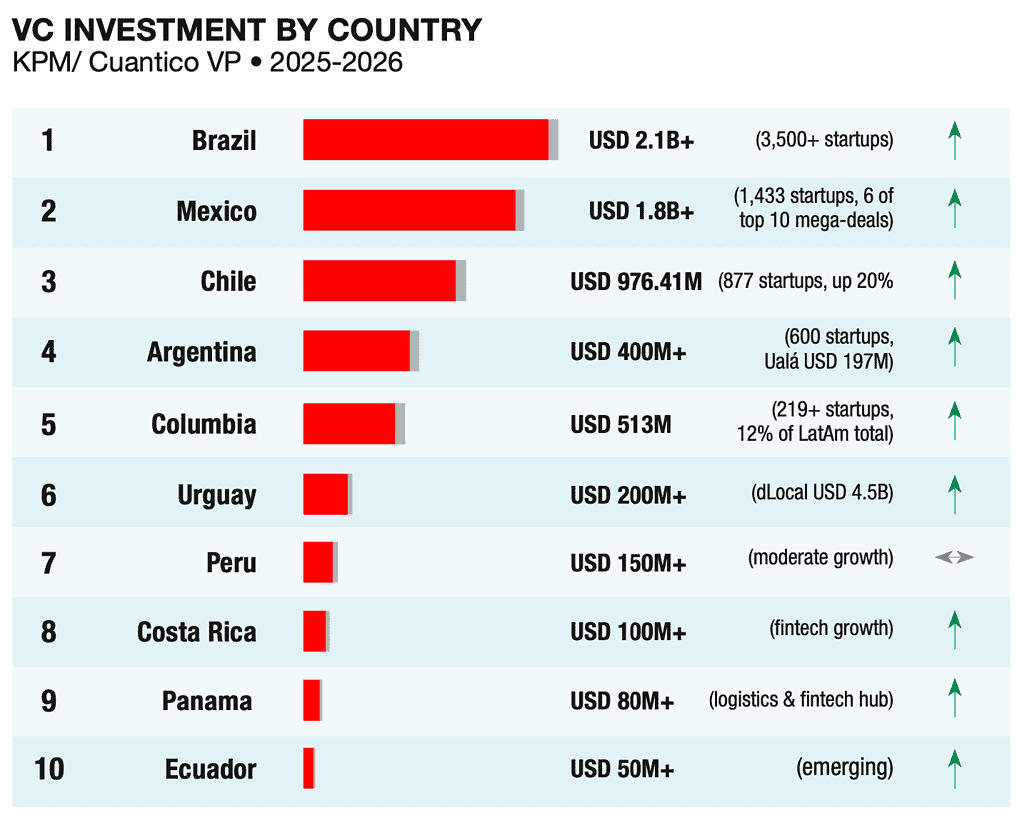
Brazil, Colombia, and Mexico account for about 57% of all Latin American fintechs, with remittances, loans, and financial management the main segments. In Mexico, the arrival of Mercado Libre and its subsidiary Mercado Pago, as well as Nubank, has forced traditional banks to offer their own digital alternatives.
“Mexico and Brazil, as the biggest economies, are pushing towards regulation. El Salvador is small but dynamic and has a fantastic regulatory sandbox,” said Daniel Leiva, partner at Torres Legal in El Salvador. “Then there are countries that are also pushing forward, like Colombia and Argentina. Argentina is fighting to integrate fintechs into the economy.”
With a Fintech 2.0 Law due in Mexico, the market is starting to mature as adoption of digital banks and payment schemes increases across the region. Mexico now has over 1,000 fintech companies, second in the region only to Brazil.
“This famous law has the objective to develop open finance as well as public access to user data of Mexican financial projects,” said de Los Heros, “creating clear regulations for virtual actors, tokenization, and stable coins.”
That would not be a minute too soon, as Mexico’s rapid fintech expansion has outstripped the Comisión Nacional Bancaria y de Valores (CNBV)’s ability to regulate, Leiva said.
De Los Heros does not believe the law will be ready this year; there is no publicly available draft of the law, nor is a draft bill before Congress or the Senate. Yet, speaking at the Fintech Festival 2026 in February, CNBV President Ángel Cabrera claimed that Mexico was technologically ready for Fintech 2.0, adding, “The CNBV’s vision is to build an ecosystem of digitally born entities that generate value where cash still predominates today.”
Leiva points to El Salvador as another example of dynamism in the industry.
With one regulator, the National Commission of Digital Assets (CNAD), working in tandem with the Central Bank of El Salvador, the focus has been on neutral laws; CNAD regulates certain types of activities, like crypto, without marrying the law to specific technologies. A broader scope allows for quicker adoption and avoids delays in achieving regulatory consensus on specific blockchain models, for example. This enables distributed technologies and similar models to be regulated more effectively.
(Brazil and Mexico concentrated 78.5% of all regional VC in 2025. Fintech captures 61% of capital. Source: KPMG, Cuantico VP, StartupBlink • 2025-2026)
From Sandboxes to Standards
Colombia’s instant payment system, Bre-B, was launched by the Banco de la República last October. Bre-B aims to connect traditional banks, fintechs, and digital wallets through a single public digital platform. By August, it had recorded 1.51 billion transactions and more than 35 million users; 171 financial institutions had integrated by then. Those numbers could be even better if the bank had been less passive and restrictive over the past couple of years, according to Leiva.
Eduardo De Los Heros, Bitso
That said, Colombia’s fintech sector is at a crossroads, with rapid uptake butting up against a new regulatory framework. The Banco de la República and the Superintendencia Financiera de Colombia have instituted new regulations to protect consumers, ensure financial stability, and combat money laundering. Fintechs now have to adhere to the same standards as traditional banks, including rigorous know-your-customer protocols.
“I am not convinced that excessive regulation is the ideal mechanism for the financial services users,” says de Los Heros. “But in regions like Latin America, where there’s not always advanced banking options, it can be that regulation brings positive effects, at least because it protects users against possible abusive practices by stock markets, financial entities, or virtual service providers.”
Peru’s attempts to integrate banks, fintechs, and users on a single inter-platform payment system under one legislative umbrella are also attracting attention. The Andean nation has “a high index of unbanked people,” de Los Heros said, and in theory, having a unified system with a single platform could speed mass adoption. “We have to see how an interactive interbanking and inter-platform payment system could be adopted region-wise. It’s more important to have an interbanking system that works than an inter-platform system that is not adopted.”
In the medium term, both de Los Heros and Leiva foresee a maturing market with heightened regulatory scrutiny. More regulation does not necessarily mean a more restrictive environment in a region where institutions have been praised for creativity and dynamism, and where central banks responded to the Covid-19 pandemic in ways that avoided the inflationary pressures other countries endured.
Daniel Leiva, Torres Legal
“Powerhouses like Nubank or Mercado Libre didn’t exist 25 years ago, so creating regulation for them is complex,” Leiva said. “I firmly believe the big actors like Nubank will move into other regions. They will go global. We’re going to have to implement new regulatory mechanisms, like allowing a banking license to be used across Central America.”
Latin America can build on its reputation for forward thinking and dynamic legislation, he added.
“Through new mechanisms of payment, like Pix, [Brazil, Mexico, and El Salvador] are the three regional pillars of legislative development,” he said. “Very interesting things are coming, and you could say Latin America is the lungs of fintech laws globally.”
Not everything is rosy, and de Los Heros is particularly concerned with the implications of AI and how to regulate it.
“AI causes me to lose sleep,” he said. “I really doubt that the industry has all the controls needed. To protect financial systems and society against the unmeasured use of AI and its consequences, we might have to start from zero to establish a lot of norms that we haven’t even thought about yet.”
Nic Wirtz is a contributing writer based in Guatemala.