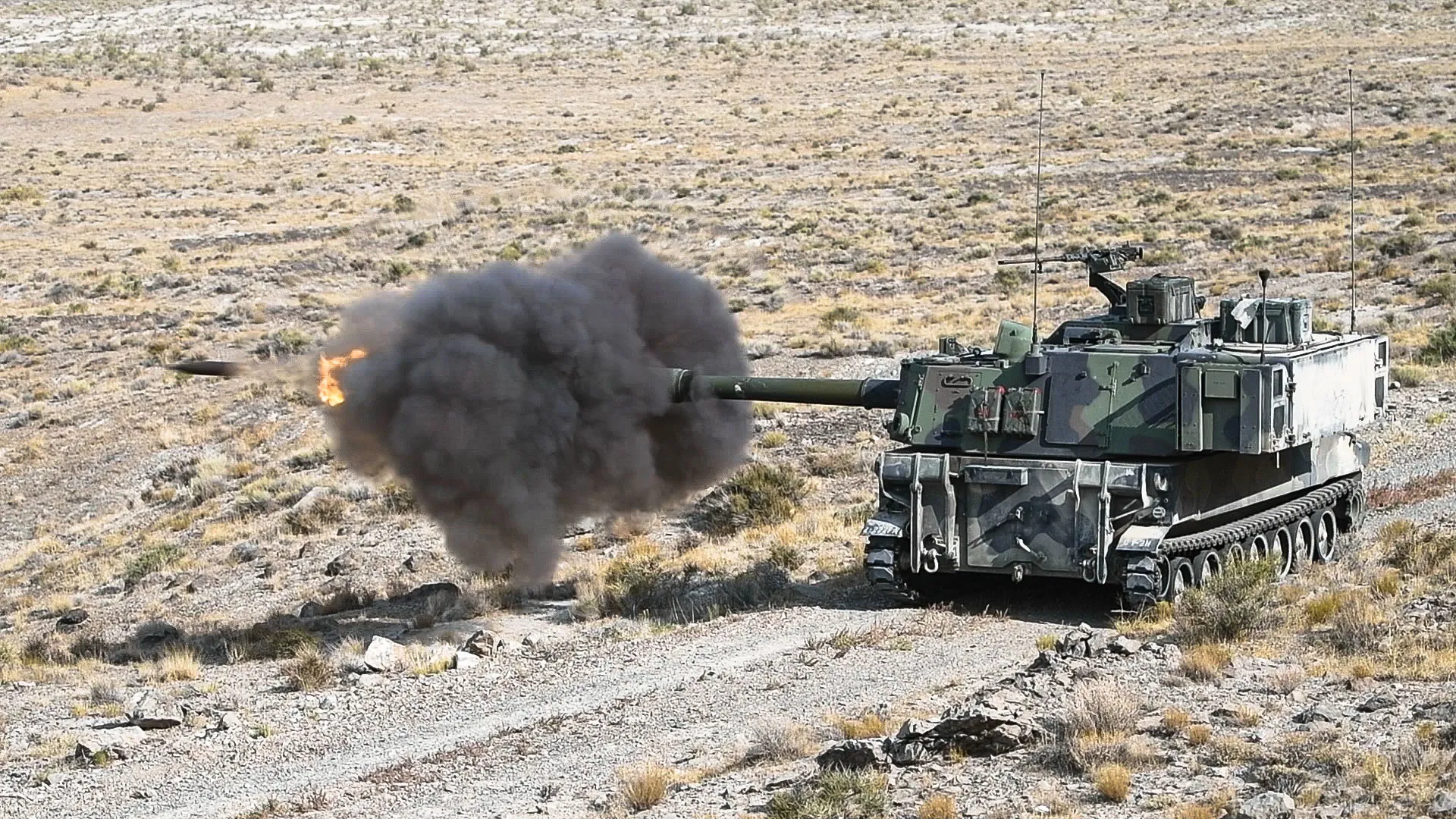
The Army’s Rhode Island-sized test range in Utah’s high desert has long carefully policed access and entry privileges. But as the service takes notes from industry on how to innovate faster and move more efficiently, access to Dugway Proving Ground, and other Army test ranges, are becoming an easier ticket.
“We want you on our ranges,” Maj. Gen. Patrick Gaydon, commanding general of Army Test and Evaluation Command (ATEC), told a military and industry audience Wednesday at the Association of the United States Army’s Global Force Symposium in Huntsville, Ala.
“Ranges are national treasures, and we need industry to iterate in our program offices, to be able to iterate and learn how, on these ranges, to do things you can’t do elsewhere.”

For years, Gaydon said, the Army evaluated range access requests with a priority structure of one to five, in which industry was five – the lowest priority. This effectively “blocked industry off the ranges,” he said, as did a permissions process that required him to personally approve visits.
“I looked at that for my first couple months in command, but about a year ago, we completely changed that,” he said. “Approval authority is at the tester or commander level – as long as you have a nexus to defense. If you have a car company wanting to use a track out there that has nothing to do with defense, I’ll still [have to] approve that.”
In December, ATEC announced another change it billed as an effort to “combine speed with rigor” to get new tools into the hands of soldiers faster. An overhauled safety release process waived an array of paperwork red tape for troops testing out “non-type-classified systems,” or commercial and prototype gear, on Army ranges. Particularly as the service accelerates drone and anti-drone weapons testing, emphasizing low-cost and commercial solutions, this has become a headache.
During three large Army experimentation events in Germany, Hawaii and Texas, ATEC officials had to issue nearly three dozen safety release forms for unmanned aerial systems, UAS payloads, and counter-UAS weapons, officials said in a release.

The new process allows for group safety releases for systems already on the military’s cleared UAS “blue list,” as well as higher-echelon release authority to extend permissions beyond individual requesting units. It also extends some safety release expiration dates and waives evaluation for systems previously deemed low-risk.
Col. Joseph Alexander, commander of the Army’s Redstone Test Center in Huntsville, highlighted recent efforts to build a UAS test range as an extension of the “UAS test operations campus,” or UTOC, that opened there years before.
Test personnel, he said, “came to use and said, ‘Hey, we’ve got more space. We need to go faster, because that’s the accelerated testing, to be able to deliver capability.”
The range, he said, aims to bring UAS testing needs “within 48 hours” for “some of those smaller, maybe time-sensitive missions.”

As the service announced in February, Redstone will also be home to a Future Long Range Assault Aircraft (FLRAA) test facility ahead of the fielding of the Army’s MV-75 tiltrotor aircraft, set to begin as soon as next year. This will include a $59 million radio frequency test space and a nearly 13,000-square-foot anechoic, or echoless, chamber for precision instrumentation assessment.
“You should be able to put weapons systems purpose-built for FLRAA [in there],” Alexander said.
While leaders are reducing barriers to range testing, the Army is pinning greater and greater hopes on its live-virtual-constructive evaluation environments. Gaydon said ATEC’s “bumper sticker” is a strategy to reduce live testing by 30% as they front-load digital engineering and model-based testing and development.
“Yesterday, I was in a FLRAA virtual prototype,” he said of the two Alabama-based MV-75 simulators manufacturer Bell-Textron delivered to the Army last year. “We can’t quite use that to test. We can use it to prepare test pilots to fly FLRAA. But that’s another example … that will certainly drive down the amount of live testing if we get it right with digital engineering.”
Contact the editor: Tyler@twz.com