The oil “mega-deal” signed between the US and Venezuela has caused major repercussions on plenty of themes: from the legality and timeframe of the agreement to the economic and political implications and, last but not least, the controversial role of Alejandro Betancourt.
A couple of issues are also missing from recent discussions: the effects of these new deals on Venezuela’s environment and its implications for the global climate crisis.
One exception was the coverage made by the NPR’s “All Things Considered” program, where energy and climate correspondent Julia Simon interviewed Paasha Mahdavi, a political science professor at University of California, Santa Barbara, who has this to say about what the new Orinoco Belt developments by major oil company Chevron could do.
“This expansion is effectively a carbon bomb. And so if Chevron does produce this field, that’s roughly 52 million tons of carbon dioxide equivalent per year additional. That is a huge number.”
On September 2nd, the same day those deals were signed in Miraflores Palace, the United Nations Environmental Program released the report “Limiting Overshoot,” which indicates that the 1.5° threshold to limit global warming established in 2015 by the Paris Climate Accords was already crossed and therefore the world must prepare for the fallout.
But in the last few days, several Venezuelan environmental NGOs and other civil society groups are sounding the alarm about the negative consequences that those agreements could produce here. Mongabay published this map about the areas that are impacted by oil extraction in Venezuela.
Venezuelan NGOs Clima 21 and Provea made public a joint statement in which they say that “the economic recovery cannot be made at the expense of environmental human rights. No economic interest can prevail over the constitutional and international right to a healthy, safe and sustainable environment…”
They proposed five points of commitment for all involved, which include transparency and public information, effective enforcement of environmental obligations, urgent management of oil spills, protection of vulnerable communities and a transition to a sustainable model for the country.
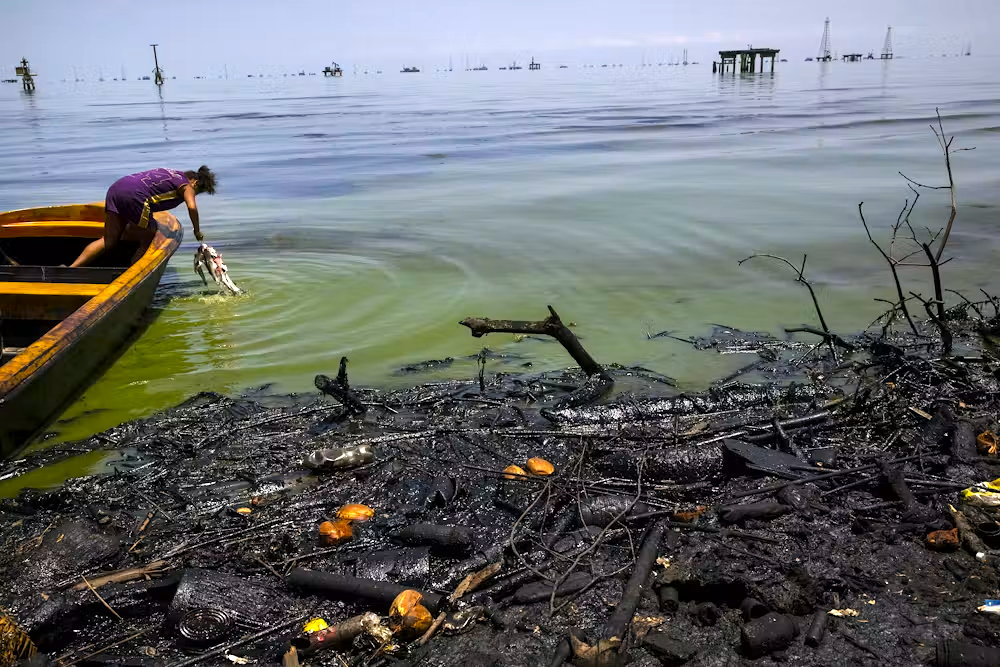
Local NGO Azul Ambientalistas claimed that in recent months there have been visible signs of spills and gas leaks in the Lake Maracaibo area, which increased after the reactivation of activities there earlier this year.
Alejandro Alvarez, director of NGO Clima 21 told Caracas Chronicles about what this overall commitment could entail: “It must take into a medium-to-long term strategic plan of reducing the fiscal dependence of the oil rent through investment in areas not related to the extraction and use of fossil fuels. There are already forecasts that could define alternative economic areas to generate currency without the extraction of petroleum.”
In similar terms, Transparencia Venezuela mentioned the need to adjust any oil investment and development to what’s established in Article 129 of the Constitution, including “environmental and socio-cultural impact studies” and “the obligation to preserve the balance…”
But some went further and openly denounced the US-Nabep deal as the surrender of our national sovereignty and civic rights, as Venezuelan sociologist Emilianio Teran-Mantovani wrote in an article for the Venezuelan Observatory of Political Ecology, an organization that he co-founded.
“The new Oil Agreement is the result of this process of political decomposition that has been unfolding in Venezuela for years; and it is the crowning achievement of the capitulation and dismantling of oil nationalism, which had already begun under Maduro and is now being fully unleashed through U.S. intervention…
“Ultimately, this means that Venezuelans themselves have no place. They hardly matter. Their decisions, expressed, for example, in the July 28, 2024 elections, do not matter. Neither do their social and labor rights. And the environment is even less relevant, an area that has been rendered completely invisible in this conflict.”
“There is no National Policy, National Strategy, nor a National Plan of Adaptation and Mitigation to Climate Change. There’s neither a Climate National Budget nor a National System for an Inventory of Greenhouse Gases…”
Besides these statements, the issue of how this oil deal will affect our surroundings has taken a backseat to other concerns while clouded by a lack of details and overall uncertainty around it, despite the promises of a prosperous recovery made by government officials in Caracas and Washington.
In the meantime, the problem of incidents like oil spills continues to be present to this day, with the most recent one occurring on the coast of Lake Maracaibo near Cabimas, as local NGO Azul Ambientalistas claimed that in recent months there have been visible signs of spills and gas leaks in the lake, which increased after the reactivation of activities in the area earlier this year.
Oil spills have sadly become commonplace over time, but reliable data on the matter is hard to come by, with NGOs like Clima 21 and the Venezuelan Observatory of Political Ecology filling the gap that the State is not providing.
“This possible impact (of the pollution produced by the projects of the oil deals) would add to the systemic chronic environmental crisis of the Venezuelan oil industry, which has a very high accident rate because of the abandonment of safety protocols and protections to the communities and ecosystems in the most affected areas. Our concern is the absence of guarantees in those agreements that these problems will be attended to and solved.”
And then there’s the concern of climate change and its already visible effects around the world. At the moment, the ongoing El Super Niño climate event is exacerbating temperatures, causing historical heatwaves like the recent one in Europe and creating serious worries about food crops and other essential natural resources in many nations, including here in Venezuela.
Evidence of how climate change has directly affected Venezuela can be found in the second academic report on climate change (DRACC), which was formally presented last December by the Venezuelan Academy of Physics, Mathematics and Natural Sciences. In its findings is the acknowledgment that the average temperature in the country has risen 0,22 °C per decade between 1980 and 2015, while global warming is responsible for anomalies in rainfall.
But the most damning conclusion is the complete disregard coming from the Venezuelan State.
“This is an important theme in which the government has made failed or incomplete advances” Alvárez, mentioning two failed projects: wind farms in Paraguaná and solar panels for an indigenous community in Amazonas state, which ended up abandoned.
“There is no National Policy, National Strategy, nor a National Plan of Adaptation and Mitigation to Climate Change. There’s neither a Climate National Budget nor a National System for an Inventory of Greenhouse Gases… …the climate institutional weakness accentuates the vulnerabilities of the national territory to the physical threats of the current climate change…”
“The climate change issue has completely disappeared from the Venezuelan political agenda. We have no information on the position of the government in the next international meetings on the matter,” Alvarez told us. He added that “in any case, we need a commitment of the State to fulfill the obligations of the Paris accords and the COP30 (the most recent UN’s climate change conference held in Brazil in November 2025) that promote an energy transition outside of fossil fuels.”
Given this assessment and the Trump administration’s doubling-down on the exploitation of fossil sources of energy, this oil deal could simply make those physical effects even worse.
Parallel to this is the inclusion of how clean energy sources like solar or wind could not only assist in alleviating the electricity shortage but create new opportunities for our economy. Now, it seems like the only one considered is the hydroelectric power that we largely depend on.
“This is an important theme in which the government has made failed or incomplete advances” Alvárez, mentioning two failed projects: wind farms in Paraguaná and solar panels for an indigenous community in Amazonas state, which ended up abandoned.
Overall, any discussion about the environmental consequences that this controversial oil deal could have for all Venezuelans is not at the forefront. It is not entirely erased from view, however.
The short-term argument also brings a long-term one that our society has been dodging for many years: finding a suitable compromise between the needs of our economic apparatus that require immediate attention and that our hydrocarbon industry can provide, while keeping safe basic things like the air we breathe or the water we use and even trying to preserve the natural wonders that this beautiful country of ours offers.