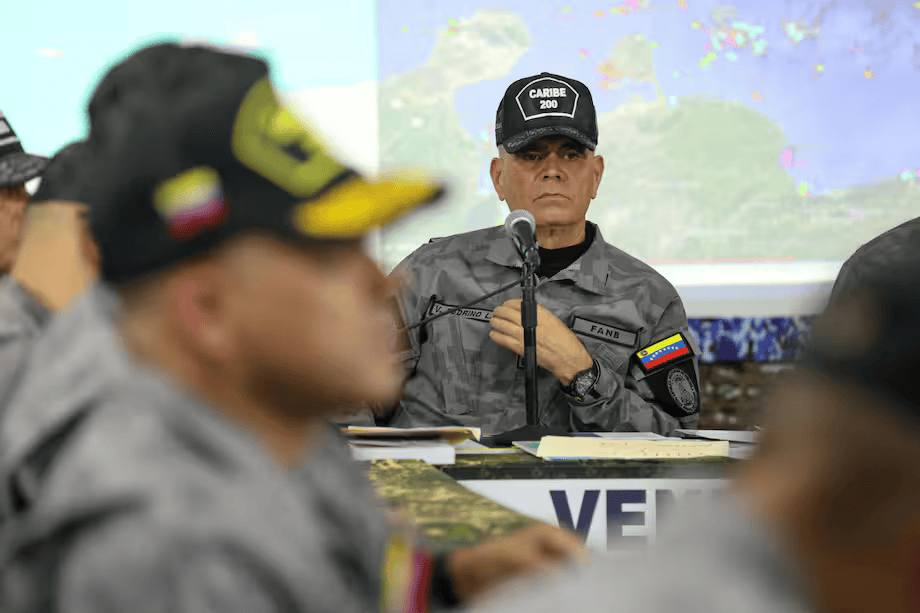
In another timeline, in that parallel universe where Venezuela is a normal Latin American country and not a case study of self destruction and democratic retreat, Vladimir Padrino López might have been a good military officer. A native from Caracas, he graduated with honors in the Military Academy in 1984, and as was normal for promising Venezuelan Army officers like him, he was sent to study in the infamous School of the Americas where the United States managed to train the armies of their allied countries. Padrino Lopez was sent later to command an Army post in the border with Colombia, and then came Hugo Chávez.
He was back in Caracas when the crisis of April 2002 allowed Chávez to purge the armed forces and control them as a whole, after promoting the politicization—to his favor, of course—of the military caste. Padrino read the room and focused on rising as a hardcore chavista. By the end of the Chávez years, he was leading the chief of staff of the Army, in the pole position to jump into the highest job an active military officer can get in Venezuela: minister of defense. Nicolás Maduro appointed him as such in October 2014, as well as chief of the FANB’s Strategic Operations Command.
By then, he was a general-in-chief with four stars on his uniform, but the most important thing is what he did, and what he didn’t.
Padrino López didn’t stop Colombian guerrillas from controlling villages, rivers, mines and illegal businesses in Venezuela. On the contrary, he helped him to use our territory as a sanctuary that protected them from Colombian soldiers and as a hunting ground for kidnapping and drug trafficking. He didn’t purge military intelligence from Cuban advisors and spies, but let them impose terror in the ranks and prevent the rise of conspirators against Maduro with extreme prejudice. What Padrino López focused on was on lucrative arms trade and cooperation with the Russian and Iranian industrial-military complexes. His most important function for Maduro was to help him to keep FANB in line, to lead the different military tribes around the chavista regime, and to ensure support from the women and men in uniform to an autocratic consolidation—through the illegal Constituent Assembly, and the two illegitimate inaugurations of Maduro in 2019 and 2025.
He was the minister of defense when FANB was tasked with overseeing the Mining Arc, when the protest wave of 2017 was drowned in blood, when FANB deployed with the police the killing squads of the Operación de Liberacion del Pueblo, and when DGCIM became the spearhead of the worst place Venezuela has been in terms of human rights since the military dictatorship of General Marcos Perez Jimenez. This is why you can find the name of Padrino López in several reports on repression and crimes against humanity in Venezuela: he was at the top of the military chain of command responsible for kidnapping, torturing and killing people.
Now he has completed his comeback, with the mission of helping Delcy and Jorge Rodríguez keep stability, to deter potential spoilers from trying to change the post-Maduro order.
The demise of Padrino López has been a rumor for years, as his ascendancy among troops decayed. Thousands of members of the armed forces have been victims of witchhunts or abandoned FANB, by quitting or even deserting, fed up with abuse, low wages, corruption and miserable operational arrest. In January 3, years of preaching about asymmetric war and millions spent on Russian toys did nothing to avoid the capture of Maduro and the bombing of Fuerte Tiuna. Delcy Rodriguez found a pretext to send Padrino to retirement, which was way past due. Naturally, she didn’t do it to punish him for being useless as an army leader, incapable of defending the country and his commander in chief, but because she needed someone she trusts more.
The successor might not be as visible or as well known as Padrino Lopez, but he is not very different. General Gustavo González López is also an alumni of the School of the Americas, a loyal chavista and a longtime member of the Maduro regime’s military elite. Twenty years ago he was already serving in civilian positions, like director of the Caracas Metro, that had nothing to do with his training, and everything to do with his loyalty to Chávez and the chavista (but not only chavista) myth that military officers are good managers because they know how to boss people around and impose order. González López’s organizational abilities, though, were more in the realm of building an efficient repressive apparatus than in running a decades-old public transport system.
He was appointed head of SEBIN, the civilian political police in charge of the dungeons in El Helicoide, during the 2014 repression wave. That meant González López was one of the men who dragged the country down the ladder of poor human rights indicators. Just like Padrino López, he quickly entered the list of Venezuelan high-level officials targeted by international sanctions and investigations. One year later, he became interior minister. Just when an assassination attempt with drones surprised Maduro and his security ring during a military parade in Caracas, and a scandal followed the murder of opposition councilman Fernando Albán in the SEBIN headquarters, González López was dismissed and put aside.
Now he has completed his comeback, with the mission of helping Delcy and Jorge Rodríguez keep stability, to deter potential spoilers from trying to change the post-Maduro order. González López was appointed chief of the DGCIM and commander of the Presidential Guard just after January 3, and now is at the top of the pyramid.
This is about loyalty, not about any political transition. We can’t expect justice, reconciliation or any movement towards the restoration of the rule of law with a man like González López heading the Venezuelan military. No one in the barracks or the streets is safer because one symbol of the Maduro regime, Vladimir Padrino Lopez, has been replaced by another.