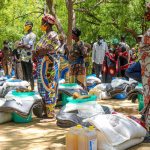

The Chadian government has launched the 2026 National Humanitarian Response Plan (NHRP) and the Refugee Response Plan (RRP) to coordinate assistance for vulnerable people uprooted by war. Amid a growing refugee crisis, including the arrival of 7,000 new Sudanese refugees at the eastern Oure Cassoni camp, the Chadian authorities established these schemes to tackle the humanitarian crisis overwhelming the country.
At an event held on Feb. 5, in N’Djamena, Chad’s capital city, the coordinator of the initiatives, Francois Batalingaya, commended humanitarian actors for their “constant engagement, which is essential for support to populations confronted by multiple crises”. He stressed the importance of mobilisation at both national and international levels, recognising the contributions of government, technical, financial, and humanitarian partners.
According to Batalingaya, the humanitarian plan is based on an analysis of four major drivers of crisis: conflicts and displacement, food and nutritional insecurity, sanitary emergencies, and climatic shocks. He revealed that 4.5 million people in Chad need assistance, with 3.4 million identified as priority targets, requiring nearly US$1 billion in financing.
He acknowledged persistent challenges, including financial deficits, insecurity, administrative constraints, and the need for stronger national appropriations and leadership. “Faced with these stakes, we must reinforce collective action and increase advocacy in order to avoid certain populations going without assistance,” he said.
The Minister of Social Action, National Solidarity and Humanitarian Affairs, Zara Mahamat Issa, described the launch of the NHRP and RRP as “a key moment for strategic planning and an exercise in accountability towards vulnerable populations.” She noted Chad’s continued solidarity in hosting refugees despite regional security crises, climate change, forced displacement, and socio-economic fragility.
“The government reaffirms its engagement to place the protection of vulnerable populations at the heart of its public action, considering humanitarian response as a factor of stability, social cohesion and sustainable development,” Zara said. She noted that transparency, accountability, and localisation of assistance are priorities, and called for better coordination amid limited resources.
During Batalingaya’s visit to the Oure Cassoni refugee camp, where more than 7,000 Sudanese refugees had recently arrived, he highlighted issues around the humanitarian crisis in Chad. He described the visit as “an immersion into an increasing humanitarian crisis which necessitates immediate responses.”
Testimonies from refugees, community leaders, and aid partners revealed feelings of uncertainty, exhaustion, and a shortage of basic necessities in the refugee camps. “Behind each of these problems are the suspended lives of children lacking access to education and families deprived of shelter,” stated a local humanitarian worker.
The refugees urgently need water, sanitation, healthcare, nutrition, food security, shelter, household items, protection, and education. “Oure Cassoni is an alarm signal. Without rapid and reinforced mobilisation, humanitarian needs would continue to overwhelm response capacities. The urgency is real, and inaction is no longer an option,” Batalingaya warned.
The Chadian government has launched the 2026 National Humanitarian Response Plan and the Refugee Response Plan to manage aid for people affected by conflicts, including an influx of 7,000 new Sudanese refugees.
Francois Batalingaya, initiative coordinator, emphasized the need for national and international cooperation, recognizing factors such as conflicts, food insecurity, sanitary issues, and climate shocks affecting 4.5 million Chadians, with 3.4 million needing urgent support.
Challenges like financial shortfalls, insecurity, and administrative barriers were highlighted, stressing the importance of collective action and increased advocacy to prevent assistance gaps. Minister Zara Mahamat Issa underscored the government’s commitment to protect vulnerable populations and maintain transparency, accountability, and local engagement in humanitarian efforts.
Concerns were raised about the growing crisis at the Oure Cassoni refugee camp, indicating urgent needs for water, sanitation, healthcare, and education, with calls for immediate and enhanced mobilization to address the crisis effectively.