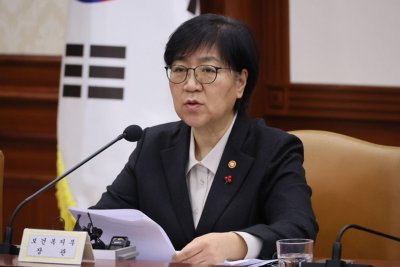

Health and Welfare Minister Jeong Eun-kyeong speaks during a meeting of economy-related ministers at the government complex in Seoul, South Korea, 21 January 2026. File. YONHAP / EPA
Feb. 6 (Asia Today) — South Korea could face a shortage of up to 4,800 physicians by 2037, the government said Thursday, as it moves closer to deciding how much to expand medical school enrollment amid mounting opposition from doctors’ groups.
The estimate was presented at the sixth meeting of the Health and Medical Policy Deliberation Committee, where the Health Ministry selected a supply-based projection model using the so-called inflow-outflow method. The model estimates future physician supply by factoring in new medical licenses and mortality rates.
Under the model, South Korea is projected to have about 135,369 practicing doctors by 2037. Even with that increase, officials estimate a shortfall ranging from 4,262 to 4,800 physicians, depending on assumptions.
Health Minister Jeong Eun-kyeong said strengthening physician training is a prerequisite for rebuilding regional, essential and public healthcare systems. “Appropriate workforce development is the first step toward restoring healthcare delivery outside major urban centers,” she said.
The ministry opted for a license-based supply model that relies on relatively stable indicators, such as new entrants and deaths, rather than more variable demand-side projections. A task force advising the committee said the model has been validated through multiple domestic and international studies.
Only the scale of enrollment expansion remains undecided. The government plans to announce next week the medical school quota for the five-year period starting in the 2027 academic year.
The proposal, however, continues to draw resistance from medical groups, including the Korean Medical Association, which argue the projections are flawed. Critics say the estimates fail to reflect differences by region and specialty, underestimate future productivity gains from artificial intelligence and rely on overly limited variables.
KMA spokesperson Kim Seong-geun warned this week that if the government pushes ahead based on what he called “distorted data,” the association would take action and hold the government fully responsible for the consequences.
Education experts also cautioned that any expansion must be accompanied by measures to protect training quality. One academic noted that overlapping cohorts from recent academic years have already strained teaching capacity and said closer monitoring will be needed to prevent deterioration in medical education and residency training.
At Thursday’s meeting, officials also reviewed discussions from a recent Medical Innovation Committee session and consultations with medical educators. Based on those talks, the ministry said it plans to cap enrollment increases to avoid excessive strain on schools and apply different standards to national universities and smaller medical colleges.
Jeong said the next committee meeting will outline not only physician training numbers but also broader policy measures to support regional healthcare staffing.
— Reported by Asia Today; translated by UPI
© Asia Today. Unauthorized reproduction or redistribution prohibited.
Original Korean report: https://www.asiatoday.co.kr/kn/view.php?key=20260206010002529