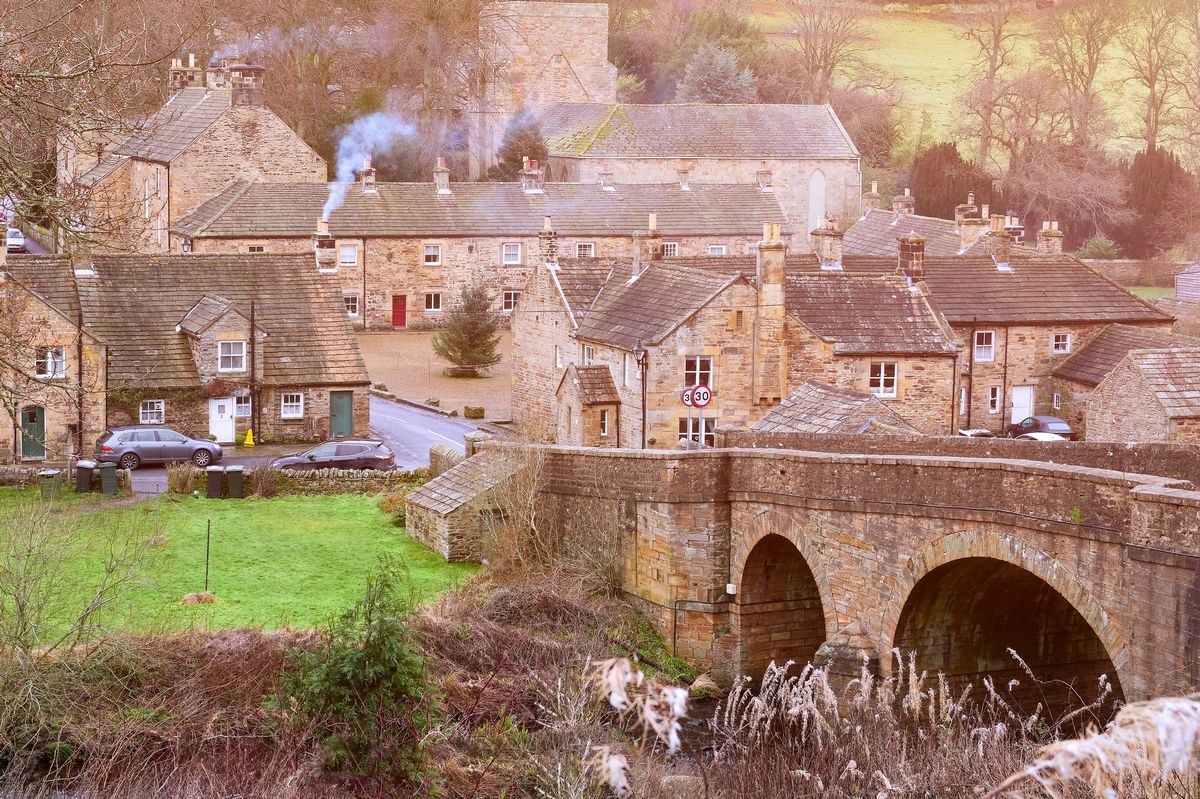
This tiny village has been dubbed as one of the UK’s most beautiful because of its medieval abbey stones and fairy-tale charm.

It’s being called one of UK’s ‘prettiest villages’(Image: Duncan_Andison via Getty Images)
A picturesque village that appears to be frozen in time has been hailed as one of the UK’s “prettiest villages” by renowned travel bloggers.
World travellers Jonny and Hannah, founders of the popular travel website Finding our Adventure, have crowned this hidden gem in Northumberland as the UK’s prettiest village, adding it to their extensive list of must-visit spots.
Upon arrival, visitors are immediately struck by the strong French influences in this charming village nestled within the North Pennines Area of Outstanding Natural Beauty. Encircled by stunning moorland fells, the quaint village of Blanchland seems as though it’s leapt straight from the pages of a fairytale.
This enchanting village, established in 1165, was built using stones from the Blanchland Abbey, and it appears as though little has changed since then. The village’s captivating history keeps tourists enthralled, while its picture-perfect honey-stone buildings are simply stunning.
Brimming with cobbled streets, hanging baskets, winding lanes, and beautiful stonework, Blanchland is notable for not having a single modern-day chain store within its borders, giving visitors the sensation of stepping back in time, reports Chronicle Live.
Tucked away beside the River Derwent, this charming hamlet sits within the forested stretch of the Derwent valley and could well be the most picturesque community in the entire North Pennines. Despite having just 135 residents, according to the latest 2011 parish census, Blanchland astonishingly attracts tourists from far and wide.
The settlement boasts only a select few key attractions, including Blanchland Abbey, the White Monk Tea Room – formerly the village school – a quirky local store with a distinctive white postbox, and what might be England’s most renowned pub-hotel combination, the Lord Crewe Arms Hotel.
Blanchland’s rich history
The village’s name stems from the French monks who resided and laboured at Blanchland Abbey, recognisable by their white robes. “Blanche” translates to white in French, giving birth to the name Blanchland – or so the story goes.
Walter de Bolbec established Blanchland Abbey in 1165, and Edward III reportedly stopped at this historically important hidden treasure whilst preparing for conflict with the Scots in 1327. The Scots, Vikings, Romans, and border Reivers are all believed to have battled for dominance over this breathtaking corner of the world.
Blanchland Abbey met its end under King Henry VIII in 1539, with substantial portions of the complex demolished, dismantled, or stripped away. The remaining structures and abbey grounds were reportedly either bestowed upon the King’s allies or sold to private buyers
The abbey’s lodge was subsequently converted into a manor house whilst its gatehouse and additional structures formed what became the village square.
In 1704, Lord Crewe purchased the Blanchland estate, and following his death in 1721, he bequeathed the property to The Lord Crewe Charity Trust. The trust proceeded to enhance the village buildings and assisted in restoring sections of the abbey church.
These efforts aimed to create a “model village” for Blanchland’s residents, who were predominantly mining families during that era.
Famous links
The celebrated Lord Crewe Arms Hotel ranks amongst Britain’s most ancient inns, with origins stretching back to the 12th century. It boasts traditional timber beams, stone-walled interiors, and a crackling open hearth, creating an ideal retreat for visitors seeking refreshment and sustenance or those wishing to spend the night on the premises.
The grand fireplace of the hotel is said to have been a hiding spot for General Tom Forster during the Jacobite uprising of 1715. The esteemed poet WH Auden spent Easter of 1930 within its historic confines and later declared that no other place held more cherished memories for him than the Lord Crewe Arms Hotel. Writer Emily Elizabeth Shaw Beavan also resided and penned her works within the hotel while her husband was employed at the Derwent Mines.
Blanchland is thought to have inspired the village portrayed in the opening and closing scenes of the 1935 play The Dog Beneath the Skin, written by Auden and Christopher Isherwood. Another celebrated poet, Philip Larkin, is rumoured to have been a frequent diner at the Lord Crewe Arms Hotel. A number of other notable figures are also believed to have visited the hotel.
In the popular television series Wolfblood, the scenes set in the fictional town of Stoneybridge were reportedly filmed in Blanchland. The village has also made numerous appearances on ITV’s Vera. Over the years, Blanchland has consistently been a top choice for filming period dramas.