Andy Burnham has urged caution on lifting the Saturday 3pm TV blackout in the UK, saying the health of the football pyramid should come first.
The rule was introduced in the 1960s to encourage fans to attend lower league games and prevents matches from being shown on UK television between 2:45pm and 5:15pm on Saturdays.
The blackout, which is enforced by Article 48 of the Uefa Statutes and is imposed by the English and Scottish football associations, comes into effect when 50% of fixtures in the top two divisions are scheduled to kick off at 3pm.
The Premier League is in the middle of a record £6.7bn domestic TV deal for Sky and TNT to show up to 270 live games a season.
But there could be room for change with the 3pm rule in the upcoming broadcast cycle, as the rights deals for the Premier League, EFL and SPFL all end in 2028-29.
The prime minister said any decision to remove the ban would require careful thought about the consequences.
“I would urge a bit of caution [on the blackout], because it does protect the income of lower-league clubs,” Burnham said.
The world’s top nuclear-armed countries are slated to hold their first-ever trilateral meeting soon as United States President Donald Trump pushes for a new nuclear arms treaty among them.
Trump will meet Chinese President Xi Jinping and Russian President Vladimir Putin for talks on the sidelines of the Asia-Pacific Economic Cooperation (APEC) summit this week in China’s Shenzhen, the White House confirmed.
Trump previously rejected Russia’s proposal to extend the treaty, demanding instead a “new, improved and modernised” deal that includes Beijing.
But China has long signalled that it is not ready to join any nuclear arms control treaty.
So why is Beijing not eager?
What is the New START treaty, and why does it matter?
New START was a treaty signed in 2010 by then-US President Barack Obama and Dmitry Medvedev, a close ally of Vladimir Putin who served as Russia’s president from 2008 to 2012. It was extended in 2021 for an additional five years when Joe Biden was the US president.
Under the agreement, Russia and the US were permitted to deploy no more than 1,550 strategic nuclear warheads and a maximum of 700 long-range missiles and bombers, had to impose a limit of 800 intercontinental ballistic missiles in deployment and grant permission for up to 18 inspections of strategic nuclear weapons sites annually by the other party.
New START collapsed in February after the five-year extension lapsed. This key accord was in turn built from earlier arms control treaties signed between Washington and Moscow.
The first of those, START I, was signed in 1991 between the US and the Soviet Union in the dying days of the Cold War. It remained in place until 2009 with the aim of capping US and Russian strategic nuclear arsenals.
START II, its successor, aimed to further reduce the number of deployed strategic nuclear warheads in addition to removing multiwarhead intercontinental ballistic missiles altogether. It was signed in 1993 but never came into force. Russia formally withdrew from it in 2002.
The Strategic Offensive Reductions Treaty (SORT) from 2003 to 2011, meanwhile, had the same purpose as START I but included less monitoring.
The COVID-19 pandemic in 2020 and Russia’s full-scale invasion of Ukraine in 2022 ended on-site inspections between the two nations in recent years, leaving them dependent on their own intelligence to judge compliance by the other side.
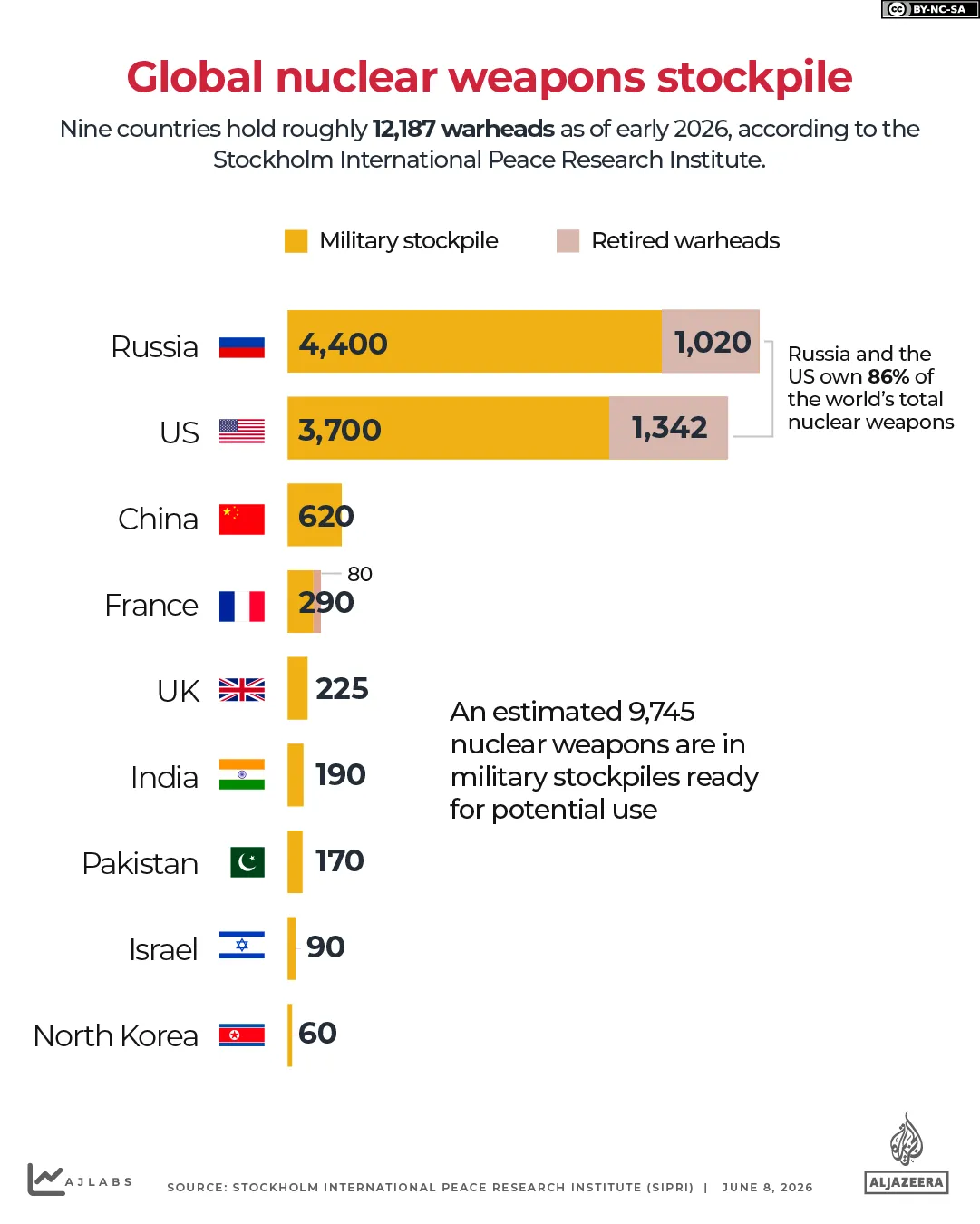
Still, the treaty offered some checks and balances to the two biggest nuclear powers in the world. Together, they possess about 86 percent of all nuclear warheads.
Why does Trump want China included in a new nuclear arms deal?
Trump has long wanted China included in the treaty because Washington believes an arms treaty involving only it and Moscow would no longer reflect the global nuclear balance of power.
“Today, the United States faces threats from multiple nuclear powers. In short, a bilateral treaty with only one nuclear power is simply inappropriate in 2026 and going forward,” US Undersecretary of State for Arms Control Thomas DiNanno said in February.
US Secretary of State Marco Rubio that same month said Trump made it clear that “to have true arms control in the 21st century, it’s impossible to do something that doesn’t include China because of their vast and rapidly growing stockpile”.
Washington also wants a successor treaty to address weapons not covered by New START.
DiNanno has said a new agreement would have to “account [for] all Russian nuclear weapons, both novel and existing strategic systems and [address] the breakout growth of Chinese nuclear weapons stockpiles”.
Why is China reluctant to join a nuclear arms control treaty?
Beijing’s unwillingness is largely due to the sheer disparity of warheads it currently possesses when compared with the US and Russia.
It has an estimated 620 of them, according to the Stockholm International Peace Research Institute (SIPRI), well below the 800 cap each for Russia and the US under New START. Moscow and Washington now have more than 5,000 each, according to SIPRI data. While the US has retired a third of its nuclear warheads so far, Russia has retired less than a fourth.
China’s nuclear arsenal, however, is growing faster than any country’s – by about 100 new warheads a year since 2023, according to SIPRI.
In February, when New Start expired, Chinese officials explained their opposition to joining a nuclear weapons capping agreement.
“China’s nuclear forces are not on the same level as those of the United States and Russia, and China will not participate in disarmament negotiations at this stage,” Ministry of Foreign Affairs spokesperson Lin Jian said in a statement at the time.
This “structural asymmetry” explains China’s reluctance to join a nuclear arms control treaty with the US and Russia alongside its own domestic restraints, said Zhao Minghao, a professor at the Institute of International Studies at China’s Fudan University.
“China maintains a declared no-first-use policy and a ‘minimum deterrence’ posture – nuclear weapons as political instruments for assured retaliation, not warfighting,” Zhao told Al Jazeera.
“From Beijing’s perspective, its arsenal is already restrained by doctrine. The potential US-Russia-China treaty would cap its insurance while imposing intrusive verification on a comparatively small force.”
He also pointed to a “credibility problem”, given the US withdrawal from a number of related treaties, such as the Anti-Ballistic Missile Treaty and the Intermediate-Range Nuclear Forces Treaty, which similarly seek to control missile numbers.
In China’s view, Washington has used arms control as a geopolitical instrument, Zhao said.
“Beijing’s strategic logic is that nuclear inferiority invites coercion – conventional or nuclear – while survivable second-strike capability neutralises it,” he said.
China’s smaller arsenal plays a role in its reluctance to join a nuclear arms treaty, but so does its ability to match US capabilities, said Sun Chenghao, a fellow at the Center for International Security and Strategy at Tsinghua University in Beijing.
“Chinese assessments also consider US missile defences, precision-strike capabilities and emerging technologies that could weaken its retaliatory capability,” Sun told Al Jazeera.
“An agreement limiting China’s forces while leaving those concerns untouched would have limited appeal.”
According to William Yang, the International Crisis Group’s senior analyst for Northeast Asia, there’s no clear advantage for Beijing and any treaty would be viewed “as a mechanism designed to limit its nuclear modernisation”.
“As a result, Beijing prefers to maintain strategic autonomy in expanding its nuclear arsenal and modernising relevant defence capabilities,” Yang told Al Jazeera.
At the same time, China’s rapid nuclear expansion raises “legitimate questions about where Beijing intends to stop”, said Alejandro Reyes, an Asia Pacific policy specialist and professor at the University of Hong Kong,
“It is difficult to assess China’s ultimate ambitions when it provides little transparency about its nuclear programme. We should not assume that China seeks parity, but neither should we assume that its declared commitment to minimum deterrence fully explains its current build-up,” Reyes told Al Jazeera.
Could the US, Russia and China ever agree on a nuclear arms deal?
According to the analysts, China would engage in a trilateral framework only when the US and Russia first reduce their arsenals towards “genuine” parity.
Zhao argued that such a path could be incremental.
It could appear as a “sustained US-China strategic stability dialogue with concrete reciprocity – test moratoria, data exchanges [and] notification of major exercises”, he explained.
The negotiations would also need to address missile defence, advanced conventional weapons and emerging technologies, Sun said.
“Differentiated obligations and phased verification would offer a more workable basis than identical reductions,” he added.
Sun said a practical starting point would be to combine US-Russian arms negotiations with “three-way discussions on crisis communication, nuclear doctrines and human control over AI-enabled nuclear systems”.
Reyes said an agreement would have to accommodate different levels of nuclear capability rather than insist on identical ceilings because all three countries have different arsenals, strategic doctrines and security concerns.
“The fundamental obstacle is political trust,” he said. “Each side regards its own nuclear capabilities as defensive while viewing the others’ modernisation programmes as potentially threatening. That dynamic encourages an arms race even when no side necessarily wants one.”
Still, such a result may not emerge anytime soon with the Ukraine war, tensions over Taiwan and US military deployments in the Asia Pacific still sources of simmering conflict between Washington and Beijing, Zhao argued.
“The likeliest near-term outcome is not a treaty but informal restraints while formal arms control waits for a geopolitical thaw that this decade is unlikely to deliver,” Zhao added.
The prime minister is expected to argue that the UK has lost more than it has gained from leaving the European Union in a speech ahead of a UK-EU summit in Brussels later this week.
Speaking at the Lord Mayor’s Banquet on Monday, Andy Burnham will compare the UK’s Brexit deal to the “emperor’s new clothes” – saying “a needlessly hard Brexit” created barriers for businesses and the promise to “take back control” was not delivered.
He is seeking to sign new agreements on food, energy and youth mobility with the bloc at Friday’s summit, where he has said a “win-win” deal can be struck.
The Conservatives have said Labour are “dragging us into the European Union via the back door with their EU reset”.
Burnham is expected to say on Monday: “It’s like the emperor’s new clothes – where no-one is prepared to say the obvious truth. Well, I say it as I see it. And to be frank, the emperor has nothing on.
“The Brexit we were given has not worked. We have lost more than we have gained.”
The prime minister says he wants to reset Britain’s relationship with the EU – and his argument is not that Brexit was wrong, but the way it happened was.
He will say any deal must pass the “Makerfield test” of providing tangible improvements to everyday lives, and deliver an arrangement which is closer to what people thought they were voting for in 2016.
Burnham is also expected to restate his commitment to Labour’s 2024 general election manifesto pledge that there would be “no return to the single market, the customs union, or freedom of movement”.
He will say the prospect of a new deal is a “win-win” and illustrates a “new approach”.
“Not adversarial. No longer burning bridges. But being constructive and positive – showing that we can come together to confront shared challenges.”
AT CHRISTMAS time, pennies count more than ever, so where can you celebrate the festivities without breaking the bank?
Well, Sainsbury’s Travel money has unveiled the world’s stand-out Christmas markets, especially when it comes to value.
Wroclaw in Poland has been crowned the best Christmas market with great value for moneySource: Getty Images – GettyBrits will get more value as the Pound is high against the Polish ZlotySource: Alamy
It adds that Poland is currently fantastic value because the Pound is at a three-year high against the Polish Zloty.
Sign up for the Travel newsletter
Thank you!
For Brits, this means spending money can stretch even further – so you can definitely stock up on souvenirs and presents if you’re heading there this December.
The market itself is in the centre of the city in Wroclaw’s medieval Market Square and has vintage carousels and a huge fairytale house.
Mulled wine will be served in iconic, boot-shaped mugs and there will be lots of Polish treats like oscypek (smoked mountain cheese with cranberry) and perniki (gingerbread).
There will be performances too including festive concerts, and a Christmas Carol Singers Parade led by elves.
Its Christmas market runs from November 20 until January 7, 2027.
Sainsbury’s Travel money also found that in Wroclaw, the cost of a local draught beer costs £3.07 and dinner for two averages at £38.
Meanwhile, the cost per night of a double room at a mid-range hotel is £49.
One-way flights are as little as £16 in December and from the UK can be as short as two hours.
The market has stalls selling food, drinks and gifts – as well as epic Christmas lightsSource: Primaria Craiova
With loveholidays, a three-night break to Wroclaw in December starts from £129pp, this includes flights from London Luton.
Wroclaw isn’t just for Christmas though, there’s so much to see in the city including its canals and over 100 bridges which resulted in its nickname; ‘the Polish Venice’.
The city also has colourful market squares, gothic town halls, and world-class museums.
If you fancy a scavenger hunt, then grab a map from the tourist office in Rynek and search for the hundreds of tiny bronze gnomes scattered around the city.
It might be something to avoid during the winter, but un the summer, the River Oder is a short walk away is a popular waterway for boat trips.
In second place for the best Christmas markets is Riga in Latvia.
Riga has strong roots to Christmas as it claims to have had the world’s first decorated Christmas tree in 1510.
It has an Old Town market and Mulled wine is a little unusual as it contains black balsam, Latvia’s famous herbal liqueur.
Wroclaw is just over two hours from the UK has cheap return flightsSource: AlamyThere’s plenty to see in Wroclaw with its pretty pastel housesSource: Alamy
The Christmas market here takes place between November 27 and January 3, 2027 in Dome Square in Old Riga.
It has over 80 individual shops with lots of handmade goodies from candles to kitted hats and gloves to gingerbread.
With loveholidays, a three-night break to Riga in December starts from £149pp including flights.
When it comes to the cheapest pints, Prague in Czechia takes the biscuit with a pint of draught beer costing an average of £2.38.
Meals for two cost £38 and the cost per night in a double room in a mid-range hotel is on average £77.
The Christmas market is set up in Prague’s Old Town Square with specialty foods, hot drinks, ceramics, jewellery and toys.
Sweet treats are especially popular including marcipán (marzipan), perníčky (gingerbread) baked in the shapes of Christmas trees, snowmen and bells, and Prague’s best-known street treat trdelník (chimney cake).
Sainsbury’s Travel money does advise to take cash as it’s usually just the larger stalls that will accept card here.
Return flights to Prague in December start from £44 and take up to two hours.
Here are the world’s top 10 Christmas markets…
Here’s the full list of the world’s top 10 Christmas markets, according to Sainsbury’s Travel money…
Martin Lewis has given tips on how to improve heat retention in homes(Image: ITV)
Money-saving guru Martin Lewis has shared how households across Britain can slash their heating costs this winter using an inexpensive product. Temperatures are dropping sharply – and with energy bills reaching record highs, families are searching for ways to keep warm without emptying their wallets.
The Met Office has forecast overnight temperatures will plummet to between -4C and -6C over the coming days. This comes alongside rocketing energy costs – with some experts forecasting a 28% increase come January.
During his ITV Money Show Live this week, Mr Lewis explained that households could make minor modifications to their radiators – resulting in substantial reductions to energy bills. He initially advised people to go through unused rooms and reduce the heating settings – while ensuring radiators have been properly bled.
There are also several affordable purchases worth considering – such as reflective panels to place behind radiators and shelves positioned above them. He stated: “Fit reflective foil behind radiators on external walls. You can get specialist foil-only on external walls, not interior. That works, doesn’t it, the reflective foil? People are asking if it’s a myth. It’s not a myth. It really does work.
“It means the heat is reflected back into the house rather than going into the external walls. Install a radiator shelf. You can get them for about eight quid. They go on top of the radiator-again, the heat is then being bounced away and brought into the main part of the house. And finally, move your big furniture away from the radiators because otherwise you’re just paying to heat the back of the furniture. You want that air to be circulating around the house.”
Ensure our latest DWP headlines always appear at the top of your Google Search by making us a Preferred Source. Click here to activate or add us as Preferred Source in your Google search settings
One viewer questioned whether radiators work better positioned on an inside wall or beneath the window. Prof Richard Fitton, Technical Director at Energy House Labs, explained: “We generally design radiator systems to go under a window so the air naturally rises in front of the window, keeps that window kind of to one side of the heat and circulates round and round. So you would want it under the window-that is absolutely the key place to do it.”
Mr Lewis added: “Take my one-degree challenge. It doesn’t sound very much. The World Health Organization says for a healthy adult, you can set the thermostat at 18°. Most of you are far higher than that. Obviously, if you’ve got a medical condition or older people, you’ll want it to be higher. But if you were to drop, say, from 21°C to 20°C, that could cut your heating bill by 7%.
“I am not telling you to do it. I’m telling you to experiment and see whether you can really notice a difference. So maybe you put a little bit more clothing on while you’re doing it on the top. Also a little note because people often contact me: if it’s cold outside, lots of people turn the thermostat up. The thermostat’s job is to take your house to a set temperature. You don’t need to turn it up. Let the thermostat do its work for itself.”
Lakefront Biotherapeutics (LKFT) launched a new share repurchase program of up to €50M after completing its initial €50M buyback on October 16, 2026 (which totaled ~1.99M ordinary shares).
Effective November 16, 2026, through no later than March 31, 2027, the new mandate authorizes repurchase
Darius Garland scored 27 points, Max Strus had 14 off the bench and the Clippers beat the Charlotte Hornets for the 17th straight time with a 113-105 victory Sunday.
Derrick Jones Jr. and Isaiah Jackson each scored 13 points, while Keaton Wagler and Gradey Dick had 12 apiece as the Clippers overcame a 13-point deficit in the third quarter to win for the third time in four games following a 1-7 start.
Coby White scored 21 points and Naz Reid added 17 for the Hornets, who lost for the eighth time in their past nine games and fell to 0-2 at the start of a four-game road trip. Coach Charles Lee was ejected when he received a pair of technical fouls in a 17-second stretch of the third quarter.
The Hornets haven’t defeated the Clippers since Nov. 18, 2017. Their last road win in the series was Feb. 28, 2009.
While still awaiting the season debut of Brandon Ingram (heel), the Clippers continued to turn things around after its poor start to the season despite being outrebounded 46-37, while taking 18 fewer shots from the floor than Charlotte.
Christian Anderson had 16 points for Charlotte, which shot 38% from the floor on 92 attempts. The Clippers shot 55.4% on 74 attempts and were 51.6% from three-point range.
The Hornets led 70-57 with 6:23 remaining in the third quarter after a three-point play by White. The Clippers closed the quarter on a 22-10 run to take an 84-83 lead into the final period.
The game was tied at 90 with 9:33 remaining when the Clippers went on a 10-0 run that was capped by a running layup from Dick with 6:57 remaining.
Up next for the Clippers: vs. Utah at Intuit Dome on Tuesday.
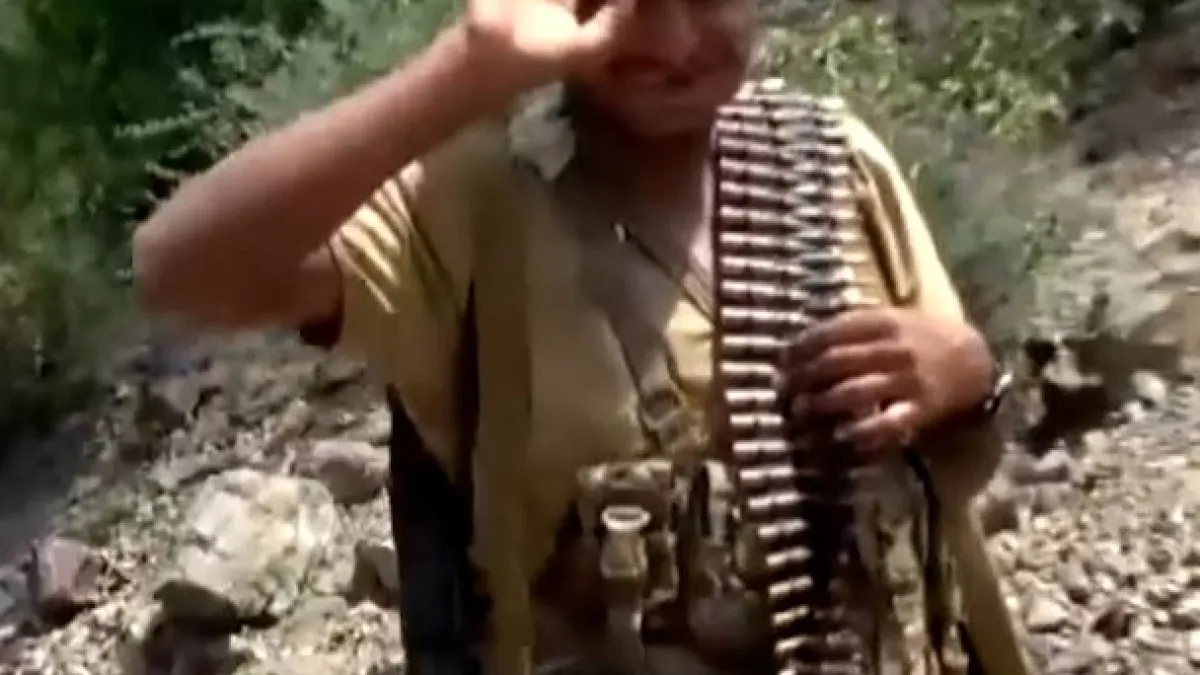
An advance by the Houthi armed group in Yemen is threatening one of the government’s last strongholds and bringing the fighting closer to Bab al-Mandeb, a vital global shipping route. Al Jazeera’s Yousef Mawry reports from Sanaa.
A tense race to replace outgoing United Nations Secretary-General Antonio Guterres is heading into its final few weeks in advance of a deadline that has never been breached, as global powers spar over candidates in an opaque election process.
With eight candidates, secret polls and geopolitical rivalries at play, the choice of the UN’s next chief is still up in the air, even as Guterres must leave office on December 31.
Recommended Stories
list of 3 itemsend of list
Competing interests from the Americas to the Middle East have complicated the process, raising fears that, for the first time in history, the new year could begin without a leader at the helm of the world’s central diplomatic organisation. The late inclusion of two candidates — Emirati diplomat Lana Nusseibeh and Turkish nominee Feridun Sinirlioglu — has further split the race wide open, with no name so far succeeding in overcoming opposition from all five permanent members of the UN Security Council (UNSC), who hold vetoes.
The protracted contest is part of a “struggle over who will exercise political influence within the UN at a time when multilateralism is under considerable pressure and attack”, Georgina Holmes, senior lecturer in politics and international studies at the Open University, United Kingdom, told Al Jazeera.
“P5 member states are not as politically aligned as they have been in previous eras, arguably even during the Cold War,” said Holmes, referring to the permanent members of the UNSC.
‘Most difficult job in the world’
The UN secretary-general has often been compared with a “secular pope” – a figure expected to unite countries and spearhead global diplomacy.
But the position is more than that of a figurehead. The secretary-general is also the UN’s top administrative official, responsible for tapping senior officials and supervising the UN Secretariat’s tens of thousands of staff.
“The secretary-general must be a skilled politician to navigate the geopolitics; a skilled diplomat and mediator to help settle disputes; a charismatic person in the public eye; and a solid and skilled administrator,” Jan Klabbers, professor of international law at the University of Cambridge, told Al Jazeera. “It has been called ‘the most difficult job in the world’ for a reason.”
This year’s race comes as the UN, under Guterres, is under heavy strain, having been sidelined from conflicts in Iran and Ukraine. It has faced blistering criticism from United States President Donald Trump and is suffering a financial crisis that has forced it to let go of thousands of staff.
It also comes as wider geopolitical rivalries extend to the pool of candidates to lead the organisation, who are being scrutinised over their nationalities and policy commitments.
Who is in the running?
Eight individuals who have been appointed by UN member states are currently in the running to replace Guterres. Most of them are from Latin America or the Caribbean, which is in line with representation according to informal UN protocol. Five of the eight are women, amid a push for the UN to select its first female secretary-general.
A leading contender, according to a series of anonymous straw polls the UNSC carries out to gauge support, is Costa Rican diplomat Rebeca Grynspan.
In the last poll on November 5, which does not show which UNSC members voted which way, Grynspan received 12 “encourage” votes and three “discourage” votes, according to PassBlue, a nonprofit that reports on UN affairs.
Grynspan, who heads the UN Conference on Trade and Development (UNCTAD), has been described as a “continuity candidate”, but there are concerns as to whether she would bring enough reform to an organisation facing huge political and financial pressures.
Richard Gowan, programme director of global issues and institutions at the International Crisis Group, told Al Jazeera that Grynspan had “solidified her position as the frontrunner”, but still appears to face opposition from the US and Russia, which could veto her bid.
While she has avoided directly confronting any veto-wielding nation, some of her reports as UNCTAD head have voiced concerns over Israel’s actions in Gaza and the occupied West Bank, positions at odds with Washington’s more full-throated support for Israel. Grynspan has previously also disagreed with Russian justifications for suspending a deal to allow the transport of grain through the Black Sea.
At the same time, she — like other candidates — is believed to be lobbying with key member states to win their support. In April, she met Russian Foreign Minister Sergei Lavrov over her candidature.
“Grynspan’s team argue that they can still nudge Washington and Moscow to accept her, and US officials do seem to be leaving open the possibility of working with her in the end,” said Gowan.
To be elected, a candidate needs at least nine votes in favour in the 15-member UNSC, while avoiding any vetoes from its five permanent members – the US, the UK, France, Russia and China. The 193-member UN General Assembly (UNGA) then ultimately has to sign off.
Ben Donaldson, adviser to the 1 for 8 Billion campaign, a civil society campaign “advocating for a fair, open, inclusive way to select the next secretary-general”, stressed that opposition from P5 members in a straw poll does not necessarily equate to an eventual veto.
“It has been used in the past as a basis to extract a concession from a candidate, very often in the form of a backroom deal to get a P5 national appointed to a key role in the future UN boss’s cabinet,” he told Al Jazeera.
The Argentinian head of the International Atomic Energy Agency (IAEA), Rafael Grossi, is also in the running. He finished second in the latest straw poll, with nine “encourage” and four “discourage” votes. However, his reputation for being closely aligned with Washington is expected to hurt him with some P5 members, especially China and Russia, though he has also had warm words for Beijing and Moscow in recent weeks.
The other candidates from Latin America or the Caribbean are Guyanese diplomat Carolyn Rodrigues Birkett, Antigua and Barbuda diplomat Maria Fernanda Espinosa and Ecuadorian diplomat Ivonne A-Baki.
Rodrigues Birkett, whose description of Israel’s actions in Gaza as “genocide” has drawn scrutiny in the US, received five “discourage” votes in the latest straw poll. Espinosa and A-Baki received 10 and 14 “discourage” votes, respectively, making their candidacies unlikely.
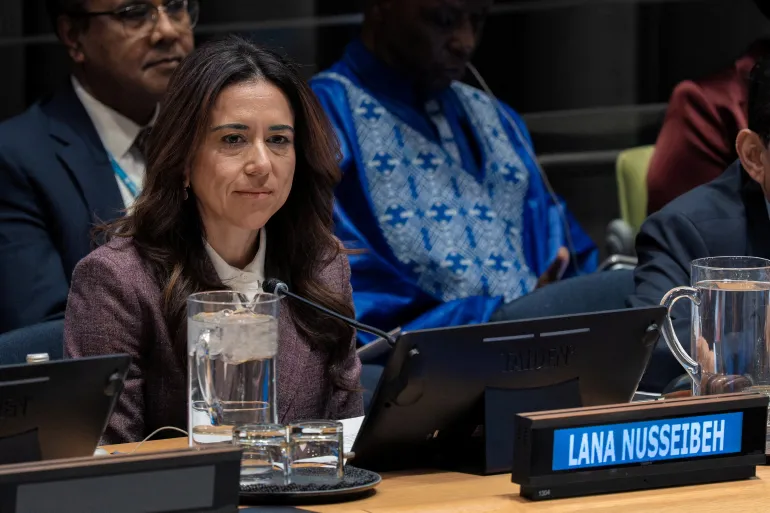
The UAE’s Lana Nusseibeh and Turkiye’s Feridun Sinirlioglu, nominated by their countries in recent weeks, have also shaken up the race but face significant opposition.
Nusseibeh is reportedly favoured by the US and Russia, but her candidacy has received pushback over her country’s alleged arming of paramilitary forces accused of atrocities in Sudan. The United Arab Emirates has denied the allegation. Nusseibeh received six “discourage” votes in the latest straw poll.
“Nusseibeh’s main challenge is to win over China, which has so far seemed sceptical about her candidacy,” said Gowan. “If she can get Beijing’s support, she could break through.”
UAE Minister of State Lana Nusseibeh looks on at the UN headquarters in the US, October 27, 2026 [David ‘Dee’ Delgado/Reuters]
Sinirlioglu’s candidature, which UNSC member Greece is expected to oppose, received eight “discourage” votes.
Ugandan politician Olara Otunnu, the only remaining African candidate, received nine “discourage” votes.
Far-right former Hungarian Prime Minister Viktor Orban, though not an official candidate, has also been floated by the US as an outside choice, The Wall Street Journal has reported.
UN in ‘near-constant crisis’
Several analysts told Al Jazeera that Grynspan appears to be in the best position, though the influence of P5 countries could change the race.
Earlier this month, the US and Russia put their weight behind the UAE’s Nusseibeh, with France and the UK offering “little resistance”, according to diplomats cited by media platform Devex.
China, for its part, has signalled a preference for a Latin American candidate, reports The New York Times, although Beijing has not publicly endorsed anyone.
Ellen Ravndal, associate professor in political science at the University of Stavanger, Norway, told Al Jazeera the drawn-out selection process and struggle to reach consensus reflect an era of “more geopolitical tensions” and a UN that is in “near-constant crisis mode”.
Adam Day, head of the Geneva office of the United Nations University Centre for Policy Research, pointed out that while the leadership contest has been lengthier and more contested than in the previous cycles in which former Secretaries-General Guterres in 2016 and Ban Ki-moon in 2006 were elected, some earlier races stretched into December.
“In the broader scope of secretary-general races, this one is still within the range of what has been normal,” Day told Al Jazeera. “But the longer it takes, the less time the incoming secretary-general has to prepare a transition.”
If no successor to Guterres is selected by the end of the year, the UN Charter does not specify an automatic interim successor. Any gap in the post would therefore require the UNSC and other UN bodies to agree on how to manage organisational leadership and operations.
“There is widespread concern that the United States and possibly other influential states are running down the clock, potentially to increase pressure to settle for a less popular candidate or to leave the UN leaderless and weakened for a period,” said Donaldson.
A man has sparked debate after sharing an uncomfortable encounter during a long-haul flight, admitting he’s been left feeling guilty about how he handled a request from another passenger
He felt awkward throughout the 12 hour flight (stock image)(Image: recep-bg via Getty Images)
When booking a flight, many passengers like to choose their seats in advance to make the journey as comfortable as possible. Others, however, either don’t get the opportunity or are happy to take their chances when checking in.
But one man has been left riddled with guilt after refusing to give up his plane seat for a pregnant woman – although strangers have been quick to take his side after hearing his story.
The 28-year-old was travelling from New York to Hawaii on a 12-hour flight and had made sure to book a ‘comfort seat’ in advance, spending around £200 and using loyalty points to secure it. However, after settling into his assigned seat, he was approached by a pregnant woman who asked if he would swap with her, explaining that she was struggling to get comfortable.
‘I needed the extra comfort and space’
He wrote on Reddit: “About 15 minutes before take off, a visibly pregnant woman was walking up and down towards the front of the plane. She and a flight attendant looked around for a moment, talked a bit, and then the lady approached me asking if I would be willing to switch seats with her due to her condition.
“I politely declined. I explained that I had specifically booked this seat because I’m pretty long (I’m 6ft 4ins tall) and that I needed the extra comfort and space.”
He explained how the flight attendant then took it upon herself to ask other passengers whether they’d swap – but they all declined. Despite this, a nagging sense of guilt crept in as he began to wonder whether he’d done the right thing.
He added: “If I agreed they would have reimbursed me for the extra cost via a voucher so that my ticket would’ve been the cost of the normal economy ticket. I’m not certain if the pregnant lady would’ve had to pay extra to switch with me because I just politely declined a few times and we didn’t get into that level of detail.
“The pregnant lady then told me I wouldn’t understand what it feels like to be a woman carrying a baby in this summer heat, got upset, and eventually had to return to her seat in the back. Throughout the flight, I felt awkward passing by her every time on the way to the bathroom.
“When I landed, I couldn’t help but feel guilty. I’m a young man without the burden of carrying a child in me and totally could’ve sacrificed a bit.. and wondered if I had been wrong to prioritize my comfort over someone who might have needed it more.”
‘Many a pregnant woman has survived economy class’
While the majority of users felt he was entirely within his rights to keep his pre-booked seat, others argued the expectant mother should have planned ahead, knowing a standard seat would leave her uncomfortable.
One user commented: “She had the option of purchasing a more comfortable seat. Unless Delta was willing to compensate you for the seat-swap I would not expect you to just ‘gift’ her your seat.
“I had done seat swaps before and United always took care of me. I pay extra for the better seats and do not want to be crunched in to some cubbyhole for 12 hours.”
Another user wrote: “You paid for that seat, and she paid for hers. She could have booked a different class if she wanted to. Most likely she knew she would be this pregnant when she booked the flight. It is unfortunate the situation she is in, truly, but unless a medical emergency were happening, I’m not sure why you would be expected to give up your seat.”
A third user commented: “Many a pregnant woman has survived economy class. If she had wanted the extra space, she also could have paid for it as you did. The other people could have also switched. But didn’t. This isn’t on you.”
Ensure our latest headlines always appear at the top of your Google Search by making us a Preferred Source. Click here to activate or add us as Preferred Source in your Google search settings
I used to eat spag bol three times a week. I’d have it every Friday at my nan’s, every Saturday at my dad’s, and every Tuesday at my mum’s. My nan would lean heavily on Dolmio and add a cheeky splash of Tabasco. My mum would rustle up hers in the time it took the pasta to cook, which gave it a crunchiness that sometimes made me cry (I swear to God, those onions were practically raw). And my dad would let his bubble away for the duration of Gladiators, meaning that by the time it was dished up at the start of Blind Date, it had an intensity that felt positively foreign.
I’m not alone in being a big fan of spag bol – the dish is often voted the nation’s favourite, and there’s now even a National Spaghetti Bolognese Day (22 May) – but I do sometimes wonder what it is about this relatively simple import, essentially a combo of mince and tomatoes plonked upon pasta, that has won over millions and withstood the vagaries of time. So I travelled to the dish’s motherland, Bologna, to unlock its secrets and hunt down some prime examples.
No sooner had I arrived in the city, which is roughly equidistant between Venice and Florence, than it became alarmingly apparent that I didn’t have a clue what I was on about – the sauce is called ragù, for a start, and is never served with spaghetti (the use of which is often attributed to Elizabeth David, who called for it in her 1954 book Italian Food). The pasta must be tagliatelle, and by official decree an authentic tagliatella must be precisely 8 millimetres wide, so that the rough, hand-rolled egg pasta (sfoglia) grips the slow-cooked meat sauce perfectly.
Notwithstanding my naivety, here are five spots in Bologna where the tagliatelle al ragù alla bolognese (or tag rag for short) proved a hit with my taste buds.
Photograph: Ben Aitken
The interior of this trendy upstart is decorated with retro kitchen utensils, presumably to trick us into thinking we’ve just stepped into the home of an 18th-century peasant. The menu includes an “ancient” version of Bologna’s signature dish that incorporates tongue and tripe. I swerve this in favour of the classica, which more or less conforms to the “official” recipe that was lodged with the Bologna chamber of commerce in 1982 (a recipe that, interestingly, condones the addition of milk).
When my lunch arrives, what’s most striking about it is the unmistakable beefiness of the ragu. In terms of flavour profile, it’s by no means tomato-forward. Were it to be briefly anthropomorphised, you’d say it was a hard-as-nails cattle rancher. Although my companion loves its meaty monotone, I confess to craving a sweeter note.
€10, 7/10
Photograph: Ben Aitken
Walking to Trattoria del Rosso along Bologna’s charming central streets, it occurs to me that the city is the colour of its ragu. Call me fanciful, but I reckon if you put all the city’s peaches and oranges and reds and pinks and browns into a food processor, you’d end up with something the colour of its famous dish.
The ragu at Trattoria del Rosso – which again comes premixed with pasta – is appreciably redder and coarser. Tomato vibes are stronger and the meat is more succulent, which could point to a higher fat content. Again, parmesan is served on the side and, again, its addition at half-time causes the dish to improve, meaning we can safely conclude that ragu is bettered by cheese.
€13, 8/10
This suburban trattoria sits on a charmless main road opposite a Lidl, so I am pleasantly surprised to find it absolutely pumping. It feels like we have chanced on a secret supper club full of Stanley Tucci types in zany specs and turtleneck sweaters. On reading the menu, I am tickled to see that the ragu is listed as “mystical”.
When the dish arrives, it proves an uncomplicated success. The pasta, which is made on site before every service, is served just as God intended, beneath a hillock of ragu. (Which is how it should be, of course. None of this premixed nonsense.) The ragu is definitely more mellow, which may betoken the addition of milk, rumoured to offset acidity and produce a creamier finish. What’s more, the meat has a distinctive earthiness to it. A smidgen of liver in the mix, perhaps? This wouldn’t be as random as it might sound, for one of the earliest extant recipes for ragù alla bolognese, penned by Pellegrino Artusi in 1891, cites chicken liver as one of the dish’s optional constituents.
I ask the waiter to spill the beans on his mystical ragu but he won’t reveal any secrets – unless, that is, I’m prepared to come back tomorrow morning to help make it with him. When I call Luigi’s bluff and tell him I’m up for it, he waves me merrily away.
Back in the picturesque thick of it, on lively Via delle Moline, is Va Mo Là. Here, the ragu is more orangey than normal, with the carrot from the soffritto (the aromatic mixed vegetable base of Italian cuisine) making its presence felt, while a higher ratio of pork in the mince results in a less overpowering sauce. Our table on the front terrace is shaded from the elements by one of Bologna’s famous porticos. (Were these covered walkways placed one after the other, they would stretch for almost 40 miles).
I confess to feeling a touch smug while tucking into my lunch, aware of the queue outside Osteria dell’Orsa round the corner, which has been inundated since a TikToker dropped a reel that went viral. My advice? Don’t bother lining up. Not there, not anywhere. Any gains will be marginal and not worth the effort. If you do find yourself at Va Mo Là, Caffè Rubik and Camera a Sud are both good nearby spots for a digestif.
€9, 7.5
Noi is inside Mercato delle Erbe, just north-west of the main square, Piazza Maggiore. The pasta is properly eggy here, and arrives smothered in a ragu that is noticeably chunkier than elsewhere. The small pool of bright orange liquor that forms at the bottom of my bowl proves a treat when mopped with a hunk of the spongy white bread that comes as standard.
When I quiz the waiter on the matter of ragu being in a monogamous relationship with tagliatelle at the expense of other strands of pasta, he says that he’d rather lose a finger than eat ragu with something else. One wall at Noi is a shrine to soffritto, which I consider ragu’s unsung, invisible hero.
€11, 8/10
Spag bol or tag rag?
Making the ragu at La Vecchia Bologna
My partner threatened to dump me when she caught me ordering a final ragu at the airport restaurant La Vecchia Bologna, but I had to give it a shot when I saw it listed on the menu as Non chiamateli spaghetti alla bolognese! (“Don’t call it spaghetti bolognese!”). Which is quite right, of course.
If my field work in Bologna has taught me anything, it’s that spag bol and tag rag are very different beasts. While the latter is more or less the same wherever you have it (as per the wishes of the Bologna Chamber of Commerce), the former is reliably all over the place, in a way that I adore. Spag bol is a refuge for that lonely courgette that has been sitting in your fridge for a week. It’s a platform for cheddar or gouda or even stilton on occasion. It can take a sausage or a dollop of Marmite in its stride.
When does a spag bol stop being a spag bol and start being something else? Well, that’s a question for the philosophers. What I can say with confidence is that given a choice between the pleasant precision of tagliatelle al ragù and the delightful chaos of spaghetti bolognese, my money’s on the latter – any day of the week.
By Chad Harbach Little Brown & Co.: 672 pages, $32
If you buy books linked on our site, The Times may earn a commission from Bookshop.org, whose fees support independent bookstores.
The author Chad Harbach just had a banner week. His second novel, “The Brightness,” hit bookstores. A24 announced his television adaptation. And the Milwaukee Brewers, his beloved hometown team, finally won their first World Series.
It was a lot all at once, considering the onetime literary superstar hasn’t made a peep in nearly a decade.
In 2011, Harbach became something of a literary unicorn: His debut, “The Art of Fielding,” inspired a bidding war, a $665,000 advance and near-universal predictions as the Next Great American Novel.
The hype, for once, panned out. He toured, made a chunk of money and worked on a few projects. Then — poof. For years, there was scarcely a sign of him online or out in the world. Until last month.
Harbach, it turned out, was emerging from the woods just outside Palo Alto. “It’s not exactly the social, cultural milieu that I expected to find myself in,” he said on the phone from his Portola Valley home.
And besides, the unlikely Californian moved west a few years back. In his mind, at least, he remains a Midwesterner.
“The Brightness: A Novel” by Chad Harbach
(Little, Brown)
When we met at the Hollywood Roosevelt in mid-October, hours before his podcast with comedian-turned-bookfluencer Anthony Jeselnik, Harbach toted an early edition of Eve Babitz’s “Slow Days, Fast Company.” He credited journalist Liz Brown with helping spark Babitz’s revival, tracing a chain of book recommendations and literary connections that reflected the inside-baseball stories he’d picked up as a co-founder of the highly influential lit mag n+1 he helped start in 2004.
The 50-year-old — wearing a cotton blue sweater, skinny jeans and Earth Runner sandals — was feeling good after watching the Brewers beat the Dodgers in their own stadium in Game 3. A self-described shy guy, he seemed more comfortable with the press, and more at ease in his own body, than he had been during the publicity blitz for “The Art of Fielding,” his bestselling 2011 debut about a college baseball team in his native Wisconsin.
But for all his years in the New York literary world — and later in Charlottesville, Va., where he earned his MFA at the University of Virginia — Harbach’s fiction has never strayed far from its roots. His hometown of Racine, Wis., “a city on the floor of Lake Michigan,” remains the gravitational center of his fictional universe.
After spending two years touring “The Art of Fielding,” Harbach was eager to move on. He sat down with his notebook, he said, hoping to “dig in, tap into the place that was going to let me know what I needed to work on next.” He had no intention of returning to Westish or the world of his first novel. “I didn’t think it would be a good idea, like commercially or artistically,” he said.
But he kept coming back to Pella, the college president’s wayward daughter from the first novel. “I just kind of kept doing that until I had to relent and say, ‘OK, I’m going to follow this for a while, and see where it wants to go.’ ”
The recently published, “The Brightness,” is set four years after “The Art of Fielding.” It returns to fictional Westish College, swapping baseball for literature and art, male friendship for female. The old characters recede; new ones take center stage, most notably classmates Pella Affenlicht and Irma Friske. Its Byzantine plot revolves around a performance-art stunt intended to draw attention to campus rape culture, which soon attracts the national media.
Author Chad Harbach.
(Genaro Molina / Los Angeles Times)
Whereas “The Art of Fielding” inhabited a kind of Pollyannaish liberal-arts idealism, “The Brightness” can be read as a reckoning with that Obama-era millennial optimism.
“At first you think you’re back in magical Westish, but it’s sort of the dark side of it,” said Keith Gessen, one of Harbach’s co-founders at n+1.
Gessen, who wrote the seminal Vanity Fair profile chronicling Harbach’s literary ascent, has known him since their undergraduate days at Harvard. He recalled a class the two took on Herman Melville, in which their professor introduced them to the idea of “unwriting:” not rewriting a text, but unwriting it, revealing things that had been there all along but remained just beyond view.
“The characters in the book are sort of trapped and beguiled, and want to stay at Westish. And the book is like, you can’t.”
Returning to Westish, Harbach also had to see it anew, this time through the eyes of its young women in 2015, on the cusp of #MeToo and the first Trump presidential term. Lisa Borst, a current editor at n+1 and one of Harbach’s trusted manuscript readers, brought this perspective to the project. “One of his real gifts,” she said, is writing dialogue, “even in spaces or institutions that he himself doesn’t necessarily have firsthand, present-tense experience of.”
And within the worlds he does know, Harbach defaults to an almost anti-autofiction. Borst pointed to a storyline in which the New York literati descend on Block Island for the wedding of Owen Dunne, a young novelist whose book bears an uncanny resemblance to “The Art of Fielding.” It’s one of several meta-moments where Harbach retcons his own first novel.
A lesser writer, Borst said, might have populated the scene with thinly disguised versions of recognizable literary-world figures. “But he’s like actually too inventive and imaginative to indulge in that kind of thing.”
Still, there were moments where Borst’s eye — what she called “millennial woman sensitivity read” — helped bridge the gender and generational divide. She recalled having a conversation with Harbach about how campuses have evolved and pointed to a key scene where a student dies by suicide, and how the campus responds.
“I went to Brown in the 2010s, and a couple of students passed away over the course of my time there,” she said. “And it was always a big deal.”
Harbach’s experience at Harvard in the ‘90s had been different. “It made me think how crisis PR and university comms have really come a long way,” Borst said.
Despite a brief online debate over Pella using toilet paper as a tampon versus a pad, the response to “The Brightness” so far is decidedly positive. Reviewers have embraced it as a big, sprawling, unapologetically old-fashioned social-realist novel, one that was worth the wait.
“As a young writer, you think, ‘I’ll write this book that everyone likes, and then I’ll just sort of ascend into heaven, and life will be solved.’ But actually nothing is solved,” Chad Harbach says.
(Genaro Molina / Los Angeles Times)
There was considerable anticipation, given the stakes: a sophomore follow-up, nearly 700 pages, that took 12 years to write. But Harbach knew better this time than to count on a successful review to change his life.
The publicity alone wore him out physically during the his first novel’s debut, but he also felt the loneliness of having an experience few people around him could relate to. “It’s very hard to acknowledge the difficulty of it because you are supposed to be unceasingly grateful and happy about all of it.”
Envy and resentment stymied certain relationships, along with the question of what comes after your wildest dreams come true. “You kind of have to really figure it out on your own on the fly,” he said, “and also, maybe most importantly, try to figure out what lies on the other side of it.”
“I think as a young writer, you think, ‘I’ll write this book that everyone likes, and then I’ll just sort of ascend into heaven, and life will be solved.’ But actually nothing is solved.” Except that he can pay his rent.
The money from “The Art of Fielding” — royalties, foreign sales and rights — gave him a cushion. Hollywood called intermittently, too. Options came, then went, then came again. It wasn’t until last month, with the announcement of the A24 TV deal, that an adaptation finally seemed to stick. “And then I basically didn’t change my lifestyle at all,” he said, stretching the money out much longer than people imagined to do it.
By continuing to live modestly, he could buy himself years to write. He remains the treasurer of the board on n+1, and a mentor to the current editors. He’s never made a cent from the magazine, he said. “From day one, it cost money.”
And that’s largely what Harbach has been doing these past 15 years: writing, and being a dad to his 4-year-old son. Until news of “The Brightness” began making the rounds early this year, remarkably little was known about him beyond the old reviews and profiles.
Except the lawsuit.
“No one has asked me about this yet,” he said.
In 2015, Harbach received what he called a “creepily cryptic email” from a reporter, giving him a heads-up about an impending front-page story. A writer named Charles Green was accusing Harbach of lifting elements of his unpublished baseball novel.
But Harbach had never heard of this writer, who lived in Texas, or seen his manuscript. “It was terrifying,” Harbach recalled. “It was draining. It was disorienting.” Ultimately, though, the story never ran. “Then in 2017 I’m like walking back to my apartment, and I got served.”
What followed was a years-long legal battle. A federal judge ultimately dismissed Green’s copyright infringement suit in 2018, a decision upheld on appeal the following year.
“It’s not the worst thing that’s ever happened to me in my life,” Harbach said. “But it was an ongoing period of just really disturbing. … There were months when it was really hard to think about anything else.”
A lodestar for Harbach remains David Foster Wallace, a fellow Midwesterner who could move effortlessly among mathematics, sports and American fiction. For all his years in the New York literary world, Harbach has never entirely shed the sensibility of the place he came from.
“Having grown up in Racine, Wis., not from a literary or intellectual family or community,” Harbach said, “I think I wanted to write a book that matched my highest ideals of literature, but that my friends from Wisconsin would read and like and comprehend. You know, just a real down-to-earth kind of quality.”
Rudi, an L.A. native, is a freelance art and culture writer. She’s at work on her debut novel about a stuttering student journalist.
Pony AI (PONY) and Toyota Motor (TM) have launched fully driverless commercial robotaxi services in Guangzhou, China, using their jointly developed seventh-generation (Gen-7) bZ4X vehicles, marking the start of commercial operations for the new model.
After defeat by England, Australia lost 15-12 against Scotland on Sunday, a result which leaves Wales fifth in the northern hemisphere table.
Wales are behind Gregor Townsend’s side on points difference, with Scotland finishing their campaign against Japan.
Tandy’s side have won three out of five games in the Nations Championship against Fiji, Japan and New Zealand with defeats in the summer against Argentina and South Africa.
Captain Dewi Lake has highlighted what has changed for this campaign to enable Wales to defeat New Zealand and rise one place in the world rankings to ninth.
“Our skills are better and I think we’re a better team, which is credit to Steve and his coaches,” said Lake.
“I think the belief is also different and the mindset has shifted.
“We’ve spoken about it a lot and it’s probably easy sometimes to say we’ve changed our mindset and believe in ourselves.
“It feels different. Everybody has come in with a voice and a belief and [we] are challenging each other to get better. Ultimately that’s what grows a group quickly.”
Prabowo says his government has a ‘zero-tolerance policy’ for companies that contribute to blazes and promises strict action.
Published On 16 Nov 202616 Nov 2026
Indonesian President Prabowo Subianto has apologised to Singapore and Malaysia for the transboundary haze due to months-long wildfires.
Prabowo conveyed the apology during a session at the ASEAN summit that kicked off on Sunday in the Philippine capital, Manila, according to a statement from the Indonesian presidential office.
Recommended Stories
list of 4 itemsend of list
Prabowo also said his government had and would continue to take firm action on companies involved in forest fires while also preparing to establish a new body to strengthen wildfire prevention.
Indonesia has a “zero-tolerance policy” for any company contributing to the blazes, the statement quoted him as saying.
“We’ve revoked 17 concessions [permits] from companies. [Meanwhile] 26 companies are currently under investigation and 11 others have been charged. Another 23 companies are on the list to be charged,” he said.
“In total, 104 companies are currently under investigation by our police.”
He also said Indonesia had deployed 71,000 forest firefighters, and 16 people died while battling the blazes.
Philippine Foreign Minister Theresa Lazaro told a news briefing later on Sunday that Jakarta was “very frank and candid in expressing the efforts they have been exerting in addressing the forest fires in Indonesia” during the plenary session.
Indonesia has been battling its most intense wildfires in 11 years, with large swaths of land scorched, mainly on the islands of Sumatra, Borneo and Papua.
Haze from the fires blanketed some of its nearest neighbours, primarily Singapore and Malaysia, over the past few months.
Malaysia and Singapore have refrained from criticising Indonesia, instead offering assistance to fight the fires.
Previously, an Indonesian official faced criticism after claiming the country’s forests supply oxygen to Malaysia and Singapore despite recurring haze from wildfires.
“We do not just send smoke, but when there is no smoke, we send oxygen,” Indonesian Government Communications Agency chief Syahganda Nainggolan said in October.
ASEAN agreement
On paper, Southeast Asian countries are committed to working together to prevent cross-border air pollution under the 2002 ASEAN Agreement on Transboundary Haze Pollution.
Haze from wildfires shrouds the area on the bank of the Kahayan River in Palangka Raya, Central Kalimantan province, Indonesia, on October 24, 2026 [Usep Hariad/Reuters]
The legally binding treaty commits the 11 members of the Association of Southeast Asian Nations (ASEAN) to tackle haze, a recurring issue for decades, through “concerted national efforts and intensified regional and international co-operation”.
However, the agreement does not contain provisions for enforcement by a judicial body such as the International Court of Justice. Disagreements over interpretation and application can only be settled through negotiation.
Implementation of the treaty has also moved at a snail’s pace. The treaty’s coordinating office in Jakarta only opened this April, nearly a quarter-century after it was envisioned.
Prabowo’s remarks came as the problem of transboundary haze has begun to disappear.
On Thursday, the ASEAN Specialised Meteorological Centre (ASMC) issued a “no transboundary smoke haze” notice for southern parts of Southeast Asia, the Jakarta Post reported. The relief has been linked to recent downpours and fewer fire hotspots in Indonesia’s Sumatra and Kalimantan provinces.
Martine Moise is one of 33 registered candidates running in Haiti’s first presidential election in a decade.
Published On 16 Nov 202616 Nov 2026
The widow of Haiti’s slain President Jovenel Moise, whose 2021 assassination was a major turning point for the nation, has registered as a candidate for the first presidential election in a decade.
Martine Moise’s name appeared on the website of the Provisional Electoral Council (CEP) as a candidate on Sunday.
Recommended Stories
list of 3 itemsend of list
A first-round vote is set for July next year.
Haiti last held a presidential election in 2016. Successive leaders have repeatedly delayed elections, citing insecurity risks, amid the expanding influence of powerful and heavily armed gangs.
“Haiti will rise again on its own two feet, because politics needs to be done differently,” Moise, who has not publicly commented on the registration, said on X last week.
In the post, she also blamed “the opposition” for bringing the country “to its knees”. “They do not want the country to develop; they do not want the people to live well,” she said.
Three female candidates
Martine Moise is one of three women among 33 registered presidential candidates. Among other prominent candidates are Michel Martelly and Jocelerme Privert, both former presidents, former Prime Minister Claude Joseph and former Foreign Minister Dominique Dupuy.
Several candidates, including Martelly and Privert, have been sanctioned internationally over accusations, which they both deny, of supporting armed gangs.
Martine Moise has been a key witness in the Miami court case prosecuting dozens of suspects involved in the murder of her husband, who led Haiti from 2017 until his death in July 2021.
He was shot in his bedroom by Colombian mercenaries impersonating agents of the United States Drug Enforcement Administration. Martine Moise suffered serious gunshot wounds and was flown to a hospital in Florida.
A series of transitional governments followed, as armed gangs, widely believed to be aided by corrupt politicians, seized control of much of the capital, Port-au-Prince, and surrounding regions.
Tens of thousands killed
About 1.5 million people have been displaced and more than 22,000 have been killed, many by security personnel. Several international forces have been deployed to Haiti to help police fight the gangs; the most recent deployment, last month, involved soldiers from El Salvador.
Last week, Haitian security forces regained control of the country’s main stadium, which had been under gang control for two years, forcing the national football team to play elsewhere.
The operation was part of a deployment of about 2,000 soldiers ordered by El Salvador’s President Nayib Bukele, who announced that the troops would set up an operational base in the stadium to push further into territory still controlled by the gangs.
Strictly Come Dancing star Kai Widdrington has confirmed if he will return to the BBC show this year as he gave fans a health update whilst recovering at home
Strictly Come Dancing star Kai Widdrington shared an update with fans tonight
Kai was rushed to hospital on Friday, with Aljaz Skorjanec stepping in to replace Kai at the last minute. With just three hours of rehearsals, Delta partnered up with Aljaz and got her highest score yet.
Updating fans on Instagram, Kai said tonight: “Hello everyone, Kai here. I just thought I’d come on here and check in, let you know how I’m doing and clear a few things up. I just want to say a massive massive thank you to Aljaz for stepping in last night at quite literally the last minute. I was on my way to hospital and he got the call at 5.30pm on Friday.
“He came in, rehearsed with Delta that evening and then the morning. I can’t thank him enough, he did such an amazing job and absolutely smashed the dance.”
Praising singer Delta, he added: “And of course, to my amazing dance partner Delta, who just dealt with everything like a pro. Dancing with someone new in the space of 24 hours is absolutely unheard of in this show and to do an Argentine Tango to that level, I was gleaming with pride and extremely proud watching from home.”
To see more of the stories you love from The Mirror and to find them easily in Google then make us your preferred source. Free and easy-to-do, just click on the link here to find more from The Mirror at the top of your feed.
Kai then updated fans on his own health, thanking the paramedics and doctors.
“Of course, myself, I’ve been a bit unwell. I had to go to hospital but the good news I’m on the mend and main thing is I’m back this week. I’m back for the rest of the series. All is good,” he shared.
“I just want to say a massive thank you to the people who looked after me, the paramedics and the people in the hospital. They were amazing. Got me feeling a lot better a lot quicker than I thought would be. A thank you to my amazing girlfriend, who has been giving me all the TLC I needed – all the soup and lovely pancakes.”
Kai then confirmed he would be back on the show next week, just in time for Blackpool Week. He said: “I will be back next week! We’ve made it back to Blackpool and I can’t wait to there with my amazing dance partner Delta.
“We’ll be training all week and heading up there in the week and I can’t wait. And to everyone who sent me all lovely messages of support, thank you. It genuinely means the world to me. I will see you all on Saturday at the Blackpool Tower!”
Japan’s economy stagnated on a quarterly basis and unexpectedly contracted on an annualized basis in the third quarter of 2026, ending a three-quarter growth streak as sluggish household spending weighed on activity.
Preliminary data showed gross domestic product was flat (0.
Fewer students from abroad are coming to U.S. colleges, and California is seeing a sharper decline than most parts of the nation — ending the state’s decades-long hold as the top destination for international students, according to data released Sunday.
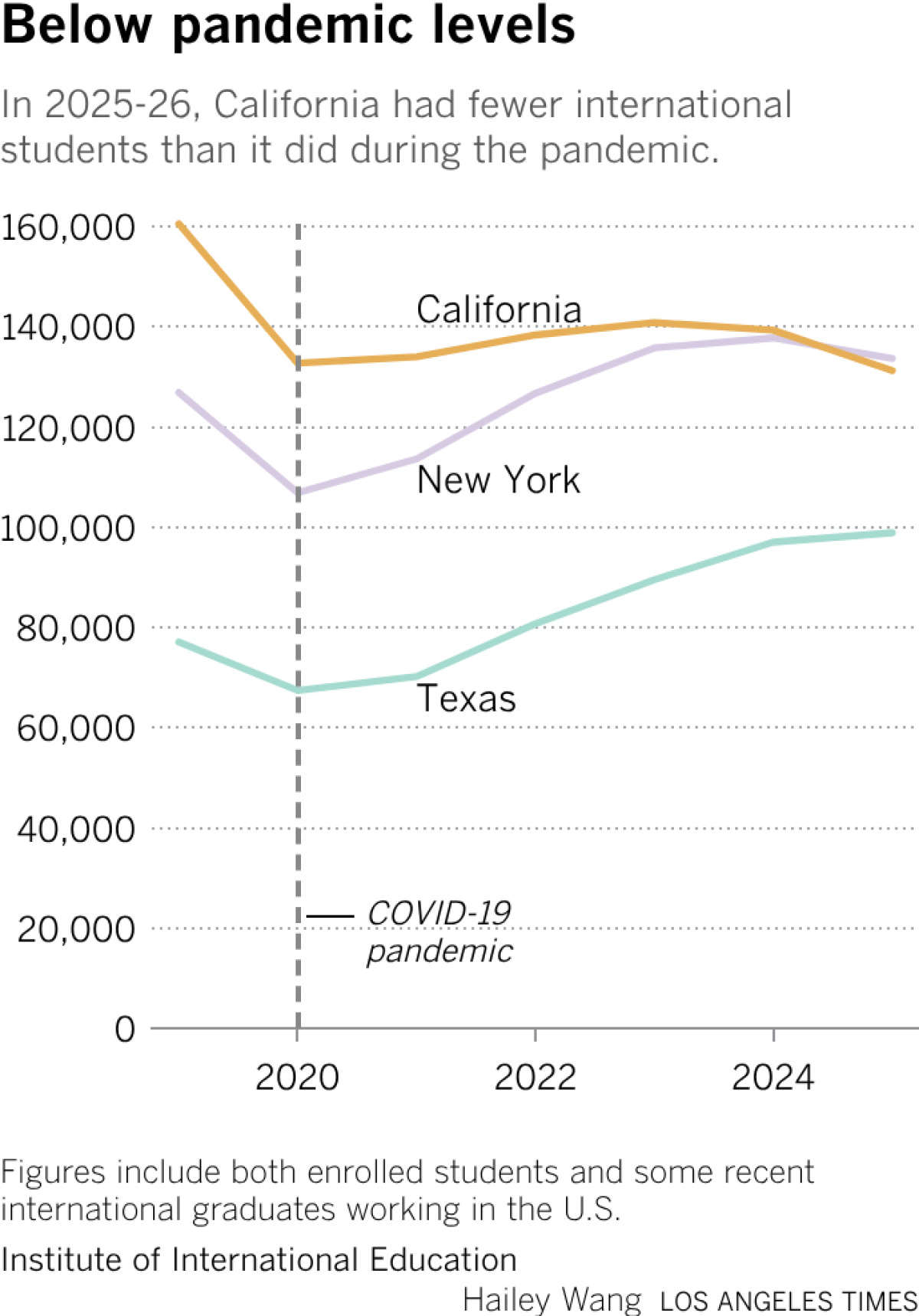
California’s population of international students for the last school year fell 5.8% to 131,276, more than twice the national rate of decline, according to the Institute of International Education’s annual report. The total is below the state’s pandemic-era count, when borders closed and classes moved to Zoom, and is the lowest in more than a decade. New York edged past the state with 133,715 international students.
Texas’ international student population also rose 1.9% to 98,902, making it the third most popular destination, behind New York and California. The gain follows years of growth driven by students from India, who accounted for the majority of the growth in Texas since 2021. Many have since graduated and are working through Optional Practical Training, a temporary-job program the report counts as part of the student experience.
In California, where Chinese students are the largest group, their numbers have fallen over the same period, though growth in Indian students kept the state’s overall share of international students rising until last year.
Nationally, the number of international students last year fell 2.7% to 1,146,163. It was the largest drop since the 2020-21 school year — during the height of pandemic closures.
“Over the last five years, international graduate numbers first soared following the COVID-19 pandemic, particularly at the master’s level, for three years, and have since eased,” said Mirka Martel, head of research, evaluation and learning at the Institute of International Education.
The report offers early evidence about whether President Trump’s aggressive enforcement of immigration rules, combined with his mandates on education policy and scientific research, would drive away international students. The lower numbers suggest they have, but not to the degree some predicted.
Since Trump returned to office in 2025, his administration has required student visa applicants to make their social media public for screening, barred or restricted travel from dozens of countries, and sought to deport noncitizen students over pro-Palestinian speech. Those steps came alongside restrictions on legal immigration and a crackdown on illegal immigration.
One recent case that has raised concerns at UC Berkeley is that of Paula Albornoz Hernandez, a Colombian student, who was detained by immigration agents last month at San Francisco International Airport while traveling to Oregon. The Department of Homeland Security said she had overstayed her visa. Her lawyer said she had a pending asylum case and a valid work permit. She was released this month after a federal judge ruled her arrest unconstitutional.
The uncertainty goes beyond those facing arrest or deportation. NAFSA — an association of international educators — reported last year that colleges were getting more questions from students worried about U.S. immigration actions and that some foreign students were choosing other countries because of U.S. immigration policies.
A 14.1% rise in students on Optional Practical Training, or OPT, kept the total drop smaller last year. The program lets graduates remain in the U.S. to gain work experience in their fields for one year, or up to three years in science, technology, engineering and math fields.
The institute counts those in the program because the work is “an essential component of an international student’s academic experience,” Martel said.
“The growth in OPT over the past four years is attributed to the post-pandemic rebound in international graduate student numbers,” she said. “As a result, we are going to be sitting on larger OPT numbers as these students cycle their way through the OPT pipeline.”
Not counting those working within this special category, international enrollment fell to 810,378, the lowest since the 2021-22 school year.
The annual report covers the prior academic year, so it does not show the effects of recent developments. Actions this year include an attempt to cap how long students can stay in the U.S. at four years, which a federal judge has temporarily blocked, and a proposed $70,000 fee on colleges for each student they recommend for OPT.
A college official has to recommend students before they can apply for federal work authorization. As part of this process, colleges would need to submit the payments but could ask for reimbursement from students or employers. Students now pay about $500 to apply. California was among 23 states that, along with Washington, D.C., formally registered opposition to the fee increase.
A separate survey by the same organization of a smaller group of colleges provides a more up-to-date preview of what is happening this fall. This second survey, of more than 800 colleges, released alongside the annual report, found international enrollment down 9% this fall. New students and graduate students each fell 15%. The takeaway is that last year’s decrease is continuing a trend.
“In the fall snapshot, we asked U.S. colleges and universities what would happen if there were changes in OPT, and we had 95% of institutions tell us that international students would likely look to another country if OPT was not available,” Martel said.
California’s changing student mix
Across the entire United States, India remained the top source of international students, with China next.
Martel said a 34% decline in Indian graduate students drove the decrease in students from India, while a 27% rise in Indian graduates staying to work through OPT offset much of the drop.
That pattern could explain the growth in Texas. Indian students made up 41% of its international students, up from 28% in 2021. The report does not break down OPT by state. But the state’s campuses have reported losses. The University of North Texas, the state’s top attraction for international students, saw their enrollment drop from 7,403 to 4,732 in fall 2025, according to university data.
In California, China remains the top source.
Chinese students make up 36% of California’s international students, compared with 22% nationally. Their numbers across the U.S. have fallen six years in a row, according to the institute’s annual reports.
California’s most popular campuses remained largely steady in international enrollment, as did large universities nationwide. USC had 17,856 international students, nearly unchanged year over year, and was fifth in the nation for its international student population. Stanford grew about 2%, to 5,824. UC Berkeley’s enrollment of these students fell less than 1%, to 11,917. At UCLA, enrollment fell nearly 4% to 10,344.
Trump administration policies affect and influence graduate students and undergraduates alike, as well as the admission decisions of universities, but a sharp decline in graduate students drove the overall drop, the report found.
Citing federal research funding uncertainty, more than 50 major research universities admitted 15% fewer doctoral students for this fall, according to the Assn. of American Universities.
Visa hurdles and travel bans
Colleges with declines this fall most often blamed the visa process, cited by 88%, and travel restrictions, cited by 70%, according to the institute. Others blamed costs and competition from other countries.
“What we find over time is that there isn’t any one singular factor that is usually leading to changes,” Martel said.
Trump’s June 2025 travel ban covered 19 countries. Students from those countries declined 7.4% last school year, close to three times the national rate. In January, the administration expanded the list to 39 countries. For most countries on the list, the restrictions block new student visas and entry to the U.S. for students who were outside the U.S. without a visa when the ban took effect, with limited exceptions.
Cutter Gauthier extended the NHL’s longest goals streak in 29 years to nine games, and Beckett Sennecke had two goals and an assist in the Ducks’ 6-1 victory over the Calgary Flames on Sunday night.
Captain Mikael Granlund, Jeff Malott and Tim Washe also scored and Ville Husso made 20 saves for the Ducks (11-9-1), who rebounded smartly from consecutive unimpressive losses for their sixth victory in eight games.
Gauthier added to his streak in style during the first period, ripping a wrist shot past Devin Cooley from the far side of the faceoff circle. Gauthier has 16 goals during this binge and 18 on the season, second-most in the NHL behind Edmonton’s Leon Draisaitl.
Mikael Backlund scored in the third period and Cooley stopped 28 shots for the Flames (9-11-1), who have lost four of six. Calgary beat the Kings one night earlier to open a three-game California trip.
Gauthier’s goals streak is the second-longest in Ducks history and the longest since Teemu Selanne scored in 11 straight for Anaheim in 1997. He’s tied for the sixth-longest streak in the NHL since 1991, and he’s only the fifth player under the age of 23 to score a goal in nine straight games, joining Selanne, Wayne Gretzky, Mike Bossy and Babe Dye.
Gauthier’s 11-game points streak also is the longest of his career.
Malott scored 1:16 after the opening faceoff, swatting in a rebound from the slot.
Backlund ended the Ducks’ bid for their first shutout win in over two years on a breakaway early in the third, but Sennecke blasted a one-timer just 25 seconds later. Shortly after Sennecke scored an empty-netter to secure his third multi-goal game of the season, Granlund scored with Cooley back in net.
Ian Moore had an assist in his season debut for the Ducks after incurring a high ankle sprain on the opening day of training camp.
Up next for the Ducks: at St. Louis on Tuesday night.
Chinese tech executive romantically linked to ex-Nvidia CEO Jensen Huang left in August 2025, the Singapore-based firm says.
By Reuters and The Associated Press
Published On 16 Nov 202616 Nov 2026
Megaspeed has confirmed that Alice Huang, the tech executive whose reported relationship with former Nvidia CEO Jensen Huang is at the centre of international spying claims, left the company last year.
The Singapore-based data centre company said in a statement on Sunday that Alice Huang left her executive role on August 30, 2025, and has held no position with the firm since.
Recommended Stories
list of 4 itemsend of list
“Megaspeed does not comment on Ms. Huang’s personal and private matters,” the statement said.
Megaspeed also pushed back on media reports it said contained claims about its operations that “are not supported by verifiable evidence”.
“The company has retained external legal counsel to conduct a thorough internal investigation,” it said.
Megaspeed, a major buyer of graphics processing units (GPUs) made by the California-based Nvidia, used to train and run frontier AI models, is facing scrutiny over its compliance with United States export controls intended to keep high-end chips out of China.
While data centres in Southeast Asian countries such as Singapore, Malaysia and Thailand can import high-end Nvidia chips legally, US authorities have long suspected the region is a hotbed of illicit smuggling on behalf of Chinese AI developers.
Megaspeed CEO and chairman Tan Yong Pong said on Thursday that the company had retained a top US law firm to lead a “comprehensive census” of its GPUs and verify its export control compliance practices.
Unnamed US officials have accused Alice Huang of working with China’s Ministry of State Security in an espionage operation targeting Jensen Huang, who stepped down as Nvidia CEO, president and board member on Thursday amid a board investigation.
Beijing has denied the allegations, describing them as “entirely groundless, speculative and intended to smear and malign China”.
Alice Huang has not publicly commented on the claims.
Singaporean authorities are investigating Megaspeed on suspicion of making false declarations in relation to its purchases of servers. They said last week they had previously confiscated Alice Huang’s passport for eight months as part of their inquiries.
Singapore’s Ministry of Home Affairs said on Thursday that it barred Huang from re-entering the country after determining that she had provided inaccurate information to investigators to downplay her role at Megaspeed.
Police investigations into Megaspeed and six other individuals are ongoing, the ministry said in a statement.
Iran-aligned Kataib Hezbollah says the group is subjected to ‘blackmail’ to force disarmament amid US pressure on Iraq.
Published On 16 Nov 202616 Nov 2026
The Iran-aligned Kataib Hezbollah group has denied its involvement in an oil smuggling operation in Iraq’s Jurf al-Nasr area after Iraqi authorities launched an anticorruption crackdown.
Kataib Hezbollah, one of Iraq’s most heavily armed factions, said in a statement on Sunday that the Iraqi prime minister’s office was “fabricating lies” and that the group was being subjected to “the largest blackmail operation” to force its disarmament.
Recommended Stories
list of 3 itemsend of list
The statement was issued a day after Prime Minister Ali al-Zaidi sacked nine senior officials following an investigation into the allegations.
The Iraqi government said an investigation committee, chaired by al-Zaidi, confirmed oil smuggling based on “intelligence documents” containing satellite images showing operations being carried out in the armed faction’s stronghold.
The committee ordered those implicated, whom it did not identify, to be referred to the judiciary and dismissed nine officials, including security and intelligence officers in Babil province, an Interior Ministry commander and the director of the Oil Pipelines Company at the Ministry of Oil.
Responding to the committee’s findings, Kataib Hezbollah said the investigation “found no violations whatsoever of the oil pipelines” and that this “definitively proves that the smuggling allegations are false”.
The group said its members accompanied the committee’s visit to the Jurf al-Nasr area on Friday.
Baghdad has been under increasing pressure from Washington to rein in Iran-aligned groups and curb Tehran’s influence in Iraq, an ally of both the US and Iran.
Al-Zaidi has previously promised to ensure that non-state armed groups would hand over their weapons to the state.
However, Kataib Hezbollah has pledged to retain its weapons arsenal and accused al-Zaidi of caving to pressure from the US, Saudi Arabia and the United Arab Emirates.
Iran-aligned groups, including Kataib Hezbollah, have previously targeted US forces in Iraq and attacked Gulf states following the start of the US-Israel war on Iran in late February.
Washington accuses Tehran of using Iraq’s economy to evade sanctions and has previously sanctioned Iraqi individuals for blending Iraqi and Iranian oil.