The election night highs for Palestinian citizens of Israel – Arab-led parties won a record 19 seats – turned into a week of delegitimising rhetoric from Israeli politicians.
Nearly 840,000 people voted for Ra’am and the Joint List, a 64 percent increase on 2022, and adding them to opposition leader Gadi Eisenkot’s bloc would give an anti-Netanyahu coalition 67 seats; without them, only a unity deal between the main Zionist blocs or another election is possible.
Recommended Stories
list of 3 itemsend of list
Israeli Prime Minister Benjamin Netanyahu’s Likud alleged the election had been “stolen” by Palestinian parties with unproven claims of Qatari financing. Qatar denied such accusations, as police sources told The Times of Israel that there was no evidence of widespread fraud. By Sunday, election committee chairman Noam Sohlberg declared the election “conducted properly”.
However, the rhetoric delegitimising the Palestinian vote is now being reflected in the coalition negotiations under way. Avigdor Lieberman, leader of the right-wing Yisrael Beytenu party, has ruled out Palestinian partners, and Eisenkot has presented four conditions for anyone joining his coalition that would be anathema to the Palestinian parties, including recognising Israel as “a Jewish, democratic, liberal, and egalitarian state”, and mandatory national service for all citizens, including Palestinians.
However, Palestinian politicians continue to express a willingness to back an Eisenkot government from outside – if only to enable the departure of Netanyahu and the far right. Meanwhile, thousands rallied in Tel Aviv for a coalition that includes the parties representing Palestinian citizens of Israel.
10 days of siege in Hebron
While the Israeli electorate was consumed by the election’s unclear results, Palestinians in the occupied West Bank continued enduring a variety of sieges, most prominently in Hebron. By October 29, Al Jazeera’s data unit counted 10 entrances sealed and about 5,000 people displaced. The city saw at least 120 arrests and 13 businesses demolished by Friday, when the army also blew up the homes of two men it blamed for an attack. Palestinian officials accused the government of using the operation to win settler votes; no Israeli official has said so outright.
On November 2, Governor Khaled Dudin announced the army had withdrawn from Hebron, and that displaced families could return. The Jerusalem Post reported that the army’s chief of staff recommended leaving Hebron before the election, but that Netanyahu refused.
But even with the operation over, the damage remains following more than 120 arrests and daily economic losses the governor put at 10 million to 12 million shekels ($3.2m to $3.8m) in a city responsible for about 40 percent of Palestinian industrial output.
Sieges in homes, expulsions from land
But Hebron was only the largest of many closures that continue to plague the West Bank. In Masafer Yatta, at least 12 villages were cut off, and the Palestinian news agency Wafa reported that forces detained 10 teachers from the Jinba school on Sunday.
Yousef Shanaran – who has been besieged in his home with his family in Wadi Rakhim for four weeks now – told Al Jazeera on Monday that settlers have now poisoned the well outside his family home, which the family already was unable to access for days at a time due to the siege. “No water, no food, nothing at all I’ve got,” he said. “Nobody is allowed to bring anything to us.”
These sieges continue as settlers, and increasingly Israeli forces, disrupt the olive harvest across the West Bank. United Nations Office for the Coordination of Humanitarian Affairs (OCHA) documented 397 settler attacks causing casualties or damage in the first 26 days of October – a monthly high since OCHA began tracking such incidents in 2006.
Across villages, a familiar pattern has emerged: settlers attack pickers, the army declares a closed military zone and orders the farmers out, and the harvest is lost.
In Gaza, attacks continued on a daily basis as the UN human rights office warned on October 30 that Palestinians are being pushed into an ever smaller area, calling the “Yellow Line” a “kill zone” that is moving westward.
By November 2, the Ministry of Health put the death toll since last year’s ceasefire at 1,593. Sunday was the deadliest day of the week, with at least eight killed. Among those reported killed over the past week:
Government and police personnel were among those killed. On October 28, a drone strike on a Ministry of Economy facility in al-Mawasi, Rafah, where staff and security personnel had gathered, killed five people, including Ministry of Agriculture official Wajdi Abu Bakr, who died on Sunday from injuries sustained in the attack.
On November 1, a drone strike in al-Mawasi, Khan Younis, killed five men whom Gaza’s Interior Ministry said were police officers.
Israeli attacks also killed children. Six-year-old Tahani Shalalfeh died of a gunshot wound in al-Mawasi, Khan Younis, on October 27, and Yamen Saqr, eight, died on October 30 of wounds from Israeli fire in Khan Younis, according to Wafa and local activists. The young child Zain Owais was reported killed on November 1 with his father, Mohammed Ali Owais, and a third man in a strike near Taj Mall in Gaza City.
On October 27, a young man was killed in an air strike in west Rafah, and a member of the Bseiso family died of earlier wounds in Gaza City, Gaza Now reported. Mohammad al-Bayouk was killed in Khan Younis on October 28, and Mohammed al-Najjar was killed near Jabalia on Thursday.
On Friday, the body of a 47-year-old man killed in an air strike at al-Waha, north of Gaza City, was recovered, Wafa reported.
Ibrahim Saeed died on Sunday of wounds from tank fire in al-Musaddar, and Yusuf Abu Younis died Monday of wounds from a drone strike in Khan Younis the day before, according to local activist Hamza al-Masri.
On Monday, Mahmoud Qaffa and Asaad Qeshta were killed in separate air strikes in Khan Younis and Ibrahim al-Saayida, 40, in al-Musaddar, according to Wafa and Haaretz.
Israeli authorities claimed many of those killed this week were Hamas fighters, though no evidence was provided. Among those were Diaa Abu al-Rous, killed north of Nuseirat on Saturday, and Mohammed Qudeih, killed in a strike on a tent in Khan Younis the same day, who the military claimed were members of Hamas’s Nukhba Forces; Palestinian reports describe Abu al-Rous as a teacher.
Such killings take place with winter closing in and humanitarian conditions struggling to improve: two infant girls died of burns in a tent fire in al-Mawasi on Friday, and the shelter picture is dire, with Gaza’s Social Development Ministry saying about 200,000 tents are needed, yet only dozens have arrived due to Israeli entry restrictions.
With no hospitals in Gaza fully functioning, the Red Crescent warned on Monday that the health system is at risk of collapse after 26 hospitals went out of service – with fuel shortages threatening the remaining facilities.
In the 1820s, a young painter left London to live in Shoreham in the west of Kent. In his waterside cottage, Samuel Palmer – remembered now as a key figure of British Romanticism – depicted moonlit cornfields, apple trees bowed under fruit and hills swollen with light. He dubbed the area his Valley of Vision. Two centuries on, Palmer’s own vision of Shoreham – and the surrounding Darent Valley – as a demi-paradise isn’t too far from the canvas.
I’ve lived in the area for five years and can’t quite believe how few people come to Shoreham. It feels like a secret yet is less than an hour from London by train. The village itself sits on the River Darent, remarked on by Edmund Spenser in his poem The Faerie Queene for its gentleness and clear water: “The still Darent, in whose waters cleane, ten thousand fishes play and decke his pleasant streame …”.
Lullingstone Country Park on the Darent Valley Trail. Photograph: AMcCulloch/Alamy
This 21-mile chalk stream glides into the Thames from Westerham and can be explored by the scenic waymarked Darent Valley Path. Shoreham is a pretty place. The road into the village drops to a stream under a weeping willow, flanked by two good pubs, and it makes a good base for exploring. Lopsided Tudor chimneys and pastel cottages lean over the lanes, and the Grade I-listed church of St Peter and St Paul keeps watch over the churchyard. It’s no surprise artists still come here to capture Palmer’s magic.
Neighbouring Otford and Eynsford are minutes on the train (or a short drive). Otford is the antique-hunter’s village, with waterside houses, the ruins of a 16th-century palace and a listed duck house on the pond – check out the labyrinthine Otford Antiques and Collectors Centre. Eynsford has the history: Lullingstone Roman villa with its beautifully preserved painted walls; Lullingstone Castle, favoured by Henry VIII and Anne Boleyn; and the ford, ringed by half-timbered houses.
Don’t miss
My top recommendation is cream tea at the Shoreham Aircraft Museum. The valley saw heavy aerial combat in the second world war, and this volunteer-run museum remembers it. You enter through the garden door of artist and proprietor Geoff Nutkins’ home, past overgrown flowerpots, witty hand-painted boards and an antique Hovis sign above a converted bakehouse, now a tearoom frozen in the early 20th century. The delicious puddings and doorstop sandwiches come from Nutkins’ own kitchen. (My Tunisian girlfriend describes it to friends as “exotically English”.) The £5 ticket to the museum buys entry to a lifetime’s collection, plus the story of his work building memorials to lost servicemen from both sides.
Take a hike
A path near Shoreham. Photograph: Graeme Robertson/The Guardian
Bring comfortable shoes. The beautiful gentle four-mile stretch of the Darent Valley Path from Shoreham to Eynsford suits all abilities, and is as good on a crisp winter day as in July, following the river through empty woodlands and rolling hills. It’s just four minutes by train if you’d rather ride back.
A 20-minute stroll from the churchyard in Shoreham brings you to Castle Farm (five minutes by car), one of the UK’s largest lavender growers. The farm shop, under rafters hung with hops, sells lavender oils, teas and ice-cream made from the harvest. Stock up on a box of gypsy tarts, a Kentish staple made with condensed milk and muscovado sugar. Grab some lavender honey, too (the farm keeps beehives). A coffee shed serves lavender teas and coffees. In summer you can picnic among the rows, à la Provence, or book to join in the harvest.
The Samuel Palmer in Shoreham. Photograph: Nathaniel Noir/Alamy
In Shoreham stop by The Crown for lunch. This dog-friendly locals’ pub has an intimate dining room and serves hearty, locally sourced classics such as fish and chips and a handmade pie of the day. Portions are large, but leave space for dinner at The Samuel Palmer. The beamed, fire-lit bar serves traditional pub favourites and small plates, while the bright, kid-friendly restaurant at the back presents chef Kieran Farquhar’s elevated seasonal discovery menu at £48 a head. At Mount Vineyard, the on-site restaurant has a pizza menu, and a quaint cafe by the vines serves coffee and handmade pastries.
In Otford try The Bull, with its pretty gardens. In Eynsford, The Malt Shovel is a favourite locally for lunch, with big portions and fair prices.
Where to stay
My pick is White Hill Woods, five minutes’ walk from Shoreham station, which has a log cabin for families (from £150 a night), and a shepherd’s hut for couples and solo travellers (from £100 a night, both two night minimum). There is a heated pool or just relax in the forest. Book ahead, as it’s popular with repeat visitors.
Getting there and around
There is a twice-hourly train from London Blackfriars to the villages, which takes about an hour, and using it to hop between them takes minutes. The Line 2 bus from Swanley to Sevenoaks runs along the road between the villages. Drivers will have no trouble parking, even on weekends.
Katie Melua has revealed she has welcomed her second childCredit: instagramKatie revealed she was pregnant in the summer with this snapCredit: Instagram
The star shared a sweet snap of herself holding her newborn and confirmed it was a baby boy named Max.
She penned: “New arrival… Max is here! So lucky to be mum to two beautiful boys. Sandro’s been the best big brother so far. Long may it last.”
Sign up for the Showbiz newsletter
Thank you!
Fans of the singer were quick to rush to congratulate her, with one saying: “Ah that’s gorgeous news! Congratulations!”
While another added: “Such lovely news congratulations on the birth of Max.”
Q4 guidance calls for 400 to 475 transactions, $100 million to $120 million in revenue, and sequential adjusted EBITDA improvement. The company ended Q3 with $12.1 million in unrestricted cash, estimated $55 million of equity in its inventory, and approximately $251 million of undrawn inventory financing capacity, most of it uncommitted.
Adonis Ratliff scored 25 points in his collegiate debut, Alijah Arenas had 21 points and a career-high eight rebounds, and No. 21 USC beat Milwaukee 95-63 to open the season Monday night.
Darius Ratliff, Adonis’ twin brother, added 14 points and five blocks in his debut for the Trojans. Rodney Rice had 15 points and nine assists in his first game since a season-ending shoulder injury last year, and KJ Lewis added 10 points.
USC (1-0) shot 56.9% from the field, including 12 of 22 from three-point range, and never trailed en route to its third straight season-opening win under coach Eric Musselman.
Amare Hereford scored 14 points and Tre Norman had 13 for the Panthers (0-1).
The Ratliff brothers, the twin sons of 16-year NBA veteran Theo Ratliff, are part of a decorated freshman class for the Trojans that includes touted recruit Christian Collins, who did not play.
Adonis Ratliff shot seven of 10 from the field, including five of seven from three-point range, and added six rebounds, three assists, two blocks and two steals. Darius Ratliff was five of 10 and made his only three-point attempt.
USC led 46-29 at halftime on the strength of red-hot shooting and lockdown defense. The Trojans shot 53.6% in the first half and forced the Panthers into nine turnovers, including six in a span of 5:10.
USC pulled away with a 15-0 run midway through the half, holding Milwaukee scoreless for more than seven minutes, and led by double figures the rest of the way.
Milwaukee guard John Lovelace Jr. injured his left leg when he landed awkwardly following a layup in the second half. He walked off the floor with an athletic trainer and did not return.
Up next for USC: vs. Wichita State at Galen Center on Sunday.
Oakland, California – Protesters dressed as cardboard robots chanted and danced to a drumbeat as they protested against new data centres outside Oakland City Hall last month.
Their concerns largely focused on how the centres — which process large amounts of digital information — might strain the energy grid.
Recommended Stories
list of 3 itemsend of list
The result, they argued, would not only be environmental harm but also sky-high electricity bills for local households.
“Power prices have gone up so much in Oakland that some people are thinking of shutting off their power,” said Carlos Gutierrez, an activist for Communities for a Better Environment, an environmental justice group.
“And the city is planning to provide power to a data centre instead.”
Opposition to data centres is growing across the United States, as residents express concern about their rapid expansion.
More than 3,000 data centres already operate in the country, with more than 1,500 others in development, according to the Pew Research Center.
But the backlash is perhaps most striking in California’s San Francisco Bay Area, a region considered to be the heart of the artificial intelligence (AI) boom.
Major AI companies such as Anthropic, OpenAI and Meta are based in the Bay Area, and the industry’s growth has been credited with fuelling a local economic renaissance.
Data centres house the advanced computer chips and servers needed to run AI-powered services such as Anthropic’s Claude and OpenAI’s ChatGPT.
But they also require 24-hour power and a large supply of water to cool their processors.
Even with such cooling technology, data centres are notorious for emitting heat, leading to an increase in land surface temperatures as high as 9 degrees Celsius (16 degrees Fahrenheit).
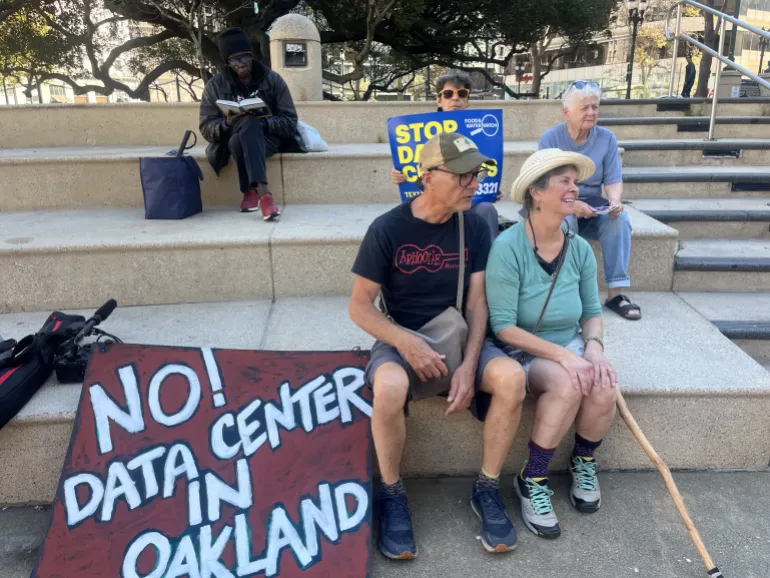
A couple sits on the steps of Oakland City Hall in California next to a sign that reads, ‘No data center in Oakland’ [Saumya Roy/Al Jazeera]
A midterm election issue
Concerns about the cost of rapid data centre growth, both environmentally and financially, have catapulted the issue into the discourse around Tuesday’s midterm elections.
In the final two months before the vote, at least seven Bay Area cities, including San Francisco and Richmond, have passed temporary moratoriums on data centre construction.
They include Oakland, which passed a data centre moratorium on October 6, after days of protest.
Local politicians competing in Tuesday’s midterms have also used the topic as a wedge issue, to rally support among certain pockets of voters.
One of the most closely watched races in the Bay Area is for the seat left vacant by longtime Democratic leader Nancy Pelosi. After 39 years in the House of Representatives, Pelosi is retiring at the end of the year.
Two Democrats are competing in Tuesday’s election to fill her position in Congress: San Francisco Supervisor Connie Chan and state Senator Scott Wiener.
Each one has staked out a different position on AI data centres. Wiener, for instance, opposes any ban on data centres.
“A blanket data centre moratorium could undermine AI regulation,” he told the publication Mission Local.
Chan, meanwhile, has pledged to seek a nationwide moratorium on data centres, at least until responsible AI regulation is put in place.
“Let’s start with a moratorium on data centres. Allow us to have that moment to regulate artificial intelligence,” she said at a debate in October.
Chan played a leading role in passing San Francisco’s moratorium in early October.
A poll from the University of Southern California showed Wiener leading Chan 47 percent to 41, as of mid-October.
Congressional candidate Connie Chan, left, stands next to outgoing US Representative Nancy Pelosi and former San Francisco Mayor Willie Brown at a campaign event in San Francisco, California, on May 29, 2026 [File: Manuel Orbegozo/Reuters]
Navigating public backlash
“Right now, data centre opposition is an issue that unifies the US public like no other,” said Shum Preston, a political analyst based in San Francisco.
So far, there has been relatively little opposition to the data centre moratoriums in local hearings. But he speculates that there may be several reasons for the lack of pushback to the bans.
Among them are the surveys indicating widespread public backlash to data centre creation.
An October CNBC poll found that 63 percent of registered US voters oppose building data centres within 16 kilometres, or 10 miles, of their homes.
“Data centres poll very poorly, and developers probably don’t want to put their supervisor friends in trouble ahead of elections. So they probably let this pass,” Preston said.
He also signalled that the short-term nature of the moratoriums may be a factor.
Certain Bay Area cities like San Francisco, Brisbane and Oakland paused construction on data centres for 45 days, with the option to extend the ban later.
Opponents of the moratoriums “will be more vocal when” the 45 days end, Preston said. By that time, the heat of the midterm election season will also have settled, he added.
“That’s when the hearings will get more contentious,” he said.
Opponents of data centres have cited environmental costs as well as higher utility bills as reasons to ban their construction [Saumya Roy/Al Jazeera]
Not long enough?
Another hurdle facing the moratoriums is the lack of transparency surrounding data centre construction.
Supervisor Shamann Walton, who sponsored San Francisco’s moratorium ordinance, has argued that the city’s definition of “data centres” is outdated.
Created in 2001 — long before the AI boom — the city planning code defines data centres as “internet service exchanges”, a definition that may not accurately characterise the technology today.
Walton said the outdated language has made it hard for authorities to count how many data centres exist in the city.
Not being able to identify data centres can also prevent city officials from monitoring their power and water usage.
“We cannot use 2001 rules to regulate 2026 technology,” he said in a September 14 statement.
Another issue is the time it takes to carry out the necessary environmental assessments. The moratoriums may not offer enough time for a comprehensive review.
“Forty-five days is hardly enough time to document and study the impacts and then frame regulations,” said Roger Lin, senior attorney at the Center for Biological Diversity, a US environmental nonprofit.
He added that legal barriers limit access to such information from the data centres themselves.
“Data centres often have nondisclosure agreements, so even local air quality boards may not know the impact of data centres on air quality,” said Lin.
Supporters tout economic benefits
Still, AI industry supporters have touted the growth of the data centres as evidence of a flourishing industry, with positive downstream effects for US communities.
Anthropic, for instance, is preparing an initial public offering (IPO) that is likely to raise billions of dollars.
But critics warn that the company’s growth may not translate into an economic boom for the San Francisco Bay Area overall.
Instead, residents fear unequal economic growth that primarily benefits the wealthy. Already, San Francisco faces some of the highest and fastest-growing home rental prices in the country.
At a hearing at San Francisco City Hall, a resident vented their frustrations about the data centres to the supervisors.
“This city is less for humans and more for robots and billionaires,” the resident said.
Dhaka, Bangladesh – Laili Begum can no longer afford to keep her two children in school. There are days when the 37-year-old garment worker struggles to put even one proper meal on the table.
An experienced sewing operator at Virtual Bottoms Limited, a ready-made garments factory near Bangladesh’s capital Dhaka, Begum earns around 15,000 taka ($121) a month, which sometimes rises to 18,000–20,000 taka ($145–$161) when she works overtime.
Recommended Stories
list of 4 itemsend of list
Her 15-year-old daughter and 12-year-old son dropped out of school earlier this year because she could not afford their education.
“We can barely afford one proper meal a day. This morning, we had only puffed rice and Bombay mix [a snack]. There was nothing for lunch. We’ve been going hungry, hoping to have a proper meal tonight. Yesterday was the same. This is how we survive now,” she told Al Jazeera.
“My son is so thin that you can count every rib in his chest. What else can I do?”
Begum is among approximately four million garment factory workers in Bangladesh, half of them women. They are now protesting for better wages.
Bangladesh, the world’s second-largest apparel exporter after China, is a key supplier to global fashion brands such as H&M, Zara, Levi Strauss, Walmart, and Primark. The country’s ready-made garment sector accounts for more than 80 percent of its export earnings, which touched $39bn last financial year.
Yet, the people sewing those clothes say their pay no longer covers basic living costs.
‘Government only makes promises’
A Muslim-majority South Asian nation of 170 million people, Bangladesh has one of the world’s lowest wages among apparel-producing countries.
Cambodia has a minimum wage of $210 a month for garment workers, Vietnam’s range from $140-$210, while wages at China’s manufacturing hub of Guangdong range between $286 and $378.
That disparity – worsened by rising inflation and the growing cost of living – pushed the workers to strike and hit the streets on Saturday to demand a minimum wage of 30,000 taka ($241), more than double the current wage of 12,500 taka ($102).
On Sunday, Begum joined one such protest in the Jamgora part of the Ashulia industrial area on the outskirts of the capital Dhaka, with the police firing tear gas and stun grenades to disperse the protesters, and arresting dozens of them.
A police vehicle burns after garment workers set it on fire during a protest demanding higher wages in Dhaka, Bangladesh, November 1, 2026 [Jannatul Ferdaus/Reuters]
The Bangladesh Garment Manufacturers and Exporters Association said the demonstrations disrupted operations at 529 factories on Sunday and affected nearly a million workers.
Later that day, the government announced the formation of a six-member wage board to review the workers’ demands.
But that did not stop the garment workers from returning to the streets for a third straight day on Monday.
In northern Dhaka’s Gazipur area, the workers blocked the Dhaka-Tangail highway, and vandalised and torched several vehicles, while clashes with police were reported from the neighbouring Mirpur district.
“The government only makes promises,” Begum told Al Jazeera. “They haven’t told us when wages will increase and by how much.”
Inflation eating into wages
Rasel Khan, a 30-year-old garment worker at Ashulia, told Al Jazeera his monthly earnings of 18,000–20,000 taka ($145–$161), including overtime, were no longer enough to support his family, which included his mother and younger brother besides his wife and child.
As living costs soar, he has accumulated a debt of about 100,000 taka ($805) to meet his needs. “It’s impossible to support a family on this income anymore. Prices keep rising, and we have to borrow money just to survive,” he said.
The last revision of the minimum wage in the garment sector took place in December 2023. Since then, prices have continued to climb. Official data put annual inflation at 8.34 percent in September, including 7.22 percent for food and 9.30 percent for non-food expenses.
Begum says she pays 3,500 taka ($28) as rent for a single room shared with her mother and children. Her father, living in their village in the central district of Sirajganj, also depends on her income.
She says she is burning discarded paper and other materials to cook because she is not able to afford a gas cylinder that costs about 2,200 taka ($18).
Zahid Hussain, a former lead economist at the World Bank’s Dhaka office, said persistent inflation over the past five years has sharply eroded the purchasing power of low-paid workers.
“When real income falls, they have to cut their daily living standards,” he told Al Jazeera. “They don’t have any surplus income.”
Hussain said a recent hike in the salary of government employees has had a “demonstration effect” among private-sector workers waiting for a similar relief.
The government’s announcement of a wage board follows an amendment to labour laws to reduce the wage review cycle from five years to three years. The current three-year period ends in December.
Prime Minister Tarique Rahman convened an emergency meeting of top government officials on Sunday, while Home Minister Salahuddin Ahmed met the garment factory owners on Monday, assuring them that a new minimum wage would be fixed through negotiations.
Labour Minister Ariful Haque Choudhury meanwhile urged the workers to resume work, saying the wage board would begin its deliberations shortly.
But Babul Akhter, a workers’ representative on the board, called for the new wages to take effect with January 2027 salaries. He also asked the demonstrators to return to work and demanded the release of arrested workers and withdrawal of cases against them.
Garment workers clash with police during a protest in Dhaka, November 1, 2026 [Jannatul Ferdaus/Reuters]
‘Western brands hold lion’s share’
The impending wage negotiations come at a challenging time for Bangladesh’s garment industry, as manufacturers balance workers’ demands for better wages with rising production costs and intensifying global competition.
Sheikh Hossain Muhammad Mustafiz, an official at Bangladesh Garment Manufacturers and Exporters Association and managing director of Cute Dress Industry Ltd, told Al Jazeera that fair wages and employment security must go hand in hand with their ability to compete in the international market.
“Workers deserve wages that support a decent standard of living. However, without fair purchasing prices from international brands, significant wage increases could put pressure on factories and threaten employment,” he said.
Mustafiz emphasised that protecting the workers’ purchasing power amid rising inflation is a responsibility that global brands that buy Bangladeshi garments must share.
“Sustainable wage growth cannot be achieved by manufacturers alone,” he said. “International brands must contribute through fair pricing and responsible purchasing practices to protect both the workers’ livelihoods and the industry’s long-term sustainability.”
Taqbir Huda, a Tech Global Institute senior fellow at the University of Oxford, accused the western brands who buy Bangladeshi garments of not addressing the issue of the workers’ rights.
“One party that could change the situation overnight has held the most extractive and exploitative role: the western buyer brands who hold the lion’s share of the value that is generated by the clothes that these workers produce,” he told Al Jazeera.
Huda said the wage board, which was due this year, was announced only after the workers began their protest.
“History gives very little reason for the workers to believe anything will improve unless they protest,” he said, adding that the formation of the wage board does not meet their demands unless it addresses rising inflation and the cost-of-living crisis.
For Begum, a drawn-out process to decide the new wages means another month of struggle to feed her family.
“Wages must rise, but food prices must also come down.”
Juan Atkins, the Detroit club music producer who pioneered techno as a genre, has died. He was 64.
Atkins’ death was confirmed in a social media post by his management firm Greensmith Artists. The post did not include a cause of death, though Greensmith said in a statement to Resident Advisor that he was found unresponsive in his hotel room in Mexico City prior to a planned performance. Atkins had suffered from diabetes-related complications in recent years.
Atkins, raised by a concert-promoter father in the shadow of Motown, formed his taste on the progressive Black-owned radio station WGPR-FM. As an artist, he rose to prominence as a teen in the early ’80s with the duo Cybotron, with Richard “3070” Davis. The pair, infatuated with Kraftwerk, Afro-futurism and acid-fried psych rock, retrofitted Detroit funk in the post-disco era with rigorous synthesizers and science-fiction themes on tracks like 1981’s “Alleys of Your Mind.”
They carved a new style of club music that echoed their city’s industrial legacy, and captivated the city’s Black teenage middle class. They scored a major underground hit with “Clear,” famously sampled by Missy Elliott and others.
After leaving Cybotron, Atkins also conjured a new alias, Model 500, for his solo records in 1985. The same year, he founded his longtime record label Metroplex, which released scores of his singles like “No UFO’s” along with 1995’s LP “Deep Space,” 1999’s “Mind and Body” and 2015’s “Digital Solutions.”
Atkins formed deep friendships with two other proto-techno producers, Derrick May and Kevin Saunderson, who became locally known as the Belleville Three (named for the small Michigan town where Atkins had moved to). The trio honed an aesthetic distinct from neighboring Chicago’s emerging style of house music, stripping out vintage soul for chillier, futuristic productions. While house was music was based on samples, designed to call a dance floor together, techno was meant to be challenging, alien and fundamentally new.
His music, including his other production projects like Infiniti and Borderland, was formally radical, and Atkins stressed that this strain of club music could “make social statements,” as he told the Guardian in 2024. Tracks like Cybotron’s “Industrial Lies” — “You buy the missile, buy the laser, buy the tank … Evict the widow, put the money in the bank” — worked as social critique and floor-filler alike. “My lyrics are supposed to make you think about something other than shaking your booty on the dance floor and falling in love.” he said. “I feel like artists have an obligation to say something meaningful.”
In the wake of Atkins’ inventions — as noted on his track “Techno Music” — a new class of acts like Jeff Mills, Drexciya, Robert Hood and Underground Resistance would go on to formalize techno as rooted in a Black, Midwestern subculture with a distinct instrumental virtuosity. While the genre has had a cross-border dialog with Germany since its inception, Atkins was confident that he and his scene got there first.
“I put it this way,” Atkins said. “I know I’m the first one to apply the word ‘techno’ to electronic music. I can’t claim to be the inventor or originator of electronic music, but I can definitely say that I got that.”
Atkins continued to tour and play prominent festivals like Detroit’s Movement and Amsterdam’s Dekmantel, often with his daughter, the musician Milan Ariel Atkins.
Detroit Mayor Mary Sheffield said in a public statement that Atkins “opened doors for generations of Detroit artists who followed him.”
“Today, millions of people dance to music that traces back to him and to our city,” Sheffield continued. “That is a Detroit story: genius, grit, and invention, from neighborhoods the world too often overlooked.”
Everton manager David Moyes’ post-match reaction to his side’s one-goal win against struggling Newcastle United, as well as the availability of Jack Grealish following disciplinary action.
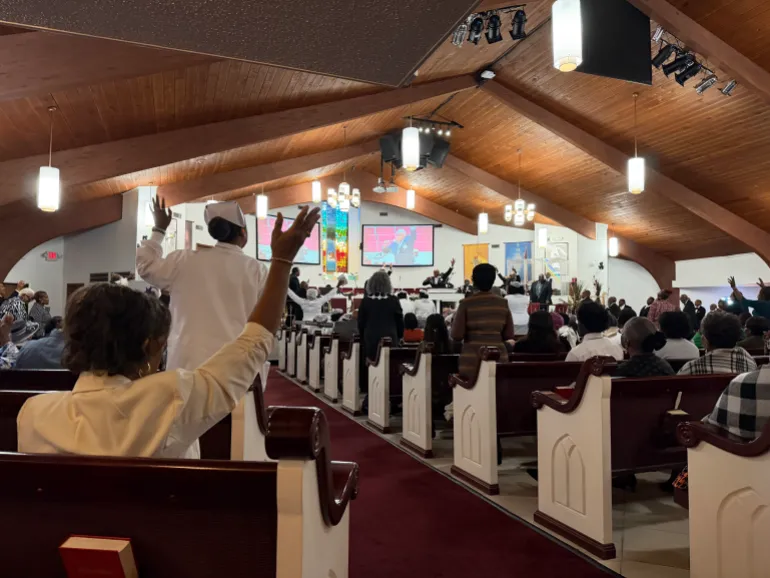
Houston, Texas – The gospel music from Mount Hebron Missionary Baptist Church spills into the streets of Sunnyside, a predominantly Black neighbourhood in southern Houston.
It is a familiar scene on any given Sunday: hands in the air, immaculate bow ties on starched shirts, fabric flowers adorning perfectly pastel hats. But with the US midterm elections just two days away, the service held a special significance on the front line of a US redistricting battle.
Recommended Stories
list of 3 itemsend of list
Mt Hebron had long been located in the ninth congressional district, its politically engaged Black voters for two decades helping to elect Democrat Al Green, a flamboyant presence in Congress known for his cane-waving opposition to US President Donald Trump.
But following an appeal from Trump, the Republican state legislature last year conducted rare mid-decade redistricting, redrawing the church and its Black community into the Black-majority 18th district.
Critics call the process “cracking and packing”, diminishing the representation in Congress of minority groups, particularly heavily Democratic Black communities, by consolidating their voting power into fewer districts.
“It’s kind of one and the same when we talk about the voting and the civil rights,” said Pastor Max Miller, who has served at the church for 18 years.
“They are trying to manipulate and monopolise the vote and minimise the people who are in those districts,” said Miller. “We see so much rolling backwards that it looks like they’re trying to take a script from an old song and turn back the hands of time.”
Mount Hebron Missionary Baptist Church in Houston, Texas [Joseph Stepansky/Al Jazeera]
As a result of the redistricting, Green was forced to run in a primary against 18th district incumbent Christian Menefee, another Black Democrat. He lost, and Houston lost one of its Black representatives in Congress.
The ninth district, meanwhile, was redrawn to favour Republicans, one of at least five US congressional seats the party hopes to pick up in the midterm vote.
The machinations have resonated with worshippers at Mt Hebron.
“I don’t like the redistricting at all because Al Green was moved out,” said 97-year-old Alice Jefferson, who had followed the congressman throughout his political career. “He always had good advice for the people.”
Voter Alice Jefferson, 97, is seen in the Sunnyside neighbourhood of Houston, Texas [Joseph Stepansky/Al Jazeera]
Janice Ray, a 61-year-old home health aide and entrepreneur, said state lawmakers were “trying to move people out of the district that they’re familiar with”.
“To me, it was all a bunch of BS,” she said. “There was no reason for it.”
“But we’ll stand firm, regardless of what they try to do,” Ray added. “Because just like it was changed, it can always be changed back.”
‘Voices have been weakened’
The redistricting process has undergone a generational transformation this election season, one that, experts say, has degraded longstanding guardrails protecting minority voting power.
“In political science, we have what we call descriptive representation,” Michael Adams, a professor at Texas Southern University in Houston, told Al Jazeera. “In terms of descriptive representation, minorities and others feel that if they can elect someone who reflects their values, for example, and who may look like them, their voting can be defined as one voice.”
“And certainly with not having an additional Black member of Congress representing Houston, a significant segment of Black voters may feel that their voices have been weakened,” he said.
Texas was only the beginning.
This year Republican and Democratic state legislatures across the country joined the spree: Republicans successfully redistricted in Missouri, North Carolina, Tennessee, Louisiana, Alabama, Florida and Ohio; Democrats did so in California, while a court-ordered map in Utah handed Democrats a favourable seat. A Democratic push in Virginia was subsequently invalidated.
Redrawing maps mid-decade, and not waiting for the latest demographic numbers from the US census, was already atypical. But many of the maps drawn this year would have been deemed illegal in previous cycles.
Section 2 of the landmark Voting Rights Act of 1965, initially passed to counter blatantly racist voting practices in the US, had long prohibited redrawing congressional maps to dilute the electoral power of minority voters.
In April, the conservative-dominated US Supreme Court ruled that anyone challenging such a map must prove “racist intent”. Critics have said the ruling effectively allows for racial gerrymandering, with proving such an intent an unreasonably high bar.
But critics of Section 2 of the Voting Rights Act have said drawing maps to protect minority voting power is in itself discriminatory.
Defenders in Texas, meanwhile, have said the redistricting was based on the shifting political makeup of the state, and not racial gerrymandering.
“This plan includes political considerations, public testimony, recognition of population growth and recent changes in voter trends,” State Representative Todd Hunter, a Republican, said shortly after the new map’s passage last year.
“Each of these newly drawn districts now trend Republican in political performance. While there’s no guarantee of electoral success, Republicans will now have an opportunity to potentially win these districts,” he said.
A political test
There are no guarantees that a party’s redistricting plans will actually work.
Following the tit-for-tat map redrawings, Republicans hoped to net at least 13 seats nationally. Polling has suggested their gains may be much more muted.
All told, about 35 million US voters will be casting ballots in newly redistricted seats this election.
“Redistricting can change the political boundaries, but it can’t guarantee how voters will behave,” Brandon Rottinghaus, a professor at the University of Houston, told Al Jazeera.
In Texas, the Republican map was drawn largely based on recent Latino voting trends. The demographic swung heavily for Trump in the state in 2024, despite once being considered a reliable Democratic voting bloc.
Beyond the ninth congressional district in Houston, Republicans hoped to pick up four other districts, most based in South Texas, with an eye on shifting Latino sentiment.
But the political tides have again turned. Trump’s popularity has tanked among Latino voters, fuelled in part by unrest over the economy and the administration’s aggressive deportation campaign.
It remains to be seen how that will reflect at the ballot box when Texas voters pick a senator, governor, members of Congress and a slate of state and local officials.
“These districts are a test of whether political dissatisfaction can overcome an aggressively partisan map,” Rottinghaus said.
‘Trying to mobilise’
With new boundaries come new opportunities.
The ninth district is now considered Republican-favoured, but its large population of low-propensity Latino voters creates a pathway for a Democratic victory, according to Dayana Iza, Texas state director of Mi Familia Vota, a Latino voting organisation that has focused resources on the congressional race.
The state legislature “kept a big portion of Latino voters there, but the reality is that the Latino percentage in that district that votes is very, very low,” Iza told Al Jazeera. “So that then became a district that we are trying to mobilise in terms of turnout.”
On the Saturday ahead of the November 3 vote, Democratic candidate Leticia Gutierrez and State Senator Molly Cook zigzagged through a neighbourhood of single-family homes in eastern Houston.
US congressional candidate Leticia Gutierrez, left, and Texas State Senator Molly Cook knock on doors in Houston, Texas [Joseph Stepansky/Al Jazeera]
Any path to victory, Gutierrez assessed, would be based on face time and a chance to connect with disillusioned voters.
“This community here has an average annual income of $63,000 a year. I make a little over that, and it’s difficult,” Gutierrez told Al Jazeera. “At this point, it’s not a left or a right thing anymore. This is an affordability crisis.”
“You’ve heard some of the voters out here say this is the first time someone actually came to my door,” she added. “That means a lot, and so we want to continue to do that.”
Among the residents was Christian Garcia, a 53-year-old who works at a local chemical plant and has not voted since moving to Texas from Puerto Rico in 2014. He said he is focused on his family, saving enough for retirement and eventually leaving some money behind for his adult children.
Voter Christian Garcia stands in his garage in Houston, Texas [Joseph Stepansky/Al Jazeera]
In the past, Garcia said, he felt voting was “wasting my time”.
“You know, it’s a lot of corruption and things,” said Garcia. “I just don’t believe in anybody anymore.”
Down the block, Esmeralda Gil, a 39-year-old teacher, said she hoped for a Democratic surge.
Gil questioned why taxes, particularly on housing, seemed so high, while so many struggled to access healthcare.
“We need affordable healthcare and affordable housing,” she said.
Australian jockey Ethan Brown has ridden Point Of Law, a horse previously owned by King Charles, to victory in this year’s Melbourne Cup, the country’s most prestigious race.
Point of Law, which was bought from the King earlier this year for an undisclosed sum, was considered an early favourite.
Brown pushed Point Of Law from the middle of the pack to take the lead with just a few hundred metres to go.
The Melbourne Cup has run in Australia since 1861, often referred to as the “race that stops a nation”. With a prize of A$10.2m ($7.04m; £5.3m), it is the country’s third richest race.
“Don’t wake me up,” said Brown, in the post-race interview.
“Just stay cool, stay patient,” Brown said, recalling his thoughts as he pushed Point Of Law to overtake Royal Supremacy from a dozen lengths behind on the home stretch.
This is a breaking news story – we’ll bring you more details as we get them.
Andrew Shue and Marilee Fiebig are starting their forever, tying the knot a month after respective ex-spouses Amy Robach and T.J. Holmes did the same.
“Melrose Place” actor Shue and immigration attorney Fiebig married Sunday, People confirmed. The coupleentered the new chapter of their relationship in an intimate ceremony at their New Jersey estate, according to photos published Sunday by the Daily Mail. Fiebig wore an off-the-shoulder lace gown, and Shue wore a black suit without a tie, the photos showed. The attorney’s teen daughter with ex-husband Holmes was also present for the ceremony.
News of Fiebig and Shue’s marriage comes just weeks after the latter announced he and Fiebig were engaged.
“You don’t know how you meet the person who’s right for you,” Shue told People at the time. “It just happened.”
Nearly four years ago, the newlyweds and their journalist exes — also recent newlyweds — were embroiled in scandal. Multiple outlets uncovered the alleged months-long relationship between former “GMA3: What You Need to Know” co-anchors Holmes and Robach in December 2022. The journalists said in 2023 they were in the process of divorcing their exes when the Daily Mail and Page Six reported on their romance. Amid the public scrutiny, Holmes and Robach were fired from their ABC News positions in January 2023.
As the journalists finalized their divorces with their ex-spouses in 2023, reports of a budding romance came to the forefront. Page Six reported that Fiebig and Shue struck up a bond over their experience with the scandal. Shue told People in October it felt like “freak luck” how the controversy led him to Fiebig.
Earnings Call Insights: Hinge Health (HNGE) Q3 2026
Management View
“Q3 saw strong top line performance and all-time highs on profitability. Revenue came in at $235 million… Gross margin came in at 88%… operating income came in at $77 million… Free cash flow, excluding onetime acquisition-related payments, was $120
Seeking Alpha’s Disclaimer:This article was automatically generated by an AI tool based on content available on the Seeking Alpha website, and has not been curated or reviewed by humans. Due to inherent limitations in using AI-based tools, the accuracy, completeness, or timeliness of such articles cannot be guaranteed. This article is intended for informational purposes only. Seeking Alpha does not take account of your objectives or your financial situation and does not offer any personalized investment advice. Seeking Alpha is not a licensed securities dealer, broker or US investment adviser or investment bank.
Newcastle United head coach Matthias Jaissle takes issue with referee John Brooks’ decision not to call a “clear foul” on Fabian Schar in the build-up to Thierno Barry’s goal in their loss to Everton in the Premier League.
Surveillance footage captured the moment a tornado ripped through a beach resort restaurant in Castellaneta Marina, southern Italy, tearing off metal roofing and flattening a restaurant. Emergency teams secured the area and cleared debris, with no injuries reported.
Hundreds of homes have been bulldozed in the Dhubri district of Assam state in northeastern India as part of a government campaign to evict families it says do not legally live there. Local media says most of the 4,000 people displaced were Bengali-speaking Muslims.
Melissa Rycroft has been arrested on suspicion of driving while intoxicated, again.
The “Bachelor” and “Dancing With the Stars” reality television star was arrested after Southlake, Texas, police say that she crashed into an ambulance and fled the scene on Halloween.
According to a press release published on the Southlake Police Department’s Facebook page, the former Dallas Cowboys cheerleader allegedly collided with a Southlake Fire Department ambulance that was sitting at a stop sign just before 6 p.m. A short time later, officers tracked down the “hit-and-run vehicle” and identified the driver as Rycroft.
No injuries were reported, but the mom of three was arrested and charged with driving while intoxicated, second offense; accident involving damage more than $200; and driving with an invalid license. The TV personality was transported to the Keller Regional Detention Facility for processing, and bond for the combined offenses was set at $9,000.
Rycroft, who appeared on the 13th season of “The Bachelor” and went on to host “Bachelor Pad,” pleaded guilty to a separate DWI charge in August, stemming from a September 2025 incident, and agreed to serve 20 months of probation. Days before her Halloween arrest, she posted photos from a Studio 54‐themed party, where she donned a costume complete with a gold sequined dress and showed off the “Dancing With the Stars” mirror ball trophy she scored when she won Season 15 in 2012 alongside her pro partner Tony Dovolani.
Rycroft’s attorney did not immediately respond on Monday to The Times’ request for comment.
Earnings Call Insights: Jazz Pharmaceuticals (JAZZ) Q3 2026
Management View
“Our third quarter results demonstrate the progress we are making as we build a more innovative and diversified Jazz.” (President, CEO & Director Renée Galá) “We delivered record revenues of $1.24 billion, an increase of 10% year-over-year.” (President, CEO & Director Galá)
Seeking Alpha’s Disclaimer:This article was automatically generated by an AI tool based on content available on the Seeking Alpha website, and has not been curated or reviewed by humans. Due to inherent limitations in using AI-based tools, the accuracy, completeness, or timeliness of such articles cannot be guaranteed. This article is intended for informational purposes only. Seeking Alpha does not take account of your objectives or your financial situation and does not offer any personalized investment advice. Seeking Alpha is not a licensed securities dealer, broker or US investment adviser or investment bank.
Archie Gray (Tottenham): I’m going with a fully north London back four. Gray scored and defended really well. He was under a lot of pressure when Tottenham were in bad form and got a lot of stick, but now Spurs are starting to pick up I’m going to give him a bit of credit.
Ezri Konsa (Arsenal): He was a beast. Head it, kick it, throw your body in front of the ball. He defended and fought for the team, getting the job done.
Jan Paul van Hecke (Tottenham): Van Hecke got a goal and he’s really growing into his role at Spurs. I still think he was a little bit overpriced, but all in all he’s had a solid start, coming up with a few goals. Micky van de Ven next to him gives him confidence that he can go and be really aggressive, because Van der Ven will cover him with his pace.
Jurrien Timber (Arsenal): Timber got away with a shirt pull on Alexander Isak and I’m really surprised the ref and video assistant referee (VAR) didn’t look at it. But again I thought he recovered and defended really well at full-back.
Iranian media report several explosions in Qeshm Island and Bandar Lengeh, as US media say the US military carried out the strikes.
Published On 3 Nov 20263 Nov 2026
Several explosions have been heard on Iran’s Qeshm Island, as media outlets in the United States reported that the US military carried out what officials called “defensive strikes” in the Strait of Hormuz.
The blasts came in rapid succession late on Monday, according to Iran’s state-owned IRNA news agency. Witnesses told the agency they saw two planes flying over the island, located off Iran’s southern coast near the Strait of Hormuz.
Recommended Stories
list of 4 itemsend of list
The semi-official Fars news agency said explosions were also heard in the port city of Bandar Lengeh, coming from the direction of the sea.
The Wall Street Journal, citing US officials, reported that the US military carried out the strikes.
Some officials told the Journal the strikes were defensive, aimed at restricting Iran’s ability to attack commercial shipping in the Strait of Hormuz. One official said Washington had deliberately kept the campaign quiet to avoid signalling a return to major combat operations.
The Associated Press news agency also cited a US official as saying the US had conducted defensive strikes against Iranian targets in the Strait of Hormuz. The official said that “Iranians using surface-to-air missiles against U.S. assets” had been targeted.
Reporters with Fox News and Axios said the attacks were in response to Iran’s Islamic Revolutionary Guard Corps (IRGC) firing at a US aircraft in the Strait of Hormuz on Monday. Citing a US official, Fox News reporter Jennifer Griffin said the incident did not mark “the start of expanded strikes by the US”.
There was no immediate comment from authorities in Iran or the US.
Earlier on Monday, the IRGC claimed it had captured two US reconnaissance drones south of Qeshm, using electronic warfare systems, and destroyed an MQ-9 drone east of the Strait of Hormuz.
The alleged US attacks come on the eve of crucial midterm elections in the US, with President Donald Trump’s Republican Party fighting to keep control of the House of Representatives and the Senate.
They also come amid intensifying diplomatic efforts to prevent renewed US attacks on Iran.
Trump, writing on his Truth Social platform on Monday, suggested that a deal with Iran could happen soon.
“Oil Prices are dropping like a rock, down almost $10 a Barrel, a record, because people feel that there will not be a war with Iran,” he wrote. “Iran wants a settlement, as soon as possible. It could happen!”
Earlier, when asked by reporters if he was considering striking Iran after Tuesday’s midterm elections, Trump replied “no”.
Iranian Ministry of Foreign Affairs spokesman Esmaeil Baghaei had said Tehran’s demands for peace had been clearly communicated to Washington and “the ball is in the US court”.
He said Iran’s proposed plan to reopen the Strait of Hormuz had been condensed and could be implemented within two days if Washington met Tehran’s conditions. These included the US lifting its naval blockade of Iranian ports and securing an end to hostilities, paving the way for the reopening of the strait and renewed negotiations.
This comes as leading opposition leader, Maria Corina Machado, returns to Venezuela and hints at criticism of Trump administration.
Published On 3 Nov 20263 Nov 2026
The United States has urged Venezuela to continue on a phased plan of economic recovery and political reconciliation before embarking on democratic elections.
Secretary of State Marco Rubio discussed the gradual plan during a meeting on the country’s political future with Venezuelan Minister of Foreign Affairs Oliver Blanco on Monday. The meeting comes nearly a year after US forces abducted former Venezuelan President Nicolas Maduro from Caracas and brought him to the US to face drug trafficking and other charges.
Recommended Stories
list of 3 itemsend of list
Neither Rubio nor Blanco spoke to the media after the meeting, but in a readout. The State Department said in a readout that Washington had reaffirmed President Donald Trump’s “three-phase plan for Venezuela: stabilization, economic recovery and political reconciliation, and democratic transition”.
Last week, Venezuelan opposition leader Maria Corina Machado returned to her country, thanking the US president and Rubio for their support. Machado, a Nobel Peace Prize laureate who gifted her medal to Trump in 2025, said she had come to organise a movement in preparation for Venezuelan elections.
Rubio “has set out a sequence of events aimed at moving toward a democratic transition that makes clear the holding of presidential elections in 2027”, she said.
Machado is balancing an election campaign with a Trump administration that has sought to extract oil from Venezuela by striking deals with the government of interim President Delcy Rodriguez, who served as Maduro’s vice president and took over after his abduction.
In September, the Trump administration said it had struck a deal with Venezuela that would give Washington a stake in about one-fifth of the country’s oil resources.
The US said it was creating a joint venture with North American Blue Energy Partners (NABEP), owned by Venezuelan businessman Alejandro Betancourt, which is the second-largest private oil operator in Venezuela, behind Chevron.
Under the deal, Caracas is giving the company 100-year rights over 17 oilfields with proven reserves of 65 billion barrels. The Pentagon will have a 35 percent stake in NABEP, and the US will be guaranteed the right to buy 20 percent of its oil output at cost, the Trump administration has said.
Shortly before Machado’s statements on Thursday, Rodriguez assured the nation that elections would be held in Venezuela “with the world as witness”, but did not specify a date.
When asked about a possible meeting with Rodriguez, Machado said she had not received any message from the interim president or from Washington.
In remarks after returning Venezuela, Machado seemed sceptical of the oil agreement with the US.
“This agreement does not reflect the levels of transparency that Venezuelan society wants,” Machado said.